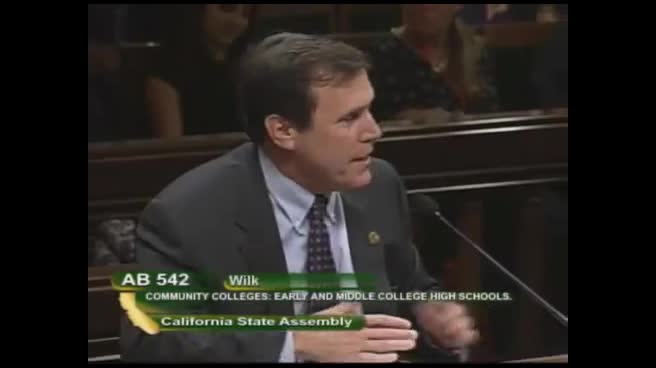
AB 542: Community colleges: early and middle college high schools.
- Session Year: 2015-2016
- House: Assembly
- Latest Version Date: 2015-07-08
Existing law authorizes the governing board of a community college district to admit to any community college under its jurisdiction as a special part-time or full-time student in any session or term any student who is eligible to attend community college pursuant to authorization given by the governing board of a school district, as specified. Existing law requires the governing board of the community college district to assign a low enrollment priority to the special part-time or full-time students, except for a student attending a middle college high school if the student is seeking to enroll in a community college course that is required for the students middle college high school program.
This bill would also except from the low enrollment priority requirement a student attending an early college high school if the student is seeking to enroll in a community college course that is required for the students early college high school program.
Existing law, for purposes of receiving state apportionments, authorizes a community college district to include high school pupils who attend a community college as special part-time or full-time students in its report of full-time equivalent students only if those pupils are enrolled in community college classes that meet certain criteria, including that if the class is a physical education class, no more than 10% of its enrollment may be comprised of special part-time or full-time students. Existing law prohibits a community college district from receiving state apportionments for special part-time and full-time students enrolled in physical education courses in excess of 5% of the community college districts total reported full-time equivalent enrollment of special part-time and full-time students.
This bill would, until January 1, 2021, provide that a student attending a middle college high school or early college high school, who is enrolled in a community college physical education course that is required for the students middle college or early college high school program, is not to be considered as a special part-time or full-time student for purposes of the 10% and 5% limits described above.
Existing law requires the Chancellor of the California Community Colleges to prepare and submit to the Department of Finance and the Legislature, on or before March 1 of each year, a report on the amount of full-time equivalent students (FTES) claimed by each community college district for special part-time and special full-time students for the preceding academic year in specified class categories.
This bill would, until January 1, 2021, additionally require that report to include the amount of FTES claimed by each community college district for students attending a middle college high school or early college high school for the preceding academic year in degree-applicable physical education courses.
Existing law authorizes the governing board of a community college district to admit to any community college under its jurisdiction as a special part-time or full-time student in any session or term any student who is eligible to attend community college pursuant to authorization given by the governing board of a school district, as specified. Existing law requires the governing board of the community college district to assign a low enrollment priority to the special part-time or full-time students, except for a student attending a middle college high school if the student is seeking to enroll in a community college course that is required for the students middle college high school program.
This bill would also except from the low enrollment priority requirement a student attending an early college high school if the student is seeking to enroll in a community college course that is required for the students early college high school program.
Existing law, for purposes of receiving state apportionments, authorizes a community college district to include high school pupils who attend a community college as special part-time or full-time students in its report of full-time equivalent students only if those pupils are enrolled in community college classes that meet certain criteria. criteria, including that if the class is a physical education class, no more than 10% of its enrollment may be comprised of special part-time or full-time students. Existing law prohibits a community college district from receiving state apportionments for special part-time and full-time students enrolled in physical education courses in excess of 5% of the community college districts total reported full-time equivalent enrollment of special part-time and full-time students.
This bill would provide that the authorization for a community college district to include high school pupils who attend a community college as special part-time or full-time students in its report of full-time equivalent students does not apply to a student attending a middle college high school or early college high school if the student school, who is enrolled in a community college physical education course that is required for the students middle college or early college high school program. program, is not to be considered as a special part-time or full-time student for purposes of the 10% and 5% limits described above.
Existing law authorizes the governing board of a community college district to admit to any community college under its jurisdiction as a special part-time or full-time student in any session or term any student who is eligible to attend community college pursuant to authorization given by the governing board of a school district, as specified. Existing law requires the governing board of the community college district to assign a low enrollment priority to the special part-time or full-time students, except for a student attending a middle college high school if the student is seeking to enroll in a community college course that is required for the students middle college high school program.
This bill would also except from the low enrollment priority requirement a student attending an early college high school if the student is seeking to enroll in a community college course that is required for the students early college high school program.
Existing law, for purposes of receiving state apportionments, authorizes a community college district to include high school pupils who attend a community college as special part-time or full-time students in its report of full-time equivalent students only if those pupils are enrolled in community college classes that meet certain criteria.
This bill would provide that the authorization for a community college district to include high school pupils who attend a community college as special part-time or full-time students in its report of full-time equivalent students does not apply to a student attending a middle college high school or early college high school if the student is enrolled in a community college course that is required for the students middle college or early college high school program.
It is the intent of the Legislature that this act eliminate statutory barriers to the operation of existing early and middle college high schools and the establishment of new early and middle college high schools.
SEC. 2.Section 76001 of the Education Code is amended to read:76001.(a)The governing board of a community college district may admit to any community college under its jurisdiction as a special part-time or full-time student in any session or term any student who is eligible to attend community college pursuant to Section 48800 or 48800.5.
(b)If the governing board of the community college district denies a request for a special part-time or full-time enrollment at a community college for a pupil who is identified as highly gifted, the governing board of the community college district shall record its findings and the reasons for denial of the request in writing within 60 days. The written recommendation and denial shall be issued at the next regularly scheduled board meeting that falls at least 30 days after the request has been submitted.
(c)The attendance of a pupil at a community college as a special part-time or full-time student pursuant to this section is authorized attendance, for which the community college shall be credited or reimbursed pursuant to Sections 48802 and 76002. Credit for courses completed shall be at the level determined to be appropriate by the school district and community college district governing boards.
(d)For purposes of this section, a special part-time student may enroll in up to, and including, 11 units per semester, or the equivalent thereof, at the community college.
(e)(1)Except as provided in paragraph (2), the governing board of a community college district shall assign a low enrollment priority to special part-time or full-time students described in subdivision (a) in order to ensure that these students do not displace regularly admitted students.
(2)This subdivision does not apply to a student attending a middle college high school as described in Section 11300, or an early college high school as described in Section 11302, if the student is seeking to enroll in a community college course that is required for the students middle college or early college high school program.
SEC. 3.Section 76002 of the Education Code is amended to read:76002.(a)For purposes of receiving state apportionments, a community college district may include high school pupils who attend a community college within the community college district pursuant to Sections 48800 and 76001 in the community college districts report of full-time equivalent students (FTES) only if those pupils are enrolled in community college classes that meet all of the following criteria:
(1)The class is open to the general public.
(2)(A)The class is advertised as open to the general public in one or more of the following:
(i)The college catalog.
(ii)The regular schedule of classes.
(iii)An addenda to the college catalog or regular schedule of classes.
(B)If a decision to offer a class on a high school campus is made after the publication of the regular schedule of classes, and the class is solely advertised to the general public through electronic media, the class shall be so advertised for a minimum of 30 continuous days before the first meeting of the class.
(3)If the class is offered at a high school campus, the class shall not be held during the time the campus is closed to the general public, as defined by the governing board of the school district during a regularly scheduled board meeting.
(4)If the class is a physical education class, no more than 10 percent of its enrollment may be comprised of special part-time or full-time students. A community college district shall not receive state apportionments for special part-time and full-time students enrolled in physical education courses in excess of 5 percent of the community college districts total reported full-time equivalent enrollment of special part-time and full-time students.
(b)A student attending a middle college high school as described in Section 11300, or an early college high school as described in Section 11302, who is enrolled in a community college physical education course that is required for the students middle college or early college high school program, shall not be considered a special part-time or full-time student for purposes of paragraph (4) of subdivision (a).
(c)The governing board of a community college district may restrict the admission or enrollment of a special part-time or full-time student during any session based on any of the following criteria:
(1)Age.
(2)Completion of a specified grade level.
(3)Demonstrated eligibility for instruction using assessment methods and procedures established pursuant to Chapter 2 (commencing with Section 78210) of Part 48 and regulations adopted by the Board of Governors of the California Community Colleges.
(d)(1)The Chancellor of the California Community Colleges shall prepare and submit to the Department of Finance and the Legislature, on or before March 1, 2004, and March 1 of each year thereafter, a report on both of the following: the
(A)The amount of FTES claimed by each community college district for special part-time and special full-time students for the preceding academic year in each of the following class categories:
(A)
(i)Noncredit.
(B)
(ii)Nondegree-applicable.
(C)
(iii)Degree-applicable, excluding physical education.
(D)
(iv)Degree-applicable physical education.
(B)The amount of FTES claimed by each community college district for students attending a middle college high school as described in Section 11300, or an early college high school as described in 11302 for the preceding academic year in degree-applicable physical education courses.
(2)The report prepared pursuant to paragraph (1) may include information required to be reported pursuant to paragraph (4) of subdivision (d) of Section 48800.
(3)A report to be submitted to the Legislature pursuant to paragraph (1) shall be submitted in compliance with Section 9795 of the Government Code.
(e)The Board of Governors of the California Community Colleges shall adopt rules and regulations to implement this section.
(f)This section shall remain in effect only until January 1, 2021, and as of that date is repealed, unless a later enacted statute, that is enacted before January 1, 2021, deletes or extends that date.
SEC. 4.Section 76002 is added to the Education Code, to read:76002.(a)For purposes of receiving state apportionments, a community college district may include high school pupils who attend a community college within the community college district pursuant to Sections 48800 and 76001 in the community college districts report of full-time equivalent students (FTES) only if those pupils are enrolled in community college classes that meet all of the following criteria:
(1)The class is open to the general public.
(2)(A) The class is advertised as open to the general public in one or more of the following:
(i)The college catalog.
(ii)The regular schedule of classes.
(iii)An addenda to the college catalog or regular schedule of classes.
(B)If a decision to offer a class on a high school campus is made after the publication of the regular schedule of classes, and the class is solely advertised to the general public through electronic media, the class shall be so advertised for a minimum of 30 continuous days before the first meeting of the class.
(3)If the class is offered at a high school campus, the class shall not be held during the time the campus is closed to the general public, as defined by the governing board of the school district during a regularly scheduled board meeting.
(4)If the class is a physical education class, no more than 10 percent of its enrollment may be comprised of special part-time or full-time students. A community college district shall not receive state apportionments for special part-time and full-time students enrolled in physical education courses in excess of 5 percent of the community college districts total reported full-time equivalent enrollment of special part-time and full-time students.
(b)The governing board of a community college district may restrict the admission or enrollment of a special part-time or full-time student during any session based on any of the following criteria:
(1)Age.
(2)Completion of a specified grade level.
(3)Demonstrated eligibility for instruction using assessment methods and procedures established pursuant to Chapter 2 (commencing with Section 78210) of Part 48 and regulations adopted by the Board of Governors of the California Community Colleges.
(c)(1) The Chancellor of the California Community Colleges shall prepare and submit to the Department of Finance and the Legislature, on or before March 1, 2021, and March 1 of each year thereafter, a report on the amount of FTES claimed by each community college district for special part-time and special full-time students for the preceding academic year in each of the following class categories:
(A)Noncredit.
(B)Nondegree-applicable.
(C)Degree-applicable, excluding physical education.
(D)Degree-applicable physical education.
(2)The report prepared pursuant to paragraph (1) may include information required to be reported pursuant to paragraph (4) of subdivision (d) of Section 48800.
(3)A report to be submitted to the Legislature pursuant to paragraph (1) shall be submitted in compliance with Section 9795 of the Government Code.
(d)The Board of Governors of the California Community Colleges shall adopt rules and regulations to implement this section.
(e)This section shall become operative on January 1, 2021.
It is the intent of the Legislature that this act eliminate statutory barriers to the operation of existing early and middle college high schools and the establishment of new early and middle college high schools.
SEC. 2.Section 76001 of the Education Code is amended to read:76001.(a)The governing board of a community college district may admit to any community college under its jurisdiction as a special part-time or full-time student in any session or term any student who is eligible to attend community college pursuant to Section 48800 or 48800.5.
(b)If the governing board of the community college district denies a request for a special part-time or full-time enrollment at a community college for a pupil who is identified as highly gifted, the governing board of the community college district shall record its findings and the reasons for denial of the request in writing within 60 days. The written recommendation and denial shall be issued at the next regularly scheduled board meeting that falls at least 30 days after the request has been submitted.
(c)The attendance of a pupil at a community college as a special part-time or full-time student pursuant to this section is authorized attendance, for which the community college shall be credited or reimbursed pursuant to Sections 48802 and 76002. Credit for courses completed shall be at the level determined to be appropriate by the school district and community college district governing boards.
(d)For purposes of this section, a special part-time student may enroll in up to, and including, 11 units per semester, or the equivalent thereof, at the community college.
(e)(1)Except as provided in paragraph (2), the governing board of a community college district shall assign a low enrollment priority to special part-time or full-time students described in subdivision (a) in order to ensure that these students do not displace regularly admitted students.
(2)This subdivision does not apply to a student attending a middle college high school as described in Section 11300, or an early college high school as described in Section 11302, if the student is seeking to enroll in a community college course that is required for the students middle college or early college high school program.
SEC. 3.Section 76002 of the Education Code is amended to read:76002.(a)For purposes of receiving state apportionments, a community college district may include high school pupils who attend a community college within the community college district pursuant to Sections 48800 and 76001 in the community college districts report of full-time equivalent students (FTES) only if those pupils are enrolled in community college classes that meet all of the following criteria:
(1)The class is open to the general public.
(2)(A)The class is advertised as open to the general public in one or more of the following:
(i)The college catalog.
(ii)The regular schedule of classes.
(iii)An addenda to the college catalog or regular schedule of classes.
(B)If a decision to offer a class on a high school campus is made after the publication of the regular schedule of classes, and the class is solely advertised to the general public through electronic media, the class shall be so advertised for a minimum of 30 continuous days before the first meeting of the class.
(3)If the class is offered at a high school campus, the class shall not be held during the time the campus is closed to the general public, as defined by the governing board of the school district during a regularly scheduled board meeting.
(4)If the class is a physical education class, no more than 10 percent of its enrollment may be comprised of special part-time or full-time students. A community college district shall not receive state apportionments for special part-time and full-time students enrolled in physical education courses in excess of 5 percent of the community college districts total reported full-time equivalent enrollment of special part-time and full-time students.
(b)Subdivision (a) does not apply to a A student attending a middle college high school as described in Section 11300, or an early college high school as described in Section 11302, if the student 11302, who is enrolled in a community college physical education course that is required for the students middle college or early college high school program. program, shall not be considered a special part-time or full-time student for purposes of paragraph (4) of subdivision (a).
(c)The governing board of a community college district may restrict the admission or enrollment of a special part-time or full-time student during any session based on any of the following criteria:
(1)Age.
(2)Completion of a specified grade level.
(3)Demonstrated eligibility for instruction using assessment methods and procedures established pursuant to Chapter 2 (commencing with Section 78210) of Part 48 and regulations adopted by the Board of Governors of the California Community Colleges.
(d)(1)The Chancellor of the California Community Colleges shall prepare and submit to the Department of Finance and the Legislature, on or before March 1, 2004, and March 1 of each year thereafter, a report on the amount of FTES claimed by each community college district for special part-time and special full-time students for the preceding academic year in each of the following class categories:
(A)Noncredit.
(B)Nondegree-applicable.
(C)Degree-applicable, excluding physical education.
(D)Degree-applicable physical education.
(2)The report prepared pursuant to paragraph (1) may include information required to be reported pursuant to paragraph (4) of subdivision (d) of Section 48800.
(e)The Board of Governors of the California Community Colleges shall adopt rules and regulations to implement this section.
It is the intent of the Legislature that this act eliminate statutory barriers to the operation of existing early and middle college high schools and the establishment of new early and middle college high schools.
SEC. 2.Section 76001 of the Education Code is amended to read:76001.(a)The governing board of a community college district may admit to any community college under its jurisdiction as a special part-time or full-time student in any session or term any student who is eligible to attend community college pursuant to Section 48800 or 48800.5.
(b)If the governing board of the community college district denies a request for a special part-time or full-time enrollment at a community college for a pupil who is identified as highly gifted, the governing board of the community college district shall record its findings and the reasons for denial of the request in writing within 60 days. The written recommendation and denial shall be issued at the next regularly scheduled board meeting that falls at least 30 days after the request has been submitted.
(c)The attendance of a pupil at a community college as a special part-time or full-time student pursuant to this section is authorized attendance, for which the community college shall be credited or reimbursed pursuant to Sections 48802 and 76002. Credit for courses completed shall be at the level determined to be appropriate by the school district and community college district governing boards.
(d)For purposes of this section, a special part-time student may enroll in up to, and including, 11 units per semester, or the equivalent thereof, at the community college.
(e)(1)Except as provided in paragraph (2), the governing board of a community college district shall assign a low enrollment priority to special part-time or full-time students described in subdivision (a) in order to ensure that these students do not displace regularly admitted students.
(2)This subdivision does not apply to a student attending a middle college high school as described in Section 11300, or an early college high school as described in Section 11302, if the student is seeking to enroll in a community college course that is required for the students middle college or early college high school program.
SEC. 3.Section 76002 of the Education Code is amended to read:76002.(a)For the purposes of receiving state apportionments, a community college district may include high school pupils who attend a community college within the community college district pursuant to Sections 48800 and 76001 in the community college districts report of full-time equivalent students (FTES) only if those pupils are enrolled in community college classes that meet all of the following criteria:
(1)The class is open to the general public.
(2)(A)The class is advertised as open to the general public in one or more of the following:
(i)The college catalog.
(ii)The regular schedule of classes.
(iii)An addenda to the college catalog or regular schedule of classes.
(B)If a decision to offer a class on a high school campus is made after the publication of the regular schedule of classes, and the class is solely advertised to the general public through electronic media, the class shall be so advertised for a minimum of 30 continuous days prior to before the first meeting of the class.
(3)If the class is offered at a high school campus, the class shall not be held during the time the campus is closed to the general public, as defined by the governing board of the school district during a regularly scheduled board meeting.
(4)If the class is a physical education class, no more than 10 percent of its enrollment may be comprised of special part-time or full-time students. A community college district shall not receive state apportionments for special part-time and full-time students enrolled in physical education courses in excess of 5 percent of the community college districts total reported full-time equivalent enrollment of special part-time and full-time students.
(b)Subdivision (a) does not apply to a student attending a middle college high school as described in Section 11300, or an early college high school as described in Section 11302, if the student is enrolled in a community college course that is required for the students middle college or early college high school program.
(b)
(c)The governing board of a community college district may restrict the admission or enrollment of a special part-time or full-time student during any session based on any of the following criteria:
(1)Age.
(2)Completion of a specified grade level.
(3)Demonstrated eligibility for instruction using assessment methods and procedures established pursuant to Chapter 2 (commencing with Section 78210) of Part 48 and regulations adopted by the Board of Governors of the California Community Colleges.
(c)
(d)(1)The Chancellor of the California Community Colleges shall prepare and submit to the Department of Finance and the Legislature, on or before March 1, 2004, and March 1 of each year thereafter, a report on the amount of FTES claimed by each community college district for special part-time and special full-time students for the preceding academic year in each of the following class categories:
(A)Noncredit.
(B)Nondegree-applicable.
(C)Degree-applicable, excluding physical education.
(D)Degree-applicable physical education.
(2)The report prepared pursuant to paragraph (1) may include information required to be reported pursuant to paragraph (4) of subdivision (d) of Section 48800.
(d)
(e)The Board of Governors of the California Community Colleges shall adopt rules and regulations to implement this section.
|
Date
|
Status
|
|---|---|
| May 28, 2015 | Read second time. Ordered to third reading. |
| Aug 27, 2015 | In committee: Held under submission. |
| Aug 17, 2015 | In committee: Referred to APPR. suspense file. |
| Jul 8, 2015 | Read second time and amended. Re-referred to Com. on APPR. |
| Jul 7, 2015 | From committee: Amend, and do pass as amended and re-refer to Com. on APPR. (Ayes 7. Noes 0.) (July 1). |
| Jun 11, 2015 | Referred to Com. on ED. |
| Jun 1, 2015 | Read third time. Passed. Ordered to the Senate. (Ayes 80. Noes 0. Page 1712.) |
| Jun 1, 2015 | Read third time. Passed. Ordered to the Senate. |
| Jun 1, 2015 | In Senate. Read first time. To Com. on RLS. for assignment. |
| Feb 23, 2015 | Read first time. To print. |
| May 28, 2015 | From committee: Do pass. (Ayes 17. Noes 0.) (May 28). |
| Apr 22, 2015 | In committee: Set, first hearing. Referred to APPR. suspense file. |
| Apr 8, 2015 | From committee: Do pass and re-refer to Com. on APPR. (Ayes 13. Noes 0.) (April 7). Re-referred to Com. on APPR. |
| Mar 24, 2015 | Re-referred to Com. on HIGHER ED. |
| Mar 23, 2015 | From committee chair, with author's amendments: Amend, and re-refer to Com. on HIGHER ED. Read second time and amended. |
| Mar 5, 2015 | Referred to Com. on HIGHER ED. |
| Feb 24, 2015 | From printer. May be heard in committee March 26. |
|
Date
|
Description
|
Location
|
Votes
|
|
|---|---|---|---|---|
| Aug 17, 2015 | Placed on suspense file | Senate Standing Committee on Appropriations |
Passed |
|
| Jul 1, 2015 | Do pass as amended, but first amend, and re-refer to the Committee on [Appropriations] | Senate Standing Committee on Education |
Passed |
|
| Jun 1, 2015 | AB 542 WILK Assembly Third Reading | Assembly Floor |
Passed |
|
| May 28, 2015 | Do pass. | Assembly Standing Committee on Appropriations |
Passed |
|
| Apr 7, 2015 | Do pass and be re-referred to the Committee on [Appropriations] | Assembly Standing Committee on Higher Education |
Passed |
This list shows positions taken on this bill by organizations on the date displayed, which is linked to the original source.
Positions by individuals are not included.
|
Organization
|
Position
|
Date
|
|---|---|---|
| California School Board Association | * Support | Aug 17, 2015 |
| California School Boards Association | * Support | Aug 17, 2015 |
| College of the Canyons | * Support | Aug 17, 2015 |
| u None received. | ** Against | Jul 1, 2015 |
AB 542 (Wilk) Page 3 of 3
SENATE COMMITTEE ON APPROPRIATIONS
Senator Ricardo Lara, Chair
2015 - 2016 Regular Session
AB 542 (Wilk) - Community colleges: early and middle college high schools.
|
|
Version: July 8, 2015 |
Policy Vote: ED. 7 - 0 |
Urgency: No |
Mandate: No |
Hearing Date: August 17, 2015 |
Consultant: Jillian Kissee |
This bill meets the criteria for referral to the Suspense File.
Bill Summary:
This bill: (1) exempts Early College High School students from the requirement that a community college district governing board assign a low enrollment priority to special part-time or full-time students; and (2) prohibits a student enrolled in a community college physical education (PE) course required for the student’s middle college or early college high school program from being considered a special part-time or full-time student, thereby excluding these students from the cap on PE courses for which the community college can claim full-time equivalent students (FTES) and receive associated state apportionments.
Fiscal Impact:
Unknown, likely significant Proposition 98 cost pressure to fund increased community college apportionments. If community college districts claimed an additional 10 percent full-time equivalent students for special part-time and full-time enrollment PE courses over the amount reported in 2013-14; this could create a cost pressure to provide about $267,000 in additional state apportionments. See staff comments.
Background:
Existing law allows the governing board of a school district, upon recommendation of the principal of the student’s school and with parental consent, to attend a community college as a special part-time or full-time student and to undertake one or more courses of instruction. (Education Code § 48800 et seq.)
A
parent or guardian of a student may petition the governing board of
the school district to authorize the attendance of the student at a
community college as a special full-time student on the ground that
the student would benefit from the advanced scholastic or vocational
work. A community college is credited with additional units of
average daily attendance attributable to the attendance of special
full-time students at the community college, except for the
enrollment and apportionment caps related to physical education (PE)
courses. (EC § 48800.5)
Existing law authorizes a community college district governing board to admit as a special part-time or full-time student any student eligible, as specified, and requires the governing board of a California Community College district to assign these students a low enrollment priority in order to ensure that they do not displace regularly admitted community college students. An exemption to this requirement is extended to Middle College High School (MCHS) students. (EC § 76001)
Early
College High Schools are small, autonomous schools that blend high
school and college into a coherent educational program. They are
designed so that all students can achieve two years of college credit
at the same time they are earning a high school diploma (within four
to five years of entering ninth grade). Early College High Schools
are designed to target pupils from backgrounds that are
underrepresented in postsecondary education, including students who
have not had access to the academic preparation needed to meet
college readiness standards, students for whom the cost of college is
prohibitive, students of color, first generation college-goers, and
English language learners. Early college high schools are not
necessarily co-located on a community college campus, and there is no
requirement to be near a community college.
Middle
College High School is a collaborative program that enables
high-potential, “at risk” students to obtain a high school
education while concurrently receiving direct access to college
courses and services. The high school is typically located on and
integrated into the community college environment, wherein high
school students attend classes at a community college and earn credit
toward a high school diploma while having the opportunity to
concurrently take college courses and to receive more intensive
counseling and administrative attention.
Proposed Law:
This bill lessens restrictions on special part-time and full-time students that attend an ECHS or MCHS until January 1, 2021. This bill includes special part-time or full-time community college students who attend an early college high school from the requirement that they be assigned a low enrollment priority by the community college district.
This bill declares that a student attending MCHS or ECHS is not considered a special part-time or full-time student for purposes of the 10 percent enrollment cap set for these students in a physical education class and the cap on state apportionments the CCD can receive for these students enrolled in physical education courses which is no more than 5 percent of the CCD’s total reported full-time equivalent enrollment of these students. In order to be exempt, these PE courses must be part of the student’s middle college or early college high school program.
This bill requires the annual report prepared by the Chancellor of the California Community Colleges and submitted to the Department of Finance and the Legislature to include the amount of full-time equivalent students claimed by each CCD attending a middle college high school or an early college high school in the prior year for “degree-applicable” PE courses.
Related Legislation:
AB 2352 (Chesbro, 2014) exempted a student attending an ECHS from being assigned a low priority for community college enrollment, and authorized districts to claim apportionment funding for MCHS and ECHS students if the courses did not comply with existing statutory criteria applicable to other high school students taking community college courses. AB 2352 failed passage in this Committee.
Staff Comments:
This bill exempts ECHS students from low enrollment priority when seeking to enroll in a community college course that is required for the student’s ECHS program, which will make it easier for some high school students to enroll in certain courses and could displace other traditional adult community college students. This bill also exempts ECHS and MCHS students from restrictions on their enrollment and allows colleges to claim them as full-time equivalent students for purposes of state apportionments in community college PE courses, making it easier to enroll in PE courses. All of these changes are intended to make it easier to provide community college course instruction to high school students, with community college apportionment funds.
The cost is of these changes is unknown because it depends on how the changes affect enrollment. According to the report required of the Community College Chancellor’s Office in existing law regarding the number of full-time equivalent students for special part-time and full-time enrollment in PE courses, 567 were reported in 2013-14 as compared to 10,658 in 2002-03 when fewer restrictions were in place. It is unclear whether these reported full-time equivalent students are attributable to the MCHS or the ECHS student enrollments. However, if community college districts claim an additional 10 percent full-time equivalent students over 2013-14 for PE course enrollments; this could create a cost pressure to provide about $267,000 in additional state apportionments using a rate of $4,684 per full-time equivalent student.
To the extent that this bill results in more students earning college credits, students may move through a public postsecondary institution more quickly in the future, which may contribute to future cost savings from reduced time in college (which may also lead to less time receiving state-funded financial aid). However, this assumes the college credits earned through MCHS or the ECHS are recognized by the postsecondary institution to which the credits are transferred and students do not take excess courses at the institution.
-- END --
AB 542 (Wilk) Page 4 of 4
SENATE COMMITTEE ON EDUCATION
Senator Carol Liu, Chair
2015 - 2016 Regular
Bill No: AB 542
Author: |
Wilk |
||
Version: |
March 23, 2015 Hearing Date: July 1, 2015 |
||
Urgency: |
No |
Fiscal: |
Yes |
Consultant: |
Kathleen Chavira |
||
Subject: Community colleges: early and middle college high schools
SUMMARY
This bill exempts Early College High School students from the requirement that a community school district governing board assign a low enrollment priority to special part-time or full-time students and prohibits a student enrolled in a community college physical education (PE) course required for the student’s middle college or early college high school program from being considered a special part-time or full-time student, thereby excluding these students from the cap on PE courses for which the community college can claim full-time equivalent students (FTES).
BACKGROUND
Existing law:
Authorizes the governing board of a school district, upon recommendation of the principal of a pupil’s school and with parental consent, to authorize a student to concurrently enroll in a community college during any session or term to undertake one or more courses of instruction. (Education Code § 48800 et seq.)
Authorizes a community college district governing board to admit as a special part-time or full-time student any student eligible pursuant to EC 48800 and requires the governing board of a California Community College district to assign these students a low enrollment priority in order to ensure that these students do not displace regularly admitted community college students. An exemption to this requirement is extended to Middle College High School (MCHS) students. (EC § 76001)
Restricts the proportion of a community college PE class that may be comprised of special part-time or full-time students to 10 percent and caps the amount of state apportionment that may be claimed for these students at no more than 5 percent of the district’s total reported full-time equivalent enrollment of special part-time and full-time students. (EC § 76002)
Establishes Middle College High Schools as broad-based comprehensive instructional programs focusing on college preparatory and school-to-work curricula, career education, work experience, community service, and support and motivational activities. (EC § 11300)
Existing law declares that early college high schools (ECHS) are innovative partnerships between public secondary schools and a local community college,
California State University of California or University of California, that allow students to earn up to two years of college credit at the same time they are earning a high school diploma. Early college high schools (ECHS) are small autonomous schools that blend high school and college into a coherent educational program.
(EC §11302)
ANALYSIS
This bill relaxes the restrictions on community college enrollment of special part-time and full-time students enrolled in middle college and early college high schools. It:
Exempts special part-time or full-time community college students who attend an early college high school from the requirement that they be assigned a low enrollment priority by the community college district.
Declares that a student attending middle college high school or early college high school is not considered a special part-time or full-time student for purposes of the enrollment and apportionment caps on community college PE courses if the PE course is required for the student’s high school program, thereby excluding these students from the caps on PE courses for which the community college can claim full-time equivalent students (FTES).
Eliminates any cap on enrollment or apportionment funding applicable to special part-time and full-time students in community college PE courses for students attending middle college, or early college high schools.
STAFF COMMENTS
Need for the bill. According to the author’s office, AB 230 (Carter, Chapter 50, Statues of 2011), extended the exemption from low priority enrollment status to Middle College High School (MCHS) students and this bill will bring parity to ECHS students by extending them the same exemption. In addition, the author is concerned that students enrolled in ECHS and MCHS programs located on community college campuses do not have access to high school PE facilities yet must complete PE courses to meet state level high school graduation requirements. Currently community colleges that provide these classes are not reimbursed for providing them to these students. This bill would ensure community colleges receive funding for providing PE courses to these students.
Related History. In December 2002, the Orange County Register ran the first in a series of highly critical articles regarding concurrent enrollment practices in the community colleges. The articles specifically focused on high school PE classes and various suspected abuses, including "phantom" classes that were apparently never held.
These anecdotal allegations resulted in a Chancellor’s Office investigation which revealed that FTES generated by concurrent enrollment in both credit and noncredit courses grew from approximately 16,000 in 1992-93 to over 52,000 in 2000-01, outpacing the overall enrollment growth of the community college system. While concurrent enrollment included courses in a variety of curricular areas, there had been significant growth in concurrent enrollment in physical education (PE) courses. The proportion of full-time equivalent students (FTES) for concurrent enrollment in PE courses was approximately 15 percent in 1992-93, but these courses comprised 34 percent of FTES for concurrent enrollment in 2000-01, the equivalent of 1.7 percent of all the FTES generated by the community colleges as a system. The expansion of concurrent enrollment in PE courses was more pronounced in about one-fifth (20 percent) of the system’s 72 districts and was especially evident with respect to PE programs. By 2001-02, six districts within the system produced 53 percent of the PE concurrent enrollment FTES generated by the entire system for that year. These districts included Los Angeles, Butte, North Orange, Contra Costa, Santa Clarita, and Mt. San Antonio.
As a result, SB 338 (Scott, Chapter 786, Statutes of 2003) was enacted to specify the conditions whereby concurrent enrollment of pupils between a school and community college district is permitted, establish restrictions on the amount of FTES that could be claimed for PE courses, and require annual reporting by the Chancellor of the amount of FTES claimed by each district for special full-time and special part-time students overall and for PE courses specifically.
Middle College High School (MCHS)/Early College High School (ECHS). According to Jobs for the Future, a nonprofit organization which launched the ECHS initiative in 2002, there are currently 40 ECHS in California, of which 92 percent are partnered with a community college. The demographic make-up of the ECHS students in the 40 schools in California is as follows: 60 percent are Latino; 17 percent are White; 9 percent are Black; and, 6 percent are Asian. There are 40 ECHS in California according to the Jobs for the Future.
ECHS are designed for young people who are underrepresented in postsecondary education, including students who have not had access to the academic preparation needed to meet college readiness standards, students for whom the cost of college is prohibitive, students of color, first generation college-goers, and English language learners.
According to the Chancellor’s Office, Middle College High School is a collaborative program that enables high-potential, "at-risk" students to obtain a high school education while concurrently receiving direct access to college courses and services. The high school is located on and integrated into the community college environment, whereby high school students attend classes at a community college and earn credit toward a high school diploma while having the opportunity to concurrently take college courses and to receive more intensive counseling and administrative attention. According to the Chancellor’s Office 9 community colleges offer recognized middle college programs. These include College of the Canyons, Contra Costa College, Grossmont College, Los Angeles Harbor College, Reedley College, San Bernardino Valley College, San Joaquin Delta College, Santa Ana College, and West Hills College – Lemoore.
Reporting? Current law requires an annual report on the amount of FTES claimed for special part-time and full-time students by each district in the preceding academic year, and specifically requires reporting on degree-applicable physical education FTES. According to the report, full-time equivalent students (FTES) for special part-time and full-time enrollment in physical education (PE) courses has gone from a high of 10,658 in 2002-03 to a low of 567 in 2013-14. It is unclear whether any of the existing FTES is attributable to Middle College High School (MCHS) and Early College High School (ECHS) student enrollments. It is also unclear how many of these students currently meet their PE requirements by taking these courses at their high schools. Would this bill create an incentive for ECHS and MCHS programs to expand enrollment in community college PE courses? How much community college FTES should be used to fund PE instruction for special part-time and full-time students? In light of the extensive issues with concurrent enrollment PE classes in the past, what is the potential for abuse of this new authority?
Staff recommends the bill be amended to expand the reporting requirements in 76002 (d) to specifically include FTES claimed for degree applicable PE courses in ECHS and MCHS programs. Staff further recommends the bill be amended to sunset the authority in 2021, pending a review of these reporting results.
Prior legislation. AB 2352 (Chesbro, 2014) exempted a student attending an ECHS from lower community college enrollment status, and authorized districts to claim apportionment funding for MCHS and ECHS students for courses required for the students' program even if the courses did not comply with existing statutory criteria applicable to other high school students taking community college courses. AB 2352 was heard and passed by this committee by a vote of 6-0 but was subsequently held in the Senate Appropriations Committee.
SUPPORT
California School Boards Association
College of the Canyons
OPPOSITION
None received.
-- END --
AB 542
Page 3
ASSEMBLY THIRD READING
AB 542
(Wilk)
As Amended March 23, 2015
Majority vote
Committee |
Votes |
Ayes |
Noes |
Higher Education |
13-0 |
Medina, Baker, Bloom, Chávez, Harper, Irwin, Jones-Sawyer, Levine, Linder, Low, Santiago, Weber, Williams |
|
Appropriations |
17-0 |
Gomez, Bigelow, Bonta, Calderon, Chang, Daly, Eggman, Gallagher, Eduardo Garcia, Gordon, Holden, Jones, Quirk, Rendon, Wagner, Weber, Wood |
|
SUMMARY: Allows a student attending an early or middle college high school (E/MCHS), who is enrolled in a community college physical education (P. E.) course that is required for the student's E/MCHS program, to not be considered as a special part-time or full-time student for purposes of existing percentage caps for special part-time and full-time students. Specifically, this bill:
Expresses that the Legislature intends for this measure to eliminate statutory barriers to the operation of existing and the establishment of new E/MCHSs.
Specifies if a student is attending an ECHS and is seeking enrollment in a community college course that is required for the student's ECHS program, he/she will not be assigned a low enrollment priority.
Specifies a student attending a(n) E/MCHS, as specified, who is enrolled in a community college P. E. course that is required for the student's E/MCHS program, shall not be considered a special part-time or full-time student for purposes of percentage caps for special part-time and full-time students (as described below in "existing law" section of this analysis).
Makes clarifying and technical changes to existing law.
EXISTING LAW:
Establishes MCHS as broad-based comprehensive instructional programs focusing on college preparatory and school-to-work curricula, career education, work experience, community service, and support and motivational activities; and declares ECHS to be autonomous schools that blend high school and college into a coherent educational program – specifying that ECHS pupils should begin taking college courses as soon as they demonstrate readiness and the college credit earned may be applied toward completing an associate or bachelor’s degree, transfer to a four-year university, or obtaining a skills certificate (Education Code (EC) Sections 11300 and 11302).
Provides opportunities for minor students to enroll in college-level, degree-applicable courses for advanced scholastic or advanced vocational purposes while they are in high school and authorizes the governing board of a school district, upon recommendation of the principal of a pupil’s school and with parental consent, to authorize a student to concurrently enroll in a community college during any session or term to undertake one or more courses of instruction (EC Section 48800, et. seq.).
Requires the California Community Colleges (CCC) Chancellor’s Office to report to the Department of Finance and Legislature annually on the amount of full-time equivalent students (FTES) claimed by each CCC district for high school pupils enrolled in non-credit, non-degree applicable, and degree applicable courses; and provides that, for purposes of receiving state apportionments, CCC districts may only include high school students within the CCC district's report on FTES if the students are enrolled in courses that are open to the general public, as specified. Additionally, current law requires the governing board of a CCC district to assign a low enrollment priority to special part-time or full-time students in order to ensure that these students do not displace regularly admitted community college students; and, specifies that if the class is a P. E. class, no more than 10% of its enrollment may be comprised of special part-time or full-time students and that a community college district shall not receive state apportionment for special part-time and full-time students enrolled in P. E. courses in excess of 5% of the district's total reported full time equivalent enrollment of special part-time and full-time students. To note, current law exempts MCHS students from being assigned low enrollment priority if they are seeking to enroll in a CCC course that is required for their MCHS program (EC Sections 76001 and 76002).
FISCAL EFFECT: According to the Assembly Appropriations Committee, to the extent districts can claim additional apportionment funding for E/MCHS students, there will be increased General Fund (Prop 98) costs. The equivalent of only 33 additional FTES statewide, at the current funding rate of $4,676 per FTES would exceed $150,000. (Total E/MCHS credit enrollment at the CCC is unknown, but estimated at 2,000 to 4,000 FTES.) To the extent, however, that community colleges as a whole are already using all state funds apportioned for enrollment, the bill will result in additional unknown Prop 98 cost pressures.
COMMENTS: Purpose of this measure. According to the author, "AB 542 will allow community colleges to receive funding for providing P. E. courses for Early College and Middle College High School students since they are responsible for completing the Physical Education requirement to meet state standards. The bill will only apply to community colleges that have an Early College High School or a Middle College High School and only exempts those students from the cap on both enrollment and apportionment funding. The caps will remain in place for other concurrently enrolled students."
Early and middle college high schools. E/MCHS operate in a similar manner to provide high school pupils opportunities to take college courses while still in high school as part of an integrated program. According to 2013 to 2014 data from ECHS programs, the ECHS programs are reaching their target populations; nationally, roughly three-fourths of high school pupils attending ECHS are students of color, while nearly 60% report eligibility for free or reduced-priced lunch. Most students attending ECHS will be the first in their families to go to college. Currently, there are 40 ECHS in California. The demographic make-up of the ECHS students in the 40 schools in California is as follows: 59.52% are Latino; 17.41% are White; 8.57% are Black; and, 6.47% are Asian. To note, 92% of the 40 schools are currently partnered with a CCC.
Challenges for E/MCHS students. High school pupils participating in E/MCHS programs are considered special part-time or full-time students for purposes of attending a community college to fulfill the college aspect of the program. According to the author, most students who attend a(n) E/MCHS program attend their courses on a community college campus, but because current law caps how many high school pupils can enroll in community college P. E. courses, and how many students the community college can receive apportionment funding for, E/MCHS students are experiencing great difficulties in gaining access to needed P. E. courses.
Additionally, by providing ECHS students an exemption from the low enrollment priority requirement, this bill will give ECHS students an opportunity to complete their programs in a timely manner. AB 230 (Carter), Chapter 50, Statues of 2011, allowed MCHS students this exemption, but not ECHS students; this bill will bring parity to ECHS students.
Concurrent enrollment abuse? As drafted, this measure will lift the existing caps on P. E. courses offered to special part-time and full-time students and the apportionment dollars community colleges can claim, if the students are taking the course as needed for their E/MCHS program. Will passage of this measure create course abuse as was experienced in the early turn of this century whereby legislation was enacted to curb concurrent enrollment abuses?
To address the potential reoccurrence of P. E. course abuse, the Legislature may wish to have specific reporting requirements added to this measure in order to monitor and track the P. E. courses offered and taken by E/MCHS students and the apportionment dollars claimed by community colleges.
Analysis Prepared by: Jeanice Warden / HIGHER ED. / (916) 319-3960 FN: 0000755
AB 542
Page 2
Date of Hearing: April 22, 2015
ASSEMBLY COMMITTEE ON APPROPRIATIONS
Jimmy Gomez, Chair
AB 542
(Wilk) – As Amended March 23, 2015
Policy Committee: |
Higher Education |
Vote: |
13 - 0 |
|
|
|
|
|
|
|
|
Urgency: No State Mandated Local Program: No Reimbursable: No
SUMMARY:
This bill:
Allows a student attending an early or middle college high school (E/MCHS), who is enrolled in a community college physical education (P. E.) course required for the student's E/MCHS program, to not be considered as a special part-time or full-time student for purposes of existing enrollment caps on special part-time and full-time students.
Specifies that a student attending an ECHS and seeking enrollment in a community college course required for the student's ECHS program will not be assigned a low enrollment priority.
FISCAL EFFECT:
To the extent districts can claim additional apportionment funding for E/MCHS students, there will be increased General Fund (Prop 98) costs. The equivalent of only 33 additional full-time equivalent students (FTES) statewide, at the current funding rate of $4,676 per FTES would exceed $150,000. (Total E/MCHS credit enrollment at the CCC is unknown, but estimated at 2,000 to 4, 000 FTES.) To the extent, however, that community colleges as a whole are already using all state funds apportioned for enrollment, the bill will result in additional unknown Prop 98 cost pressure.
COMMENTS:
Background. Concurrent enrollment provides pupils the opportunity to enroll in college courses and earn college credit while still enrolled in high school. A pupil is allowed to concurrently enroll in a CCC as a "special admit" while still attending high school, if the pupil's school district determines that the pupil would benefit from "advanced scholastic or vocational work." Special-admit students have typically been advanced pupils wanting to take more challenging coursework or pupils who come from high schools where Advanced Placement or honors courses are not widely available.
Early College High Schools are small, autonomous schools that blend high school and college into a coherent educational program. They are designed so that all students can achieve two years of college credit at the same time they are earning a high school diploma (within four to five years of entering ninth grade). By reaching out to middle schools or starting with the seventh grade and providing extensive support, Early College High Schools ensure that all students are ready for college-level courses in high school.
Middle College High School is a collaborative program that enables high-potential, "at-risk" students to obtain a high school education while concurrently receiving direct access to college courses and services. The high school is located on, and is integrated into, the community college environment, whereby high school students attend classes at a community college and earn credit toward a high school diploma while having the opportunity to concurrently take college courses and to receive more intensive counseling and administrative attention.
In 2002, legislation was enacted to limit concurrent enrollment levels after concerns were raised about a number of community college districts claiming state funding for high school students taking physical education courses.
Purpose. According to the author, "AB 542 will allow community colleges to receive funding for providing P. E. courses for Early College and Middle College High School students since they are responsible for completing the Physical Education requirement to meet state standards. The bill will only apply to community colleges that have an Early College High School or a Middle College High School and only exempts those students from the cap on both enrollment and apportionment funding. The caps will remain in place for other concurrently enrolled students."
The author asserts that most students who attend a(n) E/MCHS program attend courses on a community college campus, but because current law caps how many high school pupils can enroll in community college P. E. courses, E/MCHS students are experiencing great difficulties in gaining access to needed required P. E. courses.
AB 230 (Carter)/ Statues of 2011, provided MCHS students with an exemption to the low priority designation. AB 2352 provides this same exemption to ECHS students, thus giving them a better opportunity to complete their programs in a timely manner.
Analysis Prepared by: Chuck Nicol / APPR. / (916) 319-2081
AB 542
Page 3
Date of Hearing: April 7, 2015
ASSEMBLY COMMITTEE ON HIGHER EDUCATION
Jose Medina, Chair
AB 542
(Wilk) – As Amended March 23, 2015
SUBJECT: Community colleges: early and middle college high schools
SUMMARY: Allows a student attending an early or middle college high school (E/MCHS), who is enrolled in a community college physical education (P. E.) course that is required for the student's E/MCHS program, to not be considered as a special part-time or full-time student for purposes of existing percentage caps for special part-time and full-time students. Specifically, this bill:
Expresses that the Legislature intends for this measure to eliminate statutory barriers to the operation of existing and the establishment of new E/MCHSs.
Specifies if a student is attending an ECHS and is seeking enrollment in a community college course that is required for the student's ECHS program, he/she will not be assigned a low enrollment priority.
Specifies a student attending a(n) E/MCHS, as specified, who is enrolled in a community college P. E. course that is required for the student's E/MCHS program, shall not be considered a special part-time or full-time student for purposes of percentage caps for special part-time and full-time students (as described below in "existing law" section of this analysis).
Makes clarifying and technical changes to existing law.
EXISTING LAW:
Establishes MCHS as broad-based comprehensive instructional programs focusing on college preparatory and school-to-work curricula, career education, work experience, community service, and support and motivational activities; and declares ECHS to be autonomous schools that blend high school and college into a coherent educational program – specifying that ECHS pupils should begin taking college courses as soon as they demonstrate readiness and the college credit earned may be applied toward completing an associate or bachelor’s degree, transfer to a four-year university, or obtaining a skills certificate (Education Code Sections 11300 and 11302).
Provides opportunities for minor students to enroll in college-level, degree-applicable courses for advanced scholastic or advanced vocational purposes while they are in high school and authorizes the governing board of a school district, upon recommendation of the principal of a pupil’s school and with parental consent, to authorize a student to concurrently enroll in a community college during any session or term to undertake one or more courses of instruction (EC Section 48800, et. seq.).
Requires the California Community Colleges (CCC) Chancellor’s Office to report to the Department of Finance and Legislature annually on the amount of full-time equivalent students (FTES) claimed by each CCC district for high school pupils enrolled in non-credit, non-degree applicable, and degree applicable courses; and provides that, for purposes of receiving state apportionments, CCC districts may only include high school students within the CCC district’s report on FTES if the students are enrolled in courses that are open to the general public, as specified. Additionally, current law requires the governing board of a CCC district to assign a low enrollment priority to special part-time or full-time students in order to ensure that these students do not displace regularly admitted community college students; and, specifies that if the class is a P. E. class, no more than 10 percent of its enrollment may be comprised of special part-time or full-time students and that a community college district shall not receive state apportionment for special part-time and full-time students enrolled in P. E. courses in excess of five percent of the district's total reported full time equivalent enrollment of special part-time and full-time students. To note, current law exempts MCHS students from being assigned low enrollment priority if they are seeking to enroll in a CCC course that is required for their MCHS program (EC Sections 76001 and 76002).
FISCAL EFFECT: Unknown
COMMENTS: Purpose of this measure. According to the author, "AB 542 will allow community colleges to receive funding for providing P. E. courses for Early College and Middle College High School students since they are responsible for completing the Physical Education requirement to meet state standards. The bill will only apply to community colleges that have an Early College High School or a Middle College High School and only exempts those students from the cap on both enrollment and apportionment funding. The caps will remain in place for other concurrently enrolled students."
Early and
middle college high schools. E/MCHS operate in a similar manner
to provide high school pupils opportunities to take college courses
while still in high school as part of an integrated program.
According to 2013-2014 data from ECHS programs, the ECHS programs are
reaching their target populations; nationally, roughly three-fourths
of high school pupils attending ECHS are students of color, while
nearly 60% report eligibility for free or reduced-priced lunch. Most
students attending ECHS will be the first in their families to go to
college. Currently, there are 40 ECHS in California. The
demographic make-up of the ECHS students in the 40 schools in
California is as follows: 59.52% are Latino; 17.41% are White; 8.57%
are Black; and, 6.47% are Asian. To note, 92% of the 40 schools are
currently partnered with a CCC.
Challenges for E/MCHS students. High school pupils participating in E/MCHS programs are considered special part-time or full-time students for purposes of attending a community college to fulfill the college aspect of the program. According to the author, most students who attend a(n) E/MCHS program attend their courses on a community college campus, but because current law caps how many high school pupils can enroll in community college P. E. courses, and how many students the community college can receive apportionment funding for, E/MCHS students are experiencing great difficulties in gaining access to needed P. E. courses.
Additionally, by providing ECHS students an exemption from the low enrollment priority requirement, this bill will give ECHS students an opportunity to complete their programs in a timely manner. AB 230 (Carter, Chapter 50, Statues of 2011), allowed MCHS students this exemption, but not ECHS students; this bill will bring parity to ECHS students.
Committee consideration. Concurrent enrollment abuse? As drafted, this measure will lift the existing caps on P. E. courses offered to special part-time and full-time students and the apportionment dollars community colleges can claim, if the students are taking the course as needed for their E/MCHS program. Will passage of this measure create course abuse as was experienced in the early turn of this century whereby legislation was enacted to curb concurrent enrollment abuses?
To address the potential reoccurrence of P. E. course abuse, the Committee may wish to have specific reporting requirements added to this measure in order to monitor and track the P. E. courses offered and taken by E/MCHS students and the apportionment dollars claimed by community colleges.
Conflicting legislation. AB 288 (Holden) and AB 889 (Chang), which will both be heard today by this Committee, seek to amend and address some of the same code sections as this measure, addressing special part-time or full-time students and E/MCHS students.
Staff recommends, should all the measures pass out of this Committee, that they eventually be amended to address potential chaptering out issues.
REGISTERED SUPPORT / OPPOSITION:
Support
College of the Canyons
Opposition
None on file.
Analysis Prepared by: Jeanice Warden / HIGHER ED. / (916) 319-3960
Discussed in Hearing
 3MIN
Senate Standing Committee on Appropriations
 5MIN
Senate Standing Committee on Education
 57SEC
Assembly Floor
 2MIN
Assembly Standing Committee on Appropriations
 1MIN
Assembly Standing Committee on Higher Education
Bill Author

Bill Co-Author(s):