AB 904: Air Quality Improvement Program: Clean Reused Vehicle Rebate Project.
- Session Year: 2015-2016
- House: Assembly
- Latest Version Date: 2015-07-13
Existing law establishes the Air Quality Improvement Program that is administered by the State Air Resources Board for the purposes of funding projects related to, among other things, the reduction of criteria air pollutants and improvement of air quality. Pursuant to its existing statutory authority, the state board has established the Clean Vehicle Rebate Project, as a part of the Air Quality Improvement Program, to promote the production and use of zero-emission vehicles by providing rebates for the purchase of new zero-emission vehicles.
This bill would require the state board to establish the Clean Reused Vehicle Rebate Project, as a part of the Air Quality Improvement Program, to provide rebates or other incentives for the acquisition of an eligible used vehicle, as defined; the replacement or refurbishment of a battery and related components for an eligible used vehicle or an extended warranty for the battery or related components; or an extended service warranty to cover unexpected vehicle repairs not covered by the manufacturers warranty related to unique problems in eligible used vehicles, as specified.
Existing law establishes the Air Quality Improvement Program that is administered by the State Air Resources Board for the purposes of funding projects related to, among other things, the reduction of criteria air pollutants and improvement of air quality. Pursuant to its existing statutory authority, the state board has established the Clean Vehicle Rebate Project, as a part of the Air Quality Improvement Program, to promote the production and use of zero-emission vehicles by providing rebates for the purchase of new zero-emission vehicles.
This bill would require the state board to establish the Clean Reused Vehicle Rebate Project, as a part of the Air Quality Improvement Program, to provide rebates or other incentives for the purchase acquisition of an eligible used vehicle or, as defined; the replacement or refurbishment of a battery and related components for an electric eligible used vehicle, or an extended warranty for the battery or related components; or an extended service warranty to cover unexpected vehicle repairs not covered by the manufacturers warranty related to unique problems in eligible used vehicles, as specified.
Existing law establishes the Air Quality Improvement Program that is administered by the State Air Resources Board for the purposes of funding projects related to, among other things, the reduction of criteria air pollutants and improvement of air quality. Pursuant to its existing statutory authority, the state board has established the Clean Vehicle Rebate Project, as a part of the Air Quality Improvement Program, to promote the production and use of zero-emission vehicles by providing rebates for the purchase of new zero-emission vehicles.
This bill would require the state board to establish the Clean Reused Vehicle Rebate Project, as a part of the Air Quality Improvement Program, to provide rebates for the purchase of eligible used vehicles. an eligible used vehicle or a battery for an electric vehicle, as specified.
Existing law establishes the Air Quality Improvement Program that is administered by the State Air Resources Board for the purposes of funding projects related to, among other things, reduction of criteria air pollutants and improvement of air quality. Pursuant to its existing statutory authority, the state board has established the Clean Vehicle Rebate Project, as a part of the Air Quality Improvement Program, to promote the production and use of zero-emission vehicles by providing rebates for the purchase of new zero-emission vehicles.
This bill would require the state board to establish the Clean Reused Vehicle Rebate Project, as a part of the Air Quality Improvement Program, to provide rebates for the purchase of eligible used vehicles.
(a)For purposes of this section, the following terms mean the following:
(1)Eligible used vehicle only includes the same categories of vehicles that are eligible for a rebate under the Clean Vehicle Rebate Project.
(2)Used vehicle has the same meaning as set forth in Section 665 of the Vehicle Code.
(b)No later than July 1, 2017, the state board shall establish, as a part of the Air Quality Improvement Program, the Clean Reused Vehicle Rebate Project to provide an applicant with any of the following:
(1)A rebate or other incentive with a value of up to two thousand five hundred dollars ($2,500) one thousand eight hundred dollars ($1,800) for the acquisition of an eligible used vehicle from a licensed dealer.
(2)A rebate or other incentive for the replacement or refurbishment of a battery and related components for an eligible used vehicle, for an extended warranty for the battery and related components, or for both.
(3)A rebate or other incentive for an extended service warranty to cover unexpected vehicle repairs not covered by the manufacturers warranty related to unique problems in eligible used vehicles.
(c)A rebate or other incentive issued pursuant to this section shall be limited to one per vehicle.
(d)Rebates or other incentives issued pursuant to this section shall be limited to low- and moderate-income consumers residing in disadvantaged communities, as identified pursuant to Section 39711.
(e)Notwithstanding subdivision (d), a rebate or other incentive available pursuant to paragraph (1) of subdivision (b) shall only be issued to an applicant who resides in one of the following:
(1)A county where less than 2 percent of the total rebates of the Clean Vehicle Rebate Project, established as part of the Air Quality Improvement Program established pursuant to this article, have been issued.
(2)A district that has been designated by the state board as being in nonattainment and as not meeting the federal ambient air quality standards.
(e)
(f)The state board shall coordinate the Clean Reused Vehicle Rebate Project with the Clean Vehicle Rebate Project, established as part of the Air Quality Improvement Program established pursuant to this article, the enhanced fleet modernization program, established pursuant to Article 11 (commencing with Section 44125) of Chapter 5, and the Charge Ahead California Initiative, established pursuant to Chapter 8.5 (commencing with Section 44285), including, but not limited to, all of the following:
(1)Coordinating eligibility pursuant to this section with eligibility for the enhanced fleet modernization program.
(2)Ensuring appropriate outreach and targeting to low- and moderate-income households in an effort to encourage participation.
(3)Expanding financing mechanisms, including, but not limited to, a loan or loan-loss reserve credit enhancement program to increase consumer access to zero-emission and near-zero-emission vehicle financing and leasing options that can help lower expenditures on transportation and prequalification or point-of-sale rebates or other methods to increase participation rates among low- and moderate-income consumers.
(f)
(g)(1)The state board shall establish safeguards for the project established pursuant to this section to prevent both of the following:
(A)Fraudulent activity by the sellers and acquirers of eligible used vehicles.
(B)Practices that could prevent the intended recipients of rebates or other incentives from benefiting from this section.
(2)For purposes of this subdivision, fraudulent activity may include raising the price of eligible used vehicles in a manner that partially or completely captures a rebate or other incentive issued pursuant to this section.
(a)For purposes of this section, the following terms mean the following:
(1)Eligible used vehicle only includes the same categories of vehicles that are eligible for a rebate under the Clean Vehicle Rebate Project.
(2)Used vehicle has the same meaning as set forth in Section 665 of the Vehicle Code.
(b)No later than July 1, 2017, the state board shall establish, as a part of the Air Quality Improvement Program, the Clean Reused Vehicle Rebate Project to provide an applicant with either any of the following:
(1)A rebate or other incentive with a value of up to two thousand five hundred dollars ($2,500) for the purchase acquisition of an eligible used vehicle from a licensed dealer.
(2)A rebate or other incentive for the purchase replacement or refurbishment of a battery and related components for an electric vehicle. eligible used vehicle, for an extended warranty for the battery and related components, or for both.
(3)A rebate or other incentive for an extended service warranty to cover unexpected vehicle repairs not covered by the manufacturers warranty related to unique problems in eligible used vehicles.
(c)A rebate or other incentive issued pursuant to subdivision (b) this section shall be limited to one per vehicle.
(d)Rebates or other incentives issued pursuant to this section shall be limited to low- and moderate-income consumers residing in disadvantaged communities, as identified pursuant to Section 39711.
(d)
(e)The state board shall coordinate the Clean Reused Vehicle Rebate Project with the Clean Vehicle Rebate Project, established as part of the Air Quality Improvement Program established pursuant to this article, and the enhanced fleet modernization program, established pursuant to Article 11 (commencing with Section 44125) of Chapter 5, to enhance outreach to low-income and moderate-income communities. and the Charge Ahead California Initiative, established pursuant to Chapter 8.5 (commencing with Section 44285), including, but not limited to, all of the following:
(1)Coordinating eligibility pursuant to this section with eligibility for the enhanced fleet modernization program.
(2)Ensuring appropriate outreach and targeting to low- and moderate-income households in an effort to encourage participation.
(3)Expanding financing mechanisms, including, but not limited to, a loan or loan-loss reserve credit enhancement program to increase consumer access to zero-emission and near-zero-emission vehicle financing and leasing options that can help lower expenditures on transportation and prequalification or point-of-sale rebates or other methods to increase participation rates among low- and moderate-income consumers.
(f)(1)The state board shall establish safeguards for the project established pursuant to this section to prevent both of the following:
(A)Fraudulent activity by the sellers and acquirers of eligible used vehicles.
(B)Practices that could prevent the intended recipients of rebates or other incentives from benefiting from this section.
(2)For purposes of this subdivision, fraudulent activity may include raising the price of eligible used vehicles in a manner that partially or completely captures a rebate or other incentive issued pursuant to this section.
(a)The state board shall establish, as a part of the Air Quality Improvement Program, the Clean Reused Vehicle Rebate Project to provide rebates for the purchase of eligible used vehicles.
(b)
44274.9.(a)For purposes of this section, the following terms mean the following:
(1)Eligible used vehicles vehicle only includes the same categories of vehicles that are eligible for a rebate under the Clean Vehicle Rebate Project.
(2)Used vehicles have vehicle has the same meaning as set forth in Section 665 of the Vehicle Code.
(b)No later than July 1, 2017, the state board shall establish, as a part of the Air Quality Improvement Program, the Clean Reused Vehicle Rebate Project to provide an applicant with either of the following:
(1)A rebate of up to two thousand five hundred dollars ($2,500) for the purchase of an eligible used vehicle from a licensed dealer.
(2)A rebate for the purchase of a battery for an electric vehicle.
(c)A rebate issued pursuant to subdivision (b) shall be limited to one per vehicle.
(d)The state board shall coordinate the Clean Reused Vehicle Rebate Project with the Clean Vehicle Rebate Project, established as part of the Air Quality Improvement Program established pursuant to this article, and the enhanced fleet modernization program, established pursuant to Article 11 (commencing with Section 44125) of Chapter 5, to enhance outreach to low-income and moderate-income communities.
(a)The state board shall establish, as a part of the Air Quality Improvement Program, the Clean Reused Vehicle Rebate Project to provide rebates for the purchase of eligible used vehicles.
(b)For purposes of this section, the following terms mean the following:
(1)Eligible used vehicles only includes the same categories of vehicles that are eligible for a rebate under the Clean Vehicle Rebate Project.
(2)Used vehicles have the same meaning as set forth in Section 665 of the Vehicle Code.
|
Date
|
Status
|
|---|---|
| Jun 2, 2015 | Read third time. Passed. Ordered to the Senate. |
| Apr 25, 2016 | Withdrawn from committee. |
| Apr 25, 2016 | Re-referred to Com. on RLS. |
| Aug 27, 2015 | In committee: Held under submission. |
| Aug 17, 2015 | In committee: Referred to APPR. suspense file. |
| Jul 16, 2015 | From committee: Do pass and re-refer to Com. on APPR. (Ayes 5. Noes 1.) (July 15). Re-referred to Com. on APPR. |
| Jul 15, 2015 | From committee: Do pass and re-refer to Com. on E.Q. (Ayes 9. Noes 0.) (July 14). Re-referred to Com. on E.Q. |
| Jul 13, 2015 | From committee chair, with author's amendments: Amend, and re-refer to committee. Read second time, amended, and re-referred to Com. on T. & H. |
| Jul 7, 2015 | In committee: Set, second hearing. Hearing canceled at the request of author. |
| Jun 30, 2015 | In committee: Set, first hearing. Hearing canceled at the request of author. |
| Jun 23, 2015 | From committee chair, with author's amendments: Amend, and re-refer to committee. Read second time, amended, and re-referred to Com. on T. & H. |
| Jun 11, 2015 | Referred to Coms. on T. & H. and E.Q. |
| Jun 2, 2015 | Read third time. Passed. Ordered to the Senate. (Ayes 58. Noes 20. Page 1784.) |
| Feb 26, 2015 | Read first time. To print. |
| Jun 2, 2015 | In Senate. Read first time. To Com. on RLS. for assignment. |
| Jun 1, 2015 | Read second time. Ordered to third reading. |
| May 28, 2015 | From committee: Do pass. (Ayes 12. Noes 5.) (May 28). |
| May 20, 2015 | In committee: Set, first hearing. Referred to APPR. suspense file. |
| May 20, 2015 | In committee: Set, first hearing. Referred to suspense file. |
| Apr 30, 2015 | Re-referred to Com. on APPR. |
| Apr 29, 2015 | Read second time and amended. |
| Apr 28, 2015 | From committee: Amend, and do pass as amended and re-refer to Com. on APPR. (Ayes 14. Noes 2.) (April 27). |
| Apr 20, 2015 | In committee: Set, first hearing. Hearing canceled at the request of author. |
| Mar 16, 2015 | Referred to Com. on TRANS. |
| Feb 27, 2015 | From printer. May be heard in committee March 29. |
|
Date
|
Description
|
Location
|
Votes
|
|
|---|---|---|---|---|
| Aug 17, 2015 | Placed on suspense file | Senate Standing Committee on Appropriations |
Passed |
|
| Jul 15, 2015 | Do pass, but first be re-referred to the Committee on [Appropriations] | Senate Standing Committee on Environmental Quality |
Passed |
|
| Jul 14, 2015 | Do pass, but first be re-referred to the Committee on [Environmental Quality] | Senate Standing Committee on Transportation and Housing |
Passed |
|
| Jun 2, 2015 | AB 904 PEREA Assembly Third Reading | Assembly Floor |
Passed |
|
| May 28, 2015 | Do pass. | Assembly Standing Committee on Appropriations |
Passed |
|
| Apr 27, 2015 | Do pass as amended and be re-referred to the Committee on [Appropriations] | Assembly Standing Committee on Transportation |
Passed |
This list shows positions taken on this bill by organizations on the date displayed, which is linked to the original source.
Positions by individuals are not included.
|
Organization
|
Position
|
Date
|
|---|---|---|
| American Lung Association in California | * Indeterminate | Jul 15, 2015 |
| California Environmental Justice Alliance | ** Support | Aug 17, 2015 |
| Coalition For Clean Air | ** Support | Aug 17, 2015 |
| Communities for a Better Environment | ** Support | Aug 17, 2015 |
| Environment California | ** Support | Aug 17, 2015 |
| Latino Coalition for a Healthy California | ** Support | Aug 17, 2015 |
| NAC Seas | * Indeterminate | Jul 15, 2015 |
| Natural Resources Defense Council | ** Support | Aug 17, 2015 |
| NRDC | * Support | Jul 14, 2015 |
| San Joaquin Valley Air Pollution Control District | ** Support | Aug 17, 2015 |
| The Greenlining Institute | ** Support | Aug 17, 2015 |
| Union Of Concerned Scientists | * Indeterminate | Jul 15, 2015 |
| Valley Clean Air Now | ** Support | Aug 17, 2015 |
AB 904 (Perea) Page 4 of 4
SENATE COMMITTEE ON APPROPRIATIONS
Senator Ricardo Lara, Chair
2015 - 2016 Regular Session
AB 904 (Perea) - Air Quality Improvement Program: Clean Reused Vehicle Rebate Project
|
|
Version: July 13, 2015 |
Policy Vote: T. & H. 9 - 0, E.Q. 5 - 1 |
Urgency: No |
Mandate: No |
Hearing Date: August 17, 2015 |
Consultant: Mark McKenzie |
This bill meets the criteria for referral to the Suspense File.
Bill Summary:
AB 904 would require the State Air Resources Board (ARB) to establish a Clean Reused Vehicle Rebate Project (CRVRP) within the Air Quality Improvement Program (AQIP) by July 1, 2017 to provide rebates or incentives for eligible consumers for the acquisition of used clean vehicles, or for extended warranties or batteries and related components for eligible used vehicles.
Fiscal Impact:
ARB estimates it would incur costs of approximately $700,000 and 4 PY of staff to develop and administer the program. (Air Quality Improvement Fund or Greenhouse Gas Reduction Fund – GGRF)
Program costs (local assistance), likely in the tens of millions annually (Air Quality Improvement Fund or GGRF). For illustrative purposes, ARB has issued an average of over $45 million annually in rebates under CVRP since 2010.
Background:
Existing law establishes AQIP, which is administered by ARB in consultation with local air districts, to provide competitive grants to fund projects to reduce criteria air pollutants, improve air quality, and support research to improve the air quality impacts of alternative fuels and vehicles, vessels, and equipment technologies. AQIP encompasses several programs and is partially funded through surcharges on vehicle registration fees and a portion of the Smog Abatement Fee (paid to register vehicles less than six model years old and therefore exempt from smog check), as well as GGRF monies.
Existing law
establishes the Clean Vehicle Rebate Program (CVRP), within the AQIP,
to promote accelerated widespread commercialization of zero-emission
vehicles by providing rebates of up to $5,000 for the purchase or
lease of an eligible light-duty vehicle. This program was not
created through statute, but developed and initiated by ARB pursuant
to its existing statutory authority through AQIP. As of June 23,
2015, 109,660 CVRP rebates ($231.8M) have been issued since March
2010. There is no cap on the number of rebates that may be issued,
but rebates are subject to funding availability and the program has
been oversubscribed during several fiscal years.
Existing law establishes the Enhanced Fleet Modernization Subaccount to implement the Enhanced Fleet Modernization Program (EFMP), which was developed by ARB in consultation with the Bureau of Automotive Repair, and allows for the voluntary retirement of high-polluting passenger vehicles and light-duty and medium-duty trucks. EFMP is funded by an additional $1 surcharge on vehicle registrations, and has both a local and state administered component.
Under the statewide component, ARB administers the Consumer Assistance Program (CAP), in consultation with the Bureau of Automotive Repair. This program offers a $1,500 voucher to low-income vehicle owners, or a $1,000 voucher to other owners, to retire a high-polluting vehicle. CAP is funded by $6 of the Smog Abatement Fee, in addition to citation fees imposed by the Bureau of Automotive Repair on smog stations.
Under the local component, ARB administers a program, authorized in the San Joaquin Valley and South Coast air districts, to replace high-polluting vehicles. In addition to the “retirement” vouchers described above, the local EFMP program offers a $2,500 “replacement” voucher to low-income vehicle owners to replace a high-polluting vehicle by either purchasing a vehicle eight years old or newer, or using the voucher toward public transit.
ARB is also currently implementing the new EFMP Plus-Up Program (Plus-Up) in the San Joaquin and South Coast air districts. Plus-Up provides additional incentives above and beyond EFMP base incentives for individuals in disadvantaged communities who retire high-polluting vehicles and replace them with used or new hybrid, plug-in hybrid, or zero-emission vehicles. Eligible participants can receive additional incentives ranging from $1,500 to $5,000, depending on the vehicle type that is purchased. The EFMP, Plus-Up, and CVRP rebates can be “stacked” for a total of up to $12,000.
Proposed Law:
AB 904 would require ARB to establish CRVRP by July 1, 2017 to provide an applicant who is a low- or moderate-income consumer residing in a disadvantaged community with any of the following incentives for a single vehicle:
A rebate or other incentive with a value of up to $1,800 for the acquisition of an eligible used vehicle from a licensed dealer.
A rebate or other incentive for the replacement or refurbishment of a battery and related components of an eligible used vehicle, or an extended warranty for those items, or both.
A rebate or other incentive for an extended service warranty to cover unexpected vehicle repairs not covered by the manufacturer’s warranty related to unique problems in eligible used vehicles.
This bill would also do the following:
Limit eligibility to battery electric, plug-in hybrid, and fuel cell vehicles that have been sold or registered for operation on highways, as specified.
Limit the issuance of rebates or incentives to one per vehicle to an applicant who is a low- or moderate-income consumer residing in a disadvantaged community that is located in one of the following: (1) a county where less than two percent of rebates have been issued under the CVRP, or (2) an air district designated as being in nonattainment with federal ambient air quality standards.
Require ARB to coordinate the CRVRP with the CRRP, the EFMP, and the Charge Ahead Initiative, including all of the following: (1) coordinating eligibility with eligibility for EFMP; (2) ensuring appropriate outreach and targeting to eligible households to encourage participation; and (3) expanding financing mechanisms, including a loan or loan-loss reserve credit enhancement program and prequalification or point-of-sale rebates, as specified.
Require ARB to establish safeguards to prevent both fraudulent activity by sellers and acquirers of eligible used vehicles and practices that could prevent targeted consumers from benefiting from the program.
Staff Comments:
AB 904 would limit participation to applicants in disadvantaged communities in counties where less than two percent of rebates have been issued under the CVRP, or in an air district designated as being in nonattainment with federal ambient air quality standards. This would limit participation to applicants in disadvantaged communities in the following 25 counties: Butte, Fresno, Imperial, Kern, Kings, Los Angeles, Madera, Merced, Monterey, Orange, Riverside, San Bernardino, Sacramento, San Bernardino, San Joaquin, Santa Barbara, Santa Cruz, Solano, Stanislaus, Tehama, Tulare, Ventura, Yolo, and Yuba.
This bill establishes a rebate program for used clean vehicles, and specifies that CRVRP may only provide one voucher per vehicle. Staff notes that it would be difficult to determine whether a used vehicle eligible for a CRVRP received a voucher under CVRP when it was first purchased. While the bill would make clean vehicles more accessible to lower income applicants who may not be able to purchase a new clean vehicle, it is likely that the program would result in multiple state vouchers being issued for the purchase of the same vehicle (with a CVRP rebate when purchased new, and with a CRVRP rebate when purchased as a used vehicle).
Staff notes that there has been high demand for rebates issued under the existing CVRP; it has been fully subscribed in past years, and oversubscribed in several fiscal years. The creation of a second AQIP rebate program through the proposed CRVRP would likely mean that fewer resources could be dedicated to the existing CVRP. The programs would compete for the same funding sources (the Air Quality Improvement Fund and GGRF). In addition, there are currently several other programs that provide state incentives towards the purchase of used clean vehicles in disadvantaged communities in nonattainment areas, including the “Plus-Up” Program and “retire and replace” program under the EFMP. This bill creates a new incentive program that would be duplicative of those programs, with the distinction that this bill is also targeted to counties that have not received a high proportion of incentives under the CVRP.
ARB indicates it would need 4 additional PY of staff at a cost of approximately $700,000 to develop and administer the CRVRP created by this bill. Staff notes, however, that there are only 3 PY of staff dedicated to the current CVRP, and 3.5 PY dedicated to the EFMP “retire and replace” program. To the extent the program created by this bill diverts funding away from these existing programs, ARB’s staffing costs could be partially offset by reductions to existing programs.
-- END --
AB 904 (Perea) Page 16 of 16
SENATE COMMITTEE ON ENVIRONMENTAL QUALITY
Senator Wieckowski, Chair
2015 - 2016 Regular
Bill No: AB 904
Author: |
Perea |
||
Version: |
7/14/2015 |
Hearing Date: |
7/15/2015 |
Urgency: |
No |
Fiscal: |
Yes |
Consultant: |
Joanne Roy |
||
SUBJECT: Air Quality Improvement Program: Clean Reused Vehicle Rebate Project.
ANALYSIS:
Existing law:
Creates the Air Quality Improvement Program (AQIP), administered by California Air Resources Board (ARB), in consultation with local air districts, to provide competitive grants to fund projects to reduce criteria air pollutants, improve air quality, and support research to improve the air quality impacts of alternative fuels and vehicles, vessels, and equipment technologies. (Health and Safety Code (HSC) §44274).
Creates the Clean Vehicle Rebate Program (CVRP), within the AQIP, to promote accelerated widespread commercialization of zero-emission vehicles (ZEVs) by providing rebates of up to $5,000 for the purchase or lease of per eligible light-duty vehicle. This program was not created through statute, but instead was developed and initiated by ARB pursuant to ARB’s existing statutory authority through AQIP.
Creates the Enhanced Fleet Modernization Subaccount to implement the Enhanced Fleet Modernization Program (EFMP) developed by ARB, in consultation with the Bureau of Automotive Repair, that allows for the voluntary retirement of high-polluting passenger vehicles and light-duty and medium-duty trucks. (HSC §44125).
Under the California Alternative and Renewable Fuel, Vehicle Technology, Clean Air, and Carbon Reduction Act of 2007, requires the State Energy Resources Conservation and Development Commission (commonly referred to as the California Energy Commission) (CEC) to implement the Alternative and Renewable Fuels and Vehicle Technology Program to fund measures to develop and deploy technologies and alternative and renewable fuels in the marketplace to help attain the state’s climate change policies. (HSC §43865 et seq.).
Creates the Advanced Clean Cars Program (ACCP) administered by ARB that sets forth air quality and emissions reductions requirements for certain vehicle models and assures the development of certain clean air vehicles.
Creates the Charge Ahead Initiative, which outlines the vision of placing one million electric cars, trucks, and buses on California roadways and directs ARB to draft a financial plan to meet that goal and ensure that disadvantaged communities can participate. (HSC §44258 et seq.)
Establishes the Greenhouse Gas Reduction Fund (GGRF) in the State Treasury, requires all moneys, except for fines and penalties, collected pursuant to a market-based mechanism be deposited in the fund and requires the Department of Finance, in consultation with ARB and any other relevant state agency, to develop, as specified, a three-year investment plan for the moneys deposited in the GGRF. (Government Code §16428.8)
Prohibits the state from approving allocations for a measure or program using GGRF moneys except after determining that the use of those moneys furthers the regulatory purposes of AB 32, and requires moneys from the GGRF be used to facilitate the achievement of reductions of GHG emissions in California. (HSC §39712)
Defines “used vehicle” as a vehicle that has been sold, or has been registered with the Department of Motor Vehicles, or has been sold and operated upon the highways, or has been registered with the appropriate agency of authority, of any state, District of Columbia, territory or possession of the United States or foreign state, province, or manufacturer in the sales or distribution work of such manufacturer. (Vehicle Code §665).
This bill:
Requires ARB to establish a Clean Reused Vehicle Rebate Project (CRVRP) by July 1, 2017, to provide an applicant with any of the following:
A rebate or other incentive of up to $1,800 for acquisition of an eligible used vehicle from a licensed dealer. Restricts the rebate availability to counties in which less than 2% of the total CRVRP rebates have been issued, or counties which are located in air districts that have been designated by ARB as a state nonattainment area and does not meet National Ambient Air Quality Standards.
A rebate or other incentive of an unspecified dollar amount for the replacement or refurbishment of a battery and related components for an eligible used vehicle, for an extended warranty for the battery and related components, or for both.
A rebate or other incentive of an unspecified dollar amount for an extended service warranty to cover unexpected vehicle repairs not covered by the manufacturer’s warranty related to unique problems in eligible used vehicles.
Provides that “eligible used vehicle” only includes the same types of vehicles that are eligible for a rebate under CVRP.
Limits rebates or other incentives issued under this program to one per vehicle.
Limits rebates or other incentives issued under this program to low- and moderate-income consumers living in disadvantaged communities.
Requires ARB to coordinate CRVRP with CVRP, EFMP, and the Charge Ahead Initiative, as follows:
Coordinate CRVRP eligibility with EFMP eligibility.
Ensure appropriate outreach and targeting to low- and moderate-income communities to encourage participation.
Expand financing mechanisms, including, but not limited to, a loan or loan-loss reserve credit enhancement program to increase consumer access to zero-emission and near-zero-emission financing and leasing options, to help increase participation rates among low- and moderate-income consumers.
Requires ARB to establish safeguards for CRVRP to prevent fraudulent activity by sellers and acquirers of eligible used vehicles and practices that could prevent intended CRVRP recipients from benefiting from this program.
Background
Batteries: General. One of the key elements of any electric vehicle is its battery. A battery is an electrochemical energy storage device that can release an electrical charge when needed. It generally consists of an anode, a cathode, and an electrolyte (separator). Batteries may be made up of one or more cells, which can be connected together (in series) to provide a higher voltage. For example, a typical 12-volt car battery is made up of six cells connected together internally and a battery pack for a battery electric vehicle ( ) may have hundreds of individual cells.
Battery characteristics that are particularly important for automotive use include their energy density and power density. Energy density is a measure of how much energy a battery can hold. The higher the energy density, the longer it will last before needing to be recharged. Power is the rate at which energy is used. Power density is the measure of how much power a battery can deliver on demand – how quickly it can release energy and conversely, how quickly it can be recharged.
Battery types are typically identified by the materials that make up one or more of components of the battery. Common types of automotive batteries include lead-acid, which are used in conventional cars; nickel-metal hydride, which are commonly used in hybrid vehicles; lithium-ion, which are becoming the battery of choice for plug-in hybrids, battery electric vehicles, and some conventional hybrids; lithium polymer, which can be found in some hybrid vehicles; and, lithium iron phosphate, which are now being used in hybrids and BEVs.
The estimated price of a replacement battery to a consumer generally ranges from $3,000 to $6,000, but the price is dependent on the manufacturer. On the high end, a battery can cost approximately $12,000.
Batteries: longevity and warranties. If a battery fails, the entire battery must be replaced. Currently, there is just one manufacturer (BMW), which is set up to do modular replacement of a battery (for the BMW i3), meaning the entire battery would not need to be replaced. However, this type of modular replacement for BEV batteries is in its infancy.
Several manufacturers of plug-in vehicles offer 9-year/100,000 mile battery warranties. The National Renewable Energy Laboratory states that today’s batteries may last 12 to 15 years in moderate climates and eight to 12 years in extreme climates.
Although manufacturers have not published pricing for replacement batteries, some are offering extended warranty programs with monthly fees. If a battery needs to be replaced outside the warranty, it may be a significant expense.
Air Quality Improvement Program (AQIP). The AQIP, which was established by the California Alternative and Renewable Fuel, Vehicle Technology, Clean Air, and Carbon Reduction Act of 2007 (AB 118 (Nuñez, Chapter 750, Statutes of 2007), is a voluntary incentive program administered by ARB to finance, through grants, revolving loans, or loan guarantees, projects that improve air quality, promote research on the air quality impacts of alternative fuels and advanced technology vehicles, and support work force training.
AQIP is funded through, among other things, surcharges on vehicle registration fees and a portion of the Smog Abatement Fee (paid to register vehicles less than six model years old and therefore exempt from smog check). AQIP also receives a significant amount of Greenhouse Gas Reduction Fund (GGRF) moneys.
Clean Vehicle Rebate Project (CVRP). CVRP, which is part of AQIP, is funded by ARB and administered by the Center for Sustainable Energy, in order to promote the production and use of zero-emission vehicles, including electric, plug-in hybrid electric and fuel cell vehicles. CVRP enables the purchaser or lessee of an eligible vehicle to receive a rebate. A consumer can apply for a rebate within 18 months of purchasing or leasing an eligible vehicle. The consumer must retain ownership of the vehicle in California for at least 30 consecutive months after the purchase or lease date or reimburse ARB for part of or the entire rebate amount. Rebates are distributed on a first-come, first-served basis and issued within 90 days of application approval.
CVRP provides a rebate of up to $5,000 for purchasing or leasing a new zero-emission vehicle or plug-in hybrid electric vehicle. Specifically, a consumer may obtain a $5,000 rebate for a hydrogen fuel-cell vehicle; a $2,500 rebate for a zero-emission, battery electric vehicle; a $1,500 voucher for a plug-in hybrid electric vehicle; or, a $900 rebate for a neighborhood electric vehicle or a zero-emission motorcycle.
As of June 23, 2015, CVRP has issued 109,660 rebates ($231.8M) since March 2010. There is no cap on the number of rebates that may be issued, but rebates are subject to funding availability and the program has more than once been forced to stop issuing rebates and create a waiting list due to funds running out.
Public Fleet Pilot Project. Administered by CSE for ARB, the Public Fleet Pilot Project offers up to $15,000 in rebates for the purchase of new, eligible zero-emission and plug-in hybrid light-duty vehicles. The project replaces standard CVRP rebates with increased incentives for public agencies operating in the state’s disadvantaged communities.
Up to $2.877 million in funding from GGRF is available for California public entities fleets located in or serving disadvantaged communities. The Public Fleet Pilot Project benefits disadvantaged communities by providing immediate air pollution emission reductions while stimulating local deployment of the next generation of zero-emission and plug-in hybrid electric light-duty vehicles. The Public Fleet Pilot Project is administered as a set-aside within CVRP.
Enhanced Fleet Modernization Program (EFMP).
Plus-Up Program. ARB is currently implementing the new EFMP Plus-Up Program (Plus-Up) in the San Joaquin and South Coast air districts. Plus-Up provides additional incentives above and beyond EFMP base incentives for individuals in disadvantaged communities who retire high-polluting vehicles and replace them with used or new hybrid, plug-in hybrid, or zero-emission vehicles. Eligible participants can receive incentives ranging from $1,500 to $5,000, depending on the vehicle type that is purchased and the income level of the applicant. The EFMP, Plus-Up, and CVRP rebates can be “stacked” for a total of up to $12,000.
Car scrappage programs: EFMP provides for the voluntary “retirement” (scrappage) of high-polluting passenger vehicles and light- and medium-duty trucks. EFMP has a statewide component and a local component.
Under the statewide component, ARB administers the Consumer Assistance Program (CAP), in consultation with the Bureau of Automotive Repair. This program offers a $1,500 voucher to low-income vehicle owners, or a $1,000 voucher to other owners, to retire a high-polluting vehicle.
Under the local component, ARB administers a program, authorized in the San Joaquin Valley and South Coast air districts, to replace high-polluting vehicles. In addition to the “retirement” vouchers described above, the local EFMP program offers a $2,500 “replacement” voucher to low-income vehicle owners to replace a high-polluting vehicle by either purchasing a vehicle eight years old or newer, or using the voucher toward public transit.
Charge Ahead Initiative. SB 1275 (de León, Chapter 530, Statutes of 2014) establishes the Charge Ahead California Initiative, which outlines a vision of placing 1 million electric cars, trucks, and buses on California’s roads by 2023 and directs ARB to provide incentives to increase the availability of zero-emission vehicles and near-zero-emission vehicles, particularly in disadvantaged communities. Pursuant to SB 1275, ARB’s FY 2015-16 Funding Plan includes, among other programs and actions: a) $163M for CVRP, which includes an income cap to exclude high-income consumers and higher rebate levels for lower income consumers; b) increased investments for light-duty pilot projects in disadvantaged communities including $20M to expand air district administered retire-and-replace pilot programs that help low-income residents afford the cleanest cars.
Comments
Purpose of Bill. According to the author, “AB 904 provides an opportunity for California to increase access to electric vehicles for those with the most need. California has some of the most polluted areas in the country and requires extensive and immediate transformation for its disadvantaged communities. This bill will provide an immediate, tangible, and measureable benefit for low-moderate income Californians who largely purchase used vehicles in contrast to new ones. In the long run making electric vehicles accessible to low-moderate income Californians will speed up technological development and increase the demand and deployment of electric vehicle technology in our state. This bill builds consumer confidence in the market by establishing a battery warranty and encourages those who may not have the means to take the risk with new technology to purchase a long term saving investment for their everyday transportation needs.”
Existing programs and projects benefitting disadvantaged communities. According to ARB, several vehicle incentive programs and projects exist that specifically address disadvantaged communities, including:
EMFP Plus-Up: Promotes advanced technology vehicle replacements (new or used) for lower-income consumers. ARB has recently initiated a pilot project under EFMP in the San Joaquin Valley and greater Los Angeles area to help low-income individuals and families in disadvantaged communities (as determined by CalEnviroScreen) to retire older, polluting vehicles and purchase cleaner and more fuel-efficient cars. The program provides increasingly larger cash payments for the lowest-income families to move up to the very cleanest cars. For example, under this program, it is possible for a family that meets the income guidelines to receive up to $12,000 toward the purchase of an electric vehicle. Eligible vehicles must be less than eight years old and get 20 mpg or greater, such as a Toyota Prius. Plus-Up also allows for recipients to be eligible for vouchers for public transit passes, between $2,500 and $4,500 in value, depending on income level.
ARB states that Plus-Up is funded Fiscal Year (FY) 2014-15 for $3 million; and expects to provide $20 million in FY 2015-16 with the intent of expanding the program to other areas in the state.
Does the Plus-Up Pilot Project, which focuses on providing individuals and families in disadvantaged communities with potentially up to $12,000 to purchase cleaner vehicles (that are less than eight years old), satisfy the goals of this bill, if not more due to the air emission reductions as well?
Public Fleet Incentive Pilot Project: Offers rebates of up to $15,000 for public fleets to reduce emissions in or near disadvantaged communities. The project launched in February 2015; rebates for 86 vehicles totaling $430,000 were reserved by April 30, 2015. (FY 2015-16: $5M). (See Background #5 for more detail.)
Car Sharing and Mobility Option Pilot Project: Provides funding to establish advanced technology clean car sharing fleets in or near disadvantaged communities to offer an alternate mode of transportation and encourage use of advanced technology cars. (FY 2015-16: $5M).
Financing Assistance Pilot Project: Provides financing assistance, such as loan loss guarantees for financial institutions, or through non-profit organizations that are already lending to lower income consumers, to support consumers in or near disadvantaged communities in the purchase of an advanced technology vehicle. (FY 2015-16: $4M).
Agricultural Worker Vanpools in the San Joaquin Valley Pilot Project: Provides incentives for the purchase of new eligible zero-emission, plug-in hybrid, and hybrid passenger vans to turn over the existing fleet or to expand availability to new riders. Eligibility is limited to projects that serve disadvantaged community census tracts in the San Joaquin Valley.
(FY 2015-16: $3M).
Car scrappage programs (See Background #6(b) for more detail):
CAP: Provides consumers with $1,000, and $1,500 for low-income consumers, to retire a vehicle that meets certain eligibility guidelines. (FY 2014-15: $23.5M).
EFMP: Retirement-only program: Provides customers with $1,000, and $1,500 for low-income consumers, for vehicles that meet certain eligibility guidelines. Starting July 1, 2015, EFMP will be limited to low-income consumers, and they will receive $1,500 incentive for vehicle retirement. (FY 2014-15: $25.9M).
EFMP: Retirement-and-replacement program: Provides funds to consumers to retire an older vehicle and replace it with a new, cleaner model. ARB provides grants to the San Joaquin Valley Air Pollution Control District and South Coast Air Quality Management District to implement the program in their jurisdictions. (FY 2014-15: $2.8M)
The
several existing programs and projects listed above, as well as the
accompanying tens of millions of dollars of funding, provide air
emission benefits and place cleaner vehicles in those communities.
Because this bill proposes to add an entirely new program
that is very similar to the ones above, a
question arises as to whether doing so would be considered
unnecessary.
Coordinate among programs or incorporate within existing programs? Pursuant to several legislative directives, such as SB 1275 (de León, Chapter 530, Statutes of 2014), ARB is currently implementing several programs aimed at helping low-income consumers and consumers in disadvantaged communities. AB 904 requires ARB to coordinate the proposed CRVRP with the CVRP, EFMP, and the Charge Ahead California Initiative. However, because there appears to be much overlap in these programs, can the objectives of this bill be met via the several programs and projects currently in place? Establishing a new program or project is time consuming and costly; and adding another one to the fray may result in redundancy and confusion.
The Committee may wish to consider whether it would be more prudent, time saving, and cost effective for ARB to incorporate some of the proposed mechanisms/benefits in this bill such as extended warranties or replacement of batteries into existing programs.
Is legislation necessary? This bill would establish CRVRP as part of AQIP. As noted above, CVRP was not created through statute, but instead was developed and initiated pursuant to ARB’s existing statutory authority under AQIP. This bill proposes to establish CRVRP as part of AQIP. A question arises as to whether legislation is necessary to create CRVRP considering ARB already has existing statutory authority through AQIP.
What is the funding? This bill does not specify a funding source or amount for the proposed CRVRP, which would be established as part of AQIP.
Funding sources for AQIP. As noted above, AQIP is funded through, among other things, surcharges on vehicle registration fees and a portion of the Smog Abatement Fee, and receives a significant amount of GGRF.
Under AQIP, CVRP is highly subscribed and has more than once run out of funds midyear and been forced to establish a waiting list. It is unclear whether a new funding source would be established for CRVRP. If CRVRP takes from existing AQIP funds, how would this affect the current programs and projects, such as CVRP?
Potential GGRF? As noted earlier, AQIP receives a significant amount of GGRF. GGRF investments must facilitate the achievement of GHG emissions reductions. Considering this bill does not likely reduce GHG emissions because no high-polluting cars are required to be retired, it seems questionable whether the proposed CRVRP would be eligible to receive GGRF moneys.
Potential of double-dipping. This bill provides that an eligible used vehicle only includes the same vehicles that are eligible for rebate pursuant to CVRP. According to ARB, 70% to 75% of vehicles eligible for CVRP rebates have received them. Considering that approximately three out of four cars eligible have received the CVRP rebate, this bill may provide another rebate or incentive for the same vehicle, but without the environmental benefit of further reducing air pollution.
Incentives. This bill provides for incentives to purchase eligible used clean vehicles. The term “incentive” is very broad. Common forms of incentives may be either financial or non-financial. Examples of financial incentives include a rebate (buyer receives cash after making the purchase), a voucher (buyer receives what is essentially a coupon to take to a dealer who will deduct the voucher amount from the cost and submit to ARB for payment), or a loan with favorable terms. Non-financial incentives may include HOV lane access, free charging or free hydrogen fuel, or free/reduced parking costs. Also, while incentives often target the consumer, incentives are sometimes structured around the dealer or lending institution, such as a loan loss guarantee program. Various forms of incentives have different advantages and disadvantages based on the type of behavior meant to be encouraged. The types of incentives intended for this bill is unclear.
Fraud. Although this bill requires ARB to establish safeguards for CRVRP against fraudulent activity, there is concern that fraud potential with this bill is high. For example, although a vehicle is limited to one CRVRP rebate or incentive, this bill could result in unknowing consumers becoming victims of sellers who may not be honest about whether the vehicle had already received a CRVRP rebate or other incentive at the time of purchase. In addition, there is no standard of information for a consumer or ARB to know the value and price of a used car because they are dependent on the condition of that particular vehicle. How is ARB expected to prevent fraud on a used car?
How would ARB implement a warranty program? This bill proposes to establish CRVRP, which would include an extended warranty for a battery and related components and an extended service warranty to cover unexpected vehicle repairs. Manufacturers currently do not have warranty programs for batteries only. ARB would have to either develop a battery warranty program or work with the manufacturers to help them develop a battery warranty program. This would be a completely new program area for ARB.
How long would an extended warranty be? This bill would provide an applicant an extended service warranty to cover unexpected vehicle repairs not covered by the manufacturer’s warranty related to unique problems in eligible used vehicles. Although not included in the bill, parameters on an extended warranty that should be considered include: minimum warranty requirements, incentive type (point of sale rebate, rebate toward warranty purchase for a used advanced technology vehicle), and minimum warranty coverage in years and mileage.
What should a warranty cover? Car warranties tend to have limits on what they cover. For example, some may not cover damage as a result of negligent care or an accident caused by the owner. Or there may be requirements to maintain a car in a specified manner in order for a warranty to apply. A question arises as to whether similar conditions would apply to the warranties proposed in this bill. Also, what types of mechanical issues are considered “unique problems”? This bill is unclear as to what kinds of unique problems would be covered by a warranty.
What are long-term or other costs and considerations to keep in mind for the clean car owner?
What happens after the incentive/warranty ends or does not cover the cost of repair/replacement? A longer-term challenge for a clean car owner may be maintenance and repair of the vehicle over its lifetime. Batteries gradually lose their maximum charge over time. At a certain point, they become too weak to power a car. Eventually, it will be worthwhile to replace the battery to get back the vehicle’s original capabilities. The applicant under this program would be purchasing a used vehicle, which means that the battery is already further along in its life at the time of purchase. As noted earlier, the estimated cost to replace a battery is generally in the range of $3,000 to $6,000, and if a battery fails, the entire battery must be replaced. If a warranty does not cover the cost of replacement or the warranty has expired, is the cost of replacing the battery feasible for that purchaser? If not, is it possible that the owner may get stuck in a situation that they cannot easily afford to get out of or be left without a working vehicle entirely?
Other considerations for the clean car owner. Depending on the type of clean vehicle, a home charging station may be required. The cost varies for a home charging station based on the type of charger and location (home vs. multi-dwelling unit). ARB estimates that for a residential application, installation costs would range from approximately $1,500 to $6,000. A charger added to the design of a new structure would cost much less than retrofitting an older unit that has old wiring. In addition, as with any electrical appliance, there are also energy costs and potential maintenance and repairs of equipment to consider. Another consideration is whether the vehicle owner lives in a rental – It is possible the landlord might be reluctant to add a home charging station on the property. In general, the owner will need to consider the availability and accessibility of charging stations in the area in which the vehicle is expected to be driven.
Additionally, owners would eventually be responsible for the maintenance, which could include replacing the battery and beyond the provisions of this bill. Will it be financially feasible for the owner to maintain a car that requires a battery that costs thousands of dollars?
If a purchaser in a disadvantaged community must choose between a used conventional vehicle and used clean vehicle, is it possible that the purchaser, as well as the environment, may get more “bang for the buck” by choosing a newer, conventional vehicle? Plenty of newer, conventional vehicles exist that are subject to fuel efficiency standards, NOx and other pollutant criteria standards. For the vehicle purchaser, is it more prudent to buy a newer, conventional vehicle that may have a longer lifespan than a clean vehicle; as well as a battery maintenance cost of $50 as opposed to thousands of dollars?
Could no requirement for the retirement of a polluting vehicle result in no improvement in air quality? This bill establishes CRVRP as part of AQIP. Pursuant to AQIP, grants are provided to fund clean vehicle and equipment projects that reduce criteria and toxic air pollutants; ARB is directed to evaluate proposed projects based on potential reduction of criteria or toxic air pollutants, cost-effectiveness, contribution to regional air quality improvement, and ability to promote the use of clean alternative fuels and vehicle technologies.
Removing the legacy fleet of older, polluting vehicles is what will make the difference in improving air quality in disadvantaged communities. This bill does not require a recipient of a CRVRP benefit to scrap an older, polluting vehicle in order to receive a rebate or incentive to buy a clean, reused vehicle. Rather than reducing the number of polluting cars on the road, is it possible that this bill may simply add more cars?
For example, if a CRVRP recipient did not own a car previously and instead used public transit for transportation, would this bill increase the number of cars in the community, potentially worsening traffic? Because of an increase in number of cars on the road, motor vehicles may sit in traffic longer, which in turn may create more air pollution. Although the individual vehicle may not create more emissions, it may cause others to do so.
A question arises as to how much this proposal will improve environmental quality overall in disadvantaged communities when the bill does not reduce the number of older, polluting cars.
Broader impacts on the environment.
From where does the electricity come? Although battery electric vehicles (EVs) produce zero emissions from the vehicles themselves, and hybrid electric vehicles and plug-in hybrid electric vehicles (PHEVs) produce fewer emissions than vehicles using internal combustion engines alone, there are emissions produced by, or other environmental impacts resulting from, the sources of electricity they use. For example, like internal combustion engines, coal-fired generating stations emit carbon dioxide, which is a GHG; and nuclear generating stations produce radioactive waste products that remain toxic for thousands of years.
The life cycle emissions of an EV or PHEV depend on the source of electricity used to charge it, which vary by region. In geographic areas that use relatively low-polluting energy sources for electricity production, plug-in vehicles typically have a life cycle emissions advantage over similar conventional vehicles that run on gasoline or diesel. In regions that depend heavily on conventional fossil fuels for electricity generation, PHEVs and EVs may not demonstrate a strong life cycle emissions benefit.
A National Academy of Science study from 2013, Alternative Vehicles and Fuels, states that, while the environmental costs of an electric vehicle depends on many things, how you power it is still the most important. Different regional grids provide different emission levels relative to operating an electric vehicle because of how each energy mix is comprised. According to a National Academy of Science assessment in 2010, the power grid must produce a majority of electricity from non-fossil fuel in order to realize the potential of electric vehicles.
Although clean vehicles may reduce the amount of air pollution, it seems prudent to keep in mind potential, broader impacts to the environment.
Other environmental considerations. Energy is used to mine iron, lithium, and the rare earth elements; to smelt and process raw materials; to transport all these materials to the factory; and to manufacture the cars, the batteries and everything associated with them. What kind of energy is consumed for each of these steps and what are their environmental impacts?
The metals, solvents and processing chemicals required for the manufacturing of these batteries release GHG like sulfur hexafluoride (SF6), which is over 20,000 times as effective in global warming potential as carbon dioxide. SF6 gas decomposes to form toxics like sulfur/metal-fluoride gases, sulfur-oxyfluorides, and hydrofluoric and sulfuric acids. If multitudes of electric vehicles are expected to be built in the future, then toxic compounds and how they are addressed are issues that will have to be tackled in order to build a sustainable future.
Conclusion. This bill raises many concerns. Several programs and projects already exist that would seem to achieve the goals of this bill. If not, then perhaps components of this bill may be incorporated into one or more of these programs. Also, it appears ARB already has existing statutory authority through AQIP to create CRVRP. The bill is unclear as to the funding source and amount for CRVRP. There is opportunity for double-dipping to occur with each used vehicle sold under this proposal. It is questionable how ARB could enforce against potential fraud on a used vehicle. The types of incentives considered in this bill are unclear. Long-term costs and considerations for the clean vehicle purchaser are of concern. Most importantly, would this bill improve the air quality in disadvantaged communities?
Considering the issues raised above, the Committee may wish to consider whether there are sufficient answers to these questions and concerns to move this legislation forward.
Double referral. This bill has been referred to the Senate Committees on Transportation & Housing and Environmental Quality. This bill is scheduled to be heard in Senate Transportation & Housing Committee on July 14, 2015.
Related/Prior Legislation
AB 1176 (Perea) would establish an Advanced Low-Carbon Diesel Fuels Access Program to fund low-carbon diesel fueling infrastructure projects in communities that are disproportionately impacted by environmental hazards and where the greatest air quality impacts can be identified. AB 1176 was heard in Senate Transportation Committee on June 30, 2015.
SB 1275 (de León, Chapter 530, Statutes of 2014) established the Charge Ahead California Initiative under ARB to provide incentives to increase the availability of zero-emission vehicles and near-zero-emission vehicles, particularly in disadvantaged communities.
SB
459 (Pavley, Chapter 437, Statutes of 2013) required ARB, in
consultation with the Bureau of Automotive Repair, to update EFMP
regulations by June 30, 2015. SB 459 required the guidelines to
include a variety of new policies, including allowing for retirement
and replacement vouchers of larger amounts, focusing the program more
heavily on lower-income owners, and streamlining program requirements
to facilitate participation.
SB 359 (Pavley, Chapter 415, Statutes of 2013) required ARB, in consultation with Bureau of Automotive Repair, to update the EFMP guidelines, as specified, by June 30, 2015.
SB 535 (de León, Chapter 830, Statutes of 2012) requires the Department of Finance, when developing the three-year investment plan for cap-and-trade moneys, to allocate 25% of these funds to projects that provide benefits to disadvantaged communities, and at least 10% to projects located within disadvantaged communities.
DOUBLE REFERRAL:
This
measure will be heard in Senate Transportation and Housing Committee
on July 14, 2015.
SOURCE:
Author
SUPPORT:
American Lung Association of California
California Environmental Justice Alliance
Coalition for Clean Air
Communities for a Better Environment
Environment California
The Greenlining Institute
Latino Coalition for a Healthy California
Natural Resources Defense Council
San Joaquin Valley Air Pollution Control District
Valley Clean Air Now
OPPOSITION:
None received
-- END --
AB 904 (Perea) Page 7 of 7
SENATE COMMITTEE ON TRANSPORTATION AND HOUSING
Senator Jim Beall, Chair
2015 - 2016 Regular
Bill No: AB 904 Hearing Date: 7/14/2015
Author: |
Perea |
||
Version: |
7/13/2015 |
||
Urgency: |
No |
Fiscal: |
Yes |
Consultant: |
Erin Riches |
||
SUBJECT: Air Quality Improvement Program: Clean Reused Vehicle Rebate Project
DIGEST: This bill establishes a new program to provide incentives for the purchase or lease of used clean vehicles.
ANALYSIS:
Air Quality Improvement Program (AQIP)
Existing law establishes AQIP, which is administered by the state Air Resources Board (ARB) in consultation with local air districts. AQIP is funded through, among other things, surcharges on vehicle registration fees and a portion of the Smog Abatement Fee (paid to register vehicles less than six model years old and therefore exempt from smog check). AQIP also receives a significant amount of Greenhouse Gas Reduction Fund (GGRF) monies. AQIP, which encompasses multiple programs, provides competitive grants to fund projects to improve the air-quality impacts of alternative fuels and vehicles, vessels, and equipment technologies.
Clean Vehicle Rebate Project (CVRP)
CVRP, which is part of AQIP, is administered by ARB’s contractor, the California Center for Sustainable Energy. CVRP provides a rebate of up to $5,000 for purchasing or leasing a new zero-emission vehicle or plug-in hybrid electric vehicle. Specifically, a consumer may obtain a $5,000 rebate for a hydrogen fuel-cell vehicle; a $2,500 rebate for a zero-emission, battery electric vehicle; a $1,500 voucher for a plug-in hybrid electric vehicle; or a $900 rebate for a neighborhood electric vehicle.
As of June 8, 2015, CVRP had issued 107,885 rebates ($228 million). There is no cap on the number of rebates which may be issued, but rebates are subject to funding availability and the program has more than once been forced to stop issuing rebates and create a waiting list due to funds running out. A consumer can apply for a rebate within 18 months of purchasing or leasing an eligible vehicle. The consumer must retain ownership of the vehicle in California for at least 30 consecutive months after the purchase or lease date or reimburse ARB for part or all of the rebate amount. The consumer must also agree to other conditions, such as not tampering with the emissions control system of the vehicle. Rebates are distributed on a first-come, first-served basis and issued within 90 days of application approval.
Enhanced Fleet Modernization Program
Existing law also establishes the Enhanced Fleet Modernization Program (EFMP) under ARB. EFMP provides for the voluntary “retirement” (scrappage) of high-polluting passenger vehicles and light- and medium-duty trucks. The vehicle must be currently registered as operable and must have been continuously registered for two years prior to the application, unless the owner can demonstrate that the vehicle has been operated in California during that period. EFMP is funded by an additional $1 surcharge on the vehicle registration fee. EFMP has a statewide component and a local component.
Under the statewide component, ARB administers the Consumer Assistance Program (CAP), in consultation with the Bureau of Automotive Repair. This program offers a $1,500 voucher to low-income vehicle owners, or a $1,000 voucher to other owners, to retire a high-polluting vehicle. CAP is funded by $6 of the Smog Abatement Fee, in addition to citation fees imposed by the Bureau of Automotive Repair on smog stations.
Under the local component, ARB administers a program, authorized in the San Joaquin Valley and South Coast air districts, to replace high-polluting vehicles. In addition to the “retirement” vouchers described above, the local EFMP program offers a $2,500 “replacement” voucher to low-income vehicle owners to replace a high-polluting vehicle by either purchasing a vehicle eight years old or newer, or using the voucher toward public transit.
ARB is also currently implementing the new EFMP Plus-Up Program (Plus-Up) in the San Joaquin and South Coast air districts. Plus-Up provides additional incentives above and beyond EFMP base incentives for individuals in disadvantaged communities who retire high-polluting vehicles and replace them with used or new hybrid, plug-in hybrid, or zero-emission vehicles. Eligible participants can receive additional incentives ranging from $1,500 to $5,000, depending on the vehicle type that is purchased. The EFMP, Plus-Up, and CVRP rebates can be “stacked” for a total of up to $12,000.
Charge Ahead Initiative
In March 2012, Governor Brown issued an Executive Order setting a goal of 1.5 million zero-emission vehicles on California roads by 2025. SB 1275 (De León, Chapter 530, Statutes of 2014) builds on this goal by establishing the Charge Ahead California Initiative at ARB, which outlines a vision of placing 1 million electric cars, trucks, and buses on California’s roads by 2023. SB 1275 directs ARB to provide incentives to increase the availability of zero-emission vehicles and near-zero-emission vehicles, particularly in disadvantaged communities. Pursuant to SB 1275, ARB’s FY 2015-16 Funding Plan, which was voted on by the ARB board on June 25, 2015, includes, among other programs and actions:
An income eligibility cap for CVRP that would exclude the higher income consumers most likely to purchase a zero-emission vehicle without a CVRP rebate;
Higher rebate levels under CVRP for lower income consumers most in need of financial incentives to purchase a CVRP-eligible vehicle;
A new pilot project to create vanpooling for Central Valley agricultural workers; and
Expansion of the four existing pilot projects, including increased incentives for public fleets to purchase CVRP-eligible vehicles, advanced technology car-sharing and mobility options, increased EFMP incentives for vehicle replacement, and financing assistance.
This bill:
Requires ARB to establish a Clean Reused Vehicle Rebate Project (CRVRP) by July 1, 2017, to provide an applicant with any of the following:
A rebate or other incentive of up to $2,500 for acquisition of an eligible used vehicle from a licensed dealer.
A rebate or other incentive of an unspecified dollar amount for the replacement or refurbishment of a battery and related components for an eligible used vehicle, for an extended warranty for the battery and related components, or for both.
A rebate or other incentive of an unspecified dollar amount for an extended service warranty to cover unexpected vehicle repairs not covered by the manufacturer’s warranty related to unique problems in eligible used vehicles.
Limits rebates or other incentives issued under this program to one per vehicle.
Limits rebates or other incentives issued under this program to low- and moderate-income consumers living in disadvantaged communities.
Requires ARB to coordinate CRVRP with CVRP, EFMP, and the Charge Ahead Initiative, to, including but not limited to:
Coordinate CRVRP eligibility with EFMP eligibility.
Ensure appropriate outreach and targeting to low- and moderate-income communities.
Expand financing mechanisms, including but not limited to a loan or loan-loss reserve credit enhancement program to increase consumer access to zero-emission and near-zero-emission financing and leasing options, to help increase participation rates among low- and moderate-income consumers.
Requires ARB to establish safeguards for CRVRP to prevent fraudulent activity by sellers and acquirers of eligible used vehicles and practices that could prevent intended CRVRP recipients from benefiting from this program.
COMMENTS:
Purpose. The author states that although Fresno County is one of the most polluted areas in the state, it accounts for less than 1% of CVRP rebates. According to ARB’s CalEnviroScreen 2.0 data, Fresno County includes eight of the top 10 most disadvantaged communities in California. In order for a successful deployment of clean cars, more efforts need to be made to target disadvantaged communities. The author states that this bill would create a secondary clean vehicle marketplace that is more affordable than the new clean vehicle market. The new CRVRP would enable low- and middle-income buyers to participate in the clean economy. The author notes that more than 100,000 clean vehicles have been sold or leased in California in the past four years; with clean vehicle leases approaching their expiration date, the time is opportune for more Californians to own a clean vehicle.
Should the state provide double vouchers? While this bill provides that CRVRP may only provide one voucher per vehicle, it does not address whether a vehicle may also receive a CVRP voucher. The intent of CVRP is to help put more clean vehicles on the roads; while providing an additional voucher to a vehicle under CRVRP would help low- and moderate-income buyers and leasers obtain a used clean vehicle, it would not actually put an additional clean vehicle on the road.
Duplicative of other efforts? Pursuant to several legislative directives, ARB is currently in the process of implementing multiple programs aimed at helping to get low- and middle-income consumers into the clean car market.
Where will the money come from? This bill does not specify a funding source for CRVRP. Currently, CVRP is highly subscribed and has more than once run out of funds midyear and been forced to establish a waiting list. It is unclear whether a new funding source will be established for CRVRP or it if it might be part of CVRP.
Targeting the program. The author states that the primary purpose of this program is to get more clean vehicles into areas with extreme air quality issues. To help achieve this goal, this bill will be amended on July 13 to (1) limit the cash rebate portion to counties in which less than 2% of CVRP rebates have been issued, or (2) counties in nonattainment districts that also have not met the National Ambient Air Quality Standards. The amendments will also reduce the cash rebate amount to $1,800.
Most CVRP vouchers (84%) have been issued in nine counties: in order, Los Angeles, Santa Clara, Orange, Alameda, San Diego, San Mateo, Contra Costa, Riverside, and San Francisco. While there are 49 counties in which less than 2% of CVRP rebates have been issued, this bill also limits the program to disadvantaged communities; as a result, provision (1) limits the program to 19 counties: Butte, Fresno, Imperial, Kern, Kings, Merced, Monterey, Sacramento, San Bernardino, San Joaquin, Santa Barbara, Santa Cruz, Solano, Stanislaus, Tehama, Tulare, Ventura, Yolo, and Yuba.
The committee understands that there are two air districts in California that fail to meet National Ambient Air Quality Standards: San Joaquin Valley Air Pollution Control District (San Joaquin) and South Coast Air Quality Management District (South Coast). San Joaquin is made up of eight counties: a portion of Kern County and all of San Joaquin, Stanislaus, Merced, Madera, Fresno, Kings, and Tulare counties. South Coast covers all of Orange County and the urban portions of Los Angeles, Riverside, and San Bernardino counties.
Thus, the amendments will limit the bill to 25 counties: the 19 counties covered by provision (1), plus Los Angeles, Madera, Orange, Riverside, San Bernardino, and Stanislaus counties.
Double-referred. This bill has also been referred to the Senate Environmental Quality Committee, where it will be heard on July 15, 2015.
RELATED Legislation:
AB 1176 (Perea, 2015) — would establish an Advanced Low-Carbon Diesel Fuels Access Program to fund low-carbon diesel fueling infrastructure projects in communities that are disproportionately impacted by environmental hazards and where the greatest air-quality impacts can be identified. AB 1176 passed out of this committee on a 10-0 vote on June 30 and will be heard in the Senate Environmental Quality Committee on July 15.
SB 1275 (De León, Chapter 530, Statutes of 2014) — established the Charge Ahead California Initiative under ARB to provide incentives to increase the availability of zero-emission vehicles and near-zero-emission vehicles, particularly in disadvantaged communities.
SB 459 (Pavley, Chapter 437, Statutes of 2013) — required ARB, in consultation with the Bureau of Automotive Repair, to update EFMP regulations by June 30, 2015. SB 459 required the guidelines to include a variety of new policies, including allowing for retirement and replacement vouchers of larger amounts, focusing the program more heavily on lower income owners, and streamlining program requirements to facilitate participation.
SB 535 (De León, Chapter 830, Statutes of 2012) — requires the Department of Finance, when developing the three-year investment plan for cap-and-trade monies, to allocate 25% of these funds to projects that provide benefits to disadvantaged communities, and at least 10% to projects located within disadvantaged communities.
Assembly Votes:
Floor: 58-20
Appr: 12-5
Trans: 14-2
FISCAL EFFECT: Appropriation: No Fiscal Com.: Yes Local: No
POSITIONS: (Communicated to the committee before noon on Wednesday,
July 8, 2015.)
SUPPORT:
American Lung Association in California
California Environmental Justice Alliance
Coalition for Clean Air
Environment California
Greenlining Institute
Latino Coalition for a Healthy California
Natural Resources Defense Council
San Joaquin Valley Air Pollution Control District
Union of Concerned Scientists
OPPOSITION:
None received
-- END --
AB 904 (Perea) Page 6 of 6
SENATE COMMITTEE ON TRANSPORTATION AND HOUSING
Senator Jim Beall, Chair
2015 - 2016 Regular
Bill No: AB 904 Hearing Date: 7/7/2015
Author: |
Perea |
||
Version: |
6/23/2015 |
||
Urgency: |
No |
Fiscal: |
Yes |
Consultant: |
Erin Riches |
||
SUBJECT: Air Quality Improvement Program: Clean Reused Vehicle Rebate Project
DIGEST: This bill establishes a new program to provide incentives for the purchase or lease of used clean vehicles.
ANALYSIS:
Air Quality Improvement Program (AQIP)
Existing law establishes AQIP, which is administered by the state Air Resources Board (ARB) in consultation with local air districts. AQIP is funded through, among other things, surcharges on vehicle registration fees and a portion of the Smog Abatement Fee (paid to register vehicles less than six model years old and therefore exempt from smog check). AQIP also receives a significant amount of Greenhouse Gas Reduction Fund (GGRF) monies. AQIP, which encompasses multiple programs, provides competitive grants to fund projects to improve the air quality impacts of alternative fuels and vehicles, vessels, and equipment technologies.
Clean Vehicle Rebate Project (CVRP)
CVRP, which is part of AQIP, is administered by ARB’s contractor, the California Center for Sustainable Energy. CVRP provides a rebate of up to $5,000 for purchasing or leasing a new zero-emission vehicle or plug-in hybrid electric vehicle. Specifically, a consumer may obtain a $5,000 rebate for a hydrogen fuel-cell vehicle; a $2,500 rebate for a zero-emission, battery electric vehicle; a $1,500 voucher for a plug-in hybrid electric vehicle; or a $900 rebate for a neighborhood electric vehicle.
As of June 8, 2015, CVRP had issued 107,885 rebates ($228 million). There is no cap on the number of rebates which may be issued, but rebates are subject to funding availability and the program has more than once been forced to stop issuing rebates and create a waiting list due to funds running out. A consumer can apply for a rebate within 18 months of purchasing or leasing an eligible vehicle. The consumer must retain ownership of the vehicle in California for at least 30 consecutive months after the purchase or lease date or reimburse ARB for part or all of the rebate amount. The consumer must also agree to other conditions, such as not tampering with the emissions control system of the vehicle. Rebates are distributed on a first-come, first-served basis and issued within 90 days of application approval.
Enhanced Fleet Modernization Program
Existing law also establishes the Enhanced Fleet Modernization Program (EFMP) under ARB. EFMP provides for the voluntary “retirement” (scrappage) of high-polluting passenger vehicles and light- and medium-duty trucks. The vehicle must be currently registered as operable and must have been continuously registered for two years prior to the application, unless the owner can demonstrate that the vehicle has been operated in California during that period. EFMP is funded by an additional $1 surcharge on the vehicle registration fee. EFMP has a statewide component and a local component.
Under the statewide component, ARB administers the Consumer Assistance Program (CAP), in consultation with the Bureau of Automotive Repair. This program offers a $1,500 voucher to low-income vehicle owners, or a $1,000 voucher to other owners, to retire a high-polluting vehicle. CAP is funded by $6 of the Smog Abatement Fee, in addition to citation fees imposed by the Bureau of Automotive Repair on smog stations.
Under the local component, ARB administers a program, authorized in the San Joaquin Valley and South Coast air districts, to replace high-polluting vehicles. In addition to the “retirement” vouchers described above, the local EFMP program offers a $2,500 “replacement” voucher to low-income vehicle owners to replace a high-polluting vehicle by either purchasing a vehicle eight years old or newer, or using the voucher toward public transit.
ARB is also currently implementing the new EFMP Plus-Up Program (Plus-Up) in the San Joaquin and South Coast air districts. Plus-Up provides additional incentives above and beyond EFMP base incentives for individuals in disadvantaged communities who retire high-polluting vehicles and replace them with used or new hybrid, plug-in hybrid, or zero-emission vehicles. Eligible participants can receive additional incentives ranging from $1,500 to $5,000, depending on the vehicle type that is purchased. The EFMP, Plus-Up, and CVRP rebates can be “stacked” for a total of up to $12,000.
Charge Ahead Initiative
In March 2012, Governor Brown issued an Executive Order setting a goal of 1.5 million zero-emission vehicles on California roads by 2025. SB 1275 (De León, Chapter 530, Statutes of 2014) builds on this goal by establishing the Charge Ahead California Initiative at ARB, which outlines a vision of placing 1 million electric cars, trucks, and buses on California’s roads by 2023. SB 1275 directs ARB to provide incentives to increase the availability of zero-emission vehicles and near-zero-emission vehicles, particularly in disadvantaged communities. Pursuant to SB 1275, ARB’s FY 2015-16 Funding Plan, which will be voted on by the ARB board on June 25, 2015, includes, among other programs and actions:
An income eligibility cap for CVRP that would exclude the higher income consumers most likely to purchase a zero-emission vehicle without a CVRP rebate;
Higher rebate levels under CVRP for lower income consumers most in need of financial incentives to purchase a CVRP-eligible vehicle;
A new pilot project to create vanpooling for Central Valley agricultural workers; and
Expansion of the four existing pilot projects, including increased incentives for public fleets to purchase CVRP-eligible vehicles, advanced technology car-sharing and mobility options, increased EFMP incentives for vehicle replacement, and financing assistance.
This bill:
Requires ARB to establish a Clean Reused Vehicle Rebate Project (CRVRP) by July 1, 2017, to provide an applicant with any of the following:
A rebate or other incentive of up to $2,500 for acquisition of an eligible used vehicle from a licensed dealer.
A rebate or other incentive of an unspecified dollar amount for the replacement or refurbishment of a battery and related components for an eligible used vehicle, for an extended warranty for the battery and related components, or for both.
A rebate or other incentive of an unspecified dollar amount for an extended service warranty to cover unexpected vehicle repairs not covered by the manufacturer’s warranty related to unique problems in eligible used vehicles.
Limits rebates or other incentives issued under this program to one per vehicle.
Limits rebates or other incentives issued under this program to low- and moderate-income consumers living in disadvantaged communities.
Requires ARB to coordinate CRVRP with CVRP, EFMP, and the Charge Ahead Initiative, to, including but not limited to:
Coordinate CRVRP eligibility with EFMP eligibility.
Ensure appropriate outreach and targeting to low- and moderate-income communities.
Expand financing mechanisms, including but not limited to a loan or loan-loss reserve credit enhancement program to increase consumer access to zero-emission and near-zero-emission financing and leasing options, to help increase participation rates among low- and moderate-income consumers.
Requires ARB to establish safeguards for CRVRP to prevent fraudulent activity by sellers and acquirers of eligible used vehicles and practices that could prevent intended CRVRP recipients from benefiting from this program.
COMMENTS:
Purpose. The author states that although Fresno County is one of the most polluted areas in the state, it accounts for less than 1% of CVRP rebates. According to ARB’s CalEnviroScreen 2.0 data, Fresno County includes eight of the top 10 most disadvantaged communities in California. In order for a successful deployment of clean cars, more efforts need to be made to target disadvantaged communities. The author states that this bill would create a secondary clean vehicle marketplace that is more affordable than the new clean vehicle market. The new CRVRP would enable low- and middle-income buyers to participate in the clean economy. The author notes that more than 100,000 clean vehicles have been sold or leased in California in the past four years; with clean vehicle leases approaching their expiration date, the time is opportune for more Californians to own a clean vehicle.
Should the state provide double vouchers? While this bill provides that CRVRP may only provide one voucher per vehicle, it does not address whether a vehicle may also receive a CVRP voucher. The intent of CVRP is to help put more clean vehicles on the roads; while providing an additional voucher to a vehicle under CRVRP would help low- and moderate-income buyers and leasers obtain a used clean vehicle, it would not actually put an additional clean vehicle on the road. The committee may wish to consider amending this bill to exclude vehicles that have already received a CVRP voucher. The committee may also wish to consider amending this bill to eliminate or reduce the cash rebate option.
Duplicative of other efforts? Pursuant to several legislative directives, ARB is currently in the process of implementing multiple programs aimed at helping to get low- and middle-income consumers into the clean car market. The committee may wish to consider whether it is necessary to add another program to the mix.
Where will the money come from? This bill does not specify a funding source for CRVRP. Currently, CVRP is highly subscribed and has more than once run out of funds midyear and been forced to establish a waiting list. It is unclear whether a new funding source will be established for CRVRP or it if it might be part of CVRP.
Targeting the program. The author states that the primary purpose of this program is to get more clean vehicles into areas with extreme air quality issues. The committee may wish to consider amending this bill to be a pilot program in the San Joaquin Valley Air Pollution Control District.
Double referred. This bill has also been referred to the Environmental Quality Committee.
RELATED Legislation:
AB 1176 (Perea) — would establish an Advanced Low-Carbon Diesel Fuels Access Program to fund low-carbon diesel fueling infrastructure projects in communities that are disproportionately impacted by environmental hazards and where the greatest air quality impacts can be identified. AB 1176 passed out of this committee on a 10-0 vote on June 30th.
SB 1275 (De León, Chapter 530, Statutes of 2014) — established the Charge Ahead California Initiative under ARB to provide incentives to increase the availability of zero-emission vehicles and near-zero-emission vehicles, particularly in disadvantaged communities.
SB 459 (Pavley, Chapter 437, Statutes of 2013) — required ARB, in consultation with the Bureau of Automotive Repair, to update EFMP regulations by June 30, 2015. SB 459 required the guidelines to include a variety of new policies, including allowing for retirement and replacement vouchers of larger amounts, focusing the program more heavily on lower-income owners, and streamlining program requirements to facilitate participation.
SB 535 (De León, Chapter 830, Statutes of 2012) — requires the Department of Finance, when developing the three-year investment plan for cap-and-trade monies, to allocate 25% of these funds to projects that provide benefits to disadvantaged communities, and at least 10% to projects located within disadvantaged communities.
Assembly Votes:
Floor: 58-20
Appr: 12-5
Trans: 14-2
FISCAL EFFECT: Appropriation: No Fiscal Com.: Yes Local: No
POSITIONS: (Communicated to the committee before noon on Wednesday,
July 1, 2015.)
SUPPORT:
American Lung Association in California
California Environmental Justice Alliance
Coalition for Clean Air
Environment California
Greenlining Institute
Latino Coalition for a Healthy California
Natural Resources Defense Council
San Joaquin Valley Air Pollution Control District
Union of Concerned Scientists
OPPOSITION:
None received
-- END --
AB 904 (Perea) Page 6 of 6
SENATE COMMITTEE ON TRANSPORTATION AND HOUSING
Senator Jim Beall, Chair
2015 - 2016 Regular
Bill No: AB 904 Hearing Date: 6/30/2015
Author: |
Perea |
||
Version: |
6/23/2015 |
||
Urgency: |
No |
Fiscal: |
Yes |
Consultant: |
Erin Riches |
||
SUBJECT: Clean Reused Vehicle Rebate Project
DIGEST: This bill establishes a new program to provide incentives for the purchase or lease of used clean vehicles.
ANALYSIS:
Air Quality Improvement Program (AQIP)
Existing law establishes AQIP, which is administered by the state Air Resources Board (ARB) in consultation with local air districts. AQIP is funded through, among other things, surcharges on vehicle registration fees and a portion of the Smog Abatement Fee (paid to register vehicles less than six model years old and therefore exempt from smog check). AQIP also receives a significant amount of Greenhouse Gas Reduction Fund (GGRF) monies. AQIP, which encompasses multiple programs, provides competitive grants to fund projects to improve the air quality impacts of alternative fuels and vehicles, vessels, and equipment technologies.
Clean Vehicle Rebate Project (CVRP)
CVRP, which is part of AQIP, is administered by ARB’s contractor, the California Center for Sustainable Energy. CVRP provides a rebate of up to $5,000 for purchasing or leasing a new zero-emission vehicle or plug-in hybrid electric vehicle. Specifically, a consumer may obtain a $5,000 rebate for a hydrogen fuel-cell vehicle; a $2,500 rebate for a zero-emission, battery electric vehicle; a $1,500 voucher for a plug-in hybrid electric vehicle; or a $900 rebate for a neighborhood electric vehicle.
As of June 8, 2015, CVRP had issued 107,885 rebates ($228 million). There is no cap on the number of rebates which may be issued, but rebates are subject to funding availability and the program has more than once been forced to stop issuing rebates and create a waiting list due to funds running out. A consumer can apply for a rebate within 18 months of purchasing or leasing an eligible vehicle. The consumer must retain ownership of the vehicle in California for at least 30 consecutive months after the purchase or lease date or reimburse ARB for part or all of the rebate amount. The consumer must also agree to other conditions, such as not tampering with the emissions control system of the vehicle. Rebates are distributed on a first-come, first-served basis and issued within 90 days of application approval.
Enhanced Fleet Modernization Program
Existing law also establishes the Enhanced Fleet Modernization Program (EFMP) under ARB. EFMP provides for the voluntary “retirement” (scrappage) of high-polluting passenger vehicles and light- and medium-duty trucks. The vehicle must be currently registered as operable and must have been continuously registered for two years prior to the application, unless the owner can demonstrate that the vehicle has been operated in California during that period. EFMP is funded by an additional $1 surcharge on the vehicle registration fee. EFMP has a statewide component and a local component.
Under the statewide component, ARB administers the Consumer Assistance Program (CAP), in consultation with the Bureau of Automotive Repair. This program offers a $1,500 voucher to low-income vehicle owners, or a $1,000 voucher to other owners, to retire a high-polluting vehicle. CAP is funded by $6 of the Smog Abatement Fee, in addition to citation fees imposed by the Bureau of Automotive Repair on smog stations.
Under the local component, ARB administers a program, authorized in the San Joaquin Valley and South Coast air districts, to replace high-polluting vehicles. In addition to the “retirement” vouchers described above, the local EFMP program offers a $2,500 “replacement” voucher to low-income vehicle owners to replace a high-polluting vehicle by either purchasing a vehicle eight years old or newer, or using the voucher toward public transit.
ARB is also currently implementing the new EFMP Plus-Up Program (Plus-Up) in the San Joaquin and South Coast air districts. Plus-Up provides additional incentives above and beyond EFMP base incentives for individuals in disadvantaged communities who retire high-polluting vehicles and replace them with used or new hybrid, plug-in hybrid, or zero-emission vehicles. Eligible participants can receive additional incentives ranging from $1,500 to $5,000, depending on the vehicle type that is purchased. The EFMP, Plus-Up, and CVRP rebates can be “stacked” for a total of up to $12,000.
Charge Ahead Initiative
In March 2012, Governor Brown issued an Executive Order setting a goal of 1.5 million zero-emission vehicles on California roads by 2025. SB 1275 (De León, Chapter 530, Statutes of 2014) builds on this goal by establishing the Charge Ahead California Initiative at ARB, which outlines a vision of placing 1 million electric cars, trucks, and buses on California’s roads by 2023. SB 1275 directs ARB to provide incentives to increase the availability of zero-emission vehicles and near-zero-emission vehicles, particularly in disadvantaged communities. Pursuant to SB 1275, ARB’s FY 2015-16 Funding Plan, which will be voted on by the ARB board on June 25, 2015, includes, among other programs and actions:
An income eligibility cap for CVRP that would exclude the higher income consumers most likely to purchase a zero-emission vehicle without a CVRP rebate;
Higher rebate levels under CVRP for lower income consumers most in need of financial incentives to purchase a CVRP-eligible vehicle;
A new pilot project to create vanpooling for Central Valley agricultural workers; and
Expansion of the four existing pilot projects, including increased incentives for public fleets to purchase CVRP-eligible vehicles, advanced technology car-sharing and mobility options, increased EFMP incentives for vehicle replacement, and financing assistance.
This bill:
Requires ARB to establish a Clean Reused Vehicle Rebate Project (CRVRP) by July 1, 2017, to provide an applicant with any of the following:
A rebate or other incentive of up to $2,500 for acquisition of an eligible used vehicle from a licensed dealer.
A rebate or other incentive of an unspecified dollar amount for the replacement or refurbishment of a battery and related components for an eligible used vehicle, for an extended warranty for the battery and related components, or for both.
A rebate or other incentive of an unspecified dollar amount for an extended service warranty to cover unexpected vehicle repairs not covered by the manufacturer’s warranty related to unique problems in eligible used vehicles.
Limits rebates or other incentives issued under this program to one per vehicle.
Limits rebates or other incentives issued under this program to low- and moderate-income consumers living in disadvantaged communities.
Requires ARB to coordinate CRVRP with CVRP, EFMP, and the Charge Ahead Initiative, to, including but not limited to:
Coordinate CRVRP eligibility with EFMP eligibility.
Ensure appropriate outreach and targeting to low- and moderate-income communities.
Expand financing mechanisms, including but not limited to a loan or loan-loss reserve credit enhancement program to increase consumer access to zero-emission and near-zero-emission financing and leasing options, to help increase participation rates among low- and moderate-income consumers.
Requires ARB to establish safeguards for CRVRP to prevent fraudulent activity by sellers and acquirers of eligible used vehicles and practices that could prevent intended CRVRP recipients from benefiting from this program.
COMMENTS:
Purpose. The author states that although Fresno County is one of the most polluted areas in the state, it accounts for less than 1% of CVRP rebates. According to ARB’s CalEnviroScreen 2.0 data, Fresno County includes eight of the top 10 most disadvantaged communities in California. In order for a successful deployment of clean cars, more efforts need to be made to target disadvantaged communities. The author states that this bill would create a secondary clean vehicle marketplace that is more affordable than the new clean vehicle market. The new CRVRP would enable low- and middle-income buyers to participate in the clean economy. The author notes that more than 100,000 clean vehicles have been sold or leased in California in the past four years; with clean vehicle leases approaching their expiration date, the time is opportune for more Californians to own a clean vehicle.
Should the state provide double vouchers? While this bill provides that CRVRP may only provide one voucher per vehicle, it does not address whether a vehicle may also receive a CVRP voucher. The intent of CVRP is to help put more clean vehicles on the roads; while providing an additional voucher to a vehicle under CRVRP would help low- and moderate-income buyers and leasers obtain a used clean vehicle, it would not actually put an additional clean vehicle on the road. The committee may wish to consider amending this bill to exclude vehicles from CRVRP eligibility that have already received a CVRP voucher.
Recent amendments expand incentive options. Author’s amendments of June 23, 2015, add battery replacement or refurbishment, an extended warranty for the battery, and an extended service warranty for unexpected vehicle repairs unique to these vehicles. These options could appropriately help encourage consumers to purchase used clean vehicles by providing financial assistance specifically targeted at maintaining the vehicle and/or battery. In addition, these options would likely be less costly than a $2,500 rebate, meaning the program could help more consumers. The committee may wish to consider eliminating the $2,500 rebate option in this bill.
Duplicative of other efforts? Pursuant to several legislative directives, ARB is currently in the process of implementing multiple programs aimed at helping to get low- and middle-income consumers into the clean car market. The committee may wish to consider whether it is necessary to add another program to the mix.
Where will the money come from? This bill does not specify a funding source for CRVRP. Currently, CVRP is highly subscribed and has more than once run out of funds midyear and been forced to establish a waiting list. It is unclear whether a new funding source will be established for CRVRP or it if it might be part of CVRP.
Double-referred. This bill has also been referred to the Environmental Quality Committee.
RELATED Legislation:
AB 1176 (Perea) — would establish an Advanced Low-Carbon Diesel Fuels Access Program to fund low-carbon diesel fueling infrastructure projects in communities that are disproportionately impacted by environmental hazards and where the greatest air quality impacts can be identified. AB 1176 is also being heard by this committee today.
SB 1275 (De León, Chapter 530, Statutes of 2014) — established the Charge Ahead California Initiative under ARB to provide incentives to increase the availability of zero-emission vehicles and near-zero-emission vehicles, particularly in disadvantaged communities.
SB 459 (Pavley, Chapter 437, Statutes of 2013) — required ARB, in consultation with the Bureau of Automotive Repair, to update EFMP regulations by June 30, 2015. SB 459 required the guidelines to include a variety of new policies, including allowing for retirement and replacement vouchers of larger amounts, focusing the program more heavily on lower-income owners, and streamlining program requirements to facilitate participation.
SB 535 (De León, Chapter 830, Statutes of 2012) — requires the Department of Finance, when developing the three-year investment plan for cap-and-trade monies, to allocate 25% of these funds to projects that provide benefits to disadvantaged communities, and at least 10% to projects located within disadvantaged communities.
Assembly Votes:
Floor: 58-20
Appr: 12-5
Trans: 14-2
FISCAL EFFECT: Appropriation: No Fiscal Com.: Yes Local: No
POSITIONS: (Communicated to the committee before noon on Wednesday,
June 24, 2015.)
SUPPORT:
American Lung Association in California
California Environmental Justice Alliance
Coalition for Clean Air
Environment California
Greenlining Institute
Latino Coalition for a Healthy California
Natural Resources Defense Council
San Joaquin Valley Air Pollution Control District
Union of Concerned Scientists
OPPOSITION:
None received
-- END --
AB 904
Page 3
ASSEMBLY THIRD READING
AB 904
(Perea)
As Amended April 29, 2015
Majority vote
Committee |
Votes |
Ayes |
Noes |
Transportation |
14-2 |
Frazier, Achadjian, Baker, Bloom, Chu, Daly, Dodd, Eduardo Garcia, Gomez, Linder, Medina, Nazarian, O'Donnell, Santiago |
Kim, Melendez |
Appropriations |
12-5 |
Gomez, Bonta, Calderon, Daly, Eggman, Eduardo Garcia, Gordon, Holden, Quirk, Rendon, Weber, Wood |
Bigelow, Chang, Gallagher, Jones, Wagner |
SUMMARY: Requires the Air Resources Board (ARB) to create a rebate program for used clean air vehicles. Specifically, this bill:
Requires ARB, no later than July 1, 2017, to establish the Clean Reused Vehicle Rebate Project (CRVRP) as part of the Air Quality Improvement Program (AQIP) to provide an applicant with either of the following:
A rebate of up to $2,500 for the purchase of an eligible used vehicle from a licensed dealer, or,
A rebate for the purchase of a battery for an electric vehicle
Provides that a rebate be limited to one per vehicle.
Requires ARB to coordinate the CRVRP with the Clean Vehicle Rebate Project (CVRP) and the Enhanced Fleet Modernization Program (EFMP) to enhance outreach to low-and moderate-income communities.
Defines "eligible used vehicles" as battery electric, plug-in hybrid, and fuel cell vehicles.
Defines "used vehicles" as vehicles that have been sold or registered with an appropriate authority and operated upon the highway, as specified.
FISCAL EFFECT: According to the Assembly Appropriations Committee:
Cost pressures, likely in the tens of millions of dollars to establish the rebate program (Air Quality Improvement Fund or Greenhouse Gas reduction Fund).
Increased annual costs of $350,000 for ARB to develop, implement and review the program (Air Quality Improvement Fund or Greenhouse Gas reduction Fund).
COMMENTS: According to the author, disadvantaged communities in California are disproportionately burdened by multiple sources of pollution. However, these same communities are far behind other areas of the state when it comes to receiving clean air vehicle rebates. To illustrate this point, the author cites data showing that CVRP rebates in Fresno County account for less than 1% of the total rebates issued in the program to date despite the fact that Fresno County ranks 8th out of the 10 most disadvantaged communities and it has some of the poorest air quality in California. To address this inequity, the author has introduced this bill which would create the CRVRP to increase access to clean vehicles in disadvantaged communities by incentivizing the purchase of used clean air vehicles.
In March 2012, Governor Brown issued EO B-12-2012 that set the goal of placing 1.5 million clean cars on California's roadways by 2025. Also in early 2012, the Advanced Clean Cars Program (ACCP), administered by ARB, combined the control of smog-causing pollutants and GHG emissions into a single coordinated package of vehicle requirements for model years 2017 through 2025. The ACCP set lower emissions standards for gasoline- and diesel-powered cars and delivered to the marketplace an increasing number of clean cars with zero- and near-zero-emission technologies, such as full battery electric, plug-in hybrid electric, and hydrogen fuel cell vehicles.
To encourage the adoption of these new clean cars, ARB also implemented the CVRP, which offers up to $5,000 in rebates toward the purchase or lease of eligible light-duty clean air vehicles. To obtain a CVRP rebate, an individual is required to purchase or lease an eligible vehicle and then apply for the rebate. There is no guarantee that rebates will be issued and participants are encouraged to apply for rebates before the fund is exhausted.
To ensure program integrity and prevent fraud, ARB set certain CVRP requirements including, but not necessarily limited to, the requirement that eligible vehicles have zero- and near-zero emissions and that only one rebate be issued per vehicle. Individuals who receive a rebate pursuant to CVRP are required to retain ownership of the vehicle for operation in California for a minimum of 30 consecutive months immediately after purchase or lease and sign documents, under penalty of perjury, with regard to compliance with program requirements.
To augment the state's existing vehicle rebate program and to encourage the retirement of older, dirty cars and their replacement with cleaner cars, ARB developed EFMP, which consists of two elements: the Retirement-Only Program and the Retire-and-Replace Program. The Retirement-Only Program, implemented by the Bureau of Automotive Repair (BAR) in conjunction with Consumer Assistance Program (CAP), provides up to $1,500 for low-income consumers to scrap their vehicles if they meet certain eligibility guidelines. The Retire-and-Replace Program, on the other hand, provides low-income individuals incentives for scrapping their old, dirty vehicles and provides additional money toward the purchase of a new, clean air vehicle. The Retire-and-Replace program is available in the areas of the state that have the poorest air quality and is implemented by the South Coast Air Quality Management District (AQMD) and the San Joaquin Valley Air Pollution Control District (APCD).
In addition to these programs, this year ARB will implement the EFMP Plus-Up Program (Plus Up) to provide additional incentives above and beyond EFMP base incentives for individuals in disadvantaged communities that retire older, dirty vehicles and replace them with used or new hybrid, plug-in hybrid, or ZEV. Plus-Up will be implemented in the San Joaquin Valley APCD and South Coast AQMD, and eligible low-income participants can receive additional incentives ranging from $1,500 to $5,000 depending on the vehicle type that is purchased.
In addition to these programs, the recently enacted Charge Ahead Initiative has stated the goal of placing at least one million zero-emission and near-zero-emission vehicles into service by January 1, 2023, and requires ARB to develop a funding plan needed to achieve the goal. The bill also made changes to CVRP, requiring the establishment of programs that further increase access to and direct benefits for disadvantaged, low-income, and moderate-income communities and consumers from electric transportation. With respect to clean air vehicle funding, the Charge Ahead Initiative modified CVRP to include additional extra credit for low-income drivers who wish to buy or lease an electric car and provides assistance to car-sharing programs in low-income neighborhoods and installing electric vehicle charging stations in apartment buildings in those communities.
It is laudable that the author wishes to improve air quality by increasing access to clean air vehicles for low- and middle-income individuals in disadvantaged communities and undoubtedly areas with the poorest air quality need increased focus on them to encourage the purchase and use of cleaner vehicles. It is important to note, however, that there are already a number of programs in existence (CAP, EFMP, and CVRP) and under development (Plus-Up and the Charge Ahead Initiative) that are designed to do what the author is seeking to accomplish with this bill.
While limiting rebates to one-time dealership sales may help to eliminate fraud associated with buying and reselling eligible vehicles to obtain multiple rebates on the same vehicle, there will be a need for ARB, in consultation with the Department of Motor Vehicles, to track rebates to ensure only one rebate is issued per vehicle. Tracking of rebates issued for batteries would also be necessary and, likely, more difficult. If fraud is not fully addressed and carefully controlled in the CRVRP, it could result in rapid depletion of program funds and the inability of the program to realize the ultimate objective of placing additional clean air vehicles into service on California's roadways to achieve clean air goals.
It is also important that participants in the CRVRP are provided with clear and accurate information about used clean air vehicles to ensure that the vehicle they are purchasing meet their needs. For example, if a buyer wishes to use a rebate to purchase a used EV, particularly one which may have diminished battery capacity, they should be informed that the vehicle may only achieve a 60 to 70 mile driving range on a single charge. This would be particularly important for buyers whose driving needs exceed the vehicle's range as well as for those who may not have ready access to the unique fueling infrastructure these vehicles require. It is also important that buyers who choose to use the rebate for the vehicle (rather than a new battery) be clearly informed of the potential costs that could be incurred if a new battery or other repairs are needed.
Analysis Prepared by: Victoria Alvarez / TRANS. / (916) 319-2093 FN: 0000639
AB 904
Page 2
Date of Hearing: May 20, 2015
ASSEMBLY COMMITTEE ON APPROPRIATIONS
Jimmy Gomez, Chair
AB 904
(Perea) – As Amended April 29, 2015
Policy Committee: |
Transportation |
Vote: |
14 - 2 |
|
|
|
|
|
|
|
|
Urgency: No State Mandated Local Program: No Reimbursable: No
SUMMARY:
This bill requires the Air Resources Board (ARB) to create a rebate program for the purchase of used clean vehicles and used electric vehicle batteries. Specifically, this bill:
Requires ARB to establish, as part of the Air Quality Improvement Program (AQIP), the Clean Reused Vehicle Rebate Project (CRVRP) to provide rebates for the purchase of eligible used clean air vehicles and used electric batteries.
Eligible used vehicles include battery electric, plug-in hybrid, and fuel cell vehicles.
Used vehicles are those that have been sold or registered with an appropriate authority and operated upon the highway, as specified.
FISCAL EFFECT:
Cost pressures, likely in the tens of millions of dollars to establish the rebate program (Air Quality Improvement Fund or Greenhouse Gas reduction Fund).
Increased annual costs of $350,000 for ARB to develop, implement and review the program (Air Quality Improvement Fund or Greenhouse Gas reduction Fund).
COMMENTS:
Purpose. According to the author, disadvantaged communities in California are disproportionately burdened by multiple sources of pollution. However, these same communities are far behind other areas of the state when it comes to receiving clean air vehicle rebates.
The author cites data showing that clean vehicle rebates in Fresno County account for less than 1% of the total rebates issued throughout the state, despite the fact that Fresno County ranks 8th out of the 10 most disadvantaged communities and it has some of the poorest air quality in California.
To address this issue, this bill creates the CRVRP to increase access to clean vehicles in disadvantaged communities by incentivizing the purchase of used clean air vehicles and batteries.
Background. AB 118 (Nunez), Chapter 750, Statutes of 2007, established the AQIP, administered by ARB in consultation with local air districts, and funded through surcharges on vehicle and vessel registration fees, smog abatement fees, and identification plate fees. There is approximately $50 million annual available for AQIP programs.
As part of AQIP, ARB implemented the CVRP, which offers up to $5,000 in rebates toward the purchase or lease of eligible light-duty clean air vehicles. To obtain a CVRP rebate, an individual is required to purchase or lease an eligible vehicle and then apply for the rebate. There is no guarantee that rebates will be issued and participants are encouraged to apply for rebates before the fund is exhausted.
To ensure program integrity and prevent fraud, ARB has set certain CVRP requirements including the requirement that eligible vehicles have zero- and near-zero emissions and that only one rebate is issued per vehicle. Individuals who receive a rebate are required to retain ownership of the vehicle for operation in California for a minimum of 30 consecutive months immediately after purchase or lease and sign documents, under penalty of perjury, with regard to compliance with program requirements.
To date, there is no definitive evidence that these rebates change consumer purchasing behavior rather than reward behavior that would have happened without the rebates.
Analysis Prepared by: Jennifer Galehouse / APPR. / (916) 319-2081
AB 904
Page 5
Date of Hearing: April 27, 2015
ASSEMBLY COMMITTEE ON TRANSPORTATION
Jim Frazier, Chair
AB 904
(Perea) – As Introduced February 26, 2015
SUBJECT: Air Quality Improvement Program: Clean Reused Vehicle Rebate Project
SUMMARY: Requires the Air Resources Board (ARB) to create a rebate program for used clean air vehicles. Specifically, this bill:
Requires ARB to establish, as part of the Air Quality Improvement Program (AQIP), the Clean Reused Vehicle Rebate Project (CRVRP) to provide rebates for the purchase of eligible used clean air vehicles.
Defines "eligible used vehicles" including as battery electric, plug-in hybrid, and fuel cell vehicles.
Defines "used vehicles" as vehicles that have been sold or registered with an appropriate authority and operated upon the highway, as specified.
EXISTING LAW:
Requires ARB, pursuant to AB 32 (Nunez), Chapter 488, Statutes of 2006, to develop a plan of how to reduce statewide greenhouse gas (GHG) emissions to 1990 levels by 2020.
Creates the AQIP, administered by ARB and the California Energy Commission (Commission), in consultation with local air districts, to fund specified air quality improvement projects.
Creates the Clean Vehicle Rebate Program (CVRP), within the AQIP, to promote accelerated widespread commercialization of zero-emission vehicles (ZEVs) by providing rebates of up to $5,000 for the purchase or lease of per eligible light-duty vehicle.
Creates the Enhanced Fleet Modernization Program (EFMP) in the Bureau of Automotive Repair (BAR), pursuant to AB 118 (Nunez), Chapter 750, Statutes of 2007, to augment BARs vehicle retirement Consumer Assistance Program (CAP).
Creates the Advanced Clean Cars Program (ACCP) administered by ARBs that sets forth air quality and emissions reductions requirements for certain vehicles model and assures the development certain clean air vehicles.
Creates the Charge Ahead Initiative, pursuant to AB 1275 (De Leon) Chapter 530, Statutes of 2014, which outlines the vision of placing one million electric cars, trucks, and buses on California roadways and directs ARB to draft a financial plan to meet that goal and ensure that disadvantaged communities can participate.
FISCAL EFFECT: Unknown
COMMENTS: According to the author, disadvantaged communities in California are disproportionately burdened by multiple sources of pollution. However, these same communities are far behind other areas of the state when it comes to receiving clean air vehicle rebates. To illustrate this point, the author cites data showing that CVRP rebates in Fresno County account for less than 1% of the total rebates issued in the program to date despite the fact that Fresno County ranks 8th out of the 10 most disadvantaged communities and it has some of the poorest air quality in California. To address this inequity, the author has introduced AB 904 which would create the CRVRP to increase access to clean vehicles in disadvantaged communities by incentivizing the purchase of used clean air vehicles.
California has gone to great lengths to curb GHG emissions and improve air quality and appears to be on target to meet GHG emissions reduction goals set forth in AB 32. A much more demanding target looms beyond the AB 32 horizon, however. Executive Order (EO) S-3-05, signed by Governor Schwarzenegger, calls for an 80% reduction of GHG emissions below 1990 levels by 2050. Meeting this 2050 target will involve substantial effort and, given that the transportation sector is responsible for 40% of GHG emissions, much effort has been focused in this sector.
In March 2012, Governor Brown issued EO B-12-2012 that set the goal of placing 1.5 million clean cars on California's roadways by 2025. Also in early 2012, ARB approved ACCP that combined the control of smog-causing pollutants and GHG emissions into a single coordinated package of vehicle requirements for model years 2017 through 2025. The ACCP set lower emissions standards for gasoline- and diesel-powered cars and delivered to the marketplace an increasing number of clean cars with zero- and near-zero-emission technologies, such as full battery electric, plug-in hybrid electric, and hydrogen fuel cell vehicles.
To encourage the adoption of these new clean cars, ARB also implemented the CVRP, which offers up to $5,000 in rebates toward the purchase or lease of eligible light-duty clean air vehicles. To obtain a CVRP rebate, an individual is required to purchase or lease an eligible vehicle and then apply for the rebate. There is no guarantee that rebates will be issued and participants are encouraged to apply for rebates before the fund is exhausted.
To ensure program integrity and prevent fraud, ARB has set certain CVRP requirements including, but not necessarily be limited to, the requirement that eligible vehicle have zero- and near-zero emissions and that only one rebate be issued per vehicle. Individuals who receive a rebate pursuant to CVRP are required to retain ownership of the vehicle for operation in California for a minimum of 30 consecutive months immediately after purchase or lease and sign documents, under penalty of perjury, with regard to compliance with program requirements.
To augment the state's existing vehicle rebate program and to encourage the retirement of older, dirty cars and their replacement with cleaner cars, ARB developed EFMP, which consists of two elements: the Retirement-Only Program and the Retire-and-Replace Program. The Retirement-Only Program, implemented by the Bureau of Automotive Repair in conjunction with CAP, provides up to $1,500 for low-income consumers to scrap their vehicles if they meet certain eligibility guidelines. The Retire-and-Replace Program, on the other hand, provides low-income individuals incentives for scrapping their old, dirty vehicles and provides additional money toward the purchase of a new, clean air vehicle. The Retire-and-Replace program is available in the areas of the state that have the poorest air quality and is implemented by the South Coast Air Quality Management District (AQMD) and the San Joaquin Valley Air Pollution Control District (APCD).
In addition to these programs, this year ARB will implement the EFMP Plus-Up Program (Plus Up) to provide additional incentives above and beyond EFMP base incentives for individuals in disadvantaged communities that retire older, dirty vehicles and replace them with used or new hybrid, plug-in hybrid, or ZEV. Plus-Up will be implemented in the San Joaquin Valley APCD and South Coast AQMD, and eligible low-income participants can receive additional incentives ranging from $1,500 to $5,000 depending on the vehicle type that is purchased. EFMP, Plus-Up, and CVRP rebates can be "stacked" and if all program incentives are used, together they would total $12,000 if an individual opts to retire a vehicle and purchase a new clean air vehicle.
In addition to these programs, the recently enacted Charge Ahead Imitative has stated the goal of placing at least one million zero-emission and near-zero-emission vehicles into service by January 1, 2023, and requires ARB to develop a funding plan needed to achieve the goal. The bill also made changes to CVRP, requiring the establishment of programs that further increase access to and direct benefits for disadvantaged, low-income, and moderate-income communities and consumers from electric transportation. With respect to clean air vehicle funding, the Charge Ahead Initiative modified CVRP to include additional extra credit for low-income drivers who wish to buy or lease an electric car and provides assistance to car-sharing programs in low-income neighborhoods and installing electric vehicle charging stations in apartment buildings in those communities.
Committee concerns and proposed author's amendments:
It is laudable that the author wishes to improve air quality by increasing access to clean air vehicles for low- and middle-income individuals in disadvantaged communities and undoubtedly areas with the poorest air quality need increased focus on them to encourage the purchase and use of cleaner vehicles. It is important to note, however, that there are already a number of programs in existence (CAP, EFMP, and CVRP) and under development (Plus-Up and the Charge Ahead Initiative) that are designed to do what the author is seeking to accomplish with AB 904. For example, once the Plus-Up program is deployed, a low-income individual in a disadvantaged community would be able to take advantage of up to $12,000 in rebates and incentives toward the purchase of a cleaner vehicle not including additional other incentives and programs currently under development.
To address this concern, the author has proposed amendments
that would require ARB to coordinate with the CVRP and EFMP programs
to enhance outreach to low to moderate income communities.
In addition to being duplicative of existing programs, AB 904 fails to address key components of the program it seeks to create - components that clearly distinguish it from existing programs and would help ensure its success. For example:
The bill does not specifically address the date by which ARB would be required to establish the program nor does it speak to the amount that would be allocated to the program or what funding would be used to support the program. These are important factors given the substantial "call" funds in the GGRF and other program dollars.
In response to this concern, the author's proposed amendments would require that the CRVRP be implemented and administered by ARB beginning on July 1, 2017.
The bill does not address parameters of the program which would help to improve successful implementation and minimize fraud - a particularly pertinent issue given that the used car market can include not only dealer transactions but also third party transactions. This is critical given the potential for unscrupulous individuals to repeatedly buy and resell these clean cars, each time capturing a rebate and all the while depleting program funds while failing to deploy newer, cleaner vehicles.
To address this concern, the author has proposed that the CRVRP provide a $2,500 rebate toward the purchase of an eligible used clean air vehicle only when purchased from a licensed dealer. Only one rebate would be allowed per vehicle. The author's suggested amendments also specify that a rebate (unspecified amount) could be applied to the purchase of an electric vehicle battery.
While limiting rebates to one-time dealership sales may help to eliminate fraud associated with buying and reselling vehicles to obtain multiple rebates on the same vehicle, tracking rebates on a per vehicle bases could present difficulties. For example, under CVRP, rebates are only issued on new vehicles so there is no need to track the vehicle once the rebate is issued. For used vehicle rebates, a database would be needed to link the rebate with, assumedly, the vehicle identification number, which would likely involve access Department of Motor Vehicles records and/or information. Rebate tracking for batteries could be even more difficult and it would be difficult to ascertain whether batteries receiving rebates are being installed in vehicles that also received a rebate which, if not controlled, could result in rapid depletion of program funds and the inability of the program to realize the ultimate objective of placing additional clean air vehicles into service on California's roadways to achieve clean air goals.
The CRVRP would greatly benefit from providing prospective rebate recipients with clear and accurate information about available used clean air vehicles to ensure that the vehicle they are purchasing adequately meets their needs. For example, if a buyer wishes to use a rebate to purchase a used EV, particularly one which may have diminished battery capacity, they should be informed that the vehicle may only achieve a 60-70 mile driving range on a single charge. This would be particularly important for buyers whose driving needs exceed the vehicle's range as well as for those who may not have ready access to unique fueling infrastructure these vehicles require.
All in all, the problem the author is seeking to address is a serious and legitimate problem. Unfortunately, even with the author's proposed amendments, AB 904 is lacking in pertinent details and, hence, its merits cannot be weighed sufficiently.
Related
legislation: AB 1074 (C. Garcia) would direct the Commission to
develop an alternative refueling infrastructure plan, as part of a
broader assessment, that identifies the number of alternative fueling
stations that will be needed to fulfill the state's clean
transportation goals.
AB 1074 passed out of this committee on
April 13, 2015, with a 16-0 vote and is awaiting hearing in the
Assembly Appropriations Committee.
SB 40 (Gaines), would require incentives for qualifying zero-emission, battery-electric passenger vehicles under the CVRP be limited to vehicles with a manufacturer’s suggested retail price of $40,000 or less and that rebates for qualifying vehicles be $3,500. SB 40 is awaiting hearing in the Senate Transportation and Housing Committee.
Previous legislation: AB 1275 (De Leon), Chapter 530, Statutes of 2014, created the Charge Ahead Initiative stated the goals of the initiative are to place in service at least 1,000,000 zero-emission and near-zero-emission vehicles by January 1, 2023, and increasing access for disadvantaged, low-income, and moderate-income communities and consumers to zero-emission and near-zero-emission vehicles by, among other things, establishing programs that further increase access to and direct benefits for disadvantaged, low-income, and moderate-income communities and consumers from electric transportation.
AB 118 (Nunez), Chapter 750, Statutes of 2007, established the AQIP, administered by ARB in consultation with local air districts, and funded through surcharges on vehicle and vessel registration fees, smog abatement fees, and identification plate fees.
AB 32 (Nunez), Chapter 488, Statutes of 2006, required the ARB to develop a plan of how to reduce emissions to 1990 levels by the year 2020.
REGISTERED SUPPORT / OPPOSITION:
Support
San Joaquin Valley Air Pollution Control District
Opposition
None on file
Analysis Prepared by: Victoria Alvarez / TRANS. / (916) 319-2093
Discussed in Hearing
 38SEC
Senate Standing Committee on Appropriations
 15MIN
Senate Standing Committee on Environmental Quality
 20MIN
Senate Standing Committee on Transportation and Housing
 1MIN
Assembly Floor
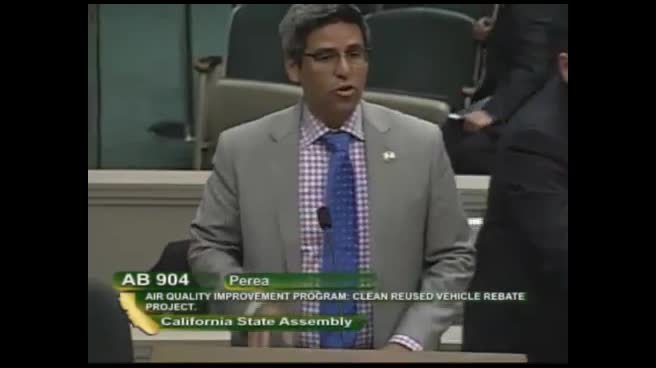 11MIN
Assembly Standing Committee on Transportation
Bill Author
Bill Co-Author(s):
