ACR 160: Motor vehicle idling: children.
- Session Year: 2015-2016
- House: Assembly
- Latest Version Date: 2016-08-05
This measure would encourage motorists to not idle their motor vehicles near places where children congregate.
This measure would encourage motorists to not idle their motor vehicles near places where children congregate.
This measure would encourage motorists to not idle their motor vehicles near places where children congregate.
This measure would encourage motorists to not idle their motor vehicles near places where children congregate.
WHEREAS, Idling of motor vehicles contributes to global warming and is linked to asthma, decreased lung function, cardiac disease, cancer, and other serious health problems; and
WHEREAS, Childrens lungs are still developing and are especially at risk of developing health problems when they are exposed to elevated levels of pollutants. Monitoring at schools has shown higher levels of benzene, formaldehyde, acetaldehyde, and other air toxics during the afternoon hour coinciding with parents picking up their children; and
WHEREAS, Asthma is the most common chronic illness among children, the largest cause of school absences, and is the third leading cause of hospitalization among children under the age of 15 years; and
WHEREAS, An idling car wastes about half a gallon of gasoline per hour, and a gallon of burned fuel emits about 20 pounds of carbon dioxide; and
WHEREAS, One minute of idling puts more carbon monoxide into the air than smoking three packs of cigarettes; and
WHEREAS, Idling produces between 10 and 12 percent more emissions than driving for the same amount of gas used due to incomplete combustion and ineffective operation of the catalytic converter; and
WHEREAS, Idling motor vehicles emit particulate matter, nitrogen dioxide, carbon monoxide, and carbon dioxide; and
WHEREAS, On a daily basis, Americans may be burning as much as 3.8 million gallons of gasoline from voluntary idling, resulting in about 40,000 tons of carbon dioxide. Annually, the cumulative effect is the useless burning of 1.4 billion gallons of gasoline and the emission of 13 million tons of carbon dioxide; and
WHEREAS, Most people waste one to two tanks of gas every year by idling, and one hour of gasoline engine idle time equals 33 miles of driving; and
WHEREAS, A common myth is that idling is better than turning the car on and off, but idling is actually bad for the car. It is better to turn off the car if the driver is going to idle for more than 10 seconds because it takes about 10 seconds worth of fuel to restart the car. This uses less gas, increases fuel efficiency, and is better for the car; and
WHEREAS, An engine runs at less than ideal operating temperature when idling, which causes water vapor to accumulate in the exhaust system and leads to corrosion; and
WHEREAS, California prohibits school bus idling for any amount of time at schools and within 100 feet of a school (Section 39640 of the Health and Safety Code and Section 2480 of Article 1 of Chapter 10 of Division 3 of Title 13 of the California Code of Regulations); and
WHEREAS, At least 27 other states and the District of Columbia have laws imposing restrictions on idling at schools; now, therefore, be it
Resolved by the Assembly of the State of California, the Senate thereof concurring, That the Legislature encourages motorists to not idle their motor vehicles near places where children congregate, such as schools and parks; and be it further
Resolved, That the Chief Clerk of the Assembly transmit copies of this resolution to the author for appropriate distribution.
|
Date
|
Status
|
|---|---|
| Mar 30, 2016 | Introduced. To print. |
| Mar 31, 2016 | From printer. |
| Apr 7, 2016 | Referred to Com. on TRANS. |
| Apr 19, 2016 | From committee: Be adopted. To Consent Calendar. (Ayes 15. Noes 0.) (April 18). |
| Apr 21, 2016 | From Consent Calendar. |
| Apr 21, 2016 | Ordered to third reading. |
| Jun 23, 2016 | Amended, adopted, and to Senate. |
| Jun 23, 2016 | Amended, adopted, and to Senate. (Page 5477.) |
| Jun 27, 2016 | In Senate. To Com. on RLS. |
| Jun 30, 2016 | From committee: Ordered to third reading. |
| Aug 1, 2016 | Adopted and to Assembly. |
| Aug 1, 2016 | Adopted and to Assembly. (Ayes 39. Noes 0. Page 4730.) |
| Aug 2, 2016 | In Assembly. Ordered to Engrossing and Enrolling. |
| Aug 5, 2016 | Chaptered by Secretary of State - Res. Chapter 98, Statutes of 2016. |
| Aug 5, 2016 | Enrolled and filed with the Secretary of State at 3 p.m. |
|
Date
|
Description
|
Location
|
Votes
|
|
|---|---|---|---|---|
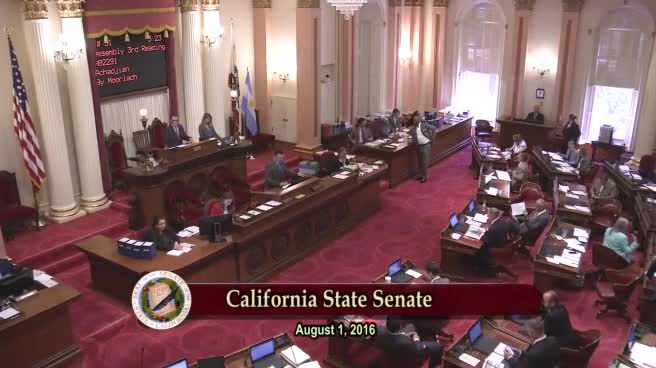
| Aug 1, 2016 | Assembly 3rd Reading ACR160 Hadley By Allen | Senate Floor |
Passed |
|
| Apr 18, 2016 | Be adopted. To Consent Calendar. | Assembly Standing Committee on Transportation |
Passed |
This list shows positions taken on this bill by organizations on the date displayed, which is linked to the original source.
Positions by individuals are not included.
|
Organization
|
Position
|
Date
|
|---|---|---|
| American Cancer Society Cancer Action Network Inc. | ** Support | Aug 1, 2016 |
| American Lung Association | ** Support | Aug 1, 2016 |
| Coalition For Clean Air | ** Support | Aug 1, 2016 |
| Grades for Green | ** Support | Aug 1, 2016 |
| Long Beach Unified School District | ** Support | Aug 1, 2016 |
| Narbonne High School | ** Support | Aug 1, 2016 |
| Riviera Hall Lutheran School | ** Support | Aug 1, 2016 |
| Robinson Riptides | ** Support | Aug 1, 2016 |
Office of Senate Floor Analyses (916) 651-1520 Fax: (916) 327-4478 | ACR 160 |
THIRD READING
Bill No: ACR 160
Amended: 6/23/16 in Assembly
ASSEMBLY FLOOR: Read and adopted, 6/23/16
SUBJECT: Motor vehicle idling: children
DIGEST:
This resolution encourages motorists to not idle their vehicles near places where children congregate.
ANALYSIS: This resolution makes the following legislative findings:
- Idling of motor vehicles contributes to global warming and is linked to asthma, decreased lung function, cardiac disease, cancer, and other serious health problems.
- Children's lungs are still developing and are especially at risk of developing health problems when they are exposed to elevated levels of pollutants. Monitoring at schools has shown higher levels of benzene, formaldehyde, acetaldehyde, and other air toxics during the afternoon hour coinciding with parents picking up their children.
- Asthma is the most common chronic illness among children, the largest cause of school absences, and is the third leading cause of hospitalization among children under the age of 15 years.
- An idling car wastes about half a gallon of gasoline per hour, and a gallon of burned fuel emits about 20 pounds of carbon dioxide.
- One minute of idling puts more carbon monoxide into the air than smoking three packs of cigarettes.
- Idling produces between 10% and 12% more emissions than driving for the same amount of gas used due to incomplete combustion and ineffective operation of the catalytic converter.
- Idling motor vehicles emit particulate matter, nitrogen dioxide, carbon monoxide, and carbon dioxide.
- On a daily basis, Americans may be burning as much as 3.8 million gallons of gasoline from voluntary idling, resulting in about 40,000 tons of carbon dioxide. Annually, the cumulative effect is the useless burning of 1.4 billion gallons of gasoline and the emission of 13 million tons of carbon dioxide.
This resolution encourages motorists to not idle their motor vehicles near places where children congregate, such as schools and parks.
FISCAL EFFECT: Appropriation: No Fiscal Com.: No Local: No
Grades for Green (source)
American Cancer Society Cancer Action Network
American Lung Association
Coalition for Clean Air
Long Beach Unified School District
Narbonne High School
Riviera Hall Lutheran School
Robinson Riptides
None received
ARGUMENTS IN SUPPORT: According to the author, "With better technologies and more fuel-efficient cars, idling is no longer a cost-saving or gas-saving measure. Moreover, due to the nature of idling, the car’s emissions remain concentrated around the vehicle as it is parked. ACR 160 is an important step in implementing this knowledge in ways that shield our children and environment from unnecessary pollutants.”
Prepared by: Jonas Austin / SFA / (916) 651-1520
7/29/16 10:51:44
**** END ****
ASSEMBLY THIRD READING
ATR Bill Id:ACR 160
Author:(Hadley)
As Introduced Ver:March 30, 2016
Majority vote
Committee | Votes | Ayes | Noes |
Transportation | 15-0 | Frazier, Linder, Baker, Bloom, Brown, Chu, Daly, Dodd, Gomez, Kim, Mathis, Medina, Melendez, Nazarian, O'Donnell |
SUMMARY: Encourages motorists to not idle their vehicles near places where children congregate. Specifically, this resolution recounts the dangers of idling in the proximity of children, including:
- Idling of motor vehicles contributes to global warming and is linked to asthma, decreased lung function, cardiac disease, cancer, and other serious health problems;
- Children's lungs are still developing and are especially at risk of developing health problems when they are exposed to elevated levels of pollutants. Monitoring at schools has shown higher levels of benzene, formaldehyde, acetaldehyde, and other air toxics during the afternoon hour coinciding with parents picking up their children;
- Asthma is the most common chronic illness among children, the largest cause of school absences, and is the third leading cause of hospitalization among children under the age of 15 years;
- An idling car wastes about half a gallon of gasoline per hour, and a gallon of burned fuel emits about 20 pounds of carbon dioxide;
- One minute of idling puts more carbon monoxide into the air than smoking three packs of cigarettes;
- Idling produces between 10% and 12% more emissions than driving for the same amount of gas used due to incomplete combustion and ineffective operation of the catalytic converter;
- Idling motor vehicles emit particulate matter, nitrogen dioxide, carbon monoxide, and carbon dioxide; and,
- On a daily basis, Americans may be burning as much as 3.8 million gallons of gasoline from voluntary idling, resulting in about 40,000 tons of carbon dioxide. Annually, the cumulative effect is the useless burning of 1.4 billion gallons of gasoline and the emission of 13 million tons of carbon dioxide.
EXISTING LAW:
- By way of regulation, prohibits school bus idling for any amount of time at schools and within 100 feet of a school.
- Sets forth minimum penalties for violating this regulation.
FISCAL EFFECT: Unknown. This bill is keyed non-fiscal by the Legislative Counsel.
COMMENTS: In December 2002, the Air Resources Board adopted a regulation to limit school bus idling and idling at schools in order to reduce harmful exposure to diesel particulate matter and other pollutants from school buses, school pupil activity buses, youth buses, general paratransit vehicles, transit buses, and heavy-duty commercial motor vehicles that operate at or near schools.
This regulation requires the driver of a school bus, school pupil activity bus, youth bus, general paratransit vehicle, transit bus, and a commercial motor vehicle to turn off the engine upon arriving at a school and to restart it no more than 30 seconds before departing. In addition, the regulation requires a motor carrier of an affected bus or vehicle to ensure that drivers are informed of the idling requirements, to track complaints and enforcement actions regarding the requirements, and to keep records of such driver education and tracking activities. Specific idling situations where health, safety, or operational concerns take precedence are exempted from this regulation. For example, exemptions are provided for idling in the midst of traffic; to ascertain safe operating conditions of a bus or vehicle; for test, service, repair, or diagnostic purposes; to accomplish work, other than transportation, for which a vehicle was designed (e.g., controlling cargo temperature or operating a lift, drill, etc.); to operate equipment needed by persons with disabilities and heaters or air conditioners for special needs children; to operate defrosters or other equipment to prevent a safety or health emergency; and to recharge a hybrid electric bus or vehicle. The minimum fine for violating this regulation is $300.
This resolution encourages all motorists not to idle their motor vehicles near place where children gather.
Analysis Prepared by: Janet Dawson / TRANS. / (916) 319-2093 FN: 0002763
Date of Hearing: April 18, 2016
ASSEMBLY COMMITTEE ON TRANSPORTATION
Jim Frazier, Chair
ABPCA Bill Id:ACR 160 (
Author:Hadley) – As Introduced Ver:March 30, 2016
SUBJECT: Motor vehicle idling: children
SUMMARY: Encourages motorists to not idle their vehicles near places where children congregate. Specifically, this resolution:
- Recounts the dangers of idling in the proximity of children, including:
- Idling of motor vehicles contributes to global warming and is linked to asthma, decreased lung function, cardiac disease, cancer, and other serious health problems;
- Children’s lungs are still developing and are especially at risk of developing health problems when they are exposed to elevated levels of pollutants. Monitoring at schools has shown higher levels of benzene, formaldehyde, acetaldehyde, and other air toxics during the afternoon hour coinciding with parents picking up their children;
- Asthma is the most common chronic illness among children, the largest cause of school absences, and is the third leading cause of hospitalization among children under the age of 15 years;
- An idling car wastes about half a gallon of gasoline per hour, and a gallon of burned fuel emits about 20 pounds of carbon dioxide;
- One minute of idling puts more carbon monoxide into the air than smoking three packs of cigarettes;
- Idling produces between 10% and 12% more emissions than driving for the same amount of gas used due to incomplete combustion and ineffective operation of the catalytic converter;
- Idling motor vehicles emit particulate matter, nitrogen dioxide, carbon monoxide, and carbon dioxide; and,
- On a daily basis, Americans may be burning as much as 3.8 million gallons of gasoline from voluntary idling, resulting in about 40,000 tons of carbon dioxide. Annually, the cumulative effect is the useless burning of 1.4 billion gallons of gasoline and the emission of 13 million tons of carbon dioxide.
EXISTING LAW:
- By way of regulation, prohibits school bus idling for any amount of time at schools and within 100 feet of a school.
- Sets forth minimum penalties for violating this regulation.
FISCAL EFFECT: Unknown, this bill is keyed non-fiscal by the Legislative Counsel.
COMMENTS: In December 2002, ARB adopted a regulation to limit school bus idling and idling at schools in order to reduce harmful exposure to diesel particulate matter and other pollutants from school buses, school pupil activity buses, youth buses, general paratransit vehicles, transit buses, and heavy-duty commercial motor vehicles that operate at or near schools.
This regulation requires the driver of a school bus, school pupil activity bus, youth bus, general paratransit vehicle, transit bus, and a commercial motor vehicle to turn off the engine upon arriving at a school and to restart it no more than 30 seconds before departing. In addition, the regulation requires a motor carrier of an affected bus or vehicle to ensure that drivers are informed of the idling requirements, to track complaints and enforcement actions regarding the requirements, and to keep records of such driver education and tracking activities. Specific idling situations where health, safety, or operational concerns take precedence are exempted from this regulation. For example, exemptions are provided for idling in the midst of traffic; to ascertain safe operating conditions of a bus or vehicle; for test, service, repair, or diagnostic purposes; to accomplish work, other than transportation, for which a vehicle was designed (e.g., controlling cargo temperature or operating a lift, drill, etc.); to operate equipment needed by persons with disabilities and heaters or air conditioners for special needs children; to operate defrosters or other equipment to prevent a safety or health emergency; and to recharge a hybrid electric bus or vehicle. The minimum fine for violating this regulation is $300.
This resolution encourages all motorists not to idle their motor vehicles near place where children gather.
Previous legislation: SB 124 (Oropeza), Chapter 561, Statutes of 2009, acknowledged existing state regulations that limit school bus idling and idling near schools, and sets forth a minimum penalty for a violation of this rule.
REGISTERED SUPPORT / OPPOSITION:
Support
None on file
Opposition
None on file
Analysis Prepared by: Janet Dawson / TRANS. / (916) 319-2093
Discussed in Hearing
View Older Hearings
Bill Author

Bill Co-Author(s):