HR 69
- Session Year: 2017-2018
- House: Assembly
- Latest Version Date: 2018-02-16
WHEREAS, On January 8, 2018, the Secretary of the United States Department of Homeland Security announced the termination of the Temporary Protected Status (TPS) designation for El Salvador and that the designation will terminate on September 9, 2019; and
WHEREAS, The termination of the TPS designation will impact about 200,000 immigrants from El Salvador since the original TPS designation for El Salvador was established in 2001; and
WHEREAS, There are approximately 49,000 TPS holders from El Salvador who reside in California; and
WHEREAS, The TPS program was established by the United States congress Congress in 1990 to provide protection to foreign nationals and work authorization while they remain in the United States because they cannot return safely to their countries due to armed conflict, environmental disasters or epidemics, or other extraordinary conditions; and
WHEREAS, The extension for the TPS program that was approved by the United States Department of Homeland Security in 2016, which was for the period of September 10, 2016, through March 9, 2018, had cited the following reasons for the extension: a series of natural disasters and environmental challenges, including regional drought, that has impacted food security; infrastructure challenges, including a housing deficit of about 630,000 houses and a lack of potable water and electricity; increasing criminal violence and insecurity; and economic challenges such as high unemployment and poverty; and
WHEREAS, TPS holders from El Salvador contribute annually about $3.1 billion in gross domestic product and experience a high labor force participation rate of 88 percent; now, therefore, be it
Resolved by the Assembly of the State of California, That the Assembly urges the President of the United States to reverse his decision to terminate the TPS designation for El Salvador; and be it further
RESOLVED, That the Assembly urges the President and the Congress of the United States to create a legislative solution to establish permanent legal status for Salvadorans who were granted temporary protected status; and be it further
Resolved, That the Chief Clerk of the Assembly transmit copies of this resolution to the President and Vice President of the United States, to the Speaker of the House of Representatives, to the Majority Leader of the Senate, and to each Senator and Representative from California in the Congress of the United States, and to the author for appropriate distribution.
WHEREAS, On January 8, 2018, the Secretary of the United States Department of Homeland Security announced the termination of the Temporary Protected Status (TPS) designation for El Salvador and that the designation will terminate on September 9, 2019; and
WHEREAS, The termination of the TPS designation will impact about 200,000 immigrants from El Salvador since the original TPS designation for El Salvador was established in 2001; and
WHEREAS, There are approximately 49,000 TPS holders from El Salvador who reside in California; and
WHEREAS, The TPS program was established by the United States congress in 1990 to provide protection to foreign nationals and work authorization while they remain in the United States because they cannot return safely to their countries due to armed conflict, environmental disasters or epidemics, or other extraordinary conditions; and
WHEREAS, The extension for the TPS program that was approved by the United States Department of Homeland Security in 2016, which was for the period of September 10, 2016, through March 9, 2018, had cited the following reasons for the extension: a series of natural disasters and environmental challenges, including regional drought, that has impacted food security; infrastructure challenges, including a housing deficit of about 630,000 houses and a lack of potable water and electricity; increasing criminal violence and insecurity; and economic challenges such as high unemployment and poverty; and
WHEREAS, TPS holders from El Salvador contribute annually about $3.1 billion in gross domestic product and experience a high labor force participation rate of 88 percent; now, therefore, be it
Resolved by the Assembly of the State of California, That the Assembly urges the President of the United States to reverse his decision to terminate the TPS designation for El Salvador; and be it further
Resolved, That the Chief Clerk of the Assembly transmit copies of this resolution to the President and Vice President of the United States, to the Speaker of the House of Representatives, to the Majority Leader of the Senate, and to each Senator and Representative from California in the Congress of the United States, and to the author for appropriate distribution.
|
Date
|
Status
|
|---|---|
| Feb 26, 2018 | Coauthors revised. |
| Feb 22, 2018 | Measure version as amended on February 16 corrected. |
| Feb 16, 2018 | Amended. Ordered to third reading. |
| Feb 15, 2018 | From committee: Amend, and be adopted as amended. (Ayes 7. Noes 0.) (February 13). |
| Jan 29, 2018 | Referred to Com. on JUD. |
| Jan 11, 2018 | Introduced. |
|
Date
|
Description
|
Location
|
Votes
|
|
|---|---|---|---|---|
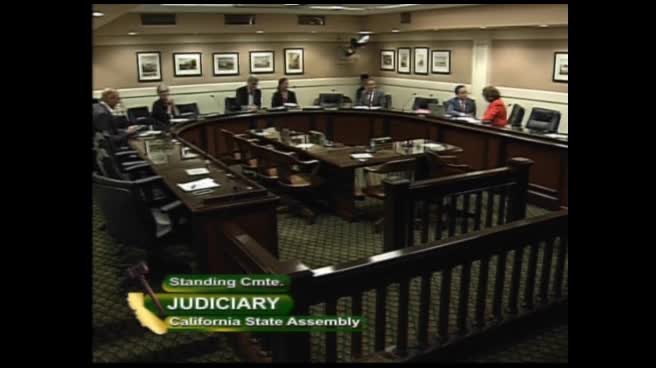
| Feb 13, 2018 | Be adopted as amended. | Assembly Standing Committee on Judiciary |
Passed |
This list shows positions taken on this bill by organizations on the date displayed, which is linked to the original source.
Positions by individuals are not included.
|
Organization
|
Position
|
Date
|
|---|---|---|
| California Immigrant Policy Center | * Support | Feb 13, 2018 |
| Coalition for Humane Immigrant Legal Rights of Los Angeles (CHIRLA) | * Support | Feb 13, 2018 |
Date of Hearing: February 13, 2018
ASSEMBLY COMMITTEE ON
, Chair
ABPCA Bill Id:
Author:( and Santiago) – As Ver:
As Proposed to be Amended
SUBJECT: IMMIGRATION: TEMPORARY PROTECTED STATUS FOR IMMIGRANTS FROM EL SALVADOR
KEY ISSUE: SHOULD the legislature urge the president to reverse his decision to terminate temporary protected status for immigrants from el salvador?
SYNOPSIS
Under the federal Immigration and Nationalization Act, the Secretary of Homeland Security may designate a foreign country for Temporary Protected Status (TPS) due to conditions in the country that temporarily prevent the country's nationals from returning safely, or in certain circumstances, where the country is unable to handle the return of its nationals adequately (for example, ongoing armed conflict or environmental disaster). After devastating earthquakes in El Salvador in 2001, the George W. Bush Administration designated TPS to Salvadorans in the U.S., and TPS designation has been renewed several times by both Republican and Democratic administrations since that time in recognition of conditions in El Salvador remaining unsafe. On January 8, 2018, however, Secretary of Homeland Security Kirstjen M. Nielsen, appointed by President Trump late last year, announced her department’s decision to terminate TPS designation for El Salvador, effective September 8, 2019.
This measure urges the Trump Administration to reverse its decision to terminate TPS designation for El Salvador, and as proposed to be amended, to work with Congress to create a legislative solution to establish permanent legal status for holders of TPS from El Salvador. Demographic data about the TPS population from El Salvador indicate that they are an industrious population with strong family ties to the U.S., including high percentages that have lived in the country for over twenty years and have U.S.-born citizen children. According to the author, there are approximately 49,000 Salvadorans in California who will be severely impacted by the administration’s decision to terminate their TPS status—which in just 18 months will leave them without legal protection from removal from the U.S. and potentially split thousands of Salvadoran families at a great human cost. This measure is supported by immigrant rights advocates and has no known opposition.
SUMMARY: Urges the President to reverse his administration's decision to terminate the Temporary Protected Status designation for El Salvador. Specifically, this measure:
- Declares that on January 8, 2018, the Secretary of the United States Department of Homeland Security (DHS) announced the termination of the Temporary Protected Status (TPS) designation for El Salvador and that the designation will terminate on September 9, 2019.
- Finds that the termination of the TPS designation will impact about 200,000 immigrants from El Salvador since it was first established in 2001, and there are approximately 49,000 TPS holders from El Salvador who reside in California who contribute annually about $3.1 billion in gross domestic product and experience a high labor force participation rate of 88 percent.
- Finds that the TPS program was established by the United States Congress in 1990 to provide protection to foreign nationals and work authorization while they remain in the United States because they cannot return safely to their countries due to armed conflict, environmental disasters or epidemics, or other extraordinary conditions.
- Finds that the previous extension for the TPS program, approved by DHS for the period of September 10, 2016, through March 9, 2018, was justified by a number of reasons, including a series of natural disasters and environmental challenges, including regional drought, that has impacted food security; infrastructure challenges, including a housing deficit of about 630,000 houses and a lack of potable water and electricity; increasing criminal violence and insecurity; and economic challenges such as high unemployment and poverty.
- Urges the President of the United States to reverse his decision to terminate the TPS designation for El Salvador.
- Urges the President and Congress to create a legislative solution to establish permanent legal status for Salvadorans who were granted Temporary Protected Status.
EXISTING FEDERAL LAW, the Immigration and Naturalization Act:
- Authorizes the Secretary of Homeland Security (Secretary) to designate a foreign state for TPS due to conditions in the country that temporarily prevent the country's nationals from returning safely, including where there has been an earthquake, flood, drought, epidemic, or other environmental disaster in the foreign state resulting in a substantial, but temporary, disruption of living conditions in the area affected, and the foreign state is unable to handle the return of its nationals adequately. (8 U.S.C. Sec. 1254a (b)(1).)
- Specifies eligibility criteria for a person who is a national of a foreign state designated for TPS to be granted individual temporary protected status in the United States. (8 U.S.C. Sec. 1254a (c).)
- Authorizes the Secretary to grant temporary protected status to a person meeting the eligibility criteria in 2), above. Additionally, prohibits the removal of the person from the U.S. during the period in which TPS is in effect, and authorizes the person to engage in employment in the U.S. under an appropriate work permit, as specified. (8 U.S.C. Sec. 1254a (a)(1).)
- Requires the Secretary, after consultation with appropriate governmental agencies and at least 60 days before end of the period of designation, to review the conditions in the foreign state for which the TPS designation is in effect, and to determine whether the conditions for such designation continue to be met. (8 U.S.C. Sec. 1254a (b)(3)(A).)
- Authorizes the Secretary to terminate the TPS designation if he or she determines that the foreign state no longer continues to meet the conditions for designation under 1), above, and by publishing notice in the Federal Register of such determination at least 60 days before the termination becomes effective. (8 U.S.C. Sec. 1254a (b)(3)(B).)
COMMENTS: This measure urges the current presidential administration to reverse its recent decision to terminate Temporary Protected Status (TPS) designation for El Salvador, and to work with Congress to create a legislative solution to establish permanent legal status for holders of TPS from El Salvador. According to the author, this measure “affirms that the State of California stands in strong opposition to the Administration’s decision to terminate TPS for El Salvador.”
Federal Law on Temporary Protected Status. Under the federal Immigration and Nationalization Act (INA), 8 U.S.C. Sec. 1254A, the Secretary of Homeland Security may designate a foreign country for Temporary Protected Status due to conditions in the country that temporarily prevent the country's nationals from returning safely, or in certain circumstances, where the country is unable to handle the return of its nationals adequately. The Secretary may designate a country for TPS due to temporary conditions in the country, such as (1) ongoing armed conflict (such as civil war); (2) an environmental disaster (such as earthquake or hurricane) or epidemic; or (3) other extraordinary and temporary conditions.
During the designated period, individuals who are TPS beneficiaries or who are found preliminarily eligible for TPS upon initial review of their cases are not removable from the United States, may obtain an employment authorization document (EAD), and may be granted travel authorization. In addition, once granted TPS, an individual also cannot be detained by DHS on the basis of his or her immigration status in the United States.
The INA also requires the Secretary, after consultation with appropriate governmental agencies, to periodically review the conditions in the foreign state for which the TPS designation is in effect, and to determine whether the conditions for such designation continue to be met. The Act authorizes the Secretary to terminate the TPS designation if he or she determines that the foreign state no longer continues to meet the conditions for TPS designation by publishing notice in the Federal Register of such determination at least 60 days before the termination becomes effective.
Although Section 1254A expressly delegates authority to designate and terminate TPS status to the Attorney General of the United States, under 8 U.S.C. Sec. 1103(a), the Secretary of Homeland Security is charged with the administration and enforcement of this and all other laws relating to the immigration and naturalization of aliens. Accordingly, the termination of TPS designation was made by Secretary of Homeland Security Kirstjen M. Nielsen, appointed by President Trump late last year.
Background on current TPS beneficiaries from El Salvador. According to a recent report by the Center for Migration Studies, there are approximately 195,000 TPS beneficiaries from El Salvador in the U.S as of January 2017. They reside in 135,400 households and have an estimated 192,700 U.S.-born children (who are not themselves holders of TPS because they are citizens not subject to deportation). An estimated 45,500 (34%) of these households have a mortgage, and the median household income for this group is about $50,000. Over half (51%) of the TPS population from El Salvador has been in the U.S. for twenty years or more, and 88% of those who are at least 16 years old are currently in the workforce. More TPS holders (49,100) live in California than any other state, with an estimated 29,400 of them residing in Los Angeles County. (Robert Warren and Donald Kerwin, "A Statistical and Demographic Profile of the U.S. Temporary Protected Status Populations from El Salvador, Honduras, and Haiti." Journal on Migration and Human Security (2017), Vol. 5 No. 3: 577-592.)
It should be noted that there are number of other countries that currently have TPS designation, including Haiti, Honduras, Nepal, Nicaragua, Somalia, Sudan, South Sudan, Syria, and Yemen. However, Haiti and Nicaragua, in addition to El Salvador, are also facing termination of their TPS designation by the current presidential administration.
Termination of TPS designation of El Salvador by current administration. TPS designation for El Salvador was originally extended by the George W. Bush Administration in 2001 after several strong earthquakes devastated the country. Since 2001, TPS designation for Salvadorans has been renewed several times by both Republican and Democratic administrations in recognition of conditions in El Salvador remaining unsafe and therefore meeting the criteria for TPS designation.
On January 8, 2018, however, Secretary of Homeland Security Kirstjen M. Nielsen announced her determination to terminate TPS designation for El Salvador pursuant to the Immigration and Nationality Act, effective as of September 8, 2019. (This represents a delayed termination period of 18 months, although only 60 days advance notice is required under the Act.) In her announcement, Nielsen stated the following:
The decision to terminate TPS for El Salvador was made after a review of the disaster-related conditions upon which the country’s original designation was based and an assessment of whether those originating conditions continue to exist as required by statute. Based on careful consideration of available information, including recommendations received as part of an inter-agency consultation process, the Secretary determined that the original conditions caused by the 2001 earthquakes no longer exist. Thus, under the applicable statute, the current TPS designation must be terminated.
Following the 2001 earthquake, El Salvador received a significant amount of international aid to assist in its recovery efforts, including millions of dollars dedicated to emergency and long-term assistance. Many reconstruction projects have now been completed. Schools and hospitals damaged by the earthquakes have been reconstructed and repaired, homes have been rebuilt, and money has been provided for water and sanitation and to repair earthquake damaged roads and other infrastructure. The substantial disruption of living conditions caused by the earthquake no longer exist.
This measure calls for the current administration to reverse its termination decision for El Salvador. According to the author, there are approximately 200,000 Salvadorans in the U.S. who will be severely impacted by the administration’s decision to terminate their TPS status—which in just 18 months will leave them without legal protection from removal from the country—and approximately 49,000 of them live in California.
Proponents of this measure contend that the Secretary's decision to terminate TPS for Salvadorans is "heartless" and contradicts the traditional humanitarian treatment of immigrants and refugees by our federal government. The Coalition for Humane Immigrant Rights (CHIRLA) notes that this decision comes in a climate where "rhetoric from the (Trump) administration continues to attack the Salvadoran community and the current legal immigration system." Recent press articles have highlighted the real-life consequences for Salvadoran families that may be split apart by the loss of protected status, including the family of Orlando Zepeda, who reside in Los Angeles:
At stake is a humble but promising life he’s built alongside his wife, Lorena, a Salvadoran also protected by the federal program known as TPS. There’s Zepeda’s maintenance job at an Alzheimer’s facility, where he was recently named employee of the year. There's the duplex . . . they bought 13 years ago. And there are their two children, who were born in America. Benjamin, 14, and Lizbeth, 12, understand that in 20 months—when the Trump administration says TPS for Salvadorans will end—their parents could be deported. (Esmeralda Bermudez. “‘This can’t be the end’ Salvadoran father says: Family fears being split by loss of protected status.” Los Angeles Times (January 29, 2018).)
Citing figures from the Center for Migration Studies, proponents also note the economic and humanitarian justifications for preserving the TPS designation for Salvadorans.
Salvadoran TPS recipients are parents to 190,000 U.S.-born children; entire generations have grown up only knowing the United States as home. If their parents are forced to exit the country thousands of families will be torn apart and the human impact represents only one part of our loss.
Salvadorans with TPS have lived and worked in the U.S. legally since the original designation in 2001. 88% of the TPS Salvadoran population participates actively in the workforce and a third of them have mortgages. They contribute about $3.1 billion in gross domestic product to our country; their disappearance will only serve to hurt our economy.
Although Secretary Nielsen’s decision is said to be based, in part, on a determination of improved conditions in El Salvador since the earthquake, proponents note that TPS holders who are removed back to El Salvador “will land in a country still reeling from natural disasters, environmental challenges, food insecurity, high unemployment, and unfortunate crime rates.” They note that the U.S. State Department’s own travel advisory (as of January 10, 2018) warns potential visitors to “Reconsider travel to El Salvador due to crime. Violent crime, such as murder, assault, rape, and armed robbery, is common. Gang activity, such as extortion, violent street crime, and narcotics and arms trafficking, is widespread. Local police may lack the resources to respond effectively to serious criminal incidents.” (Available at https://travel. state.gov/content/travel/en/traveladvisories/traveladvisories/el-salvador-travel-advisory.html.)
Accordingly, this measure calls on the Trump Administration to reverse its decision to terminate TPS designation for El Salvador.
Proposed author's amendment. Under the INA, TPS is a temporary benefit that does not lead to lawful permanent resident status or confer any other immigration status upon a person from a TPS-designated foreign state. However, registration for TPS does not prevent that person from applying for nonimmigrant status, filing for adjustment of status based on an immigrant petition, or applying for any other immigration benefit or protection for which he or she may be eligible. (See https://www.uscis.gov/humanitarian/temporary-protected-status.)
The author states that “Unless Salvadorans residing in the U.S. find a way to adjust their residency status, they will be forced to leave the country or go into hiding by September of 2019” because TPS holders do not have any pathway to legal permanent status under the INA. Accordingly, the author proposes to amend the bill, as follows, to urge the President and Congress to create a legislative solution to do so. The amendment is:
On page 2, line 10, insert: “Resolved, That the Legislature urges the President and Congress of the United States to create a legislative solution to establish permanent legal status for Salvadorans who were granted Temporary Protected Status; and be it further"
Pending Related Legislation: SJR 16 (Wilk) urges the President and Congress to extend Temporary Protected Status for the people of El Salvador, and to craft a legislative solution for establishing permanent legal status for El Salvadorans who were granted TPS. This resolution is currently in the Senate Judiciary Committee.
SJR 17 (Hueso) resolves that the Legislature condemns the decision to end the Temporary Protected Status designation for El Salvador. This resolution is also currently in the Senate Judiciary Committee.
AB 1862 (Santiago & Carrillo) seeks to appropriate $10,000,000 from the General Fund to the CA Department of Social Services for the 2017–2018 fiscal year in order to provide grants to qualified organizations that provide legal assistance to individuals affected by the termination of the federal Temporary Protected Status designation for El Salvador. AB 1862 is currently in the Assembly Judiciary Committee.
REGISTERED SUPPORT / OPPOSITION:
Support
California Immigrant Policy Center (CIPC)
Coalition for Humane Immigrant Rights (CHIRLA)
Opposition
None on file
Analysis Prepared by:
Discussed in Hearing
View Older Hearings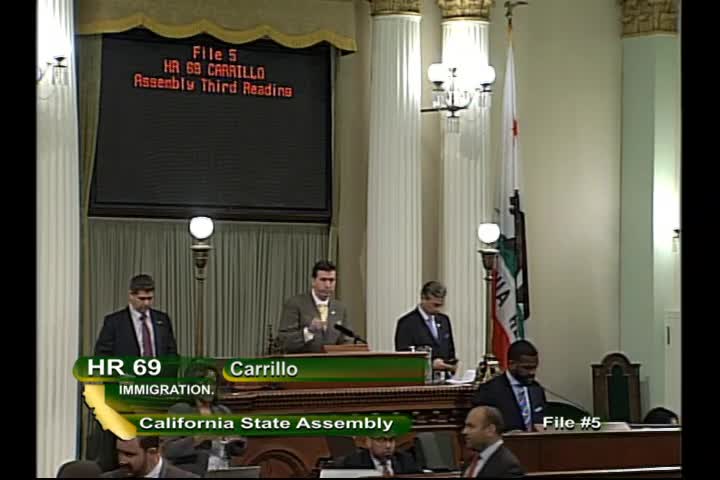


Bill Co-Author(s):



















































