SB 1088: Safety, reliability, and resiliency planning: general rate case cycle.
- Session Year: 2017-2018
- House: Senate
- Latest Version Date: 2018-07-03
Under existing law, the Public Utilities Commission has regulatory authority over public utilities, including electrical corporations and gas corporations. Existing law authorizes the commission, after a hearing, to require every public utility to construct, maintain, and operate its line, plant, system, equipment, apparatus, tracks, and premises in a manner so as to promote and safeguard the health and safety of its employees, passengers, customers, and the public. Existing law requires electrical corporations to annually prepare and submit a wildfire mitigation plan to the commission for review. Existing law requires the commission to establish standards for disaster and emergency preparedness plans, as specified, and requires an electrical corporation to develop, adopt, and update an emergency and disaster preparedness plan, as specified.
The California Emergency Services Act, among other things, establishes the Office of Emergency Services for the purpose of mitigating the effects of natural, manmade, or war-caused emergencies and makes findings and declarations relating to ensuring that preparation within the state will be adequate to deal with those emergencies.
This bill would require the office, in consultation with specified public entities, by September 30, 2019, to adopt standards for reducing risks from a major event, as defined. The bill would require those standards to include model policies that may be undertaken by local governments regarding, among other things, defensible space, and actions that may be undertaken by an electrical or gas corporation, a local publicly owned electric or gas utility, or a water utility to reduce the risk of fire occurring during a major event. The bill would require the office to update the standards at least once every 2 years.
This bill would require an electrical or gas corporation, on or before July 1, 2019, and every July 1 every two years thereafter, to submit to the commission an application for review and approval of a safety, reliability, and resiliency plan that includes certain elements. The bill would require the commission, no more than 18 months after the submission of the plan, to approve the plan with or without modification. The bill would require the commission to authorize recovery of the costs of implementing the plan through rates, as provided. The bill would require the commission to conduct an annual proceeding to review each electrical corporations and gas corporations compliance with its plan, as provided. If, after completing the compliance review, the commission determines that an electrical corporation or gas corporation is in substantial compliance with its plan, the bill would authorize the commission to find the performance, operations, management, and investment addressed in the plan to be reasonable and prudent, as specified. The bill would require the commission to assess a penalty on an electrical corporation or gas corporation for noncompliance with its plan. The bill would, except as provided, prohibit an electrical corporation from delegating, transferring, or contracting out any of its distribution system safety or reliability performance obligations, except as specified.
Existing law authorizes the commission to fix the rates and charges for public utilities, including electrical or gas corporations, and requires the rates and charges to be just and reasonable. Under its existing regulatory authority, the commission uses a general rate case to address the costs of operating and maintaining the systems of public utilities and the allocation of those cost among the public utilities customer classes. The commission has used a 3-year general rate case cycle, in which electrical or gas corporations file a general rate case application with the commission every 36 months.
This bill would explicitly authorize the commission to extend the general rate case cycle to 4 years.
Under existing law, the Public Utilities Commission has regulatory authority over public utilities, including electrical corporations and gas corporations. Existing law authorizes the commission, after a hearing, to require every public utility to construct, maintain, and operate its line, plant, system, equipment, apparatus, tracks, and premises in a manner so as to promote and safeguard the health and safety of its employees, passengers, customers, and the public. Existing law requires electrical corporations to annually prepare and submit a wildfire mitigation plan to the commission for review. Existing law requires the commission to establish standards for disaster and emergency preparedness plans, as specified, and requires an electrical corporation to develop, adopt, and update an emergency and disaster preparedness plan, as specified.
The California Emergency Services Act, among other things, establishes the Office of Emergency Services for the purpose of mitigating the effects of natural, manmade, or war-caused emergencies and makes findings and declarations relating to ensuring that preparation within the state will be adequate to deal with those emergencies.
This bill would require the office, in consultation with specified public entities, by September 30, 2019, to adopt standards for reducing risks from a major event, as defined. The bill would require those standards to include model policies that may be undertaken by local governments regarding, among other things, defensible space, and actions that may be undertaken by an electrical or gas corporation, a local publicly owned electric or gas utility, or a water utility to reduce the risk of fire occurring during a major event. The bill would require the office to update the standards at least once every 2 years.
TheThis bill would require the commission, no more than 18 months after the submission of the plan, to approve the plan with or without modification. The bill would require the commission to authorize recovery of the costs of implementing the plan through rates, as provided. The bill would require the commission to conduct an annual proceeding to review each electrical corporations and gas corporations compliance with its plan, as provided. If, after completing the compliance review, the commission determines that an electrical corporation or gas corporation is in substantial compliance with its plan, the bill would require authorize the commission to find the performance, operations, management, and investment addressed in the plan to be reasonable and prudent. prudent, as specified. The bill would require the commission to assess a penalty on an electrical corporation or gas corporation for noncompliance with its plan. The bill would, except as provided, prohibit an electrical corporation from delegating, transferring, or contracting out any of its distribution system safety or reliability performance obligations, except as specified.
Under existing law, the Public Utilities Commission has regulatory authority over public utilities, including electrical corporations and gas corporations. Existing law authorizes the commission, after a hearing, to require every public utility to construct, maintain, and operate its line, plant, system, equipment, apparatus, tracks, and premises in a manner so as to promote and safeguard the health and safety of its employees, passengers, customers, and the public. Existing law requires electrical corporations to annually prepare and submit a wildfire mitigation plan to the commission for review. Existing law requires the commission to establish standards for disaster and emergency preparedness plans, as specified, and requires an electrical corporation to develop, adopt, and update an emergency and disaster preparedness plan, as specified.
The California Emergency Services Act, among other things, establishes the Office of Emergency Services for the purpose of mitigating the effects of natural, manmade, or war-caused emergencies and makes findings and declarations relating to ensuring that preparation within the state will be adequate to deal with those emergencies.
This bill would require the office, in consultation with specified public entities, by September 30, 2019, to adopt standards for reducing risks from a major event, as defined. The bill would require that those standards to include model policies for implementation that may be undertaken by local governments regarding, among other things, defensible space, and actions to be that may be undertaken by an electrical or gas corporation, a local publicly owned electric or gas utility, or a water utility to reduce the risk of fire occurring during a major event. The bill would require the office to update the standards at least once every 2 years.
The bill would require each electrical corporation or gas corporation, beginning January 15, 2019, and by January 15 every 2 years thereafter, to prepare and submit a safety, reliability, and resiliency plan, containing specified elements, to the commission for review and approval. The bill would require the commission commission, no more than 18 months after the submission of the plan, to approve, or approve the plan with modifications, the submitted plan by December 31 of the year in which the plan is submitted. or without modification. The bill would require the commission to authorize recovery of the costs of implementing the plan through rates, as provided. The bill would require the commission to conduct an annual proceeding to review each electrical corporations and gas corporations compliance with its plan, as provided. The bill would require, if, If, after completing the compliance review, the commission determines that an electrical corporation or gas corporation is in substantial compliance with its plan, that the bill would require the commission deem to find the performance, operations, management, and investment addressed in the plan to be reasonable and prudent. The bill would require the commission to assess a penalty on an electrical corporation or gas corporation for noncompliance with its plan. The bill would, except as provided, prohibit an electrical corporation from delegating, transferring, or contracting out any of its distribution system safety or reliability performance obligations, except as defined, and would prohibit the commission from authorizing an electrical corporation to do so. specified.
Under existing law, the Public Utilities Commission has regulatory authority over public utilities, including electrical corporations and gas corporations. Existing law authorizes the commission, after a hearing, to require every public utility to construct, maintain, and operate its line, plant, system, equipment, apparatus, tracks, and premises in a manner so as to promote and safeguard the health and safety of its employees, passengers, customers, and the public. Existing law requires electrical corporations to annually prepare and submit a wildfire mitigation plan to the commission for review. Existing law requires the commission to establish standards for disaster and emergency preparedness plans, as specified, and requires an electrical corporation to develop, adopt, and update an emergency and disaster preparedness plan, as specified.
The California Emergency Services Act, among other things, establishes the Office of Emergency Services for the purpose of mitigating the effects of natural, manmade, or war-caused emergencies and makes findings and declarations relating to ensuring that preparation within the state will be adequate to deal with those emergencies.
This bill would require the office, in consultation with specified public entities, by September 30, 2019, to adopt standards for reducing risks from a major event, as defined. The bill would require that those standards include model policies for implementation by local governments regarding, among other things, defensible space, and actions to be undertaken by an electrical or gas corporation, a local publicly owned electric or gas utility, or a water utility to reduce the risk of fire occurring during a major event. The bill would require the office to update the standards at least once every 2 years.
The bill would require each electrical corporation or gas corporation, beginning January 15, 2019, and by January 15 every 2 years thereafter, to prepare and submit a safety, reliability, and resiliency plan, containing specified elements, to the commission for review and approval. The bill would require the commission to approve, or approve with modifications, the submitted plan by December 31 of the year in which the plan is submitted. The bill would require the commission to authorize recovery of the costs in of implementing the plan through rates, as provided. The bill would require the commission to conduct an annual proceeding to review each electrical corporations and gas corporations compliance with its plan, as provided. The bill would require, if, after completing the compliance review, the commission determines that an electrical corporation or gas corporation is in substantial compliance with its plan, that the commission deem the performance, operations, management, and investment addressed in the plan to be reasonable and prudent. The bill would require the commission to assess a penalty on an electrical corporation or gas corporation for noncompliance with its plan. The bill would, except as provided, prohibit an electrical corporation from delegating, transferring, or contracting out any of its distribution safety or reliability performance obligations, as defined, and would prohibit the commission from authorizing an electrical corporation to do so.
Under existing law, the Public Utilities Commission has regulatory authority over public utilities, including electrical corporations and gas corporations. Existing law authorizes the commission, after a hearing, to require every public utility to construct, maintain, and operate its line, plant, system, equipment, apparatus, tracks, and premises in a manner so as to promote and safeguard the health and safety of its employees, passengers, customers, and the public. Existing law requires electrical corporations to annually prepare and submit a wildfire mitigation plan to the commission for review. Existing law requires the commission to establish standards for disaster and emergency preparedness plans, as specified, and requires an electrical corporation to develop, adopt, and update an emergency and disaster preparedness plan, as specified. Existing law authorizes every city, county, or city and county within an electrical corporations service area to designate a point of contact for the electrical corporation to consult with on emergency and disaster preparedness plans.
This bill would make legislative findings and declarations relative to the need for, and adoption of, safety and resilience plans by electrical and gas corporations, and the approval and enforcement of those plans by the commission, and would state the intent of the Legislature to enact later legislation to implement those findings and declarations.The California Emergency Services Act, among other things, establishes the Office of Emergency Services for the purpose of mitigating the effects of natural, manmade, or war-caused emergencies and makes findings and declarations relating to ensuring that preparation within the state will be adequate to deal with those emergencies.
This bill would require the office, in consultation with specified public entities, by September 30, 2019, to adopt standards for reducing risks from a major event, as defined. The bill would require that those standards include model policies for implementation by local governments regarding, among other things, defensible space, and actions to be undertaken by an electrical or gas corporation, a local publicly owned electric or gas utility, or a water utility to reduce the risk of fire occurring during a major event. The bill would require the office to update the standards at least once every 2 years.
The bill would require each electrical corporation or gas corporation, beginning January 15, 2019, and by January 15 every 2 years thereafter, to prepare and submit a safety, reliability, and resiliency plan, containing specified elements, to the commission for review and approval. The bill would require the commission to approve, or approve with modifications, the submitted plan by December 31 of the year in which the plan is submitted. The bill would require the commission to authorize recovery of the costs in implementing the plan through rates, as provided. The bill would require the commission to conduct an annual proceeding to review each electrical corporations and gas corporations compliance with its plan, as provided. The bill would require, if, after completing the compliance review, the commission determines that an electrical corporation or gas corporation is in substantial compliance with its plan, that the commission deem the performance, operations, management, and investment addressed in the plan to be reasonable and prudent. The bill would require the commission to assess a penalty on an electrical corporation or gas corporation for noncompliance with its plan. The bill would, except as provided, prohibit an electrical corporation from delegating, transferring, or contracting out any of its distribution safety or reliability performance obligations, as defined, and would prohibit the commission from authorizing an electrical corporation to do so.
Under existing law, the Public Utilities Commission has regulatory authority over public utilities, including electrical corporations and gas corporations. Existing law authorizes the commission, after a hearing, to require every public utility to construct, maintain, and operate its line, plant, system, equipment, apparatus, tracks, and premises in a manner so as to promote and safeguard the health and safety of its employees, passengers, customers, and the public. Existing law requires the commission to establish standards for disaster and emergency preparedness plans, as specified, and requires an electrical corporation to develop, adopt, and update an emergency and disaster preparedness plan, as specified. Existing law authorizes every city, county, or city and county within an electrical corporations service area to designate a point of contact for the electrical corporation to consult with on emergency and disaster preparedness plans.
This bill would make legislative findings and declarations relative to the need for, and adoption of, safety and resilience plans by electrical and gas corporations, and the approval and enforcement of those plans by the commission, and would state the intent of the Legislature to enact later legislation to implement those findings and declarations.
The Legislature finds and declares as follows:
(a)The effects of climate change are happening now and will continue to increase both around the world and in California.
(b)There will be more frequent and increasingly severe storms, floods, mudslides, and wildfires.
(c)Eight of the 20 most destructive fires in Californias history have occurred since 2015, with five occurring in 2017 alone.
(d)Greenhouse gas emissions from wildfires undermine Californias plans to reduce emissions. The emissions from the 2017 wildfires were estimated to be nearly as much as the total 2017 emissions from electric generation.
(e)The electric and gas transmission and distribution systems can be the cause of fires, which, because of climate change, can be much more severe.
(f)Catastrophic storms, floods, mudslides, fires, earthquakes, and other major events cause loss of life, tremendous property damage, public health impacts, environmental degradation, and damage to local economies. These events can also adversely impact electrical and gas transmission and distribution systems.
(g)California is overdue for a major earthquake.
(h)Natural disasters can cause vast economic damage. The North Bay and Southern California suffered major economic impacts to businesses and many jobs were lost as a result of the 2017 wildfires.
(i)Failure to prepare for the effects of climate change would adversely affect the credit rating of California and local jurisdictions.
(j)Executive Order B-30-15 addresses the need for climate adaptation by incorporating climate change impacts into the states Five-Year Infrastructure Plan, updating the states climate adaptation strategy by identifying how climate change will affect infrastructure and industry and what actions can be taken to reduce the risks posed by climate change, factoring climate change into state agencies planning and investment decisions, and implementing measures under existing agency and departmental authority to reduce greenhouse gas emissions.
(k)Chapter 608 of the Statutes of 2015 requires that cities and counties address climate adaptation and resilience strategies in local planning.
(l)Chapter 606 of the Statutes of 2015 establishes the Integrated Climate Adaptation and Resiliency Program to be administered by the Office of Planning and Research to coordinate regional and local efforts with state climate adaptation strategies to adapt to the impacts of climate change.
(m)Chapter 603 of the Statutes of 2015 requires the Natural Resources Agency to update the states climate adaptation strategy every three years to address vulnerabilities to climate change by sector, including the energy sector, and requires state agencies to maximize promoting the use of the climate adaptation strategy to inform planning decisions and ensure that state investments consider climate change impacts.
(n)Chapter 580 of the Statutes of 2016 requires state agencies to take into account the impacts of climate change when planning, designing, building, operating, maintaining, and investing in state infrastructure.
(o)Preventing or mitigating property and infrastructure damage and injury from catastrophic storms, floods, mudslides, fires, earthquakes, and other major events is much safer, better for local economies, and far less expensive than emergency repair and reconstruction.
(p)Responding to catastrophic storms, floods, mudslides, fires, earthquakes, and other major events requires a substantial, well-trained local utility workforce. After the 2017 North Bay wildfires, the Pacific Gas and Electric Company utilized 4,300 employees to quickly repair and restore utility service to its customers. The Public Utilities Commission should require each electrical and gas corporation to have a sufficiently sized and trained workforce available, including employees of other utilities pursuant to mutual aid agreements and employees of entities that have entered into contracts with utilities, to quickly respond to major events.
(q)Investment in reducing the risk of wildfires has a proven cost savings ratio of at least three to one, but the Public Utilities Commission has failed to establish adequate standards to reduce the risk of wildfires caused by utility equipment and to make electrical and gas corporation equipment more resilient and resistant to damage.
(r)The Public Utilities Commission should establish fire risk reduction and mitigation standards, including protocols for disabling reclosers and deenergizing lines. All protocols should meet or exceed industry best practices. Disabling reclosers and deenergizing lines can cause impacts to fire and police response, the availability of water, hospitals, schools, evacuation centers, and other critical facilities.
(s)Electric and gas reliability is a critical component of public safety.
(t)The Public Utilities Commission should require electrical and gas corporations to harden their systems to reduce damage from catastrophic storms, floods, mudslides, fires, earthquakes, and other major events.
(u)The Public Utilities Commission should require electrical corporations to evaluate and incorporate technological solutions, including microgrids, so that critical facilities maintain electrical service during and after catastrophic storms, floods, mudslides, fires, earthquakes, and other major events.
(v)Electrical corporations should be allowed to contract with providers of distributed energy resources so long as the providers meet insurance requirements set by the Public Utilities Commission for direct damages caused by the failure of distributed energy resources equipment.
(w)Electrical corporations and gas corporations should file with the Public Utilities Commission safety, reliability, and resiliency plans, which should address all relevant rules, regulations, standards, and practices to prevent and mitigate risk from catastrophic storms, floods, mudslides, fires, earthquakes, and other major events that affect the safety and reliability of the electrical and gas system. Safety and reliability should be the highest priority in all commission decisions.
(x)The Public Utilities Commission should impose penalties on an electrical corporation or gas corporation that fails to comply with an approved plan. The amount of the penalty should be correlated with the nature and severity of the failure to comply with the approved plan. Any penalties should be paid exclusively by shareholders of the electrical corporation or gas corporation.
(y)The Office of the Safety Advocate should participate in all proceedings authorized by Chapter 11 (commencing with Section 2899) of Part 2 of Division 1 of the Public Utilities Code.
(z)Electrical corporations and gas corporations should notify their customers, including local governments and agencies, of proceedings authorized by the Utility Infrastructure, Safety, Reliability, and Accountability Act (Chapter 11 (commencing with Section 2899) of Part 2 of Division 1 of the Public Utilities Code).
(aa)The commission should encourage public comment at hearings for proceedings authorized by the Utility Infrastructure, Safety, Reliability, and Accountability Act (Chapter 11 (commencing with Section 2899) of Part 2 of Division 1 of the Public Utilities Code).
(ab)Consistent with its ratepayer protection duties pursuant to Article 1 (commencing with Section 451) of Chapter 3 of Part 1 of Division 1 of the Public Utilities Code, the commission should ensure the costs associated with the implementation of Chapter 11 (commencing with Section 2899) of Part 2 of Division 1 of the Public Utilities Code are just and reasonable for ratepayers while protecting public safety and the reliability of electric and gas services.
SEC. 2.Section 8587.13 is added to the Government Code, to read:8587.13.(a)For purposes of this section, major event means a large storm, flood, mudslide, fire, earthquake, or other occurrence that significantly affects the safety and reliability of the electrical or gas distribution system.
(b)On or before September 30, 2019, and on or before September 30 of every 2 two years thereafter, the office, in consultation with the Department of Forestry and Fire Protection, the Public Utilities Commission, and other appropriate state and local agencies, shall adopt or update standards for reducing risk from a major event.
(c)The standards shall include both of the following:
(1)Model policies that may be undertaken by local governments regarding zoning, defensible space, fire-resistant building materials, and other measures applicable to properties at risk during a major event.
(2)Actions that may be undertaken by electrical corporations, gas corporations, local publicly owned electric utilities, local publicly owned gas utilities, and water utilities to reduce the risk of fire during a major event.
SEC. 3.Section 454 of the Public Utilities Code is amended to read:454.(a)(1)Except as provided in Section 455, a public utility shall not change any rate or so alter any classification, contract, practice, or rule as to result in any new rate, except upon a showing before the commission and a finding by the commission that the new rate is justified. Whenever any electrical, gas, heat, telephone, water, or sewer system corporation files an application to change any rate, other than a change reflecting and passing through to customers only new costs to the corporation that do not result in changes in revenue allocation, for the services or commodities furnished by it, the corporation shall furnish to its customers affected by the proposed rate change notice of its application to the commission for approval of the new rate. This notice requirement does not apply to any rate change proposed by a corporation pursuant to an advice letter submitted to the commission in accordance with commission procedures for this means of submission. The procedures for advice letters may include provision for notice to customers or subscribers on a case-by-case basis, as determined by the commission. The corporation may include the notice with the regular bill for charges transmitted to the customers within 45 days if the corporation operates on a 30-day billing cycle, or within 75 days if the corporation operates on a 60-day billing cycle. If more than one application to change any rate is filed within a single billing cycle, the corporation may combine the notices into a single notice if the applications are separately identified. The notice shall state the amount of the proposed rate change expressed in both dollar and percentage terms for the entire rate change as well as for each customer classification, a brief statement of the reasons the change is required or sought, and the mailing and, if available, email address of the commission to which any customer inquiries may be directed regarding how to participate in, or receive further notices regarding the date, time, or place of, any hearing on the application, and the mailing address of the corporation to which any customer inquiries relative to the proposed rate change may be directed.
(2)For a safety, reliability, and resiliency plan submitted by an electrical or gas corporation pursuant to Section 2899.2, the corporation shall furnish to its customers written notice with the regular bill for charges for the two billing cycles before it submits the plan. The written notice shall include a link to the Internet Web site where the plan will be available electronically upon its submission.
(b)For a water corporation with more than 2,000 service connections, the notice required in subdivision (a) shall include estimated rate impacts on the various customer classes of the corporation. The commission may require the corporation to inform customers in a separate letter or through a bill insert, at the corporations discretion, of the outcome of the general rate case, within 60 days if the corporation operates on a 30-day billing cycle, or within 90 days if the corporation operates on a 60-day billing cycle, of the commissions final decision, including the approved rates and the approved capital projects that will subsequently be executed by way of an advice letter.
(c)The commission may adopt rules it considers reasonable and proper for each class of public utility providing for the nature of the showing required to be made in support of proposed rate changes, the form and manner of the presentation of the showing, with or without a hearing, and the procedure to be followed in the consideration thereof. Rules applicable to common carriers may provide for the publication and filing of any proposed rate change together with a written showing in support thereof, giving notice of the filing and showing in support thereof to the public, granting an opportunity for protests thereto, and to the consideration of, and action on, the showing and any protests filed thereto by the commission, with or without hearing. However, the proposed rate change does not become effective until it has been approved by the commission.
(d)(1)The commission shall permit individual public utility customers and subscribers affected by a proposed rate change, and organizations formed to represent their interests, to testify at any hearing on the proposed rate change, except that the presiding officer need not allow repetitive or irrelevant testimony and may conduct the hearing in an efficient manner.
(2)The commission shall permit any member of the public to testify at any hearing or proceeding authorized under the Utility Infrastructure, Safety, Reliability, and Accountability Act (Chapter 11 (commencing with Section 2899) of Part 2), except that the presiding officer need not allow repetitive or irrelevant testimony and may conduct the hearing in an efficient manner.
SEC. 4.Chapter 11 (commencing with Section 2899) is added to Part 2 of Division 1 of the Public Utilities Code, to read:11.Utility Infrastructure, Safety, Reliability, and Accountability2899.This chapter shall be known, and may be cited, as the Utility Infrastructure, Safety, Reliability, and Accountability Act.
2899.1.For purposes of this chapter, the following definitions apply:
(a)Distribution system means the portion of the electric system beginning with equipment that operates at voltages lower than that controlled by the Independent System Operator up to and including the customers meter, and that is used to transmit, deliver, store, or furnish electricity, light, heat, or power.
(b)Major event means a large storm, flood, mudslide, fire, earthquake, or other occurrence that significantly affects the safety and reliability of the electrical or gas distribution system.
(c)Plan means the safety, reliability, and resiliency plan filed by an electrical or gas corporation pursuant to Section 2899.2, including measures addressing both routine operations and major events.
(d)Utility means an electrical corporation or gas corporation.
2899.2.(a)On or before July 1, 2019, and on or before July 1 every two years thereafter, each utility shall prepare and submit to the commission an application for review and approval of a safety, reliability, and resiliency plan. The plan submitted on or before July 1, 2019, shall be limited to addressing fire risks, with subsequent plans addressing risks associated with routine operation and all major events. The plan shall include sufficient information for the public and the commission to determine the costs and benefits to ratepayers of the investments proposed in the plan.
(b) The plan shall include all of the following elements:
(1)All relevant safety rules, regulations, standards, and practices adopted by the commission and, after January 1, 2021, all applicable standards adopted or updated by the Office of Emergency Services pursuant to Section 8587.13 of the Government Code.
(2)A program to comply with applicable safety rules, regulations, standards, and practices adopted by the commission and, after January 1, 2021, a program to comply with standards adopted or updated by the Office of Emergency Services pursuant to Section 8587.13 of the Government Code.
(3)A program to manage compliance, including, but not limited to, plans for assigning personnel, training, and monitoring and checking that the personnel have carried out their assignments, and a system of quality assurance and quality control.
(4)The wildfire mitigation plan submitted pursuant to Section 8386, including protocols for disabling reclosers and deenergizing portions of the electrical distribution system that consider the impacts on public safety, as well as protocols related to mitigating the public safety impacts of those protocols, including impacts to critical first responders, and to health and communication infrastructure.
(5)Actions the utility will take to ensure that its system will achieve the highest level of safety, reliability, and resiliency, and to ensure that its system is prepared for a major event, including hardening and modernizing its infrastructure with improved engineering, system design, standards, equipment, and facilities.
(6)Plans for vegetation management.
(7)For gas corporations, both of the following:
(A)A program to preemptively replace pipe and other equipment that is aging, brittle, or otherwise vulnerable to damage from a major event, or that could endanger public or employee safety.
(B)A program to locate, mark and repair leaks, relight pilot lights, and all other activity needed to restore service following a major event.
(8)For electrical corporations, a program to evaluate and incorporate technological solutions, such as distributed energy resources and microgrids that can be islanded from the distribution grid for critical customers or critical facilities, such as schools, hospitals, critical care patients, water pumping and treatment facilities, telecommunication infrastructure, and government and other facilities that provide public safety or other critical functions.
(9)The disaster and emergency preparedness plan prepared pursuant to Section 768.6, including both of the following:
(A)Plans to prepare for, and to restore service after, a major event, including workforce mobilization, and prepositioning equipment and employees.
(B)Plans for community outreach and public awareness before, during, and after a major event.
(10)Plans for distribution grid operation during a major event, including an incident command system.
(11)Clear evidence that the utility has an adequately sized and trained workforce to promptly restore service after a major event, taking into account employees of other utilities pursuant to mutual aid agreements and employees of entities that have entered into contracts with the utility.
(12)Activities to support customers during and after a major event, including outage reporting, billing, repair processing and timing, access to utility representatives, emergency communications, and restoration plans.
(13)Forecasted costs of every element of the plan.
(14)Any other element pertaining to electric and gas safety, reliability, or resiliency deemed appropriate by the commission.
(c)(1)The commission shall review the plans of the utilities in a single consolidated proceeding. The commission shall accept comment on the plans from the public and interested parties and verify that the plans comply with all applicable rules, regulations, and standards, including those adopted by the Office of Emergency Services pursuant to the State Assistance for Fire Equipment Act (Article 5.5 (commencing with Section 8589.8) of Chapter 7 of Division 1 of Title 2 of the Government Code), as appropriate. The commission shall evaluate the reasonableness of the elements of the plans considering the risks involved and the costs to implement the plan.
(2)In reviewing the plans, consistent with its ratepayer protection duties pursuant to Article 1 (commencing with Section 451) of Chapter 3 of Part 1, the commission shall ensure that the cost impacts of the plans are just and reasonable for ratepayers while prioritizing protecting public safety and the reliability of electric and gas services.
(3)Notwithstanding Section 1701.5, with or without modification, the commission shall strive to approve the plans within 12 months of, but in no case shall approve the plans more than 18 months after, their submission, unless the commission makes a written determination, including reasons supporting the determination, that the 18-month deadline cannot be met, and issues an order extending the deadline. Each utilitys approved plan shall remain in effect until the commission approves the utilitys subsequent plan.
(4)(A)Consistent with its ratepayer protection duties pursuant to Article 1 (commencing with Section 451) of Chapter 3 of Part 1, the commission shall authorize rate recovery of the reasonable revenue requirements to implement plans approved by the commission in the proceeding reviewing the plans pursuant to paragraph (1).
(B)All forecasted costs not included in the plan or deemed outside the scope of the plan by the commission may be requested and considered in a utilitys general rate case or other appropriate proceeding.
(C)When allocating the costs of an approved plan, the commission shall consider allocating costs (i) in proportion to the benefits to each rate class and (ii) based on the climate zones in which the approved investments will be made.
(5)The utilities shall not divert revenues authorized to implement the plan to any activities or investments outside their plans.
(6)Each utility shall establish a memorandum account to track costs incurred for fire risk mitigation from January 1, 2019, until the commissions approval of the utilitys plan submitted on or before January 15, 2019, that are not otherwise covered in the utilitys revenue requirements. The commission shall review the costs in the memorandum accounts and disallow recovery of those costs the commission deems unreasonable.
(d)On or after January 1, 2019, each utilitys Risk Assessment Mitigation Phase filing shall exclude risks addressed in the plan required pursuant to subdivision (b).
(e)The commission may extend the three-year general rate case cycle to a four-year general rate case cycle.
2899.3.(a)For purposes of this section, distribution system safety or reliability performance obligations of an electrical corporation include, but are not limited to, owning, controlling, operating, managing, maintaining, planning, engineering, designing, investing in, and constructing the distribution system in its service territory, distribution system reliability, emergency response and restoration, vegetation management, service connections, service turnons and turnoffs, and service inquiries relating to the operation of the distribution system.
(b)(1)An electrical corporation shall not delegate, transfer, or contract out any distribution system safety or reliability performance obligation.
(2)Notwithstanding paragraph (1), an electrical corporation may contract with the owner or operator of a distributed energy resource so long as the owner or operator of the distributed energy resource meets the insurance requirements set by the commission to cover direct damages caused by the failure of the distributed energy resources to comply with the terms of the contract.
(c)The prohibition specified in paragraph (1) of subdivision (b) does not apply to line clearance tree trimming under the supervision of the electrical corporation, the purchase of materials or equipment, contracting for construction of infrastructure owned by the electrical corporation, contracting for pole test and treat services, contracting for bulk electricity capacity, energy, or storage that is not for purposes of distribution system safety and reliability, or contracting for information technology services.
(d)Paragraph (1) of subdivision (b) does not prohibit a cable television corporation or telephone corporation from contracting for make-ready work or performing work on its equipment attached to poles that also support equipment owned by an electrical corporation.
(e)When performing the planning, engineering, and design described in subdivision (a), the electrical corporation shall consider both of the following:
(1)The current and future load.
(2)The current and future distributed energy resources owned by the electrical corporation, community choice aggregators, or any other person or entity.
2899.4.The commission shall conduct an annual proceeding to review each utilitys compliance with its plan, including a factual analysis of any major events that occurred, as follows:
(a)Beginning March 1, 2021, and each March 1 thereafter, each utility shall file with the commission a report addressing compliance with the plan during the prior calendar year.
(b)(1)Prior to March 1, 2021, and prior to each March 1 thereafter, the commission shall make available a list of qualified independent evaluators with experience in assessing electric and gas operations.
(2)Each utility shall engage an independent evaluator listed pursuant to paragraph (1) to review and assess the utilitys compliance with its plan. The independent evaluator shall consult with, and operate under the direction of, the Safety and Enforcement Division of the commission. The independent evaluator shall issue a report on July 1 of each year in which a report required by subdivision (a) is filed. As a part of the independent evaluators report, the independent evaluator shall determine whether any revenue authorized to implement the plan was diverted to any activities or investments outside the plan. The commission shall strive to complete its compliance review within 12 months of, but in no case shall that review be completed more than 18 months after, the submission of a utilitys compliance report.
(3)The commission shall authorize the utility to recover in rates the costs of the independent evaluation.
(4)The commission shall have exclusive jurisdiction over compliance by a utility with the standards adopted pursuant to Section 8587.13 of the Government Code.
2899.5.The commission shall assess penalties if a utility fails to substantially comply with its plan. In determining an appropriate amount of the penalty, the commission shall consider all of the following:
(a)The nature and severity of any noncompliance with the plan, including whether the noncompliance resulted in harm.
(b)The extent to which the commission has found that the utility complied with its plans in prior years.
(c)Whether the utility self-reported the circumstances constituting noncompliance.
(d)Whether the utility implemented corrective actions with respect to the noncompliance.
(e)Whether the utility had advance notice of the circumstances constituting noncompliance.
(f)Whether the utility had previously engaged in conduct of a similar nature that caused significant property damage or injury.
(g)Any other factors established by the commission in a rulemaking proceeding, consistent with purposes of this section.
2899.6.(a)After completing the review pursuant to Section 2899.4, if, either at the time the plan is reviewed and approved or subsequent to its review and approval, the commission determines that a utility was in substantial compliance with its approved plan, the commission, to the extent the commission finds it is consistent with the ratepayer protection duties established pursuant to Article 1 (commencing with Section 451) of Chapter 3 of Part 1, shall find that the utilitys performance, operations, management, and investments addressed in the plan are reasonable and prudent for purposes of any subsequent commission proceeding.
(b)Any findings made pursuant to Section 2899.4:
(1)Shall be used by the commission to carry out its obligations under Section 451.
(2)Shall not apply to performance, operations, management, or investment not addressed or outside the scope of the approved plan.
(3)Shall not affect any civil action. Nothing in this paragraph shall impact the admissibility of evidence otherwise permitted by law or rule of court.
(4)Shall not apply to events that occurred before the first plan is approved for a particular utility.
(c)This section is not intended to create an obligation on the ratepayer to pay for any of the following:
(1)Any charge that is not just and reasonable pursuant to Section 451.
(2)Any cost incurred as a result of negligence by the utility.
(3)Any charge based on utility activity that is not addressed in the approved plan.
(4)Any charge based on utility performance, operation, management, or investment not addressed in the approved plan.
(5)Any moneys diverted from an activity approved in the plan to activity outside the plan.
2899.7.This chapter does not alter the responsibilities or authority of a community choice aggregator.
The Legislature finds and declares as follows:
(a)The effects of climate change are happening now and will continue to increase both around the world and in California.
(b)There will be more frequent and increasingly severe storms, floods, mudslides, and wildfires.
(c)Eight of the 20 most destructive fires in Californias history have occurred since 2015, with five occurring in 2017 alone.
(d)Greenhouse gas emissions from wildfires undermine Californias plans to reduce emissions. The emissions from the 2017 wildfires were estimated to be nearly as much as the total 2017 emissions from electric generation.
(e)The electric and gas transmission and distribution systems can be the cause of fires, which, because of climate change, can be much more severe.
(f)Catastrophic storms, floods, mudslides, fires, earthquakes, and other major events cause loss of life, tremendous property damage, public health impacts, environmental degradation, and damage to local economies. These events can also adversely impact electrical and gas transmission and distribution systems.
(g)California is overdue for a major earthquake.
(h)Natural disasters can cause vast economic damage. The North Bay and Southern California suffered major economic impacts to businesses and many jobs were lost as a result of the 2017 wildfires.
(i)Failure to prepare for the effects of climate change would adversely affect the credit rating of California and local jurisdictions.
(j)Executive Order B-30-15 addresses the need for climate adaptation by incorporating climate change impacts into the states Five-Year Infrastructure Plan, updating the states climate adaptation strategy by identifying how climate change will affect infrastructure and industry and what actions can be taken to reduce the risks posed by climate change, factoring climate change into state agencies planning and investment decisions, and implementing measures under existing agency and departmental authority to reduce greenhouse gas emissions.
(k)Chapter 608 of the Statutes of 2015 requires that cities and counties address climate adaptation and resilience strategies in local planning.
(l)Chapter 606 of the Statutes of 2015 establishes the Integrated Climate Adaptation and Resiliency Program to be administered by the Office of Planning and Research to coordinate regional and local efforts with state climate adaptation strategies to adapt to the impacts of climate change.
(m)Chapter 603 of the Statutes of 2015 requires the Natural Resources Agency to update the states climate adaptation strategy every three years to address vulnerabilities to climate change by sector, including the energy sector, and requires state agencies to maximize promoting the use of the climate adaptation strategy to inform planning decisions and ensure that state investments consider climate change impacts.
(n)Chapter 580 of the Statutes of 2016 requires state agencies to take into account the impacts of climate change when planning, designing, building, operating, maintaining, and investing in state infrastructure.
(o)Preventing or mitigating property and infrastructure damage and injury from catastrophic storms, floods, mudslides, fires, earthquakes, and other major events is much safer, better for local economies, and far less expensive than emergency repair and reconstruction.
(p)Responding to catastrophic storms, floods, mudslides, fires, earthquakes, and other major events requires a substantial, well-trained local utility workforce. After the 2017 North Bay wildfires, the Pacific Gas and Electric Company utilized 4,300 employees to quickly repair and restore utility service to its customers. The Public Utilities Commission should require each electrical and gas corporation to have a sufficiently sized and trained workforce available, including employees of other utilities pursuant to mutual aid agreements and employees of entities that have entered into contracts with utilities, to quickly respond to major events.
(q)Investment in reducing the risk of wildfires has a proven cost savings ratio of at least three to one, but the Public Utilities Commission has failed to establish adequate standards to reduce the risk of wildfires caused by utility equipment and to make electrical and gas corporation equipment more resilient and resistant to damage.
(r)The Public Utilities Commission should establish fire risk reduction and mitigation standards, including protocols for disabling reclosers and deenergizing lines. All protocols should meet or exceed industry best practices. Disabling reclosers and deenergizing lines can cause impacts to fire and police response, the availability of water, hospitals, schools, evacuation centers, and other critical facilities.
(s)Electric and gas reliability is a critical component of public safety.
(t)The Public Utilities Commission should require electrical and gas corporations to harden their systems to reduce damage from catastrophic storms, floods, mudslides, fires, earthquakes, and other major events.
(u)The Public Utilities Commission should require electrical corporations to evaluate and incorporate technological solutions, including microgrids, so that critical facilities maintain electrical service during and after catastrophic storms, floods, mudslides, fires, earthquakes, and other major events.
(v)Electrical corporations should be allowed to contract with providers of distributed energy resources so long as the providers meet insurance requirements set by the Public Utilities Commission for direct damages caused by the failure of distributed energy resources equipment.
(w)Electrical corporations and gas corporations should file with the Public Utilities Commission safety, reliability, and resiliency plans, which should address all relevant rules, regulations, standards, and practices to prevent and mitigate risk from catastrophic storms, floods, mudslides, fires, earthquakes, and other major events that affect the safety and reliability of the electrical and gas system. Safety and reliability should be the highest priority in all commission decisions.
(x)The Public Utilities Commission should impose penalties on an electrical corporation or gas corporation that fails to comply with an approved plan. The amount of the penalty should be correlated with the nature and severity of the failure to comply with the approved plan. Any penalties should be paid exclusively by shareholders of the electrical corporation or gas corporation.
(y)The Office of the Safety Advocate should participate in all proceedings authorized by Chapter 11 (commencing with Section 2899) of Part 2 of Division 1 of the Public Utilities Code.
(z)Electrical corporations and gas corporations should notify their customers, including local governments and agencies, of proceedings authorized by the Utility Infrastructure, Safety, Reliability, and Accountability Act (Chapter 11 (commencing with Section 2899) of Part 2 of Division 1 of the Public Utilities Code).
(aa)The commission should encourage public comment at hearings for proceedings authorized by the Utility Infrastructure, Safety, Reliability, and Accountability Act (Chapter 11 (commencing with Section 2899) of Part 2 of Division 1 of the Public Utilities Code).
(ab)Consistent with its ratepayer protection duties pursuant to Article 1 (commencing with Section 451) of Chapter 3 of Part 1 of Division 1 of the Public Utilities Code, the commission should ensure the costs associated with the implementation of Chapter 11 (commencing with Section 2899) of Part 2 of Division 1 of the Public Utilities Code are just and reasonable for ratepayers while protecting public safety and the reliability of electric and gas services.
SEC. 2.Section 8587.13 is added to the Government Code, to read:8587.13.(a)For purposes of this section, major event means a large storm, flood, mudslide, fire, earthquake, or other occurrence that significantly affects the safety and reliability of the electrical or gas distribution system.
(b)On or before September 30, 2019, and on or before September 30 of every 2 years thereafter, the office, in consultation with the Department of Forestry and Fire Protection, the Public Utilities Commission, and other appropriate state and local agencies, shall adopt or update standards for reducing risk from a major event.
(c)The standards shall include both of the following:
(1)Model policies that may be undertaken by local governments regarding zoning, defensible space, fire-resistant building materials, and other measures applicable to properties at risk during a major event.
(2)Actions that may be undertaken by electrical corporations, gas corporations, local publicly owned electric utilities, local publicly owned gas utilities, and water utilities to reduce the risk of fire during a major event.
SEC. 3.Section 454 of the Public Utilities Code is amended to read:454.(a)(1)Except as provided in Section 455, a public utility shall not change any rate or so alter any classification, contract, practice, or rule as to result in any new rate, except upon a showing before the commission and a finding by the commission that the new rate is justified. Whenever any electrical, gas, heat, telephone, water, or sewer system corporation files an application to change any rate, other than a change reflecting and passing through to customers only new costs to the corporation that do not result in changes in revenue allocation, for the services or commodities furnished by it, the corporation shall furnish to its customers affected by the proposed rate change notice of its application to the commission for approval of the new rate. This notice requirement does not apply to any rate change proposed by a corporation pursuant to an advice letter submitted to the commission in accordance with commission procedures for this means of submission. The procedures for advice letters may include provision for notice to customers or subscribers on a case-by-case basis, as determined by the commission. The corporation may include the notice with the regular bill for charges transmitted to the customers within 45 days if the corporation operates on a 30-day billing cycle, or within 75 days if the corporation operates on a 60-day billing cycle. If more than one application to change any rate is filed within a single billing cycle, the corporation may combine the notices into a single notice if the applications are separately identified. The notice shall state the amount of the proposed rate change expressed in both dollar and percentage terms for the entire rate change as well as for each customer classification, a brief statement of the reasons the change is required or sought, and the mailing and, if available, email address of the commission to which any customer inquiries may be directed regarding how to participate in, or receive further notices regarding the date, time, or place of, any hearing on the application, and the mailing address of the corporation to which any customer inquiries relative to the proposed rate change may be directed.
(2)For a safety, reliability, and resiliency plan submitted by an electrical or gas corporation pursuant to Section 2899.2, the corporation shall furnish to its customers written notice with the regular bill for charges for the two billing cycles before it submits the plan. The written notice shall include a link to the Internet Web site where the plan will be available electronically upon its submission.
(b)For a water corporation with more than 2,000 service connections, the notice required in subdivision (a) shall include estimated rate impacts on the various customer classes of the corporation. The commission may require the corporation to inform customers in a separate letter or through a bill insert, at the corporations discretion, of the outcome of the general rate case, within 60 days if the corporation operates on a 30-day billing cycle, or within 90 days if the corporation operates on a 60-day billing cycle, of the commissions final decision, including the approved rates and the approved capital projects that will subsequently be executed by way of an advice letter.
(c)The commission may adopt rules it considers reasonable and proper for each class of public utility providing for the nature of the showing required to be made in support of proposed rate changes, the form and manner of the presentation of the showing, with or without a hearing, and the procedure to be followed in the consideration thereof. Rules applicable to common carriers may provide for the publication and filing of any proposed rate change together with a written showing in support thereof, giving notice of the filing and showing in support thereof to the public, granting an opportunity for protests thereto, and to the consideration of, and action on, the showing and any protests filed thereto by the commission, with or without hearing. However, the proposed rate change does not become effective until it has been approved by the commission.
(d)(1)The commission shall permit individual public utility customers and subscribers affected by a proposed rate change, and organizations formed to represent their interests, to testify at any hearing on the proposed rate change, except that the presiding officer need not allow repetitive or irrelevant testimony and may conduct the hearing in an efficient manner.
(2)The commission shall permit any member of the public to testify at any hearing or proceeding authorized under the Utility Infrastructure, Safety, Reliability, and Accountability Act (Chapter 11 (commencing with Section 2899) of Part 2), except that the presiding officer need not allow repetitive or irrelevant testimony and may conduct the hearing in an efficient manner.
SEC. 4.Chapter 11 (commencing with Section 2899) is added to Part 2 of Division 1 of the Public Utilities Code, to read:11.Utility Infrastructure, Safety, Reliability, and Accountability2899.This chapter shall be known, and may be cited, as the Utility Infrastructure, Safety, Reliability, and Accountability Act.
2899.1.For purposes of this chapter, the following definitions apply:
(a)Distribution system means the portion of the electric system beginning with equipment that operates at voltages lower than that controlled by the Independent System Operator up to and including the customers meter, and that is used to transmit, deliver, store, or furnish electricity, light, heat, or power.
(b)Major event means a large storm, flood, mudslide, fire, earthquake, or other occurrence that significantly affects the safety and reliability of the electrical or gas distribution system.
(c)Plan means the safety, reliability, and resiliency plan filed by an electrical or gas corporation pursuant to Section 2899.2, including measures addressing both routine operations and major events.
(d)Utility means an electrical corporation or gas corporation.
2899.2.(a)On or before January 15, July 1, 2019, and on or before January 15 July 1 every two years thereafter, each utility shall prepare and submit to the commission an application for review and approval of a safety, reliability, and resiliency plan. The plan submitted on or before January 15, July 1, 2019, shall be limited to addressing fire risks, with subsequent plans addressing risks associated with routine operation and all major events. The plan shall include sufficient information for the public and the commission to determine the costs and benefits to ratepayers of the investments proposed in the plan.
(b) The plan shall include all of the following elements:
(1)All relevant safety rules, regulations, standards, and practices adopted by the commission and, after January 1, 2021, all applicable standards adopted or updated by the Office of Emergency Services pursuant to Section 8587.13 of the Government Code.
(2)A program to comply with applicable safety rules, regulations, standards, and practices adopted by the commission and, after January 1, 2021, a program to comply with standards adopted or updated by the Office of Emergency Services pursuant to Section 8587.13 of the Government Code.
(3)A program to manage compliance, including, but not limited to, plans for assigning personnel, training, and monitoring and checking that the personnel have carried out their assignments, and a system of quality assurance and quality control.
(4)The wildfire mitigation plan submitted pursuant to Section 8386, including protocols for disabling reclosers and deenergizing portions of the electrical distribution system, system that consider the impacts on public safety, as well as protocols related to mitigating the public safety impacts of those protocols. protocols, including impacts to critical first responders, and to health and communication infrastructure.
(5)Actions the utility will take to ensure that its system will achieve the highest level of safety, reliability, and resiliency, and to ensure that its system is not vulnerable to widespread failure during prepared for a major event, including hardening and modernizing its infrastructure with improved engineering, system design, standards, equipment, and facilities.
(6)Plans for vegetation management.
(7)For gas corporations, both of the following:
(A)A program to preemptively replace pipe and other equipment that is aging, brittle, or otherwise vulnerable to damage from a major event, or that could endanger public or employee safety.
(B)A program to locate, mark and repair leaks, relight pilot lights, and all other activity needed to restore service following a major event.
(8)For electrical corporations, a program to evaluate and incorporate technological solutions, such as distributed energy resources and microgrids that can be islanded from the distribution grid for critical customers, customers or critical facilities, such as schools, hospitals, critical care patients, water pumping and treatment facilities, telecommunication infrastructure, and government and other facilities that provide public safety or other critical functions.
(9)The disaster and emergency preparedness plan prepared pursuant to Section 768.6, including both of the following:
(A)Plans to prepare for, and to restore service after, a major event, including workforce mobilization, and prepositioning equipment and employees.
(B)Plans for community outreach and public awareness before, during, and after a major event.
(10)Plans for distribution grid operation during a major event, including an incident command system.
(11)Clear evidence that the utility has an adequately sized and trained workforce to promptly restore service after a major event, taking into account employees of other utilities pursuant to mutual aid agreements and employees of entities that have entered into contracts with the utility.
(12)Activities to support customers during and after a major event, including outage reporting, billing, repair processing and timing, access to utility representatives, emergency communications, and restoration plans.
(13)Forecasted costs of every element of the plan.
(14)Any other element pertaining to electric and gas safety, reliability, or resiliency deemed appropriate by the commission.
(c)(1)The commission shall review the plans of the utilities in a single consolidated proceeding. The commission shall accept comment on the plans from the public and interested parties and verify that the plans comply with all applicable rules, regulations, and standards, including those adopted by the Office of Emergency Services pursuant to the State Assistance for Fire Equipment Act (Article 5.5 (commencing with Section 8589.8) of Chapter 7 of Division 1 of Title 2 of the Government Code), as appropriate. The commission shall evaluate the reasonableness of the elements of the plans considering the risks involved and the costs to implement the plan.
(2)In reviewing the plans, consistent with its ratepayer protection duties pursuant to Article 1 (commencing with Section 451) of Chapter 3 of Part 1, the commission shall ensure that the cost impacts of the plans are just and reasonable for ratepayers while prioritizing protecting public safety and the reliability of electric and gas services.
(3)Notwithstanding Section 1701.5, with or without modification, the commission shall strive to approve the plans within 12 months of, but in no case shall approve the plans more than 18 months after, their submission, unless the commission makes a written determination, including reasons supporting the determination, that the 18-month deadline cannot be met, and issues an order extending the deadline. Each utilitys approved plan shall remain in effect until the commission approves the utilitys subsequent plan.
(4)(A)Consistent with its ratepayer protection duties pursuant to Article 1 (commencing with Section 451) of Chapter 3 of Part 1, the commission shall authorize rate recovery of the reasonable revenue requirements to implement plans approved by the commission in the proceeding reviewing the plans pursuant to paragraph (1).
(B)Forecasted costs All forecasted costs not included in the plan or deemed outside the scope of the plan by the commission may be requested and considered in a utilitys general rate case or other appropriate proceeding.
(5)The utilities shall not divert revenues authorized to implement the plan to any activities or investments outside their plans.
(6)Each utility shall establish a memorandum account to track costs incurred for fire risk mitigation from January 1, 2019, until the commissions approval of the utilitys plan submitted on or before January 15, 2019, that are not otherwise covered in the utilitys revenue requirements. The commission shall review the costs in the memorandum accounts and disallow recovery of those costs the commission deems unreasonable.
(d)On or after January 1, 2019, each utilitys Risk Assessment Mitigation Phase filing shall exclude risks addressed in the plan required pursuant to subdivision (b).
(e)The commission may extend the three-year general rate case cycle to a four-year general rate case cycle.
2899.3.(a)For purposes of this section, distribution system safety or reliability performance obligations of an electrical corporation include, but are not limited to, owning, controlling, operating, managing, maintaining, planning, engineering, designing, investing in, and constructing the distribution system in its service territory, distribution system reliability, emergency response and restoration, vegetation management, service connections, service turnons and turnoffs, and service inquiries relating to the operation of the distribution system.
(b)(1)An electrical corporation shall not delegate, transfer, or contract out any distribution system safety or reliability performance obligation.
(2)Notwithstanding paragraph (1), an electrical corporation may contract with the owner or operator of a distributed energy resource so long as the owner or operator of the distributed energy resource meets the insurance requirements set by the commission to cover direct damages caused by the failure of the distributed energy resources to comply with the terms of the contract.
(c)The prohibition specified in paragraph (1) of subdivision (b) does not apply to line clearance tree trimming under the supervision of the electrical corporation, the purchase of materials or equipment, contracting for construction of infrastructure owned by the electrical corporation, contracting for pole test and treat services, contracting for bulk electricity capacity, energy, or storage that is not for purposes of distribution system safety and reliability, or contracting for information technology services.
(d)Paragraph (1) of subdivision (b) does not prohibit a cable television corporation or telephone corporation from contracting for make-ready work or performing work on its equipment attached to poles that also support equipment owned by an electrical corporation.
(e)When performing the planning, engineering, and design described in subdivision (a), the electrical corporation shall consider both of the following:
(1)The current and future load.
(2)The current and future distributed energy resources owned by the electrical corporation, community choice aggregators, or any other person or entity.
2899.4.The commission shall conduct an annual proceeding to review each utilitys compliance with its plan, including a factual analysis of any major events that occurred, as follows:
(a)Beginning March 1, 2020, 2021, and each March 1 thereafter, each utility shall file with the commission a report addressing compliance with the plan during the prior calendar year.
(b)(1)Prior to March 1, 2020, 2021, and prior to each March 1 thereafter, the commission shall make available a list of qualified independent evaluators with experience in assessing electric and gas operations.
(2)Each utility shall engage an independent evaluator listed pursuant to paragraph (1) to review and assess the utilitys compliance with its plan. The independent evaluator shall consult with, and operate under the direction of, the Safety and Enforcement Division of the commission. The independent evaluator shall issue a report on July 1 of each year in which a report required by subdivision (a) is filed. As a part of the independent evaluators report, the independent evaluator shall determine whether any revenue authorized to implement the plan was diverted to any activities or investments outside the plan. The commission shall strive to complete its compliance review within 12 months of, but in no case shall that review be completed more than 18 months after, the submission of a utilitys compliance report.
(3)The commission shall authorize the utility to recover in rates the costs of the independent evaluation.
(4)The commission shall have exclusive jurisdiction over compliance by a utility with the standards adopted pursuant to Section 8587.13 of the Government Code.
2899.5.The commission shall assess penalties if a utility fails to substantially comply with its plan. In determining an appropriate amount of the penalty, the commission shall consider all of the following:
(a)The nature and severity of any noncompliance with the plan, including whether the noncompliance resulted in harm.
(b)The extent to which the commission has found that the utility complied with its plans in prior years.
(c)Whether the utility self-reported the circumstances constituting noncompliance.
(d)Whether the utility implemented corrective actions with respect to the noncompliance.
(e)Whether the utility had advance notice of the circumstances constituting noncompliance.
(f)Whether the utility had previously engaged in conduct of a similar nature that caused significant property damage or injury.
(g)Any other factors established by the commission in a rulemaking proceeding, consistent with purposes of this section.
2899.6.(a)After completing the review pursuant to Section 2899.4, if, either at the time the plan is reviewed and approved or subsequent to its review and approval, the commission determines that a utility was in substantial compliance with its approved plan, the commission, to the extent the commission finds it is consistent with the ratepayer protection duties established pursuant to Article 1 (commencing with Section 451) of Chapter 3 of Part 1, shall find that the utilitys performance, operations, management, and investments addressed in the plan are reasonable and prudent for purposes of any subsequent commission proceeding.
(b)Any findings made pursuant to Section 2899.4:
(1)Shall be used by the commission to carry out its obligations under Section 451.
(2)Shall not apply to performance, operations, management, or investment not addressed or outside the scope of the approved plan.
(3)Shall not affect any civil action. Nothing in this paragraph shall impact the admissibility of evidence otherwise permitted by law or rule of court.
(4)Shall not apply to events that occurred before the first plan is approved for a particular utility.
The Legislature finds and declares as follows:
(a)The effects of climate change are happening now and will continue to increase both around the world and in California.
(b)There will be more frequent and increasingly severe storms, floods, mudslides, and wildfires.
(c)Eight of the 20 most destructive fires in Californias history have occurred since 2015, with five occurring in 2017 alone.
(d)Greenhouse gas emissions from wildfires undermine Californias plans to reduce emissions. The emissions from the 2017 wildfires were estimated to be nearly as much as the total 2017 emissions from electric generation.
(e)The electric and gas transmission and distribution systems can be the cause of fires, which, because of climate change, can be much more severe.
(f)Catastrophic storms, floods, mudslides, fires, earthquakes, and other major events cause loss of life, tremendous property damage, public health impacts, environmental degradation, and damage to local economies. These events can also adversely impact electrical and gas transmission and distribution systems.
(g)California is overdue for a major earthquake.
(h)Natural disasters can cause vast economic damage. The North Bay and Southern California suffered major economic impacts to businesses and many jobs were lost as a result of the 2017 wildfires.
(i)Failure to prepare for the effects of climate change would adversely affect the credit rating of California and local jurisdictions.
(j)Executive Order B-30-15 addresses the need for climate adaptation by incorporating climate change impacts into the states Five-Year Infrastructure Plan, updating the states climate adaptation strategy by identifying how climate change will affect infrastructure and industry and what actions can be taken to reduce the risks posed by climate change, factoring climate change into state agencies planning and investment decisions, and implementing measures under existing agency and departmental authority to reduce greenhouse gas emissions.
(k)Chapter 608 of the Statutes of 2015 requires that cities and counties address climate adaptation and resilience strategies in local planning.
(l)Chapter 606 of the Statutes of 2015 establishes the Integrated Climate Adaptation and Resiliency Program to be administered by the Office of Planning and Research to coordinate regional and local efforts with state climate adaptation strategies to adapt to the impacts of climate change.
(m)Chapter 603 of the Statutes of 2015 requires the Natural Resources Agency to update the states climate adaptation strategy every three years to address vulnerabilities to climate change by sector, including the energy sector, and requires state agencies to maximize promoting the use of the climate adaptation strategy to inform planning decisions and ensure that state investments consider climate change impacts.
(n)Chapter 580 of the Statutes of 2016 requires state agencies to take into account the impacts of climate change when planning, designing, building, operating, maintaining, and investing in state infrastructure.
(o)Preventing or mitigating property and infrastructure damage and injury from catastrophic storms, floods, mudslides, fires, earthquakes, and other major events is much safer, better for local economies, and far less expensive than emergency repair and reconstruction.
(p)Responding to catastrophic storms, floods, mudslides, fires, earthquakes, and other major events requires a substantial, well-trained local utility workforce. After the 2017 North Bay wildfires, the Pacific Gas and Electric Company utilized 4,300 employees to quickly repair and restore utility service to its customers. The Public Utilities Commission should require each electrical and gas corporation to have a sufficiently sized and trained workforce available, including employees of other utilities pursuant to mutual aid agreements and employees of entities that have entered into contracts with utilities, to quickly respond to major events.
(q)Investment in reducing the risk of wildfires has a proven cost savings ratio of at least three to one, but the Public Utilities Commission has failed to establish adequate standards to reduce the risk of wildfires caused by utility equipment and to make electrical and gas corporation equipment more resilient and resistant to damage.
(r)The Public Utilities Commission should establish fire risk reduction and mitigation standards, including protocols for disabling reclosers and deenergizing lines. All protocols should meet or exceed industry best practices. Disabling reclosers and deenergizing lines can cause impacts to fire and police response, the availability of water, hospitals, schools, evacuation centers, and other critical facilities.
(s)Electric and gas reliability is a critical component of public safety.
(t)The Public Utilities Commission should require electrical and gas corporations to harden their systems to reduce damage from catastrophic storms, floods, mudslides, fires, earthquakes, and other major events.
(u)The Public Utilities Commission should require electrical corporations to evaluate, construct, operate, and maintain evaluate and incorporate technological solutions, including microgrids, so that critical facilities maintain electrical service during and after catastrophic storms, floods, mudslides, fires, earthquakes, and other major events.
(v)Electrical corporations should be allowed to contract with providers of distributed energy resources so long as the providers can ensure that they have the financial capacity to pay for damages caused by a failure of distributed energy resources equipment, such as a spreading lithium ion battery fire, that puts the safety and property of members of the public at risk. meet insurance requirements set by the Public Utilities Commission for direct damages caused by the failure of distributed energy resources equipment.
(w)Electrical corporations and gas corporations should file with the Public Utilities Commission safety, reliability, and resiliency plans, which should address all relevant rules, regulations, standards, and practices to prevent and mitigate risk from catastrophic storms, floods, mudslides, fires, earthquakes, and other major events that affect the safety and reliability of the electrical and gas system. Safety and reliability should be the highest priority in all commission decisions.
(x)The Public Utilities Commission should impose penalties on an electrical corporation or gas corporation that fails to comply with an approved plan. The amount of the penalty should be correlated with the nature and severity of the failure to comply with the approved plan. Any penalties should be paid exclusively by shareholders of the electrical corporation or gas corporation.
(y)The Office of the Safety Advocate should participate in all proceedings authorized by Chapter 11 (commencing with Section 2899) of Part 2 of Division 1 of the Public Utilities Code.
(z)Electrical corporations and gas corporations should notify their customers, including local governments and agencies, of proceedings authorized by the Utility Infrastructure, Safety, Reliability, and Accountability Act (Chapter 11 (commencing with Section 2899) of Part 2 of Division 1 of the Public Utilities Code).
(aa)The commission should encourage public comment at hearings for proceedings authorized by the Utility Infrastructure, Safety, Reliability, and Accountability Act (Chapter 11 (commencing with Section 2899) of Part 2 of Division 1 of the Public Utilities Code).
(ab)Consistent with its ratepayer protection duties pursuant to Article 1 (commencing with Section 451) of Chapter 3 of Part 1 of Division 1 of the Public Utilities Code, the commission should ensure the costs associated with the implementation of Chapter 11 (commencing with Section 2899) of Part 2 of Division 1 of the Public Utilities Code are just and reasonable for ratepayers while protecting public safety and the reliability of electric and gas services.
SEC. 2.Section 8587.13 is added to the Government Code, to read:8587.13.(a)For purposes of this section, major event means a large storm, flood, mudslide, fire, earthquake, or other occurrence that significantly affects the safety and reliability of the electrical or gas distribution system.
(b)On or before September 30, 2019, and on or before September 30 of every 2 years thereafter, the office, in consultation with the Department of Forestry and Fire Protection, the Public Utilities Commission, and other appropriate state and local agencies, shall adopt or update standards for reducing risk from a major event.
(c)The standards shall include both of the following:
(1)Model policies that may be undertaken by local governments regarding zoning, defensible space, fire-resistant building materials, and other measures applicable to properties at risk during a major event.
(2)Actions that may be undertaken by electrical corporations, gas corporations, local publicly owned electric utilities, local publicly owned gas utilities, and water utilities to reduce the risk of fire during a major event.
SEC. 3.Section 454 of the Public Utilities Code is amended to read:454.(a)(1)Except as provided in Section 455, a public utility shall not change any rate or so alter any classification, contract, practice, or rule as to result in any new rate, except upon a showing before the commission and a finding by the commission that the new rate is justified. Whenever any electrical, gas, heat, telephone, water, or sewer system corporation files an application to change any rate, other than a change reflecting and passing through to customers only new costs to the corporation that do not result in changes in revenue allocation, for the services or commodities furnished by it, the corporation shall furnish to its customers affected by the proposed rate change notice of its application to the commission for approval of the new rate. This notice requirement does not apply to any rate change proposed by a corporation pursuant to an advice letter submitted to the commission in accordance with commission procedures for this means of submission. The procedures for advice letters may include provision for notice to customers or subscribers on a case-by-case basis, as determined by the commission. The corporation may include the notice with the regular bill for charges transmitted to the customers within 45 days if the corporation operates on a 30-day billing cycle, or within 75 days if the corporation operates on a 60-day billing cycle. If more than one application to change any rate is filed within a single billing cycle, the corporation may combine the notices into a single notice if the applications are separately identified. The notice shall state the amount of the proposed rate change expressed in both dollar and percentage terms for the entire rate change as well as for each customer classification, a brief statement of the reasons the change is required or sought, and the mailing and, if available, email address of the commission to which any customer inquiries may be directed regarding how to participate in, or receive further notices regarding the date, time, or place of, any hearing on the application, and the mailing address of the corporation to which any customer inquiries relative to the proposed rate change may be directed.
(2)For a safety, reliability, and resiliency plan submitted by an electrical or gas corporation pursuant to Section 2899.2, the corporation shall furnish to its customers written notice with the regular bill for charges for the two billing cycles before it submits the plan. The written notice shall include a link to the Internet Web site where the plan will be available electronically upon its submission.
(b)For a water corporation with more than 2,000 service connections, the notice required in subdivision (a) shall include estimated rate impacts on the various customer classes of the corporation. The commission may require the corporation to inform customers in a separate letter or through a bill insert, at the corporations discretion, of the outcome of the general rate case, within 60 days if the corporation operates on a 30-day billing cycle, or within 90 days if the corporation operates on a 60-day billing cycle, of the commissions final decision, including the approved rates and the approved capital projects that will subsequently be executed by way of an advice letter.
(c)The commission may adopt rules it considers reasonable and proper for each class of public utility providing for the nature of the showing required to be made in support of proposed rate changes, the form and manner of the presentation of the showing, with or without a hearing, and the procedure to be followed in the consideration thereof. Rules applicable to common carriers may provide for the publication and filing of any proposed rate change together with a written showing in support thereof, giving notice of the filing and showing in support thereof to the public, granting an opportunity for protests thereto, and to the consideration of, and action on, the showing and any protests filed thereto by the commission, with or without hearing. However, the proposed rate change does not become effective until it has been approved by the commission.
(d)(1)The commission shall permit individual public utility customers and subscribers affected by a proposed rate change, and organizations formed to represent their interests, to testify at any hearing on the proposed rate change, except that the presiding officer need not allow repetitive or irrelevant testimony and may conduct the hearing in an efficient manner.
(2)The commission shall permit any member of the public to testify at any hearing or proceeding authorized under the Utility Infrastructure, Safety, Reliability, and Accountability Act (Chapter 11 (commencing with Section 2899) of Part 2), except that the presiding officer need not allow repetitive or irrelevant testimony and may conduct the hearing in an efficient manner.
SEC. 4.Chapter 11 (commencing with Section 2899) is added to Part 2 of Division 1 of the Public Utilities Code, to read:11.Utility Infrastructure, Safety, Reliability, and Accountability2899.This chapter shall be known, and may be cited, as the Utility Infrastructure, Safety, Reliability, and Accountability Act.
2899.1.For purposes of this chapter, the following definitions apply:
(a)Distribution system means the portion of the electric system beginning with equipment that operates at voltages lower than that controlled by the Independent System Operator up to and including the customers meter, and that is used to transmit, deliver, store, or furnish electricity, light, heat, or power.
(b)Major event means a large storm, flood, mudslide, fire, earthquake, or other occurrence that significantly affects the safety and reliability of the electrical or gas distribution system.
(c)Plan means the safety, reliability, and resiliency plan filed by an electrical or gas corporation pursuant to Section 2899.2, including measures addressing both routine operations and major events.
(d)Utility means an electrical corporation or gas corporation.
2899.2.(a)On or before January 15, 2019, and on or before January 15 every two years thereafter, each utility shall prepare and submit to the commission for review and approval a safety, reliability, and resiliency plan. The plan submitted on or before January 15, 2019, shall be limited to addressing fire risks, with subsequent plans addressing risks associated with routine operation and all major events. The plan shall include sufficient information for the public and the commission to determine the costs and benefits to ratepayers of the investments proposed in the plan.
(b) The plan shall include all of the following elements:
(1)All relevant safety rules, regulations, standards, and practices adopted by the commission and, after January 1, 2021, all applicable standards adopted or updated by the Office of Emergency Services pursuant to Section 8587.13 of the Government Code.
(2)A program to comply with applicable safety rules, regulations, standards, and practices adopted by the commission and, after January 1, 2021, a program to comply with standards adopted or updated by the Office of Emergency Services pursuant to Section 8587.13 of the Government Code.
(3)A program to manage compliance, including, but not limited to, plans for assigning personnel, training, and monitoring and checking that the personnel have carried out their assignments, and a system of quality assurance and quality control.
(4)The wildfire mitigation plan submitted pursuant to Section 8386, including protocols for disabling reclosers and deenergizing portions of the electrical distribution system, as well as protocols related to mitigating the impacts of those protocols.
(5)Actions the utility will take to ensure that its system will achieve the highest level of safety, reliability, and resiliency, and to ensure that its system is not vulnerable to widespread failure during a major event, including hardening and modernizing its infrastructure with improved engineering, system design, standards, equipment, and facilities.
(6)Plans for vegetation management.
(7)For gas corporations, both of the following:
(A)A program to preemptively replace pipe and other equipment that is aging, brittle, or otherwise vulnerable to damage from a major event, or that could endanger public or employee safety.
(B)A program to locate, mark and repair leaks, relight pilot lights, and all other activity needed to restore service following a major event.
(8)For electrical corporations, a program to evaluate, construct, operate, and maintain evaluate and incorporate technological solutions, such as distributed energy resources and microgrids that can be islanded from the distribution grid for critical customers, such as schools, hospitals, critical care patients, water pumping and treatment facilities, and government and other facilities that provide public safety or other critical functions.
(9)The disaster and emergency preparedness plan prepared pursuant to Section 768.6, including both of the following:
(A)Plans to prepare for, and to restore service after, a major event, including workforce mobilization, and prepositioning equipment and employees.
(B)Plans for community outreach and public awareness before, during, and after a major event.
(10)Plans for distribution grid operation during a major event, including an incident command system.
(11)Clear evidence that the utility has an adequately sized and trained workforce to promptly restore service after a major event, taking into account employees of other utilities pursuant to mutual aid agreements and employees of entities that have entered into contracts with the utility.
(12)Activities to support customers during and after a major event, including outage reporting, billing, repair processing and timing, access to utility representatives, emergency communications, and restoration plans.
(13)Forecasted costs of every element of the plan.
(14)Any other element pertaining to electric and gas safety, reliability, or resiliency deemed appropriate by the commission.
(c)(1)The commission shall review the plans of the utilities in a single consolidated proceeding. The commission shall verify that the plans comply with all applicable rules, regulations, and standards, including those adopted by the Office of Emergency Services pursuant to the State Assistance for Fire Equipment Act (Article 5.5 (commencing with Section 8589.8) of Chapter 7 of Division 1 of Title 2 of the Government Code), as appropriate. The commission shall evaluate the reasonableness of the elements of the plans considering the risks involved and the costs to implement the plan.
(2)In reviewing the plans, the commission shall make safety and reliability of electric or gas services the highest priority. consistent with its ratepayer protection duties pursuant to Article 1 (commencing with Section 451) of Chapter 3 of Part 1, the commission shall ensure that the cost impacts of the plans are just and reasonable for ratepayers while prioritizing protecting public safety and the reliability of electric and gas services.
(3)Notwithstanding Section 1701.5, with or without modification, the commission shall strive to approve the plans within 12 months of, but in no case shall approve the plans more than 18 months after, their submission. submission, unless the commission makes a written determination, including reasons supporting the determination, that the 18-month deadline cannot be met, and issues an order extending the deadline.
(4)(A)The Consistent with its ratepayer protection duties pursuant to Article 1 (commencing with Section 451) of Chapter 3 of Part 1, the commission shall authorize rate recovery of the reasonable revenue requirements to implement plans approved by the commission in the proceeding reviewing the plans pursuant to paragraph (1). Except as provided in subparagraph (B), authorized revenue shall not be reviewed, adjusted, or authorized in a utilitys general rate case.
(B)Forecasted costs deemed outside the scope of the plan by the commission may be requested and considered in a utilitys general rate case or other appropriate proceeding.
(5)The utilities shall not divert revenues authorized to implement the plan to any activities or investments outside their plans.
(6)Each utility shall establish a memorandum account to track costs incurred for fire risk mitigation from January 1, 2019, until the commissions approval of the utilitys plan submitted on or before January 15, 2019, that are not otherwise covered in the utilitys revenue requirements. The commission shall review the costs in the memorandum accounts and disallow recovery of those costs the commission deems unreasonable.
(d)On or after January 1, 2019, each utilitys Risk Assessment Mitigation Phase filing shall exclude risks addressed in the plan required pursuant to subdivision (b).
2899.3.(a)For purposes of this section, distribution system safety or reliability performance obligations of an electrical corporation include, but are not limited to, owning, controlling, operating, managing, maintaining, planning, engineering, designing, investing in, and constructing the distribution system in its service territory, distribution system reliability, emergency response and restoration, vegetation management, service connections, service turnons and turnoffs, and service inquiries relating to the operation of the distribution system.
(b)(1)An electrical corporation shall not delegate, transfer, or contract out any distribution system safety or reliability performance obligation.
(2)Notwithstanding paragraph (1), an electrical corporation may contract with the owner or operator of a distributed energy resource if the contract is approved by the commission and requires the owner or operator of that resource to do both of the following: so long as the owner or operator of the distributed energy resource meets the insurance requirements set by the commission to cover direct damages caused by the failure of the distributed energy resources to comply with the terms of the contract.
(A)Indemnify the electrical corporation for direct damages to the electrical corporation, and direct, indirect, and consequential loss or damages to a person or other entity that is not a party to the contract, caused by the distributed energy resource equipment or the failure of that equipment to operate as required by the contract.(B)Maintain the financial capacity to pay the damages specified in subparagraph (A).(c)The prohibition specified in paragraph (1) of subdivision (b) does not apply to line clearance tree trimming under the supervision of the electrical corporation, the purchase of materials or equipment, contracting for construction of infrastructure owned by the electrical corporation, contracting for pole test and treat services, contracting for bulk electricity capacity, energy, or storage that is not for purposes of distribution system safety and reliability, or contracting for information technology services.
(d)Paragraph (1) of subdivision (b) does not prohibit a cable television corporation or telephone corporation from contracting for make-ready work or performing work on its equipment attached to poles that also support equipment owned by an electrical corporation.
2899.4.The commission shall conduct an annual proceeding to review each utilitys compliance with its plan, including a factual analysis of any major events that occurred, as follows:
(a)Beginning March 1, 2020, and each March 1 thereafter, each utility shall file with the commission a report addressing compliance with the plan during the prior calendar year.
(b)(1)Prior to March 1, 2020, and prior to each March 1 thereafter, the commission shall make available a list of qualified independent evaluators with experience in assessing electric and gas operations.
(2)Each utility shall engage an independent evaluator listed pursuant to paragraph (1) to review and assess the utilitys compliance with its plan. The independent evaluator shall consult with, and operate under the direction of, the Safety and Enforcement Division of the commission. The independent evaluator shall issue a report on July 1 of each year in which a report required by subdivision (a) is filed. As a part of the independent evaluators report, the independent evaluator shall determine whether any revenue authorized to implement the plan was diverted to any activities or investments outside the plan. The commission shall strive to complete its compliance review within 12 months of, but in no case shall it that review be completed more than 18 months after, the submission of a utilitys compliance report.
(3)The commission shall authorize the utility to recover in rates the costs of the independent evaluation.
(4)The commission shall have exclusive jurisdiction over compliance by a utility with the standards adopted pursuant to Section 8587.13 of the Government Code.
2899.5.The commission shall assess penalties if a utility fails to substantially comply with its plan. In determining an appropriate amount of the penalty, the commission shall consider all of the following:
(a)The nature and severity of any noncompliance with the plan, including whether the noncompliance resulted in harm.
(b)The extent to which the commission has found that the utility complied with its plans in prior years.
(c)Whether the utility self-reported the circumstances constituting noncompliance.
(d)Whether the utility implemented corrective actions with respect to the noncompliance.
(e)Whether the utility had advance notice of the circumstances constituting noncompliance.
(f)Whether the utility had previously engaged in conduct of a similar nature that caused significant property damage or injury.
(g)Any other factors established by the commission in a rulemaking proceeding, consistent with purposes of this section.
2899.6.(a)After completing the review pursuant to Section 2899.4, if if, either at the time the plan is reviewed and approved or subsequent to its review and approval, the commission determines that a utility was in substantial compliance with its approved plan, the commission shall commission, to the extent the commission finds it is consistent with the ratepayer protection duties established pursuant to Article 1 (commencing with Section 451) of Chapter 3 of Part 1, shall find that the utilitys performance, operations, management, and investments addressed in the plan are reasonable and prudent for purposes of any subsequent commission proceeding.
(b)Any findings made pursuant to Section 2899.4:
(1)Shall be used by the commission to carry out its obligations under Section 451.
(2)Shall not apply to performance, operations, management, or investment not addressed or outside the scope of the approved plan.
(3)Shall not affect any civil action. Nothing in this paragraph shall impact the admissibility of evidence otherwise permitted by law or rule of court.
(4)Shall not apply to events that occurred before the first plan is approved for a particular utility.
CORRECTIONS: TextPage 14.The Legislature finds and declares as follows:
(a)The effects of climate change are happening now and will continue to increase both around the world and in California.
(b)There will be more frequent and increasingly severe storms, floods, mudslides, and wildfires.
(c)Eight of the 20 most destructive fires in Californias history have occurred since 2015, with five occurring in 2017 alone.
(d)Greenhouse gas emissions from wildfires undermine Californias plans to reduce emissions. The emissions from the 2017 wildfires were estimated to be nearly as much as the total 2017 emissions from electric generation.
(e)The electric and gas transmission and distribution systems can be the cause of fires, which, because of climate change, can be much more severe.
(f)Catastrophic storms, floods, mudslides, fires, earthquakes, and other major events cause loss of life, tremendous property damage, public health impacts, environmental degradation, and damage to local economies. These events can also adversely impact electrical and gas transmission and distribution systems.
(g)California is overdue for a major earthquake.
(h)Natural disasters can cause vast economic damage. The North Bay and Southern California suffered major economic impacts to businesses and many jobs were lost as a result of the 2017 wildfires.
(i)Failure to prepare for the effects of climate change would adversely affect the credit rating of California and local jurisdictions.
(j)Executive Order B-30-15 addresses the need for climate adaptation by incorporating climate change impacts into the states Five-Year Infrastructure Plan, updating the states climate adaptation strategy by identifying how climate change will affect infrastructure and industry and what actions can be taken to reduce the risks posed by climate change, factoring climate change into state agencies planning and investment decisions, and implementing measures under existing agency and departmental authority to reduce greenhouse gas emissions.
(k)Chapter 608 of the Statutes of 2015 requires that cities and counties address climate adaptation and resilience strategies in local planning.
(l)Chapter 606 of the Statutes of 2015 establishes the Integrated Climate Adaptation and Resiliency Program to be administered by the Office of Planning and Research to coordinate regional and local efforts with state climate adaptation strategies to adapt to the impacts of climate change.
(m)Chapter 603 of the Statutes of 2015 requires the Natural Resources Agency to update the states climate adaptation strategy every three years to address vulnerabilities to climate change by sector, including the energy sector, and requires state agencies to maximize promoting the use of the climate adaptation strategy to inform planning decisions and ensure that state investments consider climate change impacts.
(n)Chapter 580 of the Statutes of 2016 requires state agencies to take into account the impacts of climate change when planning, designing, building, operating, maintaining, and investing in state infrastructure.
(o)Preventing or mitigating property and infrastructure damage and injury from catastrophic storms, floods, mudslides, fires, earthquakes, and other major events is much safer, better for local economies, and far less expensive than emergency repair and reconstruction.
(p)Responding to catastrophic storms, floods, mudslides, fires, earthquakes, and other major events requires a substantial, well-trained local utility workforce. After the 2017 North Bay wildfires, the Pacific Gas and Electric Company utilized 4,300 employees to quickly repair and restore utility service to its customers. The Public Utilities Commission should require each electrical and gas corporation to have a sufficiently sized and trained workforce available, including employees of other utilities pursuant to mutual aid agreements and employees of entities that have entered into contracts with utilities, to quickly respond to major events.
(q)Investment in reducing the risk of wildfires has a proven cost savings ratio of at least three to one, but the Public Utilities Commission has failed to establish adequate standards to reduce the risk of wildfires caused by utility equipment and to make electrical and gas corporation equipment more resilient and resistant to damage.
(r)The Public Utilities Commission should establish fire risk reduction and mitigation standards, including protocols for disabling reclosers and deenergizing lines. All protocols should meet or exceed industry best practices. Disabling reclosers and deenergizing lines can cause impacts to fire and police response, the availability of water, hospitals, schools, evacuation centers, and other critical facilities.
(s)Electric and gas reliability is a critical component of public safety.
(t)The Public Utilities Commission should require electrical and gas corporations to harden their systems to reduce damage from catastrophic storms, floods, mudslides, fires, earthquakes, and other major events.
(u)The Public Utilities Commission should require electrical corporations to evaluate, construct, operate, and maintain technological solutions, including microgrids, so that critical facilities maintain electrical service during and after catastrophic storms, floods, mudslides, fires, earthquakes, and other major events.
(v)The Public Utilities Commission should not rely on unregulated entities in lieu of public utilities to provide electric safety or reliability.(v)Electrical corporations should be allowed to contract with providers of distributed energy resources so long as the providers can ensure that they have the financial capacity to pay for damages caused by a failure of distributed energy resources equipment, such as a spreading lithium ion battery fire, that puts the safety and property of members of the public at risk.
(w)Electrical corporations and gas corporations should file with the Public Utilities Commission safety, reliability, and resiliency plans, which should address all relevant rules, regulations, standards, and practices to prevent and mitigate risk from catastrophic storms, floods, mudslides, fires, earthquakes, and other major events that affect the safety and reliability of the electrical and gas system. Safety and reliability should be the highest priority in all commission decisions.
(x)The Public Utilities Commission should impose penalties on an electrical corporation or gas corporation that fails to comply with an approved plan. The amount of the penalty should be correlated with the nature and severity of the failure to comply with the approved plan. Any penalties should be paid exclusively by shareholders of the electrical corporation or gas corporation.
(y)The Office of the Safety Advocate should participate in all proceedings authorized by Chapter 11 (commencing with Section 2899) of Part 2 of Division 1 of the Public Utilities Code.
(z)Electrical corporations and gas corporations should notify their customers, including local governments and agencies, of proceedings authorized by the Utility Infrastructure, Safety, Reliability, and Accountability Act (Chapter 11 (commencing with Section 2899) of Part 2 of Division 1 of the Public Utilities Code).
(aa)The commission should encourage public comment at hearings for proceedings authorized by the Utility Infrastructure, Safety, Reliability, and Accountability Act (Chapter 11 (commencing with Section 2899) of Part 2 of Division 1 of the Public Utilities Code).
SEC. 2.Section 8587.13 is added to the Government Code, to read:8587.13.(a)For purposes of this section, major event means a large storm, flood, mudslide, fire, earthquake, or other occurrence that significantly affects the safety and reliability of the electrical or gas distribution system.
(b)On or before September 30, 2019, and on or before September 30 of every 2 years thereafter, the office, in consultation with the Department of Forestry and Fire Protection, the Public Utilities Commission, and other appropriate state and local agencies, shall adopt or update standards for reducing risk from a major event.
(c)The standards shall include both of the following:
(1)Model policies to that may be undertaken by local governments regarding zoning, defensible space, fire-resistant building materials, and other measures applicable to properties at risk during a major event.
(2)Actions to that may be undertaken by electrical corporations, gas corporations, local publicly owned electric utilities, local publicly owned gas utilities, and water utilities to reduce the risk of fire during a major event.
SEC. 3.Section 454 of the Public Utilities Code is amended to read:454.(a)(1)Except as provided in Section 455, a public utility shall not change any rate or so alter any classification, contract, practice, or rule as to result in any new rate, except upon a showing before the commission and a finding by the commission that the new rate is justified. Whenever any electrical, gas, heat, telephone, water, or sewer system corporation files an application to change any rate, other than a change reflecting and passing through to customers only new costs to the corporation that do not result in changes in revenue allocation, for the services or commodities furnished by it, the corporation shall furnish to its customers affected by the proposed rate change notice of its application to the commission for approval of the new rate. This notice requirement does not apply to any rate change proposed by a corporation pursuant to an advice letter submitted to the commission in accordance with commission procedures for this means of submission. The procedures for advice letters may include provision for notice to customers or subscribers on a case-by-case basis, as determined by the commission. The corporation may include the notice with the regular bill for charges transmitted to the customers within 45 days if the corporation operates on a 30-day billing cycle, or within 75 days if the corporation operates on a 60-day billing cycle. If more than one application to change any rate is filed within a single billing cycle, the corporation may combine the notices into a single notice if the applications are separately identified. The notice shall state the amount of the proposed rate change expressed in both dollar and percentage terms for the entire rate change as well as for each customer classification, a brief statement of the reasons the change is required or sought, and the mailing and, if available, email address of the commission to which any customer inquiries may be directed regarding how to participate in, or receive further notices regarding the date, time, or place of, any hearing on the application, and the mailing address of the corporation to which any customer inquiries relative to the proposed rate change may be directed.
(2)For a safety, reliability, and resiliency plan submitted by an electrical or gas corporation pursuant to Section 2899.2, the corporation shall furnish to its customers written notice with the regular bill for charges for the two billing cycles before it submits the plan. The written notice shall include a link to the Internet Web site where the plan will be available electronically upon its submission.
(b)For a water corporation with more than 2,000 service connections, the notice required in subdivision (a) shall include estimated rate impacts on the various customer classes of the corporation. The commission may require the corporation to inform customers in a separate letter or through a bill insert, at the corporations discretion, of the outcome of the general rate case, within 60 days if the corporation operates on a 30-day billing cycle, or within 90 days if the corporation operates on a 60-day billing cycle, of the commissions final decision, including the approved rates and the approved capital projects that will subsequently be executed by way of an advice letter.
(c)The commission may adopt rules it considers reasonable and proper for each class of public utility providing for the nature of the showing required to be made in support of proposed rate changes, the form and manner of the presentation of the showing, with or without a hearing, and the procedure to be followed in the consideration thereof. Rules applicable to common carriers may provide for the publication and filing of any proposed rate change together with a written showing in support thereof, giving notice of the filing and showing in support thereof to the public, granting an opportunity for protests thereto, and to the consideration of, and action on, the showing and any protests filed thereto by the commission, with or without hearing. However, the proposed rate change does not become effective until it has been approved by the commission.
(d)(1)The commission shall permit individual public utility customers and subscribers affected by a proposed rate change, and organizations formed to represent their interests, to testify at any hearing on the proposed rate change, except that the presiding officer need not allow repetitive or irrelevant testimony and may conduct the hearing in an efficient manner.
(2)The commission shall permit any member of the public to testify at any hearing or proceeding authorized under the Utility Infrastructure, Safety, Reliability, and Accountability Act (Chapter 11 (commencing with Section 2899) of Part 2 of Division 1 of the Public Utilities Code), 2), except that the presiding officer need not allow repetitive or irrelevant testimony and may conduct the hearing in an efficient manner.
SEC. 4.Chapter 11 (commencing with Section 2899) is added to Part 2 of Division 1 of the Public Utilities Code, to read:11.Utility Infrastructure, Safety, Reliability, and Accountability2899.This chapter shall be known, and may be cited, as the Utility Infrastructure, Safety, Reliability, and Accountability Act.
2899.1.For purposes of this chapter, the following definitions apply:
(a)Distribution system means the portion of the electric system beginning with equipment that operates at voltages lower than that controlled by the Independent System Operator up to and including the customers meter, and that is used to transmit, deliver, store, or furnish electricity, light, heat, or power.
(a)(b)Major event means a large storm, flood, mudslide, fire, earthquake, or other occurrence that significantly affects the safety and reliability of the electrical or gas distribution system.
(b)(c)Plan means the safety, reliability, and resiliency plan filed by an electrical or gas corporation pursuant to Section 2899.2, including measures addressing both routine operations and major events.
(c)(d)Utility means an electrical corporation or gas corporation.
2899.2.(a)On or before January 15, 2019, and on or before January 15 every two years thereafter, each utility shall prepare and submit to the commission for review and approval a safety, reliability, and resiliency plan. The plan submitted on or before January 15, 2019, shall be limited to addressing fire risks, with subsequent plans addressing risks associated with routine operation and all major events.
(b) The plan shall include all of the following elements:
(1)All relevant safety rules, regulations, standards, and practices adopted by the commission and, after January 1, 2021, all applicable standards adopted or updated by the Office of Emergency Services pursuant to Section 8587.13 of the Government Code.
(2)A program to comply with applicable safety rules, regulations, standards, and practices adopted by the commission and, after January 1, 2021, a program to comply with standards adopted or updated by the Office of Emergency Services pursuant to Section 8587.13 of the Government Code.
(3)A program to manage compliance, including, but not limited to, plans for assigning personnel, training, and monitoring and checking that the personnel have carried out their assignments, and a system of quality assurance and quality control.
(4)The wildfire mitigation plan submitted pursuant of to Section 8386, including protocols for disabling reclosers and deenergizing portions of the electrical distribution system, as well as protocols related to mitigating the impacts of those protocols.
(5)Actions the utility will take to ensure that its system will achieve the highest level of safety, reliability, and resiliency, and to ensure that its system is not vulnerable to widespread failure during a major event, including hardening and modernizing its infrastructure with improved engineering, system design, standards, equipment, and facilities.
(6)Plans for vegetation management.
(7)For gas corporations, both of the following:
(A)A program to preemptively replace pipe and other equipment that is aging, brittle, or otherwise vulnerable to damage from a major event, or that could endanger public or employee safety.
(B)A program to locate, mark and repair leaks, relight pilot lights, and all other activity needed to restore service following a major event.
(8)For electrical corporations, a program to evaluate, construct, operate, and maintain technological solutions, including such as distributed energy resources and microgrids that can be islanded from the distribution grid for critical customers, such as schools, hospitals, critical care patients, water pumping and treatment facilities, and government and other facilities that provide public safety or other critical functions.
(9)The disaster and emergency preparedness plan prepared pursuant to Section 768.6, including both of the following:
(A)Plans to prepare for, and to restore service after, a major event, including workforce mobilization, and prepositioning equipment and employees.
(B)Plans for community outreach and public awareness before, during, and after a major event.
(10)Plans for distribution grid operation during a major event, including an incident command system.
(11)Clear evidence that the utility has an adequately sized and trained workforce to promptly restore service after a major event, taking into account employees of other utilities pursuant to mutual aid agreements and employees of entities that have entered into contracts with the utility.
(12)Activities to support customers during and after a major event, including outage reporting, billing, repair processing and timing, access to utility representatives, emergency communications, and restoration plans.
(13)Forecasted costs of every element of the plan.
(14)Any other element pertaining to electric and gas safety, reliability, or resiliency deemed appropriate by the commission.
(c)(1)The commission shall review the plans of the utilities in a single consolidated proceeding. The commission shall verify that the plans comply with all applicable rules, regulations, and standards, including those adopted by the Office of Emergency Services pursuant to the State Assistance for Fire Equipment Act (Article 5.5 (commencing with Section 8589.8) of Chapter 7 of Division 1 of Title 2 of the Government Code), as appropriate. The commission shall evaluate the reasonableness of the elements of the plans considering the risks involved and the costs to implement the plan.
(2)In reviewing the plans, the commission shall make safety and reliability of electric or gas services the highest priority.
(3)Notwithstanding Section 1701.5, on or before December 31, 2019, and on or before December 31 of each year in which the utilities have submitted plans pursuant to subdivision (a), the commission shall approve, or approve with modification, the submitted plans. If the commission fails to issue a decision on a plan on or before December 31, the utility shall implement its submitted plan until the time the commission approves the plan, at which time the utility shall implement the plan as approved by the commission. The commission shall authorize the recovery in rates of the costs incurred by the utility in implementing its submitted plan prior to the approval by the commission without a reasonable review. with or without modification, the commission shall strive to approve the plans within 12 months of, but in no case shall approve the plans more than 18 months after, their submission.
(4)(A)The commission shall authorize rate recovery of the reasonable revenue requirements to implement plans approved by the commission in the proceeding reviewing the plans pursuant to paragraph (1). Except as provided in subparagraph (B), authorized revenue shall not be reviewed, adjusted, or authorized in a utilitys general rate case.
(B)Forecasted costs deemed outside the scope of the plan by the commission may be requested and considered in a utilitys general rate case or other appropriate proceeding.
(5)The utilities shall not divert revenues authorized to implement the plan to any activities or investments outside their plans.
(6)Each utility shall establish a memorandum account to track costs incurred for fire risk mitigation from January 1, 2019, until the commissions approval of the utilitys plan submitted on or before January 15, 2019, that are not otherwise covered in the utilitys revenue requirements. The commission shall review the costs in the memorandum accounts and disallow recovery of those costs the commission deems unreasonable.
(d)On or after January 1, 2019, each utilitys Risk Assessment Mitigation Phase filing shall exclude risks addressed in the plan required pursuant to subdivision (b).
2899.3.(a)For purposes of this section, distribution system safety or reliability performance obligations of an electrical corporation include, but are not limited to, owning, controlling, operating, managing, maintaining, planning, engineering, designing, investing in, and constructing the distribution system in its service territory, distribution system reliability, emergency response and restoration, vegetation management, service connections, service turnons and turnoffs, and service inquiries relating to the operation of the distribution system.
(b)(1)An electrical corporation shall not delegate, transfer, or contract out any distribution system safety or reliability performance obligation.
(c)The commission shall not permit, authorize, or direct an electrical corporation to delegate, transfer, or contract out, or authorize any other entity to perform, a utility distribution safety or reliability performance obligation.(d)This section does not prohibit contracting out(2)Notwithstanding paragraph (1), an electrical corporation may contract with the owner or operator of a distributed energy resource if the contract is approved by the commission and requires the owner or operator of that resource to do both of the following:
(A)Indemnify the electrical corporation for direct damages to the electrical corporation, and direct, indirect, and consequential loss or damages to a person or other entity that is not a party to the contract, caused by the distributed energy resource equipment or the failure of that equipment to operate as required by the contract.
(B)Maintain the financial capacity to pay the damages specified in subparagraph (A).
(c)The prohibition specified in paragraph (1) of subdivision (b) does not apply to line clearance tree trimming under the supervision of the electrical corporation, the purchase of materials or equipment, contracting for construction of infrastructure owned by the electrical corporation, contracting for pole test and treat services, contracting for bulk electricity capacity, energy, or storage that is not for purposes of distribution system safety and reliability, or contracting for information technology services.
(d)Paragraph (1) of subdivision (b) does not prohibit a cable television corporation or telephone corporation from contracting for make-ready work or performing work on its equipment attached to poles that also support equipment owned by an electrical corporation.
2899.4.The commission shall conduct an annual proceeding to review each utilitys compliance with its plan, including a factual analysis of any major events that occurred, as follows:
(a)Beginning March 1, 2020, and each March 1 thereafter, each utility shall file with the commission a report addressing compliance with the plan during the prior calendar year.
(b)(1)Prior to March 1, 2020, and prior to each March 1 thereafter, the commission shall make available a list of qualified independent evaluators with experience in assessing electric and gas operations.
(2)Each utility shall engage an independent evaluator listed pursuant to paragraph (1) to review and assess the utilitys compliance with its plan. The independent evaluator shall consult with, and operate under the direction of, the Safety and Enforcement Division of the commission. The independent evaluator shall issue a report on July 1 of each year in which a report required by subdivision (a) is filed. As a part of the independent evaluators report, the independent evaluator shall determine whether any revenue authorized to implement the plan was diverted to any activities or investments outside the plan. The commission shall strive to complete its compliance review within 12 months of, but in no case shall it be completed more than 18 months after, the submission of a utilitys compliance report.
(3)The commission shall authorize the utility to recover in rates the costs of the independent evaluation.
(4)The commission shall have exclusive jurisdiction over compliance by a utility with the standards adopted pursuant to Section 8587.13 of the Government Code.
2899.5.The commission shall assess penalties if a utility fails to substantially comply with its plan. In determining an appropriate amount of the penalty, the commission shall consider all of the following:
(a)The nature and severity of any noncompliance with the plan, including whether the noncompliance resulted in harm.
(b)The extent to which the commission has found that the utility complied with its plans in prior years.
(c)Whether the utility self-reported the circumstances constituting noncompliance.
(d)Whether the utility implemented corrective actions with respect to the noncompliance.
(e)Whether the utility had advance notice of the circumstances constituting noncompliance.
(f)Whether the utility had previously engaged in conduct of a similar nature that caused significant property damage or injury.
(g)Any other factors established by the commission in a rulemaking proceeding, consistent with purposes of this section.
2899.6.(a)After completing the review pursuant to Section 2899.4, if the commission determines that a utility was in substantial compliance with its approved plan, the commission shall find that the utilitys performance, operations, management, and investments addressed in the plan shall be deemed are reasonable and prudent for all purposes. purposes of any subsequent commission proceeding.
(b)Any findings made pursuant to Section 2899.4:
(1)Shall be used by the commission to carry out its obligations under Section 451.
(2)Shall not apply to performance, operations, management, or investment not addressed or outside the scope of the approved plan.
(3)Shall not affect any civil action. Nothing in this paragraph shall impact the admissibility of evidence otherwise permitted by law or rule of court.
(4)Shall not apply to events that occurred before the first plan is approved for a particular utility.
The Legislature finds and declares as follows:
(a)The effects of climate change are happening now and will continue to increase both around the world and in California.
(b)There will be more frequent and increasingly severe storms, floods, mudslides, and wildfires.
(c)Eight of the 20 most destructive fires in Californias history have occurred since 2015, with five occurring in 2017 alone.
(d)Greenhouse gas emissions from wildfires undermine Californias plans to reduce emissions. The emissions from the 2017 wildfires were estimated to be nearly as much as the total 2017 emissions from electric generation.
(e)The electric and gas transmission and distribution systems can be the cause of fires fires, which, because of climate change, can be much more severe.
(f)Catastrophic storms, floods, mudslides, fires, earthquakes earthquakes, and other major events cause loss of life, tremendous property damage, public health impacts, environmental degradation, and damage to local economies. These events can also adversely impact electric electrical and gas transmission and distribution systems.
(g)California is overdue for a major earthquake.
(h)Natural disasters can cause vast economic damage. The North Bay and Southern California suffered major economic impacts to businesses and many jobs were lost as a result of the 2017 wildfires.
(i)Failure to prepare for the effects of climate change would adversely affect the credit rating of California and local jurisdictions.
(j)Executive Order B-30-15 addresses the need for climate adaptation by incorporating climate change impacts into the states Five-Year Infrastructure Plan, updating the states climate adaptation strategy by identifying how climate change will affect infrastructure and industry and what actions can be taken to reduce the risks posed by climate change, factoring climate change into state agencies planning and investment decisions, and implementing measures under existing agency and departmental authority to reduce greenhouse gas emissions.
(k)Chapter 608 of the Statutes of 2015 requires that cities and counties address climate adaptation and resilience strategies in local planning.
(l)Chapter 606 of the Statutes of 2015 establishes the Integrated Climate Adaptation and Resiliency Program to be administered by the Office of Planning and Research to coordinate regional and local efforts with state climate adaptation strategies to adapt to the impacts of climate change.
(m)Chapter 603 of the Statutes of 2015 requires the Natural Resources Agency to update the states climate adaptation strategy every three years to address vulnerabilities to climate change by sector, including the energy sector, and requires state agencies to maximize promoting the use of the climate adaptation strategy to inform planning decisions and ensure that state investments consider climate change impacts.
(n)Chapter 580 of the Statutes of 2016 requires state agencies to take into account the impacts of climate change when planning, designing, building, operating, maintaining, and investing in state infrastructure.
(o)Preventing or mitigating property and infrastructure damage and injury from catastrophic storms, floods, mudslides, fires, earthquakes, and other major events is much safer, better for local economies, and far less expensive than emergency repair and reconstruction.
(p)Responding to catastrophic storms, floods, mudslides, fires, earthquakes, and other major events requires a substantial, well-trained local utility workforce. After the 2017 North Bay wildfires, the Pacific Gas and Electric Company utilized 4,300 employees to quickly repair and restore utility service to its customers. The Public Utilities Commission should require each electrical and gas corporation to have a sufficiently sized and trained workforce available, including employees of other utilities pursuant to mutual aid agreements and employees of entities that have entered into contracts with utilities, to quickly respond to major events.
(q)Investment in reducing the risk of wildfires has a proven cost savings ratio of at least three to one, but the Public Utilities Commission has failed to establish adequate standards to reduce the risk of wildfires caused by utility equipment and to make electrical and gas corporation equipment more resilient and resistant to damage.
(r)The Public Utilities Commission should establish fire risk reduction and mitigation standards, including protocols for disabling reclosers and deenergizing lines. All protocols should meet or exceed industry best practices. Disabling reclosers and deenergizing lines can cause impacts to fire and police response, the availability of water, hospitals, schools, evacuation centers, and other critical facilities.
(s)Electric and gas reliability is a critical component of public safety.
(t)The Public Utilities Commission should require electrical and gas corporations to harden their systems to reduce damage from catastrophic storms, floods, mudslides, fires, earthquakes, and other major events.
(u)The Public Utilities Commission should require electrical corporations to evaluate, construct, operate, and maintain technological solutions, including microgrids, so that critical facilities maintain electrical service during and after catastrophic storms, floods, mudslides, fires, earthquakes, and other major events.
(v)The Public Utilities Commission should not rely on unregulated entities in lieu of public utilities to provide electric safety or reliability.
(w)Electrical corporations and gas corporations should file with the Public Utilities Commission safety, reliability, and resiliency plans, which should address all relevant rules, regulations, standards, and practices to prevent and mitigate risk from catastrophic storms, floods, mudslides, fires, earthquakes, and other major events that affect the safety and reliability of the electric electrical and gas system. Safety and reliability should be the highest priority in all commission decisions.
(x)The Public Utilities Commission should impose penalties on an electrical corporation or gas corporation that fails to comply with an approved plan. The amount of the penalty should be correlated with the nature and severity of the failure to comply with the approved plan. Any penalties should be paid exclusively by shareholders of the electrical corporation or gas corporation.
(y)The Office of the Safety Advocate should participate in all proceedings authorized by Chapter 11 (commencing with Section 2899) of Part 2 of Division 1 of the Public Utilities Code.
(z)Electrical corporations and gas corporations should notify their customers, including local governments and agencies, of proceedings authorized by the Utility Infrastructure, Safety, Reliability, and Accountability Act (Chapter 11 (commencing with Section 2899) of Part 2 of Division 1 of the Public Utilities Code).
(aa)The commission should encourage public comment at hearings for proceedings authorized by the Utility Infrastructure, Safety, Reliability, and Accountability Act (Chapter 11 (commencing with Section 2899) of Part 2 of Division 1 of the Public Utilities Code).
SEC. 2.Section 8587.13 is added to the Government Code, to read:8587.13.(a)For purposes of this section, major event means a large storm, flood, mudslide, fire, earthquake, or other occurrence that significantly affects the safety and reliability of the electrical or gas distribution system.
(b)On or before September 30, 2019, and on or before September 30th 30 of every 2 years thereafter, the office, in consultation with the Department of Forestry and Fire Protection, the Public Utilities Commission, and other appropriate state and local agencies, shall adopt or update standards for reducing risk from a major event.
(c)The standards shall include both of the following:
(1)Model policies to be undertaken by local governments regarding zoning, defensible space, fire-resistant building materials, and other measures applicable to properties at risk during a major event.
(2)Actions to be undertaken by electrical corporations, gas corporations, local publicly owned electric utilities, local publicly owned gas utilities, and water utilities to reduce the risk of fire during a major event.
SEC. 3.Section 454 of the Public Utilities Code is amended to read:454.(a)(1)Except as provided in Section 455, a public utility shall not change any rate or so alter any classification, contract, practice, or rule as to result in any new rate, except upon a showing before the commission and a finding by the commission that the new rate is justified. Whenever any electrical, gas, heat, telephone, water, or sewer system corporation files an application to change any rate, other than a change reflecting and passing through to customers only new costs to the corporation which that do not result in changes in revenue allocation, for the services or commodities furnished by it, the corporation shall furnish to its customers affected by the proposed rate change notice of its application to the commission for approval of the new rate. This notice requirement does not apply to any rate change proposed by a corporation pursuant to an advice letter submitted to the commission in accordance with commission procedures for this means of submission. The procedures for advice letters may include provision for notice to customers or subscribers on a case-by-case basis, as determined by the commission. The corporation may include the notice with the regular bill for charges transmitted to the customers within 45 days if the corporation operates on a 30-day billing cycle, or within 75 days if the corporation operates on a 60-day billing cycle. If more than one application to change any rate is filed within a single billing cycle, the corporation may combine the notices into a single notice if the applications are separately identified. The notice shall state the amount of the proposed rate change expressed in both dollar and percentage terms for the entire rate change as well as for each customer classification, a brief statement of the reasons the change is required or sought, and the mailing, and mailing and, if available, the email address of the commission to which any customer inquiries may be directed regarding how to participate in, or receive further notices regarding the date, time, or place of, any hearing on the application, and the mailing address of the corporation to which any customer inquiries relative to the proposed rate change may be directed.
(2)For a safety, reliability, and resiliency plan submitted by an electrical or gas corporation pursuant to Section 2899.2, the corporation shall furnish to its customers written notice with the regular bill for charges for the two billing cycles before it submits the plan. The written notice shall include a link to the Internet Web site where the plan will be available electronically upon its submission.
(b)For a water corporation with more than 2,000 service connections, the notice required in subdivision (a) shall include estimated rate impacts on the various customer classes of the corporation. The commission may require the corporation to inform customers in a separate letter or through a bill insert, at the corporations discretion, of the outcome of the general rate case, within 60 days if the corporation operates on a 30-day billing cycle, or within 90 days if the corporation operates on a 60-day billing cycle, of the commissions final decision, including the approved rates and the approved capital projects that will subsequently be executed by way of an advice letter.
(c)The commission may adopt rules it considers reasonable and proper for each class of public utility providing for the nature of the showing required to be made in support of proposed rate changes, the form and manner of the presentation of the showing, with or without a hearing, and the procedure to be followed in the consideration thereof. Rules applicable to common carriers may provide for the publication and filing of any proposed rate change together with a written showing in support thereof, giving notice of the filing and showing in support thereof to the public, granting an opportunity for protests thereto, and to the consideration of, and action on, the showing and any protests filed thereto by the commission, with or without hearing. However, the proposed rate change does not become effective until it has been approved by the commission.
(d)(1)The commission shall permit individual public utility customers and subscribers affected by a proposed rate change, and organizations formed to represent their interests, to testify at any hearing on the proposed rate change, except that the presiding officer need not allow repetitive or irrelevant testimony and may conduct the hearing in an efficient manner.
(2)The commission shall permit any member of the public to testify at any hearing or proceeding authorized under the Utility Infrastructure, Safety, Reliability, and Accountability Act (Chapter 11 (commencing with Section 2899) of Part 2 of Division 1 of the Public Utilities Code), except that the presiding officer need not allow repetitive or irrelevant testimony and may conduct the hearing in an efficient manner.
SEC. 3.SEC. 4.Chapter 11 (commencing with Section 2899) is added to Part 2 of Division 1 of the Public Utilities Code, to read:11.Utility Infrastructure, Safety, Reliability, and Accountability2899.This chapter shall be known, and may be cited, as the Utility Infrastructure, Safety, Reliability, and Accountability Act.
2899.1.For purposes of this chapter, the following definitions apply:
(a)Major event means a large storm, flood, mudslide, fire, earthquake, or other occurrence that significantly affects the safety and reliability of the electrical or gas distribution system.
(b)Plan means the safety, reliability, and resiliency plan filed by an electrical or gas corporation pursuant to Section 2899.1, 2899.2, including measures addressing both routine operations and major events.
(c)Utility means an electrical corporation or gas corporation.
2899.2.(a)On or before January 15, 2019, and on or before January 15 every two years thereafter, each utility shall prepare and submit to the commission for review and approval a safety, reliability, and resiliency plan. The plan submitted on or before January 15, 2019, shall be limited to addressing fire risks, with subsequent plans addressing risks associated with routine operation and all major events.
(b) The plan shall include all of the following elements:
(1)All relevant safety rules, regulations, standards, and practices adopted by the commission and, after January 1, 2021, all applicable standards adopted or updated by the Office of Emergency Services pursuant to Section 8587.13 of the Government Code.
(2)A program to comply with applicable safety rules, regulations, standards, and practices adopted by the commission and, after January 1, 2021, a program to comply with standards adopted or updated by the Office of Emergency Services pursuant to Section 8587.13 of the Government Code.
(3)A program to manage compliance, including, but not limited to, plans for assigning personnel, training, and monitoring and checking that the personnel have carried out their assignments, and a system of quality assurance and quality control.
(4)The wildfire mitigation plan submitted pursuant of Section 8286, 8386, including protocols for disabling reclosers and deenergizing portions of the electrical distribution system, as well as protocols related to mitigating the impacts of those protocols.
(5)Actions the utility will take to ensure that its system will achieve the highest level of safety, reliability, and resilience, resiliency, and to ensure that its system is not vulnerable to widespread failure during a major event, including hardening and modernizing its infrastructure with improved engineering, system design, standards, equipment, and facilities.
(6)Plans for vegetation management.
(7)For gas corporations, both of the following:
(A)A program to preemptively replace pipe and other equipment that is aging, brittle, or otherwise vulnerable to damage from a major event, or that could endanger public or employee safety.
(B)A program to locate, mark and repair leaks, relight pilot lights, and all other activity needed to restore service following a major event.
(8)For electrical corporations, a program to evaluate, construct, operate, and maintain technological solutions, including microgrids that can be islanded from the distribution grid for critical customers, such as schools, hospitals, critical care patients, water pumping and treatment facilities, and government and other facilities that provide public safety or other critical functions.
(9)The disaster and emergency preparedness plan prepared pursuant to Section 768.6, including both of the following:
(A)Plans to prepare for, and to restore service after, a major event, including workforce mobilization, and prepositioning equipment and employees.
(B)Plans for community outreach and public awareness before, during, and after a major event.
(10)Plans for distribution grid operation during a major event, including an incident command system.
(11)Clear evidence that the utility has an adequately sized and trained workforce to promptly restore service after a major event, taking into account employees of other utilities pursuant to mutual aid agreements and employees of entities that have entered into contracts with the utility.
(12)Activities to support customers during and after a major event, including outage reporting, billing, repair processing and timing, access to utility representatives, emergency communications, and restoration plans.
(13)Forecasted costs of every element of the plan.
(14)Any other element pertaining to electric and gas safety, reliability, or resiliency deemed appropriate by the commission.
(c)(1)The commission shall review the plans of the utilities in a single consolidated proceeding. The commission shall verify that the plans comply with all applicable rules, regulations, and standards, including those adopted by the Office of Emergency Services pursuant to the State Assistance for Fire Equipment Act (Article 5.5 (commencing with Section 8589.8 8589.8) of Chapter 7 of Division 1 of Title 2 of the Government Code, Code), as appropriate. The commission shall evaluate the reasonableness of the elements of the plans considering the risks involved and the costs to implement the plan.
(2)In reviewing the plans, the commission shall make safety and reliability of electric or gas services the highest priority.
(3)Notwithstanding Section 1701.5, on or before December 31, 2019, and on or before December 31 of each year in which the utilities have submitted plans pursuant to subdivision (a), the commission shall approve, or approve with modification, the submitted plans. If the commission fails to issue a decision on a plan on or before December 31, the utility shall implement its submitted plan until the time the commission approves the plan, at which time the utility shall implement the plan as approved by the commission. The commission shall authorize the recovery in rates of the costs incurred by the utility in implementing its submitted plan prior to the approval by the commission without a reasonable review.
(4)(A)The commission shall authorize rate recovery of the reasonable revenue requirements to implement plans approved by the commission in the proceeding reviewing the plans pursuant to paragraph (1). Except as provided in subparagraph (B), authorized revenue shall not be reviewed, adjusted, or authorized in a utilitys general rate case.
(B)Forecasted costs deemed outside the scope of the plan by the commission may be requested and considered in a utilitys general rate case or other appropriate proceeding.
(5)The utilities shall not divert revenues authorized to implement the plan to any activities or investments outside their plans.
(6)Each utility shall establish a memorandum account to track costs incurred for fire risk mitigation from January 1, 2019, until the commissions approval of the utilitys plan submitted on or before January 15, 2019, that are not otherwise covered in the utilitys revenue requirements. The commission shall review the costs in the memorandum accounts and disallow recovery of those costs the commission deems unreasonable.
(d)On or after January 1, 2019, each utilitys Risk Assessment Mitigation Phase filing shall exclude risks addressed in the plan required pursuant to subdivision (b).
2899.3.(a)For purposes of this section, distribution safety or reliability performance obligations of an electrical corporation include, but are not limited to, owning, controlling, operating, managing, maintaining, planning, engineering, designing, investing in, and constructing the distribution system in its service territory, system reliability, emergency response and restoration, vegetation management, service connections, service turnons and turnoffs, and service inquiries relating to the operation of the distribution system.
(b)An electrical corporation shall not delegate, transfer, or contract out any distribution safety or reliability performance obligation.
(c)The commission shall not permit, authorize, or direct an electrical corporation to delegate, transfer, or contract out, or authorize any other entity to perform, a utility distribution safety or reliability performance obligation.
(d)This section does not prohibit contracting out line clearance tree trimming under the supervision of the electrical corporation, the purchase of materials or equipment, contracting for construction of infrastructure owned by the electrical corporation, contracting for pole test and treat services, contracting for bulk electricity capacity, energy, or storage that is not for purposes of distribution safety and reliability, or contracting for information technology services.
2899.4.The commission shall conduct an annual proceeding to review each utilitys compliance with its plan, including a factual analysis of any major events that occurred, as follows:
(a)Beginning March 1, 2020, and each March 1 thereafter, each utility shall file with the commission a report addressing compliance with the plan during the prior calendar year.
(b)(1)Prior to March 1, 2020, and prior to each March 1 thereafter, the commission shall make available a list of qualified independent evaluators with experience in assessing electric and gas operations.
(2)Each utility shall engage an independent evaluator listed pursuant to paragraph (1) to review and assess the utilitys compliance with its plan. The independent evaluator shall consult with, and operate under the direction of, the Safety and Enforcement Division of the commission. The independent evaluator shall issue a report on July 1 of each year in which a report required by subdivision (a) is filed. As a part of the independent evaluators report, the independent evaluator shall determine whether any revenue authorized to implement the plan was diverted to any activities or investments outside the plan.
(3)The commission shall authorize the utility to recover in rates the costs of the independent evaluation.
(4)The commission shall have exclusive jurisdiction over compliance by a utility with the standards adopted pursuant to Section 8587.13 of the Government Code.
2899.5.The commission shall assess penalties if a utility fails to substantially comply with its plan. In determining an appropriate amount of the penalty, the commission shall consider all of the following:
(a)The nature and severity of any noncompliance with the plan, including whether the noncompliance resulted in harm.
(b)The extent to which the commission has found that the utility complied with its plans in prior years.
(c)Whether the utility self-reported the circumstances constituting noncompliance.
(d)Whether the utility implemented corrective actions with respect to the noncompliance.
(e)Whether the utility had advance notice of the circumstances constituting noncompliance.
(f)Whether the utility had previously engaged in conduct of a similar nature that caused significant property damage or injury.
(g)Any other factors established by the commission in a rulemaking proceeding, consistent with purposes of this section.
2899.6.After completing the review pursuant to Section 2899.4, if the commission determines that a utility was in substantial compliance with its plan, the utilitys performance, operations, management, and investments addressed in the plan shall be deemed reasonable and prudent for all purposes.
The Legislature finds and declares as follows:
(a)The effects of climate change are happening now and will continue to increase both around the world and in California.
(b)There will be more frequent and increasingly severe storms, floods, mudslides, and wildfires.
(c)Eight of the 20 most destructive fires in Californias history have occurred since 2015, with five occurring in 2017 alone.
(d)Greenhouse gas emissions from wildfires undermine Californias plans to reduce emissions. The emissions from the 2017 wildfires were estimated to be nearly as much as the total 2017 emissions from electric generation.
(e)The electric and gas transmission and distribution systems can be the cause of fires which, because of climate change, can be much more severe.
(f)Catastrophic storms, floods, mudslides, fires, earthquakes and other major events cause loss of life, tremendous property damage, public health impacts, environmental degradation, and damage to local economies. These events can also adversely impact electric and gas transmission and distribution systems.
(g)California is overdue for a major earthquake.
(h)Natural disasters can cause vast economic damage. The North Bay and Southern California suffered major economic impacts to businesses and many jobs were lost as a result of the 2017 wildfires.
(i)Failure to prepare for the effects of climate change would adversely affect the credit rating of California and local jurisdictions.
(j)Executive Order B-30-15 addresses the need for climate adaptation by incorporating climate change impacts into the states Five-Year Infrastructure Plan, updating the states climate adaptation strategy by identifying how climate change will affect infrastructure and industry and what actions can be taken to reduce the risks posed by climate change, factoring climate change into state agencies planning and investment decisions, and implementing measures under existing agency and departmental authority to reduce greenhouse gas emissions.
(k)Chapter 608 of the Statutes of 2015 requires that cities and counties address climate adaptation and resilience strategies in local planning.
(l)Chapter 606 of the Statutes of 2015 establishes the Integrated Climate Adaptation and Resiliency Program to be administered by the Office of Planning and Research to coordinate regional and local efforts with state climate adaptation strategies to adapt to the impacts of climate change.
(m)Chapter 603 of the Statutes of 2015 requires the Natural Resources Agency to update the states climate adaptation strategy every three years to address vulnerabilities to climate change by sector, including the energy sector, and requires state agencies to maximize promoting the use of the climate adaptation strategy to inform planning decisions and ensure that state investments consider climate change impacts.
(n)Chapter 580 of the Statutes of 2016 requires state agencies to take into account the impacts of climate change when planning, designing, building, operating, maintaining, and investing in state infrastructure.
(o)Preventing or mitigating property and infrastructure damage and injury from catastrophic storms, floods, mudslides, fires, earthquakes, and other major events is much safer, better for local economies, and far less expensive than emergency repair and reconstruction.
(p)Responding to catastrophic storms, floods, mudslides, fires, earthquakes, and other major events requires a substantial, well-trained local utility workforce. After the 2017 North Bay wildfires, the Pacific Gas and Electric Company utilized 4,300 employees to quickly repair and restore utility service to its customers. The Public Utilities Commission should require each electrical and gas corporation to have a sufficiently sized and trained workforce available, including employees of other utilities pursuant to mutual aid agreements and employees of entities that have entered into contracts with utilities, to quickly respond to major events.
(q)Investment in reducing the risk of wildfires has a proven cost savings ratio of at least three to one, but the Public Utilities Commission has failed to establish adequate standards to reduce the risk of wildfires caused by utility equipment and to make electrical and gas corporation equipment more resilient and resistant to damage.
(r)The Public Utilities Commission should establish fire risk reduction and mitigation standards, including protocols for disabling reclosers and deenergizing lines. All protocols should meet or exceed industry best practices. Disabling reclosers and deenergizing lines can cause impacts to fire and police response, the availability of water, hospitals, schools, evacuation centers, and other critical facilities.
(s)Electric and gas reliability is a critical component of public safety.
(t)The Public Utilities Commission should require electrical and gas corporations to harden their systems to reduce damage from catastrophic storms, floods, mudslides, fires, earthquakes, and other major events.
(u)The Public Utilities Commission should require electrical corporations to evaluate, construct, operate, and maintain technological solutions, including microgrids, so that critical facilities maintain electrical service during and after catastrophic storms, floods, mudslides, fires, earthquakes, and other major events.
(v)The Public Utilities Commission should not rely on unregulated entities in lieu of public utilities to provide electric safety or reliability.
(w)Electrical corporations and gas corporations should file with the Public Utilities Commission safety, reliability, and resiliency plans, which should address all relevant rules, regulations, standards, and practices to prevent and mitigate risk from catastrophic storms, floods, mudslides, fires, earthquakes, and other major events that affect the safety and reliability of the electric and gas system. Safety and reliability should be the highest priority in all commission decisions.
(x)The Public Utilities Commission should impose penalties on an electrical corporation or gas corporation that fails to comply with an approved plan. The amount of the penalty should be correlated with the nature and severity of the failure to comply with the approved plan. Any penalties should be paid exclusively by shareholders of the electrical corporation or gas corporation.
(y)The Office of the Safety Advocate should participate in all proceedings authorized by Chapter 11 (commencing with Section 2899) of Part 2 of Division 1 of the Public Utilities Code.
SEC. 2.Section 8587.13 is added to the Government Code, to read:8587.13.(a)For purposes of this section, major event means a large storm, flood, mudslide, fire, earthquake, or other occurrence that significantly affects the safety and reliability of the electrical or gas distribution system.
(b)On or before September 30, 2019, and on September 30th of every 2 years thereafter, the office, in consultation with the Department of Forestry and Fire Protection, the Public Utilities Commission, and other appropriate state and local agencies, shall adopt or update standards for reducing risk from a major event.
(c)The standards shall include both of the following:
(1)Model policies to be undertaken by local governments regarding zoning, defensible space, fire-resistant building materials, and other measures applicable to properties at risk during a major event.
(2)Actions to be undertaken by electrical corporations, gas corporations, local publicly owned electric utilities, local publicly owned gas utilities, and water utilities to reduce the risk of fire during a major event.
SEC. 3.Chapter 11 (commencing with Section 2899) is added to Part 2 of Division 1 of the Public Utilities Code, to read:11.Utility Infrastructure, Safety, Reliability, and Accountability2899.This chapter shall be known, and may be cited, as the Utility Infrastructure, Safety, Reliability, and Accountability Act.
2899.1.For purposes of this chapter, the following definitions apply:
(a)Major event means a large storm, flood, mudslide, fire, earthquake, or other occurrence that significantly affects the safety and reliability of the electrical or gas distribution system.
(b)Plan means the safety, reliability, and resiliency plan filed by an electrical or gas corporation pursuant to Section 2899.1, including measures addressing both routine operations and major events.
(c)Utility means an electrical corporation or gas corporation.
2899.2.(a)On or before January 15, 2019, and on or before January 15 every two years thereafter, each utility shall prepare and submit to the commission for review and approval a safety, reliability, and resiliency plan. The plan submitted on or before January 15, 2019, shall be limited to addressing fire risks, with subsequent plans addressing risks associated with routine operation and all major events.
(b) The plan shall include all of the following elements:
(1)All relevant safety rules, regulations, standards, and practices adopted by the commission and, after January 1, 2021, all applicable standards adopted or updated by the Office of Emergency Services pursuant to Section 8587.13 of the Government Code.
(2)A program to comply with applicable safety rules, regulations, standards, and practices adopted by the commission and, after January 1, 2021, a program to comply with standards adopted or updated by the Office of Emergency Services pursuant to Section 8587.13 of the Government Code.
(3)A program to manage compliance, including, but not limited to, plans for assigning personnel, training, and monitoring and checking that the personnel have carried out their assignments, and a system of quality assurance and quality control.
(4)The wildfire mitigation plan submitted pursuant of Section 8286, including protocols for disabling reclosers and deenergizing portions of the electrical distribution system, as well as protocols related to mitigating the impacts of those protocols.
(5)Actions the utility will take to ensure that its system will achieve the highest level of safety, reliability, and resilience, and to ensure that its system is not vulnerable to widespread failure during a major event, including hardening and modernizing its infrastructure with improved engineering, system design, standards, equipment, and facilities.
(6)Plans for vegetation management.
(7)For gas corporations, both of the following:
(A)A program to preemptively replace pipe and other equipment that is aging, brittle, or otherwise vulnerable to damage from a major event, or that could endanger public or employee safety.
(B)A program to locate, mark and repair leaks, relight pilot lights, and all other activity needed to restore service following a major event.
(8)For electrical corporations, a program to evaluate, construct, operate, and maintain technological solutions, including microgrids that can be islanded from the distribution grid for critical customers, such as schools, hospitals, critical care patients, water pumping and treatment facilities, and government and other facilities that provide public safety or other critical functions.
(9)The disaster and emergency preparedness plan prepared pursuant to Section 768.6, including both of the following:
(A)Plans to prepare for, and to restore service after, a major event, including workforce mobilization, and prepositioning equipment and employees.
(B)Plans for community outreach and public awareness before, during, and after a major event.
(10)Plans for distribution grid operation during a major event, including an incident command system.
(11)Clear evidence that the utility has an adequately sized and trained workforce to promptly restore service after a major event, taking into account employees of other utilities pursuant to mutual aid agreements and employees of entities that have entered into contracts with the utility.
(12)Activities to support customers during and after a major event, including outage reporting, billing, repair processing and timing, access to utility representatives, emergency communications, and restoration plans.
(13)Forecasted costs of every element of the plan.
(14)Any other element pertaining to electric and gas safety, reliability, or resiliency deemed appropriate by the commission.
(c)(1)The commission shall review the plans of the utilities in a single consolidated proceeding. The commission shall verify that the plans comply with all applicable rules, regulations, and standards, including those adopted by the Office of Emergency Services pursuant to Section 8589.8 of the Government Code, as appropriate. The commission shall evaluate the reasonableness of the elements of the plans considering the risks involved and the costs to implement the plan.
(2)In reviewing the plans, the commission shall make safety and reliability of electric or gas services the highest priority.
(3)Notwithstanding Section 1701.5, on or before December 31, 2019, and on or before December 31 of each year in which the utilities have submitted plans pursuant to subdivision (a), the commission shall approve, or approve with modification, the submitted plans. If the commission fails to issue a decision on a plan on or before December 31, the utility shall implement its submitted plan until the time the commission approves the plan, at which time the utility shall implement the plan as approved by the commission. The commission shall authorize the recovery in rates of the costs incurred by the utility in implementing its submitted plan prior to the approval by the commission without a reasonable review.
(4)(A)The commission shall authorize rate recovery of the reasonable revenue requirements to implement plans approved by the commission in the proceeding reviewing the plans pursuant to paragraph (1). Except as provided in subparagraph (B), authorized revenue shall not be reviewed, adjusted, or authorized in a utilitys general rate case.
(B)Forecasted costs deemed outside the scope of the plan by the commission may be requested and considered in a utilitys general rate case or other appropriate proceeding.
(5)The utilities shall not divert revenues authorized to implement the plan to any activities or investments outside their plans.
(6)Each utility shall establish a memorandum account to track costs incurred for fire risk mitigation from January 1, 2019, until the commissions approval of the utilitys plan submitted on or before January 15, 2019, that are not otherwise covered in the utilitys revenue requirements. The commission shall review the costs in the memorandum accounts and disallow recovery of those costs the commission deems unreasonable.
(d)On or after January 1, 2019, each utilitys Risk Assessment Mitigation Phase filing shall exclude risks addressed in the plan required pursuant to subdivision (b).
2899.3.(a)For purposes of this section, distribution safety or reliability obligations of an electrical corporation include, but are not limited to, owning, controlling, operating, managing, maintaining, planning, engineering, designing, investing in, and constructing the distribution system in its service territory, system reliability, emergency response and restoration, vegetation management, service connections, service turnons and turnoffs, and service inquiries relating to the operation of the distribution system.
(b)An electrical corporation shall not delegate, transfer, or contract out any distribution safety or reliability performance obligation.
(c)The commission shall not permit, authorize, or direct an electrical corporation to delegate, transfer, or contract out, or authorize any other entity to perform, a utility distribution safety or reliability performance obligation.
(d)This section does not prohibit contracting out line clearance tree trimming under the supervision of the electrical corporation, the purchase of materials or equipment, contracting for construction of infrastructure owned by the electrical corporation, contracting for pole test and treat services, contracting for bulk electricity capacity, energy, or storage that is not for purposes of distribution safety and reliability, or contracting for information technology services.
2899.4.The commission shall conduct an annual proceeding to review each utilitys compliance with its plan, including a factual analysis of any major events that occurred, as follows:
(a)Beginning March 1, 2020, and each March 1 thereafter, each utility shall file with the commission a report addressing compliance with the plan during the prior calendar year.
(b)(1)Prior to March 1, 2020, and prior to each March 1 thereafter, the commission shall make available a list of qualified independent evaluators with experience in assessing electric and gas operations.
(2)Each utility shall engage an independent evaluator listed pursuant to paragraph (1) to review and assess the utilitys compliance with its plan. The independent evaluator shall consult with, and operate under the direction of, the Safety and Enforcement Division of the commission. The independent evaluator shall issue a report on July 1 of each year in which a report required by subdivision (a) is filed. As a part of the independent evaluators report, the independent evaluator shall determine whether any revenue authorized to implement the plan was diverted to any activities or investments outside the plan.
(3)The commission shall authorize the utility to recover in rates the costs of the independent evaluation.
(4)The commission shall have exclusive jurisdiction over compliance by a utility with the standards adopted pursuant to Section 8587.13 of the Government Code.
2899.5.The commission shall assess penalties if a utility fails to substantially comply with its plan. In determining an appropriate amount of the penalty, the commission shall consider all of the following:
(a)The nature and severity of any noncompliance with the plan, including whether the noncompliance resulted in harm.
(b)The extent to which the commission has found that the utility complied with its plans in prior years.
(c)Whether the utility self-reported the circumstances constituting noncompliance.
(d)Whether the utility implemented corrective actions with respect to the noncompliance.
(e)Whether the utility had advance notice of the circumstances constituting noncompliance.
(f)Whether the utility had previously engaged in conduct of a similar nature that caused significant property damage or injury.
(g)Any other factors established by the commission in a rulemaking proceeding, consistent with purposes of this section.
2899.6.After completing the review pursuant to Section 2899.4, if the commission determines that a utility was in substantial compliance with its plan, the utilitys performance, operations, management, and investments addressed in the plan shall be deemed reasonable and prudent for all purposes.
SECTION 1.Section 768.7 is added to the Public Utilities Code, to read:768.7.(a)The Legislature finds and declares all of the following:(1)The effects of climate change are happening now and will continue to increase both around the world and in California.(2)There will be more frequent and increasingly severe storms, floods, mudslides, and wildfires.(3)Emissions of greenhouse gases from wildfires undermine Californias goals to reduce those emissions. The amount of emissions of greenhouse gases from the 2017 wildfires was estimated to be nearly as much as the total amount of 2017 emissions from electrical generation.(4)The electrical and gas transmission and distribution systems can be the cause of fires which, because of climate change, can be much more severe.(5)The electrical and natural gas transmission and distribution systems can be impacted by storms, floods, mudslides, wildfires, earthquakes, and other major events. These impacts can, and have, caused loss of life, tremendous property damage, and damage to local economies.(6)California is overdue for a major earthquake.(7)Natural disasters can cause vast economic damage. The North Bay suffered major economic impacts to businesses and many jobs were lost as a result of the 2017 wildfires.(8)Failure to prepare for the effects of climate change would adversely affect the credit rating of California and local jurisdictions.(9)Preventing or mitigating damage from storms, floods, mudslides, wildfires, earthquakes, and other major events is much safer for life and property, better for local economies, and far less expensive than emergency repair and reconstruction.(10)Responding to storms, floods, mudslides, wildfires, earthquakes, and other major events requires a substantial, well-trained local utility workforce. After the 2017 North Bay wildfires, Pacific Gas and Electric Company utilized 4,300 employees to quickly repair and restore utility service to its customers. The commission should require that each electrical and gas corporation have a sufficiently sized and trained workforce to respond quickly to major events.(11)The commission has failed to establish adequate standards to reduce the risk of wildfires caused by utility equipment and to make electrical and gas corporations equipment more resilient and resistant to damage.(12)The commission should establish wildfire risk reduction and mitigation standards including standards for disabling reclosers and deenergizing electrical lines. All standards should meet or exceed industry best practices. Disabling reclosers and deenergizing electrical lines can cause impacts to fire and police response, the availability of water, hospitals, schools, evacuation centers, and other critical facilities. The commission should require electrical corporations to construct, operate, and maintain microgrids so that critical facilities do not lose electrical service in the event of major events. The commission shall not rely on unregulated entities in lieu of public utilities to provide electrical safety or reliability.(13)Every other year, the commission should require each electrical corporation and each gas corporation to prepare and submit its utility safety and resilience plan for review and approval. Each plan should include all relevant standards and practices to prevent and mitigate risk from storms, floods, mudslides, wildfires, earthquakes, and other major events, and measures to comply with those standards and practices including investment and operation plans, utility microgrids, and workforce sizing and training practices. These safety and resilience plans should incorporate the disaster and emergency preparedness standards and plans prepared pursuant to Section 768.6. The plans should include a budget for all capital costs, and operations and maintenance expenses, including insurance levels and costs, needed to implement the plan. The commission should review the plans in a single proceeding for all energy utilities and either approve or approve with modifications each plan, including authorizing the revenue requirements to implement the plans. Any revenue requirement authorized in this proceeding should not also be eligible for recovery in any other proceeding. After the proceeding in which the plans are initially reviewed and approved, each subsequent proceeding under this paragraph should review each energy utilitys compliance with its approved plan along with a review of costs of any repair and restoration for catastrophic events.(14)Failure of an energy utility to substantially comply with an approved plan should result in shareholders of the utility paying penalties. Penalties should be tiered based on the severity of the noncompliance and should credit self-reporting of violations. Substantial compliance with an approved plan should mean that the utility acted reasonably and prudently.(15)Safety and reliability should be the first priority in all commission decisions.(16)The Office of the Safety Advocate should participate in all proceedings authorized by this section.(b)It is the intent of the Legislature to enact later Legislation to implement the findings and declarations of subdivision (a).(a)The Legislature finds and declares all of the following:
(1)The effects of climate change are happening now and will continue to increase both around the world and in California.
(2)There will be more frequent and increasingly severe storms, floods, mudslides, and wildfires.
(3)Emissions of greenhouse gases from wildfires undermine Californias goals to reduce those emissions. The amount of emissions of greenhouse gases from the 2017 wildfires was estimated to be nearly as much as the total amount of 2017 emissions from electrical generation.
(4)The electrical and gas transmission and distribution systems can be the cause of fires which, because of climate change, can be much more severe.
(5)The electrical and natural gas transmission and distribution systems can be impacted by storms, floods, mudslides, wildfires, earthquakes, and other major events. These impacts can, and have, caused loss of life, tremendous property damage, and damage to local economies.
(6)California is overdue for a major earthquake.
(7)Natural disasters can cause vast economic damage. The North Bay suffered major economic impacts to businesses and many jobs were lost as a result of the 2017 wildfires.
(8)Failure to prepare for the effects of climate change would adversely affect the credit rating of California and local jurisdictions.
(9)Preventing or mitigating damage from storms, floods, mudslides, wildfires, earthquakes, and other major events is much safer for life and property, better for local economies, and far less expensive than emergency repair and reconstruction.
(10)Responding to storms, floods, mudslides, wildfires, earthquakes, and other major events requires a substantial, well-trained local utility workforce. After the 2017 North Bay wildfires, Pacific Gas and Electric Company utilized 4,300 employees to quickly repair and restore utility service to its customers. The commission should require that each electrical and gas corporation have a sufficiently sized and trained workforce to respond quickly to major events.
(11)The commission has failed to establish adequate standards to reduce the risk of wildfires caused by utility equipment and to make electrical and gas corporations equipment more resilient and resistant to damage.
(12)The commission should establish wildfire risk reduction and mitigation standards including standards for disabling reclosers and deenergizing electrical lines. All standards should meet or exceed industry best practices. Disabling reclosers and deenergizing electrical lines can cause impacts to fire and police response, the availability of water, hospitals, schools, evacuation centers, and other critical facilities. The commission should require electrical corporations to construct, operate, and maintain microgrids so that critical facilities do not lose electrical service in the event of major events. The commission shall not rely on unregulated entities in lieu of public utilities to provide electrical safety or reliability.
(13)Every other year, the commission should require each electrical corporation and each gas corporation to prepare and submit its utility safety and resilience plan for review and approval. Each plan should include all relevant standards and practices to prevent and mitigate risk from storms, floods, mudslides, wildfires, earthquakes, and other major events, and measures to comply with those standards and practices including investment and operation plans, utility microgrids, and workforce sizing and training practices. These safety and resilience plans should incorporate the disaster and emergency preparedness standards and plans prepared pursuant to Section 768.6. The plans should include a budget for all capital costs, and operations and maintenance expenses, including insurance levels and costs, needed to implement the plan. The commission should review the plans in a single proceeding for all energy utilities and either approve or approve with modifications each plan, including authorizing the revenue requirements to implement the plans. Any revenue requirement authorized in this proceeding should not also be eligible for recovery in any other proceeding. After the proceeding in which the plans are initially reviewed and approved, each subsequent proceeding under this paragraph should review each energy utilitys compliance with its approved plan along with a review of costs of any repair and restoration for catastrophic events.
(14)Failure of an energy utility to substantially comply with an approved plan should result in shareholders of the utility paying penalties. Penalties should be tiered based on the severity of the noncompliance and should credit self-reporting of violations. Substantial compliance with an approved plan should mean that the utility acted reasonably and prudently.
(15)Safety and reliability should be the first priority in all commission decisions.
(16)The Office of the Safety Advocate should participate in all proceedings authorized by this section.
(b)It is the intent of the Legislature to enact later Legislation to implement the findings and declarations of subdivision (a).
|
Date
|
Status
|
|---|---|
| Jul 5, 2018 | Re-referred to Com. on RLS. pursuant to Assembly Rule 96. |
| Jul 3, 2018 | Read second time and amended. Re-referred to Com. on APPR. |
| Jul 2, 2018 | From committee: Do pass as amended and re-refer to Com. on APPR. (Ayes 15. Noes 1.) (June 28). |
| Jun 21, 2018 | From committee: Do pass and re-refer to Com. on G.O. (Ayes 8. Noes 2.) (June 20). Re-referred to Com. on G.O. |
| Jun 12, 2018 | From committee with author's amendments. Read second time and amended. Re-referred to Com. on U. & E. |
| Jun 7, 2018 | Referred to Coms. on U. & E. and G.O. |
| May 31, 2018 | In Assembly. Read first time. Held at Desk. |
| May 30, 2018 | Read third time. Passed. (Ayes 30. Noes 1.) Ordered to the Assembly. |
| May 29, 2018 | Read second time. Ordered to third reading. |
| May 25, 2018 | From committee: Do pass as amended. (Ayes 4. Noes 2.) (May 25). |
| May 23, 2018 | Set for hearing May 25. |
| May 22, 2018 | May 22 hearing: Placed on APPR. suspense file. |
| May 15, 2018 | Set for hearing May 22. |
| May 14, 2018 | May 14 hearing postponed by committee. |
| May 4, 2018 | Set for hearing May 14. |
| May 2, 2018 | May 7 set for first hearing canceled at the request of author. |
| May 2, 2018 | From committee with author's amendments. Read second time and amended. Re-referred to Com. on APPR. |
| Apr 27, 2018 | Set for hearing May 7. |
| Apr 24, 2018 | From committee: Do pass and re-refer to Com. on APPR. (Ayes 11. Noes 1. Page 4785.) (April 24). Re-referred to Com. on APPR. |
| Apr 23, 2018 | From committee: Do pass and re-refer to Com. on APPR. (Ayes 11. Noes 1.) (April 24). Re-referred to Com. on APPR. |
| Apr 19, 2018 | Set for hearing April 24. |
| Apr 18, 2018 | From committee: Do pass and re-refer to Com. on G.O. (Ayes 9. Noes 1.) (April 17). Re-referred to Com. on G.O. |
| Apr 9, 2018 | From committee with author's amendments. Read second time and amended. Re-referred to Com. on E., U. & C. |
| Apr 6, 2018 | Set for hearing April 17. |
| Apr 4, 2018 | Re-referred to Coms. on E., U. & C. and G.O. |
| Mar 15, 2018 | From committee with author's amendments. Read second time and amended. Re-referred to Com. on RLS. |
| Feb 22, 2018 | Referred to Com. on RLS. |
| Feb 13, 2018 | From printer. May be acted upon on or after March 15. |
| Feb 12, 2018 | Introduced. Read first time. To Com. on RLS. for assignment. To print. |
|
Date
|
Description
|
Location
|
Votes
|
|
|---|---|---|---|---|
| Jun 28, 2018 | Do pass as amended and be re-referred to the Committee on [Appropriations] | Assembly Standing Committee on Governmental Organization |
Passed |
|
| Jun 20, 2018 | Do pass and be re-referred to the Committee on [Governmental Organization] | Assembly Standing Committee on Utilities and Energy |
Passed |
|
| May 30, 2018 | Senate 3rd Reading SB1088 Dodd | Senate Floor |
Passed |
|
| May 25, 2018 | Do pass as amended | Senate Standing Committee on Appropriations |
Passed |
|
| May 22, 2018 | Placed on suspense file | Senate Standing Committee on Appropriations |
Passed |
|
| Apr 24, 2018 | Do pass, but first be re-referred to the Committee on [Appropriations] | Senate Standing Committee on Governmental Organization |
Passed |
|
| Apr 17, 2018 | Do pass, but first be re-referred to the Committee on [Governmental Organization] | Senate Standing Committee on Energy, Utilities and Communications |
Passed |
This list shows positions taken on this bill by organizations on the date displayed, which is linked to the original source.
Positions by individuals are not included.
|
Organization
|
Position
|
Date
|
|---|---|---|
| 350 Bay Area | * Against | May 22, 2018 |
| 651-4107 | ** Against | May 29, 2018 |
| Advanced Energy Economy | * Against | May 22, 2018 |
| Advanced Microgoods Solutions Company | * Against | Apr 24, 2018 |
| Agricultural Energy Consumers Association | ** Against | Jun 27, 2018 |
| Alliance for Nuclear Responsibility | ** Against | May 29, 2018 |
| American Insurance Association | * Against | Apr 24, 2018 |
| American Pistachio Growers | ** Against | Jun 27, 2018 |
| Asian Pacific Environmental Network | ** Against | Jun 27, 2018 |
| BARON & BUDD | * Indeterminate | Apr 24, 2018 |
| Borrego Solar | * Against Unless Amend | May 22, 2018 |
| Brightline Defense | * Against | May 22, 2018 |
| California Association Of Winegrape Growers | ** Against | Jun 27, 2018 |
| California Building Industry Association | ** Support | Jun 27, 2018 |
| California Community Choice Association | ** Against | Jun 27, 2018 |
| California Cotton Ginners And Growers Association Inc. | ** Against | Jun 27, 2018 |
| California Energy Storage Alliance | * Against Unless Amend | May 22, 2018 |
| California Environmental Justice Alliance | ** Against | Jun 27, 2018 |
| California Farm Bureau Federation | ** Against | Jun 27, 2018 |
| California Fresh Fruit Association | ** Against | Jun 27, 2018 |
| California Labor Federation, Afl-Cio | ** Support | Jun 27, 2018 |
| California Large Energy Consumer Association | ** Against | May 29, 2018 |
| California Large Energy Consumers Association | ** Against | Jun 27, 2018 |
| California League Of Conservation Voters | * Against Unless Amend | May 22, 2018 |
| California League of Food Producers | ** Against | Jun 27, 2018 |
| California Manufacturers & Technology Association | ** Against | Jun 27, 2018 |
| California Municipal Utilities Association | * Indeterminate | Apr 24, 2018 |
| California Natural Gas Producers Association | ** Against | Jun 27, 2018 |
| California Public Interest Research Group (Calpirg) | * Indeterminate | Apr 17, 2018 |
| California Retailers Association | ** Against | Jun 27, 2018 |
| California Solar and Storage Association | * Against | May 22, 2018 |
| California State Association Of Counties | ** Support | Jun 27, 2018 |
| California State Association Of Electrical Workers | ** Support | Jun 27, 2018 |
| California State Pipe Trades Council | ** Support | Jun 27, 2018 |
| Capital City Solar | * Against Unless Amend | May 22, 2018 |
| Cause CCHA | * Against | Apr 17, 2018 |
| Center for Community Action & Environmental Justice | ** Against | Jun 27, 2018 |
| Center for Sustainable Energy | * Against Unless Amend | May 22, 2018 |
| Central Coast Alliance United for a Sustainable Economy | ** Against | Jun 27, 2018 |
| City of Santa Barbara | * Indeterminate | Apr 24, 2018 |
| City of Santa Rosa | * Indeterminate | Apr 24, 2018 |
| Coalition of California Utility Employees | ** Support | Jun 27, 2018 |
| Communities for a Better Environment | ** Against | Jun 27, 2018 |
| Congress of California Seniors | ** Support | Jun 27, 2018 |
| Consumer Attorneys Of California | * Indeterminate | Apr 24, 2018 |
| Consumer Federation Of California | ** Against | Jun 27, 2018 |
| Consumer Watchdog | * Against | Apr 24, 2018 |
| Corda Solar | * Against Unless Amend | May 22, 2018 |
| E., U., & C. | ** Against | May 29, 2018 |
| EnerNOC | * Against Unless Amend | May 22, 2018 |
| ENGIE | * Against Unless Amend | May 22, 2018 |
| Engineers and Scientists of California | ** Support | Jun 27, 2018 |
| Environment California | ** Against | May 29, 2018 |
| Environmental Defense Fund | ** Against | May 29, 2018 |
| Far West Equipment Dealers Association | ** Against | Jun 27, 2018 |
| Fossil Free California | * Against | May 22, 2018 |
| Frontier Communications | ** Against | Jun 27, 2018 |
| Greenlining Institute; The | ** Against | Jun 19, 2018 |
| Hernandez Strategy Group | * Against | Apr 17, 2018 |
| IBEW 1245 | * Support | May 22, 2018 |
| Mendocino County, CA | * Indeterminate | Apr 24, 2018 |
| Napa County | * Indeterminate | Apr 24, 2018 |
| Napa County Legislative Subcommittee | ** Support | Jun 27, 2018 |
| Natural Resources Defense Council (NRDC) | * Against | May 22, 2018 |
| Office of Ratepayer Advocates | ** Against | Jun 27, 2018 |
| Oppose As Amended | ** Against | Jun 19, 2018 |
| Oppose Unless Amended | ** Against | Jun 19, 2018 |
| Pacific Gas And Electric Company | ** Support | Jun 27, 2018 |
| People Organizing to Demand Environmental & Economic Rights | ** Against | Jun 27, 2018 |
| Physicians for Social Responsibility, Los Angeles | ** Against | Jun 27, 2018 |
| Prepared By: Nidia Bautista | ** Against | May 29, 2018 |
| San Diego Gas and Electric Company | ** Support | Jun 27, 2018 |
| Santa Barbara County Board of Supervisors | ** Support | Jun 27, 2018 |
| Shaw Yoder Antwih Inc | * Support | May 22, 2018 |
| Sierra Business Council | ** Support | Jun 27, 2018 |
| Silicon Valley Leadership Group | * Against Unless Amend | May 22, 2018 |
| Solar Energy Industries Association | * Against Unless Amend | May 22, 2018 |
| Solar Richmond | * Against Unless Amend | May 22, 2018 |
| Sonoma Clean Power | ** Against | Jun 19, 2018 |
| Sonoma County Board of Supervisors | ** Support | Jun 27, 2018 |
| Southern California Edison | ** Support | Jun 27, 2018 |
| State Building and Construction Trades Council | ** Support | Jun 27, 2018 |
| Sunrun Inc. | * Against | May 22, 2018 |
| Technet-Technology Network | * Against Unless Amend | May 22, 2018 |
| The Utility Reform Network | ** Against | Jun 27, 2018 |
| Union Of Concerned Scientists | * Against Unless Amend | May 22, 2018 |
| United Services Automobile Association (Usaa) | * Against Unless Amend | Apr 24, 2018 |
| United Services Automobile Association (Usaa) | * Against | Apr 24, 2018 |
| Up From the Ashes | * Against | Apr 24, 2018 |
| Up From the Ashes | * Against Unless Amend | Apr 17, 2018 |
| Utility Workers Union of America | ** Support | Jun 27, 2018 |
| Vote Solar | * Against Unless Amend | May 22, 2018 |
| Western Agricultural Processors Association | ** Against | Jun 27, 2018 |
| Western Growers Association | ** Against | Jun 27, 2018 |
| Western States Petroleum Association | ** Against | Jun 27, 2018 |
Date of Hearing: June 28, 2018
ASSEMBLY COMMITTEE ON GOVERNMENTAL ORGANIZATION
Adam Gray, Chair
SBPCA Bill Id:SB 1088
Author:(Dodd) – As Amended Ver:June 12, 2018
SENATE VOTE: 34-2
SUBJECT: Safety, reliability, and resiliency planning: general rate case cycle
SUMMARY: This bill requires each electrical corporation or gas corporation (IOU), to submit a safety, reliability, and resiliency plan to the California Public Utilities Commission (CPUC) every two years, requires the CPUC to approve the submitted plan within 18 months and authorize recovery of the costs of implementing the plan through rates. Additionally, this bill prohibits an electrical IOU from delegating, transferring, or contracting out any of its distribution safety or reliability performance obligations. This bill also requires the Governor’s Office of Emergency Services (Cal OES) to adopt standards for reducing risks from a major event and requires the office to update the standards at least once every two years. Specifically, this bill:
- Requires Cal OES, on or before September 30, 2019, and every two years thereafter, in consultation with the Department of Forestry and Fire Protection (CAL FIRE), the CPUC, and other appropriate state and local agencies, to adopt or update standards for reducing risk from a major event.
- Establishes the Utility Infrastructure, Safety, Reliability, and Accountability Act which requires each IOU to submit an application to the CPUC by July 2019 to establish a safety, reliability, and resiliency plan (plan) for the distribution system to address fire risks. Starting in 2021, the IOU would file a plan every two years to address routine operations and all major events and every two years thereafter. The plan must include:
- Sufficient information for the public and the CPUC to determine the costs and benefits to ratepayers of the investments proposed;
- All rules, regulations, standards, and practices required by the CPUC and Cal OES with a corresponding program of compliance. and a program to comply with all rules and to manage compliance;
- Wildfire mitigation plan including protocols for disabling re-closers and de-energizing portions of the electrical distribution system that consider the impacts on public safety;
- Actions the utility will take to ensure that its system will achieve the highest level of safety, reliability, and resiliency, and to ensure that its system is prepared for and not vulnerable to widespread failure during a major event;
- Plans for vegetation management;
- For gas IOUs, a preemptive pipe replacement program to locate, mark and repair leaks, relight pilot lights, and all other activity needed to restore service following a major event;
- For electrical IOUs, a program to evaluate and incorporate technological solutions, such as distributed energy resources and microgrids that can be islanded from the distribution grid for critical customers or critical facilities, such as schools, hospitals, critical care patients, water pumping and treatment facilities, telecommunication infrastructure, and government and other facilities that provide public safety or other critical functions;
- Disaster and emergency preparedness plans required under current law to also include plants for service restoration and community outreach and public awareness before, during and after a major event;
- Plans for distribution grid operation during a major event, including an incident command system;
- Clear evidence that the utility has an adequately sized and trained workforce;
- Activities to support customers during and after a major event, including outage reporting, billing, repair processing and timing access to utility representatives, emergency communications, and restoration plans; and
- Forecasted costs of every element of the plan;
- Requires the CPUC to review and approve the plans of all IOUs in a single consolidated proceeding to be concluded no later than 18 months after filing, accept comment from the public, ensure that cost impacts are just and reasonable, verify compliance with all applicable laws, and authorize recovery of reasonable revenue requirements,
- Requires the IOUs to establish a memorandum account to track the costs of the plan and requires the CPUC to disallow recovery of those costs the commission deems unreasonable.
- Permits the CPUC to extend general rate cases (GRCs) to a four-year cycle from three-year cycles;
- Prohibits an electric IOU from delegating, transferring, or contracting out any “distribution system safety or reliability performance obligation”:
- Which is defined as including, but is not limited to owning, controlling, operating, managing, maintaining, planning, engineering, designing, investing in, and constructing the distribution system in its service territory, distribution system reliability, emergency response and restoration, vegetation management, service connections, service turnons and turnoffs, and service inquiries relating to the operation of the distribution system;
- But excludes line clearance tree trimming under the supervision of an electric IOU, the purchase of materials or equipment, contracting for construction of infrastructure owned by the electrical IOU, contracting for pole test and treat services, contracting for bulk electricity capacity, energy, or storage that is not for purposes of distribution system safety and reliability, or contracting for information technology services; and
- And permits the electric IOU to contract with the owner or operators of distributed energy resources so long as the owner or operator meets the insurance requirements set by the CPUC to cover direct damages caused by the failure of the resource.
- Which is defined as including, but is not limited to owning, controlling, operating, managing, maintaining, planning, engineering, designing, investing in, and constructing the distribution system in its service territory, distribution system reliability, emergency response and restoration, vegetation management, service connections, service turnons and turnoffs, and service inquiries relating to the operation of the distribution system;
- Requires the CPUC to conduct an annual proceeding starting in 2021 to review IOU compliance with the plans.
- Beginning in 2021, the CPUC shall establish a list of independent evaluators from which the IOUs shall choose to review and assess the IOU’s compliance with its plan and determine whether any revenue authorized to implement the plan was diverted to other purposes.
- Requires the CPUC to assess penalties if a utility fails to substantially comply with its plan and requires the CPUC to consider specific factors.
- If the CPUC finds that the IOU is in substantial compliance with its plan, the CPUC shall find that the IOU’s performance, operations, management, and investments addressed in the plan are reasonable and prudent for purposes of any subsequent commission proceeding.
- Requires, as part of an IOUs general rate case, written notice to customers of the plan, with the regular bill for charges, for the two billing cycles before it submits the plan.
- Requires the CPUC to permit any member of the public to testify at any hearing or proceeding authorized under the Utility Infrastructure, Safety, Reliability, and Accountability Act (Chapter 11 (commencing with Section 2899) of Part 2), except that the presiding officer need not allow repetitive or irrelevant testimony and may conduct the hearing in an efficient manner.
EXISTING LAW:
- Establishes the California Emergency Services Act, among other things, establishes CalOES for the purpose of mitigating the effects of natural, man-made, or war-caused emergencies and makes findings and declarations relating to ensuring that preparation within the state will be adequate to deal with those emergencies. (Government Code § 8550, et seq.)
- Requires the CPUC to develop formal procedures to incorporate safety in a rate case application by an electrical corporation or gas corporations. (Public Utilities Code § 750)
- Authorizes the CPUC, after a hearing, to require every public utility to construct, maintain, and operate its line, plant, system, equipment, apparatus, tracks, and premises in a manner so as to promote and safeguard the health and safety of its employees, passengers, customers, and the public. (Public Utilities Code § 768)
- Requires the CPUC to establish standards for disaster and emergency preparedness plans, as specified, and requires an electrical corporation to develop, adopt, and update an emergency and disaster preparedness plan, as specified. (Public Utilities Code § 768.6)
- Requires each electrical corporation to annually prepare and submit a wildfire mitigation plan for the next compliance period to the CPUC for review, and requires specified elements to be included in the plans. (Public Utilities Code § 8386)
- Sets for rules for the design, construction, operation, and maintenance of overhead utility facilities such as power lines, communications lines, utility poles, and pole-mounted antennas. (CPUC General Order 95)
- Prescribes inspection cycles for electric IOU distribution facilities. (CPUC General Order 165)
- Requires that every electric IOU annually prepare and submit a plan that sets forth the utility’s anticipated responses to emergencies and major outages. (CPUC General Order 166)
FISCAL EFFECT: According to the Senate Appropriations Committee:
- The CPUC indicates that it would incur ongoing costs of $2.5 million to $3.5 million (ratepayer funds) to create, adopt, and update standards for reducing risk from fire danger, as well as review and evaluate safety, reliability, and resiliency plans filed by the utilities. These proceedings have the potential to be lengthy and require staff with specific expertise.
- CalOES would require up to $500,000 (General Fund) and two new positions to draft initial standards, and at least half a position ongoing to update the standards every two years. CalOES also indicates that the expertise required for this workload may difficult to find, requiring it to contract out instead.
COMMENTS:
Purpose of the bill: According to the Author, “Investment in reducing the risk of wildfires has a proven cost savings of at least 3:1, but the CPUC has not established adequate standards to reduce the risk of wildfires caused by utility equipment and to make electric and gas utility equipment more resilient and resistant to damage from major events. This bill would require the CalOES, along with other agencies, to establish standards for utilities to protect against damage from natural disasters. IOUs will file safety, reliability and resilience plans with the CPUC which provide for hardening the utility infrastructure. The plans would include all costs to implement the safety, reliability and resilience measures. The CPUC would review, modify and approve the plans, including the costs to implement the plans. Establishing a stand-alone rulemaking would require Investor Owned Utilities and the CPUC to give greater attention and care to safety and reliability, and the bill would establish strong accountability requirements.”
Wildfires: California’s 2017 wildfire season will go down as one of the worst in the state’s history. From January 1, 2017, through December 31, 2017, over 9,000 fires burned more than 1.2 million acres, an increase from the previous year which brought 6,986 fires burning around 564,000 acres, according to Cal Fire. The total acreage in 2017 included nearly 300,000 acres burned solely by the Thomas Fire, which grew to the largest wildfire in state history in late December.
The Thomas Fire lasted over 40 days, burning 281,893 acres. The blaze began on December 4 in Ventura County and exploded in growth due to strong Santa Ana winds. It destroyed over 1,000 structures and claimed two lives. While the Thomas Fire became the largest California wildfire in recorded history, it was also the seventh-most destructive, in terms of number of structures destroyed. However, two months prior to the Thomas Fire, a new record was set for most destructive wildfire in state history.
In October, the Tubbs Fire, which burned over 36,000 acres in the state’s wine country, destroyed 5,643 structures and claimed 22 lives in Sonoma and Napa counties. The number of structures destroyed from the Tubbs Fire alone is more than half of the 10,780 total structures lost to wildfire in 2017 statewide. The 22 deaths also make it the third deadliest wildfire on record in California. Along with the Tubbs Fire, multiple other destructive fires damaged critical infrastructure and forced evacuations from October 8 through October 31 across seven counties.
In the aftermath, CAL FIRE has begun investigating the cause of each 2017 wildfire. As of June 8, 2017, CAL FIRE has determined the causes of 16 wildfires in Mendocino, Humboldt, Butte, Nevada, Sonoma, Lake, and Napa Counties. According to press releases issued by CAL FIRE on May 25 and June 8, 2018, investigators have determined that 16 Northern California wildfires in the October 2017 Fire Siege were caused by trees coming into contact with power lines, distribution lines, conductors and the failure of power poles.
Cal OES: In 2009, the California Legislature merged the powers, purposes, and responsibilities of the former Cal OES with those of the Office of Homeland Security (OHS) into the newly- created California Emergency Management Agency (CalEMA).On July 1, 2013, Governor Edmund G. Brown Jr.’s Reorganization Plan #2 eliminated CalEMA and restored it to the Governor’s Office, renaming it the California Governor’s Office of Emergency Services (Cal OES), and merging it with the Office of Public Safety Communications. Today, Cal OES is responsible for overseeing and coordinating emergency preparedness, response, recovery and homeland security activities within the state.
This bill requires Cal OES, in consultation with the CAL FIRE, the CPUC, and other appropriate state and local agencies, to adopt or update standards for reducing risk from a major event, which is defined as “a large storm, flood, mudslide, fire, earthquake, or other occurrence that significantly affects the safety and reliability of the electrical or gas distribution system”.
Current Safety Requirements: According to the Utilities and Energy Committee’s analysis, previous wildfires – namely the 2007 fire season – have prompted a several year effort to address fire prevention. Most recently the CPUC focused on the development and adoption of a statewide fire-threat map and also the identification, evaluation, and adoption of fire-safety regulations. Work on this phase was completed in December 2017. The most significant regulations adopted by this Decision were:
- A new High Fire-Threat District (“HFTD”) is added to General Order 95 (“GO 95”). 1 The HFTD consists of three areas:
- Zone 1 consists of Tier 1 High Hazard Zones (“HHZs”) on the map of Tree Mortality HHZs prepared jointly by the United States Forest Service and the California Department of Forestry and Fire Protection (“CAL FIRE”). Tier 1 HHZs are in direct proximity to communities, roads, and utility lines, and represent a direct threat to public safety.
- Tier 2 consists of areas on the California Public Utilities Commission’s Fire-Threat Map (“CPUC Fire-Threat Map”) where there is an elevated risk for destructive utility-associated wildfires. The CPUC Fire-Threat Map is currently in an advanced stage of development.
- Tier 3 consists of areas on the CPUC Fire-Threat Map where there is an extreme risk for destructive utility-associated wildfires.
- Amendments to GO 95, Rule 18, to require utilities to (i) prioritize correction of safety hazards based, in part, on whether the safety hazard is located in the HFTD; (ii) correct within six months a Priority Level 2 fire risk that is located in Tier 3 of the HFTD; and (iii) correct within 12 months a Priority Level 2 fire risk that is located in Tier 2 of the HFTD.
- Amendments to GO 95, Rule 35, Table 1, to require utilities to maintain the stricter Case 14 vegetation clearances in the HFTD.
- Amendments to GO 95, Rule 38, to increase the effective minimum clearance between wires for new and reconstructed facilities in Tier 3 of the HFTD.
- Amendments to GO 95, Rule 80.1-A, to require minimum patrol and detailed inspection cycles for overhead communication lines in Tier 2 and Tier 3 of the HFTD. Inspections must be conducted twice as often in Tier 3 compared to Tier 2.
- Amendments to GO 95, Rule 80.1-B, to require a minimum intrusive inspection cycle for overhead communication lines in Tier 3 of the HFTD.
- Amendments to GO 95, Appendix E, to increase the recommended time-of-trim clearances between power lines and vegetation in the HFTD.
- Amendments to GO 165, Table 1, to require annual patrol inspections of overhead electric utility distribution facilities in rural Tier 2 and Tier 3 areas of the HFTD.
- Amendments to GO 166, Standard 1, Part E, to require every electric investor-owned utility (“Electric IOU”) with overhead power lines in the HFTD to prepare a fire-prevention plan.
- Amendments to Electric Tariff Rule 11 to allow Electric IOUs to disconnect electric service to a customer in the HFTD when:
- There is a breach of the minimum vegetation clearances required by California Public Resources Code §§ 4292 and 4293 for State Responsibility Areas.
- The Electric IOU has obtained from an arborist a written determination that a dead, rotten, diseased, leaning, or overhanging tree (or parts thereof) poses an imminent or immediate risk for falling onto a power line.
This bill seeks to establish a new and separate safety framework, in which a “Safety, Reliability, and Resiliency Plan” is submitted by IOUs in July 2019. The author and sponsor argue that a new framework is needed because the current laws and CPUC regulations are inadequate and do not reduce the risk of wildfires caused by utility equipment and do not make electric and gas utility equipment more resilient and resistant to damage from major events.
Support: The Coalition of California Utility Employees (CCUE) and California State Association of Electrical Workers (IBEW) write in support, “SB 1088 takes long overdue steps to significantly reform the CPUC process for planning and approving critical investments into the State's aging utility infrastructure…In So Cal Edison's last general rate case (GRC) the CPUC approved a spending plan for the replacement of rotting power poles. The rate of change out ultimately approved would take over 200 years in order to replace all wood poles. Needless to say, there is yet to be invented a wood utility pole with a 200 year life. In short, the CPUC regularly adopts investment plans for utilities that they know are woefully inadequate. SB 1088 takes a pro-active approach to planning for future natural disasters and takes bold steps to force the CPUC and IOUs to re-align their primary focus to their core responsibility - protecting the public’s health and safety through prudent management and oversight of the State's utility infrastructure.”
Southern California Edison (SCE) writes in support, “SCE supports clear and comprehensive policy solutions for wildfire mitigation and response. As wildfires increase in frequency and intensity, it is imperative that a holistic policy response is crafted to help address this major threat affecting the state’s economy and the communities we serve…In SCE’s 50,000 square-mile service territory alone, roughly 9 million acres are considered high fire-risk areas. To protect the customers we serve, SCE has developed a comprehensive electric sector approach to identifying wildfire risks, reducing these risks, and responding to wildfire events as they occur. This bill would complement the efforts SCE and the other IOUs have already begun, and we value the author’s leadership in ensuring that wildfire solutions remain a priority for the state.”
Opposition: A coalition comprising of agriculture producers, retailers and manufacturers and petroleum trade associations write in opposition, “While we support the stated objectives of strengthening the safety, reliability and resiliency of the state’s electric and gas transmission and distribution systems, SB 1088 is more likely to result in significant rate increases for all California ratepayers without guarantee. Utility rates in California are already amongst the highest in the nation. The average industrial electricity rate in California, as of February 2018, was 12.96 cents/kWh, 95.5% higher than the US average of 6.63 cents/kWh for all states other than California. California’s industrial prices were the 6th highest in the nation. These dramatically higher electricity prices translated into commercial and industrial ratepayers paying $9.7 billion more than ratepayers in other states in the US using the same amount of energy. This bill exposes ratepayers to substantial utility expenses by providing a blank check for cost recovery on all utility expenses related to the IOU plans if the commission determines that the utility was in “substantial compliance” with their own approved plan.”
The Utility Reform Network (TURN) writes in opposition, “Rather than enhancing safety, SB 1088 would reduce current energy utility incentives to operate their systems safely and prudently and would effectively grant the utilities a blank check to burden ratepayers with unnecessary and excessive costs, without the opportunity for meaningful review of utility requests for steep rate hikes. The bill would negate years of nation-leading efforts by the CPUC and parties such as TURN to improve the utilities’ prioritization of safety risks and to implement better and more cost-effective mitigation measures for those risks, including the all-important wildfire risk.”
Policy Discussion: It is clear the majority of the opposition to this bill focuses on the new safety, reliability, and resiliency plans and the process by which they are approved leading to rate increases for rate payers. While most stakeholders agree and support the stated objectives of the bill to harden infrastructure to mitigate further disasters, they fear unequitable rates will be applied to achieve such a goal. Should the committee agree that a new and more focused process and standards are needed to harden infrastructure around the state to mitigate a repeat of the 2017 wildfires, the questions that follow are: 1) How can the plans be paid for in an equitable way?; and 2) Are there ways to offset the inevitable rate increases that will result from the plans? The committee and author may wish to consider whether it is appropriate to ensure that the rate increases tied to the plans are dispersed among all rate classes and to the regions that stand to benefit the most from the improved infrastructure. Furthermore, the committee and author may wish to consider ways to offset the rate increases by further considering other energy resources, such as hydroelectric generation, as eligible renewable energy resources for the purposes of the California Renewables Portfolio Standard (RPS).
Author’s Amendments: The Author has offered and will accept the following amendments in committee:
- Provide that the CPUC shall consider allocating costs in proportion to the benefits to each rate class, and climate region in which the approved investments will be made.
Sec 2899.2(c)(4)(C)When allocating the costs of a plan, the commission shall consider allocating costs (i) in proportion to the benefits to each rate class, and (ii) based on the climate zone in which the approved investments will be made.
- Clarify that a CPUC finding that a utility complied with its safety, reliability and resilience plan, shall not in any way be construed to obligate ratepayers to pay for a utility’s negligence or anything not addressed in the plan.
2899.6(c) Nothing in this section is intended to create any ratepayer obligation to pay for any of the following:
(1) Any charge that is not just and reasonable pursuant to section 451;
(2) Any negligence by the utility;
(3) Any charge based on utility activity that is not addressed in the plan;
(4) Any charge based on utility performance, operation, management or investment not addressed in the plan;
(5) Any money diverted from the activity approved in the plan to activity outside the plan.
3. Clarify that nothing in the bill alters the responsibilities or authority of community choice aggregators.
2899.7 Nothing in this chapter alters the responsibilities or authority of community choice aggregators.
Double Referral: SB 1088 was heard by Assembly Committee on Utilities and Energy on June 20, 2018, and passed on an 8-2 vote.
Prior/Related Legislation: SB 819 (Hill) of 2017-2018 Legislative Session. Would prohibit an electrical corporation from recovering a fine or penalty through a rate approved by the CPUC. This bill would also prohibit an electrical corporation or gas corporation from recovering through a rate approved by the CPUC an uninsured expense from damages caused by the utility’s electric facilities or gas facilities, if the CPUC determines that the electrical corporation did not reasonably construct, maintain, manage, control, or operate the facility. (Pending in Assembly Appropriations Committee)
SB 901 (Dodd) of 2017-2018 Legislative Session. Would require a wildfire mitigation plan prepared by an electrical corporation, and wildfire mitigation measures prepared by a local publicly owned electric utility or electrical cooperative, to include protocols the utility or cooperative may use to determine when it may be necessary to deenergize its electrical lines and deactivate its reclosers. (Pending in Assembly Committee on Utilities and Energy)
SB 549 (Bradford), Chapter 284, Statutes of 2016. Requires an electrical or gas corporation to annually notify the CPUC of each time that capital or expense revenue authorized by the CPUC for maintenance, safety, or reliability was redirected by the electrical or gas corporation to other purposes.
SB 900 (Hill), Chapter 552, Statutes of 2014. Requires the CPUC to develop formal procedures, as specified, to consider safety in a rate case application by an electrical corporation or gas corporation.
AB 56 (Hill), Chapter 519, Statutes of 2011. Requires the CPUC, in any ratemaking proceeding in which the CPUC authorizes a gas corporation to recover expenses for a federal transmission pipeline integrity management program, or for related capital expenditures for the maintenance and repair of transmission pipelines, to require the gas corporation to establish and maintain a balancing account for the recovery of those expenses.
SB 879 (Padilla), Chapter 523, Statutes of 2011. Among its provisions, included the same provision related to maintaining a balancing account for gas pipeline safety maintenance and repair as in AB 56.
REGISTERED SUPPORT / OPPOSITION:
Support
California State Association of Electrical Workers (Co-Sponsor)
Coalition of California Utility Employees (Co-Sponsor)
California Building Industry Association
California Labor Federation, AFL-CIO
California State Association of Counties
California State Pipe Trades Council
Congress of California Seniors
Engineers and Scientists of California
Napa County Legislative Subcommittee
Pacific Gas and Electric Company
San Diego Gas and Electric Company
Santa Barbara County Board of Supervisors
Sierra Business Council
Sonoma County Board of Supervisors
Southern California Edison
State Building and Construction Trades Council
Utility Workers Union of America
Opposition
Agricultural Energy Consumers Association
American Pistachio Growers
Asian Pacific Environmental Network
California Association of Winegrape Growers
California Community Choice Association
California Cotton Ginners and Growers Association Inc.
California Environmental Justice Alliance
California Farm Bureau Federation
California Fresh Fruit Association
California Large Energy Consumers Association
California League of Food Producers
California Manufacturers & Technology Association
California Natural Gas Producers Association
California Retailers Association
Center for Community Action & Environmental Justice
Central Coast Alliance United For A Sustainable Economy
Communities For A Better Environment
Consumer Federation of California
Far West Equipment Dealers Association
Frontier Communications
Office of Ratepayer Advocates
People Organizing To Demand Environmental & Economic Rights
Physicians For Social Responsibility, Los Angeles
The Utility Reform Network
Western Agricultural Processors Association
Western Growers Association
Western States Petroleum Association
Analysis Prepared by: Kenton Stanhope / G.O. / (916) 319-2531
Date of Hearing: June 20, 2018
ASSEMBLY COMMITTEE ON UTILITIES AND ENERGY
Chris Holden, Chair
SBPCA Bill Id:SB 1088
Author:(Dodd) – As Amended Ver:June 12, 2018
SENATE VOTE: 34-2
SUBJECT: Safety, reliability, and resiliency planning: general rate case cycle
SUMMARY: This bill requires each electrical corporation or gas corporation (IOU), to submit a safety, reliability, and resiliency plan to the California Public Utilities Commission (CPUC) every two years, requires the CPUC to approve the submitted plan within 18 months and authorize recovery of the costs of implementing the plan through rates. Additionally, this bill prohibits an electrical IOU from delegating, transferring, or contracting out any of its distribution safety or reliability performance obligations. This bill also requires the Office of Emergency Services (OES) to adopt standards for reducing risks from a major event and requires the office to update the standards at least once every two years. Specifically, this bill:
- Requires OES, on or before September 30, 2019, and every two years thereafter, in consultation with the Department of Forestry and Fire Protection (CAL FIRE), the CPUC, and other appropriate state and local agencies, to adopt or update standards for reducing risk from a major event.
- Establishes the Utility Infrastructure, Safety, Reliability, and Accountability Act which requires each IOU to submit an application to the CPUC by July 2019 to establish a safety, reliability, and resiliency plan (plan) for the distribution system to address fire risks. Starting in 2021, the IOU would file a plan every two years to address routine operations and all major events and every two years thereafter. The plan must include:
- Sufficient information for the public and the CPUC to determine the costs and benefits to ratepayers of the investments proposed;
- All rules, regulations, standards, and practices required by the CPUC and OES with a corresponding program of compliance. and a program to comply with all rules and to manage compliance;
- Wildfire mitigation plan including protocols for disabling re-closers and de-energizing portions of the electrical distribution system that consider the impacts on public safety;
- Actions the utility will take to ensure that its system will achieve the highest level of safety, reliability, and resiliency, and to ensure that its system is prepared for and not vulnerable to widespread failure during a major event;
- Plans for vegetation management;
- For gas IOUs, a preemptive pipe replacement program to locate, mark and repair leaks, relight pilot lights, and all other activity needed to restore service following a major event;
- For electrical IOUs, a program to evaluate and incorporate technological solutions, such as distributed energy resources and microgrids that can be islanded from the distribution grid for critical customers or critical facilities, such as schools, hospitals, critical care patients, water pumping and treatment facilities, telecommunication infrastructure, and government and other facilities that provide public safety or other critical functions;
- Disaster and emergency preparedness plans required under current law to also include plants for service restoration and community outreach and public awareness before, during and after a major event;
- Plans for distribution grid operation during a major event, including an incident command system;
- Clear evidence that the utility has an adequately sized and trained workforce;
- Activities to support customers during and after a major event, including outage reporting, billing, repair processing and timing access to utility representatives, emergency communications, and restoration plans; and
- Forecasted costs of every element of the plan;
- Requires the CPUC to review and approve the plans of all IOUs in a single consolidated proceeding to be concluded no later than 18 months after filing, accept comment from the public, ensure that cost impacts are just and reasonable, verify compliance with all applicable laws, and authorize recovery of reasonable revenue requirements,
- Requires the IOUs to establish a memorandum account to track the costs of the plan and requires the CPUC to disallow recovery of those costs the commission deems unreasonable.
- Permits the CPUC to extend general rate cases (GRCs) to a four-year cycle from three-year cycles;
- Prohibits an electric IOU from delegating, transferring, or contracting out any “distribution system safety or reliability performance obligation”:
- Which is defined as including, but is not limited to owning, controlling, operating, managing, maintaining, planning, engineering, designing, investing in, and constructing the distribution system in its service territory, distribution system reliability, emergency response and restoration, vegetation management, service connections, service turnons and turnoffs, and service inquiries relating to the operation of the distribution system;
- But excludes line clearance tree trimming under the supervision of an electric IOU, the purchase of materials or equipment, contracting for construction of infrastructure owned by the electrical IOU, contracting for pole test and treat services, contracting for bulk electricity capacity, energy, or storage that is not for purposes of distribution system safety and reliability, or contracting for information technology services; and
- And permits the electric IOU to contract with the owner or operators of distributed energy resources so long as the owner or operator meets the insurance requirements set by the CPUC to cover direct damages caused by the failure of the resource.
- Which is defined as including, but is not limited to owning, controlling, operating, managing, maintaining, planning, engineering, designing, investing in, and constructing the distribution system in its service territory, distribution system reliability, emergency response and restoration, vegetation management, service connections, service turnons and turnoffs, and service inquiries relating to the operation of the distribution system;
- Requires the CPUC to conduct an annual proceeding starting in 2021 to review IOU compliance with the plans.
- Beginning in 2021, the CPUC shall establish a list of independent evaluators from which the IOUs shall choose to review and assess the IOU’s compliance with its plan and determine whether any revenue authorized to implement the plan was diverted to other purposes.
- Requires the CPUC to assess penalties if a utility fails to substantially comply with its plan and requires the CPUC to consider specific factors.
- If the CPUC finds that the IOU is in substantial compliance with its plan, the CPUC shall find that the IOU’s performance, operations, management, and investments addressed in the plan are reasonable and prudent for purposes of any subsequent commission proceeding.
- Requires, as part of an IOUs general rate case, written notice to customers of the plan, with the regular bill for charges, for the two billing cycles before it submits the plan.
- Requires the CPUC to permit any member of the public to testify at any hearing or proceeding authorized under the Utility Infrastructure, Safety, Reliability, and Accountability Act (Chapter 11 (commencing with Section 2899) of Part 2), except that the presiding officer need not allow repetitive or irrelevant testimony and may conduct the hearing in an efficient manner.
EXISTING LAW:
- Requires the CPUC to develop formal procedures to incorporate safety in a rate case application by an electrical corporation or gas corporations. (Public Utilities Code § 750)
- Authorizes the CPUC, after a hearing, to require every public utility to construct, maintain, and operate its line, plant, system, equipment, apparatus, tracks, and premises in a manner so as to promote and safeguard the health and safety of its employees, passengers, customers, and the public. (Public Utilities Code § 768)
- Requires the CPUC to establish standards for disaster and emergency preparedness plans, as specified, and requires an electrical corporation to develop, adopt, and update an emergency and disaster preparedness plan, as specified. (Public Utilities Code § 768.6)
- Requires each electrical corporation to annually prepare and submit a wildfire mitigation plan for the next compliance period to the CPUC for review, and requires specified elements to be included in the plans. (Public Utilities Code § 8386)
- Establishes the California Emergency Services Act, among other things, establishes the Office of Emergency Services (OES) for the purpose of mitigating the effects of natural, man-made, or war-caused emergencies and makes findings and declarations relating to ensuring that preparation within the state will be adequate to deal with those emergencies. (Government Code § 8550, et seq.)
- Sets for rules for the design, construction, operation, and maintenance of overhead utility facilities such as power lines, communications lines, utility poles, and pole-mounted antennas. (CPUC General Order 95)
- Prescribes inspection cycles for electric IOU distribution facilities. (CPUC General Order 165)
- Requires that every electric IOU annually prepare and submit a plan that sets forth the utility’s anticipated responses to emergencies and major outages. (CPUC General Order 166)
FISCAL EFFECT: According to the Senate Appropriations Committee:
- The CPUC indicates that it would incur ongoing costs of $2.5 million to $3.5 million (ratepayer funds) to create, adopt, and update standards for reducing risk from fire danger, as well as review and evaluate safety, reliability, and resiliency plans filed by the utilities. These proceedings have the potential to be lengthy and require staff with specific expertise.
- The OES would require up to $500,000 (General Fund) and two new positions to draft initial standards, and at least half a position ongoing to update the standards every two years. OES also indicates that the expertise required for this workload may difficult to find, requiring it to contract out instead.
BACKGROUND:
2007/2017 Wildfires – The 2017 California wildfire season was the most destructive wildfire season on record, and saw multiple wildfires burning across California, including five of the 20 most destructive wildland/urban interface fires in the state's history. Devastating fires raged in Santa Rosa, Los Angeles, and Ventura, and the Thomas Fire proved to be the largest wildfire in California history. These fires further demonstrated the fire risk in California. As a result of the fires and critical fire weather conditions, both the President of the United States and the Governor of California issued State of Emergency declarations.
Beginning on October 21, 2007, a fire storm ripped through portions of Southern California. This fire storm, which was comprised of more than a dozen fires, spread over portions of Orange, San Diego, Los Angeles, San Bernardino, Ventura, Santa Barbara, and Riverside counties. The total area burned by these five power-line fires exceeded 334 square miles and caused extensive damage to properties in the region, widespread evacuations, and fatalities. Investigative reports issued in the aftermath of the 2007 wildfires by the California Department of Forestry and Fire Protection (Cal Fire) and the CPUC’s Consumer Protection and Safety Division (CPSD) (now the Safety and Enforcement Division), attributed the ignition of three of these wildfires to San Diego Gas & Electric Company (SDG&E) facilities.
Fire-Safety Regulations – The 2007 Southern California wildfires triggered a several year effort to address fire prevention. Most recently the CPUC focused on the development and adoption of a statewide fire-threat map and also the identification, evaluation, and adoption of fire-safety regulations. Work on this phase was completed in December 2017. The most significant regulations adopted by this Decision were:
- A new High Fire-Threat District (“HFTD”) is added to General Order 95 (“GO 95”). 1 The HFTD consists of three areas:
- Zone 1 consists of Tier 1 High Hazard Zones (“HHZs”) on the map of Tree Mortality HHZs prepared jointly by the United States Forest Service and the California Department of Forestry and Fire Protection (“CAL FIRE”). Tier 1 HHZs are in direct proximity to communities, roads, and utility lines, and represent a direct threat to public safety.
- Tier 2 consists of areas on the California Public Utilities Commission’s Fire-Threat Map (“CPUC Fire-Threat Map”) where there is an elevated risk for destructive utility-associated wildfires. The CPUC Fire-Threat Map is currently in an advanced stage of development.
- Tier 3 consists of areas on the CPUC Fire-Threat Map where there is an extreme risk for destructive utility-associated wildfires.
- Amendments to GO 95, Rule 18, to require utilities to (i) prioritize correction of safety hazards based, in part, on whether the safety hazard is located in the HFTD; (ii) correct within six months a Priority Level 2 fire risk that is located in Tier 3 of the HFTD; and (iii) correct within 12 months a Priority Level 2 fire risk that is located in Tier 2 of the HFTD.
- Amendments to GO 95, Rule 35, Table 1, to require utilities to maintain the stricter Case 14 vegetation clearances in the HFTD.
- Amendments to GO 95, Rule 38, to increase the effective minimum clearance between wires for new and reconstructed facilities in Tier 3 of the HFTD.
- Amendments to GO 95, Rule 80.1-A, to require minimum patrol and detailed inspection cycles for overhead communication lines in Tier 2 and Tier 3 of the HFTD. Inspections must be conducted twice as often in Tier 3 compared to Tier 2.
- Amendments to GO 95, Rule 80.1-B, to require a minimum intrusive inspection cycle for overhead communication lines in Tier 3 of the HFTD.
- Amendments to GO 95, Appendix E, to increase the recommended time-of-trim clearances between power lines and vegetation in the HFTD.
- Amendments to GO 165, Table 1, to require annual patrol inspections of overhead electric utility distribution facilities in rural Tier 2 and Tier 3 areas of the HFTD.
- Amendments to GO 166, Standard 1, Part E, to require every electric investor-owned utility (“Electric IOU”) with overhead power lines in the HFTD to prepare a fire-prevention plan.
- Amendments to Electric Tariff Rule 11 to allow Electric IOUs to disconnect electric service to a customer in the HFTD when:
- There is a breach of the minimum vegetation clearances required by California Public Resources Code §§ 4292 and 4293 for State Responsibility Areas.
- The Electric IOU has obtained from an arborist a written determination that a dead, rotten, diseased, leaning, or overhanging tree (or parts thereof) poses an imminent or immediate risk for falling onto a power line.
COMMENTS:
- Author’s Statement. Investment in reducing the risk of wildfires has a proven cost savings of at least 3:1, but the CPUC has not established adequate standards to reduce the risk of wildfires caused by utility equipment and to make electric and gas utility equipment more resilient and resistant to damage from major events. This bill would require the Office of Emergency Services, along with other agencies, to establish standards for utilities to protect against damage from natural disasters. IOUs will file safety, reliability and resilience plans with the CPUC which provide for hardening the utility infrastructure. The plans would include all costs to implement the safety, reliability and resilience measures. The CPUC would review, modify and approve the plans, including the costs to implement the plans. Establishing a stand-alone rulemaking would require Investor Owned Utilities and the CPUC to give greater attention and care to safety and reliability, and the bill would establish strong accountability requirements.
2) Broader Discussion Needed. The issue of safety and electricity is critical and of statewide import. Thus far, however, the consideration of whether the safety planning requirements in this bill are the right standard, in the right venues, with the right priorities has been limited. The regulating agencies have yet to comment and engage on the good work that the author intends as a result of this bill. But the committee has deadlines and the bill must move given the import of the subject. There are threshold issues raised by the bill which are highlighted below and warrant immediate and detailed discussion with the regulating agencies, the Legislature, and the Governor.
- Layered Filings. The IOUs are currently required to make several safety filings and proceedings are underway. More paper and more proceedings do not necessarily equate to improved safety. It is not clear whether the mandates of this bill duplicate, complement, conflict, or complicate the CPUC’s work and what gaps, if any, are addressed by this bill.
Required by this bill – a new “Safety, Reliability, and Resiliency Plan” submitted by an IOUs in July 2019. The plans are then consolidated into one proceeding for review and public comment. Much of the detail required by the plans is now managed through other proceedings and the IOU general rate cases (GRCs). The theory appears to be that the work is buried in GRCs that are not sufficiently transparent. The CPUC is mandated to manage and approve costs through this proceeding rather than the GRC requiring the commission to determine whether costs are just and reasonable. Greater standards of evidence and participation are triggered in GRC proceedings than would be required of the plan review. The CPUC is required to “strive to finish” the plan review in 12 months but must finish in 18 months. The Commission is then required to conduct an annual proceeding to determine each IOU’s compliance with its plan and including a factual analysis of any “major events” which is not defined.
Existing Safety Frameworks:
- Safety Planning – Emergency Response Plans & Wildfire Mitigation Plans
- The CPUC develops and provides guidance, as prescribed in statute, to the electric IOUs to develop Emergency Response Plans and Wildfire Mitigation Plans. The CPUC also approves these plans and ensures compliance with guidance and statute.
- The electric IOUs are tasked with developing Emergency Response Plans and Wildfire Mitigation Plans consistent with CPUC guidance and statute. These plans outline, describe and summarize electric IOU responsibilities, actions and resources to respond to emergencies and mitigate wildfires.
- Identifying Risk – Safety Modeling Assessment Proceeding (S-MAP)
- The CPUC conducts/oversees the S-MAP, with stakeholders, to develop, update and approve a methodology used by the electric IOUs to identify and assess risk to their electric infrastructure.
- The electric IOUs participate in the S-MAP and then utilize the approved methodology to identify and assess risk to their electric infrastructure.
- Prioritizing Risk – Risk Assessment Mitigation Phase (RAMP)
- Based on the S-MAP approved methodology, the CPUC provides guidance, reviews, modifies and approves the RAMP filings of the electric IOUs that prioritizes risks electric IOUs infrastructure are exposed too, and the measures they plan to implement to mitigate these prioritized risks.
- The electric IOUs develop RAMP filings, which prioritize the risks electric IOU infrastructure is exposed too and propose measures to mitigate these risks based on the S-MAP approved methodology.
- Investing to Mitigate Risk – General Rate Cases
- The CPUC provides recommendations within each electric IOU GRC proceeding (overarching proceeding that examines all electric IOU expenses and established electric rates) regarding which mitigation measures each IOU should invest ratepayer monies towards based on their RAMP filings. The CPUC, through a GRC proceeding, and with stakeholder input, determines and approves the risk mitigation measures that should be recovered by ratepayers, balancing electric service safety, reliability and affordability.
- The electric IOUs participate in their GRC proceedings and are required to justify all of their expenses including those expenses related to risk mitigation measures.
- De-energizing Lines– This bill requires the new plan to include “protocols for disabling reclosers and de-energizing portions of the electrical distribution system that consider the impacts on public safety, as well as protocols related to mitigating the public safety impacts of those protocols, including impacts to critical first responders, and to health and communication infrastructure.” Senate Bill 901 (Dodd) requires an existing mandate for “wildfire mitigation plans” to include factors the IOU uses to determine when it may be necessary to deenergize its electrical lines and deactivate its reclosers, and procedures for notifying customers. Moreover the CPUC has a resolution scheduled for adoption in July that “extends the de-energization reasonableness, public notification, mitigation and reporting requirements” of a prior decision to all IOUs and “adds new requirements.” This critical issue is now addressed in three different directives which may interfere with efficacy of the acts.
- General Order 95 and other Fire Safety Regulations – In a December 2017 the CPUC updated line inspection and vegetation management requirements as well as adopting statewide fire maps against which levels of risk are considered.
4) Distribution Grid Impacts.
System Control – With limited exceptions, this bill prohibits an IOU from delegating, transferring, or contracting out any distribution system safety or reliability performance obligation. The safety implications of this section are not clear. One of the most obvious impacts is that it appears to preclude a utility, in emergencies, from utilizing personnel from other utilities across the state and nation through established mutual aid agreements which are critical in addressing system outages after storms and disasters.
- Microgrids – The bill requires the IOUs to have a program to incorporate distributed energy resources and microgrids that can be islanded from the distribution grid for critical customers, customers or critical facilities, such as schools, hospitals, critical care patients, water pumping and treatment facilities, telecommunication infrastructure, and government and other facilities that provide public safety or other critical functions.” The concept appears to go beyond what is necessary for critical safety needs. Microgrids typically still utilize distribution lines within the “island.” As noted by the CPUC’s pending resolution, back-up generation is the critical need to address safety at times of an outage. The concept of microgrids, sound good but the concept still being developed, piloted, and is very expensive.
- Circumventing General Rate Cases. Many of those opposed to the bill take issue with the attempt by this bill to circumvent the GRC proceeding into a separate proceeding that does not encompass the evidentiary record requirements of GRCs, thereby limiting the ability of parties to thoroughly review the plans. Moreover, those opposed raise concerns about the feasibility of such all-encompassing plans to be reviewed in one proceeding under a year’s time, when GRCs generally take 18 months to two years for each utility. Additionally, many of those opposed believe the end result will be a blank check to benefit utilities and their shareholders at the expense of ratepayers, without the outcome of improved safety. Some of the opposition contends that the new all-encompassing proceeding with a limited under a year timeline will allow utilities to game the process by not providing full and detailed information.
- Ratepayer Vulnerability? The critical provision of this bill, with unknown ratepayer impact, is added Public Utilities Code Section 2899.6 (a) at page 15, lines 11-20. This provision relaxes the standard of review by the CPUC to consider whether a utility’s liability costs should be recovered from ratepayers. This bill would supplant the CPUC’s current review to determine whether a utility acted reasonably, or as a prudent manager, after a fire, for instance, has occurred. Instead the CPUC would base its decision on whether the utility was in “substantial compliance” with its filed and approved safety, reliability, and resiliency plan as established by this bill. The annual review and approval of IOU safety plans would act as a substitute of whether the IOU was prudent in its management. It does not appear that the on-the-ground actions of a utility would be relevant.
There is concern that this section could allow extensive liability costs under inverse condemnation to be passed on to ratepayers. There may be a need to stabilize the utilities and to assist with socializing the costs of extreme events. However, this bill appears to allow extensive costs to be borne by ratepayers with no safety net for those impacts. If the State is in the “new normal” and the IOUs continue to face extreme costs as a result tragic events, the ratepayers of any one IOU may not be able to withstand the costs.
The committee may wish to consider striking this section from the bill at this time.
8) Double Referral. Should this bill be approved by this committee, it will be re-referred to the Assembly Governmental Organization.
9) Related Legislation.
SB 819 (Hill, 2017) would prohibit an electrical corporation from recovering a fine or penalty through a rate approved by the CPUC. This bill would also prohibit an electrical corporation or gas corporation from recovering through a rate approved by the CPUC an uninsured expense from damages caused by the utility’s electric facilities or gas facilities, if the CPUC determines that the electrical corporation did not reasonably construct, maintain, manage, control, or operate the facility. Status: Set for hearing in Assembly Utilities & Energy Committee, January 20, 2018.
SB 901 (Dodd, 2017) would require a wildfire mitigation plan prepared by an electrical corporation, and wildfire mitigation measures prepared by a local publicly owned electric utility or electrical cooperative, to include protocols the utility or cooperative may use to determine when it may be necessary to deenergize its electrical lines and deactivate its reclosers. The bill is scheduled to be heard by this committee at this hearing. Set for hearing in Assembly Utilities & Energy Committee, January 20, 2018.
10) Prior Legislation.
SB 549 (Bradford, Chapter 284, Statutes of 2016) requires an electrical or gas corporation to annually notify the CPUC of each time that capital or expense revenue authorized by the CPUC for maintenance, safety, or reliability was redirected by the electrical or gas corporation to other purposes.
SB 900 (Hill, Chapter 552, Statutes of 2014) requires the CPUC to develop formal procedures, as specified, to consider safety in a rate case application by an electrical corporation or gas corporation.
AB 56 (Hill, Chapter 519, Statutes of 2011) required the CPUC, in any ratemaking proceeding in which the CPUC authorizes a gas corporation to recover expenses for a federal transmission pipeline integrity management program, or for related capital expenditures for the maintenance and repair of transmission pipelines, to require the gas corporation to establish and maintain a balancing account for the recovery of those expenses.
SB 879 (Padilla, Chapter 523, Statutes of 2011) among its provisions, included the same provision related to maintaining a balancing account for gas pipeline safety maintenance and repair as in AB 56.
REGISTERED SUPPORT / OPPOSITION:
Support
California State Association of Electrical Workers (Co-Sponsor)
Coalition of California Utility Employees (Co-Sponsor)
California Building Industry Association
California Labor Federation, AFL-CIO
California State Association of Counties
California State Pipe Trades Council
Napa County Legislative Subcommittee
Pacific Gas And Electric Company
San Diego Gas And Electric Company
Santa Barbara County Board of Supervisors
Sierra Business Council
Sonoma County Board of Supervisors
Southern California Edison
State Building And Construction Trades Council
The Engineers and Scientists of California
Opposition
Agricultural Energy Consumers Association
American Pistachio Growers
Asian Pacific Environmental Network
California Cotton Ginners and Growers Association Inc.
California Environmental Justice Alliance
California Farm Bureau Federation
California Fresh Fruit Association
California Large Energy Consumers Association
California League of Food Producers
California Manufacturers & Technology Association
California Natural Gas Producers Association
California Retailers Association
Center for Community Action & Environmental Justice
Central Coast Alliance United For A Sustainable Economy
Communities For A Better Environment
Consumer Federation of California
Far West Equipment Dealers Association
Greenlining Institute; The
Office of Ratepayer Advocates
People Organizing To Demand Environmental & Economic Rights
Physicians For Social Responsibility, Los Angeles
Sonoma Clean Power
The Utility Reform Network
Western Agricultural Processors Association
Western Growers Association
Western States Petroleum Association
Oppose As Amended
Frontier Communications Corporation
Southern California Edison
Oppose Unless Amended
California Community Choice Association
Sonoma Clean Power
Analysis Prepared by: Kellie Smith / U. & E. /
Office of Senate Floor Analyses (916) 651-1520 Fax: (916) 327-4478 | SB |
THIRD READING
Bill No: SB 1088
Amended: 5/25/18
SENATE ENERGY, U. & C. COMMITTEE: 9-1, 4/17/18
AYES: Hueso, Bradford, Cannella, Hertzberg, McGuire, Skinner, Stern, Vidak, Wiener
NOES: Hill
NO VOTE RECORDED: Morrell
SENATE GOVERNMENTAL ORG. COMMITTEE: 11-1, 4/24/18
AYES: Dodd, Wilk, Bradford, Cannella, Gaines, Galgiani, Glazer, Hueso, Lara, Portantino, Vidak
NOES: Hill
SENATE APPROPRIATIONS COMMITTEE: 4-2, 5/25/18
AYES: Lara, Beall, Bradford, Wiener
NOES: Hill, Nielsen
NO VOTE RECORDED: Bates
SOURCE: Coalition of California Utility Employees
DIGEST:
This bill requires each electrical corporation or gas corporation, to submit a safety, reliability, and resiliency plan to the California Public Utilities Commission (CPUC) every two years, requires the CPUC to approve the submitted plan within 18 months and authorize recovery of the costs of implementing the plan through rates. Additionally, this bill prohibits an electrical corporation from delegating, transferring, or contracting out any of its distribution safety or reliability performance obligations. This bill also requires the Office of Emergency Services (OES) to adopt standards for reducing risks from a major event and require the office to update the standards at least once every two years.
Existing law:
- Provides that the CPUC has regulatory authority over public utilities, including electric corporations and gas corporations. (California Constitution, Article 3 and 4)
- Requires the CPUC if, after a hearing, it finds that the rates charged or collected by any public utility are insufficient, unlawful, unjust, unreasonable, discriminatory, or preferential, to determine and fix, by order, the just, reasonable, or sufficient rates, classifications, rules, practices, or contracts to be thereafter observed and in force. (Public Utilities Code §728)
- Requires the CPUC to develop formal procedures to incorporate safety in a rate case application by an electrical corporation or gas corporations. (Public Utilities Code §750)
- Requires the CPUC to establish standards for disaster and emergency preparedness plans, as specified, and requires an electrical corporation to develop, adopt, and update an emergency and disaster preparedness plan, as specified. (Public Utilities Code §768.6)
- Requires each electrical corporation to annually prepare and submit a wildfire mitigation plan for the next compliance period to the CPUC for review, and requires specified elements to be included in the plans. (Public Utilities Code §8386)
This bill:
- Makes 28 findings and declarations concerning the effects of climate change, wildfires, catastrophic incidents and natural disasters, the need for climate adaptation, California’s efforts related to adaptation, the need for protocols to deenergize electric lines and disable reclosers, directing the CPUC to require electrical and gas corporations to harden their systems, and other findings related to the language in this bill.
- Establishes the Utility Infrastructure, Safety, Reliability, and Accountability Act which requires each electrical corporation and gas corporation to prepare, on or before January 15, 2019, and on or before January 15 every two years thereafter, to prepare and submit to the CPUC for review and approval a safety, reliability, and resiliency plan.
- Requires the CPUC to review the plans of the utilities in a single consolidated proceeding. Requires the CPUC to verify that the plans comply with all applicable rules, regulations, and standards, including those adopted by the OES pursuant to this bill. Requires the CPUC to strive to approve the plans within 12 months of, but in no case more than 18 months, after their submission, unless the CPUC makes a written determination that the 18-month deadline cannot be met and issues an order extending the deadline. Requires the CPUC to authorize the recovery in rates of the costs incurred by the utility in implementing its submitted plan consistent with the CPUC’s ratepayer protection duties.
- Requires, on or after January 1, 2019, each utility’s Risk Assessment Mitigation Phase (RAMP) filing to exclude risks addressed in the plan.
- Prohibits an electrical corporation from delegating, transferring, or contracting out any distribution safety or reliability performance obligation. Authorizes an electrical corporation to contract with the owner or operator of a distributed energy resources if the owner or operator meets the insurance requirements set by the CPUC to cover direct damages caused by the failure of the distributed energy resources.
- Requires the CPUC to conduct an annual proceeding to review each utility’s compliance with its plan, including a factual analysis of any major events that occurred. Beginning March 1, 2020, and each March 1 thereafter, requires each utility to file with the CPUC a report addressing compliance with the plan during the prior calendar year.
- Requires the CPUC to assess penalties if a utility fails to substantially comply with its plan. In determining an appropriate amount of the penalty, the CPUC must consider specified criteria.
- Provides that if the CPUC determines, after completing the review, that a utility was in substantial compliance with its plan, to the extent the CPUC finds it is consistent with ratepayer protection, the utility’s performance, operations, management, and investments addressed in the plan may be deemed reasonable and prudent for purposes of any subsequent CPUC proceeding and are prohibited from affecting any civil action and any previous events.
- Requires OES, on or before September 30, 2019, and on September 30th of every two years thereafter, in consultation with the Department of Forestry and Fire Protection (CAL FIRE), the CPUC, and other appropriate state and local agencies, to adopt or update standards for reducing risk from a major event.
Background
CPUC efforts to address wildfires. After the 2007 fires ravaged several areas of the state, in 2008, the CPUC initiated a rulemaking proceeding to address fires related to utility poles. The CPUC’s efforts have resulted in additional requirements on utilities to reduce the likelihood of fires started by or threatening utility facilities, including improved vegetation management, as well as, requiring the utilities to develop electric utility fire prevention plans. The first phase also adopted fire hazard maps of high-risk areas in Southern California. In May 2015, the CPUC opened a new rulemaking proceeding to develop and adopt fire-threat maps and fire-safety regulations (R. 15-05-006). The CPUC tasked CAL FIRE to oversee and select outside experts to develop a more refined statewide fire hazard map. Additionally, the CPUC has held at least two safety en bancs related to utility pole safety and wildfires. The CPUC’s rulemaking efforts to address wildfires and electric systems have been active since 2008, with several phases, in two separate proceedings. These efforts have resulted in the adoption of over 70 proposed rule changes with often prescriptive standards – such as dictating clearances between power lines and trees. More recently, the CPUC has embarked on an effort to incorporate wildfire mitigation analysis into the RAMP filings of the utilities. The RAMP filing is meant to incorporate a risk-informed approach into the general rate case (GRC).
SB 1028 (Hill, Chapter 598, Statutes of 2016). SB 1028 requires electric utilities regulated by the CPUC to submit wildfire mitigation plans for review and comment by the CPUC and for the publicly owned utility to have their governing board adopt wildfire mitigation plans, if the utility believes the operate in an area where there is a threat of wildfires. SB 1028 is an effort to establish more performance or risk-based safety rules that focus on identification of hazards and goal setting, while providing utilities flexibility in achieving the goals. The intent is to have performance-based goals compliment the prescriptive rules related to wildfire prevention, including the multitude of general orders (such as GO-95) related to safety.
Other emergencies and disasters. Additionally, the CPUC has a number of other general orders and requirements of utilities to submit disaster and emergency response plans, as well as, the numerous safety requirements regarding gas pipelines, including those adopted in several legislative measures after the San Bruno explosion.
GRC. All utilities that are regulated by the CPUC are required to undergo a GRC whereby the utility requests funding for distribution, generation and operation costs associated with their service. The GRCs are major regulatory proceedings and provide the CPUC an opportunity to perform an exhaustive examination of a utility’s operations and costs with input from all stakeholders, representing consumers, business and other interests, including the Office of Ratepayer Advocates whose accountants and analysts closely exam the requests of the utilities. Usually performed every three years and conducted over roughly 18 months, the GRC allows the CPUC to conduct a broad and detailed review of a utility’s revenues, expenses, and investments in plant and equipment to establish an approved revenue requirement. Through the GRC, a utility forecasts how they will structure their operations and make investments for the next three years.
Safety Spending and Accountability Reporting. As the CPUC continues its effort to better incorporate safety risk assessment into its rate case decision making as part of the on-going Safety Model Assessment Proceeding (S-MAP), required under SB 900 (Hill, Chapter 552, Statutes of 2014), aspects of the new risk management approach are being incorporated into GRCs. Recent GRC filings from PG&E and SCE for the first time included extensive testimony on utility management of identified safety risks, development of risk mitigation programs and projects, and prioritizing infrastructure and operational spending to enhance safety. CPUC Safety and Enforcement Department (SED) staff and intervenors will assess how well the utilities are incorporating risk mitigations into their GRC spending proposals. Also, as part of the June 2016 decision on the Sempra utilities’ previous GRC (D.16-06-054), the CPUC ordered a first-of-its kind accountability reporting requirement to ensure that utility spending comports with approved activities and that the safety impacts can be meaningfully assessed. SED staff have been deeply involved in the development of these new policies, conducting data requests, issuing evaluation reports, and convening working groups to develop safety performance metrics and accountability report templates, as well as providing advisory support for the S-MAP proceeding (A.15-05-002, et al.). In 2016, SB 549 (Bradford, Chapter 284, Statutes of 2016) was signed into law and requires an electrical or gas corporation to annually notify the CPUC of each time that capital or expense revenue authorized by the CPUC for maintenance, safety, or reliability was redirected by the electrical or gas corporation to other purposes.
This bill. SB 1088 proposes to require a single consolidated proceeding to address new all-encompassing safety, reliability and resiliency plans for all CPUC-regulated utilities outside the GRC and incorporate additional new requirements adopted by OES. This bill establishes a 12 to 18 month timeline by which the CPUC would be allowed to review and approve a plan. Moreover, this bill authorizes rate recovery for the plan. The proponents of the bill state their desire to reform the CPUC process for planning and approving critical investments. The Coalition of California Utility Employees (CCUE) states that for two decades they have “often been the lone voice petitioning the CPUC to invest in electric and gas system safety and reliability. CCUE contends that SB 1088 will help utilities realign their priorities to place safety and reliability as their number one primary focus. CCUE argues that the current GRC cycle provides very little time for the discussion and consideration of critical infrastructure and safety needs. According to them, SB 1088 forces the CPUC to review these safety and resiliency plans to be the subject of their own proceeding outside the GRC process.
While the bill’s intent for improved safety is universally supported by commenters, those in opposition also state some of the following concerns with the bill:
Circumventing GRC and recently adopted safety processes. Many of those opposed to the bill take issue with the attempt to circumvent the GRC proceeding. Specifically, there is concern about the feasibility of such all-encompassing plans as proposed by this bill to be reviewed in one proceeding under a 12 month to 18 month timeline, when a GRC generally takes 18 months to two years per each utility. Additionally, many of those opposed believe the end result will be a blank check to benefit utilities and their shareholders at the expense of ratepayers, without the outcome of improved safety. Some of the opposition contends that the new all-encompassing proceeding under a limited timeline will allow utilities to game the process by not providing full and detailed information, although recently added language attempts to address this concern. Additionally, many opposed have expressed concerns with the bill’s proposal to undermine the existing RAMP and SMAP processes established recently to address safety risks.
Ratepayer impacts. Several of the opponents to the bill state their concern for potential substantial and very significant increases to electric and gas utility rates. Specifically, those opposed contend that the bill’s threshold that guarantees full cost recovery of the resiliency plans so long as the utility is found to be “substantially in compliance” for plans that, as TURN states, “can never be sufficiently detailed and complete to serve as meaningful blueprints for prudent utility decision-making.”
Liability and accountability. Some opposed to this bill expressed concerns with the language that was previously in the bill which requires the plan to be “deemed reasonable and prudent for all purposes.” It is unclear if those opposed on this issue remain opposed to the language in the bill attempting to reduce the concerns regarding implications for civil action.
Third-party contracting. The bill includes provisions prohibiting third-party contracting of the distribution system, with specified exceptions. Many opposed to this provision of the bill had concerns about the language that was previously in the bill concerning indemnification requirements in contracts for distributed energy resource equipment. However, that language has been eliminated and replaced with language requiring insurance set by the CPUC.
Related/Prior Legislation
SB 819 (Hill, 2017) prohibits an electrical corporation from recovering a fine or penalty through a rate approved by the CPUC. This bill also prohibits an electrical corporation or gas corporation from recovering through a rate approved by the CPUC an uninsured expense from damages caused by the utility’s electric facilities or gas facilities, if the CPUC determines that the electrical corporation did not reasonably construct, maintain, manage, control, or operate the facility. The bill has been referred to the Senate Floor.
SB 901 (Dodd, 2017) requires a wildfire mitigation plan prepared by an electrical corporation, and wildfire mitigation measures prepared by a local publicly owned electric utility or electrical cooperative, to include protocols the utility or cooperative may use to determine when it may be necessary to deenergize its electrical lines and deactivate its reclosers. The bill has been referred to the Senate Floor.
SB 549 (Bradford, Chapter 284, Statutes of 2016) required an electrical or gas corporation to annually notify the CPUC of each time that capital or expense revenue authorized by the CPUC for maintenance, safety, or reliability was redirected by the electrical or gas corporation to other purposes.
SB 900 (Hill, Chapter 552, Statutes of 2014) required the CPUC to develop formal procedures, as specified, to consider safety in a rate case application by an electrical corporation or gas corporation.
FISCAL EFFECT: Appropriation: Fiscal Com.: Local:
According to the Senate Appropriations Committee:
- CPUC indicates that it would incur ongoing costs of $2.5 million to $3.5 million (ratepayer funds) to create, adopt, and update standards for reducing risk from fire danger, as well as review and evaluate safety, reliability, and resiliency plans filed by the utilities. These proceedings have the potential to be lengthy and require staff with specific expertise.
- OES would require up to $500,000 (General Fund) and two new positions to draft initial standards, and at least half a position ongoing to update the standards every two years. OES also indicates that the expertise required for this workload may difficult to find, requiring it to contract out instead.
Coalition of California Utility Employees (source)
California Building Industry Association
California Labor Federation
California State Association of Counties
California State Association of Electrical Workers
California State Pipe Trades Council
Pacific Gas and Electric Company
San Diego Gas and Electric Company
Sierra Business Council
Sonoma County Board of Supervisors
Southern California Edison
State Building and Construction Trades Council
OPPOSITION: (Verified 5/29/18)
Agricultural Energy Consumers Association
Alliance for Nuclear Responsibility
Asian Pacific Environmental Network
California Community Choice Association
California Environmental Justice Alliance
California Farm Bureau Federation
California Large Energy Consumer Association
California League of Food Producers
California Manufacturers and Technology Association
California Natural Gas Producers Association
California Retailers Association
Center for Community Action & Environmental Justice
Communities for a Better Environment
Consumer Federation of California
Environment California
Environmental Defense Fund
People Organizing to Demand Environmental & Economic Rights
The Utility Reform Network
Western Growers
Western States Petroleum Association
ARGUMENTS IN SUPPORT: According to the author, “Investment in reducing the risk of wildfires has a proven cost savings of at least 3:1, but the CPUC has not established adequate standards to reduce the risk of wildfires caused by utility equipment and to make electric and gas utility equipment more resilient and resistant to damage from major events. This bill would require the Office of Emergency Services, along with other agencies, to establish standards for utilities to protect against damage from natural disasters. IOUs will file safety, reliability and resilience plans with the CPUC which provide for hardening the utility infrastructure. The plans would include all costs to implement the safety, reliability and resilience measures. The CPUC would review, modify and approve the plans, including the costs to implement the plans. Establishing a stand-alone rulemaking would require Investor Owned Utilities and the CPUC to give greater attention and care to safety and reliability, and the bill would establish strong accountability requirements.”
ARGUMENTS IN OPPOSITION: The arguments in opposition to the bill can be categorized under three general areas: concern about increasing and unjustified costs to ratepayers, undermining the existing liability and accountability, an infeasible timeline and process, lack of metrics related to resiliency, and concerns regarding broad prohibitions against utilities contracting.
With regards to ratepayer costs, The Utility Reform Network (TURN) states the bill is based on a one-sided bargain that would benefit utilities at the expense of ratepayers, without improving safety. TURN states that “rather than enhancing safety, SB 1088 would reduce current energy utility incentives to operate their systems safely and prudently and would effectively grant the utilities a blank check.
The Consumer Federation of California states that the bill’s regulatory review timeline “undermines the possibility for a review that is fully vetted by the regulator and the public” and “leaves almost no room for the regulator to reject a utility plan.”
5/29/18 17:44:33
**** END ****
SENATE COMMITTEE ON
Senator Ricardo Lara, Chair
2017 - 2018 Regular Session
SB 1088 (Dodd) - Safety, reliability, and resiliency planning
Version: | Policy Vote: |
Urgency: | Mandate: |
Hearing Date: | Consultant: |
Bill Summary:
SB 1088 would (1) require the Office of Emergency Services (OES) to establish standards for utilities for reducing risks from major events, as defined, (2) require each electrical or gas corporation to prepare and submit a safety, reliability, and resiliency plan to the California Public Utilities Commission (CPUC) for approval, and (3) require CPUC to authorize cost recovery for the plan and its implementation, to conduct an annual proceeding to review the utility's compliance with the plan, and to impose penalties for non-compliance.
*********** ANALYSIS ADDENDUM – SUSPENSE FILE ***********
The following information is revised to reflect amendments
adopted by the committee on May 25, 2018
Fiscal Impact:
- CPUC indicates that it would incur ongoing costs of $2.5 million to $3.5 million (ratepayer funds) to create, adopt, and update standards for reducing risk from fire danger, as well as review and evaluate safety, reliability, and resiliency plans filed by the utilities. These proceedings have the potential to be lengthy and require staff with specific expertise.
- OES would require up to $500,000 (General Fund) and two new positions to draft initial standards, and at least half a position ongoing to update the standards every two years. OES also indicates that the expertise required for this workload may difficult to find, requiring it to contract out instead.
Author Amendments:
Amendments clarify requirements for distributed energy resources.
Committee Amendments:
Amendments clarify CPUC oversight provisions.
-- END --
SENATE COMMITTEE ON
Senator Ricardo Lara, Chair
2017 - 2018 Regular Session
SB 1088 (Dodd) - Safety, reliability, and resiliency planning
Version: | Policy Vote: |
Urgency: | Mandate: |
Hearing Date: | Consultant: |
This bill meets the criteria for referral to the Suspense File.
Bill Summary:
SB 1088 would (1) require the Office of Emergency Services (OES) to establish standards for utilities for reducing risks from major events, as defined, (2) require each electrical or gas corporation to prepare and submit a safety, reliability, and resiliency plan to the California Public Utilities Commission (CPUC) for approval, and (3) require CPUC to authorize cost recovery for the plan and its implementation, to conduct an annual proceeding to review the utility's compliance with the plan, and to impose penalties for non-compliance.
Fiscal Impact:
- CPUC indicates that it would incur ongoing costs of $2.5 million to $3.5 million (ratepayer funds) to create, adopt, and update standards for reducing risk from fire danger, as well as review and evaluate safety, reliability, and resiliency plans filed by the utilities.
- OES would require up to $500,000 (General Fund) and two new positions to draft initial standards, and half a position ongoing to update the standards every two years. OES also indicates that the expertise required for this workload may difficult to find, requiring it to contract out instead.
Background: In late 2017 California experienced devastating wildfires that burned over 1.2 million acres, damaged thousands of structures, and caused multiple fatalities. The Thomas fire in Southern California began in early December and ultimately burned over 280,000 acres, becoming the largest fire in state history. Afterwards, heavy rains occurred, resulting in a mudslide within the fire-burned area of Montecito. Hundreds of homes were damaged or destroyed, and multiple fatalities occurred. The Tubbs fire in Northern California began in early October and burned over 5,600 structures, becoming the most destructive fire in California history. The October 2017 Fire Siege, which included the Tubbs, Redwood Valley, Atlas, and Cascade fires, had four of the twenty deadliest fires in the state’s history, resulting in 44 fatalities. States of emergency were declared in all of these regions and a Presidential Major Disaster Declaration for the wildfires was issued. The estimated costs from the wildfires are in the billions. The causes of the fires are still under investigation; however, that has not stopped numerous lawsuits from being filed.
Proposed Law:
This bill would, among other things, do the following:
- Define "major event" to mean a large storm, flood, mudslide, fire, earthquake, or other occurrence that significantly affects the safety and reliability of the electrical or gas distribution system.
- Require OES, by September 30, 2019 and on or before September 30 of every 2 years thereafter, in consultation with CalFire, CPUC, and other appropriate state and local agencies to adopt or update standards for reducing risk from a major event. The standards would be required to include specified information.
- Require an electrical or gas corporation to furnish written notice to its customers, two billing cycles before it is submitted, of a safety, reliability, and resiliency plan.
- Require CPUC to permit any member of the public to testify at any hearing or proceeding authorized under the Utility Infrastructure, Safety, Reliability, and Accountability Act.
- Define "distribution system" as the portion of the electric system beginning with equipment that operates at voltages lower than that controlled by the Independent System Operator up to and including the customer's meter, and that this used to transmit, deliver, store, or furnish electricity, light, heat, or power.
- Require, on or before January 15, 2019 and on or before January 15 every two years thereafter, each utility to prepare and submit for review and approval a safety, reliability, and resiliency plan. Provide the January 2019 plans are limited to addressing fire risks and subsequent plans should address risks associated with routine operation and all major events. The plans would be required to have specified elements.
- Require CPUC to review the plans in a single consolidated proceeding. Require the commission to verify the plans comply with all applicable rules, regulations, and standards and to evaluate the reasonableness of the elements of the plans considering the risks involved and the costs to implement the plan. Require the commission to make safety and reliability the highest priority.
- Require CPUC, with or without modification, to strive to approve the plans within 12 months of, but in no case shall approve the plans more than 18 months after, their submission.
- Provide CPUC shall authorize rate recovery of the reasonable revenue requirements to implement approved plans and provides the authorized revenue shall not be reviewed, adjusted, or authorized in a utility's general rate case. Provides forecasted costs outside the scope of the plan may be considered in a utility's general rate case or other proceeding.
- Prohibit a utility from diverting authorized revenues to implement the plans to any activities or investments outside the plan. Require the establishment of a memorandum account to track costs incurred for fire risk mitigation that are not otherwise covered in the utility's revenue requirements
- Provide, after January 1, 2019, each utility's Risk Assessment Mitigation Phase filing shall exclude risks addressed in the plan.
- State "distribution system safety or reliability performance obligations" of an electrical corporation include, but are not limited to, owning, controlling, operating, managing, maintaining, planning, engineering, designing, investing in, and constructing the distribution system in its service territory, distribution system reliability, emergency response and restoration, vegetation management, service connections, service turn-ons and turn-offs, and service inquiries relating to the operation of the distribution system.
- Prohibit an electrical corporation from delegating, transferring, or contracting out any distribution system safety or reliability performance obligation, except for line clearance tree trimming under the utility's supervision, the purchase of materials or equipment, contracting for construction of infrastructure owned by the utility, contracting for pole test and treat services, or contracting for bulk electricity capacity, energy, or storage that is not for purposes of distribution system safety and reliability, or contracting for information technology services. This prohibition does not prohibit a cable television corporation or telephone corporation from contracting for make-ready work or performing work on its equipment attached to poles that also support equipment owned by an electrical corporation.
- Provide an electrical corporation may contract with the owner or operator of a distributed energy resource if the contract is approved by PUC and requires the owner or operator to indemnify the electrical corporation for direct damages and direct, indirect, and consequential loss or damages to a person or other entity that is not a party to the contract, caused by the distributed energy resource equipment or the failure of that equipment to operate as required and to maintain the financial capacity to pay the specified damages.
- Require CPUC to conduct an annual proceeding to review each utility's compliance with its plan, including a factual analysis of any major events that occurred. Require each utility, as of March 1, 2020 and each March 1 thereafter, to file a report addressing compliance with the plan in the prior calendar year. Require CPUC, prior to March 1, 2020 and prior to each March thereafter, to make a list available of qualified independent evaluators with experience in assessing electric and gas operations. Require each utility to engage an independent evaluator to review and assess the utility's compliance with its plan. Require the independent evaluator to operate under the direction of the Safety and Enforcement Division and shall issue a report on July 1 of each year. Requires the independent evaluator to determine whether any authorized revenue was diverted. Authorize the utilities to recover the costs of the evaluator through rates. Require the commission to strive to complete its compliance review within 12 months, but no later than 18 months after the submission of the compliance report.
- Require CPUC to assess penalties if the utility fails to substantially comply with its plan and requires the commission to consider the following in determining the appropriate amount of the penalty: (1) the nature and severity of any noncompliance, (2) the extent to which the utility has complied in the past; (3) whether the utility self-reported the circumstances constituting noncompliance; (4) whether the utility implemented corrective actions; (5) whether the utility has advance notice of the circumstances constituting noncompliance; (6) whether the utility previously engaged in conduct of a similar nature that caused significant property damage or injury; and (7) any other factors established by the commission in rulemaking proceeding.
- Provide that after completing the review, if CPUC determines the utility was in "substantial compliance" with its approved plan, it shall find the utility's performance, operations, management, and investments addressed in the plan are reasonable and prudent for purposes of any subsequent commission proceeding.
- Provide that any findings made pursuant to the annual compliance review proceeding shall be used by the commission to carry out its obligations regarding just and reasonable rates; shall not apply to performance, operations, management, or investment not addressed or outside the scope of the approved plan; shall not affect any civil action; and shall not apply to events that occurred before the first plan is approved for a particular utility.
Related Legislation:
- SB 819 (Hill, 2018) would prohibit an electrical or gas corporation from recovering, in rates, fines and penalties assessed against the corporation for damages as a result of the corporation's negligence. The bill is currently pending on the Senate Floor.
- SB 901 (Dodd, 2018) would require the wildfire mitigation plan prepared by the electrical corporations, local publicly owned electric utilities, and electrical cooperatives to include protocols to determine when it may be necessary to deenergize its electrical lines and deactivate its reclosers and procedures for notifying customers, particularly first responders, who may be impacted by the deenergizing of the electrical lines. The bill is currently pending on the Suspense File of this Committee.
- SB 1169 (Anderson, 2018) requires 10 percent of any penalty or fine for a violation related to the role a utility company played in the starting of a wildfire incident to be paid into the Wildfire Incident Penalty and Fine Fund for specified fire prevention purposes. The bill is currently pending in this Committee.
Staff Comments:
The Governor’s Reorganization Plan No. 2 established OES in 2013, and vested OES with the responsibility for the state’s emergency and disaster response services for natural, technological, or manmade disasters and emergencies. Today, OES performs its broader mission by administering numerous programs .
As noted above, this bill would require OES, by September 30, 2019, and every two years thereafter, to consult with CalFire, the CPUC, and other appropriate state and local agencies to adopt or update standards for reducing risk from a major event. Major events include, but are not limited to, a large storm, mudslide, fire, or other occurrence that significantly affects the safety and reliability of the electrical or gas distribution system, such as the North Bay Fires, and the Thomas Fire and Thomas Fire burn scar debris flow in Santa Barbara County.
The standards proposed in this bill to be developed by OES are required to include the following: model policies to be undertaken by local governments regarding zoning, defensible space, fire-resistant building materials, and other measures applicable to properties at risk during a major event; and, actions to be undertaken by electrical corporations, gas corporations, local publicly owned electric utilities, local publicly owned gas utilities, and water utilities to reduce risk of fire during a major event.
-- END --
SENATE COMMITTEE ON GOVERNMENTAL ORGANIZATION
Senator Bill Dodd
Chair
2017 - 2018 Regular
Bill No: 1088 Hearing Date: 4/24/2018
Author: | |||
Version: | 4/9/2018 Amended | ||
Urgency: | No | Fiscal: | Yes |
Consultant: | Brian Duke | ||
SUBJECT: Safety, reliability, and resiliency planning
DIGEST: This bill establishes the Utility Infrastructure, Safety, Reliability, and Accountability Act, and requires the Office of Emergency Services (OES) to adopt standards for reducing risks from a major event, as defined. Additionally, this bill requires each electrical corporation or gas corporation to submit a safety, reliability, and resiliency plan to the California Public Utilities Commission (CPUC) every two years.
ANALYSIS:
Existing law:
- Establishes OES, in the office of the Governor, and provides that OES is responsible for the state’s emergency and disaster response services for natural, technological, or manmade disasters and emergencies; and, makes findings and declarations related to ensuring that preparation within the state will be adequate to deal with those emergencies.
- Specifies those events constituting a state or local emergency and provides for specified activities in preparation for, or response to, those events.
- Requires the Governor to coordinate the preparation of plans and programs for the mitigation of the effects of an emergency by the political subdivisions of the State of California, such plans and programs to be integrated into and coordinated with the State Emergency Plan (SEP), and the plans and programs of the federal government and of other states to the fullest possible extent.
- Requires OES to update the SEP on or before January 1, 2019, and every five years thereafter.
- Establishes the CPUC, and requires the CPUC to establish standards for disaster and emergency preparedness plans, including but not limited to methods of working to control and mitigate an emergency or disaster and its aftereffects.
- Authorizes the CPUC to require every public utility to construct, maintain, and operate its line, plant, system, equipment, apparatus, tracks and premises in a manner so as to promote and safeguard the health and safety of its employees, passengers, customers, and the public.
- Requires electrical corporations to annually prepare and submit a wildfire mitigation plan to the CPUC for review.
This bill:
- Requires OES, in consultation with the Department of Forestry and Fire Protection (CalFire), the CPUC, and other appropriate state and local agencies, to adopt standards for reducing risks from a major event, as defined, by September 30, 2019, and every two years thereafter.
- Requires that those standards include model policies to be undertaken by local governments regarding zoning, defensible space, fire-resistant building materials, and other measures applicable to properties at risk during a major event; and, actions to be undertaken by electrical corporations, gas corporations, local publicly owned electrical utilities, local publicly owned gas utilities, and water utilities to reduce the risk of fire during a major event.
- Establishes the Utility Infrastructure, Safety, Reliability, and Accountability Act which requires each electrical corporation and gas corporation to prepare, on or before January 15, 2019, and every two years thereafter, to prepare and submit to the CPUC for review and approval a safety, reliability, and resiliency plan.
- Requires the plan submitted on or before January 15, 2019, to be limited to addressing fire risks, with subsequent plans addressing risks associated with routine operation and all major events.
- Requires the plan to include specified elements, including all relevant safety rules, regulations, standards, and practices adopted by the CPUC and those adopted by OES, wildfire mitigation plans, and several other elements.
- Requires the CPUC to review the plans of the utilities in a single consolidated proceeding; and, requires the CPUC to verify that the plans comply with all applicable rules, regulations, and standards, including those adopted by the OES.
- Requires the CPUC, in reviewing the plans, to make safety and reliability of electric or gas services the highest priority.
- Requires the CPUC to approve, or approve with modification, the submitted plans on or before December 31, 2019, and on or before December 31 of each year in which the utilities have submitted plans.
- Requires the CPUC to authorize rate recovery of the reasonable revenue requirements to implement plans approved by the CPUC in the proceeding reviewing plans.
- Prohibits utilities from diverting revenues authorized to implement the plan to any activities or investments outside their plans.
- Requires each utility to establish a memorandum account to track costs incurred for fire risk mitigation from January 1, 2019, until the CPUC’s approval of the utility’s plan submitted on or before January 15, 2019, that are not otherwise covered in the utility’s revenue requirements.
- Requires, on or after January 1, 2019, each utility’s Risk Assessment Mitigation Phase filing to exclude risks addressed in the plan.
- Prohibits the CPUC from permitting, authorizing, or directing an electrical corporation to delegate, transfer, or contract out, or authorize any other entity to perform, a utility distribution safety or reliability performance obligation; and, prohibits an electrical corporation from delegating, transferring, or contracting out any distribution safety or reliability performance obligation.
- Explicitly authorizes the contracting out of line clearance tree trimming under the supervision of the electrical corporation, the purchase of materials or equipment, contracting for construction or infrastructure owned by the electrical corporation, contracting for pole test and treat services, contracting for bulk electricity capacity, energy, or storage that is not for purposes of distribution safety and reliability, or contracting for information technology services.
- Requires the CPUC to conduct an annual proceeding to review each utility’s compliance with its plan, including factual analysis of any major events that occurred.
- Requires, beginning March 1, 2020, and every year thereafter, that each utility file with the CPUC a report addressing compliance with the plan during the prior calendar year.
- Requires each utility to engage an independent evaluator to review and assess the utility’s compliance with its plan, and requires the independent evaluator to issue a report on July 1 of each year.
- Requires the CPUC to assess penalties if a utility fails to substantially comply with its plan; and, provides that in determining an appropriate amount for the penalty, the CPUC must consider specified criteria.
- Provides that if the CPUC determines, after completing the review, that a utility was in substantial compliance with its plan, the utility’s performance, operations, management, and investments addressed in the plan must be deemed reasonable and prudent for all purposes.
- Defines “major event” to mean a large storm, flood, mudslide, fire, earthquake, or other occurrence that significantly affects the safety and reliability of the electrical or gas distribution system.
- Defines “plan” to mean the safety, reliability, and resiliency plan filed by an electrical or gas corporation, including measures addressing both routine operations and major events.
- Defines “utility” to mean an electrical corporation or gas corporation.
- Makes legislative findings and declarations relating to emergency preparedness, and the increasingly frequent and catastrophic natural disasters experienced due to climate change.
Background
Purpose of the bill. According to the author, “climate change will cause increasingly severe and more frequent storms, floods, mudslides and wildfires, and California is overdue for a major earthquake. Eight of the 20 most destructive fires in the State’s history have occurred since 2015, with five occurring in 2017 alone. These major events cause loss of life, property damage, public health impacts, environmental degradation, damage to local economies, and adverse impacts to electric and gas transmission and distribution systems. The emissions from the 2017 wildfires were estimated to be nearly as much as the total 2017 emissions from electric generation.”
Further, the author argues that “investment in reducing the risk of wildfires has a proven cost savings of at least 3:1, but the CPUC has not established adequate standards to reduce the risk of wildfires caused by utility equipment and to make electric and gas utility equipment more resilient and resistant to damage from major events.”
Additionally the author states that “this bill would require OES, along with other agencies, to establish standards for utilities to protect against damage from natural disasters. Investor-owned utilities (IOUs) will file safety, reliability and resilience plans with the CPUC which provide for hardening the utility infrastructure. The plans would include all costs to implement the safety, reliability and resilience measures.”
2017 California fire season. California’s 2017 wildfire season was unprecedented, both in terms of scope and destruction. The state faced roughly 9,000 wildfires which burned over one million acres. The fires destroyed nearly 11,000 structures and were responsible for the deaths of at least 46 people. The cleanup and recovery from these devastating fires, and ensuing debris flows, continue to this day. As climate change continues to plague the state, many scientists predict that the 2017 fire season is not an anomaly, and that similar wildfires are likely to continue into the future.
Office of Emergency Services. The Governor’s Reorganization Plan No. 2 established the OES in 2013, and vested OES with the responsibility for the state’s emergency and disaster response services for natural, technological, or manmade disasters and emergencies. Today, OES performs its broader mission by administering numerous programs that support stakeholders, protect California communities, and help to create a resilient California.
This bill requires OES, by September 30, 2019, and every two years thereafter, to consult with CalFire, the CPUC, and other appropriate state and local agencies to adopt or update standards for reducing risk from a major event. Major events include, but are not limited to, a large storm, mudslide, fire, or other occurrence that significantly affects the safety and reliability of the electrical or gas distribution system, such as the North Bay Fires, and the Thomas Fire and Thomas Fire burn scar debris flow in Santa Barbara County.
The standards proposed in this bill to be developed by OES are required to include the following: model policies to be undertaken by local governments regarding zoning, defensible space, fire-resistant building materials, and other measures applicable to properties at risk during a major event; and, actions to be undertaken by electrical corporations, gas corporations, local publicly owned electric utilities, local publicly owned gas utilities, and water utilities to reduce risk of fire during a major event.
Prior/Related Legislation
SB 819 (Hill, 2018) prohibits an electrical corporation from recovering a fine or penalty through a rate approved by the CPUC. (Pending in the Senate Judiciary Committee)
SB 901 (Dodd, 2018) requires a wildfire mitigation plan prepared by an electrical corporation, publicly owned electric utility, or electrical cooperative to include protocols to determine when it may be necessary to de-energize its electrical lines and deactivate its reclosers. (Pending in the Senate Appropriations Committee)
SB 1076 (Hertzberg, 2018) requires OES to develop preparedness recommendations to harden the critical infrastructure of electrical utilities against an electromagnetic pulse attack, geomagnetic storm event, or other long-term outage. (Pending in the Senate Governmental Organization Committee)
AB 289 (Gray, Chapter 289, Statutes of 2017) required OES to update the SEP on or before January 1, 2019, and every five years thereafter.
SB 370 (Hertzberg, 2017) would have declared the intent of the Legislature to enact legislation that would protect California ratepayers, businesses, and infrastructure from a catastrophe such as the Carrington Event. (Held in the Senate Appropriations Committee)
SB 1028 (Hill, Chapter 598, Statutes of 2016) required electric utilities regulated by the CPUC to submit wildfire mitigation plans for review and comment by the CPUC.
SB 1463 (Moorlach, 2016) would have required the CPUC to prioritize areas in which communities are subject to conditions that increase fire hazards associated with overhead utility facilities when determining areas which it would require enhanced mitigation measures for wildfire hazards posed by overhead electrical lines and equipment. (Vetoed by Governor Brown)
FISCAL EFFECT: Appropriation: Fiscal Com.: Local:
SUPPORT:
California State Association of Counties
California State Association of Electrical Workers
California State Pipe Trades Council
Coalition of California Utility Employees
Sonoma County Board of Supervisors
OPPOSITION:
California Large Energy Consumers Association
California League of Conservation Voters
Consumer Attorneys of California
Consumer Federation of California
Environment California
Environmental Defense Fund
Silicon Valley Leadership Group
The Utility Reform Network
ARGUMENTS IN SUPPORT: The Coalition of California Utility Employees states that this bill “requires OES along with other agencies to establish standards for all IOUs to protect against damage from storms, floods, mudslides, wildfires, earthquakes, and other major events. SB 1088 takes a pro-active approach to planning for future natural disasters and takes bold steps to force the CPUC and IOUs to re-align their primary focus to their core responsibility – protecting the public’s health and safety through prudent management and oversight of the State’s utility infrastructure. This bill takes long overdue steps to significantly reform the CPUC process for planning and approving critical investments into the State’s aging utility infrastructure.”
Additionally, the California State Association of Counties writes in support of this bill stating that “our changing climate is creating increasingly dangerous conditions in California with increased and prolonged drought conditions and rising tree mortality rates. Collectively, we must start taking steps to address this new normal. SB 1088 would help by making California’s utility infrastructure more resilient. Designing model policies and providing the CPUC with the authority to review investor-owned utility reliability and resiliency plans is an excellent first step in making California more resilient. In addition, this bill would help protect consumers by increasing the reliability of major gas and electricity distribution systems, and provide for increased accountability.”
ARGUMENTS IN OPPOSITION: The Utility Reform Network (TURN) argues that “SB 1088 would not make utility operations safer. In fact, it would detract from concerted efforts of recent years to inject more analytic rigor into utility safety analysis and to focus more of the CPUC’s and parties’ attention in rate cases on safety risk mitigation. At the same time, SB 1088 would enrich utility shareholders at the expense of vulnerable households who would be forced to pay large rate increases for bloated programs of unproven benefit to safety risk reduction. TURN fully recognizes that the increased risk of wildfires poses new challenges and financial threats to both ratepayers and utilities. Unfortunately, SB 1088 is fundamentally flawed and offers no such constructive solutions.”
In addition, the California Large Energy Consumers Association writes that their “primary concern with SB 1088 is the inadequate review process, both for the forward looking reviews of the plans themselves, including the forecast costs for the multiple elements, and for the backward looking, compliance reviews, and the associated provisions on cost recovery. A single year for review of all the utilities’ plans is wholly insufficient, given the necessarily detailed, fact-specific nature of the multiple required elements for each utilities plan.”
DUAL REFERRAL: Senate Energy, Utilities & Communications Committee 9-1.
SENATE COMMITTEE ON ENERGY, UTILITIES AND COMMUNICATIONS
Senator Ben Hueso, Chair
2017 - 2018 Regular
Bill No: SB 1088 Hearing Date: 4/17/2018
Author: | Dodd | ||
Version: | 4/9/2018 Amended | ||
Urgency: | No | Fiscal: | Yes |
Consultant: | Nidia Bautista | ||
SUBJECT: Safety, reliability, and resiliency planning
DIGEST: This bill would require each electrical corporation or gas corporation, to submit a safety, reliability, and resiliency plan to the CPUC every two years, require the CPUC to approve the submitted plan by December 31st of the year in which the plan is submitted, and authorize recovery of the costs of implementing the plan through rates. This bill would require the CPUC to conduct an annual proceeding to review all electrical corporation’s and gas corporation’s compliance with their plan, as provided, and if the CPUC determines that the corporation is in substantial compliance with its plan, that the CPUC deem the performance, operations, management, and investment addressed in the plan to be reasonable and prudent. Additionally, this bill would prohibit an electrical corporation from delegating, transferring, or contracting out any of its distribution safety or reliability performance obligations. This bill would also require OES to adopt standards for reducing risks from a major event and require the office to update the standards at least once every two years.
ANALYSIS:
Existing law:
- Provides that the California Public Utilities Commission (CPUC) has regulatory authority over public utilities, including electric corporations and gas corporations. (California Constitution, Article 3 and 4)
- Requires the CPUC if, after a hearing, it finds that the rates charged or collected by any public utility are insufficient, unlawful, unjust, unreasonable, discriminatory, or preferential, to determine and fix, by order, the just, reasonable, or sufficient rates, classifications, rules, practices, or contracts to be thereafter observed and in force. (Public Utilities Code §728)
- Requires the CPUC to develop formal procedures to incorporate safety in a rate case application by an electrical corporation or gas corporations. (Public Utilities Code §750)
- Authorizes the CPUC, after a hearing, to require every public utility to construct, maintain, and operate its line, plant, system, equipment, apparatus, tracks, and premises in a manner so as to promote and safeguard the health and safety of its employees, passengers, customers, and the public. (Public Utilities Code §768)
- Requires the CPUC to establish standards for disaster and emergency preparedness plans, as specified, and requires an electrical corporation to develop, adopt, and update an emergency and disaster preparedness plan, as specified. (Public Utilities Code §768.6)
- Requires each electrical corporation to annually prepare and submit a wildfire mitigation plan for the next compliance period to the CPUC for review, and requires specified elements to be included in the plans. (Public Utilities Code §8386)
- Establishes the California Emergency Services Act, among other things, establishes the Office of Emergency Services (OES) for the purpose of mitigating the effects of natural, manmade, or war-caused emergencies and makes findings and declarations relating to ensuring that preparation within the state will be adequate to deal with those emergencies. (Government Code §8550, et seq.)
This bill:
- Makes 27 findings and declarations concerning the effects of climate change, wildfires, catastrophic incidents and natural disasters, the need for climate adaptation, California’s efforts related to adaptation, the need for protocols to deenergize electric lines and disable reclosers, directing the CPUC to require electrical and gas corporations to harden their systems, and other findings related to the language in this bill.
- Establishes the Utility Infrastructure, Safety, Reliability, and Accountability Act which requires each electrical corporation and gas corporation to prepare, on or before January 15, 2019, and on or before January 15 every two years thereafter, to prepare and submit to the CPUC for review and approval a safety, reliability, and resiliency plan. Requires the plan submitted on or before January 15, 2019, to be limited to addressing fire risks, with subsequent plans addressing risks associated with routine operation and all major events.
- Requires the plan to include specified elements, including all relevant safety rules, regulations, standards, and practices adopted by the CPUC and those adopted by the OES, per this bill, wildfire mitigation plans, and several other elements.
- Requires the CPUC to review the plans of the utilities in a single consolidated proceeding. Requires the CPUC to verify that the plans comply with all applicable rules, regulations, and standards, including those adopted by the OES pursuant to this bill. Requires the CPUC to evaluate the reasonableness of the elements of the plans considering the risks involved and the costs to implement the plan.
- Requires the CPUC, in reviewing the plans, to make safety and reliability of electric or gas services the highest priority.
- Requires the CPUC to approve, or approve with modification, the submitted plans on or before December 31, 2019, and on or before December 31 of each year in which the utilities have submitted plans. If the CPUC fails to issue a decision on a plan on or before December 31, requires the utility to implement the submitted plan until the time the CPUC approves the plan, at which time the utility must implement the plan as approved by the CPUC. Requires the CPUC to authorize the recovery in rates of the costs incurred by the utility in implementing its submitted plan prior to the approval by the CPUC without a reasonable review.
- Requires the CPUC to authorize rate recovery of the reasonable revenue requirements to implement plans approved by the CPUC in the proceeding reviewing the plans. Prohibits authorized revenue from the plan to be reviewed, adjusted, or authorized in a utility’s general rate case (GRC).
- Provides that forecasted costs deemed outside the scope of the plan by the CPUC may be requested and considered in a utility’s GRC or other appropriate proceeding.
- Prohibits utilities from diverting revenues authorized to implement the plan to any activities or investments outside their plans.
- Requires each utility to establish a memorandum account to track costs incurred for fire risk mitigation from January 1, 2019, until the CPUC’s approval of the utility’s plan submitted on or before January 15, 2019, that are not otherwise covered in the utility’s revenue requirements.
- Requires, on or after January 1, 2019, each utility’s Risk Assessment Mitigation Phase (RAMP) filing to exclude risks addressed in the plan required pursuant to subdivision (b).
- Prohibits an electrical corporation from delegating, transferring, or contracting out any distribution safety or reliability performance obligation. Prohibits the CPUC from permitting, authorizing, or directing an electrical corporation to delegate, transfer, or contract out, or authorize any other entity to perform, a utility distribution safety or reliability performance obligation. Explicitly authorizes contracting out line clearance tree trimming under the supervision of the electrical corporation, the purchase of materials or equipment, contracting for construction or infrastructure owned by the electrical corporation, contracting for pole test and treat services, contracting for bulk electricity capacity, energy, or storage that is not for purposes of distribution safety and reliability, or contracting for information technology services.
- Requires the CPUC to conduct an annual proceeding to review each utility’s compliance with its plan, including a factual analysis of any major events that occurred.
- Beginning March 1, 2020, and each March 1 thereafter, requires each utility to file with the CPUC a report addressing compliance with the plan during the prior calendar year. Requires the CPUC to make available a list of qualified independent evaluators with experience in assessing electric and gas operations. Requires each utility to engage an independent evaluator to review and assess the utility’s compliance with its plan. Requires the independent evaluator to consult with and operate under the direction of the Safety and Enforcement Division of the CPUC. Requires the evaluator to issue a report on July 1 each year and authorizes the utility to recover in rates the cost of the evaluator.
- Requires the CPUC to assess penalties if a utility fails to substantially comply with its plan. In determining an appropriate amount of the penalty, the CPUC must consider specified criteria.
- If the CPUC determines, after completing the review, that a utility was in substantial compliance with its plan, the utility’s performance, operations, management, and investments addressed in the plan must be deemed reasonable and prudent for all purposes.
- Requires OES, on or before September 30, 2019, and on September 30th of every two years thereafter, in consultation with the Department of Forestry and Fire Protection (CalFire), the CPUC, and other appropriate state and local agencies, to adopt or update standards for reducing risk from a major event.
- Requires the standards OES adopts to include both: model policies to be undertaken by local governments regarding zoning, defensible space, fire-resistant materials and others; and actions to be undertaken by electrical corporations, gas corporations, local publicly owned electric utilities, local publicly owned gas utilities, and water utilities to reduce the risk of fire during a major event.
Background
CPUC efforts to address wildfires. After the 2007 fires ravaged several areas of the state, in 2008, the CPUC initiated a rulemaking proceeding to address fires related to utility poles. The CPUC’s efforts have resulted in additional requirements on utilities to reduce the likelihood of fires started by or threatening utility facilities, including improved vegetation management, as well as, requiring the utilities to develop electric utility fire prevention plans. The first phase also adopted fire hazard maps of high-risk areas in Southern California. In May 2015, the CPUC opened a new rulemaking proceeding to develop and adopt fire-threat maps and fire-safety regulations (R. 15-05-006). The CPUC tasked CalFire to oversee and select outside experts to develop a more refined statewide fire hazard map. Additionally, the CPUC has held at least two safety en bancs related to utility pole safety and wildfires. The CPUC’s rulemaking efforts to address wildfires and electric systems have been active since 2008, with several phases, in two separate proceedings. These efforts have resulted in the adoption of over 70 proposed rule changes with often prescriptive standards – such as dictating clearances between power lines and trees. More recently, the CPUC has embarked on an effort to incorporate wildfire mitigation analysis into the RAMP filings of the utilities. The RAMP filing is meant to incorporate a risk-informed approach into the GRC.
SB 1028 (Hill, Chapter 598, Statutes of 2016). In 2016, SB 1028 (Hill) was signed into law. The bill requires electric utilities regulated by the CPUC to submit wildfire mitigation plans for review and comment by the CPUC and for POU to have their governing board adopt wildfire mitigation plans, if the utility believes the operate in an area where there is a threat of wildfires. SB 1028 is an effort to establish more performance or risk-based safety rules that focus on identification of hazards and goal setting, while providing utilities flexibility in achieving the goals. The intent is to have performance-based goals compliment the prescriptive rules related to wildfire prevention, including the multitude of general orders (such as GO-95) related to safety.
Other emergencies and disasters. Additionally, the CPUC has a number of other general orders and requirements of utilities to submit disaster and emergency response plans. Not to mention the numerous safety requirements regarding gas pipelines, including those adopted after the San Bruno explosion.
General Rate Case. All utilities that are regulated by the CPUC are required to undergo a GRC whereby the utility requests funding for distribution, generation and operation costs associated with their service. The GRCs are major regulatory proceedings and provide the CPUC an opportunity to perform an exhaustive examination of a utility’s operations and costs with input from all stakeholders, representing consumers, business and other interests, including the Office of Ratepayer Advocates (ORA) whose accountants and analysts closely exam the requests of the utilities. Usually performed every three years and conducted over roughly 18 months, the GRC allows the CPUC to conduct a broad and detailed review of a utility’s revenues, expenses, and investments in plant and equipment to establish an approved revenue requirement. Through the GRC, a utility forecasts how they will structure their operations and make investments for the next three years.
Safety Spending and Accountability Reporting. As the CPUC continues its effort to better incorporate safety risk assessment into its rate case decision making as part of the on-going Safety Model Assessment Proceeding (S-MAP), required under SB 900 (Hill, Chapter 552, Statutes of 2014), aspects of the new risk management approach are being incorporated into GRCs. Recent GRC filings from PG&E and SCE for the first time included extensive testimony on utility management of identified safety risks, development of risk mitigation programs and projects, and prioritizing infrastructure and operational spending to enhance safety. In the first full application of the new S-MAP paradigm, San Diego Gas & Electric and Southern California Gas Company in November 2016, made their initial RAMP filings in advance of their 2018 GRC applications due in September 2017 (I.16-10-015/I.16- 10-016). CPUC Safety and Enforcement Department (SED) staff and intervenors will assess how well the utilities are incorporating risk mitigations into their GRC spending proposals. Also, as part of the June 2016 decision on the Sempra utilities’ previous GRC (D.16-06-054), the CPUC ordered a first-of-its kind accountability reporting requirement to ensure that utility spending comports with approved activities and that the safety impacts can be meaningfully assessed. SED staff have been deeply involved in the development of these new policies, conducting data requests, issuing evaluation reports, and convening working groups to develop safety performance metrics and accountability report templates, as well as providing advisory support for the S-MAP proceeding (A.15-05-002, et al.).” In 2016, SB 549 (Bradford, Chapter 284, Statutes of 2016) was signed into law and requires an electrical or gas corporation to annually notify the CPUC of each time that capital or expense revenue authorized by the CPUC for maintenance, safety, or reliability was redirected by the electrical or gas corporation to other purposes.
This bill. SB 1088 proposes require a single consolidated proceeding to address new all-encompassing safety, reliability and resiliency plans for all CPUC-regulated utilities outside the GRC and incorporate additional new requirements adopted by OES. This bill establishes a one year timeline by which the CPUC would be allowed to approve or modify and approve a plan. If a plan is not approved by December 31st, the utility would be allowed to implement the yet unapproved plan. Moreover, this bill authorizes rate recovery for the plan. The proponents of the bill state their desire to reform the CPUC process for planning and approving critical investments. The Coalition of California Utility Employees (CCUE) states that for two decades they have “often been the lone voice petitioning the CPUC to invest in electric and gas system safety and reliability. CCUE contends that SB 1088 will help utilities realign their priorities to place safety and reliability as their number one primary focus. CCUE argues that the current GRC cycle provides very little time for the discussion and consideration of critical infrastructure and safety needs. According to them, SB 1088 forces the CPUC to review these safety and resiliency plans to be the subject of their own proceeding outside the GRC process.
While the intent of this bill for improved safety is universally supported by commenters, those in opposition also state some of the following concerns with thee bill:
Circumventing GRC. Many of those opposed to the bill take issue with the attempt by this bill to circumvent the GRC proceeding into a separate proceeding that does not encompass the evidentiary record requirements of GRCs, thereby limiting the ability of parties to thoroughly review the plans. Moreover, those opposed raise concerns about the feasibility of such all-encompassing plans to be reviewed in one proceeding under a year’s time, when GRCs generally take 18 months to 2 years for each utility. Additionally, many of those opposed believe the end result will be a blank check to benefit utilities and their shareholders at the expense of ratepayers, without the outcome of improved safety. Some of the opposition contends that the new all-encompassing proceeding with a limited under a year timeline will allow utilities to game the process by not providing full and detailed information.
Ratepayer impacts. Several of the opponents to the bill state their concern for potential substantial increases to rates. Specifically, those oppose contend that the bill’s threshold that guarantees full cost recovery of the resiliency plans so long as the utility is found to be “substantially in compliance” for plans that, as TURN states, “can never be sufficiently detailed and complete to serve as meaningful blueprints for prudent utility decision-making.”
Liability and accountability. Some opposed to this bill are concerned with the language in Section 2899.6 which requires the plan to be “deemed reasonable and prudent for all purposes.” The sponsor and author have stated their intent not to limit civil liability. However, they also note their desire to limit civil action should a utility be in substantial compliance with the plan. Therefore, it is unclear what “all purposes” is intended to encompass.
Third-party contracting. The bill includes provisions prohibiting third-party contracting of the distribution system, with specified exceptions. In discussions with the sponsor and author’s office, both acknowledge that the language may be broader than is intended, as the language would prohibit rearrangements on utility poles by communications providers, vegetation management, and perhaps a larger universe of unintended activity that may be routinely done by third-parties.
Double referral. Should this bill be approved by this committee, it will be re-referred to the Senate Committees on Governmental Organization.
Prior/Related Legislation
SB 819 (Hill, 2017) would prohibit an electrical corporation from recovering a fine or penalty through a rate approved by the CPUC. This bill would also prohibit an electrical corporation or gas corporation from recovering through a rate approved by the CPUC an uninsured expense from damages caused by the utility’s electric facilities or gas facilities, if the CPUC determines that the electrical corporation did not reasonably construct, maintain, manage, control, or operate the facility. The bill is scheduled to be heard by this committee at this hearing.
SB 901 (Dodd, 2017) would require a wildfire mitigation plan prepared by an electrical corporation, and wildfire mitigation measures prepared by a local publicly owned electric utility or electrical cooperative, to include protocols the utility or cooperative may use to determine when it may be necessary to deenergize its electrical lines and deactivate its reclosers. The bill is scheduled to be heard by this committee at this hearing.
SB 549 (Bradford, Chapter 284, Statutes of 2016) requires an electrical or gas corporation to annually notify the CPUC of each time that capital or expense revenue authorized by the CPUC for maintenance, safety, or reliability was redirected by the electrical or gas corporation to other purposes.
SB 900 (Hill, Chapter 552, Statutes of 2014) requires the CPUC to develop formal procedures, as specified, to consider safety in a rate case application by an electrical corporation or gas corporation.
AB 56 (Hill, Chapter 519, Statutes of 2011) required the CPUC, in any ratemaking proceeding in which the CPUC authorizes a gas corporation to recover expenses for a federal transmission pipeline integrity management program, or for related capital expenditures for the maintenance and repair of transmission pipelines, to require the gas corporation to establish and maintain a balancing account for the recovery of those expenses.
SB 879 (Padilla, Chapter 523, Statutes of 2011) among its provisions, included the same provision related to maintaining a balancing account for gas pipeline safety maintenance and repair as in AB 56.
FISCAL EFFECT: Appropriation: No Fiscal Com.: Yes Local: No
SUPPORT:
Coalition of California Utility Employees (Source)
California State Association of Counties
California State Association of Electrical Workers
California State Pipe Trades Council
Sonoma County Board of Supervisors
OPPOSITION:
Agricultural Energy Consumers Association
Alliance for Nuclear Responsibility
Asian Pacific Environmental Network
California Environmental Justice Alliance
California Large Energy Consumer Association
Center for Community Action & Environmental Justice
Communities for a Better Environment
Consumer Attorneys of California
Consumer Federation of California
People Organizing to Demand Environmental & Economic Rights
Silicon Valley Leadership Group
The Utility Reform Network
Vote Solar
ARGUMENTS IN SUPPORT: According to the author:
“Investment in reducing the risk of wildfires has a proven cost savings of at least 3:1, but the CPUC has not established adequate standards to reduce the risk of wildfires caused by utility equipment and to make electric and gas utility equipment more resilient and resistant to damage from major events. This bill would require the Office of Emergency Services, along with other agencies, to establish standards for utilities to protect against damage from natural disasters. IOUs will file safety, reliability and resilience plans with the CPUC which provide for hardening the utility infrastructure. The plans would include all costs to implement the safety, reliability and resilience measures. The CPUC would review, modify and approve the plans, including the costs to implement the plans. Establishing a stand-alone rulemaking would require Investor Owned Utilities and the CPUC to give greater attention and care to safety and reliability, and the bill would establish strong accountability requirements.”
ARGUMENTS IN OPPOSITION: The arguments in opposition to the bill can be categorized under three general areas: concern about increased and unjustified costs to ratepayers, undermining the existing liability and accountability, an infeasible timeline and process, lack of metrics related to resiliency, and concerns regarding broad prohibitions against utilities contracting.
With regards to ratepayer costs, TURN states the bill is based on a one-sided bargain that would benefit utilities at the expense of ratepayers, without improving safety. TURN states that “rather than enhancing safety, SB 1088 would reduce current energy utility incentives to operate their systems safely and prudently and would effectively grant the utilities a blank check.
The Consumer Attorneys of America oppose the bill because ‘as written the bill gives utilities a “get out of jail free” card for all civil liability simply because the utility was in “substantial compliance” with some obscure and yet to be determined CPUC utility plan.’
The Consumer Federation of America states that the bill’s regulatory review timeline “undermines the possibility for a review that is fully vetted by the regulator and the public” and “leaves almost no room for the regulator to reject a utility plan.”
The Silicon Valley Leadership Group opposes the bill’s “requirement for exclusive investor-owned utility performance of distribution safety and reliability work” which SVLG states “has nothing to do with being prepared for cataclysmic natural events. The provision would, however, squelch competition in a number of areas where third party distributed energy solutions currently flourish, areas like behind the meter solar, storage, and demand response.”
-- END --
Discussed in Hearing
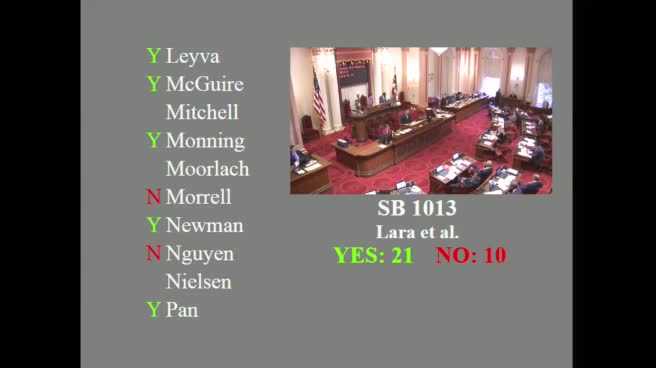 20MIN
Senate Floor
 20MIN
Senate Standing Committee on Appropriations
 27MIN
Senate Standing Committee on Governmental Organization
 1H
Senate Standing Committee on Energy, Utilities and Communications
Bill Author

Bill Co-Author(s):