SB 1057: Juvenile justice coordinating council.
- Session Year: 2023-2024
- House: Senate
- Latest Version Date: 2024-05-16
Current Status:
Failed
(2024-08-15: August 15 hearing: Held in committee and under submission.)
Introduced
In Committee
First Chamber
In Committee
Second Chamber
Enacted
Under existing law, there is established in each county treasury a Supplemental Law Enforcement Services Account (SLESA) to receive all amounts allocated to a county for specified purposes. Existing law requires the moneys to be allocated in specified amounts, including, but not limited to, 50% to a county or city and county to implement a comprehensive multiagency juvenile justice plan, as specified. Existing law requires the juvenile justice plan to be developed by the local juvenile justice coordinating council in each county and city and county. Existing law requires a juvenile justice coordinating council to consist of certain members, including, but not limited to, the chief probation officer, as chair, and a representative from the district attorneys office, the public defenders office, and the sheriffs department, among others.
This bill would revise and recast those membership provisions, and instead require each county juvenile justice coordinating council to, at a minimum, consist of at least 50% community representatives with the remainder of the seats allocated as specified. The bill would require the council to include an at-promise youth, as defined, and either a person with experience in the juvenile court system or a system-impacted family member. The bill would require, if a county board of supervisors or a countys juvenile coordinating councils bylaws established term limits, that all individuals of the council be subject to the term limits. The bill would require a council to meet no less than 3 times per year and announce its meetings at least 10 days in advance of a meeting.
Under existing law, there is established in each county treasury a Supplemental Law Enforcement Services Account (SLESA) to receive all amounts allocated to a county for specified purposes. Existing law requires the moneys to be allocated in specified amounts, including, but not limited to, 50% to a county or city and county to implement a comprehensive multiagency juvenile justice plan, as specified. Existing law requires the juvenile justice plan to be developed by the local juvenile justice coordinating council in each county and city and county. Existing law requires the plan to be annually reviewed and updated by the council and submitted to the Board of State and Community Corrections. Existing law requires a county or city and county to submit a report to the board of supervisors and the board to assess the effectiveness of the programs, strategies, and system enhancements funded under these provisions and specifies the information to be included in the report.
This bill would require a county or city and county to establish a juvenile justice coordinating council in order to obtain funding under these provisions. The bill would require the board to evaluate if a county or a city and county has complied with the requirements of these provisions and would authorize the board or any state agency overseeing the administration of these funds to determine an appropriate remedial action or to withhold funding if a county or city and county fails to create a juvenile justice coordinating council. The bill would revise required components of the multiagency juvenile justice plan to, among other things, additionally require a plan to include an assessment of existing community-based youth development services, identification and prioritization of areas of the community that are vulnerable to court system involvement due to high rates of poverty and the incarceration of at-promise youths family members, among other things, and a description of the target population funded under these provisions. The bill would require assessments to prioritize soliciting direct feedback on youth participants satisfaction with existing services and resources. The bill would require programs and strategies funded under these provisions to, among other things, be modeled on healing-centered, restorative, trauma-informed, and positive youth development approaches and in collaboration with community-based organizations. The bill would prohibit the sharing of personally identifying information across agencies without informed, voluntary, revocable, and written consent of youth participants or their parents or legal guardians. The bill would require a council to include additional information in its annual report to the board of supervisors and the board relating to their programs, including data on youth participants and council members.
The bill would require the local agency overseeing requests for proposals for funds under these provisions to engage with community stakeholders, as specified, and take into account the countys juvenile justice plan and equity funding across the county. The bill would authorize any local agency to oversee the request for proposals except for a law enforcement-related agency, with preference for behavioral health-related local agencies.
Existing law requires a juvenile justice coordinating council to consist of certain members, including, but not limited to, the chief probation officer, as chair, and a representative from the district attorneys office, the public defenders office, and the sheriffs department, among others.
This bill would revise and recast those membership provisions, and instead require each county juvenile justice coordinating council to, at a minimum, consist of at least 50% community representatives with the remainder of the seats allocated to representatives from governmental agencies, as specified. The bill would require the council to include an at-promise youth, as defined, and either a person with experience in the juvenile court system or a system-impacted family member. The bill would require a council to select 2 cochairs from amongst its members, at least one of whom shall be a community representative. The bill would require, if a county board of supervisors or a countys juvenile coordinating councils bylaws established term limits, that all individuals of the council be subject to the term limits. The bill would require a council to meet no less than 3 times per year and announce its meetings at least 10 days in advance of a meeting.
Under existing law, there is established in each county treasury a Supplemental Law Enforcement Services Account (SLESA) to receive all amounts allocated to a county for specified purposes. Existing law requires the moneys to be allocated in specified amounts, including, but not limited to, 50% to a county or city and county to implement a comprehensive multiagency juvenile justice plan, as specified. Existing law requires the juvenile justice plan to be developed by the local juvenile justice coordinating council in each county and city and county. Existing law requires the plan to be annually reviewed and updated by the council and submitted to the Board of State and Community Corrections. Existing law requires a county or city and county to submit a report to the board of supervisors and the board to assess the effectiveness of the programs, strategies, and system enhancements funded under these provisions and specifies the information to be included in the report.
This bill would require a county or city and county to establish a juvenile justice coordinating council in order to obtain funding under these provisions. The bill would require the board to evaluate if a county or a city and county has complied with the requirements of these provisions and would authorize the board or any state agency overseeing the administration of these funds to determine an appropriate remedial action or to withhold funding if a county or city and county fails to create a juvenile justice coordinating council. The bill would revise required components of the multiagency juvenile justice plan to, among other things, additionally require a plan to include an assessment of existing community-based youth development services, identification and prioritization of areas of the community that are vulnerable to court system involvement due to high rates of poverty and the incarceration of at-promise youths family members, among other things, and a description of the target population funded under these provisions. The bill would require assessments to prioritize soliciting direct feedback on youth participants satisfaction with existing services and resources. The bill would require programs and strategies funded under these provisions to, among other things, be modeled on healing-centered, restorative, trauma-informed, and positive youth development approaches and in collaboration with community-based organizations. The bill would prohibit the sharing of personally identifying information across agencies without informed, voluntary, revocable, and written consent of youth participants or their parents or legal guardians. The bill would require a council to include additional information in its annual report to the board of supervisors and the board relating to their programs, including data on youth participants and council members.
The bill would require the local agency overseeing requests for proposals for funds under these provisions to engage with community stakeholders, as specified, and take into account the countys juvenile justice plan and equity funding across the county. The bill would authorize any local agency to oversee the request for proposals except for a law enforcement-related agency, with preference for behavioral health-related local agencies.
Existing law requires a juvenile justice coordinating council to consist of certain members, including, but not limited to, the chief probation officer, as chair, and a representative from the district attorneys office, the public defenders office, and the sheriffs department, among others.
This bill would revise and recast those membership provisions, and instead require each county juvenile justice coordinating council to, at a minimum, consist of at least 50% community representatives with the remainder of the seats allocated to representatives from governmental agencies, as specified. The bill would require the council to include an at-promise youth, as defined, and either a person with experience in the juvenile court system or a system-impacted family member. The bill would require a council to select 2 cochairs from amongst its members, at least one of whom shall be a community representative. The bill would require a council to meet no less than 3 times per year and announce its meetings at least 10 days in advance of a meeting.
Existing law establishes the jurisdiction of the juvenile court over minors who are between 12 and 17 years of age, inclusive, who have violated a federal, state, or local law or ordinance, as specified, and over minors under 12 years of age who have been alleged to have committed specified crimes. Existing law authorizes a juvenile court to adjudge a person under these circumstances to be a ward of the court.This bill would make a technical, nonsubstantive change to these provisions.Existing law establishes the jurisdiction of the juvenile court over minors who are between 12 and 17 years of age, inclusive, who have violated a federal, state, or local law or ordinance, as specified, and over minors under 12 years of age who have been alleged to have committed specified crimes. Existing law authorizes a juvenile court to adjudge a person under these circumstances to be a ward of the court.
This bill would make a technical, nonsubstantive change to these provisions.
(a)The Legislature finds and declares all of the following:
(1)The grant administration under the Juvenile Justice Crime Prevention Act (JJCPA), which was created under the Schiff-Cardenas Crime Prevention Act of 2000 (Chapter 353 of the Statutes of 2000), requires that each county establish a juvenile justice coordinating council (Council) that consists of representatives from a variety of local agencies and community groups to ensure the countys multiagency juvenile justice plan is collaborative and comprehensive. A 2020 audit by the California State Auditor found that 20 percent of counties lacked a Council entirely. Of those counties that did complete plans, the California State Auditor found that counties generally made limited revisions to their plans over the past 20 years despite significant changes to the juvenile justice landscape.
(2)The Councils were intended to guide the implementation of JJCPA funds to support community-run prevention and intervention programs that would include meaningful planning and program assessments. Many of the Councils have fallen short of the original vision to support positive youth development in community settings and reduce youth involvement in the court system. The use of JJCPA funds on law enforcement salaries and benefits, including net-widening with excessive probation supervision, is contradictory to the acts original intent of investment in collaborative, community-based services.
(3)To be aligned with the purpose of the JJCPA, programs and strategies created by the Councils and funded under the JJCPA should be primarily focused on preventing young people from entering the criminal legal system through developing a nonpunitive, community-based, healing-centered, culturally competent, restorative, trauma-informed approach that is supported by key stakeholders, which is critical to reducing collateral consequences for justice-involved youth and saving taxpayer dollars.
(4)The Councils juvenile justice plans and subsequent allocation of JJCPA funds do not reflect the drastically changing landscape of Californias youth justice system or research on best practices to support youth. Since 2000, youth arrests have declined by over 80 percent. California has also seen a 66-percent decline in referrals to probation since 2006. Research shows that many at-promise youth are in the free community; therefore, the juvenile justice plans, programs, and strategies should reflect this changing landscape by investing in community-based solutions and services.
(5)Comprehensive multiagency juvenile justice plans should focus on creating nurturing environments conducive to healthy youth development. An analysis of multiple studies of system-involved youth shows significantly higher adverse childhood experience (ACE) scores, overrepresentation of minority youth, and documented associations between these ACEs and increased behavioral, legal, mental health, substance abuse, pregnancy, victimization, and educational problems. Arrest, court hearings, detention, and incarceration are inherently stressful, and can exacerbate trauma symptoms.
(6)State Strategies to Address the Needs of Justice-Involved Youth Impacted by Collateral Consequences (February 2023) by the National Governors Association found that justice-involved youth face a diverse range of collateral consequences that can have both immediate and long-term negative and adverse impacts on their well-being and the well-being of their families.
(7)The Justice Policy Institutes Sticker Shock 2020: The Cost of Youth Incarceration (July 2020) provides that extensive research reveals that secure youth incarceration increases the likelihood of recidivism and harms educational attainment, lifetime wages, and future health outcomes for youth. In 2020, California spent an average of $833 per day per youth in confinement, which is equivalent to spending $308,259 per year per youth. Prevention and intervention services for youth development are more cost effective to be administered through community-based services rather than through law enforcement agencies and incarceration.
(b)Therefore, it is the intent of the Legislature to include strong community representation on each Council, including at-promise youth, people and families impacted by the juvenile court system, and community-based service providers, to ensure that juvenile justice plans primarily focus on providing healing-centered, culturally competent, restorative, community-based programs and services that reduce and avoid young peoples engagement with law enforcement, including programs and services administered by or overseen by law enforcement agencies.
SEC. 2.Section 30061 of the Government Code is amended to read:30061.(a)There shall be established in each county treasury a Supplemental Law Enforcement Services Account (SLESA), to receive all amounts allocated to a county for purposes of implementing this chapter.(b)In any fiscal year for which a county receives moneys to be expended for the implementation of this chapter, the county auditor shall allocate the moneys in the countys SLESA within 30 days of the deposit of those moneys into the fund. The moneys shall be allocated as follows:(1)Five and fifteen-hundredths percent to the county sheriff for county jail construction and operation. In the case of the Counties of Madera, Napa, and Santa Clara, this allocation shall be made to the county director or chief of corrections.(2)Five and fifteen-hundredths percent to the district attorney for criminal prosecution.(3)Thirty-nine and seven-tenths percent to the county and the cities within the county, and, in the case of the Counties of San Mateo, Kern, Siskiyou, and Contra Costa, also to the Broadmoor Police Protection District, the Bear Valley Community Services District, the Stallion Springs Community Services District, the Lake Shastina Community Services District, and the Kensington Police Protection and Community Services District, in accordance with the relative population of the cities within the county and the unincorporated area of the county, and the Broadmoor Police Protection District in the County of San Mateo, the Bear Valley Community Services District and the Stallion Springs Community Services District in the County of Kern, the Lake Shastina Community Services District in the County of Siskiyou, and the Kensington Police Protection and Community Services District in the County of Contra Costa, as specified in the most recent January estimate by the Demographic Research Unit of the Department of Finance, and as adjusted to provide, except as provided in subdivision (i), a grant of at least one hundred thousand dollars ($100,000) to each law enforcement jurisdiction. For a newly incorporated city whose population estimate is not published by the Department of Finance, but that was incorporated prior to July 1 of the fiscal year in which an allocation from the SLESA is to be made, the city manager, or an appointee of the legislative body, if a city manager is not available, and the county administrative or executive officer shall prepare a joint notification to the Department of Finance and the county auditor with a population estimate reduction of the unincorporated area of the county equal to the population of the newly incorporated city by July 15, or within 15 days after the Budget Act is enacted, of the fiscal year in which an allocation from the SLESA is to be made. A person residing within the Broadmoor Police Protection District, the Bear Valley Community Services District, the Stallion Springs Community Services District, the Lake Shastina Community Services District, or the Kensington Police Protection and Community Services District shall not also be counted as residing within the unincorporated area of the County of San Mateo, Kern, Siskiyou, or Contra Costa, or within any city located within those counties. Except as provided in subdivision (i), the county auditor shall allocate a grant of at least one hundred thousand dollars ($100,000) to each law enforcement jurisdiction. Moneys allocated to the county pursuant to this subdivision shall be retained in the county SLESA, and moneys allocated to a city pursuant to this subdivision shall be deposited in a SLESA established in the city treasury.(4)Fifty percent to the county or city and county to implement a comprehensive multiagency juvenile justice plan, as provided in this paragraph. In order to be eligible for funding under this paragraph, a county or city and county shall establish a juvenile justice coordinating council with membership described in Section 749.22 of the Welfare and Institutions Code. The juvenile justice plan shall be developed by the local juvenile justice coordinating council in each county and city and county. If a county or city and county fails to establish a juvenile justice coordinating council, the Board of State and Community Corrections or any state agency overseeing the administration of these funds shall have the authority to determine appropriate remedial action or withhold the funding provided under this paragraph. The plan shall be reviewed and updated annually by the juvenile justice coordinating council. The plan or updated plan shall be approved by the county board of supervisors. The plan or updated plan shall be submitted to the Board of State and Community Corrections by May 1 of each year in a format specified by the Board of State and Community Corrections that consolidates the form of submission of the annual comprehensive multiagency juvenile justice plan to be developed under this paragraph with the form for submission of the annual Youthful Offender Block Grant plan that is required to be developed and submitted pursuant to Section 1961 of the Welfare and Institutions Code.(A)The comprehensive multiagency juvenile justice plan shall include, but not be limited to, all of the following components:(i)An assessment of existing law enforcement, probation, education, mental health, health, social services, drug and alcohol, and community-based youth development services and resources that specifically center at-promise youth, youth involved in the juvenile court system, and their families. Assessments shall prioritize soliciting direct feedback on youth participants satisfaction with existing services and resources.(ii)An identification and prioritization of the neighborhoods, schools, and other areas in the community that are vulnerable to court system involvement due to high rates of poverty, a lack of educational and employment opportunities, racial discrimination, the incarceration of an at-promise youths family members, and a high prevalence of community violence and crime.(iii)A local juvenile justice action strategy that provides for a continuum of care to prevent and respond to young people experiencing juvenile court system involvement that is modeled on a framework of positive youth development and demonstrates a healing-centered, culturally competent, restorative, community-based, collaborative, and integrated approach for at-promise youth and youth involved in the juvenile court system.(iv)A description of the target population for the program strategies that are proposed to be funded pursuant to this paragraph, including a description of the target populations race, ethnicity, age, gender identity, and ZIP Code of residence.(v)Input from at-promise youth, youth involved in the juvenile court system and their families, and a description of the programs and strategies that are proposed to be funded pursuant to this subparagraph, including documentation of their effectiveness, specific objectives, and outcome measures.(B)Programs and strategies proposed to be funded under this paragraph shall satisfy all of the following requirements:(i)Be based on programs and approaches that have been demonstrated to be effective in creating positive youth development outcomes, helping young people avoid engagement with law enforcement agencies, and reducing community violence and crime. These programs and approaches shall be modeled on healing-centered, culturally competent, restorative, trauma-informed, and positive youth development approaches.(ii)Collaborate and integrate services of all the resources set forth in clause (i) of subparagraph (A), to the extent appropriate, and prioritize collaboration with community-based organizations.(iii)Employ information sharing systems to ensure that county actions are fully coordinated, and designed to provide data for measuring the success of programs and strategies funded by this paragraph, while still protecting participant confidentiality in prearrest and prebooking diversion programs. Personally identifying information shall not be shared across agencies without the informed, voluntary, revocable, and written consent of youth participants, or their parents or legal guardians on behalf of minors.(C)The local agency overseeing the request for proposals process for funds provided under this paragraph shall engage community stakeholders, including, but not limited to, at-promise youth, youth involved in the juvenile court system and their families, and the juvenile justice coordinating council in the process of selecting which entities to which to distribute funds. The local agency shall take into account the countys juvenile justice plan and equity of funding across the county in the final selection of proposals to be funded. The local agency overseeing the request for proposals process for funds provided under this paragraph may be any county agency that is not a law enforcement-related agency, with preference for behavioral health-related local agencies. (D)To assess the effectiveness of programs and strategies funded pursuant to this paragraph, the juvenile justice coordinating council of each county or city and county shall submit by October 1 of each year a report to the county board of supervisors and to the Board of State and Community Corrections on the programs and strategies funded pursuant to this paragraph. The report shall be in a format specified by the Board of State and Community Corrections that consolidates the report to be submitted pursuant to this chapter with the annual report to be submitted to the Board of State and Community Corrections for the Youthful Offender Block Grant program, as required by subdivision (c) of Section 1961 of the Welfare and Institutions Code. The report shall include all of the following:(i)An updated description of the programs and strategies that have been funded pursuant to this paragraph in the immediately preceding fiscal year. Descriptions shall include evidence supporting the programs and strategies, including feedback from youth participants.(ii)An accounting of expenditures during the immediately preceding fiscal year for each program and strategy funded pursuant to this paragraph.(iii)A description and expenditure report for programs and strategies that have been cofunded during the preceding fiscal year using funds provided under this paragraph and Youthful Offender Block Grant funds provided under Chapter 1.5 (commencing with Section 1950) of Division 2.5 of the Welfare and Institutions Code.(iv)An updated list of juvenile justice coordinating council members, including their assigned seat and profession, if applicable, and dates for all council meetings in the immediately preceding fiscal year. (v)Countywide juvenile justice trend data available from existing statewide juvenile justice data systems or networks, as specified by the Board of State and Community Corrections, including, but not limited to, arrests, diversions, petitions filed, petitions sustained, placements, incarcerations, subsequent petitions, and probation violations, disaggregated by race, ethnicity, gender identity, age, and ZIP Code of residence, and including, in a format to be specified by the Board of State and Community Corrections, a summary description or analysis, based on available information, of how the programs and strategies funded pursuant to this paragraph have or may have contributed to, or influenced, the juvenile justice data trends identified in the report.(E)The Board of State and Community Corrections shall, within 45 days of having received the countys report, post on its internet website the report and a description or summary of the programs and strategies that have been supported by funds made available to the county under this paragraph.(F)The Board of State and Community Corrections shall compile the local reports and, by March 1 of each year following their submission, make a report to the Governor and the Legislature summarizing the programs and strategies and related expenditures made by each county and city and county from the appropriation made for the purposes of this paragraph. The annual report to the Governor and the Legislature shall also summarize the countywide trend data and any other pertinent information submitted by counties indicating how the programs and strategies supported by funds appropriated under this paragraph have or may have contributed to, or influenced, the trends identified. The Board of State and Community Corrections may consolidate the annual report to the Legislature required under this paragraph with the annual report required by subdivision (d) of Section 1961 of the Welfare and Institutions Code for the Youthful Offender Block Grant program. The annual report shall be submitted pursuant to Section 9795, and shall be posted for access by the public on the internet website of the Board of State and Community Corrections.(G)As used in this paragraph, at-promise youth means young people up to 25 years of age, inclusive, who are vulnerable to court system involvement due to high rates of poverty, a lack of educational and employment opportunities, racial discrimination, the incarceration of one or more of their family members, and a high prevalence of community violence and crime.(c)Subject to subdivision (d), for each fiscal year in which the county, each city, the Broadmoor Police Protection District, the Bear Valley Community Services District, the Stallion Springs Community Services District, the Lake Shastina Community Services District, and the Kensington Police Protection and Community Services District receive moneys pursuant to paragraph (3) of subdivision (b), the county, each city, and each district specified in this subdivision shall appropriate those moneys in accordance with the following procedures:(1)In the case of the county, the county board of supervisors shall appropriate existing and anticipated moneys exclusively to provide frontline law enforcement services, other than those services specified in paragraphs (1) and (2) of subdivision (b), in the unincorporated areas of the county, in response to written requests submitted to the board by the county sheriff and the district attorney. Any request submitted pursuant to this paragraph shall specify the frontline law enforcement needs of the requesting entity, and those personnel, equipment, and programs that are necessary to meet those needs.(2)In the case of a city, the city council shall appropriate existing and anticipated moneys exclusively to fund frontline municipal police services, in accordance with written requests submitted by the chief of police of that city or the chief administrator of the law enforcement agency that provides police services for that city.(3)In the case of the Broadmoor Police Protection District within the County of San Mateo, the Bear Valley Community Services District or the Stallion Springs Community Services District within the County of Kern, the Lake Shastina Community Services District within the County of Siskiyou, or the Kensington Police Protection and Community Services District within the County of Contra Costa, the legislative body of that special district shall appropriate existing and anticipated moneys exclusively to fund frontline municipal police services, in accordance with written requests submitted by the chief administrator of the law enforcement agency that provides police services for that special district.(d)For each fiscal year in which the county, a city, or the Broadmoor Police Protection District within the County of San Mateo, the Bear Valley Community Services District or the Stallion Springs Community Services District within the County of Kern, the Lake Shastina Community Services District within the County of Siskiyou, or the Kensington Police Protection and Community Services District within the County of Contra Costa receives any moneys pursuant to this chapter, in no event shall the governing body of any of those recipient agencies subsequently alter any previous, valid appropriation by that body, for that same fiscal year, of moneys allocated to the county or city pursuant to paragraph (3) of subdivision (b).(e)For the 201112 fiscal year, the Controller shall allocate 23.54 percent of the amount deposited in the Local Law Enforcement Services Account in the Local Revenue Fund 2011 for the purposes of paragraphs (1), (2), and (3) of subdivision (b), and shall allocate 23.54 percent for purposes of paragraph (4) of subdivision (b).(f)Commencing with the 201213 fiscal year, subsequent to the allocation described in subdivision (c) of Section 29552, the Controller shall allocate 23.54363596 percent of the remaining amount deposited in the Enhancing Law Enforcement Activities Subaccount in the Local Revenue Fund 2011 for the purposes of paragraphs (1) to (3), inclusive, of subdivision (b), and, subsequent to the allocation described in subdivision (c) of Section 29552, shall allocate 23.54363596 percent of the remaining amount for purposes of paragraph (4) of subdivision (b).(g)Commencing with the 201314 fiscal year, subsequent to the allocation described in subdivision (d) of Section 29552, the Controller shall allocate 23.54363596 percent of the remaining amount deposited in the Enhancing Law Enforcement Activities Subaccount in the Local Revenue Fund 2011 for the purposes of paragraphs (1) to (3), inclusive, of subdivision (b), and, subsequent to the allocation described in subdivision (d) of Section 29552, shall allocate 23.54363596 percent of the remaining amount for purposes of paragraph (4) of subdivision (b). The Controller shall allocate funds in monthly installments to local jurisdictions for public safety in accordance with this section as annually calculated by the Director of Finance.(h)Funds received pursuant to subdivision (b) shall be expended or encumbered in accordance with this chapter no later than June 30 of the following fiscal year. A local agency that has not met the requirement of this subdivision shall remit unspent SLESA moneys received after April 1, 2009, to the Controller for deposit in the Local Safety and Protection Account, after April 1, 2012, to the Local Law Enforcement Services Account, and after July 1, 2012, to the County Enhancing Law Enforcement Activities Subaccount. This subdivision shall become inoperative on July 1, 2015.(i)In the 201011 fiscal year, if the fourth quarter revenue derived from fees imposed by subdivision (a) of Section 10752.2 of the Revenue and Taxation Code that are deposited in the General Fund and transferred to the Local Safety and Protection Account, and continuously appropriated to the Controller for allocation pursuant to this section, are insufficient to provide a minimum grant of one hundred thousand dollars ($100,000) to each law enforcement jurisdiction, the county auditor shall allocate the revenue proportionately, based on the allocation schedule in paragraph (3) of subdivision (b). The county auditor shall proportionately allocate, based on the allocation schedule in paragraph (3) of subdivision (b), all revenues received after the distribution of the fourth quarter allocation attributable to these fees for which payment was due prior to July 1, 2011, until all minimum allocations are fulfilled, at which point all remaining revenue shall be distributed proportionately among the other jurisdictions.(j)The county auditor shall redirect unspent funds that were remitted after July 1, 2012, by a local agency to the County Enhancing Law Enforcement Activities Subaccount pursuant to subdivision (h), to the local agency that remitted the unspent funds in an amount equal to the amount remitted.SEC. 3.SEC. 2.Section 749.22 of the Welfare and Institutions Code is repealed.SEC. 4.SEC. 3.Section 749.22 is added to the Welfare and Institutions Code, to read:749.22.(a)For the purposes of this section, the following definitions apply:
(1)At-promise youth means young people up to 25 years of age, inclusive, who are vulnerable to court system involvement due to high rates of poverty, a lack of educational and employment opportunities, racial discrimination, the incarceration of one or more of their family members, and a high prevalence of community violence and crime.
(2)Community representative means an individual who is currently or formerly justice system-involved, a system-impacted family member, or a representative from a nonprofit, community-based organization that provides services to youth and that does not include law enforcement employees or staff.
(b)To be eligible for a grant under this article, each county shall be required to establish a juvenile justice coordinating council that shall develop and implement a continuum of care to prevent and respond to young people experiencing juvenile court system involvement that is modeled on a framework of positive youth development and demonstrates a healing-centered, restorative, community-based, collaborative, and integrated approach for at-promise youth and youth involved in the juvenile court system.
(c)(1)A juvenile justice coordinating council shall, at a minimum, consist of at least 50 percent community representatives and the remainder of seats shall be allocated as described in paragraph (2).
(2)The juvenile justice coordinating council shall be composed of the chief probation officer, as cochair, and may include one representative each from the public health department, the district attorneys office, the public defenders office, the board of supervisors, the county department of social services, the county department of mental or behavioral health, a community-based drug and alcohol program, a city police department, the county office of education or a school district, and the county department of children, youth, and families, if one exists. The juvenile justice coordinating council shall be cochaired by a community representative elected from among its members, and shall include an at-promise youth, and either a person with experience in the juvenile court system or a system-impacted family member.
(3)If a county board of supervisors or a countys juvenile justice coordinating councils bylaws establish term limits, all individuals of the council, including cochairs, shall be subject to these term limits.(4)The board of supervisors shall be informed of any community-based organizations participating on a juvenile justice coordinating council.(d)A juvenile justice coordinating council shall meet no less than three times per year and announce meetings at least 10 days in advance. A juvenile justice coordinating council shall make meetings accessible to the public through remote participation, such as streaming and remote call-in options, and shall choose meeting times that optimize and encourage public participation.
(e)A juvenile justice coordinating council shall develop a comprehensive multiagency juvenile justice plan pursuant to Section 30061 of the Government Code that identifies the resources and strategies for providing an effective continuum of care for at-promise youth, youth involved in the juvenile court system, and their families.(a)The Legislature finds and declares all of the following:
(1)The grant administration under the Juvenile Justice Crime Prevention Act (JJCPA), which was created under the Schiff-Cardenas Crime Prevention Act of 2000 (Chapter 353 of the Statutes of 2000), requires that each county establish a juvenile justice coordinating council (Council) that consists of representatives from a variety of local agencies and community groups to ensure the countys multiagency juvenile justice plan is collaborative and comprehensive. A 2020 audit by the California State Auditor found that 20 percent of counties lacked a Council entirely. Of those counties that did complete plans, the California State Auditor found that counties generally made limited revisions to their plans over the past 20 years despite significant changes to the juvenile justice landscape.
(2)The Councils were intended to guide the implementation of JJCPA funds to support community-run prevention and intervention programs that would include meaningful planning and program assessments. Many of the Councils have fallen short of the original vision to support positive youth development in community settings and reduce youth involvement in the court system. The use of JJCPA funds on law enforcement salaries and benefits, including net-widening with excessive probation supervision, is contradictory to the acts original intent of investment in collaborative, community-based services.
(3)To be aligned with the purpose of the JJCPA, programs and strategies created by the Councils and funded under the JJCPA should be primarily focused on preventing young people from entering the criminal legal system through developing a nonpunitive, community-based, healing-centered, culturally competent, restorative, trauma-informed approach that is supported by key stakeholders, which is critical to reducing collateral consequences for justice-involved youth and saving taxpayer dollars.
(4)The Councils juvenile justice plans and subsequent allocation of JJCPA funds do not reflect the drastically changing landscape of Californias youth justice system or research on best practices to support youth. Since 2000, youth arrests have declined by over 80 percent. California has also seen a 66-percent decline in referrals to probation since 2006. Research shows that many at-promise youth are in the free community; therefore, the juvenile justice plans, programs, and strategies should reflect this changing landscape by investing in community-based solutions and services.
(5)Comprehensive multiagency juvenile justice plans should focus on creating nurturing environments conducive to healthy youth development. An analysis of multiple studies of system-involved youth shows significantly higher adverse childhood experience (ACE) scores, overrepresentation of minority youth, and documented associations between these ACEs and increased behavioral, legal, mental health, substance abuse, pregnancy, victimization, and educational problems. Arrest, court hearings, detention, and incarceration are inherently stressful, and can exacerbate trauma symptoms.
(6)State Strategies to Address the Needs of Justice-Involved Youth Impacted by Collateral Consequences (February 2023) by the National Governors Association found that justice-involved youth face a diverse range of collateral consequences that can have both immediate and long-term negative and adverse impacts on their well-being and the well-being of their families.
(7)The Justice Policy Institutes Sticker Shock 2020: The Cost of Youth Incarceration (July 2020) provides that extensive research reveals that secure youth incarceration increases the likelihood of recidivism and harms educational attainment, lifetime wages, and future health outcomes for youth. In 2020, California spent an average of $833 per day per youth in confinement, which is equivalent to spending $308,259 per year per youth. Prevention and intervention services for youth development are more cost effective to be administered through community-based services rather than through law enforcement agencies and incarceration.
(b)Therefore, it is the intent of the Legislature to include strong community representation on each Council, including at-promise youth, people and families impacted by the juvenile court system, and community-based service providers, to ensure that juvenile justice plans primarily focus on providing healing-centered, culturally competent, restorative, community-based programs and services that reduce and avoid young peoples engagement with law enforcement, including programs and services administered by or overseen by law enforcement agencies.
SEC. 2.Section 30061 of the Government Code is amended to read:30061.(a)There shall be established in each county treasury a Supplemental Law Enforcement Services Account (SLESA), to receive all amounts allocated to a county for purposes of implementing this chapter.
(b)In any fiscal year for which a county receives moneys to be expended for the implementation of this chapter, the county auditor shall allocate the moneys in the countys SLESA within 30 days of the deposit of those moneys into the fund. The moneys shall be allocated as follows:
(1)Five and fifteen-hundredths percent to the county sheriff for county jail construction and operation. In the case of the Counties of Madera, Napa, and Santa Clara, this allocation shall be made to the county director or chief of corrections.
(2)Five and fifteen-hundredths percent to the district attorney for criminal prosecution.
(3)Thirty-nine and seven-tenths percent to the county and the cities within the county, and, in the case of the Counties of San Mateo, Kern, Siskiyou, and Contra Costa, also to the Broadmoor Police Protection District, the Bear Valley Community Services District, the Stallion Springs Community Services District, the Lake Shastina Community Services District, and the Kensington Police Protection and Community Services District, in accordance with the relative population of the cities within the county and the unincorporated area of the county, and the Broadmoor Police Protection District in the County of San Mateo, the Bear Valley Community Services District and the Stallion Springs Community Services District in the County of Kern, the Lake Shastina Community Services District in the County of Siskiyou, and the Kensington Police Protection and Community Services District in the County of Contra Costa, as specified in the most recent January estimate by the Demographic Research Unit of the Department of Finance, and as adjusted to provide, except as provided in subdivision (i), a grant of at least one hundred thousand dollars ($100,000) to each law enforcement jurisdiction. For a newly incorporated city whose population estimate is not published by the Department of Finance, but that was incorporated prior to July 1 of the fiscal year in which an allocation from the SLESA is to be made, the city manager, or an appointee of the legislative body, if a city manager is not available, and the county administrative or executive officer shall prepare a joint notification to the Department of Finance and the county auditor with a population estimate reduction of the unincorporated area of the county equal to the population of the newly incorporated city by July 15, or within 15 days after the Budget Act is enacted, of the fiscal year in which an allocation from the SLESA is to be made. A person residing within the Broadmoor Police Protection District, the Bear Valley Community Services District, the Stallion Springs Community Services District, the Lake Shastina Community Services District, or the Kensington Police Protection and Community Services District shall not also be counted as residing within the unincorporated area of the County of San Mateo, Kern, Siskiyou, or Contra Costa, or within any city located within those counties. Except as provided in subdivision (i), the county auditor shall allocate a grant of at least one hundred thousand dollars ($100,000) to each law enforcement jurisdiction. Moneys allocated to the county pursuant to this subdivision shall be retained in the county SLESA, and moneys allocated to a city pursuant to this subdivision shall be deposited in a SLESA established in the city treasury.
(4)Fifty percent to the county or city and county to implement a comprehensive multiagency juvenile justice plan, as provided in this paragraph. In order to be eligible for funding under this paragraph, a county or city and county shall establish a juvenile justice coordinating council with membership described in Section 749.22 of the Welfare and Institutions Code. The juvenile justice plan shall be developed by the local juvenile justice coordinating council in each county and city and county. If a county or city and county fails to establish a juvenile justice coordinating council, the Board of State and Community Corrections or any state agency overseeing the administration of these funds shall have the authority to determine appropriate remedial action or withhold the funding provided under this paragraph. The plan shall be reviewed and updated annually by the juvenile justice coordinating council. The plan or updated plan shall be approved by the county board of supervisors. The plan or updated plan shall be submitted to the Board of State and Community Corrections by May 1 of each year in a format specified by the Board of State and Community Corrections that consolidates the form of submission of the annual comprehensive multiagency juvenile justice plan to be developed under this paragraph with the form for submission of the annual Youthful Offender Block Grant plan that is required to be developed and submitted pursuant to Section 1961 of the Welfare and Institutions Code.
(A)The comprehensive multiagency juvenile justice plan shall include, but not be limited to, all of the following components:
(i)An assessment of existing law enforcement, probation, education, mental health, health, social services, drug and alcohol, and community-based youth development services and resources that specifically center at-promise youth, youth involved in the juvenile court system, and their families. Assessments shall prioritize soliciting direct feedback on youth participants satisfaction with existing services and resources.
(ii)An identification and prioritization of the neighborhoods, schools, and other areas in the community that are vulnerable to court system involvement due to high rates of poverty, a lack of educational and employment opportunities, racial discrimination, the incarceration of an at-promise youths family members, and a high prevalence of community violence and crime.
(iii)A local juvenile justice action strategy that provides for a continuum of care to prevent and respond to young people experiencing juvenile court system involvement that is modeled on a framework of positive youth development and demonstrates a healing-centered, culturally competent, restorative, community-based, collaborative, and integrated approach for at-promise youth and youth involved in the juvenile court system.
(iv)A description of the target population for the program strategies that are proposed to be funded pursuant to this paragraph, including a description of the target populations race, ethnicity, age, gender identity, and ZIP Code of residence.
(v)Input from at-promise youth, youth involved in the juvenile court system and their families, and a description of the programs and strategies that are proposed to be funded pursuant to this subparagraph, including documentation of their effectiveness, specific objectives, and outcome measures.
(B)Programs and strategies proposed to be funded under this paragraph shall satisfy all of the following requirements:
(i)Be based on programs and approaches that have been demonstrated to be effective in creating positive youth development outcomes, helping young people avoid engagement with law enforcement agencies, and reducing community violence and crime. These programs and approaches shall be modeled on healing-centered, culturally competent, restorative, trauma-informed, and positive youth development approaches.
(ii)Collaborate and integrate services of all the resources set forth in clause (i) of subparagraph (A), to the extent appropriate, and prioritize collaboration with community-based organizations.
(iii)Employ information sharing systems to ensure that county actions are fully coordinated, and designed to provide data for measuring the success of programs and strategies funded by this paragraph, while still protecting participant confidentiality in prearrest and prebooking diversion programs. Personally identifying information shall not be shared across agencies without the informed, voluntary, revocable, and written consent of youth participants, or their parents or legal guardians on behalf of minors.
(C)The local agency overseeing the request for proposals process for funds provided under this paragraph shall engage community stakeholders, including, but not limited to, at-promise youth, youth involved in the juvenile court system and their families, and the juvenile justice coordinating council in the process of selecting which entities to which to distribute funds. The local agency shall take into account the countys juvenile justice plan and equity of funding across the county in the final selection of proposals to be funded. The local agency overseeing the request for proposals process for funds provided under this paragraph may be any county agency that is not a law enforcement-related agency, with preference for behavioral health-related local agencies.
(D)To assess the effectiveness of programs and strategies funded pursuant to this paragraph, the juvenile justice coordinating council of each county or city and county shall submit by October 1 of each year a report to the county board of supervisors and to the Board of State and Community Corrections on the programs and strategies funded pursuant to this paragraph. The report shall be in a format specified by the Board of State and Community Corrections that consolidates the report to be submitted pursuant to this chapter with the annual report to be submitted to the Board of State and Community Corrections for the Youthful Offender Block Grant program, as required by subdivision (c) of Section 1961 of the Welfare and Institutions Code. The report shall include all of the following:
(i)An updated description of the programs and strategies that have been funded pursuant to this paragraph in the immediately preceding fiscal year. Descriptions shall include evidence supporting the programs and strategies, including feedback from youth participants.
(ii)An accounting of expenditures during the immediately preceding fiscal year for each program and strategy funded pursuant to this paragraph.
(iii)A description and expenditure report for programs and strategies that have been cofunded during the preceding fiscal year using funds provided under this paragraph and Youthful Offender Block Grant funds provided under Chapter 1.5 (commencing with Section 1950) of Division 2.5 of the Welfare and Institutions Code.
(iv)An updated list of juvenile justice coordinating council members, including their assigned seat and profession, if applicable, and dates for all council meetings in the immediately preceding fiscal year.
(v)Countywide juvenile justice trend data available from existing statewide juvenile justice data systems or networks, as specified by the Board of State and Community Corrections, including, but not limited to, arrests, diversions, petitions filed, petitions sustained, placements, incarcerations, subsequent petitions, and probation violations, disaggregated by race, ethnicity, gender identity, age, and ZIP Code of residence, and including, in a format to be specified by the Board of State and Community Corrections, a summary description or analysis, based on available information, of how the programs and strategies funded pursuant to this paragraph have or may have contributed to, or influenced, the juvenile justice data trends identified in the report.
(E)The Board of State and Community Corrections shall, within 45 days of having received the countys report, post on its internet website the report and a description or summary of the programs and strategies that have been supported by funds made available to the county under this paragraph.
(F)The Board of State and Community Corrections shall compile the local reports and, by March 1 of each year following their submission, make a report to the Governor and the Legislature summarizing the programs and strategies and related expenditures made by each county and city and county from the appropriation made for the purposes of this paragraph. The annual report to the Governor and the Legislature shall also summarize the countywide trend data and any other pertinent information submitted by counties indicating how the programs and strategies supported by funds appropriated under this paragraph have or may have contributed to, or influenced, the trends identified. The Board of State and Community Corrections may consolidate the annual report to the Legislature required under this paragraph with the annual report required by subdivision (d) of Section 1961 of the Welfare and Institutions Code for the Youthful Offender Block Grant program. The annual report shall be submitted pursuant to Section 9795, and shall be posted for access by the public on the internet website of the Board of State and Community Corrections.
(G)As used in this paragraph, at-promise youth means young people up to 25 years of age, inclusive, who are vulnerable to court system involvement due to high rates of poverty, a lack of educational and employment opportunities, racial discrimination, the incarceration of one or more of their family members, and a high prevalence of community violence and crime.
(c)Subject to subdivision (d), for each fiscal year in which the county, each city, the Broadmoor Police Protection District, the Bear Valley Community Services District, the Stallion Springs Community Services District, the Lake Shastina Community Services District, and the Kensington Police Protection and Community Services District receive moneys pursuant to paragraph (3) of subdivision (b), the county, each city, and each district specified in this subdivision shall appropriate those moneys in accordance with the following procedures:
(1)In the case of the county, the county board of supervisors shall appropriate existing and anticipated moneys exclusively to provide frontline law enforcement services, other than those services specified in paragraphs (1) and (2) of subdivision (b), in the unincorporated areas of the county, in response to written requests submitted to the board by the county sheriff and the district attorney. Any request submitted pursuant to this paragraph shall specify the frontline law enforcement needs of the requesting entity, and those personnel, equipment, and programs that are necessary to meet those needs.
(2)In the case of a city, the city council shall appropriate existing and anticipated moneys exclusively to fund frontline municipal police services, in accordance with written requests submitted by the chief of police of that city or the chief administrator of the law enforcement agency that provides police services for that city.
(3)In the case of the Broadmoor Police Protection District within the County of San Mateo, the Bear Valley Community Services District or the Stallion Springs Community Services District within the County of Kern, the Lake Shastina Community Services District within the County of Siskiyou, or the Kensington Police Protection and Community Services District within the County of Contra Costa, the legislative body of that special district shall appropriate existing and anticipated moneys exclusively to fund frontline municipal police services, in accordance with written requests submitted by the chief administrator of the law enforcement agency that provides police services for that special district.
(d)For each fiscal year in which the county, a city, or the Broadmoor Police Protection District within the County of San Mateo, the Bear Valley Community Services District or the Stallion Springs Community Services District within the County of Kern, the Lake Shastina Community Services District within the County of Siskiyou, or the Kensington Police Protection and Community Services District within the County of Contra Costa receives any moneys pursuant to this chapter, in no event shall the governing body of any of those recipient agencies subsequently alter any previous, valid appropriation by that body, for that same fiscal year, of moneys allocated to the county or city pursuant to paragraph (3) of subdivision (b).
(e)For the 201112 fiscal year, the Controller shall allocate 23.54 percent of the amount deposited in the Local Law Enforcement Services Account in the Local Revenue Fund 2011 for the purposes of paragraphs (1), (2), and (3) of subdivision (b), and shall allocate 23.54 percent for purposes of paragraph (4) of subdivision (b).
(f)Commencing with the 201213 fiscal year, subsequent to the allocation described in subdivision (c) of Section 29552, the Controller shall allocate 23.54363596 percent of the remaining amount deposited in the Enhancing Law Enforcement Activities Subaccount in the Local Revenue Fund 2011 for the purposes of paragraphs (1) to (3), inclusive, of subdivision (b), and, subsequent to the allocation described in subdivision (c) of Section 29552, shall allocate 23.54363596 percent of the remaining amount for purposes of paragraph (4) of subdivision (b).
(g)Commencing with the 201314 fiscal year, subsequent to the allocation described in subdivision (d) of Section 29552, the Controller shall allocate 23.54363596 percent of the remaining amount deposited in the Enhancing Law Enforcement Activities Subaccount in the Local Revenue Fund 2011 for the purposes of paragraphs (1) to (3), inclusive, of subdivision (b), and, subsequent to the allocation described in subdivision (d) of Section 29552, shall allocate 23.54363596 percent of the remaining amount for purposes of paragraph (4) of subdivision (b). The Controller shall allocate funds in monthly installments to local jurisdictions for public safety in accordance with this section as annually calculated by the Director of Finance.
(h)Funds received pursuant to subdivision (b) shall be expended or encumbered in accordance with this chapter no later than June 30 of the following fiscal year. A local agency that has not met the requirement of this subdivision shall remit unspent SLESA moneys received after April 1, 2009, to the Controller for deposit in the Local Safety and Protection Account, after April 1, 2012, to the Local Law Enforcement Services Account, and after July 1, 2012, to the County Enhancing Law Enforcement Activities Subaccount. This subdivision shall become inoperative on July 1, 2015.
(i)In the 201011 fiscal year, if the fourth quarter revenue derived from fees imposed by subdivision (a) of Section 10752.2 of the Revenue and Taxation Code that are deposited in the General Fund and transferred to the Local Safety and Protection Account, and continuously appropriated to the Controller for allocation pursuant to this section, are insufficient to provide a minimum grant of one hundred thousand dollars ($100,000) to each law enforcement jurisdiction, the county auditor shall allocate the revenue proportionately, based on the allocation schedule in paragraph (3) of subdivision (b). The county auditor shall proportionately allocate, based on the allocation schedule in paragraph (3) of subdivision (b), all revenues received after the distribution of the fourth quarter allocation attributable to these fees for which payment was due prior to July 1, 2011, until all minimum allocations are fulfilled, at which point all remaining revenue shall be distributed proportionately among the other jurisdictions.
(j)The county auditor shall redirect unspent funds that were remitted after July 1, 2012, by a local agency to the County Enhancing Law Enforcement Activities Subaccount pursuant to subdivision (h), to the local agency that remitted the unspent funds in an amount equal to the amount remitted.
SEC. 3.Section 749.22 of the Welfare and Institutions Code is repealed.SEC. 4.Section 749.22 is added to the Welfare and Institutions Code, to read:749.22.(a)For the purposes of this section, the following definitions apply:
(1)At-promise youth means young people up to 25 years of age, inclusive, who are vulnerable to court system involvement due to high rates of poverty, a lack of educational and employment opportunities, racial discrimination, the incarceration of one or more of their family members, and a high prevalence of community violence and crime.
(2)Community representative means an individual who is currently or formerly justice system-involved, a system-impacted family member, or a representative from a nonprofit, community-based organization that provides services to youth and that does not include law enforcement employees or staff.
(b)To be eligible for a grant under this article, each county shall be required to establish a juvenile justice coordinating council that shall develop and implement a continuum of care to prevent and respond to young people experiencing juvenile court system involvement that is modeled on a framework of positive youth development and demonstrates a healing-centered, restorative, community-based, collaborative, and integrated approach for at-promise youth and youth involved in the juvenile court system.
(c)(1)A juvenile justice coordinating council shall, at a minimum, consist of at least 50 percent community representatives and the remainder of seats shall be allocated to representatives from governmental agencies. as described in paragraph (2).
(2)The juvenile justice coordinating council shall include an at-promise youth, and either a person with experience in the juvenile court system or a system-impacted family member. The juvenile justice coordinating council may include one representative each from the public health department, the district attorneys office, the county probation department, the public defenders office, the board of supervisors, the county department of social services, the county department of mental or behavioral health, a community-based drug and alcohol program, a city police department, the county office of education or a school district, and the county department of children, youth, and families, if one exists. If a county board of supervisors or a countys juvenile justice coordinating councils bylaws establish term limits, all individuals of the council, including cochairs, shall be subject to these term limits.(3)A juvenile justice coordinating council shall elect two cochairs from among its members, at least one of whom shall be a community representative.(2)The juvenile justice coordinating council shall be composed of the chief probation officer, as cochair, and may include one representative each from the public health department, the district attorneys office, the public defenders office, the board of supervisors, the county department of social services, the county department of mental or behavioral health, a community-based drug and alcohol program, a city police department, the county office of education or a school district, and the county department of children, youth, and families, if one exists. The juvenile justice coordinating council shall be cochaired by a community representative elected from among its members, and shall include an at-promise youth, and either a person with experience in the juvenile court system or a system-impacted family member.
(3)If a county board of supervisors or a countys juvenile justice coordinating councils bylaws establish term limits, all individuals of the council, including cochairs, shall be subject to these term limits.
(4)The board of supervisors shall be informed of any community-based organizations participating on a juvenile justice coordinating council.
(d)A juvenile justice coordinating council shall meet no less than three times per year and announce meetings at least 10 days in advance. A juvenile justice coordinating council shall make meetings accessible to the public through remote participation, such as streaming and remote call-in options, and shall choose meeting times that optimize and encourage public participation.
(e)A juvenile justice coordinating council shall develop a comprehensive multiagency juvenile justice plan pursuant to Section 30061 of the Government Code that identifies the resources and strategies for providing an effective continuum of care for at-promise youth, youth involved in the juvenile court system, and their families.
(a)The Legislature finds and declares all of the following:
(1)The grant administration under the Juvenile Justice Crime Prevention Act (JJCPA), which was created under the Schiff-Cardenas Crime Prevention Act of 2000 (Chapter 353 of the Statutes of 2000), requires that each county establish a juvenile justice coordinating council (Council) that consists of representatives from a variety of local agencies and community groups to ensure the countys multiagency juvenile justice plan is collaborative and comprehensive. A 2020 audit by the California State Auditor found that 20 percent of counties lacked a Council entirely. Of those counties that did complete plans, the California State Auditor found that counties generally made limited revisions to their plans over the past 20 years despite significant changes to the juvenile justice landscape.
(2)The Councils were intended to guide the implementation of JJCPA funds to support community-run prevention and intervention programs that would include meaningful planning and program assessments. Many of the Councils have fallen short of the original vision to support positive youth development in community settings and reduce youth involvement in the court system. The use of JJCPA funds on law enforcement salaries and benefits, including net-widening with excessive probation supervision, is contradictory to the acts original intent of investment in collaborative, community-based services.
(3)To be aligned with the purpose of the JJCPA, programs and strategies created by the Councils and funded under the JJCPA should be primarily focused on preventing young people from entering the criminal legal system through developing a nonpunitive, community-based, healing-centered, culturally competent, restorative, trauma-informed approach that is supported by key stakeholders, which is critical to reducing collateral consequences for justice-involved youth and saving taxpayer dollars.
(4)The Councils juvenile justice plans and subsequent allocation of JJCPA funds do not reflect the drastically changing landscape of Californias youth justice system or research on best practices to support youth. Since 2000, youth arrests have declined by over 80 percent. California has also seen a 66-percent decline in referrals to probation since 2006. Research shows that many at-promise youth are in the free community; therefore, the juvenile justice plans, programs, and strategies should reflect this changing landscape by investing in community-based solutions and services.
(5)Comprehensive multiagency juvenile justice plans should focus on creating nurturing environments conducive to healthy youth development. An analysis of multiple studies of system-involved youth shows significantly higher adverse childhood experience (ACE) scores, overrepresentation of minority youth, and documented associations between these ACEs and increased behavioral, legal, mental health, substance abuse, pregnancy, victimization, and educational problems. Arrest, court hearings, detention, and incarceration are inherently stressful, and can exacerbate trauma symptoms.
(6)State Strategies to Address the Needs of Justice-Involved Youth Impacted by Collateral Consequences (February 2023) by the National Governors Association found that justice-involved youth face a diverse range of collateral consequences that can have both immediate and long-term negative and adverse impacts on their well-being and the well-being of their families.
(7)The Justice Policy Institutes Sticker Shock 2020: The Cost of Youth Incarceration (July 2020) provides that extensive research reveals that secure youth incarceration increases the likelihood of recidivism and harms educational attainment, lifetime wages, and future health outcomes for youth. In 2020, California spent an average of $833 per day per youth in confinement, which is equivalent to spending $308,259 per year per youth. Prevention and intervention services for youth development are more cost effective to be administered through community-based services rather than through law enforcement agencies and incarceration.
(b)Therefore, it is the intent of the Legislature to include strong community representation on each Council, including at-promise youth, people and families impacted by the juvenile court system, and community-based service providers, to ensure that juvenile justice plans primarily focus on providing healing-centered, culturally competent, restorative, community-based programs and services that reduce and avoid young peoples engagement with law enforcement, including programs and services administered by or overseen by law enforcement agencies.
SEC. 2.Section 30061 of the Government Code is amended to read:30061.(a)There shall be established in each county treasury a Supplemental Law Enforcement Services Account (SLESA), to receive all amounts allocated to a county for purposes of implementing this chapter.
(b)In any fiscal year for which a county receives moneys to be expended for the implementation of this chapter, the county auditor shall allocate the moneys in the countys SLESA within 30 days of the deposit of those moneys into the fund. The moneys shall be allocated as follows:
(1)Five and fifteen-hundredths percent to the county sheriff for county jail construction and operation. In the case of the Counties of Madera, Napa, and Santa Clara Counties, Clara, this allocation shall be made to the county director or chief of corrections.
(2)Five and fifteen-hundredths percent to the district attorney for criminal prosecution.
(3)Thirty-nine and seven-tenths percent to the county and the cities within the county, and, in the case of the Counties of San Mateo, Kern, Siskiyou, and Contra Costa Counties, Costa, also to the Broadmoor Police Protection District, the Bear Valley Community Services District, the Stallion Springs Community Services District, the Lake Shastina Community Services District, and the Kensington Police Protection and Community Services District, in accordance with the relative population of the cities within the county and the unincorporated area of the county, and the Broadmoor Police Protection District in the County of San Mateo, the Bear Valley Community Services District and the Stallion Springs Community Services District in Kern County, the County of Kern, the Lake Shastina Community Services District in Siskiyou County, the County of Siskiyou, and the Kensington Police Protection and Community Services District in Contra Costa County, the County of Contra Costa, as specified in the most recent January estimate by the Demographic Research Unit of the Department of Finance, and as adjusted to provide, except as provided in subdivision (i), a grant of at least one hundred thousand dollars ($100,000) to each law enforcement jurisdiction. For a newly incorporated city whose population estimate is not published by the Department of Finance, but that was incorporated prior to July 1 of the fiscal year in which an allocation from the SLESA is to be made, the city manager, or an appointee of the legislative body, if a city manager is not available, and the county administrative or executive officer shall prepare a joint notification to the Department of Finance and the county auditor with a population estimate reduction of the unincorporated area of the county equal to the population of the newly incorporated city by July 15, or within 15 days after the Budget Act is enacted, of the fiscal year in which an allocation from the SLESA is to be made. No A person residing within the Broadmoor Police Protection District, the Bear Valley Community Services District, the Stallion Springs Community Services District, the Lake Shastina Community Services District, or the Kensington Police Protection and Community Services District shall not also be counted as residing within the unincorporated area of the County of San Mateo, Kern, Siskiyou, or Contra Costa, or within any city located within those counties. Except as provided in subdivision (i), the county auditor shall allocate a grant of at least one hundred thousand dollars ($100,000) to each law enforcement jurisdiction. Moneys allocated to the county pursuant to this subdivision shall be retained in the county SLESA, and moneys allocated to a city pursuant to this subdivision shall be deposited in a SLESA established in the city treasury.
(4)Fifty percent to the county or city and county to implement a comprehensive multiagency juvenile justice plan plan, as provided in this paragraph. In order to be eligible for funding under this paragraph, a county or city and county shall establish a juvenile justice coordinating council with membership described in Section 749.22 of the Welfare and Institutions Code. The juvenile justice plan shall be developed by the local juvenile justice coordinating council in each county and city and county with the membership described in Section 749.22 of the Welfare and Institutions Code. county. If a county or city and county fails to establish a juvenile justice coordinating council, the Board of State and Community Corrections or any state agency overseeing the administration of these funds shall have the authority to determine appropriate remedial action or withhold the funding provided under this paragraph. The plan shall be reviewed and updated annually by the council. juvenile justice coordinating council. The plan or updated plan may, at the discretion of the county or city and county, shall be approved by the county board of supervisors. The plan or updated plan shall be submitted to the Board of State and Community Corrections by May 1 of each year in a format specified by the board Board of State and Community Corrections that consolidates the form of submission of the annual comprehensive multiagency juvenile justice multiagency plan to be developed under this chapter paragraph with the form for submission of the annual Youthful Offender Block Grant plan that is required to be developed and submitted pursuant to Section 1961 of the Welfare and Institutions Code.
(A)The comprehensive multiagency juvenile justice plan shall include, but not be limited to, all of the following components:
(i)An assessment of existing law enforcement, probation, education, mental health, health, social services, drug and alcohol, and youth services resources that specifically target at-risk juveniles, juvenile offenders, and their families. community-based youth development services and resources that specifically center at-promise youth, youth involved in the juvenile court system, and their families. Assessments shall prioritize soliciting direct feedback on youth participants satisfaction with existing services and resources.
(ii)An identification and prioritization of the neighborhoods, schools, and other areas in the community that face a significant public safety risk from juvenile crime, such as gang activity, daylight burglary, late-night robbery, vandalism, truancy, controlled substances sales, firearm-related violence, and juvenile substance abuse and alcohol use. are vulnerable to court system involvement due to high rates of poverty, a lack of educational and employment opportunities, racial discrimination, the incarceration of an at-promise youths family members, and a high prevalence of community violence and crime.
(iii)A local juvenile justice action strategy that provides for a continuum of responses to juvenile crime and delinquency and demonstrates a collaborative and integrated approach for implementing a system of swift, certain, and graduated responses for at-risk youth and juvenile offenders. care to prevent and respond to young people experiencing juvenile court system involvement that is modeled on a framework of positive youth development and demonstrates a healing-centered, culturally competent, restorative, community-based, collaborative, and integrated approach for at-promise youth and youth involved in the juvenile court system.
(iv)A description of the programs, strategies, or system enhancements that are proposed to be funded pursuant to this subparagraph.(iv)A description of the target population for the program strategies that are proposed to be funded pursuant to this paragraph, including a description of the target populations race, ethnicity, age, gender identity, and ZIP Code of residence.
(v)Input from at-promise youth, youth involved in the juvenile court system and their families, and a description of the programs and strategies that are proposed to be funded pursuant to this subparagraph, including documentation of their effectiveness, specific objectives, and outcome measures.
(B)Programs, strategies, and system enhancements Programs and strategies proposed to be funded under this chapter paragraph shall satisfy all of the following requirements:
(i)Be based on programs and approaches that have been demonstrated to be effective in reducing delinquency and addressing juvenile crime for any elements of response to juvenile crime and delinquency, including prevention, intervention, suppression, and incapacitation. creating positive youth development outcomes, helping young people avoid engagement with law enforcement agencies, and reducing community violence and crime. These programs and approaches shall be modeled on healing-centered, culturally competent, restorative, trauma-informed, and positive youth development approaches.
(ii)Collaborate and integrate services of all the resources set forth in clause (i) of subparagraph (A), to the extent appropriate. appropriate, and prioritize collaboration with community-based organizations.
(iii)Employ information sharing systems to ensure that county actions are fully coordinated, and designed to provide data for measuring the success of juvenile justice programs and strategies. programs and strategies funded by this paragraph, while still protecting participant confidentiality in prearrest and prebooking diversion programs. Personally identifying information shall not be shared across agencies without the informed, voluntary, revocable, and written consent of youth participants, or their parents or legal guardians on behalf of minors.
(C)The local agency overseeing the request for proposals process for funds provided under this paragraph shall engage community stakeholders, including, but not limited to, at-promise youth, youth involved in the juvenile court system and their families, and the juvenile justice coordinating council in the process of selecting which entities to which to distribute funds. The local agency shall take into account the countys juvenile justice plan and equity of funding across the county in the final selection of proposals to be funded. The local agency overseeing the request for proposals process for funds provided under this paragraph may be any county agency that is not a law enforcement-related agency, with preference for behavioral health-related local agencies.
(C)(D)To assess the effectiveness of programs, strategies, and system enhancements programs and strategies funded pursuant to this paragraph, the juvenile justice coordinating council of each county or city and county shall submit by October 1 of each year a report to the county board of supervisors and to the Board of State and Community Corrections on the programs, strategies, and system enhancements programs and strategies funded pursuant to this chapter. paragraph. The report shall be in a format specified by the board Board of State and Community Corrections that consolidates the report to be submitted pursuant to this chapter with the annual report to be submitted to the board Board of State and Community Corrections for the Youthful Offender Block Grant program, as required by subdivision (c) of Section 1961 of the Welfare and Institutions Code. The report shall include all of the following:
(i)An updated description of the programs, strategies, and system enhancements programs and strategies that have been funded pursuant to this chapter paragraph in the immediately preceding fiscal year. Descriptions shall include evidence supporting the programs and strategies, including feedback from youth participants.
(ii)An accounting of expenditures during the immediately preceding fiscal year for each program, strategy, or system enhancement program and strategy funded pursuant to this chapter. paragraph.
(iii)A description and expenditure report for programs, strategies, or system enhancements programs and strategies that have been cofunded during the preceding fiscal year using funds provided under this chapter paragraph and Youthful Offender Block Grant funds provided under Chapter 1.5 (commencing with Section 1950) of Division 2.5 of the Welfare and Institutions Code.
(iv)An updated list of juvenile justice coordinating council members, including their assigned seat and profession, if applicable, and dates for all council meetings in the immediately preceding fiscal year.
(iv)(v)Countywide juvenile justice trend data available from existing statewide juvenile justice data systems or networks, as specified by the Board of State and Community Corrections, including, but not limited to, arrests, diversions, petitions filed, petitions sustained, placements, incarcerations, subsequent petitions, and probation violations, disaggregated by race, ethnicity, gender identity, age, and ZIP Code of residence, and including, in a format to be specified by the board, Board of State and Community Corrections, a summary description or analysis, based on available information, of how the programs, strategies, or system enhancements programs and strategies funded pursuant to this chapter paragraph have or may have contributed to, or influenced, the juvenile justice data trends identified in the report.
(D)(E)The board Board of State and Community Corrections shall, within 45 days of having received the countys report, post on its internet website the report and a description or summary of the programs, strategies, or system enhancements programs and strategies that have been supported by funds made available to the county under this chapter. paragraph.
(E)(F)The Board of State and Community Corrections shall compile the local reports and, by March 1 of each year following their submission, make a report to the Governor and the Legislature summarizing the programs, strategies, and system enhancements programs and strategies and related expenditures made by each county and city and county from the appropriation made for the purposes of this paragraph. The annual report to the Governor and the Legislature shall also summarize the countywide trend data and any other pertinent information submitted by counties indicating how the programs, strategies, or system enhancements programs and strategies supported by funds appropriated under this chapter paragraph have or may have contributed to, or influenced, the trends identified. The board Board of State and Community Corrections may consolidate the annual report to the Legislature required under this paragraph with the annual report required by subdivision (d) of Section 1961 of the Welfare and Institutions Code for the Youthful Offender Block Grant program. The annual report shall be submitted pursuant to Section 9795, and shall be posted for access by the public on the internet website of the board. Board of State and Community Corrections.
(G)As used in this paragraph, at-promise youth means young people up to 25 years of age, inclusive, who are vulnerable to court system involvement due to high rates of poverty, a lack of educational and employment opportunities, racial discrimination, the incarceration of one or more of their family members, and a high prevalence of community violence and crime.
(c)Subject to subdivision (d), for each fiscal year in which the county, each city, the Broadmoor Police Protection District, the Bear Valley Community Services District, the Stallion Springs Community Services District, the Lake Shastina Community Services District, and the Kensington Police Protection and Community Services District receive moneys pursuant to paragraph (3) of subdivision (b), the county, each city, and each district specified in this subdivision shall appropriate those moneys in accordance with the following procedures:
(1)In the case of the county, the county board of supervisors shall appropriate existing and anticipated moneys exclusively to provide frontline law enforcement services, other than those services specified in paragraphs (1) and (2) of subdivision (b), in the unincorporated areas of the county, in response to written requests submitted to the board by the county sheriff and the district attorney. Any request submitted pursuant to this paragraph shall specify the frontline law enforcement needs of the requesting entity, and those personnel, equipment, and programs that are necessary to meet those needs.
(2)In the case of a city, the city council shall appropriate existing and anticipated moneys exclusively to fund frontline municipal police services, in accordance with written requests submitted by the chief of police of that city or the chief administrator of the law enforcement agency that provides police services for that city.
(3)In the case of the Broadmoor Police Protection District within the County of San Mateo, the Bear Valley Community Services District or the Stallion Springs Community Services District within Kern County, the County of Kern, the Lake Shastina Community Services District within Siskiyou County, the County of Siskiyou, or the Kensington Police Protection and Community Services District within Contra Costa County, the County of Contra Costa, the legislative body of that special district shall appropriate existing and anticipated moneys exclusively to fund frontline municipal police services, in accordance with written requests submitted by the chief administrator of the law enforcement agency that provides police services for that special district.
(d)For each fiscal year in which the county, a city, or the Broadmoor Police Protection District within the County of San Mateo, the Bear Valley Community Services District or the Stallion Springs Community Services District within Kern County, the County of Kern, the Lake Shastina Community Services District within Siskiyou County, the County of Siskiyou, or the Kensington Police Protection and Community Services District within Contra Costa County the County of Contra Costa receives any moneys pursuant to this chapter, in no event shall the governing body of any of those recipient agencies subsequently alter any previous, valid appropriation by that body, for that same fiscal year, of moneys allocated to the county or city pursuant to paragraph (3) of subdivision (b).
(e)For the 201112 fiscal year, the Controller shall allocate 23.54 percent of the amount deposited in the Local Law Enforcement Services Account in the Local Revenue Fund 2011 for the purposes of paragraphs (1), (2), and (3) of subdivision (b), and shall allocate 23.54 percent for purposes of paragraph (4) of subdivision (b).
(f)Commencing with the 201213 fiscal year, subsequent to the allocation described in subdivision (c) of Section 29552, the Controller shall allocate 23.54363596 percent of the remaining amount deposited in the Enhancing Law Enforcement Activities Subaccount in the Local Revenue Fund 2011 for the purposes of paragraphs (1) to (3), inclusive, of subdivision (b), and, subsequent to the allocation described in subdivision (c) of Section 29552, shall allocate 23.54363596 percent of the remaining amount for purposes of paragraph (4) of subdivision (b).
(g)Commencing with the 201314 fiscal year, subsequent to the allocation described in subdivision (d) of Section 29552, the Controller shall allocate 23.54363596 percent of the remaining amount deposited in the Enhancing Law Enforcement Activities Subaccount in the Local Revenue Fund 2011 for the purposes of paragraphs (1) to (3), inclusive, of subdivision (b), and, subsequent to the allocation described in subdivision (d) of Section 29552, shall allocate 23.54363596 percent of the remaining amount for purposes of paragraph (4) of subdivision (b). The Controller shall allocate funds in monthly installments to local jurisdictions for public safety in accordance with this section as annually calculated by the Director of Finance.
(h)Funds received pursuant to subdivision (b) shall be expended or encumbered in accordance with this chapter no later than June 30 of the following fiscal year. A local agency that has not met the requirement of this subdivision shall remit unspent SLESA moneys received after April 1, 2009, to the Controller for deposit in the Local Safety and Protection Account, after April 1, 2012, to the Local Law Enforcement Services Account, and after July 1, 2012, to the County Enhancing Law Enforcement Activities Subaccount. This subdivision shall become inoperative on July 1, 2015.
(i)In the 201011 fiscal year, if the fourth quarter revenue derived from fees imposed by subdivision (a) of Section 10752.2 of the Revenue and Taxation Code that are deposited in the General Fund and transferred to the Local Safety and Protection Account, and continuously appropriated to the Controller for allocation pursuant to this section, are insufficient to provide a minimum grant of one hundred thousand dollars ($100,000) to each law enforcement jurisdiction, the county auditor shall allocate the revenue proportionately, based on the allocation schedule in paragraph (3) of subdivision (b). The county auditor shall proportionately allocate, based on the allocation schedule in paragraph (3) of subdivision (b), all revenues received after the distribution of the fourth quarter allocation attributable to these fees for which payment was due prior to July 1, 2011, until all minimum allocations are fulfilled, at which point all remaining revenue shall be distributed proportionately among the other jurisdictions.
(j)The county auditor shall redirect unspent funds that were remitted after July 1, 2012, by a local agency to the County Enhancing Law Enforcement Activities Subaccount pursuant to subdivision (h), to the local agency that remitted the unspent funds in an amount equal to the amount remitted.
SEC. 3.Section 749.22 of the Welfare and Institutions Code is repealed.749.22.To be eligible for this grant, each county shall be required to establish a multiagency juvenile justice coordinating council that shall develop and implement a continuum of county-based responses to juvenile crime. The coordinating councils shall, at a minimum, include the chief probation officer, as chair, and one representative each from the district attorneys office, the public defenders office, the sheriffs department, the board of supervisors, the department of social services, the department of mental health, a community-based drug and alcohol program, a city police department, the county office of education or a school district, and an at-large community representative. In order to carry out its duties pursuant to this section, a coordinating council shall also include representatives from nonprofit community-based organizations providing services to minors. The board of supervisors shall be informed of community-based organizations participating on a coordinating council. The coordinating councils shall develop a comprehensive, multiagency plan that identifies the resources and strategies for providing an effective continuum of responses for the prevention, intervention, supervision, treatment, and incarceration of male and female juvenile offenders, including strategies to develop and implement locally based or regionally based out-of-home placement options for youths who are persons described in Section 602. Counties may utilize community punishment plans developed pursuant to grants awarded from funds included in the 1995 Budget Act to the extent the plans address juvenile crime and the juvenile justice system or local action plans previously developed for this program. The plan shall include, but not be limited to, the following components:(a)An assessment of existing law enforcement, probation, education, mental health, health, social services, drug and alcohol and youth services resources which specifically target at-risk juveniles, juvenile offenders, and their families.(b)An identification and prioritization of the neighborhoods, schools, and other areas in the community that face a significant public safety risk from juvenile crime, such as gang activity, daylight burglary, late-night robbery, vandalism, truancy, controlled substance sales, firearm-related violence, and juvenile alcohol use within the councils jurisdiction.(c)A local action plan (LAP) for improving and marshaling the resources set forth in subdivision (a) to reduce the incidence of juvenile crime and delinquency in the areas targeted pursuant to subdivision (b) and the greater community. The councils shall prepare their plans to maximize the provision of collaborative and integrated services of all the resources set forth in subdivision (a), and shall provide specified strategies for all elements of response, including prevention, intervention, suppression, and incapacitation, to provide a continuum for addressing the identified male and female juvenile crime problem, and strategies to develop and implement locally based or regionally based out-of-home placement options for youths who are persons described in Section 602.(d)Develop information and intelligence-sharing systems to ensure that county actions are fully coordinated, and to provide data for measuring the success of the grantee in achieving its goals. The plan shall develop goals related to the outcome measures that shall be used to determine the effectiveness of the program.(e)Identify outcome measures which shall include, but not be limited to, the following:(1)The rate of juvenile arrests.(2)The rate of successful completion of probation.(3)The rate of successful completion of restitution and court-ordered community service responsibilities.SEC. 4.Section 749.22 is added to the Welfare and Institutions Code, to read:749.22.(a)For the purposes of this section, the following definitions apply:
(1)At-promise youth means young people up to 25 years of age, inclusive, who are vulnerable to court system involvement due to high rates of poverty, a lack of educational and employment opportunities, racial discrimination, the incarceration of one or more of their family members, and a high prevalence of community violence and crime.
(2)Community representative means an individual who is currently or formerly justice system-involved, a system-impacted family member, or a representative from a nonprofit, community-based organization that provides services to youth and that does not include law enforcement employees or staff.
(b)To be eligible for a grant under this article, each county shall be required to establish a juvenile justice coordinating council that shall develop and implement a continuum of care to prevent and respond to young people experiencing juvenile court system involvement that is modeled on a framework of positive youth development and demonstrates a healing-centered, restorative, community-based, collaborative, and integrated approach for at-promise youth and youth involved in the juvenile court system.
(c)(1)A juvenile justice coordinating council shall, at a minimum, consist of at least 50 percent community representatives and the remainder of seats shall be allocated to representatives from governmental agencies.
(2)The juvenile justice coordinating council shall include an at-promise youth, and either a person with experience in the juvenile court system or a system-impacted family member. The juvenile justice coordinating council may include one representative each from the public health department, the district attorneys office, the county probation department, the public defenders office, the board of supervisors, the county department of social services, the county department of mental or behavioral health, a community-based drug and alcohol program, a city police department, the county office of education or a school district, and the county department of children, youth, and families, if one exists. If a county board of supervisors or a countys juvenile justice coordinating councils bylaws establish term limits, all individuals of the council, including cochairs, shall be subject to these term limits.
(3)A juvenile justice coordinating council shall elect two cochairs from among its members, at least one of whom shall be a community representative.
(4)The board of supervisors shall be informed of any community-based organizations participating on a juvenile justice coordinating council.
(d)A juvenile justice coordinating council shall meet no less than three times per year and announce meetings at least 10 days in advance. A juvenile justice coordinating council shall make meetings accessible to the public through remote participation, such as streaming and remote call-in options, and shall choose meeting times that optimize and encourage public participation.
(e)A juvenile justice coordinating council shall develop a comprehensive multiagency juvenile justice plan pursuant to Section 30061 of the Government Code that identifies the resources and strategies for providing an effective continuum of care for at-promise youth, youth involved in the juvenile court system, and their families.
SECTION 1.Section 602 of the Welfare and Institutions Code is amended to read:602.(a)Except as provided in Section 707, any minor who is between 12 years of age and 17 years of age, inclusive, when the minor violates any law of this state or of the United States or any ordinance of any city or county of this state defining crime other than an ordinance establishing a curfew based solely on age, is within the jurisdiction of the juvenile court, which may adjudge the minor to be a ward of the court.(b)Any minor who is under 12 years of age when the minor is alleged to have committed any of the following offenses is within the jurisdiction of the juvenile court, which may adjudge the minor to be a ward of the court:(1)Murder.(2)Rape by force, violence, duress, menace, or fear of immediate and unlawful bodily injury.(3)Sodomy by force, violence, duress, menace, or fear of immediate and unlawful bodily injury.(4)Oral copulation by force, violence, duress, menace, or fear of immediate and unlawful bodily injury.(5)Sexual penetration by force, violence, duress, menace, or fear of immediate and unlawful bodily injury.(a)Except as provided in Section 707, any minor who is between 12 years of age and 17 years of age, inclusive, when he or she the minor violates any law of this state or of the United States or any ordinance of any city or county of this state defining crime other than an ordinance establishing a curfew based solely on age, is within the jurisdiction of the juvenile court, which may adjudge the minor to be a ward of the court.
(b)Any minor who is under 12 years of age when he or she the minor is alleged to have committed any of the following offenses is within the jurisdiction of the juvenile court, which may adjudge the minor to be a ward of the court:
(1)Murder.
(2)Rape by force, violence, duress, menace, or fear of immediate and unlawful bodily injury.
(3)Sodomy by force, violence, duress, menace, or fear of immediate and unlawful bodily injury.
(4)Oral copulation by force, violence, duress, menace, or fear of immediate and unlawful bodily injury.
(5)Sexual penetration by force, violence, duress, menace, or fear of immediate and unlawful bodily injury.
|
Date
|
Status
|
|---|---|
| Aug 15, 2024 | August 15 hearing: Held in committee and under submission. |
| Aug 7, 2024 | August 7 set for first hearing. Placed on suspense file. |
| Jul 3, 2024 | From committee: Do pass and re-refer to Com. on APPR. (Ayes 5. Noes 2.) (July 2). Re-referred to Com. on APPR. |
| Jun 3, 2024 | Referred to Com. on PUB. S. |
| May 23, 2024 | In Assembly. Read first time. Held at Desk. |
| May 22, 2024 | Read third time. Passed. (Ayes 26. Noes 9. Page 4142.) Ordered to the Assembly. |
| May 20, 2024 | Read second time. Ordered to third reading. |
| May 16, 2024 | Read second time and amended. Ordered to second reading. |
| May 16, 2024 | From committee: Do pass as amended. (Ayes 5. Noes 2. Page 3969.) (May 16). |
| May 14, 2024 | Set for hearing May 16. |
| May 13, 2024 | May 13 hearing: Placed on APPR suspense file. |
| May 3, 2024 | Set for hearing May 13. |
| Apr 25, 2024 | Read second time and amended. Re-referred to Com. on APPR. |
| Apr 24, 2024 | From committee: Do pass as amended and re-refer to Com. on APPR. (Ayes 4. Noes 1. Page 3730.) (April 23). |
| Apr 5, 2024 | Set for hearing April 23. |
| Apr 3, 2024 | Re-referred to Com. on PUB S. |
| Mar 19, 2024 | From committee with author's amendments. Read second time and amended. Re-referred to Com. on RLS. |
| Feb 21, 2024 | Referred to Com. on RLS. |
| Feb 9, 2024 | From printer. May be acted upon on or after March 10. |
| Feb 8, 2024 | Introduced. Read first time. To Com. on RLS. for assignment. To print. |
|
Date
|
Description
|
Location
|
Votes
|
|
|---|---|---|---|---|
| Jul 2, 2024 | Do pass and be re-referred to the Committee on [Appropriations] | Assembly Standing Committee on Public Safety |
Passed |
|
| May 22, 2024 | Senate 3rd Reading SB1057 Menjivar et al. | Senate Floor |
Passed |
|
| May 16, 2024 | Do pass as amended | Senate Standing Committee on Appropriations |
Passed |
|
| May 13, 2024 | Placed on suspense file | Senate Standing Committee on Appropriations |
Passed |
|
| Apr 23, 2024 | Do pass as amended, but first amend, and re-refer to the Committee on [Appropriations] | Senate Standing Committee on Public Safety |
Passed |
This list shows positions taken on this bill by organizations on the date displayed, which is linked to the original source.
Positions by individuals are not included.
|
Organization
|
Position
|
Date
|
|---|---|---|
| Access Reproductive Justice | ** Support | |
| Aclu California Action | * Support | Jul 2, 2024 |
| AFSCME California | * Against | Jul 2, 2024 |
| All of Us or None | * Support | Jul 2, 2024 |
| All of Us or None - Sacramento | * Support | Jul 2, 2024 |
| Alliance for Boys & Men of Color | ** Support | |
| Alliance for Girls | ** Support | |
| Anti Recidivism Coalition | * Support | Jul 2, 2024 |
| Arts for Healing and Justice Network | ** Support | |
| Association Of Orange County Deputy Sheriffs | ** Against | |
| Association of Probation Supervisors | ** Against | |
| BU 702- SEIU 721 Joint Council | ** Against | |
| California Academy of Child and Adolescent Psychiatry | ** Support | |
| California Alliance for Youth and Community Justice | * Support | Jul 2, 2024 |
| California Alliance Of Child And Family Services | * Support | Jul 2, 2024 |
| California District Attorneys Association | * Against | Jul 2, 2024 |
| California Public Defenders Association | * Support | Jul 2, 2024 |
| California State Association Of Counties | * Against | Jul 2, 2024 |
| California Youth Connection | ** Support | |
| Californians United for a Responsible Budget | ** Support | |
| Center on Juvenile and Criminal Justice | * Support | Jul 2, 2024 |
| Chief Probation Officers Of California | * Against | Jul 2, 2024 |
| Children Now | ** Support | |
| Children's Defense Fund - CA | ** Support | |
| Coalition for Engaged Education | ** Support | |
| Collective for Liberatory Lawyering | ** Support | |
| Communities United for Restorative Youth Justice | ** Support | |
| Community Healers | * Support | Jul 2, 2024 |
| Contra Costa County | ** Against | |
| County of Monterey | * Against | Jul 2, 2024 |
| County of Riverside | ** Against | |
| County of Santa Barbara | ** Against | |
| County of Ventura | ** Against | |
| Courage California | ** Support | |
| CPDA | * Support | Apr 23, 2024 |
| Ella Baker Center For Human Rights | * Support | Jul 2, 2024 |
| Freedom 4 Youth | ** Support | |
| Fresh Lifelines for Youth | ** Support | |
| Fresno County Board of Supervisors | * Against | Jul 2, 2024 |
| Humboldt County Transition Age Youth Collaboration's Youth Advocacy Board | ** Support | |
| Immigrant Legal Resource Center | ** Support | |
| Initiate Justice | * Support | Jul 2, 2024 |
| Initiate Justice Action | * Support | Jul 2, 2024 |
| Inyo County Probation Department | ** Against | |
| Juvenile Justice Coordinating Council | * Support | Jul 2, 2024 |
| Kern County Board of Supervisors | * Against | Jul 2, 2024 |
| LA Defensa | ** Support | |
| Los Angeles Youth Uprising Coalition | ** Support | |
| Madera County Board of Supervisors | * Against | Jul 2, 2024 |
| Marin County | * Against | Apr 23, 2024 |
| Mendocino County Board of Supervisors | * Against | Jul 2, 2024 |
| Messaging for Success | ** Support | |
| Meztli Projects | ** Support | |
| Milpa Collective | ** Support | |
| Monterey County Probation Association | ** Against | |
| National Center for Youth Law | * Support | Jul 2, 2024 |
| Orange County Board of Supervisors | * Against | Jul 2, 2024 |
| Pacific Juvenile Defender Center | ** Support | |
| Placer County Board of Supervisors | * Against | Jul 2, 2024 |
| Public Health Advocates | ** Support | |
| Riverside Sheriffs Association | * Indeterminate | Apr 23, 2024 |
| Rtime Co. | ** Support | |
| Rural County Representatives of California | ** Against | |
| Sacramento County Probation Association | ** Against | |
| Sacramento; County Of | ** Against | |
| San Diego County Probation Officers Association | ** Against | |
| San Francisco Deputy Probation Officers Association | ** Against | |
| San Joaquin County Board of Supervisors | * Against | Jul 2, 2024 |
| San Joaquin County Probation Officers Association | ** Against | |
| San Luis Obispo Board of Supervisors | * Against | Jul 2, 2024 |
| San Luis Obispo County Probation Peace Officers Association | ** Against | |
| Shasta County Board of Supervisors | * Against | Jul 2, 2024 |
| Sigma Beta Xi Inc. | ** Support | |
| Silicon Valley De-Bug | ** Support | |
| Solano County Board of Supervisors | * Against | Jul 2, 2024 |
| Southeast Asia Resource Action Center | ** Support | |
| Sppoa | ** Against | |
| Stanislaus County Board of Supervisors | * Against | Jul 2, 2024 |
| State Coalition Of Probation Organizations | ** Against | |
| State Coalition Probation Organizations | * Against | Apr 23, 2024 |
| Students Deserve | ** Support | |
| The Children's Partnership | ** Support | |
| The Collective for Liberatory Lawyering | ** Support | |
| The W. Haywood Burns Institute | ** Support | |
| Uncommon Law | ** Support | |
| Underground Grit | ** Support | |
| Urban Counties of California | ** Against | |
| Urban Peace Institute | ** Support | |
| Urban Peace Movement | ** Support | |
| VENTURA COUNTY PROFESSIONAL PEACE OFFICERS ASSOCIATION | ** Against | |
| Vera Institute Of Justice | * Support | Jul 2, 2024 |
| Women'S Foundation California | ** Support | |
| Young Women’s Freedom Center | ** Support | |
| Youth Forward | ** Support |
Date of Hearing: August 7, 2024
ASSEMBLY COMMITTEE ON APPROPRIATIONS
Buffy Wicks, Chair
SBPCA Bill Id:SB 1057
Author:(Menjivar) – As Amended Ver:May 16, 2024
Policy Committee: | Public Safety | Vote: | 5 - 2 |
|
| ||
|
|
Urgency: No State Mandated Local Program: No Reimbursable: No
SUMMARY:
This bill changes the requirements a county Juvenile Justice Coordinating Council (JJCC) must meet to be eligible for funding under the Juvenile Justice Crime Prevention Act (JJCPA).
Specifically, this bill eliminates the existing requirements for the composition of a JJCC’s membership and the local action plan a JJCC must produce. Instead, this bill implements the following provisions a county must meet to be eligible for JJCPA funding:
- Requires a county to establish a JJCC that develops and implements a continuum of care to prevent and respond to young people experiencing juvenile court system involvement, as specified.
- Requires a JJCC to be composed, at a minimum, of at least 50% community representatives. Defines “community representative” to mean an individual who is currently or formerly justice system-involved, a system-impacted family member, or a representative from a nonprofit, community-based organization that provides services to youth and that does not include law enforcement employees or staff.
- Requires a JJCC to include the following members: the county’s chief probation officer (as a co-chair), a community representative (as a co-chair), an at-promise youth, and either a person with experience in the juvenile court system or a system-impacted family member.
- Permits the JJCC to include representatives from specified county and city entities, including the county’s public health department, the district attorney’s office, and the public defender’s office.
- Requires that a JJCC meet no less than three times per year and follow specified public meeting requirements to optimize and encourage public participation.
FISCAL EFFECT:
Cost pressures (General Fund) of an unknown but potentially significant amount. As discussed below, counties currently receive hundreds of millions of dollars in JJCPA funding annually from the state. Although this funding is contingent on counties meeting the existing JJCC requirements, some counties do not meet the requirements but receive annual JJCPA funding anyway. This bill imposes new requirements a county’s JJCC must meet to be eligible for JJCPA funding. If counties are unable to meet these requirements, become ineligible for JJCPA funding, and do not receive JJCPA funding, counties will experience significant fiscal impacts to their juvenile justice systems. Proposition 30 (2012) provides that legislation enacted after September 30, 2012, that has an overall effect of increasing the costs already borne by a local agency for programs or levels of service mandated by realignment (including juvenile justice realignment) applies to local agencies only to the extent the state provides annual funding for the cost increase. If this bill results in a loss of JJCPA funding to the counties, the state may need to provide funding from some other source to counties to maintain state-mandated juvenile justice operations.
According to the Legislative Analyst’s Office, the General Fund faces a structural deficit in the tens of billions of dollars over the next several fiscal years.
COMMENTS:
- Purpose. According to the author, although California has made great strides in improving its approach to juvenile justice and youth development, the lack of community representation on JJCCs has contributed to the flawed implementation of the JJCPA. The author argues that greater, and more meaningful, community representation on JJCCs will help counties better serve youth impacted by the juvenile justice system.
- JJCPA Funding. According to the Board of State and Community Corrections’ (BSCC) 2024 report to the Legislature on juvenile justice funding:
Each county annually receives allocations of JJCPA and [Youth Offender Block Grant (YOBG)] funds determined by prescribed formulas based on the county’s population for JJCPA and a combination of juvenile population and juvenile felony dispositions for YOBG…JJCPA and YOBG are part of the funding structure established in the 2011 Public Safety Realignment legislation, funded through the Local Revenue Fund of 2011, specifically the Law Enforcement Services Account. JJCPA’s main revenue source is the Vehicle License Fee Fund, supplemented by State Sales Tax revenue if needed… Proposition 30, approved in 2012, constitutionally guaranteed funding for JJCPA and YOBG, providing local agencies with flexibility in designing, administering, and delivering public safety services as determined by the Legislature. (Cal. Const. art. XIII, § 36, Assembly Bill 118, (Chapter 40, Stats. 2011).
Nearly $200 million in JJCPA funding was dispersed to the counties in fiscal year 2022-23. A county generally has broad discretion over how to spend its JJCPA funding to support its juvenile justice system.
- State Auditor Report. In 2020, the State Auditor released an audit that assessed county compliance with JJCPA requirements, spending and reporting of JJCPA funds, and data collection and evaluation of JJCPA-funded programs. Among other findings, the auditor concluded that weak oversight by the state and counties has resulted in some counties not having a JJCC at all, some counties having vacancies on their council, and several counties making only limited revisions to their comprehensive juvenile justice plan over the last two decades despite significant changes in the statewide juvenile justice landscape. Despite this lack of compliance, counties have continued to regularly receive JJCPA funding.
- This bill. Existing law requires a county to establish a JJCC to be eligible for funding under the JJCPA. A JJCC must include the county’s chief probation officer, who chairs the committee, nine members from specified city and county offices, two members from community-based organizations that provide services to youth, and one member from the community at large. This bill changes the required composition of a JJCC to achieve an even balance between county representatives and community members, and makes other changes to focus a JJCC’s efforts on positive youth development and require a JJCC to meet additional public meeting requirements. Under the bill, a county’s JJCC must meet these requirements for the county to be eligible for JJCPA funding.
- Support and Opposition. In support of this bill, multiple criminal justice reform and youth advocacy organizations argue that counties do not comply with existing JJCC composition requirements, hold meetings regarding juvenile justice reforms behind closed doors, and have irresponsibly spent JJCPA money allocated for juvenile justice efforts. The organizations write:
SB 1057 will advance the health-first approach to youth justice envisioned in California’s Juvenile Justice Realignment Plan, ensure equitable community representation and improved transparency and decision-making, and promote positive youth development for California’s most vulnerable youth.
This bill is opposed by several county associations, county governments, and probation associations. In opposition, the California State Association of Counties writes:
Unfortunately, SB 1057 does not take into consideration the real and challenging concerns in counties across the state that are unable to establish a full council due to a lack of community volunteers, especially in rural regions. Further, while on its surface the changes to the composition of the JJCC and their meeting frequency may seem reasonable, counties remain concerned that the end goal of this measure is to minimize local governmental authority and redirect JJCPA funding away from long-standing, bedrock investments in county staffing. As we have noted in our previous advocacy on bills that have sought to make changes to this same section of law, JJCPA funding is part of the 2011 Realignment fiscal structure and therefore protected pursuant to Proposition 30 (2012).
Analysis Prepared by: Annika Carlson / APPR. / (916) 319-2081
Date of Hearing: July 2, 2024
Consultant: Samarpreet Kaur
ASSEMBLY COMMITTEE ON PUBLIC SAFETY
Kevin McCarty, Chair
SBPCA Bill Id:SB 1057
Author:(Menjivar) – As Amended Ver:May 16, 2024
SUMMARY: Revises and recasts the membership for a Juvenile Justice Coordinating Council, specifically, this bill:
- Provides that in order to be eligible for a grant under this article, each county shall be required to establish a Juvenile Justice Coordinating Council that shall develop and implement a continuum of care to prevent and respond to young people experiencing juvenile court system involvement that is modeled on a framework of positive youth development and demonstrates a healing-centered, restorative, community-based, collaborative, and integrated approach for at-promise youth and youth involved in the juvenile court system.
- Requires that a Juvenile Justice Coordinating Council to, at a minimum, consist of at least 50 percent community representatives.
- Requires the Juvenile Justice Coordinating Council to be composed of the chief probation officer, as co-chair, and may include one representative each from the public health department, the district attorney’s office, the public defender’s office, the board of supervisors, the county department of social services, the county department of mental or behavioral health, a community-based drug and alcohol program, a city police department, the county office of education or a school district, and the county department of children, youth, and families, if one exists.
- Requires the Juvenile Justice Coordinating Council to be co-chaired by a community representative elected from among its members, to include an at-promise youth, and either a person with experience in the juvenile court system or a system-impacted family member.
- Requires that a Juvenile Justice Coordinating Council to meet no less than three times per year, announce meetings at least 10 days in advance, make meetings accessible to the public through remote participation, such as streaming and remote call-in options, and to choose meeting times that optimize and encourage public participation.
- Defines “At-promise youth” as young people up to 25 years of age, inclusive, who are vulnerable to court system involvement due to high rates of poverty, a lack of educational and employment opportunities, racial discrimination, the incarceration of one or more of their family members, and a high prevalence of community violence and crime.
- Defines “Community representative” as an individual who is currently or formerly justice system-involved, a system-impacted family member, or a representative from a nonprofit, community-based organization that provides services to youth and that does not include law enforcement employees or staff.
- Makes legislative findings and declarations.
EXISTING LAW:
- Establishes in each county treasury a Supplemental Law Enforcement Services Account (SLESA). (Gov. Code, § 30061, subd. (a).)
- Requires the county auditor, in any fiscal year for which a county receives moneys to be expended, to allocate the moneys in the county’s SLESA within 30 days of the deposit of those moneys into the fund. Specifies how the moneys are allocated. (Gov. Code, § 30061, subd. (b).)
- Requires fifty percent of the money allocated to the county or city and county to implement a comprehensive multiagency juvenile justice plan, as provided. Requires the juvenile justice plan to be developed by the local juvenile justice coordinating council in each county and city and county. Requires the plan to be reviewed and updated annually by the council. (Gov. Code, § 30061, subd. (b)(4).)
- Provides that the plan or updated plan may, at the discretion of the county or city and county, be approved by the county board of supervisors. Requires the plan or updated plan to be submitted to the BSCC by May 1 of each year in a format specified by the board. (Gov. Code, § 30061, subd. (b)(4).)
- Requires the multiagency juvenile justice plan to include all of the following:
- An assessment of existing law enforcement, probation, education, mental health, health, social services, drug and alcohol, and youth services resources that specifically target at-risk juveniles, juvenile offenders, and their families;
- An identification and prioritization of the neighborhoods, schools, and other areas in the community that face a significant public safety risk from juvenile crime, such as gang activity, daylight burglary, late-night robbery, vandalism, truancy, controlled substances sales, firearm-related violence, and juvenile substance abuse and alcohol use;
- A local juvenile justice action strategy that provides for a continuum of responses to juvenile crime and delinquency and demonstrates a collaborative and integrated approach for implementing a system of swift, certain, and graduated responses for at-risk youth and juvenile offenders; and,
- A description of the programs, strategies, or system enhancements that are proposed to be funded pursuant to this subparagraph. (Gov. Code, § 30061, subd. (b)(4)(A).)
- Requires that the programs, strategies, and system enhancements proposed to be funded satisfy all of the following requirements:
- Be based on programs and approaches that have been demonstrated to be effective in reducing delinquency and addressing juvenile crime for any elements of response to juvenile crime and delinquency, including prevention, intervention, suppression, and incapacitation;
- Collaborate and integrate services of all the resources to the extent appropriate; and,
- Employ information sharing systems to ensure that county actions are fully coordinated, and designed to provide data for measuring the success of juvenile justice programs and strategies. (Gov. Code, § 30061, subd. (b)(4)(B).)
- Requires each county or city and county to submit an annual report to the county board of supervisors and to the Board of State and Community Corrections (BSCC) on the programs, strategies, and system enhancements funded in order to assess their effectiveness. Requires the report to include all of the following:
- An updated description of the programs, strategies, and system enhancements that have been funded in the immediately preceding fiscal year;
- An accounting of expenditures during the immediately preceding fiscal year for each program, strategy, or system enhancement funded;
- A description and expenditure report for programs, strategies, or system enhancements that have been co-funded during the preceding fiscal year using JJCPA funds and Youthful Offender Block Grant funds;
- Countywide juvenile justice trend data available from existing statewide juvenile justice data systems or networks, as specified by the BSCC, including, but not limited to, arrests, diversions, petitions filed, petitions sustained, placements, incarcerations, subsequent petitions, and probation violations, and including, in a format to be specified by the board, a summary description or analysis, based on available information, of how the programs, strategies, or system enhancements funded pursuant to this chapter have or may have contributed to, or influenced, the juvenile justice data trends identified in the report. (Gov. Code, § 30061, subd. (c)(4)(C).)
- Requires the BSCC to compile the local reports and, by March 1 of each year following their submission, make a report to the Governor and the Legislature summarizing the programs, strategies, and system enhancements and related expenditures made by each county and city and county. Requires the annual report to the Governor and the Legislature to also summarize the countywide trend data and any other pertinent information submitted by counties indicating how the programs, strategies, or system enhancements supported by appropriated have or may have contributed to, or influenced, the trends identified. Requires the annual report to be posted for access by the public on the website of the board. (Gov. Code, § 30061, subd. (c)(4)(E).)
- Establishes the Juvenile Crime Enforcement and Accountability Challenge Grant Program that is administered by the BSCC for the purpose of reducing juvenile crime and delinquency. Requires this program to award grants on a competitive basis following request-for-proposal evaluation standards and guidelines developed by the board to counties that develop and implement a comprehensive, multiagency local action plan that provides for a continuum of responses to juvenile crime and delinquency, including collaborative ways to address local problems of juvenile crime; and demonstrate a collaborative and integrated approach for implementing a system of swift, certain, graduated responses, and appropriate sanctions for at-risk youth and juvenile offenders. (Welf. & Inst. Code, § 749.21.)
- Provides that in order to be eligible for this grant, each county shall be required to establish a multiagency juvenile justice coordinating council that shall develop and implement a continuum of county-based responses to juvenile crime. The coordinating councils shall, at a minimum, include the chief probation officer, as chair, and one representative each from the district attorney’s office, the public defender’s office, the sheriff’s department, the board of supervisors, the department of social services, the department of mental health, a community-based drug and alcohol program, a city police department, the county office of education or a school district, and an at-large community representative. (Welf. & Inst. Code, § 749.22.)
- Requires a coordinating council to include representatives from nonprofit community-based organizations providing services to minors. The board of supervisors shall be informed of community-based organizations participating on a coordinating council. The coordinating councils shall develop a comprehensive, multiagency plan that identifies the resources and strategies for providing an effective continuum of responses for the prevention, intervention, supervision, treatment, and incarceration of male and female juvenile offenders, including strategies to develop and implement locally based or regionally based out-of-home placement options for youths (Welf. & Inst. Code, § 749.22.)
- Provides that counties may utilize community punishment plans developed pursuant to grants awarded from funds included in the 1995 Budget Act to the extent the plans address juvenile crime and the juvenile justice system or local action plans previously developed for this program. Requires the plan include, but not be limited to, the following components:
- An assessment of existing law enforcement, probation, education, mental health, health, social services, drug and alcohol and youth services resources which specifically target at-risk juveniles, juvenile offenders, and their families;
- An identification and prioritization of the neighborhoods, schools, and other areas in the community that face a significant public safety risk from juvenile crime, such as gang activity, daylight burglary, late-night robbery, vandalism, truancy, controlled substance sales, firearm-related violence, and juvenile alcohol use within the council’s jurisdiction;
- A local action plan for improving and marshaling the resources described above to reduce the incidence of juvenile crime and delinquency in the targeted areas and the greater community. Requires the councils to prepare their plans to maximize the provision of collaborative and integrated services of all the resources described above, and to provide specified strategies for all elements of response, including prevention, intervention, suppression, and incapacitation, to provide a continuum for addressing the identified male and female juvenile crime problem, and strategies to develop and implement locally based or regionally based out-of-home placement options for youths;
- Develop information and intelligence-sharing systems to ensure that county actions are fully coordinated, and to provide data for measuring the success of the grantee in achieving its goals. Requires the plan to develop goals related to the outcome measures that will be used to determine the effectiveness of the program; and,
- Identify outcome measures which must include, but not be limited to, the following:
- The rate of juvenile arrests;
ii) The rate of successful completion of probation; and,
iii) The rate of successful completion of restitution and court-ordered community service responsibilities. (Welf. & Inst. Code, § 749.22.)
FISCAL EFFECT: Unknown.
COMMENTS:
- Author's Statement: According to the author, "California has committed to ending the era of tough-on-crime approach to youth incarceration while ushering in a new, health-based approach to youth development. While we have made great strides, there remain opportunities for improvement. One urgent opportunity is rectifying the injustices created by the flawed implementation of the Juvenile Justice Crime Prevention Act (JJCPA). The JJCPA was enacted over twenty years ago to service youth in their communities and keep them from entering the justice system. However, the lack of community representation on counties’ local Juvenile Justice Coordinating Council (JJCC) has caused us to fall short of that goal.
“SB 1057 seeks to remedy this problem by creating a more equitable JJCC composition. The expertise of those who are most impacted by the system, and those working alongside them with a trauma-informed, healing-focused lens, are invaluable to implementing the JJCPA. SB 1057 would require counties to bring these experts to the table. However, it is not enough simply to have a seat at the table. System impacted young people, credible messengers, and trusted community stakeholders must feel safe; SB 1057 will add a community co-chair to JJCCs to ensure community voice does not become illusory. This bill does not defund probation, nor does it require that probation or other county agencies are left behind – SB 1057 simply supplements the current efforts by adding community voice to the decision-making process.”
- Background: The Juvenile Justice Crime Prevention Act (JJCPA) was enacted in 2000 through the signage of AB 1913 (Chapter 353, Statues of 2000). Its goal is to provide a stable funding source for local county juvenile justice programs and help reduce crime among young at-risk individuals. The JJCPA requires that each county establish a juvenile justice coordinating council and that it be made up of minimum twelve mandated seats, which include, at-least ten representatives from various local government agencies, at-least one representative from a nonprofit community-based organization, and at-least one at-large community representative. The coordinating council is required to develop a comprehensive multiagency juvenile justice plan for the county. This plan must be annually updated to generally summarize a county’s holistic efforts to reduce juvenile crime. Specifically the plan must reflect a description of juvenile programs and strategies, accounting/description of expenditures from the previous fiscal year, and countywide juvenile justice trend data available. Each county must submit its plan to the county Board of Supervisors and the BSCC annually, along with a year-end report that describes the county’s JJCPA-funded programs and how those programs may have affected the county’s juvenile justice trends. The BSCC then compiles the information it receives from the counties and submits an annual report to the Governor and Legislature.
For the Fiscal Year 2022-2023, the JJCPA-YOBG Grant allocated $368 million to counties to support youth within the juvenile justice system or those at risk. The state provides JJCPA funding to counties based on population. JJCPA and YOBG are part of the funding structure established in the 2011 Public Safety Realignment legislation, funded through the Local Revenue Fund of 2011, specifically the Law Enforcement Services Account. JJCPA's main revenue source is the Vehicle License Fee Fund, supplemented by State Sales Tax revenue if needed. YOBG's primary revenue source is State Sales Tax, with potential supplementation from the Vehicle License Fee Fund in case of shortfalls. Proposition 30, approved in 2012, constitutionally guaranteed funding for JJCPA and YOBG, providing local agencies with flexibility in designing, administering, and delivering public safety services as determined by the Legislature. (Board of State and Community Corrections, Juvenile Justice Crime Prevention Act and Youth Offender Block Grant Annual Report to the Legislature (Mar. 2024), p. 14 available at < https://www.bscc.ca.gov/wp-content/uploads/2024/04/2024-JJCPA-YOBG-Legislative-Report-FINAL-4-2024.pdf)
This bill would revise and recast the membership for a Juvenile Justice Coordinating Council. Specifically the council will be required to be composed of the following members: the chief probation officer as the co-chair, one community representative, elected from among its members, as the other co-chair, at-least one at-promise youth, and at least fifty percent of the council be made up of community representatives. This bill would additionally state that the council may include one representative each from various county or city and county departments and shall meet no less than three times per year, announce meetings at least 10 days in advance, make meetings accessible to the public through remote participation, such as streaming and remote call-in options.
- State Auditor Report (2020): At the request of the Joint Legislative Audit Committee, the State Auditor conducted an audit to assess five counties’ spending and reporting of JJCPA funds, and decision-making processes related to and evaluations of their JJCPA-funded programs. The report containing the audit findings was published in May 2020. The overall conclusion of the report was that weak oversight of the JJCPA by the state and counties had resulted in some counties not having a juvenile justice coordinating council at all, Mendocino lacked a Coordinating Council but still received JJCPA funds, some counties having vacancies on their council, and several counties making only limited revisions to their comprehensive juvenile justice plan over the last two decades despite significant changes in the statewide juvenile justice landscape. (State Auditor, Juvenile Justice Crime Prevention Act: Weak Oversight Has Hindered Its Meaningful Implementation (Report 2019-116), pp. 1-4, available at <http://auditor.ca.gov/pdfs/reports/2019-116.pdf .)
The State Auditor made the following recommendations for legislative action:
- To ensure that counties adequately identify how they serve at‑risk youth, the Legislature should require counties to define at‑risk youth in their comprehensive plans. The Legislature should also require the BSCC to review counties’ comprehensive plans to ensure that each contains an adequate definition of at‑risk youth.
- The Legislature should direct the BSCC to monitor reports that counties submit to ensure that they include meaningful descriptions or analyses of how their JJCPA‑funded programs may have contributed to or influenced countywide juvenile justice trends.
- To enable the BSCC to provide effective oversight of the required elements of the JJCPA, the Legislature should amend state law to describe a process for restricting the spending of JJCPA funding by counties that do not meet JJCPA requirements. As part of that process, the State should prohibit counties from spending JJCPA funds if they have not established Coordinating Councils.
- To make JJCPA funding more stable and predictable, the Legislature should amend state law to increase the amount of guaranteed JJCPA funding the State provides to counties. (Id. at p. 5.)
- Argument in Support: According to the National Center for Youth Law, “In 2000, the Schiff-Cárdenas Juvenile Justice Crime Prevention Act was created to support youth in their communities and limit their involvement in the justice system. The grant requires that each county establish a Juvenile Justice Coordinating Council that consists of representatives from a variety of local agencies and community groups to ensure the county’s multi-agency juvenile justice plan is collaborative and comprehensive.
“However, in 2020, the California State Auditor released a report which found that most counties left mandatory stakeholder seats vacant. In fact, 20 percent of counties lacked a Council entirely during the audit review period. Of those counties that did complete plans, the State Auditor found that counties generally made limited revisions to their plans over the past 20 years although youth arrests in California have declined by 89 percent from 243,090 in 2000 to 26,000 in 2022. The state has also seen a 91 percent decline in referrals to probation since 2006, from 187,296 in 2006 to 16,252 in 2022.
“Across the state, inequitable decision-making by JJCCs has continued in the years since the Auditor’s report. The Riverside County JJCC was required to add five community member seats following a 2020 settlement centered on the county’s Youth Accountability Team (YAT) program. The lawsuit argued that the YAT program spent millions of dollars funneling children into an unconstitutional probation system that denied them their due process rights and subjected them to oppressive, invasive policies, such as surprise searches, unannounced home visitations, strict restrictions on who participants could speak to, curfews, and interrogations into intimate details of their lives. In 2021 and 2022, Fresno and Sacramento Counties were both found to be unlawfully holding meetings on juvenile justice reform behind closed doors. Dismal reporting has continued, allowing for incidents such as in Los Angeles County, where probation was found to have spent nearly $400 thousand yearly on a youth diversion program that served zero youth participants while simultaneously hoarding almost $100 million in JJCPA funding, thus preventing the delivery of much-needed resources to parks and recreation, arts, education, and behavioral health oriented youth programming.
“SB 1057 will advance the health-first approach to youth justice envisioned in California’s Juvenile Justice Realignment Plan, ensure equitable community representation and improved transparency and decision-making, and promote positive youth development for California’s most vulnerable youth.”
- Argument in Opposition: According to the Chief Probation Officers’ of California (CPOC), “SB 1057 revises the composition of local Juvenile Justice Coordinating Councils in an untenable way. Our continued concerns underlying our opposition include:
• The bill would jeopardize county funding, tying receipt of the grant to a new council composition that has considerable challenges in seating. Community participation is voluntary and not compelled, yet community participation becomes a requirement for counties to meet with 50 percent of its council membership.
• Requires, rather than permits, a council to have at least 50 percent community representatives. This mandate becomes particularly difficult, and in some cases would likely not be able to be met, in many parts of the state. It is important to note that there are instances within the current committee composition that despite best efforts to obtain participation for all of the members, there have been challenges in doing so.
• Requires, rather than permits, a community representative co-chair. Not only does this mandate a co-chair, but further specifies that it shall be a community representative. Mandating it with the level of specificity in the bill does not reflect the local needs, nor the challenges faced in many counties to be able to meet these new requirements for community members.
• Narrowly defines community representative which exacerbates the challenges to fill these very prescriptive volunteer positions in many parts of the State.
“We wholly support and acknowledge the benefit of having multiple perspectives on this committee and proactively encourage this at the local level. The local councils currently include an at-large community member as well as representatives from nonprofit community-based organizations providing services to minors. By requiring, rather than authorizing additional members, and tying funding to these new requirements, the bill would create considerable obstacles in counties continued ability to deliver much needed and heavily relied upon supports and services. Counties having difficulty seating community members including those with lived experience, should be provided additional tools and resources to address this issue, rather than have their population served be penalized.”
- Prior Legislation:
- AB 702 (Jackson), of the 2023-2024 Legislative Session, would require no less than 80% of the funds allocated under grants be distributed to community-based organizations and other public agencies or departments that are not law enforcement entities. It would revise and recast membership provisions, and instead require each juvenile justice coordinating council to, at a minimum, consist of at least 50% community representatives with the remainder of the seats allocated to representatives from government agencies. Lastly it would require a council to select 2 co-chairs from amongst its members. AB 702 was not heard in Assembly Public Safety.
- SB 493 (Bradford), of the 2021-2022 Legislative Session, would require no less than 95% of the funds allocated to be distributed to community-based organizations and other public agencies or departments that are not law enforcement entities and prohibits this portion of the funds from being used for law enforcement purposes. It would revise and recast membership provisions, and instead require each Juvenile Justice Coordinating Council to, at a minimum, consist of 7 members with at least 50% community representatives with the remainder of the seats allocated to government agencies. The bill would require a council to select 2 co-chairs from amongst its members, at least 1 of which must be a community representative. SB 493 was held in Senate Appropriations.
- AB 1007 (Jones-Sawyer), of the 2019-2020 Legislative Session, would require no less than 95% of the funds allocated to be distributed to community-based organizations and other public agencies or departments that are not law enforcement entities. It would revise and recast membership provisions, and instead require each Juvenile Justice Coordinating Council to, at a minimum, consist of 7 members with at least 50% community representatives with the remainder of the seats allocated to government agencies. The bill would require a council to select 2 co-chairs from amongst its members. AB 1007 was not set for a hearing in Senate Public Safety.
- AB 1913 (Cardenas), Chapter 353, Statues of 2000, allocated 50% of SLESF moneys to counties and cities and counties to implement a comprehensive multiagency juvenile justice plan with specified components and objectives, and required that the plan be developed by the local juvenile justice coordinating council in each county and city and county.
REGISTERED SUPPORT / OPPOSITION:
Support
ACLU California Action
All of Us or None (HQ)
Alliance for Girls
California Academy of Child and Adolescent Psychiatry
California Alliance for Youth and Community Justice
California Alliance of Child and Family Services
California Public Defenders Association
California Youth Connection (CYC)
Center on Juvenile and Criminal Justice
Children Now
Children's Defense Fund - CA
Coalition for Engaged Education
Communities United for Restorative Youth Justice (CURYJ)
Ella Baker Center for Human Rights
Freedom 4 Youth
Fresh Lifelines for Youth
Humboldt County Transition Age Youth Collaboration's Youth Advocacy Board
Initiate Justice
LA Defensa
Legal Services for Prisoners With Children
Messaging for Success
National Center for Youth Law
Public Health Advocates
Rtime Co.
Sigma Beta Xi, INC. (sbx Youth and Family Services)
Silicon Valley De-bug
Southeast Asia Resource Action Center
The Children's Partnership
The Collective for Liberatory Lawyering
The W. Haywood Burns Institute
Vera Institute of Justice
Youth Forward
Oppose
American Federation of State, County and Municipal Employees, Afl-cio
Bu 702- Seiu 721 Joint Council
California District Attorneys Association
California State Association of Counties (CSAC)
Chief Probation Officers' of California (CPOC)
Contra Costa County
County of Fresno
County of Kern
County of Madera
County of Mendocino
County of Monterey
County of Placer
County of Riverside
County of San Luis Obispo
County of Santa Barbara
County of Solano
County of Stanislaus
County of Ventura
Fresno County Board of Supervisors
Los Angeles County Probation Managers Association Afscme Local 1967
Los Angeles County Probation Officers Union, Afscme Local 685
Rural County Representatives of California (RCRC)
Sacramento County Probation Association
Sacramento; County of
San Francisco Deputy Probation Officers Association
San Joaquin County Board of Supervisors
Santa Clara County Probation Peace Officer's Union, Afscme Local 1587
Shasta; County of
Sppoa
State Coalition of Probation Organizations
Urban Counties of California (UCC)
Ventura County Professional Peace Officers Association
Analysis Prepared by: Samarpreet Kaur / PUB. S. / (916) 319-3744
SENATE RULES COMMITTEE Office of Senate Floor Analyses (916) 651-1520 Fax: (916) 327-4478 | SB 1057 |
THIRD READING
Bill No: SB 1057
Author: Menjivar (D), et al.
Amended: 5/16/24
Vote: 21
SENATE PUBLIC SAFETY COMMITTEE: 4-1, 4/23/24
AYES: Wahab, Bradford, Skinner, Wiener
NOES: Seyarto
SENATE APPROPRIATIONS COMMITTEE: 5-2, 5/16/24
AYES: Caballero, Ashby, Becker, Bradford, Wahab
NOES: Jones, Seyarto
SUBJECT: Juvenile justice coordinating council
SOURCE: Alliance for Boys and Men of Color
California Alliance for Youth and Community Justice
Center on Criminal and Juvenile Justice; Children’s Defense Fund-California
Communities United for Restorative Youth Justice
Fresh Lifelines for Youth Bay Area
National Center for Youth Law
Sigma Beta Xi Youth and Family Services
DIGEST:
This bill changes the membership requirements of a county’s juvenile justice coordinating council to require each county juvenile justice coordinating council to consist of at least 50% community representatives; makes representatives from specified governmental agencies who are currently required to be on the council optional; and requires a county’s juvenile justice coordinating council to select two co-chairs from its members, one being a community representative and one being the probation chief.
ANALYSIS:
Existing law:
- Establishes the Juvenile Crime Enforcement and Accountability Challenge Grant Program that is administered by the Board of State and Community Corrections (BSCC) for the purpose of reducing juvenile crime and delinquency. Requires this program to award grants on a competitive basis following request-for-proposal evaluation standards and guidelines developed by the board to counties that develop and implement a comprehensive, multiagency local action plan that provides for a continuum of responses to juvenile crime and delinquency, including collaborative ways to address local problems of juvenile crime; and demonstrate a collaborative and integrated approach for implementing a system of swift, certain, graduated responses, and appropriate sanctions for at-risk youth and juvenile offenders. (Welf. & Inst. Code, § 749.21.)
- Provides that to be eligible for the grant, each county is required to establish a multiagency juvenile justice coordinating council that develops and implements a continuum of county-based responses to juvenile crime. Requires the coordinating councils include, at a minimum, the chief probation officer, as chair, and one representative each from the district attorney’s office, the public defender’s office, the sheriff’s department, the board of supervisors, the department of social services, the department of mental health, a community-based drug and alcohol program, a city police department, the county office of education or a school district, and an at-large community representative. (Welf. & Inst. Code, § 749.22.)
- Requires a coordinating council to include representatives from nonprofit community-based organizations providing services to minors. Requires the board of supervisors to be informed of community-based organizations participating on a coordinating council. Requires the coordinating councils to develop a comprehensive, multiagency plan that identifies the resources and strategies for providing an effective continuum of responses for the prevention, intervention, supervision, treatment, and incarceration of male and female juvenile offenders, including strategies to develop and implement locally based or regionally based out-of-home placement options for youths. (Welf. & Inst. Code, § 749.22.)
- Provides that counties may utilize community punishment plans developed pursuant to grants awarded from funds included in the 1995 Budget Act to the extent the plans address juvenile crime and the juvenile justice system or local action plans previously developed for this program. Requires the plan include, but not be limited to, the following components:
- An assessment of existing law enforcement, probation, education, mental health, health, social services, drug and alcohol and youth services resources which specifically target at-risk juveniles, juvenile offenders, and their families.
- An identification and prioritization of the neighborhoods, schools, and other areas in the community that face a significant public safety risk from juvenile crime, such as gang activity, daylight burglary, late-night robbery, vandalism, truancy, controlled substance sales, firearm-related violence, and juvenile alcohol use within the council’s jurisdiction.
- A local action plan for improving and marshaling the resources described above to reduce the incidence of juvenile crime and delinquency in the targeted areas and the greater community. Requires the councils to prepare their plans to maximize the provision of collaborative and integrated services of all the resources described above, and to provide specified strategies for all elements of response, including prevention, intervention, suppression, and incapacitation, to provide a continuum for addressing the identified male and female juvenile crime problem, and strategies to develop and implement locally based or regionally based out-of-home placement options for youths.
- Develop information and intelligence-sharing systems to ensure that county actions are fully coordinated, and to provide data for measuring the success of the grantee in achieving its goals. Requires the plan to develop goals related to the outcome measures that will be used to determine the effectiveness of the program.
- Identify outcome measures which must include, but not be limited to, the following: the rate of juvenile arrests, the rate of successful completion of probation, and the rate of successful completion of restitution and court-ordered community service responsibilities. (Welf. & Inst. Code, § 749.22.)
This bill:
- Defines “at-promise youth” to mean young people up to 25 years of age, inclusive, who are vulnerable to court system involvement due to high rates of poverty, a lack of educational and employment opportunities, racial discrimination, the incarceration of one or more of their family members, and a high prevalence of community violence and crime.
- Defines “community representative” to mean an individual who is currently or formerly justice system-involved, a system-impacted family member, or a representative from a nonprofit, community-based organization that provides services to youth and that does not include law enforcement employees or staff.
- Provides that in order to be eligible for a grant, each county is required to establish a juvenile justice coordinating council that must develop and implement a continuum of care to prevent and respond to young people experiencing juvenile court system involvement that is modeled on a framework of positive youth development and demonstrates a healing-centered, restorative, community-based, collaborative, and integrated approach for at-promise youth and youth involved in the juvenile court system.
- Requires a juvenile justice coordinating council to, at a minimum, consist of at least 50 percent community representatives.
- Requires the juvenile justice coordinating council to be composed of the chief probation officer, as co-chair, and may include one representative each from the public health department, the district attorney’s office, the public defender’s office, the board of supervisors, the county department of social services, the county department of mental or behavioral health, a community-based drug and alcohol program, a city police department, the county office of education or a school district, and the county department of children, youth, and families, if one exists.
- Requires the juvenile justice coordinating council to be co-chaired by a community representative elected from among its members, and requires the council to include an at-promise youth, and either a person with experience in the juvenile court system or a system-impacted family member.
- Requires a juvenile justice coordinating council to elect two co-chairs from among its members, at least one of whom must be a community representative.
- Requires a juvenile justice coordinating council to meet no less than three times per year and announce meetings at least 10 days in advance. Requires a juvenile justice coordinating council to make meetings accessible to the public through remote participation, such as streaming and remote call-in options. Requires the council to choose meeting times that optimize and encourage public participation.
Background
The Juvenile Justice Crime Prevention Act (JJCPA) was enacted in 2000 to provide a stable funding source to counties with the goal of helping them reduce crime among young people. According to the author statement included in the Assembly Public Safety Committee analysis of AB 1913:
AB 1913 is a necessary counterpart to Proposition 21, recently passed by the voters. AB 1913 would provide needed support and reform of the juvenile justice system. It would reduce the public safety problems associated with juvenile delinquency in California by implementing programs proven to reduce recidivism among juveniles. (Assem. Com. on Public Safety, Analysis of Assem. Bill 1913 (1999-2000 Reg. Sess.) as amended Mar. 23, 2000, p. 5.)
The JJCPA involves collaboration between the state, local county agencies, and community-based organizations in order to accomplish the goal of reducing delinquency. The target demographic includes youth on probation and in juvenile halls and camps, as well as at-risk youth. The JJCPA requires that each county establish a juvenile justice coordinating council made up of representatives from various local government agencies, CBOs, and the community. The coordinating council is required to develop a comprehensive multiagency juvenile justice plan for the county. State law specifies the four components that must be included in every county’s juvenile justice plan which taken together, generally summarize a county’s holistic efforts to reduce juvenile crime. The JJCPA requires counties to base their programs on approaches that are effective in reducing juvenile crime and delinquency and requires JJCPA-funded programs and strategies to be designed to provide data for measuring their success. Each county must submit its plan to the BSCC annually, along with a year-end report that describes the county’s JJCPA-funded programs and how those programs may have affected the county’s juvenile justice trends. The BSCC then compiles the information it receives from the counties and submits an annual report to the Governor and Legislature.
The state provides JJCPA funding to counties based on population. Funding is provided through an annual guaranteed funding amount, referred to as base funding, and if funds are available, an additional variable amount, referred to as growth funding. Because growth funding varies from year to year, counties do not know how much growth funding they will receive in any given year which has resulted in counties not spending their entire JJCPA allocations. During the 2021-2022 fiscal year, the statewide base allocation of JJCPA funds was $107.1 million with an additional $69.9 million allocated from growth funding. (Board of State and Community Corrections, Juvenile Justice Crime Prevention Act and Youth Offender Block Grant Annual Report to the Legislature (Mar. 2023), p. 12 available at <http://www.bscc.ca.gov/wp-content/uploads/2023-JJCPA-YOBG-Legislative-Report-FINAL.pdf .)
Counties enjoy broad discretion in how JJCPA funds are used to support and enhance their juvenile justice systems. According to a report published by the Children’s Defense Fund- California in 2018, “[JJCPA funds] ha[ve] been allocated for a range of programs, including policing and probation supervision in schools, public housing and park services, mental health screening and treatment, and community-based arts and after-school programs.” (Soung et al., Juvenile Justice Crime Prevention Act in Los Angeles: A Case Study on Advocacy & Collaborative Reform (Dec. 2018), p. 3 available at <https://www.cdfca.org/wp-content/uploads/sites/4/2019/01/juvenile-justice-crime-prevention-act-in-los-angeles.pdf?_ga=2.215258129.705757938.1618379732-177568109.1618379732 .) The report noted that there were 150 JJCPA programs administered by the counties in 2014-2015 which served 84,450 at-risk and probation youth. (Id.)
At the request of the Joint Legislative Audit Committee, the State Auditor conducted an audit to assess five counties’ spending and reporting of JJCPA funds, and decision-making processes related to and evaluations of their JJCPA-funded programs. The report containing the audit findings was published in May 2020. The overall conclusion of the report was that weak oversight of the JJCPA by the state and counties had resulted in some counties not having a juvenile justice coordinating council at all, some counties having vacancies on their council, and several counties making only limited revisions to their comprehensive juvenile justice plan over the last two decades despite significant changes in the statewide juvenile justice landscape. (State Auditor, Juvenile Justice Crime Prevention Act: Weak Oversight Has Hindered Its Meaningful Implementation (Report 2019-116), pp. 1-4, available at <http://auditor.ca.gov/pdfs/reports/2019-116.pdf .)
The State Auditor made the following recommendations for legislative action:
- To ensure that counties adequately identify how they serve at‑risk youth, the Legislature should require counties to define at‑risk youth in their comprehensive plans. The Legislature should also require the BSCC to review counties’ comprehensive plans to ensure that each contains an adequate definition of at‑risk youth.
- The Legislature should direct the BSCC to monitor reports that counties submit to ensure that they include meaningful descriptions or analyses of how their JJCPA‑funded programs may have contributed to or influenced countywide juvenile justice trends.
- To enable the BSCC to provide effective oversight of the required elements of the JJCPA, the Legislature should amend state law to describe a process for restricting the spending of JJCPA funding by counties that do not meet JJCPA requirements. As part of that process, the State should prohibit counties from spending JJCPA funds if they have not established Coordinating Councils.
- To make JJCPA funding more stable and predictable, the Legislature should amend state law to increase the amount of guaranteed JJCPA funding the State provides to counties. (Id. at p. 5.)
FISCAL EFFECT: Appropriation: No Fiscal Com.: Yes Local: No
According to the Senate Appropriations Committee:
Unknown, potential cost pressures to counties (local funds).
SUPPORT: (Verified 5/16/24)
Alliance for Boys & Men of Color (co-source)
California Alliance for Youth and Community Justice (co- source)
Center on Juvenile and Criminal Justice (co- source)
Children’s Defense Fund-California (co- source)
Communities United for Restorative Youth Justice (co- source)
Fresh Lifelines for Youth Bay Area (co- source)
National Center for Youth Law (co- source)
Sigma Beta Xi Youth and Family Services (co- source)
Access Reproductive Justice
Arts for Healing and Justice Network
California Public Defenders Association
Californians United for a Responsible Budget
Children Now
Collective for Liberatory Lawyering
Courage California
Ella Baker Center for Human Rights
Freedom 4 Youth
Haywood Burns Institute
Immigrant Legal Resource Center
Initiate Justice
Los Angeles Youth Uprising Coalition
Meztli Projects
MILPA Collective
Pacific Juvenile Defender Center
Silicon Valley De-Bug
Students Deserve
UnCommon Law
Underground GRIT
Urban Peace Institute
Urban Peace Movement
Women’s Foundation California
Young Women’s Freedom Center
OPPOSITION: (Verified 5/16/24)
Association of Orange County Deputy Sheriffs
Association of Probation Supervisors
BU 702- SEIU 721 Joint Council
California District Attorneys Association
California State Association of Counties
Chief Probation Officers’ of California
County of Fresno
County of Kern
County of Mendocino
County of Orange
County of San Luis Obispo
County of Santa Barbara
County of Shasta
County of Solano
Inyo County Probation Department
Los Angeles County Probation Managers Association, AFSCME Local 1967
Los Angeles County Probation Officers Union, AFSCME Local 685
Monterey County Probation Association
Rural County Representatives of California
Sacramento County Probation Association
San Diego County Probation Officers Association
San Joaquin County Probation Officers Association
San Luis Obispo County Probation Peace Officers Association
State Coalition of Probation Organizations
Urban Counties of California
ARGUMENT IN SUPPORT: The bill’s co-sponsors write:
…SB 1057…would help California fully realize the Juvenile Justice Crime Prevention Act’s (JJCPA) vision of providing health-centered, culturally competent, and community-based approaches for at-promise youth and youth involved in the juvenile court system by ensuring equitable community representation and improved decision-making within county Juvenile Justice Coordinating Councils (JJCCs).
ARGUMENT IN OPPOSITION: According to the Chief Probation Officers of California:
SB 1057… seeks to revise the composition of local Juvenile Justice Coordinating Councils and make changes to multiagency juvenile justice plans. In doing so, this bill seeks to do away with collaborative and multi-agency approaches currently relied upon which have been essential tools in supporting an entire continuum that prevents juveniles from becoming more formally system involved through effectuating successful and expeditious re-entry post system involvement….
Prepared by: Stephanie Jordan / PUB. S. /
5/17/24 16:07:53
**** END ****
SENATE COMMITTEE ON
Senator Anna Caballero, Chair
2023 - 2024 Regular Session
SB 1057 (Menjivar) - Juvenile justice coordinating council
Version: | Policy Vote: |
Urgency: | Mandate: |
Hearing Date: | Consultant: |
Bill Summary:
SB 1057 requires counties to establish a juvenile justice coordinating council and meet other specified requirements in order to obtain Juvenile Justice Crime Prevention Act (JJCPA) funding.
*********** ANALYSIS ADDENDUM – SUSPENSE FILE ***********
The following information is revised to reflect amendments
adopted by the committee on May 16, 2024
Fiscal Impact:
Unknown, potential cost pressures to counties (local funds).
Committee Amendments:
Delete provisions allowing the state to withhold JJCPA funding.
-- END --
SENATE COMMITTEE ON
Senator Anna Caballero, Chair
2023 - 2024 Regular Session
SB 1057 (Menjivar) - Juvenile justice coordinating council
Version: | Policy Vote: |
Urgency: | Mandate: |
Hearing Date: | Consultant: |
Bill Summary: SB 1057 requires counties to establish a juvenile justice coordinating council and meet other specified requirements in order to obtain Juvenile Justice Crime Prevention Act (JJCPA) funding.
Fiscal Impact: Potentially significant costs (General Fund, local funds) in the hundreds of millions annually to counties. The amount of state funds allocated to county Supplemental Law Enforcement Services accounts appears to be in the low-to-mid hundreds of millions of dollars annually. If, under Proposition 30, the state is required to provide annual funding to local agencies to offset cost increases resulting from the withholding of funds or of funds allocated in those accounts being distributed to community based organizations (CBOs) and non-law enforcement public agencies or departments, this measure could lead to major General Fund costs in the hundreds of millions of dollars annually. In addition, the California State Association of Counties (CSAC), the Urban Counties of California (UCC), and the Rural County Representatives of California (RCRC) indicate significant ongoing cost pressures in the tens of millions annually due to increases in workload including process changes, enhancements to case management systems to accommodate new data collection requirements, and additional staffing time to meet a variety of the new duties and responsibilities across the board that would be required by this bill. (See Staff Comments.)
Background:
Schiff-Cardenas Crime Prevention Act of 2000[1]: The Schiff-Cardenas Crime Prevention Act of 2000 authorized funding for county juvenile justice programs and designated the Board of State and Community Corrections (BSCC)[2] to the administrator of funding. This effort was designed to provide a stable funding source for juvenile programs that have been proven effective in curbing crime among at-risk and young offenders. The Act requires counties to implement a comprehensive multiagency juvenile justice plan, developed by the local juvenile justice coordinating council in each county, with specified components and objectives. The Act requires the multiagency juvenile justice plan to be submitted to the BSCC for review and approval in order to be funded.
Realignment: As a part of the 2011 realignment, the state modified how it funds certain existing programs for local agencies and shifted the funding source for the JJCPA to a realignment account. Under 2011 realignment, JJCPA funds are allocated to local justice system subaccounts with the funding renewed each year based on levels calculated by the state Controller’s office.
Proposition 30 (2012): Proposition 30 added Article XIII, Section 36(c)(4)(A) to the California Constitution, which provides that if the state enacts legislation after September 30, 2012 that increases local costs associated with programs or services realigned in 2011, then the state must provide funding to cover those costs; if no state funding is provided, counties have no obligation to deliver the higher levels of service. Proposition 30 also requires certain specified revenues to be deposited into the Local Revenue Fund of 2011 and to be continuously appropriated exclusively to fund the provision of Public Safety Services by local agencies.
Proposition 30 exempts the state from mandate reimbursements to local jurisdictions for realigned responsibilities for “Public Safety Services” including the managing of local jails and the provision of services for and supervision of minor and adult individuals who have committed crimes. The constitutional amendment, however, provides that legislation enacted after September 30, 2012 that has an overall effect of increasing the costs to a local agency for Public Safety Services transferred by the 2011 Realignment Legislation, including JJCP funding, applies to local agencies only to the extent that the state provides annual funding for the costs increase. Thus, generally, local agencies are not obligated to provide programs or levels of services for minors who have committed crimes required by legislation above the level for which funding has been provided by the state. Accordingly, for over 20 years, the state has allocated funding to counties under the JJCPA.
State Auditor Report:[3] At the request of the Joint Legislative Audit Committee, the State Auditor conducted an audit to assess five counties’ spending and reporting of JJCPA funds, and decision-making processes related to and evaluations of their JJCPA-funded programs. The report containing the audit findings was published in May 2020. The overall conclusion of the report was that weak oversight of the JJCPA by the state and counties had resulted in some counties not having a Juvenile Justice Coordinating Council at all, some counties having vacancies on their council, and several counties making only limited revisions to their comprehensive juvenile justice plan over the last two decades despite significant changes in the statewide juvenile justice landscape.
Proposed Law: This bill makes several changes to the JJCPA and the county juvenile justice coordinating councils. Namely, this bill explicitly requires counties to establish a juvenile justice coordinating council in order to obtain JJCPA funding; requires BSCC to evaluate if a county has complied with the requirements of the JJCPA and authorizes the BSCC or any state agency overseeing the administration of the JJCPA funds to determine an appropriate remedial action or to withhold funding if a county fails to create a juvenile justice coordinating council; and, changes the membership requirements of a juvenile justice coordinating council to require each county juvenile justice coordinating council to consist of at least 50% community representatives.
Related Legislation:
- AB 702 (Jackson, 2023) was substantially similar to this bill. AB 702 was not heard in Assembly Public Safety Committee.
- SB 493 (Bradford, 2021) would have revised components of the JJCPA, including by requiring funded programs to be modeled on trauma-informed and youth development approaches in collaboration with CBOs, requiring no less than 95 percent of specified funds appropriated to counties be allocated to CBOs and non-law enforcement government entities, and changing the composition of county juvenile justice coordinating councils. SB 493 was held under submission by this Committee.
- AB 1007 (Jones-Sawyer, 2020) was substantially similar to SB 493. AB 1007 was not heard in Senate Public Safety Committee due to COVID-19.
Staff Comments:
The state provides JJCPA funding to counties based on population. Funding is provided through an annual guaranteed funding amount, referred to as base funding, and if funds are available, an additional variable amount, referred to as growth funding. Because growth funding varies from year to year, counties do not know how much growth funding they will receive in any given year which has resulted in counties not spending their entire JJCPA allocations. During the 2022-2023 fiscal year, the statewide base allocation of JJCPA funds was $107.1 million with an additional $92.3 million allocated from growth funding. Counties enjoy broad discretion in how JJCPA funds are used to support and enhance their juvenile justice systems.
If a county is unable to meet the new requirements under this bill, the state would be authorized to take “appropriate remedial action” or withhold all JJCPA funds. It is unclear how withheld funding would be used and how counties would be able to deliver services to youths in their jurisdiction without such funding. If the local costs resulting from this bill are determined to be included within the realigned responsibilities specified in Proposition 30, counties would not be obligated to provide a level of service above the level for which funding is provided by the state. Consequently, the provisions of this measure may lead to the additional appropriation of General Fund monies to obtain local compliance. Costs could be even more significant given that counties now bear full responsibility for the entire juvenile justice system pursuant to Juvenile Justice Realignment (2020).
Additionally, this bill would require counties to collect, analyze, and report additional and more detailed information to the BSCC, in a format to be specified by the BSCC, on its funded programs. The additional one-time and ongoing local agency administrative costs for these activities are unknown, but could be significant. Under existing law, administrative overhead costs are capped at 0.5 percent of a local entity’s annual allocation. To the extent the mandated activities result in a county expending administrative costs above the cap could potentially be subject to mandate reimbursement by the state or require a subvention of funds from the state pursuant to Proposition 30, should the amount of available funding for these activities be insufficient to cover these costs. Counties report the following cost pressures associated with implementing the requirements of bill:
Revised and expanded elements of the comprehensive multiagency juvenile justice plan | Costs associated with revised and expanded elements of comprehensive multiagency juvenile justice plan, including: New requirement that assessment of existing services and resources prioritize soliciting direct feedback from various youth cohorts (including “at-promise youth,” as defined, up to age 25) regarding their satisfaction with existing services and resources. New considerations detailed in (ii) describing community challenges and in (iii) reframing the continuum of services and care. New description of the target population proposed for the strategies to be funded in the plan, including a description of the target population’s race, ethnicity, age, gender identity, and ZIP Code of residence. Incorporation of input from youth and their families and required documentation of the effectiveness, specific objectives, and outcome measures associated with the programs and strategies to be funded. |
Revised and expanded requirements of programs and strategies to be funded by the comprehensive multiagency juvenile justice plan | Costs associated with revised and expanded requirements of programs and strategies to be funded by the comprehensive multiagency juvenile justice plan, including: New requirements detailed in (i) regarding measurements of effectiveness and change in focus, including but not limited to modeling programs that are healing-centered, culturally competent, restorative, and trauma-informed. Prioritizing collaboration with communitybased organizations (CBOs). New requirements regarding participant confidentiality in prearrest and prebooking programs and prohibition against information sharing without written consent of youth, parents, or guardians. |
New Request for Proposal (RFP) process | Costs associated with administering an RFP process for deployment of JJCPA funds, including: Procurement process; Review and scoring procedures; Engagement of stakeholders, as specified; Other required considerations, as specified. |
Revised and expanded requirements for annual report to the BSCC | Costs associated with revised and expanded annual reporting requirements to the BSCC, including: New requirement that descriptions of programs and strategy include evidence supporting the programs and strategies, including feedback from youth participants. Provision of an updated list of JJCC members, with details as specified, along with dates for all council meetings in the preceding fiscal years; Expansion of currently required countywide juvenile justice trend data to include for each of the eight required elements (and any optional elements the county includes beyond those) to include disaggregation by race, ethnicity, gender identity, age, and ZIP code of residence |
Definition of “at-promise” youth | Costs associated with incorporation of definition of “at-promise” youth meaning young people up to the age of 25 years who are vulnerable to system involvement for various reasons/community circumstances, as defined: Impact on required new responsibilities in (b)(4)(A) the comprehensive multiagency juvenile justice plan, as well as (b)(4)(C) engagement from the county agency overseeing the new RFP process. |
Redraft of Welfare and Institutions Code section 749.22, including changes to the scope, composition, and meeting frequency of the JJCC | Costs associated with changes to composition of JJCC: Expansion of JJCC to include up to 22 members, depending on local application of new membership formulation. Implications of term limits, as specified. Reporting requirements to Board of Supervisors regarding participation of CBOs on JJCC. Mandated meeting frequency of no fewer than three times per year and associated meeting notice requirements. Requirement that JJCC meetings are accessible to public through remote participation and that selected meeting times optimize and encourage public participation. |
-- END --
In 2001, the Legislature extended the funding and changed the program’s name to the Juvenile Justice Crime Prevention Act (JJCPA). ↑
Formerly the Board of Corrections and later the Corrections Standards Authority. ↑
State Auditor, Juvenile Justice Crime Prevention Act: Weak Oversight Has Hindered Its Meaningful Implementation (Report 2019-116), pp. 1-4, available at <http://auditor.ca.gov/pdfs/reports/2019-116.pdf>. ↑
SENATE COMMITTEE ON PUBLIC SAFETY
Senator Aisha Wahab, Chair
2023 - 2024 Regular
Bill No: SB 1057 Hearing Date: April 23, 2024
Author: | Menjivar | ||
Version: | March 19, 2024 | ||
Urgency: | No | Fiscal: | Yes |
Consultant: | SJ | ||
Subject: Juvenile justice coordinating council
HISTORY
Source: Alliance for Boys & Men of Color
California Alliance for Youth and Community Justice
Center on Juvenile and Criminal Justice
Children’s Defense Fund-California
Communities United for Restorative Youth Justice
Fresh Lifelines for Youth Bay Area
National Center for Youth Law
Sigma Beta Xi Youth and Family Services
Prior Legislation: AB 702 (Jackson), not heard in Assembly Public Safety in 2023
AB 505 (Ting), Ch. 528, Stats. 2023
SB 493 (Bradford), held in Senate Appropriations in 2021
AB 1007 (Jones-Sawyer), not heard in 2020 due to COVID-19
AB 1998 (Campos), Ch. 880, Stats. 2016
Proposition 30, as approved by the voters on November 6, 2012
AB 109 (Com. on Budget), Ch. 15, Stats. 2011
SB 81 (Com. on Budget & Fiscal Rev.), Ch. 175, Stats. 2007
AB 1913 (Cardenas), Ch. 353, Stats. 2000
Proposition 21, as approved by the voters on March 7, 2000
AB 2261 (Aguiar), Ch. 325, Stats. 1998
SB 1760 (Com. on Budget & Fiscal Rev.), Ch. 133, Stats. 1996
Support: Access Reproductive Justice; Arts for Healing and Justice Network; California Public Defenders Association; Californians United for a Responsible Budget; Children Now; Collective for Liberatory Lawyering; Courage California; Ella Baker Center for Human Rights; Freedom 4 Youth; Haywood Burns Institute; Immigrant Legal Resource Center; Initiate Justice; Los Angeles Youth Uprising Coalition; Meztli Projects; MILPA Collective; Pacific Juvenile Defender Center; Silicon Valley De-Bug; Students Deserve; UnCommon Law; Underground GRIT; Urban Peace Institute; Women’s Foundation California; Young Women’s Freedom Center
Opposition: Association of Orange County Deputy Sheriffs; Association of Probation Supervisors; BU 702- SEIU 721 Joint Council; California District Attorneys Association; California State Association of Counties; Chief Probation Officers’ of California; Coalition of Probation Unions; County of Fresno; County of Kern; County of Mendocino; County of Orange; County of San Luis Obispo; California Santa Barbara; Inyo County Probation Department; Los Angeles County Probation Managers Association, AFSCME Local 1967; Los Angeles County Probation Officers Union, AFSCME Local 685; Mendocino County Board of Supervisors; Monterey County Probation Association; Rural County Representatives of California; Sacramento County Probation Association; San Diego County Probation Officers Association; San Joaquin County Probation Officers Association; San Luis Obispo County Probation Peace Officers Association; State Coalition of Probation Organizations; Urban Counties of California
PURPOSE
The purpose of this bill is to: 1) explicitly require a county or city and county to establish a juvenile justice coordinating council in order to obtain Juvenile Justice Crime Prevention Act (JJCPA) funding; 2) require the Board of Community and State Corrections (BSCC) to evaluate if a county or a city and county has complied with the requirements of these provisions and authorize the BSCC or any state agency overseeing the administration of the JJCPA funds to determine an appropriate remedial action or to withhold funding if a county or city and county fails to create a juvenile justice coordinating council; 3) change the membership requirements of a juvenile justice coordinating council to require each county juvenile justice coordinating council to consist of at least 50% community representatives and specifies the governmental agencies that may hold the remaining seats on the council; and 4) require a council to select 2 co-chairs from its members, and requires one of the co-chairs to be a community representative.
Existing law establishes in each county treasury a Supplemental Law Enforcement Services Account (SLESA). (Gov. Code, § 30061, subd. (a).)
Existing law requires the county auditor, in any fiscal year for which a county receives moneys to be expended, to allocate the moneys in the county’s SLESA within 30 days of the deposit of those moneys into the fund. Specifies how the moneys are allocated. (Gov. Code, § 30061, subd. (b).)
Existing law requires fifty percent of the money allocated to the county or city and county to implement a comprehensive multiagency juvenile justice plan, as provided. Requires the juvenile justice plan to be developed by the local juvenile justice coordinating council in each county and city and county. Requires the plan to be reviewed and updated annually by the council. (Gov. Code, § 30061, subd. (c)(4).)
Existing law provides that the plan or updated plan may, at the discretion of the county or city and county, be approved by the county board of supervisors. Requires the plan or updated plan to be submitted to the BSCC by May 1 of each year in a format specified by the board. (Gov. Code, § 30061, subd. (c)(4).)
Existing law requires the multiagency juvenile justice plan to include, but not be limited to, all of the following components:
- An assessment of existing law enforcement, probation, education, mental health, health, social services, drug and alcohol, and youth services resources that specifically target at-risk juveniles, juvenile offenders, and their families.
- An identification and prioritization of the neighborhoods, schools, and other areas in the community that face a significant public safety risk from juvenile crime, such as gang activity, daylight burglary, late-night robbery, vandalism, truancy, controlled substances sales, firearm-related violence, and juvenile substance abuse and alcohol use.
- A local juvenile justice action strategy that provides for a continuum of responses to juvenile crime and delinquency and demonstrates a collaborative and integrated approach for implementing a system of swift, certain, and graduated responses for at-risk youth and juvenile offenders.
- A description of the programs, strategies, or system enhancements that are proposed to be funded. (Gov. Code, § 30061, subd. (c)(4)(A).)
Existing law requires that programs, strategies, and system enhancements proposed to be funded satisfy all of the following requirements:
- Be based on programs and approaches that have been demonstrated to be effective in reducing delinquency and addressing juvenile crime for any elements of response to juvenile crime and delinquency, including prevention, intervention, suppression, and incapacitation.
- Collaborate and integrate services of all resources to the extent appropriate.
- Employ information sharing systems to ensure that county actions are fully coordinated, and designed to provide data for measuring the success of juvenile justice programs and strategies. (Gov. Code, § 30061, subd. (c)(4)(B).)
Existing law requires each county or city and county to submit an annual report to the county board of supervisors and to the BSCC on the programs, strategies, and system enhancements funded in order to assess their effectiveness. Requires the report to be in a format specified by the board and to include all of the following:
- An updated description of the programs, strategies, and system enhancements that have been funded in the immediately preceding fiscal year.
- An accounting of expenditures during the immediately preceding fiscal year for each program, strategy, or system enhancement funded.
- A description and expenditure report for programs, strategies, or system enhancements that have been co-funded during the preceding fiscal year using JJCPA funds and Youthful Offender Block Grant funds.
- Countywide juvenile justice trend data available from existing statewide juvenile justice data systems or networks, as specified by the BSCC, including, but not limited to, arrests, diversions, petitions filed, petitions sustained, placements, incarcerations, subsequent petitions, and probation violations, and including, in a format to be specified by the board, a summary description or analysis, based on available information, of how the programs, strategies, or system enhancements funded pursuant to this chapter have or may have contributed to, or influenced, the juvenile justice data trends identified in the report. (Gov. Code, § 30061, subd. (c)(4)(C).)
Existing law requires the BSCC to compile the local reports and, by March 1 of each year following their submission, make a report to the Governor and the Legislature summarizing the programs, strategies, and system enhancements and related expenditures made by each county and city and county. Requires the annual report to the Governor and the Legislature to also summarize the countywide trend data and any other pertinent information submitted by counties indicating how the programs, strategies, or system enhancements supported by appropriated have or may have contributed to, or influenced, the trends identified. Requires the annual report to be posted for access by the public on the website of the board. (Gov. Code, § 30061, subd. (c)(4)(E).)
Existing law establishes the Juvenile Crime Enforcement and Accountability Challenge Grant Program that is administered by the BSCC for the purpose of reducing juvenile crime and delinquency. Requires this program to award grants on a competitive basis following request-for-proposal evaluation standards and guidelines developed by the board to counties that develop and implement a comprehensive, multiagency local action plan that provides for a continuum of responses to juvenile crime and delinquency, including collaborative ways to address local problems of juvenile crime; and demonstrate a collaborative and integrated approach for implementing a system of swift, certain, graduated responses, and appropriate sanctions for at-risk youth and juvenile offenders. (Welf. & Inst. Code, § 749.21.)
Existing law provides that to be eligible for the grant, each county is required to establish a multiagency juvenile justice coordinating council that develops and implements a continuum of county-based responses to juvenile crime. Requires the coordinating councils include, at a minimum, the chief probation officer, as chair, and one representative each from the district attorney’s office, the public defender’s office, the sheriff’s department, the board of supervisors, the department of social services, the department of mental health, a community-based drug and alcohol program, a city police department, the county office of education or a school district, and an at-large community representative. (Welf. & Inst. Code, § 749.22.)
Existing law requires a coordinating council to include representatives from nonprofit community-based organizations providing services to minors. Requires the board of supervisors to be informed of community-based organizations participating on a coordinating council. Requires the coordinating councils to develop a comprehensive, multiagency plan that identifies the resources and strategies for providing an effective continuum of responses for the prevention, intervention, supervision, treatment, and incarceration of male and female juvenile offenders, including strategies to develop and implement locally based or regionally based out-of-home placement options for youths. (Welf. & Inst. Code, § 749.22.)
Existing law provides that counties may utilize community punishment plans developed pursuant to grants awarded from funds included in the 1995 Budget Act to the extent the plans address juvenile crime and the juvenile justice system or local action plans previously developed for this program. Requires the plan include, but not be limited to, the following components:
- An assessment of existing law enforcement, probation, education, mental health, health, social services, drug and alcohol and youth services resources which specifically target at-risk juveniles, juvenile offenders, and their families.
- An identification and prioritization of the neighborhoods, schools, and other areas in the community that face a significant public safety risk from juvenile crime, such as gang activity, daylight burglary, late-night robbery, vandalism, truancy, controlled substance sales, firearm-related violence, and juvenile alcohol use within the council’s jurisdiction.
- A local action plan for improving and marshaling the resources described above to reduce the incidence of juvenile crime and delinquency in the targeted areas and the greater community. Requires the councils to prepare their plans to maximize the provision of collaborative and integrated services of all the resources described above, and to provide specified strategies for all elements of response, including prevention, intervention, suppression, and incapacitation, to provide a continuum for addressing the identified male and female juvenile crime problem, and strategies to develop and implement locally based or regionally based out-of-home placement options for youths.
- Develop information and intelligence-sharing systems to ensure that county actions are fully coordinated, and to provide data for measuring the success of the grantee in achieving its goals. Requires the plan to develop goals related to the outcome measures that will be used to determine the effectiveness of the program.
- Identify outcome measures which must include, but not be limited to, the following: the rate of juvenile arrests, the rate of successful completion of probation, and the rate of successful completion of restitution and court-ordered community service responsibilities. (Welf. & Inst. Code, § 749.22.)
This bill explicitly provides that in order for a county or city and county to be eligible for funding, it must establish a juvenile justice coordinating council.
This bill authorizes the BSCC or any state agency overseeing the administration of these funds to determine appropriate remedial action or withhold funding if a county or city and county fails to establish a juvenile justice coordinating council.
This bill revises the components of the multiagency juvenile justice plan. Specifically, requires the plan include:
- An assessment of existing law enforcement, probation, education, mental health, health, social services, drug and alcohol, and community-based youth development services and resources that specifically center at-promise youth, youth involved in the juvenile court system, and their families. Assessments shall prioritize soliciting direct feedback on youth participants’ satisfaction with existing services and resources.
- An identification and prioritization of the neighborhoods, schools, and other areas in the community that are vulnerable to court system involvement due to high rates of poverty, a lack of educational and employment opportunities, racial discrimination, the incarceration of an at-promise youth’s family members, and a high prevalence of community violence and crime.
- A local juvenile justice action strategy that provides for a continuum of care to prevent and respond to young people experiencing juvenile court system involvement that is modeled on a framework of positive youth development and demonstrates a healing-centered, culturally competent, restorative, community-based, collaborative, and integrated approach for at-promise youth and youth involved in the juvenile court system.
- A description of the target population for the program strategies that are proposed to be funded pursuant to this paragraph, including a description of the target population’s race, ethnicity, age, gender identity, and ZIP Code of residence.
- Input from at-promise youth, youth involved in the juvenile court system and their families, and a description of the programs and strategies that are proposed to be funded pursuant to this subparagraph, including documentation of their effectiveness, specific objectives, and outcome measures.
This bill revises the requirements for JJCPA-funded programs and strategies. Specifically, requires a program or strategy to:
- Be based on programs and approaches that have been demonstrated to be effective in creating positive youth development outcomes, helping young people avoid engagement
with law enforcement agencies, and reducing community violence and crime. Requires these programs and approaches to be modeled on healing-centered, culturally competent, restorative, trauma-informed, and positive youth development approaches.
- Collaborate and integrate services of law enforcement, probation, education, mental health, health, social services, drug and alcohol, and community-based youth development services and resources that specifically center at-promise youth, youth involved in the juvenile court system, and their families, to the extent appropriate, and prioritize collaboration with community-based organizations.
- Employ information sharing systems to ensure that county actions are fully coordinated, and designed to provide data for measuring the success of programs and strategies funded by this paragraph, while still protecting participant confidentiality in pre-arrest and pre-booking diversion programs. Prohibits personally identifying information from being shared across agencies without the informed, voluntary, revocable, and written consent of youth participants, or their parents or legal guardians on behalf of minors.
This bill requires the local agency overseeing the request for proposals process for funds provided to engage community stakeholders, including, but not limited to, at-promise youth, youth involved in the juvenile court system and their families, and the juvenile justice coordinating council in the process of selecting which entities to which to distribute funds. Requires the local agency to take into account the county’s juvenile justice plan and equity of funding across the county in the final selection of proposals to be funded. Provides that the local agency overseeing the request for proposals process for funds may be any county agency that is not a law enforcement-related agency, with preference for behavioral health-related local agencies.
This bill requires the report regarding funded programs and strategies that each juvenile justice coordinating council must submit annually to the county board of supervisors and the BSCC to include, in addition to the existing requirements, the following information:
- Descriptions of the programs and strategies that include evidence supporting the programs and strategies, including feedback from youth participants.
- An updated list of juvenile justice coordinating council members, including their assigned seat and profession, if applicable, and dates for all council meetings in the immediately preceding fiscal year.
- Countywide juvenile justice trend data that is required under current law to be disaggregated by race, ethnicity, gender identity, age, and ZIP Code of residence.
This bill defines “at-promise youth” to mean young people up to 25 years of age, inclusive, who are vulnerable to court system involvement due to high rates of poverty, a lack of educational and employment opportunities, racial discrimination, the incarceration of one or more of their family members, and a high prevalence of community violence and crime.
This bill defines “community representative” to mean an individual who is currently or formerly justice system-involved, a system-impacted family member, or a representative from a nonprofit, community-based organization that provides services to youth and that does not include law enforcement employees or staff.
This bill provides that in order to be eligible for a grant, each county is required to establish a juvenile justice coordinating council that must develop and implement a continuum of care to prevent and respond to young people experiencing juvenile court system involvement that is modeled on a framework of positive youth development and demonstrates a healing-centered, restorative, community-based, collaborative, and integrated approach for at-promise youth and youth involved in the juvenile court system.
This bill requires a juvenile justice coordinating council to, at a minimum, consist of at least 50 percent community representatives and requires the remainder of seats to be allocated to representatives from governmental agencies.
This bill requires the juvenile justice coordinating council to include an at-promise youth, and either a person with experience in the juvenile court system or a system-impacted family member. Provides that the juvenile justice coordinating council may include one representative each from the public health department, the district attorney’s office, the county probation department, the public defender’s office, the board of supervisors, the county department of social services, the county department of mental or behavioral health, a community-based drug and alcohol program, a city police department, the county office of education or a school district, and the county department of children, youth, and families, if one exists.
This bill provides that if a county board of supervisors or a county’s juvenile justice coordinating council’s bylaws establish term limits, all individuals of the council, including co-chairs, are subject to these term limits.
This bill requires a juvenile justice coordinating council to elect two co-chairs from among its members, at least one of whom must be a community representative.
This bill requires the board of supervisors to be informed of any community-based organizations participating on a juvenile justice coordinating council.
This bill requires a juvenile justice coordinating council to meet no less than three times per year and announce meetings at least 10 days in advance. Requires a juvenile justice coordinating council to make meetings accessible to the public through remote participation, such as streaming and remote call-in options. Requires the council to choose meeting times that optimize and encourage public participation.
This bill requires a juvenile justice coordinating council to develop a comprehensive multiagency juvenile justice plan, as specified, that identifies the resources and strategies for providing an effective continuum of care for at-promise youth, youth involved in the juvenile court system, and their families.
This bill includes uncodified findings and declarations.
This bill makes other technical and conforming changes.
COMMENTS
- Need For This Bill
According to the author:
California has committed to ending the era of tough-on-crime approach to youth incarceration while ushering in a new, health-based approach to youth development. While we have made great strides, there remain opportunities for improvement. One urgent opportunity is rectifying the injustices created by the flawed implementation of the Juvenile Justice Crime Prevention Act (JJCPA). The JJCPA was enacted over twenty years ago to service youth in their communities and keep them from entering the justice system. However, the lack of community representation on counties’ local Juvenile Justice Coordinating Council (JJCC) has caused us to fall short of that goal.
SB 1057 seeks to remedy this problem by creating a more equitable JJCC composition. The expertise of those who are most impacted by the system, and those working alongside them with a trauma-informed, healing-focused lens, are invaluable to implementing the JJCPA. SB 1057 would require counties to bring these experts to the table. However, it is not enough simply to have a seat at the table. System impacted young people, credible messengers, and trusted community stakeholders must feel safe; SB 1057 will add a community co-chair to JJCCs to ensure community voice does not become illusory. This bill does not defund probation, nor does it require that probation or other county agencies are left behind – SB 1057 simply supplements the current efforts by adding community voice to the decision-making process.
- Juvenile Justice Crime Prevention Act
The JJCPA was enacted in 2000 to provide a stable funding source to counties with the goal of helping them reduce crime among young people. According to the author statement included in the Assembly Public Safety Committee analysis of AB 1913:
AB 1913 is a necessary counterpart to Proposition 21, recently passed by the voters. AB 1913 would provide needed support and reform of the juvenile justice system. It would reduce the public safety problems associated with juvenile delinquency in California by implementing programs proven to reduce recidivism among juveniles. (Assem. Com. on Public Safety, Analysis of Assem. Bill 1913 (1999-2000 Reg. Sess.) as amended Mar. 23, 2000, p. 5.)
The JJCPA involves collaboration between the state, local county agencies, and community-based organizations in order to accomplish the goal of reducing delinquency. The target demographic includes youth on probation and in juvenile halls and camps, as well as at-risk youth. The JJCPA requires that each county establish a juvenile justice coordinating council made up of representatives from various local government agencies, CBOs, and the community. The coordinating council is required to develop a comprehensive multiagency juvenile justice plan for the county. State law specifies the four components that must be included in every county’s juvenile justice plan which taken together, generally summarize a county’s holistic efforts to reduce juvenile crime. The JJCPA requires counties to base their programs on approaches that are effective in reducing juvenile crime and delinquency and requires JJCPA-funded programs and strategies to be designed to provide data for measuring their success. Each county must submit its plan to the BSCC annually, along with a year-end report that describes the county’s JJCPA-funded programs and how those programs may have affected the county’s juvenile justice trends. The BSCC then compiles the information it receives from the counties and submits an annual report to the Governor and Legislature.
The state provides JJCPA funding to counties based on population. Funding is provided through an annual guaranteed funding amount, referred to as base funding, and if funds are available, an additional variable amount, referred to as growth funding. Because growth funding varies from year to year, counties do not know how much growth funding they will receive in any given year which has resulted in counties not spending their entire JJCPA allocations. During the 2021-2022 fiscal year, the statewide base allocation of JJCPA funds was $107.1 million with an additional $69.9 million allocated from growth funding. (Board of State and Community Corrections, Juvenile Justice Crime Prevention Act and Youth Offender Block Grant Annual Report to the Legislature (Mar. 2023), p. 12 available at <http://www.bscc.ca.gov/wp-content/uploads/2023-JJCPA-YOBG-Legislative-Report-FINAL.pdf>.)
Counties enjoy broad discretion in how JJCPA funds are used to support and enhance their juvenile justice systems. According to a report published by the Children’s Defense Fund- California in 2018, “[JJCPA funds] ha[ve] been allocated for a range of programs, including policing and probation supervision in schools, public housing and park services, mental health screening and treatment, and community-based arts and after-school programs.” (Soung et al., Juvenile Justice Crime Prevention Act in Los Angeles: A Case Study on Advocacy & Collaborative Reform (Dec. 2018), p. 3 available at <https://www.cdfca.org/wp-content/uploads/sites/4/2019/01/juvenile-justice-crime-prevention-act-in-los-angeles.pdf?_ga=2.215258129.705757938.1618379732-177568109.1618379732>.) The report noted that there were 150 JJCPA programs administered by the counties in 2014-2015 which served 84,450 at-risk and probation youth. (Id.)
- State Auditor’s Report
At the request of the Joint Legislative Audit Committee, the State Auditor conducted an audit to assess five counties’ spending and reporting of JJCPA funds, and decision-making processes related to and evaluations of their JJCPA-funded programs. The report containing the audit findings was published in May 2020. The overall conclusion of the report was that weak oversight of the JJCPA by the state and counties had resulted in some counties not having a Juvenile Justice Coordinating Council at all, some counties having vacancies on their council, and several counties making only limited revisions to their comprehensive juvenile justice plan over the last two decades despite significant changes in the statewide juvenile justice landscape. (State Auditor, Juvenile Justice Crime Prevention Act: Weak Oversight Has Hindered Its Meaningful Implementation (Report 2019-116), pp. 1-4, available at <http://auditor.ca.gov/pdfs/reports/2019-116.pdf>.)
The State Auditor made the following recommendations for legislative action:
- To ensure that counties adequately identify how they serve at‑risk youth, the Legislature should require counties to define at‑risk youth in their comprehensive plans. The Legislature should also require the BSCC to review counties’ comprehensive plans to ensure that each contains an adequate definition of at‑risk youth.
- The Legislature should direct the BSCC to monitor reports that counties submit to ensure that they include meaningful descriptions or analyses of how their JJCPA‑funded programs may have contributed to or influenced countywide juvenile justice trends.
- To enable the BSCC to provide effective oversight of the required elements of the JJCPA, the Legislature should amend state law to describe a process for restricting the spending of JJCPA funding by counties that do not meet JJCPA requirements. As part of that process, the State should prohibit counties from spending JJCPA funds if they have not established Coordinating Councils.
- To make JJCPA funding more stable and predictable, the Legislature should amend state law to increase the amount of guaranteed JJCPA funding the State provides to counties.
(Id. at p. 5.)
- Major Provisions of the Bill
This bill makes several changes to the JJCPA and the county juvenile justice coordinating councils.
Juvenile Justice Coordinating Councils
This bill explicitly provides that in order for a county or city and county to be eligible for funding, it must establish a juvenile justice coordinating council, and authorizes the BSCC or any state agency overseeing the administration of these funds to determine appropriate remedial action or withhold funding if a county or city and county fails to establish a juvenile justice coordinating council. This bill also requires a juvenile justice coordinating council to meet no less than three times per year.
This bill additionally requires a juvenile justice coordinating council to consist of at least 50 percent community representatives, and specifically requires the juvenile justice coordinating council include an at-promise youth and either a person with experience in the juvenile court system or a system-impacted family member. With regard to the rest of the rest of the juvenile justice coordinating council’s membership, the bill provides that the juvenile justice coordinating council may include one representative each from the public health department, the district attorney’s office, the county probation department, the public defender’s office, the board of supervisors, the county department of social services, the county department of mental or behavioral health, a community-based drug and alcohol program, a city police department, the county office of education or a school district, and the county department of children, youth, and families, if one exists. Finally, this bill requires a juvenile justice coordinating council to elect two co-chairs from among its members, at least one of whom must be a community representative.
Multiagency Juvenile Justice Plan
This bill revises the components of the multiagency juvenile justice plan as well as the requirements for JJCPA-funded programs and strategies.
This bill requires the local agency overseeing the request for proposals process for funds provided to engage community stakeholders, including, but not limited to, at-promise youth, youth involved in the juvenile court system and their families, and the juvenile justice coordinating council in the process of selecting which entities to which to distribute funds. This bill also requires the local agency to take into account the county’s juvenile justice plan and equity of funding across the county in the final selection of proposals to be funded, and provides that the local agency overseeing the request for proposals process for funds may be any county agency that is not a law enforcement-related agency, with preference for behavioral health-related local agencies.
RFP Process
This bill requires the local agency overseeing the request for proposals process for funds to engage community stakeholders, as specified, and the juvenile justice coordinating council in the process of selecting which entities to which to distribute funds. Notably, this bill requires the local agency overseeing the request for proposals process for funds may be any county agency that is not a law enforcement-related agency, with preference for behavioral health-related local agencies.
Annual Report
This bill requires the report regarding funded programs and strategies that each juvenile justice coordinating council must submit annually to the county board of supervisors and the BSCC to include the following information in addition to the requirements under existing law:
- Descriptions of the programs and strategies that include evidence supporting the programs and strategies, including feedback from youth participants.
- An updated list of juvenile justice coordinating council members, including their assigned seat and profession, if applicable, and dates for all council meetings in the immediately preceding fiscal year.
- Countywide juvenile justice trend data that is required under current law to be disaggregated by race, ethnicity, gender identity, age, and ZIP Code of residence.
- Argument in Support
The bill’s co-sponsors write:
…SB 1057…would help California fully realize the Juvenile Justice Crime Prevention Act’s (JJCPA) vision of providing health-centered, culturally competent, and community-based approaches for at-promise youth and youth involved in the juvenile court system by ensuring equitable community representation and improved decision-making within county Juvenile Justice Coordinating Councils (JJCCs).
…
In 2000, the Schiff-Cardenas Juvenile Justice Crime Prevention Act was created to support youth in their communities and limit their involvement in the justice system. The grant requires that each county establish a Juvenile Justice Coordinating Council that consists of representatives from a variety of local agencies and community groups to ensure the county’s multi-agency juvenile justice plan is collaborative and comprehensive.
However, in 2020, the California State Auditor released a report which found that most counties left mandatory stakeholder seats vacant. In fact, 20 percent of counties lacked a Council entirely during the audit review period. Of those counties that did complete plans, the State Auditor found that counties generally made limited revisions to their plans over the past 20 years although youth arrest have declined by 89 percent from 243,090 in 2000 to 26,000 in 2022, and California has also seen a decline in referrals to probation…from 187,296 in 2006 to 16, 252 in 2022. Additionally, counties’ reporting failed to evaluate whether their JJCPA-Funded programs have been effective.
Across the state, inequitable decision-making by JJCCs has continued in the years since the Auditor’s report. The Riverside County JJCC was required to add five community member seats following a 2020 settlement centered on the county’s Youth Accountability Team (YAT) program. the lawsuit argued that the YAT program spent millions of dollars funneling children into an unconstitutional probation system that denied them their due process rights and subjected them to oppressive, invasive policies, such as surprise searches, unannounced home visitations, strict restrictions on who participants could speak to, curfews, and interrogations into intimate details of their lives. In 2021 and 2022, Fresno and Sacramento Counties were both found to be unlawfully holding meetings on juvenile justice reform behind closed doors. Dismal data reporting has continued, allowing for incidents such as in Los Angeles County, where probation was found to have spent nearly $400,000 yearly on a youth diversion program that served zero youth participants while simultaneously hoarding almost $100 million in JJCPA funding, thus preventing the delivery of much-needed resources to parks and recreation, arts, education, and behavioral health oriented programming.
- Argument in Opposition
According to the Chief Probation Officers of California:
SB 1057…would repurpose and reprioritize new processes thereby redirecting the expenditure of critical juvenile justice investments which are expended in accordance with research-based standards and producing highly effective results. This funding has been foundational to supporting positive youth outcomes resulting in a 60 percent decline in youth detention rates and a 73 percent decline in juvenile arrest rates over the last decade. Additionally, the bill seeks to revise the composition of local Juvenile Justice Coordinating Councils and make changes to multiagency juvenile justice plans. In doing so, this bill seeks to do away with collaborative and multi-agency approaches currently relied upon which have been essential tools in supporting an entire continuum that prevents juveniles from becoming more formally system involved through effectuating successful and expeditious re-entry post system involvement….
First, it is important to understand that the current system supports both transparency and multi-disciplinary voices as fundamental pieces to advise the direction of these plans in each of the 58 counties. … JJCPA supports our ability to provide cognitively designed, evidence-based and trauma-informed care. These efforts manifest in either partnerships with other system stakeholders, contracts with non-governmental entities where appropriate, or specific skill building within the probation department to deliver direct prevention services and programming. SB 1057 would create further instability at a time when we are absorbing the responsibility and liability of moving the entire continuum to probation and counties to continue to advance the historical progress made to divert youth away from detention.
Second, SB 1057 would impact county funding in several ways.
New language in the bill would allow the State via the Board of State and Community Corrections to withhold the funding if a county fails to establish a juvenile justice coordinating council. This mechanism is subjective, unclear, and sets a precedent for funding to counties to be withheld for service delivery that is provided by counties.
…
Redirection of important investments in local systems in local systems would create instability and diminution for the provision of necessary supports and services for youth in our communities. We would reiterate the constitutional concerns associated with the requirement to redirect JJCPA resources, given that this funding resides within the 2011 fiscal structure that is constitutionally protected under the provisions of Proposition 30 (2012). \
…
Third, … we are concerned that the changes proposed in this bill will have the adverse impact to its stated goals. … Counties and probation are statutorily responsible for the safety and rehabilitation of all youth across the juvenile continuum, yet this bill removes probation from the role of coordinating the planning process with these statutory duties. Therefore, probation and counties take on the responsibility and accountability for outcomes of juvenile services without the ability to coordinate and guide the plans to meet the goals, outcomes and requirements.
…[I]t is unclear how the approach in this bill … would support the advancement of integrated and coordinated delivery of juvenile prevention and diversion services. … It is also unclear why this change is being proposed in light of the evolution and decline of youth in detention and with counties’ significant focus on preventing youth from coming into contact with the juvenile justice system through efforts such as JJCPA over the last decade.
-- END --
Discussed in Hearing
 18SEC
Assembly Standing Committee on Appropriations
17SEC
Assembly Standing Committee on Appropriations
12SEC
Assembly Standing Committee on Appropriations
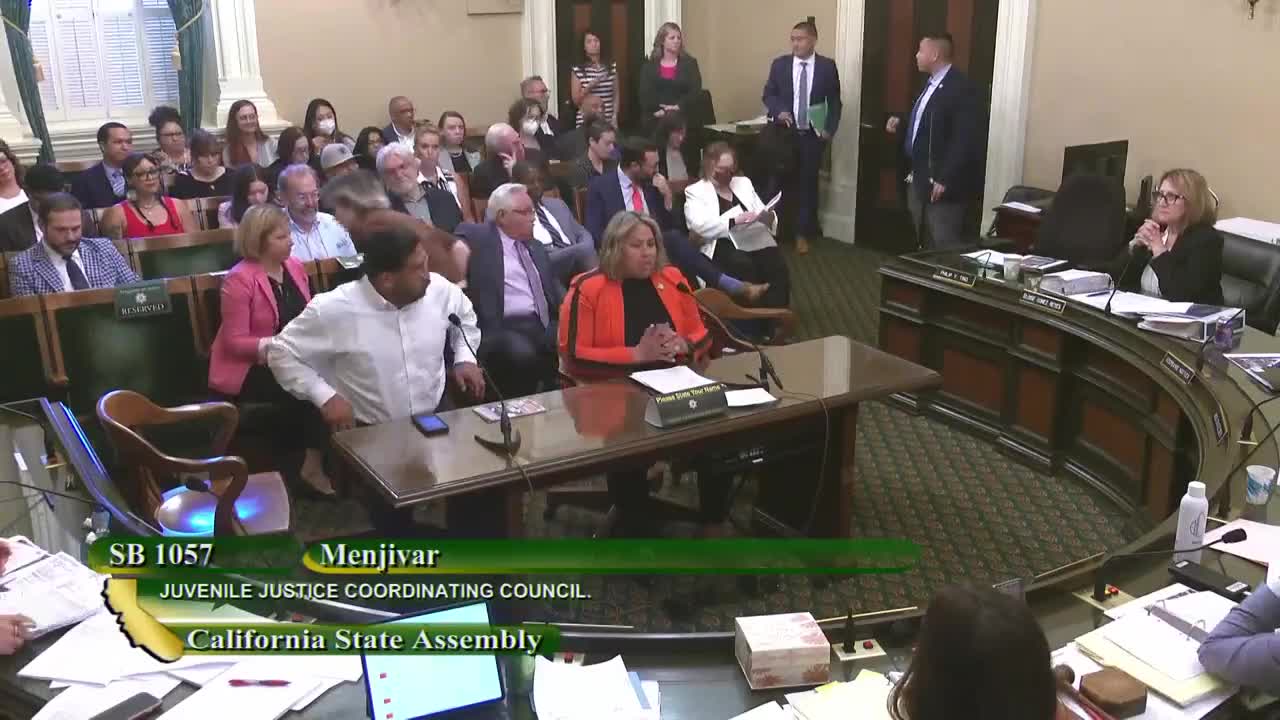 32MIN
Assembly Standing Committee on Public Safety
 16MIN
Senate Floor
 13MIN
Senate Standing Committee on Public Safety
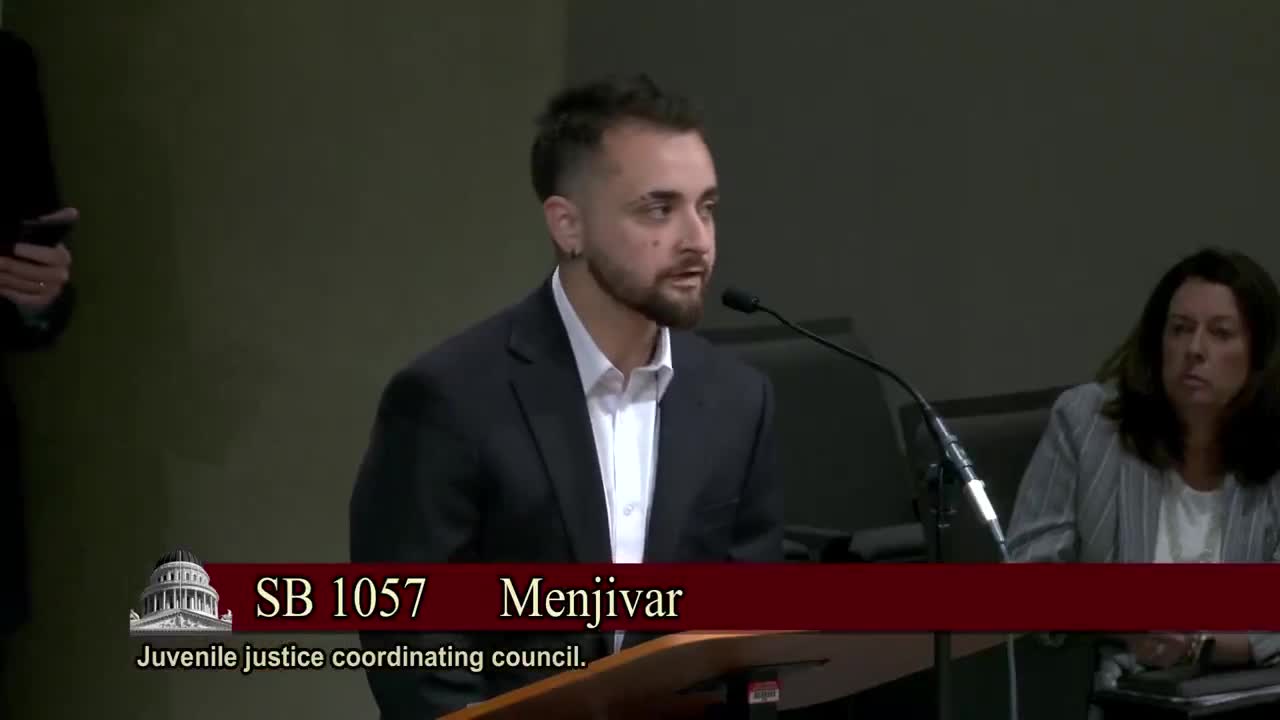 4MIN
Senate Standing Committee on Public Safety
 22SEC
Senate Standing Committee on Public Safety
Bill Author
Bill Co-Author(s):
