SB 430: Tied-house exceptions: advertising: common parent company.
- Session Year: 2023-2024
- House: Senate
- Latest Version Date: 2023-06-21
Current Status:
Failed
(2023-09-01: September 1 hearing: Held in committee and under submission.)
Introduced
In Committee
First Chamber
In Committee
Second Chamber
Enacted
Existing law, the Alcoholic Beverage Control Act, which is administered by the Department of Alcoholic Beverage Control, regulates the application, issuance, and suspension of licenses for the manufacture, distribution, and sale of alcoholic beverages. Existing law, known as tied-house restrictions, generally prohibits specified licensees and their agents from paying a retailer for advertising. Existing law creates a variety of exceptions to this general prohibition.
This bill would create a new exception to the tied-house restrictions on advertising. In this regard, the bill would authorize specified licensees to purchase advertising services from an advertising subsidiary that is under common ownership with a retail licensee subsidiary, subject to specified conditions. The bill would require an advertising subsidiary from whom an authorized licensee purchases advertising services pursuant to these provisions to submit to the department semiannually a report that summarizes those services and includes other specified information. The bill would make it a misdemeanor for an authorized licensee or a retail licensee subsidiary to solicit or coerce a wholesaler the solicitation or coercion of a wholesaler or an authorized licensee, as specified, in connection with the advertising services permitted under these provisions. provisions a misdemeanor and subject to specified penalties. By creating a new crime, the bill would impose a state-mandated local program. The bill would define terms for its purposes and would set forth related findings. By creating a new crime, the bill would impose a state-mandated local program.
The California Constitution requires the state to reimburse local agencies and school districts for certain costs mandated by the state. Statutory provisions establish procedures for making that reimbursement.
This bill would provide that no reimbursement is required by this act for a specified reason.
Existing law, the Alcoholic Beverage Control Act, which is administered by the Department of Alcoholic Beverage Control, regulates the application, issuance, and suspension of licenses for the manufacture, distribution, and sale of alcoholic beverages. Existing law, known as tied-house restrictions, generally prohibits specified licensees and their agents from paying a retailer for advertising. Existing law creates a variety of exceptions to this general prohibition.
This bill would create a new exception to the tied-house restrictions on advertising. In this regard, the bill would authorize specified licensees to purchase advertising services from an advertising subsidiary that is under common ownership with a retail licensee subsidiary, subject to specified conditions. The bill would make it a misdemeanor for an authorized licensee or a retail licensee subsidiary to solicit or coerce a wholesaler in connection with the advertising services permitted under these provisions. The bill would define terms for its purposes and would set forth related findings. By creating a new crime, the bill would impose a state-mandated local program.
The California Constitution requires the state to reimburse local agencies and school districts for certain costs mandated by the state. Statutory provisions establish procedures for making that reimbursement.
This bill would provide that no reimbursement is required by this act for a specified reason.
Existing law, the Alcoholic Beverage Control Act, which is administered by the Department of Alcoholic Beverage Control, regulates the application, issuance, and suspension of licenses for the manufacture, distribution, and sale of alcoholic beverages. Existing law, known as tied-house restrictions, generally prohibits specified licensees and their agents from paying a retailer for advertising. Existing law creates a variety of exceptions to this general prohibition.
This bill would create a new exception to the tied-house restrictions on advertising. In this regard, the bill would authorize specified licensees to purchase advertising services from an advertising subsidiary that is under common ownership with a retail licensee subsidiary, subject to specified conditions. The bill would make it a misdemeanor for an authorized licensee or a retail licensee subsidiary to solicit or coerce a wholesaler in connection with the advertising services permitted under these provisions. The bill would define terms for its purposes. By creating a new crime, the bill would impose a state-mandated local program.
The California Constitution requires the state to reimburse local agencies and school districts for certain costs mandated by the state. Statutory provisions establish procedures for making that reimbursement.
This bill would provide that no reimbursement is required by this act for a specified reason.
(a)Notwithstanding For purposes of this section, the following definitions apply:
(1)Advertising subsidiary means any person that provides advertising services, such as the sale, placement, or dissemination of advertising.
(2)(A)Except as provided in subparagraph (B), authorized licensee means a winegrower, California winegrowers agent, beer and wine importer general, wine rectifier, craft distiller, distilled spirits manufacturer, distilled spirits manufacturers agent, distilled spirits importer general, distilled spirits rectifier, distilled spirits general rectifier, rectifier, out-of-state distilled spirits shippers certificate holder, brandy manufacturer, brandy importer, beer manufacturer, or an out-of-state beer manufacturer certificate holder.
(B)Authorized licensee does not include a person that exclusively holds one or more of the following pairs of licenses:
(i)A distilled spirits wholesalers license and a distilled spirits importer license.
(ii)A distilled spirits wholesalers license and a distilled spirits importer general license.
(iii)A beer and wine wholesaler license and a beer and wine importer license.
(iv)A beer and wine wholesaler license and a beer and wine importer general license.
(3)Common parent company means a company that meets all of the following criteria:
(A)Wholly owns, directly or indirectly, both an advertising subsidiary and a retail subsidiary.
(B)Before the effective date of this section, has owned and operated at least 50 retail licensees.
(C)Has or has had a contract or agreement with a professional sports league to stream live events on its streaming media services owned by the company.
(4)Retail licensee subsidiary means any person that is licensed in this state as an on-sale or off-sale retailer of alcoholic beverages.
(b)Notwithstanding any other provision of this division, an authorized licensee may purchase advertising services from an advertising subsidiary that is under common ownership with a retail licensee subsidiary, if the following conditions are met:
(1)The common parent company of the advertising subsidiary and the retail licensee subsidiary is a publicly traded company whose shares of stock are sold to the general public on a stock exchange located in the United States.
(2)No individual serves A person shall not serve as an officer, director, or manager of both the advertising subsidiary and the retail licensee subsidiary at the same time. time or otherwise control or manage decisions related to both the retail licensee subsidiarys purchase or sale of alcoholic beverages and the advertising subsidiarys advertising of alcoholic beverages.
(3)The funds derived from the advertising services purchased by the authorized licensee under this section are not directly available to to, and do not otherwise directly benefit, the retail licensee subsidiary.
(4)The advertising subsidiary and the retail licensee subsidiary maintain separate financial records.
(5)The advertising subsidiary and the retail licensee subsidiary have separately staffed sales and operations departments.
(6)The advertising services purchased by the authorized licensee shall be limited to the sale, placement, or dissemination, or any combination thereof, of advertising, including related sponsorships, on video and streaming media services that are owned by the common parent company of the advertising subsidiary and the retail licensee subsidiary.
(7)The advertising services purchased by the authorized licensee shall not include advertising that does any of the following:
(A)Appears on the premises of the retail licensee subsidiary.
(B)Appears on the internet website website, mobile application, or social media operated by or for the retail licensee subsidiary.
(C)References the retail licensee subsidiary. subsidiary, including, but not limited to, an address, telephone number, email address, internet website, or social media address of the retail licensee subsidiary or an image of the retail licensee subsidiarys premises.
(D)Includes any internet website or social media address, QR code, or any electronic means by which a consumer may directly purchase the authorized licensees products or directs a consumer to another internet website or social media address where the consumer may directly purchase the authorized licensees products.
(8)The advertising subsidiary shall not place advertisements purchased by the authorized licensee immediately before or after advertisements of the retail licensee subsidiary.
(8)(9)The retail licensee subsidiary shall sell other brands of alcoholic beverages in addition to the brands distributed by competing authorized licensees or wholesalers other than a brand produced or marketed by the authorized licensee. licensee that purchased the advertising services.
(9)An(10)The agreement for the purchase of advertising services shall be based on advertising rates that are commercially reasonable under the prevailing market conditions and not, directly or indirectly, based in any manner on a percentage of the authorized licensees sales, revenues, or profits. The agreement shall not be conditioned directly or indirectly, explicitly or implicitly, or in any other way, on the purchase, sale, or distribution of any alcoholic beverage manufactured or distributed by the authorized licensee. All decisions regarding the purchase and sale purchase, sale, or promotion of alcoholic beverages by the retail licensee subsidiary shall be made at the independent and exclusive discretion of the retail licensee subsidiary.
(11)A wholesaler shall not, directly or indirectly, underwrite, share in, or contribute to the cost of the purchased advertising services, unless the wholesaler is the authorized licensee directly purchasing the advertising services on its own behalf pursuant to this section.
(b)(12)Any purchase of advertising services pursuant to subdivision (a) shall be conducted pursuant to a written contract agreement entered into by the authorized licensee and the advertising subsidiary. The advertising subsidiary shall provide the department a copy of the agreement upon a written request.
(c)An advertising subsidiary from whom an authorized licensee purchases advertising services pursuant to this section shall submit to the department semiannually a report that summarizes those services and includes, at a minimum, the following information:
(1)The product or products being advertised or promoted.
(2)The authorized licensee purchasing the advertising services.
(3)The time period during which the advertising services will be provided.
(4)Any specific event or activity to which the advertising or promotion is connected.
(c)(d)Any authorized licensee who, through coercion or other illegal means, induces, directly or indirectly, a holder of a wholesalers license to fulfill those contractual obligations entered into pursuant to subdivision (a) (b) shall be guilty of a misdemeanor and shall be punished by imprisonment in the county jail not exceeding six months, or by a fine in an amount equal to the entire value of the advertising services involved in the contract plus ten thousand dollars ($10,000), or by both imprisonment and fine. The person shall also be subject to license revocation pursuant to Section 24200.
(d)(e)(1)Any retail licensee subsidiary who solicits does either of the following shall be subject to penalties specified in paragraph (2):
(A)Solicits or coerces, directly or indirectly, an authorized licensee to purchase advertising services pursuant to subdivision (b).
(B)Solicits or coerces, directly or indirectly, a holder of a wholesalers license to solicit an authorized licensee to purchase advertising services pursuant to subdivision (a) (b).
(2)A retail licensee subsidiary who violates paragraph (1) shall be guilty of a misdemeanor and shall be punished by imprisonment in the county jail not exceeding six months, or by a fine in an amount equal to the entire value of the advertising services involved in the contract plus ten thousand dollars ($10,000), or by both imprisonment and fine. The person retail subsidiary shall also be subject to license revocation pursuant to Section 24200.
(e)For purposes of this section, the following definitions apply:(1)Advertising subsidiary means any person that provides advertising services, such as the sale, placement, or dissemination of advertising.(2)Authorized licensee means a winegrower, California winegrowers agent, beer and wine importer general, wine rectifier, craft distiller, distilled spirits manufacturer, distilled spirits manufacturers agent, distilled spirits importer general, distilled spirits rectifier, distilled spirits general rectifier, rectifier, out-of-state distilled spirits shippers certificate holder, brandy manufacturer, brandy importer, beer manufacturer, or an out-of-state beer manufacturer certificate holder.(3)Common parent company means a company that wholly owns, directly or indirectly, both an advertising subsidiary and a retail licensee subsidiary.(4)Retail licensee subsidiary means any person that is licensed in this state as an on-sale or off-sale retailer of alcoholic beverages.(f)The Legislature finds that it is necessary and proper to require a separation between manufacturing interests, wholesale interests, and retail interests in the production and distribution of alcoholic beverages in order to prevent suppliers from dominating local markets through vertical integration and to prevent excessive sales of alcoholic beverages produced by overly aggressive marketing techniques. Notwithstanding the foregoing, having considered the public welfare, the economic impact on the state, and the entirety of the circumstances involved, the Legislature further finds that the purpose and intent of the general prohibition against tied interests is not violated by granting the exception established by this section.
SEC. 2.No reimbursement is required by this act pursuant to Section 6 of Article XIIIB of the California Constitution because the only costs that may be incurred by a local agency or school district will be incurred because this act creates a new crime or infraction, eliminates a crime or infraction, or changes the penalty for a crime or infraction, within the meaning of Section 17556 of the Government Code, or changes the definition of a crime within the meaning of Section 6 of Article XIIIB of the California Constitution.
(a)Notwithstanding any other provision of this division, an authorized licensee may purchase advertising services from an advertising subsidiary that is under common ownership with a retail licensee subsidiary, if the following conditions are met:
(1)The common parent company of the advertising subsidiary and the retail licensee subsidiary is a publiclytraded publicly traded company whose shares of stock are sold to the general public on a stock exchange located in the United States.
(2)No individual serves as an officer, director, or manager of both the advertising subsidiary and the retail licensee subsidiary at the same time.
(3)The funds derived from the advertising services purchased by the authorized licensee under this section are not directly available to the retail licensee subsidiary.
(4)The advertising subsidiary and the retail licensee subsidiary maintain separate financial records.
(5)The advertising subsidiary and the retail licensee subsidiary have separately staffed sales departments.
(2)(6)The advertising services purchased by the authorized licensee shall be limited to the sale, placement, or dissemination, or any combination thereof, of advertising, including related sponsorships, on video and streaming media services that are owned by the common parent company of the advertising subsidiary and the retail licensee subsidiary.
(3)(7)The advertising services purchased by the authorized licensee shall not include advertising that does any of the following:
(A)Appears on the premises of the retail licensee subsidiary.
(B)Appears on the internet website operated by or for the retail licensee subsidiary.
(C)References the retail licensee subsidiary.
(4)(8)The retail licensee subsidiary shall sell other brands of alcoholic beverages in addition to the brands produced or marketed by the authorized licensee.
(5)(9)An agreement for the purchase of advertising services shall not be conditioned directly or indirectly, explicitly or implicitly, or in any other way, on the purchase, sale, or distribution of any alcoholic beverage manufactured or distributed by the authorized licensee. All decisions regarding the purchase and sale of alcoholic beverages shall be made at the independent and exclusive discretion of the retail licensee subsidiary.
(b)Any purchase of advertising services pursuant to subdivision (a) shall be conducted pursuant to a written contract entered into by the authorized licensee and advertising subsidiary.
(b)(c)Any authorized licensee who, through coercion or other illegal means, induces, directly or indirectly, a holder of a wholesalers license to fulfill those contractual obligations entered into pursuant to subdivision (a) shall be guilty of a misdemeanor and shall be punished by imprisonment in the county jail not exceeding six months, or by a fine in an amount equal to the entire value of the advertising services involved in the contract plus ten thousand dollars ($10,000), or by both imprisonment and fine. The person shall also be subject to license revocation pursuant to Section 24200.
(c)(d)Any retail licensee subsidiary who solicits or coerces, directly or indirectly, a holder of a wholesalers license to solicit an authorized licensee to purchase advertising services pursuant to subdivision (a) shall be guilty of a misdemeanor and shall be punished by imprisonment in the county jail not exceeding six months, or by a fine in an amount equal to the entire value of the advertising services involved in the contract plus ten thousand dollars ($10,000), or by both imprisonment and fine. The person shall also be subject to license revocation pursuant to Section 24200.
(d)(e)For purposes of this section, the following definitions apply:
(1)Advertising subsidiary means any person that provides advertising services, such as the sale, placement, or dissemination of advertising.
(2)Authorized licensee means a winegrower, California winegrowers agent, beer and wine importer general, wine rectifier, craft distiller, distilled spirits manufacturer, distilled spirits manufacturers agent, distilled spirits importer general, distilled spirits rectifier, distilled spirits general rectifier, rectifier, out-of-state distilled spirits shippers certificate holder, brandy manufacturer, brandy importer, beer manufacturer, or an out-of-state beer manufacturer certificate holder.
(3)Common parent company means a company that wholly owns, directly or indirectly, both an advertising subsidiary and a retail licensee subsidiary.
(4)Retail licensee subsidiary means any person that is licensed in this state as an on-sale or off-sale retailer of alcoholic beverages.
(f)The Legislature finds that it is necessary and proper to require a separation between manufacturing interests, wholesale interests, and retail interests in the production and distribution of alcoholic beverages in order to prevent suppliers from dominating local markets through vertical integration and to prevent excessive sales of alcoholic beverages produced by overly aggressive marketing techniques. Notwithstanding the foregoing, having considered the public welfare, the economic impact on the state, and the entirety of the circumstances involved, the Legislature further finds that the purpose and intent of the general prohibition against tied interests is not violated by granting the exception established by this section.
SEC. 2.No reimbursement is required by this act pursuant to Section 6 of Article XIIIB of the California Constitution because the only costs that may be incurred by a local agency or school district will be incurred because this act creates a new crime or infraction, eliminates a crime or infraction, or changes the penalty for a crime or infraction, within the meaning of Section 17556 of the Government Code, or changes the definition of a crime within the meaning of Section 6 of Article XIIIB of the California Constitution.
(a)Notwithstanding any other provision of this division, an authorized licensee may purchase advertising services from an advertising subsidiary that is under common ownership with a retail licensee subsidiary, if the following conditions are met:
(1)The common parent company of the advertising subsidiary and the retail licensee subsidiary is a publiclytraded company whose shares of stock are sold to the general public on a stock exchange located in the United States.
(2)The advertising services shall be limited to the sale, placement, or dissemination, or any combination thereof, of advertising, including related sponsorships, on video and streaming media services that are owned by the common parent company of the advertising subsidiary and the retail licensee subsidiary.
(3)The advertising services shall not include advertising that does any of the following:
(A)Appears on the premises of the retail licensee subsidiary.
(B)Appears on the internet website operated by or for the retail licensee subsidiary.
(C)References the retail licensee subsidiary.
(4)The retail licensee subsidiary shall sell other brands of alcoholic beverages in addition to the brands produced or marketed by the authorized licensee.
(5)An agreement for the purchase of advertising services shall not be conditioned directly or indirectly, explicitly or implicitly, or in any other way, on the purchase, sale, or distribution of any alcoholic beverage manufactured or distributed by the authorized licensee. All decisions regarding the purchase and sale of alcoholic beverages shall be made at the independent and exclusive discretion of the retail licensee subsidiary.
(b)Any authorized licensee who, through coercion or other illegal means, induces, directly or indirectly, a holder of a wholesalers license to fulfill those contractual obligations entered into pursuant to subdivision (a) shall be guilty of a misdemeanor and shall be punished by imprisonment in the county jail not exceeding six months, or by a fine in an amount equal to the entire value of the advertising services involved in the contract plus ten thousand dollars ($10,000), or by both imprisonment and fine. The person shall also be subject to license revocation pursuant to Section 24200.
(c)Any retail licensee subsidiary who solicits or coerces, directly or indirectly, a holder of a wholesalers license to solicit an authorized licensee to purchase advertising services pursuant to subdivision (a) shall be guilty of a misdemeanor and shall be punished by imprisonment in the county jail not exceeding six months, or by a fine in an amount equal to the entire value of the advertising services involved in the contract plus ten thousand dollars ($10,000), or by both imprisonment and fine. The person shall also be subject to license revocation pursuant to Section 24200.
(d)For purposes of this section, the following definitions apply:
(1)Advertising subsidiary means any person that provides advertising services, such as the sale, placement, or dissemination of advertising.
(2)Authorized licensee means a winegrower, California winegrowers agent, beer and wine importer general, wine rectifier, craft distiller, distilled spirits manufacturer, distilled spirits manufacturers agent, distilled spirits importer general, distilled spirits rectifier, distilled spirits general rectifier, rectifier, out-of-state distilled spirits shippers certificate holder, brandy manufacturer, brandy importer, beer manufacturer, or an out-of-state beer manufacturer certificate holder.
(3)Common parent company means a company that wholly owns, directly or indirectly, both an advertising subsidiary and a retail licensee subsidiary.
(4)Retail licensee subsidiary means any person that is licensed in this state as an on-sale or off-sale retailer of alcoholic beverages.
SEC. 2.No reimbursement is required by this act pursuant to Section 6 of Article XIIIB of the California Constitution because the only costs that may be incurred by a local agency or school district will be incurred because this act creates a new crime or infraction, eliminates a crime or infraction, or changes the penalty for a crime or infraction, within the meaning of Section 17556 of the Government Code, or changes the definition of a crime within the meaning of Section 6 of Article XIIIB of the California Constitution.
|
Date
|
Status
|
|---|---|
| Sep 1, 2023 | September 1 hearing: Held in committee and under submission. |
| Aug 16, 2023 | August 16 set for first hearing. Placed on suspense file. |
| Jul 12, 2023 | July 12 hearing postponed by committee. |
| Jun 21, 2023 | Read second time and amended. Re-referred to Com. on APPR. |
| Jun 20, 2023 | From committee: Do pass as amended and re-refer to Com. on APPR. (Ayes 16. Noes 0.) (June 14). |
| May 18, 2023 | Referred to Com. on G.O. |
| May 8, 2023 | In Assembly. Read first time. Held at Desk. |
| May 8, 2023 | Read third time. Passed. (Ayes 36. Noes 0. Page 1021.) Ordered to the Assembly. |
| Apr 25, 2023 | Read second time. Ordered to third reading. |
| Apr 24, 2023 | From committee: Be ordered to second reading pursuant to Senate Rule 28.8. |
| Apr 14, 2023 | Set for hearing April 24. |
| Apr 11, 2023 | From committee: Do pass and re-refer to Com. on APPR. (Ayes 15. Noes 0. Page 656.) (April 11). Re-referred to Com. on APPR. |
| Mar 30, 2023 | From committee with author's amendments. Read second time and amended. Re-referred to Com. on G.O. |
| Mar 28, 2023 | Set for hearing April 11. |
| Feb 22, 2023 | Referred to Com. on G.O. |
| Feb 14, 2023 | From printer. May be acted upon on or after March 16. |
| Feb 13, 2023 | Introduced. Read first time. To Com. on RLS. for assignment. To print. |
|
Date
|
Description
|
Location
|
Votes
|
|
|---|---|---|---|---|
| Jun 14, 2023 | Do pass as amended and be re-referred to the Committee on [Appropriations] | Assembly Standing Committee on Governmental Organization |
Passed |
|
| May 8, 2023 | Senate 3rd Reading SB430 Dodd | Senate Floor |
Passed |
|
| Apr 11, 2023 | Do pass, but first be re-referred to the Committee on [Appropriations] | Senate Standing Committee on Governmental Organization |
Passed |
This list shows positions taken on this bill by organizations on the date displayed, which is linked to the original source.
Positions by individuals are not included.
|
Organization
|
Position
|
Date
|
|---|---|---|
| Alcohol Justice | ** Against | |
| Amazon | * Support | Jun 14, 2023 |
| Asian Business Association of San Diego | ** Support | |
| Bay Area Council | ** Support | |
| CA African American Chamber of Commerce | ** Support | |
| California African American Chamber Of Commerce | ** Support | |
| California Asian Pacific Chamber Of Commerce | * Support | Jun 14, 2023 |
| California Beer and Beverage Distributors | * Against | Jun 14, 2023 |
| California Black Chamber of Commerce | ** Support | |
| California Craft Beer Brewers Association | * Against | Jun 14, 2023 |
| California Family Beer Distributors | * Against | Jun 14, 2023 |
| California Grocers Association | * Support | Jun 14, 2023 |
| California Hispanic Chamber Of Commerce | * Support | Jun 14, 2023 |
| California Labor Federation | * Against | Jun 14, 2023 |
| California Retailers | * Support | Jun 14, 2023 |
| Central City Association Of Los Angeles | ** Support | |
| Culver City Chamber of Commerce | * Support | Jun 14, 2023 |
| Forty Niners Football Company LLC | ** Support | |
| Fresno Grizzlies | ** Support | |
| Governmental Advocates, Inc. | * Support | Apr 11, 2023 |
| Hollywood Chamber Of Commerce | * Support | Jun 14, 2023 |
| Inland Empire Economic Partnership | * Support | Jun 14, 2023 |
| Los Angeles Area Chamber Of Commerce | ** Support | |
| Los Angeles County Business Federation | * Support | Jun 14, 2023 |
| MGM Studios | ** Support | |
| National Football League | * Support | Jun 14, 2023 |
| Prime Video | ** Support | |
| San Diego Regional Chamber Of Commerce | * Support | Jun 14, 2023 |
| San Francisco 49ers | * Support | Jun 14, 2023 |
| San Francisco Chamber of Commerce | ** Support | |
| San Jose Chamber of Commerce | ** Support | |
| Silicon Valley Leadership Group | * Support | Jun 14, 2023 |
| Teamsters | * Against | Jun 14, 2023 |
| Ufcw Western States Council | * Against | Jun 14, 2023 |
| VALLEY INDUSTRY AND COMMERCE ASSOCIATION | * Support | Jun 14, 2023 |
| Wine Institute | * Against | Jun 14, 2023 |
| Wine Spirits Wholesalers of California | * Against Unless Amend | Jun 14, 2023 |
| Young's Republic | * Against | Jun 14, 2023 |
Date of Hearing: August 16, 2023
ASSEMBLY COMMITTEE ON APPROPRIATIONS
Chris Holden, Chair
SBPCA Bill Id:SB 430
Author:(Dodd) – As Amended Ver:June 21, 2023
Policy Committee: | Governmental Organization | Vote: | 16 - 0 |
|
| ||
|
|
Urgency: No State Mandated Local Program: Yes Reimbursable: No
SUMMARY:
This bill creates a tied-house exception authorizing specified Department of Alcoholic Beverage Control (ABC) licensees to purchase advertising services from an advertising subsidiary under common ownership with a retail licensee subsidiary.
Specifically, this bill:
- Defines a “common parent company” to mean a company that meets all of the following criteria: (a) wholly owns, directly or indirectly, both an advertising subsidiary and a retail subsidiary; (b) has owned and operated, before this bill’s effective date, at least 50 retail licensees; and (c) has or had a contract or agreement with a professional sports league to stream live events on its streaming media services owned by the company.
- Allows an authorized licensee to purchase advertising services from an advertising subsidiary under common ownership with a retail licensee subsidiary if certain conditions minimizing conflict-of-interest are met and the sale, placement, or dissemination of advertising is limited to video and streaming media services owned by the common parent company.
- Requires an applicable advertising subsidiary to submit semi-annual reports regarding purchased advertising services to ABC.
- Provides specified misdemeanor penalties for violations by an authorized licensee or a retail licensee subsidiary.
FISCAL EFFECT:
ABC estimates minor and absorbable costs to review the semi-annual report and provide enforcement. However, this committee sees a wide array of bills that propose to modify the scope of alcohol laws. Generally, advertising tied-house exceptions such as those proposed by this bill do not generate significant new enforcement workload for ABC, but taken together, these proposals could lead to significant new costs and future budget requests. Four years ago, the Legislature acted to address ABC’s persistent structural deficit. SB 82 (Committee on Budget and Fiscal Review), Chapter 29, Statutes of 2019, included fee increases that went into effect on October 1, 2019.
Although ABC does not anticipate receiving an overwhelming number of complaints, it is difficult to predict, as a tied-house exception of this scale is unprecedented. Although only one common parent company (Amazon) currently meets this bill’s definition, this exception allows the purchase of advertising services on evolving omnipresent entertainment mediums, unlike current exceptions that allow the purchase of advertising services at a single physical location. Thus, the fiscal effect of this bill could be potentially significant.
COMMENTS:
- Purpose. According to the author:
SB 430 provides a limited tied-house exemption to an entertainment business under common ownership with an alcoholic beverage retail business…tied-house laws were enacted to address social ills related to alcohol overconsumption, and one of the tactics to do so was to prevent alcohol manufacturers from controlling alcohol retailers. However, this type of control simply does not exist where a remote affiliate works with an alcohol manufacturer on matters unrelated to the retail sale of alcohol.
- Support and Opposition. This bill is supported by Amazon Studios, Prime Video, and MGM Studios “because it addresses an issue we face. We share the same parent company as Whole Foods Market, Amazon Fresh, and Amazon Go, which are alcoholic beverage retailers.” These proponents further note:
SB 430 will allow alcohol manufacturers to advertise with our entertainment businesses in a manner consistent with virtually every other entertainment company. For example, Prime Video will be able to air alcoholic beverage advertisements during live events and on other streaming content and MGM Studios will be able to accept product placements, like a branded vodka or gin martini, in a James Bond film.
This bill is also supported by various chambers of commerce, grocers and retailers associations, and the National Football League (NFL).
This bill is opposed by the Wine Institute, which argues this bill is “one of the most, if not the most, sweeping exception to tied-house laws in California’s history” and further notes:
SB 430 creates a “pay to play” environment in which alcohol producers will feel it is necessary or be pressured to advertise with Amazon to gain entry into or maintain good standing with Whole Foods Market…Over time, SB 430’s proposed tied-house exception would result in homogenizing the wine selection in Whole Foods Market and other Amazon-owned retailers to primarily brands that can afford to advertise on Amazon’s streaming platforms.
This bill is also opposed by the California Family Beer Distributors, labor organizations, and Alcohol Justice. This bill is opposed, unless amended, by the Wine and Spirits Wholesalers of California and California Beer and Beverage Distributors, which propose limiting the scope of the exception to “payments for advertising solely to [NFL] sporting events and sponsorships.”
- Background.
Tied-house Law. California’s tied-house law prevents the vertical integration of the alcohol industry by keeping the manufacturer, wholesaler, and retailer separated. Generally, one type of license holder is not permitted to do business as another type of licensee, and licensees are prohibited from directly or indirectly giving away anything of value, such as free goods, services, or advertising, in connection with the sale or distribution of an alcoholic beverage. By prohibiting a licensee at a higher level in the distribution chain from giving “things of value” to a licensee at a lower level, the law removes an incentive for a lower level licensee to give preferential treatment to the products of a higher level licensee.
Another Exception. Over the years, numerous exceptions to tied-house prohibitions have been enacted. For example, an exception was granted in 1992 allowing an alcohol manufacturer or wholesaler (Anheuser-Busch) to own marine parks (Sea World) where alcohol is sold. Additionally, many advertising exceptions have been granted for arenas and stadiums, including professional sports facilities, such as SoFi Stadium (home of the Los Angeles Rams), and numerous facilities at California’s colleges, such as Snapdragon Stadium at San Diego State University, allowing sponsorship deals with alcohol manufacturers and distributors. This bill allows authorized licensees to purchase advertising services from an advertising subsidiary under a common parent company with a retail licensee subsidiary. Under this exception, for example, Anheuser-Busch would be allowed to purchase streaming advertisements from Amazon Prime Video, despite Amazon’s common ownership of Whole Foods Market.
Recent Amendments. Numerous amendments were made upon passage of this bill from the Assembly Governmental Organization Committee. According to the committee’s analysis, consideration of the amendments was in the context of “the long-standing foundation and most fundamental principles of the state’s tied-house laws, while also recognizing the changing contemporary media landscape.” The amendments effectively limit the common parent company exception to Amazon and are intended to strengthen corporate guardrails. For example, amendments specify a person is prohibited from controlling or managing decisions related to both the retail licensee subsidiary’s purchase or sale of alcoholic beverages and the advertising subsidiary’s advertising of alcoholic beverages, prohibit bookending advertisements purchased by the authorized licensee with advertisements for the retail licensee subsidiary, and impose other limitations on advertising content.
Analysis Prepared by: Irene Ho / APPR. / (916) 319-2081
Date of Hearing: June 14, 2023
ASSEMBLY COMMITTEE ON GOVERNMENTAL ORGANIZATION
Miguel Santiago, Chair
SBPCA Bill Id:SB 430
Author:(Dodd) – As Amended Ver:March 30, 2023
SENATE VOTE: 36-0
SUBJECT: Tied-house exceptions: advertising: common parent company
SUMMARY: This bill would create a new exception to the tied-house restrictions on advertising. In this regard, the bill would authorize specified licensees to purchase advertising services from an advertising subsidiary that is under common ownership with a retail licensee subsidiary, subject to specified conditions. The advertising services purchased by the authorized licensee shall be limited to the sale, placement, or dissemination, or any combination thereof, of advertising, including related sponsorships, on video and streaming media services that are owned by the common parent company of the advertising subsidiary and the retail licensee subsidiary. Specifically, this bill:
1) Authorizes an authorized licensee to purchase advertising services from an advertising subsidiary that is under common ownership with a retail licensee subsidiary, if the following conditions are met:
a) The common parent company of the advertising subsidiary and the retail licensee subsidiary is a publicly traded company whose shares of stock are sold to the general public on a stock exchange located in the United States.
b) No individual serves as an officer, director, or manager of both the advertising subsidiary and the retail licensee subsidiary at the same time.
c) The funds derived from the advertising services are not directly available to the retail licensee subsidiary.
d) The advertising subsidiary and the retail licensee subsidiary maintain separate financial records.
e) The advertising subsidiary and the retail licensee subsidiary have separately staffed sales departments.
2) Defines “authorized licensee” to mean a winegrower, California winegrower’s agent, beer and wine importer general, wine rectifier, craft distiller, distilled spirits manufacturer, distilled spirits manufacturer’s agent, distilled spirits importer general, distilled spirits rectifier, distilled spirits general rectifier, rectifier, out-of-sate distilled spirits shipper’s certificate holder, brandy manufacturer, brandy importer, beer manufacturer, or an out-of-state beer manufacturer certificate holder.
3) Requires that the advertising services be limited to the sale, placement, or dissemination, or any combination thereof, of advertising, including related sponsorships, on video and streaming media services that are owned by the common parent company of the advertising subsidiary and the retail licensee subsidiary.
4) Prohibits advertising services to include advertising that does any of the following:
a) Appears on the premises of the retail licensee subsidiary.
b) Appears on the internet website operated by or for the retail licensee subsidiary.
c) References the retail licensee subsidiary.
5) Requires the retail licensee to sell other brands of alcoholic beverages in addition to the brands produced or marketed by the authorized licensee.
6) Provides that an agreement for the purchase of advertising services shall not be conditioned directly or indirectly, explicitly or implicitly, or in any other way, on the purchase, sale, or distribution of any alcoholic beverage manufactured or distributed by the authorized licensee. All decisions regarding the purchase and sale of alcoholic beverages shall be made at the independent and exclusive discretion of the retail licensee subsidiary.
7) Requires that any advertising services be conducted pursuant to a written contract entered into by the authorized licensee and advertising subsidiary.
8) Provides that any authorized licensee or retail licensee who, through coercion or other illegal means, induces, directly or indirectly, a holder of a wholesaler’s license to fulfill those contractual obligations should be guilty of a misdemeanor and shall be punished by imprisonment in the county jail not exceeding six months, or by a fine, as specified, and subject to license revocation.
EXISTING LAW:
1) Establishes the Department of Alcoholic Beverage Control (ABC) and grants it exclusive authority to administer the provisions of the Alcoholic Beverage Control Act (Act) in accordance with laws enacted by the Legislature. This involves licensing individuals and businesses associated with the manufacture, importation, and sale of alcoholic beverages and the collection of license fees for this purpose.
2) Separates the alcoholic beverage industry into three component parts, or tiers, of the manufacturer (including breweries, wineries, and distilleries), wholesaler, and retailer (both onsale and off-sale). This is referred to as the “Tied-house” law or “three-tier” system. Generally, other than exceptions granted by the Legislature, the holder of one type of license is not permitted to do business as another type of licensee within the “three-tier” system.
3) Prohibits, in general, an alcohol manufacturer, wholesaler, or any officer, director, or agent of any such person from owning, directly or indirectly, any interest in any on-sale license, or from providing anything of value to retailers, be it free goods, services, or advertising. Numerous exceptions to these restrictions have been enacted throughout the years in those specific instances where the Legislature determined that the public's interests were protected.
4) Prohibits, generally, an alcoholic beverage licensee from giving any gift or free goods in connection with the sale or distribution of any alcoholic beverage, except as provided for in the Act or by rules adopted by ABC.
4) Prohibits, in general, a manufacturer, winegrower, distiller, bottler, or wholesaler, among other licensees, or agents of these licensees, from paying a retailer for advertising.
5) Provides a variety of exceptions from the advertising prohibition, including permitting specified licensees to purchase advertising space and time from, or on behalf of, an on-sale retail licensee that is an owner, manager, or major tenant of certain stadiums, parks, entertainment complexes, and arenas, subject to specified conditions.
6) Defines an on-sale license as authorizing the sale of all types of alcoholic beverages:
namely, beer, wine and distilled spirits, for consumption on the premises (such as at a
restaurant or bar). An off-sale license authorizes the sale of all types of alcoholic beverages
for consumption off the premises in original, sealed containers.
FISCAL EFFECT: This bill is keyed fiscal by Legislative Counsel.
COMMENTS:
Purpose of the bill. According to the author’s office, “SB 430 provides a limited tied-house exemption to an entertainment business under common ownership with an alcoholic beverage retail business. The bill includes various provisions that have become standard in tied-house advertising exemption bills including that the alcoholic beverage retail business must sell other brands of alcohol beverages that those being advertised.”
In addition, the author’s office argues that, “tied-house laws were enacted to address social ills related to alcohol overconsumption, and one of the tactics to do so was to prevent alcohol manufacturers from controlling alcohol retailers. However, this type of control simply does not exist where a remote affiliate works with an alcohol manufacturer on matters unrelated to the retail sale of alcohol.”
Background.
Tied-house laws. Most states have some version of Tied-house laws to keep each tier independent of the others, mainly for the purpose of prohibiting tied houses and the anti-competitive results and temperance issues they raise. There are many variations on this theme among the states, since the Twenty-First Amendment gave the states the power to create their own regulatory schemes.
State and federal laws generally prohibit certain relationships among those who produce, distribute, and sell alcoholic beverages. The term “Tied-house” is derived from a common practice in England whereby a bar or public house was “tied”—by ownership, contractual obligations, or other influences—to a specific manufacturer. In some instances, that model encouraged intemperance in alcohol consumption. This was because retailers would offer manufacturers generous favors, such as expensive business meals and gifts. In order to recoup these costs, aggressive product promotion was needed. Manufacturers sometimes used their influence to force tied houses to sell their products and exclude products from other manufacturers.
As a result, after the repeal of prohibition in 1933, California’s current “three-tier” system was introduced. This body of law was initially created to: a) promote the state’s interest in an orderly market; b) prohibit vertical integration and dominance by a single producer in the market place; c) stop commercial bribery and safeguard the public from predatory marketing techniques; d) discourage and/or prevent intemperate drinking. These provisions prohibit a manufacturer from paying for advertising space at any facility where the facility is licensed to sell alcoholic beverages. In essence, if a licensee at a higher level of the distribution chain were allowed to give things of value to a licensee at a lower level, said licensee might have added incentive to give preference to the products of the person/entity making the gift.
In general, state law prohibits suppliers from providing retailers with “things of value.” These “tied-house” restrictions are generally aimed at preventing undue influence by suppliers over retailers. The Act, however, also contains numerous exceptions to tied-house laws in those specific instances where the Legislature determined that the public's interests are protected. For example, an existing exception allows certain alcoholic beverage manufacturers at invitation-only hosted events, to provide attendees at the event with free ground transportation to homes, hotels or motels where attendees are staying. Another, allows a beer manufacturer, as defined, to provide consumers free or discounted rides through taxicabs, transportation network companies, or any other ride service to further public safety. On a larger scale, in 1988, Bass Brewery began to acquire ownership of the Holiday Inn hotel chain worldwide, including, at the time, 77 hotels in California. Of the 77 hotels, 10 had between 100 and 150 guestrooms. In 1990, the Act was amended to lower the number of required guestrooms from 150 to 100, which allowed Bass Brewery to own and operate the 10 smaller establishments in the same fashion that the law permitted them to operate the 67 larger hotels. In 1992, a tied-house exception was granted which allowed an alcohol manufacturer or wholesaler (Anheuser-Busch) to own marine parks (SeaWorld in San Diego).
Additionally, over the years, several tied-house exceptions have been also granted by the Legislature for a number of stadiums, parks, entertainment complexes, and arenas. Some examples are Levi’s Stadium in Santa Clara, Oakland Coliseum in Oakland, Arrowhead Pond Arena in Anaheim, Kern County Arena in Bakersfield, the National Orange Show Events Center in San Bernardino, Auto Club Speedway, (formerly California Speedway) in Fontana, Grizzly Stadium in Fresno, Raley Field in West Sacramento, HP Pavilion in San Jose, StubHub Center (formerly the Home Depot Center) in Carson, and many other related venues. In some cases, it was commonly accepted that the tied-house exception was necessary because the project was privately financed and the revenue from the sale of advertising and sponsorship would help to offset construction costs. (For other related tied-house exceptions, see prior legislation)
Generally, the business community is interested in removing unnecessary business regulations and creating conditions that facilitate investment and expansion opportunities for companies that have some degree of ownership in multiple segments of the industry. Opponents' of tied-house exceptions have generally expressed concern over the further erosion of California’s tied-house laws because the creation of another exception to the general rule.
Why the need for the bill? Tied-house laws prohibit a company that owns a subsidiary that holds an alcohol license from selling advertising space to an alcohol beverage manufacture, regardless of whether the company itself is in the business of selling alcohol. This has presented challenges for companies like MGM studios, which in 2020 was acquired by Amazon. Because Amazon owns Whole Foods, Amazon Fresh, and AmazonGo who hold an ABC alcohol license, tied-house restrictions would prohibit both Amazon, Prime Video, Amazon Studios, and MGM studios from selling any advertising space to an alcohol manufacturer regardless of whether those businesses have a California alcohol license or in the business of manufacturing, distributing, or selling alcoholic beverages. These tied-house restrictions extend, not only to commercials, but product placements in movies/shows. If such a violation were to occur, it is important to note that the violation and any subsequent punishment by the ABC would be on the holder of the alcohol license.
The sponsor notes that “the way people watch and consume entertainment has drastically evolved in recent years through the development of streaming services, and it is fair to say that tied-house laws did not anticipate alcohol advertising in this context. SB 430 will allow our advertising businesses to engage with alcohol manufacturers consistent with other similarly situated businesses. For example, Prime Video will be able to air alcoholic beverage advertisements during Thursday Night Football, and MGM Studios will be able to accept product placements, like a branded vodka or gin martini, in a James Bond film.
In support. According to MGM Studios, “Our advertising businesses do not engage in the sale of alcohol, and they have no influence or control over Amazon’s alcohol retail businesses and vice versa. SB 430 contains several safeguards mandating independence between our unrelated businesses, including several firewall provisions to mandate the financial separation of our advertising businesses from Amazon’s alcohol retail businesses. The bill would also require separate management and sales staff. This type of alcohol advertising tied-house exception is not unique in California. SB 430 is a narrow proposal, similar to others the California Legislature and this committee have approved, and it is consistent with the spirits of the tied-house restrictions.”
According to the California Hispanic Chamber of Commerce, “According to ABC, if a company owns a subsidiary that holds alcohol retail licenses, then all other subsidiaries of the company, even if unrelated and not in the business of selling alcohol, are prohibited by tied-house laws from selling advertising space to an alcohol beverage manufacture. This broad prohibition is particularly limiting when one of the subsidiaries is an entertainment business that derives revenue from advertising. SB 430 seeks to remedy this issue by creating a narrow exemption specific to this scenario, which was not contemplated when tied-house laws were enacted post-prohibition.”
In opposition. According to the Wine and Spirits Wholesalers of California, Inc. and the California Beer and Beverage Distributors, “Amazon holds an ‘indirect interest’ in licensed retailers through its equity/ownership interests in its subsidiaries, including Whole Foods Market, Inc., Amazon Retail LLC, Amazon Go, and Amazon Fresh, which in turn hold multiple retail licenses to sell beer, distilled spirits and wine products for off-premises consumption in California. Various provisions of the Act prohibits manufacturers and importers from paying, directly or indirectly, the holder of a retail license for advertising services. The tied-house exception sought in SB 430 to purchase advertising services has not been enacted in any other state, and, without stringent guardrails, could lead to disorderly market in the largest alcohol market in the country.”
The Wine Institute writes in opposition, “SB 430 creates a “pay to play” environment that would be one of the most, if not the most, sweeping exception to tied-house laws in California’s history. If passed, it would undermine the protections those laws provide for all—but especially small and mid-sized—wineries in the state. In stark contrast to existing tied-house exceptions, which are narrowly tailored to specific physical entertainment venues and events, SB 430 proposes an extremely broad exception that will allow for 24-7 advertising over multiple services with potentially global reach. This bill would also create unfair competitive advantages for its sponsor, Amazon, and its many subsidiaries, and would incentive similarly situated companies to follow suit.
Policy consideration. Given the long-standing foundation and most fundamental principles of the state's tied-house laws, while also recognizing the changing contemporary media landscape, the author and committee may wish to consider the following amendments:
1) Prior to the effective date of this bill, the common parent company shall have owned and operated at least 50 or more retail licenses in the state that were licensed by the ABC. In addition, the common parent company shall have or have had a contract/agreement in effect with a professional sports league to stream live events on its streaming media services that is owned by the common parent company.
2) Provide that the advertising services purchased by the authorized licensee shall not include advertising that does any of the following: a) Appears on the internet website, mobile application, or social media operated by or for the retail licensee subsidiary; b) References the retail licensee subsidiary including, but not limited to, an address, telephone number, email address, internet website, or social media address of the retail licensee subsidiary or an image of the retail licensee subsidiary’s premises; and c) Includes any internet website or social media address, QR code, or any electronic means by which a consumer may directly purchase the authorized licensee’s products or directs a consumer to another internet website or social media address where it may directly purchase the authorized licensee’s products.
3) The advertising subsidiary shall not place advertisements purchased by the authorized licensee immediately before or after advertisements of the retail licensee subsidiary. (i.e., Bookending)
4) Any purchase of advertising services shall be conducted pursuant to a written agreement entered into by the authorized licensee and the advertising subsidiary. The advertising subsidiary shall provide ABC a copy of the agreement upon a written request.
5) The advertising subsidiary shall submit to the ABC semi-annually a report summarizing any advertising services purchased by authorized licensees authorized by the Act. This summary shall include, at a minimum, an identification of the product or products being advertised or promoted, the authorized licensee purchasing the advertising services, the time period during which the advertising services will be provided, and any specific event or activity to which the advertising or promotion is connected.
6) Provide that a person shall not serve as an officer, director, or manager of both the advertising subsidiary and the retail licensee subsidiary at the same time or otherwise control or manage decisions related to both the retail licensee subsidiary’s purchase or sale of alcoholic beverages and the advertising subsidiary’s advertising of alcoholic beverages.
7) The funds derived from the advertising services purchased by the authorized licensee are not directly available to, or otherwise directly benefit, the retail licensee subsidiary.
8) The advertising subsidiary and the retail licensee subsidiary have separately staffed sales and operations departments.
9) Be specific that the retail licensee subsidiary shall sell brands of alcoholic beverages distributed by competing authorized licensees or wholesalers other than a brand produced or marketed by the authorized licensee that purchased the advertising services.
10) Clarify that “No wholesaler, except a wholesaler that is also an authorized licensee directly purchasing advertising services on its own behalf, may, directly or indirectly, underwrite, share in, or contribute to the cost of any purchased advertising services authorized pursuant to this section.”
11) State that the agreement for the purchase of advertising services shall be based on advertising rates that are commercially reasonable under the prevailing market conditions and not, directly or indirectly, based in any manner on a percentage of the authorized licensee’s sales, revenues, or profits.
12) Provide that the all decisions regarding the purchase, and sale, or promotion of alcoholic beverages by the retail licensee subsidiary shall be made at the independent and exclusive discretion of the retail licensee subsidiary.
13) Provide that any retail licensee subsidiary who does either of the following shall be subject to penalties, as specified in the current version of the bill:
a) Solicits or coerces, directly or indirectly, an authorized licensee to purchase advertising services pursuant to the bill.
b) Solicits or coerces, directly or indirectly, a holder of a wholesaler’s license to solicit an authorized licensee to purchase advertising services, as defined in the bill.
14) Additionally to other stated penalties in the bill, the retail licensee subsidiary shall also be subject to license revocation pursuant to BPC § 24200 in current law.
15) For purposes of this bill, the following definition should apply: An “Authorized licensee” does not include a person that exclusively holds one or more of the following pairs of licenses: (i) A distilled spirits wholesaler’s license and a distilled spirits importer license; (ii) A distilled spirits wholesaler’s license and a distilled spirits importer general license; (iii) A beer and wine wholesaler license and a beer and wine importer license; (iv) A beer and wine wholesaler license and a beer and wine importer’s general license.
Related legislation. AB 840 (Addis) of 2023. Would authorize specified licensees to purchase advertising space and time from, or on behalf of, an on-sale licensee that is the owner, manager, or major tenants at various facilities that are situated on California State University campuses located in the Counties of San Luis Obispo, Fresno, Monterey, Orange, Santa Clara, and Los Angeles, as specified. (Senate Committee on Governmental Organization)
SB 392 (Bradford) of 2023. Would authorizes specified licensees to purchase advertising space and time from, or on behalf of, an on-sale licensee that is the owner, manager, or major tenant of a fully enclosed arena with a seating capacity of at least 18,000 seats located in the City of Inglewood (Intuit Dome), as specified. (Assembly Committee on Governmental Organization)
Prior legislation. SB 1280 (Hueso), Chapter 304, Statutes of 2022. Allowed specified licensees to purchase advertising space and time from, or on behalf of, an on-sale licensee that is the owner, manager, or major tenant at specified facilities on the campus of San Diego State University.
AB 98 (Kalra), Chapter 267, Statutes of 2022. Authorized specified licensees to purchase advertising space and time from, or on behalf of, an on-sale licensee that is the owner, manager, or major tenant at a fully enclosed arena with a fixed capacity in excess of 4,000 seats located in the City of San Jose (Tech CU Arena).
AB 1323 (Haney), Chapter 271, Statutes of 2022. Allowed specified licensees to purchase advertising space and time from, or on behalf of, an on-sale licensee that is the owner, manager, or major tenant of an on-sale retail licensed premises configured with theatrical seating of at least 1,600 seats but no more than 2,400 seats in the city and County of San Francisco (Curran Theatre), as specified.
AB 1330 (Mayes), Chapter 272, Statutes of 2022. Authorized specified licensees to purchase advertising space and time from, or on behalf of, an on-sale licensee that is the owner, manager, or major tenant at a fully enclosed arena with a fixed capacity in excess of 10,000 seats located in the County of Riverside (Acrisure Arena).
AB 1070 (Cooper) of 2021. Allowed specified alcohol licensees, until January 1, 2025, to give up to 12 retail advertising umbrellas to an on-sale retail licensee each calendar year. (Vetoed by Governor Newsom)
SB 386 (Umberg), Chapter 309, Statutes of 2021. Authorized specified alcohol licensees to sponsor events promoted by, and to purchase advertising space and time from, or on behalf, an on-sale licensee that is the owner, operator agent of the operator, or sole assignee or the operator’s advertising rights of a mixed-use district located in the County of Orange (ocV!BE), as specified.
AB 1133 (Low), Chapter 623, Statutes of 2019. Allowed, until January 1, 2023, a beer manufacturer to give up to five cases of glassware – a total of 120 pieces – to an on-sale retail licensee, as specified, and allows an on-sale retail licensee to accept, without direct or indirect charge, up to 10 cases of glassware – a total of 240 pieces – per licensed location from licensed beer manufactures.
AB 2000 (Kalra), Chapter 483, Statutes of 2018. Extended an existing exception in the Act pertaining to the general prohibition against advertising arrangements between retail, wholesale, and manufacturer licensees to include an outdoor professional sports stadium with a fixed seating capacity of at least 3,000 seats located in the City of San Jose (San Jose Municipal Stadium – minor league baseball San Jose Giants), and an outdoor professional sports stadium with a fixed seating capacity of at least 15,000 seats located in the City of San Jose (Avaya Stadium – San Jose Earthquakes).
AB 2146 (Gloria), Chapter 487, Statutes of 2018. Extended an existing exception in the Act pertaining to the general prohibition against advertising arrangements between retail, wholesale, and manufacturer licensees to include an outdoor stadium with a fixed seating capacity of at least 43,000 seats located in the City of San Diego (Petco Park – San Diego Padres).
AB 2573 (Low), of 2018. Would have allowed a beer manufacturer to give up to five cases of glassware to an on-sale retail licensee, as specified. (Vetoed by Governor Brown)
AB 609 (Santiago), Chapter 295, Statutes of 2017. Extended the sunset date for five years, from 2018 to 2023, on a specific provision in the Act, which permits specified licensees (distilled spirits manufacturers and winegrowers) or an authorized agent, to provide, free of charge, entertainment, food, and distilled spirits, wine, or nonalcoholic beverages to consumers at an invitation-only event.
AB 711 (Low), Chapter 226, Statutes of 2017. Allowed a beer manufacturer to provide consumers free or discounted rides through taxicabs, transportation network companies, or any other ride service for the purpose of furthering public safety. Additionally, the bill allowed the person authorized to conduct a hosted event to provide attendees at the event with a free ride home.
SB 664 (Dodd), Chapter 486, Statutes of 2017. Extended an existing exception in the Act pertaining to the general prohibition against advertising arrangements between retail, wholesale, and manufacturer licensees to include an outdoor stadium (AT&T Park – the home of the San Francisco Giants) and an indoor arena (Chase Center – the home of the Golden State Warriors) with specified seating capacities located in the City and County of San Francisco.
AB 1724 (Jones-Sawyer), Chapter 478, Statutes of 2017. Among other things, extended an existing exception in the Act pertaining to the general prohibition against advertising arrangements between retail, wholesale, and manufacturer licensees to include a specified outdoor stadium located in the City of Los Angeles (Banc of California Stadium, the future home of the Los Angeles Football Club).
SB 582 (Bradford), Chapter 672, Statutes of 2017. Allowed beer manufacturers, winegrowers, distilled spirits rectifiers, distilled spirits manufacturers, or distilled spirits manufacturer’s agents to purchase advertising space and time from, or on behalf of, on-sale retail licensees at a specified stadium (The Los Angeles Stadium at Hollywood Park) and performance venue located in the City of Inglewood.
SB 461 (Allen), Chapter 517, Statutes of 2017. Reduced the minimum number of guestroom accommodations from 100 to 25 for an existing provision in the Act that enables specified licensees, or any authorized agent of those persons to hold an ownership interest in a hotel or motel.
AB 780 (Williams), Chapter 408, Statutes of 2015. Clarified the rules that permit an alcohol beverage producer, importer, or wholesaler (supplier) to list or mention on- and off- premise retailers in supplier-sponsored advertising, including supplier websites and social media channels.
AB 520 (Chesbro), Chapter 777, Statutes of 2014. Expands the types of licensees (designated representative) that may conduct instructional tastings events regarding wine or distilled spirits at "on-sale" retail licensed premises and would place additional restrictions on the instructional tastings events, including restrictions on the types of advertising that may be conducted prior to the event. The bill does not change current law tasting limitations on the amounts that may be provided to a consumer.
AB 1116 (Hall), Chapter 461, Statutes of 2013. Expanded an existing provision of law that permits certain alcoholic beverage producers to hold private, free of charge, invitational-only promotional events, to allow these events to be held on the premises of a “hotel,” as defined; and extended the sunset on this provision of law from January 1, 2014 to January 1, 2018.
AB 636 (Hall), Chapter 329, Statutes of 2013. Authorized, under specified conditions and until January 1, 2016, the appearance of a person for the purpose of providing autographs at an instructional event for consumers that a winegrower, California winegrower's agent, importer, or other specified parties conduct, or participate in, that is held at a retailer's premises featuring wines produced by or for the winegrower or, imported by the wine importer.
AB 2349 (Nestande), Chapter 374, Statutes of 2012. Provided that the listing of names, addresses, telephone numbers, or email addresses in other forms of electronic media do not constitute a thing of value.
AB 1429 (Committee on Governmental Organization), Chapter 567, Statutes of 2001. Among other things, modified an existing tied-house exemption pertaining to ownership of a marine park to provide that beer and malt beverages may be purchased from a wholesale licensee regardless of whether the person has an ownership interest in the retail license.
AB 2711 (Floyd), Chapter 277, Statutes of 1992. Authorized specified alcoholic beverage licensees to hold ownership in a general on-sale retail license which is an integral part of a defined marine park.
AB 645 (Floyd), Chapter 135, Statutes of 1990). Among other things, permitted an alcoholic beverage manufacturer or wholesaler to hold ownership in a retail on-sale or off-sale license at a hotel or motel of not less than 100 guestrooms, rather than 150 guestrooms.
REGISTERED SUPPORT / OPPOSITION:
Support
Amazon Studios
Bay Area Council
CA African American Chamber of Commerce
California African American Chamber of Commerce
California Asian Pacific Chamber of Commerce (CAPCC)
California Black Chamber of Commerce
California Grocers Association
California Hispanic Chambers of Commerce
California Retailers Association
Central City Association of Los Angeles
Culver City Chamber of Commerce
Forty Niners Football Company LLC
Fresno Grizzlies
Inland Empire Economic Partnership (IEEP)
Los Angeles Area Chamber of Commerce
Los Angeles County Business Federation (BIZFED)
MGM Studios
National Football League
Prime Video
San Diego Regional Chamber of Commerce
San Francisco Chamber of Commerce
San Jose Chamber of Commerce
Silicon Valley Leadership Group
Valley Industry and Commerce Association (VICA)
Oppose
Alcohol Justice
California Family Beer Distributors
California Teamsters Public Affairs Council
Wine Institute
Oppose Unless Amended
California Beer and Beverage Distributors
Analysis Prepared by: Eric Johnson / G.O. / (916) 319-2531
SENATE RULES COMMITTEE Office of Senate Floor Analyses (916) 651-1520 Fax: (916) 327-4478 | SB 430 |
THIRD READING
Bill No: SB 430
Author: Dodd (D)
Amended: 3/30/23
Vote: 21
SENATE GOVERNMENTAL ORG. COMMITTEE: 15-0, 4/11/23
AYES: Dodd, Wilk, Alvarado-Gil, Archuleta, Ashby, Bradford, Glazer, Jones, Nguyen, Ochoa Bogh, Padilla, Portantino, Roth, Rubio, Seyarto
SENATE APPROPRIATIONS COMMITTEE: Senate Rule 28.8
SUBJECT: Tied-house exceptions: advertising: common parent company
SOURCE: Author
DIGEST:
This bill authorizes specified licenses to purchase advertising services from an advertising subsidiary that is under the common ownership with a retail licensee subsidiary if specified conditions are met.
ANALYSIS:
Existing law:
- Establishes the Department of Alcoholic Beverage Control (ABC) and grants it exclusive authority to administer the provisions of the ABC Act in accordance with laws enacted by the Legislature. This involves licensing individuals and businesses associated with the manufacture, importation, and sale of alcoholic beverages and the collection of license fees for this purpose.
- Separates the alcoholic beverage industry into three component parts, or tiers, of the manufacturer (including breweries, wineries, and distilleries), wholesaler, and retailer (both on-sale and off-sale). This is referred to as the “tied-house” law or “three-tier” system. Generally, other than exceptions granted by the Legislature, the holder of one type of license is not permitted to do business as another type of licensee within the “three-tier” system.
- Prohibits, in general, a manufacturer, winegrower, manufacturer's agent, rectifier, distiller, bottler, importer, or wholesaler, or any officer, director or agent of any such person from owning, directly or indirectly, any interest in any on-sale license.
- Prohibits, in general, a manufacturer, winegrower, distiller, bottler, or wholesaler, among other licensees, or agents of these licensees, from paying a retailer for advertising.
- Provides a variety of exceptions from the advertising prohibition, including permitting specified licensees to purchase advertising space and time from, or on behalf of, an on-sale retail licensee that is an owner, manager, or major tenant of certain stadiums, parks, entertainment complexes, and arenas, subject to specified conditions.
This bill:
- Authorizes an authorized licensee to purchase advertising services from an advertising subsidiary that is under common ownership with a retail licensee subsidiary, if the following conditions are met:
- The common parent company of the advertising subsidiary and the retail licensee subsidiary is a publicly traded company whose shares of stock are sold to the general public on a stock exchange located in the United States.
- No individual serves as an officer, director, or manager of both the advertising subsidiary and the retail licensee subsidiary at the same time.
- The funds derived from the advertising services are not directly available to the retail licensee subsidiary.
- The advertising subsidiary and the retail licensee subsidiary maintain separate financial records.
- The advertising subsidiary and the retail licensee subsidiary have separately staffed sales departments.
- Defines “authorized licensee” to mean a winegrower, California winegrower’s agent, beer and wine importer general, wine rectifier, craft distiller, distilled spirits manufacturer, distilled spirits manufacturer’s agent, distilled spirits importer general, distilled spirits rectifier, distilled spirits general rectifier, rectifier, out-of-sate distilled spirits shipper’s certificate holder, brandy manufacturer, brandy importer, beer manufacturer, or an out-of-state beer manufacturer certificate holder.
- Requires that the advertising services be limited to the sale, placement, or dissemination, or any combination thereof, of advertising, including related sponsorships, on video and streaming media services that are owned by the common parent company of the advertising subsidiary and the retail licensee subsidiary.
- Prohibits advertising services to include advertising that does any of the following:
- Appears on the premises of the retail licensee subsidiary.
- Appears on the internet website operated by or for the retail licensee subsidiary.
- References the retail licensee subsidiary.
- Requires the retail licensee to sell other brands of alcoholic beverages in addition to the brands produced or marketed by the authorized licensee.
- Provides that an agreement for the purchase of advertising services shall not be conditioned directly or indirectly, explicitly or implicitly, or in any other way, on the purchase, sale, or distribution of any alcoholic beverage manufactured or distributed by the authorized licensee. All decisions regarding the purchase and sale of alcoholic beverages shall be made at the independent and exclusive discretion of the retail licensee subsidiary.
- Requires that any advertising services be conducted pursuant to a written contract entered into by the authorized licensee and advertising subsidiary.
- Provides that any authorized licensee or retail licensee who, through coercion or other illegal means, induces, directly or indirectly, a holder of a wholesaler’s license to fulfill those contractual obligations should be guilty of a misdemeanor and shall be punished by imprisonment in the county jail not exceeding six months, or by a fine, as specified, and subject to license revocation.
Background
Purpose of the bill. According to the author’s office, “SB 430 provides a limited tied-house exemption to an entertainment business under common ownership with an alcoholic beverage retail business. The bill includes various provisions that have become standard in tied-house advertising exemption bills including that the alcoholic beverage retail business must sell other brands of alcohol beverages that those being advertised.”
In addition, the author’s office argues that, “tied-house laws were enacted to address social ills related to alcohol overconsumption, and one of the tactics to do so was to prevent alcohol manufacturers from controlling alcohol retailers. However, this type of control simply does not exist where a remote affiliate works with an alcohol manufacturer on matters unrelated to the retail sale of alcohol.”
Tied-House Laws. Tied-house laws generally prohibit suppliers and retailers from sharing common owners and legally restrict alcohol beverage suppliers’ ability to gain control over retailers through indirect means. The original policy rationale for this body of law was to: (1) promote the state’s interest in an orderly market; (2) prohibit the vertical integration and dominance by a single producer in the marketplace; (3) prohibit commercial bribery and to protect the public from predatory marketing practices; and (4) discourage and/or prevent the intemperate use of alcoholic beverages. These provisions prohibit a manufacturer from paying for advertising space at any facility where the facility is licensed to sell alcoholic beverages.
In addition, tied house restrictions prohibit a company that owns a subsidiary that holds an alcohol license from selling advertising space to an alcohol beverage manufacture, regardless of whether the company itself is in the business of selling alcohol. This has presented challenges for companies like MGM studios, which in 2020 was acquired by Amazon. Because Amazon owns Whole Foods, the holder of an alcohol license, tied-house restrictions would prohibit both Amazon and MGM studios from selling any advertising space to an alcohol manufacturer regardless of whether those businesses have a California alcohol license or in the business of manufacturing, distributing, or selling alcoholic beverages. These tied-house restrictions extend, not only to commercials, but product placements in movies/shows. If such a violation were to occur, it is important to note that the violation and any subsequent punishment would be on the holder of the alcohol license.
Over the years, the Legislature has authorized a number of tied-house advertising exceptions. This includes numerous exceptions to the tied-house restrictions have been added to a number of stadiums, parks, entertainment complexes, and arenas. Some examples are Levi’s Stadium in Santa Clara, Oakland Coliseum in Oakland, Honda Center in Anaheim, Kern County Arena in Bakersfield, the National Orange Show Events Center in San Bernardino, Auto Club Speedway, (formerly California Speedway) in Fontana, Grizzly Stadium in Fresno, Sutter Health Park in West Sacramento, SAP Center in San Jose, Dignity Health in Carson, and numerous other venues.
Related/Prior Legislation
SB 392 (Bradford, 2023) authorizes specified licensees to purchase advertising space and time from, or on behalf of, an on-sale licensee that is the owner, manager, or major tenant of a fully enclosed arena with a seating capacity of at least 18,000 seats located in the City of Inglewood (Intuit Dome), as specified. (Pending on the Senate Floor)
AB 840 (Addis, 2023) authorizes specified licensees to purchase advertising space and time from, or on behalf of, an on-sale licensee that is the owner, manager, or major tenants at various facilities that are situated on California State University campuses located in the Counties of San Luis Obispo, Fresno, Monterey, Orange, Santa Clara, and Los Angeles, as specified. (Pending in the Assembly Appropriations Committee)
SB 1280 (Hueso, Chapter 304, Statutes of 2022) authorized specified licensees to purchase advertising space and time from, or on behalf of, an on-sale licensee that is the owner, manager, or major tenant at specified facilities on the campus of San Diego State University.
AB 98 (Kalra, Chapter 267, Statutes of 2022) authorized specified licensees to purchase advertising space and time from, or on behalf of, an on-sale licensee that is the owner, manager, or major tenant of a fully enclosed arena with a fixed capacity in excess of 4,000 seats located in the City of San Jose (Tech CU Arena).
AB 1323 (Haney, Chapter 271, Statutes of 2022) authorized specified licensees to purchase advertising space and time from, or on behalf of, an on-sale licensee that is the owner, manager, or major tenant of an on-sale retail licensed premises configured with theatrical seating of at least 1,600 seats but no more than 2,400 seats in the City and County of San Francisco (Curran Theater), as specified.
AB 1330 (Mayes, Chapter 272, Statutes 2022) authorized specified licensees to purchase advertising space and time from, or on behalf of, an on-sale licensee that is the owner, manager, or major tenant at a fully enclosed arena with a fixed capacity in excess of 10,000 seats located in the County of Riverside (Acrisure Arena).
SB 386 (Umberg, Chapter 309, Statutes of 2021) authorized specified alcohol licensees to sponsor events promoted by, and to purchase advertising space and time from, or on behalf, an on-sale licensee that is the owner, operator agent of the operator, or sole assignee or the operator’s advertising rights of a mixed-use district located in the County of Orange (ocV!BE), as specified.
AB 3139 (Gray, Chapter 175, Statutes of 2020) among other things, extended a current tied-house exception to the Orpheum and Golden Gate Theater in the City and County of San Francisco.
FISCAL EFFECT: Appropriation: No Fiscal Com.: Yes Local: Yes
SUPPORT: (Verified 4/25/23)
Amazon Studios
Asian Business Association of San Diego
California Asian Pacific Chamber of Commerce
California Black Chamber of Commerce
California Grocers Association
California Hispanic Chamber of Commerce
California Retailers Association
Hollywood Chamber of Commerce
MGM Studios
National Football League
Prime Video
San Francisco 49ers
Valley Industry and Commerce Association
OPPOSITION: (Verified 4/25/23)
Alcohol Justice
California Beer and Beverage Distributors
Wine and Spirits Wholesalers of California, Inc
ARGUMENTS IN SUPPORT: According to MGM Studios, “our advertising businesses do not engage in the sale of alcohol, and they have no influence or control over Amazon’s alcohol retail businesses and vice versa. SB 430 contains several safeguards mandating independence between our unrelated businesses, including several firewall provisions to mandate the financial separation of our advertising businesses from Amazon’s alcohol retail businesses. The bill would also require separate management and sales staff. This type of alcohol advertising tied-house exception is not unique in California. SB 430 is a narrow proposal, similar to others the California Legislature and this committee have approved, and it is consistent with the spirits of the tied-house restrictions.”
According to the California Hispanic Chamber of Commerce, “according to the California Department of ABC, if a company owns a subsidiary that holds alcohol retail licenses, then all other subsidiaries of the company, even if unrelated and not in the business of selling alcohol, are prohibited by tied-house laws from selling advertising space to an alcohol beverage manufacture. This broad prohibition is particularly limiting when one of the subsidiaries is an entertainment business that derives revenue from advertising. SB 430 seeks to remedy this issue by creating a narrow exemption specific to this scenario, which was not contemplated when tied-house laws were enacted post-prohibition.”
ARGUMENTS IN OPPOSITION: According to the Wine and Spirits Wholesalers of California, Inc. and the California Beer and Beverage Distributors, “Amazon holds an ‘indirect interest’ in licensed retailers through its equity/ownership interests in its subsidiaries, including Whole Foods Market, Inc., Amazon Retail LLC, Amazon Go and Amazon Fresh, which in turn hold multiple retail licenses to sell beer, distilled spirits and wine products for off-premises consumption in California. Various provisions of the ABC Act prohibits manufacturers and importers from paying, directly or indirectly, the holder of a retail license for advertising services. The tied house exception sough in SB 430 to purchase advertising services has not been enacted in any other state, and, without stringent guardrails, could lead to disorderly market in the largest alcohol market in the country.”
Prepared by: Felipe Lopez / G.O. / (916) 651-1530
5/5/23 9:39:56
SENATE COMMITTEE ON GOVERNMENTAL ORGANIZATION
Senator Bill Dodd
Chair
2023 - 2024 Regular
Bill No: 430 Hearing Date: 4/11/2023
Author: | |||
Version: | 3/30/2023 Amended | ||
Urgency: | No | Fiscal: | Yes |
Consultant: | Felipe Lopez | ||
SUBJECT: Tied-house exceptions: advertising: common parent company
DIGEST: This bill authorizes specified licenses to purchase advertising services from an advertising subsidiary that is under the common ownership with a retail licensee subsidiary if specified conditions are met.
ANALYSIS:
Existing law:
- Establishes the Department of Alcoholic Beverage Control (ABC) and grants it exclusive authority to administer the provisions of the ABC Act in accordance with laws enacted by the Legislature. This involves licensing individuals and businesses associated with the manufacture, importation, and sale of alcoholic beverages and the collection of license fees for this purpose.
- Separates the alcoholic beverage industry into three component parts, or tiers, of the manufacturer (including breweries, wineries, and distilleries), wholesaler, and retailer (both on-sale and off-sale). This is referred to as the “tied-house” law or “three-tier” system. Generally, other than exceptions granted by the Legislature, the holder of one type of license is not permitted to do business as another type of licensee within the “three-tier” system.
- Prohibits, in general, a manufacturer, winegrower, manufacturer's agent, rectifier, distiller, bottler, importer, or wholesaler, or any officer, director or agent of any such person from owning, directly or indirectly, any interest in any on-sale license.
- Prohibits, in general, a manufacturer, winegrower, distiller, bottler, or wholesaler, among other licensees, or agents of these licensees, from paying a retailer for advertising.
- Provides a variety of exceptions from the advertising prohibition, including permitting specified licensees to purchase advertising space and time from, or on behalf of, an on-sale retail licensee that is an owner, manager, or major tenant of certain stadiums, parks, entertainment complexes, and arenas, subject to specified conditions.
This bill:
- Authorizes an authorized licensee to purchase advertising services from an advertising subsidiary that is under common ownership with a retail licensee subsidiary, if the following conditions are met:
- The common parent company of the advertising subsidiary and the retail licensee subsidiary is a publicly traded company whose shares of stock are sold to the general public on a stock exchange located in the United States.
- No individual serves as an officer, director, or manager of both the advertising subsidiary and the retail licensee subsidiary at the same time.
- The funds derived from the advertising services are not directly available to the retail licensee subsidiary.
- The advertising subsidiary and the retail licensee subsidiary maintain separate financial records.
- The advertising subsidiary and the retail licensee subsidiary have separately staffed sales departments.
- Defines “authorized licensee” to mean a winegrower, California winegrower’s agent, beer and wine importer general, wine rectifier, craft distiller, distilled spirits manufacturer, distilled spirits manufacturer’s agent, distilled spirits importer general, distilled spirits rectifier, distilled spirits general rectifier, rectifier, out-of-sate distilled spirits shipper’s certificate holder, brandy manufacturer, brandy importer, beer manufacturer, or an out-of-state beer manufacturer certificate holder.
- Requires that the advertising services be limited to the sale, placement, or dissemination, or any combination thereof, of advertising, including related sponsorships, on video and streaming media services that are owned by the common parent company of the advertising subsidiary and the retail licensee subsidiary.
- Prohibits advertising services to include advertising that does any of the following:
- Appears on the premises of the retail licensee subsidiary.
- Appears on the internet website operated by or for the retail licensee subsidiary.
- References the retail licensee subsidiary.
- Requires the retail licensee to sell other brands of alcoholic beverages in addition to the brands produced or marketed by the authorized licensee.
- Provides that an agreement for the purchase of advertising services shall not be conditioned directly or indirectly, explicitly or implicitly, or in any other way, on the purchase, sale, or distribution of any alcoholic beverage manufactured or distributed by the authorized licensee. All decisions regarding the purchase and sale of alcoholic beverages shall be made at the independent and exclusive discretion of the retail licensee subsidiary.
- Requires that any advertising services be conducted pursuant to a written contract entered into by the authorized licensee and advertising subsidiary.
- Provides that any authorized licensee or retail licensee who, through coercion or other illegal means, induces, directly or indirectly, a holder of a wholesaler’s license to fulfill those contractual obligations should be guilty of a misdemeanor and shall be punished by imprisonment in the county jail not exceeding six months, or by a fine, as specified, and subject to license revocation.
- Includes legislative findings on the importance of requiring a separation between manufacturing interests, wholesale interest, and retail interest in the production and distribution of alcoholic beverages in order to prevent suppliers form domination local markets through vertical integration and to prevent excessive sales of alcoholic beverages produced by overly aggressive marketing techniques.
Background
Purpose of the Bill. According to the author’s office, “SB 430 provides a limited tied-house exemption to an entertainment business under common ownership with an alcoholic beverage retail business. The bill includes various provisions that have become standard in tied-house advertising exemption bills including that the alcoholic beverage retail business must sell other brands of alcohol beverages that those being advertised.”
In addition, the author’s office argues that, “tied-house laws were enacted to address social ills related to alcohol overconsumption, and one of the tactics to do so was to prevent alcohol manufacturers from controlling alcohol retailers. However, this type of control simply does not exist where a remote affiliate works with an alcohol manufacturer on matters unrelated to the retail sale of alcohol.”
Tied-House Laws. Tied-house laws generally prohibit suppliers and retailers from sharing common owners and legally restrict alcohol beverage suppliers’ ability to gain control over retailers through indirect means. The original policy rationale for this body of law was to: (1) promote the state’s interest in an orderly market; (2) prohibit the vertical integration and dominance by a single producer in the marketplace; (3) prohibit commercial bribery and to protect the public from predatory marketing practices; and (4) discourage and/or prevent the intemperate use of alcoholic beverages. These provisions prohibit a manufacturer from paying for advertising space at any facility where the facility is licensed to sell alcoholic beverages.
In addition, tied house restrictions prohibit a company that owns a subsidiary that holds an alcohol license from selling advertising space to an alcohol beverage manufacture, regardless of whether the company itself is in the business of selling alcohol. This has presented challenges for companies like MGM studios, which in 2020 was acquired by Amazon. Because Amazon owns Whole Foods, the holder of an alcohol license, tied-house restrictions would prohibit both Amazon and MGM studios from selling any advertising space to an alcohol manufacturer regardless of whether those businesses have a California alcohol license or in the business of manufacturing, distributing, or selling alcoholic beverages. These tied-house restrictions extend, not only to commercials, but product placements in movies/shows. If such a violation were to occur, it is important to note that the violation and any subsequent punishment would be on the holder of the alcohol license.
Over the years, the Legislature has authorized a number of tied-house advertising exceptions. This includes numerous exceptions to the tied-house restrictions have been added to a number of stadiums, parks, entertainment complexes, and arenas. Some examples are Levi’s Stadium in Santa Clara, Oakland Coliseum in Oakland, Honda Center in Anaheim, Kern County Arena in Bakersfield, the National Orange Show Events Center in San Bernardino, Auto Club Speedway, (formerly California Speedway) in Fontana, Grizzly Stadium in Fresno, Sutter Health Park in West Sacramento, SAP Center in San Jose, Dignity Health in Carson, and numerous other venues.
Prior/Related Legislation
SB 392 (Bradford, 2023) authorizes specified licensees to purchase advertising space and time from, or on behalf of, an on-sale licensee that is the owner, manager, or major tenant of a fully enclosed arena with a seating capacity of at least 18,000 seats located in the City of Inglewood (Intuit Dome), as specified. (Pending in the Senate Appropriations Committee)
AB 840 (Addis, 2023) authorizes specified licensees to purchase advertising space and time from, or on behalf of, an on-sale licensee that is the owner, manager, or major tenants at various facilities that are situated on California State University campuses located in the Counties of San Luis Obispo, Fresno, Monterey, Orange, Santa Clara, and Los Angeles, as specified. (Pending in the Assembly Governmental Organization Committee)
SB 1280 (Hueso, Chapter 304, Statutes of 2022) authorizes specified licensees to purchase advertising space and time from, or on behalf of, an on-sale licensee that is the owner, manager, or major tenant at specified facilities on the campus of San Diego State University.
AB 98 (Kalra, Chapter 267, Statutes of 2022) authorizes specified licensees to purchase advertising space and time from, or on behalf of, an on-sale licensee that is the owner, manager, or major tenant of a fully enclosed arena with a fixed capacity in excess of 4,000 seats located in the City of San Jose (Tech CU Arena).
AB 1323 (Haney, Chapter 271, Statutes of 2022) authorizes specified licensees to purchase advertising space and time from, or on behalf of, an on-sale licensee that is the owner, manager, or major tenant of an on-sale retail licensed premises configured with theatrical seating of at least 1,600 seats but no more than 2,400 seats in the City and County of San Francisco (Curran Theater), as specified.
AB 1330 (Mayes, Chapter 272, Statutes 2022) authorizes specified licensees to purchase advertising space and time from, or on behalf of, an on-sale licensee that is the owner, manager, or major tenant at a fully enclosed arena with a fixed capacity in excess of 10,000 seats located in the County of Riverside (Acrisure Arena).
SB 386 (Umberg, Chapter 309, Statutes of 2021) authorizes specified alcohol licensees to sponsor events promoted by, and to purchase advertising space and time from, or on behalf, an on-sale licensee that is the owner, operator agent of the operator, or sole assignee or the operator’s advertising rights of a mixed-use district located in the County of Orange (ocV!BE), as specified.
AB 3139 (Gray, Chapter 175, Statutes of 2020) among other things, extended a current tied-house exception to the Orpheum and Golden Gate Theater in the City and County of San Francisco.
FISCAL EFFECT: Appropriation: Fiscal Com.: Local:
SUPPORT:
Amazon Studios
California Asian Pacific Chamber of Commerce
California Black Chamber of Commerce
California Grocers Association
California Hispanic Chamber of Commerce
California Retailers Association
MGM Studios
Prime Video
San Francisco 49ers
OPPOSITION:
Alcohol Justice
California Beer and Beverage Distributors
Wine and Spirits Wholesalers of California, Inc.
ARGUMENTS IN SUPPORT: According to MGM Studios, “our advertising businesses do not engage in the sale of alcohol, and they have no influence or control over Amazon’s alcohol retail businesses and vice versa. SB 430 contains several safeguards mandating independence between our unrelated businesses, including several firewall provisions to mandate the financial separation of our advertising businesses from Amazon’s alcohol retail businesses. The bill would also require separate management and sales staff. This type of alcohol advertising tied-house exception is not unique in California. SB 430 is a narrow proposal, similar to others the California Legislature and this committee have approved, and it is consistent with the spirits of the tied-house restrictions.”
According to the California Hispanic Chamber of Commerce, “according to the California Department of ABC, if a company owns a subsidiary that holds alcohol retail licenses, then all other subsidiaries of the company, even if unrelated and not in the business of selling alcohol, are prohibited by tied-house laws from selling advertising space to an alcohol beverage manufacture. This broad prohibition is particularly limiting when one of the subsidiaries is an entertainment business that derives revenue from advertising. SB 430 seeks to remedy this issue by creating a narrow exemption specific to this scenario, which was not contemplated when tied-house laws were enacted post-prohibition.”
ARGUMENTS IN OPPOSITION: According to the Wine and Spirits Wholesalers of California, Inc. and the California Beer and Beverage Distributors, “Amazon holds an ‘indirect interest’ in licensed retailers through its equity/ownership interests in its subsidiaries, including Whole Foods Market, Inc., Amazon Retail LLC, Amazon Go and Amazon Fresh, which in turn hold multiple retail licenses to sell beer, distilled spirits and wine products for off-premises consumption in California. Various provisions of the ABC Act prohibits manufacturers and importers from paying, directly or indirectly, the holder of a retail license for advertising services. The tied house exception sough in SB 430 to purchase advertising services has not been enacted in any other state, and, without stringent guardrails, could lead to disorderly market in the largest alcohol market in the country.”
Discussed in Hearing
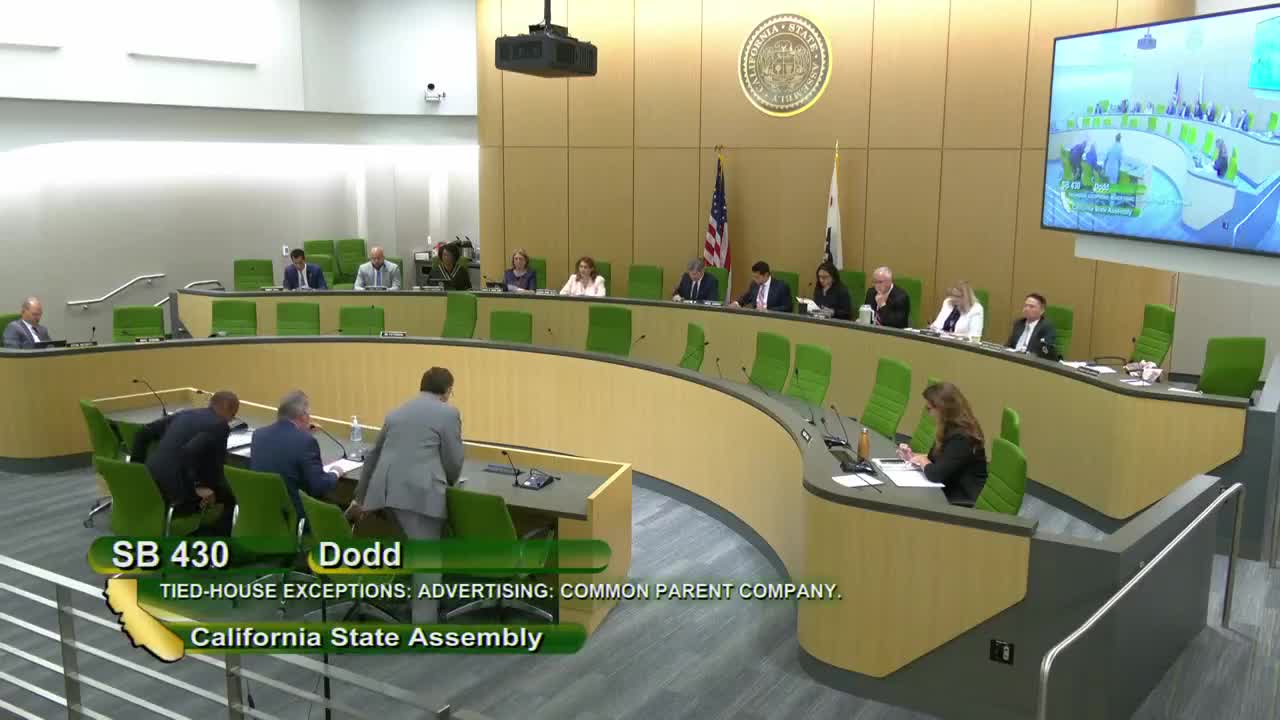 34MIN
Assembly Standing Committee on Governmental Organization
 1MIN
Senate Floor
 8MIN
Senate Standing Committee on Governmental Organization
Bill Author

Bill Co-Author(s):