SB 260: Unmanned aircraft.
- Session Year: 2025-2026
- House: Senate
- Latest Version Date: 2025-04-29
Current Status:
In Progress
(2026-06-08: Referred to Coms. on INS., PUB. S., and P. & C.P.)
Introduced
In Committee
Awaiting First Chamber Vote
Passed First Chamber
In Committee
Awaiting Second Chamber Vote
Passed Second Chamber
Enacted
What does this bill do?
The bill requires residential property insurers to notify homeowners 30 days before using a drone to take aerial images, give policyholders the images on request, provide copies of any drone inspection evidence and 120 days to fix problems before ending a policy, and delete drone-collected data within 90 days with limited exceptions. It also limits flying drones too close to listed critical infrastructure or certain Sacramento government buildings and the State Capitol with a $1,000 fine, raises the fine for drones over prisons and jails to $1,000, and makes using a drone over school grounds to watch, record, or threaten people a crime.
The summary is provided by generative AI which can make mistakes. For original language, please view the details in the table below.
Existing law generally regulates classes of insurance, including residential property insurance. Existing law requires an insurer to send various notices to a policyholder at specified intervals. Existing law imposes liability for physical invasion of privacy on a person if the person knowingly enters onto the land or into the airspace above the land of another person without permission or otherwise commits a trespass in order to capture any image or recording of the other person engaging in a private activity and the invasion occurs in a manner that is offensive to a reasonable person.
This bill would prohibit an onsite inspection by a residential property insurance company of a home conducted by a remotely operated unmanned aircraft. The bill would, until January 1, 2028, This bill would require a residential property insurer to notify a policyholder at least 30 days in advance of the day that a remotely operated unmanned aircraft will be used to take aerial images of the insured property, as specified, unless a claim has been submitted or is pending on the property and the images will be used only for evaluating the claim. The bill would require the insurer to provide the aerial images upon request, and would require the notice to include instructions regarding how a policyholder may make that request. The bill would, if a residential property insurance company insurer gathered sufficient evidence for the termination of a residential property insurance contract during an inspection of a policyholders property that was conducted by the use of a remotely operated unmanned aircraft on or after May 1, 2025, aircraft, require the company to provide written notice to the policyholder of specified information, including the reason for the potential termination of the contract and what the policyholder is required to do to comply with the provisions of the contract. contract, and to provide copies of the evidence gathered during the inspection. The bill would require the company insurer to give the policyholder 120 days to remedy the issue, and would prohibit the company from canceling the contract or would require the company to reinstate the contract if the policyholder offers proof that insurer from canceling the contract if the policyholder provides documentation that indicates that the work was completed to comply with the contract, as specified. The bill would require an insurer to destroy any evidence that is in their possession that was collected from or generated by a remotely operated unmanned aircraft no later than 90 days after the data has been collected or generated, subject to specified exceptions.
Existing law makes it a misdemeanor to enter or remain upon any property that is posted against trespassing and loitering, as specified, without the written permission of the owner, tenant, or occupant in legal possession or control of the property. Existing law makes it a misdemeanor to operate an unmanned aerial vehicle at the scene of an emergency for the purpose of viewing the scene or the activities of emergency responders, as specified.
This bill would make it an infraction to intentionally or knowingly operate an unmanned aircraft over or to come within either a specified distance or a distance that would interfere with the operations of a critical infrastructure facility, as defined, with specified exceptions, including that the operator is a governmental entity acting in their capacity as a regulator or the operator has the written consent of the owner or operator of the facility. The bill would make it an infraction to intentionally or knowingly operate an unmanned aircraft over or to come within either a specified distance or a distance that would interfere with the operations of specified property in the City of Sacramento in which the State Capitol is located, with specified exceptions, including if a person is acting with the express authorization of the Joint Rules Committee of the Legislature, and would require the Joint Rules Committee to establish related policies in consultation with the Department of the California Highway Patrol. By creating new crimes, this bill would impose a state-mandated local program.
Existing law makes it a misdemeanor for a person to enter into a school building or upon school grounds, or on public property adjacent to the school, and interfere with or disrupt the activities of the school by remaining on or reentering the property after being asked to leave, or creating a disruption with the intent to threaten the safety of a pupil, as specified.
This bill would additionally make it a misdemeanor to use an unmanned aircraft on or above a school building or upon school grounds with the intent to surveil, closely monitor, record, or threaten the safety of any person, as specified. By creating a new crime, this bill would impose a state-mandated local program.
Existing law makes it an infraction, punishable by a fine of $500, for a person to operate an unmanned aircraft on or above the grounds of a penal institution, as specified.
This bill would increase that penalty to $1,000.
The California Constitution requires the state to reimburse local agencies and school districts for certain costs mandated by the state. Statutory provisions establish procedures for making that reimbursement.
This bill would provide that no reimbursement is required by this act for a specified reason.
Existing law generally regulates classes of insurance, including residential property insurance. Existing law imposes liability for physical invasion of privacy on a person if the person knowingly enters onto the land or into the airspace above the land of another person without permission or otherwise commits a trespass in order to capture any image or recording of the other person engaging in a private activity and the invasion occurs in a manner that is offensive to a reasonable person.
This bill would prohibit an onsite inspection by a residential property insurance company of a home conducted by a remotely operated unmanned aircraft from constituting sufficient evidence for the termination of a home protection contract, unless the findings of the inspection are corroborated, as specified. The bill would require a home protection company intending to inspect a property using an unmanned aircraft to notify the issue of a home protection contract no less than 14 calendar days prior to the inspection, and would prohibit an inspection conducted using an unmanned aircraft without the above-described notice from constituting sufficient reason to modify or terminate the contract. The bill would require a home protection company or its authorized agents to provide to, upon the request of, a property owner, copies of photographic or videographic evidence that are gathered during a prequalification or subsequent inspection and are used in the inspection report. aircraft. The bill would, until January 1, 2028, if a residential property insurance company gathered sufficient evidence for the termination of a residential property insurance contract during an inspection of a policyholders property that was conducted by the use of a remotely operated unmanned aircraft on or after May 1, 2025, require the company to provide written notice to the policyholder of specified information, including the reason for the potential termination of the contract and what the policyholder is required to do to comply with the provisions of the contract. The bill would require the company to give the policyholder 120 days to remedy the issue, and would prohibit the company from canceling the contract or would require the company to reinstate the contract if the policyholder offers proof that the work was completed to comply with the contract, as specified.
Existing law makes it a misdemeanor to enter or remain upon any property that is posted against trespassing and loitering, as specified, without the written permission of the owner, tenant, or occupant in legal possession or control of the property. Existing law makes it a misdemeanor to operate an unmanned aerial vehicle at the scene of an emergency for the purpose of viewing the scene or the activities of emergency responders, as specified.
This bill would make it an infraction to intentionally or knowingly operate an unmanned aircraft over or to come within either a specified distance or a distance that would interfere with the operations of a critical infrastructure facility, as defined, with specified exceptions, including that the operator is a governmental entity acting in their capacity as a regulator or the operator has the written consent of the owner or operator of the facility. The bill would make it an infraction to intentionally or knowingly operate an unmanned aircraft over or to come within either a specified distance or a distance that would interfere with the operations of specified property in the City of Sacramento in which the State Capitol is located, with specified exceptions, including if a person is acting with the express authorization of the Joint Rules Committee of the Legislature, and would require the Joint Rules Committee to establish related policies in consultation with the Department of the California Highway Patrol. By creating new crimes, this bill would impose a state-mandated local program.
Existing law makes it a misdemeanor for a person to enter into a school building or upon school grounds, or on public property adjacent to the school, and interfere with or disrupt the activities of the school by remaining on or reentering the property after being asked to leave, or creating a disruption with the intent to threaten the safety of a pupil, as specified.
This bill would additionally make it a misdemeanor to use an unmanned aircraft on or above a school building or upon school grounds with the intent to surveil, closely monitor, record, or threaten the safety of any person, as specified. By creating a new crime, this bill would impose a state-mandated local program.
Existing law makes it an infraction, punishable by a fine of $500, for a person to operate an unmanned aircraft on or above the grounds of a penal institution, as specified.
This bill would increase that penalty to $1,000.
The California Constitution requires the state to reimburse local agencies and school districts for certain costs mandated by the state. Statutory provisions establish procedures for making that reimbursement.
This bill would provide that no reimbursement is required by this act for a specified reason.
Existing law requires a home protection company that requires an onsite inspection as a prequalification for the issuance of a home protection contract to offer a report on the inspection, as specified.
This bill would prohibit an onsite inspection of a home conducted by a remotely operated unmanned aircraft from constituting sufficient evidence for the termination of a home protection contract, unless the findings of the inspection are corroborated, as specified. The bill would require a home protection company intending to inspect a property using an unmanned aircraft to notify the issue of a home protection contract no less than 14 calendar days prior to the inspection, and would prohibit an inspection conducted using an unmanned aircraft without the above-described notice from constituting sufficient reason to modify or terminate the contract. The bill would require a home protection company or its authorized agents to provide to, upon the request of, a property owner, copies of photographic or videographic evidence that are gathered during a prequalification or subsequent inspection and are used in the inspection report.
Existing law makes it a misdemeanor to enter or remain upon any property that is posted against trespassing and loitering, as specified, without the written permission of the owner, tenant, or occupant in legal possession or control of the property. Existing law makes it a misdemeanor to operate an unmanned aerial vehicle at the scene of an emergency for the purpose of viewing the scene or the activities of emergency responders, as specified.
This bill would make it an infraction to intentionally or knowingly operate an unmanned aircraft over or to come within either a specified distance or a distance that would interfere with the operations of a critical infrastructure facility, as defined, with specified exceptions, including that the operator is a governmental entity acting in their capacity as a regulator or the operator has the written consent of the owner or operator of the facility. The bill would make it an infraction to intentionally or knowingly operate an unmanned aircraft over or to come within either a specified distance or a distance that would interfere with the operations of specified property in the City of Sacramento in which the State Capitol is located, with specified exceptions, including if a person is acting with the express authorization of the Joint Rules Committee of the Legislature, and would require the Joint Rules Committee to establish related policies in consultation with the Department of the California Highway Patrol. By creating new crimes, this bill would impose a state-mandated local program.
Existing law makes it a misdemeanor for a person to enter into a school building or upon school grounds, or on public property adjacent to the school, and interfere with or disrupt the activities of the school by remaining on or reentering the property after being asked to leave, or creating a disruption with the intent to threaten the safety of a pupil, as specified.
This bill would additionally make it a misdemeanor to use an unmanned aircraft on or above a school building or upon school grounds, or on public property adjacent to the school, grounds with the intent to surveil, closely monitor, record, or threaten the safety of any person. person, as specified. By creating a new crime, this bill would impose a state-mandated local program.
Existing law makes it an infraction, punishable by a fine of $500, for a person to operate an unmanned aircraft on or above the grounds of a penal institution, as specified.
This bill would increase that penalty to $1,000.
The California Constitution requires the state to reimburse local agencies and school districts for certain costs mandated by the state. Statutory provisions establish procedures for making that reimbursement.
This bill would provide that no reimbursement is required by this act for a specified reason.
Existing law requires a home protection company that requires an onsite inspection as a prequalification for the issuance of a home protection contract to offer a report on the inspection, as specified.
This bill would prohibit an onsite inspection of a home conducted by a remotely operated unmanned aircraft from constituting sufficient evidence for the termination of a home protection contract, unless the findings of the inspection are corroborated, as specified. The bill would require a home protection company intending to inspect a property using an unmanned aircraft to notify the issue of a home protection contract no less than 14 calendar days prior to the inspection, and would prohibit an inspection conducted using an unmanned aircraft without the above-described notice from constituting sufficient reason to modify or terminate the contract. The bill would require a home protection company or its authorized agents to provide to, upon the request of, a property owner, copies of photographic or videographic evidence that are gathered during a prequalification or subsequent inspection and are used in the inspection report.
Existing law makes it a misdemeanor to enter or remain upon any property that is posted against trespassing and loitering, as specified, without the written permission of the owner, tenant, or occupant in legal possession or control of the property. Existing law makes it a misdemeanor to operate an unmanned aerial vehicle at the scene of an emergency for the purpose of viewing the scene or the activities of emergency responders, as specified.
This bill would make it a misdemeanor an infraction to intentionally or knowingly operate an unmanned aircraft over, allow an unmanned aircraft to make contact with, over or to come within either a specified distance or a distance that would interfere with, with the operations of a critical infrastructure facility, as defined, with specified exceptions, including that the operator is a governmental entity acting in their capacity as a regulator or the operator has the written consent of the owner or operator of the facility. The bill would make it an infraction to intentionally or knowingly operate an unmanned aircraft over or to come within either a specified distance or a distance that would interfere with the operations of specified property in the City of Sacramento in which the State Capitol is located, with specified exceptions, including if a person is acting with the express authorization of the Joint Rules Committee of the Legislature, and would require the Joint Rules Committee to establish related policies in consultation with the Department of the California Highway Patrol. By creating a new crime, new crimes, this bill would impose a state-mandated local program.
Existing law makes it a misdemeanor for a person to enter into a school building or upon school grounds, or on public property adjacent to the school, and interfere with or disrupt the activities of the school by remaining on or reentering the property after being asked to leave, or creating a disruption with the intent to threaten the safety of a pupil, as specified.
This bill would additionally make it a misdemeanor to use an unmanned aircraft on or above a school building or upon school grounds, or on public property adjacent to the school, with the intent to surveil, closely monitor, record, or threaten the safety of any person in a school or on school grounds. of any person. By creating a new crime, this bill would impose a state-mandated local program.
Existing law makes it an infraction, punishable by a fine of $500, for a person to operate an unmanned aircraft on or above the grounds of a penal institution, as specified.
This bill would increase that penalty to $2,000. $1,000.
The California Constitution requires the state to reimburse local agencies and school districts for certain costs mandated by the state. Statutory provisions establish procedures for making that reimbursement.
This bill would provide that no reimbursement is required by this act for a specified reason.
Existing law requires a home protection company that requires an onsite inspection as a prequalification for the issuance of a home protection contract to offer a report on the inspection, as specified.
This bill would prohibit an onsite inspection of a home conducted by a remotely operated unmanned aircraft from constituting sufficient evidence for the termination of a home protection contract, unless the findings of the inspection are corroborated, as specified. The bill would require a home protection company intending to inspect a property using an unmanned aircraft to notify the issue of a home protection contract no less than 14 calendar days prior to the inspection, and would prohibit an inspection conducted using an unmanned aircraft without the above-described notice from constituting sufficient reason to modify or terminate the contract. The bill would require a home protection company or its authorized agents to provide to, upon the request of, a property owner, copies of photographic or videographic evidence that are gathered during a prequalification or subsequent inspection and are used in the inspection report.
Existing law makes it a misdemeanor to enter or remain upon any property that is posted against trespassing and loitering, as specified, without the written permission of the owner, tenant, or occupant in legal possession or control of the property. Existing law makes it a misdemeanor to operate an unmanned aerial vehicle at the scene of an emergency for the purpose of viewing the scene or the activities of emergency responders, as specified.
This bill would make it a misdemeanor to intentionally or knowingly operate an unmanned aircraft over, allow an unmanned aircraft to make contact with, or to come within a distance that would interfere with, the operations of a critical infrastructure facility, as defined, with specified exceptions, including that the operator is a governmental entity acting in their capacity as a regulator or the operator has the written consent of the owner or operator of the facility. By creating a new crime, this bill would impose a state-mandated local program.
Existing law makes it a misdemeanor for a person to enter into a school building or upon school grounds, or on public property adjacent to the school, and interfere with or disrupt the activities of the school by remaining on or reentering the property after being asked to leave, or creating a disruption with the intent to threaten the safety of a pupil, as specified.
This bill would additionally make it a misdemeanor to use an unmanned aircraft with the intent to threaten the safety of any person in a school or on school grounds. By creating a new crime, this bill would impose a state-mandated local program.
Existing law makes it an infraction, punishable by a fine of $500, for a person to operate an unmanned aircraft on or above the grounds of a penal institution, as specified.
This bill would increase that penalty to $2,000.
The California Constitution requires the state to reimburse local agencies and school districts for certain costs mandated by the state. Statutory provisions establish procedures for making that reimbursement.
This bill would provide that no reimbursement is required by this act for a specified reason.
(a)(1)(A)A residential property insurer shall notify a policyholder if any aerial images will be taken of the insured property by, on behalf of, or in service of the insurer. The policyholder shall receive the notice at least 30 days in advance of the day that the images will be taken.
(B)This subdivision does not apply if a claim has been submitted or is pending on the property, if any aerial images taken of the insured property are used only for the purpose of evaluating the submitted or pending claim.
(2)(A)A notice pursuant to this subdivision shall be mailed via the United States Postal Service to the policyholders mailing address of record.
(B)For a policyholder who has agreed to transact business electronically pursuant to the Uniform Electronic Transactions Act (Title 2.5 (commencing with Section 1633.1) of Part 2 of Division 3 of the Civil Code), the insurer may provide notice to the email address provided by the policyholder in addition to the mailed notice pursuant to subparagraph (A).
(b)A residential property insurer shall provide any aerial images taken or obtained of the insured property to the policyholder upon request. A notice provided pursuant to subdivision (a) shall include instructions regarding how a policyholder may make that request for images.
(c)For purposes of this section:
(1)Aerial image means an image or video collected by a remotely operated unmanned aircraft.
(2)Receive means the earliest of the delivery date shown on an express, certified, or registered mail receipt form of the United States Postal Service or two business days after the request was postmarked by the United States Postal Service.
(b)(d)(1)If a residential property insurance company insurer gathered sufficient evidence for the termination of a residential property insurance contract during an inspection of a policyholders property that was conducted by the use of a remotely operated unmanned aircraft on or after May 1, 2025, aircraft, the company insurer shall provide written notice of the reason for the potential termination of the contract and copies of the evidence gathered during the inspection to the policyholder, what the policyholder is required to do to comply with the provisions of the contract, and that the policyholder has 120 days to remedy the issue.
(2)If a residential property insurance company insurer provides notice to a policyholder pursuant to paragraph (1), the company insurer shall allow 120 calendar days for the policyholder to comply with the provisions of the contract before terminating the contract.
(3)(A)If a policyholder provides documentation that indicates that the work required to comply with the provisions of the contract was completed to the company insurer within 120 calendar days after the notice described in paragraph (1), the company insurer may not cancel the contract based on the evidence described in paragraph (1).
(B)If the residential property insurance company has terminated a policyholders contract based on the evidence described in paragraph (1) but the policyholder provides to the company, within 120 calendar days after the notice described in paragraph (1), documentation that indicates that the work required to comply with the provisions of the contract was completed, the company shall reinstate the contract.(4)A residential property insurance company may not conduct a subsequent inspection of a policyholders property within two years after an inspection described in paragraph (1).(c)This section shall remain in effect only until January 1, 2028, and as of that date is repealed.(e)(1)A residential property insurer shall destroy any evidence that is in their possession that was collected from or generated by a remotely operated unmanned aircraft as described in this section no later than 90 days after the data has been collected or generated.
(2)This subdivision does not apply to any data that is any of the following:
(A)Necessary to detect security incidents, protect against malicious, deceptive, fraudulent, or illegal activity, or prosecute those responsible for that activity.
(B)Necessary to identify and repair errors that impair existing intended functionality of the aircraft.
(C)Protected speech under the United States or California Constitutions.
(D)Necessary to comply with another law or legal obligation.
(E)Material to an ongoing investigation.
(3)A residential property insurer shall destroy any evidence described in paragraph (1) that is in their possession no later than 90 days after the completion of an investigation described in subparagraph (E) of paragraph (2).
SEC. 2.Section 2036 is added to the Insurance Code, to read:2036.(a)Any onsite inspection of a policyholders property by a residential property insurance company may not be conducted by the use of a remotely operated unmanned aircraft.(b)This section shall become effective on January 1, 2028.SEC. 3.SEC. 2.Section 402.5 is added to the Penal Code, immediately following Section 402, to read:402.5.(a)For the purposes of this section, the following terms have the following meanings:
(1)Critical infrastructure facility means all of the following:
(A)Any of the following, if the location is completely enclosed by a fence or other physical barrier that is obviously designed to exclude intruders, or if the location is clearly marked with a sign that is posted on the property, is reasonably likely to come to the attention of intruders, and indicates that entry is forbidden:
(i)A petroleum or alumina refinery.
(ii)An oil, petroleum, or chemical pipeline, drilling site, storage facility, or production facility.
(iii)An electrical power generating facility, including, but not limited to, geothermal, hydroelectric, nuclear, solar, and wind facilities, a substation, switching station, or electrical control center.
(iv)A water intake structure, water treatment facility, wastewater treatment plant, or pump station.
(v)A natural gas compressor station.
(vi)A liquid natural gas terminal or storage facility.
(vii)A port.
(viii)A gas processing plant, including a plant used in the processing, treatment, or fractionation of natural gas.
(ix)Any facility or property designated by the Federal Aviation Administration as a national security-sensitive facility.
(B)If a statewide emergency has been declared, any of the following:
(i)Any alternate government facilities utilized as part of emergency response.
(ii)State Operations Centers.
(iii)Critical access hospitals or any other health care facility in which a majority of admitted patients are victims of the declared state of emergency.
(C)Any of the following:
(i)A city hall or a county administration building in which a county board of supervisors meets.
(ii)A bridge that is part of the state or federal highway system.
(iii)A dam that is classified by the Department of Water Resources as high hazard or extremely high hazard.
(2)Dam has the same meaning as in Section 6002 of the Water Code.
(b)A person is guilty of an infraction, punishable by a fine of one thousand dollars ($1,000), if the person operates an unmanned aerial vehicle, remote piloted aircraft, or drone, and intentionally or knowingly does either of the following:
(1)Allows the unmanned aerial vehicle, remote piloted aircraft, or drone to come within 400 feet of, or below 400 feet above, a critical infrastructure facility.
(2)Allows the unmanned aerial vehicle, remote piloted aircraft, or drone to come within a distance of a critical infrastructure facility that is close enough to interfere with the operations of the property.
(c)This section does not apply to conduct described in subdivision (b) that is performed by any of the following:
(1)The federal government, the state, or a governmental entity acting in their capacity as a regulator or within the interest of public safety and security.
(2)A person under contract with or otherwise acting under the direction or on behalf of the federal government, the state, or a governmental entity acting in its capacity as a regulator or within the interest of public safety and security.
(3)An operator of an unmanned aerial vehicle, remote piloted aircraft, or drone that is being used for a commercial purpose, if the operation is conducted in compliance with both of the following:
(A)All applicable Federal Aviation Administration rules, restrictions, and exemptions.
(B)All required Federal Aviation Administration authorizations.
(4)A person under contract with or otherwise acting under the direction or on behalf of an owner or operator of the critical infrastructure facility.
(5)A person who has the prior written consent of the owner or operator of the critical infrastructure facility.
(6)The owner or occupant of the property on which the critical infrastructure facility is located or a person who has the prior written consent of the owner or occupant of that property.
SEC. 4.SEC. 3.Section 402.6 is added to the Penal Code, to read:402.6.(a)A person is guilty of an infraction, punishable by a fine of one thousand dollars ($1,000), if the person operates an unmanned aerial vehicle, remote piloted aircraft, or drone and intentionally or knowingly allows the unmanned aerial vehicle, remote piloted aircraft, or drone to come within 50 feet of, or below 400 feet above, the Legislative Office Building at 1020 N Street in the City of Sacramento, the state office building at 1021 O Street in the City of Sacramento, or the grounds of the State Capitol, which is bounded by 10th, L, 15th, and N Streets in the City of Sacramento, or to come within a distance of any of those properties that is close enough to interfere with the operations of the property.
(b)(1)This section does not apply to conduct described in subdivision (a) that is performed by any of the following:
(A)Emergency law enforcement and fire response services.
(B)The Department of General Services if its activities are necessary for the care and custody of the grounds of the State Capitol.
(C)A person acting under contract with or with the express authorization of the Joint Rules Committee of the Legislature.
(2)The Joint Rules Committee of the Legislature shall establish rules and policies in consultation with the Department of the California Highway Patrol to establish processes and criteria to implement this subdivision.
(c)In enacting this section, it is the intent of the Legislature to protect the health, safety, and privacy of elected officials, employees, and visitors to the State Capitol. This section is not intended to regulate aviation safety or airspace efficiency or any other area preempted by federal law.
SEC. 5.SEC. 4.Section 626.8 of the Penal Code is amended to read:626.8.(a)A person who comes into any school building or upon any school ground, or street, sidewalk, or public way adjacent thereto, without lawful business thereon, and whose presence or acts interfere with the peaceful conduct of the activities of the school or disrupt the school or its pupils or school activities, is guilty of a misdemeanor if the person does any of the following:
(1)Remains there after being asked to leave by the chief administrative official of that school or their designated representative, or by a person employed as a member of a security or police department of a school district pursuant to Chapter 1 (commencing with Section 38000) of Part 23 of Division 3 of Title 2 of the Education Code, or a city police officer, or sheriff or deputy sheriff, or a Department of the California Highway Patrol peace officer.
(2)Reenters or comes upon that place within seven days of being asked to leave by a person specified in paragraph (1).
(3)Has otherwise established a continued pattern of unauthorized entry.
(4)Willfully or knowingly creates a disruption with the intent to threaten the immediate physical safety of any pupil in preschool, kindergarten, or any of grades 1 to 8, inclusive, arriving at, attending, or leaving from school.
(b)(1)A person who uses an unmanned aerial vehicle, remote piloted aircraft, or drone on or above any school building or school ground with the intent to surveil, closely monitor, or record any person, or to threaten the immediate physical safety of any person, is guilty of a misdemeanor.
(2)This subdivision does not apply to a person operating an unmanned aerial vehicle, remote piloted aircraft, or drone with the intent to surveil, closely monitor, or record any person if the person has the express authorization of the school over which they are operating the vehicle, aircraft, or drone to operate the vehicle, aircraft, or drone.
(c)The punishment for a violation of this section shall be as follows:
(1)Upon a first conviction, by a fine not exceeding five hundred dollars ($500), by imprisonment in a county jail for a period of not more than six months, or by both that fine and imprisonment.
(2)If the defendant has been previously convicted once of a violation of any offense defined in this chapter or Section 415.5, by imprisonment in a county jail for a period of not less than 10 days or more than six months, or by both imprisonment and a fine not exceeding five hundred dollars ($500), and shall not be released on probation, parole, or any other basis until they have served not less than 10 days.
(3)If the defendant has been previously convicted two or more times of a violation of any offense defined in this chapter or Section 415.5, by imprisonment in a county jail for a period of not less than 90 days or more than six months, or by both imprisonment and a fine not exceeding five hundred dollars ($500), and shall not be released on probation, parole, or any other basis until they have served not less than 90 days.
(d)As used in this section, the following definitions apply:
(1)Lawful business means a reason for being present upon school property which is not otherwise prohibited by statute, by ordinance, or by any regulation adopted pursuant to statute or ordinance.
(2)Continued pattern of unauthorized entry means that on at least two prior occasions in the same school year the defendant came into any school building or upon any school ground, or street, sidewalk, or public way adjacent thereto, without lawful business thereon, and their presence or acts interfered with the peaceful conduct of the activities of the school or disrupted the school or its pupils or school activities, and the defendant was asked to leave by a person specified in paragraph (1) of subdivision (a).
(3)School means any preschool or public or private school having kindergarten or any of grades 1 to 12, inclusive.
(e)When a person is directed to leave pursuant to paragraph (1) of subdivision (a), the person directing them to leave shall inform the person that if they reenter the place within seven days, they will be guilty of a crime.
(f)This section shall not be utilized to impinge upon the lawful exercise of constitutionally protected rights of speech or assembly.
SEC. 6.SEC. 5.Section 4577 of the Penal Code is amended to read:4577.(a)Except as provided in subdivisions (b), (c), and (d), a person who knowingly and intentionally operates an unmanned aircraft system on or above the grounds of a state prison, a jail, or a juvenile hall, camp, or ranch is guilty of an infraction, punishable by a fine of one thousand dollars ($1,000).
(b)This section does not apply to a person employed by the prison who operates the unmanned aircraft system within the scope of their employment, or a person who receives prior permission from the Department of Corrections and Rehabilitation to operate the unmanned aircraft system over the prison.
(c)This section does not apply to a person employed by the jail who operates the unmanned aircraft system within the scope of their employment, or a person who receives prior permission from the county sheriff to operate the unmanned aircraft system over the jail.
(d)This section does not apply to a person employed by the county department that operates the juvenile hall, camp, or ranch who operates the unmanned aircraft system within the scope of their employment, or a person who receives prior permission from the county department that operates the juvenile hall, camp, or ranch to operate the unmanned aircraft system over the juvenile hall, camp, or ranch.
(e)For purposes of this section, the following definitions apply:
(1)Unmanned aircraft means an aircraft that is operated without the possibility of direct human intervention from within or on the aircraft.
(2)Unmanned aircraft system means an unmanned aircraft and associated elements, including, but not limited to, communication links and the components that control the unmanned aircraft that are required for the pilot in command to operate safely and efficiently in the national airspace system.
SEC. 7.SEC. 6.No reimbursement is required by this act pursuant to Section 6 of Article XIIIB of the California Constitution because the only costs that may be incurred by a local agency or school district will be incurred because this act creates a new crime or infraction, eliminates a crime or infraction, or changes the penalty for a crime or infraction, within the meaning of Section 17556 of the Government Code, or changes the definition of a crime within the meaning of Section 6 of Article XIIIB of the California Constitution.
(a)Any onsite inspection of a policyholders property by a residential property insurance company may not be conducted by the use of a remotely operated unmanned aircraft.
(b)(1)If a residential property insurance company gathered sufficient evidence for the termination of a residential property insurance contract during an inspection of a policyholders property that was conducted by the use of a remotely operated unmanned aircraft on or after May 1, 2025, the company shall provide written notice of the reason for the potential termination of the contract to the policyholder, what the policyholder is required to do to comply with the provisions of the contract, and that the policyholder has 120 days to remedy the issue.
(2)If a residential property insurance company provides notice to a policyholder pursuant to paragraph (1), the company shall allow 120 calendar days for the policyholder to comply with the provisions of the contract before terminating the contract.
(3)(A)If a policyholder provides documentation that indicates that the work required to comply with the provisions of the contract was completed to the company within 120 calendar days after the notice described in paragraph (1), the company may not cancel the contract based on the evidence described in paragraph (1).
(B)If the residential property insurance company has terminated a policyholders contract based on the evidence described in paragraph (1) but the policyholder provides to the company, within 120 calendar days after the notice described in paragraph (1), documentation that indicates that the work required to comply with the provisions of the contract was completed, the company shall reinstate the contract.
(4)A residential property insurance company may not conduct a subsequent inspection of a policyholders property within two years after an inspection described in paragraph (1).
(c)This section shall remain in effect only until January 1, 2028, and as of that date is repealed.
SEC. 2.Section 2036 is added to the Insurance Code, to read:2036.(a)Any onsite inspection of a policyholders property by a residential property insurance company may not be conducted by the use of a remotely operated unmanned aircraft.
(b)This section shall become effective on January 1, 2028.
SEC. 2.SEC. 3.Section 402.5 is added to the Penal Code, immediately following Section 402, to read:402.5.(a)For the purposes of this section, the following terms have the following meanings:
(1)Critical infrastructure facility means all of the following:
(A)Any of the following, if the location is completely enclosed by a fence or other physical barrier that is obviously designed to exclude intruders, or if the location is clearly marked with a sign that is posted on the property, is reasonably likely to come to the attention of intruders, and indicates that entry is forbidden:
(i)A petroleum or alumina refinery.
(ii)An oil, petroleum, or chemical pipeline, drilling site, storage facility, or production facility.
(iii)An electrical power generating facility, including, but not limited to, geothermal, hydroelectric, nuclear, solar, and wind facilities, a substation, switching station, or electrical control center.
(iv)A water intake structure, water treatment facility, wastewater treatment plant, or pump station.
(v)A natural gas compressor station.
(vi)A liquid natural gas terminal or storage facility.
(vii)A port.
(viii)A gas processing plant, including a plant used in the processing, treatment, or fractionation of natural gas.
(ix)Any facility or property designated by the Federal Aviation Administration as a national security-sensitive facility.
(B)If a statewide emergency has been declared, any of the following:
(i)Any alternate government facilities utilized as part of emergency response.
(ii)State Operations Centers.
(iii)Critical access hospitals or any other health care facility in which a majority of admitted patients are victims of the declared state of emergency.
(C)Any of the following:
(i)A city hall or a county administration building in which a county board of supervisors meets.
(ii)A bridge that is part of the state or federal highway system.
(iii)A dam that is classified by the Department of Water Resources as high hazard or extremely high hazard.
(2)Dam has the same meaning as in Section 6002 of the Water Code.
(b)A person is guilty of an infraction, punishable by a fine of one thousand dollars ($1,000), if the person operates an unmanned aerial vehicle, remote piloted aircraft, or drone, and intentionally or knowingly does either of the following:
(1)Allows the unmanned aerial vehicle, remote piloted aircraft, or drone to come within 400 feet of, or below 400 feet above, a critical infrastructure facility.
(2)Allows the unmanned aerial vehicle, remote piloted aircraft, or drone to come within a distance of a critical infrastructure facility that is close enough to interfere with the operations of the property.
(c)This section does not apply to conduct described in subdivision (b) that is performed by any of the following:
(1)The federal government, the state, or a governmental entity acting in their capacity as a regulator or within the interest of public safety and security.
(2)A person under contract with or otherwise acting under the direction or on behalf of the federal government, the state, or a governmental entity acting in its capacity as a regulator or within the interest of public safety and security.
(3)An operator of an unmanned aerial vehicle, remote piloted aircraft, or drone that is being used for a commercial purpose, if the operation is conducted in compliance with both of the following:
(A)All applicable Federal Aviation Administration rules, restrictions, and exemptions.
(B)All required Federal Aviation Administration authorizations.
(4)A person under contract with or otherwise acting under the direction or on behalf of an owner or operator of the critical infrastructure facility.
(5)A person who has the prior written consent of the owner or operator of the critical infrastructure facility.
(6)The owner or occupant of the property on which the critical infrastructure facility is located or a person who has the prior written consent of the owner or occupant of that property.
SEC. 3.SEC. 4.Section 402.6 is added to the Penal Code, to read:402.6.(a)A person is guilty of an infraction, punishable by a fine of one thousand dollars ($1,000), if the person operates an unmanned aerial vehicle, remote piloted aircraft, or drone and intentionally or knowingly allows the unmanned aerial vehicle, remote piloted aircraft, or drone to come within 50 feet of, or below 400 feet above, the Legislative Office Building at 1020 N Street in the City of Sacramento, the state office building at 1021 O Street in the City of Sacramento, or the grounds of the State Capitol, which is bounded by 10th, L, 15th, and N Streets in the City of Sacramento, or to come within a distance of any of those properties that is close enough to interfere with the operations of the property.
(b)(1)This section does not apply to conduct described in subdivision (a) that is performed by any of the following:
(A)Emergency law enforcement and fire response services.
(B)The Department of General Services if its activities are necessary for the care and custody of the grounds of the State Capitol.
(C)A person acting under contract with or with the express authorization of the Joint Rules Committee of the Legislature.
(2)The Joint Rules Committee of the Legislature shall establish rules and policies in consultation with the Department of the California Highway Patrol to establish processes and criteria to implement this subdivision.
(c)In enacting this section, it is the intent of the Legislature to protect the health, safety, and privacy of elected officials, employees, and visitors to the State Capitol. This section is not intended to regulate aviation safety or airspace efficiency or any other area preempted by federal law.
SEC. 4.SEC. 5.Section 626.8 of the Penal Code is amended to read:626.8.(a)A person who comes into any school building or upon any school ground, or street, sidewalk, or public way adjacent thereto, without lawful business thereon, and whose presence or acts interfere with the peaceful conduct of the activities of the school or disrupt the school or its pupils or school activities, is guilty of a misdemeanor if the person does any of the following:
(1)Remains there after being asked to leave by the chief administrative official of that school or their designated representative, or by a person employed as a member of a security or police department of a school district pursuant to Chapter 1 (commencing with Section 38000) of Part 23 of Division 3 of Title 2 of the Education Code, or a city police officer, or sheriff or deputy sheriff, or a Department of the California Highway Patrol peace officer.
(2)Reenters or comes upon that place within seven days of being asked to leave by a person specified in paragraph (1).
(3)Has otherwise established a continued pattern of unauthorized entry.
(4)Willfully or knowingly creates a disruption with the intent to threaten the immediate physical safety of any pupil in preschool, kindergarten, or any of grades 1 to 8, inclusive, arriving at, attending, or leaving from school.
(b)(1)A person who uses an unmanned aerial vehicle, remote piloted aircraft, or drone on or above any school building or school ground with the intent to surveil, closely monitor, or record any person, or to threaten the immediate physical safety of any person, is guilty of a misdemeanor.
(2)This subdivision does not apply to a person operating an unmanned aerial vehicle, remote piloted aircraft, or drone with the intent to surveil, closely monitor, or record any person if the person has the express authorization of the school over which they are operating the vehicle, aircraft, or drone to operate the vehicle, aircraft, or drone.
(c)The punishment for a violation of this section shall be as follows:
(1)Upon a first conviction, by a fine not exceeding five hundred dollars ($500), by imprisonment in a county jail for a period of not more than six months, or by both that fine and imprisonment.
(2)If the defendant has been previously convicted once of a violation of any offense defined in this chapter or Section 415.5, by imprisonment in a county jail for a period of not less than 10 days or more than six months, or by both imprisonment and a fine not exceeding five hundred dollars ($500), and shall not be released on probation, parole, or any other basis until they have served not less than 10 days.
(3)If the defendant has been previously convicted two or more times of a violation of any offense defined in this chapter or Section 415.5, by imprisonment in a county jail for a period of not less than 90 days or more than six months, or by both imprisonment and a fine not exceeding five hundred dollars ($500), and shall not be released on probation, parole, or any other basis until they have served not less than 90 days.
(d)As used in this section, the following definitions apply:
(1)Lawful business means a reason for being present upon school property which is not otherwise prohibited by statute, by ordinance, or by any regulation adopted pursuant to statute or ordinance.
(2)Continued pattern of unauthorized entry means that on at least two prior occasions in the same school year the defendant came into any school building or upon any school ground, or street, sidewalk, or public way adjacent thereto, without lawful business thereon, and their presence or acts interfered with the peaceful conduct of the activities of the school or disrupted the school or its pupils or school activities, and the defendant was asked to leave by a person specified in paragraph (1) of subdivision (a).
(3)School means any preschool or public or private school having kindergarten or any of grades 1 to 12, inclusive.
(e)When a person is directed to leave pursuant to paragraph (1) of subdivision (a), the person directing them to leave shall inform the person that if they reenter the place within seven days, they will be guilty of a crime.
(f)This section shall not be utilized to impinge upon the lawful exercise of constitutionally protected rights of speech or assembly.
SEC. 5.SEC. 6.Section 4577 of the Penal Code is amended to read:4577.(a)Except as provided in subdivisions (b), (c), and (d), a person who knowingly and intentionally operates an unmanned aircraft system on or above the grounds of a state prison, a jail, or a juvenile hall, camp, or ranch is guilty of an infraction, punishable by a fine of one thousand dollars ($1,000).
(b)This section does not apply to a person employed by the prison who operates the unmanned aircraft system within the scope of their employment, or a person who receives prior permission from the Department of Corrections and Rehabilitation to operate the unmanned aircraft system over the prison.
(c)This section does not apply to a person employed by the jail who operates the unmanned aircraft system within the scope of their employment, or a person who receives prior permission from the county sheriff to operate the unmanned aircraft system over the jail.
(d)This section does not apply to a person employed by the county department that operates the juvenile hall, camp, or ranch who operates the unmanned aircraft system within the scope of their employment, or a person who receives prior permission from the county department that operates the juvenile hall, camp, or ranch to operate the unmanned aircraft system over the juvenile hall, camp, or ranch.
(e)For purposes of this section, the following definitions apply:
(1)Unmanned aircraft means an aircraft that is operated without the possibility of direct human intervention from within or on the aircraft.
(2)Unmanned aircraft system means an unmanned aircraft and associated elements, including, but not limited to, communication links and the components that control the unmanned aircraft that are required for the pilot in command to operate safely and efficiently in the national airspace system.
SEC. 6.SEC. 7.No reimbursement is required by this act pursuant to Section 6 of Article XIIIB of the California Constitution because the only costs that may be incurred by a local agency or school district will be incurred because this act creates a new crime or infraction, eliminates a crime or infraction, or changes the penalty for a crime or infraction, within the meaning of Section 17556 of the Government Code, or changes the definition of a crime within the meaning of Section 6 of Article XIIIB of the California Constitution.
(a)The furnishing of a home protection contract without charge to a person shall constitute a violation of this part. No home protection contract providing coverage prior to the time an interest in the home to which it attaches is sold shall be issued or delivered unless it provides for consideration. Such consideration may consist of a bona fide promise to pay the protection contract fee at the time of, and only upon transfer of, title.
(b)A home protection company may require an onsite inspection as a prequalification for the issuance of a home protection contract. If the company requires an inspection, the company shall offer a report on the inspection to the applicant in connection with a bona fide application for the issuance of a contract even if the issuance of a contract on the property which is the subject of the inspection does not occur.
(c)(1)An onsite inspection of a property conducted by a remotely operated unmanned aircraft shall not constitute sufficient evidence for the termination of a home protection contract, unless the findings of the inspection are corroborated by an inspection conducted by a property inspector within 14 calendar days from the date of the unmanned aircraft inspection.
(2)A home protection company intending to inspect a property using an unmanned aircraft shall notify the individual to whom the home protection contract is issued no less than 14 calendar days prior to the inspection. An inspection conducted using an unmanned aircraft without this notice shall not constitute sufficient reason to modify or terminate a home protection contract.
(d)Upon the request of a property owner, a home protection company or its authorized agents shall provide copies of the photographic or videographic evidence gathered pursuant to subdivision (b) or (c) that is used in the property inspection report to the property owner.
SEC. 2.Section 402.5 is added to the Penal Code, immediately following Section 402, to read:402.5.(a)For the purposes of this section, the following terms have the following meanings:
(1)Critical infrastructure facility means all of the following:
(A)Any of the following, if the location is completely enclosed by a fence or other physical barrier that is obviously designed to exclude intruders, or if the location is clearly marked with a sign that is posted on the property, is reasonably likely to come to the attention of intruders, and indicates that entry is forbidden:
(i)A petroleum or alumina refinery.
(ii)An oil, petroleum, or chemical pipeline, drilling site, storage facility, or production facility.
(iii)An electrical power generating facility, including, but not limited to, geothermal, hydroelectric, nuclear, solar, and wind facilities, a substation, switching station, or electrical control center.
(iv)A polymer or rubber manufacturing facility.(v)Medication or medical device production facilities.(vi)(iv)A water intake structure, water treatment facility, wastewater treatment plant, or pump station.
(vii)(v)A natural gas compressor station.
(viii)(vi)A liquid natural gas terminal or storage facility.
(ix)A telecommunications central switching office or any structure used as part of a system to provide wired or wireless telecommunications services.(x)(vii)A port, railroad switching yard, trucking terminal, or any other freight transportation facility. port.
(xi)(viii)A gas processing plant, including a plant used in the processing, treatment, or fractionation of natural gas.
(xii)A transmission facility used by a federally licensed radio or television station.(xiii)A steelmaking facility that uses an electrical arc furnace to make steel.(xiv)(ix)Any facility or property designated by the Federal Aviation Administration as a national security-sensitive facility.
(B)If a statewide emergency has been declared, any of the following:
(i)Any alternate government facilities utilized as part of emergency response.
(ii)State Operations Centers.
(iii)Critical access hospitals or any other health care facility in which a majority of admitted patients are victims of the declared state of emergency.
(C)Any of the following:
(i)A city hall or a county administration building in which a county board of supervisors meets.
(ii)A bridge that is part of the state or federal highway system.
(iii)A dam that is classified by the Department of Water Resources as high hazard or extremely high hazard.
(2)Dam has the same meaning as in Section 6002 of the Water Code.
(b)A person is guilty of an infraction, punishable by a fine of one thousand dollars ($1,000), if the person operates an unmanned aerial vehicle, remote piloted aircraft, or drone, and intentionally or knowingly does either of the following:
(1)Allows the unmanned aerial vehicle, remote piloted aircraft, or drone to come within 400 feet of, or below 400 feet above, a critical infrastructure facility.
(2)Allows the unmanned aerial vehicle, remote piloted aircraft, or drone to come within a distance of a critical infrastructure facility that is close enough to interfere with the operations of the property.
(c)This section does not apply to conduct described in subdivision (b) that is performed by any of the following:
(1)The federal government, the state, or a governmental entity acting in their capacity as a regulator or within the interest of public safety and security.
(2)A person under contract with or otherwise acting under the direction or on behalf of the federal government, the state, or a governmental entity acting in its capacity as a regulator or within the interest of public safety and security.
(3)An operator of an unmanned aerial vehicle, remote piloted aircraft, or drone that is being used for a commercial purpose, if the operation is conducted in compliance with both of the following:
(A)All applicable Federal Aviation Administration rules, restrictions, and exemptions.
(B)All required Federal Aviation Administration authorizations.
(4)A person under contract with or otherwise acting under the direction or on behalf of an owner or operator of the critical infrastructure facility.
(5)A person who has the prior written consent of the owner of or operator of the critical infrastructure facility.
(6)The owner or occupant of the property on which the critical infrastructure facility is located or a person who has the prior written consent of the owner or occupant of that property.
SEC. 3.Section 402.6 is added to the Penal Code, to read:402.6.(a)A person is guilty of an infraction, punishable by a fine of one thousand dollars ($1,000), if the person operates an unmanned aerial vehicle, remote piloted aircraft, or drone and intentionally or knowingly allows the unmanned aerial vehicle, remote piloted aircraft, or drone to come within 50 feet of, or below 400 feet above, the Legislative Office Building at 1020 N Street in the City of Sacramento, the state office building at 1021 O Street in the City of Sacramento, or the grounds of the State Capitol, which is bounded by 10th, L, 15th, and N Streets in the City of Sacramento, or to come within a distance of any of those properties that is close enough to interfere with the operations of the property.
(b)(1)This section does not apply to conduct described in subdivision (a) that is performed by any of the following:
(A)Emergency law enforcement and fire response services.
(B)The Department of General Services if its activities are necessary for the care and custody of the grounds of the State Capitol.
(C)A person acting under contract with or with the express authorization of the Joint Rules Committee of the Legislature.
(2)The Joint Rules Committee of the Legislature shall establish rules and policies in consultation with the Department of the California Highway Patrol to establish processes and criteria to implement this subdivision.
(c)In enacting this section, it is the intent of the Legislature to protect the health, safety, and privacy of elected officials, employees, and visitors to the State Capitol. This section is not intended to regulate aviation safety or airspace efficiency or any other area preempted by federal law.
SEC. 4.Section 626.8 of the Penal Code is amended to read:626.8.(a)A person who comes into any school building or upon any school ground, or street, sidewalk, or public way adjacent thereto, without lawful business thereon, and whose presence or acts interfere with the peaceful conduct of the activities of the school or disrupt the school or its pupils or school activities, is guilty of a misdemeanor if the person does any of the following:
(1)Remains there after being asked to leave by the chief administrative official of that school or their designated representative, or by a person employed as a member of a security or police department of a school district pursuant to Chapter 1 (commencing with Section 38000) of Part 23 of Division 3 of Title 2 of the Education Code, or a city police officer, or sheriff or deputy sheriff, or a Department of the California Highway Patrol peace officer.
(2)Reenters or comes upon that place within seven days of being asked to leave by a person specified in paragraph (1).
(3)Has otherwise established a continued pattern of unauthorized entry.
(4)Willfully or knowingly creates a disruption with the intent to threaten the immediate physical safety of any pupil in preschool, kindergarten, or any of grades 1 to 8, inclusive, arriving at, attending, or leaving from school.
(b)(1)A person who uses an unmanned aerial vehicle, remote piloted aircraft, or drone on or above any school building or school ground, or street, sidewalk, or public way adjacent to the school ground, ground with the intent to surveil, closely monitor monitor, or record any person, or to threaten the immediate physical safety of any person, is guilty of a misdemeanor.
(2)This subdivision does not apply to a person operating an unmanned aerial vehicle, remote piloted aircraft, or drone with the intent to surveil, closely monitor, or record any person if the person has the express authorization of the school over which they are operating the vehicle, aircraft, or drone to operate the vehicle, aircraft, or drone.
(c)The punishment for a violation of this section shall be as follows:
(1)Upon a first conviction, by a fine not exceeding five hundred dollars ($500), by imprisonment in a county jail for a period of not more than six months, or by both that fine and imprisonment.
(2)If the defendant has been previously convicted once of a violation of any offense defined in this chapter or Section 415.5, by imprisonment in a county jail for a period of not less than 10 days or more than six months, or by both imprisonment and a fine not exceeding five hundred dollars ($500), and shall not be released on probation, parole, or any other basis until they have served not less than 10 days.
(3)If the defendant has been previously convicted two or more times of a violation of any offense defined in this chapter or Section 415.5, by imprisonment in a county jail for a period of not less than 90 days or more than six months, or by both imprisonment and a fine not exceeding five hundred dollars ($500), and shall not be released on probation, parole, or any other basis until they have served not less than 90 days.
(d)As used in this section, the following definitions apply:
(1)Lawful business means a reason for being present upon school property which is not otherwise prohibited by statute, by ordinance, or by any regulation adopted pursuant to statute or ordinance.
(2)Continued pattern of unauthorized entry means that on at least two prior occasions in the same school year the defendant came into any school building or upon any school ground, or street, sidewalk, or public way adjacent thereto, without lawful business thereon, and their presence or acts interfered with the peaceful conduct of the activities of the school or disrupted the school or its pupils or school activities, and the defendant was asked to leave by a person specified in paragraph (1) of subdivision (a).
(3)School means any preschool or public or private school having kindergarten or any of grades 1 to 12, inclusive.
(e)When a person is directed to leave pursuant to paragraph (1) of subdivision (a), the person directing them to leave shall inform the person that if they reenter the place within seven days, they will be guilty of a crime.
(f)This section shall not be utilized to impinge upon the lawful exercise of constitutionally protected rights of speech or assembly.
SEC. 5.Section 4577 of the Penal Code is amended to read:4577.(a)Except as provided in subdivisions (b), (c), and (d), a person who knowingly and intentionally operates an unmanned aircraft system on or above the grounds of a state prison, a jail, or a juvenile hall, camp, or ranch is guilty of an infraction, punishable by a fine of one thousand dollars ($1,000).
(b)This section does not apply to a person employed by the prison who operates the unmanned aircraft system within the scope of their employment, or a person who receives prior permission from the Department of Corrections and Rehabilitation to operate the unmanned aircraft system over the prison.
(c)This section does not apply to a person employed by the jail who operates the unmanned aircraft system within the scope of their employment, or a person who receives prior permission from the county sheriff to operate the unmanned aircraft system over the jail.
(d)This section does not apply to a person employed by the county department that operates the juvenile hall, camp, or ranch who operates the unmanned aircraft system within the scope of their employment, or a person who receives prior permission from the county department that operates the juvenile hall, camp, or ranch to operate the unmanned aircraft system over the juvenile hall, camp, or ranch.
(e)For purposes of this section, the following definitions apply:
(1)Unmanned aircraft means an aircraft that is operated without the possibility of direct human intervention from within or on the aircraft.
(2)Unmanned aircraft system means an unmanned aircraft and associated elements, including, but not limited to, communication links and the components that control the unmanned aircraft that are required for the pilot in command to operate safely and efficiently in the national airspace system.
SEC. 6.No reimbursement is required by this act pursuant to Section 6 of Article XIIIB of the California Constitution because the only costs that may be incurred by a local agency or school district will be incurred because this act creates a new crime or infraction, eliminates a crime or infraction, or changes the penalty for a crime or infraction, within the meaning of Section 17556 of the Government Code, or changes the definition of a crime within the meaning of Section 6 of Article XIIIB of the California Constitution.
(a)The furnishing of a home protection contract without charge to a person shall constitute a violation of this part. No home protection contract providing coverage prior to the time an interest in the home to which it attaches is sold shall be issued or delivered unless it provides for consideration. Such consideration may consist of a bona fide promise to pay the protection contract fee at the time of, and only upon transfer of, title.
(b)A home protection company may require an onsite inspection as a prequalification for the issuance of a home protection contract. If the company requires an inspection, the company shall offer a report on the inspection to the applicant in connection with a bona fide application for the issuance of a contract even if the issuance of a contract on the property which is the subject of the inspection does not occur.
(c)(1)An onsite inspection of a property conducted by a remotely operated unmanned aircraft shall not constitute sufficient evidence for the termination of a home protection contract, unless the findings of the inspection are corroborated by an inspection conducted by a property inspector within 14 calendar days from the date of the unmanned aircraft inspection.
(2)A home protection company intending to inspect a property using an unmanned aircraft shall notify the individual to whom the home protection contract is issued no less than 14 calendar days prior to the inspection. An inspection conducted using an unmanned aircraft without this notice shall not constitute sufficient reason to modify or terminate a home protection contract.
(d)Upon the request of a property owner, a home protection company or its authorized agents shall provide copies of the photographic or videographic evidence gathered pursuant to subdivision (b) or (c) that is used in the property inspection report to the property owner.
SEC. 2.Section 402.5 is added to the Penal Code, immediately following Section 402, to read:402.5.(a)For the purposes of this section, the following terms have the following meanings:
(1)Critical infrastructure facility means all of the following:
(A)Any of the following, if the location is completely enclosed by a fence or other physical barrier that is obviously designed to exclude intruders, or if the location is clearly marked with a sign that is posted on the property, is reasonably likely to come to the attention of intruders, and indicates that entry is forbidden:
(i)A petroleum or alumina refinery.
(ii)An oil, petroleum, or chemical pipeline, drilling site, storage facility, or production facility.
(ii)(iii)An electrical power generating facility, including, but not limited to, geothermal, hydroelectric, nuclear, solar, and wind facilities, a substation, switching station, or electrical control center.
(iii)(iv)A chemical, polymer, polymer or rubber manufacturing facility.
(iv)(v)Medication or medical device production facilities.
(v)(vi)A water intake structure, water treatment facility, wastewater treatment plant, or pump station.
(vi)(vii)A natural gas compressor station.
(vii)(viii)A liquid natural gas terminal or storage facility.
(viii)(ix)A telecommunications central switching office or any structure used as part of a system to provide wired or wireless telecommunications services.
(ix)(x)A port, railroad switching yard, trucking terminal, or any other freight transportation facility.
(x)(xi)A gas processing plant, including a plant used in the processing, treatment, or fractionation of natural gas.
(xi)(xii)A transmission facility used by a federally licensed radio or television station.
(xii)(xiii)A steelmaking facility that uses an electrical arc furnace to make steel.
(xiii)A dam that is classified as a high hazard.(xiv)A city hall.(xv)The State Capitol.(xvi)(xiv)Any facility or property designated by the Federal Aviation Administration as a national security-sensitive facility.
(B)If a statewide emergency has been declared: declared, any of the following:
(i)Any alternate government facilities utilized as part of emergency response.
(ii)State Operations Centers.
(iii)Critical access hospitals or any other health care facility in which a majority of admitted patients are victims of the declared state of emergency.
(C)If enclosed by a fence or other physical barrier obviously designed to exclude intruders:(i)Any portion of an aboveground oil, gas, or chemical pipeline;(ii)An oil or gas drilling site.(iii)A group of tanks used to store crude oil, such as a tank battery.(iv)An oil, gas, or chemical production facility.(v)An oil or gas wellhead.(vi)Any oil and gas facility that has an active flare.(C)Any of the following:
(i)A city hall or a county administration building in which a county board of supervisors meets.
(ii)A bridge that is part of the state or federal highway system.
(iii)A dam that is classified by the Department of Water Resources as high hazard or extremely high hazard.
(2)Dam means any barrier, including any appurtenant structures, that is constructed for the purpose of permanently or temporarily impounding water. has the same meaning as in Section 6002 of the Water Code.
(b)A person is guilty of a misdemeanor an infraction, punishable by a fine of one thousand dollars ($1,000), if the person operates an unmanned aerial vehicle, remote piloted aircraft, or drone, and intentionally or knowingly does any either of the following:
(1)Flies the aircraft over a critical infrastructure facility and the unmanned aircraft is not higher than 400 feet above ground level, unless the operator is utilizing the unmanned aircraft system as part of their employment.(2)Allows the aircraft to make contact with a critical infrastructure facility, including any person or object on the premises of or within the facility.(1)Allows the unmanned aerial vehicle, remote piloted aircraft, or drone to come within 400 feet of, or below 400 feet above, a critical infrastructure facility.
(3)(2)Allows the aircraft unmanned aerial vehicle, remote piloted aircraft, or drone to come within a distance of a critical infrastructure facility that is close enough to interfere with the operations of or cause a disturbance to the facility. the property.
(c)This section does not apply to conduct described in subdivision (b) that is performed by any of the following:
(1)The federal government, the state, or a governmental entity acting in their capacity as a regulator or within the interest of public safety and security.
(2)A person under contract with or otherwise acting under the direction or on behalf of the federal government, the state, or a governmental entity acting in its capacity as a regulator or within the interest of public safety and security.
(3)An operator of an unmanned aerial vehicle, remote piloted aircraft, or drone that is being used for a commercial purpose, if the operation is conducted in compliance with both of the following:
(A)All applicable Federal Aviation Administration rules, restrictions, and exemptions.
(B)All required Federal Aviation Administration authorizations.
(4)A person under contract with or otherwise acting under the direction or on behalf of an owner or operator of the critical infrastructure facility.
(5)A person who has the prior written consent of the owner of operator of the critical infrastructure facility.
(6)The owner or occupant of the property on which the critical infrastructure facility is located or a person who has the prior written consent of the owner or occupant of that property.
SEC. 3.Section 402.6 is added to the Penal Code, to read:402.6.(a)A person is guilty of an infraction, punishable by a fine of one thousand dollars ($1,000), if the person operates an unmanned aerial vehicle, remote piloted aircraft, or drone and intentionally or knowingly allows the unmanned aerial vehicle, remote piloted aircraft, or drone to come within 50 feet of, or below 400 feet above, the Legislative Office Building at 1020 N Street in the City of Sacramento, the state office building at 1021 O Street in the City of Sacramento, or the grounds of the State Capitol, which is bounded by 10th, L, 15th, and N Streets in the City of Sacramento, or to come within a distance of any of those properties that is close enough to interfere with the operations of the property.
(b)(1)This section does not apply to conduct described in subdivision (a) that is performed by any of the following:
(A)Emergency law enforcement and fire response services.
(B)The Department of General Services if its activities are necessary for the care and custody of the grounds of the State Capitol.
(C)A person acting under contract with or with the express authorization of the Joint Rules Committee of the Legislature.
(2)The Joint Rules Committee of the Legislature shall establish rules and policies in consultation with the Department of the California Highway Patrol to establish processes and criteria to implement this subdivision.
(c)In enacting this section, it is the intent of the Legislature to protect the health, safety, and privacy of elected officials, employees, and visitors to the State Capitol. This section is not intended to regulate aviation safety or airspace efficiency or any other area preempted by federal law.
SEC. 3.SEC. 4.Section 626.8 of the Penal Code is amended to read:626.8.(a)A person who comes into any school building or upon any school ground, or street, sidewalk, or public way adjacent thereto, without lawful business thereon, and whose presence or acts interfere with the peaceful conduct of the activities of the school or disrupt the school or its pupils or school activities, is guilty of a misdemeanor if the person does any of the following:
(1)Remains there after being asked to leave by the chief administrative official of that school or their designated representative, or by a person employed as a member of a security or police department of a school district pursuant to Chapter 1 (commencing with Section 38000) of Part 23 of Division 3 of Title 2 of the Education Code, or a city police officer, or sheriff or deputy sheriff, or a Department of the California Highway Patrol peace officer.
(2)Reenters or comes upon that place within seven days of being asked to leave by a person specified in paragraph (1).
(3)Has otherwise established a continued pattern of unauthorized entry.
(4)Willfully or knowingly creates a disruption with the intent to threaten the immediate physical safety of any pupil in preschool, kindergarten, or any of grades 1 to 8, inclusive, arriving at, attending, or leaving from school.
(5)Uses an unmanned aerial vehicle, remote piloted aircraft, or drone with the intent to threaten the immediate physical safety of any person.(b)A person who uses an unmanned aerial vehicle, remote piloted aircraft, or drone on or above any school building or school ground, or street, sidewalk, or public way adjacent to the school ground, with the intent to surveil, closely monitor or record any person, or to threaten the immediate physical safety of any person, is guilty of a misdemeanor.
(b)Punishment for(c)The punishment for a violation of this section shall be as follows:
(1)Upon a first conviction conviction, by a fine not exceeding five hundred dollars ($500), by imprisonment in a county jail for a period of not more than six months, or by both that fine and imprisonment.
(2)If the defendant has been previously convicted once of a violation of any offense defined in this chapter or Section 415.5, by imprisonment in a county jail for a period of not less than 10 days or more than six months, or by both imprisonment and a fine not exceeding five hundred dollars ($500), and shall not be released on probation, parole, or any other basis until they have served not less than 10 days.
(3)If the defendant has been previously convicted two or more times of a violation of any offense defined in this chapter or Section 415.5, by imprisonment in a county jail for a period of not less than 90 days or more than six months, or by both imprisonment and a fine not exceeding five hundred dollars ($500), and shall not be released on probation, parole, or any other basis until they have served not less than 90 days.
(c)(d)As used in this section, the following definitions apply:
(1)Lawful business means a reason for being present upon school property which is not otherwise prohibited by statute, by ordinance, or by any regulation adopted pursuant to statute or ordinance.
(2)Continued pattern of unauthorized entry means that on at least two prior occasions in the same school year the defendant came into any school building or upon any school ground, or street, sidewalk, or public way adjacent thereto, without lawful business thereon, and their presence or acts interfered with the peaceful conduct of the activities of the school or disrupted the school or its pupils or school activities, and the defendant was asked to leave by a person specified in paragraph (1) of subdivision (a).
(3)School means any preschool or public or private school having kindergarten or any of grades 1 to 12, inclusive.
(d)(e)When a person is directed to leave pursuant to paragraph (1) of subdivision (a), the person directing them to leave shall inform the person that if they reenter the place within seven days, they will be guilty of a crime.
(e)(f)This section shall not be utilized to impinge upon the lawful exercise of constitutionally protected rights of speech or assembly.
SEC. 4.SEC. 5.Section 4577 of the Penal Code is amended to read:4577.(a)Except as provided in subdivisions (b), (c), and (d), a person who knowingly and intentionally operates an unmanned aircraft system on or above the grounds of a state prison, a jail, or a juvenile hall, camp, or ranch is guilty of an infraction, punishable by a fine of two thousand dollars ($2,000). one thousand dollars ($1,000).
(b)This section does not apply to a person employed by the prison who operates the unmanned aircraft system within the scope of their employment, or a person who receives prior permission from the Department of Corrections and Rehabilitation to operate the unmanned aircraft system over the prison.
(c)This section does not apply to a person employed by the jail who operates the unmanned aircraft system within the scope of their employment, or a person who receives prior permission from the county sheriff to operate the unmanned aircraft system over the jail.
(d)This section does not apply to a person employed by the county department that operates the juvenile hall, camp, or ranch who operates the unmanned aircraft system within the scope of their employment, or a person who receives prior permission from the county department that operates the juvenile hall, camp, or ranch to operate the unmanned aircraft system over the juvenile hall, camp, or ranch.
(e)For purposes of this section, the following definitions apply:
(1)Unmanned aircraft means an aircraft that is operated without the possibility of direct human intervention from within or on the aircraft.
(2)Unmanned aircraft system means an unmanned aircraft and associated elements, including, but not limited to, communication links and the components that control the unmanned aircraft that are required for the pilot in command to operate safely and efficiently in the national airspace system.
SEC. 5.SEC. 6.No reimbursement is required by this act pursuant to Section 6 of Article XIIIB of the California Constitution because the only costs that may be incurred by a local agency or school district will be incurred because this act creates a new crime or infraction, eliminates a crime or infraction, or changes the penalty for a crime or infraction, within the meaning of Section 17556 of the Government Code, or changes the definition of a crime within the meaning of Section 6 of Article XIIIB of the California Constitution.
(a)The furnishing of a home protection contract without charge to any a person shall constitute a violation of this part. No home protection contract providing coverage prior to the time an interest in the home to which it attaches is sold shall be issued or delivered unless it provides for consideration. Such consideration may consist of a bona fide promise to pay the protection contract fee at the time of and only upon transfer of of, and only upon transfer of, title.
(b)A home protection company may require an onsite inspection as a prequalification for the issuance of a home protection contract, and in such event contract. If the company requires an inspection, the company shall offer a report on the inspection to the applicant in connection with a bona fide application for the issuance of such a contract even though if the issuance of a contract on the property which is the subject of the inspection does not occur.
(c)(1)An onsite inspection of a property conducted by a remotely operated unmanned aircraft shall not constitute sufficient evidence for the termination of a home protection contract, unless the findings of the inspection are corroborated by an inspection conducted by a property inspector within 14 calendar days from the date of the unmanned aircraft inspection.
(2)A home protection company intending to inspect a property using an unmanned aircraft shall notify the individual to whom the home protection contract is issued no less than 14 calendar days prior to the inspection. An inspection conducted using an unmanned aircraft without this notice shall not constitute sufficient reason to modify or terminate a home protection contract.
(d)Upon the request of a property owner, a home protection company or its authorized agents shall provide copies of the photographic or videographic evidence gathered pursuant to subdivision (b) or (c) that is used in the property inspection report to the property owner.
SEC. 2.Section 402.5 is added to the Penal Code, immediately following Section 402, to read:402.5.(a)For the purposes of this section, the following terms have the following meanings:
(1)Critical infrastructure facility means all of the following:
(A)Any of the following, if the location is completely enclosed by a fence or other physical barrier that is obviously designed to exclude intruders, or if the location is clearly marked with a sign that is posted on the property, is reasonably likely to come to the attention of intruders, and indicates that entry is forbidden:
(i)A petroleum or alumina refinery.
(ii)An electrical power generating facility, substation, switching station, or electrical control center.
(iii)A chemical, polymer, or rubber manufacturing facility.
(iv)Medication or medical device production facilities.
(v)A water intake structure, water treatment facility, wastewater treatment plant, or pump station.
(vi)A natural gas compressor station.
(vii)A liquid natural gas terminal or storage facility.
(viii)A telecommunications central switching office or any structure used as part of a system to provide wired or wireless telecommunications services.
(ix)A port, railroad switching yard, trucking terminal, or any other freight transportation facility.
(x)A gas processing plant, including a plant used in the processing, treatment, or fractionation of natural gas.
(xi)A transmission facility used by a federally licensed radio or television station.
(xii)A steelmaking facility that uses an electrical arc furnace to make steel.
(xiii)A dam that is classified as a high hazard.
(xiv)A city hall.
(xv)The State Capitol.
(xvi)Any facility or property designated by the Federal Aviation Administration as a national security-sensitive facility.
(B)If a statewide emergency has been declared:
(i)Any alternate government facilities utilized as part of emergency response.
(ii)State Operations Centers.
(iii)Critical access hospitals or any other health care facility in which a majority of admitted patients are victims of the declared state of emergency.
(C)If enclosed by a fence or other physical barrier obviously designed to exclude intruders:
(i)Any portion of an aboveground oil, gas, or chemical pipeline;
(ii)An oil or gas drilling site.
(iii)A group of tanks used to store crude oil, such as a tank battery.
(iv)An oil, gas, or chemical production facility.
(v)An oil or gas wellhead.
(vi)Any oil and gas facility that has an active flare.
(2)Dam means any barrier, including any appurtenant structures, that is constructed for the purpose of permanently or temporarily impounding water.
(b)A person is guilty of a misdemeanor if the person operates an unmanned aerial vehicle, remote piloted aircraft, or drone, and intentionally or knowingly does any of the following:
(1)Flies the aircraft over a critical infrastructure facility and the unmanned aircraft is not higher than 400 feet above ground level, unless the operator is utilizing the unmanned aircraft system as part of their employment.
(2)Allows the aircraft to make contact with a critical infrastructure facility, including any person or object on the premises of or within the facility.
(3)Allows the aircraft to come within a distance of a critical infrastructure facility that is close enough to interfere with the operations of or cause a disturbance to the facility.
(c)This section does not apply to conduct described in subdivision (b) that is performed by any of the following:
(1)The federal government, the state, or a governmental entity acting in their capacity as a regulator or within the interest of public safety and security.
(2)A person under contract with or otherwise acting under the direction or on behalf of the federal government, the state, or a governmental entity acting in its capacity as a regulator or within the interest of public safety and security.
(3)An operator of an unmanned aerial vehicle, remote piloted aircraft, or drone that is being used for a commercial purpose, if the operation is conducted in compliance with both of the following:
(A)All applicable Federal Aviation Administration rules, restrictions, and exemptions.
(B)All required Federal Aviation Administration authorizations.
(4)A person under contract with or otherwise acting under the direction or on behalf of an owner or operator of the critical infrastructure facility.
(5)A person who has the prior written consent of the owner of operator of the critical infrastructure facility.
(6)The owner or occupant of the property on which the critical infrastructure facility is located or a person who has the prior written consent of the owner or occupant of that property.
SEC. 3.Section 626.8 of the Penal Code is amended to read:626.8.(a)Any A person who comes into any school building or upon any school ground, or street, sidewalk, or public way adjacent thereto, without lawful business thereon, and whose presence or acts interfere with the peaceful conduct of the activities of the school or disrupt the school or its pupils or school activities, is guilty of a misdemeanor if he or she does the person does any of the following:
(1)Remains there after being asked to leave by the chief administrative official of that school or his or her their designated representative, or by a person employed as a member of a security or police department of a school district pursuant to Chapter 1 (commencing with Section 38000) of Part 23 of Division 3 of Title 2 of the Education Code, or a city police officer, or sheriff or deputy sheriff, or a Department of the California Highway Patrol peace officer.
(2)Reenters or comes upon that place within seven days of being asked to leave by a person specified in paragraph (1).
(3)Has otherwise established a continued pattern of unauthorized entry.
(4)Willfully or knowingly creates a disruption with the intent to threaten the immediate physical safety of any pupil in preschool, kindergarten, or any of grades 1 to 8, inclusive, arriving at, attending, or leaving from school.
(5)Uses an unmanned aerial vehicle, remote piloted aircraft, or drone with the intent to threaten the immediate physical safety of any person.
(b)Punishment for violation of this section shall be as follows:
(1)Upon a first conviction by a fine not exceeding five hundred dollars ($500), by imprisonment in a county jail for a period of not more than six months, or by both that fine and imprisonment.
(2)If the defendant has been previously convicted once of a violation of any offense defined in this chapter or Section 415.5, by imprisonment in a county jail for a period of not less than 10 days or more than six months, or by both imprisonment and a fine not exceeding five hundred dollars ($500), and shall not be released on probation, parole, or any other basis until he or she has they have served not less than 10 days.
(3)If the defendant has been previously convicted two or more times of a violation of any offense defined in this chapter or Section 415.5, by imprisonment in a county jail for a period of not less than 90 days or more than six months, or by both imprisonment and a fine not exceeding five hundred dollars ($500), and shall not be released on probation, parole, or any other basis until he or she has they have served not less than 90 days.
(c)As used in this section, the following definitions apply:
(1)Lawful business means a reason for being present upon school property which is not otherwise prohibited by statute, by ordinance, or by any regulation adopted pursuant to statute or ordinance.
(2)Continued pattern of unauthorized entry means that on at least two prior occasions in the same school year the defendant came into any school building or upon any school ground, or street, sidewalk, or public way adjacent thereto, without lawful business thereon, and his or her their presence or acts interfered with the peaceful conduct of the activities of the school or disrupted the school or its pupils or school activities, and the defendant was asked to leave by a person specified in paragraph (1) of subdivision (a).
(3)School means any preschool or public or private school having kindergarten or any of grades 1 to 12, inclusive.
(d)When a person is directed to leave pursuant to paragraph (1) of subdivision (a), the person directing him or her them to leave shall inform the person that if he or she reenters they reenter the place within seven days he or she days, they will be guilty of a crime.
(e)This section shall not be utilized to impinge upon the lawful exercise of constitutionally protected rights of speech or assembly.
SEC. 4.Section 4577 of the Penal Code is amended to read:4577.(a)Except as provided in subdivisions (b), (c), and (d), a person who knowingly and intentionally operates an unmanned aircraft system on or above the grounds of a state prison, a jail, or a juvenile hall, camp, or ranch is guilty of an infraction, punishable by a fine of five hundred dollars ($500). two thousand dollars ($2,000).
(b)This section does not apply to a person employed by the prison who operates the unmanned aircraft system within the scope of his or her their employment, or a person who receives prior permission from the Department of Corrections and Rehabilitation to operate the unmanned aircraft system over the prison.
(c)This section does not apply to a person employed by the jail who operates the unmanned aircraft system within the scope of his or her their employment, or a person who receives prior permission from the county sheriff to operate the unmanned aircraft system over the jail.
(d)This section does not apply to a person employed by the county department that operates the juvenile hall, camp, or ranch who operates the unmanned aircraft system within the scope of his or her their employment, or a person who receives prior permission from the county department that operates the juvenile hall, camp, or ranch to operate the unmanned aircraft system over the juvenile hall, camp, or ranch.
(e)For purposes of this section, the following definitions apply:
(1)Unmanned aircraft means an aircraft that is operated without the possibility of direct human intervention from within or on the aircraft.
(2)Unmanned aircraft system means an unmanned aircraft and associated elements, including, but not limited to, communication links and the components that control the unmanned aircraft that are required for the pilot in command to operate safely and efficiently in the national airspace system.
SEC. 5.No reimbursement is required by this act pursuant to Section 6 of Article XIIIB of the California Constitution because the only costs that may be incurred by a local agency or school district will be incurred because this act creates a new crime or infraction, eliminates a crime or infraction, or changes the penalty for a crime or infraction, within the meaning of Section 17556 of the Government Code, or changes the definition of a crime within the meaning of Section 6 of Article XIIIB of the California Constitution.
|
Date
|
Status
|
|---|---|
| Jun 8, 2026 | Referred to Coms. on INS., PUB. S., and P. & C.P. |
| Jan 27, 2026 | In Assembly. Read first time. Held at Desk. |
| Jan 27, 2026 | Read third time. Passed. (Ayes 38. Noes 0. Page 3304.) Ordered to the Assembly. |
| Jan 22, 2026 | Read second time. Ordered to third reading. |
| Jan 22, 2026 | From committee: Do pass. (Ayes 7. Noes 0. Page 3268.) (January 22). |
| Jan 16, 2026 | Set for hearing January 22. |
| May 23, 2025 | May 23 hearing: Held in committee and under submission. |
| May 16, 2025 | Set for hearing May 23. |
| May 12, 2025 | May 12 hearing: Placed on APPR. suspense file. |
| May 2, 2025 | Set for hearing May 12. |
| Apr 29, 2025 | From committee with author's amendments. Read second time and amended. Re-referred to Com. on APPR. |
| Apr 24, 2025 | From committee: Do pass and re-refer to Com. on APPR. (Ayes 5. Noes 0. Page 869.) (April 23). Re-referred to Com. on APPR. |
| Apr 21, 2025 | From committee with author's amendments. Read second time and amended. Re-referred to Com. on INS. |
| Apr 11, 2025 | Set for hearing April 23. |
| Apr 3, 2025 | Read second time and amended. Re-referred to Com. on INS. |
| Apr 2, 2025 | From committee: Do pass as amended and re-refer to Com. on INS. (Ayes 6. Noes 0. Page 611.) (April 1). |
| Mar 20, 2025 | From committee with author's amendments. Read second time and amended. Re-referred to Com. on PUB. S. |
| Mar 18, 2025 | Set for hearing April 1. |
| Feb 19, 2025 | Referred to Coms. on PUB. S. and INS. |
| Feb 4, 2025 | From printer. May be acted upon on or after March 6. |
| Feb 3, 2025 | Introduced. Read first time. To Com. on RLS. for assignment. To print. |
|
Date
|
Description
|
Location
|
Votes
|
|
|---|---|---|---|---|
| Jan 27, 2026 | Senate 3rd Reading SB260 Wahab | Senate Floor |
Passed |
|
| Jan 22, 2026 | Do pass | Senate Standing Committee on Appropriations |
Passed |
|
| May 12, 2025 | Placed on suspense file | Senate Standing Committee on Appropriations |
Passed |
|
| Apr 23, 2025 | Do pass, but first be re-referred to the Committee on [Appropriations] | Senate Standing Committee on Insurance |
Passed |
|
| Apr 1, 2025 | Do pass as amended, but first amend, and re-refer to the Committee on [Insurance] | Senate Standing Committee on Public Safety |
Passed |
This list shows positions taken on this bill by organizations on the date displayed, which is linked to the original source.
Positions by individuals are not included.
|
Organization
|
Position
|
Date
|
|---|---|---|
| Aclu California Action | ** Against | |
| California Police Chiefs Association | ** Support | |
| El Dorado Irrigation District | ** Support | |
| Palmdale Water District | ** Support | |
| Solano County Water Agency | ** Support |
SENATE RULES COMMITTEE Office of Senate Floor Analyses (916) 651-4171 | SB 260 |
THIRD READING
Bill No: SB 260
Author: Wahab (D)
Amended: 4/29/25
Vote: 21
SENATE PUBLIC SAFETY COMMITTEE: 6-0, 4/1/25
AYES: Arreguín, Seyarto, Caballero, Gonzalez, Pérez, Wiener
SENATE INSURANCE COMMITTEE: 5-0, 4/23/25
AYES: Rubio, Becker, Caballero, Padilla, Wahab
NO VOTE RECORDED: Niello, Jones
SENATE APPROPRIATIONS COMMITTEE: 7-0, 1/22/26
AYES: Caballero, Seyarto, Cabaldon, Dahle, Grayson, Richardson, Wahab
SUBJECT: Unmanned aircraft
SOURCE: Author
DIGEST:
- This bill (1) creates an infraction for operating an unmanned aerial vehicle or drone and intentionally or knowingly allowing it to come within 400 feet of a critical infrastructure facility, or to come within a distance of a critical infrastructure facility that is close enough to interfere with its operations; (2) creates an infraction for operating an unmanned aerial vehicle or drone and intentionally or knowingly allowing it to come within a specified distance of the grounds of the California State Capitol and specified California legislative buildings; (3) creates a misdemeanor to prohibit the use of an unmanned aerial vehicle or drone on or above any school building or school ground with the intent to surveil, closely monitor, or record any person, or to threaten the immediate physical safety of any person; (4) increases an existing fine for operating an unmanned aircraft system above specified carceral facilities; requires a residential property insurer to notify a policyholder at least 30 days in advance of the day that a remotely operated unmanned aircraft will be used to take aerial images of the insured property; and (5) requires a residential property insurer to provide written notice if it has gathered sufficient evidence for the termination of an insurance contract during an inspection of a policyholder’s property using a remotely operated unmanned aircraft, evidence gathered during the inspection to the policyholder, and 120 days for the policyholder to remedy the issue.
ANALYSIS:
Existing federal law:
- Provides that the U.S. Government has exclusive sovereignty of airspace of the United States, but that a citizen of the U.S. has a public right of transit through navigable airspace. (49 United States Code (U.S.C.) § 40103.)
- Sets forth definitions related to unmanned aircraft systems (UAS), as well as various requirements and restrictions on the operation of UAS, including integration of civil UAS into national airspace, safety standards, carriage of property by small unmanned aircraft, certain exceptions for limited recreations operations, and other provisions. (49 U.S.C. Ch. 448.)
- Defines “critical infrastructure” as the systems and assets, whether physical or virtual, so vital to the U.S. that the incapacity or destruction of such systems and assets would have a debilitating impact on security, national economic security, national public health or safety, or any combination of those matters, and states that it is the policy of the U.S. that that any physical or virtual disruption of the operation of the critical infrastructures the U.S. be rare, brief, geographically limited in effect, manageable, and minimally detrimental to the economy, human and government services, and national security of the U.S. (42 U.S.C. § 5195c.)
- Governs the operation of small UAS, and grant the Administrator of the Federal Aviation Administration (FAA) authority to issue special security instructions in the interest of national security, with which any person operating an aircraft, including a UAS, in a national security sensitive area must comply. (14 Code of Federal Regulations (C.F.R.) § 99.7 and 14 C.F.R. Part 107.)
Existing state law:
- Defines “unmanned aircraft” as an aircraft that is operated without the possibility of direct human intervention from within or on the aircraft. (Government (Gov.) Code, § 853.5, subd. (a).)
- Defines “unmanned aircraft system” as an unmanned aircraft and associated elements, including but not limited to, communication links and the components that control the uncrewed aircraft, which are required for the pilot in command to operate safely and efficiently in the national airspace system. (Gov. Code, § 853.5, subd. (b).)
- Makes it a misdemeanor to use a UAS to look through a hole or opening into the interior of specified areas in which the occupant has a reasonable expectation of privacy with the intent to invade the privacy of a person inside. (Penal (Pen.) Code, § 647, subd. (j)(1).)
- Provides that a person is liable for physical invasion of privacy when the person knowingly enters onto the land or into the airspace above the land of another person without permission or otherwise commits a trespass in order to capture any type of visual image, sound recording, or other physical impression of the plaintiff engaging in a private, personal, or familial activity and the invasion occurs in a manner that is offensive to a reasonable person. (Civil (Civ.) Code, §1708.8, subd. (a).)
- Provides that a person who knowingly and intentionally operates a UAS on or above the grounds of a state prison, a jail, or a juvenile hall, camp, or ranch is guilty of an infraction, punishable by a fine of $500. (Government (Gov.) Code, § 4577, subd. (a).)
- Makes it a misdemeanor for a person to come into any school building or upon any school ground without lawful business and whose presence or acts interfere with the peaceful conduct of the activities of the school or disrupt the school or its students or school activities. (Pen. Code, § 626.8, subd. (a).)
- Requires an insurer to provide a notice of nonrenewal at least 75 days before policy expiration that includes the specific reason or reasons for the nonrenewal. (Insurance (Ins.) Code, § 678, subds. (a), (c).)
This bill:
- Provides that for the purposes of its provisions, “critical infrastructure facility” means all of the following:
- Specified types of facilities that are completely enclosed, including but not limited to: a petroleum refinery; an oil, petroleum or chemical pipeline, drilling site, storage facility or production facility; an electrical power generating facility; medication or medical device production facilities; a water intake structure, water treatment facility, wastewater treatment plant, or pump station; a liquid natural gas terminal or storage facility; a telecommunications central switching office or any structure used as part of a system to provide wired or wireless telecommunications services; a port, railroad switching yard, trucking terminal, or any other freight transportation facility; a transmission facility used by a federally licensed radio or television station; and, any facility or property designated by the FAA as a national security-sensitive facility, among others.
- If a statewide emergency has been declared, any of the following: any alternate government facilities utilized as part of emergency response; State Operations Centers; or critical access hospitals or any other health care facility in which a majority of admitted patients are victims of the declared state of emergency.
- A city hall or county administration building in which a county board of supervisors meets; a bridge that is part of the state or federal highway system; or a dam that is classified by the Department of Water Resources as high hazard or extremely high hazard.
- Makes it an infraction, punishable by a fine of $1,000, if the person operates an unmanned aerial vehicle, remote piloted aircraft, or drone, and intentionally does any of the following:
- Allows the unmanned aerial vehicle, remote piloted aircraft, or drone to come within 400 feet of, or below 400 feet above, a critical infrastructure facility.
- Allows an unmanned aerial vehicle, remote piloted aircraft, or drone to come within a distance of a critical infrastructure facility that is close enough to interfere with the operations of the property.
- Provides that the prohibition above does not apply to conduct performed by any of the following:
- The federal government, the state, or a governmental entity acting in their capacity as a regulator or within the interest of public safety and security.
- A person under contract with or otherwise acting under the direction or on behalf of the federal government, the state, or a governmental entity acting in its capacity as a regulator or within the interest of public safety and security.
- An operator of an unmanned aerial vehicle, remote piloted aircraft, or drone that is being used for a commercial purpose, if the operation is conducted in compliance with all applicable FAA rules, restrictions and exemptions and all required FAA authorizations.
- A person under contract with or otherwise acting under the direction or on behalf of an owner or operator of the critical infrastructure facility.
- A person who has the prior written consent of the owner of operator of the critical infrastructure facility.
- The owner or occupant of the property on which the critical infrastructure facility is located or a person who has the prior written consent of the owner or occupant of that property.
- Makes it an infraction, punishable by a fine of $1,000, for a person to operate an unmanned aerial vehicle, remote piloted aircraft, or drone and intentionally or knowingly allow the unmanned aerial vehicle, remote piloted aircraft, or drone to come within 50 feet of, or below 400 feet above, the Legislative Office Building in Sacramento, the state office building at 1021 O Street in Sacramento, or the grounds of the State Capitol, or to come within a distance of any of those properties that is close enough to interfere with the operations of the property. Provides that this prohibition does not apply to conduct performed by: emergency law enforcement and fire response services; the Department of General Services if its activities are necessary for the care and custody of the grounds of the State Capitol; or a person acting under contract with or with the express authorization of the Joint Rules Committee of the Legislature.
- Requires the Joint Rules Committee of the Legislature to establish rules and policies in consultation with the California Highway Patrol to establish processes and criteria to implement the relevant exemptions above.
- Increases the fine that may be imposed for operating an unmanned aircraft system on or above a state prison, jail, or juvenile hall, camp, or ranch to a maximum of $1,000.
- Makes it a misdemeanor for a person to use an unmanned aerial vehicle, remote piloted aircraft, or drone on or above any school building or school ground, or street, sidewalk, or public way adjacent to the school ground, with the intent to surveil, closely monitor or record any person, or to threaten the immediate physical safety of any person.
- Requires a residential property insurer to notify a policyholder if any aerial images will be taken of the insured property by, on behalf of, or in service of the insurer. Requires the policyholder to receive the notice at least 30 days in advance of the day that the images will be taken.
- Requires a residential property insurer, if it has gathered sufficient evidence for the termination of a residential property insurance contract during an inspection of a policyholder’s property that was conducted by the use of a remotely operated unmanned aircraft, to provide written notice of the reason for the potential termination of the contract and copies of the evidence gathered during the inspection to the policyholder, what the policyholder is required to do to comply with the provisions of the contract, and that the policyholder has 120 days to remedy the issue.
Comments
UASs and public safety. Once limited to military and commercial applications,
UASs (aircrafts that fly without a human pilot on-board, controlled remotely or autonomously, commonly referred to as drones) have become ubiquitous in the United States due to their widespread availability and affordability. Commercially, drones are increasingly used in a variety of fields, including package delivery, agriculture, infrastructure management, search and rescue, surveying, and security. Drones have also seen wider use in a host of recreational contexts – by hobbyists, technology enthusiasts, photographers and other visual artists, and drone use is only expected to increase dramatically in the future. The FAA has forecasted that the commercial drone fleet (drones operated in connection with a business) will reach 955,000, and that the recreational fleet (drones used for personal enjoyment) will number around 1.82 million by 2027. As drone usage continues to rise, so too does the potential for heightened public safety risks, including unauthorized surveillance, weaponization and terrorism, airspace interference, and property damage, among others. Existing California law does not include a multitude of restrictions specific to the use of drones by private operators, but does impose civil and criminal liability for unlawful invasions of privacy that involve the use of drones. Specifically, in the criminal context, California law prohibits using a device, including an unmanned aircraft system, to observe a person in any area in which the person has a reasonable expectation of privacy with the intent to invade the privacy of a person.
UASs and residential property insurance. According to the National Association of Insurance Commissioners, the increasing commercial use of UASs and their applications in many fields has compelled industry leaders as well as various federal and state regulatory agencies to contemplate how and when they are used. Insurance companies are exploring commercialization and coverage issues and opportunities while state insurance regulators work to address all relevant regulatory challenges and concerns related to drone operation.
The use of drones could be very beneficial for the insurance industry, particularly following a natural disaster. Drones could be employed to reach remote, inaccessible, or even dangerous areas by claims adjusters, providing increased and more complete data to speed up claims processing timelines. They may also enhance cost efficiency for insurers, both in pre-loss and post-loss assessments, as utilizing drones may reduce the labor and time associated with manual inspections.
However, there are concerns centered around the use of drones and the changing insurance environment, particularly in developing best practices and risk management. These concerns include the lack of transparency around insurers’ termination of coverage without policyholder notification, the responsibility of insurers to communicate with policyholders when conducting risk assessments, and privacy and data security issues.
FISCAL EFFECT: Appropriation: No Fiscal Com.: Yes Local: Yes
According to the Senate Appropriations Committee:
- Unknown potentially significant fiscal impact to the California Department of Insurance (CDI) for any additional administrative and enforcement workload associated with new requirements for insurers regarding the taking, usage, and disposal of aerial images (Insurance Fund). The magnitude of costs to CDI will depend on, among other things, the volume of complaints received specific to insurers’ mishandling of aerial image data, the complexity of any subsequent investigations, and the level of non-compliance by residential property insurers with the provisions of this bill.
- Unknown, potentially significant cost to the state funded trial court system (Trial Court Trust Fund, General Fund) to adjudicate the criminal penalties in this bill. Defendants are constitutionally guaranteed certain rights during criminal proceedings, including the right to a jury trial and the right to counsel (at public expense if the defendants are unable to afford the costs of representation). Increasing penalties leads to lengthier and more complex court proceedings with attendant workload and resource costs to the court. The fiscal impact of this bill to the courts will depend on many unknown factors, including the numbers of people charged with an offense and the factors unique to each case. An eight-hour court day costs approximately $10,500 in staff in workload. If court days exceed 10, costs to the trial courts could reach hundreds of thousands of dollars. In 2023–24, over 4.8 million cases were filed statewide in the superior courts, including 77,850 nontraffic infractions, 451,647 misdemeanor cases, and 179,821 felony cases. Filings increased over the past year, driven mostly by misdemeanors and infractions, and civil limited cases. The increase in filings from the previous year is greater than 5% for civil limited and unlimited, appellate division appeals, juvenile delinquency, misdemeanors and infractions, and probate. While the courts are not funded on a workload basis, an increase in workload could result in delayed court services and would put pressure on the General Fund to fund additional staff and resources and to increase the amount appropriated to backfill for trial court operations.
- Unknown, potentially significant costs (local funds, General Fund) to the counties to incarcerate people for the crimes created by this bill. The average annual cost to incarcerate one person in county jail is approximately $77,252 per year. Actual incarceration costs to counties will depend on the number of convictions and the length of each sentence. Although county incarceration costs are generally not considered reimbursable state mandates pursuant to Proposition 30 (2012), overcrowding in county jails creates cost pressure on the General Fund because the state has historically granted new funding to counties to offset overcrowding resulting from 2011 public safety realignment.
- Unknown, potentially significant cost pressures (local funds) to county probation departments of an unknown, but potentially significant amount, if individuals convicted of offenses under this bill are supervised locally in the community in lieu of or in addition to incarceration.
SUPPORT: (Verified 1/22/26)
California Police Chiefs Association
El Dorado Irrigation District
Palmdale Water District
Solano County Water Agency
OPPOSITION: (Verified 1/22/26)
Prepared by: Alex Barnett / PUB. S. /
1/23/26 15:39:10
**** END ****
SENATE COMMITTEE ON APPROPRIATIONS
Senator Anna Caballero, Chair
2025 - 2026 Regular Session
SB 260 (Wahab) - Unmanned aircraft
Version: April 29, 2025 | Policy Vote: PUB. S. 6 - 0, INS. 5 - 0 |
Urgency: No | Mandate: Yes |
Hearing Date: May 12, 2025 | Consultant: Liah Burnley, Janelle Miyashiro |
Bill Summary:
SB 260 establishes new requirements on residential property insurers when using aerial images taken by a remotely unmanned aircraft system (UAS) to gather evidence when evaluating policies, as specified; and creates criminal penalties for the use of UASs in specified locations.
Fiscal Impact:
- Unknown potentially significant fiscal impact to the California Department of Insurance (CDI) for any additional administrative and enforcement workload associated with new requirements for insurers regarding the taking, usage, and disposal of aerial images (Insurance Fund). The magnitude of costs to CDI will depend on, among other things, the volume of complaints received specific to insurers’ mishandling of aerial image data, the complexity of any subsequent investigations, and the level of non-compliance by residential property insurers with the provisions of this bill.
- Unknown, potentially significant cost to the state funded trial court system (Trial Court Trust Fund, General Fund) to adjudicate the criminal penalties in this bill. Defendants are constitutionally guaranteed certain rights during criminal proceedings, including the right to a jury trial and the right to counsel (at public expense if the defendants are unable to afford the costs of representation). Increasing penalties leads to lengthier and more complex court proceedings with attendant workload and resource costs to the court. The fiscal impact of this bill to the courts will depend on many unknown factors, including the numbers of people charged with an offense and the factors unique to each case. An eight-hour court day costs approximately $10,500 in staff in workload. If court days exceed 10, costs to the trial courts could reach hundreds of thousands of dollars. In 2023–24, over 4.8 million cases were filed statewide in the superior courts, including 77,850 nontraffic infractions, 451,647 misdemeanor cases, and 179,821 felony cases. Filings increased over the past year, driven mostly by misdemeanors and infractions, and civil limited cases. The increase in filings from the previous year is greater than 5% for civil limited and unlimited, appellate division appeals, juvenile delinquency, misdemeanors and infractions, and probate. While the courts are not funded on a workload basis, an increase in workload could result in delayed court services and would put pressure on the General Fund to fund additional staff and resources and to increase the amount appropriated to backfill for trial court operations. The Governor’s 2025-26 budget proposes a $40 million ongoing increase in discretionary funding from the General Fund to help pay for increased trial court operation costs beginning in 2025-26.
- Unknown, potentially significant costs (local funds, General Fund) to the counties to incarcerate people for the crimes created by this bill. The average annual cost to incarcerate one person in county jail is approximately $77,252 per year. Actual incarceration costs to counties will depend on the number of convictions and the length of each sentence. Although county incarceration costs are generally not considered reimbursable state mandates pursuant to Proposition 30 (2012), overcrowding in county jails creates cost pressure on the General Fund because the state has historically granted new funding to counties to offset overcrowding resulting from 2011 public safety realignment.
- Unknown, potentially significant cost pressures (local funds) to county probation departments of an unknown, but potentially significant amount, if individuals convicted of offenses under this bill are supervised locally in the community in lieu of or in addition to incarceration.
Background:
UASs and residential property insurance. According to the National Association of Insurance Commissioners, the increasing commercial use of UASs (aircrafts that fly without a human pilot on-board, controlled remotely or autonomously, commonly referred to as drones) and their applications in many fields has compelled industry leaders as well as various federal and state regulatory agencies to contemplate how and when they are used. Insurance companies are exploring commercialization and coverage issues and opportunities while state insurance regulators work to address all relevant regulatory challenges and concerns related to drone operation.
The use of drones could be very beneficial for the insurance industry, particularly following a natural disaster. Drones could be employed to reach remote, inaccessible, or even dangerous areas by claims adjusters, providing increased and more complete data to speed up claims processing timelines. They may also enhance cost efficiency for insurers, both in pre-loss and post-loss assessments, as utilizing drones may reduce the labor and time associated with manual inspections.
However, there are concerns centered around the use of drones and the changing insurance environment, particularly in developing industry best practices and risk management. These concerns include the lack of transparency around insurers’ termination of coverage without policyholder notification, the responsibility of insurers to communicate with policyholders when conducting risk assessments, and privacy and data security issues.
UASs and public safety. Once limited to military and commercial applications, drones have become ubiquitous in the United States due to their widespread availability and affordability. Commercially, drones are increasingly used in a variety of fields, including package delivery, agriculture, infrastructure management, search and rescue, surveying, and security. Drones have also seen wider use in a host of recreational contexts – by hobbyists, technology enthusiasts, photographers and other visual artists, and drone use is only expected to increase dramatically in the future. The FAA has forecasted that the commercial drone fleet (drones operated in connection with a business) will reach 955,000, and that the recreational fleet (drones used for personal enjoyment) will number around 1.82 million by 2027. As drone usage continues to rise, so too does the potential for heightened public safety risks, including unauthorized surveillance, weaponization and terrorism, airspace interference, and property damage, among others. Existing California law does not include a multitude of restrictions specific to the use of drones by private operators, but does impose civil and criminal liability for unlawful invasions of privacy that involve the use of drones. Specifically, in the criminal context, California law prohibits using a device, including an unmanned aircraft system, to observe a person in any area in which the person has a reasonable expectation of privacy with the intent to invade the privacy of a person.
Proposed Law:
Provisions pertaining to residential property insurance:
- Requires an insurer to notify a policyholder if any aerial images will be taken of the property by or on behalf of the insurer at least 30 days prior to those images being taken.
- Provides the notice be mailed to the policyholder’s mailing address on record, or be sent to the email address provided by the policyholder in addition to the mailed notice.
- Requires the notice to include instruction regarding how a policyholder may request any images taken or obtained by the insurer.
- Excludes aerial images of an insured property taken and used only for evaluating a submitted or pending claim.
- Requires an insurer to provide any aerial images taken or obtained to the policyholder upon request.
- If an insurer gathers sufficient evidence through aerial imagery for termination of a residential property insurance contract, requires that insurer to provide written notice of the reason for termination, copies of evidence, what the policyholder is required to do to comply with contract provisions, and that the policyholder has 120 days to remedy the issue.
- Requires the insurer to allow 120 calendar days to comply with contract provisions before terminating the contract.
- If the policyholder indicates work required to comply with their contract provisions is completed within 120 calendar days after the termination notice is provided, prohibits the insurer from canceling the contract.
- Requires an insurer to destroy any evidence in their possession collected from or generated by a remotely operated unmanned aircraft within 90 days the data has been collected or generated.
- Excludes necessary data to: detect security incidents or to protect against malicious, deceptive fraudulent, or illegal activity; identify and repair errors impairing existing intended aircraft functionality; protected speech; comply with another law or legal obligation; or material to an ongoing investigation.
- If data is used as material in an ongoing investigation, requires an insurer to destroy any evidence in their possession within 90 days after the completion of that investigation.
- Excludes necessary data to: detect security incidents or to protect against malicious, deceptive fraudulent, or illegal activity; identify and repair errors impairing existing intended aircraft functionality; protected speech; comply with another law or legal obligation; or material to an ongoing investigation.
- Defines “aerial image” as an image or video collected by a remotely operated unmanned aircraft.
Criminal Penalties:
- Increases the current fine for the infraction of knowingly and intentionally operates a UAS on or above the grounds of a state prison, a jail, or a juvenile hall, camp, or ranch from a fine of $500 to $1,000.
- Criminalizes operation of a UAS in specified spaces, as follows:
- Using a UAS above any school with the intent to surveil, closely monitor, or record any person, or to threaten the immediate physical safety of any person. This new crime is a misdemeanor, punishable as follows:
- Upon a first conviction, by a fine not $500, imprisonment in a county jail for a period of not more than six months, or by both that fine and imprisonment;
- If a defendant has a specified prior conviction, by imprisonment in a county jail for a period of not less than 10 days or more than six months, or by both imprisonment and a fine not exceeding $500. The defendant and shall not be released on probation, parole, or any other basis until he or they have served 10 days; and,
- If a defendant has two or more specified prior convictions, by imprisonment in a county jail for a period of not less than 90 days or more than six months, or by both imprisonment and a fine not exceeding $500, and the defendant shall not be released on probation, parole, or any other basis until they have served not 90 days.
- This does not apply to a person operating a UAS with the intent to surveil, closely monitor, or record any person if the person has the express authorization of the school.
- Using a UAS within 50 feet of, or below 400 feet above, the Legislative Office Building at 1020 N Street in the City of Sacramento, the state office building at 1021 O Street in the City of Sacramento, or the grounds of the State Capitol, which is bounded by 10th, L, 15th, and N Streets in the City of Sacramento, or to come within a distance of any of those properties that is close enough to interfere with the operations of the property. This new offense is an infraction, punishable by a fine of one $1,000. This does not apply to any of the following:
- Emergency law enforcement and fire response services.
- The Department of General Services if its activities are necessary for the care and custody of the grounds of the State Capitol.
- A person acting under contract with or with the express authorization of the Joint Rules Committee of the Legislature.
- The Joint Rules Committee of the Legislature shall establish rules and policies in consultation with the Department of the California Highway Patrol to establish processes and criteria to implement this subdivision.
- Using a UAS within 400 feet of, or below 400 feet above, a critical infrastructure facility, as defined, or within a distance of a critical infrastructure facility that is close enough to interfere with the operations of the property. This new crime is an infraction, punishable by a fine of $1,000. This crime apply to any of the following:
- The federal government, the state, or a governmental entity acting in their capacity as a regulator or within the interest of public safety and security.
- A person under contract with or otherwise acting under the direction or on behalf of the federal government, the state, or a governmental entity acting in its capacity as a regulator or within the interest of public safety and security.
- An UAS used for a commercial purpose, if the operation is conducted in compliance with all applicable Federal Aviation Administration rules, restrictions, and exemptions.
- A person under contract with or otherwise acting under the direction or on behalf of an owner or operator of the critical infrastructure facility.
- A person who has the prior written consent of the owner or operator of the critical infrastructure facility.
- The owner or occupant of the property on which the critical infrastructure facility is located or a person who has the prior written consent of the owner or occupant of that property.
- Using a UAS above any school with the intent to surveil, closely monitor, or record any person, or to threaten the immediate physical safety of any person. This new crime is a misdemeanor, punishable as follows:
Related Legislation:
AB 75 (Calderon, 2025) requires insurers to notify residential policyholders before aerial photos are taken; requires insurers to provide policyholders copies of the images upon request; and prohibits an admitted insurer from basing adverse underwriting decisions on aerial images taken more than 45 days prior to sending notice of that adverse underwriting decision, as specified. AB 75 is pending in the Assembly Appropriations Committee.
SB 93 (Weber Pierson, 2025) prohibits a person from operating a robotic device – the definition of which would include a UAS – equipped with a weapon, a violation of which is an infraction punishable by a fine of at least $100 and not more than $2,000. SB 93 is pending on this Committee’s Suspense File.
-- END --
SENATE COMMITTEE ON INSURANCE
Senator Susan Rubio, Chair
2025 - 2026 Regular
Bill No: SB 260 Hearing Date: April 23, 2025
Author: | Wahab | ||
Version: | April 21, 2025 Amended | ||
Urgency: | No | Fiscal: | Yes |
Consultant: | Brandon Seto | ||
SUBJECT: Unmanned aircraft
DIGEST:
Prevents a residential property insurance company (company) from using unmanned aircraft to conduct onsite inspections of a policyholder’s property. Creates retroactive requirements including notice to a policyholder if a company discovers sufficient evidence to terminate a policy during an unmanned aircraft inspection, and allows 120 days for rectification of contract non-compliance before a policy is canceled. Additionally requires reinstatement of a policy canceled for these reasons following an unmanned aircraft inspection, if a policyholder takes corrective action to comply with the contract within 120 days of receiving the notice. Prohibits re-inspection of such properties for two years.
ANALYSIS:
Existing law:
- Defines an “unmanned aircraft” as an aircraft that is operated without the possibility of direct human intervention from within or on the aircraft.
- Defines “unmanned aircraft system” as an unmanned aircraft and associated elements, including but not limited to, communication links and the components that control the un-crewed aircraft, which are required for the pilot in command to operate safely and efficiently in the national airspace system.
- States that a person is liable for physical invasion of privacy when the person knowingly enters onto the land or into the airspace above the land of another person without permission or otherwise commits a trespass in order to capture any type of visual image, sound recording, or other physical impression of the other person engaging in a private, personal, or familial activity and the invasion occurs in a manner that is offensive to a reasonable person.
- Requires an insurer to provide a notice of nonrenewal at least 75 days before policy expiration that includes the specific reason or reasons for the nonrenewal, the telephone number of the insurer’s representative who handles consumer inquiries or complaints, and a statement pertaining to the availability of review by the Department of Insurance.
The insurance provisions of this bill:
- Prohibit a residential property insurance company (company) from using unmanned aircraft, as defined, to conduct on onsite inspection of a policyholder’s property.
- Stipulate that if a company gathered sufficient evidence for the termination of a residential property insurance contract during an inspection of a policyholder’s property using an unmanned aircraft on or after May 1, 2025, the company shall provide the policyholder with written notice of the reason for the potential termination, what must be done to comply with the contract, and that the policyholder has 120 days to remedy the issue(s).
- Require that a company must allow 120 days for the policyholder to rectify and comply with the information provided in such a notice before terminating the contract.
- Specify that if a policyholder, within 120 days after receiving such a non-compliance notice, provides documentation to the company which demonstrates corrections made and compliance with the contract, the company may not cancel the contract.
- State that if a company terminated a policyholder’s contract using evidence from an unmanned aircraft inspection, as described above, conducted on or after May 1, 2025, and if within 120 days after receiving the notice described above, the policyholder provides documentation to the company which demonstrates that corrections have been made to achieve compliance, the company must reinstate the contract.
- Prohibit a company from conducting a subsequent inspection of a policyholder’s property within two years of the initial inspection described above.
- Repeal the provisions mentioned above on January 1, 2028.
- Prohibit a company from conducting onsite inspections of a policyholder’s property using an unmanned aircraft, commencing January 1, 2028.
Background
According to the author:
The world we live in is fast moving and technology has made it even faster. The ability for ordinary citizens to access state of the art drone technology has made it simple for individuals and corporations to utilize it in ways that compromise privacy and asset protections.
The lack of clarity with respect to low-altitude (under 400 feet) drone use has allowed insurance companies to surveil the private property of policyholders without their knowledge or consent to check on the condition of homeowners’ roofs, yard conditions and on items on properties such as trampolines. The lack of notice to the homeowner is concerning - any rational individual would consider an inspection without notice or consent an invasion of privacy.
These inspections collect images and information that are used to terminate a policyholder’s residential property insurance contract. Property owners are often not given enough time to remedy or ‘cure’ the conditions the insurer has assessed as sufficient evidence for termination.
In addition, there is no requirement that the collected images of property used in an assessment – again, collected without notice or consent – be turned over to the owner of the property. There is no assurance that images are destroyed after an investigation has concluded. Given that there is a reasonable expectation of privacy when it comes to property boundaries, the collection and storage of images taken without permission in such a setting amounts to a violation of long-established rights.
Without the standardization of updated statewide regulations, we will not be able to address the ever-improving levels of sophistication and capabilities of drone technology. Along with assuring citizens about their privacy, it is the responsibility of the state to ensure the businesses that deploy them do so respecting the privacy rights of policyholders, as well as the safety of all citizens.
Questions
The author may wish to consider the following:
- Revising the two-year prohibition on re-inspection of properties to consider insurers’ ability to conduct inspections to ensure risk continues to meet the insurer’s renewal eligibility guidelines.
- Clarifying that unmanned aircraft will not be allowed to conduct onsite inspections starting January 1, 2026 and removing the repeal of this prohibition in Section 2036(a) of the bill.
Related/Prior Legislation
AB 75 (Calderon): Requires admitted insurers to notify residential property insurance policyholders at least 30 days in advance of taking any aerial images of the insured property, and requires insurers to provide any aerial images taken or obtained of the insured property to the policyholder upon request. This bill is pending in Assembly Privacy and Consumer Protection Committee.
Double Referral
This bill was previously heard in Senate Public Safety Committee, which analyzed the issues in this bill under its purview.
ARGUMENTS IN SUPPORT:
Supporters of the Public Safety provisions of the bill state:
SB 260 defines “critical infrastructure” as facilities that produce energy, broadcast communications, transport goods, and include other essential government buildings. Interference or damage caused by the irresponsible use of remotely piloted aircraft at these facilities could endanger the operations of our cities, counties, and state government bodies that millions depend on. Given the continued rise in both commercial and recreational drone use, it is crucial for California to establish necessary boundaries and consequences to protect these sites.
ARGUMENTS IN OPPOSITION:
The American Civil Liberties Union California Action states:
By restricting the use of drones to gather information, SB 260 curtails the public's right to know. Drones have become essential tools for journalists, activists, and citizens to document events of public interest and expose wrongdoing. Limiting their use restricts the free flow of information and undermines the principles of transparency and open government. SB 260 poses a grave threat to civil liberties. Its provisions are overly broad, vague, disproportionate, and they invite excessive surveillance, chill free speech, and restrict the public's right to gather and disseminate information.
SUPPORT:
California Police Chiefs Association
El Dorado Irrigation District
Palmdale Water District
Solano County Water Agency
OPPOSITION:
ACLU California Action
-- END --
Discussed in Hearing
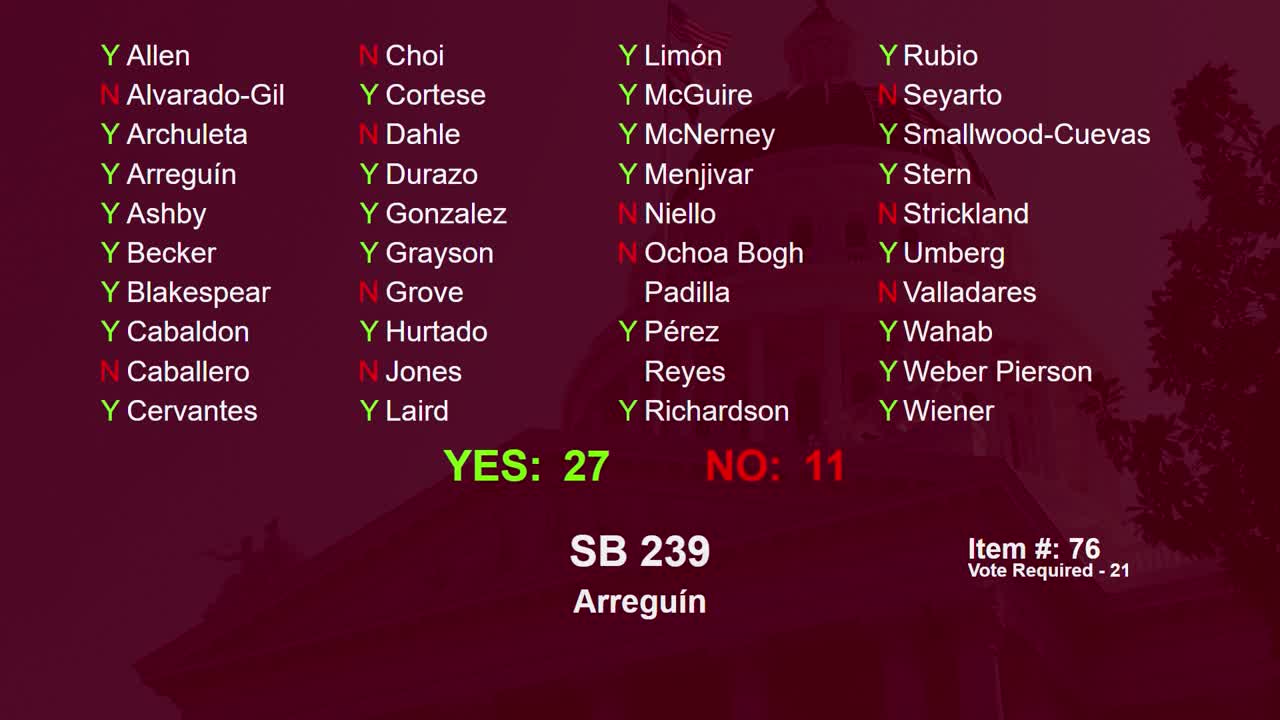 7MIN
Senate Floor
 17MIN
Senate Standing Committee on Insurance
 7MIN
Senate Standing Committee on Public Safety
Bill Author

Bill Co-Author(s):