SB 540: Independent System Operator: independent regional organization: California Renewables Portfolio Standard Program.
- Session Year: 2025-2026
- House: Senate
- Latest Version Date: 2025-05-29
Current Status:
In Progress
(2025-09-09: Joint Rule 61(a)(13) suspended. (Ayes 60. Noes 20. Page 3128.))
Introduced
In Committee
Awaiting First Chamber Vote
Passed First Chamber
In Committee
Awaiting Second Chamber Vote
Passed Second Chamber
Enacted
What does this bill do?
The bill lets the California Independent System Operator (ISO) and transmission‑owning utilities join voluntary energy markets run by an independent regional organization only if specified state protections are met, and creates a Regional Energy Market Oversight Council to approve participation or order withdrawal. It also requires the ISO to keep the technical ability to run markets and remain the state’s balancing authority (the entity that keeps supply and demand balanced), says the regional footprint is not a California balancing authority for renewables rules, and directs the Energy Commission to require out‑of‑state resources to show a pseudo‑tie or dynamic scheduling agreement (ways to deliver out‑of‑state power into California) or firm transmission to count for California procurement.
The summary is provided by generative AI which can make mistakes. For original language, please view the details in the table below.
(1)Existing law provides for the establishment of an Independent System Operator (ISO) as a nonprofit public benefit corporation and requires the ISO to ensure efficient use and reliable operation of the electrical transmission grid consistent with achieving planning and operating reserve criteria no less stringent than those established by the Western Electricity Coordinating Council and the North American Electric Reliability Council. Existing law, the Clean Energy and Pollution Reduction Act of 2015, provides for the transformation of the ISO into a regional organization, with the approval of the Legislature, pursuant to a specified process. That process provides that modifications to the ISOs governance structure, through changes to its bylaws or other corporate governance documents, will not become effective until the ISO, the Public Utilities Commission (PUC), the State Energy Resources Conservation and Development Commission (Energy Commission), the State Air Resources Board (state board), the Governor, and the Legislature take specified actions on or before January 1, 2019.
This bill would delete the above-described provisions providing for the transformation of the ISO into a regional organization. The bill would authorize the ISO and the electrical corporations that are participating transmission owners whose transmission systems are operated by the ISO, in lieu of the ISO managing related energy markets, as provided, ISO to use voluntary energy markets governed by an independent regional organization, only if specified requirements are satisfied. The bill would authorize the ISO, on or after January 1, 2028, to implement tariff modifications accepted by the Federal Energy Regulatory Commission to operate the energy markets whose rules are governed by an independent regional organization if the governing board of the ISO adopts a resolution, as specified, finding that each of the specified requirements have been, or will be, adopted by the independent regional organization. The bill would require the ISO to maintain the necessary technical capability to operate energy markets, as specified, and would require the ISO to continue its functions and responsibilities as a balancing authority, as provided.
This bill would establish the Regional Energy Market Oversight Council, which would be responsible for ensuring that participation in regional energy markets serves the interests of the state. The bill would require the council to approve or disapprove initial participation in the independent regional organization by electrical corporations and any other participating load-serving entities and determine whether electrical corporations and any other participating load-serving entities should be required to withdraw from an energy market governed by the independent regional organization. The bill would require the council to convene a duly noticed public meeting to make a finding of approval or withdrawal of participation in the independent regional organization and would require the council to disapprove of initial participation in the independent regional organization, or order withdrawal, if the council makes any of specified findings.
(2)Existing law establishes the California Renewables Portfolio Standard Program, which requires the PUC to establish a renewables portfolio standard requiring all retail sellers, as defined, to procure a minimum quantity of electricity products from eligible renewable energy resources, as defined, at specified percentages of the total kilowatthours sold to their retail end-customers during specified compliance periods. Existing law defines California balancing authority and balancing authority area for purposes of the program.
This bill would provide that the above-described independent regional organization is not a California balancing authority and its geographic footprint is not a balancing authority area for purposes of the program.
The program, consistent with the goals of procuring the least-cost and best-fit eligible renewable energy resources that meet project viability principles, requires that all retail sellers procure a balanced portfolio of electricity products from eligible renewable energy resources, as specified, referred to as the portfolio content requirements.
This bill would require, in making determinations regarding the eligibility of products to satisfy the portfolio content requirements, the Energy Commission to require, at a minimum, resources that do not have a first point of interconnection to a California balancing authority to demonstrate either that the resource operates under a pseudo-tie agreement or dynamic scheduling agreement with the Independent System Operator of another California balancing authority, or that the resource has secured, and exercised its rights to, firm transmission necessary to deliver its output to a California balancing authority without substituting electricity from another source.
(3)Existing law requires the Power Exchange to provide an efficient competitive auction, open on a nondiscriminatory basis to all suppliers, that meets the loads of all exchange customers at efficient prices, and authorizes the Power Exchange governing board to form appropriate technical advisory committees composed of market and nonmarket participants to advise the governing board on relevant issues.
This bill would delete these provisions.
(4)Under existing law, a violation of the Public Utilities Act or any order, decision, rule, direction, demand, or requirement of the PUC is a crime.
Because certain provisions of this bill would be part of the act and a violation of a PUC action implementing the bills requirements would be a crime, the bill would impose a state-mandated local program.
The California Constitution requires the state to reimburse local agencies and school districts for certain costs mandated by the state. Statutory provisions establish procedures for making that reimbursement.
This bill would provide that no reimbursement is required by this act for a specified reason.
(1)Existing law provides for the establishment of an Independent System Operator (ISO) as a nonprofit public benefit corporation and requires the ISO to ensure efficient use and reliable operation of the electrical transmission grid consistent with achieving planning and operating reserve criteria no less stringent than those established by the Western Electricity Coordinating Council and the North American Electric Reliability Council. Existing law, the Clean Energy and Pollution Reduction Act of 2015, provides for the transformation of the ISO into a regional organization, with the approval of the Legislature, pursuant to a specified process. That process provides that modifications to the ISOs governance structure, through changes to its bylaws or other corporate governance documents, will not become effective until the ISO, the Public Utilities Commission (PUC), the State Energy Resources Conservation and Development Commission (Energy Commission), the State Air Resources Board (state board), the Governor, and the Legislature take specified actions on or before January 1, 2019.
This bill would delete the above-described provisions providing for the transformation of the ISO into a regional organization. The bill would authorize the ISO and the electrical corporations that are participating transmission owners whose transmission systems are operated by the ISO, in lieu of the ISO managing related energy markets, as provided, to use voluntary energy markets governed by an independent regional organization, only if specified requirements are satisfied. The bill would authorize the ISO, on or after January 1, 2028, to implement tariff modifications accepted by the Federal Energy Regulatory Commission to operate the energy markets whose rules are governed by an independent regional organization if the governing board of the ISO adopts a resolution, as specified, finding that each of the specified conditions requirements have been, or will be, adopted by the independent regional organization. The bill would require the ISO to maintain the necessary technical capability to operate energy markets, as specified, and would require the ISO to continue its functions and responsibilities as a balancing authority, as provided.
This bill would specify that the above-described provisions do not diminish the PUCs authority to direct an electrical corporation to withdraw from an energy market governed by an independent regional organization, and would authorize the PUC to direct an electrical corporation to withdraw from an energy market governed by an independent regional organization under specific circumstances. The bill would also require an electrical corporation within the balancing authority of the ISO to withdraw from an energy market governed by an independent regional organization under two specified conditions.This bill would establish the Regional Energy Market Oversight Council, which would be responsible for ensuring that participation in regional energy markets serves the interests of the state. The bill would require the council to approve or disapprove initial participation in the independent regional organization by electrical corporations and any other participating load-serving entities and determine whether electrical corporations and any other participating load-serving entities should be required to withdraw from an energy market governed by the independent regional organization. The bill would require the council to convene a duly noticed public meeting to make a finding of approval or withdrawal of participation in the independent regional organization and would require the council to disapprove of initial participation in the independent regional organization, or order withdrawal, if the council makes any of specified findings.
(2)Existing law establishes the California Renewables Portfolio Standard Program, which requires the PUC to establish a renewables portfolio standard requiring all retail sellers, as defined, to procure a minimum quantity of electricity products from eligible renewable energy resources, as defined, at specified percentages of the total kilowatthours sold to their retail end-customers during specified compliance periods. Existing law defines California balancing authority and balancing authority area for purposes of the program.
This bill would provide that the above-described independent regional organization is not a California balancing authority and its geographic footprint is not a balancing authority area for purposes of the program.
The program, consistent with the goals of procuring the least-cost and best-fit eligible renewable energy resources that meet project viability principles, requires that all retail sellers procure a balanced portfolio of electricity products from eligible renewable energy resources, as specified, referred to as the portfolio content requirements.
This bill would require, in making determinations regarding the eligibility of products to satisfy the portfolio content requirements, the Energy Commission to require, at a minimum minimum, resources that do not have a first point of interconnection to a California balancing authority to demonstrate either that the resource operates under a pseudo-tie agreement or dynamic scheduling agreement with the Independent System Operator of another California balancing authority, or that the resource has secured, and exercised its rights to, firm transmission necessary to deliver its output to a California balancing authority without substituting electricity from another source.
(2)(3)Existing law requires the Power Exchange to provide an efficient competitive auction, open on a nondiscriminatory basis to all suppliers, that meets the loads of all exchange customers at efficient prices, and authorizes the Power Exchange governing board to form appropriate technical advisory committees composed of market and nonmarket participants to advise the governing board on relevant issues.
This bill would delete these provisions.
(3)(4)Under existing law, a violation of the Public Utilities Act or any order, decision, rule, direction, demand, or requirement of the PUC is a crime.
Because certain provisions of this bill would be part of the act and a violation of a PUC action implementing the bills requirements would be a crime, the bill would impose a state-mandated local program.
The California Constitution requires the state to reimburse local agencies and school districts for certain costs mandated by the state. Statutory provisions establish procedures for making that reimbursement.
This bill would provide that no reimbursement is required by this act for a specified reason.
(1)Existing law provides for the establishment of an Independent System Operator (ISO) as a nonprofit public benefit corporation and requires the ISO to ensure efficient use and reliable operation of the electrical transmission grid consistent with achieving planning and operating reserve criteria no less stringent than those established by the Western Electricity Coordinating Council and the North American Electric Reliability Council. Existing law, the Clean Energy and Pollution Reduction Act of 2015, provides for the transformation of the ISO into a regional organization, with the approval of the Legislature, pursuant to a specified process. That process provides that modifications to the ISOs governance structure, through changes to its bylaws or other corporate governance documents, will not become effective until the ISO, the Public Utilities Commission, Commission (PUC), the State Energy Resources Conservation and Development Commission, Commission (Energy Commission), the State Air Resources Board (state board), the Governor, and the Legislature take specified actions on or before January 1, 2019.
This bill would delete the above-described provisions providing for the transformation of the ISO into a regional organization. The bill would authorize the ISO and the electrical corporations that are participating transmission owners whose transmission systems are operated by the ISO, in lieu of the ISO managing related energy markets, as provided, to use voluntary energy markets governed by an independent regional organization, provided that if specified requirements are satisfied. The bill would authorize the ISO, on or after January 1, 2027, 2028, to implement tariff modifications accepted by the Federal Energy Regulatory Commission to operate the energy markets whose rules are governed by an independent regional organization if the governing board of the ISO adopts a resolution, as specified, finding that each of the specified conditions have been, or will be, adopted by the independent regional organization. The bill would require the ISO to maintain the necessary technical capability to operate energy markets, as specified, and would require the ISO to continue its functions and responsibilities as a balancing authority, as provided.
This bill would specify that the above-described provisions do not diminish the PUCs authority to direct an electrical corporation to withdraw from an energy market governed by an independent regional organization, and would authorize the PUC to direct an electrical corporation to withdraw from an energy market governed by an independent regional organization under specific circumstances. The bill would also require an electrical corporation within the balancing authority of the ISO to withdraw from an energy market governed by an independent regional organization under two specified conditions.
(2)Existing law establishes the California Renewables Portfolio Standard Program, which requires the PUC to establish a renewables portfolio standard requiring all retail sellers, as defined, to procure a minimum quantity of electricity products from eligible renewable energy resources, as defined, at specified percentages of the total kilowatthours sold to their retail end-customers during specified compliance periods. Existing law defines California balancing authority and balancing authority area for purposes of the program.
This bill would provide that the above-described independent regional organization is not a California balancing authority and its geographic footprint is not a balancing authority area for purposes of the program.
The program, consistent with the goals of procuring the least-cost and best-fit eligible renewable energy resources that meet project viability principles, requires that all retail sellers procure a balanced portfolio of electricity products from eligible renewable energy resources, as specified, referred to as the portfolio content requirements.
This bill would require, in making determinations regarding the eligibility of products to satisfy the portfolio content requirements, the Energy Commission to require, at a minimum resources that do not have a first point of interconnection to a California balancing authority to demonstrate either that the resource operates under a pseudo-tie agreement or dynamic scheduling agreement with the Independent System Operator of another California balancing authority, or that the resource has secured, and exercised its rights to, firm transmission necessary to deliver its output to a California balancing authority without substituting electricity from another source.
Existing(2)Existing law requires the Power Exchange to provide an efficient competitive auction, open on a nondiscriminatory basis to all suppliers, that meets the loads of all exchange customers at efficient prices, and authorizes the Power Exchange governing board to form appropriate technical advisory committees composed of market and nonmarket participants to advise the governing board on relevant issues.
This bill would delete these provisions.
(3)Under existing law, a violation of the Public Utilities Act or any order, decision, rule, direction, demand, or requirement of the PUC is a crime.
Because certain provisions of this bill would be part of the act and a violation of a PUC action implementing the bills requirements would be a crime, the bill would impose a state-mandated local program.
The California Constitution requires the state to reimburse local agencies and school districts for certain costs mandated by the state. Statutory provisions establish procedures for making that reimbursement.
This bill would provide that no reimbursement is required by this act for a specified reason.
Existing law provides for the establishment of an Independent System Operator (ISO) as a nonprofit public benefit corporation and requires the ISO to ensure efficient use and reliable operation of the electrical transmission grid consistent with achieving planning and operating reserve criteria no less stringent than those established by the Western Electricity Coordinating Council and the North American Electric Reliability Council. Existing law, the Clean Energy and Pollution Reduction Act of 2015, provides for the transformation of the ISO into a regional organization, with the approval of the Legislature, pursuant to a specified process. That process provides that modifications to the ISOs governance structure, through changes to its bylaws or other corporate governance documents, will not become effective until the ISO, the Public Utilities Commission, the State Energy Resources Conservation and Development Commission, the State Air Resources Board (state board), the Governor, and the Legislature take specified actions on or before January 1, 2019.
This bill would delete the above-described provisions providing for the transformation of the ISO into a regional organization. The bill would authorize the ISO and the electrical corporations that are participating transmission owners whose transmission systems are operated by the ISO, in lieu of the ISO managing related energy markets, as provided, to use voluntary energy markets governed by an independent regional organization, provided that specified requirements are satisfied. The bill would authorize the ISO, on or after January 1, 2027, to implement tariff modifications accepted by the Federal Energy Regulatory Commission to operate the energy markets whose rules are governed by an independent regional organization if the governing board of the ISO adopts a resolution, as specified, finding that each of the specified conditions have been, or will be, adopted by the independent regional organization. The bill would require the ISO to maintain the necessary technical capability to operate energy markets, as specified, and would require the ISO to continue its functions and responsibilities as a balancing authority, as provided.
Existing law requires the Power Exchange to provide an efficient competitive auction, open on a nondiscriminatory basis to all suppliers, that meets the loads of all exchange customers at efficient prices, and authorizes the Power Exchange governing board to form appropriate technical advisory committees composed of market and nonmarket participants to advise the governing board on relevant issues.
This bill would delete these provisions.
Existing law provides for the establishment of an Independent System Operator (ISO) as a nonprofit public benefit corporation and requires the ISO to ensure efficient use and reliable operation of the electrical transmission grid consistent with achieving planning and operating reserve criteria no less stringent than those established by the Western Electricity Coordinating Council and the North American Electric Reliability Council. Existing law, the Clean Energy and Pollution Reduction Act of 2015, provides for the transformation of the ISO into a regional organization, with the approval of the Legislature, pursuant to a specified process. That process provides that modifications to the ISOs governance structure, through changes to its bylaws or other corporate governance documents, will not become effective until the ISO, the Public Utilities Commission, the State Energy Resources Conservation and Development Commission, the State Air Resources Board (state board), the Governor, and the Legislature take specified actions on or before January 1, 2019.
This bill would delete the above-described provisions providing for the transformation of the ISO into a regional organization. The bill would authorize the ISO and the electrical corporations that are participating transmission owners whose transmission systems are operated by the ISO, in lieu of the ISO managing related energy markets, as provided, to use energy markets governed by an independent regional organization, provided that specified requirements are satisfied. The bill would authorize the ISO, on or after January 1, 2027, to implement tariff modifications accepted by the Federal Energy Regulatory Commission to operate the energy markets whose rules are governed by an independent regional organization if the governing board of the ISO adopts a resolution, as specified, finding that each of the specified conditions have been, or will be, adopted by the independent regional organization. The bill would require the ISO to maintain the necessary technical capability to operate energy markets, as specified, and would require the ISO to continue its functions and responsibilities as a balancing authority, as provided.
Existing law requires the Power Exchange to provide an efficient competitive auction, open on a nondiscriminatory basis to all suppliers, that meets the loads of all exchange customers at efficient prices, and authorizes the Power Exchange governing board to form appropriate technical advisory committees composed of market and nonmarket participants to advise the governing board on relevant issues.
This bill would delete these provisions.
(a)The Independent System Operator governing board shall comprise a five-member independent governing board of directors appointed by the Governor and subject to confirmation by the Senate. Any reference in this chapter or in any other provision of law to the Independent System Operator governing board means the independent governing board appointed under this subdivision.
(b)A member of the independent governing board appointed under subdivision (a) may not be affiliated with any actual or potential participant in any market administered by the Independent System Operator.
(c)(1)All appointments shall be for three-year terms.
(2)There is no limit on the number of terms that may be served by any member.
(d)The Oversight Board shall require the articles of incorporation and bylaws of the Independent System Operator to be revised in accordance with this section, and shall make filings with the Federal Energy Regulatory Commission as the Oversight Board determines to be necessary.
(e)For purposes of the initial appointments to the Independent System Operator governing board, as provided in subdivision (a), the Governor shall appoint one member to a one-year term, two members to a two-year term, and two members to a three-year term.
SEC. 2.Section 345.6 is added to the Public Utilities Code, to read:345.6.(a)In lieu of the Independent System Operator managing related energy markets as provided in subdivision (b) of Section 345.5, the The Independent System Operator and the electrical corporations that are participating transmission owners whose transmission systems are operated by the Independent System Operator may use voluntary energy markets governed by an independent regional organization only if all of the following requirements are satisfied:
(1)The independent regional organization is a nonprofit corporation whose governance documents, and the tariff approved by the Federal Energy Regulatory Commission, include obligations to do both of the following: an obligation to
(A)Respect respect the authority of each state that has a load-serving entity or balancing authority participating in the market to set its own procurement, resource adequacy, environmental, reliability, and other public interest policies.
(B)Manage energy markets in a manner that is consistent with all of the following:(i)Making the most efficient use of available energy resources.(ii)Reducing, to the extent possible, overall economic cost to consumers.(iii)Complying with applicable state laws intended to protect the publics health and the environment.(iv)Maximizing availability of existing electrical generation resources necessary to meet the needs of electricity consumers.(v)Conducting internal operations in a manner that minimizes cost impacts on ratepayers to the extent practicable and consistent with state law.(vi)Communicating with all balancing area authorities participating in the independent regional organization in a manner that supports electrical reliability.(2)The governing board of the independent regional organization maintains a public policy committee consisting of members of the governing board of the independent regional organization that engages with states, local power authorities, and federal power marketing administrations about potential impacts to state, local, or federal policies before it approves a tariff change for filing at the Federal Energy Regulatory Commission.
(3)The governing board of the independent regional organization maintains a relationship with and seeks input from a body of state regulators or similar body to receive the views of state regulators.
(4)The independent regional organization makes funding available for a consumer advocate organization that represents the interests of one or more consumer advocate offices authorized in state law, including the Public Advocates Office of the Public Utilities Commission, and facilitates engagement by those offices in the markets governed by the independent regional organization.
(5)The independent regional organization maintains an office of public participation to provide information and education to members of the public about issues and initiatives at the independent regional organization, including facilitating engagement in those processes.
(6)In addition to any independent market monitoring activity required by a Federal Energy Regulatory Commission order, the independent regional organization maintains access to independent market analysis for the governing board of the independent regional organization on the impacts of market dynamics or rule changes to minimize overall costs to end-use consumers.
(7)Market Subject to reasonable confidentiality provisions, market data is available to the commission and the Public Advocates Office of the Public Utilities Commission, and other states commissions and public advocate offices, to the same or greater extent as existed on December 31, 2024, for the markets governed by the Independent System Operator.
(8)There is a stakeholder process designed to provide nonbinding advice to the governing board of the independent regional organization.
(9)The independent regional organization is obligated to conduct meetings and make decisions in an open process with transparent, documented rationales, and all meetings of the governing board of the independent regional organization are publicly noticed and, excluding executive sessions, are available to remote participants, recorded and posted on the independent regional organizations internet website, open to the public, and subject to open record requirements. The obligations in this paragraph shall be at least as stringent as substantially similar to those that apply to the Independent System Operator. Operator at the time a resolution is adopted pursuant to subdivision (b).
(10)The Independent System Operator continues to operate the energy markets, subject to the market rules determined by the independent regional organization as accepted by the Federal Energy Regulatory Commission.
(11)The market rules of the independent regional organization provide greenhouse gas emissions information and protocols sufficient to enable compliance with the requirements of any state agency.
(12)The independent regional organization does not do either of the following:
(A)Establish, operate, or rely on a centralized capacity market, or separate energy markets for dispatchable, firm, and intermittent resources.(B)Establish any mandatory requirements relating to resource adequacy or reserve margins.(13)Nothing in the tariff filed with the Federal Energy Regulatory Commission for the independent regional organization, or any other aspect of participating in energy markets overseen by the independent regional organization, shall cause California electrical corporations that are participating transmission owners, or load-serving entities, to be assessed any costs of fossil fuel generation resources that are not dispatched to serve California end-use loads or any costs to subsidize fossil fuel generation resources.(14)The tariff filed with approved by the Federal Energy Regulatory Commission for the independent regional organization provides a procedure for unilateral withdrawal from the independent regional organizations energy markets by any state or participant on their own accord, or as required by an applicable regulatory authority, with reasonable prior notice and without any penalties, unreasonable costs, or further approvals.
(15)The governance documents of the independent regional organization and the tariff approved by the Federal Energy Regulatory Commission authorize the use of the process outlined in subdivision (c) for determining initial participation in, and voluntary withdrawal from, the independent regional organization by electrical corporations and any other participating load-serving entities subject to the jurisdiction of the state.
(b)On or after January 1, 2028, the Independent System Operator may implement tariff modifications accepted by the Federal Energy Regulatory Commission to operate the energy markets whose rules are governed by an independent regional organization, as provided in subdivision (a), if the governing board of the Independent System Operator adopts a resolution finding that each of the requirements of paragraphs (1) to (15), inclusive, of subdivision (a) have been or will be adopted by the independent regional organization. The governing board of the Independent System Operator may adopt the resolution if the Independent System Operator satisfies all of the following requirements before adopting the resolution:
(1)The meeting is open to the public, available to remote participants, recorded, and posted on the Independent System Operators internet website.
(2)The Independent System Operator issues a notice of the meeting and proposed findings not less than 90 days before the meeting.
(3)The notice explains the basis for finding that each requirement of paragraphs (1) to (15), inclusive, of subdivision (a) will be met.
(4)The notice provides an opportunity for written comments on the proposed findings.
(5)The Independent System Operator issues written responses to any comments not less than 20 days before the meeting.
(6)After issuing the written responses described in paragraph (5), but before adopting the resolution, the Independent System Operator shall offer to provide testimony to the legislative committee in each house of the Legislature with primary jurisdiction over electrical corporations on its proposed findings and responses and shall provide testimony to a joint hearing of those committees if those committees request testimony.
(c)(1)There is hereby created in the state government the Regional Energy Market Oversight Council, which shall be responsible for ensuring that participation in a regional energy market serves the interests of the state.
(2)The council shall be composed of the President of the Public Utilities Commission, the Chair of the Energy Commission, the Chair of Senate Committee on Energy, Utilities and Communications, the Chair of the Assembly Committee on Utilities and Energy, and the Attorney General. The Attorney General shall serve as chair of the council.
(3)The council shall approve or disapprove initial participation in the independent regional organization by electrical corporations and any other participating load-serving entities, and, at any point after initial approval, determine whether electrical corporations and any other participating load-serving entities should be required to withdraw from an energy market governed by the independent regional organization.
(4)The council shall convene a duly noticed public meeting to make a finding of approval or withdrawal of participation in the independent regional organization. The council shall review the proposed initial tariff filed by the independent regional organization, the tariff approved by the Federal Energy Regulatory Commission, and any subsequent actions that implicate the outcomes or requirements described in subparagraphs (A) to (E), inclusive. The council shall disapprove of initial participation in the independent regional organization, and shall order withdrawal, if the council finds that any of the conditions of subdivision (a) have not been satisfied or that participation in the independent regional organization causes or imposes any of the following outcomes or requirements:
(A)Any weakening or invalidation of requirements of the California Renewable Portfolio Standard (Article 16 (commencing with Section 399.11)), including, but not limited to, the requirements of Section 399.16, or of Section 454.53 or any other applicable renewable energy, resource adequacy, or integrated resource planning requirement in state law.
(B)Any requirement that the State of California, the Independent System Operator, or any participating load-serving entity, is required to procure or subsidize coal, natural gas, or any other fossil generation resources located outside of California.
(C)Any other requirement that results in adverse impacts on Californias resource planning, procurement, environmental, reliability, or other applicable public interest policies.
(D)Any requirement adopted by the independent regional organization or the federal government that results in costs to California ratepayers that exceed the economic benefits over a two-year period, and any requirement that imposes costs to California ratepayers for withdrawal from the independent regional organization, other than de minimis, necessary, and reasonable costs.
(E)Any requirement that does not fully compensate California ratepayers for costs they bear for the Independent System Operator to provide the independent regional organization any services, facilities, equipment, and property, including intellectual property, that does not hold California ratepayers and the Independent System Operator harmless, through indemnity or insurance, for claims arising from the operation of the independent regional market, and that does not provide for the first lien on all revenues associated with the transactions affecting California ratepayers.
(5)The Independent System Operator shall not implement tariff modifications pursuant to subdivision (b) unless the council makes a finding approving participation in the independent regional organization.
(6)Upon a determination by the council that withdrawal is required pursuant to paragraph (4), any participating load-serving entity shall unilaterally withdraw from the independent regional organization within 120 days.
(7)In addition to meeting on its own motion, the council shall meet and make a finding and determination within 30 days of receiving a resolution approved by both houses of the California State Legislature requesting that it meet to determine if the conditions justifying withdrawal have occurred.
(d)(1)The Independent System Operator shall maintain the necessary technical capability to operate energy markets in a manner that enables California electrical corporations, local publicly owned electric utilities, and other applicable market participants to withdraw from the markets governed by the independent regional organization and instead the Independent System Operator would provide separate market services for those entities.
(2)On or before February 1, 2028, Beginning two years after the implementation of the independent regional organizations markets, and every two years thereafter, the Independent System Operator shall report to the commission, Energy Commission, and the legislative committees with primary jurisdiction over electrical corporations, in compliance with Section 9795 of the Government Code, on the status of the development and compliance with this section.
(3)(A)The Independent System Operator shall conduct a study of the impacts of implementing subdivision (a) on the creation or retention of jobs in California. The study shall specifically include the impact on jobs constructing and maintaining powerplants in California.
(B)The Independent System Operator shall host public workshops on the study methodology and the results of the study.
(C)The Independent System Operator shall complete the study on or before December 31, 2026. Upon completion, the Independent System Operator shall provide the study to the legislative committee in each house of the Legislature with primary jurisdiction over electrical corporations.
(D)The results of the study shall be included in the Independent System Operators findings and resolution described in subdivision (b).
(E)The study submitted pursuant to subparagraph (C) shall be in compliance with Section 9795 of the Government Code.
(e)(1)The Independent System Operator shall continue its functions and responsibilities as a balancing authority as they existed before enactment of this section, and maintain compliance with applicable reliability standards as developed, adopted, and enforced by the North American Electric Reliability Corporation, the Western Electricity Coordinating Council, or the Federal Energy Regulatory Commission.
(2)The Independent System Operator shall not change its balancing authority area from that which existed on December 31, 2024, except as follows:
(A)Standard accretion of new transmission lines, substations, and other equipment by participating transmission owners.
(B)The Independent System Operator may combine its balancing authority area with another California balancing authority if the combination is mutually agreed upon.
(C)The Independent System Operator may use its subscriber participating transmission owner tariff.
(3)Except as provided in subdivision (a) with respect to managing energy markets as provided in this section, this section does not change the responsibilities of the Independent System Operator under Section 345.5, including managing the transmission grid, planning for transmission expansion, reliability, resource adequacy, and complying with Section 25308 of the Public Resources Code.
(f)(1)This section does not change any requirement related to the California Renewables Portfolio Standard Program as provided in Article 16 (commencing with Section 399.11).
(2)This section does not change the policy of the state to reach specified targets by specified dates for supplying eligible renewable energy resources and zero-carbon resources as provided in subdivision (a) of Section 454.53.
(3)This section does not change the authority of the commission regarding resource adequacy, integrated resource planning, or procuring resources under Section 380, 454.51, 454.52, or any other law.
(g)The Independent System Operator may act as a vendor, through a contract with the independent regional organization, of market operation services, generation dispatch services, transmission operation services, transmission planning services, reliability coordination, balancing authority compliance or operation services, or other electrical system services.
(h)For purposes of this section, both of the following definitions apply:
(1)Balancing authority, balancing authority area, and California balancing authority have the same meanings as provided in Section 399.12.
(2)Load-serving entity has the same meaning as provided in Section 380.
SEC. 3.Section 352 of the Public Utilities Code is repealed.SEC. 4.Article 4 (commencing with Section 355) of Chapter 2.3 of Part 1 of Division 1 of the Public Utilities Code is repealed.SEC. 5.Article 5 (commencing with Section 359) of Chapter 2.3 of Part 1 of Division 1 of the Public Utilities Code is repealed.SEC. 6.Article 5.5 (commencing with Section 359.5) of Chapter 2.3 of Part 1 of Division 1 of the Public Utilities Code is repealed.SEC. 7.Section 399.12 of the Public Utilities Code is amended to read:399.12.For purposes of this article, the following terms have the following meanings:
(a)Conduit hydroelectric facility means a facility for the generation of electricity that uses only the hydroelectric potential of an existing pipe, ditch, flume, siphon, tunnel, canal, or other manmade conduit that is operated to distribute water for a beneficial use.
(b)Balancing authority means the responsible entity that integrates resource plans ahead of time, maintains load-interchange generation balance within a balancing authority area, and supports interconnection frequency in real time.
(c)Balancing authority area means the collection of generation, transmission, and loads within the metered boundaries of the area within which the balancing authority maintains the electrical load-resource balance. The geographic footprint of the independent regional organization described in Section 345.6 is not a balancing authority area.
(d)California balancing authority means a balancing authority with control over a balancing authority area primarily located in this state and operating for retail sellers and local publicly owned electric utilities subject to the requirements of this article and includes the Independent System Operator (ISO) and a local publicly owned electric utility operating a transmission grid that is not under the operational control of the ISO. A California balancing authority is responsible for the operation of the transmission grid within its metered boundaries, which is not limited by the political boundaries of the State of California. The independent regional organization described in Section 345.6 is not a California balancing authority.
(e)Eligible renewable energy resource means an electrical generating facility that meets the definition of a renewable electrical generation facility in Section 25741 of the Public Resources Code, subject to the following:
(1)(A)An existing small hydroelectric generation facility of 30 megawatts or less shall be eligible only if a retail seller or local publicly owned electric utility procured the electricity from the facility as of December 31, 2005. A new hydroelectric facility that commences generation of electricity after December 31, 2005, is not an eligible renewable energy resource if it will cause an adverse impact on instream beneficial uses or cause a change in the volume or timing of streamflow.
(B)Notwithstanding subparagraph (A), a conduit hydroelectric facility of 30 megawatts or less that commenced operation before January 1, 2006, is an eligible renewable energy resource. A conduit hydroelectric facility of 30 megawatts or less that commences operation after December 31, 2005, is an eligible renewable energy resource so long as it does not cause an adverse impact on instream beneficial uses or cause a change in the volume or timing of streamflow.
(C)A facility approved by the governing board of a local publicly owned electric utility prior to June 1, 2010, for procurement to satisfy renewable energy procurement obligations adopted pursuant to former Section 387, shall be certified as an eligible renewable energy resource by the Energy Commission pursuant to this article, if the facility is a renewable electrical generation facility as defined in Section 25741 of the Public Resources Code.
(D)(i)A small hydroelectric generation unit with a nameplate capacity not exceeding 40 megawatts that is operated as part of a water supply or conveyance system is an eligible renewable energy resource only for the retail seller or local publicly owned electric utility that procured the electricity from the unit as of December 31, 2005. No unit shall be eligible pursuant to this subparagraph if an application for certification is submitted to the Energy Commission after January 1, 2013. Only one retail seller or local publicly owned electric utility shall be deemed to have procured electricity from a given unit as of December 31, 2005.
(ii)Notwithstanding clause (i), a local publicly owned electric utility that meets the criteria of subdivision (j) of Section 399.30 may sell to another local publicly owned electric utility electricity from small hydroelectric generation units that qualify as eligible renewable energy resources under clause (i), and that electricity may be used by the local publicly owned electric utility that purchased the electricity to meet its renewables portfolio standard procurement requirements. The total of all those sales from the utility shall be no greater than 100,000 megawatthours of electricity.
(iii)The amendments made to this subdivision by the act adding this subparagraph are intended to clarify existing law and apply from December 10, 2011.
(2)(A)A facility engaged in the combustion of municipal solid waste shall not be considered an eligible renewable energy resource.
(B)Subparagraph (A) does not apply to generation before January 1, 2017, from a facility located in the County of Stanislaus that was operational before September 26, 1996.
(f)Procure means to acquire through ownership or contract.
(g)Procurement entity means any person or corporation authorized by the commission to enter into contracts to procure eligible renewable energy resources on behalf of customers of a retail seller pursuant to subdivision (f) of Section 399.13.
(h)(1)Renewable energy credit means a certificate of proof associated with the generation of electricity from an eligible renewable energy resource, issued through the accounting system established by the Energy Commission pursuant to Section 399.25, that one unit of electricity was generated and delivered by an eligible renewable energy resource.
(2)Renewable energy credit includes all renewable and environmental attributes associated with the production of electricity from the eligible renewable energy resource, except for an emissions reduction credit issued pursuant to Section 40709 of the Health and Safety Code and any credits or payments associated with the reduction of solid waste and treatment benefits created by the usage of biomass or biogas fuels.
(3)(A)Electricity generated by an eligible renewable energy resource attributable to the use of nonrenewable fuels, beyond a de minimis quantity used to generate electricity in the same process through which the facility converts renewable fuel to electricity, shall not result in the creation of a renewable energy credit. The Energy Commission shall set the de minimis quantity of nonrenewable fuels for each renewable energy technology at a level of no more than 2 percent of the total quantity of fuel used by the technology to generate electricity. The Energy Commission may adjust the de minimis quantity for an individual facility, up to a maximum of 5 percent, if it finds that all of the following conditions are met:
(i)The facility demonstrates that the higher quantity of nonrenewable fuel will lead to an increase in generation from the eligible renewable energy facility that is significantly greater than generation from the nonrenewable fuel alone.
(ii)The facility demonstrates that the higher quantity of nonrenewable fuels will reduce the variability of its electrical output in a manner that results in net environmental benefits to the state.
(iii)The higher quantity of nonrenewable fuel is limited to either natural gas or hydrogen derived by reformation of a fossil fuel.
(B)Electricity generated by a small hydroelectric generation facility shall not result in the creation of a renewable energy credit unless the facility meets the requirements of subparagraph (A) or (D) of paragraph (1) of subdivision (e).
(C)Electricity generated by a conduit hydroelectric generation facility shall not result in the creation of a renewable energy credit unless the facility meets the requirements of subparagraph (B) of paragraph (1) of subdivision (e).
(D)Electricity generated by a facility engaged in the combustion of municipal solid waste shall not result in the creation of a renewable energy credit. This subparagraph does not apply to renewable energy credits that were generated before January 1, 2017, by a facility engaged in the combustion of municipal solid waste located in the County of Stanislaus that was operational before September 26, 1996, and sold pursuant to contacts entered into before January 1, 2017.
(i)Renewables portfolio standard means the specified percentage of electricity generated by eligible renewable energy resources that a retail seller or a local publicly owned electric utility is required to procure pursuant to this article.
(j)Retail seller means an entity engaged in the retail sale of electricity to end-use customers located within the state, including any of the following:
(1)An electrical corporation, as defined in Section 218.
(2)A community choice aggregator. A community choice aggregator shall participate in the renewables portfolio standard program subject to the same terms and conditions applicable to an electrical corporation.
(3)An electric service provider, as defined in Section 218.3. The electric service provider shall be subject to the same terms and conditions applicable to an electrical corporation pursuant to this article. This paragraph does not impair a contract entered into between an electric service provider and a retail customer before the suspension of direct access by the commission pursuant to Section 80110 of the Water Code.
(4)Retail seller does not include any of the following:
(A)A corporation or person employing cogeneration technology or producing electricity consistent with subdivision (b) of Section 218.
(B)The Department of Water Resources acting in its capacity pursuant to Division 27 (commencing with Section 80000) of the Water Code.
(C)A local publicly owned electric utility.
(k)WECC means the Western Electricity Coordinating Council of the North American Electric Reliability Corporation, or a successor to the corporation.
SEC. 8.Section 399.16.5 is added to the Public Utilities Code, to read:399.16.5.In making determinations regarding the eligibility of products to satisfy the requirements of paragraph (1) of subdivision (b) of Section 399.16, the Energy Commission shall require, at a minimum, either of the following demonstrations for resources that do not have a first point of interconnection to a California balancing authority:
(a)The resource operates under a pseudo-tie agreement or dynamic scheduling agreement with the Independent System Operator of another California balancing authority.
(b)The resource has secured, and exercised its rights to, firm transmission necessary to deliver its output to a California balancing authority without substituting electricity from another source.
SEC. 9.No reimbursement is required by this act pursuant to Section 6 of Article XIIIB of the California Constitution because the only costs that may be incurred by a local agency or school district will be incurred because this act creates a new crime or infraction, eliminates a crime or infraction, or changes the penalty for a crime or infraction, within the meaning of Section 17556 of the Government Code, or changes the definition of a crime within the meaning of Section 6 of Article XIIIB of the California Constitution.
(a)In lieu of the Independent System Operator managing related energy markets as provided in subdivision (b) of Section 345.5, the Independent System Operator and the electrical corporations that are participating transmission owners whose transmission systems are operated by the Independent System Operator may use voluntary energy markets governed by an independent regional organization only if all of the following requirements are satisfied:
(1)The independent regional organization is a nonprofit corporation whose governance documents, and the tariff approved by the Federal Energy Regulatory Commission, include obligations to do both of the following:
(A)Respect the authority of each state that has a load-serving entity or balancing authority participating in the market to set its own procurement, environmental, reliability, and other public interest policies.
(B)Manage energy markets in a manner that is consistent with all of the following:
(i)Making the most efficient use of available energy resources.
(ii)Reducing, to the extent possible, overall economic cost to consumers.
(iii)Complying with applicable state laws intended to protect the publics health and the environment.
(iv)Maximizing availability of existing electrical generation resources necessary to meet the needs of electricity consumers.
(v)Conducting internal operations in a manner that minimizes cost impacts on ratepayers to the extent practicable and consistent with state law.
(vi)Communicating with all balancing area authorities participating in the independent regional organization in a manner that supports electrical reliability.
(2)The governing board of the independent regional organization maintains a public policy committee consisting of members of the governing board of the independent regional organization that engages with states, local power authorities, and federal power marketing administrations about potential impacts to state, local, or federal policies before it approves a tariff change for filing at the Federal Energy Regulatory Commission.
(3)The governing board of the independent regional organization maintains a relationship with and seeks input from a body of state regulators or similar body to receive the views of state regulators.
(4)The independent regional organization makes funding available for a consumer advocate organization that represents the interests of one or more consumer advocate offices authorized in state law, including the Public Advocates Office of the Public Utilities Commission, and facilitates engagement by those offices in the markets governed by the independent regional organization.
(5)The independent regional organization maintains an office of public participation to provide information and education to members of the public about issues and initiatives at the independent regional organization, including facilitating engagement in those processes.
(6)In addition to any independent market monitoring activity required by a Federal Energy Regulatory Commission order, the independent regional organization maintains access to independent market analysis for the governing board of the independent regional organization on the impacts of market dynamics or rule changes to minimize overall costs to end-use consumers.
(7)Market data is available to the commission and the Public Advocates Office of the Public Utilities Commission, and other states commissions and public advocate offices, to the same or greater extent as existed on December 31, 2024, for the markets governed by the Independent System Operator.
(8)There is a stakeholder process designed to provide nonbinding advice to the governing board of the independent regional organization.
(9)The independent regional organization is obligated to conduct meetings and make decisions in an open process with transparent, documented rationales, and all meetings of the governing board of the independent regional organization are publicly noticed and, excluding executive sessions, are available to remote participants, recorded and posted on the independent regional organizations internet website, open to the public, and subject to open record requirements. The obligations in this paragraph shall be at least as stringent as those that apply to the Independent System Operator.
(10)The Independent System Operator continues to operate the energy markets, subject to the market rules determined by the independent regional organization as accepted by the Federal Energy Regulatory Commission.
(11)The market rules of the independent regional organization provide greenhouse gas emissions information and protocols sufficient to enable compliance with the requirements of any state agency.
(12)The independent regional organization does not do either of the following:
(A)Establish, operate, or rely on a centralized capacity market, or separate energy markets for dispatchable, firm, and intermittent resources.
(B)Establish any mandatory requirements relating to resource adequacy or reserve margins.
(13)Nothing in the tariff filed with the Federal Energy Regulatory Commission for the independent regional organization, or any other aspect of participating in energy markets overseen by the independent regional organization, shall cause California electrical corporations that are participating transmission owners, or load-serving entities, to be assessed any costs of fossil fuel generation resources that are not dispatched to serve California end-use loads or any costs to subsidize fossil fuel generation resources.
(14)The tariff filed with the Federal Energy Regulatory Commission for the independent regional organization provides a procedure for unilateral withdrawal from the independent regional organizations energy markets by any state or participant with reasonable prior notice and without any penalties, unreasonable costs, or further approvals.
(15)The governance documents of the independent regional organization and the tariff approved by the Federal Energy Regulatory Commission authorize the use of the process outlined in subdivision (c) for determining initial participation in, and voluntary withdrawal from, the independent regional organization by electrical corporations and any other participating load-serving entities subject to the jurisdiction of the state.
(b)On or after January 1, 2028, the Independent System Operator may implement tariff modifications accepted by the Federal Energy Regulatory Commission to operate the energy markets whose rules are governed by an independent regional organization, as provided in subdivision (a), if the governing board of the Independent System Operator adopts a resolution finding that each of the requirements of paragraphs (1) to (14), (15), inclusive, of subdivision (a) have been or will be adopted by the independent regional organization. The governing board of the Independent System Operator may adopt the resolution if the Independent System Operator satisfies all of the following requirements before adopting the resolution:
(1)The meeting is open to the public, available to remote participants, recorded, and posted on the Independent System Operators internet website.
(2)The Independent System Operator issues a notice of the meeting and proposed findings not less than 90 days before the meeting.
(3)The notice explains the basis for finding that each requirement of paragraphs (1) to (14), (15), inclusive, of subdivision (a) will be met.
(4)The notice provides an opportunity for written comments on the proposed findings.
(5)The Independent System Operator issues written responses to any comments not less than 20 days before the meeting.
(6)After issuing the written responses described in paragraph (5), but before adopting the resolution, the Independent System Operator shall offer to provide testimony to the legislative committee in each house of the Legislature with primary jurisdiction over electrical corporations on its proposed findings and responses and shall provide testimony to a joint hearing of those committees if those committees request testimony.
(c)(1)There is hereby created in the state government the Regional Energy Market Oversight Council, which shall be responsible for ensuring that participation in a regional energy market serves the interests of the state.
(2)The council shall be composed of the President of the Public Utilities Commission, the Chair of the Energy Commission, the Chair of Senate Committee on Energy, Utilities and Communications, the Chair of the Assembly Committee on Utilities and Energy, and the Attorney General. The Attorney General shall serve as chair of the council.
(3)The council shall approve or disapprove initial participation in the independent regional organization by electrical corporations and any other participating load-serving entities, and, at any point after initial approval, determine whether electrical corporations and any other participating load-serving entities should be required to withdraw from an energy market governed by the independent regional organization.
(4)The council shall convene a duly noticed public meeting to make a finding of approval or withdrawal of participation in the independent regional organization. The council shall review the proposed initial tariff filed by the independent regional organization, the tariff approved by the Federal Energy Regulatory Commission, and any subsequent actions that implicate the outcomes or requirements described in subparagraphs (A) to (E), inclusive. The council shall disapprove of initial participation in the independent regional organization, and shall order withdrawal, if the council finds that any of the conditions of subdivision (a) have not been satisfied or that participation in the independent regional organization causes or imposes any of the following outcomes or requirements:
(A)Any weakening or invalidation of requirements of the California Renewable Portfolio Standard (Article 16 (commencing with Section 399.11)), including, but not limited to, the requirements of Section 399.16, or of Section 454.53 or any other applicable renewable energy, resource adequacy, or integrated resource planning requirement in state law.
(B)Any requirement that the State of California, the Independent System Operator, or any participating load-serving entity, is required to procure or subsidize coal, natural gas, or any other fossil generation resources located outside of California.
(C)Any other requirement that results in adverse impacts on Californias resource planning, procurement, environmental, reliability, or other applicable public interest policies.
(D)Any requirement adopted by the independent regional organization or the federal government that results in costs to California ratepayers that exceed the economic benefits over a two-year period, and any requirement that imposes costs to California ratepayers for withdrawal from the independent regional organization, other than de minimis, necessary, and reasonable costs.
(E)Any requirement that does not fully compensate California ratepayers for costs they bear for the Independent System Operator to provide the independent regional organization any services, facilities, equipment, and property, including intellectual property, that does not hold California ratepayers and the Independent System Operator harmless, through indemnity or insurance, for claims arising from the operation of the independent regional market, and that does not provide for the first lien on all revenues associated with the transactions affecting California ratepayers.
(5)The Independent System Operator shall not implement tariff modifications pursuant to subdivision (b) unless the council makes a finding approving participation in the independent regional organization.
(6)Upon a determination by the council that withdrawal is required pursuant to paragraph (4), any participating load-serving entity shall unilaterally withdraw from the independent regional organization within 120 days.
(7)In addition to meeting on its own motion, the council shall meet and make a finding and determination within 30 days of receiving a resolution approved by both houses of the California State Legislature requesting that it meet to determine if the conditions justifying withdrawal have occurred.
(c)(d)(1)The Independent System Operator shall maintain the necessary technical capability to operate energy markets in a manner that enables California electrical corporations, local publicly owned electric utilities, and other applicable market participants to withdraw from the markets governed by the independent regional organization and instead the Independent System Operator would provide separate market services for those entities.
(2)On or before February 1, 2028, and every two years thereafter, the Independent System Operator shall report to the commission, Energy Commission, and the legislative committees with primary jurisdiction over electrical corporations, in compliance with Section 9795 of the Government Code, on the status of the development and compliance with this section.
(3)(A)The Independent System Operator shall conduct a study of the impacts of implementing subdivision (a) on the creation or retention of jobs in California. The study shall specifically include the impact on jobs constructing and maintaining powerplants in California.
(B)The Independent System Operator shall host public workshops on the study methodology and the results of the study.
(C)The Independent System Operator shall complete the study on or before December 31, 2026. Upon completion, the Independent System Operator shall provide the study to the legislative committee in each house of the Legislature with primary jurisdiction over electrical corporations.
(D)The results of the study shall be included in the Independent System Operators findings and resolution described in subdivision (b).
(E)The study submitted pursuant to subparagraph (C) shall be in compliance with Section 9795 of the Government Code.
(d)(1)This section does not diminish the commissions authority to direct an electrical corporation to withdraw from an energy market governed by an independent regional organization.(2)The commission may direct an electrical corporation to withdraw from an energy market governed by an independent regional organization if actions taken by the independent regional organization or federal government result in modifications to market rules or operations that result in a violation of any of the requirements of subdivision (a), are detrimental to California consumers, or adversely affect California resource planning, procurement, environmental, reliability, or other public interest policies.(e)An electrical corporation within the balancing authority of the Independent System Operator shall withdraw from an energy market governed by an independent regional organization under either of the following conditions:(1)If any requirement relating to the California renewables portfolio standard program as provided in Article 16 (commencing with Section 399.11), the zero-carbon resource targets established under subdivision (a) of Section 454.53, or the integrated resource planning program is held invalid by a reviewing court in a final, nonappealable order based on claims of impermissible discrimination against generating resources located outside of the state.(2)If California load-serving entities or participating transmission owners are required, pursuant to any combination of actions taken by the federal government under Section 202 of the Federal Power Act (16 U.S.C. Sec. 824a), with a total duration of greater than six months, to subsidize the operation of fossil generation resources located outside of the boundaries of the Independent System Operator but within the footprint of the independent regional organization.(f)(e)(1)The Independent System Operator shall continue its functions and responsibilities as a balancing authority as they existed before enactment of this section, and maintain compliance with applicable reliability standards as developed, adopted, and enforced by the North American Electric Reliability Corporation, the Western Electricity Coordinating Council, or the Federal Energy Regulatory Commission.
(2)The Independent System Operator shall not change its balancing authority area from that which existed on December 31, 2024, except as follows:
(A)Standard accretion of new transmission lines, substations, and other equipment by participating transmission owners.
(B)The Independent System Operator may combine its balancing authority area with another California balancing authority if the combination is mutually agreed upon.
(C)The Independent System Operator may use its subscriber participating transmission owner tariff.
(3)Except as provided in subdivision (a) with respect to managing energy markets as provided in this section, this section does not change the responsibilities of the Independent System Operator under Section 345.5, including managing the transmission grid, planning for transmission expansion, reliability, resource adequacy, and complying with Section 25308 of the Public Resources Code.
(g)(f)(1)This section does not change any requirement related to the California Renewables Portfolio Standard Program as provided in Article 16 (commencing with Section 399.11).
(2)This section does not change the policy of the state to reach specified targets by specified dates for supplying eligible renewable energy resources and zero-carbon resources as provided in subdivision (a) of Section 454.53.
(3)This section does not change the authority of the commission regarding resource adequacy, integrated resource planning, or procuring resources under Section 380, 454.51, 454.52, or any other law.
(h)(g)The Independent System Operator may act as a vendor, through a contract with the independent regional organization, of market operation services, generation dispatch services, transmission operation services, transmission planning services, reliability coordination, balancing authority compliance or operation services, or other electrical system services.
(i)(h)For purposes of this section, the both of the following definitions apply:
(1)Balancing authority, balancing authority area, and California balancing authority have the same meanings as provided in Section 399.12.
(2)Load-serving entity has the same meaning as provided in Section 380.
SEC. 3.Section 352 of the Public Utilities Code is repealed.SEC. 4.Article 4 (commencing with Section 355) of Chapter 2.3 of Part 1 of Division 1 of the Public Utilities Code is repealed.SEC. 5.Article 5 (commencing with Section 359) of Chapter 2.3 of Part 1 of Division 1 of the Public Utilities Code is repealed.SEC. 6.Article 5.5 (commencing with Section 359.5) of Chapter 2.3 of Part 1 of Division 1 of the Public Utilities Code is repealed.SEC. 7.Section 399.12 of the Public Utilities Code is amended to read:399.12.For purposes of this article, the following terms have the following meanings:
(a)Conduit hydroelectric facility means a facility for the generation of electricity that uses only the hydroelectric potential of an existing pipe, ditch, flume, siphon, tunnel, canal, or other manmade conduit that is operated to distribute water for a beneficial use.
(b)Balancing authority means the responsible entity that integrates resource plans ahead of time, maintains load-interchange generation balance within a balancing authority area, and supports interconnection frequency in real time.
(c)Balancing authority area means the collection of generation, transmission, and loads within the metered boundaries of the area within which the balancing authority maintains the electrical load-resource balance. The geographic footprint of the independent regional organization described in Section 345.6 is not a balancing authority area.
(d)California balancing authority means a balancing authority with control over a balancing authority area primarily located in this state and operating for retail sellers and local publicly owned electric utilities subject to the requirements of this article and includes the Independent System Operator (ISO) and a local publicly owned electric utility operating a transmission grid that is not under the operational control of the ISO. A California balancing authority is responsible for the operation of the transmission grid within its metered boundaries, which is not limited by the political boundaries of the State of California. The independent regional organization described in Section 345.6 is not a California balancing authority.
(e)Eligible renewable energy resource means an electrical generating facility that meets the definition of a renewable electrical generation facility in Section 25741 of the Public Resources Code, subject to the following:
(1)(A)An existing small hydroelectric generation facility of 30 megawatts or less shall be eligible only if a retail seller or local publicly owned electric utility procured the electricity from the facility as of December 31, 2005. A new hydroelectric facility that commences generation of electricity after December 31, 2005, is not an eligible renewable energy resource if it will cause an adverse impact on instream beneficial uses or cause a change in the volume or timing of streamflow.
(B)Notwithstanding subparagraph (A), a conduit hydroelectric facility of 30 megawatts or less that commenced operation before January 1, 2006, is an eligible renewable energy resource. A conduit hydroelectric facility of 30 megawatts or less that commences operation after December 31, 2005, is an eligible renewable energy resource so long as it does not cause an adverse impact on instream beneficial uses or cause a change in the volume or timing of streamflow.
(C)A facility approved by the governing board of a local publicly owned electric utility prior to June 1, 2010, for procurement to satisfy renewable energy procurement obligations adopted pursuant to former Section 387, shall be certified as an eligible renewable energy resource by the Energy Commission pursuant to this article, if the facility is a renewable electrical generation facility as defined in Section 25741 of the Public Resources Code.
(D)(i)A small hydroelectric generation unit with a nameplate capacity not exceeding 40 megawatts that is operated as part of a water supply or conveyance system is an eligible renewable energy resource only for the retail seller or local publicly owned electric utility that procured the electricity from the unit as of December 31, 2005. No unit shall be eligible pursuant to this subparagraph if an application for certification is submitted to the Energy Commission after January 1, 2013. Only one retail seller or local publicly owned electric utility shall be deemed to have procured electricity from a given unit as of December 31, 2005.
(ii)Notwithstanding clause (i), a local publicly owned electric utility that meets the criteria of subdivision (j) of Section 399.30 may sell to another local publicly owned electric utility electricity from small hydroelectric generation units that qualify as eligible renewable energy resources under clause (i), and that electricity may be used by the local publicly owned electric utility that purchased the electricity to meet its renewables portfolio standard procurement requirements. The total of all those sales from the utility shall be no greater than 100,000 megawatthours of electricity.
(iii)The amendments made to this subdivision by the act adding this subparagraph are intended to clarify existing law and apply from December 10, 2011.
(2)(A)A facility engaged in the combustion of municipal solid waste shall not be considered an eligible renewable energy resource.
(B)Subparagraph (A) does not apply to generation before January 1, 2017, from a facility located in the County of Stanislaus that was operational before September 26, 1996.
(f)Procure means to acquire through ownership or contract.
(g)Procurement entity means any person or corporation authorized by the commission to enter into contracts to procure eligible renewable energy resources on behalf of customers of a retail seller pursuant to subdivision (f) of Section 399.13.
(h)(1)Renewable energy credit means a certificate of proof associated with the generation of electricity from an eligible renewable energy resource, issued through the accounting system established by the Energy Commission pursuant to Section 399.25, that one unit of electricity was generated and delivered by an eligible renewable energy resource.
(2)Renewable energy credit includes all renewable and environmental attributes associated with the production of electricity from the eligible renewable energy resource, except for an emissions reduction credit issued pursuant to Section 40709 of the Health and Safety Code and any credits or payments associated with the reduction of solid waste and treatment benefits created by the usage of biomass or biogas fuels.
(3)(A)Electricity generated by an eligible renewable energy resource attributable to the use of nonrenewable fuels, beyond a de minimis quantity used to generate electricity in the same process through which the facility converts renewable fuel to electricity, shall not result in the creation of a renewable energy credit. The Energy Commission shall set the de minimis quantity of nonrenewable fuels for each renewable energy technology at a level of no more than 2 percent of the total quantity of fuel used by the technology to generate electricity. The Energy Commission may adjust the de minimis quantity for an individual facility, up to a maximum of 5 percent, if it finds that all of the following conditions are met:
(i)The facility demonstrates that the higher quantity of nonrenewable fuel will lead to an increase in generation from the eligible renewable energy facility that is significantly greater than generation from the nonrenewable fuel alone.
(ii)The facility demonstrates that the higher quantity of nonrenewable fuels will reduce the variability of its electrical output in a manner that results in net environmental benefits to the state.
(iii)The higher quantity of nonrenewable fuel is limited to either natural gas or hydrogen derived by reformation of a fossil fuel.
(B)Electricity generated by a small hydroelectric generation facility shall not result in the creation of a renewable energy credit unless the facility meets the requirements of subparagraph (A) or (D) of paragraph (1) of subdivision (e).
(C)Electricity generated by a conduit hydroelectric generation facility shall not result in the creation of a renewable energy credit unless the facility meets the requirements of subparagraph (B) of paragraph (1) of subdivision (e).
(D)Electricity generated by a facility engaged in the combustion of municipal solid waste shall not result in the creation of a renewable energy credit. This subparagraph does not apply to renewable energy credits that were generated before January 1, 2017, by a facility engaged in the combustion of municipal solid waste located in the County of Stanislaus that was operational before September 26, 1996, and sold pursuant to contacts entered into before January 1, 2017.
(i)Renewables portfolio standard means the specified percentage of electricity generated by eligible renewable energy resources that a retail seller or a local publicly owned electric utility is required to procure pursuant to this article.
(j)Retail seller means an entity engaged in the retail sale of electricity to end-use customers located within the state, including any of the following:
(1)An electrical corporation, as defined in Section 218.
(2)A community choice aggregator. A community choice aggregator shall participate in the renewables portfolio standard program subject to the same terms and conditions applicable to an electrical corporation.
(3)An electric service provider, as defined in Section 218.3. The electric service provider shall be subject to the same terms and conditions applicable to an electrical corporation pursuant to this article. This paragraph does not impair a contract entered into between an electric service provider and a retail customer before the suspension of direct access by the commission pursuant to Section 80110 of the Water Code.
(4)Retail seller does not include any of the following:
(A)A corporation or person employing cogeneration technology or producing electricity consistent with subdivision (b) of Section 218.
(B)The Department of Water Resources acting in its capacity pursuant to Division 27 (commencing with Section 80000) of the Water Code.
(C)A local publicly owned electric utility.
(k)WECC means the Western Electricity Coordinating Council of the North American Electric Reliability Corporation, or a successor to the corporation.
SEC. 8.Section 399.16.5 is added to the Public Utilities Code, to read:399.16.5.In making determinations regarding the eligibility of products to satisfy the requirements of paragraph (1) of subdivision (b) of Section 399.16, the Energy Commission shall require, at a minimum, either of the following demonstrations for resources that do not have a first point of interconnection to a California balancing authority:
(a)The resource operates under a pseudo-tie agreement or dynamic scheduling agreement with the Independent System Operator of another California balancing authority.
(b)The resource has secured, and exercised its rights to, firm transmission necessary to deliver its output to a California balancing authority without substituting electricity from another source.
SEC. 9.No reimbursement is required by this act pursuant to Section 6 of Article XIIIB of the California Constitution because the only costs that may be incurred by a local agency or school district will be incurred because this act creates a new crime or infraction, eliminates a crime or infraction, or changes the penalty for a crime or infraction, within the meaning of Section 17556 of the Government Code, or changes the definition of a crime within the meaning of Section 6 of Article XIIIB of the California Constitution.
(a)The Independent System Operator governing board shall comprise a five-member independent governing board of directors appointed by the Governor and subject to confirmation by the Senate. Any reference in this chapter or in any other provision of law to the Independent System Operator governing board means the independent governing board appointed under this subdivision.
(b)A member of the independent governing board appointed under subdivision (a) may not be affiliated with any actual or potential participant in any market administered by the Independent System Operator.
(c)(1)All appointments shall be for three-year terms.
(2)There is no limit on the number of terms that may be served by any member.
(d)The Oversight Board shall require the articles of incorporation and bylaws of the Independent System Operator to be revised in accordance with this section, and shall make filings with the Federal Energy Regulatory Commission as the Oversight Board determines to be necessary.
(e)For purposes of the initial appointments to the Independent System Operator governing board, as provided in subdivision (a), the Governor shall appoint one member to a one-year term, two members to a two-year term, and two members to a three-year term.
SEC. 2.Section 345.6 is added to the Public Utilities Code, to read:345.6.(a)In lieu of the Independent System Operator managing related energy markets as provided in subdivision (b) of Section 345.5, the Independent System Operator and the electrical corporations that are participating transmission owners whose transmission systems are operated by the Independent System Operator may use voluntary energy markets governed by an independent regional organization if all of the following requirements are satisfied:
(1)The independent regional organization is a nonprofit corporation whose governance documents documents, and the tariff approved by the Federal Energy Regulatory Commission, include a corporate obligation to respect obligations to do both of the following:
(A)Respect the authority of each state that has a load-serving entity or balancing authority participating in the market to set its own procurement, environmental, reliability, and other public interest policies.
(B)Manage energy markets in a manner that is consistent with all of the following:
(i)Making the most efficient use of available energy resources.
(ii)Reducing, to the extent possible, overall economic cost to consumers.
(iii)Complying with applicable state laws intended to protect the publics health and the environment.
(iv)Maximizing availability of existing electrical generation resources necessary to meet the needs of electricity consumers.
(v)Conducting internal operations in a manner that minimizes cost impacts on ratepayers to the extent practicable and consistent with state law.
(vi)Communicating with all balancing area authorities participating in the independent regional organization in a manner that supports electrical reliability.
(2)The governing board of the independent regional organization maintains a public policy committee consisting of members of the governing board of the independent regional organization that engages with states, local power authorities, and federal power marketing administrations about potential impacts to state, local, or federal policies before it approves a tariff change for filing at the Federal Energy Regulatory Commission.
(3)The governing board of the independent regional organization maintains a relationship with and seeks input from a body of state regulators or similar body to receive the views of state regulators.
(4)The independent regional organization makes funding available for a consumer advocate organization that represents the interests of one or more consumer advocate offices authorized in state law law, including the Public Advocates Office of the Public Utilities Commission, and facilitates engagement by those offices in the markets governed by the independent regional organization.
(5)The independent regional organization maintains an office of public participation to provide information and education to members of the public about issues and initiatives at the independent regional organization, including facilitating engagement in those processes.
(6)In addition to any independent market monitoring activity required by a Federal Energy Regulatory Commission order, the independent regional organization maintains access to independent market analysis for the governing board of the independent regional organization on the impacts of market dynamics or rule changes to minimize overall costs to end-use consumers.
(7)Subject to appropriate confidentiality provisions, market Market data is available to the commission and the Public Advocates Office, Office of the Public Utilities Commission, and other states commissions and public advocate offices, to the same or greater extent as existed on December 31, 2024, for the markets governed by the Independent System Operator.
(8)There is a stakeholder process designed to provide nonbinding advice to the governing board of the independent regional organization.
(9)The independent regional organization is obligated to conduct meetings and make decisions in an open process with transparent, documented rationales, and all meetings of the governing board of the independent regional organization are publicly noticed and, excluding executive sessions, are available to remote participants, recorded and posted on the independent regional organizations internet website, open to the public, and subject to open record requirements. The obligations in this paragraph shall be at least as stringent as those that apply to the Independent System Operator.
(10)The Independent System Operator continues to operate the energy markets, subject to the market rules determined by the independent regional organization as accepted by the Federal Energy Regulatory Commission.
(11)The market rules of the independent regional organization continue to provide greenhouse gas emissions information and protocols sufficient to enable entities subject to the State Air Resources Boards rules to demonstrate compliance. compliance with the requirements of any state agency.
(12)The independent regional organization does not do either of the following:
(A)Establish, operate, or rely on a centralized capacity market, or separate energy markets for dispatchable, firm, and intermittent resources.
(B)Establish any mandatory requirements relating to resource adequacy or reserve margins.
(13)Nothing in the tariff filed with the Federal Energy Regulatory Commission for the independent regional organization, or any other aspect of participating in energy markets overseen by the independent regional organization, shall cause California electrical corporations that are participating transmission owners, or load-serving entities, to be assessed any costs of fossil fuel generation resources that are not dispatched to serve California end-use loads or any costs to subsidize fossil fuel generation resources.
(12)(14)The tariff filed with the Federal Energy Regulatory Commission for the independent regional organization provides a procedure for unilateral withdrawal from the independent regional organizations energy markets by any state or participant with reasonable prior notice and without any penalties, unreasonable costs, or further approvals.
(b)On or after January 1, 2027, 2028, the Independent System Operator may implement tariff modifications accepted by the Federal Energy Regulatory Commission to operate the energy markets whose rules are governed by an independent regional organization, as provided in subdivision (a), if the governing board of the Independent System Operator adopts a resolution finding that each of the requirements of paragraphs (1) through (12), to (14), inclusive, of subdivision (a) have been or will be adopted by the independent regional organization. The governing board of the Independent System Operator may adopt the resolution if the Independent System Operator satisfies all of the following requirements: requirements before adopting the resolution:
(1)The meeting is open to the public, available to remote participants, recorded, and posted on the Independent System Operators internet website.
(2)The Independent System Operator issues a notice of the meeting and proposed findings not less than 90 days before the meeting.
(3)The notice explains the basis for finding that each requirement of paragraphs (1) through (12), to (14), inclusive, of subdivision (a) will be met.
(4)The notice provides an opportunity for written comments on the proposed findings.
(5)The Independent System Operator issues written responses to any comments not less than 20 days before the meeting.
(6)After issuing the written responses described in paragraph (5), but before adopting the resolution, the Independent System Operator shall offer to provide testimony to the legislative committee in each house of the Legislature with primary jurisdiction over electrical corporations on its proposed findings and responses and shall provide testimony to a joint hearing of those committees if those committees request testimony.
(c)(1)The Independent System Operator shall maintain the necessary technical capability to operate energy markets in a manner that enables California electrical corporations, local publicly owned electric utilities, and other applicable market participants to withdraw from the markets governed by the independent regional organization and instead the Independent System Operator would provide separate market services for those entities.
(2)On or before February 1, 2028, and every two years thereafter, the Independent System Operator shall report to the commission, Energy Commission, and the legislative committees with primary jurisdiction over electrical corporations, in compliance with Section 9795 of the Government Code, on the status of the development and compliance with this section.
(3)(A)The Independent System Operator shall conduct a study of the impacts of implementing subdivision (a) on the creation or retention of jobs in California. The study shall specifically include the impact on jobs constructing and maintaining powerplants in California.
(B)The Independent System Operator shall host public workshops on the study methodology and the results of the study.
(C)The Independent System Operator shall complete the study on or before December 31, 2026. Upon completion, the Independent System Operator shall provide the study to the legislative committee in each house of the Legislature with primary jurisdiction over electrical corporations.
(D)The results of the study shall be included in the Independent System Operators findings and resolution described in subdivision (b).
(E)The study submitted pursuant to subparagraph (C) shall be in compliance with Section 9795 of the Government Code.
(2)(d)(1)This section does not modify diminish the commissions authority to direct an electrical corporation to withdraw from an energy market governed by an independent regional organization in response to federal action or any other significant change in market rules or operations detrimental to California consumers or California procurement, environmental, reliability, or other public interest policies. organization.
(2)The commission may direct an electrical corporation to withdraw from an energy market governed by an independent regional organization if actions taken by the independent regional organization or federal government result in modifications to market rules or operations that result in a violation of any of the requirements of subdivision (a), are detrimental to California consumers, or adversely affect California resource planning, procurement, environmental, reliability, or other public interest policies.
(e)An electrical corporation within the balancing authority of the Independent System Operator shall withdraw from an energy market governed by an independent regional organization under either of the following conditions:
(1)If any requirement relating to the California renewables portfolio standard program as provided in Article 16 (commencing with Section 399.11), the zero-carbon resource targets established under subdivision (a) of Section 454.53, or the integrated resource planning program is held invalid by a reviewing court in a final, nonappealable order based on claims of impermissible discrimination against generating resources located outside of the state.
(2)If California load-serving entities or participating transmission owners are required, pursuant to any combination of actions taken by the federal government under Section 202 of the Federal Power Act (16 U.S.C. Sec. 824a), with a total duration of greater than six months, to subsidize the operation of fossil generation resources located outside of the boundaries of the Independent System Operator but within the footprint of the independent regional organization.
(d)(f)(1)The Independent System Operator shall continue its functions and responsibilities as a balancing authority as they existed before enactment of this section, and maintain compliance with applicable reliability standards as developed, adopted, and enforced by the North American Electric Reliability Corporation, the Western Electricity Coordinating Council, or the Federal Energy Regulatory Commission.
(2)The Independent System Operator shall not change its balancing authority area from that which existed on December 31, 2024, except as follows:
(A)Standard accretion of new transmission lines, substations, and other equipment by participating transmission owners.
(B)The Independent System Operator may combine its balancing authority area with another California balancing authority if the combination is mutually agreed upon.
(C)The Independent System Operator may use its subscriber participating transmission owner tariff.
(3)Except as provided in subdivision (a) with respect to managing energy markets as provided in this section, this section does not change the responsibilities of the Independent System Operator under Section 345.5, including managing the transmission grid, planning for transmission expansion, reliability, resource adequacy, and complying with Section 25308 of the Public Resources Code.
(e)(g)(1)This section does not change any requirement related to the California Renewables Portfolio Standard Program as provided in Article 16 (commencing with Section 399.11).
(2)This section does not change the policy of the state to reach specified targets by specified dates for supplying eligible renewable energy resources and zero-carbon resources as provided in subdivision (a) of Section 454.53.
(3)This section does not change the authority of the commission regarding resource adequacy, integrated resource planning, or procuring resources under Section 380, 454.51, 454.52, or any other law.
(f)(h)The Independent System Operator may act as a vendor, through a contract with the independent regional organization, of market operation services, generation dispatch services, transmission operation services, transmission planning services, reliability coordination, balancing authority compliance or operation services, or other electrical system services.
(g)(i)For purposes of this section, the terms balancing both of the following definitions apply:
(1)Balancing authority, balancing authority area, and California balancing authority have the same meanings as provided in Section 399.12.
(2)Load-serving entity has the same meaning as provided in Section 380.
SEC. 3.Section 352 of the Public Utilities Code is repealed.SEC. 4.Article 4 (commencing with Section 355) of Chapter 2.3 of Part 1 of Division 1 of the Public Utilities Code is repealed.SEC. 5.Article 5 (commencing with Section 359) of Chapter 2.3 of Part 1 of Division 1 of the Public Utilities Code is repealed.SEC. 6.Article 5.5 (commencing with Section 359.5) of Chapter 2.3 of Part 1 of Division 1 of the Public Utilities Code is repealed.SEC. 7.Section 399.12 of the Public Utilities Code is amended to read:399.12.For purposes of this article, the following terms have the following meanings:
(a)Conduit hydroelectric facility means a facility for the generation of electricity that uses only the hydroelectric potential of an existing pipe, ditch, flume, siphon, tunnel, canal, or other manmade conduit that is operated to distribute water for a beneficial use.
(b)Balancing authority means the responsible entity that integrates resource plans ahead of time, maintains load-interchange generation balance within a balancing authority area, and supports interconnection frequency in real time.
(c)Balancing authority area means the collection of generation, transmission, and loads within the metered boundaries of the area within which the balancing authority maintains the electrical load-resource balance. The geographic footprint of the independent regional organization described in Section 345.6 is not a balancing authority area.
(d)California balancing authority is means a balancing authority with control over a balancing authority area primarily located in this state and operating for retail sellers and local publicly owned electric utilities subject to the requirements of this article and includes the Independent System Operator (ISO) and a local publicly owned electric utility operating a transmission grid that is not under the operational control of the ISO. A California balancing authority is responsible for the operation of the transmission grid within its metered boundaries boundaries, which is not limited by the political boundaries of the State of California. The independent regional organization described in Section 345.6 is not a California balancing authority.
(e)Eligible renewable energy resource means an electrical generating facility that meets the definition of a renewable electrical generation facility in Section 25741 of the Public Resources Code, subject to the following:
(1)(A)An existing small hydroelectric generation facility of 30 megawatts or less shall be eligible only if a retail seller or local publicly owned electric utility procured the electricity from the facility as of December 31, 2005. A new hydroelectric facility that commences generation of electricity after December 31, 2005, is not an eligible renewable energy resource if it will cause an adverse impact on instream beneficial uses or cause a change in the volume or timing of streamflow.
(B)Notwithstanding subparagraph (A), a conduit hydroelectric facility of 30 megawatts or less that commenced operation before January 1, 2006, is an eligible renewable energy resource. A conduit hydroelectric facility of 30 megawatts or less that commences operation after December 31, 2005, is an eligible renewable energy resource so long as it does not cause an adverse impact on instream beneficial uses or cause a change in the volume or timing of streamflow.
(C)A facility approved by the governing board of a local publicly owned electric utility prior to June 1, 2010, for procurement to satisfy renewable energy procurement obligations adopted pursuant to former Section 387, shall be certified as an eligible renewable energy resource by the Energy Commission pursuant to this article, if the facility is a renewable electrical generation facility as defined in Section 25741 of the Public Resources Code.
(D)(i)A small hydroelectric generation unit with a nameplate capacity not exceeding 40 megawatts that is operated as part of a water supply or conveyance system is an eligible renewable energy resource only for the retail seller or local publicly owned electric utility that procured the electricity from the unit as of December 31, 2005. No unit shall be eligible pursuant to this subparagraph if an application for certification is submitted to the Energy Commission after January 1, 2013. Only one retail seller or local publicly owned electric utility shall be deemed to have procured electricity from a given unit as of December 31, 2005.
(ii)Notwithstanding clause (i), a local publicly owned electric utility that meets the criteria of subdivision (j) of Section 399.30 may sell to another local publicly owned electric utility electricity from small hydroelectric generation units that qualify as eligible renewable energy resources under clause (i), and that electricity may be used by the local publicly owned electric utility that purchased the electricity to meet its renewables portfolio standard procurement requirements. The total of all those sales from the utility shall be no greater than 100,000 megawatthours of electricity.
(iii)The amendments made to this subdivision by the act adding this subparagraph are intended to clarify existing law and apply from December 10, 2011.
(2)(A)A facility engaged in the combustion of municipal solid waste shall not be considered an eligible renewable energy resource.
(B)Subparagraph (A) does not apply to generation before January 1, 2017, from a facility located in Stanislaus the County of Stanislaus that was operational prior to before September 26, 1996.
(f)Procure means to acquire through ownership or contract.
(g)Procurement entity means any person or corporation authorized by the commission to enter into contracts to procure eligible renewable energy resources on behalf of customers of a retail seller pursuant to subdivision (f) of Section 399.13.
(h)(1)Renewable energy credit means a certificate of proof associated with the generation of electricity from an eligible renewable energy resource, issued through the accounting system established by the Energy Commission pursuant to Section 399.25, that one unit of electricity was generated and delivered by an eligible renewable energy resource.
(2)Renewable energy credit includes all renewable and environmental attributes associated with the production of electricity from the eligible renewable energy resource, except for an emissions reduction credit issued pursuant to Section 40709 of the Health and Safety Code and any credits or payments associated with the reduction of solid waste and treatment benefits created by the utilization usage of biomass or biogas fuels.
(3)(A)Electricity generated by an eligible renewable energy resource attributable to the use of nonrenewable fuels, beyond a de minimis quantity used to generate electricity in the same process through which the facility converts renewable fuel to electricity, shall not result in the creation of a renewable energy credit. The Energy Commission shall set the de minimis quantity of nonrenewable fuels for each renewable energy technology at a level of no more than 2 percent of the total quantity of fuel used by the technology to generate electricity. The Energy Commission may adjust the de minimis quantity for an individual facility, up to a maximum of 5 percent, if it finds that all of the following conditions are met:
(i)The facility demonstrates that the higher quantity of nonrenewable fuel will lead to an increase in generation from the eligible renewable energy facility that is significantly greater than generation from the nonrenewable fuel alone.
(ii)The facility demonstrates that the higher quantity of nonrenewable fuels will reduce the variability of its electrical output in a manner that results in net environmental benefits to the state.
(iii)The higher quantity of nonrenewable fuel is limited to either natural gas or hydrogen derived by reformation of a fossil fuel.
(B)Electricity generated by a small hydroelectric generation facility shall not result in the creation of a renewable energy credit unless the facility meets the requirements of subparagraph (A) or (D) of paragraph (1) of subdivision (e).
(C)Electricity generated by a conduit hydroelectric generation facility shall not result in the creation of a renewable energy credit unless the facility meets the requirements of subparagraph (B) of paragraph (1) of subdivision (e).
(D)Electricity generated by a facility engaged in the combustion of municipal solid waste shall not result in the creation of a renewable energy credit. This subparagraph does not apply to renewable energy credits that were generated before January 1, 2017, by a facility engaged in the combustion of municipal solid waste located in Stanislaus the County of Stanislaus that was operational prior to before September 26, 1996, and sold pursuant to contacts entered into before January 1, 2017.
(i)Renewables portfolio standard means the specified percentage of electricity generated by eligible renewable energy resources that a retail seller or a local publicly owned electric utility is required to procure pursuant to this article.
(j)Retail seller means an entity engaged in the retail sale of electricity to end-use customers located within the state, including any of the following:
(1)An electrical corporation, as defined in Section 218.
(2)A community choice aggregator. A community choice aggregator shall participate in the renewables portfolio standard program subject to the same terms and conditions applicable to an electrical corporation.
(3)An electric service provider, as defined in Section 218.3. The electric service provider shall be subject to the same terms and conditions applicable to an electrical corporation pursuant to this article. This paragraph does not impair a contract entered into between an electric service provider and a retail customer prior to before the suspension of direct access by the commission pursuant to Section 80110 of the Water Code.
(4)Retail seller does not include any of the following:
(A)A corporation or person employing cogeneration technology or producing electricity consistent with subdivision (b) of Section 218.
(B)The Department of Water Resources acting in its capacity pursuant to Division 27 (commencing with Section 80000) of the Water Code.
(C)A local publicly owned electric utility.
(k)WECC means the Western Electricity Coordinating Council of the North American Electric Reliability Corporation, or a successor to the corporation.
SEC. 8.Section 399.16.5 is added to the Public Utilities Code, to read:399.16.5.In making determinations regarding the eligibility of products to satisfy the requirements of paragraph (1) of subdivision (b) of Section 399.16, the Energy Commission shall require, at a minimum, either of the following demonstrations for resources that do not have a first point of interconnection to a California balancing authority:
(a)The resource operates under a pseudo-tie agreement or dynamic scheduling agreement with the Independent System Operator of another California balancing authority.
(b)The resource has secured, and exercised its rights to, firm transmission necessary to deliver its output to a California balancing authority without substituting electricity from another source.
SEC. 9.No reimbursement is required by this act pursuant to Section 6 of Article XIIIB of the California Constitution because the only costs that may be incurred by a local agency or school district will be incurred because this act creates a new crime or infraction, eliminates a crime or infraction, or changes the penalty for a crime or infraction, within the meaning of Section 17556 of the Government Code, or changes the definition of a crime within the meaning of Section 6 of Article XIIIB of the California Constitution.
(a)The Independent System Operator governing board shall comprise a five-member independent governing board of directors appointed by the Governor and subject to confirmation by the Senate. Any reference in this chapter or in any other provision of law to the Independent System Operator governing board means the independent governing board appointed under this subdivision.
(b)A member of the independent governing board appointed under subdivision (a) may not be affiliated with any actual or potential participant in any market administered by the Independent System Operator.
(c)(1)All appointments shall be for three-year terms.
(2)There is no limit on the number of terms that may be served by any member.
(d)The Oversight Board shall require the articles of incorporation and bylaws of the Independent System Operator to be revised in accordance with this section, and shall make filings with the Federal Energy Regulatory Commission as the Oversight Board determines to be necessary.
(e)For purposes of the initial appointments to the Independent System Operator governing board, as provided in subdivision (a), the Governor shall appoint one member to a one-year term, two members to a two-year term, and two members to a three-year term.
SEC. 2.Section 345.6 is added to the Public Utilities Code, to read:345.6.(a)In lieu of the Independent System Operator managing related energy markets as provided in subdivision (b) of Section 345.5, the Independent System Operator and the electrical corporations that are participating transmission owners whose transmission systems are operated by the Independent System Operator may use voluntary energy markets governed by an independent regional organization if all of the following requirements are satisfied:
(1)The independent regional organization is a nonprofit corporation whose governance documents include a corporate obligation to respect the authority of each state that has a load-serving entity or balancing authority participating in the market to set its own procurement, environmental, reliability, and other public interest policies.
(2)The governing board of the independent regional organization maintains a public policy committee consisting of members of the governing board of the independent regional organization that engages with states, local power authorities, and federal power marketing administrations about potential impacts to state, local, or federal policies before it approves a tariff change for filing at the Federal Energy Regulatory Commission.
(3)The governing board of the independent regional organization maintains a relationship with and seeks input from a body of state regulators or similar body to receive the views of state regulators.
(4)The independent regional organization makes funding available for a consumer advocate organization that represents the interests of one or more consumer advocate offices authorized in state law and facilitates engagement by those offices in the markets governed by the independent regional organization.
(5)The independent regional organization maintains an office of public participation to provide information and education to members of the public about issues and initiatives at the independent regional organization, including facilitating engagement in those processes.
(6)In addition to any independent market monitoring activity required by a Federal Energy Regulatory Commission order, the independent regional organization maintains access to independent market analysis for the governing board of the independent regional organization on the impacts of market dynamics or rule changes to minimize overall costs to end-use consumers.
(7)Subject to appropriate confidentiality provisions, market data is available to the commission and the Public Advocates Office, and other states commissions and public advocate offices, to the same or greater extent as existed on December 31, 2024, for the markets governed by the Independent System Operator.
(8)There is a stakeholder process designed to provide nonbinding advice to the governing board of the independent regional organization.
(9)The independent regional organization is obligated to conduct meetings and make decisions in an open process with transparent, documented rationales, and all meetings of the governing board of the independent regional organization are publicly noticed and, excluding executive sessions, are available to remote participants, recorded and posted on the independent regional organizations internet website, open to the public, and subject to open record requirements.
(10)The Independent System Operator continues to operate the energy markets, subject to the market rules determined by the independent regional organization as accepted by the Federal Energy Regulatory Commission.
(11)The market rules of the independent regional organization continue to provide greenhouse gas emissions information and protocols sufficient to enable entities subject to the State Air Resources Boards rules to demonstrate compliance.
(12)The independent regional organization permits and provides a procedure for unilateral withdrawal by any participant with reasonable prior notice. notice and without any further approvals.
(b)On or after January 1, 2027, the Independent System Operator may implement tariff modifications accepted by the Federal Energy Regulatory Commission to operate the energy markets whose rules are governed by an independent regional organization, as provided in subdivision (a), if the governing board of the Independent System Operator adopts a resolution finding that each of the requirements of paragraphs (1) through (12), inclusive, of subdivision (a) have been or will be adopted by the independent regional organization. The governing board of the Independent System Operator may adopt the resolution if the Independent System Operator satisfies all of the following requirements:
(1)The meeting is open to the public, available to remote participants, recorded, and posted on the Independent System Operators internet website.
(2)The Independent System Operator issues a notice of the meeting and proposed findings not less than 90 days before the meeting.
(3)The notice explains the basis for finding that each requirement of paragraphs (1) through (12), inclusive, of subdivision (a) will be met.
(4)The notice provides an opportunity for written comments on the proposed findings.
(5)The Independent System Operator issues written responses to any comments not less than 20 days before the meeting.
(c)(1)The Independent System Operator shall maintain the necessary technical capability to operate energy markets in a manner that enables California electrical corporations, local publicly owned electric utilities, and other applicable market participants to withdraw from the markets governed by the independent regional organization and instead the Independent System Operator would provide separate market services for those entities.
(2)This section does not modify the commissions authority to direct an electrical corporation to withdraw from an energy market governed by an independent regional organization in response to federal action or any other significant change in market rules or operations detrimental to California consumers or California procurement, environmental, reliability, or other public interest policies.
(d)(1)The Independent System Operator shall continue its functions and responsibilities as a balancing authority as they existed before enactment of this section, and maintain compliance with applicable reliability standards as developed, adopted, and enforced by the North American Electric Reliability Corporation, the Western Electricity Coordinating Council, or the Federal Energy Regulatory Commission.
(2)The Independent System Operator shall not change its balancing authority area from that which existed on December 31, 2024, except as follows:
(A)Standard accretion of new transmission lines, substations, and other equipment by participating transmission owners.
(B)The Independent System Operator may combine its balancing authority area with another California balancing authority if the combination is mutually agreed upon.
(C)The Independent System Operator may use its subscriber participating transmission owner tariff.
(3)This Except as provided in subdivision (a) with respect to managing energy markets as provided in this section, this section does not change the responsibilities of the Independent System Operator under Section 345.5, including managing the transmission grid, planning for transmission expansion, and complying with Section 25308 of the Public Resources Code.
(e)(1)This section does not change any requirement related to the California Renewables Portfolio Standard Program as provided in Article 16 (commencing with Section 399.11).
(2)This section does not change the policy of the state to reach specified targets by specified dates for supplying eligible renewable energy resources and zero-carbon resources as provided in subdivision (a) of Section 454.53.
(e)(f)The Independent System Operator may act as a vendor, through a contract with the independent regional organization, of market operation services, generation dispatch services, transmission operation services, transmission planning services, reliability coordination, balancing authority compliance or operation services, or other electrical system services.
(f)(g)For purposes of this section, the terms balancing authority, balancing authority area, and California balancing authority have the same meanings as provided in Section 399.12.
SEC. 3.Section 352 of the Public Utilities Code is repealed.SEC. 4.Article 4 (commencing with Section 355) of Chapter 2.3 of Part 1 of Division 1 of the Public Utilities Code is repealed.SEC. 5.Article 5 (commencing with Section 359) of Chapter 2.3 of Part 1 of Division 1 of the Public Utilities Code is repealed.SEC. 6.Article 5.5 (commencing with Section 359.5) of Chapter 2.3 of Part 1 of Division 1 of the Public Utilities Code is repealed.(a)The Independent System Operator governing board shall be composed of comprise a five-member independent governing board of directors appointed by the Governor and subject to confirmation by the Senate. Any reference in this chapter or in any other provision of law to the Independent System Operator governing board means the independent governing board appointed under this subdivision.
(b)A member of the independent governing board appointed under subdivision (a) may not be affiliated with any actual or potential participant in any market administered by the Independent System Operator.
(c)(1)All appointments shall be for three-year terms.
(2)There is no limit on the number of terms that may be served by any member.
(d)The Oversight Board shall require the articles of incorporation and bylaws of the Independent System Operator to be revised in accordance with this section, and shall make filings with the Federal Energy Regulatory Commission as the Oversight Board determines to be necessary.
(e)For the purposes of the initial appointments to the Independent System Operator governing board, as provided in subdivision (a), the Governor shall appoint one member to a one-year term, two members to a two-year term, and two members to a three-year term.
(f)This section becomes inoperative on the date on which the governance modifications set forth in Section 359.5 become effective and is repealed on January 1 of the following year.SEC. 2.Section 345.6 is added to the Public Utilities Code, to read:345.6.(a)In lieu of the Independent System Operator managing related energy markets as provided in subdivision (b) of Section 345.5, the Independent System Operator and the electrical corporations that are participating transmission owners whose transmission systems are operated by the Independent System Operator may use energy markets governed by an independent regional organization if all of the following requirements are satisfied:
(1)The independent regional organization is a nonprofit corporation whose governance documents include a corporate obligation to respect the authority of each state that has a load-serving entity or balancing authority participating in the market to set its own procurement, environmental, reliability, and other public interest policies.
(2)The governing board of the independent regional organization maintains a public policy committee consisting of members of the governing board of the independent regional organization that engages with states, local power authorities, and federal power marketing administrations about potential impacts to state, local, or federal policies before it approves a tariff change for filing at the Federal Energy Regulatory Commission.
(3)The governing board of the independent regional organization maintains a relationship with and seeks input from a body of state regulators or similar body to receive the views of state regulators.
(4)The independent regional organization makes funding available for a consumer advocate organization that represents the interests of one or more consumer advocate offices authorized in state law and facilitates engagement by those offices in the markets governed by the independent regional organization.
(5)The independent regional organization maintains an office of public participation to provide information and education to members of the public about issues and initiatives at the independent regional organization, including facilitating engagement in those processes.
(6)In addition to any independent market monitoring activity required by a Federal Energy Regulatory Commission order, the independent regional organization maintains access to independent market analysis for the governing board of the independent regional organization on the impacts of market dynamics or rule changes to minimize overall costs to end-use consumers.
(7)Subject to appropriate confidentiality provisions, market data is available to the commission and the Public Advocates Office, and other states commissions and public advocate offices, to the same or greater extent as existed on December 31, 2024, for the markets governed by the Independent System Operator.
(8)There is a stakeholder process designed to provide nonbinding advice to the governing board of the independent regional organization.
(9)The independent regional organization is obligated to conduct meetings and make decisions in an open process with transparent, documented rationales, and all meetings of the governing board of the independent regional organization are publicly noticed and, excluding executive sessions, are available to remote participants, recorded and posted on the independent regional organizations internet website, open to the public, and subject to open record requirements.
(10)The Independent System Operator continues to operate the energy markets, subject to the market rules determined by the independent regional organization as accepted by the Federal Energy Regulatory Commission.
(11)The market rules of the independent regional organization continue to provide greenhouse gas emissions information and protocols sufficient to enable entities subject to the State Air Resources Boards rules to demonstrate compliance.
(12)The independent regional organization permits and provides a procedure for withdrawal by any participant with reasonable prior notice.
(b)On or after January 1, 2027, the Independent System Operator may implement tariff modifications accepted by the Federal Energy Regulatory Commission to operate the energy markets whose rules are governed by an independent regional organization, as provided in subdivision (a), if the governing board of the Independent System Operator adopts a resolution finding that each of the requirements of paragraphs (1) through (12), inclusive, of subdivision (a) have been or will be adopted by the independent regional organization. The governing board of the Independent System Operator may adopt the resolution if the Independent System Operator satisfies all of the following requirements:
(1)The meeting is open to the public, available to remote participants, recorded, and posted on the Independent System Operators internet website.
(2)The Independent System Operator issues a notice of the meeting and proposed findings not less than 90 days before the meeting.
(3)The notice explains the basis for finding that each requirement of paragraphs (1) through (12), inclusive, of subdivision (a) will be met.
(4)The notice provides an opportunity for written comments on the proposed findings.
(5)The Independent System Operator issues written responses to any comments not less than 20 days before the meeting.
(c)(1)The Independent System Operator shall maintain the necessary technical capability to operate energy markets in a manner that enables California electrical corporations, local publicly owned electric utilities, and other applicable market participants to withdraw from the markets governed by the independent regional organization and instead the Independent System Operator would provide separate market services for those entities.
(2)This section does not modify the commissions authority to direct an electrical corporation to withdraw from an energy market governed by an independent regional organization in response to federal action or any other significant change in market rules or operations detrimental to California consumers or California procurement, environmental, reliability, or other public interest policies.
(d)(1)The Independent System Operator shall continue its functions and responsibilities as a balancing authority as they existed before enactment of this section, and maintain compliance with applicable reliability standards as developed, adopted, and enforced by the North American Electric Reliability Corporation, the Western Electricity Coordinating Council, or the Federal Energy Regulatory Commission.
(2)The Independent System Operator shall not change its balancing authority area from that which existed on December 31, 2024, except as follows:
(A)Standard accretion of new transmission lines, substations, and other equipment by participating transmission owners.
(B)The Independent System Operator may combine its balancing authority area with another California balancing authority if the combination is mutually agreed upon.
(C)The Independent System Operator may use its subscriber participating transmission owner tariff.
(3)This section does not change the responsibilities of the Independent System Operator under Section 345.5, including managing the transmission grid, planning for transmission expansion, and complying with Section 25308 of the Public Resources Code.
(e)The Independent System Operator may act as a vendor, through a contract with the independent regional organization, of market operation services, generation dispatch services, transmission operation services, transmission planning services, reliability coordination, balancing authority compliance or operation services, or other electrical system services.
(f)For purposes of this section, the terms balancing authority, balancing authority area, and California balancing authority have the same meanings as provided in Section 399.12.
SEC. 3.Section 352 of the Public Utilities Code is repealed.352.(a)The Independent System Operator may not enter into a multistate entity or a regional organization as authorized in Section 359 unless that entry is approved by the Oversight Board.(b)This section becomes inoperative on the date on which the governance modifications set forth in Section 359.5 become effective and is repealed on January 1 of the following year.SEC. 4.Article 4 (commencing with Section 355) of Chapter 2.3 of Part 1 of Division 1 of the Public Utilities Code is repealed.SEC. 5.Article 5 (commencing with Section 359) of Chapter 2.3 of Part 1 of Division 1 of the Public Utilities Code is repealed.SEC. 6.Article 5.5 (commencing with Section 359.5) of Chapter 2.3 of Part 1 of Division 1 of the Public Utilities Code is repealed.|
Date
|
Status
|
|---|---|
| Sep 9, 2025 | Joint Rule 61(a)(13) suspended. (Ayes 60. Noes 20. Page 3128.) |
| Jul 15, 2025 | July 16 set for first hearing canceled at the request of author. |
| Jul 10, 2025 | Referred to Coms. on U. & E. and APPR. |
| Jul 10, 2025 | Re-referred to Coms. on U. & E. and APPR. pursuant to Assembly Rule 51. |
| Jul 10, 2025 | Pursuant to Assembly Rule 51. |
| Jun 5, 2025 | In Assembly. Read first time. Held at Desk. |
| Jun 4, 2025 | Reconsideration granted. (Ayes 39. Noes 0. Page 1517.) |
| Jun 4, 2025 | Read third time. Passed. (Ayes 36. Noes 0. Page 1518.) Ordered to the Assembly. |
| Jun 4, 2025 | Read third time. Passed. (Ayes 33. Noes 1. Page 1517.) Ordered to the Assembly. |
| Jun 4, 2025 | Motion to reconsider made by Senator Becker. |
| Jun 2, 2025 | Read second time. Ordered to third reading. |
| May 29, 2025 | Read third time and amended. |
| May 29, 2025 | Ordered to second reading. |
| May 28, 2025 | Read second time and amended. Ordered to third reading. |
| May 27, 2025 | From committee: Do pass as amended. (Ayes 4. Noes 1. Page 1203.) (May 23). |
| May 20, 2025 | Set for hearing May 23. |
| May 19, 2025 | May 19 hearing: Placed on APPR. suspense file. |
| May 9, 2025 | Set for hearing May 19. |
| May 1, 2025 | Read second time and amended. Re-referred to Com. on APPR. |
| Apr 30, 2025 | From committee: Do pass as amended and re-refer to Com. on APPR. (Ayes 11. Noes 0. Page 941.) (April 29). |
| Apr 22, 2025 | From committee: Do pass and re-refer to Com. on JUD. (Ayes 17. Noes 0. Page 810.) (April 21). Re-referred to Com. on JUD. |
| Apr 11, 2025 | Set for hearing April 29 in JUD. pending receipt. |
| Apr 10, 2025 | Set for hearing April 21. |
| Mar 24, 2025 | From committee with author's amendments. Read second time and amended. Re-referred to Com. on E., U & C. |
| Mar 5, 2025 | Referred to Coms. on E., U & C. and JUD. |
| Feb 21, 2025 | From printer. May be acted upon on or after March 23. |
| Feb 20, 2025 | Introduced. Read first time. To Com. on RLS. for assignment. To print. |
|
Date
|
Description
|
Location
|
Votes
|
|
|---|---|---|---|---|
| Jun 4, 2025 | Senate 3rd Reading SB540 Becker et al. | Senate Floor |
Passed |
|
| Jun 4, 2025 | Senate 3rd Reading SB540 Becker et al. Reconsider | Senate Floor |
Passed |
|
| Jun 4, 2025 | Senate 3rd Reading SB540 Becker et al. | Senate Floor |
Passed |
|
| May 23, 2025 | Do pass as amended | Senate Standing Committee on Appropriations |
Passed |
|
| May 19, 2025 | Placed on suspense file | Senate Standing Committee on Appropriations |
Passed |
|
| Apr 29, 2025 | Do pass as amended, but first amend, and re-refer to the Committee on [Appropriations] | Senate Standing Committee on Judiciary |
Passed |
|
| Apr 21, 2025 | Do pass, but first be re-referred to the Committee on [Judiciary] | Senate Standing Committee on Energy, Utilities and Communications |
Passed |
This list shows positions taken on this bill by organizations on the date displayed, which is linked to the original source.
Positions by individuals are not included.
|
Organization
|
Position
|
Date
|
|---|---|---|
| 350 Humboldt | ** Support | |
| 350 Sacramento | ** Support | |
| 350s: Bay Area, Conejo/San Fernando Valley, Contra Costa Action, Long Beach, | ** Against | |
| Advanced Energy United | ** Support | |
| Akamai Technologies | ** Support | |
| American Clean Power California | ** Support | |
| and Yolo | ** Against | |
| Auburn CA, Beach Cities, California Green Team, Claremont/Inland Valley, Cloverdale, | ** Against | |
| AWS Americas | ** Support | |
| Balancing Authority of Northern California | ** Against | |
| Balancing Authority of Northern California | ** Support | |
| Ballona Wetlands Institute | ** Against | |
| Ban SUP | ** Against | |
| Bay LA, Stanislaus, Stockton, The Resistance Northridge, Tracy, Tri-Valley, TWW - Los | ** Against | |
| Bay LA, Stanislaus, Stockton, The Resistance Northridge, Tracy, Tri-Valley, TWW - Los Gatos, Ventura, West Side LA, Yalla, and Yolo | ** Against | |
| Cal Poly Initiative for Climate Leadership and Resilience | ** Against | |
| California & Nevada State Association of Electrical Workers | ** Support | |
| California Alliance for Community Energy | ** Against | |
| California Chamber Of Commerce | ** Support | |
| California Climate Voters | ** Against | |
| California Community Choice Association | ** Support | |
| California Environmental Justice Alliance | ** Against | |
| California Environmental Voters | ** Support | |
| California Farm Bureau | ** Against | |
| California Large Energy Consumers Association | ** Support | |
| California Manufacturers & Technology Association | ** Support | |
| California Municipal Utilities Association | ** Against | |
| California Municipal Utilities Association | ** Support | |
| California Solar & Storage Association | ** Against | |
| California State Association Of Electrical Workers | ** Support | |
| California State Counsel of Laborers | ** Against | |
| California State Pipe Trades Council | ** Support | |
| Californians for Energy Choice | ** Against | |
| Californians for Green Nuclear Power | ** Against | |
| Californians For Green Nuclear Power, Inc. | ** Against | |
| Center For Biological Diversity | ** Against | |
| Ceres | ** Support | |
| Change Begins With Me | ** Against | |
| Chino Valley Democratic Club | ** Against | |
| City of Glendale Water & Power | ** Support | |
| City, Palo Alto Plus, Petaluma, Redlands, Resisters Walnut Creek, Ross Valley, | ** Against | |
| Clean Coalition | ** Against | |
| Clean Energy Buyers Association | ** Support | |
| Clean Power Alliance | ** Support | |
| Clean Power Campaign | ** Support | |
| cleanearth4kids.org | ** Against | |
| Climate Action California | ** Support | |
| Climate Hawks Vote | ** Support | |
| Coalition of California Utility Employees | ** Support | |
| Coastal Lands Action Network | ** Against | |
| Colusa County, East Bay, East Valley, El Dorado Hills, Elmwood, Euclid, Fremont, Hillcrest, | ** Against | |
| Community For A Better Environment | ** Against | |
| Consumer Watchdog | ** Against | |
| Contra Costa Move On | ** Against | |
| County Climate Hub | ** Against | |
| Cruz County, Sausalito, Sebastopol, San Francisco, San Francisco Peninsula, | ** Against | |
| Data Center Coalition | ** Support | |
| Defend Ballona Wetlands | ** Against | |
| Democrats for Neighborhood Action | ** Against | |
| District Council of Iron Workers | ** Against | |
| E2 Environmental Entrepreneurs | ** Support | |
| Edf Renewables | ** Support | |
| EDF Renewables-Western Region | ** Support | |
| EDP Renewables | ** Support | |
| El Dorado Progressives | ** Against | |
| Electric Vehicle Association, CA Central Coast Chapter | ** Against | |
| Elevate California | ** Support | |
| Elmwood, Euclid, Fremont, Hillcrest, Indian Valley, Lakewood, Livermore, | ** Against | |
| Enel North America | ** Support | |
| Enel North America, Inc. | ** Support | |
| Engie North America | ** Support | |
| Environmental and Political Action Alerts | ** Against | |
| Environmental Defense Fund | ** Support | |
| Environmental Working Group | ** Against | |
| EPAA Environmental and Political Action Group | ** Against | |
| Extinction Rebellion SF Bay Area | ** Against | |
| Feminists In Action Los Angeles | ** Against | |
| Food and Water Watch | ** Against | |
| Fresnans Against Fracking | ** Against | |
| Gatos, Ventura, West Side LA, Yalla, and Yolo | ** Against | |
| Glendale Environmental Coalition | ** Against | |
| Glendale Water and Power | ** Support | |
| ** Support | ||
| Green Party of California | ** Against | |
| Habitable Designs | ** Against | |
| Haight Ashbury Neighborhood Council | ** Against | |
| Hammond Climate Solutions | ** Against | |
| Hammond Climate Solutions Foundation | ** Against | |
| Hang Out Do Good | ** Against | |
| Independent Energy Producers Association | ** Support | |
| Indian Valley, Lakewood, Livermore, Los Angeles, Manteca, Marin, Media City Burbank, | ** Against | |
| Indivisibles: 36, 41, CA-14,CA-25 Simi Valley Porter Ranch, CA-43, CA-45, Alta | ** Against | |
| International Brotherhood of Boilermakers | ** Against | |
| Lassen Municipal Utility District | ** Support | |
| LEAP | ** Support | |
| Local Clean Energy Alliance | ** Against | |
| Long Beach Alliance for Clean Energy | ** Against | |
| Long Beach Environmental Alliance | ** Against | |
| Los Angeles, Manteca, Marin, Media City Burbank, Mendocino, Mid- | ** Against | |
| Marin Clean Energy | ** Support | |
| MCE Community Choice Energy | ** Support | |
| Mendocino, Mid-Peninsula, Monterey, Normal Heights, OC 46, OC 48, Of the Desert, | ** Against | |
| Microsoft Corporation | ** Support | |
| mill valley community action network | ** Against | |
| Mitsubishi Cement Corporation | ** Support | |
| Modesto Irrigation District | ** Support | |
| Napa Climate Now | ** Against | |
| Natural Resources Defense Council | ** Support | |
| Northern California Power Agency | ** Against | |
| Northern California Power Agency | ** Support | |
| Northridge, Tracy, Tri-Valley, TWW - Los Gatos, Ventura, West Side LA, | ** Against | |
| Northridge, Tracy, Tri-Valley, WW - Los Gatos, Ventura, West Side LA, Yalla, | ** Against | |
| OC Power Authority | ** Support | |
| Offshore Wind California | ** Support | |
| Orange County Power Authority | ** Support | |
| Orchard City, Palo Alto Plus, Petaluma, Redlands, Resisters Walnut Creek, Ross Valley, | ** Against | |
| Our City San Francisco | ** Against | |
| Our City San Francisco and Californians for Energy Choice | ** Against | |
| our revolution, long beach | ** Against | |
| Pacific Gas And Electric Company | ** Support | |
| Pacific Power | ** Support | |
| Pacific Steel Group | ** Support | |
| Pasadena, Auburn CA, Beach Cities, California Green Team, Claremont/Inland | ** Against | |
| Pattern Energy | ** Support | |
| Peninsula Clean Energy | ** Support | |
| Peninsula, Monterey, Normal Heights, OC 46, OC 48, Of the Desert, Orchard | ** Against | |
| Pioneer Community Energy | ** Support | |
| Progressive Democrats Of America | ** Against | |
| Progressive Democrats of California | ** Against | |
| Progressive Democrats Of Santa Monica Mountains | ** Against | |
| Progressive Democrats of: America, California, and Santa Monica Mountains | ** Against | |
| Protect Our Communities Foundation | ** Against | |
| Queers 4 Climate | ** Against | |
| Reclaim Our Power | ** Against | |
| Reclaim Our Power, Utility Justice Campaign | ** Against | |
| Récolte Energy | ** Against | |
| Renew Home | ** Support | |
| Rivian | ** Support | |
| Rooted in Resistance | ** Against | |
| Sacramento Municipal Utility District | ** Support | |
| Sacramento, San Diego Central, San Jose, San Pedro, Santa Barbara, Santa | ** Against | |
| Sacramento, San Diego Central, San Jose, San Pedro, Santa Barbara, Santa Cruz County, | ** Against | |
| San Diego 350 | ** Against | |
| San Diego Community Power | ** Support | |
| San Diego Gas and Electric Company | ** Support | |
| San Diego, SoCal, South Bay LA, Southland Legislative Alliance, and Ventura | ** Against | |
| San Diego, SoCal, South Bay LA, Southland Legislative Alliance, and Ventura County Climate Hub | ** Against | |
| San Joaquin Valley Democratic Club | ** Against | |
| San Luis Obispo Climate Coalition | ** Against | |
| Santa Cruz Climate Action Network | ** Against | |
| Santa Cruz for Bernie | ** Against | |
| Santa Monica Dem Club | ** Against | |
| Santa Monica Democratic Club | ** Against | |
| Sausalito, Sebastopol, San Francisco, San Francisco Peninsula, SFV, Sonoma County, South | ** Against | |
| sequoia forestkeeper | ** Against | |
| SFV, Sonoma County, South Bay LA, Stanislaus, Stockton, The Resistance | ** Against | |
| Sierra Nevada Brewing Company | ** Support | |
| Silicon Valley Clean Energy | ** Support | |
| Silicon Valley Leadership Group | ** Support | |
| SLO Climate Coalition | ** Against | |
| Socal Americans for Democratic Action | ** Against | |
| SoCal, South Bay LA, Southland Legislative Alliance, and Ventura County Climate Hub | ** Against | |
| Solar Energy Industries Association | ** Support | |
| Southern California Edison | ** Support | |
| Southern California Public Power Authority | ** Against | |
| Sunflower Alliance | ** Against | |
| Sustainable Rossmoor | ** Against | |
| Sustainable Systems Research Foundation | ** Against | |
| Technet | ** Support | |
| The Clean Coalition | ** Against | |
| The Climate Alliance of Santa Cruz County | ** Against | |
| The Climate Reality Project-Silicon Valley Chapter | ** Support | |
| The Nature Conservancy | ** Support | |
| The Protect Our Communities Foundation | ** Against | |
| The Utility Reform Network | ** Against | |
| Together We Will Contra Costa | ** Against | |
| Union Of Concerned Scientists | ** Support | |
| Urban Ecology Project | ** Against | |
| Valley Women's Club of San Lorenzo Valley | ** Against | |
| Valley, Cloverdale, Colusa County, East Bay, East Valley, El Dorado Hills, | ** Against | |
| Venice Resistance | ** Against | |
| Western Freedom | ** Support | |
| Western Freedom Energy Action | ** Support | |
| Western Power Trading Forum | ** Support | |
| Western Resource Advocates | ** Support | |
| Western States SMART Council | ** Support | |
| Women's Alliance Los Angeles | ** Against | |
| Women'S Energy Matters | ** Against | |
| Yalla, and Yolo | ** Against |
SENATE RULES COMMITTEE Office of Senate Floor Analyses (916) 651-1520 Fax: (916) 327-4478 | SB 540 |
THIRD READING
Bill No: SB 540
Author: Becker (D) and Stern (D)
Amended: 5/28/25
Vote: 21
SENATE ENERGY, U. & C. COMMITTEE: 17-0, 4/21/25
AYES: Becker, Ochoa Bogh, Allen, Archuleta, Arreguín, Ashby, Caballero, Dahle, Gonzalez, Grayson, Grove, Limón, McNerney, Rubio, Stern, Strickland, Wahab
SENATE JUDICIARY COMMITTEE: 11-0, 4/29/25
AYES: Umberg, Niello, Arreguín, Ashby, Caballero, Durazo, Laird, Stern, Valladares, Weber Pierson, Wiener
NO VOTE RECORDED: Allen, Wahab
SENATE APPROPRIATIONS COMMITTEE: 4-1, 5/23/25
AYES: Caballero, Cabaldon, Grayson, Richardson
NOES: Wahab
NO VOTE RECORDED: Seyarto, Dahle
SUBJECT: Independent System Operator: independent regional organization: California Renewables Portfolio Standard Program
SOURCE: California State Association of Electrical Workers
Coalition of California Utility Employees
Environmental Defense Fund
Natural Resources Defense Council
DIGEST:
This bill authorizes the California Independent System Operator (CAISO) and the electrical corporations whose transmission is operated by the CAISO to use voluntary energy markets governed by an independent regional organization (RO), in lieu of the CAISO managing related energy markets.
ANALYSIS:
Existing law:
- Establishes the U.S. Federal Energy Regulatory Commission (FERC) has exclusive jurisdiction over the transmission of electric energy in interstate commerce and over sales of electric energy at wholesale in interstate commerce by public utilities. (Federal Power Act §§§201, 205, 206 (16 USC 824, 824d, 824e)
- Establishes and vests the California Public Utilities Commission (CPUC) with regulatory authority over public utilities, including electrical corporations. (Article XII of the California Constitution)
- Establishes the CAISO governing board with five members appointed for three-year terms by the Governor and subject to confirmation by the Senate. Requires the CAISO to ensure efficient use and reliable operation of the transmission grid. Requires the CAISO, as a nonprofit, public benefit corporation, to conduct its operations consistent with applicable state and federal laws and consistent with the interests of the people of the state. Requires the CAISO to consult with, and coordinate with, state and local agencies to ensure it is operating in furtherance of state law regarding consumer and environmental protection. (Public Utilities Code §§§337, 345 and 345.5)
- Expresses the intent of the Legislature that the CAISO transform into a RO to promote the development of regional electricity transmission markets in the western states only when such transformation is in the best interest of California ratepayers. Requires the transformation of the CAISO into a RO, with the approval of the Legislature, pursuant to a specified process. (Public Utilities Code §359.5)
- Establishes the renewable portfolio standard (RPS) which requires all retail sellers to procure a minimum quantity of electricity products from eligible renewable energy resources as a specified percentage of total kilowatt hours sold to their customers (60% by 2030) and specifies portfolio content categories with an increasing majority from renewable energy resources that have a first point of interconnection with a California balancing authority (BA) – this is known as “Bucket 1” resources. (Public Utilities Code §§399.15 and 399.16)
- Establishes the policy of the state that eligible renewable energy resources and zero-carbon resources supply 100% of all retail sales of electricity to California end-use customers by December 31, 2045. Requires the CPUC and California Energy Commission (CEC) to take steps to ensure that a transition to a zero-carbon electric system for the state does not cause or contribute to greenhouse gas (GHG) emissions increases elsewhere in the western grid. (Public Utilities Code §454.53)
This bill:
- Authorizes the CAISO and the electrical corporations that are participating transmission owners whose transmission systems are operated by the CAISO, in lieu of the CAISO managing related energy markets conducting its operations consistent with applicable state and federal laws and consistent with the interests of the people of the state, to use voluntary energy markets governed by an independent RO, only if specified requirements are satisfied, including the independent RO. These include: the independent RO is a nonprofit corporation whose governance document include a corporate obligation to respect the authority of each state to set its own procurement, environmental, reliability, and other public interest policies and the governance documents and FERC approved tariff provides a procedure for voluntary withdrawal by any California electrical corporation and any other participating load-serving entity (LSE).
- Authorizes the CAISO, on or after January 1, 2028, to implement tariff modifications accepted by the FERC to operate the energy markets whose rules are governed by an independent RO if the governing board of the CAISO adopts a resolution finding that each of the specified requirements have been, or will be, adopted by the independent RO.
- Requires the CAISO to maintain the necessary technical capability to operate energy markets in a manner that enables California electrical corporations, local electric publicly owned utilities (POUs), and other applicable market participants to withdraw from the markets governed by the independent RO.
- Requires the CAISO to continue its functions and responsibilities as a BA and maintain compliance with applicable reliability standards as enforced by the North American Electric Reliability Corporations, Western Electricity Coordinating Council, or FERC.
- Establishes the Regional Energy Market Oversight Council (REMOC), five member Council composed of the President of the CPUC, Chair of the CEC, Attorney General and the Chairs of the energy policy committees for the Senate and Assembly. The REMOC responsible for ensuring that participation in the regional energy markets serves the interests of the state. Requires the REMOC to approve or disapprove initial participation in the independent RO by electrical corporations and any other participating LSEs and determine whether electrical corporations and any other participating LSEs should be required to withdraw from an energy market governed by the independent RO. Requires the REMOC to convene a duly noticed public meeting to make a finding of approval or withdrawal of participation in the independent RO and requires the REMOC to disapprove of initial participation in the independent RO, or order withdrawal, if the REMOC makes any of the specified findings.
- Provides that the independent RO is not a California BA and its geographic footprint is not a BA area for purposes of the RPS.
- Requires, in making determinations regarding the eligibility of products to satisfy the portfolio content requirements, the CEC to require at a minimum resources that do not have a first point of interconnection to a California BA to demonstrate either that the resource operates under a pseudo-tie agreement or dynamic scheduling agreement with the CAISO of another California BA, or that the resources has secured, and exercises its rights to, firm transmission necessary to deliver its output to a California BA without substituting electricity from another source.
- Deletes provisions providing for the transformation of the Independent System Operators (ISO) into a RO. (Public Utilities Code §§359, 359.5, and (f) of §337)
- Deletes requirements of the Power Exchange to provide an efficient competitive auction. (Public Utilities Code §355)
Background
Efforts to expand CAISO operations across the West. After multiple unsuccessful Legislative efforts to regionalize the regional transmission operations (RTO) authority of the CAISO, including making the governance independent from California authority, in July 2023, a group of regulators, including CPUC President Reynolds and CEC Vice Chair Gunda, along with regulators from Arizona, New Mexico, Oregon, and Washington called for a viable path to electricity market inclusive of all Western states, including California, with independent governance. The regulators expressed a common commitment in seeking the benefits of an expanded regional energy market and encouraged stakeholders to participate in the effort and shape the approach.
About the Pathways Initiative. In the roughly year and a half since the effort was initiated by the regulators’ letter, a stakeholder driven process has culminated in broad support among diverse parties – including environmental, labor, local electric POUs, community choice aggregators, and others – for what is referred to as the West-Wide Governance Pathways Initiative (Pathways Initiative). The Pathways Initiative is an effort led by a group of stakeholders from the eleven Western states in the Western Interconnection (Arizona, California, Colorado, Idaho, Montana, New Mexico, Nevada, Oregon, Utah, Washington, and Wyoming) with the goal of creating a new entity with independent governance capable of offering an expansive suite of West-Wide, voluntary wholesale electricity market functions across the largest possible footprint. Unlike previous attempts which sought to authorize the expansion of the main electric grid and all the functions operated by the CAISO (including making its governance independent of California authority) as an RTO, the Pathways Initiative has proposed an expansion and independence of the energy market functions of the CAISO, preserving the other functions (including transmission, reliability, BA, etc.). Specifically, the Pathways Initiative has proposed the development of a new independent RO to oversee the energy markets functions of the CAISO.
Renewable Portfolio Standard (RPS). California’s RPS requires all retail sellers to procure a minimum quantity of electricity products from eligible renewable energy resources. The RPS currently calls for 52% of total retail electricity sales in California to be met from eligible renewables by December 31, 2027, and 60% by December 31, 2030. The RPS statute also requires a percentage of those targets that must be met with specific portfolio content categories, these are commonly referred to as “RPS buckets.” There are three categories of RPS buckets (each with varying requirements of their procurement, with preference for Category 1, then Category 2, and lastly Category 3).
Comments
Need for this bill. The author states:
As we move toward achieving California’s 100% clean energy goals, we must look at all possible solutions to improve reliability, reduce costs, and cut emissions in California. Pathways Initiative strikes that balance by unlocking the benefits of a regional energy market while safeguarding California’s critical public policy priorities. It offers a win-win scenario for California—achieving cleaner energy, more reliable power, and real savings for ratepayers.
This bill is intended to reflect the Step 2 proposal by the Pathways Initiative by authorizing the CAISO, and the electrical corporations for whom the CAISO operates transmission (notably, Pacific Gas & Electric, San Diego Gas & Electric, and Southern California Edison), to use voluntary energy markets governed by an independent RO, if specified requirements are met. The authorization would support the efforts by the supporters of the Pathways Initiative to expand energy markets across the West by attracting more participation from other states who are currently reluctant to join in markets governed by a CAISO governing board appointed by the California Governor and confirmed the by the Senate. They note the changing energy landscape and need for a larger footprint to provide market efficiencies and electric grid optimization, including support for advancing clean energy.
Differences between this effort and previous legislative proposals. As noted above, previous legislative efforts attempted to transform the CAISO into a regional RTO independent of California governance (appointment by the Governor and confirmation by the Senate) with the notion to transfer all of the CAISO’s functions – BA, transmission planning and operations, transmission cost allocation, reliability coordination, energy market operations and rules. Instead, the proponents of this bill contend SB 540 seeks to only transform the functions related to energy market rules to the independent RO. The supporters of this bill argue SB 540 is a more incremental approach to the previous legislative efforts and one that is more protective of California’s clean energy policies, particularly as it retains the BA functions. Additionally, the supporters suggest an independent RO for energy markets – especially as energy day ahead market (EDAM) is scheduled to launch next year – will enable additional participation from entities who are wary of participating in a market whose governance is overseen by California. They assert the expansion of the energy markets enabled by the independent RO will provide greater opportunity to reduce costs for electric utility customers, optimize clean energy resources, provide system efficiencies, and improved electric reliability. Moreover, the supporters argue that expansion of energy markets in the West will happen, as other competing efforts are taking shape, specifically the efforts by Southwest Power Pool’s (a RTO in the Eastern Interconnection) to develop Markets+ energy day ahead market in the Western Interconnection, which has been conditionally approved by the federal government and for which Bonneville Power Administration has signaled its intention to join.
Studies on impacts, show promise and need for some caution. Various studies have been presented or released to help better quantify the potential impacts of a broader energy market footprint on consumer cost/savings, electricity reliability, and emissions. Previous studies examined the benefits of the expansion of the CAISO BA functions across a broader Western footprint, more recent studies have sought to quantify the impacts of expanded energy markets. The CEC commissioned the study by the Brattle Group who examined the impacts of expanded participation in the West in CAISO’s EDAM. In general, the preliminary study notes that benefits vary depending on the size and diversity of the members that join, with a greater potential for benefits from a larger and more diverse footprint. The preliminary study found a fully expanded EDAM could produce nearly $800 million/year in benefits to Californians, higher than a split market scenario (at $182 million/year). The preliminary study also found the expanded EDAM provides a greater reduction in natural gas generation (31% reduction) within California and overall reduced emissions, as compared to a split market scenario which would reduce emissions in state but increase emissions within the broader footprint. A separate study by Professor Michael Wara and researchers at Stanford University’s Woods Institute on the Environment examined electricity reliability benefits of broader regional cooperation under extreme events. The study found that in the worst-case stress event, the benefits of operating in a single West-wide electricity market are greater as compared to those of a split West-wide market. Specifically, the study notes the larger footprints for a single ISO/RTO create larger reliability benefits during extreme events.
Concerns about risks of undermining state’s clean energy policies. Efforts to regionalize the CAISO have long raised concerns that such expansions could undermine the state’s clean energy policies, especially the RPS and its preference for Bucket 1 eligible renewable energy resources. Previous efforts to regionalize the CAISO raised concerns that opening up the operation of CAISO would expose state policies and programs to federal preemption or Dormant Commerce Clause claims. These concerns largely express trepidation that the broader footprint within an independent and expanded market could result in challenges to California’s RPS and eliminate the ability to require that power be delivered to a California BA (if that BA is now the entire Western U.S.) or that California utilities could be forced to prop up coal plants whether as part of an RTO-run capacity market or from challenges to state policies for renewable energy and zero-carbon resources by other market participants, or interference in the market by FERC under the orders of the White House.
Bill attempts to provide guardrails. As written, this bill would require the CAISO to ensure the independent RO satisfies a number of requirements as a condition of California participating in the independent RO, including: the governing board maintains a public policy governing board committee that engages with states, maintains relationships and seek input from a body of state regulators, maintain an office of public participation, maintains access to independent market analysis, market data is available to the CEC, market rule continue to provide GHG emissions information and protocols, and provides a procedure for unilateral withdrawal by any participant. These guardrails are intended to make clear the protections for Californians. However, based on the language prior to the Senate Appropriations Committee amendments, many of opponents to this bill argue that the guardrails are not strong enough to overcome the control of the Delaware-based corporation, as the Pathways Initiative has proposed, that will have full authority to set the rules. The need for guardrails is warranted, especially given the actions by President Trump, as he has already espoused and interfered in independent agencies, which could implicate FERC. President Trump has also expressed vocal support for coal generation, his opposition to renewable energy, and issued executive orders supporting these positions, including one directing the U.S. Attorney General to identify state and local laws that may be unconstitutional or preempted by federal law, citing those addressing climate change in California as an example.
Opportunities to withdraw. Many of the opponents to this bill express concerns that the language is not strong enough to protect the state from the need to withdraw, including the risk of unknown penalties that may be assessed against the state or its utilities. The Utility Reform Network (TURN) recommends language that requires California utilities to withdraw from the independent RO if legal challenges result in a court ruling that California’s resource planning policy (RPS, resource adequacy, etc.) discriminates against out-of-state resources. Appropriations Committee amendments require the REMOC to approve or disapprove initial participation or withdrawal of participation in the independent RO at a publicly noticed meeting. It is unclear to what extent these amendments address the oppositions’ concerns or raise concerns by supporters.
FISCAL EFFECT: Appropriation: No Fiscal Com.: Yes Local: Yes
According to the Senate Appropriations Committee:
- To the extent that this bill impacts electricity rates, it could result in unknown but potentially significant costs or savings to the state as an electric utility ratepayer. The State of California is an electricity customer, purchasing roughly one percent of the state’s electricity. As such, the state incurs costs when rates increase, and realizes cost savings if rates go down. (General Fund and various special funds)
- To the extent that this bill results in a lower amount of reduced emissions related to California’s emission reduction targets than the amount that otherwise would have occurred, it could result in cost pressures of an unknown but potentially significant amount (various funds) to find and fund equivalent emissions reductions from other sources in order to ensure the same progress toward meeting state climate goals.
SUPPORT: (Verified 5/27/25)
California State Association of Electrical Workers (Co-source)
Coalition of California Utility Employees (Co-source)
Environmental Defense Fund (Co-source)
Natural Resources Defense Council (Co-source)
350 Humboldt
350 Sacramento
Advanced Energy United
Akamai Technologies
AWS Americas (Amazon)
American Clean Power- California
Balancing Authority of Northern California
California & Nevada State Association of Electrical Workers
California Chamber of Commerce
California Community Choice Association
California Environmental Voters
California Large Energy Consumers Association
California Manufacturers & Technology Association
California Municipal Utilities Association
California State Pipe Trades Council
Ceres
City of Glendale Water & Power
Clean Energy Buyers Association
Clean Power Alliance
Clean Power Campaign
Climate Action California
Climate Hawks Vote
Data Center Coalition
E2 - Environmental Entrepreneurs
EDF Renewables
EDF Renewables-Western Region
Elevate California
Enel North America
Engie North America
Glendale Water and Power
Google
Independent Energy Producers Association
Lassen Municipal Utility District
Leap
Marin Clean Energy
Microsoft Corporation
Mitsubishi Cement Corporation
Modesto Irrigation District
Natural Resources Defense Council
Northern California Power Agency
Offshore Wind California
Orange County Power Authority
Pacific Gas and Electric Company
Pacific Power
Pacific Steel Group
Pattern Energy
Peninsula Clean Energy
Pioneer Community Energy
Renew Home
Rivian
Sacramento Municipal Utility District
San Diego Community Power
San Diego Gas and Electric Company
Sierra Nevada Brewing Company
Silicon Valley Clean Energy
Silicon Valley Leadership Group
Solar Energy Industries Association
Southern California Edison
TechNet
The Climate Reality Project - Silicon Valley Chapter
The Nature Conservancy
Union of Concerned Scientists
Western Freedom Energy Action
Western Power Trading Forum
Western Resource Advocates
Western States SMART Council
OPPOSITION: (Verified 5/27/25)
350s: Bay Area, Conejo/San Fernando Valley, Contra Costa Action, Long Beach,
San Diego, SoCal, South Bay LA, Southland Legislative Alliance, and Ventura
County Climate Hub
Ballona Wetlands Institute
Ban Sup (Single Use Plastic)
Cal Poly Initiative for Climate Leadership and Resilience
California Alliance for Community Energy
California Climate Voters
California Environmental Justice Alliance
California Farm Bureau
California Solar & Storage Association
California State Counsel of Laborers
Californians for Energy Choice
Californians for Green Nuclear Power, Inc.
Center for Biological Diversity
Change Begins With Me
Chino Valley Democratic Club
Clean Coalition
Coastal Lands Action Network
Community for a Better Environment
Consumer Watchdog
Contra Costa Moveon
Defend Ballona Wetlands
Democrats for Neighborhood Action
District Council of Iron Workers
El Dorado Progressives
Electric Vehicle Association, CA Central Coast Chapter
Environmental Working Group
EPAA Environmental and Political Action Group
Extinction Rebellion SF Bay Area
Feminists in Action Los Angeles
Food and Water Watch
Fresnans Against Fracking
Glendale Environmental Coalition
Green Party of California
Haight Ashbury Neighborhood Council
Hammond Climate Solutions
Hang Out Do Good
Indivisibles: 36, 41, CA-14,CA-25 Simi Valley Porter Ranch, CA-43, CA-45, Alta
Pasadena, Auburn CA, Beach Cities, California Green Team, Claremont/Inland
Valley, Cloverdale, Colusa County, East Bay, East Valley, El Dorado Hills,
Elmwood, Euclid, Fremont, Hillcrest, Indian Valley, Lakewood, Livermore,
Los Angeles, Manteca, Marin, Media City Burbank, Mendocino, Mid-
Peninsula, Monterey, Normal Heights, OC 46, OC 48, Of the Desert, Orchard
City, Palo Alto Plus, Petaluma, Redlands, Resisters Walnut Creek, Ross Valley,
Sacramento, San Diego Central, San Jose, San Pedro, Santa Barbara, Santa
Cruz County, Sausalito, Sebastopol, San Francisco, San Francisco Peninsula,
SFV, Sonoma County, South Bay LA, Stanislaus, Stockton, The Resistance
Northridge, Tracy, Tri-Valley, WW - Los Gatos, Ventura, West Side LA, Yalla,
and Yolo
International Brotherhood of Boilermakers
Local Clean Energy Alliance
Long Beach Alliance for Clean Energy
Long Beach Environmental Alliance
Mill Valley Community Action Network
Napa Climate Now
Our City San Francisco
Our Revolution Long Beach
Progressive Democrats of: America, California, and Santa Monica Mountains
Queers 4 Climate
Reclaim Our Power Utility Justice Campaign
Reclaim Our Power!
Récolte Energy
Rooted in Resistance
San Joaquin Valley Democratic Club
Santa Cruz Climate Action Network
Santa Cruz for Bernie
Santa Monica Democratic Club
Sequoia Forestkeeper
San Luis Obispo Climate Coalition
SoCal Americans for Democratic Action
Sunflower Alliance
Sustainable Rossmoor
Sustainable Systems Research Foundation
The Clean Coalition
The Climate Alliance of Santa Cruz County
The Protect Our Communities Foundation
The Utility Reform Network
Together We Will-Contra Costa
Urban Ecology Project
Valley Women's Club of San Lorenzo Valley
Venice Resistance
Women's Energy Matters
Women's Alliance Los Angeles
Four Individuals
ARGUMENTS IN SUPPORT: The Natural Resources Defense Council and Environmental Defense Fund state:
SB 540 represents a significant step toward modernizing California's energy infrastructure and enhancing collaboration across state lines to achieve a more resilient and sustainable energy future. By improving grid reliability, reducing electricity costs for Californians, and making significant strides toward our decarbonization goals, this legislation promises substantial benefits for all Californians.
ARGUMENTS IN OPPOSITION: The Utility Reform Network (TURN) states:
Despite the incremental nature of this new approach, TURN remains concerned that SB 540 currently contains insufficient safeguards to protect California consumers if the RO adopts market rules that frustrate key state environmental, resource planning, reliability or other public interest policies. These adverse outcomes have become more likely given recent announcements by the Trump administration indicating an intention to prioritize coal-fired generation, devalue clean energy resources, and challenge the legitimacy of state climate policies.
Prepared by: Nidia Bautista / E., U. & C. / (916) 651-4107
6/6/25 10:37:24
**** END ****
SENATE RULES COMMITTEE Office of Senate Floor Analyses (916) 651-1520 Fax: (916) 327-4478 | SB 540 |
THIRD READING
Bill No: SB 540
Author: Becker (D) and Stern (D)
Amended: 5/29/25
Vote: 21
SENATE ENERGY, U. & C. COMMITTEE: 17-0, 4/21/25
AYES: Becker, Ochoa Bogh, Allen, Archuleta, Arreguín, Ashby, Caballero, Dahle, Gonzalez, Grayson, Grove, Limón, McNerney, Rubio, Stern, Strickland, Wahab
SENATE JUDICIARY COMMITTEE: 11-0, 4/29/25
AYES: Umberg, Niello, Arreguín, Ashby, Caballero, Durazo, Laird, Stern, Valladares, Weber Pierson, Wiener
NO VOTE RECORDED: Allen, Wahab
SENATE APPROPRIATIONS COMMITTEE: 4-1, 5/23/25
AYES: Caballero, Cabaldon, Grayson, Richardson
NOES: Wahab
NO VOTE RECORDED: Seyarto, Dahle
SUBJECT: Independent System Operator: independent regional organization: California Renewables Portfolio Standard Program
SOURCE: California State Association of Electrical Workers
Coalition of California Utility Employees
Environmental Defense Fund
Natural Resources Defense Council
DIGEST:
This bill authorizes the California Independent System Operator (CAISO) and the electrical corporations whose transmission is operated by the CAISO to use voluntary energy markets governed by an independent regional organization (RO), if specified requirements are met.
Senate Floor amendments of 5/23/25 make substantive and technical changes to reflect negotiated amendments between the Chair of the Judiciary Committee and the author, including requiring consistency with state interests in existing law, affording some discretion to the independent RO regarding confidentiality of data sharing, and policies related to open meetings, among other amendments.
ANALYSIS:
Existing law:
- Establishes the U.S. Federal Energy Regulatory Commission (FERC) has exclusive jurisdiction over the transmission of electric energy in interstate commerce and over sales of electric energy at wholesale in interstate commerce by public utilities. (Federal Power Act §§§201, 205, 206 (16 USC 824, 824d, 824e)
- Establishes and vests the California Public Utilities Commission (CPUC) with regulatory authority over public utilities, including electrical corporations. (Article XII of the California Constitution)
- Establishes the CAISO governing board with five members appointed for three-year terms by the Governor and subject to confirmation by the Senate. Requires the CAISO to ensure efficient use and reliable operation of the transmission grid. Requires the CAISO, as a nonprofit, public benefit corporation, to conduct its operations consistent with applicable state and federal laws and consistent with the interests of the people of the state. Requires the CAISO to consult with, and coordinate with, state and local agencies to ensure it is operating in furtherance of state law regarding consumer and environmental protection. (Public Utilities Code §§§337, 345 and 345.5)
- Expresses the intent of the Legislature that the CAISO transform into a RO to promote the development of regional electricity transmission markets in the western states only when such transformation is in the best interest of California ratepayers. Requires the transformation of the CAISO into a RO, with the approval of the Legislature, pursuant to a specified process. (Public Utilities Code §359.5)
- Establishes the renewable portfolio standard (RPS) which requires all retail sellers to procure a minimum quantity of electricity products from eligible renewable energy resources as a specified percentage of total kilowatt hours sold to their customers (60% by 2030) and specifies portfolio content categories with an increasing majority from renewable energy resources that have a first point of interconnection with a California balancing authority (BA) – this is known as “Bucket 1” resources. (Public Utilities Code §§399.15 and 399.16)
- Establishes the policy of the state that eligible renewable energy resources and zero-carbon resources supply 100% of all retail sales of electricity to California end-use customers by December 31, 2045. Requires the California Public Utilities Commission (CPUC) and California Energy Commission (CEC) to take steps to ensure that a transition to a zero-carbon electric system for the state does not cause or contribute to greenhouse gas (GHG) emissions increases elsewhere in the western grid. (Public Utilities Code §454.53)
This bill:
- Authorizes the CAISO and the electrical corporations that are participating transmission owners whose transmission systems are operated by the CAISO to use voluntary energy markets governed by an independent RO, only if specified requirements are satisfied. These include: the independent RO is a nonprofit corporation whose governance document includes a corporate obligation to respect the authority of each state to set its own procurement, environmental, reliability, and other public interest policies and the governance documents and FERC approved tariff provides a procedure for voluntary withdrawal by any California electrical corporation and any other participating load-serving entity (LSE).
- Authorizes the CAISO, on or after January 1, 2028, to implement tariff modifications accepted by the FERC to operate the energy markets whose rules are governed by an independent RO if the governing board of the CAISO adopts a resolution finding that each of the specified requirements have been, or will be, adopted by the independent RO.
- Requires the CAISO to maintain the necessary technical capability to operate energy markets in a manner that enables California electrical corporations, local electric publicly owned utilities (POUs), and other applicable market participants to withdraw from the markets governed by the independent RO.
- Requires the CAISO to continue its functions and responsibilities as a BA and maintain compliance with applicable reliability standards as enforced by the North American Electric Reliability Corporations, Western Electricity Coordinating Council, or FERC.
- Establishes the Regional Energy Market Oversight Council (REMOC), five member Council composed of the President of the CPUC, Chair of the CEC, Attorney General and the Chairs of the energy policy committees for the Senate and Assembly. The REMOC responsible for ensuring that participation in the regional energy markets serves the interests of the state. Requires the REMOC to approve or disapprove initial participation in the independent RO by electrical corporations and any other participating LSEs and determine whether electrical corporations and any other participating LSEs should be required to withdraw from an energy market governed by the independent RO. Requires the REMOC to convene a duly noticed public meeting to make a finding of approval or withdrawal of participation in the independent RO and requires the REMOC to disapprove of initial participation in the independent RO, or order withdrawal, if the REMOC makes any of the specified findings.
- Provides that the independent RO is not a California BA and its geographic footprint is not a BA area for purposes of the RPS.
- Requires, in making determinations regarding the eligibility of products to satisfy the portfolio content requirements of the RPS, the CEC to require at a minimum resources that do not have a first point of interconnection to a California BA to demonstrate either that the resource operates under a pseudo-tie agreement or dynamic scheduling agreement with the CAISO of another California BA, or that the resource has secured, and exercises its rights to, firm transmission necessary to deliver its output to a California BA without substituting electricity from another source.
- Deletes provisions providing for the transformation of the Independent System Operators (ISO) into a RO for regional transmission electricity markets. (Public Utilities Code §§359, 359.5, and (f) of §337)
- Deletes requirements of the Power Exchange to provide an efficient competitive auction. (Public Utilities Code §355)
Background
Efforts to expand CAISO operations across the West. After multiple unsuccessful Legislative efforts to regionalize the regional transmission operations (RTO) authority of the CAISO, including making the governance independent from California authority, in July 2023, a group of regulators, including CPUC President Reynolds and CEC Vice Chair Gunda, along with regulators from Arizona, New Mexico, Oregon, and Washington called for a viable path to electricity market inclusive of all Western states, including California, with independent governance. The regulators expressed a common commitment in seeking the benefits of an expanded regional energy market and encouraged stakeholders to participate in the effort and shape the approach.
About the Pathways Initiative. In the roughly year and a half since the effort was initiated by the regulators’ letter, a stakeholder driven process has culminated in broad support among diverse parties – including environmental, labor, local electric POUs, community choice aggregators, and others – for what is referred to as the West-Wide Governance Pathways Initiative (Pathways Initiative). The Pathways Initiative is an effort led by a group of stakeholders from the eleven Western states in the Western Interconnection (Arizona, California, Colorado, Idaho, Montana, New Mexico, Nevada, Oregon, Utah, Washington, and Wyoming) with the goal of creating a new entity with independent governance capable of offering an expansive suite of West-Wide, voluntary wholesale electricity market functions across the largest possible footprint. Unlike previous attempts which sought to authorize the expansion of the main electric grid and all the functions operated by the CAISO (including making its governance independent of California authority) as an RTO, the Pathways Initiative has proposed an expansion and independence of the energy market functions of the CAISO, preserving the other functions (including transmission, reliability, BA, etc.). Specifically, the Pathways Initiative has proposed the development of a new independent RO to oversee the energy markets functions of the CAISO.
Renewable Portfolio Standard (RPS). California’s RPS requires all retail sellers to procure a minimum quantity of electricity products from eligible renewable energy resources. The RPS currently calls for 52% of total retail electricity sales in California to be met from eligible renewables by December 31, 2027, and 60% by December 31, 2030. The RPS statute also requires a percentage of those targets that must be met with specific portfolio content categories, these are commonly referred to as “RPS buckets.” There are three categories of RPS buckets (each with varying requirements of their procurement, with preference for Category 1, then Category 2, and lastly Category 3).
Comments
Need for this bill. The author states:
As we move toward achieving California’s 100% clean energy goals, we must look at all possible solutions to improve reliability, reduce costs, and cut emissions in California. Pathways Initiative strikes that balance by unlocking the benefits of a regional energy market while safeguarding California’s critical public policy priorities. It offers a win-win scenario for California—achieving cleaner energy, more reliable power, and real savings for ratepayers.
This bill is intended to reflect the Step 2 proposal by the Pathways Initiative by authorizing the CAISO, and the electrical corporations for whom the CAISO operates transmission (notably, Pacific Gas & Electric, San Diego Gas & Electric, and Southern California Edison), to use voluntary energy markets governed by an independent RO, if specified requirements are met. The authorization would support the efforts by the supporters of the Pathways Initiative to expand energy markets across the West by attracting more participation from other states who are currently reluctant to join in markets governed by a CAISO governing board appointed by the California Governor and confirmed the by the Senate. They note the changing energy landscape and need for a larger footprint to provide market efficiencies and electric grid optimization, including support for advancing clean energy.
Differences between this effort and previous legislative proposals. As noted above, previous legislative efforts attempted to transform the CAISO into a regional RTO independent of California governance (appointment by the Governor and confirmation by the Senate) with the notion to transfer all of the CAISO’s functions – BA, transmission planning and operations, transmission cost allocation, reliability coordination, energy market operations and rules. Instead, the proponents of this bill contend SB 540 seeks to only transform the functions related to energy market rules to the independent RO. The supporters of this bill argue SB 540 is a more incremental approach to the previous legislative efforts and one that is more protective of California’s clean energy policies, particularly as it retains the BA functions. Additionally, the supporters suggest an independent RO for energy markets – especially as energy day ahead market (EDAM) is scheduled to launch next year – will enable additional participation from entities who are wary of participating in a market whose governance is overseen by California. They assert the expansion of the energy markets enabled by the independent RO will provide greater opportunity to reduce costs for electric utility customers, optimize clean energy resources, provide system efficiencies, and improved electric reliability. Moreover, the supporters argue that expansion of energy markets in the West will happen, as other competing efforts are taking shape, specifically the efforts by Southwest Power Pool’s (a RTO in the Eastern Interconnection) to develop Markets+ energy day ahead market in the Western Interconnection, which has been conditionally approved by the federal government and for which Bonneville Power Administration has signaled its intention to join.
Studies on impacts, show promise and need for some caution. Various studies have been presented or released to help better quantify the potential impacts of a broader energy market footprint on consumer cost/savings, electricity reliability, and emissions. Previous studies examined the benefits of the expansion of the CAISO BA functions across a broader Western footprint, more recent studies have sought to quantify the impacts of expanded energy markets. The CEC commissioned the study by the Brattle Group who examined the impacts of expanded participation in the West in CAISO’s EDAM. In general, the preliminary study notes that benefits vary depending on the size and diversity of the members that join, with a greater potential for benefits from a larger and more diverse footprint. The preliminary study found a fully expanded EDAM could produce nearly $800 million/year in benefits to Californians, higher than a split market scenario (at $182 million/year). The preliminary study also found the expanded EDAM provides a greater reduction in natural gas generation (31% reduction) within California and overall reduced emissions, as compared to a split market scenario which would reduce emissions in state but increase emissions within the broader footprint. A separate study by Professor Michael Wara and researchers at Stanford University’s Woods Institute on the Environment examined electricity reliability benefits of broader regional cooperation under extreme events. The study found that in the worst-case stress event, the benefits of operating in a single West-wide electricity market are greater as compared to those of a split West-wide market. Specifically, the study notes the larger footprints for a single ISO/RTO create larger reliability benefits during extreme events.
Concerns about risks of undermining the state’s clean energy policies. Efforts to regionalize the CAISO have long raised concerns that such expansions could undermine the state’s clean energy policies, especially the RPS and its preference for Bucket 1 eligible renewable energy resources. Previous efforts to regionalize the CAISO raised concerns that opening up the operation of CAISO would expose state policies and programs to federal preemption or Dormant Commerce Clause claims. These concerns largely express trepidation that the broader footprint within an independent and expanded market could result in challenges to California’s RPS and eliminate the ability to require that power be delivered to a California BA to satisfy Bucket 1 requirements (if that BA is now the entire Western U.S.). There are also concerns that California utilities could be forced to prop up coal plants, whether as part of an RTO-run capacity market or from challenges to state policies for renewable energy and zero-carbon resources by other market participants, or interference in the market by FERC, perhaps under the orders of the White House.
Bill attempts to provide guardrails. As written, this bill would require the CAISO to ensure the independent RO satisfies a number of requirements as a condition of California participating in the independent RO, including: the governing board maintains a public policy governing board committee that engages with states, maintains relationships and seek input from a body of state regulators, maintain an office of public participation, maintains access to independent market analysis, market data is available to the CPUC (subject to reasonable confidentiality), market rules continue to provide GHG emissions information and protocols, and provides a procedure for unilateral withdrawal by any participant. These guardrails are intended to make clear the protections for Californians. However, based on the language prior to the Senate Appropriations Committee amendments, many of opponents to this bill argue that the guardrails are not strong enough to overcome the control of the Delaware-based corporation, as the Pathways Initiative has proposed, that will have full authority to set the rules. The need for guardrails is warranted, especially given the actions by President Trump, as he has already espoused to and interfered in independent agencies, which could implicate FERC. President Trump has also expressed vocal support for coal generation, his opposition to renewable energy, and issued executive orders supporting these positions, including one directing the U.S. Attorney General to identify state and local laws that may be unconstitutional or preempted by federal law, citing those addressing climate change in California as an example.
Opportunities to withdraw. Many of the opponents to this bill express concerns that the language is not strong enough to protect the state and its participating entities from the need to withdraw, including the risk of unknown penalties that may be assessed against the state or its utilities. The Utility Reform Network (TURN) recommends language that requires California utilities to withdraw from the independent RO if legal challenges result in a court ruling that California’s resource planning policy (RPS, resource adequacy, etc.) discriminates against out-of-state resources. Appropriations Committee amendments require the REMOC to approve or disapprove initial participation or withdrawal of participation in the independent RO at a publicly noticed meeting. It is unclear to what extent these amendments address the oppositions’ concerns or raise concerns by supporters.
FISCAL EFFECT: Appropriation: No Fiscal Com.: Yes Local: Yes
According to the Senate Appropriations Committee:
- To the extent that this bill impacts electricity rates, it could result in unknown but potentially significant costs or savings to the state as an electric utility ratepayer. The State of California is an electricity customer, purchasing roughly one percent of the state’s electricity. As such, the state incurs costs when rates increase, and realizes cost savings if rates go down. (General Fund and various special funds)
- To the extent that this bill results in a lower amount of reduced emissions related to California’s emission reduction targets than the amount that otherwise would have occurred, it could result in cost pressures of an unknown but potentially significant amount (various funds) to find and fund equivalent emissions reductions from other sources in order to ensure the same progress toward meeting state climate goals.
SUPPORT: (Verified 6/4/25)
California State Association of Electrical Workers (co-source)
Coalition of California Utility Employees (co-source)
Environmental Defense Fund (co-source)
Natural Resources Defense Council (co-source)
350 Humboldt
350 Sacramento
Advanced Energy United
Akamai Technologies
AWS Americas (Amazon)
American Clean Power- California
California & Nevada State Association of Electrical Workers
California Chamber of Commerce
California Community Choice Association
California Environmental Voters
California Large Energy Consumers Association
California Manufacturers & Technology Association
California State Pipe Trades Council
Ceres
City of Glendale Water & Power
Clean Energy Buyers Association
Clean Power Alliance
Clean Power Campaign
Climate Action California
Climate Hawks Vote
Data Center Coalition
E2 - Environmental Entrepreneurs
EDF Renewables
EDF Renewables-Western Region
Elevate California
Enel North America
Engie North America
Glendale Water and Power
Independent Energy Producers Association
Lassen Municipal Utility District
Leap
Marin Clean Energy
Microsoft Corporation
Mitsubishi Cement Corporation
Modesto Irrigation District
Offshore Wind California
Orange County Power Authority
Pacific Gas and Electric Company
Pacific Power
Pacific Steel Group
Pattern Energy
Peninsula Clean Energy
Pioneer Community Energy
Renew Home
Rivian
Sacramento Municipal Utility District
San Diego Community Power
San Diego Gas and Electric Company
Sierra Nevada Brewing Company
Silicon Valley Clean Energy
Silicon Valley Leadership Group
Solar Energy Industries Association
Southern California Edison
TechNet
The Climate Reality Project - Silicon Valley Chapter
The Nature Conservancy
Union of Concerned Scientists
Western Freedom Energy Action
Western Power Trading Forum
Western Resource Advocates
Western States SMART Council
OPPOSITION: (Verified 6/4/25)
350s: Bay Area, Conejo/San Fernando Valley, Contra Costa Action, Long Beach,
San Diego,SoCal, South Bay LA, Southland Legislative Alliance, and Ventura County Climate Hub
Balancing Authority of Northern California
Ballona Wetlands Institute
Ban Sup (Single Use Plastic)
Cal Poly Initiative for Climate Leadership and Resilience
California Alliance for Community Energy
California Climate Voters
California Environmental Justice Alliance
California Farm Bureau
California Municipal Utilities Association
California Solar & Storage Association
California State Counsel of Laborers
Californians for Energy Choice
Californians for Green Nuclear Power, Inc.
Center for Biological Diversity
Change Begins With Me
Chino Valley Democratic Club
Clean Coalition
CleanEarth4Kids.org
Coastal Lands Action Network
Community for a Better Environment
Consumer Watchdog
Contra Costa Moveon
Defend Ballona Wetlands
Democrats for Neighborhood Action
District Council of Iron Workers
El Dorado Progressives
Electric Vehicle Association, CA Central Coast Chapter
Environmental Working Group
EPAA Environmental and Political Action Group
Extinction Rebellion SF Bay Area
Feminists in Action Los Angeles
Food and Water Watch
Fresnans Against Fracking
Glendale Environmental Coalition
Green Party of California
Haight Ashbury Neighborhood Council
Hammond Climate Solutions
Hang Out Do Good
Indivisibles: 36, 41, CA-14,CA-25 Simi Valley Porter Ranch, CA-43, CA-45,
Alta Pasadena, Auburn CA, Beach Cities, California Green Team, Claremont/Inland Valley, Cloverdale, Colusa County, East Bay, East Valley, El Dorado Hills, Elmwood, Euclid, Fremont, Hillcrest, Indian Valley, Lakewood, Livermore, Los Angeles, Manteca, Marin, Media City Burbank, Mendocino, Mid-Peninsula, Monterey, Normal Heights, OC 46, OC 48, Of the Desert, Orchard City, Palo Alto Plus, Petaluma, Redlands, Resisters Walnut Creek, Ross Valley, Sacramento, San Diego Central, San Jose, San Pedro, Santa Barbara, Santa Cruz County, Sausalito, Sebastopol, San Francisco, San Francisco Peninsula, SFV, Sonoma County, South Bay LA, Stanislaus, Stockton, The Resistance Northridge, Tracy, Tri-Valley, TWW - Los Gatos, Ventura, West Side LA, Yalla, and Yolo
International Brotherhood of Boilermakers
Local Clean Energy Alliance
Long Beach Alliance for Clean Energy
Long Beach Environmental Alliance
Mill Valley Community Action Network
Napa Climate Now
Northern California Power Agency
Our City San Francisco
Our Revolution Long Beach
Progressive Democrats of America
Progressive Democrats of California
Progressive Democrats of Santa Monica Mountains
Queers 4 Climate
Reclaim Our Power Utility Justice Campaign
Reclaim Our Power!
Récolte Energy
Rooted in Resistance
San Joaquin Valley Democratic Club
Santa Cruz Climate Action Network
Santa Cruz for Bernie
Santa Monica Democratic Club
Sequoia Forestkeeper
SLO Climate Coalition
SoCal Americans for Democratic Action
Southern California Public Power Authority
Sunflower Alliance
Sustainable Rossmoor
Sustainable Systems Research Foundation
The Clean Coalition
The Climate Alliance of Santa Cruz County
The Protect Our Communities Foundation
The Utility Reform Network
Together We Will-Contra Costa
Urban Ecology Project
Valley Women's Club of San Lorenzo Valley
Venice Resistance
Women's Energy Matters
Women's Alliance Los Angeles
Four Individuals
ARGUMENTS IN SUPPORT: The Natural Resources Defense Council and Environmental Defense Fund state:
SB 540 represents a significant step toward modernizing California's energy infrastructure and enhancing collaboration across state lines to achieve a more resilient and sustainable energy future. By improving grid reliability, reducing electricity costs for Californians, and making significant strides toward our decarbonization goals, this legislation promises substantial benefits for all Californians.
ARGUMENTS IN OPPOSITION: The Utility Reform Network (TURN) states:
Despite the incremental nature of this new approach, TURN remains concerned that SB 540 currently contains insufficient safeguards to protect California consumers if the RO adopts market rules that frustrate key state environmental, resource planning, reliability or other public interest policies. These adverse outcomes have become more likely given recent announcements by the Trump administration indicating an intention to prioritize coal-fired generation,
devalue clean energy resources, and challenge the legitimacy of state climate policies.
Prepared by: Nidia Bautista / E., U. & C. / (916) 651-4107
6/6/25 10:38:53
**** END ****
SENATE RULES COMMITTEE Office of Senate Floor Analyses (916) 651-1520 Fax: (916) 327-4478 | SB 540 |
THIRD READING
Bill No: SB 540
Author: Becker (D) and Stern (D)
Amended: 5/29/25
Vote: 21
SENATE ENERGY, U. & C. COMMITTEE: 17-0, 4/21/25
AYES: Becker, Ochoa Bogh, Allen, Archuleta, Arreguín, Ashby, Caballero, Dahle, Gonzalez, Grayson, Grove, Limón, McNerney, Rubio, Stern, Strickland, Wahab
SENATE JUDICIARY COMMITTEE: 11-0, 4/29/25
AYES: Umberg, Niello, Arreguín, Ashby, Caballero, Durazo, Laird, Stern, Valladares, Weber Pierson, Wiener
NO VOTE RECORDED: Allen, Wahab
SENATE APPROPRIATIONS COMMITTEE: 4-1, 5/23/25
AYES: Caballero, Cabaldon, Grayson, Richardson
NOES: Wahab
NO VOTE RECORDED: Seyarto, Dahle
SUBJECT: Independent System Operator: independent regional organization: California Renewables Portfolio Standard Program
SOURCE: California State Association of Electrical Workers
Coalition of California Utility Employees
Environmental Defense Fund
Natural Resources Defense Council
DIGEST:
This bill authorizes the California Independent System Operator (CAISO) and the electrical corporations whose transmission is operated by the CAISO to use voluntary energy markets governed by an independent regional organization (RO), if specified requirements are met.
Senate Floor amendments of 5/23/25 make substantive and technical changes to reflect negotiated amendments between the Chair of the Judiciary Committee and the author, including requiring consistency with state interests in existing law, affording some discretion to the independent RO regarding confidentiality of data sharing, and policies related to open meetings, among other amendments.
ANALYSIS:
Existing law:
- Establishes the U.S. Federal Energy Regulatory Commission (FERC) has exclusive jurisdiction over the transmission of electric energy in interstate commerce and over sales of electric energy at wholesale in interstate commerce by public utilities. (Federal Power Act §§§201, 205, 206 (16 USC 824, 824d, 824e)
- Establishes and vests the California Public Utilities Commission (CPUC) with regulatory authority over public utilities, including electrical corporations. (Article XII of the California Constitution)
- Establishes the CAISO governing board with five members appointed for three-year terms by the Governor and subject to confirmation by the Senate. Requires the CAISO to ensure efficient use and reliable operation of the transmission grid. Requires the CAISO, as a nonprofit, public benefit corporation, to conduct its operations consistent with applicable state and federal laws and consistent with the interests of the people of the state. Requires the CAISO to consult with, and coordinate with, state and local agencies to ensure it is operating in furtherance of state law regarding consumer and environmental protection. (Public Utilities Code §§§337, 345 and 345.5)
- Expresses the intent of the Legislature that the CAISO transform into a RO to promote the development of regional electricity transmission markets in the western states only when such transformation is in the best interest of California ratepayers. Requires the transformation of the CAISO into a RO, with the approval of the Legislature, pursuant to a specified process. (Public Utilities Code §359.5)
- Establishes the renewable portfolio standard (RPS) which requires all retail sellers to procure a minimum quantity of electricity products from eligible renewable energy resources as a specified percentage of total kilowatt hours sold to their customers (60% by 2030) and specifies portfolio content categories with an increasing majority from renewable energy resources that have a first point of interconnection with a California balancing authority (BA) – this is known as “Bucket 1” resources. (Public Utilities Code §§399.15 and 399.16)
- Establishes the policy of the state that eligible renewable energy resources and zero-carbon resources supply 100% of all retail sales of electricity to California end-use customers by December 31, 2045. Requires the California Public Utilities Commission (CPUC) and California Energy Commission (CEC) to take steps to ensure that a transition to a zero-carbon electric system for the state does not cause or contribute to greenhouse gas (GHG) emissions increases elsewhere in the western grid. (Public Utilities Code §454.53)
This bill:
- Authorizes the CAISO and the electrical corporations that are participating transmission owners whose transmission systems are operated by the CAISO to use voluntary energy markets governed by an independent RO, only if specified requirements are satisfied. These include: the independent RO is a nonprofit corporation whose governance document includes a corporate obligation to respect the authority of each state to set its own procurement, environmental, reliability, and other public interest policies and the governance documents and FERC approved tariff provides a procedure for voluntary withdrawal by any California electrical corporation and any other participating load-serving entity (LSE).
- Authorizes the CAISO, on or after January 1, 2028, to implement tariff modifications accepted by the FERC to operate the energy markets whose rules are governed by an independent RO if the governing board of the CAISO adopts a resolution finding that each of the specified requirements have been, or will be, adopted by the independent RO.
- Requires the CAISO to maintain the necessary technical capability to operate energy markets in a manner that enables California electrical corporations, local electric publicly owned utilities (POUs), and other applicable market participants to withdraw from the markets governed by the independent RO.
- Requires the CAISO to continue its functions and responsibilities as a BA and maintain compliance with applicable reliability standards as enforced by the North American Electric Reliability Corporations, Western Electricity Coordinating Council, or FERC.
- Establishes the Regional Energy Market Oversight Council (REMOC), five member Council composed of the President of the CPUC, Chair of the CEC, Attorney General and the Chairs of the energy policy committees for the Senate and Assembly. The REMOC responsible for ensuring that participation in the regional energy markets serves the interests of the state. Requires the REMOC to approve or disapprove initial participation in the independent RO by electrical corporations and any other participating LSEs and determine whether electrical corporations and any other participating LSEs should be required to withdraw from an energy market governed by the independent RO. Requires the REMOC to convene a duly noticed public meeting to make a finding of approval or withdrawal of participation in the independent RO and requires the REMOC to disapprove of initial participation in the independent RO, or order withdrawal, if the REMOC makes any of the specified findings.
- Provides that the independent RO is not a California BA and its geographic footprint is not a BA area for purposes of the RPS.
- Requires, in making determinations regarding the eligibility of products to satisfy the portfolio content requirements of the RPS, the CEC to require at a minimum resources that do not have a first point of interconnection to a California BA to demonstrate either that the resource operates under a pseudo-tie agreement or dynamic scheduling agreement with the CAISO of another California BA, or that the resource has secured, and exercises its rights to, firm transmission necessary to deliver its output to a California BA without substituting electricity from another source.
- Deletes provisions providing for the transformation of the Independent System Operators (ISO) into a RO for regional transmission electricity markets. (Public Utilities Code §§359, 359.5, and (f) of §337)
- Deletes requirements of the Power Exchange to provide an efficient competitive auction. (Public Utilities Code §355)
Background
Efforts to expand CAISO operations across the West. After multiple unsuccessful Legislative efforts to regionalize the regional transmission operations (RTO) authority of the CAISO, including making the governance independent from California authority, in July 2023, a group of regulators, including CPUC President Reynolds and CEC Vice Chair Gunda, along with regulators from Arizona, New Mexico, Oregon, and Washington called for a viable path to electricity market inclusive of all Western states, including California, with independent governance. The regulators expressed a common commitment in seeking the benefits of an expanded regional energy market and encouraged stakeholders to participate in the effort and shape the approach.
About the Pathways Initiative. In the roughly year and a half since the effort was initiated by the regulators’ letter, a stakeholder driven process has culminated in broad support among diverse parties – including environmental, labor, local electric POUs, community choice aggregators, and others – for what is referred to as the West-Wide Governance Pathways Initiative (Pathways Initiative). The Pathways Initiative is an effort led by a group of stakeholders from the eleven Western states in the Western Interconnection (Arizona, California, Colorado, Idaho, Montana, New Mexico, Nevada, Oregon, Utah, Washington, and Wyoming) with the goal of creating a new entity with independent governance capable of offering an expansive suite of West-Wide, voluntary wholesale electricity market functions across the largest possible footprint. Unlike previous attempts which sought to authorize the expansion of the main electric grid and all the functions operated by the CAISO (including making its governance independent of California authority) as an RTO, the Pathways Initiative has proposed an expansion and independence of the energy market functions of the CAISO, preserving the other functions (including transmission, reliability, BA, etc.). Specifically, the Pathways Initiative has proposed the development of a new independent RO to oversee the energy markets functions of the CAISO.
Renewable Portfolio Standard (RPS). California’s RPS requires all retail sellers to procure a minimum quantity of electricity products from eligible renewable energy resources. The RPS currently calls for 52% of total retail electricity sales in California to be met from eligible renewables by December 31, 2027, and 60% by December 31, 2030. The RPS statute also requires a percentage of those targets that must be met with specific portfolio content categories, these are commonly referred to as “RPS buckets.” There are three categories of RPS buckets (each with varying requirements of their procurement, with preference for Category 1, then Category 2, and lastly Category 3).
Comments
Need for this bill. The author states:
As we move toward achieving California’s 100% clean energy goals, we must look at all possible solutions to improve reliability, reduce costs, and cut emissions in California. Pathways Initiative strikes that balance by unlocking the benefits of a regional energy market while safeguarding California’s critical public policy priorities. It offers a win-win scenario for California—achieving cleaner energy, more reliable power, and real savings for ratepayers.
This bill is intended to reflect the Step 2 proposal by the Pathways Initiative by authorizing the CAISO, and the electrical corporations for whom the CAISO operates transmission (notably, Pacific Gas & Electric, San Diego Gas & Electric, and Southern California Edison), to use voluntary energy markets governed by an independent RO, if specified requirements are met. The authorization would support the efforts by the supporters of the Pathways Initiative to expand energy markets across the West by attracting more participation from other states who are currently reluctant to join in markets governed by a CAISO governing board appointed by the California Governor and confirmed the by the Senate. They note the changing energy landscape and need for a larger footprint to provide market efficiencies and electric grid optimization, including support for advancing clean energy.
Differences between this effort and previous legislative proposals. As noted above, previous legislative efforts attempted to transform the CAISO into a regional RTO independent of California governance (appointment by the Governor and confirmation by the Senate) with the notion to transfer all of the CAISO’s functions – BA, transmission planning and operations, transmission cost allocation, reliability coordination, energy market operations and rules. Instead, the proponents of this bill contend SB 540 seeks to only transform the functions related to energy market rules to the independent RO. The supporters of this bill argue SB 540 is a more incremental approach to the previous legislative efforts and one that is more protective of California’s clean energy policies, particularly as it retains the BA functions. Additionally, the supporters suggest an independent RO for energy markets – especially as energy day ahead market (EDAM) is scheduled to launch next year – will enable additional participation from entities who are wary of participating in a market whose governance is overseen by California. They assert the expansion of the energy markets enabled by the independent RO will provide greater opportunity to reduce costs for electric utility customers, optimize clean energy resources, provide system efficiencies, and improved electric reliability. Moreover, the supporters argue that expansion of energy markets in the West will happen, as other competing efforts are taking shape, specifically the efforts by Southwest Power Pool’s (a RTO in the Eastern Interconnection) to develop Markets+ energy day ahead market in the Western Interconnection, which has been conditionally approved by the federal government and for which Bonneville Power Administration has signaled its intention to join.
Studies on impacts, show promise and need for some caution. Various studies have been presented or released to help better quantify the potential impacts of a broader energy market footprint on consumer cost/savings, electricity reliability, and emissions. Previous studies examined the benefits of the expansion of the CAISO BA functions across a broader Western footprint, more recent studies have sought to quantify the impacts of expanded energy markets. The CEC commissioned the study by the Brattle Group who examined the impacts of expanded participation in the West in CAISO’s EDAM. In general, the preliminary study notes that benefits vary depending on the size and diversity of the members that join, with a greater potential for benefits from a larger and more diverse footprint. The preliminary study found a fully expanded EDAM could produce nearly $800 million/year in benefits to Californians, higher than a split market scenario (at $182 million/year). The preliminary study also found the expanded EDAM provides a greater reduction in natural gas generation (31% reduction) within California and overall reduced emissions, as compared to a split market scenario which would reduce emissions in state but increase emissions within the broader footprint. A separate study by Professor Michael Wara and researchers at Stanford University’s Woods Institute on the Environment examined electricity reliability benefits of broader regional cooperation under extreme events. The study found that in the worst-case stress event, the benefits of operating in a single West-wide electricity market are greater as compared to those of a split West-wide market. Specifically, the study notes the larger footprints for a single ISO/RTO create larger reliability benefits during extreme events.
Concerns about risks of undermining the state’s clean energy policies. Efforts to regionalize the CAISO have long raised concerns that such expansions could undermine the state’s clean energy policies, especially the RPS and its preference for Bucket 1 eligible renewable energy resources. Previous efforts to regionalize the CAISO raised concerns that opening up the operation of CAISO would expose state policies and programs to federal preemption or Dormant Commerce Clause claims. These concerns largely express trepidation that the broader footprint within an independent and expanded market could result in challenges to California’s RPS and eliminate the ability to require that power be delivered to a California BA to satisfy Bucket 1 requirements (if that BA is now the entire Western U.S.). There are also concerns that California utilities could be forced to prop up coal plants, whether as part of an RTO-run capacity market or from challenges to state policies for renewable energy and zero-carbon resources by other market participants, or interference in the market by FERC, perhaps under the orders of the White House.
Bill attempts to provide guardrails. As written, this bill would require the CAISO to ensure the independent RO satisfies a number of requirements as a condition of California participating in the independent RO, including: the governing board maintains a public policy governing board committee that engages with states, maintains relationships and seek input from a body of state regulators, maintain an office of public participation, maintains access to independent market analysis, market data is available to the CPUC (subject to reasonable confidentiality), market rules continue to provide GHG emissions information and protocols, and provides a procedure for unilateral withdrawal by any participant. These guardrails are intended to make clear the protections for Californians. However, based on the language prior to the Senate Appropriations Committee amendments, many of opponents to this bill argue that the guardrails are not strong enough to overcome the control of the Delaware-based corporation, as the Pathways Initiative has proposed, that will have full authority to set the rules. The need for guardrails is warranted, especially given the actions by President Trump, as he has already espoused to and interfered in independent agencies, which could implicate FERC. President Trump has also expressed vocal support for coal generation, his opposition to renewable energy, and issued executive orders supporting these positions, including one directing the U.S. Attorney General to identify state and local laws that may be unconstitutional or preempted by federal law, citing those addressing climate change in California as an example.
Opportunities to withdraw. Many of the opponents to this bill express concerns that the language is not strong enough to protect the state and its participating entities from the need to withdraw, including the risk of unknown penalties that may be assessed against the state or its utilities. The Utility Reform Network (TURN) recommends language that requires California utilities to withdraw from the independent RO if legal challenges result in a court ruling that California’s resource planning policy (RPS, resource adequacy, etc.) discriminates against out-of-state resources. Appropriations Committee amendments require the REMOC to approve or disapprove initial participation or withdrawal of participation in the independent RO at a publicly noticed meeting. It is unclear to what extent these amendments address the oppositions’ concerns or raise concerns by supporters.
FISCAL EFFECT: Appropriation: No Fiscal Com.: Yes Local: Yes
According to the Senate Appropriations Committee:
- To the extent that this bill impacts electricity rates, it could result in unknown but potentially significant costs or savings to the state as an electric utility ratepayer. The State of California is an electricity customer, purchasing roughly one percent of the state’s electricity. As such, the state incurs costs when rates increase, and realizes cost savings if rates go down. (General Fund and various special funds)
- To the extent that this bill results in a lower amount of reduced emissions related to California’s emission reduction targets than the amount that otherwise would have occurred, it could result in cost pressures of an unknown but potentially significant amount (various funds) to find and fund equivalent emissions reductions from other sources in order to ensure the same progress toward meeting state climate goals.
SUPPORT: (Verified 6/4/25)
California State Association of Electrical Workers (co-source)
Coalition of California Utility Employees (co-source)
Environmental Defense Fund (co-source)
Natural Resources Defense Council (co-source)
350 Humboldt
350 Sacramento
Advanced Energy United
Akamai Technologies
AWS Americas (Amazon)
American Clean Power- California
California & Nevada State Association of Electrical Workers
California Chamber of Commerce
California Community Choice Association
California Environmental Voters
California Large Energy Consumers Association
California Manufacturers & Technology Association
California State Pipe Trades Council
Ceres
City of Glendale Water & Power
Clean Energy Buyers Association
Clean Power Alliance
Clean Power Campaign
Climate Action California
Climate Hawks Vote
Data Center Coalition
E2 - Environmental Entrepreneurs
EDF Renewables
EDF Renewables-Western Region
Elevate California
Enel North America
Engie North America
Glendale Water and Power
Independent Energy Producers Association
Lassen Municipal Utility District
Leap
Marin Clean Energy
Microsoft Corporation
Mitsubishi Cement Corporation
Modesto Irrigation District
Offshore Wind California
Orange County Power Authority
Pacific Gas and Electric Company
Pacific Power
Pacific Steel Group
Pattern Energy
Peninsula Clean Energy
Pioneer Community Energy
Renew Home
Rivian
Sacramento Municipal Utility District
San Diego Community Power
San Diego Gas and Electric Company
Sierra Nevada Brewing Company
Silicon Valley Clean Energy
Silicon Valley Leadership Group
Solar Energy Industries Association
Southern California Edison
TechNet
The Climate Reality Project - Silicon Valley Chapter
The Nature Conservancy
Union of Concerned Scientists
Western Freedom Energy Action
Western Power Trading Forum
Western Resource Advocates
Western States SMART Council
OPPOSITION: (Verified 6/4/25)
350s: Bay Area, Conejo/San Fernando Valley, Contra Costa Action, Long Beach,
San Diego,SoCal, South Bay LA, Southland Legislative Alliance, and Ventura County Climate Hub
Balancing Authority of Northern California
Ballona Wetlands Institute
Ban Sup (Single Use Plastic)
Cal Poly Initiative for Climate Leadership and Resilience
California Alliance for Community Energy
California Climate Voters
California Environmental Justice Alliance
California Farm Bureau
California Municipal Utilities Association
California Solar & Storage Association
California State Counsel of Laborers
Californians for Energy Choice
Californians for Green Nuclear Power, Inc.
Center for Biological Diversity
Change Begins With Me
Chino Valley Democratic Club
Clean Coalition
CleanEarth4Kids.org
Coastal Lands Action Network
Community for a Better Environment
Consumer Watchdog
Contra Costa Moveon
Defend Ballona Wetlands
Democrats for Neighborhood Action
District Council of Iron Workers
El Dorado Progressives
Electric Vehicle Association, CA Central Coast Chapter
Environmental Working Group
EPAA Environmental and Political Action Group
Extinction Rebellion SF Bay Area
Feminists in Action Los Angeles
Food and Water Watch
Fresnans Against Fracking
Glendale Environmental Coalition
Green Party of California
Haight Ashbury Neighborhood Council
Hammond Climate Solutions
Hang Out Do Good
Indivisibles: 36, 41, CA-14,CA-25 Simi Valley Porter Ranch, CA-43, CA-45,
Alta Pasadena, Auburn CA, Beach Cities, California Green Team, Claremont/Inland Valley, Cloverdale, Colusa County, East Bay, East Valley, El Dorado Hills, Elmwood, Euclid, Fremont, Hillcrest, Indian Valley, Lakewood, Livermore, Los Angeles, Manteca, Marin, Media City Burbank, Mendocino, Mid-Peninsula, Monterey, Normal Heights, OC 46, OC 48, Of the Desert, Orchard City, Palo Alto Plus, Petaluma, Redlands, Resisters Walnut Creek, Ross Valley, Sacramento, San Diego Central, San Jose, San Pedro, Santa Barbara, Santa Cruz County, Sausalito, Sebastopol, San Francisco, San Francisco Peninsula, SFV, Sonoma County, South Bay LA, Stanislaus, Stockton, The Resistance Northridge, Tracy, Tri-Valley, TWW - Los Gatos, Ventura, West Side LA, Yalla, and Yolo
International Brotherhood of Boilermakers
Local Clean Energy Alliance
Long Beach Alliance for Clean Energy
Long Beach Environmental Alliance
Mill Valley Community Action Network
Napa Climate Now
Northern California Power Agency
Our City San Francisco
Our Revolution Long Beach
Progressive Democrats of America
Progressive Democrats of California
Progressive Democrats of Santa Monica Mountains
Queers 4 Climate
Reclaim Our Power Utility Justice Campaign
Reclaim Our Power!
Récolte Energy
Rooted in Resistance
San Joaquin Valley Democratic Club
Santa Cruz Climate Action Network
Santa Cruz for Bernie
Santa Monica Democratic Club
Sequoia Forestkeeper
SLO Climate Coalition
SoCal Americans for Democratic Action
Southern California Public Power Authority
Sunflower Alliance
Sustainable Rossmoor
Sustainable Systems Research Foundation
The Clean Coalition
The Climate Alliance of Santa Cruz County
The Protect Our Communities Foundation
The Utility Reform Network
Together We Will-Contra Costa
Urban Ecology Project
Valley Women's Club of San Lorenzo Valley
Venice Resistance
Women's Energy Matters
Women's Alliance Los Angeles
Four Individuals
ARGUMENTS IN SUPPORT: The Natural Resources Defense Council and Environmental Defense Fund state:
SB 540 represents a significant step toward modernizing California's energy infrastructure and enhancing collaboration across state lines to achieve a more resilient and sustainable energy future. By improving grid reliability, reducing electricity costs for Californians, and making significant strides toward our decarbonization goals, this legislation promises substantial benefits for all Californians.
ARGUMENTS IN OPPOSITION: The Utility Reform Network (TURN) states:
Despite the incremental nature of this new approach, TURN remains concerned that SB 540 currently contains insufficient safeguards to protect California consumers if the RO adopts market rules that frustrate key state environmental, resource planning, reliability or other public interest policies. These adverse outcomes have become more likely given recent announcements by the Trump administration indicating an intention to prioritize coal-fired generation,
devalue clean energy resources, and challenge the legitimacy of state climate policies.
Prepared by: Nidia Bautista / E., U. & C. / (916) 651-4107
6/4/25 14:27:57
**** END ****
SENATE RULES COMMITTEE Office of Senate Floor Analyses (916) 651-1520 Fax: (916) 327-4478 | SB 540 |
THIRD READING
Bill No: SB 540
Author: Becker (D) and Stern (D)
Amended: 5/29/25
Vote: 21
SENATE ENERGY, U. & C. COMMITTEE: 17-0, 4/21/25
AYES: Becker, Ochoa Bogh, Allen, Archuleta, Arreguín, Ashby, Caballero, Dahle, Gonzalez, Grayson, Grove, Limón, McNerney, Rubio, Stern, Strickland, Wahab
SENATE JUDICIARY COMMITTEE: 11-0, 4/29/25
AYES: Umberg, Niello, Arreguín, Ashby, Caballero, Durazo, Laird, Stern, Valladares, Weber Pierson, Wiener
NO VOTE RECORDED: Allen, Wahab
SENATE APPROPRIATIONS COMMITTEE: 4-1, 5/23/25
AYES: Caballero, Cabaldon, Grayson, Richardson
NOES: Wahab
NO VOTE RECORDED: Seyarto, Dahle
SUBJECT: Independent System Operator: independent regional organization: California Renewables Portfolio Standard Program
SOURCE: California State Association of Electrical Workers
Coalition of California Utility Employees
Environmental Defense Fund
Natural Resources Defense Council
DIGEST:
This bill authorizes the California Independent System Operator (CAISO) and the electrical corporations whose transmission is operated by the CAISO to use voluntary energy markets governed by an independent regional organization (RO), if specified requirements are met.
Senate Floor amendments of 5/23/25 make substantive and technical changes to reflect negotiated amendments between the Chair of the Judiciary Committee and the author, including requiring consistency with state interests in existing law, affording some discretion to the independent RO regarding confidentiality of data sharing, and policies related to open meetings, among other amendments.
ANALYSIS:
Existing law:
- Establishes the U.S. Federal Energy Regulatory Commission (FERC) has exclusive jurisdiction over the transmission of electric energy in interstate commerce and over sales of electric energy at wholesale in interstate commerce by public utilities. (Federal Power Act §§§201, 205, 206 (16 USC 824, 824d, 824e)
- Establishes and vests the California Public Utilities Commission (CPUC) with regulatory authority over public utilities, including electrical corporations. (Article XII of the California Constitution)
- Establishes the CAISO governing board with five members appointed for three-year terms by the Governor and subject to confirmation by the Senate. Requires the CAISO to ensure efficient use and reliable operation of the transmission grid. Requires the CAISO, as a nonprofit, public benefit corporation, to conduct its operations consistent with applicable state and federal laws and consistent with the interests of the people of the state. Requires the CAISO to consult with, and coordinate with, state and local agencies to ensure it is operating in furtherance of state law regarding consumer and environmental protection. (Public Utilities Code §§§337, 345 and 345.5)
- Expresses the intent of the Legislature that the CAISO transform into a RO to promote the development of regional electricity transmission markets in the western states only when such transformation is in the best interest of California ratepayers. Requires the transformation of the CAISO into a RO, with the approval of the Legislature, pursuant to a specified process. (Public Utilities Code §359.5)
- Establishes the renewable portfolio standard (RPS) which requires all retail sellers to procure a minimum quantity of electricity products from eligible renewable energy resources as a specified percentage of total kilowatt hours sold to their customers (60% by 2030) and specifies portfolio content categories with an increasing majority from renewable energy resources that have a first point of interconnection with a California balancing authority (BA) – this is known as “Bucket 1” resources. (Public Utilities Code §§399.15 and 399.16)
- Establishes the policy of the state that eligible renewable energy resources and zero-carbon resources supply 100% of all retail sales of electricity to California end-use customers by December 31, 2045. Requires the California Public Utilities Commission (CPUC) and California Energy Commission (CEC) to take steps to ensure that a transition to a zero-carbon electric system for the state does not cause or contribute to greenhouse gas (GHG) emissions increases elsewhere in the western grid. (Public Utilities Code §454.53)
This bill:
- Authorizes the CAISO and the electrical corporations that are participating transmission owners whose transmission systems are operated by the CAISO to use voluntary energy markets governed by an independent RO, only if specified requirements are satisfied. These include: the independent RO is a nonprofit corporation whose governance document includes a corporate obligation to respect the authority of each state to set its own procurement, environmental, reliability, and other public interest policies and the governance documents and FERC approved tariff provides a procedure for voluntary withdrawal by any California electrical corporation and any other participating load-serving entity (LSE).
- Authorizes the CAISO, on or after January 1, 2028, to implement tariff modifications accepted by the FERC to operate the energy markets whose rules are governed by an independent RO if the governing board of the CAISO adopts a resolution finding that each of the specified requirements have been, or will be, adopted by the independent RO.
- Requires the CAISO to maintain the necessary technical capability to operate energy markets in a manner that enables California electrical corporations, local electric publicly owned utilities (POUs), and other applicable market participants to withdraw from the markets governed by the independent RO.
- Requires the CAISO to continue its functions and responsibilities as a BA and maintain compliance with applicable reliability standards as enforced by the North American Electric Reliability Corporations, Western Electricity Coordinating Council, or FERC.
- Establishes the Regional Energy Market Oversight Council (REMOC), five member Council composed of the President of the CPUC, Chair of the CEC, Attorney General and the Chairs of the energy policy committees for the Senate and Assembly. The REMOC responsible for ensuring that participation in the regional energy markets serves the interests of the state. Requires the REMOC to approve or disapprove initial participation in the independent RO by electrical corporations and any other participating LSEs and determine whether electrical corporations and any other participating LSEs should be required to withdraw from an energy market governed by the independent RO. Requires the REMOC to convene a duly noticed public meeting to make a finding of approval or withdrawal of participation in the independent RO and requires the REMOC to disapprove of initial participation in the independent RO, or order withdrawal, if the REMOC makes any of the specified findings.
- Provides that the independent RO is not a California BA and its geographic footprint is not a BA area for purposes of the RPS.
- Requires, in making determinations regarding the eligibility of products to satisfy the portfolio content requirements of the RPS, the CEC to require at a minimum resources that do not have a first point of interconnection to a California BA to demonstrate either that the resource operates under a pseudo-tie agreement or dynamic scheduling agreement with the CAISO of another California BA, or that the resource has secured, and exercises its rights to, firm transmission necessary to deliver its output to a California BA without substituting electricity from another source.
- Deletes provisions providing for the transformation of the Independent System Operators (ISO) into a RO for regional transmission electricity markets. (Public Utilities Code §§359, 359.5, and (f) of §337)
- Deletes requirements of the Power Exchange to provide an efficient competitive auction. (Public Utilities Code §355)
Background
Efforts to expand CAISO operations across the West. After multiple unsuccessful Legislative efforts to regionalize the regional transmission operations (RTO) authority of the CAISO, including making the governance independent from California authority, in July 2023, a group of regulators, including CPUC President Reynolds and CEC Vice Chair Gunda, along with regulators from Arizona, New Mexico, Oregon, and Washington called for a viable path to electricity market inclusive of all Western states, including California, with independent governance. The regulators expressed a common commitment in seeking the benefits of an expanded regional energy market and encouraged stakeholders to participate in the effort and shape the approach.
About the Pathways Initiative. In the roughly year and a half since the effort was initiated by the regulators’ letter, a stakeholder driven process has culminated in broad support among diverse parties – including environmental, labor, local electric POUs, community choice aggregators, and others – for what is referred to as the West-Wide Governance Pathways Initiative (Pathways Initiative). The Pathways Initiative is an effort led by a group of stakeholders from the eleven Western states in the Western Interconnection (Arizona, California, Colorado, Idaho, Montana, New Mexico, Nevada, Oregon, Utah, Washington, and Wyoming) with the goal of creating a new entity with independent governance capable of offering an expansive suite of West-Wide, voluntary wholesale electricity market functions across the largest possible footprint. Unlike previous attempts which sought to authorize the expansion of the main electric grid and all the functions operated by the CAISO (including making its governance independent of California authority) as an RTO, the Pathways Initiative has proposed an expansion and independence of the energy market functions of the CAISO, preserving the other functions (including transmission, reliability, BA, etc.). Specifically, the Pathways Initiative has proposed the development of a new independent RO to oversee the energy markets functions of the CAISO.
Renewable Portfolio Standard (RPS). California’s RPS requires all retail sellers to procure a minimum quantity of electricity products from eligible renewable energy resources. The RPS currently calls for 52% of total retail electricity sales in California to be met from eligible renewables by December 31, 2027, and 60% by December 31, 2030. The RPS statute also requires a percentage of those targets that must be met with specific portfolio content categories, these are commonly referred to as “RPS buckets.” There are three categories of RPS buckets (each with varying requirements of their procurement, with preference for Category 1, then Category 2, and lastly Category 3).
Comments
Need for this bill. The author states:
As we move toward achieving California’s 100% clean energy goals, we must look at all possible solutions to improve reliability, reduce costs, and cut emissions in California. Pathways Initiative strikes that balance by unlocking the benefits of a regional energy market while safeguarding California’s critical public policy priorities. It offers a win-win scenario for California—achieving cleaner energy, more reliable power, and real savings for ratepayers.
This bill is intended to reflect the Step 2 proposal by the Pathways Initiative by authorizing the CAISO, and the electrical corporations for whom the CAISO operates transmission (notably, Pacific Gas & Electric, San Diego Gas & Electric, and Southern California Edison), to use voluntary energy markets governed by an independent RO, if specified requirements are met. The authorization would support the efforts by the supporters of the Pathways Initiative to expand energy markets across the West by attracting more participation from other states who are currently reluctant to join in markets governed by a CAISO governing board appointed by the California Governor and confirmed the by the Senate. They note the changing energy landscape and need for a larger footprint to provide market efficiencies and electric grid optimization, including support for advancing clean energy.
Differences between this effort and previous legislative proposals. As noted above, previous legislative efforts attempted to transform the CAISO into a regional RTO independent of California governance (appointment by the Governor and confirmation by the Senate) with the notion to transfer all of the CAISO’s functions – BA, transmission planning and operations, transmission cost allocation, reliability coordination, energy market operations and rules. Instead, the proponents of this bill contend SB 540 seeks to only transform the functions related to energy market rules to the independent RO. The supporters of this bill argue SB 540 is a more incremental approach to the previous legislative efforts and one that is more protective of California’s clean energy policies, particularly as it retains the BA functions. Additionally, the supporters suggest an independent RO for energy markets – especially as energy day ahead market (EDAM) is scheduled to launch next year – will enable additional participation from entities who are wary of participating in a market whose governance is overseen by California. They assert the expansion of the energy markets enabled by the independent RO will provide greater opportunity to reduce costs for electric utility customers, optimize clean energy resources, provide system efficiencies, and improved electric reliability. Moreover, the supporters argue that expansion of energy markets in the West will happen, as other competing efforts are taking shape, specifically the efforts by Southwest Power Pool’s (a RTO in the Eastern Interconnection) to develop Markets+ energy day ahead market in the Western Interconnection, which has been conditionally approved by the federal government and for which Bonneville Power Administration has signaled its intention to join.
Studies on impacts, show promise and need for some caution. Various studies have been presented or released to help better quantify the potential impacts of a broader energy market footprint on consumer cost/savings, electricity reliability, and emissions. Previous studies examined the benefits of the expansion of the CAISO BA functions across a broader Western footprint, more recent studies have sought to quantify the impacts of expanded energy markets. The CEC commissioned the study by the Brattle Group who examined the impacts of expanded participation in the West in CAISO’s EDAM. In general, the preliminary study notes that benefits vary depending on the size and diversity of the members that join, with a greater potential for benefits from a larger and more diverse footprint. The preliminary study found a fully expanded EDAM could produce nearly $800 million/year in benefits to Californians, higher than a split market scenario (at $182 million/year). The preliminary study also found the expanded EDAM provides a greater reduction in natural gas generation (31% reduction) within California and overall reduced emissions, as compared to a split market scenario which would reduce emissions in state but increase emissions within the broader footprint. A separate study by Professor Michael Wara and researchers at Stanford University’s Woods Institute on the Environment examined electricity reliability benefits of broader regional cooperation under extreme events. The study found that in the worst-case stress event, the benefits of operating in a single West-wide electricity market are greater as compared to those of a split West-wide market. Specifically, the study notes the larger footprints for a single ISO/RTO create larger reliability benefits during extreme events.
Concerns about risks of undermining the state’s clean energy policies. Efforts to regionalize the CAISO have long raised concerns that such expansions could undermine the state’s clean energy policies, especially the RPS and its preference for Bucket 1 eligible renewable energy resources. Previous efforts to regionalize the CAISO raised concerns that opening up the operation of CAISO would expose state policies and programs to federal preemption or Dormant Commerce Clause claims. These concerns largely express trepidation that the broader footprint within an independent and expanded market could result in challenges to California’s RPS and eliminate the ability to require that power be delivered to a California BA to satisfy Bucket 1 requirements (if that BA is now the entire Western U.S.). There are also concerns that California utilities could be forced to prop up coal plants, whether as part of an RTO-run capacity market or from challenges to state policies for renewable energy and zero-carbon resources by other market participants, or interference in the market by FERC, perhaps under the orders of the White House.
Bill attempts to provide guardrails. As written, this bill would require the CAISO to ensure the independent RO satisfies a number of requirements as a condition of California participating in the independent RO, including: the governing board maintains a public policy governing board committee that engages with states, maintains relationships and seek input from a body of state regulators, maintain an office of public participation, maintains access to independent market analysis, market data is available to the CPUC (subject to reasonable confidentiality), market rules continue to provide GHG emissions information and protocols, and provides a procedure for unilateral withdrawal by any participant. These guardrails are intended to make clear the protections for Californians. However, based on the language prior to the Senate Appropriations Committee amendments, many of opponents to this bill argue that the guardrails are not strong enough to overcome the control of the Delaware-based corporation, as the Pathways Initiative has proposed, that will have full authority to set the rules. The need for guardrails is warranted, especially given the actions by President Trump, as he has already espoused to and interfered in independent agencies, which could implicate FERC. President Trump has also expressed vocal support for coal generation, his opposition to renewable energy, and issued executive orders supporting these positions, including one directing the U.S. Attorney General to identify state and local laws that may be unconstitutional or preempted by federal law, citing those addressing climate change in California as an example.
Opportunities to withdraw. Many of the opponents to this bill express concerns that the language is not strong enough to protect the state and its participating entities from the need to withdraw, including the risk of unknown penalties that may be assessed against the state or its utilities. The Utility Reform Network (TURN) recommends language that requires California utilities to withdraw from the independent RO if legal challenges result in a court ruling that California’s resource planning policy (RPS, resource adequacy, etc.) discriminates against out-of-state resources. Appropriations Committee amendments require the REMOC to approve or disapprove initial participation or withdrawal of participation in the independent RO at a publicly noticed meeting. It is unclear to what extent these amendments address the oppositions’ concerns or raise concerns by supporters.
FISCAL EFFECT: Appropriation: No Fiscal Com.: Yes Local: Yes
According to the Senate Appropriations Committee:
- To the extent that this bill impacts electricity rates, it could result in unknown but potentially significant costs or savings to the state as an electric utility ratepayer. The State of California is an electricity customer, purchasing roughly one percent of the state’s electricity. As such, the state incurs costs when rates increase, and realizes cost savings if rates go down. (General Fund and various special funds)
- To the extent that this bill results in a lower amount of reduced emissions related to California’s emission reduction targets than the amount that otherwise would have occurred, it could result in cost pressures of an unknown but potentially significant amount (various funds) to find and fund equivalent emissions reductions from other sources in order to ensure the same progress toward meeting state climate goals.
SUPPORT: (Verified 6/2/25)
California State Association of Electrical Workers (co-source)
Coalition of California Utility Employees (co-source)
Environmental Defense Fund (co-source)
Natural Resources Defense Council (co-source)
350 Humboldt
350 Sacramento
Advanced Energy United
Akamai Technologies
AWS Americas (Amazon)
American Clean Power- California
Balancing Authority of Northern California
California & Nevada State Association of Electrical Workers
California Chamber of Commerce
California Community Choice Association
California Environmental Voters
California Large Energy Consumers Association
California Manufacturers & Technology Association
California Municipal Utilities Association
California State Pipe Trades Council
Ceres
City of Glendale Water & Power
Clean Energy Buyers Association
Clean Power Alliance
Clean Power Campaign
Climate Action California
Climate Hawks Vote
Data Center Coalition
E2 - Environmental Entrepreneurs
EDF Renewables
EDF Renewables-Western Region
Elevate California
Enel North America
Engie North America
Glendale Water and Power
Independent Energy Producers Association
Lassen Municipal Utility District
Leap
Marin Clean Energy
Microsoft Corporation
Mitsubishi Cement Corporation
Modesto Irrigation District
Natural Resources Defense Council
Northern California Power Agency
Offshore Wind California
Orange County Power Authority
Pacific Gas and Electric Company
Pacific Power
Pacific Steel Group
Pattern Energy
Peninsula Clean Energy
Pioneer Community Energy
Renew Home
Rivian
Sacramento Municipal Utility District
San Diego Community Power
San Diego Gas and Electric Company
Sierra Nevada Brewing Company
Silicon Valley Clean Energy
Silicon Valley Leadership Group
Solar Energy Industries Association
Southern California Edison
TechNet
The Climate Reality Project - Silicon Valley Chapter
The Nature Conservancy
Union of Concerned Scientists
Western Freedom Energy Action
Western Power Trading Forum
Western Resource Advocates
Western States SMART Council
OPPOSITION: (Verified 6/2/25)
350s: Bay Area, Conejo/San Fernando Valley, Contra Costa Action, Long Beach, San Diego,
SoCal, South Bay LA, Southland Legislative Alliance, and Ventura County Climate Hub
Ballona Wetlands Institute
Ban Sup (Single Use Plastic)
Cal Poly Initiative for Climate Leadership and Resilience
California Alliance for Community Energy
California Climate Voters
California Environmental Justice Alliance
California Farm Bureau
California Solar & Storage Association
California State Counsel of Laborers
Californians for Energy Choice
Californians for Green Nuclear Power, Inc.
Center for Biological Diversity
Change Begins With Me
Chino Valley Democratic Club
Clean Coalition
CleanEarth4Kids.org
Coastal Lands Action Network
Community for a Better Environment
Consumer Watchdog
Contra Costa Moveon
Defend Ballona Wetlands
Democrats for Neighborhood Action
District Council of Iron Workers
El Dorado Progressives
Electric Vehicle Association, CA Central Coast Chapter
Environmental Working Group
EPAA Environmental and Political Action Group
Extinction Rebellion SF Bay Area
Feminists in Action Los Angeles
Food and Water Watch
Fresnans Against Fracking
Glendale Environmental Coalition
Green Party of California
Haight Ashbury Neighborhood Council
Hammond Climate Solutions
Hang Out Do Good
Indivisibles: 36, 41, CA-14,CA-25 Simi Valley Porter Ranch, CA-43, CA-45, Alta Pasadena, Auburn CA, Beach Cities, California Green Team, Claremont/Inland Valley, Cloverdale, Colusa County, East Bay, East Valley, El Dorado Hills, Elmwood, Euclid, Fremont, Hillcrest, Indian Valley, Lakewood, Livermore, Los Angeles, Manteca, Marin, Media City Burbank, Mendocino, Mid-Peninsula, Monterey, Normal Heights, OC 46, OC 48, Of the Desert, Orchard City, Palo Alto Plus, Petaluma, Redlands, Resisters Walnut Creek, Ross Valley, Sacramento, San Diego Central, San Jose, San Pedro, Santa Barbara, Santa Cruz County, Sausalito, Sebastopol, San Francisco, San Francisco Peninsula, SFV, Sonoma County, South
Bay LA, Stanislaus, Stockton, The Resistance Northridge, Tracy, Tri-Valley, TWW - Los Gatos, Ventura, West Side LA, Yalla, and Yolo
International Brotherhood of Boilermakers
Local Clean Energy Alliance
Long Beach Alliance for Clean Energy
Long Beach Environmental Alliance
Mill Valley Community Action Network
Napa Climate Now
Our City San Francisco
Our Revolution Long Beach
Progressive Democrats of America
Progressive Democrats of California
Progressive Democrats of Santa Monica Mountains
Queers 4 Climate
Reclaim Our Power Utility Justice Campaign
Reclaim Our Power!
Récolte Energy
Rooted in Resistance
San Joaquin Valley Democratic Club
Santa Cruz Climate Action Network
Santa Cruz for Bernie
Santa Monica Democratic Club
Sequoia Forestkeeper
SLO Climate Coalition
SoCal Americans for Democratic Action
Sunflower Alliance
Sustainable Rossmoor
Sustainable Systems Research Foundation
The Clean Coalition
The Climate Alliance of Santa Cruz County
The Protect Our Communities Foundation
The Utility Reform Network
Together We Will-Contra Costa
Urban Ecology Project
Valley Women's Club of San Lorenzo Valley
Venice Resistance
Women's Energy Matters
Women's Alliance Los Angeles
Four Individuals
ARGUMENTS IN SUPPORT: The Natural Resources Defense Council and Environmental Defense Fund state:
SB 540 represents a significant step toward modernizing California's energy infrastructure and enhancing collaboration across state lines to achieve a more resilient and sustainable energy future. By improving grid reliability, reducing electricity costs for Californians, and making significant strides toward our decarbonization goals, this legislation promises substantial benefits for all Californians.
ARGUMENTS IN OPPOSITION: The Utility Reform Network (TURN) states:
Despite the incremental nature of this new approach, TURN remains concerned that SB 540 currently contains insufficient safeguards to protect California consumers if the RO adopts market rules that frustrate key state environmental, resource planning, reliability or other public interest policies. These adverse outcomes have become more likely given recent announcements by the Trump administration indicating an intention to prioritize coal-fired generation,
devalue clean energy resources, and challenge the legitimacy of state climate policies.
Prepared by: Nidia Bautista / E., U. & C. / (916) 651-4107
6/2/25 23:06:07
**** END ****
SENATE RULES COMMITTEE Office of Senate Floor Analyses (916) 651-1520 Fax: (916) 327-4478 | SB 540 |
THIRD READING
Bill No: SB 540
Author: Becker (D) and Stern (D)
Amended: 5/28/25
Vote: 21
SENATE ENERGY, U. & C. COMMITTEE: 17-0, 4/21/25
AYES: Becker, Ochoa Bogh, Allen, Archuleta, Arreguín, Ashby, Caballero, Dahle, Gonzalez, Grayson, Grove, Limón, McNerney, Rubio, Stern, Strickland, Wahab
SENATE JUDICIARY COMMITTEE: 11-0, 4/29/25
AYES: Umberg, Niello, Arreguín, Ashby, Caballero, Durazo, Laird, Stern, Valladares, Weber Pierson, Wiener
NO VOTE RECORDED: Allen, Wahab
SENATE APPROPRIATIONS COMMITTEE: 4-1, 5/23/25
AYES: Caballero, Cabaldon, Grayson, Richardson
NOES: Wahab
NO VOTE RECORDED: Seyarto, Dahle
SUBJECT: Independent System Operator: independent regional organization: California Renewables Portfolio Standard Program
SOURCE: California State Association of Electrical Workers
Coalition of California Utility Employees
Environmental Defense Fund
Natural Resources Defense Council
DIGEST:
This bill authorizes the California Independent System Operator (CAISO) and the electrical corporations whose transmission is operated by the CAISO to use voluntary energy markets governed by an independent regional organization (RO), in lieu of the CAISO managing related energy markets.
ANALYSIS:
Existing law:
- Establishes the U.S. Federal Energy Regulatory Commission (FERC) has exclusive jurisdiction over the transmission of electric energy in interstate commerce and over sales of electric energy at wholesale in interstate commerce by public utilities. (Federal Power Act §§§201, 205, 206 (16 USC 824, 824d, 824e)
- Establishes and vests the California Public Utilities Commission (CPUC) with regulatory authority over public utilities, including electrical corporations. (Article XII of the California Constitution)
- Establishes the CAISO governing board with five members appointed for three-year terms by the Governor and subject to confirmation by the Senate. Requires the CAISO to ensure efficient use and reliable operation of the transmission grid. Requires the CAISO, as a nonprofit, public benefit corporation, to conduct its operations consistent with applicable state and federal laws and consistent with the interests of the people of the state. Requires the CAISO to consult with, and coordinate with, state and local agencies to ensure it is operating in furtherance of state law regarding consumer and environmental protection. (Public Utilities Code §§§337, 345 and 345.5)
- Expresses the intent of the Legislature that the CAISO transform into a RO to promote the development of regional electricity transmission markets in the western states only when such transformation is in the best interest of California ratepayers. Requires the transformation of the CAISO into a RO, with the approval of the Legislature, pursuant to a specified process. (Public Utilities Code §359.5)
- Establishes the renewable portfolio standard (RPS) which requires all retail sellers to procure a minimum quantity of electricity products from eligible renewable energy resources as a specified percentage of total kilowatt hours sold to their customers (60% by 2030) and specifies portfolio content categories with an increasing majority from renewable energy resources that have a first point of interconnection with a California balancing authority (BA) – this is known as “Bucket 1” resources. (Public Utilities Code §§399.15 and 399.16)
- Establishes the policy of the state that eligible renewable energy resources and zero-carbon resources supply 100% of all retail sales of electricity to California end-use customers by December 31, 2045. Requires the CPUC and California Energy Commission (CEC) to take steps to ensure that a transition to a zero-carbon electric system for the state does not cause or contribute to greenhouse gas (GHG) emissions increases elsewhere in the western grid. (Public Utilities Code §454.53)
This bill:
- Authorizes the CAISO and the electrical corporations that are participating transmission owners whose transmission systems are operated by the CAISO, in lieu of the CAISO managing related energy markets conducting its operations consistent with applicable state and federal laws and consistent with the interests of the people of the state, to use voluntary energy markets governed by an independent RO, only if specified requirements are satisfied, including the independent RO. These include: the independent RO is a nonprofit corporation whose governance document include a corporate obligation to respect the authority of each state to set its own procurement, environmental, reliability, and other public interest policies and the governance documents and FERC approved tariff provides a procedure for voluntary withdrawal by any California electrical corporation and any other participating load-serving entity (LSE).
- Authorizes the CAISO, on or after January 1, 2028, to implement tariff modifications accepted by the FERC to operate the energy markets whose rules are governed by an independent RO if the governing board of the CAISO adopts a resolution finding that each of the specified requirements have been, or will be, adopted by the independent RO.
- Requires the CAISO to maintain the necessary technical capability to operate energy markets in a manner that enables California electrical corporations, local electric publicly owned utilities (POUs), and other applicable market participants to withdraw from the markets governed by the independent RO.
- Requires the CAISO to continue its functions and responsibilities as a BA and maintain compliance with applicable reliability standards as enforced by the North American Electric Reliability Corporations, Western Electricity Coordinating Council, or FERC.
- Establishes the Regional Energy Market Oversight Council (REMOC), five member Council composed of the President of the CPUC, Chair of the CEC, Attorney General and the Chairs of the energy policy committees for the Senate and Assembly. The REMOC responsible for ensuring that participation in the regional energy markets serves the interests of the state. Requires the REMOC to approve or disapprove initial participation in the independent RO by electrical corporations and any other participating LSEs and determine whether electrical corporations and any other participating LSEs should be required to withdraw from an energy market governed by the independent RO. Requires the REMOC to convene a duly noticed public meeting to make a finding of approval or withdrawal of participation in the independent RO and requires the REMOC to disapprove of initial participation in the independent RO, or order withdrawal, if the REMOC makes any of the specified findings.
- Provides that the independent RO is not a California BA and its geographic footprint is not a BA area for purposes of the RPS.
- Requires, in making determinations regarding the eligibility of products to satisfy the portfolio content requirements, the CEC to require at a minimum resources that do not have a first point of interconnection to a California BA to demonstrate either that the resource operates under a pseudo-tie agreement or dynamic scheduling agreement with the CAISO of another California BA, or that the resources has secured, and exercises its rights to, firm transmission necessary to deliver its output to a California BA without substituting electricity from another source.
- Deletes provisions providing for the transformation of the Independent System Operators (ISO) into a RO. (Public Utilities Code §§359, 359.5, and (f) of §337)
- Deletes requirements of the Power Exchange to provide an efficient competitive auction. (Public Utilities Code §355)
Background
Efforts to expand CAISO operations across the West. After multiple unsuccessful Legislative efforts to regionalize the regional transmission operations (RTO) authority of the CAISO, including making the governance independent from California authority, in July 2023, a group of regulators, including CPUC President Reynolds and CEC Vice Chair Gunda, along with regulators from Arizona, New Mexico, Oregon, and Washington called for a viable path to electricity market inclusive of all Western states, including California, with independent governance. The regulators expressed a common commitment in seeking the benefits of an expanded regional energy market and encouraged stakeholders to participate in the effort and shape the approach.
About the Pathways Initiative. In the roughly year and a half since the effort was initiated by the regulators’ letter, a stakeholder driven process has culminated in broad support among diverse parties – including environmental, labor, local electric POUs, community choice aggregators, and others – for what is referred to as the West-Wide Governance Pathways Initiative (Pathways Initiative). The Pathways Initiative is an effort led by a group of stakeholders from the eleven Western states in the Western Interconnection (Arizona, California, Colorado, Idaho, Montana, New Mexico, Nevada, Oregon, Utah, Washington, and Wyoming) with the goal of creating a new entity with independent governance capable of offering an expansive suite of West-Wide, voluntary wholesale electricity market functions across the largest possible footprint. Unlike previous attempts which sought to authorize the expansion of the main electric grid and all the functions operated by the CAISO (including making its governance independent of California authority) as an RTO, the Pathways Initiative has proposed an expansion and independence of the energy market functions of the CAISO, preserving the other functions (including transmission, reliability, BA, etc.). Specifically, the Pathways Initiative has proposed the development of a new independent RO to oversee the energy markets functions of the CAISO.
Renewable Portfolio Standard (RPS). California’s RPS requires all retail sellers to procure a minimum quantity of electricity products from eligible renewable energy resources. The RPS currently calls for 52% of total retail electricity sales in California to be met from eligible renewables by December 31, 2027, and 60% by December 31, 2030. The RPS statute also requires a percentage of those targets that must be met with specific portfolio content categories, these are commonly referred to as “RPS buckets.” There are three categories of RPS buckets (each with varying requirements of their procurement, with preference for Category 1, then Category 2, and lastly Category 3).
Comments
Need for this bill. The author states:
As we move toward achieving California’s 100% clean energy goals, we must look at all possible solutions to improve reliability, reduce costs, and cut emissions in California. Pathways Initiative strikes that balance by unlocking the benefits of a regional energy market while safeguarding California’s critical public policy priorities. It offers a win-win scenario for California—achieving cleaner energy, more reliable power, and real savings for ratepayers.
This bill is intended to reflect the Step 2 proposal by the Pathways Initiative by authorizing the CAISO, and the electrical corporations for whom the CAISO operates transmission (notably, Pacific Gas & Electric, San Diego Gas & Electric, and Southern California Edison), to use voluntary energy markets governed by an independent RO, if specified requirements are met. The authorization would support the efforts by the supporters of the Pathways Initiative to expand energy markets across the West by attracting more participation from other states who are currently reluctant to join in markets governed by a CAISO governing board appointed by the California Governor and confirmed the by the Senate. They note the changing energy landscape and need for a larger footprint to provide market efficiencies and electric grid optimization, including support for advancing clean energy.
Differences between this effort and previous legislative proposals. As noted above, previous legislative efforts attempted to transform the CAISO into a regional RTO independent of California governance (appointment by the Governor and confirmation by the Senate) with the notion to transfer all of the CAISO’s functions – BA, transmission planning and operations, transmission cost allocation, reliability coordination, energy market operations and rules. Instead, the proponents of this bill contend SB 540 seeks to only transform the functions related to energy market rules to the independent RO. The supporters of this bill argue SB 540 is a more incremental approach to the previous legislative efforts and one that is more protective of California’s clean energy policies, particularly as it retains the BA functions. Additionally, the supporters suggest an independent RO for energy markets – especially as energy day ahead market (EDAM) is scheduled to launch next year – will enable additional participation from entities who are wary of participating in a market whose governance is overseen by California. They assert the expansion of the energy markets enabled by the independent RO will provide greater opportunity to reduce costs for electric utility customers, optimize clean energy resources, provide system efficiencies, and improved electric reliability. Moreover, the supporters argue that expansion of energy markets in the West will happen, as other competing efforts are taking shape, specifically the efforts by Southwest Power Pool’s (a RTO in the Eastern Interconnection) to develop Markets+ energy day ahead market in the Western Interconnection, which has been conditionally approved by the federal government and for which Bonneville Power Administration has signaled its intention to join.
Studies on impacts, show promise and need for some caution. Various studies have been presented or released to help better quantify the potential impacts of a broader energy market footprint on consumer cost/savings, electricity reliability, and emissions. Previous studies examined the benefits of the expansion of the CAISO BA functions across a broader Western footprint, more recent studies have sought to quantify the impacts of expanded energy markets. The CEC commissioned the study by the Brattle Group who examined the impacts of expanded participation in the West in CAISO’s EDAM. In general, the preliminary study notes that benefits vary depending on the size and diversity of the members that join, with a greater potential for benefits from a larger and more diverse footprint. The preliminary study found a fully expanded EDAM could produce nearly $800 million/year in benefits to Californians, higher than a split market scenario (at $182 million/year). The preliminary study also found the expanded EDAM provides a greater reduction in natural gas generation (31% reduction) within California and overall reduced emissions, as compared to a split market scenario which would reduce emissions in state but increase emissions within the broader footprint. A separate study by Professor Michael Wara and researchers at Stanford University’s Woods Institute on the Environment examined electricity reliability benefits of broader regional cooperation under extreme events. The study found that in the worst-case stress event, the benefits of operating in a single West-wide electricity market are greater as compared to those of a split West-wide market. Specifically, the study notes the larger footprints for a single ISO/RTO create larger reliability benefits during extreme events.
Concerns about risks of undermining state’s clean energy policies. Efforts to regionalize the CAISO have long raised concerns that such expansions could undermine the state’s clean energy policies, especially the RPS and its preference for Bucket 1 eligible renewable energy resources. Previous efforts to regionalize the CAISO raised concerns that opening up the operation of CAISO would expose state policies and programs to federal preemption or Dormant Commerce Clause claims. These concerns largely express trepidation that the broader footprint within an independent and expanded market could result in challenges to California’s RPS and eliminate the ability to require that power be delivered to a California BA (if that BA is now the entire Western U.S.) or that California utilities could be forced to prop up coal plants whether as part of an RTO-run capacity market or from challenges to state policies for renewable energy and zero-carbon resources by other market participants, or interference in the market by FERC under the orders of the White House.
Bill attempts to provide guardrails. As written, this bill would require the CAISO to ensure the independent RO satisfies a number of requirements as a condition of California participating in the independent RO, including: the governing board maintains a public policy governing board committee that engages with states, maintains relationships and seek input from a body of state regulators, maintain an office of public participation, maintains access to independent market analysis, market data is available to the CEC, market rule continue to provide GHG emissions information and protocols, and provides a procedure for unilateral withdrawal by any participant. These guardrails are intended to make clear the protections for Californians. However, based on the language prior to the Senate Appropriations Committee amendments, many of opponents to this bill argue that the guardrails are not strong enough to overcome the control of the Delaware-based corporation, as the Pathways Initiative has proposed, that will have full authority to set the rules. The need for guardrails is warranted, especially given the actions by President Trump, as he has already espoused and interfered in independent agencies, which could implicate FERC. President Trump has also expressed vocal support for coal generation, his opposition to renewable energy, and issued executive orders supporting these positions, including one directing the U.S. Attorney General to identify state and local laws that may be unconstitutional or preempted by federal law, citing those addressing climate change in California as an example.
Opportunities to withdraw. Many of the opponents to this bill express concerns that the language is not strong enough to protect the state from the need to withdraw, including the risk of unknown penalties that may be assessed against the state or its utilities. The Utility Reform Network (TURN) recommends language that requires California utilities to withdraw from the independent RO if legal challenges result in a court ruling that California’s resource planning policy (RPS, resource adequacy, etc.) discriminates against out-of-state resources. Appropriations Committee amendments require the REMOC to approve or disapprove initial participation or withdrawal of participation in the independent RO at a publicly noticed meeting. It is unclear to what extent these amendments address the oppositions’ concerns or raise concerns by supporters.
FISCAL EFFECT: Appropriation: No Fiscal Com.: Yes Local: Yes
According to the Senate Appropriations Committee:
- To the extent that this bill impacts electricity rates, it could result in unknown but potentially significant costs or savings to the state as an electric utility ratepayer. The State of California is an electricity customer, purchasing roughly one percent of the state’s electricity. As such, the state incurs costs when rates increase, and realizes cost savings if rates go down. (General Fund and various special funds)
- To the extent that this bill results in a lower amount of reduced emissions related to California’s emission reduction targets than the amount that otherwise would have occurred, it could result in cost pressures of an unknown but potentially significant amount (various funds) to find and fund equivalent emissions reductions from other sources in order to ensure the same progress toward meeting state climate goals.
SUPPORT: (Verified 5/27/25)
California State Association of Electrical Workers (Co-source)
Coalition of California Utility Employees (Co-source)
Environmental Defense Fund (Co-source)
Natural Resources Defense Council (Co-source)
350 Humboldt
350 Sacramento
Advanced Energy United
Akamai Technologies
AWS Americas (Amazon)
American Clean Power- California
Balancing Authority of Northern California
California & Nevada State Association of Electrical Workers
California Chamber of Commerce
California Community Choice Association
California Environmental Voters
California Large Energy Consumers Association
California Manufacturers & Technology Association
California Municipal Utilities Association
California State Pipe Trades Council
Ceres
City of Glendale Water & Power
Clean Energy Buyers Association
Clean Power Alliance
Clean Power Campaign
Climate Action California
Climate Hawks Vote
Data Center Coalition
E2 - Environmental Entrepreneurs
EDF Renewables
EDF Renewables-Western Region
Elevate California
Enel North America
Engie North America
Glendale Water and Power
Google
Independent Energy Producers Association
Lassen Municipal Utility District
Leap
Marin Clean Energy
Microsoft Corporation
Mitsubishi Cement Corporation
Modesto Irrigation District
Natural Resources Defense Council
Northern California Power Agency
Offshore Wind California
Orange County Power Authority
Pacific Gas and Electric Company
Pacific Power
Pacific Steel Group
Pattern Energy
Peninsula Clean Energy
Pioneer Community Energy
Renew Home
Rivian
Sacramento Municipal Utility District
San Diego Community Power
San Diego Gas and Electric Company
Sierra Nevada Brewing Company
Silicon Valley Clean Energy
Silicon Valley Leadership Group
Solar Energy Industries Association
Southern California Edison
TechNet
The Climate Reality Project - Silicon Valley Chapter
The Nature Conservancy
Union of Concerned Scientists
Western Freedom Energy Action
Western Power Trading Forum
Western Resource Advocates
Western States SMART Council
OPPOSITION: (Verified 5/27/25)
350s: Bay Area, Conejo/San Fernando Valley, Contra Costa Action, Long Beach,
San Diego, SoCal, South Bay LA, Southland Legislative Alliance, and Ventura
County Climate Hub
Ballona Wetlands Institute
Ban Sup (Single Use Plastic)
Cal Poly Initiative for Climate Leadership and Resilience
California Alliance for Community Energy
California Climate Voters
California Environmental Justice Alliance
California Farm Bureau
California Solar & Storage Association
California State Counsel of Laborers
Californians for Energy Choice
Californians for Green Nuclear Power, Inc.
Center for Biological Diversity
Change Begins With Me
Chino Valley Democratic Club
Clean Coalition
Coastal Lands Action Network
Community for a Better Environment
Consumer Watchdog
Contra Costa Moveon
Defend Ballona Wetlands
Democrats for Neighborhood Action
District Council of Iron Workers
El Dorado Progressives
Electric Vehicle Association, CA Central Coast Chapter
Environmental Working Group
EPAA Environmental and Political Action Group
Extinction Rebellion SF Bay Area
Feminists in Action Los Angeles
Food and Water Watch
Fresnans Against Fracking
Glendale Environmental Coalition
Green Party of California
Haight Ashbury Neighborhood Council
Hammond Climate Solutions
Hang Out Do Good
Indivisibles: 36, 41, CA-14,CA-25 Simi Valley Porter Ranch, CA-43, CA-45, Alta
Pasadena, Auburn CA, Beach Cities, California Green Team, Claremont/Inland
Valley, Cloverdale, Colusa County, East Bay, East Valley, El Dorado Hills,
Elmwood, Euclid, Fremont, Hillcrest, Indian Valley, Lakewood, Livermore,
Los Angeles, Manteca, Marin, Media City Burbank, Mendocino, Mid-
Peninsula, Monterey, Normal Heights, OC 46, OC 48, Of the Desert, Orchard
City, Palo Alto Plus, Petaluma, Redlands, Resisters Walnut Creek, Ross Valley,
Sacramento, San Diego Central, San Jose, San Pedro, Santa Barbara, Santa
Cruz County, Sausalito, Sebastopol, San Francisco, San Francisco Peninsula,
SFV, Sonoma County, South Bay LA, Stanislaus, Stockton, The Resistance
Northridge, Tracy, Tri-Valley, WW - Los Gatos, Ventura, West Side LA, Yalla,
and Yolo
International Brotherhood of Boilermakers
Local Clean Energy Alliance
Long Beach Alliance for Clean Energy
Long Beach Environmental Alliance
Mill Valley Community Action Network
Napa Climate Now
Our City San Francisco
Our Revolution Long Beach
Progressive Democrats of: America, California, and Santa Monica Mountains
Queers 4 Climate
Reclaim Our Power Utility Justice Campaign
Reclaim Our Power!
Récolte Energy
Rooted in Resistance
San Joaquin Valley Democratic Club
Santa Cruz Climate Action Network
Santa Cruz for Bernie
Santa Monica Democratic Club
Sequoia Forestkeeper
San Luis Obispo Climate Coalition
SoCal Americans for Democratic Action
Sunflower Alliance
Sustainable Rossmoor
Sustainable Systems Research Foundation
The Clean Coalition
The Climate Alliance of Santa Cruz County
The Protect Our Communities Foundation
The Utility Reform Network
Together We Will-Contra Costa
Urban Ecology Project
Valley Women's Club of San Lorenzo Valley
Venice Resistance
Women's Energy Matters
Women's Alliance Los Angeles
Four Individuals
ARGUMENTS IN SUPPORT: The Natural Resources Defense Council and Environmental Defense Fund state:
SB 540 represents a significant step toward modernizing California's energy infrastructure and enhancing collaboration across state lines to achieve a more resilient and sustainable energy future. By improving grid reliability, reducing electricity costs for Californians, and making significant strides toward our decarbonization goals, this legislation promises substantial benefits for all Californians.
ARGUMENTS IN OPPOSITION: The Utility Reform Network (TURN) states:
Despite the incremental nature of this new approach, TURN remains concerned that SB 540 currently contains insufficient safeguards to protect California consumers if the RO adopts market rules that frustrate key state environmental, resource planning, reliability or other public interest policies. These adverse outcomes have become more likely given recent announcements by the Trump administration indicating an intention to prioritize coal-fired generation, devalue clean energy resources, and challenge the legitimacy of state climate policies.
Prepared by: Nidia Bautista / E., U. & C. / (916) 651-4107
5/28/25 17:34:43
**** END ****
SENATE COMMITTEE ON
Senator Anna Caballero, Chair
2025 - 2026 Regular Session
SB 540 (Becker) - Independent System Operator: independent regional organization: California Renewables Portfolio Standard Program
Version: | Policy Vote: |
Urgency: | Mandate: |
Hearing Date: | Consultant: |
Bill Summary:
This bill would authorize the California Independent System Operator (CAISO) and electrical corporations whose transmission is operated by the CAISO to use voluntary energy markets governed by a regional organization in lieu of the CAISO managing related energy markets. CAISO could unilaterally make the decision as to when specified conditions are met to then allow CAISO and the electrical corporations to use voluntary energy markets governed by the regional organization that is not incorporated in California nor under California’s control.
*********** ANALYSIS ADDENDUM – SUSPENSE FILE ***********
The following information is revised to reflect amendments
adopted by the committee on May 23, 2025
Fiscal Impact:
- To the extent that this bill impacts electricity rates, it could result in unknown but potentially significant costs or savings to the state as a an electric utility ratepayer. The State of California is an electricity customer, purchasing roughly one percent of the state’s electricity. As such, the state incurs costs when rates increase, and realizes cost savings if rates go down. (General Fund and various special funds)
- To the extent that this bill results in a lower amount of reduced emissions related to California’s emission reduction targets than the amount that otherwise would have occurred, it could result in cost pressures of an unknown but potentially significant amount (various funds) to find and fund equivalent emissions reductions from other sources in order to ensure the same progress toward meeting state climate goals.
Committee Amendments:
Committee amendments would modify off-ramp provisions to protect California ratepayers and climate policies. Specifically, they would strike the existing off-ramp provision and instead create an off-ramp committee that would be required to make certain findings, as specified.
-- END --
SENATE COMMITTEE ON
Senator Anna Caballero, Chair
2025 - 2026 Regular Session
SB 540 (Becker) - Independent System Operator: independent regional organization: California Renewables Portfolio Standard Program
Version: | Policy Vote: |
Urgency: | Mandate: |
Hearing Date: | Consultant: |
Bill Summary:
This bill would authorize the California Independent System Operator (CAISO) and electrical corporations whose transmission is operated by the CAISO to use voluntary energy markets governed by a regional organization in lieu of the CAISO managing related energy markets. CAISO could unilaterally make the decision as to when specified conditions are met to then allow CAISO and the electrical corporations to use voluntary energy markets governed by the regional organization that is not incorporated in California nor under California’s control.
Fiscal Impact:
- To the extent that this bill impacts electricity rates, it could result in unknown but potentially significant costs or savings to the state as a an electric utility ratepayer. The State of California is an electricity customer, purchasing roughly one percent of the state’s electricity. As such, the state incurs costs when rates increase, and realizes cost savings if rates go down. (General Fund and various special funds)
- To the extent that this bill results in a lower amount of reduced emissions related to California’s emission reduction targets than the amount that otherwise would have occurred, it could result in cost pressures of an unknown but potentially significant amount (various funds) to find and fund equivalent emissions reductions from other sources in order to ensure the same progress toward meeting state climate goals.
Background:
The CAISO is a nonprofit public benefit corporation that was created by California statute as part of the effort to deregulate and restructure the electricity market in the late 1990s. The CAISO manages the flow of electricity across the high-voltage bulk power system that makes up 80% of California’s and a small part of Nevada’s electric grid. CAISO is registered as both a transmission operator and BA under the NERC reliability functional model. As with other BAs, the CAISO is FERC and NERC regulated. The CAISO is an ISO overseeing the transmission, reliability, and energy market operations. Unlike other RTO/ISOs, the CAISO governing board members are appointed by the Governor and require confirmation by the State Senate.
CAISO Western Energy Imbalance Market (WEIM). As part of its management of the wholesale electricity market, the CAISO also operates a voluntary WEIM which was established in 2014. The WEIM is a real-time bulk power trading market involving 22 participants across 10 western states (representing 79% of the load of the Western Interconnection) that trade the difference between the day-ahead forecast of power and the actual amount of energy needed to meet demand in each hour. Energy trade in the WEIM is limited and intermittent. Currently, the WEIM handles generation that a participating LSE considers surplus at the last minute.
Energy Day Ahead Market (EDAM). In addition to the WEIM, the CAISO is launching a voluntary EDAM in 2026 with the participation of PacifiCorp and Portland General Electric and additional participants, including LADWP and BANC, committed to join in 2027. The EDAM is designed to deliver additional benefits to those realized in the WEIM through greater reliability coordination and resource optimization. The EDAM design was jointly approved in February 2023, and the associated tariff has been approved by the FERC. These tariff provisions aim to improve renewable integration and market efficiency through day-ahead scheduling and unit commitment across a larger area for expanded regional activity in the extended day ahead market that may not require governance changes of the CAISO. The expanded market is intended to increase reliability from greater situational awareness and allow participants to share surplus renewable energy across a broad Western footprint.
Efforts to expand CAISO operations across the West. After multiple unsuccessful Legislative efforts to regionalize the RTO authority of the CAISO , including making the governance independent from California authority, in July 2023, a group of regulators, including CPUC President Reynolds and CEC Vice Chair Gunda, along with regulators from Arizona, New Mexico, Oregon, and Washington called for a viable path to electricity market inclusive of all Western states, including California, with independent governance. The regulators’ call came in the form of a letter addressed to the Committee on Regional Electric Power Cooperation (CREPC) and the Western Interstate Energy Board (WEIM) whereby regulators expressed a common commitment in seeking the benefits of an expanded regional energy market and encouraged stakeholders to participate in the effort and shape the approach.
About the Pathways Initiative. In the roughly year and a half since the effort was initiated by the regulators’ letter, a stakeholder driven process has culminated in broad support among diverse parties – including environmental, labor, local publicly owned utilities (POUs), community choice aggregators (CCAs), and others – for what is referred to as the West-Wide Governance Pathways Initiative (Pathways Initiative). The Pathways Initiative is an effort led by a group of stakeholders from the eleven Western states in the Western Interconnection (Arizona, California, Colorado, Idaho, Montana, New Mexico, Nevada, Oregon, Utah, Washington, and Wyoming) with the goal of creating a new entity with independent governance capable of offering an expansive suite of West-Wide, voluntary wholesale electricity market functions across the largest possible footprint. Unlike previous attempts which sought to authorize the expansion of the main electric grid and all the functions operated by the CAISO (including making its governance independent of California authority) as an RTO, the Pathways Initiative has proposed an expansion and independence of the energy market functions of the CAISO, preserving the other functions (including transmission, reliability, BA, etc.). Specifically, the Pathways Initiative has proposed the development of a new independent RO to oversee the energy markets functions of the CAISO.
Renewable Portfolio Standard (RPS). California’s RPS requires all retail sellers to procure a minimum quantity of electricity products from eligible renewable energy resources. The RPS currently calls for 52% of total retail electricity sales in California to be met from eligible renewables by December 31, 2027, and 60% by December 31, 2030. The RPS statute also requires a percentage of those targets that must be met with specific portfolio content categories, these are commonly referred to as “RPS buckets.”
Proposed Law:
This bill would provide for the transformation of the CAISO into a regional organization. Specifically, it would:
- Authorize the CAISO and the electrical corporations whose transmission systems are operated by the CAISO, in lieu of the CAISO managing related energy markets conducting its operations consistent with applicable state and federal laws and consistent with the interests of the people of the state, to use voluntary energy markets governed by an independent RO if specified requirements are satisfied, including that the independent RO:
- Is a nonprofit corporation whose governance documents, and the tariff approved by the Federal Energy Regulatory Commission, include obligations to do both of the following:
- Respect the authority of each state to set its own procurement, environmental, reliability, and other public interest policies.
- Manage energy markets in a manner that is consistent with all of the following:
- Making the most efficient use of available energy resources.
- Reducing, to the extent possible, overall economic cost to consumers.
- Complying with applicable state laws intended to protect the public’s health and the environment.
- Maximizing availability of existing electrical generation resources necessary to meet the needs of electricity consumers.
- Conducting internal operations in a manner that minimizes cost impacts on ratepayers to the extent practicable and consistent with state law.
- Communicating with all balancing area authorities participating in the independent regional organization in a manner that supports electrical reliability.
- Maintain a public policy committee of their governing board that engages with states, local power authorities, and federal power marketing before it approves a tariff change for filing at the FERC.
- Maintain a relationship with and seeks input from a body of state regulators to receive the views of state regulators.
- Make funding available for a consumer advocate organization that represents the interests of one or more consumer advocate offices authorized in state law, including the Public Advocate’s Office of the Public Utilities Commission, and facilitates engagement by those offices in the markets governed by the independent regional organization.
- Maintain access to independent market analysis to minimize overall costs to end-use customers.
- The CAISO would continue to operate the energy markets, subject to market rules determined by the independent RO as accepted by FERC.
- Has market rules that provide GHG emissions information and protocols sufficient to enable compliance with the requirements of any state agency.
- The tariff filed with FERC for the independent regional organization provides a procedure for unilateral withdrawal from the independent regional organization’s energy markets by any state or participant with reasonable prior notice and without any penalties, unreasonable costs, or further approvals. a procedure for unilateral withdrawal by any participant.
- Is a nonprofit corporation whose governance documents, and the tariff approved by the Federal Energy Regulatory Commission, include obligations to do both of the following:
- Authorize the CAISO, on or after January 1, 2028, to implement tariff modifications accepted by the FERC to operate the energy markets whose rules are governed by an independent RO if the governing board of the CAISO adopts a resolution finding that each of the specified conditions above have been, or will be, adopted by the independent RO. Authorize the CAISO to adopt the resolution including the meeting is open to the public and the CAISO issues a notice of the meeting not less than 90 days before the meeting, among other requirements.
- Before adopting the resolution, CAISO must offer to provide testimony to the Legislature with primary jurisdiction over electrical corporations on its proposed findings and responses, as specified.
- Require the CAISO to maintain the necessary technical capability to operate energy markets in a manner that enables California electrical corporations, local publicly owned electric utilities, and other applicable market participants to withdraw from the markets governed by the independent RO and instead the CAISO would provide separate market services for those entities.
- Require, on or before February 1, 2028, and every two years thereafter, CAISO to report to the CPUC, CEC, and the Legislature on the status of the development and compliance with this section.
- Require CAISO to conduct a study of the impacts of implementing certain provisions on the creation or retention of jobs in California, as specified.
- Specify that these provisions do not diminish the CPUC’s authority to direct an electrical corporation to withdraw from an energy market governed by an independent regional organization, and would authorize the CPUC to direct an electrical corporation to withdraw from an energy market governed by an independent regional organization under specific circumstances. The bill would also require an electrical corporation within the balancing authority of the ISO to withdraw from an energy market governed by an independent regional organization under two specified conditions.
- Require the CAISO to continue its functions and responsibilities as a BA and maintain compliance with applicable reliability standards as enforced by the NERC, WECC, or FERC.
- Prohibit the CAISO from changing its BA area as it existed December 31, 2024, except in specified circumstances, including combining with California BAs.
- Provide, except with respect to managing energy markets, there is no change to the CAISO’s responsibilities relative to the requirements of Public Utilities Code §345.5, including managing the transmission grid, planning for transmission expansion, and complying with requirements related to its memorandum of understanding with the CPUC and CEC.
- Provide there is no change to any requirement related to the state’s RPS and the policy of the state to reach specified targets for zero-carbon and renewable energy resources, including 100% zero-carbon and renewable energy resources by 2045.
- Authorize the CAISO to act as a vendor, through a contract with the independent RO, of specified services, including: market operation, generation dispatch, transmission operation, reliability coordination, BA compliance or operation, or other electrical system services.
- Delete provisions providing for the transformation of the Independent System Operators (ISO) into a RO. (Public Utilities Code §§359, 359.5, and (f) of §337,)
- Delete requirements of the Power Exchange to provide an efficient competitive auction. (Public Utilities Code §355)
- Require, in making determinations regarding the eligibility of products to satisfy the portfolio content requirements, that the CEC require, at a minimum resources that do not have a first point of interconnection to a California balancing authority to demonstrate either that the resource operates under a pseudo-tie agreement or dynamic scheduling agreement with the Independent System Operator of another California balancing authority, or that the resource has secured, and exercised its rights to, firm transmission necessary to deliver its output to a California balancing authority without substituting electricity from another source.
Related Legislation:
AB 538 (Holden) of 2023, would have delegated to the CEC the ability to authorize the transformation of the CAISO into a multistate regional transmission system, if specified requirements were satisfied. This bill would have prohibited a California electrical transmission facility owner, a retail seller of electricity, or a publicly owned utility from joining a multistate regional transmission system organization, if specified requirements were not met. The bill was held in the Assembly Appropriations Committee.
ACR 188 (Holden, Chapter 138, Statutes of 2022) requests, by February 28, 2023, the CAISO, in consultation with the California BAs, to produce a report that summarizes recent relevant studies on the impacts of expanded regional cooperation on California and identifies key issues that will advance the state’s energy and environmental goals.
AB 813 (Holden) of 2018, would have delegated to the CEC the ability to authorize the transformation of the CAISO into a multistate regional transmission system, if specified requirements are satisfied. The bill was held in this committee.
SB 100 (De León, Chapter 312, Statutes of 2018) established the 100 Percent Clean Energy Act of 2018 which increased the RPS requirement from 50% by 2030 to 60% and creates the policy of planning to meet all of the state's retail electricity supply with a mix of RPS-eligible and zero-carbon resources by December 31, 2045, for a total of 100% clean energy. Required the CPUC, in consultation with the CEC, CARB, and all California BAs, to issue a joint report to the Legislature by January 1, 2021, reviewing and evaluating the 100% clean energy policy.
SB 726 (Holden) of 2017, included three distinct, largely unrelated components, one of which would have established a process to authorize transformation of the CAISO into a RO. The bill was held in the Senate Rules Committee.
SB 350 (De Leon, Chapter 547, Statutes of 2015), among other things, established targets to increase retail sales of renewable electricity to 50% by 2030, stated the intent of the Legislature to provide for the regionalization of CAISO, and required statutory authorization of such regionalization.
Staff Comments:
There are potential ratepayer costs for the creation of the new structure and the implementation of this bill. Those costs could result in a rate increase. The impact is unknown, but many of the opponents assert it could be significant.
Studies on impacts show promise and also need for some caution. Various studies have been presented or released to help better quantify the potential impacts of a broader energy market footprint on consumer cost/savings, electricity reliability, and emissions. Previous studies examined the benefits of the expansion of the CAISO BA functions across a broader Western footprint, more recent studies have sought to quantify the impacts of expanded energy markets.
At a CEC Integrated Energy Policy Report (IEPR) workshop earlier this year, the Brattle Group and Professor Michael Wara from Stanford University Woods Institute for the Environment each presented studies on the impacts of an expanded regional market. The CEC commissioned the study by the Brattle Group who examined the impacts of expanded participation in the West in CAISO’s EDAM. In general, the preliminary study notes that benefits vary depending on the size and diversity of the members that join, with a greater potential for benefits from a larger and more diverse footprint. The study considered 2032 as the proxy year and simulates four market footprints, ranging from baseline to likely EDAM participants to expanded EDAM to a split regional market (EDAM and SPP Markets+). The preliminary study found a fully expanded EDAM could produce nearly $800 million/year in benefits to Californians, higher than a split market scenario (at $182 million/year). The preliminary study also found the expanded EDAM provides a greater reduction in natural gas generation (31% reduction) within California and overall reduced emissions, as compared to the split market scenario which would reduce emissions in state but increase emissions within the broader footprint.
A separate study by Professor Michael Wara and researchers at Stanford University’s Woods Institute on the Environment examined electricity reliability benefits of broader regional cooperation under extreme events. The study found that in the worst-case stress event, the benefits in operating in a single West-Wide electricity market are greater as compared to those of a split West-Wide market. Specifically, the study notes the larger footprints for a single ISO/RTO create larger reliability benefits during extreme events. The study states: “Since these events are increasingly likely due to climate change and the evolution of both energy supply and demand in western BAs, the value of cooperation is greater today and in the future than in the past.”
Concerns about risks of undermining state’s clean energy policies. Efforts to regionalize the CAISO have long raised concerns that such expansions could undermine the state’s clean energy policies, especially the RPS and its preference for Category 1 eligible renewable energy resources. Previous efforts to regionalize the CAISO raised concerns that opening up the operation of CAISO would expose state policies and programs to federal preemption or Dormant Commerce Clause claims. These concerns largely express trepidation that the broader footprint within an independent and expanded market could result in challenges to California’s RPS and eliminate the ability to require that power be delivered to a California BA (if that BA is now the entire Western U.S.) or that California utilities could be forced to prop up coal plants whether as part of an RTO-run capacity market or from challenges to state policies for renewable energy and zero-carbon resources by other market participants, or interference in the market by FERC under the orders of the White House. The supporters of the bill attempt to address these concerns by (1) limiting the expansion of the independent RO to only the market rules and (2) preserving all other functions with CAISO; and (3) including language in this bill that makes explicit that the bill does not change any requirement related to the RPS or the SB 100 policy of the state to reach specified zero-carbon and renewable energy goals. They also argue that the CAISO is today subject to FERC oversight with or without this proposal.
-- END --
Senator Thomas Umberg, Chair
2025-2026 Regular Session
Bill No: SB 540 (Author:Becker)
Version: March 24, 2025
Hearing Date: April 29, 2025
Fiscal: Yes
Urgency: No
Consultant: ME
SUBJECT
Independent System Operator: independent regional organization
DIGEST
This bill authorizes the California Independent System Operator (CAISO) and electrical corporations whose transmission is operated by the CAISO to use voluntary energy markets governed by a regional organization in lieu of the CAISO managing related energy markets. CAISO unilaterally can make the decision as to when specified conditions are met to then allow CAISO and the electrical corporations to use voluntary energy markets governed by the regional organization that is not incorporated in California nor under California’s control.
EXECUTIVE SUMMARY
The CAISO is a California nonprofit public benefit corporation created by statute as part of the State’s efforts to restructure the electric industry. (See Pub. Util. Code §§ 334 et seq.) The purpose of the CAISO is to ensure the efficient use and reliable operation of the electrical transmission grid, and it is charged with managing the flow of electricity across a system comprising most of California and a piece of Nevada’s transmission. The CAISO also manages the wholesale electricity market in California and operates a voluntary energy imbalance market (EIM). As discussed further below, the EIM helps balance energy supply and demand by allowing for trading of bulk power on short-term scales among a variety of utilities and generators across a number of states in the region.
The CAISO governing board is made up of five members that are appointed by the Governor and subject to confirmation by the Senate. Such members are prohibited from being affiliated with any participant in any market administered by the CAISO.
This bill would allow for CAISO to decide when CAISO and electrical corporations can use voluntary energy markets governed by an independent regional organization (IRO).
This bill passed the Senate Energy, Utilities and Communications Committee on a 17-0 vote.
PROPOSED CHANGES TO THE LAW
Existing law:
- Establishes the Federal Power Act, which grants the Federal Energy Regulatory Commission (FERC) with exclusive jurisdiction over the transmission of electric energy in interstate commerce. It establishes the process and procedures for establishing transmission of electric energy in interstate commerce by public utilities. (16 U.S.C. §§ 824, 824d, 824e.)
- Provides that all rates and charges made, demanded, or received by any public utility for, or in connection with, the transmission or sale of electric energy subject to the jurisdiction of FERC, and all rules and regulations affecting or pertaining to such rates or charges shall be just and reasonable, and any such rate or charge that is not just and reasonable is hereby declared to be unlawful. (16 U.S.C. § 824d.)
- Establishes the California Public Utilities Commission (CPUC) and vests the CPUC with regulatory authority over public utilities, including electrical corporations. (Cal. Const., Art. XII.)
- Provides for the restructuring of the electricity industry and creates, among other entities, the California Independent System Operator (CAISO). (Pub. Util. Code §§ 334 et seq.)
- Provides for a governing board of the CAISO made up of five members appointed for three-year terms by the governor and subject to confirmation by the Senate. (Pub. Util. Code §§ 337 et seq.)
- Requires, in order to fulfill unmet long-term resource needs, the establishment of a renewables portfolio standard (RPS) requiring all retail sellers to procure a minimum quantity of electricity products from eligible renewable energy resources as a specified percentage of total kilowatt hours sold to their retail end-use customers each compliance period. (Pub. Util. Code § 399.15, § 399.16.)
- Establishes the policy of the state that eligible renewable energy resources and zero-carbon resources supply 100% of all retail sales of electricity to California end-use customers by December 31, 2045. Requires the CPUC and California Energy Commission, in consultation with The California Air Resources Board, to take steps to ensure that a transition to a zero-carbon electric system does not cause or contribute to greenhouse gas emissions increases elsewhere in the western grid. (Pub. Util. Code § 454.53.)
- Requires CAISO to ensure the efficient use and reliable operation of the transmission grid consistent with achievement of planning and operating reserve criteria no less stringent than those established by the Western Electricity Coordinating Council and the North American Electric Reliability Corporation. (Pub. Util. Code § 345.)
- Requires the CAISO to manage the transmission grid and related energy markets in order to ensure the reliability of electric service and the health and safety of the public. (Pub. Util. Code § 345.5.)
This bill:
- Specifies that in lieu of the CAISO managing related energy markets as provided in Pub. Util. Code § 345.5 (b), the CAISO and the electrical corporations that are participating transmission owners whose transmission systems are operated by CAISO may use voluntary energy markets governed by an IRO if all of the following requirements, in 2) through 13), below are satisfied.
- The IRO is a nonprofit corporation whose governance documents include a corporate obligation to respect the authority of each state that has a load-serving entity or balancing authority participating in the market to set its own procurement, environmental, reliability, and other public interest policies.
- The governing board of the IRO maintains a public policy committee consisting of members of the governing board of the IRO that engages with states, local power authorities, and federal power marketing administrations about potential impacts to state, local, or federal policies before it approves a tariff change for filing at the FERC.
- The governing board of the IRO maintains a relationship with and seeks input from a body of state regulators or similar body to receive the views of state regulators.
- The IRO makes funding available for a consumer advocate organization that represents the interests of one or more consumer advocate offices authorized in state law and facilitates engagement by those offices in the markets governed by the IRO.
- The IRO maintains an office of public participation to provide information and education to members of the public about issues and initiatives at the IRO, including facilitating engagement in those processes.
- In addition to any independent market monitoring activity required by a FERC order, the IRO maintains access to independent market analysis for the governing board of the IRO on the impacts of market dynamics or rule changes to minimize overall costs to end-use consumers.
- Subject to appropriate confidentiality provisions, market data is available to the Public Utilities Commission and the Public Advocate’s Office, and other states’ commissions and public advocate offices, to the same or greater extent as existed on December 31, 2024, for the markets governed by the CAISO.
- There is a stakeholder process designed to provide nonbinding advice to the governing board of the IRO.
- The IRO is obligated to conduct meetings and make decisions in an open process with transparent, documented rationales, and all meetings of the governing board of the IRO are publicly noticed and, excluding executive sessions, are available to remote participants, recorded and posted on the IRO’s internet website, open to the public, and subject to open record requirements.
- The IRO continues to operate the energy markets, subject to the market rules determined by the IRO as accepted by the FERC.
- The market rules of the IRO continue to provide greenhouse gas emissions information and protocols sufficient to enable entities subject to the State Air Resources Board’s rules to demonstrate compliance.
- The IRO provides a procedure for unilateral withdrawal by any participant with reasonable prior notice and without any further approvals.
- Provides that on or after January 1, 2027, the CAISO may implement tariff modifications accepted by the FERC to operate the energy markets whose rules are governed by an IRO, as provided above, if the governing board of the CAISO adopts a resolution finding that each of the requirements of paragraphs (2) through (13), above, have been or will be adopted by the IRO.
- Provides that the governing board of the CAISO may adopt the resolution if the ISO satisfies all of the following requirements: the meeting is open to the public, available to remote participants, recorded, and posted on the CAISO’s internet website; the CAISO issues a notice of the meeting and proposed findings not less than 90 days before the meeting; the notice explains the basis for finding that each requirement of paragraphs (1) through (12), above will be met; the notice provides an opportunity for written comments on the proposed findings; and the CAISO issues written responses to any comments not less than 20 days before the meeting.
- Requires the CAISO to maintain the necessary technical capability to operate energy markets in a manner that enables California electrical corporations, local publicly owned electric utilities, and other applicable market participants to withdraw from the markets governed by the IRO and instead the CAISO would provide separate market services for those entities.
- Specifies that this law does not modify the CPUC’s authority to direct an electrical corporation to withdraw from an energy market governed by an IRO in response to federal action or any other significant change in market rules or operations detrimental to California consumers or California procurement, environmental, reliability, or other public interest policies.
- Requires that the CAISO continue its functions and responsibilities as a balancing authority as they existed before enactment of this law, and maintain compliance with applicable reliability standards as developed, adopted, and enforced by the North American Electric Reliability Corporation, the Western Electricity Coordinating Council, or the FERC.
- Prohibits the CAISO from changing its balancing authority area from that which existed on December 31, 2024, except that: the CAISO may use its subscriber participating transmission owner tariff; the CAISO may combine its balancing authority area with another California balancing authority if the combination is mutually agreed upon; and standard accretion of new transmission lines, substations, and other equipment by participating transmission owners.
- Provides that this law does not change the responsibilities of the CAISO under Public Utilities Code § 345.5, including managing the transmission grid, planning for transmission expansion, and complying with Public Resources Code § 25308, except with respect to managing energy markets if all criteria are met under this bill.
- Specifies that this law does not change any requirement related to the California Renewables Portfolio Standard Program or change the policy of the state to reach specified targets by specified dates for supplying eligible renewable energy resources and zero-carbon resources as provided in Public Utilities Code § 454.53 (a).
- Provides that the CAISO may act as a vendor, through a contract with the IRO, of market operation services, generation dispatch services, transmission operation services, transmission planning services, reliability coordination, balancing authority compliance or operation services, or other electrical system services.
- Specifies that the terms “balancing authority,” “balancing authority area,” and “California balancing authority” have the same meanings as provided in Public Utilities Code § 399.12.
COMMENTS
- Stated need for the bill
According to the author:
As we move toward achieving California’s 100% clean energy goals, we must look at all possible solutions to improve reliability, reduce costs, and cut emissions in California. Pathways strikes that balance by unlocking the benefits of a regional energy market while safeguarding California’s critical public policy priorities. It offers a win-win scenario for California—achieving cleaner energy, more reliable power, and real savings for ratepayers.
[ . . . ]
SB 540 enables the CAISO and California utilities to participate in energy markets governed by a separate, independent regional organization (RO). If the RO meets specific criteria, CAISO would be authorized to enact a resolution allowing the RO’s rules to govern CAISO’s energy markets. The CAISO would continue to be the operator of the energy markets.
SB 540 does not transfer authority for transmission planning, transmission cost allocation, balancing authority functions, or reliability coordination–this authority would remain with the existing CAISO board structure. The bill also does not immediately authorize utilities to enter a market governed by an RO, CAISO must first demonstrate the RO meets a number of statutory requirements before moving control of the market rules to the RO including: confirming that California regulatory agencies and CAISO retain control over Renewables Portfolio Standard requirements, climate policy, other procurement requirements, transmission planning, CAISO’s interconnection queue, and resource adequacy requirements; requiring that the RO provides a procedure for withdrawal from the market, should it no longer benefit California to participate; maintaining the capability to operate its own market, should California decide to withdraw from the RO; ensuring the RO is obligated to make decisions in an open process; making funding available for consumer advocates to engage in the process, and more.
The expanded market that SB 540 would enable will save ratepayers money, improve grid reliability, and reduce air pollution from power plants in California by:
1) Optimizing the use of generation, storage and transmission resources.
2) Securing California’s ability to export excess renewables rather than curtailing them and importing them from other states when available.
3) Allowing California to draw upon a wider set of Western renewable resources when our grid is stressed.
4) Making less use of back-up diesel generators and the oldest, dirtiest gas plants during system peaks.
SB 540 will help us reach our climate goals in the most cost-effective and reliable manner possible by tapping into a much wider set of Western resources–lowering energy bills, improving grid reliability, and reducing pollution in front-line communities, while also retaining control of our procurement, environmental, reliability, and other public policies.
2. President Trump has threatened California and directed his Department of Justice to identify ways to undermine our climate goals
On April 8, 2025, President Trump issued an Executive Order entitled, “Protecting American Energy from State Overreach.”[1] In the Executive Order the President writes the following:
[ . . . ] My Administration is committed to unleashing American energy, especially through the removal of all illegitimate impediments to the identification, development, siting, production, investment in, or use of domestic energy resources — particularly oil, natural gas, coal, hydropower, geothermal, biofuel, critical mineral, and nuclear energy resources. [ . . . ]American energy dominance is threatened when State and local governments seek to regulate energy beyond their constitutional or statutory authorities. For example, when States target or discriminate against out-of-State energy producers by imposing significant barriers to interstate and international trade, American energy suffers, and the equality of each State enshrined by the Constitution is undermined. [ . . . ] California, for example, punishes carbon use by adopting impossible caps on the amount of carbon businesses may use, all but forcing businesses to pay large sums to “trade” carbon credits to meet California’s radical requirements. [ . . . ] These State laws and policies weaken our national security and devastate Americans by driving up energy costs for families coast-to-coast, despite some of these families not living or voting in States with these crippling policies. These laws and policies also undermine Federalism by projecting the regulatory preferences of a few States into all States. [ . . . ] These State laws and policies try to dictate interstate and international disputes over air, water, and natural resources; unduly discriminate against out-of-State businesses; contravene the equality of States; and retroactively impose arbitrary and excessive fines without legitimate justification. These State laws and policies are fundamentally irreconcilable with my Administration’s objective to unleash American energy. They should not stand.
[ . . . ] (a) The Attorney General, in consultation with the heads of appropriate executive departments and agencies, shall identify all State and local laws, regulations, causes of action, policies, and practices (collectively, State laws) burdening the identification, development, siting, production, or use of domestic energy resources that are or may be unconstitutional, preempted by Federal law, or otherwise unenforceable. The Attorney General shall prioritize the identification of any such State laws purporting to address “climate change” or involving “environmental, social, and governance” initiatives, “environmental justice,” carbon or “greenhouse gas” emissions, and funds to collect carbon penalties or carbon taxes.
(b) The Attorney General shall expeditiously take all appropriate action to stop the enforcement of State laws and continuation of civil actions identified in subsection (a) of this section that the Attorney General determines to be illegal.
(c) Within 60 days of the date of this order, the Attorney General shall submit a report to the President, through the Counsel to the President, regarding actions taken under subsection (b) of this section. The Attorney General shall also recommend any additional Presidential or legislative action necessary to stop the enforcement of State laws identified in subsection (a) of this section that the Attorney General determines to be illegal or otherwise fulfill the purpose of this order. [ . . . ]
On that same day, President Trump issued an Executive Order entitled, “Strengthening the Reliability and Security of the United States Electric Grid.”[2] In the Executive Order the President writes the following:
[ . . . ] The United States is experiencing an unprecedented surge in electricity demand driven by rapid technological advancements, including the expansion of artificial intelligence data centers and an increase in domestic manufacturing. This increase in demand, coupled with existing capacity challenges, places a significant strain on our Nation’s electric grid. Lack of reliability in the electric grid puts the national and economic security of the American people at risk. The United States’ ability to remain at the forefront of technological innovation depends on a reliable supply of energy from all available electric generation sources and the integrity of our Nation’s electric grid. [ . . . ]
It is the policy of the United States to ensure the reliability, resilience, and security of the electric power grid. It is further the policy of the United States that in order to ensure adequate and reliable electric generation in America, to meet growing electricity demand, and to address the national emergency declared pursuant to Executive Order 14156 of January 20, 2025 (Declaring a National Energy Emergency), our electric grid must utilize all available power generation resources, particularly those secure, redundant fuel supplies that are capable of extended operations. [ . . . ]
On the same day as these two executive orders, President Trump issued yet another relevant order specifically calling for a massive expansion of domestic coal production.[3]
3. The author, sponsors and supporters highlight the benefits of joining an IRO
The author explains the following:
For many years, California’s energy regulators have explored how they could optimize available energy supplies across other western states to expand our energy markets and enable an affordable, clean, and reliable grid.
Studies have shown that there are significant benefits for California in an expanded energy market. For example, a Stanford Woods Institute (2024) study found that an expanded market would relieve strain on the electric grid during extreme heat events–in an expanded market scenario the grid was strained 40% fewer hours. A study commissioned by the California Energy Commission (CEC) found that under an expanded market, California would save nearly $800 million per year and gas generation in California would fall by 31%, moving us closer to our 100% clean energy goals while reducing air pollution. However, these benefits only materialize if other states want to join the regional market, a market they are wary of if it’s solely under California’s control.
Several fundamentally different proposals, that would reassure other Western states of California’s willingness to work jointly, have made their way before the Legislature. Most recently, AB 538 (Holden, 2023) would have transformed CAISO into a regional transmission organization (RTO). However, these previous efforts have failed over reasonable concerns about losing control of the state’s critical public policies.
The Pathways Initiative Proposal (which SB 540 would implement) offers a way to solve these problems. Instead of creating an RTO, the Pathways Proposal creates a regional organization (RO) that only governs the market rules for energy markets while retaining CAISO’s role as a California-governed balancing authority so that California and CAISO retain control over procurement, environmental, reliability, and other public policies.
The author also highlights the following studies and their results as support for the bill:
The Western Electricity Coordinating Council’s 2021 Western Assessment of Resource Adequacy discusses how, “the West has changed. These changes appear not only destined to continue, but to accelerate. If reliability and resilience are to be maintained, our planning, analyses, and ideas about resource adequacy must also change. Based on current projections, by 2025, each subregion, and the interconnection, will be unable to meet the 99.98%—one-day-in-ten-year—reliability threshold.”
The “Collaboration Across Western States” (pgs. 131-132) section of the SB 100 Joint Agency Report discusses how regional coordination is key to California’s strategy to realize our energy and GHG emission reduction goals. The report discusses the success of our Western Energy Imbalance Market (WEIM), producing costs savings and reducing curtailment of clean resources in California and across the West. It also highlights how regional coordination could ease the importation and integration of renewable energy facilities with regions that complement CA’s seasonal and operational needs.
A Stanford Woods Institute Study focused on the reliability benefits of having a larger market, particularly around better coordination and optimization under stressed conditions. They found that under stressed conditions, such as the September 2022 heat event, the grid was under extreme stress 40% fewer hours (15% of hours, rather than 25% during that period) if the market was expanded from the initial EDAM participants to all of the Western Interconnection. Also, unserved energy (i.e. the amount that demand had to be curtailed with rolling black-outs) was cut in half.
The paper is explicitly supportive of the Pathways effort as a means to improve reliability: “Our results also lend an additional dimension of support for the reforms being undertaken to create a more equitable and independent governance structure for the EDAM and the Western Energy Imbalance Market (WEIM) via changes to the CAISO tariff, as well as the West-Wide Governance Pathways Initiative Phase I and Phase II efforts. Given the growing impacts of climate change on extreme heat events that translate directly into grid stress events, our results also indicate the value to all parties of greater integration that can only result from shared and equitable governance structures that facilitate greater sharing of resources.”
A Brattle Group Report, commissioned by the CEC, looked at 4 scenarios for who would participate in a regional market:
- Baseline: EDAM with today’s committed members (CA + Pacificorp East)
- Baseline+: Baseline plus (apparently) likely additions of Idaho Power, NV Energy, and PNM (New Mexico).
- Expanded EDAM: Basically all the available members of the Western Interconnect
- Split Market: Almost everybody not in Baseline+ goes to SPP’s Markets+ instead.
They find benefits for CA of $678M annually for #3 over #2 and about $500M for #3 over #4. The report also finds environmental benefits. Including:
- CA gas generation falls 31% with Expanded EDAM
- Wind and solar curtailment falls 10% in Expanded EDAM
- CO2 emissions fall in CA but rise in the West as a whole—this is due to the model assuming higher gas prices.
The Natural Resources Defense Council and Environment Defense Fund, sponsors of the bill, write:
[ . . . ] This bill authorizes the California Independent System Operator (CAISO) and participating electrical corporations to utilize energy markets governed by an independent regional organization, provided specific requirements are met. By facilitating California's transition to a more integrated and efficient energy market, SB 540 seeks to enhance grid reliability, promote renewable energy integration, and reduce overall costs to consumers.
California has ambitious decarbonization goals, including striving for 100% clean electricity by 2045. To achieve these targets, California needs to work with its neighbors through an integrated electricity market. SB 540 facilitates the expansion of regional energy markets, which is pivotal to efficiently integrate renewable energy sources and reduce greenhouse gas emissions throughout the region. By participating in a broader, coordinated energy market, California can better manage renewable energy variability, leading to reduced reliance on gas generation, fewer carbon emissions, and reduced solar and wind curtailments.
[ . . . ] SB 540 outlines several conditions to ensure that California's participation in an energy market governed by an independent regional organization aligns with the state's environmental goals, maintains regulatory oversight, and protects consumer interests. These conditions include but are not limited to:
• Respect for State Authority: The regional organization must respect California’s authority to set its own procurement, environmental, reliability, and other public interest policies. California’s climate and energy policies, like the Renewable Portfolio Standard, will not be changed by SB 540.
• Inclusion of the Public Interest: The regional organization must maintain an office of public participation to provide information and education to members of the public about issues and opportunities to engage.
• Data Transparency: Market data must be available to the California Public Utilities Commission, the Public Advocate’s Office, and other states’ commissions and public advocate offices.
• Greenhouse Gas Information: The regional organization must provide greenhouse gas information and protocols to enable compliance with the California Air and Resources Board rules.
• Voluntary Entry and Exit: There is a process that permits CAISO and California electrical corporations to withdraw from the regional organization.
By meeting these conditions, SB 540 ensures that any engagement with an independent regional organization respects California's authority to set its own procurement, environmental, reliability, and other public interest policies. This safeguard maintains the state's commitment to its clean energy goals and environmental standards while benefiting from the efficiencies of a regional market. [ . . . ]
In support, a broad coalition, including the California Chamber of Commerce, Amazon, Google, Microsoft, the California Manufacturers and Technology Association, renewable energy groups, among others, explain that SB 540 increases the use of clean energy:
A consolidated western energy market will maximize use of existing clean energy generation and enable a faster, more affordable clean energy future. SB 540 makes more clean energy available both in California and around the West by reducing curtailment (deliberately reducing output below what could have been produced), a growing problem for solar and wind power generators in California. The CEC study determined the expanded market would reduce wind and solar curtailment by 10 percent. This improvement would reduce air pollution by displacing other less efficient emitting resources and enhance the financial foundation for clean energy investment and jobs by enabling California to use and sell more of its clean energy.3 With 80% of energy customers in the West now served by utilities with net-zero carbon energy mandates, the demand for clean energy resources will continue to grow. Maximizing use of existing clean generation is the fastest, most affordable way to reduce emissions.
4. Labor unions are split in their position on this bill
In support, the California State Association of Electrical Workers and the Coalition of California Utility Employees, write:
[ . . . ] The bill allows CAISO’s energy markets to include a wider market of electricity resources which studies have shown would provide significant benefits to California consumers, including cost savings, enhanced grid reliability, and reduced air pollution.
We have been staunch opponents of prior efforts at regionalization of the CAISO. Those prior efforts in 2015, 2018 and 2023 would have turned the CAISO itself into a regional transmission organization by removing the Board of Governors which is appointed by the Governor and confirmed by the Senate and replacing it with an independent board. This would have meant that all the functions of the CAISO, including transmission planning, transmission system operation, transmission cost allocation, balancing authority functions, reliability coordination, energy market operations and setting the energy market rules would have been removed from California’s control with no planned rules for any of these activities going forward. This proposal would have decimated California's Renewable Portfolio Standard program, subjected Californians to the risk of much higher costs for transmission projects, risked California’s environmental and energy policies, and created great uncertainty as to future energy markets. None of this was in California's interest.
In contrast, SB 540 only authorizes changing the entity that sets the energy market rules from one under the CAISO board to a new regional organization run by an independent board. All other functions of the CAISO would remain intact, and the CAISO itself would remain intact. This proposal was developed over the course of 1½ years by a set of experts representing the full spectrum of interests across the western United States. Known as the Pathways Initiative, the proposal establishes a strong set of requirements that ensure that California's energy and environmental policies are protected while delivering lower costs, better reliability, and lower emissions in California.
SB 540 achieves these results because it addresses the fundamental obstacle to expanding the CAISO’s day ahead market. That obstacle is that utilities from many other states are unwilling to join the day ahead market so long as it is predominantly under the control of California. By putting the energy market rules under the control of an independent entity, utilities from other states are much more willing to join that market and allow all of us to reap the mutual benefits of the broader market. Of course, the challenge has always been that California policymakers are justifiably reluctant to give up control over the energy market rules and are concerned that policies of other states could be imposed on California. However, other states are just as concerned that California policies could be imposed on them. No state wants any other state to impose its policies on it. Because of this shared concern, it was possible to develop the Pathways proposal so that every state has its own environmental, energy and other public policies protected from being overridden by decisions of the new regional organization. The Pathways proposal includes a very robust set of protocols that safeguard the policies of every state. These protocols include everything from including this obligation in the corporate charter of the regional organization itself to requiring the new regional organization board to consult with representatives of every state before taking any action that might in any way affect the public policies of any state. These and other requirements provide very strong assurance that the policies of any other state would not be imposed upon California, and vice versa.
SB 540 requires the CAISO to find that all of the important policy parameters of the Pathways proposal, including the protection of state policies, are in place before it is authorized to implement the proposal.
SB 540 also ensures that the energy markets are completely voluntary. That is, any entity has the right to join the market and to leave the market at its own discretion or at the direction of its regulator such as the California Public Utilities Commission. If the new market and the rules determined by the regional organization are beneficial to California, then our utilities should certainly participate. If they are not beneficial to California, then just as certainly our utilities should withdraw. The right to withdraw is absolutely protected. If for some reason the Federal Energy Regulatory Commission does not approve this absolute right to withdraw, then the CAISO would be prohibited from implementing the Pathways proposal. [ . . . ]
In opposition to this bill, the California State Council of Laborers, District Council of Iron Workers, and International Brotherhood of Boilermakers, write:
On behalf of our organizations and the hundreds of thousands of workers we collectively represent, we write to express our current opposition to Senate Bill 540 due to its potential significant economic and employment consequences, particularly for middle-class, blue-collar workers. We urge this committee to slow down this process so that we can see how the current federal government is going to impact California’s energy markets and determine the effect of this bill on in-state industrial jobs.
The hardworking men and women of the construction trades are the backbone of California’s economy, delivering the critical infrastructure necessary to sustain our communities and industries. Our trades collectively represent tens of thousands of skilled workers essential in constructing and maintaining our energy infrastructure. Producing power in-state allows California to ensure that its high-road labor and environmental values are upheld as we work to meet the climate crisis and continue to power our state. We are committed to protecting our environment and the working-class families that drive California’s economy.
Our trades were not consulted as this proposal was developed, so our members' concerns were not considered when developing this bill. With prior bills considering multistate markets and regionalization, robust job studies showed massive job losses to the industrial trades. We can all agree California is not in a position to afford to lose industrial jobs at this scale. Additionally, as of this week, we are seeing an attack on California’s energy portfolio as the Trump administration is mounting an assault on our shared commitment to sustainable power generation and is also pressuring the Federal Energy Regulatory Commission (FERC) to implement the Administration’s new energy directive. Additionally, the recently accepted CAISO tariff does not give California the ability to unilaterally rescind from any subsequent multi-state market-thus arguably giving FERC increased access to our energy markets. As SB 540 is not intended to take effect until 2027 at the earliest, and there is, therefore, no dire urgency, we ask that you allow time for the Federal policies to take shape so that we can determine the potential effect on California and will enable us to also conduct an independent jobs study at a credible California institution and provide that report to the legislature. The legislature, rate-payers, and the blue-collar workers that power our state deserve this information before rash decisions about policy are made that could have such significant negative consequences.
5. Dormant Commerce Clause and federal preemption challenges are likely to be brought given President Trump’s Executive Orders
Despite the stated benefits, there are dangers in moving forward with this bill. These dangers are even greater now that President Trump has put a target on California’s green energy laws and directed the United States Attorney General to find ways to curtail our state’s climate change efforts and to identify opportunities to challenge our state policies through various legal angles, such as federal preemption and discrimination (Dormant Commerce Clause) legal angles. Currently, California is able to exert a certain amount of influence over the direction of the CAISO with regard to interstate energy with a board appointed by the Governor and subject to approval by the California State Senate. Under this bill, California would open the state up to federal challenges.
After California ceded control to the federal government in the 1990s, it took tremendous effort to claw back the amount of control currently maintained. This critical oversight was established by statute and a challenge several years later by Duke Energy and the Federal Energy Regulatory Commission (FERC) was narrowly defeated. (See Cal. Indep. Sys. Operator Corp. v. FERC (2004) 372 F.3d 395.) The concern is that once California gives up any degree of control, it will be gone forever, and in its place will be the uncertainty of increased federal intervention, especially when the Trump Administration has put a target on California’s green energy laws.
The two major legal concerns that arise from this bill are based on the federal preemption doctrine and the Dormant Commerce Clause.
The supremacy clause of the United States Constitution provides:
This Constitution, and the Laws of the United States which shall be made in Pursuance thereof; and all Treaties made, or which shall be made, under the Authority of the United States, shall be the supreme Law of the Land; and the Judges in every State shall be bound thereby, any Thing in the Constitution or Laws of any State to the Contrary notwithstanding. (U.S. Const., art. VI, cl. 2.)
This provision forms the basis of Congress’ authority to preempt state laws. “Under the Supremacy Clause, from which our pre-emption doctrine is derived, any state law, however clearly within a State’s acknowledged power, which interferes with or is contrary to federal law, must yield.” (Gade v. National Solid Waste Management Association (1992) 505 U.S. 88, 108.) United States Supreme Court precedent identifies several forms such preemption may take.
The simplest form is “express preemption,” which occurs when Congress explicitly preempts state law in its enactment of federal law. Congress can also preempt state law implicitly. Field preemption exists when federal law creates “a scheme of federal regulation ‘so pervasive as to make reasonable the inference that Congress left no room for the States to supplement it.’” (Barnett Bank, N.A. v. Nelson (1996) 517 U.S. 25, 31 (quoting Rice v. Santa Fe Elevator Corp. (1947) 331 U.S. 218, 230).) “Conflict preemption” exists where federal law actually conflicts with state law and compliance with both state and federal law is impossible or where the state law impedes the realization of the full purposes and objectives of Congress. (California v. ARC America Corp. (1989) 490 U. S. 93, 100.) Federal preemption is not limited to federal statutes, as regulations adopted by federal agencies may also supersede state law. (Washington Mutual Bank v. Superior Court (2002) 95 Cal.App.4th 606, 612.)
Article I, Section 8 of the United States Constitution bestows the power upon the federal government to regulate commerce among the states. Although not explicitly stated therein, this clause has been interpreted to include a “dormant limitation on the authority of the States to enact legislation affecting interstate commerce.” (Healy v. Beer Inst. (1989) 491 U.S. 324, 326 n.1.) This is aptly referred to as the Dormant Commerce Clause. The key questions when determining whether a state law is in violation of this constitutional principle is whether the law discriminates between in-state and out-of-state actors. Thus, while preemption requires that the federal government has legislated, the Dormant Commerce Clause can be used to invalidate state laws where no federal law governs.
In the context of this bill, the concern is that should California’s CAISO and electrical corporations whose transmission is operated by the CAISO use voluntary energy markets governed by an IRO in lieu of the CAISO managing related energy markets, it may expose state policies and programs to federal preemption claims or Dormant Commerce Clause challenges. California’s regulations with regard to the type or amount of energy being produced while participating in the new regional voluntary energy market governed by a new IRO could be challenged. In light of the President’s Executive Orders, it is safe to assume that a challenge will be made that California’s green energy laws either conflict with FERC jurisdiction and are preempted, or that the California laws unduly interfere with the interstate flow of energy and the energy generation in states outside of California (a Dormant Commerce Clause challenge).
For example, existing law establishing a renewable portfolio standard (RPS) that requires the California Public Utilities Commission (CPUC) to establish an RPS requiring all retail sellers to procure a minimum quantity of electricity products from eligible renewable energy resources could be at risk. (Pub. Util. Code § 399.16.)
Consumer Watchdog writes the following in opposition to SB 540:
Consumer Watchdog opposes SB 540, which gives power over California environmental laws to the Federal Energy Regulatory Commission (FERC) at grave risk to California’s renewable portfolio standard (RPS) and other clean energy laws.
[ . . . ] Pathways proponents claim that California needs more power and more renewable electricity, and that a Delaware corporation operating regional electricity markets will make that happen. The problem is that the Delaware company will be entirely subject to FERC’s rules, a FERC with Donald Trump’s appointees on it, not California’s. Changing California law and statutory requirements to allow a regional market operator that will be a Delaware corporation eliminates all the protections that ISO v. FERC provides California to require the market operator to follow California law and propose market rules that follow California law. (ISO v. FERC, 372 F.3d 396 (D.C. Cir. 2004).) California is now shielded from any challenge to its authority over the board of CA’s market operator, CAISO, because it is a California corporation. California cannot be forced to violate California’s environmental laws. That protection vanishes if California cedes its authority to a Delaware corporation that runs the regional market. Under Pathways as envisioned in SB 540, the CAISO remains the transmission grid operator, but it will transfer its right to propose tariffs (the rules for how the markets and the transmission grid operate, called Section 205 filing rights) to a Delaware (DE) corporation, called a Regional Operator (RO). The Delaware RO will control all the tariffs dictating how all electricity markets operate AND how California runs its grid. California would give up its right to demand that its environmental, consumer and health safety laws be followed. [ . . . ]
Pathways risks invalidating CA’s landmark Renewable Portfolio Standard (RPS) laws: Any market participant or prospective market participant, such as a coal plant owner, can challenge California’s RPS, which sets targets for California’s clean energy goals, as a violation of the Interstate Commerce Law and invalidate the RPS law. Changing our California-only electricity market to a multi state market makes us vulnerable to lawsuits claiming that our RPS law violates interstate commerce. Even if all the utilities or states joining the regional market operator agreed that California laws, as well as policies, would remain effective, any company could still sue California to invalidate the RPS. [ . . . ]
The so-called “guardrails” in the SB 540 proposal are not safeguards. Even if CAISO remains the balancing authority, the Delaware corporation will hold all the cards and possess the authority to make the rules for both the markets and the transmission grid, solely subject to FERC’s jurisdiction. Currently CAISO has to file tariffs with FERC, but as long as it does it in a timely way and according to the rules they cannot be invalidated. Once we give the power to the RO, the RO can make choices that are different from California’s, or FERC can make choices for the RO that California must follow – such as prioritizing coal resources, which Trump did in 2018. [ . . . ]
There is a growing volume of case law that supports the reality of these risks.
In North Dakota v. Heydinger (8th Cir. 2016) 825 F.3d 912, the Eighth Circuit Court of Appeals was presented with a challenge to a Minnesota statute governing carbon dioxide emissions. The statute intended to reduce “statewide power sector carbon dioxide emissions” by prohibiting utilities from meeting Minnesota demand with electricity generated by a “new large energy facility” in a transaction that will contribute to carbon dioxide emissions. (Id. at 915-916.) The statute regulated “the total annual emissions of carbon dioxide from the generation of electricity within the state and all emissions of carbon dioxide from the generation of electricity imported from outside of the state and consumed in Minnesota.” (Id.)
Minnesota is part of an ISO, the Midcontinent Independent Transmission System Operator (MISO). The court found that in the regional grid, “a person who imports electricity does not know the origin of the electrons it receives, whether or not the transaction is pursuant to a long-term purchase agreement with an out-of-state generator.” (Id. at 921.) The court explained:
In the MISO grid, electrons flow freely without regard to state borders, entirely under MISO’s control. Thus, when a non-Minnesota generating utility injects electricity into the MISO grid to meet its commitments to non-Minnesota customers, it cannot ensure that those electrons will not flow into and be consumed in Minnesota. Likewise, non-Minnesota utilities that enter into power purchase agreements to serve non-Minnesota members cannot guarantee that the electricity eventually bid into the MISO markets pursuant to those agreements will not be imported into and consumed in Minnesota.
(Id.) The court found that Minnesota’s statute therefore ran afoul of the Dormant Commerce Clause because it sought to impose carbon dioxide emissions standards that would necessarily implicate other participants in the regional grid where generation and transmission was occurring wholly out of state. (Id.) The court reasoned:
Other States in the MISO region have not adopted Minnesota’s policy of increasing the cost of electricity by restricting use of the currently most cost-efficient sources of generating capacity. Yet the challenged statute will impose that policy on neighboring States by preventing MISO members from adding capacity from prohibited sources anywhere in the grid, absent Minnesota regulatory approval or the dismantling of the federally encouraged and approved MISO transmission system. This Minnesota may not do without the approval of Congress.
(Id. at 922.)
In a United States Supreme Court case involving PJM Interconnection, a regional transmission organization overseeing a multistate grid on the east coast. (Hughes v. Talen Energy Mktg., LLC (2016) 578 U.S. 150 [136 S.Ct. 1288, 1297].) PJM operated a capacity auction for the exchange of power through long-term bilateral contracts. (Id. at 1294-95.) Maryland, a participant in the PJM, became concerned that the capacity auction was not adequately incentivizing the development of sufficient new electricity generation in-state. (Id.) In response, Maryland enacted its own regulatory program, providing subsidies to a new generator that would sell that capacity into the auction. (Id.)
The United States Supreme Court struck down the Maryland program, finding it intruded upon FERC’s exclusive jurisdiction. (Talen Energy at 1297-99.) The Court specifically held that the fact Maryland was only attempting to encourage construction of new in-state generation did not save its program. (Id.) The Court concluded that “States may not seek to achieve ends, however legitimate, through regulatory means that intrude on FERC’s authority.” (Id.)
It could be argued that such holdings are limited to the particular circumstances of those cases and would not serve to undermine California laws if this bill is enacted. However, this is far from clear. Although, for instance, the Court in Talen Energy expressly limited its holding to the particular intrusion presented therein, there is no certainty or guarantee that the underlying principles of these cases would not be applied to undermine California’s current or future policies. This bill, coupled with President Trump’s laser focus on “Reinvigorating America’s Beautiful Clean Coal Industry” and undoing California’s green energy policy and actual directive to the United States Attorney General to find ways to combat California’s green energy laws through theories of preemption and the Dormant Commerce Clause, truly make California’s policies vulnerable to challenge. It is safe to assume that California will be more susceptible to being found to run afoul of the Dormant Commerce Clause or preempted by federal law for impinging on the jurisdiction of FERC should this law be enacted.
Should such fears materialize, California could see significant harms to its energy goals and its standing in the regional market. Opposition to this bill points out that should California laws governing the use of renewable energy be preempted or found to violate the Dormant Commerce Clause, then dirtier forms of energy, such as from coal, could enter into the grid operating in California.
One example of these risks is California’s carbon pricing; it is the main mechanism that keeps coal power out of California’s wholesale electricity market. However, it is uncertain whether California would be able to continue to impose carbon prices on generators outside of California without violating the Dormant Commerce Clause, and even if there was a way to maintain the carbon pricing scheme, it is unclear how it could function on a practical level. The current EIM operated by the CAISO is entirely voluntary and, amazingly, FERC approved the integration of carbon pricing into the EIM tariff. This bill could undermine the voluntary nature of this mechanism and run into serious issues, such as those faced in Heydinger.
Once the CAISO approves participation in the IRO, regional issues are strictly overseen by FERC, and there are no guarantees, especially because the IRO does not operate under the political oversight of the California Legislature. The holding in Talen Energy reinforces this concern, as it involved guarantees made to Maryland by the PJM in exchange for support for a centralized capacity market. However, those promises were later revoked over Maryland’s objections.
FERC has expansive jurisdiction over energy that is transferred through interstate commerce. Given the current administration and its ever-increasing appetite to usurp California’s state control, it would arguably be dangerous policy to authorize the CAISO and the electrical corporations whose transmission is operated by the CAISO to use voluntary energy markets governed by an IRO in lieu of the CAISO managing related energy markets. This would increase the risk that FERC and this administration find a hook to challenge a host of laws in California, not to mention take control over what type of energy is generated and used in California and how much it costs.
A coalition of numerous environmental and consumer protection organizations, which include the Center for Biological Diversity, Food and Water Watch, Consumer Watchdog, and Indivisible CA Green Team, among others write in opposition to the bill:
[ . . . ] We only need to look at Maryland’s experience, when they joined the PJM RTO (Regional transmission Operator), for a cautionary warning of how states can lose control over their energy markets. The Supreme Court in Hughes v. Talen says anything that is related (“tethered”) to the wholesale market is at risk, and can be changed at any time by a Section 205 filing, or an aggressive litigant’s lawsuit.
Based on CAISO v. FERC (2004), California has unique protections against FERC (Federal Energy Regulatory Commission) – because we are a single RTO. But we would lose those protections if we move to a multistate RO. Then our RPS and SB 100 clean energy targets would be at risk from FERC because, as Hughes v. Talen says, they could interfere with the wholesale market. The RO (or any litigants) could use this opening to override our RPS and bring coal power to California.
We are safer from FERC as a single state RTO now. Why risk our special status we worked so hard to get after Enron? [ . . . ]
Given that the President’s Executive Orders precisely target California and what he refers to as our “state overreach” this is arguably not the year to pass this legislation. It would be prudent to proceed with caution and wait and see how the United States Attorney General identifies and takes “action against state laws and policies that burden the use of domestic energy resources and that are unconstitutional, preempted by federal law, or otherwise unenforceable” without giving the Trump Administration another new opportunity upon which to take action against our state’s green energy efforts.
In response to the above concerns, the author notes:
Opponents will claim that CAISO v. FERC (2004) is relevant to the bill. However, that case concerned the makeup of CAISO’s Board of Governors. It established that the Federal Energy Regulatory Commission (FERC) cannot mandate the make-up of CAISO’s board (or that of any other organization under its jurisdiction, including the new regional organization). It is not relevant to this bill at all because there is no proposed change to the makeup of the CAISO Board of Governors.
Opponents worry that Hughes v. Talen Energy Marketing (2016) is an example showing how FERC can interfere with a state’s attempts to subsidize certain kinds of energy generation. However, the court’s decision was clear that this is not intended to block all state policy, just to block a specific kind of policy that would directly impact energy prices in the wholesale markets: “Maryland’s program is rejected only because it disregards an interstate wholesale rate required by FERC,” Ginsburg wrote. “Neither Maryland nor other States are foreclosed from encouraging production of new or clean generation through measures that do not condition payment of funds on capacity clearing the auction.”
CAISO’s energy market is already subject to FERC jurisdiction, FERC has already approved those rules, and FERC could already object to certain kinds of state policies that could interfere with CAISO’s existing markets. It has not. Expanding those markets to cover a wider area changes nothing about this.
6. Opponents highlight the risks of SB 540 and the author has agreed to amend the bill to address some of the concerns raised
Loretta Lynch, the former President of the CPUC during the California Energy Crisis of 2000-2001 and a former Commission staff member, Bill Julian, highlight the following in opposition to the bill:
California’s increased vulnerability to the Trump FERC and to a Commerce Clause attack stems first from the “in lieu of” language in Section 2. Currently, California law and policy completely aligns with the CAISO’s FERC-approved tariff. The CAISO, acting through its Governor-appointed board, is precluded by section 345.5(b) from proposing to FERC any tariff or rule change that would violate any provisions of state law. Today, the CAISO cannot propose market rules or tariffs that conflict with CA law because doing so would violate the statutory duties owed by the not-for-profit corporation to the people of California and be remediable by the California Attorney General. See Corporations Code section 5250. This protection will be eliminated under proposed section 345.6 because the regional electricity market operator will no longer be a California corporation subject to the authority of the California Attorney General.
SB 540 substitutes the clear language and requirements of Section 345.5(b) with a list of “conditions” which the CAISO in its sole judgment finds “… have been or will be adopted by the [RO].” 345.6(b). But the conditions substituted for current CA law in the bill provide no protection against cost increases as the electricity market operator will no longer be required to minimize costs to California consumers as the CAISO must do today.
SB 540’s new section 345.6(b)(1) requires only “corporate obligations” – not legally binding requirements, -- which a future board may change under Delaware law. The bill only includes a corporate commitment that the regional operator’s governance documents must include a “corporate obligation to respect the authority of each state . . . to set its own procurement, environmental, reliability, and other public interest policies.” Nowhere does SB 540 require that the regional operator include any legal obligation in its tariffs or market rules to respect actual state laws. Rather SB 540 provides only a hollow “corporate” acknowledgement to respect the authority of a state to set its own “policies.”
First, a corporate governance document obligation does not constitute a binding or enforceable legal requirement to respect state policies.
Second, an acknowledgement of state authority to set its own policies is not the same as a requirement to propose or follow market rules that will comply with state laws – policies do not equal laws. SB 540 does not require the RO to file tariffs or market rules that “respect the state’s authority to set policies” much less follow or at least be consistent with state laws.
Third, the regional operator can put any corporate obligation into its governance documents but FERC can ignore that corporate document – or can require the regional operator to change its corporate documents to obtain FERC approval to run the regional electricity markets. FERC could issue any requirement to change the corporate documents AFTER the CAISO votes to use the regional market.
SB 540’s proponents’ claims that foundational California energy programs – integrated resource planning (IRP), resource adequacy (RA), renewable portfolio standard (RPS), reduced carbon energy supply (SB 100) – can be protected through corporate document governance obligations. Those claims are speculative at best, especially in the absence of enforceable standards and a mechanism for enforcing them in the bill. Only through incorporation under California law can Californians be assured that the corporate commitments are real and enforceable by the California Attorney General.
The Utility Reform Network (TURN) requests the following amendments in their letter of opposition to the bill:
TURN was strongly opposed to legislation in prior years that would have transformed CAISO into a Regional Transmission Organization by eliminating the Governor-appointed, Senate-confirmed board and merging the individual balancing authority areas associated with all the participating transmission owners. By preserving CAISO’s governance structure and its role as a balancing authority, SB 540 represents a different, and more cautious, approach to the development of regional energy markets. Despite the incremental nature of this new approach, TURN remains concerned that SB 540 currently contains insufficient safeguards to protect California consumers if the RO adopts market rules that frustrate key state environmental, resource planning, reliability or other public interest policies. These adverse outcomes have become more likely given recent announcements by the Trump administration indicating an intention to prioritize coal-fired generation1, devalue production from clean energy resources, and challenge the legitimacy of state climate policies.2
TURN has been working constructively with the author of SB 540 on various concerns relating to the RO and hopes that they can be addressed through amendments. Specifically, TURN recommends amendments to accomplish the following:
- Clarify that the RO’s tariffs must permit California to withdraw its utilities from the regional market without penalties or any need for additional approvals by the Federal Energy Regulatory Commission (FERC). This element of the RO tariff must be approved by FERC prior to CAISO agreeing to cede its governance of these markets. The Legislature may wish to consider a requirement that a joint concurrent resolution be enacted after FERC approves the relevant tariff but prior to the transition.
- The RO must be prohibited from establishing any requirements relating to resource adequacy, reserve margins or reliability. Further the RO must not be allowed to rely on a centralized capacity market or separate energy markets for dispatchable, firm and intermittent resources. These prohibitions are necessary because the Trump administration has indicated its intent to intervene in wholesale markets for purposes of favoring coal and gas generation and marginalizing renewable energy resources. Successful federal intervention would be far more likely if the RO managed requirements, policies or markets that go beyond the proposed Extended Day Ahead Market (EDAM).
- Authorize the California Public Utilities Commission to direct the Investor Owned Utilities (IOUs) to withdraw from the RO if there are any violations of the obligations laid out in SB 540 or changes to RO-governed markets that harm California consumers or frustrate California resource planning, procurement, environmental, reliability or other public interest policies.
Require California IOUs and Publicly Owned Utilities (POUs) to withdraw from the RO if legal challenges result in a court ruling that any California resource planning policy (including the Renewables Portfolio Standard (RPS)) impermissibility discriminates against out-of-state resources. This protection is necessary in light of the increased risk that participation in the RO, combined with strict delivery requirements to the CAISO balancing authority area, could embolden various market participants to pursue legal challenges to California’s resource planning and RPS rules.
Require California IOUs and Publicly Owned Utilities (POUs) to withdraw from the RO if actions taken by the federal government force California consumers to subsidize out-of-state fossil generating resources under Section 202 of the Federal Power Act. President Trump has already indicated an intention to use Section 202 to force all participants in energy markets to subsidize fossil generation at risk of retirement.
- Require California IOUs and POUs to withdraw from the RO if a Joint Concurrent resolution is passed by the State Assembly and State Senate.
- Clarify that the RPS requirements relating to energy delivery from resources outside of a California Balancing Authority must satisfy strict standards including the use of dynamic scheduling, pseudo ties, or firm transmission rights. These clarifications are needed in light of changes to energy market rules and practices under EDAM.
The adoption of amendments responsive to these concerns would allow TURN to remove our opposition. While we recognize the potential benefits of an efficiently administered regional energy market, the risk of adverse outcomes to California consumers and California policy leadership must be fully addressed in this bill.
The author has agreed to amend the bill to address some of the concerns raised by opposition to the bill. The amendments are in the mock-up that appears at the end of this analysis and are subject to nonsubstantive style changes recommended by the Office of Legislative Counsel.
7. The Legislature, instead of the CAISO, is in the best position to protect the public and to make the ultimate decision about whether the CAISO and electrical corporations can use the voluntary energy markets governed by the IRO
As drafted, the CAISO has the final say in whether the CAISO and electrical corporations use voluntary energy markets governed by an IRO. The Legislature may wish to amend the bill to provide that the CAISO must report their findings to the Legislature and the Legislature must review their findings to determine whether they agree with the CAISO’s assessment and thereafter authorize the CAISO to then issue their certification that will trigger the ability of the CAISO and California electrical corporation to use markets governed by the IRO. The author has not agreed to this amendment. Alternatively, the Legislature may wish to amend the bill to provide that the California Attorney General must review the CAISO’s findings and determine whether they agree with the CAISO’s assessment. If the Attorney General agrees then the CAISO may proceed. Under the current language of the bill there is no process by which any entity can appeal the assessment of the CAISO that all preconditions were met or will be met. This is arguably too much power solely in the hands of an entity with unelected members who are not accountable to voters.
SUPPORT
California State Association of Electrical Workers (sponsor)
Coalition of California Utility Employees (sponsor)
Environmental Defense Fund (sponsor)
Natural Resources Defense Council (sponsor)
Advanced Energy United
Akamai Technologies
American Clean Power
AWS Americas (Amazon)
Balancing Authority of Northern California
CalCCA
California Chamber of Commerce
California Community Choice Association
California Environmental Voters
California Large Energy Consumers
California Manufacturers & Technology Association
California Municipal Utilities Association
California State Pipe Trades Council
Ceres
Clean Energy Buyers Association
Clean Power Alliance
Clean Power Campaign
Climate Action California
Climate Hawks Vote
Climate Reality Project: Silicon Valley Chapter
Coalition of California Utility Employees
Data Center Coalition
E2 Environmental Entrepreneurs
EDF Renewables
EDP Renewables
Elevate California
Enel North America, Inc.
ENGIE of North America
Glendale Water and Power
Independent Energy Producers Association
Lassen Municipal Utility District
Leap
MCE Community Choice Energy
Microsoft
Mitsubishi Cement Corporation
Modesto Irrigation District
Nature Conservancy
Nevada State Association of Electrical Workers
Northern California Power Agency
OC Power Authority
Offshore Wind California
Pacific Gas and Electric
Pacific Power
Pacific Steel Group
Pattern Energy
Peninsula Clean Energy Authority
Renew Home
Rivian Automotive
Sacramento Municipal Utility District
San Diego Community Power
San Diego Gas and Electric
Sierra Nevada Brewing Co.
Silicon Valley Clean Energy
Silicon Valley Leadership Group
Solar Energy Industries Association
Southern California Edison
Union of Concerned Scientists
Western Freedom
Western Power Trading Forum
Western Resource Advocates
Western States SMART Council
350 Humboldt
350 Sacramento
OPPOSITION
Ballona Wetlands Institute
Ban SUP (Single Use Plastic)
Cal Poly Initiative for Climate Leadership and Resilience
California Alliance for Community Energy
California Climate Voters
California Farm Bureau
Californians for Green Nuclear Power
California Solar and Storage Association
California State Counsel of Laborers
Center for Biological Diversity
Chino Valley Democratic Club
Clean Coalition
Climate Alliance of Santa Cruz County
Consumer Watchdog
Coastal Lands Action Network Courageous Resistance
Defend Ballona Wetlands
Democrats for Neighborhood Action
District Council of Iron Workers
Electric Vehicle Association CA Central Coast Chapter
Environmental and Political Action Alerts
Extinction Rebellion SF Bay Area
Food and Water Watch
Fresnans Against Fracking
Glendale Environmental Coalition
Green Party of California
Habitable Designs
Haight Ashbury Neighborhood Council
Hammond Climate Solutions Foundation
Hang Out Do Good
Indivisible CA Green Team
Indivisible CA: StateStrong, a coalition of 70 Indivisible groups
Indivisible of the Desert
International Brotherhood of Boilermakers
Local Clean Energy Alliance
Local Clean Energy Alliance Oakland, Ca
Long Beach Alliance for Clean Energy
Long Beach Environmental Alliance
Napa Climate Now
Our City San Francisco and Californians for Energy Choice
Progressive Democrats of America
Progressive Democrats of California
Progressive Democrats of the Santa Monica Mountains
Protect Our Communities Foundation
Queers 4 Climate
Reclaim Our Power
Récolte Energy
San Diego 350
San Joaquin Valley Democratic Club
Santa Cruz Climate Action Network
Santa Cruz for Bernie
Santa Monica Dem Club
Sequoia ForestKeeper
SLO Climate Coalition
SoCal Americans for Democratic Action
SoCal 350
Sunflower Alliance
Sustainable Rossmoor
Sustainable Systems Research Foundation, Santa Cruz
The Utility Reform Network
Urban Ecology Project
Valley Women’s Club of San Lorenzo Valley
Women’s Energy Matters
350 Bay Area
350 Conejo/San Fernando Valley
350 Contra Costa Action
350 Long Beach
350 South Bay LA
350 Southland Legislative Alliance
350 Ventura County Climate Hub
Two individuals
RELATED LEGISLATION
Pending Legislation: None known.
Prior Legislation:
AB 538 (Holden, 2023) would have delegated to the California Energy Commission the ability to authorize the transformation of the CAISO into a multistate regional transmission system, if specified requirements are satisfied. Would have prohibited a California electrical transmission facility owner, a retail seller of electricity, or a publicly owned utility from joining a multistate regional transmission system organization, if specified requirements are not met. The bill was held in the Assembly Appropriations Committee.
ACR 188 (Holden, Ch. 138, Stats. 2022) requests, by February 28, 2023, the CAISO, in consultation with the California BAs, to produce a report that summarizes recent relevant studies on the impacts of expanded regional cooperation on California and identifies key issues that will advance the state’s energy and environmental goals.
AB 813 (Holden, 2018) would have delegated to the California Energy Commission the ability to authorize the transformation of the CAISO into a multistate regional transmission system, if specified requirements are satisfied. The bill died in the Senate Appropriations Committee.
SB 100 (De León, Ch. 312, Stats. 2018) established the 100 Percent Clean Energy Act of 2018 which increased the RPS requirement from 50% by 2030 to 60% and creates the policy of planning to meet all of the state's retail electricity supply with a mix of RPS-eligible and zero-carbon resources by December 31, 2045, for a total of 100% clean energy. Required the CPUC, in consultation with the California Energy Commission, California Air Resources Board, and all California Balancing Authorities, to issue a joint report to the Legislature by January 1, 2021, reviewing and evaluating the 100% clean energy policy.
SB 726 (Holden, 2017) would have authorized the transformation of the CAISO into a regional organization if its governing board undertook certain steps and the Commission on Regional Grid Transformation, which the bill would have created, and made specified findings. This bill was held in the Senate Rules Committee.
SB 350 (De León, Ch. 547, Stats. 2015) among other things, established targets to increase retail sales of renewable electricity to 50 percent by 2030, states the intent of the Legislature to provide for the regionalization of CAISO, and requires statutory authorization of such regionalization.
PRIOR VOTES:
Senate Energy, Utilities and Communications Committee (Ayes 17, Noes 0)
**************
Amended Mock-up for 2025-2026 SB-540 (Becker (S), Stern (S))
Mock-up based on Version Number 98 - Amended Senate 3/24/25
The people of the State of California do enact as follows:
SECTION 1. Section 337 of the Public Utilities Code is amended to read:
337. (a) The Independent System Operator governing board shall comprise a five-member independent governing board of directors appointed by the Governor and subject to confirmation by the Senate. Any reference in this chapter or in any other provision of law to the Independent System Operator governing board means the independent governing board appointed under this subdivision.
(b) A member of the independent governing board appointed under subdivision (a) may not be affiliated with any actual or potential participant in any market administered by the Independent System Operator.
(c) (1) All appointments shall be for three-year terms.
(2) There is no limit on the number of terms that may be served by any member.
(d) The Oversight Board shall require the articles of incorporation and bylaws of the Independent System Operator to be revised in accordance with this section, and shall make filings with the Federal Energy Regulatory Commission as the Oversight Board determines to be necessary.
(e) For purposes of the initial appointments to the Independent System Operator governing board, as provided in subdivision (a), the Governor shall appoint one member to a one-year term, two members to a two-year term, and two members to a three-year term.
SEC. 2. Section 345.6 is added to the Public Utilities Code, to read:
345.6. (a) In lieu of the Independent System Operator managing related energy markets as provided in subdivision (b) of Section 345.5, the Independent System Operator and the electrical corporations that are participating transmission owners whose transmission systems are operated by the Independent System Operator may use voluntary energy markets governed by an independent regional organization if all of the following requirements are satisfied:
(1) The independent regional organization is a nonprofit corporation whose governance documents and the tariff approved by the Federal Energy Regulatory Commission include a corporate obligation obligations to do both of the following:
(A) rRespect the authority of each state that has a load-serving entity or balancing authority participating in the market to set its own procurement, environmental, reliability, and other public interest policies., and
(B) Manage energy markets in a manner that is consistent with all of the following:
(i) Making the most efficient use of available energy resources.
(ii) Reducing, to the extent possible, overall economic cost to consumers.
(iii) Applicable state laws intended to protect the public’s health and the environment.
(iv) Maximizing availability of existing electric generation resources necessary to meet the needs of electricity consumers.
(v) Conducting internal operations in a manner that minimizes cost impact on ratepayers to the extent practicable and consistent with the provisions of state laws.
(vi) Communicating with all balancing area authorities participating in the independent regional organization in a manner that supports electrical reliability.
(2) The governing board of the independent regional organization maintains a public policy committee consisting of members of the governing board of the independent regional organization that engages with states, local power authorities, and federal power marketing administrations about potential impacts to state, local, or federal policies before it approves a tariff change for filing at the Federal Energy Regulatory Commission.
(3) The governing board of the independent regional organization maintains a relationship with and seeks input from a body of state regulators or similar body to receive the views of state regulators.
(4) The independent regional organization makes funding available for a consumer advocate organization that represents the interests of one or more consumer advocate offices authorized in state law, including the Public Advocates Office, and facilitates engagement by those offices in the markets governed by the independent regional organization.
(5) The independent regional organization maintains an office of public participation to provide information and education to members of the public about issues and initiatives at the independent regional organization, including facilitating engagement in those processes.
(6) In addition to any independent market monitoring activity required by a Federal Energy Regulatory Commission order, the independent regional organization maintains access to independent market analysis for the governing board of the independent regional organization on the impacts of market dynamics or rule changes to minimize overall costs to end-use consumers.
(7) Subject to appropriate confidentiality provisions, market Market data is available to the commission and the Public Advocate’s Office, and other states’ commissions and public advocate offices, to the same or greater extent as existed on December 31, 2024, for the markets governed by the Independent System Operator.
(8) There is a stakeholder process designed to provide nonbinding advice to the governing board of the independent regional organization.
(9) The independent regional organization is obligated to conduct meetings and make decisions in an open process with transparent, documented rationales, and all meetings of the governing board of the independent regional organization are publicly noticed and, excluding executive sessions, are available to remote participants, recorded and posted on the independent regional organization’s internet website, open to the public, and subject to open record requirements. The obligations in this paragraph shall be at least as stringent as those that apply to the Independent System Operator.
(10) The Independent System Operator continues to operate the energy markets, subject to the market rules determined by the independent regional organization as accepted by the Federal Energy Regulatory Commission.
(11) The market rules of the independent regional organization continue to provide greenhouse gas emissions information and protocols sufficient to enable compliance with any requirements of any state agency.entities subject to the State Air Resources Board’s rules to demonstrate compliance.
(12) The independent regional organization does not:
(A) Establish, operate or rely on a centralized capacity market, or separate energy markets for dispatchable, firm and intermittent resources, or
(B) Establish any mandatory requirements relating to resource adequacy or reserve margins.
(13) Nothing in the tariff filed with the Federal Energy Regulatory Commission for the independent regional organization, or any other aspect of participating in energy markets overseen by the independent regional organization, will cause California electrical corporations, participating transmission owners or load-serving entities to be assessed any costs of fossil fuel generation resources that are not dispatched to serve California end-use loads or any costs to subsidize fossil fuel generation resources.
(12) (14) The tariff filed with the Federal Energy Regulatory Commission for the independent regional organization provides a procedure for unilateral withdrawal from the independent regional organization’s energy markets by any state or participant with reasonable prior notice and without any penalties, unreasonable costs or further approvals.
(b) On or after January 1, 2027 2028, the Independent System Operator may implement tariff modifications accepted by the Federal Energy Regulatory Commission to operate the energy markets whose rules are governed by an independent regional organization, as provided in subdivision (a), if the governing board of the Independent System Operator adopts a resolution finding that each of the requirements of paragraphs (1) through (12)(14), inclusive, of subdivision (a) have been or will be adopted by the independent regional organization. The governing board of the Independent System Operator may adopt the resolution if the Independent System Operator satisfies all of the following requirements prior to adopting the resolution:
(1) The meeting is open to the public, available to remote participants, recorded, and posted on the Independent System Operator’s internet website.
(2) The Independent System Operator issues a notice of the meeting and proposed findings not less than 90 days before the meeting.
(3) The notice explains the basis for finding that each requirement of paragraphs (1) through (12)(14), inclusive, of subdivision (a) will be met.
(4) The notice provides an opportunity for written comments on the proposed findings.
(5) The Independent System Operator issues written responses to any comments not less than 20 days before the meeting.
(6) After issuing the written responses described in paragraph (5) but prior to adopting the resolution, the Independent System Operator shall offer to provide testimony to the legislative committee in each house with primary jurisdiction over electrical corporations on its proposed findings and responses and shall provide testimony to a joint hearing of those committees if those committees request testimony.
(c) (1) The Independent System Operator shall maintain the necessary technical capability to operate energy markets in a manner that enables California electrical corporations, local publicly owned electric utilities, and other applicable market participants to withdraw from the markets governed by the independent regional organization and instead the Independent System Operator would provide separate market services for those entities.
(2) Beginning February 1, 2028, and every two years thereafter, the Independent System Operator Shall report to the commission, Energy Commission, and the legislative committees with primary jurisdiction over electrical corporations on the status of the development and compliance with the provisions of this section.
(3)(A) The independent System Operator shall conduct a study of the impact of implementing subdivision (a) on the creation or retention of jobs in California. The study shall specifically include the impact on jobs constructing and maintaining power plants in California.
(B)The Independent System Operator shall host public workshops on the study methodology and the results of the study.
(C) The Independent System Operator shall complete the study no later than December 31, 2026. Upon completion, the Independent System Operator shall provide the study to the legislative committee in each house with primary jurisdiction over electrical corporations.
(D) The results of the study shall be included in the Independent System Operator’s findings and resolution described in subdivision (b).
(2) (d) (1) This section does not modify diminish the commission’s authority to direct an electrical corporation to withdraw from an energy market governed by an independent regional organization. in response to federal action or any other significant change in market rules or operations detrimental to California consumers or California procurement, environmental, reliability, or other public interest policies.
(2) The commission may direct the electrical corporations to withdraw from an energy market governed by an independent regional organization if actions taken by the independent regional organization or federal government result in modifications to market rules or operations that result in a violation of any of the requirements of subdivision (a) or are detrimental to California consumers or adversely affect California resource planning, procurement, environmental, reliability, or other public interest policies.
(3) Electrical corporations within the balancing authority of the Independent System Operator shall withdraw from an energy market governed by an independent regional organization under either of the following conditions:
(A) If any requirement relating to the California renewables portfolio standard program as provided in Article 16 (beginning with Section 399.11), the zero carbon resource targets established under subdivision (a) of Section 454.53, or the Integrated Resources Planning program is held invalid by a reviewing court in a final, non-appealable order based on claims of impermissible discrimination against generating resources located outside of the state.
(B) If California load serving entities or Participating Transmission Owners are required, pursuant to any combination of actions taken by the federal government under section 202 of the federal Power Act with a total duration of greater than six months, to subsidize the operation of fossil generation resources located outside of the boundaries of the Independent System Operator but within the footprint of the independent regional organization.
(d) (e) (1) The Independent System Operator shall continue its functions and responsibilities as a balancing authority as they existed before enactment of this section, and maintain compliance with applicable reliability standards as developed, adopted, and enforced by the North American Electric Reliability Corporation, the Western Electricity Coordinating Council, or the Federal Energy Regulatory Commission.
(2) The Independent System Operator shall not change its balancing authority area from that which existed on December 31, 2024, except as follows:
(A) Standard accretion of new transmission lines, substations, and other equipment by participating transmission owners.
(B) The Independent System Operator may combine its balancing authority area with another California balancing authority if the combination is mutually agreed upon.
(C) The Independent System Operator may use its subscriber participating transmission owner tariff.
(3) Except as provided in subdivision (a) with respect to managing energy markets as provided in this section, this section does not change the responsibilities of the Independent System Operator under Section 345.5, including managing the transmission grid, planning for transmission expansion, reliability, resource adequacy, and complying with Section 25308 of the Public Resources Code.
(e) (f) (1) This section does not change any requirement related to the California Renewables Portfolio Standard Program as provided in Article 16 (commencing with Section 399.11).
(2) This section does not change the policy of the state to reach specified targets by specified dates for supplying eligible renewable energy resources and zero-carbon resources as provided in subdivision (a) of Section 454.53.
(3) This section does not change the authority of the commission regarding resource adequacy, integrated resource planning or procuring resources under Sections 380, 454.51, 454.52, or any other provision of law.
(f) (g)The Independent System Operator may act as a vendor, through a contract with the independent regional organization, of market operation services, generation dispatch services, transmission operation services, transmission planning services, reliability coordination, balancing authority compliance or operation services, or other electrical system services.
(g) (h) (1) For purposes of this section, the terms “balancing authority,” “balancing authority area,” and “California balancing authority” have the same meanings as provided in Section 399.12.
(2) For purposes of this section, the term “load-serving entity” has the same meaning as provided in Section 380.
SEC. 3. Section 352 of the Public Utilities Code is repealed.
SEC. 4. Article 4 (commencing with Section 355) of Chapter 2.3 of Part 1 of Division 1 of the Public Utilities Code is repealed.
SEC. 5. Article 5 (commencing with Section 359) of Chapter 2.3 of Part 1 of Division 1 of the Public Utilities Code is repealed.
SEC. 6. Article 5.5 (commencing with Section 359.5) of Chapter 2.3 of Part 1 of Division 1 of the Public Utilities Code is repealed.
SEC. 7. Section 399.12 of the Public Utilities Code is amended to read:
... (d) “California balancing authority” is a balancing authority with control over a balancing authority area primarily located in this state and operating for retail sellers and local publicly owned electric utilities subject to the requirements of this article and includes the Independent System Operator (ISO) and a local publicly owned electric utility operating a transmission grid that is not under the operational control of the ISO. A California balancing authority is responsible for the operation of the transmission grid within its metered boundaries which is not limited by the political boundaries of the State of California. The independent regional organization described in Section 345.6 is not a California Balancing Authority and its geographic footprint is not a balancing authority area.
SEC. 8. Section 399.16.5 is added to the Public Utilities Code, to read:
399.16.5. (a) In making determinations regarding the eligibility of products to satisfy the requirements of paragraph (1) of subdivision (b) of Section 399.16, the Energy Commission shall require, at a minimum, one of the following demonstrations for resources that do not have a first point of interconnection to a California balancing authority:
(1) The resource operates under a pseudo-tie agreement or dynamic scheduling agreement with the Independent System Operator of another California Balancing Authority.
(2) The resource has secured, and exercised its rights to, firm transmission necessary to deliver its output to a California Balancing Authority without substituting electricity from another source.
Executive Order 14260, Protecting American Energy from State Overreach (April 8, 2025) President Donald Trump, https://www.whitehouse.gov/presidential-actions/2025/04/protecting-american-energy-from-state-overreach/. ↑
Executive Order 14262, Strengthening the Reliability and Security of the United States Electric Grid (April 8, 2025) President Donald Trump, https://www.whitehouse.gov/presidential-actions/2025/04/strengthening-the-reliability-and-security-of-the-united-states-electric-grid/. ↑
Executive Order 14261, Reinvigorating America’s Beautiful Clean Coal Industry and Amending Executive Order 14241 (April 8, 2025) President Donald Trump, https://www.whitehouse.gov/presidential-actions/2025/04/reinvigorating-americas-beautiful-clean-coal-industry-and-amending-executive-order-14241/. ↑
Discussed in Hearing
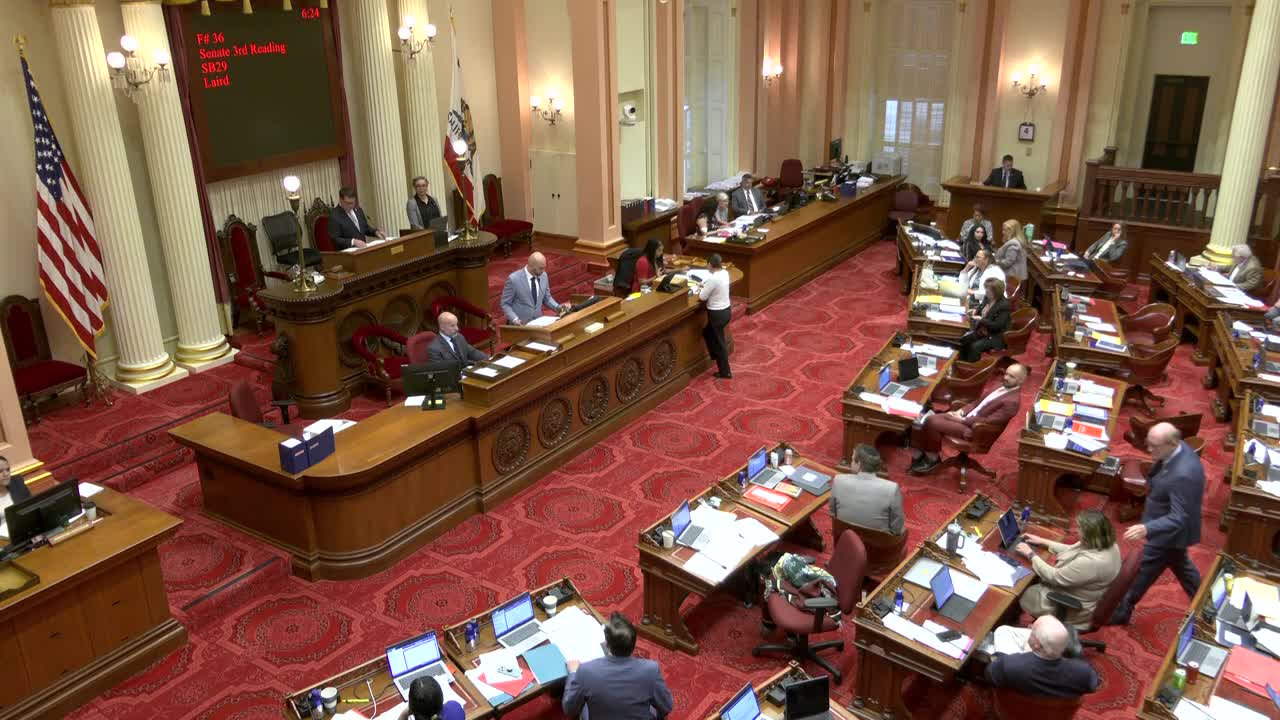 43MIN
Senate Floor
 45SEC
Senate Standing Committee on Appropriations
 40MIN
Senate Standing Committee on Judiciary
 1H
Senate Standing Committee on Energy, Utilities and Communications


Bill Co-Author(s):