SB 672: The Youth Rehabilitation and Opportunity Act.
- Session Year: 2025-2026
- House: Senate
- Latest Version Date: 2025-06-13
Current Status:
In Progress
(2026-06-03: June 9 set for final hearing canceled at the request of author.)
Introduced
In Committee
Awaiting First Chamber Vote
Passed First Chamber
In Committee
Awaiting Second Chamber Vote
Passed Second Chamber
Enacted
Existing law requires the Board of Parole Hearings to conduct a youth offender parole hearing for offenders sentenced to state prison who committed specified crimes when they were under 25 years of age. Existing law makes a person who was convicted of a controlling offense that was committed when the person was under 18 years of age and for which the sentence is life without the possibility of parole eligible for release on parole at a youth offender hearing by the board during the persons 25th year of incarceration. Existing law specifies that these provisions do not alter the rights of a victim at a parole hearing.
Under existing law, a murder perpetrated by specified means or under certain circumstances is defined as murder of the first degree. Existing law, as added by Proposition 7, an initiative measure approved by the voters at the November 7, 1978, statewide general election, requires that a person convicted of first-degree murder be subject to death or confinement in prison for a term of life without the possibility of parole in any case in which specified special circumstances are charged and found to be true. Proposition 7 does not provide for amendment by the Legislature.
This bill, the Youth Rehabilitation and Opportunity Act, would instead make a person who was convicted of a controlling offense that was committed when the person was 25 years of age or younger and for which they were sentenced to life without the possibility of parole eligible for parole after their 25th year of incarceration, except as specified. The bill would require the board to complete, by January 1, 2028, all hearings for individuals who are or will be entitled to have their parole suitability considered at a youth offender parole hearing by these provisions, as specified.
Existing law requires the Board of Parole Hearings to conduct a youth offender parole hearing for offenders sentenced to state prison who committed specified crimes when they were under 25 years of age. Existing law makes a person who was convicted of a controlling offense that was committed when the person was under 18 years of age and for which the sentence is life without the possibility of parole eligible for release on parole at a youth offender hearing by the board during the persons 25th year of incarceration. Existing law specifies that these provisions do not alter the rights of a victim at a parole hearing.
Under existing law, a murder perpetrated by specified means or under certain circumstances is defined as murder of the first degree. Existing law, as added by Proposition 7, an initiative measure approved by the voters at the November 7, 1978, statewide general election, requires that a person convicted of first-degree murder be subject to death or confinement in prison for a term of life without the possibility of parole in any case in which specified special circumstances are charged and found to be true. Proposition 7 does not provide for amendment by the Legislature.
This bill, the Youth Rehabilitation and Opportunity Act, would instead make a person who was convicted of a controlling offense that was committed when the person was 25 years of age or younger and for which they were sentenced to life without the possibility of parole eligible for parole after their 25th year of incarceration, except as specified. The bill would require the board to complete, by January 1, 2028, all hearings for individuals who are or will be entitled to have their parole suitability considered at a youth offender parole hearing by these provisions. provisions, as specified.
Existing law requires the Board of Parole Hearings to conduct a youth offender parole hearing for offenders sentenced to state prison who committed specified crimes when they were under 25 years of age. Existing law makes a person who was convicted of a controlling offense that was committed when the person was under 18 years of age and for which the sentence is life without the possibility of parole eligible for release on parole at a youth offender hearing by the board during the persons 25th year of incarceration.
Under existing law, a murder perpetrated by specified means or under certain circumstances is defined as murder of the first degree. Existing law, as added by Proposition 7, an initiative measure approved by the voters at the November 7, 1978, statewide general election, requires that a person convicted of first-degree murder be subject to death or confinement in prison for a term of life without the possibility of parole in any case in which specified special circumstances are charged and found to be true. Proposition 7 does not provide for amendment by the Legislature.
This bill, the Youth Rehabilitation and Opportunity Act, would instead make a person who was convicted of a controlling offense that was committed when the person was 25 years of age or younger and for which they were sentenced to life without the possibility of parole eligible for parole after their 25th year of incarceration, except as specified. The bill would require the board to complete, by January 1, 2028, all hearings for individuals who are or will be entitled to have their parole suitability considered at a youth offender parole hearing by these provisions.
This act shall be known, and may be cited, as the Youth Rehabilitation and Opportunity Act.
SEC. 2.Section 3051 of the Penal Code is amended to read:3051.(a)(1)(A)A youth offender parole hearing is a hearing by the Board of Parole Hearings for the purpose of reviewing the parole suitability of any prisoner who was 25 years of age or younger at the time of the controlling offense.
(B)The board shall conduct a hearing under this section in accordance with the public safety standards described in paragraph (1) of subdivision (b) of Section 3041.
(2)For the purposes of this section, the following definitions shall apply:
(A)Incarceration means detention in a city or county jail, local juvenile facility, mental health facility, Division of Juvenile Justice facility, or Department of Corrections and Rehabilitation facility.
(B)Controlling offense means the offense or enhancement for which a sentencing court imposed the longest term of imprisonment.
(C)Youth parole eligible date is the earliest date upon which a youth offender is eligible for release on parole at a youth offender parole hearing. Except as provided in subdivision (i) and Section 3051.1, a youth offender is entitled to their initial youth offender parole hearing within six months of their youth parole eligible date, as determined in subdivision (b), unless previously released or entitled to an earlier parole consideration hearing pursuant to any other law.
(b)(1)A person who was convicted of a controlling offense that was committed when they were 25 years of age or younger and for which the sentence is a determinate sentence shall be eligible for release on parole at a youth offender parole hearing during their 15th year of incarceration. The youth parole eligible date for a person eligible for a youth offender parole hearing under this paragraph shall be the first day of their 15th year of incarceration.
(2)A person who was convicted of a controlling offense that was committed when they were 25 years of age or younger and for which the sentence is a life term of less than 25 years to life shall be eligible for release on parole at a youth offender parole hearing during their 20th year of incarceration. The youth parole eligible date for a person eligible for a youth offender parole hearing under this paragraph shall be the first day of their 20th year of incarceration.
(3)A person who was convicted of a controlling offense that was committed when they were 25 years of age or younger and for which the sentence is a life term of 25 years to life shall be eligible for release on parole at a youth offender parole hearing during their 25th year of incarceration. The youth parole eligible date for a person eligible for a youth offender parole hearing under this paragraph shall be the first day of their 25th year of incarceration.
(4)A person who was convicted of a controlling offense that was committed when they were 25 years of age or younger and for which the sentence is life without the possibility of parole shall be eligible for release on parole at a youth offender parole hearing during their 25th year of incarceration. The youth parole eligible date for a person eligible for a youth offender parole hearing under this paragraph shall be the first day of their 25th year of incarceration. This section does not apply to a person who committed the controlling offense when they were 18 years of age or older at the time of the crime and were convicted of any of the following offenses:
(A)Special circumstance murder committed by means of a destructive device, bomb, or explosive pursuant to paragraph (4) or (6) of subdivision (a) of Section 190.2.
(A)(B)Special circumstance murder of a peace officer or federal law enforcement officer or agent pursuant to paragraph (7) or (8) of subdivision (a) of Section 190.2.
(C)Special circumstance murder of a firefighter pursuant to paragraph (9) of subdivision (a) of Section 190.2.
(D)Special circumstance murder of a witness to a crime pursuant to paragraph (10) of subdivision (a) of Section 190.2.
(E)Special circumstance murder of a prosecutor pursuant to paragraph (11) of subdivision (a) of Section 190.2.
(F)Special circumstance murder of a judge pursuant to paragraph (12) of subdivision (a) of Section 190.2.
(G)Special circumstance murder of a government official pursuant to paragraph (13) of subdivision (a) of Section 190.2.
(H)Special circumstance murder in which the victim was intentionally killed because of their race, color, religion, nationality, or country of origin pursuant to paragraph (16) of subdivision (a) of Section 190.2 or murder that is a hate crime, as defined in Section 422.55.
(B)(I)A sex offense committed during the course of murder in the first degree with special circumstances pursuant to paragraph (17) of subdivision (a) of Section 190.2.
(C)(J)Special circumstance murder that was intentional and involved the infliction of torture pursuant to paragraph (18) of subdivision (a) of Section 190.2.
(K)Special circumstance murder of a juror pursuant to paragraph (20) of subdivision (a) of Section 190.2.
(D)(i)(L)First-degree murder as the actual killer if three two or more people are killed in a shooting incident at a school or place of worship. incident.
(ii)For purposes of this subparagraph, a school includes a public or private prekindergarten school, K12 school, and postsecondary educational institution.(M)Intentional murder of a child 12 years of age or younger.
(N)Murder that is an act of domestic violence, as defined in Section 13700.
(c)An individual subject to this section shall meet with the board pursuant to subdivision (a) of Section 3041.
(d)The board shall conduct a youth offender parole hearing to consider release. At the youth offender parole hearing, the board shall release the individual on parole as provided in Section 3041, except that the board shall act in accordance with subdivision (c) of Section 4801.
(e)The youth offender parole hearing to consider release shall provide for a meaningful opportunity to obtain release. The board shall review and, as necessary, revise existing regulations and adopt new regulations regarding determinations of suitability made pursuant to this section, subdivision (c) of Section 4801, and other related topics, consistent with relevant case law, in order to provide that meaningful opportunity for release.
(f)(1)In assessing growth and maturity, psychological evaluations and risk assessment instruments, if used by the board, shall be administered by licensed psychologists employed by the board and shall take into consideration the diminished culpability of youth as compared to that of adults, the hallmark features of youth, and subsequent growth and increased maturity of the individual.
(2)Family members, friends, school personnel, faith leaders, and representatives from community-based organizations with knowledge about the individual before the crime or the individuals growth and maturity since the time of the crime may submit statements for review by the board.
(3)(A)The board shall conduct a proceeding under this section in accordance with all constitutional and statutory rights of a registered victim and their next of kin under California law, including, but not limited to, the rights to notification described in paragraph (1) of subdivision (a) of Section 3043, to appear personally or by counsel and to adequately and reasonably express their views pursuant to paragraph (1) of subdivision (b) of Section 3043, and to have the board consider their entire and uninterrupted statement in deciding whether to release the person on parole pursuant to subdivision (d) of Section 3043.
(B)The Board of Parole Hearings or its successor is responsible for protecting victims rights in the parole process pursuant to Section 3044.
(g)If parole is not granted, the board shall set the time for a subsequent youth offender parole hearing in accordance with paragraph (3) of subdivision (b) of Section 3041.5. In exercising its discretion pursuant to paragraph (4) of subdivision (b) and subdivision (d) of Section 3041.5, the board shall consider the factors in subdivision (c) of Section 4801. A subsequent youth offender parole hearing shall not be necessary if the offender is released pursuant to any other law prior to the date of the subsequent hearing.
(h)This section does not apply to cases in which sentencing occurs pursuant to Section 1170.12, subdivisions (b) to (i), inclusive, of Section 667, or Section 667.61. This section does not apply to an individual to whom this section would otherwise apply, but who, subsequent to attaining 26 years of age, commits an additional crime for which malice aforethought is a necessary element of the crime or for which the individual is sentenced to life in prison.
(i)(1)The board shall complete all youth offender parole hearings for individuals who became entitled to have their parole suitability considered at a youth offender parole hearing prior to January 1, 2014, by July 1, 2015.
(2)(A)The board shall complete all youth offender parole hearings for individuals who were sentenced to indeterminate life terms and who become entitled to have their parole suitability considered at a youth offender parole hearing on January 1, 2016, by July 1, 2017.
(B)The board shall complete all youth offender parole hearings for individuals who were sentenced to determinate terms and who become entitled to have their parole suitability considered at a youth offender parole hearing on January 1, 2016, by July 1, 2021. The board shall, for all individuals described in this subparagraph, conduct the consultation described in subdivision (a) of Section 3041 before July 1, 2017.
(3)(A)The board shall complete all youth offender parole hearings for individuals who were sentenced to indeterminate life terms and who become entitled to have their parole suitability considered at a youth offender parole hearing on January 1, 2018, by January 1, 2020.
(B)The board shall complete all youth offender parole hearings for individuals who were sentenced to determinate terms and who become entitled to have their parole suitability considered at a youth offender parole hearing on January 1, 2018, by January 1, 2022. The board shall, for all individuals described in this subparagraph, conduct the consultation described in subdivision (a) of Section 3041 before January 1, 2019.
(4)The board shall complete, by July 1, 2020, all youth offender parole hearings for individuals who were sentenced to terms of life without the possibility of parole before the person had attained 18 years of age and who are or will be entitled to have their parole suitability considered at a youth offender parole hearing before July 1, 2020.
(5)The board shall complete, by January 1, 2028, all youth offender parole hearings for individuals who were sentenced to terms of life without the possibility of parole and who are or will be entitled to have their parole suitability considered at a youth offender parole hearing before January 1, 2028.
(j)The Secretary of the Department of Corrections and Rehabilitation may authorize a person described in paragraphs (1) to (3), inclusive, of subdivision (b) to obtain an earlier youth parole eligible date by adopting regulations pursuant to subdivision (b) of Section 32 of Article I of the California Constitution.
This act shall be known, and may be cited, as the Youth Rehabilitation and Opportunity Act.
SEC. 2.Section 3051 of the Penal Code is amended to read:3051.(a)(1)(A)A youth offender parole hearing is a hearing by the Board of Parole Hearings for the purpose of reviewing the parole suitability of any prisoner who was 25 years of age or younger at the time of the controlling offense.
(B)The board shall conduct a hearing under this section in accordance with the public safety standards described in paragraph (1) of subdivision (b) of Section 3041.
(2)For the purposes of this section, the following definitions shall apply:
(A)Incarceration means detention in a city or county jail, local juvenile facility, mental health facility, Division of Juvenile Justice facility, or Department of Corrections and Rehabilitation facility.
(B)Controlling offense means the offense or enhancement for which a sentencing court imposed the longest term of imprisonment.
(C)Youth parole eligible date is the earliest date upon which a youth offender is eligible for release on parole at a youth offender parole hearing. Except as provided in subdivision (i) and Section 3051.1, a youth offender is entitled to their initial youth offender parole hearing within six months of their youth parole eligible date, as determined in subdivision (b), unless previously released or entitled to an earlier parole consideration hearing pursuant to any other law.
(b)(1)A person who was convicted of a controlling offense that was committed when they were 25 years of age or younger and for which the sentence is a determinate sentence shall be eligible for release on parole at a youth offender parole hearing during their 15th year of incarceration. The youth parole eligible date for a person eligible for a youth offender parole hearing under this paragraph shall be the first day of their 15th year of incarceration.
(2)A person who was convicted of a controlling offense that was committed when they were 25 years of age or younger and for which the sentence is a life term of less than 25 years to life shall be eligible for release on parole at a youth offender parole hearing during their 20th year of incarceration. The youth parole eligible date for a person eligible for a youth offender parole hearing under this paragraph shall be the first day of their 20th year of incarceration.
(3)A person who was convicted of a controlling offense that was committed when they were 25 years of age or younger and for which the sentence is a life term of 25 years to life shall be eligible for release on parole at a youth offender parole hearing during their 25th year of incarceration. The youth parole eligible date for a person eligible for a youth offender parole hearing under this paragraph shall be the first day of their 25th year of incarceration.
(4)A person who was convicted of a controlling offense that was committed when they were 25 years of age or younger and for which the sentence is life without the possibility of parole shall be eligible for release on parole at a youth offender parole hearing during their 25th year of incarceration. The youth parole eligible date for a person eligible for a youth offender parole hearing under this paragraph shall be the first day of their 25th year of incarceration. This section does not apply to a person who committed the controlling offense when they were 18 years of age or older at the time of the crime and was were convicted of special any of the following offenses:
(A)Special circumstance murder of a peace officer or federal law enforcement officer or agent pursuant to paragraph (7) or (8) of subdivision (a) of Section 190.2.
(B)A sex offense committed during the course of murder in the first degree with special circumstances pursuant to paragraph (17) of subdivision (a) of Section 190.2.
(C)Special circumstance murder that was intentional and involved the infliction of torture pursuant to paragraph (18) of subdivision (a) of Section 190.2.
(D)(i)First-degree murder as the actual killer if three or more people are killed in a shooting incident at a school or place of worship.
(ii)For purposes of this subparagraph, a school includes a public or private prekindergarten school, K12 school, and postsecondary educational institution.
(c)An individual subject to this section shall meet with the board pursuant to subdivision (a) of Section 3041.
(d)The board shall conduct a youth offender parole hearing to consider release. At the youth offender parole hearing, the board shall release the individual on parole as provided in Section 3041, except that the board shall act in accordance with subdivision (c) of Section 4801.
(e)The youth offender parole hearing to consider release shall provide for a meaningful opportunity to obtain release. The board shall review and, as necessary, revise existing regulations and adopt new regulations regarding determinations of suitability made pursuant to this section, subdivision (c) of Section 4801, and other related topics, consistent with relevant case law, in order to provide that meaningful opportunity for release.
(f)(1)In assessing growth and maturity, psychological evaluations and risk assessment instruments, if used by the board, shall be administered by licensed psychologists employed by the board and shall take into consideration the diminished culpability of youth as compared to that of adults, the hallmark features of youth, and subsequent growth and increased maturity of the individual.
(2)Family members, friends, school personnel, faith leaders, and representatives from community-based organizations with knowledge about the individual before the crime or the individuals growth and maturity since the time of the crime may submit statements for review by the board.
(3)This section does not alter the rights of victims at parole hearings.(3)(A)The board shall conduct a proceeding under this section in accordance with all constitutional and statutory rights of a registered victim and their next of kin under California law, including, but not limited to, the rights to notification described in paragraph (1) of subdivision (a) of Section 3043, to appear personally or by counsel and to adequately and reasonably express their views pursuant to paragraph (1) of subdivision (b) of Section 3043, and to have the board consider their entire and uninterrupted statement in deciding whether to release the person on parole pursuant to subdivision (d) of Section 3043.
(B)The Board of Parole Hearings or its successor is responsible for protecting victims rights in the parole process pursuant to Section 3044.
(g)If parole is not granted, the board shall set the time for a subsequent youth offender parole hearing in accordance with paragraph (3) of subdivision (b) of Section 3041.5. In exercising its discretion pursuant to paragraph (4) of subdivision (b) and subdivision (d) of Section 3041.5, the board shall consider the factors in subdivision (c) of Section 4801. A subsequent youth offender parole hearing shall not be necessary if the offender is released pursuant to any other law prior to the date of the subsequent hearing.
(h)This section does not apply to cases in which sentencing occurs pursuant to Section 1170.12, subdivisions (b) to (i), inclusive, of Section 667, or Section 667.61. This section does not apply to an individual to whom this section would otherwise apply, but who, subsequent to attaining 26 years of age, commits an additional crime for which malice aforethought is a necessary element of the crime or for which the individual is sentenced to life in prison.
(i)(1)The board shall complete all youth offender parole hearings for individuals who became entitled to have their parole suitability considered at a youth offender parole hearing prior to January 1, 2014, by July 1, 2015.
(2)(A)The board shall complete all youth offender parole hearings for individuals who were sentenced to indeterminate life terms and who become entitled to have their parole suitability considered at a youth offender parole hearing on January 1, 2016, by July 1, 2017.
(B)The board shall complete all youth offender parole hearings for individuals who were sentenced to determinate terms and who become entitled to have their parole suitability considered at a youth offender parole hearing on January 1, 2016, by July 1, 2021. The board shall, for all individuals described in this subparagraph, conduct the consultation described in subdivision (a) of Section 3041 before July 1, 2017.
(3)(A)The board shall complete all youth offender parole hearings for individuals who were sentenced to indeterminate life terms and who become entitled to have their parole suitability considered at a youth offender parole hearing on January 1, 2018, by January 1, 2020.
(B)The board shall complete all youth offender parole hearings for individuals who were sentenced to determinate terms and who become entitled to have their parole suitability considered at a youth offender parole hearing on January 1, 2018, by January 1, 2022. The board shall, for all individuals described in this subparagraph, conduct the consultation described in subdivision (a) of Section 3041 before January 1, 2019.
(4)The board shall complete, by July 1, 2020, all youth offender parole hearings for individuals who were sentenced to terms of life without the possibility of parole before the person had attained 18 years of age and who are or will be entitled to have their parole suitability considered at a youth offender parole hearing before July 1, 2020.
(5)The board shall complete, by January 1, 2028, all youth offender parole hearings for individuals who were sentenced to terms of life without the possibility of parole and who are or will be entitled to have their parole suitability considered at a youth offender parole hearing before January 1, 2028.
(j)The Secretary of the Department of Corrections and Rehabilitation may authorize a person described in paragraphs (1) to (3), inclusive, of subdivision (b) to obtain an earlier youth parole eligible date by adopting regulations pursuant to subdivision (b) of Section 32 of Article I of the California Constitution.
This act shall be known, and may be cited, as the Youth Rehabilitation and Opportunity Act.
SEC. 2.Section 3051 of the Penal Code is amended to read:3051.(a)(1)A youth offender parole hearing is a hearing by the Board of Parole Hearings for the purpose of reviewing the parole suitability of any prisoner who was 25 years of age or younger at the time of the controlling offense.
(2)For the purposes of this section, the following definitions shall apply:
(A)Incarceration means detention in a city or county jail, a local juvenile facility, a mental health facility, a Division of Juvenile Justice facility, or a Department of Corrections and Rehabilitation facility.
(B)Controlling offense means the offense or enhancement for which any a sentencing court imposed the longest term of imprisonment.
(C)Youth parole eligible date is the earliest date upon which a youth offender is eligible for release on parole at a youth offender parole hearing. Except as provided in subdivision (i) and Section 3051.1, a youth offenders are offender is entitled to their initial youth offender parole hearing within six months of their youth parole eligible date, as determined in subdivision (b), unless previously released or entitled to an earlier parole consideration hearing pursuant to any other law.
(b)(1)A person who was convicted of a controlling offense that was committed when the person was they were 25 years of age or younger and for which the sentence is a determinate sentence shall be eligible for release on parole at a youth offender parole hearing during the persons their 15th year of incarceration. The youth parole eligible date for a person eligible for a youth offender parole hearing under this paragraph shall be the first day of the persons their 15th year of incarceration.
(2)A person who was convicted of a controlling offense that was committed when the person was they were 25 years of age or younger and for which the sentence is a life term of less than 25 years to life shall be eligible for release on parole at a youth offender parole hearing during the persons their 20th year of incarceration. The youth parole eligible date for a person eligible for a youth offender parole hearing under this paragraph shall be the first day of the persons their 20th year of incarceration.
(3)A person who was convicted of a controlling offense that was committed when the person was they were 25 years of age or younger and for which the sentence is a life term of 25 years to life shall be eligible for release on parole at a youth offender parole hearing during the persons their 25th year of incarceration. The youth parole eligible date for a person eligible for a youth offender parole hearing under this paragraph shall be the first day of the persons their 25th year of incarceration.
(4)A person who was convicted of a controlling offense that was committed when the person was they were 25 years of age or younger and for which the sentence is life without the possibility of parole shall be eligible for release on parole at a youth offender parole hearing during the persons their 25th year of incarceration. The youth parole eligible date for a person eligible for a youth offender parole hearing under this paragraph shall be the first day of the persons their 25th year of incarceration. This section does not apply to a person who committed the controlling offense when the person was they were 18 years of age or older at the time of the crime and was convicted of special circumstance murder pursuant to paragraph (7) or (8) of subdivision (a) of Section 190.2.
(c)An individual subject to this section shall meet with the board pursuant to subdivision (a) of Section 3041.
(d)The board shall conduct a youth offender parole hearing to consider release. At the youth offender parole hearing, the board shall release the individual on parole as provided in Section 3041, except that the board shall act in accordance with subdivision (c) of Section 4801.
(e)The youth offender parole hearing to consider release shall provide for a meaningful opportunity to obtain release. The board shall review and, as necessary, revise existing regulations and adopt new regulations regarding determinations of suitability made pursuant to this section, subdivision (c) of Section 4801, and other related topics, consistent with relevant case law, in order to provide that meaningful opportunity for release.
(f)(1)In assessing growth and maturity, psychological evaluations and risk assessment instruments, if used by the board, shall be administered by licensed psychologists employed by the board and shall take into consideration the diminished culpability of youth as compared to that of adults, the hallmark features of youth, and any subsequent growth and increased maturity of the individual.
(2)Family members, friends, school personnel, faith leaders, and representatives from community-based organizations with knowledge about the individual before the crime or the individuals growth and maturity since the time of the crime may submit statements for review by the board.
(3)This section is not intended to does not alter the rights of victims at parole hearings.
(g)If parole is not granted, the board shall set the time for a subsequent youth offender parole hearing in accordance with paragraph (3) of subdivision (b) of Section 3041.5. In exercising its discretion pursuant to paragraph (4) of subdivision (b) and subdivision (d) of Section 3041.5, the board shall consider the factors in subdivision (c) of Section 4801. A subsequent youth offender parole hearing shall not be necessary if the offender is released pursuant to any other law prior to the date of the subsequent hearing.
(h)This section does not apply to cases in which sentencing occurs pursuant to Section 1170.12, subdivisions (b) to (i), inclusive, of Section 667, or Section 667.61. This section does not apply to an individual to whom this section would otherwise apply, but who, subsequent to attaining 26 years of age, commits an additional crime for which malice aforethought is a necessary element of the crime or for which the individual is sentenced to life in prison.
(i)(1)The board shall complete all youth offender parole hearings for individuals who became entitled to have their parole suitability considered at a youth offender parole hearing prior to January 1, 2014, by July 1, 2015.
(2)(A)The board shall complete all youth offender parole hearings for individuals who were sentenced to indeterminate life terms and who become entitled to have their parole suitability considered at a youth offender parole hearing on January 1, 2016, by July 1, 2017.
(B)The board shall complete all youth offender parole hearings for individuals who were sentenced to determinate terms and who become entitled to have their parole suitability considered at a youth offender parole hearing on January 1, 2016, by July 1, 2021. The board shall, for all individuals described in this subparagraph, conduct the consultation described in subdivision (a) of Section 3041 before July 1, 2017.
(3)(A)The board shall complete all youth offender parole hearings for individuals who were sentenced to indeterminate life terms and who become entitled to have their parole suitability considered at a youth offender parole hearing on January 1, 2018, by January 1, 2020.
(B)The board shall complete all youth offender parole hearings for individuals who were sentenced to determinate terms and who become entitled to have their parole suitability considered at a youth offender parole hearing on January 1, 2018, by January 1, 2022. The board shall, for all individuals described in this subparagraph, conduct the consultation described in subdivision (a) of Section 3041 before January 1, 2019.
(4)The board shall complete, by July 1, 2020, all youth offender parole hearings for individuals who were sentenced to terms of life without the possibility of parole before the person had attained 18 years of age and who are or will be entitled to have their parole suitability considered at a youth offender parole hearing before July 1, 2020.
(5)The board shall complete, by January 1, 2028, all youth offender parole hearings for individuals who were sentenced to terms of life without the possibility of parole and who are or will be entitled to have their parole suitability considered at a youth offender parole hearing before January 1, 2028.
(j)The Secretary of the Department of Corrections and Rehabilitation may authorize persons a person described in paragraphs (1), (2), and (3) (1) to (3), inclusive, of subdivision (b) to obtain an earlier youth parole eligible date by adopting regulations pursuant to subdivision (b) of Section 32 of Article I of the California Constitution.
This act shall be known, and may be cited, as the Youth Rehabilitation and Opportunity Act.
SEC. 2.Section 3051 of the Penal Code is amended to read:3051.(a)(1)A youth offender parole hearing is a hearing by the Board of Parole Hearings for the purpose of reviewing the parole suitability of any prisoner who was 25 years of age or younger, or was under 18 years of age as specified in paragraph (4) of subdivision (b), younger at the time of the controlling offense.
(2)For the purposes of this section, the following definitions shall apply:
(A)Incarceration means detention in a city or county jail, a local juvenile facility, a mental health facility, a Division of Juvenile Justice facility, or a Department of Corrections and Rehabilitation facility.
(B)Controlling offense means the offense or enhancement for which any sentencing court imposed the longest term of imprisonment.
(C)Youth parole eligible date is the earliest date upon which a youth offender is eligible for release on parole at a youth offender parole hearing. Except as provided in subdivision (i) and Section 3051.1, youth offenders are entitled to their initial youth offender parole hearing within six months of their youth parole eligible date, as determined in subdivision (b), unless previously released or entitled to an earlier parole consideration hearing pursuant to any other law.
(b)(1)A person who was convicted of a controlling offense that was committed when the person was 25 years of age or younger and for which the sentence is a determinate sentence shall be eligible for release on parole at a youth offender parole hearing during the persons 15th year of incarceration. The youth parole eligible date for a person eligible for a youth offender parole hearing under this paragraph shall be the first day of the persons 15th year of incarceration.
(2)A person who was convicted of a controlling offense that was committed when the person was 25 years of age or younger and for which the sentence is a life term of less than 25 years to life shall be eligible for release on parole at a youth offender parole hearing during the persons 20th year of incarceration. The youth parole eligible date for a person eligible for a youth offender parole hearing under this paragraph shall be the first day of the persons 20th year of incarceration.
(3)A person who was convicted of a controlling offense that was committed when the person was 25 years of age or younger and for which the sentence is a life term of 25 years to life shall be eligible for release on parole at a youth offender parole hearing during the persons 25th year of incarceration. The youth parole eligible date for a person eligible for a youth offender parole hearing under this paragraph shall be the first day of the persons 25th year of incarceration.
(4)A person who was convicted of a controlling offense that was committed before the person had attained 18 years of age when the person was 25 years of age or younger and for which the sentence is life without the possibility of parole shall be eligible for release on parole at a youth offender parole hearing during the persons 25th year of incarceration. The youth parole eligible date for a person eligible for a youth offender parole hearing under this paragraph shall be the first day of the persons 25th year of incarceration. This section does not apply to a person who committed the controlling offense when the person was 18 years of age or older at the time of the crime and was convicted of special circumstance murder pursuant to paragraph (7) or (8) of subdivision (a) of Section 190.2.
(c)An individual subject to this section shall meet with the board pursuant to subdivision (a) of Section 3041.
(d)The board shall conduct a youth offender parole hearing to consider release. At the youth offender parole hearing, the board shall release the individual on parole as provided in Section 3041, except that the board shall act in accordance with subdivision (c) of Section 4801.
(e)The youth offender parole hearing to consider release shall provide for a meaningful opportunity to obtain release. The board shall review and, as necessary, revise existing regulations and adopt new regulations regarding determinations of suitability made pursuant to this section, subdivision (c) of Section 4801, and other related topics, consistent with relevant case law, in order to provide that meaningful opportunity for release.
(f)(1)In assessing growth and maturity, psychological evaluations and risk assessment instruments, if used by the board, shall be administered by licensed psychologists employed by the board and shall take into consideration the diminished culpability of youth as compared to that of adults, the hallmark features of youth, and any subsequent growth and increased maturity of the individual.
(2)Family members, friends, school personnel, faith leaders, and representatives from community-based organizations with knowledge about the individual before the crime or the individuals growth and maturity since the time of the crime may submit statements for review by the board.
(3)This section is not intended to alter the rights of victims at parole hearings.
(g)If parole is not granted, the board shall set the time for a subsequent youth offender parole hearing in accordance with paragraph (3) of subdivision (b) of Section 3041.5. In exercising its discretion pursuant to paragraph (4) of subdivision (b) and subdivision (d) of Section 3041.5, the board shall consider the factors in subdivision (c) of Section 4801. A subsequent youth offender parole hearing shall not be necessary if the offender is released pursuant to any other law prior to the date of the subsequent hearing.
(h)This section shall does not apply to cases in which sentencing occurs pursuant to Section 1170.12, subdivisions (b) to (i), inclusive, of Section 667, or Section 667.61, or to cases in which an individual is sentenced to life in prison without the possibility of parole for a controlling offense that was committed after the person had attained 18 years of age. 667.61. This section shall does not apply to an individual to whom this section would otherwise apply, but who, subsequent to attaining 26 years of age, commits an additional crime for which malice aforethought is a necessary element of the crime or for which the individual is sentenced to life in prison.
(i)(1)The board shall complete all youth offender parole hearings for individuals who became entitled to have their parole suitability considered at a youth offender parole hearing prior to January 1, 2014, by July 1, 2015.
(2)(A)The board shall complete all youth offender parole hearings for individuals who were sentenced to indeterminate life terms and who become entitled to have their parole suitability considered at a youth offender parole hearing on January 1, 2016, by July 1, 2017.
(B)The board shall complete all youth offender parole hearings for individuals who were sentenced to determinate terms and who become entitled to have their parole suitability considered at a youth offender parole hearing on January 1, 2016, by July 1, 2021. The board shall, for all individuals described in this subparagraph, conduct the consultation described in subdivision (a) of Section 3041 before July 1, 2017.
(3)(A)The board shall complete all youth offender parole hearings for individuals who were sentenced to indeterminate life terms and who become entitled to have their parole suitability considered at a youth offender parole hearing on January 1, 2018, by January 1, 2020.
(B)The board shall complete all youth offender parole hearings for individuals who were sentenced to determinate terms and who become entitled to have their parole suitability considered at a youth offender parole hearing on January 1, 2018, by January 1, 2022. The board shall, for all individuals described in this subparagraph, conduct the consultation described in subdivision (a) of Section 3041 before January 1, 2019.
(4)The board shall complete, by July 1, 2020, all youth offender parole hearings for individuals who were sentenced to terms of life without the possibility of parole before the person had attained 18 years of age and who are or will be entitled to have their parole suitability considered at a youth offender parole hearing before July 1, 2020.
(5)The board shall complete, by January 1, 2028, all youth offender parole hearings for individuals who were sentenced to terms of life without the possibility of parole and who are or will be entitled to have their parole suitability considered at a youth offender parole hearing before January 1, 2028.
(j)The Secretary of the Department of Corrections and Rehabilitation may authorize persons described in paragraphs (1), (2), and (3) of subdivision (b) to obtain an earlier youth parole eligible date by adopting regulations pursuant to subdivision (b) of Section 32 of Article 1 I of the California Constitution.
|
Date
|
Status
|
|---|---|
| Jun 3, 2026 | June 9 set for final hearing canceled at the request of author. |
| Jul 1, 2025 | July 1 set for second hearing canceled at the request of author. |
| Jun 13, 2025 | From committee with author's amendments. Read second time and amended. Re-referred to Com. on PUB. S. |
| Jun 11, 2025 | June 17 set for first hearing canceled at the request of author. |
| Jun 9, 2025 | Referred to Com. on PUB. S. |
| Jun 4, 2025 | In Assembly. Read first time. Held at Desk. |
| Jun 3, 2025 | Read third time. Passed. (Ayes 24. Noes 11. Page 1450.) Ordered to the Assembly. |
| May 27, 2025 | Read second time. Ordered to third reading. |
| May 23, 2025 | From committee: Do pass as amended. (Ayes 5. Noes 1. Page 1209.) (May 23). |
| May 23, 2025 | Read second time and amended. Ordered to second reading. |
| May 16, 2025 | Set for hearing May 23. |
| May 5, 2025 | May 5 hearing: Placed on APPR. suspense file. |
| Apr 25, 2025 | Set for hearing May 5. |
| Apr 23, 2025 | From committee: Do pass and re-refer to Com. on APPR. (Ayes 5. Noes 1. Page 842.) (April 22). Re-referred to Com. on APPR. |
| Apr 10, 2025 | From committee with author's amendments. Read second time and amended. Re-referred to Com. on PUB. S. |
| Apr 9, 2025 | Set for hearing April 22. |
| Mar 5, 2025 | Referred to Com. on PUB. S. |
| Feb 24, 2025 | Read first time. |
| Feb 24, 2025 | From printer. May be acted upon on or after March 24. |
| Feb 21, 2025 | Introduced. To Com. on RLS. for assignment. To print. |
|
Date
|
Description
|
Location
|
Votes
|
|
|---|---|---|---|---|
| Jun 3, 2025 | Senate 3rd Reading SB672 Rubio et al. | Senate Floor |
Passed |
|
| May 23, 2025 | Do pass as amended | Senate Standing Committee on Appropriations |
Passed |
|
| May 5, 2025 | Placed on suspense file | Senate Standing Committee on Appropriations |
Passed |
|
| Apr 22, 2025 | Do pass, but first be re-referred to the Committee on [Appropriations] | Senate Standing Committee on Public Safety |
Passed |
This list shows positions taken on this bill by organizations on the date displayed, which is linked to the original source.
Positions by individuals are not included.
|
Organization
|
Position
|
Date
|
|---|---|---|
| Aclu California Action | ** Support | |
| All of Us or None Los Angeles | ** Support | |
| Amnesty International USA | ** Support | |
| Anti-Recidivism Coalition | ** Support | |
| Asian American Criminal Trial Lawyers Association | ** Support | |
| Asian Law Alliance | ** Support | |
| Asian Prisoner Support Committee | ** Support | |
| Bar Association of San Francisco, Court Appointment Programs, Lawyer Referral & Information Service | ** Support | |
| California Catholic Conference | ** Support | |
| California Coalition of Women Prisoners | ** Support | |
| California District Attorneys Association | ** Against | |
| California Faculty Association | ** Support | |
| California Hispanic Chambers Of Commerce | ** Support | |
| California Innocence Coalition | ** Support | |
| California Police Chiefs Association | ** Against | |
| California Public Defenders Association | ** Support | |
| California Youth Defender Center | ** Support | |
| Californians for Safety and Justice | ** Support | |
| Californians United for a Responsible Budget | ** Support | |
| Communities United for Restorative Youth Justice | ** Support | |
| Community Interventions | ** Support | |
| Courage California | ** Support | |
| Crime Victims United Of California | ** Against | |
| Death Penalty Focus | ** Support | |
| Ella Baker Center For Human Rights | ** Support | |
| Everychild Foundation | ** Support | |
| Fair Chance Project | ** Support | |
| Famm | ** Support | |
| Felony Murder Elimination Project | ** Support | |
| Freedom 4 Youth | ** Support | |
| Friends Committee On Legislation Of California | ** Support | |
| Grip Training Institute | ** Support | |
| Healing Dialogue and Action | ** Support | |
| Human Rights Watch | ** Support | |
| Initiate Justice | ** Support | |
| Initiate Justice Action | ** Support | |
| Justice2jobs Coalition | ** Support | |
| juvenile law center | ** Support | |
| LA County Public Defenders Union, Local 148 | ** Support | |
| LA Defensa | ** Support | |
| LatinoJustice PRLDEF | ** Support | |
| League Of Women Voters Of California | ** Support | |
| Legal Services for Prisoners with Children | ** Support | |
| Life Without Parole Alliance Group - Calipatria State Prison | ** Support | |
| Los Angeles County Public Defender's Office | ** Support | |
| Milpa Collective | ** Support | |
| Multiple Individuals | ** Support | |
| National Center for Youth Law | ** Support | |
| National LWOP Leadership Council | ** Support | |
| Orange County District Attorneys Office | ** Against | |
| Peace and Justice Law Center | ** Support | |
| PICO California | ** Support | |
| Post-Conviction Justice Project | ** Support | |
| Riverside County District Attorney | ** Against | |
| Rubicon Programs | ** Support | |
| San Diego County District Attorneys Office | ** Against | |
| San Francisco Public Defender | ** Support | |
| SEIU California | ** Support | |
| Silicon Valley De-Bug | ** Support | |
| Sister Warriors Freedom Coalition | ** Support | |
| Smart Justice California | ** Support | |
| South Asian Network | ** Support | |
| Spirit Awakening Foundation | ** Support | |
| Survived & Punished | ** Support | |
| The Center for Life Without Parole Studies | ** Support | |
| The Change Parallel Project | ** Support | |
| Uncommon Law | ** Support | |
| Underground Scholars Initiative - UC Berkeley | ** Support | |
| Underground Scholars Initiative At the University of California, Irvine | ** Support | |
| Underground Scholars Initiative, University of California, Irvine | ** Support | |
| Underground Scholars Initiative, University of California, Los Angeles | ** Support | |
| University of San Diego School of Law Children's Advocacy Institute | ** Support | |
| Urban Peace Movement | ** Support | |
| Usc Gould School Of Law Post-Conviction Justice Project | ** Support | |
| Vera Institute Of Justice | ** Support | |
| Viet Voices | ** Support | |
| W. Haywood Burns Institute | ** Support | |
| Youth Forward | ** Support |
SENATE RULES COMMITTEE Office of Senate Floor Analyses (916) 651-1520 Fax: (916) 327-4478 | SB 672 |
THIRD READING
Bill No: SB 672
Author: Rubio (D), et al.
Amended: 5/23/25
Vote: 21
SENATE PUBLIC SAFETY COMMITTEE: 5-1, 4/22/25
AYES: Arreguín, Caballero, Gonzalez, Pérez, Wiener
NOES: Seyarto
SENATE APPROPRIATIONS COMMITTEE: 5-1, 5/23/25
AYES: Caballero, Cabaldon, Grayson, Richardson, Wahab
NOES: Seyarto
NO VOTE RECORDED: Dahle
SUBJECT: The Youth Rehabilitation and Opportunity Act
SOURCE: Anti-Recidivism Coalition
National LWOP Leadership Council
Human Rights Watch
USC Gould School of Law Post-Conviction Justice Project
DIGEST:
This bill expands youth offender parole eligibility to include individuals convicted of a controlling offense that was committed when the person was 25 years of age or younger and for which the person was sentenced to life without the possibility of parole (LWOP), except as specified.
ANALYSIS:
Existing law:
- Provides that a youth offender parole hearing is a hearing by the Board of Parole Hearings (BPH) for the purpose of reviewing the parole suitability of any incarcerated individual who was 25 years of age or younger, or was under 18 years of age if sentenced to LWOP, at the time of the controlling offense. (Penal (Pen.) Code, § 3051, subd. (a)(1).)
- Defines “incarceration” as detention in a city or county jail, a local juvenile facility, a mental health facility, a Division of Juvenile Justice facility, or a Department of Corrections and Rehabilitation facility. (Pen. Code, § 3051, subd. (a)(2)(A).)
- Defines “controlling offense” as the offense or enhancement for which any sentencing court imposed the longest term of imprisonment. (Pen. Code, § 3051, subd. (a)(2)(B).)
- Defines “youth parole eligible date” as the earliest date upon which a youth offender is eligible for release on parole at a youth offender parole hearing. (Pen. Code, § 3051, subd. (a)(2)(C).)
- Provides the following parole mechanism for a person who was convicted of a controlling offense that was committed when the person was 25 years of age or younger:
- If the controlling offense was a determinate sentence, the person is eligible for release during person’s 15th year of incarceration;
- If the controlling offense was a life term less than 25-years-to-life, the person is eligible for release during the person’s 20th year of incarceration; and,
- If the controlling offense was a life term of 25-years-to-life, the person is eligible for release during the person’s 25th year of incarceration. (Pen. Code, § 3051, subd. (b)(1)-(3).)
- Provides that a person who was convicted of a controlling offense that was committed before the person had attained 18 years of age and for which the person was sentenced to LWOP is eligible for release during the person’s 25th year of incarceration. (Pen. Code, § 3051, subd. (b)(4).)
- Provides that BPH conduct a youth offender parole hearing to consider release. Provides that if the person is found suitable for parole at the youth offender parole hearing, the person must be granted parole. (Pen. Code, § 3051, subd. (d).)
- Provides that in reviewing a person’s suitability for parole in a youth offender parole hearing, BPH must give great weight to the diminished culpability of juveniles as compared to adults, the hallmark features of youth, and any subsequent growth and increased maturity of the person in accordance with relevant case law. (Pen. Code, §§ 3051, subd. (d) & 4801, subd. (c).)
- Requires that the youth offender parole hearing provide for a meaningful opportunity to obtain release. (Pen. Code, § 3051, subd. (e).)
- Excludes the following from youthful offender parole eligibility: a person sentenced under the Three Strikes law or the One Strike Sex Offense law; a person sentenced to LWOP whose controlling offense was committed after the person had attained 18 years of age; or an individual who would otherwise be eligible for youth offender parole, but who, subsequent to attaining 26 years of age, commits an additional crime for which malice aforethought is a necessary element of the crime or for which the individual is sentenced to life in prison. (Pen. Code § 3051, subd. (h).)
- Establishes various deadlines for BPH to complete youth offender parole hearings based on the type of sentence and when the person became entitled to have their parole suitability considered at a youth offender parole hearing. (Pen. Code, § 3051, subd. (i)(1)-(3).)
- Requires BPH to complete all youth offender parole hearings for individuals who were sentenced to LWOP and who are or will be entitled to have their parole suitability considered at a youth offender parole hearing by July 1, 2020. (Pen. Code, § 3051, subd. (i)(4).)
This bill:
- Provides that a person who was convicted of a controlling offense that was committed when the person was 25 years of age or younger and for which the person was sentenced to LWOP is eligible for release on parole at a youth offender parole hearing during their 25th year of incarceration. Provides that the youth parole eligible date for such a person is the first day of their 25th year of incarceration.
- Excludes from youth offender parole eligibility a person who committed the controlling offense when they were 18 years of age or older at the time of the crime and was convicted of special circumstance murder for the murder of a peace officer or federal law enforcement officer or agent.
- Excludes from youth offender parole eligibility a person who committed the controlling offense when they were 18 years of age or older at the time and was convicted of sex offenses committed during the course of a special circumstance murder while the defendant was engaged in, or was an accomplice in, the commission of, attempted commission of, or the immediate flight after committing, or attempting to commit robbery, kidnapping, rape, sodomy, lewd or lascivious act upon a child under 14, oral copulation, burglary, arson, train wrecking, mayhem, rape by instrument, or carjacking.
- Excludes from youth offender parole eligibility a person who committed the controlling offense when they were 18 years of age or older at the time and was convicted of special circumstance murder that was intentional and involved the infliction of torture.
- Excludes from youth offender parole eligibility a person who committed the controlling offense when they were 18 years of age or older at the time and was convicted of first-degree murder as the actual killer if three or more people are killed in a shooting incident at a school or place of worship. Defines school as a public or private prekindergarten school, K–12 school, and postsecondary educational institution.
- Includes technical and conforming changes.
Background
In accordance with U.S. Supreme Court and California Supreme Court case law, SB 260 (Hancock, Chapter 312, Statutes of 2013), established a parole eligibility mechanism for individuals sentenced to determinate and indeterminate terms for crimes committed when they were juveniles. (Pen. Code, § 3051.) Under the youth offender parole process created by SB 260, a person has an opportunity for a parole hearing after having served 15, 20, or 25 years of incarceration depending on their controlling offense. (Pen. Code, § 3051.) SB 261 (Hancock), Chapter 471, Statutes of 2015, expanded eligibility for a youth offender parole hearings to those whose controlling offense occurred before they reached the age of 23.
In People v. Franklin (2016) 63 Cal.4th 261, the California Supreme Court held the enactment of Penal Code section 3051 satisfied the requirement that a defendant who was a minor at the time of an offense have a meaningful opportunity to gain release during his or her natural lifetime because it requires that the defendant receive a parole hearing during the person’s 25th year of incarceration.
AB 1308 (Stone, Chapter 675, Statutes of 2018), further expanded youth offender parole eligibility to include individuals whose controlling offense was committed when the person was 25 or younger.
Youth Offender Parole for Individuals Sentenced to LWOP. Prior to the enactment of SB 394 (Lara, Chapter 684, Statutes of 2017), juveniles sentenced to LWOP were not eligible for youth offender parole. Instead, most individuals sentenced to LWOP for crimes committed when they were under 18 could petition for recall and resentencing after serving at least 15 years of the sentence via a process established by SB 9 (Yee, Chapter 828, Statutes of 2012). This recall and resentencing process was found to be an inadequate remedy for a Miller violation. (In re Kirchner (2017) 2 Cal.5th 1040, 1052-1054.) In 2016, the U.S. Supreme Court held that Miller announced a substantive rule of constitutional law that applied retroactively. (Montgomery v. Louisiana (2016) 577 U.S. 190, 206.)
SB 394 (Lara) applied the youth offender parole process to individuals sentenced to LWOP who were under 18 years of age at the time of the controlling offense and provided that such individuals would be eligible for a youth offender parole hearing during their 25th year of incarceration.
People v. Hardin. The exclusion of young adult offenders sentenced to LWOP from youth offender parole eligibility has been challenged. In 2024, the California Supreme Court held that the exclusion of this category of offenders from youth offender parole did not violate equal protection. (People v. Hardin (2024) 15 Cal. 5th 834 (Hardin).) The appellant in Hardin was convicted of first-degree murder with a special circumstance following the robbery and murder of an elderly neighbor when the appellant was 25 years old. The appellant received an LWOP sentence.
In deciding the case, the court observed that in enacting Penal Code section 3051, the Legislature sought to bring California’s juvenile sentencing in line with a series of court decisions identifying Eighth Amendment limits on the sentencing of juvenile offenders. (Id. at pp. 843-845.) The court acknowledged that as initially enacted, the youth offender parole statute only applied to individuals whose crimes were committed before the age of 18, and was later expanded, first to apply to older offenders and then to apply to juvenile offenders sentenced to LWOP. (Id. at pp. 845-846.) The court noted that the expansion to include young adults explicitly excluded individuals sentenced to LWOP. (Id. at p. 846.)
The court summarized the appellant’s argument as follows: “Hardin effectively challenges the life without parole exclusion on its face, in all of its applications. He also challenges the exclusion more specifically as it applies to young adult offenders who are, like him, serving life without parole sentences following convictions for first degree murder with one or more special circumstances.” (Id. at p. 847.)
Under the highly deferential rational basis review standard, the court “presume[s] that a given statutory classification is valid ‘until the challenger shows that no rational basis for the unequal treatment is reasonably conceivable.’” (Id. at p. 852 (citing Chatman, supra, 4 Cal.5th at p. 288-289.) Applying this standard, the court found that the appellant had failed to demonstrate that the Legislature had acted irrationally in excluding young adults sentenced to LWOP from youth offender parole eligibility. (Id. at pp. 855-857.)
Although the court upheld the youth offender parole statute’s exclusion of young adults sentenced to LWOP, the majority opinion observed that several intermediate appellate court opinions had encouraged the Legislature “to give further careful consideration to the issue.” (Id. at p. 864.)
This bill expands youth offender parole eligibility to include individuals convicted of a controlling offense that was committed when the person was 25 years of age or younger and for which the person was sentenced to LWOP. This bill includes a number of exceptions, including individuals convicted of any of the following offenses: special circumstance murder of a peace officer or federal law enforcement officer or agent; a sex offense committed during the course of a special circumstance murder while the defendant was engaged in, or was an accomplice in, the commission of, attempted commission of, or the immediate flight after committing, or attempting to commit robbery, kidnapping, rape, sodomy, lewd or lascivious act upon a child under 14, oral copulation, burglary, arson, train wrecking, mayhem, rape by instrument, or carjacking; special circumstance murder that was intentional and involved the infliction of torture; and first-degree murder as the actual killer if three or more people are killed in a shooting incident at a school or place of worship.
FISCAL EFFECT: Appropriation: No Fiscal Com.: Yes Local: No
According to the Senate Appropriations Committee:
Significant costs to the California Department of Corrections Rehabilitation (CDCR) (General Funds) likely in the millions of dollars. CDCR estimates that approximately 1,634 incarcerated individuals were sentenced to life without the possibility of parole (LWOP) for offenses committed between the ages of 18 and 25 and would therefore be required to receive a parole suitability hearing by January 1, 2028, if SB 672 is enacted. While largely unclear how many individuals would be excluded from eligibility, based on a small sampling, CDCR anticipates that only a small number of the 1,634 incarcerated individuals identified would be excluded from eligibility.
SUPPORT: (Verified 5/23/25)
Anti-Recidivism Coalition (co-source)
National LWOP Leadership Council (co-source)
Human Rights Watch (co-source)
USC Gould School of Law Post-Conviction Justice Project (co-source)
ACLU California Action
All of Us or None Los Angeles
Amnesty International USA
Asian American Criminal Trial Lawyers Association
Asian Law Alliance
Asian Prisoner Support Committee
Bar Association of San Francisco, Court Appointment Programs, Lawyer Referral & Information Service
California Catholic Conference
California Coalition of Women Prisoners
California Faculty Association
California Hispanic Chambers of Commerce
California Innocence Coalition
California Public Defenders Association
California Youth Defender Center
Californians for Safety and Justice
Californians United for a Responsible Budget
Communities United for Restorative Youth Justice
Community Interventions
Courage California
Death Penalty Focus
Ella Baker Center for Human Rights
Everychild Foundation
Fair Chance Project
Famm
Felony Murder Elimination Project
Freedom 4 Youth
Friends Committee on Legislation of California
GRIP Training Institute
Healing Dialogue and Action
Initiate Justice
Initiate Justice Action
Justice2Jobs Coalition
Juvenile Law Center
LA County Public Defenders Union, Local 148
La Defensa
LatinoJustice PRLDEF
League of Women Voters of California
Legal Services for Prisoners with Children
Life Without Parole Alliance Group - Calipatria State Prison
Los Angeles County Public Defender’s Office
MILPA Collective
National Center for Youth Law
Peace and Justice Law Center
PICO California
Post-Conviction Justice Project
Rubicon Programs
San Francisco Public Defender
SEIU California
Silicon Valley De-Bug
Sister Warriors Freedom Coalition
Smart Justice California
South Asian Network
Spirit Awakening Foundation
Survived & Punished
The Center for Life Without Parole Studies
The Change Parallel Project
UnCommon Law
Underground Scholars Initiative, UC Berkeley
Underground Scholars Initiative, University of California Los Angeles
Underground Scholars Initiative, University of California, Irvine
University of San Diego School of Law, Children’s Advocacy Institute
Urban Peace Movement
Vera Institute of Justice
Viet Voices
W. Haywood Burns Institute
Youth Forward
Multiple Individuals
OPPOSITION: (Verified 5/23/25)
California District Attorneys Association
California Police Chiefs Association
Crime Victims United of California
Orange County District Attorney’s Office
Riverside County District Attorney
San Diego County District Attorney’s Office
Prepared by: Stephanie Jordan / PUB. S. /
5/27/25 14:10:40
**** END ****
SENATE COMMITTEE ON
Senator Anna Caballero, Chair
2025 - 2026 Regular Session
SB 672 (Rubio) - The Youth Rehabilitation and Opportunity Act
Version: | Policy Vote: |
Urgency: | Mandate: |
Hearing Date: | Consultant: |
Bill Summary:
SB 672 expands youth offender parole eligibility to include individuals convicted of a controlling offense that was committed when the person was 25 years of age or younger and for which the person was sentenced to life without the possibility of parole (LWOP).
*********** ANALYSIS ADDENDUM – SUSPENSE FILE ***********
The following information is revised to reflect amendments
adopted by the committee on May 23, 2025
Fiscal Impact:
Significant costs to the California Department of Corrections Rehabilitation (CDCR) (General Funds) likely in the millions of dollars. CDCR estimates that approximately 1,634 incarcerated individuals were sentenced to life without the possibility of parole (LWOP) for offenses committed between the ages of 18 and 25 and would therefore be required to receive a parole suitability hearing by January 1, 2028, if SB 672 is enacted. While largely unclear how many individuals would be excluded from eligibility, based on a small sampling, CDCR anticipates that only a small number of the 1,634 incarcerated individuals identified would be excluded from eligibility.
CDCR estimates that the cost of conducting the roughly 1,634 additional hearings required by the January 1, 2028 implementation deadline under SB 672 would range in the mid-millions of dollars. Accommodating up to 1,634 additional hearings over a two-year period would significantly impact the Board of Parole Hearings’ (BPH) schedule, representing an approximate 20 percent increase in its overall hearing workload. BPH would require a staffing augmentation, likely a combination of limited term and ongoing positions, to meet this significant increase in workload. Absent additional commissioners to handle more hearings, there is a significant likelihood that the deadlines established in this bill would lead to BPH having to prioritize these hearings over other previously scheduled or planned hearings.
As noted, CDCR does not currently track whether an individual is sentenced under the specific exclusionary criteria established in the bill. Therefore, while CDCR can determine the total number of LWOP persons who committed their controlling offense when they were 18 years of age or older but under 26 years of age, it cannot readily determine how many of these individuals would be excluded. If SB 672 is enacted, CDCR case records staff would need to review all 1,634 files for exclusions and calculate eligibility dates. This process would entail significant overtime costs for case records staff, likely resulting in one-time costs in the low hundreds of thousands.
Although this bill will result in significant one-time costs, this bill could result in significant cost savings in the long term. The Legislative Analyst’s Office (LAO) estimates the average annual cost to incarcerate one person in state prison is $133,000. By way of illustration, if 10 people are incarcerated for one less year as a result of this bill, it would save state over $1 million dollars. Over the next decade, if 100 people are incarcerated for 10 fewer years, it would save the state over one hundred million dollars. This is a conservative estimate, given that state prison sentences add significant costs to CDCR for the delivery of mental health care for an aging population. About one‑third of the prison population has a diagnosed mental health need. The annual cost of operating a mental health crisis bed at CDCR is around $400,000.
Author Amendments:
- Add coauthors.
- Require BPH to conduct the hearing in accordance to public safety standards, as specified.
- Exempt individuals who were convicted of specified offenses, including:
- Special circumstance murder of a law enforcement officer;
- Sex offenses committed during the course of murder, as specified; and,
- First-degree murder if three or more people are killed at the scene of a shooting incident, as specified.
-- END --
SENATE COMMITTEE ON
Senator Anna Caballero, Chair
2025 - 2026 Regular Session
SB 672 (Rubio) - The Youth Rehabilitation and Opportunity Act
Version: | Policy Vote: |
Urgency: | Mandate: |
Hearing Date: | Consultant: |
Bill Summary:
SB 672 expands youth offender parole eligibility to include individuals convicted of a controlling offense that was committed when the person was 25 years of age or younger and for which the person was sentenced to life without the possibility of parole (LWOP).
Fiscal Impact:
Significant costs to the California Department of Corrections Rehabilitation (CDCR) (General Funds) likely in the millions of dollars. CDCR estimates that approximately 1,634 incarcerated individuals were sentenced to life without the possibility of parole (LWOP) for offenses committed between the ages of 18 and 25 and would therefore be required to receive a parole suitability hearing by January 1, 2028, if SB 672 is enacted. While largely unclear how many individuals would be excluded from eligibility, based on a small sampling, CDCR anticipates that only a small number of the 1,634 incarcerated individuals identified would be excluded from eligibility.
CDCR estimates that the cost of conducting the roughly 1,634 additional hearings required by the January 1, 2028 implementation deadline under SB 672 would range in the mid-millions of dollars. Accommodating up to 1,634 additional hearings over a two-year period would significantly impact the Board of Parole Hearings’ (BPH) schedule, representing an approximate 20 percent increase in its overall hearing workload. BPH would require a staffing augmentation, likely a combination of limited term and ongoing positions, to meet this significant increase in workload. Absent additional commissioners to handle more hearings, there is a significant likelihood that the deadlines established in this bill would lead to BPH having to prioritize these hearings over other previously scheduled or planned hearings.
As noted, CDCR does not currently track whether an individual is sentenced under the specific exclusionary criteria established in the bill. Therefore, while CDCR can determine the total number of LWOP persons who committed their controlling offense when they were 18 years of age or older but under 26 years of age, it cannot readily determine how many of these individuals would be excluded. If SB 672 is enacted, CDCR case records staff would need to review all 1,634 files for exclusions and calculate eligibility dates. This process would entail significant overtime costs for case records staff, likely resulting in one-time costs in the low hundreds of thousands. (See Staff Comments)
Background:
A youth offender parole hearing is a parole suitability hearing for a person who qualifies as a youth offender, at which the hearing panel must give great weight to the youth offender factors. Most offenders who were under the age of 26 when they committed their controlling offense, which is the single crime or enhancement for which any sentencing court imposed the longest term of imprisonment on the person, qualify as a youth offender. However, a person might be disqualified as a youth offender if they were sentenced to (LWOP) if they were over the age of 18 when they committed their offense.
The idea of a youth offender parole hearing is based on scientific evidence showing that parts of the brain involved in behavior control continue to mature through late adolescence and that adolescent brains are not yet fully mature until a person is in his or her mid-to-late 20s. Specifically, the area of the brain responsible for impulse control, understanding consequences, and other executive functions is not fully developed until that time.
In reviewing this scientific evidence, the United States Supreme Court and the California Supreme Court have recognized that the younger a person is, the more susceptible he or she is to negative influences and outside pressures, including peer pressure. But as they age, maturity can lead to reflection that is the foundation for remorse, renewal, and rehabilitation. Therefore, the California Legislature has determined that with few exceptions, offenders who commit crimes while under the age of 26 and who are sentenced to state prison are required to have a meaningful opportunity for parole during their natural life.
In addition, courts have determined that persons under the age of 18 cannot be sentenced to life without the opportunity of parole absent consideration of the juvenile’s special circumstances. As a result of this case law, the Legislature has determined that with few exceptions, offenders who were under the age of 18 and who were sentenced to life without the possibility of parole are required to have a meaningful opportunity for parole after serving 25 years of incarceration.
Proposed Law:
- Provides that a person who was convicted of a controlling offense that was committed when the person was 25 years of age or younger and for which the person was sentenced to LWOP is eligible for release on parole at a youth offender parole hearing during their 25th year of incarceration.
- Provides that the youth parole eligible date for such a person is the first day of their 25th year of incarceration.
- Excludes from youth offender parole eligibility a person who committed the controlling offense when they were 18 years of age or older at the time of the crime and was convicted of special circumstance murder for the murder of a peace officer or federal law enforcement officer or agent.
Related Legislation:
SB 286 (Jones) would exclude specified individuals from Elderly Parole eligibility. SB 286 is pending on this Committee’s Suspense File.
Staff Comments: Although this bill will result in significant one-time costs, this bill could result in significant cost savings in the long term. The Legislative Analyst’s Office (LAO) estimates the average annual cost to incarcerate one person in state prison is $133,000. By way of illustration, if 10 people are incarcerated for one less year as a result of this bill, it would save state over $1 million dollars. Over the next decade, if 100 people are incarcerated for 10 fewer years, it would save the state over one hundred million dollars. This is a conservative estimate, given that state prison sentences add significant costs to CDCR for the delivery of mental health care for an aging population. About one‑third of the prison population has a diagnosed mental health need. The annual cost of operating a mental health crisis bed at CDCR is around $400,000.
-- END --
SENATE COMMITTEE ON PUBLIC SAFETY
Senator Jesse Arreguín, Chair
2025 - 2026 Regular
Bill No: SB 672 Hearing Date: April 22, 2025
Author: | Rubio | ||
Version: | April 10, 2025 | ||
Urgency: | No | Fiscal: | Yes |
Consultant: | SJ | ||
Subject: The Youth Rehabilitation and Opportunity Act
HISTORY
Source: Anti-Recidivism Coalition
National LWOP Leadership Council
Human Rights Watch
USC Gould School of Law Post Conviction Justice Project
Prior Legislation: AB 965 (Stone), Ch. 577, Stats. of 2019
AB 1308 (Stone), Ch. 675, Stats. of 2018
SB 394 (Lara), Ch. 684, Stats. of 2017
SB 261 (Hancock), Ch. 471, Stats. of 2015
SB 260 (Hancock), Ch. 312, Stats. of 2013
SB 9 (Yee), Ch. 828, Stats. of 2012
Support: ACLU California Action; All of Us or None Los Angeles; Amnesty International USA; Asian American Criminal Trial Lawyers Association; Asian Law Alliance; Asian Prisoner Support Committee; Bar Association of San Francisco, Court Appointment Programs, Lawyer Referral & Information Service; California Catholic Conference; California Coalition of Women Prisoners; California Hispanic Chambers of Commerce; California Innocence Coalition; California Public Defenders Association; California Youth Defender Center; Californians for Safety and Justice; Californians United for a Responsible Budget; Communities United for Restorative Youth Justice; Community Interventions; Courage California; Death Penalty Focus; Ella Baker Center for Human Rights; Everychild Foundation; Fair Chance Project; Famm; Felony Murder Elimination Project; Freedom 4 Youth; Friends Committee on Legislation of California; GRIP Training Institute; Initiate Justice; Initiate Justice Action; Justice2Jobs Coalition; Juvenile Law Center; LA County Public Defenders Union, Local 148; La Defensa; LatinoJustice PRLDEF; Legal Services for Prisoners With Children; Life Without Parole Alliance Group - Calipatria State Prison; Los Angeles County Public Defender’s Office; MILPA Collective; National Center for Youth Law; Peace and Justice Law Center; PICO California; Post-Conviction Justice Project; Rubicon Programs; San Francisco Public Defender; SEIU California; Silicon Valley De-Bug; Sister Warriors Freedom Coalition; Smart Justice California; Spirit Awakening Foundation; The Change Parallel Project; UnCommon Law; Underground Scholars Initiative, UC Berkeley; Underground Scholars Initiative at the University of California, Irvine; Underground Scholars Initiative, University of California Los Angeles; University of San Diego School of Law, Children’s Advocacy Institute; Urban Peace Movement; Vera Institute of Justice; Viet Voices; W. Haywood Burns Institute; Youth Forward; over 700 individuals
Opposition: California District Attorneys Association; Orange County District Attorney’s Office; Riverside County District Attorney; San Diego County District Attorney’s Office
PURPOSE
The purpose of this bill is to expand youth offender parole eligibility to include individuals convicted of a controlling offense that was committed when the person was 25 years of age or younger and for which the person was sentenced to life without the possibility of parole (LWOP), except as specified.
Existing law provides that a youth offender parole hearing is a hearing by the Board of Parole Hearings (BPH) for the purpose of reviewing the parole suitability of any incarcerated individual who was 25 years of age or younger, or was under 18 years of age if sentenced to LWOP, at the time of the controlling offense. (Pen. Code, § 3051, subd. (a)(1).)
Existing law defines “incarceration” as detention in a city or county jail, a local juvenile facility, a mental health facility, a Division of Juvenile Justice facility, or a Department of Corrections and Rehabilitation facility. (Pen. Code, § 3051, subd. (a)(2)(A).)
Existing law defines “controlling offense” as the offense or enhancement for which any sentencing court imposed the longest term of imprisonment. (Pen. Code, § 3051, subd. (a)(2)(B).)
Existing law defines “youth parole eligible date” as the earliest date upon which a youth offender is eligible for release on parole at a youth offender parole hearing. (Pen. Code, § 3051, subd. (a)(2)(C).)
Existing law provides the following parole mechanism for a person who was convicted of a controlling offense that was committed when the person was 25 years of age or younger:
- If the controlling offense was a determinate sentence, the person is eligible for release during person’s 15th year of incarceration;
- If the controlling offense was a life term less than 25-years-to-life, the person is eligible for release during the person’s 20th year of incarceration; and,
- If the controlling offense was a life term of 25-years-to-life, the person is eligible for release during the person’s 25th year of incarceration. (Pen. Code, § 3051, subd. (b)(1)-(3).)
Existing law provides that a person who was convicted of a controlling offense that was committed before the person had attained 18 years of age and for which the person was sentenced to LWOP is eligible for release during the person’s 25th year of incarceration. (Pen. Code, § 3051, subd. (b)(4).)
Existing law provides that BPH conduct a youth offender parole hearing to consider release. Provides that if the person is found suitable for parole at the youth offender parole hearing, the person must be granted parole. (Pen. Code, § 3051, subd. (d).)
Existing law provides that in reviewing a person’s suitability for parole in a youth offender parole hearing, BPH must give great weight to the diminished culpability of juveniles as compared to adults, the hallmark features of youth, and any subsequent growth and increased maturity of the person in accordance with relevant case law. (Pen. Code, §§ 3051, subd. (d) & 4801, subd. (c).)
Existing law requires that the youth offender parole hearing provide for a meaningful opportunity to obtain release. (Pen. Code, § 3051, subd. (e).)
Existing law excludes the following from youthful offender parole eligibility: a person sentenced under the Three Strikes law or the One Strike Sex Offense law; a person sentenced to LWOP whose controlling offense was committed after the person had attained 18 years of age; or an individual who would otherwise be eligible for youth offender parole, but who, subsequent to attaining 26 years of age, commits an additional crime for which malice aforethought is a necessary element of the crime or for which the individual is sentenced to life in prison. (Pen. Code § 3051, subd. (h).)
Existing law establishes various deadlines for BPH to complete youth offender parole hearings based on the type of sentence and when the person became entitled to have their parole suitability considered at a youth offender parole hearing. (Pen. Code, § 3051, subd. (i)(1)-(3).)
Existing law requires BPH to complete all youth offender parole hearings for individuals who were sentenced to LWOP and who are or will be entitled to have their parole suitability considered at a youth offender parole hearing by July 1, 2020. (Pen. Code, § 3051, subd. (i)(4).)
This bill provides that a person who was convicted of a controlling offense that was committed when the person was 25 years of age or younger and for which the person was sentenced to LWOP is eligible for release on parole at a youth offender parole hearing during their 25th year of incarceration. Provides that the youth parole eligible date for such a person is the first day of their 25th year of incarceration.
This bill excludes from youth offender parole eligibility a person who committed the controlling offense when they were 18 years of age or older at the time of the crime and was convicted of special circumstance murder for the murder of a peace officer or federal law enforcement officer or agent.
This bill includes technical and conforming changes.
COMMENTS
- Need For This Bill
According to the author:
A strong criminal justice system recognizes the potential for rehabilitation and change. SB 672 will provide young Californians who were sentenced to life without parole for committing specified crimes before age 26, and who have served 25 years in prison, with the opportunity to demonstrate their growth, maturity, and rehabilitation before the Board of Parole Hearings.
The Youth Rehabilitation and Opportunity Act reflects modern scientific understanding and recent California court decisions that highlight the need for the Legislature to address this issue. As the California Supreme Court wrote in a recent decision: “That so many judges across the state have taken this step reflects the significance of the issue…[We know] that young people – even young people who have committed grave offenses – are capable of significant, sometimes transformative, change over the course of their lifetimes. To extinguish any hope of release, particularly for an individual just past the cusp of adulthood, is a form of retribution that exacts its own price – one borne not just by the individuals involved, but by their families, by their communities, and by society as a whole.”
It is important to emphasize what this bill does and what this bill doesn’t do. SB 672 is about review, not release. SB 672 maintains all existing rights of victims at parole hearings. SB 672 does not apply to individuals convicted of committing crimes such as murdering a law enforcement officer or sexually violent crimes such as rape or child sex offenses. This bill ensures a balanced approach that considers the rights and safety of victims while fostering a justice system that is supportive of youth rehabilitation and their potential for change.
- Case Law Related to Juvenile Sentencing
In 2010, the U.S. Supreme Court ruled that it is unconstitutional to sentence a youth who did not commit homicide to LWOP. (Graham v. Florida (2010) 560 U.S. 48 (Graham).) The Court discussed the fundamental differences between a juvenile and adult offender and reasserted its earlier findings from Roper v. Simmons (2005) 543 U.S. 551, that juveniles have lessened culpability than adults due to those differences. The Court stated that “life without parole is an especially harsh punishment for a juvenile,” noting that a juvenile offender “will on average serve more years and a greater percentage of his life in prison than an adult offender.” (Graham, supra, 560 U.S. at p. 70.)
In Miller v. Alabama (2012) 567 U.S. 460 (Miller), the U.S. Supreme Court further held the Eighth Amendment forbids a state from mandating the imposition of an LWOP sentence on a juvenile homicide offender. (Id. at p. 479.) The Court concluded: “Although we do not foreclose a sentencer’s ability to [impose an LWOP sentence on a juvenile] in homicide cases, we require it to take into account how children are different, and how those differences counsel against irrevocably sentencing them to a lifetime in prison.” (Id. at p. 480.)
Consistent with these decisions, the California Supreme Court ruled that sentencing a juvenile offender for a non-homicide offense to a term of years with a parole eligibility date that falls outside the juvenile offender’s natural life expectancy—i.e., the functional equivalent of an LWOP sentence—constitutes cruel and unusual punishment in violation of the Eighth Amendment. (People v. Caballero (2012) 55 Cal.4th 262, 268 (Caballero).) A juvenile offender must be provided a “meaningful opportunity to demonstrate their rehabilitation and fitness to reenter society in the future.” (Ibid.)
The Court in Caballero advised that “[d]efendants who were sentenced for crimes they committed as juveniles who seek to modify life without parole or equivalent de facto sentences already imposed may file petitions for writs of habeas corpus in the trial court in order to allow the court to weigh the mitigating evidence in determining the extent of incarceration required before parole hearings.” (Caballero, supra, 55 Cal.4th at p. 269.) The Court did not provide a precise timeframe for setting these future parole hearings, but stressed that “the sentence must not violate the defendant’s Eighth Amendment rights and must provide [the defendant with] a ‘meaningful opportunity to obtain release based on demonstrated maturity and rehabilitation’ under Graham’s mandate.” (Ibid.)
While the court in Caballero pointed out that these individuals may file petitions for writs of habeas corpus in the trial court, the court also urged the Legislature to establish a parole eligibility mechanism for an individual sentenced to a de facto life sentence without the possibility of parole for crimes committed as a juvenile. (Caballero, supra, 55 Cal.4th at p. 269, fn. 5.)
- Youth Offender Parole
In accordance with Graham, Miller, and Caballero, SB 260 (Hancock), Chapter 312, Statutes of 2013, established a parole eligibility mechanism for individuals sentenced to determinate and indeterminate terms for crimes committed when they were juveniles. (Pen. Code, § 3051.) Under the youth offender parole process created by SB 260, a person has an opportunity for a parole hearing after having served 15, 20, or 25 years of incarceration depending on their controlling offense. (Pen. Code, § 3051.) SB 261 (Hancock), Chapter 471, Statutes of 2015, expanded eligibility for a youth offender parole hearings to those whose controlling offense occurred before they reached the age of 23.
In People v. Franklin (2016) 63 Cal.4th 261, the California Supreme Court held the enactment of Penal Code section 3051 satisfies the requirement of Miller-Caballero that a defendant who was a minor at the time of an offense have a meaningful opportunity to gain release during his or her natural lifetime because it requires that the defendant receive a parole hearing during the person’s 25th year of incarceration.
AB 1308 (Stone), Chapter 675, Statutes of 2018, further expanded youth offender parole eligibility to include individuals whose controlling offense was committed when the person was 25 or younger.
- Youth Offender Parole for Individuals Sentenced to LWOP
Prior to the enactment of SB 394 (Lara), Chapter 684, Statutes of 2017, juveniles sentenced to LWOP were not eligible for youth offender parole. Instead, most individuals sentenced to LWOP for crimes committed when they were under 18 could petition for recall and resentencing after serving at least 15 years of the sentence via a process established by SB 9 (Yee), Chapter 828, Statutes of 2012. This recall and resentencing process was found to be an inadequate remedy for a Miller violation. (In re Kirchner (2017) 2 Cal.5th 1040, 1052-1054.) In 2016, the U.S. Supreme Court held that Miller announced a substantive rule of constitutional law that applied retroactively. (Montgomery v. Louisiana (2016) 577 U.S. 190, 206.) The decision noted that giving Miller retroactive effect would not be too burdensome because states could simply give affected individuals parole hearings which would “ensure[] that juveniles whose crimes reflected only transient immaturity—and who have since matured—will not be forced to serve a disproportionate sentence in violation of the Eighth Amendment.” (Id. at p. 212.)
SB 394 (Lara) applied the youth offender parole process to individuals sentenced to LWOP who were under 18 years of age at the time of the controlling offense and provided that such individuals would be eligible for a youth offender parole hearing during their 25th year of incarceration.
- People v. Hardin
The exclusion of young adult offenders sentenced to LWOP from youth offender parole eligibility has been challenged. In 2024, the California Supreme Court held that the exclusion of this category of offenders from youth offender parole did not violate equal protection. (People v. Hardin (2024) 15 Cal. 5th 834 (Hardin).) The appellant in Hardin was convicted of first-degree murder with a special circumstance following the robbery and murder of an elderly neighbor when the appellant was 25 years old. The appellant received an LWOP sentence.
In deciding the case, the court observed that in enacting Penal Code section 3051, the Legislature sought to bring California’s juvenile sentencing in line with a series of court decisions identifying Eighth Amendment limits on the sentencing of juvenile offenders. (Id. at pp. 843-845.) The court acknowledged that as initially enacted, the youth offender parole statute only applied to individuals whose crimes were committed before the age of 18, and was later expanded, first to apply to older offenders and then to apply to juvenile offenders sentenced to LWOP. (Id. at pp. 845-846.) The court noted that the expansion to include young adults explicitly excluded individuals sentenced to LWOP. (Id. at p. 846.)
The court summarized the appellant’s argument as follows: “Hardin effectively challenges the life without parole exclusion on its face, in all of its applications. He also challenges the exclusion more specifically as it applies to young adult offenders who are, like him, serving life without parole sentences following convictions for first degree murder with one or more special circumstances.” (Id. at p. 847.)
The equal protection clause requires that “all persons similarly situated should be treated alike.” (Ibid. (citing Cleburne v. Cleburne Living Center, Inc. (1985) 473 U.S. 432, 439.) The “requirement of equal protection ensures that the government does not treat a group of people unequally without some justification.” (Ibid. (citing People v. Chatman (2018) 4 Cal.5th 277, 288 (Chatman).) The court stated:
The degree of justification required to satisfy equal protection depends on the type of unequal treatment at issue. Courts apply heightened scrutiny when a challenged statute or other regulation involves a suspect classification such as race, or a fundamental right such as the right to vote … But when a statute involves neither a suspect classification nor a fundamental right, “the general rule is that
legislation is presumed to be valid and will be sustained if the classification drawn by the statute is rationally related to a legitimate state interest.” A court applying this standard finds “a denial of equal protection only if there is no rational relationship between a disparity in treatment and some legitimate government purpose.” (Ibid.) (Internal citations omitted.)
Under the highly deferential rational basis review standard, the court “presume[s] that a given statutory classification is valid ‘until the challenger shows that no rational basis for the unequal treatment is reasonably conceivable.’” (Id. at p. 852 (citing Chatman, supra, 4 Cal.5th at p. 288-289.) Applying this standard and finding that the appellant had failed to demonstrate that the Legislature had acted irrationally in excluding young adults sentenced to LWOP from youth offender parole eligibility, the court explained:
[I]n designing section 3051, the Legislature consciously drew lines that altered the parole component of offenders’ sentences based not only on the age of the offender (and thus the offender’s amenability to rehabilitation) but also on the offense and sentence imposed. The lines the Legislature drew necessarily reflect a set of legislative judgments about the nature of punishment that is appropriate for the crime. … The statutory framework indicates that the Legislature aimed to increase opportunities for meaningful release for young adult offenders, while taking into account the appropriate punishment for the underlying crimes, depending on their severity. … While section 3051 is not, in terms, a statute prescribing sentences for particular crimes, it does “set[] the consequences of criminal offenses.” It is reasonable to infer that in setting those consequences through operation of the youth offender parole system, the Legislature balanced multiple considerations, including both concerns about increasing opportunities for release for young adults able to show growth and maturity and concerns about calibrating the level of punishment appropriate for certain serious criminal offenses. (Id. at pp. 855-857.) (Internal citations omitted.)
Although the court upheld the youth offender parole statute’s exclusion of young adults sentenced to LWOP, the majority opinion observed that several intermediate appellate court opinions had encouraged the Legislature “to give further careful consideration to the issue.” (Id. at p. 864.) The court noted:
That so many judges across the state have taken this step reflects the significance of this issue. Special circumstance murder is an unquestionably grave offense, one that exacts an unimaginable toll on the lives of victims and those the victims leave behind. But we also know that young people—even young people who have committed grave offenses—are capable of significant, sometimes transformative, change over the course of their lifetimes. To extinguish any hope of release, particularly for an individual just past the cusp of adulthood, is a form of retribution that exacts its own price—one borne not just by the individuals involved, but by their families, by their communities, and by society as a whole. … Our legislative bodies may continue to consider the issue and how to balance concerns about the severity of certain crimes with the overarching concern that prompted enactment of the youth offender parole hearing system and its eventual expansion to young adult offenders—that is, the recognition of the potential of
young persons for growth and change. We are, however, mindful that the issue in this case arises in the first instance because the Legislature chose to expand
opportunities for early parole consideration to many categories of young adult offenders, even though it was under no constitutional compulsion to do so. We are also mindful that the legislative branch is entitled to proceed incrementally, so long as it proceeds rationally, in “walking [the] tightrope” of the political process. (Id. at pp. 864-866.) (Internal citations omitted.)
This bill expands youth offender parole eligibility to include individuals convicted of a controlling offense that was committed when the person was 25 years of age or younger and for which the person was sentenced to LWOP. Such a person would become eligible for youth offender parole during their 25th year of incarceration. In other words, this bill creates parity between youth offenders who were sentenced to LWOP and those who were not sentenced to LWOP with respect to the maximum age at the time of the commitment offense.
However, this bill would exclude from youth offender parole eligibility a person who committed the controlling offense when they were 18 years of age or older at the time of the crime and was convicted of special circumstance murder for the murder of a peace officer or federal law enforcement officer or agent. For the special circumstance to be charged, Penal Code section 190.2 requires that the victim was engaged in the course of the performance of their duties, was intentionally killed, and the defendant knew, or reasonably should have known, that the victim was a peace officer or law enforcement officer or agent, engaged in the performance of their duties. (Pen. Code, § 190.2, subds. (a)(7), (8).) The other exclusions from youth offender parole are not changed by this bill.
- Argument in Support
The Los Angeles County Public Defender’s Office writes:
Senate Bill 672 represents an important step toward aligning our justice system with well-established neuroscientific research showing that human brain development, especially the areas of the brain affecting judgment and decision-making, continues well into the mid-twenties. The current practice of sentencing young people to life in prison with no possibility of parole ignores this scientific reality, and ignores the fact that people who committed serious crimes as youth have tremendous capacity for personal growth, change, and rehabilitation.
Key aspects of SB 672:
- Provides youth parole eligibility after 25 years of incarceration to individuals who were 25 years or younger convicted of committing an offense for which they were sentenced to life in prison without the possibility parole. Parole eligibility is not a guarantee of release, instead, it is an opportunity for release only if the individual can demonstrate to the parole board and the Governor that they do not pose a risk of danger to society.
- Maintains existing rights of victims at parole hearings within a parole hearing framework that prioritizes public safety.
- Excludes individuals convicted of the murder of a law enforcement officer, sexually violent crimes, or sentenced under the “Three-Strikes” laws.
In 2012, California first passed a law giving a second chance to young people serving LWOP sentences who were under age 18 at the time of their crimes. The following year, it enacted the Youth Offender Parole law, which ultimately included most young people sentenced to long terms for crimes that occurred through age 25. People who are released through the state’s parole process have an exceptionally low recidivism rate, with only 2.8% committing new crimes within three years of release, and of those, less than one percent (.5%) are convicted of new felonies against persons.
Furthermore, SB 672 responds to calls from California Supreme Court Justices and multiple appellate courts urging the legislature to extend youth offender parole consideration to all youth sentenced to life without parole.
- Argument in Opposition
According to the Riverside County District Attorney:
Senate Bill 672 … proposes to expand eligibility for parole consideration to individuals sentenced to life without the possibility of parole (LWOP) who committed their crimes under the age of 26.
Currently, individuals convicted of special circumstance murder—some of the most egregious and violent crimes under California law—face only two sentencing options: death or life without the possibility of parole. As Justice Leondra Kruger of the California Supreme Court has affirmed, special circumstance murder is “a uniquely serious offense.” SB 672 would undermine this legal standard by allowing those convicted of these most heinous crimes as young adults to seek parole after serving only 25 years.
This bill would extend leniency to offenders who have committed acts such as torture killings, multiple murders, hate crimes, or other murders involving exceptional depravity. …
These crimes are not the result of immaturity or poor judgment alone, they represent a calculated disregard for human life. SB 672 disregards the gravity of these offenses and risks retraumatizing victims’ families who were promised finality through LWOP sentences. For these families, SB 672 reopens emotional wounds by forcing them to re-engage with the criminal justice process, attend parole hearings, and potentially confront the individual responsible for the death of their loved one – repeatedly, for years to come. This is not justice. It is a re-litigation of closure.
…
Further reducing the sentences of those who were specifically deemed too dangerous to ever be released is unnecessary and unsafe. SB 672 prioritizes early release opportunities over public safety and fails to honor the suffering and trauma endured by the families of murder victims.
-- END --
Discussed in Hearing
View Older Hearings
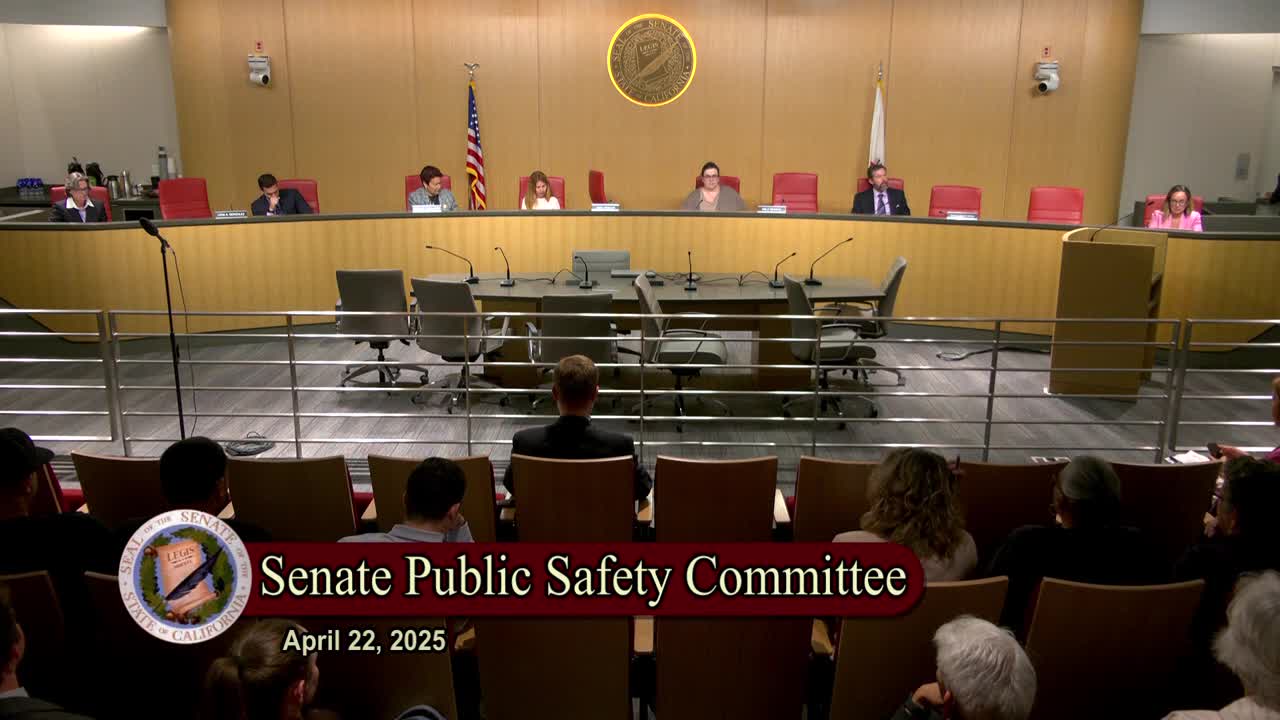
Bill Author

Bill Co-Author(s):