AB 1018: Medi-Cal: Early and Periodic Screening, Diagnosis, and Treatment (EPSDT).
- Session Year: 2015-2016
- House: Assembly
- Latest Version Date: 2015-05-28
Existing law provides for the Medi-Cal program, which is administered by the State Department of Health Care Services, under which qualified low-income individuals receive health care services. The Medi-Cal program is, in part, governed and funded by federal Medicaid Program provisions. Existing law provides that Early and Periodic Screening, Diagnosis, and Treatment (EPSDT) services for any individual under 21 years of age is covered under Medi-Cal consistent with the requirements of federal law. Under federal law, EPSDT services include screening services, vision services, dental services, hearing services, and other necessary services to correct or ameliorate defects and physical and mental illnesses and conditions discovered by the screening services, whether or not the services are covered under the state plan. Existing federal law, the Individuals with Disabilities Education Act, requires that a free appropriate public education be made available to individuals with exceptional needs, and be tailored to their individual needs.
This bill would require the department to permit county mental health plans to contract with local educational agencies (LEAs), as defined, to provide services for Medi-Cal eligible pupils under EPSDT. The bill would also require the department to permit an LEA to make claims for federal financial participation directly to the department for EPSDT services provided by the LEA or that the LEA has contracted for. The bill would also require the department to examine methodologies for increasing LEA participation in the Medi-Cal program so that schools can meet the educationally related health care needs of their pupils.
This bill would require the State Department of Health Care Services and the Department of Education to convene a joint task force to examine the delivery of mental health services to children eligible for EPSDT services and for services pursuant to the federal Individuals with Disabilities Education Act, and to consider specified subjects. The bill would require the task force to hold at least 2 public meetings by October 1, 2016, and to submit a report to the Legislature covering key findings and recommendations for further action, if any.
Existing law provides for the Medi-Cal program, which is administered by the State Department of Health Care Services, under which qualified low-income individuals receive health care services. The Medi-Cal program is, in part, governed and funded by federal Medicaid Program provisions. Existing law provides that Early and Periodic Screening, Diagnosis, and Treatment (EPSDT) for any individual under 21 years of age is covered under Medi-Cal consistent with the requirements of federal law. Under federal law, EPSDT services include screening services, vision services, dental services, hearing services, and other necessary services to correct or ameliorate defects and physical and mental illnesses and conditions discovered by the screening services, whether or not the services are covered under the state plan.
This bill would require the department to permit county mental health plans to contract with local educational agencies (LEAs), as defined, to provide services for Medi-Cal eligible pupils under EPSDT. The bill would also require the department to permit an LEA to make claims for federal financial participation directly to the department for EPSDT services provided by the LEA or that the LEA has contracted for. The bill would also require the department to examine methodologies for increasing LEA participation in the Medi-Cal program so that schools can meet the educationally related health care needs of their pupils.
(a)The Legislature finds that it is in the states interest to ensure delivery of mental health services to children in California is coordinated, accessible, and cost-effective.
(b)The State Department of Health Care Services and the State Department of Education shall convene a joint task force to examine the delivery of mental health services to children eligible for Early and Periodic Screening, Diagnosis, and Treatment services and for services pursuant to the federal Individuals with Disabilities Education Act (20 U.S.C. Sec. 1400 et seq.). The goal of the task force shall be to ensure children are provided accessible and coordinated care that is compliant with state and federal law, in a way that is maximally cost-effective for the state. The task force shall consider all of the following:
(1)Whether current technical assistance and guidance to county mental health plans and schools is sufficient to optimize service delivery and overall cost-effectiveness of service delivery.
(2)Whether current funding arrangements for services available through the Early and Periodic Screening, Diagnosis, and Treatment Program and pursuant to the federal Individuals with Disabilities Education Act maximize federal funding to the state for provision of these services.
(3)Issuing best practice guidelines for how special education local plan areas and county mental health plans can work together to optimize access to federal financial participation for eligible services in both systems.
(4)How disputes over responsibility for service delivery is, and should be, resolved in cases where children are dually eligible for Early Periodic Screening, Diagnosis, and Treatment services and services pursuant to the federal Individuals with Disabilities Education Act.
(c)The task force shall solicit information from relevant stakeholders. By October 1, 2016, the task force shall hold at least two public meetings. By January 1, 2017, the task force shall report to the Legislature a summary of key findings and recommendations for further action, if any.
(d)(1)A report to be submitted pursuant to subdivision (c) shall be submitted in compliance with Section 9795 of the Government Code.
(2)Pursuant to Section 9795 of the Government Code, this section is repealed on January 1, 2021.
SECTION 1.Section 14727 is added to the Welfare and Institutions Code, to read:14727.(a)(1)The department shall permit county mental health plans to contract with local educational agencies (LEAs) to provide services for Medi-Cal eligible pupils under Early and Periodic Screening, Diagnosis, and Treatment (EPSDT).
(2)(A)Subject to subparagraph (B), if an LEA does not have a contract with the county mental health plan, the department shall permit an LEA to make claims for federal financial participation directly to the department for EPSDT services provided by the LEA or that the LEA has contracted for. Unless otherwise precluded by federal law, an LEA shall be reimbursed for all eligible EPSDT services provided under this section.
(B)To receive federal financial participation under this paragraph, the LEA shall pay the nonfederal share of EPSDT expenditures and shall certify its public expenditures for EPSDT services to the department.
(b)(1)Services that a county mental health plan may contract with an LEA for, or that an LEA may receive federal financial participation for, under this section include, but are not limited to, any of the following:
(A)Mental health assessments.
(B)Targeted case management services.
(C)Behavioral services.
(D)Mental health, social work, and counseling services.
(E)Individual and group services.
(F)Crisis intervention.
(G)Day treatment.
(H)Residential treatment.
(I)Medication support services.
(2)The Legislature does not intend for this section to authorize an LEA or a county mental health plan to knowingly provide, or submit a claim for, duplicated EPSDT services.
(c)The department shall examine methodologies for increasing LEA participation in the Medi-Cal program so that schools can meet the educationally related health care needs of their pupils, which shall include simplifying the claiming processes for Medi-Cal billing to the extent possible.
(d)For purposes of this section, local educational agency has the same meaning as that term is defined in Section 56026.3 of the Education Code.
(e)This section shall be implemented to the extent permitted by federal law. The department shall seek any necessary state plan amendments or waiver amendments to implement this section and shall undertake all necessary activities to obtain federal financial participation for reimbursable services provided by LEAs or contracted for by LEAs under this section.
(a)(1)The department shall permit county mental health plans to contract with local educational agencies (LEAs) to provide services for Medi-Cal eligible pupils under Early and Periodic Screening, Diagnosis, and Treatment (EPSDT).
(2)(A)Subject to subparagraph (B), if an LEA does not have a contract with the county mental health plan, the department shall permit an LEA to make claims for federal financial participation directly to the department for EPSDT services provided by the LEA or that the LEA has contracted for. Unless otherwise precluded by federal law, LEAs an LEA shall be reimbursed for all eligible EPSDT services provided under this section.
(B)To receive federal financial participation under this paragraph, the LEA shall pay the nonfederal share of EPSDT expenditures and shall certify its public expenditures for EPSDT services to the department.
(b)(1)Services that a county mental health plan may contract with an LEA for, or that an LEA may receive federal financial participation for, under this section include, but are not limited to, any of the following:
(A)Mental health assessments.
(B)Targeted case management services.
(C)Behavioral services.
(D)Mental health, social work, and counseling services.
(E)Individual and group services.
(F)Crisis intervention.
(G)Day treatment.
(H)Residential treatment.
(I)Medication support services.
(2)The Legislature does not intend for this section to authorize an LEA or a county mental health plan to knowingly provide, or submit a claim for, duplicated EPSDT services.
(c)The department shall examine methodologies for increasing LEA participation in the Medi-Cal program so that schools can meet the educationally related health care needs of their pupils, which shall include simplifying the claiming processes for Medi-Cal billing to the extent possible.
(d)For purposes of this section, local educational agency has the same meaning as that term is defined in Section 56026.3 of the Education Code.
(e)This section shall be implemented to the extent permitted by federal law. The department shall seek any necessary state plan amendments or waiver amendments to implement this section and shall undertake all necessary activities to obtain federal financial participation for reimbursable services provided by LEAs or contracted for by LEAs under this section.
(a)(1)The department shall permit county mental health plans to contract with local educational agencies (LEAs) to provide services for Medi-Cal eligible pupils under Early and Periodic Screening, Diagnosis, and Treatment (EPSDT).
(2)(A)Subject to subparagraph (B), if an LEA does not have a contract with the county mental health plan, the department shall permit an LEA to make claims for federal financial participation directly to the department for EPSDT services provided by the LEA or that the LEA has contracted for. Unless otherwise precluded by federal law, LEAs shall be reimbursed for all eligible EPSDT services provided under this section.
(B)To receive federal financial participation under this paragraph, the LEA shall pay the nonfederal share of EPSDT expenditures and shall certify its public expenditures for EPSDT services to the department.
(b)(1)Services that a county mental health plan may contract with an LEA for, or that an LEA may receive federal financial participation for, under this section include, but are not limited to, any of the following:
(A)Mental health assessments.
(B)Targeted case management services.
(C)Behavioral services.
(D)Mental health, social work, and counseling services.
(E)Individual and group services.
(F)Crisis intervention.
(G)Day treatment.
(H)Residential treatment.
(I)Medication support services.
(2)The Legislature does not intend for this section to authorize an LEA or a county mental health plan to knowingly provide, or submit a claim for, duplicated EPSDT services.
(c)The department shall examine methodologies for increasing LEA participation in the Medi-Cal program so that schools can meet the educationally related health care needs of their pupils, which shall include simplifying the claiming processes for Medi-Cal billing to the extent possible.
(d)For purposes of this section, local educational agency has the same meaning as that term is defined in Section 56026.3 of the Education Code.
(e)This section shall be implemented to the extent permitted by federal law. The department shall seek any necessary state plan amendments or waiver amendments to implement this section and shall undertake all necessary activities to obtain federal financial participation for reimbursable services provided by LEAs or contracted for by LEAs under this section.
|
Date
|
Status
|
|---|---|
| May 28, 2015 | Read second time and amended. Ordered returned to second reading. |
| Aug 27, 2015 | In committee: Held under submission. |
| Aug 17, 2015 | In committee: Referred to APPR. suspense file. |
| Jul 2, 2015 | From committee: Do pass and re-refer to Com. on APPR. (Ayes 7. Noes 0.) (July 1). Re-referred to Com. on APPR. |
| Jun 24, 2015 | From committee: Do pass and re-refer to Com. on HEALTH. (Ayes 9. Noes 0.) (June 24). Re-referred to Com. on HEALTH. |
| Jun 11, 2015 | Referred to Coms. on ED. and HEALTH. |
| Jun 2, 2015 | Read third time. Passed. Ordered to the Senate. (Ayes 71. Noes 0. Page 1813.) |
| Jun 2, 2015 | Read third time. Passed. Ordered to the Senate. |
| Jun 2, 2015 | In Senate. Read first time. To Com. on RLS. for assignment. |
| Jun 1, 2015 | Read second time. Ordered to third reading. |
| Feb 26, 2015 | Read first time. To print. |
| May 28, 2015 | From committee: Amend, and do pass as amended. (Ayes 17. Noes 0.) (May 28). |
| Apr 29, 2015 | In committee: Set, first hearing. Referred to APPR. suspense file. |
| Apr 22, 2015 | From committee: Do pass and re-refer to Com. on APPR. (Ayes 18. Noes 0.) (April 21). Re-referred to Com. on APPR. |
| Apr 14, 2015 | Re-referred to Com. on HEALTH. |
| Apr 14, 2015 | In committee: Set, first hearing. Hearing canceled at the request of author. |
| Apr 13, 2015 | From committee chair, with author's amendments: Amend, and re-refer to Com. on HEALTH. Read second time and amended. |
| Mar 19, 2015 | Referred to Com. on HEALTH. |
| Feb 27, 2015 | From printer. May be heard in committee March 29. |
|
Date
|
Description
|
Location
|
Votes
|
|
|---|---|---|---|---|
| Aug 17, 2015 | Placed on suspense file | Senate Standing Committee on Appropriations |
Passed |
|
| Jul 1, 2015 | Do pass, but first be re-referred to the Committee on [Appropriations] | Senate Standing Committee on Health |
Passed |
|
| Jun 24, 2015 | Do pass, but first be re-referred to the Committee on [Health] | Senate Standing Committee on Education |
Passed |
|
| Jun 2, 2015 | AB 1018 COOPER Assembly Third Reading | Assembly Floor |
Passed |
|
| May 28, 2015 | Do pass as amended. | Assembly Standing Committee on Appropriations |
Passed |
|
| Apr 21, 2015 | Do pass and be re-referred to the Committee on [Appropriations] | Assembly Standing Committee on Health |
Passed |
This list shows positions taken on this bill by organizations on the date displayed, which is linked to the original source.
Positions by individuals are not included.
|
Organization
|
Position
|
Date
|
|---|---|---|
| Association Of California School Administrators | ** Support | Jul 1, 2015 |
| Butte County Special Education Local Plan Area | ** Support | Jul 1, 2015 |
| California Academy Of Family Physicians | ** Support | Apr 21, 2015 |
| California Association for School Business Officials | ** Support | Jul 1, 2015 |
| California Association Of School Psychologists | * Support | Apr 21, 2015 |
| California Black Health Network | ** Support | Jul 1, 2015 |
| California Council Of Community Mental Health Agencies | ** Against | Apr 21, 2015 |
| California Medical Association, Inc. | ** Support | Jul 1, 2015 |
| California Right to Life Committee, Inc. | ** Against | Jul 1, 2015 |
| California School Boards Association | ** Support | Jul 1, 2015 |
| California SELPA Organization | * Support | Apr 21, 2015 |
| California State Association Of Counties | * Neutral | Apr 21, 2015 |
| Coalition for Adequate Funding for Special Education | ** Support | Jul 1, 2015 |
| Elk Grove Unified School District | * Support | Apr 21, 2015 |
| Medical Billing Technologies, Inc. | ** Support | Jul 1, 2015 |
| Mount Diablo Unified Special Education Local Plan Area | ** Support | Jul 1, 2015 |
| Nami California | ** Support | Jul 1, 2015 |
| Napa County Special Education Local Plan Area | ** Support | Apr 21, 2015 |
| One individual | ** Support | Apr 21, 2015 |
| Santa Clara County Office Of Education | ** Support | Jul 1, 2015 |
| SELPA Administrators of California | ** Support | Jun 24, 2015 |
| SOAR | * Support | Apr 21, 2015 |
| SOAR Coalition | * Support | Apr 21, 2015 |
| Solano County Special Education Local Plan Area | ** Support | Apr 21, 2015 |
| Special Education Local Plan Area Administrators of California | ** Support | Jul 1, 2015 |
| Special Opportunities For Access & Reform Coalition | ** Support | Jul 1, 2015 |
| Twin Rivers Unified School District | ** Support | Jul 1, 2015 |
| Yellow County SELPA | * Support | Apr 21, 2015 |
AB 1018 (Cooper) Page 2 of 2
SENATE COMMITTEE ON APPROPRIATIONS
Senator Ricardo Lara, Chair
2015 - 2016 Regular Session
AB 1018 (Cooper) - Medi-Cal: Early and Periodic Screening, Diagnosis, and Treatment (EPSDT)
|
|
Version: May 28, 2015 |
Policy Vote: ED. 9 - 0, HEALTH 7 - 0 |
Urgency: No |
Mandate: No |
Hearing Date: August 17, 2015 |
Consultant: Brendan McCarthy |
This bill meets the criteria for referral to the Suspense File.
Bill Summary:
AB 1018 would require the Department of Health Care Services and the Department of Education to convene a joint taskforce to examine the delivery of mental health services to children.
Fiscal Impact:
One-time costs up to $100,000 for the Department of Health Care Services to provide staff support to the taskforce and develop the required report (General Fund and federal funds).
One-time costs of $105,000 for the Department of Education to provide staff support to the taskforce and develop the required report (General Fund).
One-time costs of about $20,000 for logistical support of the task force, including reimbursing travel expenses for members (General Fund and federal funds).
Background:
Under state and federal law, the Department of Health Care Services operates the Medi-Cal program, which provides health care coverage to low income individuals, families, and children. Medi-Cal provides coverage to childless adults and parents with household incomes up to 138% of the federal poverty level and to children with household incomes up to 266% of the federal poverty level. The federal government provides matching funds that vary from 50% to 90% of expenditures depending on the category of beneficiary.
As part of the Medi-Cal program, the Early and Periodic Screening, Diagnosis, and Treatment (EPSDT) program, provides health care and mental health benefits to Medi-Cal enrollees under age 21. Typically, mental health services covered under EPSDT are considered specialty mental health services and are provided (and paid for) by county mental health plans.
Prior to 2012, students who had mental health needs documented in their individualized education plan were referred by local educational agencies to county mental health plans to receive specialty mental health services. Budget trailer bill adopted in 2011 shifted responsibility for providing certain mental health services from county mental health plans to local educational agencies. Mental health services identified in a student’s individualized education plan must be provided directly by the local educational agency or through contracts with outside providers. (This did not eliminate the county obligation to fund specialty mental health services.) While local educational agencies are required to ensure that student mental health service needs are met, local educational agencies can only provide and bill for EPSDT services if the local educational agency contracts with the county mental health plan. At this time, local educational agencies may provide mental health services without seeking Medi-Cal reimbursement, enroll as a Medi-Cal provider and bill Medi-Cal for services provided to Medi-Cal enrollees, or collaborate with a county mental health plan to secure mental health services through the county mental health plan.
Proposed Law:
AB 1018 would require the Department of Health Care Services and the Department of Education to convene a joint taskforce to examine the delivery of mental health services to children.
The bill would require the taskforce to consider several issues relating to the delivery of mental health services to students, funding arrangements to pay for those services, best practices for coordination between school organizations and county mental health plans, and other issues.
The bill would require a report from the taskforce to the Legislature by January 1, 2017.
The bill’s provisions would sunset on January 1, 2021.
Related Legislation:
AB 1133 (Achadjian) would establish a four year pilot project to provide outreach and technical assistance to local educational agencies for providing mental health services at school sites. That bill was held on the Assembly Appropriations Committee’s Suspense File.
Staff Comments:
The Joint Legislative Audit Committee recently approved an audit request, requiring the Bureau of State Audits to review the provision of mental health services to students.
-- END --
AB 1018 (Cooper) Page 5 of 5
SENATE COMMITTEE ON HEALTH
Senator Ed Hernandez, O.D., Chair
BILL NO: AB 1018
AUTHOR: |
Cooper |
||
VERSION: |
May 28, 2015 |
||
HEARING DATE: |
July 1, 2015 |
|
|
CONSULTANT: |
Reyes Diaz |
||
SUBJECT: Medi-Cal: Early and Periodic Screening, Diagnosis, and Treatment (EPSDT).
SUMMARY:
Requires the Department of Health Care Services and the Department of Education to convene a task force, as specified, to examine the delivery of mental health services through the EPSDT services.
Existing law:
Establishes the Medi-Cal program, administered by the Department of Health Care Services (DHCS), under which eligible low-income individuals receive health care services subject to state and federal laws and funding.
Establishes the Medi-Cal EPSDT program for eligible individuals under 21 years, including screening, vision, dental, hearing, and other necessary services to correct or ameliorate defects and physical and mental illnesses and conditions discovered by the screening services, whether or not the services are covered under the State Plan.
Establishes, under the terms of a federal Medicaid waiver, a managed care program providing Medi-Cal specialty mental health (MH) services for eligible low-income persons administered through local county MH plans under contract with DHCS.
This bill:
Requires DHCS and the Department of Education to convene a joint task force to examine the delivery of MH services to children eligible for EPSDT services and for services pursuant to the federal Individuals with Disabilities Education Act (IDEA). Specifies that the goal of the task force is to ensure children are provided accessible and coordinated care that is compliant with state and federal law, in a way that is maximally cost-effective for the state.
Requires the task force to consider all of the following:
Whether current technical assistance and guidance to county MH plans and schools is sufficient to optimize service delivery and overall cost-effectiveness of service delivery;
Whether current funding arrangements for services available through the EPSDT program and pursuant to IDEA maximize federal funding to the state for provision of these services;
Issuing best practice guidelines for how special education local plan areas (SELPAs) and county MH plans can work together to optimize access to federal financial participation for eligible services in both systems; and,
How disputes over responsibility for service delivery is, and should be, resolved in cases where children are dually eligible for EPSDT and IDEA services.
Requires the task force to solicit information from relevant stakeholders; to hold at least two public meetings by October 1, 2016; and to report to the Legislature by January 1, 2017, a summary of key findings and recommendations for further action, if any.
Repeals the provisions in this bill on January 1, 2021.
FISCAL EFFECT:
According to the Assembly Appropriations Committee, this bill would impose one-time administrative costs to DHCS, likely under $100,000 (General Fund/federal) to staff support for a stakeholder workgroup.
PRIOR VOTES:
Assembly Floor: |
71 - 0 |
Assembly Appropriations Committee: |
17 - 0 |
Assembly Health Committee: |
18 - 0 |
COMMENTS:
Author’s statement. According to the author, EPSDT Medi-Cal funding has always been part of the total funding package for serving the MH needs of pupils with disabilities. The state shifted 100% of the MH service responsibility to schools in 2011 but did not shift access to all the funding that is available to reimburse schools for delivering the services to students. There is no state policy or direction on how a local education agency (LEA) or SELPA can seek direct access to Medi-Cal funding for EPSDT through county managed care. Instead, it is up to each LEA or SELPA to negotiate directly with county MH programs. This has created a hurdle for many LEAs/SELPAs across the state. The county MH program determines at the local level whether they want the LEA or SELPA to be vendorized or certified to bill Medi-Cal. EPSDT is a federal entitlement program without a cap. LEAs should be eligible for direct access to EPSDT funding in order to provide eligible children a range of MH services. It is in the state’s best interest to seek federal funding to serve the needs of the eligible recipient, regardless of who the service provider is, whether the services are offered by county MH or a LEA/SELPA.
Background. The federal IDEA provides that students with exceptional needs identified as having emotional disturbance may be eligible to receive MH services, which are considered related services and include counseling, psychological services, parent counseling and training, and residential placement, among others.
Prior to 2012, a student with exceptional needs, who also had MH needs and services documented in their individualized education plan (IEP), was referred by the local educational agencies (LEAs) to county MH agencies for treatment, pursuant to AB 3632 (Willie Brown, Chapter 26, Statutes of 1984). AB 114 (Committee on Budget, Chapter 43, Statutes of 2011) shifted responsibility for providing and funding IDEA-related MH services from county MH agencies to LEAs (the Superintendent of Public Instruction is responsible for monitoring LEAs to ensure compliance). Any and all services identified in a student’s IEP must be provided, whether directly by LEA employees or through contract with outside providers, such as county MH agencies. LEAs are required to ensure services are provided to students regardless of who provides or pays for those services.
The EPSDT program is a Medi-Cal benefit for people under the age of 21 who have “full-scope” Medi-Cal eligibility. This benefit allows for periodic screenings to determine health care needs and, based upon the identified health care need and diagnosis, treatment services are provided. EPSDT services include all services otherwise covered by Medi-Cal, and EPSDT beneficiaries can receive additional medically necessary services. EPSDT provides eligible children access to a range of MH services that include, among other things, MH assessment, MH services, therapy, rehabilitation, therapeutic behavioral services, crisis intervention/stabilization, day rehabilitation/day treatment, medication support, and case management.
LEAs. LEAs are responsible for educationally necessary MH services that are identified in a student’s IEP, but are prohibited from directly providing or billing for EPDST services unless the county MH department chooses to contract with the LEA for those services (EPSDT is considered specialty MH). LEAs are required to ensure services identified in a student’s IEP are provided, regardless of whether the county directly provides services, denies services, or reimburses the school for any costs if the LEA provides services (in cases where the LEA provides services covered under general Medi-Cal that overlap with EPSDT services).
According to CDE, LEAs may use one or more of the following options for sourcing MH services to Medi-Cal eligible students (including EPSDT and other MH services):
Provide and pay for services without seeking Medi-Cal reimbursement.
Use the LEA Medi-Cal Billing Option Program. Through this program, the LEA employs or contracts with qualified practitioners to provide the services pursuant to the IEP, pays for the services, and submits a claim for reimbursement. In order to use this option, the LEA must meet a number of administrative conditions, including enrollment as a Medi-Cal provider.
For EPSDT services, collaborate with county MH departments to secure the specialty MH services through the county MH plan. There are two ways an LEA can secure these services:
Enter into a contract or Memorandum of Understanding with the MH plan for a specialty MH service or an array of specialty MH services. In this case, county MH plans provide the service and incur the cost, and bill Medi-Cal for federal reimbursement.
Request to be a certified provider of Medi-Cal specialty MH services from the county MH plan. If the county MH plan certifies the LEA as an organizational provider, the LEA would provide the specialty MH service through an LEA qualified employee and submit a claim to the county MH plan for reimbursement.
Audit request. Senator Beall requested an audit of MH services for students, which was approved by the Joint Legislative Audit Committee on April 22, 2015. The audit request covers MH services more broadly than EPSDT services. Specifically, the request asks for the audit to, among other things:
Provide the following information for pre- and post-AB 114 disaggregated by students for whom an IEP identifies them as emotionally disturbed, for students whose IEP may also call for MH services, and for students who qualify or do not quality for Med-Cal services:
Compare the number of students each special education local plan area (SELPA) served under AB 3632 to the number served under AB 114;
Determine whether the type of frequency of service, and the providers of services, changed under the transition from AB 3632 to AB 114; and,
For a selection of students served under AB 3632, determine whether their IEPs were changed during the SELPA’s transition to AB 114.
Determine whether changes in treatment were made by service providers as a result of the transition from AB 3632 to AB 114.
Identify the state and federal funding sources for MH services for students with disabilities for the past five fiscal years.
Identify the number of students with MH issues in California and compare that to the number of students actually receiving services.
Double referral. This bill was heard in the Senate Education Committee on July 24, 2015, and passed out with a vote of 9-0.
Related legislation. AB 1299 (Ridley-Thomas), requires the California Health and Human Services Agency to coordinate with DHCS and the Department of Social Services to facilitate the receipt of medically necessary specialty MH services by foster youth, as specified, and for DHCS to meet specific conditions on or before July 1, 2016. AB 1299 is set for hearing on July 14, 2015, in the Senate Human Services Committee.
AB 1133 (Achadjian), establishes a four year pilot program, the School-Based Early Mental Health Intervention and Prevention Services Support Program to provide outreach, free regional training, and technical assistance for LEAs in providing MH services at school sites. AB 1133 was held on the Assembly Appropriations Committee’s suspense file.
Prior legislation. AB 2212 (Gray, of 2014), required DHCS to allow county MH plans to contract with local educational agencies (LEAs) to provide EPSDT services. AB 2212 was held on the Assembly Appropriations Committee’s suspense file.
AB 114 (Committee on Budget), shifted responsibility for MH services for students from counties to LEAs.
Support. The sponsors and other supporters of this bill, including special education advocates and LEAs, argue that when responsibility was shifted, from county agencies to schools, the state did not address the issue of how school districts could access or seek reimbursement directly from Medi-Cal and the federal government for related services under the EPSDT program. Supporters argue that it is critical that LEAs have access to these additional Medi-Cal dollars to help serve the needs of their pupils.
Opposition. The California Right to Life Committee, Inc. (CRLC) argues that this bill focuses on providing more MH services through schools for young children and youth. CRLC states they are concerned about this trend because it will lead to an identification of children having one MH diagnosis or another based on a subjective evaluation, which may not have been correct at the time.
SUPPORT AND OPPOSITION:
Support:
Special Opportunities for Access & Reform Coalition (SELPAs of Merced, Napa, Solano, Sutter, and Yolo Counties) (sponsor)
Association of California School Administrators
Butte County Special Education Local Plan Area (previous version)
California Association for School Business Officials (previous version)
California Black Health Network (previous version)
California Medical Association (previous version)
California School Boards Association (previous version)
Coalition for Adequate Funding for Special Education
Elk Grove Unified School District Special Education Local Planning Area (previous version)
Medical Billing Technologies, Inc. (previous version)
Mount Diablo Unified Special Education Local Plan Area (previous version)
NAMI California (previous version)
Santa Clara County Office of Education
Special Education Local Plan Area Administrators of California
Twin Rivers Unified School District (previous version)
Oppose: California Right to Life Committee, Inc.
-- END --
AB 1018 (Cooper) Page 5 of 5
SENATE COMMITTEE ON EDUCATION
Senator Carol Liu, Chair
2015 - 2016 Regular
Bill No: AB 1018
Author: |
Cooper |
||
Version: |
May 28, 2015 Hearing Date: June 24, 2015 |
||
Urgency: |
No |
Fiscal: |
Yes |
Consultant: |
Lynn Lorber |
||
Subject: Medi-Cal: Early and Periodic Screening, Diagnosis, and Treatment (EPSDT)
NOTE: This bill has been referred to the Committees on Education and Health. A “do pass” motion should include referral to the Committee on Health.
SUMMARY
This bill requires the California Department of Education and the Department of Health Care Services to convene a task force to examine the delivery of mental health services through the Early and Periodic Screening, Diagnosis, and Treatment services.
BACKGROUND
The federal Individuals with Disabilities Education Act provides that students with exceptional needs identified as having “emotional disturbance” may be eligible to receive mental health services. Mental health services are considered “related services” and include counseling, psychological services, parent counseling and training, and residential placement, among others. (United States Code, Title 20, § 1400 et seq. and Code of Federation Regulations, Title 34, § 300.34)
AB 114 (Committee on Budget), Chapter 43, Statutes of 2011, shifted responsibility for mental health services for students from counties to local educational agencies (LEAs). Any and all services identified in a student’s individualized education program (IEP) must be provided, whether directly by LEA employees or through contract with outside providers such as county mental health agencies. LEAs are required to ensure services are provided to students regardless of who provides or pays for those services. (Education Code § 56139)
The Early and Periodic Screening, Diagnostic and Treatment program (EPSDT) is a Medi-Cal benefit for people under the age of 21 who have “full-scope” Medi-Cal eligibility. This benefit allows for periodic screenings to determine health care needs and based upon the identified health care need and diagnosis, treatment services are provided. EPSDT services include all services otherwise covered by Medi-Cal, and EPSDT beneficiaries can receive additional medically necessary services. EPSDT provides eligible children access to a range of mental health services that include, among other things, mental health assessment, mental health services, therapy, rehabilitation, therapeutic behavioral services, crisis intervention/stabilization, day rehabilitation/day treatment, medication support and case management.
ANALYSIS
This bill requires the California Department of Education (CDE) and the Department of Health Care Services (DHCS) to convene a task force to examine the delivery of mental health services through the Early and Periodic Screening, Diagnosis, and Treatment (EPSDT) services. Specifically, this bill:
Provides that the goal of the task force is to ensure that children are provided accessible and coordinated care that is compliant with state and federal law, in a way that is maximally cost-effective for the State.
Requires the task force to consider all of the following:
Whether current technical assistance and guidance to county mental health plans and schools is sufficient to optimize service delivery and overall cost-effectiveness of service delivery.
Whether current funding arrangements for services available through the EPSDT program and pursuant to the federal IDEA maximize federal funding to the State for provision of these services.
Issuing best practice guidelines for how special education local plan areas and county mental health plans can work together to optimize access to federal financial participation for eligible services in both systems.
How disputes over responsibility for service delivery is, and should be, resolved in cases where children are dually eligible for EPSDT services and services pursuant to the federal Individuals with Disabilities Education Act (IDEA).
Requires the task force to hold at least two public meetings by October 1, 2016, and report to the Legislature by January 1, 2017, a summary of key findings and recommendations for further action, if any.
Requires the task force to solicit information from relevant stakeholders.
Sunsets the provision of this bill on January 1, 2021.
STAFF
COMMENTS
Need for the bill. According to the author, “The Early and Periodic Screening, Diagnosis, and Treatment program (EPSDT) Medi-Cal funding has always been part of the total funding package for serving the mental health needs of pupils with disabilities. The state shifted 100% of the mental health service responsibility to schools in 2011 but did not shift access to all the funding that is available to reimburse schools for delivering the services to students. There is no state policy or direction on how a local educational agency (LEA) or special education local plan area (SELPA) can seek direct access to the Medi-Cal funding for the EPSDT program through county managed care. Instead, it is up to each individual LEA or SELPA to negotiate directly with their county mental health program on whether this option would work in their area. This has created a hurdle for many local educational agencies (LEAs) and special education local plan areas (SELPAs) across the state.”
Specialty mental health services. Prior to 2012, a student with exceptional needs with mental health needs and services documented in the student’s individualized education plan (IEP) was referred by the LEA to county mental health agencies for treatment, as called for under AB 3632 (Willie Brown, Ch. 26, 1984). AB 114 (Committee on Budget, Ch. 43, 2011) shifted responsibility for providing and funding Individuals with Disabilities Education Act (IDEA)-related mental health services from county mental health agencies to LEAs (the Superintendent of Public Instruction is responsible for monitoring LEAs to ensure compliance).
LEAs are responsible for educationally-necessary mental health services that are identified in a student’s IEP, but are prohibited from directly providing or billing for EPDST services unless the county mental health department chooses to contract with the LEA for those services (Early and Periodic Screening, Diagnosis, and Treatment program (EPSDT) is considered “specialty” mental health). LEAs are required to ensure services identified in a student’s IEP are provided, regardless of whether the county directly provides services, denies services, or reimburses the school for any costs if the LEA provides services (in cases where LEA provides services covered under general Medi-Cal that overlap with EPSDT services).
According to California Department of Education (CDE), LEAs may use one or more of the following options for sourcing mental health services to Medi-Cal eligible students (including EPSDT and other mental health services):
Provide and pay for services without seeking Medi-Cal reimbursement.
Use the LEA Medi-Cal Billing Option Program. Through this program, the LEA employs or contracts with qualified practitioners to provide the services pursuant to the IEP, pays for the services, and submits a claim for reimbursement. In order to use this option, the LEA must meet a number of administrative conditions, including enrollment as a Medi-Cal provider.
For EPSDT services, collaborate with county mental health departments to secure the specialty mental health services through the county mental health plan. There are two ways an LEA can secure these services:
Enter into a contract or Memorandum of Understanding with the mental health plan for a specialty mental health service or an array of specialty mental health services. In this case, county mental health plans provide the service and incur the cost, and bill Medi-Cal for federal reimbursement.
Request to be a certified provider of Medi-Cal specialty mental health services from the county mental health plan. If the county mental health plan certifies the LEA as an organizational provider, the LEA would provide
the specialty mental health service through a local educational
agency (LEA)-qualified employee and submit a claim to the county
mental health plan for reimbursement.
http://www.cde.ca.gov/sp/se/ac/optsrltdsvcs.asp
Audit request. Senator Beall requested an audit of mental health services for students, which was approved by the Joint Legislative Audit Committee on April 22, 2015. The audit request covers mental health services more broadly than Early and Periodic Screening, Diagnosis, and Treatment program (EPSDT) services. Specifically, the request asks for the audit to, among other things:
Provide the following information for pre- and post-AB 114 disaggregated by students for whom an IEP identifies them as emotionally disturbed, for students whose IEP may also call for mental health services, and for students who qualify or do not quality for Med-Cal services:
Compare the number of students each special education local plan area (SELPA) served under AB 3632 to the number served under AB 114.
Determine whether the type of frequency of service, and the providers of services, changed under the transition from AB 3632 to AB 114.
For a selection of students served under AB 3632, determine whether their IEPs were changed during the SELPA’s transition to AB 114.
Determine whether changes in treatment were made by service providers as a result of the transition from AB 3632 to AB 114.
Identify the state and federal funding sources for mental health services for students with disabilities, for the past five fiscal years.
Identify the number of students with mental health issues in California and compare that to the number of students actually receiving services.
Fiscal impact. According to the Assembly Appropriations Committee, this bill would impose one-time administrative costs to DHCS, likely under $100,000 (General Fund/federal) to staff support for a stakeholder workgroup.
Related and prior legislation.
RELATED LEGISLATION
AB 1133 (Achadjian, 2015 ) establishes a four year pilot program, the School-Based Early Mental Health Intervention and Prevention Services Support Program (EMHI Support Program), to provide outreach, free regional training, and technical assistance for LEAs in providing mental health services at school sites. AB 1133 was held on the Assembly Appropriations Committee’s suspense file.
AB 1299 (Ridley-Thomas, 2015) requires the California Health and Human Services Agency to coordinate with Department of Health Care Services (DHCS) and the Department of Social Services to facilitate the receipt of medically necessary specialty mental health services by foster youth, as specified, and for Department of Health Care Services (DHCS) to meet specific conditions on or before July 1, 2016. AB 1299 is pending in the Senate Human Services Committee.
PRIOR LEGISLATION
AB 2212 (Gray, 2014) required DHCS to allow county mental health plans to contract with local educational agencies (LEAs) to provide Early and Periodic Screening, Diagnosis, and Treatment program (EPSDT) services. AB 2212 was held on the Assembly Appropriations Committee’s suspense file.
SUPPORT
Association of California School Administrators
California Association of School Business Officials
California School Boards Association
Coalition for Adequate Funding for Special Education
Santa Clara County Office of Education
SELPA Administrators of California
Special Opportunities for Access & Reform Coalition
OPPOSITION
California Right to Life Committee
-- END --
AB 1018
Page 2
ASSEMBLY THIRD READING
AB 1018
(Cooper)
As Amended May 28, 2015
Majority vote
Committee |
Votes |
Ayes |
Noes |
Health |
18-0 |
Bonta, Maienschein, Bonilla, Burke, Chávez, Chiu, Gomez, Gonzalez, Roger Hernández, Lackey, Nazarian, Patterson, Ridley-Thomas, Rodriguez, Santiago, Steinorth, Thurmond, Wood |
|
Appropriations |
17-0 |
Gomez, Bigelow, Bonta, Calderon, Chang, Daly, Eggman, Gallagher, Eduardo Garcia, Gordon, Holden, Jones, Quirk, Rendon, Wagner, Weber, Wood |
|
SUMMARY: Requires the Department of Health Care Services (DHCS) and the California Department of Education to convene a joint task force to examine the delivery of mental health services to children eligible for Early and Periodic Screening, Diagnosis, and Treatment services and for services required by the federal Individuals with Disabilities Education Act, as specified.
FISCAL EFFECT: According to the Assembly Appropriations Committee, this bill would have one-time administrative costs to DHCS, likely under $100,000 (General Fund/federal) to staff support for a stakeholder workgroup.
COMMENTS: Schools are a main provider of mental health services for children in California. The federal Individuals with Disabilities Education Act (IDEA) was adopted in 1975 to guarantee children with disabilities a right to public education in the least restrictive setting. In California, the federal IDEA mandate to provide special education services is administered by local school districts and local education agencies. Special education students may be eligible for health care services, including mental health services, in specific IDEA disability categories. Mental health services provided to special education students include counseling and guidance, psychological services, parental counseling and training, and residential placement, among others.
The Early and Periodic Screening, Diagnostic and Treatment (EPSDT) is a Medi-Cal benefit for individuals under the age of 21 who have full-scope Medi-Cal eligibility. This benefit allows for periodic screenings to determine health care needs and based upon the identified health care need and diagnosis, treatment services are provided. EPSDT services include all services otherwise covered by Medi-Cal and EPSDT beneficiaries can receive additional medically necessary services. EPSDT mental health services are Medi-Cal services that correct or improve mental health problems that have been determined by a physician, psychologist, counselor, social worker or other health or social services provider. EPSDT provides eligible children access to a range of mental health services that include, but are not limited to:
Mental health assessment;
Collateral contracts;
Therapy;
Rehabilitation;
Mental health services;
Medication support services;
Day rehabilitation; day treatment intensive;
Crisis intervention/stabilization;
Targeted case management; and,
Therapeutic behavioral services.
Analysis Prepared by: Paula Villescaz / HEALTH / (916) 319-2097 FN: 0000823
AB 1018
Page 5
Date of Hearing: April 29, 2015
ASSEMBLY COMMITTEE ON APPROPRIATIONS
Jimmy Gomez, Chair
AB 1018
(Cooper) – As Amended April 13, 2015
Policy Committee: |
Health |
Vote: |
18 - 0 |
|
|
|
|
|
|
|
|
Urgency: No State Mandated Local Program: No Reimbursable: No
SUMMARY:
This bill modifies provisions related to funding for Medi-Cal Early and Periodic Screening, Diagnosis, and Treatment (EPSDT) services to allow schools to provide, and be reimbursed for, services directly. Specifically, this bill:
Requires the California Department of Health Care Services (DHCS) to allow county mental health plans (MHPs) to contract with local education agencies (LEAs) to provide services for Medi-Cal eligible pupils under EPSDT.
Requires DHCS, in counties where the local education agency (LEA) does not have a contract with the county MHP, to allow the MHP to obtain federal funds on behalf of nonpublic agencies that contract with LEAs to provide those services, as specified.
States that unless otherwise precluded by federal law, LEAs and nonpublic agencies shall be reimbursed for specified EPSDT services.
Specifies LEAs provide matching funds for the services.
Defines services that a county MHP may contract for, or for which a nonpublic agency may receive federal financial participation.
Requires DHCS to examine methodologies for increasing LEA participation in the Medi-Cal program so that schools can meet the educationally related health care needs of their pupils, which includes simplifying the claiming processes for Medi-Cal billing.
Requires DHCS to seek necessary federal approvals.
FISCAL EFFECT:
One-time administrative costs to DHCS (GF/federal), likely in the hundreds of thousands of dollars, to renegotiate a federal waiver or develop a state plan amendment, issue guidance to clarify responsibility for provision of services, make any necessary adjustments to contracts with county MHPs, examine methodologies to simplify billing, and set up a separate billing and claiming structure for LEAs directly providing EPSDT services.
Significant ongoing additional administrative costs to DHCS to oversee and certify LEAs and other providers as direct providers of EPSDT services (GF/federal). DHCS is the single state agency responsible for certifying all federally reimbursed Medi-Cal expenditures. Ongoing costs would depend on how many LEAs and other providers chose to provide EPSDT services directly.
If direct billing by LEAs for EPSDT services becomes widespread, and assuming EPSDT services are paid for with Proposition 98 dollars, it could result in significant increased fiscal pressure on Proposition 98, proportionate to the dollar amount of services billed. The state already provides funding directly to counties to provide EPSDT services to eligible children. If EPSDT services were provided directly through schools without county MHP contracts and Proposition 98 funds were used instead, the state would be, in a sense, paying twice for those services. Since a redirection of Prop 98 funds for EPSDT would leave less funding available for other services, the bill would result in cost pressure to Proposition 98.
COMMENTS:
Purpose. According to the author, there is currently no state policy or direction on how an LEA can seek direct access to EPSDT mental health funding. Instead, each LEA or Special Education Local Plan Area (SELPA) must negotiate separately with each county MHP in order to be able to provide and be reimbursed for EPSDT mental health services for eligible students. Each MHP determines locally whether they want the LEA or SELPA to provide these services. The author contends that in 2011, the state shifted 100% of the service responsibility for the mental health special education needs of children, but left responsibility for EPSDT services with counties, and did not provide schools access to EPSDT funding.
Federal IDEA requirements on schools. The federal Individuals with Disabilities Education Act (IDEA) entitles all children with disabilities to a free, appropriate public education that prepares them to live and work in the community, including mental health treatment services necessary to benefit from their education. Pursuant to IDEA, LEAs define the services students with disabilities need in order to benefit from their education through an individualized education program (IEP). An IEP can include mental health services.
County Mental Health and EPSDT. The 2011 realignment left counties fully responsible for providing and funding specialty mental health services for Medi-Cal eligible individuals. Through contracts with the state DHCS, and pursuant to a specialty mental health waiver with the federal government, county MHPs are responsible for funding and providing EPSDT mental health services to Medi-Cal eligible children who meet clinical criteria. EPSDT is a broad set of services available to Medi-Cal eligible children, but the mental health portion of EPSDT is a smaller set of services which include group therapy, family therapy, case management, crisis counseling, medication, and other medically necessary services for children with serious mental illness.
County MHPs fulfill EPSDT obligations through direct service provision and contracts. Many county MHPs contract with LEAs or Special Education Local Plan Area (SELPAs) to provide certain services. County MHPs pay 100% of the costs of services and submit reimbursement claims to the federal government, through DHCS, to claim federal financial participation (FFP). By claiming FFP, counties can be reimbursed for about 50% of their costs. Counties fund their portion of the cost of these services through a combination of 2011 realignment funding, 1991 realignment funding, and Proposition 63 funds.
Recent Shifts of Responsibility. The roles and responsibilities of county mental health departments and LEAs to provide mental health services to students have changed over the years. Prior to 1984, school districts were responsible for providing all special education services to children. In 1984, the Legislature enacted AB 3632, which transferred responsibility for providing mental health services to special education pupils from school districts to county mental health departments. The intent was to build on counties’ existing expertise, and provide collaboration between schools and public mental health. AB 3632 services were deemed a state-reimbursable mandate.
In 2010, during the state's recent fiscal crisis, state funding for AB 3632 was vetoed and the mandate was suspended. AB 114 (Budget Committee), Chapter 43, Statutes of 2011, repealed provisions of AB 3632, and realigned responsibility for mental health services back to school districts. The federal IDEA now serves as the statutory framework for the provision of required services. The California Department of Education (CDE) provides guidance to LEAs on numerous aspects of this transition, including options LEAs have for claiming federal matching funds for qualifying services provided to Medi-Cal eligible children.
The issue here appears to be when there is overlap between IDEA and EPSDT, that is, when students are Medi-Cal eligible, eligible for specialty mental health services through a county mental health plan, and, in absence of Medi-Cal eligibility, would be provided services pursuant to IDEA by the school. In most counties, there appear to be successful partnerships to provide needed services to these children, which often involve school-based delivery of care.
LEA Billing Option Program. There is already an established mechanism through which LEAs can be reimbursed for providing certain Medi-Cal services on a fee-for-service basis to Medi-Cal eligible children. Through the LEA Billing Option Program, LEAs pay for the services with local funds, then file claims for federal reimbursement. LEAs are generally reimbursed 50 cents for every dollar spent, minus funds withheld for DHCS administrative costs. Thus, the program is fully funded with a combination of local and federal funds; there is no GF cost.
LEAs are only able to submit claims for services allowable under the federally approved State Plan for the LEA Medi-Cal Billing Option Program. There is some crossover with the list of services provided through EPSDT. EPSDT services that are also reimbursable through this program include psychology and counseling, case management, mental health assessments, nursing services, and other health services.
Opposition. The California Council of Community Mental Health Agencies states in opposition that this bill would require the state to seek federal approval to expand the scope of the school Medi-Cal billing option for LEAs to provide all services covered by the EPSDT county mental health program. According to the opposition, this is the wrong approach to this issue, as it ignores the need for a partnership between counties and schools. Moreover, it is not likely to be successful in getting federal approval as it is inconsistent with the managed care approach of the Medi-Cal county mental health system. The opposition states that a better approach is to ensure that counties fulfill their responsibilities to provide services to Medi-Cal enrolled students under the EPSDT program and partner with schools to identify and serve all youth who may need such services.
Related Legislation.
AB 1025 (Thurmond), pending in Assembly Education, requires CDE to establish a three-year pilot program to encourage inclusive practices that integrate mental health, special education, and school climate interventions following a multitiered framework.
AB 1133 (Achadjian), pending in Assembly Health, makes technical changes to existing law regarding grants to LEAs to pay the state share of costs of providing school-based early mental health intervention and prevention services to eligible students.
Prior Legislation.
AB 114 (Committee on Budget), Chapter 43, Statutes of 2011, a companion measure to the 2011-12 Budget bill, relieved county mental health departments of the responsibility to provide mental health services to students with disabilities (AB 3632 program) and transferred that responsibility to school districts.
AB 2212 (Gray) of 2014 was substantially similar to this bill and was held on the Suspense File of this committee.
Staff Comments. Through 2011 realignment, the state has completed the realignment of EPSDT services for Medi-Cal eligible children to counties, providing them both the responsibility and funding for these services. In many parts of the state, LEAs have entered contracts or MOUs to ensure appropriate services are provided to students who need them. It appears this bill intends to allow LEAs who are not able to secure contracts from MHPs to provide EPSDT services to bypass county MHPs, who are statutorily responsible for providing and funding such services. This raises the following issues:
Paying twice? The state is already providing funding directly to counties to provide EPSDT services. If the state were to allow LEAs to use Proposition 98 funding to directly draw down federal reimbursement to provide EPSDT services at the discretion of the LEA and outside of the county MHP structure, the state may be double-paying for those services. In effect, there would be an increase in Proposition 98 funding of EPSDT services without a decrease in county funding for such services. The net effect would be to reduce the funding available for other non-EPSDT Proposition 98 activities, increasing cost pressure on Proposition 98.
Definition of the Problem and Solution? Overall, from a state fiscal perspective, it makes sense to maximize federal reimbursement for EPSDT services provided to students with serious mental illness. If schools are directly providing or contracting for such services because of the federal IDEA mandate, and are not under contract with a county MHP, Proposition 98/GF is paying 100% of the costs of those services, which seems suboptimal. However, it should be noted that (1) not all mental health services provided by schools in order to meet IDEA requirements would be federally reimbursable, either because they are provided to children who are not Medi-Cal eligible or because the services are not covered EPSDT benefits, and (2) there are significant bureaucratic strings attached to claiming FFP, including administrative and audit requirements. According to the existing law structure, in an ideal scenario that is to the mutual benefit of the child requiring services, the school, and the state General Fund, anything that is an EPSDT service provided to a Medi-Cal eligible student should be provided through the coordinated structure of the county MHP and in a manner that works well for the student. Often, this will be school-based delivery of care. If there are local conditions where county MHPs are not making appropriate arrangements for children to get the care they are entitled to, a better approach may be to provide oversight of those county MHPs, or create a formal mechanism by which schools can raise and resolve issues relating to the adequacy of care, with state mediation and intervention if necessary. If, on the other hand, the problem in question is that the schools simply prefer to be the providers of these services, but the county MHPs find that a different mechanism of delivering the care is preferable, that seems more an issue of local coordination. For better or worse, the state has put those choices into the hands of counties through realignment. Finally, because of the dual mandate and the overlap in eligibility for mental health services through IDEA and EPSDT, it may be worth considering clarifying the responsibility of schools versus county MHPs to provide services for students entitled to those services through both IDEA and EPSDT, including who is the primary payer and who is the secondary payer, either through statute or through DHCS technical assistance or guidance.
Analysis Prepared by: Lisa Murawski / APPR. / (916) 319-2081
AB 1018
Page 6
Date of Hearing: April 21, 2015
ASSEMBLY COMMITTEE ON HEALTH
Rob Bonta, Chair
AB 1018
(Cooper) – As Amended April 13, 2015
SUBJECT: Medi-Cal: Early and Periodic Screening, Diagnosis, and Treatment (EPSDT).
SUMMARY: Requires the Department of Health Care Services (DHCS) to allow county mental health plans (MHPs) to contract with local educational agencies (LEAs) to provide services for Medi-Cal eligible pupils. Specifically, this bill:
Requires DHCS to allow county MHPs to contract with LEAs to provide EPSDT services to eligible students. EPSDT services are federally mandated services and benefits offered by Medi-Cal for children.
Requires DHCS to allow the MHP to obtain federal financial participation (FFP) for nonpublic agencies under contract with the LEA to provide EPSDT services if the LEA does not have a contract with the county MHP.
Requires LEAs to pay the nonfederal share of EPSDT expenditures in order to receive FFP.
Specifies that county MHPs may contract for, and nonpublic agencies may receive, federal funds for the following services:
Mental health assessments;
Targeted case management services;
Behavioral services;
Mental health, social work, and counseling services;
Individual and group services;
Crisis intervention;
Day treatment;
Residential treatment; and,
Medication support services.
Requires DHCS to examine methodologies for increasing LEA participation in the Medi-Cal program so that schools can meet the educationally related healthcare needs of their students, including simplifying the claiming processes for Medi-Cal billing to the extent possible.
Requires DHCS to seek any necessary Medi-Cal state plan or waiver amendments to implement this bill and to undertake any and all necessary activities to obtain federal funding for services provided by LEAs or entities an LEA contracts with for services.
EXISTING LAW:
Provides for the Medi-Cal program, administered by DHCS, under which eligible low-income individuals receive health care services subject to state and federal laws and funding.
Establishes the Medi-Cal EPSDT program for eligible individuals under 21 years.
Defines LEAs as a school district, a county office of education, a nonprofit charter school participating as a member of a special education local plan area, or a special education local plan area and allows LEAs to provide and bill for Medi-Cal services provided to students receiving special education services on Medi-Cal (generally, special education students).
Establishes, under the terms of a federal Medicaid waiver, a managed care program providing Medi-Cal specialty mental health services for eligible low-income persons administered through local county MHPs under contract with the state.
FISCAL EFFECT: This bill has not yet been analyzed by a fiscal committee.
COMMENTS:
PURPOSE OF THIS BILL. According to the author, this bill will provide LEAs and Special Education Local Plan Areas (SELPAs) with direct access to EPSDT funding for healthcare services, including mental health and trans-disciplinary assessments, both as an equitable funding mechanism and as an incentive for schools to intervene early before at-risk children show signs of failing. These vulnerable students are often trauma exposed, chemically exposed, autistic, developmentally challenged, and children stressed daily by impoverishment. The author states that this bill will allow these students to receive specifically targeted services in a timely manner.
BACKGROUND. Schools are a main provider of mental health services for children in California. The federal Individuals with Disabilities Education Act (IDEA) was adopted in 1975 to guarantee children with disabilities a right to public education in the least restrictive setting. In California, the federal IDEA mandate to provide special education services is administered by local school districts and local education agencies. Special education students may be eligible for health care services, including mental health services, in specific IDEA disability categories. Mental health services provided to special education students include counseling and guidance, psychological services, parental counseling and training, and residential placement, among others.
Section 1915(b) Medi-Cal Specialty Mental Health Services Waiver. Specialty Medi-Cal mental health services are provided under the terms of the federal Medicaid Medi-Cal Specialty Mental Health Services Consolidation 1915(b) waiver program. The waiver established a managed care program for specialty mental health services separate from the overall Medi-Cal program. Medi-Cal beneficiaries must receive specialty mental health services though county-operated MHPs. County MHPs provide services directly or through contracts in the local community using a combination of county funds, realignment revenues, and Mental Health Services Act funds. Counties pay for services locally, incurring Certified Public Expenditures, which the state then uses as the state match to claim federal Medicaid reimbursement and the state, in turn, returns the federal funds to the county MHPs. The Medi-Cal Specialty Mental Health Services Consolidation waiver has been in place since the mid-1990s and was just submitted for renewal by DHCS to the Centers for Medicare and Medicaid Services for a new five-year term, from July 1, 2015, through June 30, 2020.
Individual Education Plans (IEPs). Prior to 2011, special education students who had an severe emotional disturbance condition documented in their IEPs were referred by their schools to county mental health agencies for treatment, as called for under AB 3632 (Willie Brown), Chapter 26, Statutes of 1984. Funding for AB 3632-mandated services became an ongoing financial struggle between the state and counties, with counties accusing the state of not fully reimbursing them for costs associated with providing these services. In 2011, the Legislature repealed the state mandate on county mental health agencies to provide IDEA-related mental health services and shifted this financial responsibility to the California Department of Education (CDE). Local education agencies and local county MHPs were required to develop new agreements defining agency responsibilities that reflected the changes in state law. MHPs remain responsible for providing EPSDT services for students who are Medi-Cal beneficiaries with IDEA-related individualized education, if they meet medical necessity criteria.
EPSDT. EPSDT is a Medi-Cal benefit for individuals under the age of 21 who have full-scope Medi-Cal eligibility. This benefit allows for periodic screenings to determine health care needs and based upon the identified health care need and diagnosis, treatment services are provided. EPSDT services include all services otherwise covered by Medi-Cal and EPSDT beneficiaries can receive additional medically necessary services. EPSDT mental health services are Medi-Cal services that correct or improve mental health problems that have been determined by a physician, psychologist, counselor, social worker or other health or social services provider. EPSDT provides eligible children access to a range of mental health services that include, but are not limited to:
Mental health assessment;
Collateral contracts;
Therapy;
Rehabilitation;
Mental health services;
Medication support services;
Day rehabilitation; day treatment intensive;
Crisis intervention/stabilization;
Targeted case management; and,
Therapeutic behavioral services.
SUPPORT. The Elk Grove Unified School District SELPA, the California School Boards Association and others state in support that this bill will allow LEAs to provide mental health services for Medi-Cal eligible students under the federal EPSDT program. Prior to 2012, county mental health agencies were able to access Medi-Cal reimbursement through county managed care plans seeking reimbursement from the DHCS who has direct access to the federal Medi-Cal funding for related services such as the EPSDT. Unfortunately, when the state shifted the responsible agency for mental health services for students with IEPs (from county mental health to schools), the state did not address the issue of how school districts could access or seek reimbursement directly from Medi-Cal and the federal government for related services under the EPSDT program. This bill would allow LEA to access EPSDT program Medi-Cal reimbursements through county MHPs.
It is critical that LEAs have access to these additional Medi-Cal dollars to help serve the needs of their pupils. Unfortunately, there is no state policy or direction on how a local education agency can seek direct access to the Medi-Cal funding for the EPSDT program through county managed care. Instead, it is up to each individual LEA or SELPA to negotiate directly with their county mental health program on whether this option would work in their area. The county mental health program determines at the local level whether they want the LEA or SELPA to be vendorized or certified to provide and bill Medi-Cal.
The Coalition for Adequate Funding for Special Education states that this bill would allow school agencies to access EPSDT program Medi-Cal reimbursements through county MHPs. These additional funds will be used to help ensure that the mental health needs of these students will be met and closes the loophole that currently prevents school agencies from applying directly to the federal government for reimbursement.
OPPOSITION. The California Council of Community Mental Health Agencies states in opposition that this bill would require the state to seek federal approval to expand the scope of the school Medi-Cal billing option for LEAs to provide all services covered by the EPSDT county mental health program. According to the opposition, this is the wrong approach to this issue, as it ignores the need for a partnership between counties and schools. Moreover, it is not likely to be successful in getting federal approval as it is inconsistent with the managed care approach of the Medi-Cal county mental health system. The opposition states that a better approach is to ensure that counties fulfill their responsibilities to provide services to Medi-Cal enrolled students under the EPSDT program and partner with schools to identify and serve all youth who may need such services.
RELATED LEGISLATION.
AB 1025 (Thurmond) requires CDE to establish a three-year pilot program to encourage inclusive practices that integrate mental health, special education, and school climate interventions following a multitiered framework. AB 1025 is pending in the Assembly Education Committee.
AB 1133 (Achadjian) makes technical changes to existing law regarding grants to LEAs to pay the state share of costs of providing school-based early mental health intervention and prevention services to eligible students. AB 1133 is pending in the Assembly Health Committee.
PREVIOUS LEGISLATION.
AB 114 (Committee on Budget), Chapter 43, Statutes of 2011, a companion measure to the 2011-12 Budget bill, relieved county mental health departments of the responsibility to provide mental health services to students with disabilities (AB 3632 program) and transferred that responsibility to school districts.
AB 2212 (Gray) of 2014 was substantially similar to this bill. AB 2212 was held in the Assembly Appropriations Committee.
POLICY COMMENTS.
Permissive or mandate. According to the author and sponsors of this bill, it would give LEAs direct access to EPSDT mental health services funding and reimbursement. However, the provisions of this bill may not fully accomplish the author’s stated intent. For example, this bill requires DHCS to allow counties to contract with LEAs which is an option already available. County MHPs can directly provide or contract with community-based and local providers, including LEAs, to provide the services for which the MHPs are responsible. Some counties do contract with LEAs and some do not. It also requires DHCS to allow LEAs without a county MHP contract to obtain federal Medi-Cal funds for entities under contract with the state. If the intent of this bill is to require county MHPs to contract with LEAs, or to require DHCS to allow LEAs without a county MHP contract to bill directly for EPSDT mental health services, this bill as drafted may not accomplish that.
Specialty mental health waiver. This bill requires DHCS to seek any and all federal waivers and amendments and pursue activities to ensure federal funds are available for LEAs and entities LEAs contract with for services. The state is in the process of negotiating a complex waiver with the Centers for Medicare and Medicaid Services. The waiver is built on a continuation of the managed care concept for behavioral health with more responsibility and authority being granted to counties. This bill allows LEAs and the entities they contract with to have a fee-for-service arrangement outside of the county MHP structure and the waiver that created it. The state would face significant difficulties in gaining federal approval.
REGISTERED SUPPORT / OPPOSITION:
Support
California Academy
of Family Physicians
California Association for School Business
Officials
California Black Health Network
California
Medical Association
California School Boards
Association
Coalition for Adequate Funding for Special Education
Elk Grove Unified School District Special Education Local Plan Area
Medical Billing
Technologies, Inc.
Napa County Special Education Local Plan Area
Special Education
Local Plan Area Administrators of California
Solano County
Special Education Local Plan Area
Special Opportunities for
Access & Reform Coalition
One individual
Opposition
California Council of Community Mental Health Agencies
California Right to Life Committee, Inc.
Analysis Prepared by: Paula Villescaz / HEALTH / (916) 319-2097
Discussed in Hearing
 55SEC
Senate Standing Committee on Appropriations
 3MIN
Senate Standing Committee on Health
 4MIN
Senate Standing Committee on Education
 1MIN
Assembly Floor
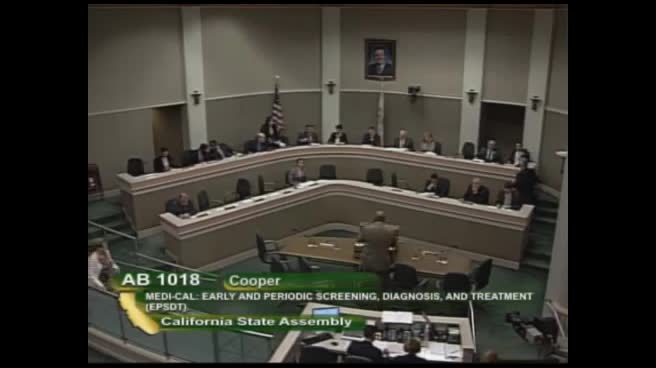 23MIN
Assembly Standing Committee on Health
Bill Author

Bill Co-Author(s):
