AB 1672: Veterans treatment courts: Judicial Council assessment and survey.
- Session Year: 2015-2016
- House: Assembly
- Latest Version Date: 2016-08-01
Existing law establishes a statewide system of courts with a superior court of one or more judges in each county. Existing law authorizes the Judicial Council to prescribe the methods, means, and standards for electronic collection of data related to court administration, practice, and procedure.
This bill would require the Judicial Council to report to the Legislature on a study of veterans and veterans treatment courts that includes a statewide assessment, as specified, of veterans treatment courts currently in operation and a survey of counties that do not operate veterans treatment courts that identifies barriers to program implementation and assesses the need for veterans treatment courts in those counties, if funds are received for that purpose. The bill would require the Judicial Council to report to the Legislature on the results of the study, as specified, on or before June 1, 2019. The bill would create the Veterans Court Assessment Fund in the State Treasury, administered by the Judicial Council, and would authorize the fund to accept private donations, as specified. The bill would appropriate specified sums from the Veterans Court Assessment Fund and from the General Fund for the purpose of conducting the study and report.
Existing law establishes a statewide system of courts with a superior court of one or more judges in each county. Existing law requires authorizes the Judicial Council to prescribe the methods, means, and standards for electronic collection of data related to court administration, practice, and procedure.
This bill would require the Judicial Council to report to the Legislature on a study of veterans and veterans treatment courts that includes a statewide assessment, as specified, of veterans treatment courts currently in operation and a survey of counties that do not operate veterans treatment courts for the purpose of identifying that identifies barriers to program implementation and assessing the need to establish assesses the need for veterans treatment courts in those counties, if funds are received for that purpose. The bill would require the Judicial Council to report to the Legislature on the results of the study, as specified, on or before June 1, 2019. The bill would create the Veterans Court Assessment Fund in the State Treasury, administered by the Judicial Council, and would authorize the fund to accept private donations, as specified. The bill would appropriate specified sums from the Veterans Court Assessment Fund and from the General Fund for the purpose of conducting the study and report.
Existing law establishes a statewide system of courts with a superior court of one or more judges in each county. Existing law requires the Judicial Council to prescribe the methods, means, and standards for electronic collection of data related to court administration, practice, and procedure.
This bill would require the Judicial Council to assess, on a statewide basis, veterans treatment courts currently in operation, survey counties that do not operate veterans treatment courts to identify barriers to program implementation, and assess the need to establish veterans courts in those counties, as specified, report to the Legislature on a study of veterans and veterans treatment courts that includes a statewide assessment, as specified, of veterans courts currently in operation and a survey of counties that do not operate veterans treatment courts for the purpose of identifying barriers to program implementation and assessing the need to establish veterans treatment courts in those counties, if funds are received for the assessment and survey. that purpose. The bill would require the Judicial Council to report to the Legislature on the results of the assessment and survey, study, as specified, on or before June 1, 2019. The bill would create the Veterans Court Assessment Fund in the State Treasury, administered by the State Controller, Judicial Council, and would authorize the fund to accept private donations, as specified. The bill would appropriate specified sums from the Veterans Court Assessment Fund and from the General Fund for the purpose of conducting the assessment, survey, study and report.
Existing law establishes a statewide system of courts with a superior court of one or more judges in each county. Existing law requires the Judicial Council to prescribe the methods, means, and standards for electronic collection of data related to court administration, practice, and procedure.
This bill would require the Judicial Council to assess, on a statewide basis, veterans treatment courts currently in operation, survey counties that do not operate veterans treatment courts to identify barriers to program implementation, and assess the need to establish veterans courts in those counties, as specified, if funds are received for the assessment and survey. The bill would require the Judicial Council to report to the Legislature on the results of the assessment and survey, as specified, on or before June 1, 2019. The bill would create the Veterans Court Assessment Fund in the State Treasury, administered by the State Controller, and would authorize the fund to accept private donations, as specified. The bill would appropriate specified sums from the Veterans Court Assessment Fund and from the General Fund for the purpose of conducting the assessment, survey, and report.
Existing law establishes a statewide system of courts with a superior court of one or more judges in each county. Existing law requires the Judicial Council to prescribe the methods, means, and standards for electronic collection of data related to court administration, practice, and procedure.
This bill would require the Judicial Council to conduct, until January 1, 2018, a study on the impact of veterans courts or veterans treatment courts on veterans involved with the criminal justice system, the impact on veterans of lack of access to veterans courts or veterans treatment courts in those counties that do not have them, the utility of community courts as a substitute for veterans courts or veterans treatment courts, and the use of technology to deliver veterans court services to counties without veterans courts or veterans treatment courts, assess, on a statewide basis, veterans treatment courts currently in operation, survey counties that do not operate veterans treatment courts to identify barriers to program implementation, and assess the need to establish veterans courts in those counties, as specified, if funds are received for the study, as specified. assessment and survey. The bill would require the Judicial Council to report to the Legislature on the results of the study, assessment and survey, as specified, on or before June 1, 2019.
Existing law establishes a statewide system of courts with a superior court of one or more judges in each county. Existing law requires the Judicial Council to prescribe the methods, means, and standards for electronic collection of data related to court administration, practice, and procedure.
This bill would require the Judicial Council to conduct, until January 1, 2018, a study on the impact of veterans courts or veterans treatment courts on veterans involved with the criminal justice system, the impact on veterans of lack of access to veterans courts or veterans treatment courts in those counties that do not have them, the utility of community courts as a substitute for veterans courts or veterans treatment courts, and the use of technology to deliver veterans court services to counties without veterans courts or veterans treatment courts, if funds are received for the study, as specified. The bill would require the Judicial Council to report to the Legislature on the results of the study, as specified, on or before June 1, 2019.
Existing law establishes a statewide system of courts with a superior court of one or more judges in each county. Existing law requires the Judicial Council to prescribe the methods, means, and standards for electronic collection of data related to court administration, practice, and procedure.
This bill would require the Judicial Council to conduct, until January 1, 2018, a study on the impact of lack of access to veterans courts or veterans treatment courts on veterans involved with the criminal justice system system, the impact on veterans of lack of access to veterans courts or veterans treatment courts in those counties that do not have them, the utility of community courts as a substitute for veterans courts or veterans treatment courts, and the use of technology to deliver veterans court services to counties without veterans courts or veterans treatment courts, if funds are received for the study, as specified. The bill would require the Judicial Council to report to the Legislature on the results of the study, as specified, on or before June 1, 2019.
Existing law establishes a statewide system of courts with a superior court of one or more judges in each county. Existing law requires the Judicial Council to prescribe the methods, means, and standards for electronic collection of data related to court administration, practice, and procedure.
This bill would require the Judicial Council to conduct, until January 1, 2018, a study on the impact of lack of access to veterans courts or veterans treatment courts on veterans involved with the criminal justice system and the use of technology to deliver veterans court services to counties without veterans courts or veterans treatment courts, if funds are received for the study, as specified. The bill would require the Judicial Council to report to the Legislature on the results of the study, as specified, on or before June 1, 2019.
Existing law, Section 6 of Article VI of the California Constitution, establishes the Judicial Council, chaired by the Chief Justice. Existing law authorizes the Chief Justice to expedite judicial business and equalize the work of judges by, among other things, assigning an active or retired judge to another court, as specified.
This bill would require the Judicial Council to establish and implement a pilot program for the purpose of establishing Veterans Courts in counties adjacent to the County of San Luis Obispo that, as of January 1, 2017, do not have veterans courts or veterans treatment courts, if funds are received for that purpose. The bill would authorize the Chief Justice to assign an active or retired judge to sit in one or more courts, and to travel between more than one court for the purpose of providing veterans court services. The bill would authorize the receipt of public or private funds for the implementation of the pilot program and establish the San Luis Obispo Regional Veterans Courts Pilot Program Fund in the State Treasury for the deposit of those funds, which would be subject to appropriation by the Legislature. The bill would conclude the pilot program on January 1, 2020.
This bill would make legislative findings and declarations as to the necessity of a special statute for the County of San Luis Obispo and adjacent counties.
(a)If the Judicial Council receives funds for the purpose of implementing this section, the Judicial Council shall report to the Legislature on a study of veterans and veterans treatment courts that includes the following:
(1)A statewide assessment of the veterans treatment courts currently in operation that includes the number of veteran participants in the program, services available, and program outcomes, including successful completion or program terminations. The assessment shall evaluate the impact of a sample of veterans treatment courts on participant outcomes, including, but not limited to, program recidivism, mental health, homelessness, employment, social stability, and substance abuse.
(2)A survey of counties that do not operate veterans treatment courts that identifies barriers to program implementation and assesses the need for veterans treatment courts in those jurisdictions based on the veterans services available and the estimated number of veterans involved in the local criminal justice system. The survey shall identify alternative resources that may be available to veterans, such as community courts or other collaborative justice courts.
(b)On or before June 1, 2019, the Judicial Council shall report to the Legislature on the results of the study described in subdivision (a). The report shall include recommendations regarding the expansion of veterans treatment courts or services to counties without veterans treatment courts and shall explore the feasibility of designing regional model veterans treatment courts through the use of service coordination or technological resources. The report shall be submitted in compliance with Section 9795.
(c)Fifty percent of the funds required for the study and report described in this section shall be funded by private sources, and 50 percent of the funds shall be funded by the state, upon appropriation by the Legislature.
(d)The Veterans Court Assessment Fund is hereby created in the State Treasury. The fund shall be administered by the Judicial Council. The fund may accept private donations from entities and individuals, and the individuals. The Judicial Council shall deposit the donations into the fund.
(e)This section shall remain in effect only until January 1, 2020, and as of that date is repealed, unless a later enacted statute, that is enacted before January 1, 2020, deletes or extends that date.
SEC. 2.If this act is not enacted, the Judicial Council shall return any funds donated to the Veterans Court Assessment Fund or donated for the purpose of carrying out the study and report described in Section 1 of this act to the entity or individual who made the donation in an amount equal to the donation.
SEC. 3.The sum of one hundred thousand dollars ($100,000) is hereby appropriated from the Veterans Court Assessment Fund to the Judicial Council for the purpose of conducting the study and report described in Section 68530 of the Government Code.
SEC. 4.The sum of one hundred thousand dollars ($100,000) is hereby appropriated from the General Fund to the Judicial Council for the purpose of conducting the study and report described in Section 68530 of the Government Code.
(a)If the Judicial Council receives funds for the purpose of implementing this section, the Judicial Council shall provide a report to the Legislature on a study of veterans and veterans treatment courts that includes the following:
(1)A statewide assessment of the veterans treatment courts currently in operation that includes the number of veteran participants in the program, services available, and program outcomes, including successful completion or program terminations. The assessment shall evaluate the impact of a sample of veterans treatment courts on participant outcomes, including, but not limited to, program recidivism, mental health, homelessness, employment, social stability, and substance abuse.
(2)A survey of counties that do not operate veterans treatment courts that identifies barriers to program implementation and assesses the need for veterans treatment courts in those jurisdictions based on the veterans services available and the estimated number of veterans involved in the local criminal justice system. The survey shall identify alternative resources that may be available to veterans, such as community courts or other collaborative justice courts.
(b)On or before June 1, 2019, the Judicial Council shall report to the Legislature on the results of the study described in subdivision (a). The report shall include recommendations regarding the expansion of veterans treatment courts or services to counties without veterans treatment courts and shall explore the feasibility of designing regional model veterans treatment courts through the use of service coordination or technological resources. The report shall be submitted in compliance with Section 9795.
(c)Fifty percent of the funds required for the study and report described in this section shall be funded by private sources, and 50 percent of the funds shall be funded by the state, upon appropriation by the Legislature.
(d)The Veterans Court Assessment Fund is hereby created in the State Treasury. The fund shall be administered by the Judicial Council. The fund may accept private donations from entities and individuals, and the Judicial Council shall deposit the donations into the fund.
(e)This section shall remain in effect only until January 1, 2020, and as of that date is repealed, unless a later enacted statute, that is enacted before January 1, 2020, deletes or extends that date.
SEC. 2.If this act is not enacted, the Judicial Council shall return any funds donated to the Veterans Court Assessment Fund or donated for the purpose of carrying out the study and report described in Section 1 of this act to the entity or individual who made the donation in an amount equal to the donation.
SEC. 3.The sum of one hundred thousand dollars ($100,000) is hereby appropriated from the Veterans Court Assessment Fund to the Judicial Council for the purpose of conducting the study and report described in Section 68530 of the Government Code.
SEC. 4.The sum of one hundred thousand dollars ($100,000) is hereby appropriated from the General Fund to the Judicial Council for the purpose of conducting the study and report described in Section 68530 of the Government Code.
(a)If the Judicial Council receives funds for the purpose of implementing this section, the Judicial Council shall do all of the following: provide a report to the Legislature on a study of veterans and veterans treatment courts that includes the following:
(1)Assess, on a statewide basis, veterans treatment courts currently in operation, including the number of veteran participants in the program, available services, and program outcomes, including, but not limited to, the number of successful program completions or program terminations. A statewide assessment of the veterans treatment courts currently in operation that includes the number of veteran participants in the program, services available, and program outcomes, including successful completion or program terminations. The assessment shall evaluate the impact of a sample of veterans treatment courts on participant outcomes, including, but not limited to, program recidivism, mental health, homelessness, employment, social stability, and substance abuse.
(2)Survey counties that do not operate veterans treatment courts to identify barriers to program implementation and assess the need for veterans treatment courts in those jurisdictions based on available existing veterans services and the estimated number of veterans involved in the local criminal justice system. A survey of counties that do not operate veterans treatment courts that identifies barriers to program implementation and assesses the need for veterans treatment courts in those jurisdictions based on the veterans services available and the estimated number of veterans involved in the local criminal justice system. The survey shall identify alternative resources that may be available to veterans, such as community courts or other collaborative justice courts.
(b)On or before June 1, 2019, the Judicial Council shall report to the Legislature on the results of the assessment and survey study described in subdivision (a). The report shall include recommendations regarding the expansion of veterans treatment courts or services to counties without veterans treatment courts and shall explore the feasibility of designing regional model veterans treatment courts through the use of service coordination or technological resources. The report shall be submitted in compliance with Section 9795 of the Government Code. 9795.
(c)Fifty percent of the funds required for the assessment, survey, study and report described in this section shall be funded by private sources, and 50 percent of the funds shall be funded by the state, upon appropriation by the Legislature.
(d)The Veterans Court Assessment Fund is hereby created in the State Treasury. The fund shall be administered by the State Controller. Judicial Council. The fund may accept private donations from entities and individuals, and the Controller Judicial Council shall deposit the donations into the fund.
(e)This section shall remain in effect only until January 1, 2020, and as of that date is repealed, unless a later enacted statute, that is enacted before January 1, 2020, deletes or extends that date.
SEC. 2.If this act is not enacted, the State Controller Judicial Council shall return any funds donated to the Veterans Court Assessment Fund or donated for the purpose of carrying out the assessment, survey, study and report described in Section 1 of this act to the entity or individual who made the donation in an amount equal to the donation.
SEC. 3.The sum of one hundred thousand dollars ($100,000) is hereby appropriated from the Veterans Court Assessment Fund to the Judicial Council for the purpose of conducting the assessment, survey, study and report described in Section 68530 of the Government Code.
SEC. 4.The sum of one hundred thousand dollars ($100,000) is hereby appropriated from the General Fund to the Judicial Council for the purpose of conducting the assessment, survey, study and report described in Section 68530 of the Government Code.
(a)If the Judicial Council receives funds for the purpose of implementing this section, the Judicial Council shall do all of the following:
(1)Assess, on a statewide basis, veterans treatment courts currently in operation, including the number of veteran participants in the program, available services, and program outcomes outcomes, including, but not limited to, the number of successful program completions or program terminations. The assessment shall evaluate the impact of a sample of veterans treatment courts on participant outcomes, including, but not limited to, program recidivism, mental health, homelessness, employment, social stability, and substance abuse.
(2)Survey counties that do not operate veterans treatment courts to identify barriers to program implementation and assess the need for veterans treatment courts in those jurisdictions based on available existing veterans services and the estimated number of veterans involved in the local criminal justice system. The survey shall identify alternative resources that may be available to veterans, such as community courts or other collaborative justice courts.(b)On or before June 1, 2019, the Judicial Council shall report to the Legislature on the results of the assessment and survey described in subdivision (a). The report shall include recommendations regarding the expansion of veterans treatment courts to counties without veterans treatment courts and shall explore the feasibility of designing regional model veterans treatment courts through the use of service coordination or technological resources. The report shall be submitted in compliance with Section 9795 of the Government Code.
(c)Fifty percent of the funds required for the assessment, survey, and report described in this section shall be funded by private sources, and 50 percent of the funds shall be funded by the state, upon appropriation by the Legislature.
(d)The Veterans Court Assessment Fund is hereby created in the State Treasury. The fund shall be administered by the State Controller. The fund may accept private donations from entities and individuals, and the Controller shall deposit the donations into the fund.
(d)
(e)This section shall remain in effect only until January 1, 2020, and as of that date is repealed, unless a later enacted statute, that is enacted before January 1, 2020, deletes or extends that date.
SEC. 2.If this act is not enacted, the State Controller shall return any funds donated to the Veterans Court Assessment Fund or donated for the purpose of carrying out the assessment, survey, and report described in Section 1 of this act to the entity or individual who made the donation in an amount equal to the donation.
SEC. 3.The sum of one hundred thousand dollars ($100,000) is hereby appropriated from the Veterans Court Assessment Fund to the Judicial Council for the purpose of conducting the assessment, survey, and report described in Section 68530 of the Government Code.
SEC. 4.The sum of one hundred thousand dollars ($100,000) is hereby appropriated from the General Fund to the Judicial Council for the purpose of conducting the assessment, survey, and report described in Section 68530 of the Government Code.
(a)If the Judicial Council receives funds for the purpose of implementing this section, the Judicial Council shall, commencing on January 1, 2017, and concluding on January 1, 2018, study and assess shall do all of the following:
(1)The impact of veterans courts or veterans treatment courts on veterans involved with the criminal justice system, including, but not limited to, the impact on recidivism, mental health, homelessness, employment, social stability, and substance abuse.
(2)The impact of lack of access to veterans courts or veterans treatment courts on veterans involved in the criminal justice system in counties that do not have veterans courts or veterans treatment courts.
(3)The utility of community courts as a substitute for veterans courts in counties that do not have veterans courts or veterans treatment courts.
(4)The use of technology to deliver veterans court services to counties without veterans courts or veterans treatment courts.
(1)Assess, on a statewide basis, veterans treatment courts currently in operation, including the number of veteran participants in the program, available services, and program outcomes including, but not limited to, the number successful program completions or program terminations. The assessment shall evaluate the impact of a sample of veterans treatment courts on participant outcomes, including, but not limited to, program recidivism, mental health, homelessness, employment, social stability, and substance abuse.
(2)Survey counties that do not operate veterans treatment courts to identify barriers to program implementation and assess the need for veterans treatment courts in those jurisdictions based on available existing veterans services and the estimated number of veterans involved in the local criminal justice system. The survey shall identify alternative resources that may be available to veterans, such as community courts or other collaborative justice courts.
(b)On or before June 1, 2019, the Judicial Council shall report to the Legislature on the results of the study. assessment and survey described in subdivision (a). The report shall include recommendations regarding the expansion of veterans court services veterans treatment courts to counties without veterans courts or veterans treatment courts, including the courts and shall explore the feasibility and implementation of technology that will support that expansion. of designing regional model veterans treatment courts through the use of service coordination or technological resources. The report shall be submitted in compliance with Section 9795 of the Government Code.
(c)Fifty percent of the funds required for the study assessment, survey, and report described in this section shall be funded by private sources, and 50 percent of the funds required for the study shall be funded by the state, upon appropriation by the Legislature.
(d)This section shall remain in effect only until January 1, 2020, and as of that date is repealed, unless a later enacted statute, that is enacted before January 1, 2020, deletes or extends that date.
(a)If the Judicial Council receives funds for the purpose of implementing this section, the Judicial Council shall, commencing on January 1, 2017, and concluding on January 1, 2018, study and assess the following:
(1)The impact of veterans courts or veterans treatment courts on veterans involved with the criminal justice system, including, but not limited to, the impact on recidivism, mental health, homelessness, employment, social stability, and substance abuse.
(2)The impact of lack of access to veterans courts or veterans treatment courts on veterans involved in the criminal justice system in counties that do not have veterans courts or veterans treatment courts.
(3)The utility of community courts as a substitute for veterans courts in those counties that do not have veterans courts or veterans treatment courts.
(4)The use of technology to deliver veterans court services to counties without veterans courts or veterans treatment courts.
(b)On or before June 1, 2019, the Judicial Council shall report to the Legislature on the results of the study. The report shall include recommendations regarding the expansion of veterans court services to counties without veterans courts or veterans treatment courts, including the feasibility and implementation of technology that will support that expansion. The report shall be submitted in compliance with Section 9795 of the Government Code.
(c)Fifty percent of the funds required for the study and report described in this section shall be funded by private sources, and 50 percent of the funds required for the study shall be funded by the state, upon appropriation by the Legislature.
(d)This section shall remain in effect only until January 1, 2020, and as of that date is repealed, unless a later enacted statute, that is enacted before January 1, 2020, deletes or extends that date.
(a)If the Judicial Council receives funds for the purpose of implementing this section, the Judicial Council shall, commencing on January 1, 2017, and concluding on January 1, 2018, study and assess the following:
(1)The impact of lack of access to veterans courts or veterans treatment courts on veterans involved with the criminal justice system, including, but not limited to, the impact on recidivism, mental health, homelessness, employment, social stability, and substance abuse.
(2)The impact of lack of access to veterans courts or veterans treatment courts on veterans involved in the criminal justice system in counties that do not have veterans courts or veterans treatment courts.
(3)The utility of community courts as a substitute for veterans courts in those counties that do not have veterans courts or veterans treatment courts.
(2)
(4)The use of technology to deliver veterans court services to counties without veterans courts or veterans treatment courts.
(b)On or before June 1, 2019, the Judicial Council shall report to the Legislature on the results of the study. The report shall include recommendations regarding the expansion of veterans court services to counties without veterans courts or veterans treatment courts, including the feasibility and implementation of technology that will support that expansion. The report shall be submitted in compliance with Section 9795 of the Government Code.
(c)Fifty percent of the funds required for the study and report described in this section shall be funded by private sources, and 50 percent of the funds required for the study shall be funded by the state, upon appropriation by the Legislature.
(d)This section shall remain in effect only until January 1, 2020, and as of that date is repealed, unless a later enacted statute, that is enacted before January 1, 2020, deletes or extends that date.
(a)If the Judicial Council receives funds for the purpose of implementing this section, the Judicial Council shall, commencing on January 1, 2017, and concluding on January 1, 2018, study the following:
(1)The impact of lack of access to veterans courts or veterans treatment courts on veterans involved with the criminal justice system, including, but not limited to, the impact on mental health, homelessness, employment, social stability, and substance abuse.
(2)The use of technology to deliver veterans court services to counties without veterans courts or veterans treatment courts.
(b)On or before June 1, 2019, the Judicial Council shall report to the Legislature on the results of the study. The report shall include recommendations regarding the expansion of veterans court services to counties without veterans courts or veterans treatment courts, including the feasibility and implementation of technology that will support that expansion. The report shall be submitted in compliance with Section 9795 of the Government Code.
(c)Fifty percent of the funds required for the study and report described in this section shall be funded by private sources, and 50 percent of the funds required for the study shall be funded by the state, upon appropriation by the Legislature.
(d)This section shall remain in effect only until January 1, 2020, and as of that date is repealed, unless a later enacted statute, that is enacted before January 1, 2020, deletes or extends that date.
SECTION 1.Title 2.7 (commencing with Section 760) is added to Part 2 of the Penal Code, to read:2.7.Veterans Courts Pilot Program760.(a)If the Judicial Council receives funds for the purpose of implementing this title, the Judicial Council shall establish and implement a pilot program for the purpose of establishing veterans courts in counties adjacent to the County of San Luis Obispo that, as of January 1, 2017, do not have veterans courts or veterans treatment courts.
(b)The pilot program established and implemented pursuant to subdivision (a) shall promote sobriety, recovery, and stability for veterans who are involved with the criminal justice system and whose court cases are affected by issues such as addiction, mental illness, and cooccurring disorders.
(c)To provide the services described in subdivision (a), the Chief Justice may assign an active or retired judge to sit in one or more courts, and to travel between more than one court, as deemed appropriate by the Chief Justice.
(d)The pilot program may be funded by public or private funds. There is established the San Luis Obispo Regional Veterans Courts Pilot Program Fund in the State Treasury. Moneys received for the purpose of implementing this title shall be deposited in the fund and shall be subject to appropriation by the Legislature.
(e)The pilot program shall conclude on January 1, 2020.
765.This title shall remain in effect only until January 1, 2020, and as of that date is repealed, unless a later enacted statute, that is enacted before January 1, 2020, deletes or extends that date.
SEC. 2.The Legislature finds and declares that a special law is necessary and that a general law cannot be made applicable within the meaning of Section 16 of Article IV of the California Constitution because of the unique need to establish veterans court services in the region surrounding the County of San Luis Obispo.
(a)If the Judicial Council receives funds for the purpose of implementing this title, the Judicial Council shall establish and implement a pilot program for the purpose of establishing veterans courts in counties adjacent to the County of San Luis Obispo that, as of January 1, 2017, do not have veterans courts or veterans treatment courts.
(b)The pilot program established and implemented pursuant to subdivision (a) shall promote sobriety, recovery, and stability for veterans who are involved with the criminal justice system and whose court cases are affected by issues such as addiction, mental illness, and cooccurring disorders.
(c)To provide the services described in subdivision (a), the Chief Justice may assign an active or retired judge to sit in one or more courts, and to travel between more than one court, as deemed appropriate by the Chief Justice.
(d)The pilot program may be funded by public or private funds. There is established the San Luis Obispo Regional Veterans Courts Pilot Program Fund in the State Treasury. Moneys received for the purpose of implementing this title shall be deposited in the fund and shall be subject to appropriation by the Legislature.
(e)The pilot program shall conclude on January 1, 2020.
765.This title shall remain in effect only until January 1, 2020, and as of that date is repealed, unless a later enacted statute, that is enacted before January 1, 2020, deletes or extends that date.
SEC. 2.The Legislature finds and declares that a special law is necessary and that a general law cannot be made applicable within the meaning of Section 16 of Article IV of the California Constitution because of the unique need to establish veterans court services in the region surrounding the County of San Luis Obispo.
|
Date
|
Status
|
|---|---|
| Jun 2, 2016 | Read third time. Passed. Ordered to the Senate. (Ayes 77. Noes 0.) |
| Apr 28, 2016 | Re-referred to Com. on APPR. |
| May 4, 2016 | In committee: Set, first hearing. Referred to APPR. suspense file. |
| May 31, 2016 | From committee: Amend, and do pass as amended. (Ayes 20. Noes 0.) (May 27). |
| May 31, 2016 | Read second time and amended. Ordered returned to second reading. |
| Jun 1, 2016 | Assembly Rule 63 suspended. |
| Jun 1, 2016 | Assembly Rule 63 suspended. (Page 5120.) |
| Jun 1, 2016 | Read second time. Ordered to third reading. |
| Jun 2, 2016 | Read third time. Passed. Ordered to the Senate. |
| Jun 2, 2016 | Read third time. Passed. Ordered to the Senate. (Ayes 77. Noes 0. Page 5242.) |
| Apr 27, 2016 | From committee chair, with author's amendments: Amend, and re-refer to Com. on APPR. Read second time and amended. |
| Jun 6, 2016 | In Senate. Read first time. To Com. on RLS. for assignment. |
| Jun 9, 2016 | Referred to Coms. on PUB. S. and V.A. |
| Jun 14, 2016 | From committee chair, with author's amendments: Amend, and re-refer to committee. Read second time, amended, and re-referred to Com. on PUB. S. |
| Jun 22, 2016 | From committee: Do pass and re-refer to Com. on V.A. with recommendation: To Consent Calendar. (Ayes 7. Noes 0.) (June 21). Re-referred to Com. on V.A. |
| Jun 28, 2016 | From committee: Do pass and re-refer to Com. on APPR. (Ayes 5. Noes 0.) (June 28). Re-referred to Com. on APPR. |
| Aug 1, 2016 | From committee chair, with author's amendments: Amend, and re-refer to committee. Read second time, amended, and re-referred to Com. on APPR. |
| Aug 1, 2016 | In committee: Referred to APPR. suspense file. |
| Aug 11, 2016 | In committee: Held under submission. |
| Mar 28, 2016 | From committee chair, with author's amendments: Amend, and re-refer to Com. on V.A. Read second time and amended. |
| Jan 19, 2016 | From printer. May be heard in committee February 18. |
| Feb 4, 2016 | Referred to Coms. on PUB. S. and V.A. |
| Feb 23, 2016 | From committee chair, with author's amendments: Amend, and re-refer to Com. on PUB. S. Read second time and amended. |
| Feb 24, 2016 | Re-referred to Com. on PUB. S. |
| Mar 1, 2016 | In committee: Set, first hearing. Hearing canceled at the request of author. |
| Mar 8, 2016 | From committee chair, with author's amendments: Amend, and re-refer to Com. on PUB. S. Read second time and amended. |
| Mar 9, 2016 | Re-referred to Com. on PUB. S. |
| Mar 15, 2016 | From committee: Do pass and re-refer to Com. on V.A. with recommendation: To Consent Calendar. (Ayes 7. Noes 0.) (March 15). Re-referred to Com. on V.A. |
| Jan 15, 2016 | Read first time. To print. |
| Mar 29, 2016 | Re-referred to Com. on V.A. |
| Apr 11, 2016 | From committee chair, with author's amendments: Amend, and re-refer to Com. on V.A. Read second time and amended. |
| Apr 12, 2016 | Re-referred to Com. on V.A. |
| Apr 13, 2016 | From committee: Do pass and re-refer to Com. on APPR. (Ayes 9. Noes 0.) (April 12). Re-referred to Com. on APPR. |
| Apr 14, 2016 | From committee chair, with author's amendments: Amend, and re-refer to Com. on APPR. Read second time and amended. |
| Apr 18, 2016 | Re-referred to Com. on APPR. |
| Apr 20, 2016 | In committee: Hearing postponed by committee. |
| Apr 21, 2016 | Action rescinded whereby the bill was reported from committee with author's amendments and whereby the bill was read second time and amended on April 14 |
|
Date
|
Description
|
Location
|
Votes
|
|
|---|---|---|---|---|
| Aug 1, 2016 | Placed on suspense file | Senate Standing Committee on Appropriations |
Passed |
|
| Jun 28, 2016 | Do pass, but first be re-referred to the Committee on [Appropriations] | Senate Standing Committee on Veterans Affairs |
Passed |
|
| Jun 21, 2016 | Do pass, but first be re-referred to the Committee on [Veterans Affairs] with the recommendation: To Consent Calendar | Senate Standing Committee on Public Safety |
Passed |
|
| Jun 2, 2016 | AB 1672 MATHIS Assembly Third Reading | Assembly Floor |
Passed |
|
| May 27, 2016 | Do pass as amended. | Assembly Standing Committee on Appropriations |
Passed |
|
| Apr 12, 2016 | Do pass and be re-referred to the Committee on [Appropriations] | Assembly Standing Committee on Veterans Affairs |
Passed |
|
| Mar 15, 2016 | Do pass and be re-referred to the Committee on [Veterans Affairs] with recommendation: To Consent Calendar | Assembly Standing Committee on Public Safety |
Passed |
This list shows positions taken on this bill by organizations on the date displayed, which is linked to the original source.
Positions by individuals are not included.
|
Organization
|
Position
|
Date
|
|---|---|---|
| American G.I Forum of California | ** Support | Aug 1, 2016 |
| American Legion-Department of California | * Support | Aug 1, 2016 |
| AMVETS-Department of California | ** Support | Aug 1, 2016 |
| California Association of County Veteran Service Officers | * Support | Aug 1, 2016 |
| California Association Of County Veterans Service Officers | * Support | Aug 1, 2016 |
| California Public Defenders Association | ** Support | Aug 1, 2016 |
| California State Commanders Veterans Council | ** Support | Aug 1, 2016 |
| California State Guild | * Support | Apr 12, 2016 |
| Crime Victims United Of California | ** Support | Aug 1, 2016 |
| Disabled Veteran Business Alliance | ** Support | Aug 1, 2016 |
| Judicial Council of California | * Support | Aug 1, 2016 |
| Military Officer's Association | * Support | Aug 1, 2016 |
| Military Officers Association of America-California Council of Chapters | * Support | Aug 1, 2016 |
| Moms Across America Organization | * Support | Apr 12, 2016 |
| National Association of Social Workers - California Chapter | * Support | Aug 1, 2016 |
| National Association Of Social Workers, California Chapter | * Support | Aug 1, 2016 |
| Rural County Representatives of California | ** Support | Aug 1, 2016 |
| The American Legion Department California | * Support | Aug 1, 2016 |
| The Military Officers Association of America | * Support | Apr 12, 2016 |
| VFW-Department of California | ** Support | Aug 1, 2016 |
| Vietnam Veterans of America | * Support | Aug 1, 2016 |
| Vietnam Veterans of America-California State Council | ** Support | Aug 1, 2016 |
SENATE COMMITTEE ON
Senator Ricardo Lara, Chair
2015 - 2016 Regular Session
AB 1672 (Mathis) - Veterans treatment courts: Judicial Council assessment and survey
Version: | Policy Vote: |
Urgency: | Mandate: |
Hearing Date: | Consultant: |
This bill meets the criteria for referral to the Suspense File.
Bill Summary:
This bill would require the Judicial Council to, on or before June 1, 2019, report to the Legislature on a study of veterans and veterans treatment courts, as specified. This bill would appropriate $100,000 from the General Fund and $100,000 from the Veterans Court Assessment (VCA) Fund, which is created in this bill, to conduct the study and report to the Legislature.
Fiscal Impact:
One-time cost to the Judicial Council of $200,000 to complete the study and report, to be funded as follows:
- General Fund appropriation: $100,000, included in this bill.
- VCA Fund appropriation: $100,000, included in this bill. The VCA Fund is newly created in this bill to accept private donations from entities and individuals, to be deposited into the VCA Fund. Staff notes the timing of the availability of funding from the VCA Fund sufficient to enable the mandated $100,000 appropriation is unknown. As a result, it is unclear whether the Judicial Council would be able to meet the reporting timeframe specified in this measure. Additionally, the mandate to conduct the study and report to the Legislature is predicated on the receipt of funds, but not specific to the receipt of the full $200,000 necessary to sufficiently fund the workload.
Background:
As noted in the Background section of the Senate Public Safety Committee analysis of this measure:
Under California law, every court has the authority to make rules for its own government. This is an inherent power of the courts, but this power has also been codified in the Government Code. This power is limited only by any conflict with the California Constitution, statute or rules adopted by the Judicial Council of California.
Nothing in California’s Constitution or statutes prohibits or requires the development of veterans’ courts. However, under the Penal Code, courts are required to identify veteran defendants suffering from post-traumatic stress disorder, traumatic brain injury, and other issues for purposes of sentencing. For this and other reasons, the Judicial Council has encouraged the development of veterans’ courts.
The Judicial Council has authority under the California Constitution to make rules governing California courts and to make recommendations to the Legislature and Governor regarding the operation of the courts. Under this authority, the Judicial Council created the Collaborative Justice Court Advisory Committee to make recommendations to the Judicial Council on criteria for identifying and evaluating collaborative justice courts and for improving the processing of cases in these courts, which include drug courts, domestic violence courts, youth courts, community courts, veterans’ courts and other collaborative justice courts. Currently, at least 12 counties in California have established veterans’ courts and two have established community courts.
Proposed Law:
This bill would require the Judicial Council to report to the Legislature on a study of veterans and veterans treatment courts if the Judicial Council receives funds for that purpose. This bill requires the study to include the following:
- A statewide assessment of the veterans treatment courts currently in operation that includes the number of veteran participants in the program, services available, and program outcomes, including successful completion or program terminations. The assessment shall evaluate the impact of a sample of veterans treatment courts on participant outcomes, including, but not limited to, program recidivism, mental health, homelessness, employment, social stability, and substance abuse.
- A survey of counties that do not operate veterans treatment courts that identifies barriers to program implementation and assesses the need for veterans treatment courts in those jurisdictions based on the veterans services available and the estimated number of veterans involved in the local criminal justice system. The survey shall identify alternative resources that may be available to veterans, such as community courts or other collaborative justice courts.
This bill requires the Judicial Council to, on or before June 1, 2019, report to the Legislature on the results of the study. The report shall include recommendations regarding the expansion of veterans treatment courts or services to counties without veterans treatment courts and shall explore the feasibility of designing regional model veterans treatment courts through the use of service coordination or technological resources. Additionally, this bill:
- Requires 50 percent of the funds required for the study and report to be funded by private sources, and 50 percent of the funds to be funded by the state, upon appropriation by the Legislature.
- Creates the Veterans Court Assessment (VCA) Fund in the State Treasury, and provides that the VCA Fund shall be administered by the Judicial Council. The VCA Fund may accept private donations from entities and individuals, and the Judicial Council shall deposit the donations into the fund.
- Sunsets the bill’s provisions on January 1, 2020.
- Provides that if this act is not enacted, the Judicial Council shall return any funds donated to the VCA Fund or donated for the purpose of carrying out the study and report to the entity or individual who made the donation in an amount equal to the donation.
- Appropriates $100,000 from the Veterans Court Assessment Fund to the Judicial Council for the purpose of conducting the study and report.
- Appropriates $100,000 from the General Fund to the Judicial Council for the purpose of conducting the study and report.
Prior Legislation:
ACR 36 (Atkins) Resolution Chapter 39/2013 encourages all superior courts to consider establishing veterans treatment courts and or veterans treatment review calendars to assist troubled veterans who have service-related mental health issues.
AB 201 (Butler) 2011 would have authorized superior courts to develop and implement veterans’ courts. This bill would have established standards and procedures for veterans courts. This bill was vetoed by the Governor with the following message:
I am returning Assembly Bill 201 without my signature. This measure would authorize superior courts to establish dedicated programs to serve eligible veterans of the United States military. While the provisions of this bill are well-intended, they create a clear expectation that our courts-already struggling with painful budget cuts--will establish a new program.
Given current budgetary constraints, the decision to adopt this kind of program-something already within the courts' authority--is better left to the sound discretion of the judiciary.
AB 1925 (Salas) 2010 would have authorized superior courts to develop and implement veterans courts for eligible veterans of the U.S. military. This bill was vetoed by the Governor.
Staff Comments:
This bill appropriates $100,000 from the General Fund on a one-time basis, and additionally appropriates $100,000 from the VCA Fund, which is newly created in this bill. The VCA Fund is to be funded through private donations from entities and individuals, and as a result the timing of the availability of funding from the VCA Fund sufficient to enable the mandated appropriation in this bill is unknown. As a result, it is unclear whether the Judicial Council would be able to meet the June 1, 2019, reporting deadline specified in this measure should funds collected in the VCA Fund be insufficient to support the $100,000 appropriation until some future date.
Recommended Amendments:
This bill creates a new fund, the VCA Fund. Consistent with the customary practice of this Committee with regard to the creation of new funds, staff recommends an amendment to clarify that VCA Funds are subject to appropriation by the Legislature.
To ensure the Judicial Council receives the full level of funding required to support the mandated study and report to the Legislature, staff recommends the following technical amendment:
68530. (a) If the Judicial Council receives all of the funds specified for the purpose of implementing this section, the Judicial Council shall report to the Legislature on a study of veterans and veterans treatment courts that includes the following:
-- END --
SENATE COMMITTEE ON
Senator Jim Nielsen, Chair
2015 - 2016 Regular
Bill No: Hearing Date: 6/28/16
Author: | Mathis | ||
Version: |
| ||
Urgency: | Fiscal: | ||
Consultant: | |||
Subject:
DESCRIPTION
Summary:
Requires the Judicial Council of California (Council) to report to the Legislature on a study of veterans and veterans treatment courts (VTC) that includes a statewide assessment of VTCs currently in operation, and a survey of counties that do not operate VTCs to help identify barriers to implementation and the need for VTCs in those counties. Also establishes a fund within the State Treasury to accept private donations to pay for the study and survey.
Existing law:
- Establishes the Council and authorizes them to make rules and recommendations regarding the operation of the courts.
- Allows courts to make rules for the administration of the courts so long as they are not otherwise prohibited by the Constitution, statute or rules adopted by the Council.
- Requires judges to identify veteran defendants suffering from sexual trauma, post-traumatic stress disorder, traumatic brain injury, substance abuse, or mental health problems as a result of his or her service and use this status as a factor in favor of granting probation and/or ordering participation in approved treatment programs.
This bill:
- Requires the Council – if funds are received for the purpose – to report to the Legislature on a study of veterans and VTCs that includes:
- A statewide assessment, as specified, of VTCs currently in operation; and
- A survey of counties that do not operate VTCs that identifies barriers to program implementation and assesses the need for VTCs in those counties.
- Requires the Council to report to the Legislature on the results of the study, as specified, on or before June 1, 2019.
- Regarding the Veterans Court Assessment Fund (Fund):
- Establishes the Fund within the State Treasury.
- Provides that the Fund will be administered by the Council.
- Authorizes the fund to accept private donations, as specified.
- Authorizes that specified sums be appropriated from the Fund and from the General Fund for the purpose of conducting the study and report.
BACKGROUND
Judicial Council of California
The California Constitution [Article VI, § 6(d)] establishes the Council, which serves as the policymaking body of the California courts. Chaired by the Chief Justice of California, the Council is responsible for ensuring the consistent, independent, impartial, and accessible administration of justice.
Existing law allows courts to make rules for the administration of the courts so long as they are not otherwise prohibited by the Constitution, statute or rules adopted by the Judicial Council.
Existing law also requires judges to identify veteran defendants suffering from sexual trauma, post-traumatic stress disorder, traumatic brain injury, substance abuse, or mental health problems as a result of his or her service and use this status as a factor in favor of granting probation and/or ordering participation in approved treatment programs.
Veterans Treatment Courts
In 2006, California became the first state to establish a prison diversion program for veterans and military members when Governor Schwarzenegger signed AB 2586 (Parra) creating Penal Code § 1170.9. Since then, PC § 1170.9 has been expanded and refined by the Legislature. The resulting VTCs are judicially-supervised court docket intended to (1) reduce correctional costs, (2) protect community safety, and (3) improve public welfare. The VTC combines rigorous treatment and accountability for veterans facing incarceration due to charges stemming from substance abuse and/or mental health issues. They promote sobriety, recovery and stability through a coordinated response and the understanding that the bonds of military service and combat run deep.
Veterans treatment courts not only allow veterans to go through the process with other veterans, who are similarly situated and have common past experiences, but also link them with services uniquely designed for the distinct needs that arise from that military experience. The approach requires a coordinated response involving collaboration among the traditional county and nonprofit partners found in typical drug and mental health courts, the USDVA’s health care and benefits agencies, the California Department of Veterans Affairs (CalVet), county veterans service officers (CVSOs), and, in some programs, volunteer veteran mentors and veterans' family support organizations.
Existing Law provides that – in the case of any person convicted of a criminal offense, who would otherwise be sentenced to county jail or state prison, and who alleges that he or she committed the offense as a result of post-traumatic stress disorder (PTSD), substance abuse, or psychological problems stemming from service in a combat theater in the United States military – the court shall, prior to sentencing, hold a hearing to determine whether the defendant was a member of the military forces of the United States who served in combat and shall assess whether the defendant suffers from PTSD, substance abuse, or psychological problems as a result of that service.
Existing law also states that if the court concludes that a defendant convicted of a criminal offense was a member of the military forces of the United States suffering from PTSD, substance abuse, or psychological problems stemming from service in a combat theater and if the defendant is otherwise eligible for probation and the court places the defendant on probation, the court may order the defendant into a local; state; federal; or private, non-profit treatment program for a period not to exceed that which the defendant would have served in state prison or county jail, provided the defendant agrees to participate in the program and the court determines that an appropriate treatment program exists.
Also, existing law obligates counties to provide mental health treatment services to persons suffering from PTSD, substance abuse, or psychological problems stemming from service in a combat theater only to the extent that resources are available for that purpose. If mental health treatment services are ordered by the court, the county mental health agency shall coordinate appropriate referral of the defendant to the county veterans service officer. The county mental health agency shall not be responsible for providing services outside its traditional scope of services. An order shall be made referring a defendant to a county mental health agency only if the agency has agreed to accept responsibility for the treatment of the defendant.
VTC Funding
County VTCs are purely discretionary. Like other California collaborative justice courts, VTCs are funded from existing trial court resources and do not receive a dedicated stream of funding from the State General Fund.
Existing court resources allow VTCs to be funded in a variety of ways. Some rely on in-kind services of the courts or justice system partners. The U.S. Department of Justice’s Bureau of Justice Assistance, supervises a grant program and works in partnership with Justice for Vets to provide technical assistance to VTCs. Because Veterans Courts generally use the drug court model, they also can apply for federal Drug Court funding through BJA and the Substance Abuse and Mental Health Services Administration, when that funding is available.
The Judicial Council manages two funding streams that could be used for VTCs:
- The Recidivism Reduction Fund (RRF) is a $15 million competitive grant program, from state general fund, that the courts can use to fund three different programs designed to reduce criminal recidivism: pretrial programs; the use of risk and needs assessment; and collaborative justice courts (which would include VTCs). This is a one-time program and the Judicial Council was scheduled to discuss the award recommendations at its February 19, 2015 meeting.
- The Substance Abuse Focus Grant is an ongoing grant program, funded annually from a line item from the Judicial Council portion of the State Budget Act. It is available to local courts for the purpose of implementing, enhancing or expanding drug courts or other collaborative justice courts. This program allocates approximately $1.1 million through a formula grant process. Individual court awards range in size, but generally do not exceed $50,000. Veterans courts can seek funding through this source as well.
COMMENT
Related/Prior Legislation
AB 2098 (Levine, Chapter 163, Statutes of 2014) requires the court to consider a defendant’s status as a veteran suffering from PTSD or other forms of trauma when making specified sentencing determinations.
ACR 36 (Atkins, Resolution Chapter 39, Statutes of 2013) encourages all superior courts to consider establishing VTCs and/or veterans treatment review calendars to assist troubled veterans who have service-related mental health issues.
AB 201 (Butler, vetoed, 2012) would have authorized superior courts to develop and implement veterans’ courts. This bill would have established standards and procedures for veterans’ courts and would have specified that county participation in the veterans’ courts program is voluntary.
AB 1925 (Salas, vetoed, 2010) would have authorized superior courts to develop and implement veterans’ courts for eligible veterans of the United States (U.S.) military. The Governor’s veto message stated “authorizing legislation is not required for the superior courts to establish specialized courts with dedicated calendars. I would urge the Judicial Council to examine the need for veterans' courts, however, and establish appropriate guidelines for the superior courts to follow.”
AB 674 (Salas, Chapter 347, Statutes of 2010) allows a court to order a defendant who suffers from sexual trauma, traumatic brain injury, post-traumatic stress disorder, substance abuse, or mental health problems as a result of military service, into a treatment program or veteran's court for a period not to exceed that which the defendant would have served in state prison or jail.
POSITIONS
Sponsor: Author.
Support:
American G.I Forum of California
American Legion-Department of California
AMVETS-Department of California
California Association of County Veterans Service Officers
California Public Defenders Association
California State Commanders Veterans Council
Military Officers Association of America-California Council of Chapters
Crime Victims United of California
Disabled Veteran Business Alliance
Judicial Council of California
National Association of Social Workers – California Chapter
VFW-Department of California
Rural County Representatives of California
Vietnam Veterans of America-California State Council
Oppose: None received.
-- END --
SENATE COMMITTEE ON PUBLIC SAFETY
Senator Loni Hancock, Chair
2015 - 2016 Regular
Bill No: AB 1672 Hearing Date: June 21, 2016
Author: | Mathis | ||
Version: | June 14, 2016 | ||
Urgency: | No | Fiscal: | Yes |
Consultant: | ML | ||
Subject: Veterans Treatment Courts: Judicial Council Assessment and Survey
HISTORY
Source: Author
Prior Legislation: AB 2098 (Levine) – Ch. 163, Stats. 2014
AB 201 (Butler), 2011-2012 Legislative Session, Vetoed by Governor
AB 1925 (Salas), 2009-2010 Legislative Session, Vetoed by Governor
Support: American G.I Forum of California; American Legion-Department of California; AMVETS-Department of California; California Association of County Veterans Service Officers; California Public Defenders Association; California State Commanders Veterans Council; Military Officers Association of America-California Council of Chapters; Crime Victims United of California; Disabled Veteran Business Alliance; Judicial Council of California; National Association of Social Workers – California Chapter; VFW-Department of California; Rural County Representatives of California; The Vietnam Veterans of America-California State Council
Opposition: None known
Assembly Floor Vote: 77 - 0
PURPOSE
The purpose of this bill is to require the Judicial Council to study the impact of veterans’ courts, or the lack thereof, on veterans involved in the criminal justice system, the availability of technology to increase access to veterans’ courts, and the utility of community courts as a substitute.
Existing law vests in the superior courts the judicial power of California. (Cal. Const. art. VI, § 1.)
Existing law stablishes the Judicial Council and authorizes them to make rules and recommendations regarding the operation of the courts. (Cal. Const. art. VI, § 6(d).)
Existing law allows courts to make rules for the administration of the courts so long as they are not otherwise prohibited by the Constitution, statute or rules adopted by the Judicial Council. (Gov. Code, § 68070; Wisniewski v. Clary (1975) 46 Cal.App.3d 499.)
Existing law requires judges to identify veteran defendants suffering from sexual trauma, post-traumatic stress disorder, traumatic brain injury, substance abuse, or mental health problems as a result of his or her service and use this status as a factor in favor of granting probation and/or ordering participation in approved treatment programs. (Penal Code, § 1170.9.)
This bill requires the Judicial Council to study the impact of veterans’ courts, or the lack thereof, on veterans involved in the criminal justice system. The study will begin January 1, 2017 and end January 1, 2018.
This bill requires the Judicial Council to study the availability of technology to deliver veterans’ courts services to counties without such courts. The study will begin January 1, 2017 and end January 1, 2018.
This bill requires the Judicial Council to study the utility of community courts as a substitute for veterans’ courts in those counties that do not have veterans’ courts. The study will begin January 1, 2017 and end January 1, 2018.
This bill requires the Judicial Council to report to the Legislature the results of their studies on the impact of veterans’ courts and the feasibility of technology to deliver veterans’ courts services that have no such courts by June 1, 2019.
This bill states that 50% of the cost of this study shall be paid by private funds and 50% shall be paid by public funds.
This bill sunsets these provisions on January 1, 2020.
RECEIVERSHIP/OVERCROWDING CRISIS AGGRAVATION
For the past several years this Committee has scrutinized legislation referred to its jurisdiction for any potential impact on prison overcrowding. Mindful of the United States Supreme Court ruling and federal court orders relating to the state’s ability to provide a constitutional level of health care to its inmate population and the related issue of prison overcrowding, this Committee has applied its “ROCA” policy as a content-neutral, provisional measure necessary to ensure that the Legislature does not erode progress in reducing prison overcrowding.
On February 10, 2014, the federal court ordered California to reduce its in-state adult institution population to 137.5% of design capacity by February 28, 2016, as follows:
- 143% of design bed capacity by June 30, 2014;
- 141.5% of design bed capacity by February 28, 2015; and,
- 137.5% of design bed capacity by February 28, 2016.
In December of 2015 the administration reported that as “of December 9, 2015, 112,510 inmates were housed in the State’s 34 adult institutions, which amounts to 136.0% of design bed capacity, and 5,264 inmates were housed in out-of-state facilities. The current population is 1,212 inmates below the final court-ordered population benchmark of 137.5% of design bed capacity, and has been under that benchmark since February 2015.” (Defendants’ December 2015 Status Report in Response to February 10, 2014 Order, 2:90-cv-00520 KJM DAD PC, 3-Judge Court, Coleman v. Brown, Plata v. Brown (fn. omitted).) One year ago, 115,826 inmates were housed in the State’s 34 adult institutions, which amounted to 140.0% of design bed capacity, and 8,864 inmates were housed in out-of-state facilities. (Defendants’ December 2014 Status Report in Response to February 10, 2014 Order, 2:90-cv-00520 KJM DAD PC, 3-Judge Court, Coleman v. Brown, Plata v. Brown (fn. omitted).)
While significant gains have been made in reducing the prison population, the state must stabilize these advances and demonstrate to the federal court that California has in place the “durable solution” to prison overcrowding “consistently demanded” by the court. (Opinion Re: Order Granting in Part and Denying in Part Defendants’ Request For Extension of December 31, 2013 Deadline, NO. 2:90-cv-0520 LKK DAD (PC), 3-Judge Court, Coleman v. Brown, Plata v. Brown (2-10-14). The Committee’s consideration of bills that may impact the prison population therefore will be informed by the following questions:
- Whether a proposal erodes a measure which has contributed to reducing the prison population;
- Whether a proposal addresses a major area of public safety or criminal activity for which there is no other reasonable, appropriate remedy;
- Whether a proposal addresses a crime which is directly dangerous to the physical safety of others for which there is no other reasonably appropriate sanction;
- Whether a proposal corrects a constitutional problem or legislative drafting error; and
- Whether a proposal proposes penalties which are proportionate, and cannot be achieved through any other reasonably appropriate remedy.
COMMENTS
1. Stated Need for This Bill
The author states:
A veterans’ court, also known as a veterans’ treatment court, is a problem-solving court intended to serve veterans who are involved with the justice system and whose court cases are affected by issues such as addiction, mental illness, and/or co-occurring disorders. These courts promote sobriety, recovery, and stability through a coordinated response involving cooperation and collaboration with prosecutors, defense lawyers, probation departments, county veterans service offices, the California Department of Veterans Affairs (CDVA), health-care networks, employment and housing agencies and groups, volunteer mentors who are usually also veterans, and family support organizations.
Several counties throughout the state do not currently have a veterans’ court within their limits. As such, these veterans often find themselves neglected and underrepresented once they become involved in the judicial system. This problem is exacerbated because neighboring counties are not currently authorized to provide the services needed by these veterans. Without proper representation and information, these veterans are left to manage and navigate the challenges of the justice system without vital assistance.
This bill will commission a one-year study on the impact that a lack of access to a veterans’ court has upon veterans. In addition, the study will assess the utility of a community court serving in place of a veterans’ court. Finally, the study will evaluate the feasibility of using technology to allow counties without veterans’ courts to utilize counties with them.
2. Background
Under California law, every court has the authority to make rules for its own government. This is an inherent power of the courts, but this power has also been codified in the Government Code. This power is limited only by any conflict with the California Constitution, statute or rules adopted by the Judicial Council of California.
Nothing in California’s Constitution or statutes prohibits or requires the development of veterans’ courts. However, under the Penal Code, courts are required to identify veteran defendants suffering from post-traumatic stress disorder, traumatic brain injury, and other issues for purposes of sentencing. For this and other reasons, the Judicial Council has encouraged the development of veterans’ courts.
The Judicial Council has authority under the California Constitution to make rules governing California courts and to make recommendations to the Legislature and Governor regarding the operation of the courts. Under this authority, the Judicial Council created the Collaborative Justice Court Advisory Committee to make recommendations to the Judicial Council on criteria for identifying and evaluating collaborative justice courts and for improving the processing of cases in these courts, which include drug courts, domestic violence courts, youth courts, community courts, veterans’ courts and other collaborative justice courts. Currently, at least 12 counties in California have established veterans’ courts and two have established community courts.
Collaborative justice courts primary purpose is to connect criminal defendants with mental health, drug treatment and other rehabilitative services to reduce recidivism. In general, community courts have similar aims –in terms of connecting defendants with rehabilitative services- with the additional aims of promoting principles of community involvement, balanced and restorative justice, and accountability. Community courts can channel required community service hours to help meet community needs. In practice, community courts may differ little or not at all from other collaborative justice courts. For example, in Orange County the Community Court is the umbrella court for all of Orange County’s collaborative justice courts, including their veterans’ court.
Veterans’ courts are hybrid drug and mental health courts that use the drug court model to serve veterans struggling with addiction, serious mental illness and/or co-occurring disorders. They promote sobriety, recovery and stability through a coordinated response that involves cooperation and collaboration with the traditional partners found in drug and mental health courts in addition to the U.S. Department of Veterans Affairs health care networks, the Veterans' Benefits Administration, and, in some programs, volunteer veteran mentors and veterans' family support organizations.
Veterans' Treatment Courts are responses to the growing trend of veterans appearing before the courts to face charges stemming from substance abuse or mental illness. Drug and mental health courts frequently serve veteran populations. Research has shown that traditional services do not always adequately meet the needs of veterans. Many veterans are entitled to treatment through the Veterans' Administration and veterans treatment courts help connect them with these benefits.
According to government reports, there are 23,440,000 veterans in the United States and approximately 1.7 million veterans of Iraq and Afghanistan. The U.S. Department of Veterans Affairs estimates that as many as one third of the adult homeless population have served in the military and that at any given time there are as many as 130,000 homeless veterans. This population mirrors the general homeless population in that 45% suffer mental illness and 75% suffer from substance abuse problems. Veterans are not more likely to be arrested than the general population. But there are significant numbers of veterans involved with the criminal justice system, many of whom struggle with mental health and/or substance abuse illnesses. A 2000 Bureau of Justice Statistics Report found that 81% of all justice involved veterans had a substance abuse problem prior to incarceration, 35% were identified as suffering from alcohol dependency, 23% were homeless at some point in the prior year, and 25% were identified as mentally ill.
While there have been studies on the benefits of many collaborative justice courts, as well as studies on best practices for those courts, there has not been an extensive study on the impact of veterans’ courts. However, the studies conducted on other collaborative justice courts have been encouraging. For example, drug courts have seen recidivism reductions of 85% and annual savings of $90 million among participating counties. This bill would determine if similar positive impacts can be extended to veterans involved in the criminal justice system.
3. Argument in Support
Crime Victims United of California states, in part:
Crime Victims United has long standing tradition of rehabilitative efforts that are sound and will strengthen public safety. This bill specifically targets a study on a group of individuals that deserve specialized rehabilitative measures. The men and women who bravely served our nation face specific challenges when they return to civilian life and these challenges need to be addressed with preventative and rehabilitative measures in our complex court system. While existing law requires veterans courts in California it is crucial to see that the challenges of these men and women are being met and served. This study will provide valuable insight into learning the effectiveness of the existing programs as well as provide information on how we can better serve our veterans.
-- END –
ASSEMBLY THIRD READING
ATR Bill Id:AB 1672
Author:(Mathis)
As Amended Ver:May 31, 2016
2/3 vote
Committee | Votes | Ayes | Noes |
Public Safety | 7-0 | Jones-Sawyer, Melendez, Lackey, Lopez, Low, Quirk, Santiago | |
Veterans Affairs | 9-0 | Irwin, Chávez, Achadjian, Alejo, Brown, Daly, Frazier, Mathis, Salas | |
Appropriations | 20-0 | Gonzalez, Bigelow, Bloom, Bonilla, Bonta, Calderon, Chang, Daly, Eggman, Gallagher, Eduardo Garcia, Roger Hernández, Holden, Jones, Obernolte, Quirk, Santiago, Wagner, Weber, Wood |
|
SUMMARY: Requires the Judicial Council to conduct a statewide assessment of the veterans treatment courts, as specified, and provide a report to the Legislature on or before June 1, 2019, if funding is received for this purpose. Specifically, this bill:
- Provides that this study of veterans and veterans treatment courts shall include a statewide assessment of the veterans treatment courts currently in operation that includes the number of veteran participants in the program, services available, and program outcomes, including successful completion or program terminations.
- States that the assessment shall evaluate the impact of a sample of veterans treatment courts on participant outcomes, including, but not limited to, program recidivism, mental health, homelessness, employment, social stability, and substance abuse.
- States that the report shall include a survey of counties that do not operate veterans treatment courts and identifies barriers to program implementation and assesses the need for veterans treatment courts in those jurisdictions based on the veterans services available and the estimated number of veterans involved in the local criminal justice system.
- Specifies that the survey shall identify alternative resources that may be available to veterans, such as community courts or other collaborative justice courts.
- Provides that the report to the Legislature shall include recommendations regarding the expansion of veterans treatment courts to counties without veterans treatment courts and shall explore the feasibility of designing regional model veterans treatment courts through the use of service coordination or technological resources.
- Requires 50% of the cost of this study to be funded by private sources and 50% to be funded by the state, upon appropriation by the Legislature.
- Creates the Veterans Court Assessment Fund in the State Treasury, which is to be administered by the Judicial Council.
- Specifies that the Veterans Court Assessment Fund may accept private donations from entities and individuals, and requires the Judicial Council to deposit the donations into the fund.
- Establishes a sunset date of January 1, 2020 for these provisions.
- States if the provisions of this bill are not enacted, the Judicial Council shall return any funds donated to the Veterans Court Assessment Fund or donated for the purpose of carrying out the study and report to the entity or individual who made the donation in an amount equal to the donation.
- Appropriates $100,000 from the Veterans Court Assessment Fund to the Judicial Council for the purpose of conducting the study and report.
- Appropriates $100,000 from the General Fund to the Judicial Council for the purpose of conducting the study and report.
EXISTING LAW:
- Vests in the superior courts the judicial power of California.
- Establishes the Judicial Council and authorizes them to make rules and recommendations regarding the operation of the courts.
- Allows courts to make rules for the administration of the courts so long as they are not otherwise prohibited by the Constitution, statute or rules adopted by the Judicial Council.
- Requires judges to identify veteran defendants suffering from sexual trauma, post-traumatic stress disorder, traumatic brain injury, substance abuse, or mental health problems as a result of his or her service and use this status as a factor in favor of granting probation and/or ordering participation in approved treatment programs.
FISCAL EFFECT: According to the Assembly Appropriations Committee, one-time cost of $200,000 to Judicial Council, to be covered as follows:
- General Fund appropriation of $100,000 included in this bill.
- Veterans Court Assessment Fund appropriation of $100,000. This fund is created in this bill and is to serve as a depository for private donations.
COMMENTS: According to the author, "Every veteran deserves access to courts specifically designed to assist them through our complex justice system. These courts also provide vital information on mental health and substance abuse recovery programs. As such, counties with veterans' courts should support counties without them. AB 1672 will commission a study on the costs associated with permitting counties with veterans courts to provide services to counties without the courts. This simple measure will ensure that no veteran is left without the representation they deserve."
Analysis Prepared by: Stella Choe/ PUB. S. / (916) 319-3744 FN: 0003143
Date of Hearing: May 4, 2016
ASSEMBLY COMMITTEE ON APPROPRIATIONS
Lorena Gonzalez, Chair
ABPCA Bill Id:AB 1672
Author:(Mathis) – As Amended Ver:April 27, 2016
Policy Committee: | Public Safety | Vote: | 7 - 0 |
Veterans Affairs | 9 - 0 |
Urgency: No State Mandated Local Program: No Reimbursable: No
SUMMARY:
This bill requires the Judicial Council, if funding (50% private/50% public) is provided to:
- Assess veterans treatment courts statewide, including the number of participant veterans, available services, and specific program outcomes.
- Survey counties that do not operate veterans treatment courts to identify barriers to program implementation and assess the need for these courts. The survey must identify alternative resources that may be available to veterans, such community courts or other collaborative justice courts.
- Report to the Legislature, by June 1, 2019, the results of the assessment and survey. The report must include recommendations regarding the expansion of veteran treatment courts.
FISCAL EFFECT:
One-time cost of $200,000 to Judicial Council, to be covered as follows:
- General Fund appropriation of $100,000 included in this bill.
- Veterans Court Assessment Fund appropriation of $100,000. This fund is created in this bill and is to serve as a depository for private donations.
COMMENTS:
- Background. Judges are required to identify veteran defendants suffering from sexual trauma, post-traumatic stress disorder, traumatic brain injury, substance abuse, or mental health problems as a result of their service and use this status as a factor in favor of granting probation and/or ordering participation in approved treatment programs. For this and other reasons, the Judicial Council has encouraged the development of veterans’ courts. Currently, at least 12 counties have established such courts.
Veterans' Treatment Courts are responses to the growing trend of veterans appearing before the courts to face charges stemming from substance abuse or mental illness. Drug and mental health courts frequently serve veteran populations. Many veterans are entitled to treatment through the Veterans' Administration and veterans treatment courts help connect them with these benefits.
While there have been studies on the benefits of many collaborative justice courts, as well as studies on best practices for those courts, there has not been an extensive study on the impact of veterans’ courts. However, the studies conducted on other collaborative justice courts have been encouraging. For example, drug courts have seen recidivism reductions of 85% and annual savings of $90 million among participating counties.
- Purpose. According to the author, “AB 1672 will commission a study on the costs associated with permitting counties with veterans courts to provide services to counties without the courts. This simple measure will ensure that no veteran is left without the representation they deserve.”
- Comments. AB 1672 specifies that the work of the Judicial Council is contingent upon an appropriation and private funds. However, unless private funding has been secured and an appropriation is guaranteed, it is not clear why the Judicial Council is required to produce a report by June 1, 2019. This deadline implies that the work will get started long before this date. Furthermore, if this study is that critical, it should not be contingent on matching private funds.
- Support: The California Public Defenders Association states, “This bill presents a possibility for expansion of this collaborative justice project into new areas of the state, and could provide a model for the establishment of such courts in other regions.”
- Prior Legislation:
- AB 2098 (Levine), Chapter 163, Statutes of 2014, requires the court to consider a defendant’s status as a veteran suffering from post-traumatic stress disorder (PTSD) or other forms of trauma when making specified sentencing determinations.
- AB 201 (Butler) of the 2011-12 Legislative Session, would have authorized superior courts to develop and implement veterans’ courts. This bill would have established standards and procedures for veterans’ courts. AB 201 was vetoed, in his veto message Governor Brown, in part, stated:
- AB 2098 (Levine), Chapter 163, Statutes of 2014, requires the court to consider a defendant’s status as a veteran suffering from post-traumatic stress disorder (PTSD) or other forms of trauma when making specified sentencing determinations.
“Given current budgetary constraints, the decision to adopt this kind of program-something already within the courts' authority--is better left to the sound discretion of the judiciary.”
- AB 1925 (Salas), of the 2009-10 Legislative Session, would have authorized superior courts to develop and implement veterans’ courts for eligible veterans of the United States (U.S.) military. AB 1925 was vetoed, in his veto message, Governor Schwarzenegger, in part, stated
“authorizing legislation is not required for the superior courts to establish specialized courts with dedicated calendars. I would urge the Judicial Council to examine the need for veterans' courts, however, and establish appropriate guidelines for the superior courts to follow.”
Analysis Prepared by: Pedro Reyes / APPR. / (916) 319-2081
Date of Hearing: April 12, 2016
ASSEMBLY COMMITTEE ON VETERANS AFFAIRS
Jacqui Irwin, Chair
ABPCA Bill Id:AB 1672 (
Author:Mathis) – As Amended Ver:March 28, 2016
SUBJECT: Veterans and community courts: Judicial Council study
SUMMARY: Requires the Judicial Council to study the impact of veterans’ courts, or the lack thereof, on veterans involved in the criminal justice system, the availability of technology to increase access to veterans’ courts, and the utility of community courts as a substitute. Specifically, this bill:
- Mandates that Judicial Council assess, on a statewide basis, veterans treatment courts currently in operation, including the number of veteran participants in the program, available services, and program outcomes including, but not limited to, the number successful program completions or program terminations.
- Specifies that the assessment shall evaluate the impact of a sample of veterans treatment courts on participant outcomes, including, but not limited to, program recidivism, mental health, homelessness, employment, social stability, and substance abuse.
- Directs Judicial Council to survey counties that do not operate veterans treatment courts to identify barriers to program implementation and assess the need for veterans treatment courts in those jurisdictions based on available existing veterans services and the estimated number of veterans involved in the local criminal justice system. The survey shall identify alternative resources that may be available to veterans, such as community courts or other collaborative justice courts.
- The bill would require the Judicial Council to report to the Legislature on the results of the study, as specified, on or before June 1, 2019.
- States that 50% of the cost of this study shall be paid by private funds and 50% shall be paid by public funds.
- Sunsets these provisions on January 1, 2020.
EXISTING LAW:
- Vests in the superior courts the judicial power of California. (Cal. Const. art. VI, § 1.)
- Establishes the Judicial Council and authorizes them to make rules and recommendations regarding the operation of the courts. (Cal. Const. art. VI, § 6(d).)
- Allows courts to make rules for the administration of the courts so long as they are not otherwise prohibited by the Constitution, statute or rules adopted by the Judicial Council. (Gov. Code, § 68070; Wisniewski v. Clary (1975) 46 Cal.App.3d 499.)
- Requires judges to identify veteran defendants suffering from sexual trauma, post-traumatic stress disorder, traumatic brain injury, substance abuse, or mental health problems as a result of his or her service and use this status as a factor in favor of granting probation and/or ordering participation in approved treatment programs. (Pen. Code, § 1170.9.)
FISCAL EFFECT: Unknown
COMMENTS:
This bill would, if funded, direct the Judicial Council to study various aspects of veteran treatment courts. The study would, if completed, provide the Legislature and the Governor with additional information on which to base policy decisions concerning veteran treatment courts.
REGISTERED SUPPORT / OPPOSITION:
Support
California Public Defenders Association
Opposition
None on File
Analysis Prepared by: Jenny Callison / V.A. / (916) 319-3550
Date of Hearing: March 15, 2016
Consultant: Matt Dean
ASSEMBLY COMMITTEE ON
, Sr., Chair
ABPCA Bill Id:
Author:() – As Ver:March 8, 2016
SUMMARY: Requires the Judicial Council to study the impact of veterans’ courts, or the lack thereof, on veterans involved in the criminal justice system, the availability of technology to increase access to veterans’ courts, and the utility of community courts as a substitute. Specifically, this bill:
- Requires the Judicial Council to study the impact of veterans’ courts, or the lack thereof, on veterans involved in the criminal justice system. The study will begin January 1, 2017 and end January 1, 2018.
- Requires the Judicial Council to study the availability of technology to deliver veterans’ courts services to counties without such courts. The study will begin January 1, 2017 and end January 1, 2018.
- Requires the Judicial Council to study the utility of community courts as a substitute for veterans’ courts in those counties that do not have veterans’ courts. The study will begin January 1, 2017 and end January 1, 2018.
- Requires the Judicial Council to report to the Legislature the results of their studies on the impact of veterans’ courts and the feasibility of technology to deliver veterans’ courts services that have no such courts by June 1, 2019.
- States that 50% of the cost of this study shall be paid by private funds and 50% shall be paid by public funds.
- Sunsets these provisions on January 1, 2020.
EXISTING LAW:
- Vests in the superior courts the judicial power of California. (Cal. Const. art. VI, § 1.)
- Establishes the Judicial Council and authorizes them to make rules and recommendations regarding the operation of the courts. (Cal. Const. art. VI, § 6(d).)
- Allows courts to make rules for the administration of the courts so long as they are not otherwise prohibited by the Constitution, statute or rules adopted by the Judicial Council. (Gov. Code, § 68070; Wisniewski v. Clary (1975) 46 Cal.App.3d 499.)
- Requires judges to identify veteran defendants suffering from sexual trauma, post-traumatic stress disorder, traumatic brain injury, substance abuse, or mental health problems as a result of his or her service and use this status as a factor in favor of granting probation and/or ordering participation in approved treatment programs. (Pen. Code, § 1170.9.)
FISCAL EFFECT: Unknown
COMMENTS:
- Author's Statement: According to the author, "Every veteran deserves access to courts specifically designed to assist them through our complex justice system. These courts also provide vital information on mental health and substance abuse recovery programs. As such, counties with veterans’ courts should support counties without them. AB 1672 will commission a study on the costs associated with permitting counties with veterans courts to provide services to counties without the courts. This simple measure will ensure that no veteran is left without the representation they deserve.”
- Background: Under California law, every court has the authority to make rules for its own government. This is an inherent power of the courts, but this power has also been codified in the Government Code. This power is limited only by any conflict with the California Constitution, statute or rules adopted by the Judicial Council of California.
Nothing in California’s Constitution or statutes prohibits or requires the development of veterans’ courts. However, under the Penal Code, courts are required to identify veteran defendants suffering from post-traumatic stress disorder, traumatic brain injury, and other issues for purposes of sentencing. For this and other reasons, the Judicial Council has encouraged the development of veterans’ courts.
The Judicial Council has authority under the California Constitution to make rules governing California courts and to make recommendations to the Legislature and Governor regarding the operation of the courts. Under this authority, the Judicial Council created the Collaborative Justice Court Advisory Committee to make recommendations to the Judicial Council on criteria for identifying and evaluating collaborative justice courts and for improving the processing of cases in these courts, which include drug courts, domestic violence courts, youth courts, community courts, veterans’ courts and other collaborative justice courts. Currently, at least 12 counties in California have established veterans’ courts and two have established community courts.
Collaborative justice courts primary purpose is to connect criminal defendants with mental health, drug treatment and other rehabilitative services to reduce recidivism. In general, community courts have similar aims –in terms of connecting defendants with rehabilitative services- with the additional aims of promoting principles of community involvement, balanced and restorative justice, and accountability. Community courts can channel required community service hours to help meet community needs. In practice, community courts may differ little or not at all from other collaborative justice courts. For example, in Orange County the Community Court is the umbrella court for all of Orange County’s collaborative justice courts, including their veterans’ court.
Veterans’ courts are hybrid drug and mental health courts that use the drug court model to serve veterans struggling with addiction, serious mental illness and/or co-occurring disorders. They promote sobriety, recovery and stability through a coordinated response that involves cooperation and collaboration with the traditional partners found in drug and mental health courts in addition to the U.S. Department of Veterans Affairs health care networks, the Veterans' Benefits Administration, and, in some programs, volunteer veteran mentors and veterans' family support organizations.
Veterans' Treatment Courts are responses to the growing trend of veterans appearing before the courts to face charges stemming from substance abuse or mental illness. Drug and mental health courts frequently serve veteran populations. Research has shown that traditional services do not always adequately meet the needs of veterans. Many veterans are entitled to treatment through the Veterans' Administration and veterans treatment courts help connect them with these benefits.
According to government reports, there are 23,440,000 veterans in the United States and approximately 1.7 million veterans of Iraq and Afghanistan. The U.S. Department of Veterans Affairs estimates that as many as one third of the adult homeless population have served in the military and that at any given time there are as many as 130,000 homeless veterans. This population mirrors the general homeless population in that 45% suffer mental illness and 75% suffer from substance abuse problems. Veterans are not more likely to be arrested than the general population. But there are significant numbers of veterans involved with the criminal justice system, many of whom struggle with mental health and/or substance abuse illnesses. A 2000 Bureau of Justice Statistics Report found that 81% of all justice involved veterans had a substance abuse problem prior to incarceration, 35% were identified as suffering from alcohol dependency, 23% were homeless at some point in the prior year, and 25% were identified as mentally ill.
While there have been studies on the benefits of many collaborative justice courts, as well as studies on best practices for those courts, there has not been an extensive study on the impact of veterans’ courts. However, the studies conducted on other collaborative justice courts have been encouraging. For example, drug courts have seen recidivism reductions of 85% and annual savings of $90 million among participating counties. This bill would determine if similar positive impacts can be extended to veterans involved in the criminal justice system.
- Argument in Support: The California Public Defenders Association states, “This bill would implement a pilot program whose purpose is to establish veterans’ courts in “counties adjacent to the County of San Luis Obispo” that do not have veterans courts or veterans treatment courts in operation as of January 1, 2017. The bill would empower the Chief Justice to assign an active or retired judge to sit in such veterans’ courts, and would establish a special fund in the state treasury that could accept public or private moneys in support of veterans courts in the region.
“The goal of veterans courts is to promote sobriety, recovery, and stability for former service members charged with criminal offenses. Currently, only 12 of 58 California counties have established veterans courts, which are a critical means for connecting veterans to Veterans Administration services for which they are eligible.
“This bill presents a possibility for expansion of this collaborative justice project into new areas of the state, and could provide a model for the establishment of such courts in other regions.” - Prior Legislation:
- AB 2098 (Levine), Chapter 163, Statutes of 2014, requires the court to consider a defendant’s status as a veteran suffering from post-traumatic stress disorder (PTSD) or other forms of trauma when making specified sentencing determinations.
- AB 201 (Butler) of the 2011-12 Legislative Session, would have authorized superior courts to develop and implement veterans’ courts. This bill would have established standards and procedures for veterans’ courts and would have specified that county participation in the veterans’ courts program is voluntary. AB 201 was vetoed.
- AB 1925 (Salas), of the 2009-10 Legislative Session, would have authorized superior courts to develop and implement veterans’ courts for eligible veterans of the United States (U.S.) military. AB 1925 was vetoed. The Governor’s veto message stated “authorizing legislation is not required for the superior courts to establish specialized courts with dedicated calendars. I would urge the Judicial Council to examine the need for veterans' courts, however, and establish appropriate guidelines for the superior courts to follow.”
- AB 2098 (Levine), Chapter 163, Statutes of 2014, requires the court to consider a defendant’s status as a veteran suffering from post-traumatic stress disorder (PTSD) or other forms of trauma when making specified sentencing determinations.
REGISTERED SUPPORT / OPPOSITION:
Support:
California Public Defenders Association
Opposition:
None
Analysis Prepared by:
Discussed in Hearing
 6MIN
Senate Standing Committee on Appropriations
 10MIN
Assembly Floor
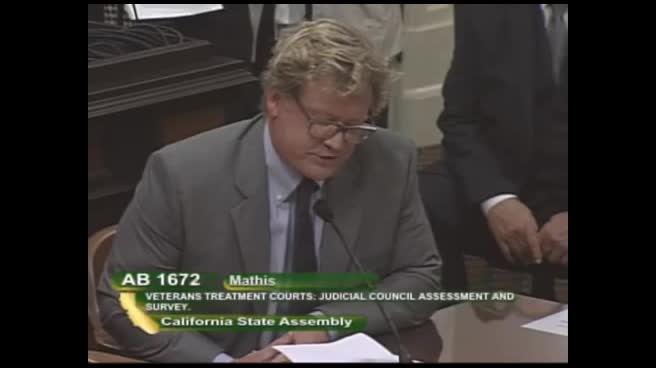 7MIN