AB 1820: Unmanned aircraft systems.
- Session Year: 2015-2016
- House: Assembly
- Latest Version Date: 2016-05-19
Existing federal law, the Federal Aviation Administration Modernization and Reform Act of 2012, provides for the integration of civil and public unmanned aircraft systems, commonly known as drones, into the national airspace system.
This bill would generally prohibit a law enforcement agency from using an unmanned aircraft system, obtaining an unmanned aircraft system from another public agency by contract, loan, or other arrangement, or using information obtained from an unmanned aircraft system used by another public agency, except as provided authorized by the bills provisions. provisions of this bill. The bill would make its provisions applicable to all law enforcement agencies and private entities when contracting with or acting as the agent of a law enforcement agency for the use of an unmanned aircraft system. The bill would authorize a law enforcement agency to use an unmanned aircraft system, obtain an unmanned aircraft system from another public agency by contract, loan, or other arrangement, or permit another law enforcement agency to use an unmanned aircraft system within the agencys jurisdiction jurisdiction, if the law enforcement agency complies with specified requirements, including, among others, that before the use of an unmanned aircraft system, the law enforcement agency develops and makes available to the public a policy on the use of an the unmanned aircraft system, system that meets specified requirements, as provided, and that the law enforcement agency complies with all applicable federal, state, and local law and the unmanned aircraft system policy developed by the law enforcement agency pursuant to the bills policy adopted pursuant to these provisions. The bill would prohibit a law enforcement agency from using an unmanned aircraft system to surveil private property unless, among other justifications, property, unless the law enforcement agency obtains a search warrant. warrant or express permission to search the property, as specified, or an exigent circumstance exists.
The bill would require any images, footage, or data obtained through the use of an unmanned aircraft system under these provisions to be permanently destroyed within one year, except as specified. Unless authorized by federal law, the bill would prohibit a person or entity, including a public agency subject to these provisions, or a person or entity under contract to a public agency, for the purpose of that contract, entity from equipping or arming an unmanned aircraft system with a weapon or other device that may be carried by, or launched or directed from, an unmanned aircraft system and that is intended to cause incapacitation, bodily injury or death, or damage to, or the destruction of, real or personal property. device, as specified. By creating a new crime, the bill would impose a state-mandated local program. The bill would also provide that specified surveillance restrictions on electronic devices apply to the use or operation of an unmanned aircraft system by a law enforcement agency.
The California Constitution requires the state to reimburse local agencies and school districts for certain costs mandated by the state. Statutory provisions establish procedures for making that reimbursement.
This bill would provide that no reimbursement is required by this act for a specified reason.
Existing federal law, the Federal Aviation Administration Modernization and Reform Act of 2012, provides for the integration of civil and public unmanned aircraft systems, commonly known as drones, into the national airspace system.
This bill would generally prohibit a law enforcement agency from using an unmanned aircraft system, obtaining an unmanned aircraft system from another public agency by contract, loan, or other arrangement, or using information obtained from an unmanned aircraft system used by another public agency, except as provided by the bills provisions. The bill would make its provisions applicable to all law enforcement agencies and private entities when contracting with or acting as the agent of a law enforcement agency for the use of an unmanned aircraft system. The bill would authorize a law enforcement agency to use an unmanned aircraft system system, obtain an unmanned aircraft system from another public agency by contract, loan, or other arrangement, or permit another law enforcement agency to use an unmanned aircraft system within the agencys jurisdiction if the law enforcement agency complies with specified requirements, including, among others, that before the use of an unmanned aircraft system, the law enforcement agency develops and makes available to the public a policy on the use of an unmanned aircraft system, as provided, and that the law enforcement agency complies with all applicable federal, state, and local law and the unmanned aircraft system policy developed by the law enforcement agency pursuant to the bills provisions. The bill would prohibit a law enforcement agency from using an unmanned aircraft system to surveil private property unless, among other justifications, the law enforcement agency obtains a search warrant.
The bill would require images, footage, or data obtained through the use of an unmanned aircraft system under these provisions to be permanently destroyed within one year, except as specified. Unless authorized by federal law, the bill would prohibit a person or entity, including a public agency subject to these provisions, or a person or entity under contract to a public agency, for the purpose of that contract, from equipping or arming an unmanned aircraft system with a weapon or other device that may be carried by, or launched or directed from, an unmanned aircraft system and that is intended to cause incapacitation, bodily injury or death, or damage to, or the destruction of, real or personal property. By creating a new crime, the bill would impose a state-mandated local program. The bill would also provide that specified surveillance restrictions on electronic devices apply to the use or operation of an unmanned aircraft system by a law enforcement agency.
The California Constitution requires the state to reimburse local agencies and school districts for certain costs mandated by the state. Statutory provisions establish procedures for making that reimbursement.
This bill would provide that no reimbursement is required by this act for a specified reason.
Existing federal law, the Federal Aviation Administration Modernization and Reform Act of 2012, provides for the integration of civil and public unmanned aircraft systems, commonly known as drones, into the national airspace system.
This bill would generally prohibit a law enforcement agency from using an unmanned aircraft system, obtaining an unmanned aircraft system from another public agency by contract, loan, or other arrangement, or using information obtained from an unmanned aircraft system used by another public agency, except as provided by the bills provisions. The bill would make its provisions applicable to all law enforcement agencies and private entities when contracting with or acting as the agent of a law enforcement agency for the use of an unmanned aircraft system. The bill would authorize a law enforcement agency to use an unmanned aircraft system if the law enforcement agency complies with specified requirements, including, among others, that before the use of an unmanned aircraft system, the law enforcement agency develops and makes available to the public a policy on the use of an unmanned aircraft system, as provided, and that the law enforcement agency complies with all applicable federal, state, and local law and the unmanned aircraft system policy developed by the law enforcement agency pursuant to the bills provisions. The bill would prohibit a law enforcement agency from using an unmanned aircraft system to surveil private property unless, among other justifications, the law enforcement agency obtains a search warrant.
The bill would require images, footage, or data obtained through the use of an unmanned aircraft system under these provisions to be permanently destroyed within one year, except as specified. Unless authorized by federal law, the bill would prohibit a person or entity, including a public agency subject to these provisions, or a person or entity under contract to a public agency, for the purpose of that contract, from equipping or arming an unmanned aircraft system with a weapon or other device that may be carried by, or launched or directed from, an unmanned aircraft system and that is intended to cause incapacitation, bodily injury or death, or damage to, or the destruction of, real or personal property. By creating a new crime, the bill would impose a state-mandated local program. The bill would also provide that specified surveillance restrictions on electronic devices apply to the use or operation of an unmanned aircraft system by a law enforcement agency.
The California Constitution requires the state to reimburse local agencies and school districts for certain costs mandated by the state. Statutory provisions establish procedures for making that reimbursement.
This bill would provide that no reimbursement is required by this act for a specified reason.
(a)A law enforcement agency shall not use an unmanned aircraft system, obtain an unmanned aircraft system from another public agency by contract, loan, or other arrangement, or use information obtained from an unmanned aircraft system used by another public agency, except as provided in this title. This title shall apply to all law enforcement agencies and private entities when contracting with or acting as the agent of a law enforcement agency for the use of an unmanned aircraft system.
(b)A law enforcement agency may use an unmanned aircraft system, obtain an unmanned aircraft system from another agency by contract, loan, or other arrangement, or permit another law enforcement agency to use an unmanned aircraft system within the agencys jurisdiction if the law enforcement agency complies with the requirements of this title and all applicable federal, state, and local law.
(c)If the use of an unmanned aircraft system by a local law enforcement agency may involve the collection of images, footage, or data from another county, city, or city and county, the law enforcement agency shall obtain a warrant based on probable cause, unless either of the following applies:
(1)An exigent circumstance exists.
(2)The law enforcement agency has entered into a written, public agreement with the appropriate law enforcement agency in the other county, city, or city and county, and that other law enforcement agency complies with paragraph (5) (6) of subdivision (d).
(d)(1)If a law enforcement agency elects to use an unmanned aircraft system, the law enforcement agency shall first develop and make available to the public a policy on its use of the unmanned aircraft system, and train the law enforcement agencys officers and employees on the policy, before the use of the unmanned aircraft system.
(2)A law enforcement agency shall use the unmanned aircraft system consistent with the policy developed pursuant to this subdivision.
(3)Before finalizing the policy required by this subdivision, the law enforcement agency shall present the proposed policy at a regularly scheduled and noticed public meeting of its governing body with an opportunity for public comment.
(4)
(3)The policy required by this subdivision shall specify, at a minimum, all of the following:
(A)The circumstances under which an unmanned aircraft system may or may not be used.
(B)The rules and processes required before the use of an unmanned aircraft system.
(C)The individuals who may access or use an unmanned aircraft system or the information collected by an unmanned aircraft system and the circumstances under which those individuals may do so.
(D)The safeguards to protect against unauthorized use or access.
(E)The training required for any individual authorized to use or access information collected by an unmanned aircraft system.
(F)The guidelines for sharing images, footage, or data with other law enforcement agencies and public agencies.
(G)The manner in which information obtained from another public agencys use of an unmanned aircraft system will be used.
(H)Mechanisms to ensure that the policy required by this subdivision is adhered to.
(4)The finalized policy developed pursuant to this subdivision shall be predominantly posted on the law enforcement agencys public Internet Web site.
(5)The law enforcement agency shall maintain an Internet Web site page for public input to address civilians concerns and recommendations.
(5)
(6)If a law enforcement agency elects to permit another law enforcement agency to use an unmanned aircraft system within the agencys jurisdiction by means of an agreement entered into pursuant to subdivision (c), the agency shall post a copy of the agreement on its Internet Web site. The agreement, at a minimum, shall specify that the policies developed by the law enforcement agency that owns the unmanned aircraft system will be complied with by that law enforcement agency in the jurisdiction in which the unmanned aircraft system is used.
(e)A law enforcement agency shall not use an unmanned aircraft system, obtain an unmanned aircraft system from another public agency by contract, loan, or other arrangement, or use information obtained from an unmanned aircraft system used by another public agency to surveil private property unless the law enforcement agency has obtained either of the following:
(1)A search warrant based on probable cause.
(2)The express permission of the person or entity with the legal authority to authorize a search of the specific private property to be subjected to surveillance.
(f)Notwithstanding subdivision (e), a law enforcement agency may use an unmanned aircraft system to surveil private property if an exigent circumstance exists, including, but not limited to, either of the following circumstances:
(1)In emergency situations if there is an imminent threat to life or of great bodily harm, including, but not limited to, fires, hostage crises, barricaded suspects, hot pursuit situations if reasonably necessary to prevent harm to law enforcement officers or others, and search and rescue operations on land or water.
(2)To determine the appropriate response to an imminent or existing environmental emergency or disaster, including, but not limited to, oil spills or chemical spills.
14351.(a)Images, footage, or data obtained through the use of an unmanned aircraft system shall be permanently destroyed within one year, except that a law enforcement agency may retain the images, footage, or data in both of the following circumstances:
(1)For training purposes. Images, footage, or data retained for training purposes shall be used only for the education and instruction of a law enforcement agencys employees in matters related to the mission of the law enforcement agency and for no other purpose.
(2)For academic research or teaching purposes. Images, footage, or data retained for academic research or teaching purposes shall be used only for the advancement of research and teaching conducted by an academic or research institution and matters related to the mission of the institution and for no other purpose.
(b)Notwithstanding subdivision (a), a law enforcement agency may retain beyond one year images, footage, or data obtained through the use of an unmanned aircraft system in both of the following circumstances:
(1)If a search warrant authorized the collection of the images, footage, or data.
(2)If the images, footage, or data are evidence in any claim filed or any pending litigation, internal disciplinary proceeding, enforcement proceeding, or criminal investigation.
14352.Unless authorized by federal law, a person or entity, including a law enforcement agency subject to Section 14350 or a person or entity under contract to a law enforcement agency, for the purpose of that contract, shall not equip or arm an unmanned aircraft system with a weapon or other device that may be carried by, or launched or directed from, an unmanned aircraft system and that is intended to cause incapacitation, bodily injury or death, or damage to, or the destruction of, real or personal property.
14353.A law enforcement agency that uses an unmanned aircraft system or obtains an unmanned aircraft system from another public agency by contract, loan, or other arrangement shall make a good faith effort to operate the system so as to minimize the collection of images, footage, or data of persons, places, or things not specified with particularity in the warrant authorizing the use of an unmanned aircraft system, or, if no warrant was obtained, for purposes unrelated to the justification for the operation.
14354.(a)This title is not intended to conflict with or supersede federal law, including rules and regulations of the Federal Aviation Administration.
(b)A local legislative body may adopt more restrictive policies on the acquisition, use, or retention of unmanned aircraft systems by a law enforcement agency.
14355.Except as provided in this title, the surveillance restrictions on electronic devices described in Chapter 1.5 (commencing with Section 630) of Title 15 of Part 1 shall apply to the use or operation of an unmanned aircraft system by a law enforcement agency.
14356.For the purposes of this title, the following definitions shall apply:
(a)Criminal intelligence means information compiled, analyzed, or disseminated in an effort to anticipate, prevent, monitor, or investigate criminal activity.
(b)Law enforcement agency means the Attorney General, each district attorney, and each agency of the state or political subdivision of the state authorized by statute to investigate or prosecute law violators and that employs peace officers.
(c)Surveil means the purposeful observation of a person or private property with the intent of gathering criminal intelligence.
(d) Unmanned aircraft system means an unmanned aircraft and associated elements, including communication links and the components that control the unmanned aircraft, that are required for the pilot in command to operate safely and efficiently in the national airspace system.
SEC. 2.No reimbursement is required by this act pursuant to Section 6 of Article XIIIB of the California Constitution because the only costs that may be incurred by a local agency or school district will be incurred because this act creates a new crime or infraction, eliminates a crime or infraction, or changes the penalty for a crime or infraction, within the meaning of Section 17556 of the Government Code, or changes the definition of a crime within the meaning of Section 6 of Article XIIIB of the California Constitution.
(a)A law enforcement agency shall not use an unmanned aircraft system, obtain an unmanned aircraft system from another public agency by contract, loan, or other arrangement, or use information obtained from an unmanned aircraft system used by another public agency, except as provided in this title. This title shall apply to all law enforcement agencies and private entities when contracting with or acting as the agent of a law enforcement agency for the use of an unmanned aircraft system.
(b)A law enforcement agency may use an unmanned aircraft system, obtain an unmanned aircraft system from another agency by contract, loan, or other arrangement, or permit another law enforcement agency to use information obtained from an unmanned aircraft system used by another public agency, within the agencys jurisdiction if the law enforcement agency complies with the requirements of this title and all applicable federal, state, and local law.
(c)If the use of an unmanned aircraft system by a local law enforcement agency may involve the collection of images, footage, or data from another county, city, or city and county, the law enforcement agency shall obtain a warrant based on probable cause, unless an either of the following applies:
(1)An exigent circumstance exists.
(2)The law enforcement agency has entered into a written, public agreement with the appropriate law enforcement agency in the other county, city, or city and county, and that other law enforcement agency complies with paragraph (5) of subdivision (d).
(d)(1)If a law enforcement agency elects to use an unmanned aircraft system, the law enforcement agency shall first develop and make available to the public a policy on its use of the unmanned aircraft system, and train the law enforcement agencys officers and employees on the policy, before the use of the unmanned aircraft system.
(2)A law enforcement agency shall use the unmanned aircraft system consistent with the policy developed pursuant to this subdivision.
(3)Before finalizing the policy required by this subdivision, the law enforcement agency shall present the proposed policy at a regularly scheduled and noticed public meeting of its governing body with an opportunity for public comment.
(4)The policy required by this subdivision shall specify, at a minimum, all of the following:
(A)The circumstances under which an unmanned aircraft system may or may not be used.
(B)The rules and processes required before the use of an unmanned aircraft system.
(C)The individuals who may access or use an unmanned aircraft system or the information collected by an unmanned aircraft system and the circumstances under which those individuals may do so.
(D)The safeguards to protect against unauthorized use or access.
(E)The training required for any individual authorized to use or access information collected by an unmanned aircraft system.
(F)The guidelines for sharing images, footage, or data with other law enforcement agencies and public agencies.
(G)The manner in which information obtained from another public agencys use of an unmanned aircraft system will be used.
(H)Mechanisms to ensure that the policy required by this subdivision is adhered to.
(5)If a law enforcement agency elects to permit another law enforcement agency to use an unmanned aircraft system within the agencys jurisdiction by means of an agreement entered into pursuant to subdivision (c), the agency shall post a copy of the agreement on its Internet Web site.
(e)A law enforcement agency shall not use an unmanned aircraft system, or obtain an unmanned aircraft system from another public agency by contract, loan, or other arrangement, or use information obtained from an unmanned aircraft system used by another public agency, agency to surveil private property unless the law enforcement agency has obtained either of the following:
(1)A search warrant based on probable cause.
(2)The express permission of the person or entity with the legal authority to authorize a search of the specific private property to be subjected to surveillance.
(f)Notwithstanding subdivision (e), a law enforcement agency may use an unmanned aircraft system to surveil private property if an exigent circumstance exists, including, but not limited to, either of the following circumstances:
(1)In emergency situations if there is an imminent threat to life or of great bodily harm, including, but not limited to, fires, hostage crises, barricaded suspects, hot pursuit situations if reasonably necessary to prevent harm to law enforcement officers or others, and search and rescue operations on land or water.
(2)To determine the appropriate response to an imminent or existing environmental emergency or disaster, including, but not limited to, oil spills or chemical spills.
14351.(a)Images, footage, or data obtained through the use of an unmanned aircraft system shall be permanently destroyed within one year, except that a law enforcement agency may retain the images, footage, or data in both of the following circumstances:
(1)For training purposes. Images, footage, or data retained for training purposes shall be used only for the education and instruction of a law enforcement agencys employees in matters related to the mission of the law enforcement agency and for no other purpose.
(2)For academic research or teaching purposes. Images, footage, or data retained for academic research or teaching purposes shall be used only for the advancement of research and teaching conducted by an academic or research institution and matters related to the mission of the institution and for no other purpose.
(b)Notwithstanding subdivision (a), a law enforcement agency may retain beyond one year images, footage, or data obtained through the use of an unmanned aircraft system in both of the following circumstances:
(1)If a search warrant authorized the collection of the images, footage, or data.
(2)If the images, footage, or data are evidence in any claim filed or any pending litigation, internal disciplinary proceeding, enforcement proceeding, or criminal investigation.
14352.Unless authorized by federal law, a person or entity, including a law enforcement agency subject to Section 14350 or a person or entity under contract to a law enforcement agency, for the purpose of that contract, shall not equip or arm an unmanned aircraft system with a weapon or other device that may be carried by, or launched or directed from, an unmanned aircraft system and that is intended to cause incapacitation, bodily injury or death, or damage to, or the destruction of, real or personal property.
14353.A law enforcement agency that uses an unmanned aircraft system or obtains an unmanned aircraft system from another public agency by contract, loan, or other arrangement shall make a good faith effort to operate the system so as to minimize the collection of images, footage, or data of persons, places, or things not specified with particularity in the warrant authorizing the use of an unmanned aircraft system, or, if no warrant was obtained, for purposes unrelated to the justification for the operation.
14354.(a)This title is not intended to conflict with or supersede federal law, including rules and regulations of the Federal Aviation Administration.
(b)A local legislative body may adopt more restrictive policies on the acquisition, use, or retention of unmanned aircraft systems by a law enforcement agency.
14355.Except as provided in this title, the surveillance restrictions on electronic devices described in Chapter 1.5 (commencing with Section 630) of Title 15 of Part 1 shall apply to the use or operation of an unmanned aircraft system by a law enforcement agency.
14356.For the purposes of this title, the following definitions shall apply:
(a)Criminal intelligence means information compiled, analyzed, or disseminated in an effort to anticipate, prevent, monitor, or investigate criminal activity.
(b)Law enforcement agency means the Attorney General, each district attorney, and each agency of the state or political subdivision of the state authorized by statute to investigate or prosecute law violators and that employs peace officers.
(c)Surveil means the purposeful observation of a person or private property with the intent of gathering criminal intelligence.
(d) Unmanned aircraft system means an unmanned aircraft and associated elements, including communication links and the components that control the unmanned aircraft, that are required for the pilot in command to operate safely and efficiently in the national airspace system.
SEC. 2.No reimbursement is required by this act pursuant to Section 6 of Article XIIIB of the California Constitution because the only costs that may be incurred by a local agency or school district will be incurred because this act creates a new crime or infraction, eliminates a crime or infraction, or changes the penalty for a crime or infraction, within the meaning of Section 17556 of the Government Code, or changes the definition of a crime within the meaning of Section 6 of Article XIIIB of the California Constitution.
(a)A law enforcement agency shall not use an unmanned aircraft system, obtain an unmanned aircraft system from another public agency by contract, loan, or other arrangement, or use information obtained from an unmanned aircraft system used by another public agency, except as provided in this title. This title shall apply to all law enforcement agencies and private entities when contracting with or acting as the agent of a law enforcement agency for the use of an unmanned aircraft system.
(b)A law enforcement agency may use an unmanned aircraft system, or use information obtained from an unmanned aircraft system used by another public agency, if the law enforcement agency complies with the requirements of this title and all applicable federal, state, and local law.
(c)If the use of an unmanned aircraft system by a local law enforcement agency may involve the collection of images, footage, or data from another county, city, or city and county, the law enforcement agency shall obtain a warrant based on probable cause, unless an exigent circumstance exists.
(d)(1)If a law enforcement agency elects to use an unmanned aircraft system, the law enforcement agency shall first develop and make available to the public a policy on its use of the unmanned aircraft system, and train the law enforcement agencys officers and employees on the policy, before the use of the unmanned aircraft system.
(2)A law enforcement agency shall use the unmanned aircraft system consistent with the policy developed pursuant to this subdivision.
(3)Before finalizing the policy required by this subdivision, the law enforcement agency shall present the proposed policy at a regularly scheduled and noticed public meeting of its governing body with an opportunity for public comment.
(4)The policy required by this subdivision shall specify, at a minimum, all of the following:
(A)The circumstances under which an unmanned aircraft system may or may not be used.
(B)The rules and processes required before the use of an unmanned aircraft system.
(C)The individuals who may access or use an unmanned aircraft system or the information collected by an unmanned aircraft system and the circumstances under which those individuals may do so.
(D)The safeguards to protect against unauthorized use or access.
(E)The training required for any individual authorized to use or access information collected by an unmanned aircraft system.
(F)The guidelines for sharing images, footage, or data with other law enforcement agencies and public agencies.
(G)The manner in which information obtained from another public agencys use of an unmanned aircraft system will be used.
(H)Mechanisms to ensure that the policy required by this subdivision is adhered to.
(e)A law enforcement agency shall not use an unmanned aircraft system, or information obtained from an unmanned aircraft system used by another public agency, to surveil private property unless the law enforcement agency has obtained either of the following:
(1)A search warrant based on probable cause.
(2)The express permission of the person or entity with the legal authority to authorize a search of the specific private property to be subjected to surveillance.
(f)Notwithstanding subdivision (e), a law enforcement agency may use an unmanned aircraft system to surveil private property if an exigent circumstance exists, including, but not limited to, either of the following circumstances:
(1)In emergency situations if there is an imminent threat to life or of great bodily harm, including, but not limited to, fires, hostage crises, barricaded suspects, hot pursuit situations if reasonably necessary to prevent harm to law enforcement officers or others, and search and rescue operations on land or water.
(2)To determine the appropriate response to an imminent or existing environmental emergency or disaster, including, but not limited to, oil spills or chemical spills.
14351.(a)Images, footage, or data obtained through the use of an unmanned aircraft system shall be permanently destroyed within one year, except that a law enforcement agency may retain the images, footage, or data in both of the following circumstances:
(1)For training purposes. Images, footage, or data retained for training purposes shall be used only for the education and instruction of a law enforcement agencys employees in matters related to the mission of the law enforcement agency and for no other purpose.
(2)For academic research or teaching purposes. Images, footage, or data retained for academic research or teaching purposes shall be used only for the advancement of research and teaching conducted by an academic or research institution and matters related to the mission of the institution and for no other purpose.
(b)Notwithstanding subdivision (a), a law enforcement agency may retain beyond one year images, footage, or data obtained through the use of an unmanned aircraft system in both of the following circumstances:
(1)If a search warrant authorized the collection of the images, footage, or data.
(2)If the images, footage, or data are evidence in any claim filed or any pending litigation, internal disciplinary proceeding, enforcement proceeding, or criminal investigation.
14352.Unless authorized by federal law, a person or entity, including a law enforcement agency subject to Section 14350 or a person or entity under contract to a law enforcement agency, for the purpose of that contract, shall not equip or arm an unmanned aircraft system with a weapon or other device that may be carried by, or launched or directed from, an unmanned aircraft system and that is intended to cause incapacitation, bodily injury or death, or damage to, or the destruction of, real or personal property.
14353.All unmanned aircraft systems shall be operated A law enforcement agency that uses an unmanned aircraft system shall operate the system so as to minimize the collection of images, footage, or data of persons, places, or things not specified with particularity in the warrant authorizing the use of an unmanned aircraft system, or, if no warrant was obtained, for purposes unrelated to the justification for the operation.
14354.(a)This title is not intended to conflict with or supersede federal law, including rules and regulations of the Federal Aviation Administration.
(b)A local legislative body may adopt more restrictive policies on the acquisition, use, or retention of unmanned aircraft systems by a law enforcement agency.
14355.Except as provided in this title, the surveillance restrictions on electronic devices described in Chapter 1.5 (commencing with Section 630) of Title 15 of Part 1 shall apply to the use or operation of an unmanned aircraft system by a law enforcement agency.
14356.For the purposes of this title, the following definitions shall apply:
(a)Criminal intelligence means information compiled, analyzed, or disseminated in an effort to anticipate, prevent, monitor, or investigate criminal activity.
(b)Law enforcement agency means the Attorney General, each district attorney, and each agency of the state or political subdivision of the state authorized by statute to investigate or prosecute law violators and that employs peace officers.
(c)Surveil means the purposeful observation of a person or private property with the intent of gathering criminal intelligence.
(d) Unmanned aircraft system means an unmanned aircraft and associated elements, including communication links and the components that control the unmanned aircraft, that are required for the pilot in command to operate safely and efficiently in the national airspace system.
SEC. 2.No reimbursement is required by this act pursuant to Section 6 of Article XIIIB of the California Constitution because the only costs that may be incurred by a local agency or school district will be incurred because this act creates a new crime or infraction, eliminates a crime or infraction, or changes the penalty for a crime or infraction, within the meaning of Section 17556 of the Government Code, or changes the definition of a crime within the meaning of Section 6 of Article XIIIB of the California Constitution.
(a)A law enforcement agency shall not use an unmanned aircraft system, obtain an unmanned aircraft system from another public agency by contract, loan, or other arrangement, or use information obtained from an unmanned aircraft system used by another public agency, except as provided in this title. This title shall apply to all law enforcement agencies and private entities when contracting with or acting as the agent of a law enforcement agency for the use of an unmanned aircraft system.
(b)A law enforcement agency may use an unmanned aircraft system, or use information obtained from an unmanned aircraft system used by another public agency, if the law enforcement agency complies with the requirements of this title and all applicable federal, state, and local law.
(c)If the use of an unmanned aircraft system by a local law enforcement agency may involve the collection of images, footage, or data from another county, city, or city and county, the law enforcement agency shall obtain a warrant based on probable cause, unless an exigent circumstance exists.
(d)(1)If a law enforcement agency elects to use an unmanned aircraft system, the law enforcement agency shall first develop and make available to the public a policy on its use of the unmanned aircraft system, and train the law enforcement agencys officers and employees on the policy, before the use of the unmanned aircraft system.
(2)A law enforcement agency shall use the unmanned aircraft system consistent with the policy developed pursuant to this subdivision.
(3)Before finalizing the policy required by this subdivision, the law enforcement agency shall present the proposed policy at a regularly scheduled and noticed public meeting of its governing body with an opportunity for public comment.
(4)The policy required by this subdivision shall specify, at a minimum, all of the following:
(A)The circumstances under which an unmanned aircraft system may or may not be used.
(B)The rules and processes required before the use of an unmanned aircraft system.
(C)The individuals who may access or use an unmanned aircraft system or the information collected by an unmanned aircraft system and the circumstances under which those individuals may do so.
(D)The safeguards to protect against unauthorized use or access.
(E)The training required for any individual authorized to use or access information collected by an unmanned aircraft system.
(F)The guidelines for sharing images, footage, or data with other law enforcement agencies and public agencies.
(G)The manner in which information obtained from another public agencys use of an unmanned aircraft system will be used.
(H)Mechanisms to ensure that the policy required by this subdivision is adhered to.
(e)A law enforcement agency shall not use an unmanned aircraft system, or information obtained from an unmanned aircraft system used by another public agency, to surveil private property unless the law enforcement agency has obtained either of the following:
(1)A search warrant based on probable cause.
(2)The express permission of the person or entity with the legal authority to authorize a search of the specific private property to be subjected to surveillance.
(f)Notwithstanding subdivision (e), a law enforcement agency may use an unmanned aircraft system to surveil private property if an exigent circumstance exists, including, but not limited to, either of the following circumstances:
(1)In emergency situations if there is an imminent threat to life or of great bodily harm, including, but not limited to, fires, hostage crises, barricaded suspects, hot pursuit situations if reasonably necessary to prevent harm to law enforcement officers or others, and search and rescue operations on land or water.
(2)To determine the appropriate response to an imminent or existing environmental emergency or disaster, including, but not limited to, oil spills or chemical spills.
14351.(a)Images, footage, or data obtained through the use of an unmanned aircraft system shall be permanently destroyed within one year, except that a law enforcement agency may retain the images, footage, or data in both of the following circumstances:
(1)For training purposes. Images, footage, or data retained for training purposes shall be used only for the education and instruction of a law enforcement agencys employees in matters related to the mission of the law enforcement agency and for no other purpose.
(2)For academic research or teaching purposes. Images, footage, or data retained for academic research or teaching purposes shall be used only for the advancement of research and teaching conducted by an academic or research institution and matters related to the mission of the institution and for no other purpose.
(b)Notwithstanding subdivision (a), a law enforcement agency may retain beyond one year images, footage, or data obtained through the use of an unmanned aircraft system in both of the following circumstances:
(1)If a search warrant authorized the collection of the images, footage, or data.
(2)If the images, footage, or data are evidence in any claim filed or any pending litigation, internal disciplinary proceeding, enforcement proceeding, or criminal investigation.
14352.Unless authorized by federal law, a person or entity, including a law enforcement agency subject to Section 14350 or a person or entity under contract to a law enforcement agency, for the purpose of that contract, shall not equip or arm an unmanned aircraft system with a weapon or other device that may be carried by, or launched or directed from, an unmanned aircraft system and that is intended to cause incapacitation, bodily injury or death, or damage to, or the destruction of, real or personal property.
14353.All unmanned aircraft systems shall be operated so as to minimize the collection of images, footage, or data of persons, places, or things not specified with particularity in the warrant authorizing the use of an unmanned aircraft system, or, if no warrant was obtained, for purposes unrelated to the justification for the operation.
14354.(a)This title is not intended to conflict with or supersede federal law, including rules and regulations of the Federal Aviation Administration.
(b)A local legislative body may adopt more restrictive policies on the acquisition, use, or retention of unmanned aircraft systems by a law enforcement agency.
14355.Except as provided in this title, the surveillance restrictions on electronic devices described in Chapter 1.5 (commencing with Section 630) of Title 15 of Part 1 shall apply to the use or operation of an unmanned aircraft system by a law enforcement agency.
14356.For the purposes of this title, the following definitions shall apply:
(a)Criminal intelligence means information compiled, analyzed, or disseminated in an effort to anticipate, prevent, monitor, or investigate criminal activity.
(b)Law enforcement agency means the Attorney General, each district attorney, and each agency of the state or political subdivision of the state authorized by statute to investigate or prosecute law violators and that employs peace officers.
(c)Surveil means the purposeful observation of a person or private property with the intent of gathering criminal intelligence.
(d) Unmanned aircraft system means an unmanned aircraft and associated elements, including communication links and the components that control the unmanned aircraft, that are required for the pilot in command to operate safely and efficiently in the national airspace system.
SEC. 2.No reimbursement is required by this act pursuant to Section 6 of Article XIIIB of the California Constitution because the only costs that may be incurred by a local agency or school district will be incurred because this act creates a new crime or infraction, eliminates a crime or infraction, or changes the penalty for a crime or infraction, within the meaning of Section 17556 of the Government Code, or changes the definition of a crime within the meaning of Section 6 of Article XIIIB of the California Constitution.
|
Date
|
Status
|
|---|---|
| Apr 21, 2016 | Joint Rule 62(a), file notice suspended. |
| Jun 28, 2016 | In committee: Set, first hearing. Failed passage. Reconsideration granted. |
| Jun 22, 2016 | From committee: Do pass and re-refer to Com. on JUD. (Ayes 5. Noes 2.) (June 21). Re-referred to Com. on JUD. |
| Jun 2, 2016 | Referred to Coms. on PUB. S. and JUD. |
| May 23, 2016 | Read third time. Passed. Ordered to the Senate. (Ayes 43. Noes 25.) |
| May 23, 2016 | Read third time. Passed. Ordered to the Senate. (Ayes 43. Noes 25. Page 4906.) |
| May 23, 2016 | Read third time. Passed. Ordered to the Senate. |
| May 23, 2016 | In Senate. Read first time. To Com. on RLS. for assignment. |
| May 19, 2016 | Read third time and amended. Ordered to third reading. (Page 4852.) |
| May 19, 2016 | Read third time and amended. Ordered to third reading. |
| May 5, 2016 | Read second time. Ordered to third reading. |
| May 4, 2016 | From committee: Do pass. (Ayes 14. Noes 6.) (May 4). |
| Apr 21, 2016 | Joint Rule 62(a), file notice suspended. (Page 4448.) |
| Feb 8, 2016 | Read first time. To print. |
| Apr 21, 2016 | In committee: Reconsideration granted by unanimous consent. |
| Apr 21, 2016 | From committee: Do pass and re-refer to Com. on APPR. (Ayes 6. Noes 5.) (April 21). Re-referred to Com. on APPR. |
| Apr 19, 2016 | In committee: Set, first hearing. Failed passage. |
| Apr 12, 2016 | Re-referred to Com. on P. & C.P. |
| Apr 11, 2016 | From committee chair, with author's amendments: Amend, and re-refer to Com. on P. & C.P. Read second time and amended. |
| Apr 4, 2016 | In committee: Hearing postponed by committee. |
| Mar 15, 2016 | From committee: Do pass and re-refer to Com. on P. & C.P. (Ayes 7. Noes 0.) (March 15). Re-referred to Com. on P. & C.P. |
| Mar 9, 2016 | Re-referred to Com. on PUB. S. |
| Mar 8, 2016 | From committee chair, with author's amendments: Amend, and re-refer to Com. on PUB. S. Read second time and amended. |
| Feb 25, 2016 | Referred to Coms. on PUB. S. and P. & C.P. |
| Feb 9, 2016 | From printer. May be heard in committee March 10. |
|
Date
|
Description
|
Location
|
Votes
|
|
|---|---|---|---|---|
| Jun 28, 2016 | [First] hearing set for [06-29-2016]: Failed passage in Committee. Reconsideration granted | Senate Standing Committee on Judiciary |
Passed |
|
| Jun 28, 2016 | Do pass, but first be re-referred to the Committee on [Appropriations] | Senate Standing Committee on Judiciary |
Failed |
|
| Jun 21, 2016 | Do pass, but first be re-referred to the Committee on [Judiciary] | Senate Standing Committee on Public Safety |
Passed |
|
| May 23, 2016 | AB 1820 QUIRK Assembly Third Reading | Assembly Floor |
Passed |
|
| May 4, 2016 | Do pass. | Assembly Standing Committee on Appropriations |
Passed |
|
| Apr 21, 2016 | Do pass and be re-referred to the Committee on [Appropriations] | Assembly Standing Committee on Privacy and Consumer Protection |
Passed |
|
| Apr 19, 2016 | Do pass and be re-referred to the Committee on [Appropriations] | Assembly Standing Committee on Privacy and Consumer Protection |
Failed |
|
| Mar 15, 2016 | Do pass and be re-referred to the Committee on [Privacy and Consumer Protection] | Assembly Standing Committee on Public Safety |
Passed |
This list shows positions taken on this bill by organizations on the date displayed, which is linked to the original source.
Positions by individuals are not included.
|
Organization
|
Position
|
Date
|
|---|---|---|
| 10)Author's Statement: According to the author, ' | ** Against | Mar 15, 2016 |
| 11)Argument in Support: According to | ** Against | Mar 15, 2016 |
| American Civil Liberties Union Foundation Of Southern California | * Support | Jun 28, 2016 |
| California Civil Liberties Advocacy | * Support | Jun 21, 2016 |
| California Police Chiefs Association | * Against | Mar 15, 2016 |
| California State Sheriffs' Association | * Against | Jun 21, 2016 |
| Central Coast Forest Association | ** Support | May 4, 2016 |
| Consumer Federation Of California | ** Against | May 4, 2016 |
| Consumer Watchdog | ** Against | May 4, 2016 |
| Electric Frontier Foundation | * Against | Jun 28, 2016 |
| EXISTING LAW: | ** Against | Mar 15, 2016 |
| P. & C.P. | ** Against | May 4, 2016 |
| Peace Officers Research Association Of California | ** Against | May 4, 2016 |
| Privacy Rights Clearinghouse | ** Against | May 4, 2016 |
| Specifically, this bill: | ** Against | Mar 15, 2016 |
Senator Hannah-Beth Jackson, Chair
2015-2016 Regular Session
Bill No: AB 1820 (Author:Quirk)
Version: May 19, 2016
Hearing Date: June 28, 2016
Fiscal: Yes
Urgency: No
Consultant: TH
SUBJECT
Unmanned Aircraft Systems
DESCRIPTION
This bill prohibits a law enforcement agency from using an unmanned aircraft system, obtaining an unmanned aircraft system from another public agency, or using information obtained from an unmanned aircraft system, except as specifically authorized. A law enforcement agency would be authorized to use an unmanned aircraft system if it, among other things, develops a policy on the use of unmanned aircraft systems that meets specified requirements. The bill would prohibit a law enforcement agency from using an unmanned aircraft system to surveil private property, unless the law enforcement agency obtains a search warrant or express permission to search the property, or an exigent circumstance exists.
This bill would require any images, footage, or data obtained through the use of an unmanned aircraft system to be permanently destroyed within one year, and would prohibit a person or entity from equipping or arming an unmanned aircraft system with a weapon or other device, except as specified.
BACKGROUND
The development of small unmanned aircraft systems (UAS) – known variously as “unmanned aerial vehicles,” “remote piloted aircraft,” or simply “drones” – promises to transform the way Californians interact with each other and their environment. Just a few decades ago, small aircraft of this type were the exclusive domain of hobbyists. Within the last decade or so, the public has become familiar with the military’s use of unmanned aircraft to accomplish certain mission objectives. However, in December 2013 when Amazon.com, FedEx, and UPS announced their plans to integrate unmanned aircraft into their logistics and delivery services, the possibility of widespread adoption of this technology became clear.
Along with a variety of businesses, law enforcement agencies across the country are starting to look at how to leverage unmanned aerial vehicle technology. According to one report:
As drones become cheaper and more capable, more police departments across the country are asking for and getting federal approval to use them for law enforcement. But the Federal Aviation Administration only takes safety into consideration when it grants a law enforcement agency approval to use drones, leaving privacy protections to legislation—which, depending on the state in question, may or may not exist. Agencies as large as the Michigan State Police and as small as the Grand Forks County [N.D.] Sheriff's Department have received FAA approval to use drones. Most departments use them for missions like search-and-rescue or for photographing a crime scene or an accident site. But unless a law enforcement agency is within one of the 14 states that have passed privacy legislation limiting how police can use drones, there’s little in theory keeping it from using a drone for a less innocuous end—such as surveillance without a warrant. (Kaveh Waddell, Few Privacy Limitations Exist on How Police Use Drones, National Journal (Feb. 5, 2015) <http://www.theatlantic.com/politics/archive/2015/02/few-privacy-limitations-exist-on-how-police-use-drones/458583/> [as of June 19, 2016].)
At present, the use of unmanned aerial vehicles of any kind in the skies over California is fairly restricted. Congress effectively closed the national airspace to commercial drone use in the Federal Aviation Administration (FAA) Modernization and Reform Act of 2012.[1] That Act established a framework for safely integrating unmanned aircraft into the national airspace no later than September 30, 2015. The Act does, however, permit certain commercial unmanned aircraft operations to take place before the integration framework is implemented. Section 333 of the Act authorizes the Secretary of Transportation to establish special interim requirements for the operation of these aircraft by designated operators, provided the aircraft and their operators meet certain minimum standards and have applied for a commercial use exemption. To date, hundreds of commercial operators have applied for, and received, permission to fly commercial drones, including film production companies, construction, surveying, and inspection companies, and real estate firms. The Act also sets out a separate interim operation exemption for “public unmanned aircraft,” allowing public agencies like police departments to operate drones upon application, provided the aircraft and their operators meet certain minimum standards.[2] According to recent media reports, several California law enforcement agencies and other public entities have acquired drones, but very few have put them into service.
This bill would prohibit a law enforcement agency from using an unmanned aircraft system unless it first adopts a policy governing its use. Among other things, this bill would require a law enforcement agency to obtain a warrant before using a UAS in another city or county, or before surveiling private property, except in specified circumstances. This bill would also prohibit the weaponization of drones, and would require images and other data obtained by a UAS to be destroyed within one year, except as specified.
CHANGES TO EXISTING LAW
Existing law, the California Constitution, provides that all people are by nature free and independent and have inalienable rights. Among these are enjoying and defending life and liberty, acquiring, possessing, and protecting property, and pursuing and obtaining safety, happiness, and privacy. (Cal. Const, art. I, Sec. 1.)
Existing federal and state law provide that the right of the people to be secure in their persons, houses, papers, and effects, against unreasonable searches and seizures, shall not be violated, and no warrants shall issue, but upon probable cause, supported by oath or affirmation, and particularly describing the place to be searched, and the persons or things to be seized. (U.S. Const., 4th Amend.; Cal. Const, art. I, Sec. 13.)
Existing federal law provides that the Federal Aviation Administration shall regulate aircraft operations conducted in the national airspace, including unmanned aircraft operations. (49 U.S.C. Sec. 40103; 49 U.S.C. Sec. 40102(a)(6).)
Existing law makes it a crime for any person to intentionally and without the consent of all parties to a confidential communication, by means of any electronic amplifying or recording device, eavesdrop upon or record the confidential communication, whether the communication is carried on among the parties in the presence of one another or by means of a telegraph, telephone, or other device. (Pen. Code Sec. 632.)
Existing law provides that any person who trespasses on property for the purpose of committing any act, or attempting to commit any act, in violation of the above provision shall be punished by a fine not exceeding two thousand five hundred dollars ($2,500), by imprisonment in the county jail not exceeding one year or in the state prison, or by both that fine and imprisonment. (Pen. Code Sec. 634.)
Existing law provides that no person or entity in this state shall use an electronic tracking device to determine the location or movement of a person, but also provides that this section shall not apply to the lawful use of an electronic tracking device by a law enforcement agency. (Pen. Code Sec. 637.7.)
This bill prohibits law enforcement agencies and private entities acting under contract or as an agent of a law enforcement agency, from using an unmanned aircraft system, obtaining an unmanned aircraft system from another public agency by contract, loan, or other arrangement, or using information obtained from an unmanned aircraft system used by another public agency, except as authorized.
This bill provides that if the use of an unmanned aircraft system by a local law enforcement agency involves the collection of images, footage, or data from another county, city, or city and county, the law enforcement agency shall obtain a warrant based on probable cause, unless either of the following applies:
- an exigent circumstance exists; or
- the law enforcement agency has entered into a written, public agreement with the appropriate law enforcement agency in the other county, city, or city and county, as specified.
This bill provides that if a law enforcement agency elects to use an unmanned aircraft system, the law enforcement agency shall first develop and make available to the public a policy on its use of the unmanned aircraft system, and train the law enforcement agency’s officers and employees on the policy, before the use of the unmanned aircraft system.
This bill requires a law enforcement agency to use an unmanned aircraft system consistent with its policy, and states that the policy shall specify, at a minimum, all of the following:
- the circumstances under which an unmanned aircraft system may or may not be used;
- the rules and processes required before the use of an unmanned aircraft system;
- the individuals who may access or use an unmanned aircraft system or the information collected by an unmanned aircraft system and the circumstances under which those individuals may do so;
- the safeguards to protect against unauthorized use or access;
- the training required for any individual authorized to use or access information collected by an unmanned aircraft system;
- the guidelines for sharing images, footage, or data with other law enforcement agencies and public agencies;
- the manner in which information obtained from another public agency’s use of an unmanned aircraft system will be used; and
- mechanisms to ensure that the policy is adhered to.
This bill states that the finalized policy shall be predominantly posted on the law enforcement agency’s public Internet Web site, and that the law enforcement agency shall maintain an Internet Web site page for public input to address civilians’ concerns and recommendations regarding that policy.
This bill states that if a law enforcement agency elects to permit another law enforcement agency to use an unmanned aircraft system within the agency’s jurisdiction by means of an agreement, the agency shall post a copy of the agreement on its Internet Web site, and the agreement, at a minimum, shall specify that the policies developed by the law enforcement agency that owns the unmanned aircraft system will be complied with by that law enforcement agency in the jurisdiction in which the unmanned aircraft system is used.
This bill states that a law enforcement agency shall not use an unmanned aircraft system, obtain an unmanned aircraft system from another public agency by contract, loan, or other arrangement, or use information obtained from an unmanned aircraft system used by another public agency to surveil private property unless the law enforcement agency has obtained either of the following:
- a search warrant based on probable cause; or
- the express permission of the person or entity with the legal authority to authorize a search of the specific private property to be subjected to surveillance.
This bill states, notwithstanding the above, a law enforcement agency may use an unmanned aircraft system to surveil private property if an exigent circumstance exists, including, but not limited to, either of the following circumstances:
- in emergency situations if there is an imminent threat to life or of great bodily harm; or
- to determine the appropriate response to an imminent or existing environmental emergency or disaster.
This bill states that images, footage, or data obtained through the use of an unmanned aircraft system shall be permanently destroyed within one year, except that a law enforcement agency may retain the images, footage, or data in both of the following circumstances:
- for the education and instruction of a law enforcement agency’s employees in matters related to the mission of the law enforcement agency; and
- for the advancement of research and teaching conducted by an academic or research institution and matters related to the mission of the institution.
This bill states, notwithstanding the above, a law enforcement agency may retain beyond one year images, footage, or data obtained through the use of an unmanned aircraft system in both of the following circumstances:
- if a search warrant authorized the collection of the images, footage, or data; or
- if the images, footage, or data are evidence in any claim filed or any pending litigation, internal disciplinary proceeding, enforcement proceeding, or criminal investigation.
This bill provides that, unless authorized by federal law, a person or entity shall not equip or arm an unmanned aircraft system with a weapon or other device that may be carried by, or launched or directed from, an unmanned aircraft system and that is intended to cause incapacitation, bodily injury or death, or damage to, or the destruction of, real or personal property.
This bill provides that a law enforcement agency shall make a good faith effort to operate an unmanned aircraft system so as to minimize the collection of images, footage, or data of persons, places, or things not specified with particularity in the warrant authorizing its use or for purposes unrelated to the justification for the operation.
This bill provides that a local legislative body may adopt more restrictive policies on the acquisition, use, or retention of unmanned aircraft systems by a law enforcement agency.
COMMENT
- Stated need for the bill
The author writes:
The Federal Aviation Administration (FAA) regulations on the use of drones are in their infancy. Furthermore, these regulations focus on commercial and personal use. In February 2015 President Obama issued a memorandum to department and agency executives requiring that they develop policies and procedures on the use of drones. The memorandum highlighted 5 key areas that needed to be addressed including privacy protections, civil rights and civil liberties protections, accountability, transparency and reporting. The FAA and President Obama’s [memorandum] are silent on how local law enforcement should or should not operate a drone. Additionally, California lacks any law or regulation governing the acquisition and use of [drones] by law enforcement agencies. Several jurisdictions have already purchased drones with very little, if any, public announcement or discussion.
AB 1820 requires law enforcement agencies to develop policies on the use of unmanned aircraft systems before they can be deployed for use. Areas that must be covered in the policy include the following:
• Circumstances under which an unmanned aircraft system may or may not be used;
• The individuals who may access the unmanned aircraft system and training requirements;
• Safeguards to protect against unauthorized use or access;
• Guidelines for sharing images, footage or data with other law enforcement agencies and public agencies; and
• Mechanics to ensure the policies are followed.
AB 1820 requires law enforcement agencies to post the policies on their website and to allow the public to express concerns on the policies or use of drones. With limited exceptions, data captured by unmanned aircraft systems must be destroyed within a year.
AB 1820 requires law enforcement agencies to operate unmanned aircraft systems in a way that minimizes the inadvertent collection of images, footage and data. Additionally, the bill prohibits the use of a drone over private property unless access to the property is granted, or, pending an exigent circumstance, a warrant is obtained. [The bill also] restricts cross-jurisdictional use of a drone unless an exigent circumstance exists, there is a warrant, or [a] written agreement between jurisdictions to allow for aerial surveillance aid.
- Fundamental Right to Privacy
The California Constitution provides that all people have inalienable rights, including the right to pursue and obtain privacy. (Cal. Const., art. I, Sec. 1.) This “right of privacy is vitally important. It derives, in this state, not only from the protections against unreasonable searches and seizures guaranteed by the Fourth Amendment and article I, section 13, but also from article I, section 1, of our State Constitution. Homage to personhood is the foundation for individual rights protected by our state and national Constitutions.” (In re William G. (1985) 40 Cal.3d 550, 563.) Because of their inherent maneuverability and the ease with which they may enter spaces infeasible for manned aircraft, the growth of unmanned aerial vehicle technology presents a challenge to maintaining traditional boundaries that separate public and private spheres, and to preserving the fundamental right to privacy in California.
California’s constitutional right to privacy restricts the government and others from infringing upon legally protected privacy interests of California residents. The California Supreme Court has found that “[l]egally recognized privacy interests are generally of two classes: (1) interests in precluding the dissemination or misuse of sensitive and confidential information (informational privacy); and (2) interests in making intimate personal decisions or conducting personal activities without observation, intrusion, or interference (autonomy privacy). (Hill v. National Collegiate Athletic Assn. (1994) 7 Cal.4th 1, 35 [internal quotation marks omitted].) The latter of these – informational privacy – is “the core value” furthered by the constitutional right of privacy. (Id.) “A particular class of information is private when well-established social norms recognize the need to maximize individual control over its dissemination and use to prevent unjustified embarrassment or indignity. Such norms create a threshold reasonable expectation of privacy in the data at issue.” (Id.) The Court has held that “the usual sources of positive law governing the right to privacy -- common law development, constitutional development, [and] statutory enactment”-- illuminate “[w]hether established social norms safeguard a particular type of information . . . from public or private intervention.” (Id. at 36.)
Recent Fourth Amendment jurisprudence strongly suggests that information subject to collection by unmanned aircraft operated by law enforcement agencies, such as locational information and surveillance data, falls within the class of information safeguarded by established social norms. In United States v. Jones (2012) 132 S. Ct. 945, for example, the U.S. Supreme Court examined the significant privacy concerns raised by locational tracking technology. The Jones case considered whether the attachment of a Global Positioning System (GPS) tracking device to an individual’s vehicle, and the subsequent use of that device to track the vehicle’s movements on public streets, constituted a search within the meaning of the Fourth Amendment. In her concurring opinion, Justice Sotomayor made the following observations:
Awareness that the Government may be watching chills associational and expressive freedoms. And the Government’s unrestrained power to assemble data that reveal private aspects of identity is susceptible to abuse. The net result is that GPS monitoring--by making available at a relatively low cost such a substantial quantum of intimate information about any person whom the Government, in its unfettered discretion, chooses to track--may alter the relationship between citizen and government in a way that is inimical to democratic society.
I would take these attributes of GPS monitoring into account when considering the existence of a reasonable societal expectation of privacy in the sum of one’s public movements. I would ask whether people reasonably expect that their movements will be recorded and aggregated in a manner that enables the Government to ascertain, more or less at will, their political and religious beliefs, sexual habits, and so on. (United States v. Jones (2012) 132 S. Ct. 945, 955-956 [internal citations and quotation marks omitted].)
Use of unmanned aircraft to track the location of individuals and gather surveillance data is arguably more invasive than GPS tracking of a vehicle’s movements on public streets. Unlike GPS tracking, unmanned aircraft can collect data on a wide range of individuals at the same time, and in areas far removed from public streets.
This bill proposes a number of safeguards that would help ensure law enforcement agencies operate unmanned aircraft systems in a manner that respects Californian’s fundamental right to privacy. First, this bill would prohibit the use of these vehicles until after a law enforcement agency develops a usage policy disclosing how drone systems will be deployed and how information gathered through these systems will be used or shared. Second, the bill includes warrant requirements for use of unmanned aircraft in cities or counties outside a local law enforcement agency’s home jurisdiction, and over private property when surveiling that property, subject to specified exceptions. Third, the bill contains provisions that require law enforcement officers to minimize the collection of images and data via an unmanned aircraft system to only that specified in an authorizing warrant or, in the case no warrant was issued, to only that which is necessary to carry out the operation prompting use of the aircraft. The bill also would require law enforcement agencies to delete data collected by a drone within a year of its collection, unless needed for such things as prosecution of a criminal investigation or unless it was collected pursuant to a warrant.
While these provisions would help to ensure that law enforcement drones are operated in a manner respectful of the fundamental right to privacy, the author may wish to consider amending the bill to explicitly require UAS usage policies to describe how authorized uses are consistent with respect for individual privacy and civil liberties, and to explicitly prohibit the use of these aircraft for the sole purpose of monitoring individuals exercising constitutionally guaranteed rights, such as the right to speak or peaceably assemble under the First Amendment. Additionally, the author may wish to consider amending the bill to ensure that its requirements are enforceable by a broad range of stakeholders, and that aggrieved parties are given adequate remedies to redress harms in the event of non-compliance.
Potential Amendments:
- require law enforcement unmanned aircraft system use to comply with all applicable law, including the fundamental right to privacy;
- require law enforcement use policies to describe how unmanned aircraft system use will respect privacy and civil liberties, and the measures that will be used to ensure the accuracy of information or data collected;
- prohibit the use of unmanned aircraft systems solely for the purpose of monitoring activities protected by the First Amendment or the lawful exercise of other rights secured by the United States Constitution, the California Constitution, and federal and state law;
- require law enforcement use policies to be periodically reviewed and approved by public governing bodies; and
- provide adequate remedies for individuals harmed by the improper use of unmanned aircraft systems.
The addition of “privacy” to the list of unalienable rights in the California Constitution “was intended to strengthen the right of privacy,” and “[t]he elevation of the right to be free from invasions of privacy to constitutional stature was apparently intended to be an expansion of the [existing] privacy right.” (Cent. Valley Ch. 7th Step Found. v. Younger (1989) 214 Cal.App.3d 145, 160.) “[The] principal ‘mischiefs’ at which the amendment is directed are: (1) ‘government snooping’ and the secret gathering of personal information; (2) the overbroad collection and retention of unnecessary personal information by government and business interests; (3) the improper use of information properly obtained for a specific purpose, for example, the use of it for another purpose or the disclosure of it to some third party; and (4) the lack of a reasonable check on the accuracy of existing records.” (Id.) The policy question for this Committee to consider is, without more, does this bill provide enough guidance to law enforcement agencies to avoid the “mischiefs” the privacy amendment sought to curtail?
- Data Use and Security
As discussed in Comment 2, the type of information collected through the use of an unmanned aircraft system (UAS) could be highly sensitive. For example, locational data gathered by a UAS, especially over time, can be used to determine a person’s political and religious beliefs, known associates, frequented places, and even their medical conditions. Other recent bills regulating law enforcement’s use of surveillance technologies considered by this Committee have included provisions addressing security and operational protocols to ensure that collected data remains confidential and is protected from unauthorized access or use. (See e.g. Sen. Com. on Judiciary, Analysis of Sen. Bill No. 34 (2015–2016 Reg. Sess.) as introduced, [for hearing on Apr. 14, 2015].) This bill would require a law enforcement agency’s usage policy to describe, among other things, “safeguards to protect unauthorized use or access.” However, the bill does not impose any direct requirements to ensure that collected data is protected from misuse or data breach, or that the permissible use of collected data is restricted by appropriate safeguards to ensure respect for individual privacy and civil liberties.
Insufficient data security and use protocols for UAS collected information may risk infringing upon an individual’s constitutional right to privacy in much the same way as improper “front-end” collection practices. Under this bill, law enforcement agencies will be confronted with determining such things as what purposes images, footage, or data obtained through the use of a UAS should be used for, whether this information should be used for purposes other than that for which they were originally collected, and whether it should be shared with other public and private entities. Similarly, law enforcement agencies will have to determine how such information should be protected from misuse or improper access and who should have access to it. The policy question for this Committee to consider is whether the Legislature ought to provide more direct guidance to law enforcement agencies faced with these critical issues of data security and privacy protection. To this end, the Committee may wish to amend this bill to provide explicit data use and security standards that directly protect individual privacy and civil liberties.
Potential Amendments:
- ensure that information and data gathered through the use of an unmanned aircraft system is protected with reasonable operational, administrative, technical, and physical safeguards to ensure its confidentiality and integrity; and
- implement and maintain reasonable security procedures and practices in order to protect information and data gathered through the use of that system from unauthorized access, destruction, use, modification, or disclosure.
- Opposition Concerns
A coalition of privacy and civil liberty groups in opposition to this bill state:
Although it may be unintended, AB 1820 appears to grant unparalleled and unconstitutional surveillance powers to the state. For example, by allowing unlimited use of a drone over all public lands, highways, and spaces open to the public, law enforcement would be authorized to track anyone, including by following them around any time they are in public, without any judicial oversight or cause to suspect wrongdoing. . . By omitting the need for a warrant when a law enforcement agency uses drones over public lands within its jurisdiction, among other omissions, AB 1820 implies there is no expectation of privacy so long as the drone is over a public area. The right to privacy is not lost simply because the surveillance device is over public land. . . . Additionally, the bill appears to authorize warrantless surveillance of activities protected by the First Amendment, such as protest rallies, which has led to documented abuses by law enforcement. Law enforcement should not be authorized to perform such wide-ranging surveillance without a warrant supported by probable cause.
In contrast, the California State Sheriffs’ Association (CSSA), also in opposition, suggests that the warrant requirements in this bill are too burdensome, raising specific concerns about restricting the use of unmanned aerial vehicles in adjacent cities or counties, stating “[t]here is no reason to prohibit the use of a UAV during a search and rescue mission, for example, because the local law enforcement agency with jurisdiction does not own one.” Additionally, CSSA raises concerns “about the bill’s provisions that require a law enforcement agency using a drone to maintain a website to allow concerns about drone use to be delivered directly to the agency,” stating that this provision “represents yet another unfunded mandate on law enforcement toward the end of influencing departmental law enforcement policy.”
Support: California Civil Liberties Advocacy; Central Coast Forest Association
Opposition: American Civil Liberties Union of California; California Peace Officers’ Association; California Police Chiefs Association; California State Sheriffs’ Association; Consumer Federation of California; Consumer Watchdog; Electronic Frontier Foundation; Peace Officers Research Association of California; Oakland Privacy Working Group; Privacy Rights Clearinghouse
HISTORY
Source: Author
Related Pending Legislation:
SB 807 (Gaines, 2016) would provide public entities and public employees with immunity from civil liability for any damage to an unmanned aircraft system if the damage was caused while the public entity or public employee was providing, and the unmanned aircraft system was interfering with, the operation, support, or enabling of specified emergency services. This bill provides similar immunity to emergency responders employed by private entities or who are unpaid volunteers when those emergency responders act within the scope of authority provided by a public entity or a public employee. This bill is pending in the Assembly Privacy and Consumer Protection Committee.
SB 868 (Jackson, 2016) enacts the State Remote Piloted Aircraft Act, which creates a regulatory framework that allows for the deployment of drone technology under specified restrictions. The bill, among other things, limits drone use near critical infrastructure, heliports, and airports, without permission, limits drone use over state parks, wildlife refuges, the State Capitol, or other designated safety areas, without a permit or permission, prohibits the weaponization of drones, and prohibits the reckless operation of drones and drone interference with manned aircraft. This bill is pending in the Assembly Privacy and Consumer Protection Committee.
AB 56 (Quirk, 2015) prohibits law enforcement agencies from using an unmanned aircraft system, obtaining an unmanned aircraft system from another public agency by contract, loan, or other arrangement, or using information obtained from an unmanned aircraft system used by another public agency, unless certain requirements are met. To use an unmanned aircraft system, among other things, law enforcement agencies would be required to develop and make available to the public a policy on the use of the system, as well as comply with specified laws and the unmanned aircraft system policy developed by the law enforcement agency. This bill prohibits a law enforcement agency from using an unmanned aircraft system to surveil private property unless, among other things, the law enforcement agency obtains a search warrant, and would require images, footage, or data obtained through the use of an unmanned aircraft system under these provisions to be permanently destroyed within one year, except as specified. This bill is on the Senate inactive file.
AB 2320 (Calderon, 2016) places several restrictions on the use of unmanned aircraft systems, including using such systems to violate protective orders, to view the scene of an emergency in a way that impedes police officers, firefighters, emergency medical, or other emergency personnel, or military personnel in the performance of their emergency duties, or to stalk another person by willfully, maliciously, and repeatedly following or willfully and maliciously harassing another person. This bill is pending in the Senate Public Safety Committee.
Prior Legislation:
SB 142 (Jackson, 2015) would have clarified that the operation of an unmanned aerial vehicle less than 350 feet above the property of another, without permission or legal authority, constitutes trespass. This bill was vetoed by Governor Brown.
SB 170 (Gaines, 2015) would have provided that a person who knowingly and intentionally operates an unmanned aircraft on or above the grounds of a state prison or a jail is guilty of a misdemeanor, except as specified. This bill was vetoed by Governor Brown.
SB 262 (Galgiani, 2015) would authorize law enforcement agencies to use unmanned aircraft systems provided such use complies with certain conditions, including: search and seizure protections in the U.S. and California Constitutions; federal law applicable to unmanned aircraft systems; and state law applicable to law enforcement agency use of surveillance technology. This bill would also require law enforcement agencies to receive approval from their local governing body prior to using unmanned aircraft systems, and would restrict the use of such systems for conducting surveillance of private property. This bill is pending in the Senate Judiciary Committee.
SB 271 (Gaines, 2015) would have made it an infraction to operate an unmanned aircraft on the grounds of, or less than 350 feet above ground level within the airspace overlaying, a public school providing instruction in kindergarten or grades 1 to 12 during school hours and without permission of school officials. This bill would have exempted specified media and news personnel unless they receive a request from school officials to cease using an unmanned aircraft above a school, and would also have exempted law enforcement. This bill was vetoed by Governor Brown.
AB 14 (Waldron, 2015) would create the Unmanned Aircraft Systems Task Force, which would be required to research, develop, and formulate a comprehensive policy for unmanned aircraft systems in California. The task force would be required to submit, among other things, a policy draft and suggested legislation pertaining to unmanned aircraft systems to the Legislature and the Governor on or before January 1, 2018. This bill is pending reconsideration in the Assembly Transportation Committee.
AB 1327 (Gorell, 2014) would have prohibited public agencies from using unmanned aircraft systems, or contracting for the use of these systems, with certain exceptions for law enforcement agencies acting pursuant to a warrant and in certain other cases, including when the use or operation of the unmanned aircraft system achieves the core mission of the agency and the purpose of use is unrelated to the gathering of criminal intelligence. The bill would have also required notice by public agencies intending to deploy unmanned aircraft, would have required images, footage, or data obtained through the use of such aircraft to be permanently destroyed within one year except as specified, and would have prohibited equipping unmanned aircraft with weapons. This bill was vetoed by Governor Brown.
SB 15 (Padilla, 2013) would have, among other things, required law enforcement agencies to obtain search warrants when using unmanned aircraft, and would have required that an application for the search warrant specify the intended purpose for which the unmanned aircraft would be used. The bill would have also restricted data collection by unmanned aircraft and would have prohibited equipping unmanned aircraft with weapons. This bill died in the Assembly Public Safety Committee.
AB 1524 (Waldron, 2013) would have required any entity that owns or operates an unmanned aircraft to place identifying information or digitally store identifying information on the aircraft. The bill would have exempted model aircraft, and would have made a person or entity that violates its provisions liable for a civil fine not to exceed $2,500. This bill was set for hearing in the Assembly Transportation Committee, but the hearing was cancelled at the author’s request.
Prior Vote:
Assembly Floor (Ayes 43, Noes 25)
Assembly Appropriations Committee (Ayes 14, Noes 6)
Assembly Privacy and Consumer Protection Committee (Ayes 6, Noes 5)
Assembly Privacy and Consumer Protection Committee (Ayes 4, Noes 6)
Assembly Public Safety Committee (Ayes 7, Noes 0)
**************
H.R. 658, 112th Congress (2011-2012). In general, the FAA is tasked with regulating aircraft operations conducted in the national airspace under 49 U.S.C. Sec. 40103. This authority extends to unmanned aircraft operations, which, by definition, are considered to be “aircraft.” (See 49 U.S.C. Sec. 40102(a)(6), which defines an “aircraft” as “any contrivance invented, used, or designed to navigate, or fly in, the air.”) ↑
See Section 334 of the FAA Modernization and Reform Act of 2012. ↑
SENATE COMMITTEE ON PUBLIC SAFETY
Senator Loni Hancock, Chair
2015 - 2016 Regular
Bill No: AB 1820 Hearing Date: June 21, 2016
Author: | Quirk | ||
Version: | May 19, 2016 | ||
Urgency: | No | Fiscal: | Yes |
Consultant: | MK | ||
Subject: Unmanned Aircraft Systems
HISTORY
Source: Author
Prior Legislation: SB 167 (Gaines) not heard 2015
SB 170 (Gaines) Vetoed 2015
SB 262 (Galgiani) Failed Senate Judiciary 2015
SB 263 (Gaines) not heard 2015
SB 271 (Gaines) Vetoed 2015
AB 56 (Quirk) inactive Senate Floor
SB 15 (Padilla) failed Assembly Public Safety 2014
AB 1327 (Gorell) Vetoed 2014
Support: California Civil Liberties Advocacy; Central Coast Forest Association
Opposition: American Civil Liberties Union; California Police Chiefs Association; California State Sheriffs’ Association; Consumer Federation of California; Consumer Watchdog; Electronic Frontier Foundation; Peace Officers Research Association of California; Privacy Rights Clearinghouse
Assembly Floor Vote: 43 - 25
PURPOSE
The purpose of this bill is to regulate the use of unmanned aircraft systems (UAS) by law enforcement agencies.
Existing law provides that the right of the people to be secure in their persons, houses, papers, and effects against unreasonable seizures and searches may not be violated; and a warrant may not issue except on probable cause, supported by oath or affirmation, particularly describing the place to be searched and the persons and things to be seized. (Cal. Const., art. 1, sec. 13.)
Existing law states that a search warrant is an order in writing, in the name of the people, signed by a magistrate, directed to a peace officer, commanding him or her to search for a person or persons, a thing or things, or personal property, and, in the case of a thing or things or personal property, bring the same before the magistrate. (Penal Code § 1523.)
Existing law provides that a search warrant may be issued upon any of the following grounds:
a) When the property was stolen or embezzled;
b) When the property or things were used as the means of committing a felony;
c) When the property or things are in the possession of any person with the intent to use them as a means of committing a public offense, or in the possession of another to whom he or she may have delivered them for the purpose of concealing them or preventing them from being discovered;
d) When the property or things to be seized consist of any item or constitute any evidence that tends to show a felony has been committed, or tends to show that a particular person has committed a felony;
e) When the property or things to be seized consist of evidence that tends to show that sexual exploitation of a child, or possession of matter depicting sexual conduct of a person under the age of 18 years, has occurred or is occurring;
f) When there is a warrant to arrest a person;
g) When a provider of electronic communication service or remote computing service
has records or evidence, showing that property was stolen or embezzled constituting a misdemeanor, or that property or things are in the possession of any person with the intent to use them as a means of committing a misdemeanor public offense, or in the possession of another to whom he or she may have delivered them for the purpose of concealing them or preventing their discovery;
h) When the property to be seized includes evidence of a violation of specified Labor Code sections;
i) When the property to be seized includes a firearm or deadly weapon or any other
deadly weapon at the scene of a domestic violence offense;
j) When the property to be seized includes a firearm or deadly weapon owned by a person apprehended because of his or her mental condition;
k) When the property to be seized is a firearm in possession of a person prohibited under the family code;
l) When the information to be received from the use of a tracking device under shows a specified violation of the Fish and Game Code or Public Resources Code;
m) When a sample of blood would show evidence of a DUI; or,
n) Starting January 1, 2016, when the property to be seized is a firearm owned by a person subject to a gun violence restraining order. (Penal Code § 1524(a).)
Existing law prohibits wiretapping or eavesdropping on confidential communications, which excludes communications made in public or in any circumstance that the parties may reasonably expect that the communication may be overheard or recorded. (Penal Code § 632 (c).)
Existing law provides that nothing in the sections prohibiting eavesdropping or wiretapping prohibits specified law enforcement officers or their assistants or deputies acting within the scope of his or her authority, from overhearing or recording any communication that they could lawfully overhear or record. (Penal Code § 633.)
Existing law, in the California Public Records Act, generally provides that access to information concerning the conduct of the people’s business is a fundamental and necessary right of every person in this state. (Government Code, § 6250 et. seq.)
Existing law provides that public records are open to inspection at all times during the office hours of the state or local agency and every person has a right to inspect any public record, except as provided. Any reasonably segregable portion of a record shall be available for inspection by any person requesting the record after deletion of the portions that are exempted by law. (Government Code, § 6253)
This bill prohibits a law enforcement agency from using an UAS, obtaining a UAS from another public agency by contract, loan or other arrangement, or using information obtained from an UAS used by another public agency, except as provided in the provisions of this bill.
This bill specifies that the provisions of this bill apply to all law enforcement agencies and private entities when contracting with or acting as the agent of a law enforcement agency for the use of an UAS.
This bill allows a law enforcement agency to use UAS system, or use information obtained from a UAS system used by another public agency, only if the law enforcement agency complies with the regulations of this bill and all other applicable federal, state, and local laws.
This bill requires a search warrant if the use of a UAS by a local law enforcement agency involves the collection of images or data from another city or county, unless an exigent circumstance exists or the law enforcement agency has entered into a written public agreement with the appropriate law enforcement agency in the other city or county.
This bill requires a law enforcement agency to develop and make available to the public the policy on its use of the UAS, and requires training of the law enforcement agency’s officers and employees on the policy, if they elect to use a UAS.
This bill requires a law enforcement agency to use the unmanned aircraft system consistent with the policy developed regarding UAS.
This bill specifies that a law enforcement agency’s UAS policy must include the following:
- The circumstances under which an unmanned aircraft system may or may not be used;
- The rules and processes required before using an unmanned aircraft system;
- The individuals who may access or use an unmanned aircraft system or the information collected by an unmanned aircraft system and the circumstances under which those individuals may do so;
- The safeguards to protect against unauthorized use or access;
- The training required for any individual authorized to use or access information collected by an unmanned aircraft system;
- The guidelines for sharing images, footage, or data with other law enforcement agencies and public agencies;
- The manner in which information obtained from another public agency’s use of an unmanned aircraft system will be used;
- Mechanisms to ensure that the policy is adhered to.
- The finalized policy developed shall be posted on the law enforcement agency’s public Internet Web Site
- The law enforcement agency shall maintain an Internet Web site page for public input to address civilians’ concerns and recommendations.
This bill provides that if a law enforcement agency elects to permit another law enforcement agency to use an UAS within the jurisdiction by means of an agreement, the agency shall post a copy of the agreement on its Internet Web site. The agreement shall at minimum specify that the policies developed by the law enforcement agency that owns the UAS will be complied with by the law enforcement agency in the jurisdiction in which the UAS is used.
This bill prohibits a law enforcement agency from using a UAS, or information obtained from an UAS used by another public agency, to surveil private property unless the law enforcement has obtained a search warrant or express permission of the person or entity with legal authority to authorize a search of the property.
This bill allows a law enforcement agency, without first obtaining a warrant or consent from the property owner over private property, to use an UAS if an exigent circumstance exists.
This bill specifies that exigent circumstances include, but are not limited to, the following:
- In emergency situations if there is an imminent threat to life or of great bodily harm, including, but not limited to fires, hostage crises, "hot pursuit" situations if reasonably necessary to prevent harm to law enforcement officers or others; and search and rescue operations on land or water.
- To determine the appropriate response to an imminent or existing environmental emergency or disaster, including, but not limited to, oils spills or chemical spills.
This bill requires images, footage, or data obtained through the use of an UAS shall be permanently destroyed with one year, except in the following circumstances the agency may retain the data:
- For training purposes of the law enforcement agency’s employees in matters related to the mission of the law enforcement agency;
- For academic research or teaching purposes;
- If a search warrant authorized collection of the images, footage, or data; and
- If the images, footage, or data are evidence in any claim filed or any pending litigation, internal disciplinary proceeding, enforcement proceeding, or criminal investigation.
This bill prohibits a person, entity, or public agency from equipping or arming an UAS with a weapon or other device that may be carried by or launched from an UAS and that may cause bodily injury or death or damage to, or the destruction of, real or personal property, unless authorized by federal law.
This bill specifies that law enforcement agencies using unmanned aircraft systems shall operate them to minimize the collection of images, footage, or data of persons, places, or things not specified with particularity in the warrant authorizing the use of an unmanned aircraft system, or, if no warrant was obtained, for purposes unrelated to the justification for the operation.
This bill states that none of the provisions in this bill are intended to conflict with or supersede federal law, including rules and regulations of the Federal Aviation Administration (FAA)
This bill authorizes a local legislative body to adopt more restrictive policies on the acquisition or use of unmanned aircraft systems by a law enforcement agency.
This bill states that except for provisions of this bill, that surveillance restrictions on electronic devices shall also apply to UAS.
This bill defines “surveil” as "the purposeful observation of a person or private property with the intent of gathering criminal intelligence."
This bill defines “criminal intelligence" as "information compiled, analyzed, or disseminated in an effort to anticipate, prevent, monitor, or investigate criminal activity."
This bill defines “law enforcement agency” as "the Attorney General, each district attorney, and each agency of the state or subdivision of the state authorized by statute to investigate or prosecute law violators and that employs peace officers."
This bill defines "UAS" as an unmanned aircraft and associated elements, including communication links and the components that control the unmanned aircraft, that are required for the pilot in command to operate safely and efficiently in the national airspace system.
RECEIVERSHIP/OVERCROWDING CRISIS AGGRAVATION
For the past several years this Committee has scrutinized legislation referred to its jurisdiction for any potential impact on prison overcrowding. Mindful of the United States Supreme Court ruling and federal court orders relating to the state’s ability to provide a constitutional level of health care to its inmate population and the related issue of prison overcrowding, this Committee has applied its “ROCA” policy as a content-neutral, provisional measure necessary to ensure that the Legislature does not erode progress in reducing prison overcrowding.
On February 10, 2014, the federal court ordered California to reduce its in-state adult institution population to 137.5% of design capacity by February 28, 2016, as follows:
- 143% of design bed capacity by June 30, 2014;
- 141.5% of design bed capacity by February 28, 2015; and,
- 137.5% of design bed capacity by February 28, 2016.
In December of 2015 the administration reported that as “of December 9, 2015, 112,510 inmates were housed in the State’s 34 adult institutions, which amounts to 136.0% of design bed capacity, and 5,264 inmates were housed in out-of-state facilities. The current population is 1,212 inmates below the final court-ordered population benchmark of 137.5% of design bed capacity, and has been under that benchmark since February 2015.” (Defendants’ December 2015 Status Report in Response to February 10, 2014 Order, 2:90-cv-00520 KJM DAD PC, 3-Judge Court, Coleman v. Brown, Plata v. Brown (fn. omitted).) One year ago, 115,826 inmates were housed in the State’s 34 adult institutions, which amounted to 140.0% of design bed capacity, and 8,864 inmates were housed in out-of-state facilities. (Defendants’ December 2014 Status Report in Response to February 10, 2014 Order, 2:90-cv-00520 KJM DAD PC, 3-Judge Court, Coleman v. Brown, Plata v. Brown (fn. omitted).)
While significant gains have been made in reducing the prison population, the state must stabilize these advances and demonstrate to the federal court that California has in place the “durable solution” to prison overcrowding “consistently demanded” by the court. (Opinion Re: Order Granting in Part and Denying in Part Defendants’ Request For Extension of December 31, 2013 Deadline, NO. 2:90-cv-0520 LKK DAD (PC), 3-Judge Court, Coleman v. Brown, Plata v. Brown (2-10-14). The Committee’s consideration of bills that may impact the prison population therefore will be informed by the following questions:
- Whether a proposal erodes a measure which has contributed to reducing the prison population;
- Whether a proposal addresses a major area of public safety or criminal activity for which there is no other reasonable, appropriate remedy;
- Whether a proposal addresses a crime which is directly dangerous to the physical safety of others for which there is no other reasonably appropriate sanction;
- Whether a proposal corrects a constitutional problem or legislative drafting error; and
- Whether a proposal proposes penalties which are proportionate, and cannot be achieved through any other reasonably appropriate remedy.
COMMENTS
1. Need for This Bill
According to the author:
Per the Federal Aviation Administration (FAA), an unmanned aircraft system (UAS) is an unmanned aircraft and all of the associated support equipment, control station, data links, telemetry, communications and navigation equipment necessary to operate the unmanned aircraft. A UAS is flown either by a pilot via a ground control system or autonomously through use of an on-board computer, communication link and any additional equipment used to operate the UAS.
Current FAA rules prohibit UAS use in FAA airspace but allow commercial users to apply for an exemption from the FAA rules along with an FAA Certificate of Authorization (COA) permitting commercial uses, such as real estate marketing, wedding photography, television, film, mapping, and land surveys. Federal, state and local government agencies, law enforcement, and public colleges and universities can also receive a COA from the FAA, authorizing specific uses of UAS for specific time periods.
On February 15, 2015, the FAA published a proposed a new framework of regulations for the use of UAS in national airspace (above 400 feet), which would allow the routine use of certain small UAS (under 55 pounds). The proposed rules would limit flights to non-recreational, daylight, visual-line-of-sight operations. The rules also address height restrictions, operator certification, aircraft registration and marking, and operational limits.
An UAS is inherently different from manned aircrafts, both in size and flying capability. Some unmanned aircraft weigh 1,900 pounds and can remain aloft for 30 hours or more because there is no need for them to land to change pilots. Some are 6 inches long. Others can perform dangerous missions without risking loss of life. However, most UAS currently available for purchase by law enforcement lack the capability to do more than simply hover for small periods of time before needing to recharge.
UAS have myriad practical applications. For example, UAS can be used to survey damage, locate victims, and assess threats in natural and manmade disasters without risking the lives of rescue workers. UAS can be used in agriculture to observe and measure crops while conserving resources and avoiding the use of heavy equipment. UAS can also give the media safe, economical, and environmentally-friendly access to aerial views for news broadcasts when compared to the current use of helicopters and other manned aircraft. Some law enforcement agencies have acquired UAS for the intended use in emergency situations such as hostage-taking, school shootings, and kidnapping-related crimes.
California lacks any law or regulation governing the acquisition and use of UAS by law enforcement agencies. Several jurisdictions have already purchased drones with very little, if any, public announcement or discussion.
In response to the lack of direction on the use of this new technology, AB 1820 requires law enforcement agencies to develop policies on the use of unmanned aircraft systems. Areas that must be covered in the policy include the following:
- Circumstances under which an unmanned aircraft system may or may not be used
- The individuals who may access the unmanned aircraft system and training requirements
- Safeguards to protect against unauthorized use or access
- Guidelines for sharing images, footage or data with other law enforcement agencies and public agencies
- Mechanics to ensure the policies are ensured
AB 1820 requires law enforcement agencies to post the policies on their website and to allow for public to comment on any concerns or suggestions on their use.
With limited exceptions, data captured by unmanned aircraft systems must be destroyed within a year.
AB 1820 requires law enforcement agencies to operate unmanned aircraft systems in a way that minimizes the inadvertent collection of images, footage and data.
Additionally, the bill prohibits the use of a drone over private property unless access to the property is granted, or, pending an exigent circumstance, a warrant is obtained.
2. Technology and the 4th Amendment
Both the United States and the California constitutions guarantee the right of all persons to be secure from unreasonable searches and seizures. (U.S. Const., amend. IV; Cal. Const., art. 1, sec. 13.) This protection applies to all unreasonable government intrusions into legitimate expectations of privacy. (United States v. Chadwick (1977) 433 U.S. 1, 7, overruled on other grounds by California v. Acevedo (1991) 500 U.S. 565.) In general, a search is not valid unless it is conducted pursuant to a warrant where a person has a reasonable expectation of privacy. The mere reasonableness of a search, assessed in light of the surrounding circumstances, is not a substitute for the warrant required by the Constitution. (Arkansas v. Sanders (1979) 442 U.S. 753, 758, overruled on other grounds by California v. Acevedo, supra.) There are exceptions to the warrant requirement, but the burden of establishing an exception is on the party seeking one. [Arkansas v. Sanders (1979) 442 U.S. 753, 760, overruled on other grounds by California v. Acevedo, supra.]
Courts have been confronted with questions of how evolving technology intersects with the Fourth Amendment. In Kyllo v. United States (2001) 533 U.S. 27, the U.S. Supreme Court considered whether the use of a thermal imager, which detects infrared radiation invisible to the naked eye, to determine whether the defendant was growing marijuana in his apartment, was a search in violation of the Fourth Amendment. The Court held that "[w]here, as here, the Government uses a device that is not in general public use, to explore details of the home that would previously have been unknowable without physical intrusion, the surveillance is a 'search' and is presumptively unreasonable without a warrant." (Id. at p. 40.)
In United States v. Jones (2012) 132 S. Ct. 945, the Supreme Court was presented with a Fourth Amendment challenge to the use of a Global Positioning System (GPS) tracking device by law enforcement officers to monitor the movements of a suspected drug trafficker's vehicle over a period of 28 days. The Court held that the government's installation of the GPS device on the defendant's private property for the purpose of conducting surveillance constituted a "search" under the Fourth Amendment. GPS technology is intrusive because it "generates a precise, comprehensive, record of a person’s public movements that reflects a wealth of detail about her familial, political, professional, religious, and sexual associations. The Government can store such records and efficiently mine them for information years into the future." (Id. at pp. 955-956.)
Because technology is always evolving it is important to consider how new technology should be regulated in order to avoid governmental abuse. The Court's decisions in prior cases provide some guidance on how new technology may be evaluated within the framework of the Fourth Amendment's protections against unreasonable searches and seizures. As illustrated in Kyllo and Jones, even in a public space, the use of advanced technology to conduct surveillance without a warrant may be restricted by the Fourth Amendment.
3. Use of UAS by a Law Enforcement Agency
Generally, this bill requires allows a law enforcement agency to use a UAS on public lands when specified requirements are met and requires a warrant, permission or exigent circumstance for an UAS to be used on private property.
It would require a law enforcement agency to develop a public policy on the use of an UAS and train its officers and employees in the use before using an UAS. The bill specifies what issues at minimum the policy must address and requires that the policy be posted on the law enforcement agency’s website.
The bill also provides that if an agency uses an UAS from another jurisdiction they may only do so if an exigent circumstance exist or if the law enforcement agency has entered into a written, public agreement with the appropriate law enforcement agency in the other jurisdiction and that the other law enforcement agencies complies with the requirements of the law.
4. Use on Private Property
This bill provides that a law enforcement agency shall not use an UAS or borrow a UAS to surveil private property unless the law enforcement agency has either obtained a search warrant or has the express permission of the person or entity with the legal authority to authorize a search of the property. However if there is an exigent circumstance, including an emergency situation where there is an imminent threat to life or of great bodily harm or a need to determine the appropriate response to an imminent or existing environmental emergency or disaster.
5. Retention of Data
This bill provides that a law enforcement agency using a UAS should make a good faith effort to operate the system so as to minimize the collection of images, footage, or data of persons, places or things not specified with particularity in the warrant authorizing the use or for purposes unrelated to the justification for the operation.
This bill provides that images, footage or data obtained through the use of an UAS shall be permanently destroyed within one year unless:
- The data, images etc. are to be use for educational and training of the law enforcement agency’s employees.
- The data, images etc. are to be used for academic research or teaching purposes.
- If a search warrant authorized the collection of images, data etc.
- If the images, data etc. are evidence in any claim filed or any pending litigation, internal disciplinary proceeding, enforcement proceeding or criminal investigation.
5. Arming of a UAS
This bill prohibits equipping or arming an UAS with a weapon or other device that may be carried by, or launched or directed from, an UAS and that is intended to cause incapacitation, bodily injury or death, or damage to, or the destruction of, real or personal property.
6. Support
The California Civil Liberties Advocacy supports this bill stating:
The CCLA believes that law enforcement should never be permitted to use unmanned aerial vehicles absent a warrant based on probable cause. Nor should they be allowed to disseminate images or video footage of persons or property captured by such vehicles to other agencies or to the public absent a warrant, court order, absent the express consent of the persons or lawful owners of the property contained in the footage.
Under the provisions of AB 1820, law enforcement agencies will be prohibited from using unmanned aerial vehicles absent a usage and data retention policy that must be finalized pursuant to a regularly scheduled public meeting. The bill stipulates—and it is imperative—that local members of the public have an opportunity to weigh in on these policies. To exclude members of the public from the policy-making process would be to circumvent a fundamental component of a democratic republic. Though local legislative bodies and law enforcement groups would likely be opposed, it would be far more ideal if such policies were put to a vote by the local electorate. These pragmatic concerns aside, the opportunity for public comment is necessary at the bare minimum in order to preserve some semblance of a democracy.
The most significant provision of AB 1820 is the requirement that law enforcement agencies obtain a search warrant based on probable case. Nonetheless, AB 1820 currently contains provisions for exigent circumstances where obtaining a warrant would hinder law enforcement, or where “the collection of images, footage, or data” may involve another jurisdiction. This should ameliorate any fears from law enforcement that AB 1820 will hinder “hot pursuit” or emergency situations, or the incidental collection of images or footage involving other jurisdictions.
6. Opposition
The ACLU, Consumer Watchdog, Privacy Rights Clearinghouse and Consumer Federation of California oppose this bill stating in part:
Although it may be unintended, AB 1820 appears to grant unparalleled and unconstitutional surveillance powers to the state. For example, by allowing unlimited use of a drone over all public lands, highways, and spaces open to the public, law enforcement would apparently be authorized to track any person by following them around any time they are in public, without any judicial oversight or cause to suspect wrongdoing. This kind of monitoring is even more intrusive than using a GPS device to track the movements of a suspect, which was invalidated as an unconstitutional search in United States v Jones (2012) 132 S. Ct. 945 because it “generates a precise, comprehensive, record of a person’s public movements that reflects a wealth of detail about her familial, political, professional, religious and sexual associations. The Government can store such records and efficiently mine them for information years into the future” (Id. At pp. 955-956.)
By omitting the need for a warrant when a law enforcement agency uses drones over public lands within its jurisdiction, among other omissions, AB 1820 implies there is no expectation of privacy so long as the drone is over a public area. The right to privacy is not lost simply because the surveillance is over public land. This kind of invasive spying authorized by AB 1820 is not consistent with reasonable expectations of privacy and appears to be in violation of both article 1§ 1of the California Constitution and the Fourth Amendment to the US Constitution.
-- END –
ASSEMBLY THIRD READING
ATR Bill Id:AB 1820
Author:(Quirk)
As Amended Ver:May 19, 2016
Majority vote
Committee | Votes | Ayes | Noes |
Public Safety | 7-0 | Jones-Sawyer, Melendez, Lackey, Lopez, Low, Quirk, Santiago | |
Privacy | 6-5 | Chau, Calderon, Dababneh, Gatto, Gordon, Low | Wilk, Baker, Chang, Cooper, Olsen |
Appropriations | 14-6 | Gonzalez, Bloom, Bonilla, Bonta, Calderon, Daly, Eggman, Eduardo Garcia, McCarty, Holden, Quirk, Santiago, Weber, Wood | Bigelow, Chang, Gallagher, Jones, Obernolte, Wagner |
SUMMARY: Regulates the use of unmanned aircraft systems (UAS) by law enforcement agencies. Specifically, this bill:
- Defines "UAS" as an unmanned aircraft and associated elements, including communication links and the components that control the unmanned aircraft, that are required for the pilot in command to operate safely and efficiently in the national airspace system.
- Prohibits a law enforcement agency from using a UAS, obtaining a UAS from another public agency by contract, loan or other arrangement, or using information obtained from a UAS used by another public agency, except as provided in the provisions of this bill.
- Specifies that the provisions of this bill apply to all law enforcement agencies and private entities when contracting with or acting as the agent of a law enforcement agency for the use of a UAS.
- Allows a law enforcement agency to use UAS system, obtain a UAS system from another agency, by contract, loan, or other arrangement, or permit another law enforcement agency to use a UAS within the agency's jurisdiction, if the law enforcement agency complies with the regulations of this bill and all other applicable federal, state, and local laws.
- Requires a search warrant if the use of a UAS by a local law enforcement agency involves the collection of images or data from another city or county, unless an exigent circumstance exists or the law enforcement agency has entered into a written, public agreement with the law enforcement agency in the other county, city, or city and county.
- Specifies that if a law enforcement agency elects to permit another law enforcement agency to use a UAS with the agency's jurisdiction with an agreement between the agencies, it shall post a copy of the agreement on its Web site.
- Requires that any agreement between law enforcement agencies allowing use of a UAS in its jurisdiction specify that the law enforcement agency that owns the UAS will comply with the UAS policies they developed.
- Requires a law enforcement agency to develop and make available to the public the policy on its use of the UAS, and requires training of the law enforcement agency's officers and employees on the policy, if they elect to use a UAS.
- Requires the UAS policy developed by a law enforcement agency be posted on the law enforcement agency's public internet website.
- States that the law enforcement agency to must maintain and internet web site age for public input to address civilians' concerns and recommendations.
- Requires a law enforcement agency to use the unmanned aircraft system consistent with the policy developed regarding UAS.
- Specifies that a law enforcement agency's UAS policy must include the following:
- The circumstances under which an unmanned aircraft system may or may not be used;
- The rules and processes required before using an unmanned aircraft system;
- The individuals who may access or use an unmanned aircraft system or the information collected by an unmanned aircraft system and the circumstances under which those individuals may do so;
- The safeguards to protect against unauthorized use or access;
- The training required for any individual authorized to use or access information collected by an unmanned aircraft system;
- The guidelines for sharing images, footage, or data with other law enforcement agencies and public agencies;
- The manner in which information obtained from another public agency's use of an unmanned aircraft system will be used; and
- Mechanisms to ensure that the policy is adhered to.
- Prohibits a law enforcement agency from using a UAS, obtain a UAS from another public agency, or use information obtained from a UAS used by another public agency, to surveil private property unless the law enforcement has obtained a search warrant or express permission of the person or entity with legal authority to authorize a search of the property.
- Allows a law enforcement agency, without first obtaining a warrant or consent from the property owner over private property, to use a UAS if an exigent circumstance exists.
- Specifies that exigent circumstances include, but are not limited to, the following:
- In emergency situations if there is an imminent threat to life or of great bodily harm, including, but not limited to fires, hostage crises, "hot pursuit" situations if reasonably necessary to prevent harm to law enforcement officers or others; and search and rescue operations on land or water.
- To determine the appropriate response to an imminent or existing environmental emergency or disaster, including, but not limited to, oils spills or chemical spills.
- Requires images, footage, or data obtained through the use of an UAS shall be permanently destroyed with one year, except in the following circumstances the agency may retain the data:
- For training purposes of the law enforcement agency's employees in matters related to the mission of the law enforcement agency;
- For academic research or teaching purposes;
- If a search warrant authorized collection of the images, footage, or data; and
- If the images, footage, or data are evidence in any claim filed or any pending litigation, internal disciplinary proceeding, enforcement proceeding, or criminal investigation.
- Prohibits a person, entity, or public agency from equipping or arming a UAS with a weapon or other device that may be carried by or launched from a UAS and that may cause bodily injury or death or damage to, or the destruction of, real or personal property, unless authorized by federal law.
- Specifies that law enforcement agencies using a UAS, or obtains a UAS from another public agency shall make a good faith effort to operate them to minimize the collection of images, footage, or data of persons, places, or things not specified with particularity in the warrant authorizing the use of an unmanned aircraft system, or, if no warrant was obtained, for purposes unrelated to the justification for the operation.
- States that none of the provisions in this bill are intended to conflict with or supersede federal law, including rules and regulations of the Federal Aviation Administration (FAA).
- Authorizes a local legislative body to adopt more restrictive policies on the acquisition or use of unmanned aircraft systems by a law enforcement agency.
- States that except for provisions of this bill, that surveillance restrictions on electronic devices shall also apply to UAS.
- Defines "surveil" as "the purposeful observation of a person or private property with the intent of gathering criminal intelligence."
- Defines "criminal intelligence" as "information compiled, analyzed, or disseminated in an effort to anticipate, prevent, monitor, or investigate criminal activity."
- Defines "law enforcement agency" as "the Attorney General, each district attorney, and each agency of the state or subdivision of the state authorized by statute to investigate or prosecute law violators and that employs peace officers."
EXISTING LAW:
- The right of the people to be secure in their persons, houses, papers, and effects against unreasonable seizures and searches may not be violated; and a warrant may not issue except on probable cause, supported by oath or affirmation, particularly describing the place to be searched and the persons and things to be seized.
- States that a search warrant is an order in writing, in the name of the people, signed by a magistrate, directed to a peace officer, commanding him or her to search for a person or persons, a thing or things, or personal property, and, in the case of a thing or things or personal property, bring the same before the magistrate.
- Prohibits wiretapping or eavesdropping on confidential communications, which excludes communications made in public or in any circumstance that the parties may reasonably expect that the communication may be overheard or recorded.
- Provides that nothing in the sections prohibiting eavesdropping or wiretapping prohibits specified law enforcement officers or their assistants or deputies acting within the scope of his or her authority, from overhearing or recording any communication that they could lawfully overhear or record.
- California Public Records Act generally provides that access to information concerning the conduct of the people's business is a fundamental and necessary right of every person in this state.
- Provides that public records are open to inspection at all times during the office hours of the state or local agency and every person has a right to inspect any public record, except as provided. Any reasonably segregable portion of a record shall be available for inspection by any person requesting the record after deletion of the portions that are exempted by law.
FISCAL EFFECT:
According to the Assembly Appropriations Committee:
- Significant one-time and ongoing non-reimbursable local law enforcement agency costs (Local Funds) to adhere to the standards and protections provided for under this measure including but not limited to the development of policies, procedures, training, data security, collection, and retention, and public access.
- One-time and ongoing potentially significant future cost pressure (General Fund/Special Fund) to the extent UAS are utilized in the future by state agencies including but not limited to the Department of Justice (DOJ), the California Highway Patrol (CHP), and the Department of Fish and Wildlife (DFW), and the Office of Emergency Services (OES).
COMMENTS: According to the Author, "Technology has played a critical role in helping law enforcement groups strategize new ways to fight crime. A UAS, or drone, can be a great asset to the state and can play an important role in improving public safety. For example, the California Military Department provided firefighters with aerial surveillance while battling the massive Rim Fire in 2013 along the foothills of the Sierra Nevada. This aerial surveillance allowed firefighters to track the fire in real time, allowed commanders to move firefighters out of harm's way and reposition firefighters as the wind shifted the fire across the mountainside.
"Drones may also be able to observe areas that are difficult or dangerous for officers to enter, they can help assess dangerous situations (such as a hostage situation or bomb threat) and assist in strategizing responses to these incidents.
"Though drone technology is growing quickly, high-tech capabilities (such as detailed imagine from high altitudes, ability to travel large distances) are still under development or cost prohibitive for law enforcement agencies. However, without parameters to guide the use of these devices, the possibility for abuse exists.
"AB 1820 will establish a set of parameters for the use of drones by law enforcement agencies. Specifically, the bill requires law enforcement agencies to develop a set of policies to govern the use of drones that will be presented as a regularly scheduled meeting of the governing body to allow for public comment.
"Additionally, AB 1820 indicates instances in which a warrant is needed for the use of a drone and how long the images captured by a drone must be retained before they can be destroyed."
Analysis Prepared by: David Billingsley / PUB. S. / (916) 319-3744 FN: 0003000
ASSEMBLY THIRD READING
ATR Bill Id:AB 1820
Author:(Quirk)
As Amended Ver:April 11, 2016
Majority vote
Committee | Votes | Ayes | Noes |
Public Safety | 7-0 | Jones-Sawyer, Melendez, Lackey, Lopez, Low, Quirk, Santiago | |
Privacy | 6-5 | Chau, Calderon, Dababneh, Gatto, Gordon, Low | Wilk, Baker, Chang, Cooper, Olsen |
Appropriations | 14-6 | Gonzalez, Bloom, Bonilla, Bonta, Calderon, Daly, Eggman, Eduardo Garcia, McCarty, Holden, Quirk, Santiago, Weber, Wood | Bigelow, Chang, Gallagher, Jones, Obernolte, Wagner |
SUMMARY: Regulates the use of unmanned aircraft systems (UAS) by law enforcement agencies. Specifically, this bill:
- Defines "UAS" as an unmanned aircraft and associated elements, including communication links and the components that control the unmanned aircraft, that are required for the pilot in command to operate safely and efficiently in the national airspace system.
- Prohibits a law enforcement agency from using an UAS, obtaining a UAS from another public agency by contract, loan or other arrangement, or using information obtained from an UAS used by another public agency, except as provided in the provisions of this bill.
- Specifies that the provisions of this bill apply to all law enforcement agencies and private entities when contracting with or acting as the agent of a law enforcement agency for the use of an UAS.
- Allows a law enforcement agency to use UAS system, obtain a UAS system from another agency, by contract, loan, or other arrangement, or permit another law enforcement agency to use a UAS within the agency's jurisdiction, if the law enforcement agency complies with the regulations of this bill and all other applicable federal, state, and local laws.
- Requires a search warrant if the use of a UAS by a local law enforcement agency involves the collection of images or data from another city or county, unless an exigent circumstance exists or the law enforcement agency has entered into a written, public agreement with the a law enforcement agency in the other county, city, or city and county.
- Specifies that if a law enforcement agency elects to permit another law enforcement agency to use an UAS with the agency's jurisdiction with an agreement between the agencies, it shall post a copy of the agreement on its Web site.
- Requires a law enforcement agency to develop and make available to the public the policy on its use of the UAS, and requires training of the law enforcement agency's officers and employees on the policy, if they elect to use a UAS.
- Requires a law enforcement agency to use the unmanned aircraft system consistent with the policy developed regarding UAS.
- States that a law enforcement agency shall present the proposed UAS policy at their regularly scheduled and noticed public meeting of its governing body with an opportunity for public comment, before finalizing the policy.
- Specifies that a law enforcement agency's UAS policy must include the following:
- The circumstances under which an unmanned aircraft system may or may not be used;
- The rules and processes required before using an unmanned aircraft system;
- The individuals who may access or use an unmanned aircraft system or the information collected by an unmanned aircraft system and the circumstances under which those individuals may do so;
- The safeguards to protect against unauthorized use or access;
- The training required for any individual authorized to use or access information collected by an unmanned aircraft system;
- The guidelines for sharing images, footage, or data with other law enforcement agencies and public agencies;
- The manner in which information obtained from another public agency's use of an unmanned aircraft system will be used; and
- Mechanisms to ensure that the policy is adhered to.
- Prohibits a law enforcement agency from using a UAS, obtain a UAS from another public agency, or use information obtained from an UAS used by another public agency, to surveil private property unless the law enforcement has obtained a search warrant or express permission of the person or entity with legal authority to authorize a search of the property.
- Allows a law enforcement agency, without first obtaining a warrant or consent from the property owner over private property, to use an UAS if an exigent circumstance exists.
- Specifies that exigent circumstances include, but are not limited to, the following:
- In emergency situations if there is an imminent threat to life or of great bodily harm, including, but not limited to fires, hostage crises, "hot pursuit" situations if reasonably necessary to prevent harm to law enforcement officers or others; and search and rescue operations on land or water.
- To determine the appropriate response to an imminent or existing environmental emergency or disaster, including, but not limited to, oils spills or chemical spills.
- Requires images, footage, or data obtained through the use of an UAS shall be permanently destroyed with one year, except in the following circumstances the agency may retain the data:
- For training purposes of the law enforcement agency's employees in matters related to the mission of the law enforcement agency;
- For academic research or teaching purposes;
- If a search warrant authorized collection of the images, footage, or data; and
- If the images, footage, or data are evidence in any claim filed or any pending litigation, internal disciplinary proceeding, enforcement proceeding, or criminal investigation.
- Prohibits a person, entity, or public agency from equipping or arming an UAS with a weapon or other device that may be carried by or launched from an UAS and that may cause bodily injury or death or damage to, or the destruction of, real or personal property, unless authorized by federal law.
- Specifies that law enforcement agencies using a UAS, or obtains an UAS from another public agency shall make a good faith effort to operate them to minimize the collection of images, footage, or data of persons, places, or things not specified with particularity in the warrant authorizing the use of an unmanned aircraft system, or, if no warrant was obtained, for purposes unrelated to the justification for the operation.
- States that none of the provisions in this bill are intended to conflict with or supersede federal law, including rules and regulations of the Federal Aviation Administration (FAA).
- Authorizes a local legislative body to adopt more restrictive policies on the acquisition or use of unmanned aircraft systems by a law enforcement agency.
- States that except for provisions of this bill, that surveillance restrictions on electronic devices shall also apply to UAS.
- Defines "surveil" as "the purposeful observation of a person or private property with the intent of gathering criminal intelligence."
- Defines "criminal intelligence" as "information compiled, analyzed, or disseminated in an effort to anticipate, prevent, monitor, or investigate criminal activity."
- Defines "law enforcement agency" as "the Attorney General, each district attorney, and each agency of the state or subdivision of the state authorized by statute to investigate or prosecute law violators and that employs peace officers."
EXISTING LAW:
- The right of the people to be secure in their persons, houses, papers, and effects against unreasonable seizures and searches may not be violated; and a warrant may not issue except on probable cause, supported by oath or affirmation, particularly describing the place to be searched and the persons and things to be seized.
- States that a search warrant is an order in writing, in the name of the people, signed by a magistrate, directed to a peace officer, commanding him or her to search for a person or persons, a thing or things, or personal property, and, in the case of a thing or things or personal property, bring the same before the magistrate.
- Prohibits wiretapping or eavesdropping on confidential communications, which excludes communications made in public or in any circumstance that the parties may reasonably expect that the communication may be overheard or recorded.
- Provides that nothing in the sections prohibiting eavesdropping or wiretapping prohibits specified law enforcement officers or their assistants or deputies acting within the scope of his or her authority, from overhearing or recording any communication that they could lawfully overhear or record.
- California Public Records Act generally provides that access to information concerning the conduct of the people's business is a fundamental and necessary right of every person in this state.
- Provides that public records are open to inspection at all times during the office hours of the state or local agency and every person has a right to inspect any public record, except as provided. Any reasonably segregable portion of a record shall be available for inspection by any person requesting the record after deletion of the portions that are exempted by law.
FISCAL EFFECT:
According to the Assembly Appropriations Committee:
- Significant one-time and ongoing non-reimbursable local law enforcement agency costs (Local Funds) to adhere to the standards and protections provided for under this measure including but not limited to the development of policies, procedures, training, data security, collection, and retention, and public access.
- One-time and ongoing potentially significant future cost pressure (General Fund/Special Fund) to the extent UAS are utilized in the future by state agencies including but not limited to the Department of Justice (DOJ), the California Highway Patrol (CHP), and the Department of Fish and Wildlife (DFW), and the Office of Emergency Services (OES).
COMMENTS: According to the Author, "Technology has played a critical role in helping law enforcement groups strategize new ways to fight crime. A UAS, or drone, can be a great asset to the state and can play an important role in improving public safety. For example, the California Military Department provided firefighters with aerial surveillance while battling the massive Rim Fire in 2013 along the foothills of the Sierra Nevada. This aerial surveillance allowed firefighters to track the fire in real time, allowed commanders to move firefighters out of harm's way and reposition firefighters as the wind shifted the fire across the mountainside.
"Drones may also be able to observe areas that are difficult or dangerous for officers to enter, they can help assess dangerous situations (such as a hostage situation or bomb threat) and assist in strategizing responses to these incidents.
"Though drone technology is growing quickly, high-tech capabilities (such as detailed imagine from high altitudes, ability to travel large distances) are still under development or cost prohibitive for law enforcement agencies. However, without parameters to guide the use of these devices, the possibility for abuse exists.
"AB 1820 will establish a set of parameters for the use of drones by law enforcement agencies. Specifically, the bill requires law enforcement agencies to develop a set of policies to govern the use of drones that will be presented as a regularly scheduled meeting of the governing body to allow for public comment.
"Additionally, AB 1820 indicates instances in which a warrant is needed for the use of a drone and how long the images captured by a drone must be retained before they can be destroyed."
Analysis Prepared by: David Billingsley/ PUB. S. / (916) 319-3744 FN: 0002879
Date of Hearing: May 4, 2016
ASSEMBLY COMMITTEE ON APPROPRIATIONS
Lorena Gonzalez, Chair
ABPCA Bill Id:AB 1820
Author:(Quirk) – As Amended Ver:April 11, 2016
Policy Committee: | Public Safety | Vote: | 7 - 0 |
Privacy and Consumer Protection | 4 - 6 | ||
Privacy and Consumer Protection | 6 - 5 |
Urgency: No State Mandated Local Program: Yes Reimbursable: No
SUMMARY:
This bill regulates the use of unmanned aircraft systems (UAS) by state and local law enforcement agencies by requiring that a law enforcement agency, if it wishes to deploy UAS, to develop a policy on the use of UAS, disclose the proposed policy to the public, and train the agency’s officers and staff on the policy before UAS is deployed.
FISCAL EFFECT:
- Significant one-time and ongoing non-reimbursable local law enforcement agency costs (Local Funds) to adhere to the standards and protections provided for under this measure including but not limited to the development of policies, procedures, training, data security, collection, and retention, and public access.
- One-time and ongoing potentially significant future cost pressure (General Fund/Special Fund) to the extent UAS are utilized in the future by state agencies including but not limited to the Department of Justice (DOJ), the California Highway Patrol (CHP), and the Department of Fish and Wildlife (DFW), and the Office of Emergency Services (OES).
COMMENTS:
- Background. Several local governments in California are considering allowing law enforcement to use UAS in their jurisdictions. For example, on April 8, 2015, the San Jose Neighborhoods Commission endorsed a 12-month pilot project allowing the San Jose police department to test UAS. The San Jose City Council is expected to approve the pilot project, which would begin in 2017.
In 2014, the Los Angeles (L.A.) Police Department acquired two UAS from the Seattle Police Department. Following public criticism, the L.A. City Council called on the L.A. Police Commission to develop a policy on the use of UAS before LAPD deploys them. The city’s policy is still in development.
- Purpose. According to the author, “Technology has played a critical role in helping law enforcement groups strategize new ways to fight crime. An unmanned aircraft system (UAS), or drone, can be a great asset to the state and can play an important role in improving public safety. For example, the California Military Department provided firefighters with aerial surveillance while battling the massive Rim Fire in 2013 along the foothills of the Sierra Nevada. This aerial surveillance allowed firefighters to track the fire in real time, allowed commanders to move firefighters out of harm’s way and reposition firefighters as the wind shifted the fire across the mountainside."
This bill is intended to protect personal privacy and promote transparency in law enforcement by establishing a set of public parameters for law enforcement use of UAS, commonly known as “drones,” over public and private spaces in California.
- Support. The California Civil Liberties Advocacy (CCLA) writes in support, “CCLA strongly feels that AB 1820 properly balances the privacy interests of individual citizens with law enforcement’s need to detect, prevent, and prosecute crime by requiring sound usage and data retention policies, and by requiring law enforcement to obtain a search warrant in connection with footage obtained for a criminal investigation.”
- Opposition. The American Civil Liberties Union of California (ACLU) contends that police should not use UAS without a warrant, stating that, "Drones represent a revolutionary new technology that has the potential to be a useful law enforcement tool but which also creates serious new threats to privacy that must be subject to the controls of a search warrant.”
- Related Legislation.
- AB 56 (Quirk) regulates the use of UAS by public agencies, including law enforcement. AB 56 passed the Assembly on a 61-12 vote and is pending on the Senate Inactive File.
- SB 262 (Galgiani) would have authorized a law enforcement agency to use a UAS if it complied with the U.S. Constitution and the California Constitution, federal law applicable to the use of UAS by a law enforcement agency, state law applicable to a law enforcement agency’s use of surveillance technology that can be attached to a UAS, and provided the local governing board approved the use. SB 262 was held in the Senate Judiciary Committee.
- SB 868 (Jackson) proposes the State Remote Piloted Aircraft Act containing numerous UAS regulations. SB 868 is pending before the Senate Public Safety Committee.
- Prior Legislation. SB 15 (Padilla) of 2013 would have imposed a search warrant requirement on law enforcement agency use of a UAS in certain circumstances, would have applied existing civil and criminal law to prohibited activities with devices or instrumentalities affixed to, or contained within a UAS, and would have prohibited equipping a UAS with a weapon, and would have prohibited using a UAS to invade a person's privacy. SB 15 failed passage in the Assembly Public Safety Committee.
Analysis Prepared by: Pedro Reyes / APPR. / (916) 319-2081
Date of Hearing: April 21, 2016
ASSEMBLY COMMITTEE ON PRIVACY AND CONSUMER PROTECTION
Ed Chau, Chair
ABPCA Bill Id:AB 1820 (
Author:Quirk) – As Amended Ver:April 11, 2016
SUBJECT: Unmanned aircraft systems
SUMMARY: Regulates the use of unmanned aircraft systems (UAS) by state and local law enforcement agencies by requiring that a law enforcement agency develop a policy on the use of UAS, disclose the proposed policy to the public, and train the agency’s officers and staff on the policy before UAS is deployed. Specifically, this bill:
- Requires a law enforcement agency that plans to use a UAS, obtain a UAS from another public agency by contract, loan, or other arrangement, use information collected by another agency’s UAS, or permit another law enforcement agency to use a UAS within the agency’s jurisdiction, to do all of the following:
- If the use of UAS involves capturing images, footage or data from another jurisdiction, then the agency must obtain a warrant (unless an exigent circumstance exists) or enter into a written, public agreement with the appropriate law enforcement agency in the other city, county, or city and county, and that other agency must post the agreement on its website;
- Develop and make available to the public a policy on the agency’s use of UAS. The policy must include:
- The circumstances under which a UAS may or may not be used;
- The rules and processes required before a UAS may be used;
- The individuals who may access or use a UAS or the information collected via UAS and the circumstances under which those individuals may do so;
- The safeguards to protect against unauthorized use or access;
- The training required for an individual authorized to use or access information collected via UAS;
- The guidelines for sharing images, footage, or data with other law enforcement agencies and public agencies;
- The manner in which information obtained from another public agency’s use of UAS will be used; and
- Mechanisms to ensure the policy is followed.
- Present the proposed policy at a regularly scheduled and noticed public meeting of its governing body with an opportunity for public comment.
- Train the agency’s officers and staff on the agency’s policy before UAS is deployed.
- Follow the agency’s policy when deploying UAS.
- Make a good faith effort to minimize the collection of images, footage, or data or persons, places, or things not relevant to the search warrant or justification for using the UAS.
- Destroy any images, footage, or data gathered using UAS within one year, except that:
- UAS images, footage and data may be kept and used longer than a year for training, academic research or teaching purposes;
- UAS images, footage and data may be kept and used longer than a year if they were originally collected under a search warrant; and
- UAS images, footage and data may be kept and used longer than a year if they are evidence in any claim, pending litigation, internal disciplinary proceeding, enforcement proceeding, or criminal investigation.
- If the use of UAS involves surveilling private property, then the agency must get a search warrant or express permission from the person with authority to authorize a search, unless there is an “exigent circumstance” including life and death emergencies, hot pursuit situations, search and rescue operations, or to determine the response needed in an emergency or disaster.
- Bans law enforcement agencies, and any other person or entity from arming a UAS, unless permitted by federal law.
- States that the bill is not intended to conflict with or supersede federal law, including rules and regulations of the Federal Aviation Administration (FAA).
- Permits a local legislative body to adopt more restrictive policies on local law enforcement use of UAS.
- Defines terms, including “criminal intelligence,” “law enforcement agency,” “surveil,” and UAS.
EXISTING LAW:
- Provides, pursuant to the United States Constitution, that “the right of the people to be secure in their persons, houses, papers, and effects, against unreasonable searches and seizures, shall not be violated, and no warrants shall issue, but upon probable cause, supported by Oath or affirmation, and particularly describing the place to be searched and the persons or things to be seized.” (U.S. Const. amend. IV)
- Provides, pursuant to the California Constitution, that “the right of the people to be secure in their persons, houses, papers and effects against unreasonable seizures and searches may not be violated; and a warrant may not issue except on probable cause, supported by oath or affirmation, particularly describing the place to be searched and the persons and things to be seized.” (CA Const. art. I, Section 13)
- Vests the FAA with the authority to regulate airspace use, management and efficiency, air traffic control, safety, navigational facilities, and aircraft noise. (49 United States Code (U.S.C.) Sec. 40103, 44502, and 44701-44735)
- Requires, under the FAA Modernization and Reform Act of 2012, the FAA to safely integrate UAS operation into the national airspace system by September 30, 2015, and to develop and implement certification requirements for the operation of UAS in the national airspace system. (Public Law Number 112-095)
- Requires law enforcement, in certain instances, to obtain a warrant to search a person or a person’s property and states that a search warrant is an order in writing, in the name of the people, signed by a magistrate, directed to a peace officer, commanding him or her to search for a person or persons, a thing or things, or personal property, and, in the case of a thing or things or personal property, bring the same before the magistrate. (Penal Code (PC) Section 1523)
- Defines physical invasion of privacy in terms of trespassing in order to capture an image, sound recording or other impression in certain circumstances. It also defines constructive invasion of privacy as attempting to capture such an impression under circumstances in which the plaintiff had a reasonable expectation of privacy. (California Civil Code Section 1708.8)
FISCAL EFFECT:
Unknown
COMMENTS:
- Purpose of this bill. This bill is intended to protect personal privacy and promote transparency in law enforcement by establishing a set of public parameters for law enforcement use of UAS, commonly known as “drones,” over public and private spaces in California. This measure is author-sponsored.
- Author’s statement. According to the author, “Technology has played a critical role in helping law enforcement groups strategize new ways to fight crime. An unmanned aircraft system (UAS), or drone, can be a great asset to the state and can play an important role in improving public safety. For example, the California Military Department provided firefighters with aerial surveillance while battling the massive Rim Fire in 2013 along the foothills of the Sierra Nevada. This aerial surveillance allowed firefighters to track the fire in real time, allowed commanders to move firefighters out of harm’s way and reposition firefighters as the wind shifted the fire across the mountainside."
"Drones may also be able to observe areas that are difficult or dangerous for officers to enter; they can help assess dangerous situations (such as a hostage situation or bomb threat) and assist in strategizing responses to these incidents. Though drone technology is growing quickly, high-tech capabilities (such as detailed imaging from high altitudes and the ability to fly long distances) are still under development or cost prohibitive for law enforcement agencies. However, without parameters to guide the use of these devices, the possibility for abuse exists. AB 1820 requires law enforcement agencies to develop a set of policies to govern the use of drones that will be presented at a regularly scheduled meeting of the governing body to allow for public comment. Additionally, AB 1820 indicates instances in which a warrant is needed for the use of a drone and how long the images captured by a drone may be retained.”
- What is a UAS? The FAA defines a UAS as an unmanned aircraft system and all of the associated support equipment, control stations, data links, telemetry, and communications and navigation equipment necessary to operate the unmanned aircraft. Often more commonly referred to as "drones," a UAS is flown either by a pilot via a ground control system or autonomously through use of an on-board computer.
- FAA regulation of UAS. Current FAA rules prohibit UAS use in FAA airspace but allow commercial, governmental, and research institution users to apply for an exemption from the FAA rules along with an FAA Certificate of Authorization (COA) permitting specific commercial, governmental or research uses. Therefore, law enforcement agencies can obtain a COA to use UAS.
- Regulating law enforcement’s use of UAS. This bill is in part a re-introduction of AB 56 (Quirk) from 2015, which proposed requiring law enforcement agencies to obtain approval from their governing bodies before deploying UAS. AB 56 is currently on the Senate Inactive File as a result of opposition from law enforcement and civil liberties groups.
Like AB 56, this bill requires development of a detailed policy before police deployment of UAS, but instead of requiring approval from the local governing body, this bill mandates only that the governing body hold a public meeting on the policy and provide an opportunity for public comment. The bill specifically authorizes cities and counties to adopt more restrictive policies on local law enforcement use of UAS than this bill requires.
Similar to AB 56 (Quirk) from 2015, this bill also requires that for surveillance of private property, a law enforcement agency must either get a search warrant or get consent from the person with the legal authority to grant access to the property, unless there is an exigent circumstance, such as a hostage or a hot pursuit situation. This bill also carries over some of the AB 56 parameters restricting retention of UAS data to one year and the requirement that law enforcement officials and staff be trained in how to follow the UAS policy. AB 56 passed this Committee on a 9-1 vote on April 30, 2015.
- Recent amendments regarding cross-jurisdictional issues. The California State Sheriff’s Association (CSSA) has expressed a concern that the bill makes operation of UAS near a city’s or county’s borders impractical because the bill requires a law enforcement agency to get a search warrant if operation of the UAS involves capturing images, footage or data from another jurisdiction. CSSA has proposed that operation of UAS in or near neighboring cities and counties should be governed by mutual aid agreements or multi-jurisdictional task forces.
Recent amendments (April 11, 2016) to the bill accomplish three things:
- Specifically allow a law enforcement agency to let another law enforcement agency operate a UAS within its jurisdiction as long as the agency enters into a written, public agreement governing the UAS operation and the agreement is posted on the website of the agency in the jurisdiction where UAS operations will occur;
- Clarify that a law enforcement agency only has a duty to make a good faith effort to minimize the collection of images of persons, places, or things unrelated to the reason the UAS is being operated. This amendment is intended to recognize the fact that it is virtually impossible to completely minimize or eliminate the capture of unrelated images; and
- Make technical changes to correct Legislative Counsel drafting errors.
The amendments are designed to reduce the number of concerns that law enforcement groups have with the bill but, according to opponents, they do not completely remove opposition from law enforcement groups.
- Prohibition on weaponized UAS. UAS have the capability of being armed with weapons, both lethal and nonlethal. The U.S. has used armed UAS to target militants in military operations abroad. (“Drones Are Weapons of Choice in Fighting Qaeda,” New York Times, Mar. 17, 2009) Domestically, there has been a push by some law enforcement agencies to arm drones to fire rubber bullets and tear gas. (“Drones over US to get weaponized – so far, non-lethally,” RT.com, May 24, 2012)
This bill would ban any person or entity, including a law enforcement agency, from arming UAS with weapons, launchable devices, or other capabilities that may cause incapacitation, injury, death, or property damage. - Fourth Amendment decisions on the use of aircraft over private property. In considering the specific question of when a person has a reasonable expectation of privacy in the airspace around his or her home, courts have consistently held that while the Fourth Amendment to the U.S. Constitution protects citizens from unreasonable searches and seizures, it does not guarantee privacy. For example, the U.S. Supreme Court in 1986 ruled that the Santa Clara, California police department did not violate the Fourth Amendment when it rented a private plane and viewed the defendant’s backyard marijuana crops from an altitude of 1,000 feet, despite the fact that the yard was surrounded by a 6-foot outer fence and a 10-foot inner fence. (Cal. v. Ciraolo (1986) 476 U.S. 207, 209.)
The Court observed that the defendant’s expectation of privacy in his backyard was unreasonable. That the backyard and its crop were within the “curtilage” of respondent's home did not itself bar all police observation. The mere fact that an individual has taken measures to restrict some views of his activities does not preclude an officer's observation from a public vantage point where he has a right to be and which renders the activities clearly visible. The police observations here took place within public navigable airspace, in a physically nonintrusive manner. (Id. at p. 215.)
From the perspective of some law enforcement agencies, using a UAS to view private property from a public vantage point is akin to giving the police a better set of eyes and would not violate the Fourth Amendment. But unlike the police in Ciraolo who rented a private plane and flew it 1,000 above ground, law enforcement’s use of UAS is potentially much more invasive, because a UAS can hover at very low altitudes and capture detailed photos and videos of activities on the ground.
This bill proposes to require law enforcement agencies to create a detailed UAS policy and vet that policy with the public before deploying UAS to fight crime.
- The Fourth Amendment and new technologies. The U.S. Constitution and the California Constitution guarantee the right of all persons to be secure from unreasonable searches and seizures. This protection applies to all unreasonable government intrusions into legitimate expectations of privacy. (United States v. Chadwick (1977) 433 U.S. 1, 7, overruled on other grounds by California v. Acevedo (1991) 500 U.S. 565.) In general, a search is not valid unless it is conducted pursuant to a warrant. There are exceptions to the warrant requirement, but the burden of establishing an exception is on the party seeking one. (Arkansas v. Sanders (1979) 442 U.S. 753, 760, overruled on other grounds by California v. Acevedo, supra.)
Courts have been confronted with questions of how evolving technology intersects with the Fourth Amendment. In Kyllo v. United States (2001) 533 U.S. 27, the U.S. Supreme Court considered whether the use of a thermal imager, which detects infrared radiation invisible to the naked eye, to determine whether the defendant was growing marijuana in his apartment, was a search in violation of the Fourth Amendment. The Court held that "[w]here, as here, the Government uses a device that is not in general public use, to explore details of the home that would previously have been unknowable without physical intrusion, the surveillance is a 'search' and is presumptively unreasonable without a warrant." (Id. at p. 40.)
Similarly, in United States v. Jones (2012) 132 S. Ct. 945, the Supreme Court was presented with a Fourth Amendment challenge to the use of a Global Positioning System (GPS) tracking device by law enforcement officers to monitor the movements of a suspected drug trafficker's vehicle over a period of 28 days. The Court held that the government's installation of the GPS device on the defendant's private property for the purpose of conducting surveillance constituted a "search" under the Fourth Amendment. GPS technology is intrusive because it "generates a precise, comprehensive, record of a person’s public movements that reflects a wealth of detail about her familial, political, professional, religious, and sexual associations. The Government can store such records and efficiently mine them for information years into the future." (Id. at pp. 955-956.)
As technology evolves, the Legislature must consider how new technologies should be used in a way that carefully balances the need for public safety against the right to personal privacy. The Court's decisions in Kyllo and Jones provide some clues as to how courts may ultimately rule on the extent of law enforcement’s use of drones. Eventually, the courts may rule that the use of drones to conduct surveillance without a warrant is restricted by the Fourth Amendment. But until a case rises to the 9th Circuit or the U.S. Supreme Court, any restrictions on the use of UAS by law enforcement and other public agencies are left up to the Legislature and local governments.
- California local government action on UAS. Several local governments in California are considering allowing law enforcement to use UAS in their jurisdictions. For example, on April 8, 2015, the San Jose Neighborhoods Commission endorsed a 12-month pilot project allowing the San Jose police department to test UAS. The San Jose City Council is expected to approve the pilot project, which would begin in 2017. (“Controversial Police Drone Inches Closer To Flight In San Jose,” San Jose Mercury News, April 9, 2015.)
In 2014, the Los Angeles (L.A.) Police Department acquired two UAS from the Seattle Police Department. Following public criticism, the L.A. City Council called on the L.A. Police Commission to develop a policy on the use of UAS before LAPD deploys them. The city’s policy is still in development. (“LAPD’s 2 Drones Will Remain Grounded During Policy Review, Police Commission Says Amid Protest,” KTLA5, September, 14, 2014; and “LA City Council Instructs LAPD, Commission, To Create Drone-Use Criteria,” ABC7, October 28, 2014.)
In 2013, the Alameda County Sheriff’s Department purchased two UAS using the Department's own funds and without public notice or approval from the Alameda County Board of Supervisors. (“Alameda County Sheriff Reveals that He’s Bought 2 Drones,” S.F. Gate (Dec. 3, 2014).
- The Governor’s veto of AB 1327 (Gorell). In 2014, the Legislature passed AB 1327 (Gorell), which would have required all law enforcement agencies to obtain a search warrant before any use of UAS, except for certain emergencies. However, AB 1327 was vetoed by the Governor on the grounds that the exceptions for emergencies were too narrowly drafted. In his veto message, Governor Brown stated:
"This bill prohibits law enforcement from using a drone without obtaining a search warrant, except in limited circumstances. There are undoubtedly circumstances where a warrant is appropriate. The bill's exceptions, however, appear to be too narrow and could impose requirements beyond what is required by either the 4th Amendment or the privacy provisions in the California Constitution."
- Arguments in support. California Civil Liberties Advocacy (CCLA) writes in support, “CCLA strongly feels that AB 1820 properly balances the privacy interests of individual citizens with law enforcement’s need to detect, prevent, and prosecute crime by requiring sound usage and data retention policies, and by requiring law enforcement to obtain a search warrant in connection with footage obtained for a criminal investigation.”
- Arguments in opposition. The California State Sheriff’s Association states, “[W]e must oppose the provisions that would require … policies before the legislative body with “jurisdiction” over the law enforcement agency… The state Legislature should not mandate the method in which law enforcement policies are adopted at the local level. We do not believe the public comment period at a board of supervisors meeting – assuming a board of supervisors can be considered the governing body of the office of the elected sheriff – would be conducive to creating appropriate policies and procedures.”
The American Civil Liberties Union of California (ACLU) contends that police should not use UAS without a warrant, stating that, "Drones represent a revolutionary new technology that has the potential to be a useful law enforcement tool but which also creates serious new threats to privacy that must be subject to the controls of a search warrant. As the Supreme Court noted with respect to thermal imaging, '[w]here … the Government uses a device … to explore details of the home that would previously have been unknowable without physical intrusion, the surveillance is a ‘search’ and is presumptively unreasonable without a warrant.' In Kyllo v. United States (2001) 533 U.S. 27, 40.” ACLU also states, “[T]he public-notice provision is so negligible as to be irrelevant because it does no more than to require the agencies create policies that are made available to the public.”
- Related legislation. AB 56 (Quirk) regulates the use of UAS by public agencies, including law enforcement. AB 56 passed the Assembly on a 61-12 vote and is pending on the Senate Inactive File.
SB 262 (Galgiani) would have authorized a law enforcement agency to use a UAS if it complied with the U.S. Constitution and the California Constitution, federal law applicable to the use of UAS by a law enforcement agency, state law applicable to a law enforcement agency’s use of surveillance technology that can be attached to a UAS, and provided the local governing board approved the use. SB 262 was held in the Senate Judiciary Committee.
SB 868 (Jackson) proposes the State Remote Piloted Aircraft Act containing numerous UAS regulations. SB 868 is pending before the Senate Public Safety Committee.
- Prior legislation. SB 15 (Padilla) of 2013 would have imposed a search warrant requirement on law enforcement agency use of a UAS in certain circumstances, would have applied existing civil and criminal law to prohibited activities with devices or instrumentalities affixed to, or contained within a UAS, and would have prohibited equipping a UAS with a weapon, and would have prohibited using a UAS to invade a person's privacy. SB 15 failed passage in the Assembly Public Safety Committee.
- Double-referral. This bill was double-referred to the Assembly Public Safety Committee, where it was heard on March 15, 2015, and passed on a 7-0 vote.
- Reconsideration. This bill was heard by this Committee on April 19, 2016, and failed passage on a 4-6 vote. The author requested and was granted reconsideration where it will heard for vote only on April 21, 2016.
REGISTERED SUPPORT / OPPOSITION:
Support
California Civil Liberties Advocacy (CCLA)
Central Coast Forest Association
Opposition
ACLU
California Peace Officers’ Association (CPOA)
California State Sheriffs’ Association
Consumer Federation of California
Consumer Watchdog
Peace Officers Research Association of California (PORAC)
Privacy Rights Clearinghouse
Analysis Prepared by: Jennie Bretschneider / P. & C.P. / (916) 319-2200
Date of Hearing: April 19, 2016
ASSEMBLY COMMITTEE ON PRIVACY AND CONSUMER PROTECTION
Ed Chau, Chair
ABPCA Bill Id:AB 1820 (
Author:Quirk) – As Amended Ver:April 11, 2016
SUBJECT: Unmanned aircraft systems
SUMMARY: Regulates the use of unmanned aircraft systems (UAS) by state and local law enforcement agencies by requiring that a law enforcement agency develop a policy on the use of UAS, disclose the proposed policy to the public, and train the agency’s officers and staff on the policy before UAS is deployed. Specifically, this bill:
- Requires a law enforcement agency that plans to use a UAS, obtain a UAS from another public agency by contract, loan, or other arrangement, use information collected by another agency’s UAS, or permit another law enforcement agency to use a UAS within the agency’s jurisdiction, to do all of the following:
- If the use of UAS involves capturing images, footage or data from another jurisdiction, then the agency must obtain a warrant (unless an exigent circumstance exists) or enter into a written, public agreement with the appropriate law enforcement agency in the other city, county, or city and county, and that other agency must post the agreement on its website;
- Develop and make available to the public a policy on the agency’s use of UAS. The policy must include:
- The circumstances under which a UAS may or may not be used;
- The rules and processes required before a UAS may be used;
- The individuals who may access or use a UAS or the information collected via UAS and the circumstances under which those individuals may do so;
- The safeguards to protect against unauthorized use or access;
- The training required for an individual authorized to use or access information collected via UAS;
- The guidelines for sharing images, footage, or data with other law enforcement agencies and public agencies;
- The manner in which information obtained from another public agency’s use of UAS will be used; and
- Mechanisms to ensure the policy is followed.
- Present the proposed policy at a regularly scheduled and noticed public meeting of its governing body with an opportunity for public comment.
- Train the agency’s officers and staff on the agency’s policy before UAS is deployed.
- Follow the agency’s policy when deploying UAS.
- Make a good faith effort to minimize the collection of images, footage, or data or persons, places, or things not relevant to the search warrant or justification for using the UAS.
- Destroy any images, footage, or data gathered using UAS within one year, except that:
- UAS images, footage and data may be kept and used longer than a year for training, academic research or teaching purposes;
- UAS images, footage and data may be kept and used longer than a year if they were originally collected under a search warrant; and
- UAS images, footage and data may be kept and used longer than a year if they are evidence in any claim, pending litigation, internal disciplinary proceeding, enforcement proceeding, or criminal investigation.
- If the use of UAS involves surveilling private property, then the agency must get a search warrant or express permission from the person with authority to authorize a search, unless there is an “exigent circumstance” including life and death emergencies, hot pursuit situations, search and rescue operations, or to determine the response needed in an emergency or disaster.
- Bans law enforcement agencies, and any other person or entity from arming a UAS, unless permitted by federal law.
- States that the bill is not intended to conflict with or supersede federal law, including rules and regulations of the Federal Aviation Administration (FAA).
- Permits a local legislative body to adopt more restrictive policies on local law enforcement use of UAS.
- Defines terms, including “criminal intelligence,” “law enforcement agency,” “surveil,” and UAS.
EXISTING LAW:
- Provides, pursuant to the United States Constitution, that “the right of the people to be secure in their persons, houses, papers, and effects, against unreasonable searches and seizures, shall not be violated, and no warrants shall issue, but upon probable cause, supported by Oath or affirmation, and particularly describing the place to be searched and the persons or things to be seized.” (U.S. Const. amend. IV)
- Provides, pursuant to the California Constitution, that “the right of the people to be secure in their persons, houses, papers and effects against unreasonable seizures and searches may not be violated; and a warrant may not issue except on probable cause, supported by oath or affirmation, particularly describing the place to be searched and the persons and things to be seized.” (CA Const. art. I, Section 13)
- Vests the FAA with the authority to regulate airspace use, management and efficiency, air traffic control, safety, navigational facilities, and aircraft noise. (49 United States Code (U.S.C.) Sec. 40103, 44502, and 44701-44735)
- Requires, under the FAA Modernization and Reform Act of 2012, the FAA to safely integrate UAS operation into the national airspace system by September 30, 2015, and to develop and implement certification requirements for the operation of UAS in the national airspace system. (Public Law Number 112-095)
- Requires law enforcement, in certain instances, to obtain a warrant to search a person or a person’s property and states that a search warrant is an order in writing, in the name of the people, signed by a magistrate, directed to a peace officer, commanding him or her to search for a person or persons, a thing or things, or personal property, and, in the case of a thing or things or personal property, bring the same before the magistrate. (Penal Code (PC) Section 1523)
- Defines physical invasion of privacy in terms of trespassing in order to capture an image, sound recording or other impression in certain circumstances. It also defines constructive invasion of privacy as attempting to capture such an impression under circumstances in which the plaintiff had a reasonable expectation of privacy. (California Civil Code Section 1708.8)
FISCAL EFFECT:
Unknown
COMMENTS:
- Purpose of this bill. This bill is intended to protect personal privacy and promote transparency in law enforcement by establishing a set of public parameters for law enforcement use of UAS, commonly known as “drones,” over public and private spaces in California. This measure is author-sponsored.
- Author’s statement. According to the author, “Technology has played a critical role in helping law enforcement groups strategize new ways to fight crime. An unmanned aircraft system (UAS), or drone, can be a great asset to the state and can play an important role in improving public safety. For example, the California Military Department provided firefighters with aerial surveillance while battling the massive Rim Fire in 2013 along the foothills of the Sierra Nevada. This aerial surveillance allowed firefighters to track the fire in real time, allowed commanders to move firefighters out of harm’s way and reposition firefighters as the wind shifted the fire across the mountainside."
"Drones may also be able to observe areas that are difficult or dangerous for officers to enter; they can help assess dangerous situations (such as a hostage situation or bomb threat) and assist in strategizing responses to these incidents. Though drone technology is growing quickly, high-tech capabilities (such as detailed imaging from high altitudes and the ability to fly long distances) are still under development or cost prohibitive for law enforcement agencies. However, without parameters to guide the use of these devices, the possibility for abuse exists. AB 1820 requires law enforcement agencies to develop a set of policies to govern the use of drones that will be presented at a regularly scheduled meeting of the governing body to allow for public comment. Additionally, AB 1820 indicates instances in which a warrant is needed for the use of a drone and how long the images captured by a drone may be retained.”
- What is a UAS? The FAA defines a UAS as an unmanned aircraft system and all of the associated support equipment, control stations, data links, telemetry, and communications and navigation equipment necessary to operate the unmanned aircraft. Often more commonly referred to as "drones," a UAS is flown either by a pilot via a ground control system or autonomously through use of an on-board computer.
- FAA regulation of UAS. Current FAA rules prohibit UAS use in FAA airspace but allow commercial, governmental, and research institution users to apply for an exemption from the FAA rules along with an FAA Certificate of Authorization (COA) permitting specific commercial, governmental or research uses. Therefore, law enforcement agencies can obtain a COA to use UAS.
- Regulating law enforcement’s use of UAS. This bill is in part a re-introduction of AB 56 (Quirk) from 2015, which proposed requiring law enforcement agencies to obtain approval from their governing bodies before deploying UAS. AB 56 is currently on the Senate Inactive File as a result of opposition from law enforcement and civil liberties groups.
Like AB 56, this bill requires development of a detailed policy before police deployment of UAS, but instead of requiring approval from the local governing body, this bill mandates only that the governing body hold a public meeting on the policy and provide an opportunity for public comment. The bill specifically authorizes cities and counties to adopt more restrictive policies on local law enforcement use of UAS than this bill requires.
Similar to AB 56 (Quirk) from 2015, this bill also requires that for surveillance of private property, a law enforcement agency must either get a search warrant or get consent from the person with the legal authority to grant access to the property, unless there is an exigent circumstance, such as a hostage or a hot pursuit situation. This bill also carries over some of the AB 56 parameters restricting retention of UAS data to one year and the requirement that law enforcement officials and staff be trained in how to follow the UAS policy. AB 56 passed this Committee on a 9-1 vote on April 30, 2015.
- Recent amendments regarding cross-jurisdictional issues. The California State Sheriff’s Association (CSSA) has expressed a concern that the bill makes operation of UAS near a city’s or county’s borders impractical because the bill requires a law enforcement agency to get a search warrant if operation of the UAS involves capturing images, footage or data from another jurisdiction. CSSA has proposed that operation of UAS in or near neighboring cities and counties should be governed by mutual aid agreements or multi-jurisdictional task forces.
Recent amendments (April 11, 2016) to the bill accomplish three things:
- Specifically allow a law enforcement agency to let another law enforcement agency operate a UAS within its jurisdiction as long as the agency enters into a written, public agreement governing the UAS operation and the agreement is posted on the website of the agency in the jurisdiction where UAS operations will occur;
- Clarify that a law enforcement agency only has a duty to make a good faith effort to minimize the collection of images of persons, places, or things unrelated to the reason the UAS is being operated. This amendment is intended to recognize the fact that it is virtually impossible to completely minimize or eliminate the capture of unrelated images; and
- Make technical changes to correct Legislative Counsel drafting errors.
The amendments are designed to reduce the number of concerns that law enforcement groups have with the bill but, according to opponents, they do not completely remove opposition from law enforcement groups.
- Prohibition on weaponized UAS. UAS have the capability of being armed with weapons, both lethal and nonlethal. The U.S. has used armed UAS to target militants in military operations abroad. (“Drones Are Weapons of Choice in Fighting Qaeda,” New York Times, Mar. 17, 2009) Domestically, there has been a push by some law enforcement agencies to arm drones to fire rubber bullets and tear gas. (“Drones over US to get weaponized – so far, non-lethally,” RT.com, May 24, 2012)
This bill would ban any person or entity, including a law enforcement agency, from arming UAS with weapons, launchable devices, or other capabilities that may cause incapacitation, injury, death, or property damage. - Fourth Amendment decisions on the use of aircraft over private property. In considering the specific question of when a person has a reasonable expectation of privacy in the airspace around his or her home, courts have consistently held that while the Fourth Amendment to the U.S. Constitution protects citizens from unreasonable searches and seizures, it does not guarantee privacy. For example, the U.S. Supreme Court in 1986 ruled that the Santa Clara, California police department did not violate the Fourth Amendment when it rented a private plane and viewed the defendant’s backyard marijuana crops from an altitude of 1,000 feet, despite the fact that the yard was surrounded by a 6-foot outer fence and a 10-foot inner fence. (Cal. v. Ciraolo (1986) 476 U.S. 207, 209.)
The Court observed that the defendant’s expectation of privacy in his backyard was unreasonable. That the backyard and its crop were within the “curtilage” of respondent's home did not itself bar all police observation. The mere fact that an individual has taken measures to restrict some views of his activities does not preclude an officer's observation from a public vantage point where he has a right to be and which renders the activities clearly visible. The police observations here took place within public navigable airspace, in a physically nonintrusive manner. (Id. at p. 215.)
From the perspective of some law enforcement agencies, using a UAS to view private property from a public vantage point is akin to giving the police a better set of eyes and would not violate the Fourth Amendment. But unlike the police in Ciraolo who rented a private plane and flew it 1,000 above ground, law enforcement’s use of UAS is potentially much more invasive, because a UAS can hover at very low altitudes and capture detailed photos and videos of activities on the ground.
This bill proposes to require law enforcement agencies to create a detailed UAS policy and vet that policy with the public before deploying UAS to fight crime.
- The Fourth Amendment and new technologies. The U.S. Constitution and the California Constitution guarantee the right of all persons to be secure from unreasonable searches and seizures. This protection applies to all unreasonable government intrusions into legitimate expectations of privacy. (United States v. Chadwick (1977) 433 U.S. 1, 7, overruled on other grounds by California v. Acevedo (1991) 500 U.S. 565.) In general, a search is not valid unless it is conducted pursuant to a warrant. There are exceptions to the warrant requirement, but the burden of establishing an exception is on the party seeking one. (Arkansas v. Sanders (1979) 442 U.S. 753, 760, overruled on other grounds by California v. Acevedo, supra.)
Courts have been confronted with questions of how evolving technology intersects with the Fourth Amendment. In Kyllo v. United States (2001) 533 U.S. 27, the U.S. Supreme Court considered whether the use of a thermal imager, which detects infrared radiation invisible to the naked eye, to determine whether the defendant was growing marijuana in his apartment, was a search in violation of the Fourth Amendment. The Court held that "[w]here, as here, the Government uses a device that is not in general public use, to explore details of the home that would previously have been unknowable without physical intrusion, the surveillance is a 'search' and is presumptively unreasonable without a warrant." (Id. at p. 40.)
Similarly, in United States v. Jones (2012) 132 S. Ct. 945, the Supreme Court was presented with a Fourth Amendment challenge to the use of a Global Positioning System (GPS) tracking device by law enforcement officers to monitor the movements of a suspected drug trafficker's vehicle over a period of 28 days. The Court held that the government's installation of the GPS device on the defendant's private property for the purpose of conducting surveillance constituted a "search" under the Fourth Amendment. GPS technology is intrusive because it "generates a precise, comprehensive, record of a person’s public movements that reflects a wealth of detail about her familial, political, professional, religious, and sexual associations. The Government can store such records and efficiently mine them for information years into the future." (Id. at pp. 955-956.)
As technology evolves, the Legislature must consider how new technologies should be used in a way that carefully balances the need for public safety against the right to personal privacy. The Court's decisions in Kyllo and Jones provide some clues as to how courts may ultimately rule on the extent of law enforcement’s use of drones. Eventually, the courts may rule that the use of drones to conduct surveillance without a warrant is restricted by the Fourth Amendment. But until a case rises to the 9th Circuit or the U.S. Supreme Court, any restrictions on the use of UAS by law enforcement and other public agencies are left up to the Legislature and local governments.
- California local government action on UAS. Several local governments in California are considering allowing law enforcement to use UAS in their jurisdictions. For example, on April 8, 2015, the San Jose Neighborhoods Commission endorsed a 12-month pilot project allowing the San Jose police department to test UAS. The San Jose City Council is expected to approve the pilot project, which would begin in 2017. (“Controversial Police Drone Inches Closer To Flight In San Jose,” San Jose Mercury News, April 9, 2015.)
In 2014, the Los Angeles (L.A.) Police Department acquired two UAS from the Seattle Police Department. Following public criticism, the L.A. City Council called on the L.A. Police Commission to develop a policy on the use of UAS before LAPD deploys them. The city’s policy is still in development. (“LAPD’s 2 Drones Will Remain Grounded During Policy Review, Police Commission Says Amid Protest,” KTLA5, September, 14, 2014; and “LA City Council Instructs LAPD, Commission, To Create Drone-Use Criteria,” ABC7, October 28, 2014.)
In 2013, the Alameda County Sheriff’s Department purchased two UAS using the Department's own funds and without public notice or approval from the Alameda County Board of Supervisors. (“Alameda County Sheriff Reveals that He’s Bought 2 Drones,” S.F. Gate (Dec. 3, 2014).
- The Governor’s veto of AB 1327 (Gorell). In 2014, the Legislature passed AB 1327 (Gorell), which would have required all law enforcement agencies to obtain a search warrant before any use of UAS, except for certain emergencies. However, AB 1327 was vetoed by the Governor on the grounds that the exceptions for emergencies were too narrowly drafted. In his veto message, Governor Brown stated:
"This bill prohibits law enforcement from using a drone without obtaining a search warrant, except in limited circumstances. There are undoubtedly circumstances where a warrant is appropriate. The bill's exceptions, however, appear to be too narrow and could impose requirements beyond what is required by either the 4th Amendment or the privacy provisions in the California Constitution."
- Arguments in support. California Civil Liberties Advocacy (CCLA) writes in support, “CCLA strongly feels that AB 1820 properly balances the privacy interests of individual citizens with law enforcement’s need to detect, prevent, and prosecute crime by requiring sound usage and data retention policies, and by requiring law enforcement to obtain a search warrant in connection with footage obtained for a criminal investigation.”
- Arguments in opposition. The California State Sheriff’s Association states, “[W]e must oppose the provisions that would require … policies before the legislative body with “jurisdiction” over the law enforcement agency… The state Legislature should not mandate the method in which law enforcement policies are adopted at the local level. We do not believe the public comment period at a board of supervisors meeting – assuming a board of supervisors can be considered the governing body of the office of the elected sheriff – would be conducive to creating appropriate policies and procedures.”
The American Civil Liberties Union of California (ACLU) contends that police should not use UAS without a warrant, stating that, "Drones represent a revolutionary new technology that has the potential to be a useful law enforcement tool but which also creates serious new threats to privacy that must be subject to the controls of a search warrant. As the Supreme Court noted with respect to thermal imaging, '[w]here … the Government uses a device … to explore details of the home that would previously have been unknowable without physical intrusion, the surveillance is a ‘search’ and is presumptively unreasonable without a warrant.' In Kyllo v. United States (2001) 533 U.S. 27, 40.” ACLU also states, “[T]he public-notice provision is so negligible as to be irrelevant because it does no more than to require the agencies create policies that are made available to the public.”
- Related legislation. AB 56 (Quirk) regulates the use of UAS by public agencies, including law enforcement. AB 56 passed the Assembly on a 61-12 vote and is pending on the Senate Inactive File.
SB 262 (Galgiani) would have authorized a law enforcement agency to use a UAS if it complied with the U.S. Constitution and the California Constitution, federal law applicable to the use of UAS by a law enforcement agency, state law applicable to a law enforcement agency’s use of surveillance technology that can be attached to a UAS, and provided the local governing board approved the use. SB 262 was held in the Senate Judiciary Committee.
SB 868 (Jackson) proposes the State Remote Piloted Aircraft Act containing numerous UAS regulations. SB 868 is pending before the Senate Public Safety Committee.
- Prior legislation. SB 15 (Padilla) of 2013 would have imposed a search warrant requirement on law enforcement agency use of a UAS in certain circumstances, would have applied existing civil and criminal law to prohibited activities with devices or instrumentalities affixed to, or contained within a UAS, and would have prohibited equipping a UAS with a weapon, and would have prohibited using a UAS to invade a person's privacy. SB 15 failed passage in the Assembly Public Safety Committee.
- Double-referral. This bill was double-referred to the Assembly Public Safety Committee, where it was heard on March 15, 2015, and passed on a 7-0 vote.
REGISTERED SUPPORT / OPPOSITION:
Support
California Civil Liberties Advocacy (CCLA)
Central Coast Forest Association
Opposition
ACLU
California Peace Officers’ Association (CPOA)
California State Sheriffs’ Association
Consumer Federation of California
Consumer Watchdog
Peace Officers Research Association of California (PORAC)
Privacy Rights Clearinghouse
Analysis Prepared by: Jennie Bretschneider / P. & C.P. / (916) 319-2200
Date of Hearing: March 15, 2016
Counsel: David Billingsley
ASSEMBLY COMMITTEE ON
, Sr., Chair
ABPCA Bill Id:
Author:() – As Ver:
SUMMARY:
SUMMARY:
Regulates the use of unmanned aircraft systems (UAS) by law enforcement agencies. Specifically, this bill:
- Defines "UAS" as an unmanned aircraft and associated elements, including communication links and the components that control the unmanned aircraft, that are required for the pilot in command to operate safely and efficiently in the national airspace system.
- Prohibits a law enforcement agency from using an UAS, obtaining a UAS from another public agency by contract, loan or other arrangement, or using information obtained from an UAS used by another public agency, except as provided in the provisions of this bill.
- Specifies that the provisions of this bill apply to all law enforcement agencies and private entities when contracting with or acting as the agent of a law enforcement agency for the use of an UAS.
- Allows a law enforcement agency to use UAS system, or use information obtained from a UAS system used by another public agency, only if the law enforcement agency complies with the regulations of this bill and all other applicable federal, state, and local laws.
- Requires a search warrant if the use of a UAS by a local law enforcement agency involves the collection of images or data from another city or county, unless an exigent circumstance exists.
- Requires a law enforcement agency to develop and make available to the public the policy on its use of the UAS, and requires training of the law enforcement agency’s officers and employees on the policy, if they elect to use a UAS.
- Requires a law enforcement agency to use the unmanned aircraft system consistent with the policy developed regarding UAS.
- States that a law enforcement agency shall present the proposed UAS policy at their regularly scheduled and noticed public meeting of its governing body with an opportunity for public comment, before finalizing the policy.
- Specifies that a law enforcement agency’s UAS policy must include the following:
- The circumstances under which an unmanned aircraft system may or may not be used;
- The rules and processes required before using an unmanned aircraft system;
- The individuals who may access or use an unmanned aircraft system or the information collected by an unmanned aircraft system and the circumstances under which those individuals may do so;
- The safeguards to protect against unauthorized use or access;
- The training required for any individual authorized to use or access information collected by an unmanned aircraft system;
- The guidelines for sharing images, footage, or data with other law enforcement agencies and public agencies;
- The manner in which information obtained from another public agency’s use of an unmanned aircraft system will be used; and
- Mechanisms to ensure that the policy is adhered to.
- The circumstances under which an unmanned aircraft system may or may not be used;
- Prohibits a law enforcement agency from using a UAS, or information obtained from an UAS used by another public agency, to surveil private property unless the law enforcement has obtained a search warrant or express permission of the person or entity with legal authority to authorize a search of the property.
- Allows a law enforcement agency, without first obtaining a warrant or consent from the property owner over private property, to use an UAS if an exigent circumstance exists.
- Specifies that exigent circumstances include, but are not limited to, the following:
- In emergency situations if there is an imminent threat to life or of great bodily harm, including, but not limited to fires, hostage crises, "hot pursuit" situations if reasonably necessary to prevent harm to law enforcement officers or others; and search and rescue operations on land or water.
- To determine the appropriate response to an imminent or existing environmental emergency or disaster, including, but not limited to, oils spills or chemical spills.
- In emergency situations if there is an imminent threat to life or of great bodily harm, including, but not limited to fires, hostage crises, "hot pursuit" situations if reasonably necessary to prevent harm to law enforcement officers or others; and search and rescue operations on land or water.
- Requires images, footage, or data obtained through the use of an UAS shall be permanently destroyed with one year, except in the following circumstances the agency may retain the data:
- For training purposes of the law enforcement agency’s employees in matters related to the mission of the law enforcement agency;
- For academic research or teaching purposes;
- If a search warrant authorized collection of the images, footage, or data; and
- If the images, footage, or data are evidence in any claim filed or any pending litigation, internal disciplinary proceeding, enforcement proceeding, or criminal investigation.
- For training purposes of the law enforcement agency’s employees in matters related to the mission of the law enforcement agency;
- Prohibits a person, entity, or public agency from equipping or arming an UAS with a weapon or other device that may be carried by or launched from an UAS and that may cause bodily injury or death or damage to, or the destruction of, real or personal property, unless authorized by federal law.
- Specifies that law enforcement agencies using unmanned aircraft systems shall operate them to minimize the collection of images, footage, or data of persons, places, or things not specified with particularity in the warrant authorizing the use of an unmanned aircraft system, or, if no warrant was obtained, for purposes unrelated to the justification for the operation.
- States that none of the provisions in this bill are intended to conflict with or supersede federal law, including rules and regulations of the Federal Aviation Administration (FAA)
- Authorizes a local legislative body to adopt more restrictive policies on the acquisition or use of unmanned aircraft systems by a law enforcement agency.
- States that except for provisions of this bill, that surveillance restrictions on electronic devices shall also apply to UAS.
- Defines “surveil” as "the purposeful observation of a person or private property with the intent of gathering criminal intelligence."
- Defines “criminal intelligence" as "information compiled, analyzed, or disseminated in an effort to anticipate, prevent, monitor, or investigate criminal activity."
- Defines “law enforcement agency” as "the Attorney General, each district attorney, and each agency of the state or subdivision of the state authorized by statute to investigate or prosecute law violators and that employs peace officers."
EXISTING LAW:
- The right of the people to be secure in their persons, houses, papers, and effects against unreasonable seizures and searches may not be violated; and a warrant may not issue except on probable cause, supported by oath or affirmation, particularly describing the place to be searched and the persons and things to be seized. (Cal. Const., art. 1, sec. 13.)
- States that a search warrant is an order in writing, in the name of the people, signed by a magistrate, directed to a peace officer, commanding him or her to search for a person or persons, a thing or things, or personal property, and, in the case of a thing or things or personal property, bring the same before the magistrate. (Pen. Code, § 1523.)
- Permits a search warrant to be issued for any of the following grounds:
- When the property subject to search was stolen or embezzled;
- When property or things were used as the means to commit a felony;
- When the property or things are in the possession of any person with the intent to use them as a means of committing a public offense, or in the possession of another to whom he or she may have delivered them for the purpose of concealing them or preventing them from being discovered;
- When the property or things to be seized consist of any item or constitute any evidence that tends to show a felony has been committed, or tends to show that a particular person has committed a felony;
- When the property or things to be seized consist of evidence that tends to show that sexual exploitation of a child or possession of matter depicting sexual conduct of a person under the age of 18 years has occurred or is occurring;
- When there is a warrant to arrest a person;
- When a provider of electronic communication service or remote computing service has records or evidence, as specified, showing that property was stolen or embezzled constituting a misdemeanor, or that property or things are in the possession of any person with the intent to use them as a means of committing a misdemeanor public offense, or in the possession of another to whom he or she may have delivered them for the purpose of concealing them or preventing their discovery;
- When the property or things to be seized include an item or any evidence that tends to show a violation of a specified section of the Labor Code, or tends to show that a particular person has violated that section;
- When the property or things to be seized include a firearm or any other deadly weapon at the scene of, or at the premises occupied or under the control of the person arrested in connection with, a domestic violence incident involving a threat to human life or a physical assault as specified;
- When the property or things to be seized include a firearm or any other deadly weapon that is owned by, or in the possession of, or in the custody or control of, specified persons;
- When the property or things to be seized include a firearm that is owned by, or in the possession of, or in the custody or control of, a person who is subject to the prohibitions regarding firearms, as specified, if a prohibited firearm is possessed, owned, in the custody of, or controlled by a person against whom a specified protective order has been issued, the person has been lawfully served with that order, and the person has failed to relinquish the firearm as required by law;
- When the information to be received from the use of a tracking device constitutes evidence that tends to show that either a felony, a misdemeanor violation of the Fish and Game Code, or a misdemeanor violation of the Public Resources Code has been committed or is being committed, tends to show that a particular person has committed a felony, a misdemeanor violation of the Fish and Game Code, or a misdemeanor violation of the Public Resources Code, or is committing a felony, a misdemeanor violation of the Fish and Game Code, or a misdemeanor violation of the Public Resources Code, or will assist in locating an individual who has committed or is committing a felony, a misdemeanor violation of the Fish and Game Code, or a misdemeanor violation of the Public Resources Code;
- When a sample of the blood of a person constitutes evidence that tends to show a violation of specified provisions in the Vehicle Code relating to driving under the influence offenses and the person from whom the sample is being sought has refused an officer's request to submit to, or has failed to complete, a blood test as specified; and,
- Beginning January 1, 2016, the property or things to be seized are firearms or ammunition or both that are owned by, in the possession of, or in the custody or control of a person who is the subject of a gun violence restraining order, as specified. (Pen. Code, § 1524, subd. (a).)
- When the property subject to search was stolen or embezzled;
- Prohibits wiretapping or eavesdropping on confidential communications, which excludes communications made in public or in any circumstance that the parties may reasonably expect that the communication may be overheard or recorded. (Pen. Code, § 632, subd. (c).)
- Provides that nothing in the sections prohibiting eavesdropping or wiretapping prohibits specified law enforcement officers or their assistants or deputies acting within the scope of his or her authority, from overhearing or recording any communication that they could lawfully overhear or record. (Pen. Code, § 633.)
- California Public Records Act generally provides that access to information concerning the conduct of the people’s business is a fundamental and necessary right of every person in this state. (Gov. Code, § 6250 et. seq.)
- Provides that public records are open to inspection at all times during the office hours of the state or local agency and every person has a right to inspect any public record, except as provided. Any reasonably segregable portion of a record shall be available for inspection by any person requesting the record after deletion of the portions that are exempted by law. (Gov. Code, § 6253)
FISCAL EFFECT:
Unknown
COMMENTS:
- Author's Statement: According to the author, "Technology has played a critical role in helping law enforcement groups strategize new ways to fight crime. A UAS, or drone, can be a great asset to the state and can play an important role in improving public safety. For example, the California Military Department provided firefighters with aerial surveillance while battling the massive Rim Fire in 2013 along the foothills of the Sierra Nevada. This aerial surveillance allowed firefighters to track the fire in real time, allowed commanders to move firefighters out of harm’s way and reposition firefighters as the wind shifted the fire across the mountainside.
“Drones may also be able to observe areas that are difficult or dangerous for officers to enter, they can help assess dangerous situations (such as a hostage situation or bomb threat) and assist in strategizing responses to these incidents.
“Though drone technology is growing quickly, high-tech capabilities (such as detailed imagine from high altitudes, ability to travel large distances) are still under development or cost prohibitive for law enforcement agencies. However, without parameters to guide the use of these devices, the possibility for abuse exists.
“AB 1820 will establish a set of parameters for the use of drones by law enforcement agencies. Specifically, the bill requires law enforcement agencies to develop a set of policies to govern the use of drones that will be presented as a regularly scheduled meeting of the governing body to allow for public comment.
“Additionally, AB 1820 indicates instances in which a warrant is needed for the use of a drone and how long the images captured by a drone must be retained before they can be destroyed.” - Background: According to the Federal Aviation Administration (FAA), an unmanned aircraft system (UAS) is an unmanned aircraft and all of the associated support equipment, control station, data links, telemetry, communications and navigation equipment necessary to operate the unmanned aircraft. A UAS is flown either by a pilot via a ground control system or autonomously through use of an on-board computer, communication link and any additional equipment used to operate the UAS.
An UAS is inherently different from manned aircrafts, both in size and flying capability. Some unmanned aircraft weigh 1,900 pounds and can remain aloft for 30 hours or more because there is no need for them to land to change pilots. Some are six inches long. Others can perform dangerous missions without risking loss of life. However, most UAS currently available for purchase by law enforcement lack the capability to do more than simply hover for small periods of time before needing to recharge.
UAS have myriad practical applications. For example, UAS can be used to survey damage, locate victims, and assess threats in natural and manmade disasters without risking the lives of rescue workers. UAS can be used in agriculture to observe and measure crops while conserving resources and avoiding the use of heavy equipment. UAS can also give the media safe, economical, and environmentally-friendly access to aerial views for news broadcasts when compared to the current use of helicopters and other manned aircraft. Some law enforcement agencies have acquired UAS for the intended use in emergency situations such as hostage-taking, school shootings, and kidnapping-related crimes.
California lacks any law or regulation governing the acquisition and use of UAS by law enforcement agencies. Several jurisdictions have already purchased drones with very little, if any, public announcement or discussion. - FAA Regulatory Action on UAS: The FAA has proposed a framework of regulations that would allow routine use of certain small UAS in today's aviation system, while maintaining flexibility to accommodate future technological innovations. The FAA proposal offers safety rules for small UAS (under 55 pounds) conducting non-recreational operations. The rule would limit flights to daylight optional use of a visual observer, aircraft registration and marking, and operational limits. (https://www.faa.gov/uas/nprm/)
FAA rules prohibit UAS use in FAA airspace but allow commercial users to apply for an exemption from the FAA rules along with an FAA Certificate of Authorization (COA) permitting commercial uses, such as real estate marketing, wedding photography, television, film, mapping, and land surveys. Federal, state and local government agencies, law enforcement, and public colleges and universities can also receive a COA from the FAA, authorizing specific uses of UAS for specific time periods.
For public aircraft operations, the FAA issues a Certificate of Waiver or Authorization (COA) that permits public agencies and organizations to operate a particular aircraft, for a particular purpose, in a particular area. The COA allows an operator to use a defined block of airspace and includes special safety provisions unique to the proposed operation. COAs usually are issued for a specific period – up to two years in many cases. (https://www.faa.gov/uas/public_operations/)
The FAA works with these organizations to develop conditions and limitations for UAS operations to ensure they do not jeopardize the safety of other aviation operations. The objective is to issue a COA with parameters that ensure a level of safety equivalent to manned aircraft. Usually, this entails making sure that the UAS does not operate in a populated area and that the aircraft is observed, either by someone in a manned aircraft or someone on the ground to ensure separation from other aircraft in accordance with right-of-way rules. Common public uses today include law enforcement, firefighting, border patrol, disaster relief, search and rescue, military training, and other government operational missions.
The FAA manages public aircraft COAs through its COA Online system. Before the FAA grants an agency access to COA Online, the agency will be asked to provide the FAA with a "declaration letter" from the city, county, or state attorney's office assuring the FAA that the proponent is recognized as a political subdivision of the government of the State, as specified, and that the proponent will operate its unmanned aircraft in accordance with federal law. (https://www.faa.gov/uas/public_operations/) - Fourth Amendment Considerations: Technology and Warrantless Searches: Both the United States and the California Constitutions guarantee the right of all persons to be secure from unreasonable searches and seizures. (U.S. Const., amend. IV; Cal. Const., art. 1, sec. 13.) This protection applies to all unreasonable government intrusions into legitimate expectations of privacy. (United States v. Chadwick (1977) 433 U.S. 1, 7, overruled on other grounds by California v. Acevedo (1991) 500 U.S. 565.) In general, a search is not valid unless it is conducted pursuant to a warrant. The mere reasonableness of a search, assessed in light of the surrounding circumstances, is not a substitute for the warrant required by the Constitution. (Arkansas v. Sanders (1979) 442 U.S. 753, 758, overruled on other grounds by California v. Acevedo, supra.) There are exceptions to the warrant requirement, but the burden of establishing an exception is on the party seeking one. (Arkansas v. Sanders (1979) 442 U.S. 753, 760, overruled on other grounds by California v. Acevedo, supra.)
Courts have been confronted with questions of how evolving technology intersects with the Fourth Amendment. In Kyllo v. United States (2001) 533 U.S. 27, the U.S. Supreme Court considered whether the use of a thermal imager, which detects infrared radiation invisible to the naked eye, to determine whether the defendant was growing marijuana in his apartment, was a search in violation of the Fourth Amendment. The Court held that "[w]here, as here, the Government uses a device that is not in general public use, to explore details of the home that would previously have been unknowable without physical intrusion, the surveillance is a 'search' and is presumptively unreasonable without a warrant." (Id. at p. 40.)
In United States v. Jones (2012) 132 S. Ct. 945, the Supreme Court was presented with a Fourth Amendment challenge to the use of a Global Positioning System (GPS) tracking device by law enforcement officers to monitor the movements of a suspected drug trafficker's vehicle over a period of 28 days. The Court held that the government's installation of the GPS device on the defendant's private property for the purpose of conducting surveillance constituted a "search" under the Fourth Amendment. GPS technology is intrusive because it "generates a precise, comprehensive, record of a person’s public movements that reflects a wealth of detail about her familial, political, professional, religious, and sexual associations. The Government can store such records and efficiently mine them for information years into the future." (Id. at pp. 955-956.)
Because technology is always evolving it is important to consider how new technology should be regulated in order to avoid governmental abuse. The Court's decisions in prior cases provide some guidance on how new technology may be evaluated within the framework of the Fourth Amendment's protections against unreasonable searches and seizures. As illustrated in Kyllo and Jones, even in a public space, the use of advanced technology to conduct surveillance without a warrant may be restricted by the Fourth Amendment.
- Reasonable Notice Requirement: The proposed use of UAS by law enforcement has been a divisive issue for some local jurisdictions. Public outcry against the unrestrained use of UAS by the government has led some counties to reconsider their use. In 2013, the sheriff of Alameda County attempted to request funding for UAS by the County Board of Supervisors. The sheriff pulled the item from consideration after public criticism. At the end of 2014, it was revealed that the Alameda County Sheriff went ahead and purchased the UAS using the department's own funds. Critics, including the American Civil Liberties Union, described the issue as "'a troubling example of law enforcement trying to acquire invasive and extremely unpopular surveillance technology in secret."' (Lee, Alameda County Sheriff Reveals that He’s Bought 2 Drones, S.F. Gate (Dec. 3, 2014).)
San Jose, after purchasing an UAS, was also met with a hostile response for not informing the public of the device either before or after its purchase. San Jose police issued a statement acknowledging that the department 'should have done a better job of communicating the purpose and acquisition of the (drone) to [the] community. The community should have the opportunity to provide feedback, ask questions, and express their concerns before we move forward with this project.' (Lee, Alameda County Sheriff Reveals that He’s Bought 2 Drones, S.F. Gate (Dec. 3, 2014).)
This bill requires a law enforcement agency to provide its UAS policy to the public before deploying UAS technology. This bill also requires the law enforcement agency to present its proposed UAS policy at a regularly scheduled and noticed meeting of its governing body with an opportunity for public comment. - Weaponized UAS: UAS devices have the capability of being armed with weapons, lethal and nonlethal. The United States has used armed UAS to target militants in military operations abroad. (Christopher Drew, Drones Are Weapons of Choice in Fighting Qaeda, New York Times (Mar. 17, 2009).) Domestically, there has been a push by some law enforcement agencies to arm UAS to fire rubber bullets and tear gas. (See Drones over US to get weaponized – so far, non-lethally, RT.com (May 24, 2012).) This bill would prohibit the equipping or arming of an UAS with a weapon or other launchable device that may cause injury, death, or property damage, unless authorized by federal law.
- Argument in Opposition: According to California State Sheriffs’ Association, “. . ., we are concerned with the bill’s provision that would prohibit the use of a UAV in another city or county absent a warrant or exigent circumstances. There is no reason to prohibit the use of a UAV during a search and rescue mission, for example, because the local law enforcement agency with jurisdiction does not own one. Moreover, it is simply impractical that a UAV that is operating on the edge of the jurisdictional boundaries of an authorized city or county could limit the collection of date or images to those found solely within that jurisdiction. If anything, the use of UAVs in neighboring counties should be governed by mutual aid agreements or be allowed in multijurisdictional task forces.
“In addition, we must oppose the provisions that would require the promulgation of specific law enforcement polices before the legislative body with “jurisdiction” over the law enforcement agency seeking to use a UAV. While public input is appreciated and is often sought, the state Legislature should not mandate the method in which law enforcement policies are adopted at the local level. We do not believe the public comment period at a board of supervisors meeting – assuming a board of supervisions can be considered the governing body of the office of the elected sheriff – would be conducive to creating appropriate policies and procedures.” - Related Legislation: AB 56 Quirk, of the 2015-2016 Legislative Session, would authorize a law enforcement agency to use an UAS if the law enforcement agency complies with specified requirements. AB 56 is on the Senate Inactive File
- Prior Legislation:
- SB 262 (Galgiani), of the 2015-2016 Legislative Session, would have authorize a law enforcement agency to use UAS if the use of the UAS complies with protections against unreasonable searches guaranteed by the United States Constitution and the California Constitution, federal law, and state law applicable to a law enforcement agency's use of an UAS.
- AB 1327 (Gorell), of the 2013-2014 Legislative Session, would have regulated the use of UAS by public agencies and the dissemination and use of any images, data and footage obtained by those systems. AB 1327 was vetoed.
- SB 15 (Padilla), of the 2013-2014 Legislative Session, would have required law enforcement to get a warrant for drone use if it implicated a legitimate expectation of privacy. Would have limited drone use by public agencies to within the scope of the agencies authority and prevented public agencies from providing drone information to law enforcement without a warrant. Would have directed public agencies to destroy drone information after one year except as specified. SB 15 failed passage in this committee.
- SB 262 (Galgiani), of the 2015-2016 Legislative Session, would have authorize a law enforcement agency to use UAS if the use of the UAS complies with protections against unreasonable searches guaranteed by the United States Constitution and the California Constitution, federal law, and state law applicable to a law enforcement agency's use of an UAS.
REGISTERED SUPPORT / OPPOSITION:
Support
None
Opposition
American Civil Liberties Union of California
California State Sheriffs’ Association
Specifically, this bill: >
EXISTING LAW:
>
FISCAL EFFECT:
Unknown
COMMENTS:
>
- Author's Statement: According to the author, ">
- Argument in Support: According to >
- Argument in Opposition: According to >
- Related Legislation: >
- Prior Legislation: >
REGISTERED SUPPORT / OPPOSITION:
Support
>
Opposition
>
Analysis Prepared by:
Discussed in Hearing
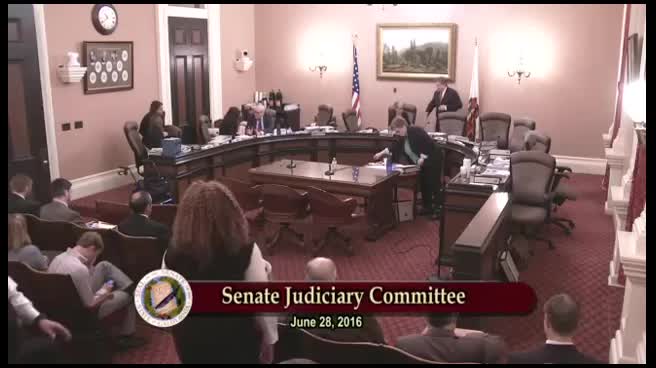 10MIN
Senate Standing Committee on Judiciary
 15MIN
Senate Standing Committee on Public Safety
 3MIN
Assembly Floor
 1MIN
Assembly Floor
 2MIN
Assembly Standing Committee on Appropriations
 12MIN
Assembly Standing Committee on Public Safety
Bill Author

Bill Co-Author(s):