AB 2723: Juvenile dependency: prostitution.
- Session Year: 2015-2016
- House: Assembly
- Latest Version Date: 2016-03-18
Existing law establishes the jurisdiction of the juvenile court, which may adjudge certain children to be dependents of the court under certain circumstances, including when the child is abused, a parent or guardian fails to adequately supervise or protect the child, as specified, or a parent or guardian fails to provide the child with adequate food, clothing, shelter, or medical treatment. Existing law declares that a child is within the dependency jurisdiction of the juvenile court if the child is a victim of sexual trafficking, or receives food, shelter, or money in exchange for specified sexual acts, as a result of the failure or inability of his or her parent or guardian to protect the child, and declares that this is declaratory of existing law.
This bill would additionally include a child within the dependency jurisdiction of the juvenile court if the child solicits or engages in any act of prostitution or loiters in a public place with the intent to commit prostitution, and the childs parent or guardian has failed to protect the child. The bill would state that these provisions are declaratory of existing law.
The Arnold-Kennick Juvenile Court Law provides that any person who is under 18 years of age when he or she violates any criminal law while in this state, except an age curfew ordinance or any other specified offense, comes within the jurisdiction of the juvenile court, which may adjudge the person a ward of the court.
This bill would make technical, nonsubstantive changes to that provision.
A child who comes within any of the following descriptions is within the jurisdiction of the juvenile court which may adjudge that person to be a dependent child of the court:
(a)The child has suffered, or there is a substantial risk that the child will suffer, serious physical harm inflicted nonaccidentally upon the child by the childs parent or guardian. For purposes of this subdivision, a court may find there is a substantial risk of serious future injury based on the manner in which a less serious injury was inflicted, a history of repeated inflictions of injuries on the child or the childs siblings, or a combination of these and other actions by the parent or guardian that indicate the child is at risk of serious physical harm. For purposes of this subdivision, serious physical harm does not include reasonable and age-appropriate spanking to the buttocks if there is no evidence of serious physical injury.
(b)(1) The child has suffered, or there is a substantial risk that the child will suffer, serious physical harm or illness, as a result of the failure or inability of his or her parent or guardian to adequately supervise or protect the child, or the willful or negligent failure of the childs parent or guardian to adequately supervise or protect the child from the conduct of the custodian with whom the child has been left, or by the willful or negligent failure of the parent or guardian to provide the child with adequate food, clothing, shelter, or medical treatment, or by the inability of the parent or guardian to provide regular care for the child due to the parents or guardians mental illness, developmental disability, or substance abuse. A child shall not be found to be a person described by this subdivision solely due to the lack of an emergency shelter for the family. Whenever it is alleged that a child comes within the jurisdiction of the court on the basis of the parents or guardians willful failure to provide adequate medical treatment or specific decision to provide spiritual treatment through prayer, the court shall give deference to the parents or guardians medical treatment, nontreatment, or spiritual treatment through prayer alone in accordance with the tenets and practices of a recognized church or religious denomination, by an accredited practitioner thereof, and shall not assume jurisdiction unless necessary to protect the child from suffering serious physical harm or illness. In making its determination, the court shall consider (1) the nature of the treatment proposed by the parent or guardian, (2) the risks to the child posed by the course of treatment or nontreatment proposed by the parent or guardian, (3) the risk, if any, of the course of treatment being proposed by the petitioning agency, and (4) the likely success of the courses of treatment or nontreatment proposed by the parent or guardian and agency. The child shall continue to be a dependent child pursuant to this subdivision only so long as is necessary to protect the child from risk of suffering serious physical harm or illness.
(2)The Legislature finds and declares that a child who is sexually trafficked, as described in Section 236.1 of the Penal Code, or who receives food or shelter in exchange for, or who is paid to perform, sexual acts described in Section 236.1 or 11165.1 of the Penal Code, or who has engaged in the conduct described in subdivision (b) of Section 647 or Section 653.22 of the Penal Code, and whose parent or guardian failed to, or was unable to, protect the child, is within the description of this subdivision, and that this finding is declaratory of existing law. These children shall be known as commercially sexually exploited children.
(c)The child is suffering serious emotional damage, or is at substantial risk of suffering serious emotional damage, evidenced by severe anxiety, depression, withdrawal, or untoward aggressive behavior toward self or others, as a result of the conduct of the parent or guardian or who has no parent or guardian capable of providing appropriate care. A child shall not be found to be a person described by this subdivision if the willful failure of the parent or guardian to provide adequate mental health treatment is based on a sincerely held religious belief and if a less intrusive judicial intervention is available.
(d)The child has been sexually abused, or there is a substantial risk that the child will be sexually abused, as defined in Section 11165.1 of the Penal Code, by his or her parent or guardian or a member of his or her household, or the parent or guardian has failed to adequately protect the child from sexual abuse when the parent or guardian knew or reasonably should have known that the child was in danger of sexual abuse.
(e)The child is under the age of five years and has suffered severe physical abuse by a parent, or by any person known by the parent, if the parent knew or reasonably should have known that the person was physically abusing the child. For the purposes of this subdivision, severe physical abuse means any of the following: any single act of abuse which causes physical trauma of sufficient severity that, if left untreated, would cause permanent physical disfigurement, permanent physical disability, or death; any single act of sexual abuse which causes significant bleeding, deep bruising, or significant external or internal swelling; or more than one act of physical abuse, each of which causes bleeding, deep bruising, significant external or internal swelling, bone fracture, or unconsciousness; or the willful, prolonged failure to provide adequate food. A child shall not be removed from the physical custody of his or her parent or guardian on the basis of a finding of severe physical abuse unless the social worker has made an allegation of severe physical abuse pursuant to Section 332.
(f)The childs parent or guardian caused the death of another child through abuse or neglect.
(g)The child has been left without any provision for support; physical custody of the child has been voluntarily surrendered pursuant to Section 1255.7 of the Health and Safety Code and the child has not been reclaimed within the 14-day period specified in subdivision (g) of that section; the childs parent has been incarcerated or institutionalized and cannot arrange for the care of the child; or a relative or other adult custodian with whom the child resides or has been left is unwilling or unable to provide care or support for the child, the whereabouts of the parent are unknown, and reasonable efforts to locate the parent have been unsuccessful.
(h)The child has been freed for adoption by one or both parents for 12 months by either relinquishment or termination of parental rights or an adoption petition has not been granted.
(i)The child has been subjected to an act or acts of cruelty by the parent or guardian or a member of his or her household, or the parent or guardian has failed to adequately protect the child from an act or acts of cruelty when the parent or guardian knew or reasonably should have known that the child was in danger of being subjected to an act or acts of cruelty.
(j)The childs sibling has been abused or neglected, as defined in subdivision (a), (b), (d), (e), or (i), and there is a substantial risk that the child will be abused or neglected, as defined in those subdivisions. The court shall consider the circumstances surrounding the abuse or neglect of the sibling, the age and gender of each child, the nature of the abuse or neglect of the sibling, the mental condition of the parent or guardian, and any other factors the court considers probative in determining whether there is a substantial risk to the child.
It is the intent of the Legislature that this section not disrupt the family unnecessarily or intrude inappropriately into family life, prohibit the use of reasonable methods of parental discipline, or prescribe a particular method of parenting. Further, this section is not intended to limit the offering of voluntary services to those families in need of assistance but who do not come within the descriptions of this section. To the extent that savings accrue to the state from child welfare services funding obtained as a result of the enactment of the act that enacted this section, those savings shall be used to promote services which support family maintenance and family reunification plans, such as client transportation, out-of-home respite care, parenting training, and the provision of temporary or emergency in-home caretakers and persons teaching and demonstrating homemaking skills. The Legislature further declares that a physical disability, such as blindness or deafness, is no bar to the raising of happy and well-adjusted children and that a courts determination pursuant to this section shall center upon whether a parents disability prevents him or her from exercising care and control. The Legislature further declares that a child whose parent has been adjudged a dependent child of the court pursuant to this section shall not be considered to be at risk of abuse or neglect solely because of the age, dependent status, or foster care status of the parent.
As used in this section, guardian means the legal guardian of the child.
SECTION 1.Section 602 of the Welfare and Institutions Code is amended to read:602.(a)Except as provided in subdivision (b), any person who is under 18 years of age when he or she violates any law of this state or of the United States or any ordinance of any city or county of this state defining crime, other than an ordinance establishing a curfew based solely on age, is within the jurisdiction of the juvenile court, which may adjudge that person to be a ward of the court.
(b)Any person who is alleged, when he or she was 14 years of age or older, to have committed one of the following offenses shall be prosecuted under the general law in a court of criminal jurisdiction:
(1)Murder, as described in Section 187 of the Penal Code, if one of the circumstances enumerated in subdivision (a) of Section 190.2 of the Penal Code is alleged by the prosecutor, and the prosecutor alleges that the minor personally killed the victim.
(2)The following sex offenses, if the prosecutor alleges that the minor personally committed the offense and alleges that one of the circumstances enumerated in subdivision (d) or (e) of Section 667.61 of the Penal Code applies:
(A)Rape, as described in paragraph (2) of subdivision (a) of Section 261 of the Penal Code.
(B)Spousal rape, as described in paragraph (1) of subdivision (a) of Section 262 of the Penal Code.
(C)Forcible sex offenses in concert with another, as described in Section 264.1 of the Penal Code.
(D)Forcible lewd and lascivious acts on a child under 14 years of age, as described in subdivision (b) of Section 288 of the Penal Code.
(E)Forcible sexual penetration, as described in subdivision (a) of Section 289 of the Penal Code.
(F)Sodomy or oral copulation in violation of Section 286 or 288a of the Penal Code, by force, violence, duress, menace, or fear of immediate and unlawful bodily injury on the victim or another person.
(G)Lewd and lascivious acts on a child under 14 years of age, as defined in subdivision (a) of Section 288, unless the defendant qualifies for probation under subdivision (d) of Section 1203.066 of the Penal Code.
(a)Except as provided in subdivision (b), any person who is under 18 years of age when he or she violates any law of this state or of the United States or any ordinance of any city or county of this state defining crime crime, other than an ordinance establishing a curfew based solely on age, is within the jurisdiction of the juvenile court, which may adjudge such that person to be a ward of the court.
(b)Any person who is alleged, when he or she was 14 years of age or older, to have committed one of the following offenses shall be prosecuted under the general law in a court of criminal jurisdiction:
(1)Murder, as described in Section 187 of the Penal Code, if one of the circumstances enumerated in subdivision (a) of Section 190.2 of the Penal Code is alleged by the prosecutor, and the prosecutor alleges that the minor personally killed the victim.
(2)The following sex offenses, if the prosecutor alleges that the minor personally committed the offense, and if the prosecutor alleges and alleges that one of the circumstances enumerated in the One Strike law, subdivision (d) or (e) of Section 667.61 of the Penal Code, applies:
(A)Rape, as described in paragraph (2) of subdivision (a) of Section 261 of the Penal Code.
(B)Spousal rape, as described in paragraph (1) of subdivision (a) of Section 262 of the Penal Code.
(C)Forcible sex offenses in concert with another, as described in Section 264.1 of the Penal Code.
(D)Forcible lewd and lascivious acts on a child under 14 years of age, as described in subdivision (b) of Section 288 of the Penal Code.
(E)Forcible sexual penetration, as described in subdivision (a) of Section 289 of the Penal Code.
(F)Sodomy or oral copulation in violation of Section 286 or 288a of the Penal Code, by force, violence, duress, menace, or fear of immediate and unlawful bodily injury on the victim or another person.
(G)Lewd and lascivious acts on a child under 14 years of age, as defined in subdivision (a) of Section 288, unless the defendant qualifies for probation under subdivision (d) of Section 1203.066 of the Penal Code.
|
Date
|
Status
|
|---|---|
| May 4, 2016 | Read second time. Ordered to third reading. |
| Aug 11, 2016 | In committee: Held under submission. |
| Aug 8, 2016 | Referred to APPR. suspense file. |
| Jun 22, 2016 | From committee: Do pass and re-refer to Com. on APPR. (Ayes 6. Noes 1.) (June 21). Re-referred to Com. on APPR. |
| Jun 15, 2016 | From committee: Do pass and re-refer to Com. on JUD. (Ayes 4. Noes 0.) (June 14). Re-referred to Com. on JUD. |
| May 26, 2016 | Referred to Coms. on HUMAN S., JUD. and APPR. |
| May 19, 2016 | Read third time. Passed. Ordered to the Senate. (Ayes 75. Noes 0.) |
| May 19, 2016 | Read third time. Passed. Ordered to the Senate. (Ayes 75. Noes 0. Page 4854.) |
| May 19, 2016 | Read third time. Passed. Ordered to the Senate. |
| May 19, 2016 | In Senate. Read first time. To Com. on RLS. for assignment. |
| Feb 19, 2016 | Introduced. To print. |
| May 3, 2016 | From committee: Do pass. (Ayes 10. Noes 0.) (May 3). |
| Apr 27, 2016 | From committee: Do pass and re-refer to Com. on JUD. (Ayes 6. Noes 0.) (April 26). Re-referred to Com. on JUD. |
| Apr 12, 2016 | In committee: Hearing postponed by committee. |
| Mar 28, 2016 | Re-referred to Com. on HUM. S. |
| Mar 18, 2016 | From committee chair, with author's amendments: Amend, and re-refer to Com. on HUM. S. Read second time and amended. |
| Mar 17, 2016 | Referred to Coms. on HUM. S. and JUD. |
| Feb 22, 2016 | Read first time. |
| Feb 21, 2016 | From printer. May be heard in committee March 22. |
|
Date
|
Description
|
Location
|
Votes
|
|
|---|---|---|---|---|
| Aug 8, 2016 | Placed on suspense file | Senate Standing Committee on Appropriations |
Passed |
|
| Jun 21, 2016 | Do pass, but first be re-referred to the Committee on [Appropriations] | Senate Standing Committee on Judiciary |
Passed |
|
| Jun 14, 2016 | Do pass, but first be re-referred to the Committee on [Judiciary] | Senate Standing Committee on Human Services |
Passed |
|
| May 19, 2016 | AB 2723 CHÁVEZ Assembly Third Reading | Assembly Floor |
Passed |
|
| May 3, 2016 | Do pass. | Assembly Standing Committee on Judiciary |
Passed |
|
| Apr 26, 2016 | Do pass and be re-referred to the Committee on [Judiciary] | Assembly Standing Committee on Human Services |
Passed |
This list shows positions taken on this bill by organizations on the date displayed, which is linked to the original source.
Positions by individuals are not included.
|
Organization
|
Position
|
Date
|
|---|---|---|
| Alameda County District Attorney Nancy O'Malley | ** Against | May 19, 2016 |
| Children'S Law Center Of California | ** Support | May 19, 2016 |
| LIUNA Locals 777 & 792 | ** Support | Jun 21, 2016 |
| Merced Irrigation District | * Support | May 25, 2016 |
| Office of the District Attorney of Alameda County | ** Against | Jun 21, 2016 |
SENATE COMMITTEE ON APPROPRIATIONS
Senator Ricardo Lara, Chair
2015 - 2016 Regular Session
AB 2723 (Chávez) - Juvenile dependency: prostitution
Version: March 18, 2016 | Policy Vote: HUMAN S. 4 - 0, JUD. 6 - 1 |
Urgency: No | Mandate: No |
Hearing Date: August 8, 2016 | Consultant: Jolie Onodera |
This bill meets the criteria for referral to the Suspense File.
Bill Summary:
AB 2723 would expand the population of children eligible to be adjudged dependents of the juvenile court to include a child who solicits or engages in any act of prostitution or loiters in a public place with the intent to commit prostitution, as specified.
Fiscal Impact:
- Commercially Sexually Exploited Children (CSEC) program: Potential future cost pressure (General Fund*) to provide services and grants within the dependency system of care under the CSEC Program, which is administered by the DSS, to the extent services and case management activities are provided by participating counties to a greater number of minors, and/or to the extent additional counties opt into the program in the future. One-time costs, not including services, for an initial screening and assessment for CSEC eligibility of 200 minors is estimated to cost about $125,000 (General Fund*). The 2016 Budget Act provides $19 million General Fund to support this program for the 38 counties electing to participate in the program.
- Local detention facilities: Potential local agency cost savings (Local Funds) to juvenile detention facilities, and to county probation departments for services and administration costs for these minors who otherwise may have been arrested and potentially adjudicated as juvenile delinquents or wards of the court. DOJ statistics indicate 368 arrests in 2013, 267 arrests in 2014, and 235 arrests in 2015 of minors for the prostitution offenses specified in this measure. DOJ statistics indicate less than 10 percent of arrests are ultimately adjudicated in court each year.
- *Proposition 30 (2012): Exempts the State from mandate reimbursement for realigned responsibilities for “public safety services” including the provision of child welfare services to prevent child exploitation, however, legislation enacted after September 30, 2012, that has an overall effect of increasing the costs already borne by a local agency for public safety services apply to local agencies only to the extent the State provides annual funding for the cost increase.
- Criminal justice system: Potentially significant future cost savings (General Fund/Local Funds) to numerous state and local agencies, including but not limited to the courts, state prisons, local correctional facilities, and human services agencies to the extent expanding dependency jurisdiction to these exploited minors and providing them with necessary supportive services results in reductions in future involvement in the criminal justice system.
Background:
Existing law provides that a person who solicits or who agrees to engage in or who engages in any act of prostitution is guilty of a misdemeanor. No agreement to engage in an act of prostitution constitutes a violation unless some act, in addition to the agreement, is done within this state in furtherance of the commission of an act of prostitution by the person agreeing to engage in that act. “Prostitution,” for purposes of this provision, includes any lewd act between persons for money or other consideration. (Penal Code (PC) § 647(b).)
Existing law provides that it is unlawful for any person to loiter in any public place with the intent to commit prostitution. This intent is evidenced by acting in a manner and under circumstances which openly demonstrate the purpose of inducing, enticing, or soliciting prostitution, or procuring another to commit prostitution. (PC § 653.22(a).)
Existing law includes codified legislative findings and declares that a child who is sexually trafficked, as described in Section 236.1 of the Penal Code, or who receives food or shelter in exchange for, or who is paid to perform, sexual acts described in Section 236.1 or 11165.1 of the Penal Code, and whose parent or guardian failed to, or was unable to, protect the child, is within the description of this subdivision, and that this finding is declaratory of existing law. These children shall be known as commercially sexually exploited children. (Welfare and Institutions Code (WIC) § 300 (b)(2).)
Commercially Sexually Exploited Children Program (CSEC) Program
Existing law establishes the federal and state CSEC Program, administered by the Department of Social Services (DSS), to provide prevention, intervention, services, and training for CSEC activities. Counties that elect to participate in state CSEC activities receive funding for specialized services for the CSEC population. (WIC §§ 16524.7-16524.10.)
A county electing to receive funding from the CSEC Program is required to submit a plan to DSS describing how the county intends to utilize the funds to be allocated. The county plan is required to include documentation indicating the county’s collaboration with county partner agencies and children-focused entities, which must include the formation of a multidisciplinary team to serve children.
Each county electing to receive funds from the CSEC Program is additionally required to develop an interagency protocol to be utilized in serving sexually exploited children, to be developed by a team led by a representative of the county human services department and must include representatives from county probation, county mental health, county public health department, the juvenile court. The team may also include, but shall not be limited to, representatives from local education agencies, local law enforcement, survivors of sexual exploitation and trafficking, and other providers as necessary.
The initial 35 counties that opted into the program were separated into two tiers: 13 Tier I counties received $25,000 to develop interagency protocols and 22 Tier II counties received enhanced funding based on their prevalence of CSEC youth, completion of a CSEC protocol, and the county’s readiness to serve. Shortly after the state program was enacted, federal CSEC legislation was enacted with statewide requirements.
Proposed funding levels remained at $14 million General Fund since the program’s inception, until the most recent budget augmented annual funding by $5 million, increasing annual support for the CSEC Program to $19 million General Fund.
Proposed Law:
This bill would additionally include a child within the dependency jurisdiction of the juvenile court if the child solicits or engages in any act of prostitution or loiters in a public place with the intent to commit prostitution, and the child’s parent or guardian has failed to protect the child.
Related Legislation:
SB 1322 (Mitchell) 2016 would prohibit a minor from being arrested for a prostitution offense, as specified, and would provide that a commercially exploited child pursuant to the bill’s provisions may be adjudged a dependent child of the court, as specified, and may be taken into temporary custody if the conditions allowing temporary custody without warrant are met. SB 1322 has been ordered to Third Reading on the Assembly Floor.
SB 1064 (Hancock) 2016 would eliminate the sunset date on the discretionary Sexually Exploited Minors Pilot Project in Alameda and Los Angeles Counties, to operate indefinitely. SB 1064 would expand the definition of “commercially sexually exploited minor” served by the program to include, among others, minors who have been adjudged dependents of the juvenile court. SB 1064 has been ordered to Third Reading on the Assembly Floor.
AB 1675 (Stone) 2016 would require a probation officer, in a case in which a minor is alleged to have committed the crime of solicitation, prostitution, or loitering with the intent to commit prostitution, to provide informal supervision for the minor, instead of requesting that the prosecutor file a petition declaring the minor to be a ward of the juvenile court. AB 1675 is scheduled to be heard today by this Committee.
AB 1730 (Atkins) 2016 would authorize a chief probation officer of a county to create a program to provide services to youth within the county relating to the commercial sexual exploitation of youth. Funding for the program is contingent upon an appropriation in the annual Budget Act, to be administered by the Board of State and Community Corrections. AB 1730 is scheduled to be heard today by this Committee.
AB 1731 (Atkins) 2016 would create the Statewide Interagency Human Trafficking Task Force to gather statewide data on human trafficking, to recommend interagency protocols and best practices for training and outreach to law enforcement, victim service providers, and other state and private sector employees likely to encounter sex trafficking, and to evaluate and implement approaches to increase public awareness about human trafficking. AB 1731 is scheduled to be heard today by this Committee.
AB 1760 (Santiago) 2016 would have directed a peace officer who determines that a minor is a victim of human trafficking to report such abuse, consult with a child welfare worker about a safe placement for the minor, and transport the minor to such placement, unless the minor is otherwise arrested. AB 1760 was held on the Suspense File of the Assembly Appropriations Committee.
SB 826 (Committee on Budget and Fiscal Review) Chapter 23/2016, the Budget Act of 2016, among its numerous provisions, appropriates $14 million General Fund to support the CSEC program.
Prior Legislation: SB 855 (Committee on Budget and Fiscal Review) Chapter 29/2014 established the CSEC program, and authorized annual state funding for county agencies electing to participate in the program to provide services to child victims of commercial sexual exploitation.
Staff Comments:
By revising the definition of “commercially sexually exploited children” within WIC § 300(b)(2) to include children who have engaged in prostitution or loitering with the intent to engage in prostitution, this bill could potentially result in additional children becoming eligible under the dependency system of care.
Based on information from the DOJ, over 200 arrests of minors for the prostitution offenses specified in this measure occurred in 2015. To the extent these minors would instead be considered under dependency vs. delinquency jurisdiction of the juvenile courts, the one-time costs, not including services, for an initial screening and assessment for eligibility under the CSEC program for 200 minors is estimated to cost about $125,000 (General Fund). To the extent these minors are adjudged dependents of the juvenile court, additional future costs to provide services and grants within the dependency system of care under the CSEC Program could be incurred.
This bill could potentially result in significant future cost savings to numerous state and local agencies, including but not limited to the courts, state prisons, local correctional facilities, and human services agencies to the extent expanding dependency jurisdiction to these exploited minors and providing them with necessary supportive services results in reductions in future involvement in the criminal justice system.
-- END --
Senator Hannah-Beth Jackson, Chair
2015-2016 Regular Session
Bill No: AB 2723 (Author:Chávez)
Version: March 18, 2016
Hearing Date: June 21, 2016
Fiscal: No
Urgency: No
Consultant: NR
SUBJECT
Juvenile dependency: prostitution
DESCRIPTION
Existing law declares that a child is within the dependency jurisdiction of the juvenile court if the child is a victim of sexual trafficking, or receives food, shelter, or money in exchange for specified sexual acts, and whose parent or guardian failed to, or was unable to protect the child. This bill would add prostitution to the specified sexual acts in this provision.
BACKGROUND
Human trafficking is an estimated $32 billion-a-year global industry. After drug trafficking, human trafficking is the world’s second most profitable criminal enterprise. The United States is one of the top destination countries for trafficking in persons, and California – a populous border state with a significant immigrant population and the world’s ninth largest economy – is one of the nation’s top four destination states for trafficking human beings. (Office of the Attorney General, The State of Human Trafficking in California, (2012).)
According to the Attorney General, significant new challenges in combating this crime have emerged in the last five years. Criminal organizations and street gangs have increasingly turned to human trafficking because they find it more profitable and lower risk than drug trafficking. Additionally, new innovations in technology make it possible for traffickers to recruit victims and perpetrate their crimes online.
There has been considerable federal and state legislation in response to human trafficking. In 2005, California passed the California Trafficking Victims Protection Act, AB 22 (Lieber, Ch. 240, Stats. 2005) which established human trafficking as a felony and provided assistance for victims. The same year, SB 180 (Kuehl, Ch. 239, Stats. 2005), established a statewide taskforce chaired by the Attorney General. In 2013, California voters passed Proposition 35 which increased criminal penalties for traffickers. The proposition also provided that consent by a victim of human trafficking who is a minor, or a mistake of fact as to the age of the victim, are not defenses to criminal prosecution.
Heightened penalties, however, only address part of the problem. Left in the wake of human trafficking are thousands of child victims. States have attempted to address the issues concerning sexually exploited children in a variety of ways including the decriminalization of minor prostitution and the creation of diversion programs which aim to channel victims into support services rather than the criminal justice system. (Kate Walker, Child Welfare Council, Ending the Commercial Sexual Exploitation of Children: A Call for Multi-System Collaboration in California (2013).) California, however, provides that minors engaging in any act of prostitution are guilty of disorderly conduct, a misdemeanor.
Unlike the juvenile delinquency system which imposes criminal-like penalties on minors, the juvenile dependency court seeks to connect minor victims of abuse with services including housing, healthcare, and mental health support. To address the issues related to commercially sexually exploited youth, this bill, would clarify that a minor engaged in prostitution, as defined in the Penal Code, and whose parents fail to protect the child, falls within the juvenile court’s dependency jurisdiction.
CHANGES TO EXISTING LAW
Existing law establishes the criteria by which a child who has suffered, or is at risk of suffering, significant abuse or harm is within the jurisdiction of the juvenile court, which may adjudge that person to be a dependent child of the court. (Welf. & Inst. Code Sec. 300.)
Existing law includes, within the definition of “child welfare services,” public social services that are directed toward the prevention of exploitation or delinquency of children as well as services provided on behalf of children alleged to be the victims of exploitation. (Welf. & Inst. Code Sec. 16501.)
Existing law defines human trafficking as being the victim of someone who deprives or violates the personal liberty of another with the intent to obtain forced labor or services, and defines a sexually trafficked child as the victim of a person who causes, induces, or persuades, or attempts to cause, induce, or persuade a person who is at the time of commission of the offense to engage in a commercial sex act. (Pen. Code Sec. 236.1(c).)
Existing law declares that a child is within the dependency jurisdiction of the juvenile court if the child is a victim of sexual trafficking, or receives food, shelter, or money in exchange for specified sexual acts, and whose parent or guardian failed to, or was unable to protect the child. Provides that this finding is declaratory of existing law. (Welf. & Inst. Code Sec. 300(b)(2).)
This bill would add to the above provision that a minor who has engaged in prostitution, as defined in Sections 647(b) and 653.22 of the Penal Code, falls within the dependency jurisdiction of the juvenile court.
COMMENT
- Stated need for the bill
According to the author:
While children that are victims of sexual trafficking can be adjudged as a dependent of the juvenile court system, there is a loophole that leaves out children soliciting or engaging in any act of prostitution or loitering in a public place with the intent to commit prostitution, and the child’s parent or guardian has failed to protect the child. AB 2723 would additionally include a child within the dependency jurisdiction of the juvenile court if the child solicits or engages in any act of prostitution or loiters in a public place with the intent to commit prostitution, and the child’s parent or guardian has failed to protect the child.
- Clarification of existing law
Welfare & Institutions Code Section 300 provides that the dependency court may exercise jurisdiction over a child who comes within a number of descriptions, including a child who has been “commercially sexually exploited,” defined as a child who is sexually trafficked or who receives food or shelter in exchange for, or who is paid to perform, sexual acts, and whose parent or guardian has failed to protect the child. The provision does not specifically list “prostitution,” despite the fact that the welfare of children forced into prostitution was clearly considered by the legislature in enacting the law. Perhaps the word “prostitution” was left out of the statute in an effort to couch the conversation in terms of these children as victims, not as criminals. Children cannot consent to engage in sex, and children who are forced to work in prostitution are truly victims of commercial sexual abuse who need services and support to escape their abusers and heal, rather than prosecution and judgment.
This bill would, in the provision which brings commercially sexually exploited children under the dependency court’s jurisdiction, add a reference to two Penal Code sections defining acts of prostitution, thereby ensuring that the dependency court may connect these youth with the supportive services they need instead of directing them into the juvenile delinquency system.
- Opposition’s concerns
A number of counties provide services to victims of child commercial sexual exploitation through the juvenile delinquency system instead of the dependency system. Alameda County District Attorney Nancy O’Malley argues that, for those counties, this bill will create ambiguity in the outreach, engagement and protection of minors who are engaging in commercial sex conduct, specifically, how a minor enters the system. Ms. O’Malley opposes the bill because, in her opinion, the programs Alameda County has set up for commercially sexually exploited youth are working and this bill might “undue all the work that has been done.” Ms. O’Malley writes:
The Alameda County District Attorney’s Office is recognized as a statewide and national leader in combatting human trafficking, particularly when minors are involved. In terms of services, we make no distinction between a minor who is a victim of human trafficking and a minor engaging in conduct described in Penal Code Sections 647 (a) and (b) and 653.22. . . .We have created a Diversion Program for commercially sexually exploited children, called the Young Women’s Saturday Program and a weekly multi-disciplinary working group called SafetyNet. This is the first true Multi-disciplinary Team to address commercially sexually exploited children in a collaborative and comprehensive manner. SafetyNet consists of representatives from more than 20 agencies and/or disciplines, who meet weekly to discuss between 15-18 minors who are [sexually exploited] or are at risk for [sexual exploitation].
Existing law, and this bill, do not require the dependency court to exercise jurisdiction over a commercially sexually exploited youth. Instead, the statute provides that the court may extend jurisdiction over these youth. Minors who violate any state, federal, or local law may also be subject to the juvenile delinquency court’s jurisdiction. (See Welf. & Inst. Code Sec. 602.) In fact, youth who simultaneously fall under the jurisdiction of the dependency and delinquency court are so common that the county welfare and probation departments are required to make a recommendation to the court regarding which initial status would best serve the interests of the minor. (Welf. & Inst. Code Sec. 241.1.)
Despite the concerns of the opposition, this bill would not require commercially sexually exploited youth to be adjudicated as dependents of the child welfare system. Instead, the bill would allow such children to come within the jurisdiction of the dependency court. Thus, Alameda should be able to continue offering the successful, multidisciplinary services approach that it has developed through the juvenile delinquency system for minor victims of commercial sexual exploitation.
Support: LIUNA Locals 777 & 792; County Welfare Directors Association of California
Opposition: Alameda County District Attorney
HISTORY
Source: Children’s Law Center of California
Related Pending Legislation: None Known
Prior Legislation:
AB 2035 (Chesbro, 2014) would have provided that a minor is within the jurisdiction of the juvenile court and a dependent child of the court if the minor is a victim of human trafficking, and the parent or guardian failed or was unable to protect the child. This bill was vetoed by Governor Brown.
SB 114 (Pavley, Ch. 42, Stats. 2013) extended the sunset date to January 1, 2017, for a discretionary pilot project related to commercially sexually exploited minors established pursuant to SB 1279 (Pavley, Ch. 116, Stats. 2010) and extended the sunset date for the District Attorney of Los Angeles to submit a report to the Legislature to April 1, 2016.
AB 799 (Swanson, Ch. 51, Stats. 2011) extended the sunset of a authorizing the Alameda County District Attorney to create a pilot project, contingent upon local funding, for the purposes of developing a comprehensive, replicative, multidisciplinary model to address the needs and effective treatment of commercially sexually exploited minors.
SB 1279 (Pavley, Ch. 116, Stats. 2010) authorized, until January 1, 2014, a discretionary pilot project in Los Angeles County to encourage the development of a comprehensive, multidisciplinary model reflecting the best practices for the response of law enforcement and the criminal and juvenile justice systems to identify, assess, and address the needs of commercially sexually exploited children who have been arrested or detained by local law enforcement for prostitution crimes.
AB 499 (Swanson, Ch. 359, Stats. 2008) authorized a discretionary pilot project in Alameda County to encourage the development of a comprehensive, replicative, and multidisciplinary model reflecting the best practices for the response of law enforcement and the criminal and juvenile justice systems to identify, assess and address the needs of commercially sexually exploited children who have been arrested, as specified.
SB 180 (Kuehl, Ch. 239, Stats. 2005) established the California Alliance to Combat Trafficking and Slavery Task Force to be chaired by the California Attorney General and set forth its course of action and physical make-up.
AB 22 (Lieber, Ch. 240, Stats. 2005) established civil and criminal penalties for trafficking in human beings, allowed for forfeiture of assets derived from human trafficking, made legislative findings and required law enforcement agencies to provide Law Enforcement Agency Endorsement to trafficking victims, created the California Alliance to Combat Trafficking Task Force, and provided restitution to victims.
Prior Vote:
Assembly Floor (Ayes 75, Noes 0)
Assembly Judiciary Committee (Ayes 10, Noes 0)
Assembly Human Services Committee (Ayes 6, Noes 0)
**************
SENATE COMMITTEE ON HUMAN SERVICES
Senator McGuire, Chair
2015 - 2016 Regular
Bill No: AB 2723
Author: | Chávez | ||
Version: | March 18, 2016 | Hearing Date: | June 14, 2016 |
Urgency: | No | Fiscal: | No |
Consultant: | Mareva Brown | ||
Subject: Juvenile dependency: prostitution
SUMMARY
This bill would include a child within the dependency jurisdiction of the juvenile court if the child solicits or engages in any act of prostitution or loiters in a public place with the intent to commit prostitution, and the child’s parent or guardian has failed to protect the child. The bill would state that these provisions are declaratory of existing law.
ABSTRACT
Existing law:
- Establishes a system of juvenile dependency for children who are or are at risk of being physically, sexually or emotionally abused, being neglected or being exploited to ensure their safety, protection and physical and emotional well-being. (WIC 300, et seq.)
- Makes Legislative declaration that a child who is sexually trafficked, as defined, or who receives food or shelter in exchange for, or who is paid to perform, specified sexual acts, and whose parent or guardian failed to, or was unable to, protect the child, is within the description of a child in the dependency system, and that this finding is declaratory of existing law. These children shall be known as commercially sexually exploited children. (WIC 300 (b)(2))
- Defines human trafficking as being the victim of someone who deprives or violates the personal liberty of another with the intent to obtain forced labor or services, and defines a sexually trafficked child as the victim of a person who causes, induces, or persuades, or attempts to cause, induce, or persuade, a person who is a minor at the time of commission of the offense to engage in a commercial sex act, as defined. (PC 236.1(c))
This bill:
- Adds to the Legislative findings and declarations that a sexually trafficked child is one who has engaged in soliciting for prostitution, as defined, or loitering with the intent to commit prostitution, as defined.
FISCAL IMPACT
This bill has been identified as non-fiscal by Legislative Counsel.
BACKGROUND AND DISCUSSION
Purpose of the bill:
This bill includes a child within the dependency jurisdiction of the juvenile court if the child solicits or engages in any act of prostitution or loiters in a public place with the intent to commit prostitution, and the child’s parent or guardian has failed to protect the child. The author states “if we want the children of California to thrive, we have to set them up to succeed and protect them from a range of potential dangers like sexual predators to neglectful guardians.”
Commercially Sexually Exploited Children (CSEC)
The commercial sexual exploitation of children is a form of human trafficking in which a child younger than 18 is caused, induced or persuaded to engage in a sexual act for the purpose of financial or other economic reasons. Under this definition, an economic exchange may be either for money or non-monetary things, such as food, shelter, drugs - commonly called “survival sex.”[1]
The Federal Bureau of Investigation’s Innocence Lost National Initiative, which was launched in June 2003, has rescued more than 4,800 children nationwide who were forced to engage in commercial sex activities, as well as successfully prosecuting more than 2,000 pimps and other adults. More than 100,000 children across the nation were believed to be involved in sex trafficking annually. The issue is especially acute in California, where San Francisco, Los Angeles and San Diego have been identified by the FBI as areas of “high intensity child prostitution.”
A 2013 report by the Child Welfare Council of California identified CSEC as a critical problem needing immediate solutions. According to the report, “Ending the Commercial Sexual Exploitation of Children: A Call for Multi-System Collaboration in California,” various systems, including law enforcement, probation, education, mental health, primary health care, child welfare and public health systems serve these victims, but often in ways that are not coordinated, nor aligned philosophically.
Risk factors for children
Researchers have identified key risk factors for children who are exploited, including age – the risk of exploitation increases as age decreases and officials report it is common to find boys between ages 11 and 13 and girls between ages 12 and 14 who are forced to engage in the sex trade. A history of sexual abuse among girl victims is additionally a risk factor, according to the Child Welfare Council report, which cited data that indicated youth who experienced child sexual abuse were 28 times more likely to be arrested for prostitution at some point in their lives than children who did not. Children with school-related problems such as truancy and learning disabilities may be especially vulnerable to exploitation.
One significant risk factor appears to be that children with a history of child welfare agency involvement are particularly vulnerable to commercial sexual exploitation. The
Child Welfare Council report noted that while California data is not collected regarding commercial sexual exploitation of children who are in the child welfare system, studies have estimated that anywhere from 50 to 80 percent of victims of CSEC are or were formerly involved with child welfare.[2] These children often have a history of abuse or neglect, which led to their involvement with the child welfare system initially. Then, frequent changes in foster homes or group home care and the absence of a positive loving adult leave them especially vulnerable. One study found that youth who run away from home or foster placements are targets within as little as 48 hours of being on the streets.
Child Welfare System
California’s child welfare system is intended to protect children at risk of child abuse and neglect or exploitation by providing intensive services to families to allow children to remain in their homes, or by arranging temporary or permanent placement of the child in the safest and least restrictive environment possible. Approximately 62,000 children were in the custody of the child welfare system as of October 2015, according to the state’s child welfare case management system. About 45,000 children were placed in out-of-home situations in 2016, according to data released by CDSS with the governor’s budget.
The overlap between CSEC and foster youth was the subject of a 2013 Human Services Committee hearing, in which experts testified that abusers may recruit victims directly out of group homes. These abusers have been successful using other foster youth as recruiters and enticing victims with gifts of clothing and other goods, or with promises of love.
Concerns about how to treat victims of CSEC safely and appropriately – and specifically whether they should be addressed within the juvenile justice or child welfare system -- have prompted the creation of a CSEC workgroup through the Child Welfare Council and other efforts. SB 855 (Budget and Fiscal Review, Chapter 29, Statutes of 2014) established a CSEC program administered by CDSS and funded through county child welfare agencies. In addition to funding services, it required CDSS to provide training for county children’s services workers to identify, intervene and provide case management services to children who are CSEC, and to train foster caregivers, to create data tracking systems and other changes.
Related legislation:
SB 794, (Senate Human Services Committee, Chapter 425, Statutes of 2014) required the county probation or welfare departments to immediately report to law enforcement any allegation of commercial sexual exploitation, as defined, of a child or youth receiving child welfare services, and other changes.
SB 855 (Committee on Budget and Fiscal Review, Chapter 29, Statutes of 2014) created a CSEC program within CDSS, and authorized funding to counties that elected to create prevention and intervention activities and services to children who have been commercially sexually abused.
SB 1322 (Mitchell, 2016) decriminalizes the act of soliciting for prostitution if the alleged perpetrator is a child, and permits the child to be made a dependent of the child welfare system, as specified.
COMMENTS
This bill furthers Legislative efforts to define CSEC youth within the context of the child welfare system in order to provide youth with access to treatment and supportive services.
PRIOR VOTES
Assembly Floor: | 75 - 0 |
Assembly Appropriations Committee: |
|
Assembly Human Services Committee: | 6 - 0 |
POSITIONS
Support:
LIUNA Locals 777 & 792
The County Welfare Directors Association of California
The Children’s Law Center of California
Oppose:
Office of the District Attorney of Alameda County
-- END --
Estes and Weiner. “The Commercial Sexual Exploitation of Children In the U. S., Canada and Mexico.” Univ. of PA, 2002. http://www.sp2.upenn.edu/restes/CSEC_Files/Exec_Sum_020220.pdf ↑
Walker, Kate, “Ending the commercial sexual exploitation of children: A call for multi-system collaboration in California,” California Child Welfare Council, February 2013. ↑
ASSEMBLY THIRD READING
ATR Bill Id:AB 2723
Author:(Chávez)
As Amended Ver:March 18, 2016
Majority vote
Committee | Votes | Ayes | Noes |
Human Services | 6-0 | Bonilla, Grove, Lopez, Maienschein, Mark Stone, Thurmond | |
Judiciary | 10-0 | Mark Stone, Wagner, Alejo, Chau, Chiu, Gallagher, Cristina Garcia, Holden, Maienschein, Ting |
SUMMARY: Makes Legislative findings and declarations stating that a child who has loitered with the intent to commit prostitution or who has solicited, agreed to engage, or engaged in prostitution, as specified, and whose parent or guardian failed to, or was unable to, protect the child, falls under the definition of "commercially sexually exploited children" and may be adjudged a dependent child of the juvenile court.
EXISTING LAW:
- States that the purpose of foster care law is to provide maximum safety and protection for children who are being physically, sexually or emotionally abused, neglected, or exploited and to ensure the safety, protection, and physical and emotional well-being of children at risk of such harm. (Welfare and Institutions Code (WIC) Section 300.2)
- Defines "commercial sex act" as "sexual conduct on account of which anything of value is given or received by any person." (Penal Code (PEN) Section 236.1 (h)(2))
- Defines commercially sexually exploited children as a child who is sexually trafficked or receives food or shelter in exchange for the performance of certain sexual acts, as specified. (WIC Section 300)
- States that any person who solicits or agrees to engage in or who engages in any act of prostitution, as specified, is guilty of disorderly conduct, a misdemeanor. (PEN Section 647)
- States that it is unlawful for any person to loiter in any public place with the intent to commit prostitution, as specified. (PEN Section 653.22)
- Establishes the federal Preventing Sex Trafficking and Strengthening Families Act, which places a number of requirements on states, including a number of improvements to the child welfare system aimed at improving outcomes for children and youth in foster care. (Public Law 113-183)
FISCAL EFFECT: Unknown. This bill is keyed non-fiscal by the Legislative Counsel.
COMMENTS:
Child Welfare Services: The purpose of California's Child Welfare Services (CWS) system is to protect children from abuse and neglect and provide for their health and safety. When children are identified as being at risk of abuse, neglect or abandonment, county juvenile courts hold legal dependency jurisdiction; these children are served by the CWS system through the appointment of a social worker. Through this juvenile dependency system, there are multiple opportunities for the custody of the child, or his or her placement outside of the home, to be evaluated, reviewed and determined by the judicial system, in consultation with the child's social worker, to help provide the best possible services to the child. The CWS system seeks to help children who have been removed from their homes reunify with their parents or guardians, whenever appropriate. However, the court may determine that an alternate permanent placement is more fitting; the court must give preference to potential placements in this order: relatives, nonrelative extended family members, or family foster homes. Placement in group homes or other intensive treatment placement settings are considered only in more challenging situations where a child may need stabilization services in order to transition to a less restrictive placement, such as with a relative or foster caregiver. There are currently close to 63,000 children and youth in California's CWS system.
Commercial Sexual Exploitation of Children (CSEC): Commercial sexual exploitation of children is defined as the sexual exploitation of children entirely, or at least primarily, for financial or other economic reasons. Under this definition, the economic exchanges may be either monetary or non-monetary (i.e., for food, shelter, drugs). Sex trafficking of minors is defined as the "recruitment, harboring, transportation, provision, or obtaining of a person for the purpose of a commercial sex act" where the person is a United States citizen or lawful permanent resident under the age of 18 years.
According to Department of Social Services, approximately 800,000 victims annually are trafficked across international borders worldwide, and between 14,500-17,500 of those victims are trafficked into the United States. Nearly 95% of CSEC victims in the United States are female, and it is estimated that between 50-80% of child victims of commercial sexual exploitation have been involved with the child welfare system, according to the National Center for Youth Law. According to the National Center for Missing and Exploited Children, it is estimated that one in six endangered runaways were likely sex trafficking victims in 2014. Many experts believe, however, that these statistics are underestimated; challenges arise when identifying victims, collecting and cross-referencing data, and deciding on common definitions in order to collect accurate statistics. Many youth also do not identify as victims or may be reluctant to admit to victimization due to fears of retaliation from traffickers, deportation, or incarceration by law enforcement.
Need for this bill: According to the author's office, "We need to make sure we are protecting our children and looking out for them every step of the way. If we want the children of California to thrive, we have to set them up to succeed and protect them from a range of potential dangers like sexual predators to neglectful guardians."
Analysis Prepared by: Kelsy Castillo / HUM. S. / (916) 319-2089 FN: 0002849
Date of Hearing: May 3, 2016
ASSEMBLY COMMITTEE ON JUDICIARY
Mark Stone, Chair
ABPCA Bill Id:AB 2723
Author:(Chávez) – As Amended Ver:March 18, 2016
SUBJECT: dependency JURISDICTION: prostitution
KEY ISSUE: IN ORDER TO BETTER PROTECT CHILDREN FROM FURTHER ABUSE, SHOULD dependENcy jurisdiction be CLARIFIED to include CHILDREN WHO engage in or soliciT FOR PROSTITUTION, OR WHO LOITER WITH INTENT TO COMMIT PROSTITUTION, AND whose parents are NOT PROPERLY PROTECTing them?
SYNOPSIS
This bill represents another helpful step in the Legislature’s continuing efforts to battle the tragedy of human trafficking, particularly involving children. The Attorney General’s office reports that human trafficking is the world’s fastest growing criminal enterprise with a global industry estimated at $32 billion-a-year. California, in particular, is one of the top four destination states for human trafficking in the United States. This bill comes to the Legislature at the same time as multiple other efforts to help children who are victims of commercial sexual trafficking. The goal of all these bills is to recognize that children who are involved in prostitution are crime victims and require services and support to protect them from further abuse and help them successfully transition to adulthood.
Currently some sexually exploited children are specifically included within the group of abused or neglected children who can be adjudicated as dependents of the juvenile court. Specifically included are children who are sexually trafficked or who receive food or shelter in exchange for, or who are paid to perform, sexual acts, all as defined, and whose parents or guardians have failed to protect them. This bill expands that list to include children who have loitered with the intent to commit prostitution or who have solicited, agreed to engage, or engaged in prostitution and whose parents or guardians have failed to protect them. This provides a clear route through the child welfare system to protect these children from further victimization and sexual abuse.
This bill is supported by the Children's Law Center of California, which argues that this bill eliminates any ambiguity and ensures that all sexually exploited children have a pathway into the protections afforded by the child welfare system.
This bill is opposed by the Alameda County District Attorney who believes the bill “creates ambiguity in the outreach, engagement and protection of minors who are engaging in commercial sex conduct,” specifically, “how the minor enters the system.” However, this bill does not require that the particular child victims of sexual exploitation in this bill set forth in the bill be adjudicated as dependents in the child welfare system. Instead, the bill merely allows such children to come within the jurisdiction of the juvenile dependency court. And in counties that do not provide the exemplary multidisciplinary services approach that Alameda County does and instead either prosecute these abused children or, potentially even worse, leave them on the street to be further abused, this bill clarifies that there is a third option -- help them within the child welfare system.
SUMMARY: Provides that a minor who engages in or solicits for, or who loiters with intent to commit, prostitution may be adjudged a dependent of the juvenile court. Specifically, this bill makes legislative findings and declarations that a child who has loitered with the intent to commit prostitution or who has solicited, agreed to engage, or engaged in prostitution, as specified, and whose parent or guardian has failed to, or was unable to, protect the child, falls under the definition of a “commercially sexually exploited child” and may be adjudged a dependent child of the juvenile court.
EXISTING LAW:
- States that the purpose of the dependency system is the maximum safety and protection for children who are currently being abused, neglected, or exploited. Provides that the focus is on the preservation of the family, as well as the safety, protection, and physical and emotional well-being of the child. (Welfare & Institutions Code Section 300.2. Unless stated otherwise, all further statutory references are to that code.)
- Provides that children may be adjudged dependent children of the juvenile court and be removed from their parents or guardian on the basis of abuse or neglect. (Section 300.)
- Declares that a child who is sexually trafficked or who receives food or shelter in exchange for, or who is paid to perform, sexual acts, all as defined, and whose parent or guardian has failed to protect him or her, is within the description of a dependent child of the juvenile court, and that this finding is declaratory of existing law. Provides that these children are known as commercially sexually exploited children. (Section 300 (b)(2).)
- Specifies the circumstances under which a person who causes, induces, or persuades, or attempts to cause, induce, or persuade, a minor to engage in commercial sex is guilty of human trafficking. (Penal Code Section 236.1 (c)(1) and (2).)
- Defines "commercial sex act," "sexual exploitation” and "commercial sexual exploitation" of a child. (Penal Code Sections 236.1 (h)(2), 11165.1 (c), (d).)
- States that any person who solicits or agrees to engage in or who engages in any act of prostitution, as specified, is guilty of disorderly conduct, a misdemeanor. (Penal Code Section 647 (b).)
- States that it is unlawful for any person to loiter in any public place with the intent to commit prostitution. Provides that the intent is evidenced by acting in a manner and under circumstances which openly demonstrate the purpose of inducing, enticing, or soliciting prostitution. (Penal Code Section 653.22.)
- Requires the county welfare and county probation departments, pursuant to the joint protocol, to make a recommendation to the court regarding which initial status of a minor who appears to come within both dependency and delinquency jurisdiction would best serve the interests of the minor and the protection of society. (Section 241.1.)
- Authorizes the probation department and child welfare services department in any county, in consultation with the presiding judge of the juvenile court, to jointly create a written protocol to jointly assess and recommend dual status designation for the minor. Allows a minor to simultaneously be designated as a dependent child and a ward of the juvenile court if the joint protocol has been entered into by both departments and if the minor meets certain criteria as specified in the joint protocol only. (Section 241.1 (e).)
- Finds and declares that in order to adequately serve children who have been sexually exploited, it is necessary that counties develop and utilize a multidisciplinary team approach to case management, service planning, and provision of services, and that counties develop and utilize interagency protocols to ensure services are provided as needed to this population. (Section 16524.6.)
- Establishes the Commercially Sexually Exploited Children Program (CSECP) that is required to be administered by the State Department of Social Services (DSS), which provides all of the following:
- Requires DSS, in consultation with the County Welfare Directors Association, to develop an allocation methodology to distribute funding for the program. (Section 16524.7 (a)(2).)
- Authorizes the use of these funds by counties electing to participate in the program for prevention and intervention activities and services to children who are victims, or at risk of becoming victims, of commercial sexual exploitation. (Section 16524.7 (a)(3)(A).)
- Requires DSS to contract for training for county children’s services workers to identify, intervene, and provide case management services to children who are victims of commercial sexual exploitation, and for the training of foster caregivers for the prevention and identification of potential victims. (Section 16524.7 (a)(3)(B).)
- Requires DSS, no later than April 1, 2017, to provide to the Legislature, information regarding the implementation of the program. (Section 16524.10.)
- Requires each county, electing to receive funds, to develop an interagency protocol, developed by a team led by a representative of the county human services department and to include representatives from specified county agencies and the juvenile court, to be utilized in serving sexually exploited children who have been adjudged to be a dependent child of the juvenile court. (Section 16524.8.)
- Requires DSS, in consultation with the County Welfare Directors Association, to ensure that the Child Welfare Services/Case Management System is capable of collecting data concerning children who are commercially sexually exploited, and to disseminate any necessary instructions on data entry to the county child welfare and probation department staff. (Section 16524.9.)
FISCAL EFFECT: As currently in print this bill is keyed non-fiscal.
COMMENTS: This bill represents another helpful step in the Legislature’s continuing efforts to battle the tragedy of human trafficking. The Attorney General’s office reports that human trafficking is the world’s fastest growing criminal enterprise with a global industry estimated at $32 billion-a-year. California, in particular, is one of the top four destination states for human trafficking in the United States. This bill comes to the Legislature at the same time as multiple other efforts to help children who are victims of commercial sexual trafficking. The goal of all these bills is to recognize that children who are involved in prostitution are actually victims of crime and sexual exploitation and require services and support to protect them from further abuse.
California’s child welfare system is responsible for the protection and safety of children at risk of abuse, neglect or abandonment. Currently some sexually exploited children are specifically referenced within the group of abused or neglected children who can be adjudicated as dependents of the juvenile court. Specifically included are children who are sexually trafficked or who receive food or shelter in exchange for, or who paid to perform, sexual acts, all as defined, and whose parents or guardians have failed to protect them. This bill expands that specified list to include children who have loitered with the intent to commit prostitution or who have solicited, agreed to engage, or engaged in prostitution and whose parents or guardians have failed to protect them. While this bill is likely a clarification of existing law, it removes any ambiguity and ensures that sexually exploited children appropriately come within the jurisdiction of the dependency court.
In support of the bill, the author writes:
While children that are victims of sexual trafficking can be adjudged as a dependent of the juvenile court system, there is a loophole that leaves out children soliciting or engaging in any act of prostitution or loitering in a public place with the intent to commit prostitution, and the child’s parent or guardian has failed to protect the child. Law has determined that being trafficked is not a requirement to be determined when dealing with minors because they are not able to consent to have sex, therefore, these children are caught in a loophole unless being trafficked is specifically determined. . . .
We need to make sure we are protecting our children and looking out for them every step of the way. If we want the children of California to thrive, we have to set them up to succeed and protect them from a range of potential dangers like sexual predators to neglectful guardians.
Writing in support, the Children's Law Center of California (CLC) adds that this bill ensures a pathway into the child welfare system for child victims of sexual exploitation: "AB 2723 clarifies that children soliciting or engaging in prostitution, or loitering with the intent to commit prostitution, fall within the jurisdiction of the dependency court when the other criteria of WIC 300(b)(2) are met. While it is the position of CLC that these children should already be receiving the protections of the child welfare system according to current law, it is our understanding that this is not happening consistently throughout the state. Importantly, this bill would eliminate any ambiguity."
Commercial Sexual Exploitation of Children (CSEC): All too frequently, across America and throughout California, children are being sexually exploited for commercial gain:
Every day of the year, thousands of America’s children are coerced into performing sex for hire. Some of these children are brutally beaten and raped into submission. Others are literally stolen off the streets, then isolated, drugged, and starved until they become “willing” participants. Some children are alternately wooed and punished, eventually forming trauma bonds with their exploiters, similar to cases of domestic or intimate partner violence. Still others are living on the streets with no way to survive, except by exchanging sex for food, clothing and shelter. The people who sexually exploit children have built increasingly sophisticated criminal enterprises around the sale of vulnerable young boys and girls. This is a multi-billion dollar commercial industry that preys on children as young as ten, and it is happening to tens of thousands of American children in or near our own neighborhoods. (California Child Welfare Council, Ending the Commercial Sexual Exploitation of Children: A Call for Multi-System Collaboration in California 5.)
According to DSS, approximately 800,000 victims annually are trafficked across international borders worldwide, and between 14,500-17,500 of those victims are trafficked into the United States. Nearly 95 percent of CSEC victims in the U.S. are female, and it is estimated that between 50-80 percent of child victims of commercial sexual exploitation have been involved with the child welfare system, according to the National Center for Youth Law. According to the National Center for Missing and Exploited Children, it is estimated that one in six endangered runaways were likely sex trafficking victims in 2014. Many experts believe, however, that these statistics are underestimated; challenges arise when identifying victims, collecting and cross-referencing data, and deciding on common definitions in order to collect accurate statistics. Many youth also do not identify as victims or may be reluctant to admit to victimization due to fears of retaliation from traffickers, deportation, or incarceration by law enforcement.
Current law provides that children who are “commercially sexually exploited children” come within the jurisdiction of the child welfare system. Section 300 provides that a child who comes within any of a number of descriptions is within the jurisdiction of the juvenile court which may adjudge that person to be a dependent child of the court. One of the descriptions listed in Section 300 is a “commercially sexually exploited” child, defined as a child who is sexually trafficked or who receives food or shelter in exchange for, or who is paid to perform, sexual acts, and whose parent or guardian has failed to protect the child. (Section 300 (b)(2).) However, this provision does not currently list another category of commercially sexually exploited youth: a child who has “engaged in the conduct described in subdivision (b) of Section 647 or Section 653.22 of the Penal Code.” This bill would simply add such youth to Section 300 (b)(2). By doing so, it would allow the juvenile dependency court to adjudicate such a child a dependent of the court and bring that child under its jurisdiction. While this bill may well be a clarification of existing law, it is important to remove any ambiguity and ensure that these child victims rightly can be protected in the child welfare system.
CSEC Victims May Fit the Criteria of Both Probation Youth (Delinquents) and Welfare Youth (Dependents): It is a crime to “solicit anyone to engage in or who engages in lewd or dissolute conduct in any public place or in any place open to the public or exposed to public view.” (Penal Code Section 647 (a).) Section 602 (a) provides that “any person who is under 18 years of age when he or she violates any law of this state or of the United States or any ordinance of any city or county of this state defining crime . . . is within the jurisdiction of the juvenile court, which may adjudge such person to be a ward of the court.” Therefore a minor who engages in an act of prostitution or solicitation is subject to the jurisdiction of the juvenile court as a “delinquent” pursuant to Section 602.
At the same time, children cannot consent to engage in sex. Children who are forced to work in prostitution are truly CSEC victims who need services and support to escape and heal from their abusers, rather than prosecution. Legislation containing protective provisions for trafficked children is sometimes called "safe harbor" laws. Safe harbor laws can take different approaches including providing immunity from prosecution for certain offenses by minors, creating an affirmative defense to criminal charges for trafficked victims, providing for the pretrial diversion of trafficked youth, and creating procedures to clear trafficking related criminal convictions from victim's records. Common goals identified in safe harbor legislation include that trafficked children be treated as victims and not prosecuted as prostitutes and that trafficked children be diverted from the justice system and placed in appropriate services.
This bill does not divert children from the juvenile delinquency system. Instead, this bill allows children who engage in prostitution or who are soliciting for or loitering with intent to commit prostitution to be brought into the child welfare system and made dependents of the juvenile court in order to protect them from further abuse. This clarifies that the juvenile court has the ability to serve these children directly through the child welfare system, without any involvement of the delinquency system.
At Least One County Prefers to Treat CSEC Victims Outside of the Foster Care System and Fears This Bill Prevents or Interferes With Such Programs. Some counties have policies that acknowledge that minors engaging in sex work are victims of sexual exploitation who need services to reintegrate into law-abiding society, but utilize the juvenile delinquency system to facilitate those services. Alameda County appears to be such a county. According to Alameda County District Attorney Nancy O’Malley:
The Alameda County District Attorney’s Office is recognized as a statewide and national leader in combatting human trafficking, particularly when minors are involved. In terms of services, we make no distinction between a minor who is a victim of human trafficking and a minor engaging in conduct described in Penal Code Sections 647 (a) and (b) and 653.22. . . .We have created a Diversion Program for CSEC, called the Young Women’s Saturday Program and a weekly multi-disciplinary working group called SafetyNet. This is the first true Multi-disciplinary Team (MDT) to address CSEC in a collaborative and comprehensive manner. SafetyNet consists of representatives from more than 20 agencies and/or disciplines, who meet weekly to discuss between 15-18 minors who are CSEC or are at risk for CSEC.
D.A. O’Malley opposes the bill because it, in her opinion, “creates ambiguity in the outreach, engagement and protection of minors who are engaging in commercial sex conduct,” specifically, “how the minor enters the system.” D.A. O’Malley seems to believe that the bill will interfere with programs such as Alameda County’s, writing “We are opposed to AB 2723 because we believe the programs that we have set up for CSEC in our county are working and we do not want to undue all the work that has been done.”
In fact, as stated above, the bill does not require CSEC victims be adjudicated as dependents in the child welfare system. Instead, the bill merely allows such children to come within the jurisdiction of the juvenile dependency court. And in counties that do not provide the successful, multidisciplinary services approach that the Alameda County district attorney offers and instead either prosecute these abused children or, potentially even worse, leave them on the street to be further abused, this bill clarifies that there is a third option -- help them within the child welfare system.
Pending Related Legislation: More than two dozen measures regarding human trafficking have been introduced this year, including the following:
AB 1675 (Stone), 2016, requires, in a case in which a minor is alleged to have committed a prostitution-related offense, the probation officer to delineate a specific program of supervision for the minor in lieu of requesting that the prosecuting attorney file a petition to have the minor declared a ward of the juvenile court.
AB 1730 (Atkins), 2016, authorizes the chief probation officer of a county to create a program to provide services to youth within the county that address needs relating to the commercial sexual exploitation of youth.
AB 1760 (Santiago), 2016, expands, among other things, legislative findings and declarations regarding the inclusion of commercially sexually exploited children within the jurisdiction of the juvenile court to also encompass children who are human trafficking victims, as specified.
SB 1322 (Mitchell), 2016, provides that a child who engages in commercial sexual activity may not be arrested for prostitution or solicitation, requires a peace officer who comes into contact with a minor engaged in a commercial sex act to report the abuse or neglect to the county welfare agency, and states the child may be adjudged a dependent child of the court.
REGISTERED SUPPORT / OPPOSITION:
Support
Children's Law Center of California
Opposition
Alameda County District Attorney Nancy O'Malley
Analysis Prepared by: Alison Merrilees and Leora Gershenzon / JUD. / (916) 319-2334
Date of Hearing: April 26, 2016
ASSEMBLY COMMITTEE ON HUMAN SERVICES
Susan Bonilla, Chair
ABPCA Bill Id:AB 2723 (
Author:Chávez) – As Amended Ver:March 18, 2016
SUBJECT: Juvenile dependency: prostitution
SUMMARY: Makes Legislative findings and declarations stating that a child who has loitered with the intent to commit prostitution or who has solicited, agreed to engage, or engaged in prostitution, as specified, and whose parent or guardian failed to, or was unable to, protect the child, falls under the definition of “commercially sexually exploited children” and may be adjudged a dependent child of the juvenile court.
EXISTING LAW:
- States that the purpose of foster care law is to provide maximum safety and protection for children who are being physically, sexually or emotionally abused, neglected, or exploited and to ensure the safety, protection, and physical and emotional well-being of children at risk of such harm. (WIC 300.2)
- Defines "commercial sex act" as "sexual conduct on account of which anything of value is given or received by any person." (PEN 236.1 (h)(2))
- Defines commercially sexually exploited children as a child who is sexually trafficked or receives food or shelter in exchange for the performance of certain sexual acts, as specified. (WIC 300)
- States that any person who solicits or agrees to engage in or who engages in any act of prostitution, as specified, is guilty of disorderly conduct, a misdemeanor. (PEN 647)
- States that it is unlawful for any person to loiter in any public place with the intent to commit prostitution, as specified. (PEN 653.22)
- Establishes the federal Preventing Sex Trafficking and Strengthening Families Act, which places a number of requirements on states, including a number of improvements to the child welfare system aimed at improving outcomes for children and youth in foster care. (P.L. 113-183)
FISCAL EFFECT: Unknown.
COMMENTS:
Child Welfare Services: The purpose of California’s Child Welfare Services (CWS) system is to protect children from abuse and neglect and provide for their health and safety. When children are identified as being at risk of abuse, neglect or abandonment, county juvenile courts hold legal dependency jurisdiction; these children are served by the CWS system through the appointment of a social worker. Through this juvenile dependency system, there are multiple opportunities for the custody of the child, or his or her placement outside of the home, to be evaluated, reviewed and determined by the judicial system, in consultation with the child’s social worker, to help provide the best possible services to the child. The CWS system seeks to help children who have been removed from their homes reunify with their parents or guardians, whenever appropriate. However, the court may determine that an alternate permanent placement is more fitting; the court must give preference to potential placements in this order: relatives, nonrelative extended family members, or family foster homes. Placement in group homes or other intensive treatment placement settings are considered only in more challenging situations where a child may need stabilization services in order to transition to a less restrictive placement, such as with a relative or foster caregiver. There are currently close to 63,000 children and youth in California’s CWS system.
Commercial Sexual Exploitation of Children (CSEC): Commercial sexual exploitation of children is defined as the sexual exploitation of children entirely, or at least primarily, for financial or other economic reasons. Under this definition, the economic exchanges may be either monetary or non-monetary (i.e., for food, shelter, drugs). Sex trafficking of minors is defined as the “recruitment, harboring, transportation, provision, or obtaining of a person for the purpose of a commercial sex act” where the person is a United States citizen or lawful permanent resident under the age of 18 years.
According to DSS, approximately 800,000 victims annually are trafficked across international borders worldwide, and between 14,500-17,500 of those victims are trafficked into the United States. Nearly 95% of CSEC victims in the U.S. are female, and it is estimated that between 50-80% of child victims of commercial sexual exploitation have been involved with the child welfare system, according to the National Center for Youth Law. According to the National Center for Missing and Exploited Children, it is estimated that one in six endangered runaways were likely sex trafficking victims in 2014. Many experts believe, however, that these statistics are underestimated; challenges arise when identifying victims, collecting and cross-referencing data, and deciding on common definitions in order to collect accurate statistics. Many youth also do not identify as victims or may be reluctant to admit to victimization due to fears of retaliation from traffickers, deportation, or incarceration by law enforcement.
Need for this bill: According to the author’s office, “We need to make sure we are protecting our children and looking out for them every step of the way. If we want the children of California to thrive, we have to set them up to succeed and protect them from a range of potential dangers like sexual predators to neglectful guardians.”
PRIOR/RELATED LEGISLATION:
SB 1322 (Mitchell), 2016, provides that a child who engages in commercial sexual activity may not be arrested for prostitution or solicitation, requires a peace officer who comes into contact with a minor engaged in a commercial sex act to report the abuse or neglect to the county welfare agency, and states the child may be adjudged a dependent child of the court. This bill is awaiting hearing in the Senate Appropriations Committee.
AB 1730 (Atkins), 2016, authorizes the chief probation officer of a county to create a program to provide services to youth within the county that address needs relating to the commercial sexual exploitation of youth. This bill is currently on the suspense file in the Assembly Appropriations Committee.
SB 855 (Committee on Budget and Fiscal Review), Chapter 29, Statutes of 2014, provided structure and incentives to encourage county agencies to collaborate in identifying and serving CSEC.
DOUBLE REFERRAL. This bill has been double-referred. Should this bill pass out of this committee, it will be referred to the Assembly Judiciary Committee.
REGISTERED SUPPORT / OPPOSITION:
Support
None on file.
Opposition
None on file.
Analysis Prepared by: Kelsy Castillo / HUM. S. / (916) 319-2089
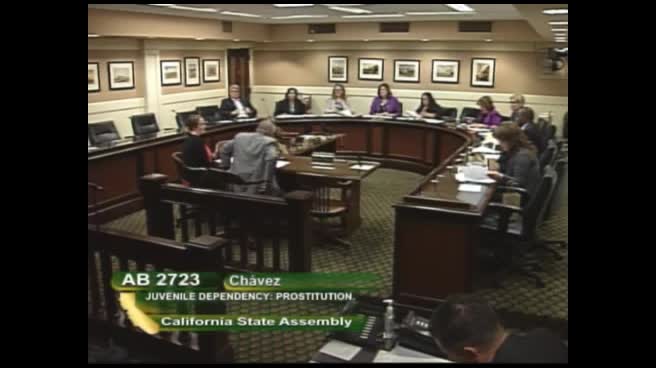
Bill Author

Bill Co-Author(s):