AB 824: Fire prevention activities.
- Session Year: 2015-2016
- House: Assembly
- Latest Version Date: 2015-07-16
Existing law requires the Board of Forestry and Fire Protection to classify all lands within the state, without regard to any classification of lands made by or for any federal agency or purpose, for the purpose of determining areas in which the financial responsibility of preventing and suppressing fires is primarily the responsibility of the state.
Existing law requires the Department of Forestry and Fire Protection to provide an annual report to the Legislature detailing the departments fire prevention activities, as described. Existing law requires the report to include specified data and information.
This bill would, for purposes of this report, describe fire prevention activities to include coordination and cooperation with the federal government government, as provided. The bill would require the report to include a map of the areas of coordination between the department and the federal government, as provided.
Existing law requires the Board of Forestry and Fire Protection to classify all lands within the state, without regard to any classification of lands made by or for any federal agency or purpose, for the purpose of determining areas in which the financial responsibility of preventing and suppressing fires is primarily the responsibility of the state.
Existing law requires the Department of Forestry and Fire Protection to provide an annual report to the Legislature detailing the departments fire prevention activities, as described. Existing law requires the report to include specified data and information.
This bill would, for purposes of this report, describe fire prevention activities to include coordination and cooperation with the federal government. The bill would require the report to include a map of the areas of coordination between the department and the federal government, as provided.
Existing law, the Porter-Cologne Water Quality Control Act, requires the State Department of Public Health to establish uniform statewide recycling criteria for each varying type of use of recycled water if the use involves the protection of public health. The act defines recycling criteria to mean the levels of constituents of recycled water, and the means for assurance of reliability under the design concept that will result in recycled water that is safe for the uses to be made.
This bill would make technical, nonsubstantive changes to that definition.
(a)For purposes of this section, fire prevention activities include, but are not limited to, all of the following:
(1)Fire prevention education.
(2)Hazardous fuel reduction and vegetation management.
(3)Fire investigation.
(4)Civil cost recovery.
(5)Forest and fire law enforcement.
(6)Fire prevention engineering.
(7)Prefire planning.
(8)Risk analysis.
(9)Volunteer programs and partnerships.
(10)Coordination and cooperation with the federal government. government, which shall include, but not be limited to, all of the following:
(A)Estimates of state and federal fire prevention costs to fund fire prevention activities of Fire Safe Councils, community emergency response teams developed by local governments, and similar organizations who cooperate with state and federal authorities to reduce the risk of wildfires near communities.
(B)Estimates of the funding needs for forest fuel management programs to reduce urgent fire risks near communities at high risk of wildfire.
(C)Usage of coordinated policies that promote defensible space adjacent to communities where multiple jurisdictions may engage in fire suppression activities.
(b)It is the intent of the Legislature that the year-round staffing and the extension of the workweek that has been provided to the department pursuant to memorandums of understanding with the state will result in significant increases in the departments current level of fire prevention activities. It is also the intent of the Legislature that the budgetary augmentations for year-round staffing not reduce the reimbursements that the department receives from contracts with local governments for the department to provide local fire protection and emergency services pursuant to Section 4144, commonly referred to as Amador agreements.
(c)On or before January 10 of each year, the department shall provide a report to the Legislature, including the budget and fiscal committees of the Assembly and the Senate, in accordance with Section 9795 of the Government Code, detailing the departments fire prevention activities, including the increased activities described in subdivision (b). The report shall display the fire prevention activities of the previous fiscal year, as well as the information from previous reports for purposes of a comparison of data. The report shall include all of the following:
(1)Fire prevention activities performed by the department on lands designated as state responsibility areas, and by counties, where, pursuant to a contract with the department, a county has agreed to provide fire protection services in state responsibility areas within county boundaries on behalf of the department. The fire prevention activities included in the report pursuant to this paragraph shall include, but not be limited to, all of the following:
(A)The number of hours of fire prevention education performed.
(B)The number of defensible space inspections conducted, including statewide totals and totals for each region.
(C)The number of citations issued for noncompliance with Section 4291.
(D)The number of acres treated by mechanical fuel reduction.
(E)The number of acres treated by prescribed burns.
(F)Any other data or qualitative information deemed necessary by the department in order to provide the Legislature with a clear and accurate accounting of fire prevention activities, particularly with regard to variations from one year to the next.
(G)A map of the areas of coordination between the department and the federal government, particularly in areas of high fire hazard severity or in wildlife-urban wildland-urban interface areas.
(2)The fire prevention performance measures described in subparagraphs (A) to (G), inclusive, of paragraph (1) shall be reported for each region annually, including activities performed from December 15 to April 15, inclusive.
(3)Projected fire prevention activities for the following fiscal year.
(4)Information on each of the Amador agreements described in subdivision (b), including an annual update on the number of those agreements and reimbursements received from the agreements that are in effect.
(a)For purposes of this section, fire prevention activities include, but are not limited to, all of the following:
(1)Fire prevention education.
(2)Hazardous fuel reduction and vegetation management.
(3)Fire investigation.
(4)Civil cost recovery.
(5)Forest and fire law enforcement.
(6)Fire prevention engineering.
(7)Prefire planning.
(8)Risk analysis.
(9)Volunteer programs and partnerships.
(10)Coordination and cooperation with the federal government.
(b)It is the intent of the Legislature that the year-round staffing and the extension of the workweek that has been provided to the department pursuant to memorandums of understanding with the state will result in significant increases in the departments current level of fire prevention activities. It is also the intent of the Legislature that the budgetary augmentations for year-round staffing not reduce the reimbursements that the department receives from contracts with local governments for the department to provide local fire protection and emergency services pursuant to Section 4144, commonly referred to as Amador agreements.
(c)On or before January 10 of each year, the department shall provide a report to the Legislature, including the budget and fiscal committees of the Assembly and the Senate, in accordance with Section 9795 of the Government Code, detailing the departments fire prevention activities, including the increased activities described in subdivision (b). The report shall display the fire prevention activities of the previous fiscal year, as well as the information from previous reports for purposes of a comparison of data. The report shall include all of the following:
(1)Fire prevention activities performed by the department on lands designated as state responsibility areas, and by counties, where, pursuant to a contract with the department, a county has agreed to provide fire protection services in state responsibility areas within county boundaries on behalf of the department. The fire prevention activities included in the report pursuant to this paragraph shall include, but not be limited to, all of the following:
(A)The number of hours of fire prevention education performed.
(B)The number of defensible space inspections conducted, including statewide totals and totals for each region.
(C)The number of citations issued for noncompliance with Section 4291.
(D)The number of acres treated by mechanical fuel reduction.
(E)The number of acres treated by prescribed burns.
(F)Any other data or qualitative information deemed necessary by the department in order to provide the Legislature with a clear and accurate accounting of fire prevention activities, particularly with regard to variations from one year to the next.
(G)A map of the areas of coordination between the department and the federal government, particularly in areas of high fire hazard severity or in wildlife-urban interface areas.
(2)The fire prevention performance measures described in subparagraphs (A) to (F), (G), inclusive, of paragraph (1) shall be reported for each region annually, including activities performed from December 15 to April 15, inclusive.
(3)Projected fire prevention activities for the following fiscal year.
(4)Information on each of the Amador contracts agreements described in subdivision (b), including an annual update on the number of those contracts agreements and reimbursements received from the contracts agreements that are in effect.
SECTION 1.Section 13520 of the Water Code is amended to read:13520.As used in this article recycling criteria are the levels of constituents of recycled water, and the means for assurance of reliability under the design concept that will result in recycled water that is safe from the standpoint of public health, for the uses to be made of the recycled water.
As used in this article recycling criteria are the levels of constituents of recycled water, and the means for assurance of reliability under the design concept which that will result in recycled water that is safe from the standpoint of public health, for the uses to be made of the recycled water.
|
Date
|
Status
|
|---|---|
| Feb 26, 2015 | Read first time. To print. |
| Feb 27, 2015 | From printer. May be heard in committee March 29. |
| Mar 26, 2015 | From committee chair, with author's amendments: Amend, and re-refer to Com. on NAT. RES. Read second time and amended. |
| Mar 26, 2015 | Referred to Com. on NAT. RES. |
| Apr 6, 2015 | Re-referred to Com. on NAT. RES. |
| Apr 28, 2015 | From committee: Do pass and re-refer to Com. on APPR. with recommendation: To Consent Calendar. (Ayes 9. Noes 0.) (April 27). Re-referred to Com. on APPR. |
| May 6, 2015 | From committee: Do pass. To Consent Calendar. (Ayes 17. Noes 0.) (May 6). |
| May 7, 2015 | Read second time. Ordered to Consent Calendar. |
| May 14, 2015 | In Senate. Read first time. To Com. on RLS. for assignment. |
| May 14, 2015 | Read third time. Passed. Ordered to the Senate. |
| May 14, 2015 | Read third time. Passed. Ordered to the Senate. (Ayes 78. Noes 0. Page 1449.) |
| May 28, 2015 | Referred to Com. on N.R. & W. |
| Jul 15, 2015 | From committee: Amend, and do pass as amended and re-refer to Com. on APPR. with recommendation: To Consent Calendar. (Ayes 9. Noes 0.) (July 14). |
| Jul 16, 2015 | Read second time and amended. Re-referred to Com. on APPR. |
| Aug 17, 2015 | In committee: Referred to APPR. suspense file. |
| Aug 27, 2015 | In committee: Held under submission. |
|
Date
|
Description
|
Location
|
Votes
|
|
|---|---|---|---|---|
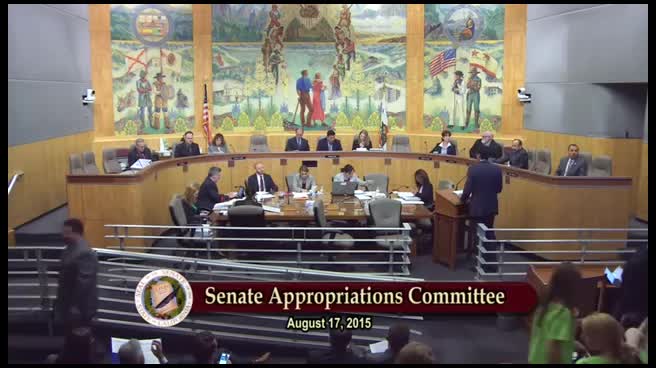
| Aug 17, 2015 | Placed on suspense file | Senate Standing Committee on Appropriations |
Passed |
|
| Jul 14, 2015 | Do pass as amended, but first amend, and re-refer to the Committee on [Appropriations] with the recommendation: To Consent Calendar | Senate Standing Committee on Natural Resources and Water |
Passed |
|
| May 14, 2015 | AB 824 GATTO Consent Calendar Second Day Regular Session | Assembly Floor |
Passed |
|
| May 6, 2015 | Do pass. To Consent Calendar. | Assembly Standing Committee on Appropriations |
Passed |
|
| Apr 27, 2015 | Do pass and be re-referred to the Committee on [Appropriations] with recommendation: To Consent Calendar | Assembly Standing Committee on Natural Resources |
Passed |
This list shows positions taken on this bill by organizations on the date displayed, which is linked to the original source.
Positions by individuals are not included.
|
Organization
|
Position
|
Date
|
|---|---|---|
| Center For Biological Diversity, Inc. | ** Support | Aug 17, 2015 |
| Crescenta Valley Fire Safe Council | ** Support | Aug 17, 2015 |
| Sierra Club California | ** Support | Aug 17, 2015 |
AB 824 (Gatto) Page 2 of 2
SENATE COMMITTEE ON APPROPRIATIONS
Senator Ricardo Lara, Chair
2015 - 2016 Regular Session
AB 824 (Gatto) - Fire prevention activities
|
|
Version: July 16, 2015 |
Policy Vote: N.R. & W. 9 - 0 |
Urgency: No |
Mandate: No |
Hearing Date: August 17, 2015 |
Consultant: Marie Liu |
This bill meets the criteria for referral to the Suspense File.
Bill Summary:
AB 824 would expand the Department of Forestry and Fire’s (CalFire) annual report on fire prevention activities to include information regarding the coordination and cooperation with the federal government.
Fiscal Impact:
Initial costs of $302,000 for the first year and then $258,000 annually thereafter from the General Fund to CalFire in order to obtain the required report information.
Unknown cost pressures, at least in the tens of millions of dollars, to the General Fund and the Fire Prevention Fund (special) by identifying the funding needs for forest fuel management programs.
Background:
Under existing law, The Board of Forestry (board) is required to identify all lands where the state has the primary financial responsibility for preventing and suppressing fires. These state responsibility areas (SRAs) are generally lands that are (or were, prior to development) largely covered by trees, brush, and grass and other undeveloped lands. Under 4114 of the Pubic Resources Code, CalFire must provide wildland fire prevention and firefighting personnel and equipment within the SRA. CalFire may provide rescue, first aid, and other emergency services to the public in the SRA if the activity does not require additional funds. All habitable structures within the SRA are required to pay a Fire Prevention Fee to pay for fire prevention services within the SRA that is deposited into the State Responsibility Area Fire Prevention Fund.
Existing law requires CalFire to report annually on its fire prevention activities in the previous year (PRC §4137). Specifically, the report is to include information such as the number of hours of fire prevention education performed, the number of defensible space inspections conducted, and the number of acres treated to reduce fuel loads.
Proposed Law:
This bill would expand the annual fire prevention report required under PRC §4137 to also include information about coordination and cooperation with the federal government. Specifically, the report would be required to include:
Estimates of state and federal fire prevention costs to fund fire prevention activities of local organizations, such as Fire Safe Councils, who cooperate with the state and federal authorities to reduce the risk of wildfires near communities.
Estimates of the funding needs for forest fuel management programs to reduce urgent fire risks near communities at high risk of wildfire.
Usage of coordinated policies that promote defensible space adjacent to communities where multiple jurisdictions may engage in fire suppression activities.
A map of the areas of coordination between the state and the federal government.
Staff Comments:
To include the map of areas of coordination between the state and federal government would have minor and absorbable costs to CalFire to include in the annual report.
To provide the other estimates required in the bill would require an extensive amount of data gathering and consolidation by CalFire. For example, in regards to estimating the state and federal fire prevention costs to fund local organizations, CalFire would need to identify appropriate organizations, which is a large universe, and obtain funding information from the federal government. Also, to make meaningful estimates of forest fuel management programs, CalFire would need to consolidate detailed information from its individual units about local conditions. Altogether, CalFire anticipates needing two Associate Governmental Program Analysts ongoing for a first year cost of $302,000, and the $258,000 annually ongoing. As the required information note is limited to SRA lands, the activities required by this bill could not be paid for by the SRA Fire Prevention Fund and would therefore come from the General Fund.
This bill would require the annual report to have information regarding the funding needs for forest fuel management programs to reduce urgent fire risks near communities at high risk of wildfire. While these needs are exist regardless of this bill, identifying and reporting these needs will increase pressures on the state to pay for such needs, thereby creating cost pressures. As the need for fuel management in state are extensive, staff estimates that these cost pressures would at least be in the tens of millions of dollars.
-- END --
AB 824 (Gatto) Page 4 of 4
SENATE COMMITTEE ON NATURAL RESOURCES AND WATER
Senator Fran Pavley, Chair
2015 - 2016 Regular
Bill No: AB 824 Hearing Date: July 14, 2015
Author: |
Gatto |
|
|
Version: |
March 26, 2015 Amended |
||
Urgency: |
No |
Fiscal: |
Yes |
Consultant: |
William Craven |
||
Subject: Fire prevention activities.
BACKGROUND AND EXISTING LAW
Requires the Board of Forestry (Board) to classify all lands within the state for the purpose of determining areas in which the financial responsibility of preventing and suppressing fires is primarily the responsibility of the state (these areas are known as “state responsibility area” or “SRA”).
Requires the California Department of Forestry and Fire Protection (CDF) to provide an annual report to the Legislature detailing its fire prevention activities.
Requires the report to include the following specified data and information:
The number of hours of fire prevention education performed.
The number of defensible space inspections conducted, including statewide totals and totals for each region.
The number of citations issued for noncompliance.
The number of acres treated by mechanical fuel reduction.
The number of acres treated by prescribed burns.
Projected fire prevention activities for the following fiscal year.
Information on each of the “Amador contracts.” (An Amador contract continues CDF staffing and station coverage through the winter.)
CDF and the federal government have agreements regarding mutual aid in suppressing fires, cost apportionment, incident command, and other aspects of fires that originate on federal lands, expand onto federal lands, or that otherwise require the involvement of both federal and state resources to suppress fires.
PROPOSED LAW
This bill:
Requires that coordination and cooperation with the federal government be considered a fire prevention activity for the purposes of the report.
Requires the report to the Legislature on fire prevention activities to include a map of the areas of coordination between CDF and the federal government, particularly in areas of high fire hazard severity or in wildlife-urban interface areas.
Renames “Amador contracts” as “Amador agreements” to be consistent throughout the section.
ARGUMENTS IN SUPPORT
According to the author, the main problem this bill attempts to address is the lack of adequate fire prevention activities that are carried out collaboratively between the state and federal government. Wildland areas are divided up into a network of federal, state, and local land; however, fires are not limited by these jurisdictional lines. While local, state, and federal agencies often work collaboratively in battling fires, there is a great deal of room for improvement in collaborative fire prevention, as opposed to fire suppression, activities.
The current framework for fire prevention activities does not sufficiently recognize and promote collaboration between the state and federal government. This bill seeks to remedy that by reframing the definition of “fire prevention activities” to reflect a more cooperative mission and by requiring CDF to include information about those cooperative activities to the Legislature. This information would be included in a report that CDF already produces and submits to the Legislature.
ARGUMENTS IN OPPOSITION
None received.
COMMENTS
1) According to a new book, “On the Burning Edge,” (Dickman, Penguin Random House, 2015), the fire suppression budget of the US Forest Service (USFS) in 1991 was about 13% of its total budget. Today, the agency which is the largest wildland fire agency in the nation, now spends nearly half of its annual budget on fire suppression, which in most years is approximately $5 billion. (CDF’s annual budget exceeds $1 billion.) More telling, the USFS fire suppression appropriation has been overspent every year since 1999. It has had to borrow millions from its other programs—timber, recreation, fisheries—to meet the need. Though Congress has reimbursed the Forest Service for up to 80 percent of the fire program’s overspending, calling it disaster relief, the cannibalism of other program budgets has become so bad that many believe that the USFS can’t be both a competent fire agency and a competent land management agency.
Historically, the focus of the USFS has been on suppression, not prevention. This, in part, is because the USFS lands are predominately unpopulated wildlands, although that is changing as more housing is constructed near wildlands.
The Forest Service predicts that by 2030, 40 percent more homes will be in the path of wildfires. Right now, with federal, state, and local government spending included, one study puts the total annual cost of fire suppression at $4.7 billion, and there’s little reason to believe that that figure will do anything but rise.
At the same time, there is little evidence that the increased spending is doing much to make towns that abut the forest safer. Fire is a natural part of the landscape, although it has been suppressed for generations. The homes aren’t. Along with today’s denser forests, drier climates, and more people living in the wildlands, wildfires are burning houses with a frequency never seen before. In the 1960s, across the U.S, about a hundred homes went up in smoke every fire season; today, across the west, the number is close to three thousand.
Of course, as Dickman points out, these costs don’t compare to those from a massive hurricane—Katrina cost $125 billion. The significant difference is that the threat wildfire poses to houses and towns can be mitigated—through forest thinning, prescribed burns, and defensible-space work. Yet western towns remain inexplicably ill-prepared. In 2013, fewer than 2 percent of America’s communities had done any defensible-space work at all. In California, fire prevention activities by CDF are documented in the annual report mentioned earlier and those reports show very slow and gradual improvement in fire prevention activities in most years.
2) In 2009, Congress passed the Federal Land Assistance, Management, and Enhancement Act of 2009 (the FLAME Act). This legislation established a separate account for funding for emergency wildfire suppression activities undertaken on Department of the Interior and National Forest System lands. Last summer, as part of the FLAME Act implementation, the Eldorado National Forest was one of two forests in California selected to begin implementation of the National Cohesive Wildland Fire Management Strategy. CDF and the USFS developed “Fire Adapted 50,” which is a joint effort to reduce fuel, improve forest health, and increase effectiveness of wildland fire response. This is an example of joint USFS-CDF prevention work that would be reported to the Legislature to meet the requirements of this bill.
SUGGESTED AMENDMENTS
To provide more specific information about coordination and cooperation between CDF and the federal government that future reports will document, the author may want to consider three additions to the reporting requirement at page 2, line 14, that could be provided in addition to other relevant information:
AMENDMENT 1
4137 (a) (10) Coordination and cooperation with the federal government, including but limited to the following:
a) Estimates of state and federal fire prevention costs to fund fire prevention activities of Fire Safe Councils, community emergency response teams developed by local governments, and similar organizations who cooperate with state and federal authorities to reduce the risk of wildfires near communities.
b) Estimates of the funding needs for forest fuel management programs to reduce urgent fire risks near communities at high risk of wildfire.
c) Usage of coordinated policies that promote defensible space adjacent to communities where multiple jurisdictions may engage in fire suppression activities.
AMENDMENT 2
The author proposes adding a technical amendment in (a) 10 and (c)1 after the word “government” the term “on large landscape-scale projects”
SUPPORT
Center for Biological Diversity
Crescenta Valley Fire Safe Council
Sierra Club California
OPPOSITION
None Received
-- END --
AB 824
Page 2
Date of Hearing: May 6, 2015
ASSEMBLY COMMITTEE ON APPROPRIATIONS
Jimmy Gomez, Chair
AB 824
(Gatto) – As Amended March 26, 2015
Policy Committee: |
Natural Resources |
Vote: |
9 - 0 |
|
|
|
|
|
|
|
|
Urgency: No State Mandated Local Program: No Reimbursable: No
SUMMARY:
This bill modifies what must be included in CalFire's annual report to the Legislature on fire prevention activities. Specifically, this bill:
Requires that coordination and cooperation with the federal government be considered a fire prevention activity for the purposes of the report.
Requires the report to the Legislature on fire prevention activities to include a map of the areas of coordination between CALFIRE and the federal government, particularly in areas of high fire hazard severity or in wildlife-urban interface areas.
Provides technical clarification.
FISCAL EFFECT:
No additional state costs.
COMMENTS:
Purpose. According to the author, wildland areas are divided up into a network of federal, state, and local land but fires are not limited by these jurisdictional lines. The author states that the current framework for fire prevention activities does not sufficiently recognize and promote collaboration among different levels of government.
This bill reframes the definition of fire prevention activities to reflect a more cooperative mission by requiring CALFIRE to include information about those cooperative activities in its annual report to the Legislature.
Fire Prevention Activities. Current law Requires CALFIRE to provide an annual report to the Legislature detailing CALFIRE’s fire prevention activities. The report is required to include:
a) The number of hours of fire prevention education performed.
The number of defensible space inspections conducted, including statewide totals and totals for each region.
The number of citations issued for noncompliance.
The number of acres treated by mechanical fuel reduction.
The number of acres treated by prescribed burns.
Projected fire prevention activities for the following fiscal year.
Information on each of the “Amador contracts.” (An Amador contract continues CALFIRE staffing and station coverage through the winter.)
This bill expands the requirements to include collaborative efforts and maps of coordinated activities, particularly in areas of high fire hazard severity or in wildlife-urban interface areas.
Analysis Prepared by: Jennifer Galehouse / APPR. / (916) 319-2081
AB 824
Page 3
Date of Hearing: April 27, 2015
ASSEMBLY COMMITTEE ON NATURAL RESOURCES
Das Williams, Chair
AB 824
(Gatto) – As Amended March 26, 2015
SUBJECT: Fire prevention activities
SUMMARY: Requires the Department of Forestry and Fire Protection (CALFIRE) to report to the Legislature on its coordination and cooperation with the federal government and include a map of the areas of coordination.
EXISTING LAW:
Requires the Board of Forestry (Board) to classify all lands within the state for the purpose of determining areas in which the financial responsibility of preventing and suppressing fires is primarily the responsibility of the state (these areas are known as “state responsibility area” or “SRA”).
Requires CALFIRE to provide an annual report to the Legislature detailing CALFIRE’s fire prevention activities.
Requires the report to include the following specified data and information:
The number of hours of fire prevention education performed.
The number of defensible space inspections conducted, including statewide totals and totals for each region.
The number of citations issued for noncompliance.
The number of acres treated by mechanical fuel reduction.
The number of acres treated by prescribed burns.
Projected fire prevention activities for the following fiscal year.
Information on each of the “Amador contracts.” (An Amador contract continues CALFIRE staffing and station coverage through the winter.)
THIS BILL:
Requires that coordination and cooperation with the federal government be considered a fire prevention activity for the purposes of the report.
Requires the report to the Legislature on fire prevention activities to include a map of the areas of coordination between CALFIRE and the federal government, particularly in areas of high fire hazard severity or in wildlife-urban interface areas.
Renames “Amador contracts” as “Amador agreements” to be consistent throughout the section.
FISCAL EFFECT: Unknown
COMMENTS:
Author’s statement.
The main problem this bill attempts to address is the lack of adequate fire prevention activities that are carried out collaboratively between the state and federal government. Wildland areas are divided up into a network of federal, state, and local land; however, fires are not limited by these jurisdictional lines. While local, state, and federal agencies often work collaboratively in battling fires, there is a great deal of room for improvement in collaborative fire prevention activities.
The current framework for fire prevention activities does not sufficiently recognize and promote collaboration between the state and federal government. This bill seeks to remedy that by reframing the definition of “fire prevention activities” to reflect a more cooperative mission and by requiring CALFIRE to include information about those cooperative activities to the Legislature. This information would be included in a report that CALFIRE already produces and submits to the legislature.
California wildfires. The federal government is responsible for fire fighting in approximately one-third of the state (around 30 million acres) between all of the federal land management agencies, which includes the United States Forest Service (USFS), the National Park Service and the Bureau of Land Management. California wildfires happen in local, federal, and CALFIRE jurisdiction and can cross boundaries. In 2013, the number of California wildfires and acres burned for all jurisdictions were:
Jurisdiction |
Fires |
Acres |
CALFIRE |
3,672 |
114,472 |
Federal Firefighting Agencies |
2,213 |
450,126 |
Local Governments |
3,004 |
37,036 |
FLAME Act. Congress passed the Federal Land Assistance, Management, and Enhancement Act of 2009 (the FLAME Act). This legislation established a separate account for funding for emergency wildfire suppression activities undertaken on Department of the Interior and National Forest System lands. In addition to the funding language, the Act required the Secretaries of Agriculture and the Interior, acting jointly, submit to Congress a report containing a cohesive strategy addressing how the two departments, working together, will address the wildland fire problems. Leadership in both departments recognized that in order to be truly national in scope, a cohesive strategy must go beyond federal fire agencies and include tribal, state, local, public, and stakeholder interests. Wildfire knows no jurisdictional boundaries, and the agencies and entities having direct or indirect fire management responsibilities are therefore linked at all levels. The report found that inclusion, collaboration, and cooperation are absolute requirements in today’s wildland fire environment.
Last summer, as part of the FLAME Act implementation, the Eldorado National Forest was one of two forests in California selected to begin implementation of the National Cohesive Wildland Fire Management Strategy. CALFIRE and the USFS developed “Fire Adapted 50,” which is a joint effort to reduce fuel, improve forest health, and increase effectiveness of wildland fire response. This is an example of what CALFIRE will be required to report to the Legislature to meet the requirements of this bill. Information about these efforts to coordinate and cooperate with the federal government should be studied by the Legislature to see how both state and federal government can improve their response to wildfires.
REGISTERED SUPPORT / OPPOSITION:
Support
Center for Biological Diversity
Opposition
None on file
Analysis Prepared by: Michael Jarred / NAT. RES. / (916) 319-2092
Discussed in Hearing
 37SEC
Senate Standing Committee on Appropriations
Bill Author

Bill Co-Author(s):