AB 1552: Large public utilities: timely payment of subcontractors: women, minority, disabled veteran, and LGBT business enterprise procurement: late payment penalties.
- Session Year: 2017-2018
- House: Assembly
- Latest Version Date: 2018-05-23
Under existing law, the Public Utilities Commission has regulatory authority over public utilities, including electrical, gas, water, and telephone corporations. Existing law requires each electrical, gas, water, wireless telecommunications service provider, or telephone corporation with gross annual revenues exceeding $25,000,000, and its commission-regulated subsidiaries and affiliates, to annually submit a detailed and verifiable plan for increasing procurement from women, minority, disabled veteran, and LGBT business enterprises, as defined, and to implement an outreach program to inform and recruit those business enterprises to apply for procurement contracts, as specified. Existing law includes a declaration by the Legislature that each electrical, gas, water, mobile telephony service provider, and telephone corporation that is not required to submit a plan, and each cable television corporation and direct broadcast satellite provider, is encouraged to voluntarily adopt a plan for increasing procurement from those business enterprises. Existing law requires the commission, by rule or order, to adopt criteria for verifying and determining eligibility of women, minority, and LGBT business enterprises for procurement contracts. defined. Existing law requires the commission to report certain information relative to the activities undertaken by those public utilities by September 1 of each year.
This bill would require each electrical, gas, water, mobile telephony service provider, or telephone corporation, with gross annual revenues exceeding $25,000,000, and its commission-regulated subsidiaries and affiliates, to pay an undisputed invoice by its required payment approval date, as defined. If the payment is not made by that date, the bill would require the utility to pay a late payment penalty to a certified small business, as defined, that is a disabled veteran, minority, women, or LGBT business enterprise claimant, or to a nonsmall-business claimant another business that has committed to having at least 25% of the contracted work undertaken by a certified small business, at a rate of 10% above the United States Prime Rate. The bill would require each of the specified utilities to annually provide the commission with information concerning its late payment penalties. The bill would require the commission to encourage all public utilities to adopt policies and practices that encourage certified small businesses to promptly pay their subcontractors and suppliers, especially those that are small businesses. the payment terms of its contracts with certified disabled veteran, minority, women, or LGBT small business enterprises and late payment penalties that it paid to certified disabled veteran, minority, women, or LGBT small business enterprises. The bill would revise the commissions reporting requirements to the Legislature to require the report to include information on contracts entered into and payments made during the report period to certified disabled veteran, minority, women, or LGBT small business enterprises.
Under existing law, a violation of any order, decision, rule, direction, demand, or requirement of the commission is a crime.
Because a violation of an order or decision of the commission implementing the requirements of the bill would be a crime, the bill would impose a state-mandated local program by creating a new crime.
The California Constitution requires the state to reimburse local agencies and school districts for certain costs mandated by the state. Statutory provisions establish procedures for making that reimbursement.
This bill would provide that no reimbursement is required by this act for a specified reason.
Under existing law, the Public Utilities Commission has regulatory authority over public utilities, including electrical, gas, water, and telephone corporations. Existing law requires each electrical, gas, water, wireless telecommunications service provider, or telephone corporation with gross annual revenues exceeding $25,000,000, and its commission-regulated subsidiaries and affiliates, to annually submit a detailed and verifiable plan for increasing procurement from women, minority, disabled veteran, and LGBT business enterprises, as defined, and to implement an outreach program to inform and recruit those business enterprises to apply for procurement contracts, as specified. Existing law includes a declaration by the Legislature that each electrical, gas, water, mobile telephony service provider, and telephone corporation that is not required to submit a plan, and each cable television corporation and direct broadcast satellite provider, is encouraged to voluntarily adopt a plan for increasing procurement from those business enterprises. Existing law requires the commission, by rule or order, to adopt criteria for verifying and determining eligibility of women, minority, and LGBT business enterprises for procurement contracts.
This bill would require each electrical, gas, water, mobile telephony service provider, or telephone corporation, with gross annual revenues exceeding $25,000,000, and its commission-regulated subsidiaries and affiliates, to pay an undisputed invoice by its required payment approval date, as defined. If the payment is not made by that date, the bill would require the utility to pay a late payment penalty to a certified small business, as defined, that is a disabled veteran, minority, women, or LGBT business enterprise claimant, or to a nonsmall business nonsmall-business claimant that has committed to having at least 25% of the contracted work undertaken by a certified small business, at a rate of 10% above the United States Prime Rate, and to all other claimants in accord with the contractual agreement. Rate. The bill would require each of the specified utilities to annually provide the commission with information concerning its late payment penalties. The bill would require the commission to encourage all public utilities to adopt policies and practices that encourage claimants certified small businesses to promptly pay their contractors subcontractors and suppliers, especially those that are small businesses.
Under existing law, a violation of any order, decision, rule, direction, demand, or requirement of the commission is a crime.
Because a violation of an order or decision of the commission implementing the requirements of the bill would be a crime, the bill would impose a state-mandated local program by creating a new crime.
The California Constitution requires the state to reimburse local agencies and school districts for certain costs mandated by the state. Statutory provisions establish procedures for making that reimbursement.
This bill would provide that no reimbursement is required by this act for a specified reason.
Under existing law, the Public Utilities Commission has regulatory authority over public utilities, including electrical, gas, water, and telephone corporations. Existing law requires each electrical, gas, water, wireless telecommunications service provider, or telephone corporation with gross annual revenues exceeding $25,000,000, and its commission-regulated subsidiaries and affiliates, to annually submit a detailed and verifiable plan for increasing procurement from women, minority, disabled veteran, and LGBT business enterprises, as defined, and to implement an outreach program to inform and recruit those business enterprises to apply for procurement contracts, as specified. Existing law includes a declaration by the Legislature that each electrical, gas, water, mobile telephony service provider, and telephone corporation that is not required to submit a plan, and each cable television corporation and direct broadcast satellite provider, is encouraged to voluntarily adopt a plan for increasing procurement from those business enterprises. Existing law requires the commission, by rule or order, to adopt criteria for verifying and determining eligibility of women, minority, and LGBT business enterprises for procurement contracts.
This bill would require each electrical, gas, water, mobile telephony service provider, or telephone corporation, with gross annual revenues exceeding $25,000,000, and its commission-regulated subsidiaries and affiliates, to pay an undisputed invoice by its required payment approval date, as defined. If the payment is not made by that date, the bill would require the utility to pay a late payment penalty to a certified small business, as defined, that is a disabled veteran, minority, women, or LGBT business enterprise claimant a penalty claimant, or to a nonsmall business claimant that has committed to having at least 25% of the contracted work undertaken by a certified small business, at a rate of 10% above the United States Prime Rate, and to all other claimants a penalty at a rate of 1% above the Pooled Money Investment Account daily rate, of the amount of the late undisputed invoice, as specified. The bill would provide that a late payment penalty that accrues as a result of a utilitys failure to make a timely payment is not recoverable from its ratepayers. in accord with the contractual agreement. The bill would require each utility of the specified utilities to annually provide the commission with a report of information concerning its late payment penalties. The bill would authorize the commission to open a proceeding to offer further guidance to assist in the implementation of these provisions, and would require the commission to encourage all public utilities to adopt policies and practices that encourage claimants to promptly pay their contractors and suppliers, especially those that are small businesses.
Under existing law, a violation of any order, decision, rule, direction, demand, or requirement of the commission is a crime.
Because a violation of an order or decision of the commission implementing the requirements of the bill would be a crime, the bill would impose a state-mandated local program by creating a new crime.
The California Constitution requires the state to reimburse local agencies and school districts for certain costs mandated by the state. Statutory provisions establish procedures for making that reimbursement.
This bill would provide that no reimbursement is required by this act for a specified reason.
Under existing law, the Public Utilities Commission (PUC) has regulatory authority over public utilities, including electrical electrical, gas, water, and telephone corporations. Existing law authorizes the PUC to fix the rates and charges for every public utility, and requires that those rates and charges be just and reasonable. Existing law requires the PUC to require each electrical corporation under the operational control of the Independent System Operator as of January 1, 2001, to modify tariffs so that all customers that install new distributed energy resources, as defined, in accordance with specified criteria are served under rates, rules, and requirements identical to those of a customer within the same rate schedule that does not use distributed energy resources and to withdraw any provisions in otherwise applicable tariffs that activate other tariffs, rates, or rules if a customer uses distributed energy resources. Existing law provides, notwithstanding these requirements, that a customer that installs new distributed energy resources not be exempted from (1) reasonable interconnection charges, (2) charges imposed pursuant to the Reliable Electric Service Investment Act, and (3) charges imposed to repay the Department of Water Resources for electricity procurement expenses incurred in response to the electricity crisis of 200001. Existing law requires the PUC, in establishing the rates applicable to customers that install new distributed energy resources, to create a firewall that segregates distribution cost recovery so that any net costs, taking into account the actual costs and benefits of distributed energy resources, proportional to each customer class, as determined by the PUC, resulting from the tariff modifications granted to members of each customer class may be recovered only from that class. requires each electrical, gas, water, wireless telecommunications service provider, or telephone corporation with gross annual revenues exceeding $25,000,000, and its commission-regulated subsidiaries and affiliates, to annually submit a detailed and verifiable plan for increasing procurement from women, minority, disabled veteran, and LGBT business enterprises, as defined, and to implement an outreach program to inform and recruit those business enterprises to apply for procurement contracts, as specified. Existing law includes a declaration by the Legislature that each electrical, gas, water, mobile telephony service provider, and telephone corporation that is not required to submit a plan, and each cable television corporation and direct broadcast satellite provider, is encouraged to voluntarily adopt a plan for increasing procurement from those business enterprises. Existing law requires the commission, by rule or order, to adopt criteria for verifying and determining eligibility of women, minority, and LGBT business enterprises for procurement contracts.
This bill would, by July 1, 2018, to the extent authorized by federal law, require the states 3 largest electrical corporations to stop assessing utility-imposed nonbypassable charges against customers using clean distributed generation resources, as defined, for electricity generated and consumed on-site and instead require those customers to pay all applicable fees based only on electricity purchased from the electrical corporation that is delivered over the electrical grid. would require each electrical, gas, water, mobile telephony service provider, or telephone corporation, with gross annual revenues exceeding $25,000,000, and its commission-regulated subsidiaries and affiliates, to pay an undisputed invoice by its required payment approval date, as defined. If the payment is not made by that date, the bill would require the utility to pay a late payment penalty to a disabled veteran, minority, women, or LGBT business enterprise claimant a penalty at a rate of 10% above the United States Prime Rate, and to all other claimants a penalty at a rate of 1% above the Pooled Money Investment Account daily rate, of the amount of the late undisputed invoice, as specified. The bill would provide that a late payment penalty that accrues as a result of a utilitys failure to make a timely payment is not recoverable from its ratepayers. The bill would require each utility to annually provide the commission with a report of its late payment penalties. The bill would authorize the commission to open a proceeding to offer further guidance to assist in the implementation of these provisions, and would require the commission to encourage all public utilities to adopt policies and practices that encourage claimants to promptly pay their contractors and suppliers, especially those that are small businesses.
Under existing law, a violation of the Public Utilities Act or any order, decision, rule, direction, demand, or requirement of the PUC commission is a crime.
Because the provisions of this bill would be a part of the act and because a violation of an order or decision of the PUC commission implementing its requirements the requirements of the bill would be a crime, the bill would impose a state-mandated local program by creating a new crime.
The California Constitution requires the state to reimburse local agencies and school districts for certain costs mandated by the state. Statutory provisions establish procedures for making that reimbursement.
This bill would provide that no reimbursement is required by this act for a specified reason.
Under existing law, the Public Utilities Commission (PUC) has regulatory authority over public utilities, including electrical corporations. Existing law authorizes the PUC to fix the rates and charges for every public utility, and requires that those rates and charges be just and reasonable. Existing law requires the PUC to require each electrical corporation under the operational control of the Independent System Operator as of January 1, 2001, to modify tariffs so that all customers that install new distributed energy resources, as defined, in accordance with specified criteria are served under rates, rules, and requirements identical to those of a customer within the same rate schedule that does not use distributed energy resources and to withdraw any provisions in otherwise applicable tariffs that activate other tariffs, rates, or rules if a customer uses distributed energy resources. Existing law provides, notwithstanding these requirements, that a customer that installs new distributed energy resources not be exempted from (1) reasonable interconnection charges, (2) charges imposed pursuant to the Reliable Electric Service Investment Act, and (3) charges imposed to repay the Department of Water Resources for electricity procurement expenses incurred in response to the electricity crisis of 200001. Existing law requires the PUC, in establishing the rates applicable to customers that install new distributed energy resources, to create a firewall that segregates distribution cost recovery so that any net costs, taking into account the actual costs and benefits of distributed energy resources, proportional to each customer class, as determined by the PUC, resulting from the tariff modifications granted to members of each customer class may be recovered only from that class.
This bill would, by July 1, 2018, to the extent authorized by federal law, require the states 3 largest electrical corporations to stop assessing utility-imposed nonbypassable charges against customers using clean distributed generation resources, as defined, for electricity generated and consumed on-site and instead require those customers to pay all applicable fees based only on electricity purchased from the electrical corporation that is delivered over the electrical grid.
Under existing law, a violation of the Public Utilities Act or any order, decision, rule, direction, demand, or requirement of the PUC is a crime.
Because the provisions of this bill would be a part of the act and because a violation of an order or decision of the PUC implementing its requirements would be a crime, the bill would impose a state-mandated local program by creating a new crime.
The California Constitution requires the state to reimburse local agencies and school districts for certain costs mandated by the state. Statutory provisions establish procedures for making that reimbursement.
This bill would provide that no reimbursement is required by this act for a specified reason.
(a)The Legislature finds and declares that it is in the best interests of the state and its citizens to ensure that all materials, equipment, technology, and construction and other services provided to a public utility be paid for in full and in a timely manner.
(b)It is the intent of the Legislature that the authority granted to the Public Utilities Commission pursuant to Section 792 of the Public Utilities Code and other related sections in the Public Utilities Act (Part 1 (commencing with Section 201) of Division 1 of the Public Utilities Code) includes the authority to establish and prescribe the forms, accounts, records, and memorandum to be kept by public utilities, including those concerning the expenditures of moneys to pay contractors.
(c)It is the Legislature's intent that the Public Utilities Commission use its authority to adopt rules, policies, and practices that encourage both of the following:
(1)That public utilities promptly review and pay invoices, refunds, and payments in a timely fashion. The rules, policies, and practices may include, but are not limited to, transparent payment processes that allow prime contractors to track receipt, approval, and payment for invoices and refunds.
(2)That prime contractors promptly pay their subcontractors and suppliers, especially those subcontractors and suppliers that are small businesses. The policies and practices may include, but are not limited to, expedited payment processes and transparent payment practices that allow a subcontracting business to track when a subcontractor or supplier has been paid.
SEC. 2.Article 4.5 (commencing with Section 800) is added to Chapter 4 of Part 1 of Division 1 of the Public Utilities Code, to read:4.5.Prompt Payment of Small Business Contractors800.The Legislature finds and declares that a public utility with gross annual revenues exceeding twenty-five million dollars ($25,000,000) is of a reasonable size for the commission to responsibly expect that the utility and its commission-regulated subsidiaries and affiliates have the administrative capacity to pay the amounts of properly submitted, undisputed invoices, refunds, or other undisputed payments that are owed to certified small businesses.
801.For purposes of this article, the following terms have the following meanings:
(a)Certified small business means a business certified by the State of California as meeting the requirements of subdivision (d) of Section 14837 of the Government Code.
(b)Invoice means a bill, claim, or other document that requests payment on a contractual agreement under which a public utility described in subdivision (a) of Section 803 agrees to purchase a good or service. If the contractual agreement specifies a specific form or format for invoicing, the invoice shall meet the terms of the contractual agreement.
(c)Reasonable cause means a determination by a public utility described in subdivision (a) of Section 803 that any of the following conditions is present:
(1)There is a discrepancy between the invoiced or claimed amount and the provisions of the contractual agreement for the goods or services.
(2)There is a discrepancy between the invoiced or claimed amount and either the goods or services delivered by the certified small business to the public utility or the goods or services accepted by the public utility.
(3)The public utility requires the certified small business to provide additional evidence supporting the validity of the invoiced or claimed amount.
(4)The certified small business has improperly executed or needs to correct the invoice.
(5)There is a discrepancy between the refund or other payment due as calculated by the party to whom the money is owed and by the public utility.
(d)The date an invoice is received by the public utility means the date an invoice is delivered and received by the public utility described in subdivision (a) of Section 803 or by a party specified in the contract to receive the invoice.
(e)Required payment date means the date on which payment is due as specified in a contractual agreement. If a date is not specified in the contractual agreement, the required payment date is 30 calendar days following the date upon which an undisputed invoice is received by the public utility described in subdivision (a) of Section 803 or a party specified in the contract to receive the invoice, or, if 30 days falls on a weekend or holiday, the following business day.
803.(a)The late payment penalty requirements in this article shall apply only to an electrical, gas, water, or telephone corporation, including a mobile telephony service provider, with gross annual revenues exceeding twenty-five million dollars ($25,000,000), and its commission-regulated subsidiaries and affiliates.
(b)A public utility described in subdivision (a) shall pay an undisputed invoice issued by a certified small business, or another business that has committed to having at least 25 percent of the contractual work undertaken by a certified small business, by the required payment date, but may dispute an invoice for reasonable cause if the public utility notifies the certified small business or other business within 15 working days from receipt of the invoice, or delivery of goods or services, whichever is later. An employee of the public utility shall not dispute an invoice on the basis of minor or technical defects to circumvent or avoid the general intent, or any of the specific provisions, of this section.
(c)(1)If a public utility described in subdivision (a) fails to comply with the requirement of subdivision (b), it shall pay a late payment penalty, as described in this subdivision, without requiring the certified small business or other business to submit an additional invoice for that amount. The penalty shall begin to accrue 15 days following the required due date and cease to accrue on the date the public utility issues the payment.
(2)The late payment penalty required to be paid pursuant to this subdivision shall be at a rate of 10 percent above the United States Prime Rate on June 30 of the prior fiscal year of the amount of the late undisputed invoice. The late payment penalty shall cease to accrue on the date full payment or full refund is made. If the amount of the late payment penalty is ten dollars ($10) or less, it shall be waived and not paid by the public utility.
SEC. 3.Section 910.3 of the Public Utilities Code is amended to read:910.3.(a)The commission shall provide a report to the Legislature on September 1 of each year, on the progress of activities undertaken by each electrical, gas, water, wireless telecommunications service provider, and telephone corporation with gross annual revenues exceeding twenty-five million dollars ($25,000,000), in the implementation of women, minority, disabled veteran, and LGBT business enterprise development programs pursuant to Article 5 (commencing with Section 8281) of Chapter 7 of Division 4. The report shall include information about which procurements are made procurement activities with women, minority, disabled veteran, and LGBT business enterprises with at least a majority of the enterprises workforce in California, to the extent that information is readily accessible. The report shall include information on contracts entered into and payments made during the report period. The commission shall recommend a program for carrying out the policy declared in Article 5 (commencing with Section 8281) of Chapter 7 of Division 4, together with recommendations for legislation that it deems necessary or desirable to further that policy. The commission shall make the report available on its Internet Web site.
(b)In regard to disabled veteran business enterprises, the commission shall ensure that the programs and legislation recommended pursuant to subdivision (a) are consistent with the disabled veteran business enterprise certification eligibility requirements imposed by the Department of General Services and that the recommendations include only those disabled veteran business enterprises certified by the Department of General Services.
(c)The commission shall include the information about LGBT business enterprises required by subdivision (a) beginning with the report due on September 1, 2016.
SEC. 4.Section 8283 of the Public Utilities Code is amended to read:8283.(a)The commission shall require each electrical, gas, water, wireless telecommunications service provider, and telephone corporation with gross annual revenues exceeding twenty-five million dollars ($25,000,000) and their commission-regulated subsidiaries and affiliates, to submit annually, a detailed and verifiable plan for increasing procurement from women, minority, disabled veteran, and LGBT business enterprises in all categories, including, but not limited to, renewable energy, wireless telecommunications, broadband, smart grid, and rail projects.
(b)These annual plans shall include short- and long-term goals and timetables, but not quotas, and shall include methods for encouraging both prime contractors and grantees to engage women, minority, disabled veteran, and LGBT business enterprises in subcontracts in all categories that provide subcontracting opportunities, including, but not limited to, renewable energy, wireless telecommunications, broadband, smart grid, and rail projects.
(c)The commission shall establish guidelines for all electrical, gas, water, wireless telecommunications service providers, and telephone corporations with gross annual revenues exceeding twenty-five million dollars ($25,000,000) and their commission-regulated subsidiaries and affiliates, to be utilized in establishing programs pursuant to this article.
(d)(1)Every electrical, gas, water, wireless telecommunications service provider, and telephone corporation with gross annual revenues exceeding twenty-five million dollars ($25,000,000) shall furnish an annual report to the commission regarding the all of the following:
(A)The implementation of programs established pursuant to this article article.
(B)Information on the payment terms of contracts with certified disabled veteran, minority, women, or LGBT small business enterprises, including the number and aggregate dollar amount of contracts with 30-day or less payment periods, 31- to 45-day payment periods, 46- to 60-day payment periods, and more than 60-day payment periods following the submittal of an undisputed invoice.
(C)Information concerning late payment penalties that it paid to certified disabled veteran, minority, women, or LGBT small business enterprises, in accordance with Article 4.5 (commencing with section 800).
(2)The report shall be in a form that the commission shall require, and at the time that the commission shall annually designate. The report shall include the information about LGBT business enterprises beginning with the 2016 report.
(e)(1)The Legislature declares that each electrical, gas, water, mobile telephony service provider, and telephone corporation that is not required to submit a plan pursuant to subdivision (a) is encouraged to voluntarily adopt a plan for increasing women, minority, disabled veteran, and LGBT business enterprise procurement in all categories.
(2)The Legislature declares that each cable television corporation and direct broadcast satellite provider is encouraged to voluntarily adopt a plan for increasing women, minority, disabled veteran, and LGBT business enterprise procurement and to voluntarily report activity in this area to the Legislature on an annual basis.
SEC. 5.No reimbursement is required by this act pursuant to Section 6 of Article XIIIB of the California Constitution because the only costs that may be incurred by a local agency or school district will be incurred because this act creates a new crime or infraction, eliminates a crime or infraction, or changes the penalty for a crime or infraction, within the meaning of Section 17556 of the Government Code, or changes the definition of a crime within the meaning of Section 6 of Article XIIIB of the California Constitution.
All matter omitted in this version of the bill appears in the bill as amended in the Assembly, January 22, 2018. (JR11)(a)The Legislature finds and declares both all of the following:
(1)The most vulnerable businesses, including women, minority, disabled veteran, and LGBT business enterprises, often disproportionately suffer when they do not receive the payments owed to them on time.
(2)Research shows that small businesses face unique challenges in accessing capital.
(3)Ensuring these businesses receive timely payment so they can meet their business obligations is a matter of statewide concern.
(b)It is the intent of the Legislature to do both of the following:
(1)To ensure that those businesses receive their payments on time, and that, when those payments are received late, those businesses are adequately compensated for the harm that they suffer. so that they can meet their business obligations.
(2)To enable those businesses to participate equally in their pursuits of the American Dream.
SEC. 2.Section 8281 of the Public Utilities Code is amended to read:8281.(a)The Legislature hereby finds and declares that the essence of the American economic system of private enterprise is free, open, and transparent competition. Only through free, open, and transparent competition can free markets, reasonable and just prices, free entry into business, and opportunities for the expression and growth of personal initiative and individual judgment be ensured. The preservation and expansion of that competition are basic to the economic well-being of this state and that well-being cannot be realized unless the actual and potential capacity of women, minority, disabled veteran, and LGBT business enterprises is are encouraged and developed. Therefore, it is the declared policy of the state to aid the interests of women, minority, disabled veteran, and LGBT business enterprises in order to preserve reasonable and just prices and a free competitive enterprise, to ensure that a fair proportion of the total purchases and contracts or subcontracts for commodities, supplies, technology, property, and services for regulated public utilities, including, but not limited to, renewable energy resources, mobile telecommunications, broadband, smart grid, and rail projects, are awarded to women, minority, disabled veteran, and LGBT business enterprises, and to maintain and strengthen the overall economy of the state.
(b)(1)The Legislature finds and declares all of the following:
(A)The opportunity for full participation in our free enterprise system by women, minority, disabled veteran, and LGBT business enterprises is essential if this state is to attain social and economic equality for those businesses and improve the functioning of the state economy.
(B)Public agencies and some regulated public utilities that have established short- and long-range women, minority, disabled veteran, and LGBT business enterprise goals that have resulted in their awarding 30 percent or more of their contracts to these business enterprises.
(C)Women, minority, disabled veteran, and LGBT business enterprises have traditionally received less than a proportionate share of regulated public utility procurement contracts, especially in renewable energy resources, mobile telecommunications, broadband, smart grid, and rail projects. Supplier diversity activities have benefited public utilities and their customers by increasing the potential pool of bidders and allowing public utilities to enter into best value contracts.
(D)It is in the states interest to expeditiously improve the economically disadvantaged position of women, minority, disabled veteran, and LGBT business enterprises. As California becomes an increasingly diverse state, exclusionary procurement policies impair the ability of public utilities to meet their primary mission.
(E)The position of these women, minority, disabled veteran, and LGBT business enterprises can be substantially improved by providing long-range substantial goals for procurement by regulated public utilities of technology, equipment, supplies, services, materials, and construction work, especially in renewable energy resources, mobile telecommunications, broadband, smart grid, and rail projects, from women, minority, disabled veteran, and LGBT businesses.
(F)That procurement also benefits the regulated public utilities and consumers of the state by encouraging the expansion of the number of suppliers for procurements, thereby encouraging competition among the suppliers and promoting economic efficiency in the process.
(G)That the long-term economic viability of this state depends substantially upon the ability of renewable energy resources, mobile telecommunications, broadband, smart grid, and rail projects to incorporate women, minority, disabled veteran, and LGBT businesses into those projects.
(2)It is the purpose of this article to do all of the following:
(A)Encourage greater economic opportunity for women, minority, disabled veteran, and LGBT business enterprises.
(B)Promote competition among regulated public utility suppliers in order to enhance economic efficiency in the procurement of electrical, gas, water, mobile telephony service provider, and telephone corporation contracts and contracts of their commission-regulated subsidiaries and affiliates.
(C)Clarify and expand the program for the procurement by regulated public utilities of technology, equipment, supplies, services, materials, and construction work from certified women, minority, disabled veteran, and LGBT business enterprises.
(D)Ensure that certified women, minority, disabled veteran, and LGBT businesses are treated respectfully, including by providing for the prompt payment of valid invoices.
SEC. 3.Section 8287 is added to the Public Utilities Code, to read:8287.(a)The following definitions apply to this section:
(1)Certified small business means a business certified by the State of California as meeting the requirements of subdivision (d) of Section 14837 of the Government Code.
(2)Invoice means a bill, claim, or other document that requests payment on a contractual agreement under which a public utility described in paragraph (1) of subdivision (b), agrees to purchase a good or service. If the contractual agreement specifies a specific form or format for invoicing, the invoice shall meet the terms of the contractual agreement.
(3)Reasonable cause means a determination by a public utility described in paragraph (1) of subdivision (b) that any of the following conditions is present:
(A)There is a discrepancy between the invoice or claimed amount and the provisions of the contractual agreement for the goods or services.
(B)There is a discrepancy between the invoice or claimed amount and either the goods or services delivered by the claimant certified small business to the public utility or the goods or services accepted by the public utility.
(C)The public utility requires the claimant certified small business to provide additional evidence supporting the validity of the invoice or claimed amount.
(D)The claimant certified small business has improperly executed or needs to correct the invoice.
(E)There is a discrepancy between the refund or other payment due as calculated by the party to whom the money is owed and by the public utility.
(4)The date an invoice is received by the public utility means the date an invoice is delivered to and received by the public utility described in paragraph (1) of subdivision (b) or party specified in the contract.
(5)Required payment date means the date on which payment is due as specified in a contractual agreement. If a date is not specified in the contractual agreement, the required payment date is 30 calendar days following the date upon which an undisputed invoice is received by the public utility described in paragraph (1) of subdivision (b).
(b)(1)The late payment penalty requirements in this section shall apply only to an electrical, gas, water, mobile telephony service provider, or telephone corporation, with gross annual revenues exceeding twenty-five million dollars ($25,000,000), and its commission-regulated subsidiaries and affiliates.
(2)Other utilities are encouraged to implement policies that support the prompt payment of contractors.
(c)(1)A public utility described in paragraph (1) of subdivision (b) shall pay an undisputed invoice by a certified small business, or a nonsmall business that has committed to having at least 25 percent of the contractual work undertaken by a certified small business, by the required payment date. date, but may dispute an invoice for reasonable cause if the public utility notifies the certified small business or nonsmall business within 15 working days from receipt of the invoice, or delivery of goods or services, whichever is later. No employee of the public utility shall dispute an invoice on the basis of minor or technical defects to circumvent or avoid the general intent, or any of the specific provisions, of this section.
(2)A utility described in paragraph (1) of subdivision (b) may dispute an invoice submitted by a claimant for reasonable cause if the utility notifies the claimant within 15 working days from receipt of the invoice, or delivery of goods or services, whichever is later. No employee of the utility shall dispute an invoice on the basis of minor or technical defects to circumvent or avoid the general intent, or any of the specific provisions, of this section.(d)(1)If a public utility described in paragraph (1) of subdivision (b) fails to comply with the requirement of paragraph (1) of subdivision (c), it shall pay a late payment penalty, as described in this subdivision, without requiring the claimant certified small business to submit an additional invoice for that amount. The penalty shall cease to accrue on the date the public utility issues the payment.
(2)If the claimant is a certified small business or a nonsmall business that committed to having at least 25 percent of the contracted work undertaken by a certified small business, a utility described in paragraph (1) of subdivision (b) shall pay to the claimant a The late payment penalty required to be paid pursuant to this subdivision shall be at a rate of 10 percent above the United States Prime Rate on June 30 of the prior fiscal year of the amount of the late undisputed invoice. The late payment penalty shall cease to accrue on the date full payment or full refund is made. If the amount of the late payment penalty is ten dollars ($10) or less, it shall be waived and not paid by the public utility. For any other business claimant, the utility shall adhere to the payment policies set by the terms of the contractual agreement with that claimant.
(e)Any late payment penalty that accrues as a result of a failure of a public utility described in paragraph (1) of subdivision (b) to make a timely payment, as required by this section, shall be considered by the commission in any ratemaking or other appropriate proceeding involving the public utilitys recovery of expenses.
(f)(1)On an annual basis, within 90 calendar days following the end of each fiscal year, a public utility described in paragraph (1) of subdivision (b) shall provide the commission with information concerning late payment penalties that it paid to certified disabled veteran, minority, women, or LGBT small business enterprises, in accordance with this section during the preceding fiscal year.
(2)The information shall include the total dollar amount of contracts paid during the fiscal year and separately identify both of the following:
(A)The total number and dollar amount of late payment penalties paid to certified disabled veteran, minority, women, or LGBT small business enterprises, disaggregated, at a minimum, by the categories of business enterprises specified in paragraph (1) of subdivision (d) for which each late payment penalty was made.
(B)The total number and dollar amount of contractual agreements entered into with a certified disabled veteran, minority, women, and LGBT business enterprise which include a 30-day, a 45-day, and a 60-or-more-day payment provision following the submittal of an undisputed invoice.
(3)This information shall be included in the report prepared by the public utility pursuant to subdivision (d) of Section 8283.
(g)The commission shall encourage all public utilities to adopt policies and practices that encourage claimants certified small businesses to promptly pay their contractors subcontractors and suppliers, especially those claimants subcontractors and suppliers that are small businesses. The policies and practices may include, but are not limited to, expedited payment processes and transparent payment practices that allow a contractor certified small business to track when the claimant a subcontractor or supplier has been paid.
SEC. 4.No reimbursement is required by this act pursuant to Section 6 of Article XIIIB of the California Constitution because the only costs that may be incurred by a local agency or school district will be incurred because this act creates a new crime or infraction, eliminates a crime or infraction, or changes the penalty for a crime or infraction, within the meaning of Section 17556 of the Government Code, or changes the definition of a crime within the meaning of Section 6 of Article XIIIB of the California Constitution.
(a)The Legislature finds and declares that the both of the following:
(1)The most vulnerable businesses, including women, minority, disabled veteran, and LGBT business enterprises, are often treated differently by the entities with whom they contract, and that those businesses often disproportionately suffer when they do not receive the payments owed to them on time.
(2)Research shows that small businesses face unique challenges in accessing capital.
(b)It is the intent of the Legislature to do both of the following:
(1)To ensure that those businesses receive their payments on time, and that, when those payments are received late, those businesses are adequately compensated for the harm that they suffer.
(2)To enable those businesses to participate equally in their pursuits of the American Dream.
SEC. 2.Section 8281 of the Public Utilities Code is amended to read:8281.(a)The Legislature hereby finds and declares that the essence of the American economic system of private enterprise is free, open, and transparent competition. Only through free, open, and transparent competition can free markets, reasonable and just prices, free entry into business, and opportunities for the expression and growth of personal initiative and individual judgment be ensured. The preservation and expansion of that competition are basic to the economic well-being of this state and that well-being cannot be realized unless the actual and potential capacity of women, minority, disabled veteran, and LGBT business enterprises is encouraged and developed. Therefore, it is the declared policy of the state to aid the interests of women, minority, disabled veteran, and LGBT business enterprises in order to preserve reasonable and just prices and a free competitive enterprise, to ensure that a fair proportion of the total purchases and contracts or subcontracts for commodities, supplies, technology, property, and services for regulated public utilities, including, but not limited to, renewable energy resources, mobile telecommunications, broadband, smart grid, and rail projects, are awarded to women, minority, disabled veteran, and LGBT business enterprises, and to maintain and strengthen the overall economy of the state.
(b)(1)The Legislature finds and declares all of the following:
(A)The opportunity for full participation in our free enterprise system by women, minority, disabled veteran, and LGBT business enterprises is essential if this state is to attain social and economic equality for those businesses and improve the functioning of the state economy.
(B)Public agencies and some regulated public utilities that have established short- and long-range women, minority, disabled veteran, and LGBT business enterprise goals are have resulted in their awarding 30 percent or more of their contracts to these business enterprises.
(C)Women, minority, disabled veteran, and LGBT business enterprises have traditionally received less than a proportionate share of regulated public utility procurement contracts, especially in renewable energy resources, mobile telecommunications, broadband, smart grid, and rail projects. Supplier diversity activities have benefited utilities and their customers by increasing the potential pool of bidders and allowing utilities to enter into best value contracts.
(D)It is in the states interest to expeditiously improve the economically disadvantaged position of women, minority, disabled veteran, and LGBT business enterprises. As California becomes an increasingly diverse state, exclusionary procurement policies impair the ability of utilities to meet their primary mission.
(E)The position of these businesses women, minority, disabled veteran, and LGBT business enterprises can be substantially improved by providing long-range substantial goals for procurement by regulated public utilities of technology, equipment, supplies, services, materials, and construction work, especially in renewable energy resources, mobile telecommunications, broadband, smart grid, and rail projects, from women, minority, disabled veteran, and LGBT businesses.
(F)That procurement also benefits the regulated public utilities and consumers of the state by encouraging the expansion of the number of suppliers for procurements, thereby encouraging competition among the suppliers and promoting economic efficiency in the process.
(G)That the long-term economic viability of this state depends substantially upon the ability of renewable energy resources, mobile telecommunications, broadband, smart grid, and rail projects to incorporate women, minority, disabled veteran, and LGBT businesses into those projects.
(2)It is the purpose of this article to do all of the following:
(A)Encourage greater economic opportunity for women, minority, disabled veteran, and LGBT business enterprises.
(B)Promote competition among regulated public utility suppliers in order to enhance economic efficiency in the procurement of electrical, gas, water, mobile telephony service provider, and telephone corporation contracts and contracts of their commission-regulated subsidiaries and affiliates.
(C)Clarify and expand the program for the procurement by regulated public utilities of technology, equipment, supplies, services, materials, and construction work from certified women, minority, disabled veteran, and LGBT business enterprises.
(D)Ensure that regulated public utilities treat certified women, minority, disabled veteran, and LGBT businesses are treated respectfully, including by providing for the prompt payment of valid invoices.
SEC. 3.Section 8287 is added to the Public Utilities Code, to read:8287.(a)The following definitions apply to this section:
(1)Certified small business means a business certified by the State of California as meeting the requirements of subdivision (d) of Section 14837 of the Government Code.
(1)(2)Invoice means a bill or claim bill, claim, or other document that requests payment on a contract contractual agreement under which a public utility acquires described in paragraph (1) of subdivision (b), agrees to purchase a good or service. If the contractual agreement specifies a specific form or format for invoicing, the invoice shall meet the terms of the contractual agreement.
(2)(3)Reasonable cause means a determination by a public utility described in paragraph (1) of subdivision (b) that any of the following conditions is present:
(A)There is a discrepancy between the invoice or claimed amount and the provisions of the contract contractual agreement for the goods or services.
(B)There is a discrepancy between the invoice or claimed amount and either the goods or services delivered by the claimant to the public utility or the goods or services accepted by the public utility.
(C)The public utility requires the claimant to provide additional evidence supporting the validity of the invoice or claimed amount.
(D)The claimant has improperly executed or needs to correct the invoice.
(E)There is a discrepancy between the refund or other payment due as calculated by the party to whom the money is owed and by the public utility.
(3)(4)The date an invoice is received by the public utility means the date an invoice is delivered to and received by the public utility described in paragraph (1) of subdivision (b) or party specified in the contract.
(4)(5)Required payment approval date means the date on which payment is due as specified in a contract. contractual agreement. If a date is not specified in the contract, contractual agreement, the required payment approval date is 30 calendar days following the date upon which an undisputed invoice is received by the public utility. utility described in paragraph (1) of subdivision (b).
(b)(1)The late payment penalty requirements in this section shall apply only to an electrical, gas, water, mobile telephony service provider, or telephone corporation, with gross annual revenues exceeding twenty-five million dollars ($25,000,000), and its commission-regulated subsidiaries and affiliates.
(2)Other public utilities are encouraged to implement policies that support the prompt payment of contractors.
(c)(1)A utility described in paragraph (1) of subdivision (b) shall pay an undisputed invoice by the required payment approval date.
(2)A utility described in paragraph (1) of subdivision (b) may dispute an invoice submitted by a claimant for reasonable cause if the utility notifies the claimant within 15 working days from receipt of the invoice, or delivery of property goods or services, whichever is later. No employee of the utility shall dispute an invoice on the basis of minor or technical defects to circumvent or avoid the general intent, or any of the specific provisions, of this section.
(d)(1)If a utility described in paragraph (1) of subdivision (b) fails to comply with the requirement of paragraph (1) of subdivision (c), it shall pay a late payment penalty, as described in this subdivision, without requiring the claimant to submit an additional invoice for that amount. The penalty shall cease to accrue on the date the utility issues the payment.
(1)(2)If the claimant is a disabled veteran, minority, women, or LGBT business enterprise, as defined in this article, the utility certified small business or a nonsmall business that committed to having at least 25 percent of the contracted work undertaken by a certified small business, a utility described in paragraph (1) of subdivision (b) shall pay to the claimant a late payment penalty at a rate of 10 percent above the United States Prime Rate on June 30 of the prior fiscal year of the amount of the late undisputed invoice. The late payment penalty shall cease to accrue on the date full payment or full refund is made. If the amount of the late payment penalty is ten dollars ($10) or less, it shall be waived and not paid by the utility. For any other business claimant, the utility shall adhere to the payment policies set by the terms of the contractual agreement with that claimant.
(2)To all other businesses, the utility shall pay a late payment penalty at a rate of 1 percent above the Pooled Money Investment Account daily rate on June 30 of the prior fiscal year, not to exceed a rate of 15 percent, of the amount of the late undisputed invoice. If the amount of the penalty is twenty-five dollars ($25) or less, the penalty shall be waived and not paid by the utility.(e)Any late payment penalty that accrues as a result of a failure of a utility described in paragraph (1) of subdivision (b) to make a timely payment, as required by this section, shall not be recoverable from the utilitys ratepayers. be considered by the commission in any ratemaking or other appropriate proceeding involving the utilitys recovery of expenses.
(f)(1)On an annual basis, within 90 calendar days following the end of each fiscal year, a utility described in paragraph (1) of subdivision (b) shall provide the commission with a report of information concerning late payment penalties that it paid to certified disabled veteran, minority, women, or LGBT small business enterprises, in accordance with this section during the preceding fiscal year.
(2)The report information shall include the total dollar amount of contracts paid during the fiscal year and separately identify the both of the following:
(A)The total number, number and dollar amount, amount of late payment penalties paid pursuant to paragraphs (1) and (2) of subdivision (d), to certified disabled veteran, minority, women, or LGBT small business enterprises, disaggregated, at a minimum, by the ownership categories of business enterprises specified in paragraph (1) of subdivision (d) for which each late payment penalty was made. This
(B)The total number and dollar amount of contractual agreements entered into with a certified disabled veteran, minority, women, and LGBT business enterprise which include a 30-day, a 45-day, and a 60-or-more-day payment provision following the submittal of an undisputed invoice.
(3)This information shall be included in the annual plan required by report prepared by the utility pursuant to subdivision (d) of Section 8283.
(g)The commission may open a proceeding to offer further guidance to assist in the implementation of this section.(h)(g)The commission shall encourage all public utilities to adopt policies and practices that encourage claimants to promptly pay their contractors and suppliers, especially those claimants that are small businesses. The policies and practices may include, but are not limited to, expedited payment processes and transparent payment practices that allow a contractor to track when the claimant has been paid by a public utility. paid.
SEC. 4.No reimbursement is required by this act pursuant to Section 6 of Article XIIIB of the California Constitution because the only costs that may be incurred by a local agency or school district will be incurred because this act creates a new crime or infraction, eliminates a crime or infraction, or changes the penalty for a crime or infraction, within the meaning of Section 17556 of the Government Code, or changes the definition of a crime within the meaning of Section 6 of Article XIIIB of the California Constitution.
(a)The Legislature finds and declares that the most vulnerable businesses, including women, minority, disabled veteran, and LGBT business enterprises, are often treated differently by the entities with whom they contract, and that those businesses often disproportionately suffer when they do not receive the payments owed to them on time.
(b)It is the intent of the Legislature to do both of the following:
(1)To ensure that those businesses receive their payments on time, and that, when those payments are received late, those businesses are adequately compensated for the harm that they suffer.
(2)To enable those businesses to participate equally in their pursuits of the American Dream.
SEC. 2.Section 8281 of the Public Utilities Code is amended to read:8281.(a)The Legislature hereby finds and declares that the essence of the American economic system of private enterprise is free, open, and transparent competition. Only through free, open, and transparent competition can free markets, reasonable and just prices, free entry into business, and opportunities for the expression and growth of personal initiative and individual judgment be ensured. The preservation and expansion of that competition are basic to the economic well-being of this state and that well-being cannot be realized unless the actual and potential capacity of women, minority, disabled veteran, and LGBT business enterprises is encouraged and developed. Therefore, it is the declared policy of the state to aid the interests of women, minority, disabled veteran, and LGBT business enterprises in order to preserve reasonable and just prices and a free competitive enterprise, to ensure that a fair proportion of the total purchases and contracts or subcontracts for commodities, supplies, technology, property, and services for regulated public utilities, including, but not limited to, renewable energy, wireless energy resources, mobile telecommunications, broadband, smart grid, and rail projects, are awarded to women, minority, disabled veteran, and LGBT business enterprises, and to maintain and strengthen the overall economy of the state.
(b)(1)The Legislature finds and declares all of the following:
(A)The opportunity for full participation in our free enterprise system by women, minority, disabled veteran, and LGBT business enterprises is essential if this state is to attain social and economic equality for those businesses and improve the functioning of the state economy.
(B)Public agencies and some regulated public utilities that have established short- and long-range women, minority, disabled veteran, and LGBT business enterprise goals are awarding 30 percent or more of their contracts to these business enterprises.
(C)Women, minority, disabled veteran, and LGBT business enterprises have traditionally received less than a proportionate share of regulated public utility procurement contracts, especially in renewable energy, wireless energy resources, mobile telecommunications, broadband, smart grid, and rail projects.
(D)It is in the states interest to expeditiously improve the economically disadvantaged position of women, minority, disabled veteran, and LGBT business enterprises.
(E)The position of these businesses can be substantially improved by providing long-range substantial goals for procurement by regulated public utilities of technology, equipment, supplies, services, materials, and construction work, especially in renewable energy, wireless energy resources, mobile telecommunications, broadband, smart grid, and rail projects, from women, minority, disabled veteran, and LGBT businesses.
(F)That procurement also benefits the regulated public utilities and consumers of the state by encouraging the expansion of the number of suppliers for procurements, thereby encouraging competition among the suppliers and promoting economic efficiency in the process.
(G)That the long-term economic viability of this state depends substantially upon the ability of renewable energy, wireless energy resources, mobile telecommunications, broadband, smart grid, and rail projects to incorporate women, minority, disabled veteran, and LGBT businesses into those projects.
(2)It is the purpose of this article to do all of the following:
(A)Encourage greater economic opportunity for women, minority, disabled veteran, and LGBT business enterprises.
(B)Promote competition among regulated public utility suppliers in order to enhance economic efficiency in the procurement of electrical, gas, water, wireless telecommunications mobile telephony service provider, and telephone corporation contracts and contracts of their commission-regulated subsidiaries and affiliates.
(C)Clarify and expand the program for the procurement by regulated public utilities of technology, equipment, supplies, services, materials, and construction work from women, minority, disabled veteran, and LGBT business enterprises.
(D)Ensure that regulated public utilities treat women, minority, disabled veteran, and LGBT businesses respectfully, including by providing for the prompt payment of valid invoices.
SEC. 3.Section 8287 is added to the Public Utilities Code, to read:8287.(a)The following definitions apply to this section:
(1)Invoice means a bill or claim that requests payment on a contract under which a public utility acquires a good or service.
(2)Reasonable cause means a determination by a public utility that any of the following conditions is present:
(A)There is a discrepancy between the invoice or claimed amount and the provisions of the contract for the goods or services.
(B)There is a discrepancy between the invoice or claimed amount and either the goods or services delivered by the claimant to the public utility or the goods or services accepted by the public utility.
(C)The public utility requires the claimant to provide additional evidence supporting the validity of the invoice or claimed amount.
(D)The claimant has improperly executed or needs to correct the invoice.
(E)There is a discrepancy between the refund or other payment due as calculated by the party to whom the money is owed and by the public utility.
(3)The date an invoice is received by the public utility means the date an invoice is delivered to the public utility or party specified in the contract.
(4)Required payment approval date means the date on which payment is due as specified in a contract. If a date is not specified in the contract, the required payment approval date is 30 calendar days following the date upon which an undisputed invoice is received by the public utility.
(b)(1)The late payment penalty requirements in this section shall apply only to an electrical, gas, water, mobile telephony service provider, or telephone corporation, with gross annual revenues exceeding twenty-five million dollars ($25,000,000), and its commission-regulated subsidiaries and affiliates.
(2)Other public utilities are encouraged to implement policies that support the prompt payment of contractors.
(c)(1)A utility described in paragraph (1) of subdivision (b) shall pay an undisputed invoice by the required payment approval date.
(2)A utility described in paragraph (1) of subdivision (b) may dispute an invoice submitted by a claimant for reasonable cause if the utility notifies the claimant within 15 working days from receipt of the invoice, or delivery of property or services, whichever is later. No employee of the utility shall dispute an invoice on the basis of minor or technical defects to circumvent or avoid the general intent, or any of the specific provisions, of this section.
(d)If a utility described in paragraph (1) of subdivision (b) fails to comply with the requirement of paragraph (1) of subdivision (c), it shall pay a late payment penalty, as described in this subdivision, without requiring the claimant to submit an additional invoice for that amount. The penalty shall cease to accrue on the date the utility issues the payment.
(1)If the claimant is a disabled veteran, minority, women, or LGBT business enterprise, as defined in this article, the utility shall pay to the claimant a late payment penalty at a rate of 10 percent above the United States Prime Rate on June 30 of the prior fiscal year of the amount of the late undisputed invoice. If the amount of the late payment penalty is ten dollars ($10) or less, it shall be waived and not paid by the utility.
(2)To all other businesses, the utility shall pay a late payment penalty at a rate of 1 percent above the Pooled Money Investment Account daily rate on June 30 of the prior fiscal year, not to exceed a rate of 15 percent, of the amount of the late undisputed invoice. If the amount of the penalty is twenty-five dollars ($25) or less, the penalty shall be waived and not paid by the utility.
(e)Any late payment penalty that accrues as a result of a failure of a utility described in paragraph (1) of subdivision (b) to make a timely payment, as required by this section, shall not be recoverable from the utilitys ratepayers.
(f)(1)On an annual basis, within 90 calendar days following the end of each fiscal year, a utility described in paragraph (1) of subdivision (b) shall provide the commission with a report of late payment penalties that it paid in accordance with this section during the preceding fiscal year.
(2)The report shall include the total dollar amount of contracts paid during the fiscal year and separately identify the total number, and dollar amount, of late payment penalties paid pursuant to paragraphs (1) and (2) of subdivision (d), disaggregated, at a minimum, by the ownership categories of business enterprises specified in paragraph (1) of subdivision (d) for which each late payment penalty was made. This information shall be included in the annual plan required by Section 8283.
(g)The commission may open a proceeding to offer further guidance to assist in the implementation of this section.
(h)The commission shall encourage all public utilities to adopt policies and practices that encourage claimants to promptly pay their contractors and suppliers, especially those claimants that are small businesses. The policies and practices may include, but are not limited to, expedited payment processes and transparent payment practices that allow a contractor to track when the claimant has been paid by a public utility.
SEC. 4.No reimbursement is required by this act pursuant to Section 6 of Article XIIIB of the California Constitution because the only costs that may be incurred by a local agency or school district will be incurred because this act creates a new crime or infraction, eliminates a crime or infraction, or changes the penalty for a crime or infraction, within the meaning of Section 17556 of the Government Code, or changes the definition of a crime within the meaning of Section 6 of Article XIIIB of the California Constitution.
SECTION 1.Section 354 is added to the Public Utilities Code, to read:354.(a)As used in this section, clean distributed generation resource means a facility that is located on the customers premises and generates electricity, or electricity and useful heat, where the electricity generated is used for a purpose described in paragraph (1) or (2) of subdivision (b) of Section 218, and that meets, as determined for each year of eligibility based on the then current criteria, either of the following requirements:(1)It meets all of the following criteria:(A)Complies with the emissions standards adopted by the State Air Resources Board pursuant to the distributed generation certification program requirements (Section 94203 of Title 17 of the California Code of Regulations).(B)Has a nameplate rated generation capacity of 10 megawatts or less.(C) Is sized to meet the electrical demand of, or use the available waste heat of, the customer that will be served by the facility.(2)It meets all of the following criteria:(A)Is an eligible renewable energy resource, pursuant to the California Renewables Portfolio Standard Program (Article 16 (commencing with Section 399.11)).(B)Has a nameplate rated generation capacity of 15 megawatts or less.(C)Is sized to meet the electrical demand of the customer that will be served by the facility.(D)Will not otherwise be addressed in the commissions implementation of Section 769 or 2827.1.(b)To the extent authorized by federal law, by July 1, 2018, the commission shall require the states three largest electrical corporations to stop assessing utility-imposed nonbypassable charges against customers using clean distributed generation resources for electricity generated and consumed on-site and instead require those customers to pay all applicable fees based only on electricity purchased from the electrical corporation that is delivered over the electrical grid.SEC. 2.No reimbursement is required by this act pursuant to Section 6 of Article XIIIB of the California Constitution because the only costs that may be incurred by a local agency or school district will be incurred because this act creates a new crime or infraction, eliminates a crime or infraction, or changes the penalty for a crime or infraction, within the meaning of Section 17556 of the Government Code, or changes the definition of a crime within the meaning of Section 6 of Article XIIIB of the California Constitution.(a)As used in this section, clean distributed generation resource means a facility that is located on the customers premises and generates electricity, or electricity and useful heat, where the electricity generated is used for a purpose described in paragraph (1) or (2) of subdivision (b) of Section 218, and that meets, as determined for each year of eligibility based on the then current criteria, either of the following requirements:
(1)It meets all of the following criteria:
(A)Complies with the emissions standards adopted by the State Air Resources Board pursuant to the distributed generation certification program requirements (Section 94203 of Title 17 of the California Code of Regulations).
(B)Has a nameplate rated generation capacity of 10 megawatts or less.
(C) Is sized to meet the electrical demand of, or use the available waste heat of, the customer that will be served by the facility.
(2)It meets all of the following criteria:
(A)Is an eligible renewable energy resource, pursuant to the California Renewables Portfolio Standard Program (Article 16 (commencing with Section 399.11)).
(B)Has a nameplate rated generation capacity of 15 megawatts or less.
(C)Is sized to meet the electrical demand of the customer that will be served by the facility.
(D)Will not otherwise be addressed in the commissions implementation of Section 769 or 2827.1.
(b)To the extent authorized by federal law, by July 1, 2018, the commission shall require the states three largest electrical corporations to stop assessing utility-imposed nonbypassable charges against customers using clean distributed generation resources for electricity generated and consumed on-site and instead require those customers to pay all applicable fees based only on electricity purchased from the electrical corporation that is delivered over the electrical grid.
SEC. 2.No reimbursement is required by this act pursuant to Section 6 of Article XIIIB of the California Constitution because the only costs that may be incurred by a local agency or school district will be incurred because this act creates a new crime or infraction, eliminates a crime or infraction, or changes the penalty for a crime or infraction, within the meaning of Section 17556 of the Government Code, or changes the definition of a crime within the meaning of Section 6 of Article XIIIB of the California Constitution.
|
Date
|
Status
|
|---|---|
| May 23, 2018 | From committee chair, with author's amendments: Amend, and re-refer to committee. Read second time, amended, and re-referred to Com. on E., U. & C. |
| Apr 19, 2018 | Referred to Com. on E., U. & C. |
| Jan 29, 2018 | In Senate. Read first time. To Com. on RLS. for assignment. |
| Jan 29, 2018 | Read third time. Passed. Ordered to the Senate. |
| Jan 23, 2018 | Read second time. Ordered to third reading. |
| Jan 22, 2018 | Read second time and amended. Ordered returned to second reading. |
| Jan 18, 2018 | From committee: Amend, and do pass as amended. (Ayes 16. Noes 0.) (January 18). |
| Jan 11, 2018 | From committee: Do pass and re-refer to Com. on APPR. (Ayes 12. Noes 0.) (January 11). Re-referred to Com. on APPR. |
| Jan 9, 2018 | From committee: Do pass and re-refer to Com. on U. & E. (Ayes 6. Noes 0.) (January 9). Re-referred to Com. on U. & E. |
| Jan 8, 2018 | Re-referred to Com. on J., E.D., & E. |
| Jan 4, 2018 | From committee chair, with author's amendments: Amend, and re-refer to Com. on J., E.D., & E. Read second time and amended. |
| Jan 3, 2018 | From committee: Be re-referred to Coms. on J., E.D., & E. and U. & E. (Ayes 10. Noes 0.) (January 3). Re-referred to Com. on J., E.D., & E. |
| Sep 15, 2017 | Re-referred to Com. on RLS. pursuant to Assembly Rule 96. |
| Sep 13, 2017 | Re-referred to Com. on U. & E. |
| Sep 12, 2017 | From committee chair, with author's amendments: Amend, and re-refer to Com. on U. & E. Read second time and amended. |
| Mar 16, 2017 | Referred to Com. on U. & E. |
| Feb 19, 2017 | From printer. May be heard in committee March 21. |
| Feb 17, 2017 | Read first time. To print. |
|
Date
|
Description
|
Location
|
Votes
|
|
|---|---|---|---|---|
| Jan 29, 2018 | AB 1552 QUIRK-SILVA Assembly Third Reading | Assembly Floor |
Passed |
|
| Jan 18, 2018 | Do pass as amended. | Assembly Standing Committee on Appropriations |
Passed |
|
| Jan 11, 2018 | Do pass and be re-referred to the Committee on [Appropriations] | Assembly Standing Committee on Utilities and Energy |
Passed |
|
| Jan 9, 2018 | Do pass and be re-referred to the Committee on [Utilities and Energy] | Assembly Standing Committee on Jobs, Economic Development, and the Economy |
Passed |
|
| Jan 3, 2018 | Favorable With Amendment(s) (Commerce Committee) | Assembly Standing Committee on Rules |
Passed |
This list shows positions taken on this bill by organizations on the date displayed, which is linked to the original source.
Positions by individuals are not included.
|
Organization
|
Position
|
Date
|
|---|---|---|
| American Indian Chamber Of Commerce | ** Support | Jan 7, 2018 |
| American Indian Chamber Of Commerce Of California | ** Support | Jan 10, 2018 |
| Asian Business Association | ** Support | Jan 10, 2018 |
| California Small Business Association | ** Support | Jan 10, 2018 |
| Latin Business Association | ** Support | Jan 10, 2018 |
ASSEMBLY THIRD READING
ATR Bill Id:AB 1552
Author:(Quirk-Silva)
As Amended Ver:January 22, 2018
Majority vote
Committee | Votes | Ayes | Noes |
Jobs | 6-0 | Quirk-Silva, Travis Allen, Berman, Cervantes, Patterson, Rodriguez | |
Utilities | 12-0 | Holden, Chávez, Burke, Chen, Cunningham, Eggman, Fong, Cristina Garcia, Muratsuchi, Quirk, Santiago, Ting | |
Appropriations | 16-0 | Gonzalez Fletcher, Bigelow, Bloom, Bonta, Brough, Calderon, Carrillo, Chau, Eggman, Fong, Friedman, Gallagher, Eduardo Garcia, Jones-Sawyer, Quirk, Reyes |
|
SUMMARY: Requires public utilities, as defined, with gross revenues exceeding $25 million, to timely pay undisputed invoices to its contractors or automatically include a late penalty for certified small business suppliers, as specified, when the payment is made. Specifically, this bill:
- Requires electrical, gas, or water utilities, mobile telephony service providers, or telephone corporations (public utilities) with gross receipts exceeding $25 million to automatically pay penalties on any undisputed invoice not paid within 30 days, without the necessity of additional invoices by certified small business claimants, unless the contracts with the public utilities specifically provide otherwise.
- Requires the public utility to pay a penalty of 10% above the United States Prime Rate on late payments made to certified small business suppliers or non-small business suppliers for which 25% of the contracted work has been committed to be undertaken by certified small businesses.
- Requires public utilities to report to the California Public Utilities Commission (CPUC) on:
- Late payment penalties made to certified disabled veteran, minority, women, or lesbian, gay, bisexual, or transgender (LGBT) business enterprises, as specified; and
- The payment terms of new contracts with diverse suppliers, including those for 30 days, 45 days and more than 60 days.
- Requires the CPUC to encourage all public utilities to adopt policies and practices that encourage claimants to promptly pay their contractors and suppliers, especially those that are small businesses.
EXISTING LAW:
- Requires the CPUC to establish supplier diversity program guidelines. A public utility (described in 1 in the summary section) is required to use these guidelines when establishing their own programs to increase procurement participation by women, minorities, disabled veterans, and LGBT business enterprises.
- Requires the CPUC to develop an outreach program to inform and recruit women, minority, disabled veteran, and LGBT business enterprises to apply for procurement contracts. A public utility (described in 1 in the summary section) is required to implement the CPUC outreach program.
- Requires the CPUC to require each public utility (described in 1 in the summary section) to:
- Submit annually a detailed and verifiable plan for increasing procurement participation by businesses owned by women, LGBT individuals, minorities, and disabled veterans, as specified.
- Submit an annual report on the programs the utility established to increase supplier diversity, as specified.
FISCAL EFFECT: According to the CPUC, this bill would likely require the opening of a new proceeding and would result in increased one-time costs in the range of hundreds of thousands to the low millions of dollars, depending on the scope of the proceeding. (Special Fund).
COMMENTS: Utilities mandated to participate in General Order (GO) 156 – The CPUC's Supplier Diversity Program, expended $9.37 billion in 2016 through its diverse supplier network, including women, minority-, disabled veteran- and LGBT-business enterprises. This represents 31% of total contracting in the year, far exceeding the 21.5% target and representing important revenues to participating businesses.
With evolving technological needs and the significant number of baby boomer retirements, many businesses, including investor owned utilities have a need to replace long-time contractors. Sound economic policy suggests that selecting from the broadest array of vendors is allowing utilities to make an optimal choice based on price, quality, and other considerations the utility deems most appropriate. Over the years GO 156 has helped thousands of diverse businesses obtain contracting opportunities with public utilities.
The overall success of the Supplier Diversity Program can, however, be undermined when vendors are not paid in a timely fashion. This bill requires undisputed invoices to be paid under the terms of the contract or within 30 days if no payment date is specified.
For procurement contracts involving small businesses, which includes upwards of 80% of business already participating in the CPUC Clearinghouse, the bill establishes a late payment penalty. According to the sponsor, the American Indian Chamber of Commerce, some of California's most vulnerable businesses have to borrow money, postpone new projects, and/or sell contracts to factoring companies in order to meet current pay roll and other operational needs.
The policy analysis includes information on the development of GO 156, the importance of supplier diversity and small businesses, as well as related legislation.
Outcomes of GO-156: In 2016, Utilities exceeded the 21.5% goal set through GO 156, as well as the minority-owned and women-owned business enterprises goals. Nevertheless, the utilities were short of meeting the disabled veteran-owned business enterprise goal of 1.5% by 0.07%.
2016 Diversity Procurement from CPUC Regulated Entities | |||
Category | Procurement Amount | Percent Achieved | Goal |
Minority-Owned Businesses | $6.13 billion | 20.23% | 15.5% |
Women-Owned Businesses | $2.77 billion | 9.13% | 5.0% |
Disabled Veteran-Owned Business Enterprises | $0.43 billion | 1.43% | 1.5% |
LGBT-Owned business | $0.04 billion | 0.12% | No Goal |
SBA 8(a) | $0.001 billion | 0.003% | No Goal |
Total Diverse Procurement Activity | $9.37 billion | 30.92% | 21.5% |
Source: 2016 CPUC Annual Report on GO 156 | |||
2016 was the first year utilities were required to track and report on procurement activities with LGBT-owned business. For 2016 the utilities reported $36.63 million, 0.12% of total utilities' procurement.
On Going Discussions: Public utilities participating in the Supplier Diversity Program have expressed concern that the bill may be overreaching. The author has stated that she is committed to continuing to work with stakeholders and keep the related policy committees updated on these discussions. The public utilities have no official position at this time and have also committed to working with the author on clarifying problem and the remedy.
Analysis Prepared by: Toni Symonds / J., E.D., & E. / (916) 319-2090 FN: 0002566
Date of Hearing: January 18, 2018
ASSEMBLY COMMITTEE ON APPROPRIATIONS
Lorena Gonzalez Fletcher, Chair
ABPCA Bill Id:AB 1552
Author:(Quirk-Silva) – As Amended Ver:January 4, 2018
Policy Committee: | Jobs, Economic Development, and the Economy | Vote: | 6-0 |
Utilities and Energy | 12 - 0 | ||
|
|
Urgency: No State Mandated Local Program: Yes Reimbursable: No
SUMMARY:
This bill requires regulated public utilities with gross revenues exceeding $25 million, to timely pay undisputed invoices to its contractors or automatically include a late penalty when the payment is made. Specifically, this bill:
- Requires electrical, gas, or water utilities, mobile telephony service providers, or telephone corporations (regulated public utilities) to automatically pay penalties on any undisputed invoice not paid within 30 days, without the necessity of additional invoices by the claimants, unless the contracts with the regulated public utilities specifically provide otherwise.
- Requires the regulated public utility to pay a penalty of 10% above the United States Prime Rate on late payments made to certified small businesses or non-small businesses for which 25% of its subcontractors are certified small businesses.
- Requires regulated public utilities to report to the California Public Utilities Commission (PUC) on late payment penalties made to certified disabled veteran, minority, women, or lesbian, gay, bisexual, or transgender (LGBT) small business enterprises, as specified.
- Requires the PUC to encourage all public utilities to adopt policies and practices that encourage claimants to promptly pay their contractors and suppliers, especially those that are small businesses.
FISCAL EFFECT:
According to the PUC, this bill would likely require the opening of a new proceeding and would result in increased one-time costs in the range of hundreds of thousands to the low millions of dollars, depending on the scope of the proceeding. (special fund).
COMMENTS:
- Background. Pursuant to General Order (GO) 156, the Utility Supplier Diversity Program promotes and monitors supplier diversity in utilities’ procurement and oversees a certification clearinghouse (the Supplier Clearinghouse). The program encourages the utilities to purchase the following percentages of their procurement: 1) 15% from minority-business enterprises (MBEs); 5% from women-business enterprises (WBEs); and 1.5% from disabled veteran-business enterprises (DVBEs). Currently, the program does not have a percentage target goal for lesbian, gay, bisexual, transsexual-business enterprises (LGBTBEs). The PUC will review and make a determination on the LGBTBE program goal by 2021. Nevertheless, the utilities are strongly encouraged to include LGBTBEs in their procurement outreach.
Each participating utility is required to report annually to the PUC on its diverse procurement performance and plans for future enhancement. The intent of the supplier diversity report is to provide the PUC with information on the utilities progress in meeting their short-, mid-, and long-term supplier diversity goals.
- Purpose. According to the author, “the overall success of the Supplier Diversity Program can be undermined when a vendor is not paid in a timely fashion. Late payments can result in a business needing to borrow money, postpone new projects, and/or sell contracts to factoring companies in order to meet current pay roll and other operational needs.”
The author further states, “For those utilities that have not adopted adequate business practices that allow the utility to process undisputed claims within the timeframe they set in the contract, AB 1552 sets a basic standard and consequence, consistent with the terms already set in state and public law.”
- Amendments. The Utilities and Energy Committee heard this bill on January 11, 2018 and proposed amendments to address legislative intent, definitions, and make other technical and conforming revisions. Due to time constraints, should this bill move off Suspense, the amendments will be adopted by this Committee.
Analysis Prepared by: Jennifer Galehouse / APPR. / (916) 319-2081
Date of Hearing: January 11, 2018
ASSEMBLY COMMITTEE ON UTILITIES AND ENERGY
Chris Holden, Chair
ABPCA Bill Id:AB 1552 (
Author:Quirk-Silva) – As Amended Ver:January 4, 2018
SUBJECT: Women, minority, disabled veteran, and LGBT business enterprise procurement: late payment penalties
SUMMARY: Requires an electrical, gas, water, mobile telephony service provider, or telephone corporation (regulated public utilities) with gross revenues exceeding $25 million to timely pay undisputed invoices of its contractors or automatically include a late penalty when the payment is made. Specifically, this bill:
- Requires a regulated public utility to automatically pay to any claimant a penalty on any undisputed invoice not paid within 30 days, without the necessity of an additional invoice by the claimant, unless the contract with the regulated public utility otherwise provides.
- Specifically requires a penalty of ten percent above the United States Prime Rate on late payments made by a regulated public utility to a certified small business or a non-small business for which 25 percent of its subcontractors are certified small businesses.
- Requires regulated public utilities to report to the California Public Utilities Commission (CPUC) late payment penalties made to certified disabled veteran, minority, women, or lesbian, gay, bisexual, or transgender (LGBT) small business enterprises including the total number and dollar amount of late payment penalties and the total number and dollar amount of contractual agreements entered into with a which include specified timelines for payment of undisputed invoices.
- Requires the CPUC to encourage all public utilities to adopt policies and practices that encourage claimants to promptly pay their contractors and suppliers, especially those that are small businesses.
- Defines the terms “certified small business”, “invoice”, “reasonable cause”, and “required payment date” for purposes of applying the late payment penalty.
- Enhances and clarifies the findings and declarations of the Legislature relative to the existing supplier diversity procurement program for regulated public utilities.
EXISTING LAW:
- Directs the CPUC to require each electrical, gas, water, and telephone corporation, and each wireless telecommunications service provider, with gross annual revenues exceeding $25 million, to submit annually a plan for increasing procurement with women, minority, disabled veteran, and LGBT business enterprises, generally known as the Supplier Diversity Program. (Public Utilities Code § 8283)
- Requires each regulated public utility to submit an annual report to the CPUC regarding implementation of its Supplier Diversity Program and requires the CPUC to annually report to the Legislature on the progress of regulated public utilities in implementing these programs. (Public Utilities Code § 8283)
- Requires the CPUC to adopt criteria for verifying eligibility of women, minority and LGBT enterprises, and to adopt the Department of General Services’ certification of disabled veteran enterprises. (Public Utilities Code § 8284)
- Establishes the Small Business Procurement and Contract Act to facilitate the participation of small business, including microbusiness, in the provision of goods, information technology, and services to the state, and in the construction (including alteration, demolition, repair, or improvement) of state facilities. (Government Code § 14835 et seq.)
- Defines a small business as one with 100 or fewer employees, and average annual gross receipts of ten million dollars ($10,000,000) or less over the previous three years, or one that is a manufacturer, as defined, with 100 or fewer employees. Commencing January 1, 2019, the average annual gross receipts threshold will be $15 million. (Government Code § 14837 [d])
- Establishes the California Prompt Payment Act to require that state agencies pay properly submitted, undisputed invoices, refunds, or other undisputed payments due to individuals within 45 days of receipt, or automatically calculate and pay the appropriate late payment penalties. (Government Code § 927 et seq.)
FISCAL EFFECT: This bill is keyed fiscal and will be referred to the Appropriations Committee for its review of the fiscal effect of this bill. It is important to note however that the Appropriations Committee limits its analysis to the impact on overall state agency impacts and cannot assess the impacts of policy on the costs of electricity or gas service to ratepayers.
BACKGROUND:
Supplier Diversity Program – In the mid-1980s, the California Legislature passed AB 3678 (Stats. 1986, Ch. 1259) to encourage the award of a fair proportion of total utility contracts and subcontracts to women-business enterprises (WBE), and minority-business enterprises (MBE). This bill created the foundation for the CPUC’s Utility Supplier Diversity Program. Subsequently, the CPUC issued General Order (GO) 156 to implement the statutes and set the Utility Supplier Diversity Program framework and guidelines. In 1992, the CPUC amended GO 156 to add disabled veteran-owned business enterprises (DVBE) into the program and in 2015 GO 156 was amended again to implement AB 1678 (Gordon) that added LGBT-owned business enterprises (LGBTBE). GO 156 directly covers CPUC-regulated electrical, gas, water, mobile telephony providers, and telephone corporations and their regulated subsidiaries and affiliates, with gross annual revenues exceeding $25 million.
The Utility Supplier Diversity Program promotes and monitors supplier diversity in utilities’ procurement and oversees a certification clearinghouse (the Supplier Clearinghouse). The program encourages the utilities to purchase at least 21.5 percent of their procurement from WMDVLGBTBEs (15% from MBEs, 5% from WBEs, and 1.5% from DVBEs). Currently, the program does not have a percentage target goal for LGBTBEs. The CPUC will review and make a determination on LGBTBE program goal by 2021. Nevertheless, the utilities are strongly encouraged to include LGBTBEs in their procurement outreach.
Each participating utility is required to report annually to the CPUC on its diverse procurement performance and plans for future enhancement. The intent of the supplier diversity reports is to provide the CPUC with information on the utilities progress in meeting their short-, mid-, and long-term supplier diversity goals.
According to the CPUC’s annual report,[1] in 2016, the participating utilities reported a total of $9.37 billion procurement with WMDVLGBTBEs and achieved 30.92 percent of total utilities’ procurement. Complying with the GO 156 requirement for utilities to report on LGBTBE starting from 2016, all the utilities included their LGBTBE procurement spend. The total procurement with diverse suppliers increased by 6.34 percent in 2016 – from $8.82 billion in 2015, to $9.37 billion in 2016. Despite this increase, the diverse procurement spend as a percentage of total utilities’ procurement declined from 32.36 percent to 30.92.
COMMENTS:
- Author’s Purpose. Over the years, GO 156 has helped to open-up thousands of contracting opportunities to businesses that may not have otherwise come to the attention of utilities, including enterprises owned and operated by women, minorities, disabled veterans, and LGBT individuals. The overall success of the Supplier Diversity Program can, however, be undermined when a vendor is not paid in a timely fashion. Late payment can result in a business needing to borrow money, postpone new projects, and/or sell contracts to factoring companies in order to meet current pay roll and other operational needs. For those public utilities that meet their contractual deadlines, the bill is intended to have no significant disruptive impact. For those utilities that have not adopted adequate business practices that allow the utility to process undisputed claims within the timeframe they set in the contract, AB 1552 sets a basic standard and consequence, consistent with the terms already set in state and public law.
- State Prompt Payment Program. The Legislature established a similar late payment program for its vendors for payments delayed more than 45 days. This bill establishes a 30-day payment requirement, if the terms of the contract do not specify the payment deadlines. The author reports that the federal government has a 30-day payment requirement before a penalty applies.
- Where’s the Problem? Anecdotally, small business supporters of the bill report that they have been personally impacted by late payments. The American Indian Chamber of Commerce, the sponsor of this bill, reports direct knowledge of businesses that are not being paid on a timely basis, according to the terms of their contracts. The businesses have been reluctant to complain because they do not want to jeopardize future contracting opportunities. It has also been reported that the issue was raised at the CPUC's annual en banc on supplier diversity last fall and identified by some presenters as the top issue of concern with the program.
The large utilities report that they have or are implementing electronic billing programs which are paying vendors within a few weeks of receipt of invoices and have or are largely eliminating late payments.
The bill does require the participating regulated public utilities to track and report invoice payments on an annual basis to the CPUC. - Scope of Penalty. The author’s stated concern is that timely payments for services or sales of products are not being made to small businesses and particularly those which are certified as women, minority, disabled veteran, and LGBT businesses. These businesses are often precariously situated in the marketplace and struggling to develop.
However, the payment penalties of this bill appear to apply to any bill received by any regulated public utility and go far beyond the targeted small business universe of concern to the author. As such the penalty will apply to a utility phone bill, contracts with outside legal counsel, multi-million dollar electricity procurement contracts and others because the late payment requirement applies to “any claimant” which is not defined in the bill. Consequently, the committee may wish to consider narrowing the breadth of the bill’s provisions by defining claimant as any state certified small business. - Scope of Businesses Affected. This bill does not directly apply late payment penalties for regulated public utility contracts with women, minorities, disabled veterans and LGBT businesses. It applies to certified small businesses. However, the author advises that, according to the CPUC’s 2016 GO 156 Report, 83 percent of the businesses on the Supplier Diversity Clearinghouse database have revenues under $10 million, which is the current financial threshold for a certified small business under the state’s program.
- Scope of Damages. At page 3, lines 13-14 the bill expresses the intent of the Legislature that “businesses are adequately compensated for the harm that they suffer” as a result of late payments. The reference to compensating harm could be construed to support civil damages to the business. Late payment penalties are considered to act as a motivator for prompt payment processing and a penalty on the contractor, not necessarily compensation for damages to the vendor. The committee may wish to clarify the intent of the bill by striking at page 3, lines 12-14, and inserting “time, so that they can meet their business obligations. This is a matter of statewide concern.
- Applicable “Utilities”. Existing law establishing the CPUC’s Supplier Diversity Program applies to women, minorities, disabled veterans and LGBT businesses and then uses the phrase “regulated public utilities” to envelop those entities. This bill regularly uses “utilities” to apply the late payment penalties which may be confusing on implementation. The committee may wish to clarify the measure by conforming this measure to current law and use “regulated public utilities” in lieu of “utilities”.
- Prime v Subcontractors. Anecdotally it has been reported that as much as half of regulated public utility dollars flow through primary contractors to subcontractors and that many subcontractors are small businesses to which this bill, as a subcontractor, would not apply. It appears that the bill attempts to address the issue of late payments by prime contractors by requiring the CPUC to encourage the utilities to adopt policies so that “claimants will promptly pay contractors and subcontractors. However the provision is not clear since it uses the term “claimant” interchangeably to refer to prime and subcontractors. The committee may wish to amend this section (page 8, line 26) to clarify that the CPUC require a regulated public utility to adopt policies that encourage their prime contractors to promptly pay their subcontractors especially those that are small businesses.
- Utility Response. Conversations with the large electrical corporations which participate in the Supplier Diversity Program think that the bill is overreaching and have expressed their concerns to the author. They have no official position at this time and will continue to work with the author on clarifying problem and the remedy.
- Double Referral. This bill was heard by the Assembly Committee on Jobs, Economic Development, and the Economy on Tuesday, January 9th and passed 6-0.
REGISTERED SUPPORT / OPPOSITION:
Support
American Indian Chamber Of Commerce of California
Asian Business Association
California Small Business Association
Latin Business Association
Opposition
None on file.
Analysis Prepared by: Kellie Smith / U. & E. /
See generally the CPUC’s annual report to the Legislature, Year 2016 Utilities Procurement of Goods, Services and Fuel from Women-, Minority-, Disabled Veteran-, and LGBT-owned Business Enterprises, at http://www.cpuc.ca.gov/uploadedFiles/CPUC_Public_Website/Content/About_Us/Supplier_Diversity/Reports/2017_GO_156LegReport8-29.pdf ↑
Date of Hearing: January 9, 2018
ASSEMBLY COMMITTEE ON JOBS, ECONOMIC DEVELOPMENT, AND THE ECONOMY
Sharon Quirk-Silva, Chair
ABPCA Bill Id:AB 1552 (
Author:Quirk-Silva) – As Amended Ver:January 4, 2018
SUBJECT: Women, minority, disabled veteran, and LGBT business enterprise procurement: late payment penalties
SUMMARY: Requires a utility that is already mandated to participate in supplier diversity outreach program to pay undisputed invoices by the payment date specified in the contractual agreement or 30 days if no date is specified. Should the utility fail to make a timely payment, the bill requires the utility to pay certain small business vendors a late payment penalty. Specifically, this bill:
- Expresses findings and declarations, including, but not limited to:
- Supplier diversity activities have benefited utilities and their customers by increasing the potential pool of bidders and allowing utilities to enter into best value contracts;
- Research shows that small businesses face unique challenges in accessing capital; and
- The most vulnerable businesses, including (small) women, minority, disabled veteran, and LGBT business enterprises, often disproportionately suffer when they do not receive the payments owed to them on time.
- Expresses legislative intent that women, minority, disabled veteran, and LGBT business enterprises should be paid on time and when those payments are received late, those businesses should be adequately compensated for the harm that they suffer.
- Requires an electrical, gas, water, mobile telephony service provider, or telephone corporation, with gross annual revenues exceeding $25 million and its commission-regulated subsidiaries and affiliates, to pay all undisputed invoices on the required payment date. If no term is specified in the contractual agreement, payment is required to be made within 30 days of receiving the undisputed invoice.
- Authorizes a utility (described in 3 above) to dispute an invoice submitted by a claimant for reasonable cause, as defined, if the utility notifies the claimant within 15 working days from receipt of the invoice, or delivery of goods or services, whichever is later. The bill prohibits an invoice from being disputed on the basis of minor or technical defects in order to circumvent or avoid the general terms of the prompt payment requirements, as specified.
- Requires a utility (described in 3 above) that fails to pay an undisputed invoice of a certified small business on the required payment date to pay a late payment penalty. The bill also applies the late payment penalty provisions to non-small businesses that committed in the contractual agreement to have at least 25% of the contracted work be undertaken by a certified small business. For all other businesses, payment policies follow the terms of the contractual agreement. In addition, the bill:
- Sets a late payment penalty rate of 10% above the U.S. Prime Rate on June 30 of the prior fiscal year of the amount of the late undisputed invoice; and
- Provides that the penalty is to be waived if the amount of the late payment penalty is ten dollars ($10) or less.
- Requires the California Public Utility Commission (CPUC) to encourage all utilities to adopt policies and practices that encourage claimants to promptly pay their contractors and suppliers, especially those claimants that are small businesses. The bill specifies that:
- These policies and practices may include, but are not limited to, expedited payment processes and transparent payment practices that allow a contractor to track when the claimant has been paid by a public utility; and
- Utilities not subject to the late payment penalty requirements in AB 1552 are encouraged to voluntarily implement policies that support the prompt payment of contractors.
- Requires a utility (described in 3 above) to annually report by certification category:
- On the number and dollar amount of late payment penalties paid to certified disabled veteran, minority, women, or LGBT small business enterprises; and
- On the number and dollar amount of contractual agreements with certified disabled veteran, minority, women, and LGBT business enterprise which include a 30-day, a 45-day, and a 60+-day payment provision.
This information is required to be provided through the already mandated supplier diversity report process.
- Provides that any late payment penalty that accrues as a result of a failure of a utility (described in 3 above) to make a timely payment, as specified, to be considered by the commission in any ratemaking or other appropriate proceeding involving the utility's recovery of expenses.
- Defines the following terms:
- "Certified small business" means a business certified by the state of California as a small business for state procurement purposes. State certification requirements provide that the business must:
- Be an independently owned and operated business that is not dominant in its field of operation;
- The principal office of the business is located in California and the officers of the business are domiciled in California;
- The business, together with affiliates, employing 100 or fewer employees;
- The business' average annual gross receipts of $10 million or less over the previous three years. Beginning in January 2019, the average annual gross receipts threshold increases to $15 million. In addition, a biennial review of the average annual gross receipt levels is required to be undertaken and adjusted to reflect changes in the California Consumer Price Index for all items; and
- The business is capable of contributing to the fulfillment of contract requirements by performing a commercially useful function.
- “Invoice” means a bill, claim, or other document that requests payment on a contractual agreement under which a public utility agrees to purchase a good or service. If the contractual agreement specified a specific form or format for invoicing, the invoice is required to meet the terms of the contractual agreement.
- “Reasonable cause” means a determination by the utility that any of the following conditions is present:
- There is a discrepancy between the invoice or claimed amount and the provisions of the contractual agreement for the goods or services;
- There is a discrepancy between the invoice or claimed amount and the goods or services delivered or accepted by the utility;
- The utility requires the claimant to provide additional evidence supporting the validity of the invoice or claimed amount;
- The claimant has improperly executed or needs to correct the invoice; and
- There is a discrepancy between the refund or other payment due as calculated by the party to whom the money is owed and by the utility.
- The date an invoice is “received by the utility” means the date an invoice is delivered to and received by the utility or party specified in the contract.
- “Required payment date” means the date on which payment is due as specified in a contractual agreement. If a date is not specified in the contractual agreement, the required payment date is 30 calendar days following the date upon which an undisputed invoice is received by the utility.
- "Certified small business" means a business certified by the state of California as a small business for state procurement purposes. State certification requirements provide that the business must:
EXISTING LAW:
- Requires the CPUC to establish supplier diversity program guidelines. A utility (described in 3 in the summary section) is required to use these guidelines when establishing their own programs to increase procurement participation by women, minorities, disabled veterans, and LBGT business enterprises.
- Requires the CPUC to develop an outreach program to inform and recruit women, minority, disabled veteran, and LGBT business enterprises to apply for procurement contracts. A utility (described in 3 in the summary section) is required to implement the CPUC outreach program.
- Requires the CPUC to require each utility (described in 3 in the summary section) to:
- Submit annually a detailed and verifiable plan for increasing procurement participation by businesses owned by women, LGBT individuals, minorities, and disabled veterans, as specified.
- Submit an annual report on the programs the utility established to increase supplier diversity, as specified.
- Expresses legislative intent that each electrical, gas, water, mobile telephony service provider, and telephone corporation that is not required to submit a supplier diversity plan, as specified, is encouraged to voluntarily adopt a plan for increasing women, minority, disabled veteran, and LGBT business enterprise procurement in all categories.
- Expresses legislative intent that each that each cable television corporation and direct broadcast satellite provider is encouraged to voluntarily adopt a plan for increasing women, minority, disabled veteran, and LGBT business enterprise procurement and to voluntarily report activity in this area to the Legislature on an annual basis.
- Requires the CPUC to adopt criteria for verifying and determining the eligibility of women, minority, and LGBT business enterprises for procurement contracts, as specified.
- Requires the Department of General Services (DGS) to implement a certification program for small businesses and disabled veteran business enterprises (DVBEs).
- Establishes the Prompt Payment Act, which requires state agencies to make the payment of undisputed invoices for property or services under the terms of the contractual agreement or within 30 calendar days of receipt of the invoice if a specific date is not established by the contract.
- A state agency is authorized to dispute an invoice for reasonable cause within 15 working days of receipt.
- The maximum time from the receipt of an undisputed invoice to the date of payment is 45 calendar days. If payment is not issued within 45 calendar days from the state agency receipt of an undisputed invoice, late payment penalties are applied. Two penalty rates are set in existing law, as follows:
- 10% above the U.S. Prime Rate for payment delays to a certified small business or certain nonprofit corporations; and
- 1% above the pooled Money Investment Account daily rate on June 30 of the prior fiscal year, not to exceed 15%, for payment delays for all other businesses.
- State agencies are requires to report and DGS annually prepares a comprehensive procurement summary report, which includes information on late payment penalties paid by state procurement entities.
FISCAL EFFECT: Unknown
POLICY ISSUE FRAME: Utilities mandated to participate in General Order (GO) 156 – The CPUC's Supplier Diversity Program, expended $9.37 billion in 2016 through its diverse supplier network, including women, minority-, disabled veteran- and LGBT-business enterprises. This represents 31% of total contracting in the year, far exceeding the 21.5% target and representing important revenues to participating businesses.
With evolving technological needs and the significant number of baby boomer retirements, many businesses, including investor owned utilities have a need to replace long-time contractors. Sound economic policy suggests that selecting from the broadest array of vendors is allowing utilities to make an optimal choice based on price, quality, and other considerations the utility deems most appropriate. Over the years GO 156 has helped to open-up thousands of contracting opportunities to businesses that may not have otherwise come to the attention of utilities, including enterprises owned and operated by women, minorities, disabled veterans, and LGBT individuals.
The overall success of the Supplier Diversity Program can, however, be undermined when vendors are not paid in a timely fashion. AB 1552 requires undisputed invoices to be paid under the terms of the contract or within 30 days if no payment date is specified. For procurement contracts involving small businesses, which includes upwards of 80% of business already participating in the CPUC Clearinghouse, the bill establishes a late payment penalty. According to the sponsor, the American Indian Chamber of Commerce, some of California's most vulnerable businesses have to borrow money, postpone new projects, and/or sell contracts to factoring companies in order to meet current pay roll and other operational needs.
The analysis includes information on the development of GO 156, the importance of supplier diversity and small businesses, as well as related legislation.
COMMENTS:
- Statute and GO 156: Beginning in 1986, the Legislature enacted a series of statutes, and the CPUC adopted GO 156, for the purpose of encouraging greater diverse business participation in utility contracts. Currently utilities that are mandated to participate in GO 156 include electrical, gas, water, wireless telecommunications service providers, and telephone corporations with gross annual revenues over $25 million including commission-regulated subsidiaries and affiliates.
Statute and GO 156 include rules and regulations for the utilities' compliance with the Supplier Diversity contracting program, and requires participating utilities to inform, recruit, and work toward having at least 21.5% of their procurement activities over a five-year period be with business enterprises primarily owned and operated by women-, minority-, disabled veteran-owned business enterprises. More specifically, the targets are 15% for minority-owned businesses, 5% for women-owned businesses, and 1.5% for DVBEs.
The CPUC has not yet set a minimum procurement participation target for LGBT-owned business enterprises. GO 156 states that during the first five years of implementation, the utilities are excused from setting numerically-based goals and, instead, the utilities should focus their efforts on updating their supplier diversity policies, developing targeted outreach programs, and ensuring LGBT business entities are aware of available technical assistance, among other actions.
In order for the procurement activities to count toward supplier diversity goals, a woman-, minority-, or LGBT-owned business enterprise has to become certified through an entity recognized by the CPUC’s Utility Diversity Supplier Program clearinghouse. These third-party certifications generally cost money. Businesses owned and operated by disabled veterans use the free DGS certification process established under the California Disabled Veteran Business Enterprise Program. AB 1552 proposes to use the "small business" certification, which is also free and available through DGS.
As of July 31st, 2017, the Clearinghouse database has a total of 8,270 verified diverse vendors, including:
- 2,736 women business enterprises;
- 2,514 minority business enterprises;
- 1,232, minority women-owned or woman and minority male–owned businesses;
- 1,823, DVBEs;
- 110 LGBT-business enterprises; and
- 46 Small Business Administration 8(a) certified businesses.
Regulated entities are also required to annually submit a detailed and verifiable plan, with goals and timetables, for increasing diverse business participation in all categories of procurement, including technology, equipment, supplies, services, materials, and construction. Although there is no penalty for failure of a utility to meet the goals, each utility is required to report annually on its progress. The CPUC, in turn, is required to make an annual progress report to the Legislature.
- Market Impacts on California's Demographic Shift: As unprecedented numbers of baby boomers prepare to retire from the marketplace, new businesses are emerging, and older companies are restructuring and/or disbanding. This demographic trend reflects only a generational shift in the U.S., but also marks a shift in the race and ethnicity of nation's working age population. In 2014, California became the ninth state in the U.S. to have Latinos be recorded as the majority population based on race and ethnicity and millennials become the largest population group based on age.
Comparison of Business Growth by Race, Ethnicity, and Veterans | |
Business Ownership | Percent Change 2007 to 2012 Number of all Firms |
American Indian and Alaska Native Women | 35.7% |
American Indian and Alaska Native Men | 7.4% |
Asian American Women | 44.3% |
Asian American Men | 25.7% |
Black Women | 67.5% |
Black Men | 18.8% |
Hispanic Women | 87.3% |
Hispanic Men | 39.3% |
White Women | 10.1% |
White Men | 0.7% |
Veteran Women | 29.6% |
Veteran Men | 7.7% |
Source: 2012 Survey of Business Owners | |
Companies that wish to remain competitive need to address these changing demographics, as well as increasing business ownership patterns by previously underrepresented ownership groups (chart below). These changes not only affect customer and community needs, but also quality and access to resources, technology, and business to business relationships. For many firms this means expanding outreach identify new business partners, offering technical assistance to new and prospective partners, and joining and participating in network activities. These activities benefit the businesses by increasing the pool of potential workers, partners, and suppliers.
The CPUC regulates a wide range of private business activity, including electrical, gas, water, mobile telephony service provider, and telephone corporations. In undertaking its mission to protect consumers, safeguard the environment, and assure Californians' access to safe and reliable utility infrastructure and services, the CPUC also has a duty to assess economic trends and propose appropriate actions to support the longevity of the entities upon which it regulates.
Under GO 156, the CPUC encourages expanded outreach to business owners from groups which have been historically underrepresented, sets policies to assist regulated entities in designing programs that successfully increase supplier diversity, and ask for annual reporting so that the CPUC can monitor the policy. GO 156 recommends that utilities consider key business related factors in setting procurement participation targets, including: Total purchasing and contracting projections; availability of diverse suppliers and their competitiveness in the geographic area; and market dynamics, among other factors. The objective of these activities is to expand the available pool of potential contractors by encouraging this increasing number of diverse businesses to become potential suppliers of products and services to the utility.
Nothing in GO 156 authorizes or permits a utility to use set-asides, preferences, or quotas in administration of its Supplier Diversity Program and utilities retain the authority to use legitimate business judgment to select a supplier for a particular contract.
- State Prompt Payment Program: AB 1552 uses a prompt payment structure similar to that of state procurement activities related to goods, services, and information technology. Under existing state law, invoices on delivered goods and services are required to be paid promptly, which is generally understood to be within 30 days, unless the procurement agreement specifies another timeframe. To incentivize a state agency to "promptly" pay contracts, a late payment penalty is assessed for every day the payment is made beyond 45 days.
Reflective of the financial challenges smaller size vendors face in fronting the costs of material and labor to undertake a state contract, existing law sets a higher late payment penalty for contracts with primes that are a certified small business, small business Medical vendor, and nonprofits with contracts valued at under $500,000. An undisputed invoiced from these small business and nonprofit vendors are assessed at a penalty of 10% above the US Prime Rate, as compared to a rate of 1% above the pooled Money Investment Account for all other vendors. In 2016-17, this annual interest rate deferential is 13.5% vs. 1.58%.
As an example: Under the higher penalty calculation for a small business and nonprofit prime vendor, an invoice for $10,000 that is 90 days late would incur a penalty of $332.91, [($10,000X.0003699) X 90]. That same contract with another prime business would be $38.97 [($10,000X.0000433) X 90].
These late payment penalties are required to be reported to DGS and aggregated into an annual report. In 2015-16, 2,926 invoices were paid later than 45 days for a total of late payment penalties of $377,635.09. This represents 0.0003% of all invoices processed by the state in the fiscal year. Below is a chart displaying more detail on the late payment penalties paid in 2015-16.
Late Payment Penalties Paid by State Departments (FY 2015-16) | ||
Vendor Category | Number of Occurrences | Value of Late Payments |
Small Businesses | 1,940 | $219,493.72 |
Other Businesses | 986 | $158,141.37 |
Total | 2,926 | $377,635.09 |
Source: DGS, Prompt Payment Report 2105-16 | ||
Even though late payment penalties are paid on only a small fraction of state contracts, these payments represent meaningful revenues to impacted businesses. Tracking the payments is also an important monitoring tool for the Administration and the Legislature. In 2015-16 small businesses were more likely than other vendors to not be paid on time with 66% of all late penalty occurrences and 58% of dollars paid for late payments going to small businesses. Given the well documented challenges small businesses face in accessing capital, these late payment penalties assist businesses in covering the real cost of waiting to be paid.
AB 1552 uses a similar model by applying a late payment penalty in cases where the undisputed invoice is paid when it is past due and it was submitted by a certified small business or a business who commit to using certified small business for 25% of the contract. As shown in the 2016 GO 156 Report, 83% of the businesses on the Supplier Diversity Clearinghouse database have revenues under $10 million, which is the current financial threshold for a certified small business. In 2019, this revenue limit will increase to $15 million and, thereafter, is will be adjusted every two years based on changes in the California Consumer Price Index.
- Outcomes of GO-156: In 2016, GO 156 reporting utilities spent $9.37 billion through Supplier Diversity Programs. The total procurement awards increased by 6.34%; from $8.82 billion in 2015, to $9.37 billion in 2016. The year-over percentage amount of total contracting, however, decreased from 32.36% to 30.92%.
Utilities exceeded the 21.5% goal set through GO 156, as well as the minority-owned and women-owned business enterprises goals. Nevertheless, the utilities were short of meeting the disabled veteran-owned business enterprise goal by 0.07%.
2016 Diversity Procurement from CPUC Regulated Entities | |||
Category | Procurement Amount | Percent Achieved | Goal |
$9.37 billion | 30.92% | 21.5% | |
Minority-Owned Businesses | $6.13 billion | 20.23% | 15.5% |
Women-Owned Businesses | $2.77 billion | 9.13% | 5.0% |
Disabled Veteran-Owned Business Enterprises | $0.43 billion | 1.43% | 1.5% |
LGBT-Owned business | $0.04 billion | 0.12% | No Goal |
SBA 8(a) | $0.001 billion | 0.003% | No Goal |
Source: 2016 CPUC Annual Report on GO 156 | |||
2016 was the first year utilities were required to track and report on procurement activities with LGBT-owned business. For 2016 the utilities reported $36.63 million, 0.12% of total utilities’ procurement.
The 2016 annual report on the implementation of GO 156 highlighted the accomplishments of Pacific Gas and Electric Company (PG&E), San Diego Gas & Electric (SDG&E), Southern California Edison (SCE), and Southwest Gas on continuing to spend more than 40% of their procurement with diverse suppliers. The annual report also notes:
- Frontier Communications increased their diverse spending from $711,231 in 2015 (5.48%) to $52.51 million (25.56%). This was likely due, according to the report, to the acquisition of Verizon California.
- Diverse contracting through the small utilities declined from $144.81 million in 2015 to $143.61 million. The overall percentage of total procurement increased from 18.63% to 20.79%.
- Suburban Water Company achieved the most percentage of total procurement at 37.09% among all CPUC regulated water utilities. All the water utilities, except San Gabriel Valley Water Company and San Jose Water Company, continue to meet the GO 156 21.5% goal.
The 2016 annual report also highlights capacity building and technical assistance being offered through utilities, including:
- Utilities provided educational and developmental programs on themes such as critical business issues, best practices, procurement processes, and safety to help grow diverse suppliers.
- AT&T selected 17 businesses to attend the highly accredited programs offered by John F. Kennedy University, Northwestern University and Dartmouth Colleges designed for businesses to develop future growth strategies and embrace innovative business practices.
- Cal Water continued offering its Water Technology Training Scholarship Program to diverse suppliers to improve their proficiency and competitiveness in preparing water distribution and treatment tests.
- Cox will be offering a $10,000 scholarship to a diverse supplier to attend an Executive/MBA-type business development program, in California and in one other state.
- The utilities are working with prime contractors to bolster diverse suppliers’ inclusion in subcontracting. Some of the approaches the utilities are employing:
- Include WMDVLGBTBE subcontracting language in contracts with prime contractors.
- Regular meetings with prime contractors.
- Implement internal tools to identify subcontracting opportunities.
- Involve prime contractors in outreach efforts.
- Develop strategies to monitor subcontracting efforts and performances.
- Prime contractor recognition and award programs.
Even given some successes, the DVBE category and certain industry sectors remain underutilized. GO 156 specifically highlights the need for increasing utilization in both the product and service categories where there has been low utilization. The 2016 report also highlights the continued need for progress in professional and technical categories, including legal and financial services and fuel procurement.
AB 1552 would expand reporting to include reporting of late payment penalties by diverse certified business category and length of the payment periods once an undisputed invoice is submitted, including payment periods of 30, 45, and more than 60 days.
- Disadvantaged Communities: Another category of targeted procurement outreach includes SB 350 and the communities identified by the California Environmental Protection Agency's California Environmental Screen (Cal Enviro Screen), which identifies communities in California that suffer from a range of environmental, economic, health burdens. [SB 350, Chapter 547, Statutes of 2016]
In 2016, 27 utilities contracted with 2,765 diverse businesses of which 29.04% were located in a disadvantage community identified by the Cal Enviro Screen. Of the 5,202 California businesses listed in the Supplier Clearinghouse database, 30.28% are in disadvantaged communities.
- Additional Information on the Clearinghouse: The Clearinghouse maintains an internet-based platform of certified businesses to assist utilities in identifying and contracting with GO 156 businesses. The operating costs of the Clearinghouse are paid directly by the utilities subject to the mandatory elements of GO 156. Utilities subject to these diversity contracting requirements are assessed a charge based on intrastate revenues.
Businesses seeking placement on the Clearinghouse platform must first obtain certification through a Clearinghouse recognized certification entity. The Clearinghouse website identifies various third-party entities that issue CPUC recognized certification of women-, minority-, and/or LGBT-owned business enterprises. Disabled veteran-owned businesses (DVBE) are certified by the Office of Small Business & Disabled Veteran Business Enterprise Services, a unit of the California Department of General Services. The publically available database can be reached through this link: http://www.thesupplierclearinghouse.com/
As noted above, the Clearinghouse database has a total of 8,270 verified diverse vendors. Of these vendors, approximately 61% are owned by females and 39% by males. Information on race and ethnicity and business size are charted below.
Race and Ethnicity | Business Size | |||
White | 42% | Under $1 million in revenues | 50% | |
Hispanic American | 22% | $1 million to $2.5 million | 15% | |
Asian Pacific American | 20% | $2.5 million to $5 million | 9% | |
African American | 13% | $5 million to $10 million | 9% | |
Native American | 3% | $10 million and above | 17% | |
Source: 2016 CPUC Annual Report on GO 156 | ||||
One of the 2016 accomplishments of the Supplier Clearinghouse was to implement an industry classification upgrade to the businesses' listing. Previously, companies were exclusively identified by the Standard Industry Code (SEC) and now the business will identified by the North American Industry Classification System (NAICS). NAICS was developed under the direction and guidance of the federal Office of Management and Budget and officially replaced the SIC system in 1997. This update should allow utilities to more effectively search for potential contractors.
Based on this the old SEC classifications: 18% of certified businesses in the database provide business services; 17% provide engineering, accounting, and other professional services; 9% are construction firms; and 6% are in wholesale durable goods.
- Related Legislation: Below is a list of related legislation:
- AB 873 (Davis) CPUC Procurement Contracts with Water Companies: This bill requires each water corporation with 10,000 or more service connections to submit annual plans for increasing procurement from women- and minority-owned businesses and DVBEs to encourage each electrical, gas, water, and telephone corporation that is not required to submit a plan under current law to voluntarily adopt a plan for increasing women, minority, and DVBE procurement in all categories. Status: Signed by the Governor, Chapter 316, Status of 2008.
- AB 1678 (Gordon) LGBT-Owned Business Enterprises: This bill expands the provisions of the CPUC Supplier Diversity Program to include LGBT business enterprises. Status: Signed by the Governor, Chapter 633, Statutes of 2014
- AB 1918 (Davis) CPUC Procurement Wireless Telecommunications: This bill requires the CPUC to require specified wireless telecommunications service providers to annually report on their progress in increasing contracting with women- and minority-owned businesses and DVBEs. Status: Signed by the Governor, Chapter 456, Statutes of 2010.
- AB 2758 (Bradford) CPUC Minority and Women Procurement Goal Reporting: This bill requires the CPUC to include in their required report to the Legislature, the renewable energy, wireless telecommunications, broadband, smart grid and rail projects as categories for which utilities should increase procurement from women, minority and DVBEs, as specified. Status: Signed by the Governor, Chapter 475, Statutes of 2010.
- AB 3678 (Moore) CPUC Procurement Goals: This bill codified the broader parameters of GO 156, and requires electrical, gas, and telephone corporations (with gross annual revenues exceeding $25 million) to annually submit a detailed and verifiable plan for increasing women- and minority-owned business procurement in all categories that includes short- and long-term goals and timetables, and furnish an annual report. It also required the CPUC to establish guidelines for the plans. Status: Signed by the Governor, Chapter 1259, Statutes of 1986.
- SB 2398 (Dills) CPUC DVBE Procurement Goal: This bill included DVBEs in the classes of entities eligible under women- and minority-owned business programs. A subsequent CPUC decision includes disabled veteran-owned business enterprises (D. 95-12-045) and establishes a 1.5-percent goal for disabled veteran-owned businesses. Status: Signed by the Governor, Chapter 516, Statutes of 1990.
- Double Referral: The Assembly Rules Committee has referred this measure the Assembly Committee on Jobs, Economic Development and the Economy and to the Assembly Committee on Utilities and Energy (U&E). Should this measure pass the committee, it will be referred to U&E for further policy consideration.
REGISTERED SUPPORT / OPPOSITION:
Support
American Indian Chamber of Commerce (sponsor)
Asian Business Association
California Small Business Association
Latin Business Association
Opposition
None on file
Analysis Prepared by:
Discussed in Hearing
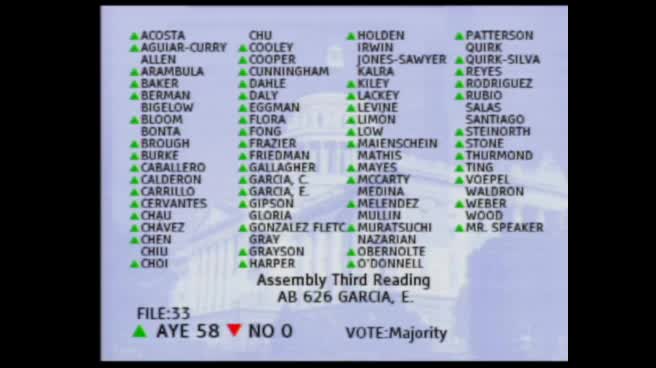 2MIN
Assembly Floor
 21MIN
Assembly Standing Committee on Appropriations
 11MIN
Assembly Standing Committee on Utilities and Energy
Bill Author

Bill Co-Author(s):