AB 1681: Information technology contractors: standardized performance assessment system: report.
- Session Year: 2017-2018
- House: Assembly
- Latest Version Date: 2017-03-28
Existing law establishes in state government within the Government Operations Agency the Department of Technology, supervised by the Director of Technology who is the State Chief Information Officer. Existing law provides that the Department of Technology is responsible for the approval and oversight of specified information technology projects. Existing law requires specified contracts for the acquisition of information technology projects to be made by or under the supervision of the Department of Technology.
This bill would require the Director of Technology, on or before January 1, 2019, to submit to the Governor and committees of the Senate and Assembly, as described, a report regarding the development of a standardized performance assessment system for information technology contractors. This bill would repeal this provision on January 1, 2023.
Existing law requires the State Air Resources Board to adopt and implement emission standards for new motor vehicles for the control of emissions from new motor vehicles that the state board finds to be necessary and technologically feasible.This bill would make a nonsubstantive change to that provision.Existing law requires the State Air Resources Board to adopt and implement emission standards for new motor vehicles for the control of emissions from new motor vehicles that the state board finds to be necessary and technologically feasible.
This bill would make a nonsubstantive change to that provision.
(a)On or before January 1, 2019, the Director of Technology shall submit a report to the Governor and to the committees of the Senate and the Assembly that have jurisdiction over information technology contracts or projects reportable under Chapter 4800 of the State Administrative Manual regarding the development of a standardized performance assessment system for information technology contractors.
(b)(1)A report to be submitted pursuant to subdivision (a) shall be submitted in compliance with Section 9795 of the Government Code.
(2)Pursuant to Section 10231.5 of the Government Code, this section is repealed on January 1, 2023.
SECTION 1.Section 43101 of the Health and Safety Code is amended to read:43101.(a)The state board shall adopt and implement emission standards for new motor vehicles for the control of emissions from new motor vehicles that the state board finds to be necessary and technologically feasible to carry out the purposes of this division. Prior to adopting these standards, the state board shall consider the impact of these standards on the economy of the state, including, but not limited to, their effect on motor vehicle fuel efficiency.(b)The standards adopted pursuant to this section may be applicable to motor vehicle engines, rather than to motor vehicles.(a)The state board shall adopt and implement emission standards for new motor vehicles for the control of emissions from new motor vehicles that the state board finds to be necessary and technologically feasible to carry out the purposes of this division. Before Prior to adopting these standards, the state board shall consider the impact of these standards on the economy of the state, including, but not limited to, their effect on motor vehicle fuel efficiency.
(b)The standards adopted pursuant to this section may be applicable to motor vehicle engines, rather than to motor vehicles.
|
Date
|
Status
|
|---|---|
| Jun 14, 2017 | Referred to Com. on RLS. |
| Jun 5, 2017 | In Senate. Read first time. To Com. on RLS. for assignment. |
| Jun 1, 2017 | Read third time. Passed. Ordered to the Senate. (Ayes 79. Noes 0. Page 2047.) |
| May 26, 2017 | From committee: Do pass. (Ayes 17. Noes 0.) (May 26). |
| May 10, 2017 | In committee: Set, first hearing. Referred to APPR. suspense file. |
| Apr 26, 2017 | From committee: Do pass and re-refer to Com. on APPR. with recommendation: To Consent Calendar. (Ayes 10. Noes 0.) (April 25). Re-referred to Com. on APPR. |
| Mar 29, 2017 | Re-referred to Com. on P. & C.P. |
| Mar 28, 2017 | From committee chair, with author's amendments: Amend, and re-refer to Com. on P. & C.P. Read second time and amended. |
| Mar 27, 2017 | Referred to Com. on P. & C.P. |
| Feb 19, 2017 | From printer. May be heard in committee March 21. |
| Feb 17, 2017 | Read first time. To print. |
|
Date
|
Description
|
Location
|
Votes
|
|
|---|---|---|---|---|
| Jun 1, 2017 | AB 1681 BURKE Assembly Third Reading | Assembly Floor |
Passed |
|
| May 26, 2017 | Do pass. | Assembly Standing Committee on Appropriations |
Passed |
|
| Apr 25, 2017 | Do pass and be re-referred to the Committee on [Appropriations] with recommendation: To Consent Calendar | Assembly Standing Committee on Privacy and Consumer Protection |
Passed |
This list shows positions taken on this bill by organizations on the date displayed, which is linked to the original source.
Positions by individuals are not included.
ASSEMBLY THIRD READING
ATR Bill Id:AB 1681
Author:(Burke)
As Amended Ver:March 28, 2017
Majority vote
Committee | Votes | Ayes | Noes |
Privacy | 10-0 | Chau, Kiley, Baker, Berman, Gloria, Dababneh, Irwin, Kalra, Obernolte, Reyes | |
Appropriations | 17-0 | Gonzalez Fletcher, Bigelow, Bloom, Bocanegra, Bonta, Brough, Calderon, McCarty, Quirk, Fong, Friedman, Gallagher, Eduardo Garcia, Gray, Muratsuchi, Obernolte, Reyes |
|
SUMMARY: Requires the California Department of Technology (CDT) to submit, by January 1, 2019, a report to the Governor and the Legislature on the development of a standardized performance assessment system, commonly known as a "vendor scorecard," to evaluate vendor performance on information technology (IT) procurement projects.
FISCAL EFFECT: According to the Assembly Appropriations Committee:
Minor and absorbable costs to CDT for the required report since CDT is already working on a performance assessment system and should have information on its efforts readily available.
COMMENTS:
- California Department of Technology and procurement: CDT is responsible for the approval and oversight of statewide IT projects, IT professional development across the Executive Branch, and the provision of IT services to state and local governments as well as some non-governmental entities. CDT also sets statewide IT security standards and procedures to ensure state agencies use best practices in IT management.
Specifically, CDT is responsible for reviewing and approving major, or "reportable," IT project proposals developed by state agencies. A project is "reportable" if:
CDT is currently responsible for 28 reportable projects across the Executive Branch, totaling roughly $3.1 billion. Non‑reportable projects are completely within the authority of a given state agency to manage and are not subject to CDT approval and oversight.
Once CDT approves a reportable IT project its role changes to project oversight. CDT provides ongoing independent project oversight of projects to determine if the project is on track according to the planned scope, budget and timeline for the project. Sometimes projects change in scope over time, suffer schedule delays, or experience cost overruns. When a project changes significantly, i.e., 10% or more in one of those categories, then the changes are documented in a Special Project Report, which must be submitted to CDT for approval.
CDT has authority to intervene when projects fall too far off track. CDT has specific authority to suspend or terminate an IT project based on poor performance and can hold state agencies and departments accountable by restricting future project approvals until the agency or department corrects specific performance failures or weaknesses.
- The federal government already uses vendor scorecards: Currently, the federal government relies on the past performance of vendors as an evaluation criterion and has implemented a system known as the Contractor Performance Assessment Reporting System (CPARS). CPARS is a web-based application that collects and manages vendor performance assessment reports. The federal system provides real-time data collected through the use of a "report card" that evaluates vendor performance in key areas that are directly correlated to the quality of work, including project schedule, cost control, project management, communication, and compliance. Whether the information is positive or negative, the information is available for federal agencies to evaluate as part of the past performance consideration and the report card provides an accurate representation of a vendor’s track record of performance.
The author contends that providing a means for collecting real-time data on a vendor’s performance during an IT project offers a significant benefit to California by offering a relevant way to assess quality of work, gauge actual customer satisfaction, and create an incentive to maximize performance on contracts. While CDT certainly has information on the current and past performance of vendors, the state currently does not have a formal system of analyzing, comparing, and weighing this data as part of the state's IT procurement process.
- Improving CDT oversight of IT procurement and implementation: Unfortunately, over the last two decades, the state has experienced several high-profile IT project failures, and IT projects that have been successfully completed have still experienced major cost overruns and time delays.
The State Auditor has documented several of these failures and made several recommendations to CDT on how to improve its IT project approval and oversight functions. (See "California Department of Veterans Affairs: The State Paid Nearly $28 million for a Flawed System That Fails to Meet the Needs of its Veterans Homes (Report 2015-121); "California Department of Consumer Affairs' BreEZe System: Inadequate Planning and Oversight Led to Implementation at Far Fewer Regulatory Entities at a Significantly Higher Cost (Report 2014-116)" and "High Risk Update—California Department of Technology: Lack of Guidance, Potentially Conflicting Roles, and Staffing Issues Continue to Make Oversight of State Information Technology Projects High Risk (Report 2014-602)")
Recently, CDT rolled out a new IT project approval process, known as the Project Approval Lifecycle. With an improved procurement process, CDT hopes to prevent or reduce the likelihood of future IT project failures.
This bill essentially requires CDT to report to the Legislature on the vendor scorecard system, which AB 1546 requires CDT to establish.
Analysis Prepared by: Jennie Bretschneider / P. & C.P. / (916) 319-2200 FN: 0000692
Date of Hearing: May 10, 2017
ASSEMBLY COMMITTEE ON APPROPRIATIONS
Lorena Gonzalez Fletcher, Chair
ABPCA Bill Id:AB 1681
Author:(Burke) – As Amended Ver:March 28, 2017
Policy Committee: | Privacy and Consumer Protection | Vote: | 10 - 0 |
|
| ||
|
|
Urgency: No State Mandated Local Program: No Reimbursable: No
SUMMARY:
This bill requires the California Department of Technology (CDT) to submit, by January 1, 2019, a report to the Governor and the Legislature on the development of a standardized performance assessment system to evaluate vendor performance on information technology (IT) procurement projects.
FISCAL EFFECT:
Minor and absorbable costs to CDT for the required report since CDT is already working on a performance assessment system and should have information on its efforts readily available.
COMMENTS:
- Background. CDT is responsible for the approval and oversight of statewide IT projects, IT professional development across the executive branch, and the provision of IT services to state and local governments as well as some non-governmental entities. CDT also sets statewide IT security standards and procedures to ensure state agencies use best practices in IT management.
- Purpose. According to the author, this bill “ensures the Legislature has an accurate picture of the tool that the Department of Technology is using when evaluating a bidder’s past performance in the State’s procurement process for large IT projects. Results matter and the report provided by the Director of Technology will ensure a clear understanding of the standardized performance assessment system the Department of Technology is using to provide accountability for IT contracts.”
- Related Legislation. AB 1546 (Burke), also in this committee, requires CDT to develop and implement a standardized contractor performance assessment report system to evaluate vendor performance on IT projects and to incorporate the performance assessment system into the IT procurement process. AB 1546 specifies certain requirements of the assessment system and requires CDT to complete the development of the system by January 1, 2019.
Analysis Prepared by: Jessica Peters / APPR. / (916) 319-2081
Date of Hearing: April 25, 2017
ASSEMBLY COMMITTEE ON PRIVACY AND CONSUMER PROTECTION
Ed Chau, Chair
ABPCA Bill Id:AB 1681 (
Author:Burke) – As Amended Ver:March 28, 2017
SUBJECT: Information technology contractors: standardized performance assessment system: report
SUMMARY: Requires the California Department of Technology (CDT) to submit, by January 1, 2019, a report to the Governor and the Legislature on the development of a standardized performance assessment system, commonly known as a “vendor scorecard,” to evaluate vendor performance on information technology (IT) procurement projects.
EXISTING LAW:
- Establishes within the Government Operations Agency the CDT, under the supervision of the Director of Technology, also known as the State Chief Information Officer. (Government Code Section (GC) 11545(a))
- Requires the Director to, among other things, approve IT projects and provide technology direction to agency and department chief information officers to ensure the integration of statewide technology initiatives. (GC 11545(b))
- Requires CDT to improve the governance and implementation of IT by standardizing reporting relationships, roles, and responsibilities for setting IT priorities. (GC 11546.1)
- Requires the heads of state agencies and entities to appoint chief information officers, requires state agencies and entities to report certain information to the department, and further requires state agencies to take all necessary steps to achieve the targets set forth by the department in its IT performance management framework and report their progress to the department on a quarterly basis. (GC 11545)
FISCAL EFFECT: Unknown
COMMENTS:
- Purpose of this bill: This bill is intended to improve the state’s success in IT procurement and IT project implementation by requiring CDT to report to the Governor and the Legislature on the development of a system of scoring IT vendors based on their current and past performance on state IT projects so that CDT and state agencies can better discern which vendors have the best track record for performance. This bill is author-sponsored.
- Author's statement: According to the author, this bill “ensures the Legislature has an accurate picture of the tool that the Department of Technology is using when evaluating a bidder’s past performance in the State’s procurement process for large IT projects. Results matter and the report provided by the Director of Technology will ensure a clear understanding of the standardized performance assessment system the Department of Technology is using to provide accountability for IT contracts.”
- California Department of Technology and procurement: CDT is responsible for the approval and oversight of statewide IT projects, IT professional development across the Executive Branch, and the provision of IT services to state and local governments as well as some non-governmental entities. CDT also sets statewide IT security standards and procedures to ensure state agencies use best practices in IT management.
Specifically, CDT is responsible for reviewing and approving major, or “reportable,” IT project proposals developed by state agencies. A project is “reportable” if:
- The estimated project cost exceeds the state agency or department’s cost threshold (also called “delegated authority”), which is assigned by CDT. The cost thresholds generally range from $200,000 to $2 million, depending on a given agency’s delegated authority, and reflect CDT’s assessment of the agency or department’s past performance with IT projects.
- The project cost falls under the cost threshold but is not absorbable, so the agency or department had to get an appropriation from the Legislature; or
- The project itself is specifically mandated through legislation.
CDT is currently responsible for 28 reportable projects across the Executive Branch, totaling roughly $3.1 billion. Non‑reportable projects are completely within the authority of a given state agency to manage and are not subject to CDT approval and oversight.
Once CDT approves a reportable IT project its role changes to project oversight. CDT provides ongoing independent project oversight of projects to determine if the project is on track according to the planned scope, budget and timeline for the project. Sometimes projects change in scope over time, suffer schedule delays, or experience cost overruns. When a project changes significantly, i.e., 10% or more in one of those categories, then the changes are documented in a Special Project Report , which must be submitted to CDT for approval.
CDT has authority to intervene when projects fall too far off track. CDT has specific authority to suspend or terminate an IT project based on poor performance and can hold state agencies and departments accountable by restricting future project approvals until the agency or department corrects specific performance failures or weaknesses.
- The federal government already uses vendor scorecards: Currently, the federal government relies on the past performance of vendors as an evaluation criterion and has implemented a system known as the Contractor Performance Assessment Reporting System (CPARS). CPARS is a web-based application that collects and manages vendor performance assessment reports. The federal system provides real-time data collected through the use of a “report card” that evaluates vendor performance in key areas that are directly correlated to the quality of work, including project schedule, cost control, project management, communication, and compliance. Whether the information is positive or negative, the information is available for federal agencies to evaluate as part of the past performance consideration and the report card provides an accurate representation of a vendor’s track record of performance.
The author contends that providing a means for collecting real-time data on a vendor’s performance during an IT project offers a significant benefit to California by offering a relevant way to assess quality of work, gauge actual customer satisfaction, and create an incentive to maximize performance on contracts. While CDT certainly has information on the current and past performance of vendors, the state currently does not have a formal system of analyzing, comparing, and weighing this data as part of the state’s IT procurement process.
- Improving CDT oversight of IT procurement and implementation: Unfortunately, over the last two decades, the state has experienced several high-profile IT project failures, and IT projects that have been successfully completed have still experienced major cost overruns and time delays.
The State Auditor has documented several of these failures and made several recommendations to CDT on how to improve its IT project approval and oversight functions. (See “California Department of Veterans Affairs: The State Paid Nearly $28 million for a Flawed System That Fails to Meet the Needs of its Veterans Homes (Report 2015-121); “California Department of Consumer Affairs’ BreEZe System: Inadequate Planning and Oversight Led to Implementation at Far Fewer Regulatory Entities at a Significantly Higher Cost (Report 2014-116)” and “High Risk Update—California Department of Technology: Lack of Guidance, Potentially Conflicting Roles, and Staffing Issues Continue to Make Oversight of State Information Technology Projects High Risk (Report 2014-602)”)
Recently, CDT rolled out a new IT project approval process, known as the Project Approval Lifecycle . With an improved procurement process, CDT hopes to prevent or reduce the likelihood of future IT project failures.
This bill essentially requires CDT to report to the Legislature on the vendor scorecard system, which AB 1546 requires CDT to establish. The author and the committee may wish to consider whether the report required in this bill could be included in AB 1546, since AB 1546 requires establishment of the vendor scorecard system itself.
CDT has indicated it is already working to create an IT contractor performance system and plans to work with IT vendors during its development. CDT publicly discussed the vendor scorecard concept as early as July 2014 at an oversight hearing held by the Assembly Accountability and Administrative Review Committee.
- Governor Brown vetoed prior legislation as “not necessary:” In 2015, the Legislature approved AB 522 (Burke), which was identical to this bill, but Governor Brown vetoed the bill, stating that: “While holding technology contractors accountable for their performance is important, this bill is not necessary because it duplicates what the Department of Technology is already doing.”
- Related legislation: AB 1546 (Burke) would require CDT to develop and implement, by January 1, 2019, a standardized contractor performance assessment report system to evaluate the performance of a contractor on any IT contract or reportable project reportable under Chapter 4800 of the State Administrative Manual.
AB 1680 (Burke) would require CDT to establish and oversee the implementation of a training program for persons engaged in the procurement of complex IT. AB 1680 is currently pending in this Committee. - Prior legislation: AB 522 (Burke) of 2015 was similar to AB 1546. AB 522 was vetoed by the Governor.
REGISTERED SUPPORT / OPPOSITION:
Support
None on file
Opposition
None on file
Analysis Prepared by: Jennie Bretschneider / P. & C.P. /
Discussed in Hearing
View Older Hearings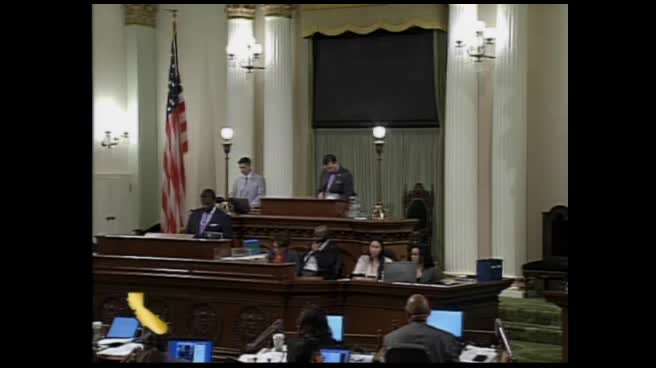

Bill Author

Bill Co-Author(s):