AB 2304: Reduced fare transit pass programs: report.
- Session Year: 2017-2018
- House: Assembly
- Latest Version Date: 2018-06-18
The California Constitution provides that the University of California constitutes a public trust administered by the Regents of the University of California, a corporation in the form of a board, with full powers of organization and government, subject to legislative control only for specified purposes.
Existing law declares that the fostering, continuance, and development of public transportation systems are a matter of statewide concern. Existing law imposes various requirements on transit operators and provides funding for transit services and capital improvements.
This bill would request the University of California Institute Institutes of Transportation Studies to prepare and submit a report to the Governor and specified committees of the Legislature on or before January 1, 2020, that details the reduced fare transit pass programs in California that are administered by a public transit operator, California college or university, or any other entity, as specified. The bill would request the University of California Institutes of Transportation Studies to convene and consult with a group of stakeholders, as specified, in preparing the report.
The California Constitution provides that the University of California constitutes a public trust administered by the Regents of the University of California, a corporation in the form of a board, with full powers of organization and government, subject to legislative control only for specified purposes.
Existing law declares that the fostering, continuance, and development of public transportation systems are a matter of statewide concern. Existing law authorizes the Department of Transportation to administer various programs and allocates moneys for various public transportation purposes. imposes various requirements on transit operators and provides funding for transit services and capital improvements.
This bill would require the department request the University of California Institute of Transportation Studies to prepare and submit a report to the Governor and specified committees of the Legislature on or before January 1, 2022, on the status of transit pass programs statewide, 2020, that details the reduced fare transit pass programs in California that are administered by a public transit operator, California college or university, or any other entity, as specified.
Existing law declares that the fostering, continuance, and development of public transportation systems are a matter of statewide concern. Existing law authorizes the Department of Transportation to administer various programs and allocates moneys for various public transportation purposes.
This bill would require the department to submit a report to specified committees of the Legislature on or before January 1, 2022, on the status of transit pass programs statewide, as specified.
(a) The University of California Institute Institutes of Transportation Studies is requested to prepare and submit a report to the Governor and to the fiscal and policy committees of the Legislature that oversee transportation programs, on or before January 1, 2020, that details reduced fare transit pass programs in California that are administered by a public transit operator, California college or university, or any other entity.
(b)In preparing the report, the University of California Institutes of Transportation Studies is requested to convene and consult with a group of stakeholders including, but not limited to, academics, administrators, transit professionals, student advocates, and transit advocates.
(b)(c)The report shall include, but not be limited to, all of the following:
(1)An assessment of reduced fare transit pass programs that are administered by public transit operators, including eligibility for each program and how each program is funded.
(2)An assessment of reduced fare transit pass programs that are administered by other entities, such as universities, colleges, and private businesses, including eligibility for each program and how each program is funded.
(3)An assessment of whether each program described in paragraph (1) or (2) has contributed to increased transit ridership among eligible recipients.
(4)An assessment of the available funding sources for reduced fare transit pass programs.
(5)A discussion of any negative fiscal impacts on public transit operators relating to the offering of reduced fare transit pass programs, including farebox recovery ratios.
(c)(d)The report required to be submitted pursuant to subdivision (a) shall be submitted to those committees of the Legislature in compliance with Section 9795 of the Government Code.
(d)(e)This section shall remain in effect only until January 1, 2021, and as of that date is repealed.
(a)On or before January 1, 2022, the Department of Transportation shall submit a report on the status of transit pass programs statewide The University of California Institute of Transportation Studies is requested to prepare and submit a report to the Governor and to the fiscal and policy committees of the Legislature that oversee transportation programs. programs, on or before January 1, 2020, that details reduced fare transit pass programs in California that are administered by a public transit operator, California college or university, or any other entity.
(b)The report shall include, but not be limited to, all of the following:
(1)The number of free or reduced-fare transit passes provided to pupils and students.(2)Whether those programs have increased transit ridership among eligible pupils and students.(3)An assessment of how many transit operators and schools statewide have transit pass programs.(4)An assessment of how many transit operators and schools statewide do not have transit pass programs.(5)Recommendations to expand transit pass programs statewide to ensure that each pupil or student meeting certain eligibility equipments, as determined by the department, has access to a transit pass program.(1)An assessment of reduced fare transit pass programs that are administered by public transit operators, including eligibility for each program and how each program is funded.
(2)An assessment of reduced fare transit pass programs that are administered by other entities, such as universities, colleges, and private businesses, including eligibility for each program and how each program is funded.
(3)An assessment of whether each program described in paragraph (1) or (2) has contributed to increased transit ridership among eligible recipients.
(4)An assessment of the available funding sources for reduced fare transit pass programs.
(5)A discussion of any negative fiscal impacts on public transit operators relating to the offering of reduced fare transit pass programs, including farebox recovery ratios.
(c)The report required to be submitted pursuant to subdivision (a) shall be submitted to those committees of the Legislature in compliance with Section 9795 of the Government Code.
(d)This section shall remain in effect only until January 1, 2021, and as of that date is repealed.
REVISIONS: HeadingLine 2.(a)On or before January 1, 2022, the Department of Transportation shall submit a report on the status of transit pass programs statewide to the fiscal and policy committees of the Legislature that oversee transportation programs.
(b)The report shall include, but not be limited to, all of the following:
(1)The number of free or reduced-fare transit passes provided to pupils and students.
(2)Whether those programs have increased transit ridership among eligible pupils and students.
(3)An assessment of how many transit operators and schools statewide have transit pass programs.
(4)An assessment of how many transit operators and schools statewide do not have transit pass programs.
(5)Recommendations to expand transit pass programs statewide to ensure that each pupil or student meeting certain eligibility equipments, as determined by the department, has access to a transit pass program.
(c)The report required to be submitted pursuant to subdivision (a) shall be submitted in compliance with Section 9795 of the Government Code.
|
Date
|
Status
|
|---|---|
| Jun 18, 2018 | From committee chair, with author's amendments: Amend, and re-refer to committee. Read second time, amended, and re-referred to Com. on RLS. |
| Jun 7, 2018 | Referred to Com. on RLS. |
| May 30, 2018 | In Senate. Read first time. To Com. on RLS. for assignment. |
| May 29, 2018 | Read third time. Passed. Ordered to the Senate. |
| May 25, 2018 | Coauthors revised. |
| Apr 18, 2018 | In committee: Set, first hearing. Referred to APPR. suspense file. |
| Apr 10, 2018 | From committee: Do pass and re-refer to Com. on APPR. (Ayes 14. Noes 0.) (April 9). Re-referred to Com. on APPR. |
| Apr 3, 2018 | Re-referred to Com. on TRANS. |
| Apr 2, 2018 | From committee chair, with author's amendments: Amend, and re-refer to Com. on TRANS. Read second time and amended. |
| Mar 19, 2018 | In committee: Hearing postponed by committee. |
| Mar 1, 2018 | Referred to Com. on TRANS. |
| Feb 14, 2018 | From printer. May be heard in committee March 16. |
| Feb 13, 2018 | Read first time. To print. |
|
Date
|
Description
|
Location
|
Votes
|
|
|---|---|---|---|---|
| May 29, 2018 | AB 2304 HOLDEN Assembly Third Reading | Assembly Floor |
Passed |
|
| May 25, 2018 | Do pass. | Assembly Standing Committee on Appropriations |
Passed |
|
| Apr 9, 2018 | Do pass and be re-referred to the Committee on [Appropriations] | Assembly Standing Committee on Transportation |
Passed |
This list shows positions taken on this bill by organizations on the date displayed, which is linked to the original source.
Positions by individuals are not included.
|
Organization
|
Position
|
Date
|
|---|---|---|
| California Bicycle Coalition | * Support | Apr 9, 2018 |
| San Francisco Bay Area Rapid Transit District | * Support | Apr 9, 2018 |
ASSEMBLY THIRD READING
ATR Bill Id:AB 2304
Author:(Holden)
As Amended Ver:April 2, 2018
Majority vote
Committee | Votes | Ayes | Noes |
Transportation | 14-0 | Frazier, Fong, Aguiar-Curry, Baker, Berman, Chu, Daly, Friedman, Gipson, Harper, Mathis, Medina, Nazarian, O'Donnell | |
Appropriations | 16-0 | Gonzalez Fletcher, Bigelow, Bloom, Bonta, Calderon, Carrillo, Chau, Eggman, Fong, Friedman, Gallagher, Eduardo Garcia, Nazarian, Obernolte, Quirk, Reyes |
|
SUMMARY: Requests the University of California (UC) Institute of Transportation Studies (ITS) to prepare and submit a report on reduced fare transit pass programs to the Governor and Legislature by January 1, 2020. Specifically, this bill:
- Requests ITS to prepare a report on reduced fare transit pass programs in California that are administered by public transit operators, California colleges and universities, or any other entity.
- Requires the report to be submitted to the Governor, and policy and fiscal committees that oversee transportation programs on or before January 1, 2020.
- Requires the report to include, but not be limited to:
- An assessment of reduced fare transit pass programs that are administered by public transit operators, including eligibility for each program and how it is funded;
- An assessment of reduced fare transit pass programs that are administered by other entities, such as colleges, universities, and private businesses including eligibility for the program and how it is funded;
- An assessment of whether the programs have contributed to increased transit ridership among the eligible recipients;
- An assessment of available funding sources for reduced fare transit pass programs; and,
- A discussion of any negative fiscal impacts on public transit operators, related to offering reduced fare transit passes, including farebox recovery ratios.
- Repeals the section after January 1, 2021.
FISCAL EFFECT: According to the Assembly Appropriations Committee, cost pressures (Public Transportation Account) of roughly $140,000 for ITS to perform the study.
COMMENTS: Currently, many transit agencies in California provide free or reduced fare transit passes to students and other populations for use on their systems. For example, the San Francisco (SF) Muni offers the Free Muni for Youth program that gives free access to Muni to low and moderate income youth, from 5-18 years old. Sacramento Regional Transit also offers students from age 5-18 a 50% discounted fare for passes. The Los Angeles County Metropolitan Transportation Authority (Metro) has been offering reduced fares for both K-12 and college students since the early 1990s. Specifically, Metro has programs for both college students, with a 54% discount on a monthly pass, and a 76% discount for the K-12 program.
Additionally, for student transit fare programs, many transit agencies have developed agreements directly with schools in their jurisdictions to partner and provide free or reduced passes to all students. For example, the University of California Los Angeles (UCLA) and the University of Southern California (USC) provide free passes for their students in partnership with Metro. In the Sacramento area, the University of California at Davis offers a variety of travel options at reduced rates for students and faculty through their goClub.
Most transit agencies subsidize the free or reduced fare programs as part of their existing operating budget or utilize funding from other state, local, or private sources. For example, the current Low Carbon Transit Operations Program (LCTOP), funded by the state’s Cap and Trade program, allows transit agencies to use funds for transit passes.
The author previously introduced two bills to create and fund a statewide reduced fare transit pass program, AB 2222 of 2016, and last year’s AB 17. Both programs targeted low income student populations at K-12, community colleges, and universities in the state. AB 17 was eventually amended by the author to be a pilot program. This committee expressed concerns that a separate program for transit agencies to implement or augment reduced free transit passes may not be necessary. As previously noted, numerous transit agencies and colleges and universities in California are already administering successful transit pass programs. Additionally, transit operators offer discount programs for a variety of eligibilities, not only low income students. However, there is no statewide data on exactly how many reduced fare transit pass programs exist, what populations they serve, and how they are being funded. AB 17 was vetoed by Governor Brown, stating that, "before creating this new statewide program, I think we should have a fuller discussion on how local transit discount programs work and how any new ones should be paid for."
To that end, the author introduced this bill to request a statewide assessment of reduced fare transit passes. Specifically, the author states that, "Being able to commute freely is necessary for individuals to participate in society and affects one's ability to secure employment, education, medical services, and to reach important destinations. Reduced fare programs decrease the burden of transportation costs and enable individuals to become productive members of society. However, empirical data currently valuable to us is broad and scarce. A comprehensive study is necessary to show the effectiveness of these programs."
The statewide assessment requested in this bill will not only highlight the innovative reduced fare transit pass programs currently being offered, but also advance a better understanding of any possible policy or funding options the Legislature may want to revisit in the future.
Please see the policy committee analysis for full discussion of this bill.
Analysis Prepared by: Melissa White / TRANS. / (916) 319-2093 FN: 0003074
Date of Hearing: April 18, 2018
ASSEMBLY COMMITTEE ON APPROPRIATIONS
Lorena Gonzalez Fletcher, Chair
ABPCA Bill Id:AB 2304
Author:(Holden) – As Amended Ver:April 2, 2018
Policy Committee: | Transportation | Vote: | 14 - 0 |
Urgency: No State Mandated Local Program: No Reimbursable: No
SUMMARY:
This bill requests the University of California (UC) Institute of Transportation Studies (ITS) to prepare a report on reduced-fare transit pass programs and submit it to the governor and Legislature by January 1, 2020. This bill specifies certain information that the report must include.
FISCAL EFFECT:
Cost pressures (Public Transportation Account) of roughly $140,000 for ITS to perform the study.
COMMENTS:
- Background. AB 17 (Holden), of the current legislative session, would have created a pilot program to fund reduced-fare transit passes. AB 17 was vetoed by Governor Brown. The veto message stated that, “before creating this new statewide program, I think we should have a fuller discussion on how local transit discount programs work and how any new ones should be paid for.”
- Purpose. This bill responds to the veto message to request a statewide assessment of reduced-fare transit pass programs. Writing in support of this bill, the San Francisco Bay Area Rapid Transit District states:
Over the past two years, the Legislature has debated over how to provide greater access to public transit without burdening working class students and families. AB 2304 would provide a better understanding of the impact of transit pass programs statewide as well as best practices for financing and expanding such efforts.
- Prior legislation.
AB 17 (Holden), of the current legislative session, would have created a reduced-fare transit pass pilot program funded with $20 million and administered by the Department of Transportation (Caltrans). AB 17 was vetoed by Governor Brown.
AB 2222 (Holden), of the 2015-16 Legislative Session, would have created a statewide reduced-fare transit pass program administered by Caltrans for low income students. AB 2222 was held on the Senate Appropriations Committee suspense file.
Analysis Prepared by: Jessica Peters / APPR. / (916) 319-2081
Date of Hearing: April 9, 2018
ASSEMBLY COMMITTEE ON TRANSPORTATION
Jim Frazier, Chair
ABPCA Bill Id:AB 2304 (
Author:Holden) – As Amended Ver:April 2, 2018
SUBJECT: Transit pass programs: status report
SUMMARY: Requests the University of California (UC) Institute of Transportation Studies (ITS) to prepare and submit a report on reduced fare transit pass programs to the Governor and Legislature by January 1, 2020. Specifically, this bill:
- Requests ITS to prepare a report on reduced fare transit pass programs in California that are administered by public transit operators, California colleges and universities, or any other entity.
- Requires the report to be submitted to the Governor, and policy and fiscal committees that oversee transportation programs on or before January 1, 2020.
- Requires the report to include, but not be limited to:
- An assessment of reduced fare transit pass programs that are administered by public transit operators, including eligibility for each program and how it is funded;
- An assessment of reduced fare transit pass programs that are administered by other entities, such as colleges, universities, and private businesses including eligibility for the program and how it is funded;
- An assessment of whether the programs have contributed to increased transit ridership among the eligible recipients;
- An assessment of available funding sources for reduced fare transit pass programs; and,
- A discussion of any negative fiscal impacts on public transit operators, related to offering reduced fare transit passes, including farebox recovery ratios.
- Repeals the section after January 1, 2021.
EXISTING LAW:
- Creates the UC system with the full powers of organization and government.
- Encourages the Regents of the UC system to create an ITS and cooperate with the California State Transportation Agency (CalSTA) and its departments on transportation research and training.
- Provides $5 million per year to the ITS for the purpose of conducting transportation research and transportation-related workforce education, training, and development.
- Declares that the fostering, continuance, and development of public transportation systems are a matter of statewide concern.
FISCAL EFFECT: Unknown
COMMENTS: Currently, many transit agencies in California provide free or reduced fare transit passes to students and other populations for use on their systems. For example, the San Francisco (SF) Muni offers the Free Muni for Youth program that gives free access to Muni to low and moderate income youth, from 5-18 years old. Sacramento Regional Transit also offers students from age 5-18 a 50% discounted fare for passes. The Los Angeles County Metropolitan Transportation Authority (Metro) has been offering reduced fares for both K-12 and college students since the early 1990s. Specifically, Metro has programs for both college students, with a 54% discount on a monthly pass, and a 76% discount for the K-12 program. Most of these programs require proof of age, such as a senior discount, or proof of a student being registered in school; however, the SF Muni program is based upon family income level.
Additionally, for student transit fare programs, many transit agencies have developed agreements directly with schools in their jurisdictions to partner and provide free or reduced passes to all students. For example, the University of California Los Angeles (UCLA) and the University of Southern California (USC) provide free passes for their students in partnership with Metro. In the Sacramento area, the University of California at Davis offers a variety of travel options at reduced rates for students and faculty through their goClub.
Most transit agencies subsidize the free or reduced fare programs as part of their existing operating budget or utilize funding from other state, local, or private sources. For example, the current Low Carbon Transit Operations Program (LCTOP), funded by the state’s Cap and Trade program, allows transit agencies to use funds for transit passes. In fact, many rural transit operators have almost exclusively used LCTOP funds for transit passes, such as the Mendocino Transit Authority who used LCTOP funds to subsidize bus fares for Mendocino college students. Additionally, the recent passage of SB 1 (Beall), Chapter 5, Statues of 2017, provides a roughly 130% increase in State Transit Assistance (STA) funding for transit operators, which could help expand reduced fare transit pass programs as well.
The author previously introduced two bills to create and fund a statewide reduced fare transit pass program, AB 2222 of 2016, and last year’s AB 17. Both programs targeted low income student populations at K-12, community colleges, and universities in the state. AB 17 was eventually amended by the author to be a pilot program. This committee expressed concerns that a separate program for transit agencies to implement or augment reduced free transit passes may not be necessary. As previously noted, numerous transit agencies and colleges and universities in California are already administering successful transit pass programs. Additionally, transit operators offer discount programs for a variety of eligibilities, not only low income students. However, there is no statewide data on exactly how many reduced fare transit pass programs exist, what populations they serve, and how they are being funded.
AB 17 was vetoed by Governor Brown, stating that, “before creating this new statewide program, I think we should have a fuller discussion on how local transit discount programs work and how any new ones should be paid for.”
To that end, the author introduced this bill to request a statewide assessment of reduced fare transit passes. Specifically, the author states that, “Being able to commute freely is necessary for individuals to participate in society and affects one’s ability to secure employment, education, medical services, and to reach important destinations. Reduced fare programs decrease the burden of transportation costs and enable individuals to become productive members of society. However, empirical data currently valuable to us is broad and scarce. A comprehensive study is necessary to show the effectiveness of these programs.”
Writing in support of the bill, the San Francisco Bay Area Rapid Transit District (BART), shared their own experience with reduced fare programs, “BART currently provides a discounted fare to all youths 5-18. We also offer fare discounts to students at colleges and universities participating in BART’s Higher Education Discount Program (HEDP). San Francisco State University is the first HEDP participant and students use a multi-function identification card for campus service and transit discounts.”
Further, BART states that, “Over the past two years, the Legislature has debated over how to provide greater access to public transit without burdening working class students and families. AB 2304 would provide a better understanding of the impact of transit pass programs statewide as well as best practices for financing and expanding such efforts.”
The statewide assessment requested in this bill will not only highlight the innovative reduced fare transit pass programs currently being offered, but also advance a better understanding of any possible policy or funding options the Legislature may want to revisit in the future.
Previous legislation: AB 17 (Holden) of 2017, would have created a reduced fare transit pass pilot program funded at $20 million to be administered by the Department of Transportation (Caltrans) to provide free or reduced fare transit passes to low income students. AB 17 was vetoed by Governor Brown.
AB 2222 (Holden) of 2016, would have created a reduced fare transit pass program to be administered by Caltrans for low income students. AB 2222 was held on the Senate Appropriations Committee suspense file.
AB 1555 (Gomez) of 2016, would have appropriated $800 million from the Greenhouse Gas Reduction Fund (GGRF) to fund a variety of programs including $10 million for active transportation and transit pass investments. AB 1555 was referred to the Assembly Committee on Budget and Fiscal Review and returned to the Chief Clerk without being heard.
SB 951 (McGuire) of 2016, would have created and appropriated $3 million annually from the GGRF through 2020-21 for the Golden State Patriot Passes pilot program to provide veterans with free access to transit. SB 951 was held on the Senate Appropriations Committee suspense file.
SB 862 (Committee on Budget and Fiscal Review), Chapter 36, Statues of 2014, created and funded with GGRF, the Affordable Housing and Sustainable Communities, the Low Carbon Transportation, and the LCTOP programs.
AB 1002 (Bloom) of 2013, would have increased the tax on vehicle registrations by $6. 40% of the revenues would have been appropriated to transportation commissions and transit operators to support transit operations and maintain and expand reduced fare programs, including transit passes for students, low-income youth, seniors, and persons with disabilities. AB 1002 was referred to the Assembly Local Government Committee but was returned to the Chief Clerk without being heard.
REGISTERED SUPPORT / OPPOSITION:
Support
California Bicycle Coalition
San Francisco Bay Area Rapid Transit District
Opposition
None on file
Analysis Prepared by: Melissa White / TRANS. / (916) 319-2093
Discussed in Hearing
View Older Hearings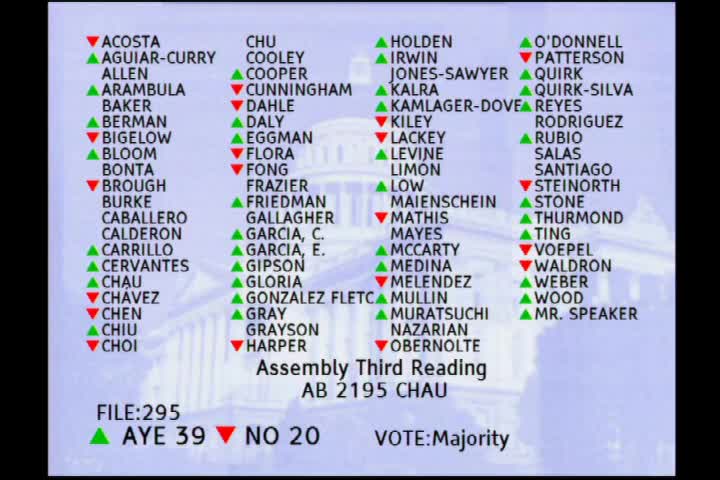
Bill Author


