AB 2378: Greenhouse Gas Reduction Fund: report.
- Session Year: 2017-2018
- House: Assembly
- Latest Version Date: 2018-04-26
The California Global Warming Solutions Act of 2006 establishes the State Air Resources Board as the state agency responsible for monitoring and regulating sources of emissions of greenhouse gases. The act authorizes the state board to include the use of market-based compliance mechanisms. Existing law requires all moneys, except for fines and penalties, collected by the state board from a market-based compliance mechanism to be deposited in the Greenhouse Gas Reduction Fund and to be available upon appropriation by the Legislature. Existing law requires the Department of Finance to annually submit a report to the appropriate committees of the Legislature on the status of the projects funded with moneys from the fund.
This bill would require the state board, in consultation with the State Department of Public Health, to submit a specified report, no later than January 1, 2020, to the Joint Legislative Budget Committee quantifying report, as part of the Department of Finances annual report, quantifying, for each program that has received moneys through January 1, 2020, from the Greenhouse Gas Reduction Fund Fund, the public health impacts of each of those programs.
The California Global Warming Solutions Act of 2006 establishes the State Air Resources Board as the state agency responsible for monitoring and regulating sources of emissions of greenhouse gases. The act authorizes the state board to include the use of market-based compliance mechanisms. Existing law requires all moneys, except for fines and penalties, collected by the state board from a market-based compliance mechanism to be deposited in the Greenhouse Gas Reduction Fund and to be available upon appropriation by the Legislature. Existing law requires the Department of Finance to annually submit a report to the appropriate committees of the Legislature on the status of the projects funded with moneys from the fund.
This bill would require the state board, in consultation with the State Department of Public Health, to submit a specified report, no later than January 1, 2020, to the Joint Legislative Budget Committee quantifying for each program that has received moneys from the Greenhouse Gas Reduction Fund the public health impacts of each of those programs.
Existing law requires the State Air Resources Board to adopt rules and regulations relating to vehicular emissions standards, as specified, that will achieve the ambient air quality standards required by federal law in conjunction with other measures adopted by the state board, air pollution control and air quality management districts, and the United States Environmental Protection Agency. Existing law requires the state board to adopt and enforce rules and regulations that anticipate the development of new technologies or the improvement of existing technologies if necessary to carry out its duty.This bill would make a technical, nonsubstantive change to this provision.Existing law requires the State Air Resources Board to adopt rules and regulations relating to vehicular emissions standards, as specified, that will achieve the ambient air quality standards required by federal law in conjunction with other measures adopted by the state board, air pollution control and air quality management districts, and the United States Environmental Protection Agency. Existing law requires the state board to adopt and enforce rules and regulations that anticipate the development of new technologies or the improvement of existing technologies if necessary to carry out its duty.
This bill would make a technical, nonsubstantive change to this provision.
(a)No later than January 1, 2020, the (1)The state board, in consultation with the State Department of Public Health, shall submit a report to the Joint Legislative Budget Committee quantifying quantifying, for each program that has received moneys through January 1, 2020, from the fund fund, the public health impacts of each of those programs.
(2)The report required pursuant to this section shall be submitted as part of the report the Department of Finance is required to submit to the Legislature pursuant to Section 39720.
(b) A report to be submitted pursuant to this section shall be submitted in compliance with Section 9795 of the Government Code.
(c)Pursuant to Section 10231.5 of the Government Code, this section is repealed on January 1, 2024.
(a)No later than January 1, 2020, the state board, in consultation with the State Department of Public Health, shall submit a report to the Joint Legislative Budget Committee quantifying for each program that has received moneys from the fund the public health impacts of each of those programs.
(b) A report to be submitted pursuant to this section shall be submitted in compliance with Section 9795 of the Government Code.
(c)Pursuant to Section 10231.5 of the Government Code, this section is repealed on January 1, 2024.
SECTION 1.Section 39602.5 of the Health and Safety Code is amended to read:39602.5.(a)The state board shall adopt rules and regulations pursuant to Section 43013 that, in conjunction with other measures adopted by the state board, the districts, and the United States Environmental Protection Agency, will achieve the ambient air quality standards required by the federal Clean Air Act (42 U.S.C. Sec. 7401 et seq.) in all areas of the state by the applicable attainment date, and to maintain these standards thereafter. The state board shall adopt these measures if they are necessary, technologically feasible, and cost effective, consistent with Section 43013.(b)If necessary to carry out its duties under this section, the state board shall adopt and enforce rules and regulations that anticipate the development of new technologies or the improvement of existing technologies. The rules and regulations shall require standards that the state board finds and determines can likely be achieved by the compliance date set forth in the rule.(a)The state board shall adopt rules and regulations pursuant to Section 43013 that, in conjunction with other measures adopted by the state board, the districts, and the United States Environmental Protection Agency, will achieve the ambient air quality standards required by the federal Clean Air Act (42 U.S.C. Sec. 7401 et seq.) in all areas of the state by the applicable attainment date, and to maintain these standards thereafter. The state board shall adopt these measures if they are necessary, technologically feasible, and cost effective, consistent with Section 43013.
(b)If necessary to carry out its duties under this section, the state board shall adopt and enforce rules and regulations that anticipate the development of new technologies or the improvement of existing technologies. The rules and regulations shall require standards that the state board finds and determines can likely be achieved by the compliance date set forth in the rule.
|
Date
|
Status
|
|---|---|
| Jun 7, 2018 | Referred to Com. on RLS. |
| May 30, 2018 | In Senate. Read first time. To Com. on RLS. for assignment. |
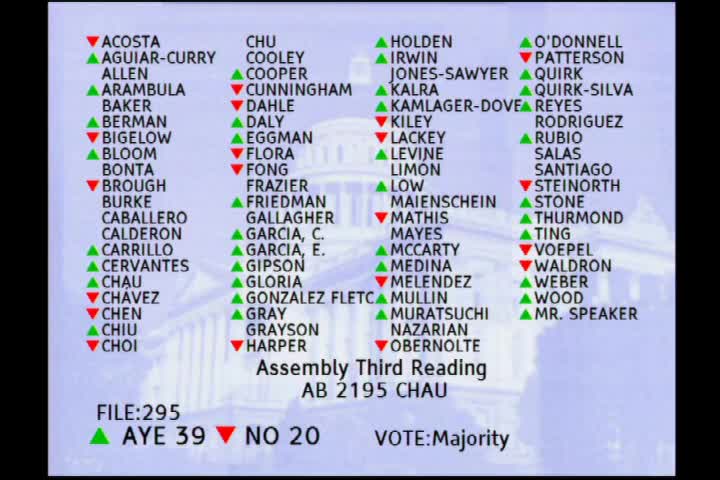
| May 29, 2018 | Read third time. Passed. Ordered to the Senate. |
| May 25, 2018 | From committee: Do pass. (Ayes 16. Noes 0.) (May 25). |
| May 16, 2018 | In committee: Set, first hearing. Referred to APPR. suspense file. |
| Apr 30, 2018 | Re-referred to Com. on APPR. |
| Apr 26, 2018 | Read second time and amended. |
| Apr 25, 2018 | From committee: Amend, and do pass as amended and re-refer to Com. on APPR. (Ayes 10. Noes 0.) (April 23). |
| Mar 19, 2018 | Re-referred to Com. on NAT. RES. |
| Mar 15, 2018 | Referred to Com. on NAT. RES. |
| Feb 15, 2018 | From printer. May be heard in committee March 17. |
| Feb 14, 2018 | Read first time. To print. |
|
Date
|
Description
|
Location
|
Votes
|
|
|---|---|---|---|---|
| May 29, 2018 | AB 2378 SALAS Assembly Third Reading | Assembly Floor |
Passed |
|
| May 25, 2018 | Do pass. | Assembly Standing Committee on Appropriations |
Passed |
|
| Apr 23, 2018 | Do pass as amended and be re-referred to the Committee on [Appropriations] | Assembly Standing Committee on Natural Resources |
Passed |
This list shows positions taken on this bill by organizations on the date displayed, which is linked to the original source.
Positions by individuals are not included.
ASSEMBLY THIRD READING
ATR Bill Id:AB 2378
Author:(Salas)
As Amended Ver:April 26, 2018
Majority vote
Committee | Votes | Ayes | Noes |
Natural Resources | 10-0 | Muratsuchi, Acosta, Chau, Eggman, Flora, Limón, McCarty, Melendez, Mark Stone, Reyes | |
Appropriations | 16-0 | Gonzalez Fletcher, Bigelow, Bloom, Bonta, Calderon, Carrillo, Chau, Eggman, Fong, Friedman, Gallagher, Eduardo Garcia, Nazarian, Obernolte, Quirk, Reyes |
|
SUMMARY: Requires the Air Resources Board (ARB), in consultation with the Department of Public Health (DPH) to submit a quantifying the public health impacts of each program that has received moneys from the Greenhouse Gas Reduction Fund (GGRF) through January 1, 2020.
EXISTING LAW:
- Requires ARB, pursuant to California Global Warming Solutions Act of 2006 [AB 32 (Nuñez), Chapter 488, Statutes of 2006], to adopt a statewide greenhouse gas (GHG) emissions limit equivalent to 1990 levels by 2020 and adopt regulations to achieve maximum technologically feasible and cost-effective GHG emission reductions.
- Establishes the GGRF and requires all moneys, except for fines and penalties, collected by ARB from the auction or sale of allowances pursuant to a market-based compliance mechanism to be deposited in the GGRF and available for appropriation by the Legislature.
- Requires the Legislative Analyst's Office, until January 1, 2030, to annually report to the Legislature on the economic impacts and benefits of the 2030 GHG emissions targets.
- Requires the Department of Finance (DOF) to annually report to the appropriate committees of the Legislature on the status and outcomes of projects funded by the GGRF.
FISCAL EFFECT: According to the Assembly Appropriations Committee, this bill has the following costs:
- Increased ongoing annual ARB costs of approximately $520,000 (3 Personnel Year (PY)) to analyze air quality data and health impacts over 30 programs, update funding guidelines and reporting requirements, and develop new quantification methodologies as necessary (GGRF).
- Increased ongoing annual DPH costs of approximately $295,000 (2 PY) to provide technical assistance to ARB (GGRF).
COMMENTS: ARB's primary charge since its creation in 1967 has been to protect the public from the harmful effects of air pollution. ARB is part of a three-tiered approach to controlling air pollution: 1) the United States Environmental Protection Agency sets nationwide air quality and emissions standards and oversees state efforts and enforcement; 2) ARB focuses on California's air quality challenges by setting the state's stricter emissions standards for a range of pollution sources, including vehicles, fuels, and consumer products; and, 3) California's 35 local air pollution control districts regulate emissions from businesses and stationary facilities, ranging from oil refiners to dry cleaners.
In response to AB 617 (Cristina Garcia), Chapter 136, Statutes of 2017, ARB established the Community Air Protection Program (CAPP). CAPP's focus is to reduce exposure in communities most impacted by air pollution. ARB staff has begun working with local air districts, community groups, community members, environmental organizations, and regulated industries to develop a new community-focused action framework for community air protection. This effort includes community air monitoring and community emissions reduction programs. In addition, the Legislature has appropriated funding to support early actions to address localized air pollution through targeted incentive funding to deploy cleaner technologies in these communities, as well as grants to support community participation in the AB 617 process. AB 617 also includes new requirements for accelerated retrofits of pollution controls on industrial sources, increased penalties, and greater transparency and availability of air quality and emissions data, which will help advance air pollution control efforts throughout the state.
The primary focus of AB 32 is to reduce GHG emissions to minimize climate change; the Legislature recognized that investments in GHG emissions reduction projects provide significant co-benefits, including public health, environmental, economic, and social benefits. AB 1532 (Pérez), Chapter 807, Statutes of 2012, requires administering agencies of GGRF funding to maximize the co-benefits of their investments. ARB contracted with the University of California, Berkeley to research methods for assessing co-benefits. Assessment methods have been developed for 10 categories of co-benefits, including asthma and respiratory disease incidence.
The 2014-15 Budget Act allocated GGRF revenues for the 2014-15 Fiscal Year and established a long-term plan for the allocation of GGRF revenues beginning in Fiscal Year 2015-16. 35% of GGRF is continuously appropriated for investments in transit, affordable housing, and sustainable communities. 25% is continuously appropriated to continue the construction of the high-speed rail project. The remaining 40% is subject to annual appropriation by the Legislature for investments in programs that include low-carbon transportation, energy efficiency and renewable energy, and natural resources and waste diversion. Listed below are the major GGRF program areas and proposed funding.
ARB prepares, on behalf of DOF, an annual report to the Legislature that is released each year on March 1. ARB is currently developing methods to quantify several co‑benefits that are related to air quality and criterion pollutants [such as fine particulate matter (PM 2.5), nitrogen oxide, reactive organic gases and diesel particulate matter], and public health (asthma). By January 1, 2020, ARB expects to have received some of this data and will include it in the March 1, 2020, annual report to the Legislature.
Analysis Prepared by: Elizabeth MacMillan / NAT. RES. / (916) 319-2092 FN: 0003044
Date of Hearing: May 16, 2018
ASSEMBLY COMMITTEE ON APPROPRIATIONS
Lorena Gonzalez Fletcher, Chair
ABPCA Bill Id:AB 2378
Author:(Salas) – As Amended Ver:April 26, 2018
Policy Committee: | Natural Resources | Vote: | 10 - 0 |
|
| ||
|
|
Urgency: No State Mandated Local Program: No Reimbursable: No
SUMMARY:
This bill requires the California Air Resources Board (ARB), in consultation with the State Department of Public Health (DPH), to include, as part of the Department of Finance’s
(DOF) cap-and-trade auction proceeds annual report to the Legislature, the quantification of public health impacts of each program that has received Greenhouse Gas Reduction Funds (GGRF) through January 1, 2020.
FISCAL EFFECT:
- Increased ongoing annual ARB costs of approximately $520,000 (3 PY) to analyze air quality data and health impacts over 30 programs, update funding guidelines and reporting requirements, and develop new quantification methodologies as necessary (GGRF).
- Increased ongoing annual DPH costs of approximately $295,000 (2 PY) to provide technical assistance to ARB (GGRF).
COMMENTS:
- Purpose. According to the author, “GGRF investments in air pollution reduction programs must be evaluated to find out if these programs are successful in improving air quality and public health.”
- Background. The California Global Warming Solutions Act of 2006 (AB 32) requires ARB to adopt a statewide GHG emissions limit equivalent to 1990 levels by 2020 and adopt regulations, including market-based compliance mechanisms, to achieve maximum technologically feasible and cost-effective GHG emission reductions.
As part of the implementation of AB 32 market-based compliance measures, ARB adopted a cap-and-trade program that caps allowable statewide emissions and provides for the auctioning of emission credits, the proceeds of which are quarterly deposited into the GGRF available for appropriation by the Legislature.
The 2014-15 Budget Act allocated cap-and-trade revenues for the 2014-15 fiscal year and established a long-term plan for the allocation of cap-and-trade revenues beginning in fiscal year 2015-16.
The budget continuously appropriates 35% of cap-and-trade funds for investments in transit, affordable housing, and sustainable communities. Twenty-five percent of the revenues are continuously appropriated to continue the construction of high-speed rail. The remaining 40% are to be appropriated annually by the Legislature for investments in programs that include low-carbon transportation, energy efficiency and renewable energy, and natural resources and waste diversion.
AB 1532 (Pérez), Chapter 807, Statutes of 2012, requires administering agencies of GGRF funding to maximize the co-benefits of their investments. AB 398 (E.Garcia), Chapter 135, Statutes of 2017, extends ARB’s cap-and-trade authority to 2030 and requires ARB to update its scoping plan (the planning document for GHG reductions).
- DOF Annual Report. ARB prepares, on behalf of DOF, the annual report to the Legislature that is released each year on March 1. ARB is currently developing methods to quantify several co‑benefits that are related to air quality and criterion pollutants [such as fine particulate matter (PM 2.5), nitrogen oxides (NOx), reactive organic gases (ROG), and diesel particulate matter], and public health (asthma), and are prioritized in AB 1532 and AB 398. By January 1, 2020, ARB expects to have received some of this data and will include it in the March 1, 2020, annual report to the Legislature.
Analysis Prepared by: Jennifer Galehouse / APPR. / (916) 319-2081
Date of Hearing: April 23, 2018
ASSEMBLY COMMITTEE ON NATURAL RESOURCES
Al Muratsuchi, Acting Chair
ABPCA Bill Id:AB 2378 (
Author:Salas) – As Amended Ver:March 15, 2018
SUBJECT: Greenhouse Gas Reduction Fund: report
SUMMARY: Requires the Air Resources Board (ARB), in consultation with the Department of Public Health (DPH) to submit a report to the Joint Legislative Budget Committee by January 1, 2020 quantifying the public health impacts of each program that has received moneys from the Greenhouse Gas Reduction Fund (GGRF).
EXISTING LAW:
- Establishes ARB, whose primary duties are controlling motor vehicle emissions, coordinating activities of air districts for the purposes of the Clean Air Act, and implementing the California Global Warming Solutions Act.
- Requires the ARB, pursuant to California Global Warming Solutions Act of 2006 [AB 32 (Nuñez), Chapter 488, Statutes of 2006], to adopt a statewide greenhouse gas (GHG) emissions limit equivalent to 1990 levels by 2020 and adopt regulations to achieve maximum technologically feasible and cost-effective GHG emission reductions.
- Requires ARB to reduce GHG emissions at least 40% below the statewide GHG emissions limit no later than December 31, 2030. Authorizes, until December 31, 2030, ARB to permit the use of market-based compliance mechanisms (i.e., the Cap-and-Trade program) to comply with GHG reduction regulations once specified conditions are met.
- Establishes the GGRF and requires all moneys, except for fines and penalties, collected by ARB from the auction or sale of allowances pursuant to a market-based compliance mechanism to be deposited in the GGRF and available for appropriation by the Legislature.
- Establishes the GGRF Investment Plan and Communities Revitalization Act (Act) to set procedures for the investment of GHG allowance auction revenues. Authorizes a range of GHG reduction investments and establishes several policy objectives:
- Maximize economic, environmental, and public health benefits;
- Foster job creation;
- Complement efforts to improve air quality;
- Direct investment toward the most disadvantaged communities and households in the state;
- Provide opportunities for businesses, public agencies, nonprofits, and other community institutions to participate in and benefit from statewide efforts to reduce GHG emissions; and,
- Lessen the impacts and effects of climate change on the state's communities, economy, and environment.
- Maximize economic, environmental, and public health benefits;
- Specifies that moneys appropriated from the GGRF through investments may include funding to reduce GHG emissions as follows:
- Energy efficiency, clean and renewable energy generation, distributed renewable energy generation, transmission and storage, and other related actions;
- The development of state-of-the-art systems to move goods and freight, advanced technology vehicles and vehicle infrastructure, advanced biofuels, and low-carbon and efficient public transportation;
- Water use and water supply, land and natural resource conservation and management, forestry, and sustainable agriculture projects;
- Strategic planning and development of sustainable infrastructure projects;
- In-state diversion of municipal solid waste from disposal through waste reduction, diversion, and reuse;
- Investments in programs implemented by local and regional agencies, local and regional collaboratives, and nonprofit organizations coordinating with local governments; and,
- Funding research, development, and deployment of innovative technologies, measures, and practices related to programs and projects funded pursuant to the Act.
- Energy efficiency, clean and renewable energy generation, distributed renewable energy generation, transmission and storage, and other related actions;
- Beginning this year, establishes the following priorities for expenditure of cap-and-trade auction revenue through 2030:
- Toxic and criteria air pollutants from stationary and mobile sources;
- Low- and zero-carbon transportation alternatives;
- Sustainable agricultural practices that promote clean technology, water efficiency, and improved air quality;
- Healthy forests and urban greening;
- Short-lived climate pollutants;
- Climate adaptation and resiliency; and,
- Climate and clean energy research.
- Toxic and criteria air pollutants from stationary and mobile sources;
- Requires the investment plan to allocate:
- A minimum of 25% of the available moneys in the GGRF to projects located within, and that provide benefits to individuals living in, disadvantaged communities;
- A minimum of 5% of the available moneys in the GGRF to projects that benefit low-income households or to projects located within, and benefiting individuals living in, low-income communities; and,
- A minimum of 5% of the available moneys in the GGRF to projects that benefit low-income households that are outside of, but within ½ mile of, disadvantaged communities, or to projects located within the boundaries of, and benefiting individuals living in, low-income communities that are outside of, but within ½ mile of, disadvantaged communities.
- A minimum of 25% of the available moneys in the GGRF to projects located within, and that provide benefits to individuals living in, disadvantaged communities;
- Requires the Legislative Analyst's Office, until January 1, 2030, to annually report to the Legislature on the economic impacts and benefits of the 2030 GHG emissions targets.
FISCAL EFFECT: Unknown
COMMENTS:
- Author's statement:
As recent as January 2018, air quality in the Valley was so bad that it reached dangerous levels. The haze that covered the Valley, which was reported to look like fog, was concentrated particulate air pollution and was making people sick. According the American Lung Association’s State of the Air Report 2017, California is home to 7 of the 10 American cities with the worst ozone pollution. Bakersfield remains the most polluted city in America in terms of spikes in particulate matter, with Visalia, Fresno and Modesto-Merced coming in second, third and fourth. Both, particulate matter (PM 2.5) and ozone are linked to a long list of health problems including asthma, lung cancer, premature death, and developmental delays in children.
The Governor’s proposed 2018-19 budget proposed $4.2 billion for programs administered by the Environmental Protection Agency, including the administrations proposed spending plan for cap and trade revenues and zero emission vehicles (ZEV) infrastructure. As the state continues to make significant investments in air pollution reduction programs with hundreds of millions of dollars in grants available over the next several years, it is critical to identify which programs are the most cost effective in reducing air pollution exposure and which are the ones that that have a direct impact in improving air quality and public health.
Approximately 12 million Californians currently live in communities that exceed the federal standards for ozone and PM. While various regulatory and legislative efforts have led to substantial and noticeable improvements in air quality and public health, for many low-income families in disadvantaged communities exposure to harmful pollutants remains a problem. GGRF investments in air pollution reduction programs must be evaluated to find out if these programs are successful in improving air quality and public health.
AB 2378 would require the ARB, in collaboration with DPH, to submit, no later than January 1, 2020, a report to the Joint Legislative Budget Committees quantifying the public health benefits resulting from GGRF investments in air quality programs.
While the Office of Environmental Health Hazard Assessment (OEHHA) has been tasked by Governor Brown to analyze possible benefits and impacts from GHG emission reductions to disadvantaged communities, the first report released February 2017 does not include sufficient information to evaluate which programs are the most successful in achieving the most improvements in public health.
- Air pollution. ARB's primary charge since its creation in 1967 has been to protect the public from the harmful effects of air pollution. ARB is part of a three-tiered approach to controlling air pollution: 1) the United States Environmental Protection Agency sets nationwide air quality and emissions standards and oversees state efforts and enforcement; 2) ARB focuses on California's air quality challenges by setting the state's stricter emissions standards for a range of pollution sources, including vehicles, fuels, and consumer products; and, 3) California's 35 local air pollution control districts regulate emissions from businesses and stationary facilities, ranging from oil refiners to dry cleaners.
In response to AB 617 (C. Garcia), Chapter 136, Statutes of 2017, ARB established the Community Air Protection Program (CAPP). CAPP's focus is to reduce exposure in communities most impacted by air pollution. ARB staff has begun working with local air districts, community groups, community members, environmental organizations, and regulated industries to develop a new community-focused action framework for community air protection. This effort includes community air monitoring and community emissions reduction programs. In addition, the Legislature has appropriated funding to support early actions to address localized air pollution through targeted incentive funding to deploy cleaner technologies in these communities, as well as grants to support community participation in the AB 617 process. AB 617 also includes new requirements for accelerated retrofits of pollution controls on industrial sources, increased penalties, and greater transparency and availability of air quality and emissions data, which will help advance air pollution control efforts throughout the state. - GGRF. The primary focus of AB 32 is to reduce GHG emissions to minimize climate change; the Legislature recognized that investments in GHG emissions reduction projects provide significant co-benefits, including public health, environmental, economic, and social benefits. AB 1532 (Pérez), Chapter 807, Statutes of 2012, requires administering agencies of GGRF funding to maximize the co-benefits of their investments. ARB contracted with the University of California, Berkeley (UCB) to research methods for assessing co-benefits. Assessment methods have been developed for ten categories of co-benefits, including asthma and respiratory disease incidence.
In February 2017, the OEHHA report Tracking and Evaluation of Benefits and Impacts of Greenhouse Gas Limits in Disadvantaged Communities made the following findings:
- A disproportionate number of facilities subject to the Cap-and-Trade Program are located in disadvantaged communities. Of the 281 facilities analyzed, 57% are located in or within one-half mile of a disadvantaged community. More specifically, 15 of 20 refineries (75%), five of seven hydrogen plants (71%) and 72 of the 110 facilities classified by ARB as "other combustion source" facilities (65%) are located in or within one-half mile of a disadvantaged community. While people's actual exposures to toxic co-pollutants emitted from these facilities would depend on various factors such as meteorological conditions and smokestack heights, changes in co-pollutant emissions resulting from the Cap-and-Trade Program would nonetheless tend to have disproportionate benefits (if emissions decrease) or adverse impacts (if emissions increase) on disadvantaged communities because of their proximity to these facilities;
- There were moderate correlations between GHG emissions and the emissions of criteria air pollutants. The strongest correlation was with fine particulate matter emissions (PM2.5). There was also moderate correlation between GHG and toxic chemical emissions across the entire set of Cap-and-Trade facilities with covered emissions. Some individual industrial sectors showed greater correlations between emissions of GHGs and toxic co-pollutants. Refineries overall showed a strong correlation, while cement plants showed a moderate correlation. Oil and gas production facilities also showed a moderate correlation, depending on the statistical approach used. Facilities in certain sectors with broad ranges of emissions levels (e.g., electricity generation facilities) showed increased correlation with a specific statistical analysis (logarithmic transformation). This report only looked at emissions from one recent year (2014), however, because this was the only year for which air toxics data could be obtained in time for this analysis;
- OEHHA also conducted a more detailed case study of nine cement plants and 19 refineries. These facilities have relatively high toxicity-weighted emissions, and data for the years 2011 to 2014 were available. The different plants showed varying levels of correlation among GHG, toxicity-weighted emissions, and PM2.5 emissions during the four-year period. Several cement facilities showed modest positive correlations between GHG and toxicity-weighted emissions, while two cement facilities showed poorer correlations. For refineries, there were generally positive correlation between GHG and toxicity-weighted air emissions. Facilities with high levels of GHG emissions generally had higher PM2.5 and toxicity-weighted emissions. There were some differences between individual refineries in the relationships between GHGs, toxicity-weighted and PM2.5 emissions, perhaps reflecting differences in the kinds of products made at each of the refineries; and,
- These results indicate that the relationship between GHGs and other pollutant emissions is complex. GHG facilities that emit higher levels of GHGs tend to have higher emissions of toxic air contaminants and criteria air pollutants. There is a need for additional investigation into the factors that drive emission changes, how GHG emission reductions are likely to be achieved in different industrial sectors, and what that may mean for concomitant changes in emissions of toxic air pollutants. Nonetheless, these analyses suggest that reductions in GHG emissions are likely to result in lower pollutant exposures in disadvantaged communities, based overall on the positive correlations observed for the 2014 data.
- Existing GGRF funding and programs. The 2014-15 Budget Act allocated GGRF revenues for the 2014-15 Fiscal Year and established a long-term plan for the allocation of GGRF revenues beginning in Fiscal Year 2015-16. Thirty-five percent of GGRF is continuously appropriated for investments in transit, affordable housing, and sustainable communities. Twenty-five percent is continuously appropriated to continue the construction of the high-speed rail project. The remaining 40% is subject to annual appropriation by the Legislature for investments in programs that include low-carbon transportation, energy efficiency and renewable energy, and natural resources and waste diversion. Listed below are the major GGRF program areas and proposed funding.
Program | Department | 2017-18 | Proposed 2018-19 (in millions) |
Continuous Appropriations | |||
High-speed rail | High-Speed Rail Authority | $655 | $571 |
Affordable housing and sustainable communities | Strategic Growth Council | $524 | $456 |
Transit and intercity rail capital | Transportation Agency | $262 | $228 |
Transit operations | Department of Transportation | $131 | $114 |
Spending Commitments | |||
Manufacturing sales tax exemption backfill | N/A | $43 | $89 |
Administrative costs | Various agencies | $30 | $35 |
State Responsibility Area backfill | Department of Forestry and Fire Protection/Conservation Corps | $80 | $28 |
Discretionary Spending | |||
Mobil Source Emissions | |||
Local air district programs | Air Resources Board | $250 | $250 |
Clean Vehicle Rebate Project | Air Resources Board | $140 | $175 |
Freight and heavy-duty vehicle incentives | Air Resources Board | $320 | $160 |
Low-income, light-duty vehicles and school buses | Air Resources Board | $100 | $100 |
Low-carbon fuel production | Energy Commission | $0 | $25 |
Forestry | |||
Forest health and fire prevention | Department of Forestry and Fire Protection | $200 | $160 |
Local fire prevention grants | Office of Emergency Services | $25 | $25 |
Urban forestry | Department of Forestry and Fire Prevention | $20 | $0 |
Agriculture | |||
Agricultural equipment | Air Resources Board | $85 | $102 |
Methane reduction from dairies | Department of Food and Agriculture | $99 | $99 |
Incentives for food processors | Energy Commission | $60 | $34 |
Healthy soils | Department of Food and Agriculture | $0 | $5 |
Agricultural renewable energy | Energy Commission | $6 | $4 |
Other Programs | |||
Climate and energy research | Office of Planning and Research | $11 | $35 |
Transformative Climate Communities | Office of Planning and Research | $10 | $25 |
Waste diversion | Department of Resources Recycling and Recovery | $40 | $20 |
Integrated Climate Investment Program | Go-Biz | $40 | $20 |
Energy Corps | Conservation Corps | $0 | $6 |
Technical assistance to community groups | Air Resources Board | $5 | $5 |
Urban greening | Natural Resources Agency | $26 | $0 |
Natural lands climate adaptation | Wildlife Conservation Board | $20 | $0 |
Low income weatherization and solar | Community Services and Development | $18 | $0 |
Wetland restoration | Department of Fish and Wildlife | $15 | $0 |
Coastal climate adaptation | Various agencies | $6 | $0 |
Total | $3,181 | $2,771 |
Source: Legislative Analyst's Office
- Suggested amendment. ARB already provides an annual report to the Legislature on the GGRF and related programs. The committee may wish to amend the bill to require ARB to include the information requested by the bill in its annual report, which is submitted on March 1st.
REGISTERED SUPPORT / OPPOSITION:
Support
None on file
Opposition
None on file
Analysis Prepared by: Elizabeth MacMillan / NAT. RES. /
Discussed in Hearing
 53SEC
Assembly Floor
 2MIN
Assembly Standing Committee on Natural Resources
Bill Author

Bill Co-Author(s):