AB 2407: Recycling: lithium-ion vehicle batteries: advisory group.
- Session Year: 2017-2018
- House: Assembly
- Latest Version Date: 2018-04-17
The Rechargeable Battery Recycling Act of 2006 requires every retailer, as defined, to have in place a system for the acceptance and collection of used rechargeable batteries for reuse, recycling, or proper disposal. Existing law requires the system for the acceptance and collection of used rechargeable batteries to include, at a minimum, specified elements, including, among others, the take-back at no cost to the consumer of a used rechargeable battery of the type or brand that the retailer sold or previously sold. Existing law defines rechargeable battery for purposes of these provisions to mean a small, nonvehicular, rechargeable nickel-cadmium, nickel metal hydride, lithium-ion, or sealed lead-acid battery, or a battery pack containing these types of batteries.
This bill would require the Secretary for Environmental Protection, on or before April 1, 2019, to convene the Lithium-Ion Car Battery Recycling Advisory Group to review, and advise the Legislature on, policies pertaining to the recovery and recycling of lithium-ion batteries sold with motor vehicles in the state, and would require the secretary to appoint members to the committee from specified departments, vocations, and organizations. The bill would require the advisory group to consult with specified entities and, on or before April 1, 2020, to submit policy recommendations to the Legislature aimed at ensuring that 90% of end-of-life lithium-ion batteries discarded in the state are recycled in a safe and cost-effective manner in the state. The bill would repeal these provisions on January 1, 2022.
Under existing law, the Public Utilities Commission (PUC) has regulatory authority over public utilities, including electrical corporations. Existing law requires the PUC, in consultation with the State Energy Resources Conservation and Development Commission (Energy Commission), the State Air Resources Board (state board), electrical corporations, and the motor vehicle industry, to evaluate policies to develop infrastructure sufficient to overcome any barriers to the widespread deployment and use of plug-in hybrid and electric vehicles, and to adopt rules that address specified issues. Existing law requires the PUC, in cooperation with the Energy Commission, the state board, air quality management districts and air pollution control districts, electrical and gas corporations, and the motor vehicle industry, to evaluate and implement policies to promote the development of equipment and infrastructure needed to facilitate the use of electric power and natural gas to fuel low-emission vehicles.This bill would express the intent of the Legislature to enact legislation relating to electric vehicles.Under existing law, the Public Utilities Commission (PUC) has regulatory authority over public utilities, including electrical corporations. Existing law requires the PUC, in consultation with the State Energy Resources Conservation and Development Commission (Energy Commission), the State Air Resources Board (state board), electrical corporations, and the motor vehicle industry, to evaluate policies to develop infrastructure sufficient to overcome any barriers to the widespread deployment and use of plug-in hybrid and electric vehicles, and to adopt rules that address specified issues. Existing law requires the PUC, in cooperation with the Energy Commission, the state board, air quality management districts and air pollution control districts, electrical and gas corporations, and the motor vehicle industry, to evaluate and implement policies to promote the development of equipment and infrastructure needed to facilitate the use of electric power and natural gas to fuel low-emission vehicles.
This bill would express the intent of the Legislature to enact legislation relating to electric vehicles.
(a)For purposes of this section, the following definitions apply:
(1)Automobile dismantler has the same definition as in Section 220 of the Vehicle Code.
(2)Motor vehicle has the same definition as in Section 415 of the Vehicle Code.
(3)Vehicle manufacturer has the same definition as in Section 672 of the Vehicle Code.
(b)On or before April 1, 2019, the Secretary for Environmental Protection shall convene the Lithium-Ion Car Battery Recycling Advisory Group to review, and advise the Legislature on, policies pertaining to the recovery and recycling of lithium-ion vehicle batteries sold with motor vehicles in the state. Until April 1, 2020, the advisory group shall meet at least quarterly. The advisory group shall consult with universities and research institutions that have conducted research in the area of battery recycling, manufacturers of electric and hybrid vehicles, and the recycling industry. The Secretary for Environmental Protection shall appoint at least one member to the advisory group from each of the following:
(1)The Department of Resources Recycling and Recovery.
(2)The Department of Toxic Substances Control.
(3)A vehicle manufacturer or an organization that represents one or more vehicle manufacturers.
(4)An electronic waste recycler or an organization that represents one or more electronic waste recyclers.
(5)An automotive repair dealer or an organization that represents one or more automotive repair dealers.
(5)(6)An automobile dismantler or an organization that represents one or more motor vehicle automobile dismantlers.
(6)(7)An environmental organization that specializes in waste reduction and recycling.
(8)A representative of the energy storage industry.
(c)On or before April 1, 2020, the Lithium-Ion Car Battery Recycling Advisory Group shall submit policy recommendations to the Legislature, in compliance with Section 9795 of the Government Code, aimed at ensuring that 90 percent of end-of-life lithium-ion vehicle batteries discarded in the state are recycled in a safe and cost-effective manner in the state.
(d)This section shall remain in effect only until January 1, 2022, and as of that date is repealed.
(a)For purposes of this section, the following definitions apply:
(1)Automobile dismantler has the same definition as in Section 220 of the Vehicle Code.
(2)Motor vehicle has the same definition as in Section 415 of the Vehicle Code.
(3)Vehicle manufacturer has the same definition as in Section 672 of the Vehicle Code.
(b)On or before April 1, 2019, the Secretary for Environmental Protection shall convene the Lithium-Ion Car Battery Recycling Advisory Group to review, and advise the Legislature on, policies pertaining to the recovery and recycling of lithium-ion vehicle batteries sold with motor vehicles in the state. Until April 1, 2020, the advisory group shall meet at least quarterly. The advisory group shall consult with universities and research institutions that have conducted research in the area of battery recycling, manufacturers of electric and hybrid vehicles, and the recycling industry. The Secretary for Environmental Protection shall appoint at least one member to the advisory group from each of the following:
(1)The Department of Resources Recycling and Recovery.
(2)The Department of Toxic Substances Control.
(3)A vehicle manufacturer or an organization that represents one or more vehicle manufacturers.
(4)An electronic waste recycler or an organization that represents one or more electronic waste recyclers.
(5)An automobile dismantler or an organization that represents one or more motor vehicle dismantlers.
(6)An environmental organization that specializes in waste reduction and recycling.
(c)On or before April 1, 2020, the Lithium-Ion Car Battery Recycling Advisory Group shall submit policy recommendations to the Legislature, in compliance with Section 9795 of the Government Code, aimed at ensuring that 90 percent of end-of-life lithium-ion vehicle batteries discarded in the state are recycled in a safe and cost-effective manner in the state.
(d)This section shall remain in effect only until January 1 2022, and as of that date is repealed.
SECTION 1.It is the intent of the Legislature to enact legislation relating to electric vehicles.It is the intent of the Legislature to enact legislation relating to electric vehicles.
|
Date
|
Status
|
|---|---|
| Jun 20, 2018 | In committee: Set, first hearing. Hearing canceled at the request of author. |
| Jun 12, 2018 | In committee: Set, first hearing. Hearing canceled at the request of author. |
| Jun 7, 2018 | Referred to Com. on EQ. |
| May 30, 2018 | In Senate. Read first time. To Com. on RLS. for assignment. |
| May 29, 2018 | Read third time. Passed. Ordered to the Senate. |
| May 25, 2018 | From committee: Do pass. (Ayes 16. Noes 0.) (May 25). |
| May 9, 2018 | In committee: Set, first hearing. Referred to APPR. suspense file. |
| Apr 25, 2018 | From committee: Do pass and re-refer to Com. on APPR. (Ayes 6. Noes 1.) (April 24). Re-referred to Com. on APPR. |
| Apr 18, 2018 | Re-referred to Com. on E.S. & T.M. |
| Apr 17, 2018 | From committee chair, with author's amendments: Amend, and re-refer to Com. on E.S. & T.M. Read second time and amended. |
| Apr 2, 2018 | Re-referred to Com. on E.S. & T.M. |
| Mar 23, 2018 | From committee chair, with author's amendments: Amend, and re-refer to Com. on E.S. & T.M. Read second time and amended. |
| Mar 22, 2018 | Referred to Com. on E.S. & T.M. |
| Feb 15, 2018 | From printer. May be heard in committee March 17. |
| Feb 14, 2018 | Read first time. To print. |
|
Date
|
Description
|
Location
|
Votes
|
|
|---|---|---|---|---|
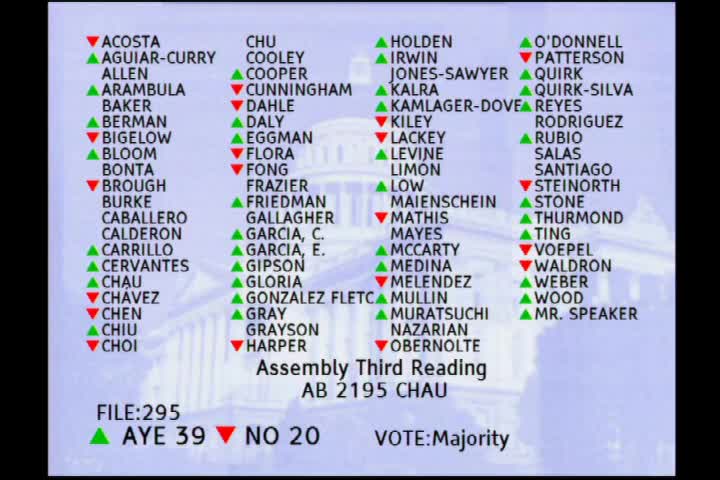
| May 29, 2018 | AB 2407 TING Assembly Third Reading | Assembly Floor |
Passed |
|
| May 25, 2018 | Do pass. | Assembly Standing Committee on Appropriations |
Passed |
|
| Apr 24, 2018 | Do pass and be re-referred to the Committee on [Appropriations] | Assembly Standing Committee on Environmental Safety and Toxic Materials |
Passed |
This list shows positions taken on this bill by organizations on the date displayed, which is linked to the original source.
Positions by individuals are not included.
|
Organization
|
Position
|
Date
|
|---|---|---|
| Californians Against Waste | * Support | Apr 24, 2018 |
| Plug In America | ** Support | Apr 20, 2018 |
| Rural County Representatives of California | ** Support | Apr 20, 2018 |
ASSEMBLY THIRD READING
ATR Bill Id:AB 2407
Author:(Ting)
As Amended Ver:April 17, 2018
Majority vote
Committee | Votes | Ayes | Noes |
Environmental Safety | 6-1 | Quirk, Melendez, Arambula, Bloom, Holden, Muratsuchi | Brough |
Appropriations | 16-0 | Gonzalez Fletcher, Bigelow, Bloom, Bonta, Calderon, Carrillo, Chau, Eggman, Fong, Friedman, Gallagher, Eduardo Garcia, Nazarian, Obernolte, Quirk, Reyes |
|
SUMMARY: Requires the Secretary for the Environmental Protection Agency (CalEPA) to convene a research group to review, and advise the Legislature on, policies pertaining to the recovery and recycling of lithium-ion (Li-ion) vehicle batteries sold with motor vehicles in the state. Specifically, this bill:
- Requires, on or before April 1, 2019, the Secretary of CalEPA to convene the Lithium-Ion Car Battery Recycling Advisory Group (Advisory Group) to review, and advise the Legislature on, policies pertaining to the recovery and recycling of Li-ion vehicle batteries sold with motor vehicles in the state.
- Requires, until April 1, 2020, the Advisory group to meet at least quarterly; and, to consult with universities and research institutions that have conducted research in the area of battery recycling; manufacturers of electric and hybrid vehicles; and, the recycling industry.
- Requires the Secretary of CalEPA to appoint at least one member to the Advisory Group from each of the following: the Department of Resources Recycling and Recovery (CalRecycle); the Department of Toxic Substances Control (DTSC), a vehicle manufacturer or an organization that represents one or more vehicle manufacturers; an electronic waste recycler or an organization that represents one or more electronic waste recyclers; an automobile dismantler or an organization that represents one or more motor vehicle dismantlers; an automotive repair dealer or an organization that represents one or more automotive repair dealers; a representative of the energy storage industry; and, an environmental organization that specializes in waste reduction and recycling. Requires, on or before April 1, 2020, the Advisory Group to submit policy recommendations to the Legislature aimed at ensuring that 90% of end-of-life Li-ion vehicle batteries discarded in the state are recycled in a safe and cost-effective manner in the state.
- Sunsets the provisions of the bill on January 1, 2022.
FISCAL EFFECT: According to the Assembly Appropriations Committee, enactment of this bill could result in costs of approximately $500,000 (General Fund or special fund) for the Advisory Group to contract with universities and research institutions; unknown costs for CalRecyle and DTSC to participate in the Advisory Group; and, absorbable costs to CalEPA.
COMMENTS:
Need for the bill: According to the author: "Current law does not provide for coordinated [recycling] or reuse of vehicular lithium-ion batteries, and the rapid increase of electric vehicles presents a future challenge that California needs to start examining now.[…] With new models expected by nearly all major automobile manufacturers, the expansion of lithium-ion battery powered electric vehicles is coming, and with the benefits of cleaner air and reduced greenhouse gas emissions, the state also needs to meet the challenges of battery life-cycles."
Zero emission vehicles (ZEVs): Zero emission vehicles, or ZEVs, is an umbrella term for hydrogen fuel cell electric vehicles, battery electric vehicles (EVs), and plug-in hybrid electric vehicles (PHEVs). ZEVs are vehicles that emit no exhaust gas from the onboard source of power, hence the term 'zero emission.'
How many ZEVs and Li-ion batteries are on the road today: California increased the number of ZEVs in the state by 1300% in six years, growing from 25,000 in 2012 to more than 450,000 today. ZEVs now account for approximately 4.5-5% of all new car sales in California. All ZEVs contain a Li-ion battery to provide their electric power.
Li-ion batteries are hazardous waste: In California, because Li-ion batteries are considered a hazardous or universal waste, any facility that accepts them for collection, storage, waste management, or recycling would have to be permitted by DTSC for managing hazardous waste. It is unknown how many facilities are permitted by DTSC to accept Li-ion batteries from hybrids and electric vehicles for management or recycling.
Li-ion battery waste: According to a presentation to DTSC from Occupational Knowledge International, by 2028, roughly eight million kilotons of waste Li-ion batteries from ZEVs are expected to be generated. By 2038, the estimate is 55 million kilotons.
Infrastructure, as well as understanding, is lacking: Little research has been devoted to understanding the challenges and tradeoffs associated with end-of-life management strategies for ZEV batteries, and the pace at which new collection, second life, and recycling infrastructure must be scaled up. It will require appropriate research to develop a roadmap for building the infrastructure necessary to process used batteries and divert them from landfills.
The bill requires the Secretary for CalEPA to convene an Advisory Group to review policies pertaining to the recovery and recycling of lithium-ion vehicle batteries sold with motor vehicles in the state.
Given the growing number of ZEVs on the road, the fact Li-ion batteries are considered hazardous, and the need to have systems in place to collect these products when they are done with their useful life, studying the possibilities now is prudent. With the appropriate variety of representation of auto manufacturers, battery management professionals, and state agencies in the Advisory Group, it can be well-quipped to advise the Legislature on policies pertaining to the recovery and recycling of Li-ion vehicle batteries sold with motor vehicles in the state.
Analysis Prepared by: Paige Brokaw / E.S. & T.M. / (916) 319-3965 FN: 0003156
Date of Hearing: May 9, 2018
ASSEMBLY COMMITTEE ON APPROPRIATIONS
Lorena Gonzalez Fletcher, Chair
ABPCA Bill Id:AB 2407
Author:(Ting) – As Amended Ver:April 17, 2018
Policy Committee: | Environmental Safety and Toxic Materials | Vote: | 6 - 1 |
|
| ||
|
|
Urgency: No State Mandated Local Program: No Reimbursable: No
SUMMARY:
This bill requires, by April 1,2019, the CalEPA secretary to convene the Lithium-Ion Car Battery Recycling Advisory Group (Advisory Group), to review and advise the Legislature on policies pertaining to the recovery and recycling of Li-ion vehicle batteries sold with motor vehicles in the state. Until April 1, 2020, this bill requires the Advisory Group to meet at least quarterly and consult with specified universities, research institutions, and the recycling industry.
Specifically, this bill:
- Requires the CalEPA secretary to appoint at least one member to the Advisory Group from the following:
- CalRecyle.
- Department of Toxic Substance Control (DTSC).
- A vehicle manufacturer or an organization that represents vehicle manufacturers.
- An electronic waste recycler or an organization that represents electronic waste recyclers.
- An auto dismantler or an organization that represents auto dismantlers.
- An auto repair dealer or an organization that represents auto repair dealers.
- A representative of the energy storage industry.
- A representative of an environmental organization that specializes in waste reduction and recycling.
- Requires the Advisory Group to submit policy recommendations to the Legislature, by April 1, 2020, aimed at ensuring that 90% of end-of-life Li-ion vehicle batteries discarded in the state are recycled in a safe and cost-effective manner.
FISCAL EFFECT:
- Advisory Group costs of approximately $500,000 (GF or special fund) to contract with universities and research institutions. CalEPA costs are absorbable.
- Unknown costs for CalRecyle and DTSC to participate in the Advisory Group.
COMMENTS:
- Purpose. According to the author, "Current law does not provide for coordinated recycling or reuse of vehicular lithium-ion batteries, and the rapid increase of electric vehicles presents a future challenge that California needs to start examining now.”
This bill establishes an advisory group to develop methods to achieve the state goal of 90% recycling rate for end-of-life Li-ion vehicle batteries.
- Background. Li-ion batteries are widely used in portable electronics like laptops, smart phones, digital cameras, game consoles, and cordless power tools and are also used as vehicle batteries in zero-emission vehicles (ZEVs).
California increased the number of ZEVs in the state by 1300% in six years—growing from 25,000 in 2012 to more than 450,000 today—and ZEVs now account for approximately
4.5% - 5 % of all new car sales in California. All ZEVs contain a Li-ion battery to provide their electric power.
Given the growing number of ZEVs on the road, the fact Li-ion batteries are considered hazardous, and the need to have systems in place to collect these products when they are done with their useful life, studying the possibilities now is prudent. With the appropriate variety of representation of auto manufacturers, battery management professionals, and state agencies on the Advisory Group, the group should be able to advise the Legislature on policies pertaining to the recovery and recycling of Li-ion vehicle batteries sold with motor vehicles in the state.
- Similar Legislation. AB 2832 (Dahle) requires the DTSC to identify recycling opportunities for lithium-ion batteries and develop a grant program for Li-ion battery recycling. This bill will be heard today in this committee.
Analysis Prepared by: Jennifer Galehouse / APPR. / (916) 319-2081
Date of Hearing: April 24, 2018
ASSEMBLY COMMITTEE ON ENVIRONMENTAL SAFETY AND TOXIC MATERIALS
Bill Quirk, Chair
ABPCA Bill Id:AB 2407 (
Author:Ting) – As Amended Ver:April 17, 2018
SUBJECT: Recycling: lithium-ion vehicle batteries: advisory group
SUMMARY: Requires the Secretary for the Environmental Protection Agency (CalEPA) to convene a research group to review, and advise the Legislature on, policies pertaining to the recovery and recycling of lithium-ion (Li-ion) vehicle batteries sold with motor vehicles in the state. Specifically, this bill:
- Requires, on or before April 1, 2019, the Secretary for CalEPA to convene the Lithium-Ion Car Battery Recycling Advisory Group (Advisory Group) to review, and advise the Legislature on, policies pertaining to the recovery and recycling of Li-ion vehicle batteries sold with motor vehicles in the state.
- Requires, until April 1, 2020, the Advisory group:
- To meet at least quarterly; and,
- Consult with universities and research institutions that have conducted research in the area of battery recycling; manufacturers of electric and hybrid vehicles; and, the recycling industry.
- Requires the Secretary of CalEPA to appoint at least one member to the Advisory Group from each of the following: the Department of Resources Recycling and Recovery (CalRecycle); the Department of Toxic Substances Control (DTSC), a vehicle manufacturer or an organization that represents one or more vehicle manufacturers; an electronic waste recycler or an organization that represents one or more electronic waste recyclers; an automobile dismantler or an organization that represents one or more motor vehicle dismantlers; an automotive repair dealer or an organization that represents one or more automotive repair dealers; a representative of the energy storage industry; and, an environmental organization that specializes in waste reduction and recycling.
- Requires, on or before April 1, 2020, the Advisory Group to submit policy recommendations to the Legislature aimed at ensuring that 90 percent of end-of-life Li-ion vehicle batteries discarded in the state are recycled in a safe and cost-effective manner in the state.
- Sunsets the provisions of the bill on January 1, 2022.
EXISTING LAW:
- Prohibits the disposal of a lead-acid battery at a solid waste facility, or on or in any land, surface waters, watercourses, or marine waters. (Health and Safety Code (HSC) § 25215.2)
- Establishes the Lead-Acid Battery Recycling Act of 2016 (Act) to impose fees on lead-acid batteries to fund lead contamination cleanup. (HSC § 25215)
- Establishes the California Rechargeable Battery Recycling Act to require retailers to have a mechanism to accept all non-vehicular rechargeable batteries from consumers for recycling. (Public Resources Code § 42451)
FISCAL EFFECT: Unknown.
COMMENTS:
Need for the bill: According to the author:
"Current law does not provide for coordinated [recycling] or reuse of vehicular lithium-ion batteries, and the rapid increase of electric vehicles presents a future challenge that California needs to start examining now. […] With new models expected by nearly all major automobile manufacturers, the expansion of lithium-ion battery powered electric vehicles is coming, and with the benefits of cleaner air and reduced greenhouse gas emissions, the state also needs to meet the challenges of battery life-cycles."
Zero emission vehicles (ZEVs): Zero emission vehicles, or ZEVs, is an umbrella term for hydrogen fuel cell electric vehicles, battery electric vehicles (EVs) and plug-in hybrid electric vehicles (PHEVs). ZEVs are vehicles that emit no exhaust gas from the onboard source of power, hence the term 'zero emission.'
Value of ZEVs to California goals: California has some of the most ambitious climate emission reduction goals in the nation, which include goals to reduce petroleum use in California by up to 50% from 2015 levels by 2030, and to reduce greenhouse gas emissions 40% below 1990 levels by 2030. The transportation sector represents about 40% of California's total greenhouse gas emissions portfolio, so promoting ZEVs, and replacing traditional gas-powered cars with ZEVs, is a very big part of California's mission to reduce those climate emissions.
Encouraging ZEV sales is a state priority: In 2012, Governor Jerry Brown issued Executive Order (EO) B-16-12 directing state government to help accelerate the market for ZEVs in California. This EO calls for 1.5 million ZEVs in California by 2025 and establishes several milestones to achieve this goal.
In 2014, the State Legislature passed and Governor Brown signed the California Charge Ahead Initiative (SB 1275, Chapter 530, Statutes of 2014) to support consumer incentives and rebates to help achieve one million ZEVs on California’s roads by January 1, 2023.
In 2015, the State Legislature passed and Governor Brown signed into law the Clean Energy and Pollution Reduction Act of 2015 (SB 350, Chapter 547, Statutes of 2015), which established a statewide policy to effectuate widespread electrification of the transportation sector.
Most recently, on January 26, 2018, Governor Jerry Brown signed EO B-48-18 to call for a new target of 5 million ZEVs in California by 2030. The Governor is also proposing a new eight-year initiative to continue the state’s clean vehicle rebates and spur more electric vehicle charging station infrastructure investments. This $2.5 billion initiative is aimed to bring 250,000 vehicle charging stations to California by 2025.
State policies supporting ZEVs: Supporting those lofty goals are various state policies that have been enacted or promulgated by state agencies to expand the fleet of ZEVs on California roads.
The State of California continues to provide monetary rebates up to $2,500 for the purchase or long-term (30 months or more) lease of ZEVs. (There are also federal rebates for ZEVs consumers can take advantage of in addition to the state's rebates.)
The state also provides high occupancy vehicle (HOV) lane access to ZEV drivers, regardless of being a single passenger or HOV, as a benefit to driving a ZEV.
The California Air Resources Board also has the ZEV mandate, which requires auto manufacturers to produce an increasing number of pure ZEVs (battery electric as well as fuel cell electric vehicles).
How many ZEVs and Li-ion batteries are on the road today: California increased the number of ZEVs in the state by 1300% in six years—growing from 25,000 in 2012 to more than 450,000 today—and ZEVs now account for approximately 4.5-5 percent of all new car sales in California. All ZEVs contain a Li-ion battery to provide their electric power.
Li-ion batteries: Li-ion batteries, widely used in portable electronics like laptops, smart phones, digital cameras, game consoles, and cordless power tools, are also widely used as vehicle batteries in ZEVs.
The traditional Li-ion chemistry involves a lithium cobalt oxide cathode and a graphite anode. Li-ion batteries are efficient at holding charges and recharging to power a car, and traditional Li-ion batteries can have hundreds to a few thousand charge cycles through their lives. The life-span of Li-ion battery is anywhere between 10-20 years.
Li-ion batteries are hazardous waste: All batteries are considered hazardous waste in California when they are discarded. Batteries are considered hazardous because of the metals and/or other toxic or corrosive materials contain within. Batteries are potentially a valuable source of recyclable metal.
All batteries in California that are intended for disposal must be recycled, or taken to a household hazardous waste disposal facility, a universal waste handler (e.g. storage facility or broker), or an authorized recycling facility.
Hazardous waste regulations designate a category of hazardous wastes called "universal waste" (u-waste). DTSC regulation recognizes all batteries that exhibit a characteristic of a hazardous waste as a u-waste.
Li-ion battery waste: According to CalRecycle's 2014 Waste Characterization Study, batteries, which include car, flashlight, small appliance, watch, and hearing aid batteries, represented 11,887 tons (0.003%) of California's overall disposed waste stream. However, this figure does not distinguish between single-use and automotive batteries, but it is also likely that automotive Li-ion batteries represent a "de minimis" amount of this total.
According to a presentation to DTSC from Occupational Knowledge International, by 2028, roughly 8 million kilotons of waste Li-ion batteries from ZEVs are expected to be generated; by 2038, the estimate is 55 million kilotons.
Collection rates today: It is unknown how many Li-ion batteries are being collected for end of life management.
There are currently about 35 million total cars on the road in California. Of those, about 450,000-500,000 are ZEVs. ZEV car sales started to pick up in 2011, when they still represented less than 0.5% of total sales. The life span of those cars' batteries have not yet maxed out, so ZEV car owners have not yet, en masse, needed replacement Li-ion car batteries. There simply is no data from new car dealers or auto body shops on spent Li-ion batteries being collected.
While current end-of-life management for automotive Li-ion batteries is completely unknown, there is no doubt that there is a need for infrastructure to manage the inevitable and exponential waste of ZEV Li-ion batteries.
Current Li-ion battery management: According to the U.S. Geological Survey, historically, lithium recycling has been insignificant, but has increased over time owing to the growth in consumption of lithium batteries. One U.S. company has recycled lithium metal and lithium-ion batteries since 1992 at its facility in British Columbia, Canada. In 2009, the U.S. Department of Energy awarded the company $9.5 million to construct the first U.S. recycling facility for lithium-ion batteries, which was still under construction in 2014.
In California, because Li-ion batteries are considered a hazardous or universal waste, any facility that accepts them for collection, storage, waste management, or recycling would have to be permitted by DTSC for managing hazardous waste.
It is unknown how many facilities are permitted by DTSC to accept Li-ion batteries from hybrids and electric vehicles for management or recycling.
Market for Li-ion batteries: End-of-life management of Li-ion automotive batteries is still nascent, but, theoretically, they could be collected for end-of-life management as hazardous waste, recycling, reuse, or potentially even refurbishment.
If there is a market for reusing Li-ion and cobalt, recycling these automotive batteries could prove to be lucrative.
There is also potential for repurposing Li-ion batteries for alternative (non-vehicular) energy storage. According to the report by the Lawrence Livermore Laboratory prepared for the California Energy Commission, Plug-In Electric Vehicle Battery Recycling Scale-Up Strategies for California (2015-2050): Logistics, Life-Cycle Environmental Implications, and Second-Life Potential, batteries used in ZEVs "have a lifetime of 8-10 years, and they have significant capacity left for less demanding, second-life stationary energy storage applications after their capacity fades below acceptable levels [for a car]. This second-life battery can be used in California’s electricity grid for demand response and frequency regulation to help stabilize the network, or to support residential customers using off-grid solar arrays. At this time, the late-stage degradation pattern of batteries is not yet quantified."
California has battery recycling programs, but not for automotive Li-ion batteries: The California Rechargeable Battery Recycling Act (Act) (AB 1125, Chapter 572, Statutes of 2005) banned all household batteries from solid waste landfill disposal and required retailers to take back rechargeable batteries for recycling at no cost to consumers. Rechargeable batteries covered under the Act include small, non-vehicular, rechargeable nickel‑cadmium, nickel metal hydride, lithium ion, or sealed lead‑acid battery, or a battery pack containing these types of batteries.
According to DTSC's data for 2012, nearly 22.2 million pounds of rechargeable batteries were collected from consumers for recycling, which include approximately 700,000 pounds of Li-ion batteries (non-vehicular) batteries. It is difficult to say how well this program has worked for collecting household lithium-ion batteries because batteries contained within electronic devices that are recycled (e.g. cell phones and laptop computers) are not counted separately but may represent a significant portion of the total quantity, and California law does not require battery handlers or recyclers to report the number or weight of batteries collected for recycling, but the increase in battery collection since the Act was enacted has steadily increased over the years.
Under the Lead-Acid Battery Recycling Act of 2016 (AB 2153, Chapter 666, Statutes of 2016), consumers are charged a $1 fee per lead-acid car battery at the point of sale. Manufacturers also pay a $1 fee on each battery sold in the state. The money from the fee revenues are used to clean up areas of the state that have been contaminated by the production and recycling of lead acid batteries.
According to a 2007 contracted report to the California Integrated Waste Management Board (CIWMB, which is now CalRecycle), Framework for Evaluating End-of-Life Product Management Systems in California, the need to have disposal options for lead-acid batteries lead to an industry response by BCI Inc. to promote model legislation for states to enact. That resulted in a model that included a landfill ban, a mandatory retailer-take back system, and mandatory collection of deposit on the purchase of a new battery if an old battery is not returned. California adopted a modified version of the model legislation in 1989. According to the auto care industry, 99.6% of all lead-acid core batteries are currently recycled in California.
Management of end-of-life Li-ion batteries could follow a comparable path of industry-led initiative. Preliminary thinking by CalRecycle is that Li-ion batteries may be managed similarly to lead-acid batteries. CalRecycle administers the Future of Electronic Waste Management in California project to examine current conditions and future options for electronic waste (e-waste) management in California and engage stakeholders in exploring how various approaches could address future challenges. That project currently considers ZEV "low" priority for e-waste management, noting that they are "likely managed by industry."
Notably, when a ZEV on the road today is in an auto collision, the car may be brought to the car dealer for repair. Those dealers are equipped to remove, repair, and/or replace the Li-ion battery in a damaged or totaled ZEV. While the specifics of the processes for removing and/or replacing the battery in ZEVs are unknown to this Committee, car dealers are permitted, mechanically-capable facilities to manage those batteries. Car dealers can continue to service ZEVs and their end-of-life Li-ion batteries until a statewide system or statewide rules for end-of-life Li-ion battery management can be developed and uniformly implemented by non-dealer auto body shops.
Infrastructure, as well as understanding, is lacking: Little research has been devoted to understanding the challenges and tradeoffs associated with end-of-life management strategies for ZEV batteries, and the pace at which new collection, second life, and recycling infrastructure must be scaled up.
Developing a roadmap for building the infrastructure necessary to process used batteries and divert them to appropriate uses requires much research.
The bill requires the Secretary for CalEPA to convene an Advisory Group to review policies pertaining to the recovery and recycling of lithium-ion vehicle batteries sold with motor vehicles in the state. The Advisory Group is required to include at least one member from CalRecycle, DTSC, a vehicle manufacturer or an organization that represents one or more vehicle manufacturers, an electronic waste recycler or an organization that represents one or more electronic waste recyclers, an auto body shop representative, an automobile dismantler or an organization that represents one or more motor vehicle dismantlers, a representative of the energy storage industry, and an environmental organization that specializes in waste reduction and recycling.
Given the growing number of ZEVs on the road, the fact Li-ion batteries are considered hazardous, and the need to have systems in place to collect these products when they are done with their useful life, studying the possibilities now is prudent. With the appropriate variety of representation of auto manufacturers, battery management professionals, and state agencies in the Advisory Group, it can be well-quipped to advise the Legislature on policies pertaining to the recovery and recycling of Li-ion vehicle batteries sold with motor vehicles in the state.
Related legislation:
- AB 2832 (Dahle). Requires the Department of Toxic Substances Control (DTSC) to identify recycling opportunities for lithium-ion batteries and develop a grant program for lithium-ion (Li-ion) battery recycling. This bill was approved by this Committee on April 10 and is now pending in the Assembly Appropriations Committee.
- AB 193 (Cevantes). Provides rebates for electric vehicles and rebates for the replacement or refurbishment of electric vehicle batteries. This bill was held on the Inactive file in the Senate.
REGISTERED SUPPORT / OPPOSITION:
Support
Californians Against Waste (Sponsor)
Plug In America
Rural County Representatives of California
Opposition
None on file
Analysis Prepared by: Paige Brokaw / E.S. & T.M. /
Discussed in Hearing
 54SEC
Assembly Floor
 2MIN
Assembly Standing Committee on Environmental Safety and Toxic Materials
Bill Author

Bill Co-Author(s):