AB 3160: Fire safety.
- Session Year: 2017-2018
- House: Assembly
- Latest Version Date: 2018-08-09
(1)Existing law requires each planning agency to prepare and the legislative body of each county and city to adopt a comprehensive, long-term general plan for the physical development of the county or city containing specified elements, including a housing element and a safety element for the protection of the community from any unreasonable risks associated with, among other things, wildland and urban fires, as prescribed. Existing law requires that upon the next revision of the housing element of the plan on or after January 1, 2014, the safety element be reviewed and updated as necessary to address the risk of fire for land classified as state responsibility areas, as defined, and land classified as very high fire hazard severity zones, as defined.
This bill would instead require that the above-described safety element be reviewed and updated as necessary to address that fire risk concurrent with each revision of the housing element of a plan on or after January 1, 2019, and would authorize a local jurisdiction to review and update the safety element upon being classified as a very high fire hazard severity zone without revision of the housing element.
(2)The California Global Warming Solutions Act of 2006 requires all moneys, except for fines and penalties, collected by the State Air Resources Board from the auction or sale of allowances as part of a market-based compliance mechanism to be deposited in the Greenhouse Gas Reduction Fund and to be available, upon appropriation by the Legislature, for greenhouse gas emissions reduction activities. The Budget Act of 2018 appropriated specified amounts of moneys payable from the fund to the Department of Forestry and Fire Protection to be used for specified resource management and fire prevention activities.
This bill would require that the sum of $2,500,000 of the funds appropriated to the department pursuant to a specified item of the Budget Act of 2018 be made available to the University of California to be used to place science advisors in underserved counties located in, or adjacent to, a state responsibility area, to build capacity to deliver structural hardening, defensible space, forest fire resiliency, and carbon sequestration, in consultation with all interested public and private entities, as specified. The bill would authorize the department to require supplemental reporting on the use and outcomes of those moneys as a condition of release of the funds.
(3)Existing law requires the State Board of Forestry and Fire Protection to adopt regulations implementing minimum fire safety standards related to defensible space that are applicable to state responsibility area lands and lands under the authority of the department, and specifies that these regulations apply to the perimeters and access to all residential, commercial, and industrial building construction within state responsibility areas approved after January 1, 1991.
This bill would also require the board to adopt regulations implementing minimum fire safety standards that are applicable to lands classified and designated as very high fire hazard severity zones and would require the regulations to apply to the parameters and access to all residential, commercial, and industrial building construction within lands classified and designated as very high fire hazard severity zones, as defined, after July 1, 2021. The bill would further require the board to, on and after July 1, 2021, periodically update regulations for fuel breaks and greenbelts near communities to provide greater fire safety for the perimeters to all residential, commercial, and industrial building construction within state responsibility areas and lands classified and designated as very high fire hazard severity zones after that date. The bill would require the board, on or before July 1, 2022, to develop criteria and maintain a Fire Adapted Community list of local agencies located in a state responsibility area or a very high fire hazard severity zone that meet best practices for local fire planning.
Existing law generally establishes a policy of the state to discourage conveyances of federal public lands in California from the federal government. Existing law specifies that these conveyances are void ab initio unless the State Lands Commission was provided with the right of first refusal or the right to arrange for the transfer of the federal public land to another entity. Under existing law, if the commission was provided with the right of first refusal or the right to arrange for the transfer of the federal public lands to another entity, the commission is required to issue a certificate affirming certain compliance before the conveyance of federal public lands in California.This bill would authorize the executive officer of the commission to issue these certifications of compliance.Existing law requires the commission to waive its right of first refusal or the right to arrange for the transfer of the federal public lands to another entity, and issue a certification of compliance affirming compliance, for prescribed conveyances or lease renewals.This bill would additionally require the commission to waive these rights and issue a certification of compliance for the conveyance of surplus or excess real property that is authorized for disposal or realignment by the federal government during the base realignment and closure process, as specified.Existing law generally establishes a policy of the state to discourage conveyances of federal public lands in California from the federal government. Existing law specifies that these conveyances are void ab initio unless the State Lands Commission was provided with the right of first refusal or the right to arrange for the transfer of the federal public land to another entity. Existing law exempts the sale of real property acquired by a federal agency through a foreclosure proceeding from these provisions. Under existing law, if the commission was provided with the right of first refusal or the right to arrange for the transfer of the federal public lands to another entity, the commission is required to issue a certificate affirming certain compliance before the conveyance of federal public lands in California.
This bill would authorize the executive officer of the commission to issue these certifications of compliance.
Existing law requires the commission to waive its right of first refusal or the right to arrange for the transfer of the federal public lands to another entity, and issue a certification of compliance affirming compliance, for prescribed conveyances or lease renewals.
This bill would additionally exempt from these provisions the sale or lease require the commission to waive these rights and issue a certification of compliance for the conveyance of surplus or excess real property that is authorized for disposal or realignment by the federal government during the base realignment and closure process, as specified.
Existing law generally establishes a policy of the state to discourage conveyances of federal public lands in California from the federal government. Existing law specifies that these conveyances are void ab initio unless the State Lands Commission was provided with the right of first refusal or the right to arrange for the transfer of the federal public land to another entity. Existing law exempts the sale of real property acquired by a federal agency through a foreclosure proceeding from these provisions.
This bill would additionally exempt from these provisions the sale or lease of surplus or excess real property that is authorized for disposal or realignment by the federal government during the base realignment and closure process, as specified.
Existing law establishes the Coastal Wetlands Fund and provides that its funds in the State Treasury, to contain contributions from specified sources, may be expended by the Department of Fish and Wildlife and the State Coastal Conservancy, upon appropriation by the Legislature, for the maintenance of coastal wetlands property owned by the state, a conservancy of the state, a local government agency, or a nonprofit organization.This bill would make nonsubstantive changes in those provisions.Existing law establishes the Coastal Wetlands Fund and provides that its funds in the State Treasury, to contain contributions from specified sources, may be expended by the Department of Fish and Wildlife and the State Coastal Conservancy, upon appropriation by the Legislature, for the maintenance of coastal wetlands property owned by the state, a conservancy of the state, a local government agency, or a nonprofit organization.
This bill would make nonsubstantive changes in those provisions.
The general plan shall consist of a statement of development policies and shall include a diagram or diagrams and text setting forth objectives, principles, standards, and plan proposals. The plan shall include the following elements:
(a)A land use element that designates the proposed general distribution and general location and extent of the uses of the land for housing, business, industry, open space, including agriculture, natural resources, recreation, and enjoyment of scenic beauty, education, public buildings and grounds, solid and liquid waste disposal facilities, greenways, as defined in Section 816.52 of the Civil Code, and other categories of public and private uses of land. The location and designation of the extent of the uses of the land for public and private uses shall consider the identification of land and natural resources pursuant to paragraph (3) of subdivision (d). The land use element shall include a statement of the standards of population density and building intensity recommended for the various districts and other territory covered by the plan. The land use element shall identify and annually review those areas covered by the plan that are subject to flooding identified by flood plain mapping prepared by the Federal Emergency Management Agency (FEMA) or the Department of Water Resources. The land use element shall also do both of the following:
(1)Designate in a land use category that provides for timber production those parcels of real property zoned for timberland production pursuant to the California Timberland Productivity Act of 1982 (Chapter 6.7 (commencing with Section 51100) of Part 1 of Division 1 of Title 5).
(2)Consider the impact of new growth on military readiness activities carried out on military bases, installations, and operating and training areas, when proposing zoning ordinances or designating land uses covered by the general plan for land, or other territory adjacent to military facilities, or underlying designated military aviation routes and airspace.
(A)In determining the impact of new growth on military readiness activities, information provided by military facilities shall be considered. Cities and counties shall address military impacts based on information from the military and other sources.
(B)The following definitions govern this paragraph:
(i)Military readiness activities mean all of the following:
(I)Training, support, and operations that prepare the men and women of the military for combat.
(II)Operation, maintenance, and security of any military installation.
(III)Testing of military equipment, vehicles, weapons, and sensors for proper operation or suitability for combat use.
(ii)Military installation means a base, camp, post, station, yard, center, homeport facility for any ship, or other activity under the jurisdiction of the United States Department of Defense as defined in paragraph (1) of subsection (g) of Section 2687 of Title 10 of the United States Code.
(b)(1)A circulation element consisting of the general location and extent of existing and proposed major thoroughfares, transportation routes, terminals, any military airports and ports, and other local public utilities and facilities, all correlated with the land use element of the plan.
(2)(A)Commencing January 1, 2011, upon any substantive revision of the circulation element, the legislative body shall modify the circulation element to plan for a balanced, multimodal transportation network that meets the needs of all users of streets, roads, and highways for safe and convenient travel in a manner that is suitable to the rural, suburban, or urban context of the general plan.
(B)For purposes of this paragraph, users of streets, roads, and highways mean bicyclists, children, persons with disabilities, motorists, movers of commercial goods, pedestrians, users of public transportation, and seniors.
(c)A housing element as provided in Article 10.6 (commencing with Section 65580).
(d)(1)A conservation element for the conservation, development, and utilization of natural resources including water and its hydraulic force, forests, soils, rivers and other waters, harbors, fisheries, wildlife, minerals, and other natural resources. The conservation element shall consider the effect of development within the jurisdiction, as described in the land use element, on natural resources located on public lands, including military installations. That portion of the conservation element including waters shall be developed in coordination with any countywide water agency and with all district and city agencies, including flood management, water conservation, or groundwater agencies that have developed, served, controlled, managed, or conserved water of any type for any purpose in the county or city for which the plan is prepared. Coordination shall include the discussion and evaluation of any water supply and demand information described in Section 65352.5, if that information has been submitted by the water agency to the city or county.
(2)The conservation element may also cover all of the following:
(A)The reclamation of land and waters.
(B)Prevention and control of the pollution of streams and other waters.
(C)Regulation of the use of land in stream channels and other areas required for the accomplishment of the conservation plan.
(D)Prevention, control, and correction of the erosion of soils, beaches, and shores.
(E)Protection of watersheds.
(F)The location, quantity, and quality of the rock, sand, and gravel resources.
(3)Upon the next revision of the housing element on or after January 1, 2009, the conservation element shall identify rivers, creeks, streams, flood corridors, riparian habitats, and land that may accommodate floodwater for purposes of groundwater recharge and stormwater management.
(e)An open-space element as provided in Article 10.5 (commencing with Section 65560).
(f)(1)A noise element that shall identify and appraise noise problems in the community. The noise element shall analyze and quantify, to the extent practicable, as determined by the legislative body, current and projected noise levels for all of the following sources:
(A)Highways and freeways.
(B)Primary arterials and major local streets.
(C)Passenger and freight online railroad operations and ground rapid transit systems.
(D)Commercial, general aviation, heliport, helistop, and military airport operations, aircraft overflights, jet engine test stands, and all other ground facilities and maintenance functions related to airport operation.
(E)Local industrial plants, including, but not limited to, railroad classification yards.
(F)Other ground stationary noise sources, including, but not limited to, military installations, identified by local agencies as contributing to the community noise environment.
(2)Noise contours shall be shown for all of these sources and stated in terms of community noise equivalent level (CNEL) or day-night average sound level (Ldn). The noise contours shall be prepared on the basis of noise monitoring or following generally accepted noise modeling techniques for the various sources identified in paragraphs (1) to (6), inclusive.
(3)The noise contours shall be used as a guide for establishing a pattern of land uses in the land use element that minimizes the exposure of community residents to excessive noise.
(4)The noise element shall include implementation measures and possible solutions that address existing and foreseeable noise problems, if any. The adopted noise element shall serve as a guideline for compliance with the states noise insulation standards.
(g)(1)A safety element for the protection of the community from any unreasonable risks associated with the effects of seismically induced surface rupture, ground shaking, ground failure, tsunami, seiche, and dam failure; slope instability leading to mudslides and landslides; subsidence; liquefaction; and other seismic hazards identified pursuant to Chapter 7.8 (commencing with Section 2690) of Division 2 of the Public Resources Code, and other geologic hazards known to the legislative body; flooding; and wildland and urban fires. The safety element shall include mapping of known seismic and other geologic hazards. It shall also address evacuation routes, military installations, peakload water supply requirements, and minimum road widths and clearances around structures, as those items relate to identified fire and geologic hazards.
(2)The safety element, upon the next revision of the housing element on or after January 1, 2009, shall also do the following:
(A)Identify information regarding flood hazards, including, but not limited to, the following:
(i)Flood hazard zones. As used in this subdivision, flood hazard zone means an area subject to flooding that is delineated as either a special hazard area or an area of moderate or minimal hazard on an official flood insurance rate map issued by the Federal Emergency Management Agency (FEMA). The identification of a flood hazard zone does not imply that areas outside the flood hazard zones or uses permitted within flood hazard zones will be free from flooding or flood damage.
(ii)National Flood Insurance Program maps published by FEMA.
(iii)Information about flood hazards that is available from the United States Army Corps of Engineers.
(iv)Designated floodway maps that are available from the Central Valley Flood Protection Board.
(v)Dam failure inundation maps prepared pursuant to Section 6161 of the Water Code that are available from the Department of Water Resources.
(vi)Awareness Floodplain Mapping Program maps and 200-year flood plain maps that are or may be available from, or accepted by, the Department of Water Resources.
(vii)Maps of levee protection zones.
(viii)Areas subject to inundation in the event of the failure of project or nonproject levees or floodwalls.
(ix)Historical data on flooding, including locally prepared maps of areas that are subject to flooding, areas that are vulnerable to flooding after wildfires, and sites that have been repeatedly damaged by flooding.
(x)Existing and planned development in flood hazard zones, including structures, roads, utilities, and essential public facilities.
(xi)Local, state, and federal agencies with responsibility for flood protection, including special districts and local offices of emergency services.
(B)Establish a set of comprehensive goals, policies, and objectives based on the information identified pursuant to subparagraph (A), for the protection of the community from the unreasonable risks of flooding, including, but not limited to:
(i)Avoiding or minimizing the risks of flooding to new development.
(ii)Evaluating whether new development should be located in flood hazard zones, and identifying construction methods or other methods to minimize damage if new development is located in flood hazard zones.
(iii)Maintaining the structural and operational integrity of essential public facilities during flooding.
(iv)Locating, when feasible, new essential public facilities outside of flood hazard zones, including hospitals and health care facilities, emergency shelters, fire stations, emergency command centers, and emergency communications facilities or identifying construction methods or other methods to minimize damage if these facilities are located in flood hazard zones.
(v)Establishing cooperative working relationships among public agencies with responsibility for flood protection.
(C)Establish a set of feasible implementation measures designed to carry out the goals, policies, and objectives established pursuant to subparagraph (B).
(3)Upon the next Concurrent with each revision of the housing element on or after January 1, 2014, 2019, the safety element shall be reviewed and updated as necessary to address the risk of fire for land classified as state responsibility areas, as defined in Section 4102 of the Public Resources Code, and land classified as very high fire hazard severity zones, as defined in subdivision (i) of Section 51177. The local jurisdiction may review and update the safety element upon being classified as a very high fire hazard severity zone without revision of the housing element. This review shall consider the advice included in the Office of Planning and Researchs most recent publication of guidance document entitled Fire Hazard Planning, General Plan Technical Advice Series and shall also include all of the following:
(A)Information regarding fire hazards, including, but not limited to, all of the following:
(i)Fire hazard severity zone maps available from the Department of Forestry and Fire Protection.
(ii)Any historical data on wildfires available from local agencies or a reference to where the data can be found.
(iii)Information about wildfire hazard areas that may be available from the United States Geological Survey.
(iv)General location and distribution of existing and planned uses of land in very high fire hazard severity zones and in state responsibility areas, including structures, roads, utilities, and essential public facilities. The location and distribution of planned uses of land shall not require defensible space compliance measures required by state law or local ordinance to occur on publicly owned lands or open space designations of homeowner associations.
(v)Local, state, and federal agencies with responsibility for fire protection, including special districts and local offices of emergency services.
(B)A set of goals, policies, and objectives based on the information identified pursuant to subparagraph (A) for the protection of the community from the unreasonable risk of wildfire.
(C)A set of feasible implementation measures designed to carry out the goals, policies, and objectives based on the information identified pursuant to subparagraph (B) including, but not limited to, all of the following:
(i)Avoiding or minimizing the wildfire hazards associated with new uses of land.
(ii)Locating, when feasible, new essential public facilities outside of high fire risk areas, including, but not limited to, hospitals and health care facilities, emergency shelters, emergency command centers, and emergency communications facilities, or identifying construction methods or other methods to minimize damage if these facilities are located in a state responsibility area or very high fire hazard severity zone.
(iii)Designing adequate infrastructure if a new development is located in a state responsibility area or in a very high fire hazard severity zone, including safe access for emergency response vehicles, visible street signs, and water supplies for structural fire suppression.
(iv)Working cooperatively with public agencies with responsibility for fire protection.
(D)If a city or county has adopted a fire safety plan or document separate from the general plan, an attachment of, or reference to, a city or countys adopted fire safety plan or document that fulfills commensurate goals and objectives and contains information required pursuant to this paragraph.
(4)Upon the next revision of a local hazard mitigation plan, adopted in accordance with the federal Disaster Mitigation Act of 2000 (Public Law 106-390), on or after January 1, 2017, or, if a local jurisdiction has not adopted a local hazard mitigation plan, beginning on or before January 1, 2022, the safety element shall be reviewed and updated as necessary to address climate adaptation and resiliency strategies applicable to the city or county. This review shall consider advice provided in the Office of Planning and Researchs General Plan Guidelines and shall include all of the following:
(A)(i)A vulnerability assessment that identifies the risks that climate change poses to the local jurisdiction and the geographic areas at risk from climate change impacts, including, but not limited to, an assessment of how climate change may affect the risks addressed pursuant to paragraphs (2) and (3).
(ii)Information that may be available from federal, state, regional, and local agencies that will assist in developing the vulnerability assessment and the adaptation policies and strategies required pursuant to subparagraph (B), including, but not limited to, all of the following:
(I)Information from the Internet-based Cal-Adapt tool.
(II)Information from the most recent version of the California Adaptation Planning Guide.
(III)Information from local agencies on the types of assets, resources, and populations that will be sensitive to various climate change exposures.
(IV)Information from local agencies on their current ability to deal with the impacts of climate change.
(V)Historical data on natural events and hazards, including locally prepared maps of areas subject to previous risk, areas that are vulnerable, and sites that have been repeatedly damaged.
(VI)Existing and planned development in identified at-risk areas, including structures, roads, utilities, and essential public facilities.
(VII)Federal, state, regional, and local agencies with responsibility for the protection of public health and safety and the environment, including special districts and local offices of emergency services.
(B)A set of adaptation and resilience goals, policies, and objectives based on the information specified in subparagraph (A) for the protection of the community.
(C)A set of feasible implementation measures designed to carry out the goals, policies, and objectives identified pursuant to subparagraph (B) including, but not limited to, all of the following:
(i)Feasible methods to avoid or minimize climate change impacts associated with new uses of land.
(ii)The location, when feasible, of new essential public facilities outside of at-risk areas, including, but not limited to, hospitals and health care facilities, emergency shelters, emergency command centers, and emergency communications facilities, or identifying construction methods or other methods to minimize damage if these facilities are located in at-risk areas.
(iii)The designation of adequate and feasible infrastructure located in an at-risk area.
(iv)Guidelines for working cooperatively with relevant local, regional, state, and federal agencies.
(v)The identification of natural infrastructure that may be used in adaptation projects, where feasible. Where feasible, the plan shall use existing natural features and ecosystem processes, or the restoration of natural features and ecosystem processes, when developing alternatives for consideration. For the purposes of this clause, natural infrastructure means the preservation or restoration of ecological systems, or utilization of engineered systems that use ecological processes, to increase resiliency to climate change, manage other environmental hazards, or both. This may include, but is not limited to, floodplain and wetlands restoration or preservation, combining levees with restored natural systems to reduce flood risk, and urban tree planting to mitigate high heat days.
(D)(i)If a city or county has adopted the local hazard mitigation plan, or other climate adaptation plan or document that fulfills commensurate goals and objectives and contains the information required pursuant to this paragraph, separate from the general plan, an attachment of, or reference to, the local hazard mitigation plan or other climate adaptation plan or document.
(ii)Cities or counties that have an adopted hazard mitigation plan, or other climate adaptation plan or document that substantially complies with this section, or have substantially equivalent provisions to this subdivision in their general plans, may use that information in the safety element to comply with this subdivision, and shall summarize and incorporate by reference into the safety element the other general plan provisions, climate adaptation plan or document, specifically showing how each requirement of this subdivision has been met.
(5)After the initial revision of the safety element pursuant to paragraphs (2) and (3) upon each revision of the housing element, the planning agency shall review and, if necessary, revise the safety element to identify new information relating to flood and fire hazards that was not available during the previous revision of the safety element.
(6)Cities and counties that have flood plain management ordinances that have been approved by FEMA that substantially comply with this section, or have substantially equivalent provisions to this subdivision in their general plans, may use that information in the safety element to comply with this subdivision, and shall summarize and incorporate by reference into the safety element the other general plan provisions or the flood plain ordinance, specifically showing how each requirement of this subdivision has been met.
(7)Prior to the periodic review of its general plan and prior to preparing or revising its safety element, each city and county shall consult the California Geological Survey of the Department of Conservation, the Central Valley Flood Protection Board, if the city or county is located within the boundaries of the Sacramento and San Joaquin Drainage District, as set forth in Section 8501 of the Water Code, and the Office of Emergency Services for the purpose of including information known by and available to the department, the agency, and the board required by this subdivision.
(8)To the extent that a countys safety element is sufficiently detailed and contains appropriate policies and programs for adoption by a city, a city may adopt that portion of the countys safety element that pertains to the citys planning area in satisfaction of the requirement imposed by this subdivision.
(h)(1)An environmental justice element, or related goals, policies, and objectives integrated in other elements, that identifies disadvantaged communities within the area covered by the general plan of the city, county, or city and county, if the city, county, or city and county has a disadvantaged community. The environmental justice element, or related environmental justice goals, policies, and objectives integrated in other elements, shall do all of the following:
(A)Identify objectives and policies to reduce the unique or compounded health risks in disadvantaged communities by means that include, but are not limited to, the reduction of pollution exposure, including the improvement of air quality, and the promotion of public facilities, food access, safe and sanitary homes, and physical activity.
(B)Identify objectives and policies to promote civil engagement in the public decisionmaking process.
(C)Identify objectives and policies that prioritize improvements and programs that address the needs of disadvantaged communities.
(2)A city, county, or city and county subject to this subdivision shall adopt or review the environmental justice element, or the environmental justice goals, policies, and objectives in other elements, upon the adoption or next revision of two or more elements concurrently on or after January 1, 2018.
(3)By adding this subdivision, the Legislature does not intend to require a city, county, or city and county to take any action prohibited by the United States Constitution or the California Constitution.
(4)For purposes of this subdivision, the following terms shall apply:
(A)Disadvantaged communities means an area identified by the California Environmental Protection Agency pursuant to Section 39711 of the Health and Safety Code or an area that is a low-income area that is disproportionately affected by environmental pollution and other hazards that can lead to negative health effects, exposure, or environmental degradation.
(B)Public facilities includes public improvements, public services, and community amenities, as defined in subdivision (d) of Section 66000.
(C)Low-income area means an area with household incomes at or below 80 percent of the statewide median income or with household incomes at or below the threshold designated as low income by the Department of Housing and Community Developments list of state income limits adopted pursuant to Section 50093 of the Health and Safety Code.
SEC. 2.Section 705.6 is added to the Public Resources Code, to read:705.6.(a)Of the funds appropriated to the department pursuant to Item 3540-001-3228 of Section 2.0 of the Budget Act of 2018, the sum of two million five hundred thousand dollars ($2,500,000) shall be made available to the University of California to be used to place science advisors in underserved counties located in, or adjacent to, a state responsibility area, to build local capacity to deliver structural hardening, defensible space, forest fire resiliency, and carbon sequestration in those counties, in consultation with all interested public and private entities, and reduce greenhouse gas emissions.
(b)The department may require supplemental reporting on the use and outcomes of these funds as a condition of release of the funds.
SEC. 3.Section 4290 of the Public Resources Code is amended to read:4290.(a)The board shall adopt regulations implementing minimum fire safety standards related to defensible space which that are applicable to state responsibility area lands under the authority of the department. department, and to lands classified and designated as very high fire hazard severity zones, as defined in subdivision (i) of Section 51177 of the Government Code. These regulations apply to the perimeters and access to all residential, commercial, and industrial building construction within state responsibility areas approved after January 1, 1991. 1991, and within lands classified and designated as very high fire hazard severity zones, as defined in subdivision (i) of Section 51177 of the Government Code after July 21, 2021. The board may not adopt building standards, as defined in Section 18909 of the Health and Safety Code, under the authority of this section. As an integral part of fire safety standards, the State Fire Marshal has the authority to adopt regulations for roof coverings and openings into the attic areas of buildings specified in Section 13108.5 of the Health and Safety Code. The regulations apply to the placement of mobile homes as defined by National Fire Protection Association standards. These regulations do not apply where an application for a building permit was filed prior to January 1, 1991, or to parcel or tentative maps or other developments approved prior to January 1, 1991, if the final map for the tentative map is approved within the time prescribed by the local ordinance. The regulations shall include all of the following:
(1)Road standards for fire equipment access.
(2)Standards for signs identifying streets, roads, and buildings.
(3)Minimum private water supply reserves for emergency fire use.
(4)Fuel breaks and greenbelts.
(b)The board shall, on and after July 1, 2021, periodically update regulations for fuel breaks and greenbelts near communities to provide greater fire safety for the perimeters to all residential, commercial, and industrial building construction within state responsibility areas and lands classified and designated as very high fire hazard severity zones, as defined in subdivision (i) of Section 51177 of the Government Code, after July 1, 2021. These regulations shall include measures to preserve undeveloped ridgelines to reduce fire risk and improve fire protection.
(b)(c)These regulations do not supersede local regulations which that equal or exceed minimum regulations adopted by the state.
(d)The board may enter into contracts with technical experts to meet the requirements of this section.
SEC. 4.Section 4290.1 is added to the Public Resources Code, to read:4290.1.(a)On or before July 1, 2022, the board shall develop criteria and maintain a Fire Adapted Community list of local agencies located in a state responsibility area or a very high fire hazard severity zone, identified pursuant to Section 51178 of the Government Code, that meet best practices for local fire planning.
(b)The board shall consider all of the following when developing the criteria for the list required under subdivision (a):
(1)Participation in the National Fire Protection Associations Firewise USA or the National Wildfire Coordinating Groups Fire Adapted Communities programs.
(2)Adoption of the boards recommendations to improve the safety element pursuant to subdivision (b) of Section 65302.5 of the Government Code.
(3)Recently developed or updated community wildfire protection plans.
SECTION 1.Section 8560 of the Public Resources Code is amended to read:8560.(a)For purposes of this chapter, the following terms apply:(1)Conservation plan means a habitat conservation plan developed pursuant to Section 10 of the federal Endangered Species Act of 1973 (16 U.S.C. Sec. 1539) and its implementing regulations, as the federal act and regulations exist as of January 1, 2016, and an approved natural communities conservation plan developed pursuant to the Natural Community Conservation Planning Act (Chapter 10 (commencing with Section 2800) of Division 3 of the Fish and Game Code).(2)Conveyance includes any method, including sale, donation, or exchange, by which all or a portion of the right, title, and interest of the United States in and to federal lands located in California is transferred to another entity.(3)Federal public land means any land owned by the United States, including the surface estate, the subsurface estate, or any improvements on those estates.(4)Infrastructure means any development or construction that is not on or appurtenant to the federal public land at the time of transfer.(b)(1)Except as provided in Chapter 6 (commencing with Section 6441) of Part 1, it is the policy of the State of California to discourage conveyances that transfer ownership of federal public lands in California from the federal government.(2)(A)Except as provided in this chapter, conveyances of federal public lands in California are void ab initio unless the commission was provided with the right of first refusal to the conveyance or the right to arrange for the transfer of the federal public land to another entity.(B)The commission may seek declaratory and injunctive relief from a court of competent jurisdiction to contest conveyances made to any entity unless the requirements of this paragraph are met.(C)The commission shall formally consider its right of first refusal or arrange for the transfer of federal public lands to a third party at a public hearing.(D)(i)Prior to the conveyance of federal public lands in California, if the commission was provided with the right of first refusal or the right to arrange for the transfer of the federal public lands to another entity, the commission shall issue a certificate affirming compliance with this section.(ii)The commission shall waive its right of first refusal or the right to arrange for the transfer of the federal public lands to another entity, and issue a certification of compliance affirming compliance with this section for a conveyance that is deemed by the commission to be routine. A conveyance deemed by the commission to be routine includes, but is not limited to, the exchange of lands of equal value between the federal government and a private entity. The commission may adopt regulations to establish a process and criteria for determining the types of conveyances it considers to be routine.(iii)The executive officer of the commission shall have authority to issue certifications of compliance for conveyances made in compliance with this section.(E)The commission, the Wildlife Conservation Board, and the Department of Fish and Wildlife shall enter into a memorandum of understanding that establishes a state policy that all three agencies shall undertake all feasible efforts to protect against any future unauthorized conveyance or any change in federal public land designation, including, but not limited to, any change in use, classification, or legal status of any lands designated as federal monuments pursuant to the federal Antiquities Act of 1906 (Public Law 59-209).(c)The state shall not be responsible for any costs associated with conveyed federal public land that the commission did not accept, purchase, or arrange for the transfer of, pursuant to this section. Costs include, but are not limited to, management costs and infrastructure development costs.(d)The commission may establish, through regulations or another appropriate method, a process for engaging with federal land managers and potential purchasers of federal public lands early in the conveyance process.(e)The commission shall ensure, for any conveyed federal public land the commission accepts, purchases, or arranges for the transfer of, that future management of the conveyed federal public land is determined in a public process that gives consideration of past recognized and legal uses of those lands. At a minimum, the public process required by this subdivision shall include a noticed and open meeting as required by the Bagley-Keene Open Meeting Act (Article 9 (commencing with Section 11120) of Division 3 of Title 2 of the Government Code).(f)The commission shall waive its right of first refusal or the right to arrange for the transfer of the federal public lands to another entity, and issue a certification of compliance affirming compliance with this section for any of the following:(1)The conveyance of federal public lands pursuant to a conservation plan.(2)The renewal of a lease in existence as of January 1, 2017.(3)The conveyance of federal public lands to a federally recognized Native American tribe or lands taken into or out of trust for a Native American tribe or individual Native American.(4)The conveyance of surplus or excess real property that is authorized for disposal or realignment by the federal government during the base realignment and closure process pursuant to the Defense Base Closure and Realignment Act of 1990 (Public Law 101-510), as amended, and its implementing regulations.(g)The provisions of this section are severable. If any provision of this section or its application is held invalid, that invalidity shall not affect other provisions or applications that can be given effect without the invalid provision or application.(a)For purposes of this chapter, the following terms apply:
(1)Conservation plan means a habitat conservation plan developed pursuant to Section 10 of the federal Endangered Species Act of 1973 (16 U.S.C. Sec. 1539) and its implementing regulations, as the federal act and regulations exist as of January 1, 2016, and an approved natural communities conservation plan developed pursuant to the Natural Community Conservation Planning Act (Chapter 10 (commencing with Section 2800) of Division 3 of the Fish and Game Code).
(2)Conveyance includes any method, including sale, donation, or exchange, by which all or a portion of the right, title, and interest of the United States in and to federal lands located in California is transferred to another entity.
(3)Federal public land means any land owned by the United States, including the surface estate, the subsurface estate, or any improvements on those estates.
(4)Infrastructure means any development or construction that is not on or appurtenant to the federal public land at the time of transfer.
(b)(1)Except as provided in Chapter 6 (commencing with Section 6441) of Part 1, it is the policy of the State of California to discourage conveyances that transfer ownership of federal public lands in California from the federal government.
(2)(A)Except as provided in this chapter, conveyances of federal public lands in California are void ab initio unless the commission was provided with the right of first refusal to the conveyance or the right to arrange for the transfer of the federal public land to another entity.
(B)The commission may seek declaratory and injunctive relief from a court of competent jurisdiction to contest conveyances made to any entity unless the requirements of this paragraph are met.
(C)The commission shall formally consider its right of first refusal or arrange for the transfer of federal public lands to a third party at a public hearing.
(D)(i)Prior to the conveyance of federal public lands in California, if the commission was provided with the right of first refusal or the right to arrange for the transfer of the federal public lands to another entity, the commission shall issue a certificate affirming compliance with this section.
(ii)The commission shall waive its right of first refusal or the right to arrange for the transfer of the federal public lands to another entity, and issue a certification of compliance affirming compliance with this section for a conveyance that is deemed by the commission to be routine. A conveyance deemed by the commission to be routine includes, but is not limited to, the exchange of lands of equal value between the federal government and a private entity. The commission may adopt regulations to establish a process and criteria for determining the types of conveyances it considers to be routine.
(iii)The executive officer of the commission shall have authority to issue certifications of compliance for conveyances made in compliance with this section.
(E)The commission, the Wildlife Conservation Board, and the Department of Fish and Wildlife shall enter into a memorandum of understanding that establishes a state policy that all three agencies shall undertake all feasible efforts to protect against any future unauthorized conveyance or any change in federal public land designation, including, but not limited to, any change in use, classification, or legal status of any lands designated as federal monuments pursuant to the federal Antiquities Act of 1906 (Public Law 59-209).
(c)The state shall not be responsible for any costs associated with conveyed federal public land that the commission did not accept, purchase, or arrange for the transfer of, pursuant to this section. Costs include, but are not limited to, management costs and infrastructure development costs.
(d)The commission may establish, through regulations or another appropriate method, a process for engaging with federal land managers and potential purchasers of federal public lands early in the conveyance process.
(e)The commission shall ensure, for any conveyed federal public land the commission accepts, purchases, or arranges for the transfer of, that future management of the conveyed federal public land is determined in a public process that gives consideration of past recognized and legal uses of those lands. At a minimum, the public process required by this subdivision shall include a noticed and open meeting as required by the Bagley-Keene Open Meeting Act (Article 9 (commencing with Section 11120) of Division 3 of Title 2 of the Government Code).
(f)The commission shall waive its right of first refusal or the right to arrange for the transfer of the federal public lands to another entity, and issue a certification of compliance affirming compliance with this section for any of the following:
(1)The conveyance of federal public lands pursuant to a conservation plan.
(2)The renewal of a lease in existence as of January 1, 2017.
(3)The conveyance of federal public lands to a federally recognized Native American tribe or lands taken into or out of trust for a Native American tribe or individual Native American.
(4)The conveyance of surplus or excess real property that is authorized for disposal or realignment by the federal government during the base realignment and closure process pursuant to the Defense Base Closure and Realignment Act of 1990 (Public Law 101-510), as amended, and its implementing regulations.
(g)The provisions of this section are severable. If any provision of this section or its application is held invalid, that invalidity shall not affect other provisions or applications that can be given effect without the invalid provision or application.
SECTION 1.Section 8561 of the Public Resources Code is amended to read:8561.This chapter does not apply to either of the following:(a)The sale of real property acquired by a federal agency through a foreclosure proceeding.(b)The sale or lease of surplus or excess real property that is authorized for disposal or realignment by the federal government during the base realignment and closure process pursuant to the Defense Base Closure and Realignment Act of 1990 (Public Law 101-510), as amended, and its implementing regulations.This chapter does not apply to the either of the following:
(a)The sale of real property acquired by a federal agency through a foreclosure proceeding.
(b)The sale or lease of surplus or excess real property that is authorized for disposal or realignment by the federal government during the base realignment and closure process pursuant to the Defense Base Closure and Realignment Act of 1990 (Public Law 101-510), as amended, and its implementing regulations.
SECTION 1.Section 5818.2 of the Public Resources Code is amended to read:5818.2.(a)(1)The funds in the Coastal Wetlands Fund may be expended by the Department of Fish and Wildlife and the State Coastal Conservancy, upon appropriation by the Legislature, for the maintenance of coastal wetlands property owned by the state, a conservancy of the state, a local government agency, or a nonprofit organization.(2)The funds in the Coastal Wetlands Fund may be expended by the state pursuant to this section in the form of grants.(3)An applicant may apply to the State Coastal Conservancy for a grant pursuant to the grant application procedures in Division 21 (commencing with Section 31000) to perform maintenance of coastal wetlands property owned by the state, a conservancy of the state, a local government agency, or a nonprofit organization.(b)The Department of Fish and Wildlife and the State Coastal Conservancy may accept contributions to the Coastal Wetlands Fund. The sources of contributions that may be accepted include, but are not limited to, private individuals and organizations, nonprofit organizations, and federal, state, and local agencies including special districts. The contributions accepted may include moneys identified pursuant to the California Environmental Quality Act (Division 13 (commencing with Section 21000)) or the National Environmental Policy Act of 1969 (42 U.S.C. Sec. 4321 et seq.) as acceptable mitigation for development projects. The Department of Fish and Wildlife and the State Coastal Conservancy shall deposit a contribution accepted pursuant to this subdivision in the Coastal Wetlands Fund, subject to the requirements of Section 5818.1.(a)(1)The funds in the Coastal Wetlands Fund may be expended by the Department of Fish and Game Wildlife and the State Coastal Conservancy, upon appropriation by the Legislature, for the maintenance of coastal wetlands property owned by the state, a conservancy of the state, a local government agency, or a nonprofit organization.
(2)The funds in the Coastal Wetlands Fund may be expended by the state pursuant to this section in the form of grants.
(3)An applicant may apply to the State Coastal Conservancy for a grant pursuant to the grant application procedures in Division 21 (commencing with Section 31000) to perform maintenance of coastal wetlands property owned by the state, a conservancy of the state, a local government agency, or a nonprofit organization.
(b)The Department of Fish and Game Wildlife and the State Coastal Conservancy may accept contributions to the Coastal Wetlands Fund. The sources of contributions that may be accepted include, but are not limited to, private individuals and organizations, nonprofit organizations, and federal, state, and local agencies including special districts. The contributions accepted may include moneys identified pursuant to the California Environmental Quality Act (Division 13 (commencing with Section 21000)) or the National Environmental Policy Act of 1969 (42 U.S.C. Sec. 4321 et seq.) as acceptable mitigation for development projects. The Department of Fish and Game Wildlife and the State Coastal Conservancy shall deposit a contribution accepted pursuant to this subdivision in the Coastal Wetlands Fund, subject to the requirements of Section 5818.1.
|
Date
|
Status
|
|---|---|
| Aug 9, 2018 | From committee chair, with author's amendments: Amend, and re-refer to committee. Read second time, amended, and re-referred to Com. on N.R. & W. |
| Jun 18, 2018 | In committee: Set, first hearing. Hearing canceled at the request of author. |
| May 24, 2018 | Referred to Com. on N.R. & W. |
| May 15, 2018 | In Senate. Read first time. To Com. on RLS. for assignment. |
| May 14, 2018 | Read third time. Passed. Ordered to the Senate. |
| May 10, 2018 | Read second time. Ordered to third reading. |
| May 9, 2018 | From committee: Do pass. (Ayes 12. Noes 0.) (May 9). |
| Apr 26, 2018 | From committee: Do pass and re-refer to Com. on APPR. (Ayes 7. Noes 0.) (April 25). Re-referred to Com. on APPR. |
| Apr 19, 2018 | Re-referred to Com. on L. GOV. |
| Apr 18, 2018 | Read second time and amended. |
| Apr 17, 2018 | From committee: Amend, and do pass as amended and re-refer to Com. on L. GOV. (Ayes 8. Noes 0.) (April 16). |
| Apr 2, 2018 | Re-referred to Com. on NAT. RES. |
| Mar 22, 2018 | Referred to Coms. on NAT. RES. and L. GOV. |
| Feb 17, 2018 | From printer. May be heard in committee March 19. |
| Feb 16, 2018 | Read first time. To print. |
|
Date
|
Description
|
Location
|
Votes
|
|
|---|---|---|---|---|
| May 14, 2018 | AB 3160 GRAYSON Assembly Third Reading | Assembly Floor |
Passed |
|
| May 9, 2018 | Do pass. | Assembly Standing Committee on Appropriations |
Passed |
|
| Apr 25, 2018 | Do pass and be re-referred to the Committee on [Appropriations] | Assembly Standing Committee on Local Government |
Passed |
|
| Apr 16, 2018 | Do pass as amended and be re-referred to the Committee on [Local Government] | Assembly Standing Committee on Natural Resources |
Passed |
This list shows positions taken on this bill by organizations on the date displayed, which is linked to the original source.
Positions by individuals are not included.
|
Organization
|
Position
|
Date
|
|---|---|---|
| 319-3958 | ** Against | Apr 24, 2018 |
| City of Concord | * Support | Apr 16, 2018 |
| City Of Concord [Sponsor] | ** Against | Apr 24, 2018 |
| L. GOV. | ** Against | Apr 24, 2018 |
| USA Property Funds | * Support | Apr 16, 2018 |
ASSEMBLY THIRD READING
ATR Bill Id:AB 3160
Author:(Grayson)
As Amended Ver:April 18, 2018
Majority vote
Committee | Votes | Ayes | Noes |
Natural Resources | 8-0 | Muratsuchi, Acosta, Chau, Flora, Limón, McCarty, Mark Stone, Bloom | |
Local Government | 7-0 | Aguiar-Curry, Bloom, Caballero, Cooley, Grayson, Lackey, Mark Stone | |
Appropriations | 12-0 | Gonzalez Fletcher, Bloom, Bonta, Calderon, Carrillo, Chau, Friedman, Eduardo Garcia, Nazarian, Flora, Quirk, Reyes |
SUMMARY: Requires the State Lands Commission (SLC) to waive specified rights and issue a certification of compliance for the conveyance of property that is authorized for disposal or realignment by the federal government during the base realignment and closure process. Specifically, this bill:
- Requires the SLC to issue a certification of compliance for the sale or lease of surplus or excess real property that is authorized for disposal or realignment by the federal government during the base realignment and closure process.
- Allows the Executive Officer of the SLC to issue the certification of compliance.
EXISTING LAW:
- Requires SLC to be the steward and manager of the state's public trust lands. SLC has direct administrative control over the state's public trust lands and oversight authority over public trust lands granted by the Legislature to local governments.
- Authorizes SLC under specified conditions to approve the exchange of lands of equal value with the federal government. Requires all lands acquired to be subject to the laws governing state lands of the class from which the exchange was made.
- Authorizes SLC to purchase outstanding interests in tide and submerged lands that have been or may be converted to wetlands, or adjoining or nearby lands where the public use and ownership of the land is in furtherance of public trust purposes.
- Authorizes federal agencies to convey federal public lands under certain circumstances.
- Prohibits a person from knowingly presenting for recording or filing with a county recorder a deed, instrument, or other document related to a conveyance of federal land unless SLC is given right of first refusal for the conveyance or the right to arrange for the transfer of the federal public land. Declares it is the policy of the State of California to discourage conveyances that transfer ownership of federal public lands in California from the federal government.
- Requires SLC to waive its right of first refusal or the right to arrange for the transfer of the federal public lands to another entity, and issue a certification of compliance affirming compliance with this section for any of the following:
- The conveyance of federal public lands pursuant to a conservation plan;
- The renewal of a lease in existence as of January 1, 2017; and,
- The conveyance of federal public lands to a federally recognized Native American tribe or lands taken into or out of trust for a Native American tribe or individual Native American.
FISCAL EFFECT: According to the Assembly Appropriations Committee, potential minor costs savings associated with enhanced executive office authority to issue compliance certifications, obviating the need to prepare staff reports for SLC meetings.
COMMENTS: The federal government owns roughly 640 million acres, more than a quarter of the land in the United States. The federal agencies that manage most of these lands include Bureau of Land Management, Forest Service, Fish and Wildlife Service, and National Parks System. These lands are heavily concentrated in 12 western states, where the federal government owns slightly less than half of the overall land area. In California, the federal government owns approximately 45% of the land, including Yosemite National Park, Point Reyes National Seashore, Joshua Tree National Park, and several national forests and monuments. In comparison, east of the Mississippi River the federal government owns only 4% of land. Much of the land managed by the Bureau of Land Management is available for leases to ranchers for grazing and to companies that mine or produce oil.
There have been various proposals in Congress, the Republican Party platform, and in western state legislatures to either sell federal land through a competitive bid process or transfer federal land to states for management. Supporters of these efforts contend that there is excessive federal influence over their lives and economies and that the federal government should divest itself of many lands. However, much of the public in California supports federal ownership of land for the benefit of the public. In addition, the federal government spends billions maintaining federal lands and charges lower rents for grazing and mining permits than private land owners. Therefore, states and land users would likely see increased costs under these proposals.
In April 2017, President Donald Trump ordered a review of two dozen national monuments, which could put about six California national monuments up for reconsideration ranging from the wildflower-rich Carrizo Plain National Monument in the San Joaquin Valley to the Giant Sequoia National Monument in the western slopes of the Sierra Nevada mountain range. The Executive Order instructs Department of Interior Secretary Ryan Zinke to issue recommendations to the president on whether to rescind, reduce, or modify monuments that are larger than 100,000 acres or where the designation was made without enough public input or coordination. These monuments were issued using the 1906 Antiquities Act signed by President Theodore Roosevelt. On December, 5 2017, Secretary Zinke called on President Trump to shrink four national monuments including Bear Ears and Grand Staircase-Escalante in Utah.
SB 50 (Allen), Chapter 535, Statutes of 2017, declares that it is the policy of the State of California to discourage conveyances that transfer ownership of federal public lands in California from the federal government. It also attempts to establish a right of first refusal for the state to buy, accept, or select the recipient of the federal land. SB 5 (de León), Chapter 852, Statutes of 2017, if approved by voters, would authorize the Wildlife Conservation Board to allocate money to the SLC to acquire an interest in federal public lands that may be proposed for sale or disposal. On April 2, 2018, the U.S. Justice Department filed suit against SB 50 saying that it interferes with the disposal of federal land. The lawsuit cited examples of conveyances of federal real property such as property owned by the Department of the Army, the Department of the Navy, and the Department of Veterans Affairs. In all instances SLC could decline to exercise its right of first refusal and allow these conveyances to continue. SLC has already declined to exercise it right of first refusal once consistent with the requirements of SB 50.
Analysis Prepared by: Michael Jarred / NAT. RES. / (916) 319-2092 FN: 0002916
Date of Hearing: May 9, 2018
ASSEMBLY COMMITTEE ON APPROPRIATIONS
Lorena Gonzalez Fletcher, Chair
ABPCA Bill Id:AB 3160
Author:(Grayson) – As Amended Ver:April 18, 2018
Policy Committee: | Natural Resources | Vote: | 8 - 0 |
Local Government | 7 - 0 | ||
|
|
Urgency: No State Mandated Local Program: No Reimbursable: No
SUMMARY:
This bill requires the State Lands Commission (SLC) to issue a certification of compliance for the sale or lease of surplus or excess real property authorized for disposal or realignment by the federal government during the base realignment and closure process. This bill allows the executive office of the SLC to issue the certification of compliance rather than the SLC itself.
FISCAL EFFECT:
Potential minor costs savings associated with enhanced executive office authority to issue compliance certifications, obviating the need to prepare staff reports for SLC meetings.
COMMENTS:
Background and Purpose. Last year, in response to actions by President Trump to review two dozen national monuments, the Legislature enacted SB 50 (Allen), Chapter 535, Statutes of 2017, to declare it the policy of California to discourage conveyances to transfer ownership of federal public lands in California from the federal government to private entities.
SB 50 also establishes a right-of-first-refusal for SLC to buy, accept, or select the recipient of the federal land. On April 2, 2018, the U.S. Justice Department filed suit against SB 50 saying it interferes with the disposal of federal land. The lawsuit cited examples of conveyances of federal real property, such as property owned by the Department of the Army, the Department of the Navy, and the Department of Veterans Affairs. In all instances, the SLC could decline to exercise its right-of-first-refusal and allow these conveyances to continue. SLC has already declined to exercise its right-of-first refusal once consistent with the requirements of SB 50.
The City of Concord’s Local Reuse Authority has been planning for the transfer of surplus federal property related to the closure of the Concord Naval Weapons Station for over ten years. The United States Navy and the Concord Local Reuse Authority expect to reach agreement on the first transfer of approximately 3,200 of the planned 5,000 acres transfer by March 2019.
According to the author, the Concord Reuse Project is one of numerous Base Realignment and Closure (BRAC) projects in California impacted by this new state law. The author notes the regulations for SB 50 have not yet been drafted and the new statutory requirement will impede the timing of the transfer. This bill addresses the sale or lease of surplus federal property resulting from military base realignments and closures.
Analysis Prepared by: Jennifer Galehouse / APPR. / (916) 319-2081
Date of Hearing: April 25, 2018
ASSEMBLY COMMITTEE ON LOCAL GOVERNMENT
Cecilia Aguiar-Curry, Chair
ABPCA Bill Id:AB 3160 (
Author:Grayson) – As Amended Ver:April 18, 2018
SUBJECT: Federal public lands: conveyances: defense base closure and realignment.
SUMMARY: Requires the State Lands Commission (SLC) to waive specified rights and issue a certification of compliance for the conveyance of property that is authorized for disposal or realignment by the federal government during the base realignment and closure process. Specifically, this bill:
- Requires the SLC to issue a certification of compliance for the sale or lease of surplus or excess real property that is authorized for disposal or realignment by the federal government during the base realignment and closure process.
- Allows the Executive Officer of the SLC to issue the certification of compliance.
EXISTING LAW:
- Requires SLC to be the steward and manager of the state's public trust lands. SLC has direct administrative control over the state's public trust lands and oversight authority over public trust lands granted by the Legislature to local governments.
- Authorizes SLC, under specified conditions, to approve the exchange of lands of equal value with the federal government. Requires all lands acquired to be subject to the laws governing state lands of the class from which the exchange was made.
- Authorizes SLC to purchase outstanding interests in tide and submerged lands that have been or may be converted to wetlands, or adjoining or nearby lands where the public use and ownership of the land is in furtherance of public trust purposes.
- Authorizes federal agencies to convey federal public lands, under certain circumstances.
- Prohibits a person from knowingly presenting for recording or filing with a county recorder a deed, instrument, or other document related to a conveyance of federal land, unless SLC is given right of first refusal for the conveyance or the right to arrange for the transfer of the federal public land. Declares it is the policy of the State of California to discourage conveyances that transfer ownership of federal public lands in California from the federal government.
- Requires SLC to waive its right of first refusal or the right to arrange for the transfer of the federal public lands to another entity, and issue a certification of compliance affirming compliance with this section for any of the following:
- The conveyance of federal public lands pursuant to a conservation plan;
- The renewal of a lease in existence as of January 1, 2017; and,
- The conveyance of federal public lands to a federally recognized Native American tribe or lands taken into or out of trust for a Native American tribe or individual Native American.
- The conveyance of federal public lands pursuant to a conservation plan;
FISCAL EFFECT: This bill is keyed fiscal.
COMMENTS:
- Bill Summary. This bill requires the SLC to issue a certification of compliance for the sale or lease of surplus or excess real property that is authorized for disposal or realignment by the federal government during the base realignment and closure process. This bill allows the Executive Officer of the SLC to issue the certification of compliance to reduce the amount of time to issue the certification of compliance.
This bill is sponsored by the City of Concord.
- Author’s Statement. According to the author, “After over ten years of planning, including multiple levels of state and federal regulatory review, and millions of taxpayers’ dollars spent to meet requirements for property transfer and redevelopment, the U.S. Navy and Concord Local Reuse Authority expect to reach First Transfer of approximately 3,200 acres of the planned transfer of 5,000 acres within the next 12 months (by March 2019.)
“Newly enacted state law now requires these transfers to be approved by the State Lands Commission under a set of regulations that have yet to be drafted or adopted. This new requirement will undoubtedly impede the timing of the transfer and impact job creation, affordable housing, protections of endangered species, parks and open space; and numerous other economic development benefits from the Reuse Project.
“The Concord Reuse Project is but one of numerous Base Realignment and Closure (BRAC) projects in California negatively impacted by this new state law. The City of Concord’s Local Reuse Authority has been planning for the transfer of surplus federal property related to the closure of the Concord Naval Weapons Station for over ten years.”
- Background. The federal government owns roughly 640 million acres, more than a quarter of the land in the United States. The federal agencies that manage most of these lands include Bureau of Land Management, Forest Service, Fish and Wildlife Service, and National Parks System. These lands are heavily concentrated in 12 western states, where the federal government owns slightly less than half of the overall land area. In California, the federal government owns approximately 45% of the land, including Yosemite National Park, Point Reyes National Seashore, Joshua Tree National Park, and several national forests and monuments. In comparison, east of the Mississippi River the federal government owns only 4% of land. Much of the land managed by the Bureau of Land Management is available for leases to ranchers for grazing and to companies that mine or produce oil.
There have been various proposals in Congress, the Republican Party platform, and in western state legislatures to either sell federal land through a competitive bid process or transfer federal land to states for management. Supporters of these efforts contend that there is excessive federal influence over their lives and economies and that the federal government should divest itself of many lands. However, much of the public in California supports federal ownership of land for the benefit of the public. In addition, the federal government spends billions maintaining federal lands and charges lower rents for grazing and mining permits than private land owners. Therefore, states and land users would likely see increased costs under these proposals.
In April 2017, President Donald Trump ordered a review of two dozen national monuments, which could put about six California national monuments up for reconsideration ranging from the wildflower-rich Carrizo Plain National Monument in the San Joaquin Valley to the Giant Sequoia National Monument in the western slopes of the Sierra Nevada mountain range. The Executive Order instructs Department of Interior Secretary Ryan Zinke to issue recommendations to the president on whether to rescind, reduce, or modify monuments that are larger than 100,000 acres or where the designation was made without enough public input or coordination. These monuments were issued using the 1906 Antiquities Act signed by President Theodore Roosevelt. On December 5 2017, Secretary Zinke called on President Trump to shrink four national monuments, including Bear Ears and Grand Staircase-Escalante in Utah.
SB 50 (Allen), Chapter 535, Statutes of 2017, declares that it is the policy of the State of California to discourage conveyances that transfer ownership of federal public lands in California from the federal government. It also attempts to establish a right of first refusal for the state to buy, accept, or select the recipient of the federal land. SB 5 (De León), Chapter 852, Statutes of 2017, if approved by voters, would authorize the Wildlife Conservation Board to allocate money to the SLC to acquire an interest in federal public lands that may be proposed for sale or disposal. On April 2, 2018, the U.S. Justice Department filed suit against SB 50 saying that it interferes with the disposal of federal land. The lawsuit cited examples of conveyances of federal real property, such as property owned by the Department of the Army, the Department of the Navy, and the Department of Veterans Affairs. In all instances, SLC could decline to exercise its right of first refusal and allow these conveyances to continue. SLC has already declined to exercise it right of first refusal once consistent with the requirements of SB 50.
- Arguments in Support. Supporters argue that an exemption for BRAC redevelopment projects from the Public Resources Code 8561 is clearly warranted, and does not undermine the policy intent found in the original enactment of SB 50.
- Arguments in Opposition. None on file.
- Double-referral. This bill was heard in the Natural Resources Committee on April 16, 2018, and passed on an 8-0 vote.
REGISTERED SUPPORT / OPPOSITION:
Support Opposition
City of Concord [SPONSOR] None on file
Analysis Prepared by: Debbie Michel / L. GOV. / (916) 319-3958
Date of Hearing: April 16, 2018
ASSEMBLY COMMITTEE ON NATURAL RESOURCES
Al Muratsuchi, Acting Chair
ABPCA Bill Id:AB 3160 (
Author:Grayson) – As Amended Ver:March 22, 2018
SUBJECT: Federal public lands: conveyances: defense base closure and realignment
SUMMARY: Exempts the sale or lease of surplus or excess real property that is authorized for disposal or realignment by the federal government during the base realignment and closure process from the requirement that the State Lands Commission (SLC) is given the right of first refusal.
EXISTING LAW:
- Requires SLC to be the steward and manager of the state's public trust lands. SLC has direct administrative control over the state's public trust lands and oversight authority over public trust lands granted by the Legislature to local governments.
- Authorizes SLC under specified conditions to approve the exchange of lands of equal value with the federal government. Requires all lands acquired to be subject to the laws governing state lands of the class from which the exchange was made.
- Authorizes SLC to purchase outstanding interests in tide and submerged lands that have been or may be converted to wetlands, or adjoining or nearby lands where the public use and ownership of the land is in furtherance of public trust purposes.
- Authorizes federal agencies to convey federal public lands under certain circumstances.
- Prohibits a person from knowingly presenting for recording or filing with a county recorder a deed, instrument, or other document related to a conveyance of federal land unless SLC is given right of first refusal for the conveyance or the right to arrange for the transfer of the federal public land. Declares it is the policy of the State of California to discourage conveyances that transfer ownership of federal public lands in California from the federal government.
- Requires SLC to waive its right of first refusal or the right to arrange for the transfer of the federal public lands to another entity, and issue a certification of compliance affirming compliance with this section for any of the following:
- The conveyance of federal public lands pursuant to a conservation plan;
- The renewal of a lease in existence as of January 1, 2017; and,
- The conveyance of federal public lands to a federally recognized Native American tribe or lands taken into or out of trust for a Native American tribe or individual Native American.
- The conveyance of federal public lands pursuant to a conservation plan;
FISCAL EFFECT: Unknown
COMMENTS:
- Author’s statement:
After over ten years of planning, including multiple levels of state and federal regulatory review, and millions of taxpayers’ dollars spent to meet requirements for property transfer and redevelopment, the U.S. Navy and Concord Local Reuse Authority expect to reach First Transfer of approximately 3,200 acres of the planned transfer of 5,000 acres within the next 12 months (by March 2019.).
Newly enacted state law now requires these transfers to be approved by the State Lands Commission under a set of regulations that have yet to be drafted or adopted. This new requirement will undoubtedly impede the timing of the transfer and impact job creation, affordable housing, protections of endangered species, parks and open space, and numerous other economic development benefits from the Reuse Project.
The Concord Reuse Project is but one of numerous Base Realignment and Closure (BRAC) projects in California negatively impacted by this new state law.
- Background. The federal government owns roughly 640 million acres, more than a quarter of the land in the United States. The federal agencies that manage most of these lands include Bureau of Land Management, Forest Service, Fish and Wildlife Service, and National Parks System. These lands are heavily concentrated in 12 western states, where the federal government owns slightly less than half of the overall land area. In California, the federal government owns approximately 45% of the land, including Yosemite National Park, Point Reyes National Seashore, Joshua Tree National Park, and several national forests and monuments. In comparison, east of the Mississippi River the federal government owns only 4% of land. Much of the land managed by the Bureau of Land Management is available for leases to ranchers for grazing and to companies that mine or produce oil.
There have been various proposals in Congress, the Republican Party platform, and in western state legislatures to either sell federal land through a competitive bid process or transfer federal land to states for management. Supporters of these efforts contend that there is excessive federal influence over their lives and economies and that the federal government should divest itself of many lands. However, much of the public in California supports federal ownership of land for the benefit of the public. In addition, the federal government spends billions maintaining federal lands and charges lower rents for grazing and mining permits than private land owners. Therefore, states and land users would likely see increased costs under these proposals.
In April 2017, President Donald Trump ordered a review of two dozen national monuments, which could put about six California national monuments up for reconsideration ranging from the wildflower-rich Carrizo Plain National Monument in the San Joaquin Valley to the Giant Sequoia National Monument in the western slopes of the Sierra Nevada mountain range. The Executive Order instructs Department of Interior Secretary Ryan Zinke to issue recommendations to the president on whether to rescind, reduce, or modify monuments that are larger than 100,000 acres or where the designation was made without enough public input or coordination. These monuments were issued using the 1906 Antiquities Act signed by President Theodore Roosevelt. On December, 5 2017, Secretary Zinke called on President Trump to shrink four national monuments including Bear Ears and Grand Staircase-Escalante in Utah.
SB 50 (Allen), Chapter 535, Statutes of 2017, declares that it is the policy of the State of California to discourage conveyances that transfer ownership of federal public lands in California from the federal government. It also attempts to establish a right of first refusal for the state to buy, accept, or select the recipient of the federal land. SB 5 (de León), Chapter 852, Statutes of 2017, if approved by voters, would authorize the Wildlife Conservation Board to allocate money to the SLC to acquire an interest in federal public lands that may be proposed for sale or disposal. On April 2, 2018, the U.S. Justice Department filed suit against SB 50 saying that it interferes with the disposal of federal land. The lawsuit cited examples of conveyances of federal real property such as property owned by the Department of the Army, the Department of the Navy, and the Department of Veterans Affairs. In all instances SLC could decline to exercise its right of first refusal and allow these conveyances to continue. SLC has already declined to exercise it right of first refusal once consistent with the requirements of SB 50.
- Amendments. The SLC is the best entity to review conveyances to ensure they meet the specifications of this bill. There are other categories in which SLC must waive their right of first refusal and issue a certification of compliance. The author and committee may wish to consider amending the bill to require SLC to issue a certification of compliance for the sale or lease of surplus or excess real property that is authorized for disposal or realignment by the federal government during the base realignment and closure process. The author and committee may wish to consider also amending the bill to allow the Executive Officer of the Commission to issue the certification of compliance to reduce the amount of time the issue the certification of compliance.
- Double referral. This bill is also referred to the Assembly Local Government Committee.
REGISTERED SUPPORT / OPPOSITION:
Support
City of Concord (sponsor)
Opposition
None on file
Analysis Prepared by: Michael Jarred / NAT. RES. /
Discussed in Hearing
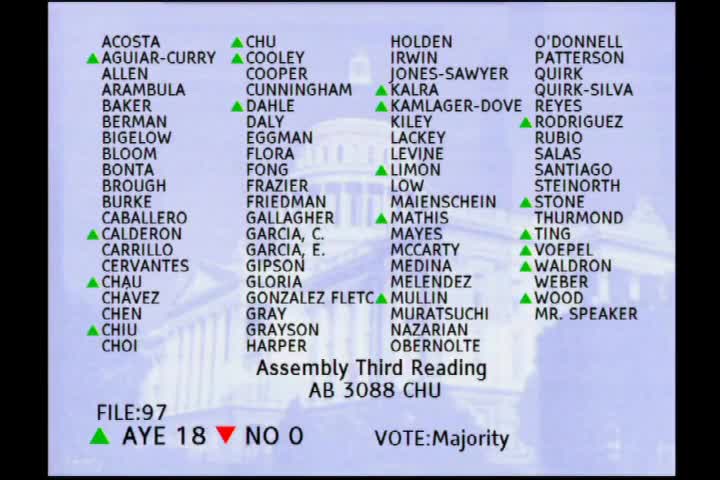 7MIN
Assembly Floor
 1MIN
Assembly Standing Committee on Appropriations
 5MIN
Assembly Standing Committee on Local Government
 6MIN
Assembly Standing Committee on Natural Resources
Bill Author

Bill Co-Author(s):