AB 3233: Pupil assessment: grade II: reported as local academic indicator.
- Session Year: 2017-2018
- House: Assembly
- Latest Version Date: 2018-07-05
Existing law establishes a system of public elementary and secondary education in this state, through which local educational agencies throughout the state provide instruction in kindergarten and grades 1 to 12, inclusive, at the schools they operate. Existing law establishes the California Assessment of Student Performance and Progress (CAASPP) as the statewide system of pupil assessments, under which various assessments are required or authorized to be administered in public schools, as specified. Existing law requires, on or before October 1, 2016, the State Board of Education to adopt evaluation rubrics for specified purposes. Pursuant to this requirement, the state board adopted evaluation rubrics in September 2016 and created the California School Dashboard, which is a graphically presented, publicly accessible interface that displays school performance data based on the evaluation rubrics.
This bill would require grade 11 performance standards for the academic indicator on the California School Dashboard to incorporate results from specified assessments. The bill would further provide that, if administered to all grade 11 pupils within a local educational agency, assessments that meet specified federal requirements may be reported on the California School Dashboard as a local academic indicator.
Existing law establishes a system of public elementary and secondary education in this state, through which local educational agencies throughout the state provide instruction in kindergarten and grades 1 to 12, inclusive, at the schools they operate. Existing law establishes the California Assessment of Student Performance and Progress (CAASPP) as the statewide system of pupil assessments, under which various assessments are required or authorized to be administered in public schools, as specified. Existing law requires, on or before October 1, 2016, the State Board of Education to adopt evaluation rubrics for specified purposes. Pursuant to this requirement, the state board adopted evaluation rubrics in September 2016 and created the California School Dashboard, which is a graphically presented, publicly accessible interface that displays school performance data based on the evaluation rubrics.
This bill would require the Superintendent of Public Instruction to recommend, and the state board to adopt, grade 11 performance standards for the academic indicator on evaluation rubrics and the California School Dashboard based on summative results from pupil assessments on English language arts and mathematics for grades 3 to 8, inclusive, and grade 11, that measure content standards adopted by the state board. The bill would further require that grade 11 performance standards for the academic indicator on evaluation rubrics and the California School Dashboards to incorporate results from specified assessments. The bill would further provide that, if administered to all grade 11 pupils within a local educational agency, assessments that meet specified federal requirements may be reported on the California School Dashboard as a local academic indicator.
Existing law establishes a system of public elementary and secondary education in this state, through which local educational agencies throughout the state provide instruction in kindergarten and grades 1 to 12, inclusive, at the schools they operate. Existing law establishes the California Assessment of Student Performance and Progress (CAASPP) as the statewide system of pupil assessments, under which various assessments are required or authorized to be administered in public schools, as specified. Existing law requires, on or before October 1, 2016, the State Board of Education to adopt evaluation rubrics for specified purposes. Pursuant to this requirement, the state board adopted evaluation rubrics in September 2016 and created the California School Dashboard, which is a graphically presented, publicly accessible interface that displays school performance data based on the evaluation rubrics.
This bill would require the Superintendent of Public Instruction to recommend, and the state board to adopt, performance standards for the academic indicator on evaluation rubrics and the California School Dashboard based on summative results from pupil assessments on English language arts and mathematics for grades 3 to 8, inclusive, and grade 11, that measure content standards adopted by the state board. The bill would further require that grade 11 performance standards for the academic indicator on evaluation rubrics and the California School Dashboards incorporate results from specified assessments.
Existing law establishes the State Board of Education, consisting of 10 members, who are appointed by the Governor with the advice and consent of 2/3 of the Senate, and requires the Governor to appoint an additional student member to the state board pursuant to a specified selection process. Existing law requires, as part of that selection process, the state board, by December 31 of each year, to select 3 finalists for the Governors consideration and rank the finalists according to its preference.This bill would instead require the state board to select 3 finalists for the Governors consideration and rank the finalists according to its preference by December 15 of each year.The bill would also make nonsubstantive changes.Existing law establishes the State Board of Education, consisting of 10 members, who are appointed by the Governor with the advice and consent of 2/3 of the Senate, and requires the Governor to appoint an additional student member to the state board pursuant to a specified selection process. Existing law requires, as part of that selection process, the state board, by December 31 of each year, to select 3 finalists for the Governors consideration and rank the finalists according to its preference.
This bill would instead require the state board to select 3 finalists for the Governors consideration and rank the finalists according to its preference by December 15 of each year.
The bill would also make nonsubstantive changes.
Grade 11 performance standards for the academic indicator on the California School Dashboard adopted pursuant to Section 52064.5 shall incorporate results from summative assessments administered pursuant to paragraph (1) of subdivision (b) of Section 60640. If administered to all grade 11 pupils within a local educational agency, assessments that meet federal requirements under Section 1111(b)(2)(H) of the federal Elementary and Secondary Education Act (20 U.S.C. Sec. 6301 et seq.) seq.), as amended by the federal Every Student Succeeds Act (Public Law 114-95), may be reported on the California School Dashboard as a local academic indicator.
Grade 11 performance standards for the academic indicator on evaluation rubrics and the California School Dashboard adopted pursuant to Section 52064.5 shall incorporate results from summative assessments administered pursuant to paragraph (1) of subdivision (b) of Section 60640, and if applicable and 60640. If administered to all grade 11 pupils within a local educational agency, assessments that meet federal requirements under Section 1111(b)(2)(H) of the federal Elementary and Secondary Education Act (20 U.S.C. Sec. 6301 et seq.) as amended by the federal Every Student Succeeds Act (Public Law 114-95). 114-95), may be reported on the California School Dashboard as a local academic indicator.
(a)The Superintendent shall recommend, and the state board shall adopt, performance standards for the academic indicator on evaluation rubrics and the California School Dashboard based on summative results from pupil assessments on English language arts and mathematics for grades 3 to 8, inclusive, and grade 11, that measure content standards adopted by the state board.
(b)Grade 11 performance standards for the academic indicator on evaluation rubrics and the California School Dashboard shall incorporate results from summative assessments administered pursuant to paragraph (1) of subdivision (b) of Section 60640, and if applicable and administered to all grade 11 pupils within a local educational agency, assessments that meet federal requirements under Section 1111(b)(2)(H) of the federal Elementary and Secondary Education Act (20 U.S.C. Sec. 6301 et seq.) as amended by the federal Every Student Succeeds Act (Public Law 114-95).
SECTION 1.Section 33000.5 of the Education Code is amended to read:33000.5.(a)Notwithstanding Sections 33000 and 33001, the Governor shall also appoint a student member to the state board, with the advice and consent of two-thirds of the Senate.(b)The term of office of the student member is one year, and shall begin on August 1. An individual may serve only one term as a student member.(c)Notwithstanding Section 1020 of the Government Code, the student member shall be, at the time the student members one-year term commences, a student enrolled in good standing in grade 12 in a public high school. The student member shall be selected from the three students recommended by the state board pursuant to paragraph (5) of subdivision (d). The student member shall be a voting member with the full rights and duties of the other 10 members of the state board.(d)The process for selecting the student member shall be as follows:(1)The state board shall notify every school district governing board, district superintendent, high school principal, high school student activities director, and student body president by September 15 of each year that applications are being accepted for the student members position.(2)Applications for the student members position shall be submitted to the state board no later than October 31 of each year.(3)A screening committee of the state board shall select 12 semifinalists for the student members position.(4)The school district governing board student members shall select six candidates from the 12 semifinalists.(5)The state board shall, by December 15 of each year, select three finalists for the Governors consideration and shall rank the finalists according to its preference.(e)Nothing in this section shall be construed to require the governing board of a school district that maintains a high school to grant voting rights to a student member serving on the school district governing board.(a)Notwithstanding Sections 33000 and 33001, the Governor shall also appoint a student member to the State Board of Education, state board, with the advice and consent of two-thirds of the Senate.
(b)Notwithstanding subdivisions (c) and (d) the incumbent student member on January 1, 1984, shall be eligible for appointment by the Governor subject to the advice and consent of two-thirds of the Senate.(c)(b)The term of office of the student member is one year, and shall begin on August 1. An individual may serve only one term as a student member.
(d)(c)Notwithstanding Section 1020 of the Government Code, the student member shall be, at the time the student members one-year term commences, a student enrolled in good standing in grade 12 in a public high school. The student member shall be selected from the three students recommended by the State Board of Education state board pursuant to paragraph (5) of subdivision (e). (d). The student member shall be a voting member with the full rights and duties of the other 10 members of the state board.
(e)(d)The process for selecting the student member shall be as follows:
(1)The State Board of Education state board shall notify every school district governing board, district superintendent, high school principal, high school student activities director, and student body president by September 15 of each year that applications are being accepted for the student members position.
(2)Applications for the student members position shall be submitted to the State Board of Education state board no later than October 31 of each year.
(3)A screening committee of the State Board of Education state board shall select 12 semifinalists for the student members position.
(4)The school district governing board student members shall select six candidates from the 12 semifinalists.
(5)The State Board of Education state board shall, by December 31 15 of each year, select three finalists for the Governors consideration and shall rank the finalists according to their its preference.
(f)(e)Nothing in this section shall be construed to require the governing board of a school district which that maintains a high school to grant voting rights to a student member serving on the school district governing board.
|
Date
|
Status
|
|---|---|
| Aug 16, 2018 | In committee: Held under submission. |
| Aug 6, 2018 | In committee: Referred to APPR. suspense file. |
| Jul 5, 2018 | Read second time and amended. Re-referred to Com. on APPR. |
| Jul 3, 2018 | From committee: Amend, and do pass as amended and re-refer to Com. on APPR. with recommendation: To Consent Calendar. (Ayes 7. Noes 0.) (June 27). |
| Jun 18, 2018 | In committee: Set, first hearing. Hearing canceled at the request of author. |
| Jun 13, 2018 | Referred to Com. on ED. |
| May 31, 2018 | In Senate. Read first time. To Com. on RLS. for assignment. |
| May 30, 2018 | Read third time. Passed. Ordered to the Senate. |
| May 25, 2018 | From committee: Do pass. (Ayes 16. Noes 0.) (May 25). |
| May 16, 2018 | In committee: Set, first hearing. Referred to APPR. suspense file. |
| May 2, 2018 | Re-referred to Com. on APPR. |
| May 1, 2018 | Read second time and amended. |
| Apr 30, 2018 | From committee: Amend, and do pass as amended and re-refer to Com. on APPR. with recommendation: To Consent Calendar. (Ayes 7. Noes 0.) (April 25). |
| Apr 18, 2018 | Re-referred to Com. on ED. |
| Apr 17, 2018 | From committee chair, with author's amendments: Amend, and re-refer to Com. on ED. Read second time and amended. |
| Mar 12, 2018 | Referred to Com. on ED. |
| Feb 17, 2018 | From printer. May be heard in committee March 19. |
| Feb 16, 2018 | Read first time. To print. |
|
Date
|
Description
|
Location
|
Votes
|
|
|---|---|---|---|---|
| Aug 6, 2018 | Placed on suspense file | Senate Standing Committee on Appropriations |
Passed |
|
| Jun 27, 2018 | Do pass as amended, but first amend, and re-refer to the Committee on [Appropriations] with the recommendation: To Consent Calendar | Senate Standing Committee on Education |
Passed |
|
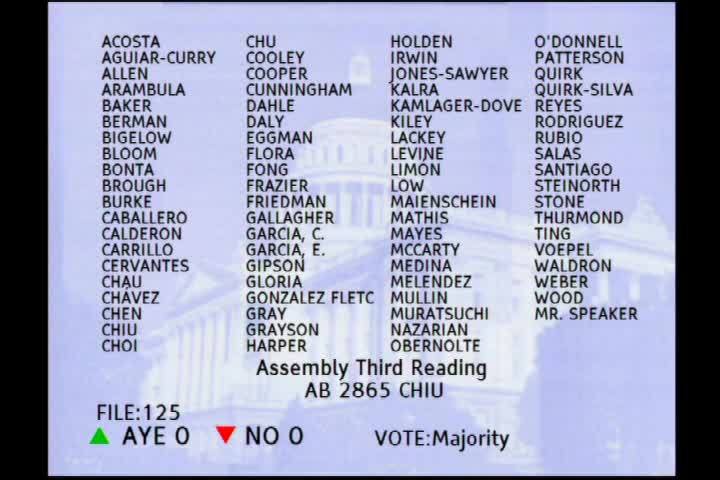
| May 30, 2018 | AB 3233 KILEY Assembly Third Reading | Assembly Floor |
Passed |
|
| May 25, 2018 | Do pass. | Assembly Standing Committee on Appropriations |
Passed |
|
| Apr 25, 2018 | Do pass as amended, and be re-referred to the Committee on [Appropriations] with recommendation: To Consent Calendar | Assembly Standing Committee on Education |
Passed |
This list shows positions taken on this bill by organizations on the date displayed, which is linked to the original source.
Positions by individuals are not included.
|
Organization
|
Position
|
Date
|
|---|---|---|
| Edvoice | ** Support | Jun 26, 2018 |
SENATE COMMITTEE ON APPROPRIATIONS
Senator Anthony Portantino, Chair
2017 - 2018 Regular Session
AB 3233 (Kiley) - Pupil assessment: grade II: reported as local academic indicator
Version: July 5, 2018 | Policy Vote: ED. 7 - 0 |
Urgency: No | Mandate: No |
Hearing Date: August 6, 2018 | Consultant: Lenin Del Castillo |
This bill meets the criteria for referral to the Suspense File.
Bill Summary:
This bill authorizes a local education agency (LEA) that administers a nationally recognized high school assessment that meets specified federal requirements to all students in grade 11 to report those assessments on the California School Dashboard as a local academic indicator.
Fiscal Impact: This bill could lead to cost pressure for the state to go through the Federal Peer Review process to determine that a nationally recognized high school assessment (e.g. the SAT or ACT) meets federal requirements.
The California Department of Education (CDE) estimates that the associated ongoing General Fund costs would be approximately $543,000 beginning in the 2019-20 fiscal year, $893,000 in 2020-21, and up to $1.3 million in 2021-22 for two assessments. These costs also assume workload to redesign and analyze the state’s existing accountability system to integrate the new assessments.
Background:
Existing law establishes the California Assessment of Student Performance and Progress (CAASPP), which consists of the following assessments:
- The Smarter Balanced Assessments Consortium (SBAC), which assesses English language arts and mathematics.
- The California Alternative Assessment, which may be administered only to special education students as required by their Individualized Education Program.
- The California Science Tests, which will be field tested in the spring on 2018.
Existing law requires the SBAC to be administered in grades 3 through 8, inclusive, and grade 11. Its assessment system is aligned to the Common Core State Standards, which serve as the basis for California’s academic content standards. The SBAC is a computer-assisted assessment in English and language arts and mathematics that is administered in grades 3 through 8, inclusive, and grade 11, and is untimed, with an average of 7.5 hours to complete the exam. All LEAs are required to administer the SBAC assessments to all students except those who opt out (as permitted by existing state law) and special education students who qualify for an alternative assessment.
The SBAC’s summative assessments “determine students’ progress toward college and career readiness in English language arts/literacy and math. These are given at the end of the school year and consist of two parts: a computer adaptive test and a performance task.
The SAT and ACT are commonly administered college admissions exams. The SAT includes a Reading Test, Writing and Language Test, and a Math Test. There is also an option SAT Essay. According to the College Board, “In the Reading Test, students will encounter questions like those asked in a lively, thoughtful, evidence-based discussion.” The Reading Test measures command of evidence, words in context, and analysis in History/Social Studies and in Science. The Writing and Language Test asks students “to be an editor and improve passages that were written especially for the test—and that include deliberate errors.” The Writing and Language Test also measures command of evidence, words in context, and analysis in History/Social Studies and in Science. Finally, the Math Test “covers a range of math practices, with an emphasis on problem solving, modeling, using tools strategically, and using algebraic structure.” The Math Test measures fluency, conceptual understanding, and applications. The redesigned SAT Essay “asks you to use your reading, analysis, and writing skills.” The SAT is a timed, paper exam.
The ACT Exam test scores reflect what students have learned throughout high school and provide colleges and universities with excellent information for recruiting, advising, placement, and retention.” The ACT contains four multiple-choice tests—English, mathematics, reading, and science—and an optional writing test. According to ACT, “these tests are designed to measure skills that are most important for success in postsecondary education and that are acquired in secondary education. The ACT English test measures understanding of the conventions of standard English, production of writing, and knowledge of language. The ACT mathematics test assesses the skills students typically acquire in courses taken through grade 11.
The ACT reading test measures reading comprehension. The ACT science test measures the interpretation, analysis, evaluation, reasoning, and problem-solving skills required in the natural sciences. The optional ACT writing test is an essay test that measures writing skills taught in high school English classes and entry level college composition courses.” The ACT is a timed, paper exam.
Proposed Law:
This bill authorizes a local education agency that administers a nationally recognized high school assessment that meets specified federal requirements to all students in grade 11 to report those assessments on the California School Dashboard as a local academic indicator.
Related Legislation:
AB 1951 (O’Donnell, 2018) requires the Superintendent of Public Instruction to approve one or more nationally recognized high school assessments that a LEA may, at its own discretion, administer in lieu of the grade 11 SBAC, commencing with the 2019-20 school year. AB 1951 is also scheduled to be heard by this Committee on August 6, 2018.
-- END --
SENATE COMMITTEE ON EDUCATION
Senator Benjamin Allen, Chair
2017 - 2018 Regular
Bill No: Hearing Date: June 27, 2018
Author: | Kiley | ||
Version: |
| ||
Urgency: | Fiscal: | ||
Consultant: | |||
Subject:
SUMMARY
This bill requires grade 11 performance standards for the academic indicator on the California School Dashboard to incorporate results from the Smarter Balanced Summative Assessment (SBAC), and authorizes a local education agency that administers a nationally recognized high school assessment that meets specified federal requirements to all students in grade 11 to report those assessments on the California School Dashboard as a local academic indicator.
BACKGROUND
Existing law:
1) Establishes the California Assessment of Student Performance and Progress, which consists of the following assessments:
a) The SBAC in English language arts and mathematics for grades 3 to 8, inclusive, and grade 11 that measures content standards adopted by the State Board of Education (SBE).
b) The California Alternative Assessment, which may be administered only to special education students as required by their Individualized Education Program.
c) The California Science Tests, which will be field tested in the spring of 2018. (Education Code § 60640)
2) Requires the SBE to adopt evaluation rubrics, by October 1, 2016, for all of the following purposes:
a) To assist a school district, county office of education or charter school in evaluating its strengths, weaknesses, and areas that require improvement.
b) To assist a county superintendent of schools in identifying school districts and charter schools in need of technical assistance, and the specific priorities upon which the technical assistance should be focused.
c) To assist the Superintendent of Public Instruction in identifying school districts for which intervention is warranted. (EC § 52064.5)
3) Requires the evaluation rubrics to reflect a holistic, multidimensional assessment of school districts and individual schoolsite performance and include all of the state priorities. Existing law requires, as part of the evaluation rubrics, the State Board of Education to adopt standards for school district and individual schoolsite performance and expectations for improvement in regard to each of the state priorities. (EC § 52064.5)
ANALYSIS
This bill requires grade 11 performance standards for the academic indicator on the California School Dashboard to incorporate results from the Smarter Balanced Summative Assessment (SBAC), and authorizes a local education agency (LEA) that administers a nationally recognized high school assessment that meets specified federal requirements to all students in grade 11 to report those assessments on the California School Dashboard as a local academic indicator.
STAFF COMMENTS
1) Need for the bill. According to the author, “California is failing many of our students that are most in need. Only 18% of low-income 4th graders are proficient in math and only 31% of these students are proficient in English across all grade levels. The achievement gap endures, with over 1.2 million disadvantaged African American and Latino students in California below grade level in math, a number greater than total enrollment in 39 other states. When it comes to college and career readiness, over 70% of California high school graduates will need remedial help in Math and English.
The California School Dashboard was created to update and improve transparency and school accountability of public schools across the state. Providing as much information as possible about the school assessments will give parents the ability to make the most informed decision for their child.”
2) SBAC and Accountability. SBAC scores are used as part of the state's accountability system, in particular the school dashboard, which uses SBAC scores along with other state and local performance measures to evaluate school and district performance. According to the California Department of Education, “he Academic Indicator is based on the results of the SBAC for English language arts/literacy (ELA) and mathematics results and applies only to LEAs and schools with grades three through eight. Performance will be calculated and reported separately for ELA and mathematics. At the January 2017 SBE meeting, the SBE approved the "Distance from Level 3 (DF3)" methodology which measures how far (or the distance) each student is from the Level 3 (i.e., Standard Met) Smarter Balanced performance level. Each student’s score is compared to Level 3, and all distance results are then averaged to produce a school- and student-group-level average scale score. The results will show, on average, the needed improvement to bring the average student score to Level 3 or the extent to which the average student score meets or exceeds Level 3. Using scale scores, rather than a percentage of students performing at or above Standard Met, provides a more comprehensive picture of how all students at the school are performing on the Smarter Balanced assessments.”
Importantly, the grade 11 Smarter Balanced Summative Assessment (SBAC) score is not included in the Academic Indicator at this point in time. Instead, it is used as a component of the College and Career Indicator. However, in April the State Board of Education (SBE), in an effort to gain federal approval for the state plan for purposes of the federal Every Student Succeeds Act, amended and resubmitted that state plan to include Grade 11 SBAC as part of the Academic Indicator. The U.S. Department of Education has still not approved the state plan, but grade 11 SBAC results would be included in the Academic indicator for English language arts and math for the 2018 Dashboard, unless the SBE elects to use this indicator only for school identification under the Every Student Succeeds Act (ESSA).
This bill strips the SBE of that authority and disrupts the state’s negotiations with the U.S. Department of Education regarding our state plan by requiring grade 11 SBAC scores to be incorporated into the academic indicator on the California School Dashboard. Accordingly, staff recommends that the bill amended to delete this provision.
3) Nationally recognized high school assessment requirements. Federal law, the ESSA, authorizes states to approve a nationally recognized high school assessment that local education agencies (LEAs) may administer in lieu of the existing state-wide assessment (which is the Smarter Balanced Assessment for California), provided the alternative assessment meets or exceeds strict requirements. Federal regulations define "nationally recognized high school assessment" to mean "an assessment of high school students' knowledge and skills that is administered in multiple States and is recognized by institutions of higher education in those or other States for the purposes of entrance or placement into courses in postsecondary education or training programs." The SAT and ACT are common examples of a nationally recognized high school assessment, though they would be required to meet the federal requirements.
This bill would allow a local education agency that offers an assessment pursuant to those provisions and that meets the federal requirements, as outlined below, to include those results on the California School Dashboard as a local indicator if it administers the assessment to all grade 11 students. The federal requirements require that the assessment:
- Is aligned with the state academic standards.
- Addresses the depth and breadth of those standards.
- Is equivalent to or more rigorous than the stateside assessment it is replacing in terms of the following:
- The coverage of academic content;
- The difficulty of the assessment;
- The overall quality of the assessment; and
- And other aspects of the assessment that the state may establish
- Meets all federal requirements that apply to the statewide assessment.
- Produces valid and reliable data on student academic achievement with respect to all high school students and each subgroup on high school students in the local education agency (LEA) that:
- Are comparable to achievement data produced by the statewide assessment (i.e., Smarter Balanced Summative Assessment (SBAC));
- Are expressed in terms consistent with the states academic achievement standards; and
- Provide unbiased, rational, and consistent differentiation among schools within the state for the purpose of the state accountability system.
In addition, the LEA must also notify all parents of high school students it serves:
- That the LEA intends to use an alternative assessment in place of the SBAC in grade 11;
- How parents and, as appropriate, students may provide meaningful input regarding the LEAs request; and
- Of any effect of such a request on the LEA's instructional program.
4) Related legislation. AB 1951 (O’Donnell, 2018) requires the Superintendent of Public Instruction (SPI) to approve, by an unspecified date, one or more nationally recognized high school assessments that a LEA may, at its own discretion, administer in lieu of the grade 11 SBAC, commencing with the 2019-20 school year. AB 1951 is pending in the Senate Appropriations Committee.
SUPPORT
EdVoice
OPPOSITION
None received
-- END --
ASSEMBLY THIRD READING
ATR Bill Id:AB 3233
Author:(Kiley)
As Amended Ver:May 1, 2018
Majority vote
Committee | Votes | Ayes | Noes |
Education | 7-0 | O'Donnell, Kiley, Kalra, McCarty, Steinorth, Thurmond, Weber | |
Appropriations | 16-0 | Gonzalez Fletcher, Bigelow, Bloom, Bonta, Calderon, Carrillo, Chau, Eggman, Fong, Friedman, Gallagher, Eduardo Garcia, Nazarian, Obernolte, Quirk, Reyes |
|
SUMMARY: Allows certain grade 11 standardized assessment scores to be reported in the California School Dashboard as a local academic indicator if all grade 11 pupils take the assessment.
FISCAL EFFECT: According to the Assembly Appropriations Committee:
- One-time Proposition 98 of 1988 (General Fund) GF costs, likely in the tens of thousands of dollars, to the San Joaquin county office of education, which maintains the School Dashboard, to update the dashboard to include a local indicator for grade 11 assessments.
- One-time GF costs of about $100,000 for the California Department of Education (CDE) to hire one personnel year to update Local Control and Accountability Plan (LCAP) materials for schools, provide guidance to on the new local indicator, develop self-reflection tools, field questions, and update the state's LCAP template.
COMMENTS:
Background. Schools are required to write strategic plans known as LCAPs to describe how they will support student achievement in eight state priority areas, including student engagement, parental engagement, and academic achievement. Student data reflecting outcomes in these priority areas is collected annually and publically displayed on the School Dashboard website for accountability purposes. The website displays statewide indicators, such as absenteeism, graduation, college and career readiness, and academic achievement, as measured by student scores on the Smarter Balanced Assessment Consortium (SBAC) standardized assessment. In addition to statewide indicators, schools can upload local indicators to the dashboard. These local indicators are 1) basic services and conditions, b) implementation of state academic priorities, c) parent engagement, d) school climate, e) coordination of services for expelled youth, and f) coordination of services for foster youth.
This bill allows school districts to include student scores on certain other assessments as a local indicator on the Dashboard, provided all grade 11 students at a school take the chosen assessment. (These assessments would most likely be the SAT or ACT.)
Related Legislation. AB 1951 (O'Donnell) of the current legislative session, which is pending in the Assembly, requires the CDE to approve a nationally recognized high school assessment (such as the SAT or ACT) that districts may administer in lieu of the SBAC in grade 11, provided the assessment meets specified state and federal requirements.
Analysis Prepared by: Rick Pratt / ED. / (916) 319-2087 FN: 0003203
Date of Hearing: May 16, 2018
ASSEMBLY COMMITTEE ON APPROPRIATIONS
Lorena Gonzalez Fletcher, Chair
ABPCA Bill Id:AB 3233
Author:(Kiley) – As Amended Ver:May 1, 2018
Policy Committee: | Education | Vote: | 7 - 0 |
|
|
Urgency: No State Mandated Local Program: No Reimbursable: No
SUMMARY: This bill allows certain grade 11 assessments to be reported in the California School Dashboard as a local academic indicator if all grade 11 pupils take the assessment.
FISCAL EFFECT:
- One-time Proposition 98 GF costs, likely in the tens of thousands of dollars, to the San Joaquin county office of education, which maintains the School Dashboard, to update the dashboard to include a local indicator for grade 11 assessments.
- One-time GF costs of about $100,000 for the California Department of Education (CDE) to hire one PY to update Local Control and Accountability Plan (LCAP) materials for schools, provide guidance to on the new local indicator, develop self-reflection tools, field questions, and update the state’s LCAP template.
COMMENTS:
- Background. Schools are required to write strategic plans known as LCAPs to describe how they will support student achievement in eight state priority areas, including student engagement, parental engagement, and academic achievement. Student data reflecting outcomes in these priority areas is collected annually and publically displayed on the School Dashboard website for accountability purposes. The website displays statewide indicators, such as absenteeism, graduation, college and career readiness, and academic achievement, as measured by student scores on the Smarter Balanced Assessment Consortium (SBAC) standardized assessment. In addition to statewide indicators, schools can upload local indicators to the dashboard. These local indicators are a) basic services and conditions, b) implementation of state academic priorities, c) parent engagement, d) school climate, e) coordination of services for expelled youth, and f) coordination of services for foster youth.
This bill would allow school districts to include student scores on certain other assessments as a local indicator on the Dashboard, provided all grade 11 students at a school take the chosen assessment. (These assessments would most likely be the SAT or ACT.)
- Related Legislation. AB 1951 (O'Donnell), of this session, requires CDE to approve a nationally recognized high school assessment (such as the SAT or ACT) that districts may administer in lieu of the SBAC in grade 11, provided the assessment meets specified state and federal requirements. The bill is pending on this committee’s suspense file.
Analysis Prepared by: Natasha Collins / APPR. / (916) 319-2081
Date of Hearing: April 25, 2018
ASSEMBLY COMMITTEE ON EDUCATION
Patrick O'Donnell, Chair
ABPCA Bill Id:AB 3233 (
Author:Kiley) – As Amended Ver:April 17, 2018
SUBJECT: Pupil assessment: performance standards
SUMMARY: Requires the Superintendent of Public Instruction (SPI) to recommend and the State Board of Education (SBE) to adopt, performance standards for the academic indicator on evaluation rubrics and the California School Dashboard based on summative results from pupil assessments on English language arts and mathematics for grades 3 to 8, inclusive, and grade 11, that measure content standards adopted by the state board. Also requires the grade performance standards for the academic indicator on evaluation rubrics and the California School Dashboard to incorporate results from summative assessments administered pursuant to the California Assessment of Student Performance and Progress (CAASPP) program and, if applicable and administered to all grade 11 pupils within a local educational agency, assessments that meet federal requirements under the Every Student Succeeds Act (ESSA).
EXISTING LAW:
- Establishes the California Assessment of Student Performance and Progress (CAASPP), which consists of the following assessments:
- The SBAC, which assesses English language arts and mathematics;
- The California Alternative Assessment, which may be administered only to special education students as required by their Individualized Education Program.
- The California Science Tests, which will be field tested in the spring on 2018.
- Requires the SBAC to be administered in grades 3 through 8, inclusive, and grade 11.
- Requires the SBE to adopt evaluation rubrics for all of the following purposes:
- To assist a school district, county office of education, or charter school in evaluating its strengths, weaknesses, and areas that require improvement
- To assist a county superintendent of schools in identifying school districts and charter schools in need of technical assistance and the specific priorities upon which the technical assistance should be focused; and
- To assist the SPI in identifying school districts for which intervention is warranted.
- Requires the evaluation rubrics to reflect a holistic, multidimensional assessment of school district and individual schoolsite performance and shall include all of the state priorities established for Local Control and Accountability Plans (LCAPs).
- Requires the SBE to adopt standards for school district and individual schoolsite performance and expectations for improvement in regard to each of the state LCAP priorities.
FISCAL EFFECT: Unknown
COMMENTS: This bill has two components. First, it requires the SPI to recommend and the SBE to adopt performance standards based on summative SBAC assessments for the academic indicator on the evaluation rubrics (now referred to at the California School Dashboard). Because this is already required by existing law and the SBE has already adopted performance standards, staff recommends that the bill be amended to delete this requirement.
In addition, this bill adds an additional academic indicator to the Dashboard for grade 11. Currently, the grade 11 academic indicator includes results from CAASPP assessments. This bill adds scores from the SAT or ACT as a required indicator if either of those tests is administered to all pupils in grade 11.
The current Dashboard academic indicators are state indicators, meaning the data are collected by the state to be reported in school and school district Dashboards. The decision to administer the SAT or ACT is a local decision, and those scores are not reported to the state.
Unintended consequences. Requiring districts to report SAT/ACT scores if they have them could have negative consequences for students. A struggling district may want to administer the SAT/ACT to all of its 10th and/or 11th graders. Because the district is struggling, it knows the scores won’t be good, but it's trying to encourage students who would not otherwise think about college to begin seeing it as an option. It's trying to instill a college-going mindset by changing the district culture. And it doesn't have to worry about low scores reflecting negatively on its Dashboard, because they will be used only for internal evaluation and accountability. But if it is forced to publicly report the scores, and if they are used as a state indicator, then that could be a disincentive to offer the SAT/ACT to all students. In this way, what we would be doing for public, statewide accountability could have negative consequences for the very students we’re trying to help. Low income students could lose the opportunity to take the test at all.
Technical difficulties. There are also technical and fairness problems. SBAC scores are not reported on the Dashboard as scores, so neither would SAT/ACT scores, if used as a state indicator. Instead, scores are used to determine the percentage of students who meet or exceed specific performance benchmarks. If SAT/ACT scores were to be used as a state indicator for academic performance, then the SAT/ACT scores would be blended in with the SBAC scores to make that determination. But not all districts would be administering the SAT/ACT. Right now, the Dashboard has an apples-to-apples comparison among districts (with the SBAC being the apples). Under this proposal, some districts would add oranges to their baskets in the form of SAT/ACT scores. Therefore, for accountability purposes, we would be comparing the all-apples baskets of some districts with apples-plus-oranges baskets of other districts, which would not be a fair or accurate comparison. For these reasons, staff recommends that the bill be amended to give districts the option of reporting SAT/ACT scores as an additional local indicator for academic achievement.
Related legislation. AB 1951 (O'Donnell) requires the SPI to approve a nationally recognized high school assessment (such as the SAT or ACT) that districts may administer in lieu of the SBAC in grade 11, provided the assessment meets specified state and federal requirements.
REGISTERED SUPPORT / OPPOSITION:
Support
EdVoice
Opposition
None received
Analysis Prepared by: Rick Pratt / ED. / (916) 319-2087
Discussed in Hearing
View Older Hearings
Bill Author

Bill Co-Author(s):