HR 39
- Session Year: 2017-2018
- House: Assembly
- Latest Version Date: 2017-05-09
WHEREAS, Mildred and Richard Loving were an interracial couple who were married in Washington, D.C., in 1958, but were banned from marrying in their home state of Virginia, where interracial marriage was illegal at the time; and
WHEREAS, The Lovings eventually challenged this ruling; their case was eventually taken up by the American Civil Liberties Union and went through many levels of the justice system before the United States Supreme Court unanimously decided in 1967 that the Lovings marriage should be upheld in all states; and
WHEREAS, At the time of the Loving decision, 16 states had laws banning interracial marriage and the Loving decision made it illegal for these states to enforce those laws; and
WHEREAS, Loving Day was founded in 2004, and has since garnered support from thousands of people domestically and internationally, and from organizations and publications; and
WHEREAS, Loving Day celebrations aim to create a common connection between multicultural communities, groups, and individuals; and
WHEREAS, Loving Days mission is to fight racial prejudice, promote tolerance, awareness, and understanding through education, and foster supportive multicultural communities; and
WHEREAS, Loving Day seeks to commemorate and celebrate the United States Supreme Courts 1967 ruling, keeping its importance fresh in the minds of a generation that has grown up with interracial relationships being legal, as well as to explore issues facing couples currently in interracial relationships; and
WHEREAS, California has led the marriage equality movement, beginning 60 years ago, by striking down laws prohibiting marriage between interracial couples (Perez v. Sharp (1948) 32 Cal.2d 711); and
WHEREAS, The county clerk who denied Andrea Perez and Sylvester Davis a marriage license in 1947 applied Sections 60 and 69 of the Civil Code; and
WHEREAS, Section 69 of the Civil Code provided that no license may be issued authorizing the marriage of a white person with a Negro, mulatto, Mongolian or member of the Malay race; and
WHEREAS, On October 1, 1948, the California Supreme Court ruled in Andrea and Sylvesters favor by a 4-3 vote; and
WHEREAS, California became the first court in the 20th century to strike down an antimiscegenation law; and
WHEREAS, The California State Assembly has a history of supporting movements and legislation that celebrate the diversity and equality of all persons; and
WHEREAS, We are now moving forward in the 21st century as a multiracial and multicultural society and realize that we must find a common vision from our interwoven past to build a society free of racism for the benefit of our collective future; now, therefore, be it
Resolved by the Assembly of the State of California, That the Assembly designates Monday, June 12, 2017, as Loving Day, to be observed as the official commemoration of the landmark United States Supreme Court decision, Loving v. Virginia (1967) 388 U.S. 1, which legalized interracial marriage in the United States; and be it further
Resolved, That the Chief Clerk of the Assembly transmit copies of this resolution to the President and Vice President of the United States, to the Speaker and Minority Leader of the United States House of Representatives, to the Majority Leader and Minority Leader of the United States Senate, to each member of the California delegation to the United States Congress, and to the Governor of California.
|
Date
|
Status
|
|---|---|
| Jun 12, 2017 | Coauthors revised. |
| May 22, 2017 | Action rescinded whereby the resolution was adopted on May 18, 2017. |
| May 18, 2017 | Read. Adopted. (Ayes 69. Noes 0. Page 1622.). |
| May 16, 2017 | From committee: Be adopted. To Consent Calendar. (Ayes 10. Noes 0.) (May 16). |
| May 15, 2017 | Referred to Com. on JUD. |
| May 9, 2017 | Introduced. |
|
Date
|
Description
|
Location
|
Votes
|
|
|---|---|---|---|---|
| May 18, 2017 | HR 39 MCCARTY Consent Calendar Second Day Regular Session | Assembly Floor |
Passed |
|
| May 16, 2017 | Be adopted. To Consent Calendar. | Assembly Standing Committee on Judiciary |
Passed |
This list shows positions taken on this bill by organizations on the date displayed, which is linked to the original source.
Positions by individuals are not included.
Date of Hearing: May 16, 2017
ASSEMBLY COMMITTEE ON JUDICIARY
Mark Stone, Chair
ABPCA Bill Id:HR 39
Author:(McCarty) – As Introduced Ver:May 9, 2017
PROPOSED CONSENT
SUBJECT: LOVING DAY
KEY ISSUE: IN HONOR OF THE 50TH ANNIVERSARY OF THE LANDMARK AND HISTORIC UNITED STATES SUPREME COURT DECISION, LOVING V. VIRGINIA, SHOULD THE LEGISLATURE COMMEMORATE JUNE 12TH, 2017 AS LOVING DAY?
SYNOPSIS
This resolution commemorates June 12th, 2017 as Loving Day, in honor of the 50th Anniversary of Loving v. Virginia, the landmark unanimous Supreme Court decision that struck down miscegenation laws and reinforced the holding that the right to marriage is a fundamental right under the United States Constitution. This resolution also makes several findings marking the celebration of Loving Day, and recognizes California’s place in history in advancing marriage equality.
SUMMARY: Designates June 12, 2017 as Loving Day to commemorate the landmark United States Supreme Court decision, Loving v. Virginia. Specifically, this resolution makes the following findings:
- Mildred and Richard Loving were an interracial couple who were married in Washington, D.C., in 1958, but were banned from marrying in their home state of Virginia, where interracial marriage was illegal at the time; and
- The Lovings eventually challenged this ruling; their case was eventually taken up by the American Civil Liberties Union and went through many levels of the justice system before the United States Supreme Court unanimously decided in 1967 that the Lovings’ marriage should be upheld in all states; and
- At the time of the Loving decision, 16 states had laws banning interracial marriage and the Loving decision made it illegal for these states to enforce those laws; and
- Loving Day was founded in 2004, and has since garnered support from thousands of people domestically and internationally, and from organizations and publications; and
- Loving Day celebrations aim to create a common connection between multicultural communities, groups, and individuals; and
- Loving Day’s mission is to fight racial prejudice, promote tolerance, awareness, and understanding through education, and foster supportive multicultural communities; and
- Loving Day seeks to commemorate and celebrate the United States Supreme Court’s 1967 ruling, keeping its importance fresh in the minds of a generation that has grown up with interracial relationships being legal, as well as to explore issues facing couples currently in interracial relationships; and
- California has led the marriage equality movement, beginning 60 years ago, by striking down laws prohibiting marriage between interracial couples (Perez v. Sharp (1948) 32 Cal.2d 711); and
- The county clerk who denied Andrea Perez and Sylvester Davis a marriage license in 1947 applied Sections 60 and 69 of the Civil Code; and
- Section 69 of the Civil Code provided that “no license may be issued authorizing the marriage of a white person with a Negro, mulatto, Mongolian or member of the Malay race”; and
- On October 1, 1948, the California Supreme Court ruled in Andrea and Sylvester’s favor by a 4-3 vote; and
- California became the first court in the 20th century to strike down an anti-miscegenation law; and
- The California State Assembly has a history of supporting movements and legislation that celebrate the diversity and equality of all persons; and
- We are now moving forward in the 21st century as a multiracial and multicultural society and realize that we must find a common vision from our interwoven past to build a society free of racism for the benefit of our collective future.
EXISTING LAW:
- Establishes that no state shall make or enforce any law which shall abridge the privileges or immunities of citizens of the United States; nor shall any state deprive any person of life, liberty, or property, without due process of law; nor deny to any person within its jurisdiction the equal protection of the laws. (U.S. Const., 14th Amend.)
- Holds that the fundamental right to marriage is protected by the United States Constitution. (Obergefell v. Hodges (2015) 135 S. Ct. 2584, 2598; Zablocki v. Redhail (1978) 434 U.S. 374, 384; Loving v. Virginia (1967) 388 U.S. 1, 12; Griswold v. Connecticut (1965) 381 U.S. 479; Skinner v. Oklahoma (1942) 316 U.S. 535; Meyer v. Nebraska (1923) 262 U.S. 290; Maynard v. Hill (1888) 125 U.S. 190.)
FISCAL EFFECT: As currently in print this measure is keyed non-fiscal.
COMMENTS: Mildred and Richard Loving never set out to make history. Indeed, Mildred Loving simply saw herself “as an ordinary black woman who fell in love with an ordinary white man.” (Pratt, Crossing the Color Line: A Historical Assessment and Personal Narrative of Loving v. Virginia (1998) 41 How. L.J. 229, 244.) Fifty years later, their ordinary love story (propelled by their extraordinary courage) continues to shape American jurisprudence. This resolution honors the Loving’s story, and their case that reached the Supreme Court.
Their story. In 1958, Mildred Jeter and Richard Loving fell in love in a rural Caroline County, Virginia. Sure, Mildred admits that she didn’t like Richard at first—he was arrogant, she said—but eventually, they started to date and started talking about marriage. But their union was a crime in the State of Virginia (in addition to 23 other states). Mildred—who was part black and part Cherokee, and Richard—who was white—weren’t allowed to marry under Virginia’s 1924 “Racial Integrity Act”. [In fact, it appears that Virginia was one of the first colonies to have unwritten miscegenation prohibitions (sometimes known as “anti-miscegenation laws). (Kreis, Symposium: Marriage Demosprudence (2016) 16 U. Ill. L. Rev. 1679, 1684).] By the early 20th century, of the 48 contiguous states, only seven states didn’t have a miscegenation law. (Ibid.) While these racist laws remained in place, it wasn’t until 1948, when California’s miscegenation statute that prohibited marriage between a white person and “negroes, Mongolians, members of the Malay race, or mulattoes” was invalidated by Perez v. Lippold (1948) 32 Cal.2d 711, that California became the first state in the nation to hold that such laws were unconstitutional.
The Lovings were married in Washington D.C., even though Virginia also made it a crime for interracial couples to evade the state’s miscegenation law by marrying in another state with the intent of returning to Virginia. (Loving v. Virginia (1967) 388 U.S. 1, 4.) Several weeks after their marriage, in the middle of the night, county law enforcement officers barged into their bedroom and arrested the couple. The couple were hauled to jail, pled guilty, and eventually were sentenced to serve one-year terms in the state prison. Their sentences, however, were suspended upon their agreement to leave Virginia and never return together. They agreed to the exile, and moved to Washington, D.C. But the Lovings never adapted to city life. (The Loving Story (Augusta Films 2011).) They missed their families back in Virginia, and their kids didn’t have enough room to play outside; indeed, one of their kids was hit by a car in the city. (Ibid.) They sought legal advice and eventually contacted the American Civil Liberties Union (ACLU) to take on their case so they could return to the State of Virginia.
When the ACLU filed their first motion in state court to set aside the Lovings’ sentence, Judge Bazile denied the ACLU’s petition, citing the following: “Almighty God created the races white, black, yellow, malay and red, and he placed them on separate continents. And but for the interference with his arrangement, there would be no cause for such marriages. The fact that he separated the races shows that he did not intend for the races to mix.” (Loving, supra, 388 U.S. at 2.) Evidently, the ACLU appealed, and eventually the Lovings’ case found its way to the United States Supreme Court where they would rightfully prevail.
Their case. In Loving v. Virginia, the Supreme Court of the United States unanimously struck down Virginia’s miscegenation laws, holding that the Virginia statutes violated the Due Process Clause and the Equal Protection Clause of Fourteenth Amendment. (Id. at 12.) In the court’s opinion, Chief Justice Warren stated the following:
Marriage is one of the “basic civil rights of man,” fundamental to our very existence and survival. To deny this fundamental freedom on so unsupportable a basis as the racial classifications embodied in these statutes, classifications so directly subversive of the principle of equality at the heart of the Fourteenth Amendment, is surely to deprive all the State's citizens of liberty without due process of law. The Fourteenth Amendment requires that the freedom of choice to marry not be restricted by invidious racial discriminations. Under our Constitution, the freedom to marry, or not marry, a person of another race resides with the individual and cannot be infringed by the State. [Citations omitted].
After Loving, states stopped enforcing their miscegenation laws, but it wasn’t until 2000 that Alabama became the last state in the nation to remove its miscegenation law from its books. (The Loving Story (Augusta Films 2011).)
Their impact. The Loving decision was not only a landmark civil rights case, but was also an important case in advancing marriage equality under the law. Indeed, recent decisions on marriage equality have relied on the holding and reasoning in Loving to overturn other state-bans on the right to marry. (See Obergefell v. Hodges (2015) 135 S. Ct. 2584.)
This resolution honors the 50th anniversary of the landmark United States Supreme Court decision, Loving v. Virginia, and Mildred and Richard Loving. After their case ended, the Lovings moved back to Virginia. Sadly, eight years after their court victory, Richard Loving was killed in a car accident. Mildred lived the rest of her life in the home that Richard built for her in Virginia. Although Mildred tried to stay out of the limelight, she has (in rare moments) reflected about her place in history. Before her death in 2008, she said this:
All we ever wanted was to get married, because we loved each other….I married the only man I had ever loved, and I’m happy for the time we had together. For me, that was enough. (Pratt, supra, 41 How. L.J. at 244.)
Author’s statement. In support of this resolution, the author writes:
Loving Day recognizes two major events in this nation’s history. First, this resolution will recognize California’s history of leading the equality movement. California became one of the first states in the United States to prohibit anti-miscegenation laws. Second, this resolution will commemorate what is currently referred to as “Loving Day,” a celebration of the United States Supreme Court 1967 ruling which banned states from enforcing state anti-miscegenation laws. Loving Day’s promotes tolerance, fosters supportive multicultural communities, and fights racial prejudice.
REGISTERED SUPPORT / OPPOSITION:
Support
None on file
Opposition
None on file
Analysis Prepared by: Eric Dang / JUD. / (916) 319-2334
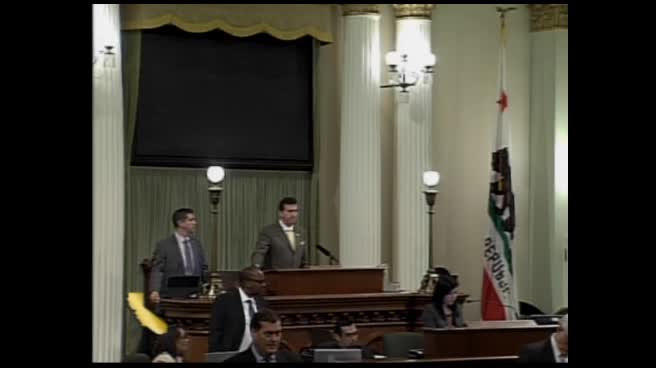
Bill Author

Bill Co-Author(s):