HR 6
- Session Year: 2017-2018
- House: Assembly
- Latest Version Date: 2017-01-09
WHEREAS, January 22, 2017, marks the 44th anniversary of the United States Supreme Courts landmark decision in Roe v. Wade, which affirmed that every woman has a fundamental right to control her own reproductive decisions and to decide whether to end or to continue pregnancy, and is an occasion deserving of celebration; and
WHEREAS, Roe v. Wade has been the cornerstone of womens ability to control their reproductive lives, allowing every woman in America the right to decide when, if, and with whom to have children, and how many children to have; and
WHEREAS, Womens ability to control their reproductive lives has helped and facilitated their participation in the economic and social life of our nation; and
WHEREAS, Roe v. Wade has drastically reduced the maternal mortality rate for women terminating their pregnancies in the United States. In the years prior to the decision, illegal abortion accounted for approximately 17 percent of all reported deaths attributable to pregnancy and childbirth, and many women were severely injured as a result of back alley abortion procedures; and
WHEREAS, Interference with a womans right to choose causes women to be forced into illegal and dangerous abortions, as they often were in the United States before the Roe v. Wade decision. Many women are forced to make these decisions today in countries where abortion is illegal and where the unsafe methods of illegal abortion lead to 13 percent of global maternal deaths annually, or 8 maternal deaths every hour. Many survivors of an illegal abortion suffer serious and often permanent injuries; and
WHEREAS, Roe v. Wade continues to protect the health and freedom of women throughout the United States; and
WHEREAS, The State of California stands in strong support of every womans fundamental right, as confirmed in Roe v. Wade, to make her own decisions regarding her pregnancy; now, therefore, be it
Resolved by the Assembly of the State of California, That the Assembly urges the President of the United States and the United States Congress to express their support for a womans fundamental right to control her own reproductive decisions, as well as their support for access to comprehensive reproductive health care, including the services provided by Planned Parenthood; and be it further
Resolved, That the Chief Clerk of the Assembly transmit copies of this resolution to the President and Vice President of the United States, to the Speaker of the House of Representatives, to the Majority Leader of the Senate, to each Senator and Representative from California in the Congress of the United States, and to the author for appropriate distribution.
|
Date
|
Status
|
|---|---|
| Jan 30, 2017 | Coauthors revised. |
| Jan 26, 2017 | From committee: Be adopted. Ordered to Third Reading. (Ayes 8. Noes 0.) (January 26). |
| Jan 23, 2017 | Referred to Com. on JUD. |
| Jan 9, 2017 | Introduced. |
|
Date
|
Description
|
Location
|
Votes
|
|
|---|---|---|---|---|
| Jan 30, 2017 | HR 6 BURKE Assembly Third Reading | Assembly Floor |
Passed |
|
| Jan 26, 2017 | Be adopted. To third reading. | Assembly Standing Committee on Judiciary |
Passed |
This list shows positions taken on this bill by organizations on the date displayed, which is linked to the original source.
Positions by individuals are not included.
|
Organization
|
Position
|
Date
|
|---|---|---|
| American Federation of State, County and Municipal Employees | ** Support | Jan 25, 2017 |
| Marin County | * Support | Jan 26, 2017 |
| Planned Parenthood Affiliates Of California | * Support | Jan 26, 2017 |
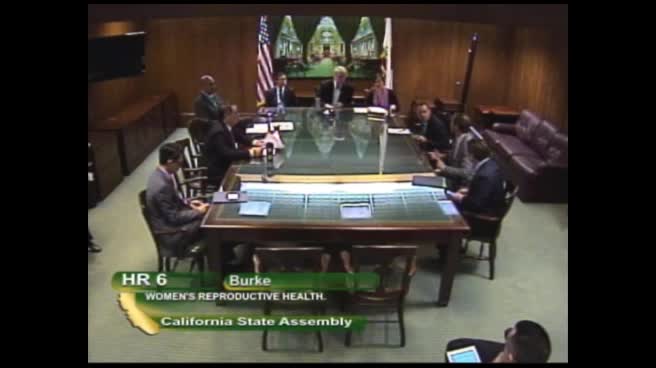
Date of Hearing: January 26, 2017
ASSEMBLY COMMITTEE ON JUDICIARY
Mark Stone, Chair
ABPCA Bill Id:HR 6
Author:(Burke) – As Introduced Ver:January 9, 2017
SUBJECT: WOMEN'S REPRODUCTIVE HEALTH
KEY ISSUE: IN HONOR OF THE 44TH ANNIVERSARY OF THE LANDMARK AND HISTORIC UNITED STATES SUPREME COURT DECISION, ROE V. WADE, SHOULD THE LEGISLATURE URGE THE PRESIDENT AND CONGRESS OF THE UNITED STATES TO SUPPORT A WOMAN’S FUNDAMENTAL RIGHT TO CONTROL HER OWN REPRODUCTIVE DECISIONS?
SYNOPSIS
This resolution, similar to others passed by this Committee in recent years, urges the President and Congress of the United States to express their support for a woman’s fundamental right to control her own reproductive decisions, and to support access to comprehensive reproductive health care, including care provided by Planned Parenthood. This resolution also makes findings regarding the importance of Roe v. Wade, makes findings about the importance of reproductive rights, and reaffirms California’s strong support of a woman’s right to choose.
SUMMARY: Urges the President of the United States and the United States Congress to express their support for a woman’s fundamental right to control her own reproductive decisions, as well as their support for access to comprehensive reproductive health care, including the services provided by Planned Parenthood. Specifically, this resolution makes the following findings:
- January 22, 2017, marks the 44th anniversary of the United States Supreme Court’s landmark decision in Roe v. Wade, which affirmed that every woman has a fundamental right to control her own reproductive decisions and to decide whether to end or continue pregnancy, and is an occasion deserving of celebration.
- Roe v. Wade has been the cornerstone of women’s ability to control their reproductive lives, allowing every woman in America the right to decide when, if, and with whom to have children, and how many children to have.
- Women’s ability to control their reproductive lives has helped and facilitated their participation in the economic and social life of our nation.
- Roe v. Wade has drastically reduced the maternal mortality rate for women terminating their pregnancies in the United States. In the years prior to the decision, illegal abortion accounted for approximately 17 percent of all reported deaths attributable to pregnancy and childbirth, and many women were severely injured as a result of “back alley” abortion procedures.
- Interference with a woman’s right to choose causes women to be forced into illegal and dangerous abortions, as they often were in the United States before the Roe v. Wade decision. Many women are forced to make these decisions today in countries where abortion is illegal and where the unsafe methods of illegal abortion lead to 13 percent of global maternal deaths annually, or 8 maternal deaths every hour. Many survivors of illegal abortion suffer serious and often permanent injuries.
- Roe v. Wade continues to protect the health and freedom of women throughout the United States.
- The State of California stands in strong support of every woman’s fundamental right, as confirmed in Roe v. Wade, to make her own decisions regarding her pregnancy.
EXISTING LAW:
- Recognizes a right to privacy under the United States Constitution. (Boyd v. United States (1886) 116 U.S. 616; Meyer v. Nebraska (1923) 262 U.S. 390; Griswold v. Connecticut (1965) 381 U.S. 479; Lawrence v. Texas (2003) 539 U.S. 558.)
- Explicitly provides for the right to privacy under the California Constitution. (California Constitution, Article I, Section 1.)
- Holds that the constitutionally protected right to privacy limits a state’s power to restrict a woman’s fundamental right to terminate a pregnancy. (Roe v. Wade (1973) 410 U.S. 113.)
- Holds that if a law’s purpose or effect places a substantial obstacle in the path of a woman seeking a pre-viability abortion, the law is unconstitutional. (Planned Parenthood of Southeastern Pa. v. Casey (1992) 505 U.S. 833, 878; see also Whole Woman’s Health v. Hellerstedt (2016) 579 U.S. ___ [136 S.Ct. 2292, 2300].)
FISCAL EFFECT: As currently in print this resolution is keyed non-fiscal.
COMMENTS: This resolution honors the anniversary of the landmark United States Supreme Court decision, Roe v. Wade (1973) 410 U.S. 113. In Roe, the Supreme Court held that the constitutional right to privacy extends to a woman’s right to terminate her pregnancy and that some state regulation of access to abortion is permissible. There, “Jane Roe” wanted to end her pregnancy under safe and clinical conditions but could not obtain an abortion under Texas law unless her life was threatened by continuation of her pregnancy. Unable to travel to another state for the procedure, she challenged the Texas criminal statute, arguing that the law abridged her right of personal privacy. The Supreme Court struck down the Texas statute, and held that the constitutional right to privacy “is broad enough to encompass a woman’s decision whether or not to terminate her pregnancy.” (Id. at 155.)
Roe v. Wade is a natural extension of the constitutional principles under the right to privacy. The United States Supreme Court has long recognized the constitutional protection of the right of privacy. (See, e.g., Boyd v. United States (1886) 116 U.S. 616.) That privacy right has been extended to marital, sexual, and familial matters. (See, e.g., Meyer v. Nebraska (1923) 262 U.S. 390; Griswold v. Connecticut (1965) 381 U.S. 479; Lawrence v. Texas (2003) 539 U.S. 558.) In Roe v. Wade, the Court held that the right to privacy also extends to a woman’s decision whether to terminate a pregnancy. At the same time, the Court provided two state interests that are sufficiently compelling to justify restrictions on a woman’s right to choose to terminate a pregnancy: (1) a state may regulate the abortion procedure after the first trimester of pregnancy in ways reasonably related to promote a woman’s health; and (2) after the point of fetal viability, a state may, to protect the potential life of the fetus, prohibit abortions that are not necessary to preserve a woman’s life or health.
Roe v. Wade has been the subject of much debate, both political and legal. Indeed, the application and validity of the decision has been frequently challenged in court. In 1992, in Planned Parenthood of Southeastern Pennsylvania v. Casey (1992) 505 U.S. 833, the Supreme Court reaffirmed Roe v. Wade and provided reasoning for once again upholding Roe:
[F]or two decades of economic and social developments, people have organized intimate relationships and made choices that define their views of themselves and their places in society, in reliance on the availability of abortion in the event that contraception should fail. The ability of women to participate equally in the economic and social life of the Nation has been facilitated by their ability to control their reproductive lives. The Constitution serves human values, and while the effect of reliance on Roe cannot be exactly measured, neither can the certain cost of overruling Roe for people who have ordered their thinking and living around that case be dismissed. (Casey at 856 [internal citations omitted].)
Research shows that Roe v. Wade has saved women’s lives. According to an article, “The Public Health Impact of Legal Abortion: 30 Years Later,” published by the Guttmacher Institute:
The number of abortion-related deaths per million live births fell from nearly 40 in 1970 to 8 in 1976. The trend was caused mainly by a decline in the absolute number of deaths from illegal abortion—especially after Roe v. Wade—from 39 in 1972 to two in 1976. After 1975, mortality due to legally induced abortion also fell—from more than three deaths per 100,000 abortions in 1975 to about one in 1976 and even fewer thereafter. (Cates et al., Comment: The Public Health Impact of Legal Abortion: 30 Years Later (January/February 2003) 35 Perspectives on Sexual and Reproductive Health 1.)
Indeed, between 1978 and 2010, the abortion-related mortality rate fell to less than 1 death per 100,000 abortions. (Centers for Disease Control and Prevention, Abortion Surveillance – United States, 2011 (November 28, 2014).)
Even in the face of these maternal mortality numbers, there have been efforts to restrict access to abortion and to limit a woman’s fundamental right to choose. In 2015, the U.S. House of Representatives passed House Resolution 3134, known as the Defund Planned Parenthood Act of 2015, to prohibit Planned Parenthood and its clinics from receiving any federal funds unless it stopped providing abortions (even though existing law already prohibited the use of federal funds to pay for abortion services). In 2015, the state of Texas enacted House Bill 2, which, among other things, required abortion clinics to comply with standards set for ambulatory surgical centers—requirements that would have shut down 75% of the state’s health clinics and significantly limited access for women to clinics in rural areas. (Petition for a Writ of Certiorari at 1-8, Whole Woman’s Health v. Cole (5th Cir. 2015) 790 F.3d 563, No. 14-50928.) Ultimately, the Supreme Court struck down that Texas law, holding that the statute unduly burdened a woman’s fundamental right, and reaffirming the Court’s holdings in Roe and Casey. (Whole Woman’s Health v. Hellerstedt (2016) 579 U.S. ___ [136 S.Ct. 2292, 2300].)
The fundamental rights of women appear to be under attack. The Trump Administration has made no secret of its plans to limit a woman’s fundamental right to choose. In presidential debates and in a post-election interview, President Trump said he would appoint pro-life judges and that those appointments would “automatically” result in Roe v. Wade being overturned. (The 45th President (interview with Lesley Stahl) 60 Minutes (CBS television broadcast, Nov. 13, 2016); Commission on Presidential Debates (Oct. 19, 2016).) Within days of taking office, President Trump issued a Presidential Memorandum, reinstating the “Mexico City Policy." (Pres. Mem., The Mexico City Policy (January 23, 2017).) The policy requires foreign non-governmental organizations (NGOs) to certify that they will not “perform or actively promote abortion as a method of family planning,” using funds from any source (including non-U.S. funds), as a condition for receiving U.S. government global family planning assistance and, as of Jan. 23, 2017, any other U.S. global health assistance. (http://kff.org/global-health-policy/fact-sheet/mexico-city-policy-explainer/) While President Trump has not unequivocally said that he wants Roe v. Wade overturned, his position seems clear from his recent statements and actions.
Despite these efforts, California continues its long history of protecting the privacy rights of all Californians. Under California’s Constitution, the right to privacy is explicitly protected for all Californians: “All people are by nature free and independent and have inalienable rights. Among these are enjoying and defending life and liberty, acquiring, possessing, and protecting property, and pursuing and obtaining safety, happiness, and privacy.” (Article I, Section 1.) Indeed, this privacy right has been interpreted to provide greater protection of a woman’s right to choose than that provided under the federal Constitution. (American Academy of Pediatrics v. Lungren (1997) 16 Cal.4th 307, 327.) It’s not surprising then that the State of California co-authored an amicus brief with other states to support Whole Woman’s Health’s challenge to the Texas law in Whole Woman’s Health v. Hellerstedt, and continues to enact laws to ensure that women have access to comprehensive reproductive health care.
Consistent with California’s laws and policies, this resolution would convey to the President and the U.S. Congress that the California Legislature supports a woman’s fundamental right to control her own reproductive decisions and access to comprehensive reproductive health care, including services provided by Planned Parenthood, and therefore honors the landmark Supreme Court decision in Roe v. Wade.
In support of this resolution, the author provided the following statement:
At a time when these very protections are threatened, including access to comprehensive reproductive health care services for millions of women and families, it is of the utmost importance that we recognize and commemorate this significant Supreme Court decision. According to the Center for Reproductive Rights, if Roe v. Wade was overturned, over 37 million women in 33 states could be at-risk of losing their fundamental rights. HR 6 affirms that the State of California stands in strong support of the Roe v. Wade decision and a woman’s right to choose.
REGISTERED SUPPORT / OPPOSITION:
Support
American Federation of State, County and Municipal Employees
Planned Parenthood of California
Opposition
None on file
Analysis Prepared by: Eric Dang / JUD. /
Discussed in Hearing
View Older Hearings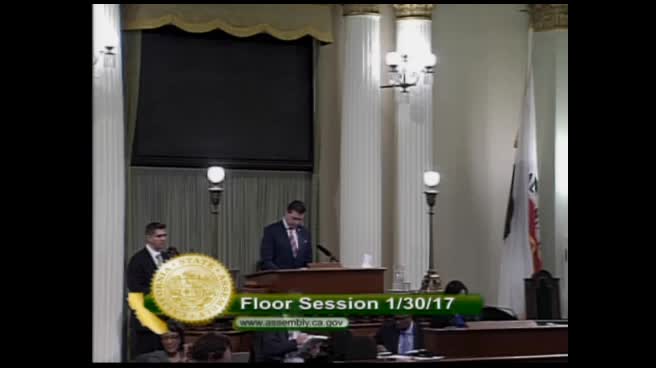


Bill Co-Author(s):