SB 827: San Francisco Bay Area Rapid Transit District: Office of the BART Inspector General.
- Session Year: 2023-2024
- House: Senate
- Latest Version Date: 2024-08-05
Current Status:
Failed
(2024-08-30: Ordered to inactive file on request of Assembly Member Aguiar-Curry.)
Introduced
In Committee
First Chamber
In Committee
Second Chamber
Enacted
What does this bill do?
The bill gives the Office of the BART Inspector General broader, independent authority to run audits and investigations, including wide access to district and contractor records, entry to facilities, and the power to issue subpoenas (formal orders to appear or hand over documents) in probes of nonemployee misconduct. It also requires the office to tell employees who have a union that they may have a union representative at investigatory interviews and to get a written waiver if the employee declines, and it keeps most investigatory files confidential while allowing the office to release findings when necessary.
The summary is provided by generative AI which can make mistakes. For original language, please view the details in the table below.
Existing law establishes the San Francisco Bay Area Rapid Transit District (BART), governed by a board of directors, with specified powers and duties relative to the construction and operation of a rapid transit system. Existing law also establishes the independent Office of the BART Inspector General within BART and specifies the duties and responsibilities of the BART Inspector General including, among others, conducting, supervising, and coordinating audits and investigations relating to the districts programs and operations. Existing law provides that any investigatory file compiled by the BART Inspector General is an investigatory file compiled by a local law enforcement agency subject to disclosure pursuant to provisions of the California Public Records Act applicable to law enforcement records.
This bill would provide that the BART Inspector General is vested with the full authority to exercise all responsibility for maintaining a full scope, independent, and objective audit and investigation program. The bill would provide the office with access and authority to examine all records, files, documents, accounts, reports, correspondence, or other property of the district and external entities that perform work for the district. The bill would provide that all books, papers, records, and correspondence of the office are public records subject to the California Public Records Act, but would prohibit the BART Inspector General office from releasing certain types of records to the public, except under certain circumstances. Before conducting any investigatory interview with an employee represented by an employee organization, the bill would require the office to notify the employee of certain rights including the right to be represented at the interview by a representative of the employee organization and would require the office to obtain a written waiver of that right of representation from the employee if the interview is conducted without a representative of the employee organization. The bill would authorize the BART Inspector General office to issue subpoenas for the attendance of subjects and witnesses and the production of records, files, documents, accounts, reports, correspondence, or other property, or for the making of oral or written sworn statements, in any interview conducted as part of an audit, investigation, or review. review relating to improper activities by a person or entity other than an employee of the district, as specified.
Existing constitutional provisions require that a statute that limits the right of access to the meetings of public bodies or the writings of public officials and agencies be adopted with findings demonstrating the interest protected by the limitation and the need for protecting that interest.
This bill would make legislative findings to that effect.
Existing law establishes the San Francisco Bay Area Rapid Transit District (BART), governed by a board of directors, with specified powers and duties relative to the construction and operation of a rapid transit system. Existing law also establishes the independent Office of the BART Inspector General within BART and specifies the duties and responsibilities of the BART Inspector General including, among others, conducting, supervising, and coordinating audits and investigations relating to the districts programs and operations.
This bill would provide that the BART Inspector General is vested with the full authority to exercise all responsibility for maintaining a full scope, independent, and objective audit and investigation program. The bill would provide the office with access and authority to examine all records, files, documents, accounts, reports, correspondence, or other property of the district and external entities that perform work for the district. The bill would provide that all books, papers, records, and correspondence of the office are public records subject to the California Public Records Act, but would prohibit the BART Inspector General from releasing certain types of records to the public, except under certain circumstances. The bill would authorize the BART Inspector General to issue subpoenas for the attendance of witnesses and the production of records, files, documents, accounts, reports, correspondence, or other property, or for the making of oral or written sworn statements, in any interview conducted as part of an audit, investigation, or review.
Existing constitutional provisions require that a statute that limits the right of access to the meetings of public bodies or the writings of public officials and agencies be adopted with findings demonstrating the interest protected by the limitation and the need for protecting that interest.
This bill would make legislative findings to that effect.
Existing law establishes the San Francisco Bay Area Rapid Transit District (BART), governed by a board of directors, with specified powers and duties relative to the construction and operation of a rapid transit system. Existing law also establishes the independent Office of the BART Inspector General within BART and specifies the duties and responsibilities of the BART Inspector General including, among others, conducting, supervising, and coordinating audits and investigations relating to the districts programs and operations.
This bill would provide that the BART Inspector General is vested with the full authority to exercise all responsibility for maintaining a full scope, independent, and objective audit and investigation program. The bill would provide the office with access and authority to examine all records, files, documents, accounts, reports, correspondence, or other property of the district and external entities that perform work for the district. The bill would provide that all books, papers, records, and correspondence of the office are public records subject to the California Public Records Act, but would prohibit the BART Inspector General from releasing certain types of records to the public, except under certain circumstances. The bill would also make it a crime to engage in specified activities with regard to an audit, evaluation, investigation, or review conducted pursuant to these provisions, as specified. Because the bill would create a new crime, the bill would impose a state-mandated local program.
Existing constitutional provisions require that a statute that limits the right of access to the meetings of public bodies or the writings of public officials and agencies be adopted with findings demonstrating the interest protected by the limitation and the need for protecting that interest.
This bill would make legislative findings to that effect.
The California Constitution requires the state to reimburse local agencies and school districts for certain costs mandated by the state. Statutory provisions establish procedures for making that reimbursement.This bill would provide that no reimbursement is required by this act for a specified reason.Existing law establishes the San Francisco Bay Area Rapid Transit District (BART), governed by a board of directors, with specified powers and duties relative to the construction and operation of a rapid transit system. Existing law also establishes the independent Office of the BART Inspector General within BART and specifies the duties and responsibilities of the BART Inspector General including, among others, conducting, supervising, and coordinating audits and investigations relating to the districts programs and operations.
This bill would provide that the BART Inspector General is vested with the full authority to exercise all responsibility for maintaining a full scope, independent, and objective audit and investigation program. The bill would provide the office with access and authority to examine all records, files, documents, accounts, reports, correspondence, or other property of the district and external entities that perform work for the district. The bill would provide that all books, papers, records, and correspondence of the office are public records subject to the California Public Records Act, but would prohibit the BART Inspector General from releasing certain types of records to the public, except under certain circumstances. The bill would also make it a crime to engage in specified activities with regard to an audit, evaluation, investigation, or review conducted pursuant to these provisions, as specified. Because the bill would create a new crime, the bill would impose a state-mandated local program.
Existing constitutional provisions require that a statute that limits the right of access to the meetings of public bodies or the writings of public officials and agencies be adopted with findings demonstrating the interest protected by the limitation and the need for protecting that interest.
This bill would make legislative findings to that effect.
The California Constitution requires the state to reimburse local agencies and school districts for certain costs mandated by the state. Statutory provisions establish procedures for making that reimbursement.
This bill would provide that no reimbursement is required by this act for a specified reason.
(a)There is hereby created in the district an independent Office of the BART Inspector General to ensure that the district makes effective use of bridge toll revenue and other revenue and operates efficiently, effectively, and in compliance with applicable federal and state laws.
(b)(1)The board shall nominate three persons to the Governor who shall appoint one of the three persons nominated by the board to serve as the BART Inspector General for an initial four-year term. The board shall have the option to renew the term at will. The BART Inspector General shall be removed from office by the board, subject to approval of the Governor, only if either of the following occur:
(A)A two-thirds majority of the members of the board votes for removal.
(B)The BART Inspector General violates a federal or state law or regulation, a local ordinance, or a policy or practice of the authority relative to ethical practices, including, but not limited to, the acceptance of gifts or contributions.
(2)The reasons for removal of the BART Inspector General shall be stated in writing and shall include the basis for removal. The document stating the reasons for dismissal shall be deemed a public document and posted on the districts internet website.
(c)The BART Inspector General is vested with the full authority to exercise all responsibility for maintaining a full scope, independent, and objective audit and investigation program, including, but not limited to, those activities described in paragraph (4) of subdivision (a) of Section 28841 and Section 28841.2.
SEC. 2.Section 28841 of the Public Utilities Code is amended to read:28841.(a)The duties and responsibilities of the BART Inspector General shall include, but are not limited to, all of the following:
(1)To examine the operating practices of the district to identify fraud, waste, and opportunities for efficiencies in the administration of programs and operations.
(2)To ensure the BART administration, the board of directors, and the public are fully informed of the Inspector Generals findings and recommendations.
(3)To identify opportunities to improve the data used to determine project resource allocations.
(4)To conduct, supervise, and coordinate audits and investigations relating to the districts programs and operations, including, but not limited to, toll-funded programs.
(5)To identify best practices in the delivery of capital projects and recommend policies to enable the district to adopt these practices when practicable.
(6)To recommend policies promoting efficiency in the administration of programs and operations.
(7)To review and recommend best practices that the district should follow to maintain positive and productive relations with its employees and the collective bargaining units representing those employees.
(b)(1)In carrying out the duties and responsibilities outlined in subdivision (a), the Office of the BART Inspector General shall not unduly interfere with the districts Office of Civil Rights Equal Employment Opportunity Unit or the Title VI/Environmental Justice Unit, or the powers and duties of the districts Office of the Independent Police Auditor outlined in Section 28767.8.
(2)The districts Office of Civil Rights and Office of the Independent Police Auditor shall not unduly interfere with the Office of the BART Inspector Generals duties and responsibilities outlined in subdivision (a).
SEC. 3.Section 28841.2 is added to the Public Utilities Code, to read:28841.2.(a)The Office of the BART Inspector General shall have access and authority to examine all records, files, documents, accounts, reports, correspondence, or other property of the district and external entities that perform work for the district. The Office of the BART Inspector General may enter any district office or facility and access, examine, and reproduce during regular business hours all records, files, documents, accounts, reports, vouchers, correspondence files, and all other records for any audit or investigation. Any officer or employee of the district or entity having these records or property in their possession, under their control, or otherwise having access to them, shall permit access to, and examination and reproduction thereof, upon the request of the BART Inspector General or the BART Inspector Generals authorized representative.
(b)(1)Before conducting any investigatory interview conducted with an employee represented by an employee organization, as defined in Section 28848, who is the subject of an investigation or may be subject to discipline or other adverse consequences as a result of the investigation, the Office of the BART Inspector General shall notify the employee that they are entitled to be accompanied represented at the interview by a representative of the employee organization and that the employee shall have all the rights afforded to them under all applicable labor laws, including, but not limited to, the rights provided pursuant to N.L.R.B. v. J. Weingarten, Inc., 420 U.S. 251 (1975). (1975), and all collectively bargained rights.
(2)If an employee elects to forego the right to be represented as specified in paragraph (1), the Office of the BART Inspector General shall obtain a written waiver of that right from the employee before conducting the interview and maintain the written waiver for at least two years after conducting the interview with the employee. The written waiver shall include a statement acknowledging receipt of a notification of the right to representation, followed by a statement affirmatively waiving that right.
(3)The Office of the BART Inspector General shall interact with any employee organization in a manner that is consistent with all applicable labor laws, including, but not limited to, N.L.R.B. v. J. Weingarten, Inc., 420 U.S. 251 (1975), and all collectively bargained rights.
(4)(A)In order to facilitate transparency and accountability but maintain the integrity and confidentiality of its investigatory files, the Office of the BART Inspector General shall maintain accurate records of all signed waivers and all documents related to its investigations.
(B)The Office of the BART Inspector General and impacted employee organizations shall collaborate to develop a standard waiver form to be used for purposes of paragraph (2) that includes a summary of applicable labor law and a represented employees contractual rights, and that includes the information required pursuant to paragraph (2).
(C)The BART Inspector General shall furnish, upon request of the employee, a copy of the signed waiver obtained pursuant to this subdivision to the employee and the represented employees employee organization.
(5)Except as provided in subparagraph (C) of paragraph (4), the Office of the BART Inspector General shall keep interview records confidential pursuant to Section 28844 and provide the appropriate board-appointed officer or the general manager, or designee of those persons, with interview summaries and information only as needed so that the board-appointed officer, general manager, or their designees may conduct investigations. This paragraph does not affect the requirement for the board-appointed officer or general manager to act in accordance with the applicable collective bargaining agreements and applicable laws.
(6)(A)(i)The Office of the BART Inspector General is under no obligation to alert or notice an employee organization if a represented employee freely and willingly initiates contact with the office for the purpose of whistleblowing.
(ii)Notwithstanding clause (i), the Office of the BART Inspector General shall provide the represented employee described in clause (i) with a written waiver described in paragraph (2).
(B)For purposes of this paragraph, whistleblowing means reporting waste, fraud, violations of law, or any health or safety threats to the Office of the BART Inspector General.
(7)If the Office of the BART Inspector General fails to obtain a valid waiver as specified in this subdivision before interviewing an employee without the presence of a representative of the applicable employee organization, any evidence obtained as a result of the interview with the employee, including, but not limited to, any evidence obtained from third parties who are interviewed as the result of the interview with the employee, shall not be admissible in a disciplinary action initiated against the employee.
(8)The responsibilities and duties required of the Office of the BART Inspector General in this subdivision shall apply to all employees, contractors, and officers of the Office of the BART Inspector General.
(9)The rights of employees afforded under this subdivision are not intended to obstruct or interfere with the independence of the Office of the BART Inspector General, the ability of the office to access documents and property that are necessary for investigations, or carry out any other duties or authority provided to the office pursuant to this article.
(10)For purposes of this subdivision, employee organization has the same meaning as defined in Section 28848.
SEC. 4.Section 28841.4 is added to the Public Utilities Code, to read:28841.4.(a)The Office of the BART Inspector General may gain access to confidential records or property that are obtained in connection with any audit, evaluation, investigation, or review conducted pursuant to Section 28841.2 unless a law specifically refers to and precludes the BART Inspector General from accessing, examining, and reproducing any record or property pursuant to Section 28841.2. Information or documents obtained in connection with any audit, evaluation, investigation, or review conducted by the Office of the BART Inspector General are subject to any limitations on release of the information or documents as may apply to an employee or officer of the district or external entity subject to this article that provided the information or documents. Providing confidential information pursuant to this section, including, but not limited to, confidential information that is subject to a privilege, shall not constitute a waiver of that privilege.
(b)For purposes of this section, confidential records or property means records or property that may lawfully be kept confidential as a result of a statutory or common law privilege or any other law.
(c)The Office of the BART Inspector General shall not destroy any papers or memoranda used to support a completed audit sooner than three years after the audit report is released to the public. All books, papers, records, and correspondence of the office pertaining to its work are public records subject to Division 10 (commencing with Section 7920.000) of Title 1 of the Government Code and shall be filed at any of the regularly maintained offices of the Office of the BART Inspector General, except that none of the following items or papers of which these items are a part shall be released to the public by the Office of the BART Inspector General or the employees of the Office of the BART Inspector General:
(1)Personal papers and correspondence of any person providing assistance to the Office of the BART Inspector General when that person has requested in writing that their papers and correspondence be kept private and confidential. Those papers and correspondence shall become public records if the written request is withdrawn, or upon the order of the Office of the BART Inspector General.
(2)Papers, correspondence, memoranda, or any substantive information pertaining to any audit not completed.
(3)Papers, correspondence, or memoranda pertaining to any audit that has been completed, which papers, correspondence, or memoranda are not used in support of any report resulting from the audit.
(4)Any information within a survey of public employees that the Office of the BART Inspector General determines should be kept confidential to deter retaliation if the public employees respond to the survey. because the information reasonably could lead to either identification of an individual employee or retaliation against an employee if the information were released.
(5)Any record of an investigation, including, but not limited to, all investigative files and work product, as provided in Section 28844, except that the Office of the BART Inspector General, whenever the BART Inspector General determines it necessary to serve the interests of the state, may issue a public report of an investigation that has substantiated an improper governmental activity, as defined in Section 8547.2 of the Government Code, keeping confidential the identity of the employee or employees involved. The Office of the BART Inspector General may also release any findings or evidence supporting any findings resulting from an investigation conducted pursuant to this article whenever the BART Inspector General determines it necessary to serve the interests of the state.
(d)(1)(A)The Office of the BART Inspector General, or their designee, may issue subpoenas for the attendance of subjects and witnesses and the production of records, files, documents, accounts, reports, correspondence, or other property, or for the making of oral or written sworn statements, in any interview conducted as part of an audit, investigation, or review. review relating to improper activities by a person or entity other than an employee of the district. Any subpoena issued under this article pursuant to this section may be served by any person authorized to serve process of any court of record or by any person designated for that purpose by the BART Inspector General or their designee.
(B)Before issuing a subpoena pursuant to subparagraph (A), the Office of the BART Inspector General shall, as applicable, first seek voluntary attendance of subjects and witnesses, the voluntary the production of records, files, documents, accounts, reports, correspondence, or other property, or the voluntary attendance for the making of oral or written sworn statements. When seeking the voluntary attendance of any employee represented by an employee organization, as defined in Section 28848, the Office of the BART Inspector General shall act in accordance with any collective bargaining agreements and applicable laws.
(2)The superior court in the county in which any interview is held under the direction of the BART Inspector General, or their designee, pursuant to duties authorized by this article, has jurisdiction to compel the attendance of subjects and witnesses, the making of oral or written sworn statements, and the production of records or other property, as required by any subpoena issued by the office. If any person refuses to attend, testify, or produce any records or property required by the subpoena, the BART Inspector General, or their designee, may petition the superior court in the county in which the hearing is pending for an order compelling the person to attend and answer questions under penalty of perjury or produce the records required by the subpoena.
(3)The rights of employees afforded under this subdivision are not intended to obstruct or interfere with the independence of the Office of the BART Inspector General, the ability of the office to access documents and property that are necessary for investigations, or carry out any other duties or authority provided to the office pursuant to this article.
SEC. 5.The Legislature finds and declares that Section Sections 3 and 4 of this act, which adds Section add Sections 28841.2 and 28841.4 to the Public Utilities Code, imposes a limitation on the publics right of access to the meetings of public bodies or the writings of public officials and agencies within the meaning of Section 3 of Article I of the California Constitution. Pursuant to that constitutional provision, the Legislature makes the following findings to demonstrate the interest protected by this limitation and the need for protecting that interest:
The need for the Office of the BART Inspector General to fully examine and evaluate records, files, documents, accounts, reports, correspondence, and all other property of the San Francisco Bay Area Rapid Transit District and external entities that perform work for the district outweighs the interest in public disclosure of information obtained by the Office of the BART Inspector General in connection with its activities.
(a)There is hereby created in the district an independent Office of the BART Inspector General to ensure that the district makes effective use of bridge toll revenue and other revenue and operates efficiently, effectively, and in compliance with applicable federal and state laws.
(b)(1)The board shall nominate three persons to the Governor who shall appoint one of the three persons nominated by the board to serve as the BART Inspector General for an initial four-year term. The board shall have the option to renew the term at will. The BART Inspector General shall be removed from office by the board, subject to approval of the Governor, only if either of the following occur:
(A)A two-thirds majority of the members of the board votes for removal.
(B)The BART Inspector General violates a federal or state law or regulation, a local ordinance, or a policy or practice of the authority relative to ethical practices, including, but not limited to, the acceptance of gifts or contributions.
(2)The reasons for removal of the BART Inspector General shall be stated in writing and shall include the basis for removal. The document stating the reasons for dismissal shall be deemed a public document and posted on the districts internet website.
(c)The BART Inspector General is vested with the full authority to exercise all responsibility for maintaining a full scope, independent, and objective audit and investigation program, including, but not limited to, those activities described in paragraph (4) of subdivision (d) (a) of Section 28841 and Section 28841.2.
SEC. 2.Section 28841 of the Public Utilities Code is amended to read:28841.(a)The duties and responsibilities of the BART Inspector General shall include, but are not limited to, all of the following:
(a)(1)To examine the operating practices of the district to identify fraud, waste, and opportunities for efficiencies in the administration of programs and operations.
(b)(2)To ensure the BART administration, the board of directors, and the public are fully informed of his or her the Inspector Generals findings and recommendations.
(c)(3)To identify opportunities to improve the data used to determine project resource allocations.
(d)(4)To conduct, supervise, and coordinate audits and investigations relating to the districts programs and operations, including, but not limited to, toll-funded programs.
(e)(5)To identify best practices in the delivery of capital projects and recommend policies to enable the district to adopt these practices when practicable.
(f)(6)To recommend policies promoting efficiency in the administration of programs and operations.
(g)(7)To review and recommend best practices that the district should follow to maintain positive and productive relations with its employees and the collective bargaining units representing those employees.
(b)(1)In carrying out the duties and responsibilities outlined in subdivision (a), the Office of the BART Inspector General shall not unduly interfere with the districts Office of Civil Rights Equal Employment Opportunity Unit or the Title VI/Environmental Justice Unit, or the powers and duties of the districts Office of the Independent Police Auditor outlined in Section 28767.8.
(2)The districts Office of Civil Rights and Office of the Independent Police Auditor shall not unduly interfere with the Office of the BART Inspector Generals duties and responsibilities outlined in subdivision (a).
SEC. 2.SEC. 3.Section 28841.2 is added to the Public Utilities Code, to read:28841.2.(a)The Office of the BART Inspector General shall have access and authority to examine all records, files, documents, accounts, reports, correspondence, or other property of the district and external entities that perform work for the district. The Office of the BART Inspector General may enter any district office or facility and access, examine, and reproduce during regular business hours all records, files, documents, accounts, reports, vouchers, correspondence files, and all other records for any audit or investigation. Any officer or employee of the district or entity having these records or property in their possession, under their control, or otherwise having access to them, shall permit access to, and examination and reproduction thereof, upon the request of the BART Inspector General or the BART Inspector Generals authorized representative.
(b)Before any interview conducted with an employee represented by an employee organization, as defined in Section 28848, who is the subject of an investigation or may be subject to discipline or other adverse consequences as a result of the investigation, the BART Inspector General shall notify the employee that they are entitled to be accompanied by a representative of the employee organization and that the employee shall have all the rights afforded to them under N.L.R.B. v. J. Weingarten, Inc., 420 U.S. 251 (1975).
SEC. 3.SEC. 4.Section 28841.4 is added to the Public Utilities Code, to read:28841.4.(a)The BART Inspector General may gain access to confidential records or property that are obtained in connection with any audit, evaluation, investigation, or review conducted pursuant to Section 28841.2 unless a law specifically refers to and precludes the BART Inspector General from accessing, examining, and reproducing any record or property pursuant to Section 28841.2. Information or documents obtained in connection with any audit, evaluation, investigation, or review conducted by the BART Inspector General are subject to any limitations on release of the information or documents as may apply to an employee or officer of the district or external entity subject to this article that provided the information or documents. Providing confidential information pursuant to this section, including, but not limited to, confidential information that is subject to a privilege, shall not constitute a waiver of that privilege.
(b)For purposes of this section, confidential records or property means records or property that may lawfully be kept confidential as a result of a statutory or common law privilege or any other law.
(c)The Office of the BART Inspector General shall not destroy any papers or memoranda used to support a completed audit sooner than three years after the audit report is released to the public. All books, papers, records, and correspondence of the office pertaining to its work are public records subject to Division 10 (commencing with Section 7920.000) of Title 1 of the Government Code and shall be filed at any of the regularly maintained offices of the BART Inspector General, except that none of the following items or papers of which these items are a part shall be released to the public by the BART Inspector General or the employees of the BART Inspector General:
(1)Personal papers and correspondence of any person providing assistance to the BART Inspector General when that person has requested in writing that their papers and correspondence be kept private and confidential. Those papers and correspondence shall become public records if the written request is withdrawn, or upon the order of the BART Inspector General.
(2)Papers, correspondence, memoranda, or any substantive information pertaining to any audit not completed.
(3)Papers, correspondence, or memoranda pertaining to any audit that has been completed, which papers, correspondence, or memoranda are not used in support of any report resulting from the audit.
(4)Any survey of public employees that the BART Inspector General determines should be kept confidential to deter retaliation if the public employees respond to the survey.
(5)Any record of an investigation, including, but not limited to, all investigative files and work product, except that the BART Inspector General, whenever the BART Inspector General determines it necessary to serve the interests of the state, may issue a public report of an investigation that has substantiated an improper governmental activity, as defined in Section 8547.2 of the Government Code, keeping confidential the identity of the employee or employees involved. The BART Inspector General may also release any findings or evidence supporting any findings resulting from an investigation conducted pursuant to this article whenever the BART Inspector General determines it necessary to serve the interests of the state.
(d)(1)The BART Inspector General, or their designee, may issue subpoenas for the attendance of witnesses and the production of records, files, documents, accounts, reports, correspondence, or other property, or for the making of oral or written sworn statements, in any interview conducted as part of an audit, investigation, or review. Any subpoena issued under this article may be served by any person authorized to serve process of any court of record or by any person designated for that purpose by the BART Inspector General or their designee.
(2)The superior court in the county in which any interview is held under the direction of the BART Inspector General, or their designee, pursuant to duties authorized by this article, has jurisdiction to compel the attendance of witnesses, the making of oral or written sworn statements, and the production of records or other property, as required by any subpoena issued by the office. If any person refuses to attend, testify, or produce any records or property required by the subpoena, the BART Inspector General, or their designee, may petition the superior court in the county in which the hearing is pending for an order compelling the person to attend and answer questions under penalty of perjury or produce the records required by the subpoena.
SEC. 4.SEC. 5.The Legislature finds and declares that Section 3 4 of this act, which adds Section 28841.4 to the Public Utilities Code, imposes a limitation on the publics right of access to the meetings of public bodies or the writings of public officials and agencies within the meaning of Section 3 of Article I of the California Constitution. Pursuant to that constitutional provision, the Legislature makes the following findings to demonstrate the interest protected by this limitation and the need for protecting that interest:
The need for the Office of the BART Inspector General to fully examine and evaluate records, files, documents, accounts, reports, correspondence, and all other property of the San Francisco Bay Area Rapid Transit District and external entities that perform work for the district outweighs the interest in public disclosure of information obtained by the Office of the BART Inspector General in connection with its activities.
(a)There is hereby created in the district an independent Office of the BART Inspector General to ensure that the district makes effective use of bridge toll revenue and other revenue and operates efficiently, effectively, and in compliance with applicable federal and state laws.
(b)(1)The board shall nominate three persons to the Governor who shall appoint one of the three persons nominated by the board to serve as the BART Inspector General for an initial four-year term. The board shall have the option to renew the term at will. The BART Inspector General shall be removed from office by the board, subject to approval of the Governor, only if either of the following occur:
(A)A two-thirds majority of the members of the board votes for removal.
(B)The BART Inspector General violates a federal or state law or regulation, a local ordinance, or a policy or practice of the authority relative to ethical practices, including, but not limited to, the acceptance of gifts or contributions.
(2)The reasons for removal of the BART Inspector General shall be stated in writing and shall include the basis for removal. The document stating the reasons for dismissal shall be deemed a public document and posted on the districts internet website.
(c)The BART Inspector General is vested with the full authority to exercise all responsibility for maintaining a full scope, independent, and objective audit and investigation program, including, but not limited to, those activities described in subdivision (d) of Section 28841 and Section 28841.2.
SEC. 2.Section 28841.2 is added to the Public Utilities Code, to read:28841.2.(a)The Office of the BART Inspector General shall have access and authority to examine all records, files, documents, accounts, reports, correspondence, or other property of the district and external entities that perform work for the district. The Office of the BART Inspector General may enter any district office or facility and access, examine, and reproduce during regular business hours all records, files, documents, accounts, reports, vouchers, correspondence files, and all other records for any audit or investigation. Any officer or employee of the district or entity having these records or property in their possession, under their control, or otherwise having access to them, shall permit access to, and examination and reproduction thereof, upon the request of the BART Inspector General or the BART Inspector Generals authorized representative.
(b)Before any interview conducted with an employee represented by an employee organization, as defined in Section 28848, who is the subject of an investigation or may be subject to discipline or other adverse consequences as a result of the investigation, the BART Inspector General shall notify the employee that they are entitled to be accompanied by a representative of the employee organization and that the employee shall have all the rights afforded to them under N.L.R.B. v. J. Weingarten, 420 U.S. 251 (1975).
SEC. 3.Section 28841.4 is added to the Public Utilities Code, to read:28841.4.(a)The BART Inspector General may gain access to confidential records or property that are obtained in connection with any audit, evaluation, investigation, or review conducted pursuant to Section 28841.2 unless a law specifically refers to and precludes the BART Inspector General from accessing, examining, and reproducing any record or property pursuant to Section 28841.2. Information or documents obtained in connection with any audit, evaluation, investigation, or review conducted by the BART Inspector General are subject to any limitations on release of the information or documents as may apply to an employee or officer of the district or external entity subject to this article that provided the information or documents. Providing confidential information pursuant to this section, including, but not limited to, confidential information that is subject to a privilege, shall not constitute a waiver of that privilege.
(b)For purposes of this section, confidential records or property means records or property that may lawfully be kept confidential as a result of a statutory or common law privilege or any other law.
(c)The Office of the BART Inspector General shall not destroy any papers or memoranda used to support a completed audit sooner than three years after the audit report is released to the public. All books, papers, records, and correspondence of the office pertaining to its work are public records subject to Division 10 (commencing with Section 7920.000) of Title 1 of the Government Code and shall be filed at any of the regularly maintained offices of the BART Inspector General, except that none of the following items or papers of which these items are a part shall be released to the public by the BART Inspector General or the employees of the BART Inspector General:
(1)Personal papers and correspondence of any person providing assistance to the BART Inspector General when that person has requested in writing that their papers and correspondence be kept private and confidential. Those papers and correspondence shall become public records if the written request is withdrawn, or upon the order of the BART Inspector General.
(2)Papers, correspondence, memoranda, or any substantive information pertaining to any audit not completed.
(3)Papers, correspondence, or memoranda pertaining to any audit that has been completed, which papers, correspondence, or memoranda are not used in support of any report resulting from the audit.
(4)Any survey of public employees that the BART Inspector General determines should be kept confidential to deter retaliation if the public employees respond to the survey.
(5)Any record of an investigation, including, but not limited to, all investigative files and work product, except that the BART Inspector General, whenever the BART Inspector General determines it necessary to serve the interests of the state, may issue a public report of an investigation that has substantiated an improper governmental activity, as defined in Section 8547.2 of the Government Code, keeping confidential the identity of the employee or employees involved. The BART Inspector General may also release any findings or evidence supporting any findings resulting from an investigation conducted pursuant to this article whenever the BART Inspector General determines it necessary to serve the interests of the state.
SEC. 4.Section 28841.6 is added to the Public Utilities Code, to read:28841.6.It is a misdemeanor, punishable by imprisonment in a county jail not exceeding six months, or by a fine not exceeding one thousand dollars ($1,000), or by both that imprisonment and fine, to do any of the following:(a)Fail or refuse to permit the examination of, access to, or reproduction of the records, files, documents, accounts, reports, correspondence, cash drawers, or cash of their office by the BART Inspector General or in any way interfere with such examination conducted pursuant to this article.(b)Interfere, intend to deceive or defraud, or obstruct the BART Inspector General in the performance of an audit, evaluation, investigation, or review pursuant to this article.(c)Manipulate, correct, alter, or change records, documents, accounts, reports, or correspondence before or during any audit, evaluation, investigation, or review conducted pursuant to this article.(d)Distribute, reproduce, release, or fail to safeguard confidential draft documents exchanged between the BART Inspector General and the entity subject to the audit, evaluation, investigation, or review conducted pursuant to this article before the release of the final report and without the BART Inspector Generals express permission.SEC. 5.SEC. 4.The Legislature finds and declares that Section 3 of this act, which adds Section 28841.4 to the Public Utilities Code, imposes a limitation on the publics right of access to the meetings of public bodies or the writings of public officials and agencies within the meaning of Section 3 of Article I of the California Constitution. Pursuant to that constitutional provision, the Legislature makes the following findings to demonstrate the interest protected by this limitation and the need for protecting that interest:
The need for the Office of the BART Inspector General to fully examine and evaluate records, files, documents, accounts, reports, correspondence, and all other property of the San Francisco Bay Area Rapid Transit District and external entities that perform work for the district outweighs the interest in public disclosure of information obtained by the Office of the BART Inspector General in connection with its activities.
SEC. 6.No reimbursement is required by this act pursuant to Section 6 of Article XIIIB of the California Constitution because the only costs that may be incurred by a local agency or school district will be incurred because this act creates a new crime or infraction, eliminates a crime or infraction, or changes the penalty for a crime or infraction, within the meaning of Section 17556 of the Government Code, or changes the definition of a crime within the meaning of Section 6 of Article XIIIB of the California Constitution.(a)There is hereby created in the district an independent Office of the BART Inspector General to ensure that the district makes effective use of bridge toll revenue and other revenue and operates efficiently, effectively, and in compliance with applicable federal and state laws.
(b)(1)The board shall nominate three persons to the Governor who shall appoint one of the three persons nominated by the board to serve as the BART Inspector General for an initial four-year term. The board shall have the option to renew the term at will. The BART Inspector General shall be removed from office by the board, subject to approval of the Governor, only if either of the following occur:
(A)A two-thirds majority of the members of the board votes for removal.
(B)The BART Inspector General violates a federal or state law or regulation, a local ordinance, or a policy or practice of the authority relative to ethical practices, including, but not limited to, the acceptance of gifts or contributions.
(2)The reasons for removal of the BART Inspector General shall be stated in writing and shall include the basis for removal. The document stating the reasons for dismissal shall be deemed a public document and posted on the districts Internet Web site. internet website.
(c)Within one year of the operative date of this article, the board shall nominate three persons to serve as the first BART Inspector General to be appointed pursuant to subdivision (b).(c)The BART Inspector General is vested with the full authority to exercise all responsibility for maintaining a full scope, independent, and objective audit and investigation program, including, but not limited to, those activities described in subdivision (d) of Section 28841 and Section 28841.2.
SEC. 2.Section 28841.2 is added to the Public Utilities Code, to read:28841.2.The Office of the BART Inspector General shall have access and authority to examine all records, files, documents, accounts, reports, correspondence, or other property of the district and external entities that perform work for the district. The Office of the BART Inspector General may enter any district office or facility and access, examine, and reproduce during regular business hours all records, files, documents, accounts, reports, vouchers, correspondence files, and all other records for any audit or investigation. Any officer or employee of the district or entity having these records or property in their possession, under their control, or otherwise having access to them, shall permit access to, and examination and reproduction thereof, upon the request of the BART Inspector General or the BART Inspector Generals authorized representative.
SEC. 3.Section 28841.4 is added to the Public Utilities Code, to read:28841.4.(a)The BART Inspector General may gain access to confidential records or property that are obtained in connection with any audit, evaluation, investigation, or review conducted pursuant to Section 28841.2 unless a law specifically refers to and precludes the BART Inspector General from accessing, examining, and reproducing any record or property pursuant to Section 28841.2. Information or documents obtained in connection with any audit, evaluation, investigation, or review conducted by the BART Inspector General are subject to any limitations on release of the information or documents as may apply to an employee or officer of the district or external entity subject to this article that provided the information or documents. Providing confidential information pursuant to this section, including, but not limited to, confidential information that is subject to a privilege, shall not constitute a waiver of that privilege.
(b)For purposes of this section, confidential records or property means records or property that may lawfully be kept confidential as a result of a statutory or common law privilege or any other law.
(c)The Office of the BART Inspector General shall not destroy any papers or memoranda used to support a completed audit sooner than three years after the audit report is released to the public. All books, papers, records, and correspondence of the office pertaining to its work are public records subject to Division 10 (commencing with Section 7920.000) of Title 1 of the Government Code and shall be filed at any of the regularly maintained offices of the BART Inspector General, except that none of the following items or papers of which these items are a part shall be released to the public by the BART Inspector General or the employees of the BART Inspector General:
(1)Personal papers and correspondence of any person providing assistance to the BART Inspector General when that person has requested in writing that their papers and correspondence be kept private and confidential. Those papers and correspondence shall become public records if the written request is withdrawn, or upon the order of the BART Inspector General.
(2)Papers, correspondence, memoranda, or any substantive information pertaining to any audit not completed.
(3)Papers, correspondence, or memoranda pertaining to any audit that has been completed, which papers, correspondence, or memoranda are not used in support of any report resulting from the audit.
(4)Any survey of public employees that the BART Inspector General determines should be kept confidential to deter retaliation if the public employees respond to the survey.
(5)Any record of an investigation, including, but not limited to, all investigative files and work product, except that the BART Inspector General, whenever the BART Inspector General determines it necessary to serve the interests of the state, may issue a public report of an investigation that has substantiated an improper governmental activity, as defined in Section 8547.2 of the Government Code, keeping confidential the identity of the employee or employees involved. The BART Inspector General may also release any findings or evidence supporting any findings resulting from an investigation conducted pursuant to this article whenever the BART Inspector General determines it necessary to serve the interests of the state.
SEC. 4.Section 28841.6 is added to the Public Utilities Code, to read:28841.6.It is a misdemeanor, punishable by imprisonment in a county jail not exceeding six months, or by a fine not exceeding one thousand dollars ($1,000), or by both that imprisonment and fine, to do any of the following:
(a)Fail or refuse to permit the examination of, access to, or reproduction of the records, files, documents, accounts, reports, correspondence, cash drawers, or cash of their office by the BART Inspector General or in any way interfere with such examination conducted pursuant to this article.
(b)Interfere, intend to deceive or defraud, or obstruct the BART Inspector General in the performance of an audit, evaluation, investigation, or review pursuant to this article.
(c)Manipulate, correct, alter, or change records, documents, accounts, reports, or correspondence before or during any audit, evaluation, investigation, or review conducted pursuant to this article.
(d)Distribute, reproduce, release, or fail to safeguard confidential draft documents exchanged between the BART Inspector General and the entity subject to the audit, evaluation, investigation, or review conducted pursuant to this article before the release of the final report and without the BART Inspector Generals express permission.
SEC. 5.The Legislature finds and declares that Section 3 of this act, which adds Section 28841.4 to the Public Utilities Code, imposes a limitation on the publics right of access to the meetings of public bodies or the writings of public officials and agencies within the meaning of Section 3 of Article I of the California Constitution. Pursuant to that constitutional provision, the Legislature makes the following findings to demonstrate the interest protected by this limitation and the need for protecting that interest:
The need for the Office of the BART Inspector General to fully examine and evaluate records, files, documents, accounts, reports, correspondence, and all other property of the San Francisco Bay Area Rapid Transit District and external entities that perform work for the district outweighs the interest in public disclosure of information obtained by the Office of the BART Inspector General in connection with its activities.
SEC. 6.No reimbursement is required by this act pursuant to Section 6 of Article XIIIB of the California Constitution because the only costs that may be incurred by a local agency or school district will be incurred because this act creates a new crime or infraction, eliminates a crime or infraction, or changes the penalty for a crime or infraction, within the meaning of Section 17556 of the Government Code, or changes the definition of a crime within the meaning of Section 6 of Article XIIIB of the California Constitution.
|
Date
|
Status
|
|---|---|
| Aug 30, 2024 | Ordered to inactive file on request of Assembly Member Aguiar-Curry. |
| Aug 6, 2024 | Read second time. Ordered to third reading. |
| Aug 5, 2024 | Read second time and amended. Ordered to second reading. |
| Jul 3, 2024 | From committee: Do pass as amended. (Ayes 11. Noes 0.) (July 2). |
| Jun 24, 2024 | From committee with author's amendments. Read second time and amended. Re-referred to Com. on JUD. |
| Jun 18, 2024 | From committee: Do pass and re-refer to Com. on JUD. (Ayes 15. Noes 0.) (June 17). Re-referred to Com. on JUD. |
| May 13, 2024 | Referred to Coms. on TRANS. and JUD. |
| Jan 29, 2024 | In Assembly. Read first time. Held at Desk. |
| Jan 29, 2024 | Read third time. Passed. (Ayes 39. Noes 0. Page 3055.) Ordered to the Assembly. |
| Jan 16, 2024 | Read second time. Ordered to third reading. |
| Jan 12, 2024 | Withdrawn from committee. |
| Jan 12, 2024 | Ordered to second reading. |
| Jan 11, 2024 | From committee: Do pass and re-refer to Com. on APPR. (Ayes 10. Noes 0. Page 2980.) (January 11). Re-referred to Com. on APPR. |
| Jan 11, 2024 | From committee with author's amendments. Read second time and amended. Re-referred to Com. on APPR. |
| Jan 10, 2024 | From committee: Do pass and re-refer to Com. on JUD. (Ayes 15. Noes 0. Page 2971.) (January 9). Re-referred to Com. on JUD. |
| Jan 4, 2024 | Set for hearing January 11 in JUD. pending receipt. |
| Jan 3, 2024 | Set for hearing January 9. |
| Apr 11, 2023 | April 11 set for first hearing. Failed passage in committee. (Ayes 7. Noes 1. Page 689.) Reconsideration granted. |
| Mar 21, 2023 | Set for hearing April 11. |
| Mar 1, 2023 | Referred to Coms. on TRANS. and JUD. |
| Feb 21, 2023 | From printer. May be acted upon on or after March 20. |
| Feb 17, 2023 | Introduced. Read first time. To Com. on RLS. for assignment. To print. |
|
Date
|
Description
|
Location
|
Votes
|
|
|---|---|---|---|---|
| Jul 2, 2024 | Do pass as amended. | Assembly Standing Committee on Judiciary |
Passed |
|
| Jun 17, 2024 | Do pass and be re-referred to the Committee on [Judiciary] | Assembly Standing Committee on Transportation |
Passed |
|
| Jan 29, 2024 | Senate 3rd Reading SB827 Glazer | Senate Floor |
Passed |
|
| Jan 11, 2024 | Do pass, but first be re-referred to the Committee on [Appropriations] | Senate Standing Committee on Judiciary |
Passed |
|
| Jan 9, 2024 | Do pass, but first be re-referred to the Committee on [Judiciary] | Senate Standing Committee on Transportation |
Passed |
|
| Apr 11, 2023 | [First] hearing set for [04-12-2023]: Failed passage in Committee. Reconsideration granted | Senate Standing Committee on Transportation |
Passed |
|
| Apr 11, 2023 | Do pass, but first be re-referred to the Committee on [Judiciary] | Senate Standing Committee on Transportation |
Failed |
This list shows positions taken on this bill by organizations on the date displayed, which is linked to the original source.
Positions by individuals are not included.
|
Organization
|
Position
|
Date
|
|---|---|---|
| Amalgamated Transit Union | * Indeterminate | Jul 2, 2024 |
| American Federation Of State, County And Municipal Employees, Afl-Cio | ** Against | |
| Art Inspector General | * Support | Apr 11, 2023 |
| Association of Local Government Auditors | ** Support | |
| BART | * For If Amend | Jul 2, 2024 |
| Bay Area Council | * Support | Jul 2, 2024 |
| Bay Area Transportation Working Group | ** Support | |
| California Conference Board Of The Amalgamated Transit Union | ** Against | |
| City of Berkeley | * Support | Apr 11, 2023 |
| Contra Costa Transportation Authority | ** Support | |
| Livable California | ** Support | |
| Mission Street Neighbors | ** Support | |
| San Francisco Bay Area Rapid Transit District | ** Support | |
| SEIU California | * Indeterminate | Jul 2, 2024 |
SENATE THIRD READING
STR Bill Id:SB 827
Author:(Glazer)
As Amended Ver:August 05, 2024
Majority vote
SUMMARY
Gives new powers to the Office of the San Francisco Bay Area Rapid Transit (BART) Inspector General (IG) to ensure independence, including the right to access and examine all records, files, documents, accounts, reports, correspondence, or other property of BART and external entities that perform work for BART; and the right to subpoena documents, employees (in a manner that is protective of their rights), and witnesses.
Major Provisions:
- Provides that the IG is vested with the full authority to exercise all responsibility for maintaining a full scope, independent, and objective audit and investigation program.
- Prohibits, in carrying out the duties and responsibilities, the IG from unduly interfering with the district's Office of Civil Rights' Equal Employment Opportunity Unit or the Title VI/Environmental Justice Unit, or the powers and duties of the district's Office of the Independent Police Auditor; and prohibits those offices from unduly interfering with the IG's duties and responsibilities.
- Provides that the IG shall have access and authority to examine all records, files, documents, accounts, reports, correspondence, or other property of the district and external entities that perform work for the district.
- Requires, before conducting any investigatory interview with an employee represented by an employee organization, the IG to notify the employee that they are entitled to be represented at the interview by a representative of the employee organization and that the employee shall have all the rights afforded to them under all applicable labor laws, including, but not limited to, the rights provided pursuant to N.L.R.B. v. J. Weingarten, Inc., 420 U.S. 251 (1975), and all collectively bargained rights.
- Provides that if an employee elects to forego the right to be represented specified in, the IG shall obtain a written waiver of that right from the employee before conducting the interview and maintain the written waiver for at least two years after conducting the interview with the employee.
- Requires the written waiver to include a statement acknowledging receipt of a notification of the right to representation, followed by a statement affirmatively waiving that right.
- Requires the IG to interact with any employee organization in a manner that is consistent with all applicable labor laws, including, but not limited to, N.L.R.B. v. J. Weingarten, Inc., 420 U.S. 251 (1975), and all collectively bargained rights.
- Requires the IG and impacted employee organizations to develop a standard waiver form that would be furnished upon request of the employee and used for purposes of 4a), above that includes a summary of applicable labor law and a represented employee's contractual rights and that includes the information required pursuant to 4), above.
- Requires, except as provided in 8), below, the IG to keep interview records confidential and provide the appropriate board-appointed officer or the general manager, or designee of those persons, with interview summaries and information only as needed so that the board-appointed official, general manager, or their designees may conduct investigations.
- Clarifies that the IG is under no obligation to alert or notice an employee organization if a represented employee freely and willingly initiates contact with the Office for the purpose of whistleblowing.
- Notwithstanding 8), the IG still must provide the represented employee with a written waiver described in 4), above.
- Provides that if the IG fails to obtain a valid waiver as specified in this subdivision before interviewing an employee without the presence of a representative of the applicable employee organization, any evidence obtained as a result of the interview with the employee, including, but not limited to, any evidence obtained from third parties who are interviewed as the result of the interview with the employee, shall not be admissible in a disciplinary action initiated against the employee.
- Clarifies that the responsibilities and duties required of the IG apply to all employees, contractors, and officers of the Office of the IG.
- Provides that the IG may gain access to confidential records or property that are obtained in connection with any audit, evaluation, investigation, or review conducted regarding BART, unless a law specifically refers to and precludes the IG from accessing, examining, and reproducing any record or property.
- Provides that the IG shall not destroy any papers or memoranda used to support a completed audit sooner than three years after the audit report is released to the public.
- Authorizes the IG, or their designee, to issue subpoenas for the attendance of subjects and witnesses and the production of records, files, documents, accounts, reports, correspondence, or other property, or for the making of oral or written sworn statements, in any interview conducted as part of an audit, investigation, or review relating to improper activities by a person or entity other than an employee of the district.
- Provides that the superior court in the county in which any interview is held under the direction of the IG or their designee, pursuant to duties authorized by this article, has jurisdiction to compel the attendance of witnesses, the making of oral or written sworn statements, and the production of records or other property, as required by any subpoena issued by the office; and if any person refuses to attend, testify, or produce any records or property required by the subpoena, the IG or their designee, may petition the superior court in the county in which the hearing is pending for an order compelling the person to attend and answer questions under penalty of perjury or produce the records required by the subpoena.
- Provides that the rights of employees afforded under the bill are not intended to obstruct or interfere with the independence of the BART IG, the ability of the Office to access documents and property that are necessary for investigations, or carry out any other duties or authority provided to the Office pursuant to this article.
COMMENTS
Independent inspector generals and auditors provide essential accountability and transparency over government programs and operations through objective analysis. Ensuring their independence is critical to their effectiveness and credibility. This bill seeks to strengthen the independence of the BART IG and provide it with the powers and authority necessary to effectively carry out its mission. The bill enacts various changes modeled after current laws governing existing inspector generals and nationally recognized best practices or standards for auditors and inspector generals, including the Government Auditing Standards published by the Comptroller General of the United States.
Background. BART is a special district that consists of Alameda County, Contra Costa County, and the City and County of San Francisco. BART connects San Francisco with cities in the East Bay and suburbs in northern San Mateo County. The BART IG was established to ensure BART makes effective use of bridge toll and other revenue and operates efficiently, effectively, and in compliance with applicable federal and state laws. Duties and responsibilities for the BART IG include, among others, conducting fraud and waste investigations, conducting audits, making recommendations to improve the efficiency and effectiveness of BART programs and operations, identifying opportunities to improve the data used to determine project resource allocations, and identifying and recommending best practices in the delivery of capital projects.
New IG Powers and Authority. This bill provides the BART IG with the statutory authority and powers needed to be truly independent. Many of the provisions of this bill are modeled after existing provisions of law related to other existing inspector generals and their authority and powers.
Amendments made to this bill in the Assembly on June 24, 2024 ensure that the BART IG does not unduly interfere with the district's Office of Civil Rights' Equal Opportunity Unity or the Title VI/Environmental Justice Unit or the powers and duties of the district's office of the Independent Policy Auditor. The amendments also explicitly authorize the BART IG to have subpoena power. Further amendments made in the Assembly Judiciary Committee clarify that before issuing a subpoena, the BART IG first seek voluntary attendance of subjects and witnesses, the voluntary the production of records, files, documents, accounts, reports, correspondence, or other property, or the voluntary attendance for the making of oral or written sworn statements.
Weingarten rights and notice. Currently, a represented BART employee has the right to be represented by their exclusive representative at an investigatory interview if the employee reasonably believes that it might result in disciplinary action. Under existing law this is commonly known as a "Weingarten right" as it is derived from a 1975 U.S. Supreme Court Case NLRB v. J. Weingarten, Inc. (420 U.S. 251.) that held a represented employee had certain rights in regards to representation in an investigatory interview. Amendments adopted in the Senate require the BART IG to notify an employee of their Weingarten rights.
Further amendments were made in the Assembly Judiciary Committee to ensure that any investigatory interview BART IG conducts with an employee represented by an employee organization is done in accordance with all collectively bargained rights. If an employee chooses to forego the right to be represented, the BART IG must obtain a written waiver of that right. The BART IG and impacted employee organizations shall collaborate to develop a standard waiver. The amendments also require the BART IG to maintain accurate records of all signed waivers and provide an employee a copy of their signed waiver when requested. The amendments also state that the BART IG is under no obligation to alert the employee organization when approached by an employee for the purpose of whistleblowing. The amendments state that if the BART IG does not obtain a signed waiver, any evidence obtained as a result of the interview shall not be admissible in a disciplinary action initiated against the employee. Finally, the amendments state that the responsibilities and duties required of the BART IG apply to all employees, contractors, and officers of the BART IG and clarifies that the rights of the employees as enumerated are not intended to obstruct or interfere with the independence of the BART IG.
According to the Author
"Inspectors general are supposed to be independent watchdogs of the agency with which they serve. Unfortunately, BART's Board of Directors and management has repeatedly refused to provide the Inspector General (IG) with the full power and authority the job requires. An Alameda County Grand Jury found in June 2022, BART obstructed the independent watchdog. "From the beginning," the grand jury report found, BART's management, Board of Directors and labor unions "sought to undermine Inspector General Harriet Richardson's role by limiting access to information and employees." This bill would designate powers and protections already enjoyed by the California Department of Transportation IG to the BART IG to ensure that the office has the adequate authority to provide its voter-mandated oversight. The changes proposed in this bill are modeled after existing language in the Government Code and include nationally recognized best practices for auditors and inspectors general. With these changes, the residents of the Bay Area – BART's rider base and primary source of revenue – could be confident that the IG can exercise the independent oversight the Legislature and voters intended."
Arguments in Support
According to the Bay Area Council, supporters of this bill, "SB 827 seeks to align the duties and responsibilities of the BART OIG with similar public offices including the Los Angeles County Metropolitan Authority Office of the Inspector General, the State Auditor, and California Department of Transportation (Caltrans) Independent Office of Audits and Investigations. The bill provides the OIG with explicit access to all records, documents, accounts, reports, communication, or other property of BART or its third-party contractors, and further clarifies the office's authority to conduct independent oversight of BART's programs and operations."
Arguments in Opposition
None on file.
FISCAL COMMENTS
Unknown. This bill is keyed non-fiscal by the Legislative Council.
VOTES
SENATE FLOOR: 39-0-1
YES: Allen, Alvarado-Gil, Archuleta, Ashby, Atkins, Becker, Blakespear, Bradford, Caballero, Cortese, Dahle, Dodd, Durazo, Eggman, Glazer, Grove, Hurtado, Jones, Laird, Limón, McGuire, Menjivar, Min, Newman, Nguyen, Niello, Ochoa Bogh, Padilla, Portantino, Roth, Rubio, Seyarto, Skinner, Smallwood-Cuevas, Stern, Umberg, Wahab, Wiener, Wilk
ABS, ABST OR NV: Gonzalez
ASM TRANSPORTATION: 15-0-0
YES: Wilson, Davies, Aguiar-Curry, Berman, Juan Carrillo, Hart, Hoover, Jackson, Lowenthal, Papan, Sanchez, Ting, Wallis, Ward, Wicks
ASM JUDICIARY: 11-0-1
YES: Kalra, Dixon, Bauer-Kahan, Bryan, Connolly, Haney, Maienschein, McKinnor, Pacheco, Joe Patterson, Reyes
ABS, ABST OR NV: Sanchez
UPDATED
VERSION: August 05, 2024
CONSULTANT: Aaron Kurz / TRANS. / (916) 319-2093 FN: 0003726
SENATE THIRD READING
STR Bill Id:SB 827
Author:(Glazer)
As Amended Ver:June 24, 2024
Majority vote
SUMMARY
Gives new powers to the Office of the San Francisco Bay Area Rapid Transit (BART) Inspector General (IG) to ensure independence, including the right to access and examine all records, files, documents, accounts, reports, correspondence, or other property of BART and external entities that perform work for BART; and the right to subpoena documents, employees (in a manner that is protective of their rights), and witnesses.
Major Provisions:
- Provides that the IG is vested with the full authority to exercise all responsibility for maintaining a full scope, independent, and objective audit and investigation program.
- Prohibits, in carrying out the duties and responsibilities, the IG from unduly interfering with the district's Office of Civil Rights' Equal Employment Opportunity Unit or the Title VI/Environmental Justice Unit, or the powers and duties of the district's Office of the Independent Police Auditor; and prohibits those offices from unduly interfering with the IG's duties and responsibilities.
- Provides that the IG shall have access and authority to examine all records, files, documents, accounts, reports, correspondence, or other property of the district and external entities that perform work for the district.
- Requires, before conducting any investigatory interview with an employee represented by an employee organization, the IG to notify the employee that they are entitled to be represented at the interview by a representative of the employee organization and that the employee shall have all the rights afforded to them under all applicable labor laws, including, but not limited to, the rights provided pursuant to N.L.R.B. v. J. Weingarten, Inc., 420 U.S. 251 (1975), and all collectively bargained rights.
- Provides that if an employee elects to forego the right to be represented specified in, the IG shall obtain a written waiver of that right from the employee before conducting the interview and maintain the written waiver for at least two years after conducting the interview with the employee.
- Requires the written waiver to include a statement acknowledging receipt of a notification of the right to representation, followed by a statement affirmatively waiving that right.
- Requires the IG to interact with any employee organization in a manner that is consistent with all applicable labor laws, including, but not limited to, N.L.R.B. v. J. Weingarten, Inc., 420 U.S. 251 (1975), and all collectively bargained rights.
- Requires the IG and impacted employee organizations to develop a standard waiver form that would be furnished upon request of the employee and used for purposes of 4a), above that includes a summary of applicable labor law and a represented employee's contractual rights and that includes the information required pursuant to 4), above.
- Requires, except as provided in 8), below, the IG to keep interview records confidential and provide the appropriate board-appointed officer or the general manager, or designee of those persons, with interview summaries and information only as needed so that the board-appointed official, general manager, or their designees may conduct investigations.
- Clarifies that the IG is under no obligation to alert or notice an employee organization if a represented employee freely and willingly initiates contact with the Office for the purpose of whistleblowing.
- Notwithstanding 8), the IG still must provide the represented employee with a written waiver described in 4), above.
- Provides that if the IG fails to obtain a valid waiver as specified in this subdivision before interviewing an employee without the presence of a representative of the applicable employee organization, any evidence obtained as a result of the interview with the employee, including, but not limited to, any evidence obtained from third parties who are interviewed as the result of the interview with the employee, shall not be admissible in a disciplinary action initiated against the employee.
- Clarifies that the responsibilities and duties required of the IG apply to all employees, contractors, and officers of the Office of the IG.
- Provides that the IG may gain access to confidential records or property that are obtained in connection with any audit, evaluation, investigation, or review conducted regarding BART, unless a law specifically refers to and precludes the IG from accessing, examining, and reproducing any record or property.
- Provides that the IG shall not destroy any papers or memoranda used to support a completed audit sooner than three years after the audit report is released to the public.
- Authorizes the IG, or their designee, to issue subpoenas for the attendance of subjects and witnesses and the production of records, files, documents, accounts, reports, correspondence, or other property, or for the making of oral or written sworn statements, in any interview conducted as part of an audit, investigation, or review relating to improper activities by a person or entity other than an employee of the district.
- Provides that the superior court in the county in which any interview is held under the direction of the IG or their designee, pursuant to duties authorized by this article, has jurisdiction to compel the attendance of witnesses, the making of oral or written sworn statements, and the production of records or other property, as required by any subpoena issued by the office; and if any person refuses to attend, testify, or produce any records or property required by the subpoena, the IG or their designee, may petition the superior court in the county in which the hearing is pending for an order compelling the person to attend and answer questions under penalty of perjury or produce the records required by the subpoena.
- Provides that the rights of employees afforded under the bill are not intended to obstruct or interfere with the independence of the BART IG, the ability of the Office to access documents and property that are necessary for investigations, or carry out any other duties or authority provided to the Office pursuant to this article.
COMMENTS
Independent inspector generals and auditors provide essential accountability and transparency over government programs and operations through objective analysis. Ensuring their independence is critical to their effectiveness and credibility. This bill seeks to strengthen the independence of the BART IG and provide it with the powers and authority necessary to effectively carry out its mission. The bill enacts various changes modeled after current laws governing existing inspector generals and nationally recognized best practices or standards for auditors and inspector generals, including the Government Auditing Standards published by the Comptroller General of the United States.
Background. BART is a special district that consists of Alameda County, Contra Costa County, and the City and County of San Francisco. BART connects San Francisco with cities in the East Bay and suburbs in northern San Mateo County. The BART IG was established to ensure BART makes effective use of bridge toll and other revenue and operates efficiently, effectively, and in compliance with applicable federal and state laws. Duties and responsibilities for the BART IG include, among others, conducting fraud and waste investigations, conducting audits, making recommendations to improve the efficiency and effectiveness of BART programs and operations, identifying opportunities to improve the data used to determine project resource allocations, and identifying and recommending best practices in the delivery of capital projects.
New IG Powers and Authority. This bill provides the BART IG with the statutory authority and powers needed to be truly independent. Many of the provisions of this bill are modeled after existing provisions of law related to other existing inspector generals and their authority and powers.
Amendments made to this bill in the Assembly on June 24, 2024 ensure that the BART IG does not unduly interfere with the district's Office of Civil Rights' Equal Opportunity Unity or the Title VI/Environmental Justice Unit or the powers and duties of the district's office of the Independent Policy Auditor. The amendments also explicitly authorize the BART IG to have subpoena power. Further amendments made in the Assembly Judiciary Committee clarify that before issuing a subpoena, the BART IG first seek voluntary attendance of subjects and witnesses, the voluntary the production of records, files, documents, accounts, reports, correspondence, or other property, or the voluntary attendance for the making of oral or written sworn statements.
Weingarten rights and notice. Currently, a represented BART employee has the right to be represented by their exclusive representative at an investigatory interview if the employee reasonably believes that it might result in disciplinary action. Under existing law this is commonly known as a "Weingarten right" as it is derived from a 1975 U.S. Supreme Court Case NLRB v. J. Weingarten, Inc. (420 U.S. 251.) that held a represented employee had certain rights in regards to representation in an investigatory interview. Amendments adopted in the Senate require the BART IG to notify an employee of their Weingarten rights.
Further amendments were made in the Assembly Judiciary Committee to ensure that any investigatory interview BART IG conducts with an employee represented by an employee organization is done in accordance with all collectively bargained rights. If an employee chooses to forego the right to be represented, the BART IG must obtain a written waiver of that right. The BART IG and impacted employee organizations shall collaborate to develop a standard waiver. The amendments also require the BART IG to maintain accurate records of all signed waivers and provide an employee a copy of their signed waiver when requested. The amendments also state that the BART IG is under no obligation to alert the employee organization when approached by an employee for the purpose of whistleblowing. The amendments state that if the BART IG does not obtain a signed waiver, any evidence obtained as a result of the interview shall not be admissible in a disciplinary action initiated against the employee. Finally, the amendments state that the responsibilities and duties required of the BART IG apply to all employees, contractors, and officers of the BART IG and clarifies that the rights of the employees as enumerated are not intended to obstruct or interfere with the independence of the BART IG.
According to the Author
"Inspectors general are supposed to be independent watchdogs of the agency with which they serve. Unfortunately, BART's Board of Directors and management has repeatedly refused to provide the Inspector General (IG) with the full power and authority the job requires. An Alameda County Grand Jury found in June 2022, BART obstructed the independent watchdog. "From the beginning," the grand jury report found, BART's management, Board of Directors and labor unions "sought to undermine Inspector General Harriet Richardson's role by limiting access to information and employees." This bill would designate powers and protections already enjoyed by the California Department of Transportation IG to the BART IG to ensure that the office has the adequate authority to provide its voter-mandated oversight. The changes proposed in this bill are modeled after existing language in the Government Code and include nationally recognized best practices for auditors and inspectors general. With these changes, the residents of the Bay Area – BART's rider base and primary source of revenue – could be confident that the IG can exercise the independent oversight the Legislature and voters intended."
Arguments in Support
According to the Bay Area Council, supporters of this bill, "SB 827 seeks to align the duties and responsibilities of the BART OIG with similar public offices including the Los Angeles County Metropolitan Authority Office of the Inspector General, the State Auditor, and California Department of Transportation (Caltrans) Independent Office of Audits and Investigations. The bill provides the OIG with explicit access to all records, documents, accounts, reports, communication, or other property of BART or its third-party contractors, and further clarifies the office's authority to conduct independent oversight of BART's programs and operations."
Arguments in Opposition
None on file.
FISCAL COMMENTS
Unknown. This bill is keyed non-fiscal by the Legislative Council.
VOTES
SENATE FLOOR: 39-0-1
YES: Allen, Alvarado-Gil, Archuleta, Ashby, Atkins, Becker, Blakespear, Bradford, Caballero, Cortese, Dahle, Dodd, Durazo, Eggman, Glazer, Grove, Hurtado, Jones, Laird, Limón, McGuire, Menjivar, Min, Newman, Nguyen, Niello, Ochoa Bogh, Padilla, Portantino, Roth, Rubio, Seyarto, Skinner, Smallwood-Cuevas, Stern, Umberg, Wahab, Wiener, Wilk
ABS, ABST OR NV: Gonzalez
ASM TRANSPORTATION: 15-0-0
YES: Wilson, Davies, Aguiar-Curry, Berman, Juan Carrillo, Hart, Hoover, Jackson, Lowenthal, Papan, Sanchez, Ting, Wallis, Ward, Wicks
ASM JUDICIARY: 11-0-1
YES: Kalra, Dixon, Bauer-Kahan, Bryan, Connolly, Haney, Maienschein, McKinnor, Pacheco, Joe Patterson, Reyes
ABS, ABST OR NV: Sanchez
UPDATED
VERSION: June 24, 2024
CONSULTANT: Aaron Kurz / TRANS. / (916) 319-2093 FN: 0003726
Date of Hearing: July 2, 2024
ASSEMBLY COMMITTEE ON JUDICIARY
Ash Kalra, Chair
SBPCA Bill Id:SB 827
Author:(Glazer) – As Amended Ver:June 24, 2024
As Proposed to be Amended
SENATE VOTE: 39-0
SUBJECT: SAN FRANCISCO BAY AREA RAPID TRANSIT DISTRICT: OFFICE OF THE BART INSPECTOR GENERAL
KEY ISSUES:
- SHOULD THE BART INSPECTOR GENERAL (IG) BE GRANTED NEW POWERS, INCLUDING THE POWER TO ACCESS AND EXAMINE ALL RECORDS, FILES, DOCUMENTS, ACCOUNTS, REPORTS, CORRESPONDENCE, OR OTHER PROPERTY OF BART AND EXTERNAL ENTITIES THAT PERFORM WORK FOR BART, TO ENSURE THAT THE OFFICE IS INDEPENDENT?
- IN EXERCISING THESE NEW POWERS IN RELATION TO BART EMPLOYEES REPRESENTED BY AN EMPLOYEE ORGANIZATION, SHOULD THE IG BE REQUIRED TO ACT IN A MANNER CONSISTENT WITH ALL APPLICABLE LABOR LAWS AND ALL COLLECTIVELY BARGAINED RIGHTS OF THOSE EMPLOYEES?
SYNOPSIS
BART is a special district that consists of Alameda County, Contra Costa County, and the City and County of San Francisco. BART connects San Francisco with cities in the East Bay and suburbs in northern San Mateo County operating on five lines, 131 miles of track with 50 stations in five counties. With an average pre-COVID-19 weekday daily ridership of about 405,000 passengers, BART is the fifth-busiest heavy rail rapid transit system in the nation. Past legislation established the independent Office of the BART Inspector General (IG). However, the IG’s current powers may be inadequate under existing law. According to the author, the former State Auditor, Elaine Howle, studied the powers and protections for similar offices and concluded that the BART IG lacks many of the traits considered standard in the industry. Specifically, Ms. Howle determined that access to the records and employees of an agency facing an audit was necessary to an IG’s work.
This author-sponsored bill, recently approved by the Committee on Transportation by a vote of 15-0, expands and strengthens powers of the IG to ensure that the office is independent and successful. It clarifies the IG’s right to access and examine all records, files, documents, accounts, reports, correspondence, or other property of BART and external entities that perform work for BART; grants the IG subpoena power; and clarifies that the IG is required to comply with labor laws and labor agreements when interviewing and investigating represented employees. Regarding issues that are within the jurisdiction of this Committee, the bill makes two significant changes to existing law that are in the Committee’s jurisdiction: (1) access and disclosure of public records and (2) subpoena power.
The author proposes a clarifying amendment to allow more information from employee surveys to be released to the public. The Committee recommends amendments to Sections 3 and 4 of the bill, addressing subpoena power, to both allow the IG to effectively investigate and prosecute waste, fraud, and abuse affecting BART operations, while also respecting the rights of BART employees (including employees who are whistleblowers). All of the proposed amendments are incorporated into the SUMMARY of the bill, below, and explained in the analysis.
The bill in print is supported by Association of Local Government Auditors, Bay Area Council, Contra Costa Transportation Authority, Livable California, Mission Street Neighbors, and San Francisco Bay Area Rapid Transit District (if amended). It is opposed by American Federation of State, County and Municipal Employees, AFL-CIO and SEIU California (unless amended). According to the groups in opposition, the amendments recommended by the Committee will cause them to remove opposition and be neutral on the bill.
SUMMARY: Gives new powers to the Office of the BART Inspector General (IG) to ensure that the office is independent, including the right to access and examine all records, files, documents, accounts, reports, correspondence, or other property of BART and external entities that perform work for BART; and the right to subpoena documents, employees (in a manner that is protective of their rights), and witnesses. Specifically, this bill:
- Provides that the IG is vested with the full authority to exercise all responsibility for maintaining a full scope, independent, and objective audit and investigation program, including, but not limited to, the following:
- To conduct, supervise, and coordinate audits and investigations relating to the district’s programs and operations, including, but not limited to, toll-funded programs (as provided under existing law).
- To have access and authority to examine all records, files, documents, accounts, reports, correspondence, or other property of the district and external entities that perform work for the district (as described in 3), below).
- Prohibits, in carrying out the duties and responsibilities outlined in 2) of EXISTING LAW, below, the IG from unduly interfering with the district’s Office of Civil Rights’ Equal Employment Opportunity Unit or the Title VI/Environmental Justice Unit, or the powers and duties of the district’s Office of the Independent Police Auditor; and prohibits those offices from unduly interfering with the IG’s duties and responsibilities.
- Provides that the IG shall have access and authority to examine all records, files, documents, accounts, reports, correspondence, or other property of the district and external entities that perform work for the district.
- The IG may enter any district office or facility and access, examine, and reproduce during regular business hours all records, files, documents, accounts, reports, vouchers, correspondence files, and all other records for any audit or investigation.
- Any officer or employee of the district or entity having these records or property in their possession, under their control, or otherwise having access to them, shall permit access to, and examination and reproduction thereof, upon the request of the IG or the IG’s authorized representative.
- Requires, before conducting any investigatory interview with an employee represented by an employee organization, the IG to notify the employee that they are entitled to be represented at the interview by a representative of the employee organization and that the employee shall have all the rights afforded to them under all applicable labor laws, including, but not limited to, the rights provided pursuant to N.L.R.B. v. J. Weingarten, Inc., 420 U.S. 251 (1975), and all collectively bargained rights.
- Provides that if an employee elects to forego the right to be represented specified in 4), the IG shall obtain a written waiver of that right from the employee before conducting the interview and maintain the written waiver for at least two years after conducting the interview with the employee.
- Requires the written waiver to include a statement acknowledging receipt of a notification of the right to representation, followed by a statement affirmatively waiving that right.
- Requires the IG to interact with any employee organization in a manner that is consistent with all applicable labor laws, including, but not limited to, N.L.R.B. v. J. Weingarten, Inc., 420 U.S. 251 (1975), and all collectively bargained rights.
- Requires, in order to facilitate transparency and accountability but maintain the integrity and confidentiality of its investigatory files, the IG to maintain accurate records of all signed waivers and all documents related to its investigations.
- Requires the IG and impacted employee organizations to collaborate to develop a standard waiver form to be used for purposes of 4a) that includes a summary of applicable labor law and a represented employee’s contractual rights and that includes the information required pursuant to 4).
- Requires the IG to furnish, upon request of the employee, a copy of the signed waiver obtained pursuant to this subdivision to the employee and the represented employee’s employee organization.
- Requires, except as provided in 8), the IG to keep interview records confidential and provide the appropriate board-appointed officer or the general manager, or designee of those persons, with interview summaries and information only as needed so that the board-appointed official, general manager, or their designees may conduct investigations. This paragraph does not affect the requirement for the board-appointed official or general manager to act in accordance with the applicable collective bargaining agreements and applicable laws.
- Clarifies that the IG is under no obligation to alert or notice an employee organization if a represented employee freely and willingly initiates contact with the Office for the purpose of whistleblowing.
- Notwithstanding 10), the IG still must provide the represented employee with a written waiver described in 4).
- For purposes of 10), “whistleblowing” means reporting waste, fraud, violations of law, or any health or safety threats to the Office of the Inspector General.
- Provides that if the IG fails to obtain a valid waiver as specified in this subdivision before interviewing an employee without the presence of a representative of the applicable employee organization, any evidence obtained as a result of the interview with the employee, including, but not limited to, any evidence obtained from third parties who are interviewed as the result of the interview with the employee, shall not be admissible in a disciplinary action initiated against the employee.
- Clarifies that the responsibilities and duties required of the IG apply to all employees, contractors, and officers of the Office of the IG.
- Defines, for purposes of the above, “employee organization” has the same definition as in existing law.
- Provides that the IG may gain access to confidential records or property that are obtained in connection with any audit, evaluation, investigation, or review conducted regarding BART, unless a law specifically refers to and precludes the IG from accessing, examining, and reproducing any record or property.
- Information or documents obtained in connection with any audit, evaluation, investigation, or review conducted by the IG are subject to any limitations on release of the information or documents as may apply to an employee or officer of the district or external entity subject to this article that provided the information or documents.
- Providing confidential information pursuant to this section, including, but not limited to, confidential information that is subject to a privilege, shall not constitute a waiver of that privilege.
- Provides, for purposes of 14), “confidential records or property” means records or property that may lawfully be kept confidential as a result of a statutory or common law privilege or any other law.
- Provides that the IG shall not destroy any papers or memoranda used to support a completed audit sooner than three years after the audit report is released to the public.
- Makes all books, papers, records, and correspondence of the office pertaining to its work public records subject to Division 10 (commencing with Section 7920.000) of Title 1 of the Government Code and shall be filed at any of the regularly maintained offices of the IG, except that none of the following items or papers of which these items are a part shall be released to the public by the IG or the employees of the IG:
- Personal papers and correspondence of any person providing assistance to the IG when that person has requested in writing that their papers and correspondence be kept private and confidential. Those papers and correspondence shall become public records if the written request is withdrawn, or upon the order of the IG.
- Papers, correspondence, memoranda, or any substantive information pertaining to any audit not completed.
- Papers, correspondence, or memoranda pertaining to any audit that has been completed, which papers, correspondence, or memoranda are not used in support of any report resulting from the audit.
- Any information within a survey of public employees that the IG determines should be kept confidential because it reasonably could lead to either identification of an individual employee, or retaliation against an employee, if the information were released.
- Any record of an investigation, including, but not limited to, all investigative files and work product, except that the IG, whenever the IG determines it necessary to serve the interests of the state, may issue a public report of an investigation that has substantiated an improper governmental activity, keeping confidential the identity of the employee or employees involved. The IG may also release any findings or evidence supporting any findings resulting from an investigation conducted pursuant to this article whenever the IG determines it necessary to serve the interests of the state.
- Makes all books, papers, records, and correspondence of the office pertaining to its work public records subject to Division 10 (commencing with Section 7920.000) of Title 1 of the Government Code and shall be filed at any of the regularly maintained offices of the IG, except that none of the following items or papers of which these items are a part shall be released to the public by the IG or the employees of the IG:
- Authorizes the IG, or their designee, to issue subpoenas for the attendance of subjects and witnesses and the production of records, files, documents, accounts, reports, correspondence, or other property, or for the making of oral or written sworn statements, in any interview conducted as part of an audit, investigation, or review relating to improper activities by a person or entity other than an employee of the district.
- Provides that any subpoena issued pursuant to this section may be served by any person authorized to serve process of any court of record or by any person designated for that purpose by the IG or their designee.
- Requires that before issuing a subpoena pursuant to 17), the IG shall, as applicable, first seek voluntary attendance of subjects and witnesses, the voluntary production of records, files, documents, accounts, reports, correspondence, or other property, or the voluntary attendance for the making of oral or written sworn statements.
- Requires the IG, when seeking the voluntary attendance of any employee represented by an employee organization, to act in accordance with any collective bargaining agreements and applicable laws.
- Provides that the superior court in the county in which any interview is held under the direction of the IG or their designee, pursuant to duties authorized by this article, has jurisdiction to compel the attendance of witnesses, the making of oral or written sworn statements, and the production of records or other property, as required by any subpoena issued by the office; and if any person refuses to attend, testify, or produce any records or property required by the subpoena, the IG or their designee, may petition the superior court in the county in which the hearing is pending for an order compelling the person to attend and answer questions under penalty of perjury or produce the records required by the subpoena.
- Provides that the rights of employees afforded under the bill are not intended to obstruct or interfere with the Independence of the Office of the BART Inspector General, the ability of the Office to access documents and property that are necessary for investigations, or carry out any other duties or authority provided to the Office pursuant to this article.
EXISTING LAW:
- Establishes the San Francisco Bay Area Rapid Transit District Act and BART, governed by a board of directors (Board), with specified powers and duties relative to the construction and operation of a rapid transit system. (Public Utilities Code Sections 28500, 28745 et seq.)
- Creates an independent Office of the BART Inspector General (IG) to ensure that BART makes effective use of bridge toll revenue and other revenue and operates efficiently, effectively, and in compliance with applicable laws. (Public Utilities Code Section 28840 (a).)
- Requires the Board to provide three nominations to the Governor and requires the Governor to appoint one of the three nominees to serve as the BART IG for an initial four-year term, with an option to renew the term at will. (Id. at (b).)
- Authorizes the Board to remove the BART IG from office if either a two-thirds majority of the members of the Board votes for their removal or if the BART IG violates federal or state law or regulation, a local ordinance, or any policy or practice related to ethical practices, including but not limited to, the acceptance of gifts or contributions. (Ibid.)
- Requires the reason for removal of the BART IG be stated in writing, include the basis for removal, and posted on BART’s website. (Ibid.)
- Specifies the following as duties and responsibilities of the BART IG:
- To examine the operating practices of the district to identify fraud, waste, and opportunities for efficiencies in the administration of programs and operations.
- To ensure the BART administration, the board of directors, and the public are fully informed of the Inspector General’s findings and recommendations.
- To identify opportunities to improve the data used to determine project resource allocations.
- To conduct, supervise, and coordinate audits and investigations relating to the district’s programs and operations, including, but not limited to, toll-funded programs.
- To identify best practices in the delivery of capital projects and recommend policies to enable the district to adopt these practices when practicable.
- To recommend policies promoting efficiency in the administration of programs and operations.
- To review and recommend best practices that the district should follow to maintain positive and productive relations with its employees and the collective bargaining units representing those employees. (Public Utilities Code Section 28841.)
- Specifies that any investigatory file compiled by the BART IG is an investigatory file compiled by a local law enforcement agency as governed by the California Public Records Act. (Public Utilities Code Section 28844.)
- Pursuant to the California Public Records Act, specifies that records of investigations conducted by, or records of intelligence information or security procedures of, the office of the Attorney General and the Department of Justice, the Office of Emergency Services and any state or local police agency, or any investigatory or security files compiled by any other state or local police agency, or any investigatory or security files compiled by any other state or local agency for correctional, law enforcement, or licensing purposes are not requried to be disclosed or made available to the public upon request. (Government Code Section 7923.600.)
- Puruant to case law, provides that a represented employee has the right to be represented by their exclusive representative at an investigatory interview if the employee reasonably believes that it might result in disciplinary action. (NLRB v. J. Weingarten, Inc. (1975) 420 U.S. 251.)
FISCAL EFFECT: As currently in print this bill is keyed non-fiscal.
COMMENTS: This author-sponsored bill expands and strengthens powers of the Office of the BART Inspector General (IG) to ensure that the office is independent; clarifies the IG’s right to access and examine all records, files, documents, accounts, reports, correspondence, or other property of BART and external entities that perform work for BART; grants the IG subpoena power; and clarifies that the IG is required to comply with labor laws and labor agreements when interviewing and investigating represented employees. According to the author:
This bill would designate powers and protections already enjoyed by the California Department of Transportation IG to the BART IG to ensure that the office has the adequate authority to provide its voter-mandated oversight. The changes proposed in this bill are modeled after existing language in the Government Code and include nationally recognized best practices for auditors and inspectors general. With these changes, the residents of the Bay Area – BART’s rider base and primary source of revenue – could be confident that the IG can exercise the independent oversight the Legislature and voters intended.
Background. BART is a special district that consists of Alameda County, Contra Costa County, and the City and County of San Francisco. BART connects San Francisco with cities in the East Bay and suburbs in northern San Mateo County operating on five lines, 131 miles of track with 50 stations in five counties. With an average pre-COVID-19 weekday daily ridership of about 405,000 passengers, BART is the fifth-busiest heavy rail rapid transit system in the nation.
SB 595 (Beall), Chapter 650, Statutes of 2017 authorized Regional Measure 3 (RM3) and created the IG. Voters approved the measure in 2018, which raised toll rates on the Bay Area’s seven state-owned bridges located in the City and County of San Francisco; and Alameda, Contra Costa, Marin, Napa, San Mateo, Santa Clara, Solano, and Sonoma Counties.
However, the IG’s current powers may be inadequate under existing law. According to the author, the former State Auditor, Elaine Howle, studied the powers and protections for similar offices and concluded that the BART IG lacks many of the traits considered standard in the industry. Specifically, the Auditor determined that access to the records and employees of an agency facing an audit was necessary to an IG’s work. Moreover, the Auditor identified that the IG’s office lacked similar authority to records and employees found in statutes governing the California Department of Corrections and Rehabilitation’s IG office, the California State Auditor’s office, and federal inspectors general.
This lack of authority may have contributed to mismanagement and allowed misconduct to be undetected and unpunished. According to the author:
Unfortunately, BART’s Board of Directors and management has repeatedly refused to provide the Inspector General (IG) with the full power and authority the job requires. An Alameda County Grand Jury found in June 2022, BART obstructed the independent watchdog. “From the beginning,” the grand jury report found, BART’s management, Board of Directors and labor unions “sought to undermine Inspector General Harriet Richardson’s role by limiting access to information and employees.”
The bill expands and strengthens powers of the IG in several ways to ensure that the office is independent and successful. It clarifies the IG’s right to access and examine all records, files, documents, accounts, reports, correspondence, or other property of BART and external entities that perform work for BART; grants the IG subpoena power; and clarifies that the IG is required to comply with labor laws and labor agreements when interviewing and investigating represented employees. Regarding issues that are within the jurisdiction of this Committee, the bill makes two significant changes to existing law.
Access to records. The bill in print requires BART to give the IG access and authority to examine all records, files, documents, accounts, reports, correspondence, or other property of BART and external entities that perform work for them. It requires any officer or employee of BART or any entity having these records or property in their possession, under their control, or otherwise having access to them, to permit access to, and examination and reproduction of, the records or property upon the request of the BART IG or the IG’s authorized representative. The bill additionally authorizes the IG to gain access to confidential records or property that are obtained in connection with any audit, investigation, or review conducted, unless a law specifically refers to and precludes it. The bill also provides that complying with these provisions as it relates to confidential information, including, but not limited to, confidential information that is subject to a privilege, does not constitute a waiver of that privilege.
This authority is similar to the Auditor’s authority under Section 8545.2 of the Government Code, which provides the Auditor broad access to records of a public entity being audited, and the CalTrans IG’s authority under Section 14461 of the Government Code, which specifically authorizes access to examine all records and properties of the Department of Transportation and external entities that receive transportation funds from the department, even if confidential or privileged. The CDCR IG has similar authority to the Auditor and the LACMTA IG has authority to unrestricted access to all MTA records and prompt access to officers, employees, or contractors as necessary. (Harriet Richardson, Fiscal Year 2021 Annual Report Bart Office of the Inspector General (July 16, 2021) at p. 4; See also Pen. Code § 6126.5; LACMTA Admin, Code § 2-20-010.)
The bill ensures that the confidentiality of any records accessed by the BART IG or their designee remains confidential by requiring that any information or documents obtained in connection with any audit, evaluation, investigation, or review conducted by the IG are subject to any limitations on release of the information or documents as may apply to an employee, officer, or external entity that provided the information or documents. Additionally the bill ensures that complying with these provisions does not constitute a waiver of confidentiality or privilege.
The California Public Records Act—and its application to records of the IG. Under the California Public Records Act (CPRA), public records are open to inspection at all times during the office hours of a public agency for inspection by the public, unless exempted. (Government Code Section 7922.525.) A public record is defined as any writing containing information relating to the conduct of the public’s business prepared, owned, used, or retained by any public agency regardless of physical form or characteristics. (Section 7920.530.) The CPRA allows a public agency 10 days or, in specified “unusual circumstances,” an additional 14 days after the 10-day period to respond to a request for the public record, and authorizes the agency to charge a fee for its “direct costs of duplication” of the record. (Sections 7922.530 (a), 7922.535.)
Sections of existing law within the Public Utilities Code governing records of the IG repeat this general rule. First, Public Utilities Code Section 28841.4 (c) states that, “all books, papers, records, and correspondence of the BART IG Office pertaining to its work are public records and subject to the California Public Records Act.” Next, Public Utilities Code Section 28844 states that, “Any investigatory file compiled by the BART IG is an investigatory file compiled by a local law enforcement agency subject to disclosure pursuant to the California Public Records Act [emphasis added].” At least in the case of Section 28844, however, this description is quite misleading. Under the California Public Records Act—which governs the IG’s investigatory files, according to Section 28844--an investigatory file of a state or local law enforcement, licensing, or local agency is specifically exempt from disclosure in response to a request for public records:
Except as provided. . ., this division does not require the disclosure of records of complaints to, or investigations conducted by, or records of intelligence information or security procedures of, the office of the Attorney General and the Department of Justice, the Office of Emergency Services and any state or local police agency, or any investigatory or security files compiled by any other state or local police agency, or any investigatory or security files compiled by any other state or local agency for correctional, law enforcement, or licensing purposes. (Government Code Section 7923.600 (a) [emphasis added].)
Section 28841.4 of Public Utilities Code has an additional exemption for the following records, making them specifically exempt from disclosure and inspection pursuant to the California Public Records Act:
(1) Personal papers and correspondence of any person providing assistance to the BART Inspector General when that person has requested in writing that their papers and correspondence be kept private and confidential. Those papers and correspondence shall become public records if the written request is withdrawn, or upon the order of the BART Inspector General.
(2) Papers, correspondence, memoranda, or any substantive information pertaining to any audit not completed.
(3) Papers, correspondence, or memoranda pertaining to any audit that has been completed, which papers, correspondence, or memoranda are not used in support of any report resulting from the audit.
(4) Any survey of public employees that the BART Inspector General determines should be kept confidential to deter retaliation if the public employees respond to the survey.
(5) Any record of an investigation, including, but not limited to, all investigative files and work product, except that the BART Inspector General, whenever the BART Inspector General determines it necessary to serve the interests of the state, may issue a public report of an investigation that has substantiated an improper governmental activity, as defined in Section 8547.2 of the Government Code, keeping confidential the identity of the employee or employees involved. The BART Inspector General may also release any findings or evidence supporting any findings resulting from an investigation conducted pursuant to this article whenever the BART Inspector General determines it necessary to serve the interests of the state. (Public Utilities Code Section 28841.4 (c).)
Most of these exemptions appear to be consistent with (and duplicative of) the CPRA’s exemption for investigatory files, given that most deal with records that likely would be within the IG’s investigative and auditing files. However, the wording of one of these existing exemptions—Public Utilities Code Section 28841.4 (c)(4)—appears to be more broad than necessary. An “employee survey” is not necessarily a record that would or must only be maintained in the IG’s investigatory files. While there may be good reason to exempt some information within such a survey, there also is a strong public interest in the survey results (to the extent that they do not identify individual employees or subject them to potential retaliation). In order to narrow this exception, the author has agreed to the following clarifying amendment:
(4) Any information within a survey of public employees that the IG determines should be kept confidential because it reasonably could lead to either identification of an individual employee or to deter retaliation if the public employees respond to the survey against an employee if the information were released.
Existing law (unchanged by the bill) authorizes the IG, whenever the IG determines it necessary to serve the interests of the state, to issue a public report of an investigation that has substantiated an improper governmental activity, keeping confidential the identity of the employee or employees involved. It also authorizes the IG to release any findings or evidence supporting any findings resulting from an investigation conducted pursuant to this article whenever the BART IG determines it necessary to serve the interests of the state.
The need for the IG to fully examine and evaluate records, files, documents, accounts, reports, correspondence, and all other property of the San Francisco Bay Area Rapid Transit District and external entities that perform work for the district outweighs the interest in public disclosure of information obtained by the IG in connection with its activities.
Subpoena power. Recent amendments to the bill (on June 24, 2024) explicitly authorize the IG to have subpoena power. Until it was amended on June 24, 2024, the bill required, “Any officer or employee of the district or entity having these records or property in their possession, under their control, or otherwise having access to them, . . . [to] permit access to, and examination and reproduction thereof, upon the request of the BART Inspector General or the BART Inspector General’s authorized representative.” The bill did not specifically provide the IG with the authority to compel the officer or employee of the district or entity having these records or property in their possession to produce such records prior to those amendments.
This subpoena power – at least as applied to employees and officers—may not be necessary, given that existing law (unchanged by the bill) requires cooperation with any request of the IG for records. Public Utilities Code Section 28841.2 (a) requires the following:
Any officer or employee of the district or entity having these records or property in their possession, under their control, or otherwise having access to them, shall permit access to, and examination and reproduction thereof, upon the request of the BART Inspector General or the BART Inspector General’s authorized representative.
Arguably, the IG’s subpoena power should only be used when the IG’s statutory right to obtain evidence upon request proves to be ineffective. According to the opposition, existing labor agreements require employees to comply with IG’s requests for information during their investigations. According to these groups, the addition of subpoena authority not only is unnecessary, but could harm the workforce. These groups assert that the recurrent problems that are cited as justification for the bill are with external providers (i.e. fraudulent contractors), not employees, failing to comply with requests for information during OIG investigations. They strongly support efforts to investigate and prosecute contractor fraud. In relation to BART workers, however, they argue that the scope of the subpoena authority should be limited—at least initially-- to situations where the evidence is available from outside BART itself, such as investigations related to contractor fraud.
Opposition concerns with the prior version of the bill—lack of a requirement to notify employees who are subject to investigation of their right to representation—are partially, but not fully resolved. Currently, a represented BART employee has the right to be represented by their exclusive representative at an investigatory interview if the employee reasonably believes that it might result in disciplinary action. Under existing law, this is commonly known as a “Weingarten right” as it is derived from a 1975 U.S. Supreme Court Case NLRB v. J. Weingarten, Inc. (1975) 420 U.S. 251. Writing in opposition to the original version of this bill, AFSCME (which represents BART workers) wrote the following:
SB 827 is problematic because employees or officers of the district involved in an audit, investigation, or review by the OIG are not guaranteed access to representation by their respective unions. The provisions in SB 827 would require that the OIG notify the employee of their Weingarten rights to union representation during questioning if that member is the subject of an investigation or may be disciplined because of the investigation, is inferior to the current agreement between workers represented by AFSCME and BART, which requires notification to the union, as well as the employee.
Notification that an employee is being questioned would provide unions with both the ability to communicate information regarding a worker’s rights with the bargaining unit and to verify that the OIG is adequately and accurately communicating the employees' rights to the employees in question. SB 827 would not guarantee the notification of rights to represented employees who are not considered suspects. Finally, by expanding the scope of the OIG, the district will incur costs which the state would be required to reimburse.
The bill was later amended to provide that, “Before any interview conducted with an employee represented by an employee organization, as defined in Section 28848, who is the subject of an investigation or may be subject to discipline or other adverse consequences as a result of the investigation, the BART Inspector General shall notify the employee that they are entitled to be accompanied by a representative of the employee organization and that the employee shall have all the rights afforded to them under N.L.R.B. v. J. Weingarten, 420 U.S. 251 (1975).”
However, the bill in print still does not require that notification also be given to the employee’s union representative. AFSCME writes that this lack of notice requires them to continue to oppose the bill:
[T]his empowers OIG overreach by giving the Office the authority to interrogate employees or officers of the district involved in an audit, investigation, or review without a traceable guarantee that they have access to representation by their respective unions. While the amendments would require that the OIG notify the employee of their existing Weingarten rights to union representation during questioning if that member is the subject of an investigation or may be disciplined because of the investigation, this amendment remains inferior to the current agreement between workers represented by AFSCME and BART, which also requires notification to the union.
Amendments recommended by the Committee. In order to both allow the IG to effectively investigate and prosecute waste, fraud, and abuse affecting BART operations, and also respect the rights of BART employees (including employees who are whistleblowers), the Committee suggests the following amendments to Sections Three and Four of the bill:
SEC. 3. Section 28841.2 is added to the Public Utilities Code, to read:
28841.2. (a) The Office of the BART Inspector General shall have access and authority to examine all records, files, documents, accounts, reports, correspondence, or other property of the district and external entities that perform work for the district. The Office of the BART Inspector General may enter any district office or facility and access, examine, and reproduce during regular business hours all records, files, documents, accounts, reports, vouchers, correspondence files, and all other records for any audit or investigation. Any officer or employee of the district or entity having these records or property in their possession, under their control, or otherwise having access to them, shall permit access to, and examination and reproduction thereof, upon the request of the BART Inspector General or the BART Inspector General’s authorized representative.
(b) (1) Before conducting any investigatory interview conducted with an employee represented by an employee organization, as defined in Section 28848, who is the subject of an investigation or may be subject to discipline or other adverse consequences as a result of the investigation, the Office of the BART Inspector General shall notify the employee that they are entitled to be accompanied by a representative of the employee organization and that the employee shall have all the rights afforded to them under N.L.R.B. v. J. Weingarten, Inc., 420 U.S. 251 (1975) and all collectively bargained rights.
(2) If an employee elects to forego the right to be represented specified in paragraph (1), the Office of the BART Inspector General shall obtain a written waiver of that right from the employee before conducting the interview and maintain the written waiver for at least two years after conducting the interview with the employee. The written waiver shall include a statement acknowledging receipt of a notification of the right to representation, followed by a statement affirmatively waiving that right.
(3) The Office of the BART Inspector General shall interact with any employee organization in a manner that is consistent with all applicable labor laws, including, but not limited to, N.L.R.B. v. J. Weingarten, Inc., 420 U.S. 251 (1975), and all collectively bargained rights.
(4) (A) In order to facilitate transparency and accountability but maintain the integrity and confidentiality of its investigatory files, the Office of the BART Inspector General shall maintain accurate records of all signed waivers and all documents related to its investigations.
(B) The Office of the BART Inspector General and impacted employee organizations shall collaborate to develop a standard waiver form to be used for purposes of paragraph (2) that includes a summary of applicable labor law and a represented employee’s contractual rights and that includes the information required pursuant to paragraph (2).
(C) The Inspector General shall furnish, upon request of the employee, a copy of the signed waiver obtained pursuant to this subdivision to the employee and the represented employee’s employee organization.
(5) Except as provided in subparagraph (C) of paragraph (4), the Office of the BART Inspector General shall keep interview records confidential and provide the appropriate board-appointed officer or the general manager, or designee of those persons, with interview summaries and information only as needed so that the board-appointed official, general manager, or their designees may conduct investigations. This paragraph does not affect the requirement for the board-appointed official or general manager to act in accordance with the applicable collective bargaining agreements and applicable laws.
(6) (A) (i) The Office of the BART Inspector General is under no obligation to alert or notice an employee organization if a represented employee freely and willingly initiates contact with the Office for the purpose of whistleblowing.
(ii) Notwithstanding clause (i), the Office of the BART Inspector General shall provide the represented employee with a written waiver described in paragraph (2).
(B) For purposes of this paragraph, “whistleblowing” means reporting waste, fraud, violations of law, or any health or safety threats to the Office of the Inspector General.
(7) If the Office of the BART Inspector General fails to obtain a valid waiver as specified in this subdivision before interviewing an employee without the presence of a representative of the applicable employee organization, any evidence obtained as a result of the interview with the employee, including, but not limited to, any evidence obtained from third parties who are interviewed as the result of the interview with the employee, shall not be admissible in a disciplinary action initiated against the employee.
(8) The responsibilities and duties required of the Office of the BART Inspector General in this subdivision shall apply to all employees, contractors, and officers of the Office of the BART Inspector General.
(9) The rights of employees afforded under this subdivision are not intended to obstruct or interfere with the Independence of the Office of the BART Inspector General, the ability of the Office to access documents and property that are necessary for investigations, or carry out any other duties or authority provided to the Office pursuant to this article.
(10 For purposes of the subdivision, “employee organization” has the same definition as in Section 28848.
SEC. 4. Section 28841.4 is added to the Public Utilities Code, to read:
28841.4. (a) The BART Inspector General may gain access to confidential records or property that are obtained in connection with any audit, evaluation, investigation, or review conducted pursuant to Section 28841.2 unless a law specifically refers to and precludes the BART Inspector General from accessing, examining, and reproducing any record or property pursuant to Section 28841.2. Information or documents obtained in connection with any audit, evaluation, investigation, or review conducted by the BART Inspector General are subject to any limitations on release of the information or documents as may apply to an employee or officer of the district or external entity subject to this article that provided the information or documents. Providing confidential information pursuant to this section, including, but not limited to, confidential information that is subject to a privilege, shall not constitute a waiver of that privilege.
(b) For purposes of this section, “confidential records or property” means records or property that may lawfully be kept confidential as a result of a statutory or common law privilege or any other law.
(c) The Office of the BART Inspector General shall not destroy any papers or memoranda used to support a completed audit sooner than three years after the audit report is released to the public. All books, papers, records, and correspondence of the office pertaining to its work are public records subject to Division 10 (commencing with Section 7920.000) of Title 1 of the Government Code and shall be filed at any of the regularly maintained offices of the BART Inspector General, except that none of the following items or papers of which these items are a part shall be released to the public by the BART Inspector General or the employees of the BART Inspector General:
(1) Personal papers and correspondence of any person providing assistance to the BART Inspector General when that person has requested in writing that their papers and correspondence be kept private and confidential. Those papers and correspondence shall become public records if the written request is withdrawn, or upon the order of the BART Inspector General.
(2) Papers, correspondence, memoranda, or any substantive information pertaining to any audit not completed.
(3) Papers, correspondence, or memoranda pertaining to any audit that has been completed, which papers, correspondence, or memoranda are not used in support of any report resulting from the audit.
(4) Any survey of public employees that the BART Inspector General determines should be kept confidential to deter retaliation if the public employees respond to the survey.
(5) Any record of an investigation, including, but not limited to, all investigative files and work product, except that the BART Inspector General, whenever the BART Inspector General determines it necessary to serve the interests of the state, may issue a public report of an investigation that has substantiated an improper governmental activity, as defined in Section 8547.2 of the Government Code, keeping confidential the identity of the employee or employees involved. The BART Inspector General may also release any findings or evidence supporting any findings resulting from an investigation conducted pursuant to this article whenever the BART Inspector General determines it necessary to serve the interests of the state.
(d) (1) (A) The BART Inspector General, or their designee, may issue subpoenas for the attendance of witnesses and the production of records, files, documents, accounts, reports, correspondence, or other property, or for the making of oral or written sworn statements, in any interview conducted as part of an audit, investigation, or review. Any subpoena issued under this article may be served by any person authorized to serve process of any court of record or by any person designated for that purpose by the BART Inspector General or their designee.
(B) Before issuing a subpoena pursuant to subparagraph (A), the Office of the BART Inspector General shall, as applicable, first seek voluntary attendance of subjects and witnesses, the voluntary the production of records, files, documents, accounts, reports, correspondence, or other property, or the voluntary attendance for the making of oral or written sworn statements. When seeking the voluntary attendance of any employee represented by an employee organization, as defined in Section 28848, the Office of the Inspector General shall act in accordance with any collective bargaining agreements and applicable laws.
(2) The superior court in the county in which any interview is held under the direction of the BART Inspector General, or their designee, pursuant to duties authorized by this article, has jurisdiction to compel the attendance of witnesses, the making of oral or written sworn statements, and the production of records or other property, as required by any subpoena issued by the office. If any person refuses to attend, testify, or produce any records or property required by the subpoena, the BART Inspector General, or their designee, may petition the superior court in the county in which the hearing is pending for an order compelling the person to attend and answer questions under penalty of perjury or produce the records required by the subpoena.
(3) The rights of employees afforded under this subdivision are not intended to obstruct or interfere with the Independence of the Office of the BART Inspector General, the ability of the Office to access documents and property that are necessary for investigations, or carry out any other duties or authority provided to the Office pursuant to this article.
The groups in opposition have indicated to the Committee that these amendments would cause them to change their position from Oppose (or Oppose, unless amended) to neutral on the bill.
ARGUMENTS IN SUPPORT: The Association of Local Government Auditors write that the bill “will strengthen language in existing legislation to clarify expectations and provide BART’s Office of the Inspector General (OIG) with the independence necessary to do its work in compliance with professional standards. ALGA would like to offer our assistance as you work to enhance the independence and effectiveness of this important oversight office.”
Bay Area Council writes the following to explain its support:
Since its conception, BART OIG experienced challenges when carrying out the duties and responsibilities of the position, which include conducting audits as well as fraud and waste investigations, identifying and recommending best practices in the delivery of capital projects, and making recommendations to improve the efficiency and effectiveness of BART programs and operations, among others. The recurring challenges faced by the former BART IG have been documented and distributed in verbal and written reports to the Legislature and BART Board of Directors.
SB 827 seeks to align the duties and responsibilities of the BART OIG with similar public offices including the Los Angeles County Metropolitan Authority Office of the Inspector General, the State Auditor, and California Department of Transportation (Caltrans) Independent Office of Audits and Investigations.
ARGUMENTS IN OPPOSITION: The American Federation of State, County, and Municipal Employees (AFSCME), AFL-CIO, writes to express its “regretful opposition to SB 827 (Glazer), which would limit the transparency of the audit process while imposing penalties that interfere with an ongoing audit of the San Francisco Bay Area Rapid Transit District (BART)” for a number of reasons, including the following:
SB 827 is problematic because employees or officers of the district involved in an audit, investigation, or review by the OIG are not guaranteed access to representation by their respective unions. The provisions in SB 827 would require that the OIG notify the employee of their Weingarten rights to union representation during questioning if that member is the subject of an investigation or may be disciplined because of the investigation, is inferior to the current agreement between workers represented by AFSCME and BART, which requires notification to the union, as well as the employee.
Notification that an employee is being questioned would provide unions with both the ability to communicate information regarding a worker’s rights with the bargaining unit and to verify that the OIG is adequately and accurately communicating the employees' rights to the employees in question. SB 827 would not guarantee the notification of rights to represented employees who are not considered suspects. Finally, by expanding the scope of the OIG, the district will incur costs which the state would be required to reimburse.
SEIU California writes that it “requests your “no” vote on SB 827 (Glazer), unless it is amended to improve rights for Bay Area Regional Transit (BART) workers.” SEIU writes the following to explain how and why the bill in print should be amended to respect the rights of BART workers:
While we appreciate the amendments that clarify the original jurisdiction of BART’s Office of Civil Rights and the Office of the Independent Police Auditor (OIPA) in relation to the OIG, these changes do not go far enough. BART currently operates under the authority of an elected Board of Directors responsible for much of what is proposed to be assigned to the OIG under this bill. SEIU joins the other unions representing BART workers who have asked for clarifying amendments that strengthen Weingarten rights and restrict subpoena power to contractors rather than represented staff.
REGISTERED SUPPORT / OPPOSITION:
Support
Association of Local Government Auditors
Bay Area Council
Contra Costa Transportation Authority
Livable California
Mission Street Neighbors
Support if Amended
San Francisco Bay Area Rapid Transit District (BART)
Opposition
American Federation of State, County and Municipal Employees, AFL-CIO
Oppose Unless Amended
SEIU California
Analysis Prepared by: Alison Merrilees / JUD. / (916) 319-2334
Date of Hearing: June 17, 2024
ASSEMBLY COMMITTEE ON TRANSPORTATION
Lori D. Wilson, Chair
SBPCA Bill Id:SB 827
Author:(Glazer) – As Amended Ver:January 11, 2024
SENATE VOTE: 39-0
SUBJECT: San Francisco Bay Area Rapid Transit District: Office of the BART Inspector General
SUMMARY: Provides that the San Francisco Bay Area Rapid Transit District (BART) Inspector General (BART IG), is vested with the full authority to exercise all responsibility for maintaining a full scope, independent, and objective audit and investigation program including access to BART facilities and the authority to examine all records and other property. Specifically, this bill:
- Provides that the BART IG has access and authority to examine all records, files, documents, accounts, reports, correspondence, or other property of BART and external entities that perform work for them:
- Requires any officer or employee of BART or entity having these records or property in their possession, under their control, or otherwise having access to them, to permit access to, and examination and reproduction of, the records or property upon the request of the BART IG or the IG’s authorized representative;
- Authorizes the BART IG to gain access to confidential records or property that are obtained in connection with any audit, investigation, or review conducted, unless a law specifically refers to and precludes it;
- Requires that any information or documents obtained in connection with any audit, evaluation, investigation, or review conducted by the BART IG are subject to any limitations on release of the information or documents as may apply to an employee or officer of BART or external entity that provided the information or documents.
- Specifies that providing confidential information, including, but not limited to; and, confidential information that is subject to a privilege, does not constitute a waiver of that privilege.
- Requires the BART IG to notify an employee of their right to be accompanied by a representative from their employing organization if they are the subject of an investigation or may be subject to discipline or other adverse consequences as the result of an investigation.
- Prohibits the BART IG from destroying any papers or memoranda used to support a completed audit sooner than three years after the audit report is released to the public.
- States that all books, papers, records, and correspondence of the office pertaining to its work are public records and subject to the California Public Records Act, except:
- Personal papers and correspondence of any person providing assistance to the BART IG when that person has requested in writing that their papers and correspondence be kept private and confidential. Those papers and correspondence shall become public records if the written request is withdrawn, or upon the order of the BART IG;
- Papers, correspondence, memoranda, or any substantive information pertaining to any audit not completed;
- Papers, correspondence, or memoranda pertaining to any audit that has been completed, which papers, correspondence, or memoranda are not used in support of any report resulting from the audit;
- Any survey of public employees that the BART IG determines should be kept confidential to deter retaliation if the public employees respond to the survey; and,
- Any record of an investigation, including, but not limited to, all investigative files and work product, except that the BART IG, whenever the BART IG determines it necessary to serve the interests of the state, may issue a public report of an investigation that has substantiated an improper governmental activity, as defined in Section 8547.2 of the Government Code, keeping confidential the identity of the employee or employees involved. The BART IG may also release any findings or evidence supporting any findings resulting from an investigation conducted pursuant to this article whenever the BART IG determines it necessary to serve the interests of the state.
EXISTING LAW:
- Establishes the BART, governed by a board of directors (Board), with specified powers and duties relative to the construction and operation of a rapid transit system. (Public Utilities Code (PUC) 28500)
- Creates an independent Office of the BART IG to ensure BART makes effective use of bridge toll revenue and other revenue and operates efficiently, effectively, and in compliance with applicable laws. (PUC 28840)
- Requires the Board to provide three nominations to the Governor and requires the Governor to appoint one of the three nominees to serve as the BART IG for an initial four-year term, with an option to renew the term at will;
- Authorizes the Board to remove the BART IG from office if either a two-thirds majority of the members of the Board votes for their removal or if the BART IG violates federal or state law or regulation, a local ordinance, or any policy or practice related to ethical practices, including but not limited to, the acceptance of gifts or contributions; and,
- Requires the reason for removal of the BART IG be stated in writing, include the basis for removal, and posted on BART’s website.
- Specifies the duties and responsibilities of the BART IG including, among others, conducting, supervising, and coordinating audits and investigations relating to the district’s programs and operations. (PUC 28841)
- Specifies that any investigatory file compiled by the BART IG is an investigatory file compiled by a local law enforcement agency subject to disclosure pursuant to the California Public Records Act. (PUC 28844)
FISCAL EFFECT: Unknown
COMMENTS: Independent inspector generals and auditors provide essential accountability and transparency over government programs and operations through objective analysis. Ensuring their independence is critical to their effectiveness and credibility. This bill seeks to strengthen the independence of the BART IG and provide the BART IG with the powers and authority necessary to effectively carry out the mission of the Office of the BART IG. The bill enacts various changes modeled after current laws governing existing inspector generals, such as the California State Auditor (Auditor), and nationally recognized best practices or standards for auditors and inspector generals, including the Government Auditing Standards published by the Comptroller General of the United States.
Background. BART is a special district that consists of Alameda County, Contra Costa County, and the City and County of San Francisco. BART connects San Francisco with cities in the East Bay and suburbs in northern San Mateo County operating on five lines, 131 miles of track with 50 stations in five counties. With an average pre-COVID-19 weekday daily ridership of about 405,000 passengers, BART is the fifth-busiest heavy rail rapid transit system in the nation.
SB 595 (Beall), Chapter 650, Statutes of 2017 authorized Regional Measure 3 (RM3) and created the BART IG. Voters approved the measure in 2018, which raised toll rates on the Bay Area’s seven state-owned bridges located in the City and County of San Francisco; and Alameda, Contra Costa, Marin, Napa, San Mateo, Santa Clara, Solano, and Sonoma Counties.
The BART IG was established to ensure BART makes effective use of bridge toll and other revenue and operates efficiently, effectively, and in compliance with applicable federal and state laws. Duties and responsibilities for the BART IG include, among others, conducting fraud and waste investigations, conducting audits, making recommendations to improve the efficiency and effectiveness of BART programs and operations, identifying opportunities to improve the data used to determine project resource allocations, and identifying and recommending best practices in the delivery of capital projects.
SB 595 also requires the Bay Area Toll Authority (BATA) to provide $1 million annually from an allocation of RM3 revenue to fund the operations of the BART IG. It allows BATA to increase funding in the second and subsequent years of operation of the office, to the extent the BART IG requests and justifies the need for funds and such requests can be accommodated in BATA’s budget.
New IG Powers and Authority. This bill provides the BART IG with the statutory authority and powers needed to be an independent inspector general. Many of the provisions of the bill are modeled after existing provisions of law related to other existing inspector generals and their authority and powers, such as the State Auditor, Inspector General of the Department of Transportation (CalTrans IG), Inspector General of the California Department of Corrections (CDCR IG), and Inspector General of the Los Angeles County Metropolitan Transportation Authority (LACMTA IG). Specifically, the bill provides that the BART IG shall have the independence necessary to conduct all of its audits and investigations in conformity with national standards and freedom from any impairments that may restrict the office’s abilities.
This authority this bill grants is similar to the Auditor’s authority under Section 8545.2 of the Government Code, which provides the Auditor broad access to records of a public entity being audited, and the CalTrans IG’s authority under Section 14461 of the Government Code, which specifically authorizes access to examine all records and properties of the Department of Transportation and external entities that receive transportation funds from the department, even if confidential or privileged. The CDCR IG has similar authority to the Auditor and the LACMTA IG has authority to unrestricted access to all MTA records and prompt access to officers, employees, or contractors as necessary. (Pen. Code § 6126.5; LACMTA Admin, Code § 2-20-010)
Weingarten rights. Currently, a represented BART employee has the right to be represented by their exclusive representative at an investigatory interview if the employee reasonably believes that it might result in disciplinary action. Under existing law this is commonly known as a “Weingarten right” as it is derived from a 1975 U.S. Supreme Court Case NLRB v. J. Weingarten, Inc. (420 U.S. 251.) that held a represented employee had certain rights in regards to representation in an investigatory interview. Amendments adopted in the Senate require the BART IG to notify an employee of their Weingarten rights.
According to the author, “Inspectors general are supposed to be independent watchdogs of the agency with which they serve. Unfortunately, BART’s Board of Directors and management has repeatedly refused to provide the Inspector General (IG) with the full power and authority the job requires. An Alameda County Grand Jury found in June 2022, BART obstructed the independent watchdog. “From the beginning,” the grand jury report found, BART’s management, Board of Directors and labor unions “sought to undermine Inspector General Harriet Richardson’s role by limiting access to information and employees.” This bill would designate powers and protections already enjoyed by the California Department of Transportation IG to the BART IG to ensure that the office has the adequate authority to provide its voter-mandated oversight. The changes proposed in this bill are modeled after existing language in the Government Code and include nationally recognized best practices for auditors and inspectors general. With these changes, the residents of the Bay Area – BART’s rider base and primary source of revenue – could be confident that the IG can exercise the independent oversight the Legislature and voters intended.”
Supporters of the bill state, “SB 827 seeks to align the duties and responsibilities of the BART OIG with similar public offices including the Los Angeles County Metropolitan Authority Office of the Inspector General, the State Auditor, and California Department of Transportation (Caltrans) Independent Office of Audits and Investigations. The bill provides the OIG with explicit access to all records, documents, accounts, reports, communication, or other property of BART or its third-party contractors, and further clarifies the office’s authority to conduct independent oversight of BART’s programs and operations.”
Opponents of the bill state, “SB 827 as this empowers OIG overreach by giving the Office the authority to interrogate employees or officers of the district involved in an audit, investigation, or review without a traceable guarantee that they have access to representation by their respective unions. While the amendments would require that the OIG notify the employee of their existing Weingarten rights to union representation during questioning if that member is the subject of an investigation or may be disciplined because of the investigation, this amendment remains inferior to the current agreement between workers represented by AFSCME and BART, which also requires notification to the union.”
Related and previous legislation: SB 1488 (Glazer of 2022) was vetoed by Governor Newsom stating “While I agree with the intent of the legislation and appreciate the author's collaboration with the BART Board on many of the bill's provisions, I understand there is one unresolved issue regarding the notification of all represented employees of their right to representation. I encourage the author to work with the IG and the BART Board to resolve this remaining issue in either a charter or future legislation”.
SB 595 (Beall, Chapter, 650, Statutes of 2017) authorized a special election in the Bay Area, known as Regional Measure 3, to consider a proposed increase in the amount of the toll rate charged on the state-owned toll bridges in that area to be used for specified projects and programs, and also created the Independent Office of the BART IG within BART, with specified powers and responsibilities for audits and investigations.
REGISTERED SUPPORT / OPPOSITION:
Support
Bay Area Council
Contra Costa Transportation Authority
Livable California
San Francisco Bay Area Rapid Transit District (support if amended)
Opposition
American Federation of State, County, and Municipal Employees (AFSCME), AFL-CIO
Analysis Prepared by: Aaron Kurz / TRANS. / (916) 319-2093
SENATE RULES COMMITTEE Office of Senate Floor Analyses (916) 651-1520 Fax: (916) 327-4478 | SB 827 |
THIRD READING
Bill No: SB 827
Author: Glazer (D)
Amended: 1/11/24
Vote: 21
SENATE TRANSPORTATION COMMITTEE: 7-1, 4/11/23 (FAIL)
AYES: Niello, Allen, Becker, Dahle, Dodd, Seyarto, Umberg
NOES: Archuleta
NO VOTE RECORDED: Gonzalez, Blakespear, Cortese, Limón, McGuire, Newman, Nguyen, Wahab
SENATE TRANSPORTATION COMMITTEE: 15-0, 1/9/24
AYES: Gonzalez, Niello, Allen, Archuleta, Becker, Blakespear, Cortese, Dahle, Dodd, Limón, Newman, Nguyen, Seyarto, Umberg, Wahab
SENATE JUDICIARY COMMITTEE: 10-0, 1/11/24
AYES: Umberg, Wilk, Allen, Ashby, Caballero, Gonzalez, Laird, Min, Niello, Wiener
NO VOTE RECORDED: Stern
SUBJECT: San Francisco Bay Area Rapid Transit District: Office of the BART Inspector General
SOURCE: Author
DIGEST:
This bill revises the authority of the San Francisco Bay Area Rapid Transit District (BART) Inspector General (IG). This bill clarifies the BART IG’s access to BART facilities, and the authority to examine records and other property, as specified.
ANALYSIS:
Existing law:
- Establishes BART, governed by a board of directors (Board), with specified powers and duties relative to the construction and operation of a rapid transit system.
- Creates an independent Office of the BART IG (OIG) to ensure BART makes effective use of bridge toll revenue and other revenue and operates efficiently, effectively, and in compliance with applicable laws.
- Specifies the duties and responsibilities of the BART IG including, among others, conducting, supervising, and coordinating audits and investigations relating to the district’s programs and operations.
This bill:
- Stipulates that the BART IG is vested with the full authority to exercise all responsibility for mainlining a full scope, independent, and objective audit and investigation program, as specified.
- Requires BART to give the BART IG access and authority to examine all records, files, documents, accounts, reports, correspondence, or other property of BART and external entities that perform work for them.
- Authorizes the BART IG to enter any BART office or facility and access, examine and reproduce during regular business hours all records, files, documents, accounts, reports, vouchers, correspondence files, and all other records for any audit or investigation.
- Requires any officer or employee of BART or entity having these records or property in their possession, under their control, or otherwise having access to them, to permit access to, and examination and reproduction of, the records or property upon the request of the BART IG or the BART IG’s authorized representative.
- Authorizes the BART IG to gain access to confidential records or property that are obtained in connection with any audit, investigation, or review conducted, unless a law specifically refers to and precludes it.
- Requires that any information or documents obtained in connection with any audit, evaluation, investigation, or review conducted by the BART IG are subject to any limitations on release of the information or documents as may apply to an employee or officer of BART or external entity that provided the information or documents.
- Provides that in any interview conducted with a represented employee who is the subject of an investigation the employee shall be notified by the BART IG that they are entitled to be accompanied by a union representative.
Comments
- Purpose of the bill. According to the author, “Inspectors general are supposed to be independent watchdogs of the agency with which they serve. Unfortunately, BART’s Board of Directors and management has repeatedly refused to provide the Inspector General (IG) with the full power and authority that she requires to do her job. An Alameda County Grand Jury found in June 2022 that BART obstructed the independent watchdog. ‘From the beginning,’ the grand jury report found, BART’s management, Board of Directors and labor unions ‘sought to undermine Inspector General Harriet Richardson’s role by limiting access to information and employees.’ This bill would designate powers and protections already enjoyed by the Caltrans IG to the BART IG to ensure that the office has the adequate authority to provide its voter-mandated oversight. The changes proposed in this bill are modeled after existing language in the Government Code and include nationally-recognized best practices for auditors and inspectors general. With these changes, the residents of the Bay Area – BART’s rider base and primary source of revenue – could be confident that the IG can exercise the independent oversight that was intended when SB 595 was enacted in 2017 and later ratified by the voters.”
- BART. BART is a special district created by the State of California consisting of Alameda County, Contra Costa County, and the City and County of San Francisco. BART connects San Francisco with cities in the East Bay and suburbs in northern San Mateo County operating on five lines, 131 miles of track with 50 stations in five counties. With an average pre-COVID-19 weekday daily ridership of about 405,000 passengers, BART is the fifth-busiest heavy rail rapid transit system in the nation.
- BART IG. SB 595 (Beall, Chapter 650, Statutes of 2017), which authorized Regional Measure 3 (RM3), also created the BART IG. The measure, which raised toll rates on the Bay Area’s seven state-owned bridges, was approved by voters in 2018 in the City and County of San Francisco, and Alameda, Contra Costa, Marin, Napa, San Mateo, Santa Clara, Solano, and Sonoma Counties.
The BART IG was established to ensure BART makes effective use of bridge toll and other revenue and operates efficiently, effectively, and in compliance with applicable federal and state laws. Duties and responsibilities for the BART IG include, among others, conducting fraud and waste investigations, conducting audits, making recommendations to improve the efficiency and effectiveness of BART programs and operations, identifying opportunities to improve the data used to determine project resource allocations, and identifying and recommending best practices in the delivery of capital projects.
- BART IG struggled to get up and running. In June 2019, Governor Newsom appointed Harriet Richardson as the first BART IG. Ms. Richardson has detailed issues getting the office running, specifically the development and approval of a charter for the office to clarify roles and responsibilities. The charter was built on both the BART IG statute and additional requirements and authority given to other IGs in California and throughout the nation. The BART IG presented the charter to the Board in January 2021 but it has not yet been adopted.
- Previous legislation to increase BART IG’s authority. In 2022, SB 1488 (Glazer, 2022) was introduced to revise the duties and responsibilities of the BART IG based upon statutory powers and explicit authorities of other IG offices, including the California State Auditor, the California Department of Transportation (Caltrans) IG, and the Los Angeles Metropolitan Transportation Authority (LA Metro) IG.
BART and the affected labor representatives had concerns about the bill and worked with the author on amendments as it moved through the process. One of the main concerns was the ability for the BART IG to have access to and authority to meet with any employee or officer or contractor as necessary to complete an audit, investigation, or review. Currently, a represented BART employee has the right to be represented by their exclusive representative in an investigatory interview that the employee reasonably agrees might result in disciplinary action, commonly known as a “Weingarten right.”
BART and the affected labor representatives wanted to clarify that when the BART IG meets with any represented employee to complete an audit, investigation, or review the BART IG would comply with “all the rights afforded to employees under current collective bargaining agreements.”
SB 1488 was approved by Legislature, but was ultimately vetoed by Governor Newsom. In his veto message, the Governor stated, “While I agree with the intent of the legislation and appreciate the author's collaboration with the BART Board on many of the bill's provisions, I understand there is one unresolved issue regarding the notification of all represented employees of their right to representation. I encourage the author to work with the IG and the BART Board to resolve this remaining issue in either a charter or future legislation.”
- BART IG leaves post early. In March 2023, four months before the end of her term, BART IG Harriet Richardson resigned from her post. In the Fiscal Year 2022, BART IG Annual Report, Ms. Richardson states, “Although the accomplishments are ones that my team and I take great pride in, we are discouraged by BART’s attempts to diminish our work. Words cannot fully express how demeaning it is to have our credibility challenged, and to face attempts to remove our ability to do our work in compliance with the professional standards that we hold in high regard.”
- Alameda County Grand Jury also concerned with treatment of the BART IG. The Alameda County Grand Jury, which is tasked with investigating the operations of various officers, departments, and agencies in Alameda County, looked into the issues surrounding the BART IG. In its 2021-2022 Final Report, the Grand Jury states, “The Grand Jury found that from the beginning, both BART’s board and management impeded the IG’s efforts to conduct independent oversight. In addition, board members and management supported union efforts to limit OIG access to their members, which stymied OIG independence and the confidentiality of investigations.”
BART responded to the Alameda County Grand Jury report disagreeing with many of its findings, noting that management has been receptive and responsive to recommendations made by the BART IG. Specifically, BART cites accepting 40 of 47 recent recommendations during the BART IG’s audits and investigations, and that the Board has created an Audit Committee, which includes two public members and meets on a regular basis. BART also clarified that, “The Board and management are neutral to the conditions of engagement between the labor unions and the OIG.”
- This bill takes a more narrow approach to increasing BART IG authority. As noted by the author, the changes included in this bill are modeled after existing IG authorities, specifically, the existing authorities afforded by the Caltrans IG. This bill is a slimmed-down version of its predecessor and mainly focuses on the BART IG’s authority to have access to facilities, records, and documents needed for the performance of the BART IG’s duties. Specifically, this bill clarifies the purpose of the BART IG by stating that the BART IG is vested with the full authority to exercise all responsibility for maintaining a full scope, independent, and objective audit and investigation program. This bill also clarifies the BART IG’s access and authority to examine all records, files, documents, accounts, reports, correspondence, and other property of BART and external entities, and requires any BART employee or external entity to permit access.
- Recent Amendments Intended to Remove Opposition. This bill was recently amended to address the two primary concerns of the opposition. First, the amendments remove the misdemeanor penalties for obstructing the BART IG’s work. Second, the amendments clarify that an employee’s Weingarten rights (see comment 5 above) are preserved. The opponents testified in the Senate Transportation Committee hearing that adoption of the amendments would remove their opposition. But letters removing the opposition have not been submitted to the Senate portal as of the date of this analysis.
- It’s Getting Better. In May 2023 Governor Newsom appointed a new BART IG, Claudette Biemeret, and relations between the BART IG and BART have improved significantly. In her Fiscal Year 2023 Annual Report she notes a number of achievements including closing 35 investigations and releasing 21 reports. The 2023 report did not raise concerns over the BART IG’s ability to carry out her responsibilities nor was it critical of BART management, unlike the 2022 Annual Report. Increasing the BART IG’s budget from $1 million annually to $2.7 million must have also played a role in improving relations. But important work remains to be done, including approving the long overdue charter for the BART IG. Yet even here there are reports of progress. Labor representatives have said that the charter is 90% done, and the BART Board President has called for approval of the charter by the end of the first quarter of 2024. If that happens the need for this bill greatly diminishes.
- More Accountability then More Money – Bay Area transit agencies are considering asking the public for additional funding to make up for lower fare revenue and higher expenses in the COVID aftermath. Recent polling indicates that the public is not inclined to support more funding without better service and greater accountability, which is supported by a robust and independent BART IG.
FISCAL EFFECT: Appropriation: No Fiscal Com.: No Local: No
SUPPORT: (Verified 1/30/24)
Association of Local Government Auditors
Bay Area Council
Livable California
Mission Street Neighbors
OPPOSITION: (Verified 1/30/24)
AFSCME
Prepared by: Randy Chinn / TRANS. / (916) 651-4121
1/30/24 10:11:04
**** END ****
Senator Thomas Umberg, Chair
2023-2024 Regular Session
Bill No: SB 827 (Author:Glazer)
Version: February 17, 2023
Hearing Date: January 11, 2024
Fiscal: Yes
Urgency: No
Consultant: AM
SUBJECT
San Francisco Bay Area Rapid Transit District: Office of the BART Inspector General
DIGEST
This bill revises the duties and responsibilities of the San Francisco Bay Area Rapid Transit District (BART) Inspector General (BART IG), as specified, and provides that the BART IG is vested with the full authority to exercise all responsibility for maintaining a full scope, independent, and objective audit and investigation program. The bill also specifies the BART IG’s access to BART facilities and the authority to examine records and other property, as provided.
EXECUTIVE SUMMARY
Independent inspector generals and auditors provide essential accountability and transparency over government programs and operations through objective analysis. Ensuring their independence is critical to their effectiveness and credibility. This bill seeks to strengthen the independence of the BART IG and provide the BART IG with the powers and authority necessary to effectively carry out the mission of the Office of the BART IG. The bill enacts various changes modeled after current laws governing existing inspector generals, such as the California State Auditor (Auditor), and nationally recognized best practices or standards for auditors and inspector generals, including the Government Auditing Standards published by the Comptroller General of the United States.
The bill is author sponsored and supported by the Association of Local Government Auditors, Bay Area Council, Mission Street Neighbors, and Livable California. No opposition was received by the Committee. The bill failed passage in the Senate Transportation Committee in April 2023 on a vote of 7 to 1, but was granted reconsideration. The bill passed the Senate Transportation Committee on a vote of 16 to 0.
Existing law:
- Establishes the BART, governed by a board of directors (Board), with specified powers and duties relative to the construction and operation of a rapid transit system.
- Creates an independent Office of the BART IG to ensure BART makes effective use of bridge toll revenue and other revenue and operates efficiently, effectively, and in compliance with applicable laws. (Pub. Util. Code § 28840(a).)
- Requires the Board to provide three nominations to the Governor and requires the Governor to appoint one of the three nominees to serve as the BART IG for an initial four-year term, with an option to renew the term at will. (Id. at (b).)
- Authorizes the Board to remove the BART IG from office if either a two-thirds majority of the members of the Board votes for their removal or if the BART IG violates federal or state law or regulation, a local ordinance, or any policy or practice related to ethical practices, including but not limited to, the acceptance of gifts or contributions. (Ibid.)
- Requires the reason for removal of the BART IG be stated in writing, include the basis for removal, and posted on BART’s website. (Ibid.)
- Specifies the duties and responsibilities of the BART IG including, among others, conducting, supervising, and coordinating audits and investigations relating to the district’s programs and operations. (Pub. Util. Code § 28841.)
- Specifies that any investigatory file compiled by the BART IG is an investigatory file compiled by a local law enforcement agency subject to disclosure pursuant to the California Public Records Act. (Pub. Util. Code § 28844.)
This bill:
- Provides that the BART IG that is vested with the full authority to exercise all responsibility for maintaining a full scope, independent, and objective audit and investigation program.
- Provides that the BART IG is to have access and authority to examine all records, files, documents, accounts, reports, correspondence, or other property of BART and external entities that perform work for them.
- Requires any officer or employee of BART or entity having these records or property in their possession, under their control, or otherwise having access to them, to permit access to, and examination and reproduction of, the records or property upon the request of the BART IG or the IG’s authorized representative.
- Authorizes the BART IG to gain access to confidential records or property that are obtained in connection with any audit, investigation, or review conducted, unless a law specifically refers to and precludes it.
- Requires that any information or documents obtained in connection with any audit, evaluation, investigation, or review conducted by the BART IG are subject to any limitations on release of the information or documents as may apply to an employee or officer of BART or external entity that provided the information or documents.
- Specifies that providing confidential information, including, but not limited to, confidential information that is subject to a privilege, does not constitute a waiver of that privilege.
- Prohibits the BART IG from destroying any papers or memoranda used to support a completed audit sooner than three years after the audit report is released to the public.
- States that all books, papers, records, and correspondence of the office pertaining to its work are public records and subject to the California Public Records Act, except:
- Personal papers and correspondence of any person providing assistance to the BART IG when that person has requested in writing that their papers and correspondence be kept private and confidential. Those papers and correspondence shall become public records if the written request is withdrawn, or upon the order of the BART IG.
- Papers, correspondence, memoranda, or any substantive information pertaining to any audit not completed.
- Papers, correspondence, or memoranda pertaining to any audit that has been completed, which papers, correspondence, or memoranda are not used in support of any report resulting from the audit.
- Any survey of public employees that the BART IG determines should be kept confidential to deter retaliation if the public employees respond to the survey.
- Any record of an investigation, including, but not limited to, all investigative files and work product, except that the BART IG, whenever the BART IG determines it necessary to serve the interests of the state, may issue a public report of an investigation that has substantiated an improper governmental activity, as defined in Section 8547.2 of the Government Code, keeping confidential the identity of the employee or employees involved. The BART IG may also release any findings or evidence supporting any findings resulting from an investigation conducted pursuant to this article whenever the BART IG determines it necessary to serve the interests of the state.
- Makes it a misdemeanor, punishable by imprisonment in a county jail not exceeding six months, or by a fine not exceeding one thousand dollars ($1,000), or by both imprisonment and fine, to do any of the following:
- Fail or refuse to permit the examination of, access to, or reproduction of the records, files, documents, accounts, reports, correspondence, cash drawers, or cash of their office by the BART IG or in any way interfere with such examination conducted pursuant to this article.
- Interfere, intend to deceive or defraud, or obstruct the BART IG in the performance of an audit, evaluation, investigation, or review pursuant to this article.
- Manipulate, correct, alter, or change records, documents, accounts, reports, or correspondence before or during any audit, evaluation, investigation, or review conducted pursuant to this article.
- Distribute, reproduce, release, or fail to safeguard confidential draft documents exchanged between the BART IG and the entity subject to the audit, evaluation, investigation, or review conducted pursuant to this article before the release of the final report and without the BART Inspector General’s express permission.
COMMENTS
- Stated need for the bill
The author writes:
Inspector Generals are supposed to be independent watchdogs of the agency with which they serve. This bill would give new powers and protections to the BART Inspector General to ensure that the office is truly independent. The changes proposed in this bill are modeled after current laws governing the CalTrans Inspector General and the state Auditor, and nationally recognized best practices or standards for auditors and inspector generals. With these changes, the residents of the Bay Area could be confident that the Inspector General can exercise the independent oversight that was intended when SB 595 was enacted in 2017 and later ratified by the voters.
- Establishment of the BART IG and issues getting the Office of the BART IG’s charter adopted
Senate Bill 595 (Beall, Ch. 650, Stats. 2017), which authorized Regional Measure 3, [1] also created the independent Office of the BART IG to ensure BART makes effective use of bridge tolls and other revenue and operates efficiently, effectively, and in compliance with applicable federal and state laws. In June 2019, Governor Newsom appointed Harriet Richardson as the first BART IG. The Fiscal Year 2021 Annual Report to the Legislature from the BART IG details issues the BART IG has encountered establishing the Office, specifically, developing the Office of the BART IG’s charter and getting it approved by the Board.[2]
The Annual Report states that the Board requested the BART IG have discussions with labor unions regarding the proposed charter and that the BART IG was “surprised” that the unions presented revisions to the proposed charter, “including major changes that would alter the intent of the legislation that created our office and create independence impairments.” [3] The report further stated:
[…] we discussed the unions’ proposed revisions in detail and accepted changes they proposed that allowed us to stay within the confines of the law and our professional standards. However, accepting some of their revisions would mean that we would be noncompliant with the ethical principles and independence standard that the Government Code requires we follow, as well as our statutory mandates in the Public Utilities Code, and would remove the authority traditional and required of an OIG such that we cannot work independently. We, therefore, declined to accept some of the changes. Our position does not imply that we will fail to uphold the rights of union represented employees, or that we will not work with union leaders in a manner that allows for their feedback and input when appropriate.
The charter was never adopted by the Board and no charter has been adopted to date. Harriet Richardson resigned as BART IG in March 2023. In May 2023 Governor Newsom appointed Claudette Biemeret as the new BART IG.
- Bill provides the BART IG specified powers and authority to fulfill purpose of independent oversight of BART
In 2022, the author introduced SB 1488 with the goal of ensuring the BART IG has the statutory authority and powers needed to be an independent inspector general. SB 1488 was similar to this bill, but included additional specific powers for the BART IG, such as subpoena power and the authority to meet with any employee or officer of BART or contractor of BART. SB 1488 passed this Committee on a vote of 10 to 0. However, SB 1488 was vetoed by Governor Newsom stating: “While I agree with the intent of the legislation and appreciate the author's collaboration with the BART Board on many of the bill's provisions, I understand there is one unresolved issue regarding the notification of all represented employees of their right to representation. I encourage the author to work with the IG and the BART Board to resolve this remaining issue in either a charter or future legislation.”
This bill is a pared down version of SB 1488 and many of its provisions are modeled off existing provisions of law related to other existing inspector generals and their authority and powers, such as the Auditor, Inspector General of the Department of Transportation (CalTrans IG), Inspector General of the California Department of Corrections (CDCR IG), and Inspector General of the Los Angeles County Metropolitan Transportation Authority (LACMTA IG). Specifically, this bill states that the BART IG is vested with the full authority to exercise all responsibility for maintaining a full scope, independent, and objective audit and investigation.
The bill requires BART to give the BART IG access and authority to examine all records, files, documents, accounts, reports, correspondence, or other property of BART and external entities that perform work for them. It requires any officer or employee of BART or any entity having these records or property in their possession, under their control, or otherwise having access to them, to permit access to, and examination and reproduction of, the records or property upon the request of the BART IG or the IG’s authorized representative. The bill additionally authorizes the BART IG to gain access to confidential records or property that are obtained in connection with any audit, investigation, or review conducted, unless a law specifically refers to and precludes it. The bill also provides that complying with these provisions as it relates to confidential information, including, but not limited to, confidential information that is subject to a privilege, does not constitute a waiver of that privilege.
This authority is similar to the Auditor’s authority under Section 8545.2 of the Government Code, which provides the Auditor broad access to records of a public entity being audited, and the CalTrans IG’s authority under Section 14461 of the Government Code, which specifically authorizes access to examine all records and properties of the Department of Transportation and external entities that receive transportation funds from the department, even if confidential or privileged. The CDCR IG has similar authority to the Auditor and the LACMTA IG has authority to unrestricted access to all MTA records and prompt access to officers, employees, or contractors as necessary. [4] (Pen. Code § 6126.5; LACMTA Admin, Code § 2-20-010.)
The bill ensures that the confidentiality of any records accessed by the BART IG or their designee remains confidential by requiring that any information or documents obtained in connection with any audit, evaluation, investigation, or review conducted by the IG are subject to any limitations on release of the information or documents as may apply to an employee, officer, or external entity that provided the information or documents. Additionally the bill ensures that complying with these provisions does not constitute a waiver of confidentiality or privilege.
The bill also specifically states that all books, papers, records, and correspondence of the BART IG Office pertaining to its work are public records and subject to the California Public Records Act, except for the following:
- Personal papers and correspondence of any person providing assistance to the BART Inspector General when that person has requested in writing that their papers and correspondence be kept private and confidential. Those papers and correspondence shall become public records if the written request is withdrawn, or upon the order of the BART IG.
- Papers, correspondence, memoranda, or any substantive information pertaining to any audit not completed.
- Papers, correspondence, or memoranda pertaining to any audit that has been completed, which papers, correspondence, or memoranda are not used in support of any report resulting from the audit.
- Any survey of public employees that the BART IG determines should be kept confidential to deter retaliation if the public employees respond to the survey.
- Any record of an investigation, including, but not limited to, all investigative files and work product.
The bill authorizes the BART IG, whenever the BART IG determines it necessary to serve the interests of the state, to issue a public report of an investigation that has substantiated an improper governmental activity, as defined in Section 8547.2 of the Government Code, keeping confidential the identity of the employee or employees involved. It also authorizes the BART IG to release any findings or evidence supporting any findings resulting from an investigation conducted pursuant to this article whenever the BART IG determines it necessary to serve the interests of the state.
The bill makes it a misdemeanor, punishable by imprisonment in a county jail not exceeding six months, or by a fine not exceeding $1,000, or by both, for doing any of the following:
- Failing or refusing to permit the examination of, access to, or reproduction of the records, files, documents, accounts, reports, correspondence, cash drawers, or cash of their office by the BART IG or to interfere in any way with such examination.
- Interfering, intending to deceive or defraud, or obstructing the BART IG in the performance of an audit, evaluation, investigation, or review.
- Manipulating, correcting, altering, or changing records, documents, accounts, reports, or correspondence before or during any audit, evaluation, investigation, or review conducted.
- Distributing, reproducing, releasing, or failing to safeguard confidential draft documents exchanged between the BART IG and the entity subject to the audit, evaluation, investigation, or review conducted before the release of the final report and without the BART IG’s express permission.
- Stated concerns by stakeholders
BART states that they could potentially support the bill if certain amendments were taken. These include:
- Removing the misdemeanor provisions;
- Inserting language granting the BART IG subpoena power, similar to SB 1488 (Glazer, 2022); and
- Inserting language that was in SB 1488 that defines the scope of the BART IG authority as to not conflict with other audit and oversight offices, such as BART’s Office of Civil Rights;
The Bay Area Transportation Working Group writes with recommendations to address issues they see in the bill. These include:
- Establishing a budget for the BART IG in statute;
- Changing how the BART IG is selected and qualifications needed;
- Requiring the Governor’s approval to extend the term of the BART IG; and
- Subpoena power for the BART IG;
- Amendments agreed to in Senate Transportation Committee
In the Senate Transportation Committee the author agreed to make amendments to the bill to delete the misdemeanor provisions from the bill and add language addressing how the BART IG may interact with employees represented by an employee organization. A mock-up of the amendments is attached to the end of this analysis.[5]
- Statements in support
The Bay Area Council writes in support:
Since its conception, BART OIG experienced challenges when carrying out the duties and responsibilities of the position, which include conducting audits as well as fraud and waste investigations, identifying and recommending best practices in the delivery of capital projects, and making recommendations to improve the efficiency and effectiveness of BART programs and operations, among others. The recurring challenges faced by the former BART IG have been documented and distributed in verbal and written reports to the Legislature and BART Board of Directors. […]
With BART struggling to recover its ridership and facing the daunting potential of reaching its “fiscal cliff” as early as January 2025, it is more important than ever that efficiencies are identified wherever possible and that every dollar is spent appropriately. Inherent in the process of maximizing efficiencies are strong, stable layers of accountability, and the BART IG position is no exception. Now is the time to ensure the full authority of the position of the BART IG.
SUPPORT
Association of Local Government Auditors
Bay Area Council
Mission Street Neighbors
Livable California
OPPOSITION
None received
RELATED LEGISLATION
Pending Legislation: None known.
Prior Legislation:
SB 1488 (Glazer, 2022) was somewhat similar to this bill though it included more robust provisions that are not included in this bill related to, among other things, subpoena power and the authority to meet with any employee or officer of BART or contractor of BART. The Governor vetoed SB 1488. See Comment 3, above, for the Governor’s veto message.
SB 87 (Committee on Budget and Fiscal Review, Ch. 32, Stats. 2019) added new powers and duties to the Caltrans Office of Audits and Investigations.
SB 595 (Beall, Ch. 650, Stats. 2017) authorized a special election in the Bay Area, known as Regional Measure 3, to consider a proposed increase in the amount of the toll rate charged on the state-owned toll bridges in that area to be used for specified projects and programs, and also created the Independent Office of the BART IG within BART, with specified powers and responsibilities for audits and investigations.
SB 1 (Beall, Ch. 5, Stats. 2017) provided more than $5 billion annually in new funding for transportation infrastructure, and created the Independent Office of Audits and Investigations within Caltrans, with specified powers and duties.
PRIOR VOTES
Senate Transportation Committee (Ayes 16, Noes 0)
Senate Transportation Committee (Ayes 16, Noes 0) Reconsideration granted.
Senate Transportation Committee (Ayes 7, Noes 1) Failed passage in Committee.
******
Mock-up of Amendments to SB 827 (Glazer)
The people of the State of California do enact as follows:
SECTION 1. Section 28840 of the Public Utilities Code is amended to read:
28840. (a) There is hereby created in the district an independent Office of the BART Inspector General to ensure that the district makes effective use of bridge toll revenue and other revenue and operates efficiently, effectively, and in compliance with applicable federal and state laws.
(b) (1) The board shall nominate three persons to the Governor who shall appoint one of the three persons nominated by the board to serve as the BART Inspector General for an initial four-year term. The board shall have the option to renew the term at will. The BART Inspector General shall be removed from office by the board, subject to approval of the Governor, only if either of the following occur:
(A) A two-thirds majority of the members of the board votes for removal.
(B) The BART Inspector General violates a federal or state law or regulation, a local ordinance, or a policy or practice of the authority relative to ethical practices, including, but not limited to, the acceptance of gifts or contributions.
(2) The reasons for removal of the BART Inspector General shall be stated in writing and shall include the basis for removal. The document stating the reasons for dismissal shall be deemed a public document and posted on the district’s internet website.
(c) The BART Inspector General is vested with the full authority to exercise all responsibility for maintaining a full scope, independent, and objective audit and investigation program, including, but not limited to, those activities described in subdivision (d) of Section 28841 and Section 28841.2.
SEC. 2. Section 28841.2 is added to the Public Utilities Code, to read:
28841.2. (a) The Office of the BART Inspector General shall have access and authority to examine all records, files, documents, accounts, reports, correspondence, or other property of the district and external entities that perform work for the district. The Office of the BART Inspector General may enter any district office or facility and access, examine, and reproduce during regular business hours all records, files, documents, accounts, reports, vouchers, correspondence files, and all other records for any audit or investigation. Any officer or employee of the district or entity having these records or property in their possession, under their control, or otherwise having access to them, shall permit access to, and examination and reproduction thereof, upon the request of the BART Inspector General or the BART Inspector General’s authorized representative.
(b) Before any interview conducted with an employee represented by an employee organization, as defined in Section 28848, who is the subject of an investigation or may be subject to discipline or other adverse consequences as a result of the investigation, the BART Inspector General shall notify the employee that they are entitled to be accompanied by a representative of the employee organization and that the employee shall have all the rights afforded to them under N.L.R.B. v. J. Weingarten, 420 U.S. 251 (1975).
SEC. 3. Section 28841.4 is added to the Public Utilities Code, to read:
28841.4. (a) The BART Inspector General may gain access to confidential records or property that are obtained in connection with any audit, evaluation, investigation, or review conducted pursuant to Section 28841.2 unless a law specifically refers to and precludes the BART Inspector General from accessing, examining, and reproducing any record or property pursuant to Section 28841.2. Information or documents obtained in connection with any audit, evaluation, investigation, or review conducted by the BART Inspector General are subject to any limitations on release of the information or documents as may apply to an employee or officer of the district or external entity subject to this article that provided the information or documents. Providing confidential information pursuant to this section, including, but not limited to, confidential information that is subject to a privilege, shall not constitute a waiver of that privilege.
(b) For purposes of this section, “confidential records or property” means records or property that may lawfully be kept confidential as a result of a statutory or common law privilege or any other law.
(c) The Office of the BART Inspector General shall not destroy any papers or memoranda used to support a completed audit sooner than three years after the audit report is released to the public. All books, papers, records, and correspondence of the office pertaining to its work are public records subject to Division 10 (commencing with Section 7920.000) of Title 1 of the Government Code and shall be filed at any of the regularly maintained offices of the BART Inspector General, except that none of the following items or papers of which these items are a part shall be released to the public by the BART Inspector General or the employees of the BART Inspector General:
(1) Personal papers and correspondence of any person providing assistance to the BART Inspector General when that person has requested in writing that their papers and correspondence be kept private and confidential. Those papers and correspondence shall become public records if the written request is withdrawn, or upon the order of the BART Inspector General.
(2) Papers, correspondence, memoranda, or any substantive information pertaining to any audit not completed.
(3) Papers, correspondence, or memoranda pertaining to any audit that has been completed, which papers, correspondence, or memoranda are not used in support of any report resulting from the audit.
(4) Any survey of public employees that the BART Inspector General determines should be kept confidential to deter retaliation if the public employees respond to the survey.
(5) Any record of an investigation, including, but not limited to, all investigative files and work product, except that the BART Inspector General, whenever the BART Inspector General determines it necessary to serve the interests of the state, may issue a public report of an investigation that has substantiated an improper governmental activity, as defined in Section 8547.2 of the Government Code, keeping confidential the identity of the employee or employees involved. The BART Inspector General may also release any findings or evidence supporting any findings resulting from an investigation conducted pursuant to this article whenever the BART Inspector General determines it necessary to serve the interests of the state.
SEC. 4. Section 28841.6 is added to the Public Utilities Code, to read:
28841.6. It is a misdemeanor, punishable by imprisonment in a county jail not exceeding six months, or by a fine not exceeding one thousand dollars ($1,000), or by both that imprisonment and fine, to do any of the following:
(a) Fail or refuse to permit the examination of, access to, or reproduction of the records, files, documents, accounts, reports, correspondence, cash drawers, or cash of their office by the BART Inspector General or in any way interfere with such examination conducted pursuant to this article.
(b) Interfere, intend to deceive or defraud, or obstruct the BART Inspector General in the performance of an audit, evaluation, investigation, or review pursuant to this article.
(c) Manipulate, correct, alter, or change records, documents, accounts, reports, or correspondence before or during any audit, evaluation, investigation, or review conducted pursuant to this article.
(d) Distribute, reproduce, release, or fail to safeguard confidential draft documents exchanged between the BART Inspector General and the entity subject to the audit, evaluation, investigation, or review conducted pursuant to this article before the release of the final report and without the BART Inspector General’s express permission.
SEC. 5. SEC. 4. The Legislature finds and declares that Section 3 of this act, which adds Section 28841.4 to the Public Utilities Code, imposes a limitation on the public’s right of access to the meetings of public bodies or the writings of public officials and agencies within the meaning of Section 3 of Article I of the California Constitution. Pursuant to that constitutional provision, the Legislature makes the following findings to demonstrate the interest protected by this limitation and the need for protecting that interest:
The need for the Office of the BART Inspector General to fully examine and evaluate records, files, documents, accounts, reports, correspondence, and all other property of the San Francisco Bay Area Rapid Transit District and external entities that perform work for the district outweighs the interest in public disclosure of information obtained by the Office of the BART Inspector General in connection with its activities.
SEC. 6. No reimbursement is required by this act pursuant to Section 6 of Article XIII B of the California Constitution because the only costs that may be incurred by a local agency or school district will be incurred because this act creates a new crime or infraction, eliminates a crime or infraction, or changes the penalty for a crime or infraction, within the meaning of Section 17556 of the Government Code, or changes the definition of a crime within the meaning of Section 6 of Article XIII B of the California Constitution.
Regional Measure 3 was approved by the voters in 2018 and raised tolls on the Bay Area region’s state-owned toll bridges. ↑
Harriet Richardson, Fiscal Year 2021 Annual Report Bart Office of the Inspector General (July 16, 2021) at p. 4, available at: https://www.bart.gov/sites/default/files/docs/BART%20OIG%20Fiscal%20Year%202021%20Annual%20Report%20to%20Legislature.pdf. ↑
Ibid. ↑
The LACMTA IG, similarly to the IG, is established in state law but the statute is largely silent on its powers. (Pub. Util. Code § 130051.28) The LACMTA IG gets most of its authority via an ordinance adopted by the LAMTA’s Board of Directors. (LACMTA Admin, Code § 2-20-010.) ↑
The amendments may also include technical, nonsubstantive changes recommended by the Office of Legislative Counsel. ↑
SENATE COMMITTEE ON TRANSPORTATION
Senator Lena Gonzalez, Chair
2023 - 2024 Regular
Bill No: Hearing Date: 1/9/2024
Author: | Glazer | ||
Version: | 2/17/2023 | ||
Urgency: | No | Fiscal: | Yes |
Consultant: | Randy Chinn | ||
SUBJECT:
DIGEST: This bill revises the authority of the San Francisco Bay Area Rapid Transit District (BART) Inspector General (IG). Clarifies the IG’s access to BART facilities, and the authority to examine records and other property, as specified. Creates a misdemeanor offense, punishable by imprisonment in a county jail not exceeding six months, or by a fine not exceeding $1,000, or by both that imprisonment and fine, for actions, as specified, obstructing the IG in the performance of an audit or investigation.
ANALYSIS:
NOTE: This bill was heard on April 11, 2023 and failed passage 7-1. Reconsideration was granted. The bill is unchanged.
Existing law:
- Establishes the BART, governed by a board of directors (Board), with specified powers and duties relative to the construction and operation of a rapid transit system.
- Creates an independent Office of the BART IG to ensure BART makes effective use of bridge toll revenue and other revenue and operates efficiently, effectively, and in compliance with applicable laws.
- Requires the BART Board to nominate three people to the Governor and requires the Governor to appoint one of the three to serve as the IG for an initial four-year term, with an option to renew the term at will.
- Authorizes the BART Board to remove the IG from office if either a 2/3rds majority of the members of the Board votes for removal or if the IG violates federal or state law or regulation, a local ordinance, or any policy or practice related to ethical practices, including but not limited to, the acceptance of gifts or contributions. Requires the reason for removal of the IG be stated in writing, include the basis for removal, and posted on BART’s website.
- Specifies the duties and responsibilities of the IG including, among others, conducting, supervising, and coordinating audits and investigations relating to the district’s programs and operations.
- Provides for the IG to receive $1 million from an allocation of bridge toll revenue from the Bay Area Toll Authority (BATA), authorizes BATA to increase that amount, as specified.
- Requires the Board to appoint a general manager who is responsible, subject to the direction and control of the Board, for the acquisition, construction, maintenance, and operation of the facilities of the district and also for the administration of the business affairs of the district.
This bill:
- Stipulates that the IG is vested with the full authority to exercise all responsibility for mainlining a full scope, independent, and objective audit and investigation program, as specified.
- Requires BART to give the IG access and authority to examine all records, files, documents, accounts, reports, correspondence, or other property of BART and external entities that perform work for them.
- Authorizes the IG to enter any BART office or facility and access, examine and reproduce during regular business hours all records, files, documents, accounts, reports, vouchers, correspondence files, and all other records for any audit or investigation.
- Requires any officer or employee of BART or entity having these records or property in their possession, under their control, or otherwise having access to them, to permit access to, and examination and reproduction of, the records or property upon the request of the IG or the IG’s authorized representative.
- Authorizes the IG to gain access to confidential records or property that are obtained in connection with any audit, investigation, or review conducted, unless a law specifically refers to and precludes it.
- Requires that any information or documents obtained in connection with any audit, evaluation, investigation, or review conducted by the IG are subject to any limitations on release of the information or documents as may apply to an employee or officer of BART or external entity that provided the information or documents.
- States that providing confidential information, including, but not limited to, confidential information that is subject to a privilege, does not constitute a waiver of that privilege.
- Defines “confidential records or property” as records or property that may lawfully be kept confidential as a result of a statutory or common law privilege or any other law.
- Prohibits the IG from destroying any papers or memoranda used to support a completed audit sooner than three years after the audit report is released to the public.
- Stipulates that all books, papers, records, and correspondence of the IG pertaining to its work are public records, as specified, and shall be filed at any of the regularly maintained offices of the IG, except the following:
- Personal papers and correspondence of any person providing assistance to the IG when that person has requested in writing that their papers and correspondence be kept private and confidential. Clarifies that those papers and correspondence will become public records if the written request is withdrawn, or upon the order of the IG.
- Papers, correspondence, memoranda, or any substantive information pertaining to any audit not completed.
- Papers, correspondence, or memoranda pertaining to any audit that has been completed, which papers, correspondence, or memoranda are not used in support of any report resulting from the audit.
- Any survey of public employees that the IG determines should be kept confidential to deter retaliation if the public employees respond to the survey.
- Any record of an investigation, including, but not limited to, all investigative files and work product, except that the IG, whenever the IG determines it necessary to serve the interests of the state, may issue a public report of an investigation that has substantiated an improper governmental activity, as defined, keeping confidential the identity of the employee or employees involved. Authorizes the IG to release any findings or evidence supporting any findings resulting from an investigation conducted pursuant to this article whenever the IG determines it necessary to serve the interests of the state.
- Creates a misdemeanor offense, punishable by imprisonment in a county jail not exceeding six months, or by a fine not exceeding $1,000, or by both that imprisonment and fine, for any of the following:
- Failing or refusing to permit the examination of, access to, or reproduction of the records, files, documents, accounts, reports, correspondence, cash drawers, or cash of their office by the IG or in any way interfere with such examination conducted pursuant to this article.
- Interfering, intending to deceive or defraud, or obstructing the IG in the performance of an audit, evaluation, investigation, or review.
- Manipulating, correcting, altering, or changing records, documents, accounts, reports, or correspondence before or during any audit, evaluation, investigation, or review conducted.
- Distributing, reproducing, releasing, or failing to safeguard confidential draft documents exchanged between IG and the entity subject to the audit, evaluation, investigation, or review conducted before the release of the final report and without the IG’s express permission.
- Makes a finding to demonstrate the need to impose a limitation on the public’s right of access to certain meetings and writings, stating that the need for the IG to fully examine and evaluate records, files, documents, accounts, reports, correspondence, and all other property of BART and external entities that perform work for BART outweighs the interest in public disclosure of information obtained by the IG in connection with its activities.
COMMENTS:
- Purpose of the bill. According to the author, “Inspectors general are supposed to be independent watchdogs of the agency with which they serve. Unfortunately, BART’s Board of Directors and management has repeatedly refused to provide the Inspector General (IG) with the full power and authority that she requires to do her job. An Alameda County Grand Jury found in June 2022 that BART obstructed the independent watchdog. ‘From the beginning,’ the grand jury report found, BART’s management, Board of Directors and labor unions ‘sought to undermine Inspector General Harriet Richardson’s role by limiting access to information and employees.’ This bill would designate powers and protections already enjoyed by the Caltrans IG to the BART IG to ensure that the office has the adequate authority to provide its voter-mandated oversight. The changes proposed in this bill are modeled after existing language in the Government Code and include nationally-recognized best practices for auditors and inspectors general. With these changes, the residents of the Bay Area – BART’s rider base and primary source of revenue – could be confident that the IG can exercise the independent oversight that was intended when SB 595 was enacted in 2017 and later ratified by the voters.”
- BART. BART is a special district created by the State of California consisting of Alameda County, Contra Costa County, and the City and County of San Francisco. BART connects San Francisco with cities in the East Bay and suburbs in northern San Mateo County operating on five lines, 131 miles of track with 50 stations in five counties. With an average pre-COVID-19 weekday daily ridership of about 405,000 passengers, BART is the fifth-busiest heavy rail rapid transit system in the nation.
Since the pandemic, BART and other transit operators in the state have experienced huge declines in ridership. In 2022, BART’s ridership was only 29% of 2019 levels, with the continuance of remote work being a major factor. Throughout the pandemic, California’s transit operators sustained service with help from federal COVID-19 relief packages, with BART receiving roughly $1.6 billion. However, with federal funds running out, BART and others are looking to the state for financial assistance. Specifically, BART is predicting operating deficits of $140 million by fiscal year 2024-2025 and up to $290 million for fiscal year 2025-2026. The Legislature is currently discussing possible transit operating assistance as part of the state budget process.
- BART IG. Senate Bill 595 (Beall, Chapter 650, Statutes of 2017), which authorized Regional Measure 3 (RM3), also created the BART IG. The measure, which raised toll rates on the Bay Area’s seven state-owned bridges, was approved by voters in 2018 in the City and County of San Francisco, Alameda, Contra Costa, Marin, Napa, San Mateo, Santa Clara, Solano, and Sonoma Counties.
The IG was established to ensure BART makes effective use of bridge toll and other revenue and operates efficiently, effectively, and in compliance with applicable federal and state laws. Duties and responsibilities for the BART IG include, among others, conducting fraud and waste investigations, conducting audits, making recommendations to improve the efficiency and effectiveness of BART programs and operations, identifying opportunities to improve the data used to determine project resource allocations, and identifying and recommending best practices in the delivery of capital projects.
SB 595 also requires the Bay Area Toll Authority (BATA) to provide $1 million annually from an allocation of RM3 revenue to the IG. It allows BATA to increase funding in the second and subsequent years of operation of the office, to the extent the BART IG requests and justifies the need for funds and such requests can be accommodated in BATA’s budget.
- BART IG struggled to get up and running. In June 2019, Governor Newsom appointed Harriet Richardson as the first BART IG. The Office of the IG Fiscal Year 2022 Annual Report says that since its inception, the office has received 133 complaints and 99 cases have been resolved. The most common allegations have been complaints alleging fraud, including theft of time and contracting fraud; unprofessional conduct, including conflict of interest and harassment; and compliance, mostly policy and procedure noncompliance.
Additionally, as detailed in the IG Fiscal Year 2021 Annual Report, as one of the first tasks of her office, the IG conducted a district-wide risk assessment to help develop an audit plan by understanding areas vulnerable to fraud, waste, or abuse, and identifying opportunities to improve efficiency and effectiveness in the use of resources.
However, Ms. Richardson detailed issues getting the office running, specifically the development and approval of a charter for the office to clarify roles and responsibilities. The charter was built on both the BART IG statute and additional requirements and authority given to other IGs in California and throughout the nation. The IG presented the charter to the BART Board of Directors in January 2021.
According to the Fiscal Year 2021 Annual Report, “the Board discussed our charter but continued it to a future meeting asking that we have discussions with labor unions before returning to the Board to adopt it. At the time, we understood the Board’s request to be that we meet with union leaders to explain what our work entails and the standards that guide it, and for us to address the unions’ concerns about how we would engage with represented employees who are under investigation. We were surprised, then, when the labor unions presented us with revisions to our charter, including major changes that would alter the intent of the legislation that created our office and create independence impairments.”
Further, “we discussed the unions’ proposed revisions in detail and accepted changes they proposed that allowed us to stay within the confines of the law and our professional standards. However, accepting some of their revisions would mean that we would be noncompliant with the ethical principles and independence standard that the Government Code requires we follow, as well as our statutory mandates in the Public Utilities Code, and would remove the authority traditionally required of an OIG such that we cannot work independently. We, therefore, declined to accept some of the changes.” The charter was not adopted.
- Previous legislation to increase BART IG’s authority. In 2022, SB 1488 (Glazer) was introduced to revise the duties and responsibilities of the IG based upon statutory powers and explicit authorities of other IG offices, including the California State Auditor, the California Department of Transportation (Caltrans) IG, and the Los Angeles Metropolitan Transportation Authority (LA Metro) IG.
Specifically, the bill would have given the IG authority to identify “abuse” in addition to waste and fraud, identify best practices in the delivery of programs, and engage in fraud prevention activities, including training employees to identify and report fraud. The bill would have clarified the IG’s access to BART facilities and employees, officers, contractors and the authority to examine records and other property. Additionally, this bill would have given the IG authority to issue subpoenas for witnesses, the production of records, files and documents; and the making of sworn statements.
Finally, as a follow up to any audit or investigation, SB 1488 would have required BART to respond to findings and recommendations made by the IG in no longer than 30 days.
BART and the affected labor representatives had concerns about the bill and worked with the author on amendments as it moved through the process. One of the main concerns was the ability for the IG to have access to and authority to meet with any employee or officer or contractor as necessary to complete an audit, investigation, or review. Currently, a represented BART employee has the right to be represented by their exclusive representative as an investigatory interview that the employee reasonably agrees might result in disciplinary action, commonly known as a “Weingarten right.”
BART and the affected labor representatives wanted to clarify that when the IG meets with any represented employee to complete an audit, investigation, or review the IG would comply with “all the rights afforded to employees under current collective bargaining agreements.”
Labor representatives further clarified their concerns that the bill “substantially undermines existing collective bargaining agreements with respect to represented employees’ rights during an investigation, applicable notice requirements, and the union’s ability to effectively represent its members.”
Further, “we believe that for investigations which involve represented employees or bargaining unit work, the inspector general, must seek prior cooperation and assistance of the Union in the investigations to ensure our members’ rights are observed.”
It is unclear how this language may affect the IG’s ability to conduct work confidentially even if the employee is not the subject of an investigation but possibly a complainant or witness. However, in response to some of the concerns, amendments were taken to make clarifying changes to the authority of the IG, including explicitly stating that employees are afforded Weingarten rights.
SB 1488 was approved by Legislature, but was ultimately vetoed by Governor Newsom. In his veto message, the Governor stated, “While I agree with the intent of the legislation and appreciate the author's collaboration with the BART Board on many of the bill's provisions, I understand there is one unresolved issue regarding the notification of all represented employees of their right to representation.
“I encourage the author to work with the IG and the BART Board to resolve this remaining issue in either a charter or future legislation.”
- BART IG leaves post early. In March 2023, four months before the end of her term, BART IG Harriet Richardson resigned from her post. In the Fiscal Year 2022 BART IG Annual Report, Ms. Richardson states, “Although the accomplishments are ones that my team and I take great pride in, we are discouraged by BART’s attempts to diminish our work. Words cannot fully express how demeaning it is to have our credibility challenged, and to face attempts to remove our ability to do our work in compliance with the professional standards that we hold in high regard.”
- Alameda County Grand Jury also concerned with treatment of the BART IG. The Alameda County Grand Jury, which is tasked with investigating the operations of various officers, departments, and agencies in Alameda County, looked into the issues surrounding the BART IG. In its 2021-2022 Final Report, the Grand Jury states, “The Grand Jury found that from the beginning, both BART’s board and management impeded the IG’s efforts to conduct independent oversight. In addition, board members and management supported union efforts to limit OIG access to their members, which stymied OIG independence and the confidentiality of investigations.”
BART responded to the Grand Jury report disagreeing with many of its findings, noting that management has been receptive and responsive to recommendations made by the IG. Specifically, BART cites accepting 40 of 47 recent recommendations during the IG’s audits and investigations, and that the BART Board has created an Audit Committee, which includes two public members and meets on a regular basis. BART also clarified that, “The Board and management are neutral to the conditions of engagement between the labor unions and the OIG.”
- SB 827 takes a more narrow approach to increasing BART IG authority. As noted by the author, the changes included in the proposed bill are modeled after existing IG authorities, specifically, the existing authorities afforded by the Caltrans IG. The bill is a slimmed-down version of its predecessor, and mainly focuses on the IG’s authority to have access to facilities, records, and documents needed for the performance of the IG’s duties. Specifically, the bill clarifies the purpose of the IG by stating that the IG is vested with the full authority to exercise all responsibility for maintaining a full scope, independent, and objective audit and investigation program. The bill also clarifies the IG’s access and authority to examine all records, files, documents, accounts, reports, correspondence, and other property of BART and external entities, and requires any BART employee or external entity to permit access.
Additionally, the bill details what types of information used by the IG would remain confidential. Finally, the bill creates a misdemeanor offense punishable by imprisonment in a county jail not exceeding six months, or by a fine not exceeding $1,000 for obstructing the IG in the performance of an audit or investigation; failing or refusing to permit the IG’s access to records, files, and other relevant materials; manipulating or changing records, documents, and correspondence; or releasing or failing to safeguard confidential documents.
Unlike, SB 1488, the bill does not specifically expand the current duties and responsibilities of the IG, nor require the BART general manager to respond to the IG’s findings within a certain time period. Additionally, SB 827 does not give the IG explicit authority to meet with any employee or officer or contractor necessary to complete an audit or investigation, nor does it provide for subpoena authority.
Writing in support of the bill, the Bay Area Council states, “Since its conception, BART OIG experienced challenges when carrying out the duties and responsibilities of the position, which include conducting audits as well as fraud and waste investigations, identifying and recommending best practices in the delivery of capital projects, and making recommendations to improve the efficiency and effectiveness of BART programs and operations, among others. The recurring challenges faced by the former BART IG have been documented and distributed in verbal and written reports to the Legislature and BART Board of Directors.
“With BART struggling to recover its ridership and facing the daunting potential of reaching its “fiscal cliff” as early as January 2025, it is more important than ever that efficiencies are identified wherever possible and that every dollar is spent appropriately. Inherent in the process of maximizing efficiencies are strong, stable layers of accountability, and the BART IG position is no exception. Now is the time to ensure the full authority of the position of the BART IG.”
- Concerns remain. Both BART and affected labor representatives remain concerned with expansions of authority for the BART IG called for in SB 827.
BART submitted comments to the author, writing with a “support if amended” position. Specifically, BART detailed their concerns about two issues.
“Misdemeanor Penalty -- SB 827 would make it a misdemeanor, punishable by imprisonment in a county jail for up to six months and/or a fine up to $1,000, to obstruct the OIG in the performance of an audit, evaluation, investigation, or review. While this language may be used as a deterrent and a means to enforce the compliance of BART employees and contractors, BART has concerns with a criminal penalty approach. For example, a misdemeanor may require an individual to seek outside legal counsel and appear in court for a trial, potentially resulting in a criminal record that could impact future employment or professional licensing. BART would like to work with you and the OIG on amendments to remove the proposed criminal charge and insert language granting the OIG subpoena authority.
“Jurisdiction of Other Audit and Oversight Entities -- Last year, you agreed to amendments within SB 1488 that clearly define the scope of the OIG as to not conflict with other audit and oversight offices, such as BART’s Office of Civil Rights and the Office of the Independent Police Auditor. This language is not included within SB 827 and BART seeks to work with you and OIG on similar amendments to address the original jurisdiction, undue influence, and the independence of these three separate entities.”
Writing in opposition to the bill, the Service Employees International Union (SEIU) California states, “The Office of the BART Inspector General was created by legislation and Regional Measure 3 in 2018 after agreement from all parties involved. SB 827 throws out that agreement and proposes changes to the original authorization without the support of labor or management at BART.
“We appreciate the author's efforts to narrow this bill from the vetoed SB 1488 (Glazer) from last year, but the changes do not go far enough. Although the provisions of SB 827 mirror existing authority under Caltrans law, BART operates under the authority of an elected Board of Directors responsible for much of what is proposed to be assigned to the OIG under this bill.
“BART and interested parties are in the process of amending their charter to include many of the best practices suggested by this legislation, but replacing the threat to employee exercise of rights with the possibility of criminal referral is not an improvement. The BART contract already subjects any employee who interferes with an investigation with discipline and potential dismissal. SEIU asks that any further legislation await the outcome of the charter amendment procedures. SB 827 interferes with and supersedes the collective bargaining rights of BART employees.”
- Updates Since 2023 Hearing
Bigger Budget -- In early 2023 both the IG and the Alameda County Grand Jury were concerned about inadequate funding. The IG’s Fiscal Year 2022 Annual Report notes, “After conducting a thorough analysis of our funding needs, we determined that we require an additional $1.7 million to $1.8 million in annual funding to achieve our objectives and ensure that we function as an independent office. With that information, we requested that the Bay Area Toll Authority (BATA) increase our budget to $2.7 million and $2.8 million in fiscal years 2023 and 2024, respectively.” This request has been granted beginning Fiscal Year 2024.
New IG, Better Relations -- In May 2023 Governor Newsom appointed a new Inspector General, Claudette Biemeret. In her Fiscal Year 2023 Annual Report she notes a number of achievements including closing 35 investigations and releasing 21 reports, including an audit of BART’s financial structure. This report did not raise concerns over the IG’s ability to carry out her responsibilities nor was it critical of BART management, unlike the 2022 Annual Report.
Charter Still Pending -- As noted in comment 4 above, another concern is the lack of a charter for the IG. The charter, which has been pending since 2021, describes and clarifies the IG’s roles and responsibilities. There are reports that the charter is finally close to approval by BART’s board, but that could not be verified by the Committee.
More Money, More Accountability – Bay Area transit agencies are considering asking the public for additional funding to make up for lower fare revenue and higher expenses in the COVID aftermath. Recent polling indicates that the public is not inclined to support more funding without better service and greater accountability, which is supported by a robust and independent IG.
- Double referral. SB 827 is double referred to the Senate Judiciary Committee.
Related/PREVIOUS Legislation:
SB 1488 (Glazer, 2022) – Would have revised the duties and responsibilities of the BART IG and provided that the IG shall have the independence necessary to conduct all of its audits and investigations in conformity with specified standards. Clarified the IG’s access to BART facilities and employees, officers, contractors and the authority to examine records and other property, as specified. This bill was vetoed by Governor Newsom.
SB 595 (Beall, Chapter 650, Statutes of 2017) – Authorized a special election in the Bay Area, known as Regional Measure 3, to consider a proposed increase in the amount of the toll rate charged on the state-owned toll bridges in that area to be used for specified projects and programs. Also created the Independent Office of the BART IG within BART, with specified powers and responsibilities for audits and investigations. Also provided for the IG to receive $1,000,000 from an allocation of bridge toll revenue, in the second and subsequent years of operation of the office, authorized an increase that amount.
SB 87 (Committee on Budget and Fiscal Review, Chapter 32, Statues of 2019) – The Transportation Budget Trailer bill added new powers and duties to the Caltrans Office of Audits and Investigations.
SB 1 (Beall, Chapter 5, Statues of 2017) – Provided more the $5 billion annually in new funding for transportation infrastructure. Also created the Independent Office of Audits and Investigations within Caltrans, with specified powers and duties.
FISCAL EFFECT: Appropriation: No Fiscal Com.: Yes Local: Yes
POSITIONS: (Communicated to the committee before 5:00pm on Wednesday, January 3, 2024.)
SUPPORT:
Association of Local Government Auditors
Bay Area Council
Livable California
Mission Street Neighbors
Support If Amended:
Bay Area Transportation Working Group
San Francisco Bay Area Rapid Transit District (BART)
OPPOSITION:
American Federation of State, County, and Municipal Employees (AFSCME)
California Conference Board of The Amalgamated Transit Union
Service Employees International Union (SEIU) California
-- END --
SENATE COMMITTEE ON TRANSPORTATION
Senator Lena Gonzalez, Chair
2023 - 2024 Regular
Bill No: SB 827 Hearing Date: 4/11/2023
Author: | Glazer | ||
Version: | 2/17/2023 | ||
Urgency: | No | Fiscal: | Yes |
Consultant: | Melissa White | ||
SUBJECT: San Francisco Bay Area Rapid Transit District: Office of the BART Inspector General
DIGEST: This bill revises the authority of the San Francisco Bay Area Rapid Transit District (BART) Inspector General (IG). Clarifies the IG’s access to BART facilities, and the authority to examine records and other property, as specified. Creates a misdemeanor offense, punishable by imprisonment in a county jail not exceeding six months, or by a fine not exceeding $1,000, or by both that imprisonment and fine, for actions, as specified, obstructing the IG in the performance of an audit or investigation.
ANALYSIS:
Existing law:
- Establishes the BART, governed by a board of directors (Board), with specified powers and duties relative to the construction and operation of a rapid transit system.
- Creates an independent Office of the BART IG to ensure BART makes effective use of bridge toll revenue and other revenue and operates efficiently, effectively, and in compliance with applicable laws.
- Requires the BART Board to nominate three people to the Governor and requires the Governor to appoint one of the three to serve as the IG for an initial four-year term, with an option to renew the term at will.
- Authorizes the BART Board to remove the IG from office if either a 2/3rds majority of the members of the Board votes for removal or if the IG violates federal or state law or regulation, a local ordinance, or any policy or practice related to ethical practices, including but not limited to, the acceptance of gifts or contributions. Requires the reason for removal of the IG be stated in writing, include the basis for removal, and posted on BART’s website.
- Specifies the duties and responsibilities of the IG including, among others, conducting, supervising, and coordinating audits and investigations relating to the district’s programs and operations.
- Provides for the IG to receive $1 million from an allocation of bridge toll revenue from the Bay Area Toll Authority (BATA), authorizes BATA to increase that amount, as specified.
- Requires the Board to appoint a general manager who is responsible, subject to the direction and control of the Board, for the acquisition, construction, maintenance, and operation of the facilities of the district and also for the administration of the business affairs of the district.
This bill:
- Stipulates that the IG is vested with the full authority to exercise all responsibility for mainlining a full scope, independent, and objective audit and investigation program, as specified.
- Requires BART to give the IG access and authority to examine all records, files, documents, accounts, reports, correspondence, or other property of BART and external entities that perform work for them.
- Authorizes the IG to enter any BART office or facility and access, examine and reproduce during regular business hours all records, files, documents, accounts, reports, vouchers, correspondence files, and all other records for any audit or investigation.
- Requires any officer or employee of BART or entity having these records or property in their possession, under their control, or otherwise having access to them, to permit access to, and examination and reproduction of, the records or property upon the request of the IG or the IG’s authorized representative.
- Authorizes the IG to gain access to confidential records or property that are obtained in connection with any audit, investigation, or review conducted, unless a law specifically refers to and precludes it.
- Requires that any information or documents obtained in connection with any audit, evaluation, investigation, or review conducted by the IG are subject to any limitations on release of the information or documents as may apply to an employee or officer of BART or external entity that provided the information or documents.
- States that providing confidential information, including, but not limited to, confidential information that is subject to a privilege, does not constitute a waiver of that privilege.
- Defines “confidential records or property” as records or property that may lawfully be kept confidential as a result of a statutory or common law privilege or any other law.
- Prohibits the IG from destroying any papers or memoranda used to support a completed audit sooner than three years after the audit report is released to the public.
- Stipulates that all books, papers, records, and correspondence of the IG pertaining to its work are public records, as specified, and shall be filed at any of the regularly maintained offices of the IG, except the following:
- Personal papers and correspondence of any person providing assistance to the IG when that person has requested in writing that their papers and correspondence be kept private and confidential. Clarifies that those papers and correspondence will become public records if the written request is withdrawn, or upon the order of the IG.
- Papers, correspondence, memoranda, or any substantive information pertaining to any audit not completed.
- Papers, correspondence, or memoranda pertaining to any audit that has been completed, which papers, correspondence, or memoranda are not used in support of any report resulting from the audit.
- Any survey of public employees that the IG determines should be kept confidential to deter retaliation if the public employees respond to the survey.
- Any record of an investigation, including, but not limited to, all investigative files and work product, except that the IG, whenever the IG determines it necessary to serve the interests of the state, may issue a public report of an investigation that has substantiated an improper governmental activity, as defined, keeping confidential the identity of the employee or employees involved. Authorizes the IG to release any findings or evidence supporting any findings resulting from an investigation conducted pursuant to this article whenever the IG determines it necessary to serve the interests of the state.
- Creates a misdemeanor offense, punishable by imprisonment in a county jail not exceeding six months, or by a fine not exceeding $1,000, or by both that imprisonment and fine, for any of the following:
- Failing or refusing to permit the examination of, access to, or reproduction of the records, files, documents, accounts, reports, correspondence, cash drawers, or cash of their office by the IG or in any way interfere with such examination conducted pursuant to this article.
- Interfering, intending to deceive or defraud, or obstructing the IG in the performance of an audit, evaluation, investigation, or review.
- Manipulating, correcting, altering, or changing records, documents, accounts, reports, or correspondence before or during any audit, evaluation, investigation, or review conducted.
- Distributing, reproducing, releasing, or failing to safeguard confidential draft documents exchanged between IG and the entity subject to the audit, evaluation, investigation, or review conducted before the release of the final report and without the IG’s express permission.
- Makes a finding to demonstrate the need to impose a limitation on the public’s right of access to certain meetings and writings, stating that the need for the IG to fully examine and evaluate records, files, documents, accounts, reports, correspondence, and all other property of BART and external entities that perform work for BART outweighs the interest in public disclosure of information obtained by the IG in connection with its activities.
COMMENTS:
- Purpose of the bill. According to the author, “Inspectors general are supposed to be independent watchdogs of the agency with which they serve. Unfortunately, BART’s Board of Directors and management has repeatedly refused to provide the Inspector General (IG) with the full power and authority that she requires to do her job. An Alameda County Grand Jury found in June 2022 that BART obstructed the independent watchdog. ‘From the beginning,’ the grand jury report found, BART’s management, Board of Directors and labor unions ‘sought to undermine Inspector General Harriet Richardson’s role by limiting access to information and employees.’ This bill would designate powers and protections already enjoyed by the Caltrans IG to the BART IG to ensure that the office has the adequate authority to provide its voter-mandated oversight. The changes proposed in this bill are modeled after existing language in the Government Code and include nationally-recognized best practices for auditors and inspectors general. With these changes, the residents of the Bay Area – BART’s rider base and primary source of revenue – could be confident that the IG can exercise the independent oversight that was intended when SB 595 was enacted in 2017 and later ratified by the voters.”
- BART. BART is a special district created by the State of California consisting of Alameda County, Contra Costa County, and the City and County of San Francisco. BART connects San Francisco with cities in the East Bay and suburbs in northern San Mateo County operating on five lines, 131 miles of track with 50 stations in five counties. With an average pre-COVID-19 weekday daily ridership of about 405,000 passengers, BART is the fifth-busiest heavy rail rapid transit system in the nation.
Since the pandemic, BART and other transit operators in the state have experienced huge declines in ridership. In 2022, BART’s ridership was only 29% of 2019 levels, with the continuance of remote work being a major factor. Throughout the pandemic, California’s transit operators sustained service with help from federal COVID-19 relief packages, with BART receiving roughly $1.6 billion. However, with federal funds running out, BART and others are looking to the state for financial assistance. Specifically, BART is predicting operating deficits of $140 million by fiscal year 2024-2025 and up to $290 million for fiscal year 2025-2026. The Legislature is currently discussing possible transit operating assistance as part of the state budget process.
- BART IG. Senate Bill 595 (Beall, Chapter 650, Statutes of 2017), which authorized Regional Measure 3 (RM3), also created the BART IG. The measure, which raised toll rates on the Bay Area’s seven state-owned bridges, was approved by voters in 2018 in the City and County of San Francisco, Alameda, Contra Costa, Marin, Napa, San Mateo, Santa Clara, Solano, and Sonoma Counties.
The IG was established to ensure BART makes effective use of bridge toll and other revenue and operates efficiently, effectively, and in compliance with applicable federal and state laws. Duties and responsibilities for the BART IG include, among others, conducting fraud and waste investigations, conducting audits, making recommendations to improve the efficiency and effectiveness of BART programs and operations, identifying opportunities to improve the data used to determine project resource allocations, and identifying and recommending best practices in the delivery of capital projects.
SB 595 also requires the Bay Area Toll Authority (BATA) to provide $1 million annually from an allocation of RM3 revenue to the IG. It allows BATA to increase funding in the second and subsequent years of operation of the office, to the extent the BART IG requests and justifies the need for funds and such requests can be accommodated in BATA’s budget.
- BART IG struggled to get up and running. In June 2019, Governor Newsom appointed Harriet Richardson as the first BART IG. The Office of the IG Fiscal Year 2022 Annual Report says that since its inception, the office has received 133 complaints and 99 cases have been resolved. The most common allegations have been complaints alleging fraud, including theft of time and contracting fraud; unprofessional conduct, including conflict of interest and harassment; and compliance, mostly policy and procedure noncompliance.
Additionally, as detailed in the IG Fiscal Year 2021 Annual Report, as one of the first tasks of her office, the IG conducted a district-wide risk assessment to help develop an audit plan by understanding areas vulnerable to fraud, waste, or abuse, and identifying opportunities to improve efficiency and effectiveness in the use of resources.
However, Ms. Richardson detailed issues getting the office running, specifically the development and approval of a charter for the office to clarify roles and responsibilities. The charter was built on both the BART IG statute and additional requirements and authority given to other IGs in California and throughout the nation. The IG presented the charter to the BART Board of Directors in January 2021.
According to the Fiscal Year 2021 Annual Report, “the Board discussed our charter but continued it to a future meeting asking that we have discussions with labor unions before returning to the Board to adopt it. At the time, we understood the Board’s request to be that we meet with union leaders to explain what our work entails and the standards that guide it, and for us to address the unions’ concerns about how we would engage with represented employees who are under investigation. We were surprised, then, when the labor unions presented us with revisions to our charter, including major changes that would alter the intent of the legislation that created our office and create independence impairments.”
Further, “we discussed the unions’ proposed revisions in detail and accepted changes they proposed that allowed us to stay within the confines of the law and our professional standards. However, accepting some of their revisions would mean that we would be noncompliant with the ethical principles and independence standard that the Government Code requires we follow, as well as our statutory mandates in the Public Utilities Code, and would remove the authority traditionally required of an OIG such that we cannot work independently. We, therefore, declined to accept some of the changes.” The charter was not adopted.
- Previous legislation to increase BART IG’s authority. Last year, SB 1488 (Glazer) was introduced to revise the duties and responsibilities of the IG based upon statutory powers and explicit authorities of other IG offices, including the California State Auditor, the California Department of Transportation (Caltrans) IG, and the Los Angeles Metropolitan Transportation Authority (LA Metro) IG.
Specifically, the bill would have given the IG authority to identify “abuse” in addition to waste and fraud, identify best practices in the delivery of programs, and engage in fraud prevention activities, including training employees to identify and report fraud. The bill would have clarified the IG’s access to BART facilities and employees, officers, contractors and the authority to examine records and other property. Additionally, this bill would have given the IG authority to issue subpoenas for witnesses, the production of records, files and documents; and the making of sworn statements.
Finally, as a follow up to any audit or investigation, SB 1488 would have required BART to respond to findings and recommendations made by the IG in no longer than 30 days.
BART and the affected labor representatives had concerns about the bill and worked with the author on amendments as it moved through the process. One of the main concerns was the ability for the IG to have access to and authority to meet with any employee or officer or contractor as necessary to complete an audit, investigation, or review. Currently, a represented BART employee has the right to be represented by their exclusive representative as an investigatory interview that the employee reasonably agrees might result in disciplinary action, commonly known as a “Weingarten right.”
BART and the affected labor representatives wanted to clarify that when the IG meets with any represented employee to complete an audit, investigation, or review the IG would comply with “all the rights afforded to employees under current collective bargaining agreements.”
Labor representatives further clarified their concerns that the bill “substantially undermines existing collective bargaining agreements with respect to represented employees’ rights during an investigation, applicable notice requirements, and the union’s ability to effectively represent its members.”
Further, “we believe that for investigations which involve represented employees or bargaining unit work, the inspector general, must seek prior cooperation and assistance of the Union in the investigations to ensure our members’ rights are observed.”
It is unclear how this language may affect the IG’s ability to conduct work confidentially even if the employee is not the subject of an investigation but possibly a complainant or witness. However, in response to some of the concerns, amendments were taken to make clarifying changes to the authority of the IG, including explicitly stating that employees are afforded Weingarten rights.
SB 1488 was approved by Legislature, but was ultimately vetoed by Governor Newsom. In his veto message, the Governor stated, “While I agree with the intent of the legislation and appreciate the author's collaboration with the BART Board on many of the bill's provisions, I understand there is one unresolved issue regarding the notification of all represented employees of their right to representation.
“I encourage the author to work with the IG and the BART Board to resolve this remaining issue in either a charter or future legislation.”
- BART IG leaves post early. In March 2023, four months before the end of her term, BART IG Harriet Richardson reigned from her post. In the most recent BART IG Annual Report, Ms. Richardson states, “Although the accomplishments are ones that my team and I take great pride in, we are discouraged by BART’s attempts to diminish our work. Words cannot fully express how demeaning it is to have our credibility challenged, and to face attempts to remove our ability to do our work in compliance with the professional standards that we hold in high regard.”
- Alameda County Grand Jury also concerned with treatment of the BART IG. The Alameda County Grand Jury, which is tasked with investigating the operations of various officers, departments, and agencies in Alameda County, looked into the issues surrounding the BART IG. In a summary of findings, the Grand Jury states, “The Grand Jury found that from the beginning, both BART’s board and management impeded the IG’s efforts to conduct independent oversight. In addition, board members and management supported union efforts to limit OIG access to their members, which stymied OIG independence and the confidentiality of investigations.”
BART responded to the Grand Jury report disagreeing with many of its findings, noting that management has been receptive and responsive to recommendations made by the IG. Specifically, BART cites accepting 40 of 47 recent recommendations during the IG’s audits and investigations, and that the BART Board has created an Audit Committee, which includes two public members and meets on a regular basis. BART also clarified that, “The Board and management are neutral to the conditions of engagement between the labor unions and the OIG.”
- SB 827 takes a more narrow approach to increasing BART IG authority. As noted by the author, the changes included in the proposed bill are modeled after existing IG authorities, specifically, the existing authorities afforded by the Caltrans IG. The bill is a slimmed-down version of its predecessor, and mainly focuses on the IG’s authority to have access to facilities, records, and documents needed for the performance of the IG’s duties. Specifically, the bill clarifies the purpose of the IG by stating that the IG is vested with the full authority to exercise all responsibility for maintaining a full scope, independent, and objective audit and investigation program. The bill also clarifies the IG’s access and authority to examine all records, files, documents, accounts, reports, correspondence, and other property of BART and external entities, and requires any BART employee or external entity to permit access.
Additionally, the bill details what types of information used by the IG would remain confidential. Finally, the bill creates a misdemeanor offense punishable by imprisonment in a county jail not exceeding six months, or by a fine not exceeding $1,000 for obstructing the IG in the performance of an audit or investigation; failing or refusing to permit the IG’s access to records, files, and other relevant materials; manipulating or changing records, documents, and correspondence; or releasing or failing to safeguard confidential documents.
Unlike, SB 1488, the bill does not specifically expand the current duties and responsibilities of the IG, nor require the BART general manager to respond to the IG’s findings within a certain time period. Additionally, SB 827 does not give the IG explicit authority to meet with any employee or officer or contractor necessary to complete an audit or investigation, nor does it provide for subpoena authority.
Writing in support of the bill, the Bay Area Council states, “Since its conception, BART OIG experienced challenges when carrying out the duties and responsibilities of the position, which include conducting audits as well as fraud and waste investigations, identifying and recommending best practices in the delivery of capital projects, and making recommendations to improve the efficiency and effectiveness of BART programs and operations, among others. The recurring challenges faced by the former BART IG have been documented and distributed in verbal and written reports to the Legislature and BART Board of Directors.
“With BART struggling to recover its ridership and facing the daunting potential of reaching its “fiscal cliff” as early as January 2025, it is more important than ever that efficiencies are identified wherever possible and that every dollar is spent appropriately. Inherent in the process of maximizing efficiencies are strong, stable layers of accountability, and the BART IG position is no exception. Now is the time to ensure the full authority of the position of the BART IG.”
- Concerns remain. Both BART and affected labor representatives remain concerned with expansions of authority for the BART IG called for in SB 827.
BART submitted comments to the author, writing with a “support if amended” position. Specifically, BART detailed their concerns about two issues.
“Misdemeanor Penalty -- SB 827 would make it a misdemeanor, punishable by imprisonment in a county jail for up to six months and/or a fine up to $1,000, to obstruct the OIG in the performance of an audit, evaluation, investigation, or review. While this language may be used as a deterrent and a means to enforce the compliance of BART employees and contractors, BART has concerns with a criminal penalty approach. For example, a misdemeanor may require an individual to seek outside legal counsel and appear in court for a trial, potentially resulting in a criminal record that could impact future employment or professional licensing. BART would like to work with you and the OIG on amendments to remove the proposed criminal charge and insert language granting the OIG subpoena authority.
“Jurisdiction of Other Audit and Oversight Entities -- Last year, you agreed to amendments within SB 1488 that clearly define the scope of the OIG as to not conflict with other audit and oversight offices, such as BART’s Office of Civil Rights and the Office of the Independent Police Auditor. This language is not included within SB 827 and BART seeks to work with you and OIG on similar amendments to address the original jurisdiction, undue influence, and the independence of these three separate entities.”
Writing in opposition to the bill, the Service Employees International Union (SEIU) California states, “The Office of the BART Inspector General was created by legislation and Regional Measure 3 in 2018 after agreement from all parties involved. SB 827 throws out that agreement and proposes changes to the original authorization without the support of labor or management at BART.
“We appreciate the author's efforts to narrow this bill from the vetoed SB 1488 (Glazer) from last year, but the changes do not go far enough. Although the provisions of SB 827 mirror existing authority under Caltrans law, BART operates under the authority of an elected Board of Directors responsible for much of what is proposed to be assigned to the OIG under this bill.
“BART and interested parties are in the process of amending their charter to include many of the best practices suggested by this legislation, but replacing the threat to employee exercise of rights with the possibility of criminal referral is not an improvement. The BART contract already subjects any employee who interferes with an investigation with discipline and potential dismissal. SEIU asks that any further legislation await the outcome of the charter amendment procedures. SB 827 interferes with and supersedes the collective bargaining rights of BART employees.”
- Additional resources needed to be effective. As noted by both the IG’s Annual Report and the Alameda Grand Jury, the ability of the IG to work effectively and fully implement the mission of the office requires additional resources. As mentioned, SB 595 authorized BATA to allocate $1 million for the office from bridge toll revenue from RM3 and authorizes BATA to increase that amount.
The IG’s most recent Annual Report notes, “After conducting a thorough analysis of our funding needs, we determined that we require an additional $1.7 million to $1.8 million in annual funding to achieve our objectives and ensure that we function as an independent office. With that information, we requested that the Bay Area Toll Authority (BATA) increase our budget to $2.7 million and $2.8 million in fiscal years 2023 and 2024, respectively.”
On March 29, 2023, BART and the Metropolitan Transportation Commission (MTC), who oversees BATA, announced a new proposal to increase the BART IG’s budget to $2.7 million annually. BART and MTC plan to take the request to their respective boards later this spring.
- Double referral. SB 827 is double referred to the Senate Judiciary Committee.
Related/PREVIOUS Legislation:
SB 1488 (Glazer, 2022) – Would have revised the duties and responsibilities of the BART IG and provided that the IG shall have the independence necessary to conduct all of its audits and investigations in conformity with specified standards. Clarified the IG’s access to BART facilities and employees, officers, contractors and the authority to examine records and other property, as specified. This bill was vetoed by Governor Newsom.
SB 595 (Beall, Chapter 650, Statutes of 2017) – Authorized a special election in the Bay Area, known as Regional Measure 3, to consider a proposed increase in the amount of the toll rate charged on the state-owned toll bridges in that area to be used for specified projects and programs. Also created the Independent Office of the BART IG within BART, with specified powers and responsibilities for audits and investigations. Also provided for the IG to receive $1,000,000 from an allocation of bridge toll revenue, in the second and subsequent years of operation of the office, authorized an increase that amount.
SB 87 (Committee on Budget and Fiscal Review, Chapter 32, Statues of 2019) – The Transportation Budget Trailer bill added new powers and duties to the Caltrans Office of Audits and Investigations.
SB 1 (Beall, Chapter 5, Statues of 2017) – Provided more the $5 billion annually in new funding for transportation infrastructure. Also created the Independent Office of Audits and Investigations within Caltrans, with specified powers and duties.
FISCAL EFFECT: Appropriation: Fiscal Com.: Local:
POSITIONS: (Communicated to the committee before noon on Wednesday,
April 5, 2023.)
SUPPORT:
Association of Local Government Auditors
Bay Area Council
Livable California
Mission Street Neighbors
Support If Amended:
Bay Area Transportation Working Group
San Francisco Bay Area Rapid Transit District (BART)
OPPOSITION:
American Federation of State, County, and Municipal Employees (AFSCME)
California Conference Board of The Amalgamated Transit Union
Service Employees International Union (SEIU) California
-- END --
Discussed in Hearing
 5MIN
Assembly Standing Committee on Judiciary
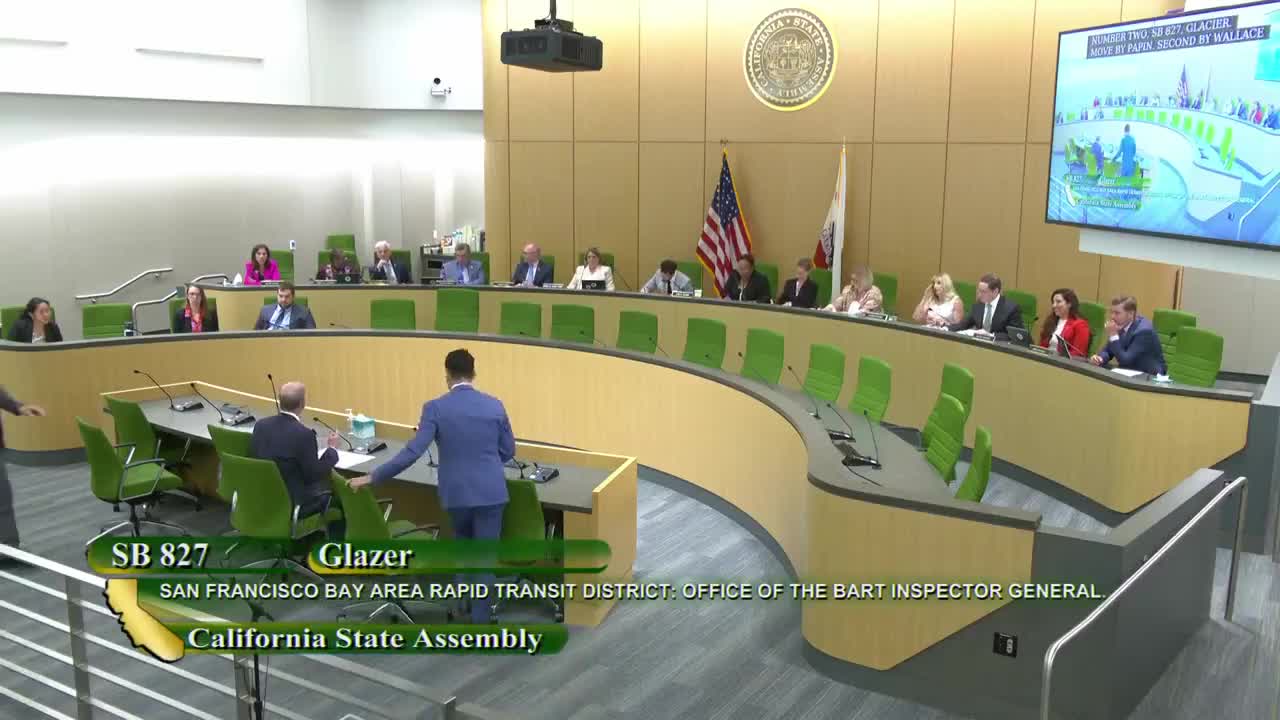 10MIN
Assembly Standing Committee on Transportation
 2MIN
Senate Floor
 4MIN
Senate Standing Committee on Judiciary
 17MIN
Senate Standing Committee on Transportation
 55MIN
Senate Standing Committee on Transportation
Bill Author

Bill Co-Author(s):