AB 1004: California Tahoe Conservancy.
- Session Year: 2015-2016
- House: Assembly
- Latest Version Date: 2015-08-10
Existing law establishes the California Tahoe Conservancy within the Natural Resources Agency to, among other things, acquire, restore, and manage property, protect the natural environment, and preserve the scenic beauty and recreational opportunities of the Lake Tahoe region, as defined. Existing law authorizes the conservancy to lease, rent, sell, exchange, or otherwise transfer any real property or interest therein, or option acquired under those provisions to local public agencies, state agencies, federal agencies, nonprofit organizations, individuals, corporate entities, or partnerships for management purposes pursuant to terms and conditions approved by the conservancy.
This bill would instead, except as provided, authorize the conservancy to take those actions relating to the lease, sale, exchange, and transfer of any real property or interest therein, or option acquired under those provisions to fulfill the purposes of the conservancy and to promote specified state planning priorities. The bill would require the conservancy to submit, on or before January 1, 2018, a report to the appropriate policy and fiscal committees of the Legislature on its progress toward promoting those priorities.
Existing law establishes the California Tahoe Conservancy within the Natural Resources Agency to, among other things, acquire, restore, and manage property, protect the natural environment, and preserve the scenic beauty and recreational opportunities of the Lake Tahoe region, as defined. Existing law prescribes the membership and functions and duties of the conservancy and authorizes the conservancy to lease, rent, sell, exchange, or otherwise transfer any real property or interest therein, or option acquired under those provisions to local public agencies, state agencies, federal agencies, nonprofit organizations, individuals, corporate entities, or partnerships for management purposes pursuant to terms and conditions approved by the conservancy.
This bill would instead instead, except as provided, authorize the conservancy to take those actions relating to the lease, sale, exchange, and transfer of any real property or interest therein, or option acquired under those provisions to fulfill the purposes of the conservancy and to promote specified state planning priorities. The bill would require the conservancy to submit, on or before January 1, 2018, a report to the appropriate policy and fiscal committees of the Legislature on its progress toward promoting those priorities.
Existing law establishes the California Tahoe Conservancy within the Natural Resources Agency to, among other things, acquire, restore, and manage property, protect the natural environment, and preserve the scenic beauty and recreational opportunities of the Lake Tahoe region, as defined. Existing law prescribes the membership and functions and duties of the conservancy and authorizes the conservancy to lease, rent, sell, exchange, or otherwise transfer any real property or interest therein, or option acquired under those provisions to local public agencies, state agencies, federal agencies, nonprofit organizations, individuals, corporate entities, or partnerships for management purposes pursuant to terms and conditions approved by the conservancy.
This bill would instead authorize the conservancy to take those actions relating to the lease, sale, exchange, and transfer of any real property or interest therein, or option acquired under those provisions to fulfill the purposes of the conservancy and to promote specified state planning priorities. The bill would require the conservancy to submit, on or before January 1, 2018, a report to the appropriate policy and fiscal committees of the Legislature on its progress toward promoting those priorities.
Existing law establishes the California Tahoe Conservancy within the Natural Resources Agency to, among other things, acquire, restore, and manage property, protect the natural environment, and preserve the scenic beauty and recreational opportunities of the Lake Tahoe region, as defined. Existing law prescribes the membership and functions and duties of the conservancy and authorizes the conservancy to lease, rent, sell, exchange, or otherwise transfer any real property or interest therein, or option acquired under those provisions to local public agencies, state agencies, federal agencies, nonprofit organizations, individuals, corporate entities, or partnerships for management purposes pursuant to terms and conditions approved by the conservancy.
This bill would instead authorize the conservancy to take those actions relating to the lease, sale, exchange, and transfer of any real property or interest therein, or option acquired under those provisions to fulfill the purposes of the conservancy and to promote specified state planning priorities.
(a)Notwithstanding any other provisions of law and except as provided in subdivision (b), the conservancy may lease, rent, sell, exchange, or otherwise transfer any real property or interest therein, or option acquired under this title to local public agencies, state agencies, federal agencies, nonprofit organizations, individuals, corporate entities, or partnerships to fulfill the purposes of this title and to promote the states planning priorities, consistent with subdivision (i) of Section 79707 of the Water Code. The conservancy may request the Director of General Services to undertake these actions on its behalf.
(b)The conservancy shall not sell any real property, or interest therein, acquired pursuant to Section 66907.5.
(c)(1)On or before January 1, 2018, the conservancy shall submit a report to the appropriate policy and fiscal committees of the Legislature on its progress toward promoting the states planning priorities described in subdivision (a).
(2)This subdivision is inoperative on January 1, 2022, pursuant to Section 10231.5.
(a)Notwithstanding any other provisions of law, law and except as provided in subdivision (b), the conservancy may lease, rent, sell, exchange, or otherwise transfer any real property or interest therein, or option acquired under this title to local public agencies, state agencies, federal agencies, nonprofit organizations, individuals, corporate entities, or partnerships to fulfill the purposes of this title and to promote the states planning priorities, consistent with subdivision (i) of Section 79707 of the Water Code. The conservancy may request the Director of General Services to undertake these actions on its behalf.
(b)The conservancy shall not sell any real property, or interest therein, acquired pursuant to Section 66907.5.
(b)
(c)(1)On or before January 1, 2018, the conservancy shall submit a report to the appropriate policy and fiscal committees of the Legislature on its progress toward promoting the states planning priorities described in subdivision (a).
(2)This subdivision is inoperative on January 1, 2022, pursuant to Section 10231.5.
(a)Notwithstanding any other provisions of law, the conservancy may lease, rent, sell, exchange, or otherwise transfer any real property or interest therein, or option acquired under this title to local public agencies, state agencies, federal agencies, nonprofit organizations, individuals, corporate entities, or partnerships to fulfill the purposes of this title and to promote the states planning priorities, consistent with subdivision (i) of Section 79707 of the Water Code. The conservancy may request the Director of General Services to undertake these actions on its behalf.
(b)(1)On or before January 1, 2018, the conservancy shall submit a report to the appropriate policy and fiscal committees of the Legislature on its progress toward promoting the states planning priorities described in subdivision (a).
(2)This subdivision is inoperative on January 1, 2022, pursuant to Section 10231.5.
Notwithstanding any other provisions of law, the conservancy may lease, rent, sell, exchange, or otherwise transfer any real property or interest therein, or option acquired under this title to local public agencies, state agencies, federal agencies, nonprofit organizations, individuals, corporate entities, or partnerships for management purposes pursuant to terms and conditions approved by the conservancy to fulfill the purposes of this title and to promote the states planning priorities, consistent with subdivision (i) of Section 79707 of the Water Code. The conservancy may request the Director of General Services to undertake these actions on its behalf.
|
Date
|
Status
|
|---|---|
| May 18, 2015 | In Senate. Read first time. To Com. on RLS. for assignment. |
| Aug 10, 2015 | Chaptered by Secretary of State - Chapter 153, Statutes of 2015. |
| Aug 10, 2015 | Approved by the Governor. |
| Aug 3, 2015 | Enrolled and presented to the Governor at 3 p.m. |
| Jul 9, 2015 | Read third time. Passed. Ordered to the Assembly. (Ayes 39. Noes 0. Page 1879.). |
| Jul 9, 2015 | Read third time. Passed. Ordered to the Assembly. |
| Jul 9, 2015 | In Assembly. Ordered to Engrossing and Enrolling. |
| Jul 7, 2015 | Read second time. Ordered to Consent Calendar. |
| Jul 6, 2015 | From committee: Be placed on second reading file pursuant to Senate Rule 28.8 and ordered to consent calendar. |
| Jun 24, 2015 | From committee: Do pass and re-refer to Com. on APPR. with recommendation: To Consent Calendar. (Ayes 9. Noes 0.) (June 23). Re-referred to Com. on APPR. |
| May 28, 2015 | Referred to Com. on N.R. & W. |
| May 18, 2015 | Read third time. Passed. Ordered to the Senate. (Ayes 77. Noes 0. Page 1478.) |
| May 18, 2015 | Read third time. Passed. Ordered to the Senate. |
| Feb 26, 2015 | Read first time. To print. |
| May 14, 2015 | Read third time and amended. Ordered to third reading. (Page 1434.) |
| May 14, 2015 | Read third time and amended. Ordered to third reading. |
| May 7, 2015 | Ordered to third reading. |
| May 7, 2015 | From Consent Calendar. |
| Apr 30, 2015 | Read second time. Ordered to Consent Calendar. |
| Apr 29, 2015 | From committee: Do pass. To Consent Calendar. (Ayes 17. Noes 0.) (April 29). |
| Apr 21, 2015 | Re-referred to Com. on APPR. |
| Apr 20, 2015 | Read second time and amended. |
| Apr 16, 2015 | From committee: Amend, and do pass as amended and re-refer to Com. on APPR. (Ayes 9. Noes 0.) (April 13). |
| Mar 19, 2015 | Referred to Com. on NAT. RES. |
| Feb 27, 2015 | From printer. May be heard in committee March 29. |
|
Date
|
Description
|
Location
|
Votes
|
|
|---|---|---|---|---|
| Jul 9, 2015 | Consent Calendar 2nd AB1004 Dahle | Senate Floor |
Passed |
|
| Jun 23, 2015 | Do pass, but first be re-referred to the Committee on [Appropriations] with the recommendation: To Consent Calendar | Senate Standing Committee on Natural Resources and Water |
Passed |
|
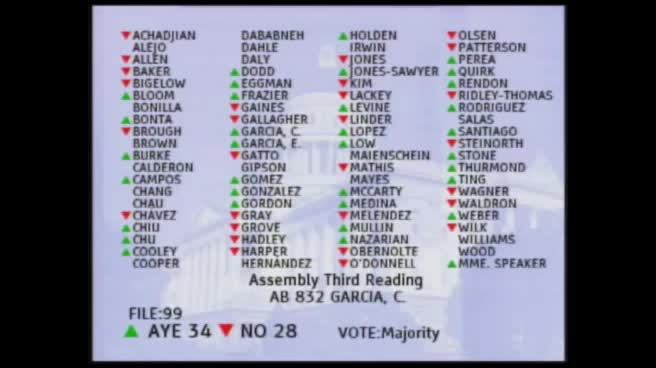
| May 18, 2015 | AB 1004 DAHLE Assembly Third Reading | Assembly Floor |
Passed |
|
| Apr 29, 2015 | Do pass. To Consent Calendar. | Assembly Standing Committee on Appropriations |
Passed |
|
| Apr 13, 2015 | Do pass as amended and be re-referred to the Committee on [Appropriations] | Assembly Standing Committee on Natural Resources |
Passed |
This list shows positions taken on this bill by organizations on the date displayed, which is linked to the original source.
Positions by individuals are not included.
|
Organization
|
Position
|
Date
|
|---|---|---|
| California Tahoe Alliance | * Support | Apr 13, 2015 |
| California Tahoe Conservancy Staff | ** Support | Apr 13, 2015 |
| City Of South Lake Tahoe | ** Support | Apr 13, 2015 |
| League To Save Lake Tahoe | ** Support | Apr 13, 2015 |
| North Tahoe Public Utility District | ** Support | Apr 13, 2015 |
| San Francisco County | * Support | Apr 13, 2015 |
| South Tahoe Public Utility District | ** Support | Apr 13, 2015 |
| Tahoe City Public Utility District | ** Support | Apr 13, 2015 |
| Tahoe Fund; The | ** Support | Apr 13, 2015 |
| Tahoe Resource Conservation District | ** Support | Apr 13, 2015 |
| The Ocean Conservancy | * Support | Apr 13, 2015 |
AB 1004
Page 4
|
Office of Senate Floor Analyses (916) 651-1520 Fax: (916) 327-4478 |
CONSENT
Bill No: AB 1004
Amended: 5/14/15 in Assembly
SENATE NATURAL RES. & WATER COMMITTEE: 9-0, 6/23/15
AYES: Pavley, Stone, Allen, Hertzberg, Hueso, Jackson, Monning, Vidak, Wolk
SENATE APPROPRIATIONS COMMITTEE: Senate Rule 28.8
ASSEMBLY FLOOR: 77-0, 5/18/15 - See last page for vote
SUBJECT: California Tahoe Conservancy
SOURCE: California Tahoe Conservancy
DIGEST: This bill clarifies the authority of the California Tahoe Conservancy (CTC) to lease, sell, exchange, or otherwise transfer real property or interest therein, to fulfill the purposes of the CTC.
Existing law:
Establishes the CTC (Government Code (GC) Title 7.42, commencing with Section 66905).
Provides the CTC with the authority to select and acquire real property or interests therein for the purposes of protecting the natural environment, providing public access or public recreational facilities, preserving wildlife habitat areas, or providing access to or management of acquired lands (GC Section 66907).
Authorizes the CTC to acquire interests in land by means of land exchanges and to enter into all alternatives to the acquisition of fee interests in land, including, but not limited to, the acquisition of easements, development rights, life estates, leases, and leaseback agreements (GC Section 66907.1).
Authorizes CTC to request the State Public Works Board exercise the power of eminent domain if CTC feels that all reasonable efforts to acquire the property have failed and the action is necessary to remove an impediment to an otherwise voluntary acquisition or is needed to achieve the purposes of other related acquisitions (GC Section 66907.5).
Authorizes CTC to lease, rent, sell, exchange, or otherwise transfer any real property or interest therein, or option acquired under this title to local public agencies, state agencies, federal agencies, nonprofit organizations, individuals, corporate entities, or partnerships for management purposes pursuant to terms and conditions approved by CTC (GC Section 66907.8).
Creates the Sustainable Communities and Climate Protection Act of 2008 (Sustainable Communities Act, SB 375, Steinberg, Chapter 728, Statutes of 2008), which supports the State's climate action goals to reduce greenhouse gas (GHG) emissions through coordinated transportation and land use planning with the goal of more sustainable communities.
Creates the Water Quality, Supply, and Infrastructure Improvement Act of 2014 (Water Code Division 26.7) to provide funding for projects consistent with statewide environmental goals and planning priorities (GC Section 65041.1) and the sustainable communities strategy (GC Section 65080(b)(2)(B)).
This bill:
Amends GC Section 66907.8 to clarify CTC’s authority to lease, sell, exchange, or otherwise transfer real property or interest therein, to fulfill the purposes of the CTC and to promote the state’s planning priorities, consistent with the policies of the Water Quality, Supply, and Infrastructure Improvement Act of 2014.
Clarifies that CTC is not authorized to sell any property acquired through the use of eminent domain.
Requires CTC to submit a report to the appropriate policy and fiscal committees of the Legislature on its progress toward promoting the state’s planning priorities on or before January 1, 2018.
Background
The CTC was created by statute in 1984 and tasked with maintaining equilibrium between the region’s natural endowment and its manmade environment; protecting the natural environment, including water quality, air quality, wildlife, and habitat areas; acquiring, restoring, and managing property; and preserving the scenic beauty and recreational opportunities of the region.
In 2013, CTC launched the Tahoe Livable Communities (TLC) program in order to facilitate the goals of the Lake Tahoe Sustainable Communities Strategy. TLC is focused on promoting more concentrated areas of development in the region’s town centers, in order to create walkable, bikeable, and transit-friendly communities.
Comments
Sustainable Communities Strategy: The Sustainable Communities Act requires the California Air Resources Board (CARB) to set regional targets for GHG emissions reductions from passenger vehicle use. In 2010, CARB established these targets for 2020 and 2035 for each region covered by one of the State's metropolitan planning organizations (MPOs).
Each of California’s MPOs must prepare a "sustainable communities strategy" (SCS) as an integral part of its regional transportation plan. The SCS contains land use, housing, and transportation strategies that will allow the region to meet its GHG emission reduction targets. The Sustainable Communities Act also establishes incentives to encourage local governments and developers to implement the SCS.
Clarification of CTC authority: This bill clarifies that CTC is allowed to divest of real property, or interest therein, as necessary to fulfill both the mission of CTC and state mandates, to include the SCS.
FISCAL EFFECT: Appropriation: No Fiscal Com.: Yes Local: No
California Tahoe Conservancy (source)
California Tahoe Alliance
None received
ARGUMENTS IN SUPPORT: Writing in support, the California Tahoe Alliance states, “AB 1004 would update the Conservancy’s enabling statute to reflect…regional and statewide planning goals. The measure would clarify the Conservancy’s authority to sell, exchange, or transfer land to fulfill its existing mission and implement projects consistent with new statewide mandates. As the principle state agency responsible for acquiring land, awarding grants, and achieving statewide priorities in the Basin, it is important for the Conservancy to have the authority to implement projects that advance regional and statewide environmental and climate goals.”
ASSEMBLY FLOOR: 77-0, 5/18/15
AYES: Achadjian, Alejo, Travis Allen, Baker, Bigelow, Bloom, Bonilla, Bonta, Brough, Brown, Burke, Calderon, Campos, Chang, Chau, Chávez, Chiu, Chu, Cooley, Cooper, Dababneh, Dahle, Daly, Dodd, Eggman, Frazier, Beth Gaines, Gallagher, Cristina Garcia, Eduardo Garcia, Gatto, Gipson, Gomez, Gonzalez, Gordon, Gray, Grove, Hadley, Harper, Roger Hernández, Holden, Irwin, Jones, Jones-Sawyer, Lackey, Levine, Linder, Lopez, Low, Maienschein, Mayes, McCarty, Medina, Mullin, Nazarian, Obernolte, O'Donnell, Olsen, Patterson, Perea, Quirk, Rendon, Ridley-Thomas, Rodriguez, Salas, Santiago, Steinorth, Mark Stone, Thurmond, Ting, Wagner, Waldron, Weber, Wilk, Williams, Wood, Atkins
NO VOTE RECORDED: Kim, Mathis, Melendez
Prepared by: Angee Doerr / N.R. & W. / (916) 651-4116
7/7/15 17:21:12
**** END ****
AB 1004 (Dahle) Page 3 of 3
SENATE COMMITTEE ON NATURAL RESOURCES AND WATER
Senator Fran Pavley, Chair
2015 - 2016 Regular
Bill No: AB 1004 Hearing Date: June 23, 2015
Author: |
Dahle |
|
|
Version: |
May 14, 2015 Amended |
||
Urgency: |
No |
Fiscal: |
Yes |
Consultant: |
Angee Doerr |
||
Subject: California Tahoe Conservancy.
BACKGROUND AND EXISTING LAW
Background:
The California Tahoe Conservancy (CTC) was created by statute in 1984 and tasked with maintaining equilibrium between the region’s natural endowment and its manmade environment; protecting the natural environment, including water quality, air quality, wildlife, and habitat areas; acquiring, restoring, and managing property; and preserving the scenic beauty and recreational opportunities of the region.
In 2013, CTC launched the Tahoe Livable Communities (TLC) program in order to facilitate the goals of the Lake Tahoe Sustainable Communities Strategy (SCS). TLC is focused on promoting more concentrated areas of development in the region’s town centers, in order to create walkable, bikeable, and transit-friendly communities.
Existing law:
Establishes the California Tahoe Conservancy (CTC) (Government Code (GC) Title 7.42, commencing with section 66905)
Provides the CTC with the authority to select and acquire real property or interests therein for the purposes of protecting the natural environment, providing public access or public recreational facilities, preserving wildlife habitat areas, or providing access to or management of acquired lands (GC Section 66907).
Authorizes the CTC to acquire interests in land by means of land exchanges and to enter into all alternatives to the acquisition of fee interests in land, including, but not limited to, the acquisition of easements, development rights, life estates, leases, and leaseback agreements (GC Section 66907.1).
Authorizes CTC to request the State Public Works Board exercise the power of eminent domain if CTC feels that all reasonable efforts to acquire the property have failed and the action is necessary to remove an impediment to an otherwise voluntary acquisition or is needed to achieve the purposes of other related acquisitions (GC Section 66907.5).
Authorizes CTC to lease, rent, sell, exchange, or otherwise transfer any real property or interest therein, or option acquired under this title to local public agencies, state agencies, federal agencies, nonprofit organizations, individuals, corporate entities, or partnerships for management purposes pursuant to terms and conditions approved by CTC (GC Section 66907.8).
Creates The Sustainable Communities and Climate Protection Act of 2008 (Sustainable Communities Act, SB 375, Chapter 728, Statutes of 2008), which supports the State's climate action goals to reduce greenhouse gas (GHG) emissions through coordinated transportation and land use planning with the goal of more sustainable communities.
Creates the Water Quality, Supply, and Infrastructure Improvement Act of 2014 (Water Code Division 26.7) to provide funding for projects consistent with statewide environmental goals and planning priorities (GC Section 65041.1) and the sustainable communities strategy (GC Section 65080(b)(2)(B)).
PROPOSED LAW
This bill:
Amends Government Code Section 66907.8 to clarify CTC’s authority to lease, sell, exchange, or otherwise transfer real property or interest therein, to fulfill the purposes of the CTC and to promote the state’s planning priorities, consistent with the policies of Water Quality, Supply, and Infrastructure Improvement Act of 2014.
Clarifies that CTC is not authorized to sell any property acquired through the use of eminent domain.
Requires CTC to submit a report to the appropriate policy and fiscal committees of the Legislature on its progress toward promoting the state’s planning priorities on or before January 1, 2018.
ARGUMENTS IN SUPPORT
Writing in support, the California Tahoe Alliance states “AB 1004 would update the Conservancy’s enabling statute to reflect…regional and statewide planning goals. The measure would clarify the Conservancy’s authority to sell, exchange, or transfer land to fulfill its existing mission and implement projects consistent with new statewide mandates. As the principle state agency responsible for acquiring land, awarding grants, and achieving statewide priorities in the Basin, it is important for the Conservancy to have the authority to implement projects that advance regional and statewide environmental and climate goals.”
ARGUMENTS IN OPPOSITION
None Received
COMMENTS
Sustainable Communities Strategy: The Sustainable Communities and Climate Protection Act of 2008 (Sustainable Communities Act, SB 375, Chapter 728, Statutes of 2008) requires CARB to set regional targets for GHG emissions reductions from passenger vehicle use. In 2010, CARB established these targets for 2020 and 2035 for each region covered by one of the State's metropolitan planning organizations (MPO).
Each of California’s MPOs must prepare a "sustainable communities strategy" (SCS) as an integral part of its regional transportation plan. The SCS contains land use, housing, and transportation strategies that will allow the region to meet its GHG emission reduction targets. The Sustainable Communities Act also establishes incentives to encourage local governments and developers to implement the SCS.
Clarification of CTC authority: The bill clarifies that CTC is allowed to divest of real property, or interest therein, as necessary to fulfill both the mission of the CTC and state mandates, to include the SCS.
SUPPORT
California Tahoe Conservancy (Source)
California Tahoe Alliance
OPPOSITION
None Received
-- END --
AB 1004
Page 2
ASSEMBLY THIRD READING
AB 1004
(Dahle)
As Amended May 14, 2015
Majority vote
Committee |
Votes |
Ayes |
Noes |
Natural Resources |
9-0 |
Williams, Dahle, Cristina Garcia, Hadley, Harper, McCarty, Rendon, Mark Stone, Wood |
|
Appropriations |
17-0 |
Gomez, Bigelow, Bloom, Bonta, Calderon, Chang, Daly, Eggman, Gallagher, Eduardo Garcia, Holden, Jones, Quirk, Rendon, Wagner, Weber, Wood |
|
SUMMARY: Alters the California Tahoe Conservancy's (Conservancy) powers. Specifically, this bill:
Expands the Conservancy's authorization to engage in property transactions, or request the Director of General Services to act on its behalf, to promote the state's planning priorities and sustainable communities strategies.
Prohibits the Conservancy from selling real property that has been acquired through eminent domain, including a sale that promotes the state's planning priorities and sustainable communities strategies.
Requires the Conservancy to submit a progress report to the appropriate policy and fiscal committees of the Legislature by January 1, 2018.
FISCAL EFFECT: According to the Assembly Appropriations Committee:
No additional state costs.
Potential increases in future land sale revenue.
COMMENTS:
Conservancy. Since its establishment in 1984, the Conservancy has acquired and manages nearly 4,700 parcels encompassing 6,500 acres for public access, water quality, and wildlife protection purposes. The Conservancy was created to maintain an equilibrium between the region’s natural endowment and its manmade environment, to protect the natural environment, including water quality, air quality, wildlife, and habitat areas, to acquire, restore, and manage property, and to preserve the scenic beauty and recreational opportunities of the region.
Tahoe Livable Communities Program (TLC). In December 2012, the Tahoe Regional Planning Agency and Tahoe Metropolitan Planning Organization adopted the Lake Tahoe Sustainable Communities Strategy (Lake Tahoe SCS). The Lake Tahoe SCS seeks to reduce per capita greenhouse gas emissions 12% by 2020 and an additional 7% by 2035. To achieve these targets, the Lake Tahoe SCS promotes clustered development in the Basin’s town centers. The Conservancy has developed the TLC to assist in implementing the Lake Tahoe SCS and other statewide planning priorities. The TLC will refocus the Conservancy's land acquisition and marketable rights program to do the following:
Acquire and restore aging developed properties on environmentally sensitive lands and retire or transfer the development rights to town centers;
Sell, lease, or exchange vacant Conservancy land in these town centers;
Acquire the remaining private properties in several of Lake Tahoe's roadless subdivisions to remove the threat of development.
This bill would clarify the Conservancy's authority to sell, exchange or transfer real property to implement the TLC. A component of the TLC will have the Conservancy engaged in efforts to create more vibrant walkable town centers in the Lake Tahoe region. The Conservancy owns parcels in town centers that could be developed into infill mixed-use development. These parcels would be exchanged for parcels in environmentally sensitive areas. The goal of this is to shrink the development footprint in the Lake Tahoe region and to shift the existing land use pattern from scattered auto-centric districts to vibrant walkable and bike-able town centers. This is a new approach to achieve the Conservancy's mission and has not been done before at any conservancy.
Analysis Prepared by: Michael Jarred / NAT. RES. / (916) 319-2092 FN: 0000429
AB 1004
Page 2
ASSEMBLY THIRD READING
AB 1004
(Dahle)
As Amended April 20, 2015
Majority vote
Committee |
Votes |
Ayes |
Noes |
Natural Resources |
9-0 |
Williams, Dahle, Cristina Garcia, Hadley, Harper, McCarty, Rendon, Mark Stone, Wood |
|
Appropriations |
17-0 |
Gomez, Bigelow, Bloom, Bonta, Calderon, Chang, Daly, Eggman, Gallagher, Eduardo Garcia, Holden, Jones, Quirk, Rendon, Wagner, Weber, Wood |
|
SUMMARY: This bill expands the California Tahoe Conservancy's (Conservancy) authorization to engage in property transactions, or request the Director of General Services to act on its behalf, to promote the state's planning priorities and sustainable communities strategies. This bill requires the Conservancy to submit a progress report to the appropriate policy and fiscal committees of the Legislature by January 1, 2018.
FISCAL EFFECT: According to the Assembly Appropriations Committee:
No additional state costs.
Potential increases in future land sale revenue.
COMMENTS:
Conservancy. Since its establishment in 1984, the Conservancy has acquired and manages nearly 4,700 parcels encompassing 6,500 acres for public access, water quality, and wildlife protection purposes. The Conservancy was created to maintain an equilibrium between the region’s natural endowment and its manmade environment, to protect the natural environment, including water quality, air quality, wildlife, and habitat areas, to acquire, restore, and manage property, and to preserve the scenic beauty and recreational opportunities of the region.
Tahoe Livable Communities Program (TLC). In December 2012, the Tahoe Regional Planning Agency (TRPA) and Tahoe Metropolitan Planning Organization (TMPO) adopted the Lake Tahoe Sustainable Communities Strategy (Lake Tahoe SCS). The Lake Tahoe SCS seeks to reduce per capita GHG emissions 12% by 2020 and an additional 7% by 2035. To achieve these targets, the Tahoe SCS promotes clustered development in the Basin’s town centers. The Conservancy has developed the TLC to assist in implementing the Lake Tahoe SCS and other statewide planning priorities. The TLC will refocus the Conservancy's land acquisition and marketable rights program to do the following:
Acquire and restore aging developed properties on environmentally sensitive lands and retire or transfer the development rights to town centers;
Sell, lease, or exchange vacant Conservancy land in these town centers;
Acquire the remaining private properties in several of Lake Tahoe’s roadless subdivisions to remove the threat of development.
This bill would clarify the Conservancy's authority to sell, exchange or transfer real property to implement the TLC. A component of the TLC will have the Conservancy engaged in efforts to create more vibrant walkable town centers in the Lake Tahoe region. The Conservancy owns parcels in town centers that could be developed into infill mixed-use development. These parcels would be exchanged for parcels in environmentally sensitive areas. The goal of this is to shrink the development footprint in the Lake Tahoe region and to shift the existing land use pattern from scattered auto-centric districts to vibrant walkable and bike-able town centers. This is a new approach to achieve the Conservancy's mission and has not been done before at any conservancy.
Analysis Prepared by: Michael Jarred / NAT. RES. / (916) 319-2092 FN: 0000350
AB 1004
Page 2
Date of Hearing: April 29, 2015
ASSEMBLY COMMITTEE ON APPROPRIATIONS
Jimmy Gomez, Chair
AB 1004
(Dahle) – As Amended April 20, 2015
Policy Committee: |
Natural Resources |
Vote: |
9 - 0 |
|
|
|
|
|
|
|
|
Urgency: No State Mandated Local Program: No Reimbursable:
SUMMARY:
This bill expands the California Tahoe Conservancy's (Conservancy) authorization to engage in property transactions, or request the Director of General Services to act on its behalf, to promote the state's planning priorities and sustainable communities strategies. This bill requires the Conservancy to submit a progress report to the appropriate policy and fiscal committees of the Legislature by January 1, 2018.
FISCAL EFFECT:
No additional state costs.
Potential increases in future land sale revenue.
COMMENTS:
Purpose. According to the Conservancy, this bill is necessary to clarify its authority to lease, sell, exchange, or otherwise transfer lands to implement the Lake Tahoe Sustainable Communities Strategy and further other programmatic purposes.
Background. In December 2012, the Tahoe Regional Planning Agency (TRPA) and Tahoe Metropolitan Planning Organization (TMPO) adopted the Lake Tahoe Sustainable Communities Strategy (Lake Tahoe SCS).
The Lake Tahoe SCS seeks to reduce per capita GHG emissions 12% by 2020 and an additional 7% by 2035. To achieve these targets, the Tahoe SCS promotes clustered development in the Basin’s town centers.
To further the goals of the SCS, the Conservancy has developed the Tahoe Livable Communities Program (TLC) to focus the Conservancy’s land acquisition and marketable rights
State Conservancies. There are currently 10 state conservancies located within the Natural Resources Agency: a) Sierra Nevada Conservancy; b) California Tahoe Conservancy; c) State Coastal Conservancy; d) San Joaquin River Conservancy; e) Sacramento-San Joaquin Delta Conservancy; f) Coachella Mountains Conservnacy; g) San Gabriel and Lower Los Angeles Rivers Conservancy; h) Santa Monica Mountains Conservancy; i) Baldwin Hills Conservancy; and j) San Diego River Conservancy.
Since its establishment in 1984, the California Tahoe Conservancy has acquired and manages nearly 4,700 parcels encompassing 6,500 acres for public access, water quality, and wildlife protection purposes.
The Conservancy was created to maintain a balance between the region’s natural endowment and its manmade environment, by protecting the natural environment and habitat areas and preserving the scenic beauty and recreational opportunities of the region.
Analysis Prepared by: Jennifer Galehouse / APPR. / (916) 319-2081
AB 1004
Page 2
Date of Hearing: April 13, 2015
ASSEMBLY COMMITTEE ON NATURAL RESOURCES
Das Williams, Chair
AB 1004
(Dahle) – As Introduced February 26, 2015
SUBJECT: California Tahoe Conservancy
SUMMARY: Expands the California Tahoe Conservancy’s (Conservancy) authorization to lease, rent, sell, exchange, or otherwise transfer real property to local public agencies, state agencies, federal agencies, nonprofit organizations, individuals, corporate entities, or partnerships to promote the state’s planning priorities and sustainable communities strategies.
EXISTING LAW:
Establishes the Conservancy within the Natural Resources Agency (NRA) to, among other things, acquire, restore, and manage property, protect the natural environment, and preserve the scenic beauty and recreational opportunities of the Lake Tahoe region.
Prescribes the membership, functions, and duties of the Conservancy and authorizes it to lease, rent, sell, exchange, or otherwise transfer any real property or interest therein, or option acquired under those provisions to local public agencies, state agencies, federal agencies, nonprofit organizations, individuals, corporate entities, or partnerships for management purposes pursuant to terms and conditions approved by the Conservancy.
FISCAL EFFECT: Unknown
COMMENTS:
Conservancy. Since its establishment in 1984, the Conservancy has acquired and manages nearly 4,700 parcels encompassing 6,500 acres for public access, water quality, and wildlife protection purposes. The Conservancy was created to maintain an equilibrium between the region’s natural endowment and its manmade environment, to protect the natural environment, including water quality, air quality, wildlife, and habitat areas, to acquire, restore, and manage property, and to preserve the scenic beauty and recreational opportunities of the region.
Tahoe Livable Communities Program (TLC). In December 2012, the Tahoe Regional Planning Agency (TRPA) and Tahoe Metropolitan Planning Organization (TMPO) adopted the Lake Tahoe Sustainable Communities Strategy (Lake Tahoe SCS). The Lake Tahoe SCS seeks to reduce per capita GHG emissions 12% by 2020 and an additional 7% by 2035. To achieve these targets, the Tahoe SCS promotes clustered development in the Basin’s town centers. The Conservancy has developed the TLC to assist in implementing the Lake Tahoe SCS and other statewide planning priorities. The TLC will refocus the Conservancy’s land acquisition and marketable rights program to do the following:
Acquire and restore aging developed properties on environmentally sensitive lands and retire or transfer the development rights to town centers;
Sell, lease, or exchange vacant Conservancy land in these town centers;
Acquire the remaining private properties in several of Lake Tahoe’s roadless subdivisions to remove the threat of development.
AB 1004. AB 1004 would clarify the Conservancy’s authority to sell, exchange or transfer real property to implement the TLC. A component of the TLC will have the Conservancy engaged in efforts to create more vibrant walkable town centers in the Lake Tahoe region. The Conservancy owns parcels in town centers that could be developed into infill mixed-use development. These parcels would be exchanged for parcels in environmentally sensitive areas. The goal of this is to shrink the development footprint in the Lake Tahoe region and to shift the existing land use pattern from scattered auto-centric districts to vibrant walkable and bike-able town centers. This is a new approach to achieve the Conservancy’s mission and has not been done before at any conservancy. The author and committee may wish to consider amending the bill to require the Conservancy to report to the Legislature on its progress implementing statewide planning priorities on or before January 1, 2018.
REGISTERED SUPPORT / OPPOSITION:
Support
California Tahoe Conservancy Staff
City of South Lake Tahoe
League to Save Lake Tahoe
North Tahoe Public Utility District
South Tahoe Public Utility District
Tahoe City Public Utility District
Tahoe Fund
Tahoe Resource Conservation District
Opposition
None on file
Analysis Prepared by: Michael Jarred / NAT. RES. / (916) 319-2092
Discussed in Hearing
 43SEC
Assembly Floor
 33SEC
Assembly Floor
 2MIN
Assembly Standing Committee on Natural Resources
Bill Author

Bill Co-Author(s):
