AB 1008: Public utilities: sale of hydrogen to public as a motor vehicle fuel.
- Session Year: 2015-2016
- House: Assembly
- Latest Version Date: 2015-07-15
The Public Utilities Act provides that whenever any common carrier, toll bridge corporation, pipeline corporation, gas corporation, electrical corporation, telephone corporation, telegraph corporation, water corporation, sewer system corporation, or heat corporation performs a service for, or delivers a commodity to, the public or any portion of the public for which any compensation or payment is received, that entity is a public utility subject to the jurisdiction, control, and regulation of the Public Utilities Commission and the provisions of the act. The act provides that the ownership or operation of a facility that sells compressed natural gas at retail to the public for use only as a motor vehicle fuel, and the selling of compressed natural gas at retail from that facility to the public for use only as a motor vehicle fuel, does not make the corporation or person a public utility solely because of that ownership, operation, or sale.
This bill would additionally provide that the ownership or operation of a facility that sells hydrogen at retail to the public for use only as a motor vehicle fuel, and the selling of hydrogen at retail from that facility to the public for use only as a motor vehicle fuel, does not make the corporation or person a public utility solely because of that ownership, operation, or sale.
The Public Utilities Act provides that whenever any common carrier, toll bridge corporation, pipeline corporation, gas corporation, electrical corporation, telephone corporation, telegraph corporation, water corporation, sewer system corporation, or heat corporation that performs a service for, or delivers a commodity to, the public or any portion of the public for which any compensation or payment is received, that entity is a public utility subject to the jurisdiction, control, and regulation of the Public Utilities Commission and the provisions of the act. The act provides that the ownership or operation of a facility that sells compressed natural gas at retail to the public for use only as a motor vehicle fuel, and the selling of compressed natural gas at retail from that facility to the public for use only as a motor vehicle fuel, does not make the corporation or person a public utility solely because of that ownership, operation, or sale.
This bill would additionally provide that the ownership or operation of a facility that sells hydrogen at retail to the public for use only as a motor vehicle fuel, and the selling of hydrogen at retail from that facility to the public for use only as a motor vehicle fuel, does not make the corporation or person a public utility solely because of that ownership, operation, or sale.
(a)Public utility includes every common carrier, toll bridge corporation, pipeline corporation, gas corporation, electrical corporation, telephone corporation, telegraph corporation, water corporation, sewer system corporation, and heat corporation, where the service is performed for, or the commodity is delivered to, the public or any portion thereof.
(b)Whenever any common carrier, toll bridge corporation, pipeline corporation, gas corporation, electrical corporation, telephone corporation, telegraph corporation, water corporation, sewer system corporation, or heat corporation performs a service for, or delivers a commodity to, the public or any portion thereof for which any compensation or payment whatsoever is received, that common carrier, toll bridge corporation, pipeline corporation, gas corporation, electrical corporation, telephone corporation, telegraph corporation, water corporation, sewer system corporation, or heat corporation, is a public utility subject to the jurisdiction, control, and regulation of the commission and the provisions of this part.
(c)When any person or corporation performs any service for, or delivers any commodity to, any person, private corporation, municipality, or other political subdivision of the state, that in turn either directly or indirectly, mediately or immediately, performs that service for, or delivers that commodity to, the public or any portion thereof, that person or corporation is a public utility subject to the jurisdiction, control, and regulation of the commission and the provisions of this part.
(d)Ownership or operation of a facility that employs cogeneration technology or produces power from other than a conventional power source or the ownership or operation of a facility which employs landfill gas technology does not make a corporation or person a public utility within the meaning of this section solely because of the ownership or operation of that facility.
(e)Any corporation or person engaged directly or indirectly in developing, producing, transmitting, distributing, delivering, or selling any form of heat derived from geothermal or solar resources or from cogeneration technology to any privately owned or publicly owned public utility, or to the public or any portion thereof, is not a public utility within the meaning of this section solely by reason of engaging in any of those activities.
(f)The ownership or operation of a facility that sells compressed natural gas or hydrogen at retail to the public for use only as a motor vehicle fuel, and the selling of compressed natural gas or hydrogen at retail from that facility to the public for use only as a motor vehicle fuel, does not make the corporation or person a public utility within the meaning of this section solely because of that ownership, operation, or sale.
(g)Ownership or operation of a facility that is an exempt wholesale generator, as defined in the Public Utility Holding Company Act of 2005 (42 U.S.C. Sec. 16451(6)), does not make a corporation or person a public utility within the meaning of this section, solely due to the ownership or operation of that facility.
(h)The ownership, control, operation, or management of an electric plant used for direct transactions or participation directly or indirectly in direct transactions, as permitted by subdivision (b) of Section 365, sales into a market established and operated by the Independent System Operator or any other wholesale electricity market, or the use or sale as permitted under subdivisions (b) to (d), inclusive, of Section 218, shall not make a corporation or person a public utility within the meaning of this section solely because of that ownership, participation, or sale.
(i)The ownership, control, operation, or management of a facility that supplies electricity to the public only for use to charge light duty plug-in electric vehicles does not make the corporation or person a public utility within the meaning of this section solely because of that ownership, control, operation, or management. For purposes of this subdivision, light duty plug-in electric vehicles includes light duty battery electric and plug-in hybrid electric vehicles. This subdivision does not affect the commissions authority under Section 454 or 740.2 or any other applicable statute.
|
Date
|
Status
|
|---|---|
| May 7, 2015 | Referred to Com. on E., U., & C. |
| Jul 15, 2015 | Chaptered by Secretary of State - Chapter 109, Statutes of 2015. |
| Jul 15, 2015 | Approved by the Governor. |
| Jul 9, 2015 | Enrolled and presented to the Governor at 2 p.m. |
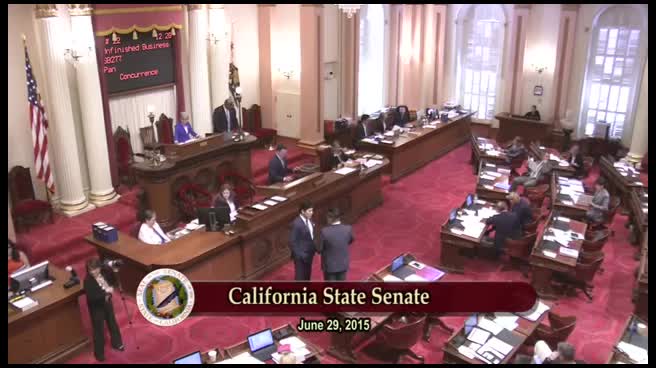
| Jun 29, 2015 | Read third time. Passed. Ordered to the Assembly. (Ayes 37. Noes 0. Page 1662.). |
| Jun 29, 2015 | Read third time. Passed. Ordered to the Assembly. |
| Jun 29, 2015 | In Assembly. Ordered to Engrossing and Enrolling. |
| Jun 17, 2015 | Read second time. Ordered to third reading. |
| Jun 16, 2015 | From committee: Do pass. (Ayes 10. Noes 0.) (June 16). |
| Feb 26, 2015 | Read first time. To print. |
| Apr 20, 2015 | Read third time. Passed. Ordered to the Senate. (Ayes 80. Noes 0. Page 1015.) |
| Apr 20, 2015 | In Senate. Read first time. To Com. on RLS. for assignment. |
| Apr 15, 2015 | Read second time. Ordered to consent calendar. |
| Apr 14, 2015 | From committee: Do pass. To Consent Calendar. (Ayes 14. Noes 0.) (April 13). |
| Apr 14, 2015 | From committee: Do pass. Ordered to Consent Calendar. (Ayes 14. Noes 0.) (April 13). |
| Mar 19, 2015 | Referred to Com. on U. & C. |
| Feb 27, 2015 | From printer. May be heard in committee March 29. |
|
Date
|
Description
|
Location
|
Votes
|
|
|---|---|---|---|---|
| Jun 29, 2015 | Assembly 3rd Reading AB1008 Quirk By Cannella | Senate Floor |
Passed |
|
| Jun 16, 2015 | Do pass | Senate Standing Committee on Energy, Utilities and Communications |
Passed |
|
| Apr 20, 2015 | AB 1008 QUIRK Consent Calendar Second Day | Assembly Floor |
Passed |
|
| Apr 13, 2015 | Do pass. To Consent Calendar. | Assembly Standing Committee on Utilities and Commerce |
Passed |
This list shows positions taken on this bill by organizations on the date displayed, which is linked to the original source.
Positions by individuals are not included.
|
Organization
|
Position
|
Date
|
|---|---|---|
| California Hydrogen Business Council | ** Support | Jun 29, 2015 |
| Center For Transportation And The Environment | ** Support | Jun 29, 2015 |
| Natural Resources Defense Council | ** Support | Jun 29, 2015 |
AB 1008
Page 5
|
Office of Senate Floor Analyses (916) 651-1520 Fax: (916) 327-4478 |
THIRD READING
Bill No: AB 1008
Introduced: 2/26/15
SENATE ENERGY, U. & C. COMMITTEE: 10-0, 6/16/15
AYES: Hueso, Fuller, Cannella, Hertzberg, Hill, Lara, Leyva, McGuire, Morrell, Wolk
NO VOTE RECORDED: Pavley
ASSEMBLY FLOOR: 80-0, 4/20/15 (Consent) - See last page for vote
SUBJECT: Public utilities: sale of hydrogen to public as a motor vehicle fuel
DIGEST: This bill provides that the ownership or operation of a facility that sells hydrogen at retail to the public for use only as a motor vehicle fuel does not make the corporation or person a public utility solely because of that ownership, operation, or sale.
Existing law:
Establishes the California Public Utilities Commission (CPUC) with five members appointed by the Governor and confirmed by the Senate and empowers the CPUC to regulate privately owned public utilities. Provides that the CPUC may fix rates, establish rules, examine records, issue subpoenas, and other powers over the utilities it regulates. Specifies that the Legislature may prescribe that additional classes of private corporations or other persons are public utilities. (Article XII California Constitution)
Defines a public utility as every common carrier, gas corporation, electrical corporation, water corporation, toll bridge corporation, pipeline corporation, telegraph corporation, sewer system corporation and heat corporation, where the service is performed for, or the commodity is delivered to, the public or any portion thereof. Provides that when any public utility performs a service or delivers a commodity to the public or any portion thereof for which any compensation or payment shall be subject to the jurisdiction, control, and regulation of the CPUC. (Public Utilities Code §216)
Establishes that the ownership or operation of a facility that sells compressed natural gas at retail to the public for use only as a motor vehicle fuel, and the selling of compressed natural gas at retail from the facility to the public for use only as a motor vehicle fuel, does not make the corporation or person a public utility solely because of that ownership, operation, or sale. (Public Utilities Code §216)
Establishes that ownership, control, operation or management of a facility that supplies electricity to the public only for the use to charge light duty plug-in vehicles does not make the corporation or person a public utility within the meaning of this section solely because of that ownership, control, operation, or management. (Public Utilities Code §216)
This bill provides that the ownership or operation of a facility that sells hydrogen at retail to the public for use only as a motor vehicle fuel does not make the corporation or person a public utility solely because of that ownership, operation, or sale.
Background
The California Global Warming Solutions Act of 2006, enacted by AB 32 (Núñez and Pavley, Chapter 488, Statutes of 2006), tasked the Air Resources Board (ARB) to adopt rules and regulations that would reduce greenhouse gas emission in the state to 1990 levels by 2020. With AB 32, the Legislature acknowledged the adverse impacts and threat global warming poses to the economic wellbeing, public health, natural resources, and environment of California and took an active step towards mitigating its effect.
With the transportation sector representing roughly 40% of the state’s greenhouse gas emissions, increasing the use of zero emission vehicles (ZEV), such as hydrogen fuel cell electric vehicles (FCEVs), is expected to play a significant role in reducing California's greenhouse gas emissions and provide improved local air quality. In 2012, the ARB began implementing the Advanced Clean Cars program which seeks to rapidly increase the number of ZEV technologies, such as hydrogen fuel cells and battery electric vehicles. The ARB estimates that by mid-century, 87% of cars on the road will need to be full ZEVs which would put California on the path to reducing greenhouse gas emissions by 80% by 2050.
FCEVs. FCEVs are fueled with hydrogen gas stored on the vehicle. Hydrogen gas passes through a fuel cell that mixes the gas with oxygen to generate electric currents that run the vehicle. Since the vehicle is primarily fueled with pure hydrogen, there are no pollutants emitted into the atmosphere, only water and heat.
Hydrogen stations. In April 2004, Governor Schwarzenegger issued Executive Order S-07-04, which created the California Hydrogen Highway Network (CaH2Net). The mission of CaH2Net was to assure that the state had hydrogen- fueling stations in place to meet the demand of fuel cells and other hydrogen vehicle technologies being placed on California roads. CaH2Net convened stakeholders and developed a blueprint plan that described the actions needed to create hydrogen highways.
In March 2012, Governor Brown issued Executive Order B-16-2012 to facilitate the rapid commercialization of ZEVs and in February 2013, he issued a ZEV Action Plan which created a roadmap towards achieving 1.5 million ZEVs on California roadways by 2025.
In 2014, the Legislature passed and the Governor signed SB 1275 (De León, Chapter 530, Statutes of 2014) which codified a goal of one million zero and near-zero emission vehicles on California’s roads by 2023.
California currently has 13 research hydrogen-fueling stations, nine public stations and an additional 18 that have been funded and are expected to become operational in the next few years. Funding for hydrogen infrastructure is provided by the California Energy Commission (CEC) through funding authorized by AB 118 (Núñez, Chapter 750, Statutes of 2007).
Is a bill needed? AB 1008 includes hydrogen fueling stations among the list of facilities exempted from the definition of a public utility. Current law exempts both electricity and natural gas fueling facilities for vehicles from the definition of a public utility. However, electricity and natural gas facilities use a commodity that is also supplied by a privately owned public utility regulated by the CPUC. A similar exemption may not be needed for hydrogen since there is no existing privately owned public utility that provides hydrogen as a commodity to the public. The author and supporters argue that such an exemption is needed to give investors greater certainty that hydrogen stations won’t be regulated as a utility in the future and, thereby, encourage increased private investment in hydrogen-fueling stations.
Prior/Related Legislation
AB 118 (Núñez, Chapter 750, Statutes of 2007) created the Alternative and Renewable Fuel and Vehicle Technology Program (ARFVTP) and authorized CEC to spend up to $120 million per year for over seven years (from 2008-2015) to develop, demonstrate, and deploy innovative technologies to transform California’s fuel and vehicle types.
AB 631 (Ma, Chapter 480, Statutes of 2011) exempted from the definition of a public utility a facility that supplies electricity to the public only for use to charge light-duty plug-in electric vehicles.
AB 8 (Perea, Chapter 401, Statutes of 2013) extended the sunset imposed to 2024 for several fee programs, including the ARFVTP. Required CEC to allocate $20 million annually until 2024 to fund hydrogen-fueling charging stations, not to exceed 20% of the monies appropriated by the Legislature from the ARFVTP Fund, until there are at least 100 publicly available hydrogen-fueling stations in California.
FISCAL EFFECT: Appropriation: No Fiscal Com.: No Local: No
California Hydrogen Business Council
Center for Transportation and the Environment
FirstElement Fuel Inc.
Natural Resources Defense Council
OPPOSITION: (Verified 6/16/15)
None received
ARGUMENTS IN SUPPORT: The author’s office states that the ambiguity in how hydrogen will be regulated is a concern for investors interested in developing hydrogen-fueling infrastructure. The author argues that the certainty provided by this bill when adopted will enable investors to prepare and establish a credible, privately funded business case to scale the market.
ASSEMBLY FLOOR: 80-0, 4/20/15
AYES: Achadjian, Alejo, Travis Allen, Baker, Bigelow, Bloom, Bonilla, Bonta, Brough, Brown, Burke, Calderon, Campos, Chang, Chau, Chávez, Chiu, Chu, Cooley, Cooper, Dababneh, Dahle, Daly, Dodd, Eggman, Frazier, Beth Gaines, Gallagher, Cristina Garcia, Eduardo Garcia, Gatto, Gipson, Gomez, Gonzalez, Gordon, Gray, Grove, Hadley, Harper, Roger Hernández, Holden, Irwin, Jones, Jones-Sawyer, Kim, Lackey, Levine, Linder, Lopez, Low, Maienschein, Mathis, Mayes, McCarty, Medina, Melendez, Mullin, Nazarian, Obernolte, O'Donnell, Olsen, Patterson, Perea, Quirk, Rendon, Ridley-Thomas, Rodriguez, Salas, Santiago, Steinorth, Mark Stone, Thurmond, Ting, Wagner, Waldron, Weber, Wilk, Williams, Wood, Atkins
Prepared by: Nidia Bautista / E., U., & C. / (916) 651-4107
6/17/15 15:48:14
**** END ****
AB 1008 (Quirk) Page 4 of 4
SENATE COMMITTEE ON ENERGY, UTILITIES AND COMMUNICATIONS
Senator Ben Hueso, Chair
2015 - 2016 Regular
Bill No: AB 1008 Hearing Date: 6/16/2015
Author: |
Quirk |
||
Version: |
2/26/2015 As Introduced |
||
Urgency: |
No |
Fiscal: |
No |
Consultant: |
Nidia Bautista |
||
SUBJECT: Public utilities: sale of hydrogen to public as a motor vehicle fuel.
DIGEST: This bill would provide that the ownership or operation of a facility that sells hydrogen at retail to the public for use only as a motor vehicle fuel does not make the corporation or person a public utility solely because of that ownership, operation, or sale.
ANALYSIS:
Existing law:
Establishes the California Public Utilities Commission (CPUC) with five members appointed by the Governor and confirmed by the Senate and empowers the CPUC to regulate privately owned public utilities. Provides that the CPUC may fix rates, establish rules, examine records, issue subpoenas, and other powers over the utilities it regulates. Specifies that the Legislature may prescribe that additional classes of private corporations or other persons are public utilities. (Article XII California Constitution)
Defines a public utility as every common carrier, gas corporation, electrical corporation, water corporation, toll bridge corporation, pipeline corporation, telegraph corporation, sewer system corporation and heat corporation, where the service is performed for, of the commodity is delivered to, the public or any portion thereof. Provides that when any public utility performs a service or delivers a commodity to the public or any portion thereof for which any compensation or payment shall be subject to the jurisdiction, control, and regulation of the CPUC. (Public Utilities Code §216)
Establishes that the ownership or operation of a facility that sells compressed natural gas at retail to the public for use only as a motor vehicle fuel, and the selling of compressed natural gas at retail from the facility to the public for use only as a motor vehicle fuel, does not make the corporation or person a public utility solely because of that ownership, operation, or sale. (Public Utilities Code §216)
Establishes that ownership, control, operation or management of a facility that supplies electricity to the public only for the use to charge light duty plug-in vehicles does not make the corporation or person a public utility within the meaning of this section solely because of that ownership, control, operation, or management. (Public Utilities Code §216)
This bill would provide that the ownership or operation of a facility that sells hydrogen at retail to the public for use only as a motor vehicle fuel does not make the corporation or person a public utility solely because of that ownership, operation, or sale.
Background
The California Global Warming Solutions Act of 2006, enacted by AB 32, tasked the Air Resources Board (ARB) to adopt rules and regulations that would reduce greenhouse gas emission in the state to 1990 levels by 2020. With it, the Legislature acknowledged the adverse impacts and threat global warming poses to the economic wellbeing, public health, natural resources, and environment of California and took an active step towards mitigating its effect.
With the transportation sector representing roughly 40% of the state’s greenhouse gas emissions, increasing the use of zero emission vehicles (ZEV), such as hydrogen fuel cell vehicles (FCEVs), is expected to play a significant role in reducing California's greenhouse gas emissions and provide improved local air quality. In 2012, the ARB began implementing the Advanced Clean Cars program which seeks to rapidly increase the number of ZEV technologies, such as hydrogen fuel cells and battery electric vehicles. The ARB estimates that by mid-century, 87% of cars on the road will need to be full ZEVs which would put California on the path to reducing greenhouse gas emissions by 80% by 2050.
Hydrogen fuel cell electric vehicles. FCEVs are fueled with hydrogen gas stored on the vehicle. Hydrogen gas passes through a fuel cell that mixes the gas with oxygen to generate electric currents that run the vehicle. Since the vehicle is primarily fueled with pure hydrogen, there are no pollutants emitted into the atmosphere, only water and heat.
Hydrogen stations. In April 2004, Governor Schwarzenegger issued Executive Order S-07-04, which created the California Hydrogen Highway Network (CaH2Net). The mission of CaH2Net was to assure that the state had hydrogen fueling stations in place to meet the demand of fuel cells and other hydrogen vehicle technologies being placed on California roads. CaH2Net convened stakeholders and developed a blueprint plan that described the actions needed to create hydrogen highways.
In March 2012, Governor Brown issued Executive Order B-16-2012 to facilitate the rapid commercialization of ZEVs and in February 2013, he issued a ZEV Action Plan which created a roadmap towards achieving 1.5 million ZEVs on California roadways by 2025.
In 2014, the Legislature passed and the Governor signed SB 1275 (De León, Chapter 530, Statutes of 2014) which codified a goal of one million zero and near-zero emission vehicles on California’s roads by 2023.
California currently has 13 research hydrogen fueling stations, nine public stations and an additional 18 that have been funded and are expected to become operational in the next few years. Funding for hydrogen infrastructure is provided by the California Energy Commission (CEC) through funding authorized by AB 118 (Núñez, Chapter 750, Statutes of 2007).
Is a bill needed? AB 1008 would include hydrogen fueling stations among the list of types of facilities exempted from the definition of a public utility. In the case of electricity and natural gas fueling facilities which are currently exempted, they represent a commodity that is also supplied by a privately owned public utility regulated by the CPUC. A similar exemption may not be needed for hydrogen since there is no existing privately owned public utility that provides hydrogen as a commodity to the public. However, the author and supporters argue that such an exemption is needed to give investors greater certainty and increase private investment in hydrogen fueling stations.
Prior/Related Legislation
AB 118 (Núñez, Chapter 750, Statutes of 2007), created the Alternative and Renewable Fuel and Vehicle Technology Program (ARFVTP) and authorized CEC to spend up to $120 million per year for over seven years (from 2008-2015) to develop, demonstrate, and deploy innovative technologies to transform California’s fuel and vehicle types.
AB 631 (Ma, Chapter 480, Statutes of 2011), exempted from the definition of a public utility a facility that supplies electricity to the public only for use to charge light-duty plug-in electric vehicles.
AB 8 (Perea, Chapter 401, Statutes of 2013), extended the sunset imposed to 2024 for several fee programs, including the ARFVTP. Required CEC to allocate $20 million annually until 2024 to fund hydrogen-fueling charging stations, not to exceed 20% of the monies appropriated by the Legislature from the ARFVTP Fund, until there are at least 100 publicly available hydrogen-fueling stations in California.
FISCAL EFFECT: Appropriation: No Fiscal Com.: No Local: No
ASSEMBLY VOTES:
Assembly Floor (80-0)
Assembly Utilities and Commerce Committee (14-0)
SUPPORT:
California Hydrogen Business Council
Center for Transportation and the Environment
First Element Fuel Inc.
Natural Resources Defense Council
OPPOSITION:
None received
ARGUMENTS IN SUPPORT: The author’s office states that the ambiguity in how hydrogen will be regulated is a concern for investors interested in developing hydrogen fueling infrastructure. The author argues that the certainty provided by this bill when adopted will enable investors to prepare and establish a credible, privately funded business case to scale the market.
-- END --
AB 1008
Page 3
Date of Hearing: April 13, 2015
ASSEMBLY COMMITTEE ON UTILITIES AND COMMERCE
Anthony Rendon, Chair
AB 1008
(Quirk) – As Introduced February 26, 2015
SUBJECT: Public utilities: sale of hydrogen to public as a motor vehicle fuel
SUMMARY:
This bill clarifies that the ownership or operation of a facility that sells hydrogen for use only as a motor vehicle fuel is not a public utility. Specifically, this bill:
Clarifies existing law to make clear that the ownership or operation of a facility that sells hydrogen at retail to the public for use only as a motor vehicle fuel, does not make the corporation or person a public utility.
EXISTING LAW:
The State Constitution permits the Public Utilities Commission to fix rates and establish rules for all public utilities and includes the furnishing power as a public utility, subject to control by the Legislature.
Defines a “public utility” to include every common carrier, toll bridge corporation, pipeline corporation, gas corporation, electrical corporation, telephone corporation, telegraph corporation, water corporation, sewer system corporation and heat corporation, where the service is performed for, or the commodity is delivered to, the public for any compensation or payment. (Public Utilities Code 216)
Specifies that the ownership or operation of a facility that employs cogeneration technology or produces power from other than a conventional power source or the ownership or operation of a facility which employs landfill gas technology is not a public utility solely because of the ownership or operation of that facility. (Public Utilities Code 216)
Specifies that any corporation or person engaged directly or indirectly in developing, producing, transmitting, distributing, delivering, or selling any form of heat derived from geothermal or solar resources or from cogeneration technology to any privately owned or publicly owned public utility, or to the public or any portion thereof, is not a public utility solely by reason of engaging in any of those activities. (Public Utilities Code 216)
Specifics that the ownership or operations of a facility that sells compressed natural gas at retail to the public for use only as a motor vehicle fuel, does not make the corporation or person a public utility solely because of that ownership, operation, or sale. (Public Utilities Code 216)
Specifies that ownership or operation of a facility that is an exempt wholesale generator is not a public utility solely due to the ownership or operation of that facility. (Public Utilities Code 216)
Specifies the ownership, control, operation, or management of an electric plant used for direct transactions or participation directly or indirectly in direct transactions as permitted, is not a public utility solely because of that ownership, participation or sale. (Public Utilities Code 216)
Specifies that the ownership, control, operation, or management of a facility that supplies electricity to the public only use to charge light duty plug-in electric vehicles is not a public utility solely because of that ownership, control, operation, or management. (Public Utilities Code 216)
FISCAL EFFECT: Unknown
COMMENTS:
Author’s statement: “California’s interest in hydrogen Fuel Cell Electric Vehicles (FCEVs) is not new. These technologies have had limited adoption rate and consumer market adoption penetration because of a lack of vehicle availability and fueling infrastructure. With numerous vehicle manufactures beginning to sell FCEVs and as more FCEV options become available in the near future, the fuel infrastructure is essential to supporting these technologies. Accelerating the use of hydrogen FCEVs in the state of California will assist in putting more zero-emission vehicles on the road.”
Background: The California Global Warming Solutions Act of 2006, enacted by Assembly Bill (AB) 32, tasked the Air Resources Board (ARB) to adopt rules and regulations that would reduce greenhouse gas emission in the state to 1990 levels by 2020. With it, the Legislature acknowledged the adverse impacts and threat global warming poses to the economic wellbeing, public health, natural resources, and environment of California and took an active step towards mitigating its effect.
Increasing the use of zero emission vehicles (ZEV), such as hydrogen fuel cell vehicles, will play a significant role in reducing California’s greenhouse gas and smog emissions to standards set forth by AB 32. In 2012, the ARB implemented the Advanced Clean Cars program which seek to rapidly increase the number of ZEV technologies, such as hydrogen fuel cells and battery electric vehicles. The ARB estimates that by mid-century, 87% of cars on the road will need to be full ZEVs which would put California on the path to reducing greenhouse gas emissions by 80% by 2050.
Hydrogen Fuel Cell Electric Vehicles: Hydrogen FCEVs are fueled with hydrogen gas stored on the vehicle. Hydrogen gas passes through a fuel cell that mixes the gas with oxygen to generate electric currents that run the vehicle. Because the vehicle is primarily fueled with pure hydrogen no pollutants is emitted, only water and heat.
Hydrogen Stations: In April 2004, Governor Schwarzenegger issued Executive Order S-07-04, which created the California Hydrogen Highway Network (CaH2Net). The mission of CaH2Net was to support a transition to assure that the state had hydrogen fueling stations in place to meet the demand of fuel cells and other hydrogen vehicle technologies being placed on California roads. CaH2Net convened stakeholders and developed a blueprint plan that described the actions needed to create hydrogen highways.
Subsequently in March 2012, Governor Brown issued Executive Order B-16-2012 to facilitate the rapid commercialization of ZEVs and in February 2013, he issued a ZEV Action Plan which created a roadmap towards achieving 1.5 million zero-emission vehicles on California roadways by 2025.
California currently has 13 research hydrogen fueling stations, 9 public stations and an additional 18 that have been funded and are expected to become operational in the next few years. Funding for hydrogen infrastructure is provided by the California Energy Commission (CEC) through funding authorized by AB 118 (Nunez) Chapter 750, Statutes of 2007. In May 2014, the CEC announced it will invest nearly $40 million in hydrogen refueling stations to further accelerate the development of publically accessible hydrogen refueling stations in order to promote the use of zero emission fuel cell vehicles.
Provides clarity for hydrogen: Under current law, a person or a business that sells compressed natural gas for use only as a motor vehicle fuel, is not a public utility solely because of that ownership, operation, or sale. According to the author “the ambiguity in how hydrogen will be regulated is a concern for investors interested in developing hydrogen fueling infrastructure. These investors need certainty that hydrogen used for transportation will be treated like natural gas and electricity used for transportation.” This bill would remove the ambiguity in current law and clarifies that hydrogen sold for the purpose of being use as a motor vehicle fuel is not regulated as a public utility.
REGISTERED SUPPORT / OPPOSITION:
Support
California Hydrogen Business Council
Opposition
None on file
Analysis Prepared by: Edmond Cheung / U. & C. / (916) 319-2083
Bill Author

Bill Co-Author(s):