AB 1017: Employers.
- Session Year: 2015-2016
- House: Assembly
- Latest Version Date: 2015-09-08
Existing law imposes various restrictions on employers with respect to applicants for employment. A violation of those restrictions is a misdemeanor.
This bill would prohibit an employer from seeking salary history information about an applicant for employment, except as otherwise provided. The bill would specify that a violation of its provisions would not be subject to the misdemeanor provision.
Existing law imposes various restrictions on employers with respect to applicants for employment. A violation of those restrictions is a misdemeanor.
This bill would prohibit an employer from seeking salary history information from about an applicant for employment and from releasing the salary history of any current or former employee without written authorization from the current or former employee or without first obtaining certification from the prospective employer that the prospective employer has obtained written authorization from the current or former employee to disclose that information. employment, except as otherwise provided. The bill would specify that a violation of its provisions would not be subject to the misdemeanor provision.
Existing law imposes various restrictions on employers with respect to applicants for employment. A violation of those restrictions is a misdemeanor.
This bill would prohibit an employer from seeking salary history information from an applicant for employment and from releasing the salary history of any current or former employee without written authorization from the current or former employee. By imposing new prohibitions on employers, the violation of which would be a crime, this bill would impose a state-mandated local program. employee or without first obtaining certification from the prospective employer that the prospective employer has obtained written authorization from the current or former employee to disclose that information. The bill would specify that a violation of its provisions would not be subject to the misdemeanor provision.
The California Constitution requires the state to reimburse local agencies and school districts for certain costs mandated by the state. Statutory provisions establish procedures for making that reimbursement.
This bill would provide that no reimbursement is required by this act for a specified reason.
Existing law imposes various restrictions on employers with respect to applicants for employment. A violation of those restrictions is a misdemeanor.
This bill would prohibit an employer from publishing, listing, or posting an advertisement, as specified, to recruit candidates without including the minimum rate of pay, and from paying wages for less than what were advertised. The bill would also prohibit an employer from seeking salary history information from an applicant for employment and from releasing the salary history of any current or former employee without written authorization from the current or former employee. By imposing new prohibitions on employers, the violation of which would be a crime, this bill would impose a state-mandated local program.
The California Constitution requires the state to reimburse local agencies and school districts for certain costs mandated by the state. Statutory provisions establish procedures for making that reimbursement.
This bill would provide that no reimbursement is required by this act for a specified reason.
Existing law subjects an employer who is, or wishes to become, a contractor with the state for public works, or for goods or services, to various nondiscrimination requirements. Existing law authorizes requiring an employer to submit a nondiscrimination program to the Department of Fair Employment and Housing for approval and certification, prior to becoming a contractor or subcontractor with the state, as well as requiring the provision of periodic reports of contractor or subcontractor compliance with that program.
This bill would require an employer with 100 or more employees, prior to becoming a contractor or subcontractor with the state, to submit an income equality program to the Department of Fair Employment and Housing for approval and certification and to submit periodic reports of its compliance with that program. The bill would require the income equality program to include the collection of summary data on the compensation paid to employees, including, but not limited to, data sorted by gender and race, and policies designed to ensure income equality and prevent unlawful discrimination.
Existing law authorizes the Department of Fair Employment and Housing, where the department determines and certifies that specified provisions relating to nondiscrimination are violated or determines a contractor or subcontractor is engaging in certain unlawful practices, to recommend appropriate sanctions to the awarding agency.
This bill would require the contractor or subcontractor to be subject to a civil penalty of not less than $10,000 if the department makes the determination and certification described above. This bill would require the penalty to be deposited in the Fair Employment Fund, which the bill would create, and would continuously appropriate the money in the fund to the department to be used for specified purposes. By creating a continuously appropriated fund, this bill would make an appropriation.
Existing law generally prohibits an employer from paying an employee at wage rates less than the rates paid to employees of the opposite sex in the same establishment. Existing law further imposes penalties on an employer who violates this provision, subjecting the employer to civil action and specifying liquidated damages that may be paid to an employee who is paid unfairly.
This bill would state the intent of the Legislature that would require pay equity for women in the workplace.
(a)An employer shall not, orally or in writing, personally or through an agent, seek salary history information, including, but not limited to, compensation and benefits, about an applicant for employment.
(b)Section 433 does not apply to this section.
(c)This section shall not apply to salary history information disclosable to the public pursuant to federal or state law, including but not limited to, the California Public Records Act, Chapter 3.5 (commencing with Section 6250) of Division 7 of Title 1 of the Government Code, or the federal Freedom of Information Act, Section 552 of Title 5 of the United States Code.
(a)An employer shall not do either of the following:
(1)Orally not, orally or in writing, personally or through an agent, seek salary history information, including, but not limited to, compensation and benefits, from about an applicant for employment for an interview or as a condition of employment.
(2)Release the salary history of any current or former employee to any prospective employer in response to a request as part of an interview or hiring process without written authorization from the current or former employee or without first obtaining certification from the prospective employer that the prospective employer has obtained written authorization from the current or former employee to disclose that information.
(b)Section 433 does not apply to this section.
(c)This section shall not apply to salary history information disclosable to the public pursuant to federal or state law, including but not limited to, the California Public Records Act, Chapter 3.5 (commencing with Section 6250) of Division 7 of Title 1 of the Government Code, or the federal Freedom of Information Act, Section 552 of Title 5 of the United States Code.
(a)An employer shall not do any either of the following:
(a)
(1)Orally or in writing, personally or through an agent, seek salary history information, including, but not limited to, compensation and benefits, from an applicant for employment for an interview or as a condition of employment.
(b)
(2)Release the salary history of any current or former employee to any prospective employer in response to a request as part of an interview or hiring process without written authorization from the current or former employee. employee or without first obtaining certification from the prospective employer that the prospective employer has obtained written authorization from the current or former employee to disclose that information.
(b)Section 433 does not apply to this section.
SEC. 2.No reimbursement is required by this act pursuant to Section 6 of Article XIIIB of the California Constitution because the only costs that may be incurred by a local agency or school district will be incurred because this act creates a new crime or infraction, eliminates a crime or infraction, or changes the penalty for a crime or infraction, within the meaning of Section 17556 of the Government Code, or changes the definition of a crime within the meaning of Section 6 of Article XIIIB of the California Constitution.
An employer shall not do any of the following:
(a)Orally or in writing, personally or through an agent, publish, list, or post, publicly or within the organization, or publish, list, or post with any employment agency, job-listing service, or Internet Web site, an advertisement to recruit candidates for hire or independent contractors to fill a position within the organization, without including the minimum rate of pay whether paid by the hour, shift, day, week, salary, piece, commission, or other form of pay, including overtime, with allowances, if any, claimed as part of the minimum wage, including tip, meal, or lodging allowances. In addition, an employer shall not pay wages for the position for less than what were advertised.
(b)
(a)Orally or in writing, personally or through an agent, seek salary history information, including, but not limited to, compensation and benefits, from an applicant for employment for an interview or as a condition of employment.
(c)
(b)Release the salary history of any current or former employee to any prospective employer in response to a request as part of an interview or hiring process without written authorization from the current or former employee.
SEC. 2.No reimbursement is required by this act pursuant to Section 6 of Article XIIIB of the California Constitution because the only costs that may be incurred by a local agency or school district will be incurred because this act creates a new crime or infraction, eliminates a crime or infraction, or changes the penalty for a crime or infraction, within the meaning of Section 17556 of the Government Code, or changes the definition of a crime within the meaning of Section 6 of Article XIIIB of the California Constitution.
An employer shall not do any of the following:
(a)Orally or in writing, personally or through an agent, publish, list, or post, publicly or within the organization, or publish, list, or post with any employment agency, job-listing service, or Internet Web site, an advertisement to recruit candidates for hire or independent contractors to fill a position within the organization, without including the minimum rate of pay whether paid by the hour, shift, day, week, salary, piece, commission, or other form of pay, including overtime, with allowances, if any, claimed as part of the minimum wage, including tip, meal, or lodging allowances. In addition, an employer shall not pay wages for the position for less than what were advertised.
(b)Orally or in writing, personally or through an agent, seek salary history information, including, but not limited to, compensation and benefits, from an applicant for employment for an interview or as a condition of employment.
(c)Release the salary history of any current or former employee to any prospective employer in response to a request as part of an interview or hiring process without written authorization from the current or former employee.
SEC. 2.No reimbursement is required by this act pursuant to Section 6 of Article XIIIB of the California Constitution because the only costs that may be incurred by a local agency or school district will be incurred because this act creates a new crime or infraction, eliminates a crime or infraction, or changes the penalty for a crime or infraction, within the meaning of Section 17556 of the Government Code, or changes the definition of a crime within the meaning of Section 6 of Article XIIIB of the California Constitution.
SECTION 1.Section 12990 of the Government Code is amended to read:12990.(a)Any employer who is, or wishes to become, a contractor with the state for public works or for goods or services is subject to the provisions of this part relating to discrimination in employment and to the nondiscrimination requirements of this section and any rules and regulations that implement it.
(b)(1) Prior to becoming a contractor or subcontractor with the state, an employer may be required to submit a nondiscrimination program to the department for approval and certification and may be required to submit periodic reports of its compliance with that program.
(2)Prior to becoming a contractor or subcontractor with the state, an employer with 100 or more employees shall submit an income equality program to the department for approval and certification and shall be required to submit periodic reports of its compliance with that program. The income equality program shall include the collection of summary data on the compensation paid to employees, including data sorted by gender and race, and include policies designed to ensure income equality and prevent unlawful discrimination.
(c)Every state contract and subcontract for public works or for goods or services shall contain a nondiscrimination clause prohibiting discrimination on the bases enumerated in this part by contractors or subcontractors. The nondiscrimination clause shall contain a provision requiring contractors and subcontractors to give written notice of their obligations under that clause to labor organizations with which they have a collective bargaining or other agreement. These contractual provisions shall be fully and effectively enforced. This subdivision does not apply to a credit card purchase of goods of two thousand five hundred dollars ($2,500) or less. The total amount of exemption authorized herein shall not exceed seven thousand five hundred dollars ($7,500) per year for each company from which a state agency is purchasing goods by credit card. It shall be the responsibility of each state agency to monitor the use of this exemption and adhere to these restrictions on these purchases.
(d)The department shall periodically develop rules and regulations for the application and implementation of this section, and submit them to the council for consideration and adoption in accordance with the provisions of Chapter 3.5 (commencing with Section 11340) of Part 1. Those rules and regulations shall describe and include, but not be limited to, all of the following:
(1)Procedures for the investigation, approval, certification, decertification, monitoring, and enforcement of nondiscrimination programs.
(2)The size of contracts or subcontracts below which any particular provision of this section shall not apply.
(3)The circumstances, if any, under which a contractor or subcontractor is not subject to this section.
(4)Criteria for determining the appropriate plant, region, division, or other unit of a contractors or subcontractors operation for which a nondiscrimination program is required.
(5)Procedures for coordinating the nondiscrimination requirements of this section and its implementing rules and regulations with the California Plan for Equal Opportunity in Apprenticeship, with the provisions and implementing regulations of Article 9.5 (commencing with Section 11135) of Chapter 1 of Part 1, and with comparable federal laws and regulations concerning nondiscrimination, equal employment opportunity, and affirmative action by those who contract with the United States.
(6)The basic principles and standards to guide the department in administering and implementing this section.
(e)Where a contractor or subcontractor is required to prepare an affirmative action, equal employment, or nondiscrimination program subject to review and approval by a federal compliance agency, that program may be filed with the department, instead of any nondiscrimination program regularly required by this section or its implementing rules and regulations. Such a program shall constitute a prima facie demonstration of compliance with this section. Where the department or a federal compliance agency has required the preparation of an affirmative action, equal employment, or nondiscrimination program subject to review and approval by the department or a federal compliance agency, evidence of such a program shall also constitute prima facie compliance with an ordinance or regulation of any city, city and county, or county that requires an employer to submit such a program to a local awarding agency for its approval prior to becoming a contractor or subcontractor with that agency.
(f)(1)Where the department determines and certifies that the provisions of this section or its implementing rules and regulations are violated or determines a contractor or subcontractor is engaging in practices made unlawful under this part, the contractor or subcontractor shall be subject to a civil penalty of not less than ten thousand dollars ($10,000). The department may recommend additional appropriate sanctions to the awarding agency. Any such recommendation shall take into account the severity of the violation or violations and any other penalties, sanctions, or remedies previously imposed.
(2)(A)The penalty collected pursuant to paragraph (1) shall be deposited in the Fair Employment Fund, which is hereby created in the General Fund.
(B)Notwithstanding Section 13340, all money transferred to the Fair Employment Fund is hereby continuously appropriated to the department without regard to fiscal years for enforcement of the Fair Employment and Housing Act and for education of employers and employees of their rights and responsibilities under the act.
(C)Money appropriated to the department shall be used to supplement, not supplant, other funding available to the department for the purposes specified in subparagraph (B).
(a)Any employer who is, or wishes to become, a contractor with the state for public works or for goods or services is subject to the provisions of this part relating to discrimination in employment and to the nondiscrimination requirements of this section and any rules and regulations that implement it.
(b)(1) Prior to becoming a contractor or subcontractor with the state, an employer may be required to submit a nondiscrimination program to the department for approval and certification and may be required to submit periodic reports of its compliance with that program.
(2)Prior to becoming a contractor or subcontractor with the state, an employer with 100 or more employees shall submit an income equality program to the department for approval and certification and shall be required to submit periodic reports of its compliance with that program. The income equality program shall include the collection of summary data on the compensation paid to employees, including data sorted by gender and race, and include policies designed to ensure income equality and prevent unlawful discrimination.
(c)Every state contract and subcontract for public works or for goods or services shall contain a nondiscrimination clause prohibiting discrimination on the bases enumerated in this part by contractors or subcontractors. The nondiscrimination clause shall contain a provision requiring contractors and subcontractors to give written notice of their obligations under that clause to labor organizations with which they have a collective bargaining or other agreement. These contractual provisions shall be fully and effectively enforced. This subdivision does not apply to a credit card purchase of goods of two thousand five hundred dollars ($2,500) or less. The total amount of exemption authorized herein shall not exceed seven thousand five hundred dollars ($7,500) per year for each company from which a state agency is purchasing goods by credit card. It shall be the responsibility of each state agency to monitor the use of this exemption and adhere to these restrictions on these purchases.
(d)The department shall periodically develop rules and regulations for the application and implementation of this section, and submit them to the council for consideration and adoption in accordance with the provisions of Chapter 3.5 (commencing with Section 11340) of Part 1. Those rules and regulations shall describe and include, but not be limited to, all of the following:
(1)Procedures for the investigation, approval, certification, decertification, monitoring, and enforcement of nondiscrimination programs.
(2)The size of contracts or subcontracts below which any particular provision of this section shall not apply.
(3)The circumstances, if any, under which a contractor or subcontractor is not subject to this section.
(4)Criteria for determining the appropriate plant, region, division, or other unit of a contractors or subcontractors operation for which a nondiscrimination program is required.
(5)Procedures for coordinating the nondiscrimination requirements of this section and its implementing rules and regulations with the California Plan for Equal Opportunity in Apprenticeship, with the provisions and implementing regulations of Article 9.5 (commencing with Section 11135) of Chapter 1 of Part 1, and with comparable federal laws and regulations concerning nondiscrimination, equal employment opportunity, and affirmative action by those who contract with the United States.
(6)The basic principles and standards to guide the department in administering and implementing this section.
(e)Where a contractor or subcontractor is required to prepare an affirmative action, equal employment, or nondiscrimination program subject to review and approval by a federal compliance agency, that program may be filed with the department, instead of any nondiscrimination program regularly required by this section or its implementing rules and regulations. Such a program shall constitute a prima facie demonstration of compliance with this section. Where the department or a federal compliance agency has required the preparation of an affirmative action, equal employment, or nondiscrimination program subject to review and approval by the department or a federal compliance agency, evidence of such a program shall also constitute prima facie compliance with an ordinance or regulation of any city, city and county, or county that requires an employer to submit such a program to a local awarding agency for its approval prior to becoming a contractor or subcontractor with that agency.
(f)(1)Where the department determines and certifies that the provisions of this section or its implementing rules and regulations are violated or determines a contractor or subcontractor is engaging in practices made unlawful under this part, the contractor or subcontractor shall be subject to a civil penalty of not less than ten thousand dollars ($10,000). The department may recommend additional appropriate sanctions to the awarding agency. Any such recommendation shall take into account the severity of the violation or violations and any other penalties, sanctions, or remedies previously imposed.
(2)(A)The penalty collected pursuant to paragraph (1) shall be deposited in the Fair Employment Fund, which is hereby created in the General Fund.
(B)Notwithstanding Section 13340, all money transferred to the Fair Employment Fund is hereby continuously appropriated to the department without regard to fiscal years for enforcement of the Fair Employment and Housing Act and for education of employers and employees of their rights and responsibilities under the act.
(C)Money appropriated to the department shall be used to supplement, not supplant, other funding available to the department for the purposes specified in subparagraph (B).
SECTION 1.It is the intent of the Legislature to enact legislation that would require pay equity for women in the workplace.
It is the intent of the Legislature to enact legislation that would require pay equity for women in the workplace.
|
Date
|
Status
|
|---|---|
| Sep 1, 2015 | In Assembly. Concurrence in Senate amendments pending. May be considered on or after September 3 pursuant to Assembly Rule 77. |
| Jun 4, 2015 | Referred to Com. on L. & I.R. |
| Jun 25, 2015 | From committee: Do pass and re-refer to Com. on APPR. (Ayes 4. Noes 1.) (June 24). Re-referred to Com. on APPR. |
| Jun 30, 2015 | In committee: Set, first hearing. Hearing canceled at the request of author. |
| Jul 8, 2015 | From committee chair, with author's amendments: Amend, and re-refer to committee. Read second time, amended, and re-referred to Com. on APPR. |
| Jul 13, 2015 | From committee: Be placed on second reading file pursuant to Senate Rule 28.8. |
| Jul 14, 2015 | Read second time. Ordered to third reading. |
| Aug 24, 2015 | Read third time and amended. Ordered to second reading. |
| Aug 25, 2015 | Read second time. Ordered to third reading. |
| May 26, 2015 | Read third time. Passed. Ordered to the Senate. (Ayes 42. Noes 29. Page 1587.) |
| Sep 1, 2015 | Read third time. Passed. Ordered to the Assembly. |
| Sep 1, 2015 | Read third time. Passed. Ordered to the Assembly. (Ayes 23. Noes 14. Page 2333.). |
| Sep 3, 2015 | Senate amendments concurred in. To Engrossing and Enrolling. (Ayes 42. Noes 33. Page 2839.). |
| Sep 3, 2015 | Senate amendments concurred in. To Engrossing and Enrolling. (Ayes 42. Noes 33.). |
| Sep 16, 2015 | Enrolled and presented to the Governor at 4 p.m. |
| Oct 11, 2015 | Vetoed by Governor. |
| Jan 15, 2016 | Consideration of Governor's veto stricken from file. |
| Apr 23, 2015 | From committee: Be re-referred to Com. on L. & E. Re-referred. (Ayes 10. Noes 0.) (April 23). Re-referred to Com. on L. & E. |
| Feb 27, 2015 | From printer. May be heard in committee March 29. |
| Mar 26, 2015 | From committee chair, with author's amendments: Amend, and re-refer to Com. on L. & E. Read second time and amended. |
| Mar 26, 2015 | Referred to Coms. on L. & E. and JUD. |
| Apr 6, 2015 | Re-referred to Com. on L. & E. |
| Apr 16, 2015 | From committee chair, with author's amendments: Amend, and re-refer to Com. on L. & E. Read second time and amended. |
| Apr 20, 2015 | In committee: Hearing postponed by committee. |
| Apr 20, 2015 | Re-referred to Com. on L. & E. |
| Apr 20, 2015 | Re-referred to Com. on RLS. pursuant to Assembly Rule 96. |
| Feb 26, 2015 | Read first time. To print. |
| Apr 30, 2015 | From committee: Do pass and re-refer to Com. on APPR. (Ayes 5. Noes 2.) (April 30). Re-referred to Com. on APPR. |
| May 13, 2015 | From committee: Do pass. (Ayes 11. Noes 5.) (May 13). |
| May 14, 2015 | Read second time. Ordered to third reading. |
| May 18, 2015 | Read third time and amended. Ordered to third reading. |
| May 18, 2015 | Read third time and amended. Ordered to third reading. (Page 1486.) |
| May 26, 2015 | In Senate. Read first time. To Com. on RLS. for assignment. |
| May 26, 2015 | Read third time. Passed. Ordered to the Senate. |
|
Date
|
Description
|
Location
|
Votes
|
|
|---|---|---|---|---|
| Sep 3, 2015 | AB 1017 CAMPOS Concurrence in Senate Amendments | Assembly Floor |
Passed |
|
| Sep 1, 2015 | Assembly 3rd Reading AB1017 Campos By Mitchell | Senate Floor |
Passed |
|
| Jun 24, 2015 | Do pass, but first be re-referred to the Committee on [Appropriations] | Senate Standing Committee on Labor and Industrial Relations |
Passed |
|
| May 26, 2015 | AB 1017 CAMPOS Assembly Third Reading | Assembly Floor |
Passed |
|
| May 13, 2015 | Do pass. | Assembly Standing Committee on Appropriations |
Passed |
|
| Apr 30, 2015 | Do pass and be re-referred to the Committee on [Appropriations] | Assembly Standing Committee on Labor and Employment |
Passed |
|
| Apr 23, 2015 | Be re-referred to the Committee on [Labor and Employment] | Assembly Standing Committee on Rules |
Passed |
This list shows positions taken on this bill by organizations on the date displayed, which is linked to the original source.
Positions by individuals are not included.
|
Organization
|
Position
|
Date
|
|---|---|---|
| 9to5 | ** Support | Sep 1, 2015 |
| Air Conditioning Trade Association | ** Against | Sep 1, 2015 |
| American Association Of University Women-Ca | * Support | Jun 24, 2015 |
| American Federation Of State, County And Municipal Employees, Afl-Cio | ** Support | Sep 1, 2015 |
| Associated Builders And Contractors Of California | ** Against | Sep 1, 2015 |
| Auto Care Association | ** Against | Sep 1, 2015 |
| California Association of Bed and Breakfast Inns | ** Against | Sep 1, 2015 |
| California Association of Health Services at Home | * Against | Jun 24, 2015 |
| California Association Of Winegrape Growers | ** Against | Sep 1, 2015 |
| California Automotive Wholesalers' Association | ** Against | Sep 1, 2015 |
| California Business Properties Association | ** Against | Sep 1, 2015 |
| California Chamber Of Commerce | ** Against | Sep 1, 2015 |
| California Domestic Workers Coalition | ** Support | Sep 1, 2015 |
| California Employer Lawyers Association | ** Support | Sep 1, 2015 |
| California Employment Law Council | ** Against | Sep 1, 2015 |
| California Employment Lawyers Association | ** Support | Jun 24, 2015 |
| California Grocers Association | ** Against | Sep 1, 2015 |
| California Hotel and Lodging Association | ** Against | Sep 1, 2015 |
| California Immigrant Policy Center | ** Support | Apr 30, 2015 |
| California Labor Federation, Afl-Cio | ** Support | Apr 30, 2015 |
| California League of Food Processors | ** Against | Sep 1, 2015 |
| California Manufacturers And Technology Association | ** Against | Sep 1, 2015 |
| California Newspaper Publishers Association | ** Against | Apr 30, 2015 |
| California Professional Association Of Specialty Contractors | ** Against | Sep 1, 2015 |
| California Restaurant Association | ** Against | Sep 1, 2015 |
| California Travel Association | ** Against | Sep 1, 2015 |
| California Trucking Association | ** Against | Sep 1, 2015 |
| CAWA - Representing the Automotive Parts Industry | ** Against | Jun 24, 2015 |
| Civil Justice Association Of California | ** Against | Sep 1, 2015 |
| Education | * Support | Jun 24, 2015 |
| El Centro Chamber of Commerce | ** Against | Sep 1, 2015 |
| Equal Rights Advocates | ** Support | Sep 1, 2015 |
| Fairfield-Suisun City Chamber of Commerce | ** Against | Sep 1, 2015 |
| Fullerton Chamber of Commerce | ** Against | Sep 1, 2015 |
| Greater Bakersfield Chamber of Commerce | ** Against | Sep 1, 2015 |
| Greater Conejo Valley Chamber of Commerce | ** Against | Sep 1, 2015 |
| Greater Fresno Area Chamber of Commerce | ** Against | Sep 1, 2015 |
| Mujeres Unidas Y Activas | ** Support | Sep 1, 2015 |
| National Federation Of Independent Business | ** Against | Sep 1, 2015 |
| Rancho Cordova Chamber of Commerce | ** Against | Sep 1, 2015 |
| Redondo Beach Chamber of Commerce and Visitors Bureau | ** Against | Sep 1, 2015 |
| San Jose Silicon Valley Chamber of Commerce | ** Against | Sep 1, 2015 |
| Service Employees International Union California | * Support | Jun 24, 2015 |
| South Bay Association of Chambers of Commerce | ** Against | Sep 1, 2015 |
| Southwest California Legislative Council | ** Against | Sep 1, 2015 |
| The Chamber of the Santa Barbara Region | ** Against | Sep 1, 2015 |
| Torrance Area Chamber of Commerce | ** Against | Sep 1, 2015 |
| Western Electrical Contractors Association | ** Against | Sep 1, 2015 |
| Wine Institute | ** Against | Sep 1, 2015 |
GOVERNOR'S VETO
AB 1017
(Campos)
As Enrolled September 8, 2015
2/3 vote
ASSEMBLY: |
42-29 |
(May 26, 2015) |
SENATE: |
23-14 |
(September 1, 2015) |
ASSEMBLY: |
42-33 |
(September 3, 2015) |
|
|
|
Original Committee Reference: L. & E.
SUMMARY: Prohibits the use of employee salary history information, as specified, and enacts other requirements.
The Senate amendments:
Revise the bill to merely prohibit an employer from orally or in writing, personally or through an agent, from seeking salary history information, including, but not limited to, compensation and benefits, about an applicant for employment.
Provide that specified misdemeanor criminal provisions of existing law do not apply to this bill.
FISCAL EFFECT: According to the Senate Appropriations Committee, pursuant to Senate Rule 28.8, negligible state costs.
COMMENTS: This bill is sponsored by the California Employment Lawyers Association and the American Association of University Women who argue that our slow rate of progress on eliminating gender pay inequality is due at least in part because we have allowed employers to preserve historical inequities.
According to the sponsors, because changing jobs is often the best opportunity women have to increase their pay we need to make sure they are not penalized by prior salaries that may well have been discriminatory. They state that policies that peg current salary to prior pay by default, ignore that the prior salary earned by a male job applicant may itself be the product of sex discrimination or may reflect the residual effects of the traditionally enhanced value attached to the kind of work usually performed by men.
A coalition of employers, including the California Chamber of Commerce, opposes this bill and states that, despite the assumption that employers have accurate wage information on what the current market is for all potential job positions, they often do not. By requesting salary information, employers can adjust any unrealistic expectations or salary ranges to match the current market rate for the advertised job position. This has worked to the benefit of the applicant/employee. Opponents argue that current protections exist in law to address pay disparity and that this bill merely created additional avenues of litigation.
This bill would prohibit an employer from seeking salary information from an applicant for employment.
I agree with the sponsors that we must endeavor to ensure that all workers are paid fairly and do not receive a lower wage because of their gender or any other immutable characteristic that has no bearing on how they will perform in their job. This year, I signed SB 358 that gives California the strongest equal pay law in the nation. This bill, however, broadly prohibits employers from obtaining relevant information with little evidence that this would assure more equitable wages. Let's give SB 358 a chance to work before making further changes.
Analysis Prepared by: Ben Ebbink / L. & E. / (916) 319-2091 FN: 0002495
AB 1017
Page 1
CONCURRENCE IN SENATE AMENDMENTS
AB 1017
(Campos)
As Amended August 24, 2015
Majority vote
ASSEMBLY: |
42-29 |
(May 26, 2015) |
SENATE: |
23-14 |
(September 1, 2015) |
Original Committee Reference: L. & E.
SUMMARY: Prohibits the use of employee salary history information, as specified, and enacts other requirements.
The Senate amendments:
Revise the bill to merely prohibit an employer from orally or in writing, personally or through an agent, from seeking salary history information, including, but not limited to, compensation and benefits, about an applicant for employment.
Provide that specified misdemeanor criminal provisions of existing law do not apply to this bill.
FISCAL EFFECT: According to the Senate Appropriations Committee, pursuant to Senate Rule 28.8, negligible state costs.
COMMENTS: This bill is sponsored by the California Employment Lawyers Association and the American Association of University Women who argue that our slow rate of progress on eliminating gender pay inequality is due at least in part because we have allowed employers to preserve historical inequities.
According to the sponsors, because changing jobs is often the best opportunity women have to increase their pay we need to make sure they are not penalized by prior salaries that may well have been discriminatory. They state that policies that peg current salary to prior pay by default, ignore that the prior salary earned by a male job applicant may itself be the product of sex discrimination or may reflect the residual effects of the traditionally enhanced value attached to the kind of work usually performed by men.
A coalition of employers, including the California Chamber of Commerce, opposes this bill and states that, despite the assumption that employers have accurate wage information on what the current market is for all potential job positions, they often do not. By requesting salary information, employers can adjust any unrealistic expectations or salary ranges to match the current market rate for the advertised job position. This has worked to the benefit of the applicant/employee. Opponents argue that current protections exist in law to address pay disparity and that this bill merely created additional avenues of litigation.
Analysis Prepared by: Ben Ebbink / L. & E. / (916) 319-2091 FN: 0001519
AB 1017
Page 7
|
Office of Senate Floor Analyses (916) 651-1520 Fax: (916) 327-4478 |
THIRD READING
Bill No: AB 1017
Amended: 8/24/15 in Senate
SENATE LABOR & IND. REL. COMMITTEE: 4-1, 6/24/15
AYES: Mendoza, Jackson, Leno, Mitchell
NOES: Stone
SENATE APPROPRIATIONS COMMITTEE: Senate Rule 28.8
ASSEMBLY FLOOR: 42-29, 5/26/15 - See last page for vote
DIGEST: This bill prohibits the use and release of employee salary history information, as specified.
Senate
Floor Amendments of 8/24/15 remove the provision of the bill that
allowed the release of salary history to a prospective employer with
employee written authorization and specify that the bill does not
apply to information disclosable to the public pursuant to federal or
state law.
Prohibits an employer from paying an employee at wage rates less than the rates paid to employees of the opposite sex in the same establishment for equal work on jobs where the performance of which requires equal skill, effort, and responsibility and which are performed under similar working conditions, except where the payment is made pursuant to a:
Seniority system
Merit system
System which measures earnings by quantity or quality of production, or a differential based on any bona fide factor other than sex.
(Labor Code §1197.5)
States that an employer that pays or causes to be paid any employee a wage less than the rate paid to an employee of the opposite sex and is guilty of a misdemeanor and is punishable by a fine of not more than $10,000 or by imprisonment for not more than six months. (Labor Code §1199.5)
This bill:
Prohibits the use of employee salary history information.
Prohibits an employer, orally or in writing, from seeking salary history information, including compensation and benefits, from an applicant for an interview or as a condition of employment.
States that this section shall not apply to salary history information disclosable to the public pursuant to federal or state law, including but not limited to, the California Public Records Act or federal Freedom of Information Act.
Comments
Research on gender pay disparity. There have been numerous studies dedicated to calculating disparities in earnings between men and women in the workplace over the last 50 years. In 1963, women who worked full-time year-round made 59 cents on average for every dollar earned by a man and according to the American Association of University Women (AAUW). Today that number stands at 78% for women compared to their male counterparts, a gap of 22 cents. AAUW also ranked the wage gap for individual states in the U.S., California ranking fifth with a gap of 84%.
This gap has narrowed due to various factors, including women’s progress in education and workforce participation. A study from Francine D. Blau and Lawrence M. Khan, “The Gender Pay Gap: Have Women Gone as Far as They Can?” found that if women had the same education, experience, demographic characteristics, industrial and occupational distribution, and union coverage as men, the wage ratio would rise to about 91% of men’s wages – an 8% unexplained difference that the researchers suggest could be influenced by discrimination. A 2013 Congressional Research Service report “Pay Equity: Legislative and Legal Developments” referenced a study commissioned by the U.S. Department of Labor that used a different data source than Blau and Kahn from 2007 and a slightly different set of personal and human capital characteristic controls. The study found an unexplained earnings differential between 5% and 7%.
According to a report by the National Partnership for Women and Families, women in California earn 84 cents for each dollar earned by men (as of October 2014). California has one of the largest wage gaps for African American and Hispanic women, who make just 64 and 44 cents, respectively, for every $1 a white male makes. In 2011, the Georgetown University Center on Education and the Workforce found that college-educated women working full time earn $650,000 less than their male peers do over the course of a lifetime.
Need for this bill? According to the author, changing jobs is often the best opportunity women have to increase their pay and it is important to make sure they are not penalized by prior salaries that may have been discriminatory. The author notes policies that peg current salary to prior pay by default, ignore that the prior salary earned by a male job applicant may itself be the product of sex discrimination or may reflect the residual effects of the traditionally enhanced value attached to the kind of work usually performed by men. The courts have recognized this and have cautioned employers that salary matching can be a discriminatory practice. In Futran v. Ring Radio Co. 501 F. Supp. 734, 739 n.2 (N.D. Ga. 1980), for example, a court held that “to give more than nominal consideration to [prior pay] would serve to perpetuate the historic employment discrimination in wages suffered by females in the work force.”
The Equal Employment Opportunity Commission (EEOC) has echoed that concern, stating that prior salary history should not be the sole explanation for a wage disparity. Quoting from court decisions, the EEOC has stated “Prior salary cannot, by itself, justify a compensation disparity. This is because prior salaries of job candidates can reflect sex-based compensation discrimination. Thus, permitting prior salary alone as a justification for a compensation disparity ‘would swallow up the rule and inequality in compensation among genders would be perpetuated.’” quoting Irby v. Bittick, 44 F.3d 949, 955 (11th Cir. 1995).
This bill prohibits an employer from seeking salary history information, including compensation and benefits, from an applicant for an interview or as a condition of employment. This bill also prohibits an employer from releasing the salary history of any current or former employee to any prospective employer without written authorization from the current or former employee. The author argues that AB 1017 is intended to create a “blind” process solution to the gender pay gap issue, especially for employers that may not realize the impact of long established practices on female workers. The author states that by limiting an employer’s ability to ask about prior salary, this bill helps put men and women on more of an equal footing.
FISCAL EFFECT: Appropriation: No Fiscal Com.: Yes Local: No
9to5
American Federation of State, County and Municipal Employees, AFL-CIO
California Domestic Workers Coalition
California Employer Lawyers Association
California Labor Federation
Equal Rights Advocates
Mujeres Unidas y Activas
The Women’s Foundation of California
OPPOSITION: (Verified 8/26/15)
Air Conditioning Trade Association
Associated Builders and Contractors of California
Auto Care Association
California Association of Bed and Breakfast Inns
California Association of Winegrape Growers
California Automotive Wholesalers’ Association
California Business Properties Association
California Chamber of Commerce
California Employment Law Council
California Grocers Association
California Hotel and Lodging Association
California League of Food Processors
California Manufacturers and Technology Association
California Professional Association of Specialty Contractors
California Restaurant Association
California Travel Association
California Trucking Association
Civil Justice Association of California
El Centro Chamber of Commerce
Fairfield-Suisun City Chamber of Commerce
Fullerton Chamber of Commerce
Greater Bakersfield Chamber of Commerce
Greater Conejo Valley Chamber of Commerce
Greater Fresno Area Chamber of Commerce
National Federation of Independent Business
Rancho Cordova Chamber of Commerce
Redondo Beach Chamber of Commerce and Visitors Bureau
San Jose Silicon Valley Chamber of Commerce
Santa Maria Valley Chamber of Commerce Visitor and Convention Bureau
South Bay Association of Chambers of Commerce
Southwest California Legislative Council
The Chamber of the Santa Barbara Region
Torrance Area Chamber of Commerce
Western Electrical Contractors Association
Wine Institute
ARGUMENTS IN SUPPORT: Proponents note that a recent report from the Institute for Women’s Policy Research stated that if progress continues at its current rate, the gender wage gap will note close until 2042. Proponents argue that the current slow rate of progress could be due in part because employers are allowed to base salary decisions during the hiring process on prior salaries that could reflect historical inequities. Proponents also note that according to AAUW, the pay gap begins with a woman’s first job and from that moment forward, her past salary will hold down her future salary since salary offers consider past income. Proponents argue that removing salary history removes the inappropriate use of salary as the grading system of the working world.
Proponents contend that most employees in the private sector have no real knowledge of the value of their job or what other employees with similar jobs are making. They argue that many companies either employ or consult compensation specialists to determine the salary for a job, yet they still ask the job candidate to provide desired salary without providing a minimum salary for the job. Proponents note that the typical job applicant/candidate will provide desired salary and salary history while the employer does not provide any financial information about the job. Proponents argue that this uneven distribution of knowledge ensures the employer is able to hire at the lowest salary possible for each candidate. Proponents bring attention to a study by payscale.com that found 85% of employers use salary ranges to structure compensation programs, based on online salary data, salary surveys, association data, or consultants.
Moreover, proponents counter the opponent argument that salary data allowed employers to adjust unreasonably expectations or salary ranges to match the market rate for the position by arguing that employers can easily adjust their expectations or salary range based on the salary requested by the job application, as opposed to her prior salary, which is often an arbitrary amount based on a prior employer’s judgment that may or may not have been discriminatory. Proponents conclude that by creating a more unbiased structure for negotiating pay during the hiring process, AB 1017 will help empower women to negotiate a fair salary and hopefully get us closer to achieving pay equity in California.
ARGUMENTS IN OPPOSITION: Opponents argue that there are
several legitimate, non-discriminatory reasons why employers seek
information regarding prior compensation of an applicant –for
example, employers may not have accurate wage information on what the
current market is for all potential job positions and in competitive
industries, business competitors can utilize salary data to lure
talented employees from their workforce.
According to opponents, by requesting salary information, employers can adjust any unrealistic expectations or salary ranges to match the current market rate for the advertised job position. Additionally, opponents argue it can be utilized as a reference regarding whether the employee’s expectations of compensation far exceed what the employer can realistically offer.
Opponents note that the concern in question asks if the applicant’s final compensation is offered/paid compared to those in the same job category. Opponents argue that Labor Code Section 1197.5 requires an employer to provide equal pay for equal work, which Senator Jackson is seeking to strengthen through SB 358. Opponents also note that the federal Equal Pay Act, the Fair Employment and Housing Act, and Title VII preclude an employer from discriminating against an employee, including wages, on the basis of gender – arguing that there are existing protections to preclude an employer from paying a female employee less, even if the employee’s prior salary was lower than her male counterpart.
Lastly, opponents argue an employer should not be subject to litigation under the Labor Code Private Attorneys General Act Sections 2699, for inquiring into an applicant’s salary history or prior compensation when there is no ultimate harm to the applicant/employee.
ASSEMBLY FLOOR: 42-29, 5/26/15
AYES: Alejo, Bonilla, Bonta, Burke, Calderon, Campos, Chau, Chiu, Chu, Cooley, Cooper, Daly, Dodd, Eggman, Cristina Garcia, Eduardo Garcia, Gipson, Gomez, Gonzalez, Gordon, Roger Hernández, Holden, Jones-Sawyer, Levine, Lopez, Low, McCarty, Medina, Mullin, Nazarian, Quirk, Rendon, Ridley-Thomas, Rodriguez, Salas, Santiago, Mark Stone, Thurmond, Ting, Weber, Williams, Atkins
NOES: Achadjian, Travis Allen, Baker, Bigelow, Brough, Chang, Dababneh, Dahle, Beth Gaines, Gallagher, Gatto, Gray, Grove, Hadley, Irwin, Jones, Kim, Lackey, Linder, Mayes, Melendez, Obernolte, Olsen, Patterson, Steinorth, Wagner, Waldron, Wilk, Wood
NO VOTE RECORDED: Bloom, Brown, Chávez, Frazier, Harper, Maienschein, Mathis, O'Donnell, Perea
Prepared by: Deanna Ping / L. & I.R. / (916) 651-1556
8/26/15 16:51:20
**** END ****
AB 1017
Page 8
|
Office of Senate Floor Analyses (916) 651-1520 Fax: (916) 327-4478 |
THIRD READING
Bill No: AB 1017
Amended: 7/8/15 in Senate
SENATE LABOR & IND. REL. COMMITTEE: 4-1, 6/24/15
AYES: Mendoza, Jackson, Leno, Mitchell
NOES: Stone
SENATE APPROPRIATIONS COMMITTEE: Senate Rule 28.8
ASSEMBLY FLOOR: 42-29, 5/26/15 - See last page for vote
DIGEST: This bill prohibits the use of employee salary history information, as specified, and enacts other requirements.
Existing
law:
Prohibits an employer from paying an employee at wage rates less than the rates paid to employees of the opposite sex in the same establishment for equal work on jobs where the performance of which requires equal skill, effort, and responsibility and which are performed under similar working conditions, except where the payment is made pursuant to a:
Seniority system
Merit system
System which measures earnings by quantity or quality of production, or a differential based on any bona fide factor other than sex.
(Labor Code §1197.5)
States that an employer that pays or causes to be paid any employee a wage less than the rate paid to an employee of the opposite sex and is guilty of a misdemeanor and is punishable by a fine of not more than $10,000 or by imprisonment for not more than six months. (Labor Code §1199.5)
This
bill prohibits the use of employee salary history information, as
specified, and enacts other requirements. Specifically, this bill:
Prohibits an employer, orally or in writing, from seeking salary history information, including compensation and benefits, from an applicant for an interview or as a condition of employment.
Prohibits an employer from releasing the salary history of any current or former employee to any prospective employer in response to a request, as part of an interview or hiring process, without written authorization from the current or former employee.
Makes any person violating this article guilty of a misdemeanor.
Comments
Research on gender pay disparity. There have been numerous studies dedicated to calculating disparities in earnings between men and women in the workplace over the last fifty years. In 1963, women who worked full-time year-round made 59 cents on average for every dollar earned by a man and according to the American Association of University Women (AAUW). Today that number stands at 78% for women compared to their male counterparts, a gap of 22 cents. AAUW also ranked the wage gap for individual states in the U.S., California ranking 5th with a gap of 84%.
This gap has narrowed due to various factors, including women’s progress in education and workforce participation. A study from Francine D. Blau and Lawrence M. Khan, “The Gender Pay Gap: Have Women Gone as Far as They Can?” found that if women had the same education, experience, demographic characteristics, industrial and occupational distribution, and union coverage as men, the wage ratio would rise to about 91% of men’s wages – an 8% unexplained difference that the researchers suggest could be influenced by discrimination. A 2013 Congressional Research Service report “Pay Equity: Legislative and Legal Developments” referenced a study commissioned by the U.S. Department of Labor that used a different data source than Blau and Kahn from 2007 and a slightly different set of personal and human capital characteristic controls. The study found an unexplained earnings differential between 5% and 7%.
According to a report by the National Partnership for Women and Families, women in California earn 84 cents for each dollar earned by men (as of October 2014). California has one of the largest wage gaps for African American and Hispanic women, who make just 64 and 44 cents, respectively, for every $1 a white male makes. In 2011, the Georgetown University Center on Education and the Workforce found that college-educated women working full time earn $650,000 less than their male peers do over the course of a lifetime.
Legislative effort for pay equity. On a federal level, the Equal Pay Act of 1963 prohibits covered employers from paying lower wages to female employees than male employees for “equal work” on jobs requiring “equal skill, effort, and responsibility” and performed under similar working conditions at the same location. The most recent piece of pay equity legislation signed into law by President Obama was the Lilly Ledbetter Act of 2009 which extends the time period in which an employee can file a claim to recover lost wages due to discrimination. Other pay equity bills that are under consideration at the federal level include the Paycheck Fairness Act which would provide greater wage transparency as well as the Fair Pay Act which would substitute “equivalent jobs” for the “equal” work standard.
California enacted the California Equal Pay Act in 1949 with “equal pay for equal work” language, similar to the federal Equal Pay Act of 1963. States such as Alaska, Arkansas, Idaho, Illinois, Maine, Maryland, Massachusetts, North Dakota, Oklahoma, Oregon, South Dakota, Tennessee, West Virginia, have state Equal Pay Acts with standards of equal pay for work of a substantially similar or comparable character. And according to a Fact Sheet from the Women’s Bureau 10 states, including California, have enacted state laws to address employer wage secrecy policies and increase wage transparency.
Need for this bill? According to the author, changing jobs is often the best opportunity women have to increase their pay and it is important to make sure they are not penalized by prior salaries that may have been discriminatory. The author notes policies that peg current salary to prior pay by default, ignore that the prior salary earned by a male job applicant may itself be the product of sex discrimination or may reflect the residual effects of the traditionally enhanced value attached to the kind of work usually performed by men. The courts have recognized this and have cautioned employers that salary matching can be a discriminatory practice. In Futran v. Ring Radio Co. 501 F. Supp. 734, 739 n.2 (N.D. Ga. 1980), for example, a court held that “to give more than nominal consideration to [prior pay] would serve to perpetuate the historic employment discrimination in wages suffered by females in the work force.”
The Equal Employment Opportunity Commission (EEOC) has echoed that concern, stating that prior salary history should not be the sole explanation for a wage disparity. Quoting from court decisions, the EEOC has stated “Prior salary cannot, by itself, justify a compensation disparity. This is because prior salaries of job candidates can reflect sex-based compensation discrimination. Thus, permitting prior salary alone as a justification for a compensation disparity ‘would swallow up the rule and inequality in compensation among genders would be perpetuated.’” quoting Irby v. Bittick, 44 F.3d 949, 955 (11th Cir. 1995).
This bill prohibits an employer from seeking salary history information, including compensation and benefits, from an applicant for an interview or as a condition of employment. This bill also prohibits an employer from releasing the salary history of any current or former employee to any prospective employer without written authorization from the current or former employee. The author argues that AB 1017 is intended to create a “blind” process solution to the gender pay gap issue, especially for employers that may not realize the impact of long established practices on female workers. The author states that by limiting an employer’s ability to ask about prior salary, this bill helps put men and women on more of an equal footing.
FISCAL EFFECT: Appropriation: No Fiscal Com.: Yes Local: No
9to5
American Federation of State, County and Municipal Employees, AFL-CIO
California Domestic Workers Coalition
California Employer Lawyers Association
California Labor Federation
Equal Rights Advocates
Mujeres Unidas y Activas
The Women’s Foundation of California
OPPOSITION: (Verified 7/15/15)
Air Conditioning Trade Association
Associated Builders and Contractors of California
Auto Care Association
California Association of Bed and Breakfast Inns
California Association of Winegrape Growers
California Automotive Wholesalers’ Association
California Business Properties Association
California Chamber of Commerce
California Employment Law Council
California Grocers Association
California Hotel and Lodging Association
California League of Food Processors
California Manufacturers and Technology Association
California Professional Association of Specialty Contractors
California Restaurant Association
California Travel Association
California Trucking Association
Civil Justice Association of California
El Centro Chamber of Commerce
Fairfield-Suisun City Chamber of Commerce
Fullerton Chamber of Commerce
Greater Bakersfield Chamber of Commerce
Greater Conejo Valley Chamber of Commerce
Greater Fresno Area Chamber of Commerce
National Federation of Independent Business
Rancho Cordova Chamber of Commerce
Redondo Beach Chamber of Commerce and Visitors Bureau
San Jose Silicon Valley Chamber of Commerce
Santa Maria Valley Chamber of Commerce Visitor and Convention Bureau
South Bay Association of Chambers of Commerce
Southwest California Legislative Council
The Chamber of the Santa Barbara Region
Torrance Area Chamber of Commerce
Western Electrical Contractors Association
Wine Institute
ARGUMENTS IN SUPPORT: Proponents note that a recent report from the Institute for Women’s Policy Research stated that if progress continues at its current rate, the gender wage gap will note close until 2042. Proponents argue that the current slow rate of progress could be due in part because employers are allowed to base salary decisions during the hiring process on prior salaries that could reflect historical inequities. Proponents also note that according to American Association of University Women, the pay gap begins with a woman’s first job and from that moment forward, her past salary will hold down her future salary since salary offers consider past income. Proponents argue that removing salary history removes the inappropriate use of salary as the grading system of the working world.
Proponents contend that most employees in the private sector have no real knowledge of the value of their job or what other employees with similar jobs are making. They argue that many companies either employ or consult compensation specialists to determine the salary for a job, yet they still ask the job candidate to provide desired salary without providing a minimum salary for the job. Proponents note that the typical job applicant/candidate will provide desired salary and salary history while the employer does not provide any financial information about the job. Proponents argue that this uneven distribution of knowledge ensures the employer is able to hire at the lowest salary possible for each candidate. Proponents bring attention to a study by payscale.com that found 85% of employers use salary ranges to structure compensation programs, based on online salary data, salary surveys, association data, or consultants.
Moreover, proponents counter the opponent argument that salary data allowed employers to adjust unreasonably expectations or salary ranges to match the market rate for the position by arguing that employers can easily adjust their expectations or salary range based on the salary requested by the job application, as opposed to her prior salary, which is often an arbitrary amount based on a prior employer’s judgment that may or may not have been discriminatory. Proponents conclude that by creating a more unbiased structure for negotiating pay during the hiring process, AB 1017 will help empower women to negotiate a fair salary and hopefully get us closer to achieving pay equity in California.
ARGUMENTS IN OPPOSITION: Opponents argue that there are several legitimate, non-discriminatory reasons why employers seek information regarding prior compensation of an applicant –for example, employers may not have accurate wage information on what the current market is for all potential job positions and in competitive industries, business competitors can utilize salary data to lure talented employees from their workforce.
According to opponents, by requesting salary information, employers can adjust any unrealistic expectations or salary ranges to match the current market rate for the advertised job position. Additionally, opponents argue it can be utilized as a reference regarding whether the employee’s expectations of compensation far exceed what the employer can realistically offer.
Opponents note that the concern in question asks if the applicant’s final compensation is offered/paid compared to those in the same job category. Opponents argue that Labor Code Section 1197.5 requires an employer to provide equal pay for equal work, which Senator Jackson is seeking to strengthen through SB 358. Opponents also note that the federal Equal Pay Act, the Fair Employment and Housing Act, and Title VII preclude an employer from discriminating against an employee, including wages, on the basis of gender – arguing that there are existing protections to preclude an employer from paying a female employee less, even if the employee’s prior salary was lower than her male counterpart.
Lastly, opponents argue an employer should not be subject to litigation under the Labor Code Private Attorneys General Act Sections 2699, for inquiring into an applicant’s salary history or prior compensation when there is no ultimate harm to the applicant/employee.
ASSEMBLY FLOOR: 42-29, 5/26/15
AYES: Alejo, Bonilla, Bonta, Burke, Calderon, Campos, Chau, Chiu, Chu, Cooley, Cooper, Daly, Dodd, Eggman, Cristina Garcia, Eduardo Garcia, Gipson, Gomez, Gonzalez, Gordon, Roger Hernández, Holden, Jones-Sawyer, Levine, Lopez, Low, McCarty, Medina, Mullin, Nazarian, Quirk, Rendon, Ridley-Thomas, Rodriguez, Salas, Santiago, Mark Stone, Thurmond, Ting, Weber, Williams, Atkins
NOES: Achadjian, Travis Allen, Baker, Bigelow, Brough, Chang, Dababneh, Dahle, Beth Gaines, Gallagher, Gatto, Gray, Grove, Hadley, Irwin, Jones, Kim, Lackey, Linder, Mayes, Melendez, Obernolte, Olsen, Patterson, Steinorth, Wagner, Waldron, Wilk, Wood
NO VOTE RECORDED: Bloom, Brown, Chávez, Frazier, Harper, Maienschein, Mathis, O’Donnell, Perea
Prepared by: Deanna Ping / L. & I.R. / (916) 651-1556
7/15/15 16:31:49
AB 1017 (Campos) Page 6 of 6
SENATE COMMITTEE ON LABOR AND INDUSTRIAL RELATIONS
Senator Tony Mendoza, Chair
2015 - 2016 Regular
Bill No: AB 1017 Hearing Date: June 24, 2015
Author: |
Campos |
||
Version: |
May 18, 2015 |
||
Urgency: |
No |
Fiscal: |
Yes |
Consultant: |
Deanna Ping |
||
Subject: Employers.
KEY ISSUE
Should the Legislature prohibit an employer from seeking salary history information from an applicant for an interview or as a condition of employment?
Should the Legislature prohibit an employer from releasing the salary history of any current or former employee to any prospective employer without written authorization from the current or former employee?
ANALYSIS
Existing law prohibits an employer from paying an employee at wage rates less than the rates paid to employees of the opposite sex in the same establishment for equal work on jobs where the performance of which requires equal skill, effort, and responsibility and which are performed under similar working conditions, except where the payment is made pursuant to a:
a seniority system
merit system
system which measures earnings by quantity or quality of production, or a differential based on any bona fide factor other than sex.
(Labor
Code §1197.5)
Existing law states that an employer that pays or causes to be paid any employee a wage less than the rate paid to an employee of the opposite sex and is guilty of a misdemeanor and is punishable by a fine of not more than ten thousand dollars or by imprisonment for not more than six months. (Labor Code §1199.5)
This Bill
prohibits the use of employee salary history information, as
specified, and enacts other requirements. Specifically, this bill:
Prohibits an employer, orally or in writing, from seeking salary history information, including compensation and benefits, from an applicant for an interview or as a condition of employment.
Prohibits an employer from releasing the salary history of any current or former employee to any prospective employer in response to a request, as part of an interview or hiring process, without written authorization from the current or former employee.
Would make any person violating this article guilty of a misdemeanor.
COMMENTS
1. Research on Gender Pay Disparity
There have been numerous studies dedicated to calculating disparities in earnings between men and women in the workplace over the last fifty years. In 1963, women who worked full-time year-round made 59 cents on average for every dollar earned by a man and according to the American Association of University Women (AAUW). Today that number stands at 78 percent for women compared to their male counterparts, a gap of 22 cents. AAUW also ranked the wage gap for individual states in the US, California ranking 5th with a gap of 84 percent.
This gap has narrowed due to various factors, including women’s progress in education and workforce participation. A study from Francine D. Blau and Lawrence M. Khan, “The Gender Pay Gap: Have Women Gone as Far as They Can?” found that if women had the same education, experience, demographic characteristics, industrial and occupational distribution, and union coverage as men, the wage ratio would rise to about 91 percent of men’s wages – an 8 percent unexplained difference that the researchers suggest could be influenced by discrimination. A 2013 Congressional Research Service report “Pay Equity: Legislative and Legal Developments” referenced a study commissioned by the U.S. Department of Labor that used a different data source than Blau and Kahn from 2007 and a slightly different set of personal and human capital characteristic controls. The study found an unexplained earnings differential between 5 and 7 percent.
According to a report by the National Partnership for Women & Families, women in California earn 84 cents for each dollar earned by men (as of October 2014). California has one of the largest wage gaps for African American and Hispanic women, who make just 64 and 44 cents, respectively, for every $1 a white male makes. In 2011, the Georgetown University Center on Education and the Workforce found that college-educated women working full time earn $650,000 less than their male peers do over the course of a lifetime.
2. Legislative Effort for Pay Equity
On a federal level, the Equal Pay Act of 1963 prohibits covered employers from paying lower wages to female employees than male employees for “equal work” on jobs requiring “equal skill, effort, and responsibility” and performed under similar working conditions at the same location. The most recent piece of pay equity legislation signed into law by President Obama was the Lilly Ledbetter Act of 2009 which extends the time period in which an employee can file a claim to recover lost wages due to discrimination. Other pay equity bills that are under consideration at the federal level include the Paycheck Fairness Act which would provide greater wage transparency as well as the Fair Pay Act which would substitute “equivalent jobs” for the “equal” work standard.
California enacted the California Equal Pay Act in 1949 with “equal pay for equal work” language, similar to the federal Equal Pay Act of 1963. States such as Alaska, Arkansas, Idaho, Illinois, Maine, Maryland, Massachusetts, North Dakota, Oklahoma, Oregon, South Dakota, Tennessee, West Virginia, have state Equal Pay Acts with standards of equal pay for work of a substantially similar or comparable character. And according to a Fact Sheet from the Women’s Bureau ten states, including California, have enacted state laws to address employer wage secrecy policies and increase wage transparency.
3. Need for this bill?
According to the author, changing jobs is often the best opportunity women have to increase their pay and it is important to make sure they are not penalized by prior salaries that may have been discriminatory. The author notes policies that peg current salary to prior pay by default, ignore that the prior salary earned by a male job applicant may itself be the product of sex discrimination or may reflect the residual effects of the traditionally enhanced value attached to the kind of work usually performed by men. The courts have recognized this and have cautioned employers that salary matching can be a discriminatory practice. In Futran v. Ring Radio Co. 501 F. Supp. 734, 739 n.2 (N.D. Ga. 1980), for example, a court held that “to give more than nominal consideration to [prior pay] would serve to perpetuate the historic employment discrimination in wages suffered by females in the work force.”
The Equal Employment Opportunity Commission (EEOC) has echoed that concern, stating that prior salary history should not be the sole explanation for a wage disparity. Quoting from court decisions, the EEOC has stated "Prior salary cannot, by itself, justify a compensation disparity. This is because prior salaries of job candidates can reflect sex-based compensation discrimination. Thus, permitting prior salary alone as a justification for a compensation disparity ‘would swallow up the rule and inequality in compensation among genders would be perpetuated.’ quoting Irby v. Bittick, 44 F.3d 949, 955 (11th Cir. 1995).
This bill would prohibit an employer from seeking salary history information, including compensation and benefits, from an applicant for an interview or as a condition of employment. This bill would also prohibit an employer from releasing the salary history of any current or former employee to any prospective employer without written authorization from the current or former employee. The author argues that AB 1017 is intended to create a ‘blind’ process solution to the gender pay gap issue, especially for employers that may not realize the impact of long established practices on female workers. The author states that by limiting an employer’s ability to ask about prior salary, we help put men and women on more of an equal footing.
4. Proponent Arguments:
Proponents note that a recent report from the Institute for Women’s Policy Research stated that if progress continues at its current rate, the gender wage gap will note close until 2042. Proponents argue that the current slow rate of progress could be due in part because employers are allowed to base salary decisions during the hiring process on prior salaries that could reflect historical inequities. Proponents also note that according to American Association of University Women, the pay gap begins with a woman’s first job and from that moment forward, her past salary will hold down her future salary since salary offers consider past income. Proponents argue that removing salary history removes the inappropriate use of salary as the grading system of the working world.
Proponents contend that most employees in the private sector have no real knowledge of the value of their job or what other employees with similar jobs are making. They argue that many companies either employ or consult compensation specialists to determine the salary for a job, yet they still ask the job candidate to provide desired salary without providing a minimum salary for the job. Proponents note that the typical job applicant/candidate will provide desired salary and salary history while the employer does not provide any financial information about the job. Proponents argue that this uneven distribution of knowledge ensures the employer is able to hire at the lowest salary possible for each candidate. Proponents bring attention to a study by payscale.com that found 85 percent of employers use salary ranges to structure compensation programs, based on online salary data, salary surveys, association data, or consultants.
Moreover, proponents counter the opponent argument that salary data allowed employers to adjust unreasonably expectations or salary ranges to match the market rate for the position by arguing that employers can easily adjust their expectations or salary range based on the salary requested by the job application, as opposed to her prior salary, which is often an arbitrary amount based on a prior employer’s judgment that may or may not have been discriminatory. Proponents conclude that by creating a more unbiased structure for negotiating pay during the hiring process, AB 1017 will help empower women to negotiate a fair salary and hopefully get us closer to achieving pay equity in California.
5. Opponent Arguments:
Opponents argue that there are several legitimate, non-discriminatory reasons why employers seek information regarding prior compensation of an applicant –for example, employers may not have accurate wage information on what the current market is for all potential job positions and in competitive industries, business competitors can utilize salary data to lure talented employees from their workforce.
According to opponents, by requesting salary information, employers can adjust any unrealistic expectations or salary ranges to match the current market rate for the advertised job position. Additionally, opponents argue it can be utilized as a reference regarding whether the employee’s expectations of compensation far exceed what the employer can realistically offer.
Opponents note that the concern in question asks if the applicant’s final compensation is offered/paid compared to those in the same job category. Opponents argue that Labor Code Section 1197.5 requires an employer to provide equal pay for equal work, which Senator Jackson is seeking to strengthen through SB 358. Opponents also note that the federal Equal Pay Act, the Fair Employment and Housing Act, and Title VII preclude an employer from discriminating against an employee, including wages, on the basis of gender – arguing that there are existing protections to preclude an employer from paying a female employee less, even if the employee’s prior salary was lower than her male counterpart.
Lastly, opponents argue an employer should not be subject to litigation under the Labor Code Private Attorneys General Act (PAGA) Sections 2699, for inquiring into an applicant’s salary history or prior compensation when there is no ultimate harm to the applicant/employee.
6. Prior Legislation:
SB 358 of 2015 (Jackson) – would prohibits an employer from paying any employee at wage rates less than the rates paid to employees of the opposite sex for work of a comparable character on jobs the performance of which requires comparable skills, effort, and responsibility, and that are performed under similar working conditions and remove the ‘any bona fide factor other than sex’ exception to instead a bona fide factor with a business necessity.
AB 2555 of 2006 (Oropeza) – would have increased the damages for which an employer may be liable for gender-based pay discrimination and impose a civil penalty for violations of law, as specified; establish a state Equal Pay Commission as specified; require employers of 50 or more to provide each employee with a written job statement. This bill was vetoed by Governor Schwarzenegger.
AB 169 of 2005 (Oropeza) – would have increased the amount of liquidated damages due to employees who are paid unfairly in violation of existing law relating to gender-based payment discrimination. This bill was vetoed by Governor Schwarzenegger.
AB 2317 of 2004 (Oropeza) –would have increased the amount of liquidated damages paid for violations of state law prohibiting gender-based pay discrimination. This bill was vetoed by Governor Schwarzenegger.
SUPPORT
American Federation of State, County and Municipal Employees, AFL-CIO
California Employment Lawyers Association
OPPOSITION
California Chamber of Commerce
Air Conditioning Trade Association
Associated Builders and Contractors of California
Auto Care Association
California Association of Bed and Breakfast Inns
California Association of Winegrape Growers
California Business Properties Association
California Employment Law Council
California Grocers Association
California Hotel and Lodging Association
California League of Food Processors
California Manufacturers and Technology Association
California Restaurant Association
California Professional Association of Specialty Contractors
California Travel Association
California Trucking Association
CAWA – Representing the Automotive Parts Industry
Civil Justice Association of California
El Centro Chamber of Commerce
Fairfield-Suisun City Chamber of Commerce
Fullerton Chamber of Commerce
Greater Bakersfield Chamber of Commerce
Greater Conejo Valley Chamber of Commerce
Greater Fresno Area Chamber of Commerce
National Federation of Independent Business
Rancho Cordova Chamber of Commerce
Redondo Beach Chamber of Commerce and Visitors Bureau
San Jose Silicon Valley Chamber of Commerce
Santa Maria Valley Chamber of Commerce Visitor and Convention Bureau
South Bay Association of Chambers of Commerce
Southwest California Legislative Council
The Chamber of the Santa Barbara Region
Torrance Area Chamber of Commerce
Western Electrical Contractors Association
Wine Institute
-- END --
AB 1017
Page 1
ASSEMBLY THIRD READING
AB 1017
(Campos)
As Amended May 18, 2015
Majority vote
Committee |
Votes |
Ayes |
Noes |
Labor |
5-2 |
Roger Hernández, Chu, Low, McCarty, Thurmond |
Harper, Patterson |
Appropriations |
11-5 |
Gomez, Bloom, Bonta, Calderon, Eggman, Eduardo Garcia, Holden, Quirk, Rendon, Weber, Wood |
Bigelow, Chang, Gallagher, Jones, Wagner |
SUMMARY: Prohibits the use of employee salary history information, as specified, and enacts other requirements. Specifically, this bill:
Prohibits an employer from seeking salary history information, including compensation and benefits, from an applicant for employment for an interview or as a condition of employment.
Prohibits an employer from releasing the salary history of any current or former employee to any prospective employer without written authorization from the current or former employee.
FISCAL EFFECT: According to the Assembly Appropriations Committee, this bill has no direct state impact as this bill does not mandate enforcement by the Labor Commissioner nor provide for a civil penalty for employers who violate the provisions of this bill.
COMMENTS: This bill is sponsored by the California Employment Lawyers Association and the American Association of University Women who argue that our slow rate of progress on eliminating gender pay inequality is due at least in part because we have allowed employers to preserve historical inequities.
According to the sponsors, because changing jobs is often the best opportunity women have to increase their pay we need to make sure they are not penalized by prior salaries that may well have been discriminatory. They state that policies that peg current salary to prior pay by default, ignore that the prior salary earned by a male job applicant may itself be the product of sex discrimination or may reflect the residual effects of the traditionally enhanced value attached to the kind of work usually performed by men.
A coalition of employers, including the California Chamber of Commerce, opposes this bill and states that, despite the assumption that employers have accurate wage information on what the current market is for all potential job positions, they often do not. By requesting salary information, employers can adjust any unrealistic expectations or salary ranges to match the current market rate for the advertised job position. This has worked to the benefit of the applicant/employee. Opponents argue that current protections exist in law to address pay disparity and that this bill merely created additional avenues of litigation.
Analysis Prepared by: Benjamin Ebbink / L. & E. / (916) 319-2091 FN: 0000427
AB 1017
Page 2
ASSEMBLY THIRD READING
AB 1017
(Campos)
As Amended April 16, 2015
Majority vote
Committee |
Votes |
Ayes |
Noes |
Labor |
5-2 |
Roger Hernández, Chu, Low, McCarty, Thurmond |
Harper, Patterson |
Appropriations |
11-5 |
Gomez, Bloom, Bonta, Calderon, Eggman, Eduardo Garcia, Holden, Quirk, Rendon, Weber, Wood |
Bigelow, Chang, Gallagher, Jones, Wagner |
SUMMARY: Prohibits the use of employee salary history information, as specified, and enacts other requirements. Specifically, this bill:
Provides that an employer shall not publish or list an advertisement to recruit candidates for hire without including the minimum rate of pay, including overtime, as specified.
Prohibits an employer from paying wages for a position less than what were advertised.
Prohibits an employer from seeking salary history information, including compensation and benefits, from an applicant for employment for an interview or as a condition of employment.
Prohibits an employer from releasing the salary history of any current or former employee to any prospective employer without written authorization from the current or former employee.
FISCAL EFFECT: According to the Assembly Appropriations Committee, this bill has no direct state impact as this bill does not mandate enforcement by the Labor Commissioner nor provide for a civil penalty for employers who violate the provisions of this bill.
COMMENTS: This bill is sponsored by the California Employment Lawyers Association and the American Association of University Women (AAUW), who argue that our slow rate of progress on eliminating gender pay inequality is due at least in part because we have allowed employers to preserve historical inequities.
According to the sponsors, because changing jobs is often the best opportunity women have to increase their pay we need to make sure they are not penalized by prior salaries that may well have been discriminatory. They state that policies that peg current salary to prior pay by default, ignore that the prior salary earned by a male job applicant may itself be the product of sex discrimination or may reflect the residual effects of the traditionally enhanced value attached to the kind of work usually performed by men.
A coalition of employers, including the California Chamber of Commerce, opposes this bill and states that eliminating an employer's ability to adjust the minimum rate of pay once posted in an advertisement will limit an employer's flexibility to offer an employee a position who may not meet all of the qualifications of the job. In addition, they contend that, despite the assumption that employers have accurate wage information on what the current market is for all potential job positions, they often do not. By requesting salary information, employers can adjust any unrealistic expectations or salary ranges to match the current market rate for the advertised job position. This has worked to the benefit of the applicant/employee. Opponents argue that current protections exist in law to address pay disparity and that this bill merely created additional avenues of litigation.
Analysis Prepared by: Ben Ebbink / L. & E. / (916) 319-2091 FN: 0000371
AB 1017
Page 2
Date of Hearing: May 13, 2015
ASSEMBLY COMMITTEE ON APPROPRIATIONS
Jimmy Gomez, Chair
AB 1017
(Campos) – As Amended April 16, 2015
Policy Committee: |
Rules |
Vote: |
10 - 0 |
|
Labor and Employment |
|
5 - 2 |
|
|
|
|
Urgency: No State Mandated Local Program: Yes Reimbursable: No
SUMMARY:
This bill prohibits an employer from publishing or listing an advertisement to recruit candidates for hire without including the minimum rate of pay, including overtime. Specifically, this bill
Prohibits an employer from paying wages for a position less than what were advertised.
Prohibits an employer from seeking salary history information, including compensation and benefits, from an applicant for employment for an interview or as a condition of employment.
Prohibits an employer from releasing the salary history of any current or former employee to any prospective employer without written authorization from the current or former employee.
FISCAL EFFECT:
No direct state impact as the bill does not mandate enforcement by the Labor Commissioner nor provide for a civil penalty for employers who violate provisions of this bill.
COMMENTS:
Purpose. According to research from the Institute for Women's Policy Research (IWPR), in 2013, female full-time workers made only 78 cents for every dollar earned by men, a gender wage gap of 22 percent. According to a report by the National Partnership for Women & Families, women in California earn 84 cents for each dollar earned by men (as of October 2014). California has one of the largest wage gaps for African American and Hispanic women, who make just 64 and 44 cents, respectively, for every $1 a white male makes. In 2011, the Georgetown University Center on Education and the Workforce found that college-educated women working full time earn $650,000 less than their male peers do over the course of a lifetime.
This bill is sponsored by the California Employment Lawyers Association and the American Association of University Women (AAUW), who state that the slow rate of progress on eliminating gender pay inequality is due, at least in part, to allowing employers to preserve historical inequities. Policies that peg current salary to prior pay, by default, they state, ignore that the prior salary earned by a male job applicant may itself be the product of sex discrimination or may reflect the residual effects of the traditionally enhanced value attached to the kind of work usually performed by men.
Employers already are prohibited from asking certain questions from job applicants, such as marital status, religion or medical history. This kind of information is simply not relevant and could allow employers to discriminate. The sponsors contend that, similarly, pay history is only relevant to the extent it allows employers to determine how low they can drive the bargain. They argue that if we truly want to eliminate the vestiges of pay discrimination, then we cannot allow salary decisions across the job market to be built upon a history of unfair pay. They contend that it’s time we put an end to this prejudicial hiring practice and give women a better chance to negotiate a fair deal.
Opposition. The California Chamber of Commerce and several employers oppose this bill based on concerns that eliminating an employer’s ability to adjust the minimum rate of pay once posted in an advertisement will limit an employer’s flexibility to offer an employee a position who may not meet all of the qualifications of the job. Further, they state, employers determine the appropriate wage and salary to pay an applicant based upon various factors, including skill, education, prior experience, as well as the funding available for the job. Setting forth an artificial minimum rate of pay for a job position will not change this employer determination. The opposition also states California has numerous protections in place to encourage equitable pay for equitable work. Specifically, Labor Code Section 232 already precludes an employer from preventing an employee from disclosing his or her wages. Labor Code Section 1197.5 mandates an employer provide equal wages for equal work. The Fair Employment and Housing Act (FEHA) precludes any discrimination in the workplace based upon various protected classifications, including gender.
Analysis Prepared by: Misty Feusahrens / APPR. / (916) 319-2081
AB 1017
Page 6
Date of Hearing: April 30, 2015
ASSEMBLY COMMITTEE ON LABOR AND EMPLOYMENT
Roger Hernández, Chair
AB 1017
(Campos) – As Amended April 16, 2015
SUBJECT: Employers
SUMMARY: Prohibits the use of employee salary history information, as specified, and enacts other requirements. Specifically, this bill:
Provides that an employer shall not publish or list an advertisement to recruit candidates for hire without including the minimum rate of pay, including overtime, as specified.
Prohibits an employer from paying wages for a position less than what were advertised.
Prohibits an employer from seeking salary history information, including compensation and benefits, from an applicant for employment for an interview or as a condition of employment.
Prohibits an employer from releasing the salary history of any current or former employee to any prospective employer without written authorization from the current or former employee.
EXISTING LAW:
Generally prohibits an employer from paying an employee at wage rates less than the rates paid to employees of the opposite sex in the same establishment for equal work on jobs the performance of which requires equal skill, effort, and responsibility, and which are performed under similar working conditions.
Establishes exceptions to that prohibition where the payment is made pursuant to a seniority system, a merit system, a system which measures earnings by quantity or quality of production, or a differential based on any bona fide factor other than sex.
Makes it a misdemeanor for an employer or other person acting either individually or as an officer, agent, or employee of another person to pay or cause to be paid to any employee a wage less than the rate paid to an employee of the opposite sex as required by these provisions, or who reduces the wages of any employee in order to comply with these provisions.
FISCAL EFFECT: Unknown
COMMENTS: This bill is sponsored by the California Employment Lawyers Association and the American Association of University Women (AAUW), who argue that our slow rate of progress on eliminating gender pay inequality is due at least in part because we have allowed employers to preserve historical inequities.
Recent Research on the Pay Gap
According to research from the Institute for Women's Policy Research (IWPR), in 2013, female full-time workers made only 78 cents for every dollar earned by men, a gender wage gap of 22 percent. They conclude that if change continues at the same pace, it will take 44 years – or until 2058 – for women to reach pay parity. In California, the gap will close in 2042.
According to a report by the National Partnership for Women & Families, women in California earn 84 cents for each dollar earned by men (as of October 2014). California has one of the largest wage gaps for African American and Hispanic women, who make just 64 and 44 cents, respectively, for every $1 a white male makes.
In 2011, the Georgetown University Center on Education and the Workforce found that college-educated women working full time earn $650,000 less than their male peers do over the course of a lifetime.
Do Inquiries Into Salary History Perpetuate Inequality?
According to the sponsors, because changing jobs is often the best opportunity women have to increase their pay we need to make sure they are not penalized by prior salaries that may well have been discriminatory.
They state that policies that peg current salary to prior pay by default, ignore that the prior salary earned by a male job applicant may itself be the product of sex discrimination or may reflect the residual effects of the traditionally enhanced value attached to the kind of work usually performed by men. Recognizing these facts, courts have cautioned employers that salary matching is frequently discriminatory. In Futran v. Ring Radio Co. 501 F. Supp. 734, 739 n.2 (N.D. Ga. 1980), for example, a court held that “to give more than nominal consideration to [prior pay] would serve to perpetuate the historic employment discrimination in wages suffered by females in the work force.”
The Equal Employment Opportunity Commission (EEOC) has echoed that concern, stating that prior salary history should not be the sole explanation for a wage disparity. Quoting from court decisions, the EEOC has stated "Prior salary cannot, by itself, justify a compensation disparity. This is because prior salaries of job candidates can reflect sex-based compensation discrimination. Thus, permitting prior salary alone as a justification for a compensation disparity ‘would swallow up the rule and inequality in compensation among genders would be perpetuated.’ quoting Irby v. Bittick, 44 F.3d 949, 955 (11th Cir. 1995). See also Glenn v. General Motors Corp., 841 F.2d 1567, 1571 (11th Cir. 1988) (prior salary alone cannot justify a pay disparity); Faust v. Hilton Hotels Corp., 1990 WL 120615, at *5 (E.D. La. 1990) (reliance on prior salary as a factor other than sex would "allow employer to pay one employee more than an employee of the opposite sex because that employer or a previous employer discriminated against the lower paid employee").
Critics contend that the impact of prior salaries is particularly concerning in certain industries and across racial lines. For example, women in Silicon Valley with advanced degrees are making more than 70 percent less than men with the same degrees. In addition, California has one of the largest wage gaps for African American and Hispanic women, who make just 64 and 44 cents, respectively, for every $1 a white man makes. These depressed salaries only serve to devalue a woman’s worth and make it harder for her to negotiate better pay.
On the contrary, by limiting an employer’s ability to ask about prior salary, we help put men and women on more of an equal footing. Employers already are prohibited from asking certain questions from job applicants, such as marital status, religion or medical history. This kind of information is simply not relevant and could allow employers to discriminate.
The sponsors contend that, similarly, pay history is only relevant to the extent it allows employers to determine how low they can drive the bargain.
They argue that if we truly want to eliminate the vestiges of pay discrimination, then we cannot allow salary decisions across the job market to be built upon a history of unfair pay. They contend that it’s time we put an end to this prejudicial hiring practice and give women a better chance to negotiate a fair deal.
Specific Changes Proposed by This Bill – And Proffered Rationale in Support
First, this bill would prohibit an employer from seeking salary history information, including compensation and benefits, from an applicant for employment for an interview or as a condition of employment. This bill would also prohibit an employer from releasing the salary history of any current or former employee to any prospective employer without written authorization from the current or former employee.
As discussed above, the sponsors contend that this would create a “blind process” solution to the gender pay gap issue. According to AAUW, the pay gap begins with a woman’s first job. From that moment forward, her past salary will hold down her future salary since salary offers consider past income. Often this is done by adding 10-15 percent to the previous pay. Removing salary history removes the inappropriate use of salary as the grading system of the working world.
Second, this bill would provide that an employer shall not publish or list an advertisement for hire without including the minimum rate of pay, including overtime, as specified. This bill also prohibits an employer from paying wages for a position less than what were advertised.
The sponsors contend that most employees in the private sector have no real knowledge of the value of their job or what other employees with similar jobs are making. Many companies either employ or consult compensation specialists to determine the salary for a job yet they still ask the job candidate to provide desired salary without providing a minimum salary for the job. The typical job applicant/candidate will provide desired salary and salary history while the employer does not provide any financial information about the job. This uneven distribution of knowledge ensures the employer is able to hire at the lowest salary possible for each candidate.
Moreover, the sponsors contend that this too perpetuates gender pay inequality. They state that research done by Linda Babcock at Carnegie Mellon University shows that men state salaries 30 percent higher than women when negotiating. Since many non-government jobs do not include any pay information, the negotiation starts when asked to state a desired salary. On average, men will set forth a desired salary 30 percent higher number then women.
ARGUMENTS IN OPPOSITION
A coalition of employers, including the California Chamber of Commerce, opposes this measure and states the following:
"Limits Candidates Ability to Obtain Job Opportunities:
[This bill] prohibits an employer from posting a job advertisement unless the advertisement sets forth a minimum rate of pay for the position and states that an employer cannot pay below the advertised rate. Eliminating an employer’s ability to adjust the minimum rate of pay once posted in an advertisement will limit an employer’s flexibility to offer an employee a position who may not meet all of the qualifications of the job. Many employers who interview candidates may find that the employee is not adequately qualified for the position posted, but nonetheless would like to offer him/her employment at a lesser compensation to allow the individual to gain the experience, skills, and training necessary. For example, recent college graduates, long-term unemployed individuals, or first time employees in the marketplace, may not have the requested qualifications that justify the stated minimum level of compensation, but yet employers would like to give them a job opportunity. [This bill] would preclude an employer from offering such an applicant the position at a lower rate, which will limit such applicants’ employment opportunities.
[This Bill] Does Not Create Transparency or Address Wage Disparity:
Employers determine the appropriate wage and salary to pay an applicant based upon various factors, including skill, education, prior experience, as well as the funding available for the job. Setting forth an artificial minimum rate of pay for a job position will not change this employer determination. Moreover, employers may feel compelled to reduce the minimum rate of pay in an advertisement in order to create sufficient room to adjust that rate depending on the various factors and varied candidates for the job. Accordingly, [this bill] will not provide transparency into the rate of pay ultimately offered to the applicant for the job position.
Moreover, to the extent women actually undervalue their work and skills, forcing an employer to set forth an artificial minimum rate of pay may do more harm than good. An employee, who undervalues his or her work, is not anymore likely to negotiate for a higher amount from his or her former employment than from an artificial minimum wage rate under [this bill]. Accordingly, that same employee is either going to: (1) experience the same potential set back in compensation as he or she does now; or (2) experience a more significant setback if the applicant assumes that the minimum rate of pay is the final amount the employer is willing to compensate for the position.
Disclosure of wage rates or salary ranges for a job position or even disclosure of actual compensation of wages has not been proven to address gender equity pay. In a Sacramento Bee article dated March 28, 2015, it detailed findings that, despite disclosing actual compensation of all employees, women staff in the California Legislature actually made less than male staff.
Salary Information Can Increase Wages:
Despite the assumption that employers have accurate wage information on what the current market is for all potential job positions, they often do not. By requesting salary information, employers can adjust any unrealistic expectations or salary ranges to match the current market rate for the advertised job position. This has worked to the benefit of the applicant/employee.
Posting a Minimum Commission or Piece Rate in A Job Advertisement Is Unreasonable:
Unlike a minimum hourly rate, a commission or piece rate is primarily based upon employee output. Accordingly, forcing an employer to identify a minimum commission or piece rate in a job advertisement that cannot be adjusted is simply unreasonable.
Current Protections Exist to Address Pay Disparity:
California has numerous protections in place to encourage equitable pay for equitable work. Specifically, Labor Code Section 232 already precludes an employer from preventing an employee from disclosing his or her wages. Labor Code Section 1197.5 mandates an employer provide equal wages for equal work. The Fair Employment and Housing Act (FEHA) precludes any discrimination in the workplace based upon various protected classifications, including gender. These existing protections are likely what contributed to California being ranked as one of the top 5 states for gender equity in pay in the 2013 report issued by American Association of University of Women (AAUW).
Additional Avenue of Litigation:
To the extent that forcing employers to set forth a minimum wage rate in their advertisement does not provide any actual transparency or equity in pay, [this bill] represents another mandate on employers that will subject them to potential litigation under the Labor Code Private Attorney General Act (PAGA), with statutory penalties and employee-only attorney’s fees. Exposing employers to additional threats of litigation for failing to set forth a minimum rate of pay for a commission or piece rate, or that includes overtime, as well as credits for meal and lodging, is an unnecessary increase in doing business."
REGISTERED SUPPORT / OPPOSITION:
Support
American Federation of State, County and Municipal Employees
California Employment Lawyers Association
California Immigrant Policy Center
California Labor Federation, AFL-CIO
Equal Rights Advocates
Opposition
Air Conditioning Trade Association
Associated Builders and Contractors of California
California Association of Bed and Breakfast Inns
California Association of Winegrape Growers
California Chamber of Commerce
California Employment Law Council
California Grocers Association
California Hotel and Lodging Association
California Manufacturers and Technology Association
California Newspaper Publishers Association
California Professional Association of Specialty Contractors
California Trucking Association
El Centro Chamber of Commerce
Fairfield-Suisun City Chamber of Commerce
Fullerton Chamber of Commerce
Greater Bakersfield Chamber of Commerce
Greater Conejo Valley Chamber of Commerce
Greater Fresno Area Chamber of Commerce
National Federation of Independent Business
San Jose Silicon Valley Chamber of Commerce
Santa Maria Valley Chamber of Commerce Visitor and Convention Bureau
Southwest California Legislative Council
The Chamber of the Santa Barbara Region
Western Electrical Contractors Association
Wine Institute
Analysis Prepared by: Ben Ebbink / L. & E. / (916) 319-2091
Discussed in Hearing
 3MIN
Assembly Floor
 13MIN
Senate Floor
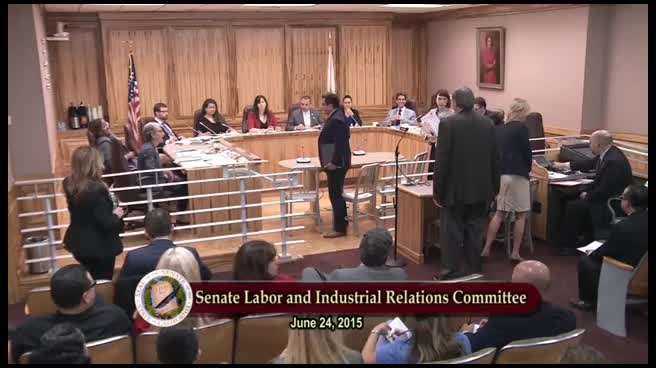 35MIN
Senate Standing Committee on Labor and Industrial Relations
 32SEC
Assembly Floor
 11MIN
Assembly Floor
 1MIN
Assembly Floor
 3MIN
Assembly Standing Committee on Appropriations
 27MIN
Assembly Standing Committee on Labor and Employment
Bill Author