AB 1103: Solid waste disposal: self-haulers.
- Session Year: 2015-2016
- House: Assembly
- Latest Version Date: 2016-09-22
The California Integrated Waste Management Act of 1989, administered by the Department of Resources Recycling and Recovery, generally regulates the disposal, management, and recycling of solid waste. Existing law requires exporters, brokers, and transporters of recyclables or compost to submit periodic information to the department on the types, quantities, and destinations of materials that are disposed of, sold, or transferred.
This bill would additionally require a self-hauler to submit that information to the department and would require the department to develop regulations that define self-hauler to include specified persons and entities.
The California Integrated Waste Management Act of 1989, administered by the Department of Resources Recycling and Recovery, generally regulates the disposal, management, and recycling of solid waste. Existing law requires exporters, brokers, and transporters of recyclables or compost to submit periodic information to the department on the types, quantities, and destinations of materials that are disposed of, sold, or transferred.
This bill would additionally require a self-hauler, as specified, self-hauler to submit that information to the department. department and would require the department to develop regulations that define self-hauler to include specified persons and entities.
Existing law prohibits a person, other than an authorized recycling agent, from removing specified materials that have been segregated from solid waste materials and placed at a designated recycling collection location for residential curbside collection programs authorized by a city, county, or local agency for the purposes of collection and recycling or at a designated recycling collection location by any commercial or industrial entity. Existing law authorizes a court, in a civil action by a recycling agent against a person alleged to have violated these laws, to either allow treble damages or award a civil penalty, as specified, against the unauthorized person removing the recyclable material, and to allow treble damages or award a higher civil penalty, as specified, against a person for a second violation and subsequent violations.
This bill would prohibit a person, subject to these same penalties and damages, from collecting, removing, or transporting solid waste generated by another person on residential, commercial, or industrial premises located within a city, county, or local governmental jurisdiction, except in compliance with applicable law, as defined. The bill would apply those same penalties and damages in any civil action against a person alleged to have violated, or to have knowingly participated in the violation of, the segregated recycling laws specified above. The bill would require a court, if a plaintiff prevails in a civil action brought pursuant to these and related provisions, to award to the plaintiff reasonable attorneys fees, expert witness fees, and costs incurred in the course of the litigation.
The California Integrated Waste Management Act of 1989, administered by the Department of Resources Recycling and Recovery, generally regulates the disposal, management, and recycling of solid waste. Existing law requires exporters, brokers, and transporters of recyclables or compost to submit periodic information to the department on the types, quantities, and destinations of materials that are disposed of, sold, or transferred.
This bill would additionally require a self-hauler, as defined, specified, to submit that information to the department.
Existing law prohibits a person, other than the an authorized recycling agent of the city or county, agent, from removing specified materials that have been segregated from solid waste materials and placed at a designated recycling collection location for residential curbside collection programs authorized by a city, county, or local agency for the purposes of collection and recycling. recycling or at a designated recycling collection location by any commercial or industrial entity. Existing law authorizes a court, in a civil action by a recycling agent against a person alleged to have violated that or another specified law, these laws, to either allow treble damages or award a civil penalty, as specified, against the unauthorized person removing the recyclable material, and to allow treble damages or award a higher civil penalty, as specified, against a person for a second violation and subsequent violations.
This bill would prohibit a person, other than the solid waste enterprise duly authorized by a city, county, or other local governmental agency, subject to these same penalties and damages, from collecting, removing, or transporting solid waste generated by another person on residential, commercial, or industrial premises located within the a city, county, or local governmental jurisdiction. jurisdiction, except in compliance with applicable law, as defined. The bill would apply those same penalties and damages in any civil action against a person alleged to have violated, or to have knowingly participated in the violation of, the segregated recycling laws specified above. The bill would require a court, if a plaintiff prevails in a civil action brought pursuant to these and related provisions, to award to the plaintiff reasonable attorneys fees, expert witness fees, and costs incurred in the course of the litigation.
The California Integrated Waste Management Act of 1989, administered by the Department of Resources Recycling and Recovery, generally regulates the disposal, management, and recycling of solid waste. Existing law requires exporters, brokers, and transporters of recyclables or compost to submit periodic information to the department on the types, quantities, and destinations of materials that are disposed of, sold, or transferred.
This bill would additionally require a self-hauler, as defined, to submit that information to the department.
Existing law prohibits a person, other than the authorized recycling agent of the city or county, from removing specified materials that have been segregated from solid waste materials and placed at a designated recycling collection location for residential curbside collection programs authorized by a city, county, or local agency for the purposes of collection and recycling. Existing law authorizes a court, in a civil action by a recycling agent against a person alleged to have violated that or another specified law, to either allow treble damages or award a civil penalty, as specified, against the unauthorized person removing the recyclable material, and to allow treble damages or award a civil penalty, as specified, against a person for a second violation and subsequent violations.
This bill would prohibit a person, other than the solid waste enterprise duly authorized by a city, county, or other local governmental agency, subject to these same penalties and damages, from collecting, removing, or transporting solid waste generated on residential, commercial, or industrial premises located within the city, county, or local governmental jurisdiction. The bill would require a court, if a plaintiff prevails in a civil action brought pursuant to these and related provisions, to award to the plaintiff reasonable attorneys fees, expert witness fees, and costs incurred in the course of the litigation.
Existing law, on and after April 1, 2016, requires a business that generates a certain amount of organic waste to arrange for recycling services specifically for organic waste, and requires each city, county, or regional agency approved by the Department of Resources Recycling and Recovery to implement an organic waste recycling program designed to divert organic waste generated by those businesses, except as specified. Existing law defines the term organic waste for purposes of those provisions to include food waste.
This bill would require a person who transports a certain amount of food waste to be registered by the department, except as specified. The bill would require a registered transporter to maintain a record of food waste transported that contains specified documents and information, and to certify, under penalty of perjury, to the accuracy of the record. By expanding the application of the crime of perjury, the bill would impose a state-mandated local program. The bill would authorize the department to impose fees on registered transporters for vehicles used to transport food waste for the departments reasonable regulatory costs in administering these provisions regulating the diversion of food waste, as specified. The bill would require food waste transporters and facilities to report specified information to the department at least quarterly, including, among other things, the quantity of food waste transported or received, as applicable. The bill would subject a registered transporter of food waste to a civil penalty, payable to the department, for a violation of these provisions. The bill would require a jurisdiction or other local governmental agency to inspect vehicles that are used by transporters to transport food waste. By imposing additional duties on local governmental agencies, the bill would impose a state-mandated local program.
The California Constitution requires the state to reimburse local agencies and school districts for certain costs mandated by the state. Statutory provisions establish procedures for making that reimbursement.
This bill would provide that with regard to certain mandates no reimbursement is required by this act for a specified reason.
With regard to any other mandates, this bill would provide that, if the Commission on State Mandates determines that the bill contains costs so mandated by the state, reimbursement for those costs shall be made pursuant to the statutory provisions noted above.
Existing law, on and after April 1, 2016, requires a business that generates a certain amount of organic waste to arrange for recycling services specifically for organic waste, and requires each city, county, or regional agency approved by the Department of Resources Recycling and Recovery to implement an organic waste recycling program designed to divert organic waste generated by those businesses, except as specified. Existing law defines the term organic waste for purposes of those provisions to include food waste and food-soiled paper waste.
This bill would also define the terms food-soiled paper and food waste for purposes of those provisions. require a person who transports a certain amount of food waste to be registered by the department, except as specified. The bill would require a registered transporter to maintain a record of food waste transported that contains specified documents and information, and to certify, under penalty of perjury, to the accuracy of the record. By expanding the application of the crime of perjury, the bill would impose a state-mandated local program. The bill would authorize the department to impose fees on registered transporters for vehicles used to transport food waste for the departments reasonable regulatory costs in administering these provisions regulating the diversion of food waste, as specified. The bill would require food waste transporters and facilities to report specified information to the department at least quarterly, including, among other things, the quantity of food waste transported or received, as applicable. The bill would subject a registered transporter of food waste to a civil penalty, payable to the department, for a violation of these provisions. The bill would require a jurisdiction or other local governmental agency to inspect vehicles that are used by transporters to transport food waste. By imposing additional duties on local governmental agencies, the bill would impose a state-mandated local program.
The California Constitution requires the state to reimburse local agencies and school districts for certain costs mandated by the state. Statutory provisions establish procedures for making that reimbursement.
This bill would provide that with regard to certain mandates no reimbursement is required by this act for a specified reason.
With regard to any other mandates, this bill would provide that, if the Commission on State Mandates determines that the bill contains costs so mandated by the state, reimbursement for those costs shall be made pursuant to the statutory provisions noted above.
Existing law, on and after April 1, 2016, requires a business that generates a certain amount of organic waste to arrange for recycling services specifically for organic waste, and requires each city, county, or regional agency approved by the Department of Resources Recycling and Recovery to implement an organic waste recycling program designed to divert organic waste generated by those businesses, except as specified. Existing law defines the term organic waste for purposes of those provisions to include food waste and food-soiled paper waste.
This bill would also define the terms food-soiled paper and food waste for purposes of those provisions.
(a)Disposal facility operators shall submit information on the disposal tonnages by jurisdiction or region of origin that are disposed of at each disposal facility to the department, and to counties that request the information, in a form prescribed by the department. To enable disposal facility operators to provide that information, solid waste handlers and transfer station operators shall provide information to disposal facility operators on the origin of the solid waste that they deliver to the disposal facility.
(b)(1)Recycling and composting operations and facilities shall submit periodic information to the department on the types and quantities of materials that are disposed of, sold, or transferred to other recycling or composting facilities, end users inside of the state or outside of the state, or exporters, brokers, or transporters for sale inside of the state or outside of the state.
(2)Exporters, brokers, self-haulers, and transporters of recyclables or compost shall submit periodic information to the department on the types, quantities, and destinations of materials that are disposed of, sold, or transferred. The department shall develop regulations implementing this section that define self-hauler to include, at a minimum, a person or entity that generates and transports, utilizing its own employees and equipment, more than one cubic yard per week of its own food waste to a location or facility that is not owned and operated by that person or entity.
(3)The information in the reports submitted pursuant to this subdivision may be provided to the department on an aggregated facility-wide basis and may exclude financial data, such as contract terms and conditions (including information on pricing, credit terms, volume discounts and other proprietary business terms), the jurisdiction of the origin of the materials, or information on the entities from which the materials are received. The department may provide this information to jurisdictions, aggregated by company, upon request. The aggregated information, other than that aggregated by company, is public information.
(c)The department shall adopt regulations pursuant to this section requiring practices and procedures that are reasonable and necessary to implement this section, and that provide a representative accounting of solid wastes and recyclable materials that are handled, processed, or disposed. Those regulations approved by the department shall not impose an unreasonable burden on waste and recycling handling, processing, or disposal operations or otherwise interfere with the safe handling, processing, and disposal of solid waste and recyclables. The department shall include in those regulations both of the following:
(1)Procedures to ensure that an opportunity to comply is provided prior to initiation of enforcement authorized by Section 41821.7.
(2)Factors to be considered in determining penalty amounts that are similar to those provided in Section 45016.
(d)Any person who refuses or fails to submit information required by regulations adopted pursuant to this section is liable for a civil penalty of not less than five hundred dollars ($500) and not more than five thousand dollars ($5,000) for each violation of a separate provision or, for continuing violations, for each day that the violation continues.
(e)Any person who knowingly or willfully files a false report, or any person who refuses to permit the department or any of its representatives to make inspection or examination of records, or who fails to keep any records for the inspection of the department, or who alters, cancels, or obliterates entries in the records for the purpose of falsifying the records as required by regulations adopted pursuant to this section, is liable for a civil penalty of not less than five hundred dollars ($500) and not more than ten thousand dollars ($10,000) for each violation of a separate provision or, for continuing violations, for each day that the violation continues.
(f)Liability under this section may be imposed in a civil action, or liability may be imposed administratively pursuant to this article.
(g)(1)Notwithstanding Title 5 (commencing with Section 3426) of Part 1 of Division 4 of the Civil Code and Article 11 (commencing with Section 1060) of Chapter 4 of Division 8 of the Evidence Code, all records that the facility or operator is reasonably required to keep to allow the department to verify information in, or verification of, the reports required pursuant to subdivisions (a) and (b) and implementing regulations shall be subject to inspection and copying by the department, but shall be confidential and shall not be subject to disclosure under the California Public Records Act (Chapter 3.5 (commencing with Section 6250) of Division 7 of Title 1 of the Government Code).
(2)Notwithstanding Title 5 (commencing with Section 3426) of Part 1 of Division 4 of the Civil Code and Article 11 (commencing with Section 1060) of Chapter 4 of Division 8 of the Evidence Code, an employee of a government entity may, at the disposal facility, inspect and copy records related to tonnage received at the facility on or after July 1, 2015, and originating within the government entitys geographic jurisdiction. Those records shall be limited to weight tags that identify the hauler, vehicle, quantity, date, type, and origin of waste received at a disposal facility. Those records shall be available to those government entities for the purposes of subdivision (a) and as necessary to enforce the collection of local fees, but those records shall be confidential and shall not be subject to disclosure under the California Public Records Act (Chapter 3.5 (commencing with Section 6250) of Division 7 of Title 1 of the Government Code). Names of haulers using specific landfills shall not be disclosed by a government entity unless necessary as part of an administrative or judicial enforcement proceeding to fund local programs or enforce local franchises.
(3)A government entity may petition the superior court for injunctive or declaratory relief to enforce its authority under paragraph (2). The times for responsive pleadings and hearings in these proceedings shall be set by the judge of the court with the object of securing a decision as to these matters at the earliest possible time.
(4)For purposes of this section, a government entity is an entity identified in Section 40145 or an entity formed pursuant to Section 40976.
(5)For purposes of this subdivision, disposal and disposal facility have the same meanings as prescribed by Sections 40120.1 and 40121, respectively.
(6)Nothing in this subdivision shall be construed to limit or expand the authority of a government entity that may have been provided by this section and implementing regulations as they read on December 31, 2015.
(7)The records subject to inspection and copying by the department pursuant to paragraph (1) or by an employee of a government entity pursuant to paragraph (2) may be redacted by the operator before inspection to exclude confidential pricing information contained in the records, such as contract terms and conditions (including information on pricing, credit terms, volume discounts, and other proprietary business terms), if the redacted information is not information that is otherwise required to be reported to the department.
(h)Notwithstanding the Uniform Electronic Transactions Act (Title 2.5 (commencing with Section 1633.1) of Part 2 of Division 3 of the Civil Code), reports required by this section shall be submitted electronically, using an electronic reporting format system established by the department.
(i)All records provided in accordance with this section shall be subject to Section 40062.
SEC. 2.Section 41952 of the Public Resources Code is amended and renumbered to read:41957.Nothing in this chapter limits the right of any person to donate, sell, or otherwise dispose of his or her recyclable materials.
SEC. 3.Section 41952 is added to the Public Resources Code, to read:41952.No person shall collect, remove, or transport solid waste generated by another person on residential, commercial, or industrial premises located within a city, county, or local governmental jurisdiction, except in compliance with applicable law. For purposes of this section, applicable law includes, but is not limited to, a municipal ordinance regulating the handling of solid waste.
SEC. 4.Section 41953 of the Public Resources Code is amended to read:41953.(a)In any civil action by a person, including, but not limited to, a local governmental agency or its recycling agent, against a person alleged to have violated Section 41950 or 41951, or by a person, including, but not limited to, a local governmental agency or a solid waste enterprise authorized by the local governmental agency to handle solid waste, against a person alleged to have violated, or to have knowingly participated in the violation of, Section 41952, the court may either allow treble damages, as measured by the market value of the recyclable material removed, or award a civil penalty of not more than two thousand dollars ($2,000), whichever is greater, for each unauthorized removal, against the unauthorized person removing the recyclable material or solid waste.
(b)In any civil action by a person, including, but not limited to, a local governmental agency or its recycling agent, against a person alleged to have violated Section 41950 or 41951, or by a person, including, but not limited to, a local governmental agency or a solid waste enterprise authorized by the local governmental agency to handle solid waste, against a person alleged to have violated, or to have knowingly participated in the violation of, Section 41952, for a second, or subsequent, time in any 12-month period, the court may either allow treble damages, as measured by the market value of the recyclable material removed, or award a civil penalty of not more than five thousand dollars ($5,000), whichever is greater, for each unauthorized removal against the unauthorized person removing the recyclable material or solid waste.
(c)If a plaintiff prevails in a civil action brought pursuant to this chapter, the court shall award to the plaintiff reasonable attorneys fees, expert witness fees, and costs incurred in the course of the litigation.
(a)Disposal facility operators shall submit information on the disposal tonnages by jurisdiction or region of origin that are disposed of at each disposal facility to the department, and to counties that request the information, in a form prescribed by the department. To enable disposal facility operators to provide that information, solid waste handlers and transfer station operators shall provide information to disposal facility operators on the origin of the solid waste that they deliver to the disposal facility.
(b)(1)Recycling and composting operations and facilities shall submit periodic information to the department on the types and quantities of materials that are disposed of, sold, or transferred to other recycling or composting facilities, end users inside of the state or outside of the state, or exporters, brokers, or transporters for sale inside of the state or outside of the state.
(2)Exporters, brokers, self-haulers, and transporters of recyclables or compost shall submit periodic information to the department on the types, quantities, and destinations of materials that are disposed of, sold, or transferred. For purposes of this section, The department shall develop regulations implementing this section that define self-hauler means to include, at a minimum, a person or entity that generates and transports, utilizing its own employees and equipment, more than one cubic yard per week of its own recyclables, organics, or compostable material food waste to a location or facility that is not owned and operated by that person or entity.
(3)The information in the reports submitted pursuant to this subdivision may be provided to the department on an aggregated facility-wide basis and may exclude financial data, such as contract terms and conditions (including information on pricing, credit terms, volume discounts and other proprietary business terms), the jurisdiction of the origin of the materials, or information on the entities from which the materials are received. The department may provide this information to jurisdictions, aggregated by company, upon request. The aggregated information, other than that aggregated by company, is public information.
(c)The department shall adopt regulations pursuant to this section requiring practices and procedures that are reasonable and necessary to implement this section, and that provide a representative accounting of solid wastes and recyclable materials that are handled, processed, or disposed. Those regulations approved by the department shall not impose an unreasonable burden on waste and recycling handling, processing, or disposal operations or otherwise interfere with the safe handling, processing, and disposal of solid waste and recyclables. The department shall include in those regulations both of the following:
(1)Procedures to ensure that an opportunity to comply is provided prior to initiation of enforcement authorized by Section 41821.7.
(2)Factors to be considered in determining penalty amounts that are similar to those provided in Section 45016.
(d)Any person who refuses or fails to submit information required by regulations adopted pursuant to this section is liable for a civil penalty of not less than five hundred dollars ($500) and not more than five thousand dollars ($5,000) for each violation of a separate provision or, for continuing violations, for each day that the violation continues.
(e)Any person who knowingly or willfully files a false report, or any person who refuses to permit the department or any of its representatives to make inspection or examination of records, or who fails to keep any records for the inspection of the department, or who alters, cancels, or obliterates entries in the records for the purpose of falsifying the records as required by regulations adopted pursuant to this section, is liable for a civil penalty of not less than five hundred dollars ($500) and not more than ten thousand dollars ($10,000) for each violation of a separate provision or, for continuing violations, for each day that the violation continues.
(f)Liability under this section may be imposed in a civil action, or liability may be imposed administratively pursuant to this article.
(g)(1)Notwithstanding Title 5 (commencing with Section 3426) of Part 1 of Division 4 of the Civil Code and Article 11 (commencing with Section 1060) of Chapter 4 of Division 8 of the Evidence Code, all records that the facility or operator is reasonably required to keep to allow the department to verify information in, or verification of, the reports required pursuant to subdivisions (a) and (b) and implementing regulations shall be subject to inspection and copying by the department, but shall be confidential and shall not be subject to disclosure under the California Public Records Act (Chapter 3.5 (commencing with Section 6250) of Division 7 of Title 1 of the Government Code).
(2)Notwithstanding Title 5 (commencing with Section 3426) of Part 1 of Division 4 of the Civil Code and Article 11 (commencing with Section 1060) of Chapter 4 of Division 8 of the Evidence Code, an employee of a government entity may, at the disposal facility, inspect and copy records related to tonnage received at the facility on or after July 1, 2015, and originating within the government entitys geographic jurisdiction. Those records shall be limited to weight tags that identify the hauler, vehicle, quantity, date, type, and origin of waste received at a disposal facility. Those records shall be available to those government entities for the purposes of subdivision (a) and as necessary to enforce the collection of local fees, but those records shall be confidential and shall not be subject to disclosure under the California Public Records Act (Chapter 3.5 (commencing with Section 6250) of Division 7 of Title 1 of the Government Code). Names of haulers using specific landfills shall not be disclosed by a government entity unless necessary as part of an administrative or judicial enforcement proceeding to fund local programs or enforce local franchises.
(3)A government entity may petition the superior court for injunctive or declaratory relief to enforce its authority under paragraph (2). The times for responsive pleadings and hearings in these proceedings shall be set by the judge of the court with the object of securing a decision as to these matters at the earliest possible time.
(4)For purposes of this section, a government entity is an entity identified in Section 40145 or an entity formed pursuant to Section 40976.
(5)For purposes of this subdivision, disposal and disposal facility have the same meanings as prescribed by Sections 40120.1 and 40121, respectively.
(6)Nothing in this subdivision shall be construed to limit or expand the authority of a government entity that may have been provided by this section and implementing regulations as they read on December 31, 2015.
(7)The records subject to inspection and copying by the department pursuant to paragraph (1) or by an employee of a government entity pursuant to paragraph (2) may be redacted by the operator before inspection to exclude confidential pricing information contained in the records, such as contract terms and conditions (including information on pricing, credit terms, volume discounts, and other proprietary business terms), if the redacted information is not information that is otherwise required to be reported to the department.
(h)Notwithstanding the Uniform Electronic Transactions Act (Title 2.5 (commencing with Section 1633.1) of Part 2 of Division 3 of the Civil Code), reports required by this section shall be submitted electronically, using an electronic reporting format system established by the department.
(i)All records provided in accordance with this section shall be subject to Section 40062.
SEC. 2.Section 41952 of the Public Resources Code is amended and renumbered to read:41957.Nothing in this chapter limits the right of any person to donate, sell, or otherwise dispose of his or her recyclable materials.
SEC. 3.Section 41952 is added to the Public Resources Code, to read:41952.No person, other than the solid waste enterprise duly authorized by a city, county, or other local governmental agency, person shall collect, remove, or transport solid waste generated by another person on residential, commercial, or industrial premises located within the a city, county, or local governmental jurisdiction. jurisdiction, except in compliance with applicable law. For purposes of this section, applicable law includes, but is not limited to, a municipal ordinance regulating the handling of solid waste.
SEC. 4.Section 41953 of the Public Resources Code is amended to read:41953.(a)In any civil action by a person, including, but not limited to, a local governmental agency or its recycling agent agent, against a person alleged to have violated Section 41950 or 41951, or by an authorized a person, including, but not limited to, a local governmental agency or a solid waste enterprise authorized by the local governmental agency to handle solid waste, against a person alleged to have violated violated, or to have knowingly participated in the violation of, Section 41952, the court may either allow treble damages, as measured by the market value of the recyclable material removed, or award a civil penalty of not more than two thousand dollars ($2,000), whichever is greater, for each unauthorized removal, against the unauthorized person removing the recyclable material. material or solid waste.
(b)In any civil action by a person, including, but not limited to, a local governmental agency or its recycling agent agent, against a person alleged to have violated Section 41950 or 41951, or by an authorized a person, including, but not limited to, a local governmental agency or a solid waste enterprise authorized by the local governmental agency to handle solid waste, against a person alleged to have violated violated, or to have knowingly participated in the violation of, Section 41952, for a second, or subsequent, time in any 12-month period, the court may either allow treble damages, as measured by the market value of the recyclable material removed, or award a civil penalty of not more than five thousand dollars ($5,000), whichever is greater, for each unauthorized removal against the unauthorized person removing the recyclable material. material or solid waste.
(c)If a plaintiff prevails in a civil action brought pursuant to this chapter, the court shall award to the plaintiff reasonable attorneys fees, expert witness fees, and costs incurred in the course of the litigation.
(a)Disposal facility operators shall submit information on the disposal tonnages by jurisdiction or region of origin that are disposed of at each disposal facility to the department, and to counties that request the information, in a form prescribed by the department. To enable disposal facility operators to provide that information, solid waste handlers and transfer station operators shall provide information to disposal facility operators on the origin of the solid waste that they deliver to the disposal facility.
(b)(1)Recycling and composting operations and facilities shall submit periodic information to the department on the types and quantities of materials that are disposed of, sold, or transferred to other recycling or composting facilities, end users inside of the state or outside of the state, or exporters, brokers, or transporters for sale inside of the state or outside of the state.
(2)Exporters, brokers, brokers, self-haulers, and transporters of recyclables or compost shall submit periodic information to the department on the types, quantities, and destinations of materials that are disposed of, sold, or transferred. For purposes of this section, self-hauler means a person or entity that generates and transports, utilizing its own employees and equipment, more than one cubic yard per week of its own recyclables, organics, or compostable material to a location or facility that is not owned and operated by that person or entity.
(3)The information in the reports submitted pursuant to this subdivision may be provided to the department on an aggregated facility-wide basis and may exclude financial data, such as contract terms and conditions (including information on pricing, credit terms, volume discounts and other proprietary business terms), the jurisdiction of the origin of the materials, or information on the entities from which the materials are received. The department may provide this information to jurisdictions, aggregated by company, upon request. The aggregated information, other than that aggregated by company, is public information.
(c)The department shall adopt regulations pursuant to this section requiring practices and procedures that are reasonable and necessary to implement this section, and that provide a representative accounting of solid wastes and recyclable materials that are handled, processed, or disposed. Those regulations approved by the department shall not impose an unreasonable burden on waste and recycling handling, processing, or disposal operations or otherwise interfere with the safe handling, processing, and disposal of solid waste and recyclables. The department shall include in those regulations both of the following:
(1)Procedures to ensure that an opportunity to comply is provided prior to initiation of enforcement authorized by Section 41821.7.
(2)Factors to be considered in determining penalty amounts that are similar to those provided in Section 45016.
(d)Any person who refuses or fails to submit information required by regulations adopted pursuant to this section is liable for a civil penalty of not less than five hundred dollars ($500) and not more than five thousand dollars ($5,000) for each violation of a separate provision or, for continuing violations, for each day that the violation continues.
(e)Any person who knowingly or willfully files a false report, or any person who refuses to permit the department or any of its representatives to make inspection or examination of records, or who fails to keep any records for the inspection of the department, or who alters, cancels, or obliterates entries in the records for the purpose of falsifying the records as required by regulations adopted pursuant to this section, is liable for a civil penalty of not less than five hundred dollars ($500) and not more than ten thousand dollars ($10,000) for each violation of a separate provision or, for continuing violations, for each day that the violation continues.
(f)Liability under this section may be imposed in a civil action, or liability may be imposed administratively pursuant to this article.
(g)(1)Notwithstanding Title 5 (commencing with Section 3426) of Part 1 of Division 4 of the Civil Code and Article 11 (commencing with Section 1060) of Chapter 4 of Division 8 of the Evidence Code, all records that the facility or operator is reasonably required to keep to allow the department to verify information in, or verification of, the reports required pursuant to subdivisions (a) and (b) and implementing regulations shall be subject to inspection and copying by the department, but shall be confidential and shall not be subject to disclosure under the California Public Records Act (Chapter 3.5 (commencing with Section 6250) of Division 7 of Title 1 of the Government Code).
(2)Notwithstanding Title 5 (commencing with Section 3426) of Part 1 of Division 4 of the Civil Code and Article 11 (commencing with Section 1060) of Chapter 4 of Division 8 of the Evidence Code, an employee of a government entity may, at the disposal facility, inspect and copy records related to tonnage received at the facility on or after July 1, 2015, and originating within the government entitys geographic jurisdiction. Those records shall be limited to weight tags that identify the hauler, vehicle, quantity, date, type, and origin of waste received at a disposal facility. Those records shall be available to those government entities for the purposes of subdivision (a) and as necessary to enforce the collection of local fees, but those records shall be confidential and shall not be subject to disclosure under the California Public Records Act (Chapter 3.5 (commencing with Section 6250) of Division 7 of Title 1 of the Government Code). Names of haulers using specific landfills shall not be disclosed by a government entity unless necessary as part of an administrative or judicial enforcement proceeding to fund local programs or enforce local franchises.
(3)A government entity may petition the superior court for injunctive or declaratory relief to enforce its authority under paragraph (2). The times for responsive pleadings and hearings in these proceedings shall be set by the judge of the court with the object of securing a decision as to these matters at the earliest possible time.
(4)For purposes of this section, a government entity is an entity identified in Section 40145 or an entity formed pursuant to Section 40976.
(5)For purposes of this subdivision, disposal and disposal facility have the same meanings as prescribed by Sections 40120.1 and 40121, respectively.
(6)Nothing in this subdivision shall be construed to limit or expand the authority of a government entity that may have been provided by this section and implementing regulations as they read on December 31, 2015.
(7)The records subject to inspection and copying by the department pursuant to paragraph (1) or by an employee of a government entity pursuant to paragraph (2) may be redacted by the operator before inspection to exclude confidential pricing information contained in the records, such as contract terms and conditions (including information on pricing, credit terms, volume discounts, and other proprietary business terms), if the redacted information is not information that is otherwise required to be reported to the department.
(h)Notwithstanding the Uniform Electronic Transactions Act (Title 2.5 (commencing with Section 1633.1) of Part 2 of Division 3 of the Civil Code), reports required by this section shall be submitted electronically, using an electronic reporting format system established by the department.
(i)All records provided in accordance with this section shall be subject to Section 40062.
SEC. 2.Section 41952 of the Public Resources Code is amended and renumbered to read:41952.41957.Nothing in this chapter limits the right of any person to donate, sell, or otherwise dispose of his or her recyclable materials.
SEC. 3.Section 41952 is added to the Public Resources Code, to read:41952.No person, other than the solid waste enterprise duly authorized by a city, county, or other local governmental agency, shall collect, remove, or transport solid waste generated on residential, commercial, or industrial premises located within the city, county, or local governmental jurisdiction.
SEC. 4.Section 41953 of the Public Resources Code is amended to read:41953.(a)In any civil action by a recycling agent against a person alleged to have violated Section 41950 or 41951, or by an authorized solid waste enterprise against a person alleged to have violated Section 41952, the court may either allow treble damages, as measured by the market value of the recyclable material removed, or award a civil penalty of not more than two thousand dollars ($2,000), whichever is greater, for each unauthorized removal, against the unauthorized person removing the recyclable material.
(b)In any civil action by a recycling agent against a person alleged to have violated Section 41950 or 41951 41951, or by an authorized solid waste enterprise against a person alleged to have violated Section 41952, for a second, or subsequent time, subsequent, time in any 12-month period, the court may either allow treble damages, as measured by the market value of the recyclable material removed, or award a civil penalty of not more than five thousand dollars ($5,000), whichever is greater, for each unauthorized removal against the unauthorized person removing the recyclable material.
(c)If a plaintiff prevails in a civil action brought pursuant to this chapter, the court shall award to the plaintiff reasonable attorneys fees, expert witness fees, and costs incurred in the course of the litigation.
SECTION 1.(a)The Legislature finds and declares that a statewide system of accounting for the diversion of food waste through the implementation and enforcement of statewide standards for hauling, processing, and transferring of food waste is critical to protect public health and safety, to reduce the disposal of food waste in landfills, and to improve the environment through the reduction of greenhouse gases. According to the State Air Resources Boards May 2015 Short-Lived Climate Pollutant Reduction Strategy concept paper, The strategy will consider measures to meet a goal of diverting 90 percent of organics from landfills through source reduction and organics recycling by 2025.
(b)It is the intent of the Legislature that food waste material be managed in a manner that is consistent statewide and that tracks the movement of food waste through a regulated system to significantly improve the states ability to do both of the following:
(1)Quantify progress toward greenhouse gas reduction goals statewide.
(2)Report diversion levels for determining progress toward the states current 75 percent recycling goal.
SEC. 2.Section 42649.8 of the Public Resources Code is amended to read:42649.8.For purposes of this chapter, the following terms shall apply:
(a)Business means a commercial or public entity, including, but not limited to, a firm, partnership, proprietorship, joint stock company, corporation, or association that is organized as a for-profit or nonprofit entity, or a multifamily residential dwelling, and including federal, state, county, and municipal entities, special districts, schools, and colleges.
(b)Commercial waste generator means a business subject to subdivision (a) of Section 42649.2.
(c)Food waste means discarded putrescible solid, semisolid, and liquid food, including, but not limited to, fruit, vegetables, cheese, meat, bones, poultry, seafood, bread, rice, pasta, oils, and herbs, and any other putrescible matter produced from human food production and preparation activities.
(d)Individual self-hauler means a self-hauler with only one transporter vehicle that transports not more than one cubic yard of food waste per week from not more than one location.
(e)Organic waste means food waste, green waste, landscape and pruning waste, nonhazardous wood waste, and food-soiled paper waste that is mixed in with food waste.
(f)Organic waste generator means a business subject to subdivision (a) of Section 42649.81.
(g)Rural jurisdiction means a jurisdiction that is located entirely within one or more rural counties, or a regional agency comprised of jurisdictions that are located within one or more rural counties.
(h)Rural county means a county that has a total population of less than 70,000 persons.
(i)Self-hauler means a business that hauls more than one cubic yard of its own food waste or hauls food waste from more than one location, rather than contracting for that service, and self-haul means to act as a self-hauler.
(j)Transporter vehicle means a vehicle that transports and delivers food waste to an approved processing facility, and that is operated by a business required to be registered pursuant to Section 42649.89.
SEC. 3.Section 42649.88 is added to the Public Resources Code, to read:42649.88.Any facility that is permitted or authorized by law to receive food waste may participate in the diversion of food waste pursuant to this chapter.
SEC. 4.Section 42649.89 is added to the Public Resources Code, to read:42649.89.(a)Except as expressly provided herein, it is unlawful for any business to transport more than one cubic yard of food waste per week or to transport food waste from more than one location without being registered by the department as a transporter of food waste. The following are exempt from the registration and related requirements of this section:
(1)Licensed renderers lawfully operating pursuant to Chapter 5 (commencing with Section 19200) of Part 3 of Division 9 of the Food and Agricultural Code.
(2)Transporters of agricultural byproducts destined for final disposition on land in a manner that is specifically authorized by the State Water Resources Control Board, or a Regional Water Quality Control Board, provided such final disposition does not adversely affect public health and safety or the environment.
(b)The department may impose fees on registered transporters of food waste and individual self-haulers for transporter vehicles for the reasonable regulatory costs to the department to administer the provisions of this chapter regulating the diversion of food waste, not to exceed the following:
(1)Except as specified in paragraph (2), three hundred dollars ($300) for each transporter vehicle.
(2)One hundred dollars ($100) for the transporter vehicle of an individual self-hauler.
(c)A registered transporter shall procure and maintain insurance coverage against claims for injuries to persons or damages to property that may arise from, or in connection with, the performance of the work of the transporter. A registered transporter shall maintain commercial liability, commercial automobile liability, workers compensation, and pollution liability insurance policies, in an amount and type as determined by the department, which amount shall be no less than one million dollars ($1,000,000). A registered transporter lawfully operating pursuant to a franchise, contract, license, or permit issued by a local agency shall be deemed to have satisfied the requirements of this subdivision.
(d)A transporter vehicle shall be inspected on a regular basis, at a frequency and in accordance with standards developed by the department, by the jurisdiction or other local governmental entity permitting the transporters operation. The inspection shall include, but is not limited to, the vehicles cleanliness, whether the vehicle is watertight, whether the food waste is properly contained, and whether the vehicle has been inspected pursuant to Section 34501.12 of the Vehicle Code. A transporter lawfully operating pursuant to a franchise, contract, license, or permit issued by a local agency shall be deemed to have satisfied the requirements of this subdivision.
(e)A registered transporter shall comply with state or local laws or requirements, including a local ordinance or agreement, applicable to the collection, handling, or recycling of solid waste.
SEC. 5.Section 42649.9 is added to the Public Resources Code, to read:42649.9.(a)A registered transporter shall maintain a record of transported food waste to document that food waste did not remain on the premises of the generator for more than seven days, consistent with, and subject to the exceptions provided in, Section 17331 of Title 14 of the California Code of Regulations, and was handled in accordance with the provisions of this chapter, as specified in regulations to be adopted pursuant to subdivision (e).
(b)The record shall include a receipt indicating the acceptance of the material at a permitted or approved facility, the quantity of the material, and the jurisdiction of origin of the food waste. The transporter shall certify, under penalty of perjury, that the record is accurate.
(c)A registered transporter shall submit an electronic report to the department, at least quarterly, containing all information required to be reported pursuant to subdivision (b) of Section 42649.91.
(d)A registered transporter shall maintain all records required pursuant to this section for a minimum of three years.
(e)The department may adopt regulations requiring practices and procedures that are reasonable and necessary to provide an accounting of food waste transported, handled, processed, or disposed. The regulations shall not impose an unreasonable burden on the transporting, safe handling, processing, and disposal of food waste.
SEC. 6.Section 42649.91 is added to the Public Resources Code, to read:42649.91.(a)The department shall compile a list of permitted and approved facilities authorized to accept food waste and shall also notify facilities and registered transporters of the requirements relating to transportation of food waste by posting the information on the departments Internet Web site.
(b)The department shall require a registered transporter or facility that transports or receives food waste, as applicable, to report information to the department at least quarterly concerning the transportation and receipt of food waste, including all of the following:
(1)The name of the transporter or facility.
(2)The jurisdiction of origin of the food waste.
(3)The quantity of the food waste transported or received in weight or volume.
(4)The date and time the food waste was transported or received.
(5)The license plate number of the vehicle used for transportation.
(6)Any other information required by the department.
SEC. 7.Section 42649.92 is added to the Public Resources Code, to read:42649.92.Any person who refuses or fails to submit information required by regulations adopted pursuant to Sections 42649.88 to 42649.91, inclusive, is liable to the department for a civil penalty of not less than five hundred dollars ($500) and not more than five thousand dollars ($5,000) for each violation of a separate provision or, for continuing violations, for each day that the violation continues.
SEC. 8.No reimbursement is required by this act pursuant to Section 6 of Article XIIIB of the California Constitution for certain costs that may be incurred by a local agency or school district because, in that regard, this act creates a new crime or infraction, eliminates a crime or infraction, or changes the penalty for a crime or infraction, within the meaning of Section 17556 of the Government Code, or changes the definition of a crime within the meaning of Section 6 of Article XIIIB of the California Constitution.
However, if the Commission on State Mandates determines that this act contains other costs mandated by the state, reimbursement to local agencies and school districts for those costs shall be made pursuant to Part 7 (commencing with Section 17500) of Division 4 of Title 2 of the Government Code.
(a)The Legislature finds and declares that a statewide system of accounting for the diversion of food waste through the implementation and enforcement of statewide standards for hauling, processing, and transferring of food waste is critical to protect public health and safety, to reduce the disposal of food waste in landfills, and to improve the environment through the reduction of greenhouse gases. According to the State Air Resources Boards May 2015 Short-Lived Climate Pollutant Reduction Strategy concept paper, The strategy will consider measures to meet a goal of diverting 90 percent of organics from landfills through source reduction and organics recycling by 2025.
(b)It is the intent of the Legislature that food waste material be managed in a manner that is consistent statewide and that tracks the movement of food waste through a regulated system to significantly improve the states ability to do both of the following:
(1)Quantify progress toward greenhouse gas reduction goals statewide.
(2)Report diversion levels for determining progress toward the states current 75 percent recycling goal.
SECTION 1.SEC. 2.Section 42649.8 of the Public Resources Code is amended to read:42649.8.For purposes of this chapter, the following terms shall apply:
(a)Business means a commercial or public entity, including, but not limited to, a firm, partnership, proprietorship, joint stock company, corporation, or association that is organized as a for-profit or nonprofit entity, or a multifamily residential dwelling. dwelling, and including federal, state, county, and municipal entities, special districts, schools, and colleges.
(b)Commercial waste generator means a business subject to subdivision (a) of Section 42649.2.
(c)Food-soiled paper includes, but is not limited to, food soiled napkins, towels, egg cartons, pizza boxes, waxed or unwaxed cardboard or paper food and beverage containers or wrappers, paper bags, coffee filters, tea bags, and plates and cups that do not have a plastic coating.
(d)
(c)Food waste means discarded putrescible solid, semisolid, and liquid food, including, but not limited to, fruit, vegetables, cheese, meat, bones, poultry, seafood, bread, rice, pasta, oils, and herbs, and any other putrescible matter produced from human food production and preparation activities. Food waste includes food-soiled paper. Food waste does not include materials required to be handled pursuant to Chapter 5 (commencing with Section 19200) of Part 3 of Division 9 of the Food and Agricultural Code.
(d)Individual self-hauler means a self-hauler with only one transporter vehicle that transports not more than one cubic yard of food waste per week from not more than one location.
(e)Organic waste means food waste, green waste, landscape and pruning waste, nonhazardous wood waste, and food-soiled paper waste that is mixed in with food waste.
(f)Organic waste generator means a business subject to subdivision (a) of Section 42649.81.
(g)Rural jurisdiction means a jurisdiction that is located entirely within one or more rural counties, or a regional agency comprised of jurisdictions that are located within one or more rural counties.
(h)Rural county means a county that has a total population of less than 70,000 persons.
(i)Self-hauler means a business that hauls more than one cubic yard of its own food waste or hauls food waste from more than one location, rather than contracting for that service service, and self-haul means to act as a self-hauler.
(j)Transporter vehicle means a vehicle that transports and delivers food waste to an approved processing facility, and that is operated by a business required to be registered pursuant to Section 42649.89.
SEC. 3.Section 42649.88 is added to the Public Resources Code, to read:42649.88.Any facility that is permitted or authorized by law to receive food waste may participate in the diversion of food waste pursuant to this chapter.
SEC. 4.Section 42649.89 is added to the Public Resources Code, to read:42649.89.(a)Except as expressly provided herein, it is unlawful for any business to transport more than one cubic yard of food waste per week or to transport food waste from more than one location without being registered by the department as a transporter of food waste. The following are exempt from the registration and related requirements of this section:
(1)Licensed renderers lawfully operating pursuant to Chapter 5 (commencing with Section 19200) of Part 3 of Division 9 of the Food and Agricultural Code.
(2)Transporters of agricultural byproducts destined for final disposition on land in a manner that is specifically authorized by the State Water Resources Control Board, or a Regional Water Quality Control Board, provided such final disposition does not adversely affect public health and safety or the environment.
(b)The department may impose fees on registered transporters of food waste and individual self-haulers for transporter vehicles for the reasonable regulatory costs to the department to administer the provisions of this chapter regulating the diversion of food waste, not to exceed the following:
(1)Except as specified in paragraph (2), three hundred dollars ($300) for each transporter vehicle.
(2)One hundred dollars ($100) for the transporter vehicle of an individual self-hauler.
(c)A registered transporter shall procure and maintain insurance coverage against claims for injuries to persons or damages to property that may arise from, or in connection with, the performance of the work of the transporter. A registered transporter shall maintain commercial liability, commercial automobile liability, workers compensation, and pollution liability insurance policies, in an amount and type as determined by the department, which amount shall be no less than one million dollars ($1,000,000). A registered transporter lawfully operating pursuant to a franchise, contract, license, or permit issued by a local agency shall be deemed to have satisfied the requirements of this subdivision.
(d)A transporter vehicle shall be inspected on a regular basis, at a frequency and in accordance with standards developed by the department, by the jurisdiction or other local governmental entity permitting the transporters operation. The inspection shall include, but is not limited to, the vehicles cleanliness, whether the vehicle is watertight, whether the food waste is properly contained, and whether the vehicle has been inspected pursuant to Section 34501.12 of the Vehicle Code. A transporter lawfully operating pursuant to a franchise, contract, license, or permit issued by a local agency shall be deemed to have satisfied the requirements of this subdivision.
(e)A registered transporter shall comply with state or local laws or requirements, including a local ordinance or agreement, applicable to the collection, handling, or recycling of solid waste.
SEC. 5.Section 42649.9 is added to the Public Resources Code, to read:42649.9.(a)A registered transporter shall maintain a record of transported food waste to document that food waste did not remain on the premises of the generator for more than seven days, consistent with, and subject to the exceptions provided in, Section 17331 of Title 14 of the California Code of Regulations, and was handled in accordance with the provisions of this chapter, as specified in regulations to be adopted pursuant to subdivision (e).
(b)The record shall include a receipt indicating the acceptance of the material at a permitted or approved facility, the quantity of the material, and the jurisdiction of origin of the food waste. The transporter shall certify, under penalty of perjury, that the record is accurate.
(c)A registered transporter shall submit an electronic report to the department, at least quarterly, containing all information required to be reported pursuant to subdivision (b) of Section 42649.91.
(d)A registered transporter shall maintain all records required pursuant to this section for a minimum of three years.
(e)The department may adopt regulations requiring practices and procedures that are reasonable and necessary to provide an accounting of food waste transported, handled, processed, or disposed. The regulations shall not impose an unreasonable burden on the transporting, safe handling, processing, and disposal of food waste.
SEC. 6.Section 42649.91 is added to the Public Resources Code, to read:42649.91.(a)The department shall compile a list of permitted and approved facilities authorized to accept food waste and shall also notify facilities and registered transporters of the requirements relating to transportation of food waste by posting the information on the departments Internet Web site.
(b)The department shall require a registered transporter or facility that transports or receives food waste, as applicable, to report information to the department at least quarterly concerning the transportation and receipt of food waste, including all of the following:
(1)The name of the transporter or facility.
(2)The jurisdiction of origin of the food waste.
(3)The quantity of the food waste transported or received in weight or volume.
(4)The date and time the food waste was transported or received.
(5)The license plate number of the vehicle used for transportation.
(6)Any other information required by the department.
SEC. 7.Section 42649.92 is added to the Public Resources Code, to read:42649.92.Any person who refuses or fails to submit information required by regulations adopted pursuant to Sections 42649.88 to 42649.91, inclusive, is liable to the department for a civil penalty of not less than five hundred dollars ($500) and not more than five thousand dollars ($5,000) for each violation of a separate provision or, for continuing violations, for each day that the violation continues.
SEC. 8.No reimbursement is required by this act pursuant to Section 6 of Article XIIIB of the California Constitution for certain costs that may be incurred by a local agency or school district because, in that regard, this act creates a new crime or infraction, eliminates a crime or infraction, or changes the penalty for a crime or infraction, within the meaning of Section 17556 of the Government Code, or changes the definition of a crime within the meaning of Section 6 of Article XIIIB of the California Constitution.
However, if the Commission on State Mandates determines that this act contains other costs mandated by the state, reimbursement to local agencies and school districts for those costs shall be made pursuant to Part 7 (commencing with Section 17500) of Division 4 of Title 2 of the Government Code.
For purposes of this chapter, the following terms shall apply:
(a)Business means a commercial or public entity, including, but not limited to, a firm, partnership, proprietorship, joint stock company, corporation, or association that is organized as a for-profit or nonprofit entity, or a multifamily residential dwelling.
(b)Commercial waste generator means a business subject to subdivision (a) of Section 42649.2.
(c)Food-soiled paper includes includes, but is not limited to, food soiled napkins, towels, egg cartons, pizza boxes, waxed or unwaxed cardboard containers, and uncoated plates and cups. or paper food and beverage containers or wrappers, paper bags, coffee filters, tea bags, and plates and cups that do not have a plastic coating.
(d)Food waste means discarded putrescible solid, semisolid, and liquid food, including including, but not limited to, fruit, vegetables, cheese, meat, bones, poultry, seafood, bread, rice, pasta, and oils; coffee filters and tea bags; cut flowers and herbs; oils, and herbs, and any other putrescible matter produced from human or animal food production, preparation, and consumption production and preparation activities. Food waste includes food-soiled paper. Food waste does not include materials required to be handled pursuant to Chapter 5 (commencing with Section 19200) of Part 3 of Division 9 of the Food and Agricultural Code.
(e)Organic waste means food waste, green waste, landscape and pruning waste, nonhazardous wood waste, and food-soiled paper waste that is mixed in with food waste.
(f)Organic waste generator means a business subject to subdivision (a) of Section 42649.81.
(g)Rural jurisdiction means a jurisdiction that is located entirely within one or more rural counties, or a regional agency comprised of jurisdictions that are located within one or more rural counties.
(h)Rural county means a county that has a total population of less than 70,000 persons.
(i)Self-hauler means a business that hauls its own waste rather than contracting for that service and self-haul means to act as a self-hauler.
For purposes of this chapter, the following terms shall apply:
(a)Business means a commercial or public entity, including, but not limited to, a firm, partnership, proprietorship, joint stock company, corporation, or association that is organized as a for-profit or nonprofit entity, or a multifamily residential dwelling.
(b)Commercial waste generator means a business subject to subdivision (a) of Section 42649.2.
(c)Food-soiled paper includes food soiled napkins, towels, egg cartons, pizza boxes, waxed cardboard containers, and uncoated plates and cups.
(d)Food waste means discarded solid, semisolid, and liquid food, including fruit, vegetables, cheese, meat, bones, poultry, seafood, bread, rice, pasta, and oils; coffee filters and tea bags; cut flowers and herbs; and any putrescible matter produced from human or animal food production, preparation, and consumption activities. Food waste includes food-soiled paper.
(c)
(e)Organic waste means food waste, green waste, landscape and pruning waste, nonhazardous wood waste, and food-soiled paper waste that is mixed in with food waste.
(d)
(f)Organic waste generator means a business subject to subdivision (a) of Section 42649.81.
(e)
(g)Rural jurisdiction means a jurisdiction that is located entirely within one or more rural counties, or a regional agency comprised of jurisdictions that are located within one or more rural counties.
(f)
(h)Rural county means a county that has a total population of less than 70,000 persons.
(g)
(i)Self-hauler means a business that hauls its own waste rather than contracting for that service and self-haul means to act as a self-hauler.
|
Date
|
Status
|
|---|---|
| Jun 6, 2016 | From committee chair, with author's amendments: Amend, and re-refer to committee. Read second time, amended, and re-referred to Com. on E.Q. |
| Sep 1, 2016 | Enrolled and presented to the Governor at 4:30 p.m. |
| Aug 25, 2016 | Senate amendments concurred in. To Engrossing and Enrolling. (Ayes 72. Noes 1. Page 6283.). |
| Aug 25, 2016 | Senate amendments concurred in. To Engrossing and Enrolling. |
| Aug 24, 2016 | From committee: That the Senate amendments be concurred in. (Ayes 8. Noes 0.) (August 24). |
| Aug 23, 2016 | Joint Rule 62(a), file notice suspended. (Page 6114.) |
| Aug 23, 2016 | Joint Rule 62(a), file notice suspended. |
| Aug 18, 2016 | Re-referred to Com. on NAT. RES. pursuant to Assembly Rule 77.2. |
| Aug 16, 2016 | In Assembly. Concurrence in Senate amendments pending. May be considered on or after August 18 pursuant to Assembly Rule 77. |
| Aug 15, 2016 | Read third time. Passed. Ordered to the Assembly. (Ayes 33. Noes 5.). |
| Aug 15, 2016 | Read third time. Passed. Ordered to the Assembly. (Ayes 33. Noes 5. Page 4955.). |
| Aug 15, 2016 | Read third time. Passed. Ordered to the Assembly. |
| Jun 28, 2016 | Read second time. Ordered to third reading. |
| Jun 27, 2016 | From committee: Be placed on second reading file pursuant to Senate Rule 28.8. |
| Jun 15, 2016 | From committee: Do pass and re-refer to Com. on APPR. (Ayes 7. Noes 0.) (June 15). Re-referred to Com. on APPR. |
| Feb 27, 2015 | Introduced. To print. |
| Jun 1, 2016 | From committee chair, with author's amendments: Amend, and re-refer to committee. Read second time, amended, and re-referred to Com. on E.Q. |
| May 11, 2016 | In committee: Set, first hearing. Hearing canceled at the request of author. |
| May 11, 2016 | From committee chair, with author's amendments: Amend, and re-refer to committee. Read second time, amended, and re-referred to Com. on E.Q. |
| Jul 16, 2015 | From committee chair, with author's amendments: Amend, and re-refer to committee. Read second time, amended, and re-referred to Com. on E.Q. |
| Jun 4, 2015 | Referred to Com. on E.Q. |
| May 26, 2015 | Read third time. Passed. Ordered to the Senate. (Ayes 54. Noes 14. Page 1588.) |
| May 26, 2015 | Read third time. Passed. Ordered to the Senate. |
| May 26, 2015 | In Senate. Read first time. To Com. on RLS. for assignment. |
| May 20, 2015 | Read second time. Ordered to third reading. |
| May 19, 2015 | Read second time and amended. Ordered returned to second reading. |
| May 18, 2015 | From committee: Amend, and do pass as amended. (Ayes 6. Noes 1.) (May 11). |
| Mar 19, 2015 | Referred to Com. on NAT. RES. |
| Mar 2, 2015 | Read first time. |
| Mar 1, 2015 | From printer. May be heard in committee March 31. |
|
Date
|
Description
|
Location
|
Votes
|
|
|---|---|---|---|---|
| Aug 25, 2016 | AB 1103 DODD Concurrence in Senate Amendments | Assembly Floor |
Passed |
|
| Aug 24, 2016 | With recommendation: That Senate amendments be concurred in. | Assembly Standing Committee on Natural Resources |
Passed |
|
| Aug 15, 2016 | Assembly 3rd Reading AB1103 Dodd By Wieckowski | Senate Floor |
Passed |
|
| Jun 15, 2016 | Do pass, but first be re-referred to the Committee on [Appropriations] | Senate Standing Committee on Environmental Quality |
Passed |
|
| May 26, 2015 | AB 1103 DODD Assembly Third Reading | Assembly Floor |
Passed |
|
| May 11, 2015 | Do pass as amended. | Assembly Standing Committee on Natural Resources |
Passed |
This list shows positions taken on this bill by organizations on the date displayed, which is linked to the original source.
Positions by individuals are not included.
|
Organization
|
Position
|
Date
|
|---|---|---|
| ACES Waste Services | ** Support | Aug 15, 2016 |
| Advance Disposal Co. | ** Support | Aug 15, 2016 |
| Alameda County Industries, Inc. | ** Support | Aug 15, 2016 |
| Amador Valley Industries, LLC | ** Support | May 26, 2015 |
| America California Bank | ** Support | May 26, 2015 |
| Bay Counties SMaRT | ** Support | May 26, 2015 |
| Bay Counties Waste Services, Inc. | ** Support | Aug 15, 2016 |
| BMS Technologies | ** Support | May 26, 2015 |
| California Refuse and Recycling Council | ** Support | Aug 15, 2016 |
| California Refuse Recycling Council | ** Support | May 26, 2015 |
| California Waste Recovery Systems | ** Support | May 26, 2015 |
| Conservation Management Group | ** Support | Aug 15, 2016 |
| Consolidated Fabricators | ** Support | May 26, 2015 |
| CR&R Environmental Services | ** Support | Aug 15, 2016 |
| Davis Waste Removal | ** Support | May 26, 2015 |
| Desert Valley Disposal | ** Support | May 26, 2015 |
| East Bay Sanitary | ** Support | May 26, 2015 |
| EDCO Waste and Recycling | ** Support | May 26, 2015 |
| Fremont Recycling and Transfer Station | ** Support | May 26, 2015 |
| Garaventa Enterprises, Inc. | ** Support | May 26, 2015 |
| Garden City Sanitation | ** Support | May 26, 2015 |
| Green Hasson Janks | ** Support | May 26, 2015 |
| MarBorg Industries | ** Support | May 26, 2015 |
| Marin Sanitary Service | ** Support | May 26, 2015 |
| McConnell, Manit, and Trout Insurance Services | ** Support | May 26, 2015 |
| Mid Valley Disposal | ** Support | May 26, 2015 |
| Mission Trail Waste Systems, Inc. | ** Support | Aug 15, 2016 |
| Napa Recycling and Waste Services | ** Support | May 26, 2015 |
| Northern Recycling and Waste Services | ** Support | May 26, 2015 |
| Olympic Wire and Equipment | ** Support | May 26, 2015 |
| Palm Springs Disposal Services | ** Support | May 26, 2015 |
| Peninsula Sanitary Service | ** Support | May 26, 2015 |
| Pleasanton Garbage Service | ** Support | May 26, 2015 |
| Quackenbush Compost | ** Support | May 26, 2015 |
| Republic Services | ** Support | Aug 25, 2016 |
| RJ Proto Consulting Group | ** Support | May 26, 2015 |
| Rose, Andrew S., Attorney | ** Support | May 26, 2015 |
| Snider Leasing | ** Support | May 26, 2015 |
| Solid Waste Insurance Managers | ** Support | May 26, 2015 |
| South Lake Refuse and Recycling | ** Support | May 26, 2015 |
| South San Francisco Scavenger Company, Inc. | ** Support | Aug 15, 2016 |
| Southern California Disposal and Recycling | ** Support | May 26, 2015 |
| Specialty Solid Waste and Recycling | ** Support | May 26, 2015 |
| Tracy Delta Solid Waste Management | ** Support | May 26, 2015 |
| Tracy Material Recovery | ** Support | May 26, 2015 |
| TruStar Energy | ** Support | May 26, 2015 |
| Turlock Scavenger | ** Support | May 26, 2015 |
| Upper Valley Disposal and Recycling | ** Support | May 26, 2015 |
| Varner Brothers | ** Support | May 26, 2015 |
| Waste Connections, Inc. | ** Support | May 26, 2015 |
| Westhoff, Cone, and Holmstedt | ** Support | May 26, 2015 |
| Zanker Recycling | ** Support | May 26, 2015 |
CONCURRENCE IN SENATE AMENDMENTS
CSA2 Bill Id:AB 1103
Author:(Dodd)
As Amended Ver:June 6, 2016
Majority vote
ASSEMBLY: |
| (May 26, 2015) | SENATE: | 33-5 | (August 15, 2016) |
(vote not relevant)
COMMITTEE VOTE: | 8-0 | (August 24, 2016) | RECOMMENDATION: | Concur |
(Nat. Res.)
Original Committee Reference: NAT. RES.
SUMMARY: This bill adds self-haulers to the requirement that exporters, brokers, and transporters of recyclables or compost submit specified, periodic information to the Department of Resources Recycling and Recovery (CalRecycle) and requires CalRecycle to develop regulations to define "self-hauler."
The Senate amendments delete the Assembly version of the bill, and instead:
- Add self-haulers to the requirement that exporters, brokers, transporters of recyclables or compost submit specified, periodic information to CalRecycle.
- Require CalRecycle to develop regulations to define "self-hauler" and include in the definition, at a minimum, a person or entity that generates and transports, utilizing its own employees and equipment, more than one cubic yard per week of its own food waste to a location or facility that is not owned and operated by that person or entity.
EXISTING LAW, pursuant to the California Integrated Waste Management Act:
- Establishes a state recycling goal that 75% of solid waste generated be diverted from landfill disposal by 2020 through source reduction, recycling, and composting.
- Requires each local jurisdiction to divert 50% of solid waste from landfill disposal through source reduction, recycling, and composting.
- Requires exporters, brokers, and transporters of recyclables or compost to submit periodic information to CalRecycle on the types, quantities, and destinations of materials that are disposed of, sold, or transferred.
- Grants CalRecycle regulatory authority to adopt practices and procedures related to waste tracking in the state.
FISCAL EFFECT: Pursuant to Senate Rule 28.8, this bill has negligible state costs.
COMMENTS: An estimated 35 million tons of waste are disposed of in California's landfills annually, of which 32% is compostable organic materials, 29% is construction and demolition debris, and 17% is paper.
CalRecycle is tasked with diverting at least 75% of solid waste generated statewide by 2020. Organic materials make up one-third of the waste stream and food continues to be the greatest single item disposed, making up over 15% of materials landfilled. CalRecycle is also charged with implementing its Strategic Directive 6.1, which calls for reducing organic waste disposal by 50% by 2020. According to CalRecycle, significant gains in organic waste diversion are necessary to meet the 75% goal and implement Strategic Directive 6.1. Recycling technologies for organic waste include composting, anaerobic digestion, and other types of processing that generate renewable fuels, energy, soil amendments, and mulch.
Compost and other soil amendments that can be produced from organic materials have been shown to improve soil health by incorporating organic matter, beneficial micro-organisms, and nutrients and reduce the need for chemical pesticides and fertilizers. These products also conserve water by allowing water to penetrate the soil more quickly decreasing runoff.
Recycling organic waste provides significant greenhouse gas (GHG) reductions over landfilling. Composting and other organics processing technologies, including anaerobic digestion, reduce GHGs by avoiding the emissions that would be generated by the material's decomposition in a landfill. Landfill gas is generated by the decomposition of organic materials such as food, paper, wood, and yard waste. Fifty percent of landfill gas is methane, a GHG that is over 80 times more efficient at trapping heat than carbon dioxide. While most modern landfills have systems in place to capture methane, significant amounts continue to escape into the atmosphere. According to ARB's GHG inventory, approximately 7 million tons of CO2 equivalent are released annually by landfills. That number is expected to increase to 8.5 million tons of CO2 equivalent by 2020.
According to the author, there is a significant amount of organic waste that is collected by "self-haulers" who may not be captured by CalRecycle's waste tracking system. To the extent that these self-haulers transport a significant amount of organic waste, California may have an incomplete picture of how much organic waste is being diverted from landfills and what the true amount GHG emissions reductions are actually being achieved, relative to the state's statutory goals.
Analysis Prepared by: Elizabeth MacMillan / NAT. RES. / (916) 319-2092 FN: 0004907
Date of Hearing: August 24, 2016
ASSEMBLY COMMITTEE ON NATURAL RESOURCES
Das Williams, Chair
ABPCA Bill Id:AB 1103 (
Author:Dodd) – As Amended Ver:June 6, 2016
SUBJECT: Solid waste disposal: self-haulers
SUMMARY: Adds self-haulers to the requirement that exporters, brokers, and transporters of recyclables or compost submit specified, periodic information to the Department of Resources Recycling and Recovery (CalRecycle) and requires CalRecycle to develop regulations to define “self-hauler.”
EXISTING LAW, pursuant to the California Integrated Waste Management Act:
- Establishes a state recycling goal that 75% of solid waste generated be diverted from landfill disposal by 2020 through source reduction, recycling, and composting.
- Requires each local jurisdiction to divert 50% of solid waste from landfill disposal through source reduction, recycling, and composting.
- Requires exporters, brokers, and transporters of recyclables or compost to submit periodic information to CalRecycle on the types, quantities, and destinations of materials that are disposed of, sold, or transferred.
- Authorizes CalRecycle to adopt practices and procedures related to waste tracking in the state.
FISCAL EFFECT: According to the Senate Appropriations Committee, pursuant to Senate Rule 28.8, this bill has negligible state costs.
COMMENTS: An estimated 35 million tons of waste are disposed of in California’s landfills annually, of which 32% is compostable organic materials, 29% is construction and demolition debris, and 17% is paper.
CalRecycle is tasked with diverting at least 75% of solid waste generated statewide by 2020. Organic materials make up one-third of the waste stream and food continues to be the greatest single item disposed, making up over 15% of materials landfilled. CalRecycle is also charged with implementing its Strategic Directive 6.1, which calls for reducing organic waste disposal by 50% by 2020. According to CalRecycle, significant gains in organic waste diversion are necessary to meet the 75% goal and implement Strategic Directive 6.1. Recycling technologies for organic waste include composting, anaerobic digestion, and other types of processing that generate renewable fuels, energy, soil amendments, and mulch.
Compost and other soil amendments that can be produced from organic materials have been shown to improve soil health by incorporating organic matter, beneficial micro-organisms, and nutrients and reduce the need for chemical pesticides and fertilizers. These products also conserve water by allowing water to penetrate the soil more quickly decreasing runoff.
Recycling organic waste provides significant GHG reductions over landfilling. Composting and other organics processing technologies, including anaerobic digestion, reduce GHGs by avoiding the emissions that would be generated by the material’s decomposition in a landfill. Landfill gas is generated by the decomposition of organic materials such as food, paper, wood, and yard waste. Fifty percent of landfill gas is methane, a GHG that is over 80 times more efficient at trapping heat than carbon dioxide. While most modern landfills have systems in place to capture methane, significant amounts continue to escape into the atmosphere. According to ARB’s GHG inventory, approximately 7 million tons of CO2 equivalent are released annually by landfills. That number is expected to increase to 8.5 million tons of CO2 equivalent by 2020.
According to the author, there is a significant amount of organic waste collected by “self-haulers" that may not be captured by CalRecycle's waste tracking system. To the extent that these self-haulers transport a significant amount of organic waste, California may have an incomplete picture of how much organic waste is being diverted from landfills and what the true amount of GHG emissions reductions are actually being achieved, relative to the state’s statutory goals.
REGISTERED SUPPORT / OPPOSITION:
Support
Republic Services
Opposition
None on file
Analysis Prepared by: Elizabeth MacMillan / NAT. RES. / (916) 319-2092
CONCURRENCE IN SENATE AMENDMENTS
CSA1 Bill Id:AB 1103
Author:(Dodd)
As Amended Ver:June 6, 2016
Majority vote
ASSEMBLY: |
| (May 26, 2015) | SENATE: | 33-5 | (August 15, 2016) |
(vote not relevant)
Original Committee Reference: NAT. RES.
SUMMARY: This bill adds self-haulers to the requirement that exporters, brokers, and transporters of recyclables or compost submit specified, periodic information to the Department of Resources Recycling and Recovery (CalRecycle) and requires CalRecycle to develop regulations to define "self-hauler."
The Senate amendments delete the Assembly version of the bill, and instead:
- Add self-haulers to the requirement that exporters, brokers, transporters of recyclables or compost submit specified, periodic information to CalRecycle.
- Require CalRecycle to develop regulations to define "self-hauler" and include in the definition, at a minimum, a person or entity that generates and transports, utilizing its own employees and equipment, more than one cubic yard per week of its own food waste to a location or facility that is not owned and operated by that person or entity.
EXISTING LAW, pursuant to the California Integrated Waste Management Act:
- Establishes a state recycling goal that 75% of solid waste generated be diverted from landfill disposal by 2020 through source reduction, recycling, and composting.
- Requires each local jurisdiction to divert 50% of solid waste from landfill disposal through source reduction, recycling, and composting.
- Requires exporters, brokers, and transporters of recyclables or compost to submit periodic information to CalRecycle on the types, quantities, and destinations of materials that are disposed of, sold, or transferred.
- Grants CalRecycle regulatory authority to adopt practices and procedures related to waste tracking in the state.
FISCAL EFFECT: According to Senate Appropriations Committee, pursuant to Senate Rule 28.8, this bill has negligible state costs.
COMMENTS: An estimated 35 million tons of waste are disposed of in California's landfills annually, of which 32% is compostable organic materials, 29% is construction and demolition debris, and 17% is paper.
CalRecycle is tasked with diverting at least 75% of solid waste generated statewide by 2020. Organic materials make up one-third of the waste stream and food continues to be the greatest single item disposed, making up over 15% of materials landfilled. CalRecycle is also charged with implementing its Strategic Directive 6.1, which calls for reducing organic waste disposal by 50% by 2020. According to CalRecycle, significant gains in organic waste diversion are necessary to meet the 75% goal and implement Strategic Directive 6.1. Recycling technologies for organic waste include composting, anaerobic digestion, and other types of processing that generate renewable fuels, energy, soil amendments, and mulch.
Compost and other soil amendments that can be produced from organic materials have been shown to improve soil health by incorporating organic matter, beneficial micro-organisms, and nutrients and reduce the need for chemical pesticides and fertilizers. These products also conserve water by allowing water to penetrate the soil more quickly decreasing runoff.
Recycling organic waste provides significant Greenhouse Gas (GHG) reductions over landfilling. Composting and other organics processing technologies, including anaerobic digestion, reduce GHGs by avoiding the emissions that would be generated by the material's decomposition in a landfill. Landfill gas is generated by the decomposition of organic materials such as food, paper, wood, and yard waste. Fifty percent of landfill gas is methane, a GHG that is over 80 times more efficient at trapping heat than carbon dioxide. While most modern landfills have systems in place to capture methane, significant amounts continue to escape into the atmosphere. According to California Air Resources Board (ARB) GHG inventory, approximately 7 million tons of CO2 equivalent are released annually by landfills. That number is expected to increase to 8.5 million tons of CO2 equivalent by 2020.
According to the author, there is a significant amount of organic waste that is collected by "self-haulers" who may not be captured by CalRecycle's waste tracking system. To the extent that these self-haulers transport a significant amount of organic waste, California may have an incomplete picture of how much organic waste is being diverted from landfills and what the true amount GHG emissions reductions are actually being achieved, relative to the state's statutory goals.
Analysis Prepared by: Elizabeth MacMillan / NAT. RES. / (916) 319-2092 FN: 0003634
Office of Senate Floor Analyses (916) 651-1520 Fax: (916) 327-4478 | AB |
THIRD READING
Bill No: AB 1103
:
SENATE ENVIRONMENTAL QUALITY COMMITTEE: 7-0, 6/15/16
AYES: Wieckowski, Gaines, Bates, Hill, Jackson, Leno, Pavley
SENATE APPROPRIATIONS COMMITTEE: Senate Rule 28.8
ASSEMBLY FLOOR: 54-14, 5/26/15 - See last page for vote
SOURCE: California Refuse and Recycling Council
DIGEST: This bill adds self-haulers to the requirement that exporters, brokers, and transporters of recyclables or compost submit specified, periodic information to the Department of Resources Recycling and Recovery (CalRecycle) and requires CalRecycle to develop regulations to define “self-hauler.”
ANALYSIS: Existing law, pursuant to the California Integrated Waste Management Act of 1989 (Public Resources Code §40000 et seq.):
- Establishes a state recycling goal of 75% of solid waste generated be diverted from landfill disposal by 2020 through source reduction, recycling, and composting.
- Requires each local jurisdiction to divert 50% of solid waste from landfill disposal through source reduction, recycling, and composting.
- Requires exporters, brokers, and transporters of recyclables or compost to submit periodic information to CalRecycle on the types, quantities, and destinations of materials that are disposed of, sold, or transferred.
- Grants CalRecycle regulatory authority to adopt practices and procedures related to waste tracking in the state.
This bill:
- Adds self-haulers to the requirement that exporters, brokers, transporters of recyclables or compost submit specified, periodic information to CalRecycle.
- Requires CalRecycle to develop regulations to define “self-hauler” and must include in the definition, at a minimum, a person or entity that generates and transports, utilizing its own employees and equipment, more than one cubic yard per week of its own food waste to a location or facility that is not owned and operated by that person or entity.
Background
Statewide waste diversion goals. An estimated 35 million tons of waste are disposed of in California’s landfills annually, of which 32% is compostable organic materials, 29% is construction and demolition debris, and 17% is paper.
CalRecycle has a goal of diverting from landfills at least 75% of solid waste statewide by 2020 through source reduction, recycling and composting. Source reduction, or waste prevention, is designing products to reduce the amount of waste that will later need to be thrown away and also to make the resulting waste less toxic. Recycling is the recovery of useful materials, such as paper, glass, plastic, and metals, from the trash used to make new products reducing the amount of virgin raw materials needed. Composting involves collecting organic waste, such as food scraps and yard trimmings, and storing it under conditions designed to help it break down naturally. This resulting compost can then be used as a natural fertilizer/soil amendment.
In addition, CalRecycle is charged with implementing Strategic Directive 6.1, which calls for reducing organic waste disposal by 50% by 2020. According to CalRecycle, significant gains in organic waste diversion (through recycling technologies of organic waste, including composting and anaerobic digestion) are necessary to meet the 75% goal and to implement Strategic Directive 6.1.
By using and reusing materials in the most productive and sustainable ways across their entire life cycle, conserving resources and reducing wastes help slow climate change and minimize the environmental impacts of used materials.
Comments
Purpose of Bill. According to the author:
The Legislature has enacted programs for the collection, and recycling of organic waste for reporting the disposition of that waste. Most recently, the Legislature enacted, and the Governor signed AB 901 (Chapter 746, Statutes of 2015), which among other things requires disposal facility operators to submit tonnage information to CalRecycle, and exporters, brokers, and transporters of recyclables or compost to submit periodic information to CalRecycle on the types, quantities, and destinations of materials that are disposed of, sold, or transferred inside or outside of the state. These reporting requirements apply to permitted facilities and to authorized waste haulers, either locally operated or franchised.
Unfortunately, there still may be a significant amount of organic waste that is collected and disposed of in one or another manner by so-called “self-haulers” who operate in an unmonitored fashion, unauthorized, and possibly illegally. As unauthorized self-haulers, these transporters are not likely to abide by reporting requirements nor transport organic waste to appropriate recycling facilities. To the extent that these self-haulers move to dispose of a significant amount of organic waste, without state and local knowledge, California will have an incomplete picture of how much organic waste is being diverted from landfills and what the true amount of methane/GHG reduction is actually being achieved, relative to the state’s statutory goals. That information gap needs to be closed, and the transporting of all organic waste needs to be monitored and reported.
Related/Prior Legislation
AB 901 (Gordon, Chapter 746, Statutes of 2015) updated, revised, and expanded the information recycling and composting facilities are required to submit to CalRecycle.
AB 1826 (Chesbro, Chapter 727, Statutes of 2014) required generators of specified amounts of organic waste to arrange for recycling services and requires local governments to implement organic waste recycling programs.
AB 341 (Chesbro, Chapter 476, Statutes of 2011) established a statewide 75% recycling goal and required commercial waste generators to arrange for recycling services and required local governments to implement commercial solid waste recycling programs.
FISCAL EFFECT: Appropriation: Fiscal Com.: Local:
California Refuse and Recycling Council (source)
ACES Waste Services
Advance Disposal Co.
Alameda County Industries, Inc.
Bay Counties Waste Services, Inc.
Burrtec Waste Industries
Conservation Management Group
CR&R Environmental Services
Mission Trail Waste Systems, Inc.
South San Francisco Scavenger Company, Inc.
OPPOSITION: (Verified 6/28/16)
None received
ASSEMBLY FLOOR: 54-14, 5/26/15
AYES: Alejo, Baker, Bonilla, Bonta, Brown, Burke, Calderon, Campos, Chau, Chiu, Chu, Cooley, Dababneh, Daly, Dodd, Eggman, Frazier, Cristina Garcia, Eduardo Garcia, Gipson, Gomez, Gonzalez, Gordon, Gray, Hadley, Roger Hernández, Holden, Irwin, Jones-Sawyer, Levine, Lopez, Low, Maienschein, McCarty, Medina, Mullin, Nazarian, Obernolte, Perea, Quirk, Rendon, Ridley-Thomas, Rodriguez, Salas, Santiago, Mark Stone, Thurmond, Ting, Wagner, Waldron, Weber, Williams, Wood, Atkins
NOES: Achadjian, Travis Allen, Bigelow, Cooper, Beth Gaines, Gallagher, Gatto, Jones, Lackey, Mayes, Olsen, Patterson, Steinorth, Wilk
NO VOTE RECORDED: Bloom, Brough, Chang, Chávez, Dahle, Grove, Harper, Kim, Linder, Mathis, Melendez, O'Donnell
8/4/16 9:07:32
SENATE COMMITTEE ON ENVIRONMENTAL QUALITY
Senator Wieckowski, Chair
2015 - 2016 Regular
Bill No: AB 1103
Author: | Dodd | ||
Version: | 6/6/2016 | Hearing Date: | 6/15/2016 |
Urgency: | No | Fiscal: | Yes |
Consultant: | Joanne Roy | ||
SUBJECT: Solid waste: disposal.
ANALYSIS:
Existing law, pursuant to the California Integrated Waste Management Act of 1989 (Public Resources Code §40000 et seq.):
- Establishes a state recycling goal of 75% of solid waste generated be diverted from landfill disposal by 2020 through source reduction, recycling, and composting.
- Requires each local jurisdiction to divert 50% of solid waste from landfill disposal through source reduction, recycling, and composting.
- Requires exporters, brokers, and transporters of recyclables or compost to submit periodic information to CalRecycle on the types, quantities, and destinations of materials that are disposed of, sold, or transferred.
- Grants CalRecycle regulatory authority to adopt practices and procedures related to waste tracking in the state.
This bill:
- Adds self-haulers to the requirement that exporters, brokers, transporters of recyclables or compost submit specified, periodic information to CalRecycle.
- Requires CalRecycle to develop regulations to define “self-hauler” and must include in the definition, at a minimum, a person or entity that generates and transports, utilizing its own employees and equipment, more than one cubic yard per week of its own food waste to a location or facility that is not owned and operated by that person or entity.
Background
Statewide waste diversion goals. An estimated 35 million tons of waste are disposed of in California’s landfills annually, of which 32% is compostable organic materials, 29% is construction and demolition debris, and 17% is paper.
CalRecycle has a goal of diverting from landfills at least 75% of solid waste statewide by 2020 through source reduction, recycling and composting. Source reduction, or waste prevention, is designing products to reduce the amount of waste that will later need to be thrown away and also to make the resulting waste less toxic. Recycling is the recovery of useful materials, such as paper, glass, plastic, and metals, from the trash used to make new products reducing the amount of virgin raw materials needed. Composting involves collecting organic waste, such as food scraps and yard trimmings, and storing it under conditions designed to help it break down naturally. This resulting compost can then be used as a natural fertilizer/soil amendment.
In addition, CalRecycle is charged with implementing Strategic Directive 6.1, which calls for reducing organic waste disposal by 50% by 2020. According to CalRecycle, significant gains in organic waste diversion (through recycling technologies of organic waste, including composting and anaerobic digestion) are necessary to meet the 75% goal and to implement Strategic Directive 6.1.
By using and reusing materials in the most productive and sustainable ways across their entire life cycle, conserving resources and reducing wastes help slow climate change and minimize the environmental impacts of used materials.
Comments
Purpose of Bill. According to the author:
The Legislature has enacted programs for the collection, and recycling of organic waste for reporting the disposition of that waste. Most recently, the Legislature enacted, and the Governor signed AB 901 (Chapter 746, Statutes of 2015), which among other things requires disposal facility operators to submit tonnage information to CalRecycle, and exporters, brokers, and transporters of recyclables or compost to submit periodic information to CalRecycle on the types, quantities, and destinations of materials that are disposed of, sold, or transferred inside or outside of the state. These reporting requirements apply to permitted facilities and to authorized waste haulers, either locally operated or franchised.
Unfortunately, there still may be a significant amount of organic waste that is collected and disposed of in one or another manner by so-called “self-haulers” who operate in an unmonitored fashion, unauthorized, and possibly illegally. As unauthorized self-haulers, these transporters are not likely to abide by reporting requirements nor transport organic waste to appropriate recycling facilities. To the extent that these self-haulers move to dispose of a significant amount of organic waste, without state and local knowledge, California will have an incomplete picture of how much organic waste is being diverted from landfills and what the true amount of methane/GHG reduction is actually being achieved, relative to the state’s statutory goals. That information gap needs to be closed, and the transporting of all organic waste needs to be monitored and reported.
Related/Prior Legislation
AB 901 (Gordon, Chapter 746, Statutes of 2015) updated, revised, and expanded the information recycling and composting facilities are required to submit to CalRecycle.
AB 1826 (Chesbro, Chapter 727, Statutes of 2014) required generators of specified amounts of organic waste to arrange for recycling services and requires local governments to implement organic waste recycling programs.
AB 341 (Chesbro, Chapter 476, Statutes of 2011) established a statewide 75% recycling goal and required commercial waste generators to arrange for recycling services and required local governments to implement commercial solid waste recycling programs.
SOURCE:
California Refuse and Recycling Council
SUPPORT:
None received
OPPOSITION:
None received
-- END --
AB 1103
Page 2
ASSEMBLY THIRD READING
AB 1103
(Dodd)
As Introduced February 27, 2015
Majority vote
Committee |
Votes |
Ayes |
Noes |
Natural Resources |
6-1 |
Williams, Cristina Garcia, McCarty, Rendon, Mark Stone, Wood |
Harper |
SUMMARY: Defines "food soiled paper" and "food waste" within the Integrated Waste Management Act (IWMA). Specifically, this bill defines:
"Food-soiled paper" as including, but not limited to, food soiled napkins, towels, egg cartons, pizza boxes, waxed or unwaxed cardboard containers, or paper food and beverage containers or wrappers, paper bags, coffee filters, tea bags, and plates and cups that do not have a plastic coating.
"Food waste" as discarded putrescible (i.e., capable of rotting in a manner that causes a nuisance due to odors, vectors, gasses, etc.) solid, semisolid, and liquid food, including, but not limited to, fruit, vegetables, cheese, meat, bones, poultry, seafood, bread, rice, pasta, oils, and herbs and any other putrescible matter produced from human food production and preparation activities. Specifies that food waste includes food-soiled paper. Specifies that food waste does not include materials regulated by the California Department of Food and Agriculture.
EXISTING LAW, pursuant to the IWMA:
Requires local agencies to divert, through source reduction, recycling, and composting, 50% of solid waste disposed by their jurisdictions.
Establishes a statewide diversion goal of 75% by 2020.
Requires a commercial waste generator, including multi-family dwellings, to arrange for recycling services and requires local governments to implement commercial solid waste recycling programs designed to divert solid waste from businesses.
Requires generators of specified amounts of organic waste to arrange for recycling services for that material.
Defines "organic waste" as food waste, green waste, landscape and pruning waste, nonhazardous wood waste, and food-soiled paper that is mixed in with food waste.
FISCAL EFFECT: None
COMMENTS: According to the author:
AB 1103 defines "food waste" to create a statewide standard definition. Presently, there is no definition in state law and there are scores of local definitions. The bill will assist both California commercial generators and local governments in clarifying what is meant by "food waste" in order to help monitor what is being recycled and what is being dumped in landfills, which is necessary to protect public health and safety.
The California Department of Resources Recycling and Recovery (CalRecycle) is tasked with diverting at least 75% of solid waste statewide by 2020. Organic materials make up one-third of the waste stream and food continues to be the greatest single item disposed, making up over 15% of materials landfilled. CalRecycle is also charged with implementing its Strategic Directive 6.1, which calls for reducing organic waste disposal by 50% by 2020. According to CalRecycle, significant gains in organic waste diversion are necessary to meet the 75% goal and implement Strategic Directive 6.1. Recycling technologies for organic waste include composting, anaerobic digestion, and other types of processing that generate renewable fuels, energy, soil amendments, and mulch.
Compost and other soil amendments that can be produced from organic materials have been shown to improve soil health by incorporating organic matter, beneficial micro-organisms, and nutrients and reduce the need for chemical pesticides and fertilizers. These products also conserve water by allowing water to penetrate the soil more quickly decreasing runoff.
According to the Air Resources Board (ARB), a total reduction of 80 million metric tons (MMT), or 16% compared to business as usual, is necessary to reduce statewide greenhouse gas (GHG) emissions to 1990 levels by 2020. ARB intends to achieve approximately 78% of the reductions through direct regulations. ARB proposes to achieve the balance of reductions necessary to meet the 2020 limit (approximately 18 MMT) through its cap-and-trade program.
Recycling organic waste provides significant GHG reductions over landfilling. Composting and other organics processing technologies, including anaerobic digestion, reduce GHGs by avoiding the emissions that would be generated by the material's decomposition in a landfill. Landfill gas is generated by the decomposition of organic materials such as food, paper, wood, and yard waste. Fifty percent of landfill gas is methane, a GHG that is 34 times more efficient at trapping heat than carbon dioxide. While most modern landfills have systems in place to capture methane, significant amounts continue to escape into the atmosphere. According to ARB's GHG inventory, approximately 7 million tons of carbon dioxide equivalent are released annually by landfills. That number is expected to increase to 8.5 million tons of carbon dioxide equivalent by 2020.
Analysis Prepared by: Elizabeth MacMillan / NAT. RES. / (916) 319-2092 FN: 0000459
AB 1103
Page 4
Date of Hearing: May 11, 2015
ASSEMBLY COMMITTEE ON NATURAL RESOURCES
Das Williams, Chair
AB 1103 (
Dodd) – As Introduced February 27, 2015
SUBJECT: Solid waste: organic waste
SUMMARY: Defines "food soiled paper" and "food waste" within the Integrated Waste Management Act (IWMA).
EXISTING
LAW, pursuant to the IWMA:
Requires local agencies to divert, through source reduction, recycling, and composting, 50% of solid waste disposed by their jurisdictions.
Establishes a statewide diversion goal of 75% by 2020.
Requires a commercial waste generator, including multi-family dwellings, to arrange for recycling services and requires local governments to implement commercial solid waste recycling programs designed to divert solid waste from businesses.
Requires generators of specified amounts of organic waste to arrange for recycling services for that material.
Defines "organic waste" as food waste, green waste, landscape and pruning waste, nonhazardous wood waste, and food-soiled paper that is mixed in with food waste.
THIS BILL defines the following terms:
"Food-soiled paper" as including food soiled napkins, towels, egg cartons, pizza boxes, waxed cardboard containers, and uncoated plates and cups.
"Food waste" as discarded solid, semisolid, and liquid food, including fruit, vegetables, cheese, meat, bones, poultry, seafood, bread, rice, pasta, and oils; coffee filters and tea bags; cut flowers and herbs; and any putrescible matter (i.e., capable of rotting in a manner that causes a nuisance due to odors, vectors, gasses, etc.) produced from human or animal food production, preparation, and consumption activities. Specifies that food waste includes food-soiled paper.
FISCAL EFFECT: Non-fiscal
COMMENTS:
Author's statement.
AB 1103 defines "food waste" to create a statewide standard definition. Presently, there is no definition in state law and there are scores of local definitions. The bill will assist both California commercial generators and local governments in clarifying what is meant by "food waste" in order to help monitor what is being recycled and what is being dumped in landfills, which is necessary to protect public health and safety.
Meeting the state’s recycling goals. CalRecycle is tasked with diverting at least 75% of solid waste statewide by 2020. Organic materials make up one-third of the waste stream and food continues to be the greatest single item disposed, making up over 15% of materials landfilled. CalRecycle is also charged with implementing its Strategic Directive 6.1, which calls for reducing organic waste disposal by 50% by 2020. According to CalRecycle, significant gains in organic waste diversion are necessary to meet the 75% goal and implement Strategic Directive 6.1. Recycling technologies for organic waste include composting, anaerobic digestion, and other types of processing that generate renewable fuels, energy, soil amendments, and mulch.
Compost and other soil amendments that can be produced from organic materials have been shown to improve soil health by incorporating organic matter, beneficial micro-organisms, and nutrients and reduce the need for chemical pesticides and fertilizers. These products also conserve water by allowing water to penetrate the soil more quickly decreasing runoff.
Waste reduction and GHGs. According to ARB, a total reduction of 80 million metric tons (MMT), or 16% compared to business as usual, is necessary to reduce statewide GHG emissions to 1990 levels by 2020. ARB intends to achieve approximately 78% of the reductions through direct regulations. ARB proposes to achieve the balance of reductions necessary to meet the 2020 limit (approximately 18 MMT) through its cap-and-trade program.
Recycling organic waste provides significant GHG reductions over landfilling. Composting and other organics processing technologies, including anaerobic digestion, reduce GHGs by avoiding the emissions that would be generated by the material’s decomposition in a landfill. Landfill gas is generated by the decomposition of organic materials such as food, paper, wood, and yard waste. Fifty percent of landfill gas is methane, a GHG that is 21 times more efficient at trapping heat than carbon dioxide. While most modern landfills have systems in place to capture methane, significant amounts continue to escape into the atmosphere. According to ARB’s GHG inventory, approximately 7 million tons of CO2 equivalent are released annually by landfills. That number is expected to increase to 8.5 million tons of CO2 equivalent by 2020.
Suggested amendment. The committee may wish to amend the definition of food waste to exclude agricultural materials that are not part of the solid waste stream and to clarify the types of materials that are "food" by making the following changes:
(c) “Food-soiled
paper” includes, but is not limited to, food soiled
napkins, towels, egg cartons, pizza boxes, waxed cardboard or paper
food and beverage containers, wrappers, paper bags and coffee
filters, tea bags, uncoated plates, and cups
that do not have a plastic coating.
(d) “Food
waste” means discarded putrescible solid, semisolid,
and liquid food, including, but not limited to,
fruit, vegetables, legumes, cheese,
meat, bones, poultry, seafood, bread, rice, pasta, and oils, coffee
filters and tea bags; cut flowers and
herbs, and any other putrescible matter produced from
human or animal food production, and
preparation, and consumption activities. Food
waste includes food-soiled paper. Food waste does not include
any material that is required to be handled only pursuant to the
California Food and Agricultural Code and regulations adopted
pursuant thereto.
REGISTERED SUPPORT / OPPOSITION:
Support
Amador Valley Industries
America California Bank
Atlas
Disposal Industries
BMS Technologies
Bay Counties
SMaRT
Burrtec Waste Industries
CR&R Environmental
Services
California Refuse Recycling Council
California
Waste Recovery Systems
Consolidated Fabricators
Davis
Waste Removal
Desert Valley Disposal
EDCO Waste and
Recycling
East Bay Sanitary
Fremont Recycling and
Transfer Station
Garaventa Enterprises
Garden City
Sanitation
Gilton Solid Waste Management
Green Hasson
Janks
MarBorg Industries
Marin Sanitary Service
McConnell, Manit, and Trout Insurance Services
Mid Valley
Disposal
Mission Trail Waste Systems
Napa Recycling and
Waste Services
Northern Recycling and Waste Services
Olympic
Wire and Equipment
Palm Springs Disposal Services
Pena's
Disposal
Peninsula Sanitary Service
Pleasanton Garbage
Service
Quackenbush Compost
RJ Proto Consulting Group
Rose, Andrew S., Attorney
South San Francisco Scavenger
Snider Leasing
Solid Waste Insurance Managers
South
Lake Refuse and Recycling
Southern California Disposal and
Recycling
Specialty Solid Waste and Recycling
Tracy Delta
Solid Waste Management
Tracy Material Recovery
TruStar
Energy
Turlock Scavenger
Upper Valley Disposal and
Recycling
Varner Brothers
Waste Connections
Westhoff,
Cone, and Holmstedt
Zanker Recycling
Opposition
None on file
Analysis Prepared by: Elizabeth MacMillan / NAT. RES. / (916) 319-2092
Discussed in Hearing
View Older Hearings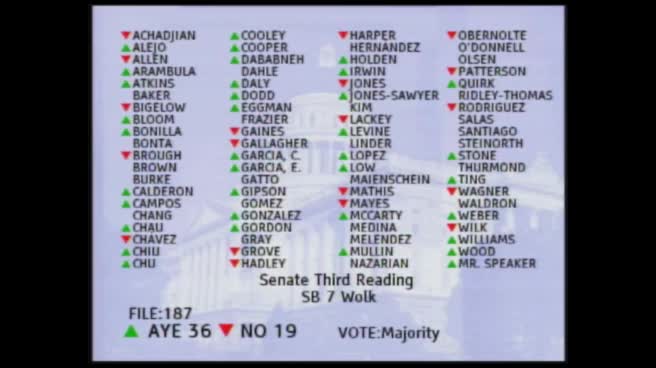
Bill Author

Bill Co-Author(s):