AB 1116: Connected televisions.
- Session Year: 2015-2016
- House: Assembly
- Latest Version Date: 2015-10-06
Existing law makes it a crime for a person who owns, controls, operates, or manages a satellite or cable television corporation to use an electronic device to record, transmit, or observe any events or listen to, record, or monitor any conversations that take place inside a subscribers residence, workplace, or place of business, without obtaining the express written consent of the subscriber. Existing law requires a device that includes an integrated and enabled wireless access point that is sold as new in the state for use in a small office, home office, or residential setting to be manufactured to possess certain features or advisories, including, among others, protection on the device that requires an affirmative action by the consumer prior to allowing use of the product and an advisory for the consumer regarding how to protect his or her wireless network connection from unauthorized access.
This bill would prohibit a person or entity from providing the operation of a voice recognition feature within this state without prominently informing, during the initial setup or installation of a connected television, either the user or the person designated by the user to perform the initial setup or installation of the connected television. This bill would further prohibit any actual recordings of spoken word collected through the operation of a voice recognition feature by the manufacturer of a connected television, or a 3rd party contracting with a manufacturer of a connected television, for the purpose of improving the voice recognition feature from being sold or used for any advertising purpose. This bill would prohibit a person or entity from compelling a manufacturer or other entity providing the operation of a voice recognition feature to build specific features for the purpose of allowing an investigative or law enforcement officer to monitor communications through that feature. This bill would limit the liability of a manufacturer to functionality provided at the time of the original sale of a connected television and specifically exclude liability for functionality provided by applications that the user chooses to use in the cloud or are downloaded and installed by a user. This bill would define terms for its purposes. This bill would prohibit a waiver of these prohibitions and authorize their enforcement by injunction or civil penalty in a court of competent jurisdiction by the Attorney General or a district attorney. This bill specifies that its provisions shall not be deemed to create a private right of action or limit any existing private right of action. This bill would provide that these provisions are severable.
Existing law makes it a crime for a person who owns, controls, operates, or manages a satellite or cable television corporation to use an electronic device to record, transmit, or observe any events or listen to, record, or monitor any conversations that take place inside a subscribers residence, workplace, or place of business, without obtaining the express written consent of the subscriber. Existing law requires a device that includes an integrated and enabled wireless access point that is sold as new in the state for use in a small office, home office, or residential setting to be manufactured to possess certain features and or advisories, including, among others, protection on the device that requires an affirmative action by the consumer prior to allowing use of the product and an advisory for the consumer regarding how to protect his or her wireless network connection from unauthorized access.
This bill would prohibit a person or entity from using the features in a connected television that allow the collection, recording, storage, analysis, transmission, interpretation, or other use of the spoken word of a person providing the operation of a voice recognition feature within this state without prominently informing informing, during the initial setup or installation of a connected television, either the user or a the person designated by the user to perform the initial setup or installation of the connected television, except as specified. television. This bill would further prohibit a manufacturer of a connected television or a third party that contracts with a manufacturer of a connected television, as specified, from using or selling for any advertising purpose any spoken word or other sound that was collected by a connected television, including for the purpose of improving the function, operation, or features of the connected television. any actual recordings of spoken word collected through the operation of a voice recognition feature by the manufacturer of a connected television, or a 3rd party contracting with a manufacturer of a connected television, for the purpose of improving the voice recognition feature from being sold or used for any advertising purpose. This bill would prohibit a person or entity from compelling a manufacturer or other entity offering features that allow the collection, recording, storage, analysis, transmission, interpretation, or other use of spoken words, providing the operation of a voice recognition feature to build specific features for the purpose of allowing an investigative or law enforcement officer to monitor communications through that feature. This bill would limit the liability of a manufacturer to functionality provided at the time of the original sale of a connected television and specifically exclude liability for functionality provided by applications that the user chooses to use in the cloud or are downloaded and installed by a user. This bill would define terms for its purposes. This bill would prohibit a waiver of these prohibitions and authorize their enforcement by injunction or civil penalty in a court of competent jurisdiction by the Attorney General or a district attorney. This bill specifies that its provisions shall not be deemed to create a private right of action or limit any existing private right of action. This bill would provide that these provisions are severable.
Existing law makes it a crime for a person who owns, controls, operates, or manages a satellite or cable television corporation to use an electronic device to record, transmit, or observe any events or listen to, record, or monitor any conversations that take place inside a subscribers residence, workplace, or place of business, without obtaining the express written consent of the subscriber. Existing law requires a device that includes an integrated and enabled wireless access point that is sold as new in the state for use in a small office, home office, or residential setting to be manufactured to possess certain features and advisories, including, among others, protection on the device that requires an affirmative action by the consumer prior to allowing use of the product and an advisory for the consumer regarding how to protect his or her wireless network connection from unauthorized access.
This bill would prohibit a person or entity from using the features in a connected television that allow the collection, recording, storage, analysis, transmission, interpretation, or other use of the spoken word of a person within this state without prominently informing the user or a person designated by the user to perform the initial setup or installation of the connected television, except as specified. This bill would further prohibit a manufacturer of a connected television or a third party that contracts with a manufacturer of a connected television, as specified, from using or selling for any advertising purpose any spoken word or other sound that was collected by a connected television television, including for the purpose of improving the function, operation, or features of the connected television. This bill would prohibit a person or entity from compelling a manufacturer or entity offering features that allow the collection, recording, storage, analysis, transmission, interpretation, or other use of spoken words, to build specific features for the purpose of allowing an investigative or law enforcement officer to monitor communications through that feature. This bill would limit the liability of a manufacturer to functionality provided at the time of the original sale of a connected television and specifically exclude liability for functionality provided by applications downloaded and installed by a user. This bill would define terms for its purposes. This bill would prohibit a waiver of these prohibitions and authorize their enforcement by injunction or civil penalty in a court of competent jurisdiction by the Attorney General or a district attorney. This bill specifies that its provisions shall not be deemed to create a private right of action or limit any existing private right of action. This bill would provide that these provisions are severable.
Existing law makes it a crime for a person who owns, controls, operates, or manages a satellite or cable television corporation to use an electronic device to record, transmit, or observe any events or listen to, record, or monitor any conversations that take place inside a subscribers residence, workplace, or place of business, without obtaining the express written consent of the subscriber. Existing law requires a device that includes an integrated and enabled wireless access point that is sold as new in the state for use in a small office, home office, or residential setting to be manufactured to possess certain features and advisories, including, among others, protection on the device that requires an affirmative action by the consumer prior to allowing use of the product and an advisory for the consumer regarding how to protect his or her wireless network connection from unauthorized access.
This bill would prohibit a connected television sold or leased in the state that is equipped with a voice recognition feature to use spoken words or other sounds for any purpose not essential to the function of the application for which the user enabled or utilized the voice recognition feature, and further prohibit a person from enabling or utilizing the voice recognition feature of a connected television without the consent of the user, as specified. This bill would require a connected television sold or leased in the state to be equipped with mechanisms to control the use of the voice recognition feature and indicate when it is collecting or transmitting spoken words or other sounds. person or entity from using the features in a connected television that allow the collection, recording, storage, analysis, transmission, interpretation, or other use of the spoken word of a person within this state without informing the user or a person designated by the user to perform the initial setup or installation of the connected television, except as specified. This bill would further prohibit a manufacturer of a connected television or a third party that contracts with a manufacturer of a connected television, as specified, from using or selling for any advertising purpose any spoken word or other sound that was collected by a connected television for the purpose of improving the function, operation, or features of the connected television. This bill would prohibit a person or entity from compelling a manufacturer or entity offering features that allow the collection, recording, storage, analysis, transmission, interpretation, or other use of spoken words, to build specific features for the purpose of allowing an investigative or law enforcement officer to monitor communications through that feature. This bill would limit the liability of a manufacturer to functionality provided at the time of the original sale of a connected television and specifically exclude liability for functionality provided by applications downloaded and installed by a user. This bill would define terms for its purposes. This bill would prohibit a waiver of these prohibitions and authorize their enforcement by injunction or civil penalty in a court of competent jurisdiction by the Attorney General or a district attorney. This bill specifies that its provisions shall not be deemed to create a private right of action or limit any existing private right of action. This bill would provide that these provisions are severable.
Existing law makes it a crime for a person who owns, controls, operates, or manages a satellite or cable television corporation to use an electronic device to record, transmit, or observe any events or listen to, record, or monitor any conversations that take place inside a subscribers residence, workplace, or place of business, without obtaining the express written consent of the subscriber. Existing law requires a device that includes an integrated and enabled wireless access point that is sold as new in the state for use in a small office, home office, or residential setting to be manufactured to possess certain features and advisories, including, among others, protection on the device that requires an affirmative action by the consumer prior to allowing use of the product and an advisory for the consumer regarding how to protect his or her wireless network connection from unauthorized access.
This bill would prohibit a connected television sold or leased in the state that is equipped with a voice recognition feature to use spoken words or other sounds for any purpose not essential to the function of the application for which the user enabled or utilized the voice recognition feature, and further prohibit a person from enabling or utilizing the voice recognition feature of a connected television without the consent of the user, as specified. This bill would require a connected television sold or leased in the state to be equipped with mechanisms to control the use of the voice recognition feature and indicate when it is collecting or transmitting spoken words or other sounds. This bill would define terms for its purposes. This bill would prohibit a waiver of these prohibitions and authorize their enforcement by injunction or civil penalty in a court of competent jurisdiction by the Attorney General or a district attorney. This bill specifies that its provisions shall not be deemed to create a private right of action or limit any existing private right of action. This bill would provide that these provisions are severable.
Existing law makes it a crime for a person who owns, controls, operates, or manages a satellite or cable television corporation to use an electronic device to record, transmit, or observe any events or listen to, record, or monitor any conversations that take place inside a subscribers residence, workplace, or place of business, without obtaining the express written consent of the subscriber. Existing law requires a device that includes an integrated and enabled wireless access point that is sold as new in the state for use in a small office, home office, or residential setting to be manufactured to possess certain features and advisories, including, among others, protection on the device that requires an affirmative action by the consumer prior to allowing use of the product and an advisory for the consumer regarding how to protect his or her wireless network connection from unauthorized access.
This bill would prohibit a manufacturer from producing for sale in the state, or delivering to be offered for sale in the state, a connected television, as defined, that offers voice recognition technology that is capable of recording or transmitting audio to the manufacturer or a 3rd party when any voice recognition technology is not enabled or recording or transmitting any spoken words to the manufacturer or a 3rd party, except for the specific voice commands necessary to operate the voice recognition technology. connected television sold or leased in the state that is equipped with a voice recognition feature to use spoken words or other sounds for any purpose not essential to the function of the application for which the user enabled or utilized the voice recognition feature, and further prohibit a person from enabling or utilizing the voice recognition feature of a connected television without the consent of the user, as specified. This bill would require a connected television sold or leased in the state to be equipped with mechanisms to control the use of the voice recognition feature and indicate when it is collecting or transmitting spoken words or other sounds. This bill would define terms for its purposes. This bill would prohibit a waiver of these prohibitions and authorize their enforcement by injunction or civil penalty in a court of competent jurisdiction by the Attorney General or a district attorney. This bill specifies that its provisions shall not be deemed to create a private right of action. This bill would provide that these provisions are severable.
Existing law makes it a crime for a person who owns, controls, operates, or manages a satellite or cable television corporation to use an electronic device to record, transmit, or observe any events or listen to, record, or monitor any conversations that take place inside a subscribers residence, workplace, or place of business, without obtaining the express written consent of the subscriber. Existing law requires a device that includes an integrated and enabled wireless access point that is sold as new in the state for use in a small office, home office, or residential setting to be manufactured to possess certain features and advisories, including, among others, protection on the device that requires an affirmative action by the consumer prior to allowing use of the product and an advisory for the consumer regarding how to protect his or her wireless network connection from unauthorized access.
This bill would prohibit a manufacturer from producing for sale in the state, or delivering to be offered for sale in the state, a connected television, as defined, that offers voice recognition technology that is capable of recording or transmitting audio to the manufacturer or a 3rd party when any voice recognition technology is not enabled or recording or transmitting any spoken words to the manufacturer or a 3rd party, except for the specific voice commands necessary to operate the voice recognition technology. This bill would prohibit a waiver of these prohibitions and authorize their enforcement by injunction or civil penalty in a court of competent jurisdiction by the Attorney General or a district attorney. This bill specifies that its provisions shall not be deemed to create a private right of action. This bill would provide that these provisions are severable.
(a)A person or entity shall not provide the operation of a voice recognition feature within this state without prominently informing, during the initial setup or installation of a connected television, either the user or the person designated by the user to perform the initial setup or installation of the connected television.
(b)Any actual recordings of spoken word collected through the operation of a voice recognition feature by the manufacturer of a connected television for the purpose of improving the voice recognition feature, including, but not limited to, the operation of an accessible user interface for people with disabilities, shall not be sold or used for any advertising purpose.
(c)Any actual recordings of spoken word collected through the operation of a voice recognition feature by a third party contracting with a manufacturer for the purpose of improving the voice recognition feature, including, but not limited to, the operation of an accessible user interface for people with disabilities, shall not be sold or used for any advertising purpose.
(d)A person or entity shall not compel a manufacturer or other entity providing the operation of a voice recognition feature to build specific features for the purpose of allowing an investigative or law enforcement officer to monitor communications through that feature.
(e)A manufacturer shall only be liable for functionality provided at the time of the original sale of a connected television and shall not be liable for functionality provided by applications that the user chooses to use in the cloud or are downloaded and installed by a user.
(f)This chapter shall not apply to any product or service provided by a company covered under Section 637.5 of the Penal Code.
22948.21.For purposes of this chapter, the following definitions shall apply:
(a)Connected television means a video device designed for home use to receive television signals and reproduce them on an integrated, physical screen display that exceeds 12 inches, except that this term shall not include a personal computer, portable device, or a separate device that connects physically or wirelessly to a television, including, but not limited to, a set-top box, video game console, or digital video recorder.
(b)User means a person who originally purchases, leases, or takes ownership of a connected television. A person who is incidentally recorded when a voice recognition feature is activated by a user shall not be deemed to be a user.
(c)Voice recognition feature means the function of a connected television that allows the collection, recording, storage, analysis, transmission, interpretation, or other use of spoken words or other sounds, except that this term shall not include voice commands that are not recorded or transmitted beyond the connected television.
22948.22.Any waiver of the provisions of this chapter is contrary to public policy and void and unenforceable.
22948.23.(a)Actions for relief pursuant to this chapter may be prosecuted exclusively in a court of competent jurisdiction in a civil action brought in the name of the people of the State of California by the Attorney General or by any district attorney. This chapter shall not be deemed to create a private right of action, or limit any existing private right of action.
(b)A court may enjoin a person who knowingly engages, has engaged, or proposes to engage, in a violation of this chapter. The court may make any orders or judgments as may be necessary to prevent a violation of this chapter.
(c)A person who knowingly engages, has engaged, or proposes to engage, in a violation of this chapter shall be liable for a civil penalty not to exceed two thousand five hundred dollars ($2,500) for each connected television sold or leased in violation of this chapter. If the action is brought by the Attorney General, the penalty shall be deposited into the General Fund. If the action is brought by a district attorney, the penalty shall be paid to the treasurer of the county in which the judgment was entered.
22948.24.The remedies or penalties provided by this chapter are cumulative to each other and to the remedies or penalties available under all other laws of the state.
22948.25.The provisions of this chapter are severable. If any provision of this chapter or its application are held to be invalid, that invalidity shall not affect other provisions or applications that can be given effect without the invalid provision or application.
(a)Except for voice commands that are not recorded or transmitted beyond the connected television, a A person or entity shall not use the features in a connected television that allow the collection, recording, storage, analysis, transmission, interpretation, or other use of the spoken word of a person provide the operation of a voice recognition feature within this state without prominently informing informing, during the initial setup or installation of a connected television, either the user or a the person designated by the user to perform the initial setup or installation of the connected television. A manufacturer of a connected television or a third party that contracts with a manufacturer of a connected television to provide a voice recognition feature shall not use or sell for any advertising purpose any spoken word or other sound that was collected by a connected television, including for the purpose of improving the function, operation, or features of the connected television, or for the provision of an accessible user interface for people with disabilities.
(b)Any actual recordings of spoken word collected through the operation of a voice recognition feature by the manufacturer of a connected television for the purpose of improving the voice recognition feature, including, but not limited to, the operation of an accessible user interface for people with disabilities, shall not be sold or used for any advertising purpose.
(c)Any actual recordings of spoken word collected through the operation of a voice recognition feature by a third party contracting with a manufacturer for the purpose of improving the voice recognition feature, including, but not limited to, the operation of an accessible user interface for people with disabilities, shall not be sold or used for any advertising purpose.
(b)
(d)A person or entity shall not compel a manufacturer or other entity offering features that allow the collection, recording, storage, analysis, transmission, interpretation, or other use of spoken words, providing the operation of a voice recognition feature to build specific features for the purpose of allowing an investigative or law enforcement officer to monitor communications through that feature.
(c)
(e)A manufacturer shall only be liable for functionality provided at the time of the original sale of a connected television and shall not be liable for functionality provided by applications that the user chooses to use in the cloud or are downloaded and installed by a user.
(d)
(f)This section chapter shall not apply to any product or service provided by a company covered under Section 637.5 of the Penal Code.
22948.21.For purposes of this chapter, the following definitions shall apply:
(a)Connected television means a video device designed for home use to receive television signals and reproduce them on an integrated, physical screen display that exceeds 12 inches, except that this term shall not include a personal computer, portable device, or a separate device that connects physically or wirelessly to a television, including, but not limited to, a set-top box, video game console, or digital video recorder.
(b)User means a person who originally purchases, leases, or takes ownership of a connected television. A person who is incidentally recorded when a voice recognition feature is activated by a user shall not be deemed to be a user.
(c)Voice recognition feature means the function of a connected television that allows the collection, recording, storage, analysis, transmission, interpretation, or other use of spoken words or other sounds, except that this term shall not include voice commands that are not recorded or transmitted beyond the connected television.
22948.22.Any waiver of the prohibitions in Section 22948.21 provisions of this chapter is contrary to public policy and void and unenforceable.
22948.23.(a)Actions for relief pursuant to this chapter may be prosecuted exclusively in a court of competent jurisdiction in a civil action brought in the name of the people of the State of California by the Attorney General or by any district attorney. This chapter shall not be deemed to create a private right of action, or limit any existing private right of action.
(b)A court may enjoin a person who knowingly engages, has engaged, or proposes to engage, in a violation of this chapter. The court may make any orders or judgments as may be necessary to prevent a violation of this chapter.
(c)A person who knowingly engages, has engaged, or proposes to engage, in a violation of this chapter shall be liable for a civil penalty not to exceed two thousand five hundred dollars ($2,500) for each connected television sold or leased in violation of this chapter. If the action is brought by the Attorney General, the penalty shall be deposited into the General Fund. If the action is brought by a district attorney, the penalty shall be paid to the treasurer of the county in which the judgment was entered.
22948.24.The remedies or penalties provided by this chapter are cumulative to each other and to the remedies or penalties available under all other laws of the state.
22948.25.The provisions of this chapter are severable. If any provision of this chapter or its application are held to be invalid, that invalidity shall not affect other provisions or applications that can be given effect without the invalid provision or application.
(a)Except for voice commands that are not recorded or transmitted beyond the connected television, a person or entity shall not use the features in a connected television that allow the collection, recording, storage, analysis, transmission, interpretation, or other use of the spoken word of a person within this state without prominently informing the user or a person designated by the user to perform the initial setup or installation of the connected television. A manufacturer of a connected television or a third party that contracts with a manufacturer of a connected television to provide a voice recognition feature shall not use or sell for any advertising purpose any spoken word or other sound that was collected by a connected television television, including for the purpose of improving the function, operation, or features of the connected television, including, but not limited to, or for the provision of an accessible user interface for people with disabilities.
(b)A person or entity shall not compel a manufacturer or entity offering features that allow the collection, recording, storage, analysis, transmission, interpretation, or other use of spoken words, to build specific features for the purpose of allowing an investigative or law enforcement officer to monitor communications through that feature.
(c)A manufacturer shall only be liable for functionality provided at the time of the original sale of a connected television and shall not be liable for functionality provided by applications downloaded and installed by a user.
(d)This section shall not apply to any product or service provided by a company covered under Section 637.5 of the Penal Code.
22948.21.For purposes of this chapter, the following definitions shall apply:
(a)Connected television means a video device designed for home use to receive television signals and reproduce them on an integrated, physical screen display that exceeds 12 inches, except that this term shall not include a personal computer, portable device, or a separate device that connects physically or wirelessly to a television, including, but not limited to, a set-top box, video game console, or digital video recorder.
(b)User means a person who purchases, leases, or takes ownership of a connected television. A person who is incidentally recorded when a voice recognition feature is activated by a user shall not be deemed to be a user.
(c)Utilize means to use a voice recognition feature that was previously enabled.
(d)
(c)Voice recognition feature means the function of a connected television that allows the collection, recording, storage, analysis, transmission, interpretation, or other use of spoken words or other sounds, except that this term shall not include voice commands that are not recorded or transmitted beyond the connected television.
22948.22.Any waiver of the prohibitions in Section 22948.21 is contrary to public policy and void and unenforceable.
22948.23.(a)Actions for relief pursuant to this chapter may be prosecuted exclusively in a court of competent jurisdiction in a civil action brought in the name of the people of the State of California by the Attorney General or by any district attorney. This chapter shall not be deemed to create a private right of action, or limit any existing private right of action.
(b)A court may enjoin a manufacturer that person who engages, has engaged, or proposes to engage, in a violation of this chapter. The court may make any orders or judgments as may be necessary to prevent a violation of this chapter.
(c)A manufacturer that person who engages, has engaged, or proposes to engage, in a violation of this chapter shall be liable for a civil penalty not to exceed two thousand five hundred dollars ($2,500) for each connected television sold or leased in violation of this chapter. If the action is brought by the Attorney General, the penalty shall be deposited into the General Fund. If the action is brought by a district attorney, the penalty shall be paid to the treasurer of the county in which the judgment was entered.
22948.24.The remedies or penalties provided by this chapter are cumulative to each other and to the remedies or penalties available under all other laws of the state.
22948.25.The provisions of this chapter are severable. If any provision of this chapter or its application are held to be invalid, that invalidity shall not affect other provisions or applications that can be given effect without the invalid provision or application.
(a)Notwithstanding subdivision (b), a connected television sold or leased in the state that is equipped with a voice recognition feature shall not be used to collect, record, store, analyze, transmit, interpret, or otherwise use spoken words or other sounds for any purpose not essential to the function of the application for which the user enabled or utilized the voice recognition feature. Purposes not essential to the function of an application include, but are not limited to, advertising and the analysis of household conversations.
(b)(1)A person shall not enable or utilize the voice recognition feature of a connected television sold or leased in the state without the consent of the user, as set forth in paragraph (2).
(2)Consent shall be received by means of a separate notice that gives the user an opportunity to understand and choose the use of the voice recognition feature before it is enabled. Consent shall only be required at the time the voice recognition feature is enabled, and not each time the user starts the voice recognition feature.
(c)A connected television sold or leased in the state that is equipped with a voice recognition feature shall also be equipped with all of the following:
(1)A mechanism that requires a user to affirmatively choose the use of the voice recognition feature, including, but not limited to, a user setting.
(2)A mechanism that allows a user to start and stop the voice recognition feature for the purpose of operating the connected television or using a specific software application on the television.
(3)A mechanism that indicates to the user when the voice recognition feature is collecting or transmitting spoken words or other sounds.
(d)This section shall not apply to those products and services provided by companies covered by Section 637.5 of the Penal Code.
22948.20.(a)Except for voice commands that are not recorded or transmitted beyond the connected television, a person or entity shall not use the features in a connected television that allow the collection, recording, storage, analysis, transmission, interpretation, or other use of the spoken word of a person within this state without informing the user or a person designated by the user to perform the initial setup or installation of the connected television. A manufacturer of a connected television or a third party that contracts with a manufacturer of a connected television to provide a voice recognition feature shall not use or sell for any advertising purpose any spoken word or other sound that was collected by a connected television for the purpose of improving the function, operation, or features of the connected television, including, but not limited to, the provision of an accessible user interface for people with disabilities.
(b)A person or entity shall not compel a manufacturer or entity offering features that allow the collection, recording, storage, analysis, transmission, interpretation, or other use of spoken words, to build specific features for the purpose of allowing an investigative or law enforcement officer to monitor communications through that feature.
(c)A manufacturer shall only be liable for functionality provided at the time of the original sale of a connected television and shall not be liable for functionality provided by applications downloaded and installed by a user.
(d)This section shall not apply to any product or service provided by a company covered under Section 637.5 of the Penal Code.
22948.21.For purposes of this chapter, the following definitions shall apply:
(a)Connected television means a device that can be connected to the Internet, receives television signals used to broadcast programs for entertainment, information, and education, and reproduces them on a screen, except that this term shall not include a personal computer, tablet, video game console, or cellular telephone. video device designed for home use to receive television signals and reproduce them on an integrated, physical screen display that exceeds 12 inches, except that this term shall not include a personal computer, portable device, or a separate device that connects physically or wirelessly to a television, including, but not limited to, a set-top box, video game console, or digital video recorder.
(b)Enable means to take an affirmative action to make a voice recognition feature operational on a connected television.
(c)
(b)User mean an individual means a person who purchases, leases, or takes ownership of a connected television. A person who is incidentally recorded when a voice recognition feature is activated by a user shall not be deemed to be a user.
(d)
(c)Utilize means to use a voice recognition feature that was previously enabled.
(e)
(d)Voice recognition feature means the function of a connected television that allows the collection, recording, storage, analysis, transmission, interpretation, or other use of spoken words or other sounds, except that this term shall not include voice commands that are not recorded or transmitted beyond the connected television.
22948.22.Any waiver of the prohibitions in Section 22948.21 is contrary to public policy and void and unenforceable.
22948.23.(a)Actions for relief pursuant to this chapter may be prosecuted exclusively in a court of competent jurisdiction in a civil action brought in the name of the people of the State of California by the Attorney General or by any district attorney. This chapter shall not be deemed to create a private right of action, or limit any existing private right of action.
(b)A court may enjoin a manufacturer that engages, has engaged, or proposes to engage, in a violation of this chapter. The court may make any orders or judgments as may be necessary to prevent a violation of this chapter.
(c)A manufacturer that engages, has engaged, or proposes to engage, in a violation of this chapter shall be liable for a civil penalty not to exceed two thousand five hundred dollars ($2,500) for each connected television in violation of this chapter. If the action is brought by the Attorney General, the penalty shall be deposited into the General Fund. If the action is brought by a district attorney, the penalty shall be paid to the treasurer of the county in which the judgment was entered.
22948.24.The remedies or penalties provided by this chapter are cumulative to each other and to the remedies or penalties available under all other laws of the state.
22948.25.The provisions of this chapter are severable. If any provision of this chapter or its application are held to be invalid, that invalidity shall not affect other provisions or applications that can be given effect without the invalid provision or application.
(a)Notwithstanding subdivision (b), a connected television sold or leased in the state that is equipped with a voice recognition feature shall not be used to collect, record, store, analyze, transmit, interpret, or otherwise use spoken words or other sounds for any purpose not essential to the function of the application for which the user enabled or utilized the voice recognition feature. Purposes not essential to the function of an application include, but are not limited to, advertising and the analysis of household conversations.
(b)(1)A person shall not enable or utilize the voice recognition feature of a connected television sold or leased in the state without the consent of the user, as set forth in paragraph (2).
(2)Consent shall be received by means of a separate notice that gives the user an opportunity to understand and choose the use of the voice recognition feature before it is enabled, including, but not limited to, an interactive on-screen dialog. enabled. Consent shall only be required at the time the voice recognition feature is enabled, and not each time the user starts the voice recognition feature.
(c)A connected television sold or leased in the state that is equipped with a voice recognition feature shall also be equipped with all of the following:
(1)A mechanism that requires a user to affirmatively choose the use of the voice recognition feature, including, but not limited to, a user setting.
(2)A mechanism that allows a user to start and stop the voice recognition feature for the purpose of operating the connected television or using a specific software application on the television, including, but not limited to, a button or voice command. television.
(3)A mechanism that indicates to the user when the voice recognition feature is collecting or transmitting spoken words or other sounds, including, but not limited to, a signal light. sounds.
(d)This section shall not apply to those products and services provided by companies covered by Section 637.5 of the Penal Code.
22948.21.For purposes of this chapter, the following definitions shall apply:
(a)Connected television means a device that can be connected to the Internet, receives television signals used to broadcast programs for entertainment, information, and education, and reproduces them on a screen, except that this term shall not include a personal computer, tablet, video game console, or cellular telephone.
(b)Enable means to take an affirmative action to make a voice recognition feature operational on a connected television.
(c)User mean an individual who purchases, leases, or takes ownership of a connected television.
(d)Utilize means to use a voice recognition feature that was previously enabled.
(e)Voice recognition feature means the function of a connected television that allows the collection, recording, storage, analysis, transmission, interpretation, or other use of spoken words or other sounds, except that this term shall not include voice commands that are not recorded or transmitted beyond the connected television.
22948.22.Any waiver of the prohibitions in Section 22948.21 is contrary to public policy and void and unenforceable.
22948.23.(a)Actions for relief pursuant to this chapter may be prosecuted exclusively in a court of competent jurisdiction in a civil action brought in the name of the people of the State of California by the Attorney General or by any district attorney. This chapter shall not be deemed to create a private right of action. action, or limit any existing private right of action.
(b)A court may enjoin a manufacturer that engages, has engaged, or proposes to engage, in a violation of this chapter. The court may make any orders or judgments as may be necessary to prevent a violation of this chapter.
(c)A manufacturer that engages, has engaged, or proposes to engage, in a violation of this chapter shall be liable for a civil penalty not to exceed two thousand five hundred dollars ($2,500) for each connected television in violation of this chapter. If the action is brought by the Attorney General, the penalty shall be deposited into the General Fund. If the action is brought by a district attorney, the penalty shall be paid to the treasurer of the county in which the judgment was entered.
22948.24.The remedies or penalties provided by this chapter are cumulative to each other and to the remedies or penalties available under all other laws of the state.
22948.25.The provisions of this chapter are severable. If any provision of this chapter or its application are held to be invalid, that invalidity shall not affect other provisions or applications that can be given effect without the invalid provision or application.
For purposes of this chapter, connected television shall mean a television set or set-top box with integrated Internet features.
22948.21.A manufacturer shall not produce for sale in the state, or deliver to be offered for sale in the state, a connected television that offers voice recognition technology that is capable of either of the following:
(1)Recording or transmitting audio, including, but not limited to, an individuals conversation, to the manufacturer or a third party when any voice recognition technology is not enabled.
(2)Recording or transmitting any spoken words to the manufacturer or a third party, except for the specific voice commands necessary to operate the voice recognition technology.
22948.20.(a)Notwithstanding subdivision (b), a connected television sold or leased in the state that is equipped with a voice recognition feature shall not be used to collect, record, store, analyze, transmit, interpret, or otherwise use spoken words or other sounds for any purpose not essential to the function of the application for which the user enabled or utilized the voice recognition feature. Purposes not essential to the function of an application include, but are not limited to, advertising and the analysis of household conversations.
(b)(1)A person shall not enable or utilize the voice recognition feature of a connected television sold or leased in the state without the consent of the user, as set forth in paragraph (2).
(2)Consent shall be received by means of a separate notice that gives the user an opportunity to understand and choose the use of the voice recognition feature before it is enabled, including, but not limited to, an interactive on-screen dialog. Consent shall only be required at the time the voice recognition feature is enabled, and not each time the user starts the voice recognition feature.
(c)A connected television sold or leased in the state that is equipped with a voice recognition feature shall also be equipped with all of the following:
(1)A mechanism that requires a user to affirmatively choose the use of the voice recognition feature, including, but not limited to, a user setting.
(2)A mechanism that allows a user to start and stop the voice recognition feature for the purpose of operating the connected television or using a specific software application on the television, including, but not limited to, a button or voice command.
(3)A mechanism that indicates to the user when the voice recognition feature is collecting or transmitting spoken words or other sounds, including, but not limited to, a signal light.
22948.21.For purposes of this chapter, the following definitions shall apply:
(a)Connected television means a device that can be connected to the Internet, receives television signals used to broadcast programs for entertainment, information, and education, and reproduces them on a screen, except that this term shall not include a personal computer, tablet, or cellular telephone.
(b)Enable means to take an affirmative action to make a voice recognition feature operational on a connected television.
(c)User mean an individual who purchases, leases, or takes ownership of a connected television.
(d)Utilize means to use a voice recognition feature that was previously enabled.
(e)Voice recognition feature means the function of a connected television that allows the collection, recording, storage, analysis, transmission, interpretation, or other use of spoken words or other sounds, except that this term shall not include voice commands that are not recorded or transmitted beyond the connected television.
22948.22.Any waiver of the prohibitions in Section 22948.21 is contrary to public policy and void and unenforceable.
22948.23.(a)Actions for relief pursuant to this chapter may be prosecuted exclusively in a court of competent jurisdiction in a civil action brought in the name of the people of the State of California by the Attorney General or by any district attorney. This chapter shall not be deemed to create a private right of action.
(b)A court may enjoin a manufacturer that engages, has engaged, or proposes to engage, in a violation of this chapter. The court may make any orders or judgments as may be necessary to prevent a violation of this chapter.
(c)A manufacturer that engages, has engaged, or proposes to engage, in a violation of this chapter shall be liable for a civil penalty not to exceed two thousand five hundred dollars ($2,500) for each connected television in violation of this chapter. If the action is brought by the Attorney General, the penalty shall be deposited into the General Fund. If the action is brought by a district attorney, the penalty shall be paid to the treasurer of the county in which the judgment was entered.
22948.24.The remedies or penalties provided by this chapter are cumulative to each other and to the remedies or penalties available under all other laws of the state.
22948.25.The provisions of this chapter are severable. If any provision of this chapter or its application are held to be invalid, that invalidity shall not affect other provisions or applications that can be given effect without the invalid provision or application.
For purposes of this chapter, connected television shall mean a television set or set-top box with integrated Internet features.
22948.21.A manufacturer shall not produce for sale in the state, or deliver to be offered for sale in the state, a connected television that offers voice recognition technology that is capable of either of the following:
(1)Recording or transmitting audio, including, but not limited to, an individuals conversation, to the manufacturer or a third party when any voice recognition technology is not enabled.
(2)Recording or transmitting any spoken words to the manufacturer or a third party, except for the specific voice commands necessary to operate the voice recognition technology.
22948.22.Any waiver of the prohibitions in Section 22948.21 is contrary to public policy and void and unenforceable.
22948.23.(a)Actions for relief pursuant to this chapter may be prosecuted exclusively in a court of competent jurisdiction in a civil action brought in the name of the people of the State of California by the Attorney General or by any district attorney. This chapter shall not be deemed to create a private right of action.
(b)A court may enjoin a manufacturer that engages, has engaged, or proposes to engage, in a violation of this chapter. The court may make any orders or judgments as may be necessary to prevent a violation of this chapter.
(c)A manufacturer that engages, has engaged, or proposes to engage, in a violation of this chapter shall be liable for a civil penalty not to exceed two thousand five hundred dollars ($2,500) for each connected television in violation of this chapter. If the action is brought by the Attorney General, the penalty shall be deposited into the General Fund. If the action is brought by a district attorney, the penalty shall be paid to the treasurer of the county in which the judgment was entered.
22948.24.The remedies or penalties provided by this chapter are cumulative to each other and to the remedies or penalties available under all other laws of the state.
22948.25.The provisions of this chapter are severable. If any provision of this chapter or its application are held to be invalid, that invalidity shall not affect other provisions or applications that can be given effect without the invalid provision or application.
|
Date
|
Status
|
|---|---|
| Sep 8, 2015 | Read third time. Passed. Ordered to the Assembly. (Ayes 40. Noes 0. Page 2591.). |
| Jul 16, 2015 | Read second time and amended. Re-referred to Com. on APPR. |
| Aug 17, 2015 | From committee: Be placed on second reading file pursuant to Senate Rule 28.8 and ordered to consent calendar. |
| Aug 18, 2015 | Read second time. Ordered to Consent Calendar. |
| Aug 20, 2015 | From Consent Calendar. |
| Aug 20, 2015 | Ordered to third reading. |
| Sep 3, 2015 | Read third time and amended. Ordered to second reading. |
| Sep 4, 2015 | Read second time. Ordered to third reading. |
| Sep 8, 2015 | In Assembly. Concurrence in Senate amendments pending. May be considered on or after September 10 pursuant to Assembly Rule 77. |
| Sep 8, 2015 | Read third time. Passed. Ordered to the Assembly. |
| Jul 15, 2015 | From committee: Amend, and do pass as amended and re-refer to Com. on APPR. with recommendation: To Consent Calendar. (Ayes 7. Noes 0.) (July 14). |
| Sep 9, 2015 | Assembly Rule 77 suspended. |
| Sep 9, 2015 | Assembly Rule 77 suspended. (Page 2990.) |
| Sep 9, 2015 | Senate amendments concurred in. To Engrossing and Enrolling. |
| Sep 9, 2015 | Senate amendments concurred in. To Engrossing and Enrolling. (Ayes 76. Noes 0. Page 3019.). |
| Sep 9, 2015 | Senate amendments concurred in. To Engrossing and Enrolling. (Ayes 76. Noes 0.). |
| Sep 17, 2015 | Enrolled and presented to the Governor at 4 p.m. |
| Oct 6, 2015 | Approved by the Governor. |
| Oct 6, 2015 | Chaptered by Secretary of State - Chapter 524, Statutes of 2015. |
| May 13, 2015 | From committee: Do pass. To Consent Calendar. (Ayes 17. Noes 0.) (May 13). |
| Mar 1, 2015 | From printer. May be heard in committee March 31. |
| Mar 2, 2015 | Read first time. |
| Mar 19, 2015 | Referred to Coms. on P. & C.P. and JUD. |
| Apr 13, 2015 | From committee chair, with author's amendments: Amend, and re-refer to Com. on P. & C.P. Read second time and amended. |
| Apr 14, 2015 | Re-referred to Com. on P. & C.P. |
| Apr 22, 2015 | From committee: Do pass and re-refer to Com. on JUD. (Ayes 11. Noes 0.) (April 21). Re-referred to Com. on JUD. |
| Apr 29, 2015 | From committee: Amend, and do pass as amended and re-refer to Com. on APPR. (Ayes 10. Noes 0.) (April 28). |
| Apr 30, 2015 | Read second time and amended. |
| May 4, 2015 | Re-referred to Com. on APPR. |
| Feb 27, 2015 | Introduced. To print. |
| May 14, 2015 | Read second time. Ordered to Consent Calendar. |
| May 22, 2015 | In Senate. Read first time. To Com. on RLS. for assignment. |
| May 22, 2015 | Read third time. Passed. Ordered to the Senate. |
| May 22, 2015 | Read third time. Passed. Ordered to the Senate. (Ayes 74. Noes 0. Page 1563.) |
| Jun 4, 2015 | Referred to Com. on JUD. |
| Jun 15, 2015 | In committee: Set, first hearing. Hearing canceled at the request of author. |
| Jun 29, 2015 | In committee: Set, second hearing. Hearing canceled at the request of author. |
| Jul 2, 2015 | From committee chair, with author's amendments: Amend, and re-refer to committee. Read second time, amended, and re-referred to Com. on JUD. |
|
Date
|
Description
|
Location
|
Votes
|
|
|---|---|---|---|---|
| Sep 9, 2015 | AB 1116 P. & C.P. Concurrence in Senate Amendments By GATTO | Assembly Floor |
Passed |
|
| Sep 8, 2015 | Assembly 3rd Reading AB1116 Committee On P. & C.P. (Gatto) By Leno | Senate Floor |
Passed |
|
| Jul 14, 2015 | Do pass as amended, but first amend, and re-refer to the Committee on [Appropriations] with the recommendation: To Consent Calendar | Senate Standing Committee on Judiciary |
Passed |
|
| May 22, 2015 | AB 1116 P. & C.P. Consent Calendar Second Day Regular Session | Assembly Floor |
Passed |
|
| May 13, 2015 | Do pass. To Consent Calendar. | Assembly Standing Committee on Appropriations |
Passed |
|
| Apr 28, 2015 | Do pass as amended and be re-referred to the Committee on [Appropriations] | Assembly Standing Committee on Judiciary |
Passed |
|
| Apr 21, 2015 | Do pass and be re-referred to the Committee on [Judiciary] | Assembly Standing Committee on Privacy and Consumer Protection |
Passed |
This list shows positions taken on this bill by organizations on the date displayed, which is linked to the original source.
Positions by individuals are not included.
|
Organization
|
Position
|
Date
|
|---|---|---|
| California Chamber Of Commerce | * Support | Apr 28, 2015 |
| Consumer Electronics Association (Cea) | * Neutral | Apr 21, 2015 |
| Electronic Frontier Foundation | * Support | Apr 28, 2015 |
| Privacy Rights Clearinghouse | ** Support | Sep 8, 2015 |
| Privacy Rights Coalition | * Support | Apr 21, 2015 |
AB 1116
Page 2
CONCURRENCE IN SENATE AMENDMENTS
AB 1116
(Committee on Privacy and Consumer Protection)
As Amended , 2015
Majority vote
ASSEMBLY: |
74-0 |
(May 22, 2015) |
SENATE: |
40-0 |
(September 8, 2015) |
Original Committee Reference: P. & C.P.
SUMMARY: Prohibits the collection and use of spoken words and conversations captured by Internet-connected televisions, commonly known as "connected televisions" or "smart TVs" without first informing the user, and prohibits using or selling for advertising purposes any spoken words or sounds collected through a connected television for purposes of improving the voice recognition feature. Specifically, this bill:
Prohibits the provision of voice recognition features without first prominently providing the user or user's designee with of the television’s capability to collect, record, store, analyze, transmit, interpret or otherwise use spoken words during the initial setup or installation.
Prohibits the sale or use for advertising purposes of actual recordings of spoken words collected through the operation of a voice recognition feature by the manufacturer of a connected television for the purpose of improving the voice recognition feature.
Prohibits the sale or use for advertising purposes of actual recordings of spoken words collected through the operation of a voice recognition feature by a third party contracting with a manufacturer for the purpose of improving the voice recognition feature.
Prohibits a person or entity from compelling a manufacturer or an entity offering voice recognition services to build features into a connected television for the purpose of allowing an investigative or law enforcement officer to monitor communications.
Specifies that a manufacturer is only liable for functionality provided at the time of the original sale of a connected television, and is not liable for any separate applications downloaded and installed onto the connected television by a user.
Specifies that the provisions of this bill do not apply to satellite or cable television corporations, as specified.
Defines the terms "connected television," "user," and "voice recognition feature."
Invalidates any waiver of this bill’s provisions as contrary to public policy, and void and unenforceable.
Gives the Attorney General or a district attorney the power to prosecute a manufacturer that violates or proposes to violate these provisions by seeking injunctive relief, a civil penalty of up to $2,500 per violation, or both, and are cumulative.
Specifies that there is no private right of action for violation of these provisions, nor do these provisions limit any existing right of private action.
Declares that the provisions of this bill are severable.
The Senate amendments generally revise and recast the provisions of this bill to: 1) remove the requirement for user consent prior to initially enabling the voice recognition feature of a connected television; 2) remove the requirements that connected televisions indicate when the voice recognition feature is activated and have an on/off function for the voice recognition feature; 3) limit the bill to restricting connected TV manufacturers and their third party voice recognition service contractors from using data originally collected for the purpose of improving the voice recognition features for the purpose of advertising; and 4) specify that the penalties in the bill apply when there is a "knowing" violation of the bill.
FISCAL EFFECT: According to the Assembly Appropriations Committee, there are potential minor costs to the Attorney General or local prosecutors, offset to some extent by penalty revenues.
COMMENTS: This bill is intended to protect the privacy of people inside their homes by requiring disclosure at installation to the user of the functions of a connected television, while also prohibiting the use of voice data collected from connected TVs for advertising if the voice data was originally collected by the manufacturer (or third party voice recognition provider) solely for the purpose of improving the connected television or voice recognition features of the TV.
Connected TV voice recognition features respond to human voices so that users can speak basic commands to operate the TV and speak search terms to search for content on the Internet, rather than using the remote control to find and select options. According to Statistica.com, about 52 million smart TVs were sold worldwide in 2011, and that figure is expected to reach 141 million in 2015.
Analysis Prepared by: Jennie Bretschneider / P. & C.P. / (916) 319-2200 FN: 0002228
AB 1116
Page 8
|
Office of Senate Floor Analyses (916) 651-1520 Fax: (916) 327-4478 |
THIRD READING
Bill No: AB 1116
Author: Committee on Privacy and Consumer Protection, et al.
Amended: 9/3/15 in Senate
SENATE JUDICIARY COMMITTEE: 7-0, 7/14/15
AYES: Jackson, Moorlach, Anderson, Hertzberg, Leno, Monning, Wieckowski
SENATE APPROPRIATIONS COMMITTEE: Senate Rule 28.8
ASSEMBLY FLOOR: 74-0, 5/22/15 (Consent) - See last page for vote
SUBJECT: Connected televisions
DIGEST: This bill prohibits the operation of a voice recognition feature within a connected television without first prominently informing, during the initial setup or installation of a connected television, either the user or the person designated by the user to perform the initial setup or installation of the connected television. This bill also prohibits for advertising purposes the use or sale of certain recordings that are collected by a connected television for the purpose of improving its voice recognition feature.
Senate Floor Amendments of 9/3/15 limit the scope of the prohibition against using sound recordings collected by a connected television for advertising purposes to only those recordings collected for the purpose of improving the connected television’s voice recognition feature.
Existing law:
Provides, in the California Constitution, that all people are by nature free and independent and have inalienable rights. Among these are enjoying and defending life and liberty, acquiring, possessing, and protecting property, and pursuing and obtaining safety, happiness, and privacy. (Cal. Const, art. I, Sec. 1.)
Permits a person to bring an action in tort for an invasion of privacy and provides that in order to state a claim for violation of the constitutional right to privacy, a plaintiff must establish the following three elements: (1) a legally protected privacy interest; (2) a reasonable expectation of privacy in the circumstances; and (3) conduct by the defendant that constitutes a serious invasion of privacy. (Hill v. National Collegiate Athletic Assn. (1994) 7 Cal.4th 1, 40.)
States that legally recognized privacy interests are generally of two classes: interests in precluding the dissemination or misuse of sensitive and confidential information (informational privacy), and interests in making intimate personal decisions or conducting personal activities without observation, intrusion, or interference (autonomy privacy). (Hill v. National Collegiate Athletic Assn. (1994) 7 Cal.4th 1, 35.)
Renders an individual liable for constructive invasion of privacy when that individual attempts to capture, in a manner that is offensive to a reasonable person, any type of visual image, sound recording, or other physical impression of another engaging in a private, personal, or familial activity, through the use of any device, regardless of whether there is a physical trespass, if this image, sound recording, or other physical impression could not have been achieved without a trespass unless the device was used. (Civ. Code Sec. 1708.8.)
States that no person who owns, controls, operates, or manages a satellite or cable television corporation, or who leases channels on a satellite or cable system shall use any electronic device to record, transmit, or observe any events or listen to, record, or monitor any conversations that take place inside a subscriber’s residence, workplace, or place of business, without obtaining the express written consent of the subscriber, as specified. (Pen. Code Sec. 637.5(a)(1).)
States that no satellite or cable television corporation may provide any person with any individually identifiable information regarding any of its subscribers, including, but not limited to, the subscriber’s television viewing habits, shopping choices, interests, opinions, energy uses, medical information, banking data or information, or any other personal or private information, without the subscriber’s express written consent. (Pen. Code Sec. 637.5(a)(2).)
Specifies that individual subscriber viewing responses or other individually identifiable information derived from subscribers may be retained and used by a satellite or cable television corporation only to the extent reasonably necessary for billing purposes and internal business practices, and to monitor for unauthorized reception of services, as specified. (Pen. Code Sec. 637.5(b).)
Specifies that any individually identifiable subscriber information gathered by a satellite or cable television corporation shall be made available for subscriber examination within 30 days of receiving a request by a subscriber to examine the information on the premises of the corporation. (Pen. Code Sec. 637.5(d).)
This bill:
States that a person or entity shall not provide the operation of a voice recognition feature within this state without prominently informing, during the initial setup or installation of a connected television, either the user or the person designated by the user to perform the initial setup or installation of the connected television.
States that any actual recordings of spoken word collected through the operation of a voice recognition feature by the manufacturer of a connected television or a third party for the purpose of improving the voice recognition feature, including, but not limited to, the operation of an accessible user interface for people with disabilities, shall not be sold or used for any advertising purpose.
Specifies that a manufacturer shall only be liable for functionality provided at the time of the original sale of a connected television and shall not be liable for functionality provided by applications that the user chooses to use in the cloud or are downloaded and installed by a user.
Does not apply to satellite or cable television corporations regulated under Section 637.5 of the Penal Code.
Provides that enforcement of the above provisions may be prosecuted exclusively in a court of competent jurisdiction in a civil action brought in the name of the people of the State of California by the Attorney General or by any district attorney, and that this bill shall not be deemed to create a private right of action, or limit any existing private right of action. This bill specifies that actions for relief may include enjoining a person who engages, has engaged, or proposes to engage, in a violation of the above provisions, and assessing a civil penalty against the person not to exceed two thousand five hundred dollars ($2,500) for each connected television sold or leased in violation of this chapter.
Defines, among others, the following terms:
“connected television” means a video device designed for home use to receive television signals and reproduce them on an integrated, physical screen display that exceeds 12 inches, but does not include a personal computer, portable device, or a separate device that connects physically or wirelessly to a television, including, but not limited to, a set-top box, video game console, or digital video recorder; and
“voice recognition feature” means the function of a connected television that allows the collection, recording, storage, analysis, transmission, interpretation, or other use of spoken words or other sounds, except that this term shall not include voice commands that are not recorded or transmitted beyond the connected television.
Background
Late last year, an electronics manufacturer named Samsung unveiled a new consumer television set featuring voice recognition technology that enables the user to operate the television, access imbedded applications, and navigate the Internet, using voice commands. Shortly after its introduction, consumer groups expressed concern that the television’s voice recognition technology was recording sounds within range of the television and transmitting the recordings across the Internet to third parties for unknown purposes. An article earlier this spring from the British Broadcasting Company describes the problem as follows:
Samsung is warning customers about discussing personal information in front of their smart television set. The warning applies to TV viewers who control their Samsung Smart TV using its voice activation feature. When the feature is active, such TV sets “listen” to what is said and may share what they hear with Samsung or third parties, it said.
Privacy campaigners said the technology smacked of the telescreens, in George Orwell’s 1984, which spied on citizens. The warning came to light via a story in online news magazine the Daily Beast which published an excerpt of a section of Samsung’s privacy policy for its net-connected Smart TV sets. These [TV sets] record what is said when a button on a remote control is pressed. The policy explains that the TV set will be listening to people in the same room to try to spot when commands or queries are issued via the remote. It goes on to say: “If your spoken words include personal or other sensitive information, that information will be among the data captured and transmitted to a third party.”
Corynne McSherry, an intellectual property lawyer for the Electronic Frontier Foundation which campaigns on digital rights issues, told the Daily Beast that the third party was probably the company providing speech-to-text conversion for Samsung. She added: “If I were the customer, I might like to know who that third party was, and I’d definitely like to know whether my words were being transmitted in a secure form.”
. . .
In response to the widespread sharing of its policy statement, Samsung has issued a statement to clarify how voice activation works. It emphasised that the voice recognition feature is activated using the TV’s remote control. It said the privacy policy was an attempt to be transparent with owners in order to help them make informed choices about whether to use some features on its Smart TV sets, adding that it took consumer privacy “very seriously”.
Samsung said: “If a consumer consents and uses the voice recognition feature, voice data is provided to a third party during a requested voice command search. At that time, the voice data is sent to a server, which searches for the requested content then returns the desired content to the TV.” It added that it did not retain voice data or sell the audio being captured. Smart-TV owners would always know if voice activation was turned on because a microphone icon would be visible on the screen, it said. (British Broadcasting Corporation, Not in Front of the Telly: Warning Over ‘Listening’ TV (Feb. 9, 2015) <http://www.bbc.com/news/technology-31296188 [as of June 20, 2015].)
Responding to concerns that connected televisions such as Samsung’s may be recording user conversations without knowledge or consent, this bill prohibits the use of such features without first informing the user about the feature. This bill also prohibits the manufacturer of a connected television and specified third parties from using or selling for an advertising purpose certain sounds that were collected by the television, and prohibits a person from compelling another to build specific features into a connected television function that allow investigative or law enforcement officers to monitor communications.
This bill authorizes the Attorney General or any district attorney to seek a court order enjoining violations of the above prohibitions, as well as seek civil penalties not to exceed $2,500 against a person for each connected television found to violate these prohibitions.
Comments
The author writes:
AB 1116 prohibits a manufacturer from selling a television in California that can record and transmit sounds or conversations from inside a person’s home back to the manufacturer or to a third party when the TV’s voice recognition technology is not enabled by the consumer. The bill specifies that only the Attorney General or a district attorney may enforce its provisions. The bill does not create a private right of action. This bill is authored and sponsored by the Assembly Privacy and Consumer Protection Committee.
Once considered a novelty, voice recognition technology has become a standard capability of many consumer electronics. From telephones that capture and interpret our voices to enable handsfree texting, to televisions that allow users to change channels via voice command, this cutting edge technology has continued to evolve in ways that promote ease of use and safety for consumers. Critics, however, question the price of this progress. Much to the dismay and outrage of consumers and civil libertarians in the United States and abroad, recent news reports have exposed that smart TVs with voice recognition features can record and transmit sounds and private conversations inside the room where the TV is located. While manufacturers have warnings tucked away in their privacy policies and service agreements, consumers have been largely unaware that whatever they say can be captured, recorded and transmitted to the manufacturer or a third party service provider.
AB 1116 protects California consumers by effectively requiring manufacturers to ensure that a TV’s voice recognition feature cannot be remotely enabled by the manufacturer or the manufacturer’s third party service provider without a consumer’s knowledge.
Prior Legislation
AB 2306 (Chau, Chapter 858, Statutes of 2014) expanded the tort of constructive invasion of privacy to include the use of any device to capture, or attempt to capture, in a manner that is offensive to a reasonable person, any type of visual image, sound recording, or other physical impression of another person engaging in a personal or familial activity under circumstances in which the other person had a reasonable expectation of privacy.
AB 2667 (Bloom, Chapter 426, Statutes of 2014) amended the Karnette Rental-Purchase Act to require a lessor to give clear and prominent notice to a consumer and obtain their express consent when selling an electronic device that has geophysical location tracking technology installed by the lessor. The bill prohibited lessors from using, selling, or sharing geophysical location tracking technology for any purpose other than the repossession of the electronic device when there is a violation of the rental-purchase agreement, or when requested by the consumer, and also prohibited a lessor from using or installing monitoring technology on an electronic device for any purpose other than to provide remote technical assistance when requested by the consumer.
SB 1090 (Bowen, Chapter 731, Statutes of 2001) expanded to satellite television corporations the existing prohibition on using electronic devices to observe, listen to, record, or monitor events or conversations inside a cable television subscriber’s residence, workplace, or place of business without the subscriber’s written consent, or from providing any other person with individually identifiable information, as specified, regarding any subscriber.
SB 1599 (Bowen, 2000) would have expanded to video providers, as defined, the existing prohibition on using electronic devices to observe, listen to, record, or monitor events or conversations inside a cable television subscriber’s residence, workplace, or place of business without the subscriber’s written consent, or from providing any other person with individually identifiable information, as specified, regarding any subscriber. The bill died in the Assembly Public Safety Committee.
FISCAL EFFECT: Appropriation: No Fiscal Com.: Yes Local: No
Privacy Rights Clearinghouse
None received
ASSEMBLY FLOOR: 74-0, 5/22/15
AYES: Achadjian, Travis Allen, Baker, Bigelow, Bloom, Bonilla, Bonta, Brough, Brown, Burke, Calderon, Campos, Chang, Chau, Chávez, Chiu, Chu, Cooley, Cooper, Dababneh, Dahle, Daly, Dodd, Eggman, Frazier, Beth Gaines, Gallagher, Cristina Garcia, Eduardo Garcia, Gatto, Gipson, Gomez, Gonzalez, Gordon, Gray, Grove, Hadley, Harper, Roger Hernández, Holden, Irwin, Jones-Sawyer, Kim, Lackey, Levine, Linder, Lopez, Low, Maienschein, Mathis, Mayes, McCarty, Medina, Melendez, Mullin, Nazarian, Obernolte, Patterson, Perea, Quirk, Rendon, Ridley-Thomas, Rodriguez, Salas, Santiago, Steinorth, Mark Stone, Thurmond, Ting, Wagner, Wilk, Williams, Wood, Atkins
NO VOTE RECORDED: Alejo, Jones, O'Donnell, Olsen, Waldron, Weber
Prepared by: Tobias Halvarson / JUD. / (916) 651-4113
9/4/15 18:27:54
**** END ****
AB 1116
Page 8
|
Office of Senate Floor Analyses (916) 651-1520 Fax: (916) 327-4478 |
THIRD READING
Bill No: AB 1116
Author: Committee on Privacy and Consumer Protection, et al.
Amended: 7/16/15 in Senate
SENATE JUDICIARY COMMITTEE: 7-0, 7/14/15
AYES: Jackson, Moorlach, Anderson, Hertzberg, Leno, Monning, Wieckowski
SENATE APPROPRIATIONS COMMITTEE: Senate Rule 28.8
ASSEMBLY FLOOR: 74-0, 5/22/15 (Consent) - See last page for vote
SUBJECT: Connected televisions
DIGEST: This bill prohibits a person from using the features in a connected television that allow for the collection and recording of spoken words without first informing the user of the connected television, except as specified. This bill prohibits the manufacturer of a connected television and specified third parties from using or selling for an advertising purpose sounds that were collected by a connected television for the purpose of improving the function, operation, or features of the television. This bill also prohibits a person from compelling another who offers features that allow for the collection and recording of spoken words through a connected television to build in specific features that allow an investigative or law enforcement officer to monitor communications through that feature, and limits the liability of manufacturers of connected televisions, as specified.
Existing law:
Provides, in the California Constitution, that all people are by nature free and independent and have inalienable rights. Among these are enjoying and defending life and liberty, acquiring, possessing, and protecting property, and pursuing and obtaining safety, happiness, and privacy. (Cal. Const, art. I, Sec. 1.)
Permits a person to bring an action in tort for an invasion of privacy and provides that in order to state a claim for violation of the constitutional right to privacy, a plaintiff must establish the following three elements: (1) a legally protected privacy interest; (2) a reasonable expectation of privacy in the circumstances; and (3) conduct by the defendant that constitutes a serious invasion of privacy. (Hill v. National Collegiate Athletic Assn. (1994) 7 Cal.4th 1, 40.)
States that legally recognized privacy interests are generally of two classes: interests in precluding the dissemination or misuse of sensitive and confidential information (informational privacy), and interests in making intimate personal decisions or conducting personal activities without observation, intrusion, or interference (autonomy privacy). (Hill v. National Collegiate Athletic Assn. (1994) 7 Cal.4th 1, 35.)
Renders an individual liable for constructive invasion of privacy when that individual attempts to capture, in a manner that is offensive to a reasonable person, any type of visual image, sound recording, or other physical impression of another engaging in a private, personal, or familial activity, through the use of any device, regardless of whether there is a physical trespass, if this image, sound recording, or other physical impression could not have been achieved without a trespass unless the device was used. (Civ. Code Sec. 1708.8.)
States that no person who owns, controls, operates, or manages a satellite or cable television corporation, or who leases channels on a satellite or cable system shall use any electronic device to record, transmit, or observe any events or listen to, record, or monitor any conversations that take place inside a subscriber’s residence, workplace, or place of business, without obtaining the express written consent of the subscriber, as specified. (Pen. Code Sec. 637.5(a)(1).)
States that no satellite or cable television corporation may provide any person with any individually identifiable information regarding any of its subscribers, including, but not limited to, the subscriber’s television viewing habits, shopping choices, interests, opinions, energy uses, medical information, banking data or information, or any other personal or private information, without the subscriber’s express written consent. (Pen. Code Sec. 637.5(a)(2).)
Specifies that individual subscriber viewing responses or other individually identifiable information derived from subscribers may be retained and used by a satellite or cable television corporation only to the extent reasonably necessary for billing purposes and internal business practices, and to monitor for unauthorized reception of services, as specified. (Pen. Code Sec. 637.5(b).)
Specifies that any individually identifiable subscriber information gathered by a satellite or cable television corporation shall be made available for subscriber examination within 30 days of receiving a request by a subscriber to examine the information on the premises of the corporation. (Pen. Code Sec. 637.5(d).)
This bill:
Provides that, except for voice commands that are not recorded or transmitted beyond the connected television, a person or entity shall not use the features in a connected television that allow the collection, recording, storage, analysis, transmission, interpretation, or other use of the spoken word of a person within this state without prominently informing the user or a person designated by the user to perform the initial setup or installation of the connected television.
States that a manufacturer of a connected television or a third party that contracts with a manufacturer of a connected television to provide a voice recognition feature shall not use or sell for any advertising purpose any spoken word or other sound that was collected by a connected television, including for the purpose of improving the function, operation, or features of the connected television, or for the provision of an accessible user interface for people with disabilities.
Prohibits a person or entity from compelling a manufacturer or entity offering features that allow the collection, recording, storage, analysis, transmission, interpretation, or other use of spoken words, to build specific features for the purpose of allowing an investigative or law enforcement officer to monitor communications through that feature.
Does not apply to satellite or cable television corporations regulated under Section 637.5 of the Penal Code.
Defines the following terms:
“connected television” means a video device designed for home use to receive television signals and reproduce them on an integrated, physical screen display that exceeds 12 inches, except that this term shall not include a personal computer, portable device, or a separate device that connects physically or wirelessly to a television, including, but not limited to, a set-top box, video game console, or digital video recorder;
“user” means a person who purchases, leases, or takes ownership of a connected television, but does not include a person who is incidentally recorded when a voice recognition feature is activated by a user;
“utilize” means to use a voice recognition feature that was previously enabled; and
“voice recognition feature” means the function of a connected television that allows the collection, recording, storage, analysis, transmission, interpretation, or other use of spoken words or other sounds, except that this term shall not include voice commands that are not recorded or transmitted beyond the connected television.
Provides that enforcement of the above provisions may be prosecuted exclusively in a court of competent jurisdiction in a civil action brought in the name of the people of the State of California by the Attorney General or by any district attorney, and that this bill shall not be deemed to create a private right of action, or limit any existing private right of action. This bill specifies that actions for relief may include enjoining a person who engages, has engaged, or proposes to engage, in a violation of the above provisions, and assessing a civil penalty against the person not to exceed two thousand five hundred dollars ($2,500) for each connected television sold or leased in violation of this chapter.
Specifies that a manufacturer shall only be liable for functionality provided at the time of the original sale of a connected television and shall not be liable for functionality provided by applications downloaded and installed by a user.
Background
Late last year, an electronics manufacturer named Samsung unveiled a new consumer television set featuring voice recognition technology that enables the user to operate the television, access imbedded applications, and navigate the Internet, using voice commands. Shortly after its introduction, consumer groups expressed concern that the television’s voice recognition technology was recording sounds within range of the television and transmitting the recordings across the Internet to third parties for unknown purposes. An article earlier this spring from the British Broadcasting Company describes the problem as follows:
Samsung is warning customers about discussing personal information in front of their smart television set. The warning applies to TV viewers who control their Samsung Smart TV using its voice activation feature. When the feature is active, such TV sets “listen” to what is said and may share what they hear with Samsung or third parties, it said.
Privacy campaigners said the technology smacked of the telescreens, in George Orwell’s 1984, which spied on citizens. The warning came to light via a story in online news magazine the Daily Beast which published an excerpt of a section of Samsung’s privacy policy for its net-connected Smart TV sets. These [TV sets] record what is said when a button on a remote control is pressed. The policy explains that the TV set will be listening to people in the same room to try to spot when commands or queries are issued via the remote. It goes on to say: “If your spoken words include personal or other sensitive information, that information will be among the data captured and transmitted to a third party.”
Corynne McSherry, an intellectual property lawyer for the Electronic Frontier Foundation which campaigns on digital rights issues, told the Daily Beast that the third party was probably the company providing speech-to-text conversion for Samsung. She added: “If I were the customer, I might like to know who that third party was, and I’d definitely like to know whether my words were being transmitted in a secure form.”
. . .
In response to the widespread sharing of its policy statement, Samsung has issued a statement to clarify how voice activation works. It emphasised that the voice recognition feature is activated using the TV’s remote control. It said the privacy policy was an attempt to be transparent with owners in order to help them make informed choices about whether to use some features on its Smart TV sets, adding that it took consumer privacy “very seriously”.
Samsung said: “If a consumer consents and uses the voice recognition feature, voice data is provided to a third party during a requested voice command search. At that time, the voice data is sent to a server, which searches for the requested content then returns the desired content to the TV.” It added that it did not retain voice data or sell the audio being captured. Smart-TV owners would always know if voice activation was turned on because a microphone icon would be visible on the screen, it said. (British Broadcasting Corporation, Not in Front of the Telly: Warning Over ‘Listening’ TV (Feb. 9, 2015) <http://www.bbc.com/news/technology-31296188 [as of June 20, 2015].)
Responding to concerns that connected televisions such as Samsung’s may be recording user conversations without knowledge or consent, this bill prohibits the use of such features without first informing the user about the feature. This bill also prohibits the manufacturer of a connected television and specified third parties from using or selling for an advertising purpose certain sounds that were collected by the television, and prohibits a person from compelling another to build specific features into a connected television function that allow investigative or law enforcement officers to monitor communications.
This bill authorizes the Attorney General or any district attorney to seek a court order enjoining violations of the above prohibitions, as well as seek civil penalties not to exceed $2,500 against person for each connected television found to violate these prohibitions.
Comments
The author writes:
AB 1116 prohibits a manufacturer from selling a television in California that can record and transmit sounds or conversations from inside a person’s home back to the manufacturer or to a third party when the TV’s voice recognition technology is not enabled by the consumer. The bill specifies that only the Attorney General or a district attorney may enforce its provisions. The bill does not create a private right of action. This bill is authored and sponsored by the Assembly Privacy and Consumer Protection Committee.
Once considered a novelty, voice recognition technology has become a standard capability of many consumer electronics. From telephones that capture and interpret our voices to enable handsfree texting, to televisions that allow users to change channels via voice command, this cutting edge technology has continued to evolve in ways that promote ease of use and safety for consumers. Critics, however, question the price of this progress. Much to the dismay and outrage of consumers and civil libertarians in the United States and abroad, recent news reports have exposed that smart TVs with voice recognition features can record and transmit sounds and private conversations inside the room where the TV is located. While manufacturers have warnings tucked away in their privacy policies and service agreements, consumers have been largely unaware that whatever they say can be captured, recorded and transmitted to the manufacturer or a third party service provider.
AB 1116 protects California consumers by effectively requiring manufacturers to ensure that a TV’s voice recognition feature cannot be remotely enabled by the manufacturer or the manufacturer’s third party service provider without a consumer’s knowledge and without any action by the consumer to enable the voice recognition feature.
Related/Prior Legislation
AB 2306 (Chau, Chapter 858, Statutes of 2014) expanded the tort of constructive invasion of privacy to include the use of any device to capture, or attempt to capture, in a manner that is offensive to a reasonable person, any type of visual image, sound recording, or other physical impression of another person engaging in a personal or familial activity under circumstances in which the other person had a reasonable expectation of privacy.
AB 2667 (Bloom, Chapter 426, Statutes of 2014) amended the Karnette Rental-Purchase Act to require a lessor to give clear and prominent notice to a consumer and obtain their express consent when selling an electronic device that has geophysical location tracking technology installed by the lessor. The bill prohibited lessors from using, selling, or sharing geophysical location tracking technology for any purpose other than the repossession of the electronic device when there is a violation of the rental-purchase agreement, or when requested by the consumer, and also prohibited a lessor from using or installing monitoring technology on an electronic device for any purpose other than to provide remote technical assistance when requested by the consumer.
SB 1090 (Bowen, Chapter 731, Statutes of 2001) expanded to satellite television corporations the existing prohibition on using electronic devices to observe, listen to, record, or monitor events or conversations inside a cable television subscriber’s residence, workplace, or place of business without the subscriber’s written consent, or from providing any other person with individually identifiable information, as specified, regarding any subscriber.
SB 1599 (Bowen, 2000) would have expanded to video providers, as defined, the existing prohibition on using electronic devices to observe, listen to, record, or monitor events or conversations inside a cable television subscriber’s residence, workplace, or place of business without the subscriber’s written consent, or from providing any other person with individually identifiable information, as specified, regarding any subscriber. The bill died in the Assembly Public Safety Committee.
FISCAL EFFECT: Appropriation: No Fiscal Com.: Yes Local: No
Privacy Rights Clearinghouse
OPPOSITION: (Verified 8/19/15)
None received
ASSEMBLY FLOOR: 74-0, 5/22/15
AYES: Achadjian, Travis Allen, Baker, Bigelow, Bloom, Bonilla, Bonta, Brough, Brown, Burke, Calderon, Campos, Chang, Chau, Chávez, Chiu, Chu, Cooley, Cooper, Dababneh, Dahle, Daly, Dodd, Eggman, Frazier, Beth Gaines, Gallagher, Cristina Garcia, Eduardo Garcia, Gatto, Gipson, Gomez, Gonzalez, Gordon, Gray, Grove, Hadley, Harper, Roger Hernández, Holden, Irwin, Jones-Sawyer, Kim, Lackey, Levine, Linder, Lopez, Low, Maienschein, Mathis, Mayes, McCarty, Medina, Melendez, Mullin, Nazarian, Obernolte, Patterson, Perea, Quirk, Rendon, Ridley-Thomas, Rodriguez, Salas, Santiago, Steinorth, Mark Stone, Thurmond, Ting, Wagner, Wilk, Williams, Wood, Atkins
NO VOTE RECORDED: Alejo, Jones, O'Donnell, Olsen, Waldron, Weber
Prepared by: Tobias Halvarson / JUD. / (916) 651-4113
8/20/15 11:45:55
**** END ****
AB 1116
Page 8
|
Office of Senate Floor Analyses (916) 651-1520 Fax: (916) 327-4478 |
CONSENT
Bill No: AB 1116
Author: Committee on Privacy and Consumer Protection, et al.
Amended: 7/16/15 in Senate
SENATE JUDICIARY COMMITTEE: 7-0, 7/14/15
AYES: Jackson, Moorlach, Anderson, Hertzberg, Leno, Monning, Wieckowski
SENATE APPROPRIATIONS COMMITTEE: Senate Rule 28.8
ASSEMBLY FLOOR: 74-0, 5/22/15 (Consent) - See last page for vote
SUBJECT: Connected televisions
DIGEST: This bill prohibits a person from using the features in a connected television that allow for the collection and recording of spoken words without first informing the user of the connected television, except as specified. This bill prohibits the manufacturer of a connected television and specified third parties from using or selling for an advertising purpose sounds that were collected by a connected television for the purpose of improving the function, operation, or features of the television. This bill also prohibits a person from compelling another who offers features that allow for the collection and recording of spoken words through a connected television to build in specific features that allow an investigative or law enforcement officer to monitor communications through that feature, and limits the liability of manufacturers of connected televisions, as specified.
Existing law:
Provides, in the California Constitution, that all people are by nature free and independent and have inalienable rights. Among these are enjoying and defending life and liberty, acquiring, possessing, and protecting property, and pursuing and obtaining safety, happiness, and privacy. (Cal. Const, art. I, Sec. 1.)
Permits a person to bring an action in tort for an invasion of privacy and provides that in order to state a claim for violation of the constitutional right to privacy, a plaintiff must establish the following three elements: (1) a legally protected privacy interest; (2) a reasonable expectation of privacy in the circumstances; and (3) conduct by the defendant that constitutes a serious invasion of privacy. (Hill v. National Collegiate Athletic Assn. (1994) 7 Cal.4th 1, 40.)
States that legally recognized privacy interests are generally of two classes: interests in precluding the dissemination or misuse of sensitive and confidential information (informational privacy), and interests in making intimate personal decisions or conducting personal activities without observation, intrusion, or interference (autonomy privacy). (Hill v. National Collegiate Athletic Assn. (1994) 7 Cal.4th 1, 35.)
Renders an individual liable for constructive invasion of privacy when that individual attempts to capture, in a manner that is offensive to a reasonable person, any type of visual image, sound recording, or other physical impression of another engaging in a private, personal, or familial activity, through the use of any device, regardless of whether there is a physical trespass, if this image, sound recording, or other physical impression could not have been achieved without a trespass unless the device was used. (Civ. Code Sec. 1708.8.)
States that no person who owns, controls, operates, or manages a satellite or cable television corporation, or who leases channels on a satellite or cable system shall use any electronic device to record, transmit, or observe any events or listen to, record, or monitor any conversations that take place inside a subscriber’s residence, workplace, or place of business, without obtaining the express written consent of the subscriber, as specified. (Pen. Code Sec. 637.5(a)(1).)
States that no satellite or cable television corporation may provide any person with any individually identifiable information regarding any of its subscribers, including, but not limited to, the subscriber’s television viewing habits, shopping choices, interests, opinions, energy uses, medical information, banking data or information, or any other personal or private information, without the subscriber’s express written consent. (Pen. Code Sec. 637.5(a)(2).)
Specifies that individual subscriber viewing responses or other individually identifiable information derived from subscribers may be retained and used by a satellite or cable television corporation only to the extent reasonably necessary for billing purposes and internal business practices, and to monitor for unauthorized reception of services, as specified. (Pen. Code Sec. 637.5(b).)
Specifies that any individually identifiable subscriber information gathered by a satellite or cable television corporation shall be made available for subscriber examination within 30 days of receiving a request by a subscriber to examine the information on the premises of the corporation. (Pen. Code Sec. 637.5(d).)
This bill:
Provides that, except for voice commands that are not recorded or transmitted beyond the connected television, a person or entity shall not use the features in a connected television that allow the collection, recording, storage, analysis, transmission, interpretation, or other use of the spoken word of a person within this state without prominently informing the user or a person designated by the user to perform the initial setup or installation of the connected television.
States that a manufacturer of a connected television or a third party that contracts with a manufacturer of a connected television to provide a voice recognition feature shall not use or sell for any advertising purpose any spoken word or other sound that was collected by a connected television, including for the purpose of improving the function, operation, or features of the connected television, or for the provision of an accessible user interface for people with disabilities.
Prohibits a person or entity from compelling a manufacturer or entity offering features that allow the collection, recording, storage, analysis, transmission, interpretation, or other use of spoken words, to build specific features for the purpose of allowing an investigative or law enforcement officer to monitor communications through that feature.
Does not apply to satellite or cable television corporations regulated under Section 637.5 of the Penal Code.
Defines the following terms:
“connected television” means a video device designed for home use to receive television signals and reproduce them on an integrated, physical screen display that exceeds 12 inches, except that this term shall not include a personal computer, portable device, or a separate device that connects physically or wirelessly to a television, including, but not limited to, a set-top box, video game console, or digital video recorder;
“user” means a person who purchases, leases, or takes ownership of a connected television, but does not include a person who is incidentally recorded when a voice recognition feature is activated by a user;
“utilize” means to use a voice recognition feature that was previously enabled; and
“voice recognition feature” means the function of a connected television that allows the collection, recording, storage, analysis, transmission, interpretation, or other use of spoken words or other sounds, except that this term shall not include voice commands that are not recorded or transmitted beyond the connected television.
Provides that enforcement of the above provisions may be prosecuted exclusively in a court of competent jurisdiction in a civil action brought in the name of the people of the State of California by the Attorney General or by any district attorney, and that this bill shall not be deemed to create a private right of action, or limit any existing private right of action. This bill specifies that actions for relief may include enjoining a person who engages, has engaged, or proposes to engage, in a violation of the above provisions, and assessing a civil penalty against the person not to exceed two thousand five hundred dollars ($2,500) for each connected television sold or leased in violation of this chapter.
Specifies that a manufacturer shall only be liable for functionality provided at the time of the original sale of a connected television and shall not be liable for functionality provided by applications downloaded and installed by a user.
Background
Late last year, an electronics manufacturer named Samsung unveiled a new consumer television set featuring voice recognition technology that enables the user to operate the television, access imbedded applications, and navigate the Internet, using voice commands. Shortly after its introduction, consumer groups expressed concern that the television’s voice recognition technology was recording sounds within range of the television and transmitting the recordings across the Internet to third parties for unknown purposes. An article earlier this spring from the British Broadcasting Company describes the problem as follows:
Samsung is warning customers about discussing personal information in front of their smart television set. The warning applies to TV viewers who control their Samsung Smart TV using its voice activation feature. When the feature is active, such TV sets “listen” to what is said and may share what they hear with Samsung or third parties, it said.
Privacy campaigners said the technology smacked of the telescreens, in George Orwell’s 1984, which spied on citizens. The warning came to light via a story in online news magazine the Daily Beast which published an excerpt of a section of Samsung’s privacy policy for its net-connected Smart TV sets. These [TV sets] record what is said when a button on a remote control is pressed. The policy explains that the TV set will be listening to people in the same room to try to spot when commands or queries are issued via the remote. It goes on to say: “If your spoken words include personal or other sensitive information, that information will be among the data captured and transmitted to a third party.”
Corynne McSherry, an intellectual property lawyer for the Electronic Frontier Foundation which campaigns on digital rights issues, told the Daily Beast that the third party was probably the company providing speech-to-text conversion for Samsung. She added: “If I were the customer, I might like to know who that third party was, and I’d definitely like to know whether my words were being transmitted in a secure form.”
. . .
In response to the widespread sharing of its policy statement, Samsung has issued a statement to clarify how voice activation works. It emphasised that the voice recognition feature is activated using the TV’s remote control. It said the privacy policy was an attempt to be transparent with owners in order to help them make informed choices about whether to use some features on its Smart TV sets, adding that it took consumer privacy “very seriously”.
Samsung said: “If a consumer consents and uses the voice recognition feature, voice data is provided to a third party during a requested voice command search. At that time, the voice data is sent to a server, which searches for the requested content then returns the desired content to the TV.” It added that it did not retain voice data or sell the audio being captured. Smart-TV owners would always know if voice activation was turned on because a microphone icon would be visible on the screen, it said. (British Broadcasting Corporation, Not in Front of the Telly: Warning Over ‘Listening’ TV (Feb. 9, 2015) <http://www.bbc.com/news/technology-31296188 [as of June 20, 2015].)
Responding to concerns that connected televisions such as Samsung’s may be recording user conversations without knowledge or consent, this bill prohibits the use of such features without first informing the user about the feature. This bill also prohibits the manufacturer of a connected television and specified third parties from using or selling for an advertising purpose certain sounds that were collected by the television, and prohibits a person from compelling another to build specific features into a connected television function that allow investigative or law enforcement officers to monitor communications.
This bill authorizes the Attorney General or any district attorney to seek a court order enjoining violations of the above prohibitions, as well as seek civil penalties not to exceed $2,500 against person for each connected television found to violate these prohibitions.
Comments
The author writes:
AB 1116 prohibits a manufacturer from selling a television in California that can record and transmit sounds or conversations from inside a person’s home back to the manufacturer or to a third party when the TV’s voice recognition technology is not enabled by the consumer. The bill specifies that only the Attorney General or a district attorney may enforce its provisions. The bill does not create a private right of action. This bill is authored and sponsored by the Assembly Privacy and Consumer Protection Committee.
Once considered a novelty, voice recognition technology has become a standard capability of many consumer electronics. From telephones that capture and interpret our voices to enable handsfree texting, to televisions that allow users to change channels via voice command, this cutting edge technology has continued to evolve in ways that promote ease of use and safety for consumers. Critics, however, question the price of this progress. Much to the dismay and outrage of consumers and civil libertarians in the United States and abroad, recent news reports have exposed that smart TVs with voice recognition features can record and transmit sounds and private conversations inside the room where the TV is located. While manufacturers have warnings tucked away in their privacy policies and service agreements, consumers have been largely unaware that whatever they say can be captured, recorded and transmitted to the manufacturer or a third party service provider.
AB 1116 protects California consumers by effectively requiring manufacturers to ensure that a TV’s voice recognition feature cannot be remotely enabled by the manufacturer or the manufacturer’s third party service provider without a consumer’s knowledge and without any action by the consumer to enable the voice recognition feature.
Related/Prior Legislation
AB 2306 (Chau, Chapter 858, Statutes of 2014) expanded the tort of constructive invasion of privacy to include the use of any device to capture, or attempt to capture, in a manner that is offensive to a reasonable person, any type of visual image, sound recording, or other physical impression of another person engaging in a personal or familial activity under circumstances in which the other person had a reasonable expectation of privacy.
AB 2667 (Bloom, Chapter 426, Statutes of 2014) amended the Karnette Rental-Purchase Act to require a lessor to give clear and prominent notice to a consumer and obtain their express consent when selling an electronic device that has geophysical location tracking technology installed by the lessor. The bill prohibited lessors from using, selling, or sharing geophysical location tracking technology for any purpose other than the repossession of the electronic device when there is a violation of the rental-purchase agreement, or when requested by the consumer, and also prohibited a lessor from using or installing monitoring technology on an electronic device for any purpose other than to provide remote technical assistance when requested by the consumer.
SB 1090 (Bowen, Chapter 731, Statutes of 2001) expanded to satellite television corporations the existing prohibition on using electronic devices to observe, listen to, record, or monitor events or conversations inside a cable television subscriber’s residence, workplace, or place of business without the subscriber’s written consent, or from providing any other person with individually identifiable information, as specified, regarding any subscriber.
SB 1599 (Bowen, 2000) would have expanded to video providers, as defined, the existing prohibition on using electronic devices to observe, listen to, record, or monitor events or conversations inside a cable television subscriber’s residence, workplace, or place of business without the subscriber’s written consent, or from providing any other person with individually identifiable information, as specified, regarding any subscriber. The bill died in the Assembly Public Safety Committee.
FISCAL EFFECT: Appropriation: No Fiscal Com.: Yes Local: No
Privacy Rights Clearinghouse
OPPOSITION: (Verified 8/19/15)
ASSEMBLY FLOOR: 74-0, 5/22/15
AYES: Achadjian, Travis Allen, Baker, Bigelow, Bloom, Bonilla, Bonta, Brough, Brown, Burke, Calderon, Campos, Chang, Chau, Chávez, Chiu, Chu, Cooley, Cooper, Dababneh, Dahle, Daly, Dodd, Eggman, Frazier, Beth Gaines, Gallagher, Cristina Garcia, Eduardo Garcia, Gatto, Gipson, Gomez, Gonzalez, Gordon, Gray, Grove, Hadley, Harper, Roger Hernández, Holden, Irwin, Jones-Sawyer, Kim, Lackey, Levine, Linder, Lopez, Low, Maienschein, Mathis, Mayes, McCarty, Medina, Melendez, Mullin, Nazarian, Obernolte, Patterson, Perea, Quirk, Rendon, Ridley-Thomas, Rodriguez, Salas, Santiago, Steinorth, Mark Stone, Thurmond, Ting, Wagner, Wilk, Williams, Wood, Atkins
NO VOTE RECORDED: Alejo, Jones, O'Donnell, Olsen, Waldron, Weber
Prepared by: Tobias Halvarson / JUD. / (916) 651-4113
8/19/15 20:34:30
**** END ****
AB 1116 (Committee on Privacy and Consumer Protection)
Page 11 of 11
Senator Hannah-Beth Jackson, Chair
2015-2016 Regular Session
AB 1116 (Committee on Privacy and Consumer Protection)
Version: July 2, 2015
Hearing Date: July 14, 2015
Fiscal: Yes
Urgency: No
TH
SUBJECT
Connected Televisions
DESCRIPTION
This bill would prohibit a person from using the features in a connected television that allow for the collection and recording of spoken words without first informing the user of the connected television, except as specified.
This bill would prohibit the manufacturer of a connected television and specified third parties from using or selling for an advertising purpose sounds that were collected by a connected television for the purpose of improving the function, operation, or features of the television.
This bill would also prohibit a person from compelling another who offers features that allow for the collection and recording of spoken words through a connected television to build in specific features that allow an investigative or law enforcement officer to monitor communications through that feature, and would limit the liability of manufacturers of connected televisions, as specified.
BACKGROUND
Late last year, an electronics manufacturer named Samsung unveiled a new consumer television set featuring voice recognition technology that enables the user to operate the television, access imbedded applications, and navigate the Internet, using voice commands. Shortly after its introduction, consumer groups expressed concern that the television’s voice recognition technology was recording sounds within range of the television and transmitting the recordings across the Internet to third parties for unknown purposes. An article earlier this spring from the British Broadcasting Company describes the problem as follows:
Samsung is warning customers about discussing personal information in front of their smart television set. The warning applies to TV viewers who control their Samsung Smart TV using its voice activation feature. When the feature is active, such TV sets “listen” to what is said and may share what they hear with Samsung or third parties, it said.
Privacy campaigners said the technology smacked of the telescreens, in George Orwell’s 1984, which spied on citizens. The warning came to light via a story in online news magazine the Daily Beast which published an excerpt of a section of Samsung’s privacy policy for its net-connected Smart TV sets. These [TV sets] record what is said when a button on a remote control is pressed. The policy explains that the TV set will be listening to people in the same room to try to spot when commands or queries are issued via the remote. It goes on to say: “If your spoken words include personal or other sensitive information, that information will be among the data captured and transmitted to a third party.”
Corynne McSherry, an intellectual property lawyer for the Electronic Frontier Foundation (EFF) which campaigns on digital rights issues, told the Daily Beast that the third party was probably the company providing speech-to-text conversion for Samsung. She added: “If I were the customer, I might like to know who that third party was, and I’d definitely like to know whether my words were being transmitted in a secure form.”
. . .
In response to the widespread sharing of its policy statement, Samsung has issued a statement to clarify how voice activation works. It emphasised that the voice recognition feature is activated using the TV’s remote control. It said the privacy policy was an attempt to be transparent with owners in order to help them make informed choices about whether to use some features on its Smart TV sets, adding that it took consumer privacy “very seriously”.
Samsung said: “If a consumer consents and uses the voice recognition feature, voice data is provided to a third party during a requested voice command search. At that time, the voice data is sent to a server, which searches for the requested content then returns the desired content to the TV.” It added that it did not retain voice data or sell the audio being captured. Smart-TV owners would always know if voice activation was turned on because a microphone icon would be visible on the screen, it said. (British Broadcasting Corporation, Not in Front of the Telly: Warning Over ‘Listening’ TV (Feb. 9, 2015) <http://www.bbc.com/news/technology-31296188> [as of June 20, 2015].)
Responding to concerns that connected televisions such as Samsung’s may be recording user conversations without knowledge or consent, this bill prohibits the use of such features without first informing the user about the feature. This bill also prohibits the manufacturer of a connected television and specified third parties from using or selling for an advertising purpose certain sounds that were collected by the television, and prohibits a person from compelling another to build specific features into a connected television function that allow investigative or law enforcement officers to monitor communications.
This bill authorizes the Attorney General or any district attorney to seek a court order enjoining violations of the above prohibitions, as well as seek civil penalties not to exceed $2,500 against the manufacturer for each connected television found to violate these prohibitions.
CHANGES TO EXISTING LAW
Existing law, the California Constitution, provides that all people are by nature free and independent and have inalienable rights. Among these are enjoying and defending life and liberty, acquiring, possessing, and protecting property, and pursuing and obtaining safety, happiness, and privacy. (Cal. Const, art. I, Sec. 1.)
Existing case law permits a person to bring an action in tort for an invasion of privacy and provides that in order to state a claim for violation of the constitutional right to privacy, a plaintiff must establish the following three elements: (1) a legally protected privacy interest; (2) a reasonable expectation of privacy in the circumstances; and (3) conduct by the defendant that constitutes a serious invasion of privacy. (Hill v. National Collegiate Athletic Assn. (1994) 7 Cal.4th 1, 40.)
Existing case law states that legally recognized privacy interests are generally of two classes: interests in precluding the dissemination or misuse of sensitive and confidential information (informational privacy), and interests in making intimate personal decisions or conducting personal activities without observation, intrusion, or interference (autonomy privacy). (Hill v. National Collegiate Athletic Assn. (1994) 7 Cal.4th 1, 35.)
Existing law renders an individual liable for constructive invasion of privacy when that individual attempts to capture, in a manner that is offensive to a reasonable person, any type of visual image, sound recording, or other physical impression of another engaging in a private, personal, or familial activity, through the use of any device, regardless of whether there is a physical trespass, if this image, sound recording, or other physical impression could not have been achieved without a trespass unless the device was used. (Civ. Code Sec. 1708.8.)
Existing law states that no person who owns, controls, operates, or manages a satellite or cable television corporation, or who leases channels on a satellite or cable system shall use any electronic device to record, transmit, or observe any events or listen to, record, or monitor any conversations that take place inside a subscriber’s residence, workplace, or place of business, without obtaining the express written consent of the subscriber, as specified. (Pen. Code Sec. 637.5(a)(1).)
Existing law states that no satellite or cable television corporation may provide any person with any individually identifiable information regarding any of its subscribers, including, but not limited to, the subscriber’s television viewing habits, shopping choices, interests, opinions, energy uses, medical information, banking data or information, or any other personal or private information, without the subscriber’s express written consent. (Pen. Code Sec. 637.5(a)(2).)
Existing law specifies that individual subscriber viewing responses or other individually identifiable information derived from subscribers may be retained and used by a satellite or cable television corporation only to the extent reasonably necessary for billing purposes and internal business practices, and to monitor for unauthorized reception of services, as specified. (Pen. Code Sec. 637.5(b).)
Existing law specifies that any individually identifiable subscriber information gathered by a satellite or cable television corporation shall be made available for subscriber examination within 30 days of receiving a request by a subscriber to examine the information on the premises of the corporation. (Pen. Code Sec. 637.5(d).)
This bill provides that, except for voice commands that are not recorded or transmitted beyond the connected television, a person or entity shall not use the features in a connected television that allow the collection, recording, storage, analysis, transmission, interpretation, or other use of the spoken word of a person within this state without informing the user or a person designated by the user to perform the initial setup or installation of the connected television.
This bill states that a manufacturer of a connected television or a third party that contracts with a manufacturer of a connected television to provide a voice recognition feature shall not use or sell for any advertising purpose any spoken word or other sound that was collected by a connected television for the purpose of improving the function, operation, or features of the connected television, including, but not limited to, the provision of an accessible user interface for people with disabilities.
This bill prohibits a person or entity from compelling a manufacturer or entity offering features that allow the collection, recording, storage, analysis, transmission, interpretation, or other use of spoken words, to build specific features for the purpose of allowing an investigative or law enforcement officer to monitor communications through that feature.
This bill does not apply to satellite or cable television corporations regulated under Section 637.5 of the Penal Code.
This bill defines the following terms:
“connected television” means a video device designed for home use to receive television signals and reproduce them on an integrated, physical screen display that exceeds 12 inches, except that this term shall not include a personal computer, portable device, or a separate device that connects physically or wirelessly to a television, including, but not limited to, a set-top box, video game console, or digital video recorder;
“user” means a person who purchases, leases, or takes ownership of a connected television, but does not include a person who is incidentally recorded when a voice recognition feature is activated by a user;
“utilize” means to use a voice recognition feature that was previously enabled; and
“voice recognition feature” means the function of a connected television that allows the collection, recording, storage, analysis, transmission, interpretation, or other use of spoken words or other sounds, except that this term shall not include voice commands that are not recorded or transmitted beyond the connected television.
This bill provides that enforcement of the above provisions may be prosecuted exclusively in a court of competent jurisdiction in a civil action brought in the name of the people of the State of California by the Attorney General or by any district attorney, and that this bill shall not be deemed to create a private right of action, or limit any existing private right of action. This bill specifies that actions for relief may include enjoining a manufacturer that engages, has engaged, or proposes to engage, in a violation of the above provisions, and assessing a civil penalty against the manufacturer not to exceed two thousand five hundred dollars ($2,500) for each connected television in violation of this chapter.
This bill specifies that a manufacturer shall only be liable for functionality provided at the time of the original sale of a connected television and shall not be liable for functionality provided by applications downloaded and installed by a user.
COMMENT
Stated need for the bill
The author writes:
AB 1116 prohibits a manufacturer from selling a television in California that can record and transmit sounds or conversations from inside a person’s home back to the manufacturer or to a third party when the TV’s voice recognition technology is not enabled by the consumer. The [bill] specifies that only the Attorney General or a district attorney may enforce [its provisions]. The bill does not create a private right of action. This bill is authored and sponsored by the Assembly Privacy and Consumer Protection Committee.
Once considered a novelty, voice recognition technology has become a standard capability of many consumer electronics. From telephones that capture and interpret our voices to enable handsfree texting, to televisions that allow users to change channels via voice command, this cutting edge technology has continued to evolve in ways that promote ease of use and safety for consumers. Critics, however, question the price of this progress. Much to the dismay and outrage of consumers and civil libertarians in the United States and abroad, recent news reports have exposed that smart TVs with voice recognition features can record and transmit sounds and private conversations inside the room where the TV is located. While manufacturers have warnings tucked away in their privacy policies and service agreements, consumers have been largely unaware that whatever they say can be captured, recorded and transmitted to the manufacturer or a third party service provider.
. . .
AB 1116 protects California consumers by effectively requiring manufacturers to ensure that a TV’s voice recognition feature cannot be remotely enabled by the manufacturer or the manufacturer’s third party service provider without a consumer’s knowledge and without any action by the consumer to enable the voice recognition feature.
Fundamental Right to Privacy
The right to privacy is a fundamental right protected by Section 1 of Article I of the California Constitution. This constitutional right to privacy restricts the government and others from infringing upon the legally protected privacy interests of California residents. The California Supreme Court has found that “[l]egally recognized privacy interests are generally of two classes: (1) interests in precluding the dissemination or misuse of sensitive and confidential information (informational privacy); and (2) interests in making intimate personal decisions or conducting personal activities without observation, intrusion, or interference (autonomy privacy). (Hill v. National Collegiate Athletic Assn. (1994) 7 Cal.4th 1, 35 [internal quotation marks omitted].) Unauthorized voice recordings collected by a connected television within one’s home fall within the “informational privacy” class of protected privacy interests.
The Court has held that “[i]nformational privacy is the core value” furthered by the constitutional right of privacy. (Id.) “A particular class of information is private when well-established social norms recognize the need to maximize individual control over its dissemination and use to prevent unjustified embarrassment or indignity. Such norms create a threshold reasonable expectation of privacy in the data at issue.” (Id.) The Court has held that “the usual sources of positive law governing the right to privacy -- common law development, constitutional development, [and] statutory enactment”-- illuminate “[w]hether established social norms safeguard a particular type of information . . . from public or private intervention.” (Id. at 36.)
Conversations within one’s home qualify as a type of information protected by established social norms. In Katz v. United States (1967) 389 U.S. 347, the U.S. Supreme Court recognized that private conversations in areas secluded from public hearing are protected from government eavesdropping under the Fourth Amendment’s search and seizure provisions precisely because there is a societal expectation that such conversations will be afforded a reasonable expectation of privacy. Indeed, California law recognized the protected nature of these communications when it prohibited satellite and cable television corporations from using television equipment to record, listen to, or monitor conversations that take place inside a subscriber’s residence without their express written consent. (See Pen. Code Sec. 637.5(a)(1).)
This bill reinforces California residents’ right to converse in their homes without fear that their conversations will be monitored or recorded by third parties through microphones embedded in their televisions. By prohibiting any party from enabling the voice recording feature of a connected television without the user’s knowledge, this bill helps ensure that conversations within the home remain private and safeguarded from misuse by others. However, it appears that the bill, as amended, inadvertently minimized the level of warning that must be given to a user before connected televisions may begin collecting and recording the sounds around them. As the author notes in Comment 1, some “manufacturers have warnings tucked away in their privacy policies and service agreements” that leave consumers “largely unaware that whatever they say can be captured, recorded and transmitted to the manufacturer or a third party service provider.” To ensure that consumers receive clear, robust warnings before a connected television begins recording and transmitting sounds beyond the television, the author offers the following amendment specifying that the warning must be prominent.
Author’s Amendment:
On page 4, line 6, after “without” insert “prominently”
Constructive Invasion of Privacy
The protections offered by this bill are complimentary to California’s existing tort of “constructive invasion of privacy.” Codified at Civil Code Section 1708.8(b), this tort renders a person liable for invasion of privacy when they attempt to capture, in a highly offensive manner, any type of visual image, sound recording, or other physical impression of another person in which that person had a reasonable expectation of privacy, through the use of any device, regardless of whether there was a physical trespass, if the image or recording could not have been achieved without a trespass unless the device was used. A constructive invasion of privacy claim may, for example, be brought against a person who used sound amplifying equipment to hear the private telephone conversation of a neighbor in a secluded portion of his or her property.
Since this tort includes the capturing of sound or video of a person engaged in any “private, personal, and familial activity” for which they had a reasonable expectation of privacy, it is likely that a reviewing court would find the unauthorized recording of conversations within a home using a connected television as tortious conduct under existing law. Unlike the present bill which limits its remedial provisions to the Attorney General and district attorneys, as discussed below, any aggrieved party is authorized to seek remedies against an individual who constructively invades their privacy, including a person who uses a connected television to surreptitiously record private conversations.
Remedies
This bill expressly authorizes the Attorney General or any district attorney to bring a civil action to enforce the prohibitions set forth in the bill, and authorizes a court to enjoin or enter other orders or judgments against manufacturers that violate its provisions, as well as assess a civil penalty not to exceed $2,500 for each violation. This bill also specifies that it shall not be deemed to create a private right of action, or limit any existing private right of action. In the past, this Committee has expressed concern about legislation that creates new rights for California residents, but leaves them without a mechanism to directly enforce those rights in the courts. Exclusive remedy provisions such as the one in this bill leave direct enforcement of an aggrieved party’s rights to public prosecutors, who, due to other office priorities or limited resources, may elect not to pursue alleged violators.
However, other provisions in California law likely give aggrieved parties suitable alternatives to recover for injuries caused by those who use connected televisions to surreptitiously record private conversations. California’s Unfair Competition Law (UCL), for example, renders an individual liable for any unlawful, unfair or fraudulent business act or practice and any unfair, deceptive, untrue or misleading advertising. (Bus. & Prof. Code Sec. 17200.) In describing the unfair competition law’s broad scope, the California Supreme Court explained: “it does not proscribe specific practices. Rather . . . it defines unfair competition to include any unlawful, unfair or fraudulent business act or practice. Its coverage is sweeping, embracing anything that can properly be called a business practice and that at the same time is forbidden by law.” (Cel-Tech Communications, Inc. v. Los Angeles Cellular Telephone Co. (1999) 20 Cal.4th 163, 180 (internal quotation marks and citations omitted).) Consequently, an aggrieved party may be able to enjoin prohibited conduct involving connected televisions and recover for their injuries through this broad consumer protection statute. Further, as discussed in Comment 3 above, the tort of constructive invasion of privacy may give aggrieved parties an alternate cause of action to pursue against those who violate this bill’s provisions in lieu of direct remedies under the bill itself. Importantly, this bill preserves these alternate remedies for consumers by expressly stating that it does not “limit any existing private right of action,” and that its remedies and penalties are “cumulative to each other and to the remedies or penalties available under all other laws of the state.”
Potential Class of Defendants
This bill’s prohibitions against such things as enabling the voice recognition feature of a connected television without the user’s knowledge are broadly written, prohibiting any “person” from violating its provisions. However, the remedies portion of the bill directs its focus on “manufacturers,” stating that a court may enjoin a manufacturer that violates the bill’s provisions, or award civil penalties against a manufacturer that commits a violation. The disconnect between the class of persons subject to this bill’s prohibitions and those against whom a court may award relief creates the possibility that a violator other than the manufacturer, such as an electronics importer, who sells or leases non-compliant connected televisions in California may escape liability. For example, if non-compliant connected televisions are manufactured overseas and lawfully sold to an importer who then offers the devices for sale in retail stores in California, this bill would seemingly only authorize public prosecutors to seek recourse against the manufacturer, not the importer who violated the law. To correct this incongruity, the author offers the following amendments to allow courts to award relief against all possible violators.
Author’s Amendments:
On page 5, line 28, strike “manufacturer” and insert “person”
On page 5, line 32, strike “manufacturer” and insert “person”
On page 5, line 35, after “television” insert “sold or leased”
Technical Amendments
The author offers the following amendments to correct technical errors in the latest version of the bill. These amendments clarify that the manufacturer of a connected television, or a third party that contracts with the manufacturer to provide a voice recognition feature, shall not use or sell for any advertising purpose any spoken word or other sound that was collected by a connected television.
Author’s Amendments:
On page 4, line 12, strike “television” and insert “television, including”
On page 4, line 14, strike “including, but not limited to,” and insert “or for”
Support: Privacy Rights Clearinghouse
Opposition: None Known
HISTORY
Source: Author
Related Pending Legislation: None Known
Prior Legislation:
AB 2306 (Chau, Ch. 858, Stats. 2014) expanded the tort of constructive invasion of privacy to include the use of any device to capture, or attempt to capture, in a manner that is offensive to a reasonable person, any type of visual image, sound recording, or other physical impression of another person engaging in a personal or familial activity under circumstances in which the other person had a reasonable expectation of privacy.
AB 2667 (Bloom, Ch. 426, Stats. 2014) amended the Karnette Rental-Purchase Act to require a lessor to give clear and prominent notice to a consumer and obtain their express consent when selling an electronic device that has geophysical location tracking technology installed by the lessor. This bill prohibited lessors from using, selling, or sharing geophysical location tracking technology for any purpose other than the repossession of the electronic device when there is a violation of the rental-purchase agreement, or when requested by the consumer, and also prohibited a lessor from using or installing monitoring technology on an electronic device for any purpose other than to provide remote technical assistance when requested by the consumer.
SB 1090 (Bowen, Ch. 731, Stats. 2001) expanded to satellite television corporations the existing prohibition on using electronic devices to observe, listen to, record, or monitor events or conversations inside a cable television subscriber’s residence, workplace, or place of business without the subscriber’s written consent, or from providing any other person with individually identifiable information, as specified, regarding any subscriber.
SB 1599 (Bowen, 2000) would have expanded to video providers, as defined, the existing prohibition on using electronic devices to observe, listen to, record, or monitor events or conversations inside a cable television subscriber’s residence, workplace, or place of business without the subscriber’s written consent, or from providing any other person with individually identifiable information, as specified, regarding any subscriber. This bill died in the Assembly Public Safety Committee.
Prior Vote:
Assembly Floor (Ayes 74, Noes 0)
Assembly Appropriations Committee (Ayes 17, Noes 0)
Assembly Judiciary Committee (Ayes 10, Noes 0)
Assembly Privacy and Consumer Protection Committee (Ayes 11, Noes 0)
**************
AB 1116
Page 2
Date of Hearing: May 13, 2015
ASSEMBLY COMMITTEE ON APPROPRIATIONS
Jimmy Gomez, Chair
AB 1116
(Committee on Privacy and Consumer Protection) – As Amended April 30, 2015
Policy Committee: |
Privacy and Consumer Protection |
Vote: |
11 - 0 |
|
Judiciary |
|
10 - 0 |
|
|
|
|
Urgency: No State Mandated Local Program: No Reimbursable: No
SUMMARY:
This bill limits the ability of "smart TVs" to record and transmit spoken words for a purpose not essential to the function of the television. Specifically, this bill:
Prohibits TVs with voice-recognition (VR) features, also known as “smart TVs,” from being used to collect, record, store, analyze, or transmit spoken words for any purpose not essential to the function of the application with the VR feature that the consumer uses.
Requires a one-time opt-in consent with a separate notice to the consumer before a VR feature on a smart TV is enabled.
Requires smart TVs with VR features to have mechanisms that allow consumers to:
Affirmatively choose to use of the VR feature;
Start and stop the VR feature; and
Understand when the VR feature is on and collecting or transmitting spoken words or sounds.
Authorizes the Attorney General (AG) or a district attorney to prosecute a manufacturer that violates or proposes to violate these provisions by seeking injunctive relief and/or a civil penalty of up to $2,500 per violation.
FISCAL EFFECT:
Potential minor costs to the AG or local prosecutors, offset to some extent by penalty revenues.
COMMENTS:
Background. Smart TVs are home entertainment systems that are connected to the Internet. Some smart TVs now have technology that can respond to human voices, which allows consumers not only to speak basic commands but also to search for content on the Internet or TV, rather than use a standard remote control to find and select options. While some manufacturers have warnings in their user manuals and privacy policies, many consumers are unaware that their TVs can capture conversations inside the home and transmit them back to the manufacturer or to a third-party service provider.
Purpose. This bill expands to smart TVs current law prohibiting cable and satellite TV operators from recording or transmitting conversations that occur in a subscriber’s home without notice and consent. According to the Chair of the Committee on Privacy and Consumer Protection, “AB 1116 protects California consumers by requiring manufacturers to ensure that a TV's VR features cannot be enabled or activated without a consumer’s knowledge or consent and also by banning the secondary use of voice data, for example for marketing and advertising purposes. This bill affirms the fundamental right to privacy established in the California constitution. Nowhere is privacy more sacred than in the comfort of a person’s home. As Justice Scalia noted in Kyllo v. United States, when speaking about the home, ‘all details are intimate details, because the entire area is held safe from prying government eyes.’ People’s intimate details must be kept safe from the prying eyes of corporations as well.”
Analysis Prepared by: Chuck Nicol / APPR. / (916) 319-2081
AB 1116
Page 7
Date of Hearing: April 28, 2015
ASSEMBLY COMMITTEE ON JUDICIARY
Mark Stone, Chair
AB 1116
(Committee on Privacy and Consumer Protection) – As Amended April 13, 2015
As Proposed to be Amended
SUBJECT: CONNECTED TELEVISIONS
KEY ISSUES:
SHOULD A TELEVISION THAT HAS THE CAPABILITY OF RECORDING HOUSEHOLD CONVERSATONS BE PROHIBITED FROM RECORDING, STORING, OR TRANSMITTING SPOKEN WORDS UNLESS THE PURCHASER OF THE DEVICE CHOOSES TO ENABLE THAT CAPABILITY AND CONSENTS TO HAVE HIS OR HER SPEECH RECORDED?
SHOULD A CONSUMER WHOSE HOUSEHOLD CONVERSATONS ARE SURREPTIOUSLY RECORDED BY A TELEVISION WITHOUT HIS OR HER KNOWLEDGE OR CONSENT HAVE NO CIVIL REMEDY FOR THE VIOLATION OF HIS OR HER PRIVACY?
SYNOPSIS
Smart TVs are home entertainment systems that are connected to the Internet. Some smart TVs now have technology that can respond to human voices, which allows consumers not only to speak basic commands but also to search for content on the Internet or TV, rather than use a standard remote control to find and select options. While some manufacturers have warnings in their user manuals and privacy policies, many consumers are unaware that their TVs can capture conversations inside the home and transmit them back to the manufacturer or to a third-party service provider. Current law prohibits cable and satellite TV operators from recording or transmitting conversations that occur in a subscriber’s home without notice and consent. However, current law does not require all smart TV manufacturers to meet this opt-in notice and consent standard. In addition, current law does not protect against secondary uses of voice data collected by smart TVs. This bill requires notice and consent before recording or transmitting any conversations that occur inside a consumer’s home. This bill also requires consent before the collection of voice data and also prohibits any secondary uses of voice data. The bill does not specify that a manufacturer is liable for civil damages as a result of violating the requirements of the bill. Nevertheless, the bill states that “This chapter shall not be deemed to create a private right of action.” This sentence is not only unnecessary, but could also be misleading and possibly counterproductive to privacy interests. In order to clarify that the bill neither creates a new cause of action, nor eliminates an existing cause of action, a clarifying amendment is suggested. The author also proposes a number of clarifying amendments that were debated and approved when this bill was heard and passed unanimously by the Assembly Privacy and Consumer Protection Committee. This bill has no opposition and is supported by Privacy Rights Clearinghouse.
SUMMARY: Limits the ability of Internet-connected televisions, commonly known as “smart TVs,” to record and transmit spoken words for a purpose that is not essential to the function of the television. Specifically, this bill:
Prohibits televisions (TVs) with voice-recognition (VR) features, also known as “smart TVs,” from being used to collect, record, store, analyze, or transmit spoken words for any purpose not essential to the function of the application with the VR feature that the consumer uses.
Specifies that advertising and the analysis of household conversations are not essential to the function of an application.
Requires a one-time opt-in consent with a separate notice to the consumer before a VR feature on a smart TV is enabled.
Requires smart TVs with VR features to have mechanisms that allow consumers to:
Affirmatively choose to use of the VR feature;
Start and stop the VR feature; and
Understand when the VR feature is on and collecting or transmitting spoken words or sounds.
Defines “connected television” as a device that can be connected to the Internet, receives television signals used to broadcast programs for entertainment, information, and education, and reproduces them on a screen, but excludes personal computers, tablets, and mobile phones.
Defines “voice recognition feature” as the function of a connected television that allows the collection, recording, storage, analysis, transmission, interpretation, or other use of spoken words or other sounds, but excludes voice commands not recorded or transmitted beyond the TV.
Gives the Attorney General or a district attorney the power to prosecute a manufacturer that violates or proposes to violate these provisions by seeking injunctive relief or a civil penalty of up to $2,500 per violation, or both.
Specifies that there is no private right of action for violation of these provisions.
Invalidates any waiver of this bill’s provisions as contrary to public policy.
EXISTING LAW:
Bans, under the Electronic Communications Privacy Act of 1986, the interception of electronic communications, such as e-mail, radio-paging devices, cell phones, private communications carriers, and computer transmissions. (18 United States Code (U.S.C.) Sections 2510-2522, 2701-2711, 3121, and 1367.)
Requires, under the federal Cable Communications Policy Act of 1984, cable TV operators to obtain written or electronic consent before collecting or sharing individually identifiable information about cable TV subscribers. (47 U.S.C. 601-639.)
Gives citizens an “inalienable right” to privacy. (California Constitution, Article 1, Section 1.)
Prohibits, with exceptions, electronic eavesdropping or recording of private communications by telephone, radio telephone, cellular radio telephone, cable or any other device or in any other manner. Violation can result in penalties of up to $10,000 and imprisonment in county jail or state prison for up to one year. (Penal Code Sections 630-638.)
Prohibits cable TV and satellite TV operators from monitoring or recording conversations in a subscriber's residence, or from sharing individually identifiable information on subscriber viewing habits or other personal information without written consent. (Penal Code Section 637.5.)
Establishes criminal and civil penalties for a violation of cable and satellite television privacy laws, including:
A misdemeanor, punishable by a fine not exceeding $3,000, or by imprisonment in the county jail not exceeding one year, or by both such fine and imprisonment. (Penal Code Section 637.5, subds. (a) and (j).); and
A private right of action, which any aggrieved person may commence, for damages for invasion of privacy. (Penal Code Section 637.5(i).)
FISCAL EFFECT: As currently in print this bill is keyed fiscal.
COMMENTS: According to Assemblymember Gatto, the lead author of this bill, “AB 1116 protects California consumers by requiring manufacturers to ensure that a TV's VR features cannot be enabled or activated without a consumer’s knowledge or consent and also by banning the secondary use of voice data, for example for marketing and advertising purposes. This bill affirms the fundamental right to privacy established in the California constitution. Nowhere is privacy more sacred than in the comfort of a person’s home. As Justice Scalia noted in Kyllo v. United States, when speaking about the home, ‘all details are intimate details, because the entire area is held safe from prying government eyes.’ People’s intimate details must be kept safe from the prying eyes of corporations as well.”
(Too) Smart TVs? Smart TVs are home entertainment systems that are connected to the Internet. Some smart TVs now have technology that can respond to human voices, which allows consumers not only to speak basic commands but also to search for content on the Internet or TV, rather than use a standard remote control to find and select options. Manufacturers have been producing smart TVs with built-in VR features since 2012. The primary manufacturers of smart TVs sold in the United States are Samsung Electronics, LG, Sony, Philips, and Panasonic. According to Statistica.com, about 52 million Smart TVs were sold worldwide in 2011, and that figure is expected to reach 141 million in 2015.
One well-known example of a smart TV is Samsung's own SmartTV system. According to the Samsung Electronics Official Global Blog, Samsung Tomorrow, the SmartTV has two separate VR features:
A microphone embedded inside the TV set that responds to commands to
perform simple functions, such as changing the channel and increasing
the volume; and
A microphone inside the TV’s remote control
that can be used to search for TV or Internet content (e.g.,
“Recommend a good Sci-Fi movie.”)
According to Samsung, voice data for the predetermined commands is neither stored nor transmitted. However, the VR search feature captures, records, stores and transmits spoken words and conversations and transmits them to a third party for analysis (in this case, Nuance Communications).
According to Samsung, to activate the VR feature, consumers must:
Enable the feature when initially installing and setting up the TV;
and
Press a button on the remote control or on the TV screen
before speaking search terms out loud.
Privacy concerns with smart TVs. Once considered a novelty, VR technology has become a standard feature of many consumer electronics. From telephones that capture and interpret our voices to enable hands-free texting to televisions that allow users to change channels or search for content via voice commands, speech recognition features have evolved in ways that promote ease of use and safety for consumers.
Critics, however, question the price of this progress. Recent news reports have alleged that smart TVs with VR features can unintentionally record and transmit sounds and private conversations inside the room where the TV is located. (“It’s not just Samsung TVs – lots of other gadgets are spying on you,” Fusion, February 17, 2015; and “Be careful what you say when your smart TV is on, Samsung warns customers,” ABA Journal, February 9, 2015.)
While some manufacturers have warnings in their user manuals and privacy policies, many consumers are unaware that their TVs can capture conversations inside the home and transmit them back to the manufacturer or to a third-party service provider.
On February 24, 2015, the Electronic Privacy Information Center (EPIC) filed a formal complaint to the Federal Trade Commission (FTC) about Samsung Electronics SmartTVs. According to the EPIC complaint, "Samsung routinely intercepts and records the private communications of consumers in their homes." In addition, while Samsung initially claimed that it encrypted all voice communications during transmission, the EPIC complaint pointed out that in February 2015 Samsung admitted it did not encrypt all voice recordings it transmits over the Internet.
According to EPIC, “When the [VR] feature is enabled, everything a user says in front of the Samsung SmartTV is recorded and transmitted over the Internet to a third party regardless of whether it is related to the provision of the service.” EPIC compiled numerous statements from Samsung SmartTV customers who stated they had no idea the TVs were recording conversations occurring in their homes. Furthermore, EPIC argued that "privacy notices" do not diminish the harm to American consumers. The EPIC complaint claimed, therefore, that Samsung had surreptitiously recorded private communications in the home and therefore violated several federal privacy laws, including the Children's Online Privacy Protection Act, The Cable Act, and the Electronic Communications Privacy Act. EPIC asked the FTC to enjoin Samsung and other companies that engage in similar practices. That complaint is currently pending before the FTC.
The Center for Privacy and Technology at Georgetown Law School and Consumer Reports analyzed the privacy policies and public statements of Samsung and LG regarding their smart TVs and concluded that “The privacy policies that cover smart TVs aren’t respecting [the privacy of your own home] the way they should. The Samsung and LG policies say that you need to give their TVs permission to collect voice data. That much is clear. Everything else isn't." (Samsung and LG smart TVs share your voice data with a third party, Consumer Reports, February 9, 2015.)
Activation with the consumer’s knowledge or consent. Current law prohibits cable and satellite TV operators from recording or transmitting conversations that occur in a subscriber’s home without notice and consent. This bill is similar to the laws governing cable and satellite TV providers because it also requires notice and consent before recording or transmitting conversations that occur inside a consumer’s home.
In the case of Samsung's SmartTV, the company has argued that it already obtains consent from consumers by requiring them to activate the VR feature in the SmartTV and also agree to the manufacturer’s privacy policy (which explains the recording and transmission of conversations) before using the VR features. However, current law does not require all smart TV manufacturers to meet this opt-in notice and consent standard. In addition, current law does not protect against secondary uses of voice data collected by smart TVs. This bill requires consent before the collection of voice data and also prohibits any secondary uses of voice data.
Effect of bill’s disclaimer that there is no “private right of action” for violation of this proposed law. The bill does not specify that a manufacturer is liable for civil damages as a result of violating the provisions of the bill. Nevertheless, the bill states that “This chapter shall not be deemed to create a private right of action.” This sentence is not only unnecessary, but could possibly be misleading and counterproductive to privacy interests. It is unnecessary because, as the court noted in Doe v. Albany Unified School District, 2011 Cal. LEXIS 2555 (Cal. Mar. 1, 2011), a violation of a statute, even one that is mandatory, does not necessarily give rise to a private right of action. Quoting prior case law, the court noted that "whether a party has a right to sue depends on whether the Legislature has 'manifested an intent to create such a private cause of action' under the statute." The court added that such intent, if any, is revealed through the language and legislative history of the statute. (Doe v. Albany Unified School District, supra, quoting Moradi-Shalal v. Firemen's Fund Insurance Companies (1988) 46 Cal. 3d 287, 305.)
As for the statute amended by this bill, neither the language of the statute nor its legislative history reveals any intent to create a private right of action, expressly or otherwise. The language of the bill does not provide that a person whose privacy is violated has the right to collect damages from a manufacturer who violates the provisions of this bill. Therefore, it seems redundant and unnecessary to say that the statute does not intend to create a private right of action. Because the bill does not, in fact, create one.
This provision is misleading and possibly counterproductive to the protection of consumer rights and privacy because it implies that a party could not rely on the violation of this statute in a civil action. It could be relevant in a negligence per se claim to show a breach of duty by the manufacturer of a TV, or it could be relevant in a civil action for common law invasion of privacy. It is also important to note that although a consumer would have a civil remedy when a cable operator eavesdropped on his or her home (Penal Code Section 637.5(i), providing that “Any aggrieved person may commence a civil action for damages for invasion of privacy against any satellite or cable television corporation, service provider, or person that leases a channel or channels on a satellite or cable television system that violates the provisions of this section.”) the Committee may question why satellite and cable television operators are made expressly liable in a civil action for eavesdropping on a consumer, while television manufacturers are relieved from civil liability to individual victims under the provisions of this bill.
Arguments in support: Privacy Rights Clearinghouse states in support of the bill:
AB 1116 will protect the privacy of people in the sanctity of their homes by restricting the sale of televisions in California that can record and transmit sounds or conversations from inside a person’s home back to the manufacturer or a third party when the TV’s voice recognition technology is not enabled by the consumer. . . While manufacturers have warnings tucked away in their privacy policies and service agreements, consumers have been largely unaware that whatever they say can be captured, recorded and transmitted to the manufacturer or a third party service provider. AB 1116 protects California consumers by effectively requiring manufacturers to ensure that a TV’s voice recognition feature cannot be remotely enabled by the manufacturer or the manufacturer’s third party service provider without the consumer’s knowledge and without any action by the consumer to enable the voice recognition feature.
Clarifying amendments. In order to clarify that the bill neither creates a new private right of action, nor eliminates an existing private right of action, the following clarifying amendments are suggested:
On page 4, at line 24, after the word “action” insert the following: “, or limit any existing private right of action”
In addition, the author proposes the following clarifying amendments that were discussed and approved by the Assembly Privacy and Consumer Protection Committee when it heard this bill on April 21, 2015, along with the author’s explanation of the amendments.
Page 3, lines 21-22, strike “, including, but not limited to, an interactive on screen dialog”
Page 3, line 34, strike “, including, but not limited to, a button or voice command”
Page 3, line 37, strike “, including, but not limited to, a signal light”
Author’s explanation: “The above three amendments are a result of discussions with an attorney from the Consumer Electronics Association. . . .[T]he attorney indicated that though that may be the case, there was a fear that mentioning specific things (like a signal light to indicate the TV is collecting sounds) could lead to California only TVs, which is not at all our intent.”
Page 3, between lines 37 and 38 insert: “(d) This section shall not apply to those products and services provided by companies covered under Section 637.5 of the Penal Code.”
Author’s explanation: “This amendment is at the request of the Cable/Satellite folks who pointed out to us that they are already subject to privacy provisions in Penal Code 637.5.”
Page 4, line 5, after “tablet,” insert: “video game console”
Author’s explanation: “This amendment came from several sources, including the Republican policy consultant who wanted to make sure that a PlayStation or X-Box would not be defined as a TV, as one could argue that some of these gaming systems receive TV signals used to broadcast signals. As we have also carved out personal computers, tablets, and cell phones (because this bill is narrowly about the TVs themselves), it just made sense to carve out video game consoles.”
Add Assemblymember Dababneh as a Committee co-author.
Prior legislation. SB 1090 (Bowen), Chapter 731, Statutes of 2001, gave satellite TV subscribers the same privacy rights afforded to cable TV subscribers under state law by prohibiting satellite TV operators from recording or transmitting conversations in a person’s residence and requiring satellite TV operators to get written or electronic consent before collecting or sharing subscribers personal information or television viewing habits.
Prior votes on this bill. AB 1116 passed the Assembly Privacy and Consumer Protection Committee on April 21, 2015 by a vote of 11-0.
REGISTERED SUPPORT / OPPOSITION:
Support
Privacy Rights Clearinghouse
Opposition
None on file
Analysis Prepared by: Alison Merrilees / JUD. / (916) 319-2334
AB 1116
Page 5
Date of Hearing: April 21, 2015
ASSEMBLY COMMITTEE ON PRIVACY AND CONSUMER PROTECTION
Mike Gatto, Chair
AB 1116
(Committee on Privacy and Consumer Protection) – As Amended April 13, 2015
SUBJECT: Connected televisions
SUMMARY: Limits how spoken words and conversations captured by Internet-connected televisions, commonly known as “smart TVs,” can be used; requires notice and consent from consumers before the voice recognition (VR) feature of a smart TV is enabled; and requires smart TVs to have mechanisms to help consumers actively control VR features. Specifically, this bill:
Prohibits smart TVs with VR features from being used to collect, record, store, analyze, or transmit spoken words for any purpose not essential to the function of the application with the VR feature that the consumer used;
Specifies that advertising and the analysis of household conversations are not essential to the function of an application;
Requires a one-time opt-in consent with a separate notice to the consumer before a VR feature on a smart TV is enabled;
Requires smart TVs with VR features to have mechanisms that allow consumers to:
Affirmatively choose to use of the VR feature;
Start and stop the VR feature; and
Understand when the VR feature is on and collecting or transmitting spoken words or sounds.
Defines “connected television” as a device that can be connected to the Internet, receives television signals used to broadcast programs for entertainment, information, and education, and reproduces them on a screen, but excludes personal computers, tablets, and mobile phones.
Defines “voice recognition feature” as the function of a connected television that allows the collection, recording, storage, analysis, transmission, interpretation, or other use of spoken words or other sounds, but excludes voice commands not recorded or transmitted beyond TV.
Gives the Attorney General or a district attorney the power to prosecute a manufacturer that violates or proposes to violate these provisions by seeking injunctive relief or a civil penalty of up to $2,500 per violation, or both, and are cumulative.
Specifies that there is no private right of action for violation of these provisions.
Declares that the provisions of this bill are severable.
Invalidates any waiver of this bill’s provisions as contrary to public policy.
EXISTING LAW:
Bans, under the Electronic Communications Privacy Act of 1986, the interception of electronic communications, such as e-mail, radio-paging devices, cell phones, private communications carriers, and computer transmissions. (18 United States Code (U.S.C.) Sections 2510-2522, 2701-2711, 3121, and 1367)
Requires, under the federal Cable Communications Policy Act of 1984, cable TV operators to obtain written or electronic consent before collecting or sharing individually identifiable information about cable TV subscribers. (47 U.S.C. 601-639)
Gives citizens an “inalienable right” to privacy. (California Constitution, Article 1, Section 1)
Prohibits, with exceptions, electronic eavesdropping or recording of private communications by telephone, radio telephone, cellular radio telephone, cable or any other device or in any other manner. Violation can result in penalties of up to $10,000 and imprisonment in county jail or state prison for up to one year. (Penal Code (PC) Sections 630-638)
Prohibits cable TV and satellite TV operators from monitoring or recording conversations in a subscriber's residence, or from sharing individually identifiable information on subscriber viewing habits or other personal information without written consent. (PC 637.5)
Establishes criminal and civil penalties for a violation of cable and satellite television privacy laws, including :
A misdemeanor, punishable by a fine not exceeding $3,000, or by imprisonment in the county jail not exceeding one year, or by both such fine and imprisonment. (PC 637.5, subds. (a) and (j)); and
A private right of action, which any aggrieved person may commence, for damages for invasion of privacy. (PC 637.5(i))
FISCAL EFFECT: Unknown
COMMENTS:
Purpose of this bill. This bill is intended to protect the privacy of people inside their homes by requiring manufacturers to add privacy features to smart TVs, such as requirements for consumers notice and obtain consent before capturing and transmitting spoken words and conversations,, and restrictions on the secondary use of voice data for marketing, advertising and other nonessential uses. This bill is authored and sponsored by the Assembly Privacy and Consumer Protection Committee.
Author’s statement. According to Assemblymember Gatto, the lead author, “AB 1116 protects California consumers by requiring manufacturers to ensure that a TV's VR features cannot be enabled or activated without a consumer’s knowledge or consent and also by banning the secondary use of voice data, for example for marketing and advertising purposes."
“This bill affirms the fundamental right to privacy established in the California constitution. Nowhere is privacy more sacred than in the comfort of a person’s home. As Justice Scalia noted in Kyllo v. United States, when speaking about the home, 'all details are intimate details, because the entire area is held safe from prying government eyes.' People’s intimate details must be kept safe from the prying eyes of corporations as well.”
What are smart TVs? Smart TVs are home entertainment systems that are connected to the Internet. Some smart TVs now have technology that can respond to human voices, which allows consumers not only to speak basic commands but also to search for content on the Internet or TV, rather than use a standard remote control to find and select options. Manufacturers have been producing smart TVs with built-in VR features since 2012. The primary manufacturers of smart TVs sold in the United States are Samsung Electronics, LG, Sony, Philips, and Panasonic. According to Statistica.com, about 52 million Smart TVs were sold worldwide in 2011, and that figure is expected to reach 141 million in 2015.
How does VR technology work? One well-known example of a smart TV is Samsung's own SmartTV system. According to the Samsung Electronics Official Global Blog, Samsung Tomorrow, the SmartTV has two separate VR features:
A microphone embedded inside the TV set that responds to commands to perform simple functions, such as changing the channel and increasing the volume; and
A microphone inside the TV’s remote control that can be used to search for TV or Internet content (e.g., “Recommend a good Sci-Fi movie.”)
According to Samsung, voice data for the
predetermined commands is neither stored nor transmitted. However,
the VR search feature captures, records, stores and transmits spoken
words and conversations and transmits them to a third party for
analysis (in this case, Nuance Communications).
According
to Samsung, to activate the VR feature, consumers must:
Enable the feature when initially installing and setting up the TV; and
Press a button on the remote control or on the TV screen before speaking search terms out loud.
Nuance Communications provides the speech-recognition technology behind most, if not all, smart TVs. Nuance is also the speech-recognition engine behind Apple’s Siri personal assistant on iPhones, and the VR telematics systems of Audi, Lexus, BMW and Mercedes cars. Nuance also plans to bring its technology to “smart” home appliances and devices, such as refrigerators, coffee makers, and home alarm systems.
What are the privacy concerns with TV VR features? Once considered a novelty, VR technology has become a standard feature of many consumer electronics. From telephones that capture and interpret our voices to enable hands-free texting to televisions that allow users to change channels or search for content via voice commands, speech recognition features have evolved in ways that promote ease of use and safety for consumers.
Critics, however, question the price of this progress. Recent news reports have alleged that smart TVs with VR features can unintentionally record and transmit sounds and private conversations inside the room where the TV is located. (“It’s not just Samsung TVs – lots of other gadgets are spying on you,” Fusion, February 17, 2015; and “Be careful what you say when your smart TV is on, Samsung warns customers,” ABA Journal, February 9, 2015.)
While some manufacturers have warnings in their user manuals and privacy policies, many consumers are unaware that their TVs can capture conversations inside the home and transmit them back to the manufacturer or to a third-party service provider.
On February 24, 2015, the Electronic Privacy Information Center (EPIC) filed a formal complaint to the Federal Trade Commission (FTC) about Samsung Electronics SmartTVs. According to the EPIC complaint, "Samsung routinely intercepts and records the private communications of consumers in their homes." In addition, while Samsung initially claimed that it encrypted all voice communications during transmission, the EPIC complaint pointed out that in February 2015 Samsung admitted it did not encrypt all voice recordings it transmits over the Internet.
According to EPIC, “When the [VR] feature is enabled, everything a user says in front of the Samsung SmartTV is recorded and transmitted over the Internet to a third party regardless of whether it is related to the provision of the service.” EPIC compiled numerous statements from Samsung SmartTV customers who stated they had no idea the TVs were recording conversations occurring in their homes. Furthermore, EPIC argued that "privacy notices" do not diminish the harm to American consumers. The EPIC complaint claimed, therefore, that Samsung had surreptitiously recorded private communications in the home and therefore violated several federal privacy laws, including the Children's Online Privacy Protection Act, The Cable Act, and the Electronic Communications Privacy Act. EPIC asked the FTC to enjoin Samsung and other companies that engage in similar practices. That complaint is currently pending before the FTC.
The Center for Privacy and Technology at Georgetown Law School and
Consumer Reports analyzed the privacy policies and public statements
of Samsung and LG regarding their smart TVs and concluded that “The
privacy policies that cover smart TVs aren’t respecting [the
privacy of your own home] the way they should. The Samsung and LG
policies say that you need to give their TVs permission to collect
voice data. That much is clear. Everything else isn't."
(“Samsung
and LG smart TVs share your voice data with a third party,”
Consumer Reports, February 9, 2015.
www.consumerreports.org/cro/news/2015/02/who-s-the-third-party-that-samsung-and-lg-smart-tvs-are-sharing-your-voice-data-with/index.htm)
Activation with the consumer’s knowledge or consent. Current law prohibits cable and satellite TV operators from recording or transmitting conversations that occur in a subscriber’s home without notice and consent. This bill is similar to the laws governing cable and satellite TV providers because it also requires notice and consent before recording or transmitting conversations that occur inside a consumer’s home.
In the case of Samsung's SmartTV, the company has argued that it already obtains consent from consumers by requiring them to activate the VR feature in the SmartTV and also agree to the manufacturer’s privacy policy (which explains the recording and transmission of conversations) before using the VR features.
However, current law does not require all smart TV manufacturers to meet this opt-in notice and consent standard. In addition, current law does not protect against secondary uses of voice data collected by smart TVs. This bill requires consent before the collection of voice data and also prohibits any secondary uses of voice data.
Arguments in support. The Privacy Rights Clearinghouse states in support of the bill, “AB 1116 will protect the privacy of people in the sanctity of their homes…While manufacturers have warnings tucked away in their privacy policies and service agreements, consumers have been largely unaware that whatever they say can be captured, recorded and transmitted to the manufacturer or a third party service provider.”
Industry concerns. The Consumer Electronics Association (CEA) submitted a letter of concern stating, “Companies need to be transparent about the information they may collect, and inform consumers about the data-collection capabilities and features of their devices. Also, manufacturers should provide protections for sensitive information and offer their customers an easy means of turning off data-collection features. The [consumer electronics] industry is working to improve the transparency and consumer education regarding the connected functions of consumer electronics devices. AB 1116 could have unintended consequences [that] inhibit the use of accessibility features for people with disabilities like voice recognition and gesture control. We are also concerned that the definitions in the bill could be interpreted to extend past the Committee’s intended functions to limit other audio and visual related capabilities.”
Prior legislation. SB 1090 (Bowen), Chapter 731, Statutes of 2001, gave satellite TV subscribers the same privacy rights afforded to cable TV subscribers under state law by prohibiting satellite TV operators from recording or transmitting conversations in a person’s residence and required satellite TV operators to get written or electronic consent before collecting or sharing subscribers personal information or television viewing habits.
Double referral. AB 1116 has been double-referred to the Assembly Judiciary Committee where it will be heard if it passes this committee.
REGISTERED SUPPORT / OPPOSITION:
Support
Privacy Rights Clearinghouse
Opposition
None received.
Analysis Prepared by: Jennie Bretschneider / P. & C.P. / (916) 319-2200
Discussed in Hearing
 47SEC
Assembly Floor
 1MIN
Senate Floor
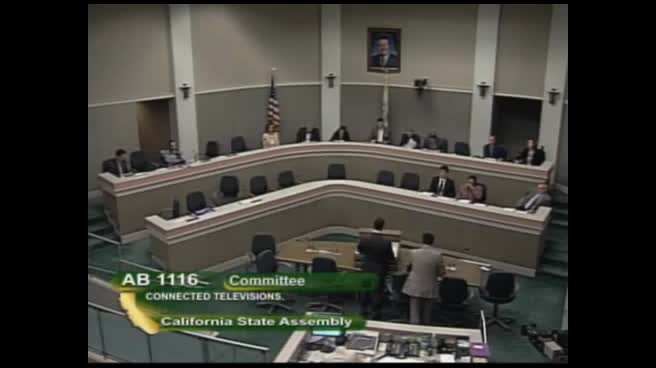 3MIN
Assembly Standing Committee on Judiciary
 6MIN
Assembly Standing Committee on Privacy and Consumer Protection
Bill Author
Bill Co-Author(s):
