AB 1177: Primary care clinics: written transfer agreements.
- Session Year: 2015-2016
- House: Assembly
- Latest Version Date: 2015-10-09
Existing regulations require primary care clinics to maintain a written transfer agreement with one or more nearby hospitals and other facilities as appropriate to meet medical emergencies. Existing law authorizes certain clinics to request that the State Department of Public Health waive this requirement.
This bill would provide that a licensed primary care clinic is not required to enter into a written transfer agreement pursuant to those provisions as a condition of licensure, except as provided for a primary care clinic that provides services as an alternative birth center, as specified. The bill would require a primary care clinic, except as specified, to send with each patient at the time of transfer, or in the case of an emergency, as promptly as possible, copies of all medical records related to the patients transfer, and would require the medical records to include, among other things, current medical findings and a brief summary of the course of treatment provided prior to the patients transfer. The bill would require the department to repeal related regulations.
Existing regulations require primary care clinics to maintain a written transfer agreement with one or more nearby hospitals and other facilities as appropriate to meet medical emergencies. Existing law authorizes certain clinics to request that the State Department of Public Health waive this requirement.
This bill would provide that a licensed primary care clinic is not required to enter into a written transfer agreement pursuant to those provisions as a condition of licensure, except as provided for an alternative birth center licensed as a primary care clinic, a primary care clinic that provides services as an alternative birth center, as specified. The bill would require a primary care clinic, except as specified, to send with each patient at the time of transfer, or in the case of an emergency, as promptly as possible, copies of all medical records related to the patients transfer, and would require the medical records to include, among other things, current medical findings and a brief summary of the course of treatment provided prior to the patients transfer. The bill would require the department to repeal its regulations to conform to these changes. related regulations.
Existing regulations require primary care clinics to maintain a written transfer agreement with one or more nearby hospitals and other facilities as appropriate to meet medical emergencies. Existing law authorizes certain clinics to request that the State Department of Public Health waive this requirement.
This bill would provide that a licensed primary care clinic is not required to enter into a written transfer agreement pursuant to those provisions as a condition of licensure, except as provided for a primary care clinic where anesthesia is used in compliance with the community standard of practice, in doses that, when administered, have the probability of placing a patient at risk for loss of the patients life-preserving protective reflexes. The bill would exempt a primary care clinic from the above-referenced hospital transfer agreement requirement if the clinic submits to the State Department of Public Health competent evidence, as defined, that documents its attempt to obtain a written transfer agreement from at least 2 local hospitals, except as provided. The bill would impose similar requirements upon an alternative birth center licensed as a primary care clinic, as specified. The bill would require a primary care clinic, except as specified, to send with each patient at the time of transfer, or in the case of an emergency, as promptly as possible, copies of all medical records related to the patients transfer, and would require the medical records to include, among other things, current medical findings and a brief summary of the course of treatment provided prior to the patients transfer. The bill would require the department to amend repeal its regulations to conform to these changes.
Existing regulations require primary care clinics to maintain a written transfer agreement with one or more nearby hospitals and other facilities as appropriate to meet medical emergencies. Existing law authorizes certain clinics to request that the State Department of Public Health waive this requirement.
This bill would provide that a licensed primary care clinic is not required to enter into a written transfer agreement pursuant to those provisions as a condition of licensure, except as provided for a primary care clinic where anesthesia is used in compliance with the community standard of practice, in doses that that, when administered administered, have the probability of placing a patient at risk for loss of the patients life-preserving protective reflexes. The bill would not require exempt a primary care clinic to have a from the above-referenced hospital transfer agreement with a nearby hospital requirement if the clinic provides analgesia and sedation services consisting only of local anesthesia, peripheral nerve blocks, a combination thereof, or conscious sedation, as defined. submits to the State Department of Public Health competent evidence, as defined, that documents its attempt to obtain a written transfer agreement from at least 2 local hospitals, except as provided. The bill would impose similar requirements upon an alternative birth center licensed as a primary care clinic, as specified. The bill would require the State Department of Public Health department to repeal amend its regulations to conform to these changes.
Existing regulations require primary care clinics to maintain a written transfer agreement with one or more nearby hospitals and other facilities as appropriate to meet medical emergencies. Existing law authorizes certain clinics to request that the State Department of Public Health waive this requirement.
This bill would provide that a licensed primary care clinic that is licensed is not required to enter into a written transfer agreement pursuant to those provisions. provisions as a condition of licensure, except as provided for a primary care clinic where anesthesia is used in compliance with the community standard of practice, in doses that when administered have the probability of placing a patient at risk for loss of the patients life-preserving protective reflexes. The bill would not require a primary care clinic to have a hospital transfer agreement with a nearby hospital if the clinic provides analgesia and sedation services consisting only of local anesthesia, peripheral nerve blocks, a combination thereof, or conscious sedation, as defined. The bill would require the State Department of Public Health to repeal its regulations to conform to these changes.
Existing regulations require primary care clinics to maintain a written transfer agreement with one or more nearby hospitals and other facilities as appropriate to meet medical emergencies. Existing law authorizes certain clinics to request that the State Department of Public Health waive this requirement.
This bill would provide that a primary care clinic that is licensed is not required to enter into a written transfer agreement pursuant to those provisions. The bill would require the State Department of Public Health to repeal its regulations to conform to these changes.
(a)Notwithstanding any other law, including, but not limited to, Section 75047 of Title 22 of the California Code of Regulations, and except as provided in subdivision (c), a primary care clinic described in subdivision (a) of Section 1204 that is licensed pursuant to this chapter shall not be required to enter into a written transfer agreement with a nearby hospital as a condition of licensure.
(b)(1)A primary care clinic shall send with each patient at the time of transfer, or in the case of an emergency, as promptly as possible, copies of all medical records related to the patients transfer. To the extent practicable and applicable to the patients transfer, the medical records shall include current medical findings, diagnoses, laboratory results, medications provided prior to transfer, a brief summary of the course of treatment provided prior to transfer, ambulation status, nursing and dietary information, name and contact information for the treating physician at the clinic, and as appropriate, pertinent administrative and demographic information related to the patient, including name and date of birth.
(2)The requirements in paragraph (1) shall not apply if the primary care clinic has entered into a written transfer agreement with a local hospital that provides for the transfer of medical records.
(c)A primary care clinic licensed pursuant to subdivision (a) of Section 1204 that provides services as an alternative birth center shall, as a condition of licensure, be required to maintain a written transfer agreement with a local hospital. The transfer agreement shall include provisions for communication and transportation to meet medical emergencies. Essential personal, health, and medical information shall either accompany the patient upon transfer or be transmitted immediately by telephone to the receiving facility. This section does not modify or supersede the requirements imposed on alternative birth centers described in Section 1204.3.
(d)The State Department of Public Health, no later than July 1, 2016, shall repeal Section 75047 of Chapter 7 of Division 5 of Title 22 of the California Code of Regulations.
(e)This section shall remain in effect only until January 1, 2018, and as of that date is repealed, unless a later enacted statute, that is enacted before January 1, 2018, deletes or extends that date.
SEC. 2.Section 1204.2 is added to the Health and Safety Code, to read:1204.2.(a)Notwithstanding any other law, and except as provided in subdivision (c), a primary care clinic described in subdivision (a) of Section 1204 that is licensed pursuant to this chapter shall not be required to enter into a written transfer agreement with a nearby hospital as a condition of licensure.
(b)(1)A primary care clinic shall send with each patient at the time of transfer, or in the case of an emergency, as promptly as possible, copies of all medical records related to the patients transfer. To the extent practicable and applicable to the patients transfer, the medical records shall include current medical findings, diagnoses, laboratory results, medications provided prior to transfer, a brief summary of the course of treatment provided prior to transfer, ambulation status, nursing and dietary information, name and contact information for the treating physician at the clinic, and as appropriate, pertinent administrative and demographic information related to the patient, including name and date of birth.
(2)The requirements in paragraph (1) shall not apply if the primary care clinic has entered into a written transfer agreement with a local hospital that provides for the transfer of medical records.
(c)A primary care clinic licensed pursuant to subdivision (a) of Section 1204 that provides services as an alternative birth center shall, as a condition of licensure, be required to maintain a written transfer agreement with a local hospital. The transfer agreement shall include provisions for communication and transportation to meet medical emergencies. Essential personal, health, and medical information shall either accompany the patient upon transfer or be transmitted immediately by telephone to the receiving facility. This section does not modify or supersede the requirements imposed on alternative birth centers described in Section 1204.3.
(d)This section shall become operative on January 1, 2018.
(a)Notwithstanding any other law, including, but not limited to, Section 75047 of Title 22 of the California Code of Regulations, and except as provided in subdivision (c), a primary care clinic described in subdivision (a) of Section 1204 that is licensed pursuant to this chapter shall not be required to enter into a written transfer agreement with a nearby hospital as a condition of licensure.
(b)(1)A primary care clinic shall send with each patient at the time of transfer, or in the case of an emergency, as promptly as possible, copies of all medical records related to the patients transfer. To the extent practicable and applicable to the patients transfer, the medical records shall include current medical findings, diagnoses, laboratory results, medications provided prior to transfer, a brief summary of the course of treatment provided prior to transfer, ambulation status, nursing and dietary information, name and contact information for the treating physician at the clinic, and as appropriate, pertinent administrative and demographic information related to the patient, including name and date of birth.
(2)The requirements in paragraph (1) shall not apply if the primary care clinic has entered into a written transfer agreement with a local hospital that provides for the transfer of medical records.
(c)An alternative birth center that is licensed under this chapter as a primary care clinic, as a condition of licensure, shall A primary care clinic licensed pursuant to subdivision (a) of Section 1204 that provides services as an alternative birth center shall, as a condition of licensure, be required to maintain a written transfer agreement with a local hospital. The transfer agreement shall include provisions for communication and transportation to meet medical emergencies. Essential personal, health, and medical information shall either accompany the patient upon transfer or be transmitted immediately by telephone to the receiving facility. This section does not modify or supersede the requirements imposed on alternative birth centers described in Section 1204.3.
(d)The State Department of Public Health, no later than July 1, 2016, shall repeal Section 75047 of Chapter 7 of Division 5 of Title 22 of the California Code of Regulations.
(e)This section shall remain in effect only until January 1, 2018, and as of that date is repealed, unless a later enacted statute, that is enacted before January 1, 2018, deletes or extends that date.
SEC. 2.Section 1204.2 is added to the Health and Safety Code, to read:1204.2.(a)Notwithstanding any other law, and except as provided in subdivision (c), a primary care clinic described in subdivision (a) of Section 1204 that is licensed pursuant to this chapter shall not be required to enter into a written transfer agreement with a nearby hospital as a condition of licensure.
(b)(1)A primary care clinic shall send with each patient at the time of transfer, or in the case of an emergency, as promptly as possible, copies of all medical records related to the patients transfer. To the extent practicable and applicable to the patients transfer, the medical records shall include current medical findings, diagnoses, laboratory results, medications provided prior to transfer, a brief summary of the course of treatment provided prior to transfer, ambulation status, nursing and dietary information, name and contact information for the treating physician at the clinic, and as appropriate, pertinent administrative and demographic information related to the patient, including name and date of birth.
(2)The requirements in paragraph (1) shall not apply if the primary care clinic has entered into a written transfer agreement with a local hospital that provides for the transfer of medical records.
(c)An alternative birth center that is licensed under this chapter as a primary care clinic, as a condition of licensure, shall A primary care clinic licensed pursuant to subdivision (a) of Section 1204 that provides services as an alternative birth center shall, as a condition of licensure, be required to maintain a written transfer agreement with a local hospital. The transfer agreement shall include provisions for communication and transportation to meet medical emergencies. Essential personal, health, and medical information shall either accompany the patient upon transfer or be transmitted immediately by telephone to the receiving facility. This section does not modify or supersede the requirements imposed on alternative birth centers described in Section 1204.3.
(d)This section shall become operative on January 1, 2018.
(a)(1)Notwithstanding any other law, including, but not limited to, Section 75047 of Title 22 of the California Code of Regulations, and except as provided in paragraph (2), subdivision (c), a primary care clinic described in subdivision (a) of Section 1204 that is licensed pursuant to this chapter shall not be required to enter into a written transfer agreement with a nearby hospital as a condition of licensure.
(2)(A)A primary care clinic where anesthesia is used in compliance with the community standard of practice, in doses that, when administered, have the probability of placing a patient at risk for loss of the patients life-preserving protective reflexes, shall have a written transfer agreement with a local accredited or licensed general acute care hospital.
(B)A primary care clinic described in subparagraph (A) is exempt from the requirements of subparagraph (A) if that clinic submits to the department any competent evidence that documents its attempt to obtain a written transfer agreement from at least two local hospitals that have elected not to enter into a transfer agreement with that primary care clinic. If the primary care clinic determines that there are not two hospitals that are reasonably accessible by road travel for purposes of providing patients with emergency medical care, the primary care clinic shall only be required to submit competent evidence to the department that documents its attempt to obtain a written transfer agreement from one local hospital.
(C)For the purposes of this section, competent evidence means evidence that is relevant and of such a nature that it can be received by a court of law, and includes, but is not limited to, an affidavit of someone with the legal authority to bind the clinic operation.
(b)(1)A primary care clinic shall send with each patient at the time of transfer, or in the case of an emergency, as promptly as possible, copies of all medical records related to the patients transfer. To the extent practicable and applicable to the patients transfer, the medical records shall include current medical findings, diagnoses, laboratory results, medications provided prior to transfer, a brief summary of the course of treatment provided prior to transfer, ambulation status, nursing and dietary information, name and contact information for the treating physician at the clinic, and as appropriate, pertinent administrative and demographic information related to the patient, including name and date of birth.
(2)The requirements in paragraph (1) shall not apply if the primary care clinic has entered into a written transfer agreement with a local hospital that provides for the transfer of medical records.
(D)
(c)An alternative birth center that is licensed under this chapter as a primary care clinic, as a condition of licensure, shall be required to maintain a written transfer agreement with a local hospital. The transfer agreement shall include provisions for communication and transportation to meet medical emergencies. Essential personal, health, and medical information shall either accompany the patient upon transfer or be transmitted immediately by telephone to the receiving facility. This section does not modify or supersede the requirements imposed on alternative birth centers described in Section 1204.3.
(b)This section does not require a primary care clinic to have a hospital transfer agreement with a local hospital, if that clinic provides only the following types of analgesia and sedation services:
(1)Local anesthesia.
(2)Peripheral nerve blocks.
(3)A combination of both local anesthesia and peripheral nerve blocks.
(4)Conscious sedation, as defined in Section 1647.1 of the Business and Professions Code.
(c)
(d)The State Department of Public Health, no later than July 1, 2016, shall amend repeal Section 75047 of Chapter 7 of Division 5 of Title 22 of the California Code of Regulations to be consistent with this section. Regulations.
(d)
(e)This section shall remain in effect only until January 1, 2018, and as of that date is repealed, unless a later enacted statute, that is enacted before January 1, 2018, deletes or extends that date.
SEC. 2.Section 1204.2 is added to the Health and Safety Code, to read:1204.2.(a)(1)Notwithstanding any other law, and except as provided in paragraph (2), subdivision (c), a primary care clinic described in subdivision (a) of Section 1204 that is licensed pursuant to this chapter shall not be required to enter into a written transfer agreement with a nearby hospital as a condition of licensure.
(2)(A)A primary care clinic where anesthesia is used in compliance with the community standard of practice, in doses that, when administered, have the probability of placing a patient at risk for loss of the patients life-preserving protective reflexes, shall have a written transfer agreement with a local accredited or licensed acute general care hospital.
(B)A primary care clinic described in subparagraph (A) is exempt from the requirements of subparagraph (A) if it submits to the department any competent evidence that documents its attempts to obtain a written transfer agreement from at least two local hospitals that have elected to not enter into a transfer agreement with that primary care clinic. If the primary care clinic determines that there are not two hospitals that are reasonably accessible by road travel for purposes of providing patients with emergency medical care, the primary care clinic shall only be required to submit competent evidence to the department that documents its attempt to obtain a written transfer agreement from one local hospital.
(C)For the purposes of this section, competent evidence means evidence that is relevant and of such a nature that it can be received by a court of law, and includes, but is not limited to, an affidavit of someone with the legal authority to bind the clinic operation.
(b)(1)A primary care clinic shall send with each patient at the time of transfer, or in the case of an emergency, as promptly as possible, copies of all medical records related to the patients transfer. To the extent practicable and applicable to the patients transfer, the medical records shall include current medical findings, diagnoses, laboratory results, medications provided prior to transfer, a brief summary of the course of treatment provided prior to transfer, ambulation status, nursing and dietary information, name and contact information for the treating physician at the clinic, and as appropriate, pertinent administrative and demographic information related to the patient, including name and date of birth.
(2)The requirements in paragraph (1) shall not apply if the primary care clinic has entered into a written transfer agreement with a local hospital that provides for the transfer of medical records.
(D)
(c)An alternative birth center that is licensed under this chapter as a primary care clinic, as a condition of licensure, shall be required to maintain a written transfer agreement with a local hospital. The transfer agreement shall include provisions for communication and transportation to meet medical emergencies. Essential personal, health, and medical information shall either accompany the patient upon transfer or be transmitted immediately by telephone to the receiving facility. This section does not modify or supersede the requirements imposed on alternative birth centers described in Section 1204.3.
(b)This section does not require a primary care clinic to have a hospital transfer agreement with a nearby hospital, if that clinic provides only the following types of analgesia and sedation services:
(1)Local anesthesia.
(2)Peripheral nerve blocks.
(3)A combination of both local anesthesia and peripheral nerve blocks.
(4)Conscious sedation, as defined in Section 1647.1 of the Business and Professions Code.
(c)This section shall become operative on January 1, 2018.
(d)
TextPage 6.(a)(1)Notwithstanding any other law, including, but not limited to, Section 75047 of Title 22 of the California Code of Regulations, and except as provided in paragraph (2), a primary care clinic described in subdivision (a) of Section 1204 that is licensed pursuant to this chapter shall not be required to enter into a written transfer agreement with a nearby hospital as a condition of licensure.
(2)(A)A primary care clinic where anesthesia is used in compliance with the community standard of practice, in doses that that, when administered administered, have the probability of placing a patient at risk for loss of the patients life-preserving protective reflexes, shall do one of the following:
(i)Have have a written transfer agreement with a local accredited or licensed general acute care hospital.
(ii)Permit procedures requiring the doses of anesthesia described in this subparagraph to be performed only by a licensee who has admitting privileges at a local accredited or licensed general acute care hospital, except that a licensee who may be precluded from having admitting privileges due to his or her professional classification or other administrative limitations shall have a written transfer agreement with a licensee who has admitting privileges at a local accredited or licensed general acute care hospital.
(iii)Submit for approval from an accrediting agency a detailed procedural plan for handling medical emergencies that shall be reviewed at the time of accreditation. A reasonable plan shall not be disapproved by the accrediting agency.
(B)A primary care clinic described in subparagraph (A) that cannot meet any of the criteria listed in clauses (i) to (iii), inclusive, of subparagraph (A) is exempt from this paragraph the requirements of subparagraph (A) if that clinic submits to the department any competent evidence that demonstrates to the department that documents its attempt to obtain a written transfer agreement from at least one nearby hospital or other inpatient health facility has two local hospitals that have elected not to enter into a transfer agreement with that primary care clinic. If the primary care clinic determines that there are not two hospitals that are reasonably accessible by road travel for purposes of providing patients with emergency medical care, the primary care clinic shall only be required to submit competent evidence to the department that documents its attempt to obtain a written transfer agreement from one local hospital.
(C)For the purposes of this section, the following definitions shall apply:
(i)Competent competent evidence means evidence that is relevant and of such a nature that it can be received by a court of law, and includes, but is not limited to, an affidavit of someone with the legal authority to bind the clinic operation.
(ii)Nearby hospital or other inpatient health facility means a hospital or other inpatient health facility that the clinic corporation has determined is reasonably accessibly by road travel for purposes of providing patients with medical emergency care.
(D)An alternative birth center that is licensed under this chapter as a primary care clinic, as a condition of licensure, shall be required to maintain a written transfer agreement with a local hospital. The transfer agreement shall include provisions for communication and transportation to meet medical emergencies. Essential personal, health, and medical information shall either accompany the patient upon transfer or be transmitted immediately by telephone to the receiving facility. This section does not modify or supersede the requirements imposed on alternative birth centers described in Section 1204.3.
(b)This section does not require a primary care clinic to have a hospital transfer agreement with a nearby local hospital, if that clinic provides only the following types of analgesia and sedation services:
(1)Local anesthesia.
(2)Peripheral nerve blocks.
(3)A combination of both local anesthesia and peripheral nerve blocks.
(4)Conscious sedation, as defined in Section 1647.1 of the Business and Professions Code.
(c)The State Department of Public Health shall, Health, no later than July 1, 2016, repeal shall amend Section 75047 of Chapter 7 of Division 5 of Title 22 of the California Code of Regulations. Regulations to be consistent with this section.
(d)This section shall remain in effect only until January 1, 2018, and as of that date is repealed, unless a later enacted statute, that is enacted before January 1, 2018, deletes or extends that date.
SEC. 2.Section 1204.2 is added to the Health and Safety Code, to read:1204.2.(a)(1)Notwithstanding any other law, and except as provided in paragraph (2), a primary care clinic described in subdivision (a) of Section 1204 that is licensed pursuant to this chapter shall not be required to enter into a written transfer agreement with a nearby hospital as a condition of licensure.
(2)(A)A primary care clinic where anesthesia is used in compliance with the community standard of practice, in doses that that, when administered administered, have the probability of placing a patient at risk for loss of the patients life-preserving protective reflexes, shall do one of the following:
(i)Have have a written transfer agreement with a local accredited or licensed acute general care hospital.
(ii)Permit procedures requiring the doses of anesthesia described in this subparagraph to be performed only by a licensee who has admitting privileges at a local accredited or licensed general acute care hospital, except that a licensee who may be precluded from having admitting privileges due to his or her professional classification or other administrative limitations shall have a written transfer agreement with a licensee who has admitting privileges at a local accredited or licensed acute care hospital.
(iii)Submit for approval from an accrediting agency a detailed procedural plan for handling medical emergencies that shall be reviewed at the time of accreditation. A reasonable plan shall not be disapproved by the accrediting agency.
(B)A primary care clinic described in subparagraph (A) that cannot meet any of the criteria listed in clauses (i) to (iii), inclusive, of subparagraph (A) shall be is exempt from this paragraph the requirements of subparagraph (A) if it submits to the department any competent evidence that demonstrates to the department that documents its attempts to obtain a written transfer agreement from at least one nearby hospital or other inpatient health facility has two local hospitals that have elected to not enter into a transfer agreement with that primary care clinic. If the primary care clinic determines that there are not two hospitals that are reasonably accessible by road travel for purposes of providing patients with emergency medical care, the primary care clinic shall only be required to submit competent evidence to the department that documents its attempt to obtain a written transfer agreement from one local hospital.
(C)For the purposes of this section, the following definitions shall apply:
(i)Competent competent evidence means evidence that is relevant and of such a nature that it can be received by a court of law, and includes, but is not limited to, an affidavit of someone with the legal authority to bind the clinic operation.
(ii)Nearby hospital or other inpatient health facility means a hospital or other inpatient health facility that the clinic corporation has determined is reasonably accessibly by road travel for purposes of providing patients with medical emergency care.
(D)An alternative birth center that is licensed under this chapter as a primary care clinic, as a condition of licensure, shall be required to maintain a written transfer agreement with a local hospital. The transfer agreement shall include provisions for communication and transportation to meet medical emergencies. Essential personal, health, and medical information shall either accompany the patient upon transfer or be transmitted immediately by telephone to the receiving facility. This section does not modify or supersede the requirements imposed on alternative birth centers described in Section 1204.3.
(b)This section does not require a primary care clinic to have a hospital transfer agreement with a nearby hospital, if that clinic provides only the following types of analgesia and sedation services:
(1)Local anesthesia.
(2)Peripheral nerve blocks.
(3)A combination of both local anesthesia and peripheral nerve blocks.
(4)Conscious sedation, as defined in Section 1647.1 of the Business and Professions Code.
(c)This section shall become operative on January 1, 2018.
(a)(1)Notwithstanding any other provision of law, including, but not limited to, Section 75047 of Title 22 of the California Code of Regulations, and except as provided in paragraph (2), a primary care clinic licensed pursuant to described in subdivision (a) of Section 1204 that is licensed pursuant to this chapter shall not be required to enter into a written transfer agreement with a nearby hospital as a condition of licensure.
(2)(A)A primary care clinic where anesthesia is used in compliance with the community standard of practice, in doses that when administered have the probability of placing a patient at risk for loss of the patients life-preserving protective reflexes, shall do one of the following:
(i)Have a written transfer agreement with a local accredited or licensed general acute care hospital.
(ii)Permit procedures requiring the doses of anesthesia described in this subparagraph to be performed only by a licensee who has admitting privileges at a local accredited or licensed general acute care hospital, except that a licensee who may be precluded from having admitting privileges due to his or her professional classification or other administrative limitations shall have a written transfer agreement with a licensee who has admitting privileges at a local accredited or licensed general acute care hospital.
(iii)Submit for approval from an accrediting agency a detailed procedural plan for handling medical emergencies that shall be reviewed at the time of accreditation. A reasonable plan shall not be disapproved by the accrediting agency.
(B)A primary care clinic described in subparagraph (A) that cannot meet any of the criteria listed in clauses (i) to (iii), inclusive, of subparagraph (A) is exempt from this paragraph if that clinic submits to the department any competent evidence that demonstrates to the department that at least one nearby hospital or other inpatient health facility has elected not to enter into a transfer agreement with that primary care clinic.
(C)For the purposes of this section, the following definitions shall apply:
(i)Competent evidence means evidence that is relevant and of such a nature that it can be received by a court of law, and includes, but is not limited to, an affidavit of someone with the legal authority to bind the clinic operation.
(ii)Nearby hospital or other inpatient health facility means a hospital or other inpatient health facility that the clinic corporation has determined is reasonably accessibly by road travel for purposes of providing patients with medical emergency care.
(b)This section does not require a primary care clinic to have a hospital transfer agreement with a nearby hospital, if that clinic provides only the following types of analgesia and sedation services:
(1)Local anesthesia.
(2)Peripheral nerve blocks.
(3)A combination of both local anesthesia and peripheral nerve blocks.
(4)Conscious sedation, as defined in Section 1647.1 of the Business and Professions Code.
(b)
(c)The State Department of Public Health shall, no later than July 1, 2016, repeal Section 75047 of Chapter 7 of Division 5 of Title 22 of the California Code of Regulations.
(c)
(d)This section shall remain in effect only until January 1, 2018, and as of that date is repealed, unless a later enacted statute, that is enacted before January 1, 2018, deletes or extends that date.
SEC. 2.Section 1204.2 is added to the Health and Safety Code, to read:1204.2.(a)(1)Notwithstanding any other provision of law, and except as provided in paragraph (2), a primary care clinic licensed pursuant to described in subdivision (a) of Section 1204 that is licensed pursuant to this chapter shall not be required to enter into a written transfer agreement with a nearby hospital as a condition of licensure.
(2)(A)A primary care clinic where anesthesia is used in compliance with the community standard of practice, in doses that when administered have the probability of placing a patient at risk for loss of the patients life-preserving protective reflexes, shall do one of the following:
(i)Have a written transfer agreement with a local accredited or licensed acute general care hospital.
(ii)Permit procedures requiring the doses of anesthesia described in this subparagraph to be performed only by a licensee who has admitting privileges at a local accredited or licensed general acute care hospital, except that a licensee who may be precluded from having admitting privileges due to his or her professional classification or other administrative limitations shall have a written transfer agreement with a licensee who has admitting privileges at a local accredited or licensed acute care hospital.
(iii)Submit for approval from an accrediting agency a detailed procedural plan for handling medical emergencies that shall be reviewed at the time of accreditation. A reasonable plan shall not be disapproved by the accrediting agency.
(B)A primary care clinic described in subparagraph (A) that cannot meet any of the criteria listed in clauses (i) to (iii), inclusive, of subparagraph (A) shall be exempt from this paragraph if it submits to the department any competent evidence that demonstrates to the department that at least one nearby hospital or other inpatient health facility has elected to not enter into a transfer agreement with that primary care clinic.
(C)For the purposes of this section, the following definitions shall apply:
(i)Competent evidence means evidence that is relevant and of such a nature that it can be received by a court of law, and includes, but is not limited to, an affidavit of someone with the legal authority to bind the clinic operation.
(ii)Nearby hospital or other inpatient health facility means a hospital or other inpatient health facility that the clinic corporation has determined is reasonably accessibly by road travel for purposes of providing patients with medical emergency care.
(b)This section does not require a primary care clinic to have a hospital transfer agreement with a nearby hospital, if that clinic provides only the following types of analgesia and sedation services:
(1)Local anesthesia.
(2)Peripheral nerve blocks.
(3)A combination of both local anesthesia and peripheral nerve blocks.
(4)Conscious sedation, as defined in Section 1647.1 of the Business and Professions Code.
(b)
(c)This section shall become operative on January 1, 2018.
(a)Notwithstanding any other provision of law, including, but not limited to, Section 75047 of Title 22 of the California Code of Regulations, a primary care clinic licensed pursuant to subdivision (a) of Section 1204 shall not be required to enter into a written transfer agreement with a nearby hospital as a condition of licensure.
(b)The State Department of Public Health shall, no later than July 1, 2016, repeal Section 75047 of Chapter 7 of Division 5 of Title 22 of the California Code of Regulations.
(c)This section shall remain in effect only until January 1, 2018, and as of that date is repealed, unless a later enacted statute, that is enacted before January 1, 2018, deletes or extends that date.
SEC. 2.Section 1204.2 is added to the Health and Safety Code, to read:1204.2.(a)Notwithstanding any other provision of law, a primary care clinic licensed pursuant to subdivision (a) of Section 1204 shall not be required to enter into a written transfer agreement with a nearby hospital as a condition of licensure.
(b)This section shall become operative on January 1, 2018.
|
Date
|
Status
|
|---|---|
| Aug 18, 2015 | Read second time. Ordered to third reading. |
| Oct 9, 2015 | Chaptered by Secretary of State - Chapter 704, Statutes of 2015. |
| Oct 9, 2015 | Approved by the Governor. |
| Sep 18, 2015 | Enrolled and presented to the Governor at 4 p.m. |
| Sep 10, 2015 | Senate amendments concurred in. To Engrossing and Enrolling. (Ayes 52. Noes 28.). |
| Sep 10, 2015 | Senate amendments concurred in. To Engrossing and Enrolling. (Ayes 52. Noes 28. Page 3067.). |
| Sep 10, 2015 | Senate amendments concurred in. To Engrossing and Enrolling. |
| Sep 9, 2015 | Read third time. Passed. Ordered to the Assembly. (Ayes 26. Noes 13. Page 2632.). |
| Sep 9, 2015 | Read third time. Passed. Ordered to the Assembly. |
| Sep 9, 2015 | In Assembly. Concurrence in Senate amendments pending. |
| Sep 8, 2015 | Read second time. Ordered to third reading. |
| Sep 4, 2015 | Read third time and amended. Ordered to second reading. |
| Aug 25, 2015 | Read second time. Ordered to third reading. |
| Aug 25, 2015 | Measure version as amended on August 24 corrected. |
| Aug 24, 2015 | Read third time and amended. Ordered to second reading. |
| Aug 24, 2015 | Measure version as amended on August 24 corrected. |
| Feb 27, 2015 | Introduced. To print. |
| Aug 17, 2015 | From committee: Be placed on second reading file pursuant to Senate Rule 28.8. |
| Jul 16, 2015 | Read second time and amended. Re-referred to Com. on APPR. |
| Jul 16, 2015 | From committee: Amend, and do pass as amended and re-refer to Com. on APPR. (Ayes 7. Noes 2.) (July 15). |
| Jul 8, 2015 | From committee chair, with author's amendments: Amend, and re-refer to committee. Read second time, amended, and re-referred to Com. on HEALTH. |
| May 21, 2015 | Referred to Com. on HEALTH. |
| May 11, 2015 | Read third time. Passed. Ordered to the Senate. (Ayes 51. Noes 28. Page 1388.) |
| May 11, 2015 | Read third time. Passed. Ordered to the Senate. |
| May 11, 2015 | In Senate. Read first time. To Com. on RLS. for assignment. |
| May 7, 2015 | Read second time. Ordered to third reading. |
| May 6, 2015 | From committee: Do pass. (Ayes 12. Noes 5.) (May 6). |
| Apr 29, 2015 | In committee: Set, first hearing. Hearing canceled at the request of author. |
| Apr 22, 2015 | From committee: Do pass and re-refer to Com. on APPR. (Ayes 14. Noes 5.) (April 21). Re-referred to Com. on APPR. |
| Mar 23, 2015 | Referred to Com. on HEALTH. |
| Mar 2, 2015 | Read first time. |
| Mar 1, 2015 | From printer. May be heard in committee March 31. |
|
Date
|
Description
|
Location
|
Votes
|
|
|---|---|---|---|---|
| Sep 10, 2015 | AB 1177 GOMEZ Concurrence in Senate Amendments | Assembly Floor |
Passed |
|
| Sep 9, 2015 | Assembly 3rd Reading AB1177 Gomez By Mitchell | Senate Floor |
Passed |
|
| Jul 15, 2015 | Do pass as amended, but first amend, and re-refer to the Committee on [Appropriations] | Senate Standing Committee on Health |
Passed |
|
| May 11, 2015 | AB 1177 GOMEZ Assembly Third Reading | Assembly Floor |
Passed |
|
| May 6, 2015 | Do pass. | Assembly Standing Committee on Appropriations |
Passed |
|
| Apr 21, 2015 | Do pass and be re-referred to the Committee on [Appropriations] | Assembly Standing Committee on Health |
Passed |
This list shows positions taken on this bill by organizations on the date displayed, which is linked to the original source.
Positions by individuals are not included.
|
Organization
|
Position
|
Date
|
|---|---|---|
| California Chapter of the American College of Emergency Physicians | ** Against | Jul 15, 2015 |
| California Family Health Council Inc. | ** Support | Sep 9, 2015 |
| California Medical Association, Inc. | ** Against | Jul 15, 2015 |
| California Primary Care Association | * Indeterminate | Jul 15, 2015 |
| Californians for Parental Rights | * Indeterminate | Jul 15, 2015 |
| Center for Medical Progress | * Indeterminate | Jul 15, 2015 |
| Community Clinic Association of Los Angeles County | ** Support | Sep 9, 2015 |
| Concerned Women for America of California | ** Against | Sep 9, 2015 |
| Planned Parenthood Action Fund of the Pacific Southwest | ** Support | Sep 9, 2015 |
| Planned Parenthood Advocacy Project Los Angeles County | ** Support | Sep 9, 2015 |
| Planned Parenthood Affiliates Of California | ** Support | Sep 9, 2015 |
| Planned Parenthood Mar Monte | ** Support | Sep 9, 2015 |
| Planned Parenthood Northern California Action Fund | ** Support | Sep 9, 2015 |
| Planned Parenthood Pasadena and San Gabriel Valley | ** Support | Sep 9, 2015 |
| strike California Right to Life Committee | ** Against | Sep 9, 2015 |
AB 1177
Page 2
CONCURRENCE IN SENATE AMENDMENTS
AB 1177
(Gomez, et al.)
As Amended September 4, 2015
Majority vote
ASSEMBLY: |
51-28 |
(May 11, 2015) |
SENATE: |
26-13 |
(September 9, 2015) |
Original Committee Reference: HEALTH
SUMMARY: Prohibits a primary care clinic, notwithstanding current regulations or any other law, from being required to enter into a written transfer agreement with a nearby hospital as a condition of licensure, and requires the Department of Public Health (DPH) to repeal the regulation requiring primary care clinics to enter into transfer agreements, no later than July 1, 2016.
The Senate amendments require primary care clinics, when transferring a patient to a hospital, to send copies of all medical records related to the transfer with the patient, or in the case of an emergency, as soon as possible, and specify that a primary care clinic that provides services as an alternative birth center must maintain a written transfer agreement with a local hospital.
EXISTING FEDERAL LAW: The Emergency Medical Treatment and Active Labor Act, (EMTALA) is an act of the United States Congress, passed in 1986 as part of the Consolidated Omnibus Budget Reconciliation Act. It requires hospitals that accept payments from Medicare to provide emergency health care treatment to anyone needing it regardless of citizenship, legal status, or ability to pay. There are no reimbursement provisions. Participating hospitals may not transfer or discharge patients needing emergency treatment except with the informed consent or stabilization of the patient or when their condition requires transfer to a hospital better equipped to administer the treatment. EMTALA applies to "participating hospitals." The statute defines participating hospitals as those that accept payment from the Department of Health and Human Services, Centers for Medicare and Medicaid Services under the Medicare program. Because there are very few hospitals that do not accept Medicare, the law applies to nearly all hospitals.
EXISTING STATE REGULATIONS: Require primary care clinics, as a condition of licensure, to have a written transfer agreement with a nearby hospital. Allow all licensed clinics, except for those providing abortion services or birthing services, to request that DPH waive the requirement to maintain a written transfer agreement, if the clinic can show that no hospital would agree to enter into a transfer agreement.
FISCAL EFFECT: According to the Senate Appropriations Committee, pursuant to Senate Rule 28.8, negligible state costs.
COMMENTS: According to the author, under current California law, clinics are obliged to obtain a hospital transfer agreement (HTA) from a nearby hospital as a condition of licensure in order to begin performing services. DPH regulations allow clinics who cannot get an HTA from a nearby hospital to apply for a waiver to this requirement. However, clinics that provide abortions or birthing services are not allowed to apply for a waiver, even if a local hospital won't agree to enter into an HTA. The author states that this effectively allows a hospital that does not want to enter into an HTA to prevent an abortion clinic from opening. The author notes that if this bill is enacted, this regulation will be repealed and unenforceable, and will give Californians equal access to reproductive services and the ability to choose.
As required by California Code of Regulations Title 22, Division 5, Chapter 7, Article 6, primary care clinics must have an HTA with a local hospital as a condition of licensure. Should a patient undergoing a procedure at a clinic require transport to the hospital, an HTA facilitates the timely transfer of the patient between the hospital and the facility. The agreements delineate the responsibilities of both the clinic and the hospital, including the required sharing of vital information such as the current medical findings regarding the patient, diagnoses, and the transfer of medical records.
Planned Parenthood Affiliates of California (PPAC) are the sponsors of this bill and they state by requiring hospital transfer agreements as a condition of licensure, DPH has essentially delegated some of its licensure authority to the hospitals, because any hospital corporation with either a moral objection or desire to secure a competitive edge can refuse to sign a transfer agreement and bring a clinic's license application to a halt. PPAC notes they believe the decision of whether to grant a clinic a license should rest exclusively with the state. PPAC also notes the existing transfer agreement requirement acts as a targeted restriction on abortion providers, or TRAP law, because only abortion clinics and birthing centers are ineligible to receive a waiver from the requirement, even in the event that they are unable to secure a transfer agreement.
The California Right to Life Committee, Inc. (CRCL) is opposed to this bill because it would remove the necessity of having a written transfer agreement with one or more nearby hospital when a primary care clinic seeks licensure. CRLC believes this would be a very serious regulation change and would threaten the physical safety of patients at these primary care clinics.
Analysis Prepared by: Lara Flynn / HEALTH / (916) 319-2097 FN: 0002300
AB 1177
Page 7
|
Office of Senate Floor Analyses (916) 651-1520 Fax: (916) 327-4478 |
THIRD READING
Bill No: AB 1177
Author: Gomez (D), Burke (D), and Low (D), et al.
Amended: 9/4/15 in Senate
SENATE HEALTH COMMITTEE: 7-2, 7/15/15
AYES: Hernandez, Hall, Mitchell, Monning, Pan, Roth, Wolk
NOES: Nguyen, Nielsen
SENATE APPROPRIATIONS COMMITTEE: Senate Rule 28.8
ASSEMBLY FLOOR: 51-28, 5/11/15 - See last page for vote
SUBJECT: Primary care clinics: written transfer agreements
SOURCE: Planned Parenthood Affiliates of California
DIGEST: This bill prohibits a primary care clinic, notwithstanding current regulations or any other law, from being required to enter into a written transfer agreement with a nearby hospital as a condition of licensure.
Senate Floor Amendments of 9/4/15 make technical clarifications suggested by the Department of Public Health (DPH) to more accurately reflect the terminology of licensed primary care clinics that are providing services as an alternative birth center, and also correct a technical drafting error.
Senate Floor Amendments of 8/24/15:
Delete provisions that would have required primary care clinics using anesthesia in specified doses to either have a written transfer agreement with a local hospital or document the clinic’s attempt to obtain a written transfer agreement with at least two local hospitals, and deleted related provisions.
Require primary care clinics to send with each patient at the time of transfer, or in the case of an emergency, as promptly as possible, copies of all medical records related to the patient’s transfer.
Require the medical records specified in 2) above, to the extent practicable and applicable to the patient’s transfer, to include current medical findings, diagnoses, laboratory results, medications provided prior to transfer, a brief summary of the course of treatment provided prior to transfer, ambulation status, nursing and dietary information, name and contact information for the treating physician at the clinic, and as appropriate, pertinent administrative and demographic information related to the patient, including name and date of birth.
Specify that the requirement in 2) above does not apply if the primary care clinic has entered into a written transfer agreement with a local hospital that provides for the transfer of medical records.
Existing law:
Licenses and regulates primary care clinics and specialty clinics by DPH. Primary care clinics are either “community clinics” or “free clinics,” while specialty clinics include surgical clinics, chronic dialysis clinics, rehabilitation clinics, and alternative birth centers.
Defines “alternative birth center” as a clinic that is not part of a hospital and that provides comprehensive perinatal services and delivery care to pregnant women who remain less than 24 hours at the facility. Alternative birth centers can be specifically licensed as a specialty clinic, or can be provided as a permitted service by a licensed primary care clinic.
Existing Title 22 regulations:
Requires primary care clinics to maintain written transfer agreements, which include provisions for communication and transportation, with one or more nearby hospitals and other inpatient health facilities as appropriate to meet medical emergencies. Requires essential personal, health and medical information to either accompany the patient upon transfer or be transmitted immediately by telephone to the receiving facility.
Permits primary care clinics, except for those providing abortion or birthing services, to request that DPH waive the written transfer agreement requirement above. Requires the clinic to demonstrate to DPH that all nearby hospitals and other inpatient health facilities, as appropriate to meet medical emergencies have refused to enter into transfer agreements.
This bill:
Prohibits primary care clinics, notwithstanding a current regulation or any other law, from being required to enter into a written transfer agreement with a nearby hospital as a condition of licensure.
Requires primary care clinics to send with each patient at the time of transfer, or in the case of an emergency, as promptly as possible, copies of all medical records related to the patient’s transfer.
Requires the medical records specified in 2) above, to the extent practicable and applicable to the patient’s transfer, to include current medical findings, diagnoses, laboratory results, medications provided prior to transfer, a brief summary of the course of treatment provided prior to transfer, ambulation status, nursing and dietary information, name and contact information for the treating physician at the clinic, and as appropriate, pertinent administrative and demographic information related to the patient, including name and date of birth.
Specifies that the requirement in 2) above does not apply if the primary care clinic has entered into a written transfer agreement with a local hospital that provides for the transfer of medical records.
Requires a primary care clinic that provides services as an alternative birth center to be required to maintain a written transfer agreement with a local hospital, and requires this transfer agreement to include provisions for communication and transportation to meet medical emergencies. Requires essential personal and medical information to either accompany the patient upon transfer or be transmitted immediately by telephone to the receiving facility.
Requires DPH to repeal, no later than July 1, 2016, specified Title 22 regulations that require primary care clinics to have a written transfer agreement with a hospital.
Comments
Author’s statement. According to the author, under current California law, clinics are obliged to obtain a hospital transfer agreement (HTA) from a nearby hospital as a condition of licensure in order to begin performing services. DPH regulations allow clinics who cannot get an HTA from a nearby hospital to apply for a waiver to this requirement. However, clinics that provide abortions or birthing services are not allowed to apply for a waiver, even if a local hospital won't agree to enter into an HTA. The author states that this effectively allows a hospital that does not want to enter into an HTA to prevent an abortion clinic from opening. The author notes that if this bill is enacted, this regulation will be repealed and unenforceable, and will give Californians equal access to reproductive services and the ability to choose.
Hospital transfer agreements. The requirement for a written transfer agreement between primary care clinics and a local hospital, which is the subject of this bill, is contained in the Title 22 regulations governing primary care clinics. There are also a handful of places where written transfer agreements are statutorily required, and would not be affected by this bill. For example, a rural general acute care hospital that does not provide surgical and anesthesia services is required to maintain a written transfer agreement with one or more general acute care hospitals that provide surgical and anesthesia services. A mobile health care services unit (generally speaking, a bus outfitted as a mobile clinic that is operated by a licensed clinic or hospital) is required to maintain written transfer agreements that include provisions for communication with, and transportation to, one or more nearby hospitals as needed to meet medical emergencies. Finally, an accredited outpatient surgical setting, which uses general anesthesia, is required to either have a written transfer agreement with a hospital, only permit surgery by physicians who have admitting privileges at a hospital, or have a “detailed procedural plan for handling medical emergencies” that is approved by the accrediting agency.
While written transfer agreements can vary by hospital, DPH provides on its website an example of a transfer agreement that meets its requirements. This form is two pages long, with 11 itemized requirements, such as a requirement that transferring institutions send with the patient forms that include information on the medical course of treatment followed by the transferring institution and other pertinent medical, administrative, and social information. Other requirements include ensuring that the hospital make available its diagnostic and therapeutic services, and to be accountable for the recognition of need for social services. The form also specifies that charges for services performed are to be collected by the institution rendering services, and that neither facility has any liability to the other for such charges.
FISCAL EFFECT: Appropriation: No Fiscal Com.: Yes Local: No
Planned Parenthood Affiliates of California (source)
California Family Health Council
Community Action Fund of Planned Parenthood Orange and San Bernardino Counties
Community Clinic Association of Los Angeles County
Planned Parenthood Action Fund of Santa Barbara, Ventura, and San Luis Obispo Counties
Planned Parenthood Action Fund of the Pacific Southwest
Planned Parenthood Advocacy Project Los Angeles County
Planned Parenthood Mar Monte
Planned Parenthood Northern California Action Fund
Planned Parenthood Pasadena and San Gabriel Valley
California
Chapter of the American College of Emergency Physicians
California Right to Life Committee
Concerned Women for America of California
ARGUMENTS IN SUPPORT: This bill is sponsored by Planned Parenthood Affiliates of California (PPAC), which states that this bill deletes an obsolete regulation that restricts abortion clinics from obtaining an exemption if they cannot enter into a transfer agreement with a local hospital. PPAC states that the Legislature vested DPH with the authority to regulate and license clinics, but by requiring HTAs as a condition of licensure, DPH has essentially delegated some of its licensure authority to the hospitals. PPAC states that any hospital corporation with either a moral objection or a desire to secure a competitive edge can refuse to sign a transfer agreement and bring a clinic’s license application to a halt. PPAC states that the existing regulations around the HTA acts like a targeted restriction on abortion providers, or a TRAP law. Community clinics that provide abortion services, like Planned Parenthood, are singled-out and in this case are unable to file for an exemption from the HTA requirement. According to PPAC, although California’s laws and regulations tend to be progressive around abortion and comprehensive reproductive health care, this bill will address some of the last remaining policies that single out abortion providers.
The California Family Health Council also supports this bill, stating that this bill expands access to essential sexual and reproductive health care by removing barriers to primary clinics from getting licenses to operate.
The Community Clinic Association of Los Angeles County states in support that the decision of whether to grant a license to a clinic should rest exclusively with the state and should not hinge upon securing an agreement with an independent entity that, for a variety of reasons, may or may not be cooperative.
ARGUMENTS IN OPPOSITION: This bill is opposed by Concerned Women for America of California (CWA), which states that operators of abortion clinics would benefit from the passage of this bill since abortion facilities would be able to open without the requirement of having to get a transfer agreement with a local hospital. CWA states that in El Centro, a Planned Parenthood recently opened, and that after months of public outcry by thousands of Imperial County residents to dissolve a transfer agreement between El Centro Regional Medical Center, suddenly this bill makes its way through the California Legislature. CWA states that women will be endangered further if abortion facilities are not required to have a transfer agreement with a local hospital, and that loosening the reins on abortion clinics will lead to serious injury and death for women. The California Right to Life Committee (CRLC) also opposes this bill, stating that primary care clinics are a benefit to their communities, so one would assume that the medical personnel would want to include transfer agreements as an important and valid component of licensure. CRLC states that it has read about serious situations developing when such facilities have not had such transfer agreements.
The California Chapter of the American College of Emergency Physicians (California ACEP) states that they are opposed unless amended to make all clinics equal by allowing community clinics providing birthing or abortion services to apply for an exemption from the written transfer agreement requirement. According to California ACEP, while it supports the goal of removing barriers to licensing for clinics offering reproductive services, it is opposed to the solution offered in this bill of eliminating transfer agreements with a local hospital for all community clinics as a condition of licensure. California ACEP states that transfer agreements between community clinics and one or more nearby hospitals are important to ensuring that clinics can adequately coordinate care for patients facing medical emergencies. California ACEP states that while it is of course true that a patient can always be transported to an emergency department by ambulance without accompanying medical information, it is always better for the patient if the treating emergency physician has access to personal, health, and medical information. California ACEP notes that under current law, clinics may ask DPH to waive the transfer agreement requirement, as long as those clinics do not provide birthing or abortion services. Rather than eliminate transfer agreements for all community clinics, California ACEP states that this bill should be amended to make all clinics equal by allowing community clinics providing birthing or abortion services to apply for an exemption.
ASSEMBLY FLOOR: 51-28, 5/11/15
AYES: Alejo, Bloom, Bonilla, Bonta, Brown, Burke, Calderon, Campos, Chau, Chiu, Chu, Cooley, Cooper, Dababneh, Daly, Dodd, Eggman, Frazier, Cristina Garcia, Eduardo Garcia, Gatto, Gipson, Gomez, Gonzalez, Gordon, Gray, Roger Hernández, Holden, Irwin, Jones-Sawyer, Levine, Lopez, Low, Maienschein, McCarty, Medina, Mullin, Nazarian, O'Donnell, Perea, Quirk, Rendon, Ridley-Thomas, Rodriguez, Santiago, Mark Stone, Thurmond, Ting, Weber, Williams, Wood
NOES: Achadjian, Travis Allen, Baker, Bigelow, Brough, Chang, Chávez, Dahle, Beth Gaines, Gallagher, Grove, Hadley, Harper, Jones, Kim, Lackey, Linder, Mathis, Mayes, Melendez, Obernolte, Olsen, Patterson, Salas, Steinorth, Wagner, Waldron, Wilk
NO VOTE RECORDED: Atkins
Prepared by: Vince Marchand / HEALTH /
9/8/15 16:19:41
**** END ****
AB 1177
Page 7
|
Office of Senate Floor Analyses (916) 651-1520 Fax: (916) 327-4478 |
THIRD READING
Bill No: AB 1177
Author: Gomez (D), Burke (D), and Low (D)
Amended: 8/24/15 in Senate
SENATE HEALTH COMMITTEE: 7-2, 7/15/15
AYES: Hernandez, Hall, Mitchell, Monning, Pan, Roth, Wolk
NOES: Nguyen, Nielsen
SENATE APPROPRIATIONS COMMITTEE: Senate Rule 28.8
ASSEMBLY FLOOR: 51-28, 5/11/15 - See last page for vote
SUBJECT: Primary care clinics: written transfer agreements
SOURCE: Planned Parenthood Affiliates of California
DIGEST: This bill prohibits a primary care clinic, notwithstanding current regulations or any other law, from being required to enter into a written transfer agreement with a nearby hospital as a condition of licensure.
Senate Floor Amendments of 8/24/15:
Delete provisions that would have required primary care clinics using anesthesia in specified doses to either have a written transfer agreement with a local hospital or document the clinic’s attempt to obtain a written transfer agreement with at least two local hospitals, and deleted related provisions.
Require primary care clinics to send with each patient at the time of transfer, or in the case of an emergency, as promptly as possible, copies of all medical records related to the patient’s transfer.
Require the medical records specified in 2) above, to the extent practicable and applicable to the patient’s transfer, to include current medical findings, diagnoses, laboratory results, medications provided prior to transfer, a brief summary of the course of treatment provided prior to transfer, ambulation status, nursing and dietary information, name and contact information for the treating physician at the clinic, and as appropriate, pertinent administrative and demographic information related to the patient, including name and date of birth.
Specify that the requirement in 2) above does not apply if the primary care clinic has entered into a written transfer agreement with a local hospital that provides for the transfer of medical records.
Existing law:
Licenses and regulates primary care clinics and specialty clinics by the Department of Public Health (DPH). Primary care clinics are either “community clinics” or “free clinics,” while specialty clinics include surgical clinics, chronic dialysis clinics, rehabilitation clinics, and alternative birth centers.
Defines “alternative birth center” as a clinic that is not part of a hospital and that provides comprehensive perinatal services and delivery care to pregnant women who remain less than 24 hours at the facility. Alternative birth centers can be specifically licensed as a specialty clinic, or can be provided as a permitted service by a licensed primary care clinic.
Existing Title 22 regulations:
Requires primary care clinics to maintain written transfer agreements, which include provisions for communication and transportation, with one or more nearby hospitals and other inpatient health facilities as appropriate to meet medical emergencies. Requires essential personal, health and medical information to either accompany the patient upon transfer or be transmitted immediately by telephone to the receiving facility.
Permits primary care clinics, except for those providing abortion or birthing services, to request that DPH waive the written transfer agreement requirement above. Requires the clinic to demonstrate to DPH that all nearby hospitals and other inpatient health facilities, as appropriate to meet medical emergencies have refused to enter into transfer agreements.
This bill:
Prohibits primary care clinics, notwithstanding a current regulation or any other law, from being required to enter into a written transfer agreement with a nearby hospital as a condition of licensure.
Requires primary care clinics to send with each patient at the time of transfer, or in the case of an emergency, as promptly as possible, copies of all medical records related to the patient’s transfer.
Requires the medical records specified in 2) above, to the extent practicable and applicable to the patient’s transfer, to include current medical findings, diagnoses, laboratory results, medications provided prior to transfer, a brief summary of the course of treatment provided prior to transfer, ambulation status, nursing and dietary information, name and contact information for the treating physician at the clinic, and as appropriate, pertinent administrative and demographic information related to the patient, including name and date of birth.
Specifies that the requirement in 2) above does not apply if the primary care clinic has entered into a written transfer agreement with a local hospital that provides for the transfer of medical records.
Requires an alternative birth center that is licensed as a primary care clinic to be required to maintain a written transfer agreement with a local hospital, and requires this transfer agreement to include provisions for communication and transportation to meet medical emergencies. Requires essential personal and medical information to either accompany the patient upon transfer or be transmitted immediately by telephone to the receiving facility.
Requires DPH to repeal, no later than July 1, 2016, specified Title 22 regulations that require primary care clinics to have a written transfer agreement with a hospital.
Comments
Author’s statement. According to the author, under current California law, clinics are obliged to obtain a hospital transfer agreement (HTA) from a nearby hospital as a condition of licensure in order to begin performing services. DPH regulations allow clinics who cannot get an HTA from a nearby hospital to apply for a waiver to this requirement. However, clinics that provide abortions or birthing services are not allowed to apply for a waiver, even if a local hospital won't agree to enter into an HTA. The author states that this effectively allows a hospital that does not want to enter into an HTA to prevent an abortion clinic from opening. The author notes that if this bill is enacted, this regulation will be repealed and unenforceable, and will give Californians equal access to reproductive services and the ability to choose.
Hospital transfer agreements. The requirement for a written transfer agreement between primary care clinics and a local hospital, which is the subject of this bill, is contained in the Title 22 regulations governing primary care clinics. There are also a handful of places where written transfer agreements are statutorily required, and would not be affected by this bill. For example, a rural general acute care hospital that does not provide surgical and anesthesia services is required to maintain a written transfer agreement with one or more general acute care hospitals that provide surgical and anesthesia services. A mobile health care services unit (generally speaking, a bus outfitted as a mobile clinic that is operated by a licensed clinic or hospital) is required to maintain written transfer agreements that include provisions for communication with, and transportation to, one or more nearby hospitals as needed to meet medical emergencies. Finally, an accredited outpatient surgical setting, which uses general anesthesia, is required to either have a written transfer agreement with a hospital, only permit surgery by physicians who have admitting privileges at a hospital, or have a “detailed procedural plan for handling medical emergencies” that is approved by the accrediting agency.
While written transfer agreements can vary by hospital, DPH provides on its website an example of a transfer agreement that meets its requirements. This form is two pages long, with 11 itemized requirements, such as a requirement that transferring institutions send with the patient forms that include information on the medical course of treatment followed by the transferring institution and other pertinent medical, administrative, and social information. Other requirements include ensuring that the hospital make available its diagnostic and therapeutic services, and to be accountable for the recognition of need for social services. The form also specifies that charges for services performed are to be collected by the institution rendering services, and that neither facility has any liability to the other for such charges.
FISCAL EFFECT: Appropriation: No Fiscal Com.: Yes Local: No
Planned Parenthood Affiliates of California (source)
California Family Health Council
Community Action Fund of Planned Parenthood Orange and San Bernardino Counties
Community Clinic Association of Los Angeles County
Planned Parenthood Action Fund of Santa Barbara, Ventura, and San Luis Obispo Counties
Planned Parenthood Action Fund of the Pacific Southwest
Planned Parenthood Advocacy Project Los Angeles County
Planned Parenthood Mar Monte
Planned Parenthood Northern California Action Fund
Planned Parenthood Pasadena and San Gabriel Valley
OPPOSITION: (Verified 8/26/15)
California
Chapter of the American College of Emergency Physicians
California Right to Life Committee
Concerned Women for America of California
ARGUMENTS IN SUPPORT: This bill is sponsored by Planned Parenthood Affiliates of California (PPAC), which states that this bill deletes an obsolete regulation that restricts abortion clinics from obtaining an exemption if they cannot enter into a transfer agreement with a local hospital. PPAC states that the Legislature vested DPH with the authority to regulate and license clinics, but by requiring HTAs as a condition of licensure, DPH has essentially delegated some of its licensure authority to the hospitals. PPAC states that any hospital corporation with either a moral objection or a desire to secure a competitive edge can refuse to sign a transfer agreement and bring a clinic’s license application to a halt. PPAC states that the existing regulations around the HTA acts like a targeted restriction on abortion providers, or a TRAP law. Community clinics that provide abortion services, like Planned Parenthood, are singled-out and in this case are unable to file for an exemption from the HTA requirement. According to PPAC, although California’s laws and regulations tend to be progressive around abortion and comprehensive reproductive health care, this bill will address some of the last remaining policies that single out abortion providers.
The California Family Health Council also supports this bill, stating that this bill expands access to essential sexual and reproductive health care by removing barriers to primary clinics from getting licenses to operate.
The Community Clinic Association of Los Angeles County states in support that the decision of whether to grant a license to a clinic should rest exclusively with the state and should not hinge upon securing an agreement with an independent entity that, for a variety of reasons, may or may not be cooperative.
ARGUMENTS IN OPPOSITION: This bill is opposed by Concerned Women for America of California (CWA), which states that operators of abortion clinics would benefit from the passage of this bill since abortion facilities would be able to open without the requirement of having to get a transfer agreement with a local hospital. CWA states that in El Centro, a Planned Parenthood recently opened, and that after months of public outcry by thousands of Imperial County residents to dissolve a transfer agreement between El Centro Regional Medical Center, suddenly this bill makes its way through the California Legislature. CWA states that women will be endangered further if abortion facilities are not required to have a transfer agreement with a local hospital, and that loosening the reins on abortion clinics will lead to serious injury and death for women. The California Right to Life Committee (CRLC) also opposes this bill, stating that primary care clinics are a benefit to their communities, so one would assume that the medical personnel would want to include transfer agreements as an important and valid component of licensure. CRLC states that it has read about serious situations developing when such facilities have not had such transfer agreements.
The California Chapter of the American College of Emergency Physicians (California ACEP) states that they are opposed unless amended to make all clinics equal by allowing community clinics providing birthing or abortion services to apply for an exemption from the written transfer agreement requirement. According to California ACEP, while it supports the goal of removing barriers to licensing for clinics offering reproductive services, it is opposed to the solution offered in this bill of eliminating transfer agreements with a local hospital for all community clinics as a condition of licensure. California ACEP states that transfer agreements between community clinics and one or more nearby hospitals are important to ensuring that clinics can adequately coordinate care for patients facing medical emergencies. California ACEP states that while it is of course true that a patient can always be transported to an emergency department by ambulance without accompanying medical information, it is always better for the patient if the treating emergency physician has access to personal, health, and medical information. California ACEP notes that under current law, clinics may ask DPH to waive the transfer agreement requirement, as long as those clinics do not provide birthing or abortion services. Rather than eliminate transfer agreements for all community clinics, California ACEP states that this bill should be amended to make all clinics equal by allowing community clinics providing birthing or abortion services to apply for an exemption.
ASSEMBLY FLOOR: 51-28, 5/11/15
AYES: Alejo, Bloom, Bonilla, Bonta, Brown, Burke, Calderon, Campos, Chau, Chiu, Chu, Cooley, Cooper, Dababneh, Daly, Dodd, Eggman, Frazier, Cristina Garcia, Eduardo Garcia, Gatto, Gipson, Gomez, Gonzalez, Gordon, Gray, Roger Hernández, Holden, Irwin, Jones-Sawyer, Levine, Lopez, Low, Maienschein, McCarty, Medina, Mullin, Nazarian, O'Donnell, Perea, Quirk, Rendon, Ridley-Thomas, Rodriguez, Santiago, Mark Stone, Thurmond, Ting, Weber, Williams, Wood
NOES: Achadjian, Travis Allen, Baker, Bigelow, Brough, Chang, Chávez, Dahle, Beth Gaines, Gallagher, Grove, Hadley, Harper, Jones, Kim, Lackey, Linder, Mathis, Mayes, Melendez, Obernolte, Olsen, Patterson, Salas, Steinorth, Wagner, Waldron, Wilk
NO VOTE RECORDED: Atkins
Prepared by: Vince Marchand / HEALTH /
8/26/15 16:19:05
**** END ****
AB 1177
Page 7
|
Office of Senate Floor Analyses (916) 651-1520 Fax: (916) 327-4478 |
THIRD READING
Bill No: AB 1177
Author: Gomez (D), Burke (D), and Low (D)
Amended: 8/24/15 in Senate
SENATE HEALTH COMMITTEE: 7-2, 7/15/15
AYES: Hernandez, Hall, Mitchell, Monning, Pan, Roth, Wolk
NOES: Nguyen, Nielsen
SENATE APPROPRIATIONS COMMITTEE: Senate Rule 28.8
ASSEMBLY FLOOR: 51-28, 5/11/15 - See last page for vote
SUBJECT: Primary care clinics: written transfer agreements
SOURCE: Planned Parenthood Affiliates of California
DIGEST: This bill prohibits a primary care clinic, notwithstanding current regulations or any other law, from being required to enter into a written transfer agreement with a nearby hospital as a condition of licensure.
Senate Floor Amendments of 8/24/15:
Delete provisions that would have required primary care clinics using anesthesia in specified doses to either have a written transfer agreement with a local hospital or document the clinic’s attempt to obtain a written transfer agreement with at least two local hospitals, and deleted related provisions.
Require primary care clinics to send with each patient at the time of transfer, or in the case of an emergency, as promptly as possible, copies of all medical records related to the patient’s transfer.
Require the medical records specified in 2) above, to the extent practicable and applicable to the patient’s transfer, to include current medical findings, diagnoses, laboratory results, medications provided prior to transfer, a brief summary of the course of treatment provided prior to transfer, ambulation status, nursing and dietary information, name and contact information for the treating physician at the clinic, and as appropriate, pertinent administrative and demographic information related to the patient, including name and date of birth.
Specify that the requirement in 2) above does not apply if the primary care clinic has entered into a written transfer agreement with a local hospital that provides for the transfer of medical records.
Existing law:
Licenses and regulates primary care clinics and specialty clinics by the Department of Public Health (DPH). Primary care clinics are either “community clinics” or “free clinics,” while specialty clinics include surgical clinics, chronic dialysis clinics, rehabilitation clinics, and alternative birth centers.
Defines “alternative birth center” as a clinic that is not part of a hospital and that provides comprehensive perinatal services and delivery care to pregnant women who remain less than 24 hours at the facility. Alternative birth centers can be specifically licensed as a specialty clinic, or can be provided as a permitted service by a licensed primary care clinic.
Existing Title 22 regulations:
Requires primary care clinics to maintain written transfer agreements, which include provisions for communication and transportation, with one or more nearby hospitals and other inpatient health facilities as appropriate to meet medical emergencies. Requires essential personal, health and medical information to either accompany the patient upon transfer or be transmitted immediately by telephone to the receiving facility.
Permits primary care clinics, except for those providing abortion or birthing services, to request that DPH waive the written transfer agreement requirement above. Requires the clinic to demonstrate to DPH that all nearby hospitals and other inpatient health facilities, as appropriate to meet medical emergencies have refused to enter into transfer agreements.
This bill:
Prohibits primary care clinics, notwithstanding a current regulation or any other law, from being required to enter into a written transfer agreement with a nearby hospital as a condition of licensure.
Requires primary care clinics to send with each patient at the time of transfer, or in the case of an emergency, as promptly as possible, copies of all medical records related to the patient’s transfer.
Requires the medical records specified in 2) above, to the extent practicable and applicable to the patient’s transfer, to include current medical findings, diagnoses, laboratory results, medications provided prior to transfer, a brief summary of the course of treatment provided prior to transfer, ambulation status, nursing and dietary information, name and contact information for the treating physician at the clinic, and as appropriate, pertinent administrative and demographic information related to the patient, including name and date of birth.
Specifies that the requirement in 2) above does not apply if the primary care clinic has entered into a written transfer agreement with a local hospital that provides for the transfer of medical records.
Requires an alternative birth center that is licensed as a primary care clinic to be required to maintain a written transfer agreement with a local hospital, and requires this transfer agreement to include provisions for communication and transportation to meet medical emergencies. Requires essential personal and medical information to either accompany the patient upon transfer or be transmitted immediately by telephone to the receiving facility.
Requires DPH to repeal, no later than July 1, 2016, specified Title 22 regulations that require primary care clinics to have a written transfer agreement with a hospital.
Comments
Author’s statement. According to the author, under current California law, clinics are obliged to obtain a hospital transfer agreement (HTA) from a nearby hospital as a condition of licensure in order to begin performing services. DPH regulations allow clinics who cannot get an HTA from a nearby hospital to apply for a waiver to this requirement. However, clinics that provide abortions or birthing services are not allowed to apply for a waiver, even if a local hospital won't agree to enter into an HTA. The author states that this effectively allows a hospital that does not want to enter into an HTA to prevent an abortion clinic from opening. The author notes that if this bill is enacted, this regulation will be repealed and unenforceable, and will give Californians equal access to reproductive services and the ability to choose.
Hospital transfer agreements. The requirement for a written transfer agreement between primary care clinics and a local hospital, which is the subject of this bill, is contained in the Title 22 regulations governing primary care clinics. There are also a handful of places where written transfer agreements are statutorily required, and would not be affected by this bill. For example, a rural general acute care hospital that does not provide surgical and anesthesia services is required to maintain a written transfer agreement with one or more general acute care hospitals that provide surgical and anesthesia services. A mobile health care services unit (generally speaking, a bus outfitted as a mobile clinic that is operated by a licensed clinic or hospital) is required to maintain written transfer agreements that include provisions for communication with, and transportation to, one or more nearby hospitals as needed to meet medical emergencies. Finally, an accredited outpatient surgical setting, which uses general anesthesia, is required to either have a written transfer agreement with a hospital, only permit surgery by physicians who have admitting privileges at a hospital, or have a “detailed procedural plan for handling medical emergencies” that is approved by the accrediting agency.
While written transfer agreements can vary by hospital, DPH provides on its website an example of a transfer agreement that meets its requirements. This form is two pages long, with 11 itemized requirements, such as a requirement that transferring institutions send with the patient forms that include information on the medical course of treatment followed by the transferring institution and other pertinent medical, administrative, and social information. Other requirements include ensuring that the hospital make available its diagnostic and therapeutic services, and to be accountable for the recognition of need for social services. The form also specifies that charges for services performed are to be collected by the institution rendering services, and that neither facility has any liability to the other for such charges.
FISCAL EFFECT: Appropriation: No Fiscal Com.: Yes Local: No
Planned Parenthood Affiliates of California (source)
California Family Health Council
Community Action Fund of Planned Parenthood Orange and San Bernardino Counties
Community Clinic Association of Los Angeles County
Planned Parenthood Action Fund of Santa Barbara, Ventura, and San Luis Obispo Counties
Planned Parenthood Action Fund of the Pacific Southwest
Planned Parenthood Advocacy Project Los Angeles County
Planned Parenthood Mar Monte
Planned Parenthood Northern California Action Fund
Planned Parenthood Pasadena and San Gabriel Valley
OPPOSITION: (Verified 8/26/15)
California
Chapter of the American College of Emergency Physicians
California Right to Life Committee
Concerned Women for America of California
ARGUMENTS IN SUPPORT: This bill is sponsored by Planned Parenthood Affiliates of California (PPAC), which states that this bill deletes an obsolete regulation that restricts abortion clinics from obtaining an exemption if they cannot enter into a transfer agreement with a local hospital. PPAC states that the Legislature vested DPH with the authority to regulate and license clinics, but by requiring HTAs as a condition of licensure, DPH has essentially delegated some of its licensure authority to the hospitals. PPAC states that any hospital corporation with either a moral objection or a desire to secure a competitive edge can refuse to sign a transfer agreement and bring a clinic’s license application to a halt. PPAC states that the existing regulations around the HTA acts like a targeted restriction on abortion providers, or a TRAP law. Community clinics that provide abortion services, like Planned Parenthood, are singled-out and in this case are unable to file for an exemption from the HTA requirement. According to PPAC, although California’s laws and regulations tend to be progressive around abortion and comprehensive reproductive health care, this bill will address some of the last remaining policies that single out abortion providers.
The California Family Health Council also supports this bill, stating that this bill expands access to essential sexual and reproductive health care by removing barriers to primary clinics from getting licenses to operate.
The Community Clinic Association of Los Angeles County states in support that the decision of whether to grant a license to a clinic should rest exclusively with the state and should not hinge upon securing an agreement with an independent entity that, for a variety of reasons, may or may not be cooperative.
ARGUMENTS IN OPPOSITION: This bill is opposed by Concerned Women for America of California (CWA), which states that operators of abortion clinics would benefit from the passage of this bill since abortion facilities would be able to open without the requirement of having to get a transfer agreement with a local hospital. CWA states that in El Centro, a Planned Parenthood recently opened, and that after months of public outcry by thousands of Imperial County residents to dissolve a transfer agreement between El Centro Regional Medical Center, suddenly this bill makes its way through the California Legislature. CWA states that women will be endangered further if abortion facilities are not required to have a transfer agreement with a local hospital, and that loosening the reins on abortion clinics will lead to serious injury and death for women. The California Right to Life Committee (CRLC) also opposes this bill, stating that primary care clinics are a benefit to their communities, so one would assume that the medical personnel would want to include transfer agreements as an important and valid component of licensure. CRLC states that it has read about serious situations developing when such facilities have not had such transfer agreements.
The California Chapter of the American College of Emergency Physicians (California ACEP) states that they are opposed unless amended to make all clinics equal by allowing community clinics providing birthing or abortion services to apply for an exemption from the written transfer agreement requirement. According to California ACEP, while it supports the goal of removing barriers to licensing for clinics offering reproductive services, it is opposed to the solution offered in this bill of eliminating transfer agreements with a local hospital for all community clinics as a condition of licensure. California ACEP states that transfer agreements between community clinics and one or more nearby hospitals are important to ensuring that clinics can adequately coordinate care for patients facing medical emergencies. California ACEP states that while it is of course true that a patient can always be transported to an emergency department by ambulance without accompanying medical information, it is always better for the patient if the treating emergency physician has access to personal, health, and medical information. California ACEP notes that under current law, clinics may ask DPH to waive the transfer agreement requirement, as long as those clinics do not provide birthing or abortion services. Rather than eliminate transfer agreements for all community clinics, California ACEP states that this bill should be amended to make all clinics equal by allowing community clinics providing birthing or abortion services to apply for an exemption.
ASSEMBLY FLOOR: 51-28, 5/11/15
AYES: Alejo, Bloom, Bonilla, Bonta, Brown, Burke, Calderon, Campos, Chau, Chiu, Chu, Cooley, Cooper, Dababneh, Daly, Dodd, Eggman, Frazier, Cristina Garcia, Eduardo Garcia, Gatto, Gipson, Gomez, Gonzalez, Gordon, Gray, Roger Hernández, Holden, Irwin, Jones-Sawyer, Levine, Lopez, Low, Maienschein, McCarty, Medina, Mullin, Nazarian, O'Donnell, Perea, Quirk, Rendon, Ridley-Thomas, Rodriguez, Santiago, Mark Stone, Thurmond, Ting, Weber, Williams, Wood
NOES: Achadjian, Travis Allen, Baker, Bigelow, Brough, Chang, Chávez, Dahle, Beth Gaines, Gallagher, Grove, Hadley, Harper, Jones, Kim, Lackey, Linder, Mathis, Mayes, Melendez, Obernolte, Olsen, Patterson, Salas, Steinorth, Wagner, Waldron, Wilk
NO VOTE RECORDED: Atkins
Prepared by: Vince Marchand / HEALTH /
8/26/15 19:11:57
**** END ****
AB 1177
Page 8
|
Office of Senate Floor Analyses (916) 651-1520 Fax: (916) 327-4478 |
THIRD READING
Bill No: AB 1177
Amended: 7/16/15 in Senate
SENATE HEALTH COMMITTEE: 7-2, 7/15/15
AYES: Hernandez, Hall, Mitchell, Monning, Pan, Roth, Wolk
NOES: Nguyen, Nielsen
SENATE APPROPRIATIONS COMMITTEE: Senate Rule 28.8
ASSEMBLY FLOOR: 51-28, 5/11/15 - See last page for vote
SUBJECT: Primary care clinics: written transfer agreements
SOURCE: Planned Parenthood Affiliates of California
DIGEST: This bill prohibits a primary care clinic, notwithstanding current regulations or any other law, from being required to enter into a written transfer agreement with a nearby hospital as a condition of licensure.
Existing law:
Licenses and regulates primary care clinics and specialty clinics by the Department of Public Health (DPH). Primary care clinics are either “community clinics” or “free clinics,” while specialty clinics include surgical clinics, chronic dialysis clinics, rehabilitation clinics, and alternative birth centers.
Defines “alternative birth center” as a clinic that is not part of a hospital and that provides comprehensive perinatal services and delivery care to pregnant women who remain less than 24 hours at the facility. Alternative birth centers can be specifically licensed as a specialty clinic, or can be provided as a permitted service by a licensed primary care clinic.
Prohibits physicians from performing procedures in an outpatient setting using anesthesia, except local anesthesia or peripheral nerve blocks, or both, complying with the community standard of practice, in doses that, when administered, have the probability of placing a patient at risk for loss of the patient’s life-preserving protective reflexes, unless in one of the following outpatient settings:
An ambulatory surgical center that is certified by the federal Centers for Medicare and Medicaid Services;
A tribal clinic, as specified;
A clinic operated directly by the United States or any of its departments;
A clinic licensed by DPH;
A health facility licensed as a general acute care hospital;
A dental office using anesthesia pursuant to specified provisions of law; or,
An outpatient setting that has been accredited by an accreditation agency that is approved to issue certificates of accreditation to outpatient settings by the Medical Board of California (MBC).
Requires MBC to adopt standards for accreditation and, in approving accrediting agencies to perform accreditation of outpatient settings, to ensure that the certification program, at a minimum, includes specified standards, including requiring the accredited outpatient setting to do one of the following:
Have a written transfer agreement with a local hospital;
Permit surgery only by a licensee who has admitting privileges at a local hospital, with the exception that licensees who may be precluded from having admitting privileges by their professional classification are required to have a written transfer agreement with licensees who have admitting privileges at a local hospital; or
Submit for approval by an accrediting agency a detailed procedural plan for handling medical emergencies that is required to be reviewed at the time of accreditation, and prohibits any reasonable plan from being disapproved by the accrediting agency.
Defines “conscious sedation,” in the Dental Practice Act, as a minimally depressed level of consciousness produced by a pharmacologic or nonpharmacologic method, or a combination thereof, that retains the patient’s ability to maintain independently and continuously an airway, and respond appropriately to physical stimulation or verbal command.
Existing Title 22 regulations:
Requires primary care clinics to maintain written transfer agreements, which include provisions for communication and transportation, with one or more nearby hospitals and other inpatient health facilities as appropriate to meet medical emergencies. Requires essential personal, health and medical information to either accompany the patient upon transfer or be transmitted immediately by telephone to the receiving facility.
Permits primary care clinics, except for those providing abortion or birthing services, to request that DPH waive the written transfer agreement requirement above. Requires the clinic to demonstrate to DPH that all nearby hospitals and other inpatient health facilities, as appropriate to meet medical emergencies have refused to enter into transfer agreements.
This bill:
Prohibits primary care clinics, notwithstanding a current regulation or any other law, from being required to enter into a written transfer agreement with a nearby hospital as a condition of licensure, except as provided in 2) below.
Requires a primary care clinic where anesthesia is used in compliance with the community standard of practice, in doses that, when administered, have the probability of placing a patient at risk for loss of the patient’s life-preserving protective reflexes, to have a written transfer agreement with a local hospital.
Exempts a primary care clinic from the requirement in 2) above if it submits to DPH any competent evidence that documents its attempt to obtain a transfer agreement from at least two local hospitals that elected to not enter into a transfer agreement with that primary care clinic. Specifies that if there are not two hospitals that are reasonably accessible, then the primary care clinic is only required to attempt to obtain a transfer agreement from one local hospital.
Defines “competent evidence,” for purposes of 3) above, as evidence that is relevant and of such a nature that it can be received by a court of law, and includes an affidavit of someone with the legal authority to bind the clinic operation.
Requires an alternative birth center that is licensed as a primary care clinic to be required to maintain a written transfer agreement with a local hospital, and requires this transfer agreement to include provisions for communication and transportation to meet medical emergencies. Requires essential personal and medical information to either accompany the patient upon transfer or be transmitted immediately by telephone to the receiving facility.
Specifies that primary care clinics are not required to have a hospital transfer agreement with a local hospital, if that clinic provides only the following types of analgesia and sedation services:
Local anesthesia;
Peripheral nerve blocks;
A combination of both local anesthesia and peripheral nerve blocks; or,
Conscious sedation, as defined in existing law.
Requires DPH to repeal, no later than July 1, 2016, specified Title 22 regulations that require primary care clinics to have a written transfer agreement with a hospital.
Comments
Author’s statement. According to the author, under current California law, clinics are obliged to obtain a hospital transfer agreement (HTA) from a nearby hospital as a condition of licensure in order to begin performing services. DPH regulations allow clinics who cannot get an HTA from a nearby hospital to apply for a waiver to this requirement. However, clinics that provide abortions or birthing services are not allowed to apply for a waiver, even if a local hospital won't agree to enter into an HTA. The author states that this effectively allows a hospital that does not want to enter into an HTA to prevent an abortion clinic from opening. The author notes that if this bill is enacted, this regulation will be repealed and unenforceable, and will give Californians equal access to reproductive services and the ability to choose.
Hospital transfer agreements. The requirement for a written transfer agreement between primary care clinics and a local hospital, which is the subject of this bill, is contained in the Title 22 regulations governing primary care clinics. There are also a handful of places where written transfer agreements are statutorily required, and would not be affected by this bill. For example, a rural general acute care hospital that does not provide surgical and anesthesia services is required to maintain a written transfer agreement with one or more general acute care hospitals that provide surgical and anesthesia services. A mobile health care services unit (generally speaking, a bus outfitted as a mobile clinic that is operated by a licensed clinic or hospital) is required to maintain written transfer agreements that include provisions for communication with, and transportation to, one or more nearby hospitals as needed to meet medical emergencies. Finally, as discussed in existing law above, an accredited outpatient surgical setting, which uses general anesthesia, is required to either have a written transfer agreement with a hospital, only permit surgery by physicians who have admitting privileges at a hospital, or have a “detailed procedural plan for handling medical emergencies” that is approved by the accrediting agency.
While written transfer agreements can vary by hospital, DPH provides on its website an example of a transfer agreement that meets its requirements. This form is two pages long, with 11 itemized requirements, such as a requirement that transferring institutions send with the patient forms that include information on the medical course of treatment followed by the transferring institution and other pertinent medical, administrative, and social information. Other requirements include ensuring that the hospital make available its diagnostic and therapeutic services, and to be accountable for the recognition of need for social services. The form also specifies that charges for services performed are to be collected by the institution rendering services, and that neither facility has any liability to the other for such charges.
FISCAL EFFECT: Appropriation: No Fiscal Com.: Yes Local: No
Planned Parenthood Affiliates of California (source)
California Family Health Council
Community Action Fund of Planned Parenthood Orange and San Bernardino Counties
Community Clinic Association of Los Angeles County
Planned Parenthood Action Fund of Santa Barbara, Ventura, and San Luis Obispo Counties
Planned Parenthood Action Fund of the Pacific Southwest
Planned Parenthood Advocacy Project Los Angeles County
Planned Parenthood Mar Monte
Planned Parenthood Northern California Action Fund
Planned Parenthood Pasadena and San Gabriel Valley
OPPOSITION: (Verified 8/19/15)
California
Chapter of the American College of Emergency Physicians
California Medical Association
California Right to Life Committee
Concerned Women for America of California
ARGUMENTS IN SUPPORT: This bill is sponsored by Planned Parenthood Affiliates of California (PPAC), which states that this bill deletes an obsolete regulation that restricts abortion clinics from obtaining an exemption if they cannot enter into a transfer agreement with a local hospital. PPAC states that the Legislature vested DPH with the authority to regulate and license clinics, but by requiring hospital transfer agreements as a condition of licensure, DPH has essentially delegated some of its licensure authority to the hospitals. PPAC states that any hospital corporation with either a moral objection or a desire to secure a competitive edge can refuse to sign a transfer agreement and bring a clinic’s license application to a halt. PPAC states that the existing regulations around the hospital transfer agreement acts like a targeted restriction on abortion providers, or a TRAP law. Community clinics that provide abortion services, like Planned Parenthood, are singled-out and in this case are unable to file for an exemption from the hospital transfer agreement requirement. According to PPAC, although California’s laws and regulations tend to be progressive around abortion and comprehensive reproductive health care, this bill will address some of the last remaining policies that single out abortion providers.
The California Family Health Council also supports this bill, stating that this bill expands access to essential sexual and reproductive health care by removing barriers to primary clinics from getting licenses to operate.
The Community Clinic Association of Los Angeles County states in support that the decision of whether to grant a license to a clinic should rest exclusively with the state and should not hinge upon securing an agreement with an independent entity that, for a variety of reasons, may or may not be cooperative.
ARGUMENTS IN OPPOSITION: This bill is opposed by Concerned Women for America of California (CWA), which states that operators of abortion clinics would benefit from the passage of this bill since abortion facilities would be able to open without the requirement of having to get a transfer agreement with a local hospital. CWA states that in El Centro, a Planned Parenthood recently opened, and that after months of public outcry by thousands of Imperial County residents to dissolve a transfer agreement between El Centro Regional Medical Center, suddenly this bill makes its way through the California Legislature. CWA states that women will be endangered further if abortion facilities are not required to have a transfer agreement with a local hospital, and that loosening the reins on abortion clinics will lead to serious injury and death for women. The California Right to Life Committee (CRLC) also opposes this bill, stating that primary care clinics are a benefit to their communities, so one would assume that the medical personnel would want to include transfer agreements as an important and valid component of licensure. CRLC states that it has read about serious situations developing when such facilities have not had such transfer agreements.
The California Chapter of the American College of Emergency Physicians (California ACEP) states that they are opposed unless amended to make all clinics equal by allowing community clinics providing birthing or abortion services to apply for an exemption from the written transfer agreement requirement. According to California ACEP, while it supports the goal of removing barriers to licensing for clinics offering reproductive services, it is opposed to the solution offered in this bill of eliminating transfer agreements with a local hospital for all community clinics as a condition of licensure. California ACEP states that transfer agreements between community clinics and one or more nearby hospitals are important to ensuring that clinics can adequately coordinate care for patients facing medical emergencies. California ACEP states that while it is of course true that a patient can always be transported to an emergency department by ambulance without accompanying medical information, it is always better for the patient if the treating emergency physician has access to personal, health, and medical information. California ACEP notes that under current law, clinics may ask DPH to waive the transfer agreement requirement, as long as those clinics do not provide birthing or abortion services. Rather than eliminate transfer agreements for all community clinics, California ACEP states that this bill should be amended to make all clinics equal by allowing community clinics providing birthing or abortion services to apply for an exemption.
The California Medical Association also opposes this bill unless amended with the same amendment requested by California ACEP.
ASSEMBLY FLOOR: 51-28, 5/11/15
AYES: Alejo, Bloom, Bonilla, Bonta, Brown, Burke, Calderon, Campos, Chau, Chiu, Chu, Cooley, Cooper, Dababneh, Daly, Dodd, Eggman, Frazier, Cristina Garcia, Eduardo Garcia, Gatto, Gipson, Gomez, Gonzalez, Gordon, Gray, Roger Hernández, Holden, Irwin, Jones-Sawyer, Levine, Lopez, Low, Maienschein, McCarty, Medina, Mullin, Nazarian, O'Donnell, Perea, Quirk, Rendon, Ridley-Thomas, Rodriguez, Santiago, Mark Stone, Thurmond, Ting, Weber, Williams, Wood
NOES: Achadjian, Travis Allen, Baker, Bigelow, Brough, Chang, Chávez, Dahle, Beth Gaines, Gallagher, Grove, Hadley, Harper, Jones, Kim, Lackey, Linder, Mathis, Mayes, Melendez, Obernolte, Olsen, Patterson, Salas, Steinorth, Wagner, Waldron, Wilk
NO VOTE RECORDED: Atkins
Prepared by: Vince Marchand / HEALTH /
8/19/15 20:34:32
**** END ****
AB 1177 (Gomez) Page 7 of 7
SENATE COMMITTEE ON HEALTH
Senator Ed Hernandez, O.D., Chair
BILL NO: AB 1177
AUTHOR: |
Gomez |
||
VERSION: |
July 8, 2015 |
||
HEARING DATE: |
July 15, 2015 |
|
|
CONSULTANT: |
Vince Marchand |
||
SUBJECT: Primary care clinics: written transfer agreements.
SUMMARY:
Prohibits a primary care clinic, notwithstanding current regulations or any other law, from being required to enter into a written transfer agreement with a nearby hospital as a condition of licensure.
Existing law:
Licenses and regulates primary care clinics and specialty clinics by the Department of Public Health (DPH). Primary care clinics are either “community clinics” or “free clinics,” while specialty clinics include surgical clinics, chronic dialysis clinics, rehabilitation clinics, and alternative birth centers.
Defines “alternative birth center” as a clinic that is not part of a hospital and that provides comprehensive perinatal services and delivery care to pregnant women who remain less than 24 hours at the facility. Alternative birth centers can be specifically licensed as a specialty clinic, or can be provided as a permitted service by a licensed primary care clinic.
Prohibits physicians from performing procedures in an outpatient setting using anesthesia, except local anesthesia or peripheral nerve blocks, or both, complying with the community standard of practice, in doses that, when administered, have the probability of placing a patient at risk for loss of the patient’s life-preserving protective reflexes, unless in one of the following outpatient settings:
An ambulatory surgical center that is CMS-certified;
A tribal clinic, as specified;
A clinic operated directly by the United States or any of its departments;
A clinic licensed by DPH;
A health facility licensed as a general acute care hospital;
A dental office using anesthesia pursuant to specified provisions of law; or,
An outpatient setting that has been accredited by an accreditation agency that is approved to issue certificates of accreditation to outpatient settings by the Medical Board of California (MBC).
Requires MBC to adopt standards for accreditation and, in approving accrediting agencies to perform accreditation of outpatient settings, to ensure that the certification program, at a minimum, includes specified standards, including requiring the accredited outpatient setting to do one of the following:
Have a written transfer agreement with a local hospital;
Permit surgery only by a licensee who has admitting privileges at a local hospital, with the exception that licensees who may be precluded from having admitting privileges by their professional classification are required to have a written transfer agreement with licensees who have admitting privileges at a local hospital; or
Submit for approval by an accrediting agency a detailed procedural plan for handling medical emergencies that is required to be reviewed at the time of accreditation, and prohibits any reasonable plan from being disapproved by the accrediting agency.
Defines “conscious sedation,” in the Dental Practice Act, as a minimally depressed level of consciousness produced by a pharmacologic or nonpharmacologic method, or a combination thereof, that retains the patient’s ability to maintain independently and continuously an airway, and respond appropriately to physical stimulation or verbal command.
Existing Title 22 regulations:
Requires primary care clinics to maintain written transfer agreements, which include provisions for communication and transportation, with one or more nearby hospitals and other inpatient health facilities as appropriate to meet medical emergencies. Requires essential personal, health and medical information to either accompany the patient upon transfer or be transmitted immediately by telephone to the receiving facility.
Permits primary care clinics, except for those providing abortion or birthing services, to request that DPH waive the written transfer agreement requirement above. Requires the clinic to demonstrate to DPH that all nearby hospitals and other inpatient health facilities, as appropriate to meet medical emergencies have refused to enter into transfer agreements.
This bill:
Prohibits primary care clinics, notwithstanding a current regulation or any other law, from being required to enter into a written transfer agreement with a nearby hospital as a condition of licensure, except as provided in 2) below.
Requires a primary care clinic where anesthesia is used in compliance with the community standard of practice, in doses that when administered have the probability of placing a patient at risk for loss of the patient’s life-preserving protective reflexes, to do one of the following:
Have a written transfer agreement with a local accredited or licensed acute general care hospital;
Permit procedures requiring this level of anesthesia to be performed only by a licensee who has admitting privileges at a local accredited or licensed general acute care hospital, except that a licensee who may be excluded from having admitting privileges due to his or her professional classification or other administrative limitations is required to have a written transfer agreement with a licensee who has admitting privileges at a local accredited or licensed acute care hospital; or,
Submit for approval from an accrediting agency a detailed procedural plan for handling medical emergencies that is required to be reviewed at the time of accreditation. Prohibits a reasonable plan from being disapproved by the accrediting agency.
Exempts a primary care clinic from the requirement in 2) above if it submits to DPH any competent evidence that demonstrates to DPH that at least one nearby hospital, as defined, or other inpatient health facility has elected to not enter into a transfer agreement with that primary care clinic. Defines “competent evidence” as evidence that is relevant and of such a nature that it can be received by a court of law, and includes an affidavit of someone with the legal authority to bind the clinic operation.
Specifies that primary care clinics are not required to have a hospital transfer agreement with a nearby hospital, if that clinic provides only the following types of analgesia and sedation services:
Local anesthesia;
Peripheral nerve blocks;
A combination of both local anesthesia and peripheral nerve blocks; or,
Conscious sedation, as defined in existing law.
Requires DPH to repeal, no later than July 1, 2016, specified Title 22 regulations that require primary care clinics to have a written transfer agreement with a hospital.
FISCAL EFFECT:
According to the Assembly Appropriations Committee analysis of the introduced version of this bill, it would have negligible state fiscal effect.
PRIOR VOTES:
Assembly Floor: |
51 - 28 |
Assembly Appropriations Committee: |
12 - 5 |
Assembly Health Committee: |
14 - 5 |
COMMENTS:
Author’s statement. According to the author, under current California law, clinics are obliged to obtain a hospital transfer agreement (HTA) from a nearby hospital as a condition of licensure in order to begin performing services. DPH regulations allow clinics who cannot get an HTA from a nearby hospital to apply for a waiver to this requirement. However, clinics that provide abortions or birthing services are not allowed to apply for a waiver, even if a local hospital won't agree to enter into an HTA. The author states that this effectively allows a hospital that does not want to enter into an HTA to prevent an abortion clinic from opening. The author notes that if this bill is enacted, this regulation will be repealed and unenforceable, and will give Californians equal access to reproductive services and the ability to choose.
Hospital transfer agreements. The requirement for a written transfer agreement between primary care clinics and a local hospital, which is the subject of this bill, is contained in the Title 22 regulations governing primary care clinics. There are also a handful of places where written transfer agreements are statutorily required, and would not be affected by this bill. For example, a rural general acute care hospital that does not provide surgical and anesthesia services is required to maintain a written transfer agreement with one or more general acute care hospitals that provide surgical and anesthesia services. A mobile health care services unit (generally speaking, a bus outfitted as a mobile clinic that is operated by a licensed clinic or hospital) is required to maintain written transfer agreements that include provisions for communication with, and transportation to, one or more nearby hospitals as needed to meet medical emergencies. Finally, as discussed in existing law above, an accredited outpatient surgical setting, which uses general anesthesia, is required to either have a written transfer agreement with a hospital, only permit surgery by physicians who have admitting privileges at a hospital, or have a “detailed procedural plan for handling medical emergencies” that is approved by the accrediting agency.
While written transfer agreements can vary by hospital, DPH provides on its website an example of a transfer agreement that meets its requirements. This form is two pages long, with 11 itemized requirements, such as a requirement that transferring institutions send with the patient forms that include information on the medical course of treatment followed by the transferring institution and other pertinent medical, administrative, and social information. Other requirements include ensuring that the hospital make available its diagnostic and therapeutic services, and to be accountable for the recognition of need for social services. The form also specifies that charges for services performed are to be collected by the institution rendering services, and that neither facilities has any liability to the other for such charges.
Related legislation. SB 396 (Hill), would require a surgical clinic to be eligible for licensure by DPH regardless of physician ownership, deems a surgical clinic to have met licensure requirements if they are federally certified, requires inspections of accredited outpatient surgical settings to be unannounced, and requires both accredited and federally certified surgical settings to be subject to the same reporting requirements to the Office of Statewide Health Planning and Development as licensed surgical clinics. SB 396 passed the Senate Health Committee by a vote of 9-0 on April 29, 2015, and is pending in the Assembly Appropriations Committee.
AB 941 (Wood), would exempt, from licensure and regulation, by DPH any clinic operated by a federally recognized Indian tribe under a contract with the United States pursuant to the Indian Self-Determination and Education Assistance Act, regardless of the location of the clinic. AB 941 passed the Senate Health Committee by a vote of 8-0 on June 24, 2015, and is pending in the Senate Appropriations Committee.
AB 1130 (Gray), would expand the licensure exemption for intermittent clinics that are operated by licensed clinics on separate premises by permitting these intermittent clinics to be open for up to 30 hours per week, instead of only 20 hours per week. AB 1130 passed the Senate Health Committee by a vote of 8-0 on June 24, 2015, and is pending in the Senate Appropriations Committee.
Prior legislation. AB 980 (Pan, Chapter 663, Statutes of 2013), required the California Building Standards Commission (CBSC) to adopt emergency regulations to delete a provision of the 2013 California Building Standards Code that established building standards for primary care clinics that provide abortion services, and prohibited the CBSC from adopting any building code standards for clinics providing medication or aspiration abortion services that differ from construction standards applicable to other primary care clinics. Required DPH, no later than July 1, 2014, to repeal or revise regulations relating to abortion services in primary care clinics to ensure that any requirements specific to abortion services are consistent with applicable law and medical standards of care.
Support. This bill is sponsored by Planned Parenthood Affiliates of California (PPAC), which states that this bill would delete an obsolete regulation that restricts abortion clinics from obtaining an exemption if they cannot enter into a transfer agreement with a local hospital. PPAC states that the Legislature vested DPH with the authority to regulate and license clinics, but by requiring hospital transfer agreements as a condition of licensure, DPH has essentially delegated some of its licensure authority to the hospitals. PPAC states that any hospital corporation with either a moral objection or a desire to secure a competitive edge can refuse to sign a transfer agreement and bring a clinic’s license application to a halt. PPAC states that the existing regulations around the hospital transfer agreement acts like a targeted restriction on abortion providers, or a TRAP law. Community clinics that provide abortion services, like Planned Parenthood, are singled-out and in this case are unable to file for an exemption from the hospital transfer agreement requirement. According to PPAC, although California’s laws and regulations tend to be progressive around abortion and comprehensive reproductive health care, this bill will address some of the last remaining policies that single out abortion providers. The California Family Health Council also supports this bill, stating that this bill would expand access to essential sexual and reproductive health care by removing barriers to primary clinics from getting licenses to operate. The Community Clinic Association of Los Angeles County states in support that the decision of whether to grant a license to a clinic should rest exclusively with the state and should not hinge upon securing an agreement with an independent entity that, for a variety of reasons, may or may not be cooperative.
Oppose unless amended. The California Chapter of the American College of Emergency Physicians (California ACEP) states that they are opposed unless amended to make all clinics equal by allowing community clinics providing birthing or abortion services to apply for an exemption from the written transfer agreement requirement. According to California ACEP, while it supports the goal of removing barriers to licensing for clinics offering reproductive services, it is opposed to the solution offered in this bill of eliminating transfer agreements with a local hospital for all community clinics as a condition of licensure. California ACEP states that transfer agreements between community clinics and one or more nearby hospitals are important to ensuring that clinics can adequately coordinate care for patients facing medical emergencies. California ACEP states that while it is of course true that a patient can always be transported to an emergency department by ambulance without accompanying medical information, it is always better for the patient if the treating emergency physician has access to personal, health, and medical information. California ACEP notes that under current law, clinics may ask DPH to waive the transfer agreement requirement, as long as those clinics do not provide birthing or abortion services. Rather than eliminate transfer agreements for all community clinics, California ACEP states that this bill should be amended to make all clinics equal by allowing community clinics providing birthing or abortion services to apply for an exemption. The California Medical Association also opposes this bill unless amended with the same amendment requested by California ACEP.
Oppose. This bill is opposed by Concerned Women for America (CWA), which states that operators of abortion clinics would benefit from the passage of this bill since abortion facilities would be able to open without the requirement of having to get a transfer agreement with a local hospital. CWA states that in El Centro, a Planned Parenthood recently opened, and that after months of public outcry by thousands of Imperial County residents to dissolve a transfer agreement between El Centro Regional Medical Center, suddenly this bill makes its way through the California Legislature. CWA states that women will be endangered further if abortion facilities are not required to have a transfer agreement with a local hospital, and that loosening the reins on abortion clinics will lead to serious injury and death for women. The California Right to Life Committee (CRLC) also opposes this bill, stating that primary care clinics are a benefit to their communities, so one would assume that the medical personnel would want to include transfer agreements as an important and valid component of licensure. CRLC states that it has read about serious situations developing when such facilities have not had such transfer agreements.
Proposed amendments.
Recent amendments to this bill generally incorporate the same transfer requirements that apply to accredited outpatient surgical settings where general anesthesia is used to those primary care clinics that use the same level of general anesthesia. These amendments were in response to a suggestion from committee staff that while most primary care clinics do not perform procedures utilizing general anesthesia, to the extent that they do, they should meet the same requirements the law imposes on accredited outpatient surgical settings. Following further discussions between committee staff, author and sponsor, the author will propose amendments that further refine these provisions by, among other things, simplifying the language, and by requiring these clinics to attempt to obtain a transfer agreement from two hospitals, instead of just one, before being exempted from the transfer requirement.
The American Congress of Obstetricians and Gynecologists, District IX (ACOG, expressed concern to the author and committee staff that in deleting the transfer agreement requirement, this bill would also apply to primary care clinics that are approved by DPH to be an alternative birth center as a special service. According to ACOG, written transfer agreements are part of the standard of care for birthing centers, and while standards of care do not always have to be written into the law, it is different when it has been the law and is being expressly deleted. To address this concern, the author has proposed amendments to specifically require alternative birth centers that are licensed as primary care clinics to maintain a written transfer agreement with a hospital.
SUPPORT AND OPPOSITION:
Support:
Planned Parenthood Affiliates of California (sponsor)
California Family Health Council
Community Action Fund of Planned Parenthood Orange and San Bernardino Counties
Community Clinic Association of Los Angeles County
Planned Parenthood Action Fund of Santa Barbara, Ventura, and San Luis Obispo Counties
Planned Parenthood Action Fund of the Pacific Southwest
Planned Parenthood Advocacy Project Los Angeles County
Planned Parenthood Mar Monte
Planned Parenthood Northern California Action Fund
Planned Parenthood Pasadena and San Gabriel Valley
Oppose:
California Chapter of the American College of Emergency Physicians (unless amended)
California Medical Association (unless amended)
California Right to Life Committee
Concerned Women for America of California
-- END --
AB 1177
Page 2
ASSEMBLY THIRD READING
AB 1177
(Gomez, et al.)
As Introduced February 27, 2015
Majority vote
Committee |
Votes |
Ayes |
Noes |
Health |
14-5 |
Bonta, Maienschein, Bonilla, Burke, Chiu, Gomez, Gonzalez, Roger Hernández, Nazarian, Ridley-Thomas, Rodriguez, Santiago, Thurmond, Wood |
Chávez, Lackey, Patterson, Steinorth, Waldron |
Appropriations |
12-5 |
Gomez, Bloom, Bonta, Calderon, Daly, Eggman, Eduardo Garcia, Holden, Quirk, Rendon, Weber, Wood |
Bigelow, Chang, Gallagher, Jones, Wagner |
SUMMARY: Requires the Department of Public Health (DPH) to repeal the regulation requiring primary care clinics to enter into a written transfer agreement with a nearby hospital as a condition of licensure, no later than July 1, 2016.
EXISTING STATE REGULATIONS: Require primary care clinics, as a condition of licensure, to have a written transfer agreement with a nearby hospital. Allow all licensed clinics, except for those providing abortion services or birthing services, to request that DPH waive the requirement to maintain a written transfer agreement, if the clinic can show that no hospital would agree to enter into a transfer agreement.
EXISTING FEDERAL LAW: The Emergency Medical Treatment and Active Labor Act, (EMTALA) is an act of the United States Congress, passed in 1986 as part of the Consolidated Omnibus Budget Reconciliation Act. It requires hospitals that accept payments from Medicare to provide emergency health care treatment to anyone needing it regardless of citizenship, legal status, or ability to pay. There are no reimbursement provisions. Participating hospitals may not transfer or discharge patients needing emergency treatment except with the informed consent or stabilization of the patient or when their condition requires transfer to a hospital better equipped to administer the treatment. EMTALA applies to "participating hospitals." The statute defines participating hospitals as those that accept payment from the Department of Health and Human Services, Centers for Medicare and Medicaid Services under the Medicare program. Because there are very few hospitals that do not accept Medicare, the law applies to nearly all hospitals.
FISCAL EFFECT: According to the Assembly Appropriations Committee, negligible state fiscal effect.
COMMENTS:
PURPOSE OF THIS BILL. According to the author, under current California law, clinics are obliged to obtain a hospital transfer agreement (HTA) from a nearby hospital as a condition of licensure in order to begin performing services. DPH regulations allow clinics who cannot get an HTA from a nearby hospital to apply for a waiver to this requirement. However, clinics that provide abortions or birthing services are not allowed to apply for a waiver, even if a local hospital won't agree to enter into an HTA. The author states that this effectively allows a hospital that does not want to enter into an HTA to prevent an abortion clinic from opening. The author notes that if this bill is enacted, this regulation will be repealed and unenforceable, and will give Californians equal access to reproductive services and the ability to choose.
BACKGROUND. As required by California Code of Regulations Title 22, Division 5, Chapter 7, Article 6, primary care clinics must have an HTA with a local hospital as a condition of licensure. Should a patient undergoing a procedure at a clinic require transport to the hospital, an HTA facilitates the timely transfer of the patient between the hospital and the facility. The agreements delineate the responsibilities of both the clinic and the hospital, including the required sharing of vital information such as the current medical findings regarding the patient, diagnoses, and the transfer of medical records.
SUPPORT. Planned Parenthood Affiliates of California (PPAC) are the sponsors of this bill and they state by requiring hospital transfer agreements as a condition of licensure, DPH has essentially delegated some of its licensure authority to the hospitals, because any hospital corporation with either a moral objection or desire to secure a competitive edge can refuse to sign a transfer agreement and bring a clinic's license application to a halt. PPAC notes they believe the decision of whether to grant a clinic a license should rest exclusively with the state. PPAC also notes the existing transfer agreement requirement acts as a targeted restriction on abortion providers, or TRAP law, because only abortion clinics and birthing centers are ineligible to receive a waiver from the requirement, even in the event that they are unable to secure a transfer agreement.
OPPOSITION. The California Chapter of the American College of Emergency Physicians is opposed to this bill unless it is amended to make all clinics equal by allowing community clinics providing birthing or abortion services to apply for an exemption.
The California Right to Life Committee, Inc. (CRCL) is opposed to this bill because it would remove the necessity of having a written transfer agreement with one or more nearby hospital when a primary care clinic seeks licensure. CRLC believes this would be a very serious regulation change and would threaten the physical safety of patients at these primary care clinics.
Analysis Prepared by: Lara Flynn / HEALTH / (916) 319-2097 FN: 0000363
AB 1177
Page 1
Date of Hearing: May 6, 2015
ASSEMBLY COMMITTEE ON APPROPRIATIONS
Jimmy Gomez, Chair
AB 1177
(Gomez) – As Introduced February 27, 2015
Policy Committee: |
Health |
Vote: |
14 - 5 |
|
|
|
|
|
|
|
|
Urgency: No State Mandated Local Program: No Reimbursable: No
SUMMARY:
This bill requires the California Department of Public Health (CDPH) to repeal the regulation requiring primary care clinics to enter into a written transfer agreement with a nearby hospital as a condition of licensure, no later than July 1, 2016.
FISCAL EFFECT:
Negligible state fiscal effect.
COMMENTS:
Purpose. According to the author, under current California law, clinics are obliged to obtain a hospital transfer agreement (HTA) from a nearby hospital as a condition of licensure in order to begin performing services. CDPH regulations allow clinics who cannot get an HTA from a nearby hospital to apply for a waiver to this requirement. However, clinics that provide abortions or birthing services are not allowed to apply for a waiver, even if a local hospital will not agree to enter into an HTA. The author states that this effectively allows a hospital that does not want to enter into an HTA to prevent an abortion clinic from opening. The author notes that if this bill is enacted, this regulation will be repealed and unenforceable, and will give Californians equal access to reproductive services and the ability to choose. This bill is sponsored by Planned Parenthood Affiliates of California (PPAC).
Opposition. The California Chapter of the American College of Emergency Physicians is opposed to this bill unless it is amended to make all clinics equal by allowing community clinics providing birthing or abortion services to apply for an exemption. The California Right to Life Committee, Inc. (CRCL), is opposed to this bill because it would remove the necessity of having a written transfer agreement with one or more nearby hospital when a primary care clinic seeks licensure, which they believe threatens patient safety.
Analysis
Prepared by: Lisa Murawski / APPR. / (916) 319-2081
AB 1177
Page 3
Date of Hearing: April 21, 2015
ASSEMBLY COMMITTEE ON HEALTH
Rob Bonta, Chair
AB 1177
(Gomez) – As Introduced February 27, 2015
SUBJECT: Primary care clinics: written transfer agreements
SUMMARY: Requires the Department of Public Health (DPH) to repeal the regulation requiring primary care clinics to enter into a written transfer agreement with a nearby hospital as a condition of licensure, no later than July 1, 2016.
EXISTING STATE LAW:
Licenses and regulates clinics, including primary care clinics and specialty clinics, such as surgical clinics, by DPH.
Defines a primary care clinic as a clinic operated by a tax-exempt nonprofit corporation that is supported and maintained in whole or in part by donations, bequests, gifts, grants, and government funds or contributions. In a community clinic, any charges to the patient must be based on the patient's ability to pay, utilizing a sliding fee scale.
Permits DPH to issue a permit to authorize a clinic to offer one or more special services, which is a type of care for which DPH has established special standards for ensuring the quality of care, including birth services and abortion services.
Provides for exemptions from licensing requirements for certain types of clinics, including federally operated clinics, local government primary care clinics, clinics affiliated with an institution of higher learning, clinics conducted as outpatient departments of hospitals, and community or free clinics.
Authorizes DPH to take various types of enforcement actions against a primary care clinic that has violated state law or regulation, including imposing fines, sanctions, civil or criminal penalties, and suspension or revocation of the clinic's license.
EXISTING STATE REGULATIONS: Require primary care clinics, as a condition of licensure, to have a written transfer agreement with a nearby hospital. Allows all licensed clinics, except for those providing abortion services or birthing services, to request that DPH waive the requirement to maintain a written transfer agreement, if the clinic can show that no hospital would agree to enter into a transfer agreement.
EXISTING FEDERAL LAW: The Emergency Medical Treatment and Active Labor Act, (EMTALA) is an act of the United States Congress, passed in 1986 as part of the Consolidated Omnibus Budget Reconciliation Act. It requires hospitals that accept payments from Medicare to provide emergency health care treatment to anyone needing it regardless of citizenship, legal status, or ability to pay. There are no reimbursement provisions. Participating hospitals may not transfer or discharge patients needing emergency treatment except with the informed consent or stabilization of the patient or when their condition requires transfer to a hospital better equipped to administer the treatment. EMTALA applies to "participating hospitals." The statute defines participating hospitals as those that accept payment from the Department of Health and Human Services, Centers for Medicare and Medicaid Services under the Medicare program. Because there are very few hospitals that do not accept Medicare, the law applies to nearly all hospitals.
FISCAL EFFECT: This bill has not been analyzed by a fiscal committee.
COMMENTS:
PURPOSE OF THIS BILL. According to the author, under current California law, clinics are obliged to obtain a hospital transfer agreement (HTA) from a nearby hospital as a condition of licensure in order to begin performing services. DPH regulations allow clinics who cannot get an HTA from a nearby hospital to apply for a waiver to this requirement. However, clinics that provide abortions or birthing services are not allowed to apply for a waiver, even if a local hospital won't agree to enter into an HTA. The author states that this effectively allows a hospital that does not want to enter into an HTA to prevent an abortion clinic from opening. The author notes that if this bill is enacted, this regulation will be repealed and unenforceable, and will give Californians equal access to reproductive services and the ability to choose.
BACKGROUND. As required by Title 22, Division 5, Chapter 7, Article 6 of the California Code of regulations, primary care clinics must have an HTA with a local hospital as a condition of licensure. Should a patient undergoing a procedure at a clinic require transport to the hospital, an HTA facilitates the timely transfer of the patient between the hospital and the facility. The agreements delineate the responsibilities of both the clinic and the hospital, including the required sharing of vital information such as the current medical findings regarding the patient, diagnoses, transfer of medical records, and the patients' personal effects.
When a patient goes to the emergency department it is critical for emergency physicians to understand the condition and what treatment the patient has received which has led them to be brought into the emergency department. It is also very helpful when the physician from the clinic speaks to the emergency physician as many times notations in medical records are not clear. This can all be built into an HTA.
SUPPORT. Planned Parenthood Affiliates of California (PPAC) are the sponsors of this bill and they state by requiring hospital transfer agreements as a condition of licensure, DPH has essentially delegated some of its licensure authority to the hospitals, because any hospital corporation with either a moral objection or desire to secure a competitive edge can refuse to sign a transfer agreement and bring a clinic's license application to a halt. PPAC notes they believe the decision of whether to grant a clinic a license should rest exclusively with the state. PPAC also notes the existing transfer agreement requirement acts as a targeted restriction on abortion providers, or TRAP law, because only abortion clinics and birthing centers are ineligible to receive a waiver from the requirement, even in the event that they are unable to secure a transfer agreement.
The California Primary Care Association is also in support of this bill, noting, some of their members have found it difficult to secure these agreements, and patient safety is already protected by standards of care.
OPPOSITION. The California Chapter of the American College of Emergency Physicians is opposed to this bill unless it is amended to make all clinics equal by allowing community clinics providing birthing or abortion services to apply for an exemption.
The California Right to Life Committee, Inc. (CRCL), is opposed to this bill because it would remove the necessity of having a written transfer agreement with one or more nearby hospital when a primary care clinic seeks licensure. CRLC believes this would be a very serious regulation change and would threaten the physical safety of patients at these primary care clinics. It would seem to be a logical requirement for any facility performing surgery or any treatment with potential medical complications.
RELATED LEGISLATION. AB 941 (Wood) expands the exemption from licensure by DPH to certain clinics operated by a federally recognized tribe or tribal organization.
PREVIOUS LEGISLATION. AB 980 (Pan), Chapter 663, Statutes of 2013, required the California Building Standards Commission to adopt emergency regulations to delete a provision of the 2013 California Building Standards Code that establishes building standards for primary care clinics that provide abortion services, and prohibited the Commission from adopting any building code standards for clinics providing medication or aspiration abortion services that differ from construction standards applicable to other primary care clinics.
REGISTERED SUPPORT / OPPOSITION:
Support
Planned
Parenthood Affiliates of California
California Family Health
Council
California Primary Care Association
Planned
Parenthood of Los Angeles County
Planned Parenthood of the
Pacific Southwest
Planned Parenthood of Santa Barbara, Ventura,
& San Luis Obispo Counties
Planned Parenthood of Orange and
San Bernardino Counties
Opposition
California Chapter of the American
College of Emergency Physicians (unless amended)
California
Right to Life Committee, Inc.
Analysis Prepared by: Lara Flynn / HEALTH / (916) 319-2097
Discussed in Hearing
 1MIN
Assembly Floor
 27MIN
Senate Floor
 15MIN
Senate Standing Committee on Health
 1MIN
Assembly Floor
 3MIN
Assembly Standing Committee on Appropriations
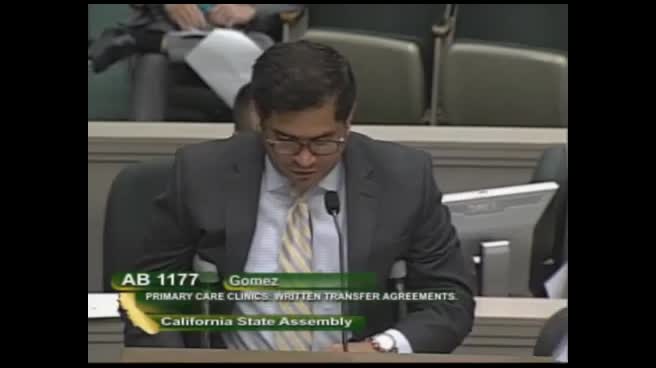 7MIN
Assembly Standing Committee on Health



Bill Co-Author(s):