AB 1200: Political Reform Act of 1974: lobbying: procurement contracts.
- Session Year: 2015-2016
- House: Assembly
- Latest Version Date: 2016-05-03
Existing provisions of the Political Reform Act of 1974 regulate the activities of lobbyists, lobbying firms, and lobbyist employers in connection with attempts to influence legislative and administrative action by legislative and other state officials, including requirements that lobbyists, lobbying firms, and lobbyist employers register and file periodic reports with the Secretary of State. For purposes of these provisions, lobbyist is defined, in part, as an individual who receives $2,000 or more in economic consideration in a calendar month, or whose principal duties as an employee are, to communicate with specified officials for the purpose of influencing legislative or administrative action.
This bill would revise the definition of lobbyist to include specified conduct by an individual acting on behalf of any person other than his or her employer for the purpose of influencing administrative action that is governmental procurement, which is further defined to include various actions regarding a state procurement contract for which the total estimated cost exceeds $250,000, thereby making the above-described lobbying requirements applicable to the specified attempts to influence governmental procurement. This bill would provide that the acts penalty provisions are the exclusive remedy for a violation of the acts requirements concerning governmental procurement lobbying.
The bill would makes these provisions operative on January 1, 2017.
Because a willful violation of the acts provisions is punishable as a misdemeanor, this bill would impose a state-mandated local program.
The California Constitution requires the state to reimburse local agencies and school districts for certain costs mandated by the state. Statutory provisions establish procedures for making that reimbursement.
This bill would provide that no reimbursement is required by this act for a specified reason.
The Political Reform Act of 1974, an initiative measure, provides that the Legislature may amend the act to further the acts purposes upon a 2/3 vote of each house and compliance with specified procedural requirements.
This bill would declare that it furthers the purposes of the act.
This bill would declare that it is to take effect immediately as an urgency statute.
Existing provisions of the Political Reform Act of 1974 regulate the activities of lobbyists, lobbying firms, and lobbyist employers in connection with attempts to influence legislative and administrative action by legislative and other state officials, including requirements that lobbyists, lobbying firms, and lobbyist employers register and file periodic reports with the Secretary of State. For purposes of these provisions, lobbyist is defined, in part, as an individual who receives $2,000 or more in economic consideration in a calendar month, or whose principal duties as an employee are, to communicate with specified officials for the purpose of influencing legislative or administrative action.
This bill would revise the definition of lobbyist to include specified conduct by an individual acting on behalf of any person other than his or her employer for the purpose of influencing administrative action that is governmental procurement, which is further defined to include various actions regarding a state procurement contract for which the total estimated cost exceeds $250,000, thereby making the above-described lobbying requirements applicable to the specified attempts to influence governmental procurement. This bill would provide that the acts penalty provisions are the exclusive remedy for a violation of the acts requirements concerning government procurement lobbying.
The bill would makes these provisions operative on January 1, 2017.
Because a willful violation of the acts provisions is punishable as a misdemeanor, this bill would impose a state-mandated local program.
The California Constitution requires the state to reimburse local agencies and school districts for certain costs mandated by the state. Statutory provisions establish procedures for making that reimbursement.
This bill would provide that no reimbursement is required by this act for a specified reason.
The Political Reform Act of 1974, an initiative measure, provides that the Legislature may amend the act to further the acts purposes upon a 2/3 vote of each house and compliance with specified procedural requirements.
This bill would declare that it furthers the purposes of the act.
This bill would declare that it is to take effect immediately as an urgency statute.
Existing provisions of the Political Reform Act of 1974 regulate the activities of lobbyists, lobbying firms, and lobbyist employers, as defined, in connection with attempts to influence legislative and administrative action by legislative and other state officials, including requirements that lobbyists, lobbying firms, and lobbyist employers register and file periodic reports with the Secretary of State. The act also prohibits a lobbyist or lobbying firm from engaging in certain activities, including, among others, accepting any payment that is contingent upon the defeat, enactment, or outcome of any proposed legislative or administrative action. For purposes of these provisions, administrative action is defined to include the proposal, drafting, development, consideration, amendment, enactment, or defeat by any state agency of any rule, regulation, or other action in any ratemaking proceeding or any quasi-legislative proceeding. For purposes of these provisions, lobbyist is defined, in part, as an individual who receives $2,000 or more in economic consideration in a calendar month, or whose principal duties as an employee are, to communicate with specified officials for the purpose of influencing legislative or administrative action.
This bill would additionally define the term administrative action to include governmental procurement, which would be defined to include various actions regarding a state procurement contract for which the total estimated cost exceeds $250,000, thereby making the above-described lobbying requirements applicable to actions that attempt to influence governmental procurement. The bill would also exclude certain actions from the definition of government procurement, including, among others, submitting a bid or fee proposal, testifying at a public hearing relating to a procurement contract, or any activity undertaken by a bona fide salesperson or a placement agent, as those terms are defined.
This bill would also authorize a lobbyist, other than a placement agent, to be compensated on a commission basis for lobbying activities related to influencing administrative action relating to governmental procurement, as specified.
This bill would revise the definition of lobbyist to include specified conduct by an individual acting on behalf of any person other than his or her employer for the purpose of influencing administrative action that is governmental procurement, which is further defined to include various actions regarding a state procurement contract for which the total estimated cost exceeds $250,000, thereby making the above-described lobbying requirements applicable to the specified attempts to influence governmental procurement.
Because a willful violation of the acts provisions is punishable as a misdemeanor, this bill would impose a state-mandated local program.
The California Constitution requires the state to reimburse local agencies and school districts for certain costs mandated by the state. Statutory provisions establish procedures for making that reimbursement.
This bill would provide that no reimbursement is required by this act for a specified reason.
The Political Reform Act of 1974, an initiative measure, provides that the Legislature may amend the act to further the acts purposes upon a 2/3 vote of each house and compliance with specified procedural requirements.
This bill would declare that it furthers the purposes of the act.
Existing provisions of the Political Reform Act of 1974 regulate the activities of lobbyists, lobbying firms, and lobbyist employers, as defined, in connection with attempts to influence legislative and administrative action by legislative and other state officials, including requirements that lobbyists, lobbying firms, and lobbyist employers register and file periodic reports with the Secretary of State. The act also prohibits a lobbyist or lobbying firm from engaging in certain activities, including, among others, accepting any payment that is contingent upon the defeat, enactment, or outcome of any proposed legislative or administrative action. For purposes of these provisions, administrative action is defined to include the proposal, drafting, development, consideration, amendment, enactment, or defeat by any state agency of any rule, regulation, or other action in any ratemaking proceeding or any quasi-legislative proceeding.
This bill would additionally define the term administrative action to include governmental procurement, which would be defined to include various actions regarding a state procurement contract for which the total estimated cost exceeds $250,000, thereby making the above-described lobbying requirements applicable to actions that attempt to influence governmental procurement. The bill would also exclude certain actions from the definition of government procurement, including, among others, submitting a bid, bid or fee proposal, testifying at a public hearing relating to a procurement contract, or any activity undertaken by a bona fide salesperson, as salesperson or a placement agent, as those terms are defined.
This bill would also authorize a lobbyist, other than a placement agent, to be compensated on a commission basis for lobbying activities related to influencing administrative action relating to governmental procurement, as specified.
Because a willful violation of the acts provisions is punishable as a misdemeanor, this bill would impose a state-mandated local program.
The California Constitution requires the state to reimburse local agencies and school districts for certain costs mandated by the state. Statutory provisions establish procedures for making that reimbursement.
This bill would provide that no reimbursement is required by this act for a specified reason.
The Political Reform Act of 1974, an initiative measure, provides that the Legislature may amend the act to further the acts purposes upon a 2/3 vote of each house and compliance with specified procedural requirements.
This bill would declare that it furthers the purposes of the act.
Existing provisions of the Political Reform Act of 1974 regulate the activities of lobbyists, lobbying firms, and lobbyist employers, as defined, in connection with attempts to influence legislative and administrative action by legislative and other state officials, including requirements that lobbyists, lobbying firms, and lobbyist employers register and file periodic reports with the Secretary of State. The act also prohibits a lobbyist or lobbying firm from engaging in certain activities, including, among others, accepting any payment that is contingent upon the defeat, enactment, or outcome of any proposed legislative or administrative action. For purposes of these provisions, administrative action is defined to include the proposal, drafting, development, consideration, amendment, enactment, or defeat by any state agency of any rule, regulation, or other action in any ratemaking proceeding or any quasi-legislative proceeding.
This bill would additionally define the term administrative action to include governmental procurement, which would be defined to include various actions regarding procurement contracts, a state procurement contract for which the total estimated cost exceeds $250,000, thereby making the above-described lobbying requirements applicable to actions that attempt to influence governmental procurement. The bill would also exclude certain actions from the definition of government procurement, including submitting a bid, testifying at a public hearing relating to a procurement contract, or any activity undertaken by bona fide salesperson, as defined.
This bill would also authorize a lobbyist to be compensated on a commission basis for lobbying activities related to influencing administrative action relating to governmental procurement, as specified.
Because a willful violation of the acts provisions is punishable as a misdemeanor, this bill would impose a state-mandated local program.
The California Constitution requires the state to reimburse local agencies and school districts for certain costs mandated by the state. Statutory provisions establish procedures for making that reimbursement.
This bill would provide that no reimbursement is required by this act for a specified reason.
The Political Reform Act of 1974, an initiative measure, provides that the Legislature may amend the act to further the acts purposes upon a 2/3 vote of each house and compliance with specified procedural requirements.
This bill would declare that it furthers the purposes of the act.
Existing provisions of the Political Reform Act of 1974 regulate the activities of lobbyists, lobbying firms, and lobbyist employers, as defined, in connection with attempts to influence legislative and administrative action by legislative and other state officials, including requirements that lobbyists, lobbying firms, and lobbyist employers register and file periodic reports with the Secretary of State. For purposes of these provisions, administrative action is defined to include the proposal, drafting, development, consideration, amendment, enactment, or defeat by any state agency of any rule, regulation, or other action in any ratemaking proceeding or any quasi-legislative proceeding.
This bill would additionally define the term administrative action to include the awarding of specified statewide contracts by the Office of Procurement in the Department of General Services, governmental procurement, which would be defined to include various actions regarding procurement contracts, thereby making the above-described lobbying requirements applicable to actions that attempt to influence those statewide contracts. governmental procurement.
Because a willful violation of the acts provisions is punishable as a misdemeanor, this bill would impose a state-mandated local program.
The California Constitution requires the state to reimburse local agencies and school districts for certain costs mandated by the state. Statutory provisions establish procedures for making that reimbursement.
This bill would provide that no reimbursement is required by this act for a specified reason.
The Political Reform Act of 1974, an initiative measure, provides that the Legislature may amend the act to further the acts purposes upon a 2/3 vote of each house and compliance with specified procedural requirements.
This bill would declare that it furthers the purposes of the act.
Existing provisions of the Political Reform Act of 1974 regulate the activities of lobbyists, lobbying firms, and lobbyist employers, as defined, in connection with attempts to influence legislative and administrative action by legislative and other state officials, including requirements that lobbyists, lobbying firms, and lobbyist employers register and file periodic reports with the Secretary of State. For purposes of these provisions, administrative action is defined to include the proposal, drafting, development, consideration, amendment, enactment, or defeat by any state agency of any rule, regulation, or other action in any ratemaking proceeding or any quasi-legislative proceeding.
This bill would additionally define the term administrative action to include the awarding of specified statewide contracts by the Office of Procurement in the Department of General Services, thereby making the above-described lobbying requirements applicable to actions that attempt to influence those statewide contracts.
Because a willful violation of the acts provisions is punishable as a misdemeanor, this bill would impose a state-mandated local program.
The California Constitution requires the state to reimburse local agencies and school districts for certain costs mandated by the state. Statutory provisions establish procedures for making that reimbursement.
This bill would provide that no reimbursement is required by this act for a specified reason.
The Political Reform Act of 1974, an initiative measure, provides that the Legislature may amend the act to further the acts purposes upon a 2/3 vote of each house and compliance with specified procedural requirements.
This bill would declare that it furthers the purposes of the act.
(a)Administrative action means either of the following:
(1)The proposal, drafting, development, consideration, amendment, enactment, or defeat by any state agency of any rule, regulation, or other action in any ratemaking proceeding or any quasi-legislative proceeding, which shall include any proceeding governed by Chapter 3.5 (commencing with Section 11340) of Part 1 of Division 3 of Title 2.
(2)With regard only to placement agents, the decision by any state agency to enter into a contract to invest state public retirement system assets on behalf of a state public retirement system.
(b)Ratemaking proceeding means, for the purposes of a proceeding before the Public Utilities Commission, any proceeding in which it is reasonably foreseeable that a rate will be established, including, but not limited to, general rate cases, performance-based ratemaking, and other ratesetting mechanisms.
(c)Quasi-legislative proceeding means, for purposes of a proceeding before the Public Utilities Commission, any proceeding that involves consideration of the establishment of a policy that will apply generally to a group or class of persons, including, but not limited to, rulemakings and investigations that may establish rules affecting an entire industry.
(d)This section shall remain in effect only until January 1, 2017, and as of that date is repealed, unless a later enacted statute, that is enacted before January 1, 2017, deletes or extends that date.
SEC. 2.Section 82002 is added to the Government Code, to read:82002.(a)Administrative action means any of the following:
(1)The proposal, drafting, development, consideration, amendment, enactment, or defeat by any state agency of any rule, regulation, or other action in any ratemaking proceeding or any quasi-legislative proceeding, which shall include any proceeding governed by Chapter 3.5 (commencing with Section 11340) of Part 1 of Division 3 of Title 2.
(2)With regard only to placement agents, the decision by any state agency to enter into a contract to invest state public retirement system assets on behalf of a state public retirement system.
(3)Governmental Procurement.
(b)Ratemaking proceeding means, for purposes of a proceeding before the Public Utilities Commission, any proceeding in which it is reasonably foreseeable that a rate will be established, including, but not limited to, general rate cases, performance-based ratemaking, and other ratesetting mechanisms.
(c)Quasi-legislative proceeding means, for purposes of a proceeding before the Public Utilities Commission, any proceeding that involves consideration of the establishment of a policy that will apply generally to a group or class of persons, including, but not limited to, rulemakings and investigations that may establish rules affecting an entire industry.
(d)(1)Governmental procurement means any of the following with respect to influencing a state procurement contract for which the total estimated cost exceeds two hundred fifty thousand dollars ($250,000):
(A)Preparing the terms, specifications, bid documents, request for proposals, or evaluation criteria for the procurement contract.
(B)Soliciting for the procurement contract.
(C)Evaluating the procurement contract.
(D)Scoring criteria for the procurement contract.
(E)Awarding, approving, denying, or disapproving the procurement contract.
(F)Approving or denying an assignment, amendment, other than an amendment authorized and payable under the terms of the procurement contract as the procurement contract was finally awarded or approved, renewal, or extension of the procurement contract, or any other material change in the procurement contract resulting in financial benefit to the offeror.
(2)Governmental procurement does not include any activity undertaken by a placement agent, as that term is defined in Section 82047.3.
(e)This section shall become operative on January 1, 2017.
SEC. 3.Section 82039 of the Government Code is amended to read:82039.(a)Lobbyist means either of the following:
(1)Any individual who receives two thousand dollars ($2,000) or more in economic consideration in a calendar month, other than reimbursement for reasonable travel expenses, or whose principal duties as an employee are, to communicate directly or through his or her agents with any elective state official, agency official, or legislative official for the purpose of influencing legislative or administrative action.
(2)A placement agent, as defined in Section 82047.3.
(b)An individual is not a lobbyist by reason of activities described in Section 86300.
(c)For the purposes of subdivision (a), a proceeding before the Public Utilities Commission constitutes administrative action if it meets any of the definitions set forth in subdivision (b) or (c) of Section 82002. However, a communication made for the purpose of influencing this type of Public Utilities Commission proceeding is not within subdivision (a) if the communication is made at a public hearing, public workshop, or other public forum that is part of the proceeding, or if the communication is included in the official record of the proceeding.
(d)This section shall remain in effect only until January 1, 2017, and as of that date is repealed, unless a later enacted statute, that is enacted before January 1, 2017, deletes or extends that date.
SEC. 4.Section 82039 is added to the Government Code, to read:82039.(a)Lobbyist means any of the following:
(1)Any individual who receives two thousand dollars ($2,000) or more in economic consideration in a calendar month, other than reimbursement for reasonable travel expenses, or whose principal duties as an employee are, to communicate directly or through his or her agents with any elective state official, agency official, or legislative official for the purpose of influencing legislative or administrative action, except for administrative action that is governmental procurement, as defined in subdivision (d) of Section 82002.
(2)A placement agent, as defined in Section 82047.3.
(3)Any individual who receives two thousand dollars ($2,000) or more in economic consideration in a calendar month, other than reimbursement for reasonable travel expenses, to communicate directly or through his or her agents on behalf of any person other than his or her employer with any elective state official, agency official, or legislative official for the purpose of influencing administrative action that is governmental procurement, as defined in subdivision (d) of Section 82002.
(b)An individual is not a lobbyist by reason of activities described in Section 86300.
(c)For the purposes of subdivision (a), a proceeding before the Public Utilities Commission constitutes administrative action if it meets any of the definitions set forth in subdivision (b) or (c) of Section 82002. However, a communication made for the purpose of influencing this type of Public Utilities Commission proceeding is not within subdivision (a) if the communication is made at a public hearing, public workshop, or other public forum that is part of the proceeding, or if the communication is included in the official record of the proceeding.
(d)This section shall become operative on January 1, 2017.
SEC. 5.Section 86207 is added to the Government Code, to read:86207.(a)Notwithstanding any other law, the penalties imposed by this title shall be the exclusive remedy for a violation of this chapter with respect to requirements for governmental procurement lobbying.
(b)This section shall become operative on January 1, 2017.
SEC. 6.No reimbursement is required by this act pursuant to Section 6 of Article XIIIB of the California Constitution because the only costs that may be incurred by a local agency or school district will be incurred because this act creates a new crime or infraction, eliminates a crime or infraction, or changes the penalty for a crime or infraction, within the meaning of Section 17556 of the Government Code, or changes the definition of a crime within the meaning of Section 6 of Article XIIIB of the California Constitution.
SEC. 7.The Legislature finds and declares that this bill furthers the purposes of the Political Reform Act of 1974 within the meaning of subdivision (a) of Section 81012 of the Government Code.
SEC. 8.This act is an urgency statute necessary for the immediate preservation of the public peace, health, or safety within the meaning of Article IV of the Constitution and shall go into immediate effect. The facts constituting the necessity are:
In order to provide the Fair Political Practices Commission with authority and sufficient time to adopt regulations necessary to implement the substantive requirements of this act before the January 1, 2017, operative date, it is necessary that this bill take effect immediately.
SECTION 1.Section 82002 of the Government Code is amended to read:82002.(a)Administrative action means any of the following:
(1)The proposal, drafting, development, consideration, amendment, enactment, or defeat by any state agency of any rule, regulation, or other action in any ratemaking proceeding or any quasi-legislative proceeding, which shall include any proceeding governed by Chapter 3.5 (commencing with Section 11340) of Part 1 of Division 3 of Title 2.
(2)With regard only to placement agents, the decision by any state agency to enter into a contract to invest state public retirement system assets on behalf of a state public retirement system.
(3)Governmental procurement.
(b)Ratemaking proceeding means, for purposes of a proceeding before the Public Utilities Commission, any proceeding in which it is reasonably foreseeable that a rate will be established, including, but not limited to, general rate cases, performance-based ratemaking, and other ratesetting mechanisms.
(c)Quasi-legislative proceeding means, for purposes of a proceeding before the Public Utilities Commission, any proceeding that involves consideration of the establishment of a policy that will apply generally to a group or class of persons, including, but not limited to, rulemakings and investigations that may establish rules affecting an entire industry.
(d)(1)Governmental procurement means any of the following with respect to influencing a state procurement contract for which the total estimated cost exceeds two hundred fifty thousand dollars ($250,000):
(A)Preparing the terms, specifications, bid documents, request for proposals, or evaluation criteria for the procurement contract.
(B)Soliciting for the procurement contract.
(C)Evaluating the procurement contract.
(D)Scoring criteria for the procurement contract.
(E)Awarding, approving, denying, or disapproving the procurement contract.
(F)Approving or denying an assignment, amendment, other than an amendment authorized and payable under the terms of the procurement contract as the procurement contract was finally awarded or approved, renewal, or extension of the procurement contract, or any other material change in the procurement contract resulting in financial benefit to the offeror.
(2)Governmental procurement does not include any activity undertaken by a placement agent, as that term is defined in Section 82047.3.
SEC. 2.Section 82039 of the Government Code is amended to read:82039.(a)Lobbyist means any of the following:
(1)Any individual who receives two thousand dollars ($2,000) or more in economic consideration in a calendar month, other than reimbursement for reasonable travel expenses, or whose principal duties as an employee are, to communicate directly or through his or her agents with any elective state official, agency official, or legislative official for the purpose of influencing legislative or administrative action, except for administrative action that is governmental procurement, as defined in subdivision (d) of Section 82002.
(2)A placement agent, as defined in Section 82047.3.
(3)Any individual who receives two thousand dollars ($2,000) or more in economic consideration in a calendar month, other than reimbursement for reasonable travel expenses, to communicate directly or through his or her agents on behalf of any person other than his or her employer with any elective state official, agency official, or legislative official for the purpose of influencing administrative action that is governmental procurement, as defined in subdivision (d) of Section 82002.
(b)An individual is not a lobbyist by reason of activities described in Section 86300.
(c)For the purposes of subdivision (a), a proceeding before the Public Utilities Commission constitutes administrative action if it meets any of the definitions set forth in subdivision (b) or (c) of Section 82002. However, a communication made for the purpose of influencing this type of Public Utilities Commission proceeding is not within subdivision (a) if the communication is made at a public hearing, public workshop, or other public forum that is part of the proceeding, or if the communication is included in the official record of the proceeding.
SEC. 3.No reimbursement is required by this act pursuant to Section 6 of Article XIIIB of the California Constitution because the only costs that may be incurred by a local agency or school district will be incurred because this act creates a new crime or infraction, eliminates a crime or infraction, or changes the penalty for a crime or infraction, within the meaning of Section 17556 of the Government Code, or changes the definition of a crime within the meaning of Section 6 of Article XIIIB of the California Constitution.
SEC. 4.The Legislature finds and declares that this bill furthers the purposes of the Political Reform Act of 1974 within the meaning of subdivision (a) of Section 81012 of the Government Code.
(a)Administrative action means any of the following:
(1)The proposal, drafting, development, consideration, amendment, enactment, or defeat by any state agency of any rule, regulation, or other action in any ratemaking proceeding or any quasi-legislative proceeding, which shall include any proceeding governed by Chapter 3.5 (commencing with Section 11340) of Part 1 of Division 3 of Title 2.
(2)With regard only to placement agents, the decision by any state agency to enter into a contract to invest state public retirement system assets on behalf of a state public retirement system.
(3)Governmental procurement.
(b)Ratemaking proceeding means, for purposes of a proceeding before the Public Utilities Commission, any proceeding in which it is reasonably foreseeable that a rate will be established, including, but not limited to, general rate cases, performance-based ratemaking, and other ratesetting mechanisms.
(c)Quasi-legislative proceeding means, for purposes of a proceeding before the Public Utilities Commission, any proceeding that involves consideration of the establishment of a policy that will apply generally to a group or class of persons, including, but not limited to, rulemakings and investigations that may establish rules affecting an entire industry.
(d)(1)Governmental procurement means any of the following with respect to influencing a state procurement contract for which the total estimated cost exceeds two hundred fifty thousand dollars ($250,000):
(A)Preparing the terms, specifications, bid documents, request for proposals, or evaluation criteria for the procurement contract.
(B)Soliciting for the procurement contract.
(C)Evaluating the procurement contract.
(D)Scoring criteria for the procurement contract.
(E)Awarding, approving, denying, or disapproving the procurement contract.
(F)Approving or denying an assignment, amendment, other than an amendment authorized and payable under the terms of the procurement contract as the procurement contract was finally awarded or approved, renewal, or extension of the procurement contract, or any other material change in the procurement contract resulting in financial benefit to the offeror.
(2)Governmental procurement does not include any of the following with respect to a state procurement contract for which the total estimated cost exceeds two hundred fifty thousand dollars ($250,000):
(A)Submitting a bid or fee proposal on the state procurement contract that does not involve any activity described in paragraph (1), including attending a bidders conference or responding to requests for information; or responding to a competitive selection process based on qualifications.
(B)Testifying at a public hearing regarding the state procurement contract.
(C)Any activity undertaken by a bona fide salesperson of an article of procurement. For purposes of this subparagraph, a bona fide salesperson is an individual who satisfies all of the following:
(i)The primary purpose of the individuals employment is the sale of an article of procurement.
(ii)The primary purpose of the individuals employment is not to influence the actions of a public officer or state agency, as described in paragraph (1).
(iii)The individual does not engage in any other activity that would qualify him or her as a lobbyist.
(D)Any activity undertaken by a placement agent, as that term is defined in Section 82047.3.
(E)Any activity relating to a contract awarded by the state through the California Multiple Award Schedule (CMAS) or a contract awarded through government multi-jurisdiction purchasing schedules.
(2)Governmental procurement does not include any activity undertaken by a placement agent, as that term is defined in Section 82047.3.
SEC. 2.Section 86205.5 is added to the Government Code, to read:86205.5.Notwithstanding Section 86205, a lobbyist, other than a placement agent, may be compensated on a commission basis only with respect to lobbying activities related to influencing administrative action for governmental procurement, as defined in subdivision (d) of Section 82002.
SEC. 2.Section 82039 of the Government Code is amended to read:82039.(a)Lobbyist means either any of the following:
(1)Any individual who receives two thousand dollars ($2,000) or more in economic consideration in a calendar month, other than reimbursement for reasonable travel expenses, or whose principal duties as an employee are, to communicate directly or through his or her agents with any elective state official, agency official, or legislative official for the purpose of influencing legislative or administrative action, except for administrative action that is governmental procurement, as defined in subdivision (d) of Section 82002.
(2)A placement agent, as defined in Section 82047.3.
(3)Any individual who receives two thousand dollars ($2,000) or more in economic consideration in a calendar month, other than reimbursement for reasonable travel expenses, to communicate directly or through his or her agents on behalf of any person other than his or her employer with any elective state official, agency official, or legislative official for the purpose of influencing administrative action that is governmental procurement, as defined in subdivision (d) of Section 82002.
(b)An individual is not a lobbyist by reason of activities described in Section 86300.
(c)For the purposes of subdivision (a), a proceeding before the Public Utilities Commission constitutes administrative action if it meets any of the definitions set forth in subdivision (b) or (c) of Section 82002. However, a communication made for the purpose of influencing this type of Public Utilities Commission proceeding is not within subdivision (a) if the communication is made at a public hearing, public workshop, or other public forum that is part of the proceeding, or if the communication is included in the official record of the proceeding.
SEC. 3.No reimbursement is required by this act pursuant to Section 6 of Article XIIIB of the California Constitution because the only costs that may be incurred by a local agency or school district will be incurred because this act creates a new crime or infraction, eliminates a crime or infraction, or changes the penalty for a crime or infraction, within the meaning of Section 17556 of the Government Code, or changes the definition of a crime within the meaning of Section 6 of Article XIIIB of the California Constitution.
SEC. 4.The Legislature finds and declares that this bill furthers the purposes of the Political Reform Act of 1974 within the meaning of subdivision (a) of Section 81012 of the Government Code.
(a)Administrative action means any of the following:
(1)The proposal, drafting, development, consideration, amendment, enactment, or defeat by any state agency of any rule, regulation, or other action in any ratemaking proceeding or any quasi-legislative proceeding, which shall include any proceeding governed by Chapter 3.5 (commencing with Section 11340) of Part 1 of Division 3 of Title 2.
(2)With regard only to placement agents, the decision by any state agency to enter into a contract to invest state public retirement system assets on behalf of a state public retirement system.
(3)Governmental procurement.
(b)Ratemaking proceeding means, for purposes of a proceeding before the Public Utilities Commission, any proceeding in which it is reasonably foreseeable that a rate will be established, including, but not limited to, general rate cases, performance-based ratemaking, and other ratesetting mechanisms.
(c)Quasi-legislative proceeding means, for purposes of a proceeding before the Public Utilities Commission, any proceeding that involves consideration of the establishment of a policy that will apply generally to a group or class of persons, including, but not limited to, rulemakings and investigations that may establish rules affecting an entire industry.
(d)(1)Governmental procurement means any of the following with respect to a state procurement contract for which the total estimated cost exceeds two hundred fifty thousand dollars ($250,000):
(A)Preparing the terms, specifications, bid documents, request for proposals, or evaluation criteria for the procurement contract.
(B)Soliciting for the procurement contract.
(C)Evaluating the procurement contract.
(D)Scoring criteria for the procurement contract.
(D)
(E)Awarding, approving, denying, or disapproving the procurement contract.
(E)
(F)Approving or denying an assignment, amendment, other than an amendment authorized and payable under the terms of the procurement contract as the procurement contract was finally awarded or approved, renewal, or extension of the procurement contract, or any other material change in the procurement contract resulting in financial benefit to the offeror.
(2)Governmental procurement does not include any of the following with respect to a state procurement contract for which the total estimated cost exceeds two hundred fifty thousand dollars ($250,000):
(A)Submitting a bid or fee proposal on the state procurement contract. contract that does not involve any activity described in paragraph (1), including attending a bidders conference or responding to requests for information; or responding to a competitive selection process based on qualifications.
(B)Testifying at a public hearing regarding the state procurement contract.
(C)Any activity, including those described in paragraph (1), activity undertaken by a bona fide salesperson of an article of procurement. For purposes of this subparagraph, a bona fide salesperson is an individual who satisfies each all of the following:
(i)The primary purpose of the individuals employment is to cause or promote the sale of, or to influence or induce another to make a purchase of, an article of procurement.
(ii)The primary purpose of the individuals employment is not to influence the actions of a public officer or state agency in regards to selecting vendors to supply articles of procurement under a state procurement contract. agency, as described in paragraph (1).
(iii)The individual does not engage in any other activity that would qualify him or her as a lobbyist.
(D)Any activity undertaken by a placement agent, as that term is defined in Section 82047.3.
(E)Any activity relating to a contract awarded by the state through the California Multiple Award Schedule (CMAS) or a contract awarded through government multi-jurisdiction purchasing schedules.
SEC. 2.Section 86205.5 is added to the Government Code, to read:86205.5.Notwithstanding Section 86205, a lobbyist lobbyist, other than a placement agent, may be compensated on a commission basis only with respect to lobbying activities related to influencing administrative action for governmental procurement, as defined in subdivision (d) of Section 82002.
SEC. 3.No reimbursement is required by this act pursuant to Section 6 of Article XIIIB of the California Constitution because the only costs that may be incurred by a local agency or school district will be incurred because this act creates a new crime or infraction, eliminates a crime or infraction, or changes the penalty for a crime or infraction, within the meaning of Section 17556 of the Government Code, or changes the definition of a crime within the meaning of Section 6 of Article XIIIB of the California Constitution.
SEC. 4.The Legislature finds and declares that this bill furthers the purposes of the Political Reform Act of 1974 within the meaning of subdivision (a) of Section 81012 of the Government Code.
(a)Administrative action means any of the following:
(1)The proposal, drafting, development, consideration, amendment, enactment, or defeat by any state agency of any rule, regulation, or other action in any ratemaking proceeding or any quasi-legislative proceeding, which shall include any proceeding governed by Chapter 3.5 (commencing with Section 11340) of Part 1 of Division 3 of Title 2.
(2)With regard only to placement agents, the decision by any state agency to enter into a contract to invest state public retirement system assets on behalf of a state public retirement system.
(3)Governmental procurement.
(b)Ratemaking proceeding means, for purposes of a proceeding before the Public Utilities Commission, any proceeding in which it is reasonably foreseeable that a rate will be established, including, but not limited to, general rate cases, performance-based ratemaking, and other ratesetting mechanisms.
(c)Quasi-legislative proceeding means, for purposes of a proceeding before the Public Utilities Commission, any proceeding that involves consideration of the establishment of a policy that will apply generally to a group or class of persons, including, but not limited to, rulemakings and investigations that may establish rules affecting an entire industry.
(d)(1)Governmental procurement means any of the following with respect to a state procurement contract for which the total estimated cost exceeds two hundred fifty thousand dollars ($250,000):
(1)
(A)Preparing the terms, specifications, bid documents, request for proposals, or evaluation criteria for a the procurement contract.
(2)
(B)Soliciting for a the procurement contract.
(3)
(C)Evaluating a the procurement contract.
(4)
(D)Awarding, approving, denying, or disapproving a the procurement contract.
(5)
(E)Approving or denying an assignment, amendment, other than an amendment authorized and payable under the terms of a the procurement contract as the procurement contract was finally awarded or approved, renewal, or extension of a the procurement contract, or any other material change in a the procurement contract resulting in financial benefit to the offeror.
(2)Governmental procurement does not include any of the following with respect to a state procurement contract for which the total estimated cost exceeds two hundred fifty thousand dollars ($250,000):
(A)Submitting a bid on the state procurement contract.
(B)Testifying at a public hearing regarding the state procurement contract.
(C)Any activity, including those described in paragraph (1), undertaken by a bona fide salesperson of an article of procurement. For purposes of this subparagraph, a bona fide salesperson is an individual who satisfies each of the following:
(i)The primary purpose of the individuals employment is to cause or promote the sale of, or to influence or induce another to make a purchase of, an article of procurement.
(ii)The primary purpose of the individuals employment is not to influence the actions of a public officer or state agency in regards to selecting vendors to supply articles of procurement under a state procurement contract.
(iii)The individual does not engage in any other activity that would qualify him or her as a lobbyist.
SEC. 2.Section 86205.5 is added to the Government Code, to read:86205.5.Notwithstanding Section 86205, a lobbyist may be compensated on a commission basis only with respect to lobbying activities related to influencing administrative action for governmental procurement, as defined in subdivision (d) of Section 82002.
SEC. 2.SEC. 3.No reimbursement is required by this act pursuant to Section 6 of Article XIIIB of the California Constitution because the only costs that may be incurred by a local agency or school district will be incurred because this act creates a new crime or infraction, eliminates a crime or infraction, or changes the penalty for a crime or infraction, within the meaning of Section 17556 of the Government Code, or changes the definition of a crime within the meaning of Section 6 of Article XIIIB of the California Constitution.
SEC. 3.SEC. 4.The Legislature finds and declares that this bill furthers the purposes of the Political Reform Act of 1974 within the meaning of subdivision (a) of Section 81012 of the Government Code.
(a)Administrative action means any of the following:
(1)The proposal, drafting, development, consideration, amendment, enactment, or defeat by any state agency of any rule, regulation, or other action in any ratemaking proceeding or any quasi-legislative proceeding, which shall include any proceeding governed by Chapter 3.5 (commencing with Section 11340) of Part 1 of Division 3 of Title 2.
(2)With regard only to placement agents, the decision by any state agency to enter into a contract to invest state public retirement system assets on behalf of a state public retirement system.
(3)Proceedings involving the awarding of statewide contracts.
(3)Governmental procurement.
(b)Ratemaking proceeding means, for the purposes of a proceeding before the Public Utilities Commission, any proceeding in which it is reasonably foreseeable that a rate will be established, including, but not limited to, general rate cases, performance-based ratemaking, and other ratesetting mechanisms.
(c)Quasi-legislative proceeding means, for purposes of a proceeding before the Public Utilities Commission, any proceeding that involves consideration of the establishment of a policy that will apply generally to a group or class of persons, including, but not limited to, rulemakings and investigations that may establish rules affecting an entire industry.
(d)Statewide contract has the same meaning as that term is defined in Section 10290 of the Public Contract Code with respect to a contract subject to Chapter 2 (commencing with Section 10290) of Part 2 of Division 2 of the Public Contract Code that has a total estimated cost in an amount over two hundred fifty thousand dollars ($250,000). Commencing January 1, 2018, this minimum amount shall be adjusted in the manner provided by subdivision (b) of Section 10105 of the Public Contract Code.
(d)Governmental procurement means any of the following:
(1)Preparing the terms, specifications, bid documents, request for proposals, or evaluation criteria for a procurement contract.
(2)Soliciting for a procurement contract.
(3)Evaluating a procurement contract.
(4)Awarding, approving, denying, or disapproving a procurement contract.
(5)Approving or denying an assignment, amendment, other than an amendment authorized and payable under the terms of a procurement contract as the procurement contract was finally awarded or approved, renewal, or extension of a procurement contract, or any other material change in a procurement contract resulting in financial benefit to the offeror.
SEC. 2.No reimbursement is required by this act pursuant to Section 6 of Article XIIIB of the California Constitution because the only costs that may be incurred by a local agency or school district will be incurred because this act creates a new crime or infraction, eliminates a crime or infraction, or changes the penalty for a crime or infraction, within the meaning of Section 17556 of the Government Code, or changes the definition of a crime within the meaning of Section 6 of Article XIIIB of the California Constitution.
SEC. 3.The Legislature finds and declares that this bill furthers the purposes of the Political Reform Act of 1974 within the meaning of subdivision (a) of Section 81012 of the Government Code.
(a)Administrative action means either any of the following:
(1)The proposal, drafting, development, consideration, amendment, enactment, or defeat by any state agency of any rule, regulation, or other action in any ratemaking proceeding or any quasi-legislative proceeding, which shall include any proceeding governed by Chapter 3.5 (commencing with Section 11340) of Part 1 of Division 3 of Title 2.
(2)With regard only to placement agents, the decision by any state agency to enter into a contract to invest state public retirement system assets on behalf of a state public retirement system.
(3)Proceedings involving the awarding of statewide contracts.
(b)Ratemaking proceeding means, for the purposes of a proceeding before the Public Utilities Commission, any proceeding in which it is reasonably foreseeable that a rate will be established, including, but not limited to, general rate cases, performance-based ratemaking, and other ratesetting mechanisms.
(c)Quasi-legislative proceeding means, for purposes of a proceeding before the Public Utilities Commission, any proceeding that involves consideration of the establishment of a policy that will apply generally to a group or class of persons, including, but not limited to, rulemakings and investigations that may establish rules affecting an entire industry.
(d)Statewide contract has the same meaning as that term is defined in Section 10290 of the Public Contract Code with respect to a contract subject to Chapter 2 (commencing with Section 10290) of Part 2 of Division 2 of the Public Contract Code that has a total estimated cost in an amount over two hundred fifty thousand dollars ($250,000). Commencing January 1, 2018, this minimum amount shall be adjusted in the manner provided by subdivision (b) of Section 10105 of the Public Contract Code.
SEC. 2.No reimbursement is required by this act pursuant to Section 6 of Article XIIIB of the California Constitution because the only costs that may be incurred by a local agency or school district will be incurred because this act creates a new crime or infraction, eliminates a crime or infraction, or changes the penalty for a crime or infraction, within the meaning of Section 17556 of the Government Code, or changes the definition of a crime within the meaning of Section 6 of Article XIIIB of the California Constitution.
SEC. 3.The Legislature finds and declares that this bill furthers the purposes of the Political Reform Act of 1974 within the meaning of subdivision (a) of Section 81012 of the Government Code.
|
Date
|
Status
|
|---|---|
| Feb 10, 2016 | Read second time and amended. Ordered returned to second reading. |
| Aug 27, 2015 | From committee: Do pass. (Ayes 5. Noes 0.) (August 27). |
| Aug 31, 2015 | Read second time. Ordered to third reading. |
| Sep 8, 2015 | Motion to reconsider made by Senator Allen. |
| Sep 8, 2015 | Read third time. Refused passage. |
| Sep 8, 2015 | Read third time. Refused passage. (Ayes 26. Noes 5. Page 2600.). |
| Sep 8, 2015 | Reconsideration granted. |
| Sep 8, 2015 | Reconsideration granted. (Ayes 39. Noes 0. Page 2600.) |
| Sep 11, 2015 | Ordered to inactive file at the request of Senator Allen. |
| Feb 10, 2016 | From inactive file. |
| Feb 10, 2016 | Ordered to second reading. |
| Aug 26, 2015 | From committee chair, with author's amendments: Amend, and re-refer to committee. Read second time, amended, and re-referred to Com. on APPR. |
| Feb 11, 2016 | Read second time. Ordered to third reading. |
| Mar 3, 2016 | In Assembly. Concurrence in Senate amendments pending. May be considered on or after March 5 pursuant to Assembly Rule 77. |
| Mar 3, 2016 | Read third time. Urgency clause adopted. Passed. Ordered to the Assembly. |
| Mar 3, 2016 | Read third time. Urgency clause adopted. Passed. Ordered to the Assembly. (Ayes 38. Noes 1. Page 3171.). |
| May 2, 2016 | Senate amendments concurred in. To Engrossing and Enrolling. |
| May 2, 2016 | Urgency clause adopted. Senate amendments concurred in. To Engrossing and Enrolling. (Ayes 72. Noes 0. Page 4621.). |
| May 5, 2016 | Enrolled and presented to the Governor at 12:30 p.m. |
| May 13, 2016 | Vetoed by Governor. |
| May 16, 2016 | Consideration of Governor's veto pending. |
| May 28, 2015 | From committee: Do pass. (Ayes 15. Noes 0.) (May 28). |
| Mar 1, 2015 | From printer. May be heard in committee March 31. |
| Mar 2, 2015 | Read first time. |
| Mar 23, 2015 | Referred to Com. on E. & R. |
| Apr 7, 2015 | From committee chair, with author's amendments: Amend, and re-refer to Com. on E. & R. Read second time and amended. |
| Apr 8, 2015 | Re-referred to Com. on E. & R. |
| Apr 29, 2015 | From committee: Do pass and re-refer to Com. on APPR. (Ayes 4. Noes 1.) (April 29). Re-referred to Com. on APPR. |
| May 19, 2015 | From committee chair, with author's amendments: Amend, and re-refer to Com. on APPR. Read second time and amended. |
| May 20, 2015 | Re-referred to Com. on APPR. |
| May 27, 2015 | In committee: Set, first hearing. Referred to APPR. suspense file. |
| Feb 27, 2015 | Introduced. To print. |
| May 28, 2015 | Joint Rule 62(a), file notice suspended. |
| May 28, 2015 | Joint Rule 62(a), file notice suspended. (Page 1613.) |
| May 28, 2015 | Read second time. Ordered to third reading. |
| Jun 3, 2015 | In Senate. Read first time. To Com. on RLS. for assignment. |
| Jun 3, 2015 | Read third time. Passed. Ordered to the Senate. (Ayes 79. Noes 0. Page 1852.) |
| Jun 18, 2015 | Referred to Com. on E. & C.A. |
| Jun 30, 2015 | From committee chair, with author's amendments: Amend, and re-refer to committee. Read second time, amended, and re-referred to Com. on E. & C.A. |
| Jul 8, 2015 | From committee: Do pass and re-refer to Com. on APPR. (Ayes 4. Noes 0.) (July 7). Re-referred to Com. on APPR. |
| Aug 17, 2015 | In committee: Referred to APPR. suspense file. |
|
Date
|
Description
|
Location
|
Votes
|
|
|---|---|---|---|---|
| May 2, 2016 | AB 1200 GORDON Concurrence - Urgency Added | Assembly Floor |
Passed |
|
| Mar 3, 2016 | Assembly 3rd Reading AB1200 Gordon By Allen Urgency Clause | Senate Floor |
Passed |
|
| Sep 8, 2015 | Assembly 3rd Reading AB1200 Gordon By Allen Reconsider | Senate Floor |
Passed |
|
| Sep 8, 2015 | Assembly 3rd Reading AB1200 Gordon By Allen | Senate Floor |
Failed |
|
| Aug 27, 2015 | Do pass | Senate Standing Committee on Appropriations |
Passed |
|
| Aug 17, 2015 | Placed on suspense file | Senate Standing Committee on Appropriations |
Passed |
|
| Jul 7, 2015 | Do pass, but first be re-referred to the Committee on [Appropriations] | Senate Standing Committee on Elections and Constitutional Amendments |
Passed |
|
| Jun 3, 2015 | AB 1200 GORDON Assembly Third Reading | Assembly Floor |
Passed |
|
| May 28, 2015 | Do pass. | Assembly Standing Committee on Appropriations |
Passed |
|
| Apr 29, 2015 | Do pass and be re-referred to the Committee on [Appropriations] | Assembly Standing Committee on Elections and Redistricting |
Passed |
This list shows positions taken on this bill by organizations on the date displayed, which is linked to the original source.
Positions by individuals are not included.
|
Organization
|
Position
|
Date
|
|---|---|---|
| California Common Cause | ** Support | Mar 3, 2016 |
| Department Of Finance | ** Against | Mar 3, 2016 |
| McGeorge School of Law | ** Support | Mar 3, 2016 |
| Secretary of State Alex Padilla | ** Support | Mar 3, 2016 |
GOVERNOR'S VETO
GV Bill Id:AB 1200
Author:(Gordon)
As Enrolled Ver:May 5, 2016
2/3 vote
ASSEMBLY: | 79-0 | (June 3, 2015) | SENATE: | 38-1 | (March 3, 2016) |
ASSEMBLY: | 72-0 | (May 2, 2016) |
Original Committee Reference: E. & R.
SUMMARY: Provides that communicating with state governmental officials in order to influence state governmental procurement, as defined, can result in a person being considered a "lobbyist" under the Political Reform Act (PRA). Specifically, this bill:
- Defines "governmental procurement," to mean any of the following with respect to influencing a state procurement contract for which the total estimated cost exceeds $250,000:
- Preparing the terms, specifications, bid documents, request for proposals, or evaluation criteria for the procurement contract;
- Soliciting for, evaluating, scoring criteria for, awarding, approving, denying, or disapproving the procurement contract; or,
- Approving or denying an assignment, amendment, other than an amendment authorized and payable under the terms of a procurement contract as the contract was finally awarded or approved, renewal, or extension of a procurement contract, or any other material change in a procurement contract resulting in financial benefit to the offeror.
- Provides that "governmental procurement" does not include activity undertaken by a placement agent, as defined.
The Senate amendments:
- Make the provisions of this bill applicable only to an individual who receives $2,000 or more in economic consideration in a calendar month, other than reimbursement for reasonable travel expenses, to communicate directly or through his or her agents on behalf of any person other than his or her employer with state governmental officials for the purpose of influencing governmental procurement.
- Make related changes by repealing provisions that would have specified certain conduct that was not considered "governmental procurement" for the purposes of this bill, including submitting bids on a contract, testifying at a public hearing regarding a state procurement contract, and activity undertaken by bona fide salespeople of articles of procurement.
- Delete a provision that would have permitted a lobbyist to be compensated on a commission basis with respect to lobbying activities related to governmental procurement.
- Provide that the penalties in the PRA are the exclusive remedy for a violation of this bill with respect to governmental procurement lobbying.
- Add an urgency clause, but delay the operative date of this bill to January 1, 2017. The urgency clause will ensure that the Fair Political Practices Commission (FPPC) has the authority and time to adopt regulations before this bill's operative date.
FISCAL EFFECT: According to the Senate Appropriations Committee, the FPPC could potentially incur costs in the hundreds of thousands of dollars annually (General Fund). The Secretary of State's Office (SOS) indicates that this bill would not impact its costs. To the extent that contractors would have to file with SOS pursuant to this bill, there would be an increase in fee revenue, which would be split evenly between the General Fund and the Political Disclosure, Accountability, Transparency and Access Fund. The amount is unknown.
COMMENTS: According to the author, "The State of California authorized over $11 billion in procurement contracts in 2014. In light of this substantial spending, the public should have the ability to see who, if anyone is attempting to influence the procurement process and expenditure of taxpayer dollars. California voters enacted the [PRA], in part, to ensure that state and local government 'serve the needs and respond to the wishes of all citizens equally' and 'perform their duties in an impartial manner.' To serve these goals, the [PRA] requires lobbying firms and parties employing lobbying firms to report their legislative and regulatory activities. Lobbying of procurement contracts does not fall under the purview of the [PRA]. For the same reasons that the state currently imposes registration and reporting requirements on legislative and regulatory lobbying, and in light of the amount of taxpayer money spent on procurement, this bill would impose necessary reporting requirements on procurement lobbying."
Under existing law, individuals and entities that make or receive specified levels of payments for the purpose of influencing legislative or administrative actions may be required to comply with the state's lobbying rules, including requirements to register with the Secretary of State and to file periodic reports. This bill brings contracting within the types of governmental decisions that are covered by the state's lobbying rules.
Existing state lobbying rules contain different tests for determining whether an individual is considered a lobbyist depending on whether that individual is engaging in communication with public officials on behalf of the individual's employer (commonly referred to as an "in-house lobbyist"), or on behalf of persons other than the individual's employer (commonly referred to as a "contract lobbyist"). A person is considered to be an in-house lobbyist if he or she spends one-third or more of his or her compensated time in a calendar month engaging in direct communication with qualifying officials for the purposes of influencing legislative or administrative action on behalf of that person's employer. A person is considered to be a contract lobbyist if he or she receives $2,000 or more in compensation in a calendar month for engaging in direct communication with qualifying officials for the purposes of influencing legislative or administrative action on behalf of anyone other than that person's employer.
The Senate amendments to this bill exempt in-house employees from the potential of being considered lobbyists by virtue of communications made on behalf of their employers to influence state governmental procurement. Only the "contract lobbyist" test would apply when determining whether an individual would be considered a "lobbyist" under this bill. The Senate amendments additionally provide that the penalties in the PRA are the exclusive remedy for a violation of this bill and make related changes.
California voters passed an initiative, Proposition 9, in 1974 that created the FPPC and codified significant restrictions and prohibitions on candidates, officeholders and lobbyists. That initiative is commonly known as the PRA. Amendments to the PRA that are not submitted to the voters, such as those contained in this bill, must further the purposes of the initiative and require a two-thirds vote of both houses of the Legislature.
This bill would revise the definition of "lobbyist" in the Political Reform Act of 1974 to include specified conduct by third-party consultants who work to influence governmental procurement.
Given that the laws regulating state procurement are voluminous and already contain ample opportunity for public scrutiny, I don't believe this bill is necessary.
Analysis Prepared by: Ethan Jones / E. & R. / (916) 319-2094 FN: 0002981
CONCURRENCE IN SENATE AMENDMENTS
CSA1 Bill Id:AB 1200
Author:(Gordon)
As Amended Ver:February 10, 2016
2/3 vote. Urgency
ASSEMBLY: | 79-0 | (June 3, 2015) | SENATE: | 38-1 | (March 3, 2016) |
Original Committee Reference: E. & R.
SUMMARY: Provides that communicating with state governmental officials in order to influence state governmental procurement, as defined, can result in a person being considered a "lobbyist" under the Political Reform Act (PRA). Specifically, this bill:
- Defines "governmental procurement," to mean any of the following with respect to influencing a state procurement contract for which the total estimated cost exceeds $250,000:
- Preparing the terms, specifications, bid documents, request for proposals, or evaluation criteria for the procurement contract;
- Soliciting for, evaluating, scoring criteria for, awarding, approving, denying, or disapproving the procurement contract; or,
- Approving or denying an assignment, amendment, other than an amendment authorized and payable under the terms of a procurement contract as the contract was finally awarded or approved, renewal, or extension of a procurement contract, or any other material change in a procurement contract resulting in financial benefit to the offeror.
- Provides that "governmental procurement" does not include activity undertaken by a placement agent, as defined.
The Senate amendments:
- Make the provisions of this bill applicable only to an individual who receives $2,000 or more in economic consideration in a calendar month, other than reimbursement for reasonable travel expenses, to communicate directly or through his or her agents on behalf of any person other than his or her employer with state governmental officials for the purpose of influencing governmental procurement.
- Make related changes by repealing provisions that would have specified certain conduct that was not considered "governmental procurement" for the purposes of this bill, including submitting bids on a contract, testifying at a public hearing regarding a state procurement contract, and activity undertaken by bona fide salespeople of articles of procurement.
- Delete a provision that would have permitted a lobbyist to be compensated on a commission basis with respect to lobbying activities related to governmental procurement.
- Provide that the penalties in the PRA are the exclusive remedy for a violation of this bill with respect to governmental procurement lobbying.
- Add an urgency clause, but delay the operative date of this bill to January 1, 2017. The urgency clause will ensure that the Fair Political Practices Commission (FPPC) has the authority and time to adopt regulations before this bill's operative date.
FISCAL EFFECT: According to the Senate Appropriations Committee, the FPPC could potentially incur costs in the hundreds of thousands of dollars annually (General Fund). The Secretary of State's Office (SOS) indicates that this bill would not impact its costs. To the extent that contractors would have to file with SOS pursuant to this bill, there would be an increase in fee revenue, which would be split evenly between the General Fund and the Political Disclosure, Accountability, Transparency and Access Fund. The amount is unknown.
COMMENTS: According to the author, "The State of California authorized over $11 billion in procurement contracts in 2014. In light of this substantial spending, the public should have the ability to see who, if anyone is attempting to influence the procurement process and expenditure of taxpayer dollars. California voters enacted the [PRA], in part, to ensure that state and local government 'serve the needs and respond to the wishes of all citizens equally' and 'perform their duties in an impartial manner.' To serve these goals, the [PRA] requires lobbying firms and parties employing lobbying firms to report their legislative and regulatory activities. Lobbying of procurement contracts does not fall under the purview of the [PRA]. For the same reasons that the state currently imposes registration and reporting requirements on legislative and regulatory lobbying, and in light of the amount of taxpayer money spent on procurement, this bill would impose necessary reporting requirements on procurement lobbying."
Under existing law, individuals and entities that make or receive specified levels of payments for the purpose of influencing legislative or administrative actions may be required to comply with the state's lobbying rules, including requirements to register with the Secretary of State and to file periodic reports. This bill brings contracting within the types of governmental decisions that are covered by the state's lobbying rules.
Existing state lobbying rules contain different tests for determining whether an individual is considered a lobbyist depending on whether that individual is engaging in communication with public officials on behalf of the individual's employer (commonly referred to as an "in-house lobbyist"), or on behalf of persons other than the individual's employer (commonly referred to as a "contract lobbyist"). A person is considered to be an in-house lobbyist if he or she spends one-third or more of his or her compensated time in a calendar month engaging in direct communication with qualifying officials for the purposes of influencing legislative or administrative action on behalf of that person's employer. A person is considered to be a contract lobbyist if he or she receives $2,000 or more in compensation in a calendar month for engaging in direct communication with qualifying officials for the purposes of influencing legislative or administrative action on behalf of anyone other than that person's employer.
The Senate amendments to this bill exempt in-house employees from the potential of being considered lobbyists by virtue of communications made on behalf of their employers to influence state governmental procurement. Only the "contract lobbyist" test would apply when determining whether an individual would be considered a "lobbyist" under this bill. The Senate amendments additionally provide that the penalties in the PRA are the exclusive remedy for a violation of this bill and make related changes.
California voters passed an initiative, Proposition 9, in 1974 that created the FPPC and codified significant restrictions and prohibitions on candidates, officeholders and lobbyists. That initiative is commonly known as the PRA. Amendments to the PRA that are not submitted to the voters, such as those contained in this bill, must further the purposes of the initiative and require a two-thirds vote of both houses of the Legislature.
Analysis Prepared by: Ethan Jones / E. & R. / (916) 319-2094 FN: 0002621
Office of Senate Floor Analyses (916) 651-1520 Fax: (916) 327-4478 | AB 1200 |
THIRD READING
Bill No: AB 1200
Amended: 2/10/16 in Senate
SENATE ELECTIONS & C.A. COMMITTEE: 4-0, 7/7/15
AYES: Allen, Hancock, Hertzberg, Liu
NO VOTE RECORDED: Anderson
SENATE APPROPRIATIONS COMMITTEE: 5-0, 8/27/15
AYES: Lara, Beall, Hill, Leyva, Mendoza
NO VOTE RECORDED: Bates, Nielsen
SENATE FLOOR: 26-5, 9/8/15 (FAIL)
AYES: Allen, Beall, Block, De León, Galgiani, Glazer, Hall, Hancock, Hernandez, Hertzberg, Hill, Hueso, Jackson, Lara, Leno, Leyva, Liu, McGuire, Mendoza, Mitchell, Monning, Pan, Pavley, Roth, Wieckowski, Wolk
NOES: Gaines, Morrell, Nielsen, Runner, Stone
NO VOTE RECORDED: Anderson, Bates, Berryhill, Cannella, Fuller, Huff, Moorlach, Nguyen, Vidak
ASSEMBLY FLOOR: 79-0, 6/3/15 - See last page for vote
SUBJECT: Political Reform Act of 1974: lobbying: procurement contracts
DIGEST: This bill provides that communicating with state governmental officials in order to influence state governmental procurement, as defined, can result in a person being considered a "lobbyist" under the Political Reform Act (PRA).
Senate Floor Amendments of 2/10/16 specify that the existing penalties in the PRA are the exclusive remedies for violations of this bill and add an urgency clause but make the provisions of this bill operative on January 1, 2017.
Existing law:
- Creates the Fair Political Practices Commission (FPPC), and makes it responsible for the impartial, effective administration and implementation of the PRA.
- Defines a "lobbyist" as either of the following:
- Any individual who receives $2,000 or more in a calendar month or whose principal duties as an employee are, to communicate directly or through his or her agents with any elective state official, agency official, or legislative official for the purpose of influencing legislative or administrative action.
- A placement agent, as defined.
- Defines a "lobbying firm" as any business entity, except as specified, including an individual contract lobbyist, which meets either of the following criteria:
- The business entity receives or becomes entitled to receive any compensation, other than reimbursement for reasonable travel expenses, for the purpose of influencing legislative or administrative action on behalf of any other person, and any partner, owner, officer, or employee of the business entity is a lobbyist; or,
- The business entity receives or becomes entitled to receive any compensation, other than reimbursement for reasonable travel expenses, to communicate directly with any elective state official, agency official, or legislative official for the purpose of influencing legislative or administrative action on behalf of any other person, if a substantial or regular portion of the activities for which the business entity receives compensation is for the purpose of influencing legislative or administrative action.
- The business entity receives or becomes entitled to receive any compensation, other than reimbursement for reasonable travel expenses, for the purpose of influencing legislative or administrative action on behalf of any other person, and any partner, owner, officer, or employee of the business entity is a lobbyist; or,
- Defines a "lobbyist employer" as any person, other than a lobbying firm, who:
- Employs one or more lobbyists for economic consideration, other than reimbursement for reasonable travel expenses, for the purpose of influencing legislative or administrative action; or
- Contracts for the services of a lobbying firm for economic consideration, other than reimbursement for reasonable travel expenses, for the purpose of influencing legislative or administrative action.
- Employs one or more lobbyists for economic consideration, other than reimbursement for reasonable travel expenses, for the purpose of influencing legislative or administrative action; or
- Defines "legislative action," for the purposes of the PRA, as either of the following:
- The drafting, introduction, consideration, modification, enactment or defeat of any bill, resolution, amendment, report, nomination or other matter by the Legislature or by either house or any committee, subcommittee, joint or select committee thereof, or by a member or employee of the Legislature acting in his official capacity; or,
- The action of the Governor in approving or vetoing any bill.
- The drafting, introduction, consideration, modification, enactment or defeat of any bill, resolution, amendment, report, nomination or other matter by the Legislature or by either house or any committee, subcommittee, joint or select committee thereof, or by a member or employee of the Legislature acting in his official capacity; or,
- Defines "administrative action," for the purposes of the PRA, as either of the following:
- The proposal, drafting, development, consideration, amendment, enactment, or defeat by any state agency of any rule, regulation, or other action in any ratemaking proceeding or a quasi-legislative proceeding, as specified; or,
- With regard only to placement agents, as defined, the decision by any state agency to enter into a contract to invest state public retirement system assets on behalf of a state public retirement system.
- The proposal, drafting, development, consideration, amendment, enactment, or defeat by any state agency of any rule, regulation, or other action in any ratemaking proceeding or a quasi-legislative proceeding, as specified; or,
- Defines “agency official,” for the purposes of the PRA, as any member, officer, employee or consultant of any state agency who as part of his official responsibilities participates in any administrative action in other than a purely clerical, secretarial or ministerial capacity.
- Requires an individual who is considered a lobbyist, as defined, to register as a lobbyist and to comply with various ethics and reporting rules.
- Requires lobbyists to complete a biennial orientation course on the relevant ethical issues and laws relating to lobbying.
- Prohibits lobbyists from receiving any payment that is in any way contingent upon defeat, enactment, or outcome of any proposed legislative or administrative action.
- Prohibits a lobbyist from making gifts aggregating more than $10 in a calendar month to any state candidate, elected state officer, legislative official, or an agency official of any agency required to be listed on the registration statement of the lobbying firm or the lobbyist employer of the lobbyist.
- Prohibits a lobbyist from doing anything with the purpose of placing any elected state officer, legislative official, agency official, or state candidate under personal obligation to the lobbyist or the lobbyist's employer.
- Prohibits a lobbyist from deceiving or attempting to deceive any elected state officer, legislative official, agency official, or state candidate with regard to any material fact pertinent to any pending administrative action.
- Prohibits a lobbyist from making a contribution to an elected state officer or candidate for elected state office if the lobbyist is registered to lobby the governmental agency for which the candidate is seeking election or the governmental agency of the elected state officer.
- Requires lobbying firms and lobbyist employers to register with the Secretary of State (SOS) and to file periodic disclosure reports that contain information about the firms' and employers' lobbying interests and agencies lobbied.
- Makes violations of the PRA subject to administrative, civil, and criminal penalties.
This bill:
- Provides that the term "administrative action," for the purposes of the PRA, includes governmental procurement, as defined, thereby making the above-described lobbying requirements applicable to actions that attempt to influence governmental procurement.
- Defines "governmental procurement," to mean any of the following with respect to influencing a state procurement contract for which the total estimated cost exceeds $250,000:
- Preparing the terms, specifications, bid documents, request for proposals, or evaluation criteria for the procurement contract;
- Soliciting for, evaluating, awarding, approving, denying, disapproving, or scoring criteria for the procurement contract; or,
- Approving or denying an assignment, amendment, other than an amendment authorized and payable under the terms of the procurement contract as the procurement contract was finally awarded or approved, renewal, or extension of the procurement contract, or any other material change in the procurement contract resulting in financial benefit to the offeror.
- Preparing the terms, specifications, bid documents, request for proposals, or evaluation criteria for the procurement contract;
- Provides that “governmental procurement” does not include any activity undertaken by a placement agent, as defined.
- Includes within the definition of “lobbyist” any individual who receives $2,000 or more in a calendar month to communicate directly or through his or her agents on behalf of any person other than his or her employer with any elective state official, agency official, or legislative official for the purpose of influencing administrative action that is governmental procurement.
- Specifies that the existing penalties in the PRA are the exclusive remedies for violations of the provisions of this bill with respect to requirements for governmental procurement lobbying.
- Contains an urgency clause but makes the provisions of the bill operative on January 1, 2017.
Background
Lobbying Regulation & Contracts. Under existing law, individuals and entities that make or receive specified levels of payments for the purpose of influencing legislative or administrative actions may be required to comply with the state's lobbying rules, including requirements to register with the SOS and to file periodic reports.
As detailed above, the term "administrative action" is defined primarily to include rule- and rate-making, the adoption of regulations, and quasi-legislative proceedings. Contracting decisions by state agencies are not included within the definition of the term "administrative action," so individuals and entities that attempt to influence state contracting decisions are not required to comply with lobbying rules as a result of their efforts with respect to contracting decisions.
For example, in its Lobbying Information Disclosure Manual, the FPPC states that an entity bidding on a contract with the Department of Housing and Community Development (Department) to provide low and moderate-income housing units would not be engaged in lobbying as a result of submitting a bid, because although the Department is an administrative agency, the awarding of a contract is not considered an administrative action.
By adding governmental procurement to the definition of "administrative action," this bill brings contracting within the types of governmental decisions that are covered by the state's lobbying rules. For individuals and entities that frequently attempt to influence state agency contracting decisions, but that do not regularly attempt to influence other actions by state agencies, this bill could require those individuals and entities to comply with the state's lobbying rules, including registering with the SOS and filing periodic disclosure reports.
Many individuals and entities that attempt to influence contracting decisions, however, may already be registered as lobbyists, lobbying firms, or lobbyist employers because those individuals and entities are involved in attempting to influence other actions by the Legislature or state agencies. For those entities and individuals, this bill will require them to disclose details about their procurement lobbying on the periodic disclosure reports that they already file.
Comments
According to the author, the State of California authorized over $11 billion in procurement contracts in 2014. In light of this substantial spending, the public should have the ability to see who, if anyone is attempting to influence the procurement process and expenditure of taxpayer dollars. California voters enacted the PRA, in part, to ensure that state and local government “serve the needs and respond to the wishes of all citizens equally” and “perform their duties in an impartial manner.” To serve these goals, the PRA requires lobbying firms and parties employing lobbying firms to report their legislative and regulatory activities. Lobbying of procurement contracts does not fall under the purview of the PRA. For the same reasons that the state currently imposes registration and reporting requirements on legislative and regulatory lobbying, and in light of the amount of taxpayer money spent on procurement, this bill imposes necessary reporting requirements on procurement lobbying.
FISCAL EFFECT: Appropriation: No Fiscal Com.: Yes Local: Yes
According to the Senate Appropriations Committee:
- The FPPC could potentially incur costs in the hundreds of thousands of dollars annually (General Fund).
- The SOS indicates that this bill would not impact its costs.
- To the extent that contractors would have to file with SOS pursuant to this bill, there would be an increase in fee revenue, which would be split evenly between the General Fund and the Political Disclosure, Accountability, Transparency and Access Fund. The amount is unknown.
Secretary of State Alex Padilla
California Common Cause
California Public Interest Research Group
Legislative and Public Policy Clinic of the University of the Pacific,
McGeorge School of Law
OPPOSITION: (Verified 2/19/16)
Department of Finance
ASSEMBLY FLOOR: 79-0, 6/3/15
AYES: Achadjian, Alejo, Baker, Bigelow, Bloom, Bonilla, Bonta, Brough, Brown, Burke, Calderon, Campos, Chang, Chau, Chávez, Chiu, Chu, Cooley, Cooper, Dababneh, Dahle, Daly, Dodd, Eggman, Frazier, Beth Gaines, Gallagher, Cristina Garcia, Eduardo Garcia, Gatto, Gipson, Gomez, Gonzalez, Gordon, Gray, Grove, Hadley, Harper, Roger Hernández, Holden, Irwin, Jones, Jones-Sawyer, Kim, Lackey, Levine, Linder, Lopez, Low, Maienschein, Mathis, Mayes, McCarty, Medina, Melendez, Mullin, Nazarian, Obernolte, O'Donnell, Olsen, Patterson, Perea, Quirk, Rendon, Ridley-Thomas, Rodriguez, Salas, Santiago, Steinorth, Mark Stone, Thurmond, Ting, Wagner, Waldron, Weber, Wilk, Williams, Wood, Atkins
NO VOTE RECORDED: Travis Allen
Prepared by: Darren Chesin / E. & C.A. / (916) 651-4106
2/10/16 14:33:11
**** END ****
Office of Senate Floor Analyses (916) 651-1520 Fax: (916) 327-4478 | AB |
THIRD READING
Bill No: AB 1200
:
SENATE ELECTIONS & C.A. COMMITTEE: 4-0, 7/7/15
AYES: Allen, Hancock, Hertzberg, Liu
NO VOTE RECORDED: Anderson
SENATE APPROPRIATIONS COMMITTEE: 5-0, 8/27/15
AYES: Lara, Beall, Hill, Leyva, Mendoza
NO VOTE RECORDED: Bates, Nielsen
SENATE FLOOR: 26-5, 9/8/15 (FAIL)
AYES: Allen, Beall, Block, De León, Galgiani, Glazer, Hall, Hancock, Hernandez, Hertzberg, Hill, Hueso, Jackson, Lara, Leno, Leyva, Liu, McGuire, Mendoza, Mitchell, Monning, Pan, Pavley, Roth, Wieckowski, Wolk
NOES: Gaines, Morrell, Nielsen, Runner, Stone
NO VOTE RECORDED: Anderson, Bates, Berryhill, Cannella, Fuller, Huff, Moorlach, Nguyen, Vidak
ASSEMBLY FLOOR: 79-0, 6/3/15 - See last page for vote
DIGEST: This bill provides that communicating with state governmental officials in order to influence state governmental procurement, as defined, can result in a person being considered a "lobbyist" under the Political Reform Act (PRA).
Senate Floor Amendments of 2/10/16 specify that the existing penalties in the PRA are the exclusive remedies for violations of this bill and add an urgency clause but make the provisions of this bill operative on January 1, 2017.
Existing law:
- Creates the Fair Political Practices Commission (FPPC), and makes it responsible for the impartial, effective administration and implementation of the PRA.
- Defines a "lobbyist" as either of the following:
- Any individual who receives $2,000 or more in a calendar month or whose principal duties as an employee are, to communicate directly or through his or her agents with any elective state official, agency official, or legislative official for the purpose of influencing legislative or administrative action.
- A placement agent, as defined.
- Defines a "lobbying firm" as any business entity, except as specified, including an individual contract lobbyist, which meets either of the following criteria:
- The business entity receives or becomes entitled to receive any compensation, other than reimbursement for reasonable travel expenses, for the purpose of influencing legislative or administrative action on behalf of any other person, and any partner, owner, officer, or employee of the business entity is a lobbyist; or,
- The business entity receives or becomes entitled to receive any compensation, other than reimbursement for reasonable travel expenses, to communicate directly with any elective state official, agency official, or legislative official for the purpose of influencing legislative or administrative action on behalf of any other person, if a substantial or regular portion of the activities for which the business entity receives compensation is for the purpose of influencing legislative or administrative action.
- The business entity receives or becomes entitled to receive any compensation, other than reimbursement for reasonable travel expenses, for the purpose of influencing legislative or administrative action on behalf of any other person, and any partner, owner, officer, or employee of the business entity is a lobbyist; or,
- Defines a "lobbyist employer" as any person, other than a lobbying firm, who:
- Employs one or more lobbyists for economic consideration, other than reimbursement for reasonable travel expenses, for the purpose of influencing legislative or administrative action; or
- Contracts for the services of a lobbying firm for economic consideration, other than reimbursement for reasonable travel expenses, for the purpose of influencing legislative or administrative action.
- Employs one or more lobbyists for economic consideration, other than reimbursement for reasonable travel expenses, for the purpose of influencing legislative or administrative action; or
- Defines "legislative action," for the purposes of the PRA, as either of the following:
- The drafting, introduction, consideration, modification, enactment or defeat of any bill, resolution, amendment, report, nomination or other matter by the Legislature or by either house or any committee, subcommittee, joint or select committee thereof, or by a member or employee of the Legislature acting in his official capacity; or,
- The action of the Governor in approving or vetoing any bill.
- The drafting, introduction, consideration, modification, enactment or defeat of any bill, resolution, amendment, report, nomination or other matter by the Legislature or by either house or any committee, subcommittee, joint or select committee thereof, or by a member or employee of the Legislature acting in his official capacity; or,
- Defines "administrative action," for the purposes of the PRA, as either of the following:
- The proposal, drafting, development, consideration, amendment, enactment, or defeat by any state agency of any rule, regulation, or other action in any ratemaking proceeding or a quasi-legislative proceeding, as specified; or,
- With regard only to placement agents, as defined, the decision by any state agency to enter into a contract to invest state public retirement system assets on behalf of a state public retirement system.
- The proposal, drafting, development, consideration, amendment, enactment, or defeat by any state agency of any rule, regulation, or other action in any ratemaking proceeding or a quasi-legislative proceeding, as specified; or,
- Defines “agency official,” for the purposes of the PRA, as any member, officer, employee or consultant of any state agency who as part of his official responsibilities participates in any administrative action in other than a purely clerical, secretarial or ministerial capacity.
- Requires an individual who is considered a lobbyist, as defined, to register as a lobbyist and to comply with various ethics and reporting rules.
- Requires lobbyists to complete a biennial orientation course on the relevant ethical issues and laws relating to lobbying.
- Prohibits lobbyists from receiving any payment that is in any way contingent upon defeat, enactment, or outcome of any proposed legislative or administrative action.
- Prohibits a lobbyist from making gifts aggregating more than $10 in a calendar month to any state candidate, elected state officer, legislative official, or an agency official of any agency required to be listed on the registration statement of the lobbying firm or the lobbyist employer of the lobbyist.
- Prohibits a lobbyist from doing anything with the purpose of placing any elected state officer, legislative official, agency official, or state candidate under personal obligation to the lobbyist or the lobbyist's employer.
- Prohibits a lobbyist from deceiving or attempting to deceive any elected state officer, legislative official, agency official, or state candidate with regard to any material fact pertinent to any pending administrative action.
- Prohibits a lobbyist from making a contribution to an elected state officer or candidate for elected state office if the lobbyist is registered to lobby the governmental agency for which the candidate is seeking election or the governmental agency of the elected state officer.
- Requires lobbying firms and lobbyist employers to register with the Secretary of State (SOS) and to file periodic disclosure reports that contain information about the firms' and employers' lobbying interests and agencies lobbied.
- Makes violations of the PRA subject to administrative, civil, and criminal penalties.
This bill:
- Provides that the term "administrative action," for the purposes of the PRA, includes governmental procurement, as defined, thereby making the above-described lobbying requirements applicable to actions that attempt to influence governmental procurement.
- Defines "governmental procurement," to mean any of the following with respect to influencing a state procurement contract for which the total estimated cost exceeds $250,000:
- Preparing the terms, specifications, bid documents, request for proposals, or evaluation criteria for the procurement contract;
- Soliciting for, evaluating, awarding, approving, denying, disapproving, or scoring criteria for the procurement contract; or,
- Approving or denying an assignment, amendment, other than an amendment authorized and payable under the terms of the procurement contract as the procurement contract was finally awarded or approved, renewal, or extension of the procurement contract, or any other material change in the procurement contract resulting in financial benefit to the offeror.
- Preparing the terms, specifications, bid documents, request for proposals, or evaluation criteria for the procurement contract;
- Provides that “governmental procurement” does not include any activity undertaken by a placement agent, as defined.
- Includes within the definition of “lobbyist” any individual who receives $2,000 or more in a calendar month to communicate directly or through his or her agents on behalf of any person other than his or her employer with any elective state official, agency official, or legislative official for the purpose of influencing administrative action that is governmental procurement.
- Specifies that the existing penalties in the PRA are the exclusive remedies for violations of the provisions of this bill with respect to requirements for governmental procurement lobbying.
- Contains an urgency clause but makes the provisions of the bill operative on January 1, 2017.
Background
Lobbying Regulation & Contracts. Under existing law, individuals and entities that make or receive specified levels of payments for the purpose of influencing legislative or administrative actions may be required to comply with the state's lobbying rules, including requirements to register with the SOS and to file periodic reports.
As detailed above, the term "administrative action" is defined primarily to include rule- and rate-making, the adoption of regulations, and quasi-legislative proceedings. Contracting decisions by state agencies are not included within the definition of the term "administrative action," so individuals and entities that attempt to influence state contracting decisions are not required to comply with lobbying rules as a result of their efforts with respect to contracting decisions.
For example, in its Lobbying Information Disclosure Manual, the FPPC states that an entity bidding on a contract with the Department of Housing and Community Development (Department) to provide low and moderate-income housing units would not be engaged in lobbying as a result of submitting a bid, because although the Department is an administrative agency, the awarding of a contract is not considered an administrative action.
By adding governmental procurement to the definition of "administrative action," this bill brings contracting within the types of governmental decisions that are covered by the state's lobbying rules. For individuals and entities that frequently attempt to influence state agency contracting decisions, but that do not regularly attempt to influence other actions by state agencies, this bill could require those individuals and entities to comply with the state's lobbying rules, including registering with the SOS and filing periodic disclosure reports.
Many individuals and entities that attempt to influence contracting decisions, however, may already be registered as lobbyists, lobbying firms, or lobbyist employers because those individuals and entities are involved in attempting to influence other actions by the Legislature or state agencies. For those entities and individuals, this bill will require them to disclose details about their procurement lobbying on the periodic disclosure reports that they already file.
Comments
According to the author, the State of California authorized over $11 billion in procurement contracts in 2014. In light of this substantial spending, the public should have the ability to see who, if anyone is attempting to influence the procurement process and expenditure of taxpayer dollars. California voters enacted the PRA, in part, to ensure that state and local government “serve the needs and respond to the wishes of all citizens equally” and “perform their duties in an impartial manner.” To serve these goals, the PRA requires lobbying firms and parties employing lobbying firms to report their legislative and regulatory activities. Lobbying of procurement contracts does not fall under the purview of the PRA. For the same reasons that the state currently imposes registration and reporting requirements on legislative and regulatory lobbying, and in light of the amount of taxpayer money spent on procurement, this bill imposes necessary reporting requirements on procurement lobbying.
FISCAL EFFECT: Appropriation: Fiscal Com.: Local:
According to the Senate Appropriations Committee:
- The FPPC could potentially incur costs in the hundreds of thousands of dollars annually (General Fund).
- The SOS indicates that this bill would not impact its costs.
- To the extent that contractors would have to file with SOS pursuant to this bill, there would be an increase in fee revenue, which would be split evenly between the General Fund and the Political Disclosure, Accountability, Transparency and Access Fund. The amount is unknown.
Secretary of State Alex Padilla
California Common Cause
California Public Interest Research Group
Legislative and Public Policy Clinic of the University of the Pacific,
McGeorge School of Law
OPPOSITION: (Verified 2/10/16)
American Council of Engineering Companies
Department of Finance
ASSEMBLY FLOOR: 79-0, 6/3/15
AYES: Achadjian, Alejo, Baker, Bigelow, Bloom, Bonilla, Bonta, Brough, Brown, Burke, Calderon, Campos, Chang, Chau, Chávez, Chiu, Chu, Cooley, Cooper, Dababneh, Dahle, Daly, Dodd, Eggman, Frazier, Beth Gaines, Gallagher, Cristina Garcia, Eduardo Garcia, Gatto, Gipson, Gomez, Gonzalez, Gordon, Gray, Grove, Hadley, Harper, Roger Hernández, Holden, Irwin, Jones, Jones-Sawyer, Kim, Lackey, Levine, Linder, Lopez, Low, Maienschein, Mathis, Mayes, McCarty, Medina, Melendez, Mullin, Nazarian, Obernolte, O'Donnell, Olsen, Patterson, Perea, Quirk, Rendon, Ridley-Thomas, Rodriguez, Salas, Santiago, Steinorth, Mark Stone, Thurmond, Ting, Wagner, Waldron, Weber, Wilk, Williams, Wood, Atkins
NO VOTE RECORDED: Travis Allen
2/11/16 16:07:29
**** END ****
AB 1200
Page 7
|
Office of Senate Floor Analyses (916) 651-1520 Fax: (916) 327-4478 |
THIRD READING
Bill No: AB 1200
Amended: 8/26/15 in Senate
SENATE ELECTIONS & C.A. COMMITTEE: 4-0, 7/7/15
AYES: Allen, Hancock, Hertzberg, Liu
NO VOTE RECORDED: Anderson
SENATE APPROPRIATIONS COMMITTEE: 5-0, 8/27/15
AYES: Lara, Beall, Hill, Leyva, Mendoza
NO VOTE RECORDED: Bates, Nielsen
SENATE FLOOR: 26-5, 9/8/15 (FAIL)
AYES: Allen, Beall, Block, De León, Galgiani, Glazer, Hall, Hancock, Hernandez, Hertzberg, Hill, Hueso, Jackson, Lara, Leno, Leyva, Liu, McGuire, Mendoza, Mitchell, Monning, Pan, Pavley, Roth, Wieckowski, Wolk
NOES: Gaines, Morrell, Nielsen, Runner, Stone
NO VOTE RECORDED: Anderson, Bates, Berryhill, Cannella, Fuller, Huff, Moorlach, Nguyen, Vidak
ASSEMBLY FLOOR: 79-0, 6/3/15 - See last page for vote
SUBJECT: Political Reform Act of 1974: lobbying: procurement contracts
DIGEST: This bill provides that communicating with state governmental officials in order to influence state governmental procurement, as defined, can result in a person being considered a "lobbyist" under the Political Reform Act (PRA).
Existing law:
Creates the Fair Political Practices Commission (FPPC), and makes it responsible for the impartial, effective administration and implementation of the PRA.
Defines a "lobbyist" as either of the following:
Any individual who receives $2,000 or more in a calendar month or whose principal duties as an employee are, to communicate directly or through his or her agents with any elective state official, agency official, or legislative official for the purpose of influencing legislative or administrative action.
A placement agent, as defined.
Defines a "lobbying firm" as any business entity, except as specified, including an individual contract lobbyist, which meets either of the following criteria:
The business entity receives or becomes entitled to receive any compensation, other than reimbursement for reasonable travel expenses, for the purpose of influencing legislative or administrative action on behalf of any other person, and any partner, owner, officer, or employee of the business entity is a lobbyist; or,
The business entity receives or becomes entitled to receive any compensation, other than reimbursement for reasonable travel expenses, to communicate directly with any elective state official, agency official, or legislative official for the purpose of influencing legislative or administrative action on behalf of any other person, if a substantial or regular portion of the activities for which the business entity receives compensation is for the purpose of influencing legislative or administrative action.
Defines a "lobbyist employer" as any person, other than a lobbying firm, who:
Employs one or more lobbyists for economic consideration, other than reimbursement for reasonable travel expenses, for the purpose of influencing legislative or administrative action; or
Contracts for the services of a lobbying firm for economic consideration, other than reimbursement for reasonable travel expenses, for the purpose of influencing legislative or administrative action.
Defines "legislative action," for the purposes of the PRA, as either of the following:
The drafting, introduction, consideration, modification, enactment or defeat of any bill, resolution, amendment, report, nomination or other matter by the Legislature or by either house or any committee, subcommittee, joint or select committee thereof, or by a member or employee of the Legislature acting in his official capacity; or,
The action of the Governor in approving or vetoing any bill.
Defines "administrative action," for the purposes of the PRA, as either of the following:
The proposal, drafting, development, consideration, amendment, enactment, or defeat by any state agency of any rule, regulation, or other action in any ratemaking proceeding or a quasi-legislative proceeding, as specified; or,
With regard only to placement agents, as defined, the decision by any state agency to enter into a contract to invest state public retirement system assets on behalf of a state public retirement system.
Defines “agency official,” for the purposes of the PRA, as any member, officer, employee or consultant of any state agency who as part of his official responsibilities participates in any administrative action in other than a purely clerical, secretarial or ministerial capacity.
Requires an individual who is considered a lobbyist, as defined, to register as a lobbyist and to comply with various ethics and reporting rules.
Requires lobbyists to complete a biennial orientation course on the relevant ethical issues and laws relating to lobbying.
Prohibits lobbyists from receiving any payment that is in any way contingent upon defeat, enactment, or outcome of any proposed legislative or administrative action.
Prohibits a lobbyist from making gifts aggregating more than $10 in a calendar month to any state candidate, elected state officer, legislative official, or an agency official of any agency required to be listed on the registration statement of the lobbying firm or the lobbyist employer of the lobbyist.
Prohibits a lobbyist from doing anything with the purpose of placing any elected state officer, legislative official, agency official, or state candidate under personal obligation to the lobbyist or the lobbyist's employer.
Prohibits a lobbyist from deceiving or attempting to deceive any elected state officer, legislative official, agency official, or state candidate with regard to any material fact pertinent to any pending administrative action.
Prohibits a lobbyist from making a contribution to an elected state officer or candidate for elected state office if the lobbyist is registered to lobby the governmental agency for which the candidate is seeking election or the governmental agency of the elected state officer.
Requires lobbying firms and lobbyist employers to register with the Secretary of State (SOS) and to file periodic disclosure reports that contain information about the firms' and employers' lobbying interests and agencies lobbied.
Makes violations of the PRA subject to administrative, civil, and criminal penalties.
This bill:
Provides that the term "administrative action," for the purposes of the PRA, includes governmental procurement, as defined, thereby making the above-described lobbying requirements applicable to actions that attempt to influence governmental procurement.
Defines "governmental procurement," to mean any of the following with respect to influencing a state procurement contract for which the total estimated cost exceeds $250,000:
Preparing the terms, specifications, bid documents, request for proposals, or evaluation criteria for the procurement contract;
Soliciting for, evaluating, awarding, approving, denying, disapproving, or scoring criteria for the procurement contract; or,
Approving or denying an assignment, amendment, other than an amendment authorized and payable under the terms of the procurement contract as the procurement contract was finally awarded or approved, renewal, or extension of the procurement contract, or any other material change in the procurement contract resulting in financial benefit to the offeror.
Provides that “governmental procurement” does not include any activity undertaken by a placement agent, as defined.
Includes within the definition of “lobbyist” any individual who receives $2,000 or more in a calendar month to communicate directly or through his or her agents on behalf of any person other than his or her employer with any elective state official, agency official, or legislative official for the purpose of influencing administrative action that is governmental procurement.
Background
Lobbying Regulation & Contracts. Under existing law, individuals and entities that make or receive specified levels of payments for the purpose of influencing legislative or administrative actions may be required to comply with the state's lobbying rules, including requirements to register with the SOS and to file periodic reports.
As detailed above, the term "administrative action" is defined primarily to include rule- and rate-making, the adoption of regulations, and quasi-legislative proceedings. Contracting decisions by state agencies are not included within the definition of the term "administrative action," so individuals and entities that attempt to influence state contracting decisions are not required to comply with lobbying rules as a result of their efforts with respect to contracting decisions.
For example, in its
Lobbying Information Disclosure Manual, the FPPC states that an
entity bidding on a contract with the Department of Housing and
Community Development (Department) to provide low and moderate-income
housing units would not be engaged in lobbying as a result of
submitting a bid, because although the Department is an
administrative agency, the awarding of a contract is not considered
an administrative action.
By adding governmental
procurement to the definition of "administrative action,"
this bill brings contracting within the types of governmental
decisions that are covered by the state's lobbying rules. For
individuals and entities that frequently attempt to influence state
agency contracting decisions, but that do not regularly attempt to
influence other actions by state agencies, this bill could require
those individuals and entities to comply with the state's lobbying
rules, including registering with the SOS and filing periodic
disclosure reports.
Many individuals and entities that
attempt to influence contracting decisions, however, may already be
registered as lobbyists, lobbying firms, or lobbyist employers
because those individuals and entities are involved in attempting to
influence other actions by the Legislature or state agencies. For
those entities and individuals, this bill will require them to
disclose details about their procurement lobbying on the periodic
disclosure reports that they already file.
Comments
According to the
author, the State of California authorized over $11 billion in
procurement contracts in 2014. In light of this substantial
spending, the public should have the ability to see who, if anyone is
attempting to influence the procurement process and expenditure of
taxpayer dollars. California voters enacted the PRA, in part, to
ensure that state and local government “serve the needs and respond
to the wishes of all citizens equally” and “perform their duties
in an impartial manner.” To serve these goals, the PRA requires
lobbying firms and parties employing lobbying firms to report their
legislative and regulatory activities. Lobbying of procurement
contracts does not fall under the purview of the PRA. For the same
reasons that the state currently imposes registration and reporting
requirements on legislative and regulatory lobbying, and in light of
the amount of taxpayer money spent on procurement, this bill imposes
necessary reporting requirements on procurement lobbying.
FISCAL EFFECT: Appropriation: No Fiscal Com.: Yes Local: Yes
According to the Senate Appropriations Committee:
The FPPC could potentially incur costs in the hundreds of thousands of dollars annually (General Fund).
The SOS indicates that this bill would not impact its costs.
To the extent that contractors would have to file with SOS pursuant to this bill, there would be an increase in fee revenue, which would be split evenly between the General Fund and the Political Disclosure, Accountability, Transparency and Access Fund. The amount is unknown.
Secretary of State Alex Padilla
California Common Cause
California Public Interest Research Group
Legislative and Public Policy Clinic of the University of the Pacific,
McGeorge School of Law
OPPOSITION: (Verified 8/31/15)
American Council of Engineering Companies
Department of Finance
ASSEMBLY FLOOR: 79-0, 6/3/15
AYES: Achadjian, Alejo, Baker, Bigelow, Bloom, Bonilla, Bonta, Brough, Brown, Burke, Calderon, Campos, Chang, Chau, Chávez, Chiu, Chu, Cooley, Cooper, Dababneh, Dahle, Daly, Dodd, Eggman, Frazier, Beth Gaines, Gallagher, Cristina Garcia, Eduardo Garcia, Gatto, Gipson, Gomez, Gonzalez, Gordon, Gray, Grove, Hadley, Harper, Roger Hernández, Holden, Irwin, Jones, Jones-Sawyer, Kim, Lackey, Levine, Linder, Lopez, Low, Maienschein, Mathis, Mayes, McCarty, Medina, Melendez, Mullin, Nazarian, Obernolte, O'Donnell, Olsen, Patterson, Perea, Quirk, Rendon, Ridley-Thomas, Rodriguez, Salas, Santiago, Steinorth, Mark Stone, Thurmond, Ting, Wagner, Waldron, Weber, Wilk, Williams, Wood, Atkins
NO VOTE RECORDED: Travis Allen
Prepared by: Darren Chesin / E. & C.A. / (916) 651-4106
9/9/15 15:09:11
**** END ****
AB 1200
Page 7
|
Office of Senate Floor Analyses (916) 651-1520 Fax: (916) 327-4478 |
THIRD READING
Bill No: AB 1200
Amended: 8/26/15 in Senate
SENATE ELECTIONS & C.A. COMMITTEE: 4-0, 7/7/15
AYES: Allen, Hancock, Hertzberg, Liu
NO VOTE RECORDED: Anderson
SENATE APPROPRIATIONS COMMITTEE: 5-0, 8/27/15
AYES: Lara, Beall, Hill, Leyva, Mendoza
NO VOTE RECORDED: Bates, Nielsen
ASSEMBLY FLOOR: 79-0, 6/3/15 - See last page for vote
SUBJECT: Political Reform Act of 1974: lobbying: procurement contracts
DIGEST: This bill provides that communicating with state governmental officials in order to influence state governmental procurement, as defined, can result in a person being considered a "lobbyist" under the Political Reform Act (PRA).
Existing law:
Creates the Fair Political Practices Commission (FPPC), and makes it responsible for the impartial, effective administration and implementation of the PRA.
Defines a "lobbyist" as either of the following:
Any individual who receives $2,000 or more in a calendar month or whose principal duties as an employee are, to communicate directly or through his or her agents with any elective state official, agency official, or legislative official for the purpose of influencing legislative or administrative action.
A placement agent, as defined.
Defines a "lobbying firm" as any business entity, except as specified, including an individual contract lobbyist, which meets either of the following criteria:
The business entity receives or becomes entitled to receive any compensation, other than reimbursement for reasonable travel expenses, for the purpose of influencing legislative or administrative action on behalf of any other person, and any partner, owner, officer, or employee of the business entity is a lobbyist; or,
The business entity receives or becomes entitled to receive any compensation, other than reimbursement for reasonable travel expenses, to communicate directly with any elective state official, agency official, or legislative official for the purpose of influencing legislative or administrative action on behalf of any other person, if a substantial or regular portion of the activities for which the business entity receives compensation is for the purpose of influencing legislative or administrative action.
Defines a "lobbyist employer" as any person, other than a lobbying firm, who:
Employs one or more lobbyists for economic consideration, other than reimbursement for reasonable travel expenses, for the purpose of influencing legislative or administrative action; or
Contracts for the services of a lobbying firm for economic consideration, other than reimbursement for reasonable travel expenses, for the purpose of influencing legislative or administrative action.
Defines "legislative action," for the purposes of the PRA, as either of the following:
The drafting, introduction, consideration, modification, enactment or defeat of any bill, resolution, amendment, report, nomination or other matter by the Legislature or by either house or any committee, subcommittee, joint or select committee thereof, or by a member or employee of the Legislature acting in his official capacity; or,
The action of the Governor in approving or vetoing any bill.
Defines "administrative action," for the purposes of the PRA, as either of the following:
The proposal, drafting, development, consideration, amendment, enactment, or defeat by any state agency of any rule, regulation, or other action in any ratemaking proceeding or a quasi-legislative proceeding, as specified; or,
With regard only to placement agents, as defined, the decision by any state agency to enter into a contract to invest state public retirement system assets on behalf of a state public retirement system.
Defines “agency official,” for the purposes of the PRA, as any member, officer, employee or consultant of any state agency who as part of his official responsibilities participates in any administrative action in other than a purely clerical, secretarial or ministerial capacity.
Requires an individual who is considered a lobbyist, as defined, to register as a lobbyist and to comply with various ethics and reporting rules.
Requires lobbyists to complete a biennial orientation course on the relevant ethical issues and laws relating to lobbying.
Prohibits lobbyists from receiving any payment that is in any way contingent upon defeat, enactment, or outcome of any proposed legislative or administrative action.
Prohibits a lobbyist from making gifts aggregating more than $10 in a calendar month to any state candidate, elected state officer, legislative official, or an agency official of any agency required to be listed on the registration statement of the lobbying firm or the lobbyist employer of the lobbyist.
Prohibits a lobbyist from doing anything with the purpose of placing any elected state officer, legislative official, agency official, or state candidate under personal obligation to the lobbyist or the lobbyist's employer.
Prohibits a lobbyist from deceiving or attempting to deceive any elected state officer, legislative official, agency official, or state candidate with regard to any material fact pertinent to any pending administrative action.
Prohibits a lobbyist from making a contribution to an elected state officer or candidate for elected state office if the lobbyist is registered to lobby the governmental agency for which the candidate is seeking election or the governmental agency of the elected state officer.
Requires lobbying firms and lobbyist employers to register with the Secretary of State (SOS) and to file periodic disclosure reports that contain information about the firms' and employers' lobbying interests and agencies lobbied.
Makes violations of the PRA subject to administrative, civil, and criminal penalties.
This bill:
Provides that the term "administrative action," for the purposes of the PRA, includes governmental procurement, as defined, thereby making the above-described lobbying requirements applicable to actions that attempt to influence governmental procurement.
Defines "governmental procurement," to mean any of the following with respect to influencing a state procurement contract for which the total estimated cost exceeds $250,000:
Preparing the terms, specifications, bid documents, request for proposals, or evaluation criteria for the procurement contract;
Soliciting for, evaluating, awarding, approving, denying, disapproving, or scoring criteria for the procurement contract; or,
Approving or denying an assignment, amendment, other than an amendment authorized and payable under the terms of the procurement contract as the procurement contract was finally awarded or approved, renewal, or extension of the procurement contract, or any other material change in the procurement contract resulting in financial benefit to the offeror.
Provides that “governmental procurement” does not include any activity undertaken by a placement agent, as defined.
Includes within the definition of “lobbyist” any individual who receives $2,000 or more in a calendar month to communicate directly or through his or her agents on behalf of any person other than his or her employer with any elective state official, agency official, or legislative official for the purpose of influencing administrative action that is governmental procurement.
Background
Lobbying Regulation & Contracts. Under existing law, individuals and entities that make or receive specified levels of payments for the purpose of influencing legislative or administrative actions may be required to comply with the state's lobbying rules, including requirements to register with the SOS and to file periodic reports.
As detailed above, the term "administrative action" is defined primarily to include rule- and rate-making, the adoption of regulations, and quasi-legislative proceedings. Contracting decisions by state agencies are not included within the definition of the term "administrative action," so individuals and entities that attempt to influence state contracting decisions are not required to comply with lobbying rules as a result of their efforts with respect to contracting decisions.
For example, in its
Lobbying Information Disclosure Manual, the FPPC states that an
entity bidding on a contract with the Department of Housing and
Community Development (Department) to provide low and moderate-income
housing units would not be engaged in lobbying as a result of
submitting a bid, because although the Department is an
administrative agency, the awarding of a contract is not considered
an administrative action.
By adding governmental
procurement to the definition of "administrative action,"
this bill brings contracting within the types of governmental
decisions that are covered by the state's lobbying rules. For
individuals and entities that frequently attempt to influence state
agency contracting decisions, but that do not regularly attempt to
influence other actions by state agencies, this bill could require
those individuals and entities to comply with the state's lobbying
rules, including registering with the SOS and filing periodic
disclosure reports.
Many individuals and entities that
attempt to influence contracting decisions, however, may already be
registered as lobbyists, lobbying firms, or lobbyist employers
because those individuals and entities are involved in attempting to
influence other actions by the Legislature or state agencies. For
those entities and individuals, this bill will require them to
disclose details about their procurement lobbying on the periodic
disclosure reports that they already file.
Comments
According to the
author, the State of California authorized over $11 billion in
procurement contracts in 2014. In light of this substantial
spending, the public should have the ability to see who, if anyone is
attempting to influence the procurement process and expenditure of
taxpayer dollars. California voters enacted the PRA, in part, to
ensure that state and local government “serve the needs and respond
to the wishes of all citizens equally” and “perform their duties
in an impartial manner.” To serve these goals, the PRA requires
lobbying firms and parties employing lobbying firms to report their
legislative and regulatory activities. Lobbying of procurement
contracts does not fall under the purview of the PRA. For the same
reasons that the state currently imposes registration and reporting
requirements on legislative and regulatory lobbying, and in light of
the amount of taxpayer money spent on procurement, this bill imposes
necessary reporting requirements on procurement lobbying.
FISCAL EFFECT: Appropriation: No Fiscal Com.: Yes Local: Yes
According to the Senate Appropriations Committee:
The FPPC could potentially incur costs in the hundreds of thousands of dollars annually (General Fund).
The SOS indicates that this bill would not impact its costs.
To the extent that contractors would have to file with SOS pursuant to this bill, there would be an increase in fee revenue, which would be split evenly between the General Fund and the Political Disclosure, Accountability, Transparency and Access Fund. The amount is unknown.
Secretary of State Alex Padilla
California Common Cause
California Public Interest Research Group
Legislative and Public Policy Clinic of the University of the Pacific,
McGeorge School of Law
OPPOSITION: (Verified 8/31/15)
American Council of Engineering Companies
Department of Finance
ASSEMBLY FLOOR: 79-0, 6/3/15
AYES: Achadjian, Alejo, Baker, Bigelow, Bloom, Bonilla, Bonta, Brough, Brown, Burke, Calderon, Campos, Chang, Chau, Chávez, Chiu, Chu, Cooley, Cooper, Dababneh, Dahle, Daly, Dodd, Eggman, Frazier, Beth Gaines, Gallagher, Cristina Garcia, Eduardo Garcia, Gatto, Gipson, Gomez, Gonzalez, Gordon, Gray, Grove, Hadley, Harper, Roger Hernández, Holden, Irwin, Jones, Jones-Sawyer, Kim, Lackey, Levine, Linder, Lopez, Low, Maienschein, Mathis, Mayes, McCarty, Medina, Melendez, Mullin, Nazarian, Obernolte, O'Donnell, Olsen, Patterson, Perea, Quirk, Rendon, Ridley-Thomas, Rodriguez, Salas, Santiago, Steinorth, Mark Stone, Thurmond, Ting, Wagner, Waldron, Weber, Wilk, Williams, Wood, Atkins
NO VOTE RECORDED: Travis Allen
Prepared by: Darren Chesin / E. & C.A. / (916) 651-4106
9/1/15 11:24:22
**** END ****
AB 1200
Page 7
|
Office of Senate Floor Analyses (916) 651-1520 Fax: (916) 327-4478 |
THIRD READING
Bill No: AB 1200
Amended: 8/26/15 in Senate
SENATE ELECTIONS & C.A. COMMITTEE: 4-0, 7/7/15
AYES: Allen, Hancock, Hertzberg, Liu
NO VOTE RECORDED: Anderson
SENATE APPROPRIATIONS COMMITTEE: 5-0, 8/27/15
AYES: Lara, Beall, Hill, Leyva, Mendoza
NO VOTE RECORDED: Bates, Nielsen
ASSEMBLY FLOOR: 79-0, 6/3/15 - See last page for vote
SUBJECT: Political Reform Act of 1974: lobbying: procurement contracts
DIGEST: This bill provides that communicating with state governmental officials in order to influence state governmental procurement, as defined, can result in a person being considered a "lobbyist" under the Political Reform Act (PRA).
Existing law:
Creates the Fair Political Practices Commission (FPPC), and makes it responsible for the impartial, effective administration and implementation of the PRA.
Defines a "lobbyist" as either of the following:
Any individual who receives $2,000 or more in a calendar month or whose principal duties as an employee are, to communicate directly or through his or her agents with any elective state official, agency official, or legislative official for the purpose of influencing legislative or administrative action.
A placement agent, as defined.
Defines a "lobbying firm" as any business entity, except as specified, including an individual contract lobbyist, which meets either of the following criteria:
The business entity receives or becomes entitled to receive any compensation, other than reimbursement for reasonable travel expenses, for the purpose of influencing legislative or administrative action on behalf of any other person, and any partner, owner, officer, or employee of the business entity is a lobbyist; or,
The business entity receives or becomes entitled to receive any compensation, other than reimbursement for reasonable travel expenses, to communicate directly with any elective state official, agency official, or legislative official for the purpose of influencing legislative or administrative action on behalf of any other person, if a substantial or regular portion of the activities for which the business entity receives compensation is for the purpose of influencing legislative or administrative action.
Defines a "lobbyist employer" as any person, other than a lobbying firm, who:
Employs one or more lobbyists for economic consideration, other than reimbursement for reasonable travel expenses, for the purpose of influencing legislative or administrative action; or
Contracts for the services of a lobbying firm for economic consideration, other than reimbursement for reasonable travel expenses, for the purpose of influencing legislative or administrative action.
Defines "legislative action," for the purposes of the PRA, as either of the following:
The drafting, introduction, consideration, modification, enactment or defeat of any bill, resolution, amendment, report, nomination or other matter by the Legislature or by either house or any committee, subcommittee, joint or select committee thereof, or by a member or employee of the Legislature acting in his official capacity; or,
The action of the Governor in approving or vetoing any bill.
Defines "administrative action," for the purposes of the PRA, as either of the following:
The proposal, drafting, development, consideration, amendment, enactment, or defeat by any state agency of any rule, regulation, or other action in any ratemaking proceeding or a quasi-legislative proceeding, as specified; or,
With regard only to placement agents, as defined, the decision by any state agency to enter into a contract to invest state public retirement system assets on behalf of a state public retirement system.
Defines “agency official,” for the purposes of the PRA, as any member, officer, employee or consultant of any state agency who as part of his official responsibilities participates in any administrative action in other than a purely clerical, secretarial or ministerial capacity.
Requires an individual who is considered a lobbyist, as defined, to register as a lobbyist and to comply with various ethics and reporting rules.
Requires lobbyists to complete a biennial orientation course on the relevant ethical issues and laws relating to lobbying.
Prohibits lobbyists from receiving any payment that is in any way contingent upon defeat, enactment, or outcome of any proposed legislative or administrative action.
Prohibits a lobbyist from making gifts aggregating more than $10 in a calendar month to any state candidate, elected state officer, legislative official, or an agency official of any agency required to be listed on the registration statement of the lobbying firm or the lobbyist employer of the lobbyist.
Prohibits a lobbyist from doing anything with the purpose of placing any elected state officer, legislative official, agency official, or state candidate under personal obligation to the lobbyist or the lobbyist's employer.
Prohibits a lobbyist from deceiving or attempting to deceive any elected state officer, legislative official, agency official, or state candidate with regard to any material fact pertinent to any pending administrative action.
Prohibits a lobbyist from making a contribution to an elected state officer or candidate for elected state office if the lobbyist is registered to lobby the governmental agency for which the candidate is seeking election or the governmental agency of the elected state officer.
Requires lobbying firms and lobbyist employers to register with the Secretary of State (SOS) and to file periodic disclosure reports that contain information about the firms' and employers' lobbying interests and agencies lobbied.
Makes violations of the PRA subject to administrative, civil, and criminal penalties.
This bill:
Provides that the term "administrative action," for the purposes of the PRA, includes governmental procurement, as defined, thereby making the above-described lobbying requirements applicable to actions that attempt to influence governmental procurement.
Defines "governmental procurement," to mean any of the following with respect to influencing a state procurement contract for which the total estimated cost exceeds $250,000:
Preparing the terms, specifications, bid documents, request for proposals, or evaluation criteria for the procurement contract;
Soliciting for, evaluating, awarding, approving, denying, disapproving, or scoring criteria for the procurement contract; or,
Approving or denying an assignment, amendment, other than an amendment authorized and payable under the terms of the procurement contract as the procurement contract was finally awarded or approved, renewal, or extension of the procurement contract, or any other material change in the procurement contract resulting in financial benefit to the offeror.
Provides that “governmental procurement” does not include any activity undertaken by a placement agent, as defined.
Includes within the definition of “lobbyist” any individual who receives $2,000 or more in a calendar month to communicate directly or through his or her agents on behalf of any person other than his or her employer with any elective state official, agency official, or legislative official for the purpose of influencing administrative action that is governmental procurement.
Background
Lobbying Regulation & Contracts. Under existing law, individuals and entities that make or receive specified levels of payments for the purpose of influencing legislative or administrative actions may be required to comply with the state's lobbying rules, including requirements to register with the SOS and to file periodic reports.
As detailed above, the term "administrative action" is defined primarily to include rule- and rate-making, the adoption of regulations, and quasi-legislative proceedings. Contracting decisions by state agencies are not included within the definition of the term "administrative action," so individuals and entities that attempt to influence state contracting decisions are not required to comply with lobbying rules as a result of their efforts with respect to contracting decisions.
For example, in its
Lobbying Information Disclosure Manual, the FPPC states that an
entity bidding on a contract with the Department of Housing and
Community Development (Department) to provide low and moderate-income
housing units would not be engaged in lobbying as a result of
submitting a bid, because although the Department is an
administrative agency, the awarding of a contract is not considered
an administrative action.
By adding governmental
procurement to the definition of "administrative action,"
this bill brings contracting within the types of governmental
decisions that are covered by the state's lobbying rules. For
individuals and entities that frequently attempt to influence state
agency contracting decisions, but that do not regularly attempt to
influence other actions by state agencies, this bill could require
those individuals and entities to comply with the state's lobbying
rules, including registering with the SOS and filing periodic
disclosure reports.
Many individuals and entities that
attempt to influence contracting decisions, however, may already be
registered as lobbyists, lobbying firms, or lobbyist employers
because those individuals and entities are involved in attempting to
influence other actions by the Legislature or state agencies. For
those entities and individuals, this bill will require them to
disclose details about their procurement lobbying on the periodic
disclosure reports that they already file.
Comments
According to the
author, the State of California authorized over $11 billion in
procurement contracts in 2014. In light of this substantial
spending, the public should have the ability to see who, if anyone is
attempting to influence the procurement process and expenditure of
taxpayer dollars. California voters enacted the PRA, in part, to
ensure that state and local government “serve the needs and respond
to the wishes of all citizens equally” and “perform their duties
in an impartial manner.” To serve these goals, the PRA requires
lobbying firms and parties employing lobbying firms to report their
legislative and regulatory activities. Lobbying of procurement
contracts does not fall under the purview of the PRA. For the same
reasons that the state currently imposes registration and reporting
requirements on legislative and regulatory lobbying, and in light of
the amount of taxpayer money spent on procurement, this bill imposes
necessary reporting requirements on procurement lobbying.
FISCAL EFFECT: Appropriation: No Fiscal Com.: Yes Local: Yes
According to the Senate Appropriations Committee:
The FPPC could potentially incur costs in the hundreds of thousands of dollars annually (General Fund).
The SOS indicates that this bill would not impact its costs.
To the extent that contractors would have to file with SOS pursuant to this bill, there would be an increase in fee revenue, which would be split evenly between the General Fund and the Political Disclosure, Accountability, Transparency and Access Fund. The amount is unknown.
California Common Cause
California Public Interest Research Group
Legislative and Public Policy Clinic of the University of the Pacific,
McGeorge School of Law
OPPOSITION: (Verified 8/27/15)
American Council of Engineering Companies
ASSEMBLY FLOOR: 79-0, 6/3/15
AYES: Achadjian, Alejo, Baker, Bigelow, Bloom, Bonilla, Bonta, Brough, Brown, Burke, Calderon, Campos, Chang, Chau, Chávez, Chiu, Chu, Cooley, Cooper, Dababneh, Dahle, Daly, Dodd, Eggman, Frazier, Beth Gaines, Gallagher, Cristina Garcia, Eduardo Garcia, Gatto, Gipson, Gomez, Gonzalez, Gordon, Gray, Grove, Hadley, Harper, Roger Hernández, Holden, Irwin, Jones, Jones-Sawyer, Kim, Lackey, Levine, Linder, Lopez, Low, Maienschein, Mathis, Mayes, McCarty, Medina, Melendez, Mullin, Nazarian, Obernolte, O'Donnell, Olsen, Patterson, Perea, Quirk, Rendon, Ridley-Thomas, Rodriguez, Salas, Santiago, Steinorth, Mark Stone, Thurmond, Ting, Wagner, Waldron, Weber, Wilk, Williams, Wood, Atkins
NO VOTE RECORDED: Travis Allen
Prepared by: Darren Chesin / E. & C.A. / (916) 651-4106
8/31/15 9:05:56
**** END ****
AB 1200
Page 7
|
Office of Senate Floor Analyses (916) 651-1520 Fax: (916) 327-4478 |
THIRD READING
Bill No: AB 1200
Amended: 8/26/15 in Senate
SENATE ELECTIONS & C.A. COMMITTEE: 4-0, 7/7/15
AYES: Allen, Hancock, Hertzberg, Liu
NO VOTE RECORDED: Anderson
SENATE APPROPRIATIONS COMMITTEE: 5-0, 8/27/15
AYES: Lara, Beall, Hill, Leyva, Mendoza
NO VOTE RECORDED: Bates, Nielsen
ASSEMBLY FLOOR: 79-0, 6/3/15 - See last page for vote
SUBJECT: Political Reform Act of 1974: lobbying: procurement contracts
DIGEST: This bill provides that communicating with state governmental officials in order to influence state governmental procurement, as defined, can result in a person being considered a "lobbyist" under the Political Reform Act (PRA).
Existing law:
Creates the Fair Political Practices Commission (FPPC), and makes it responsible for the impartial, effective administration and implementation of the PRA.
Defines a "lobbyist" as either of the following:
Any individual who receives $2,000 or more in a calendar month or whose principal duties as an employee are, to communicate directly or through his or her agents with any elective state official, agency official, or legislative official for the purpose of influencing legislative or administrative action.
A placement agent, as defined.
Defines a "lobbying firm" as any business entity, except as specified, including an individual contract lobbyist, which meets either of the following criteria:
The business entity receives or becomes entitled to receive any compensation, other than reimbursement for reasonable travel expenses, for the purpose of influencing legislative or administrative action on behalf of any other person, and any partner, owner, officer, or employee of the business entity is a lobbyist; or,
The business entity receives or becomes entitled to receive any compensation, other than reimbursement for reasonable travel expenses, to communicate directly with any elective state official, agency official, or legislative official for the purpose of influencing legislative or administrative action on behalf of any other person, if a substantial or regular portion of the activities for which the business entity receives compensation is for the purpose of influencing legislative or administrative action.
Defines a "lobbyist employer" as any person, other than a lobbying firm, who:
Employs one or more lobbyists for economic consideration, other than reimbursement for reasonable travel expenses, for the purpose of influencing legislative or administrative action; or
Contracts for the services of a lobbying firm for economic consideration, other than reimbursement for reasonable travel expenses, for the purpose of influencing legislative or administrative action.
Defines "legislative action," for the purposes of the PRA, as either of the following:
The drafting, introduction, consideration, modification, enactment or defeat of any bill, resolution, amendment, report, nomination or other matter by the Legislature or by either house or any committee, subcommittee, joint or select committee thereof, or by a member or employee of the Legislature acting in his official capacity; or,
The action of the Governor in approving or vetoing any bill.
Defines "administrative action," for the purposes of the PRA, as either of the following:
The proposal, drafting, development, consideration, amendment, enactment, or defeat by any state agency of any rule, regulation, or other action in any ratemaking proceeding or a quasi-legislative proceeding, as specified; or,
With regard only to placement agents, as defined, the decision by any state agency to enter into a contract to invest state public retirement system assets on behalf of a state public retirement system.
Defines “agency official,” for the purposes of the PRA, as any member, officer, employee or consultant of any state agency who as part of his official responsibilities participates in any administrative action in other than a purely clerical, secretarial or ministerial capacity.
Requires an individual who is considered a lobbyist, as defined, to register as a lobbyist and to comply with various ethics and reporting rules.
Requires lobbyists to complete a biennial orientation course on the relevant ethical issues and laws relating to lobbying.
Prohibits lobbyists from receiving any payment that is in any way contingent upon defeat, enactment, or outcome of any proposed legislative or administrative action.
Prohibits a lobbyist from making gifts aggregating more than $10 in a calendar month to any state candidate, elected state officer, legislative official, or an agency official of any agency required to be listed on the registration statement of the lobbying firm or the lobbyist employer of the lobbyist.
Prohibits a lobbyist from doing anything with the purpose of placing any elected state officer, legislative official, agency official, or state candidate under personal obligation to the lobbyist or the lobbyist's employer.
Prohibits a lobbyist from deceiving or attempting to deceive any elected state officer, legislative official, agency official, or state candidate with regard to any material fact pertinent to any pending administrative action.
Prohibits a lobbyist from making a contribution to an elected state officer or candidate for elected state office if the lobbyist is registered to lobby the governmental agency for which the candidate is seeking election or the governmental agency of the elected state officer.
Requires lobbying firms and lobbyist employers to register with the Secretary of State (SOS) and to file periodic disclosure reports that contain information about the firms' and employers' lobbying interests and agencies lobbied.
Makes violations of the PRA subject to administrative, civil, and criminal penalties.
This bill:
Provides that the term "administrative action," for the purposes of the PRA, includes governmental procurement, as defined, thereby making the above-described lobbying requirements applicable to actions that attempt to influence governmental procurement.
Defines "governmental procurement," to mean any of the following with respect to influencing a state procurement contract for which the total estimated cost exceeds $250,000:
Preparing the terms, specifications, bid documents, request for proposals, or evaluation criteria for the procurement contract;
Soliciting for, evaluating, awarding, approving, denying, disapproving, or scoring criteria for the procurement contract; or,
Approving or denying an assignment, amendment, other than an amendment authorized and payable under the terms of the procurement contract as the procurement contract was finally awarded or approved, renewal, or extension of the procurement contract, or any other material change in the procurement contract resulting in financial benefit to the offeror.
Provides that “governmental procurement” does not include any activity undertaken by a placement agent, as defined.
Includes within the definition of “lobbyist” any individual who receives $2,000 or more in a calendar month to communicate directly or through his or her agents on behalf of any person other than his or her employer with any elective state official, agency official, or legislative official for the purpose of influencing administrative action that is governmental procurement.
Background
Lobbying Regulation & Contracts. Under existing law, individuals and entities that make or receive specified levels of payments for the purpose of influencing legislative or administrative actions may be required to comply with the state's lobbying rules, including requirements to register with the SOS and to file periodic reports.
As detailed above, the term "administrative action" is defined primarily to include rule- and rate-making, the adoption of regulations, and quasi-legislative proceedings. Contracting decisions by state agencies are not included within the definition of the term "administrative action," so individuals and entities that attempt to influence state contracting decisions are not required to comply with lobbying rules as a result of their efforts with respect to contracting decisions.
For example, in its
Lobbying Information Disclosure Manual, the FPPC states that an
entity bidding on a contract with the Department of Housing and
Community Development (Department) to provide low and moderate-income
housing units would not be engaged in lobbying as a result of
submitting a bid, because although the Department is an
administrative agency, the awarding of a contract is not considered
an administrative action.
By adding governmental
procurement to the definition of "administrative action,"
this bill brings contracting within the types of governmental
decisions that are covered by the state's lobbying rules. For
individuals and entities that frequently attempt to influence state
agency contracting decisions, but that do not regularly attempt to
influence other actions by state agencies, this bill could require
those individuals and entities to comply with the state's lobbying
rules, including registering with the SOS and filing periodic
disclosure reports.
Many individuals and entities that
attempt to influence contracting decisions, however, may already be
registered as lobbyists, lobbying firms, or lobbyist employers
because those individuals and entities are involved in attempting to
influence other actions by the Legislature or state agencies. For
those entities and individuals, this bill will require them to
disclose details about their procurement lobbying on the periodic
disclosure reports that they already file.
Comments
According to the
author, the State of California authorized over $11 billion in
procurement contracts in 2014. In light of this substantial
spending, the public should have the ability to see who, if anyone is
attempting to influence the procurement process and expenditure of
taxpayer dollars. California voters enacted the PRA, in part, to
ensure that state and local government “serve the needs and respond
to the wishes of all citizens equally” and “perform their duties
in an impartial manner.” To serve these goals, the PRA requires
lobbying firms and parties employing lobbying firms to report their
legislative and regulatory activities. Lobbying of procurement
contracts does not fall under the purview of the PRA. For the same
reasons that the state currently imposes registration and reporting
requirements on legislative and regulatory lobbying, and in light of
the amount of taxpayer money spent on procurement, this bill imposes
necessary reporting requirements on procurement lobbying.
FISCAL EFFECT: Appropriation: No Fiscal Com.: Yes Local: Yes
According to the Senate Appropriations Committee:
The FPPC could potentially incur costs in the hundreds of thousands of dollars annually (General Fund).
The SOS indicates that this bill would not impact its costs.
To the extent that contractors would have to file with SOS pursuant to this bill, there would be an increase in fee revenue, which would be split evenly between the General Fund and the Political Disclosure, Accountability, Transparency and Access Fund. The amount is unknown.
California Common Cause
California Public Interest Research Group
Legislative and Public Policy Clinic of the University of the Pacific,
McGeorge School of Law
OPPOSITION: (Verified 8/31/15)
American Council of Engineering Companies
Department of Finance
ASSEMBLY FLOOR: 79-0, 6/3/15
AYES: Achadjian, Alejo, Baker, Bigelow, Bloom, Bonilla, Bonta, Brough, Brown, Burke, Calderon, Campos, Chang, Chau, Chávez, Chiu, Chu, Cooley, Cooper, Dababneh, Dahle, Daly, Dodd, Eggman, Frazier, Beth Gaines, Gallagher, Cristina Garcia, Eduardo Garcia, Gatto, Gipson, Gomez, Gonzalez, Gordon, Gray, Grove, Hadley, Harper, Roger Hernández, Holden, Irwin, Jones, Jones-Sawyer, Kim, Lackey, Levine, Linder, Lopez, Low, Maienschein, Mathis, Mayes, McCarty, Medina, Melendez, Mullin, Nazarian, Obernolte, O'Donnell, Olsen, Patterson, Perea, Quirk, Rendon, Ridley-Thomas, Rodriguez, Salas, Santiago, Steinorth, Mark Stone, Thurmond, Ting, Wagner, Waldron, Weber, Wilk, Williams, Wood, Atkins
NO VOTE RECORDED: Travis Allen
Prepared by: Darren Chesin / E. & C.A. / (916) 651-4106
8/31/15 20:01:57
**** END ****
AB 1200 (Gordon) Page 0 of 1
SENATE COMMITTEE ON APPROPRIATIONS
Senator Ricardo Lara, Chair
2015 - 2016 Regular Session
AB 1200 (Gordon) - Political Reform Act of 1974: lobbying: procurement contracts.
|
|
Version: August 26, 2015 |
Policy Vote: E. & C.A. 4 - 0 |
Urgency: No |
Mandate: Yes |
Hearing Date: August 27, 2015 |
Consultant: Robert Ingenito |
*********** ANALYSIS ADDENDUM – SUSPENSE FILE ***********
The following information is revised to reflect amendments
adopted by the committee on August 27, 2015
Bill Summary:
AB 1200 would provide that communicating with state governmental officials in order to influence state governmental procurement, as defined, can result in a person being considered a "lobbyist" under the Political Reform Act (PRA).
Fiscal Impact:
The Fair Political Practices Commission (FPPC) could potentially incur costs in the hundreds of thousands of dollars annually (General Fund).
The Secretary of State’s Office (SOS) indicates that the bill would not impact its costs.
To the extent that contractors would have to file with SOS pursuant to the bill, there would be an increase in fee revenue, which would be split evenly between the General Fund and the Political Disclosure, Accountability, Transparency and Access Fund. The amount is unknown.
Author Amendments:
Exempt in-house employees of prospective government contractors from needing to register as a lobbyist.
-- END --
AB 1200 (Gordon) Page 4 of 4
SENATE COMMITTEE ON APPROPRIATIONS
Senator Ricardo Lara, Chair
2015 - 2016 Regular Session
AB 1200 (Gordon) - Political Reform Act of 1974: lobbying: procurement contracts.
|
|
Version: June 30, 2015 |
Policy Vote: E. & C.A. 4 - 0 |
Urgency: No |
Mandate: Yes |
Hearing Date: August 17, 2015 |
Consultant: Robert Ingenito |
This bill meets the criteria for referral to the Suspense File.
Bill Summary:
AB 1200 would provide that communicating with state governmental officials in order to influence state governmental procurement, as defined, can result in a person being considered a "lobbyist" under the Political Reform Act (PRA).
Fiscal Impact:
The Fair Political Practices Commission (FPPC) would incur costs of $1.3 million in each of the first two years, and $1.1 million ongoing (General Fund).
The Secretary of State’s Office (SOS) indicates that the bill would not impact its costs.
To the extent that contractors would have to file with SOS pursuant to the bill, there would be an increase in fee revenue, which would be split evenly between the General Fund and the Political Disclosure, Accountability, Transparency and Access Fund. The amount is unknown, but would likely range in the low hundreds of thousands of dollars annually.
Background:
Under current law, individuals and entities that make or receive specified levels of payments for the purpose of influencing legislative or administrative actions may be required to comply with the State's lobbying rules, including requirements to register with the SOS and to file periodic reports. Current law describes "administrative action," for the purposes of the PRA, as either of the following:
The proposal, drafting, development, consideration, amendment, enactment, or defeat by any state agency of any rule, regulation, or other action in any ratemaking proceeding or a quasi-legislative proceeding, as specified; or,
With regard only to placement agents, as defined, the decision by any state agency to enter into a contract to invest state public retirement system assets on behalf of a state public retirement system.
Thus, the term "administrative action" is defined primarily to include rule- and rate-making, the adoption of regulations, and quasi-legislative proceedings. Contracting decisions by state agencies are currently not included within the definition of the term "administrative action," so individuals and entities that attempt to influence state contracting decisions are not required to comply with lobbying rules as a result of their efforts with respect to contracting decisions.
Proposed Law:
This bill would do all of the following:
Provide that the term "administrative action," for the purposes of the PRA, includes governmental procurement, as defined, thus making the above-described lobbying requirements applicable to actions that attempt to influence governmental procurement.
Define "governmental procurement," to mean any of the following with respect to a state procurement contract for which the total estimated cost exceeds $250,000:
Preparing the terms, specifications, bid documents, request for proposals, or evaluation criteria for the procurement contract.
Soliciting for, evaluating, awarding, approving, denying, disapproving, or scoring criteria for the procurement contract.
Approving or denying an assignment, amendment, other than an amendment authorized and payable under the terms of the procurement contract as the procurement contract was finally awarded or approved, renewal, or extension of the procurement contract, or any other material change in the procurement contract resulting in financial benefit to the offeror.
Provide that "governmental procurement" does not include the following:
Submitting a bid or fee proposal on a state procurement contract that does not involve any of the above activity, including attending a bidders’ conference or responding to requests for information; or responding to a competitive selection process based on qualifications.
Testifying at a public hearing regarding a state procurement contract;
Any activity undertaken by a "bona fide salesperson" of an article of procurement. Provides that a person is a "bona fide salesperson" if each of the following conditions is satisfied:
The primary purpose of the individual’s employment is the sale of an article of procurement.
The primary purpose of the individual’s employment is not to influence the actions of a public officer or state agency.
The individual does not engage in any other activity that would qualify him or her as a lobbyist.
Any activity undertaken by a placement agent, as defined.
Any activity relating to a contract awarded by the state through the California Multiple Award Schedule (CMAS) or a contract awarded through government multi-jurisdiction purchasing schedules.
Permit a lobbyist, other than a placement agent, to be compensated on a commission basis only with respect to lobbying activities related to influencing administrative action for governmental procurement.
Staff Comments:
By bringing governmental procurement within the definition of "administrative action," this bill would bring contracting within the types of governmental decisions that are covered by the state's lobbying rules. For individuals and entities that frequently attempt to influence state agency contracting decisions, but that do not regularly attempt to influence other actions by state agencies, this bill could require those individuals and entities to comply with the state's lobbying rules, including registering with the SOS and filing periodic disclosure reports.
Many individuals and entities that attempt to influence contracting decisions, however, may already be registered as lobbyists, lobbying firms, or lobbyist employers because those individuals and entities are involved in attempting to influence other actions by the Legislature or state agencies. For those entities and individuals, this bill will require them to disclose details about their procurement lobbying on the periodic disclosure reports that they already file.
FPPC workload associated with the bill includes major rulemaking, increased legal advice, preparing compliance materials, enforcement, modifying forms and manuals and outreach. FPPC indicates that the increased workload would require 11 new positions, nine of which would be permanent.
The Department of General Services indicates that about 6,000 state contracts have a value that exceeds the bill’s threshold of $250,000. The number of related contractors that would be required to file with SOS pursuant to the bill is not known. Filing with SOS includes paying a fee of $50 per year, which is deposited evenly between the General Fund and the Political Disclosure, Accountability, Transparency and Access Fund. Thus, the bill would likely result in increase in fee in the low hundreds of thousands of dollars annually. The precise amount would depend on (1) the actual number of contracts that exceed $250,000 in value, and (2) the number of contractors not already registering with SOS for other reasons.
Any local government costs resulting from the mandate in this measure are not state-reimbursable because the mandate only involves the definition of a crime or the penalty for conviction of a crime.
-- END --
AB 1200 (Gordon) Page 6 of 6
SENATE COMMITTEE ON
ELECTIONS AND CONSTITUTIONAL AMENDMENTS
Senator Ben Allen, Chair
2015 - 2016 Regular
Bill No: AB 1200 Hearing Date: 7/7/15
Author: |
Gordon |
||
Version: |
6/30/15 |
||
Urgency: |
No |
Fiscal: |
Yes |
Consultant: |
Darren Chesin |
||
Subject: Political Reform Act of 1974: lobbying: procurement contracts
DIGEST
This bill provides that communicating with state governmental officials in order to influence state governmental procurement, as defined, can result in a person being considered a "lobbyist" under the Political Reform Act (PRA).
ANALYSIS
Existing
law:
Creates the Fair Political Practices Commission (FPPC), and makes it responsible for the impartial, effective administration and implementation of the PRA.
Defines a "lobbyist" as an individual who receives $2,000 or more in a calendar month or whose principal duties as an employee are to communicate directly or through his or her agents with an elective state official, agency official, or legislative official for the purpose of influencing legislative or administrative action.
Defines a "lobbying firm" as any business entity, except as specified, including an individual contract lobbyist, which meets either of the following criteria:
The business entity receives or becomes entitled to receive any compensation, other than reimbursement for reasonable travel expenses, for the purpose of influencing legislative or administrative action on behalf of any other person, and any partner, owner, officer, or employee of the business entity is a lobbyist; or,
The business entity receives or becomes entitled to receive any compensation, other than reimbursement for reasonable travel expenses, to communicate directly with any elective state official, agency official, or legislative official for the purpose of influencing legislative or administrative action on behalf of any other person, if a substantial or regular portion of the activities for which the business entity receives compensation is for the purpose of influencing legislative or administrative action.
Defines a "lobbyist employer" as any person, other than a lobbying firm, who:
Employs one or more lobbyists for economic consideration, other than reimbursement for reasonable travel expenses, for the purpose of influencing legislative or administrative action; or
Contracts for the services of a lobbying firm for economic consideration, other than reimbursement for reasonable travel expenses, for the purpose of influencing legislative or administrative action.
Defines "legislative action," for the purposes of the PRA, as either of the following:
The drafting, introduction, consideration, modification, enactment or defeat of any bill, resolution, amendment, report, nomination or other matter by the Legislature or by either house or any committee, subcommittee, joint or select committee thereof, or by a member or employee of the Legislature acting in his official capacity; or,
The action of the Governor in approving or vetoing any bill.
Defines "administrative action," for the purposes of the PRA, as either of the following:
The proposal, drafting, development, consideration, amendment, enactment, or defeat by any state agency of any rule, regulation, or other action in any ratemaking proceeding or a quasi-legislative proceeding, as specified; or,
With regard only to placement agents, as defined, the decision by any state agency to enter into a contract to invest state public retirement system assets on behalf of a state public retirement system.
Defines “agency official,” for the purposes of the PRA, as any member, officer, employee or consultant of any state agency who as part of his official responsibilities participates in any administrative action in other than a purely clerical, secretarial or ministerial capacity.
Requires an individual who is considered a lobbyist, as defined, to register as a lobbyist and to comply with various ethics and reporting rules.
Requires lobbyists to complete a biennial orientation course on the relevant ethical issues and laws relating to lobbying.
Prohibits lobbyists from receiving any payment that is in any way contingent upon defeat, enactment, or outcome of any proposed legislative or administrative action.
Prohibits a lobbyist from making gifts aggregating more than $10 in a calendar month to any state candidate, elected state officer, legislative official, or an agency official of any agency required to be listed on the registration statement of the lobbying firm or the lobbyist employer of the lobbyist.
Prohibits a lobbyist from doing anything with the purpose of placing any elected state officer, legislative official, agency official, or state candidate under personal obligation to the lobbyist or the lobbyist's employer.
Prohibits a lobbyist from deceiving or attempting to deceive any elected state officer, legislative official, agency official, or state candidate with regard to any material fact pertinent to any pending administrative action.
Prohibits a lobbyist from making a contribution to an elected state officer or candidate for elected state office if the lobbyist is registered to lobby the governmental agency for which the candidate is seeking election or the governmental agency of the elected state officer.
Requires lobbying firms and lobbyist employers to register with the Secretary of State (SOS) and to file periodic disclosure reports that contain information about the firms' and employers' lobbying interests and agencies lobbied.
Makes violations of the PRA subject to administrative, civil, and criminal penalties.
This bill:
Provides that the term "administrative action," for the purposes of the PRA, includes governmental procurement, as defined, thereby making the above-described lobbying requirements applicable to actions that attempt to influence governmental procurement.
Defines "governmental procurement," to mean any of the following with respect to a state procurement contract for which the total estimated cost exceeds $250,000:
Preparing the terms, specifications, bid documents, request for proposals, or evaluation criteria for the procurement contract;
Soliciting for, evaluating, awarding, approving, denying, disapproving, or scoring criteria for the procurement contract; or,
Approving or denying an assignment, amendment, other than an amendment authorized and payable under the terms of the procurement contract as the procurement contract was finally awarded or approved, renewal, or extension of the procurement contract, or any other material change in the procurement contract resulting in financial benefit to the offeror.
Provides that "governmental procurement" does not include the following:
Submitting a bid or fee proposal on a state procurement contract that does not involve any of the above activity, including attending a bidders’ conference or responding to requests for information; or responding to a competitive selection process based on qualifications.
Testifying at a public hearing regarding a state procurement contract;
Any activity undertaken by a "bona fide salesperson" of an article of procurement. Provides that a person is a "bona fide salesperson" if each of the following conditions is satisfied:
The primary purpose of the individual’s employment is the sale of an article of procurement.
The primary purpose of the individual’s employment is not to influence the actions of a public officer or state agency.
The individual does not engage in any other activity that would qualify him or her as a lobbyist.
Any activity undertaken by a placement agent, as defined.
Any activity relating to a contract awarded by the state through the California Multiple Award Schedule (CMAS) or a contract awarded through government multi-jurisdiction purchasing schedules.
Permits a lobbyist, other than a placement agent, to be compensated on a commission basis only with respect to lobbying activities related to influencing administrative action for governmental procurement.
BACKGROUND
Lobbying Regulation & Contracts. Under existing law, individuals and entities that make or receive specified levels of payments for the purpose of influencing legislative or administrative actions may be required to comply with the state's lobbying rules, including requirements to register with the SOS and to file periodic reports.
As detailed above, the term "administrative action" is defined primarily to include rule- and rate-making, the adoption of regulations, and quasi-legislative proceedings. Contracting decisions by state agencies are not included within the definition of the term "administrative action," so individuals and entities that attempt to influence state contracting decisions are not required to comply with lobbying rules as a result of their efforts with respect to contracting decisions.
For
example, in its Lobbying Information Disclosure Manual, the FPPC
states that an entity bidding on a contract with the Department of
Housing and Community Development (Department) to provide low and
moderate-income housing units would not be engaged in lobbying as a
result of submitting a bid, because although the Department is an
administrative agency, the awarding of a contract is not considered
an administrative action.
By adding governmental
procurement to the definition of "administrative action,"
this bill brings contracting within the types of governmental
decisions that are covered by the state's lobbying rules. For
individuals and entities that frequently attempt to influence state
agency contracting decisions, but that do not regularly attempt to
influence other actions by state agencies, this bill could require
those individuals and entities to comply with the state's lobbying
rules, including registering with the SOS and filing periodic
disclosure reports.
Many individuals and entities that
attempt to influence contracting decisions, however, may already be
registered as lobbyists, lobbying firms, or lobbyist employers
because those individuals and entities are involved in attempting to
influence other actions by the Legislature or state agencies. For
those entities and individuals, this bill will require them to
disclose details about their procurement lobbying on the periodic
disclosure reports that they already file.
COMMENTS
According to the author: The State of California authorized over $11 billion in procurement contracts in 2014. In light of this substantial spending, the public should have the ability to see who, if anyone is attempting to influence the procurement process and expenditure of taxpayer dollars. California voters enacted the Political Reform Act, in part, to ensure that state and local government “serve the needs and respond to the wishes of all citizens equally” and “perform their duties in an impartial manner.” To serve these goals, the Political Reform Act requires lobbying firms and parties employing lobbying firms to report their legislative and regulatory activities. Lobbying of procurement contracts does not fall under the purview of the Political Reform Act. For the same reasons that the state currently imposes registration and reporting requirements on legislative and regulatory lobbying, and in light of the amount of taxpayer money spent on procurement, this bill would impose necessary reporting requirements on procurement lobbying.
RELATED/PRIOR LEGISLATION
AB
707 (Hancock) of 2005-06, would have required contractors and their
agents and consultants, as specified, who entered into specified
contracts with state agencies to publicly disclose to the SOS certain
communications with the state agency during the one‑year
period preceding the award of the contract. These provisions of AB
707 were added to the bill in the Senate, and were never considered
by the Assembly. AB 707 subsequently was gutted-and-amended and used
for another purpose, and the version of the bill dealing with state
contracts was never heard by a policy committee.
AB
13 (Florez) of 2001-02, would have required lobbyists, lobbying
firms, and lobbyist employers to disclose information on services
relating to the solicitation, proposal, negotiation, drafting,
amendment, awarding, or rescission of a nonrestrictive contract for
goods or services, as specified. These provisions of AB 13 were
added to the bill in the Senate, and were never considered by the
Assembly. AB 13 was never heard by a policy committee.
PRIOR ACTION
Assembly Floor: |
79 - 0 |
Assembly Appropriations Committee: |
15 - 0 |
Assembly Elections and Redistricting Committee: |
4 - 1 |
POSITIONS
Sponsor: Author
Support: California Common Cause
California Public Interest Research Group
Legislative and Public Policy Clinic of the University of the Pacific,
McGeorge School of Law
Oppose: American Council of Engineering Companies
-- END --
AB 1200
Page 3
ASSEMBLY THIRD READING
AB 1200
(Gordon)
As Amended May 19, 2015
2/3 vote
Committee |
Votes |
Ayes |
Noes |
Elections |
4-1 |
Gatto, Gordon, Mullin, Perea |
Ridley-Thomas |
Appropriations |
15-0 |
Gomez, Bigelow, Bonta, Calderon, Chang, Daly, Eggman, Gallagher, Eduardo Garcia, Gordon, Holden, Quirk, Rendon, Weber, Wood |
|
SUMMARY: Provides that communicating with state governmental officials in order to influence state governmental procurement, as defined, can result in a person being considered a "lobbyist" under the Political Reform Act (PRA). Specifically, this bill:
Defines "governmental procurement," to mean any of the following with respect to a state procurement contract for which the total estimated cost exceeds $250,000:
Preparing the terms, specifications, bid documents, request for proposals, or evaluation criteria for the procurement contract;
Soliciting for, evaluating, awarding, approving, denying, or disapproving the procurement contract; or,
Approving or denying an assignment, amendment, other than an amendment authorized and payable under the terms of a procurement contract as the procurement contract was finally awarded or approved, renewal, or extension of a procurement contract, or any other material change in a procurement contract resulting in financial benefit to the offeror.
Provides that "governmental procurement" does not include the following:
Submitting a bid on a state procurement contract, or testifying at a public hearing regarding a state procurement contract;
Any activity undertaken by a "bona fide salesperson" of an article of procurement. Provides that a person is a "bona fide salesperson" if each of the following conditions is satisfied:
The primary purpose of the person's employment is to cause or promote the sale of, or to influence or induce another to make a purchase of, an article of procurement;
The primary purpose of the persons' employment is not to influence the actions of a public officer or state agency in regards to selecting vendors to supply articles of procurement under a state procurement contract; and,
The person does not engage in any other activity that would qualify him or her as a lobbyist.
Permits a lobbyist to be compensated on a commission basis only with respect to lobbying activities related to influencing administrative action for governmental procurement.
Provides that the term "administrative action," for the purposes of the PRA, includes governmental procurement, as defined.
FISCAL EFFECT: According to the Assembly Appropriations Committee, the Fair Political Practices Commission (FPPC) will incur one-time costs to conduct a major new rulemaking, prepare compliance materials, and modify lobbying manuals and forms; and ongoing costs to receive and respond to a large increase in requests for advice, and to conduct additional investigations. One-time costs would be around $500,000. Ongoing costs would be somewhat larger and would be determined, based on workload demands, through the budget process.
COMMENTS: According to the author, "The State of California authorized over $11 billion in procurement contracts in 2014. In light of this substantial spending, the public should have the ability to see who, if anyone is attempting to influence the procurement process and expenditure of taxpayer dollars. California voters enacted the [PRA], in part, to ensure that state and local government ‘serve the needs and respond to the wishes of all citizens equally’ and ‘perform their duties in an impartial manner.’ To serve these goals, the [PRA] requires lobbying firms and parties employing lobbying firms to report their legislative and regulatory activities. Lobbying of procurement contracts does not fall under the purview of the [PRA]. For the same reasons that the state currently imposes registration and reporting requirements on legislative and regulatory lobbying, and in light of the amount of taxpayer money spent on procurement, this bill would impose necessary reporting requirements on procurement lobbying."
Under existing law, individuals and entities that make or receive specified levels of payments for the purpose of influencing legislative or administrative actions may be required to comply with the state's lobbying rules, including requirements to register with the Secretary of State (SOS) and to file periodic reports. The term "administrative action" is defined primarily to include rule- and rate-making, the adoption of regulations, and quasi-legislative proceedings. Contracting decisions by state agencies are not included within the definition of the term "administrative action," so individuals and entities that attempt to influence state contracting decisions are not required to comply with lobbying rules as a result of their efforts with respect to contracting decisions. For example, in its Lobbying Information Disclosure Manual, the FPPC states that an entity bidding on a contract with the Department of Housing and Community Development (Department) to provide low and moderate-income housing units would not be engaged in lobbying as a result of submitting a bid, because although the Department is an administrative agency, the awarding of a contract is not considered an administrative action.
By adding governmental procurement to the definition of "administrative action," this bill brings contracting within the types of governmental decisions that are covered by the state's lobbying rules. For individuals and entities that frequently attempt to influence state agency contracting decisions, but that do not regularly attempt to influence other actions by state agencies, this bill could require those individuals and entities to comply with the state's lobbying rules, including registering with the SOS and filing periodic disclosure reports.
Many individuals and entities that attempt to influence contracting decisions, however, may already be registered as lobbyists, lobbying firms, or lobbyist employers because those individuals and entities are involved in attempting to influence other actions by the Legislature or state agencies. For those entities and individuals, this bill will require them to disclose details about their procurement lobbying on the periodic disclosure reports that they already file.
California voters passed an initiative, Proposition 9, in 1974 that created the FPPC and codified significant restrictions and prohibitions on candidates, officeholders and lobbyists. That initiative is commonly known as the PRA. Amendments to the PRA that are not submitted to the voters, such as those contained in this bill, must further the purposes of the initiative and require a two-thirds vote of both houses of the Legislature.
Please see the policy committee analysis for a full discussion of this bill.
Analysis Prepared by: Ethan Jones / E. & R. / (916) 319-2094 FN: 0000642
AB 1200
Page 2
Date of Hearing: May 27, 2015
ASSEMBLY COMMITTEE ON APPROPRIATIONS
Jimmy Gomez, Chair
AB 1200
(Gordon) – As Amended May 19, 2015
Policy Committee: |
Elections and Redistricting |
Vote: |
4 - 1 |
|
|
|
|
|
|
|
|
Urgency: No State Mandated Local Program: Yes Reimbursable: No
SUMMARY:
This bill amends the Political Reform Act (PRA) such that communicating with state governmental officials in order to influence state governmental procurement contracts exceeding $250,000 can result in a person being considered a “lobbyist” under the PRA. Specifically, this bill:
Defines "government procurement" as:
Preparing the terms, specifications, bid documents, request for proposals, or evaluation criteria for a procurement contract; or
Soliciting for, evaluating, approving, or denying or disapproving a procurement contract; or
Approving or denying an assignment, amendment, other than an amendment authorized and payable under the terms of a procurement contract as the procurement contract was finally awarded or approved, renewal, or extension of a procurement contract, or any other material change in a procurement contract resulting in financial benefit to the offeror.
Stipulates that "government procurement" does not include:
Submitting a bid on a procurement contract or testifying at a hearing regarding a contract.
Any activity undertaken by a "bona fide salesperson," as defined, who does not engage in any other activity that would qualify him or her as a lobbyist.
Stipulates that a lobbyist may be compensated on a commission basis only with respect to lobbying activities related to influencing administrative action for government procurement.
FISCAL EFFECT:
The Fair Political Practices Commission (FPPC) will incur one-time costs to conduct a major new rulemaking, prepare compliance materials, and modify lobbying manuals and forms; and ongoing costs to receive and respond to a large increase in requests for advice, and to conduct additional investigations. One-time costs would be around $500,000. Ongoing costs would be somewhat larger and would be determined, based on workload demands, through the budget process.
COMMENTS:
Background. Under current law, individuals and entities that make or receive specified levels of payments for the purpose of influencing legislative or administrative actions may be required to comply with the state's lobbying rules, including requirements to register with the SOS and to file periodic reports. The term "administrative action" is defined primarily to include rule- and rate-making, the adoption of regulations, and quasi-legislative proceedings. Contracting decisions by state agencies are not included within the definition of the term "administrative action," so individuals and entities that attempt to influence state contracting decisions are not required to comply with lobbying rules as a result of their efforts with respect to contracting decisions. For example, in its Lobbying Information Disclosure Manual, the FPPC states that an entity bidding on a contract with the Department of Housing and Community Development (Department) to provide low and moderate-income housing units would not be engaged in lobbying as a result of submitting a bid, because although the Department is an administrative agency, the awarding of a contract is not considered an administrative action.
Purpose. According to the author, "The State of California authorized over $11 billion in procurement contracts in 2014. In light of this substantial spending, the public should have the ability to see who, if anyone is attempting to influence the procurement process and expenditure of taxpayer dollars…For the same reasons that the state currently imposes registration and reporting requirements on legislative and regulatory lobbying, and in light of the amount of taxpayer money spent on procurement, this bill would impose necessary reporting requirements on procurement lobbying.
By adding procurement to the definition of "administrative action," this bill brings contracting within the types of state governmental decisions that are covered by the state's lobbying rules. For individuals and entities that frequently attempt to influence state agency contracting decisions, but that do not regularly attempt to influence other actions by state agencies, this bill could require those individuals and entities to comply with the state's lobbying rules, including registering with the SOS and filing periodic disclosure reports.
Many individuals and entities that attempt to influence contracting decisions, however, may already be registered as lobbyists, lobbying firms, or lobbyist employers because those individuals and entities are involved in attempting to influence other actions by the Legislature or state agencies. For those entities and individuals, this bill will require them to disclose details about their procurement lobbying on the periodic disclosure reports that they already file.
Analysis Prepared by: Chuck Nicol / APPR. / (916) 319-2081
AB 1200
Page 6
Date of Hearing: April 29, 2015
ASSEMBLY COMMITTEE ON ELECTIONS AND REDISTRICTING
Sebastian Ridley-Thomas, Chair
AB 1200
(Gordon) – As Amended April 7, 2015
SUBJECT: Political Reform Act of 1974: lobbying: procurement contracts.
SUMMARY: Provides that communicating with state governmental officials in order to influence governmental procurement, as defined, can result in a person being considered a “lobbyist” under the Political Reform Act (PRA). Specifically, this bill:
Defines “governmental procurement,” for the purposes of this bill, as any of the following:
Preparing the terms, specifications, bid documents, request for proposals, or evaluation criteria for a procurement contract;
Soliciting for a procurement contract;
Evaluating a procurement contract;
Awarding, approving, denying, or disapproving a procurement contract; or,
Approving or denying an assignment, amendment, other than an amendment authorized and payable under the terms of a procurement contract as the procurement contract was finally awarded or approved, renewal, or extension of a procurement contract, or any other material change in a procurement contract resulting in financial benefit to the offeror.
Provides that the term “administrative action,” for the purposes of the PRA, includes governmental procurement, as defined.
EXISTING LAW:
Creates the Fair Political Practices Commission (FPPC), and makes it responsible for the impartial, effective administration and implementation of the PRA.
Defines a "lobbyist" as an individual who receives $2,000 or more in a calendar month or whose principal duties as an employee are to communicate directly or through his or her agents with an elective state official, agency official, or legislative official for the purpose of influencing legislative or administrative action.
Defines a "lobbying firm" as any business entity, except as specified, including an individual contract lobbyist, which meets either of the following criteria:
The business entity receives or becomes entitled to receive any compensation, other than reimbursement for reasonable travel expenses, for the purpose of influencing legislative or administrative action on behalf of any other person, and any partner, owner, officer, or employee of the business entity is a lobbyist; or,
The business entity receives or becomes entitled to receive any compensation, other than reimbursement for reasonable travel expenses, to communicate directly with any elective state official, agency official, or legislative official for the purpose of influencing legislative or administrative action on behalf of any other person, if a substantial or regular portion of the activities for which the business entity receives compensation is for the purpose of influencing legislative or administrative action.
Defines a "lobbyist employer" as any person, other than a lobbying firm, who:
Employs one or more lobbyists for economic consideration, other than reimbursement for reasonable travel expenses, for the purpose of influencing legislative or administrative action; or
Contracts for the services of a lobbying firm for economic consideration, other than reimbursement for reasonable travel expenses, for the purpose of influencing legislative or administrative action.
Defines "legislative action," for the purposes of the PRA, as either of the following:
The drafting, introduction, consideration, modification, enactment or defeat of any bill, resolution, amendment, report, nomination or other matter by the Legislature or by either house or any committee, subcommittee, joint or select committee thereof, or by a member or employee of the Legislature acting in his official capacity; or,
The action of the Governor in approving or vetoing any bill.
Defines "administrative action," for the purposes of the PRA, as either of the following:
The proposal, drafting, development, consideration, amendment, enactment, or defeat by any state agency of any rule, regulation, or other action in any ratemaking proceeding or a quasi-legislative proceeding, as specified; or,
With regard only to placement agents, as defined, the decision by any state agency to enter into a contract to invest state public retirement system assets on behalf of a state public retirement system.
Defines “agency official,” for the purposes of the PRA, as any member, officer, employee or consultant of any state agency who as part of his official responsibilities participates in any administrative action in other than a purely clerical, secretarial or ministerial capacity.
Requires an individual who is considered a lobbyist, as defined, to register as a lobbyist and to comply with various ethics and reporting rules.
Requires lobbyists to complete a biennial orientation course on the relevant ethical issues and laws relating to lobbying.
Prohibits lobbyists from receiving any payment that is in any way contingent upon defeat, enactment, or outcome of any proposed legislative or administrative action.
Prohibits a lobbyist from making gifts aggregating more than $10 in a calendar month to any state candidate, elected state officer, legislative official, or an agency official of any agency required to be listed on the registration statement of the lobbying firm or the lobbyist employer of the lobbyist.
Prohibits a lobbyist from doing anything with the purpose of placing any elected state officer, legislative official, agency official, or state candidate under personal obligation to the lobbyist or the lobbyist's employer.
Prohibits a lobbyist from deceiving or attempting to deceive any elected state officer, legislative official, agency official, or state candidate with regard to any material fact pertinent to any pending administrative action.
Prohibits a lobbyist from making a contribution to an elected state officer or candidate for elected state office if the lobbyist is registered to lobby the governmental agency for which the candidate is seeking election or the governmental agency of the elected state officer.
Requires lobbying firms and lobbyist employers to register with the Secretary of State (SOS) and to file periodic disclosure reports that contain information about the firms' and employers' lobbying interests and agencies lobbied.
Makes violations of the PRA subject to administrative, civil, and criminal penalties.
FISCAL EFFECT: Unknown. State-mandated local program; contains a crimes and infractions disclaimer.
COMMENTS:
Purpose of the Bill: According to the author:
The State of California authorized over $11 billion in procurement contracts in 2014. In light of this substantial spending, the public should have the ability to see who, if anyone is attempting to influence the procurement process and expenditure of taxpayer dollars. California voters enacted the Political Reform Act, in part, to ensure that state and local government ‘serve the needs and respond to the wishes of all citizens equally’ and ‘perform their duties in an impartial manner.’ To serve these goals, the Political Reform Act requires lobbying firms and parties employing lobbying firms to report their legislative and regulatory activities. Lobbying of procurement contracts does not fall under the purview of the Political Reform Act. For the same reasons that the state currently imposes registration and reporting requirements on legislative and regulatory lobbying, and in light of the amount of taxpayer money spent on procurement, this bill would impose necessary reporting requirements on procurement lobbying.
Lobbying Regulation & Contracts: Under existing law, individuals and entities that make or receive specified levels of payments for the purpose of influencing legislative or administrative actions may be required to comply with the state's lobbying rules, including requirements to register with the SOS and to file periodic reports. As detailed above, the term "administrative action" is defined primarily to include rule- and rate-making, the adoption of regulations, and quasi-legislative proceedings. Contracting decisions by state agencies are not included within the definition of the term "administrative action," so individuals and entities that attempt to influence state contracting decisions are not required to comply with lobbying rules as a result of their efforts with respect to contracting decisions. For example, in its Lobbying Information Disclosure Manual, the FPPC states that an entity bidding on a contract with the Department of Housing and Community Development (Department) to provide low and moderate-income housing units would not be engaged in lobbying as a result of submitting a bid, because although the Department is an administrative agency, the awarding of a contract is not considered an administrative action.
By adding governmental procurement to the definition of "administrative action," this bill brings contracting within the types of governmental decisions that are covered by the state's lobbying rules. For individuals and entities that frequently attempt to influence state agency contracting decisions, but that do not regularly attempt to influence other actions by state agencies, this bill could require those individuals and entities to comply with the state's lobbying rules, including registering with the SOS and filing periodic disclosure reports.
Many individuals and entities that attempt to influence contracting decisions, however, may already be registered as lobbyists, lobbying firms, or lobbyist employers because those individuals and entities are involved in attempting to influence other actions by the Legislature or state agencies. For those entities and individuals, this bill will require them to disclose details about their procurement lobbying on the periodic disclosure reports that they already file.
Broadening the types of decisions that are covered by the state's lobbying rules will also broaden the application of certain restrictions that apply to lobbyists, lobbyist employers, and lobbying firms. For example, existing law prohibits a lobbyist or lobbying firm from accepting any payment that is contingent upon the outcome of any administrative action. As a result, if procurement decisions are included within the types of decisions that constitute "administrative action," then this bill could prohibit individuals or firms from being paid in exchange for successfully securing contracts with state agencies. Other restrictions that apply to lobbyists and lobbying firms that could be broadened in application if this bill is enacted include restrictions on campaign contributions, limits on gifts to public officials, restrictions on placing public officials under personal obligation, and restrictions on deceiving or attempting to deceive public officials.
Lobbying Laws in Other States and at the Federal Level: The lobbying laws in at least 18 states regulate lobbying on procurement issues, though the details of those laws vary considerably, and at least some of the states that regulate lobbying on procurement have rules for procurement lobbying that differ considerably from the rules that apply to lobbying on other issues. Additionally, federal lobbying laws apply to communications related to the negotiation, award, or administration of federal contracts.
Logistical/Technical Issues: Although California's lobbying rules apply only with respect to communications with state officials and state agencies, the provisions of this bill are not clearly limited to contracts awarded or entered into by state government, and this bill could be construed to regulate communications between a person and a state official regarding local procurement decisions. The author and the committee may wish to clarify that this bill applies only to state procurement.
As currently drafted, this bill applies to all governmental procurement, regardless of the value of the contract. In the case of smaller contracts, any potential for undue influence in governmental contracting decisions is substantially reduced, so making such decisions subject to the state's lobbying laws may be excessive. On the other hand, in order to qualify as a lobbyist in the first place, an individual must receive compensation of at least $2,000 in a calendar month for the purposes of, or must spend at least one-third of his or her compensated time, engaging in direct communication with public officials. As a result, a person who communicates with state officials regarding small value contracts will only be considered a lobbyist if he or she is communicating on a large number of contracts, or is engaging in direct communications with public officials on other issues. Nevertheless, if the goal of this bill is to provide transparency over major procurement decisions, it may be appropriate to make this bill applicable only to large state contracts.
As noted above, existing law prohibits a lobbyist or lobbying firm from accepting any payment that is contingent upon the outcome of any administrative action. Salespeople—who could be considered lobbyists under the provisions of this bill under certain circumstances—often are paid commissions based on their sales. If the state's lobbying rules are going to be extended to apply to contracting decisions, it may be advisable to consider whether it is reasonable or appropriate to have the contingency fee ban be applicable to those types of decisions.Arguments in Support: The idea for this bill was developed, in part, by three students in the Legislative and Public Policy Clinic of the University of Pacific, McGeorge School of Law. In support of this bill, those students write:
In 2014, California spent over $11 billion on procurement contracts.
Yet, despite multiple prominent Sacramento-based lobbying firms
openly advertising procurement lobbying services, lobbyists are not
required to report which procurement contracts they lobby, how much
they are paid by each client to lobby those contracts, or who pays
them to influence the content of the contracts, which may offer
lobbyist employers more direct benefits than legislative or
regulatory lobbying.
Disclosure requirements help the
[FPPC] identify patterns of activity that trigger a need for
investigation. Because there are no procurement lobbying disclosure
requirements, the State is without an important tool to ensure that
procurement contracts are awarded fairly.
AB 1200 would
also help small and diverse businesses compete on a level playing
field with their competitors by increasing the transparency of the
procurement process and reducing the advantage of large businesses
that employ well-connected lobbyists.
Previous Legislation: AB 13 (Florez) of the 2001-02 Legislative Session, would have required lobbyists, lobbying firms, and lobbyist employers to disclose information on services relating to the solicitation, proposal, negotiation, drafting, amendment, awarding, or rescission of a nonrestrictive contract for goods or services, as specified. These provisions of AB 13 were added to the bill in the Senate, and were never considered by the Assembly. AB 13 was never heard by a policy committee.
AB 707 (Hancock) of the 2005-06 Legislative Session, would have required contractors and their agents and consultants, as specified, who entered into specified contracts with state agencies to publicly disclose to the SOS certain communications with the state agency during the one‑year period preceding the award of the contract. These provisions of AB 707 were added to the bill in the Senate, and were never considered by the Assembly. AB 707 subsequently was gutted-and-amended and used for another purpose, and the version of the bill dealing with state contracts was never heard by a policy committee.
Political Reform Act of 1974: California voters passed an initiative, Proposition 9, in 1974 that created the FPPC and codified significant restrictions and prohibitions on candidates, officeholders and lobbyists. That initiative is commonly known as the PRA. Amendments to the PRA that are not submitted to the voters, such as those contained in this bill, must further the purposes of the initiative and require a two-thirds vote of both houses of the Legislature.
REGISTERED SUPPORT / OPPOSITION:
Support
3 individuals
Opposition
None on file.
Analysis Prepared by: Ethan Jones / E. & R. / (916) 319-2094
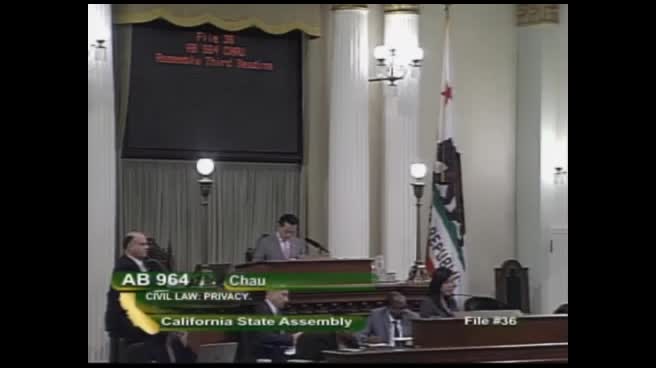
Bill Author
Bill Co-Author(s):