AB 1241: Crimes: audiovisual work: recording.
- Session Year: 2015-2016
- House: Assembly
- Latest Version Date: 2016-09-26
Existing law makes it a crime for a person to, for commercial advantage or private financial gain, knowingly advertise or offer for sale or resale, or sell or resell, or cause the rental, sale, or resale of, or rent, or manufacturer, or possess for these purposes, any recording or audiovisual work, the outside cover, box, jacket, or label of which does not clearly and conspicuously disclose the actual true name and address of the manufacturer of the recording or audiovisual work and the name of the actual author, artist, performer, producer, programmer, or group. Existing law provides different punishments for different violations of these provisions and provides that the punishment for a first offense for certain violations of these provisions is imprisonment in a county jail not to exceed one year, or a fine not to exceed $50,000, or both that fine and imprisonment. Existing law provides that the punishment for a 2nd or subsequent offense for those same violations is imprisonment in a county jail not to exceed one year, or imprisonment for a felony, or by a fine not to exceed $200,000, or by both that fine and imprisonment.
This bill would provide that the punishment for a 2nd or subsequent offense for those certain violations would be imprisonment in a county jail not to exceed one year, or imprisonment for a felony, or by a fine of not less than $1,000, but not to exceed $200,000, or by both that fine and imprisonment. The bill would also make technical, nonsubstantive changes to that provision.
Existing law makes it a crime for a person to, for commercial advantage or private financial gain, knowingly advertise or offer for sale or resale, or sell or resell, or cause the rental, sale, or resale of, or rent, or manufacturer, or possess for these purposes, any recording or audiovisual work, the outside cover, box, jacket, or label of which does not clearly and conspicuously disclose the actual true name and address of the manufacturer of the recording or audiovisual work and the name of the actual author, artist, performer, producer, programmer, or group.
This bill would make technical, nonsubstantive changes to that provision.
(a)(1)A person is guilty of failure to disclose the origin of a recording or audiovisual work if, for commercial advantage or private financial gain, he or she knowingly advertises or offers for sale or resale, or sells or resells, or causes the rental, sale, or resale of, or rents, or manufactures, or possesses for these purposes, any recording or audiovisual work, the outside cover, box, jacket, or label of which does not clearly and conspicuously disclose the actual true name and address of the manufacturer thereof and the name of the actual author, artist, performer, producer, programmer, or group thereon. This section does not require the original manufacturer or authorized licensees of software producers to disclose the contributing authors or programmers.
(2)As used in this section, recording means any tangible medium upon which information or sounds are recorded or otherwise stored, including, but not limited to, any phonograph record, disc, tape, audio cassette, wire, film, memory card, flash drive, hard drive, data storage device, or other medium on which information or sounds are recorded or otherwise stored, but does not include sounds accompanying a motion picture or other audiovisual work.
(3)As used in this section, audiovisual works are the physical embodiment of works that consist of related images that are intrinsically intended to be shown using machines or devices, such as projectors, viewers, or electronic equipment, together with accompanying sounds, if any, regardless of the nature of the material objects, such as films, tapes, discs, memory cards, flash drives, hard drives, data storage devices, or other devices, on which the works are embodied.
(b)A person who has been convicted of a violation of subdivision (a) shall be punished as follows:
(1)If the offense involves the advertisement, offer for sale or resale, sale, rental, manufacture, or possession for these purposes, of at least 100 articles of audio recordings or 100 articles of audiovisual works described in subdivision (a), or the commercial equivalent thereof, the person shall be punished by imprisonment in a county jail not to exceed one year, or by imprisonment pursuant to subdivision (h) of Section 1170 for two, three, or five years, or by a fine not to exceed five hundred thousand dollars ($500,000), or by both that fine and imprisonment.
(2)Any other violation of subdivision (a) not described in paragraph (1) shall, upon a first offense, be punished by imprisonment in a county jail not to exceed one year, or by a fine not to exceed fifty thousand dollars ($50,000), or by both that fine and imprisonment.
(3)A second or subsequent conviction under subdivision (a) not described in paragraph (1) shall be punished by imprisonment in a county jail not to exceed one year or pursuant to subdivision (h) of Section 1170, or by a fine of not less than one thousand dollars (1,000), but not to exceed two hundred thousand dollars ($200,000), or by both that fine and imprisonment.
(a)(1)A person is guilty of failure to disclose the origin of a recording or audiovisual work if, for commercial advantage or private financial gain, he or she knowingly advertises or offers for sale or resale, or sells or resells, or causes the rental, sale, or resale of, or rents, or manufactures, or possesses for these purposes, any recording or audiovisual work, the outside cover, box, jacket, or label of which does not clearly and conspicuously disclose the actual true name and address of the manufacturer thereof and the name of the actual author, artist, performer, producer, programmer, or group thereon. This section does not require the original manufacturer or authorized licensees of software producers to disclose the contributing authors or programmers.
(2)As used in this section, recording means any tangible medium upon which information or sounds are recorded or otherwise stored, including, but not limited to, any phonograph record, disc, tape, audio cassette, wire, film, memory card, flash drive, hard drive, data storage device, or other medium on which information or sounds are recorded or otherwise stored, but does not include sounds accompanying a motion picture or other audiovisual work.
(3)As used in this section, audiovisual works are the physical embodiment of works that consist of related images that are intrinsically intended to be shown using machines or devices, such as projectors, viewers, or electronic equipment, together with accompanying sounds, if any, regardless of the nature of the material objects, such as films, tapes, discs, memory cards, flash drives, hard drives, data storage devices, or other devices, on which the works are embodied.
(b)A person who has been convicted of a violation of subdivision (a) shall be punished as follows:
(1)If the offense involves the advertisement, offer for sale or resale, sale, rental, manufacture, or possession for these purposes, of at least 100 articles of audio recordings or 100 articles of audiovisual works described in subdivision (a), or the commercial equivalent thereof, the person shall be punished by imprisonment in a county jail not to exceed one year, or by imprisonment pursuant to subdivision (h) of Section 1170 for two, three, or five years, or by a fine not to exceed five hundred thousand dollars ($500,000), or by both that fine and imprisonment.
(2)Any other violation of subdivision (a) not described in paragraph (1), (1) shall, upon a first offense, be punished by imprisonment in a county jail not to exceed one year, or by a fine not to exceed fifty thousand dollars ($50,000), or by both that fine and imprisonment.
(3)A second or subsequent conviction under subdivision (a) not described in paragraph (1), (1) shall be punished by imprisonment in a county jail not to exceed one year or pursuant to subdivision (h) of Section 1170, or by a fine not to exceed two hundred thousand dollars ($200,000), or by both that fine and imprisonment.
|
Date
|
Status
|
|---|---|
| May 4, 2015 | Read third time. Passed. Ordered to the Senate. (Ayes 78. Noes 0. Page 1263.) |
| Aug 31, 2016 | Enrolled and presented to the Governor at 5 p.m. |
| Aug 16, 2016 | Returned by the Governor at the request of the Assembly. |
| Aug 16, 2016 | Ordered to Engrossing and Enrolling. |
| Aug 5, 2016 | Enrolled and presented to the Governor at 2:30 p.m. |
| Aug 2, 2016 | In Assembly. Ordered to Engrossing and Enrolling. |
| Aug 1, 2016 | Read third time. Passed. Ordered to the Assembly. (Ayes 39. Noes 0. Page 4729.). |
| Aug 1, 2016 | Read third time. Passed. Ordered to the Assembly. |
| Jun 23, 2016 | Read second time. Ordered to third reading. |
| Jun 22, 2016 | From committee: Do pass. (Ayes 7. Noes 0.) (June 21). |
| May 14, 2015 | Referred to Com. on PUB. S. |
| Feb 27, 2015 | Introduced. To print. |
| May 4, 2015 | Read third time. Passed. Ordered to the Senate. |
| May 4, 2015 | In Senate. Read first time. To Com. on RLS. for assignment. |
| Apr 29, 2015 | Read second time. Ordered to Consent Calendar. |
| Apr 28, 2015 | From committee: Do pass. To Consent Calendar. (Ayes 7. Noes 0.) (April 28). |
| Apr 6, 2015 | Re-referred to Com. on PUB. S. |
| Mar 26, 2015 | Referred to Com. on PUB. S. |
| Mar 26, 2015 | From committee chair, with author's amendments: Amend, and re-refer to Com. on PUB. S. Read second time and amended. |
| Mar 2, 2015 | Read first time. |
| Mar 1, 2015 | From printer. May be heard in committee March 31. |
|
Date
|
Description
|
Location
|
Votes
|
|
|---|---|---|---|---|
| Aug 1, 2016 | Assembly 3rd Reading AB1241 Calderon By Allen | Senate Floor |
Passed |
|
| Jun 21, 2016 | Do pass | Senate Standing Committee on Public Safety |
Passed |
|
| May 4, 2015 | AB 1241 CALDERON Consent Calendar Second Day Regular Session | Assembly Floor |
Passed |
|
| Apr 28, 2015 | Do pass. To Consent Calendar. | Assembly Standing Committee on Public Safety |
Passed |
This list shows positions taken on this bill by organizations on the date displayed, which is linked to the original source.
Positions by individuals are not included.
|
Organization
|
Position
|
Date
|
|---|---|---|
| Recording Industry Association Of America | ** Support | Aug 1, 2016 |
Office of Senate Floor Analyses (916) 651-1520 Fax: (916) 327-4478 | AB |
THIRD READING
Bill No: AB 1241
:
SENATE PUBLIC SAFETY COMMITTEE: 7-0, 6/21/16
AYES: Hancock, Anderson, Glazer, Leno, Liu, Monning, Stone
ASSEMBLY FLOOR: 78-0, 5/4/15 (Consent) - See last page for vote
SOURCE: Recording Industry Association of America
DIGEST: This bill requires a sentencing court to impose a mandatory minimum fine of at least $1,000 for a second or subsequent conviction of audio or video piracy.
Existing law:
- Provides that a person is guilty of the failure to disclose the origin of a recording or audiovisual work (piracy) if, for commercial advantage or private financial gain, he or she knowingly advertises or offers for sale or resale, or sells or resells, or causes the rental, sale or resale, or rents, or manufactures, or possesses for these purposes, any recording or audiovisual work, the outside cover, box, jacket, or label of which does not clearly and conspicuously disclose the actual true name and address of the manufacturer thereof and the name of the actual author, artist, performer, producer, programmer, or group thereon. (Pen. Code, § 653w, subd. (a)(1).)
- Provides that if the offense involves at least 100 articles of audio recordings or audiovisual works, or the commercial equivalent thereof, then the punishment is imprisonment in a county jail not to exceed one year, by imprisonment pursuant to criminal justice realignment for two, three, or five years, by a fine not to exceed $500,000, or by both that fine and imprisonment. (Pen. Code § 653w, subd. (b)(1).)
- Punishes any other first-time violation of the crime by imprisonment in a county jail not to exceed one year, by a fine of not more than $50,000, or by both that fine and imprisonment. (Pen. Code § 653w, subd. (b)(2).)
- Punishes a second or subsequent conviction by imprisonment in a county jail not to exceed one year, or by imprisonment pursuant to criminal justice realignment, by a fine not more than $200,000, or by both that fine and imprisonment. (Pen. Code § 653w, subd. (b)(3).)
- Defines "recording" as any "tangible medium upon which information or sounds are recorded or otherwise stored, including, but not limited to, any phonograph record, disc, tape, audio cassette, wire, film, memory card, flash drive, hard drive, data storage device, or other medium on which information or sounds are recorded or otherwise stored, but does not include sounds accompanying a motion picture or other audiovisual work." (Pen. Code § 653w, subd. (a)(2).)
- Defines "audiovisual works" as the "physical embodiment of works that consist of related images that are intrinsically intended to be shown using machines or devices, such as projectors, viewers, or electronic equipment, together with accompanying sounds, if any, regardless of the nature of the material objects, such as films, tapes, discs, memory cards, flash drives, data storage devices, or other devices, on which the works are embodied." (Pen. Code § 653w, subd. (a)(3).)
- Requires, in addition to any other penalty or fine, the court to order a person who has been convicted of a music or video piracy to make restitution to an owner or lawful producer, or trade association acting on behalf of the owner or lawful producer, of a phonograph record, disc, wire, tape, film, or other device or article from which sounds or visual images are derived that suffered economic loss resulting from the violation. (Pen. Code § 1202.4, subd. (r)(1).)
- Requires the restitution order be based on the aggregate wholesale value of lawfully manufactured and authorized devices or articles, and to also include reasonable costs incurred as a result of the investigation undertaken by the owner, lawful producer, or trade association acting on behalf of the owner. (Pen. Code § 1202.4, subd. (r)(1).
This bill imposes a mandatory minimum fine of not less than $1,000 for a second or subsequent conviction for the crime of music or video piracy, as prosecuted under the California law that requires a person to disclose the true name and address of the manufacturer of a musical or audio work.
Background:
According to the author:
Crimes related to piracy are often viewed as victimless. As such, they are often treated lightly by the courts. While there are opportunities for the courts to establish fines, there is no mandatory fine in cases involving piracy of copyright, intellectual property, despite the unquestioned impact upon the entertainment and other industries affected by these illegitimate activities. AB 1241 would create a minimum fine of $1,000 on a second offense.
In audio and audio-visual piracy, restitution is defined to include the value of unsold items seized from the defendant. As the items did not actually replace a legitimate sale, the value of these items is not truly restitution for a loss. (People v. Garcia (2011) 194 Cal.App.4th 612, 614-622.) The restitution is essentially a fine paid to the victim in an amount measured by the value of the illegitimate sales the defendant would have made if he or she had actually sold the items. This form of restitution is a penalty based the defendant’s criminal intent, not actual losses suffered by the victim and appears to be similar to punitive damages ordered in a civil suit.
This bill requires payment of a traditional fine. A criminal fine is paid to the government, not the victim. Criminal fines are generally imposed based on the culpability of the defendant. The fact that a defendant would have made additional illicit sales had he or she not been caught is such a consideration. A fine can also reflect the harm the defendant’s conduct more generally caused society.
Federal law preempts state law in the area of copyright. State laws related to copyright interests are generally called "true name and address" laws, which are intended to protect consumers and prohibit specified forms of unfair competition. Penal Code Section 653w is a form of true name and address law. In Anderson v. Nidorf (9th Cir. 1994) 26 F.3d 100, the United States 9th Circuit Court of Appeals upheld the California true name and address law. The defendant’s claim that the true name and address law (Pen, Code § 653w) is preempted by federal copyright has been rejected by the 9th Circuit. A state law can protect copyright interests if the law has other purposes that are legitimate subjects of state law.
The "underground economy" refers to those individuals and businesses that deal in cash and/or use other schemes to conceal their activities, identities, and true tax liabilities from government licensing, regulatory, and taxing agencies. The activities that occur in the underground economy include the sale or transfer of illegal goods, such as pirated music or movies, counterfeit pharmaceutical drugs and numerous other products. The Board of Equalization estimates that the State of California losses about $8.5 billion dollars annually in tax revenue due to the underground economy. This revenue is needed to fund critical programs such as education, public safety, infrastructure and social services.
Setting the penalty for a crime is an inherently legislative function. The Legislature does have the power to require a minimum fine or other specific sentence. (Keeler v. Superior Court (1970) 2 Cal.3d 619, 631.) Sentencing, however, is solely a judicial power. (People v. Tenorio (1970) 3 Cal.3d 89, 90-93; People v. Superior Court (Fellman) (1976) 59 Cal.App.3d 270, 275.) California law effectively directs judges to impose an individualized sentence that fits the crime and the defendant’s background, attitude, and record. (Cal. Rules of Court, rules 4.401-4.425.) This bill limits judicial discretion and requires a minimum fine of $1,000 to be imposed in each case in which a defendant has already suffered a prior conviction for piracy, regardless of the facts. A sentencing court also has the authority and discretion to impose a much higher fine than the minimum required under this bill. The maximum fine under existing law is $200,000 – approximately $800,000 with penalty assesssments. There is no evidence that this amount is not already being imposed in these types of cases.
Penalty assessments and fees must be assessed on the base fine for a crime.
Assuming a defendant was fined $1,000 as the fine for a criminal offense, a host of penalty assessments would actually require the defendant to pay a fine of over $4,000. The fine does not include victim restitution, a mandatory restitution fine, and other fines and fees.
Current law under Penal Code section 1203.1d prioritizes the order in which delinquent court-ordered debt received is to be satisfied. The priorities are 1) victim restitution, 2) state surcharge, 3) restitution fines, penalty assessments, and other fines, with payments made on a proportional basis to the total amount levied for all of these items, and 4) state/county/city reimbursements, and special revenue items.
The fine at issue in this bill has a fairly low priority in the collection order, falling in the third category. Given that victim restitution in these types of cases is to be on the aggregate wholesale value of lawfully manufactured and authorized devices or articles, and to also include reasonable costs incurred as a result of the investigation undertaken by the owner, lawful producer, or trade association acting on behalf of the owner (Pen. Code, § 1202.4, subd. (r)(1)), it could very well be the case that this fine is unlikely to be collected, especially if the defendant is ordered to pay special restitution based on the value of unsold pirated works.
A recent San Francisco Daily Journal article noted, "California courts and counties collect nearly $2 billion in fines and fees every year. Nevertheless, the state still has a more than $10.2 billion balance of uncollected debt from prior years, according to the most recent date from 2012." (See Jones & Sugarman, State Judges Bemoan Fee Collection Process, San Francisco Daily Journal, (January 5, 2015).) "The annual growth in delinquent debt partly reflects a supply of money that doesn't exist to be collected." (Ibid.) In the same article, the Presiding Judge of San Bernardino County was quoted as saying "the whole concept is getting blood out of a turnip." (Ibid.)
FISCAL EFFECT: Appropriation: Fiscal Com.: Local:
Recording Industry Association of America (source)
OPPOSITION: (Verified 6/23/16)
None received
ASSEMBLY FLOOR: 78-0, 5/4/15
AYES: Achadjian, Alejo, Travis Allen, Baker, Bigelow, Bloom, Bonilla, Bonta, Brough, Brown, Burke, Calderon, Chang, Chau, Chávez, Chiu, Chu, Cooley, Cooper, Dababneh, Daly, Dodd, Eggman, Frazier, Beth Gaines, Gallagher, Cristina Garcia, Eduardo Garcia, Gatto, Gipson, Gomez, Gonzalez, Gordon, Gray, Grove, Hadley, Harper, Roger Hernández, Holden, Irwin, Jones, Jones-Sawyer, Kim, Lackey, Levine, Linder, Lopez, Low, Maienschein, Mathis, Mayes, McCarty, Medina, Melendez, Mullin, Nazarian, Obernolte, O'Donnell, Olsen, Patterson, Perea, Quirk, Rendon, Ridley-Thomas, Rodriguez, Salas, Santiago, Steinorth, Mark Stone, Thurmond, Ting, Wagner, Waldron, Weber, Wilk, Williams, Wood, Atkins
NO VOTE RECORDED: Campos, Dahle
Prepared by: Jerome McGuire / PUB. S. /
6/24/16 14:33:37
**** END ****
SENATE COMMITTEE ON PUBLIC SAFETY
Senator Loni Hancock, Chair
2015 - 2016 Regular
Bill No: AB 1241 Hearing Date: June 21, 2016
Author: | Calderon | ||
Version: | March 26, 2015 | ||
Urgency: | No | Fiscal: | No |
Consultant: | JM | ||
Subject: Crimes: Audiovisual Work: Recording
HISTORY
Source: Recording Industry Association of America
Prior Legislation: AB 160 (Dababneh) – Ch. 427, Stats. 2015
AB 2122 (Bocanegra) – Ch. 857, Stats. 2014
SB 1479 (Pavley) – Ch. 873, Stats. 2012
SB 550 (Padilla) – Ch. 421, Stats. 2011
SB 830 (Wright) – Ch. 480, Stats. 2010
AB 2750 (Krekorian) – Ch. 468, Stats. 2008
AB 64 (Cohn) – Ch. 9, Stats, 2006
SB 1506 (Murray) – Ch. 617, Stats. 2004
Support: Unknown
Opposition: None known
Assembly Floor Vote: 78 - 0
PURPOSE
The purpose of this bill is to require a sentencing court to impose a mandatory minimum fine of at least $1,000 for a second or subsequent conviction of audio or video piracy.
Existing law provides that a person is guilty of the failure to disclose the origin of a recording or audiovisual work (piracy) if, for commercial advantage or private financial gain, he or she knowingly advertises or offers for sale or resale, or sells or resells, or causes the rental, sale or resale, or rents, or manufactures, or possesses for these purposes, any recording or audiovisual work, the outside cover, box, jacket, or label of which does not clearly and conspicuously disclose the actual true name and address of the manufacturer thereof and the name of the actual author, artist, performer, producer, programmer, or group thereon. (Pen. Code, § 653w, subd. (a)(1).)
Existing law provides that if the offense involves at least 100 articles of audio recordings or audiovisual works, or the commercial equivalent thereof, then the punishment is imprisonment in a county jail not to exceed one year, by imprisonment pursuant to criminal justice realignment for two, three, or five years, by a fine not to exceed $500,000, or by both that fine and imprisonment. (Pen. Code § 653w, subd. (b)(1).)
Existing law punishes any other first-time violation of the crime by imprisonment in a county jail not to exceed one year, by a fine of not more than $50,000, or by both that fine and imprisonment. (Pen. Code § 653w, subd. (b)(2).)
Existing law punishes a second or subsequent conviction by imprisonment in a county jail not to exceed one year, or by imprisonment pursuant to criminal justice realignment, by a fine not more than $200,000, or by both that fine and imprisonment. (Pen. Code § 653w, subd. (b)(3).)
Existing law defines "recording" as any "tangible medium upon which information or sounds are recorded or otherwise stored, including, but not limited to, any phonograph record, disc, tape, audio cassette, wire, film, memory card, flash drive, hard drive, data storage device, or other medium on which information or sounds are recorded or otherwise stored, but does not include sounds accompanying a motion picture or other audiovisual work." (Pen. Code § 653w, subd. (a)(2).)
Existing law defines "audiovisual works" as the "physical embodiment of works that consist of related images that are intrinsically intended to be shown using machines or devices, such as projectors, viewers, or electronic equipment, together with accompanying sounds, if any, regardless of the nature of the material objects, such as films, tapes, discs, memory cards, flash drives, data storage devices, or other devices, on which the works are embodied." (Pen. Code § 653w, subd. (a)(3).)
Existing law requires, in addition to any other penalty or fine, the court to order a person who has been convicted of a music or video piracy to make restitution to an owner or lawful producer, or trade association acting on behalf of the owner or lawful producer, of a phonograph record, disc, wire, tape, film, or other device or article from which sounds or visual images are derived that suffered economic loss resulting from the violation. (Pen. Code § 1202.4, subd. (r)(1).)
Existing law requires the restitution order be based on the aggregate wholesale value of lawfully manufactured and authorized devices or articles, and to also include reasonable costs incurred as a result of the investigation undertaken by the owner, lawful producer, or trade association acting on behalf of the owner. (Pen. Code § 1202.4, subd. (r)(1).
This bill imposes a mandatory minimum fine of not less than $1,000 for a second or subsequent conviction for the crime of music or video piracy, as prosecuted under the California law that requires a person to disclose the true name and address of the manufacturer of a musical or audio
work.
RECEIVERSHIP/OVERCROWDING CRISIS AGGRAVATION
For the past several years this Committee has scrutinized legislation referred to its jurisdiction for any potential impact on prison overcrowding. Mindful of the United States Supreme Court ruling and federal court orders relating to the state’s ability to provide a constitutional level of health care to its inmate population and the related issue of prison overcrowding, this Committee has applied its “ROCA” policy as a content-neutral, provisional measure necessary to ensure that the Legislature does not erode progress in reducing prison overcrowding.
On February 10, 2014, the federal court ordered California to reduce its in-state adult institution population to 137.5% of design capacity by February 28, 2016, as follows:
- 143% of design bed capacity by June 30, 2014;
- 141.5% of design bed capacity by February 28, 2015; and,
- 137.5% of design bed capacity by February 28, 2016.
In December of 2015 the administration reported that as “of December 9, 2015, 112,510 inmates were housed in the State’s 34 adult institutions, which amounts to 136.0% of design bed capacity, and 5,264 inmates were housed in out-of-state facilities. The current population is 1,212 inmates below the final court-ordered population benchmark of 137.5% of design bed capacity, and has been under that benchmark since February 2015.” (Defendants’ December 2015 Status Report in Response to February 10, 2014 Order, 2:90-cv-00520 KJM DAD PC, 3-Judge Court, Coleman v. Brown, Plata v. Brown (fn. omitted).) One year ago, 115,826 inmates were housed in the State’s 34 adult institutions, which amounted to 140.0% of design bed capacity, and 8,864 inmates were housed in out-of-state facilities. (Defendants’ December 2014 Status Report in Response to February 10, 2014 Order, 2:90-cv-00520 KJM DAD PC, 3-Judge Court, Coleman v. Brown, Plata v. Brown (fn. omitted).)
While significant gains have been made in reducing the prison population, the state must stabilize these advances and demonstrate to the federal court that California has in place the “durable solution” to prison overcrowding “consistently demanded” by the court. (Opinion Re: Order Granting in Part and Denying in Part Defendants’ Request For Extension of December 31, 2013 Deadline, NO. 2:90-cv-0520 LKK DAD (PC), 3-Judge Court, Coleman v. Brown, Plata v. Brown (2-10-14). The Committee’s consideration of bills that may impact the prison population therefore will be informed by the following questions:
- Whether a proposal erodes a measure which has contributed to reducing the prison population;
- Whether a proposal addresses a major area of public safety or criminal activity for which there is no other reasonable, appropriate remedy;
- Whether a proposal addresses a crime which is directly dangerous to the physical safety of others for which there is no other reasonably appropriate sanction;
- Whether a proposal corrects a constitutional problem or legislative drafting error; and
- Whether a proposal proposes penalties which are proportionate, and cannot be achieved through any other reasonably appropriate remedy.
COMMENTS
- Need for This Bill
According to the author:
Crimes related to piracy are often viewed as victimless. As such, they are often treated lightly by the courts. While there are opportunities for the courts to establish fines, there is no mandatory fine in cases involving piracy of copyright, intellectual property, despite the unquestioned impact upon the entertainment and other industries affected by these illegitimate activities. AB 1241 would create a minimum fine of $1,000 on a second offense.
- Special Restitution in Music and Video Piracy is Equivalent to a Fine; this Bill requires Imposition of a Standard Criminal Fine
In audio and audio-visual piracy, restitution is defined to include the value of unsold items seized from the defendant. As the items did not actually replace a legitimate sale, the value of these items is not truly restitution for a loss. (People v. Garcia (2011) 194 Cal.App.4th 612, 614-622.) The restitution is essentially a fine paid to the victim in an amount measured by the value of the illegitimate sales the defendant would have made if he or she had actually sold the items. This form of restitution is a penalty based the defendant’s criminal intent, not actual losses suffered by the victim and appears to be similar to punitive damages ordered in a civil suit.
This bill requires payment of a traditional fine. A criminal fine is paid to the government, not the victim. Criminal fines are generally imposed based on the culpability of the defendant. The fact that a defendant would have made additional illicit sales had he or she not been caught is such a consideration. A fine can also reflect the harm the defendant’s conduct more generally caused society.
- Federal Law Controls Copyright – State Law Generally Involves Other Defined Offenses that may Indirectly Advance Copyright Interests
Federal law preempts state law in the area of copyright. State laws related to copyright interests are generally called "true name and address" laws, which are intended to protect consumers and prohibit specified forms of unfair competition. Penal Code Section 653w is a form of true name and address law. In Anderson v. Nidorf (9th Cir. 1994) 26 F.3d 100, the United States 9th Circuit Court of Appeals upheld the California true name and address law. The defendant’s claim that the true name and address law (Pen, Code § 653w) is preempted by federal copyright law was rejected by the 9th Circuit. The court in Anderson explained its holding:
The state's interest in enacting Penal Code section 653w is the desire to protect the public in general, and the many employees of the vast entertainment industry in particular, from the hundreds of millions of dollars in losses suffered as a result of the "piracy and bootlegging" of the industry's products. However, the statute also has the purpose of protecting the public from being victimized by false and deceptive commercial practices. … [Anderson's] argument ignores the other purpose the legislative materials . . . show Section 653w was designed to serve: 'assisting consumers in this state by mandating that manufacturers market products for which consumers can go back to the source if there are any problems or complaints.' Preemption would frustrate the State's objective of consumer protection through disclosure. Federal copyright laws do not serve this purpose of protecting consumers. They are designed to protect the property rights of copyright owners.
Further, the California statute criminalizes selling recordings whose labels fail to disclose the manufacturer or author; it does not criminalize unauthorized duplication or "bootlegging" of copyrighted works. An act criminalized by § 653w thus does not "in and of itself . . . infringe one of the exclusive rights" listed in the copyright laws. (Id., at pp. 102-103.)
- Underground Economy
The "underground economy" refers to those individuals and businesses that deal in cash and/or use other schemes to conceal their activities, identities, and true tax liabilities from government licensing, regulatory, and taxing agencies. The activities that occur in the underground economy include the sale or transfer of illegal goods, such as pirated music or movies, counterfeit pharmaceutical drugs, vitamins, wine, clothing, accessories, weapons, tax evasion or fraud, and untaxed tobacco products or alcohol. The underground economy hurts legitimate businesses, creates an enormous tax gap and hurts all California due to the loss of revenue. The Board of Equalization estimates that the State of California losses about $8.5 billion dollars annually in tax revenue due to the underground economy. (http://www.boe.ca.gov/info/underground_economy.htm.) This revenue is needed to fund critical programs such as education, public safety, infrastructure and social services.
- Legislative and Judicial Functions as regards Criminal Sentencing
Setting the penalty, or range of penalties, for a crime is an inherently legislative function. The Legislature does have the power to require a minimum term or other specific sentence. (Keeler v. Superior Court (1970) 2 Cal.3d 619, 631.) Sentencing, however, is solely a judicial power. (People v. Tenorio (1970) 3 Cal.3d 89, 90-93; People v. Superior Court (Fellman) (1976) 59 Cal.App.3d 270, 275.) California law effectively directs judges to impose an individualized sentence that fits the crime and the defendant’s background, attitude, and record. (Cal. Rules of Court, rules 4.401-4.425.) This bill limits judicial discretion and requires a minimum fine of $1,000 to be imposed in each case in which a defendant has already suffered a prior conviction for piracy, regardless of the facts.
Although requiring a minimum fine of $1,000 for a second or subsequent conviction is within the authority of the Legislature to set penalties for crimes, the sentencing judge has the discretion to impose this amount, and much more, under existing law. The maximum fine under existing law is $200,000 – approximately $800,000 with penalty assesssments. There is no evidence that this amount is not already being imposed in these types of cases.
- Mandatory Penalty Assessments Effectively Quadruple a Criminal Fine
Penalty assessments and fees must be assessed on the base fine for a crime. Assuming a defendant was fined $1,000 as the fine for a criminal offense, the following penalty assessments would be imposed pursuant to the Penal Code and the California Government Code:
Base Fine: $ 1,000
Pen. Code § 1464 state penalty on fines: $1,000 ($10 for every $10)
Pen. Code § 1465.7 state surcharge: $ 200 (20% surcharge)
Pen. Code § 1465.8 court operation assessment: $40
Gov. Code § 70372 court construction penalty: $500 ($5 for every $10)
Gov. Code § 70373 assessment: $30
Gov. Code § 76000 penalty: $700 ($7 for every $10)
Gov. § 76000.5 EMS penalty: $200 ($2 for every $10)
Gov. § Code § 76104.6 DNA fund penalty: $100 ($1 for every $10)
Gov. § Code § 76104.7 addt'l DNA fund penalty: $400 ($4 for every $10)
Total Fine with Assessments: $4,170
It should be noted that this figure does not include victim restitution, or the restitution fine, and that other fines and fees, such as the jail booking fee, attorney fees, OR release fees, probation department fees, may also be applicable.
- Prioritization of Court-Ordered Debt and the Extent of Uncollected Fines
Current law under Penal Code section 1203.1d prioritizes the order in which delinquent court-ordered debt received is to be satisfied. The priorities are 1) victim restitution, 2) state surcharge, 3) restitution fines, penalty assessments, and other fines, with payments made on a proportional basis to the total amount levied for all of these items, and 4) state/county/city reimbursements, and special revenue items.
The fine at issue in this bill has a fairly low priority in the collection order, falling in the third category. Given that victim restitution in these types of cases is to be on the aggregate wholesale value of lawfully manufactured and authorized devices or articles, and to also include reasonable costs incurred as a result of the investigation undertaken by the owner, lawful producer, or trade association acting on behalf of the owner (Pen. Code, § 1202.4, subd. (r)(1)), it could very well be the case that this fine is unlikely to be collected, especially if the defendant is ordered to pay special restitution based on the value of unsold pirated works.
A recent San Francisco Daily Journal article noted, "California courts and counties collect nearly $2 billion in fines and fees every year. Nevertheless, the state still has a more than $10.2 billion balance of uncollected debt from prior years, according to the most recent date from 2012." (See Jones & Sugarman, State Judges Bemoan Fee Collection Process, San Francisco Daily Journal, (January 5, 2015).) "The annual growth in delinquent debt partly reflects a supply of money that doesn't exist to be collected." (Ibid.) In the same article, the Presiding Judge of San Bernardino County was quoted as saying "the whole concept is getting blood out of a turnip." (Ibid.)
-- END –
AB 1241
Page 5
Date of Hearing: April 28, 2015
Counsel: Sandra Uribe
ASSEMBLY COMMITTEE ON PUBLIC SAFETY
Bill Quirk, Chair
AB 1241
(Calderon) – As Amended March 26, 2015
SUMMARY:
Imposes a mandatory minimum fine of not less than $1,000 for a second or subsequent conviction for the crime of music or video piracy.
EXISTING LAW:
Provides that a person is guilty of the failure to disclose the origin of a recording or audiovisual work (piracy) if, for commercial advantage or private financial gain, he or she knowingly advertises or offers for sale or resale, or sells or resells, or causes the rental, sale or resale, or rents, or manufactures, or possesses for these purposes, any recording or audiovisual work, the outside cover, box, jacket, or label of which does not clearly and conspicuously disclose the actual true name and address of the manufacturer thereof and the name of the actual author, artist, performer, producer, programmer, or group thereon. (Pen. Code, § 653w, subd. (a)(1).)
Provides that if the offense involves at least 100 articles of audio recordings or audiovisual works, or the commercial equivalent thereof, then the punishment is imprisonment in a county jail not to exceed one year, by imprisonment pursuant to criminal justice realignment for two, three, or five years, by a fine not to exceed $500,000, or by both that fine and imprisonment. (Pen. Code, § 653w, subd. (b)(1).)
Punishes any other first-time violation of the crime by imprisonment in a county jail not to exceed one year, by a fine of not more than $50,000, or by both that fine and imprisonment. (Pen. Code, § 653w, subd. (b)(2).)
Punishes a second or subsequent conviction by imprisonment in a county jail not to exceed one year, or by imprisonment pursuant to criminal justice realignment, by a fine not more than $200,000, or by both that fine and imprisonment. (Pen. Code, § 653w, subd. (b)(3).)
Defines "recording" as any "tangible medium upon which information or sounds are recorded or otherwise stored, including, but not limited to, any phonograph record, disc, tape, audio cassette, wire, film, memory card, flash drive, hard drive, data storage device, or other medium on which information or sounds are recorded or otherwise stored, but does not include sounds accompanying a motion picture or other audiovisual work." (Pen. Code, § 653w, subd. (a)(2).)
Defines "audiovisual works" as the "physical embodiment of works that consist of related images that are intrinsically intended to be shown using machines or devices, such as projectors, viewers, or electronic equipment, together with accompanying sounds, if any, regardless of the nature of the material objects, such as films, tapes, discs, memory cards, flash drives, data storage devices, or other devices, on which the works are embodied." (Pen. Code, § 653w, subd. (a)(3).)
Requires, in addition to any other penalty or fine, the court to order a person who has been convicted of a music or video piracy to make restitution to an owner or lawful producer, or trade association acting on behalf of the owner or lawful producer, of a phonograph record, disc, wire, tape, film, or other device or article from which sounds or visual images are derived that suffered economic loss resulting from the violation. (Pen. Code, § 1202.4, subd. (r)(1).)
Requires the restitution order be based on the aggregate wholesale value of lawfully manufactured and authorized devices or articles, and to also include reasonable costs incurred as a result of the investigation undertaken by the owner, lawful producer, or trade association acting on behalf of the owner. (Pen. Code, § 1202.4, subd. (r)(1).)
FISCAL EFFECT:
Unknown
COMMENTS:
Author's Statement: According to the author, "AB 1241 continues the practice of fine-tuning state laws to address the impact of piracy upon very important industry sections to California. This just clarifies that a minimum fine will be established for those committing a second offense in this criminal area."
Underground Economy: The "underground economy" refers to those individuals and businesses that deal in cash and/or use other schemes to conceal their activities, identities, and true tax liabilities from government licensing, regulatory, and taxing agencies. The activities that occur in the underground economy include the sale or transfer of illegal goods, such as pirated music or movies, counterfeit pharmaceutical drugs, vitamins, wine, clothing, accessories, weapons, tax evasion or fraud, and untaxed tobacco products or alcohol. The underground economy hurts legitimate businesses, creates an enormous tax gap and hurts all California due to the loss of revenue. The Board of Equalization estimates that the State of California losses about $8.5 billion dollars annually in tax revenue due to the underground economy. (<http://www.boe.ca.gov/info/underground_economy.htm>.) This revenue is needed to fund critical programs such as education, public safety, infrastructure and social services.
Practical Considerations: Setting the penalty, or range of penalties, for a crime is an inherently legislative function. The Legislature does have the power to require a minimum term or other specific sentence. (Keeler v. Superior Court (1970) 2 Cal.3d 619, 631.) Sentencing, however, is solely a judicial power. (People v. Tenorio (1970) 3 Cal.3d 89, 90-93; People v. Superior Court (Fellman) (1976) 59 Cal.App.3d 270, 275.) California law effectively directs judges to impose an individualized sentence that fits the crime and the defendant’s background, attitude, and record. (Cal. Rules of Court, rules 4.401-4.425.) This bill limits judicial discretion and requires a minimum fine of $1,000 to be imposed in each case in which a defendant has already suffered a prior conviction for piracy, regardless of the facts.
Although a minimum fine of $1,000 for a second or subsequent conviction may not be unreasonable, the sentencing judge already has the discretion to impose this amount, and much more. There is no evidence that this amount is not already being imposed in these types of cases.
Existing Penalty Assessments: There are penalty assessments and fees assessed on the base fine for a crime. Assuming a defendant was fined $1,000 as the fine for a criminal offense, the following penalty assessments would be imposed pursuant to the Penal Code and the California Government Code:
Base Fine: $ 1,000
Penal Code 1464 state penalty on fines:
1,000 ($10 for every $10)
Penal Code 1465.7 state
surcharge:
200 (20% surcharge)
Penal Code
1465.8 court operation assessment:
40 ($40 fee per offense)
Government Code
70372 court construction penalty:
500 ($5 for every $10)
Government Code 70373
assessment:
30 ($30
for felony or misdemeanor)
Government Code 76000 penalty:
700 ($7 for every
$10)
Government Code 76000.5 EMS penalty:
200 ($2 for every $10)
Government Code
76104.6 DNA fund penalty:
100 ($1 for every
$10)
Government Code 76104.7 addt'l DNA fund
penalty:
400 ($4 for every $10)
Total Fine with Assessments: $4,170
It should be noted that this figure does not include victim restitution, or the restitution fine, and that other fines and fees, such as the jail booking fee, attorney fees, OR release fees, probation department fees, may also be applicable.
Prioritization of Court-Ordered Debt: Current law under Penal Code section 1203.1d prioritizes the order in which delinquent court-ordered debt received is to be satisfied. The priorities are 1) victim restitution, 2) state surcharge, 3) restitution fines, penalty assessments, and other fines, with payments made on a proportional basis to the total amount levied for all of these items, and 4) state/county/city reimbursements, and special revenue items.
The fine at issue in this bill has a fairly low priority in the collection order, falling in the third category. Given that victim restitution in these types of cases is to be on the aggregate wholesale value of lawfully manufactured and authorized devices or articles, and to also include reasonable costs incurred as a result of the investigation undertaken by the owner, lawful producer, or trade association acting on behalf of the owner (Pen. Code, § 1202.4, subd. (r)(1)), it could very well be the case that this fine is unlikely to be collected.
A recent San Francisco Daily Journal article noted, "California courts and counties collect nearly $2 billion in fines and fees every year. Nevertheless, the state still has a more than $10.2 billion balance of uncollected debt from prior years, according to the most recent date from 2012." (See Jones & Sugarman, State Judges Bemoan Fee Collection Process, San Francisco Daily Journal, (January 5, 2015).) "The annual growth in delinquent debt partly reflects a supply of money that doesn't exist to be collected." (Ibid.) In the same article, the Presiding Judge of San Bernardino County was quoted as saying "the whole concept is getting blood out of a turnip." (Ibid.)
Related Legislation: AB 160 (Dababneh) would expand the list of crimes that allow for forfeiture of assets and prosecution of criminal profiteering to include, among other crimes, illegal piracy of recordings or audiovisual works. AB 160 is pending in the Assembly Committee on Revenue and Taxation.
Prior Legislation:
AB 2122 (Bocanegra), Chapter 857, Statutes of 2014, provides that the "true name and address" audio recording and audiovisual works piracy alternate felony-misdemeanor shall apply where the defendant's conduct involved the "commercial equivalent" of at least 100 articles of sound recordings or audiovisual recordings.
SB 1479 (Pavley), Chapter 873, Statutes of 2012, provides that in music or video piracy cases, restitution shall include the value of pirated works that were seized from the defendant, but not actually sold.
SB 830 (Wright), Chapter 480, Statutes of 2010, expanded the definition of a "recording" for the purposes of prosecution for failing to disclose the origin of a recording when utilizing the recording for financial gain to include memory cards, flash drives, hard-drives, or data storage devices.
AB 819 (Calderon), Chapter 351, Statutes of 2010, increased the fines for intellectual property piracy.
AB 2750 (Krekorian), Chapter 468, Statutes of 2008, required a court to order persons convicted of specified crimes relating to music piracy to pay restitution to not only the owner or lawful producer, but also to a trade association acting on behalf of the owner or lawful producer.
AB 64 (Cohn), Chapter 9, Statutes of 2006, made the possession or sale of at least 100, rather than 1,000, audio recordings punishable as an alternate felony/misdemeanor.
REGISTERED SUPPORT / OPPOSITION:
Support
None
Opposition
None
Analysis Prepared by:
Sandy Uribe / PUB. S. / (916) 319-3744
Discussed in Hearing
View Older Hearings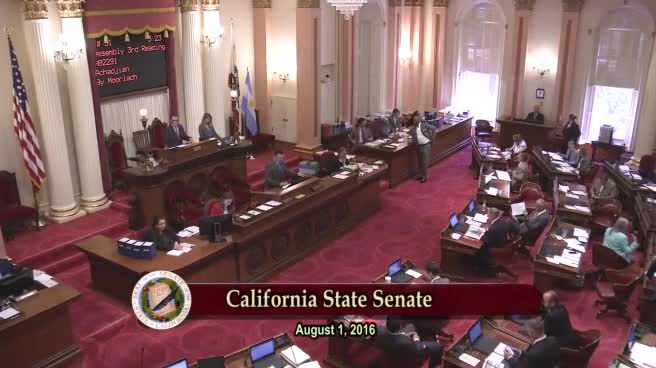
Bill Author

Bill Co-Author(s):