AB 1244: Workers' compensation.
- Session Year: 2015-2016
- House: Assembly
- Latest Version Date: 2016-09-30
Under existing law, the Director of Health Care Services is authorized, for purposes of administering the Medi-Cal program, to suspend a provider of service from further participation under the program for specified reasons, including conviction of any felony or any misdemeanor involving fraud, abuse of the Medi-Cal program or any patient, or otherwise substantially related to the qualifications, functions, or duties of a provider of service. Existing law requires the director, upon receipt of written notification from the Secretary of the United States Department of Health and Human Services that a physician or other individual practitioner has been suspended from participation in the Medicare or Medicaid programs, to promptly suspend the practitioner from participation in the Medi-Cal program.
Existing law establishes a workers compensation system, administered by the Administrative Director of the Division of Workers Compensation, that generally requires employers to secure the payment of workers compensation for injuries incurred by their employees that arise out of, or in the course of, employment. Existing law requires an employer to provide all medical services reasonably required to cure or relieve the injured worker from the effects of the injury.
Existing law authorizes an insurer, employer, or entity that provides physician network services to establish or modify a medical provider network for the provision of medical treatment to injured employees and requires the administrative director to contract with individual physicians or an independent medical review organization to perform medical provider network independent medical reviews.
This bill would require the administrative director to promptly suspend any physician, practitioner, or provider from participating in the workers compensation system if as a physician, practitioner, or provider the individual or entity meets specified criteria, including if that individual has been convicted of any felony or misdemeanor involving fraud or abuse of the Medi-Cal program, Medicare program, or workers compensation system, if that individuals license, certificate, or approval to provide health care has been surrendered or revoked, or if that individual or entity has been suspended, due to fraud or abuse, from participation in the Medicare or Medicaid programs. The bill would require the administrative director to adopt regulations for suspending a physician, practitioner, or provider from participating in the workers compensation system pursuant to these provisions, as specified, and would require the administrative director to furnish to the physician, practitioner, or provider written notice of the right to a hearing regarding the suspension and the procedure to follow to request that hearing. The bill would also require the administrative director to promptly notify the appropriate state licensing, certifying, or registering authority of a physicians, practitioners, or providers suspension and to update the divisions databases of qualified medical evaluators and medical provider networks. The bill would require the administrative director to notify the chief judge of the division of a suspension under these provisions, as specified, and post a notice on the departments Internet Web site. The bill would enact special lien proceedings for the adjudication of any liens of a physician, practitioner, or provider who has been suspended pursuant to these provisions because he or she has been convicted of a felony or misdemeanor that meets specified criteria.
The bill would also require the Director of Health Care Services to notify the administrative director of a suspension of a physician from participation in the Medi-Cal program imposed pursuant to the provisions described above authorizing the director to suspend a provider of service from participation.
Existing law establishes the Workers Compensation Appeals Board to exercise all judicial powers vested in it, as specified, including workers compensation proceedings for the recovery of compensation, or concerning any right or liability arising out of or incidental to the recovery of compensation. Existing law vests the appeals board with full power, authority, and jurisdiction to try and determine finally those matters, subject only to the review by the courts, as specified. Existing law authorizes the appeals board to determine, and allow as liens against any sum to be paid as compensation, as specified, a reasonable attorneys fee for legal services and disbursements in connection with those legal services. Existing law provides that a charge, claim, or agreement for those legal services or disbursements is not enforceable, valid, or binding in excess of a reasonable amount.
Existing law also requires an attorney to furnish to the employee a written disclosure form describing the procedures available to the injured employee or his or her dependents and specified information regarding attorneys fees. Existing law requires that a copy of the disclosure form be signed by the employee and the attorney and sent to the employer, or insurer or 3rd-party administrator, if either is known, by the attorney within 15 days of the employees and attorneys execution of the form. Existing law also requires the employee, the insurer, the employer, and the attorneys for each party to sign and file with the board a statement, signed under penalty of perjury, attesting that the signatories have not violated specified laws prohibiting conflicts of interest.
Existing law authorizes the appeals board, a workers compensation judge, or any party to the action or proceeding, as specified, to cause the deposition of witnesses in any investigation or hearing before the appeals board, and provides that the deponent is entitled to receive specified benefits, such as reasonable expenses of transportation, meals, and lodging, as specified.
This bill would prohibit payment for legal services or disbursements in connection with those legal services, or expenses relating to the deposition of witnesses, incurred under the provisions described above, as specified, prior to the filing of the disclosure form with the appeals board and the sending of that form to the employer, or to the insurer or 3rd-party administrator, if either is known, by the attorney. The bill would require the disclosure form described above to contain a paragraph setting forth the exact location of the district office of the appeals board at which the employees case will be filed and to include a specified statement. The bill would impose other requirements regarding the signing and content of the form, including that the form be signed under penalty of perjury by the attorney representing the employee, and would require the form to be filed with the appeals board.
The bill would also require an attorney who subsequently assumes the representation of the employee in the same action or proceeding to complete and sign under penalty of perjury a disclosure form that meets the above-described requirements and the statement attesting that the signatories have not violated specified laws prohibiting conflicts of interest. The bill would require the attorney to file the form and statement with the appeals board, and send them to the employer, or insurer or 3rd-party administrator, if either is known, within 15 days of the employees and attorneys execution of the form and statement.
By expanding the scope of the crime of perjury under these provisions, this bill would impose a state-mandated local program.
The California Constitution requires the state to reimburse local agencies and school districts for certain costs mandated by the state. Statutory provisions establish procedures for making that reimbursement.
This bill would provide that no reimbursement is required by this act for a specified reason.
Under existing law, the Director of Health Care Services is authorized, for purposes of administering the Medi-Cal program, to suspend a provider of service from further participation under the program for specified reasons, including conviction of any felony or any misdemeanor involving fraud, abuse of the Medi-Cal program or any patient, or otherwise substantially related to the qualifications, functions, or duties of a provider of service. Existing law requires the director, upon receipt of written notification from the Secretary of the United States Department of Health and Human Services that a physician or other individual practitioner has been suspended from participation in the Medicare or Medicaid programs, to promptly suspend the practitioner from participation in the Medi-Cal program.
Existing law establishes a workers compensation system, administered by the Administrative Director of the Division of Workers Compensation, that generally requires employers to secure the payment of workers compensation for injuries incurred by their employees that arise out of, or in the course of, employment. Existing law requires an employer to provide all medical services reasonably required to cure or relieve the injured worker from the effects of the injury.
Existing law authorizes an insurer, employer, or entity that provides physician network services to establish or modify a medical provider network for the provision of medical treatment to injured employees and requires the administrative director to contract with individual physicians or an independent medical review organization to perform medical provider network independent medical reviews. Existing law also requires the administrative director to appoint qualified medical evaluators in each of the respective specialties as required for the evaluation of medical-legal issues. Existing law requires the administrative director to terminate from the list of medical evaluators a physician who has been subject to disciplinary action by the relevant licensing board or who has been convicted of a misdemeanor or felony related to the conduct of his or her medical practice.
This bill would require the administrative director to promptly suspend any physician or practitioner physician, practitioner, or provider from participating in the workers compensation system in any capacity when if as a physician, practitioner, or provider the individual or entity meets specified criteria, including when if that individual has been convicted of any felony or misdemeanor involving fraud or abuse of the Medi-Cal program, Medicare program, or workers compensation system, when if that individuals license, certificate, or approval to provide health care has been surrendered or revoked, or when if that individual or entity has been suspended, due to fraud or abuse, from participation in the Medicare or Medicaid programs. The bill would require the administrative director to adopt regulations for suspending a physicians or practitioners participation physician, practitioner, or provider from participating in the workers compensation system pursuant to these provisions, as specified, and would require the administrative director to furnish to the physician or practitioner physician, practitioner, or provider written notice of the right to a hearing regarding the suspension and the procedure to follow to request that hearing. If a physician is a qualified medical examiner, and the division finds that the physician meets the criteria for suspension pursuant to these provisions, the bill would require the administrative director to terminate the physician from the list of medical evaluators. The bill would also require the administrative director to promptly notify the appropriate state licensing, certifying, or registering authority of a physicians or practitioners physicians, practitioners, or providers suspension and to update the divisions databases of qualified medical evaluators and medical provider networks. The bill would prohibit a provider of services from submitting or pursuing claims for payment for services or supplies provided by a physician or practitioner whose participation in the workers compensation system has been suspended, unless that claim for payment has been reduced to final judgment or the services or supplies are unrelated to a violation of the laws governing workers compensation. require the administrative director to notify the chief judge of the division of a suspension under these provisions, as specified, and post a notice on the departments Internet Web site. The bill would enact special lien proceedings for the adjudication of any liens of a physician, practitioner, or provider who has been suspended pursuant to these provisions because he or she has been convicted of a felony or misdemeanor that meets specified criteria.
The bill would also require the Director of Health Care Services to notify the administrative director of a suspension of a physician from participation in the Medi-Cal program imposed pursuant to the provisions described above authorizing the director to suspend a provider of services service from participation.
Existing law establishes the Workers Compensation Appeals Board to exercise all judicial powers vested in it, as specified, including workers compensation proceedings for the recovery of compensation, or concerning any right or liability arising out of or incidental to the recovery of compensation. Existing law vests the appeals board with full power, authority, and jurisdiction to try and determine finally those matters, subject only to the review by the courts, as specified. Existing law authorizes the appeals board to determine, and allow as liens against any sum to be paid as compensation, as specified, a reasonable attorneys fee for legal services and the reasonable expense incurred by or on behalf of the injured employee. services and disbursements in connection with those legal services. Existing law provides that a charge, claim, or agreement for those legal services or disbursements, or that reasonable expense, disbursements is not enforceable, valid, or binding in excess of a reasonable amount.
Existing law also requires an attorney to furnish to the employee a written disclosure form describing the procedures available to the injured employee or his or her dependents and specified information regarding attorneys fees. Existing law requires that a copy of the disclosure form be signed by the employee and the attorney and sent to the employer, or insurer or 3rd-party administrator, if either is known, by the attorney within 15 days of the employees and attorneys execution of the form. Existing law also requires the employee, the insurer, the employer, and the attorneys for each party to sign and file with the board a statement, signed under penalty of perjury, attesting that the signatories have not violated specified laws prohibiting conflicts of interest.
Existing law authorizes the appeals board, a workers compensation judge, or any party to the action or proceeding, as specified, to cause the deposition of witnesses in any investigation or hearing before the appeals board, and provides that the deponent is entitled to receive specified benefits, such as reasonable expenses of transportation, meals, and lodging, as specified.
This bill would prohibit payment for legal services or disbursements in connection with those legal services, or expenses relating to the deposition of witnesses, incurred under the provisions described above, as specified, prior to the filing of the disclosure form with the appeals board and the sending of that form to the employer, or to the insurer or 3rd-party administrator, if either is known, by the attorney. The bill would require the disclosure form described above to contain a paragraph setting forth the exact location of the district office of the appeals board at which the employees case will be filed and to include a specified statement. The bill would impose other requirements regarding the signing and content of the form, including that the form be signed under penalty of perjury by the attorney representing the employee, and would require the form to be filed with the appeals board.
The bill would also require an attorney who subsequently assumes the representation of the employee in the same action or proceeding to complete and sign under penalty of perjury a disclosure form that meets the above-described requirements and the statement attesting that the signatories have not violated specified laws prohibiting conflicts of interest. The bill would require the attorney to file the form and statement with the appeals board, and send them to the employer, or insurer or 3rd-party administrator, if either is known, within 15 days of the employees and attorneys execution of the form and statement.
By expanding the scope of the crime of perjury under these provisions, this bill would impose a state-mandated local program.
The California Constitution requires the state to reimburse local agencies and school districts for certain costs mandated by the state. Statutory provisions establish procedures for making that reimbursement.
This bill would provide that no reimbursement is required by this act for a specified reason.
Under existing law, the Director of Health Care Services is authorized, for purposes of administering the Medi-Cal program, to suspend a provider of service from further participation under the program for specified reasons, including conviction of any felony or any misdemeanor involving fraud, abuse of the Medi-Cal program or any patient, or otherwise substantially related to the qualifications, functions, or duties of a provider of service. Existing law requires the director, upon receipt of written notification from the Secretary of the United States Department of Health and Human Services that a physician or other individual practitioner has been suspended from participation in the Medicare or Medicaid programs, to promptly suspend the practitioner from participation in the Medi-Cal program.
Existing law establishes a workers compensation system, administered by the Administrative Director of the Division of Workers Compensation, that generally requires employers to secure the payment of workers compensation for injuries incurred by their employees that arise out of, or in the course of, employment. Existing law requires an employer to provide all medical services reasonably required to cure or relieve the injured worker from the effects of the injury.
Existing law authorizes an insurer, employer, or entity that provides physician network services to establish or modify a medical provider network for the provision of medical treatment to injured employees and requires the administrative director to contract with individual physicians or an independent medical review organization to perform medical provider network independent medical reviews. Existing law also requires the administrative director to appoint qualified medical evaluators in each of the respective specialties as required for the evaluation of medical-legal issues. Existing law requires the administrative director to terminate from the list of medical evaluators a physician who has been subject to disciplinary action by the relevant licensing board or who has been convicted of a misdemeanor or felony related to the conduct of his or her medical practice.
This bill would require the administrative director to promptly suspend any physician or practitioner from participating in the workers compensation system in any capacity when the individual or entity meets specified criteria, including when that individual has been convicted of any felony or misdemeanor involving fraud or abuse of the Medi-Cal program, Medicare program, or workers compensation system, when that individuals license, certificate, or approval to provide health care has been surrendered or revoked, or when that individual or entity has been suspended, due to fraud or abuse, from participation in the Medicare or Medicaid programs. The bill would require the administrative director to adopt regulations for suspending a physicians or practitioners participation in the workers compensation system pursuant to these provisions, as specified, and would require the administrative director to furnish to the physician or practitioner written notice of the right to a hearing regarding the suspension and the procedure to follow to request that hearing. If a physician is a qualified medical examiner, and the division finds that the physician meets the criteria for suspension pursuant to these provisions, the bill would require the administrative director to terminate the physician from the list of medical evaluators. The bill would also require the administrative director to promptly notify the appropriate state licensing, certifying, or registering authority of a physicians or practitioners suspension and to update the divisions databases of qualified medical evaluators and medical provider networks. The bill would prohibit a provider of services from submitting or pursuing claims for payment for services or supplies provided by a physician or practitioner whose participation in the workers compensation system has been suspended, unless that claim for payment has been reduced to final judgment or the services or supplies are unrelated to a violation of the laws governing workers compensation.
The bill would also require the Director of Health Care Services to notify the administrative director of a suspension of a physician from participation in the Medi-Cal program imposed pursuant to the provisions described above authorizing the director to suspend a provider of services from participation.
Existing law establishes the Workers Compensation Appeals Board to exercise all judicial powers vested in it, as specified, including workers compensation proceedings for the recovery of compensation, or concerning any right or liability arising out of or incidental to the recovery of compensation. Existing law vests the appeals board with full power, authority, and jurisdiction to try and determine finally those matters, subject only to the review by the courts, as specified. Existing law authorizes the appeals board to determine, and allow as liens against any sum to be paid as compensation, as specified, a reasonable attorneys fee for legal services and the reasonable expense incurred by or on behalf of the injured employee. Existing law provides that a charge, claim, or agreement for those legal services or disbursements, or that reasonable expense, is not enforceable, valid, or binding in excess of a reasonable amount.
Existing law also requires an attorney to furnish to the employee a written disclosure form describing the procedures available to the injured employee or his or her dependents and specified information regarding attorneys fees. Existing law requires that a copy of the disclosure form be signed by the employee and the attorney and sent to the employer, or insurer or 3rd-party administrator, if either is known, by the attorney within 15 days of the employees and attorneys execution of the form. Existing law also requires the employee, the insurer, the employer, and the attorneys for each party to sign and file with the board a statement, signed under penalty of perjury, attesting that the signatories have not violated specified laws prohibiting conflicts of interest.
Existing law authorizes the appeals board, a workers compensation judge, or any party to the action or proceeding, as specified, to cause the deposition of witnesses in any investigation or hearing before the appeals board, and provides that the deponent is entitled to receive specified benefits, such as reasonable expenses of transportation, meals, and lodging, as specified.
This bill would prohibit payment for services or expenses incurred under the provisions described above, as specified, prior to the filing of the disclosure form with the appeals board and the sending of that form to the employer, or to the insurer or 3rd-party administrator, if either is known, by the attorney. The bill would require the disclosure form described above to contain a paragraph setting forth the exact location of the district office of the appeals board at which the employees case will be filed and to include a specified statement. The bill would impose other requirements regarding the signing and content of the form, including that the form be signed under penalty of perjury by the attorney representing the employee, and would require the form to be filed with the appeals board.
The bill would also require an attorney who subsequently assumes the representation of the employee in the same action or proceeding to complete and sign under penalty of perjury a disclosure form that meets the above-described requirements and the statement attesting that the signatories have not violated specified laws prohibiting conflicts of interest. The bill would require the attorney to file the form and statement with the appeals board, and send them to the employer, or insurer or 3rd-party administrator, if either is known, within 15 days of the employees and attorneys execution of the form and statement.
By expanding the scope of the crime of perjury under these provisions, this bill would impose a state-mandated local program.
Existing law requires an employer to authorize the provision of all treatment, as specified, for an alleged injury within one working day after an employee files a specified claim for workers compensation and to continue to provide the treatment until the date that liability for the claim is accepted or rejected. Existing law limits liability for medical treatment, until the date that liability for the claim is accepted or rejected, to $10,000.
This bill would exclude from that liability limitation claims for occupational disease or cumulative injury filed on or after January 1, 2017, except under specified circumstances, including when the treatment is provided by a physician in a medical provider network established by the employer or when the treatment is provided by the employees personal physician, as defined.
The California Constitution requires the state to reimburse local agencies and school districts for certain costs mandated by the state. Statutory provisions establish procedures for making that reimbursement.
This bill would provide that no reimbursement is required by this act for a specified reason.
Under existing law, the Director of Health Care Services is authorized, for purposes of administering the Medi-Cal program, to suspend a provider of service from further participation under the program for specified reasons, including conviction of any felony or any misdemeanor involving fraud, abuse of the Medi-Cal program or any patient, or otherwise substantially related to the qualifications, functions, or duties of a provider of service. Existing law requires the director, upon receipt of written notification from the Secretary of the United States Department of Health and Human Services that a physician or other individual practitioner has been suspended from participation in the Medicare or Medicaid programs, to promptly suspend the practitioner from participation in the Medi-Cal program.
Existing law establishes a workers compensation system, administered by the Administrative Director of the Division of Workers Compensation, that generally requires employers to secure the payment of workers compensation for injuries incurred by their employees that arise out of, or in the course of, employment. Existing law requires an employer to provide all medical services reasonably required to cure or relieve the injured worker from the effects of the injury.
Existing law authorizes an insurer, employer, or entity that provides physician network services to establish or modify a medical provider network for the provision of medical treatment to injured employees and requires the administrative director to contract with individual physicians or an independent medical review organization to perform medical provider network independent medical reviews. Existing law also requires the administrative director to appoint qualified medical evaluators in each of the respective specialties as required for the evaluation of medical-legal issues. Existing law requires the administrative director to terminate from the list of medical evaluators a physician who has been subject to disciplinary action by the relevant licensing board or who has been convicted of a misdemeanor or felony related to the conduct of his or her medical practice.
This bill would require the administrative director to promptly suspend any physician or practitioner from participating in the workers compensation system in any capacity when the individual or entity meets specified criteria, including when that individual has been convicted of a felony or any one of specified misdemeanors involving fraud or abuse, any felony or misdemeanor involving fraud or abuse of the Medi-Cal program, Medicare program, or workers compensation system, when that individuals license, certificate, or approval to provide health care has been surrendered or revoked, or when that individual or entity has been suspended, due to fraud or abuse, from participation in the Medicare or Medicaid programs. The bill would require the administrative director to adopt regulations for suspending a physicians or practitioners participation in the workers compensation system pursuant to these provisions, as specified, and would require the administrative director to furnish to the physician or practitioner written notice of the right to a hearing regarding the suspension and the procedure to follow to request that hearing. If a physician is a qualified medical examiner, and the department division finds that the physician meets the criteria for suspension pursuant to these provisions, the bill would require the administrative director to terminate the physician from the list of medical evaluators. The bill would also require the administrative director to promptly notify the appropriate state licensing entity licensing, certifying, or registering authority of a physicians or practitioners suspension and to update relevant provider the divisions databases of qualified medical evaluators and medical provider networks. The bill would prohibit a provider of services from submitting or pursuing claims for payment for services or supplies provided by a physician or practitioner whose participation in the workers compensation system has been suspended, unless that claim for payment has been reduced to final judgment or the services or supplies are unrelated to a violation of the laws governing workers compensation.
The bill would also require the Director of Health Care Services to notify the administrative director of a suspension of a physician from participation in the Medi-Cal program imposed pursuant to the provisions described above authorizing the director to suspend a provider of services from participation.
Existing law establishes the Workers Compensation Appeals Board to exercise all judicial powers vested in it, as specified, including workers compensation proceedings for the recovery of compensation, or concerning any right or liability arising out of or incidental to the recovery of compensation. Existing law vests the appeals board with full power, authority, and jurisdiction to try and determine finally those matters, subject only to the review by the courts, as specified. Existing law authorizes the appeals board to determine, and allow as liens against any sum to be paid as compensation, as specified, a reasonable attorneys fee for legal services and the reasonable expense incurred by or on behalf of the injured employee. Existing law provides that a charge, claim, or agreement for those legal services or disbursements, or that reasonable expense, is not enforceable, valid, or binding in excess of a reasonable amount.
Existing law also requires an attorney to furnish the employee a written disclosure form describing the procedures available to the injured employee or his or her dependents and specified information regarding attorneys fees. Existing law requires that a copy of the disclosure form be signed by the employee and the attorney and sent to the employer, or insurer or 3rd-party administrator, if either is known, by the attorney within 15 days of the employees and attorneys execution of the form. Existing law also requires the employee, the insurer, the employer, and the attorneys for each party to sign and file with the board a statement, signed under penalty of perjury, attesting that the signatories have not violated specified laws prohibiting conflicts of interest.
Existing law authorizes the appeals board, a workers compensation judge, or any party to the action or proceeding, as specified, to cause the deposition of witnesses in any investigation or hearing before the appeals board, and provides that the deponent is entitled to receive specified benefits, such as reasonable expenses of transportation, meals, and lodging, as specified.
This bill would prohibit payment for services or expenses incurred under the provisions described above, as specified, prior to the filing of the disclosure form with the appeals board and the sending of that form to the employer, or to the insurer or 3rd-party administrator, if either is known, by the attorney. The bill would require the disclosure form described above to contain a paragraph setting forth the exact location of the district office of the appeals board at which the employees case will be filed and to include a specified statement. The bill would impose other requirements regarding the signing and content of the form, including that the form be signed under penalty of perjury by the attorney representing the employee, and would require the form to be filed with the appeals board.
The bill would also require an attorney who subsequently assumes the representation of the employee in the same action or proceeding to complete and sign under penalty of perjury a disclosure form that meets the above-described requirements and the statement attesting that the signatories have not violated specified laws prohibiting conflicts of interest. The bill would require the attorney to file the form and statement with the appeals board, and send them to the employer, or insurer or 3rd-party administrator, if either is known, within 15 days of the employees and attorneys execution of the form and statement.
By expanding the scope of the crime of perjury under these provisions, this bill would impose a state-mandated local program.
Existing law requires an employer to authorize the provision of all treatment, as specified, for an alleged injury within one working day after an employee files a specified claim for workers compensation and to continue to provide the treatment until the date that liability for the claim is accepted or rejected. Existing law limits liability for medical treatment, until the date that liability for the claim is accepted or rejected, to $10,000.
This bill would exclude from that liability limitation claims for occupational disease or cumulative injury filed on or after January 1, 2017, except under specified circumstances, including when the treatment is provided by a physician in a medical provider network established by the employer or when the treatment is provided by the employees personal physician, as defined.
The California Constitution requires the state to reimburse local agencies and school districts for certain costs mandated by the state. Statutory provisions establish procedures for making that reimbursement.
This bill would provide that no reimbursement is required by this act for a specified reason.
Under existing law, the Director of Health Care Services is authorized, for purposes of administering the Medi-Cal program, to suspend a provider of service from further participation under the program for specified reasons, including conviction of any felony or any misdemeanor involving fraud, abuse of the Medi-Cal program or any patient, or otherwise substantially related to the qualifications, functions, or duties of a provider of service. Existing law requires the director, upon receipt of written notification from the Secretary of the United States Department of Health and Human Services that a physician or other individual practitioner has been suspended from participation in the Medicare or Medicaid programs, to promptly suspend the practitioner from participation in the Medi-Cal program.
Existing law establishes a workers compensation system, administered by the Administrative Director of the Division of Workers Compensation, that generally requires employers to secure the payment of workers compensation for injuries incurred by their employees that arise out of, or in the course of, employment. Existing law requires an employer to provide all medical services reasonably required to cure or relieve the injured worker from the effects of the injury.
Existing law authorizes an insurer, employer, or entity that provides physician network services to establish or modify a medical provider network for the provision of medical treatment to injured employees and requires the administrative director to contract with individual physicians or an independent medical review organization to perform medical provider network independent medical reviews. Existing law also requires the administrative director to appoint qualified medical evaluators in each of the respective specialties as required for the evaluation of medical-legal issues. Existing law requires the administrative director to terminate from the list of medical evaluators a physician who has been subject to disciplinary action by the relevant licensing board or who has been convicted of a misdemeanor or felony related to the conduct of his or her medical practice.
This bill would require the Director of Health Care Services to notify the administrative director of a suspension imposed pursuant to the above provisions and would require the administrative director, upon that notification, to promptly suspend the physician or practitioner from participating in the workers compensation system in any capacity, including, but not limited to, participation as a qualified medical examiner, a treating provider in a medical provider network, or an independent medical reviewer. The bill would require the administrative director to adopt regulations establishing criteria for revocation of a suspended physicians or practitioners participation in the workers compensation system, subject to specified notice and hearing requirements.
This bill would require the administrative director to promptly suspend any physician or practitioner from participating in the workers compensation system in any capacity when the individual or entity meets specified criteria, including when that individual has been convicted of a felony or any one of specified misdemeanors involving fraud or abuse, when that individuals license, certificate, or approval to provide health care has been surrendered or revoked, or when that individual or entity has been suspended, due to fraud or abuse, from participation in the Medicare or Medicaid programs. The bill would require the administrative director to adopt regulations for suspending a physicians or practitioners participation in the workers compensation system pursuant to these provisions, as specified, and would require the administrative director to furnish to the physician or practitioner written notice of the right to a hearing regarding the suspension and the procedure to follow to request that hearing. If a physician is a qualified medical examiner, and the department finds that the physician meets the criteria for suspension pursuant to these provisions, the bill would require the administrative director to terminate the physician from the list of medical evaluators. The bill would also require the administrative director to notify the appropriate state licensing entity of a physicians or practitioners suspension or revocation and to update relevant provider databases of qualified medical evaluators and medical provider networks. The bill would prohibit a provider of services from submitting or pursuing claims for payment for services or supplies provided by a provider physician or practitioner whose participation in the workers compensation system has been suspended or revoked, except under specified circumstances. suspended, unless that claim for payment has been reduced to final judgment or the services or supplies are unrelated to a violation of the laws governing workers compensation.
The bill would also require the Director of Health Care Services to notify the administrative director of a suspension of a physician from participation in the Medi-Cal program imposed pursuant to the provisions described above authorizing the director to suspend a provider of services from participation.
Under existing law, the Director of Health Care Services is authorized, for purposes of administering the Medi-Cal program, to suspend a provider of service from further participation under the program for specified reasons, including conviction of any felony or any misdemeanor involving fraud, abuse of the Medi-Cal program or any patient, or otherwise substantially related to the qualifications, functions, or duties of a provider of service. Existing law requires the director, upon receipt of written notification from the Secretary of the United States Department of Health and Human Services that a physician or other individual practitioner has been suspended from participation in the Medicare or Medicaid programs, to promptly suspend the practitioner from participation in the Medi-Cal program.
Existing law establishes a workers compensation system, administered by the Administrative Director of the Division of Workers Compensation, that generally requires employers to secure the payment of workers compensation for injuries incurred by their employees that arise out of, or in the course of, employment. Existing law requires an employer to provide all medical services reasonably required to cure or relieve the injured worker from the effects of the injury.
Existing law authorizes an insurer, employer, or entity that provides physician network services to establish or modify a medical provider network for the provision of medical treatment to injured employees and requires the administrative director to contract with individual physicians or an independent medical review organization to perform medical provider network independent medical reviews. Existing law also requires the administrative director to appoint qualified medical evaluators in each of the respective specialties as required for the evaluation of medical-legal issues.
This bill would require the Director of Health Care Services to notify the administrative director of a suspension imposed pursuant to the above provisions and would require the administrative director, upon that notification, to promptly suspend the physician or practitioner from participating in the workers compensation system in any capacity, including, but not limited to, participation as a qualified medical examiner, a treating provider in a medical provider network, or an independent medical reviewer. The bill would require the administrative director to adopt regulations establishing criteria for revocation of a suspended physicians or practitioners participation in the workers compensation system, subject to specified notice and hearing requirements.
This bill would require the administrative director to notify the appropriate state licensing entity of a physicians or practitioners suspension or revocation and to update relevant provider databases of qualified medical evaluators and medical provider networks. The bill would prohibit claims for payment for services or supplies provided by a provider whose participation in the workers compensation system has been suspended or revoked, except under specified circumstances.
Existing law authorizes any person to obtain a right to appropriate water for a small irrigation use upon registering the use with the State Water Resources Control Board and thereafter applying the water to reasonable and beneficial use with due diligence. Existing law provides that the board is not required to adopt general conditions applicable to appropriations for small irrigation use until the board determines that funds are available for that purpose. Existing law provides that the authority to register for small irrigation use is effective only to the extent that the board establishes the general conditions for the applicable category of small irrigation use.
This bill would require the board, when adopting general conditions, to consult with the Department of Food and Agriculture and the University of California Cooperative Extension, regarding relevant agricultural information, and with the Department of Fish and Wildlife, regarding potential impacts on fish and wildlife species, for small irrigation use.
Existing law authorizes any person to obtain a right to appropriate water for a small irrigation use upon registering the use with the State Water Resources Control Board and thereafter applying the water to reasonable and beneficial use with due diligence. Existing law provides that the board is not required to adopt general conditions applicable to appropriations for small irrigation use until the board determines that funds are available for that purpose. Existing law provides that the authority to register for small irrigation use is effective only to the extent that the board establishes the general conditions for the applicable category of small irrigation use. Existing law requires the board, prior to adopting other general conditions for small irrigation use, and no later than June 30, 2012, to adopt general conditions for small irrigation use for facilities used for frost protection in a prescribed area, unless the board determines that sufficient funds are not available for that purpose.
This bill would require the board, when adopting general conditions, to consult with the Department of Food and Agriculture and the University of California Cooperative Extension, regarding relevant agricultural information, and with the Department of Fish and Wildlife, regarding potential impacts on fish and wildlife species, for small irrigation use other than for facilities used for frost protection in a prescribed area. use.
Existing law authorizes any person to obtain a right to appropriate water for a small irrigation use upon registering the use with the State Water Resources Control Board and thereafter applying the water to reasonable and beneficial use with due diligence. Existing law provides that the board is not required to adopt general conditions applicable to appropriations for small irrigation use until the board determines that funds are available for that purpose. Existing law provides that the authority to register for small irrigation use is effective only to the extent that the board establishes the general conditions for the applicable category of small irrigation use. Existing law requires the board, prior to adopting other general conditions for small irrigation use, and no later than June 30, 2012, to adopt general conditions for small irrigation use for facilities used for frost protection in a prescribed area, unless the board determines that sufficient funds are not available for that purpose.
This bill would require the board to adopt board, when adopting general conditions, in consultation to consult with the Department of Food and Agriculture, Agriculture and the University of California Cooperative Extension, and others, including, but not limited to the Department of Fish and Wildlife, for small irrigation use, unless the board determines that sufficient funds are not available for that purpose. Extension, regarding relevant agricultural information, and with the Department of Fish and Wildlife, regarding potential impacts on fish and wildlife species, for small irrigation use other than for facilities used for frost protection in a prescribed area.
Existing law authorizes any person to obtain a right to appropriate water for a small irrigation use upon registering the use with the State Water Resources Control Board and thereafter applying the water to reasonable and beneficial use with due diligence. Existing law provides that the board is not required to adopt general conditions applicable to appropriations for small irrigation use until the board determines that funds are available for that purpose. Existing law provides that the authority to register for small irrigation use is effective only to the extent that the board establishes the general conditions for the applicable category of small irrigation use. Existing law requires the board, prior to adopting other general conditions for small irrigation use, and no later than June 30, 2012, to adopt general conditions for small irrigation use for facilities used for frost protection in a prescribed area, unless the board determines that sufficient funds are not available for that purpose.
This bill would require the board to adopt general conditions, in consultation with the Department of Food and Agriculture, the University of California Cooperative Extension, and others, including, but not limited to the Department of Fish and Wildlife, for small irrigation use, unless the board determines that sufficient funds are not available for that purpose.
(a)(1)The administrative director shall promptly suspend, pursuant to subdivision (b), any physician, practitioner, or provider from participating in the workers compensation system as a physician, practitioner, or provider if the individual or entity meets any of the following criteria:
(A)The individual has been convicted of any felony or misdemeanor and that crime comes within any of the following descriptions:
(i)It involves fraud or abuse of the Medi-Cal program, Medicare program, or workers compensation system, or fraud or abuse of any patient.
(ii)It relates to the conduct of the individuals medical practice as it pertains to patient care.
(iii)It is a financial crime that relates to the Medi-Cal program, Medicare program, or workers compensation system.
(iv)It is otherwise substantially related to the qualifications, functions, or duties of a provider of services.
(B)The individual or entity has been suspended, due to fraud or abuse, from the federal Medicare or Medicaid programs.
(C)The individuals license, certificate, or approval to provide health care has been surrendered or revoked.
(2)The administrative director shall exercise due diligence to identify physicians, practitioners, or providers who have been suspended as described in subdivision (a) by accessing the quarterly updates to the list of suspended and ineligible providers maintained by the State Department of Health Care Services for the Medi-Cal program at https://files.medi-cal.ca.gov/pubsdoco/SandILanding.asp.
(b)(1)The administrative director shall adopt regulations for suspending a physician, practitioner, or provider from participating in the workers compensation system, subject to the notice and hearing requirements in paragraph (2).
(2)The administrative director shall furnish to the physician, practitioner, or provider written notice of the right to a hearing regarding the suspension and the procedure to follow to request a hearing. The notice shall state that the administrative director is required to suspend the physician, practitioner, or provider pursuant to subdivision (a) after 30 days from the date the notice is mailed unless the physician, practitioner, or provider requests a hearing and, in that hearing, the physician, practitioner, or provider provides proof that paragraph (1) of subdivision (a) is not applicable. The physician, practitioner, or provider may request a hearing within 10 days from the date the notice is sent by the administrative director. The request for the hearing shall stay the suspension. The hearing shall be held within 30 days of the receipt of the request. Upon the completion of the hearing, if the administrative director finds that paragraph (1) of subdivision (a) is applicable, the administrative director shall immediately suspend the physician, practitioner, or provider.
(3)The administrative director shall have power and jurisdiction to do all things necessary or convenient to conduct the hearings provided for in paragraph (2). The hearings and investigations may be conducted by any designated hearing officer appointed by the administrative director. Any authorized person conducting that hearing or investigation may administer oaths, subpoena and require the attendance of witnesses and the production of books or papers, and cause the depositions of witnesses residing within or without the state to be taken in the manner prescribed by law for like depositions in civil cases in the superior court of this state under Title 4 (commencing with Section 2016.010) of Part 4 of the Code of Civil Procedure.
(c)The administrative director shall promptly notify the physicians, practitioners, or providers state licensing, certifying, or registering authority of a suspension imposed pursuant to this section and shall update the divisions qualified medical evaluator and medical provider network databases, as appropriate.
(d)Upon suspension of a physician, practitioner, or provider pursuant to this section, the administrative director shall give notice of the suspension to the chief judge of the division, and the chief judge shall promptly thereafter provide written notification of the suspension to district offices and all workers compensation judges. The method of notification to all district offices and to all workers compensation judges shall be in a manner determined by the chief judge in his or her discretion. The administrative director shall also post notification of the suspension on the departments Internet Web site.
(e)The following procedures shall apply for the adjudication of any liens of a physician, practitioner, or provider suspended pursuant to subparagraph (A) of paragraph (1) of subdivision (a), including any liens filed by or on behalf of the physician, practitioner, or provider or any clinic, group or corporation in which the suspended physician, practitioner, or provider has an ownership interest.
(1)If the disposition of the criminal proceeding provides for or requires, whether by plea agreement or by judgment, dismissal of liens and forfeiture of sums claimed therein, as specified in the criminal disposition, all of those liens shall be deemed dismissed with prejudice by operation of law as of the effective date of the final disposition in the criminal proceeding, and orders notifying of those dismissals may and shall be entered by workers compensation judges.
(2)If the disposition of the criminal proceeding fails to specify the disposition to be made of lien filings in the workers compensation system as set forth in paragraph (1), all liens pending in any workers compensation case in any district office within the state shall be consolidated and adjudicated in a special lien proceeding as described in subdivisions (f) to (i), inclusive.
(f)After notice of suspension, pursuant to subdivision (d), and if subdivision (e) applies, the administrative director shall appoint a special lien proceeding attorney, who shall be an attorney employed by the division or by the department. The special lien proceeding attorney shall, based on the information that is available, identify liens subject to disposition pursuant to subdivision (e), and workers compensation cases in which those liens are pending, and shall notify the chief judge regarding those liens. Based on this information, the chief judge shall identify a district office for a consolidated special lien proceeding to adjudicate those liens, and shall appoint a workers compensation judge to preside over that proceeding.
(g)It shall be a presumption affecting the burden of proof that all liens to be adjudicated in the special lien proceeding, and all underlying bills for service and claims for compensation asserted therein, arise from the conduct subjecting the physician, practitioner, or provider to suspension, and that payment is not due and should not be made on those liens because they arise from, or are connected to, criminal, fraudulent, or abusive conduct or activity. A lien claimant shall not have the right to payment unless he or she rebuts that presumption by a preponderance of the evidence.
(h)The special lien proceedings shall be governed by the same laws, regulations, and procedures that govern all other matters before the appeals board. The administrative director shall promulgate regulations for the implementation of this section.
(i)If it is determined in a special lien proceeding that a lien does not arise from the conduct subjecting a physician, practitioner, or provider to suspension, the workers compensation judge shall have the discretion to adjudicate the lien or transfer the lien back to the district office having venue over the case in which the lien was filed.
(j)At any time following suspension, a physician, practitioner, or provider lien claimant may elect to withdraw or to dismiss his or her lien with prejudice, which shall constitute a final disposition of the claim for compensation asserted therein.
(k)The provisions of this section shall not affect, amend, alter, or in any way apply to the provisions of Section 139.2.
SEC. 2.Section 4906 of the Labor Code is amended to read:4906.(a)A charge, claim, or agreement for the legal services or disbursements mentioned in subdivision (a) of Section 4903, or for the expense mentioned in subdivision (b) of Section 4903, is not enforceable, valid, or binding in excess of a reasonable amount. The appeals board may determine what constitutes a reasonable amount, but payment pursuant to subdivision (a) of Section 4903 or Section 5710 shall not be allowed for any services or expenses incurred prior to the filing of the disclosure form described in subdivision (e) with the appeals board and the sending of that form to the employer, or to the insurer or third-party administrator, if either is known, by the attorney.
(b)An attorney or agent shall not demand or accept any fee from an employee or dependent of an employee for the purpose of representing the employee or dependent of an employee in any proceeding of the division, appeals board, or any appellate procedure related thereto until the amount of the fee has been approved or set by the appeals board.
(c)Any fee agreement shall be submitted to the appeals board for approval within 10 days after the agreement is made.
(d)In establishing a reasonable attorneys fee, consideration shall be given to the responsibility assumed by the attorney, the care exercised in representing the applicant, the time involved, and the results obtained.
(e)At the initial consultation, an attorney shall furnish the employee a written disclosure form promulgated by the administrative director which shall clearly and prominently describe the procedures available to the injured employee or his or her dependents. The disclosure form shall describe this section, the range of attorneys fees customarily approved by the appeals board, and the attorneys fees provisions of Section 4064 and the extent to which an employee may receive compensation without incurring attorneys fees. The disclosure form shall include the telephone number of the administrative director together with the statement that the employee may receive answers at that number to questions concerning entitlement to compensation or the procedures to follow to receive compensation. A copy of the disclosure form shall be signed by the employee and the attorney and filed with the appeals board and sent to the employer, or insurer or third-party administrator, if either is known, by the attorney within 15 days of the employees and attorneys execution thereof.
(f)The disclosure form set forth in subdivision (e) shall contain, prominently stated, the following statement:
Any person who makes or causes to be made any knowingly false or fraudulent material statement or representation for the purpose of obtaining or denying workers compensation benefits or payments is guilty of a felony.
(g)(1)The disclosure form described in subdivision (e) shall also contain a paragraph setting forth the exact location of the district office of the appeals board at which the employees case will be filed. This paragraph shall also contain, prominently displayed, the following statement:
The employee has been advised of the district office at which his or her case will be filed and that he or she may be required to attend conferences or hearings at this location at his or her own expense.
(2)The disclosure form may not be signed by the employee until he or she has been advised of the location at which his or her case will be filed, has met with or personally spoken with an attorney licensed by the State Bar of California who is regularly employed by the firm by which the employee will be represented, and has been advised of his or her rights as set forth in subdivision (e) and the provisions of paragraph (1). The name of this individual shall be clearly and legibly set forth on the disclosure form.
(3)The disclosure form shall include the actual date the disclosure form was signed by both the employee and the attorney and shall be signed under penalty of perjury by the attorney representing the employee, or an attorney licensed by the State Bar of California who is regularly employed by his or her firm. A copy of the disclosure form containing all of the required information shall be given to the employee when he or she signs the disclosure form.
(h)In addition to the disclosure form, the employee, the insurer, the employer, and the attorneys for each party shall sign under penalty of perjury and file with the board a statement, with the complete application or answer, and in addition to the disclosure required pursuant to subdivision (g), that they have not violated Section 139.3 and that they have not offered, delivered, received, or accepted any rebate, refund, commission, preference, patronage dividend, discount, or other consideration, whether in the form of money or otherwise, as compensation or inducement for any referred examination or evaluation.
(i)An attorney who subsequently assumes the representation of the employee in the same action or proceeding shall complete a disclosure form that meets all of the requirements of this section and the statement required by subdivision (h). Both the form and the statement shall be signed under penalty of perjury by the attorney or an attorney licensed by the State Bar of California who is regularly employed by his or her firm. Both the disclosure form and the statement shall be filed with the appeals board and sent to the employer, or insurer or third-party administrator, if either is known, by the attorney within 15 days of the employees and attorneys execution of the form and statement. Payment pursuant to subdivision (a) of Section 4903 or Section 5710 shall not be allowed for any services or expenses incurred prior to the filing of the disclosure form described in subdivision (e) with the appeals board and the sending of that form to the employer, or to the insurer or third-party administrator, if either is known, by the attorney.
SEC. 3.Section 14123 of the Welfare and Institutions Code is amended to read:14123.Participation in the Medi-Cal program by a provider of service is subject to suspension in order to protect the health of the recipients and the funds appropriated to carry out this chapter.
(a)(1)The director may suspend a provider of service from further participation under the Medi-Cal program for violation of any provision of this chapter or Chapter 8 (commencing with Section 14200) or any rule or regulation promulgated by the director pursuant to those chapters. The suspension may be for an indefinite or specified period of time and with or without conditions, or may be imposed with the operation of the suspension stayed or probation granted. The director shall suspend a provider of service for conviction of any felony or any misdemeanor involving fraud, abuse of the Medi-Cal program or any patient, or otherwise substantially related to the qualifications, functions, or duties of a provider of service.
(2)If the provider of service is a clinic, group, corporation, or other association, conviction of any officer, director, or shareholder with a 10 percent or greater interest in that organization, of a crime described in paragraph (1) shall result in the suspension of that organization and the individual convicted if the director believes that suspension would be in the best interest of the Medi-Cal program. If the provider of service is a political subdivision of the state or other government agency, the conviction of the person in charge of the facility of a crime described in paragraph (1) may result in the suspension of that facility. The record of conviction or a certified copy thereof, certified by the clerk of the court or by the judge in whose court the conviction is had, shall be conclusive evidence of the fact that the conviction occurred. A plea or verdict of guilty, or a conviction following a plea of nolo contendere is deemed to be a conviction within the meaning of this section.
(3)After conviction, but before the time for appeal has elapsed or the judgment of conviction has been affirmed on appeal, the director, if he or she believes that suspension would be in the best interests of the Medi-Cal program, may order the suspension of a provider of service. When the time for appeal has elapsed, or the judgment of conviction has been affirmed on appeal or when an order granting probation is made suspending the imposition of sentence irrespective of any subsequent order under Section 1203.4 of the Penal Code allowing a person to withdraw his or her plea of guilty and to enter a plea of not guilty, or setting aside the verdict of guilty, or dismissing the accusation, information, or indictment, the director shall order the suspension of a provider of service. The suspension shall not take effect earlier than the date of the directors order. Suspension following a conviction is not subject to the proceedings required in subdivision (c). However, the director may grant an informal hearing at the request of the provider of service to determine in the directors sole discretion if the circumstances surrounding the conviction justify rescinding or otherwise modifying the suspension provided for in this subdivision.
(4)If the provider of service appeals the conviction and the conviction is reversed, the provider may apply for reinstatement to the Medi-Cal program after the conviction is reversed. Notwithstanding Section 14124.6, the application for reinstatement shall not be subject to the one-year waiting period for the filing of a reinstatement petition pursuant to Section 11522 of the Government Code.
(b)Whenever the director receives written notification from the Secretary of the United States Department of Health and Human Services that a physician or other individual practitioner has been suspended from participation in the Medicare or Medicaid programs, the director shall promptly suspend the practitioner from participation in the Medi-Cal program and notify the Administrative Director of the Division of Workers Compensation of the suspension, in accordance with paragraph (2) of subdivision (e). This automatic suspension is not subject to the proceedings required in subdivision (c). No payment from state or federal funds may be made for any item or service rendered by the practitioner during the period of suspension.
(c)The proceedings for suspension shall be conducted pursuant to Section 100171 of the Health and Safety Code. The director may temporarily suspend any provider of service prior to any hearing when in his or her opinion that action is necessary to protect the public welfare or the interests of the Medi-Cal program. The director shall notify the provider of service of the temporary suspension and the effective date thereof and at the same time serve the provider with an accusation. The accusation and all proceedings thereafter shall be in accordance with Section 100171 of the Health and Safety Code. Upon receipt of a notice of defense by the provider, the director shall set the matter for hearing within 30 days after receipt of the notice. The temporary suspension shall remain in effect until such time as the hearing is completed and the director has made a final determination on the merits. The temporary suspension shall, however, be deemed vacated if the director fails to make a final determination on the merits within 60 days after the original hearing has been completed. This subdivision does not apply where the suspension of a provider is based upon the conviction of any crime involving fraud, abuse of the Medi-Cal program, or suspension from the federal Medicare program. In those instances, suspension shall be automatic.
(d)(1)The suspension by the director of any provider of service shall preclude the provider from submitting claims for payment, either personally or through claims submitted by any clinic, group, corporation, or other association to the Medi-Cal program for any services or supplies the provider has provided under the program, except for services or supplies provided prior to the suspension. No clinic, group, corporation, or other association which is a provider of service shall submit claims for payment to the Medi-Cal program for any services or supplies provided by a person within the organization who has been suspended or revoked by the director, except for services or supplies provided prior to the suspension.
(2)If the provisions of this chapter, Chapter 8 (commencing with Section 14200), or the regulations promulgated by the director are violated by a provider of service that is a clinic, group, corporation, or other association, the director may suspend the organization and any individual person within the organization who is responsible for the violation.
(e)(1)Notice of the suspension shall be sent by the director to the providers state licensing, certifying, or registering authority, along with the evidence upon which the suspension was based.
(2)At the same time notice is provided pursuant to paragraph (1), the director shall provide written notification of the suspension to the Administrative Director of the Division of Workers Compensation, for purposes of Section 139.21 of the Labor Code.
(f)In addition to the bases for suspension contained in subdivisions (a) and (b), the director may suspend a provider of service from further participation under the Medi-Cal dental program for the provision of services that are below or less than the standard of acceptable quality, as established by the California Dental Association Guidelines for the Assessment of Clinical Quality and Professional Performance, Copyright 1995, Third Edition, as periodically amended. The suspension shall be subject to the requirements contained in subdivisions (a) to (e), inclusive.
SEC. 4.No reimbursement is required by this act pursuant to Section 6 of Article XIIIB of the California Constitution because the only costs that may be incurred by a local agency or school district will be incurred because this act creates a new crime or infraction, eliminates a crime or infraction, or changes the penalty for a crime or infraction, within the meaning of Section 17556 of the Government Code, or changes the definition of a crime within the meaning of Section 6 of Article XIIIB of the California Constitution.
(a)The administrative director shall appoint qualified medical evaluators in each of the respective specialties as required for the evaluation of medical-legal issues. The appointments shall be for two-year terms.
(b)The administrative director shall appoint or reappoint as a qualified medical evaluator a physician, as defined in Section 3209.3, who is licensed to practice in this state and who demonstrates that he or she meets the requirements in paragraphs (1), (2), (6), and (7), and, if the physician is a medical doctor, doctor of osteopathy, doctor of chiropractic, or a psychologist, that he or she also meets the applicable requirements in paragraph (3), (4), or (5).
(1)Prior to his or her appointment as a qualified medical evaluator, passes an examination written and administered by the administrative director for the purpose of demonstrating competence in evaluating medical-legal issues in the workers compensation system. Physicians shall not be required to pass an additional examination as a condition of reappointment. A physician seeking appointment as a qualified medical evaluator on or after January 1, 2001, shall also complete prior to appointment, a course on disability evaluation report writing approved by the administrative director. The administrative director shall specify the curriculum to be covered by disability evaluation report writing courses, which shall include, but is not limited to, 12 or more hours of instruction.
(2)Devotes at least one-third of total practice time to providing direct medical treatment, or has served as an agreed medical evaluator on eight or more occasions in the 12 months prior to applying to be appointed as a qualified medical evaluator.
(3)Is a medical doctor or doctor of osteopathy and meets one of the following requirements:
(A)Is board certified in a specialty by a board recognized by the administrative director and either the Medical Board of California or the Osteopathic Medical Board of California.
(B)Has successfully completed a residency training program accredited by the Accreditation Council for Graduate Medical Education or the osteopathic equivalent.
(C)Was an active qualified medical evaluator on June 30, 2000.
(D)Has qualifications that the administrative director and either the Medical Board of California or the Osteopathic Medical Board of California, as appropriate, both deem to be equivalent to board certification in a specialty.
(4)Is a doctor of chiropractic and has been certified in California workers compensation evaluation by a provider recognized by the administrative director. The certification program shall include instruction on disability evaluation report writing that meets the standards set forth in paragraph (1).
(5)Is a psychologist and meets one of the following requirements:
(A)Is board certified in clinical psychology by a board recognized by the administrative director.
(B)Holds a doctoral degree in psychology, or a doctoral degree deemed equivalent for licensure by the Board of Psychology pursuant to Section 2914 of the Business and Professions Code, from a university or professional school recognized by the administrative director and has not less than five years postdoctoral experience in the diagnosis and treatment of emotional and mental disorders.
(C)Has not less than five years postdoctoral experience in the diagnosis and treatment of emotional and mental disorders, and has served as an agreed medical evaluator on eight or more occasions prior to January 1, 1990.
(6)Does not have a conflict of interest as determined under the regulations adopted by the administrative director pursuant to subdivision (o).
(7)Meets any additional medical or professional standards adopted pursuant to paragraph (6) of subdivision (j).
(c)The administrative director shall adopt standards for appointment of physicians who are retired or who hold teaching positions who are exceptionally well qualified to serve as a qualified medical evaluator even though they do not otherwise qualify under paragraph (2) of subdivision (b). A physician whose full-time practice is limited to the forensic evaluation of disability shall not be appointed as a qualified medical evaluator under this subdivision.
(d)The qualified medical evaluator, upon request, shall be reappointed if he or she meets the qualifications of subdivision (b) and meets all of the following criteria:
(1)Is in compliance with all applicable regulations and evaluation guidelines adopted by the administrative director.
(2)Has not had more than five of his or her evaluations that were considered by a workers compensation administrative law judge at a contested hearing rejected by the workers compensation administrative law judge or the appeals board pursuant to this section during the most recent two-year period during which the physician served as a qualified medical evaluator. If the workers compensation administrative law judge or the appeals board rejects the qualified medical evaluators report on the basis that it fails to meet the minimum standards for those reports established by the administrative director or the appeals board, the workers compensation administrative law judge or the appeals board, as the case may be, shall make a specific finding to that effect, and shall give notice to the medical evaluator and to the administrative director. Any rejection shall not be counted as one of the five qualifying rejections until the specific finding has become final and time for appeal has expired.
(3)Has completed within the previous 24 months at least 12 hours of continuing education in impairment evaluation or workers compensation-related medical dispute evaluation approved by the administrative director.
(4)Has not been terminated, suspended, placed on probation, or otherwise disciplined by the administrative director during his or her most recent term as a qualified medical evaluator.
If the evaluator does not meet any one of these criteria, the administrative director may in his or her discretion reappoint or deny reappointment according to regulations adopted by the administrative director. A physician who does not currently meet the requirements for initial appointment or who has been terminated under subdivision (e) because his or her license has been revoked or terminated by the licensing authority shall not be reappointed.
(e)The administrative director may, in his or her discretion, suspend or terminate a qualified medical evaluator during his or her term of appointment without a hearing as provided under subdivision (k) or (l) whenever either of the following conditions occurs:
(1)The evaluators license to practice in California has been suspended by the relevant licensing authority so as to preclude practice, or has been revoked or terminated by the licensing authority.
(2)The evaluator has failed to timely pay the fee required by the administrative director pursuant to subdivision (n).
(f)The administrative director shall furnish a physician, upon request, with a written statement of its reasons for termination of, or for denying appointment or reappointment as, a qualified medical evaluator. Upon receipt of a specific response to the statement of reasons, the administrative director shall review his or her decision not to appoint or reappoint the physician or to terminate the physician and shall notify the physician of its final decision within 60 days after receipt of the physicians response.
(g)The administrative director shall establish agreements with qualified medical evaluators to ensure the expeditious evaluation of cases assigned to them for comprehensive medical evaluations.
(h)(1)When requested by an employee or employer pursuant to Section 4062.1, the medical director appointed pursuant to Section 122 shall assign three-member panels of qualified medical evaluators within five working days after receiving a request for a panel. Preference in assigning panels shall be given to cases in which the employee is not represented. If a panel is not assigned within 20 working days, the employee shall have the right to obtain a medical evaluation from any qualified medical evaluator of his or her choice within a reasonable geographic area. The medical director shall use a random selection method for assigning panels of qualified medical evaluators. The medical director shall select evaluators who are specialists of the type requested by the employee. The medical director shall advise the employee that he or she should consult with his or her treating physician prior to deciding which type of specialist to request.
(2)The administrative director shall promulgate a form that shall notify the employee of the physicians selected for his or her panel after a request has been made pursuant to Section 4062.1 or 4062.2. The form shall include, for each physician on the panel, the physicians name, address, telephone number, specialty, number of years in practice, and a brief description of his or her education and training, and shall advise the employee that he or she is entitled to receive transportation expenses and temporary disability for each day necessary for the examination. The form shall also state in a clear and conspicuous location and type: You have the right to consult with an information and assistance officer at no cost to you prior to selecting the doctor to prepare your evaluation, or you may consult with an attorney. If your claim eventually goes to court, the workers compensation administrative law judge will consider the evaluation prepared by the doctor you select to decide your claim.
(3)When compiling the list of evaluators from which to select randomly, the medical director shall include all qualified medical evaluators who meet all of the following criteria:
(A)He or she does not have a conflict of interest in the case, as defined by regulations adopted pursuant to subdivision (o).
(B)He or she is certified by the administrative director to evaluate in an appropriate specialty and at locations within the general geographic area of the employees residence. An evaluator shall not conduct qualified medical evaluations at more than 10 locations.
(C)He or she has not been suspended or terminated as a qualified medical evaluator for failure to pay the fee required by the administrative director pursuant to subdivision (n) or for any other reason.
(4)When the medical director determines that an employee has requested an evaluation by a type of specialist that is appropriate for the employees injury, but there are not enough qualified medical evaluators of that type within the general geographic area of the employees residence to establish a three-member panel, the medical director shall include sufficient qualified medical evaluators from other geographic areas and the employer shall pay all necessary travel costs incurred in the event the employee selects an evaluator from another geographic area.
(i)The medical director appointed pursuant to Section 122 shall continuously review the quality of comprehensive medical evaluations and reports prepared by agreed and qualified medical evaluators and the timeliness with which evaluation reports are prepared and submitted. The review shall include, but not be limited to, a review of a random sample of reports submitted to the division, and a review of all reports alleged to be inaccurate or incomplete by a party to a case for which the evaluation was prepared. The medical director shall submit to the administrative director an annual report summarizing the results of the continuous review of medical evaluations and reports prepared by agreed and qualified medical evaluators and make recommendations for the improvement of the system of medical evaluations and determinations.
(j)After public hearing pursuant to Section 5307.3, the administrative director shall adopt regulations concerning the following issues:
(1)(A)Standards governing the timeframes within which medical evaluations shall be prepared and submitted by agreed and qualified medical evaluators. Except as provided in this subdivision, the timeframe for initial medical evaluations to be prepared and submitted shall be no more than 30 days after the evaluator has seen the employee or otherwise commenced the medical evaluation procedure. The administrative director shall develop regulations governing the provision of extensions of the 30-day period in both of the following cases:
(i)When the evaluator has not received test results or consulting physicians evaluations in time to meet the 30-day deadline.
(ii)To extend the 30-day period by not more than 15 days when the failure to meet the 30-day deadline was for good cause.
(B)For purposes of subparagraph (A), good cause means any of the following:
(i)Medical emergencies of the evaluator or evaluators family.
(ii)Death in the evaluators family.
(iii)Natural disasters or other community catastrophes that interrupt the operation of the evaluators business.
(C)The administrative director shall develop timeframes governing availability of qualified medical evaluators for unrepresented employees under Section 4062.1. These timeframes shall give the employee the right to the addition of a new evaluator to his or her panel, selected at random, for each evaluator not available to see the employee within a specified period of time, but shall also permit the employee to waive this right for a specified period of time thereafter.
(2)Procedures to be followed by all physicians in evaluating the existence and extent of permanent impairment and limitations resulting from an injury in a manner consistent with Sections 4660 and 4660.1.
(3)Procedures governing the determination of any disputed medical treatment issues in a manner consistent with Section 5307.27.
(4)Procedures to be used in determining the compensability of psychiatric injury. The procedures shall be in accordance with Section 3208.3 and shall require that the diagnosis of a mental disorder be expressed using the terminology and criteria of the American Psychiatric Associations Diagnostic and Statistical Manual of Mental Disorders, Third Edition-Revised, or the terminology and diagnostic criteria of other psychiatric diagnostic manuals generally approved and accepted nationally by practitioners in the field of psychiatric medicine.
(5)Guidelines for the range of time normally required to perform the following:
(A)A medical-legal evaluation that has not been defined and valued pursuant to Section 5307.6. The guidelines shall establish minimum times for patient contact in the conduct of the evaluations, and shall be consistent with regulations adopted pursuant to Section 5307.6.
(B)Any treatment procedures that have not been defined and valued pursuant to Section 5307.1.
(C)Any other evaluation procedure requested by the Insurance Commissioner, or deemed appropriate by the administrative director.
(6)Any additional medical or professional standards that a medical evaluator shall meet as a condition of appointment, reappointment, or maintenance in the status of a medical evaluator.
(k)Except as provided in this subdivision, the administrative director may, in his or her discretion, suspend or terminate the privilege of a physician to serve as a qualified medical evaluator if the administrative director, after hearing pursuant to subdivision (l), determines, based on substantial evidence, that a qualified medical evaluator:
(1)Has violated any material statutory or administrative duty.
(2)Has failed to follow the medical procedures or qualifications established pursuant to paragraph (2), (3), (4), or (5) of subdivision (j).
(3)Has failed to comply with the timeframe standards established pursuant to subdivision (j).
(4)Has failed to meet the requirements of subdivision (b) or (c).
(5)Has prepared medical-legal evaluations that fail to meet the minimum standards for those reports established by the administrative director or the appeals board.
(6)Has made material misrepresentations or false statements in an application for appointment or reappointment as a qualified medical evaluator.
A hearing shall not be required prior to the suspension or termination of a physicians privilege to serve as a qualified medical evaluator when the physician has done either of the following:
(A)Failed to timely pay the fee required pursuant to subdivision (n).
(B)Had his or her license to practice in California suspended by the relevant licensing authority so as to preclude practice, or had the license revoked or terminated by the licensing authority.
(l)The administrative director shall cite the qualified medical evaluator for a violation listed in subdivision (k) and shall set a hearing on the alleged violation within 30 days of service of the citation on the qualified medical evaluator. In addition to the authority to terminate or suspend the qualified medical evaluator upon finding a violation listed in subdivision (k), the administrative director may, in his or her discretion, place a qualified medical evaluator on probation subject to appropriate conditions, including ordering continuing education or training. The administrative director shall report to the appropriate licensing board the name of any qualified medical evaluator who is disciplined pursuant to this subdivision.
(m)The administrative director shall terminate from the list of medical evaluators any physician whose licensure has been terminated by the relevant licensing board, or who has been convicted of a misdemeanor or felony related to the conduct of his or her medical practice, or of a crime of moral turpitude. The administrative director shall suspend or terminate as a medical evaluator any physician who has been suspended or placed on probation by the relevant licensing board. The administrative director shall terminate as a medical evaluator any physician who is a person described in paragraph (3) of subdivision (b) of Section 139.21. If a physician is suspended or terminated as a qualified medical evaluator under this subdivision, a report prepared by the physician that is not complete, signed, and furnished to one or more of the parties prior to the date of conviction or action of the licensing board, whichever is earlier, shall not be admissible in any proceeding before the appeals board nor shall there be any liability for payment for the report and any expense incurred by the physician in connection with the report.
(n)A qualified medical evaluator shall pay a fee, as determined by the administrative director, for appointment or reappointment. These fees shall be based on a sliding scale as established by the administrative director. All revenues from fees paid under this subdivision shall be deposited into the Workers Compensation Administration Revolving Fund and are available for expenditure upon appropriation by the Legislature, and shall not be used by any other department or agency or for any purpose other than administration of the programs of the Division of Workers Compensation related to the provision of medical treatment to injured employees.
(o)An evaluator shall not request or accept any compensation or other thing of value from any source that does or could create a conflict with his or her duties as an evaluator under this code. The administrative director, after consultation with the Commission on Health and Safety and Workers Compensation, shall adopt regulations to implement this subdivision.
SEC. 2.SECTION 1.Section 139.21 is added to the Labor Code, immediately following Section 139.2, to read:139.21.(a)(1)The administrative director shall promptly suspend any physician or practitioner suspend, pursuant to subdivision (b), any physician, practitioner, or provider from participating in the workers compensation system in any capacity when as a physician, practitioner, or provider if the individual or entity meets any of the following criteria:
(A)The individual has been convicted of any felony or misdemeanor involving misdemeanor and that crime comes within any of the following descriptions:
(i)It involves fraud or abuse of the Medi-Cal program, Medicare program, or workers compensation system, or fraud or abuse of any patient, or patient.
(ii)It relates to the conduct of the individuals medical practice as it pertains to patient care.
(iii)It is a financial crime that relates to the Medi-Cal program, Medicare program, or workers compensation system.
(iv)It is otherwise substantially related to the qualifications, functions, or duties of a provider of services.
(B)The individual or entity has been suspended, due to fraud or abuse, from the federal Medicare or Medicaid programs.
(C)The individuals license, certificate, or approval to provide health care has been surrendered or revoked.
(2)The administrative director shall exercise due diligence to identify physicians and practitioners physicians, practitioners, or providers who have been suspended as described in subdivision (a) by accessing the quarterly updates to the list of suspended and ineligible providers maintained by the State Department of Health Care Services for the Medi-Cal program at https://files.medi-cal.ca.gov/pubsdoco/SandILanding.asp.
(b)(1)The administrative director shall adopt regulations for suspending a physicians or practitioners participation physician, practitioner, or provider from participating in the workers compensation system, subject to the notice and hearing requirements in paragraph (2).
(2)The administrative director shall furnish to the physician or practitioner physician, practitioner, or provider written notice of the right to a hearing regarding the suspension and the procedure to follow to request a hearing. The notice shall state that the division administrative director is required to suspend the physician or practitioner physician, practitioner, or provider pursuant to subdivision (a) after 30 days from the date the notice is mailed unless the physician or practitioner physician, practitioner, or provider requests a hearing and, in that hearing, the physician or practitioner physician, practitioner, or provider provides proof that paragraph (1) of subdivision (a) is not applicable. The physician or practitioner physician, practitioner, or provider may request a hearing within 10 days from the date the notice is sent by the administrative director. The request for the hearing shall stay the suspension. The hearing shall be held within 30 days of the receipt of the request. Upon the completion of the hearing, if the division administrative director finds that paragraph (1) of subdivision (a) is applicable, the administrative director shall immediately suspend the physician or practitioner. physician, practitioner, or provider.
(3)If a physician is a qualified medical examiner, and the division finds, in accordance with the notice and hearing requirements of this section, that paragraph (1) of subdivision (a) is applicable to that physician, the physician shall be terminated from the list of medical evaluators pursuant to subdivision (m) of Section 139.2.
(3)The administrative director shall have power and jurisdiction to do all things necessary or convenient to conduct the hearings provided for in paragraph (2). The hearings and investigations may be conducted by any designated hearing officer appointed by the administrative director. Any authorized person conducting that hearing or investigation may administer oaths, subpoena and require the attendance of witnesses and the production of books or papers, and cause the depositions of witnesses residing within or without the state to be taken in the manner prescribed by law for like depositions in civil cases in the superior court of this state under Title 4 (commencing with Section 2016.010) of Part 4 of the Code of Civil Procedure.
(c)The administrative director shall promptly notify the physicians or practitioners physicians, practitioners, or providers state licensing, certifying, or registering authority of a suspension imposed pursuant to this section and shall update the divisions qualified medical evaluator and medical provider network databases, as appropriate.
(d)A provider of services, whether an individual, clinic, group, corporation, or other association, may not submit a claim for payment to, or pursue a claim for payment from, a payor for any services or supplies provided by a physician or practitioner whose participation in the workers compensation system has been suspended pursuant to this section, unless that claim for payment has been reduced to final judgment or the services or supplies are unrelated to a violation of the laws governing workers compensation.
(d)Upon suspension of a physician, practitioner, or provider pursuant to this section, the administrative director shall give notice of the suspension to the chief judge of the division, and the chief judge shall promptly thereafter provide written notification of the suspension to district offices and all workers compensation judges. The method of notification to all district offices and to all workers compensation judges shall be in a manner determined by the chief judge in his or her discretion. The administrative director shall also post notification of the suspension on the departments Internet Web site.
(e)The following procedures shall apply for the adjudication of any liens of a physician, practitioner, or provider suspended pursuant to subparagraph (A) of paragraph (1) of subdivision (a), including any liens filed by or on behalf of the physician, practitioner, or provider or any clinic, group or corporation in which the suspended physician, practitioner, or provider has an ownership interest.
(1)If the disposition of the criminal proceeding provides for or requires, whether by plea agreement or by judgment, dismissal of liens and forfeiture of sums claimed therein, as specified in the criminal disposition, all of those liens shall be deemed dismissed with prejudice by operation of law as of the effective date of the final disposition in the criminal proceeding, and orders notifying of those dismissals may and shall be entered by workers compensation judges.
(2)If the disposition of the criminal proceeding fails to specify the disposition to be made of lien filings in the workers compensation system as set forth in paragraph (1), all liens pending in any workers compensation case in any district office within the state shall be consolidated and adjudicated in a special lien proceeding as described in subdivisions (f) to (i), inclusive.
(f)After notice of suspension, pursuant to subdivision (d), and if subdivision (e) applies, the administrative director shall appoint a special lien proceeding attorney, who shall be an attorney employed by the division or by the department. The special lien proceeding attorney shall, based on the information that is available, identify liens subject to disposition pursuant to subdivision (e), and workers compensation cases in which those liens are pending, and shall notify the chief judge regarding those liens. Based on this information, the chief judge shall identify a district office for a consolidated special lien proceeding to adjudicate those liens, and shall appoint a workers compensation judge to preside over that proceeding.
(g)It shall be a presumption affecting the burden of proof that all liens to be adjudicated in the special lien proceeding, and all underlying bills for service and claims for compensation asserted therein, arise from the conduct subjecting the physician, practitioner, or provider to suspension, and that payment is not due and should not be made on those liens because they arise from, or are connected to, criminal, fraudulent, or abusive conduct or activity. A lien claimant shall not have the right to payment unless he or she rebuts that presumption by a preponderance of the evidence.
(h)The special lien proceedings shall be governed by the same laws, regulations, and procedures that govern all other matters before the appeals board. The administrative director shall promulgate regulations for the implementation of this section.
(i)If it is determined in a special lien proceeding that a lien does not arise from the conduct subjecting a physician, practitioner, or provider to suspension, the workers compensation judge shall have the discretion to adjudicate the lien or transfer the lien back to the district office having venue over the case in which the lien was filed.
(j)At any time following suspension, a physician, practitioner, or provider lien claimant may elect to withdraw or to dismiss his or her lien with prejudice, which shall constitute a final disposition of the claim for compensation asserted therein.
(k)The provisions of this section shall not affect, amend, alter, or in any way apply to the provisions of Section 139.2.
SEC. 3.SEC. 2.Section 4906 of the Labor Code is amended to read:4906.(a)A charge, claim, or agreement for the legal services or disbursements mentioned in subdivision (a) of Section 4903, or for the expense mentioned in subdivision (b) of Section 4903, is not enforceable, valid, or binding in excess of a reasonable amount. The appeals board may determine what constitutes a reasonable amount, but payment pursuant to subdivision (a) or (b) of Section 4903 or Section 5710 shall not be allowed for any services or expenses incurred prior to the filing of the disclosure form described in subdivision (e) with the appeals board and the sending of that form to the employer, or to the insurer or third-party administrator, if either is known, by the attorney.
(b)An attorney or agent shall not demand or accept any fee from an employee or dependent of an employee for the purpose of representing the employee or dependent of an employee in any proceeding of the division, appeals board, or any appellate procedure related thereto until the amount of the fee has been approved or set by the appeals board.
(c)Any fee agreement shall be submitted to the appeals board for approval within 10 days after the agreement is made.
(d)In establishing a reasonable attorneys fee, consideration shall be given to the responsibility assumed by the attorney, the care exercised in representing the applicant, the time involved, and the results obtained.
(e)At the initial consultation, an attorney shall furnish the employee a written disclosure form promulgated by the administrative director which shall clearly and prominently describe the procedures available to the injured employee or his or her dependents. The disclosure form shall describe this section, the range of attorneys fees customarily approved by the appeals board, and the attorneys fees provisions of Section 4064 and the extent to which an employee may receive compensation without incurring attorneys fees. The disclosure form shall include the telephone number of the administrative director together with the statement that the employee may receive answers at that number to questions concerning entitlement to compensation or the procedures to follow to receive compensation. A copy of the disclosure form shall be signed by the employee and the attorney and filed with the appeals board and sent to the employer, or insurer or third-party administrator, if either is known, by the attorney within 15 days of the employees and attorneys execution thereof.
(f)The disclosure form set forth in subdivision (e) shall contain, prominently stated, the following statement:
Any person who makes or causes to be made any knowingly false or fraudulent material statement or representation for the purpose of obtaining or denying workers compensation benefits or payments is guilty of a felony.
(g)(1)The disclosure form described in subdivision (e) shall also contain a paragraph setting forth the exact location of the district office of the appeals board at which the employees case will be filed. This paragraph shall also contain, prominently displayed, the following statement:
The employee has been advised of the district office at which his or her case will be filed and that he or she may be required to attend conferences or hearings at this location at his or her own expense.
(2)The disclosure form may not be signed by the employee until he or she has been advised of the location at which his or her case will be filed, has met with or personally spoken with an attorney licensed by the State Bar of California who is regularly employed by the firm by which the employee will be represented, and has been advised of his or her rights as set forth in subdivision (e) and the provisions of paragraph (1). The name of this individual shall be clearly and legibly set forth on the disclosure form.
(3)The disclosure form shall include the actual date the disclosure form was signed by both the employee and the attorney and shall be signed under penalty of perjury by the attorney representing the employee, or an attorney licensed by the State Bar of California who is regularly employed by his or her firm. A copy of the disclosure form containing all of the required information shall be given to the employee when he or she signs the disclosure form.
(h)In addition to the disclosure form, the employee, the insurer, the employer, and the attorneys for each party shall sign under penalty of perjury and file with the board a statement, with the complete application or answer, and in addition to the disclosure required pursuant to subdivision (g), that they have not violated Section 139.3 and that they have not offered, delivered, received, or accepted any rebate, refund, commission, preference, patronage dividend, discount, or other consideration, whether in the form of money or otherwise, as compensation or inducement for any referred examination or evaluation.
(i)An attorney who subsequently assumes the representation of the employee in the same action or proceeding shall complete a disclosure form that meets all of the requirements of this section and the statement required by subdivision (h). Both the form and the statement shall be signed under penalty of perjury by the attorney or an attorney licensed by the State Bar of California who is regularly employed by his or her firm. Both the disclosure form and the statement shall be filed with the appeals board and sent to the employer, or insurer or third-party administrator, if either is known, by the attorney within 15 days of the employees and attorneys execution of the form and statement. Payment pursuant to subdivision (a) or (b) of Section 4903 or Section 5710 shall not be allowed for any services or expenses incurred prior to the filing of the disclosure form described in subdivision (e) with the appeals board and the sending of that form to the employer, or to the insurer or third-party administrator, if either is known, by the attorney.
SEC. 4.SEC. 3.Section 14123 of the Welfare and Institutions Code is amended to read:14123.Participation in the Medi-Cal program by a provider of service is subject to suspension in order to protect the health of the recipients and the funds appropriated to carry out this chapter.
(a)(1)The director may suspend a provider of service from further participation under the Medi-Cal program for violation of any provision of this chapter or Chapter 8 (commencing with Section 14200) or any rule or regulation promulgated by the director pursuant to those chapters. The suspension may be for an indefinite or specified period of time and with or without conditions, or may be imposed with the operation of the suspension stayed or probation granted. The director shall suspend a provider of service for conviction of any felony or any misdemeanor involving fraud, abuse of the Medi-Cal program or any patient, or otherwise substantially related to the qualifications, functions, or duties of a provider of service.
(2)If the provider of service is a clinic, group, corporation, or other association, conviction of any officer, director, or shareholder with a 10 percent or greater interest in that organization, of a crime described in paragraph (1) shall result in the suspension of that organization and the individual convicted if the director believes that suspension would be in the best interest of the Medi-Cal program. If the provider of service is a political subdivision of the state or other government agency, the conviction of the person in charge of the facility of a crime described in paragraph (1) may result in the suspension of that facility. The record of conviction or a certified copy thereof, certified by the clerk of the court or by the judge in whose court the conviction is had, shall be conclusive evidence of the fact that the conviction occurred. A plea or verdict of guilty, or a conviction following a plea of nolo contendere is deemed to be a conviction within the meaning of this section.
(3)After conviction, but before the time for appeal has elapsed or the judgment of conviction has been affirmed on appeal, the director, if he or she believes that suspension would be in the best interests of the Medi-Cal program, may order the suspension of a provider of service. When the time for appeal has elapsed, or the judgment of conviction has been affirmed on appeal or when an order granting probation is made suspending the imposition of sentence irrespective of any subsequent order under Section 1203.4 of the Penal Code allowing a person to withdraw his or her plea of guilty and to enter a plea of not guilty, or setting aside the verdict of guilty, or dismissing the accusation, information, or indictment, the director shall order the suspension of a provider of service. The suspension shall not take effect earlier than the date of the directors order. Suspension following a conviction is not subject to the proceedings required in subdivision (c). However, the director may grant an informal hearing at the request of the provider of service to determine in the directors sole discretion if the circumstances surrounding the conviction justify rescinding or otherwise modifying the suspension provided for in this subdivision.
(4)If the provider of service appeals the conviction and the conviction is reversed, the provider may apply for reinstatement to the Medi-Cal program after the conviction is reversed. Notwithstanding Section 14124.6, the application for reinstatement shall not be subject to the one-year waiting period for the filing of a reinstatement petition pursuant to Section 11522 of the Government Code.
(b)Whenever the director receives written notification from the Secretary of the United States Department of Health and Human Services that a physician or other individual practitioner has been suspended from participation in the Medicare or Medicaid programs, the director shall promptly suspend the practitioner from participation in the Medi-Cal program and notify the Administrative Director of the Division of Workers Compensation of the suspension, in accordance with paragraph (2) of subdivision (e). This automatic suspension is not subject to the proceedings required in subdivision (c). No payment from state or federal funds may be made for any item or service rendered by the practitioner during the period of suspension.
(c)The proceedings for suspension shall be conducted pursuant to Section 100171 of the Health and Safety Code. The director may temporarily suspend any provider of service prior to any hearing when in his or her opinion that action is necessary to protect the public welfare or the interests of the Medi-Cal program. The director shall notify the provider of service of the temporary suspension and the effective date thereof and at the same time serve the provider with an accusation. The accusation and all proceedings thereafter shall be in accordance with Section 100171 of the Health and Safety Code. Upon receipt of a notice of defense by the provider, the director shall set the matter for hearing within 30 days after receipt of the notice. The temporary suspension shall remain in effect until such time as the hearing is completed and the director has made a final determination on the merits. The temporary suspension shall, however, be deemed vacated if the director fails to make a final determination on the merits within 60 days after the original hearing has been completed. This subdivision does not apply where the suspension of a provider is based upon the conviction of any crime involving fraud, abuse of the Medi-Cal program, or suspension from the federal Medicare program. In those instances, suspension shall be automatic.
(d)(1)The suspension by the director of any provider of service shall preclude the provider from submitting claims for payment, either personally or through claims submitted by any clinic, group, corporation, or other association to the Medi-Cal program for any services or supplies the provider has provided under the program, except for services or supplies provided prior to the suspension. No clinic, group, corporation, or other association which is a provider of service shall submit claims for payment to the Medi-Cal program for any services or supplies provided by a person within the organization who has been suspended or revoked by the director, except for services or supplies provided prior to the suspension.
(2)If the provisions of this chapter, Chapter 8 (commencing with Section 14200), or the regulations promulgated by the director are violated by a provider of service that is a clinic, group, corporation, or other association, the director may suspend the organization and any individual person within the organization who is responsible for the violation.
(e)(1)Notice of the suspension shall be sent by the director to the providers state licensing, certifying, or registering authority, along with the evidence upon which the suspension was based.
(2)At the same time notice is provided pursuant to paragraph (1), the director shall provide written notification of the suspension to the Administrative Director of the Division of Workers Compensation, for purposes of Section 139.21 of the Labor Code.
(f)In addition to the bases for suspension contained in subdivisions (a) and (b), the director may suspend a provider of service from further participation under the Medi-Cal dental program for the provision of services that are below or less than the standard of acceptable quality, as established by the California Dental Association Guidelines for the Assessment of Clinical Quality and Professional Performance, Copyright 1995, Third Edition, as periodically amended. The suspension shall be subject to the requirements contained in subdivisions (a) to (e), inclusive.
SEC. 5.SEC. 4.No reimbursement is required by this act pursuant to Section 6 of Article XIIIB of the California Constitution because the only costs that may be incurred by a local agency or school district will be incurred because this act creates a new crime or infraction, eliminates a crime or infraction, or changes the penalty for a crime or infraction, within the meaning of Section 17556 of the Government Code, or changes the definition of a crime within the meaning of Section 6 of Article XIIIB of the California Constitution.
(a)The administrative director shall appoint qualified medical evaluators in each of the respective specialties as required for the evaluation of medical-legal issues. The appointments shall be for two-year terms.
(b)The administrative director shall appoint or reappoint as a qualified medical evaluator a physician, as defined in Section 3209.3, who is licensed to practice in this state and who demonstrates that he or she meets the requirements in paragraphs (1), (2), (6), and (7), and, if the physician is a medical doctor, doctor of osteopathy, doctor of chiropractic, or a psychologist, that he or she also meets the applicable requirements in paragraph (3), (4), or (5).
(1)Prior to his or her appointment as a qualified medical evaluator, passes an examination written and administered by the administrative director for the purpose of demonstrating competence in evaluating medical-legal issues in the workers compensation system. Physicians shall not be required to pass an additional examination as a condition of reappointment. A physician seeking appointment as a qualified medical evaluator on or after January 1, 2001, shall also complete prior to appointment, a course on disability evaluation report writing approved by the administrative director. The administrative director shall specify the curriculum to be covered by disability evaluation report writing courses, which shall include, but is not limited to, 12 or more hours of instruction.
(2)Devotes at least one-third of total practice time to providing direct medical treatment, or has served as an agreed medical evaluator on eight or more occasions in the 12 months prior to applying to be appointed as a qualified medical evaluator.
(3)Is a medical doctor or doctor of osteopathy and meets one of the following requirements:
(A)Is board certified in a specialty by a board recognized by the administrative director and either the Medical Board of California or the Osteopathic Medical Board of California.
(B)Has successfully completed a residency training program accredited by the Accreditation Council for Graduate Medical Education or the osteopathic equivalent.
(C)Was an active qualified medical evaluator on June 30, 2000.
(D)Has qualifications that the administrative director and either the Medical Board of California or the Osteopathic Medical Board of California, as appropriate, both deem to be equivalent to board certification in a specialty.
(4)Is a doctor of chiropractic and has been certified in California workers compensation evaluation by a provider recognized by the administrative director. The certification program shall include instruction on disability evaluation report writing that meets the standards set forth in paragraph (1).
(5)Is a psychologist and meets one of the following requirements:
(A)Is board certified in clinical psychology by a board recognized by the administrative director.
(B)Holds a doctoral degree in psychology, or a doctoral degree deemed equivalent for licensure by the Board of Psychology pursuant to Section 2914 of the Business and Professions Code, from a university or professional school recognized by the administrative director and has not less than five years postdoctoral experience in the diagnosis and treatment of emotional and mental disorders.
(C)Has not less than five years postdoctoral experience in the diagnosis and treatment of emotional and mental disorders, and has served as an agreed medical evaluator on eight or more occasions prior to January 1, 1990.
(6)Does not have a conflict of interest as determined under the regulations adopted by the administrative director pursuant to subdivision (o).
(7)Meets any additional medical or professional standards adopted pursuant to paragraph (6) of subdivision (j).
(c)The administrative director shall adopt standards for appointment of physicians who are retired or who hold teaching positions who are exceptionally well qualified to serve as a qualified medical evaluator even though they do not otherwise qualify under paragraph (2) of subdivision (b). A physician whose full-time practice is limited to the forensic evaluation of disability shall not be appointed as a qualified medical evaluator under this subdivision.
(d)The qualified medical evaluator, upon request, shall be reappointed if he or she meets the qualifications of subdivision (b) and meets all of the following criteria:
(1)Is in compliance with all applicable regulations and evaluation guidelines adopted by the administrative director.
(2)Has not had more than five of his or her evaluations that were considered by a workers compensation administrative law judge at a contested hearing rejected by the workers compensation administrative law judge or the appeals board pursuant to this section during the most recent two-year period during which the physician served as a qualified medical evaluator. If the workers compensation administrative law judge or the appeals board rejects the qualified medical evaluators report on the basis that it fails to meet the minimum standards for those reports established by the administrative director or the appeals board, the workers compensation administrative law judge or the appeals board, as the case may be, shall make a specific finding to that effect, and shall give notice to the medical evaluator and to the administrative director. Any rejection shall not be counted as one of the five qualifying rejections until the specific finding has become final and time for appeal has expired.
(3)Has completed within the previous 24 months at least 12 hours of continuing education in impairment evaluation or workers compensation-related medical dispute evaluation approved by the administrative director.
(4)Has not been terminated, suspended, placed on probation, or otherwise disciplined by the administrative director during his or her most recent term as a qualified medical evaluator.
If the evaluator does not meet any one of these criteria, the administrative director may in his or her discretion reappoint or deny reappointment according to regulations adopted by the administrative director. A physician who does not currently meet the requirements for initial appointment or who has been terminated under subdivision (e) because his or her license has been revoked or terminated by the licensing authority shall not be reappointed.
(e)The administrative director may, in his or her discretion, suspend or terminate a qualified medical evaluator during his or her term of appointment without a hearing as provided under subdivision (k) or (l) whenever either of the following conditions occurs:
(1)The evaluators license to practice in California has been suspended by the relevant licensing authority so as to preclude practice, or has been revoked or terminated by the licensing authority.
(2)The evaluator has failed to timely pay the fee required by the administrative director pursuant to subdivision (n).
(f)The administrative director shall furnish a physician, upon request, with a written statement of its reasons for termination of, or for denying appointment or reappointment as, a qualified medical evaluator. Upon receipt of a specific response to the statement of reasons, the administrative director shall review his or her decision not to appoint or reappoint the physician or to terminate the physician and shall notify the physician of its final decision within 60 days after receipt of the physicians response.
(g)The administrative director shall establish agreements with qualified medical evaluators to ensure the expeditious evaluation of cases assigned to them for comprehensive medical evaluations.
(h)(1)When requested by an employee or employer pursuant to Section 4062.1, the medical director appointed pursuant to Section 122 shall assign three-member panels of qualified medical evaluators within five working days after receiving a request for a panel. Preference in assigning panels shall be given to cases in which the employee is not represented. If a panel is not assigned within 20 working days, the employee shall have the right to obtain a medical evaluation from any qualified medical evaluator of his or her choice within a reasonable geographic area. The medical director shall use a random selection method for assigning panels of qualified medical evaluators. The medical director shall select evaluators who are specialists of the type requested by the employee. The medical director shall advise the employee that he or she should consult with his or her treating physician prior to deciding which type of specialist to request.
(2)The administrative director shall promulgate a form that shall notify the employee of the physicians selected for his or her panel after a request has been made pursuant to Section 4062.1 or 4062.2. The form shall include, for each physician on the panel, the physicians name, address, telephone number, specialty, number of years in practice, and a brief description of his or her education and training, and shall advise the employee that he or she is entitled to receive transportation expenses and temporary disability for each day necessary for the examination. The form shall also state in a clear and conspicuous location and type: You have the right to consult with an information and assistance officer at no cost to you prior to selecting the doctor to prepare your evaluation, or you may consult with an attorney. If your claim eventually goes to court, the workers compensation administrative law judge will consider the evaluation prepared by the doctor you select to decide your claim.
(3)When compiling the list of evaluators from which to select randomly, the medical director shall include all qualified medical evaluators who meet all of the following criteria:
(A)He or she does not have a conflict of interest in the case, as defined by regulations adopted pursuant to subdivision (o).
(B)He or she is certified by the administrative director to evaluate in an appropriate specialty and at locations within the general geographic area of the employees residence. An evaluator shall not conduct qualified medical evaluations at more than 10 locations.
(C)He or she has not been suspended or terminated as a qualified medical evaluator for failure to pay the fee required by the administrative director pursuant to subdivision (n) or for any other reason.
(4)When the medical director determines that an employee has requested an evaluation by a type of specialist that is appropriate for the employees injury, but there are not enough qualified medical evaluators of that type within the general geographic area of the employees residence to establish a three-member panel, the medical director shall include sufficient qualified medical evaluators from other geographic areas and the employer shall pay all necessary travel costs incurred in the event the employee selects an evaluator from another geographic area.
(i)The medical director appointed pursuant to Section 122 shall continuously review the quality of comprehensive medical evaluations and reports prepared by agreed and qualified medical evaluators and the timeliness with which evaluation reports are prepared and submitted. The review shall include, but not be limited to, a review of a random sample of reports submitted to the division, and a review of all reports alleged to be inaccurate or incomplete by a party to a case for which the evaluation was prepared. The medical director shall submit to the administrative director an annual report summarizing the results of the continuous review of medical evaluations and reports prepared by agreed and qualified medical evaluators and make recommendations for the improvement of the system of medical evaluations and determinations.
(j)After public hearing pursuant to Section 5307.3, the administrative director shall adopt regulations concerning the following issues:
(1)(A)Standards governing the timeframes within which medical evaluations shall be prepared and submitted by agreed and qualified medical evaluators. Except as provided in this subdivision, the timeframe for initial medical evaluations to be prepared and submitted shall be no more than 30 days after the evaluator has seen the employee or otherwise commenced the medical evaluation procedure. The administrative director shall develop regulations governing the provision of extensions of the 30-day period in both of the following cases:
(i)When the evaluator has not received test results or consulting physicians evaluations in time to meet the 30-day deadline.
(ii)To extend the 30-day period by not more than 15 days when the failure to meet the 30-day deadline was for good cause.
(B)For purposes of subparagraph (A), good cause means any of the following:
(i)Medical emergencies of the evaluator or evaluators family.
(ii)Death in the evaluators family.
(iii)Natural disasters or other community catastrophes that interrupt the operation of the evaluators business.
(C)The administrative director shall develop timeframes governing availability of qualified medical evaluators for unrepresented employees under Section 4062.1. These timeframes shall give the employee the right to the addition of a new evaluator to his or her panel, selected at random, for each evaluator not available to see the employee within a specified period of time, but shall also permit the employee to waive this right for a specified period of time thereafter.
(2)Procedures to be followed by all physicians in evaluating the existence and extent of permanent impairment and limitations resulting from an injury in a manner consistent with Sections 4660 and 4660.1.
(3)Procedures governing the determination of any disputed medical treatment issues in a manner consistent with Section 5307.27.
(4)Procedures to be used in determining the compensability of psychiatric injury. The procedures shall be in accordance with Section 3208.3 and shall require that the diagnosis of a mental disorder be expressed using the terminology and criteria of the American Psychiatric Associations Diagnostic and Statistical Manual of Mental Disorders, Third Edition-Revised, or the terminology and diagnostic criteria of other psychiatric diagnostic manuals generally approved and accepted nationally by practitioners in the field of psychiatric medicine.
(5)Guidelines for the range of time normally required to perform the following:
(A)A medical-legal evaluation that has not been defined and valued pursuant to Section 5307.6. The guidelines shall establish minimum times for patient contact in the conduct of the evaluations, and shall be consistent with regulations adopted pursuant to Section 5307.6.
(B)Any treatment procedures that have not been defined and valued pursuant to Section 5307.1.
(C)Any other evaluation procedure requested by the Insurance Commissioner, or deemed appropriate by the administrative director.
(6)Any additional medical or professional standards that a medical evaluator shall meet as a condition of appointment, reappointment, or maintenance in the status of a medical evaluator.
(k)Except as provided in this subdivision, the administrative director may, in his or her discretion, suspend or terminate the privilege of a physician to serve as a qualified medical evaluator if the administrative director, after hearing pursuant to subdivision (l), determines, based on substantial evidence, that a qualified medical evaluator:
(1)Has violated any material statutory or administrative duty.
(2)Has failed to follow the medical procedures or qualifications established pursuant to paragraph (2), (3), (4), or (5) of subdivision (j).
(3)Has failed to comply with the timeframe standards established pursuant to subdivision (j).
(4)Has failed to meet the requirements of subdivision (b) or (c).
(5)Has prepared medical-legal evaluations that fail to meet the minimum standards for those reports established by the administrative director or the appeals board.
(6)Has made material misrepresentations or false statements in an application for appointment or reappointment as a qualified medical evaluator.
A hearing shall not be required prior to the suspension or termination of a physicians privilege to serve as a qualified medical evaluator when the physician has done either of the following:
(A)Failed to timely pay the fee required pursuant to subdivision (n).
(B)Had his or her license to practice in California suspended by the relevant licensing authority so as to preclude practice, or had the license revoked or terminated by the licensing authority.
(l)The administrative director shall cite the qualified medical evaluator for a violation listed in subdivision (k) and shall set a hearing on the alleged violation within 30 days of service of the citation on the qualified medical evaluator. In addition to the authority to terminate or suspend the qualified medical evaluator upon finding a violation listed in subdivision (k), the administrative director may, in his or her discretion, place a qualified medical evaluator on probation subject to appropriate conditions, including ordering continuing education or training. The administrative director shall report to the appropriate licensing board the name of any qualified medical evaluator who is disciplined pursuant to this subdivision.
(m)The administrative director shall terminate from the list of medical evaluators any physician whose licensure has been terminated by the relevant licensing board, or who has been convicted of a misdemeanor or felony related to the conduct of his or her medical practice, or of a crime of moral turpitude. The administrative director shall suspend or terminate as a medical evaluator any physician who has been suspended or placed on probation by the relevant licensing board. The administrative director shall terminate as a medical evaluator any physician who is a person described in paragraph (3) of subdivision (b) of Section 139.21. If a physician is suspended or terminated as a qualified medical evaluator under this subdivision, a report prepared by the physician that is not complete, signed, and furnished to one or more of the parties prior to the date of conviction or action of the licensing board, whichever is earlier, shall not be admissible in any proceeding before the appeals board nor shall there be any liability for payment for the report and any expense incurred by the physician in connection with the report.
(n)A qualified medical evaluator shall pay a fee, as determined by the administrative director, for appointment or reappointment. These fees shall be based on a sliding scale as established by the administrative director. All revenues from fees paid under this subdivision shall be deposited into the Workers Compensation Administration Revolving Fund and are available for expenditure upon appropriation by the Legislature, and shall not be used by any other department or agency or for any purpose other than administration of the programs of the Division of Workers Compensation related to the provision of medical treatment to injured employees.
(o)An evaluator shall not request or accept any compensation or other thing of value from any source that does or could create a conflict with his or her duties as an evaluator under this code. The administrative director, after consultation with the Commission on Health and Safety and Workers Compensation, shall adopt regulations to implement this subdivision.
SEC. 2.Section 139.21 is added to the Labor Code, immediately following Section 139.2, to read:139.21.(a)(1)The administrative director shall promptly suspend any physician or practitioner from participating in the workers compensation system in any capacity when the individual or entity meets any of the following criteria:
(A)The individual has been convicted of any felony or misdemeanor involving fraud or abuse of the Medi-Cal program, Medicare program, or workers compensation system, or fraud or abuse of any patient, or otherwise substantially related to the qualifications, functions, or duties of a provider of services.
(B)The individual or entity has been suspended, due to fraud or abuse, from the federal Medicare or Medicaid programs.
(C)The individuals license, certificate, or approval to provide health care has been surrendered or revoked.
(2)The administrative director shall exercise due diligence to identify physicians and practitioners who have been suspended as described in subdivision (a) by accessing the quarterly updates to the list of suspended and ineligible providers maintained by the State Department of Health Care Services for the Medi-Cal program at https://files.medi-cal.ca.gov/pubsdoco/SandILanding.asp.
(b)(1)The administrative director shall adopt regulations for suspending a physicians or practitioners participation in the workers compensation system, subject to the notice and hearing requirements in paragraph (2).
(2)The administrative director shall furnish to the physician or practitioner written notice of the right to a hearing regarding the suspension and the procedure to follow to request a hearing. The notice shall state that the division is required to suspend the physician or practitioner pursuant to subdivision (a) after 30 days from the date the notice is mailed unless the physician or practitioner requests a hearing and, in that hearing, the physician or practitioner provides proof that paragraph (1) of subdivision (a) is not applicable. The physician or practitioner may request a hearing within 10 days from the date the notice is sent by the administrative director. The request for the hearing shall stay the suspension. The hearing shall be held within 30 days of the receipt of the request. Upon the completion of the hearing, if the division finds that paragraph (1) of subdivision (a) is applicable, the administrative director shall immediately suspend the physician or practitioner.
(3)If a physician is a qualified medical examiner, and the division finds, in accordance with the notice and hearing requirements of this section, that paragraph (1) of subdivision (a) is applicable to that physician, the physician shall be terminated from the list of medical evaluators pursuant to subdivision (m) of Section 139.2.
(c)The administrative director shall promptly notify the physicians or practitioners state licensing, certifying, or registering authority of a suspension imposed pursuant to this section and shall update the divisions qualified medical evaluator and medical provider network databases, as appropriate.
(d)A provider of services, whether an individual, clinic, group, corporation, or other association, may not submit a claim for payment to, or pursue a claim for payment from, a payor for any services or supplies provided by a physician or practitioner whose participation in the workers compensation system has been suspended pursuant to this section, unless that claim for payment has been reduced to final judgment or the services or supplies are unrelated to a violation of the laws governing workers compensation.
SEC. 3.Section 4906 of the Labor Code is amended to read:4906.(a)A charge, claim, or agreement for the legal services or disbursements mentioned in subdivision (a) of Section 4903, or for the expense mentioned in subdivision (b) of Section 4903, is not enforceable, valid, or binding in excess of a reasonable amount. The appeals board may determine what constitutes a reasonable amount, but payment pursuant to subdivision (a) or (b) of Section 4903 or Section 5710 shall not be allowed for any services or expenses incurred prior to the filing of the disclosure form described in subdivision (e) with the appeals board and the sending of that form to the employer, or to the insurer or third-party administrator, if either is known, by the attorney.
(b)An attorney or agent shall not demand or accept any fee from an employee or dependent of an employee for the purpose of representing the employee or dependent of an employee in any proceeding of the division, appeals board, or any appellate procedure related thereto until the amount of the fee has been approved or set by the appeals board.
(c)Any fee agreement shall be submitted to the appeals board for approval within 10 days after the agreement is made.
(d)In establishing a reasonable attorneys fee, consideration shall be given to the responsibility assumed by the attorney, the care exercised in representing the applicant, the time involved, and the results obtained.
(e)At the initial consultation, an attorney shall furnish the employee a written disclosure form promulgated by the administrative director which shall clearly and prominently describe the procedures available to the injured employee or his or her dependents. The disclosure form shall describe this section, the range of attorneys fees customarily approved by the appeals board, and the attorneys fees provisions of Section 4064 and the extent to which an employee may receive compensation without incurring attorneys fees. The disclosure form shall include the telephone number of the administrative director together with the statement that the employee may receive answers at that number to questions concerning entitlement to compensation or the procedures to follow to receive compensation. A copy of the disclosure form shall be signed by the employee and the attorney and filed with the appeals board and sent to the employer, or insurer or third-party administrator, if either is known, by the attorney within 15 days of the employees and attorneys execution thereof.
(f)The disclosure form set forth in subdivision (e) shall contain, prominently stated, the following statement:
Any person who makes or causes to be made any knowingly false or fraudulent material statement or representation for the purpose of obtaining or denying workers workers compensation benefits or payments is guilty of a felony.
(g)(1)The disclosure form described in subdivision (e) shall also contain a paragraph setting forth the exact location of the district office of the appeals board at which the employees case will be filed. This paragraph shall also contain, prominently displayed, the following statement:
The employee has been advised of the district office at which his or her case will be filed and that he or she may be required to attend conferences or hearings at this location at his or her own expense.
(2)The disclosure form may not be signed by the employee until he or she has been advised of the location at which his or her case will be filed, has met with or personally spoken with an attorney licensed by the State Bar of California who is regularly employed by the firm by which the employee will be represented, and has been advised of his or her rights as set forth in subdivision (e) and the provisions of paragraph (1). The name of this individual shall be clearly and legibly set forth on the disclosure form.
(3)The disclosure form shall include the actual date the disclosure form was signed by both the employee and the attorney and shall be signed under penalty of perjury by the attorney representing the employee, or an attorney licensed by the State Bar of California who is regularly employed by his or her firm. A copy of the disclosure form containing all of the required information shall be given to the employee when he or she signs the disclosure form.
(h)In addition to the disclosure form, the employee, the insurer, the employer, and the attorneys for each party shall sign under penalty of perjury and file with the board a statement, with the application or answer, and in addition to the disclosure required pursuant to subdivision (g), that they have not violated Section 139.3 and that they have not offered, delivered, received, or accepted any rebate, refund, commission, preference, patronage dividend, discount, or other consideration, whether in the form of money or otherwise, as compensation or inducement for any referred examination or evaluation.
(i)An attorney who subsequently assumes the representation of the employee in the same action or proceeding shall complete a disclosure form that meets all of the requirements of this section and the statement required by subdivision (h). Both the form and the statement shall be signed under penalty of perjury by the attorney or an attorney licensed by the State Bar of California who is regularly employed by his or her firm. Both the disclosure form and the statement shall be filed with the appeals board and sent to the employer, or insurer or third-party administrator, if either is known, by the attorney within 15 days of the employees and attorneys execution of the form and statement. Payment pursuant to subdivision (a) or (b) of Section 4903 or Section 5710 shall not be allowed for any services or expenses incurred prior to the filing of the disclosure form described in subdivision (e) with the appeals board and the sending of that form to the employer, or to the insurer or third-party administrator, if either is known, by the attorney.
SEC. 4.Section 5402 of the Labor Code is amended to read:5402.(a)Knowledge of an injury, obtained from any source, on the part of an employer, his or her managing agent, superintendent, foreman, or other person in authority, or knowledge of the assertion of a claim of injury sufficient to afford opportunity to the employer to make an investigation into the facts, is equivalent to service under Section 5400.
(b)If liability is not rejected within 90 days after the date the claim form is filed under Section 5401, the injury shall be presumed compensable under this division. The presumption of this subdivision is rebuttable only by evidence discovered subsequent to the 90-day period.
(c)Within one working day after an employee files a claim form under Section 5401, the employer shall authorize the provision of all treatment, consistent with Section 5307.27, for the alleged injury and shall continue to provide the treatment until the date that liability for the claim is accepted or rejected. Until the date the claim is accepted or rejected, liability for medical treatment shall be limited to ten thousand dollars ($10,000).
(d)The liability for payment for medical treatment set forth in subdivision (c) shall not apply to claims for occupational disease or cumulative injury filed on or after January 1, 2017, unless one of the following applies:
(1)A multiemployer Taft-Hartley trust fund, as described in paragraph (5) of subdivision (c) of Section 186 of Title 29 of the United States Code, would be liable for payment for the treatment if the employer was not liable for payment for the treatment.
(2)The treatment is provided by the employees personal physician as defined in subdivision (d) of Section 4600.
(3)The treatment is provided by a physician in a medical provider network established by the employer pursuant to Section 4616.
(e)Treatment provided under subdivision (c) shall not give rise to a presumption of liability on the part of the employer.
SEC. 5.SEC. 4.Section 14123 of the Welfare and Institutions Code is amended to read:14123.Participation in the Medi-Cal program by a provider of service is subject to suspension in order to protect the health of the recipients and the funds appropriated to carry out this chapter.
(a)(1)The director may suspend a provider of service from further participation under the Medi-Cal program for violation of any provision of this chapter or Chapter 8 (commencing with Section 14200) or any rule or regulation promulgated by the director pursuant to those chapters. The suspension may be for an indefinite or specified period of time and with or without conditions, or may be imposed with the operation of the suspension stayed or probation granted. The director shall suspend a provider of service for conviction of any felony or any misdemeanor involving fraud, abuse of the Medi-Cal program or any patient, or otherwise substantially related to the qualifications, functions, or duties of a provider of service.
(2)If the provider of service is a clinic, group, corporation, or other association, conviction of any officer, director, or shareholder with a 10 percent or greater interest in that organization, of a crime described in paragraph (1) shall result in the suspension of that organization and the individual convicted if the director believes that suspension would be in the best interest of the Medi-Cal program. If the provider of service is a political subdivision of the state or other government agency, the conviction of the person in charge of the facility of a crime described in paragraph (1) may result in the suspension of that facility. The record of conviction or a certified copy thereof, certified by the clerk of the court or by the judge in whose court the conviction is had, shall be conclusive evidence of the fact that the conviction occurred. A plea or verdict of guilty, or a conviction following a plea of nolo contendere is deemed to be a conviction within the meaning of this section.
(3)After conviction, but before the time for appeal has elapsed or the judgment of conviction has been affirmed on appeal, the director, if he or she believes that suspension would be in the best interests of the Medi-Cal program, may order the suspension of a provider of service. When the time for appeal has elapsed, or the judgment of conviction has been affirmed on appeal or when an order granting probation is made suspending the imposition of sentence irrespective of any subsequent order under Section 1203.4 of the Penal Code allowing a person to withdraw his or her plea of guilty and to enter a plea of not guilty, or setting aside the verdict of guilty, or dismissing the accusation, information, or indictment, the director shall order the suspension of a provider of service. The suspension shall not take effect earlier than the date of the directors order. Suspension following a conviction is not subject to the proceedings required in subdivision (c). However, the director may grant an informal hearing at the request of the provider of service to determine in the directors sole discretion if the circumstances surrounding the conviction justify rescinding or otherwise modifying the suspension provided for in this subdivision.
(4)If the provider of service appeals the conviction and the conviction is reversed, the provider may apply for reinstatement to the Medi-Cal program after the conviction is reversed. Notwithstanding Section 14124.6, the application for reinstatement shall not be subject to the one-year waiting period for the filing of a reinstatement petition pursuant to Section 11522 of the Government Code.
(b)Whenever the director receives written notification from the Secretary of the United States Department of Health and Human Services that a physician or other individual practitioner has been suspended from participation in the Medicare or Medicaid programs, the director shall promptly suspend the practitioner from participation in the Medi-Cal program and notify the Administrative Director of the Division of Workers Compensation of the suspension, in accordance with paragraph (2) of subdivision (e). This automatic suspension is not subject to the proceedings required in subdivision (c). No payment from state or federal funds may be made for any item or service rendered by the practitioner during the period of suspension.
(c)The proceedings for suspension shall be conducted pursuant to Section 100171 of the Health and Safety Code. The director may temporarily suspend any provider of service prior to any hearing when in his or her opinion that action is necessary to protect the public welfare or the interests of the Medi-Cal program. The director shall notify the provider of service of the temporary suspension and the effective date thereof and at the same time serve the provider with an accusation. The accusation and all proceedings thereafter shall be in accordance with Section 100171 of the Health and Safety Code. Upon receipt of a notice of defense by the provider, the director shall set the matter for hearing within 30 days after receipt of the notice. The temporary suspension shall remain in effect until such time as the hearing is completed and the director has made a final determination on the merits. The temporary suspension shall, however, be deemed vacated if the director fails to make a final determination on the merits within 60 days after the original hearing has been completed. This subdivision does not apply where the suspension of a provider is based upon the conviction of any crime involving fraud, abuse of the Medi-Cal program, or suspension from the federal Medicare program. In those instances, suspension shall be automatic.
(d)(1)The suspension by the director of any provider of service shall preclude the provider from submitting claims for payment, either personally or through claims submitted by any clinic, group, corporation, or other association to the Medi-Cal program for any services or supplies the provider has provided under the program, except for services or supplies provided prior to the suspension. No clinic, group, corporation, or other association which is a provider of service shall submit claims for payment to the Medi-Cal program for any services or supplies provided by a person within the organization who has been suspended or revoked by the director, except for services or supplies provided prior to the suspension.
(2)If the provisions of this chapter, Chapter 8 (commencing with Section 14200), or the regulations promulgated by the director are violated by a provider of service that is a clinic, group, corporation, or other association, the director may suspend the organization and any individual person within the organization who is responsible for the violation.
(e)(1)Notice of the suspension shall be sent by the director to the providers state licensing, certifying, or registering authority, along with the evidence upon which the suspension was based.
(2)At the same time notice is provided pursuant to paragraph (1), the director shall provide written notification of the suspension to the Administrative Director of the Division of Workers Compensation, for purposes of Section 139.21 of the Labor Code.
(f)In addition to the bases for suspension contained in subdivisions (a) and (b), the director may suspend a provider of service from further participation under the Medi-Cal dental program for the provision of services that are below or less than the standard of acceptable quality, as established by the California Dental Association Guidelines for the Assessment of Clinical Quality and Professional Performance, Copyright 1995, Third Edition, as periodically amended. The suspension shall be subject to the requirements contained in subdivisions (a) to (e), inclusive.
SEC. 6.SEC. 5.No reimbursement is required by this act pursuant to Section 6 of Article XIIIB of the California Constitution because the only costs that may be incurred by a local agency or school district will be incurred because this act creates a new crime or infraction, eliminates a crime or infraction, or changes the penalty for a crime or infraction, within the meaning of Section 17556 of the Government Code, or changes the definition of a crime within the meaning of Section 6 of Article XIIIB of the California Constitution.
(a)The administrative director shall appoint qualified medical evaluators in each of the respective specialties as required for the evaluation of medical-legal issues. The appointments shall be for two-year terms.
(b)The administrative director shall appoint or reappoint as a qualified medical evaluator a physician, as defined in Section 3209.3, who is licensed to practice in this state and who demonstrates that he or she meets the requirements in paragraphs (1), (2), (6), and (7), and, if the physician is a medical doctor, doctor of osteopathy, doctor of chiropractic, or a psychologist, that he or she also meets the applicable requirements in paragraph (3), (4), or (5).
(1)Prior to his or her appointment as a qualified medical evaluator, passes an examination written and administered by the administrative director for the purpose of demonstrating competence in evaluating medical-legal issues in the workers compensation system. Physicians shall not be required to pass an additional examination as a condition of reappointment. A physician seeking appointment as a qualified medical evaluator on or after January 1, 2001, shall also complete prior to appointment, a course on disability evaluation report writing approved by the administrative director. The administrative director shall specify the curriculum to be covered by disability evaluation report writing courses, which shall include, but is not limited to, 12 or more hours of instruction.
(2)Devotes at least one-third of total practice time to providing direct medical treatment, or has served as an agreed medical evaluator on eight or more occasions in the 12 months prior to applying to be appointed as a qualified medical evaluator.
(3)Is a medical doctor or doctor of osteopathy and meets one of the following requirements:
(A)Is board certified in a specialty by a board recognized by the administrative director and either the Medical Board of California or the Osteopathic Medical Board of California.
(B)Has successfully completed a residency training program accredited by the Accreditation Council for Graduate Medical Education or the osteopathic equivalent.
(C)Was an active qualified medical evaluator on June 30, 2000.
(D)Has qualifications that the administrative director and either the Medical Board of California or the Osteopathic Medical Board of California, as appropriate, both deem to be equivalent to board certification in a specialty.
(4)Is a doctor of chiropractic and has been certified in California workers compensation evaluation by a provider recognized by the administrative director. The certification program shall include instruction on disability evaluation report writing that meets the standards set forth in paragraph (1).
(5)Is a psychologist and meets one of the following requirements:
(A)Is board certified in clinical psychology by a board recognized by the administrative director.
(B)Holds a doctoral degree in psychology, or a doctoral degree deemed equivalent for licensure by the Board of Psychology pursuant to Section 2914 of the Business and Professions Code, from a university or professional school recognized by the administrative director and has not less than five years postdoctoral experience in the diagnosis and treatment of emotional and mental disorders.
(C)Has not less than five years postdoctoral experience in the diagnosis and treatment of emotional and mental disorders, and has served as an agreed medical evaluator on eight or more occasions prior to January 1, 1990.
(6)Does not have a conflict of interest as determined under the regulations adopted by the administrative director pursuant to subdivision (o).
(7)Meets any additional medical or professional standards adopted pursuant to paragraph (6) of subdivision (j).
(c)The administrative director shall adopt standards for appointment of physicians who are retired or who hold teaching positions who are exceptionally well qualified to serve as a qualified medical evaluator even though they do not otherwise qualify under paragraph (2) of subdivision (b). A physician whose full-time practice is limited to the forensic evaluation of disability shall not be appointed as a qualified medical evaluator under this subdivision.
(d)The qualified medical evaluator, upon request, shall be reappointed if he or she meets the qualifications of subdivision (b) and meets all of the following criteria:
(1)Is in compliance with all applicable regulations and evaluation guidelines adopted by the administrative director.
(2)Has not had more than five of his or her evaluations that were considered by a workers compensation administrative law judge at a contested hearing rejected by the workers compensation administrative law judge or the appeals board pursuant to this section during the most recent two-year period during which the physician served as a qualified medical evaluator. If the workers compensation administrative law judge or the appeals board rejects the qualified medical evaluators report on the basis that it fails to meet the minimum standards for those reports established by the administrative director or the appeals board, the workers compensation administrative law judge or the appeals board, as the case may be, shall make a specific finding to that effect, and shall give notice to the medical evaluator and to the administrative director. Any rejection shall not be counted as one of the five qualifying rejections until the specific finding has become final and time for appeal has expired.
(3)Has completed within the previous 24 months at least 12 hours of continuing education in impairment evaluation or workers compensation-related medical dispute evaluation approved by the administrative director.
(4)Has not been terminated, suspended, placed on probation, or otherwise disciplined by the administrative director during his or her most recent term as a qualified medical evaluator.
If the evaluator does not meet any one of these criteria, the administrative director may in his or her discretion reappoint or deny reappointment according to regulations adopted by the administrative director. A physician who does not currently meet the requirements for initial appointment or who has been terminated under subdivision (e) because his or her license has been revoked or terminated by the licensing authority shall not be reappointed.
(e)The administrative director may, in his or her discretion, suspend or terminate a qualified medical evaluator during his or her term of appointment without a hearing as provided under subdivision (k) or (l) whenever either of the following conditions occurs:
(1)The evaluators license to practice in California has been suspended by the relevant licensing authority so as to preclude practice, or has been revoked or terminated by the licensing authority.
(2)The evaluator has failed to timely pay the fee required by the administrative director pursuant to subdivision (n).
(f)The administrative director shall furnish a physician, upon request, with a written statement of its reasons for termination of, or for denying appointment or reappointment as, a qualified medical evaluator. Upon receipt of a specific response to the statement of reasons, the administrative director shall review his or her decision not to appoint or reappoint the physician or to terminate the physician and shall notify the physician of its final decision within 60 days after receipt of the physicians response.
(g)The administrative director shall establish agreements with qualified medical evaluators to ensure the expeditious evaluation of cases assigned to them for comprehensive medical evaluations.
(h)(1)When requested by an employee or employer pursuant to Section 4062.1, the medical director appointed pursuant to Section 122 shall assign three-member panels of qualified medical evaluators within five working days after receiving a request for a panel. Preference in assigning panels shall be given to cases in which the employee is not represented. If a panel is not assigned within 20 working days, the employee shall have the right to obtain a medical evaluation from any qualified medical evaluator of his or her choice within a reasonable geographic area. The medical director shall use a random selection method for assigning panels of qualified medical evaluators. The medical director shall select evaluators who are specialists of the type requested by the employee. The medical director shall advise the employee that he or she should consult with his or her treating physician prior to deciding which type of specialist to request.
(2)The administrative director shall promulgate a form that shall notify the employee of the physicians selected for his or her panel after a request has been made pursuant to Section 4062.1 or 4062.2. The form shall include, for each physician on the panel, the physicians name, address, telephone number, specialty, number of years in practice, and a brief description of his or her education and training, and shall advise the employee that he or she is entitled to receive transportation expenses and temporary disability for each day necessary for the examination. The form shall also state in a clear and conspicuous location and type: You have the right to consult with an information and assistance officer at no cost to you prior to selecting the doctor to prepare your evaluation, or you may consult with an attorney. If your claim eventually goes to court, the workers compensation administrative law judge will consider the evaluation prepared by the doctor you select to decide your claim.
(3)When compiling the list of evaluators from which to select randomly, the medical director shall include all qualified medical evaluators who meet all of the following criteria:
(A)He or she does not have a conflict of interest in the case, as defined by regulations adopted pursuant to subdivision (o).
(B)He or she is certified by the administrative director to evaluate in an appropriate specialty and at locations within the general geographic area of the employees residence. An evaluator shall not conduct qualified medical evaluations at more than 10 locations.
(C)He or she has not been suspended or terminated as a qualified medical evaluator for failure to pay the fee required by the administrative director pursuant to subdivision (n) or for any other reason.
(4)When the medical director determines that an employee has requested an evaluation by a type of specialist that is appropriate for the employees injury, but there are not enough qualified medical evaluators of that type within the general geographic area of the employees residence to establish a three-member panel, the medical director shall include sufficient qualified medical evaluators from other geographic areas and the employer shall pay all necessary travel costs incurred in the event the employee selects an evaluator from another geographic area.
(i)The medical director appointed pursuant to Section 122 shall continuously review the quality of comprehensive medical evaluations and reports prepared by agreed and qualified medical evaluators and the timeliness with which evaluation reports are prepared and submitted. The review shall include, but not be limited to, a review of a random sample of reports submitted to the division, and a review of all reports alleged to be inaccurate or incomplete by a party to a case for which the evaluation was prepared. The medical director shall submit to the administrative director an annual report summarizing the results of the continuous review of medical evaluations and reports prepared by agreed and qualified medical evaluators and make recommendations for the improvement of the system of medical evaluations and determinations.
(j)After public hearing pursuant to Section 5307.3, the administrative director shall adopt regulations concerning the following issues:
(1)(A)Standards governing the timeframes within which medical evaluations shall be prepared and submitted by agreed and qualified medical evaluators. Except as provided in this subdivision, the timeframe for initial medical evaluations to be prepared and submitted shall be no more than 30 days after the evaluator has seen the employee or otherwise commenced the medical evaluation procedure. The administrative director shall develop regulations governing the provision of extensions of the 30-day period in both of the following cases:
(i)When the evaluator has not received test results or consulting physicians evaluations in time to meet the 30-day deadline.
(ii)To extend the 30-day period by not more than 15 days when the failure to meet the 30-day deadline was for good cause.
(B)For purposes of subparagraph (A), good cause means any of the following:
(i)Medical emergencies of the evaluator or evaluators family.
(ii)Death in the evaluators family.
(iii)Natural disasters or other community catastrophes that interrupt the operation of the evaluators business.
(C)The administrative director shall develop timeframes governing availability of qualified medical evaluators for unrepresented employees under Section 4062.1. These timeframes shall give the employee the right to the addition of a new evaluator to his or her panel, selected at random, for each evaluator not available to see the employee within a specified period of time, but shall also permit the employee to waive this right for a specified period of time thereafter.
(2)Procedures to be followed by all physicians in evaluating the existence and extent of permanent impairment and limitations resulting from an injury in a manner consistent with Sections 4660 and 4660.1.
(3)Procedures governing the determination of any disputed medical treatment issues in a manner consistent with Section 5307.27.
(4)Procedures to be used in determining the compensability of psychiatric injury. The procedures shall be in accordance with Section 3208.3 and shall require that the diagnosis of a mental disorder be expressed using the terminology and criteria of the American Psychiatric Associations Diagnostic and Statistical Manual of Mental Disorders, Third Edition-Revised, or the terminology and diagnostic criteria of other psychiatric diagnostic manuals generally approved and accepted nationally by practitioners in the field of psychiatric medicine.
(5)Guidelines for the range of time normally required to perform the following:
(A)A medical-legal evaluation that has not been defined and valued pursuant to Section 5307.6. The guidelines shall establish minimum times for patient contact in the conduct of the evaluations, and shall be consistent with regulations adopted pursuant to Section 5307.6.
(B)Any treatment procedures that have not been defined and valued pursuant to Section 5307.1.
(C)Any other evaluation procedure requested by the Insurance Commissioner, or deemed appropriate by the administrative director.
(6)Any additional medical or professional standards that a medical evaluator shall meet as a condition of appointment, reappointment, or maintenance in the status of a medical evaluator.
(k)Except as provided in this subdivision, the administrative director may, in his or her discretion, suspend or terminate the privilege of a physician to serve as a qualified medical evaluator if the administrative director, after hearing pursuant to subdivision (l), determines, based on substantial evidence, that a qualified medical evaluator:
(1)Has violated any material statutory or administrative duty.
(2)Has failed to follow the medical procedures or qualifications established pursuant to paragraph (2), (3), (4), or (5) of subdivision (j).
(3)Has failed to comply with the timeframe standards established pursuant to subdivision (j).
(4)Has failed to meet the requirements of subdivision (b) or (c).
(5)Has prepared medical-legal evaluations that fail to meet the minimum standards for those reports established by the administrative director or the appeals board.
(6)Has made material misrepresentations or false statements in an application for appointment or reappointment as a qualified medical evaluator.
A hearing shall not be required prior to the suspension or termination of a physicians privilege to serve as a qualified medical evaluator when the physician has done either of the following:
(A)Failed to timely pay the fee required pursuant to subdivision (n).
(B)Had his or her license to practice in California suspended by the relevant licensing authority so as to preclude practice, or had the license revoked or terminated by the licensing authority.
(l)The administrative director shall cite the qualified medical evaluator for a violation listed in subdivision (k) and shall set a hearing on the alleged violation within 30 days of service of the citation on the qualified medical evaluator. In addition to the authority to terminate or suspend the qualified medical evaluator upon finding a violation listed in subdivision (k), the administrative director may, in his or her discretion, place a qualified medical evaluator on probation subject to appropriate conditions, including ordering continuing education or training. The administrative director shall report to the appropriate licensing board the name of any qualified medical evaluator who is disciplined pursuant to this subdivision.
(m)The administrative director shall terminate from the list of medical evaluators any physician whose licensure has been terminated by the relevant licensing board, or who has been convicted of a misdemeanor or felony related to the conduct of his or her medical practice, or of a crime of moral turpitude. The administrative director shall suspend or terminate as a medical evaluator any physician who has been suspended or placed on probation by the relevant licensing board. The administrative director shall terminate as a medical evaluator any physician who is a person described in paragraph (3) of subdivision (b) of Section 139.21. If a physician is suspended or terminated as a qualified medical evaluator under this subdivision, a report prepared by the physician that is not complete, signed, and furnished to one or more of the parties prior to the date of conviction or action of the licensing board, whichever is earlier, shall not be admissible in any proceeding before the appeals board nor shall there be any liability for payment for the report and any expense incurred by the physician in connection with the report.
(n)A qualified medical evaluator shall pay a fee, as determined by the administrative director, for appointment or reappointment. These fees shall be based on a sliding scale as established by the administrative director. All revenues from fees paid under this subdivision shall be deposited into the Workers Compensation Administration Revolving Fund and are available for expenditure upon appropriation by the Legislature, and shall not be used by any other department or agency or for any purpose other than administration of the programs of the Division of Workers Compensation related to the provision of medical treatment to injured employees.
(o)An evaluator shall not request or accept any compensation or other thing of value from any source that does or could create a conflict with his or her duties as an evaluator under this code. The administrative director, after consultation with the Commission on Health and Safety and Workers Compensation, shall adopt regulations to implement this subdivision.
SEC. 2.Section 139.21 is added to the Labor Code, immediately following Section 139.2, to read:139.21.(a)(1)The administrative director shall promptly suspend any physician or practitioner from participating in the workers compensation system in any capacity when the individual or entity meets any of the following criteria:
(A)The individual has been convicted of a felony.
(B)The individual has been convicted of a misdemeanor involving fraud or abuse of the Medi-Cal program, Medicare program, or workers compensation system.
(C)
(A)The individual has been convicted of a misdemeanor involving any felony or misdemeanor involving fraud or abuse of the Medi-Cal program, Medicare program, or workers compensation system, or fraud or abuse of any patient, or otherwise substantially related to the qualifications, functions, or duties of a provider of services.
(D)
(B)The individual or entity has been suspended, due to fraud or abuse, from the federal Medicare or Medicaid programs.
(E)
(C)The individuals license, certificate, or approval to provide health care has been surrendered or revoked.
(2)The administrative director shall exercise due diligence to identify physicians and practitioners who have been suspended as described in subdivision (a) by accessing the quarterly updates to the list of suspended and ineligible providers maintained by the State Department of Health Care Services for the Medi-Cal program at https://files.medi-cal.ca.gov/pubsdoco/SandILanding.asp.
(b)(1)The administrative director shall adopt regulations for suspending a physicians or practitioners participation in the workers compensation system, subject to the notice and hearing requirements in paragraph (2).
(2)The administrative director shall furnish to the physician or practitioner written notice of the right to a hearing regarding the suspension and the procedure to follow to request a hearing. The notice shall state that the department division is required to suspend the physician or practitioner pursuant to subdivision (a) after 30 days from the date the notice is mailed unless the physician or practitioner requests a hearing and, in that hearing, the physician or practitioner provides proof that paragraph (1) of subdivision (a) is not applicable. The physician or practitioner may request a hearing within 10 days from the date the notice is sent by the administrative director. The request for the hearing shall stay the suspension. The hearing shall be held within 30 days of the receipt of the request. Upon the completion of the hearing, if the department division finds that paragraph (1) of subdivision (a) is applicable, the administrative director shall immediately suspend the physician or practitioner.
(3)If a physician is a qualified medical examiner, and the department division finds, in accordance with the notice and hearing requirements of this section, that paragraph (1) of subdivision (a) is applicable to that physician, the physician shall be terminated from the list of medical evaluators pursuant to subdivision (m) of Section 139.2.
(c)The administrative director shall promptly notify the physicians or practitioners state licensing, certifying, or registering authority of a suspension imposed pursuant to this section and shall update the departments divisions qualified medical evaluator and medical provider network databases, as appropriate.
(d)A provider of services, whether an individual, clinic, group, corporation, or other association, may not submit a claim for payment to, or pursue a claim for payment from, a payor for any services or supplies provided by a physician or practitioner whose participation in the workers compensation system has been suspended pursuant to this section, unless that claim for payment has been reduced to final judgment or the services or supplies are unrelated to a violation of the laws governing workers compensation.
SEC. 3.Section 4906 of the Labor Code is amended to read:4906.(a)No A charge, claim, or agreement for the legal services or disbursements mentioned in subdivision (a) of Section 4903, or for the expense mentioned in subdivision (b) of Section 4903, is not enforceable, valid, or binding in excess of a reasonable amount. The appeals board may determine what constitutes a reasonable amount. amount, but payment pursuant to subdivision (a) or (b) of Section 4903 or Section 5710 shall not be allowed for any services or expenses incurred prior to the filing of the disclosure form described in subdivision (e) with the appeals board and the sending of that form to the employer, or to the insurer or third-party administrator, if either is known, by the attorney.
(b)No An attorney or agent shall not demand or accept any fee from an employee or dependent of an employee for the purpose of representing the employee or dependent of an employee in any proceeding of the division, appeals board, or any appellate procedure related thereto until the amount of the fee has been approved or set by the appeals board.
(c)Any fee agreement shall be submitted to the appeals board for approval within 10 days after the agreement is made.
(d)In establishing a reasonable attorneys fee, consideration shall be given to the responsibility assumed by the attorney, the care exercised in representing the applicant, the time involved, and the results obtained.
(e)At the initial consultation, an attorney shall furnish the employee a written disclosure form promulgated by the administrative director which shall clearly and prominently describe the procedures available to the injured employee or his or her dependents. The disclosure form shall describe this section, the range of attorneys fees customarily approved by the appeals board, and the attorneys fees provisions of Section 4064 and the extent to which an employee may receive compensation without incurring attorneys fees. The disclosure form shall include the telephone number of the administrative director together with the statement that the employee may receive answers at that number to questions concerning entitlement to compensation or the procedures to follow to receive compensation. A copy of the disclosure form shall be signed by the employee and the attorney and filed with the appeals board and sent to the employer, or insurer or third-party administrator, if either is known, by the attorney within 15 days of the employees and attorneys execution thereof.
(f)The disclosure form set forth in subdivision (e) shall contain, prominently stated, the following statement:
Any person who makes or causes to be made any knowingly false or fraudulent material statement or representation for the purpose of obtaining or denying workers compensation benefits or payments is guilty of a felony.
(g)(1)The disclosure form described in subdivision (e) shall also contain a paragraph setting forth the exact location of the district office of the appeals board at which the employees case will be filed. This paragraph shall also contain, prominently displayed, the following statement:
The employee has been advised of the district office at which his or her case will be filed and that he or she may be required to attend conferences or hearings at this location at his or her own expense.
(2)The disclosure form may not be signed by the employee until he or she has been advised of the location at which his or her case will be filed, has met with or personally spoken with an attorney licensed by the State Bar of California who is regularly employed by the firm by which the employee will be represented, and has been advised of his or her rights as set forth in subdivision (e) and the provisions of paragraph (1). The name of this individual shall be clearly and legibly set forth on the disclosure form.
(3)The disclosure form shall include the actual date the disclosure form was signed by both the employee and the attorney and shall be signed under penalty of perjury by the attorney representing the employee, or an attorney licensed by the State Bar of California who is regularly employed by his or her firm. A copy of the disclosure form containing all of the required information shall be given to the employee when he or she signs the disclosure form.
(g)The
(h)In addition to the disclosure form, the employee, the insurer, the employer, and the attorneys for each party shall sign under penalty of perjury and file with the board a statement, with the application or answer, under penalty of perjury and in addition to the disclosure required pursuant to subdivision (g), that they have not violated Section 139.3 and that they have not offered, delivered, received, or accepted any rebate, refund, commission, preference, patronage dividend, discount, or other consideration, whether in the form of money or otherwise, as compensation or inducement for any referred examination or evaluation.
(i)An attorney who subsequently assumes the representation of the employee in the same action or proceeding shall complete a disclosure form that meets all of the requirements of this section and the statement required by subdivision (h). Both the form and the statement shall be signed under penalty of perjury by the attorney or an attorney licensed by the State Bar of California who is regularly employed by his or her firm. Both the disclosure form and the statement shall be filed with the appeals board and sent to the employer, or insurer or third-party administrator, if either is known, by the attorney within 15 days of the employees and attorneys execution of the form and statement. Payment pursuant to subdivision (a) or (b) of Section 4903 or Section 5710 shall not be allowed for any services or expenses incurred prior to the filing of the disclosure form described in subdivision (e) with the appeals board and the sending of that form to the employer, or to the insurer or third-party administrator, if either is known, by the attorney.
SEC. 4.Section 5402 of the Labor Code is amended to read:5402.(a)Knowledge of an injury, obtained from any source, on the part of an employer, his or her managing agent, superintendent, foreman, or other person in authority, or knowledge of the assertion of a claim of injury sufficient to afford opportunity to the employer to make an investigation into the facts, is equivalent to service under Section 5400.
(b)If liability is not rejected within 90 days after the date the claim form is filed under Section 5401, the injury shall be presumed compensable under this division. The presumption of this subdivision is rebuttable only by evidence discovered subsequent to the 90-day period.
(c)Within one working day after an employee files a claim form under Section 5401, the employer shall authorize the provision of all treatment, consistent with Section 5307.27, for the alleged injury and shall continue to provide the treatment until the date that liability for the claim is accepted or rejected. Until the date the claim is accepted or rejected, liability for medical treatment shall be limited to ten thousand dollars ($10,000).
(d)The liability for payment for medical treatment set forth in subdivision (c) shall not apply to claims for occupational disease or cumulative injury filed on or after January 1, 2017, unless one of the following applies:
(1)A multiemployer Taft-Hartley trust fund, as described in paragraph (5) of subdivision (c) of Section 186 of Title 29 of the United States Code, would be liable for payment for the treatment if the employer was not liable for payment for the treatment.
(2)The treatment is provided by the employees personal physician as defined in subdivision (d) of Section 4600.
(3)The treatment is provided by a physician in a medical provider network established by the employer pursuant to Section 4616.
(d)
(e)Treatment provided under subdivision (c) shall not give rise to a presumption of liability on the part of the employer.
SEC. 3.SEC. 5.Section 14123 of the Welfare and Institutions Code is amended to read:14123.Participation in the Medi-Cal program by a provider of service is subject to suspension in order to protect the health of the recipients and the funds appropriated to carry out this chapter.
(a)(1)The director may suspend a provider of service from further participation under the Medi-Cal program for violation of any provision of this chapter or Chapter 8 (commencing with Section 14200) or any rule or regulation promulgated by the director pursuant to those chapters. The suspension may be for an indefinite or specified period of time and with or without conditions, or may be imposed with the operation of the suspension stayed or probation granted. The director shall suspend a provider of service for conviction of any felony or any misdemeanor involving fraud, abuse of the Medi-Cal program or any patient, or otherwise substantially related to the qualifications, functions, or duties of a provider of service.
(2)If the provider of service is a clinic, group, corporation, or other association, conviction of any officer, director, or shareholder with a 10 percent or greater interest in that organization, of a crime described in paragraph (1) shall result in the suspension of that organization and the individual convicted if the director believes that suspension would be in the best interest of the Medi-Cal program. If the provider of services service is a political subdivision of the state or other government agency, the conviction of the person in charge of the facility of a crime described in paragraph (1) may result in the suspension of that facility. The record of conviction or a certified copy thereof, certified by the clerk of the court or by the judge in whose court the conviction is had, shall be conclusive evidence of the fact that the conviction occurred. A plea or verdict of guilty, or a conviction following a plea of nolo contendere is deemed to be a conviction within the meaning of this section.
(3)After conviction, but before the time for appeal has elapsed or the judgment of conviction has been affirmed on appeal, the director, if he or she believes that suspension would be in the best interests of the Medi-Cal program, may order the suspension of a provider of service. When the time for appeal has elapsed, or the judgment of conviction has been affirmed on appeal or when an order granting probation is made suspending the imposition of sentence irrespective of any subsequent order under Section 1203.4 of the Penal Code allowing a person to withdraw his or her plea of guilty and to enter a plea of not guilty, or setting aside the verdict of guilty, or dismissing the accusation, information, or indictment, the director shall order the suspension of a provider of service. The suspension shall not take effect earlier than the date of the directors order. Suspension following a conviction is not subject to the proceedings required in subdivision (c). However, the director may grant an informal hearing at the request of the provider of service to determine in the directors sole discretion if the circumstances surrounding the conviction justify rescinding or otherwise modifying the suspension provided for in this subdivision.
(4)If the provider of service appeals the conviction and the conviction is reversed, the provider may apply for reinstatement to the Medi-Cal program after the conviction is reversed. Notwithstanding Section 14124.6, the application for reinstatement shall not be subject to the one-year waiting period for the filing of a reinstatement petition pursuant to Section 11522 of the Government Code.
(b)Whenever the director receives written notification from the Secretary of the United States Department of Health and Human Services that a physician or other individual practitioner has been suspended from participation in the Medicare or medicaid Medicaid programs, the director shall promptly suspend the practitioner from participation in the Medi-Cal program and notify the Administrative Director of the Division of Workers Compensation of the suspension, in accordance with paragraph (2) of subdivision (e). This automatic suspension is not subject to the proceedings required in subdivision (c). No payment from state or federal funds may be made for any item or service rendered by the practitioner during the period of suspension.
(c)The proceedings for suspension shall be conducted pursuant to Section 100171 of the Health and Safety Code. The director may temporarily suspend any provider of service prior to any hearing when in his or her opinion that action is necessary to protect the public welfare or the interests of the Medi-Cal program. The director shall notify the provider of service of the temporary suspension and the effective date thereof and at the same time serve the provider with an accusation. The accusation and all proceedings thereafter shall be in accordance with Section 100171 of the Health and Safety Code. Upon receipt of a notice of defense by the provider, the director shall set the matter for hearing within 30 days after receipt of the notice. The temporary suspension shall remain in effect until such time as the hearing is completed and the director has made a final determination on the merits. The temporary suspension shall, however, be deemed vacated if the director fails to make a final determination on the merits within 60 days after the original hearing has been completed. This subdivision does not apply where the suspension of a provider is based upon the conviction of any crime involving fraud, abuse of the Medi-Cal program, or suspension from the federal Medicare program. In those instances, suspension shall be automatic.
(d)(1)The suspension by the director of any provider of service shall preclude the provider from submitting claims for payment, either personally or through claims submitted by any clinic, group, corporation, or other association to the Medi-Cal program for any services or supplies the provider has provided under the program, except for services or supplies provided prior to the suspension. No clinic, group, corporation, or other association which is a provider of service shall submit claims for payment to the Medi-Cal program for any services or supplies provided by a person within the organization who has been suspended or revoked by the director, except for services or supplies provided prior to the suspension.
(2)If the provisions of this chapter, Chapter 8 (commencing with Section 14200), or the regulations promulgated by the director are violated by a provider of service that is a clinic, group, corporation, or other association, the director may suspend the organization and any individual person within the organization who is responsible for the violation.
(e)(1)Notice of the suspension shall be sent by the director to the providers state licensing, certifying, or registering authority, along with the evidence upon which the suspension was based.
(2)At the same time notice is provided pursuant to paragraph (1), the director shall provide written notification of the suspension to the Administrative Director of the Division of Workers Compensation, for purposes of Section 139.21 of the Labor Code.
(f)In addition to the bases for suspension contained in subdivisions (a) and (b), the director may suspend a provider of service from further participation under the Medi-Cal dental program for the provision of services that are below or less than the standard of acceptable quality, as established by the California Dental Association Guidelines for the Assessment of Clinical Quality and Professional Performance, Copyright 1995, Third Edition, as periodically amended. The suspension shall be subject to the requirements contained in subdivisions (a) to (e), inclusive.
SEC. 6.No reimbursement is required by this act pursuant to Section 6 of Article XIIIB of the California Constitution because the only costs that may be incurred by a local agency or school district will be incurred because this act creates a new crime or infraction, eliminates a crime or infraction, or changes the penalty for a crime or infraction, within the meaning of Section 17556 of the Government Code, or changes the definition of a crime within the meaning of Section 6 of Article XIIIB of the California Constitution.
(a)(1)Whenever the administrative director receives written notification from the Director of Health Care Services pursuant to Section 14123 of the Welfare and Institutions Code that a physician or other individual practitioner has been suspended from participation in the Medi-Cal program, the administrative director shall promptly suspend the physician or practitioner from participating in the workers compensation system in any capacity, including, but not limited to, participation as a qualified medical examiner, a treating provider in a medical provider network, or a medical provider network independent medical reviewer.
(2)The administrative director also shall exercise due diligence to identify physicians and practitioners who have been suspended as described in subdivision (a) by accessing the quarterly updates to the list of suspended and ineligible providers maintained by the State Department of Health Care Services for the Medi-Cal program at https://files.medi-cal.ca.gov/pubsdoco/SandILanding.asp.
(b)(1)The administrative director shall adopt regulations establishing criteria for revocation of a suspended physicians or practitioners participation in the workers compensation system, subject to the notice and hearing requirements in paragraph (2).
(2)The administrative director shall serve the physician or practitioner with written notice of the specific basis for revocation of his or her participation in the workers compensation system and shall set a hearing within 30 days of the date of service on the physician or practitioner. The hearing proceedings shall be conducted pursuant to Chapter 4 (commencing with Section 11370) of Part 1 of Division 3 of Title 2 of the Government Code.
(c)The administrative director shall promptly notify the physicians or practitioners state licensing, certifying, or registering authority of a suspension or revocation imposed pursuant to this section and shall update the departments qualified medical evaluator and medical provider network databases, as appropriate.
(d)A provider of services, whether an individual, clinic, group, corporation, or other association, may not submit a claim for payment to a payor for any services or supplies provided by a physician or practitioner whose participation in the workers compensation has been suspended or revoked pursuant to this section. This subdivision does not apply with respect to services or supplies provided prior to the date of the suspension or revocation.
SECTION 1.Section 139.2 of the Labor Code is amended to read:139.2.(a)The administrative director shall appoint qualified medical evaluators in each of the respective specialties as required for the evaluation of medical-legal issues. The appointments shall be for two-year terms.
(b)The administrative director shall appoint or reappoint as a qualified medical evaluator a physician, as defined in Section 3209.3, who is licensed to practice in this state and who demonstrates that he or she meets the requirements in paragraphs (1), (2), (6), and (7), and, if the physician is a medical doctor, doctor of osteopathy, doctor of chiropractic, or a psychologist, that he or she also meets the applicable requirements in paragraph (3), (4), or (5).
(1)Prior to his or her appointment as a qualified medical evaluator, passes an examination written and administered by the administrative director for the purpose of demonstrating competence in evaluating medical-legal issues in the workers compensation system. Physicians shall not be required to pass an additional examination as a condition of reappointment. A physician seeking appointment as a qualified medical evaluator on or after January 1, 2001, shall also complete prior to appointment, a course on disability evaluation report writing approved by the administrative director. The administrative director shall specify the curriculum to be covered by disability evaluation report writing courses, which shall include, but is not limited to, 12 or more hours of instruction.
(2)Devotes at least one-third of total practice time to providing direct medical treatment, or has served as an agreed medical evaluator on eight or more occasions in the 12 months prior to applying to be appointed as a qualified medical evaluator.
(3)Is a medical doctor or doctor of osteopathy and meets one of the following requirements:
(A)Is board certified in a specialty by a board recognized by the administrative director and either the Medical Board of California or the Osteopathic Medical Board of California.
(B)Has successfully completed a residency training program accredited by the Accreditation Council for Graduate Medical Education or the osteopathic equivalent.
(C)Was an active qualified medical evaluator on June 30, 2000.
(D)Has qualifications that the administrative director and either the Medical Board of California or the Osteopathic Medical Board of California, as appropriate, both deem to be equivalent to board certification in a specialty.
(4)Is a doctor of chiropractic and has been certified in California workers compensation evaluation by a provider recognized by the administrative director. The certification program shall include instruction on disability evaluation report writing that meets the standards set forth in paragraph (1).
(5)Is a psychologist and meets one of the following requirements:
(A)Is board certified in clinical psychology by a board recognized by the administrative director.
(B)Holds a doctoral degree in psychology, or a doctoral degree deemed equivalent for licensure by the Board of Psychology pursuant to Section 2914 of the Business and Professions Code, from a university or professional school recognized by the administrative director and has not less than five years postdoctoral experience in the diagnosis and treatment of emotional and mental disorders.
(C)Has not less than five years postdoctoral experience in the diagnosis and treatment of emotional and mental disorders, and has served as an agreed medical evaluator on eight or more occasions prior to January 1, 1990.
(6)Does not have a conflict of interest as determined under the regulations adopted by the administrative director pursuant to subdivision (o).
(7)Meets any additional medical or professional standards adopted pursuant to paragraph (6) of subdivision (j).
(c)The administrative director shall adopt standards for appointment of physicians who are retired or who hold teaching positions who are exceptionally well qualified to serve as a qualified medical evaluator even though they do not otherwise qualify under paragraph (2) of subdivision (b). A physician whose full-time practice is limited to the forensic evaluation of disability shall not be appointed as a qualified medical evaluator under this subdivision.
(d)The qualified medical evaluator, upon request, shall be reappointed if he or she meets the qualifications of subdivision (b) and meets all of the following criteria:
(1)Is in compliance with all applicable regulations and evaluation guidelines adopted by the administrative director.
(2)Has not had more than five of his or her evaluations that were considered by a workers compensation administrative law judge at a contested hearing rejected by the workers compensation administrative law judge or the appeals board pursuant to this section during the most recent two-year period during which the physician served as a qualified medical evaluator. If the workers compensation administrative law judge or the appeals board rejects the qualified medical evaluators report on the basis that it fails to meet the minimum standards for those reports established by the administrative director or the appeals board, the workers compensation administrative law judge or the appeals board, as the case may be, shall make a specific finding to that effect, and shall give notice to the medical evaluator and to the administrative director. Any rejection shall not be counted as one of the five qualifying rejections until the specific finding has become final and time for appeal has expired.
(3)Has completed within the previous 24 months at least 12 hours of continuing education in impairment evaluation or workers compensation-related medical dispute evaluation approved by the administrative director.
(4)Has not been terminated, suspended, placed on probation, or otherwise disciplined by the administrative director during his or her most recent term as a qualified medical evaluator.
If the evaluator does not meet any one of these criteria, the administrative director may in his or her discretion reappoint or deny reappointment according to regulations adopted by the administrative director. A physician who does not currently meet the requirements for initial appointment or who has been terminated under subdivision (e) because his or her license has been revoked or terminated by the licensing authority shall not be reappointed.
(e)The administrative director may, in his or her discretion, suspend or terminate a qualified medical evaluator during his or her term of appointment without a hearing as provided under subdivision (k) or (l) whenever either of the following conditions occurs:
(1)The evaluators license to practice in California has been suspended by the relevant licensing authority so as to preclude practice, or has been revoked or terminated by the licensing authority.
(2)The evaluator has failed to timely pay the fee required by the administrative director pursuant to subdivision (n).
(f)The administrative director shall furnish a physician, upon request, with a written statement of its reasons for termination of, or for denying appointment or reappointment as, a qualified medical evaluator. Upon receipt of a specific response to the statement of reasons, the administrative director shall review his or her decision not to appoint or reappoint the physician or to terminate the physician and shall notify the physician of its final decision within 60 days after receipt of the physicians response.
(g)The administrative director shall establish agreements with qualified medical evaluators to ensure the expeditious evaluation of cases assigned to them for comprehensive medical evaluations.
(h)(1)When requested by an employee or employer pursuant to Section 4062.1, the medical director appointed pursuant to Section 122 shall assign three-member panels of qualified medical evaluators within five working days after receiving a request for a panel. Preference in assigning panels shall be given to cases in which the employee is not represented. If a panel is not assigned within 20 working days, the employee shall have the right to obtain a medical evaluation from any qualified medical evaluator of his or her choice within a reasonable geographic area. The medical director shall use a random selection method for assigning panels of qualified medical evaluators. The medical director shall select evaluators who are specialists of the type requested by the employee. The medical director shall advise the employee that he or she should consult with his or her treating physician prior to deciding which type of specialist to request.
(2)The administrative director shall promulgate a form that shall notify the employee of the physicians selected for his or her panel after a request has been made pursuant to Section 4062.1 or 4062.2. The form shall include, for each physician on the panel, the physicians name, address, telephone number, specialty, number of years in practice, and a brief description of his or her education and training, and shall advise the employee that he or she is entitled to receive transportation expenses and temporary disability for each day necessary for the examination. The form shall also state in a clear and conspicuous location and type: You have the right to consult with an information and assistance officer at no cost to you prior to selecting the doctor to prepare your evaluation, or you may consult with an attorney. If your claim eventually goes to court, the workers compensation administrative law judge will consider the evaluation prepared by the doctor you select to decide your claim.
(3)When compiling the list of evaluators from which to select randomly, the medical director shall include all qualified medical evaluators who meet all of the following criteria:
(A)He or she does not have a conflict of interest in the case, as defined by regulations adopted pursuant to subdivision (o).
(B)He or she is certified by the administrative director to evaluate in an appropriate specialty and at locations within the general geographic area of the employees residence. An evaluator shall not conduct qualified medical evaluations at more than 10 locations.
(C)He or she has not been suspended or terminated as a qualified medical evaluator for failure to pay the fee required by the administrative director pursuant to subdivision (n) or for any other reason.
(4)When the medical director determines that an employee has requested an evaluation by a type of specialist that is appropriate for the employees injury, but there are not enough qualified medical evaluators of that type within the general geographic area of the employees residence to establish a three-member panel, the medical director shall include sufficient qualified medical evaluators from other geographic areas and the employer shall pay all necessary travel costs incurred in the event the employee selects an evaluator from another geographic area.
(i)The medical director appointed pursuant to Section 122 shall continuously review the quality of comprehensive medical evaluations and reports prepared by agreed and qualified medical evaluators and the timeliness with which evaluation reports are prepared and submitted. The review shall include, but not be limited to, a review of a random sample of reports submitted to the division, and a review of all reports alleged to be inaccurate or incomplete by a party to a case for which the evaluation was prepared. The medical director shall submit to the administrative director an annual report summarizing the results of the continuous review of medical evaluations and reports prepared by agreed and qualified medical evaluators and make recommendations for the improvement of the system of medical evaluations and determinations.
(j)After public hearing pursuant to Section 5307.3, the administrative director shall adopt regulations concerning the following issues:
(1)(A)Standards governing the timeframes within which medical evaluations shall be prepared and submitted by agreed and qualified medical evaluators. Except as provided in this subdivision, the timeframe for initial medical evaluations to be prepared and submitted shall be no more than 30 days after the evaluator has seen the employee or otherwise commenced the medical evaluation procedure. The administrative director shall develop regulations governing the provision of extensions of the 30-day period in both of the following cases:
(i)When the evaluator has not received test results or consulting physicians evaluations in time to meet the 30-day deadline.
(ii)To extend the 30-day period by not more than 15 days when the failure to meet the 30-day deadline was for good cause.
(B)For purposes of subparagraph (A), good cause means any of the following:
(i)Medical emergencies of the evaluator or evaluators family.
(ii)Death in the evaluators family.
(iii)Natural disasters or other community catastrophes that interrupt the operation of the evaluators business.
(C)The administrative director shall develop timeframes governing availability of qualified medical evaluators for unrepresented employees under Section 4062.1. These timeframes shall give the employee the right to the addition of a new evaluator to his or her panel, selected at random, for each evaluator not available to see the employee within a specified period of time, but shall also permit the employee to waive this right for a specified period of time thereafter.
(2)Procedures to be followed by all physicians in evaluating the existence and extent of permanent impairment and limitations resulting from an injury in a manner consistent with Sections 4660 and 4660.1.
(3)Procedures governing the determination of any disputed medical treatment issues in a manner consistent with Section 5307.27.
(4)Procedures to be used in determining the compensability of psychiatric injury. The procedures shall be in accordance with Section 3208.3 and shall require that the diagnosis of a mental disorder be expressed using the terminology and criteria of the American Psychiatric Associations Diagnostic and Statistical Manual of Mental Disorders, Third Edition-Revised, or the terminology and diagnostic criteria of other psychiatric diagnostic manuals generally approved and accepted nationally by practitioners in the field of psychiatric medicine.
(5)Guidelines for the range of time normally required to perform the following:
(A)A medical-legal evaluation that has not been defined and valued pursuant to Section 5307.6. The guidelines shall establish minimum times for patient contact in the conduct of the evaluations, and shall be consistent with regulations adopted pursuant to Section 5307.6.
(B)Any treatment procedures that have not been defined and valued pursuant to Section 5307.1.
(C)Any other evaluation procedure requested by the Insurance Commissioner, or deemed appropriate by the administrative director.
(6)Any additional medical or professional standards that a medical evaluator shall meet as a condition of appointment, reappointment, or maintenance in the status of a medical evaluator.
(k)Except as provided in this subdivision, the administrative director may, in his or her discretion, suspend or terminate the privilege of a physician to serve as a qualified medical evaluator if the administrative director, after hearing pursuant to subdivision (l), determines, based on substantial evidence, that a qualified medical evaluator:
(1)Has violated any material statutory or administrative duty.
(2)Has failed to follow the medical procedures or qualifications established pursuant to paragraph (2), (3), (4), or (5) of subdivision (j).
(3)Has failed to comply with the timeframe standards established pursuant to subdivision (j).
(4)Has failed to meet the requirements of subdivision (b) or (c).
(5)Has prepared medical-legal evaluations that fail to meet the minimum standards for those reports established by the administrative director or the appeals board.
(6)Has made material misrepresentations or false statements in an application for appointment or reappointment as a qualified medical evaluator.
A hearing shall not be required prior to the suspension or termination of a physicians privilege to serve as a qualified medical evaluator when the physician has done either of the following:
(A)Failed to timely pay the fee required pursuant to subdivision (n).
(B)Had his or her license to practice in California suspended by the relevant licensing authority so as to preclude practice, or had the license revoked or terminated by the licensing authority.
(l)The administrative director shall cite the qualified medical evaluator for a violation listed in subdivision (k) and shall set a hearing on the alleged violation within 30 days of service of the citation on the qualified medical evaluator. In addition to the authority to terminate or suspend the qualified medical evaluator upon finding a violation listed in subdivision (k), the administrative director may, in his or her discretion, place a qualified medical evaluator on probation subject to appropriate conditions, including ordering continuing education or training. The administrative director shall report to the appropriate licensing board the name of any qualified medical evaluator who is disciplined pursuant to this subdivision.
(m)The administrative director shall terminate from the list of medical evaluators any physician where whose licensure has been terminated by the relevant licensing board, or who has been convicted of a misdemeanor or felony related to the conduct of his or her medical practice, or of a crime of moral turpitude. The administrative director shall suspend or terminate as a medical evaluator any physician who has been suspended or placed on probation by the relevant licensing board. The administrative director shall terminate as a medical evaluator any physician who is a person described in paragraph (3) of subdivision (b) of Section 139.21. If a physician is suspended or terminated as a qualified medical evaluator under this subdivision, a report prepared by the physician that is not complete, signed, and furnished to one or more of the parties prior to the date of conviction or action of the licensing board, whichever is earlier, shall not be admissible in any proceeding before the appeals board nor shall there be any liability for payment for the report and any expense incurred by the physician in connection with the report.
(n)A qualified medical evaluator shall pay a fee, as determined by the administrative director, for appointment or reappointment. These fees shall be based on a sliding scale as established by the administrative director. All revenues from fees paid under this subdivision shall be deposited into the Workers Compensation Administration Revolving Fund and are available for expenditure upon appropriation by the Legislature, and shall not be used by any other department or agency or for any purpose other than administration of the programs of the Division of Workers Compensation related to the provision of medical treatment to injured employees.
(o)An evaluator shall not request or accept any compensation or other thing of value from any source that does or could create a conflict with his or her duties as an evaluator under this code. The administrative director, after consultation with the Commission on Health and Safety and Workers Compensation, shall adopt regulations to implement this subdivision.
SEC. 2.Section 139.21 is added to the Labor Code, immediately following Section 139.2, to read:139.21.(a)(1)The administrative director shall promptly suspend any physician or practitioner from participating in the workers compensation system in any capacity when the individual or entity meets any of the following criteria:
(A)The individual has been convicted of a felony.
(B)The individual has been convicted of a misdemeanor involving fraud or abuse of the Medi-Cal program, Medicare program, or workers compensation system.
(C)The individual has been convicted of a misdemeanor involving fraud or abuse of any patient, or otherwise substantially related to the qualifications, functions, or duties of a provider of services.
(D)The individual or entity has been suspended, due to fraud or abuse, from the federal Medicare or Medicaid programs.
(E)The individuals license, certificate, or approval to provide health care has been surrendered or revoked.
(2)The administrative director shall exercise due diligence to identify physicians and practitioners who have been suspended as described in subdivision (a) by accessing the quarterly updates to the list of suspended and ineligible providers maintained by the State Department of Health Care Services for the Medi-Cal program at https://files.medi-cal.ca.gov/pubsdoco/SandILanding.asp.
(b)(1)The administrative director shall adopt regulations for suspending a physicians or practitioners participation in the workers compensation system, subject to the notice and hearing requirements in paragraph (2).
(2)The administrative director shall furnish to the physician or practitioner written notice of the right to a hearing regarding the suspension and the procedure to follow to request a hearing. The notice shall state that the department is required to suspend the physician or practitioner pursuant to subdivision (a) after 30 days from the date the notice is mailed unless the physician or practitioner requests a hearing and, in that hearing, the physician or practitioner provides proof that paragraph (1) of subdivision (a) is not applicable. The physician or practitioner may request a hearing within 10 days from the date the notice is sent by the administrative director. The request for the hearing shall stay the suspension. The hearing shall be held within 30 days of the receipt of the request. Upon the completion of the hearing, if the department finds that paragraph (1) of subdivision (a) is applicable, the administrative director shall immediately suspend the physician or practitioner.
(3)If a physician is a qualified medical examiner, and the department finds, in accordance with the notice and hearing requirements of this section, that paragraph (1) of subdivision (a) is applicable to that physician, the physician shall be terminated from the list of medical evaluators pursuant to subdivision (m) of Section 139.2.
(c)The administrative director shall promptly notify the physicians or practitioners state licensing, certifying, or registering authority of a suspension imposed pursuant to this section and shall update the departments qualified medical evaluator and medical provider network databases, as appropriate.
(d)A provider of services, whether an individual, clinic, group, corporation, or other association, may not submit a claim for payment to, or pursue a claim for payment from, a payor for any services or supplies provided by a physician or practitioner whose participation in the workers compensation system has been suspended pursuant to this section, unless that claim for payment has been reduced to final judgment or the services or supplies are unrelated to a violation of the laws governing workers compensation.
SEC. 2.SEC. 3.Section 14123 of the Welfare and Institutions Code is amended to read:14123.Participation in the Medi-Cal program by a provider of service is subject to suspension in order to protect the health of the recipients and the funds appropriated to carry out this chapter.
(a)(1)The director may suspend a provider of service from further participation under the Medi-Cal program for violation of any provision of this chapter or Chapter 8 (commencing with Section 14200) or any rule or regulation promulgated by the director pursuant to those chapters. The suspension may be for an indefinite or specified period of time and with or without conditions, or may be imposed with the operation of the suspension stayed or probation granted. The director shall suspend a provider of service for conviction of any felony or any misdemeanor involving fraud, abuse of the Medi-Cal program or any patient, or otherwise substantially related to the qualifications, functions, or duties of a provider of service.
(2)If the provider of service is a clinic, group, corporation, or other association, conviction of any officer, director, or shareholder with a 10 percent or greater interest in that organization, of a crime described in paragraph (1) shall result in the suspension of that organization and the individual convicted if the director believes that suspension would be in the best interest of the Medi-Cal program. If the provider of services is a political subdivision of the state or other government agency, the conviction of the person in charge of the facility of a crime described in paragraph (1) may result in the suspension of that facility. The record of conviction or a certified copy thereof, certified by the clerk of the court or by the judge in whose court the conviction is had, shall be conclusive evidence of the fact that the conviction occurred. A plea or verdict of guilty, or a conviction following a plea of nolo contendere is deemed to be a conviction within the meaning of this section.
(3)After conviction, but before the time for appeal has elapsed or the judgment of conviction has been affirmed on appeal, the director, if he or she believes that suspension would be in the best interests of the Medi-Cal program, may order the suspension of a provider of service. When the time for appeal has elapsed, or the judgment of conviction has been affirmed on appeal or when an order granting probation is made suspending the imposition of sentence irrespective of any subsequent order under Section 1203.4 of the Penal Code allowing a person to withdraw his or her plea of guilty and to enter a plea of not guilty, or setting aside the verdict of guilty, or dismissing the accusation, information, or indictment, the director shall order the suspension of a provider of service. The suspension shall not take effect earlier than the date of the directors order. Suspension following a conviction is not subject to the proceedings required in subdivision (c). However, the director may grant an informal hearing at the request of the provider of service to determine in the directors sole discretion if the circumstances surrounding the conviction justify rescinding or otherwise modifying the suspension provided for in this subdivision.
(4)If the provider of service appeals the conviction and the conviction is reversed, the provider may apply for reinstatement to the Medi-Cal program after the conviction is reversed. Notwithstanding Section 14126.6, 14124.6, the application for reinstatement shall not be subject to the one-year waiting period for the filing of a reinstatement petition pursuant to Section 11522 of the Government Code.
(b)Whenever the director receives written notification from the Secretary of the United States Department of Health and Human Services that a physician or other individual practitioner has been suspended from participation in the Medicare or medicaid programs, the director shall promptly suspend the practitioner from participation in the Medi-Cal program and notify the Administrative Director of the Division of Workers Compensation of the suspension, in accordance with paragraph (2) of subdivision (e). This automatic suspension is not subject to the proceedings required in subdivision (c). No payment from state or federal funds may be made for any item or service rendered by the practitioner during the period of suspension.
(c)The proceedings for suspension shall be conducted pursuant to Section 100171 of the Health and Safety Code. The director may temporarily suspend any provider of service prior to any hearing when in his or her opinion that action is necessary to protect the public welfare or the interests of the Medi-Cal program. The director shall notify the provider of service of the temporary suspension and the effective date thereof and at the same time serve the provider with an accusation. The accusation and all proceedings thereafter shall be in accordance with Section 100171 of the Health and Safety Code. Upon receipt of a notice of defense by the provider, the director shall set the matter for hearing within 30 days after receipt of the notice. The temporary suspension shall remain in effect until such time as the hearing is completed and the director has made a final determination on the merits. The temporary suspension shall, however, be deemed vacated if the director fails to make a final determination on the merits within 60 days after the original hearing has been completed. This subdivision does not apply where the suspension of a provider is based upon the conviction of any crime involving fraud, abuse of the Medi-Cal program, or suspension from the federal Medicare program. In those instances, suspension shall be automatic.
(d)(1)The suspension by the director of any provider of service shall preclude the provider from submitting claims for payment, either personally or through claims submitted by any clinic, group, corporation, or other association to the Medi-Cal program for any services or supplies the provider has provided under the program, except for services or supplies provided prior to the suspension. No clinic, group, corporation, or other association which is a provider of service shall submit claims for payment to the Medi-Cal program for any services or supplies provided by a person within the organization who has been suspended or revoked by the director, except for services or supplies provided prior to the suspension.
(2)If the provisions of this chapter, Chapter 8 (commencing with Section 14200), or the regulations promulgated by the director are violated by a provider of service that is a clinic, group, corporation, or other association, the director may suspend the organization and any individual person within the organization who is responsible for the violation.
(e)(1)Notice of the suspension shall be sent by the director to the providers state licensing, certifying, or registering authority, along with the evidence upon which the suspension was based.
(2)At the same time notice is provided pursuant to paragraph (1), the director shall provide written notification of the suspension to the Administrative Director of the Division of Workers Compensation, for purposes of Section 5307.15 139.21 of the Labor Code.
(f)In addition to the bases for suspension contained in subdivisions (a) and (b), the director may suspend a provider of service from further participation under the Medi-Cal dental program for the provision of services that are below or less than the standard of acceptable quality, as established by the California Dental Association Guidelines for the Assessment of Clinical Quality and Professional Performance, Copyright 1995, Third Edition, as periodically amended. The suspension shall be subject to the requirements contained in subdivisions (a) to (e), inclusive.
(a)(1)Whenever the administrative director receives written notification from the Director of Health Care Services pursuant to Section 14123 of the Welfare and Institutions Code that a physician or other individual practitioner has been suspended from participation in the Medi-Cal program, the administrative director shall promptly suspend the physician or practitioner from participating in the workers compensation system in any capacity, including, but not limited to, participation as a qualified medical examiner, a treating provider in a medical provider network, or a medical provider network independent medical reviewer.
(2)The administrative director also shall exercise due diligence to identify physicians and practitioners who have been suspended as described in subdivision (a) by accessing the quarterly updates to the list of suspended and ineligible providers maintained by the State Department of Health Care Services for the Medi-Cal program at https://files.medi-cal.ca.gov/pubsdoco/SandILanding.asp.
(b)(1)The administrative director shall adopt regulations establishing criteria for revocation of a suspended physicians or practitioners participation in the workers compensation system, subject to the notice and hearing requirements in paragraph (2).
(2)The administrative director shall serve the physician or practitioner with written notice of the specific basis for revocation of his or her participation in the workers compensation system and shall set a hearing within 30 days of the date of service on the physician or practitioner. The hearing proceedings shall be conducted pursuant to Chapter 4 (commencing with Section 11370) of Part 1 of Division 3 of Title 2 of the Government Code.
(c)The administrative director shall promptly notify the physicians or practitioners state licensing, certifying, or registering authority of a suspension or revocation imposed pursuant to this section and shall update the departments qualified medical evaluator and medical provider network databases, as appropriate.
(d)A provider of services, whether an individual, clinic, group, corporation, or other association, may not submit a claim for payment to a payor for any services or supplies provided by a physician or practitioner whose participation in the workers compensation has been suspended or revoked pursuant to this section. This subdivision does not apply with respect to services or supplies provided prior to the date of the suspension or revocation.
SEC. 2.Section 14123 of the Welfare and Institutions Code is amended to read:14123.Participation in the Medi-Cal program by a provider of service is subject to suspension in order to protect the health of the recipients and the funds appropriated to carry out this chapter.
(a)(1)The director may suspend a provider of service from further participation under the Medi-Cal program for violation of any provision of this chapter or Chapter 8 (commencing with Section 14200) or any rule or regulation promulgated by the director pursuant to those chapters. Any such The suspension may be for an indefinite or specified period of time and with or without conditions conditions, or may be imposed with the operation of the suspension stayed or probation granted. The director shall suspend a provider of service for conviction of any felony or any misdemeanor involving fraud, abuse of the Medi-Cal program or any patient, or otherwise substantially related to the qualifications, functions, or duties of a provider of service.
If
(2)If the provider of service is a clinic, group, corporation, or other association, conviction of any officer, director, or shareholder with a 10 percent or greater interest in that organization, of such a crime described in paragraph (1) shall result in the suspension of that organization and the individual convicted if the director believes that suspension would be in the best interest of the Medi-Cal program. If the provider of services is a political subdivision of the state or other government agency, the conviction of the person in charge of the facility of such a crime described in paragraph (1) may result in the suspension of that facility. The record of conviction or a certified copy thereof, certified by the clerk of the court or by the judge in whose court the conviction is had, shall be conclusive evidence of the fact that the conviction occurred. A plea or verdict of guilty, or a conviction following a plea of nolo contendere is deemed to be a conviction within the meaning of this section.
After
(3)After conviction, but before the time for appeal has elapsed or the judgment of conviction has been affirmed on appeal, the director, if he or she believes that suspension would be in the best interests of the Medi-Cal program, may order the suspension of a provider of service. When the time for appeal has elapsed, or the judgment of conviction has been affirmed on appeal or when an order granting probation is made suspending the imposition of sentence irrespective of any subsequent order under Section 1203.4 of the Penal Code allowing a person to withdraw his or her plea of guilty and to enter a plea of not guilty, or setting aside the verdict of guilty, or dismissing the accusation, information, or indictment, the director shall order the suspension of a provider of service. The suspension shall not take effect earlier than the date of the directors order. Suspension following a conviction is not subject to the proceedings required in subdivision (c). However, the director may grant an informal hearing at the request of the provider of service to determine in the directors sole discretion if the circumstances surrounding the conviction justify rescinding or otherwise modifying the suspension provided for in this subdivision.
If
(4)If the provider of service appeals the conviction and the conviction is reversed, the provider may apply for reinstatement to the Medi-Cal program after the conviction is reversed. Notwithstanding Section 14126.6, the application for reinstatement shall not be subject to the one-year waiting period for the filing of a reinstatement petition pursuant to Section 11522 of the Government Code.
(b)Whenever the director receives written notification from the Secretary of the United States Department of Health and Human Services, Services that a physician or other individual practitioner has been suspended from participation in the Medicare or medicaid programs, the director shall promptly suspend the practitioner from participation in the Medi-Cal program. program and notify the Administrative Director of the Division of Workers Compensation of the suspension, in accordance with paragraph (2) of subdivision (e). This automatic suspension is not subject to the proceedings required in subdivision (c). No payment from state or federal funds may be made for any item or service rendered by the practitioner during the period of suspension.
(c)The proceedings for suspension shall be conducted pursuant to Section 100171 of the Health and Safety Code. The director may temporarily suspend any provider of service prior to any hearing when in his or her opinion that action is necessary to protect the public welfare or the interests of the Medi-Cal program. The director shall notify the provider of service of the temporary suspension and the effective date thereof and at the same time serve the provider with an accusation. The accusation and all proceedings thereafter shall be in accordance with Section 100171 of the Health and Safety Code. Upon receipt of a notice of defense by the provider, the director shall set the matter for hearing within 30 days after receipt of the notice. The temporary suspension shall remain in effect until such time as the hearing is completed and the director has made a final determination on the merits. The temporary suspension shall, however, be deemed vacated if the director fails to make a final determination on the merits within 60 days after the original hearing has been completed. This subdivision does not apply where the suspension of a provider is based upon the conviction of any crime involving fraud, abuse of the Medi-Cal program, or suspension from the federal Medicare program. In those instances, suspension shall be automatic.
(d)(1)The suspension by the director of any provider of service shall preclude the provider from submitting claims for payment, either personally or through claims submitted by any clinic, group, corporation, or other association to the Medi-Cal program for any services or supplies the provider has provided under the program, except for services or supplies provided prior to the suspension. No clinic, group, corporation, or other association which is a provider of service shall submit claims for payment to the Medi-Cal program for any services or supplies provided by a person within the organization who has been suspended or revoked by the director, except for services or supplies provided prior to the suspension.
Where
(2)If the provisions of this chapter or chapter, Chapter 8 (commencing with Section 14200) 14200), or the regulations promulgated by the director are violated by a provider of service which that is a clinic, group, corporation, or other association, the director may suspend the organization and any individual person within the organization who is responsible for the violation.
(e)(1)Notice of the suspension shall be sent by the director to the providers state licensing, certifying, or registering authority, along with the evidence upon which the suspension was based.
(2)At the same time notice is provided pursuant to paragraph (1), the director shall provide written notification of the suspension to the Administrative Director of the Division of Workers Compensation, for purposes of Section 5307.15 of the Labor Code.
(f)In addition to the bases for suspension contained in subdivisions (a) and (b), the director may suspend a provider of service from further participation under the Medi-Cal dental program for the provision of services that are below or less than the standard of acceptable quality, as established by the California Dental Association Guidelines for the Assessment of Clinical Quality and Professional Performance, Copyright 1995, Third Edition, as periodically amended. Any such The suspension shall be subject to the requirements contained in subdivisions (a) to (e), inclusive.
SECTION 1.Section 1229 of the Water Code is amended to read:1229.(a)The board is not required to adopt general conditions for small irrigation use pursuant to subdivision (a) of Section 1228.6 until the board determines that funds are available for that purpose.
(b)A registration for small irrigation use pursuant to this article is not authorized until the board establishes general conditions for small irrigation use pursuant to subdivision (a) of Section 1228.6 to protect instream beneficial uses.
(c)The board may establish general conditions for some methods of diversion or categories of small irrigation use before establishing general conditions for other methods or categories, in which case a registration for small irrigation use is authorized only for those methods or categories for which the board has established the general conditions for the protection of instream beneficial uses.
(d)The board, when adopting general conditions, shall consult with the Department of Food and Agriculture and the University of California Cooperative Extension, regarding relevant agricultural information, and with the Department of Fish and Wildlife, regarding potential impacts on fish and wildlife species, for small irrigation use.
(a)The board is not required to adopt general conditions for small irrigation use pursuant to subdivision (a) of Section 1228.6 until the board determines that funds are available for that purpose.
(b)A registration for small irrigation use pursuant to this article is not authorized until the board establishes general conditions for small irrigation use pursuant to subdivision (a) of Section 1228.6 to protect instream beneficial uses.
(c)The board may establish general conditions for some methods of diversion or categories of small irrigation use before establishing general conditions for other methods or categories, in which case a registration for small irrigation use is authorized only for those methods or categories for which the board has established the general conditions for the protection of instream beneficial uses.
(d)The board, when adopting general conditions, shall consult with the Department of Food and Agriculture and the University of California Cooperative Extension, regarding relevant agricultural information, and with the Department of Fish and Wildlife, regarding potential impacts on fish and wildlife species, for small irrigation use.
SECTION 1.Section 1229 of the Water Code is amended to read:1229.(a)The board is not required to adopt general conditions for small irrigation use pursuant to subdivision (a) of Section 1228.6 until the board determines that funds are available for that purpose.
(b)A registration for small irrigation use pursuant to this article is not authorized until the board establishes general conditions for small irrigation use pursuant to subdivision (a) of Section 1228.6 to protect instream beneficial uses.
(c)The board may establish general conditions for some methods of diversion or categories of small irrigation use before establishing general conditions for other methods or categories, in which case a registration for small irrigation use is authorized only for those methods or categories for which the board has established the general conditions for the protection of instream beneficial uses.
(d)The board, prior to adopting other general conditions for small irrigation use, and no later than June 30, 2012, shall adopt general conditions for registration of small irrigation use for facilities used for frost protection in the area described in paragraph (1) of subdivision (a) of Section 1259.4, unless the board determines that sufficient funds are not available for that purpose.
(e)The board, when adopting general conditions, shall consult with the Department of Food and Agriculture and the University of California Cooperative Extension, regarding relevant agricultural information, and with the Department of Fish and Wildlife, regarding potential impacts on fish and wildlife species, for small irrigation use not described in subdivision (d).
(a)The board is not required to adopt general conditions for small irrigation use pursuant to subdivision (a) of Section 1228.6 until the board determines that funds are available for that purpose.
(b)A registration for small irrigation use pursuant to this article is not authorized until the board establishes general conditions for small irrigation use pursuant to subdivision (a) of Section 1228.6 to protect instream beneficial uses.
(c)The board may establish general conditions for some methods of diversion or categories of small irrigation use before establishing general conditions for other methods or categories, in which case a registration for small irrigation use is authorized only for those methods or categories for which the board has established the general conditions for the protection of instream beneficial uses.
(d)The board, prior to adopting other general conditions for small irrigation use, and no later than June 30, 2012, shall adopt general conditions for registration of small irrigation use for facilities used for frost protection in the area described in paragraph (1) of subdivision (a) of Section 1259.4, unless the board determines that sufficient funds are not available for that purpose.
(e)The board, when adopting general conditions, shall consult with the Department of Food and Agriculture and the University of California Cooperative Extension, regarding relevant agricultural information, and with the Department of Fish and Wildlife, regarding potential impacts on fish and wildlife species, for small irrigation use not described in subdivision (d).
SECTION 1.Section 1229.2 is added to the Water Code, to read:1229.2.Notwithstanding Section 1229, the board shall adopt general conditions, in consultation with the Department of Food and Agriculture, the University of California Cooperative Extension, and others, including, but not limited to, the Department of Fish and Wildlife, for small irrigation use not described in subdivision (d) of Section 1229, unless the board determines that sufficient funds are not available for that purpose.
Notwithstanding Section 1229, the board shall adopt general conditions, in consultation with the Department of Food and Agriculture, the University of California Cooperative Extension, and others, including, but not limited to, the Department of Fish and Wildlife, for small irrigation use not described in subdivision (d) of Section 1229, unless the board determines that sufficient funds are not available for that purpose.
|
Date
|
Status
|
|---|---|
| Aug 23, 2016 | Read third time. Passed. Ordered to the Assembly. (Ayes 39. Noes 0. Page 5292.). |
| Jun 29, 2016 | From committee: Do pass and re-refer to Com. on APPR. (Ayes 5. Noes 0.) (June 29). Re-referred to Com. on APPR. |
| Aug 1, 2016 | From committee chair, with author's amendments: Amend, and re-refer to committee. Read second time, amended, and re-referred to Com. on APPR. |
| Aug 1, 2016 | In committee: Hearing postponed by committee. |
| Aug 8, 2016 | Referred to APPR. suspense file. |
| Aug 11, 2016 | From committee: Amend, and do pass as amended. (Ayes 5. Noes 0.) (August 11). |
| Aug 15, 2016 | Read second time and amended. Ordered to third reading. |
| Aug 19, 2016 | Read third time and amended. Ordered to second reading. |
| Aug 22, 2016 | Read second time. Ordered to third reading. |
| Aug 23, 2016 | Read third time. Passed. Ordered to the Assembly. |
| Jun 22, 2016 | From committee chair, with author's amendments: Amend, and re-refer to committee. Read second time, amended, and re-referred to Com. on L. & I.R. |
| Aug 24, 2016 | In Assembly. Concurrence in Senate amendments pending. May be considered on or after August 26 pursuant to Assembly Rule 77. |
| Aug 24, 2016 | Joint Rule 62(a), file notice suspended. |
| Aug 24, 2016 | Joint Rule 62(a), file notice suspended. (Page 6225.) |
| Aug 24, 2016 | Re-referred to Com. on INS. pursuant to Assembly Rule 77.2. |
| Aug 25, 2016 | From committee: That the Senate amendments be concurred in. (Ayes 12. Noes 0.) (August 25). |
| Aug 30, 2016 | Senate amendments concurred in. To Engrossing and Enrolling. |
| Aug 30, 2016 | Senate amendments concurred in. To Engrossing and Enrolling. (Ayes 79. Noes 0. Page 6466.). |
| Sep 8, 2016 | Enrolled and presented to the Governor at 4 p.m. |
| Jan 27, 2016 | Read second time. Ordered to third reading. |
| Mar 1, 2015 | From printer. May be heard in committee March 31. |
| Mar 2, 2015 | Read first time. |
| Mar 23, 2015 | Referred to Com. on W., P., & W. |
| Apr 28, 2015 | In committee: Set, first hearing. Held under submission. |
| Jan 4, 2016 | From committee chair, with author's amendments: Amend, and re-refer to Com. on W., P., & W. Read second time and amended. |
| Jan 4, 2016 | Re-referred to Com. on W., P., & W. |
| Jan 12, 2016 | From committee: Do pass and re-refer to Com. on APPR. with recommendation: To Consent Calendar. (Ayes 14. Noes 0.) (January 12). Re-referred to Com. on APPR. |
| Jan 26, 2016 | From committee: Amend, and do pass as amended. (Ayes 17. Noes 0.) (January 21). |
| Jan 26, 2016 | Read second time and amended. Ordered returned to second reading. |
| Feb 27, 2015 | Introduced. To print. |
| Jan 28, 2016 | In Senate. Read first time. To Com. on RLS. for assignment. |
| Jan 28, 2016 | Read third time. Passed. Ordered to the Senate. (Ayes 77. Noes 0. Page 3526.) |
| Feb 18, 2016 | Referred to Com. on N.R. & W. |
| May 10, 2016 | From committee chair, with author's amendments: Amend, and re-refer to committee. Read second time, amended, and re-referred to Com. on N.R. & W. |
| May 11, 2016 | Re-referred to Com. on RLS. |
| May 11, 2016 | Withdrawn from committee. |
| May 19, 2016 | Re-referred to Com. on L. & I.R. |
| Jun 14, 2016 | In committee: Hearing postponed by committee. |
|
Date
|
Description
|
Location
|
Votes
|
|
|---|---|---|---|---|
| Aug 30, 2016 | AB 1244 GRAY Concurrence in Senate Amendments | Assembly Floor |
Passed |
|
| Aug 25, 2016 | With recommendation: That Senate amendments be concurred in. | Assembly Standing Committee on Insurance |
Passed |
|
| Aug 23, 2016 | Assembly 3rd Reading AB1244 Gray By Mendoza | Senate Floor |
Passed |
|
| Aug 11, 2016 | Do pass as amended | Senate Standing Committee on Appropriations |
Passed |
|
| Aug 8, 2016 | Placed on suspense file | Senate Standing Committee on Appropriations |
Passed |
|
| Jun 29, 2016 | Do pass, but first be re-referred to the Committee on [Appropriations] | Senate Standing Committee on Labor and Industrial Relations |
Passed |
|
| Jan 28, 2016 | AB 1244 GRAY Assembly Third Reading | Assembly Floor |
Passed |
|
| Jan 21, 2016 | Do pass as amended. | Assembly Standing Committee on Appropriations |
Passed |
|
| Jan 12, 2016 | Do pass and be re-referred to the Committee on [Appropriations] with recommendation: To Consent Calendar | Assembly Standing Committee on Water, Parks, and Wildlife |
Passed |
This list shows positions taken on this bill by organizations on the date displayed, which is linked to the original source.
Positions by individuals are not included.
|
Organization
|
Position
|
Date
|
|---|---|---|
| American Insurance Association | ** Support | Aug 23, 2016 |
| Association Of California Insurance Companies | ** Support | Aug 23, 2016 |
| California Association Of Highway Patrolmen | ** Support | Aug 23, 2016 |
| California Association Of Winegrape Growers | ** Support | Jan 21, 2016 |
| California Chamber Of Commerce | ** Support | Aug 23, 2016 |
| California Conference Board Of The Amalgamated Transit Union | ** Support | Aug 23, 2016 |
| California Conference Of Machinists | ** Support | Aug 23, 2016 |
| California Farm Bureau Federation | ** Support | Jan 21, 2016 |
| California Neurological Society | ** Against | Aug 23, 2016 |
| California Professional Firefighters | ** Support | Aug 23, 2016 |
| California Society for Industrial Medicine and Surgery | ** Against | Aug 23, 2016 |
| California Society Of Physical Medicine And Rehabilitation | ** Against | Aug 23, 2016 |
| California State Association Of Counties | ** Support | Aug 23, 2016 |
| California Teamsters Public Affairs Council | ** Support | Aug 23, 2016 |
| International Longshore & Warehouse Union | ** Support | Aug 23, 2016 |
| Los Angeles County Professional Peace Officers Association | ** Support | Aug 23, 2016 |
| Medical Board of California | ** Support | Aug 23, 2016 |
| Organization Of Smud Employees | ** Support | Aug 23, 2016 |
| Professional & Technical Engineers, IFPTE Local 21, AFL-CIO | ** Support | Aug 23, 2016 |
| San Luis Obispo County Employees Association | ** Support | Aug 23, 2016 |
| UNITE-HERE, AFL-CIO | ** Support | Aug 23, 2016 |
| Utility Workers Union of America, AFL-CIO | ** Support | Aug 23, 2016 |
CONCURRENCE IN SENATE AMENDMENTS
CSA2 Bill Id:AB 1244
Author:(Gray and Daly)
As Amended Ver:August 19, 2016
Majority vote
ASSEMBLY: |
| (January 28, 2016) | SENATE: | 39-0 | (August 23, 2016) |
(vote not relevant)
COMMITTEE VOTE: | 12-0 | (August 25, 2016) | RECOMMENDATION: | concur |
(INS.)
Original Committee Reference: W., P. & W.
SUMMARY: Requires the Administrative Director (AD) of the Division of Workers' Compensation (DWC) to suspend a medical service provider if he or she is convicted of workers' compensation fraud.
The Senate amendments delete the contents of the bill as passed by the Assembly, and instead:
- Require the administrative director AD to suspend medical service providers from participating in any capacity in the workers' compensation system if any of the following applies to the provider:
- Convicted of a felony;
- Convicted of a misdemeanor involving fraud or abuse of the Medi-Cal program, Medicare program, or workers' compensation system;
- Convicted of a misdemeanor involving fraud or abuse of any patient, or otherwise substantially related to the qualifications, functions, or duties of a provider of service;
- Suspended from the federal Medicare or Medicaid programs due to fraud or abuse; or
- Lost or surrendered a license, certificate, or approval to provide health care.
- Require the AD to provide written notice to the medical provider who has been identified as eligible for suspension. The notice shall give information on how the medical provider can request a hearing to contest his or her eligibility for suspension. If the medical provider does not respond to the notice within 30 days, he or she is automatically suspended.
- Require the DWC to hold a hearing on the suspension of a medical provider within 30 days of a request. Such a request would stay any suspension of a medical provider.
- Provide that if the AD finds that the medical provider is eligible for suspension due to the reasons listed above, the AD must suspend the medical provider immediately. Upon suspension, the AD must notify the relevant licensing, certification, or registration board.
- Prohibit a suspended provider of medical services, whether an individual, clinic, group, corporation, or other association from submitting or pursuing a claim for payment from a payor, unless the claim for payment has been reduced to final judgment or the services or supplies are unrelated to a violation of the laws governing workers' compensation.
- Require that the director of Department of Health Care Services (DHCS) notify the AD if a medical provider is added to the Suspended or Ineligible Provider List.
- Limit reimbursement for legal fees unless an attorney has filed the appropriate disclosures prior to representing an injured worker.
EXISTING LAW:
- Establishes a workers' compensation system that provides benefits to an employee who suffers from an injury or illness that arises out of and in the course of employment, irrespective of fault.
- Requires all employers to secure payment of benefits by either securing the consent of the Department of Industrial Relations (DIR) to self-insure or by securing insurance against liability from an insurance company authorized by the state.
- Provides that medical, surgical, chiropractic, acupuncture, and hospital treatment, including nursing, medicines, medical and surgical supplies, crutches, and apparatuses, including orthotic and prosthetic devices and services, that is reasonably required to cure or relieve the injured worker from the effects of his or her injury shall be provided by the employer.
- Requires that all employers create a utilization review process, which is the only method to prospectively, retrospectively, or concurrently review and modify, delay, or deny, based in whole or in part on medical necessity to cure and relieve, treatment recommendations by physicians.
- Requires the director of DHCS to suspend any or all payments to a medical service provider if there is a credible allegation of fraud against the Medi-Cal system.
- Requires the director of DHCS to suspend a provider of medical services for conviction of any felony or any misdemeanor involving fraud, abuse of the Medi-Cal program or any patient, or otherwise substantially related to the qualifications, functions, or duties of a provider of medical services.
- FISCAL EFFECT: DIR estimates the annual costs of this bill to be $1.5 million (special funds). The provisions relating to suspending doctors from the workers compensation system would require additional staff to a) review whether providers should be removed from the system, and b) handle any due process issues, at a cost of $373,000 annually. The provisions requiring filing for attorney disclosure forms at each local office would require additional staffing in each office to handle the filing, at a cost of $1.1 million annually.
COMMENTS:
- Purpose. This bill seeks to combat workers' compensation fraud by changing the incentives facing medical providers in the California workers' compensation system. Specifically, this bill seeks to create a suspension process for medical providers who commit serious crimes or are involved in fraudulent activity that is modeled after the suspension process for Medi-Cal. Currently, there is no suspension process for medical providers in the workers' compensation system beyond removal from the Qualified Medical Examiner list.
In a nutshell, this bill follows the lead of Medi-Cal and requires the suspension of a medical provider if the medical provider is convicted of a felony, a misdemeanor connected to fraud, a misdemeanor connected to patient or privilege abuse, or the medical provider's license is suspended or revoked. This bill then provides a hearing process where the medical provider can contest the applicability of suspension – such mistaken identity or a later plea deal that reduces a felony to a non-eligible misdemeanor. If the medical provider does not request a hearing, the suspension would take effect within 30 days of notice.
Similar to Medi-Cal, this bill requires that a suspended medical provider be excluded from the system and denies further payment for services. In the case of Medi-Cal, however, existing law allows for a suspension of any and all payments in the case of a medical provider being charged with fraudulent activity. This bill instead suspends the provider and denies further payment after conviction and the completion of the suspension process, unless the suspension is for non-fraud related reasons or payment was already provided.
Finally, this bill requires DHCS to communicate with DIR when a medical provider is added to the Medi-Cal Suspended or Ineligible Provider List. Depending on the reasons for a medical provider being added to the Medi-Cal list, this may trigger a suspension process by the DWC as well.
- Examples of fraud addressed by the bill. Recent enforcement activities include:
- Pacific Hospital and Spinal Implants
According to recent plea agreements, the owners of Pacific Hospital illegally kicked back money to doctors, chiropractors, marketers, and others for referring workers' compensation patients for surgery and other services. In the case of spinal surgeries, surgeons received $10,000 to $15,000 for each surgery. Between 2008 and 2013, this fraudulent activity led to $500 million in illegal services being billed to employers and insurers, as well as $20 to $50 million in kickbacks resulting from those billed services.
- Peyman Heidary and Cary Abramowitz
Seven defendants were indicted at the beginning of this month for allegedly fraudulently billing nearly $100 million through a complex running and capping system. Specifically, the allegation is that a chiropractor effectively took control of a law firm, illegally paid a firm for referrals of injured workers, and then referred those injured workers to a series of medical clinics for unnecessary treatment. Peyman Heidary, the alleged "Godfather" of the plot, is facing up to 97 years in prison.
- Ronald Grusd and George Reese
In November of last year, eight defendants were indicted for a kickback scheme involving chiropractors and radiology for $25 million in allegedly fraudulent treatment. In this case, the allegation was that a group of radiology companies paid kickbacks to chiropractors for referrals of injured workers. At the time, U.S. Attorney Laura Duffy said "Today's indictments are only the first wave of charges in what we believe is rampant corruption on the part of some physicians and chiropractors in their dealings with the health care system in general, and California's Workers' Compensation System in particular."
Despite the charges, medical bills and workers' compensation liens from doctors convicted of medical fraud are still being pursued. For example, Dr. Philip Sobol, who pled guilty in connection with his involvement with the Pacific Hospital kickback scheme and is facing up to 10 years in prison, is still filing workers' compensation liens and seeking payment for treatment that is likely fraudulent. In theory, these workers' compensation liens could go towards paying his $5.2 million in restitution due to his fraudulent activities. Additionally, Dr. Sobol's medical license remains active – the Medical Board has yet to take adverse action.
Analysis Prepared by: Mark Rakich / INS. / (916) 319-2086 FN: 0004952
Office of Senate Floor Analyses (916) 651-1520 Fax: (916) 327-4478 | AB 1244 |
THIRD READING
Bill No: AB 1244
Author: Gray (D) and Daly (D), et al.
Amended: 8/19/16 in Senate
SENATE LABOR & IND. REL. COMMITTEE: 5-0, 6/29/16
AYES: Mendoza, Stone, Jackson, Leno, Mitchell
SENATE APPROPRIATIONS COMMITTEE: 5-0, 8/11/16
AYES: Lara, Beall, Hill, McGuire, Mendoza
NO VOTE RECORDED: Bates, Nielsen
ASSEMBLY FLOOR: 78-0, 1/28/16 - See last page for vote
SUBJECT: Workers’ compensation
DIGEST: This bill requires the administrative director of the Division of Workers’ Compensation to suspend a physician, practitioner, or provider from providing care or services in the workers’ compensation system if he or she is convicted of workers’ compensation fraud. This bill also provides a process for the dismissal of the convicted physician, practitioner, or provider’s liens.
Senate Floor Amendments of 8/19/16 clarify lien suspension process for physicians, practitioners, and providers convicted of fraud and add coauthors.
Existing law:
- Establishes a workers’ compensation system that provides benefits to an employee who suffers from an injury or illness that arises out of and in the course of employment, irrespective of fault. This system requires all employers to secure payment of benefits by either securing the consent of the Department of Industrial Relations (DIR) to self-insure or by securing insurance against liability from an insurance company authorized by the state.
- Provides that medical, surgical, chiropractic, acupuncture, and hospital treatment, including nursing, medicines, medical and surgical supplies, crutches, and apparatuses, including orthotic and prosthetic devices and services, that is reasonably required to cure or relieve the injured worker from the effects of his or her injury shall be provided by the employer. (Labor Code §4600)
- Requires that all employers create a utilization review process, which is a process that prospectively, retrospectively, or concurrently review and approve, modify, delay, or deny, based in whole or in part on medical necessity to cure and relieve, treatment recommendations by physicians, prior to, retrospectively, or concurrent with the provision of medical treatment services. (Labor Code §4610)
- Requires the director of the Department of Health Care Services (DHCS) to suspend any or all payments to a medical service provider if there is a credible allegation of fraud against the Medi-Cal system. (Welfare and Institutions Code §14107.11)
- Requires the director of DHCS to suspend a provider of medical services for conviction of any felony or any misdemeanor involving fraud, abuse of the Medi-Cal program or any patient, or otherwise substantially related to the qualifications, functions, or duties of a provider of medical services.
(Welfare and Institutions Code §14123)
This bill:
- Requires the administrative director (AD) of the Division of Workers’ Compensation (DWC) to suspend a physician, practitioner, or provider from participating in a professional capacity in the workers’ compensation system if any of the following is applicable:
- Convicted of a felony or a misdemeanor a felony or misdemeanor and that crime comes within any of the following descriptions:
(i) It involves fraud or abuse of the Medi-Cal program, Medicare program, or workers’ compensation system, or fraud or abuse of any patient, or patient.
(ii) It relates to the conduct of the individual’s medical practice as it pertains to patient care.
(iii) It is a financial crime that relates to the Medi-Cal program, Medicare program, or workers’ compensation system.
(iv) It is otherwise substantially related to the qualifications, functions, or duties of a provider of services.
- Suspended from the federal Medicare or Medicaid programs due to fraud or abuse; or
- Lost or surrendered a license, certificate, or approval to provide health care.
- Requires the AD to provide written notice to the medical provider who has been identified as eligible for suspension. The notice shall give information on how the medical provider can request a hearing to contest his or her eligibility for suspension. If the medical provider does not respond to the notice within 30 days, he or she is automatically suspended.
- Requires the DWC to hold a hearing on the suspension of a medical provider within 30 days of a request. Such a request would stay any suspension of a medical provider.
- Provides that if, during the hearing, the AD finds that the medical provider is eligible for suspension due to the reasons listed above, the AD must suspend the medical provider immediately. Upon suspension, the AD must notify the relevant licensing, certification, or registration board.
- Creates a process for the consolidation and dismissal of liens for specified convicted physicians, practitioners and providers.
- Requires that the director of DHCS notify the AD of the DWC if a medical provider is added to the Suspended or Ineligible Provider List.
- Limits reimbursement for legal fees unless an attorney has filed the appropriate disclosures prior to representing an injured worker.
Comments
- A Specter Haunting California: Fraud in the Workers’ Compensation System
In a recent letter to the Commission on Health and Safety and Workers’ Compensation, the Chair of the Senate Labor and Industrial Relations Committee identified fraud as a specter haunting the workers’ compensation system and presenting a fundamental challenge to the operation of system for all stakeholders. Specifically, the letter cited the recent press coverage by the Center of Investigative Reporting which detailed more than $1 billion in fraudulent activity by a variety of medical providers. Recent enforcement activities include:
- Pacific Hospital and Spinal Implants
According to recent plea agreements, the owners of Pacific Hospital illegally kicked back money to doctors, chiropractors, marketers, and others for referring workers’ compensation patients for surgery and other services. In the case of spinal surgeries, surgeons received $10,000 to $15,000 for each surgery. Between 2008 and 2013, this fraudulent activity led to $500 million in illegal services being billed to employers and insurers, as well as $20 to $50 million in kickbacks resulting from those billed services.
- Peyman Heidary and Cary Abramowitz
Seven defendants were indicted at the beginning of this month for allegedly fraudulently billing nearly $100 million through a complex running and capping system. Specifically, the allegation is that a chiropractor effectively took control of a law firm, illegally paid a firm for referrals of injured workers, and then referred those injured workers to a series of medical clinics for unnecessary treatment. Peyman Heidary, the alleged “Godfather” of the plot, is facing up to 97 years in prison.
- Ronald Grusd and George Reese
In November of last year, eight defendants were indited for a kickback scheme involving chiropractors and radiology for $25 million in allegedly fraudulent treatment. In this case, the allegation was that a group of radiology companies paid kickbacks to chiropractors for referrals of injured workers. At the time, U.S. Attorney Laura Duffy said “Today’s indictments are only the first wave of charges in what we believe is rampant corruption on the part of some physicians and chiropractors in their dealings with the health care system in general, and California’s Workers’ Compensation System in particular.”
Despite the charges, medical bills and workers’ compensation liens from doctors convicted of medical fraud are still being pursued. For example, Dr. Philip Sobol, who pled guilty in connection with his involvement with the Pacific Hospital kickback scheme and is facing up to 10 years in prison, is still filing workers’ compensation liens and seeking payment for treatment that is likely fraudulent. In theory, these workers’ compensation liens could go towards paying his $5.2 million in restitution due to his fraudulent activities. Additionally, Dr. Sobol’s medical license remains active – the Medical Board has yet to take adverse action.
- AB 1244 and Workers’ Compensation Fraud
AB 1244 seeks to combat workers’ compensation fraud by changing the incentives facing medical providers in the California workers’ compensation system. Specifically, this bill seeks to create a suspension process for medical providers who commit serious crimes or are involved in fraudulent activity that is modeled after the suspension process for Medi-Cal. Currently, there is no suspension process for medical providers in the workers’ compensation system beyond removal from the Qualified Medical Examiner list.
In a nutshell, AB 1244 follows the lead of Medi-Cal and requires the suspension of a medical provider if the medical provider is convicted of a felony, a misdemeanor connected to fraud, a misdemeanor connected to patient or privilege abuse, or the medical provider’s license is suspended or revoked. AB 1244 then provides a hearing process where the medical provider can contest the applicability of suspension – such mistaken identity or a later plea deal that reduces a felony to a non-eligible misdemeanor. If the medical provider does not request a hearing, the suspension would take effect within 30 days of notice.
Similar to Medi-Cal, AB 1244 requires that a suspended medical provider be excluded from the system and denies further payment for services. In the case of Medi-Cal, however, existing law allows for a suspension of any and all payments in the case of a medical provider being charged with fraudulent activity. AB 1244 instead suspends the provider and denies further payment after conviction and the completion of the suspension process, unless the suspension is for non-fraud related reasons or payment was already provided.
Finally, AB 1244 requires DHCS to communicate with DIR when a medical provider is added to the Medi-Cal Suspended or Ineligible Provider List. Depending on the reasons for a medical provider being added to the Medi-Cal list, this may trigger a suspension process by the DWC as well.
FISCAL EFFECT: Appropriation: No Fiscal Com.: Yes Local: Yes
According to the Senate Appropriations Committee, DIR estimates the annual costs of this bill to be $1.5 million (special funds).
American Insurance Association
Association of California Insurance Companies
California Association of Highway Patrolmen
California Chamber of Commerce
California Coalition on Workers’ Compensation
California Conference Board of the Amalgamated Transit Union
California Conference of Machinists
California Labor Federation
California Professional Firefighters
California State Association of Counties
California Teamsters Public Affairs Council
Engineers & Scientists of California, IFPTE Local 20, AFL-CIO
International Longshore & Warehouse Union
Los Angeles County Professional Peace Officers Association
Medical Board of California
Organization of SMUD Employees
Professional & Technical Engineers, IFPTE Local 21, AFL-CIO
San Luis Obispo County Employees Association
Service Employees International Union
State Building and Construction Trades Council
UNITE-HERE, AFL-CIO
Utility Workers Union of America, AFL-CIO
OPPOSITION: (Verified 8/19/16)
California Neurological Society
California Society for Industrial Medicine and Surgery
California Society of Physical Medicine and Rehabilitation
ARGUMENTS IN SUPPORT: Proponents cite the recent Center for Investigative Reporting articles which detailed significant fraud throughout the system amounting to at least $1 billion in potentially fraudulent charges. Proponents argue that the outrageous billing and treatment practices endanger injured workers and lead to significant costs on the part of employers. Moreover, proponents note that many of these medical providers would have been removed or suspended by other medical treatment systems similar to the workers’ compensation system. Proponents argue that, in order to protect injured workers and ensure that employers are only billed for appropriate medical services, it is necessary to adopt similar medical provider suspension policies as are found in Medi-Cal.
ARGUMENTS IN OPPOSITION: The opponents, while noting their opposition to provider fraud, argue that AB 1244 is overly broad. Specifically, the opponents note that the prohibition on providers being paid after conviction of fraud is excessively broad. Opponents argue that it is possible that someone could be convicted of fraudulent activity and still have legitimate liens or medical bills in the system. Therefore, the opponents request amendments to narrow the scope and prohibition of this bill to allow providers convicted of fraud to continue to be able to collect on their liens and medical bills.
ASSEMBLY FLOOR: 78-0, 1/28/16
AYES: Achadjian, Alejo, Travis Allen, Baker, Bigelow, Bloom, Bonilla, Bonta, Brough, Brown, Burke, Calderon, Campos, Chang, Chau, Chávez, Chiu, Chu, Cooley, Cooper, Dababneh, Dahle, Daly, Dodd, Eggman, Frazier, Beth Gaines, Gallagher, Cristina Garcia, Eduardo Garcia, Gatto, Gipson, Gomez, Gonzalez, Gordon, Gray, Grove, Hadley, Harper, Roger Hernández, Holden, Irwin, Jones, Jones-Sawyer, Kim, Lackey, Levine, Linder, Lopez, Low, Maienschein, Mayes, McCarty, Medina, Melendez, Mullin, Nazarian, Obernolte, O'Donnell, Olsen, Patterson, Quirk, Rendon, Ridley-Thomas, Rodriguez, Salas, Santiago, Steinorth, Mark Stone, Thurmond, Ting, Wagner, Waldron, Weber, Wilk, Williams, Wood, Atkins
NO VOTE RECORDED: Mathis
Prepared by: Gideon L. Baum / L. & I.R. / (916) 651-1556
8/22/16 22:58:08
**** END ****
Office of Senate Floor Analyses (916) 651-1520 Fax: (916) 327-4478 | AB 1244 |
THIRD READING
Bill No: AB 1244
Amended: 8/15/16 in Senate
SENATE LABOR & IND. REL. COMMITTEE: 5-0, 6/29/16
AYES: Mendoza, Stone, Jackson, Leno, Mitchell
SENATE APPROPRIATIONS COMMITTEE: 5-0, 8/11/16
AYES: Lara, Beall, Hill, McGuire, Mendoza
NO VOTE RECORDED: Bates, Nielsen
ASSEMBLY FLOOR: 78-0, 1/28/16 - See last page for vote
SUBJECT: Workers’ compensation: providers: suspension: fees and expenses
DIGEST: This bill requires the administrative director of the Division of Workers’ Compensation to suspend a medical service provider if he or she is convicted of workers’ compensation fraud.
Existing law:
- Establishes a workers’ compensation system that provides benefits to an employee who suffers from an injury or illness that arises out of and in the course of employment, irrespective of fault. This system requires all employers to secure payment of benefits by either securing the consent of the Department of Industrial Relations (DIR) to self-insure or by securing insurance against liability from an insurance company authorized by the state.
- Provides that medical, surgical, chiropractic, acupuncture, and hospital treatment, including nursing, medicines, medical and surgical supplies, crutches, and apparatuses, including orthotic and prosthetic devices and services, that is reasonably required to cure or relieve the injured worker from the effects of his or her injury shall be provided by the employer. (Labor Code §4600)
- Requires that all employers create a utilization review process, which is a process that prospectively, retrospectively, or concurrently review and approve, modify, delay, or deny, based in whole or in part on medical necessity to cure and relieve, treatment recommendations by physicians, prior to, retrospectively, or concurrent with the provision of medical treatment services. (Labor Code §4610)
- Requires the director of the Department of Health Care Services (DHCS) to suspend any or all payments to a medical service provider if there is a credible allegation of fraud against the Medi-Cal system. (Welfare and Institutions Code §14107.11)
- Requires the director of DHCS to suspend a provider of medical services for conviction of any felony or any misdemeanor involving fraud, abuse of the Medi-Cal program or any patient, or otherwise substantially related to the qualifications, functions, or duties of a provider of medical services.
(Welfare and Institutions Code §14123)
This bill:
- Requires the administrative director (AD) of the Division of Workers’ Compensation (DWC) to suspend medical service providers from participating in any capacity in the workers’ compensation system if any of the following is applicable:
- Convicted of a felony;
- Convicted of a misdemeanor involving fraud or abuse of the Medi-Cal program, Medicare program, or workers’ compensation system;
- Convicted of a misdemeanor involving fraud or abuse of any patient, or otherwise substantially related to the qualifications, functions, or duties of a provider of service;
- Suspended from the federal Medicare or Medicaid programs due to fraud or abuse; or
- Lost or surrendered a license, certificate, or approval to provide health care.
- Requires the AD to provide written notice to the medical provider who has been identified as eligible for suspension. The notice shall give information on how the medical provider can request a hearing to contest his or her eligibility for suspension. If the medical provider does not respond to the notice within 30 days, he or she is automatically suspended.
- Requires the DWC to hold a hearing on the suspension of a medical provider within 30 days of a request. Such a request would stay any suspension of a medical provider.
- Provides that if, during the hearing, the AD finds that the medical provider is eligible for suspension due to the reasons listed above, the AD must suspend the medical provider immediately. Upon suspension, the AD must notify the relevant licensing, certification, or registration board.
- Prohibits a provider of medical services, whether an individual, clinic, group, corporation, or other association from submitting or pursuing a claim for payment from a payor, unless the claim for payment has been reduced to final judgment or the services or supplies are unrelated to a violation of the laws governing workers’ compensation.
- Requires that the director of DHCS notify the AD of the DWC if a medical provider is added to the Suspended or Ineligible Provider List.
- Limits reimbursement for legal fees unless an attorney has filed the appropriate disclosures prior to representing an injured worker.
Comments
- A Specter Haunting California: Fraud in the Workers’ Compensation System
In a recent letter to the Commission on Health and Safety and Workers’ Compensation, the Chair of the Senate Labor and Industrial Relations Committee identified fraud as a specter haunting the workers’ compensation system and presenting a fundamental challenge to the operation of system for all stakeholders. Specifically, the letter cited the recent press coverage by the Center of Investigative Reporting which detailed more than $1 billion in fraudulent activity by a variety of medical providers. Recent enforcement activities include:
- Pacific Hospital and Spinal Implants
According to recent plea agreements, the owners of Pacific Hospital illegally kicked back money to doctors, chiropractors, marketers, and others for referring workers’ compensation patients for surgery and other services. In the case of spinal surgeries, surgeons received $10,000 to $15,000 for each surgery. Between 2008 and 2013, this fraudulent activity led to $500 million in illegal services being billed to employers and insurers, as well as $20 to $50 million in kickbacks resulting from those billed services.
- Peyman Heidary and Cary Abramowitz
Seven defendants were indicted at the beginning of this month for allegedly fraudulently billing nearly $100 million through a complex running and capping system. Specifically, the allegation is that a chiropractor effectively took control of a law firm, illegally paid a firm for referrals of injured workers, and then referred those injured workers to a series of medical clinics for unnecessary treatment. Peyman Heidary, the alleged “Godfather” of the plot, is facing up to 97 years in prison.
- Ronald Grusd and George Reese
In November of last year, eight defendants were indited for a kickback scheme involving chiropractors and radiology for $25 million in allegedly fraudulent treatment. In this case, the allegation was that a group of radiology companies paid kickbacks to chiropractors for referrals of injured workers. At the time, U.S. Attorney Laura Duffy said “Today’s indictments are only the first wave of charges in what we believe is rampant corruption on the part of some physicians and chiropractors in their dealings with the health care system in general, and California’s Workers’ Compensation System in particular.”
Despite the charges, medical bills and workers’ compensation liens from doctors convicted of medical fraud are still being pursued. For example, Dr. Philip Sobol, who pled guilty in connection with his involvement with the Pacific Hospital kickback scheme and is facing up to 10 years in prison, is still filing workers’ compensation liens and seeking payment for treatment that is likely fraudulent. In theory, these workers’ compensation liens could go towards paying his $5.2 million in restitution due to his fraudulent activities. Additionally, Dr. Sobol’s medical license remains active – the Medical Board has yet to take adverse action.
- AB 1244 and Workers’ Compensation Fraud
AB 1244 seeks to combat workers’ compensation fraud by changing the incentives facing medical providers in the California workers’ compensation system. Specifically, this bill seeks to create a suspension process for medical providers who commit serious crimes or are involved in fraudulent activity that is modeled after the suspension process for Medi-Cal. Currently, there is no suspension process for medical providers in the workers’ compensation system beyond removal from the Qualified Medical Examiner list.
In a nutshell, AB 1244 follows the lead of Medi-Cal and requires the suspension of a medical provider if the medical provider is convicted of a felony, a misdemeanor connected to fraud, a misdemeanor connected to patient or privilege abuse, or the medical provider’s license is suspended or revoked. AB 1244 then provides a hearing process where the medical provider can contest the applicability of suspension – such mistaken identity or a later plea deal that reduces a felony to a non-eligible misdemeanor. If the medical provider does not request a hearing, the suspension would take effect within 30 days of notice.
Similar to Medi-Cal, AB 1244 requires that a suspended medical provider be excluded from the system and denies further payment for services. In the case of Medi-Cal, however, existing law allows for a suspension of any and all payments in the case of a medical provider being charged with fraudulent activity. AB 1244 instead suspends the provider and denies further payment after conviction and the completion of the suspension process, unless the suspension is for non-fraud related reasons or payment was already provided.
Finally, AB 1244 requires DHCS to communicate with DIR when a medical provider is added to the Medi-Cal Suspended or Ineligible Provider List. Depending on the reasons for a medical provider being added to the Medi-Cal list, this may trigger a suspension process by the DWC as well.
FISCAL EFFECT: Appropriation: No Fiscal Com.: Yes Local: Yes
According to the Senate Appropriations Committee, DIR estimates the annual costs of this bill to be $1.5 million (special funds).
American Insurance Association
Association of California Insurance Companies
California Association of Highway Patrolmen
California Chamber of Commerce
California Conference Board of the Amalgamated Transit Union
California Conference of Machinists
California Labor Federation
California Professional Firefighters
California State Association of Counties
California Teamsters Public Affairs Council
Engineers & Scientists of California, IFPTE Local 20, AFL-CIO
International Longshore & Warehouse Union
Los Angeles County Professional Peace Officers Association
Medical Board of California
Organization of SMUD Employees
Professional & Technical Engineers, IFPTE Local 21, AFL-CIO
San Luis Obispo County Employees Association
UNITE-HERE, AFL-CIO
Utility Workers Union of America, AFL-CIO
OPPOSITION: (Verified 8/12/16)
California Neurological Society
California Society for Industrial Medicine and Surgery
California Society of Physical Medicine and Rehabilitation
ARGUMENTS IN SUPPORT: Proponents cite the recent Center for Investigative Reporting articles which detailed significant fraud throughout the system amounting to at least $1 billion in potentially fraudulent charges. Proponents argue that the outrageous billing and treatment practices endanger injured workers and lead to significant costs on the part of employers. Moreover, proponents note that many of these medical providers would have been removed or suspended by other medical treatment systems similar to the workers’ compensation system. Proponents argue that, in order to protect injured workers and ensure that employers are only billed for appropriate medical services, it is necessary to adopt similar medical provider suspension policies as are found in Medi-Cal.
ARGUMENTS IN OPPOSITION: The opponents, while noting their opposition to provider fraud, argue that AB 1244 is overly broad. Specifically, the opponents note that the prohibition on providers being paid after conviction of fraud is excessive broad. Opponents argue that it is possible that someone could be convicted of fraudulent activity and still have legitimate liens or medical bills in the system. Therefore, the opponents request amendments to narrow the scope and prohibition of this bill to allow providers convicted of fraud to continue to be able to collect on their liens and medical bills.
ASSEMBLY FLOOR: 78-0, 1/28/16
AYES: Achadjian, Alejo, Travis Allen, Baker, Bigelow, Bloom, Bonilla, Bonta, Brough, Brown, Burke, Calderon, Campos, Chang, Chau, Chávez, Chiu, Chu, Cooley, Cooper, Dababneh, Dahle, Daly, Dodd, Eggman, Frazier, Beth Gaines, Gallagher, Cristina Garcia, Eduardo Garcia, Gatto, Gipson, Gomez, Gonzalez, Gordon, Gray, Grove, Hadley, Harper, Roger Hernández, Holden, Irwin, Jones, Jones-Sawyer, Kim, Lackey, Levine, Linder, Lopez, Low, Maienschein, Mayes, McCarty, Medina, Melendez, Mullin, Nazarian, Obernolte, O'Donnell, Olsen, Patterson, Quirk, Rendon, Ridley-Thomas, Rodriguez, Salas, Santiago, Steinorth, Mark Stone, Thurmond, Ting, Wagner, Waldron, Weber, Wilk, Williams, Wood, Atkins
NO VOTE RECORDED: Mathis
Prepared by: Gideon L. Baum / L. & I.R. / (916) 651-1556
8/15/16 20:10:03
**** END ****
SENATE COMMITTEE ON
Senator Ricardo Lara, Chair
2015 - 2016 Regular Session
AB 1244 (Gray) - Workers’ compensation: providers: suspension: fees and expenses
Version: | Policy Vote: |
Urgency: | Mandate: |
Hearing Date: | Consultant: |
*********** ANALYSIS ADDENDUM – SUSPENSE FILE ***********
The following information is revised to reflect amendments
adopted by the committee on August 11, 2016
Bill Summary:
AB 1244 would make various changes to the workers’ compensation system.
Fiscal Impact:
The Department of Industrial Relations (DIR) estimates the annual costs of this bill to be $1.5 million (special funds).
- The provisions relating to suspending doctors from the workers compensation system would require additional staff to (1) review whether providers should be removed from the system, and (2) handle any due process issues, at a cost of $373,000 annually.
- The provisions requiring filing for attorney disclosure forms at each local office would require additional staffing in each office to handle the filing, at a cost of $1.1 million annually.
Author Amendments:
Delete the limitation of liability for payment of claims for occupational disease or cumulative injury.
-- END --
SENATE COMMITTEE ON APPROPRIATIONS
Senator Ricardo Lara, Chair
2015 - 2016 Regular Session
AB 1244 (Gray) - Workers’ compensation: providers: suspension
Version: August 1, 2016 | Policy Vote: L. & I.R. 5 - 0 |
Urgency: No | Mandate: No |
Hearing Date: August 8, 2016 | Consultant: Robert Ingenito |
This bill meets the criteria for referral to the Suspense File.
Bill Summary:
AB 1244 would make several changes to the workers’ compensation system.
Fiscal Impact:
- The Department of Industrial Relations (DIR) estimates cost of this bill to be $10.9 million initially and $10.2 million ongoing.
- The provisions relating to suspending doctors from the workers compensation system would require additional staff to (1) review whether providers should be removed from the system, and (2) handle any due process issues, at a cost of $373,000 annually.
- The provisions requiring filing for attorney disclosure forms at each local office would require additional staffing in each office to handle the filing, at a cost of $1.1 million annually.
- The provisions which would limit liability for payment by employers for medical treatment for cumulative trauma, as specified, would likely generate a significant amount of new liens, requiring additional staffing to handle the increase in lien litigation. DIR estimates a cost of $9.4 million for additional judge teams to accommodate the increased workload.
- The Department of Health Care Services (DHCS) would incur minor and absorbable costs.
Background:
Current law establishes a workers’ compensation system that provides benefits to an employee who suffers from an injury or illness that occurs during the course of employment, irrespective of fault. This system requires all employers to secure payment of benefits by either (1) securing the consent of DIR to self-insure, or (2) securing insurance against liability from an insurance company authorized by the State.
Proposed Law:
This bill would, among other things, do the following:
- Require the administrative director (AD) of DIR’s Division of Workers Compensation (DWC) to suspend medical service providers from participating in any capacity in the workers’ compensation system if any of the following is applicable:
- Convicted of a felony.
- Convicted of a misdemeanor involving fraud or abuse of the Medi-Cal program, Medicare program, or workers’ compensation system.
- Convicted of a misdemeanor involving fraud or abuse of any patient, or otherwise substantially related to the qualifications, functions, or duties of a provider of service.
- Suspended from the federal Medicare or Medicaid programs due to fraud or abuse.
- Lost or surrendered a license, certificate, or approval to provide health care.
- Require the AD to provide written notice to the medical provider who has been identified as eligible for suspension. The notice shall give information on how the medical provider can request a hearing to contest his or her eligibility for suspension. If the medical provider does not respond to the notice within 30 days, he or she is automatically suspended.
- Require DWC to hold a hearing on the suspension of a medical provider within 30 days of a request. Such a request would stay any suspension of a medical provider.
- If, during the hearing, the AD finds that the medical provider is eligible for suspension due to the reasons listed above, the AD must suspend the medical provider immediately. Upon suspension, the AD must notify the relevant licensing, certification, or registration board.
- Prohibit a provider of medical services, whether an individual, clinic, group, corporation, or other association from submitting or pursuing a claim for payment from a payor, unless the claim for payment has been reduced to final judgment or the services or supplies are unrelated to a violation of the laws governing workers’ compensation.
- Require that the Director of DCHS notify the Administrative Director of DWC if a medical provider is added to the Suspended or Ineligible Provider List.
- Establish new disclosure requirements and prohibit the payment for any legal services or expenses incurred prior to filing a written disclosure form with the Workers' Compensation Appeals Board.
- Exclude from existing employer liability limitations claims for occupational disease or cumulative injury filed on or after January 1, 2017, except under specified circumstances, including when the treatment is provided by a physician in a medical provider network established by the employer or when the treatment is provided by the employee's personal physician.
Staff Comments:
This bill’s suspension process would reduce workers’ compensation fraud by modifying the incentives facing medical providers in the State’s workers’ compensation system. Specifically, the bill, modeled on a similar process for Medi-Cal, would create a suspension process for medical providers who (1) commit serious crimes, or (2) are involved in fraudulent activity. Currently, the workers’ compensation does not contain a suspension process for medical providers beyond removal from the Qualified Medical Examiner (QME) list.
Thus, the bill would follow the lead of Medi-Cal and require the suspension of a medical provider if the medical provider is convicted of a felony, a misdemeanor connected to fraud, a misdemeanor connected to patient or privilege abuse, or the medical provider’s license is suspended or revoked. The bill then would provide for a hearing process where the medical provider can contest the applicability of suspension – such mistaken identity or a later plea deal that reduces a felony to a non-eligible misdemeanor. If the medical provider does not request a hearing, the suspension would take effect within 30 days of notice.
Similar to Medi-Cal, the bill would require that a suspended medical provider be excluded from the system and denies further payment for services. In the case of Medi-Cal, however, current law allows for a suspension of any and all payments in the case of a medical provider being charged with fraudulent activity. This bill instead would suspend the provider and denies further payment after conviction and the completion of the suspension process, unless the suspension is for non-fraud related reasons or payment was already provided.
The bill would require DHCS to communicate with DIR when a medical provider is added to the Medi-Cal Suspended or Ineligible Provider List. Depending on the reasons for a medical provider being added to the Medi-Cal list, this could trigger a suspension process by the DWC as well.
Current law requires an employer to authorize treatment for an alleged injury within one working day after the employee (1) files a specified claim for workers' compensations and (2) requires the continuation of treatment until the date the liability (limited to $10,000) for the claim is accepted or rejected. This bill would exclude claims for occupational disease or cumulative injury filed on or after January 1, 2017 (1) unless treatment is provided by the employee's personal physician or a physician in a medical provider network established by the employer, or (2) if the individual is represented by an union that has a trust fund that would be liable for the treatment if the employer as not liable for the payment. The result of these provisions is that cumulative injury costs and potential fraud would likely be curtailed. However, they also could limit the ability for workers with occupational disease and cumulative injury issues to have claims accepted.
Any local government costs resulting from the mandate in this measure are not state-reimbursable because the mandate only involves the definition of a crime or the penalty for conviction of a crime.
-- END --
SENATE COMMITTEE ON LABOR AND INDUSTRIAL RELATIONS
Senator Tony Mendoza, Chair
2015 - 2016 Regular
Bill No: AB 1244 Hearing Date: June 29, 2016
Author: | Gray | ||
Version: | June 22, 2016 | ||
Urgency: | No | Fiscal: | Yes |
Consultant: | Gideon L. Baum | ||
Subject: Workers’ compensation: providers: suspension
KEY ISSUE
Should the Legislature require the administrative director of the Division of Workers’ Compensation to suspend a medical service provider if he or she is convicted of workers’ compensation fraud?
ANALYSIS
Existing law:
- Establishes a workers’ compensation system that provides benefits to an employee who suffers from an injury or illness that arises out of and in the course of employment, irrespective of fault. This system requires all employers to secure payment of benefits by either securing the consent of the Department of Industrial Relations to self-insure or by securing insurance against liability from an insurance company authorized by the state.
- Provides that medical, surgical, chiropractic, acupuncture, and hospital treatment, including nursing, medicines, medical and surgical supplies, crutches, and apparatuses, including orthotic and prosthetic devices and services, that is reasonably required to cure or relieve the injured worker from the effects of his or her injury shall be provided by the employer. (Labor Code §4600)
- Requires that all employers create a utilization review process, which is a process that prospectively, retrospectively, or concurrently review and approve, modify, delay, or deny, based in whole or in part on medical necessity to cure and relieve, treatment recommendations by physicians, prior to, retrospectively, or concurrent with the provision of medical treatment services. (Labor Code §4610)
- Requires the director of the Department of Health Care Services (DHCS) to suspend any or all payments to a medical service provider if there is a credible allegation of fraud against the Medi-Cal system. (Welfare and Institutions Code §14107.11)
- Requires the director of DHCS to suspend a provider of medical services for conviction of any felony or any misdemeanor involving fraud, abuse of the Medi-Cal program or any patient, or otherwise substantially related to the qualifications, functions, or duties of a provider of medical services.
(Welfare and Institutions Code §14123)
This bill would:
- Requires the administrative director (AD) of the Division of Workers’ Compensation (DWC) to suspend medical service providers from participating in any capacity in the workers’ compensation system if any of the following is applicable:
- Convicted of a felony;
- Convicted of a misdemeanor involving fraud or abuse of the Medi-Cal program, Medicare program, or workers’ compensation system
- Convicted of a misdemeanor involving fraud or abuse of any patient, or otherwise substantially related to the qualifications, functions, or duties of a provider of service;
- Suspended from the federal Medicare or Medicaid programs due to fraud or abuse; or
- Lost or surrendered a license, certificate, or approval to provide health care.
- Requires the AD to provide written notice to the medical provider who has been identified as eligible for suspension. The notice shall give information on how the medical provider can request a hearing to contest his or her eligibility for suspension. If the medical provider does not respond to the notice within 30 days, he or she is automatically suspended.
- Require the DWC to hold a hearing on the suspension of a medical provider within 30 days of a request. Such a request would stay any suspension of a medical provider.
- If, during the hearing, the AD finds that the medical provider is eligible for suspension due to the reasons listed above, the AD must suspend the medical provider immediately. Upon suspension, the AD must notify the relevant licensing, certification, or registration board.
- Prohibits a provider of medical services, whether an individual, clinic, group, corporation, or other association from submitting or pursuing a claim for payment from a payor, unless the claim for payment has been reduced to final judgment or the services or supplies are unrelated to a violation of the laws governing workers’ compensation.
- Require that the director of DHCS notify the Administrative Director of the DWC if a medical provider is added to the Suspended or Ineligible Provider List.
COMMENTS
1. A Specter Haunting California: Fraud in the Workers’ Compensation System
In a recent letter to the Commission on Health and Safety and Workers’ Compensation, the Chair of this Committee identified fraud as a specter haunting the workers’ compensation system and presenting a fundamental challenge to the operation of system for all stakeholders. Specifically, the letter cited the recent press coverage by the Center of Investigative Reporting which detailed more than $1 billion in fraudulent activity by a variety of medical providers. Recent enforcement activities include:
Pacific Hospital and Spinal Implants
According to recent plea agreements, the owners of Pacific Hospital illegally kicked back money to doctors, chiropractors, marketers, and others for referring workers’ compensation patients for surgery and other services. In the case of spinal surgeries, surgeons received $10,000 to $15,000 for each surgery. Between 2008 and 2013, this fraudulent activity led to $500 million in illegal services being billed to employers and insurers, as well as $20 to $50 million in kickbacks resulting from those billed services.
Peyman Heidary and Cary Abramowitz
Seven defendants were indicted at the beginning of this month for allegedly fraudulently billing nearly $100 million through a complex running and capping system. Specifically, the allegation is that a chiropractor effectively took control of a law firm, illegally paid a firm for referrals of injured workers, and then referred those injured workers to a series of medical clinics for unnecessary treatment. Peyman Heidary, the alleged “Godfather” of the plot, is facing up to 97 years in prison.
Ronald Grusd and George Reese
In November of last year, eight defendants were indited for a kickback scheme involving chiropractors and radiology for $25 million in allegedly fraudulent treatment. In this case, the allegation was that a group of radiology companies paid kickbacks to chiropractors for referrals of injured workers. At the time, U.S. Attorney Laura Duffy said “Today’s indictments are only the first wave of charges in what we believe is rampant corruption on the part of some physicians and chiropractors in their dealings with the health care system in general, and California’s Workers’ Compensation System in particular.”
Despite the charges, medical bills and workers’ compensation liens from doctors convicted of medical fraud are still being pursued. For example, Dr. Philip Sobol, who pled guilty in connection with his involvement with the Pacific Hospital kickback scheme and is facing up to 10 years in prison, is still filing workers’ compensation liens and seeking payment for treatment that is likely fraudulent. In theory, these workers’ compensation liens could go towards paying his $5.2 million in restitution due to his fraudulent activities. Additionally, Dr. Sobol’s medical license remains active – the Medical Board has yet to take adverse action.
2. AB 1244 and Workers’ Compensation Fraud:
AB 1244 seeks to combat workers’ compensation fraud by changing the incentives facing medical providers in the California workers’ compensation system. Specifically, AB 1244 seeks to create a suspension process for medical providers who commit serious crimes or are involved in fraudulent activity that is modeled after the suspension process for Medi-Cal. Currently, there is no suspension process for medical providers in the workers’ compensation system beyond removal from the Qualified Medical Examiner (QME) list.
In a nutshell, AB 1244 would follow the lead of Medi-Cal and require the suspension of a medical provider if the medical provider is convicted of a felony, a misdemeanor connected to fraud, a misdemeanor connected to patient or privilege abuse, or the medical provider’s license is suspended or revoked. AB 1244 then provides a hearing process where the medical provider can contest the applicability of suspension – such mistaken identity or a later plea deal that reduces a felony to a non-eligible misdemeanor. If the medical provider does not request a hearing, the suspension would take effect within 30 days of notice.
Similar to Medi-Cal, AB 1244 requires that a suspended medical provider be excluded from the system and denies further payment for services. In the case of Medi-Cal, however, existing law allows for a suspension of any and all payments in the case of a medical provider being charged with fraudulent activity. AB 1244 instead suspends the provider and denies further payment after conviction and the completion of the suspension process, unless the suspension is for non-fraud related reasons or payment was already provided.
Finally, AB 1244 requires DHCS to communicate with DIR when a medical provider is added to the Medi-Cal Suspended or Ineligible Provider List. Depending on the reasons for a medical provider being added to the Medi-Cal list, this may trigger a suspension process by the DWC as well.
3. Staff Comments:
AB 1244 and Notice Requirements
Under AB 1244, the notice for the suspension hearing is sent by the AD, but then requires the Department of Industrial Relations to hold the suspension hearing, rather than the Division of Workers’ Compensation, which is under the AD’s authority. The author may wish to strike the references to “department” and replace them with “division” in Section 139.21(b)(2).
Suspension of Payment
As was noted above, Medi-Cal allows for the suspension of payment if a medical provider is charged with committing fraud. The author may want to consider a similar provision, with the requirement that the DWC consolidate and suspend all liens from the indicted medical provider. If the medical provider is eventually cleared of all charges, he or she could continue to pursue his or her claims. If he or she is eventually convicted of fraud, such a consolidation would lower barriers and reduce frictional costs in the dismissal of the liens.
4. Proponent Arguments:
Proponents cite the recent Center for Investigative Reporting articles which detailed significant fraud throughout the system amounting to at least $1 billion in potentially fraudulent charges. Proponents argue that the outrageous billing and treatment practices endanger injured workers and lead to significant costs on the part of employers. Moreover, proponents note that many of these medical providers would have been removed or suspended by other medical treatment systems similar to the workers’ compensation system. Proponents argue that, in order to protect injured workers and ensure that employers are only billed for appropriate medical services, it is necessary to adopt similar medical provider suspension policies as are found in Medi-Cal.
5. Opponent Arguments:
None on file.
6. Prior Legislation:
SB 863 (DeLeon), Chapter 363, Statutes of 2012, eliminates the “spinal pass-through”, or the double payment of spinal hardware for spine surgery.
SUPPORT
Association of California Insurance Companies
California Chamber of Commerce
California Conference Board of the Amalgamated Transit Union
California Conference of Machinists
California Professional Firefighters
California State Association of Counties
California Teamsters Public Affairs Council
Engineers & scientists of CA, IFPTE Local 20, AFL-CIO
International Longshore & Warehouse Union
Professional & Technical Engineers, IFPTE Local 21, AFL-CIO
UNITE-HERE, AFL-CIO
Utility Workers Union of America, AFL-CIO
OPPOSITION
None received.
-- END --
ASSEMBLY THIRD READING
ATR Bill Id:
Author:(Gray)
As Amended Ver:January 26, 2016
Majority vote
Committee | Votes | Ayes | Noes |
Water | 14-0 | Levine, Bigelow, Dahle, Dodd, Eggman, Beth Gaines, Cristina Garcia, Gomez, Harper, Lopez, Mathis, Medina, Salas, Williams | |
Appropriations | 17-0 | Gomez, Bigelow, Bloom, Bonilla, Bonta, Calderon, Chang, Daly, Eggman, Gallagher, Eduardo Garcia, Holden, Jones, Quirk, Wagner, Weber, Wood |
SUMMARY: Requires the State Water Resources Control Board (SWRCB) to consult with other agencies when adopting general conditions for small irrigation registrations. Specifically, this bill:
- Requires SWRCB to consult with the Department of Food and Agriculture (CDFA) and the University of California Cooperative Extension (UC Extension) regarding relevant agricultural issues.
- Requires SWRCB to consult with the Department of Fish and Wildlife (DFW) regarding potential impacts on fish and wildlife species.
EXISTING LAW:
- Defines small irrigation use as an irrigation use, heat control use, or frost protection use, not to exceed diversion to storage of 20 acre-feet annually or direct diversion of 42,000 gallons per day up to a maximum of 20 acre-feet annually.
- Adds small irrigation to the existing uses for which an applicant may obtain a right to appropriate water by registering with the SWRCB.
- Limits the total combined water use covered by registrations to one registration per 20 irrigated acres, and on all acreage covered by the registrations including any water use based on other rights, 100 acre-feet.
- Requires the SWRCB to establish general conditions for small irrigation use to protect instream beneficial uses before the small irrigation registration process can be used.
- Makes the SWRCB's duty to establish general conditions subject to SWRCB having available funds.
- Allows the SWRCB to adopt general conditions for some methods of diversion or categories of small irrigation use before establishing general conditions for others.
FISCAL EFFECT: According to the Assembly Appropriations Committee, absorbable costs for SWRCB, CDFA, DFW and the UC Extension.
COMMENTS: This bill requires the SWRCB to consult with the CDFA, UC Extension, and DFW in developing general water permit terms for small irrigation registrations.
The small irrigation registration process was created by AB 964 (Huffman), Chapter 579, Statutes of 2011, in response to resource conflicts that were occurring when sprinklers used to protect vineyards against frost were creating simultaneous water demands that, when combined with other water uses, were causing drops in river flows that could be harmful to salmon and other fish. The small irrigation use registration process was developed in order to create an expedited water right for a pond that stores less than 20 acre-feet annually so that a vineyard could draw from its pond for frost protection instead of directly from the stream. However, AB 964 was not limited to frost protection uses. The SWRCB at that time identified that one quarter of its currently-pending water rights applications were for uses of 20 acre-feet per year or less. Therefore, creation of a small irrigation registration process was expected to streamline permitting for some of those small irrigation uses and help the SWRCB eliminate some of its water right permitting backlog.
In addition to increased flexibility for irrigators, AB 964 included environmental safeguards. AB 964 required the SWRCB to develop general conditions that protect in-stream beneficial uses before the small irrigation registration process may be used. This requirement is in addition to DFW's ability under existing law to impose project-specific terms and conditions on water registrations. AB 964 allowed the SWRCB to develop general conditions for some areas or uses before others but mandated that the SWRCB develop general conditions for frost protection uses in the northern California coastal stream area by June 30, 2012, unless the SWRCB determined it had insufficient funds for that purpose.
The author states that this bill will expand small irrigation use registrations in a manner that ensures protection of senior water rights and environmental water needs by creating general permit terms for small irrigation registrations. Other supporters state this bill would assist the SWRCB in approving small projects with obvious environmental benefits by working with others to develop site-specific criteria that could expedite their approval.
Analysis Prepared by: Diane Colborn / W., P., & W. / (916) 319-2096 FN: 0002594
Date of Hearing: January 21, 2016
ASSEMBLY COMMITTEE ON APPROPRIATIONS
Jimmy Gomez, Chair
ABPCA Bill Id:AB 1244
Author:(Gray) – As Amended Ver:January 4, 2016
Policy Committee: | Water, Parks & Wildlife | Vote: | 14 - 0 |
|
| ||
|
|
Urgency: No State Mandated Local Program: No Reimbursable: No
SUMMARY:
This bill requires the State Water Resources Control Board (SWRCB) to consult with other agencies when adopting general conditions for small irrigation registrations. Specifically, this bill:
- Requires SWRCB to consult with the Department of Food and Agriculture (CDFA) and the University of California Cooperative Extension regarding relevant agricultural issues.
- Requires SWRCB to consult with the Department of Fish and Wildlife (DFW) regarding potential impacts on fish and wildlife species.
FISCAL EFFECT:
Absorbable costs for SWRCB, CDFA, DFW and the UC Cooperative Extension.
COMMENTS:
- Rationale. The small irrigation registration process was created in 2011 to expedite water right use permits for ponds that store less than 20 acre-feet annually and to reduce permitting backlog.
According to the author, this bill modifies the small registration process in a manner that ensures the protection of senior water rights and environmental water needs by the inclusion of relevant agencies.
- Technical Amendment. This bill inadvertently restores an obsolete provision which was removed from existing law by SB 798, Chapter 683, Statutes of 2015. The committee suggests an amendment to delete lines 18-22 inclusive on page 2 and provide necessary conforming changes.
Analysis Prepared by: Jennifer Galehouse / APPR. / (916) 319-2081
Date of Hearing: January 12, 2016
ASSEMBLY COMMITTEE ON WATER, PARKS, AND WILDLIFE
Marc Levine, Chair
ABPCA Bill Id:AB 1244
Author:(Gray) – As Amended Ver:January 4, 2016
SUBJECT: Water rights: small irrigation use
SUMMARY: Requires the State Water Resources Control Board (SWRCB) to adopt general water rights conditions for small irrigation registrations in consultation with the California Department of Food and Agriculture (CDFA), the University of California Cooperative Extension (UC Extension), and the California Department of Fish and Wildlife (DFW), as specified.
EXISTING LAW:
- Defines small irrigation use as an irrigation use, heat control use, or frost protection use, not to exceed diversion to storage of 20 acre-feet annually or direct diversion of 42,000 gallons per day up to a maximum of 20 acre-feet annually.
- Adds small irrigation to the existing uses for which an applicant may obtain a right to appropriate water by registering with the SWRCB.
- Limits the total combined water use covered by registrations to one registration per 20 irrigated acres and, on all acreage covered by the registrations including any water use based on other rights, 100 acre-feet.
- Requires the SWRCB to establish general conditions for small irrigation use to protect instream beneficial uses before the small irrigation registration process can be used.
- Makes the SWRCB's duty to establish general conditions subject to SWRCB having available funds.
- Allows the SWRCB to adopt general conditions for some methods of diversion or categories of small irrigation use before establishing general conditions for others.
- Requires, by June 30, 2012, that the SWRCB establish general conditions for small irrigation uses for facilities used for frost protection in the area of northern California Coastal Streams, as defined, unless the SWRCB finds it has insufficient funds to do so.
FISCAL EFFECT: Unknown
COMMENTS:
- Purpose: This bill requires the SWRCB to consult with the CDFA, UC Extension, and DFW in developing general water permit terms for small irrigation registrations.
- Background on small irrigation registrations: The small irrigation registration process was created by AB 964 (Huffman), Chapter 579, Statutes of 2011, in response to resource conflicts that were occurring when sprinklers used to protect vineyards against frost were creating simultaneous water demands that, when combined with other water uses, were causing drops in river flows that could be harmful to salmon and other fish. The small irrigation use registration process was created in order to create an expedited water right for a pond that stores less than 20 acre-feet annually so that a vineyard could draw from its pond for frost protection instead of directly from the stream. However, the bill was not limited to frost protection uses. The SWRCB at that time identified that one quarter of its currently-pending water rights applications were for uses of 20 acre-feet per year or less. Therefore, creation of a small irrigation registration process was expected to streamline permitting for some of those small irrigation uses and help the SWRCB eliminate some of its water right permitting backlog.
In addition to increased flexibility for irrigators, AB 964 included environmental safeguards. In addition to DFW's ability under existing law to impose project-specific terms and conditions on water registrations, AB 964 required the SWRCB to develop general conditions that protect in-stream beneficial uses before the small irrigation registration process may be used. AB 964 allowed the SWRCB to develop general conditions for some areas or uses before others but mandated that the SWRCB develop general conditions for frost protection uses in the northern California coastal stream area by June 30, 2012, unless the SWRCB determines it has insufficient funds for that purpose. - Prior and related legislation: AB 964 (Huffman), Chapter 579, Statutes of 2011, as referenced above, created the small irrigation registration process.
- Supporting arguments: The author states that this bill will expand small irrigation use registrations in a manner that ensures protection of senior water rights and environmental water needs by creating general permit terms for small irrigation registrations. Other supporters state AB 1244 would assist the SWRCB in approving small projects with obvious environmental benefits by working with others to develop site-specific criteria that could expedite their approval.
REGISTERED SUPPORT / OPPOSITION:
Support
California Association of Winegrape Growers
California Farm Bureau Federation
Opposition
None on file
Analysis Prepared by: Diane Colborn / W., P., & W. / (916) 319-2096
Discussed in Hearing
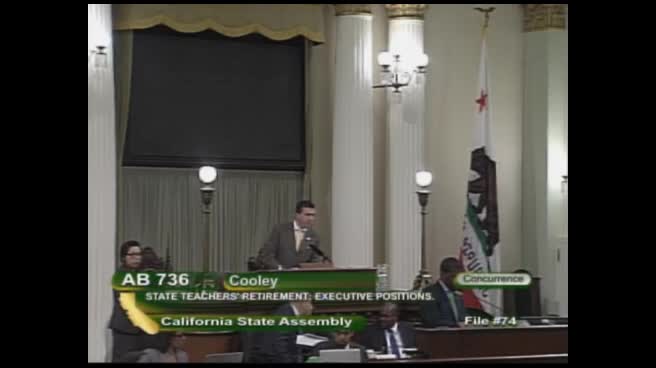 1MIN
Assembly Floor
 59SEC
Senate Floor
 1MIN
Assembly Floor
 1MIN












