AB 1375: Criminal penalties: nonpayment of fines.
- Session Year: 2015-2016
- House: Assembly
- Latest Version Date: 2015-08-13
Existing law provides that a judgment that a criminal defendant pay a fine, other than a restitution fine or order, may also direct that he or she be imprisoned until the fine is satisfied. Existing law requires the judgment to specify the term of imprisonment for nonpayment of the fine, and prohibits that term from exceeding one day for each $30 of the fine, or exceeding the term for which the defendant may be sentenced for the offense of which he or she has been convicted.
Existing law also provides that in all felony and misdemeanor convictions, either by plea or by verdict, when the defendant has been in custody, all days of custody of the defendant, as specified, are to be credited upon his or her term of imprisonment, or credited to any fine, on a proportional basis, that may be imposed, at the rate of not less than $30 per day, in the discretion of the court imposing the sentence.
This bill would increase those rates from not less than $30 to not less than $125 per day.
(a)A judgment that the defendant pay a fine, with or without other punishment, may also direct that he or she be imprisoned until the fine is satisfied and may further direct that the imprisonment begin at and continue after the expiration of any imprisonment imposed as a part of the punishment or of any other imprisonment to which the defendant may have been sentenced. The judgment shall specify the term of imprisonment for nonpayment of the fine, which shall not be more than one day for each one hundred twenty five dollars ($125) of the fine, nor exceed the term for which the defendant may be sentenced to imprisonment for the offense of which he or she has been convicted. A defendant held in custody for nonpayment of a fine shall be entitled to credit on the fine for each day he or she is held in custody, at the rate specified in the judgment. When the defendant has been convicted of a misdemeanor, a judgment that the defendant pay a fine may also direct that he or she pay the fine within a limited time or in installments on specified dates, and that in default of payment as stipulated he or she be imprisoned in the discretion of the court either until the defaulted installment is satisfied or until the fine is satisfied in full; but unless the direction is given in the judgment, the fine shall be payable.
(b)Except as otherwise provided in case of fines imposed, as a condition of probation, the defendant shall pay the fine to the clerk of the court, or to the judge if there is no clerk, unless the defendant is taken into custody for nonpayment of the fine, in which event payments made while he or she is in custody shall be made to the officer who holds the defendant in custody, and all amounts paid shall be paid over by the officer to the court that rendered the judgment. The clerk shall report to the court every default in payment of a fine or any part of that fine, or if there is no clerk, the court shall take notice of the default. If time has been given for payment of a fine or it has been made payable in installments, the court shall, upon any default in payment, immediately order the arrest of the defendant and order him or her to show cause why he or she should not be imprisoned until the fine or installment is satisfied in full. If the fine or installment is payable forthwith and it is not paid, the court shall, without further proceedings, immediately commit the defendant to the custody of the proper officer to be held in custody until the fine or installment is satisfied in full.
(c)This section applies to any violation of any of the codes or statutes of this state punishable by a fine or by a fine and imprisonment.
(d)Nothing in this section shall be construed to prohibit the clerk of the court, or the judge if there is no clerk, from turning these accounts over to another county department or a collecting agency for processing and collection.
(e)The defendant shall pay to the clerk of the court or the collecting agency a fee for the processing of installment accounts. This fee shall equal the administrative and clerical costs, as determined by the board of supervisors, or by the court, depending on which entity administers the account. The defendant shall pay to the clerk of the court or the collecting agency the fee established for the processing of the accounts receivable that are not to be paid in installments. The fee shall equal the administrative and clerical costs, as determined by the board of supervisors, or by the court, depending on which entity administers the account, except that the fee shall not exceed thirty dollars ($30).
(f)This section shall not apply to restitution fines and restitution orders.
SEC. 2.Section 2900.5 of the Penal Code is amended to read:2900.5.(a)In all felony and misdemeanor convictions, either by plea or by verdict, when the defendant has been in custody, including, but not limited to, any time spent in a jail, camp, work furlough facility, halfway house, rehabilitation facility, hospital, prison, juvenile detention facility, or similar residential institution, all days of custody of the defendant, including days served as a condition of probation in compliance with a court order, credited to the period of confinement pursuant to Section 4019, and days served in home detention pursuant to Section 1203.016 or 1203.018, shall be credited upon his or her term of imprisonment, or credited to any fine, including, but not limited to, base fines, on a proportional basis, that may be imposed, at the rate of not less than one hundred twenty five dollars ($125) per day, or more, in the discretion of the court imposing the sentence. If the total number of days in custody exceeds the number of days of the term of imprisonment to be imposed, the entire term of imprisonment shall be deemed to have been served. In any case where the court has imposed both a prison or jail term of imprisonment and a fine, any days to be credited to the defendant shall first be applied to the term of imprisonment imposed, and thereafter the remaining days, if any, shall be applied to the fine, including, but not limited to, base fines, on a proportional basis.
(b)For the purposes of this section, credit shall be given only where the custody to be credited is attributable to proceedings related to the same conduct for which the defendant has been convicted. Credit shall be given only once for a single period of custody attributable to multiple offenses for which a consecutive sentence is imposed.
(c)For the purposes of this section, term of imprisonment includes any period of imprisonment imposed as a condition of probation or otherwise ordered by a court in imposing or suspending the imposition of any sentence, and also includes any term of imprisonment, including any period of imprisonment prior to release on parole and any period of imprisonment and parole, prior to discharge, whether established or fixed by statute, by any court, or by any duly authorized administrative agency.
(d)It is the duty of the court imposing the sentence to determine the date or dates of any admission to, and release from, custody prior to sentencing and the total number of days to be credited pursuant to this section. The total number of days to be credited shall be contained in the abstract of judgment provided for in Section 1213.
(e)It is the duty of any agency to which a person is committed to apply the credit provided for in this section for the period between the date of sentencing and the date the person is delivered to the agency.
(f)If a defendant serves time in a camp, work furlough facility, halfway house, rehabilitation facility, hospital, juvenile detention facility, similar residential facility, or home detention program pursuant to Section 1203.016, 1203.017, or 1203.018, in lieu of imprisonment in a county jail, the time spent in these facilities or programs shall qualify as mandatory time in jail.
(g)Notwithstanding any other provision of this code as it pertains to the sentencing of convicted offenders, this section does not authorize the sentencing of convicted offenders to any of the facilities or programs mentioned herein.
(a)A judgment that the defendant pay a fine, with or without other punishment, may also direct that he or she be imprisoned until the fine is satisfied and may further direct that the imprisonment begin at and continue after the expiration of any imprisonment imposed as a part of the punishment or of any other imprisonment to which the defendant may have been sentenced. The judgment shall specify the term of imprisonment for nonpayment of the fine, which shall not be more than one day for each thirty dollars ($30) one hundred twenty five dollars ($125) of the fine, nor exceed the term for which the defendant may be sentenced to imprisonment for the offense of which he or she has been convicted. A defendant held in custody for nonpayment of a fine shall be entitled to credit on the fine for each day he or she is held in custody, at the rate specified in the judgment. When the defendant has been convicted of a misdemeanor, a judgment that the defendant pay a fine may also direct that he or she pay the fine within a limited time or in installments on specified dates, and that in default of payment as stipulated he or she be imprisoned in the discretion of the court either until the defaulted installment is satisfied or until the fine is satisfied in full; but unless the direction is given in the judgment, the fine shall be payable.
(b)Except as otherwise provided in case of fines imposed, as a condition of probation, the defendant shall pay the fine to the clerk of the court, or to the judge if there is no clerk, unless the defendant is taken into custody for nonpayment of the fine, in which event payments made while he or she is in custody shall be made to the officer who holds the defendant in custody, and all amounts paid shall be paid over by the officer to the court that rendered the judgment. The clerk shall report to the court every default in payment of a fine or any part of that fine, or if there is no clerk, the court shall take notice of the default. If time has been given for payment of a fine or it has been made payable in installments, the court shall, upon any default in payment, immediately order the arrest of the defendant and order him or her to show cause why he or she should not be imprisoned until the fine or installment is satisfied in full. If the fine or installment is payable forthwith and it is not paid, the court shall, without further proceedings, immediately commit the defendant to the custody of the proper officer to be held in custody until the fine or installment is satisfied in full.
(c)This section applies to any violation of any of the codes or statutes of this state punishable by a fine or by a fine and imprisonment.
(d)Nothing in this section shall be construed to prohibit the clerk of the court, or the judge if there is no clerk, from turning these accounts over to another county department or a collecting agency for processing and collection.
(e)The defendant shall pay to the clerk of the court or the collecting agency a fee for the processing of installment accounts. This fee shall equal the administrative and clerical costs, as determined by the board of supervisors, or by the court, depending on which entity administers the account. The defendant shall pay to the clerk of the court or the collecting agency the fee established for the processing of the accounts receivable that are not to be paid in installments. The fee shall equal the administrative and clerical costs, as determined by the board of supervisors, or by the court, depending on which entity administers the account, except that the fee shall not exceed thirty dollars ($30).
(f)This section shall not apply to restitution fines and restitution orders.
SEC. 2.Section 2900.5 of the Penal Code is amended to read:2900.5.(a)In all felony and misdemeanor convictions, either by plea or by verdict, when the defendant has been in custody, including, but not limited to, any time spent in a jail, camp, work furlough facility, halfway house, rehabilitation facility, hospital, prison, juvenile detention facility, or similar residential institution, all days of custody of the defendant, including days served as a condition of probation in compliance with a court order, credited to the period of confinement pursuant to Section 4019, and days served in home detention pursuant to Section 1203.016 or 1203.018, shall be credited upon his or her term of imprisonment, or credited to any fine, including, but not limited to, base fines, on a proportional basis, that may be imposed, at the rate of not less than thirty dollars ($30) one hundred twenty five dollars ($125) per day, or more, in the discretion of the court imposing the sentence. If the total number of days in custody exceeds the number of days of the term of imprisonment to be imposed, the entire term of imprisonment shall be deemed to have been served. In any case where the court has imposed both a prison or jail term of imprisonment and a fine, any days to be credited to the defendant shall first be applied to the term of imprisonment imposed, and thereafter the remaining days, if any, shall be applied to the fine, including, but not limited to, base fines, on a proportional basis.
(b)For the purposes of this section, credit shall be given only where the custody to be credited is attributable to proceedings related to the same conduct for which the defendant has been convicted. Credit shall be given only once for a single period of custody attributable to multiple offenses for which a consecutive sentence is imposed.
(c)For the purposes of this section, term of imprisonment includes any period of imprisonment imposed as a condition of probation or otherwise ordered by a court in imposing or suspending the imposition of any sentence, and also includes any term of imprisonment, including any period of imprisonment prior to release on parole and any period of imprisonment and parole, prior to discharge, whether established or fixed by statute, by any court, or by any duly authorized administrative agency.
(d)It is the duty of the court imposing the sentence to determine the date or dates of any admission to, and release from, custody prior to sentencing and the total number of days to be credited pursuant to this section. The total number of days to be credited shall be contained in the abstract of judgment provided for in Section 1213.
(e)It is the duty of any agency to which a person is committed to apply the credit provided for in this section for the period between the date of sentencing and the date the person is delivered to the agency.
(f)If a defendant serves time in a camp, work furlough facility, halfway house, rehabilitation facility, hospital, juvenile detention facility, similar residential facility, or home detention program pursuant to Section 1203.016, 1203.017, or 1203.018, in lieu of imprisonment in a county jail, the time spent in these facilities or programs shall qualify as mandatory time in jail.
(g)Notwithstanding any other provision of this code as it pertains to the sentencing of convicted offenders, this section does not authorize the sentencing of convicted offenders to any of the facilities or programs mentioned herein.
|
Date
|
Status
|
|---|---|
| May 14, 2015 | Referred to Com. on PUB. S. |
| Aug 13, 2015 | Chaptered by Secretary of State - Chapter 209, Statutes of 2015. |
| Aug 13, 2015 | Approved by the Governor. |
| Aug 3, 2015 | Enrolled and presented to the Governor at 3 p.m. |
| Jul 6, 2015 | Read third time. Passed. Ordered to the Assembly. (Ayes 39. Noes 0. Page 1789.). |
| Jul 6, 2015 | Read third time. Passed. Ordered to the Assembly. |
| Jul 6, 2015 | In Assembly. Ordered to Engrossing and Enrolling. |
| Jun 30, 2015 | Read second time. Ordered to third reading. |
| Jun 29, 2015 | From committee: Be placed on second reading file pursuant to Senate Rule 28.8. |
| Jun 16, 2015 | From committee: Do pass and re-refer to Com. on APPR. (Ayes 7. Noes 0.) (June 16). Re-referred to Com. on APPR. |
| Feb 27, 2015 | Introduced. To print. |
| Apr 30, 2015 | Read third time. Passed. Ordered to the Senate. (Ayes 77. Noes 0. Page 1226.) |
| Apr 30, 2015 | Read third time. Passed. Ordered to the Senate. |
| Apr 30, 2015 | In Senate. Read first time. To Com. on RLS. for assignment. |
| Apr 23, 2015 | Read second time. Ordered to Consent Calendar. |
| Apr 22, 2015 | From committee: Do pass. To Consent Calendar. (Ayes 17. Noes 0.) (April 22). |
| Apr 15, 2015 | From committee: Do pass and re-refer to Com. on APPR. with recommendation: To Consent Calendar. (Ayes 7. Noes 0.) (April 14). Re-referred to Com. on APPR. |
| Mar 23, 2015 | Referred to Com. on PUB. S. |
| Mar 2, 2015 | Read first time. |
| Mar 1, 2015 | From printer. May be heard in committee March 31. |
|
Date
|
Description
|
Location
|
Votes
|
|
|---|---|---|---|---|
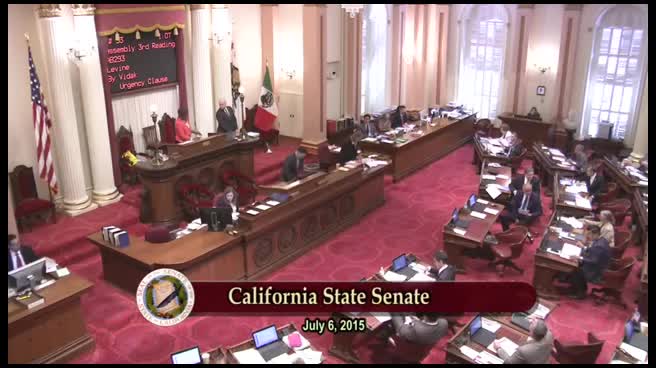
| Jul 6, 2015 | Assembly 3rd Reading AB1375 Thurmond By Hall | Senate Floor |
Passed |
|
| Jun 16, 2015 | Do pass, but first be re-referred to the Committee on [Appropriations] | Senate Standing Committee on Public Safety |
Passed |
|
| Apr 30, 2015 | AB 1375 THURMOND Consent Calendar Second Day Regular Session | Assembly Floor |
Passed |
|
| Apr 22, 2015 | Do pass. To Consent Calendar. | Assembly Standing Committee on Appropriations |
Passed |
|
| Apr 14, 2015 | Do pass and be re-referred to the Committee on [Appropriations] with recommendation: To Consent Calendar | Assembly Standing Committee on Public Safety |
Passed |
This list shows positions taken on this bill by organizations on the date displayed, which is linked to the original source.
Positions by individuals are not included.
|
Organization
|
Position
|
Date
|
|---|---|---|
| American Civil Liberties Union of California | ** Support | Jul 6, 2015 |
| California Attorneys For Criminal Justice | ** Support | Jul 6, 2015 |
| California Public Defenders Association | ** Support | Jul 6, 2015 |
| Conference of California Bar Associations | ** Support | Jul 6, 2015 |
| Ella Baker Center For Human Rights | ** Support | Jul 6, 2015 |
| Legal Services for Prisoners with Children | ** Support | Jul 6, 2015 |
AB 1375
Page 4
|
Office of Senate Floor Analyses (916) 651-1520 Fax: (916) 327-4478 |
THIRD READING
Bill No: AB 1375
Introduced: 2/27/15
SENATE PUBLIC SAFETY COMMITTEE: 7-0, 6/16/15
AYES: Hancock, Anderson, Glazer, Leno, Liu, Monning, Stone
SENATE APPROPRIATIONS COMMITTEE: Senate Rule 28.8
ASSEMBLY FLOOR: 77-0, 4/30/15 (Consent) - See last page for vote
SUBJECT: Criminal penalties: nonpayment of fines
SOURCE: Conference of California Bar Associations
DIGEST: This bill increases the statutory rate for payment of fines by incarceration from not less than $30 per day to not less than $125 per day.
Existing law:
Authorizes the court to incarcerate a defendant until an imposed criminal fine is satisfied, but limits such imprisonment to the maximum term permitted for the particular offense of conviction. (Penal Code § 1205(a).)
Requires that the time of imprisonment for failure to pay a fine be calculated as no more than one day for every $30 of the fine. (Penal Code § 1205(a).)
States that this provision applies to any violation of any of the codes or statutes of the state which are punishable by a fine or by a fine and imprisonment, but that it does not apply to restitution fines or restitution orders. (Penal Code § 1205(c) and (f).)
Provides that all days spent in custody by the defendant must first be applied to the term of imprisonment and then to any fine including, but not limited to, base fines at the rate of not less than $30 per day, or more, in the discretion of the trial court. (Penal Code § 2900.5(a).)
This bill requires that the time of imprisonment for failure to pay a fine be calculated as no more than one day for every $125 of the fine.
Background
Penal
Code Section 1205 gives the court power to enforce payment of fine in
criminal case by imprisonment. Penal Code Section 1205 also allows
defendants to request that the trial court exercise its discretion to
convert fines to jail time. The statute, however, cannot be used to
pay off restitution fines or victim restitution orders. (Penal Code
§ 1205(f).)
Criminal
fines and penalties have climbed steadily in recent decades.
Government entities tasked with collecting these fines have realized
diminishing returns from collection efforts. A recent San Francisco
Daily Journal article noted, “California courts and counties
collect nearly $2 billion in fines and fees every year.
Nevertheless, the state still has a more than $10.2 billion balance
of uncollected debt from prior years, according to the most recent
date from 2012.” (See Jones & Sugarman, State Judges Bemoan
Fee Collection Process, San Francisco Daily Journal, (January 5,
2015).) “Felons convicted to prison time usually can’t pay their
debts at all. The annual growth in delinquent debt partly reflects a
supply of money that doesn’t exist to be collected.” (Id.) In
the same article, the Presiding Judge of San Bernardino County was
quoted as saying “the whole concept is getting blood out of a
turnip.” (Id.)
By raising the daily rate at which
defendants can pay off fines and fees by converting them to jail
time, this bill may help incentivize defendants to address delinquent
debt.
FISCAL EFFECT: Appropriation: No Fiscal Com.: Yes Local: No
Conference of California Bar Associations (source)
American Civil Liberties Union of California
California Attorneys for Criminal Justice
California Public Defenders Association
Ella Baker Center for Human Rights
Legal Services for Prisoners with Children
OPPOSITION: (Verified 6/26/15)
None received
ARGUMENTS IN SUPPORT: The Conference of California Bar Associations states:
Under existing law, a criminal defendant may choose or be ordered to
serve jail time in lieu of paying a criminal fine, or he or she may
be allowed to credit time spent incarcerated against the payment of a
fine. The minimum rate of credit is $30.00 per day of incarceration
– an amount that was set in 1976 and has not been adjusted since.
In almost all California counties, this “minimum” has since
become the actual amount credited.
When this law was
enacted, $30.00 was equivalent to working 12 hours at a minimum wage
job ($1.50/hour). On January 1, 2016, the minimum wage in California
will increase to be $10.00/hour, meaning that the same 12-hour day
should be worth $120 – essentially the amount provided by AB 1375.
By another measure, $30.00 in 1976 had the same buying power as
$125.00 in 2014, according to the Bureau of Labor
Statistics.
Further, while base fines have not increased
substantially in the 39 years since 1976, the total amount offenders
are required to pay has skyrocketed due to added penalties and
assessments. The total fine for running a red light increased from
$103 in 1993 to $490 today – a 475% increase in just 20 years,
compared to the proposed 416% increase in the credit proposed by AB
1375. Speeding up to 15 mph over the limit also comes with a $238
price tag - more than 800% above what it cost in 1993. By almost any
standard, the proposed increase in the credit for jail time in lieu
of a fine is very reasonable, modest even, when it is compared to the
rise in inflation, the increased minimum wage, and the vast inflation
of court fines and fees.
This failure to adjust the rate
of credit hurts poor defendants far more than better-off defendants,
increasing anger and resentment at the inequity. Poor defendants are
less likely to be able to post bail and will spend more time
incarcerated awaiting a hearing or “working off” their fine. The
inability of an increasing number of defendants to pay the fine
outright also increases jail overcrowding.
Finally, it is
not fiscally responsible to credit defendants only $30 per day in
lieu of fine payments. At an average cost of $100 per day to house
somebody in a California county jail, it would take 10 days and cost
$1000 to house a person paying off a $300 fine. At the more
equitable rate of $125 per day, it would only take 3 days and cost
about $300. The cost savings alone justify the increase to $125 per
day.
AYES: Achadjian, Alejo, Travis Allen, Baker, Bigelow, Bloom, Bonilla, Bonta, Brough, Brown, Burke, Calderon, Chang, Chau, Chiu, Chu, Cooley, Cooper, Dababneh, Dahle, Daly, Dodd, Eggman, Frazier, Beth Gaines, Gallagher, Cristina Garcia, Eduardo Garcia, Gatto, Gipson, Gonzalez, Gordon, Gray, Grove, Hadley, Harper, Roger Hernández, Holden, Irwin, Jones, Jones-Sawyer, Kim, Lackey, Levine, Linder, Lopez, Low, Maienschein, Mathis, Mayes, McCarty, Medina, Melendez, Mullin, Nazarian, Obernolte, O'Donnell, Olsen, Patterson, Perea, Quirk, Rendon, Ridley-Thomas, Rodriguez, Salas, Santiago, Steinorth, Mark Stone, Thurmond, Ting, Wagner, Waldron, Weber, Wilk, Williams, Wood, Atkins
NO VOTE RECORDED: Campos, Chávez, Gomez
Prepared by: Jessica Devencenzi / PUB. S. /
6/29/15 15:52:18
**** END ****
AB 1375 (Thurmond ) Page 4 of 4
SENATE COMMITTEE ON PUBLIC SAFETY
Senator Loni Hancock, Chair
2015 - 2016 Regular
Bill No: AB 1375 Hearing Date: June 16, 2015
Author: |
Thurmond |
||
Version: |
February 27, 2015 |
||
Urgency: |
No |
Fiscal: |
Yes |
Consultant: |
JRD |
||
Subject: Criminal Penalties: Nonpayment of Fines
HISTORY
Source: Conference of California Bar Associations
Prior Legislation: SB 1371 (Anderson), Chapter 49, Statutes of 2012
Support: American Civil Liberties Union of California; California Attorneys for Criminal Justice; California Public Defenders Association; Legal Services for Prisoners with Children; Ella Baker Center for Human Rights
Opposition: None known
Assembly Floor Vote: 77 - 0
PURPOSE
The purpose of this bill is to increase the statutory rate for payment of fines by incarceration from not less than $30 per day to not less than $125 per day.
Existing law authorizes the court to incarcerate a defendant until an imposed criminal fine is satisfied, but limits such imprisonment to the maximum term permitted for the particular offense of conviction. (Penal Code § 1205(a).)
Existing law requires that the time of imprisonment for failure to pay a fine be calculated as no more than one day for every $30 of the fine. (Penal Code § 1205(a).)
Existing law states that this provision applies to any violation of any of the codes or statutes of the state which are punishable by a fine or by a fine and imprisonment, but that it does not apply to restitution fines or restitution orders. (Penal Code § 1205(c) and (f).)
Existing law provides that all days spent in custody by the defendant must first be applied to the term of imprisonment and then to any fine including, but not limited to, base fines at the rate of not less than $30 per day, or more, in the discretion of the trial court. (Penal Code § 2900.5(a).)
This bill requires that the time of imprisonment for failure to pay a fine be calculated as no more than one day for every $125 of the fine.
This bill provides that all days spent in custody by the defendant must first be applied to the term of imprisonment and then to any fine including, but not limited to, base fines at the rate of not less than $125 per day.
RECEIVERSHIP/OVERCROWDING CRISIS AGGRAVATION
For the past eight years, this Committee has scrutinized legislation referred to its jurisdiction for any potential impact on prison overcrowding. Mindful of the United States Supreme Court ruling and federal court orders relating to the state’s ability to provide a constitutional level of health care to its inmate population and the related issue of prison overcrowding, this Committee has applied its “ROCA” policy as a content-neutral, provisional measure necessary to ensure that the Legislature does not erode progress in reducing prison overcrowding.
On February 10, 2014, the federal court ordered California to reduce its in-state adult institution population to 137.5% of design capacity by February 28, 2016, as follows:
143% of design bed capacity by June 30, 2014;
141.5% of design bed capacity by February 28, 2015; and,
137.5% of design bed capacity by February 28, 2016.
In February of this year the administration reported that as “of February 11, 2015, 112,993 inmates were housed in the State’s 34 adult institutions, which amounts to 136.6% of design bed capacity, and 8,828 inmates were housed in out-of-state facilities. This current population is now below the court-ordered reduction to 137.5% of design bed capacity.” ( Defendants’ February 2015 Status Report In Response To February 10, 2014 Order, 2:90-cv-00520 KJM DAD PC, 3-Judge Court, Coleman v. Brown, Plata v. Brown (fn. omitted).
While significant gains have been made in reducing the prison population, the state now must stabilize these advances and demonstrate to the federal court that California has in place the “durable solution” to prison overcrowding “consistently demanded” by the court. (Opinion Re: Order Granting in Part and Denying in Part Defendants’ Request For Extension of December 31, 2013 Deadline, NO. 2:90-cv-0520 LKK DAD (PC), 3-Judge Court, Coleman v. Brown, Plata v. Brown (2-10-14). The Committee’s consideration of bills that may impact the prison population therefore will be informed by the following questions:
Whether a proposal erodes a measure which has contributed to reducing the prison population;
Whether a proposal addresses a major area of public safety or criminal activity for which there is no other reasonable, appropriate remedy;
Whether a proposal addresses a crime which is directly dangerous to the physical safety of others for which there is no other reasonably appropriate sanction;
Whether a proposal corrects a constitutional problem or legislative drafting error; and
Whether a proposal proposes penalties which are proportionate, and cannot be achieved through any other reasonably appropriate remedy.
COMMENTS
1. Need for This Legislation
According to the author:
Under existing law, a criminal defendant may choose or be ordered to serve jail time in lieu of paying a criminal fine, or he or she may be allowed to credit time spent incarcerated against the payment of a fine. The minimum rate of credit is $30.00 per day of incarceration – an amount that was set 39 years ago in 1976 and has not been adjusted since. In almost all California counties, this “minimum” has since become the actual amount credited. At the same time, while base fines have not increased substantially since 1976, the total amount offenders are required to pay has skyrocketed due to added penalties and assessments. The total fine for running a red light increased from $103 in 1993 to $490 today – a 475% increase in just 20 years, compared to the proposed 416% increase in the credit proposed by AB 1375. Speeding up to 15 mph over the limit also comes with a $238 price tag - more than 800% above what it cost in 1993.
It is not fiscally responsible to credit defendants only $30 per day in lieu of fine payments. At an average cost of $100 per day to house somebody in a California county jail, it would take 10 days and cost $1000 to house a person paying off a $300 fine. At the more equitable rate of $125 per day, it would only take 3 days and cost about $300. The cost savings alone justify the increase to $125 per day.
This failure to adjust the rate of credit hurts poor defendants far more than better-off defendants, increasing anger and resentment at the inequity. Poor defendants are less likely to be able to post bail and will spend more time incarcerated awaiting a hearing or “working off” their fine. The inability of an increasing number of defendants to pay the fine outright also increases jail overcrowding.
2. Effect of Legislation
Penal
Code section 1205 gives the court power to enforce payment of fine in
criminal case by imprisonment.1
Penal Code section 1205 also allows defendants to request that the
trial court exercise its discretion to convert fines to jail time.
The statute, however, cannot be used to pay off restitution fines or
victim restitution orders. (Penal Code § 1205(f).)
Criminal
fines and penalties have climbed steadily in recent decades.
Government entities tasked with collecting these fines have realized
diminishing returns from collection efforts. A recent San Francisco
Daily Journal article noted, “California courts and counties
collect nearly $2 billion in fines and fees every year.
Nevertheless, the state still has a more than $10.2 billion balance
of uncollected debt from prior years, according to the most recent
date from 2012.” (See Jones & Sugarman, State
Judges Bemoan Fee Collection Process,
San Francisco Daily Journal, (January 5, 2015).) “Felons convicted
to prison time usually can’t pay their debts at all. The annual
growth in delinquent debt partly reflects a supply of money that
doesn’t exist to be collected.” (Id.)
In the same article, the Presiding Judge of San Bernardino County
was quoted as saying “the whole concept is getting blood out of a
turnip.” (Id.)
By raising the daily rate at which defendants can pay
off fines and fees by converting them to jail time, this bill may
help incentivize defendants to address delinquent debt.
3. Argument in Support
According to the Conference of California Bar Associations, the sponsor of this bill:
Under existing law, a criminal
defendant may choose or be ordered to serve jail time in lieu of
paying a criminal fine, or he or she may be allowed to credit time
spent incarcerated against the payment of a fine. The minimum rate
of credit is $30.00 per day of incarceration – an amount that was
set in 1976 and has not been adjusted since. In almost all
California counties, this “minimum” has since become the actual
amount credited.
When this law was enacted, $30.00 was
equivalent to working 12 hours at a minimum wage job ($1.50/hour).
On January 1, 2016, the minimum wage in California will increase to
be $10.00/hour, meaning that the same 12-hour day should be worth
$120 – essentially the amount provided by AB 1375. By another
measure, $30.00 in 1976 had the same buying power as $125.00 in 2014,
according to the Bureau of Labor Statistics.
Further,
while base fines have not increased substantially in the 39 years
since 1976, the total amount offenders are required to pay has
skyrocketed due to added penalties and assessments. The total fine
for running a red light increased from $103 in 1993 to $490 today –
a 475% increase in just 20 years, compared to the proposed 416%
increase in the credit proposed by AB 1375. Speeding up to 15 mph
over the limit also comes with a $238 price tag - more than 800%
above what it cost in 1993. By almost any standard, the proposed
increase in the credit for jail time in lieu of a fine is very
reasonable, modest even, when it is compared to the rise in
inflation, the increased minimum wage, and the vast inflation of
court fines and fees.
This failure to adjust the rate of
credit hurts poor defendants far more than better-off defendants,
increasing anger and resentment at the inequity. Poor defendants are
less likely to be able to post bail and will spend more time
incarcerated awaiting a hearing or “working off” their fine. The
inability of an increasing number of defendants to pay the fine
outright also increases jail overcrowding.
Finally, it is
not fiscally responsible to credit defendants only $30 per day in
lieu of fine payments. At an average cost of $100 per day to house
somebody in a California county jail, it would take 10 days and cost
$1000 to house a person paying off a $300 fine. At the more
equitable rate of $125 per day, it would only take 3 days and cost
about $300. The cost savings alone justify the increase to $125 per
day.
-- END –
1 However, imprisonment pending payment of a fine is unconstitutional as applied to a convicted indigent defendant if the failure to pay is due to indigence and not to willfulness. (In re Antazo (1970) 3 Cal.3d 100, 103-104.)
AB 1375
Page 2
Date of Hearing: April 22, 2015
ASSEMBLY COMMITTEE ON APPROPRIATIONS
Jimmy Gomez, Chair
AB 1375
(Thurmond) – As Introduced February 27, 2015
Policy Committee: |
Public Safety |
Vote: |
7 - 0 |
|
|
|
|
|
|
|
|
Urgency: No State Mandated Local Program: No Reimbursable: No
SUMMARY:
This bill increases the statutory rate for credit for fines through incarceration, in lieu of paying a fine, from not less than $30 per day to not less than $125 per day.
FISCAL EFFECT:
Unknown savings to counties by reducing the time served in county jail. For example, if the average cost to house someone in jail is $100/day, a $300 base fine could be paid in 3 days, instead of 10 days.
Unknown revenue loss to the state (GF) and local agencies if more individuals opt for jail time than to pay the base fine. Penalties, assessments, and restitutions are not impacted by AB 1375.
COMMENTS:
Purpose. According to the author, "AB 1375 will bring equity to an unfair situation that has been getting worse with each passing year, by making the first increase in the dollar amount of credit incarcerated prisoners receive against fines imposed since the law was enacted in 1976. In that time, the minimum wage has increased by over 600% and the total fines, with penalties and assessments, of typical infractions has increased similarly – to over 475% for running a red light and more than 800% for travelling 15 miles over the speed limit. The failure to adjust the rate of credit hurts poor defendants far more than better-off defendants, increasing anger and resentment at the inequity. The inability of an increasing number of defendants to pay the fine outright also increases jail overcrowding and adds to the burden on the taxpayers, since the costs of incarceration are substantially more than the value of the fines imposed."
Background. Current law gives the court power to enforce payment of fine in criminal case by imprisonment. However, imprisonment pending payment of a fine is unconstitutional as applied to a convicted indigent defendant if the failure to pay is due to indigence and not to willfulness. This law is also used by defendants as a vehicle to request that the trial court exercise its discretion to convert fines to jail time. However, the statute cannot be used to pay off restitution fines or victim restitution orders.
Argument in Support: According to the Conference of California Bar Associations, the sponsor of this bill, "Under existing law, a criminal defendant may choose or be ordered to serve jail time in lieu of paying a criminal fine, or he or she may be allowed to credit time spent incarcerated against the payment of a fine. The minimum rate of credit is $30.00 per day of incarceration – an amount that was set in 1976 and has not been adjusted since. In almost all California counties, this “minimum” has since become the actual amount credited.
"When this law was enacted, $30.00 was equivalent to working 12 hours at a minimum wage job ($1.50/hour). On January 1, 2016, the minimum wage in California will increase to be $10.00/hour, meaning that the same 12-hour day should be worth $120 – essentially the amount provided by AB 1375. By another measure, $30.00 in 1976 had the same buying power as $125.00 in 2014, according to the Bureau of Labor Statistics.Prior Legislation: SB 1371 (Anderson), Chapter 49, Statutes of 2012, prohibits a defendant from satisfying an order to pay direct restitution to a victim, a restitution fine, or both, through time spent in custody at the statutory rate of $30 per day.
Analysis Prepared by: Pedro R. Reyes / APPR. / (916) 319-2081
AB 1375
Page 3
Date of Hearing: April 14, 2015
Counsel: Sandra Uribe
ASSEMBLY COMMITTEE ON PUBLIC SAFETY
Bill Quirk, Chair
AB 1375
(Thurmond) – As Introduced February 27, 2015
SUMMARY:
Increases the statutory rate for payment of fines by incarceration
from not less than $30 per day to not less than $125 per day.
Specifically, this bill:
Requires that the time of imprisonment for failure to pay a fine be calculated as no more than one day for every $125 of the fine.
Provides that all days spent in custody by the defendant must first be applied to the term of imprisonment and then to any fine including, but not limited to, base fines at the rate of not less than $125 per day.
EXISTING LAW:
Authorizes the court to incarcerate a defendant until an imposed criminal fine is satisfied, but limits such imprisonment to the maximum term permitted for the particular offense of conviction. (Pen. Code, § 1205, subd. (a).)
Requires that the time of imprisonment for failure to pay a fine be calculated as no more than one day for every $30 of the fine. (Pen. Code, § 1205, subd. (a).)
States that this provision applies to any violation of any of the codes or statutes of the state which are punishable by a fine or by a fine and imprisonment, but that it does not apply to restitution fines or restitution orders. (Pen. Code, § 1205, subds. (c) & (f).)
Provides that all days spent in custody by the defendant must first be applied to the term of imprisonment and then to any fine including, but not limited to, base fines at the rate of not less than $30 per day, or more, in the discretion of the trial court. (Pen. Code, § 2900.5, subd. (a).)
FISCAL EFFECT:
Unknown
COMMENTS:
Author's Statement: According to the author, "AB 1375 will bring equity to an unfair situation that has been getting worse with each passing year, by making the first increase in the dollar amount of credit incarcerated prisoners receive against fines imposed since the law was enacted in 1976. In that time, the minimum wage has increased by over 600% and the total fines, with penalties and assessments, of typical infractions has increased similarly – to over 475% for running a red light and more than 800% for travelling 15 miles over the speed limit. The failure to adjust the rate of credit hurts poor defendants far more than better-off defendants, increasing anger and resentment at the inequity. The inability of an increasing number of defendants to pay the fine outright also increases jail overcrowding and adds to the burden on the taxpayers, since the costs of incarceration are substantially more than the value of the fines imposed."
Penal Code Section 1205: Penal Code section 1205 gives the court power to enforce payment of fine in criminal case by imprisonment. However, imprisonment pending payment of a fine is unconstitutional as applied to a convicted indigent defendant if the failure to pay is due to indigence and not to willfulness. (In re Antazo (1970) 3 Cal.3d 100, 103-104.)
Penal Code section 1205 is also used by defendants as a vehicle to request that the trial court exercise its discretion to convert fines to jail time. However, the statute cannot be used to pay off restitution fines or victim restitution orders. (Pen. Code, § 1205, subd. (f).)
Outstanding Court-Ordered Debt: Criminal fines and penalties have climbed steadily in recent decades. Government entities tasked with collecting these fines have realized diminishing returns from collection efforts. A recent San Francisco Daily Journal article noted, "California courts and counties collect nearly $2 billion in fines and fees every year. Nevertheless, the state still has a more than $10.2 billion balance of uncollected debt from prior years, according to the most recent date from 2012." (See Jones & Sugarman, State Judges Bemoan Fee Collection Process, San Francisco Daily Journal, (January 5, 2015).) "Felons convicted to prison time usually can't pay their debts at all. The annual growth in delinquent debt partly reflects a supply of money that doesn't exist to be collected." (Ibid.) In the same article, the Presiding Judge of San Bernardino County was quoted as saying "the whole concept is getting blood out of a turnip." (Ibid.)
By raising the rate at which defendants can pay off fines and fees by converting them to jail time, this bill may help incentivize defendants to address delinquent debt.
Argument in Support: According to the Conference of California Bar Associations, the sponsor of this bill, "Under existing law, a criminal defendant may choose or be ordered to serve jail time in lieu of paying a criminal fine, or he or she may be allowed to credit time spent incarcerated against the payment of a fine. The minimum rate of credit is $30.00 per day of incarceration – an amount that was set in 1976 and has not been adjusted since. In almost all California counties, this “minimum” has since become the actual amount credited.
"When this law was enacted, $30.00 was equivalent to working 12 hours at a minimum wage job ($1.50/hour). On January 1, 2016, the minimum wage in California will increase to be $10.00/hour, meaning that the same 12-hour day should be worth $120 – essentially the amount provided by AB 1375. By another measure, $30.00 in 1976 had the same buying power as $125.00 in 2014, according to the Bureau of Labor Statistics.
"Further, while base fines have not increased substantially in the 39 years since 1976, the total amount offenders are required to pay has skyrocketed due to added penalties and assessments. The total fine for running a red light increased from $103 in 1993 to $490 today – a 475% increase in just 20 years, compared to the proposed 416% increase in the credit proposed by AB 1375. Speeding up to 15 mph over the limit also comes with a $238 price tag - more than 800% above what it cost in 1993. By almost any standard, the proposed increase in the credit for jail time in lieu of a fine is very reasonable, modest even, when it is compared to the rise in inflation, the increased minimum wage, and the vast inflation of court fines and fees.
"This failure to adjust the rate of credit hurts poor defendants far more than better-off defendants, increasing anger and resentment at the inequity. Poor defendants are less likely to be able to post bail and will spend more time incarcerated awaiting a hearing or “working off” their fine. The inability of an increasing number of defendants to pay the fine outright also increases jail overcrowding.
"Finally, it is not fiscally responsible to credit defendants only $30 per day in lieu of fine payments. At an average cost of $100 per day to house somebody in a California county jail, it would take 10 days and cost $1000 to house a person paying off a $300 fine. At the more equitable rate of $125 per day, it would only take 3 days and cost about $300. The cost savings alone justify the increase to $125 per day."
Prior Legislation: SB 1371 (Anderson), Chapter 49, Statutes of 2012, prohibits a defendant from satisfying an order to pay direct restitution to a victim, a restitution fine, or both, through time spent in custody at the statutory rate of $30 per day.
REGISTERED SUPPORT / OPPOSITION:
Support
Conference of California Bar Associations (Sponsor)
American
Civil Liberties Union of California
California Attorneys for
Criminal Justice
California Public Defenders Association
Legal
Services for Prisoners with Children
Opposition
None
Analysis Prepared by:
Sandy Uribe / PUB. S. / (916) 319-3744
Bill Author

Bill Co-Author(s):