AB 1505: Statute of limitations: public contracts.
- Session Year: 2015-2016
- House: Assembly
- Latest Version Date: 2016-08-29
Existing law makes it a misdemeanor to split or separate into smaller work orders or projects any public work project for the purpose of evading the requirement that public work be done by contract after competitive bidding.
Existing law requires that the prosecution of a misdemeanor, unless otherwise provided by law, commence within one year of the commission of the offense.
This bill would require that prosecution for a misdemeanor resulting from evading provisions requiring public work projects to be done by contract after competitive bidding, as prescribed, be commenced within 3 years of the commission of the offense.
Existing law makes it a misdemeanor to split or separate into smaller work orders or projects any public work project for the purpose of evading the requirement that public work be done by contract after competitive bidding.
Existing law requires that the prosecution of a misdemeanor, unless otherwise provided by law, commence within one year of the commission of the offense.
This bill would require that prosecution for a misdemeanor resulting from a city evading provisions requiring public work projects to be done by contract after competitive bidding, as prescribed, be commenced within 3 years of the commission of the offense.
Existing law regulates the employment practices of car washes, including providing specific recordkeeping requirements that employers of car washers must implement with regard to car washer wages, hours, and working conditions, under the enforcement authority of the Division of Labor Standards and Enforcement. Existing law requires employers of car washers to register with the Labor Commissioner and pay a specified registration fee, or be subject to a specified civil fine. Existing law also requires employers of car washers to post a $150,000 bond for the benefit of the state to compensate employees damaged by the employers nonpayment of wages, except as specified. Existing law also provides that a successor to an employer that owed wages and penalties to the predecessors employees is liable for those wages and penalties under specified circumstances.
This bill would require a car wash employer to provide written notice to a successor employer regarding the above provisions prior to the sale or other transfer of the business.
(a)Except as provided in subdivision (b), (c), (d), or (e), prosecution for an offense not punishable by death or imprisonment in the state prison or pursuant to subdivision (h) of Section 1170 shall be commenced within one year after commission of the offense.
(b)Prosecution for a misdemeanor violation of Section 647.6 or former Section 647a committed with or upon a minor under the age of 14 years shall be commenced within three years after commission of the offense.
(c)Prosecution of a misdemeanor violation of Section 729 of the Business and Professions Code shall be commenced within two years after commission of the offense.
(d)Prosecution of a misdemeanor violation of Chapter 9 (commencing with Section 7000) of Division 3 of the Business and Professions Code shall be commenced as follows:
(1)With respect to Sections 7028.17, 7068.5, and 7068.7 of the Business and Professions Code, within one year of the commission of the offense.
(2)With respect to Sections 7027.1, 7028.1, 7028.15, 7118.4, 7118.5, 7118.6, 7126, 7153, 7156, 7157, 7158, 7159.5 (licensee only), 7159.14 (licensee only), 7161, and 7189 of the Business and Professions Code, within two years of the commission of the offense.
(3)With respect to Sections 7027.3 and 7028.16 of the Business and Professions Code, within three years of the commission of the offense.
(4)With respect to Sections 7028, 7159.5 (nonlicensee only), and 7159.14 (nonlicensee only) of the Business and Professions Code, within four years of the commission of the offense.
(e)Prosecution for a misdemeanor violation of Section 6126, 10085.6, 10139, or 10147.6 of the Business and Professions Code or Section 2944.6 or 2944.7 of the Civil Code shall be commenced within three years after discovery of the commission of the offense, or within three years after completion of the offense, whichever is later.
(f)Prosecution for a violation of Section 20116, 20123.5, 20150.11, 20163, 20657, 20922, or 22033 of the Public Contract Code shall commence within three years of the commission of the offense.
(a)Except as provided in subdivision (b), (c), (d), or (e), prosecution for an offense not punishable by death or imprisonment in the state prison or pursuant to subdivision (h) of Section 1170 shall be commenced within one year after commission of the offense.
(b)Prosecution for a misdemeanor violation of Section 647.6 or former Section 647a committed with or upon a minor under the age of 14 years shall be commenced within three years after commission of the offense.
(c)Prosecution of a misdemeanor violation of Section 729 of the Business and Professions Code shall be commenced within two years after commission of the offense.
(d)Prosecution of a misdemeanor violation of Chapter 9 (commencing with Section 7000) of Division 3 of the Business and Professions Code shall be commenced as follows:
(1)With respect to Sections 7028.17, 7068.5, and 7068.7 of the Business and Professions Code, within one year of the commission of the offense.
(2)With respect to Sections 7027.1, 7028.1, 7028.15, 7118.4, 7118.5, 7118.6, 7126, 7153, 7156, 7157, 7158, 7159.5 (licensee only), 7159.14 (licensee only), 7161, and 7189 of the Business and Professions Code, within two years of the commission of the offense.
(3)With respect to Sections 7027.3 and 7028.16 of the Business and Professions Code, within three years of the commission of the offense.
(4)With respect to Sections 7028, 7159.5 (nonlicensee only), and 7159.14 (nonlicensee only) of the Business and Professions Code, within four years of the commission of the offense.
(e)Prosecution for a misdemeanor violation of Section 6126, 10085.6, 10139, or 10147.6 of the Business and Professions Code or Section 2944.6 or 2944.7 of the Civil Code shall be commenced within three years after discovery of the commission of the offense, or within three years after completion of the offense, whichever is later.
(f)Prosecution for a violation of Section 20163 20116, 20123.5, 20150.11, 20163, 20657, 20922, or 22033 of the Public Contract Code shall commence within three years of the commission of the offense.
(a)Except as provided in subdivision (b), (c), (d), or (e), prosecution for an offense not punishable by death or imprisonment in the state prison or pursuant to subdivision (h) of Section 1170 shall be commenced within one year after commission of the offense.
(b)Prosecution for a misdemeanor violation of Section 647.6 or former Section 647a committed with or upon a minor under the age of 14 years shall be commenced within three years after commission of the offense.
(c)Prosecution of a misdemeanor violation of Section 729 of the Business and Professions Code shall be commenced within two years after commission of the offense.
(d)Prosecution of a misdemeanor violation of Chapter 9 (commencing with Section 7000) of Division 3 of the Business and Professions Code shall be commenced as follows:
(1)With respect to Sections 7028.17, 7068.5, and 7068.7 of the Business and Professions Code, within one year of the commission of the offense.
(2)With respect to Sections 7027.1, 7028.1, 7028.15, 7118.4, 7118.5, 7118.6, 7126, 7153, 7156, 7157, 7158, 7159.5 (licensee only), 7159.14 (licensee only), 7161, and 7189 of the Business and Professions Code, within two years of the commission of the offense.
(3)With respect to Sections 7027.3 and 7028.16 of the Business and Professions Code, within three years of the commission of the offense.
(4)With respect to Sections 7028, 7159.5 (nonlicensee only), and 7159.14 (nonlicensee only) of the Business and Professions Code, within four years of the commission of the offense.
(e)Prosecution for a misdemeanor violation of Section 6126, 10085.6, 10139, or 10147.6 of the Business and Professions Code or Section 2944.6 or 2944.7 of the Civil Code shall be commenced within three years after discovery of the commission of the offense, or within three years after completion of the offense, whichever is later.
(f)Prosecution for a violation of Section 20163 of the Public Contract Code shall commence within three years of the commission of the offense.
SECTION 1.Section 2066.5 is added to the Labor Code, to read:2066.5.An employer engaged in car washing and polishing shall provide a successor with written notice of the provisions of this part, including Section 2066, prior to the sale or other transfer of the business.
An employer engaged in car washing and polishing shall provide a successor with written notice of the provisions of this part, including Section 2066, prior to the sale or other transfer of the business.
|
Date
|
Status
|
|---|---|
| Jan 28, 2016 | Re-referred to Com. on PUB. S. |
| Sep 1, 2016 | Enrolled and presented to the Governor at 4:30 p.m. |
| Aug 25, 2016 | Senate amendments concurred in. To Engrossing and Enrolling. (Ayes 77. Noes 1. Page 6283.). |
| Aug 25, 2016 | Senate amendments concurred in. To Engrossing and Enrolling. |
| Aug 24, 2016 | From committee: That the Senate amendments be concurred in. (Ayes 6. Noes 0.) (August 24). |
| Aug 23, 2016 | Joint Rule 62(a), file notice suspended. (Page 6114.) |
| Aug 23, 2016 | Joint Rule 62(a), file notice suspended. |
| Aug 22, 2016 | Re-referred to Com. on PUB. S. pursuant to Assembly Rule 77.2. |
| Aug 19, 2016 | In Assembly. Concurrence in Senate amendments pending. May be considered on or after August 21 pursuant to Assembly Rule 77. |
| Aug 18, 2016 | Read third time. Passed. Ordered to the Assembly. (Ayes 29. Noes 6.). |
| Aug 18, 2016 | Read third time. Passed. Ordered to the Assembly. (Ayes 29. Noes 6. Page 5128.). |
| Aug 18, 2016 | Read third time. Passed. Ordered to the Assembly. |
| Jun 15, 2016 | Read second time. Ordered to third reading. |
| Jun 14, 2016 | From committee: Do pass. (Ayes 5. Noes 2.) (June 14). |
| May 27, 2016 | From committee chair, with author's amendments: Amend, and re-refer to committee. Read second time, amended, and re-referred to Com. on PUB. S. |
| Mar 4, 2015 | Read first time. To print. |
| Jul 16, 2015 | Re-referred to Com. on RLS. pursuant to Senate Rule 29.10(c). |
| Jul 14, 2015 | Read second time. Ordered to third reading. |
| Jul 13, 2015 | Read third time and amended. Ordered to second reading. |
| Jun 11, 2015 | Read second time. Ordered to third reading. |
| Jun 10, 2015 | From committee: Do pass. (Ayes 5. Noes 0.) (June 10). |
| May 28, 2015 | Referred to Com. on L. & I.R. |
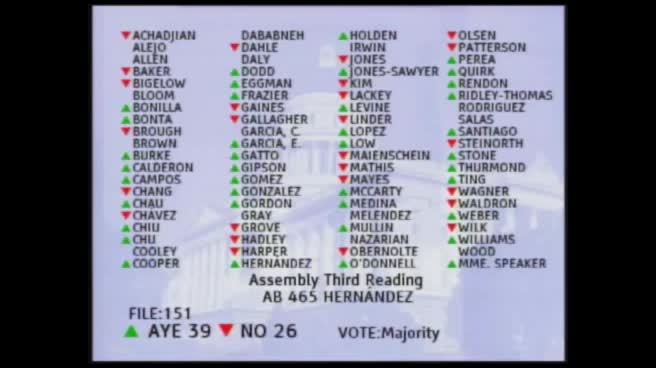
| May 14, 2015 | Read third time. Passed. Ordered to the Senate. (Ayes 76. Noes 0. Page 1444.) |
| May 14, 2015 | Read third time. Passed. Ordered to the Senate. |
| May 14, 2015 | In Senate. Read first time. To Com. on RLS. for assignment. |
| May 11, 2015 | Read second time. Ordered to third reading. |
| May 7, 2015 | From committee: Do pass. (Ayes 7. Noes 0.) (May 6). |
| Mar 26, 2015 | Referred to Com. on L. & E. |
| Mar 5, 2015 | From printer. May be heard in committee April 4. |
|
Date
|
Description
|
Location
|
Votes
|
|
|---|---|---|---|---|
| Aug 25, 2016 | AB 1505 HERNÁNDEZ Concurrence in Senate Amendments | Assembly Floor |
Passed |
|
| Aug 24, 2016 | With recommendation: That Senate amendments be concurred in. | Assembly Standing Committee on Public Safety |
Passed |
|
| Aug 18, 2016 | Assembly 3rd Reading AB1505 Roger Hernández By Anderson | Senate Floor |
Passed |
|
| Jun 14, 2016 | Do pass | Senate Standing Committee on Public Safety |
Passed |
|
| Jun 10, 2015 | Do pass | Senate Standing Committee on Labor and Industrial Relations |
Passed |
|
| May 14, 2015 | AB 1505 L. & E. Assembly Third Reading By HERNÁNDEZ | Assembly Floor |
Passed |
|
| May 6, 2015 | Do pass. | Assembly Standing Committee on Labor and Employment |
Passed |
This list shows positions taken on this bill by organizations on the date displayed, which is linked to the original source.
Positions by individuals are not included.
|
Organization
|
Position
|
Date
|
|---|---|---|
| League Of California Cities | * Against | Jun 14, 2016 |
| State Building and Construction Trades Council of California | ** Support | Aug 18, 2016 |
| State Comptroller | * Support | Jun 14, 2016 |
| State Controller Betty Yee | ** Support | Aug 18, 2016 |
GOVERNOR'S VETO
GV Bill Id:AB 1505
Author:(Roger Hernández)
As Enrolled Ver:September 1, 2016
2/3 vote
ASSEMBLY: |
| (May 14, 2015) | SENATE: | 29-6 | (August 18, 2016) |
(vote not relevant)
COMMITTEE VOTE: | 6-0 | (August 24, 2016) | RECOMMENDATION: | concur |
(Pub. S.)
ASSEMBLY: | 77-1 | (August 25, 2016) |
|
|
Original Committee Reference: L. & E..
SUMMARY: Extends the statute of limitations from one year to three for specified misdemeanor violations of the Public Contract Code.
The Senate amendments delete the Assembly version of this bill and instead, provide that prosecution for specified violations of the Public Contract Code prohibiting the splitting of work orders or projects to avoid competitive bidding shall commence within three years of the commission of the offense.
EXISTING LAW:
- Provides that prosecution for crimes punishable by imprisonment in the state prison for eight years or more must commence within six years after commission of the offense, unless otherwise provided by law.
- Provides that prosecution for an offense punishable by imprisonment in state prison or pursuant to subdivision (h) of section 1170 must commence within three years commission of the offense, except as specified.
- Provides that the prosecution of a misdemeanor must commence within one year of the commission of the offense, unless otherwise provided by law.
- Provides that for an offense which is a "wobbler" (i.e., punishable as an alternate felony or misdemeanor), the offense is classified consistent with its maximum punishment for purposes of the statute of limitations.
- Disregards enhancements for purposes of determining the statute of limitations.
- States that, unless otherwise provided by law, a statute of limitations is not tolled or extended for any reason.
- States that a prosecution is commenced when one of the following occurs:
- An indictment or information is filed;
- A complaint charging a misdemeanor or infraction is filed;
- The defendant is arraigned on a complaint that charges him or her with a felony; or,
- An arrest warrant or bench warrant is issued.
- Makes it unlawful to split or separate into smaller work orders or projects any work, project, service, or purchase for the purpose of evading provisions of law requiring contracting after competitive bidding.
- Makes it a misdemeanor to split or separate into smaller work orders or projects any public work project for the purpose of evading the requirement that public work be done by contract after competitive bidding.
- Makes it unlawful to split or separate into smaller work orders or projects any work, project, service, or purchase for the purpose of evading the provisions of law requiring contracting after competitive bidding.
- Makes it unlawful to split or separate into smaller work orders or projects for the purpose of evading the provisions of law requiring work to be done by contract after competitive bidding.
- Makes it unlawful to split or separate into smaller work orders or projects any project for the purpose of avoiding competitive bidding.
AS PASSED BY THE ASSEMBLY, this bill required a car wash employer to provide written notice to a successor employer regarding the requirements of existing law prior to the sale or other transfer of the business.
FISCAL EFFECT: None. This bill is keyed non-fiscal by the Legislative Counsel.
COMMENTS: According to the author, "While the Controller's audit was on West Covina, it brought to light a deficiency in the statute of limitations in regards to violating state and local contracting laws. The recommendation highlighted the need for a statutory change to prevent willful abuse of taxpayer dollars. The current one-year limitation impedes any recourse for justice. By extending the limitation it provides greater protection of taxpayer dollars and holds elected officials more accountable."
This bill was substantially amended in the Senate and the Assembly approved provisions of this bill were deleted. This bill, as amended in the Senate is inconsistent with Assembly actions.
I am returning Assembly Bill 1505 without my signature.
This bill extends, from one to three years, the statute of limitations for specified Public Contract Code misdemeanors relating to competitive bidding.
Although the bill extends the criminal statute of limitations for violations of seven Public Contract Code sections, violations of four of those code sections carry no criminal penalties and are not actual crimes. We should not introduce any uncertainty into the Penal Code.
Analysis Prepared by: Sandy Uribe / PUB. S. / (916) 319-3744 FN: 0005135
CONCURRENCE IN SENATE AMENDMENTS
CSA2 Bill Id:AB 1505
Author:(Roger Hernández)
As Amended Ver:May 27, 2016
Majority vote
ASSEMBLY: |
| (May 14, 2015) | SENATE: | 29-6 | (August 18, 2016) |
(vote not relevant)
COMMITTEE VOTE: | 6-0 | (August 24, 2016) | RECOMMENDATION: | concur |
(Pub. S.)
Original Committee Reference: L. E.
SUMMARY: Extends the statute of limitations from one year to three for specified misdemeanor violations of the Public Contract Code.
The Senate amendments delete the Assembly version of this bill and instead, provide that prosecution for specified violations of the Public Contract Code prohibiting the splitting of work orders or projects to avoid competitive bidding shall commence within three years of the commission of the offense.
EXISTING LAW:
- Provides that prosecution for crimes punishable by imprisonment in the state prison for eight years or more must commence within six years after commission of the offense, unless otherwise provided by law.
- Provides that prosecution for an offense punishable by imprisonment in state prison or pursuant to Section 1170(h) must commence within three years commission of the offense, except as specified.
- Provides that the prosecution of a misdemeanor must commence within one year of the commission of the offense, unless otherwise provided by law.
- Provides that for an offense which is a "wobbler" (i.e., punishable as an alternate felony or misdemeanor), the offense is classified consistent with its maximum punishment for purposes of the statute of limitations.
- Disregards enhancements for purposes of determining the statute of limitations.
- States that, unless otherwise provided by law, a statute of limitations is not tolled or extended for any reason.
- States that a prosecution is commenced when one of the following occurs:
- An indictment or information is filed;
- A complaint charging a misdemeanor or infraction is filed;
- The defendant is arraigned on a complaint that charges him or her with a felony; or,
- An arrest warrant or bench warrant is issued.
- Makes it unlawful to split or separate into smaller work orders or projects any work, project, service, or purchase for the purpose of evading provisions of law requiring contracting after competitive bidding.
- Makes it a misdemeanor to split or separate into smaller work orders or projects any public work project for the purpose of evading the requirement that public work be done by contract after competitive bidding.
- Makes it unlawful to split or separate into smaller work orders or projects any work, project, service, or purchase for the purpose of evading the provisions of law requiring contracting after competitive bidding.
- Makes it unlawful to split or separate into smaller work orders or projects for the purpose of evading the provisions of law requiring work to be done by contract after competitive bidding.
- Makes it unlawful to split or separate into smaller work orders or projects any project for the purpose of avoiding competitive bidding.
AS PASSED BY THE ASSEMBLY, this bill required a car wash employer to provide written notice to a successor employer regarding the requirements of existing law prior to the sale or other transfer of the business.
FISCAL EFFECT: None. This bill is keyed non-fiscal by the Legislative Counsel.
COMMENTS: According to the author, "While the Controller's audit was on West Covina, it brought to light a deficiency in the statute of limitations in regards to violating state and local contracting laws. The recommendation highlighted the need for a statutory change to prevent willful abuse of taxpayer dollars. The current one-year limitation impedes any recourse for justice. By extending the limitation it provides greater protection of taxpayer dollars and holds elected officials more accountable."
This bill was substantially amended in the Senate and the Assembly approved provisions of this bill were deleted. This bill, as amended in the Senate is inconsistent with Assembly actions.
Analysis Prepared by: Sandy Uribe / PUB. S. / (916) 319-3744 FN: 0004865
CONCURRENCE IN SENATE AMENDMENTS
CSA1 Bill Id:AB 1505
Author:(Roger Hernández)
As Amended Ver:May 27, 2016
Majority vote
ASSEMBLY: |
| (May 14, 2015) | SENATE: | 29-6 | (August 18, 2016) |
(vote not relevant)
Original Committee Reference: L. & E..
SUMMARY: Extends the statute of limitations from one year to three for specified misdemeanor violations of the Public Contract Code.
The Senate amendments delete the Assembly version of this bill and instead, provide that prosecution for specified violations of the Public Contract Code (PCC) prohibiting the splitting of work orders or projects to avoid competitive bidding shall commence within three years of the commission of the offense.
EXISTING LAW:
- Provides that prosecution for crimes punishable by imprisonment in the state prison for eight years or more must commence within six years after commission of the offense, unless otherwise provided by law.
- Provides that prosecution for an offense punishable by imprisonment in state prison or pursuant to PCC Section 1170(h) must commence within three years commission of the offense, except as specified.
- Provides that the prosecution of a misdemeanor must commence within one year of the commission of the offense, unless otherwise provided by law.
- Provides that for an offense which is a "wobbler" (i.e., punishable as an alternate felony or misdemeanor), the offense is classified consistent with its maximum punishment for purposes of the statute of limitations.
- Disregards enhancements for purposes of determining the statute of limitations.
- States that, unless otherwise provided by law, a statute of limitations is not tolled or extended for any reason.
- States that a prosecution is commenced when one of the following occurs:
- An indictment or information is filed;
- A complaint charging a misdemeanor or infraction is filed;
- The defendant is arraigned on a complaint that charges him or her with a felony; or,
- An arrest warrant or bench warrant is issued.
- Makes it unlawful to split or separate into smaller work orders or projects any work, project, service, or purchase for the purpose of evading provisions of law requiring contracting after competitive bidding.
- Makes it a misdemeanor to split or separate into smaller work orders or projects any public work project for the purpose of evading the requirement that public work be done by contract after competitive bidding.
- Makes it unlawful to split or separate into smaller work orders or projects any work, project, service, or purchase for the purpose of evading the provisions of law requiring contracting after competitive bidding.
- Makes it unlawful to split or separate into smaller work orders or projects for the purpose of evading the provisions of law requiring work to be done by contract after competitive bidding.
- Makes it unlawful to split or separate into smaller work orders or projects any project for the purpose of avoiding competitive bidding.
AS PASSED BY THE ASSEMBLY, this bill required a car wash employer to provide written notice to a successor employer regarding the requirements of existing law prior to the sale or other transfer of the business.
FISCAL EFFECT: None. This bill is keyed non-fiscal by the Legislative Counsel.
COMMENTS: According to the author, "While the Controller's audit was on West Covina, it brought to light a deficiency in the statute of limitations in regards to violating state and local contracting laws. The recommendation highlighted the need for a statutory change to prevent willful abuse of taxpayer dollars. The current one-year limitation impedes any recourse for justice. By extending the limitation it provides greater protection of taxpayer dollars and holds elected officials more accountable."
This bill was substantially amended in the Senate and the Assembly approved provisions of this bill were deleted. This bill, as amended in the Senate is inconsistent with Assembly actions.
Analysis Prepared by: Sandy Uribe / PUB. S. / (916) 319-3744 FN: 0003647
Office of Senate Floor Analyses (916) 651-1520 Fax: (916) 327-4478 | AB |
THIRD READING
Bill No: AB 1505
:
PRIOR VOTES NOT RELEVANT
SENATE PUBLIC SAFETY COMMITTEE: 5-2, 6/14/16
AYES: Hancock, Anderson, Leno, Liu, Monning
NOES: Glazer, Stone
DIGEST: This bill extends from one to three years the statute of limitations for specified Public Contract Code misdemeanors relating to competitive bidding.
Existing law:
- Provides that a school district must put contracts out to bid for specified contracts involving equipment or services for more than $50,000 or construction contracts for more than $15,000. (Public Contract Code § 20111)
- Provides that public projects by a local agency of more than $175,000 shall be let to contract by a formal bidding contract, projects of less than $175,000 may be bid by informal procedures. (Public Contract Code § 22032)
- Provides that all contracts for any improvement in excess of $25,000 by a reclamation district shall be let to the lowest responsible bidder. (Public Contract Code § 20921)
- Provides that a community college may make repairs, alterations, etc. without bidding when the job does not exceed 350 hours if the districts number of full-time students is less than 15,000 and the job does not exceed 750 hours or $21,000 if the number of students exceeds 15,000. (Public Contract Code § 2065)
- Provides that when the expenditure for a public project by a local agency exceeds $5,000 it shall be contracted for and let to the lowest bidder after notice. (Public Contract Code § 20162)
- Provides that in counties of 500,000 or less, public projects between $4,000 and $10,000 shall be let to contract by informal bidding procedures and public projects of $10,000 or more shall be let by formal bidding procedures. (Public Contract Code § 20150.4)
- Provides that counties with a population of 2,000,000 or more must use a formal bidding process for public buildings if the cost is more than $4,000 but they do not have to do work by bid if the cost estimate is less than $6,500 and the requirements do not apply to repair work on county owned buildings if the cost is under $50,000. (Public Contract Code §§ 20121; 20122; 20123)
- Provides that it shall be unlawful for a school district, community college district, reclamation agency or local agency to split or separate into smaller work orders or projects any work, project, service or purchase for the purpose of evading the provisions requiring contracting after competitive bidding. (Public Contract Code §§ 20116; 20657; 20922; 22033)
- Provides that when the expenditure required for a public project exceeds $5,000, it shall be contracted for and let go to the lowest responsible bidder after notice. (Public Contract Code § 20162)
- Provides that in any county, it is unlawful to split or separate into small work orders or projects any public work project for the purpose of evading the provisions requiring public work to be done by contract after competitive bidding. The penalty for a violation of these sections is a misdemeanor. (Public Contract Code §§ 20123.5; 20150.11; 20163)
- Provides that in general the prosecution for a misdemeanor shall be commenced within one year after the commission of the offense.
This bill provides instead that the prosecution for a violation of the Public Contract Code prohibiting the splitting of jobs into smaller jobs to avoid competitive bidding shall be commenced within three years of the commission of the offense.
FISCAL EFFECT: Appropriation: Fiscal Com.: Local:
State Controller Betty Yee
State Building and Construction Trades Council of California
OPPOSITION: (Verified 6/14/16)
League of California Cities
ARGUMENTS IN SUPPORT: In support, State Controller Betty Yee states:
As part of my July 2016 review of the City of West Covina’s administrative and internal controls, my auditors discovered the city violated PCC 20163, which precludes cities from splitting work orders on public work projects into smaller pieces in order to avoid the state’s competitive bidding requirements. Violation of this law is a misdemeanor, but prosecution of any alleged violation must take place within a year of the violation occurring.
Unfortunately in the case of West Covina, the violations were not discovered during that one-year period. By extending the period of time from one year to three years in which charges must be filed, AB 1505 will give prosecutors more time to discover violations of the Public Contract Code and hold local government administrators accountable.
ARGUMENTS IN OPPOSITION: In opposition, the League of California Cities states:
The League questions how serious of a problem this is among cities. The author cites a press release from the State Controller’s Office audit which identifies a violation of Public Contract Code Section 20163, but it remains unclear from the audit how that particular code section was violated to necessitate this bill.
Despite the author’s concerns, there has been no reported widespread abuse of these provisions in the public contract code. In this particular instance, the city in question took considerable measures to address the audits in the finding, including hiring a new city manager and a new public works director.
In the instance that a local government violates state and/or local law, then the agency must be held accountable to the full extent and enforcement of the law. Unfortunately, too often, city contracts for essential public services are a consistent target for litigation from competing interests and subjecting local governments to increased legal risks only make it more difficult for public servants to carry out their responsibilities.
Prepared by: Mary Kennedy / PUB. S. /
6/15/16 17:24:46
SENATE COMMITTEE ON PUBLIC SAFETY
Senator Loni Hancock, Chair
2015 - 2016 Regular
Bill No: AB 1505 Hearing Date: June 14, 2016
Author: | Roger Hernández | ||
Version: | May 27, 2016 | ||
Urgency: | No | Fiscal: | No |
Consultant: | MK | ||
Subject: Statute of Limitations: Public Contracts
HISTORY
Source: Author
Prior Legislation: None applicable
Support: Betty Yee, California’s State Controller
Opposition: None known
Assembly Floor Vote: No longer relevant
PURPOSE
The purpose of this bill is to extend from one to three years the statute of limitations for specified Public Contract Code misdemeanors relating to competitive bidding.
Existing law provides that a school district must put contracts out to bid for specified contracts involving equipment or services for more than $50,000 or construction contracts for more than $15,000. (Public Contract Code § 20111)
Existing law provides public projects by a local agency of more than $175,000 shall be let to contract by a formal bidding contract, projects of less than $175,000 may be bid by informal procedures. (Public Contract Code § 22032)
Existing law provides that all contracts for any improvement in excess of $25,000 by a reclamation district shall be let to the lowest responsible bidder. (Public Contract Code § 20921)
Existing law provides that a community college may make repairs, alterations etc. without bidding when the job does not exceed 350 hours if the districts number of full-time students is less than 15,000 and the job does not exceed 750 hours or $21,000 if the number of students exceeds 15,000. (Public Contract Code § 2065)
Existing law provides that when the expenditure for a public project by a local agency exceeds $5,000 it shall be contracted for and let to the lowest bidder after notice. (Public Contract Code § 20162)
Existing law provides that in counties of 500,000 or less, public projects between $4,000 and $10,000 shall be let to contract by informal bidding procedures and public projects of $10,000 or more shall be let by formal bidding procedures. (Public Contract Code § 20150.4)
Existing law provides that in counties with a population of 2,000,000 or more must use a formal bidding process for public buildings if the cost is more than $4,000 but they do not have to do work by bid if the cost estimate is less than $6,500 and the requirements do not apply to repair work on county owned buildings if the cost is under $50,000. (Public Contract Code §§ 20121; 20122; 20123)
Existing law provides that it shall be unlawful for a school district, community college district, reclamation agency or local agency to split or separate into smaller work orders or projects any work, project, service or purchase for the purpose of evading the provisions requiring contracting after competitive bidding. (Public Contract Code §§ 20116; 20657; 20922; 22033)
Existing law provides that when the expenditure required for a public project exceeds $5,000, it shall be contracted for and let go to the lowest responsible bidder after notice. (Public Contract Code § 20162)
Existing law provides that in any county, it is unlawful to split or separate into small work orders or projects any public work project for the purpose of evading the provisions requiring public work to be done by contract after competitive bidding. The penalty for a violation of these sections is a misdemeanor. (Public Contract Code §§ 20123.5; 20150.11; 20163)
Existing law provides that in general the prosecution for a misdemeanor shall be commenced within one year after the commission of the offense.
This bill provides instead that a the prosecution for a violation of the Public Contracts Code prohibiting the splitting of jobs into smaller jobs to avoid competitive bidding shall be commenced within three years of the commission of the offense.
RECEIVERSHIP/OVERCROWDING CRISIS AGGRAVATION
For the past several years this Committee has scrutinized legislation referred to its jurisdiction for any potential impact on prison overcrowding. Mindful of the United States Supreme Court ruling and federal court orders relating to the state’s ability to provide a constitutional level of health care to its inmate population and the related issue of prison overcrowding, this Committee has applied its “ROCA” policy as a content-neutral, provisional measure necessary to ensure that the Legislature does not erode progress in reducing prison overcrowding.
On February 10, 2014, the federal court ordered California to reduce its in-state adult institution population to 137.5% of design capacity by February 28, 2016, as follows:
- 143% of design bed capacity by June 30, 2014;
- 141.5% of design bed capacity by February 28, 2015; and,
- 137.5% of design bed capacity by February 28, 2016.
In December of 2015 the administration reported that as “of December 9, 2015, 112,510 inmates were housed in the State’s 34 adult institutions, which amounts to 136.0% of design bed capacity, and 5,264 inmates were housed in out-of-state facilities. The current population is 1,212 inmates below the final court-ordered population benchmark of 137.5% of design bed capacity, and has been under that benchmark since February 2015.” (Defendants’ December 2015 Status Report in Response to February 10, 2014 Order, 2:90-cv-00520 KJM DAD PC, 3-Judge Court, Coleman v. Brown, Plata v. Brown (fn. omitted).) One year ago, 115,826 inmates were housed in the State’s 34 adult institutions, which amounted to 140.0% of design bed capacity, and 8,864 inmates were housed in out-of-state facilities. (Defendants’ December 2014 Status Report in Response to February 10, 2014 Order, 2:90-cv-00520 KJM DAD PC, 3-Judge Court, Coleman v. Brown, Plata v. Brown (fn. omitted).)
While significant gains have been made in reducing the prison population, the state must stabilize these advances and demonstrate to the federal court that California has in place the “durable solution” to prison overcrowding “consistently demanded” by the court. (Opinion Re: Order Granting in Part and Denying in Part Defendants’ Request For Extension of December 31, 2013 Deadline, NO. 2:90-cv-0520 LKK DAD (PC), 3-Judge Court, Coleman v. Brown, Plata v. Brown (2-10-14). The Committee’s consideration of bills that may impact the prison population therefore will be informed by the following questions:
- Whether a proposal erodes a measure which has contributed to reducing the prison population;
- Whether a proposal addresses a major area of public safety or criminal activity for which there is no other reasonable, appropriate remedy;
- Whether a proposal addresses a crime which is directly dangerous to the physical safety of others for which there is no other reasonably appropriate sanction;
- Whether a proposal corrects a constitutional problem or legislative drafting error; and
- Whether a proposal proposes penalties which are proportionate, and cannot be achieved through any other reasonably appropriate remedy.
COMMENTS
1. Need for This Bill
According to the author:
In April of 2014, Assemblymember Hernández formally requested that the Controller’s Office conduct an audit of West Covina’s finances in response to several complaints of misuse of public funds.
On June 9th 2015, State Controller Betty T. Yee announced the results of a detailed review of the City of West Covina’s administrative and internal accounting controls, finding serious and pervasive deficiencies. Of the79 control components evaluated, West Covina was found to be adequate in seven.
According to the Controller’s Office, West Covina violated California Public Contract Code section 20163, which would constitute a misdemeanor had the statute of limitations not expired. “It makes no sense that the statute of limitations for violating state and local contracting laws is one year from when the money is spent,” said Controller Yee. The Controller urged the legislature to, “consider a statutory change if we expect to ferret out fraud and prevent willful abuses of state law and taxpayer dollars.”
The detailed review of the City of West Covina’s administrative and internal accounting controls by Controller Yee confirms troubling practices that harm our community and brings into question government waste and corruption. Over the years several cities have violated the public’s trust, including the city of Industry, Maywood, Beaumont, Bell, Irwindale, Richmond, Cudahy, and Montebello.
AB 1505 expands the statute of limitations by three years for violating state and local public contracting laws beyond the current one-year statute. Through AB 1505, we will be able to hold all of our elected officials to greater accountability when they are appropriating taxpayer dollars.
2. The Statute of Limitations Generally; Law Revision Commission Report
The statute of limitations requires commencement of a prosecution within a certain period of time after the commission of a crime. A prosecution is initiated by filing an indictment or information, filing a complaint, certifying a case to superior court, or issuing an arrest or bench warrant. (Penal Code § 804.) The failure of a prosecution to be commenced within the applicable period of limitation is a complete defense to the charge. The statute of limitations is jurisdictional and may be raised as a defense at any time, before or after judgment. People v. Morris (1988) 46 Cal.3d 1, 13. The defense may only be waived under limited circumstances. (See Cowan v. Superior Court (1996) 14 Cal.4th 367.)
The Legislature enacted the current statutory scheme regarding statutes of limitations for crimes in 1984 in response to a report of the California Law Revision Commission:
The Commission identified various factors to be considered in drafting a limitations statute. These factors include: (a) The staleness factor. A person accused of crime should be protected from having to face charges based on possibly unreliable evidence and from losing access to the evidentiary means to defend. (b) The repose factor. This reflects society's lack of a desire to prosecute for crimes committed in the distant past. (c) The motivation factor. This aspect of the statute imposes a priority among crimes for investigation and prosecution. (d) The seriousness factor. The statute of limitations is a grant of amnesty to a defendant; the more serious the crime, the less willing society is to grant that amnesty. (e) The concealment factor. Detection of certain concealed crimes may be quite difficult and may require long investigations to identify and prosecute the perpetrators.
The Commission concluded that a felony limitations statute generally should be based on the seriousness of the crime. Seriousness is easily determined based on classification of a crime as felony or misdemeanor and the punishment specified, and a scheme based on seriousness generally will accommodate the other factors as well. Also, the simplicity of a limitations period based on seriousness provides predictability and promotes uniformity of treatment.[1]
3. Expansion of the Statute of Limitations for Violating Local Contracting Laws
Existing law, with some exceptions, provides that the statute of limitations for a misdemeanor is one year. This bill would make the statute of limitations for misdemeanor evading provisions requiring work projects to be done by contract after competitive bidding three years.
In support State Controller Betty Yee States:
As part of my July 2016 review of the City of West Covina’s administrative and internal controls, my auditors discovered the city violated PCC 20163, which precludes cities from splitting work orders on public work projects into smaller pieces in order to avoid the state’s competitive bidding requirements. Violation of this law is a misdemeanor, but prosecution of any alleged violation must take place within a year of the violation occurring.
Unfortunately in the case of West Covina, the violations were not discovered during that one-year period. By extending the period of time from one year to three years in which charges must be filed, AB 1505 will give prosecutors more time to discover violations of the Public Contract Code and hold local government administrators accountable.
While a three year statute of limitations may be appropriate for these offenses, it is not clear that the sections that this bill extends the statute of limitations for will actually deals with the issue. Depending on the section, competitive bidding is required at contract amounts as low as $5,000. Is the issue that entities are breaking contracts in to such small increments? Will this bill deal with the issue the Controller found?
-- END –
1 Witkin Cal. Crim. Law Defenses, Section 214 (3rd Ed. 2004), citing 17 Cal. Law Rev. Com. Reports, pp.308-314. ↑
AB 1505
Page 5
|
Office of Senate Floor Analyses (916) 651-1520 Fax: (916) 327-4478 |
THIRD READING
Bill No: AB 1505
Author: Committee on Labor and Employment
Introduced: 3/4/15
SENATE LABOR & IND. REL. COMMITTEE: 5-0, 6/10/15
AYES: Mendoza, Stone, Jackson, Leno, Mitchell
ASSEMBLY FLOOR: 76-0, 5/14/15 - See last page for vote
DIGEST: This bill requires a car wash employer to provide written notice to a successor employer regarding the car wash labor code provisions, such as owed wages and penalties, prior to the sale or other transfer of the business.
Existing law:
Requires, under Labor Code §§2054 and 2055, every employer to register annually with the Labor Commissioner and lists the following conditions for registration or renewal:
The employer must present proof of compliance with the local government’s business licensing or regional regulatory requirements to the Labor Commissioner.
The employer has obtained a surety bond with a principal sum no less than $150,000 and file a copy of the bond with the Labor Commissioner. The bond shall be payable to the people of California for the benefit of any employee damaged by his or her employer’s failure to pay wages, interest on wages, or fringe benefits.
The employer has documented that a workers’ compensation insurance policy is in effect and has paid necessary fees.
Regulates, under Labor Code §2052, the car washing and polishing industry by requiring specific recordkeeping requirements of car wash employers on employee wages, hours and working conditions.
Establishes, under Labor Code §2065, a car wash worker fund for which penalties and registration fees are deposited for disbursement by the Labor Commissioner to employees of car washing or polishing businesses found to be in violation of current law.
States that, under Labor Code §2051, charitable groups, rental car agencies, self-service or automated car wash that have no more than two full-time employees for cashiering and/or maintenance purposes, and licensed vehicle dealers or automotive repair businesses are exempted.
Provides that, under Labor Code §2066, a successor to an employer that owed wages and penalties to the predecessor’s employees is liable for those wages and penalties under specified circumstances.
This bill requires a car wash employer to provide written notice to a successor employer regarding the car wash labor code provisions, such as owed wages and penalties, prior to the sale or other transfer of the business.
Comments
Background on Legislative Efforts to Regulate the Car Wash Industry
In 1999, SB 1097 (Hayden), which sought to regulate the car wash industry, was vetoed by the Governor. In his veto message the Governor said, in part: "I am vetoing this bill. I do not believe that the need to register car washes with the Labor Commissioner has been demonstrated. I am however asking the Director of Industrial Relations (DIR) to review the activities of the car washing industry and make any and all appropriate recommendation to me by June 30, 2001."
In response, DIR filed an internal report about labor law violations in the industry and possible remedies, considering limited resources and widespread violations that affect other industries in the state. Additionally, in early 2003, DIR conducted a coordinated enforcement sweep of the car washing and polishing industry in the Los Angeles area, finding numerous labor law violations, collecting back wages and penalties due totaling over $250,000.
As a result of proven violations in this industry, AB 1688 (Goldberg, Chapter 825, Statutes of 2003), "The Car Wash Worker Bill," was signed into law and took effect on January 1, 2004. AB 1688 contained a sunset date of January 1, 2007. The final car wash regulations were promulgated by DIR and finally adopted by the Office of Administrative Law on December 2005.
SB 1468 (Alarcon, Chapter 656, Statutes of 2006) extended the sunset date relating to the regulation of the car washing and polishing industry to January 1, 2010, and required the Labor Commissioner to report to the Legislature no later than December 31, 2008, on the status of labor law violations and enforcement in the car washing and polishing industry.
In March 2008, the Los Angeles Times reported the results of an investigation of the car wash industry finding that many owners pay less than half of the required minimum wage and that two-thirds of those inspected by the state since 2003 were out of compliance with one or more labor laws –including underpaying workers, hiring minors, operating without workers' compensation insurance and denying workers their meal and rest breaks.
The Division of Labor Standards Enforcement (DLSE) in the Department of Industrial Relations released the mandated study of the car wash and polishing industry in April of 2009. In the report, DLSE said the number of registered firms increased from 2007 to 2008 and that the number of citations decreased in that period. However, the report found that there continued to be hundreds of violations of labor standards. Many firms had no workers’ compensation for their workers, and there were many other violations of labor law (e.g., child labor violations, and failure to pay minimum wages and overtime pay).
In 2013, the Legislature passed and the Governor signed AB 1387 (Hernandez, Chapter 751) which eliminated the sunset date on existing law regulating the car washing and polishing industry. AB 1387 also increased the surety bond from $15,000 to $150,000 and provided a specified exemption for employers with a valid collective bargaining agreement.
California Courts and Successorship Provisions
In People ex rel. Harris v. Sunset Care Wash, LLC (205 Cal. App. 4th, 2012) the plaintiff filed an action against Sunset Car Wash, LLC to recover unpaid wages and penalties owed by the defendant Auto Spa Express, Inc. which had operated a carwash at the same location before being evicted by the property owner. The trial court denied a motion for summary judgment filed by Sunset Carwash and ruled that because it operated at the same location and performed the same services it was considered a successor under Labor Code section 2066. In its decision, the Court noted that the Legislature was motivated to enact the Section 2066 provisions by its findings that carwash operators sometimes employed practices that resulted in state labor law violations.
Need for the bill
Existing law regulates the employment practices of car washes and requires employers of car wash employees to register with the Labor Commissioner and pay a specified registration fee or be subject to a specified civil fine. Existing law also states that a successor car wash employer may be liable for unpaid wages and penalties incurred by a predecessor car wash employer if certain conditions are met.
This bill requires a car wash employer to notify a successor in writing of the requirement of the car wash registration law. According to the author, this bill provides important information about the law’s requirements to a prospective purchaser and ensures greater compliance.
FISCAL EFFECT: Appropriation: No Fiscal Com.: No Local: No
None received
OPPOSITION: (Verified 6/11/15)
None received
ARGUMENTS IN SUPPORT: According to the author’s office, this bill requires a car wash employer to notify a successor in writing of the requirement of the car wash registration law, including the potential for successor liability for unpaid wages, prior to the sale or other transfer of the business. Further, the author’s office argues that requiring a person selling their car wash business to inform a prospective purchaser about the requirements of the law will ensure greater awareness of and compliance with the law.
ASSEMBLY FLOOR: 76-0, 5/14/15
AYES: Achadjian, Alejo, Travis Allen, Baker, Bigelow, Bloom, Bonilla, Bonta, Brough, Brown, Burke, Calderon, Chang, Chau, Chávez, Chiu, Cooley, Cooper, Dababneh, Dahle, Daly, Dodd, Frazier, Beth Gaines, Gallagher, Cristina Garcia, Eduardo Garcia, Gatto, Gipson, Gomez, Gonzalez, Gordon, Gray, Grove, Hadley, Harper, Roger Hernández, Holden, Irwin, Jones, Jones-Sawyer, Kim, Lackey, Levine, Linder, Lopez, Low, Maienschein, Mathis, Mayes, McCarty, Medina, Melendez, Mullin, Obernolte, O'Donnell, Olsen, Patterson, Perea, Quirk, Rendon, Ridley-Thomas, Rodriguez, Salas, Santiago, Steinorth, Mark Stone, Thurmond, Ting, Wagner, Waldron, Weber, Wilk, Williams, Wood, Atkins
NO VOTE RECORDED: Campos, Chu, Eggman, Nazarian
Prepared by: Deanna Ping / L. & I.R. / (916) 651-1556
6/12/15 15:41:14
**** END ****
AB 1505 (Committee on Labor and Employment) Page 4 of 4
SENATE COMMITTEE ON LABOR AND INDUSTRIAL RELATIONS
Senator Tony Mendoza, Chair
2015 - 2016 Regular
Bill No: AB 1505 Hearing Date: June 10, 2015
Author: |
Committee on Labor and Employment |
||
Version: |
March 4, 2015 |
||
Urgency: |
No |
Fiscal: |
No |
Consultant: |
Deanna Ping |
||
Subject: Car washes.
KEY ISSUE
Should the legislature require a car wash employer to provide written notice to a successor employer regarding the requirements of existing law prior to the sale or other transfer of the business?
ANALYSIS
Existing
law requires every
employer to register annually with the Labor Commissioner and lists
the following conditions for registration or renewal:
The employer must present proof of compliance with the local government’s business licensing or regional regulatory requirements to the Labor Commissioner
The employer has obtained a surety bond with a principal sum no less than $150,000 and file a copy of the bond with the Labor Commissioner. The bond shall be payable to the people of California for the benefit of any employee damaged by his or her employer’s failure to pay wages, interest on wages, or fringe benefits
The employer has documented that a worker’s compensation insurance policy is in effect and has paid necessary fees
(Labor Code §§2054 and 2055)
Existing law regulates the car washing and polishing industry by requiring specific recordkeeping requirements of car wash employers on employee wages, hours and working conditions. (Labor Code §2052)
Existing law establishes a car wash worker fund for which penalties and registration fees are deposited for disbursement by the Labor Commissioner to employees of car washing or polishing businesses found to be in violation of current law. (Labor Code §2065)
Existing law states that charitable groups, rental car agencies, self-service or automated car wash that have no more than two full-time employees for cashiering and/or maintenance purposes, and licensed vehicle dealers or automotive repair businesses are exempted. (Labor Code §2051)
Existing law also provides that a successor to an employer that owed wages and penalties to the predecessor’s employees is liable for those wages and penalties under specified circumstances. (Labor Code §2066)
This bill would require a car wash employer to provide written notice to a successor employer regarding the above provisions, such as owed wages and penalties, prior to the sale or other transfer of the business.
COMMENTS
1. Background on Legislative Efforts to Regulate the Car Wash Industry
In 1999, SB 1097 (Hayden), which sought to regulate the car wash industry, was vetoed by the Governor. In his veto message the Governor said, in part: "I am vetoing this bill. I do not believe that the need to register car washes with the Labor Commissioner has been demonstrated. I am however asking the Director of Industrial Relations (DIR) to review the activities of the car washing industry and make any and all appropriate recommendation to me by June 30, 2001."
In response DIR filed an internal report about labor law violations in the industry and possible remedies, considering limited resources and widespread violations that affect other industries in the state. Additionally, in early 2003, DIR conducted a coordinated enforcement sweep of the car washing and polishing industry in the Los Angeles area, finding numerous labor law violations, collecting back wages and penalties due totaling over $250,000.
As a result of proven violations in this industry AB 1688 (Goldberg) "The Car Wash Worker Bill" was signed into law and took effect on January 1, 2004. AB 1688 contained a sunset date of January 1, 2007. The final car wash regulations were promulgated by DIR and finally adopted by the Office of Administrative Law December 2005.
SB 1468 (Alarcon) of 2006 extended the sunset date relating to the regulation of the car washing and polishing industry to January 1, 2010, and required the LC to report to the Legislature no later than December 31, 2008, on the status of labor law violations and enforcement in the car washing and polishing industry.
In March 2008, the Los Angeles Times reported the results of an investigation of the car wash industry finding that many owners pay less than half of the required minimum wage and that two-thirds of those inspected by the state since 2003 were out of compliance with one or more labor laws –including underpaying workers, hiring minors, operating without workers' compensation insurance and denying workers their meal and rest breaks.
The Division of Labor Standards Enforcement in the Department of Industrial Relations released the mandated study of the car wash and polishing industry in April of 2009. In the report, DLSE said the number of registered firms increased from 2007 to 2008 and that the number of citations decreased in that period. However, the report found that there continue to be hundreds of violations of labor standards. Many firms had no workers’ compensation for their workers, and there were many other violations of labor law (e.g., child labor violations, and failure to pay minimum wages and overtime pay).
In 2013, the legislature passed and the governor signed AB 1387 (Hernandez) which eliminated the sunset date on existing law regulating the car washing and polishing industry. AB 1387 also increased the surety bond from $15,000 to $150,000 and provided a specified exemption for employers with a valid collective bargaining agreement.
2. California Courts and Successorship Provisions:
In People ex rel. Harris v. Sunset Care Wash, LLC (205 Cal. App. 4th, 2012) the plaintiff filed an action against Sunset Car Wash, LLC to recover unpaid wages and penalties owed by the defendant Auto Spa Express, Inc. which had operated a carwash at the same location before being evicted by the property owner. The trial court denied a motion for summary judgment filed by Sunset Carwash and ruled that because it operated at the same location and performed the same services it was considered a successor under Labor Code section 2066. In its decision the Court noted that the Legislature was motivated to enact the Section 2066 provisions by its findings that carwash operators sometimes employed practices that resulted in state labor law violations.
3. Need for the bill?:
Existing law regulates the employment practices of car washes and requires employers of car wash employees to register with the Labor Commissioner and pay a specified registration fee or be subject to a specified civil fine. Existing law also states that a successor car wash employer may be liable for unpaid wages and penalties incurred by a predecessor car wash employer if certain conditions are met.
This bill would require a car wash employer to notify a successor in writing of the requirement of the car wash registration law. According to the author this bill would provide important information about the law’s requirements to a prospective purchaser and would ensure greater compliance.
4. Proponent Arguments:
According to the author’s office, this bill would require a car wash employer to notify a successor in writing of the requirement of the car wash registration law, including the potential for successor liability for unpaid wages, prior to the sale or other transfer of the business. Further, the author’s office argues that requiring a person selling their car wash business to inform a prospective purchaser about the requirements of the law will ensure greater awareness of and compliance with the law.
5. Opponent Arguments:
None on file.
6. Prior Legislation:
AB 2750 (Hernandez) of 2013 – would have required a car wash employer to provide written notice to a successor employers regarding the requirements of existing law prior to the sale or other transfer to the business. The bill was amended out of Labor Code and into Business and Professions Code.
AB 1387 (Hernandez), Chapter 751, Statues of 2013 – eliminated the sunset date on existing law regulating the car washing and polishing industry. Also, AB 1387 increased the surety bond from $15,000 to $150,000 and provided a specified exemption for employers with a valid collective bargaining agreement.
AB 236 (Swanson), Chapter 224, Statutes of 2009 – extended the sunset date of the licensing and registration program for car washes from January 1, 2010 to 2014.
SB 1468 (Alarcon), Chapter 656, Statutes of 2006 – extended the sunset date of the licensing and registration program to January 1, 2010 and required the Labor Commissioner to report on the status of labor law violations and enforcement in the car washing and polishing industry.
AB 1688 (Goldberg), Chapter 825, Statutes of 2003 – enacted regulations for the car wash industry including registration and bonding requirements, as well as protections against ‘successor’ entities avoiding previous judgments for unpaid wages or penalties.
SB 1097 (Hayden) of 1999 – would have required persons who employ others in car washing and polishing to register with the Labor Commissioner and would have required an employer who has violated specified labor laws to obtain a surety bond and meet other specified requirements. SB 1097 was vetoed by Governor Davis.
SUPPORT
None on file.
OPPOSITION
None on file.
-- END --
AB 1505
Page 1
ASSEMBLY THIRD READING
AB 1505
(Committee on Labor and Employment)
As Introduced March 4, 2015
Majority vote
Committee |
Votes |
Ayes |
Noes |
Labor |
7-0 |
Roger Hernández, Harper, Chu, Low, McCarty, Patterson, Thurmond |
|
SUMMARY: Requires a car wash employer to provide written notice to a successor employer regarding the requirements of existing law prior to the sale or other transfer of the business.
EXISTING LAW:
Regulates the employment practices of car washes, including providing specific recordkeeping requirements that employers of car wash workers must implement with regard to wages, hours and working conditions.
Requires employers of car wash workers to register with the Labor Commissioner and pay a specified registration fee, or be subjected to a specified civil fine.
Provides that a successor to any car wash employer that owed wages and penalties to the predecessor's former employees is liable for those wages and penalties if certain criteria are met.
FISCAL EFFECT: None. This bill is keyed non-fiscal by the Legislative Counsel.
COMMENTS: Existing law regulates the employment practices of car washes and requires employers of car wash employees to register with the Labor Commissioner and pay a specified registration fee, or be subject to a specified civil fine.
Existing law also provides that a successor car wash employer may be liable for unpaid wages and penalties incurred by a predecessor car wash employer if certain conditions are met.
This bill would require a car wash employer to notify a successor in writing of the requirement of the car wash registration law, including the potential for successor liability for unpaid wages, prior to the sale or other transfer of the business.
According to the author, requiring a person selling their car wash business to inform a prospective purchaser about the requirements of the law will ensure greater awareness of and compliance with the law.
This bill is identical to AB 2750 (Roger Hernández) of 2014. AB 2750 was subsequently amended to deal with an unrelated matter.
Analysis Prepared by: Ben Ebbink / L. & E. / (916) 319-2091 FN: 0000328
AB 1505
Page 2
Date of Hearing: May 6, 2015
ASSEMBLY COMMITTEE ON LABOR AND EMPLOYMENT
Roger Hernández, Chair
AB 1505
(Committee on Labor and Employment) – As Introduced March 4, 2015
SUBJECT: Car washes
SUMMARY: Requires a car wash employer to provide written notice to a successor employer regarding the requirements of existing law prior to the sale or other transfer of the business.
EXISTING LAW:
Regulates the employment practices of car washes, including providing specific recordkeeping requirements that employers of car wash workers must implement with regard to wages, hours and working conditions.
Requires employers of car wash workers to register with the Labor Commissioner and pay a specified registration fee, or be subjected to a specified civil fine.
Provides that a successor to any car wash employer that owed wages and penalties to the predecessor's former employees is liable for those wages and penalties if certain criteria are met.
FISCAL EFFECT: None. This bill is keyed non-fiscal by the Legislative Counsel.
COMMENTS: Existing law regulates the employment practices of car washes and requires employers of car wash employees to register with the Labor Commissioner and pay a specified registration fee, or be subject to a specified civil fine.
Existing law also provides that a successor car wash employer may be liable for unpaid wages and penalties incurred by a predecessor car wash employer if certain conditions are met.
This bill would require a car wash employer to notify a successor in writing of the requirement of the car wash registration law, including the potential for successor liability for unpaid wages, prior to the sale or other transfer of the business.
According to the author, requiring a person selling their car wash business to inform a prospective purchaser about the requirements of the law will ensure greater awareness of and compliance with the law.
PRIOR LEGISLATION
This bill is identical to AB 2750 (Roger Hernández) from last year. That measure was subsequently amended to deal with an unrelated matter.
REGISTERED SUPPORT / OPPOSITION:
Support
None on file.
Opposition
None on file.
Analysis Prepared by: Ben Ebbink / L. & E. / (916) 319-2091
Discussed in Hearing
 2MIN
Assembly Floor
 3MIN
Senate Floor
 18MIN
Senate Standing Committee on Public Safety
 3MIN
Assembly Floor
Bill Author

Bill Co-Author(s):