AB 1813: High-Speed Rail Authority: membership.
- Session Year: 2015-2016
- House: Assembly
- Latest Version Date: 2016-07-25
Existing law creates the High-Speed Rail Authority with specified powers and duties relative to development and implementation of a high-speed train system. The authority is composed of 9 members, including 5 members appointed by the Governor, and 2 members each appointed by the Senate Committee on Rules and the Speaker of the Assembly.
This bill would additionally provide for appointment of one Member of the Senate by the Senate Committee on Rules and one Member of the Assembly by the Speaker of the Assembly to serve as ex officio members of the authority. The bill would provide that the ex officio members shall participate in the activities of the authority to the extent that participation is not incompatible with their positions as Members of the Legislature.
(a)There is in the Transportation Agency a High-Speed Rail Authority.
(b)(1)The authority is composed of 11 members as follows:
(A)Five members appointed by the Governor.
(B)Two members appointed by the Senate Committee on Rules.
(C)Two members appointed by the Speaker of the Assembly.
(D)One Member of the Senate appointed by the Senate Committee on Rules and one Member of the Assembly appointed by the Speaker of the Assembly shall be ex officio members without vote and shall participate in the activities of the authority to the extent that participation is not incompatible with their positions as Members of the Legislature.
(2)For the purposes of making appointments to the authority pursuant to subparagraphs (A), (B), and (C) of paragraph (1), the Governor, the Senate Committee on Rules, and the Speaker of the Assembly shall take into consideration geographical diversity to ensure that all regions of the state are adequately represented.
(c)Except as provided in subdivision (d), and until their successors are appointed, members of the authority, other than ex officio members, shall hold office for terms of four years. A vacancy shall be filled by the appointing power making the original appointment, by appointing a member to serve the remainder of the term.
(d)(1)On and after January 1, 2001, the terms of all persons who are then members of the authority shall expire, but those members may continue to serve until they are reappointed or until their successors are appointed. In order to provide for evenly staggered terms, persons appointed or reappointed to the authority after January 1, 2001, shall be appointed to initial terms to expire as follows:
(A)Of the five persons appointed by the Governor, one shall be appointed to a term which expires on December 31, 2002, one shall be appointed to a term which expires on December 31, 2003, one shall be appointed to a term which expires on December 31, 2004, and two shall be appointed to terms which expires on December 31, 2005.
(B)Of the two persons appointed by the Senate Committee on Rules, one shall be appointed to a term which expires on December 31, 2002, and one shall be appointed to a term which expires on December 31, 2004.
(C)Of the two persons appointed by the Speaker of the Assembly, one shall be appointed to a term which expires on December 31, 2003, and one shall be appointed to a term which expires on December 31, 2005.
(2)Following expiration of each of the initial terms provided for in this subdivision, the term shall expire every four years thereafter on December 31.
(e)Members of the authority are subject to the Political Reform Act of 1974 (Title 9 (commencing with Section 81000)).
(f)From among its voting members, the authority shall elect a chairperson, who shall preside at all meetings of the authority, and a vice chairperson to preside in the absence of the chairperson. The chairperson shall serve a term of one year.
(g)Five voting members of the authority constitute a quorum for taking any action by the authority.
SEC. 2.Section 185022 of the Public Utilities Code is amended to read:185022.(a)Each voting member of the authority shall receive compensation of one hundred dollars ($100) for each day that the member is attending to the business of the authority, but shall not receive more than five hundred dollars ($500) in any calendar month.
(b)Voting members of the authority shall be reimbursed for their actual travel expenses incurred in attending to the business of the authority.
(a)There is in the Transportation Agency a High-Speed Rail Authority.
(b)(1)The authority is composed of nine 11 members as follows:
(A)Five members appointed by the Governor.
(B)Two members appointed by the Senate Committee on Rules.
(C)Two members appointed by the Speaker of the Assembly.
(D)One Member of the Senate appointed by the Senate Committee on Rules and one Member of the Assembly appointed by the Speaker of the Assembly shall be ex officio members without vote and shall participate in the activities of the authority to the extent that participation is not incompatible with their positions as Members of the Legislature.
(2)For the purposes of making appointments to the authority, authority pursuant to subparagraphs (A), (B), and (C) of paragraph (1), the Governor, the Senate Committee on Rules, and the Speaker of the Assembly shall take into consideration geographical diversity to ensure that all regions of the state are adequately represented.
(c)Except as provided in subdivision (d), and until their successors are appointed, members of the authority authority, other than ex officio members, shall hold office for terms of four years. A vacancy shall be filled by the appointing power making the original appointment, by appointing a member to serve the remainder of the term.
(d)(1)On and after January 1, 2001, the terms of all persons who are then members of the authority shall expire, but those members may continue to serve until they are reappointed or until their successors are appointed. In order to provide for evenly staggered terms, persons appointed or reappointed to the authority after January 1, 2001, shall be appointed to initial terms to expire as follows:
(A)Of the five persons appointed by the Governor, one shall be appointed to a term which expires on December 31, 2002, one shall be appointed to a term which expires on December 31, 2003, one shall be appointed to a term which expires on December 31, 2004, and two shall be appointed to terms which expires on December 31, 2005.
(B)Of the two persons appointed by the Senate Committee on Rules, one shall be appointed to a term which expires on December 31, 2002, and one shall be appointed to a term which expires on December 31, 2004.
(C)Of the two persons appointed by the Speaker of the Assembly, one shall be appointed to a term which expires on December 31, 2003, and one shall be appointed to a term which expires on December 31, 2005.
(2)Following expiration of each of the initial terms provided for in this subdivision, the term shall expire every four years thereafter on December 31.
(e)Members of the authority are subject to the Political Reform Act of 1974 (Title 9 (commencing with Section 81000)).
(f)From among its voting members, the authority shall elect a chairperson, who shall preside at all meetings of the authority, and a vice chairperson to preside in the absence of the chairperson. The chairperson shall serve a term of one year.
(g)Five voting members of the authority constitute a quorum for taking any action by the authority.
SEC. 2.Section 185022 of the Public Utilities Code is amended to read:185022.(a)Each voting member of the authority shall receive compensation of one hundred dollars ($100) for each day that the member is attending to the business of the authority, but shall not receive more than five hundred dollars ($500) in any calendar month.
(b)Members Voting members of the authority shall be reimbursed for their actual travel expenses incurred in attending to the business of the authority.
|
Date
|
Status
|
|---|---|
| Apr 28, 2016 | Referred to Com. on T. & H. |
| Jul 25, 2016 | Chaptered by Secretary of State - Chapter 117, Statutes of 2016. |
| Jul 25, 2016 | Approved by the Governor. |
| Jul 11, 2016 | Enrolled and presented to the Governor at 4:30 p.m. |
| Jun 30, 2016 | Read third time. Passed. Ordered to the Assembly. (Ayes 37. Noes 0. Page 4650.). |
| Jun 30, 2016 | Read third time. Passed. Ordered to the Assembly. |
| Jun 30, 2016 | In Assembly. Ordered to Engrossing and Enrolling. |
| Jun 28, 2016 | Read second time. Ordered to Consent Calendar. |
| Jun 27, 2016 | From committee: Be placed on second reading file pursuant to Senate Rule 28.8 and ordered to consent calendar. |
| Jun 15, 2016 | From committee: Do pass and re-refer to Com. on APPR. with recommendation: To Consent Calendar. (Ayes 11. Noes 0.) (June 14). Re-referred to Com. on APPR. |
| Feb 8, 2016 | Read first time. To print. |
| Apr 14, 2016 | Read third time. Passed. Ordered to the Senate. (Ayes 76. Noes 0.) |
| Apr 14, 2016 | Read third time. Passed. Ordered to the Senate. (Ayes 76. Noes 0. Page 4361.) |
| Apr 14, 2016 | Read third time. Passed. Ordered to the Senate. |
| Apr 14, 2016 | In Senate. Read first time. To Com. on RLS. for assignment. |
| Apr 7, 2016 | Read second time. Ordered to Consent Calendar. |
| Apr 6, 2016 | From committee: Do pass. To Consent Calendar. (Ayes 18. Noes 0.) (April 6). |
| Mar 15, 2016 | From committee: Do pass and re-refer to Com. on APPR. (Ayes 16. Noes 0.) (March 14). Re-referred to Com. on APPR. |
| Feb 25, 2016 | Referred to Com. on TRANS. |
| Feb 9, 2016 | From printer. May be heard in committee March 10. |
|
Date
|
Description
|
Location
|
Votes
|
|
|---|---|---|---|---|
| Jun 30, 2016 | Consent Calendar 2nd AB1813 Frazier | Senate Floor |
Passed |
|
| Jun 14, 2016 | Do pass, but first be re-referred to the Committee on [Appropriations] with the recommendation: To Consent Calendar | Senate Standing Committee on Transportation and Housing |
Passed |
|
| Apr 14, 2016 | AB 1813 FRAZIER Consent Calendar Second Day Regular Session | Assembly Floor |
Passed |
|
| Apr 6, 2016 | Do pass. To Consent Calendar. | Assembly Standing Committee on Appropriations |
Passed |
|
| Mar 14, 2016 | Do pass and be re-referred to the Committee on [Appropriations] | Assembly Standing Committee on Transportation |
Passed |
This list shows positions taken on this bill by organizations on the date displayed, which is linked to the original source.
Positions by individuals are not included.
|
Organization
|
Position
|
Date
|
|---|---|---|
| Association For California High Speed Trains | ** Support | Mar 14, 2016 |
| California State Assembly | * Indeterminate | Mar 14, 2016 |
Office of Senate Floor Analyses (916) 651-1520 Fax: (916) 327-4478 | AB |
CONSENT
Bill No: AB 1813
:
SENATE TRANS. & HOUSING COMMITTEE: 11-0, 6/14/16
AYES: Beall, Cannella, Allen, Bates, Gaines, Galgiani, Leyva, McGuire, Mendoza, Roth, Wieckowski
SENATE APPROPRIATIONS COMMITTEE: Senate Rule 28.8
ASSEMBLY FLOOR: 76-0, 4/14/16 (Consent) - See last page for vote
DIGEST: This bill adds one member of the California State Assembly and one member of the California State Senate to the California High-Speed Rail Authority (HSRA) Board of Directors, as ex-officio, non-voting members.
Existing law:
- Creates the HSRA with specific powers and duties relative to the development and implementation of an intercity high-speed rail system in California.
- Defines that the HSRA Board be composed of nine members, with five members appointed by the Governor, two members appointed by the Senate Committee on Rules, and two members appointed by the Speaker of the Assembly.
- Defines the terms for office and filling vacancies.
- Authorizes the HSRA to appoint an executive director and key executives for various areas of management.
This bill:
- Provides for the addition of two ex-officio, non-voting members to the HSRA Board of Directors: one member of the California State Senate appointed by the Senate Committee on Rules, and one member of the California State Assembly appointed by the Speaker of the Assembly.
- Provides that the ex-officio members would not vote on issues before the HSRA Board of Directors but shall participate in the activities of the HSRA to the extent that participation is not incompatible with their positions as Members of the Legislature.
- Clarifies that only voting members of the HSRA Board of Directors shall elect a chairperson, constitute a quorum, receive compensation for HSRA business, and receive reimbursement for actual travel expenses.
Comments
- Purpose. The author asserts, “The State of California and its voters have committed billions of dollars of public funds to the largest infrastructure project in the United States, and the oversight of its ongoing development and construction is of utmost importance to the Legislature. To that end, by adding two ex-officio members, one member of the Assembly and one member of the Senate, to the HSRA Board of Directors, consistent oversight regarding the development and construction of the system could be enhanced. Additionally, the ex-officio members can serve as direct liaisons to the Legislature for members to have a better understanding of the workings of the project and offer counsel and assistance from the legislative branch perspective.”
- Brief history of HSRA. In 1993, California established the Intercity High-Speed Rail Commission to develop a framework for creating a statewide high-speed rail system. Following a study released by the Commission in 1996 indicating the feasibility of such a statewide system, the Legislature passed SB 1420 (Kopp, Chapter 796, Statutes of 1996), which established the HSRA and directed it to continue planning for the system. HSRA serves as the administrative body, with primary responsibility for overseeing the planning and construction of the high-speed rail system.
Several years later, on November 4, 2008, the voters of California passed Proposition 1A, “to initiate the construction of a high-speed train system that connects the San Francisco Transbay Terminal to Los Angeles Union Station and Anaheim, and links the state’s major population centers, including Sacramento, the San Francisco Bay Area, the Central Valley, Los Angeles, the Inland Empire, Orange County, and San Diego.” Proposition 1A authorized the issuance and sale of $9.95 billion in general obligation bonds “upon appropriation by the Legislature” to begin construction of the high-speed train system. In July 2012, the Legislature approved SB 1029 (Committee on Budget and Fiscal Review, Chapter 152, Statutes of 2012), which appropriated nearly $8 billion in federal funds and state bond funds to begin the construction of the Initial Operating Section from Madera to Bakersfield. Additionally, as part of the 2014-15 state Budget, 25% of cap-and-trade revenues are to be continuously appropriated to the project.
- Other state commissions. Numerous other boards and commissions in California have ex-officio, non-voting seats for members of the Assembly and the Senate. For example, in addition to the commissioners appointed by the Governor and the Legislature, the Assembly and Senate each appoint one ex-officio member to the California Transportation Commission.
FISCAL EFFECT: Appropriation: Fiscal Com.: Local:
Association for California High Speed Trains
OPPOSITION: (Verified 6/27/16)
None received
ASSEMBLY FLOOR: 76-0, 4/14/16
AYES: Achadjian, Alejo, Travis Allen, Arambula, Atkins, Baker, Bigelow, Bloom, Bonilla, Bonta, Brough, Brown, Burke, Calderon, Campos, Chang, Chau, Chávez, Chiu, Chu, Cooley, Cooper, Dababneh, Dahle, Daly, Dodd, Eggman, Frazier, Beth Gaines, Gallagher, Cristina Garcia, Eduardo Garcia, Gatto, Gipson, Gomez, Gonzalez, Gordon, Gray, Grove, Hadley, Harper, Roger Hernández, Holden, Jones, Jones-Sawyer, Kim, Lackey, Linder, Lopez, Low, Maienschein, Mathis, Mayes, McCarty, Medina, Mullin, Obernolte, O'Donnell, Olsen, Patterson, Quirk, Ridley-Thomas, Rodriguez, Salas, Santiago, Steinorth, Mark Stone, Thurmond, Ting, Wagner, Waldron, Weber, Wilk, Williams, Wood, Rendon
NO VOTE RECORDED: Irwin, Levine, Melendez, Nazarian
6/29/16 15:50:40
**** END ****
SENATE COMMITTEE ON TRANSPORTATION AND HOUSING
Senator Jim Beall, Chair
2015 - 2016 Regular
Bill No: AB 1813 Hearing Date: June 14, 2016
Author: | Frazier | ||
Version: | 2/8/2016 | ||
Urgency: | No | Fiscal: | Yes |
Consultant: | Manny Leon | ||
SUBJECT: High-Speed Rail Authority: membership
DIGEST: This bill adds one member of the California State Assembly and one member of the California State Senate to the California High-Speed Rail Authority (HSRA) Board of Directors, as ex-officio, non-voting members.
ANALYSIS:
Existing law:
- Creates the HSRA with specific powers and duties relative to the development and implementation of an intercity high-speed rail system in California.
- Defines that the HSRA board be composed of nine members, with five members appointed by the Governor, two members appointed by the Senate Committee on Rules, and two members appointed by the Speaker of the Assembly.
- Defines the terms for office and filling vacancies.
- Authorizes the HSRA to appoint an executive director and key executives for various areas of management.
This bill:
- Provides for the addition of two ex-officio, non-voting members to the HSRA Board of Directors: one member of the California State Senate appointed by the Senate Committee on Rules, and one member of the California State Assembly appointed by the Speaker of the Assembly.
- Provides that the ex-officio members would not vote on issues before the HSRA Board of Directors but shall participate in the activities of the HSRA to the extent that participation is not incompatible with their positions as Members of the Legislature.
- Clarifies that only voting members of the HSRA Board of Directors shall elect a chairperson, constitute a quorum, receive compensation for HSRA business, and receive reimbursement for actual travel expenses.
COMMENTS:
- Purpose. The author asserts, “The State of California and its voters have committed billions of dollars of public funds to the largest infrastructure project in the United States, and the oversight of its ongoing development and construction is of utmost importance to the Legislature. To that end, by adding two ex-officio members, one member of the Assembly and one member of the Senate, to the HSRA Board of Directors, consistent oversight regarding the development and construction of the system could be enhanced. Additionally, the ex-officio members can serve as direct liaisons to the Legislature for members to have a better understanding of the workings of the project and offer counsel and assistance from the legislative branch perspective.”
- Brief history of HSRA. In 1993, California established the Intercity High-Speed Rail Commission to develop a framework for creating a statewide high-speed rail system. Following a study released by the Commission in 1996 indicating the feasibility of such a statewide system, the Legislature passed SB 1420 (Kopp, Chapter 796, Statutes of 1996), which established the HSRA and directed it to continue planning for the system. HSRA serves as the administrative body, with primary responsibility for overseeing the planning and construction of the high-speed rail system.
Several years later, on November 4, 2008, the voters of California passed Proposition 1A, “to initiate the construction of a high-speed train system that connects the San Francisco Transbay Terminal to Los Angeles Union Station and Anaheim, and links the state’s major population centers, including Sacramento, the San Francisco Bay Area, the Central Valley, Los Angeles, the Inland Empire, Orange County, and San Diego.” Proposition 1A authorized the issuance and sale of $9.95 billion in general obligation bonds “upon appropriation by the Legislature” to begin construction of the high-speed train system. In July 2012, the Legislature approved SB 1029 (Committee on Budget and Fiscal Review, Chapter 152, Statutes of 2012), which appropriated nearly $8 billion in federal funds and state bond funds to begin the construction of the Initial Operating Section (IOS) from Madera to Bakersfield. Additionally, as part of the 2014-15 state budget, 25 percent of cap-and-trade revenues are to be continuously appropriated to the project.
- Other state commissions. Numerous other boards and commissions in California have ex-officio, non-voting seats for members of the Assembly and the Senate. For example, in addition to the commissioners appointed by the Governor and the Legislature, the Assembly and Senate each appoint one ex-officio member to the California Transportation Commission.
RELATED LEGISLATION:
AB 2847 (Patterson) — requires the HSRA to include projected financing costs, for a proposed segment or combination of segments, in the business plan. Further, requires HSRA to identify any significant changes in scope for segments identified in the previous business plan or project update report, and provide an explanation of adjustments in cost and schedule attributable to those changes. This bill is pending hearing in this committee.
FISCAL EFFECT: Appropriation: Fiscal Com.: Local:
Assembly Votes:
Floor: 76-0
Approps: 18-0
Trans: 16-0
FISCAL EFFECT: Appropriation: Fiscal Com.: Local:
POSITIONS: (Communicated to the committee before noon on Wednesday,
June 8, 2016.)
SUPPORT:
Association for California High Speed Trains
OPPOSITION:
None received
-- END --
Date of Hearing: April 6, 2016
ASSEMBLY COMMITTEE ON APPROPRIATIONS
Lorena Gonzalez, Chair
ABPCA Bill Id:AB 1813
Author:(Frazier) – As Introduced Ver:February 8, 2016
Policy Committee: | Transportation | Vote: | 16 - 0 |
|
|
Urgency: No State Mandated Local Program: No Reimbursable: No
SUMMARY:
This bills adds one member of the Assembly, appointed by the Assembly Speaker, and one member of the Senate, appointed by Senate Rules, as ex-officio, non-voting members of the California High-Speed Rail Authority.
FISCAL EFFECT:
Negligible fiscal impact.
COMMENTS:
- Background. The authority is currently composed of nine voting members: five appointed by the Governor, two appointed by the Speaker, and two appointed by the Senate Committee on Rules.
- Purpose. According to the author, the State of California and its voters have committed billions of dollars of public funds to the largest infrastructure project in the United States, and the oversight of its ongoing development and construction is of utmost importance to the Legislature. To that end, adding an Assemblymember and Senator, respectively, as ex-officio members of the High-Speed Rail Authority will provide enhanced oversight of the development and construction of the system. Additionally, the ex-officio members can serve as direct liaisons to the Legislature for Members to have a better understanding of the workings of the project and offer counsel and assistance from the legislative branch perspective.
Analysis Prepared by: Chuck Nicol / APPR. / (916) 319-2081
Date of Hearing: March 14, 2016
ASSEMBLY COMMITTEE ON TRANSPORTATION
Jim Frazier, Chair
ABPCA Bill Id:AB 1813 (
Author:Frazier) – As Introduced Ver:February 8, 2016
SUBJECT: High-Speed Rail Authority: membership
SUMMARY: Adds one member of the California State Assembly and one member of the California State Senate to the California High-Speed Rail Authority (Authority) Board of Directors, as ex-officio, non-voting members. Specifically, this bill:
- Provides for the addition of two ex-officio, non-voting members to the California High-Speed Rail Authority Board of Directors: one member of the California State Senate appointed by the Senate Committee on Rules and one member of the California State Assembly appointed by the Speaker of the Assembly.
- Provides that the ex-officio members would not vote on issues before the Authority Board of Directors but shall participate in the activities of the Authority to the extent that participation is not incompatible with their positions as Members of the Legislature.
- Clarifies that only voting members of the Authority Board of Directors shall elect a chairperson, constitute a quorum, receive compensation for Authority business, and receive reimbursement for actual travel expenses.
EXISTING LAW:
- Creates the Authority with specific powers and duties relative to the development and implementation of an intercity high-speed rail system in California.
- Defines that the be composed of nine members with five members appointed by the Governor, two members appointed by the Senate Committee on Rules, and two members appointed by the Speaker of the Assembly.
- Defines the terms for office and filling vacancies.
- Authorizes members of the Authority to compensation for authority business and actual travel expenses.
- Authorizes the Authority to appoint an Executive Director and key executives for various areas of management.
FISCAL EFFECT: Unknown
COMMENTS: According to the author, the State of California and its voters have committed billions of dollars of public funds to the largest infrastructure project in the United States, and the oversight of its ongoing development and construction is of utmost importance to the Legislature. To that end, by adding two ex officio members, one member of the Assembly and one member of the Senate, to the Authority Board of Directors consistent oversight regarding the development and construction of the system could be enhanced. Additionally, the ex-officio members can serve as direct liaisons to the Legislature for Members to have a better understanding of the workings of the project and offer counsel and assistance from the legislative branch perspective.
Currently, the Authority’s Board of Directors provides oversight of the planning, design and construction of the high-speed rail system. The Board of Directors reviews and approves contracts entered into by the Authority and oversees ongoing work of the Authority with public and private partners. Additionally, the Board of Directors oversees the hiring of the Executive Director of the Authority, the top state executive; and the Authority’s Risk Manager and Auditor report directly to the Board to identify risks or concerns for the project.
California’s voters approved Proposition 1A in 2008 to provide $9.95 billion in General Obligation bonds for the planning, design and building of a high-speed rail system to connect San Francisco and Los Angeles through the Central Valley. In July 2012, the Legislature approved SB 1029 (Committee on Budget and Fiscal Review), Chapter 152, Statutes of 2012, which appropriated nearly $8 billion in federal funds and state bond funds to begin the construction of the Initial Operating Section (IOS) from Madera to Bakersfield. Additionally, as part of the 2014-15 state budget, 25 percent of cap and trade revenues were dedicated to the project. In February 2016, the Authority released its draft 2016 Business Plan which reconfigures the IOS to travel from north of Bakersfield to San Jose by 2025 at a cost of $20.9 billion with the full Phase one, from San Francisco to Los Angeles/Anaheim, projected to cost $64.2 billion.
In addition to the Authority Board of Directors, a critical part of oversight of the high-speed rail project was created by AB 3034 (Galgiani), Chapter 267, Statues of 2008, which established a Peer Review Group whose duty is to evaluate the Authority's funding plans and prepare an independent judgment as to the feasibility and the reasonableness of the Authority's plans, appropriateness of assumptions, analyses and estimates, and any observations or evaluations the group deems necessary. As an advisor to the Legislature on the Authority, the group has recommended that the Legislature increase its direct oversight of the program. Adding two ex-officio members to the Authority Board is a step in that direction.
Numerous other boards and commissions in California have ex-officio, non-voting seats for members of the Assembly and the Senate. For example, in addition to the commissioners appointed by the Governor and the Legislature, one member of the Assembly and one member of the Senate are appointed to the California Transportation Commission (CTC). Currently, Assemblymember Jim Frazier (D-Oakley), Chair of the Assembly Transportation Committee, and Senator Jim Beall (D-San Jose), Chair of the Senate Transportation and Housing Committee serve on the commission. These members help provide critical oversight of the Commission’s programs, including the approval of thousands of highway and rail projects and the expenditure of billions of dollars in public funds. Participation on the CTC by members of the Legislature has provided valuable insight into the workings of the state’s transportation system, including the roles of regional and local government partners and stakeholders. Attendance at meetings and access to briefing materials and department staff keep legislative members involved on a more consistent basis than legislative oversight hearings may afford.
In addition to the CTC, members of the Legislature also serve on the Delta Protection Commission, the Central Valley Flood Protection Board and the California State Park and Recreation Commission.
Related Legislation: AB 2382 (Lopez) which would add at least one member to the High-Speed Rail Authority who works directly with communities in the state that are most significantly burdened by, and vulnerable to, high levels of pollution. AB 2382 is currently awaiting hearing in this committee.
REGISTERED SUPPORT / OPPOSITION:
Support
Association for California High Speed Trains
Opposition
None on file
Analysis Prepared by: Melissa White / TRANS. / (916) 319-2093
Discussed in Hearing
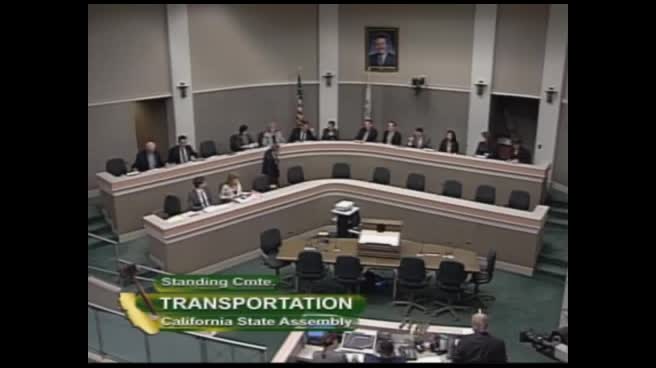 4MIN
Assembly Standing Committee on Transportation
Bill Author

Bill Co-Author(s):