AB 1867: Evidence: judicial notice: official records of conviction.
- Session Year: 2015-2016
- House: Assembly
- Latest Version Date: 2016-08-17
Existing law authorizes judicial notice to be taken of certain matters, including the official acts of state and federal legislative, executive, and judicial departments and the records of any state or federal court. Existing law provides that a certified official record of conviction, or an electronically digitized copy of that record, is admissible to prove, among other things, the act, condition, or event recorded by the record. Existing law defines electronically digitized copy as a copy (1) made by scanning, photographing, or otherwise exactly reproducing a document, (2) stored or maintained in a digitized format, and (3) bearing an electronic signature or watermark unique to the entity responsible for certifying the document.
This bill would additionally include as an electronically digitized copy a copy that, rather than bearing an electronic signature or watermark unique to the entity certifying the document, was transmitted by a superior court clerk in a manner showing that the copy was prepared and transmitted by that superior court clerk.
Existing law requires a writing to be authenticated before it can be received in evidence. Existing law defines authentication of a writing as the introduction of evidence sufficient to sustain a finding that it is the writing that the proponent of the evidence claims it is or the establishment of such facts by any other means, as provided. Under existing law a seal is presumed to be genuine and its use authorized if it purports to be the seal of certain entities including, among other, the United States or a department, agency, or public employee of the United States.
This bill would provide that this presumption applies to a scanned, electronically stored, faxed, photocopied, or other duplicate of a seal.
Under existing law a signature is presumed to be genuine and authorized if it purports to be the signature, affixed in his or her official capacity of a public employee of the United States, a public employee or any public entity in the United States, or a notary public within any state of the United States.
This bill would provide that this presumption applies to a scanned, electronically stored, faxed, photocopied, or other duplicate of a signature.
Under existing law a purported copy of a writing in the custody of a public entity, or of an entry in such a writing, is prima facie evidence of the existence and content of such writing or entry if, among other things, the office in which the writing is kept is within the United States or other specified territory, and the copy is attested or certified as a correct copy of the writing or entry by a public employee or a deputy of a public employee, having the legal custody of the writing.
This bill would provide that this presumption applies to a scanned, electronically stored, faxed, photocopied, or other duplicate of an attested or other certified correct copy of a writing or entry. The bill would also make technical, nonsubstantive changes to these provisions.
(a)The official acts and records specified in subdivisions (c) and (d) of Section 452 include any computer-generated official court records, as specified by the Judicial Council, that relate to criminal convictions, when the record is certified by a clerk of the superior court pursuant to Section 69844.5 of the Government Code at the time of computer entry.
(b)(1)An official record of conviction certified in accordance with subdivision (a) of Section 1530, or an electronically digitized copy thereof, is admissible under Section 1280 to prove the commission, attempted commission, or solicitation of a criminal offense, prior conviction, service of a prison term, or other act, condition, or event recorded by the record.
(2)For purposes of this subdivision, electronically digitized copy means a copy that is made by scanning, photographing, or otherwise exactly reproducing a document, is stored or maintained in a digitized format, and meets either of the following requirements:
(A)The copy bears an electronic signature or watermark unique to the entity responsible for certifying the document.
(B)The document that is copied is an official record of conviction, certified in accordance with subdivision (a) of Section 1530, that is transmitted by the clerk of the superior court in a manner showing that the copy was prepared and transmitted by that clerk of the superior court. A seal, signature, or other indicia of the court shall constitute adequate showing.
(a)The official acts and records specified in subdivisions (c) and (d) of Section 452 include any computer-generated official court records, as specified by the Judicial Council which Council, that relate to criminal convictions, when the record is certified by a clerk of the superior court pursuant to Section 69844.5 of the Government Code at the time of computer entry.
(b)(1)An official record of conviction certified in accordance with subdivision (a) of Section 1530, or an electronically digitized copy thereof, is admissible under Section 1280 to prove the commission, attempted commission, or solicitation of a criminal offense, prior conviction, service of a prison term, or other act, condition, or event recorded by the record.
(2)For purposes of this subdivision, electronically digitized copy means a copy that is made by scanning, photographing, or otherwise exactly reproducing a document, is stored or maintained in a digitized format, and bears an electronic signature or watermark unique to the entity responsible for certifying the document. meets either of the following requirements:
(A)The copy bears an electronic signature or watermark unique to the entity responsible for certifying the document.
(B)The document that is copied is an official record of conviction, certified in accordance with subdivision (a) of Section 1530, that is transmitted by the clerk of the superior court in a manner showing that the copy was prepared and transmitted by that clerk of the superior court. A seal, signature, or other indicia of the court shall constitute adequate showing.
SECTION 1.Section 1452 of the Evidence Code is amended to read:1452.(a)A seal is presumed to be genuine and its use authorized if it purports to be the seal of:
(1)The United States or a department, agency, or public employee of the United States.
(2)A public entity in the United States or a department, agency, or public employee of such public entity.
(3)A nation recognized by the executive power of the United States or a department, agency, or officer of such nation.
(4)A public entity in a nation recognized by the executive power of the United States or a department, agency, or officer of such public entity.
(5)A court of admiralty or maritime jurisdiction.
(6)A notary public within any state of the United States.
(b)The presumption set forth in subdivision (a) applies to a scanned, electronically stored, faxed, photocopied, or other duplicate of a seal.
SEC. 2.Section 1453 of the Evidence Code is amended to read:1453.(a)A signature is presumed to be genuine and authorized if it purports to be the signature, affixed in his or her official capacity, of:
(1)A public employee of the United States.
(2)A public employee of any public entity in the United States.
(3)A notary public within any state of the United States.
(b)The presumption set forth in subdivision (a) applies to a scanned, electronically stored, faxed, photocopied, or other duplicate of a signature.
SEC. 3.Section 1530 of the Evidence Code is amended to read:1530.(a)A purported copy of a writing in the custody of a public entity, or of an entry in such a writing, is prima facie evidence of the existence and content of such writing or entry if any of the following apply:
(1)The copy purports to be published by the authority of the nation or state, or public entity of the nation or state in which the writing is kept.
(2)The office in which the writing is kept is within the United States or within the Panama Canal Zone, the Trust Territory of the Pacific Islands, or the Ryukyu Islands, and the copy is attested or certified as a correct copy of the writing or entry by a public employee, or a deputy of a public employee, having the legal custody of the writing. The presumption set forth in this paragraph applies to a scanned, electronically stored, faxed, photocopied, or other duplicate of an attested or other certified correct copy of a writing or entry.
(3)The office in which the writing is kept is not within the United States or any other place described in paragraph (2) and the copy is attested as a correct copy of the writing or entry by a person having authority to make attestation. The attestation must be accompanied by a final statement certifying the genuineness of the signature and the official position of (A) the person who attested the copy as a correct copy or (B) any foreign official who has certified either the genuineness of the signature and official position of the person attesting the copy or the genuineness of the signature and official position of another foreign official who has executed a similar certificate in a chain of such certificates beginning with a certificate of the genuineness of the signature and official position of the person attesting the copy. Except as provided in the next sentence, the final statement may be made only by a secretary of an embassy or legation, consul general, consul, vice consul, or consular agent of the United States, or a diplomatic or consular official of the foreign country assigned or accredited to the United States. Before January 1, 1971, the final statement may also be made by a secretary of an embassy or legation, consul general, consul, vice consul, consular agent, or other officer in the foreign service of the United States stationed in the nation in which the writing is kept, authenticated by the seal of his or her office. If reasonable opportunity has been given to all parties to investigate the authenticity and accuracy of the documents, the court may, for good cause shown, (A) admit an attested copy without the final statement or (B) permit the writing or entry in foreign custody to be evidenced by an attested summary with or without a final statement.
(b)The presumptions established by this section are presumptions affecting the burden of producing evidence.
(a)A seal is presumed to be genuine and its use authorized if it purports to be the seal of:
(a)
(1)The United States or a department, agency, or public employee of the United States.
(b)
(2)A public entity in the United States or a department, agency, or public employee of such public entity.
(c)
(3)A nation recognized by the executive power of the United States or a department, agency, or officer of such nation.
(d)
(4)A public entity in a nation recognized by the executive power of the United States or a department, agency, or officer of such public entity.
(e)
(5)A court of admiralty or maritime jurisdiction.
(f)
(6)A notary public within any state of the United States.
(b)The presumption set forth in subdivision (a) applies to a scanned, electronically stored, faxed, photocopied, or other duplicate of a seal.
SEC. 2.Section 1453 of the Evidence Code is amended to read:1453.(a)A signature is presumed to be genuine and authorized if it purports to be the signature, affixed in his or her official capacity, of:
(a)
(1)A public employee of the United States.
(b)
(2)A public employee of any public entity in the United States.
(c)
(3)A notary public within any state of the United States.
(b)The presumption set forth in subdivision (a) applies to a scanned, electronically stored, faxed, photocopied, or other duplicate of a signature.
SEC. 3.Section 1530 of the Evidence Code is amended to read:1530.(a)A purported copy of a writing in the custody of a public entity, or of an entry in such a writing, is prima facie evidence of the existence and content of such writing or entry if: if any of the following apply:
(1)The copy purports to be published by the authority of the nation or state, or public entity therein of the nation or state in which the writing is kept; kept.
(2)The office in which the writing is kept is within the United States or within the Panama Canal Zone, the Trust Territory of the Pacific Islands, or the Ryukyu Islands, and the copy is attested or certified as a correct copy of the writing or entry by a public employee, or a deputy of a public employee, having the legal custody of the writing; or writing. The presumption set forth in this paragraph applies to a scanned, electronically stored, faxed, photocopied, or other duplicate of an attested or other certified correct copy of a writing or entry.
(3)The office in which the writing is kept is not within the United States or any other place described in paragraph (2) and the copy is attested as a correct copy of the writing or entry by a person having authority to make attestation. The attestation must be accompanied by a final statement certifying the genuineness of the signature and the official position of (i) (A) the person who attested the copy as a correct copy or (ii) (B) any foreign official who has certified either the genuineness of the signature and official position of the person attesting the copy or the genuineness of the signature and official position of another foreign official who has executed a similar certificate in a chain of such certificates beginning with a certificate of the genuineness of the signature and official position of the person attesting the copy. Except as provided in the next sentence, the final statement may be made only by a secretary of an embassy or legation, consul general, consul, vice consul, or consular agent of the United States, or a diplomatic or consular official of the foreign country assigned or accredited to the United States. Prior to Before January 1, 1971, the final statement may also be made by a secretary of an embassy or legation, consul general, consul, vice consul, consular agent, or other officer in the foreign service of the United States stationed in the nation in which the writing is kept, authenticated by the seal of his or her office. If reasonable opportunity has been given to all parties to investigate the authenticity and accuracy of the documents, the court may, for good cause shown, (i) (A) admit an attested copy without the final statement or (ii) (B) permit the writing or entry in foreign custody to be evidenced by an attested summary with or without a final statement.
(b)The presumptions established by this section are presumptions affecting the burden of producing evidence.
|
Date
|
Status
|
|---|---|
| Apr 11, 2016 | Read third time. Passed. Ordered to the Senate. (Ayes 77. Noes 0. Page 4260.) |
| Aug 17, 2016 | Chaptered by Secretary of State - Chapter 126, Statutes of 2016. |
| Aug 17, 2016 | Approved by the Governor. |
| Aug 5, 2016 | Enrolled and presented to the Governor at 2:30 p.m. |
| Aug 2, 2016 | In Assembly. Ordered to Engrossing and Enrolling. |
| Aug 1, 2016 | Read third time. Passed. Ordered to the Assembly. (Ayes 39. Noes 0. Page 4728.). |
| Aug 1, 2016 | Read third time. Passed. Ordered to the Assembly. |
| Jun 16, 2016 | Read second time. Ordered to third reading. |
| Jun 15, 2016 | From committee: Do pass. (Ayes 7. Noes 0.) (June 14). |
| Apr 28, 2016 | Referred to Com. on JUD. |
| Feb 10, 2016 | Read first time. To print. |
| Apr 11, 2016 | Read third time. Passed. Ordered to the Senate. |
| Apr 11, 2016 | In Senate. Read first time. To Com. on RLS. for assignment. |
| Apr 4, 2016 | Read second time. Ordered to third reading. |
| Mar 31, 2016 | Read second time and amended. Ordered returned to second reading. |
| Mar 30, 2016 | From committee: Amend, and do pass as amended. (Ayes 10. Noes 0.) (March 29). |
| Mar 10, 2016 | In committee: Set, first hearing. Hearing canceled at the request of author. |
| Feb 25, 2016 | Referred to Com. on JUD. |
| Feb 11, 2016 | From printer. May be heard in committee March 12. |
|
Date
|
Description
|
Location
|
Votes
|
|
|---|---|---|---|---|
| Aug 1, 2016 | Assembly 3rd Reading AB1867 Steinorth By Moorlach | Senate Floor |
Passed |
|
| Jun 14, 2016 | Do pass | Senate Standing Committee on Judiciary |
Passed |
|
| Apr 11, 2016 | AB 1867 STEINORTH Assembly Third Reading | Assembly Floor |
Passed |
|
| Mar 29, 2016 | Do pass as amended. | Assembly Standing Committee on Judiciary |
Passed |
This list shows positions taken on this bill by organizations on the date displayed, which is linked to the original source.
Positions by individuals are not included.
|
Organization
|
Position
|
Date
|
|---|---|---|
| California Attorneys For Criminal Justice | ** Against | Aug 1, 2016 |
| California District Attorneys Association | ** Support | Aug 1, 2016 |
| Judicial Council | ** Support | Aug 1, 2016 |
| Los Angeles County District Attorney'S Office | ** Support | Aug 1, 2016 |
| SAN BERNARDINO COUNTY DISTRICT ATTORNEY | ** Support | Apr 11, 2016 |
| San Bernardino County District Attorney's Office | ** Support | Aug 1, 2016 |
Office of Senate Floor Analyses (916) 651-1520 Fax: (916) 327-4478 | AB |
THIRD READING
Bill No: AB 1867
:
SENATE JUDICIARY COMMITTEE: 7-0, 6/14/16
AYES: Jackson, Moorlach, Anderson, Hertzberg, Leno, Monning, Wieckowski
ASSEMBLY FLOOR: 77-0, 4/11/16 - See last page for vote
SOURCE: California District Attorneys Association
DIGEST: This bill, for purposes of judicial notice of criminal conviction records, expands an existing definition of “electronically digitized copy” to also allow a court to take judicial notice of an electronically digitized copy of the record that does not bear any electronic signature or watermark as is currently required, but that, instead, is a certified copy of an official record of conviction, as specified, that has been transmitted by the clerk of the superior court in a manner showing that the copy was prepared and transmitted by that clerk of the superior court. This bill provides that a seal, signature, or other indicia of the court shall constitute adequate showing.
Existing law:
- Defines “hearsay evidence” as evidence of a statement that was made other than by a witness while testifying at the hearing and that is offered to prove the truth of the matter stated. Existing law provides that, except as provided by law, hearsay evidence is inadmissible. These provisions are collectively known as the “hearsay rule.”
- Provides that evidence of a writing made as a record of an act, condition, or event is not made inadmissible by the hearsay rule when offered in any civil or criminal proceeding to prove the act, condition, or event, if:
- the writing was made by and within the scope of duty of a public employee;
- the writing was made at or near the time of the act, condition, or event; and
- the sources of information and method and time of preparation were such as to indicate its trustworthiness.
- Provides that the content of a writing may be proven by introducing the otherwise admissible original. Existing law, the “Secondary Evidence Rule,” provides that the content of a writing may also be proved by otherwise admissible secondary evidence. The Secondary Evidence Rule further requires, however, that the court exclude secondary evidence of the content of writing if the court determines either of the following:
- a genuine dispute exists concerning material terms of the writing and justice requires the exclusion; or
- admission of the secondary evidence would be unfair.
- Provides, under the Secondary Evidence Rule, that nothing in the above makes admissible oral testimony to prove the content of a writing if the testimony is inadmissible under specified law regarding oral testimony of the content of a writing. Existing law further provides that nothing in these provisions excuses compliance with Section 1401 of the Evidence Code, below, requiring authentication of a writing.
- Requires, in a criminal action, that the court exclude secondary evidence of the content of a writing under specified circumstances. This provision, however, does not apply to, among other things, a copy of a writing in the custody of a public entity, or a copy of a writing that is recorded in the public records, if the record or a certified copy of it is made evidence of the writing by statute.
- Requires, under Section 1401 of the Evidence Code, that authentication of a writing before it can be received in evidence and also requires authentication of a writing before secondary evidence of its content can be received in evidence.
- Provides that a seal is presumed to be genuine and its use authorized if it purports to be the seal of, among other things:
- the United States (U.S.) or a department, agency, or public employee of the U.S.;
- a public entity in the U.S. or a department, agency, or public employee of such public entity; or
- a notary public within any state of the U.S.
- Provides that a signature is presumed to be genuine and authorized if it purports to be the signature, affixed in his official capacity, of:
- a public employee of the U.S.;
- a public employee of any public entity in the U.S.; or
- a notary public within any state of the U.S.
- Provides under Section 1530 of the Evidence Code, in relevant part, that a purported copy of a writing in the custody of a public entity, or of an entry in such a writing, is prima facie evidence of the existence and content of such writing or entry if:
- the copy purports to be published by the authority of the nation or state, or public entity therein in which the writing is kept;
- the office in which the writing is kept is within the U.S or specified territories and the copy is attested or certified as a correct copy of the writing or entry by a public employee, or a deputy of a public employee, having the legal custody of the writing; or
- the office in which the writing is kept is not within the U.S. or any other territory described, above, and the copy is attested as a correct copy of the writing or entry by a person having authority to make attestation, as specified.
- Provides that judicial notice may be taken of the specified matters, including official acts of the legislative, executive, and judicial departments of the U.S. and any state of the U.S., and records of any court of this state, any other state or the U.S.
- Provides, under Section 452.5 of the Evidence Code, that the official acts and records specified above include any computer-generated official court records, as specified by the Judicial Council, that relate to criminal convictions, when the record is certified by a superior court clerk pursuant to the Government Code at the time of computer entry.
- Provides further that an official record of conviction certified in accordance with Section 1530, above, as specified, or an electronically digitized copy thereof, is admissible to prove the commission, attempted commission, or solicitation of a criminal offense, prior conviction, service of a prison term, or other act, condition, or event recorded by the record. Existing law provides “electronically digitized copy” means a copy that is made by scanning, photographing, or otherwise exactly reproducing a document, is stored or maintained in a digitized format, and bears an electronic signature or watermark unique to the entity responsible for certifying the document.
This bill defines “electronically digitized copy,” instead, to mean a copy that is made by scanning, photographing, or otherwise exactly reproducing a document, is stored or maintained in a digitized format, and meets either of the following:
- the copy bears an electronic signature or watermark unique to the entity responsible for certifying the document; or
- the document that is copied is an official record of conviction, certified in accordance with existing law, that is transmitted by the superior court clerk in a manner showing that the copy was prepared and transmitted by that clerk. A seal, signature, or other indicia of the court shall constitute adequate showing.
Background
Under the doctrine of “judicial notice,” certain matters are assumed to be indisputably true, and the introduction of evidence to prove them will not be required. Judicial notice is thus a substitute for formal proof. (See generally Evid. Code Sec. 450 et seq.) The use of judicial notice as a substitute for formal proof of matters that cannot be successfully controverted is seen as a highly desirable means of saving time and money. Nevertheless, considerations of relevance remain applicable. Thus, even material for which judicial notice might seem mandatory may be excluded under other provisions of the Evidence Code, such as Section 350, which provides that only relevant evidence is admissible, or Section 352, which allows for the exclusion of otherwise relevant evidence where its probative value is substantially outweighed by the probability of its prejudicial effect. (See 1 Witkin Cal. Evid. Judicial Notice Sec. 1.)
There are certain matters listed under Section 451 of the Evidence Code of which judicial notice must be taken (compulsory judicial notice) regardless of whether a party makes a request. These include for example, the decisional, constitutional, and public statutory law of this state and of the United States, as well as facts and propositions of generalized knowledge that are so universally known that they cannot reasonably be the subject of dispute. There are other broader matters listed in Section 452 of the Evidence Code as to which judicial notice “may” be taken (optional judicial notice—though once a party requests it, it becomes compulsory and the court must grant judicial notice under Section 453 of the Evidence Code). (See id. at Sec. 4.) Those include, for example, official acts of the legislative, executive, and judicial departments of the United States and of any state of the United States, as well as any court records of this state, or any court of record of the United States or of any state of the United States. (Evid. Code Sec. 452(c), (d).)
Of particular relevance to this bill, the Criminal Convictions Record Act, Section 452.5 of the Evidence Code, provides that such official acts and records (of which judicial notice may be taken) include computer-generated official court records which relate to criminal convictions, when the record is certified by a clerk of the superior court pursuant to the Government Code at the time of computer entry. Most pertinent to this bill, this section also allows an official record of conviction, certified as a correct copy by a public employee, or a deputy of a public employee, having the legal custody of the writing (or by other authorized method), to be admitted to prove the commission, attempted commission, or solicitation of a criminal offense, prior conviction, service of a prison term, or other act, condition, or event recorded by the record. Moreover, as a result of legislation enacted in 2013, SB 378 (Block, Chapter 150, Statutes of 2013), an electronically digitized copy of an official record of conviction is also admissible under this Act to prove the commission, attempted commission, or solicitation of a criminal offense, prior conviction, service of a prison term, or other act, condition, or event recorded by the record as well. That legislation specified that for these purposes, “electronically digitized copy” means a copy that: (1) is made by scanning, photographing, or otherwise exactly reproducing a document; (2) is stored or maintained in a digitized format; and (3) bears an electronic signature or watermark unique to the entity responsible for certifying the document.
This bill now expands “electronically digitized copy” for these purposes to include a copy that: (1) is made by scanning, photographing, or otherwise exactly reproducing a document; (2) is stored or maintained in a digitized format; and (3) is certified as an official record of conviction, as specified, and transmitted by the superior court clerk in a manner showing (such as by a seal, signature, or other indicia of the court) that the copy was prepared and transmitted by that clerk.
Comment
According to the author:
Although courts are already allowed to prepare such documents electronically, the requirement to use electronic signatures or watermarks prevents most courts from using the electronic system due to the lack of training, funds, and resources required for implementation. Consequently, the system is outdated as courts continue to use paper hard copies of records. In using paper copies, [district attorney] offices and other attorneys are often required to physically travel back and forth to court clerk offices to obtain these records, instead of being able to e-mail them.
By allowing courts to scan or photocopy existing paper records for digital use, we can modernize our court system without requiring any new equipment or additional training. Instead, court clerks will be able to use existing equipment they are already familiar with to transmit documents electronically.
AB 1867 will [ . . . ] allow for the use of copies of official records of conviction. Instead of requiring that conviction records must be prepared electronically with electronic signatures or watermarks, this bill will allow court clerk offices to scan/photocopy existing hard copy records in order to store or transmit them electronically. The copied records must contain a seal, signature, or other indicia of the court for purposes of ensuring authenticity.
FISCAL EFFECT: Appropriation: Fiscal Com.: Local:
California District Attorneys Association (source)
Judicial Council
Los Angeles County District Attorney’s Office
San Bernardino County District Attorney’s Office
OPPOSITION: (Verified 6/17/16)
California Attorneys for Criminal Justice
ARGUMENTS IN SUPPORT: The sponsor of this bill, the California District Attorneys Association, writes that:
District Attorney offices around the state have large rooms overflowing with certified paper records of prior convictions for use in court when defendants commit a crime and we need to prove that they have suffered a prior conviction that affects their sentence. These have been obtained over the years by ordering them from court clerks’ offices when needed to prove a prior conviction, and they are saved for later use should the defendant commit another crime where that prior conviction needs to be proven again.
As more DA offices move to paperless systems, we need to be able to scan and save those documents electronically. We would further like to obtain these records from court clerks’ offices via email or fax and keep that record in the first instance only in its electronic form. Right now, we cannot do either of these things, because a scanned, faxed, or electronic copy of a certified copy of a prior conviction from the court is inadmissible.
Currently, California law allows court clerks’ offices to prepare records of prior convictions electronically, and if they are so prepared, to allow them to be presented in court electronically. In order to take advantage of this law, a court clerk’s office would have to affix an electronic signature or watermark to the electronically certified documents. While it may not seem difficult or costly to acquire the technology, train the staff, and actually put in place the method of preparing such documents electronically, with court budgets under tremendous strain, it is not happening. Instead, we continue to receive certified copies of prior convictions in paper form with original signatures on the certifications.
[ . . . ] AB 1867 would allow for the introduction of electronic copies, faxes, or paper copies of certified prior documents, which would make it easier to adopt paperless court procedures for all parties. This would allow the electronic storage and presentation of certified prior documents, and also allow court clerks’ offices to use their existing certification methods for prior documents, but to just send them electronically to all counsel for use in court.
ARGUMENTS IN OPPOSITION: The California Attorneys for Criminal Justice writes in opposition:
Thousands of prison sentences in California are increased or extended based upon prior convictions. These sentences are often doubled or more based on prior convictions. Judges who impose sentences rely on prior convictions as well. Therefore it is critical that precise safeguards are utilized to ensure documents admitted under “judicial notice” are accurate.
AB 1867 may be well intentioned, however, it weakens the definition of “electronically digitized copy” and therefore opens the door to courts relying on inaccurate documents. Currently, Evidence Code 452.5 requires an electronic signature or unique watermark [be] affixed to [the] document to be considered an “electronically digitized copy.” These markings essentially attach to the electronic document to ensure that the document is not altered in any way as it passes through various hands. Unfortunately, AB 1867 makes this electronic signature or watermark requirement optional.
It appears that this bill would allow a court record to be emailed directly to a prosecutor, and the prosecutor could simply print out the document and bring it to court to request judicial notice of the document. [ . . . ] AB 1867 simply requires that the email sent to the prosecutor’s office include a signature that it is being sent directly from a court clerk. This is common when prosecutors seek to introduce convictions from other counties. There is no requirement that the document itself have a unique identifier affixed to it to ensure authenticity. Documents go through many hands in a district attorney’s office. It is critical that an emailed copy contain an identifier directly affixed to it to ensure that no one intentionally or otherwise alters it. This bill opens the door to mischief. Essentially, after a document is printed out, it could be altered before being presented to a court for judicial notice. It could also be altered by someone other than the prosecutor who appears in court, and she would have no basis to determine whether the document is in fact an identical copy in a court file. There are no safeguards attached to the document itself. While the overwhelming majority of prosecutors in California are highly professional and ethical, there are too many examples of prosecutorial misconduct.
Recently, a prosecutor in Kern County falsified a transcript of an interrogation to include a fabricated statement of admission of guilt by the accused. The prosecutor claimed the alteration was a bad joke that was being misconstrued. However, this demonstrates how easy it is for a prosecutor to falsify a document when there is no requirement for a certifying watermark. [ . . . ] This bill may be well intentioned, but it weakens key protections in current law.
ASSEMBLY FLOOR: 77-0, 4/11/16
AYES: Achadjian, Alejo, Travis Allen, Atkins, Baker, Bigelow, Bloom, Bonilla, Bonta, Brough, Brown, Burke, Calderon, Campos, Chang, Chau, Chávez, Chiu, Chu, Cooley, Cooper, Dababneh, Dahle, Daly, Dodd, Eggman, Frazier, Beth Gaines, Gallagher, Cristina Garcia, Eduardo Garcia, Gatto, Gipson, Gomez, Gordon, Gray, Grove, Hadley, Harper, Roger Hernández, Holden, Irwin, Jones, Jones-Sawyer, Kim, Lackey, Levine, Linder, Lopez, Low, Maienschein, Mathis, Mayes, McCarty, Medina, Melendez, Mullin, Nazarian, Obernolte, O'Donnell, Olsen, Patterson, Quirk, Ridley-Thomas, Rodriguez, Salas, Santiago, Steinorth, Mark Stone, Thurmond, Ting, Wagner, Waldron, Weber, Wilk, Williams, Wood
NO VOTE RECORDED: Gonzalez, Rendon
6/17/16 15:03:45
Senator Hannah-Beth Jackson, Chair
2015-2016 Regular Session
Bill No: AB 1867 (Author:Steinorth)
Version: March 31, 2016
Hearing Date: June 14, 2016
Fiscal: No
Urgency: No
Consultant: RD
SUBJECT
Evidence: judicial notice: official records of conviction
DESCRIPTION
Existing law provides that an official record of conviction certified in accordance with specified law, or an electronically digitized copy thereof, is admissible to prove the commission, attempted commission, or solicitation of a criminal offense, prior conviction, service of a prison term, or other act, condition, or event recorded by the record. Existing law defines, “electronically digitized copy” to require, among other things, that the copy bear an electronic signature or watermark unique to the entity responsible for certifying the document.
This bill would now expand this definition of “electronically digitized copy” to also include a copy that does not bear an electronic signature or watermark, but that, instead, is a certified copy of an official record of conviction, as specified, that has been transmitted by the clerk of the superior court in a manner showing that the copy was prepared and transmitted by that clerk of the superior court. This bill would provide that a seal, signature, or other indicia of the court shall constitute adequate showing.
BACKGROUND
Under the doctrine of “judicial notice,” certain matters are assumed to be indisputably true, and the introduction of evidence to prove them will not be required. Judicial notice is thus a substitute for formal proof. (See generally Evid. Code Sec. 450 et seq.) The use of judicial notice as a substitute for formal proof of matters that cannot be successfully controverted is seen as a highly desirable means of saving time and money. Nevertheless, considerations of relevance remain applicable. Thus, even material for which judicial notice might seem mandatory may be excluded under other provisions of the Evidence Code, such as Section 350, which provides that only relevant evidence is admissible, or Section 352, which allows for the exclusion of otherwise relevant evidence where its probative value is substantially outweighed by the probability of its prejudicial effect. (See 1 Witkin Cal. Evid. Judicial Notice Sec. 1,
There are certain matters listed under Section 451 of the Evidence Code of which judicial notice must be taken (compulsory judicial notice) regardless of whether a party makes a request. These include for example, the decisional, constitutional, and public statutory law of this state and of the United States, as well as facts and propositions of generalized knowledge that are so universally known that they cannot reasonably be the subject of dispute. There are other broader matters listed in Section 452 of the Evidence Code as to which judicial notice “may” be taken (optional judicial notice—though once a party requests it, it becomes compulsory and the court must grant judicial notice under Section 453 of the Evidence Code). (See id. at Sec. 4.) Those include, for example, official acts of the legislative, executive, and judicial departments of the United States and of any state of the United States, as well as any court records of this state, or any court of record of the United States or of any state of the United States. (Evid. Code Sec. 452(c), (d).)
Of particular relevance to this bill, the Criminal Convictions Record Act, Section 452.5 of the Evidence Code, provides that such official acts and records (of which judicial notice may be taken) include computer-generated official court records which relate to criminal convictions, when the record is certified by a clerk of the superior court pursuant to the Government Code at the time of computer entry. Most pertinent to this bill, this section also allows an official record of conviction, certified as a correct copy by a public employee, or a deputy of a public employee, having the legal custody of the writing (or by other authorized method), to be admitted to prove the commission, attempted commission, or solicitation of a criminal offense, prior conviction, service of a prison term, or other act, condition, or event recorded by the record. Moreover, as a result of legislation enacted in 2013, SB 378 (Block, Ch. 150, Stats. 2013), an electronically digitized copy of an official record of conviction is also admissible under this Act to prove the commission, attempted commission, or solicitation of a criminal offense, prior conviction, service of a prison term, or other act, condition, or event recorded by the record as well. That legislation specified that for these purposes, “electronically digitized copy” means a copy that: (1) is made by scanning, photographing, or otherwise exactly reproducing a document; (2) is stored or maintained in a digitized format; and (3) bears an electronic signature or watermark unique to the entity responsible for certifying the document.
This bill would now expand “electronically digitized copy” for these purposes to include a copy that: (1) is made by scanning, photographing, or otherwise exactly reproducing a document; (2) is stored or maintained in a digitized format; and (3) is certified as an official record of conviction, as specified, and transmitted by the superior court clerk in a manner showing (such as by a seal, signature, or other indicia of the court) that the copy was prepared and transmitted by that clerk.
CHANGES TO EXISTING LAW
Existing law defines “hearsay evidence” as evidence of a statement that was made other than by a witness while testifying at the hearing and that is offered to prove the truth of the matter stated. Existing law provides that, except as provided by law, hearsay evidence is inadmissible. These provisions are collectively known as the “hearsay rule.” (Evid. Code Sec. 1200.)
Existing law provides that evidence of a writing made as a record of an act, condition, or event is not made inadmissible by the hearsay rule when offered in any civil or criminal proceeding to prove the act, condition, or event, if:
- the writing was made by and within the scope of duty of a public employee;
- the writing was made at or near the time of the act, condition, or event; and
- the sources of information and method and time of preparation were such as to indicate its trustworthiness. (Evid. Code Sec. 1280.)
Existing law, provides that the content of a writing may be proven by introducing the otherwise admissible original. (Evid. Code Sec. 1520.) Existing law, the “Secondary Evidence Rule,” provides that the content of a writing may also be proved by otherwise admissible secondary evidence. The Secondary Evidence Rule further requires, however, that the court exclude secondary evidence of the content of writing if the court determines either of the following:
- a genuine dispute exists concerning material terms of the writing and justice requires the exclusion; or
- admission of the secondary evidence would be unfair. (Evid. Code Sec. 1521(a).)
Existing law, the Secondary Evidence Rule provides that nothing in the above makes admissible oral testimony to prove the content of a writing if the testimony is inadmissible under specified law regarding oral testimony of the content of a writing.
Existing law further provides that nothing in these provisions excuses compliance with Section 1401, below, requiring authentication of a writing. (Evid. Code Sec. 1521(b), (c).)
Existing law requires, in a criminal action, that the court exclude secondary evidence of the content of a writing under specified circumstances. This section, however, does not apply to, among other things, a copy of a writing in the custody of a public entity, or a copy of a writing that is recorded in the public records, if the record or a certified copy of it is made evidence of the writing by statute. (Evid. Code Sec. 1522(a).)
Existing law requires authentication of a writing before it can be received in evidence and also requires authentication of a writing before secondary evidence of its content can be received in evidence. (Evid. Code Sec. 1401.).
Existing law provides that a seal is presumed to be genuine and its use authorized if it purports to be the seal of, among other things:
- the United States (U.S.) or a department, agency, or public employee of the U.S.;
- a public entity in the U.S. or a department, agency, or public employee of such public entity; or
- a notary public within any state of the U.S. (Evid. Code Sec. 1452.)
Existing law provides that a signature is presumed to be genuine and authorized if it purports to be the signature, affixed in his official capacity, of:
- a public employee of the U.S.;
- a public employee of any public entity in the U.S.; or
- a notary public within any state of the U.S. (Evid. Code Sec. 1453.)
Existing law, in relevant part, provides that a purported copy of a writing in the custody of a public entity, or of an entry in such a writing, is prima facie evidence of the existence and content of such writing or entry if:
- the copy purports to be published by the authority of the nation or state, or public entity therein in which the writing is kept;
- the office in which the writing is kept is within the U.S or specified territories and the copy is attested or certified as a correct copy of the writing or entry by a public employee, or a deputy of a public employee, having the legal custody of the writing; or
- the office in which the writing is kept is not within the U.S. or any other territory described, above, and the copy is attested as a correct copy of the writing or entry by a person having authority to make attestation, as specified. (Evid. Code Sec. 1530(a).)
Existing law provides that judicial notice may be taken of the specified matters, including official acts of the legislative, executive, and judicial departments of the U.S. and any state of the U.S., and records of any court of this state, any other state or the U.S. (Evid. Code Sec. 452(c), (d).)
Existing law provides that the official acts and records specified above include any computer-generated official court records, as specified by the Judicial Council, that relate to criminal convictions, when the record is certified by a superior court clerk pursuant to the Government Code at the time of computer entry. (Evid. Code Sec. 452.5(a).)
Existing law provides that an official record of conviction certified in accordance with specified law above, or an electronically digitized copy thereof, is admissible to prove the commission, attempted commission, or solicitation of a criminal offense, prior conviction, service of a prison term, or other act, condition, or event recorded by the record. Existing law provides “electronically digitized copy” means a copy that is made by scanning, photographing, or otherwise exactly reproducing a document, is stored or maintained in a digitized format, and bears an electronic signature or watermark unique to the entity responsible for certifying the document. (Evid. Code Sec. 452.5.)
This bill would, now, define “electronically digitized copy” to mean a copy that is made by scanning, photographing, or otherwise exactly reproducing a document, is stored or maintained in a digitized format, and meets either of the following:
- the copy bears an electronic signature or watermark unique to the entity responsible for certifying the document; or
- the document that is copied is an official record of conviction, certified in accordance with existing law, that is transmitted by the superior court clerk in a manner showing that the copy was prepared and transmitted by that clerk. A seal, signature, or other indicia of the court shall constitute adequate showing.
COMMENT
1. Stated need for the bill
According to the author:
Although courts are already allowed to prepare such documents electronically, the requirement to use electronic signatures or watermarks prevents most courts from using the electronic system due to the lack of training, funds, and resources required for implementation. Consequently, the system is outdated as courts continue to use paper hard copies of records. In using paper copies, [district attorney] offices and other attorneys are often required to physically travel back and forth to court clerk offices to obtain these records, instead of being able to e-mail them.
By allowing courts to scan or photocopy existing paper records for digital use, we can modernize our court system without requiring any new equipment or additional training. Instead, court clerks will be able to use existing equipment they are already familiar with to transmit documents electronically.
AB 1867 will [ . . . ] allow for the use of copies of official records of conviction. Instead of requiring that conviction records must be prepared electronically with electronic signatures or watermarks, this bill will allow court clerk offices to scan/photocopy existing hard copy records in order to store or transmit them electronically. The copied records must contain a seal, signature, or other indicia of the court for purposes of ensuring authenticity.
The sponsor of this bill, the California District Attorneys Association, writes that:
District Attorney offices around the state have large rooms overflowing with certified paper records of prior convictions for use in court when defendants commit a crime and we need to prove that they have suffered a prior conviction that affects their sentence. These have been obtained over the years by ordering them from court clerks’ offices when needed to prove a prior conviction, and they are saved for later use should the defendant commit another crime where that prior conviction needs to be proven again.
As more DA offices move to paperless systems, we need to be able to scan and save those documents electronically. We would further like to obtain these records from court clerks’ offices via email or fax and keep that record in the first instance only in its electronic form. Right now, we cannot do either of these things, because a scanned, faxed, or electronic copy of a certified copy of a prior conviction from the court is inadmissible.
Currently, California law allows court clerks’ offices to prepare records of prior convictions electronically, and if they are so prepared, to allow them to be presented in court electronically. In order to take advantage of this law, a court clerk’s office would have to affix an electronic signature or watermark to the electronically certified documents. While it may not seem difficult or costly to acquire the technology, train the staff, and actually put in place the method of preparing such documents electronically, with court budgets under tremendous strain, it is not happening. Instead, we continue to receive certified copies of prior convictions in paper form with original signatures on the certifications.
[ . . . ] AB 1867 would allow for the introduction of electronic copies, faxes, or paper copies of certified prior documents, which would make it easier to adopt paperless court procedures for all parties. This would allow the electronic storage and presentation of certified prior documents, and also allow court clerks’ offices to use their existing certification methods for prior documents, but to just send them electronically to all counsel for use in court.
2. Admissibility of Documents and Records
The Evidence Code generally governs the admissibility of evidence in civil and criminal proceedings, including the admissibility of documents and records. The hearsay rule states that “evidence of a statement that was made other than by a witness while testifying at the hearing and that is offered to prove the truth of the matter stated” is inadmissible except as otherwise provided by law. (Evid. Code Sec. 1200.) The Evidence Code creates a number of exceptions to the hearsay rule for documents and records that are produced by a public entity. The idea is that these documents are trustworthy:
A long-established hearsay exception makes admissible the statement of a public official, provided the official was under a duty to make it and it was based on facts within the official’s personal knowledge. The regular practice of the public office and the official duty make the statement trustworthy, and public functions could not be conveniently performed if officers and deputies were constantly called as witnesses to testify to the matters covered by official statements. (See 1 Witkin Cal. Evid. Hearsay Sec. 245 (internal citations omitted).)
Currently, computer-generated official court records of criminal records are admissible for purposes of judicial notice, and, moreover, an official record of conviction certified as a correct copy by a public employee, as otherwise required under the law, is admissible as a record by a public employee under Section 1280 of the Evidence Code to prove the conviction, attempted commission, or solicitation of a criminal offense, prior conviction, service of a prison term, or other act, condition, or event recorded by the record. In line with the longstanding hearsay exception outlined, above, Section 1280 reflects an exception to the hearsay rule for certain writings made as a record of an act, condition, or event. Under that section, such a writing is not considered inadmissible by the general hearsay rule when offered in any civil or criminal proceeding to prove the act, condition, or event, as long as: (1) the writing was made by and within the scope of duty of a public employee; (2) the writing was made at or near the time of the act, condition, or event; and (3) the sources of information and method and time of preparation were such as to indicate its trustworthiness.
In 2013, SB 378 (Block, Stats. 150, Stats. 2013) was enacted to also make electronically digitized copies of these records admissible to prove the conviction, attempted commission, or solicitation of a criminal offense, prior conviction, service of a prison term, or other act, condition, or event recorded by the record. Pursuant to that bill, however, the definition for an electronically digitized copy requires that it not only be made by scanning, photographing, or otherwise exactly reproducing a document, and be stored or maintained in a digitized format, but that it “bear an electronic signature or watermark unique to the entity responsible for certifying the document.” At the time, it was asserted by the bill’s sponsor (the San Diego District Attorney) that it has been taking longer to obtain court certified copies of prior convictions which can cause problems with the speedy trial timelines in a criminal case. (See Sen. Pub. Safety Committee analysis of SB 378 (2013-2014 Reg. Session) Apr. 9, 2013, p. 4.)
This bill, sponsored by the California District Attorneys Association (CDAA), would now expand the types of electronically digitized copies of these criminal conviction records that the courts can take judicial notice of in civil or criminal cases. Specifically, under this bill, an electronic digitized copy could now include a copy that does not bear an electronic signature or watermark, but that, instead, is a certified copy of an official record of conviction that is transmitted by the clerk of the superior court in a manner showing that the copy was prepared and transmitted by that clerk of the superior court. For these purposes, the bill expressly provides that a seal, signature, or other indicia of the court would constitute adequate showing.
In support, the Judicial Council of California writes that “[b]y expanding the definition of ‘electronically digitized copy’ the council believes AB 1867 will enhance the ability of courts to increase efficiencies by taking advantage of emerging technologies.”
3. Opposition
The California Attorneys for Criminal Justice writes in opposition:
Thousands of prison sentences in California are increased or extended based upon prior convictions. These sentences are often doubled or more based on prior convictions. Judges who impose sentences rely on prior convictions as well. Therefore it is critical that precise safeguards are utilized to ensure documents admitted under “judicial notice” are accurate.
AB 1867 may be well intentioned, however, it weakens the definition of “electronically digitized copy” and therefore opens the door to courts relying on inaccurate documents. Currently, Evidence Code 452.5 requires an electronic signature or unique watermark [be] affixed to [the] document to be considered an “electronically digitized copy.” These markings essentially attach to the electronic document to ensure that the document is not altered in any way as it passes through various hands. Unfortunately, AB 1867 makes this electronic signature or watermark requirement optional.
It appears that this bill would allow a court record to be emailed directly to a prosecutor, and the prosecutor could simply print out the document and bring it to court to request judicial notice of the document. [ . . . ] AB 1867 simply requires that the email sent to the prosecutor’s office include a signature that it is being sent directly from a court clerk. This is common when prosecutors seek to introduce convictions from other counties. There is no requirement that the document itself have a unique identifier affixed to it to ensure authenticity. Documents go through many hands in a district attorney’s office. It is critical that an emailed copy contain an identifier directly affixed to it to ensure that no one intentionally or otherwise alters it. This bill opens the door to mischief. Essentially, after a document is printed out, it could be altered before being presented to a court for judicial notice. It could also be altered by someone other than the prosecutor who appears in court, and she would have no basis to determine whether the document is in fact an identical copy in a court file. There are no safeguards attached to the document itself. While the overwhelming majority of prosecutors in California are highly professional and ethical, there are too many examples of prosecutorial misconduct.
Recently, a prosecutor in Kern County falsified a transcript of an interrogation to include a fabricated statement of admission of guilt by the accused. The prosecutor claimed the alteration was a bad joke that was being misconstrued. However, this demonstrates how easy it is for a prosecutor to falsify a document when there is no requirement for a certifying watermark. [ . . . ] This bill may be well intentioned, but it weakens key protections in current law.
Support: Judicial Council; Los Angeles County District Attorney’s Office; San Bernardino County District Attorney’s Office
Opposition: California Attorneys for Criminal Justice
HISTORY
Source: California District Attorneys Association
Related Pending Legislation: None Known
Prior Legislation: SB 378 (Block, Ch. 150, Stats. 2013) See Comment 2.
Prior Vote:
Assembly Floor (Ayes 77, Noes 0)
Assembly Judiciary Committee (Ayes 10, Noes 0)
**************
ASSEMBLY THIRD READING
ATR Bill Id:AB 1867
Author:(Steinorth)
As Amended Ver:March 31, 2016
Majority vote
Committee | Votes | Ayes | Noes |
Judiciary | 10-0 | Mark Stone, Wagner, Alejo, Chau, Chiu, Gallagher, Cristina Garcia, Holden, Maienschein, Ting |
|
SUMMARY: Permits certain seals and signatures that are electronically stored, faxed, or photocopied to be self-authenticating, and allows the use of certain electronically stored, faxed, or photocopied documents to verify the content of a writing. Specifically, this bill expands the definition of "electronically digitized copy" of records of criminal convictions, enacted by the Legislature in 2013 (SB 378 (Block), Chapter 150, Statutes of 2013) to include "a copy that is made by scanning, photographing, or otherwise exactly reproducing a document, is stored or maintained in a digitized format, and bears an electronic signature or watermark unique to the entity responsible for certifying the document."
EXISTING LAW:
- Provides that evidence of a statement made outside of court is hearsay and inadmissible unless there is an exception.
- Requires a writing to be authenticated before it is received into evidence and before secondary evidence is used to verify its content.
- Creates a presumption that a seal is genuine and its use authorized if it purports to be the seal of one of a specified entity in the United States, of countries recognized by the United States, or a notary public in the United States.
- Creates a presumption that a signature is genuine and its use authorized if it purports to be the signature of an employee of the United States, an employee of a public entity in the United States, or a notary public in the United State, so long as the individual is acting within his or her official capacity.
- Allows an official record of conviction certified in accordance with Evidence Code Section 1530(a), or an electronically digitized copy thereof, to be admitted into evidence to prove the commission, attempted commission, or solicitation of a criminal offense, prior conviction, service of a prison term, or other act, condition, or event recorded by the record and defines "electronically digitized copy" to mean a copy that is made by scanning, photographing, or otherwise exactly reproducing a document, is stored or maintained in a digitized format, and bears an electronic signature or watermark unique to the entity responsible for certifying the document. (Evidence Code Section 452.5.)
FISCAL EFFECT: None
COMMENTS: The sponsor, the California District Attorneys Association (CDAA), asserts that current law regarding the use and admissibility of "electronically digitized copies" of records of criminal convictions, enacted by the Legislature in 2013 (SB 378 (Block), Chapter 150, Statutes of 2013) is overly restrictive and therefore is not widely used.
SB 378 amended subdivision of Evidence Code Section 452.5(b) (with changes to then-existing law in bold) as follows:
(b)(1) An official record of conviction certified in accordance with subdivision (a) of Section 1530, or an electronically digitized copy thereof, is admissible under Section 1280 to prove the commission, attempted commission, or solicitation of a criminal offense, prior conviction, service of a prison term, or other act, condition, or event recorded by the record.
(2) For purposes of this subdivision, "electronically digitized copy" means a copy that is made by scanning, photographing, or otherwise exactly reproducing a document, is stored or maintained in a digitized format, and bears an electronic signature or watermark unique to the entity responsible for certifying the document.
According to CDAA, "This means that in order to take advantage of this new law, the court clerk's office would have to affix an electronic signature or watermark to the electronically certified document. Clerk's offices around the state have not yet been able to take advantage of this procedure to produce electronic records of convictions."
In order to address this concern, this bill amends the definition of "electronically digitized copy" in Section 452.5(b)(2), as follows:
(2) For purposes of this subdivision, "electronically digitized copy" means a copy that is made by scanning, photographing, or otherwise exactly reproducing a document, is stored or maintained in a digitized format, and meets one of the following requirements:
(A) The copy bears an electronic signature or watermark unique to the entity responsible for certifying the document.
(B) The document that is copied is an official record of conviction certified in accordance with subdivision (a) of Section 1530 which is transmitted by the clerk of the superior court in a manner showing that the copy was prepared and transmitted by that clerk of the superior court. A seal, signature, or other indicia of the court shall constitute adequate showing.
The proposed language, limited to certified copies of criminal convictions, will provide more flexibility for electronic copies of those records to be transmitted from courts and allow those copies to be admitted into evidence while ensuring that the actual custodian of the record has certified that the certified copy, as well as the electronic copy of that record, accurately reflects the content of the original writing.
Analysis Prepared by: Alison Merrilees / JUD. / (916) 319-2334 FN: 0002680
Date of Hearing: March 29, 2016
ASSEMBLY COMMITTEE ON JUDICIARY
Mark Stone, Chair
ABPCA Bill Id:AB 1867
Author:(Steinorth) – As Introduced Ver:February 10, 2016
SUBJECT: EVIDENCE: ADMISSIBILITY; WRITINGS
KEY ISSUES:
- SHOULD COPIES OF CERTAIN SEALS AND SIGNATURES THAT ARE ELECTRONICALLY STORED, FAXED, OR PHOTOCOPIED BE SELF-AUTHENTICATING?
- SHOULD AN ELECTRONICALLY STORED, FAXED, PHOTOCOPIED, OR OTHER DUPLICATE OF A COPY OF A GOVERNMENT WRITING WHICH HAS BEEN CERTIFED BY THE CUSTODIAN OF THE ORIGINAL WRITING, BE CONSIDERED PRIMA FACIE EVIDENCE OF THE EXISTENCE AND CONTENT OF THE WRITING, JUST LIKE THE CERTIFIED COPY ITSELF?
- IN ORDER TO ADDRESS THE CONCERN THAT CURRENT LAW DOES NOT GIVE ENOUGH FLEXIBILITY TO COURTS THAT WANT TO UTILIZE ELECTRONICALLY DIGITIZED COPIES OF CRIMINAL CONVICTIONS, MIGHT IT BE PREFERABLE TO AMEND EXISTING LAW TO PROVIDE SUCH FLEXIBILITY?
SYNOPSIS
Written documents are out of court statements. When sought to be admitted into evidence in a court proceeding to prove the truth of the content of the writing, they are hearsay and inadmissible unless an exception to the hearsay exception applies and allows them to be admitted for that purpose. California law allows a document to be admitted into evidence if it is authenticated by a witness in court and its content is verified. However, some documents are self-authenticating because of their source, such as a document from a government agency. Existing law allows documents with seals and signatures belonging to certain entities and individuals to be presumed as genuine. Existing law also allows certified copies of writings to be used to verify the content of the writing and specifically allows a certified copy of a criminal conviction to be admitted into evidence as proof of the conviction. That law was recently updated to allow an “electronically digitized copy” of a criminal conviction to be admitted into evidence as if it were a certified copy of the conviction. That statute, Section 452.5 of the Evidence Code, which was intended to modernize the Evidence Code to facilitate the use of electronic records, has reportedly been difficult to implement because it requires a court to have and use “an electronic signature or watermark unique to the entity responsible for certifying the document” in order to meet the definition of an “electronically digitized copy.” According to the sponsor of this bill, the California District Attorneys Association, “This means that in order to take advantage of this new law, the court clerk’s office would have to affix an electronic signature or watermark to the electronically certified document. Clerk’s offices around the state have not yet been able to take advantage of this procedure to produce electronic records of convictions.” In order to address this concern in a manner that is more narrowly tailored than the sweeping changes proposed in the current version of this bill, the author has agreed to delete the current content of this bill and, as an alternative, revise the definition of “electronically digitized copy” in Section 452.5. The Committee’s suggested amendments would propose an alternative definition of “electronically digitized copy” that would allow courts to make electronic copies of records and transmit them in a manner showing that the copy was prepared and transmitted by that clerk of the superior court. The definition would also clarify that “a seal, signature, or other indicia of the court shall constitute adequate showing.” The proposed language, limited to certified copies of criminal convictions, will provide more flexibility for electronic copies of those records to be transmitted from courts and allow those copies to be admitted into evidence while ensuring that the actual custodian of the record has certified that the certified copy, as well as the electronic copy of that record, accurately reflects the content of the original writing. The author has indicated that he will accept the proposed amendments in Committee as author’s amendments. This bill is supported by the San Bernardino County District Attorney and has no opposition on file.
SUMMARY: Permits certain seals and signatures that are electronically stored, faxed, or photocopied to be self- authenticating, and allows the use of certain electronically stored, faxed, or photocopied documents to verify the content of a writing. Specifically, this bill:
- Specifies that the presumption in current law, providing seals and signatures of certain government and other authorized entities or individuals are presumed to be genuine and their use authorized, also applies to electronically stored, faxed, photocopies of such seals and signatures.
- Provides that the presumption in current law that an attested or certified copy of a writing can be used as prima facie evidence of the content of the writing if the writing is kept within the United States or other specified territory also applies to electronically stored, faxed, or photocopied versions of such writings.
EXISTING LAW:
- Provides that evidence of a statement made outside of court is hearsay and inadmissible unless there is an exception. (Evidence Code Section 1200. All further statutory references are to the Evidence Code, unless otherwise indicated.)
- Requires a writing to be authenticated before it is received into evidence and before secondary evidence is used to verify its content. (Section 1401.)
- Creates a presumption that a seal is genuine and its use authorized if it purports to be the seal of one of a specified entity in the United States, of countries recognized by the United States, or a notary public in the United States. (Section 1452.)
- Creates a presumption that a signature is genuine and its use authorized if it purports to be the signature of an employee of the United States, an employee of a public entity in the United States, or a notary public in the United State, so long as the individual is acting within his or her official capacity. (Section 1453.)
- Provides that secondary evidence (a copy of a writing) that has been authenticated can be used to prove the content of a writing, unless either a genuine dispute exists regarding the terms of the writing, or admission of the evidence would be unfair. (Section 1521.)
- Provides that an attested or certified copy of a writing can be used as prima facie evidence of the content of the writing if the writing is located in the United States or other specified territory. (Section 1530 (a).)
- Allows an official record of conviction certified in accordance with subdivision (a) of Section 1530, or an electronically digitized copy thereof, to be admitted into evidence to prove the commission, attempted commission, or solicitation of a criminal offense, prior conviction, service of a prison term, or other act, condition, or event recorded by the record and defines “electronically digitized copy” to mean a copy that is made by scanning, photographing, or otherwise exactly reproducing a document, is stored or maintained in a digitized format, and bears an electronic signature or watermark unique to the entity responsible for certifying the document. (Section 452.5.)
- Requires a publisher of official legal material that is published in an electronic form as the official record of that material, as part of the Uniform Electronic Legal Material Act, to provide a method for the user of that material to determine that the record is unaltered from the official record published by the publisher. (Government Code Section 10294.)
FISCAL EFFECT: As currently in print this bill is keyed non-fiscal.
COMMENTS: Documents are often used in court proceedings as evidence of disputed facts. Because a writing in a government record is an out of court statement, it is hearsay and therefore inadmissible in court to prove the truth of any matter asserted in the writing, unless a hearsay exception applies to the writing. (Section 1200.) Official government records and other official writings are admissible in court under exceptions to the hearsay rule. (See Sections 1280 et seq.) Before being admitted as evidence, however, such records must be authenticated. Authentication of a document can be made by a witness in court who can verify the content of the writing. (Section 1413.) However, authenticating testimony is not always necessary because some documents are “self-authenticating.” For example, existing law provides that seals of certain government entities on writings are presumed to be genuine and their use is presumed to be authorized, so no further evidence of authenticity of the writing is required. (Section 1452.) Existing law also provides that certain signatures, specifically those of public employees and notaries public, on writings are presumed to be genuine and their use is presumed to be authorized, so no further evidence of authenticity of the writing is required. (Section 1453.) Similarly, current law provides that a certified copy of a government writing can be used as prima facie evidence of the content of the writing if the government office is located in the United States or other specified territory and the copy is attested or certified by a public employee of the office having legal custody of the writing. (Section 1530 (a).)
Changes to the Law Governing Self-Authentication of Seals and Signatures May not be Necessary. As currently in print, this bill would extend the presumption of authenticity that applies to seals and signatures of certain entities and individuals to copies of those seals and signatures that are electronically stored, faxed, and photocopied. It would make electronically stored, faxed and photocopied documents baring seals and signatures from certain individuals and entities presumptively authenticated for purposes of admissibility in court without the need for further authentication and without certification that the copy is genuine. As a result, the party who disputes the authenticity of the duplicated document would have the burden of proving that the document was not authentic.
Sections 1452 and 1453 address the issue of authentication of documents with seals and signatures but do not specifically address authentication of documents with seals and signatures that are copied or duplicated. Rather, the issue of duplication is addressed in an entirely different chapter of the Evidence Code (Chapter 2, “Secondary Evidence of Writings”). The fact that these are completely distinct evidentiary issues is reinforced by subdivision (c) of Section 1521, which states that “Nothing in this section excuses compliance with Section 1401 (authentication).” In fact, the Evidence Code provides guidance regarding the order in which the issues of authentication and duplication must be addressed: “Authentication of a writing is required before secondary evidence of its content may be received in evidence.” (Sections 1401 (b), 1521 (c); See 2 Witkin, Cal. Evidence (5th Edition 2012) Documentary Evidence, sec. 5, p. 152.) Authentication may be established “by any other means provided by law” (Section 1400), including the statutory presumptions in Sections 1452 and 1453. (Cal. Law Revision Com. com., supra, foll. § 1400, p. 440 [“The requisite preliminary showing may also be supplied by a presumption.”].) (People v. Goldsmith (2014) 59 Cal.4th 258, 268 [172 Cal.Rptr.3d 637, 326 P.3d 239].) There is no reason to think that a copy of a writing that is authenticated pursuant to Section 1452 and/or Section 1453 (because it has a seal and/or signature of a government office or employee) could not ultimately be admitted into evidence as proof of the content of the writing. But the issue of it being a copy would be addressed by statutes and case law governing secondary evidence (i.e. Section 1521, dealing with certified or attested copies), not by Section 1452 or 1453, as proposed by the language of this bill as it is currently in print. Because there is no evidence that the proposed amendments to Sections 1452 and 1453 are necessary or beneficial to the administration of justice, the author has agreed to delete those sections from the bill.
Allowing Copies of Certified Copies of Government Writings to be Admitted into Evidence as Proof of the Content of Original Writings may be Inappropriate. The secondary evidence rule allows the content of a writing to be proved by either: 1) an otherwise admissible original, or 2) by otherwise admissible secondary evidence, unless the court determines the secondary evidence should be excluded because either a genuine dispute exists about the material terms of the writing and justice requires the exclusion, or admission of the secondary evidence would be unfair. (Sections 1520, 1521.)
According to the Law Revision Commission, Evidence Code section 1530 addresses three evidentiary issues:
First, it is concerned with the problem of proving the content of an original writing by means of a copy, i.e., the best evidence rule. See Evidence Code § 1500. Second, it is concerned with authentication, for the copy must be authenticated as a copy of the original writing. Evidence Code § 1401. Finally, it is concerned with the hearsay rule, for a certification or attestation of authenticity is 'a statement that was made other than by a witness while testifying at the hearing and that is offered to prove the truth of the matter stated.' Evidence Code § 1200." (7 Cal. Law Revision Com. com. (Dec. 1965) p. 283, italics in original.) (In re Kirk (1999) 74 Cal.App.4th 1066, 1073.)
The “Legislature's express retention of the authentication requirements in Evidence Code section 1521, subdivision (c) and its failure to amend the certification rules of Evidence Code sections 1530 and 1531 point to the conclusion that the certification rules have not been undercut by the enactment of the secondary evidence rule. Accordingly, compliance with the certification requirements . . . serves to implement the secondary evidence rule. (In re Kirk, supra, 74 Cal.App.4th at pp. 1073-1074.) Therefore, it is reasonable to assume that the Legislature intended to maintain the requirement for copies of official records to be certified as accurate by the original custodian of the record and did so for a reason: to ensure that the copy reflects the original record. The only party who can do that is the party in possession of the original record. The recipient of such a record, on the other hand, has no ability to ensure that the record still exists or that the copy is accurate.
The sponsor of this bill, the California District Attorneys Association (CDAA) argues that this bill is necessary because “District Attorney offices throughout [sic.] the state should be permitted to electronically store and present copies of certified prior convictions.” CDAA further states that this bill is “critical to bringing our courts up to speed with technology, streamlining government services to improve public safety and cut costs to our already underfunded court system.” However, this bill is not limited to criminal proceedings. It affects all writings with certifications by the custodians of those writings and allows copies of those copies to be presumed accurate versions of the original writings and introduced into evidence as if they, too, were certified. In effect, the bill would allow a person or entity who receives a certified copy of a record to become the custodian of the record, even though the recipient would have no personal knowledge about whether the record itself still existed and was accurate. Whereas current law provides that an attested or certified copy of a government writing can be used as prima facie evidence of the content of the writing if the copy is attested or certified by a public employee of the office having legal custody of the writing, this bill would provide that the same evidentiary weight would be given to the office without legal custody of the writing itself. In fact, as currently in print, this bill would seem to bypass the certification requirement in Section 1521 and allow the copy of the signature or seal to be used to authenticate the original without also requiring authentication of the copy itself. The requirement in Section 1521 that copies must be authenticated by attestation of certification would seem to be a requirement worth keeping, at least absent any additional requirements in Sections 1452 and 1453 regarding how the electronic copies or photocopies are created and maintained. To address these issues, the author has agreed to delete these two sections from the bill.
A Better Solution to Facilitate the use of Electronic Copies of Records May be to Revise Section 452.5, Which Addresses Electronically Digitized Records of Convictions. The sponsor asserts that current law regarding the use and admissibility of “electronically digitized copies” of records of criminal convictions, enacted by the Legislature in 2013 (SB 378 (Block), Chapter 150, Stats. of 2013) is overly restrictive and therefore is not widely used.
SB 378 amended subdivision (b) of Section 452.5 (with changes to then-existing law in bold) as follows:
(b)(1) An official record of conviction certified in accordance with subdivision (a) of Section 1530, or an electronically digitized copy thereof, is admissible under Section 1280 to prove the commission, attempted commission, or solicitation of a criminal offense, prior conviction, service of a prison term, or other act, condition, or event recorded by the record.
(2) For purposes of this subdivision, “electronically digitized copy” means a copy that is made by scanning, photographing, or otherwise exactly reproducing a document, is stored or maintained in a digitized format, and bears an electronic signature or watermark unique to the entity responsible for certifying the document.
According to CDAA, “This means that in order to take advantage of this new law, the court clerk’s office would have to affix an electronic signature or watermark to the electronically certified document. Clerk’s offices around the state have not yet been able to take advantage of this procedure to produce electronic records of convictions.”
In order to address this concern in a manner that is more narrowly tailored than the sweeping changes in the current version of this bill, the author has agreed to delete the current contents of the bill and, as an alternative, revise the definition of “electronically digitized copy” in Section 452.5, as follows:
(2) For purposes of this subdivision, “electronically digitized copy” means a copy that is made by scanning, photographing, or otherwise exactly reproducing a document, is stored or maintained in a digitized format, and meets one of the following requirements:
(A) The copy bears an electronic signature or watermark unique to the entity responsible for certifying the document.
(B) The document that is copied is an official record of conviction certified in accordance with subdivision (a) of Section 1530 which is transmitted by the clerk of the superior court in a manner showing that the copy was prepared and transmitted by that clerk of the superior court. A seal, signature, or other indicia of the court shall constitute adequate showing.
The proposed language, limited to certified copies of criminal convictions, will provide more flexibility for electronic copies of those records to be transmitted from courts and allow those copies to be admitted into evidence while ensuring that the actual custodian of the record has certified that the certified copy, as well as the electronic copy of that record, accurately reflects the content of the original writing.
SIMILAR PAST LEGISLATION. SB 378 (Block, Chapter 150, Stats. of 2013) defined an “electronically digitized copy” of a record of conviction to mean a copy that is made by scanning, photographing, or otherwise exactly reproducing a document, is stored or maintained in a digitized format, and bears an electronic signature or watermark unique to the entity responsible for certifying the document and provided that an electronically digitized copy of the record is admissible as if it were a certified copy of such a record.
REGISTERED SUPPORT / OPPOSITION:
Support
California District Attorneys Association
San Bernardino County District Attorney
Opposition
None on file
Analysis Prepared by: Alison Merrilees and Navnit Bhandal / JUD. / (916) 319-2334
Discussed in Hearing
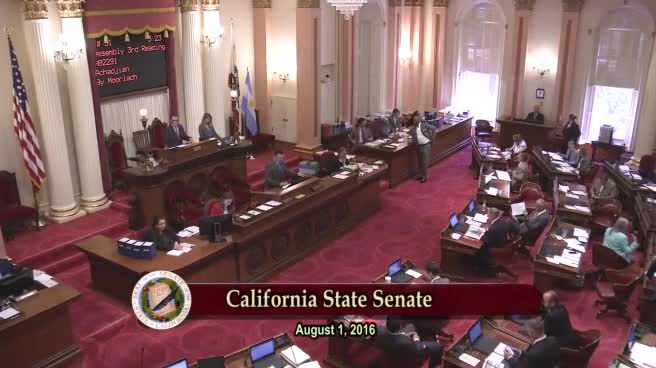 1MIN
Senate Floor
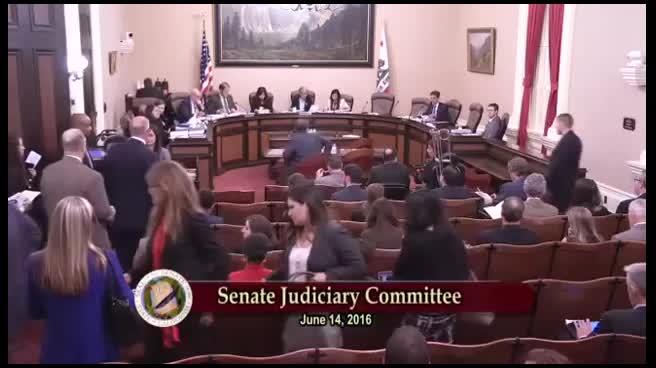 18MIN
Senate Standing Committee on Judiciary
 1MIN
Assembly Floor
Bill Author

Bill Co-Author(s):