AB 1899: Insurance: production agents: license examinations.
- Session Year: 2015-2016
- House: Assembly
- Latest Version Date: 2016-09-24
Existing law requires the Insurance Commissioner to give, at least once each month, in each of the cities in which he or she has an office, qualifying examinations for production agent licenses. Existing law requires every qualifying examination for a production agent license to be in writing and to be of sufficient scope to satisfy the commissioner that the applicant has sufficient knowledge of, and is reasonably familiar with, the insurance laws of this state and with the provisions, terms, and conditions of the insurance that may be transacted pursuant to the license sought, and that the applicant has a general and fair understanding of the obligations and duties of the holder of that license.
This bill, from January 1, 2018, to January 1, 2024, would require the examination for a license as a life agent, life-only agent, and accident and health agent be provided in English and Spanish. The bill would require the Insurance Commissioner to evaluate the qualifying examination taken in Spanish and submit a report to the Legislature by March 1, 2023, as provided.
Existing law requires the Insurance Commissioner to give, at least once each month, in each of the cities in which he or she has an office, qualifying examinations for production agent licenses. Existing law requires every qualifying examination for a production agent license to be in writing and to be of sufficient scope to satisfy the commissioner that the applicant has sufficient knowledge of, and is reasonably familiar with, the insurance laws of this state and with the provisions, terms, and conditions of the insurance that may be transacted pursuant to the license sought, and that the applicant has a general and fair understanding of the obligations and duties of the holder of that license.
This bill, commencing January 1, 2018, from January 1, 2018, to January 1, 2024, would require the examination for a license as a life agent, life-only agent, and accident and health agent be provided in English and Spanish. The bill would require the Insurance Commissioner to evaluate the qualifying examination taken in Spanish and submit a report to the Legislature by March 1, 2023, as provided.
Existing law requires the Insurance Commissioner to give, at least once each month, in each of the cities in which he or she has an office, qualifying examinations for production agent licenses. Existing law requires every qualifying examination for a production agent license to be in writing and to be of sufficient scope to satisfy the commissioner that the applicant has sufficient knowledge of, and is reasonably familiar with, the insurance laws of this state and with the provisions, terms, and conditions of the insurance that may be transacted pursuant to the license sought, and that the applicant has a general and fair understanding of the obligations and duties of the holder of that license.
This bill, commencing January 1, 2018, would require the examination for a license as a life agent, life-only agent, and accident and health agent be provided in English and Spanish.
Existing law provides for the regulation of long-term care insurance by the Insurance Commissioner and prescribes various requirements and conditions governing the delivery of individual or group long-term care insurance in the state. Existing law establishes the California Partnership for Long-Term Care Program to link private long-term care insurance and health care service plan contracts that cover long-term care with the In-Home Supportive Services Program and Medi-Cal and to provide Medi-Cal benefits to certain individuals who have income and resources above the eligibility levels for receipt of medical assistance, but who have purchased certified private long-term care insurance policies.
This bill would state the intent of the Legislature to enact legislation that would pertain to long-term care insurance.
The Legislature finds and declares all of the following:
(a)Every citizen of California deserves equal access to the protection provided by various insurance products.
(b)Spanish-speaking individuals make up a large portion of the population in California. Estimates from the 2014 American Community Survey (ACS) indicate that 38.6 percent of Californians report their ethnicity as Latino. The ACS data also indicates that 22 percent of households in which Spanish is spoken have no member over 14 years of age who speaks English fluently or very well. According to research published by Florida State University in 2006, Latino households are less likely to own life insurance than the general population, with 34 percent of Latinos purchasing life insurance compared to 62 percent of the general population. A 2012 Insurance Barometer Study by the Life Insurance and Market Research Association found the same and concluded that a contributing factor to that difference is that Latino households are less likely to have contact with an insurance agent. The Latino population is expected to continue to grow in California, with 2014 Department of Finance projections suggesting that Latinos are expected to number 23.7 million in 2050, or 47.6 percent of all Californians.
(c)By offering the opportunity for Spanish-speaking individuals to take insurance licensing exams, California will increase the number of insurance agents and brokers able to serve Spanish-speaking consumers, while also opening a career path currently unavailable to this population.
(d)Several insurance companies offer Spanish translations of the insurance products they offer, a practice the Legislature commends and encourages to be followed by every insurance company and every product offered in order to ensure that the consumer more fully understands the full scope of his or her coverage and can make more informed purchasing decisions.
(e)The option to have the insurance licensure examination administered in Spanish will decrease potential miscommunication, increase agents understanding of their duties and obligations, and allow California to keep pace with the needs of its multilingual and multicultural insurance consumers.
(f)It is essential that all of the states residents have access to vital health services that can prolong and enhance their lives, and that state government continues to take reasonable and effective actions that will facilitate access to these services.
SEC. 2.Section 1677 of the Insurance Code is amended to read:1677.(a)Each qualifying examination for a license pursuant to this chapter shall be in writing and shall be of sufficient scope to satisfy the commissioner that the applicant has sufficient knowledge of, and is reasonably familiar with, the insurance laws of this state and with the provisions, terms, and conditions of the insurance that may be transacted pursuant to the license sought, and that the applicant has a general and fair understanding of the obligations and duties of the holder of that license.
(b)On and after January 1, 2018, the examination for a license as a life agent, life-only agent, and accident and health agent shall be provided in English and Spanish.
(c)The commissioner shall evaluate the qualifying examination taken in Spanish and submit a report of the results to the Legislature no later than March 1, 2023. The report shall be submitted in compliance with Section 9795 of the Government Code and shall include, but not be limited to, all of the following:
(1)The number of people taking the examination.
(2)The pass rate, including a comparison between the comparable licensing examination taken in English.
(3)The number of licenseholders that sat for the examination provided in Spanish and passed the examination that remain licensed.
(4)The number of consumer complaints received and enforcement actions taken with regard to the licenseholders who passed the examination in Spanish.
(d)This section shall remain in effect only until January 1, 2024, and as of that date is repealed, unless a later enacted statute, that is enacted before January 1, 2024, deletes or extends that date.
SEC. 3.Section 1677 is added to the Insurance Code, to read:1677.(a)Each qualifying examination for a license pursuant to this chapter shall be in writing and shall be of sufficient scope to satisfy the commissioner that the applicant has sufficient knowledge of, and is reasonably familiar with, the insurance laws of this state and with the provisions, terms, and conditions of the insurance that may be transacted pursuant to the license sought, and that the applicant has a general and fair understanding of the obligations and duties of the holder of that license.
(b)This section shall become operative on January 1, 2024.
The Legislature finds and declares that it is essential that all of the states residents have access to vital health services that can prolong and enhance their lives, and that state government continues to take reasonable and effective actions that will facilitate access to these services.
SECTION 1.The Legislature finds and declares all of the following:
(a)Every citizen of California deserves equal access to the protection provided by various insurance products.
(b)Spanish-speaking individuals make up a large portion of the population in California. Estimates from the 2014 American Community Survey (ACS) indicate that 38.6 percent of Californians report their ethnicity as Latino. The ACS data also indicates that 22 percent of households in which Spanish is spoken have no member over 14 years of age who speaks English fluently or very well. According to research published by Florida State University in 2006, Latino households are less likely to own life insurance than the general population, with 34 percent of Latinos purchasing life insurance compared to 62 percent of the general population. A 2012 Insurance Barometer Study by the Life Insurance and Market Research Association found the same and concluded that a contributing factor to that difference is that Latino households are less likely to have contact with an insurance agent. The Latino population is expected to continue to grow in California, with 2014 Department of Finance projections suggesting that Latinos are expected to number 23.7 million in 2050, or 47.6 percent of all Californians.
(c)By offering the opportunity for Spanish-speaking individuals to take insurance licensing exams, California will increase the number of insurance agents and brokers able to serve Spanish-speaking consumers, while also opening a career path currently unavailable to this population.
(d)Several insurance companies offer Spanish translations of the insurance products they offer, a practice the Legislature commends and encourages to be followed by every insurance company and every product offered in order to ensure that the consumer more fully understands the full scope of his or her coverage and can make more informed purchasing decisions.
(e)The option to have the insurance licensure examination administered in Spanish will decrease potential miscommunication, increase agents understanding of their duties and obligations, and allow California to keep pace with the needs of its multilingual and multicultural insurance consumers.
(f)It is essential that all of the states residents have access to vital health services that can prolong and enhance their lives, and that state government continues to take reasonable and effective actions that will facilitate access to these services.
SEC. 2.Section 1677 of the Insurance Code is amended to read:1677.(a)Each qualifying examination for a license pursuant to this chapter shall be in writing and shall be of sufficient scope to satisfy the commissioner that the applicant has sufficient knowledge of, and is reasonably familiar with, the insurance laws of this state and with the provisions, terms, and conditions of the insurance that may be transacted pursuant to the license sought, and that the applicant has a general and fair understanding of the obligations and duties of the holder of that license.
(b)On and after January 1, 2018, the examination for a license as a life agent, life-only agent, and accident and health agent shall be provided in English and Spanish.
(c)The commissioner shall evaluate the qualifying examination taken in Spanish and submit a report of the results to the Legislature no later than March 1, 2023. The report shall be submitted in compliance with Section 9795 of the Government Code and shall include, but not be limited to, all of the following:
(1)The number of people taking the examination.
(2)The pass rate, including a comparison between the comparable licensing examination taken in English.
(3)The number of licenseholders that sat for the examination provided in Spanish and passed the examination that remain licensed.
(4)The number of consumer complaints received and enforcement actions taken with regard to the licenseholders who passed the examination in Spanish.
(d)This section shall remain in effect only until January 1, 2024, and as of that date is repealed, unless a later enacted statute, that is enacted before January 1, 2024, deletes or extends that date.
SEC. 3.Section 1677 is added to the Insurance Code, to read:1677.(a)Each qualifying examination for a license pursuant to this chapter shall be in writing and shall be of sufficient scope to satisfy the commissioner that the applicant has sufficient knowledge of, and is reasonably familiar with, the insurance laws of this state and with the provisions, terms, and conditions of the insurance that may be transacted pursuant to the license sought, and that the applicant has a general and fair understanding of the obligations and duties of the holder of that license.
(b)This section shall become operative on January 1, 2024.
The Legislature finds and declares that it is essential that all of the states residents have access to vital health services that can prolong and enhance their lives, and that state government continues to take reasonable and effective actions that will facilitate access to these services.
SEC. 2.Section 1677 of the Insurance Code is amended to read:1677.(a)Every Each qualifying examination for a license pursuant to this chapter shall be in writing and shall be of sufficient scope to satisfy the commissioner that the applicant has sufficient knowledge of, and is reasonably familiar with, the insurance laws of this state and with the provisions, terms, and conditions of the insurance that may be transacted pursuant to the license sought, and that the applicant has a general and fair understanding of the obligations and duties of the holder of that license.
(b)On and after January 1, 2018, the examination for a license as a life agent, life-only agent, and accident and health agent shall be provided in English and Spanish.
(c)The commissioner shall evaluate the qualifying examination taken in Spanish and submit a report of the results to the Legislature no later than March 1, 2023. The report shall be submitted in compliance with Section 9795 of the Government Code and shall include, but not be limited to, all of the following:
(1)The number of people taking the examination.
(2)The pass rate, including a comparison between the comparable licensing examination taken in English.
(3)The number of licenseholders that sat for the examination provided in Spanish and passed the examination that remain licensed.
(4)The number of consumer complaints received and enforcement actions taken with regard to the licenseholders who passed the examination in Spanish.
(d)This section shall remain in effect only until January 1, 2024, and as of that date is repealed, unless a later enacted statute, that is enacted before January 1, 2024, deletes or extends that date.
SEC. 3.Section 1677 is added to the Insurance Code, to read:1677.(a)Each qualifying examination for a license pursuant to this chapter shall be in writing and shall be of sufficient scope to satisfy the commissioner that the applicant has sufficient knowledge of, and is reasonably familiar with, the insurance laws of this state and with the provisions, terms, and conditions of the insurance that may be transacted pursuant to the license sought, and that the applicant has a general and fair understanding of the obligations and duties of the holder of that license.
(b)This section shall become operative on January 1, 2024.
The Legislature finds and declares that it is essential that all of the states residents have access to vital health services that can prolong and enhance their lives, and that state government continues to take reasonable and effective actions that will facilitate access to these services.
SEC. 2.Section 1677 of the Insurance Code is amended to read:1677.(a)Every qualifying examination for a license under pursuant to this chapter shall be in writing and shall be of sufficient scope to satisfy the commissioner that the applicant has sufficient knowledge of of, and is reasonably familiar with with, the insurance laws of this State state and with the provisions, terms terms, and conditions of the insurance which that may be transacted pursuant to the license sought, and that the applicant has a general and fair understanding of the obligations and duties of the holder of such that license.
(b)On and after January 1, 2018, the examination for a license as a life agent, life-only agent, and accident and health agent shall be provided in English and Spanish.
SECTION 1.It is the intent of the Legislature to enact legislation that would pertain to long-term care insurance.
It is the intent of the Legislature to enact legislation that would pertain to long-term care insurance.
|
Date
|
Status
|
|---|---|
| Jun 9, 2016 | Referred to Com. on INS. |
| Sep 8, 2016 | Enrolled and presented to the Governor at 4 p.m. |
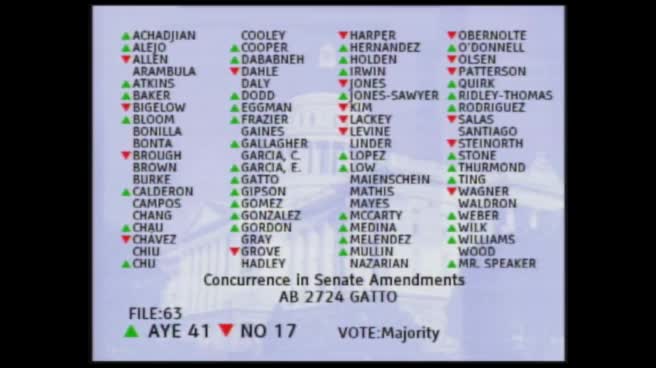
| Aug 30, 2016 | Senate amendments concurred in. To Engrossing and Enrolling. (Ayes 77. Noes 3. Page 6464.). |
| Aug 30, 2016 | Senate amendments concurred in. To Engrossing and Enrolling. |
| Aug 29, 2016 | In Assembly. Concurrence in Senate amendments pending. |
| Aug 23, 2016 | Read third time. Passed. Ordered to the Assembly. (Ayes 38. Noes 0. Page 5309.). |
| Aug 23, 2016 | Read third time. Passed. Ordered to the Assembly. |
| Aug 22, 2016 | Read second time. Ordered to third reading. |
| Aug 19, 2016 | Read third time and amended. Ordered to second reading. |
| Aug 15, 2016 | Read second time and amended. Ordered to third reading. |
| Aug 11, 2016 | From committee: Amend, and do pass as amended. (Ayes 7. Noes 0.) (August 11). |
| Aug 1, 2016 | In committee: Referred to APPR. suspense file. |
| Jun 23, 2016 | From committee: Do pass and re-refer to Com. on APPR. (Ayes 9. Noes 0.) (June 22). Re-referred to Com. on APPR. |
| Feb 11, 2016 | Read first time. To print. |
| Jun 2, 2016 | In Senate. Read first time. To Com. on RLS. for assignment. |
| Jun 1, 2016 | Read third time. Passed. Ordered to the Senate. (Ayes 78. Noes 2.) |
| Jun 1, 2016 | Read third time. Passed. Ordered to the Senate. (Ayes 78. Noes 2. Page 5132.) |
| Jun 1, 2016 | Read third time. Passed. Ordered to the Senate. |
| May 31, 2016 | Read second time. Ordered to third reading. |
| May 27, 2016 | From committee: Do pass. (Ayes 19. Noes 1.) (May 27). |
| May 11, 2016 | In committee: Set, first hearing. Referred to APPR. suspense file. |
| Apr 20, 2016 | From committee: Do pass and re-refer to Com. on APPR. (Ayes 13. Noes 0.) (April 20). Re-referred to Com. on APPR. |
| Mar 17, 2016 | Re-referred to Com. on INS. |
| Mar 16, 2016 | From committee chair, with author's amendments: Amend, and re-refer to Com. on INS. Read second time and amended. |
| Mar 14, 2016 | Referred to Com. on INS. |
| Feb 12, 2016 | From printer. May be heard in committee March 13. |
|
Date
|
Description
|
Location
|
Votes
|
|
|---|---|---|---|---|
| Aug 30, 2016 | AB 1899 CALDERON Concurrence in Senate Amendments | Assembly Floor |
Passed |
|
| Aug 23, 2016 | Assembly 3rd Reading AB1899 Calderon By Mendoza | Senate Floor |
Passed |
|
| Aug 11, 2016 | Do pass as amended | Senate Standing Committee on Appropriations |
Passed |
|
| Aug 1, 2016 | Placed on suspense file | Senate Standing Committee on Appropriations |
Passed |
|
| Jun 22, 2016 | Do pass, but first be re-referred to the Committee on [Appropriations] | Senate Standing Committee on Insurance |
Passed |
|
| Jun 1, 2016 | AB 1899 CALDERON Assembly Third Reading | Assembly Floor |
Passed |
|
| May 27, 2016 | Do pass. | Assembly Standing Committee on Appropriations |
Passed |
|
| Apr 20, 2016 | Do pass and be re-referred to the Committee on [Appropriations] | Assembly Standing Committee on Insurance |
Passed |
This list shows positions taken on this bill by organizations on the date displayed, which is linked to the original source.
Positions by individuals are not included.
|
Organization
|
Position
|
Date
|
|---|---|---|
| American Council Of Life Insurers | ** Support | Aug 23, 2016 |
| Association Of California Life & Health Insurance Companies | * Support | Jun 22, 2016 |
| Assurant Solutions - Preneed Division | ** Support | Aug 23, 2016 |
| California Department of Insurance | ** Against | Aug 23, 2016 |
| California Health Underwriters | ** Support | Aug 23, 2016 |
| Cemetery and Mortuary Association of California | ** Support | Aug 23, 2016 |
| Lincoln Heritage Life Insurance Company | ** Support | Aug 23, 2016 |
| National Alliance of Life Companies | ** Support | Aug 23, 2016 |
| National Association of Insurance and Financial Advisors, California | ** Support | Aug 23, 2016 |
| Primerica Ins. | ** Support | Jun 22, 2016 |
CONCURRENCE IN SENATE AMENDMENTS
CSA1 Bill Id:AB 1899
Author:(Calderon)
As Amended Ver:August 19, 2016
Majority vote
ASSEMBLY: | 78-2 | (June 1, 2016) | SENATE: | 38-0 | (August 23, 2016) |
Original Committee Reference: INS.
SUMMARY: Requires the Department of Insurance (DOI) to provide the license examinations for life, life-only, and accident and health agents in Spanish.
The Senate amendments
- Sunset the requirement to offer the licensing examinations in Spanish on January 1, 2024.
- Require the DOI to evaluate the Spanish language examination and report to the Legislature by March 1, 2023.
- Add findings and declarations.
EXISTING LAW:
- Requires insurance agents to be licensed by the DOI and requires that an applicant pass a written examination to become licensed.
- Establishes a variety of agent license categories based on the nature of the products the agent will be selling.
FISCAL EFFECT: Unknown
COMMENTS:
- Purpose. According to the author, existing law does not require an examination for a license as a life-agent, life-only agent, or accident and health to be provided in Spanish. Because a plurality of Californians are Latino, a significant portion this population speaking only Spanish, offering the opportunity for Spanish speakers to take the licensing exam will increase the number of agents able to serve Spanish speaking consumers. It is important for California to have agents who are better able to serve these communities. Spanish speakers serving these communities will help prevent miscommunication and potential fraud during the sales process.
- Demographics. The ethnic and linguistic diversity of California's population presents many communication challenges. The challenges are particularly acute in the insurance industry which has complex products that are hard to understand even for native English speakers. Estimates from the 2014 American Community Survey (ACS) indicate that over one-half Californians report their ethnicity as either Latino (38.6%) or Asian (13.7%). The ACS data also indicates that 22% of households where Spanish is spoken have no one over 14 who speaks English fluently or "very well." For households where an Asian language is spoken, 28% do not have a member over 14 who speaks English fluently or "very well."
- License Examinations. California residents who want to apply for an insurance producer (agent or broker) license issued by DOI must first pass a qualifying license examination. There are 10 examinations for specific insurance producer licenses. Presently, all examinations are offered only in the English language. Candidates with disabilities or those who would otherwise have difficulty taking the examination (including a language barrier) may, prior to the examination, request a special accommodation. Special accommodation requests for English as a second language (ESL) require the candidate to provide a personal letter requesting the accommodation and a letter from the candidate's English instructor or sponsoring company, certifying that English is not their primary language. Candidates satisfying these requirements will be provided an additional 30 minutes on their license examination.
- Other States. Some states offer examinations for insurance producer licenses in Spanish: New York (since 2004), Texas (since 2005) and Florida (since 2013). New Jersey will offer Spanish versions of their insurance producer license examinations later this year. The states who have offered the exam in Spanish have seen dramatically different pass rates between the English and Spanish language versions of the examinations. In Calendar Year (CY) 2014, New York reported a 42% first-time pass rate for the English version of the Life Agent examination compared with a 13% first-time pass rate for the Spanish version of the same examination. Similarly, for CY 2015, Texas reported a 57% first-time pass rate for the English version of the Life Agent examination compared with a 24% first-time pass rate for the Spanish version of the same examination. Finally, for CY 2015, Florida reported a 65% first-time pass rate for the English version of the Life Agent examination compared with a 25% first-time pass rate for the Spanish version of the same examination.
- Psychometrics. Professional licensing examinations are a substantial governmental barrier for someone seeking to enter a profession, and, accordingly, the government is required to meet rigorous standards to assure that an examination is a fair measure of the knowledge, skills, and abilities (KSAs) required to practice a profession. The examinations are developed and updated by periodic surveys of licensed professionals to determine what KSAs are used in their daily work. The results of those surveys are then compiled and analyzed and substantially determine what subjects will be covered in the test (generally known as the content outline). Individual examination items are developed by practicing professionals (subject matter experts or SMEs) to test each KSA, and those items are then tested to determine if they are fair questions or if they need to be modified. Once the questions are final, they are assembled into a test (known as a "form") that matches the content outline. Typically, a licensing exam will have multiple forms each with some overlapping and some unique items. Having multiple forms helps to prevent particular items from becoming known through overuse and helps to thwart efforts to "steal" exam questions. To establish a passing score, the SMEs go through a process to determine the passing score by assessing how a "minimally competent, entry level practitioner" would perform on the test. This process must be repeated for each form of the exam because some forms are "harder" than others and the passing scores need to be calibrated to ensure fairness among the different exam forms. The entire test development process is informed by statistical analysis and overseen by a "psychometrician" who is a psychologist credentialed in psychological measurement and testing.
Tests are necessarily bounded by the language in which they are written. Making a small change (changing a word or altering the syntax) in a test item can drastically alter how any individual item performs. These challenges are multiplied when developing a test form in another language. Simply translating an existing form can cause problems because some concepts do not move easily between languages and even slight changes in meaning or context can lead to dramatically different results among similarly situated test takers. Those "dramatically different results" are the essence of disparate treatment and threaten the validity of a licensing examination program.
Analysis Prepared by: Paul Riches / INS. / (916) 319-2086 FN: 0004972
Office of Senate Floor Analyses (916) 651-1520 Fax: (916) 327-4478 | AB |
THIRD READING
Bill No: AB 1899
:
SENATE INSURANCE COMMITTEE: 9-0, 6/22/16
AYES: Roth, Gaines, Berryhill, Glazer, Hall, Hernandez, Liu, Mitchell, Wieckowski
SENATE APPROPRIATIONS COMMITTEE: 7-0, 8/11/16
AYES: Lara, Bates, Beall, Hill, McGuire, Mendoza, Nielsen
ASSEMBLY FLOOR: 78-2, 6/1/16 - See last page for vote
DIGEST: This bill requires, until January 1, 2024, the California Department of Insurance (CDI) to provide the license examinations for life, life-only, and accident and health licensees in Spanish.
Senate Floor Amendments of 8/19/16 (1) add findings and declarations regarding the demographic makeup of California’s Spanish-speaking population and the impact that offering some examinations in Spanish may have on that population and (2) add a declaration that the Legislature commends insurers that provide Spanish translations of insurance products and encourages every insurer to do so.
Existing law:
- Requires insurance agents and brokers to be licensed by CDI and requires that applicants pass a written examination to become licensed.
- Establishes categories of “life licensees” that transact certain lines of insurance.
- Accident and health licensees may transact health, disability, credit disability, 24-hour care, and long-term care. (Authorization to sell long-term care insurance requires additional training.)
- Life-only licensees may transact life insurance, including endowments and annuities, and may include accidental death or dismemberment and disability income insurance.
- Limited life-only licensees may only transact specific life insurance policies or annuities that pay benefits in an amount of no more than $20,000 and are designated for the payment of funeral and burial expenses.
- Provides that an applicant may take a single exam to be licensed as a life-only and accident and health licensee.
- Authorizes CDI to approve insurance policies in a language other than English provided that the policyholder is given a copy of the English version and a disclosure that the English version is the official version and the translated version is for informational purposes only.
- Treats a knowing misrepresentation of information provided in a language other than English as an unfair trade practice subject to special penalties.
This bill:
- Makes findings and declarations.
- Requires, as of January 1, 2018, CDI to provide the license examinations for life, life-only, and accident and health licensees in Spanish.
- Requires CDI to submit a report to the Legislature no later than March 1, 2023, that provides information about applicants and licensees that will take the Spanish exam including pass rates, the number of licensees that have kept their licenses, and the number of consumer complaints received against those licensees.
- Sunsets the provisions of this bill on January 1, 2024.
Background
According to the U.S. Census Bureau estimates for the year 2013, about 10.4 million people speak Spanish at home in California. Of those, about 4.5 million people, a population larger than many states, do not speak English “very well.”
A study co-authored by the U.S. Treasury Department, Council of Economic Advisors, and the U.S. Department of Labor found that "by making it harder to enter a profession, licensing can also reduce employment opportunities and lower wages for excluded workers, and increase costs for consumers.” Almost all professional licensing exams are only offered in English. Currently, candidates who do not speak English as their primary language may receive an additional 30 minutes.
New York, Texas, and Florida already offer examinations for some insurance agent and broker licenses in Spanish. Applicants who took Spanish exams experience a dramatically different pass rates than those who took the English version. For example, in 2015, Florida reported a 65% first-time pass rate for the English version of the life agent examination compared with a 25% first-time pass rate for the Spanish version.
CDI raised several concerns about the bill and recommends that licensees that take the Spanish examination be restricted to transacting approved Spanish language consumer contracts only. No similar restriction applies to English-speaking licensees in California or other states that already offer Spanish exams.
FISCAL EFFECT: Appropriation: Fiscal Com.: Local:
According to the Senate Appropriations Committee, this bill results in estimated one-time costs of $230,000 in fiscal year 2017-18 to translate examination materials into Spanish, including psychometric testing, and $30,000 to prepare a report to the Legislature. The bill also results in estimated costs of $360,000 in fiscal year 2018-19 and ongoing costs of $370,000 per year to administer the exam in Spanish and process the additional applications. All costs are to the Insurance Fund and are offset by the potential revenue of $557,000 in fiscal year 2017-18, $1.1 million in fiscal year 2018-19 and $1.4 million per year ongoing generated from exam fees ($50 per exam) and licensing fees ($170 per license).
SUPPORT: (Verified 8/22/16)
American Council of Life Insurers
Association of California Life and Health Insurance Companies
Assurant Solutions – Preneed Division
California Health Underwriters
Cemetery and Mortuary Association of California
Lincoln Heritage Life Insurance Company
National Alliance of Life Companies
National Association of Insurance and Financial Advisors, California
Primerica Inc.
OPPOSITION: (Verified 8/22/16)
California Department of Insurance
ARGUMENTS IN SUPPORT: Several insurance trade associations state that the option to have the examination administered in Spanish will decrease potential miscommunication, increase agent understanding of their duties and obligations, and allow California to keep pace with the needs of its multilingual and multicultural insurance consumers.
ARGUMENTS IN OPPOSITION: CDI argues that permitting an agent to sell products and policies in English although they took and passed the Spanish examination does not provide adequate protection for the agent or the consumer. CDI explains that there is no evidence that simply passing an examination in Spanish prevents miscommunication or potential fraud during the sales process.
ASSEMBLY FLOOR: 78-2, 6/1/16
AYES: Achadjian, Alejo, Travis Allen, Arambula, Atkins, Baker, Bigelow, Bloom, Bonilla, Bonta, Brough, Brown, Burke, Calderon, Campos, Chang, Chau, Chávez, Chiu, Chu, Cooley, Cooper, Dababneh, Dahle, Daly, Dodd, Eggman, Frazier, Beth Gaines, Cristina Garcia, Eduardo Garcia, Gatto, Gipson, Gomez, Gonzalez, Gordon, Gray, Grove, Hadley, Roger Hernández, Holden, Irwin, Jones, Jones-Sawyer, Kim, Lackey, Levine, Linder, Lopez, Low, Maienschein, Mathis, Mayes, McCarty, Medina, Melendez, Mullin, Nazarian, Obernolte, O'Donnell, Olsen, Patterson, Quirk, Ridley-Thomas, Rodriguez, Salas, Santiago, Steinorth, Mark Stone, Thurmond, Ting, Wagner, Waldron, Weber, Wilk, Williams, Wood, Rendon
NOES: Gallagher, Harper
8/22/16 22:02:39
**** END ****
Office of Senate Floor Analyses (916) 651-1520 Fax: (916) 327-4478 | AB |
THIRD READING
Bill No: AB 1899
: Senate
SENATE INSURANCE COMMITTEE: 9-0, 6/22/16
AYES: Roth, Gaines, Berryhill, Glazer, Hall, Hernandez, Liu, Mitchell, Wieckowski
SENATE APPROPRIATIONS COMMITTEE: 7-0, 8/11/16
AYES: Lara, Bates, Beall, Hill, McGuire, Mendoza, Nielsen
ASSEMBLY FLOOR: 78-2, 6/1/16 - See last page for vote
DIGEST: This bill requires, until January 1, 2024, the California Department of Insurance (CDI) to provide the license examinations for life, life-only, and accident and health licensees in Spanish.
Existing law:
- Requires insurance agents and brokers (collectively referred to as “producers”) to be licensed by CDI and requires that applicants pass a written examination to become licensed.
- Establishes categories of “life licensees” that transact certain lines of insurance.
- Accident and health licensees may transact health, disability, credit disability, 24-hour care, and long-term care.
- Life-only licensees may transact life insurance, including endowments and annuities, and may include accidental death or dismemberment and disability income insurance.
- Limited life-only licensees may only transact specific life insurance policies or annuities that pay benefits in an amount of no more than $20,000 and are designated for the payment of funeral and burial expenses.
- Provides that an applicant may take a single exam to be licensed as a life-only and accident and health licensee.
- Authorizes CDI to approve insurance policies in a language other than English provided that the policyholder is given a copy of the English version and a disclosure that the English version is the official version and the translated version is for informational purposes only.
- Treats a knowing misrepresentation of information provided in a language other than English as an unfair trade practice subject to special penalties.
This bill:
- Requires, as of January 1, 2018, CDI to provide the license examinations for life, life-only, and accident and health licensees in Spanish.
- Requires CDI to submit a report to the Legislature no later than March 1, 2023, that provides information about applicants and licensees that will take the Spanish exam, including pass rates, the number of licensees that have kept their licenses, and the number of consumer complaints received against those licensees.
- Sunsets the provisions of this bill on January 1, 2024.
Background
According to the U.S. Census Bureau estimates for the year 2013, about 10.4 million people speak Spanish at home in California. Of those, about 4.5 million people, a population larger than many states, do not speak English “very well.”
A study co-authored by the U.S. Treasury Department, Council of Economic Advisors, and the U.S. Department of Labor found that "by making it harder to enter a profession, licensing can also reduce employment opportunities and lower wages for excluded workers, and increase costs for consumers.” Very few professional licensing exams are offered in California in a language other than English. Currently, CDI only offers English exams although candidates who do not speak English as their primary language may receive an additional 30 minutes to complete the exam.
New York, Texas, and Florida already offer examinations for insurance producer licenses in Spanish. Applicants who took Spanish exams experience a dramatically different pass rates than those who took the English version. For example, in 2015, Florida reported a 65% first-time pass rate for the English version of the life agent examination compared with a 25% first-time pass rate for the Spanish version.
CDI has raised several concerns about this bill and recommends that licensees that take the Spanish examination be restricted to transacting approved Spanish language consumer contracts only. No similar restriction applies to English-speaking licensees in California or appears in those states that already offer Spanish exams.
FISCAL EFFECT: Appropriation: Fiscal Com.: Local:
According to the Senate Appropriations Committee, this bill represents estimated one-time costs of $230,000 in fiscal year 2017-18 to translate examination materials into Spanish, including psychometric testing, and $30,000 to prepare a report to the Legislature. The bill also represents estimated costs of $360,000 in fiscal year 2018-19 and ongoing costs of $370,000 per year to administer the exam in Spanish and process the additional applications. All costs are to the Insurance Fund and are offset by the potential revenue of $557,000 in fiscal year 2017-18, $1.1 million in fiscal year 2018-19 and $1.4 million per year ongoing generated from exam fees ($50 per exam) and licensing fees ($170 per license).
American Council of Life Insurers
Association of California Life and Health Insurance Companies
Assurant Solutions – Preneed Division
California Health Underwriters
Cemetery and Mortuary Association of California
Lincoln Heritage Life Insurance Company
National Alliance of Life Companies
National Association of Insurance and Financial Advisors, California
Primerica Inc.
OPPOSITION: (Verified 8/12/16)
California Department of Insurance
ARGUMENTS IN SUPPORT: Primerica Inc. cites a 2013 Survey published in National Underwriter indicating that just 6% of life agents nationally identify themselves as Hispanic, compared to 17% of the general population. Additionally, Primerica cites a 2012 Insurance Barometer Study by LIMRA that found Hispanic households are less likely to own life insurance than the general population and that a contributing factor is that those households are less likely to have contact with an agent. Several insurance trade associations state that the option to have the examination administered in Spanish will decrease potential miscommunication, increase agent understanding of their duties and obligations, and allow California to keep pace with the needs of its multilingual and multicultural insurance consumers.
ARGUMENTS IN OPPOSITION: CDI argues that permitting an agent to sell products and policies in English although they took and passed the Spanish examination does not provide adequate protection for the agent or the consumer. CDI explains that there is no evidence stating that simply taking and passing an examination in Spanish prevents miscommunication or potential fraud during the sales process.
ASSEMBLY FLOOR: 78-2, 6/1/16
AYES: Achadjian, Alejo, Travis Allen, Arambula, Atkins, Baker, Bigelow, Bloom, Bonilla, Bonta, Brough, Brown, Burke, Calderon, Campos, Chang, Chau, Chávez, Chiu, Chu, Cooley, Cooper, Dababneh, Dahle, Daly, Dodd, Eggman, Frazier, Beth Gaines, Cristina Garcia, Eduardo Garcia, Gatto, Gipson, Gomez, Gonzalez, Gordon, Gray, Grove, Hadley, Roger Hernández, Holden, Irwin, Jones, Jones-Sawyer, Kim, Lackey, Levine, Linder, Lopez, Low, Maienschein, Mathis, Mayes, McCarty, Medina, Melendez, Mullin, Nazarian, Obernolte, O'Donnell, Olsen, Patterson, Quirk, Ridley-Thomas, Rodriguez, Salas, Santiago, Steinorth, Mark Stone, Thurmond, Ting, Wagner, Waldron, Weber, Wilk, Williams, Wood, Rendon
NOES: Gallagher, Harper
8/15/16 20:33:24
**** END ****
SENATE COMMITTEE ON
Senator Ricardo Lara, Chair
2015 - 2016 Regular Session
AB 1899 (Calderon) - Insurance: production agents: license examinations
Version: | Policy Vote: |
Urgency: | Mandate: |
Hearing Date: | Consultant: |
*********** ANALYSIS ADDENDUM – SUSPENSE FILE ***********
The following information is revised to reflect amendments
adopted by the committee on August 11, 2016
Bill Summary:
AB 1899 would require the California Department of Insurance (CDI) to provide the license examinations for life, life-only, and accident and health agents in Spanish.
Fiscal Impact:
- Estimated one-time costs to CDI of $230,000 in fiscal year 2017-18 to translate examination materials into Spanish, including using psychometric testing. (Insurance Fund)
- Estimated costs to CDI of $360,000 in fiscal year 2018-19 and ongoing costs of $370,000 per year for administering the life agent, life-only agent and accident and health agent exam in Spanish, including obtaining background checks of applicants and reviewing applications. (Insurance Fund)
- Estimated one-time costs to CDI of $30,000 to prepare a report to the Legislature. (Insurance Fund)
- Potential revenue of $557,000 in fiscal year 2017-18, $1.1 million in fiscal year 2018-19 and $1.4 million per year ongoing generated from exam fees ($50 per exam) and licensing fees ($170 per license). (Insurance Fund)
Author Amendments:
- Requires the Insurance Commissioner to evaluate the examinations taken in Spanish and by March 1, 2023, submit to the Legislature a report including, but not limited to:
- The number of people taking the examination;
- The pass rate of the examination in Spanish and a comparison to the pass rate of the examination in English;
- The number of licenseholders that passed the examination in Spanish and remain licensed;
- The number of consumer complaints received and actions taken.
- Sunsets the Spanish language requirements on January 1, 2024.
-- END --
SENATE COMMITTEE ON
Senator Ricardo Lara, Chair
2015 - 2016 Regular Session
AB 1899 (Calderon) - Insurance: production agents: license examinations
Version: | Policy Vote: |
Urgency: | Mandate: |
Hearing Date: | Consultant: |
This bill meets the criteria for referral to the Suspense File.
Bill Summary:
AB 1899 would require the California Department of Insurance (CDI) provide the license examinations for life, life-only, and accident and health agents in Spanish.
Fiscal Impact:
- One-time costs to CDI of $230,000 in fiscal year 2017-18 to translate examination materials into Spanish, including using psychometric testing. (Insurance Fund)
- Estimated costs to CDI of $360,000 in fiscal year 2018-19 and ongoing costs of $370,000 per year for administering the life agent, life-only agent and accident and health agent exam in Spanish, including obtaining background checks of applicants and reviewing applications. (Insurance Fund)
- Potential revenue of $557,000 in fiscal year 2017-18, $1.1 million in fiscal year 2018-19 and $1.4 million per year ongoing generated from exam fees ($50 per exam) and licensing fees ($170 per license). (Insurance Fund)
Background:
There are a number of type of insurance producer licensed through CDI. A Life-Only Agent is entitled to transact insurance coverage for human lives, benefits of endowment and annuities, death benefits or dismemberment by accident, and benefits for disability income. An Accident and Health Agent may transact insurance coverage for sickness, bodily injury, accidental death and benefits for disability income. A “Full Life Agent” (life agent) is entitled to transact insurance coverage comprising the entitled coverage of both life-only agents and accident and health agents.
California residents applying for an insurance producer license issued from CDI must first pass a qualifying examination. Currently, all of the examinations are only offered in English. According to the U.S. Census Bureau, approximately 10.4 million people in California speak Spanish at home.
Although the content of an examination can be fairly easily translated into another language, translating examinations so that they are useful in practice as a measure of an individual’s skill, knowledge, and ability is not as straightforward. Psychometric testing must be used to ensure validity and comparability of results with the original language and ensure that the translation does not inadvertently introduce error or bias.
Proposed Law:
This bill would require that by January 1, 2018, the examination for a license as a life agent, life-only agent, and accident and health agent be provided in English and Spanish.
Related Legislation:
SB 1974 (Polanco, Chapter 358, Statues of 2002) authorizes CDI to approve policies and associated materials in languages other than English if certain conditions are satisfied.
Staff Comments:
Some states already offer examinations for life producer licenses in Spanish. In calendar year 2014, New York reported a first-time pass rate of 13% for their Spanish examination and Texas reported a 24% first-time pass rate. For calendar year 2015, Florida reported a first-time pass rate of 25% for the Spanish version of their examination. The estimate for administering examinations in Spanish in California assumes approximately 8,800 individuals would take the Spanish versions of the three examinations and approximately 2,600 (nearly 30%) of those individuals would pass the exam and become licensed.
-- END --
SENATE COMMITTEE ON
Senator Richard Roth, Chair
2015 - 2016 Regular
Bill No: Hearing Date: June 22, 2016
Author: | |||
Version: | Amended | ||
Urgency: | Fiscal: | ||
Consultant: | |||
Subject:
SUMMARY
Requires the California Department of Insurance (CDI) to provide the license examinations for life, life-only, and accident and health licencees in Spanish.
DIGEST
Existing law
- Requires insurance agents and brokers (collectively referred to as “producers”) to be licensed by CDI and requires that applicants pass a written examination to become licensed.
- Establishes categories of “life licensee” that transact certain lines of insurance.
- Accident and health licensees may transact health, disability, credit disability, 24-hour care, and long-term care (with additional training).
- Life-only licensees may transact life insurance, including endowments and annuities, and may include accidental death or dismemberment and disability income insurance.
- Limited life-only licensees may only transact specific life insurance policies or annuities that pay benefits in an amount of no more than $20,000 and are designated for the payment of funeral and burial expenses.
- Provides that an applicant may take a single exam to be licensed as a life-only and accident and health licensee.
- Authorizes CDI to approve insurance policies in a language other than English provided that the policyholder is given a copy of the English version and a disclosure that the English version is the official version and the translated version is for informational purposes only.
- Treats a knowing misrepresentation of information provided in a language other than English as an unfair trade practice and subject to special penalties.
This bill Requires CDI to provide the license examinations for life, life-only, and accident and health licensees in Spanish.
COMMENTS
- Purpose of the bill According to the author, existing law does not allow for an examination for a license as a life, life-only, and accident and health producer to be provided in Spanish. California residents who want to apply for an insurance producer license issued by CDI must first pass a qualifying license examination. There are 10 examinations for specific insurance producer licenses. All examinations are offered only in English. Because a plurality of Californians are Latino and a significant portion of this population speaks only Spanish, offering the opportunity for Spanish speakers to take these licensing exams will increase the number of producers able to serve Spanish speaking consumers. The ethnic and linguistic diversity of California's population presents many communication challenges. The challenges are particularly acute in the insurance industry which has complex products that are hard to understand even for native English speakers. Estimates from the 2014 American Community Survey (ACS) indicate that 38.6% Californians report their ethnicity as Latino. The ACS data also indicates that 22% of households where Spanish is spoken have no one over 14 who speaks English fluently or “very well.” It is important for California to have insurance agents who are better able to serve these communities. Spanish speakers serving these communities will help prevent miscommunication and potential fraud during the sales process.
- Background California’s Constitution of 1849 required that “All laws, decrees, regulations, and provisions, which from their nature require publication, shall be published in English and Spanish.” California removed that provision in 1879 when it adopted the current constitution, but has made some attempts to address the challenges of its own multilingualism such as the Dymally-Alatorre Bilingual Services Act. According to the U.S. Census Bureau, about 10.4 million people speak Spanish at home in California. Given the size of the population, this lack of access would likely be reflected in California’s aggregate insurance sales. Although California represents about 12% of the national population, it only represents 8.35% of the national premium paid to life, accident, and health insurers (according to data published by the National Association of Insurance Commissioner).
Examinations. Given that professional licensing examinations are a substantial barrier for someone seeking to enter a profession, the government is required to meet rigorous standards to assure that an examination is a fair measure of the knowledge, skills, and abilities required to practice a profession. Although the content of an examination can fairly easily be translated to another language, translating examinations so they are useful in practice as a measure of an individual's skill, knowledge, and ability is not straightforward. In order to ensure validity and comparability of results with the original language, the entire test development process involves detailed statistical analysis and is overseen by a psychometrician (a psychologist credentialed in psychological measurement and testing) to ensure that the translation does not inadvertently introduce error or systematic bias.
Candidates with disabilities or those who would otherwise have difficulty taking the examination, including applicants whose do not speak English as their primary language, may request a special accommodation. Qualified candidates will be provided an additional 30 minutes.
Other States. Some states already offer examinations for insurance producer licenses in Spanish. New York offers examinations for life and accident and health. Texas and Florida offer life, accident and health, and property and casualty licenses. There are dramatically different pass rates between the English and Spanish language versions of the examinations. In Calendar Year (CY) 2014, New York reported a 42 percent first-time pass rate for the English version of the life agent examination compared with a 13 percent first-time pass rate for the Spanish version of the same examination. Similarly, for CY 2015, Texas reported a 57 percent first-time pass rate for the English version of the life agent examination compared with a 24 percent first-time pass rate for the Spanish version. For CY 2015, Florida reported a 65 percent first-time pass rate for the English version of the life agent examination compared with a 25 percent first-time pass rate for the Spanish version. Examinations in Spanish for property and casualty licenses have even lower passing scores.
- Support Primerica Inc. supports AB 1899 because it will knock down a barrier to entry and open doors into the insurance profession for individuals who might otherwise not apply and bring diversity to an industry that desperately needs it. Primerica cites a 2013 Survey published in National Underwriter indicating that just 6 percent of life agents nationally identify themselves as Hispanic, compared to 17 percent of the general population. Additionally, Primerica cites a 2012 Insurance Barometer Study by LIMRA that found Hispanic households are less likely to own life insurance than the general population and that a contributing factor is the that those households are less likely to have contact with an agent. Primerica states that offering a Spanish-language licensing exam is one way the state can do its part to help ensure agents are available in all communities.
Several insurance trade associations state that the option to have the examination administered in Spanish will decrease potential miscommunication, increase agent understanding of their duties and obligations, and allow California to keep pace with the needs of its multilingual and multicultural insurance consumers.
- Opposition CDI opposes the bill because permitting an agent to sell products and policies in English although they took and passed the Spanish examination does not provide adequate protection for the agent or the consumer. CDI explains that there is no evidence stating that simply taking and passing an examination in Spanish prevents miscommunication or potential fraud during the sales process. As a result, CDI has concerns with the bill and proposed amendment to the author that would the following:
- Require CDI to establish a pilot program to administer the examination for life only and life-only limited to the payment of funeral and burial expenses in English or Spanish on or after January 1, 2018. The three year pilot program would have at least six specific evaluation metrics.
- Limit those individual who pass the Spanish examination to transacting approved Spanish language consumer contracts only. The appointing insurer would need to certify under penalty of perjury that the Spanish translation is a true, correct, comprehensive, and complete interpretation of the official English version and would be required to ensure the appointed agents only transact Spanish language consumer contracts on the insurer’s behalf.
- Prior and Related Legislation
AB 720 (De León), Chapter 720, Statutes of 2007, split the existing license into a life-only license and an accident and health license.
SB 1974 (Polanco), Chapter 358, Statutes of 2002, authorized CDI to approve policies and associated materials in languages other than English, but provided that the English version is the official version and declares that an insurer that knowingly misrepresents information provided in a language other than English commits an unfair trade practice.
POSITIONS
Support
American Council of Life Insurers
Association of California Life and Health Insurance Companies
Assurant Solutions – Preneed Division
California Health Underwriters
Cemetery and Mortuary Association of California
Lincoln Heritage Life Insurance Company
National Association of Insurance and Financial Advisors, California
Primerica Ins.
Oppose
California Department of Insurance
-- END --
ASSEMBLY THIRD READING
ATR Bill Id:AB 1899
Author:(Calderon)
As Amended Ver:March 16, 2016
Majority vote
Committee | Votes | Ayes | Noes |
Insurance | 13-0 | Daly, Melendez, Travis Allen, Bigelow, Calderon, Chu, Cooley, Cooper, Dababneh, Dahle, Frazier, Gatto, Rodriguez | |
Appropriations | 19-1 | Gonzalez, Bigelow, Bloom, Bonilla, Bonta, Calderon, Chang, Daly, Eggman, Eduardo Garcia, Roger Hernández, Holden, Jones, Obernolte, Quirk, Santiago, Wagner, Weber, Wood | Gallagher |
SUMMARY: Requires the Department of Insurance (DOI) to provide the license examinations for life, life-only, and accident and health agents in Spanish.
EXISTING LAW:
- Requires insurance agents to be licensed by the DOI and requires that an applicant pass a written examination to become licensed.
- Establishes a variety of agent license categories based on the nature of the products the agent will be selling.
FISCAL EFFECT: According to the Assembly Appropriations Committee:
- Costs to DOI of approximately $230,000 in Fiscal Year 2017-18 to translate the materials into Spanish, including psychometric testing, and for initial staffing costs (Insurance Fund).
- Depending on the increased number of exams administered and licenses issued, the department would also incur additional costs and collect additional revenues, depending on the growth in the number of exams. The examination fee is $50 and license fees are $170 biennially.
COMMENTS:
- Purpose. According to the author, existing law does not require an examination for a license as a life-agent, life-only agent, or accident and health to be provided in Spanish. Because a plurality of Californians are Latino, a significant portion this population speaking only Spanish, offering the opportunity for Spanish speakers to take the licensing exam will increase the number of agents able to serve Spanish speaking consumers. It is important for California to have agents who are better able to serve these communities. Spanish speakers serving these communities will help prevent miscommunication and potential fraud during the sales process.
- Demographics. The ethnic and linguistic diversity of California's population presents many communication challenges. The challenges are particularly acute in the insurance industry which has complex products that are hard to understand even for native English speakers. Estimates from the 2014 American Community Survey (ACS) indicate that over one-half Californians report their ethnicity as either Latino (38.6%) or Asian (13.7%). The ACS data also indicates that 22% of households where Spanish is spoken have no one over 14 who speaks English fluently or "very well." For households where an Asian language is spoken, 28% do not have a member over 14 who speaks English fluently or "very well."
- License Examinations. California residents who want to apply for an insurance producer (agent or broker) license issued by DOI must first pass a qualifying license examination. There are 10 examinations for specific insurance producer licenses. Presently, all examinations are offered only in the English language. Candidates with disabilities or those who would otherwise have difficulty taking the examination (including a language barrier) may, prior to the examination, request a special accommodation. Special accommodation requests for ESL require the candidate to provide a personal letter requesting the accommodation and a letter from the candidate's English instructor or sponsoring company, certifying that English is not their primary language. Candidates satisfying these requirements will be provided an additional 30 minutes on their license examination.
- Other States. Some states offer examinations for insurance producer licenses in Spanish: New York (since 2004), Texas (since 2005) and Florida (since 2013). New Jersey will offer Spanish versions of their insurance producer license examinations later this year. The states who have offered the exam in Spanish have seen dramatically different pass rates between the English and Spanish language versions of the examinations. In Calendar Year (CY) 2014, New York reported a 42% first-time pass rate for the English version of the Life Agent examination compared with a 13% first-time pass rate for the Spanish version of the same examination. Similarly, for CY 2015, Texas reported a 57% first-time pass rate for the English version of the Life Agent examination compared with a 24% first-time pass rate for the Spanish version of the same examination. Finally, for CY 2015, Florida reported a 65% first-time pass rate for the English version of the Life Agent examination compared with a 25 percent first-time pass rate for the Spanish version of the same examination.
- Psychometrics. Professional licensing examinations are a substantial governmental barrier for someone seeking to enter a profession, and, accordingly, the government is required to meet rigorous standards to assure that an examination is a fair measure of the knowledge, skills, and abilities (KSAs) required to practice a profession. The examinations are developed and updated by periodic surveys of licensed professionals to determine what KSAs are used in their daily work. The results of those surveys are then compiled and analyzed and substantially determine what subjects will be covered in the test (generally known as the content outline). Individual examination items are developed by practicing professionals (subject matter experts or SMEs) to test each KSA, and those items are then tested to determine if they are fair questions or if they need to be modified. Once the questions are final, they are assembled into a test (known as a "form") that matches the content outline. Typically, a licensing exam will have multiple forms each with some overlapping and some unique items. Having multiple forms helps to prevent particular items from becoming known through overuse and helps to thwart efforts to "steal" exam questions. To establish a passing score, the SMEs go through a process to determine the passing score by assessing how a "minimally competent, entry level practitioner" would perform on the test. This process must be repeated for each form of the exam because some forms are "harder" than others and the passing scores need to be calibrated to ensure fairness among the different exam forms. The entire test development process is informed by statistical analysis and overseen by a "psychometrician" who is a psychologist credentialed in psychological measurement and testing.
Tests are necessarily bounded by the language in which they are written. Making a small change (changing a word or altering the syntax) in a test item can drastically alter how any individual item performs. These challenges are multiplied when developing a test form in another language. Simply translating an existing form can cause problems because some concepts do not move easily between languages and even slight changes in meaning or context can lead to dramatically different results among similarly situated test takers. Those "dramatically different results" are the essence of disparate treatment and threaten the validity of a licensing examination program.
Analysis Prepared by: Paul Riches / INS. / (916) 319-2086 FN: 0003356
Date of Hearing: May 11, 2016
ASSEMBLY COMMITTEE ON APPROPRIATIONS
Lorena Gonzalez, Chair
ABPCA Bill Id:AB 1899
Author:(Calderon) – As Amended Ver:March 16, 2016
Policy Committee: | Insurance | Vote: | 13 - 0 |
Urgency: No State Mandated Local Program: No Reimbursable: No
SUMMARY:
This bill requires the California Department of Insurance (CDI) to provide the license examinations for life, life-only, and accident and health agents in Spanish.
FISCAL EFFECT:
- Costs to CDI of approximately $230,000 in FY 2017-18 to translate the materials into Spanish, including psychometric testing, and for initial staffing costs (Insurance Fund).
- Depending on the increased number of exams administered and licenses issued, the department would also incur additional costs and collect additional revenues, depending on the growth in the number of exams. The examination fee is $50 and license fees are $170 biennially.
COMMENTS:
- Purpose. According to the author, existing law does not require an examination for a license as a life-agent, life-only agent, or accident and health to be provided in Spanish. The author asserts offering the licensing exam in Spanish will increase the number of agents able to serve Spanish-speaking consumers. This bill is supported by various insurance industry stakeholders and has no opposition.
- License Examinations. California residents who wish to apply for an insurance producer (agent or broker) license issued by CDI must first pass a qualifying license examination. At this time, examinations are offered only in English.
- Translations. Although the content of an examination can fairly easily be translated to another language, translating examinations so they are useful in practice as a measure of an individual's skill, knowledge, and ability is not a straightforward endeavor. In order to ensure validity and comparability of results with the original language, psychometric testing must be used when a complex item like an examination is translated. Such testing ensures that the translated content can reliably measure an individual's skill, knowledge, and ability, and that the translation did not inadvertently introduce a source of error or systematic bias.
Analysis Prepared by: Lisa Murawski / APPR. / (916) 319-2081
Date of Hearing: April 20, 2016
ASSEMBLY COMMITTEE ON INSURANCE
Tom Daly, Chair
ABPCA Bill Id:AB 1899 (
Author:Calderon) – As Amended Ver:March 16, 2016
SUBJECT: Insurance: agents: license examinations
SUMMARY: Requires the Department of Insurance (DOI) to provide the license examinations for life, life-only, and accident and health agents in Spanish.
EXISTING LAW:
- Requires insurance agents to be licensed by the DOI and requires that an applicant pass a written examination to become licensed.
- Establishes a variety of agent license categories based on the nature of the products the agent will be selling.
FISCAL EFFECT: Undetermined
COMMENTS:
- Purpose. According to the author, existing law does not require an examination for a license as a life-agent, life-only agent, or accident and health to be provided in Spanish. Because a plurality of Californians are Latino, a significant portion this population speaking only Spanish, offering the opportunity for Spanish speakers to take the licensing exam will increase the number of agents able to serve Spanish speaking consumers. It is important for California to have agents who are better able to serve these communities. Spanish speakers serving these communities will help prevent miscommunication and potential fraud during the sales process.
- Demographics. The ethnic and linguistic diversity of California's population presents many communication challenges. The challenges are particularly acute in the insurance industry which has complex products that are hard to understand even for native English speakers. Estimates from the 2014 American Community Survey (ACS) indicate that over one-half Californians report their ethnicity as either Latino (38.6%) or Asian (13.7%). The ACS data also indicates that 22% of households where Spanish is spoken have no one over 14 who speaks English fluently or "very well." For households where an Asian language is spoken, 28% do not have a member over 14 who speaks English fluently or "very well."
- License Examinations. California residents who want to apply for an insurance producer (agent or broker) license issued by DOI must first pass a qualifying license examination. There are 10 examinations for specific insurance producer licenses. Presently, all examinations are offered only in the English language. Candidates with disabilities or those who would otherwise have difficulty taking the examination (including a language barrier) may, prior to the examination, request a special accommodation. Special accommodation requests for ESL require the candidate to provide a personal letter requesting the accommodation and a letter from the candidate’s English instructor or sponsoring company, certifying that English is not their primary language. Candidates satisfying these requirements will be provided an additional 30 minutes on their license examination.
- Other States. Some states offer examinations for insurance producer licenses in Spanish: New York (since 2004), Texas (since 2005) and Florida (since 2013). New Jersey will offer Spanish versions of their insurance producer license examinations later this year. The states who have offered the exam in Spanish have seen dramatically different pass rates between the English and Spanish language versions of the examinations. In Calendar Year (CY) 2014, New York reported a 42 percent first-time pass rate for the English version of the Life Agent examination compared with a 13 percent first-time pass rate for the Spanish version of the same examination. Similarly, for CY 2015, Texas reported a 57 percent first-time pass rate for the English version of the Life Agent examination compared with a 24 percent first-time pass rate for the Spanish version of the same examination. Finally, for CY 2015, Florida reported a 65 percent first-time pass rate for the English version of the Life Agent examination compared with a 25 percent first-time pass rate for the Spanish version of the same examination.
- Psychometrics. Professional licensing examinations are a substantial governmental barrier for someone seeking to enter a profession, and, accordingly, the government is required to meet rigorous standards to assure that an examination is a fair measure of the knowledge, skills, and abilities (KSAs) required to practice a profession. The examinations are developed and updated by periodic surveys of licensed professionals to determine what KSAs are used in their daily work. The results of those surveys are then compiled and analyzed and substantially determine what subjects will be covered in the test (generally known as the content outline). Individual examination items are developed by practicing professionals (subject matter experts or SMEs) to test each KSA, and those items are then tested to determine if they are fair questions or if they need to be modified. Once the questions are final, they are assembled into a test (known as a "form") that matches the content outline. Typically, a licensing exam will have multiple forms each with some overlapping and some unique items. Having multiple forms helps to prevent particular items from becoming known through overuse and helps to thwart efforts to "steal" exam questions. To establish a passing score, the SMEs go through a process to determine the passing score by assessing how a "minimally competent, entry level practitioner" would perform on the test. This process must be repeated for each form of the exam because some forms are "harder" than others and the passing scores need to be calibrated to ensure fairness among the different exam forms. The entire test development process is informed by statistical analysis and overseen by a "psychometrician" who is a psychologist credentialed in psychological measurement and testing.
Tests are necessarily bounded by the language in which they are written. Making a small change (changing a word or altering the syntax) in a test item can drastically alter how any individual item performs. These challenges are multiplied when developing a test form in another language. Simply translating an existing form can cause problems because some concepts do not move easily between languages and even slight changes in meaning or context can lead to dramatically different results among similarly situated test takers. Those "dramatically different results" are the essence of disparate treatment and threaten the validity of a licensing examination program.
REGISTERED SUPPORT / OPPOSITION:
Support
American Council of Life Insurers
Association of California Life and Health Insurance Companies
California Health Underwriters
Lincoln Heritage Life Insurance Company
National Association of Insurance and Financial Advisors, California
Opposition
None received
Analysis Prepared by: Paul Riches / INS. / (916) 319-2086
Discussed in Hearing
 1MIN
Assembly Floor
 1MIN
Senate Floor
 7MIN
Senate Standing Committee on Insurance
 1MIN
Assembly Floor
Bill Author

Bill Co-Author(s):