AB 1978: Employment: property service workers.
- Session Year: 2015-2016
- House: Assembly
- Latest Version Date: 2016-09-15
Existing law establishes the Department of Industrial Relations in the Labor and Workforce Development Agency to foster, promote, and develop the welfare of the wage earners of California, to improve their working conditions, and to advance their opportunities for profitable employment. Existing law establishes within the department the Division of Labor Standards Enforcement, which is vested with the general duty of enforcing labor laws, including those relating to wage claims and employer retaliation.
This bill would require every employer subject to its provisions to keep accurate records of specific information regarding employees for 3 years. The bill would require the division to enforce its provisions and would authorize the Labor Commissioner, who is the chief of the division, to adopt any regulations necessary to carry out the provisions of the bill.
The bill would require every employer, effective July 1, 2018, to register annually with the Labor Commissioner in accordance with prescribed procedures. The bill would prohibit an employer from conducting any business without registration as required by the bill and would authorize the commissioner to revoke a registration under certain circumstances. The bill would set application and renewal fees for registration.
The bill would require an employer to include specific information in the registration application. The bill would prohibit the division from granting registration under specific circumstances. The bill would require the commissioner to maintain on the departments Internet Web site a public database of registered property service employers.
The bill would require the division, by January 1, 2019, to establish a biennial in-person sexual violence and harassment prevention training requirement for employees and employers with the assistance of a prescribed advisory committee to be convened by the director. The bill would require employers, as of July 1, 2018, and until the division establishes that training requirement, to provide employees with a pamphlet of the Department of Fair Employment and Housing on sexual harassment.
The bill would establish civil fines for specific violations of its provisions and vest in the commission the exclusive authority to enforce the civil fine provisions. The bill would require the deposit of registration fees and civil fines in the Labor Enforcement and Compliance Fund and would direct that the moneys in the fund from those fees and fines be used only for the reasonable costs of administering the registration of janitorial contractors and the costs and obligations associated with the administration and enforcement of the bill by the division.
Existing law establishes the Department of Industrial Relations in the Labor and Workforce Development Agency to foster, promote, and develop the welfare of the wage earners of California, to improve their working conditions, and to advance their opportunities for profitable employment. Existing law establishes within the department the Division of Labor Standards Enforcement, which is vested with the general duty of enforcing labor laws, including those relating to wage claims and employer retaliation. Existing law requires the Labor Commissioner, defined as the Chief of the Division of Labor Standards Enforcement, to establish and maintain a field enforcement unit in order to ensure that minimum labor standards are met.
The California Occupational Safety and Health Act of 1973 establishes certain safety and other responsibilities of employers and employees, including a requirement that every employer establish, implement, and maintain an effective injury prevention program. The act requires the program to be written, except as specified, and to include certain elements.
This bill would establish specific standards and protections for property service workers, to be known as the Property Service Workers Protection Act, workers and define terms for its purposes.
The bill would require the Labor Commissioner, no later than July 1, 2018, to develop worker and supervisor materials for a prescribed 4-hour training regarding sexual violence and sexual harassment and to make those materials available to employers, covered workers, and the public through, among other means, posting on its Internet Web site. The bill would require the commissioner, beginning July 1, 2019, to update these materials annually. The bill would, on and after July 1, 2018, require employers who provide janitorial services to have a system to require that covered workers and supervisors, at least annually, receive prescribed in-person training on workplace sexual violence and sexual harassment. The bill would require the commissioner to establish standards and requirements for trainers and recordkeeping relating to training. The bill would require the Labor Commissioner to develop minimum qualifications for trainers who provide the training.
The bill would require the Occupational Safety and Health Standards Board, by January 1, 2018, to adopt standards developed by the Division of Occupational Safety and Health, in consultation with a specified advisory group, that require an employer to adopt a workplace sexual violence and sexual harassment prevention plan as a part of its injury and illness prevention plan, to protect covered workers from workplace sexual violence and sexual harassment.
The bill would require every employer subject to its provisions to keep accurate records of specific information regarding employees for 3 years. The bill would require the division to enforce its provisions and would authorize the division to adopt any regulations necessary to carry out the provisions of the bill.
The bill would require every employer, effective July 1, 2018, to register annually with the Labor Commissioner in accordance with prescribed procedures. The bill would prohibit an employer from conducting any business without registration as required by the bill and would authorize the commissioner to revoke a registration under certain circumstances. The bill would set application and renewal fees for registration.
The bill would require the registration of employers conducting janitorial business, as prescribed, and establish specific authority for the Labor Commissioner to enforce and implement that requirement. The bill would set application and renewal fees. The bill would prohibit an employer, on or after July 1, 2018, from conducting any janitorial business without a valid registration. The bill would require an employer to include specific information in the registration application, subscribed and sworn to under penalty of perjury, thereby imposing a state-mandated local program by expanding the scope of the crime of perjury. application. The bill would prohibit the division from granting of registration under specific circumstances, authorize the director to deny, suspend, or void a registration in certain circumstances. The bill would require the commissioner, on and after July 1, 2018, commissioner to maintain on the commissioners departments Internet Web site a regularly updated, searchable database of registered employers, and, on and after July 1, 2019, a searchable public database regarding the compliance and enforcement activities of the department. of registered property service employers.
The bill would require the division, by January 1, 2019, to establish a biennial in-person sexual violence and harassment prevention training requirement for employees and employers with the assistance of a prescribed advisory committee to be convened by the director. The bill would require employers, as of July 1, 2018, and until the division establishes that training requirement, to provide employees with a pamphlet of the Department of Fair Employment and Housing on sexual harassment.
The bill would establish various compliance and enforcement provisions, including a requirement that the director establish a Property Services Compliance Unit to enforce the act. The bill would establish civil fines and provide for labor compliance agreements, stop order authority, audits, and investigations. The bill would impose a state-mandated local program by making it a crime to conduct any janitorial business without a valid registration, or to fail to observe a stop order.
The bill would establish civil fines for specific violations of its provisions and vest in the commission the exclusive authority to enforce the civil fine provisions. The bill would require the deposit of registration fees and specific civil fines in the State Janitorial Contractor Registration Fund, which the bill would create, Labor Enforcement and Compliance Fund and make would direct that the moneys in the fund from those fees and fines be available, upon appropriation, for the reasonable costs of administering the registration of janitorial contractors and the costs and obligations associated with the administration and enforcement of the bill by the commissioner. The bill, to provide adequate cash flow for those purposes, would authorize the Director of Finance, with the concurrence of the Secretary of the Labor and Workforce Development Agency, to approve a short-term loan each fiscal year from the Labor and Workforce Development Fund to the State Janitorial Contractor Registration Fund. division.
The bill would make conforming changes regarding the definition of an employer.
The California Constitution requires the state to reimburse local agencies and school districts for certain costs mandated by the state. Statutory provisions establish procedures for making that reimbursement.
This bill would provide that no reimbursement is required by this act for a specified reason.
Existing law establishes the Department of Industrial Relations in the Labor and Workforce Development Agency to foster, promote, and develop the welfare of the wage earners of California, to improve their working conditions, and to advance their opportunities for profitable employment. Existing law establishes within the department the Division of Labor Standards Enforcement, which is vested with the general duty of enforcing labor laws, including those relating to wage claims and employer retaliation. Existing law requires the Labor Commissioner, defined as the Chief of the Division of Labor Standards Enforcement, to establish and maintain a field enforcement unit in order to ensure that minimum labor standards are met.
The California Occupational Safety and Health Act of 1973 establishes certain safety and other responsibilities of employers and employees, including a requirement that every employer establish, implement, and maintain an effective injury prevention program. The act requires the program to be written, except as specified, and to include certain elements.
This bill would establish specific standards and protections for property service workers, to be known as the Property Service Workers Protection Act, and define terms for its purposes.
The bill would require the Labor Commissioner, no later than July 1, 2018, to develop worker and supervisor materials for a prescribed 4-hour training regarding sexual violence and sexual harassment and to make those materials available to employers, covered workers, and the public through, among other means, posting on its Internet Web site. The bill would require the commissioner, beginning July 1, 2019, to update theses these materials annually. The bill would, on and after July 1, 2018, require employers who provide janitorial services to have a system to require that covered workers and supervisors, at least annually, receive prescribed in-person training on workplace sexual violence and sexual harassment. The bill would require the commissioner to establish standards and requirements for trainers and recordkeeping relating to training. The bill would require the Labor Commissioner to develop minimum qualifications for trainers who provide the training.
The bill would require the Occupational Safety and Health Standards Board, by January 1, 2018, to adopt standards developed by the Division of Occupational Safety and Health, in consultation with a specified advisory group, that require an employer to adopt a workplace sexual violence and sexual harassment prevention plan as a part of its injury and illness prevention plan, to protect covered workers from workplace sexual violence and sexual harassment.
The bill would require the registration of employers conducting janitorial business, as prescribed, and establish specific authority for the Labor Commissioner to enforce and implement that requirement. The bill would set application and renewal fees. The bill would prohibit an employer, on or after January July 1, 2018, from conducting any janitorial business without a valid registration. The bill would require an employer to include specific information in the registration application, subscribed and sworn to under penalty of perjury, thereby imposing a state-mandated local program by expanding the scope of the crime of perjury. The bill would prohibit the granting of registration under specific circumstances, authorize the director to deny, suspend, or void a registration in certain circumstances. The bill would require the commissioner, on and after July 1, 2018, to maintain on the commissioners Internet Web site a regularly updated, searchable database of registered employers, and, on and after July 1, 2019, a searchable database regarding the compliance and enforcement activities of the department.
The bill would establish various compliance and enforcement provisions, including a requirement that the director establish a Property Services Compliance Unit to enforce the act. The bill would establish civil fines and provide for labor compliance agreements, stop order authority, audits, and investigations. The bill would impose a state-mandated local program by making it a crime to conduct any janitorial business without a valid registration, or to fail to observe a stop order.
The bill would require the deposit of registration fees and specific civil fines in the State Janitorial Contractor Registration Fund, which the bill would create, and make the moneys in the fund available, upon appropriation, for the reasonable costs of administering the registration of janitorial contractors and the costs and obligations associated with the administration and enforcement of the bill by the commissioner. The bill, to provide adequate cash flow for those purposes, would authorize the Director of Finance, with the concurrence of the Secretary of the Labor and Workforce Development Agency, to approve a short-term loan each fiscal year from the Labor and Workforce Development Fund to the State Janitorial Contractor Registration Fund.
The bill would make conforming changes regarding the definition of an employer.
The California Constitution requires the state to reimburse local agencies and school districts for certain costs mandated by the state. Statutory provisions establish procedures for making that reimbursement.
This bill would provide that no reimbursement is required by this act for a specified reason.
Existing law establishes the Department of Industrial Relations in the Labor and Workforce Development Agency to foster, promote, and develop the welfare of the wage earners of California, to improve their working conditions, and to advance their opportunities for profitable employment. Existing law establishes within the department the Division of Labor Standards Enforcement, which is vested with the general duty of enforcing labor laws, including those relating to wage claims and employer retaliation. Existing law requires the Labor Commissioner, defined as the Chief of the Division of Labor Standards Enforcement, to establish and maintain a field enforcement unit in order to ensure that minimum labor standards are met.
The California Occupational Safety and Health Act of 1973 establishes certain safety and other responsibilities of employers and employees, including a requirement that every employer establish, implement, and maintain an effective injury prevention program. The act requires the program to be written, except as specified, and to include certain elements.
This bill would establish specific standards and protections for property service workers, to be known as the Property Service Workers Protection Act, and define terms for its purposes.
The bill would require the department, Labor Commissioner, no later than July 1, 2017, 2018, to develop worker and supervisor materials for a prescribed 4-hour training regarding sexual harassment, sexual violence, and human trafficking violence and sexual harassment and to make those materials available to employers, covered workers, and the public through, among other means, posting on its Internet Web site. The bill would require the department by that date to establish requirements for commissioner, beginning July 1, 2019, to update theses materials annually. The bill would, on and after July 1, 2018, require employers who provide janitorial services to have a system to require that covered workers and supervisors, at least annually, receive prescribed in-person training on workplace sexual violence and sexual harassment and sexual assault. The bill would require the department commissioner to establish standards and requirements for trainers and recordkeeping relating to training. The bill would require the department by that date to establish a toll-free hotline for reporting of complaints and incidents of workplace sexual harassment, sexual violence, and human trafficking and require workplace notice to employees of existing rights in this area. Labor Commissioner to develop minimum qualifications for trainers who provide the training.
The bill would require the Occupational Safety and Health Standards Board, by July 1, 2017, January 1, 2018, to adopt standards developed by the Division of Occupational Safety and Health Health, in consultation with a specified advisory group, that require an employer to adopt a workplace sexual violence and sexual harassment prevention plan as a part of its injury and illness prevention plan, to protect covered workers from workplace sexual violence and sexual harassment.
The bill would require the registration of employers conducting janitorial business, as prescribed, and establish specific authority for the Director of Industrial Relations Labor Commissioner to enforce and implement that requirement. The bill would set application and renewal fees. The bill would prohibit an employer, on or after January 1, 2018, from conducting any janitorial business without a valid registration. The bill would require an employer to include specific information in the registration application, subscribed and sworn to under penalty of perjury, thereby imposing a state-mandated local program by expanding the scope of the crime of perjury. The bill would prohibit the granting of registration under specific circumstances, authorize the director to revoke, deny, suspend, or place a registration on probation, as prescribed, and would void a registration in certain circumstances. The bill would require the director commissioner, on and after February July 1, 2018, to maintain on the departments commissioners Internet Web site a regularly updated, searchable database of registered employers, and, on and after July 1, 2018, 2019, a searchable database regarding the compliance and enforcement activities of the department.
The bill would establish various compliance and enforcement provisions, including a requirement that the director establish a Property Services Compliance Unit to enforce the act. The bill would establish civil fines and provide for labor compliance agreements, stop order authority, audits, and investigations. The bill would impose a state-mandated local program by making it a crime to conduct any janitorial business without a valid registration, or to fail to observe a stop order. The bill would establish specific protections against discrimination and retaliation for engaging in conduct delineated in the bill, including civil and criminal penalties and a right to take civil action.
The bill would require the deposit of registration fees and specific civil fines in the State Janitorial Contractor Registration Fund, which the bill would create, and make the moneys in the fund available, upon appropriation, for the reasonable costs of administering the registration of janitorial contractors and the costs and obligations associated with the administration and enforcement of the bill by the department. commissioner. The bill, to provide adequate cash flow for those purposes, would authorize the Director of Finance, with the concurrence of the Secretary of the Labor and Workforce Development Agency, to approve a short-term loan each fiscal year from the Labor and Workforce Development Fund to the State Janitorial Contractor Registration Fund.
The bill would require the department, before July 1, 2017, to develop certain standards and procedures regarding violations of the bill.
The bill would make conforming changes regarding the definition of an employer.
The California Constitution requires the state to reimburse local agencies and school districts for certain costs mandated by the state. Statutory provisions establish procedures for making that reimbursement.
This bill would provide that no reimbursement is required by this act for a specified reason.
Existing law establishes within the Department of Industrial Relations in the Labor and Workforce Development Agency to foster, promote, and develop the welfare of the wage earners of California, to improve their working conditions, and to advance their opportunities for profitable employment. Existing law establishes within the department the Division of Labor Standards Enforcement, which is vested with the general duty of enforcing labor laws, including those relating to wage claims and employer retaliation. Existing law requires the Labor Commissioner, defined as the Chief of the Division of Labor Standards Enforcement, to establish and maintain a field enforcement unit in order to ensure that minimum labor standards are met. Existing law requires the commissioner to report annually to the Legislature, not later than March 1, concerning the effectiveness of the field enforcement unit, as specified.
The California Occupational Safety and Health Act of 1973 establishes certain safety and other responsibilities of employers and employees, including a requirement that every employer establish, implement, and maintain an effective injury prevention program. The act requires the program to be written, except as specified, and to include certain elements.
This bill would require the Labor Commissioner to include in the commissioners report to the Legislature, as described above, specified information on the status of wage claims and retaliation complaints, including the average amount of time it takes for a wage claim to receive a preliminary hearing and the current backlog of claims and complaints. establish specific standards and protections for property service workers, to be known as the Property Service Workers Protection Act, and define terms for its purposes.
The bill would require the department, no later than July 1, 2017, to develop worker and supervisor materials for a prescribed 4-hour training regarding sexual harassment, sexual violence, and human trafficking and to make those materials available to employers, covered workers, and the public through, among other means, posting on its Internet Web site. The bill would require the department by that date to establish requirements for employers who provide janitorial services to require that covered workers and supervisors, at least annually, receive prescribed in-person training on sexual harassment and sexual assault. The bill would require the department to establish standards and requirements for trainers and recordkeeping relating to training. The bill would require the department by that date to establish a toll-free hotline for reporting of complaints and incidents of workplace sexual harassment, sexual violence, and human trafficking and require workplace notice to employees of existing rights in this area.
The bill would require the Occupational Safety and Health Standards Board, by July 1, 2017, to adopt standards developed by the Division of Occupational Safety and Health that require an employer to adopt a workplace sexual violence and sexual harassment prevention plan as a part of its injury and illness prevention plan, to protect covered workers from sexual violence and harassment.
The bill would require the registration of employers conducting janitorial business, as prescribed, and establish specific authority for the Director of Industrial Relations to enforce and implement that requirement. The bill would set application and renewal fees. The bill would prohibit an employer, on or after January 1, 2018, from conducting any janitorial business without a valid registration. The bill would require an employer to include specific information in the registration application, subscribed and sworn to under penalty of perjury, thereby imposing a state-mandated local program by expanding the scope of the crime of perjury. The bill would prohibit the granting of registration under specific circumstances, authorize the director to revoke, suspend, or place a registration on probation, as prescribed, and would void a registration in certain circumstances. The bill would require the director, on and after February 1, 2018, to maintain on the departments Internet Web site a regularly updated, searchable database of registered employers, and, on and after July 1, 2018, a searchable database regarding the compliance and enforcement activities of the department.
The bill would establish various compliance and enforcement provisions, including a requirement that the director establish a Property Services Compliance Unit to enforce the act. The bill would establish civil fines and provide for labor compliance agreements, stop order authority, audits, and investigations. The bill would impose a state-mandated local program by making it a crime to conduct any janitorial business without a valid registration, or to fail to observe a stop order. The bill would establish specific protections against discrimination and retaliation for engaging in conduct delineated in the bill, including civil and criminal penalties and a right to take civil action.
The bill would require the deposit of registration fees and specific civil fines in the State Janitorial Contractor Registration Fund, which the bill would create, and make the moneys in the fund available, upon appropriation, for the reasonable costs of administering the registration of janitorial contractors and the costs and obligations associated with the administration and enforcement of the bill by the department. The bill, to provide adequate cash flow for those purposes, would authorize the Director of Finance, with the concurrence of the Secretary of the Labor and Workforce Development Agency, to approve a short-term loan each fiscal year from the Labor and Workforce Development Fund to the State Janitorial Contractor Registration Fund.
The bill would require the department, before July 1, 2017, to develop certain standards and procedures regarding violations of the bill.
The California Constitution requires the state to reimburse local agencies and school districts for certain costs mandated by the state. Statutory provisions establish procedures for making that reimbursement.
This bill would provide that no reimbursement is required by this act for a specified reason.
Existing law establishes within the Department of Industrial Relations the Division of Labor Standards Enforcement, which is vested with the general duty of enforcing labor laws, including those relating to wage claims and employer retaliation. Existing law requires the Labor Commissioner, defined as the Chief of the Division of Labor Standards Enforcement, to establish and maintain a field enforcement unit in order to ensure that minimum labor standards are met. Existing law requires the commissioner to report annually to the Legislature, not later than March 1, concerning the effectiveness of the field enforcement unit, as specified.
This bill would require the Labor Commissioner to include in the commissioners report to the Legislature, as described above, specified information on the status of wage claims and retaliation complaints, including the average amount of time it takes for a wage claim to receive a preliminary hearing and the current backlog of claims and complaints.
Existing law requires an employer to indemnify his or her employees for all that the employee necessarily expends or loses in direct consequence of the discharge of the employees duties or as a result of obeying the employers directions. Existing law provides an aggrieved employee with a private right of action to recover these expenditures and authorizes the Labor Commissioner to enforce these provisions by issuing citations and penalties to employers for violations of this requirement, as specified. Existing law provides for interest on awards by the court or the Division of Labor Standards Enforcement for reimbursement.
This bill would make nonsubstantive changes to those interest provisions.
For purposes of this part:
(a)(1)Covered worker means a janitor, including any individual predominantly working, whether as an employee, independent contractor, or a franchisee, as a janitor, as that term is defined in the Service Contract Act Directory of Occupations maintained by the United State Department of Labor.
(2)Covered worker does not include any individual whose work duties are predominantly final cleanup of debris, grounds, and buildings near the completion of a construction, alteration, demolition, installation, or repair work project, including, but not limited to, street cleaners.
(b)Current and valid registration means an active registration pursuant to this part that is not expired or revoked.
(c)Department means the Department of Industrial Relations.
(d)Director means the Director of Industrial Relations.
(e)(1)Employer means any person or entity that employs at least one employee and one or more covered workers and that enters into contracts, subcontracts, or franchise arrangements to provide janitorial services. The term employer includes the term covered successor employer.
(2)Covered successor employer means an employer who meets one or more of the following criteria:
(A)Uses substantially the same equipment, supervisors, and workforce to offer substantially the same services to substantially the same clients as a predecessor employer, unless the employer maintains the same workforce pursuant to Chapter 4.5 (commencing with Section 1060) of Part 3. In addition, an employer who has operated with a current and valid registration for at least the preceding three years shall not be considered a covered successor employer for using substantially the same equipment, supervisors, and workforce to substantially the same clients, if all of the following apply:
(i)The individuals in the workforce were not referred or supplied for employment by the predecessor employer to the successor employer.
(ii)The successor employer has not had any interest in, or connection with, the operation, ownership, management, or control of the business of the predecessor employer within the preceding three years.
(B)Shares in the ownership, management, control of the workforce, or interrelations of business operations with the predecessor employer.
(C)Is an immediate family member of any owner, partner, officer, licensee, or director of the predecessor employer or of any person who had a financial interest in the predecessor employer. Immediate family member means a spouse, parent, sibling, son, daughter, uncle, aunt, niece, nephew, grandparent, grandson, granddaughter, mother-in-law, father-in-law, brother-in-law, sister-in-law, or cousin.
(f)Commissioner means the Labor Commissioner of the Division of Labor Standards Enforcement of the department.
(g)Supervisor has the same meaning as in subdivision (t) of Section 12926 of the Government Code.
1421.Every employer shall keep accurate records for three years, showing all of the following:
(a)The names and addresses of all employees engaged in rendering actual services for any business of the employer.
(b)The hours worked daily by each employee, including the times the employee begins and ends each work period.
(c)The wage and wage rate paid each payroll period.
(d)The age of all minor employees.
(e)Any other conditions of employment.
1422.The Division of Labor Standards Enforcement shall enforce this part. The commissioner may adopt any regulations necessary to carry out this part.
1423.Effective July 1, 2018, every employer shall register with the commissioner annually.
1424.When a certificate of current and valid registration is originally issued or renewed under this part, the Division of Labor Standards Enforcement shall provide related and supplemental information to the registrant regarding business administration and applicable labor laws. As of July 1, 2018, employers covered by this part shall provide all covered workers a copy of the Department of Fair Employment and Housing pamphlet DFEH-185, entitled Sexual Harassment, until the sexual violence and harassment prevention training requirement is established pursuant to Section 1429.5.
1425.Proof of current and valid registration shall be by an official Division of Labor Standards Enforcement registration form.
1426.At least 60 days prior to the expiration of each registrants registration, the Division of Labor Standards Enforcement shall send a renewal notice to the last known address of the registrant. However, omission of the Division of Labor Standards Enforcement to provide the renewal notice in accordance with this section shall not excuse a registrant from making timely application for renewal of registration, shall not be a defense in any action or proceeding involving failure to renew registration, and shall not subject the Division of Labor Standards Enforcement to any legal liability.
1427.The Division of Labor Standards Enforcement shall collect from each employer an initial nonrefundable application fee of five hundred dollars ($500), and an annual fee of five hundred dollars ($500) on the anniversary date of initial application, and may periodically adjust the registration fee in an amount sufficient to fund all direct and indirect costs to administer and enforce this part.
1428.An employer shall not conduct any business without complying with the registration requirements of this part. The commissioner may revoke a registration if he or she finds an employer to be out of compliance with any requirement of this part or to have failed to satisfy any of the conditions of Section 1429.
1429.The Division of Labor Standards Enforcement shall not approve the registration of any employer until all of the following conditions are satisfied:
(a)The employer has executed a written application, in a form prescribed by the commissioner and subscribed and sworn to by the employer containing the following:
(1)The name of the business entity and, if applicable, its fictitious or doing business as name.
(2)The form of the business entity and, if a corporation, all of the following:
(A)The date of incorporation.
(B)The state in which incorporated.
(C)If a foreign corporation, the date the articles of incorporation were filed with the California Secretary of State.
(D)Whether the corporation is in good standing with the California Secretary of State.
(3)The federal employer identification number (FEIN) and the state employer identification number (SEIN) of the business.
(4)The address of the business and the telephone number and, if applicable, the addresses and telephone numbers of any branch locations.
(5)Whether the application is for a new or renewal registration and, if the application is for a renewal, the prior registration number.
(6)The names, residential addresses, telephone numbers, and social security numbers of the following persons:
(A)All corporate officers, if the business entity is a corporation.
(B)All persons exercising management responsibility in the applicants office, regardless of form of business entity.
(C)All persons, except bona fide employees on regular salaries, who have a financial interest of 10 percent or more in the business, regardless of the form of business entity, and the actual percent owned by each of those persons.
(7)The policy number, effective date, expiration date, and name and address of the carrier of the applicant business current workers compensation coverage.
(8)(A)Whether the employer and any persons named in response to subparagraph (A), (B), or (C) of paragraph (6) presently:
(i)Owe any unpaid wages.
(ii)Have unpaid judgments outstanding.
(iii)Have any liens or suits pending in court against himself or herself.
(iv)Owe payroll taxes, or personal, partnership, or corporate income taxes, Social Security taxes, or disability insurance.
(B)An applicant who answers affirmatively to any item described in subparagraph (A) shall provide, as part of the application, additional information on the unpaid amounts, including the name and address of the party owed, the amount owed, and any existing payment arrangements.
(9)(A)Whether the employer and any persons named in response to subparagraph (A), (B), or (C) of paragraph (6) have ever been cited or assessed any penalty for violating any provision of this code.
(B)An applicant who answers affirmatively to any item described in subparagraph (A) shall provide additional information, as part of the application, on the date, nature of citation, amount of penalties assessed for each citation, and the disposition of the citation, if any. The application shall describe any appeal filed. If the citation was not appealed, or if it was upheld on appeal, the applicant shall state whether the penalty assessment was paid.
(10)Effective January 1, 2020, all new applications for registration and renewal of registration shall complete the sexual violence and harassment prevention training requirements prescribed by the division and developed pursuant to Section 1429.5.
(11)Such other information as the commissioner requires for the administration and enforcement of this part.
(b)The employer has paid a registration fee to the Division of Labor Standards Enforcement pursuant to Section 1427.
(c)Notwithstanding any other law, violation of this section shall not be a crime.
1429.5.The Division of Labor Standards Enforcement shall establish a biennial in-person sexual violence and harassment prevention training requirement for employees and employers covered by this part by January 1, 2019. To assist in developing these standards, the director shall convene an advisory committee to recommend requirements for a sexual harassment prevention training program. The advisory committee shall be composed of representatives of the Division of Labor Standards Enforcement, the Division of Occupational Safety and Health, and the Department of Fair Employment and Housing, and shall also include representatives from a recognized or certified collective bargaining agent that represents janitorial workers, employers, labor-management groups in the janitorial industry, sexual assault victims advocacy groups, and other related subject matter experts. The director shall convene the advisory committee no later than July 1, 2017. The advisory committee shall consider the requirements of Section 12950.1 of the Government Code when developing the recommended standard. The Division of Labor Standards Enforcement shall propose the requirements for the sexual violence and harassment prevention training requirement no later than January 1, 2018.
1430.The Division of Labor Standards Enforcement shall not register or renew the registration of an employer in any of the following circumstances:
(a)The employer has not fully satisfied any final judgment for unpaid wages due to an employee or former employee of a business for which the employer is required to register under this chapter.
(b)The employer has failed to remit the proper amount of contributions required by the Unemployment Insurance Code or the Employment Development Department has made an assessment for those unpaid contributions against the employer that has become final and the employer has not fully paid the amount of delinquency for those unpaid contributions.
(c)The employer has failed to remit the amount of Social Security and Medicare tax contributions required by the Federal Insurance Contributions Act (FICA) to the Internal Revenue Service and the employer has not fully paid the amount or delinquency for those unpaid contributions.
1431.The commissioner shall maintain a public database of property service employers, on the Internet Web site of the department, including the name, address, registration number, and effective dates of registration.
1432.(a)An employer who fails to register pursuant to Section 1423 is subject to a civil fine of one hundred dollars ($100) for each calendar day that the employer is unregistered, not to exceed ten thousand dollars ($10,000).
(b)Any person or entity that contracts with an employer who lacks a current and valid registration, as displayed on the online registration database at the time the contract is executed, extended, renewed, or modified, under this part on the date the person or entity enters into or renews a contract or subcontract for janitorial services with the employer is subject to a civil fine of not less than two thousand dollars ($2,000) nor more than ten thousand dollars ($10,000) in the case of a first violation, and a civil fine of not less than ten thousand dollars ($10,000) nor more than twenty-five thousand dollars ($25,000) for a subsequent violation.
(c)Notwithstanding any other provision of law, the authority to enforce this section is vested exclusively with the commissioner. The procedures for issuing, contesting, and enforcing judgments for citations or civil penalties issued by the commissioner shall be the same as those set forth in Section 1197.1.
1433.(a)All registration fees collected pursuant to Section 1427, all civil fines collected pursuant to Section 1432, and any other moneys as are designated by statute or order shall be deposited in the Labor Enforcement and Compliance Fund.
(b)Moneys deposited in the fund pursuant to Section 1427 and Section 1432 shall be used only for the following purposes:
(1)The reasonable costs of administering the registration of janitorial contractors pursuant to this part by the Division of Labor Standards and Enforcement.
(2)The costs and obligations associated with the administration and enforcement of this part by the Division of Labor Standards and Enforcement.
(c)The annual employer registration renewal fee specified in of Section 1427, and any adjusted application renewal fee, shall be set in amounts that are sufficient to support the direct costs and a reasonable percentage attributable to the indirect costs of the division for administering this part.
1434.A successor employer is liable for any wages and penalties its predecessor employer owes to any of the predecessor employers former employee or employees, if the successor employer meets any of the following criteria:
(a)Uses substantially the same workforce to offer substantially the same services as the predecessor employer. This factor does not apply to employers who maintain the same workforce pursuant to Chapter 4.5 (commencing with Section 1060) of Part 3.
(b)Shares in the ownership, management, control of the labor relations, or interrelations of business operations with the predecessor employer.
(c)Employs in a managerial capacity any person who directly or indirectly controlled the wages, hours, or working conditions of the affected employees of the predecessor employer.
(d)Is an immediate family member of any owner, partner, officer, or director of the predecessor employer of any person who had a financial interest in the predecessor employer.
All matter omitted in this version of the bill appears in the bill as amended in the Assembly, June 22, 2016. (JR11) TitleLine 1. DigestPages 1 and 2. TextPages 3, 4, 5, 6, 7, 8, and 9.It is an unlawful employment practice, unless based upon a bona fide occupational qualification, or, except where based upon applicable security regulations established by the United States or the State of California:
(a)For an employer, because of the race, religious creed, color, national origin, ancestry, physical disability, mental disability, medical condition, genetic information, marital status, sex, gender, gender identity, gender expression, age, sexual orientation, or military and veteran status of any person, to refuse to hire or employ the person or to refuse to select the person for a training program leading to employment, or to bar or to discharge the person from employment or from a training program leading to employment, or to discriminate against the person in compensation or in terms, conditions, or privileges of employment.
(1)This part does not prohibit an employer from refusing to hire or discharging an employee with a physical or mental disability, or subject an employer to any legal liability resulting from the refusal to employ or the discharge of an employee with a physical or mental disability, where the employee, because of his or her physical or mental disability, is unable to perform his or her essential duties even with reasonable accommodations, or cannot perform those duties in a manner that would not endanger his or her health or safety or the health or safety of others even with reasonable accommodations.
(2)This part does not prohibit an employer from refusing to hire or discharging an employee who, because of the employees medical condition, is unable to perform his or her essential duties even with reasonable accommodations, or cannot perform those duties in a manner that would not endanger the employees health or safety or the health or safety of others even with reasonable accommodations. Nothing in this part shall subject an employer to any legal liability resulting from the refusal to employ or the discharge of an employee who, because of the employees medical condition, is unable to perform his or her essential duties, or cannot perform those duties in a manner that would not endanger the employees health or safety or the health or safety of others even with reasonable accommodations.
(3)Nothing in this part relating to discrimination on account of marital status shall do either of the following:
(A)Affect the right of an employer to reasonably regulate, for reasons of supervision, safety, security, or morale, the working of spouses in the same department, division, or facility, consistent with the rules and regulations adopted by the commission.
(B)Prohibit bona fide health plans from providing additional or greater benefits to employees with dependents than to those employees without or with fewer dependents.
(4)Nothing in this part relating to discrimination on account of sex shall affect the right of an employer to use veteran status as a factor in employee selection or to give special consideration to Vietnam-era veterans.
(5)(A)This part does not prohibit an employer from refusing to employ an individual because of his or her age if the law compels or provides for that refusal. Promotions within the existing staff, hiring or promotion on the basis of experience and training, rehiring on the basis of seniority and prior service with the employer, or hiring under an established recruiting program from high schools, colleges, universities, or trade schools do not, in and of themselves, constitute unlawful employment practices.
(B)The provisions of this part relating to discrimination on the basis of age do not prohibit an employer from providing health benefits or health care reimbursement plans to retired persons that are altered, reduced, or eliminated when the person becomes eligible for Medicare health benefits. This subparagraph applies to all retiree health benefit plans and contractual provisions or practices concerning retiree health benefits and health care reimbursement plans in effect on or after January 1, 2011.
(b)For a labor organization, because of the race, religious creed, color, national origin, ancestry, physical disability, mental disability, medical condition, genetic information, marital status, sex, gender, gender identity, gender expression, age, sexual orientation, or military and veteran status of any person, to exclude, expel, or restrict from its membership the person, or to provide only second-class or segregated membership or to discriminate against any person because of the race, religious creed, color, national origin, ancestry, physical disability, mental disability, medical condition, genetic information, marital status, sex, gender, gender identity, gender expression, age, sexual orientation, or military and veteran status of the person in the election of officers of the labor organization or in the selection of the labor organizations staff or to discriminate in any way against any of its members or against any employer or against any person employed by an employer.
(c)For any person to discriminate against any person in the selection, termination, training, or other terms or treatment of that person in any apprenticeship training program, any other training program leading to employment, an unpaid internship, or another limited duration program to provide unpaid work experience for that person because of the race, religious creed, color, national origin, ancestry, physical disability, mental disability, medical condition, genetic information, marital status, sex, gender, gender identity, gender expression, age, sexual orientation, or military and veteran status of the person discriminated against.
(d)For any employer or employment agency to print or circulate or cause to be printed or circulated any publication, or to make any nonjob-related inquiry of an employee or applicant, either verbal or through use of an application form, that expresses, directly or indirectly, any limitation, specification, or discrimination as to race, religious creed, color, national origin, ancestry, physical disability, mental disability, medical condition, genetic information, marital status, sex, gender, gender identity, gender expression, age, sexual orientation, or military and veteran status, or any intent to make any such limitation, specification, or discrimination. This part does not prohibit an employer or employment agency from inquiring into the age of an applicant, or from specifying age limitations, where the law compels or provides for that action.
(e)(1)Except as provided in paragraph (2) or (3), for any employer or employment agency to require any medical or psychological examination of an applicant, to make any medical or psychological inquiry of an applicant, to make any inquiry whether an applicant has a mental disability or physical disability or medical condition, or to make any inquiry regarding the nature or severity of a physical disability, mental disability, or medical condition.
(2)Notwithstanding paragraph (1), an employer or employment agency may inquire into the ability of an applicant to perform job-related functions and may respond to an applicants request for reasonable accommodation.
(3)Notwithstanding paragraph (1), an employer or employment agency may require a medical or psychological examination or make a medical or psychological inquiry of a job applicant after an employment offer has been made but prior to the commencement of employment duties, provided that the examination or inquiry is job related and consistent with business necessity and that all entering employees in the same job classification are subject to the same examination or inquiry.
(f)(1)Except as provided in paragraph (2), for any employer or employment agency to require any medical or psychological examination of an employee, to make any medical or psychological inquiry of an employee, to make any inquiry whether an employee has a mental disability, physical disability, or medical condition, or to make any inquiry regarding the nature or severity of a physical disability, mental disability, or medical condition.
(2)Notwithstanding paragraph (1), an employer or employment agency may require any examinations or inquiries that it can show to be job related and consistent with business necessity. An employer or employment agency may conduct voluntary medical examinations, including voluntary medical histories, which are part of an employee health program available to employees at that worksite.
(g)For any employer, labor organization, or employment agency to harass, discharge, expel, or otherwise discriminate against any person because the person has made a report pursuant to Section 11161.8 of the Penal Code that prohibits retaliation against hospital employees who report suspected patient abuse by health facilities or community care facilities.
(h)For any employer, labor organization, employment agency, or person to discharge, expel, or otherwise discriminate against any person because the person has opposed any practices forbidden under this part or because the person has filed a complaint, testified, or assisted in any proceeding under this part.
(i)For any person to aid, abet, incite, compel, or coerce the doing of any of the acts forbidden under this part, or to attempt to do so.
(j)(1)For an employer, labor organization, employment agency, apprenticeship training program or any training program leading to employment, or any other person, because of race, religious creed, color, national origin, ancestry, physical disability, mental disability, medical condition, genetic information, marital status, sex, gender, gender identity, gender expression, age, sexual orientation, or military and veteran status, to harass an employee, an applicant, an unpaid intern or volunteer, or a person providing services pursuant to a contract. Harassment of an employee, an applicant, an unpaid intern or volunteer, or a person providing services pursuant to a contract by an employee, other than an agent or supervisor, shall be unlawful if the entity, or its agents or supervisors, knows or should have known of this conduct and fails to take immediate and appropriate corrective action. An employer may also be responsible for the acts of nonemployees, with respect to sexual harassment of employees, applicants, unpaid interns or volunteers, or persons providing services pursuant to a contract in the workplace, where the employer, or its agents or supervisors, knows or should have known of the conduct and fails to take immediate and appropriate corrective action. In reviewing cases involving the acts of nonemployees, the extent of the employers control and any other legal responsibility that the employer may have with respect to the conduct of those nonemployees shall be considered. An entity shall take all reasonable steps to prevent harassment from occurring. Loss of tangible job benefits shall not be necessary in order to establish harassment.
(2)The provisions of this subdivision are declaratory of existing law, except for the new duties imposed on employers with regard to harassment.
(3)An employee of an entity subject to this subdivision is personally liable for any harassment prohibited by this section that is perpetrated by the employee, regardless of whether the employer or covered entity knows or should have known of the conduct and fails to take immediate and appropriate corrective action.
(4)(A)For purposes of this subdivision only, employer means any person regularly employing one or more persons or regularly receiving the services of one or more persons providing services pursuant to a contract, or any person acting as an agent of an employer, directly or indirectly, the state, or any political or civil subdivision of the state, and cities. The definition of employer in subdivision (d) of Section 12926 applies to all provisions of this section other than this subdivision.
(B)Notwithstanding subparagraph (A), for purposes of this subdivision, employer does not include a religious association or corporation not organized for private profit, except as provided in Section 12926.2.
(C)For purposes of this subdivision, harassment because of sex includes sexual harassment, gender harassment, and harassment based on pregnancy, childbirth, or related medical conditions. Sexually harassing conduct need not be motivated by sexual desire.
(D)For purposes of this subdivision, on and after July 1, 2018:
(i)Any person or entity that contracts with a janitorial employer as defined by subdivision (d) of Section 1421 of the Labor Code who lacks a current and valid registration under Part 4.2 (commencing with Section 1420) of Division 2 of the Labor Code on the date the person or entity enters into or renews a contract or subcontract for janitorial services with the janitorial employer, is an employer as defined by paragraph (4).
(ii)Any person or entity that contracts with a janitorial employer, as defined by subdivision (d) of Section 1421 of the Labor Code, who has a current and valid registration under Part 4.2 (commencing with Section 1420) of Division 2 of the Labor Code on the date the person or entity enters into or renews a contract or subcontract for janitorial services with the janitorial employer, is presumed not to be an employer as defined by paragraph (4) of the persons providing services pursuant to the contract or subcontract for janitorial services.
(5)For purposes of this subdivision, a person providing services pursuant to a contract means a person who meets all of the following criteria:
(A)The person has the right to control the performance of the contract for services and discretion as to the manner of performance.
(B)The person is customarily engaged in an independently established business.
(C)The person has control over the time and place the work is performed, supplies the tools and instruments used in the work, and performs work that requires a particular skill not ordinarily used in the course of the employers work.
(k)For an employer, labor organization, employment agency, apprenticeship training program, or any training program leading to employment, to fail to take all reasonable steps necessary to prevent discrimination and harassment from occurring.
(l)(1)For an employer or other entity covered by this part to refuse to hire or employ a person or to refuse to select a person for a training program leading to employment or to bar or to discharge a person from employment or from a training program leading to employment, or to discriminate against a person in compensation or in terms, conditions, or privileges of employment because of a conflict between the persons religious belief or observance and any employment requirement, unless the employer or other entity covered by this part demonstrates that it has explored any available reasonable alternative means of accommodating the religious belief or observance, including the possibilities of excusing the person from those duties that conflict with his or her religious belief or observance or permitting those duties to be performed at another time or by another person, but is unable to reasonably accommodate the religious belief or observance without undue hardship, as defined in subdivision (u) of Section 12926, on the conduct of the business of the employer or other entity covered by this part. Religious belief or observance, as used in this section, includes, but is not limited to, observance of a Sabbath or other religious holy day or days, reasonable time necessary for travel prior and subsequent to a religious observance, and religious dress practice and religious grooming practice as described in subdivision (q) of Section 12926. This subdivision shall also apply to an apprenticeship training program, an unpaid internship, and any other program to provide unpaid experience for a person in the workplace or industry.
(2)An accommodation of an individuals religious dress practice or religious grooming practice is not reasonable if the accommodation requires segregation of the individual from other employees or the public.
(3)An accommodation is not required under this subdivision if it would result in a violation of this part or any other law prohibiting discrimination or protecting civil rights, including subdivision (b) of Section 51 of the Civil Code and Section 11135 of this code.
(4)For an employer or other entity covered by this part to, in addition to the employee protections provided pursuant to subdivision (h), retaliate or otherwise discriminate against a person for requesting accommodation under this subdivision, regardless of whether the request was granted.
(m)(1)For an employer or other entity covered by this part to fail to make reasonable accommodation for the known physical or mental disability of an applicant or employee. Nothing in this subdivision or in paragraph (1) or (2) of subdivision (a) shall be construed to require an accommodation that is demonstrated by the employer or other covered entity to produce undue hardship, as defined in subdivision (u) of Section 12926, to its operation.
(2)For an employer or other entity covered by this part to, in addition to the employee protections provided pursuant to subdivision (h), retaliate or otherwise discriminate against a person for requesting accommodation under this subdivision, regardless of whether the request was granted.
(n)For an employer or other entity covered by this part to fail to engage in a timely, good faith, interactive process with the employee or applicant to determine effective reasonable accommodations, if any, in response to a request for reasonable accommodation by an employee or applicant with a known physical or mental disability or known medical condition.
(o)For an employer or other entity covered by this part, to subject, directly or indirectly, any employee, applicant, or other person to a test for the presence of a genetic characteristic.
(p)Nothing in this section shall be interpreted as preventing the ability of employers to identify members of the military or veterans for purposes of awarding a veterans preference as permitted by law.
SEC. 2.Section 1106 of the Labor Code is amended to read:1106.For purposes of Sections 1102.5, 1102.6, 1102.7, 1102.8, 1104, and 1105, employee includes, but is not limited to, any individual employed by the state or any subdivision thereof, any county, city, city and county, including any charter city or county, and any school district, community college district, municipal or public corporation, political subdivision, or the University of California, or any covered worker as defined in subdivision (a) of Section 1421.
SEC. 3.Part 4.2 (commencing with Section 1420) is added to Division 2 of the Labor Code, to read:4.2.Property Service Workers Protection Act1.General1420.(a)The Legislature finds and declares that in the janitorial industry in this state:
(1)Workers are widely victimized by wage theft, workplace sexual violence and harassment, failure to provide workers compensation insurance, and other illegal practices perpetrated by unscrupulous contractors that fail to comply with existing labor standards laws.
(2)Workers in janitorial occupations often work alone at night, making them vulnerable to sexual violence and harassment while on the job, a condition that is exacerbated by low pay, low job mobility, and inadequate training. Adopting standards to protect workers from sexual violence and sexual harassment must be an obligation of all involved in the janitorial industry.
(3)Contractors, including subcontractors and franchisors, are often undercapitalized, change names, and abuse their corporate identity; making it difficult for victimized workers to secure meaningful legal relief.
(4)While some contractors comply with labor standards laws and invest in training and retaining a more skilled workforce, these contractors are undercut by unscrupulous competitors in a continual race to the bottom.
(5)It is in the public interest that contractors compete primarily on the basis of quality, efficiency, and innovation, and not through a race to the bottom that perpetuates substandard working conditions and lack of compliance with labor standards laws.
(6)Despite the states many efforts over the years to bring underground economy practices in the janitorial industry under control, these practices persist.
(7)Absent additional regulation of labor standards by the state to prevent the undercutting of law-abiding contractors, the current situation is unlikely to change.
(b)It is the intent of the Legislature in enacting this part to:
(1)Direct janitorial contractors to post a notice regarding workplace sexual violence and harassment and to establish a system to require all janitorial workers and supervisors to at least annually receive comprehensive in-person training regarding workplace sexual violence and harassment tailored to the janitorial industry. It is also the intent of the Legislature, in enacting this part, to direct the Labor Commissioner, in consultation with labor organizations that represent janitors and with nonprofits that advocate for policies and standards to prevent workplace sexual violence and harassment in the janitorial industry, to develop the notice and the worker and supervisor education materials for these trainings in the languages and literacy levels that are appropriate for the janitorial workforce, and to establish standards for the trainers who are to deliver these trainings.
(2)Direct the Occupational Safety and Health Standards Board to require janitorial industry contractors to include the training, indicated in paragraph (1) above, as part of their injury and illness prevention plans.
(3)Establish a system of janitorial contractor registration to encourage labor standards compliance and to establish prompt and effective sanctions for violating this act.
1421.This part shall be known, and may be cited, as the Property Service Workers Protection Act.
1422.For purposes of this part:
(a)(1)Covered worker means a janitor, including any individual predominantly working, whether as an employee, independent contractor, or a franchisee, as a janitor, as that term is defined in the federal Service Contract Act Directory of Occupations.
(2)Covered workers does not include any individual whose work duties are predominantly final cleanup of debris, grounds, and buildings near the completion of a construction, alteration, demolition, installation, or repair work project, including, but not limited to, street cleaners.
(b)Current and valid registration means an active registration pursuant to Chapter 3 (commencing with Section 1430) that is not void or suspended.
(c)Director means the Director of the Department of Industrial Relations.
(c)Delinquent liability means any unsatisfied final judgment, order, assessment, or determination by a court or by any federal, state, or local administrative agency, including a confirmed arbitration award, or accord, for unpaid compensation or backpay, for having committed sexual harassment of a covered worker or for having violated any provision of this part, and for related damages, interest, fines, and penalties. An employer shall not have any delinquent liability for a final judgment, order, assessment, determination, including a confirmed arbitration award, or accord that is under appeal if the employer has secured the payment of any amount eventually found due through a bond or other appropriate means.
(d)Department means the Department of Industrial Relations.
(e)Director means the Director of Industrial Relations.
(e)
(f)(1)Employer means any person or entity that employs at least one employee and one or more covered workers and that enters into contracts, subcontracts, or franchise arrangements to provide janitorial services. The term employer includes the term covered successor employer.
(2)Covered successor employer means an employer who meets one or more of the following criteria:
(A)Uses substantially the same facilities, equipment, supervisors, and workforce to offer substantially the same services to substantially the same clients as a predecessor employer. An employer who has operated with a current and valid registration for at least the preceding three years shall not be considered a covered successor employer for using substantially the same facilities, equipment, supervisors, and workforce to substantially the same clients, if all of the following apply:
(i)The individuals in the workforce were not referred or supplied for employment by the predecessor employer to the successor employer.
(ii)The successor employer has not had any interest in, or connection with, the operation, ownership, management, or control of the business of the predecessor employer within the preceding three years.
(B)Shares in the ownership, management, control of the workforce, or interrelations of business operations with the predecessor employer.
(C)Is an immediate family member of any owner, partner, officer, licensee, or director of the predecessor employer or of any person who had a financial interest in the predecessor employer. Immediate family member means a spouse, parent, sibling, son, daughter, uncle, aunt, niece, nephew, grandparent, grandson, granddaughter, mother-in-law, father-in-law, brother-in-law, sister-in-law, or cousin.
(f)
(g)Labor Commissioner means the Labor Commissioner of the Division of Labor Standards Enforcement of the Department.
(g)
(h)State Janitorial Contractor Registration Fund or fund means the State Janitorial Contractor Registration Fund established in Chapter 5 (commencing with Section 1445).
(h)
(i)Standards board means the Occupational Safety and Health Standards Board.
(i)
(j)Supervisor has the same meaning as in subdivision (t) of Section 12926 of the Government Code.
2.Protections Against Workplace Sexual Violence and Harassment1425.(a)The Labor Commissioner, no later than January 1, 2018, shall do all of the following in consultation and partnership with an advisory group that meets the requirements of Section 1427:
(1)Develop worker and supervisor agendas, handouts, trainer guides, and other materials for a four-hour training regarding sexual violence and sexual harassment that are appropriate for the janitorial industry and the languages and literacy levels of covered workers.
(A)Training materials shall include information related to: definitions of workplace sexual violence and sexual harassment; employers legal obligations to prevent workplace sexual violence and sexual harassment; potential legal and disciplinary consequences for employers and perpetrators of workplace sexual violence and sexual harassment; community, mental health, and legal resources locally available for those who have experienced workplace sexual violence and sexual harassment; legal protections available to immigrant workers subjected to workplace sexual violence and sexual harassment, including, but not limited to, the federal U nonimmigrant status known as U visa; prevention, protection, and reporting strategies for workplace sexual violence and sexual harassment; information on filing administrative complaints with the appropriate state and federal agencies; antiretaliation and other legal protections for those who have experienced workplace sexual violence and sexual harassment; information regarding the Injury and Illness Protection Program of the Division of Occupational Safety and Health, and on the employers workplace sexual violence and sexual harassment prevention plan, as described in Section 1426, and other topics as the Labor Commissioner deems necessary for janitorial workers and supervisors.
(B)The Labor Commissioner shall provide these materials in all languages that are the language spoken at home of at least 2,000 janitors (ACS Occupation Code 4220) who reside in this state, as determined by the most recent American Community Survey of the United States Census Bureau.
(C)Beginning July 1, 2019, the Labor Commissioner shall update these materials on or before July 1 of each year and make them available to employers, covered workers, and the public through, among other means, posting on its Internet Web site.
(2)Establish minimum qualification standards for trainers who may deliver training, including including, but not limited to, a minimum of five three years of experience conducting adult education with the demographics of the janitorial workforce. The collective bargaining agent that represents the employers covered workers or the designee of the collective bargaining agent may deliver trainings. non-English speakers with a reading ability at or below the fifth grade level in the language spoken at home. If the minimum qualification standards are met, nothing in this section shall be interpreted to preclude the collective bargaining agent that represents the employers covered workers or the designee of the collective bargaining agent from delivering the trainings.
(3)Develop the size, form, and content of a notice to be posted by employers consistent with the requirements of paragraph (3) of subdivision (b), below, that shall inform covered workers of their rights under the anti-sexual harassment laws, contain examples of illegal employer conduct, and provide the telephone numbers for nonprofit, nongovernmental organizations able to provide help, referral services, training, and general information to those who have experienced workplace sexual violence and harassment or labor trafficking. The Labor Commissioner shall develop an approved notice that has been translated into the languages specified in subparagraph (B) of paragraph (1) of subdivision (a) and shall make the notice available on its Internet Web site.
(b)On and after July 1, 2018, all employers shall:
(1)Have a system to require all covered workers and supervisors to, at least annually, receive comprehensive, accurate and appropriate in-person training lasting at least four hours regarding workplace sexual violence and sexual harassment that provides an opportunity for interactive questions and answers. These mandatory trainings shall use the worker and supervisor materials in paragraph (1) of subdivision (a) and shall be delivered in English and in all primary languages spoken at home by at least 25 percent of the employers covered workers in the State of California. Employers shall provide these in-person trainings at no cost to all covered workers and to all supervisors of covered workers on at least an annual basis and within 60 days of hire. Employers shall pay employees and supervisors at their regular hourly rate of pay for participating in these trainings or, if the training causes an employee or supervisor to work overtime hours, at his or her overtime rate of pay.
(2)Maintain accurate records for a minimum of three years documenting the delivery of training by qualified trainers which includes: certificates of completion for participants, sign-in sheets with the participants and qualified trainers signatures; a listing of the names, addresses, and telephone numbers of the participants and of the qualified trainers, and a copy of the materials provided and used in the training.
(3)Post and display prominently a notice that complies with the requirements of paragraph (3) of subdivision (a) in all languages that have been made available by the Labor Commissioner. The notice shall be posted in a conspicuous place where the notice may be read by covered workers during work hours, and in all places where notices to covered workers are posted both physically and electronically.
(c)The Labor Commissioner shall have broad authority to enforce and implement the provisions of this chapter and may establish through regulation any procedures necessary to carry out such provisions.
1426.(a)The standards board, by no later than January 1, 2018, shall adopt standards developed by the Division of Occupational Safety and Health, in consultation and partnership with an advisory group that meets the requirements of Section 1427, that require an employer to adopt a workplace sexual violence and sexual harassment prevention plan, as a part of its injury and illness prevention plan, to protect covered workers from workplace sexual violence and harassment.
(b)The standards adopted pursuant to subdivision (a) shall include all of the following:
(1)A requirement that the workplace sexual violence and sexual harassment prevention plan shall be in effect at all times and in written form for all employers.
(2)A requirement that the workplace sexual violence and sexual harassment prevention plan include specific means for janitors who work during the nighttime or early morning hours to work in pairs, or to have an equivalent form of protection.
(3)A requirement that the workplace sexual violence and sexual harassment prevention plan include specific protections for covered workers against workplace sexual violence and sexual harassment from clients, coworkers, supervisors, building tenants, visitors, and intruders.
(4)A system to, at least annually, assess and improve upon factors that may contribute to, or help prevent workplace sexual violence and sexual harassment.
(5)A requirement that all workplace sexual violence and sexual harassment prevention plans, and the annual assessment of those plans, be developed in consultation and partnership with covered workers, including their recognized collective bargaining agents, if any.
(6)A requirement that all workplace sexual violence and sexual harassment prevention plans include training, notice, and recordkeeping requirements consistent with the requirements of Section 1425.
(7)A requirement that employers maintain records of complaints and incidents of workplace sexual violence and sexual harassment for a minimum period of three years, including the date, number of employees involved, nature of the claim or incident, worksite location, investigation steps, and results of the employers investigation.
(8)A requirement that employers screen supervisors for convictions of any of the acts listed in subdivision (c) of Section 290 of the Penal Code, for being listed on the registered sex offender database under the Sex Offender Registration Act (Chapter 5.5 (commencing with Section 290) of Title 9 of Part 1 of the Penal Code), and for any civil judgments for having committed sexual harassment.
(9)
(8)A requirement that employers notify covered workers, workers who have complained of an incident of workplace sexual violence or harassment, harassment of how to report such an incident to an appropriate government agency or to law enforcement as well as of any resources available to covered workers for coping with such an incident, including, but not limited to, employee assistance programs.
(c)This section does not limit the authority of the standards board to adopt standards to protect employees from workplace violence or harassment. Nothing in this section shall be interpreted to preclude the standards board from adopting standards that require other employers to adopt plans to protect employees from workplace violence or harassment. Nothing in this section shall be interpreted to preclude the standards board from adopting standards that require an employer subject to this section, or any other employer, to adopt a workplace violence or harassment prevention plan that includes elements or requirements additional to, or broader in scope than, those described in this section.
1427.The Labor Commissioner and the Division of Occupational Safety and Health shall each appoint an advisory group of stakeholders to assist them in carrying out their respective responsibilities under this chapter. The advisory group shall include representatives from at least one nonprofit organization that advocates for policies and standards to prevent workplace sexual violence and harassment in the janitorial industry, and from a labor organization that represents covered workers. The term nonprofit organization means a nonprofit entity exempt from taxation pursuant to Section 501(c)(3) of the Internal Revenue Code (26 U.S.C. Sec. 501(c)(3)) or pursuant to Section 501(c)(5) of the Internal Revenue Code (26 U.S.C. Sec. 501(c)(5)), or a nonprofit corporation.
3.Registration of Janitorial Contractors1430.(a)The Labor Commissioner shall have broad authority to interpret, enforce, and implement this part. This authority includes, but is not limited to:
(1)Maintaining the janitorial contractor registry, list, and Internet Web site.
(2)Conducting random and nonrandom audits or investigations of complaints, or both audits and investigations.
(3)Issuing, renewing, denying renewal of, suspending suspending, and voiding an employers registration and certificate of registration.
(4)Issuing civil fines and stop orders.
(5)Other powers as determined by the Labor Commissioner that are necessary to interpret, implement, and enforce this chapter and Chapter 4 (commencing with Section 1440).
(b)The Labor Commissioner may establish through the adoption of regulations any procedures it determines to be necessary to carry out the provisions of this chapter and of Chapter 4 (commencing with Section 1440).
1431.(a)On and after January 1, 2018, the Labor Commissioner shall maintain an on-line online registration system of employers integrated with the Labor Commissioners system for managing investigations.
(b)On and after July 1, 2018, no employer may conduct any janitorial business without a current and valid registration under this chapter and all employers shall be registered with the Labor Commissioner pursuant to this chapter.
(c)On and after January 1, 2018, to qualify for a certificate of registration or for a renewal of a certificate of registration under this chapter, an employer shall, in a manner prescribed by the Labor Commissioner, do all of the following:
(1)Register online with the Labor Commissioner and pay an initial nonrefundable application fee of one thousand dollars ($1,000) five hundred dollars ($500) and an annual renewal fee of one thousand dollars ($1,000) five hundred dollars ($500) on or before July 1 of each year thereafter. The director may adjust the initial registration and renewal fees no more than annually to support the costs specified in Section 1450.
(2)Execute a written application, subscribed and sworn to by the employer under penalty of perjury under the laws of this state that contains all of the following:
(A)The name of the employer and, if applicable, its fictitious business name.
(B)The form of the employer and, if a corporation, all of the following:
(i)The date of incorporation.
(ii)The state in which incorporated.
(C)If a foreign corporation, the date the articles of incorporation were filed with the California Secretary of State.
(D)Whether the corporation is in good standing with the California Secretary of State.
(E)The federal employer identification number (FEIN) and the state employer identification number (SEIN) of the employer.
(F)The employers business address, telephone number, fax number, and email address.
(G)The names, residential addresses, business addresses, telephone numbers, email addresses and Social Security social security numbers, federal employer identification number (FEIN) (FEIN), or the state employer identification number (SEIN) of the following persons:
(i)All corporate officers, if the employer is a corporation.
(ii)All persons exercising management responsibility in the employers office, regardless of the form of the business entity.
(iii)The franchisor, if the employer is a franchise.
(iv)All shareholders holding at least 10 percent of the outstanding voting shares of the employer, if the employer has shareholders, and the actual percent owned by each of those shareholders. shareholders, except that in the case of a publicly traded corporation, a listing of principal officers shall suffice.
(v)All persons who have a financial interest of 10 percent or more in the employers business, regardless of the form of business entity, and the actual percentage owned by each of those persons. persons, except that in the case of a publicly traded corporation, a listing of principal officers shall suffice.
(H)The total number of covered workers who are employees of the employer.
(I)The total number of covered workers who are independent contractors of the employer.
(J)The total number of covered workers who are franchisees of the employer.
(K)The employers total annual payroll-related expenses over the last 12 months.
(L)Whether the employer uses a professional employer organization or leasing employer.
(M)Whether the employer has instituted an alternative work week pursuant to Section 511.
(N)
(M)Name, address, and telephone number of any recognized collective bargaining agent representing any of the employers covered workers, and whether that collective bargaining agent represents all of the employers covered workers in California.
(O)
(N)Whether the application is for a new or renewal registration and, if the application is for a renewal, the prior registration number.
(P)
(O)Whether the employer is also a covered successor employer, and, if so, the information in subparagraphs (A) to (C), inclusive, (E), and (F) for the predecessor employer.
(Q)
(P)Certification that the information submitted to the Labor Commissioner under this paragraph and paragraph (3) is complete.
(R)
(Q)A written pledge under penalty of perjury under the laws of the State of California that the employer shall:
(i)Comply with all applicable federal, state, and local laws and regulations during the upcoming year, including, but not limited to, laws regarding health and safety, labor and employment, wage and hour, and licensing and registration laws that affect covered workers, including, but not limited to, Sections 96.8, 98, 98.6, and 98.7, Section, 238 to 238.5, inclusive, Sections 244, 558.1, 1019, and 1024.6, Section 1060 to Section 1065, inclusive, and Sections 1102.5 and 2810 of this code, Section 690.020 to Section 690.050, inclusive, of the Code of Civil Procedure, and Section 494.6 of the Business and Profession Code; and timely notify the Labor Commissioner as required by subdivision (d).
(ii)Timely notify the Labor Commissioner as required by subdivision (d).
(S)
(R)Such other information as the Labor Commissioner requires for the administration and enforcement of this chapter. chapter and Chapter 4 (commencing with Section 1440).
(T)
(S)A post office box and mail drop are not acceptable responses to subparagraphs (F), (G), and (I) above.
(3)Execute a written report statement that provides evidence or disclosures disclosure under penalty of perjury under the laws of the State of California, as are necessary California to establish all of the following:
(A)The employer has workers compensation coverage that complies with Division 4 (commencing with Section 3200) and includes sufficient coverage for every covered worker. Coverage may be evidenced by a current and valid certificate of workers compensation insurance or certification of self-insurance required under Section 7125 of the Business and Professions Code.
(B)The employer does not have any delinquent liability to a covered worker or the state for any assessment of unpaid compensation or backpay, for having committed sexual harassment of a covered worker, or for having violated any provision of this part, or, in all cases, for related damages, interest, fines, or penalties pursuant to any final judgment, order, or determination by a court or any federal, state, or local administrative agency, including a confirmed arbitration award or a settlement agreement. If the employer is a covered successor employer, then the employer shall establish that both the covered successor employer and the predecessor employer do not have such delinquent liability. However, for purposes of this subparagraph, the employer shall not be disqualified for any judgment, order, or determination that is under appeal or for any settlement agreement that is being adjudicated, the employer has secured the payment of any amount eventually found due through a bond or other appropriate means. has satisfied the requirement of either of the following:
(i)If the employer does not have any delinquent liability to a covered worker or the state, then the employer shall execute a written statement in accordance with this paragraph that the employer is not liable. If the employer is a covered successor employer, then the employer shall verify that both the covered successor employer and the predecessor employer do not have delinquent liability.
(ii)If the employer does have delinquent liability, as described in clause (i), that the employer has on file with the Labor Commissioner a bond sufficient to guarantee payment for any delinquent liability applicable under clause (i) or, in lieu thereof, a notarized copy of an accord with the covered worker or the state to whom the employer owes the delinquent liability. If the accord provides for the delinquent liability to be paid for in installments, then the employer must provide evidence or disclosures under penalty of perjury under the laws of this state that it is current on any installment payments under the accord.
(C)Any administrative merits determinations, arbitral awards or decisions, civil judgments, or criminal judgments rendered against the employer within the preceding five-year period for assessments for unpaid compensation or backpay, for having committed sexual harassment of a covered worker, or for having violated any provision of this part, or, in all cases, for related damages, interests, fines, and penalties. A covered successor employer shall provide this information both for itself and for its predecessor employer. At minimum, the employer shall provide:
(i)The law violated.
(ii)The case number, inspection number, charge number, docket number, or other unique identification number.
(iii)The date rendered.
(iv)The name of the court, arbitrator, agency, board, or commission rendering the determination or decision.
(v)A copy of the administrative merits determination, arbitral award or decision, or civil or criminal judgment document.
(D)On and after July 1, 2018, the employer has a sexual violence and sexual harassment prevention plan that meets the requirements of subdivision (b) of Section 1426.
(E)Within the last 12 months, the employer has screened all supervisors for convictions of any of the acts listed in subdivision (c) of Section 29 of the Penal Code, for being listed on the registered sex offender database under the Sex Offender Registration Act (Chapter 5.5 (commencing with Section 290) of Title 9 of Part 1 of the Penal Code), and for any civil judgments for having committed sexual harassment.
(F)
(E)On and after July 1, 2018, the employer is in compliance with all the requirements of Section 1425.
(G)
(F)Other information as the Labor Commissioner requires for the administration and enforcement of this chapter and of Chapter 4 (commencing with Section 1440).
(d)After an employer is registered or has renewed its registration, the employer shall notify the Labor Commissioner in writing within 90 days of:
(1)Any delinquent liability the employer owes to a covered worker or the state for any assessment of unpaid compensation or backpay, for having committed sexual harassment of a covered worker, or for having violated any provision of this part, or in all cases, for related damages, interest, fines, or penalties pursuant to any final judgment, order, determination by a court or any federal, state, or local administrative agency, including a confirmed arbitration award, or settlement agreement. state.
(2)Any updated responses to the registration or renewal application or report statement if any change occurs that would change any response in the completed application or report statement the employer submitted under paragraphs (2) and (3) of subdivision (c).
(e)At least 30 days prior to the expiration of each employers registration, the Labor Commissioner shall mail or email a renewal notice to the last known mailing or email address of the employer. However, the omission of the Labor Commissioner to provide the renewal notice in accordance with this subdivision shall not excuse an employer from making timely application for renewal of registration, shall not be a defense in any action or proceeding involving failure to renew registration, and shall not subject the Labor Commissioner to any legal liability.
(f)Fees received pursuant to this section shall be deposited in the State Janitorial Contractor Registration Fund established in Chapter 5 (commencing with Section 1450) and shall be used only for the purposes specified in that chapter.
1432.On and after July 1, 2018, the employer shall:
(a)Maintain records of the sign-in sheets and materials consistent with paragraph (2) of subdivision (b) of Section 1425. These records shall be available for inspection by the Labor Commissioner.
(b)Post and display prominently in a conspicuous place where it may be read by covered workers during work hours, and in all places where notices to covered workers are posted both physically and electronically:
(1)By July 1, 2018, the notice in paragraph (3) of subdivision (b) of Section 1425.
(2)By July 1, 2018, a copy of the employers current certificate of registration.
1433.(a)The Labor Commissioner shall not grant registration or renewal of registration to any employer who:
(1)Lacks workers compensation coverage that meets the requirements of subparagraph (A) of paragraph (3) of subdivision (b) of Section 1431.
(2)Has any delinquent liability to a worker or to the state as described in paragraph (1) of subdivision (d) of Section 1431. state.
(3)Has not submitted the complete fees, application, information, disclosures under penalty of perjury, and evidence as required by subdivisions (b) to (d), inclusive, of Section 1431.
(4)Who has willfully made false statements in its application or report statement to qualify for a certificate of registration or for a renewal of a certificate of registration under Section 1431.
(b)The Labor Commissioner shall suspend a registration if it is found that:
(1)An employer willfully made false statements in its application or its report statement submitted for a certificate of registration or for a renewal of a certificate of registration under Section 1431.
(2)The employer failed to notify the Labor Commissioner in writing within 90 days of any delinquent liability as required by paragraph (1) of subdivision (d) of Section 1431. If the employer failed to notify the Labor Commissioner within 90 days, the employers registration shall be automatically suspended on the date that the Labor Commissioner is informed, or is made aware of the delinquent liability. The suspension shall not be removed until proof of satisfaction of the delinquent liability, or in lieu thereof, a notarized copy of an accord is submitted to the Labor Commissioner. If the employer notifies the Labor Commissioner in writing within 90 days of the imposition of any delinquent liability, the employer shall, as a condition to the continual maintenance of the registration, have on file with the Labor Commissioner a bond sufficient to guarantee payment for any delinquent liability applicable under this paragraph.
(A)By operation of law, failure to maintain the bond or failure to abide by the accord shall result in the automatic suspension of any registration to which this paragraph applies. If the accord provides for the delinquent liability to be paid in instalments, and an installment payment is not made, then this shall be deemed to be failure to abide by the accord.
(B)A registration that is suspended for failure to comply with the provisions of this subdivision can only be reinstated when proof of satisfaction of all debts is made, or when a notarized copy of an accord has been filed as set forth in this subdivision.
(C)The Labor Commissioner shall take the actions required by this paragraph upon notification by any party having knowledge of the outstanding judgment upon a showing of proof of the judgment.
(3)Lacks workers compensation coverage that meets the requirements of subparagraph (A) of paragraph (3) of subdivision (c) of Section 1431.
(c)The Labor Commissioner may suspend a registration if:
(1)The employer has violated or failed to comply with the requirements of subdivision (b) of Section 1425, Section 1426, or the employer and its predecessor employer, if any, have a record of more than one violation of Section 1432.
(2)The employer has made any misrepresentations or false statements in his or her registration or registration renewal application, or in response to the Labor Commissioners request for information.
(3)The employer has failed to respond to the Labor Commissioners request for information within 30 days of such a request.
(4)The employer has failed to notify or provide the Labor Commissioner with updated responses within 90 days as required by paragraph (2) of subdivision (d) of Section 1431.
(d)Before suspending any registration, the Labor Commissioner shall hold proceedings in accordance with Chapter 4.5 (commencing with Section 11400) or Chapter 5 (commencing with Section 11500) of Part 1 of Division 3 of Title 2 of the Government Code as applicable, and the commissioner shall have all of the powers granted therein. When determining whether to suspend or reissue a registration, and when determining the duration of a suspension, the Labor Commissioner shall take into consideration evidence and other information submitted by the employer, covered workers, the employers collective bargaining representative, if any, and a labor-management cooperation committee established pursuant to the federal Labor Management Cooperation Act of 1978 (Section 175a of Title 29 of the United States Code) whose members include a collective bargaining agent that represents covered workers. The determination by the Labor Commissioner shall be reviewable only for abuse of discretion.
(e)The Labor Commissioner may reissue a registration after suspension only under the following circumstances: upon application in the manner described by the Labor Commissioner.
(1)To an individual upon application in a manner prescribed by the Labor Commissioner.
(2)To a partnership upon application in a manner prescribed by the Labor Commissioner if there is no change in the partners or in the partnership structure.
(3)To a corporation upon application in a manner prescribed by the Labor Commissioner if there is no change in the status of the corporation as registered with the Secretary of State.
(4)To a limited liability company upon application in a manner prescribed by the Labor Commissioner if there is no change in the status of the company as registered with the Secretary of State.
1434.(a)An employers registration is void when:
(1)The employer ceases conducting any janitorial business.
(2)The employer changes its form of legal entity.
(3)The employer transfers its registration.
(4)The employers registration has expired and no renewal has been issued.
(5)The employer fails to return the renewal application, fees, or report statement under subdivision (c) or Section 1431 that was rejected by the Labor Commissioner for insufficiency or incompleteness within 90 days from the date of original notice or rejection.
(b)The void date on an application may be extended up to 90 days upon documented evidence by the employer that the failure to complete the application process was due to a medical emergency or other circumstance beyond the control of the employer.
(c)A registration voided pursuant to this section shall remain in the possession of the Labor Commissioner for the period as he or she deems necessary and shall not be returned to the employer. Any reapplication for a registration shall be accompanied by the fee fixed by this chapter.
1435.(a)On and after July 1, 2018, on its Internet Web site, the Labor Commissioner shall maintain a regularly updated, searchable online database of all registered employers. The database will have the capability to search all data, at minimum, for the past 10 years. The database shall include all the following information:
(1)The name, address, telephone number, and registration number of the employer.
(2)If the employer is a successor employer, the registration number of any predecessor employers.
(3)The business addresses, telephone numbers, and email addresses of the persons that the employer submitted under subparagraph (G) of paragraph (2) of subdivision (c) of Section 1431, and, if the employers application listed anyone in clauses (iv) and (v), the percent financial interest owned by that person or shareholder.
(4)The current status and effective dates of the employers registration.
(5)The identity of the employers recognized collective bargaining agent, if any, and whether that collective bargaining agent represents all of the employers covered workers in California.
(6)A listing of any past denials, suspensions, or voidances of the employers registration, including the effective dates of those past denials, suspensions, or voidances as well as the basis for them
(7)A listing of any civil fines or stop orders issued against the employer under this part, including the dates of those fines or stop orders, and the basis for them.
(8)Other information as deemed necessary by the Labor Commissioner.
(b)On and after July 1, 2019, on the departments Internet Web site, the Labor Commissioner shall maintain a searchable online database regarding its compliance and enforcement activities. The Labor Commissioner shall update this information on or before July 1 of every year. The database shall have the capability to search all data, at minimum, for the past 10 years and shall include all the following information:
(1)The total number of employers with current and valid registration that meets the requirements under Chapter 3 (commencing with Section 1430).
(2)The total number of employers whose registration or renewal of registration was denied, suspended, or voided, within the last 12 months, categorized by the basis of that denial, suspension, or voidance, and, if applicable, the duration of the suspension.
(3)The total monetary amount of fines, the total number of fines, and the total number of employers that the Labor Commissioner has cited under Section 1441 within the last 12 months, categorized by the basis of those fines.
(4)The total number of employers who have been issued stop orders under this part over the last 12 months, categorized by the basis of those stop orders.
(5)The total number of audits initiated and completed by the Labor Commissioner under this part, within the last 12 months.
(6)The total number of complaints investigated by the Labor Commissioner under Section 1444, within the last 12 months.
(7)Other information as deemed necessary by the Labor Commissioner.
4.Enforcement1440.The Labor Commissioner shall establish a Property Services Compliance Unit to enforce this part, including, but not limited to maintaining and enforcing the janitorial contractor registry, list, and Internet Web site, conducting audits, and investigating complaints.
1441.(a)On and after July 1, 2018, an employer who fails to register or to renew its registration or that has a void or suspended registration under this part is subject to a civil fine of two hundred dollars ($200) for each calendar day, or portion thereof, that the employer conducts any janitorial business without registering or renewing its registration or with a void or suspended registration. lacks a current and valid registration under this part is subject to a civil fine of two thousand five hundred dollars ($2,500) if the employer conducts any janitorial business without a current and valid registration under this part.
(b)An employer who violates any of the other requirements of this chapter or of Chapter 3 (commencing with Section 1430) is subject to a civil fine of not more than two hundred dollars ($200) for each calendar day, or portion thereof, that the employer is in violation of either chapter, with the exception of the posting and recordkeeping requirements of Section 1432, in which case the employer shall be subject to civil fines of up to seven thousand dollars ($7,000) per violation. two thousand five hundred dollars ($2,500).
(c)Any employer that has been previously assessed pursuant to this section shall be subject to an additional penalty of one hundred dollars ($100) for each calendar day that the employer conducts business in violation of this chapter or of Chapter 3 (commencing with Section 1430), however, this amount shall not exceed one hundred thousand dollars ($100,000).
(c)The determination by the Labor Commissioner as to the amount of the fines shall be reviewable only for abuse of discretion.
(d)These civil fines may be assessed under a citation issued by the Labor Commissioner and the procedures for issuing, contesting, and enforcing judgments shall be the same as those set forth in Section 1197.1.
1442.On and after July 1, 2018, if an employer is conducting any janitorial business without a current and valid registration under this part, the Labor Commissioner may issue and serve on that employer a stop order prohibiting the use of labor by that employer until the employer acquires a current and valid registration, provided that the stop order would not compromise or imperil public safety or the life, health, and care of vulnerable individuals. The stop order shall also prohibit the employer from continuing to provide services by conducting any janitorial business using the labor of another business, contractor, or subcontractor. The stop order shall become effective immediately upon the service of the order. Any worker affected by the work stoppage shall be paid by the employer for such time lost, not exceeding 10 days, pending compliance by the employer. The employer may protest the stop order by making and filing with the Labor Commissioner a written request for a hearing within 20 days after service of the stop order. The hearing shall be held within five days from the date of filing the request. The Labor Commissioner shall notify the employer of the time and place of the hearing by mail. At the conclusion of the hearing, the stop order shall be immediately affirmed or dismissed, and within 24 hours thereafter, the Labor Commissioner shall issue and serve on all parties to the hearing by registered or certified mail a written notice of findings, accompanied by written findings. A writ of mandate may be taken from the findings to the appropriate superior court. The writ shall be taken within 45 days after the mailing of the notice of findings accompanied by written findings. The Labor Commissioner may file an action in superior court for injunctive and other appropriate relief to enforce the stop order and shall be entitled to recovery of costs and attorneys fees if any relief is obtained by the Labor Commissioner.
1443.(a)In a manner prescribed by the Labor Commissioner, the Labor Commissioner may select registered and unregistered employers as audit subjects for the purpose of determining compliance with this part. Audit subjects may be selected in any order, and routine audits may be scheduled in a manner to best minimize travel expenses and use audit personnel efficiently.
(b)The Labor Commissioner may select audit subjects using random and nonrandom selection methods. The final selection of audit subjects shall be within the discretion of the Labor Commissioner.
(c)The Labor Commissioner may investigate information or complaints in addition to conducting an audit.
1444.The Labor Commissioner shall conduct a reasonable and timely investigation upon receiving a complaint regarding a potential violation of the requirements of this part from a covered worker, a collective bargaining agent that represents covered workers, or a labor management cooperation committee established pursuant to the federal Labor Management Cooperation Act of 1978 (Section 175a of Title 29 of the United States Code) whose members include a collective bargaining agent that represents covered workers.
1445.(a)Any employer that conducts any janitorial business after its registration has been suspended, revoked, or denied reissuance is guilty of an offense punishable by a fine of not less than ten thousand dollars ($10,000), or by imprisonment for not less than six months and no more than one year, or both.
(b)
1445.Any employer, owner, director, officer, or managing agent of the employer who fails to observe a stop order issued and served upon him or her pursuant to Section 1438 this part is guilty of a misdemeanor punishable by imprisonment in county jail not exceeding 60 days or by a fine not exceeding ten thousand dollars ($10,000), or both. For the purposes of this section, the term managing agent has the same meaning as in subdivision (b) of Section 3294 of the Civil Code.
5.State Janitorial Contractor Registration Fund1450.(a)The State Janitorial Contractor Registration Fund is hereby created as a special fund in the State Treasury to be available upon appropriation of the Legislature for the purposes established in subdivision (b). All registration fees collected pursuant to Section 1431, all civil fines collected pursuant to Section 1437, 1441, and any other moneys as are designated by statute or order shall be deposited in the fund.
(b)Moneys in the fund shall be used only for the following purposes:
(1)The reasonable costs of administering the registration of janitorial contractors pursuant to Chapter 3 (commencing with Section 1430) and Chapter 4 (commencing with Section 1440) by the Labor Commissioner.
(2)The costs and obligations associated with the administration and enforcement of this part by the Labor Commissioner.
(c)The annual employer registration renewal fee specified in paragraph (1) of subdivision (c) of Section 1431, and any adjusted application renewal fee, shall be set in amounts that are sufficient to support the annual appropriation approved by the Legislature for the fund and not result in a year-end fund balance greater than 25 percent of the appropriation. Any year-end balance in the fund greater than 25 percent of the appropriation shall be applied as a credit when determining any fee adjustments for the subsequent fiscal year.
(d)To provide adequate cash flow for the purposes specified in subdivision (b), the Director of Finance, with the concurrence of the Secretary of the Labor and Workforce Development Agency, may approve a short-term loan each fiscal year from the Labor and Workforce Development Fund to the State Janitorial Contractor Registration Fund.
(1)The maximum amount of the annual loan allowable may be up to, but shall not exceed, 50 percent of the appropriation authority of the fund in the same year in which the loan was made.
(2)For the purposes of this section, a short-term loan is a transfer that is made subject to both of the following conditions:
(A)Any amount loaned is to be repaid in full during the same fiscal year in which the loan was made, except that repayment may be delayed until a date not more than 30 days after the date of enactment of the annual Budget Act for the subsequent fiscal year.
(B)Loans shall be repaid whenever the funds are needed to meet cash expenditure needs in the loaning fund or account.
SEC. 4.No reimbursement is required by this act pursuant to Section 6 of Article XIIIB of the California Constitution because the only costs that may be incurred by a local agency or school district will be incurred because this act creates a new crime or infraction, eliminates a crime or infraction, or changes the penalty for a crime or infraction, within the meaning of Section 17556 of the Government Code, or changes the definition of a crime within the meaning of Section 6 of Article XIIIB of the California Constitution.
It is an unlawful employment practice, unless based upon a bona fide occupational qualification, or, except where based upon applicable security regulations established by the United States or the State of California:
(a)For an employer, because of the race, religious creed, color, national origin, ancestry, physical disability, mental disability, medical condition, genetic information, marital status, sex, gender, gender identity, gender expression, age, sexual orientation, or military and veteran status of any person, to refuse to hire or employ the person or to refuse to select the person for a training program leading to employment, or to bar or to discharge the person from employment or from a training program leading to employment, or to discriminate against the person in compensation or in terms, conditions, or privileges of employment.
(1)This part does not prohibit an employer from refusing to hire or discharging an employee with a physical or mental disability, or subject an employer to any legal liability resulting from the refusal to employ or the discharge of an employee with a physical or mental disability, where the employee, because of his or her physical or mental disability, is unable to perform his or her essential duties even with reasonable accommodations, or cannot perform those duties in a manner that would not endanger his or her health or safety or the health or safety of others even with reasonable accommodations.
(2)This part does not prohibit an employer from refusing to hire or discharging an employee who, because of the employees medical condition, is unable to perform his or her essential duties even with reasonable accommodations, or cannot perform those duties in a manner that would not endanger the employees health or safety or the health or safety of others even with reasonable accommodations. Nothing in this part shall subject an employer to any legal liability resulting from the refusal to employ or the discharge of an employee who, because of the employees medical condition, is unable to perform his or her essential duties, or cannot perform those duties in a manner that would not endanger the employees health or safety or the health or safety of others even with reasonable accommodations.
(3)Nothing in this part relating to discrimination on account of marital status shall do either of the following:
(A)Affect the right of an employer to reasonably regulate, for reasons of supervision, safety, security, or morale, the working of spouses in the same department, division, or facility, consistent with the rules and regulations adopted by the commission.
(B)Prohibit bona fide health plans from providing additional or greater benefits to employees with dependents than to those employees without or with fewer dependents.
(4)Nothing in this part relating to discrimination on account of sex shall affect the right of an employer to use veteran status as a factor in employee selection or to give special consideration to Vietnam-era veterans.
(5)(A)This part does not prohibit an employer from refusing to employ an individual because of his or her age if the law compels or provides for that refusal. Promotions within the existing staff, hiring or promotion on the basis of experience and training, rehiring on the basis of seniority and prior service with the employer, or hiring under an established recruiting program from high schools, colleges, universities, or trade schools do not, in and of themselves, constitute unlawful employment practices.
(B)The provisions of this part relating to discrimination on the basis of age do not prohibit an employer from providing health benefits or health care reimbursement plans to retired persons that are altered, reduced, or eliminated when the person becomes eligible for Medicare health benefits. This subparagraph applies to all retiree health benefit plans and contractual provisions or practices concerning retiree health benefits and health care reimbursement plans in effect on or after January 1, 2011.
(b)For a labor organization, because of the race, religious creed, color, national origin, ancestry, physical disability, mental disability, medical condition, genetic information, marital status, sex, gender, gender identity, gender expression, age, sexual orientation, or military and veteran status of any person, to exclude, expel, or restrict from its membership the person, or to provide only second-class or segregated membership or to discriminate against any person because of the race, religious creed, color, national origin, ancestry, physical disability, mental disability, medical condition, genetic information, marital status, sex, gender, gender identity, gender expression, age, sexual orientation, or military and veteran status of the person in the election of officers of the labor organization or in the selection of the labor organizations staff or to discriminate in any way against any of its members or against any employer or against any person employed by an employer.
(c)For any person to discriminate against any person in the selection, termination, training, or other terms or treatment of that person in any apprenticeship training program, any other training program leading to employment, an unpaid internship, or another limited duration program to provide unpaid work experience for that person because of the race, religious creed, color, national origin, ancestry, physical disability, mental disability, medical condition, genetic information, marital status, sex, gender, gender identity, gender expression, age, sexual orientation, or military and veteran status of the person discriminated against.
(d)For any employer or employment agency to print or circulate or cause to be printed or circulated any publication, or to make any nonjob-related inquiry of an employee or applicant, either verbal or through use of an application form, that expresses, directly or indirectly, any limitation, specification, or discrimination as to race, religious creed, color, national origin, ancestry, physical disability, mental disability, medical condition, genetic information, marital status, sex, gender, gender identity, gender expression, age, sexual orientation, or military and veteran status, or any intent to make any such limitation, specification, or discrimination. This part does not prohibit an employer or employment agency from inquiring into the age of an applicant, or from specifying age limitations, where the law compels or provides for that action.
(e)(1)Except as provided in paragraph (2) or (3), for any employer or employment agency to require any medical or psychological examination of an applicant, to make any medical or psychological inquiry of an applicant, to make any inquiry whether an applicant has a mental disability or physical disability or medical condition, or to make any inquiry regarding the nature or severity of a physical disability, mental disability, or medical condition.
(2)Notwithstanding paragraph (1), an employer or employment agency may inquire into the ability of an applicant to perform job-related functions and may respond to an applicants request for reasonable accommodation.
(3)Notwithstanding paragraph (1), an employer or employment agency may require a medical or psychological examination or make a medical or psychological inquiry of a job applicant after an employment offer has been made but prior to the commencement of employment duties, provided that the examination or inquiry is job related and consistent with business necessity and that all entering employees in the same job classification are subject to the same examination or inquiry.
(f)(1)Except as provided in paragraph (2), for any employer or employment agency to require any medical or psychological examination of an employee, to make any medical or psychological inquiry of an employee, to make any inquiry whether an employee has a mental disability, physical disability, or medical condition, or to make any inquiry regarding the nature or severity of a physical disability, mental disability, or medical condition.
(2)Notwithstanding paragraph (1), an employer or employment agency may require any examinations or inquiries that it can show to be job related and consistent with business necessity. An employer or employment agency may conduct voluntary medical examinations, including voluntary medical histories, which are part of an employee health program available to employees at that worksite.
(g)For any employer, labor organization, or employment agency to harass, discharge, expel, or otherwise discriminate against any person because the person has made a report pursuant to Section 11161.8 of the Penal Code that prohibits retaliation against hospital employees who report suspected patient abuse by health facilities or community care facilities.
(h)For any employer, labor organization, employment agency, or person to discharge, expel, or otherwise discriminate against any person because the person has opposed any practices forbidden under this part or because the person has filed a complaint, testified, or assisted in any proceeding under this part.
(i)For any person to aid, abet, incite, compel, or coerce the doing of any of the acts forbidden under this part, or to attempt to do so.
(j)(1)For an employer, labor organization, employment agency, apprenticeship training program or any training program leading to employment, or any other person, because of race, religious creed, color, national origin, ancestry, physical disability, mental disability, medical condition, genetic information, marital status, sex, gender, gender identity, gender expression, age, sexual orientation, or military and veteran status, to harass an employee, an applicant, an unpaid intern or volunteer, or a person providing services pursuant to a contract. Harassment of an employee, an applicant, an unpaid intern or volunteer, or a person providing services pursuant to a contract by an employee, other than an agent or supervisor, shall be unlawful if the entity, or its agents or supervisors, knows or should have known of this conduct and fails to take immediate and appropriate corrective action. An employer may also be responsible for the acts of nonemployees, with respect to sexual harassment of employees, applicants, unpaid interns or volunteers, or persons providing services pursuant to a contract in the workplace, where the employer, or its agents or supervisors, knows or should have known of the conduct and fails to take immediate and appropriate corrective action. In reviewing cases involving the acts of nonemployees, the extent of the employers control and any other legal responsibility that the employer may have with respect to the conduct of those nonemployees shall be considered. An entity shall take all reasonable steps to prevent harassment from occurring. Loss of tangible job benefits shall not be necessary in order to establish harassment.
(2)The provisions of this subdivision are declaratory of existing law, except for the new duties imposed on employers with regard to harassment.
(3)An employee of an entity subject to this subdivision is personally liable for any harassment prohibited by this section that is perpetrated by the employee, regardless of whether the employer or covered entity knows or should have known of the conduct and fails to take immediate and appropriate corrective action.
(4)(A)For purposes of this subdivision only, employer means any person regularly employing one or more persons or regularly receiving the services of one or more persons providing services pursuant to a contract, or any person acting as an agent of an employer, directly or indirectly, the state, or any political or civil subdivision of the state, and cities. The definition of employer in subdivision (d) of Section 12926 applies to all provisions of this section other than this subdivision.
(B)Notwithstanding subparagraph (A), for purposes of this subdivision, employer does not include a religious association or corporation not organized for private profit, except as provided in Section 12926.2.
(C)For purposes of this subdivision, harassment because of sex includes sexual harassment, gender harassment, and harassment based on pregnancy, childbirth, or related medical conditions. Sexually harassing conduct need not be motivated by sexual desire.
(D)For purposes of this subdivision, on and after July 1, 2018:
(i)Any person or entity that contracts with a janitorial employer as defined by subdivision (d) of Section 1421 of the Labor Code who lacks a current and valid registration under Part 4.2 (commencing with Section 1420) of Division 2 of the Labor Code on the date the person or entity enters into or renews a contract or subcontract for janitorial services with the janitorial employer, is an employer as defined by paragraph (4).
(ii)Any person or entity that contracts with a janitorial employer, as defined by subdivision (d) of Section 1421 of the Labor Code, who has a current and valid registration under Part 4.2 (commencing with Section 1420) of Division 2 of the Labor Code on the date the person or entity enters into or renews a contract or subcontract for janitorial services with the janitorial employer, is presumed not to be an employer as defined by paragraph (4) of the persons providing services pursuant to the contract or subcontract for janitorial services.
(5)For purposes of this subdivision, a person providing services pursuant to a contract means a person who meets all of the following criteria:
(A)The person has the right to control the performance of the contract for services and discretion as to the manner of performance.
(B)The person is customarily engaged in an independently established business.
(C)The person has control over the time and place the work is performed, supplies the tools and instruments used in the work, and performs work that requires a particular skill not ordinarily used in the course of the employers work.
(k)For an employer, labor organization, employment agency, apprenticeship training program, or any training program leading to employment, to fail to take all reasonable steps necessary to prevent discrimination and harassment from occurring.
(l)(1)For an employer or other entity covered by this part to refuse to hire or employ a person or to refuse to select a person for a training program leading to employment or to bar or to discharge a person from employment or from a training program leading to employment, or to discriminate against a person in compensation or in terms, conditions, or privileges of employment because of a conflict between the persons religious belief or observance and any employment requirement, unless the employer or other entity covered by this part demonstrates that it has explored any available reasonable alternative means of accommodating the religious belief or observance, including the possibilities of excusing the person from those duties that conflict with his or her religious belief or observance or permitting those duties to be performed at another time or by another person, but is unable to reasonably accommodate the religious belief or observance without undue hardship, as defined in subdivision (u) of Section 12926, on the conduct of the business of the employer or other entity covered by this part. Religious belief or observance, as used in this section, includes, but is not limited to, observance of a Sabbath or other religious holy day or days, reasonable time necessary for travel prior and subsequent to a religious observance, and religious dress practice and religious grooming practice as described in subdivision (q) of Section 12926. This subdivision shall also apply to an apprenticeship training program, an unpaid internship, and any other program to provide unpaid experience for a person in the workplace or industry.
(2)An accommodation of an individuals religious dress practice or religious grooming practice is not reasonable if the accommodation requires segregation of the individual from other employees or the public.
(3)An accommodation is not required under this subdivision if it would result in a violation of this part or any other law prohibiting discrimination or protecting civil rights, including subdivision (b) of Section 51 of the Civil Code and Section 11135 of this code.
(4)For an employer or other entity covered by this part to, in addition to the employee protections provided pursuant to subdivision (h), retaliate or otherwise discriminate against a person for requesting accommodation under this subdivision, regardless of whether the request was granted.
(m)(1)For an employer or other entity covered by this part to fail to make reasonable accommodation for the known physical or mental disability of an applicant or employee. Nothing in this subdivision or in paragraph (1) or (2) of subdivision (a) shall be construed to require an accommodation that is demonstrated by the employer or other covered entity to produce undue hardship, as defined in subdivision (u) of Section 12926, to its operation.
(2)For an employer or other entity covered by this part to, in addition to the employee protections provided pursuant to subdivision (h), retaliate or otherwise discriminate against a person for requesting accommodation under this subdivision, regardless of whether the request was granted.
(n)For an employer or other entity covered by this part to fail to engage in a timely, good faith, interactive process with the employee or applicant to determine effective reasonable accommodations, if any, in response to a request for reasonable accommodation by an employee or applicant with a known physical or mental disability or known medical condition.
(o)For an employer or other entity covered by this part, to subject, directly or indirectly, any employee, applicant, or other person to a test for the presence of a genetic characteristic.
(p)Nothing in this section shall be interpreted as preventing the ability of employers to identify members of the military or veterans for purposes of awarding a veterans preference as permitted by law.
SEC. 2.Section 1106 of the Labor Code is amended to read:1106.For purposes of Sections 1102.5, 1102.6, 1102.7, 1102.8, 1104, and 1105, employee includes, but is not limited to, any individual employed by the state or any subdivision thereof, any county, city, city and county, including any charter city or county, and any school district, community college district, municipal or public corporation, political subdivision, or the University of California. California, or any covered worker as defined in subdivision (a) of Section 1421.
SECTION 1.SEC. 3.Part 4.2 (commencing with Section 1420) is added to Division 2 of the Labor Code, to read:4.2.Property Service Workers Protection Act1.General1420.(a)The Legislature finds and declares that in the janitorial industry in this state:
(1)Workers are widely victimized by wage theft, sexual harassment and assault, workplace sexual violence and harassment, failure to provide workers compensation insurance, and other low-road illegal practices perpetrated by unscrupulous employers contractors that fail to comply with existing labor standards laws.
(2)Workers in janitorial occupations often work alone at night, making them vulnerable to sexual violence and harassment while on the job, a condition that is exacerbated by low pay, low job mobility, and inadequate training. Adopting standards to protect workers from sexual violence and sexual harassment must be an obligation of all involved in the janitorial industry.
(2)Contractors
(3)Contractors, including subcontractors and franchisors, are often undercapitalized, change names, and abuse their corporate identity; making it difficult for victimized workers to secure meaningful legal relief.
(3)
(4)While some high-road employers contractors comply with labor standards laws and invest in training and retaining a more skilled workforce, these employers contractors are undercut by low-road unscrupulous competitors in a continual race to the bottom.
(4)
(5)It is in the public interest that employers contractors compete primarily on the basis of quality, efficiency, and innovation, and not through a race to the bottom that perpetuates substandard working conditions and lack of compliance with labor standards laws.
(5)
(6)Despite the states many efforts over the years to bring underground economy practices in the janitorial industry under control, these practices persist.
(6)
(7)Absent additional regulation of labor standards by the state to prevent the undercutting of high-road employers, law-abiding contractors, the current situation is unlikely to change.
(7)Workers in janitorial occupations often work alone at night, making them vulnerable to sexual violence and harassment while on the job, a condition that is exacerbated by low pay, low job mobility, and poor training. Adopting standards to protect workers from sexual violence and sexual harassment should be an obligation of all janitorial industry employers.
(b)It is the intent of the Legislature in enacting this part to:
(1)Direct the department to develop worker and supervisor education materials regarding sexual harassment and sexual violence that are tailored to the janitorial industry in the languages and literacy levels appropriate to the janitorial workforce, and to establish requirements for the frequency of that training for supervisors and workers, and standards for trainers who are to deliver training. janitorial contractors to post a notice regarding workplace sexual violence and harassment and to establish a system to require all janitorial workers and supervisors to at least annually receive comprehensive in-person training regarding workplace sexual violence and harassment tailored to the janitorial industry. It is also the intent of the Legislature, in enacting this part, to direct the Labor Commissioner, in consultation with labor organizations that represent janitors and with nonprofits that advocate for policies and standards to prevent workplace sexual violence and harassment in the janitorial industry, to develop the notice and the worker and supervisor education materials for these trainings in the languages and literacy levels that are appropriate for the janitorial workforce, and to establish standards for the trainers who are to deliver these trainings.
(2)Direct the Occupational Safety and Health Standards Board to require janitorial industry employers contractors to include the training training, indicated in paragraph (1) above, as part of their injury and illness prevention plans.
(3)Establish a system of janitorial contractor registration to encourage labor standards compliance and to establish prompt and effective sanctions for violating this part. act.
1421.This part shall be known, and may be cited, as the Property Service Workers Protection Act.
1422.For purposes of this part:
(a)Covered laws means Chapter 10 (commencing with Section 690.020) of Division 1 of Title 9 of Part 2 of the Code of Civil Procedure, Article 1 (commencing with Section 12940) of Chapter 6 of Part 2.8 of Division 3 of Title 2 of the Government Code, and the Labor Code, including, but not limited to, Sections 96.8, 98, 238 to 238.5, inclusive, 558.1, and 2810, and Chapter 4.5 (commencing with Section 1060) of Part 3.
(b)
(a)(1)Covered worker means a janitor, including any individual predominantly working, whether as an employee, independent contractor, or a franchisee, as a janitor, as that term is defined in the federal Service Contract Act Directory of Occupations. If an individuals work duties are predominantly those of a janitor as defined therein, that person shall be deemed a janitor for purposes of this part.
(2)Covered workers does not include any individual whose work duties are predominantly final cleanup of debris, grounds, and buildings near the completion of a construction, alteration, demolition, installation, or repair work project, including, but not limited to, street cleaners.
(b)Current and valid registration means an active registration pursuant to Chapter 3 (commencing with Section 1430) that is not void or suspended.
(c)Director means the Director of the Department of Industrial Relations.
(d)Department means the Department of Industrial Relations.
(c)
(e)(1)Employer means any person or entity that employs at least one employee and one or more covered workers and that enters into contracts, subcontracts, or franchise arrangements to provide janitorial services. The term employer includes the term covered successor employer.
(2)Covered successor employer means an employer who meets one or more of the following criteria:
(A)Uses substantially the same facilities, equipment, supervisors, and workforce to offer substantially the same services to substantially the same clients as a predecessor employer. An employer that who has operated with a current and valid registration for at least the preceding three years shall not be considered a covered successor employer for using substantially the same facilities, equipment, supervisors, and workforce to substantially the same clients, if all of the following apply:
(i)The individuals in the workforce were not referred or supplied for employment by the predecessor employer to the successor employer.
(ii)The successor employer has not had any interest in, or connection with, the operation, ownership, management, or control of the business of the predecessor employer within the preceding three years.
(iii)The successor employer has not been determined to have violated any of the covered laws.
(B)Shares in the ownership, management, control of the workforce, or interrelations of business operations with the predecessor employer.
(C)Is an immediate family member of any owner, partner, officer, licensee, or director of the predecessor employer or of any person who had a financial interest in the predecessor employer. Immediate family member means a spouse, parent, sibling, son, daughter, uncle, aunt, niece, nephew, grandparent, grandson, granddaughter, mother-in-law, father-in-law, brother-in-law, sister-in-law, or cousin.
(f)Labor Commissioner means the Labor Commissioner of the Division of Labor Standards Enforcement of the Department.
(d)
(g)State Janitorial Contractor Registration Fund or fund means the State Janitorial Contractor Registration Fund established in Chapter 5 (commencing with Section 1445).
(e)
(h)Standards board means the Occupational Safety and Health Standards Board.
(f)
(i)Supervisor means any individual having the authority, in the interest of the employer, to hire, transfer, suspend, lay off, recall, promote, discharge, assign, reward, or discipline workers, or the responsibility to direct them, or to adjust their grievances, or effectively to recommend that action, if, in connection with the foregoing, the exercise of that authority is not of a merely routine or clerical nature, but requires the use of independent judgment. has the same meaning as in subdivision (t) of Section 12926 of the Government Code.
2.Protections Against Workplace Sexual Violence and Harassment1425.(a)The department, Labor Commissioner, no later than July 1, 2017, January 1, 2018, shall do all of the following: following in consultation and partnership with an advisory group that meets the requirements of Section 1427:
(1)Develop worker and supervisor agendas, handouts, facilitation trainer guides, and other materials for a four-hour training regarding sexual harassment, sexual violence, and human trafficking violence and sexual harassment that are appropriate for the janitorial industry and the languages and literacy levels of covered workers.
(A)Training materials shall include information related to: definitions of workplace sexual harassment, sexual assault, and human trafficking; violence and sexual harassment; employers legal obligations to prevent workplace sexual harassment and assault; violence and sexual harassment; potential legal and disciplinary consequences for employers and perpetrators of workplace sexual harassment and assault; violence and sexual harassment; community, mental health, and legal resources locally available for survivors of those who have experienced workplace sexual harassment or assault; violence and sexual harassment; legal protections available to immigrant workers subjected to workplace sexual harassment or sexual assault, violence and sexual harassment, including, but not limited to, the federal U nonimmigrant status known as U visa, and protections for victims of human trafficking; visa; prevention, protection, and reporting strategies for workplace sexual harassment, sexual assault, or human trafficking; violence and sexual harassment; information on filing administrative complaints with the appropriate state and federal agencies; antiretaliation and other legal protections for those who have experienced workplace sexual harassment and sexual assault; violence and sexual harassment; information regarding the Injury and Illness Protection Program of the Division of Occupational Safety and Health, and on the employers workplace sexual violence and sexual harassment prevention plan, as described in Section 1426, and other topics as the director Labor Commissioner deems necessary for janitorial workers and supervisors.
(B)The department Labor Commissioner shall provide these materials in all languages that are the language spoken at home of at least 500 2,000 janitors (ACS Occupation Code 4220) who reside in this state, as determined by the most recent American Community Survey of the United States Census Bureau.
(C)The department Beginning July 1, 2019, the Labor Commissioner shall update these materials on or before July 1 of each year and make them available to employers, covered workers, and the public through, among other means, posting on its Internet Web site.
(2)Establish requirements that employers shall require all covered workers and supervisors to, at least annually, receive comprehensive, accurate and appropriate in-person training lasting at least four hours regarding sexual harassment and sexual assault that provides an opportunity for interactive questions and answers. These mandatory trainings shall use the worker and supervisor training materials in paragraph (1) of subdivision (a) and shall be delivered in the primary language spoken by at least 25 percent of the employers covered workers. Employers shall provide these in-person trainings at no cost to all covered workers and to all supervisors of covered workers on at least an annual basis and within 30 days of hire. Employers shall pay employees and supervisors at their regular rate of pay for participating in these trainings or, if required by law, at their overtime rate of pay.
(3)
(2)Establish minimum qualification standards for trainers who may deliver training, including but not limited to, a minimum of five years of experience conducting adult education with the demographics of the janitorial workforce. The collective bargaining agent that represents the employers covered workers or the designee of the collective bargaining agent may deliver trainings.
(4)Establish requirements for employers to maintain accurate records documenting the delivery of training by qualified trainers which includes: sign-in sheets with the participants and qualified trainers signatures; a listing of the names, addresses, and telephone numbers of the participants and of the qualified trainers; and a copy of the materials provided and used in the training.
(5)Establish a toll-free hotline for the reporting of complaints and incidents of workplace sexual harassment, sexual assault, and human trafficking to the Division of Occupational Safety and Health, the Department of Fair Employment and Housing, and to the National Human Trafficking Resource Center. The hotline shall provide service in all the languages that meet the requirements of subparagraph (B) of paragraph (1).
(6)Require employers to post and display prominently a notice, of a size, form, and content as the director prescribes, in a conspicuous place where it may be read by covered workers during work hours, and in all places where notices to covered workers are posted both physically and electronically. The notice shall inform covered workers of their rights under the sexual harassment and human trafficking laws, contain examples of illegal employer conduct, provide the hotline number in paragraph (5) and provide the contact information for local resources to assist those who have experienced sexual harassment and human trafficking. Where a significant portion of the employers workforce of covered workers is not proficient in English, the employer shall provide the notice in the language the covered workers speak. The department shall develop an approved notice in all languages that meet the requirements of subparagraph (B) of paragraph (1) and make that notice available on its Internet Web site.
(7)Appoint an advisory group of stakeholders to assist the department in carrying out its responsibilities under this subdivision. The advisory group shall include representatives from a nonprofit organization that advocates for standards to protect workers in the janitorial industry from workplace sexual harassment and assault and from a labor organization that represents covered workers.
(8)Adopt regulations as the department determines to be necessary to carry out this subdivision.
(b)
(3)Develop the size, form, and content of a notice to be posted by employers consistent with the requirements of paragraph (3) of subdivision (b), below, that shall inform covered workers of their rights under the anti-sexual harassment laws, contain examples of illegal employer conduct, and provide the telephone numbers for nonprofit, nongovernmental organizations able to provide help, referral services, training, and general information to those who have experienced workplace sexual violence and harassment or labor trafficking. The Labor Commissioner shall develop an approved notice that has been translated into the languages specified in subparagraph (B) of paragraph (1) of subdivision (a) and shall make the notice available on its Internet Web site.
(b)On and after July 1, 2018, all employers shall:
(1)Have a system to require all covered workers and supervisors to, at least annually, receive comprehensive, accurate and appropriate in-person training lasting at least four hours regarding workplace sexual violence and sexual harassment that provides an opportunity for interactive questions and answers. These mandatory trainings shall use the worker and supervisor materials in paragraph (1) of subdivision (a) and shall be delivered in English and in all primary languages spoken at home by at least 25 percent of the employers covered workers in the State of California. Employers shall provide these in-person trainings at no cost to all covered workers and to all supervisors of covered workers on at least an annual basis and within 60 days of hire. Employers shall pay employees and supervisors at their regular rate of pay for participating in these trainings or, if the training causes an employee or supervisor to work overtime hours, at his or her overtime rate of pay.
(2)Maintain accurate records for a minimum of three years documenting the delivery of training by qualified trainers which includes: certificates of completion for participants, sign-in sheets with the participants and qualified trainers signatures; a listing of the names, addresses, and telephone numbers of the participants and of the qualified trainers, and a copy of the materials provided and used in the training.
(3)Post and display prominently a notice that complies with the requirements of paragraph (3) of subdivision (a) in all languages that have been made available by the Labor Commissioner. The notice shall be posted in a conspicuous place where the notice may be read by covered workers during work hours, and in all places where notices to covered workers are posted both physically and electronically.
(c)The Labor Commissioner shall have broad authority to enforce and implement the provisions of this chapter and may establish through regulation any procedures necessary to carry out such provisions.
1426.(a)The standards board, by no later than July 1, 2017, January 1, 2018, shall adopt standards developed by the Division of Occupational Safety and Health Health, in consultation and partnership with an advisory group that meets the requirements of Section 1427, that require an employer to adopt a workplace sexual violence and sexual harassment prevention plan, as a part of its injury and illness prevention plan, to protect covered workers from workplace sexual violence and harassment.
(c)
(b)The standards adopted pursuant to subdivision (b) (a) shall include all of the following:
(1)A requirement that the workplace sexual violence and sexual harassment prevention plan shall be in effect at all times and in written form for all employers.
(2)A requirement that the workplace sexual violence and sexual harassment prevention plan include specific means for janitors who work during the nighttime or early morning hours to work in pairs, or to have an equivalent form of protection.
(3)A requirement that the workplace sexual violence and sexual harassment prevention plan include specific protections for janitors against covered workers against workplace sexual violence and sexual harassment from clients, coworkers, and outsiders. supervisors, building tenants, visitors, and intruders.
(4)A system to, at least annually, assess and improve upon factors that may contribute to, or help prevent workplace sexual violence and sexual harassment.
(4)
(5)A requirement that all workplace sexual violence and sexual harassment prevention plans plans, and the annual assessment of those plans, be developed in conjunction consultation and partnership with covered workers, including their recognized collective bargaining agents, if any.
(5)
(6)A requirement that all workplace sexual violence and sexual harassment prevention plans include the training of all covered workers and supervisors of covered workers consistent with subdivision (a). training, notice, and recordkeeping requirements consistent with the requirements of Section 1425.
(6)
(7)A requirement that employers maintain records of complaints and incidents of workplace sexual violence and sexual harassment, harassment for a minimum period of three years, including the date, number of employees involved, nature of the claim or incident, worksite location, investigation steps steps, and results of the employers investigation.
(7)
(8)A requirement that employers screen supervisors for convictions of any of the acts listed in subdivision (c) of Section 290 of the Penal Code, for being listed on the registered sex offender database under the Sex Offender Registration Act (Chapter 5.5 (commencing with Section 290) of Title 9 of Part 1 of the Penal Code), and for any civil judgments for having committed sexual harassment.
(8)A requirement for the reporting of complaints and incidents of workplace sexual violence and sexual harassment to appropriate agencies including, but not limited to, the Department of Fair Employment and Housing, the Division of Occupational Safety and Health, and the National Human Trafficking Resource Center.
(9)A requirement that employers notify covered workers, who have complained of an incident of workplace sexual violence or harassment, of how to report such an incident to an appropriate government agency or to law enforcement as well as of any resources available to covered workers for coping with such an incident, including, but not limited to, employee assistance programs.
(d)
(c)This section does not limit the authority of the standards board to adopt standards to protect employees from workplace violence or harassment. Nothing in this section shall be interpreted to preclude the standards board from adopting standards that require other employers to adopt plans to protect employees from workplace violence or harassment. Nothing in this section shall be interpreted to preclude the standards board from adopting standards that require an employer subject to this section, or any other employer, to adopt a workplace violence or harassment prevention plan that includes elements or requirements additional to, or broader in scope than, those described in this section.
1427.The Labor Commissioner and the Division of Occupational Safety and Health shall each appoint an advisory group of stakeholders to assist them in carrying out their respective responsibilities under this chapter. The advisory group shall include representatives from at least one nonprofit organization that advocates for policies and standards to prevent workplace sexual violence and harassment in the janitorial industry, and from a labor organization that represents covered workers. The term nonprofit organization means a nonprofit entity exempt from taxation pursuant to Section 501(c)(3) of the Internal Revenue Code (26 U.S.C. Sec. 501(c)(3)) or pursuant to Section 501(c)(5) of the Internal Revenue Code (26 U.S.C. Sec. 501(c)(5)), or a nonprofit corporation.
3.Registration of Janitorial Contractors1430.(a)The director Labor Commissioner shall have broad authority to enforce interpret, enforce, and implement this part. This authority includes, but is not limited to:
(1)Maintaining the janitorial contractor registry, list, and Internet Web site.
(2)Negotiating, monitoring and enforcing labor compliance agreements.
(3)
(2)Conducting random and nonrandom audits or investigations of complaints, or both audits and investigations.
(4)
(3)Issuing, renewing, denying renewal of, suspending, revoking, or placing on probation suspending and voiding an employers registration and certificate of registration.
(5)
(4)Issuing civil fines and stop orders.
(6)
(5)Other powers as determined by the director Labor Commissioner that are necessary to interpret, implement, and enforce this chapter. Chapter 4 (commencing with Section 1440).
(b)The director Labor Commissioner may establish through the adoption of regulations any procedures it determines to be necessary to carry out this part. the provisions of this chapter and of Chapter 4 (commencing with Section 1440).
1431.(a)On and after January 1, 2018, no employer may conduct any janitorial business without a valid registration under this section, and all employees shall be registered with the department pursuant to this section. the Labor Commissioner shall maintain an on-line registration system of employers integrated with the Labor Commissioners system for managing investigations.
(b)On and after July 1, 2018, no employer may conduct any janitorial business without a current and valid registration under this chapter and all employers shall be registered with the Labor Commissioner pursuant to this chapter.
(b)To
(c)On and after January 1, 2018, to qualify for a certificate of registration or for a renewal of a certificate of registration renewal under this section, chapter, an employer shall, in a manner prescribed by the director, Labor Commissioner, do all of the following:
(1)Beginning July 1, 2017, register Register online with the department Labor Commissioner and pay an initial nonrefundable application fee of one thousand dollars ($1,000) and an annual renewal fee of one thousand dollars ($1,000) on or before July 1 of each year thereafter. The director may adjust the initial registration and renewal fees no more than annually to support the costs specified in Section 1445. 1450.
(2)Execute a written application, subscribed and sworn to by the employer under penalty of perjury under the laws of this state that contains all of the following:
(A)The name of the employer and, if applicable, its fictitious business name.
(B)The form of the employer and, if a corporation, all of the following:
(i)The date of incorporation.
(ii)The state in which incorporated.
(C)If a foreign corporation, the date the articles of incorporation were filed with the California Secretary of State.
(D)Whether the corporation is in good standing with the California Secretary of State.
(E)The federal employer identification number (FEIN) and the state employer identification number (SEIN) of the employer.
(F)The employers business address, telephone number, fax number, and email address.
(G)The name and title of the manager, officer, or shareholder who will serve as the qualifying individual to meet the examination requirements in paragraph (4).
(H)
(G)The names, residential addresses, business addresses, telephone numbers, email addresses and Social Security numbers, federal employer identification number (FEIN) or the state employer identification number (SEIN) of the following persons:
(i)All corporate officers, if the employer is a corporation.
(ii)All persons exercising management responsibility in the employers office, regardless of the form of the business entity.
(iii)The franchisor, if the employer is a franchise.
(iv)All shareholders holding at least 10 percent of the outstanding voting shares of the employer, if the employer has shareholders, and the actual percent owned by each of those shareholders.
(v)All persons who have a financial interest of 10 percent or more in the employers business, regardless of the form of business entity, and the actual percentage owned by each of those persons.
(I)
(H)The total number of covered workers who are employees of the employer.
(J)
(I)The total number of covered workers who are independent contractors of the employer.
(J)The total number of covered workers who are franchisees of the employer.
(K)The employers total annual payroll-related expenses over the last 12 months.
(L)Whether the employer uses a professional employer organization or leasing employer.
(M)Whether the employer has instituted an alternative work week pursuant to Section 511.
(N)Name, address address, and telephone number of any recognized collective bargaining agent representing the covered workers. any of the employers covered workers, and whether that collective bargaining agent represents all of the employers covered workers in California.
(O)Whether the application is for a new or renewal registration and, if the application is for a renewal, the prior registration number.
(P)Whether the employer is also a covered successor employer, and and, if so, the information in subparagraphs (A) to (C), inclusive, (E), and (F) for the predecessor employer.
(Q)Certification that the information submitted to the director Labor Commissioner under this subparagraph paragraph and paragraph (3) is complete.
(R)A written pledge under penalty of perjury under the laws of this state the State of California that the employer shall:
(i)Comply with all applicable federal, state, and local laws and regulations during the upcoming year, including, but not limited to, laws regarding health and safety, labor and employment, wage and hour, and licensing and registration laws that affect workers. covered workers, including, but not limited to, Sections 96.8, 98, 98.6, and 98.7, Section, 238 to 238.5, inclusive, Sections 244, 558.1, 1019, and 1024.6, Section 1060 to Section 1065, inclusive, and Sections 1102.5 and 2810 of this code, Section 690.020 to Section 690.050, inclusive, of the Code of Civil Procedure, and Section 494.6 of the Business and Profession Code; and timely notify the Labor Commissioner as required by subdivision (d).
(ii)Timely notify the director Labor Commissioner as required by paragraphs (1) and (2) of subdivision (c). subdivision (d).
(S)Such other information as the director Labor Commissioner requires for the administration and enforcement of this chapter.
(T)A post office box and mail drop are not acceptable responses to subparagraphs (F), (G), and (I) above.
(3)Provide evidence, Execute a written report that provides evidence or disclosures under penalty of perjury under the laws of this state, or releases the State of California, as are necessary to establish all of the following:
(A)Workers The employer has workers compensation coverage that complies with Division 4 (commencing with Section 3200) and includes sufficient coverage for any every covered worker. Coverage may be evidenced by a current and valid certificate of workers compensation insurance or certification of self-insurance required under Section 7125 of the Business and Professions Code.
(B)The employer does not have any delinquent liability to a covered worker or the state for any assessment of back wages or unpaid compensation or backpay, for having committed sexual harassment of a covered worker, or for having violated any provision of this part, or, in all cases, for related damages, interest, fines, or penalties pursuant to any final judgment, order, or determination by a court or any federal, state, or local administrative agency, including a confirmed arbitration award. award or a settlement agreement. If the employer is a covered successor employer, then the employer shall establish that both the covered successor employer and the predecessor employer do not have such delinquent liability. However, for purposes of this subparagraph, the employer shall not be disqualified for any judgment, order, or determination that is under appeal, provided that appeal or for any settlement agreement that is being adjudicated, the employer has secured the payment of any amount eventually found due through a bond or other appropriate means.
(C)Any administrative merits determinations, arbitral awards or decisions, civil judgments, or criminal judgments rendered against the employer within the preceding three-year five-year period for violating covered laws. assessments for unpaid compensation or backpay, for having committed sexual harassment of a covered worker, or for having violated any provision of this part, or, in all cases, for related damages, interests, fines, and penalties. A covered successor employer shall provide this information both for itself and for its predecessor employer. At minimum, the employer shall provide:
(i)The law violated.
(ii)The case number, inspection number, charge number, docket number, or other unique identification number.
(iii)The date rendered.
(iv)The name of the court, arbitrator, agency, board, or commission rendering the determination or decision.
(v)A copy of the administrative merits determination, arbitral award or decision, or civil or criminal judgment document.
(D)A On and after July 1, 2018, the employer has a sexual violence and sexual harassment prevention plan that meets the requirements of subdivision (b) of Section 1425. 1426.
(E)Within the last 12 months, the employer has screened all supervisors for convictions of any of the acts listed in subdivision (c) of Section 29 of the Penal Code, for being listed on the registered sex offender database under the Sex Offender Registration Act (Chapter 5.5 (commencing with Section 290) of Title 9 of Part 1 of the Penal Code), and for any civil judgments for having committed sexual harassment.
(F)On and after July 1, 2018, the employer is in compliance with all the requirements of Section 1425.
(F)
(G)Other information as the director Labor Commissioner requires for the administration and enforcement of this chapter. chapter and of Chapter 4 (commencing with Section 1440).
(4)Designate a qualifying individual as described in subparagraph (G) of paragraph (2), to take a written examination that demonstrates an essential degree of knowledge of the current state laws and regulations that apply to employers as the director deems necessary for the safety and protection of employers, covered workers, and the public, including the identification and prevention of sexual harassment in the workplace. To successfully complete the examination, the qualifying individual shall correctly answer at least 85 percent of the questions. The examination may only be taken a maximum of three times per calendar year. The examination shall include a demonstration of the current laws and regulations regarding wages, hours, and working conditions, workplace discrimination and sexual harassment, collective bargaining, workers compensation, health and safety, the Displaced Janitor Opportunity Act (Chapter 4.5 (commencing with Section 1060) of Part 3), Section 2810, and penalties and enforcement of those laws.
(c)
(d)After an employer is registered or has renewed its registration, the employer shall: shall notify the Labor Commissioner in writing within 90 days of:
(1)Notify the director within 30 calendar days of all administrative merits determinations, arbitral awards or decisions, and civil or criminal judgments rendered against the employer for violating any covered laws.
(1)Any delinquent liability the employer owes to a covered worker or the state for any assessment of unpaid compensation or backpay, for having committed sexual harassment of a covered worker, or for having violated any provision of this part, or in all cases, for related damages, interest, fines, or penalties pursuant to any final judgment, order, determination by a court or any federal, state, or local administrative agency, including a confirmed arbitration award, or settlement agreement.
(2)Provide the director within 30 calendar days Any updated responses to the written registration or renewal application or report if any change occurs that would change any response contained within the in the completed written application. application or report the employer submitted under paragraphs (2) and (3) of subdivision (c).
(e)At least 30 days prior to the expiration of each employers registration, the Labor Commissioner shall mail or email a renewal notice to the last known mailing or email address of the employer. However, the omission of the Labor Commissioner to provide the renewal notice in accordance with this subdivision shall not excuse an employer from making timely application for renewal of registration, shall not be a defense in any action or proceeding involving failure to renew registration, and shall not subject the Labor Commissioner to any legal liability.
(f)Fees received pursuant to this section shall be deposited in the State Janitorial Contractor Registration Fund established in Chapter 5 (commencing with Section 1450) and shall be used only for the purposes specified in that chapter.
1432.The On and after July 1, 2018, the employer shall:
(a)After July 1, 2017, maintain Maintain records of the sign-in sheets and materials consistent with paragraph (4) (2) of subdivision (a) (b) of Section 1425. These records shall be available for inspection by the department and shall be maintained in a manner that meets the requirements issued by the department under subdivision (a) of Section 1425. Labor Commissioner.
(b)Post and display prominently in a conspicuous place where it may be read by covered workers during work hours, and in all places where notices to covered workers are posted both physically and electronically:
(1)By July 1, 2017, 2018, the notice in paragraph (6) (3) of subdivision (a) (b) of Section 1425.
(2)By January July 1, 2018, a copy of the employers current certificate of registration.
1433.(a)The director Labor Commissioner shall not grant registration or renewal of registration: registration to any employer who:
(1)To any employer who has a record of serious, repeated, willful, or pervasive violations of covered laws, including any covered successor employer who either alone or in combination with its predecessor employer has such a record, unless the employer has remediated the violation by entering into and fulfilling the terms of a labor compliance agreement as described in Section 1436.
(2)To any employer who has failed to provide the director evidence of
(1)Lacks workers compensation coverage that meets the requirements of subparagraph (A) of paragraph (3) of subdivision (b) of Section 1431 or who lacks that coverage. 1431.
(3)To any employer who has failed to provide the director evidence that it does not have
(2)Has any delinquent liability to a worker or to the state as described in subparagraph (B) of paragraph (3) (1) of subdivision (b) (d) of Section 1431, or who has such liability. 1431.
(4)To any employer who has failed to provide the director evidence of a sexual violence and sexual harassment prevention plan that meets the requirements of subdivision (b) of Section 1425, or who lacks such a plan.
(5)To any employer whose qualifying individual has not achieved a passing score on the written examination in paragraph (4) of subdivision (b) of Section 1431.
(6)To any employer who has
(3)Has not submitted the complete fees, application, information, disclosures under penalty of perjury, and evidence as required by subdivision (b) subdivisions (b) to (d), inclusive, of Section 1431.
(7)To any employer who
(4)Who has willfully made false statements in its application. application or report to qualify for a certificate of registration or for a renewal of a certificate of registration under Section 1431.
(b)The director may revoke, suspend, or place a registration on probation if: Labor Commissioner shall suspend a registration if it is found that:
(1)An employer willfully made false statements in its application or its report submitted for a certificate of registration or for a renewal of a certificate of registration under Section 1431.
(2)The employer failed to notify the Labor Commissioner in writing within 90 days of any delinquent liability as required by paragraph (1) of subdivision (d) of Section 1431. If the employer failed to notify the Labor Commissioner within 90 days, the employers registration shall be automatically suspended on the date that the Labor Commissioner is informed, or is made aware of the delinquent liability. The suspension shall not be removed until proof of satisfaction of the delinquent liability, or in lieu thereof, a notarized copy of an accord is submitted to the Labor Commissioner. If the employer notifies the Labor Commissioner in writing within 90 days of the imposition of any delinquent liability, the employer shall, as a condition to the continual maintenance of the registration, have on file with the Labor Commissioner a bond sufficient to guarantee payment for any delinquent liability applicable under this paragraph.
(A)By operation of law, failure to maintain the bond or failure to abide by the accord shall result in the automatic suspension of any registration to which this paragraph applies.
(B)A registration that is suspended for failure to comply with the provisions of this subdivision can only be reinstated when proof of satisfaction of all debts is made, or when a notarized copy of an accord has been filed as set forth in this subdivision.
(C)The Labor Commissioner shall take the actions required by this paragraph upon notification by any party having knowledge of the outstanding judgment upon a showing of proof of the judgment.
(3)Lacks workers compensation coverage that meets the requirements of subparagraph (A) of paragraph (3) of subdivision (c) of Section 1431.
(c)The Labor Commissioner may suspend a registration if:
(1)The employer has violated or failed to comply with any provision of this chapter. the requirements of subdivision (b) of Section 1425, Section 1426, or Section 1432.
(2)The employer has made any misrepresentations or false statements in his or her registration or registration renewal application, or in response to the directors Labor Commissioners request for information.
(3)The employer has failed to respond to the directors Labor Commissioners request for information within 10 30 days of such a request.
(4)The employer has failed to notify the director or to provide the director with updated responses within 30 days as required by paragraphs (1) or (2) of subdivision (c) of Section 1431.
(5)The employer has not complied with its labor compliance agreement.
(6)The conditions under which the registration was issued have changed or no longer exist.
(7)The employer has not complied with the posting and recordkeeping requirements of Section 1432.
(8)An employers registration has been revoked within three years from the date of application.
(c)When determining whether to suspend, revoke, or place a registration on probation, the director shall take into consideration as a mitigating factor whether the employer has entered into or otherwise fulfilled the terms of a labor compliance agreement as described in Section 1436.
(d)An employers registration is void when:
(1)The employer ceases conducting any janitorial business.
(2)The employer changes its form of legal entity.
(3)The employer transfers its registration.
(4)The director revokes an employers registration.
(e)At least 30 days prior to the expiration of each employers registration, the director shall mail or email a renewal notice to the last known mailing or email address of the employer. However, omission of the director to provide the renewal notice in accordance with this subdivision shall not excuse an employer from making timely application for renewal of registration, shall not be a defense in any action or proceeding involving failure to renew registration, and shall not subject the director to any legal liability.
(f)Fees received pursuant to this section shall be deposited in the fund established in Chapter 5 (commencing with Section 1445) and shall be used only for the purposes specified in that chapter.
(4)The employer has failed to notify or provide the Labor Commissioner with updated responses within 90 days as required by paragraph (2) of subdivision (d) of Section 1431.
(d)When determining whether to suspend or reissue a registration, and when determining the duration of a suspension, the Labor Commissioner shall take into consideration evidence and other information submitted by the employer, covered workers, the employers collective bargaining representative, if any, and a labor-management cooperation committee established pursuant to the federal Labor Management Cooperation Act of 1978 (Section 175a of Title 29 of the United States Code) whose members include a collective bargaining agent that represents covered workers. The determination by the Labor Commissioner shall be reviewable only for abuse of discretion.
(e)The Labor Commissioner may reissue a registration after suspension only under the following circumstances:
(1)To an individual upon application in a manner prescribed by the Labor Commissioner.
(2)To a partnership upon application in a manner prescribed by the Labor Commissioner if there is no change in the partners or in the partnership structure.
(3)To a corporation upon application in a manner prescribed by the Labor Commissioner if there is no change in the status of the corporation as registered with the Secretary of State.
(4)To a limited liability company upon application in a manner prescribed by the Labor Commissioner if there is no change in the status of the company as registered with the Secretary of State.
1434.(a)An employers registration is void when:
(1)The employer ceases conducting any janitorial business.
(2)The employer changes its form of legal entity.
(3)The employer transfers its registration.
(4)The employers registration has expired and no renewal has been issued.
(5)The employer fails to return the renewal application, fees, or report under subdivision (c) or Section 1431 that was rejected by the Labor Commissioner for insufficiency or incompleteness within 90 days from the date of original notice or rejection.
(b)The void date on an application may be extended up to 90 days upon documented evidence by the employer that the failure to complete the application process was due to a medical emergency or other circumstance beyond the control of the employer.
(c)A registration voided pursuant to this section shall remain in the possession of the Labor Commissioner for the period as he or she deems necessary and shall not be returned to the employer. Any reapplication for a registration shall be accompanied by the fee fixed by this chapter.
1434.1435.(a)On and after February July 1, 2018, on the departments its Internet Web site, the director Labor Commissioner shall maintain a regularly updated, searchable online database of all registered employers. The database will have the capability to search all data, at minimum, for the past 10 years, and years. The database shall include all the following information:
(1)The name, address, telephone number, and registration number of the employer.
(2)If the employer is a successor employer, the registration number of any predecessor employers.
(3)The business addresses, telephone numbers, and email addresses of the persons that the employer submitted under subparagraph (H) (G) of paragraph (2) of subdivision (b) (c) of Section 1431, and, if the employers application listed anyone in clauses (iv) and (v), the percent financial interest owned by that person or shareholder.
(4)The current status and effective dates of the employers registration.
(5)The identity of the employers recognized collective bargaining agent, if any. any, and whether that collective bargaining agent represents all of the employers covered workers in California.
(6)A listing of any past denials, revocations, or suspensions suspensions, or voidances of the employers registration, including the effective dates of those past denials, revocations, or suspensions, or voidances as well as the basis for them
(7)A listing of any civil fines or stop orders issued against the employer under this part, including the dates of those fines or stop orders, and the basis for them.
(8)A listing of all labor compliance agreements the employer has executed, and their effective dates.
(9)A copy of all labor compliance agreements the employer has executed.
(10)
(8)Other information as deemed necessary by the director. Labor Commissioner.
(b)On and after July 1, 2018, 2019, on the departments Internet Web site, the director Labor Commissioner shall maintain a searchable online database regarding its compliance and enforcement activities. The department Labor Commissioner shall update this information on or before July 1 of every year. The database shall have the capability to search all data, at minimum, for the past 10 years and shall include all the following information:
(1)The total number of employers with current, current and valid registration that meets the requirements under Section 1431. Chapter 3 (commencing with Section 1430).
(2)The total number of employers whose registration or renewal of registration was revoked or suspended, or who have been placed on probation denied, suspended, or voided, within the last 12 months, categorized by the basis of that revocation, denial, suspension, or probation. voidance, and, if applicable, the duration of the suspension.
(3)The total number of employers who have entered into a labor compliance agreement with the director within the last 12 months.
(4)
(3)The total monetary amount of fines fines, the total number of fines, and the total number of employers that the department Labor Commissioner has cited under Section 1437 1441 within the last 12 months, categorized by the basis of those fines.
(5)
(4)The total number of employers who have been issued stop orders under Section 1438 this part over the last 12 months, categorized by the basis of those stop orders.
(6)
(5)The total number of audits initiated and completed by the department Labor Commissioner under Section 1439, this part, within the last 12 months.
(7)
(6)The total number of complaints investigated by the department Labor Commissioner under Section 1440, 1444, within the last 12 months.
(8)
(7)Other information as deemed necessary by the director. Labor Commissioner.
4.Enforcement1435.1440.The director Labor Commissioner shall establish a Property Services Compliance Unit to enforce this part, including, but not limited to: to maintaining and enforcing the janitorial contractor registry, list, and Internet Web site, conducting audits, and investigating complaints.
(a)Maintaining the janitorial contractor registry, list, and Internet Web site.
(b)Negotiating and enforcing labor compliance agreements.
(c)Conducting audits and investigating complaints.
1436.Whenever an employer has a record of serious, willful, or pervasive violations of the laws or has violated one or more provisions of this part, the director may seek to negotiate and enter into a labor compliance agreement with the employer. The labor compliance agreement addresses appropriate remedial measures, compliance assistance, and any steps to resolve issues to increase compliance with covered laws, the requirements of this part, or other related matters. The employer shall comply with the terms of the labor compliance agreement. Covered workers affected by an employers record of serious, willful, or pervasive violations of the laws or who have initiated a complaint against an employer for its violations of this part shall have an opportunity to participate in the development and monitoring of such labor compliance agreements. If the covered workers are represented by a collective bargaining agent, their collective bargaining agent shall have that opportunity as well. The director may seek to engage a labor-management cooperation committee established pursuant to the federal Labor Management Cooperation Act of 1978 (Section 175a of Title 29 of the United States Code) whose members include a collective bargaining agent that represents covered workers in the development and monitoring of any labor compliance agreement.
1437.(a)An employer that meets any of the following requirements is subject to the following civil fines, either individually or in combination with one another:
(1)An employer that pursuant to this part, fails to register or to renew its registration is subject to a civil fine of not more than two hundred dollars ($200) for each calendar day, or portion thereof, that the employer conducts any janitorial business without registering or renewing its registration.
(2)An employer that fails to submit correct information to the department or that fails to provide information requested by the department within 10 days of such a request, is subject to a civil fine of not more than two hundred dollars ($200) for each calendar day, or portion thereof, that the employer conducts any janitorial business without submitting the correct information to the department or providing the information requested by the department.
(3)An employer that fails to comply with its labor compliance agreement, is subject to a civil fine of not more than two hundred dollars ($200) for each calendar day, or portion thereof, that the employer conducts any janitorial business without complying with its labor compliance agreement.
(4)An employer that fails to notify the director within 30 calendar days as required in paragraph (1) of subdivision (c) of Section 1431, is subject to a civil fine of not more than two hundred dollars ($200) for each calendar day, or portion thereof, that the employer conducts any janitorial business without notifying the director.
(5)An employer that fails to provide the director with updated responses within 30 calendar days as required in paragraph (2) of subdivision (c) of Section 1431, is subject to a civil fine of not more than two hundred dollars ($200) for each calendar day, or portion thereof, that the employer conducts any janitorial business without notifying the director.
(b)The amount of the civil fine or fines in subdivision (a) shall be determined by the director based on consideration of the following:
(1)Whether the failure of the employer was a good faith mistake, and, if so, whether the error was promptly and voluntarily corrected when brought to the attention of the employer.
(2)Whether the employer has a prior record of failing to comply with the requirements in this chapter.
(3)Whether the employer has entered into and has currently fulfilled the terms of a labor compliance agreement under Section 1436.
(4)For each individual violation, the fine may not be less than:
(A)One hundred dollars ($100) for each calendar day, or portion thereof, unless the failure of the employer was a good faith mistake, and, if so, the error was promptly and voluntarily corrected when brought to the attention of the employer.
(B)One hundred fifty dollars ($150) for each calendar day, or portion thereof, if the employer has been assessed fines or a stop order within the previous three years for failing to meet the requirements of this part, unless those fines were subsequently withdrawn or overturned.
(C)Two hundred dollars ($200) for each calendar day, or portion thereof, if the department determines that the violation was willful.
(c)An employer who violates the posting and recordkeeping requirements of Section 1432 shall be subject to civil fines of up to seven thousand dollars ($7,000) per violation.
(d)The determination by the director as to the amount of the fines shall be reviewable only for abuse of discretion.
(e)These civil fines may be assessed under a citation issued by the Labor Commissioner and the procedures for issuing, contesting, and enforcing judgments shall be the same as those set forth in Section 1197.1.
1441.(a)On and after July 1, 2018, an employer who fails to register or to renew its registration or that has a void or suspended registration under this part is subject to a civil fine of two hundred dollars ($200) for each calendar day, or portion thereof, that the employer conducts any janitorial business without registering or renewing its registration or with a void or suspended registration.
(b)An employer who violates any of the other requirements of this chapter or of Chapter 3 (commencing with Section 1430) is subject to a civil fine of not more than two hundred dollars ($200) for each calendar day, or portion thereof, that the employer is in violation of either chapter, with the exception of the posting and recordkeeping requirements of Section 1432, in which case the employer shall be subject to civil fines of up to seven thousand dollars ($7,000) per violation.
(c)The determination by the Labor Commissioner as to the amount of the fines shall be reviewable only for abuse of discretion.
(d)These civil fines may be assessed under a citation issued by the Labor Commissioner and the procedures for issuing, contesting, and enforcing judgments shall be the same as those set forth in Section 1197.1.
1438.1442.If On and after July 1, 2018, if an employer is conducting business without a valid registration under Section 1431, this part, the Labor Commissioner may issue and serve on that employer a stop order prohibiting the use of labor by that employer until the employer acquires a current and valid registration, provided that the stop order would not compromise or imperil public safety or the life, health, and care of vulnerable individuals. The stop order shall also prohibit the employer from continuing to provide services by conducting any janitorial business using the labor of another business, contractor, or subcontractor. The stop order shall become effective immediately upon the service of the order. Any worker affected by the work stoppage shall be paid by the employer for such time lost, not exceeding 10 days, pending compliance by the employer. The employer may protest the stop order by making and filing with the Labor Commissioner a written request for a hearing within 20 days after service of the stop order. The hearing shall be held within five days from the date of filing the request. The Labor Commissioner shall notify the employer of the time and place of the hearing by mail. At the conclusion of the hearing, the stop order shall be immediately affirmed or dismissed, and within 24 hours thereafter, the Labor Commissioner shall issue and serve on all parties to the hearing by registered or certified mail a written notice of findings, accompanied by written findings. A writ of mandate may be taken from the findings to the appropriate superior court. The writ shall be taken within 45 days after the mailing of the notice of findings accompanied by written findings. The Labor Commissioner may file an action in superior court for injunctive and other appropriate relief to enforce the stop order and shall be entitled to recovery of costs and attorneys fees if any relief is obtained by the Labor Commissioner.
1439.(a)On its Internet Web site, the department shall maintain and update annually a list of known janitorial employers in California. The list shall be based on information provided to the department pursuant to Section 1431, and on any other sources of information available.
(b)
1443.(a)In a manner prescribed by the director, the department shall Labor Commissioner, the Labor Commissioner may select registered and unregistered employers as audit subjects for the purpose of determining compliance with this part. The department shall select each employer from the list of known janitorial employers at least once every five years. Audit subjects may be selected in any order, and routine audits may be scheduled in a manner to best minimize travel expenses and use audit personnel efficiently.
(c)
(b)The department Labor Commissioner may select audit subjects using random and nonrandom selection methods. At least half of the audit subjects shall be selected at random from the departments listing of known janitorial employers. The final selection of audit subjects shall be within the discretion of the department. Labor Commissioner.
(d)
(c)The department Labor Commissioner may investigate information or complaints in addition to conducting an audit.
1440.1444.The department Labor Commissioner shall conduct a reasonable and timely investigation upon receiving a complaint regarding a potential violation of the requirements of this part from a covered worker, a collective bargaining agent that represents covered workers, or a labor management cooperation committee established pursuant to the federal Labor Management Cooperation Act of 1978 (Section 175a of Title 29 of the United States Code) whose members include a collective bargaining agent that represents covered workers. The department shall make a written determination regarding the disposition of each complaint within 30 days, which can be extended by good cause by the director.
1441.1445.(a)Any employer that conducts any janitorial business after its registration has been suspended, revoked, or denied reissuance is guilty of an offense punishable by a fine of not less than ten thousand dollars ($10,000), or by imprisonment for not less than six months and no more than one year, or both.
(b)Any employer, owner, director, officer, or managing agent of the employer who fails to observe a stop order issued and served upon him or her pursuant to Section 1438 is guilty of a misdemeanor punishable by imprisonment in county jail not exceeding 60 days or by a fine not exceeding ten thousand dollars ($10,000), or both. For the purposes of this section, the term managing agent has the same meaning as in subdivision (b) of Section 3294 of the Civil Code.
1442.After January 1, 2018, any person or entity that hires an employer that does not have a current, valid registration under Section 1431 on the date the person or entity enters into or renews a contract or subcontract for janitorial services with the employer, shall share with that employer all civil legal responsibility and civil liability for all violations of Article 1 (commencing with Section 12940) of Chapter 6 of Part 2.8 of Division 3 of Title 2 of the Government Code.
1443.(a)A person or entity shall not discharge an individual or in any manner discriminate, retaliate, or take an adverse action against any individual because the individual engaged in any conduct delineated in this part.
(b)Any individual who is discharged, threatened with discharge, demoted, suspended, retaliated against, subject to an adverse action, or in any other manner discriminated against in the terms or conditions of his or her work because the individual engaged in any conduct delineated in this part, shall be entitled to reinstatement and reimbursement for lost wages and work benefits.
(c)Any person or entity who willfully refuses to hire, promote, or otherwise restore an individual, including a current or former worker, who has been determined to be eligible for rehiring or promotion by a grievance procedure, arbitration, or hearing authorized by law, is guilty of a misdemeanor.
(d)Any applicant for work who is refused work, or who in any other manner is discriminated against in the terms and conditions of any offer of work because the applicant engaged in any conduct delineated in this part, shall be entitled to work and reimbursement for lost wages and work benefits.
(e)Any worker aggrieved by any violation of this section may bring a civil action for injunctive relief or damages, or both, against a registered or nonregistered employer who violates this section, and, upon prevailing, shall recover reasonable attorneys fees and costs, including expert witness fees.
(f)In addition to other remedies available, a person or entity who violates this section is liable for a civil penalty not exceeding ten thousand dollars ($10,000) per individual for each violation of this section, to be awarded to the individual or individuals who suffered this violation.
5.State Janitorial Contractor Registration Fund1445.1450.(a)The State Janitorial Contractor Registration Fund is hereby created as a special fund in the State Treasury to be available upon appropriation of the Legislature for the purposes established in subdivision (b). All registration fees collected pursuant to Section 1431, all civil fines collected pursuant to Section 1437, and any other moneys as are designated by statute or order shall be deposited in the fund.
(b)Moneys in the fund shall be used only for the following purposes:
(1)The reasonable costs of administering the registration of janitorial contractors pursuant to Section 1431. Chapter 3 (commencing with Section 1430) and Chapter 4 (commencing with Section 1440) by the Labor Commissioner.
(2)The costs and obligations associated with the administration and enforcement of this part by the department. Labor Commissioner.
(c)The annual employer registration renewal fee specified in paragraph (1) of subdivision (b) (c) of Section 1431, and any adjusted application renewal fee, shall be set in amounts that are sufficient to support the annual appropriation approved by the Legislature for the fund and not result in a year-end fund balance greater than 25 percent of the appropriation. Any year-end balance in the fund greater than 25 percent of the appropriation shall be applied as a credit when determining any fee adjustments for the subsequent fiscal year.
(d)To provide adequate cash flow for the purposes specified in subdivision (b), the Director of Finance, with the concurrence of the Secretary of the Labor and Workforce Development Agency, may approve a short-term loan each fiscal year from the Labor and Workforce Development Fund to the State Janitorial Contractor Registration Fund.
(1)The maximum amount of the annual loan allowable may be up to, but shall not exceed, 50 percent of the appropriation authority of the fund in the same year in which the loan was made.
(2)For the purposes of this section, a short-term loan is a transfer that is made subject to both of the following conditions:
(A)Any amount loaned is to be repaid in full during the same fiscal year in which the loan was made, except that repayment may be delayed until a date not more than 30 days after the date of enactment of the annual Budget Act for the subsequent fiscal year.
(B)Loans shall be repaid whenever the funds are needed to meet cash expenditure needs in the loaning fund or account.
6.Standards and Procedures1447.Before July 1, 2017, the director shall develop all the following standards and procedures:
(a)For the determination whether administrative merits determinations, arbitral awards or decisions, or civil or criminal judgments of covered laws are for serious, repeated, willful, or pervasive violations. Those standards shall:
(1)Where available, incorporate existing statutory standards for assessing whether a violation is serious, repeated, or willful.
(2)Where no statutory standards exist, develop standards that take into account the following for determining whether a violation is:
(A)Serious the number of workers affected, the degree of risk posed or actual harm done by the violation to the health, safety, or well-being of a worker, the amount of damages incurred or fines or penalties assessed with regard to the violation, and other considerations as the director finds appropriate.
(B)Repeated whether the entity has had one or more additional violations of the same or a substantially similar requirement in the past five years.
(C)Willful whether the entity knew of, showed reckless disregard for, or acted with plain indifference to whether its conduct was prohibited by covered laws.
(D)Pervasive the number of violations of a requirement or the aggregate number of violations of requirements in relation to the size of the entity.
(b)For a covered worker, a collective bargaining agent representing covered workers, or a labor management cooperation committee established pursuant to the federal Labor Management Cooperation Act of 1978 (29 U.S.C. Sec. 175a), the membership of which includes a collective bargaining agent that represents covered workers, to file a complaint regarding an employers failure to comply with the requirements of this part, and for the department to investigate and issue a written determination regarding each complaint within 30 days, which period may be extended for good cause.
(c)For the suspension, revocation, or placement into probationary status of an employers registration.
(d)For the department to negotiate and for the director to enter into labor compliance agreements with employers as described in Section 1436.
(e)For the director to conduct random and nonrandom audits or investigations, or both audits and investigations.
SEC. 2.SEC. 4.No reimbursement is required by this act pursuant to Section 6 of Article XIIIB of the California Constitution because the only costs that may be incurred by a local agency or school district will be incurred because this act creates a new crime or infraction, eliminates a crime or infraction, or changes the penalty for a crime or infraction, within the meaning of Section 17556 of the Government Code, or changes the definition of a crime within the meaning of Section 6 of Article XIIIB of the California Constitution.
(a)The Legislature finds and declares that in the janitorial industry in this state:
(1)Workers are widely victimized by wage theft, sexual harassment and assault, failure to provide workers compensation insurance, and other low-road practices perpetrated by unscrupulous employers that fail to comply with existing labor standards laws.
(2)Contractors are often undercapitalized, change names, and abuse their corporate identity; making it difficult for victimized workers to secure meaningful legal relief.
(3)While some high-road employers comply with labor standards laws and invest in training and retaining a more skilled workforce, these employers are undercut by low-road competitors in a continual race to the bottom.
(4)It is in the public interest that employers compete primarily on the basis of quality, efficiency, and innovation, and not through a race to the bottom that perpetuates substandard working conditions and lack of compliance with labor standards laws.
(5)Despite the states efforts over the years to bring underground economy practices in the janitorial industry under control, these practices persist.
(6)Absent additional regulation of labor standards by the state to prevent the undercutting of high-road employers, the current situation is unlikely to change.
(7)Workers in janitorial occupations often work alone at night, making them vulnerable to sexual violence and harassment while on the job, a condition that is exacerbated by low pay, low job mobility, and poor training. Adopting standards to protect workers from sexual violence and sexual harassment should be an obligation of all janitorial industry employers.
(b)It is the intent of the Legislature in enacting this part to:
(1)Direct the department to develop worker and supervisor education materials regarding sexual harassment and sexual violence that are tailored to the janitorial industry in the languages and literacy levels appropriate to the janitorial workforce, and to establish requirements for the frequency of that training for supervisors and workers, and standards for trainers who are to deliver training.
(2)Direct the Occupational Safety and Health Standards Board to require janitorial industry employers to include the training as part of their injury and illness prevention plans.
(3)Establish a system of janitorial contractor registration to encourage labor standards compliance and to establish prompt and effective sanctions for violating this part.
1421.This part shall be known, and may be cited, as the Property Service Workers Protection Act.
1422.For purposes of this part:
(a)Covered laws means Chapter 10 (commencing with Section 690.020) of Division 1 of Title 9 of Part 2 of the Code of Civil Procedure, Article 1 (commencing with Section 12940) of Chapter 6 of Part 2.8 of Division 3 of Title 2 of the Government Code, and the Labor Code, including, but not limited to, Sections 96.8, 98, 238 to 238.5, inclusive, 558.1, and 2810, and Chapter 4.5 (commencing with Section 1060) of Part 3.
(b)Covered worker means a janitor, including any individual working, whether as an employee, independent contractor, or a franchisee, as a janitor, as that term is defined in the federal Service Contract Act Directory of Occupations. If an individuals work duties are predominantly those of a janitor as defined therein, that person shall be deemed a janitor for purposes of this part.
(c)(1)Employer means any person or entity that employs at least one employee and one or more covered workers and that enters into contracts, subcontracts, or franchise arrangements to provide janitorial services. The term employer includes the term covered successor employer.
(2)Covered successor employer means an employer who meets one or more of the following criteria:
(A)Uses substantially the same facilities, equipment, supervisors, and workforce to offer substantially the same services to substantially the same clients as a predecessor employer. An employer that has operated with a valid registration for at least the preceding three years shall not be considered a covered successor employer for using substantially the same facilities, equipment, supervisors, and workforce to substantially the same clients, if all of the following apply:
(i)The individuals in the workforce were not referred or supplied for employment by the predecessor employer to the successor employer.
(ii)The successor employer has not had any interest in, or connection with, the operation, ownership, management, or control of the business of the predecessor employer within the preceding three years.
(iii)The successor employer has not been determined to have violated any of the covered laws.
(B)Shares in the ownership, management, control of the workforce, or interrelations of business operations with the predecessor employer.
(C)Is an immediate family member of any owner, partner, officer, licensee, or director of the predecessor employer or of any person who had a financial interest in the predecessor employer. Immediate family member means a spouse, parent, sibling, son, daughter, uncle, aunt, niece, nephew, grandparent, mother-in-law, father-in-law, brother-in-law, sister-in-law, or cousin.
(d)State Janitorial Contractor Registration Fund or fund means the State Janitorial Contractor Registration Fund established in Chapter 5 (commencing with Section 1445).
(e)Standards board means the Occupational Safety and Health Standards Board.
(f)Supervisor means any individual having the authority, in the interest of the employer, to hire, transfer, suspend, lay off, recall, promote, discharge, assign, reward, or discipline workers, or the responsibility to direct them, or to adjust their grievances, or effectively to recommend that action, if, in connection with the foregoing, the exercise of that authority is not of a merely routine or clerical nature, but requires the use of independent judgment.
2.Protections Against Workplace Sexual Violence and Harassment1425.(a)The department, no later than July 1, 2017, shall do all of the following:
(1)Develop worker and supervisor agendas, handouts, facilitation guides, and other materials for a four-hour training regarding sexual harassment, sexual violence, and human trafficking that are appropriate for the janitorial industry and the languages and literacy levels of covered workers.
(A)Training materials shall include information related to: definitions of workplace sexual harassment, sexual assault, and human trafficking; employers legal obligations to prevent sexual harassment and assault; potential legal and disciplinary consequences for employers and perpetrators of workplace sexual harassment and assault; community, mental health, and legal resources locally available for survivors of workplace sexual harassment or assault; legal protections available to immigrant workers subjected to workplace sexual harassment or sexual assault, including, but not limited to, the federal U nonimmigrant status known as U visa, and protections for victims of human trafficking; prevention, protection, and reporting strategies for workplace sexual harassment, sexual assault, or human trafficking; information on filing administrative complaints with the appropriate state and federal agencies; antiretaliation and other legal protections for those who have experienced sexual harassment and sexual assault; information regarding the Injury and Illness Protection Program of the Division of Occupational Safety and Health, and other topics as the director deems necessary for janitorial workers and supervisors.
(B)The department shall provide these materials in all languages that are the language spoken at home of at least 500 janitors (ACS Occupation Code 4220) who reside in this state, as determined by the most recent American Community Survey of the United States Census Bureau.
(C)The department shall update these materials on or before July 1 of each year and make them available to employers, covered workers, and the public through, among other means, posting on its Internet Web site.
(2)Establish requirements that employers shall require all covered workers and supervisors to, at least annually, receive comprehensive, accurate and appropriate in-person training lasting at least four hours regarding sexual harassment and sexual assault that provides an opportunity for interactive questions and answers. These mandatory trainings shall use the worker and supervisor training materials in paragraph (1) of subdivision (a) and shall be delivered in the primary language spoken by at least 25 percent of the employers covered workers. Employers shall provide these in-person trainings at no cost to all covered workers and to all supervisors of covered workers on at least an annual basis and within 30 days of hire. Employers shall pay employees and supervisors at their regular rate of pay for participating in these trainings or, if required by law, at their overtime rate of pay.
(3)Establish minimum qualification standards for trainers who may deliver training, including but not limited to, a minimum of five years of experience conducting adult education with the demographics of the janitorial workforce. The collective bargaining agent that represents the employers covered workers or the designee of the collective bargaining agent may deliver trainings.
(4)Establish requirements for employers to maintain accurate records documenting the delivery of training by qualified trainers which includes: sign-in sheets with the participants and qualified trainers signatures; a listing of the names, addresses, and telephone numbers of the participants and of the qualified trainers; and a copy of the materials provided and used in the training.
(5)Establish a toll-free hotline for the reporting of complaints and incidents of workplace sexual harassment, sexual assault, and human trafficking to the Division of Occupational Safety and Health, the Department of Fair Employment and Housing, and to the National Human Trafficking Resource Center. The hotline shall provide service in all the languages that meet the requirements of subparagraph (B) of paragraph (1).
(6)Require employers to post and display prominently a notice, of a size, form, and content as the director prescribes, in a conspicuous place where it may be read by covered workers during work hours, and in all places where notices to covered workers are posted both physically and electronically. The notice shall inform covered workers of their rights under the sexual harassment and human trafficking laws, contain examples of illegal employer conduct, provide the hotline number in paragraph (5) and provide the contact information for local resources to assist those who have experienced sexual harassment and human trafficking. Where a significant portion of the employers workforce of covered workers is not proficient in English, the employer shall provide the notice in the language the covered workers speak. The department shall develop an approved notice in all languages that meet the requirements of subparagraph (B) of paragraph (1) and make that notice available on its Internet Web site.
(7)Appoint an advisory group of stakeholders to assist the department in carrying out its responsibilities under this subdivision. The advisory group shall include representatives from a nonprofit organization that advocates for standards to protect workers in the janitorial industry from workplace sexual harassment and assault and from a labor organization that represents covered workers.
(8)Adopt regulations as the department determines to be necessary to carry out this subdivision.
(b)The standards board, by no later than July 1, 2017, shall adopt standards developed by the Division of Occupational Safety and Health that require an employer to adopt a workplace sexual violence and sexual harassment prevention plan, as a part of its injury and illness prevention plan, to protect covered workers from sexual violence and harassment.
(c)The standards adopted pursuant to subdivision (b) shall include all of the following:
(1)A requirement that the workplace sexual violence and sexual harassment prevention plan shall be in written form for all employers.
(2)A requirement that the workplace sexual violence and sexual harassment prevention plan include specific means for janitors who work during the nighttime or early morning hours to work in pairs, or to have an equivalent form of protection.
(3)A requirement that the workplace sexual violence and sexual harassment prevention plan include specific protections for janitors against violence and sexual harassment from clients, coworkers, and outsiders.
(4)A requirement that all workplace sexual violence and sexual harassment prevention plans be developed in conjunction with covered workers, including their recognized collective bargaining agents, if any.
(5)A requirement that all workplace sexual violence and sexual harassment prevention plans include the training of all covered workers and supervisors of covered workers consistent with subdivision (a).
(6)A requirement that employers maintain records of complaints and incidents of workplace sexual violence and sexual harassment, including the date, number of employees involved, nature of the claim or incident, worksite location, investigation steps and results of the employers investigation.
(7)A requirement that employers screen supervisors for convictions of any of the acts listed in subdivision (c) of Section 290 of the Penal Code, for being listed on the registered sex offender database under the Sex Offender Registration Act (Chapter 5.5 (commencing with Section 290) of Title 9 of Part 1 of the Penal Code), and for any civil judgments for having committed sexual harassment.
(8)A requirement for the reporting of complaints and incidents of workplace sexual violence and sexual harassment to appropriate agencies including, but not limited to, the Department of Fair Employment and Housing, the Division of Occupational Safety and Health, and the National Human Trafficking Resource Center.
(d)This section does not limit the authority of the standards board to adopt standards to protect employees from workplace violence or harassment. Nothing in this section shall be interpreted to preclude the standards board from adopting standards that require other employers to adopt plans to protect employees from workplace violence or harassment. Nothing in this section shall be interpreted to preclude the standards board from adopting standards that require an employer subject to this section, or any other employer, to adopt a workplace violence or harassment prevention plan that includes elements or requirements additional to, or broader in scope than, those described in this section.
3.Registration of Janitorial Contractors1430.(a)The director shall have broad authority to enforce and implement this part. This authority includes, but is not limited to:
(1)Maintaining the janitorial contractor registry, list, and Internet Web site.
(2)Negotiating, monitoring and enforcing labor compliance agreements.
(3)Conducting random and nonrandom audits or investigations of complaints, or both audits and investigations.
(4)Issuing, renewing, denying renewal of, suspending, revoking, or placing on probation an employers registration.
(5)Issuing civil fines and stop orders.
(6)Other powers as determined by the director that are necessary to interpret, implement, and enforce this chapter.
(b)The director may establish through the adoption of regulations any procedures it determines to be necessary to carry out this part.
1431.(a)On and after January 1, 2018, no employer may conduct any janitorial business without a valid registration under this section, and all employees shall be registered with the department pursuant to this section.
(b)To qualify for a certificate of registration or for a certificate of registration renewal under this section, an employer shall, in a manner prescribed by the director, do all of the following:
(1)Beginning July 1, 2017, register with the department and pay an initial nonrefundable application fee of one thousand dollars ($1,000) and an annual renewal fee of one thousand dollars ($1,000) on or before July 1 of each year thereafter. The director may adjust the initial registration and renewal fees no more than annually to support the costs specified in Section 1445.
(2)Execute a written application, subscribed and sworn to by the employer under penalty of perjury under the laws of this state that contains all of the following:
(A)The name of the employer and, if applicable, its fictitious business name.
(B)The form of the employer and, if a corporation, all of the following:
(i)The date of incorporation.
(ii)The state in which incorporated.
(C)If a foreign corporation, the date the articles of incorporation were filed with the California Secretary of State.
(D)Whether the corporation is in good standing with the California Secretary of State.
(E)The federal employer identification number (FEIN) and the state employer identification number (SEIN) of the employer.
(F)The employers business address, telephone number, fax number, and email address.
(G)The name and title of the manager, officer, or shareholder who will serve as the qualifying individual to meet the examination requirements in paragraph (4).
(H)The names, residential addresses, business addresses, telephone numbers, email addresses and Social Security numbers, federal employer identification number (FEIN) or the state employer identification number (SEIN) of the following persons:
(i)All corporate officers, if the employer is a corporation.
(ii)All persons exercising management responsibility in the employers office, regardless of the form of the business entity.
(iii)The franchisor, if the employer is a franchise.
(iv)All shareholders holding at least 10 percent of the outstanding voting shares of the employer, if the employer has shareholders, and the actual percent owned by each of those shareholders.
(v)All persons who have a financial interest of 10 percent or more in the employers business, regardless of the form of business entity, and the actual percentage owned by each of those persons.
(I)The total number of covered workers who are employees of the employer.
(J)The total number of covered workers who are independent contractors of the employer.
(K)The employers total annual payroll-related expenses over the last 12 months.
(L)Whether the employer uses a professional employer organization or leasing employer.
(M)Whether the employer has instituted an alternative work week pursuant to Section 511.
(N)Name, address and telephone number of any recognized collective bargaining agent representing the covered workers.
(O)Whether the application is for a new or renewal registration and, if the application is for a renewal, the prior registration number.
(P)Whether the employer is also a covered successor employer, and if so, the information in subparagraphs (A) to (C), inclusive, (E), and (F) for the predecessor employer.
(Q)Certification that the information submitted to the director under this subparagraph and paragraph (3) is complete.
(R)A written pledge under penalty of perjury under the laws of this state that the employer shall:
(i)Comply with all applicable federal, state, and local laws and regulations during the upcoming year, including, but not limited to, laws regarding health and safety, labor and employment, wage and hour, and licensing laws that affect workers.
(ii)Timely notify the director as required by paragraphs (1) and (2) of subdivision (c).
(S)Such other information as the director requires for the administration and enforcement of this chapter.
(3)Provide evidence, disclosures under penalty of perjury under the laws of this state, or releases as are necessary to establish all of the following:
(A)Workers compensation coverage that complies with Division 4 (commencing with Section 3200) and includes sufficient coverage for any covered worker. Coverage may be evidenced by a current and valid certificate of workers compensation insurance or certification of self-insurance required under Section 7125 of the Business and Professions Code.
(B)The employer does not have any delinquent liability to a worker or the state for any assessment of back wages or related damages, interest, fines, or penalties pursuant to any final judgment, order, or determination by a court or any federal, state, or local administrative agency, including a confirmed arbitration award. However, for purposes of this subparagraph, the employer shall not be disqualified for any judgment, order, or determination that is under appeal, provided that the employer has secured the payment of any amount eventually found due through a bond or other appropriate means.
(C)Any administrative merits determinations, arbitral awards or decisions, civil judgments, or criminal judgments rendered against the employer within the preceding three-year period for violating covered laws. A covered successor employer shall provide this information both for itself and for its predecessor employer. At minimum, the employer shall provide:
(i)The law violated.
(ii)The case number, inspection number, charge number, docket number, or other unique identification number.
(iii)The date rendered.
(iv)The name of the court, arbitrator, agency, board, or commission rendering the determination or decision.
(v)A copy of the administrative merits determination, arbitral award or decision, or civil or criminal judgment document.
(D)A sexual violence and sexual harassment prevention plan that meets the requirements of subdivision (b) of Section 1425.
(E)Within the last 12 months, the employer has screened all supervisors for convictions of any of the acts listed in subdivision (c) of Section 29 of the Penal Code, for being listed on the registered sex offender database under the Sex Offender Registration Act (Chapter 5.5 (commencing with Section 290) of Title 9 of Part 1 of the Penal Code), and for any civil judgments for having committed sexual harassment.
(F)Other information as the director requires for the administration and enforcement of this chapter.
(4)Designate a qualifying individual as described in subparagraph (G) of paragraph (2), to take a written examination that demonstrates an essential degree of knowledge of the current state laws and regulations that apply to employers as the director deems necessary for the safety and protection of employers, covered workers, and the public, including the identification and prevention of sexual harassment in the workplace. To successfully complete the examination, the qualifying individual shall correctly answer at least 85 percent of the questions. The examination may only be taken a maximum of three times per calendar year. The examination shall include a demonstration of the current laws and regulations regarding wages, hours, and working conditions, workplace discrimination and sexual harassment, collective bargaining, workers compensation, health and safety, the Displaced Janitor Opportunity Act (Chapter 4.5 (commencing with Section 1060) of Part 3), Section 2810, and penalties and enforcement of those laws.
(c)After an employer is registered or has renewed its registration, the employer shall:
(1)Notify the director within 30 calendar days of all administrative merits determinations, arbitral awards or decisions, and civil or criminal judgments rendered against the employer for violating any covered laws.
(2)Provide the director within 30 calendar days updated responses to the written registration or renewal application if any change occurs that would change any response contained within the completed written application.
1432.The employer shall:
(a)After July 1, 2017, maintain records of the sign-in sheets and materials consistent with paragraph (4) of subdivision (a) of Section 1425. These records shall be available for inspection by the department and shall be maintained in a manner that meets the requirements issued by the department under subdivision (a) of Section 1425.
(b)Post and display prominently in a conspicuous place where it may be read by covered workers during work hours, and in all places where notices to covered workers are posted both physically and electronically:
(1)By July 1, 2017, the notice in paragraph (6) of subdivision (a) of Section 1425.
(2)By January 1, 2018, a copy of the employers current certificate of registration.
1433.(a)The director shall not grant registration or renewal of registration:
(1)To any employer who has a record of serious, repeated, willful, or pervasive violations of covered laws, including any covered successor employer who either alone or in combination with its predecessor employer has such a record, unless the employer has remediated the violation by entering into and fulfilling the terms of a labor compliance agreement as described in Section 1436.
(2)To any employer who has failed to provide the director evidence of workers compensation coverage that meets the requirements of subparagraph (A) of paragraph (3) of subdivision (b) of Section 1431 or who lacks that coverage.
(3)To any employer who has failed to provide the director evidence that it does not have any delinquent liability to a worker or to the state as described in subparagraph (B) of paragraph (3) of subdivision (b) of Section 1431, or who has such liability.
(4)To any employer who has failed to provide the director evidence of a sexual violence and sexual harassment prevention plan that meets the requirements of subdivision (b) of Section 1425, or who lacks such a plan.
(5)To any employer whose qualifying individual has not achieved a passing score on the written examination in paragraph (4) of subdivision (b) of Section 1431.
(6)To any employer who has not submitted the complete fees, application, information, and evidence as required by subdivision (b) of Section 1431.
(7)To any employer who willfully made false statements in its application.
(b)The director may revoke, suspend, or place a registration on probation if:
(1)The employer has violated or failed to comply with any provision of this chapter.
(2)The employer has made any misrepresentations or false statements in his or her registration or registration renewal application, or in response to the directors request for information.
(3)The employer has failed to respond to the directors request for information within 10 days of such a request.
(4)The employer has failed to notify the director or to provide the director with updated responses within 30 days as required by paragraphs (1) or (2) of subdivision (c) of Section 1431.
(5)The employer has not complied with its labor compliance agreement.
(6)The conditions under which the registration was issued have changed or no longer exist.
(7)The employer has not complied with the posting and recordkeeping requirements of Section 1432.
(8)An employers registration has been revoked within three years from the date of application.
(c)When determining whether to suspend, revoke, or place a registration on probation, the director shall take into consideration as a mitigating factor whether the employer has entered into or otherwise fulfilled the terms of a labor compliance agreement as described in Section 1436.
(d)An employers registration is void when:
(1)The employer ceases conducting any janitorial business.
(2)The employer changes its form of legal entity.
(3)The employer transfers its registration.
(4)The director revokes an employers registration.
(e)At least 30 days prior to the expiration of each employers registration, the director shall mail or email a renewal notice to the last known mailing or email address of the employer. However, omission of the director to provide the renewal notice in accordance with this subdivision shall not excuse an employer from making timely application for renewal of registration, shall not be a defense in any action or proceeding involving failure to renew registration, and shall not subject the director to any legal liability.
(f)Fees received pursuant to this section shall be deposited in the fund established in Chapter 5 (commencing with Section 1445) and shall be used only for the purposes specified in that chapter.
1434.(a)On and after February 1, 2018, on the departments Internet Web site, the director shall maintain a regularly updated, searchable database of registered employers. The database will have the capability to search all data, at minimum, for the past 10 years, and shall include all the following information:
(1)The name, address, telephone number, and registration number of the employer.
(2)If the employer is a successor employer, the registration number of any predecessor employers.
(3)The business addresses, telephone numbers, and email addresses of the persons that the employer submitted under subparagraph (H) of paragraph (2) of subdivision (b) of Section 1431, and, if the employers application listed anyone in clauses (iv) and (v), the percent financial interest owned by that person or shareholder.
(4)The current status and effective dates of the employers registration.
(5)The identity of the employers recognized collective bargaining agent, if any.
(6)A listing of any past denials, revocations, or suspensions of the employers registration, including the effective dates of those past denials, revocations, or suspensions, as well as the basis for them
(7)A listing of any civil fines or stop orders issued against the employer under this part, including the dates of those fines or stop orders, and the basis for them.
(8)A listing of all labor compliance agreements the employer has executed, and their effective dates.
(9)A copy of all labor compliance agreements the employer has executed.
(10)Other information as deemed necessary by the director.
(b)On and after July 1, 2018, on the departments Internet Web site, the director shall maintain a searchable database regarding its compliance and enforcement activities. The department shall update this information on or before July 1 of every year. The database shall have the capability to search all data, at minimum, for the past 10 years and shall include all the following information:
(1)The total number of employers with current, valid registration that meets the requirements under Section 1431.
(2)The total number of employers whose registration was revoked or suspended, or who have been placed on probation within the last 12 months, categorized by the basis of that revocation, suspension, or probation.
(3)The total number of employers who have entered into a labor compliance agreement with the director within the last 12 months.
(4)The total amount of fines and the total number of employers that the department has cited under Section 1437 within the last 12 months, categorized by the basis of those fines.
(5)The total number of employers who have been issued stop orders under Section 1438 over the last 12 months, categorized by the basis of those stop orders.
(6)The total number of audits initiated and completed by the department under Section 1439, within the last 12 months.
(7)The total number of complaints investigated by the department under Section 1440, within the last 12 months.
(8)Other information as deemed necessary by the director.
4.Enforcement1435.The director shall establish a Property Services Compliance Unit to enforce this part, including, but not limited to:
(a)Maintaining the janitorial contractor registry, list, and Internet Web site.
(b)Negotiating and enforcing labor compliance agreements.
(c)Conducting audits and investigating complaints.
1436.Whenever an employer has a record of serious, willful, or pervasive violations of the laws or has violated one or more provisions of this part, the director may seek to negotiate and enter into a labor compliance agreement with the employer. The labor compliance agreement addresses appropriate remedial measures, compliance assistance, and any steps to resolve issues to increase compliance with covered laws, the requirements of this part, or other related matters. The employer shall comply with the terms of the labor compliance agreement. Covered workers affected by an employers record of serious, willful, or pervasive violations of the laws or who have initiated a complaint against an employer for its violations of this part shall have an opportunity to participate in the development and monitoring of such labor compliance agreements. If the covered workers are represented by a collective bargaining agent, their collective bargaining agent shall have that opportunity as well. The director may seek to engage a labor-management cooperation committee established pursuant to the federal Labor Management Cooperation Act of 1978 (Section 175a of Title 29 of the United States Code) whose members include a collective bargaining agent that represents covered workers in the development and monitoring of any labor compliance agreement.
1437.(a)An employer that meets any of the following requirements is subject to the following civil fines, either individually or in combination with one another:
(1)An employer that pursuant to this part, fails to register or to renew its registration is subject to a civil fine of not more than two hundred dollars ($200) for each calendar day, or portion thereof, that the employer conducts any janitorial business without registering or renewing its registration.
(2)An employer that fails to submit correct information to the department or that fails to provide information requested by the department within 10 days of such a request, is subject to a civil fine of not more than two hundred dollars ($200) for each calendar day, or portion thereof, that the employer conducts any janitorial business without submitting the correct information to the department or providing the information requested by the department.
(3)An employer that fails to comply with its labor compliance agreement, is subject to a civil fine of not more than two hundred dollars ($200) for each calendar day, or portion thereof, that the employer conducts any janitorial business without complying with its labor compliance agreement.
(4)An employer that fails to notify the director within 30 calendar days as required in paragraph (1) of subdivision (c) of Section 1431, is subject to a civil fine of not more than two hundred dollars ($200) for each calendar day, or portion thereof, that the employer conducts any janitorial business without notifying the director.
(5)An employer that fails to provide the director with updated responses within 30 calendar days as required in paragraph (2) of subdivision (c) of Section 1431, is subject to a civil fine of not more than two hundred dollars ($200) for each calendar day, or portion thereof, that the employer conducts any janitorial business without notifying the director.
(b)The amount of the civil fine or fines in subdivision (a) shall be determined by the director based on consideration of the following:
(1)Whether the failure of the employer was a good faith mistake, and, if so, whether the error was promptly and voluntarily corrected when brought to the attention of the employer.
(2)Whether the employer has a prior record of failing to comply with the requirements in this chapter.
(3)Whether the employer has entered into and has currently fulfilled the terms of a labor compliance agreement under Section 1436.
(4)For each individual violation, the fine may not be less than:
(A)One hundred dollars ($100) for each calendar day, or portion thereof, unless the failure of the employer was a good faith mistake, and, if so, the error was promptly and voluntarily corrected when brought to the attention of the employer.
(B)One hundred fifty dollars ($150) for each calendar day, or portion thereof, if the employer has been assessed fines or a stop order within the previous three years for failing to meet the requirements of this part, unless those fines were subsequently withdrawn or overturned.
(C)Two hundred dollars ($200) for each calendar day, or portion thereof, if the department determines that the violation was willful.
(c)An employer who violates the posting and recordkeeping requirements of Section 1432 shall be subject to civil fines of up to seven thousand dollars ($7,000) per violation.
(d)The determination by the director as to the amount of the fines shall be reviewable only for abuse of discretion.
(e)These civil fines may be assessed under a citation issued by the Labor Commissioner and the procedures for issuing, contesting, and enforcing judgments shall be the same as those set forth in Section 1197.1.
1438.If an employer is conducting business without a valid registration under Section 1431, the Labor Commissioner may issue and serve on that employer a stop order prohibiting the use of labor by that employer until the employer acquires a valid registration, provided that the stop order would not compromise or imperil public safety or the life, health, and care of vulnerable individuals. The stop order shall also prohibit the employer from continuing to provide services by conducting business using the labor of another business, contractor, or subcontractor. The stop order shall become effective immediately upon the service of the order. Any worker affected by the work stoppage shall be paid by the employer for such time lost, not exceeding 10 days, pending compliance by the employer. The employer may protest the stop order by making and filing with the Labor Commissioner a written request for a hearing within 20 days after service of the stop order. The hearing shall be held within five days from the date of filing the request. The Labor Commissioner shall notify the employer of the time and place of the hearing by mail. At the conclusion of the hearing, the stop order shall be immediately affirmed or dismissed, and within 24 hours thereafter, the Labor Commissioner shall issue and serve on all parties to the hearing by registered or certified mail a written notice of findings, accompanied by written findings. A writ of mandate may be taken from the findings to the appropriate superior court. The writ shall be taken within 45 days after the mailing of the notice of findings accompanied by written findings. The Labor Commissioner may file an action in superior court for injunctive and other appropriate relief to enforce the stop order and shall be entitled to recovery of costs and attorneys fees if any relief is obtained by the Labor Commissioner.
1439.(a)On its Internet Web site, the department shall maintain and update annually a list of known janitorial employers in California. The list shall be based on information provided to the department pursuant to Section 1431, and on any other sources of information available.
(b)In a manner prescribed by the director, the department shall select employers as audit subjects for the purpose of determining compliance with this part. The department shall select each employer from the list of known janitorial employers at least once every five years. Audit subjects may be selected in any order, and routine audits may be scheduled in a manner to best minimize travel expenses and use audit personnel efficiently.
(c)The department may select audit subjects using random and nonrandom selection methods. At least half of the audit subjects shall be selected at random from the departments listing of known janitorial employers. The final selection of audit subjects shall be within the discretion of the department.
(d)The department may investigate information or complaints in addition to conducting an audit.
1440.The department shall conduct a reasonable and timely investigation upon receiving a complaint regarding a potential violation of the requirements of this part from a covered worker, a collective bargaining agent that represents covered workers, or a labor management cooperation committee established pursuant to the federal Labor Management Cooperation Act of 1978 (Section 175a of Title 29 of the United States Code) whose members include a collective bargaining agent that represents covered workers. The department shall make a written determination regarding the disposition of each complaint within 30 days, which can be extended by good cause by the director.
1441.(a)Any employer that conducts any janitorial business after its registration has been suspended, revoked, or denied reissuance is guilty of an offense punishable by a fine of not less than ten thousand dollars ($10,000), or by imprisonment for not less than six months and no more than one year, or both.
(b)Any employer, owner, director, officer, or managing agent of the employer who fails to observe a stop order issued and served upon him or her pursuant to Section 1438 is guilty of a misdemeanor punishable by imprisonment in county jail not exceeding 60 days or by a fine not exceeding ten thousand dollars ($10,000), or both. For the purposes of this section, the term managing agent has the same meaning as in subdivision (b) of Section 3294 of the Civil Code.
1442.After January 1, 2018, any person or entity that hires an employer that does not have a current, valid registration under Section 1431 on the date the person or entity enters into or renews a contract or subcontract for janitorial services with the employer, shall share with that employer all civil legal responsibility and civil liability for all violations of Article 1 (commencing with Section 12940) of Chapter 6 of Part 2.8 of Division 3 of Title 2 of the Government Code.
1443.(a)A person or entity shall not discharge an individual or in any manner discriminate, retaliate, or take an adverse action against any individual because the individual engaged in any conduct delineated in this part.
(b)Any individual who is discharged, threatened with discharge, demoted, suspended, retaliated against, subject to an adverse action, or in any other manner discriminated against in the terms or conditions of his or her work because the individual engaged in any conduct delineated in this part, shall be entitled to reinstatement and reimbursement for lost wages and work benefits.
(c)Any person or entity who willfully refuses to hire, promote, or otherwise restore an individual, including a current or former worker, who has been determined to be eligible for rehiring or promotion by a grievance procedure, arbitration, or hearing authorized by law, is guilty of a misdemeanor.
(d)Any applicant for work who is refused work, or who in any other manner is discriminated against in the terms and conditions of any offer of work because the applicant engaged in any conduct delineated in this part, shall be entitled to work and reimbursement for lost wages and work benefits.
(e)Any worker aggrieved by any violation of this section may bring a civil action for injunctive relief or damages, or both, against a registered or nonregistered employer who violates this section, and, upon prevailing, shall recover reasonable attorneys fees and costs, including expert witness fees.
(f)In addition to other remedies available, a person or entity who violates this section is liable for a civil penalty not exceeding ten thousand dollars ($10,000) per individual for each violation of this section, to be awarded to the individual or individuals who suffered this violation.
5.State Janitorial Contractor Registration Fund1445.(a)The State Janitorial Contractor Registration Fund is hereby created as a special fund in the State Treasury to be available upon appropriation of the Legislature for the purposes established in subdivision (b). All registration fees collected pursuant to Section 1431, all civil fines collected pursuant to Section 1437, and any other moneys as are designated by statute or order shall be deposited in the fund.
(b)Moneys in the fund shall be used only for the following purposes:
(1)The reasonable costs of administering the registration of janitorial contractors pursuant to Section 1431.
(2)The costs and obligations associated with the administration and enforcement of this part by the department.
(c)The annual employer registration renewal fee specified in subdivision (b) of Section 1431, and any adjusted application renewal fee, shall be set in amounts that are sufficient to support the annual appropriation approved by the Legislature for the fund and not result in a year-end fund balance greater than 25 percent of the appropriation. Any year-end balance in the fund greater than 25 percent of the appropriation shall be applied as a credit when determining any fee adjustments for the subsequent fiscal year.
(d)To provide adequate cash flow for the purposes specified in subdivision (b), the Director of Finance, with the concurrence of the Secretary of the Labor and Workforce Development Agency, may approve a short-term loan each fiscal year from the Labor and Workforce Development Fund to the State Janitorial Contractor Registration Fund.
(1)The maximum amount of the annual loan allowable may be up to, but shall not exceed, 50 percent of the appropriation authority of the fund in the same year in which the loan was made.
(2)For the purposes of this section, a short-term loan is a transfer that is made subject to both of the following conditions:
(A)Any amount loaned is to be repaid in full during the same fiscal year in which the loan was made, except that repayment may be delayed until a date not more than 30 days after the date of enactment of the annual Budget Act for the subsequent fiscal year.
(B)Loans shall be repaid whenever the funds are needed to meet cash expenditure needs in the loaning fund or account.
6.Standards and Procedures1447.Before July 1, 2017, the director shall develop all the following standards and procedures:
(a)For the determination whether administrative merits determinations, arbitral awards or decisions, or civil or criminal judgments of covered laws are for serious, repeated, willful, or pervasive violations. Those standards shall:
(1)Where available, incorporate existing statutory standards for assessing whether a violation is serious, repeated, or willful.
(2)Where no statutory standards exist, develop standards that take into account the following for determining whether a violation is:
(A)Serious the number of workers affected, the degree of risk posed or actual harm done by the violation to the health, safety, or well-being of a worker, the amount of damages incurred or fines or penalties assessed with regard to the violation, and other considerations as the director finds appropriate.
(B)Repeated whether the entity has had one or more additional violations of the same or a substantially similar requirement in the past five years.
(C)Willful whether the entity knew of, showed reckless disregard for, or acted with plain indifference to whether its conduct was prohibited by covered laws.
(D)Pervasive the number of violations of a requirement or the aggregate number of violations of requirements in relation to the size of the entity.
(b)For a covered worker, a collective bargaining agent representing covered workers, or a labor management cooperation committee established pursuant to the federal Labor Management Cooperation Act of 1978 (29 U.S.C. Sec. 175a), the membership of which includes a collective bargaining agent that represents covered workers, to file a complaint regarding an employers failure to comply with the requirements of this part, and for the department to investigate and issue a written determination regarding each complaint within 30 days, which period may be extended for good cause.
(c)For the suspension, revocation, or placement into probationary status of an employers registration.
(d)For the department to negotiate and for the director to enter into labor compliance agreements with employers as described in Section 1436.
(e)For the director to conduct random and nonrandom audits or investigations, or both audits and investigations.
SEC. 2.No reimbursement is required by this act pursuant to Section 6 of Article XIIIB of the California Constitution because the only costs that may be incurred by a local agency or school district will be incurred because this act creates a new crime or infraction, eliminates a crime or infraction, or changes the penalty for a crime or infraction, within the meaning of Section 17556 of the Government Code, or changes the definition of a crime within the meaning of Section 6 of Article XIIIB of the California Constitution.
SECTION 1.Section 90.5 of the Labor Code is amended to read:90.5.(a)It is the policy of this state to vigorously enforce minimum labor standards in order to ensure employees are not required or permitted to work under substandard unlawful conditions or for employers that have not secured the payment of compensation, and to protect employers who comply with the law from those who attempt to gain a competitive advantage at the expense of their workers by failing to comply with minimum labor standards.
(b)In order to ensure that minimum labor standards are adequately enforced, the Labor Commissioner shall establish and maintain a field enforcement unit, which shall be administratively and physically separate from offices of the division that accept and determine individual employee complaints. The unit shall have offices in Los Angeles, San Francisco, San Jose, San Diego, Sacramento, and any other locations that the Labor Commissioner deems appropriate. The unit shall have primary responsibility for administering and enforcing those statutes and regulations most effectively enforced through field investigations, including Sections 226, 1021, 1021.5, 1193.5, 1193.6, 1194.5, 1197, 1198, 1771, 1776, 1777.5, 2651, 2673, 2675, and 3700, in accordance with the plan adopted by the Labor Commissioner pursuant to subdivision (c). Nothing in this section shall be construed to limit the authority of this unit in enforcing any statute or regulation in the course of its investigations.
(c)The Labor Commissioner shall adopt an enforcement plan for the field enforcement unit. The plan shall identify priorities for investigations to be undertaken by the unit that ensure the available resources will be concentrated in industries, occupations, and areas in which employees are relatively low paid and unskilled, and those in which there has been a history of violations of the statutes cited in subdivision (b), and those with high rates of noncompliance with Section 3700.
(d)The Labor Commissioner shall annually report to the Legislature, not later than March 1, concerning the following:
(1)The effectiveness of the field enforcement unit. This part of the report shall include, but not be limited to, all of the following:
(A)The enforcement plan adopted by the Labor Commissioner pursuant to subdivision (c), and the rationale for the priorities identified in the plan.
(B)The number of establishments investigated by the unit, and the number of types of violations found.
(C)The amount of wages found to be unlawfully withheld from workers, and the amount of unpaid wages recovered for workers.
(D)The amount of penalties and unpaid wages transferred to the General Fund as a result of the efforts of the unit.
(2)The status of wage claims and retaliation complaints. This part of the report shall include, but not be limited to, all of the following:
(A)The average amount of time it takes for a wage claim to receive a preliminary hearing.
(B)The number of determinations issued, the number of investigative hearings held, the number of complaints dismissed, and the number of complaints found valid, grouped by the year in which the complaints were filed.
(C)An update on the divisions current backlog of wage claims and retaliation complaints.
(e)The report required by subdivision (d) shall be provided in compliance with Section 9795 of the Government Code.
(a)It is the policy of this state to vigorously enforce minimum labor standards in order to ensure employees are not required or permitted to work under substandard unlawful conditions or for employers that have not secured the payment of compensation, and to protect employers who comply with the law from those who attempt to gain a competitive advantage at the expense of their workers by failing to comply with minimum labor standards.
(b)In order to ensure that minimum labor standards are adequately enforced, the Labor Commissioner shall establish and maintain a field enforcement unit, which shall be administratively and physically separate from offices of the division that accept and determine individual employee complaints. The unit shall have offices in Los Angeles, San Francisco, San Jose, San Diego, Sacramento, and any other locations that the Labor Commissioner deems appropriate. The unit shall have primary responsibility for administering and enforcing those statutes and regulations most effectively enforced through field investigations, including Sections 226, 1021, 1021.5, 1193.5, 1193.6, 1194.5, 1197, 1198, 1771, 1776, 1777.5, 2651, 2673, 2675, and 3700, in accordance with the plan adopted by the Labor Commissioner pursuant to subdivision (c). Nothing in this section shall be construed to limit the authority of this unit in enforcing any statute or regulation in the course of its investigations.
(c)The Labor Commissioner shall adopt an enforcement plan for the field enforcement unit. The plan shall identify priorities for investigations to be undertaken by the unit that ensure the available resources will be concentrated in industries, occupations, and areas in which employees are relatively low paid and unskilled, and those in which there has been a history of violations of the statutes cited in subdivision (b), and those with high rates of noncompliance with Section 3700.
(d)The Labor Commissioner shall annually report to the Legislature, not later than March 1, concerning the effectiveness following:
(1)The effectiveness of the field enforcement unit. The This part of the report shall include, but not be limited to, all of the following:
(1)
(A)The enforcement plan adopted by the Labor Commissioner pursuant to subdivision (c), and the rationale for the priorities identified in the plan.
(2)
(B)The number of establishments investigated by the unit, and the number of types of violations found.
(3)
(C)The amount of wages found to be unlawfully withheld from workers, and the amount of unpaid wages recovered for workers.
(4)
(D)The amount of penalties and unpaid wages transferred to the General Fund as a result of the efforts of the unit.
(2)The status of wage claims and retaliation complaints. This part of the report shall include, but not be limited to, all of the following:
(A)The average amount of time it takes for a wage claim to receive a preliminary hearing.
(B)The number of determinations issued, the number of investigative hearings held, the number of complaints dismissed, and the number of complaints found valid, grouped by the year in which the complaints were filed.
(C)An update on the divisions current backlog of wage claims and retaliation complaints.
(e)The report required by subdivision (d) shall be provided in compliance with Section 9795 of the Government Code.
SECTION 1.Section 2802 of the Labor Code is amended to read:2802.(a)An employer shall indemnify his or her employee for all necessary expenditures or losses incurred by the employee in direct consequence of the discharge of his or her duties, or of his or her obedience to the directions of the employer, even though unlawful, unless the employee, at the time of obeying the directions, believed them to be unlawful.
(b)All awards made by a court or by the Division of Labor Standards Enforcement for reimbursement of necessary expenditures under this section shall carry interest at the same rate as judgments in civil actions. Interest shall accrue from the date on which the employee incurred the necessary expenditures or losses.
(c)For purposes of this section, the term necessary expenditures or losses shall include all reasonable costs, including, but not limited to, attorneys fees incurred by the employee enforcing the rights granted by this section.
(d)In addition to recovery of penalties under this section in a court action or proceedings pursuant to Section 98, the commissioner may issue a citation against an employer or other person acting on behalf of the employer who violates reimbursement obligations for an amount determined to be due to an employee under this section. The procedures for issuing, contesting, and enforcing judgments for citations or civil penalties issued by the commissioner shall be the same as those set forth in Section 1197.1. Amounts recovered pursuant to this section shall be paid to the affected employee.
(a)An employer shall indemnify his or her employee for all necessary expenditures or losses incurred by the employee in direct consequence of the discharge of his or her duties, or of his or her obedience to the directions of the employer, even though unlawful, unless the employee, at the time of obeying the directions, believed them to be unlawful.
(b)All awards made by a court or by the Division of Labor Standards Enforcement for reimbursement of necessary expenditures under this section shall carry interest at the same rate as judgments in civil actions. Interest shall accrue from the date on which the employee incurred the necessary expenditure expenditures or loss. losses.
(c)For purposes of this section, the term necessary expenditures or losses shall include all reasonable costs, including, but not limited to, attorneys fees incurred by the employee enforcing the rights granted by this section.
(d)In addition to recovery of penalties under this section in a court action or proceedings pursuant to Section 98, the commissioner may issue a citation against an employer or other person acting on behalf of the employer who violates reimbursement obligations for an amount determined to be due to an employee under this section. The procedures for issuing, contesting, and enforcing judgments for citations or civil penalties issued by the commissioner shall be the same as those set forth in Section 1197.1. Amounts recovered pursuant to this section shall be paid to the affected employee.
|
Date
|
Status
|
|---|---|
| Aug 25, 2016 | Read third time. Passed. Ordered to the Assembly. (Ayes 35. Noes 1. Page 5416.). |
| Jun 22, 2016 | From committee chair, with author's amendments: Amend, and re-refer to committee. Read second time, amended, and re-referred to Com. on L. & I.R. |
| Jun 29, 2016 | From committee: Do pass and re-refer to Com. on APPR. (Ayes 4. Noes 1.) (June 29). Re-referred to Com. on APPR. |
| Aug 1, 2016 | In committee: Referred to APPR. suspense file. |
| Aug 11, 2016 | From committee: Do pass. (Ayes 5. Noes 2.) (August 11). |
| Aug 15, 2016 | Read second time. Ordered to third reading. |
| Aug 19, 2016 | Read third time and amended. Ordered to second reading. |
| Aug 22, 2016 | Read second time. Ordered to third reading. |
| Aug 25, 2016 | Read third time. Passed. Ordered to the Assembly. |
| Jun 9, 2016 | Referred to Com. on L. & I.R. |
| Aug 26, 2016 | In Assembly. Concurrence in Senate amendments pending. May be considered on or after August 28 pursuant to Assembly Rule 77. |
| Aug 26, 2016 | Measure version as amended on August 19 corrected. |
| Aug 30, 2016 | Senate amendments concurred in. To Engrossing and Enrolling. |
| Aug 30, 2016 | Senate amendments concurred in. To Engrossing and Enrolling. (Ayes 68. Noes 7. Page 6460.). |
| Sep 8, 2016 | Enrolled and presented to the Governor at 4 p.m. |
| Sep 15, 2016 | Approved by the Governor. |
| Sep 15, 2016 | Chaptered by Secretary of State - Chapter 373, Statutes of 2016. |
| May 11, 2016 | In committee: Set, first hearing. Referred to APPR. suspense file. |
| Feb 17, 2016 | From printer. May be heard in committee March 18. |
| Mar 14, 2016 | Referred to Com. on L. & E. |
| Mar 15, 2016 | From committee chair, with author's amendments: Amend, and re-refer to Com. on L. & E. Read second time and amended. |
| Mar 16, 2016 | Re-referred to Com. on L. & E. |
| Mar 28, 2016 | In committee: Set, first hearing. Hearing canceled at the request of author. |
| Apr 13, 2016 | From committee chair, with author's amendments: Amend, and re-refer to Com. on L. & E. Read second time and amended. |
| Apr 14, 2016 | Re-referred to Com. on L. & E. |
| Apr 21, 2016 | From committee: Do pass and re-refer to Com. on APPR. (Ayes 5. Noes 2.) (April 20). Re-referred to Com. on APPR. |
| Feb 16, 2016 | Read first time. To print. |
| May 27, 2016 | From committee: Amend, and do pass as amended. (Ayes 14. Noes 6.) (May 27). |
| May 31, 2016 | Read second time and amended. Ordered returned to second reading. |
| Jun 1, 2016 | Read second time. Ordered to third reading. |
| Jun 2, 2016 | Read third time. Passed. Ordered to the Senate. |
| Jun 2, 2016 | Read third time. Passed. Ordered to the Senate. (Ayes 51. Noes 23. Page 5243.) |
| Jun 2, 2016 | Read third time. Passed. Ordered to the Senate. (Ayes 51. Noes 23.) |
| Jun 6, 2016 | In Senate. Read first time. To Com. on RLS. for assignment. |
|
Date
|
Description
|
Location
|
Votes
|
|
|---|---|---|---|---|
| Aug 30, 2016 | AB 1978 GONZALEZ Concurrence in Senate Amendments | Assembly Floor |
Passed |
|
| Aug 25, 2016 | Assembly 3rd Reading AB1978 Gonzalez By Leyva | Senate Floor |
Passed |
|
| Aug 11, 2016 | Do pass | Senate Standing Committee on Appropriations |
Passed |
|
| Aug 1, 2016 | Placed on suspense file | Senate Standing Committee on Appropriations |
Passed |
|
| Jun 29, 2016 | Do pass, but first be re-referred to the Committee on [Appropriations] | Senate Standing Committee on Labor and Industrial Relations |
Passed |
|
| Jun 2, 2016 | AB 1978 GONZALEZ Assembly Third Reading | Assembly Floor |
Passed |
|
| May 27, 2016 | Do pass as amended. | Assembly Standing Committee on Appropriations |
Passed |
|
| Apr 20, 2016 | Do pass and be re-referred to the Committee on [Appropriations] | Assembly Standing Committee on Labor and Employment |
Passed |
This list shows positions taken on this bill by organizations on the date displayed, which is linked to the original source.
Positions by individuals are not included.
|
Organization
|
Position
|
Date
|
|---|---|---|
| Alliance San Diego | ** Support | Aug 25, 2016 |
| Black Community Clergy and Labor Alliance | ** Support | Aug 25, 2016 |
| Black Immigration Network | ** Support | Aug 25, 2016 |
| Building Owners and Managers Association | ** Against | Aug 25, 2016 |
| CA Domestic Workers Coalition | ** Support | Aug 25, 2016 |
| California Business Properties Association | ** Against | Aug 25, 2016 |
| California Chamber Of Commerce | ** Against | Aug 25, 2016 |
| California Democratic Party - African American Caucus | ** Support | Aug 25, 2016 |
| California Domestic Workers Coalition | ** Support | Aug 25, 2016 |
| California Employment Lawyers Association | ** Support | Aug 25, 2016 |
| California Immigrant Policy Center | ** Support | Aug 25, 2016 |
| Carecen | ** Support | Aug 25, 2016 |
| CAWA - Representing the Automotive Parts Industry | ** Against | Aug 25, 2016 |
| CHIRLA-Coalition for Humane Immigrant Rights | ** Support | Aug 25, 2016 |
| Clean Car Wash Campaign | ** Support | Aug 25, 2016 |
| Coalition for Humane Immigrant Rights of Los Angeles | ** Support | Aug 25, 2016 |
| Creating Justice LA | ** Support | Aug 25, 2016 |
| East Bay Alliance for a Sustainable Economy | ** Support | Aug 25, 2016 |
| Equal Rights Advocates | ** Support | Aug 25, 2016 |
| Faith Alliance for a Moral Economy | ** Support | Aug 25, 2016 |
| Holy Faith Episcopal Church | ** Support | Aug 25, 2016 |
| IDEPSCA | ** Support | Aug 25, 2016 |
| Instituto de Educacixf3n Popular del Sur de California | ** Support | Aug 25, 2016 |
| International Council of Shopping Centers | ** Against | Aug 25, 2016 |
| Jewish Labor Committee | ** Support | Aug 25, 2016 |
| Koreatown Immigrant Workers Alliance | ** Support | Jun 2, 2016 |
| LA County Federation of Labor | ** Support | Aug 25, 2016 |
| Los Angeles Airport Peace Officers Association | ** Support | Aug 25, 2016 |
| Los Angeles Alliance for a New Economy | ** Support | Aug 25, 2016 |
| Los Angeles County Federation of Labor | ** Support | Aug 25, 2016 |
| Los Angeles Urban League | ** Support | Aug 25, 2016 |
| Maintenance Cooperation Trust Fund | ** Support | Jun 2, 2016 |
| Methodist Federation for Social Action | ** Support | Aug 25, 2016 |
| Multi-faith Action Coalition | ** Support | Aug 25, 2016 |
| NAIOP - Commercial Real Estate Development Association | ** Against | Aug 25, 2016 |
| National Action Network | ** Support | Aug 25, 2016 |
| National Action Network Los Angeles | ** Support | Aug 25, 2016 |
| National Federation Of Independent Business | ** Against | Aug 25, 2016 |
| North County Immigration Task Force | ** Support | Aug 25, 2016 |
| Pacific Association Of Building Service Contractors | ** Support | Aug 25, 2016 |
| Pacific Association Of Building Service Contractors | ** Against | Aug 25, 2016 |
| Pacoima Beautiful | ** Support | Aug 25, 2016 |
| Page P | ** Support | Jun 2, 2016 |
| Peace Over Violence | ** Support | Aug 25, 2016 |
| PODER | ** Support | Aug 25, 2016 |
| Restaurant Opportunities Center - LA | ** Support | Aug 25, 2016 |
| Restaurant Opportunities Center - Los Angeles | ** Support | Aug 25, 2016 |
| San Diego Immigrant Rights Consortium | ** Support | Aug 25, 2016 |
| San Francisco Living Wage Coalition | ** Support | Aug 25, 2016 |
| SEIU Local 99 | ** Support | Aug 25, 2016 |
| Southern Christian Leadership Conference | ** Support | Aug 25, 2016 |
| UFCW Western States Council | ** Support | Jun 2, 2016 |
| Unitarian Universalist Justice Ministry of California | ** Support | Aug 25, 2016 |
| Unitarian Universalist Refugee & Immigrant Services & Education | ** Support | Aug 25, 2016 |
| United Domestic Workers- AFSCME Local 3930 | ** Support | Aug 25, 2016 |
| Us Organization | ** Support | Aug 25, 2016 |
| Wage Justice Center | ** Support | Jun 2, 2016 |
| Workers United Western States Regional Board | ** Support | Aug 25, 2016 |
CONCURRENCE IN SENATE AMENDMENTS
CSA1 Bill Id:AB 1978
Author:(Gonzalez)
As Amended Ver:August 19, 2016
Majority vote
ASSEMBLY: | 51-23 | (June 2, 2016) | SENATE: | 35-1 | (August 25, 2016) |
Original Committee Reference: L. & E.
SUMMARY: Enacts a number of requirements related to the janitorial industry.
The Senate amendments revise the bill to:
- Provide that, effective July 1, 2018 every employer shall register with the Labor Commissioner (LC) annually.
- Provide that the LC shall collect an initial nonrefundable application fee of $500 and an annual fee of $500, and may periodically adjust the registration fee, in an amount sufficient to fund all direct and indirect costs to administer and enforce this bill.
- Provide that no employer may conduct any business without complying with the registration requirements of this bill. The LC shall have authority to revoke a registration should an employer be found to be out of compliance with any of the requirements of this bill.
- Provide that the LC may not approve the registration of any employer until specified conditions are satisfied.
- Provide that the LC may not register or renew the registration of an employer in specified circumstances.
- Provide that the LC shall maintain a public database of property service employers, on the Web site of the Department of Industrial Relations (DIR), including the name, address, registration number, and effective dates of registration.
- Provide that an employer who fails to register is subject to a civil fine of $100 for each calendar day, not to exceed $10,000, that the employer is unregistered.
- Provide that any person or entity that contracts with an employer who lacks a current and valid registration (as displayed on the online registration database) is subject to a civil fine of not less than $2,000 nor more than $10,000 in the case of a first violation, and a civil fine of not less than $10,000 nor more than $25,000 for a subsequent violation.
- Provide that a successor employer is liable for any wages and penalties its predecessor employer owes to any of the predecessor employer's former employees, if the successor employer meets any of the following criteria:
- Uses substantially the same workforce to offer substantially the same services as the predecessor employer, as specified.
- Shares in the ownership, management, control of the labor relations, or interrelations of business operations with the predecessor employer.
- Employs in a managerial capacity any person who directly or indirectly controlled the wages, hours, or working conditions of the affected employees of the predecessor employer.
- Is an immediate family member of any owner, partner, officer, or director of the predecessor employer of any person who had a financial interest in the predecessor employer.
- Require the LC to establish a biennial in-person sexual violence and harassment prevention training requirement for employees and employers covered by this bill by January 1, 2019.
- Require the Director of DIR to convene an advisory committee to recommend requirements for the sexual harassment prevention training program.
- Specify that the advisory committee shall be composed of the Division of Labor Standards and Enforcement, the Division of Occupational Safety and Health, the Department of Fair Employment and Housing and include representatives from a recognized or certified collective bargaining agent that represents janitorial workers, employers, labor-management groups in the janitorial industry, sexual assault victims advocacy groups, and other related subject matter experts.
- Require the Director of DIR to convene the advisory committee no later than July 1, 2017.
- Require the LC to propose the requirements for the sexual violence and harassment prevention training requirement no later than January 1, 2018.
- Provide that, effective January 1, 2020 all new applications for registration and renewal of registration must complete the sexual violence and harassment prevention training requirements described above.
- Provide that, as of July 1, 2018 employers covered by this bill shall provide all new and current covered workers a copy of Department of Fair Employment and Housing's pamphlet DFEH-185, "Sexual Harassment" until the sexual violence and harassment prevention training requirement described above is established.
- Contain other related provisions and procedures.
FISCAL EFFECT: According to the Senate Appropriations Committee, DIR estimates that it would incur initial costs of $3.5 million and ongoing costs of $2.3 million to implement the provisions of the bill (special fund). These costs would be somewhat offset by the bill's proposed registration fee and civil penalties. It is difficult to estimate how many employers would be required to register and whether the fees generated would fully cover the costs of the program. DIR has the authority to increase fees if necessary.
COMMENTS: This bill establishes various requirements for the janitorial industry, including a registration requirement and protections against workplace sexual violence and harassment. According to the author, among the purpose of this bill is to lower instances of sexual harassment, sexual violence, and human trafficking in the property services industry, where it is particularly prevalent.
Supporters of the bill state, a recent report by the University of California, Berkeley, Labor Center reported on the conditions in the property services industry. The report noted a survey which found that 32% of workers in the property services industry were paid less than minimum wage, and 80% were not paid the legally required overtime when they worked more than 40 hours a week. The same survey also found that janitors and security officers are disproportionately workers of color and immigrants; more than 70% of contracted janitors were born outside the United States. The report also cited specific conditions in the property services industry which make workers more vulnerable to sexual harassment, sexual violence, and wage theft. Among those factors, isolation in particular increases the vulnerability to sexual assault. They argue that the state has acted to regulate other industries with similar risk factors, similar worker populations, and similar contracted labor. They believe the time has come to similarly regulate the property services industry.
Recent amendments taken in the Senate have removed all opposition to this bill.
Analysis Prepared by: Ben Ebbink / L. & E. / (916) 319-2091 FN: 0004855
Office of Senate Floor Analyses (916) 651-1520 Fax: (916) 327-4478 | AB |
THIRD READING
Bill No: AB 1978
:
SENATE LABOR & IND. REL. COMMITTEE: 4-1, 6/29/16
AYES: Mendoza, Jackson, Leno, Mitchell
NOES: Stone
SENATE APPROPRIATIONS COMMITTEE: 5-2, 8/11/16
AYES: Lara, Beall, Hill, McGuire, Mendoza
NOES: Bates, Nielsen
ASSEMBLY FLOOR: 51-23, 6/2/16 - See last page for vote
SOURCE: Equal Rights Advocates
Service Employees International Union
DIGEST: This bill creates a registration process for janitorial employers and requires sexual harassment and violence prevention training for janitorial workers.
Senate Floor Amendments of 8/19/16 revise and recast the existing provisions of this bill to create a janitorial service registration with a mandatory sexual harassment training requirement.
Existing law:
- Prohibits an employer, labor organization, employment agency, apprenticeship training program or any training program leading to employment, from harassing an employee, an applicant, an unpaid intern or volunteer, or a person providing services pursuant to a contract by an employee. (Government Code §12940(j))
- Establishes the Displaced Janitor Opportunity Act, which requires that a successor contractor retains employment of the predecessor contractor’s employees for a 60-day transition period. (Labor Code §§1060-1065)
This bill creates the Property Services Workers Protection Act, which seeks to protect janitorial employees from wage theft and sexual harassment. Specifically, this bill:
- Defines "covered worker" to mean a janitor, including any individual working, whether as an employee, independent contractor, or a franchisee, as a janitor. If an individual's work duties are predominantly those of a janitor, that person shall be deemed as janitor for purposes of this bill.
- Defines "employer" to mean any person or entity that employs at least one employee and one or more covered workers and that enters into contracts, subcontracts, or franchise agreements to provide janitorial services.
- Defines “successor employer” as an employer who uses substantially the same equipment, supervisors, and workforce to offer substantially the same services to substantially the same clients as a predecessor employer, unless the successor was already in the janitorial business and was not connected or related to the prior employer, as specified.
Registration of Janitorial Contractors
- Provides that on and after January 1, 2018, no employer may conduct any janitorial business without a valid registration and all employers must be registered with the Division of Labor Standards Enforcement (DLSE).
- Provides that, in order to qualify for a certificate of registration or renewal, an employer shall:
- Beginning January 1, 2018, register with DLSE and pay an initial application fee of $500 and an annual renewal fee of $500.
- Execute a written application, that contains specified information, including the address and name of the business and the workers’ compensation policy for the business.
- State if there are outstanding liens and suits or unpaid wages or unpaid taxes or if the employer has been cited for a Labor Code violation.
- Beginning January 1, 2018, register with DLSE and pay an initial application fee of $500 and an annual renewal fee of $500.
- Provides that DLSE shall not grant registration or renewal of registration to employers who owe back taxes or unpaid wages.
- Authorizes DLSE to revoke a registration specified requirements are not met.
Enforcement
- Requires DLSE to enforce the provisions of the Act.
- Establishes civil fines of $2,500 for failing to have a current and valid registration or violating the provisions of this act.
- Establishes additional civil fines against any employer that has been previously assessed civil penalties to an additional penalty of one hundred dollars ($100) for each calendar day that the employer conducts business in violation of Act, not to exceed $10,000.
- Establishes civil fines of $2,000 to $25,000 for an entity or individual who contracts with an unregistered janitorial services company.
Online Posting of Janitorial Contractor Registry
- Requires the DLSE maintains a public database of property service employers, on the Internet Web site of the Department of Industrial Relations (DIR), including the name, address, registration number, and effective dates of registration.
Workplace Sexual Violence and Sexual Harassment
- Requires DLSE, no later than January 1, 2019, to develop a biennial sexual harassment and violence prevention training. Prior to the development of the training, DLSE must convene an advisory group composed of representatives of the Division of Labor Standards Enforcement, the Division of Occupational Safety and Health, and the Department of Fair Employment and Housing, and shall also include representatives from a recognized or certified collective bargaining agent that represents janitorial workers, employers, labor-management groups in the janitorial industry, sexual assault victims advocacy groups, and other related subject matter experts.
FISCAL EFFECT: Appropriation: Fiscal Com.: Local: No
According to the Senate Appropriations Committee, the DIR estimates that the prior version of this bill would incur initial costs of $3.5 million and ongoing costs of $2.3 million to implement the provisions of this bill (special fund). An updated fiscal analysis of the bill in print is currently unavailable.
Equal Rights Advocates (co-source)
Service Employees International Union (co-source)
Alliance San Diego
Black Community Clergy and Labor Alliance
Black Immigration Network
California Democratic Party - African American Caucus
California Domestic Workers Coalition
California Employment Lawyers Association
California Immigrant Policy Center
California Labor Federation
Carecen
Clean Car Wash Campaign
Clergy and Laity United for Economic Justice
Coalition for Humane Immigrant Rights of Los Angeles
Creating Justice LA
East Bay Alliance for a Sustainable Economy
Faith Alliance for a Moral Economy
Holy Faith Episcopal Church
Instituto de Educación Popular del Sur de California
Jewish Labor Committee
Los Angeles Airport Peace Officers Association
Los Angeles Alliance for a New Economy
Los Angeles County Federation of Labor
Los Angeles Urban League
Methodist Federation for Social Action
Multi-Faith ACTION Coalition
National Action Network
National Action Network Los Angeles
North County Immigration Task Force
Pacific Association of Building Service Contractors
Pacoima Beautiful
Peace Over Violence
Pilgrim United Church of Christ, Board of Social Justice
PODER
Restaurant Opportunities Center – Los Angeles
San Diego Immigrant Rights Consortium
San Francisco Living Wage Coalition
SEIU Local 99
Southern Christian Leadership Conference
The Row LA - Church Without Walls - Skid Row Ministries
Unitarian Universalist Justice Ministry of California
Unitarian Universalist Refugee & Immigrant Services & Education
United Domestic Workers- AFSCME Local 3930
Us Organization
Workers United Western States Regional Board
OPPOSITION: (Verified 8/23/16)
None received
ARGUMENTS IN SUPPORT: The proponents note the findings of the recent report by the University of California, Berkeley Labor Center reported on the conditions in the property services industry. Specifically, the sponsor points to the report’s survey, which found that 32 percent of workers in the property services industry were paid less than the minimum wage, and that 80 percent of workers were not paid the legally required overtime. Noting the report’s finding that the property service industry has specific risk factors that make workers more vulnerable to sexual harassment and violence, the proponents believe that additional workplace protections are necessary to protect workers in the janitorial industry. The proponents note that existing law already provides a registration process for other high hazard industries, such as farm labor contracting and garment manufacturing. Proponents believe that, by combining a registration process with sexual harassment and violence training and posting requirements to notify workers of their rights, AB 1978 will make significant progress in protecting vulnerable workers from sexual harassment, sexual violence, and other forms of exploitation.
ASSEMBLY FLOOR: 51-23, 6/2/16
AYES: Alejo, Arambula, Atkins, Bloom, Bonilla, Bonta, Brown, Burke, Calderon, Campos, Chau, Chiu, Chu, Cooley, Cooper, Dababneh, Daly, Dodd, Eggman, Cristina Garcia, Eduardo Garcia, Gatto, Gipson, Gomez, Gonzalez, Gray, Roger Hernández, Holden, Irwin, Jones-Sawyer, Levine, Linder, Lopez, Low, McCarty, Medina, Mullin, Nazarian, O'Donnell, Quirk, Ridley-Thomas, Rodriguez, Salas, Santiago, Mark Stone, Thurmond, Ting, Weber, Williams, Wood, Rendon
NOES: Achadjian, Travis Allen, Baker, Brough, Chang, Chávez, Dahle, Gallagher, Grove, Harper, Jones, Kim, Lackey, Maienschein, Mathis, Mayes, Melendez, Obernolte, Olsen, Patterson, Steinorth, Wagner, Wilk
NO VOTE RECORDED: Bigelow, Frazier, Beth Gaines, Gordon, Hadley, Waldron
8/23/16 13:34:43
**** END ****
Office of Senate Floor Analyses (916) 651-1520 Fax: (916) 327-4478 | AB 1978 |
THIRD READING
Bill No: AB 1978
Amended: 8/19/16 in Senate
SENATE LABOR & IND. REL. COMMITTEE: 4-1, 6/29/16
AYES: Mendoza, Jackson, Leno, Mitchell
NOES: Stone
SENATE APPROPRIATIONS COMMITTEE: 5-2, 8/11/16
AYES: Lara, Beall, Hill, McGuire, Mendoza
NOES: Bates, Nielsen
ASSEMBLY FLOOR: 51-23, 6/2/16 - See last page for vote
SUBJECT: Employment: property service workers
SOURCE: Equal Rights Advocates
Service Employees International Union
DIGEST: This bill creates a registration process for janitorial employers and requires sexual harassment and violence prevention training for janitorial workers.
Senate Floor Amendments of 8/19/16 revise and recast the existing provisions of this bill to create a janitorial service registration with a mandatory sexual harassment training requirement.
Existing law:
- Prohibits an employer, labor organization, employment agency, apprenticeship training program or any training program leading to employment, from harassing an employee, an applicant, an unpaid intern or volunteer, or a person providing services pursuant to a contract by an employee. (Government Code §12940(j))
- Establishes the Displaced Janitor Opportunity Act, which requires that a successor contractor retains employment of the predecessor contractor’s employees for a 60-day transition period. (Labor Code §§1060-1065)
This bill creates the Property Services Workers Protection Act, which seeks to protect janitorial employees from wage theft and sexual harassment. Specifically, this bill:
- Defines "covered worker" to mean a janitor, including any individual working, whether as an employee, independent contractor, or a franchisee, as a janitor. If an individual's work duties are predominantly those of a janitor, that person shall be deemed as janitor for purposes of this bill.
- Defines "employer" to mean any person or entity that employs at least one employee and one or more covered workers and that enters into contracts, subcontracts, or franchise agreements to provide janitorial services.
- Defines “successor employer” as an employer who uses substantially the same equipment, supervisors, and workforce to offer substantially the same services to substantially the same clients as a predecessor employer, unless the successor was already in the janitorial business and was not connected or related to the prior employer, as specified.
Registration of Janitorial Contractors
- Provides that on and after January 1, 2018, no employer may conduct any janitorial business without a valid registration and all employers must be registered with the Division of Labor Standards Enforcement (DLSE).
- Provides that, in order to qualify for a certificate of registration or renewal, an employer shall:
- Beginning January 1, 2018, register with DLSE and pay an initial application fee of $500 and an annual renewal fee of $500.
- Execute a written application, that contains specified information, including the address and name of the business and the workers’ compensation policy for the business.
- State if there are outstanding liens and suits or unpaid wages or unpaid taxes or if the employer has been cited for a Labor Code violation.
- Beginning January 1, 2018, register with DLSE and pay an initial application fee of $500 and an annual renewal fee of $500.
- Provides that DLSE shall not grant registration or renewal of registration to employers who owe back taxes or unpaid wages.
- Authorizes DLSE to revoke a registration specified requirements are not met.
Enforcement
- Requires DLSE to enforce the provisions of the Act.
- Establishes civil fines of $2,500 for failing to have a current and valid registration or violating the provisions of this act.
- Establishes additional civil fines against any employer that has been previously assessed civil penalties to an additional penalty of one hundred dollars ($100) for each calendar day that the employer conducts business in violation of Act, not to exceed $10,000.
- Establishes civil fines of $2,000 to $25,000 for an entity or individual who contracts with an unregistered janitorial services company.
Online Posting of Janitorial Contractor Registry
- Requires the DLSE maintains a public database of property service employers, on the Internet Web site of the Department of Industrial Relations (DIR), including the name, address, registration number, and effective dates of registration.
Workplace Sexual Violence and Sexual Harassment
- Requires DLSE, no later than January 1, 2019, to develop a biennial sexual harassment and violence prevention training. Prior to the development of the training, DLSE must convene an advisory group composed of representatives of the Division of Labor Standards Enforcement, the Division of Occupational Safety and Health, and the Department of Fair Employment and Housing, and shall also include representatives from a recognized or certified collective bargaining agent that represents janitorial workers, employers, labor-management groups in the janitorial industry, sexual assault victims advocacy groups, and other related subject matter experts.
FISCAL EFFECT: Appropriation: No Fiscal Com.: Yes Local: No
According to the Senate Appropriations Committee, the DIR estimates that the prior version of this bill would incur initial costs of $3.5 million and ongoing costs of $2.3 million to implement the provisions of this bill (special fund). An updated fiscal analysis of the bill in print is currently unavailable.
Equal Rights Advocates (co-source)
Service Employees International Union (co-source)
Alliance San Diego
Black Community Clergy and Labor Alliance
Black Immigration Network
California Democratic Party - African American Caucus
California Domestic Workers Coalition
California Employment Lawyers Association
California Immigrant Policy Center
California Labor Federation
Carecen
Clean Car Wash Campaign
Clergy and Laity United for Economic Justice
Coalition for Humane Immigrant Rights of Los Angeles
Creating Justice LA
East Bay Alliance for a Sustainable Economy
Faith Alliance for a Moral Economy
Holy Faith Episcopal Church
Instituto de Educación Popular del Sur de California
Jewish Labor Committee
Los Angeles Airport Peace Officers Association
Los Angeles Alliance for a New Economy
Los Angeles County Federation of Labor
Los Angeles Urban League
Methodist Federation for Social Action
Multi-Faith ACTION Coalition
National Action Network
National Action Network Los Angeles
North County Immigration Task Force
Pacoima Beautiful
Peace Over Violence
Pilgrim United Church of Christ, Board of Social Justice
PODER
Restaurant Opportunities Center – Los Angeles
San Diego Immigrant Rights Consortium
San Francisco Living Wage Coalition
SEIU Local 99
Southern Christian Leadership Conference
The Row LA - Church Without Walls - Skid Row Ministries
Unitarian Universalist Justice Ministry of California
Unitarian Universalist Refugee & Immigrant Services & Education
United Domestic Workers- AFSCME Local 3930
Us Organization
Workers United Western States Regional Board
OPPOSITION: (Verified 8/22/16)
Pacific Association of Building Service Contractors
ARGUMENTS IN SUPPORT: The proponents note the findings of the recent report by the University of California, Berkeley Labor Center reported on the conditions in the property services industry. Specifically, the sponsor points to the report’s survey, which found that 32 percent of workers in the property services industry were paid less than the minimum wage, and that 80 percent of workers were not paid the legally required overtime. Noting the report’s finding that the property service industry has specific risk factors that make workers more vulnerable to sexual harassment and violence, the proponents believe that additional workplace protections are necessary to protect workers in the janitorial industry. The proponents note that existing law already provides a registration process for other high hazard industries, such as farm labor contracting and garment manufacturing. Proponents believe that, by combining a registration process with sexual harassment and violence training and posting requirements to notify workers of their rights, AB 1978 will make significant progress in protecting vulnerable workers from sexual harassment, sexual violence, and other forms of exploitation.
ARGUMENTS IN OPPOSITION: The Pacific Association of Building Service Contractors have taken an oppose unless amended position to AB 1978 (Gonzalez). First, the opponents note that the author has addressed their past concerns through amendments, and they appreciate the author’s efforts to work with them on these issues. However, the opponents argue that AB 1978 includes other unprecedented standards that exceed the need to address issues in the underground economy. The opponents believe that the provisions in AB 1978 are so extreme that it will encourage unlawful actors to continue to participate in the underground economy, as the cost of compliance is too high.
ASSEMBLY FLOOR: 51-23, 6/2/16
AYES: Alejo, Arambula, Atkins, Bloom, Bonilla, Bonta, Brown, Burke, Calderon, Campos, Chau, Chiu, Chu, Cooley, Cooper, Dababneh, Daly, Dodd, Eggman, Cristina Garcia, Eduardo Garcia, Gatto, Gipson, Gomez, Gonzalez, Gray, Roger Hernández, Holden, Irwin, Jones-Sawyer, Levine, Linder, Lopez, Low, McCarty, Medina, Mullin, Nazarian, O'Donnell, Quirk, Ridley-Thomas, Rodriguez, Salas, Santiago, Mark Stone, Thurmond, Ting, Weber, Williams, Wood, Rendon
NOES: Achadjian, Travis Allen, Baker, Brough, Chang, Chávez, Dahle, Gallagher, Grove, Harper, Jones, Kim, Lackey, Maienschein, Mathis, Mayes, Melendez, Obernolte, Olsen, Patterson, Steinorth, Wagner, Wilk
NO VOTE RECORDED: Bigelow, Frazier, Beth Gaines, Gordon, Hadley, Waldron
Prepared by: Gideon L. Baum / L. & I.R. / (916) 651-1556
8/22/16 22:41:11
**** END ****
Office of Senate Floor Analyses (916) 651-1520 Fax: (916) 327-4478 | AB |
THIRD READING
Bill No: AB 1978
:
SENATE LABOR & IND. REL. COMMITTEE: 4-1, 6/29/16
AYES: Mendoza, Jackson, Leno, Mitchell
NOES: Stone
SENATE APPROPRIATIONS COMMITTEE: 5-2, 8/11/16
AYES: Lara, Beall, Hill, McGuire, Mendoza
NOES: Bates, Nielsen
ASSEMBLY FLOOR: 51-23, 6/2/16 - See last page for vote
SOURCE: Equal Rights Advocates
Service Employees International Union
DIGEST: This bill creates a registration process for janitorial employers and requires sexual harassment and violence prevention training for janitorial workers.
Existing law:
- Prohibits an employer, labor organization, employment agency, apprenticeship training program or any training program leading to employment, from harassing an employee, an applicant, an unpaid intern or volunteer, or a person providing services pursuant to a contract by an employee. (Government Code §12940(j))
- Establishes the Displaced Janitor Opportunity Act, which requires that a successor contractor retains employment of the predecessor contractor’s employees for a 60-day transition period. (Labor Code §§1060-1065)
This bill creates the Property Services Workers Protection Act, which seeks to protect janitorial employees from wage theft and sexual harassment. Specifically, this bill:
- Defines "covered worker" to mean a janitor, including any individual working, whether as an employee, independent contractor, or a franchisee, as a janitor. If an individual's work duties are predominantly those of a janitor, that person shall be deemed as janitor for purposes of this bill.
- Defines "covered employer" to mean any person or entity that employs at least one employee and one or more covered workers and that enters into contracts, subcontracts, or franchise agreements to provide janitorial services. This includes successor employers.
- Contains related legislative findings, declarations and statements of intent.
Workplace Sexual Violence and Sexual Harassment
- Requires the Division of Labor Standards Enforcement (DLSE), no later than January 1, 2018, to do all of the following:
- Develop worker and supervisor agendas, handouts, facilitation guides, and other materials for a four-hour training regarding sexual harassment, sexual violence, and human trafficking that are appropriate for the janitorial industry and the languages and literacy levels of covered workers, as specified. DLSE shall provide these materials in all languages that are the language spoken at home of at least 2,000 janitors who reside in the state, and shall update these materials annually.
- Establish requirements that employers shall require all covered workers and supervisors, to at least annually, receive comprehensive, accurate and appropriate in-person training lasting at least four hours regarding sexual harassment and sexual assault that provides an opportunity for interactive questions and answers, as specified.
- Establish minimum qualification standards for trainers who may deliver such training, including, but not limited to, a minimum of three years of experience conducting adult education with non-English speakers with a reading ability at or below the fifth grade level in the language spoken at home. The collective bargaining agent that represents the employer’s covered workers or the designee of the collective bargaining agent may deliver such trainings.
- Establish requirements for employers to maintain accurate records of training, as specified.
- Require employers to post and display prominently a notice, developed by the DLSE and posted on its Web site, that informs covered workers of their rights under the sexual harassment and human trafficking laws, contain examples of illegal employer conduct, and provide the contact information for local resources to assist those who have experienced sexual harassment and human trafficking.
- Appoint, along with the Division of Occupational Safety and Health, an advisory group of stakeholders to assist them in carrying out their respective responsibilities under this bill. The advisory group must include representatives from at least one nonprofit organization that advocates for policies and standards to prevent workplace sexual violence and harassment in the janitorial industry, and from a labor organization that represents covered workers.
- Issue such regulations as are necessary to carry out this bill.
- Develop worker and supervisor agendas, handouts, facilitation guides, and other materials for a four-hour training regarding sexual harassment, sexual violence, and human trafficking that are appropriate for the janitorial industry and the languages and literacy levels of covered workers, as specified. DLSE shall provide these materials in all languages that are the language spoken at home of at least 2,000 janitors who reside in the state, and shall update these materials annually.
- Requires the Occupational Safety and Health Standards Board, no later than July 1, 2018, to adopt standards that require an employer to adopt a workplace sexual violence and sexual harassment prevention plan, as a part of its injury and illness prevention plan, to protect covered workers from sexual violence and harassment.
Registration of Janitorial Contractors
- Provides that on and after January 1, 2018, no employer may conduct any janitorial business without a valid registration and all employers must be registered with DLSE.
- Provides that, in order to qualify for a certificate of registration or renewal, an employer shall:
- Beginning January 1, 2018, register with DLSE and pay an initial application fee of $500 and an annual renewal fee of $500.
- Execute a written application, under penalty of perjury, that contains specified information, including an oath that the employer shall follow all applicable federal, state, and local laws.
- Provide evidence, disclosures, or releases under penalty of perjury, as are necessary to establish specified information, including proof of workers’ compensation coverage and if the employer is liable for any delinquent liabilities, which includes unpaid wages and arbitration awards due to sexual harassment, including interest, fines, and penalties.
- Beginning January 1, 2018, register with DLSE and pay an initial application fee of $500 and an annual renewal fee of $500.
- Establishes specified posting and recordkeeping requirements for covered employers.
- Provides that DLSE shall not grant registration or renewal of registration to specified employers, including lacking workers’ compensation coverage, making false statements or has not submitted the necessary application information, or has a delinquent liability to the state or a worker.
- Authorizes DLSE to revoke, suspend, or place a registration on probation if specified requirements are met, including failing to maintain a bond for payment of a delinquent liability.
Enforcement
- Requires DLSE to establish a Property Services Compliance Unit to enforce the requirements of this bill.
- Establishes civil penalties of $2,500 for failing to have a current and valid registration or violating the provisions of this act.
- Establishes additional civil penalties against any employer that has been previously assessed civil penalties to an additional penalty of one hundred dollars ($100) for each calendar day that the employer conducts business in violation of Act, not to exceed one hundred thousand dollars ($100,000).
- Authorizes DLSE to issue a stop order against an employer that is conducting business without a valid registration, and establishes criminal penalties for an employer that fails to observe a stop order.
- Establishes the State Janitorial Contractor Registration Fund, to be funded by registration fees and civil penalties. Moneys in the Fund shall only be used for administering the registration of janitorial contractors and the administration and enforcement of the requirements of this bill.
- Permits DLSE to audit employers in order to ensure compliance with this Act.
Online Posting of Janitorial Contractor Registry and Database
- Provides that, after February 1, 2018, the Department of Industrial Relations (DIR) Web site shall include a regularly updated, searchable database of registered covered employers. The database will have the capability to search all data for at least the past 10 years, and will include specified information.
- Provides that after July 1, 2018, DIR's Web site shall include a searchable database regarding its compliance and enforcement activities. The database will have the capability to search all data for at least the past ten years, and will include specified information.
Fair Employment and Housing Act (FEHA) Protections
- Extends FEHA liability due to sexual harassment or violence by a janitorial employer or supervisor to a person or entity who contracts or subcontracts with a janitorial employer who lacks a current or valid registration.
- Creates a presumption that a person or entity that contracts with a janitorial employer who has a current and valid registration is not liable for a FEHA violation due to sexual harassment or violence by a janitorial employer or supervisor against a janitorial worker.
FISCAL EFFECT: Appropriation: Fiscal Com.: Local:
According to the Senate Appropriations Committee, the DIR estimates that it would incur initial costs of $3.5 million and ongoing costs of $2.3 million to implement the provisions of this bill (special fund). These costs would be somewhat offset by this bill’s proposed registration fee and civil penalties. It is difficult to estimate how many employers would be required to register and whether the fees generated would fully cover the costs of the program. DIR has the authority to increase fees if necessary.
Equal Rights Advocates (co-source)
Service Employees International Union (co-source)
Alliance San Diego
Black Community Clergy and Labor Alliance
Black Immigration Network
California Democratic Party - African American Caucus
California Domestic Workers Coalition
California Employment Lawyers Association
California Immigrant Policy Center
California Labor Federation
Carecen
Clean Car Wash Campaign
Clergy and Laity United for Economic Justice
Coalition for Humane Immigrant Rights of Los Angeles
Creating Justice LA
East Bay Alliance for a Sustainable Economy
Faith Alliance for a Moral Economy
Holy Faith Episcopal Church
Instituto de Educación Popular del Sur de California
Jewish Labor Committee
Los Angeles Airport Peace Officers Association
Los Angeles Alliance for a New Economy
Los Angeles County Federation of Labor
Los Angeles Urban League
Methodist Federation for Social Action
Multi-Faith ACTION Coalition
National Action Network
National Action Network Los Angeles
North County Immigration Task Force
Pacoima Beautiful
Peace Over Violence
Pilgrim United Church of Christ, Board of Social Justice
PODER
Restaurant Opportunities Center – Los Angeles
San Diego Immigrant Rights Consortium
San Francisco Living Wage Coalition
SEIU Local 99
Southern Christian Leadership Conference
The Row LA - Church Without Walls - Skid Row Ministries
Unitarian Universalist Justice Ministry of California
Unitarian Universalist Refugee & Immigrant Services & Education
United Domestic Workers- AFSCME Local 3930
Us Organization
Workers United Western States Regional Board
OPPOSITION: (Verified 8/12/16)
Building Owners and Managers Association
California Business Properties Association
California Chamber of Commerce
CAWA – Representing the Automotive Parts Industry
International Council of Shopping Centers
NAIOP – Commercial Real Estate Development Association
National Federation of Independent Business
Pacific Association of Building Service Contractors
ARGUMENTS IN SUPPORT: The proponents note the findings of the recent report by the University of California, Berkeley Labor Center reported on the conditions in the property services industry. Specifically, the sponsor points to the report’s survey, which found that 32 percent of workers in the property services industry were paid less than the minimum wage, and that 80 percent of workers were not paid the legally required overtime. Noting the report’s finding that the property service industry has specific risk factors that make workers more vulnerable to sexual harassment and violence, the proponents believe that additional workplace protections are necessary to protect workers in the janitorial industry. The proponents note that existing law already provides a registration process for other high hazard industries, such as farm labor contracting and garment manufacturing. Proponents believe that, by combining a registration process with sexual harassment and violence training and posting requirements to notify workers of their rights, AB 1978 will make significant progress in protecting vulnerable workers from sexual harassment, sexual violence, and other forms of exploitation.
ARGUMENTS IN OPPOSITION: The California Chamber of Commerce and other opponents have taken an oppose unless amended position to AB 1978 (Gonzalez). First, the opponents note that the author has addressed their past concerns through amendments, and they appreciate the author’s efforts to work with them on these issues. However, the opponents argue that AB 1978 includes other unprecedented standards that exceed the need to address issues in the underground economy, including penalties and suspension of a company’s registration for poster and notice violations as well as stop orders. The opponents believe that the provisions in AB 1978 are so extreme that it will encourage unlawful actors to continue to participate in the underground economy, as the cost of compliance is too high. Opponents note that they are hopeful that they will be able to resolve these outstanding concerns with the author.
ASSEMBLY FLOOR: 51-23, 6/2/16
AYES: Alejo, Arambula, Atkins, Bloom, Bonilla, Bonta, Brown, Burke, Calderon, Campos, Chau, Chiu, Chu, Cooley, Cooper, Dababneh, Daly, Dodd, Eggman, Cristina Garcia, Eduardo Garcia, Gatto, Gipson, Gomez, Gonzalez, Gray, Roger Hernández, Holden, Irwin, Jones-Sawyer, Levine, Linder, Lopez, Low, McCarty, Medina, Mullin, Nazarian, O'Donnell, Quirk, Ridley-Thomas, Rodriguez, Salas, Santiago, Mark Stone, Thurmond, Ting, Weber, Williams, Wood, Rendon
NOES: Achadjian, Travis Allen, Baker, Brough, Chang, Chávez, Dahle, Gallagher, Grove, Harper, Jones, Kim, Lackey, Maienschein, Mathis, Mayes, Melendez, Obernolte, Olsen, Patterson, Steinorth, Wagner, Wilk
NO VOTE RECORDED: Bigelow, Frazier, Beth Gaines, Gordon, Hadley, Waldron
8/15/16 20:17:24
**** END ****
SENATE COMMITTEE ON APPROPRIATIONS
Senator Ricardo Lara, Chair
2015 - 2016 Regular Session
AB 1978 (Gonzalez) - Employment: property service workers
Version: June 22, 2016 | Policy Vote: L. & I.R. 4 - 1 |
Urgency: No | Mandate: Yes |
Hearing Date: August 1, 2016 | Consultant: Robert Ingenito |
This bill meets the criteria for referral to the Suspense File.
Bill Summary:
AB 1978 would (1) create a registration process for janitorial employers, and (2) require sexual harassment and violence prevention training for janitorial workers.
Fiscal Impact:
The Department of Industrial Relations (DIR) estimates that it would incur initial costs of $3.5 million and ongoing costs of $2.3 million to implement the provisions of the bill (special fund). These costs would be somewhat offset by the bill’s proposed registration fee and civil penalties. It is difficult to estimate how many employers would be required to register and whether the fees generated would fully cover the costs of the program. DIR has the authority to increase fees if necessary.
Background:
The UC Berkeley Labor Center recently released a report with the following findings related to the janitorial industry: (1) research statistics and in-depth interviews suggest that women janitors are at risk of sexual harassment and assault in what are often isolated working conditions, (2) sexual harassment policies are not in place or are inadequate or unenforced, (3) workers may not know to whom they can report harassment, even if they know harassment is illegal, (4) supervisors are often not trained on how to respond, and (5) janitors are disproportionately workers of color and immigrants; 75 percent of contracted janitors were born outside the U.S.
Proposed Law:
This bill would create the Property Services Workers Protection Act, which seeks to protect janitorial employees from wage theft and sexual harassment. Specifically, this bill would, among other things, do the following.
- Require DSLE, no later than January 1, 2018, to do the following:
- Develop worker and supervisor agendas, handouts, facilitation guides, and other materials for a four-hour training regarding sexual harassment, sexual violence, and human trafficking that are appropriate for the janitorial industry and the languages and literacy levels of covered workers, as specified. DLSE shall provide these materials in all languages that are the language spoken at home of at least 2,000 janitors who reside in the state, and shall update these materials annually.
- Establish requirements that employers shall require all covered workers and supervisors, to at least annually, receive comprehensive, accurate and appropriate in-person training lasting at least four hours regarding sexual harassment and sexual assault that provides an opportunity for interactive questions and answers, as specified.
- Establish minimum qualification standards for trainers who may deliver such training, including but not limited to, a minimum of three years of experience conducting adult education with non-English speakers with a reading ability at or below the fifth grade level in the language spoken at home. The collective bargaining agent that represents the employer’s covered workers or the designee of the collective bargaining agent may deliver such trainings.
- Establish requirements for employers to maintain accurate records of training, as specified.
- Require employers to post and display prominently a notice, developed by the DLSE and posted on its website, that informs covered workers of their rights under the sexual harassment and human trafficking laws, contain examples of illegal employer conduct, and provide the contact information for local resources to assist those who have experienced sexual harassment and human trafficking.
- Appoint, along with the Division of Occupational Safety and Health, an advisory group of stakeholders to assist them in carrying out their respective responsibilities under this bill. The advisory group must include representatives from at least one nonprofit organization that advocates for policies and standards to prevent workplace sexual violence and harassment in the janitorial industry, and from a labor organization that represents covered workers.
- Issue such regulations as are necessary to carry out this bill.
- Require the Occupational Safety and Health Standards Board, no later than July 1, 2018, to adopt standards that require an employer to adopt a workplace sexual violence and sexual harassment prevention plan, as a part of its injury and illness prevention plan, to protect covered workers from sexual violence and harassment.
- Provide that on and after January 1, 2018, no employer may conduct any janitorial business without a valid registration and all employers must be registered with DLSE.
- Provide that, in order to qualify for a certificate of registration or renewal, an employer shall:
- Beginning January 1, 2018, register with DLSE and pay an initial application fee of $500 and an annual renewal fee of $500.
- Execute a written application, under penalty of perjury, that contains specified information, including an oath that the employer shall follow all applicable federal, state, and local laws.
- Provide evidence, disclosures, or releases under penalty of perjury, as are necessary to establish specified information, including proof of workers’ compensation coverage and if the employer is liable for any delinquent liabilities, which includes unpaid wages and arbitration awards due to sexual harassment, including interest, fines, and penalties.
- Establish specified posting and recordkeeping requirements for covered employers.
- Provide that DLSE shall not grant registration or renewal of registration to specified employers, including lacking workers’ compensation coverage, made false statements or has not submitted the necessary application information, or has a delinquent liability to the state or a worker.
- Authorize DLSE to revoke, suspend, or place a registration on probation if specified requirements are met, including failing to maintain a bond for payment of a delinquent liability.
- Require DLSE to establish a Property Services Compliance Unit to enforce the requirements of this bill.
- Establish civil penalties of $2,500 for failing to have a current and valid registration or violating the provisions of this act.
- Establish additional civil penalties against any employer that has been previously assessed civil penalties to an additional penalty of one hundred dollars ($100) for each calendar day that the employer conducts business in violation of Act, not to exceed one hundred thousand dollars ($100,000).
- Authorize DLSE to issue a stop order against an employer that is conducting business without a valid registration, and establishes criminal penalties for an employer that fails to observe a stop order.
- Establish the State Janitorial Contractor Registration Fund, to be funded by registration fees and civil penalties. Moneys in the Fund shall only be used for administering the registration of janitorial contractors and the administration and enforcement of the requirements of this bill.
- Permit DLSE to audit employers in order to ensure compliance with this Act.
- Provide that, after February 1, 2018, DIR's website shall include a regularly updated, searchable database of registered covered employers. The database will have the capability to search all data for at least the past ten years, and will include specified information.
- Provide that after July 1, 2018, DIR's website shall include a searchable database regarding its compliance and enforcement activities. The database will have the capability to search all data for at least the past ten years, and will include specified information.
- Extend FEHA liability due to sexual harassment or violence by a janitorial employer or supervisor to a person or entity who contracts or subcontracts with a janitorial employer who lacks a current or valid registration.
- Create a presumption that a person or entity that contracts with a janitorial employer who has a current and valid registration is NOT liable for a FEHA violation due to sexual harassment or violence by a janitorial employer or supervisor against a janitorial worker.
Related Legislation:
AB 350 (Solorio) of 2011 would have expanded the provisions of existing law which requires janitorial or building maintenance service contractors to retain employees for 60 days following the awarding of a contract. The bill failed passaged on the Senate Floor.
Staff Comments:
This bill would create significant new workload for DIR. As noted above, the department estimates costs of $3.5 million initially and $2.3 million ongoing, offset to some extent by registration fees and civil penalties. It is difficult to estimate how many employers would be required to register and whether the fees generated would fully cover the costs of the program. DIR has the authority to increase fees if necessary.
DIR would allocate these new resources for staff to operate the Property Services registration unit and administer the additional enforcement requirements posed by the bill. A one-time allocation would be required to develop the sexual harassment and violence prevention training materials as specified with ongoing resources to handle translating updated materials. Additionally the Department would require resources to create the database required by this bill and estimates costs for ongoing maintenance.
Any local government costs resulting from the mandate in this measure are not state-reimbursable because the mandate only involves the definition of a crime or the penalty for conviction of a crime.
-- END --
SENATE COMMITTEE ON LABOR AND INDUSTRIAL RELATIONS
Senator Tony Mendoza, Chair
2015 - 2016 Regular
Bill No: AB 1978 Hearing Date: June 29, 2016
Author: | Gonzalez | ||
Version: | June 22, 2016 | ||
Urgency: | No | Fiscal: | Yes |
Consultant: | Gideon L. Baum | ||
Subject: Employment: property service workers
KEY ISSUE
Should the Legislature create a registration process for janitorial employers and require sexual harassment and violence prevention training for janitorial workers?
ANALYSIS
Existing law:
- Prohibits an employer, labor organization, employment agency, apprenticeship training program or any training program leading to employment, from harassing an employee, an applicant, an unpaid intern or volunteer, or a person providing services pursuant to a contract by an employee. (Government Code §12940(j))
- Establishes the Displaced Janitor Opportunity Act, which requires that a successor contractor retains employment of the predecessor contractor’s employees for a 60 day transition period. (Labor Code §§1060-1065)
This bill creates the Property Services Workers Protection Act, which seeks to protect janitorial employees from wage theft and sexual harassment. Specifically, this bill would:
- Defines "covered worker" to mean a janitor, including any individual working, whether as an employee, independent contractor, or a franchisee, as a janitor. If an individual's work duties are predominantly those of a janitor, that person shall be deemed as janitor for purposes of this bill.
- Defines "covered employer" to mean any person or entity that employs at least one employee and one or more covered workers and that enters into contracts, subcontracts, or franchise agreements to provide janitorial services. This includes successor employers.
- Contains related legislative findings, declarations and statements of intent.
Workplace Sexual Violence and Sexual Harassment
- Requires the Division of Labor Standards Enforcement (DLSE), no later than January 1, 2018, to do all of the following:
- Develop worker and supervisor agendas, handouts, facilitation guides, and other materials for a four-hour training regarding sexual harassment, sexual violence, and human trafficking that are appropriate for the janitorial industry and the languages and literacy levels of covered workers, as specified. DLSE shall provide these materials in all languages that are the language spoken at home of at least 2,000 janitors who reside in the state, and shall update these materials annually.
- Establish requirements that employers shall require all covered workers and supervisors, to at least annually, receive comprehensive, accurate and appropriate in-person training lasting at least four hours regarding sexual harassment and sexual assault that provides an opportunity for interactive questions and answers, as specified.
- Establish minimum qualification standards for trainers who may deliver such training, including but not limited to, a minimum of three years of experience conducting adult education with non-English speakers with a reading ability at or below the fifth grade level in the language spoken at home. The collective bargaining agent that represents the employer’s covered workers or the designee of the collective bargaining agent may deliver such trainings.
- Establish requirements for employers to maintain accurate records of training, as specified.
- Require employers to post and display prominently a notice, developed by the DLSE and posted on its website, that informs covered workers of their rights under the sexual harassment and human trafficking laws, contain examples of illegal employer conduct, and provide the contact information for local resources to assist those who have experienced sexual harassment and human trafficking.
- Appoint, along with the Division of Occupational Safety and Health, an advisory group of stakeholders to assist them in carrying out their respective responsibilities under this bill. The advisory group must include representatives from at least one nonprofit organization that advocates for policies and standards to prevent workplace sexual violence and harassment in the janitorial industry, and from a labor organization that represents covered workers.
- Issue such regulations as are necessary to carry out this bill.
- Develop worker and supervisor agendas, handouts, facilitation guides, and other materials for a four-hour training regarding sexual harassment, sexual violence, and human trafficking that are appropriate for the janitorial industry and the languages and literacy levels of covered workers, as specified. DLSE shall provide these materials in all languages that are the language spoken at home of at least 2,000 janitors who reside in the state, and shall update these materials annually.
- Requires the Occupational Safety and Health Standards Board, no later than July 1, 2018, to adopt standards that require an employer to adopt a workplace sexual violence and sexual harassment prevention plan, as a part of its injury and illness prevention plan, to protect covered workers from sexual violence and harassment.
Registration of Janitorial Contractors
- Provides that on and after January 1, 2018, no employer may conduct any janitorial business without a valid registration and all employers must be registered with DLSE.
- Provides that, in order to qualify for a certificate of registration or renewal, an employer shall:
- Beginning January 1, 2018, register with DLSE and pay an initial application fee of $500 and an annual renewal fee of $500.
- Execute a written application, under penalty of perjury, that contains specified information, including an oath that the employer shall follow all applicable federal, state, and local laws.
- Provide evidence, disclosures, or releases under penalty of perjury, as are necessary to establish specified information, including proof of workers’ compensation coverage and if the employer is liable for any delinquent liabilities, which includes unpaid wages and arbitration awards due to sexual harassment, including interest, fines, and penalties.
- Beginning January 1, 2018, register with DLSE and pay an initial application fee of $500 and an annual renewal fee of $500.
- Establishes specified posting and recordkeeping requirements for covered employers.
- Provides that DLSE shall not grant registration or renewal of registration to specified employers, including lacking workers’ compensation coverage, made false statements or has not submitted the necessary application information, or has a delinquent liability to the state or a worker.
- Authorizes DLSE to revoke, suspend, or place a registration on probation if specified requirements are met, including failing to maintain a bond for payment of a delinquent liability.
Enforcement
- Requires DLSE to establish a Property Services Compliance Unit to enforce the requirements of this bill.
- Establishes civil penalties of $2,500 for failing to have a current and valid registration or violating the provisions of this act.
- Establishes additional civil penalties against any employer that has been previously assessed civil penalties to an additional penalty of one hundred dollars ($100) for each calendar day that the employer conducts business in violation of Act, not to exceed one hundred thousand dollars ($100,000).
- Authorizes DLSE to issue a stop order against an employer that is conducting business without a valid registration, and establishes criminal penalties for an employer that fails to observe a stop order.
- Establishes the State Janitorial Contractor Registration Fund, to be funded by registration fees and civil penalties. Moneys in the Fund shall only be used for administering the registration of janitorial contractors and the administration and enforcement of the requirements of this bill.
- Permits DLSE to audit employers in order to ensure compliance with this Act.
Online Posting of Janitorial Contractor Registry and Database
- Provides that, after February 1, 2018, DIR's website shall include a regularly updated, searchable database of registered covered employers. The database will have the capability to search all data for at least the past ten years, and will include specified information.
- Provides that after July 1, 2018, DIR's website shall include a searchable database regarding its compliance and enforcement activities. The database will have the capability to search all data for at least the past ten years, and will include specified information.
Fair Employment and Housing Act (FEHA) Protections
- Extends FEHA liability due to sexual harassment or violence by a janitorial employer or supervisor to a person or entity who contracts or subcontracts with a janitorial employer who lacks a current or valid registration.
- Creates a presumption that a person or entity that contracts with a janitorial employer who has a current and valid registration is NOT liable for a FEHA violation due to sexual harassment or violence by a janitorial employer or supervisor against a janitorial worker.
COMMENTS
1. Need for this bill?
In the past few years, worker advocates have reported increased concern about the prevalence of workplace sexual harassment and violence. Generally, these concerns have focused on vulnerable groups of workers, such as was documented by the PBS documentary “Rape in the Fields”, which dealt with sexual harassment and violence among female migrant agricultural workers. AB 1978 seeks to address similar issues among janitorial workers.
Specifically, the author and supporters cite a recent UC Berkeley Labor Center report, which reported the following findings:
- Research statistics and in-depth interviews suggest that women janitors are at risk of sexual harassment and assault in what are often isolated working conditions.
- Sexual harassment policies are not in place or are inadequate or unenforced.
- Workers may not know to whom they can report harassment, even if they know harassment is illegal.
- Supervisors are often not trained on how to respond and end up doing nothing.
- Janitors are disproportionately workers of color and immigrants; 75 percent of contracted janitors were born outside the U.S.
Additionally, the same report examined the issue of sexual harassment and sexual violence in the workplace. The report found that some of the conditions in the property services industry increase the risk faced by property services workers. The report found the following (from page 16-17):
Most janitors work alone in empty buildings at night. This isolation is a major risk factor for sexual harassment and assault. In a Washington state study, 85 percent of the 63 workers who were raped in the workplace were working alone (Alexander, Franklin & Wolf 1994). Employers in the property services industry typically service a large number of worksites. As a result, janitors generally do not have day-to-day contact with anyone representing the employer, other than the supervisor who may be harassing them. Being isolated from co-workers and the public reduces the likelihood that anyone will intervene or serve as witnesses and allows supervisors to exert greater control over workers.
Being female, Latina, immigrant, and undocumented can make it less likely that workers will report harassment due to the fear of retaliation or lack of familiarity with their rights or resources available to them (Human Rights Watch 2012). Latinas may be less likely to report sexual assault than women of other ethnicities (Arellano, Kuhn & Chavez 1997; Romero, Wyatt, Loeb, Carmona & Solis 1999). In a recent survey, only 6.6 percent of Latinas who had been sexually victimized reported it to the police (Cuevas & Sabina 2010). Workers who are undocumented are even less likely to come forward (Ammar, Orloff, Dutton & Aguilar-Hass 2005; Zadnik, Sabina & Cuevas 2016). The top concern of many Latina workers is “keeping their jobs, even at the expense of their health or accepting unfair treatment at work” (Eggerth, DeLaney, Flynn & Jacobson 2012). The threat of retaliation keeps workers from reporting and increases the harassers’ confidence that they will not be caught (Montgomery 2016).
AB 1978 seeks to address the challenges discussed in the report by creating a sexual harassment and violence training requirement for janitorial employers, require janitorial employers to register in order to ensure compliance with these requirements, and creates new penalties and criminal violations in order to halt the operation of janitorial employers who do not comply with these requirements.
2. Proponent Arguments:
The proponents note the findings of the recent report by the UC Berkeley Labor Center reported on the conditions in the property services industry. Specifically, the sponsor points to the report’s survey, which found that 32 percent of workers in the property services industry were paid less than the minimum wage, and that 80 percent of workers were not paid the legally required overtime. Noting the report’s finding that the property service industry has specific risk factors that make workers more vulnerable to sexual harassment and violence, the proponents believe that additional workplace protections are necessary to protect workers in the janitorial industry. The proponents note that existing law already provides a registration process for other high hazard industries, such as farm labor contracting and garment manufacturing. Proponents believe that, by combining a registration process with sexual harassment and violence training and posting requirements to notify workers of their rights, AB 1978 will make significant progress in protecting vulnerable workers from sexual harassment, sexual violence, and other forms of exploitation.
3. Opponent Arguments:
The California Chamber of Commerce and other opponents have taken an oppose unless amended position to AB 1978 (Gonzalez). First, the opponents note that the author has addressed their past concerns through amendments, and they appreciate the author’s efforts to work with them on these issues. However, the opponents argue that AB 1978 includes other unprecedented standards that exceed the need to address issues in the underground economy, including penalties and suspension of a company’s registration for poster and notice violations as well as stop orders. The opponents believe that the provisions in AB 1978 are so extreme that it will encourage unlawful actors to continue to participate in the underground economy, as the cost of compliance is too high. Opponents note that they are hopeful that they will be able to resolve these outstanding concerns with the author.
4. Prior Legislation:
AB 350 (Solorio) of 2011 would have expanded the provisions of existing law which requires janitorial or building maintenance service contractors to retain employees for 60 days following the awarding of a contract. AB 350 failed passaged on the Senate Floor.
SUPPORT
Equal Rights Advocates (Co-Sponsor)
Service Employees International Union (Co-Sponsor)
Alliance San Diego
Black Community Clergy and Labor Alliance
Black Immigration Network
CA Domestic Workers Coalition
California Democratic Party - African American Caucus
California Immigrant Policy Center
California Employment Lawyers Association
California Labor Federation
Carecen
CHIRLA-Coalition for Humane Immigrant Rights
Clean Car Wash Campaign
Clergy and Laity United for Economic Justice (CLUE)
Creating Justice LA
East Bay Alliance for a Sustainable Economy
Faith Alliance for a Moral Economy
Holy Faith Episcopal Church
IDEPSCA
Jewish Labor Committee
LA County Federation of Labor
Los Angeles Airport Peace Officers Association
Los Angeles Alliance for a New Economy
Los Angeles Urban League
Methodist Federation for Social Action
Multi-Faith ACTION Coalition
National Action Network
National Action Network Los Angeles
North County Immigration Task Force
Pacoima Beautiful
Peace Over Violence
Pilgrim United Church of Christ, Board of Social Justice
PODER
Restaurant Opportunities Center - LA
San Diego Immigrant Rights Consortium
San Francisco Living Wage Coalition
SEIU Local 99
Southern Christian Leadership Conference
The Row LA - Church Without Walls - Skid Row Ministries
Unitarian Universalist Justice Ministry of California
United Domestic Workers- AFSCME Local 3930
Us Organization
UURISE - Unitarian Universalist Refugee & Immigrant Services & Education
Workers United Western States Regional Board
OPPOSITION
Building Owners and Managers Association
California Business Properties Association
California Chamber of Commerce
CAWA – Representing the Automotive Parts Industry
International Council of Shopping Centers
NAIOP – Commercial Real Estate Development Association
National Federation of Independent Business
Pacific Association of Building Service Contractors
-- END --
ASSEMBLY THIRD READING
ATR Bill Id:AB 1978
Author:(Gonzalez)
As Amended Ver:May 31, 2016
Majority vote
Committee | Votes | Ayes | Noes |
Labor | 5-2 | Roger Hernández, Chu, McCarty, O'Donnell, Thurmond | Patterson, Linder |
Appropriations | 14-6 | Gonzalez, Bloom, Bonilla, Bonta, Calderon, Daly, Eggman, Eduardo Garcia, Roger Hernández, Holden, Quirk, Santiago, Weber, Wood | Bigelow, Chang, Gallagher, Jones, Obernolte, Wagner |
SUMMARY: Enacts a number of requirements related to the janitorial industry. Specifically, this bill:
- Defines "covered worker" to mean a janitor, including any individual predominantly working, whether as an employee, independent contractor, or a franchisee, as a janitor. "Covered workers" does not include any individual whose work duties are predominantly the final cleanup of debris, grounds, and buildings near the completion of a construction, alteration, demolition, installation or repair work project.
- Defines "employer" to mean any person or entity that employs at least one employee and one or more covered workers and that enters into contracts, subcontracts, or franchise agreements to provide janitorial services.
Workplace Sexual Violence and Sexual Harassment
- Requires the Labor Commissioner (LC), no later than January 1, 2018, to do all of the following:
- Develop worker and supervisor agendas, handouts, trainer guides, and other materials for a four-hour training regarding sexual violence and sexual harassment and other specified information. The LC shall provide these materials in all languages that are the language spoken at home of at least 2,000 janitors who reside in the state, and shall update these materials on or before July 1 of each year
- Establish minimum qualification standards for trainers who may deliver such training, including but not limited to, a minimum of five years of experience conducting adult education with the demographics of the janitorial workforce. The collective bargaining agent that represents the employer's covered workers or the designee of the collective bargaining agent may deliver such trainings.
- Develop a specified notice to be posted by employers, as specified.
- Requires employers, on and after July 1, 2018, to:
- Have a system to require all covered workers and supervisors to, at least annually, receive in-person training lasting at least four hours regarding workplace sexual violence and sexual harassment, as specified.
- Maintain accurate records for at least three years documenting training, as specified.
- Post and prominently display a specified notice.
- Requires the LC and the Division of Occupational Safety and Health to appoint an advisory group of stakeholders, as specified, to assist in carrying out their respective responsibilities under this bill
- Requires the Occupational Safety and Health Standards Board (Standards Board), no later than January 1, 2018, in consultation with the advisory group, to adopt standards that require an employer to adopt a workplace sexual violence and sexual harassment prevention plan, as a part of its injury and illness prevention plan, to protect covered workers from workplace sexual violence and sexual harassment, and that includes specified elements.
- Provides that this bill shall not be interpreted to preclude the Standards Board from adopting standards that require other employers to adopt plans to protect employees from workplace violence or harassment, nor shall it be interpreted to preclude the Standards Board from adopting standards that require an employer subject to this bill, or any other employer, to adopt a workplace violence or harassment prevention plan that includes elements or requirements additional to, or broader in scope than, those described in this bill.
Registration of Janitorial Contractors
- Requires the LC, on and after January 1, 2018, to maintain an online registration system of employers.
- Provides that on and after July 1, 2018, no employer may conduct any janitorial business without a current and valid registration and all employers must be registered with the LC.
- Provides that, on and after January 1, 2018, in order to qualify for a certificate of registration or renewal, an employer shall:
- Register online with the LC and pay an initial application fee of $1,000 and an annual renewal fee of $1,000.
- Execute a written application, sworn to by the employer under penalty of perjury, that contains specified information.
- Execute a written report that provides evidence or disclosures under penalty of perjury as are necessary to establish specified information.
- Establishes specified posting and recordkeeping requirements for covered employers.
- Provides that the LC shall not grant registration or renewal of registration to any employer who meets specified criteria.
- Requires the LC to suspend a registration if specified criteria are met.
- Authorizes the LC to suspend a registration if specified requirements are met.
- Specifies the conditions under which the LC may reissue a registration after suspension.
- Requires the LC to establish a Property Services Compliance Unit to enforce the requirements of this bill.
- Establishes specified civil penalties.
- Authorizes the LC, as specified, to issue a stop order against an employer that is conducting business without a current and valid registration.
- Authorizes the LC to select employers as audit subjects for the purpose of determining compliance with this bill, as specified.
- Establishes specified criminal penalties for an employer that conducts any janitorial business after its registration has been suspended, revoked, or denied reissuance.
- Establishes the State Janitorial Contractor Registration Fund (Fund), to be funded by registration fees and civil penalties. Moneys in the Fund shall only be used for administering the registration of janitorial contractors and the administration and enforcement of the requirements of this bill.
Online Posting of Janitorial Contractor Registry and Database
- Provides that, after July 1, 2018, the LC shall maintain a regularly updated, searchable online database of all registered employers. The database will have the capability to search all data for at least the past ten years, and will include specified information.
- Provides that after July 1, 2019, the LC shall maintain a searchable online database regarding its compliance and enforcement activities. The database will have the capability to search all data for at least the past ten years, and will include specified information.
Other Provisions
- Provides that for purposes of specified provisions of existing law dealing with whistleblowers, "employee" includes any covered worker as defined in this bill.
- Provides that, on and after July 1, 2018, for purposes of provisions of the Fair Employment and Housing Act dealing with harassment, any person or entity that contracts with a janitorial employer who lacks a current and valid registration is an "employer" for purposes of those harassment provisions. A person or entity that contracts with a janitorial provider who has a current and valid registration is presumed not to be an "employer" for such purposes.
- Contains related legislative findings, declarations and statements of intent.
FISCAL EFFECT: According to the Assembly Appropriations Committee, the Department of Industrial Relations estimates costs of $3.2 million initially and approximately $2.0 million ongoing. These costs will be offset by the $1,000 registration fee and civil penalties proposed in the bill. It is difficult to estimate how many employers would be required to register and if the fees generated would fully cover the costs of the program. DIR has the authority to increase fees if necessary.
COMMENTS: This bill establishes various requirements for the janitorial industry, including a registration requirement and protections against workplace sexual violence and harassment. According to the author, among the purpose of this bill is to lower instances of sexual harassment, sexual violence, and human trafficking in the property services industry, where it is particularly prevalent.
This bill is sponsored by SEIU California. They and other supporters of the bill argue that a recent report by the University of California, Berkeley, Labor Center reported on the conditions in the property services industry. The report noted a survey which found that 32% of workers in the property services industry were paid less than minimum wage, and 80% were not paid the legally required overtime when they worked more than 40 hours a week. The same survey also found that janitors and security officers are disproportionately workers of color and immigrants; more than 70% of contracted janitors were born outside the United States. The report also cited specific conditions in the property services industry which make workers more vulnerable to sexual harassment, sexual violence, and wage theft. Among those factors, isolation in particular increases the vulnerability to sexual assault. They argue that the state has acted to regulate other industries with similar risk factors, similar worker populations, and similar contracted labor. They believe the time has come to similarly regulate the property services industry.
The California Chamber of Commerce (CalChamber) opposes this bill unless amended. They state that the business community has repeatedly participated in efforts to address the underground economy. Employers who intentionally disregard the law not only hurt employees, but other businesses in the industry who are trying to comply with the myriad of California labor and employment laws, tax laws, licensing requirements, etc. However, they state that this bill proposes unprecedented standards that simply far exceed the need to address issues in the underground economy. They are concerned that some of the provisions in this bill are so extreme, it will either: 1) limit the participation of good acting businesses in the industry; or, 2) encourage those unlawful actors to continue to operate in the underground economy, as the cost of compliance is too high. CalChamber also argues that the enforcement mechanism and penalties proposed in this bill are overly punitive and unprecedented. Finally, CalChamber argues that several of the other provisions of this bill are overbroad, unprecedented, and too onerous.
Analysis Prepared by: Ben Ebbink / L. & E. / (916) 319-2091 FN: 0003299
Date of Hearing: May 11, 2016
ASSEMBLY COMMITTEE ON APPROPRIATIONS
Lorena Gonzalez, Chair
ABPCA Bill Id:AB 1978
Author:(Gonzalez) – As Amended Ver:April 13, 2016
Policy Committee: | Labor and Employment | Vote: | 5 - 2 |
Urgency: No State Mandated Local Program: Yes Reimbursable: No
SUMMARY:
This bill enacts a number of requirements related to the janitorial industry including, sexual harassment and sexual violence standards and training tailored to this industry, and the creation of a contractor registration program. Specifically, this bill:
- Requires the Department of Industrial Relations (DIR), no later than July 1, 2017, to do the following:
- Develop materials, employer requirements, and minimum training requirements around the provision of a four-hour training regarding sexual harassment, sexual violence, and human trafficking that are appropriate for the janitorial industry and the languages and literacy levels of covered workers, as specified.
- Establish a toll-free hotline for the reporting of complaints and incidents of workplace sexual harassment, assault, and human trafficking.
- Appoint an advisory group of stakeholders, including representatives from a non-profit organization that advocates for standards to protect workers in the janitorial industry from workplace sexual harassment and assault and from a labor organization that represents covered workers.
- Issue such regulations as are necessary to carry out this bill.
- Requires the Occupational Safety and Health Standards Board (Standards Board), no later than July 1, 2017, to adopt standards that require an employer to adopt a workplace sexual violence and sexual harassment prevention plan, as a part of its injury and illness prevention plan, as specified.
- Prohibits employers from conducting any janitorial business without a valid registration with DIR, as specified, starting January 1, 2018. Establishes an initial application fee of $1,000 and an annual renewal fee of $1,000. Authorizes DIR to adjust this fee, no more than annually, to support the registration program.
- Prohibits DIR from granting registration or renewal of registration to any employer who has a record of serious, repeated, willful or pervasive violations of specified laws, including any covered successor employer, as defined.
- Requires DIR to establish a Property Services Compliance Unit to enforce the requirements of this bill.
- Provides DIR and the Labor Commissioner with several enforcement and compliance mechanisms, and establishes civil penalties for violations of provisions of this bill.
- Requires DIR to maintain on its website an updated list of known janitorial employers, and to select employers as audit subjects for the purpose of determining compliance with this bill, as specified, and shall select each employer on this list at least once every five years.
- Establishes specified whistleblower and anti-retaliation protections for individuals.
- Establishes the State Janitorial Contractor Registration Fund, supported with registration fees and civil penalties. Requires fees to be set in amounts sufficient to support the annual appropriation approved by the Legislature. Authorizes the Department of Finance to approve a short-term loan from the Labor and Workforce Development Fund to cover up to 50% of administrative costs in a fiscal year, if necessary for cash flow purposes, as specified.
- Requires DIR to develop standards and procedures for implementing the requirements of this bill, as specified, by July 1, 2017.
- Requires, after February 1, 2018, DIR's website to include a regularly updated, searchable database of registered covered employers as well as compliance and enforcement activities. The database will have the capability to search all data for at least the past ten years, and will include specified information.
FISCAL EFFECT:
The Department of Industrial Relations estimates costs of $3.2 million initially and approximately $2 million ongoing. These costs will be offset by the $1,000 registration fee and civil penalties proposed in the bill. It is difficult to estimate how many employers would be required to register and if the fees generated would fully cover the costs of the program. DIR has the authority to increase fees if necessary.
COMMENTS:
- Purpose. This bill, sponsored by SEIU California, addresses issues raised by a UC Berkeley Labor Center report on working conditions in the property services industry. The report found conditions in the property services industry that make workers more vulnerable to sexual harassment, sexual violence, and wage theft. Among those factors, isolation in particular increases the vulnerability to sexual assault. Supporters state it is clear that the property services industry is in need of regulation in order to protect vulnerable workers. There are five main industries in California that operate almost exclusively through contracting and subcontracting, including construction, garment manufacturing, farm labor, long-term care, and property services. Among these five industries, all have a registry or licensing, except for property services. In recognition that the state has acted to regulate other industries with similar risk factors, similar worker populations, and similar contracted labor, SEIU believes the time has come to similarly regulate the property services industry.
- Comment. As noted in the fiscal effect, this bill will create significant new workload for DIR. Administrative costs to the DIR include the establishment of a hotline and coordinating communications from workers and concerned parties with the Department of Fair Employment and Housing and the National Human Trafficking Center. Significant one-time resources are needed to establish a registry for janitorial employers. Ongoing support would also be needed to support staff to run the registration, review documents, and conduct audits. The bill would also require the DIR to create training materials to educate workers and supervisors about a comprehensive series of issues affecting janitorial workers. DIR would likely contract with a provider to help develop such materials. Additional resources are needed for DIR to convene an ongoing advisory group and to help administer labor compliance programs. Fees in the bill are intended to fully cover these administrative costs.
- Opposition. The California Chamber of Commerce opposes this bill. The opposition is concerned that the bill proposes unprecedented standards that far exceed the need to address issues in the underground economy. They are concerned that some of the provisions in this bill are so extreme, it will encourage unlawful actors to continue to operate in the underground economy, as the cost of compliance is too high. They state the enforcement mechanism and penalties proposed in the bill are overly punitive and unprecedented.
Analysis Prepared by: Misty Feusahrens / APPR. / (916) 319-2081
Date of Hearing: April 20, 2016
ASSEMBLY COMMITTEE ON LABOR AND EMPLOYMENT
Roger Hernández, Chair
ABPCA Bill Id:AB 1978 (
Author:Gonzalez) – As Amended Ver:April 13, 2016
SUBJECT: Employment: property service workers
SUMMARY: Enacts a number of requirements related to the janitorial industry. Specifically, this bill:
- Defines "covered worker" to mean a janitor, including any individual working, whether as an employee, independent contractor, or a franchisee, as a janitor. If an individual's work duties are predominantly those of a janitor, that person shall be deemed as janitor for purposes of this bill.
- Defines "employer" to mean any person or entity that employs at least one employee and one or more covered workers and that enters into contracts, subcontracts, or franchise agreements to provide janitorial services.
Workplace Sexual Violence and Sexual Harassment
- Requires the Department of Industrial Relations (DIR), no later than July 1, 2017, to do all of the following:
- Develop worker and supervisor agendas, handouts, facilitation guides, and other materials for a four-hour training regarding sexual harassment, sexual violence, and human trafficking that are appropriate for the janitorial industry and the languages and literacy levels of covered workers, as specified. DIR shall provide these materials in all languages that are the language spoken at home of at least 500 janitors who reside in the state, and shall update these materials on or before July 1 of each year
- Establish requirements that employers shall require all covered workers and supervisors, to at least annually, receive comprehensive, accurate and appropriate in-person training lasting at least four hours regarding sexual harassment and sexual assault that provides an opportunity for interactive questions and answers, as specified.
- Establish minimum qualification standards for trainers who may deliver such training, including but not limited to, a minimum of five (5) years of experience conducting adult education with the demographics of the janitorial workforce. The collective bargaining agent that represents the employer’s covered workers or the designee of the collective bargaining agent may deliver such trainings.
- Establish requirements for employers to maintain accurate records of training, as specified.
- Establish a toll-free hotline for the reporting of complaints and incidents of workplace sexual harassment, assault, and human trafficking.
- Require employers to post and display prominently a notice that informs covered workers of their rights under the sexual harassment and human trafficking laws, contain examples of illegal employer conduct, provide the hotline number and provide the contact information for local resources to assist those who have experienced sexual harassment and human trafficking.
- Appoint an advisory group of stakeholders, including representatives from a non-profit organization that advocates for standards to protect workers in the janitorial industry from workplace sexual harassment and assault and from a labor organization that represents covered workers.
- Issue such regulations as are necessary to carry out this bill.
- Develop worker and supervisor agendas, handouts, facilitation guides, and other materials for a four-hour training regarding sexual harassment, sexual violence, and human trafficking that are appropriate for the janitorial industry and the languages and literacy levels of covered workers, as specified. DIR shall provide these materials in all languages that are the language spoken at home of at least 500 janitors who reside in the state, and shall update these materials on or before July 1 of each year
- Requires the Occupational Safety and Health Standards Board (Standards Board), no later than July 1, 2017, to adopt standards that require an employer to adopt a workplace sexual violence and sexual harassment prevention plan, as a part of its injury and illness prevention plan, to protect covered workers from sexual violence and harassment, and that includes specified elements.
- Provides that this bill shall not be interpreted to preclude the Standards Board from adopting standards that require other employers to adopt plans to protect employees from workplace violence or harassment, nor shall it be interpreted to preclude the Standards Board from adopting standards that require an employer subject to this bill, or any other employer, to adopt a workplace violence or harassment prevention plan that includes elements or requirements additional to, or broader in scope than, those described in this bill.
Registration of Janitorial Contractors
- Provides that on and after January 1, 2018, no employer may conduct any janitorial business without a valid registration and all employers must be registered with DIR.
- Provides that, in order to qualify for a certificate of registration or renewal, an employer shall:
- Beginning July 1, 2017, register with DIR and pay an initial application fee of $1,000 and an annual renewal fee of $1,000.
- Execute a written application, sworn to by the employer under penalty of perjury, that contains specified information.
- Provide evidence, disclosures under penalty of perjury, or releases as are necessary to establish specified information.
- Designate a qualifying individual to take a written examination that demonstrates an essential degree of knowledge of the current state laws and regulations that apply to employers, as specified. To successfully complete the examination, the qualifying individual must correctly answer at least 85 percent of the questions, and the examination may only be taken a maximum of three times per calendar year.
- Beginning July 1, 2017, register with DIR and pay an initial application fee of $1,000 and an annual renewal fee of $1,000.
- Establishes specified posting and recordkeeping requirements for covered employers.
- Provides that DIR shall not grant registration or renewal of registration to specified employers, including to any employer who has a record of serious, repeated, willful or pervasive violations of specified laws, including any covered successor employer, as defined.
- Authorizes DIR to revoke, suspend, or place a registration on probation if specified requirements are met.
- Requires DIR to establish a Property Services Compliance Unit to enforce the requirements of this bill.
- Provides that whenever an employer has a record of serious, willful or pervasive violations of the laws or has violated the provisions of this bill, DIR may seek to negotiate and enter into a labor compliance agreement with the employer, including appropriate remedial measures, compliance assistance, and any steps to resolve issues to increase compliance with covered laws, as specified. Covered affected workers, collective bargaining agents, and labor-management cooperation committees shall have an opportunity to participate in the development and monitoring of such labor compliance agreements.
- Establishes specified civil penalties.
- Authorizes the Labor Commissioner, as specified, to issue a stop order against an employer that is conducting business without a valid registration.
- Requires DIR to maintain on its website an updated list of known janitorial employers, and to select employers as audit subjects for the purpose of determining compliance with this bill, as specified, and shall select each employer on this list at least once every five years.
- Establishes specified criminal penalties for an employer that conducts any janitorial business after its registration has been suspended, revoked, or denied reissuance, and for an employer, director, officer, or managing agent who fails to observe a stop order.
- Provides that, after January 1, 2018, any person or entity that hires an employer that does not have a valid registration shall share with that employer all civil responsibility and civil liability for all violations of specified laws dealing with employment discrimination, harassment, and other matters.
- Establishes specified whistleblower and anti-retaliation protections for individuals.
- Establishes the State Janitorial Contractor Registration Fund (Fund), to be funded by registration fees and civil penalties. Moneys in the Fund shall only be used for administering the registration of janitorial contractors and the administration and enforcement of the requirements of this bill.
- Requires DIR, by July 1, 2017, to develop standards and procedures for:
- The determination whether administrative determinations, arbitral awards or decisions, or civil or criminal judgments are for serious, repeated, willful or pervasive violations, as specified.
- A covered worker, a collective bargaining agent, or a labor-management cooperation committee to file a complaint regarding an employer's failure to comply with the requirements of this bill, and for DIR to investigate and issue a written determination regarding each complaint.
- Other specified matters.
- The determination whether administrative determinations, arbitral awards or decisions, or civil or criminal judgments are for serious, repeated, willful or pervasive violations, as specified.
Online Posting of Janitorial Contractor Registry and Database
- Provides that, after February 1, 2018, DIR's website shall include a regularly updated, searchable database of registered covered employers. The database will have the capability to search all data for at least the past ten years, and will include specified information.
- Provides that after July 1, 2018, DIR's website shall include a searchable database regarding its compliance and enforcement activities. The database will have the capability to search all data for at least the past ten years, and will include specified information.
- Contains related legislative findings, declarations and statements of intent.
FISCAL EFFECT: Unknown
COMMENTS: This bill establishes various requirements for the janitorial industry, including a registration requirement and protections against workplace sexual violence and harassment. The bill contains a number of legislative findings and declarations that set forth the intent of the bill, including the following:
- "Workers are widely victimized by wage theft, sexual harassment and assault, failure to provide workers compensation insurance and other low road practices perpetrated by unscrupulous employers that fail to comply with existing labor standards laws."
- "While some high-road employers comply with labor standards laws and invest in training and retaining a more skilled workforce, these employers are undercut by low-road competitors in a continual race to the bottom."
- "It is in the public interest that employers compete primarily on the basis of quality, efficiency and innovation, and not through a race to the bottom that perpetuates substandard working conditions and lack of compliance with labor standards laws."
- "Workers in janitorial occupations often work alone at night, making them vulnerable to sexual violence and harassment while on the job, a condition that is exacerbated by low pay, low job mobility and poor training. Adopting standards to protect workers from sexual violence and sexual harassment must be an obligation of all janitorial industry employers."
According to the author, among the purpose of this bill is to lower instances of sexual harassment, sexual violence, and human trafficking in the property services industry, where it is particularly prevalent.
The author argues that, most janitors and security officers work alone in empty buildings at night. This isolation is a major risk factor for sexual harassment and assault. Employers in the property services industry typically service a large number of worksites. As a result, janitors and security officers generally do not have day-to-day contact with anyone representing the employer, other than the supervisor who may be harassing them. Being isolated from co-workers and the public reduces the likelihood that anyone will intervene or serve as witnesses and allows supervisors to exert greater control over workers. The author cites a survey which reported that 85 percent of workers who were raped in the workplace reported working alone.
Background on Workplace Violence Prevalence Among the Contracted & Subcontracted Property Services Workforce
According to worker advocates, few employers in the low-wage economy are equipped to prevent or stop harassment. Sexual harassment policies are not in place or are inadequate or unenforced. Workers may not know to whom they can report harassment, even if they know harassment is illegal. Supervisors are often not trained on how to respond and end up doing nothing. Other employers dismiss claims as problems that should be handled by the criminal justice system. Even worse, workers are frequently retaliated against after reporting harassment; almost half of women who complain of sexual harassment are retaliated against in some way
The top concern of many Latina workers is “keeping their jobs, even at the expense of their health or accepting unfair treatment at work”; the threat of retaliation keeps workers from reporting and increases the harassers’ confidence that they will not be caught.
A recent UC Berkeley Labor Center report[1], titled “Race to the Bottom: How Low-Road Subcontracting Affects Working Conditions in California’s Property Services Industry,” reported on the conditions faced by property service workers and shows that workers in this industry face distinct challenges. Issues of wage theft, misclassification, sexual harassment and sexual violence are just some of the challenges facing these workers. Much of this is driven by the fact that this is a subcontracted industry with a high percentage of labor costs, which creates an incentive to cut corners in order to win contracts. The report noted a survey which found that 32 percent of workers in the property services industry were paid less than minimum wage, and 80 percent were not paid the legally required overtime when they worked more than 40 hours a week. The same survey also found that Janitors and security officers are disproportionately workers of color and immigrants; more than 70 percent of contracted janitors were born outside the U.S.
The report cited specific conditions in the property services industry which make workers more vulnerable to sexual harassment, sexual violence, and wage theft. Among those factors, isolation in particular increases the vulnerability to sexual assault. Additionally, the report found that other factors such as gender, ethnicity, and immigration status all make workers in the property services industry particularly vulnerable. The threat of retaliation makes it less likely that a worker would report sexual harassment, sexual assault, wage theft, or other workplace misconduct.
“A boom in companies trying to cut costs by contracting out janitorial and security jobs has led to large pay disparities between workers doing the same jobs," according to the UC Berkeley report as cited by the Los Angeles Times[2]… “Many contractors, especially smaller companies, also do not pay overtime or even minimum wage, Sara Hinkley, the report’s coauthor said. They often misclassify workers as independent contractors, thereby avoiding making Social Security contributions and sometimes even pocketing taxes that would normally be deducted from paychecks.”
“Janitors who work for California contractors earn on average $10.31 an hour, or 20% less than janitors who work directly for a company that uses their services”, according to the report, prepared by the university's Center for Labor Research and Education
In June of 2015, Reveal News wrote an investigative piece[3] titled, “Under cover of darkness female janitors face rape and assault.” The piece states that, “In Massachusetts, seven female janitors cleaning universities and office buildings for a company called UGL Unicco sued their employer after they said their supervisor touched and harassed them. The case settled in 2002 for $1 million; the company did not admit wrongdoing. Janitors have sued the company five times in federal courts since then. In Minnesota, a janitor filed a lawsuit in 2009 that claimed she was raped repeatedly by her boss while on the clock cleaning a shopping mall. When it got notice of her complaint, cleaning company Service Management Systems asked the accused manager to gather evidence for the case. The company settled the case and later said this was against its protocol. The janitor now works uneventfully for ABM.”
The piece continues and tells several deeply troubling stories of pervasive workplace fear and violence. “Operations like these do the thankless work of keeping everyone’s office space clean and humming. The very fact that their workers are supposed to remain unseen in an industry that takes all comers mean that when it comes to sexual violence on the job, almost everything that could go wrong does.”
Arguments in Support
This bill is sponsored by SEIU California.
They and other supporters of the bill argue that a recent report by the UC Berkeley Labor Center reported on the conditions in the property services industry. The report noted a survey which found that 32 percent of workers in the property services industry were paid less than minimum wage, and 80 percent were not paid the legally required overtime when they worked more than 40 hours a week. The same survey also found that janitors and security officers are disproportionately workers of color and immigrants; more than 70 percent of contracted janitors were born outside the U.S. The report also cited specific conditions in the property services industry which make workers more vulnerable to sexual harassment, sexual violence, and wage theft. Among those factors, isolation in particular increases the vulnerability to sexual assault.
Supporters state that it is clear that the property services industry is in need of regulation in order to protect vulnerable workers. In fact, there are five main industries in California operate almost exclusively through contracting and subcontracting, including construction, garment manufacturing, farm labor, long-term care, and property services. Not coincidentally, basic labor violations plague these industries; labor scholars and enforcement agencies continually observe that contracted labor frustrates wage enforcement. Contracting disrupts the direct relationship between employers and employees. Workers hired by contractors and subcontractors are often ignorant of the identity of, or have little access to, their true employer.
Among these five industries, all have a registry or licensing, except for property services. And the laws regulating farm labor contractors require mandatory sexual harassment training for both employees and supervisors. In addition to these industries, the car wash industry also requires employers to register with the state and pay a bond.
They argue that the state has acted to regulate other industries with similar risk factors, similar worker populations, and similar contracted labor. They believe the time has come to similarly regulate the property services industry.
Arguments in Opposition
The California Chamber of Commerce (CalChamber) opposes this bill unless amended. They state that the business community has repeatedly participated in efforts to address the underground economy. Employers who intentionally disregard the law not only hurt employees, but other businesses in the industry who are trying to comply with the myriad of California labor and employment laws, tax laws, licensing requirements, etc. However, they state that this bill proposes unprecedented standards that simply far exceed the need to address issues in the underground economy. They are concerned that some of the provisions in this bill are so extreme, it will either: (1) limit the participation of good acting businesses in the industry; or, (2) encourage those unlawful actors to continue to operate in the underground economy, as the cost of compliance is too high.
They express particular concern that the provision providing for joint liability for certain provisions of the law related to discrimination and harassment are unprecedented and inappropriate. They contend that there is no basis as to why a business that contracts for janitorial services should be deemed statutorily liable for all protections listed in this section of the Government Code when there is absolutely no way in which that contractor can engage or force the janitorial company to comply with provisions of the law. Moreover, they argue that this statutory mandate ignores and disrupts current law that already provides liability for a business who is acting as a “joint employer.”
CalChamber also argues that the enforcement mechanism and penalties proposed in this bill are overly punitive and unprecedented. While they appreciate the intent of this bill to create a disincentive for unlawful behavior, such a list of penalties and enforcement will likely have the opposite impact of discouraging good actor businesses from engaging in the industry and drive bad actor businesses further into the underground economy. This list of proposed penalties and enforcement is also entirely unprecedented for any other industry engaged in the underground economy.
Finally, CalChamber argues that several of the other provisions of this bill are overbroad, unprecedented, and too onerous.
REGISTERED SUPPORT / OPPOSITION:
Support
CLEAN Carwash Campaign
Koreatown Immigrant Workers Alliance
Maintenance Cooperation Trust Fund
SEIU California (sponsor)
UFCW Western States Council
Wage Justice Center
Opposition
California Chamber of Commerce
Analysis Prepared by: Taylor Jackson/Ben Ebbink / L. & E. / (916) 319-2091
Discussed in Hearing
View Older Hearings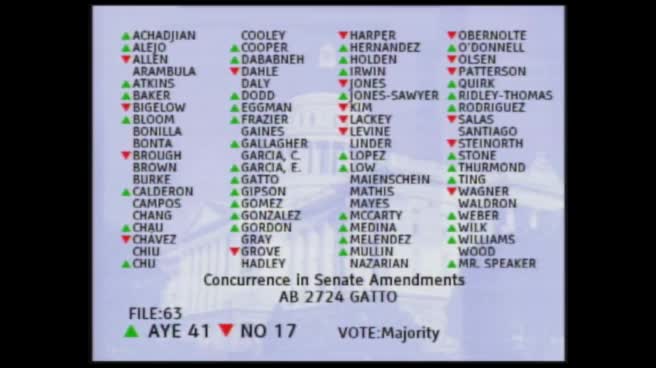
Bill Author