AB 2221: Criminal procedure: human trafficking witnesses.
- Session Year: 2015-2016
- House: Assembly
- Latest Version Date: 2016-09-26
Under existing law, a person who deprives or violates another persons personal liberty with the intent to obtain forced labor or services or who deprives or violates another persons personal liberty for the purpose of prostitution or sexual exploitation is guilty of human trafficking, a felony.
This bill would require, in a case involving a charge of human trafficking, that a minor who is a victim of the human trafficking be provided with assistance from the local county Victim Witness Assistance Center if the minor so desires that assistance.
Under existing law, a person who deprives or violates another persons personal liberty with the intent to obtain forced labor or services or who deprives or violates another persons personal liberty for the purpose of prostitution or sexual exploitation is guilty of human trafficking, a felony.
This bill would require require, in a case involving a charge of human trafficking, that a minor who is a victim of the human trafficking be provided with assistance from the local county Victim Witness Assistance Center prior to testifying as a witness in the case if the minor so desires that assistance.
(1)Under
Under existing law, a person who deprives or violates another persons personal liberty with the intent to obtain forced labor or services or who deprives or violates another persons personal liberty for the purpose of prostitution or sexual exploitation is guilty of human trafficking, a felony.
This bill would require that a minor who is a victim of human trafficking be provided with assistance from the local county Victim Witness Assistance Center prior to testifying as a witness in the case if the minor so desires that assistance.
(1)Existing law authorizes a peace officer to arrest a person without a warrant if the officer has probable cause to believe that the person has committed a public offense in the officers presence or if the officer has probable cause to believe that the person has committed a felony.
This bill would authorize a peace officer to arrest a person without a warrant if the officer has probable cause to believe that the person has committed the misdemeanor offense of soliciting a minor for prostitution.
(2)
(1)Under existing law, a person who deprives or violates another persons personal liberty with the intent to obtain forced labor or services or who deprives or violates another persons personal liberty for the purpose of prostitution or sexual exploitation is guilty of human trafficking, a felony.
This bill would require that a minor who is a victim of human trafficking be provided with assistance from the local county Victim Witness Assistance Center prior to being made subject to a subpoena to testify testifying as a witness in the case. By imposing a duty on local county agencies to provide this assistance, this bill would impose a state-mandated local program. case if the minor so desires that assistance.
(3)The California Constitution requires the state to reimburse local agencies and school districts for certain costs mandated by the state. Statutory provisions establish procedures for making that reimbursement.
This bill would provide that, if the Commission on State Mandates determines that the bill contains costs mandated by the state, reimbursement for those costs shall be made pursuant to these statutory provisions.
Existing
(1)Existing law authorizes a peace officer to arrest a person without a warrant if the officer has probable cause to believe that the person has committed a public offense in the officers presence or if the officer has probable cause to believe that the person has committed a felony.
This bill would authorize a peace officer to arrest a person without a warrant if the officer has probable cause to believe that the person has committed the misdemeanor offense of soliciting a minor for prostitution.
(2)Under existing law, a person who deprives or violates another persons personal liberty with the intent to obtain forced labor or services or who deprives or violates another persons personal liberty for the purpose of prostitution or sexual exploitation is guilty of human trafficking, a felony.
This bill would require that a minor who is a victim of human trafficking be provided with assistance from the local county Victim Witness Assistance Center prior to being made subject to a subpoena to testify as a witness in the case. By imposing a duty on local county agencies to provide this assistance, this bill would impose a state-mandated local program.
(3)The California Constitution requires the state to reimburse local agencies and school districts for certain costs mandated by the state. Statutory provisions establish procedures for making that reimbursement.
This bill would provide that, if the Commission on State Mandates determines that the bill contains costs mandated by the state, reimbursement for those costs shall be made pursuant to these statutory provisions.
Existing law authorizes a peace officer to arrest a person without a warrant if the officer has probable cause to believe that the person has committed a public offense in the officers presence or if the officer has probable cause to believe that the person has committed a felony.
This bill would authorize a peace officer to arrest a person without a warrant if the officer has probable cause to believe that the person has committed the misdemeanor offense of soliciting a minor for prostitution.
Existing law provides for enhanced penalties in the case of a person who commits 2 or more related felonies, a material element of which is fraud or embezzlement, which involve a pattern of related felony conduct, and the pattern of related felony conduct involves the taking or loss of more than $100,000.
This bill would make technical, nonsubstantive changes to that provision.
(a)In a case involving a charge of human trafficking under Section 236.1, a minor who is a victim of the human trafficking shall be provided with assistance from the local county Victim Witness Assistance Center if the minor so desires.
(b)This section does not require a local agency to operate a Victim Witness Assistance Center.
(a)Prior to testifying as a witness in In a case involving a charge of human trafficking under Section 236.1, a minor who is a victim of the human trafficking shall be provided with assistance from the local county Victim Witness Assistance Center if the minor so desires.
(b)This section does not require a local agency to operate a Victim Witness Assistance Center.
(a)Prior to testifying as a witness in a case involving a charge of human trafficking under Section 236.1, a minor who is a victim of the human trafficking shall be provided with assistance from the local county Victim Witness Assistance Center if the minor so desires.
(b)This section does not require a local agency to operate a Victim Witness Assistance Center.
Prior to being made subject to a subpoena to testify testifying as a witness in a case involving a charge of human trafficking, trafficking under Section 236.1, a minor who is a victim of the human trafficking shall be provided with assistance from the local county Victim Witness Assistance Center. Center if the minor so desires.
SEC. 2.Section 836 of the Penal Code is amended to read:836.(a)A peace officer may arrest a person in obedience to a warrant or, pursuant to the authority granted to him or her by Chapter 4.5 (commencing with Section 830) of Title 3 of Part 2, without a warrant may arrest a person whenever any of the following circumstances occur:
(1)The officer has probable cause to believe that the person to be arrested has committed a public offense in the officers presence.
(2)The person arrested has committed a felony, although not in the officers presence.
(3)The officer has probable cause to believe that the person to be arrested has committed a felony, whether or not a felony, in fact, has been committed.
(b)Any time a peace officer is called out on a domestic violence call, it shall be mandatory that the officer make a good faith effort to inform the victim of his or her right to make a citizens arrest, unless the peace officer makes an arrest for a violation of paragraph (1) of subdivision (e) of Section 243 or 273.5. This information shall include advising the victim how to safely execute the arrest.
(c)(1)When a peace officer is responding to a call alleging a violation of a domestic violence protective or restraining order issued under Section 527.6 of the Code of Civil Procedure, the Family Code, Section 136.2, 646.91, or paragraph (2) of subdivision (a) of Section 1203.097 of this code, Section 213.5 or 15657.03 of the Welfare and Institutions Code, or of a domestic violence protective or restraining order issued by the court of another state, tribe, or territory and the peace officer has probable cause to believe that the person against whom the order is issued has notice of the order and has committed an act in violation of the order, the officer shall, consistent with subdivision (b) of Section 13701, make a lawful arrest of the person without a warrant and take that person into custody whether or not the violation occurred in the presence of the arresting officer. The officer shall, as soon as possible after the arrest, confirm with the appropriate authorities or the Domestic Violence Protection Order Registry maintained pursuant to Section 6380 of the Family Code that a true copy of the protective order has been registered, unless the victim provides the officer with a copy of the protective order.
(2)The person against whom a protective order has been issued shall be deemed to have notice of the order if the victim presents to the officer proof of service of the order, the officer confirms with the appropriate authorities that a true copy of the proof of service is on file, or the person against whom the protective order was issued was present at the protective order hearing or was informed by a peace officer of the contents of the protective order.
(3)In situations where mutual protective orders have been issued under Division 10 (commencing with Section 6200) of the Family Code, liability for arrest under this subdivision applies only to those persons who are reasonably believed to have been the dominant aggressor. In those situations, prior to making an arrest under this subdivision, the peace officer shall make reasonable efforts to identify, and may arrest, the dominant aggressor involved in the incident. The dominant aggressor is the person determined to be the most significant, rather than the first, aggressor. In identifying the dominant aggressor, an officer shall consider (A) the intent of the law to protect victims of domestic violence from continuing abuse, (B) the threats creating fear of physical injury, (C) the history of domestic violence between the persons involved, and (D) whether either person involved acted in self-defense.
(d)Notwithstanding paragraph (1) of subdivision (a), if a suspect commits an assault or battery upon a current or former spouse, fiance, fiancee, a current or former cohabitant as defined in Section 6209 of the Family Code, a person with whom the suspect currently is having or has previously had an engagement or dating relationship, as defined in paragraph (10) of subdivision (f) of Section 243, a person with whom the suspect has parented a child, or is presumed to have parented a child pursuant to the Uniform Parentage Act (Part 3 (commencing with Section 7600) of Division 12 of the Family Code), a child of the suspect, a child whose parentage by the suspect is the subject of an action under the Uniform Parentage Act, a child of a person in one of the above categories, any other person related to the suspect by consanguinity or affinity within the second degree, or any person who is 65 years of age or older and who is related to the suspect by blood or legal guardianship, a peace officer may arrest the suspect without a warrant when both of the following circumstances apply:
(1)The peace officer has probable cause to believe that the person to be arrested has committed the assault or battery, whether or not it has in fact been committed.
(2)The peace officer makes the arrest as soon as probable cause arises to believe that the person to be arrested has committed the assault or battery, whether or not it has in fact been committed.
(e)In addition to the authority to make an arrest without a warrant pursuant to paragraphs (1) and (3) of subdivision (a), a peace officer may, without a warrant, arrest a person for a violation of Section 25400 when all of the following apply:
(1)The officer has reasonable cause to believe that the person to be arrested has committed the violation of Section 25400.
(2)The violation of Section 25400 occurred within an airport, as defined in Section 21013 of the Public Utilities Code, in an area to which access is controlled by the inspection of persons and property.
(3)The peace officer makes the arrest as soon as reasonable cause arises to believe that the person to be arrested has committed the violation of Section 25400.
(f)In addition to the authority to make an arrest without a warrant pursuant to subdivision (a), a peace officer may, without a warrant, arrest a person if the officer has probable cause to believe that the person to be arrested has violated subdivision (m) of Section 647, although not in the presence of the officer.
SEC. 3.If the Commission on State Mandates determines that this act contains costs mandated by the state, reimbursement to local agencies and school districts for those costs shall be made pursuant to Part 7 (commencing with Section 17500) of Division 4 of Title 2 of the Government Code.
Prior to being made subject to a subpoena to testify as a witness in a case involving human trafficking, a minor who is a victim of the human trafficking shall be provided with assistance from the local county Victim Witness Assistance Center.
SECTION 1.SEC. 2.Section 836 of the Penal Code is amended to read:836.(a)A peace officer may arrest a person in obedience to a warrant or, pursuant to the authority granted to him or her by Chapter 4.5 (commencing with Section 830) of Title 3 of Part 2, without a warrant may arrest a person whenever any of the following circumstances occur:
(1)The officer has probable cause to believe that the person to be arrested has committed a public offense in the officers presence.
(2)The person arrested has committed a felony, although not in the officers presence.
(3)The officer has probable cause to believe that the person to be arrested has committed a felony, whether or not a felony, in fact, has been committed.
(b)Any time a peace officer is called out on a domestic violence call, it shall be mandatory that the officer make a good faith effort to inform the victim of his or her right to make a citizens arrest, unless the peace officer makes an arrest for a violation of paragraph (1) of subdivision (e) of Section 243 or 273.5. This information shall include advising the victim how to safely execute the arrest.
(c)(1)When a peace officer is responding to a call alleging a violation of a domestic violence protective or restraining order issued under Section 527.6 of the Code of Civil Procedure, the Family Code, Section 136.2, 646.91, or paragraph (2) of subdivision (a) of Section 1203.097 of this code, Section 213.5 or 15657.03 of the Welfare and Institutions Code, or of a domestic violence protective or restraining order issued by the court of another state, tribe, or territory and the peace officer has probable cause to believe that the person against whom the order is issued has notice of the order and has committed an act in violation of the order, the officer shall, consistent with subdivision (b) of Section 13701, make a lawful arrest of the person without a warrant and take that person into custody whether or not the violation occurred in the presence of the arresting officer. The officer shall, as soon as possible after the arrest, confirm with the appropriate authorities or the Domestic Violence Protection Order Registry maintained pursuant to Section 6380 of the Family Code that a true copy of the protective order has been registered, unless the victim provides the officer with a copy of the protective order.
(2)The person against whom a protective order has been issued shall be deemed to have notice of the order if the victim presents to the officer proof of service of the order, the officer confirms with the appropriate authorities that a true copy of the proof of service is on file, or the person against whom the protective order was issued was present at the protective order hearing or was informed by a peace officer of the contents of the protective order.
(3)In situations where mutual protective orders have been issued under Division 10 (commencing with Section 6200) of the Family Code, liability for arrest under this subdivision applies only to those persons who are reasonably believed to have been the dominant aggressor. In those situations, prior to making an arrest under this subdivision, the peace officer shall make reasonable efforts to identify, and may arrest, the dominant aggressor involved in the incident. The dominant aggressor is the person determined to be the most significant, rather than the first, aggressor. In identifying the dominant aggressor, an officer shall consider (A) the intent of the law to protect victims of domestic violence from continuing abuse, (B) the threats creating fear of physical injury, (C) the history of domestic violence between the persons involved, and (D) whether either person involved acted in self-defense.
(d)Notwithstanding paragraph (1) of subdivision (a), if a suspect commits an assault or battery upon a current or former spouse, fiance, fiancee, a current or former cohabitant as defined in Section 6209 of the Family Code, a person with whom the suspect currently is having or has previously had an engagement or dating relationship, as defined in paragraph (10) of subdivision (f) of Section 243, a person with whom the suspect has parented a child, or is presumed to have parented a child pursuant to the Uniform Parentage Act (Part 3 (commencing with Section 7600) of Division 12 of the Family Code), a child of the suspect, a child whose parentage by the suspect is the subject of an action under the Uniform Parentage Act, a child of a person in one of the above categories, any other person related to the suspect by consanguinity or affinity within the second degree, or any person who is 65 years of age or older and who is related to the suspect by blood or legal guardianship, a peace officer may arrest the suspect without a warrant when both of the following circumstances apply:
(1)The peace officer has probable cause to believe that the person to be arrested has committed the assault or battery, whether or not it has in fact been committed.
(2)The peace officer makes the arrest as soon as probable cause arises to believe that the person to be arrested has committed the assault or battery, whether or not it has in fact been committed.
(e)In addition to the authority to make an arrest without a warrant pursuant to paragraphs (1) and (3) of subdivision (a), a peace officer may, without a warrant, arrest a person for a violation of Section 25400 when all of the following apply:
(1)The officer has reasonable cause to believe that the person to be arrested has committed the violation of Section 25400.
(2)The violation of Section 25400 occurred within an airport, as defined in Section 21013 of the Public Utilities Code, in an area to which access is controlled by the inspection of persons and property.
(3)The peace officer makes the arrest as soon as reasonable cause arises to believe that the person to be arrested has committed the violation of Section 25400.
(f)In addition to the authority to make an arrest without a warrant pursuant to subdivision (a), a peace officer may, without a warrant, arrest a person if the officer has probable cause to believe that the person to be arrested has violated subdivision (m) of Section 647, although not in the presence of the officer.
SEC. 3.If the Commission on State Mandates determines that this act contains costs mandated by the state, reimbursement to local agencies and school districts for those costs shall be made pursuant to Part 7 (commencing with Section 17500) of Division 4 of Title 2 of the Government Code.
(a)A peace officer may arrest a person in obedience to a warrant, warrant or, pursuant to the authority granted to him or her by Chapter 4.5 (commencing with Section 830) of Title 3 of Part 2, without a warrant, warrant may arrest a person whenever any of the following circumstances occur:
(1)The officer has probable cause to believe that the person to be arrested has committed a public offense in the officers presence.
(2)The person arrested has committed a felony, although not in the officers presence.
(3)The officer has probable cause to believe that the person to be arrested has committed a felony, whether or not a felony, in fact, has been committed.
(b)Any time a peace officer is called out on a domestic violence call, it shall be mandatory that the officer make a good faith effort to inform the victim of his or her right to make a citizens arrest, unless the peace officer makes an arrest for a violation of paragraph (1) of subdivision (e) of Section 243 or 273.5. This information shall include advising the victim how to safely execute the arrest.
(c)(1)When a peace officer is responding to a call alleging a violation of a domestic violence protective or restraining order issued under Section 527.6 of the Code of Civil Procedure, the Family Code, Section 136.2, 646.91, or paragraph (2) of subdivision (a) of Section 1203.097 of this code, Section 213.5 or 15657.03 of the Welfare and Institutions Code, or of a domestic violence protective or restraining order issued by the court of another state, tribe, or territory and the peace officer has probable cause to believe that the person against whom the order is issued has notice of the order and has committed an act in violation of the order, the officer shall, consistent with subdivision (b) of Section 13701, make a lawful arrest of the person without a warrant and take that person into custody whether or not the violation occurred in the presence of the arresting officer. The officer shall, as soon as possible after the arrest, confirm with the appropriate authorities or the Domestic Violence Protection Order Registry maintained pursuant to Section 6380 of the Family Code that a true copy of the protective order has been registered, unless the victim provides the officer with a copy of the protective order.
(2)The person against whom a protective order has been issued shall be deemed to have notice of the order if the victim presents to the officer proof of service of the order, the officer confirms with the appropriate authorities that a true copy of the proof of service is on file, or the person against whom the protective order was issued was present at the protective order hearing or was informed by a peace officer of the contents of the protective order.
(3)In situations where mutual protective orders have been issued under Division 10 (commencing with Section 6200) of the Family Code, liability for arrest under this subdivision applies only to those persons who are reasonably believed to have been the dominant aggressor. In those situations, prior to making an arrest under this subdivision, the peace officer shall make reasonable efforts to identify, and may arrest, the dominant aggressor involved in the incident. The dominant aggressor is the person determined to be the most significant, rather than the first, aggressor. In identifying the dominant aggressor, an officer shall consider (A) the intent of the law to protect victims of domestic violence from continuing abuse, (B) the threats creating fear of physical injury, (C) the history of domestic violence between the persons involved, and (D) whether either person involved acted in self-defense.
(d)Notwithstanding paragraph (1) of subdivision (a), if a suspect commits an assault or battery upon a current or former spouse, fiance, fiancee, a current or former cohabitant as defined in Section 6209 of the Family Code, a person with whom the suspect currently is having or has previously had an engagement or dating relationship, as defined in paragraph (10) of subdivision (f) of Section 243, a person with whom the suspect has parented a child, or is presumed to have parented a child pursuant to the Uniform Parentage Act (Part 3 (commencing with Section 7600) of Division 12 of the Family Code), a child of the suspect, a child whose parentage by the suspect is the subject of an action under the Uniform Parentage Act, a child of a person in one of the above categories, any other person related to the suspect by consanguinity or affinity within the second degree, or any person who is 65 years of age or older and who is related to the suspect by blood or legal guardianship, a peace officer may arrest the suspect without a warrant where when both of the following circumstances apply:
(1)The peace officer has probable cause to believe that the person to be arrested has committed the assault or battery, whether or not it has in fact been committed.
(2)The peace officer makes the arrest as soon as probable cause arises to believe that the person to be arrested has committed the assault or battery, whether or not it has in fact been committed.
(e)In addition to the authority to make an arrest without a warrant pursuant to paragraphs (1) and (3) of subdivision (a), a peace officer may, without a warrant, arrest a person for a violation of Section 25400 when all of the following apply:
(1)The officer has reasonable cause to believe that the person to be arrested has committed the violation of Section 25400.
(2)The violation of Section 25400 occurred within an airport, as defined in Section 21013 of the Public Utilities Code, in an area to which access is controlled by the inspection of persons and property.
(3)The peace officer makes the arrest as soon as reasonable cause arises to believe that the person to be arrested has committed the violation of Section 25400.
(f)In addition to the authority to make an arrest without a warrant pursuant to subdivision (a), a peace officer may, without a warrant, arrest a person if the officer has probable cause to believe that the person to be arrested has violated subdivision (m) of Section 647, although not in the presence of the officer.
SECTION 1.Section 186.11 of the Penal Code is amended to read:186.11.(a)(1)Any person who commits two or more related felonies, a material element of which is fraud or embezzlement, which involve a pattern of related felony conduct, and the pattern of related felony conduct involves the taking of, or results in the loss by another person or entity of, more than one hundred thousand dollars ($100,000), shall be punished, upon conviction of two or more felonies in a single criminal proceeding, in addition and consecutive to the punishment prescribed for the felony offenses of which he or she has been convicted, by an additional term of imprisonment in the state prison as specified in paragraph (2) or (3). This enhancement shall be known as the aggravated white collar crime enhancement. The aggravated white collar crime enhancement shall only be imposed once in a single criminal proceeding. For purposes of this section, pattern of related felony conduct means engaging in at least two felonies that have the same or similar purpose, result, principals, victims, or methods of commission, or are otherwise interrelated by distinguishing characteristics, and that are not isolated events. For purposes of this section, two or more related felonies means felonies committed against two or more separate victims, or against the same victim on two or more separate occasions.
(2)If the pattern of related felony conduct involves the taking of, or results in the loss by another person or entity of, more than five hundred thousand dollars ($500,000), the additional term of punishment shall be two, three, or five years in the state prison.
(3)If the pattern of related felony conduct involves the taking of, or results in the loss by another person or entity of, more than one hundred thousand dollars ($100,000), but not more than five hundred thousand dollars ($500,000), the additional term of punishment shall be the term specified in paragraph (1) or (2) of subdivision (a) of Section 12022.6.
(b)(1)The additional prison term and penalties provided for in subdivisions (a), (c), and (d) shall not be imposed unless the facts set forth in subdivision (a) are charged in the accusatory pleading and admitted or found to be true by the trier of fact.
(2)The additional prison term provided in paragraph (2) of subdivision (a) shall be in addition to any other punishment provided under law, including Section 12022.6, and shall not be limited by any other provision of law.
(c)Any person convicted of two or more felonies, as specified in subdivision (a), shall also be liable for a fine not to exceed five hundred thousand dollars ($500,000) or double the value of the taking, whichever is greater, if the existence of facts that would make the person subject to the aggravated white collar crime enhancement have been admitted or found to be true by the trier of fact. However, if the pattern of related felony conduct involves the taking of more than one hundred thousand dollars ($100,000), but not more than five hundred thousand dollars ($500,000), the fine shall not exceed one hundred thousand dollars ($100,000) or double the value of the taking, whichever is greater.
(d)(1)If a person is alleged to have committed two or more felonies, as specified in subdivision (a), and the aggravated white collar crime enhancement is also charged, or a person is charged in an accusatory pleading with a felony, a material element of which is fraud or embezzlement, that involves the taking or loss of more than one hundred thousand dollars ($100,000), and an allegation as to the existence of those facts, any asset or property that is in the control of that person, and any asset or property that has been transferred by that person to a third party, subsequent to the commission of any criminal act alleged pursuant to subdivision (a), other than in a bona fide purchase, whether found within or outside the state, may be preserved by the superior court in order to pay restitution and fines. Upon conviction of two or more felonies, as specified in subdivision (a), or a felony, a material element of which is fraud or embezzlement, that involves the taking or loss of more than one hundred thousand dollars ($100,000), this property may be levied upon by the superior court to pay restitution and fines if the existence of facts that would make the person subject to the aggravated white collar crime enhancement or that demonstrate the taking or loss of more than one hundred thousand dollars ($100,000) in the commission of a felony, a material element of which is fraud or embezzlement, have been charged in the accusatory pleading and admitted or found to be true by the trier of fact.
(2)To prevent dissipation or secreting of assets or property, the prosecuting agency may, at the same time as or subsequent to the filing of a complaint or indictment charging two or more felonies, as specified in subdivision (a), and the enhancement specified in subdivision (a), or a felony, a material element of which is fraud or embezzlement, that involves the taking or loss of more than one hundred thousand dollars ($100,000), and an allegation as to the existence of those facts, file a petition with the criminal division of the superior court of the county in which the accusatory pleading was filed, seeking a temporary restraining order, preliminary injunction, the appointment of a receiver, or any other protective relief necessary to preserve the property or assets. This petition shall commence a proceeding that shall be pendent to the criminal proceeding and maintained solely to affect the criminal remedies provided for in this section. The proceeding shall not be subject to or governed by the provisions of the Civil Discovery Act as set forth in Title 4 (commencing with Section 2016.010) of Part 4 of the Code of Civil Procedure. The petition shall allege that the defendant has been charged with two or more felonies, as specified in subdivision (a), and is subject to the aggravated white collar crime enhancement specified in subdivision (a) or that the defendant has been charged with a felony, a material element of which is fraud or embezzlement, that involves the taking or loss of more than one hundred thousand dollars ($100,000), and an allegation as to the existence of those facts. The petition shall identify that criminal proceeding and the assets and property to be affected by an order issued pursuant to this section.
(3)A notice regarding the petition shall be provided, by personal service or registered mail, to every person who may have an interest in the property specified in the petition. Additionally, the notice shall be published for at least three successive weeks in a newspaper of general circulation in the county where the property affected by an order issued pursuant to this section is located. The notice shall state that any interested person may file a verified claim with the superior court stating the nature and amount of their claimed interest. The notice shall set forth the time within which a claim of interest in the protected property is required to be filed.
(4)If the property to be preserved is real property, the prosecuting agency shall record, at the time of filing the petition, a lis pendens in each county in which the real property is situated which specifically identifies the property by legal description, the name of the owner of record as shown on the latest equalized assessment roll, and the assessors parcel number.
(5)If the property to be preserved are assets under the control of a banking or financial institution, the prosecuting agency, at the time of the filing of the petition, may obtain an order from the court directing the banking or financial institution to immediately disclose the account numbers and value of the assets of the accused held by the banking or financial institution. The prosecuting agency shall file a supplemental petition, specifically identifying which banking or financial institution accounts shall be subject to a temporary restraining order, preliminary injunction, or other protective remedy.
(6)Any person claiming an interest in the protected property may, at any time within 30 days from the date of the first publication of the notice of the petition, or within 30 days after receipt of actual notice, file with the superior court of the county in which the action is pending a verified claim stating the nature and amount of his or her interest in the property or assets. A verified copy of the claim shall be served by the claimant on the Attorney General or district attorney, as appropriate.
(7)The imposition of fines and restitution pursuant to this section shall be determined by the superior court in which the underlying criminal offense is sentenced. Any judge who is assigned to the criminal division of the superior court in the county where the petition is filed may issue a temporary restraining order in conjunction with, or subsequent to, the filing of an allegation pursuant to this section. Any subsequent hearing on the petition shall also be heard by a judge assigned to the criminal division of the superior court in the county in which the petition is filed. At the time of the filing of an information or indictment in the underlying criminal case, any subsequent hearing on the petition shall be heard by the superior court judge assigned to the underlying criminal case.
(e)Concurrent with, or subsequent to, the filing of the petition, the prosecuting agency may move the superior court for, and the superior court may issue, the following pendente lite orders to preserve the status quo of the property alleged in the petition:
(1)An injunction to restrain any person from transferring, encumbering, hypothecating, or otherwise disposing of that property.
(2)Appointment of a receiver to take possession of, care for, manage, and operate the assets and properties so that the property may be maintained and preserved. The court may order that a receiver appointed pursuant to this section shall be compensated for all reasonable expenditures made or incurred by him or her in connection with the possession, care, management, and operation of any property or assets that are subject to the provisions of this section.
(3)A bond or other undertaking, in lieu of other orders, of a value sufficient to ensure the satisfaction of restitution and fines imposed pursuant to this section.
(f)(1)No preliminary injunction may be granted or receiver appointed by the court without notice that meets the requirements of paragraph (3) of subdivision (d) to all known and reasonably ascertainable interested parties and upon a hearing to determine that an order is necessary to preserve the property pending the outcome of the criminal proceedings. A temporary restraining order may be issued by the court, ex parte, pending that hearing in conjunction with or subsequent to the filing of the petition upon the application of the prosecuting attorney. The temporary restraining order may be based upon the sworn declaration of a peace officer with personal knowledge of the criminal investigation that establishes probable cause to believe that aggravated white collar crime or a felony, a material element of which is fraud or embezzlement, that involves the taking or loss of more than one hundred thousand dollars ($100,000) has taken place and that the amount of restitution and fines exceeds or equals the worth of the assets subject to the temporary restraining order. The declaration may include the hearsay statements of witnesses to establish the necessary facts. The temporary restraining order may be issued without notice upon a showing of good cause to the court.
(2)The defendant, or a person who has filed a verified claim as provided in paragraph (6) of subdivision (d), shall have the right to have the court conduct an order to show cause hearing within 10 days of the service of the request for hearing upon the prosecuting agency, in order to determine whether the temporary restraining order should remain in effect, whether relief should be granted from any lis pendens recorded pursuant to paragraph (4) of subdivision (d), or whether any existing order should be modified in the interests of justice. Upon a showing of good cause, the hearing shall be held within two days of the service of the request for hearing upon the prosecuting agency.
(3)In determining whether to issue a preliminary injunction or temporary restraining order in a proceeding brought by a prosecuting agency in conjunction with or subsequent to the filing of an allegation pursuant to this section, the court has the discretion to consider any matter that it deems reliable and appropriate, including hearsay statements, in order to reach a just and equitable decision. The court shall weigh the relative degree of certainty of the outcome on the merits and the consequences to each of the parties of granting the interim relief. If the prosecution is likely to prevail on the merits and the risk of the dissipation of assets outweighs the potential harm to the defendants and the interested parties, the court shall grant injunctive relief. The court shall give significant weight to the following factors:
(A)The public interest in preserving the property or assets pendente lite.
(B)The difficulty of preserving the property or assets pendente lite where the underlying alleged crimes involve issues of fraud and moral turpitude.
(C)The fact that the requested relief is being sought by a public prosecutor on behalf of alleged victims of white collar crimes.
(D)The likelihood that substantial public harm has occurred where aggravated white collar crime is alleged to have been committed.
(E)The significant public interest involved in compensating the victims of white collar crime and paying court-imposed restitution and fines.
(4)The court, in making its orders, may consider a defendants request for the release of a portion of the property affected by this section in order to pay reasonable legal fees in connection with the criminal proceeding, any necessary and appropriate living expenses pending trial and sentencing, and for the purpose of posting bail. The court shall weigh the needs of the public to retain the property against the needs of the defendant to a portion of the property. The court shall consider the factors listed in paragraph (3) prior to making any order releasing property for these purposes.
(5)The court, in making its orders, shall seek to protect the interests of any innocent third persons, including an innocent spouse, who were not involved in the commission of any criminal activity.
(6)Any petition filed pursuant to this section is part of the criminal proceedings for purposes of appointment of counsel and shall be assigned to the criminal division of the superior court of the county in which the accusatory pleading was filed.
(7)Based upon a noticed motion brought by the receiver appointed pursuant to paragraph (2) of subdivision (e), the court may order an interlocutory sale of property named in the petition when the property is liable to perish, to waste, or to be significantly reduced in value, or when the expenses of maintaining the property are disproportionate to the value thereof. The proceeds of the interlocutory sale shall be deposited with the court or as directed by the court pending determination of the proceeding pursuant to this section.
(8)The court may make any orders that are necessary to preserve the continuing viability of any lawful business enterprise that is affected by the issuance of a temporary restraining order or preliminary injunction issued pursuant to this action.
(9)In making its orders, the court shall seek to prevent any asset subject to a temporary restraining order or preliminary injunction from perishing, spoiling, going to waste, or otherwise being significantly reduced in value. Where the potential for diminution in value exists, the court shall appoint a receiver to dispose of or otherwise protect the value of the property or asset.
(10)A preservation order shall not be issued against any assets of a business that are not likely to be dissipated and that may be subject to levy or attachment to meet the purposes of this section.
(g)If the allegation that the defendant is subject to the aggravated white collar crime enhancement or has committed a felony, a material element of which is fraud or embezzlement, that involves the taking or loss of more than one hundred thousand dollars ($100,000) is dismissed or found by the trier of fact to be untrue, any preliminary injunction or temporary restraining order issued pursuant to this section shall be dissolved. If a jury is the trier of fact, and the jury is unable to reach a unanimous verdict, the court shall have the discretion to continue or dissolve all or a portion of the preliminary injunction or temporary restraining order based upon the interests of justice. However, if the prosecuting agency elects not to retry the case, any preliminary injunction or temporary restraining order issued pursuant to this section shall be dissolved.
(h)(1)(A)If the defendant is convicted of two or more felonies, as specified in subdivision (a), and the existence of facts that would make the person subject to the aggravated white collar crime enhancement have been admitted or found to be true by the trier of fact, or the defendant is convicted of a felony, a material element of which is fraud or embezzlement, that involves the taking or loss of more than one hundred thousand dollars ($100,000), and an allegation as to the existence of those facts has been admitted or found to be true by the trier of fact, the trial judge shall continue the preliminary injunction or temporary restraining order until the date of the criminal sentencing and shall make a finding at that time as to what portion, if any, of the property or assets subject to the preliminary injunction or temporary restraining order shall be levied upon to pay fines and restitution to victims of the crime. The order imposing fines and restitution may exceed the total worth of the property or assets subjected to the preliminary injunction or temporary restraining order. The court may order the immediate transfer of the property or assets to satisfy any judgment and sentence made pursuant to this section. Additionally, upon motion of the prosecution, the court may enter an order as part of the judgment and sentence making the order imposing fines and restitution pursuant to this section enforceable pursuant to Title 9 (commencing with Section 680.010) of Part 2 of the Code of Civil Procedure.
(B)Additionally, the court shall order the defendant to make full restitution to the victim or to make restitution to the victim based on his or her ability to pay, as defined in subdivision (e) of Section 1203.1b. The payment of the restitution ordered by the court pursuant to this section shall be made a condition of any probation granted by the court if the existence of facts that would make the defendant subject to the aggravated white collar crime enhancement or of facts demonstrating the person committed a felony, a material element of which is fraud or embezzlement, that involves the taking or loss of more than one hundred thousand dollars ($100,000) have been admitted or found to be true by the trier of fact. Notwithstanding any other provision of law, the court may order that the period of probation continue for up to 10 years or until full restitution is made to the victim, whichever is earlier.
(C)The sentencing court shall retain jurisdiction to enforce the order to pay additional fines and restitution and, in appropriate cases, may initiate probation violation proceedings or contempt of court proceedings against a defendant who is found to have willfully failed to comply with any lawful order of the court.
(D)If the execution of judgment is stayed pending an appeal of an order of the superior court pursuant to this section, the preliminary injunction or temporary restraining order shall be maintained in full force and effect during the pendency of the appellate period.
(2)The order imposing fines and restitution shall not affect the interest in real property of any third party that was acquired prior to the recording of the lis pendens, unless the property was obtained from the defendant other than as a bona fide purchaser for value. If any assets or property affected by this section are subject to a valid lien, mortgage, security interest, or interest under a conditional sales contract and the amount due to the holder of the lien, mortgage, interest, or contract is less than the appraised value of the property, that person may pay to the state or the local government that initiated the proceeding the amount of the difference between the appraised value of the property and the amount of the lien, mortgage, security interest, or interest under a conditional sales contract. Upon that payment, the state or local entity shall relinquish all claims to the property. If the holder of the interest elects not to make that payment to the state or local governmental entity, the interest in the property shall be deemed transferred to the state or local governmental entity and any indicia of ownership of the property shall be confirmed in the state or local governmental entity. The appraised value shall be determined as of the date judgment is entered either by agreement between the holder of the lien, mortgage, security interest, or interest under a conditional sales contract and the governmental entity involved, or if they cannot agree, then by a court-appointed appraiser for the county in which the action is brought. A person holding a valid lien, mortgage, security interest, or interest under a conditional sales contract shall be paid the appraised value of his or her interest.
(3)In making its final order, the court shall seek to protect the legitimately acquired interests of any innocent third persons, including an innocent spouse, who were not involved in the commission of any criminal activity.
(i)In all cases where property is to be levied upon pursuant to this section, a receiver appointed by the court shall be empowered to liquidate all property or assets which shall be distributed in the following order of priority:
(1)To the receiver, or court-appointed appraiser, for all reasonable expenditures made or incurred by him or her in connection with the sale of the property or liquidation of assets, including all reasonable expenditures for any necessary repairs, storage, or transportation of any property levied upon under this section.
(2)To any holder of a valid lien, mortgage, or security interest up to the amount of his or her interest in the property or proceeds.
(3)To any victim as restitution for any fraudulent or unlawful acts alleged in the accusatory pleading that were proven by the prosecuting agency as part of the pattern of fraudulent or unlawful acts.
(4)For payment of any fine imposed pursuant to this section. The proceeds obtained in payment of a fine shall be paid to the treasurer of the county in which the judgment was entered, or if the action was undertaken by the Attorney General, to the Treasurer. If the payment of any fine imposed pursuant to this section involved losses resulting from violation of Section 550 of this code or Section 1871.4 of the Insurance Code, one-half of the fine collected shall be paid to the treasurer of the county in which the judgment was entered, and one-half of the fine collected shall be paid to the Department of Insurance for deposit in the appropriate account in the Insurance Fund. The proceeds from the fine first shall be used by a county to reimburse local prosecutors and enforcement agencies for the reasonable costs of investigation and prosecution of cases brought pursuant to this section.
(5)To the Restitution Fund, or in cases involving convictions relating to insurance fraud, to the Insurance Fund as restitution for crimes not specifically pleaded and proven in the accusatory pleading.
(j)If, after distribution pursuant to paragraphs (1) and (2) of subdivision (i), the value of the property to be levied upon pursuant to this section is insufficient to pay for restitution and fines, the court shall order an equitable sharing of the proceeds of the liquidation of the property, and any other recoveries, which shall specify the percentage of recoveries to be devoted to each purpose. At least 70 percent of the proceeds remaining after distribution pursuant to paragraphs (1) and (2) of subdivision (i) shall be devoted to restitution.
(k)Unless otherwise expressly provided, the remedies or penalties provided by this section are cumulative to each other and to the remedies or penalties available under all other laws of this state, except that two separate actions against the same defendant and pertaining to the same fraudulent or unlawful acts may not be brought by a district attorney or the Attorney General pursuant to this section and Chapter 5 (commencing with Section 17200) of Part 2 of Division 7 of the Business and Professions Code. If a fine is imposed under this section, it shall be in lieu of all other fines that may be imposed pursuant to any other provision of law for the crimes for which the defendant has been convicted in the action.
(a)(1)Any person who commits two or more related felonies, a material element of which is fraud or embezzlement, which involve a pattern of related felony conduct, and the pattern of related felony conduct involves the taking of, or results in the loss by another person or entity of, more than one hundred thousand dollars ($100,000), shall be punished, upon conviction of two or more felonies in a single criminal proceeding, in addition and consecutive to the punishment prescribed for the felony offenses of which he or she has been convicted, by an additional term of imprisonment in the state prison as specified in paragraph (2) or (3). This enhancement shall be known as the aggravated white collar crime enhancement. The aggravated white collar crime enhancement shall only be imposed once in a single criminal proceeding. For purposes of this section, pattern of related felony conduct means engaging in at least two felonies that have the same or similar purpose, result, principals, victims, or methods of commission, or are otherwise interrelated by distinguishing characteristics, and that are not isolated events. For purposes of this section, two or more related felonies means felonies committed against two or more separate victims, or against the same victim on two or more separate occasions.
(2)If the pattern of related felony conduct involves the taking of, or results in the loss by another person or entity of, more than five hundred thousand dollars ($500,000), the additional term of punishment shall be two, three, or five years in the state prison.
(3)If the pattern of related felony conduct involves the taking of, or results in the loss by another person or entity of, more than one hundred thousand dollars ($100,000), but not more than five hundred thousand dollars ($500,000), the additional term of punishment shall be the term specified in paragraph (1) or (2) of subdivision (a) of Section 12022.6.
(b)(1)The additional prison term and penalties provided for in subdivisions (a), (c), and (d) shall not be imposed unless the facts set forth in subdivision (a) are charged in the accusatory pleading and admitted or found to be true by the trier of fact.
(2)The additional prison term provided in paragraph (2) of subdivision (a) shall be in addition to any other punishment provided by under law, including Section 12022.6, and shall not be limited by any other provision of law.
(c)Any person convicted of two or more felonies, as specified in subdivision (a), shall also be liable for a fine not to exceed five hundred thousand dollars ($500,000) or double the value of the taking, whichever is greater, if the existence of facts that would make the person subject to the aggravated white collar crime enhancement have been admitted or found to be true by the trier of fact. However, if the pattern of related felony conduct involves the taking of more than one hundred thousand dollars ($100,000), but not more than five hundred thousand dollars ($500,000), the fine shall not exceed one hundred thousand dollars ($100,000) or double the value of the taking, whichever is greater.
(d)(1)If a person is alleged to have committed two or more felonies, as specified in subdivision (a), and the aggravated white collar crime enhancement is also charged, or a person is charged in an accusatory pleading with a felony, a material element of which is fraud or embezzlement, that involves the taking or loss of more than one hundred thousand dollars ($100,000), and an allegation as to the existence of those facts, any asset or property that is in the control of that person, and any asset or property that has been transferred by that person to a third party, subsequent to the commission of any criminal act alleged pursuant to subdivision (a), other than in a bona fide purchase, whether found within or outside the state, may be preserved by the superior court in order to pay restitution and fines. Upon conviction of two or more felonies, as specified in subdivision (a), or a felony, a material element of which is fraud or embezzlement, that involves the taking or loss of more than one hundred thousand dollars ($100,000), this property may be levied upon by the superior court to pay restitution and fines if the existence of facts that would make the person subject to the aggravated white collar crime enhancement or that demonstrate the taking or loss of more than one hundred thousand dollars ($100,000) in the commission of a felony, a material element of which is fraud or embezzlement, have been charged in the accusatory pleading and admitted or found to be true by the trier of fact.
(2)To prevent dissipation or secreting of assets or property, the prosecuting agency may, at the same time as or subsequent to the filing of a complaint or indictment charging two or more felonies, as specified in subdivision (a), and the enhancement specified in subdivision (a), or a felony, a material element of which is fraud or embezzlement, that involves the taking or loss of more than one hundred thousand dollars ($100,000), and an allegation as to the existence of those facts, file a petition with the criminal division of the superior court of the county in which the accusatory pleading was filed, seeking a temporary restraining order, preliminary injunction, the appointment of a receiver, or any other protective relief necessary to preserve the property or assets. This petition shall commence a proceeding that shall be pendent to the criminal proceeding and maintained solely to affect the criminal remedies provided for in this section. The proceeding shall not be subject to or governed by the provisions of the Civil Discovery Act as set forth in Title 4 (commencing with Section 2016.010) of Part 4 of the Code of Civil Procedure. The petition shall allege that the defendant has been charged with two or more felonies, as specified in subdivision (a), and is subject to the aggravated white collar crime enhancement specified in subdivision (a) or that the defendant has been charged with a felony, a material element of which is fraud or embezzlement, that involves the taking or loss of more than one hundred thousand dollars ($100,000), and an allegation as to the existence of those facts. The petition shall identify that criminal proceeding and the assets and property to be affected by an order issued pursuant to this section.
(3)A notice regarding the petition shall be provided, by personal service or registered mail, to every person who may have an interest in the property specified in the petition. Additionally, the notice shall be published for at least three successive weeks in a newspaper of general circulation in the county where the property affected by an order issued pursuant to this section is located. The notice shall state that any interested person may file a verified claim with the superior court stating the nature and amount of their claimed interest. The notice shall set forth the time within which a claim of interest in the protected property is required to be filed.
(4)If the property to be preserved is real property, the prosecuting agency shall record, at the time of filing the petition, a lis pendens in each county in which the real property is situated which specifically identifies the property by legal description, the name of the owner of record as shown on the latest equalized assessment roll, and the assessors parcel number.
(5)If the property to be preserved are assets under the control of a banking or financial institution, the prosecuting agency, at the time of the filing of the petition, may obtain an order from the court directing the banking or financial institution to immediately disclose the account numbers and value of the assets of the accused held by the banking or financial institution. The prosecuting agency shall file a supplemental petition, specifically identifying which banking or financial institution accounts shall be subject to a temporary restraining order, preliminary injunction, or other protective remedy.
(6)Any person claiming an interest in the protected property may, at any time within 30 days from the date of the first publication of the notice of the petition, or within 30 days after receipt of actual notice, file with the superior court of the county in which the action is pending a verified claim stating the nature and amount of his or her interest in the property or assets. A verified copy of the claim shall be served by the claimant on the Attorney General or district attorney, as appropriate.
(7)The imposition of fines and restitution pursuant to this section shall be determined by the superior court in which the underlying criminal offense is sentenced. Any judge who is assigned to the criminal division of the superior court in the county where the petition is filed may issue a temporary restraining order in conjunction with, or subsequent to, the filing of an allegation pursuant to this section. Any subsequent hearing on the petition shall also be heard by a judge assigned to the criminal division of the superior court in the county in which the petition is filed. At the time of the filing of an information or indictment in the underlying criminal case, any subsequent hearing on the petition shall be heard by the superior court judge assigned to the underlying criminal case.
(e)Concurrent with, or subsequent to, the filing of the petition, the prosecuting agency may move the superior court for, and the superior court may issue, the following pendente lite orders to preserve the status quo of the property alleged in the petition:
(1)An injunction to restrain any person from transferring, encumbering, hypothecating, or otherwise disposing of that property.
(2)Appointment of a receiver to take possession of, care for, manage, and operate the assets and properties so that the property may be maintained and preserved. The court may order that a receiver appointed pursuant to this section shall be compensated for all reasonable expenditures made or incurred by him or her in connection with the possession, care, management, and operation of any property or assets that are subject to the provisions of this section.
(3)A bond or other undertaking, in lieu of other orders, of a value sufficient to ensure the satisfaction of restitution and fines imposed pursuant to this section.
(f)(1)No preliminary injunction may be granted or receiver appointed by the court without notice that meets the requirements of paragraph (3) of subdivision (d) to all known and reasonably ascertainable interested parties and upon a hearing to determine that an order is necessary to preserve the property pending the outcome of the criminal proceedings. A temporary restraining order may be issued by the court, ex parte, pending that hearing in conjunction with or subsequent to the filing of the petition upon the application of the prosecuting attorney. The temporary restraining order may be based upon the sworn declaration of a peace officer with personal knowledge of the criminal investigation that establishes probable cause to believe that aggravated white collar crime or a felony, a material element of which is fraud or embezzlement, that involves the taking or loss of more than one hundred thousand dollars ($100,000) has taken place and that the amount of restitution and fines exceeds or equals the worth of the assets subject to the temporary restraining order. The declaration may include the hearsay statements of witnesses to establish the necessary facts. The temporary restraining order may be issued without notice upon a showing of good cause to the court.
(2)The defendant, or a person who has filed a verified claim as provided in paragraph (6) of subdivision (d), shall have the right to have the court conduct an order to show cause hearing within 10 days of the service of the request for hearing upon the prosecuting agency, in order to determine whether the temporary restraining order should remain in effect, whether relief should be granted from any lis pendens recorded pursuant to paragraph (4) of subdivision (d), or whether any existing order should be modified in the interests of justice. Upon a showing of good cause, the hearing shall be held within two days of the service of the request for hearing upon the prosecuting agency.
(3)In determining whether to issue a preliminary injunction or temporary restraining order in a proceeding brought by a prosecuting agency in conjunction with or subsequent to the filing of an allegation pursuant to this section, the court has the discretion to consider any matter that it deems reliable and appropriate, including hearsay statements, in order to reach a just and equitable decision. The court shall weigh the relative degree of certainty of the outcome on the merits and the consequences to each of the parties of granting the interim relief. If the prosecution is likely to prevail on the merits and the risk of the dissipation of assets outweighs the potential harm to the defendants and the interested parties, the court shall grant injunctive relief. The court shall give significant weight to the following factors:
(A)The public interest in preserving the property or assets pendente lite.
(B)The difficulty of preserving the property or assets pendente lite where the underlying alleged crimes involve issues of fraud and moral turpitude.
(C)The fact that the requested relief is being sought by a public prosecutor on behalf of alleged victims of white collar crimes.
(D)The likelihood that substantial public harm has occurred where aggravated white collar crime is alleged to have been committed.
(E)The significant public interest involved in compensating the victims of white collar crime and paying court-imposed restitution and fines.
(4)The court, in making its orders, may consider a defendants request for the release of a portion of the property affected by this section in order to pay reasonable legal fees in connection with the criminal proceeding, any necessary and appropriate living expenses pending trial and sentencing, and for the purpose of posting bail. The court shall weigh the needs of the public to retain the property against the needs of the defendant to a portion of the property. The court shall consider the factors listed in paragraph (3) prior to making any order releasing property for these purposes.
(5)The court, in making its orders, shall seek to protect the interests of any innocent third persons, including an innocent spouse, who were not involved in the commission of any criminal activity.
(6)Any petition filed pursuant to this section is part of the criminal proceedings for purposes of appointment of counsel and shall be assigned to the criminal division of the superior court of the county in which the accusatory pleading was filed.
(7)Based upon a noticed motion brought by the receiver appointed pursuant to paragraph (2) of subdivision (e), the court may order an interlocutory sale of property named in the petition when the property is liable to perish, to waste, or to be significantly reduced in value, or when the expenses of maintaining the property are disproportionate to the value thereof. The proceeds of the interlocutory sale shall be deposited with the court or as directed by the court pending determination of the proceeding pursuant to this section.
(8)The court may make any orders that are necessary to preserve the continuing viability of any lawful business enterprise that is affected by the issuance of a temporary restraining order or preliminary injunction issued pursuant to this action.
(9)In making its orders, the court shall seek to prevent any asset subject to a temporary restraining order or preliminary injunction from perishing, spoiling, going to waste, or otherwise being significantly reduced in value. Where the potential for diminution in value exists, the court shall appoint a receiver to dispose of or otherwise protect the value of the property or asset.
(10)A preservation order shall not be issued against any assets of a business that are not likely to be dissipated and that may be subject to levy or attachment to meet the purposes of this section.
(g)If the allegation that the defendant is subject to the aggravated white collar crime enhancement or has committed a felony, a material element of which is fraud or embezzlement, that involves the taking or loss of more than one hundred thousand dollars ($100,000) is dismissed or found by the trier of fact to be untrue, any preliminary injunction or temporary restraining order issued pursuant to this section shall be dissolved. If a jury is the trier of fact, and the jury is unable to reach a unanimous verdict, the court shall have the discretion to continue or dissolve all or a portion of the preliminary injunction or temporary restraining order based upon the interests of justice. However, if the prosecuting agency elects not to retry the case, any preliminary injunction or temporary restraining order issued pursuant to this section shall be dissolved.
(h)(1)(A)If the defendant is convicted of two or more felonies, as specified in subdivision (a), and the existence of facts that would make the person subject to the aggravated white collar crime enhancement have been admitted or found to be true by the trier of fact, or the defendant is convicted of a felony, a material element of which is fraud or embezzlement, that involves the taking or loss of more than one hundred thousand dollars ($100,000), and an allegation as to the existence of those facts has been admitted or found to be true by the trier of fact, the trial judge shall continue the preliminary injunction or temporary restraining order until the date of the criminal sentencing and shall make a finding at that time as to what portion, if any, of the property or assets subject to the preliminary injunction or temporary restraining order shall be levied upon to pay fines and restitution to victims of the crime. The order imposing fines and restitution may exceed the total worth of the property or assets subjected to the preliminary injunction or temporary restraining order. The court may order the immediate transfer of the property or assets to satisfy any judgment and sentence made pursuant to this section. Additionally, upon motion of the prosecution, the court may enter an order as part of the judgment and sentence making the order imposing fines and restitution pursuant to this section enforceable pursuant to Title 9 (commencing with Section 680.010) of Part 2 of the Code of Civil Procedure.
(B)Additionally, the court shall order the defendant to make full restitution to the victim or to make restitution to the victim based on his or her ability to pay, as defined in subdivision (b) (e) of Section 1203.1b. The payment of the restitution ordered by the court pursuant to this section shall be made a condition of any probation granted by the court if the existence of facts that would make the defendant subject to the aggravated white collar crime enhancement or of facts demonstrating the person committed a felony, a material element of which is fraud or embezzlement, that involves the taking or loss of more than one hundred thousand dollars ($100,000) have been admitted or found to be true by the trier of fact. Notwithstanding any other provision of law, the court may order that the period of probation continue for up to 10 years or until full restitution is made to the victim, whichever is earlier.
(C)The sentencing court shall retain jurisdiction to enforce the order to pay additional fines and restitution and, in appropriate cases, may initiate probation violation proceedings or contempt of court proceedings against a defendant who is found to have willfully failed to comply with any lawful order of the court.
(D)If the execution of judgment is stayed pending an appeal of an order of the superior court pursuant to this section, the preliminary injunction or temporary restraining order shall be maintained in full force and effect during the pendency of the appellate period.
(2)The order imposing fines and restitution shall not affect the interest in real property of any third party that was acquired prior to the recording of the lis pendens, unless the property was obtained from the defendant other than as a bona fide purchaser for value. If any assets or property affected by this section are subject to a valid lien, mortgage, security interest, or interest under a conditional sales contract and the amount due to the holder of the lien, mortgage, interest, or contract is less than the appraised value of the property, that person may pay to the state or the local government that initiated the proceeding the amount of the difference between the appraised value of the property and the amount of the lien, mortgage, security interest, or interest under a conditional sales contract. Upon that payment, the state or local entity shall relinquish all claims to the property. If the holder of the interest elects not to make that payment to the state or local governmental entity, the interest in the property shall be deemed transferred to the state or local governmental entity and any indicia of ownership of the property shall be confirmed in the state or local governmental entity. The appraised value shall be determined as of the date judgment is entered either by agreement between the holder of the lien, mortgage, security interest, or interest under a conditional sales contract and the governmental entity involved, or if they cannot agree, then by a court-appointed appraiser for the county in which the action is brought. A person holding a valid lien, mortgage, security interest, or interest under a conditional sales contract shall be paid the appraised value of his or her interest.
(3)In making its final order, the court shall seek to protect the legitimately acquired interests of any innocent third persons, including an innocent spouse, who were not involved in the commission of any criminal activity.
(i)In all cases where property is to be levied upon pursuant to this section, a receiver appointed by the court shall be empowered to liquidate all property or assets which shall be distributed in the following order of priority:
(1)To the receiver, or court-appointed appraiser, for all reasonable expenditures made or incurred by him or her in connection with the sale of the property or liquidation of assets, including all reasonable expenditures for any necessary repairs, storage, or transportation of any property levied upon under this section.
(2)To any holder of a valid lien, mortgage, or security interest up to the amount of his or her interest in the property or proceeds.
(3)To any victim as restitution for any fraudulent or unlawful acts alleged in the accusatory pleading that were proven by the prosecuting agency as part of the pattern of fraudulent or unlawful acts.
(4)For payment of any fine imposed pursuant to this section. The proceeds obtained in payment of a fine shall be paid to the treasurer of the county in which the judgment was entered, or if the action was undertaken by the Attorney General, to the Treasurer. If the payment of any fine imposed pursuant to this section involved losses resulting from violation of Section 550 of this code or Section 1871.4 of the Insurance Code, one-half of the fine collected shall be paid to the treasurer of the county in which the judgment was entered, and one-half of the fine collected shall be paid to the Department of Insurance for deposit in the appropriate account in the Insurance Fund. The proceeds from the fine first shall be used by a county to reimburse local prosecutors and enforcement agencies for the reasonable costs of investigation and prosecution of cases brought pursuant to this section.
(5)To the Restitution Fund, or in cases involving convictions relating to insurance fraud, to the Insurance Fund as restitution for crimes not specifically pleaded and proven in the accusatory pleading.
(j)If, after distribution pursuant to paragraphs (1) and (2) of subdivision (i), the value of the property to be levied upon pursuant to this section is insufficient to pay for restitution and fines, the court shall order an equitable sharing of the proceeds of the liquidation of the property, and any other recoveries, which shall specify the percentage of recoveries to be devoted to each purpose. At least 70 percent of the proceeds remaining after distribution pursuant to paragraphs (1) and (2) of subdivision (i) shall be devoted to restitution.
(k)Unless otherwise expressly provided, the remedies or penalties provided by this section are cumulative to each other and to the remedies or penalties available under all other laws of this state, except that two separate actions against the same defendant and pertaining to the same fraudulent or unlawful acts may not be brought by a district attorney or the Attorney General pursuant to this section and Chapter 5 (commencing with Section 17200) of Part 2 of Division 7 of the Business and Professions Code. If a fine is imposed under this section, it shall be in lieu of all other fines that may be imposed pursuant to any other provision of law for the crimes for which the defendant has been convicted in the action.
|
Date
|
Status
|
|---|---|
| May 19, 2016 | Read third time. Passed. Ordered to the Senate. (Ayes 76. Noes 0.) |
| Sep 7, 2016 | Enrolled and presented to the Governor at 12 p.m. |
| Aug 29, 2016 | Senate amendments concurred in. To Engrossing and Enrolling. (Ayes 80. Noes 0. Page 6354.). |
| Aug 29, 2016 | Senate amendments concurred in. To Engrossing and Enrolling. |
| Aug 24, 2016 | In Assembly. Concurrence in Senate amendments pending. May be considered on or after August 26 pursuant to Assembly Rule 77. |
| Aug 23, 2016 | Read third time. Passed. Ordered to the Assembly. (Ayes 39. Noes 0. Page 5267.). |
| Aug 23, 2016 | Read third time. Passed. Ordered to the Assembly. |
| Aug 19, 2016 | Read second time. Ordered to third reading. |
| Aug 18, 2016 | Read third time and amended. Ordered to second reading. |
| Aug 16, 2016 | Read second time and amended. Ordered to third reading. |
| Aug 15, 2016 | From committee: Amend, and do pass as amended. (Ayes 7. Noes 0.) (August 11). |
| Aug 1, 2016 | In committee: Referred to APPR. suspense file. |
| Jun 22, 2016 | From committee: Do pass and re-refer to Com. on APPR. with recommendation: To Consent Calendar. (Ayes 7. Noes 0.) (June 21). Re-referred to Com. on APPR. |
| Jun 21, 2016 | From committee: Do pass and re-refer to Com. on APPR. with recommendation: To Consent Calendar. (Ayes 7. Noes 0.) (June 21). Re-referred to Com. on APPR. |
| May 26, 2016 | Referred to Com. on PUB. S. |
| Feb 18, 2016 | Read first time. To print. |
| May 19, 2016 | Read third time. Passed. Ordered to the Senate. (Ayes 76. Noes 0. Page 4870.) |
| May 19, 2016 | Read third time. Passed. Ordered to the Senate. |
| May 19, 2016 | In Senate. Read first time. To Com. on RLS. for assignment. |
| May 12, 2016 | Read second time. Ordered to Consent Calendar. |
| May 11, 2016 | From committee: Do pass. To Consent Calendar. (Ayes 20. Noes 0.) (May 11). |
| Apr 20, 2016 | Re-referred to Com. on APPR. |
| Apr 19, 2016 | Read second time and amended. |
| Apr 18, 2016 | From committee: Amend, and do pass as amended and re-refer to Com. on APPR. (Ayes 7. Noes 0.) (April 12). |
| Apr 7, 2016 | Re-referred to Com. on PUB. S. |
| Apr 6, 2016 | From committee chair, with author's amendments: Amend, and re-refer to Com. on PUB. S. Read second time and amended. |
| Mar 28, 2016 | Re-referred to Com. on PUB. S. |
| Mar 17, 2016 | Referred to Com. on PUB. S. |
| Mar 17, 2016 | From committee chair, with author's amendments: Amend, and re-refer to Com. on PUB. S. Read second time and amended. |
| Feb 19, 2016 | From printer. May be heard in committee March 20. |
|
Date
|
Description
|
Location
|
Votes
|
|
|---|---|---|---|---|
| Aug 29, 2016 | AB 2221 GARCIA, C. Concurrence in Senate Amendments | Assembly Floor |
Passed |
|
| Aug 23, 2016 | Assembly 3rd Reading AB2221 Cristina Garcia By McGuire | Senate Floor |
Passed |
|
| Aug 11, 2016 | Do pass as amended | Senate Standing Committee on Appropriations |
Passed |
|
| Aug 1, 2016 | Placed on suspense file | Senate Standing Committee on Appropriations |
Passed |
|
| Jun 21, 2016 | Do pass, but first be re-referred to the Committee on [Appropriations] with the recommendation: To Consent Calendar | Senate Standing Committee on Public Safety |
Passed |
|
| May 19, 2016 | AB 2221 GARCIA, C. Consent Calendar Second Day Regular Session | Assembly Floor |
Passed |
|
| May 11, 2016 | Do pass. To Consent Calendar. | Assembly Standing Committee on Appropriations |
Passed |
|
| Apr 12, 2016 | Do pass as amended and be re-referred to the Committee on [Appropriations] | Assembly Standing Committee on Public Safety |
Passed |
This list shows positions taken on this bill by organizations on the date displayed, which is linked to the original source.
Positions by individuals are not included.
|
Organization
|
Position
|
Date
|
|---|---|---|
| American Civil Liberties Union of California | ** Against | Aug 23, 2016 |
| Bakersfield Police Department | ** Support | Aug 23, 2016 |
| California Police Chiefs Association | ** Support | Aug 23, 2016 |
| California Public Defenders Association | ** Against | Aug 23, 2016 |
| Los Angeles County District Attorney'S Office | ** Support | Aug 23, 2016 |
| Peace Officers Research Association Of California | ** Support | Aug 23, 2016 |
| PUB. S. | ** Against | Aug 23, 2016 |
CONCURRENCE IN SENATE AMENDMENTS
CSA1 Bill Id:AB 2221
Author:(Cristina Garcia and Grove)
As Amended Ver:August 18, 2016
Majority vote
ASSEMBLY: | 76-0 | (May 19, 2016) | SENATE: | 39-0 | (August 23, 2016) |
Original Committee Reference: PUB. S.
SUMMARY: Provides that in a case involving a charge of human trafficking, as specified, a minor who is a victim of the human trafficking shall be provided with assistance from the local county Victim Witness Assistance Center, if the minor so desires.
The Senate amendments:
- Provide assistance to minor victims of human trafficking through a local county Victim Witness Assistance Center, whether or not the minor testifies as a witness in the human trafficking case.
- Clarify that this bill does not require a local agency to operate a Victim Witness Assistance Center.
EXISTING LAW:
- Specifies that a prosecuting witness in a case involving a violation or attempted violation of specified offenses, including human trafficking, shall be entitled, for support, to the attendance of up to two persons of his or her own choosing, one of whom may be a witness, at the preliminary hearing and at the trial, or at a juvenile court proceeding, during the testimony of the prosecuting witness.
- States that only one of those support persons may accompany the witness to the witness stand, although the other may remain in the courtroom during the witness' testimony.
AS PASSED BY THE ASSEMBY, this bill:
- Authorized a peace officer to arrest a person without a warrant if the officer has probable cause to believe that the person has committed the misdemeanor offense of soliciting a minor for prostitution.
- Specified that prior to being subpoenaed as a witness in a human trafficking case, a minor who is a victim of human trafficking must be provided with assistance from the local county Victim Witness Assistance Center.
FISCAL EFFECT: According to the Senate Appropriations Committee:
- Victime-Witness Assistance Council (VWAC) services: Potential increase in expenditures from the Victim-Witness Assistance (VWA) Fund (Special Fund*), Victims of Crime Act (VOCA) Fund (Federal Funds), or other state funds (General Fund) for local agencies that operate VWACs and accept VWA funds to provide "assistance" to minors. There are currently 59 VWACs in the state, all of which receive funding from the VWA Fund to provide assistance to victims. By requiring VWACs to provide assistance to human trafficking victims, this measure could result in potentially significant one-time and ongoing costs to meet the requirements of this bill. In the absence of additional funding, the mandate to provide assistance to these specific victims potentially redirects funding for services that otherwise would be provided to victims of other crimes, including domestic violence and sexual assault.
- Cal OES: No anticipated impact, as no changes to the administration of the local VWAC programs are required by the bill.
*Victim-Witness Assistance (VWA) Fund – staff notes the VWA Fund is insolvent, with a projected Fiscal Year (FY) 2016-17 year-end balance of $49,000. In order to address the VWA Fund's operating shortfall, one of the state's short-term solutions has been to shift costs to other state funds such as the Restitution Fund.
COMMENTS: According to the author, "AB 2221 would allow law enforcement the authority to arrest any adult when there is probable cause to believe they solicited sex from a minor. Currently, law enforcement officials can only arrest an adult for soliciting sex from a minor if they witness the solicitation. If police come upon a situation where there is probable cause to believe an adult has solicited a minor for sex, an officer can only issue a ticket, because this is a misdemeanor crime."
Please see the policy committee analysis for a full discussion of this bill.
Analysis Prepared by: David Billingsley / PUB. S. / (916) 319-3744 FN: 0004873
Office of Senate Floor Analyses (916) 651-1520 Fax: (916) 327-4478 | AB |
THIRD READING
Bill No: AB 2221
:
SENATE PUBLIC SAFETY COMMITTEE: 7-0, 6/21/16
AYES: Hancock, Anderson, Glazer, Leno, Liu, Monning, Stone
SENATE APPROPRIATIONS COMMITTEE: 7-0, 8/11/16
AYES: Lara, Bates, Beall, Hill, McGuire, Mendoza, Nielsen
ASSEMBLY FLOOR: 76-0, 5/19/16 (Consent) - See last page for vote
DIGEST: This bill authorizes minor victims of human trafficking to be provided with victim witness assistance.
Senate Floor Amendments of 8/18/16 remove the specification that victim witness assistance centers provide victims assistance prior to testifying.
Existing law:
- Specifies that a prosecuting witness in a case involving a violation or attempted violation of specified offenses, including human trafficking, shall be entitled, for support, to the attendance of up to two persons of his or her own choosing, one of whom may be a witness, at the preliminary hearing and at the trial, or at a juvenile court proceeding, during the testimony of the prosecuting witness. (Penal Code, § 868.5.)
- States that only one of those support persons may accompany the witness to the witness stand, although the other may remain in the courtroom during the witness' testimony. (Penal Code, § 868.5.)
This bill specifies that a minor who is a victim of human trafficking must be provided with assistance from the local county Victim Witness Assistance Center if the victim so desires. This bill does not require a local agency to operate a Victim Witness Assistance Center.
Background
Victims of crime may suffer physical, emotional, or financial harm. Victims and witnesses to a crime may face retaliation or intimidation in connection with their potential participation in the criminal justice system. Victims and witness can also be confused by a criminal justice system that is not familiar to them. Victim Witness Assistance Programs can provide assistance with these issues. These programs are frequently connected to the county district attorney’s office. Victim Witness Assistance Programs generally have trained and experienced advocates provide services for victims and witnesses interacting with the criminal justice system. Services can include crisis counseling, orientation to the criminal justice system, community referrals, assistance with applying for victim compensation, a support group for family members of homicide victims, and many other services.
FISCAL EFFECT: Appropriation: Fiscal Com.: Local:
Bakersfield Police Department
California Police Chiefs Association
Los Angeles County District Attorney’s Office
Peace Officers Research Association of California
OPPOSITION: (Verified 8/18/16)
None received
ASSEMBLY FLOOR: 76-0, 5/19/16
AYES: Achadjian, Alejo, Travis Allen, Arambula, Atkins, Baker, Bigelow, Bloom, Bonilla, Bonta, Brough, Brown, Burke, Calderon, Campos, Chau, Chávez, Chiu, Chu, Cooley, Cooper, Dababneh, Dahle, Daly, Dodd, Eggman, Frazier, Beth Gaines, Gallagher, Cristina Garcia, Eduardo Garcia, Gatto, Gipson, Gomez, Gonzalez, Gordon, Gray, Grove, Hadley, Harper, Roger Hernández, Holden, Irwin, Jones, Jones-Sawyer, Kim, Lackey, Levine, Linder, Lopez, Low, Maienschein, Mayes, Medina, Melendez, Mullin, Nazarian, Obernolte, O'Donnell, Olsen, Patterson, Quirk, Ridley-Thomas, Rodriguez, Salas, Santiago, Steinorth, Mark Stone, Thurmond, Ting, Wagner, Waldron, Weber, Wilk, Wood, Rendon
NO VOTE RECORDED: Chang, Mathis, McCarty, Williams
Prepared by: Molly Lao / PUB. S. /
8/19/16 18:44:31
**** END ****
Office of Senate Floor Analyses (916) 651-1520 Fax: (916) 327-4478 | AB |
THIRD READING
Bill No: AB 2221
: 8/16/16 Senate
SENATE PUBLIC SAFETY COMMITTEE: 7-0, 6/21/16
AYES: Hancock, Anderson, Glazer, Leno, Liu, Monning, Stone
SENATE APPROPRIATIONS COMMITTEE: 7-0, 8/11/16
AYES: Lara, Bates, Beall, Hill, McGuire, Mendoza, Nielsen
ASSEMBLY FLOOR: 76-0, 5/19/16 (Consent) - See last page for vote
DIGEST: This bill authorizes minor victims of human trafficking to be provided with victim witness assistance prior to testifying.
Existing law:
- Specifies that a prosecuting witness in a case involving a violation or attempted violation of specified offenses, including human trafficking, shall be entitled, for support, to the attendance of up to two persons of his or her own choosing, one of whom may be a witness, at the preliminary hearing and at the trial, or at a juvenile court proceeding, during the testimony of the prosecuting witness. (Penal Code, § 868.5.)
2) States that only one of those support persons may accompany the witness to the witness stand, although the other may remain in the courtroom during the witness' testimony. (Penal Code, § 868.5.)
This bill specifies that prior to being subpoenaed as a witness in a human trafficking case, a minor who is a victim of human trafficking must be provided with assistance from the local county Victim Witness Assistance Center (VWAC) if the victim so desires. This bill does not require a local agency to operate a VWAC.
Background
Victims of crime may suffer physical, emotional, or financial harm. Victims and witnesses to a crime may face retaliation or intimidation in connection with their potential participation in the criminal justice system. Victims and witness can also be confused by a criminal justice system that is not familiar to them. Victim Witness Assistance Programs can provide assistance with these issues. These programs are frequently connected to the county district attorney’s office. Victim Witness Assistance Programs generally have trained and experienced advocates provide services for victims and witnesses interacting with the criminal justice system. Services can include crisis counseling, orientation to the criminal justice system, community referrals, assistance with applying for victim compensation, a support group for family members of homicide victims, and many other services.
FISCAL EFFECT: Appropriation: Fiscal Com.: Local:
According to the Senate Appropriations Committee:
- VWAC services: Potential increase in expenditures from the Victim-Witness Assistance (VWA) Fund (Special Fund*), Victims of Crime Act (VOCA) Fund (Federal Funds), or other state funds (General Fund) for local agencies that operate VWACs and accept VWA funds to provide “assistance” to minors. There are currently 59 VWACs in the state, all of which receive funding from the VWA Fund to provide assistance to victims. By requiring VWACs to provide assistance to human trafficking victims, this measure could result in potentially significant one-time and ongoing costs to meet the requirements of this bill. In the absence of additional funding, the mandate to provide assistance to these specific victims potentially redirects funding for services that otherwise would be provided to victims of other crimes, including domestic violence and sexual assault.
- Cal OES: No anticipated impact, as no changes to the administration of the local VWAC programs are required by the bill.
*Victim-Witness Assistance (VWA) Fund – staff notes the VWA Fund is insolvent, with a projected FY 2016-17 year-end balance of $49,000. In order to address the VWA Fund’s operating shortfall, one of the state’s short-term solutions has been to shift costs to other state funds such as the Restitution Fund.
Bakersfield Police Department
California Police Chiefs Association
Los Angeles County District Attorney’s Office
Peace Officers Research Association of California
OPPOSITION: (Verified 8/12/16)
None received
ASSEMBLY FLOOR: 76-0, 5/19/16
AYES: Achadjian, Alejo, Travis Allen, Arambula, Atkins, Baker, Bigelow, Bloom, Bonilla, Bonta, Brough, Brown, Burke, Calderon, Campos, Chau, Chávez, Chiu, Chu, Cooley, Cooper, Dababneh, Dahle, Daly, Dodd, Eggman, Frazier, Beth Gaines, Gallagher, Cristina Garcia, Eduardo Garcia, Gatto, Gipson, Gomez, Gonzalez, Gordon, Gray, Grove, Hadley, Harper, Roger Hernández, Holden, Irwin, Jones, Jones-Sawyer, Kim, Lackey, Levine, Linder, Lopez, Low, Maienschein, Mayes, Medina, Melendez, Mullin, Nazarian, Obernolte, O'Donnell, Olsen, Patterson, Quirk, Ridley-Thomas, Rodriguez, Salas, Santiago, Steinorth, Mark Stone, Thurmond, Ting, Wagner, Waldron, Weber, Wilk, Wood, Rendon
NO VOTE RECORDED: Chang, Mathis, McCarty, Williams
8/16/16 17:33:34
**** END ****
SENATE COMMITTEE ON
Senator Ricardo Lara, Chair
2015 - 2016 Regular Session
AB 2221 (Cristina Garcia) - Criminal procedure: human trafficking witnesses
Version: | Policy Vote: |
Urgency: | Mandate: |
Hearing Date: | Consultant: |
Bill Summary:
AB 2221 would require a minor who is a victim of human trafficking to be provided with assistance from the local county Victim Witness Assistance Center (VWAC), if the minor so desires, prior to testifying as a witness in a case involving a charge of human trafficking, as specified.
*********** ANALYSIS ADDENDUM – SUSPENSE FILE ***********
The following information is revised to reflect amendments
adopted by the committee on August 11, 2016
Fiscal Impact:
- VWAC services: Potential increase in expenditures from the Victim-Witness Assistance (VWA) Fund (Special Fund*), Victims of Crime Act (VOCA) Fund (Federal Funds), or other state funds (General Fund) for local agencies that operate VWACs and accept VWA funds to provide “assistance” to minors. There are currently 59 VWACs in the state, all of which receive funding from the VWA Fund to provide assistance to victims. By requiring VWACs to provide assistance to human trafficking victims, this measure could result in potentially significant one-time and ongoing costs to meet the requirements of this bill. In the absence of additional funding, the mandate to provide assistance to these specific victims potentially redirects funding for services that otherwise would be provided to victims of other crimes, including domestic violence and sexual assault.
- Cal OES: No anticipated impact, as no changes to the administration of the local VWAC programs are required by the bill.
*Victim-Witness Assistance (VWA) Fund – staff notes the VWA Fund is insolvent, with a projected FY 2016-17 year-end balance of $49,000. In order to address the VWA Fund’s operating shortfall, one of the state’s short-term solutions has been to shift costs to other state funds such as the Restitution Fund.
Committee Amendments:
To clarify that counties are not mandated to operate a VWAC which could create a reimbursable state mandate, the following amendment is being adopted:
236.13. (a) Prior to testifying as a witness in a case involving a charge of human trafficking under Section 236.1, a minor who is a victim of the human trafficking shall be provided with assistance from the local county Victim Witness Assistance Center if the minor so desires.
(b) Nothing in this section is intended to require a local agency to operate a Victim Witness Assistance Center.
-- END --
SENATE COMMITTEE ON APPROPRIATIONS
Senator Ricardo Lara, Chair
2015 - 2016 Regular Session
AB 2221 (Garcia) – Criminal procedure: human trafficking witnesses
Version: April 19, 2016 | Policy Vote: PUB. S. 7 - 0 |
Urgency: No | Mandate: No (see Staff Comments) |
Hearing Date: August 1, 2016 | Consultant: Jolie Onodera |
This bill meets the criteria for referral to the Suspense File.
Bill Summary:
AB 2221 would require a minor who is a victim of human trafficking to be provided with assistance from the local county Victim Witness Assistance Center (VWAC), if the minor so desires, prior to testifying as a witness in a case involving a charge of human trafficking, as specified.
Fiscal Impact:
- VWAC services: Potential increase in expenditures from the Victim-Witness Assistance (VWA) Fund (Special Fund*), Victims of Crime Act (VOCA) Fund (Federal Funds), or other state funds (General Fund) for local agencies that operate VWACs and accept VWA funds to provide “assistance” to minors. There are currently 59 VWACs in the state, all of which receive funding from the VWA Fund to provide assistance to victims. By requiring VWACs to provide assistance to human trafficking victims, this measure could result in potentially significant one-time and ongoing costs to meet the requirements of this bill. In the absence of additional funding, the mandate to provide assistance to these specific victims potentially redirects funding for services that otherwise would be provided to victims of other crimes, including domestic violence and sexual assault. Although the receipt of state funding by a local VWAC is permissive, in the absence of clarifying language, the provisions of this bill may create a reimbursable state mandate on local county VWACs (as a similar mandate is not imposed on privately-run VWACs) to provide a higher level of service.
- Cal OES: No anticipated impact, as no changes to the administration of the local VWAC programs are required by the bill.
*Victim-Witness Assistance (VWA) Fund – staff notes the VWA Fund is insolvent, with a projected FY 2016-17 year-end balance of $49,000. In order to address the VWA Fund’s operating shortfall, one of the state’s short-term solutions has been to shift costs to other state funds such as the Restitution Fund.
Background:
Existing law states that although the State has a fund for needy victims of violent crimes, and compensation is available for medical expenses, lost income or wages, and rehabilitation costs, the application process may be difficult, complex, and time-consuming, and victims may not be aware that the compensation provisions exist.
Existing law provides that it is the intent of the Legislature to provide services to meet the needs of both victims and witnesses of crime through the funding of local comprehensive centers for victim and witness assistance. (Penal Code § 13835(f).)
Under existing law, funds are appropriated from the Victim-Witness Assistance (VWA) Fund and made available through the Office of Emergency Services (Cal OES) to any public or private nonprofit agency for the assistance of victims and witnesses that meets all of the following requirements:
- It provides comprehensive services to victims and witnesses of all types of crime. It is the intent of the Legislature to make funds available only to programs that do not restrict services to victims and witnesses of a particular type of crime or in which there is a suspect in the case.
- It is recognized by the board of supervisors as the major provider of comprehensive services to victims and witnesses in the county.
- It is selected by the board of supervisors as the agency to receive funds pursuant to this article.
- It assists victims of crime in the preparation, verification, and presentation of their claims to the California Victim Compensation and Government Claims Board (Board) for indemnification, as specified.
- It cooperates with the Board in verifying the data required by law, as specified. (Penal Code § 13835.2.)
Assistance is available for victims of violent crimes often through district attorneys’ offices that operate Victim Witness Assistance Programs. Trained and experienced victim advocates provide crisis intervention counseling, information about the criminal justice system, advocacy, assistance with filing for victim compensation, and community referrals. Additional assistance for witnesses include arranging transportation and lodging for out of town witnesses, and notifying witnesses of time and place of judgment and sentencing upon request.
There are 59 Victim Witness Assistance Centers — one in each county and one more in the City of Los Angeles — that work directly with the Board to assist victims.
Proposed Law:
This bill would require a minor who is a victim of human trafficking to be provided with assistance from the local county Victim Witness Assistance Center, if the minor so desires, prior to testifying as a witness in a case involving a charge of human trafficking under Penal Code § 236.1.
Related Legislation:
AB 1276 (Santiago) 2016 would authorize, under specified conditions, a minor 17 years of age or younger to testify by contemporaneous examination and cross examination in another place and out of the presence of the judge, jury, defendant(s), and attorneys if testimony will involve the recitation of the facts of an alleged offense of human trafficking. AB 1276 is pending on the Senate Floor.
Staff Comments:
By requiring a minor who is a victim of human trafficking to be provided with assistance from the local VWAC prior to testifying as a witness in a case involving a charge of human trafficking, this bill could result in an increase in services costs to local VWACs of an unknown, but potentially significant amount. In the absence of a definition of “assistance,” the scope of services required to be provided to the minor prior to testifying as a witness in a case is unknown, and therefore, the costs to local VWACs are likewise also unknown.
One local VWAC has indicated that due to the inability of staff to respond to all crime victims, the agency “will provide comprehensive services to all crime victims upon request and provide outreach to those crime victims/witnesses who have special needs.” This bill specifies that a minor is to be provided with assistance if the minor so desires, but does not require a request from the minor for such assistance. It is unclear whether the provisions of this bill require a VWAC to actively provide outreach to ensure the requirements of the bill are met. In the absence of additional funding for victims’ services, the mandate to provide assistance to minors who are victims of human trafficking prior to testifying in a case potentially redirects funding for services that otherwise could be provided to victims of other crimes who are also in critical need of services, including domestic violence and sexual assault.
Although the receipt of state VWA Funds by a local VWAC is permissive, in the absence of clarifying language, the provisions of this bill may create a reimbursable state mandate on local county VWACs (as a similar mandate is not imposed on privately-run VWACs) to provide a higher level of service.
Recommended Amendment: To clarify that counties are not mandated to operate a VWAC, which could create a reimbursable state mandate, staff recommends the following amendment:
236.13. (a) Prior to testifying as a witness in a case involving a charge of human trafficking under Section 236.1, a minor who is a victim of the human trafficking shall be provided with assistance from the local county Victim Witness Assistance Center if the minor so desires.
(b) Nothing in this section is intended to require a local agency to operate a Victim Witness Assistance Center.
-- END --
SENATE COMMITTEE ON PUBLIC SAFETY
Senator Loni Hancock, Chair
2015 - 2016 Regular
Bill No: AB 2221 Hearing Date: June 21, 2016
Author: | Cristina Garcia | ||
Version: | April 19, 2016 | ||
Urgency: | No | Fiscal: | Yes |
Consultant: | ML | ||
Subject: Criminal Procedure: Human Trafficking Witnesses
HISTORY
Source: Author
Prior Legislation: AB 1730 (Atkins) – Introduced 1/28/2016
AB 1760 (Santiago) – Introduced 2/2/2016
SB 1322 (Mitchell) – Introduced 2/19/2016
Support: Bakersfield Police Department; California Police Chiefs Association; Los Angeles County District Attorney’s Office; Peace Officers Research Association of California
Opposition: None Known
Assembly Floor Vote: 76 - 0
PURPOSE
The purpose of this bill is to authorize minor victims of human trafficking to be provided with victim witness assistance prior to testifying.
Existing law specifies that a prosecuting witness in a case involving a violation or attempted violation of specified offenses, including human trafficking, shall be entitled, for support, to the attendance of up to two persons of his or her own choosing, one of whom may be a witness, at the preliminary hearing and at the trial, or at a juvenile court proceeding, during the testimony of the prosecuting witness. (Penal Code, § 868.5.)
Existing law states that only one of those support persons may accompany the witness to the witness stand, although the other may remain in the courtroom during the witness' testimony. (Penal Code, § 868.5.)
This bill specifies that prior to being subpoenaed as a witness in a human trafficking case, a minor who is a victim of human trafficking must be provided with assistance from the local county Victim Witness Assistance Center.
RECEIVERSHIP/OVERCROWDING CRISIS AGGRAVATION
For the past several years this Committee has scrutinized legislation referred to its jurisdiction for any potential impact on prison overcrowding. Mindful of the United States Supreme Court ruling and federal court orders relating to the state’s ability to provide a constitutional level of health care to its inmate population and the related issue of prison overcrowding, this Committee has applied its “ROCA” policy as a content-neutral, provisional measure necessary to ensure that the Legislature does not erode progress in reducing prison overcrowding.
On February 10, 2014, the federal court ordered California to reduce its in-state adult institution population to 137.5% of design capacity by February 28, 2016, as follows:
- 143% of design bed capacity by June 30, 2014;
- 141.5% of design bed capacity by February 28, 2015; and,
- 137.5% of design bed capacity by February 28, 2016.
In December of 2015 the administration reported that as “of December 9, 2015, 112,510 inmates were housed in the State’s 34 adult institutions, which amounts to 136.0% of design bed capacity, and 5,264 inmates were housed in out-of-state facilities. The current population is 1,212 inmates below the final court-ordered population benchmark of 137.5% of design bed capacity, and has been under that benchmark since February 2015.” (Defendants’ December 2015 Status Report in Response to February 10, 2014 Order, 2:90-cv-00520 KJM DAD PC, 3-Judge Court, Coleman v. Brown, Plata v. Brown (fn. omitted).) One year ago, 115,826 inmates were housed in the State’s 34 adult institutions, which amounted to 140.0% of design bed capacity, and 8,864 inmates were housed in out-of-state facilities. (Defendants’ December 2014 Status Report in Response to February 10, 2014 Order, 2:90-cv-00520 KJM DAD PC, 3-Judge Court, Coleman v. Brown, Plata v. Brown (fn. omitted).)
While significant gains have been made in reducing the prison population, the state must stabilize these advances and demonstrate to the federal court that California has in place the “durable solution” to prison overcrowding “consistently demanded” by the court. (Opinion Re: Order Granting in Part and Denying in Part Defendants’ Request For Extension of December 31, 2013 Deadline, NO. 2:90-cv-0520 LKK DAD (PC), 3-Judge Court, Coleman v. Brown, Plata v. Brown (2-10-14). The Committee’s consideration of bills that may impact the prison population therefore will be informed by the following questions:
- Whether a proposal erodes a measure which has contributed to reducing the prison population;
- Whether a proposal addresses a major area of public safety or criminal activity for which there is no other reasonable, appropriate remedy;
- Whether a proposal addresses a crime which is directly dangerous to the physical safety of others for which there is no other reasonably appropriate sanction;
- Whether a proposal corrects a constitutional problem or legislative drafting error; and
- Whether a proposal proposes penalties which are proportionate, and cannot be achieved through any other reasonably appropriate remedy.
COMMENTS
1. Stated Need for This Bill
The author states:
Both federal and state laws define human trafficking with a critical component: Victims are exploited by “force, fraud, or coercion”.[1] “Force” in regards to human trafficking typically means physical and/or sexual abuse as well as isolation and confinement. Coercion is a psychological form of control, which may include threats of harm made to the victim or the victim’s family. Victims experiencing these circumstances are under extreme duress and serious vulnerability.
Children and youth in the foster care system are significantly more at risk to be human trafficked. Of suspected or confirmed child victims of sex trafficking, 46.7% were from a group home, foster care, Department of Child and Family Services care or a shelter. The victims of human trafficking are extremely vulnerable populations and require added measures to advocate for their safety.[2]
Human trafficking victims are caught in a “he-said, she-said” situation, and oftentimes will have to testify in order to establish that there was indeed a crime against them. Having endured an already traumatic experience, there is no need for these victims to relive the atrocities from their assailant.
The majority of human trafficked children have roots in our foster care system. Many of these children have lacked the stability and support every child deserves. In order to protect victims from further exploitation, prior to taking the stand, AB 2221 will provide victims with assistance from the local county Victim Witness Assistance Center. This measure is to ensure that there is someone by their side walking them through this difficult process, helping them transition from a victim to a survivor.
2. Victim Witness Assistance Programs
Victims of crime may suffer physical, emotional, or financial harm. Victims and witnesses to a crime may face retaliation or intimidation in connection with their potential participation in the criminal justice system. Victims and witness can also be confused by a criminal justice system that is not familiar to them. Victim Witness Assistance Programs can provide assistance with these issues. These programs are frequently connected to the county district attorney’s office. Victim Witness Assistance Programs generally have trained and experienced advocates provide services for victims and witnesses interacting with the criminal justice system. Services can include crisis counseling, orientation to the criminal justice system, community referrals, assistance with applying for victim compensation, a support group for family members of homicide victims, and many other services.
-- END –
The Crime of Human Trafficking. The State of Human Trafficking in California 2012. http://oag.ca.gov/sites/all/files/agweb/pdfs/ht/human-trafficking-2012.pdf ↑
California Human Trafficking Fact Sheet. Center for Public Policy Studies. http://www.htcourts.org/wp-content/uploads/CA-HT-Fact-Sheet-2.27.13.pdf?Factsheet=HT-CA. ↑
Date of Hearing: May 11, 2016
ASSEMBLY COMMITTEE ON APPROPRIATIONS
Lorena Gonzalez, Chair
ABPCA Bill Id:AB 2221
Author:(Cristina Garcia) – As Amended Ver:April 19, 2016
Policy Committee: | Public Safety | Vote: | 7 - 0 |
Urgency: No State Mandated Local Program: No Reimbursable: No
SUMMARY:
This bill specifies that prior to being subpoenaed as a witness in a human trafficking case, a minor who is a victim of human trafficking must be provided with assistance from the local county Victim Witness Assistance Center.
FISCAL EFFECT:
No cost.
COMMENTS:
- Background/Purpose. Under current law, a prosecuting witness in a case involving a violation or attempted violation of specified offenses, including human trafficking, is entitled, for support, to the attendance of up to two persons of his or her own choosing, one of whom may be a witness, at the preliminary hearing and at the trial, or at a juvenile court proceeding, during the testimony of the prosecuting witness. Current law also states that only one of those support persons may accompany the witness to the witness stand, although the other may remain in the courtroom during the witness's testimony.
Victims of crime may suffer physical, emotional, or financial harm. Victims and witnesses to a crime may face retaliation or intimidation in connection with their potential participation in the criminal justice system. Victims and witnesses can also be confused by a criminal justice system that is not familiar to them. Victim Witness Assistance Programs can provide assistance with these issues. These programs are frequently connected to the county district attorney’s office. Victim Witness Assistance Programs generally have trained and experienced advocates provide services for victims and witnesses interacting with the criminal justice system. Services can include crisis counseling, orientation to the criminal justice system, community referrals, assistance with applying for victim compensation, a support group for family members of homicide victims, and many other services.
This bill protects a minor by requiring that the minor be provided assistance from Victim Witness Assistance Center, if the minor is victim of human trafficking, before the minor is subpoenaed as a witness.
- Related Legislation: AB 1276 (Santiago), would authorize, under specified conditions, a minor 17 years of age or younger to testify by contemporaneous examination and cross-examination in another place and out of the presence of the judge, jury, defendant or defendants, and attorneys if the testimony will involve the recitation of the facts of an alleged offense of human trafficking. SB 1276 is awaiting hearing in the Senate Public Safety Committee.
- Prior Legislation: SB 1091 (Pavley), Chapter 148, Statutes of 2012, expanded the list of cases in which a prosecuting witness may have support persons to include, among others, cases involving human trafficking, prostitution, child exploitation, and obscenity, as specified.
Analysis Prepared by: Pedro Reyes / APPR. / (916) 319-2081
Date of Hearing:
Counsel: David Billingsley
ASSEMBLY COMMITTEE ON PUBLIC SAFETY
Reginald Byron Jones-Sawyer, Sr., Chair
ABPCA Bill Id:AB 2221
Author:(Cristina Garcia) – As Amended Ver:April 6, 2016
SUMMARY:
Increases authority for law enforcement to make arrests when they have probable cause to believe that solicitation of a minor has occurred and requires minor victims of human trafficking to be provided with victim witness assistance prior to testifying. Specifically, this bill:
- Authorizes a peace officer to arrest a person without a warrant if the officer has probable cause to believe that the person has committed the misdemeanor offense of soliciting a minor for prostitution.
- Specifies that prior to being subpoenaed as a witness in a human trafficking case, a minor who is a victim of human trafficking must be provided with assistance from the local county Victim Witness Assistance Center.
EXISTING LAW:
- States that a peace officer may arrest a person in obedience to a warrant, or without a warrant, may arrest a person whenever any of the following circumstances occur:
- The officer has probable cause to believe that the person to be arrested has committed a public offense in the officer's presence; (Pen. Code, § 836, subd. (a)(1).)
- The person arrested has committed a felony, although not in the officer's presence.; or (Pen. Code, § 836, subd. (a)(2).)
- The officer has probable cause to believe that the person to be arrested has committed a felony, whether or not a felony, in fact, has been committed. (Pen. Code, § 836, subd. (a)(3).)
- The officer has probable cause to believe that the person to be arrested has committed a public offense in the officer's presence; (Pen. Code, § 836, subd. (a)(1).)
- Specifies that any time a peace officer is called out on a domestic violence call, it shall be mandatory that the officer make a good faith effort to inform the victim of his or her right to make a citizen's arrest, unless the peace officer makes an arrest for specified domestic violence offenses. (Pen. Code, § 836, subd. (b).)
- Provides that when a peace officer is responding to a call alleging a violation of a domestic violence protective or restraining order issued as specified, and the peace officer has probable cause to believe that the person against whom the order is issued has notice of the order and has committed an act in violation of the order, the officer shall make a lawful arrest of the person without a warrant and take that person into custody whether or not the violation occurred in the presence of the arresting officer. (Pen. Code, § 836, subd. (c)(1).)
- Specifies that in situations where mutual protective orders have been issued as specified, liability for arrest applies only to those persons who are reasonably believed to have been the dominant aggressor. (Pen. Code, § 836, subd. (c)(3).)
- States that the dominant aggressor is the person determined to be the most significant, rather than the first, aggressor. In identifying the dominant aggressor, an officer shall consider (A) the intent of the law to protect victims of domestic violence from continuing abuse, (B) the threats creating fear of physical injury, (C) the history of domestic violence between the persons involved, and (D) whether either person involved acted in self-defense. (Pen. Code, § 836, subd. (c)(3).)
- Provides that if a suspect commits an assault or battery upon a current or former spouse, fiance, fiancee, a current or former cohabitant, a person with whom the suspect currently is having or has previously had an engagement or dating relationship, a person with whom the suspect has parented a child, or other specified individuals, a peace officer may arrest the suspect without a warrant where both of the following circumstances apply:
- The peace officer has probable cause to believe that the person to be arrested has committed the assault or battery, whether or not it has in fact been committed; and (Pen. Code, § 836, subd. (d)(1).)
- The peace officer makes the arrest as soon as probable cause arises to believe that the person to be arrested has committed the assault or battery, whether or not it has in fact been committed. (Pen. Code, § 836, subd. (d)(2).)
- The peace officer has probable cause to believe that the person to be arrested has committed the assault or battery, whether or not it has in fact been committed; and (Pen. Code, § 836, subd. (d)(1).)
- States that a peace officer may, without a warrant, arrest a person for a violation of carrying a concealed firearm when all of the following apply:
- The officer has reasonable cause to believe that the person to be arrested has committed the violation of carrying a concealed firearm; (Pen. Code, § 836, subd. (e)(1).)
- The violation of carrying a concealed firearm occurred within an airport, in an area to which access is controlled by the inspection of persons and property; and (Pen. Code, § 836, subd. (e)(2).)
- The peace officer makes the arrest as soon as reasonable cause arises to believe that the person to be arrested has committed the violation of carrying a concealed firearm. (Pen. Code, § 836, subd. (e)(3).)
- The officer has reasonable cause to believe that the person to be arrested has committed the violation of carrying a concealed firearm; (Pen. Code, § 836, subd. (e)(1).)
- Provides that a private person may arrest another:
- For a public offense committed or attempted in his presence; and (Pen. Code, § 837.)
- When the person arrested has committed a felony, although not in his presence. (Pen. Code, § 837.)
- When a felony has been in fact committed, and he has reasonable cause for believing the person arrested to have committed it. (Pen. Code, § 837.)
- For a public offense committed or attempted in his presence; and (Pen. Code, § 837.)
- States that any person making an arrest may orally summon as many persons as he deems necessary to aid him therein. (Pen. Code, § 839.)
- Specifies that a private person who has arrested another for the commission of a public offense must, without unnecessary delay, take the person arrested before a magistrate, or deliver him or her to a peace officer. (Pen. Code, § 847.)
- Specifies that a prosecuting witness in a case involving a violation or attempted violation of specified offenses, including human trafficking, shall be entitled, for support, to the attendance of up to two persons of his or her own choosing, one of whom may be a witness, at the preliminary hearing and at the trial, or at a juvenile court proceeding, during the testimony of the prosecuting witness. (Pen. Code, § 868.5.)
- States that only one of those support persons may accompany the witness to the witness stand, although the other may remain in the courtroom during the witness' testimony. (Pen. Code, § 868.5.)
FISCAL EFFECT:
Unknown
COMMENTS:
- Author's Statement: According to the author, "AB 2221 would allow law enforcement the authority to arrest any adult when there is probable cause to believe they solicited sex from a minor. Currently, law enforcement officials can only arrest an adult for soliciting sex from a minor if they witness the solicitation. If police come upon a situation where there is probable cause to believe an adult has solicited a minor for sex, an officer can only issue a ticket, because this is a misdemeanor crime.”
- Individuals Can Be Prosecuted for the Crime of Solicitation Whether or Not an Arrest is Made: If there is sufficient evidence to establish that the crime of solicitation of a minor for prostitution has occurred, the adult responsible for the crime can be charged in court. Assuming sufficient evidence, the individual would be convicted in court and receive punishment appropriate to their criminal conduct. To the extent an arrest can provide a deterrent effect to individuals soliciting prostitutes, that deterrent effect can be achieved through prosecution and punishment through the court process. Needless to say, the process of arrest should not be used as punishment itself, or as a pretext to obtain further evidence. A court proceeding provides a full opportunity to present evidence and administer punishment in a forum that ensures due process.
- Citizen’s Arrest: If a misdemeanor offense occurs outside an officers presence, current law allows citizen’s to make arrest. In order for a citizen to make an arrest for a misdemeanor, the crime must committed in the citizen’s presence. (Pen. Code, § 837.) If the citizen makes the arrest law enforcement can take custody of the individual at that point. The Alameda County District Attorney’s Office has published materials providing guidelines for police officers when taking custody of an individual placed under citizen’s arrest.
“If the suspect is present when officers initially meet with the citizen, and if the citizen arrests him or has already done so, officers must ‘receive’ him, meaning they must take custody of him. The purpose of this requirement is to ‘minimize the potential for violence when a private person restrains another by a citizen’s arrest by requiring that a peace officer (who is better equipped by training and experience) accept custody of the person arrested from the person who made the arrest.’” (http://le.alcoda.org/publications/files/CITIZENSARREST.pdf.)
The mechanism of citizen’s arrest provides an avenue to apprehend a suspect that has committed a misdemeanor, even if the offense has not been committed in an officer’s presence.
- Peace Officers are Mandated Reporters of Child Abuse or Neglect: The California Child Abuse Neglect Reporting Act (CANRA) requires mandatory reporting when certain individuals suspect that a child has been abused or neglected. Law enforcement officers are one of the groups which have mandatory reporting responsibilities.
A mandated reporter must make a report whenever, in his/her professional capacity or within the scope of his/her employment, he/she has knowledge of, or observes a child (a person under 18) whom the mandated reporter knows or reasonably suspects has been the victim of child abuse or neglect. Abuse includes the sexual exploitation of a child.
When law enforcement suspects abuse or neglect they inform child protective services and the district attorney’s office of the suspected abuse.
Those responsibilities are triggered whether or not an arrest is made of an individual suspected committing sexual exploitation. - Victim Witness Assistance Programs: Victims of crime may suffer physical, emotional, or financial harm. Victims and witnesses to a crime may face retaliation or intimidation in connection with their potential participation in the criminal justice system. Victims and witness can also be confused by a criminal justice system that is not familiar to them. Victim Witness Assistance Programs can provide assistance with these issues. These programs are frequently connected to the county district attorney’s office. Victim Witness Assistance Programs generally have trained and experienced advocates provide services for victims and witnesses interacting with the criminal justice system. Services can include crisis counseling, orientation to the criminal justice system, community referrals, assistance with applying for victim compensation, a support group for family members of homicide victims, and many other services.
- Argument in Support: According to The Bakersfield Police Department, “Human Trafficking is a growing problem in Kern County and the City of Bakersfield is not immune. Kern County has three major state highways that dissect the County. This facilitates the smuggling and transport of human victims. Runaway juveniles are forced into prostitution by "Pimps", who lure the juveniles in with promises of money, clothes, and other material things they would not normally be able to afford. These pimps then force the juveniles to perform sex acts with strange men and women, and give them nothing in return. They often beat these juveniles into submission and prevent them, by means of force or fear, from leaving. These are the vulnerable victims that are sought out by men seeking sex with underage juveniles. The deterrent effect of this bill will be instrumental in dissuading not only "Johns" from pursuing these girls but "Pimps" from trafficking them.
“In 2013, the Bakersfield Police Department investigated the first known human trafficking case in Kern County, wherein a 15 year old female juvenile was kidnapped in Bakersfield and taken to Reno, Nevada. Once in Reno, she was forced to pose nude for photographs that were uploaded onto a prostitution website. The juvenile was forced to perform sex acts with at least 15 men before Officers were able to locate her. Officers were able to glean vital information from her regarding the prevalence of human trafficking in Bakersfield and Kern County. Again in 2013, a 14 year old female was lured out of a continuation school by an adult male who subsequently forced her into multiple sex acts with adult males who sought her out because of her young age. In both cases the traffickers were convicted and sentenced to multiple years in prison.
“Data was analyzed over a three year period (2013-2015) and the Bakersfield Police Department received 27 calls for service regarding Human Trafficking, which resulted in 19 arrests. In that same time period, 1,861 people were arrested for prostitution. Based on these numbers, it is clear that we have a problem.
“The Bakersfield Police Department is committed to impacting and eliminating sex trafficking in our city. It is our intent to expose the human trafficking problem. We will also focus efforts on educating the public on the severity of the problem in Kern County and ways that they can assist law enforcement in combating the problem. We will help the victims through the entire justice process and provide them the services necessary to return them to a normal life. It is our belief that there exists a need for stiffer penalties on offenders who solicit sex from girls who are minors as they are not legally allowed to give consent to participate in sex acts. This too would have a deterrent effect as it would be known that severe punishment will be handed down.” - Argument in Opposition: According to The American Civil Liberties Union of California, “AB 2221 seeks to expand the power of an officer to arrest a person to include “if the officer has probable cause to believe that the person to be arrested has violated subdivision (m) of Section 647. . . .” Penal Code section 647(m), in turn, proscribes a higher punishment for the offense of soliciting a person to commit an act of prostitution if “the person who was solicited was a minor at the time of the offense, and if the defendant knew or should have known that the person who was solicited was a minor at the time of the offense.”
“In order for an officer to arrest someone under the proposed language of AB 2221, the officer would have to have probable cause to believe that:
1) The suspected solicited an act of prostitution;
2) The person solicited was in fact a minor; and
3) The person solicited knew or reasonable should have known that the person solicited was a minor.
“It is difficult to imagine how an officer would have probable cause to believe all of these elements have been established unless a) the offense is committed in the officer’s presence or b) a witness informs the officer that he or she witnessed the behavior. In the latter case—when the offense was not committed in the officer’s presence—the civilian witness can effectuate a citizen’s arrest and the officer can assume custody. In addition, case law has made clear that “presence” does not require visual observation by the officer of the entire crime. Rather, presence includes detection of the crime through any senses, including hearing and includes observing sufficient circumstantial factors to establish that the crime was committed. AB 2221 thus appears unnecessary given the current power of law enforcement to effectuate an arrest.
“The letter of support from the Bakersfield Police Department further demonstrates this point. The Department states that between 2013 and 2015, they arrested 1,861 people for prostitution. The Department, by its own reporting, is quite effective at arresting people for prostitution.
“The ability to stop, arrest and search an individual is an enormous power that we give police. Lowering the threshold to allow an officer to arrest someone for a misdemeanor raises serious concerns about likely abuse of that power. An officer may be tempted to arrest someone as a pre-text, in order to question the suspect or conduct a search for additional evidence. Pre-text arrests are akin to stop-and-frisk programs and frequently associated with racial profiling and other abuses of power. A recent poll found that most voters in California believe that police discriminate against people of color. 71% of California voters believe police are most likely to discriminate against young black men. Similarly, voters view Latinos (58%) and young Latino men (61%) as groups that are more likely to be discriminated against. Making it easier for police to arrest people for low-level offenses will only make these problems worse.
“AB 2221 also requires the prosecution to provide a witness in a human trafficking case with victim assistance prior to testifying. We have no objection to this portion of the bill.” - Related Legislation: AB 1276 (Santiago), would authorize, under specified conditions, a minor 17 years of age or younger to testify by contemporaneous examination and cross-examination in another place and out of the presence of the judge, jury, defendant or defendants, and attorneys if the testimony will involve the recitation of the facts of an alleged offense of human trafficking. SB 1276 is awaiting hearing in the Senate Public Safety Committee.
- Prior Legislation: SB 1091 (Pavley), Chapter 148, Statutes of 2012, expanded the list of cases in which a prosecuting witness may have support persons to include, among others, cases involving human trafficking, prostitution, child exploitation, and obscenity, as specified.
REGISTERED SUPPORT / OPPOSITION:
Support
Bakersfield Police Department
California Police Chiefs Association
Peace Officers Research Association of California
Opposition
American Civil Liberties Union of California
California Public Defenders Association
Legal Services for Prisoners with Children
Analysis Prepared by:
David Billingsley / PUB. S. / (916) 319-3744
Discussed in Hearing
View Older Hearings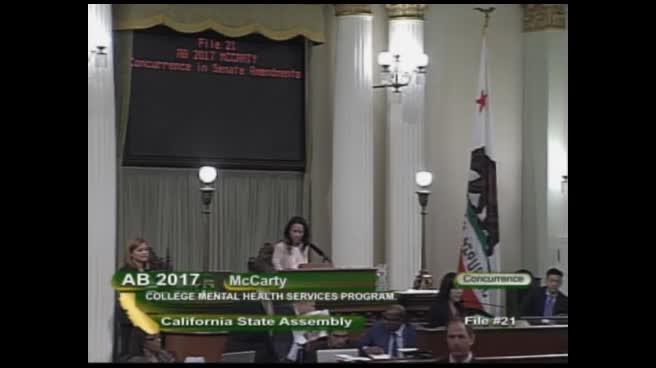
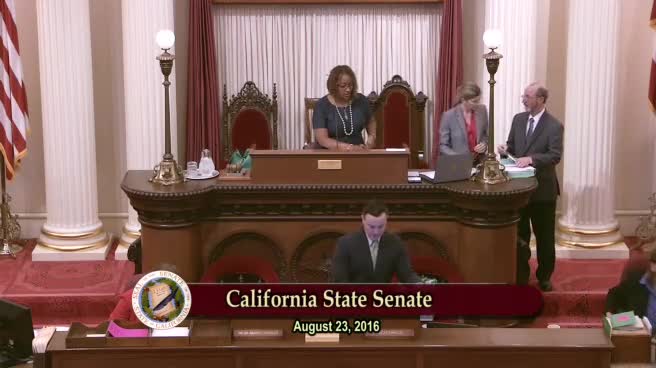


Bill Co-Author(s):