AB 2274: Credit unions.
- Session Year: 2015-2016
- House: Assembly
- Latest Version Date: 2016-09-14
(1)The California Credit Union Law provides for the regulation of credit unions within the state by the Commissioner of Business Oversight. The law requires a credit union to be directed by a board of directors consisting of an odd number of directors, at least 5 in number, each of whom are a member of the credit union, to be elected by the members at their annual meeting. The law requires a credit union to have a supervisory committee of at least 3 persons, each of whom is a member of the credit union. The law authorizes the directors to delegate the approval of applications for new memberships to any officer, director, committee member, or employee pursuant to a written membership plan adopted by the board, provided the board reviews, at least quarterly, a report of membership applications approved by an officer, director, committee member, or employee.
This bill would require the board to meet on a regular basis, not less than quarterly, as reasonably determined by the board. The bill would require the membership of the supervisory committee to be an odd number and would authorize, in lieu of the requirement for a supervisory committee, the establishment of an audit committee and the selection of the members of the audit committee. The bill would remove the requirement for the directors to, at least quarterly, review a report of membership applications approved by an officer, director, committee member, or employee to whom the directors delegated the authority to approve applications for new membership.
(2)The California Credit Union Law prohibits an obligation with a member that is not a natural person and results in liability to the credit union in excess of that members investment in the credit union unless an exception is authorized in the credit unions bylaws and approved by the commissioner. The law authorizes any lending activity permitted pursuant to this provision to be terminated by the commissioner pursuant to a specific procedure.
This bill would repeal this prohibition.
(3)The California Credit Union Law limits the circumstances when a nonmember may participate in an obligation or extension of credit to a member as a joint applicant or co-obligor.
This bill would include the terms coborrower, surety, and guarantor within these provisions.
(4)The California Credit Union Law limits a credit union from entering, directly or indirectly, into any obligation with an official, and defines that term to mean a director, officer, member of the supervisory committee, or member of the credit committee of a credit union.
This bill would modify that definition to remove the position of an officer, and to include the positions of a member of the audit committee, credit manager, president, and chief executive officer of a credit union.
(5)The California Credit Union Law requires any application for any loan or extension or guarantee of credit, except as specified, to state in writing the purpose for which the loan or extension or guarantee of credit is desired, and, if applicable, describe the property that is proposed to secure the loan or extension or guarantee of credit.
This bill would repeal this requirement.
(1)The California Credit Union Law provides for the regulation of credit unions within the state by the Commissioner of Business Oversight. The law requires a credit union to be directed by a board of directors consisting of an odd number of directors, at least 5 in number, each of whom are a member of the credit union, to be elected by the members at their annual meeting. The law requires a credit union to have a supervisory committee of at least 3 persons, each of whom is a member of the credit union. The law authorizes the directors to delegate the approval of applications for new memberships to any officer, director, committee member, or employee pursuant to a written membership plan adopted by the board, provided the board reviews, at least quarterly, a report of membership applications approved by an officer, director, committee member, or employee.
This bill would require the board to meet on a regular basis, not less than quarterly, as reasonably determined by the board. The bill would require the membership of the supervisory committee to be an odd number and would authorize, in lieu of the requirement for a supervisory committee, the establishment of an audit committee and the selection of the members of the audit committee. The bill would remove the requirement for the directors to, at least quarterly, review a report of membership applications approved by an officer, director, committee member, or employee to whom the directors delegated the authority to approve applications for new membership.
(2)The California Credit Union Law prohibits an obligation with a member that is not a natural person and results in liability to the credit union in excess of that members investment in the credit union unless an exception is authorized in the credit unions bylaws and approved by the commissioner. The law authorizes any lending activity permitted pursuant to this provision to be terminated by the commissioner pursuant to a specific procedure.
This bill would repeal this prohibition.
(3)The California Credit Union Law limits the circumstances when a nonmember may participate in an obligation or extension of credit to a member as a joint applicant or co-obligor.
This bill would include the terms coborrower, surety, and guarantor within these provisions.
(4)The California Credit Union Law limits a credit union from entering, directly or indirectly, into any obligation with an official, and defines that term to mean a director, officer, member of the supervisory committee, or member of the credit committee of a credit union.
This bill would modify that definition to remove the position of an officer, and to include the positions of a member of the audit committee, credit manager, president, and chief executive officer of a credit union.
(5)The California Credit Union Law requires any application for any loan or extension or guarantee of credit, except as specified, to state in writing the purpose for which the loan or extension or guarantee of credit is desired, and, if applicable, describe the property that is proposed to secure the loan or extension or guarantee of credit.
This bill would repeal this requirement.
(1)The California Credit Union Law provides for the regulation of credit unions within the state by the Commissioner of Business Oversight. The law requires a credit union to be directed by a board of directors consisting of an odd number of directors, at least 5 in number, each of whom are a member of the credit union, to be elected by the members at their annual meeting. The law requires a credit union to have a supervisory committee of at least 3 persons, each of whom is a member of the credit union. The law authorizes the directors to delegate the approval of applications for new memberships to any officer, director, committee member, or employee pursuant to a written membership plan adopted by the board, provided the board reviews, at least quarterly, a report of membership applications approved by an officer, director, committee member, or employee.
This bill would require the board to meet on a regular basis, not less than quarterly, as reasonably determined by the board. The bill would require the membership of the supervisory committee to be an odd number and would authorize, in lieu of the requirement for a supervisory committee, the establishment of an audit committee and the selection of the members of the audit committee. The bill would remove the requirement for the directors to, at least quarterly, review a report of membership applications approved by an officer, director, committee member, or employee to whom the directors delegated the authority to approve applications for new membership.
(2)The California Credit Union Law prohibits an obligation with a member that is not a natural person and results in liability to the credit union in excess of that members investment in the credit union unless an exception is authorized in the credit unions bylaws and approved by the commissioner. The law authorizes any lending activity permitted pursuant to this provision to be terminated by the commissioner pursuant to a specific procedure.
This bill would repeal this prohibition.
(3)The California Credit Union Law limits the circumstances when a nonmember may participate in an obligation or extension of credit to a member as a joint applicant or co-obligor.
This bill would include the terms coborrower, surety, and guarantor within these provisions.
(4)The California Credit Union Law limits a credit union from entering, directly or indirectly, into any obligation with an official, and defines that term to mean a director, officer, member of the supervisory committee, or member of the credit committee of a credit union.
This bill would modify that definition to remove the position of an officer, and to include the positions of a member of the audit committee, credit manager, president, and chief executive officer of a credit union.
(5)The California Credit Union Law requires any application for any loan or extension or guarantee of credit, except as specified, to state in writing the purpose for which the loan or extension or guarantee of credit is desired, and, if applicable, describe the property that is proposed to secure the loan or extension or guarantee of credit.
This bill would repeal this requirement.
(1)The California Credit Union Law provides for the regulation of credit unions within the state by the Commissioner of Business Oversight. The law requires a credit union to be directed by a board of directors consisting of an odd number of directors, at least 5 in number, each of whom are a member of the credit union, to be elected by the members at their annual meeting. The law requires a credit union to have a supervisory committee of at least 3 persons, each of whom is a member of the credit union. The law authorizes the directors to delegate the approval of applications for new memberships to any officer, director, committee member, or employee pursuant to a written membership plan adopted by the board, provided the board reviews, at least quarterly, a report of membership applications approved by an officer, director, committee member, or employee.
This bill would require the board to meet on a regular basis, not less than quarterly, as reasonably determined by the board. The bill would require the membership of the supervisory committee to be an odd number and would authorize, in lieu of the requirement for a supervisory committee, the establishment of an audit committee and the selection of the members of the audit committee. The bill would remove the requirement for the directors to, at least quarterly, review a report of membership applications approved by an officer, director, committee member, or employee to whom the directors delegated the authority to approve applications for new membership.
(2)The California Credit Union Law prohibits an obligation with a member that is not a natural person and results in liability to the credit union in excess of that members investment in the credit union unless an exception is authorized in the credit unions bylaws and approved by the commissioner. The law authorizes any lending activity permitted pursuant to this provision to be terminated by the commissioner pursuant to a specific procedure.
This bill would repeal this prohibition.
(3)The California Credit Union Law limits the circumstances when a nonmember may participate in an obligation or extension of credit to a member as a joint applicant or co-obligor.
This bill would include the terms coborrower, surety, and guarantor within these provisions.
(4)The California Credit Union Law limits a credit union from entering, directly or indirectly, into any obligation with an officer, official, and defines that term to mean a director, officer, member of the supervisory committee, or member of the credit committee of a credit union.
This bill would modify that definition to remove the position of an officer, and to include the positions of a member of the audit committee, credit manager, president, and chief executive officer of a credit union.
(5)The California Credit Union Law requires any application for any loan or extension or guarantee of credit, except as specified, to state in writing the purpose for which the loan or extension or guarantee of credit is desired, and, if applicable, describe the property that is proposed to secure the loan or extension or guarantee of credit.
This bill would repeal this requirement.
(1)The California Credit Union Law provides for the regulation of credit unions within the state by the Commissioner of Business Oversight. The law requires a credit union to be directed by a board of directors consisting of an odd number of directors, at least 5 in number, each of whom are a member of the credit union, to be elected by the members at their annual meeting. The law requires a credit union to have a supervisory committee of at least 3 persons, each of whom is a member of the credit union. The law authorizes the directors to delegate the approval of applications for new memberships to any officer, director, committee member, or employee pursuant to a written membership plan adopted by the board, provided the board reviews, at least quarterly, a report of membership applications approved by an officer, director, committee member, or employee.
This bill would require the board to meet on a regular basis, not less than quarterly, as reasonably determined by the board. The bill would require the membership of the supervisory committee to be an odd number and would authorize, in lieu of the requirement for a supervisory committee, the establishment of an audit committee and the selection of the members of the audit committee. The bill would remove the requirement for the directors to, at least quarterly, review a report of membership applications approved by an officer, director, committee member, or employee to whom the directors delegated the authority to approve applications for new membership.
(2)The California Credit Union Law prohibits an obligation with a member that is not a natural person and results in liability to the credit union in excess of that members investment in the credit union unless an exception is authorized in the credit unions bylaws and approved by the commissioner. The law authorizes any lending activity permitted pursuant to this provision to be terminated by the commissioner pursuant to a specific procedure.
This bill would repeal this prohibition.
(3)The California Credit Union Law limits the circumstances when a nonmember may participate in an obligation or extension of credit to a member as a joint applicant or co-obligor.
This bill would include the terms coborrower, surety, and guarantor within these provisions.
(4)The California Credit Union Law limits a credit union from entering, directly or indirectly, into any obligation with an officer, and defines that term to mean a director, officer, member of the supervisory committee, or member of the credit committee of a credit union.
This bill would modify that definition to remove the position of an officer, and to include the positions of a member of the audit committee, credit manager, president, and chief executive officer of a credit union.
(5)The California Credit Union Law requires any application for any loan or extension or guarantee of credit, except as specified, to state in writing the purpose for which the loan or extension or guarantee of credit is desired, and, if applicable, describe the property that is proposed to secure the loan or extension or guarantee of credit.
This bill would repeal this requirement.
The bylaws shall prescribe the manner in which the business of the credit union shall be conducted with reference to the following matters:
(a)The purpose of the credit union.
(b)The qualification for membership.
(c)Determination of the month, time and place of the annual meeting; the manner of conducting meetings; the method by which members shall be notified of meetings; and the number of members which shall constitute a quorum.
(d)The authorized number of directors, the number of directors necessary to constitute a quorum, and the powers and duties of officers elected by the directors.
(e)The membership, powers, and duties of the supervisory or audit committee, as applicable.
(f)The membership, powers, and duties of the credit committee or if applicable, the general powers, responsibilities and duties of the credit manager.
(g)The manner in which the bylaws may be amended.
SEC. 2.Section 14252 of the Financial Code is amended to read:14252.(a)A credit union with total assets equal to or greater than ten million dollars ($10,000,000) shall, within 105 days after the end of each fiscal year or within any extended time that the commissioner may specify, file with the commissioner an audit report for the fiscal year.
(b)The audit report called for in subdivision (a) shall comply with all of the following provisions:
(1)The audit report shall contain the audited financial statements of the credit union for, or as of the end of, the fiscal year, prepared in accordance with generally accepted accounting principles that the commissioner may specify, and any other information that the commissioner may specify.
(2)The audit report shall be based upon an audit of the credit union, conducted in accordance with generally accepted auditing standards, and any other requirements that the commissioner may specify.
(3)The audit report shall be prepared by an independent certified public accountant or independent public accountant who is acceptable to the commissioner.
(4)The audit report shall include, or be accompanied by, a certificate or opinion of the independent certified public accountant or independent public accountant that is satisfactory in form and content to the commissioner. If the certificate or opinion is qualified, the commissioner may order the credit union to take any action that the commissioner may find necessary or advisable to enable the independent certified public accountant or independent public accountant to remove the qualification.
(c)A credit union with total assets of less than ten million dollars ($10,000,000) shall, within 105 days after the end of each fiscal year or within any extended time that the commissioner may specify, file with the commissioner an audit report for the fiscal year.
(d)The audit report called for in subdivision (c) may comply with all the provisions of subdivision (b), or may consist of alternative procedures acceptable to the commissioner. An alternative procedures audit may be performed by any of the following:
(1)An independent certified public accountant.
(2)An independent public accountant.
(3)The credit unions supervisory or audit committee, as applicable, provided that the audit complies with the requirements of Section 14253.
(e)Notwithstanding subdivision (d), the commissioner may reject an alternative procedures audit that he or she determines is not satisfactory. If the commissioner rejects an alternative procedures audit for any reason, he or she may order a credit union to obtain an audit that is satisfactory to the commissioner.
(f)The commissioner may, by order or regulation, either unconditionally or upon specified terms and conditions, grant an exemption from this section in any case where the commissioner finds that the requirements of this section are not necessary or advisable.
SEC. 3.Section 14453 of the Financial Code is amended to read:14453.The board of directors of every credit union shall have the general management of the affairs, funds, and records of the credit union. The board shall meet on a regular basis, not less than quarterly, as reasonably determined by the board. The board may appoint an executive committee of no fewer than three directors, to serve at its pleasure, to act as expressly approved by the board of directors in accordance with the laws and regulations.
SEC. 4.Section 14456 of the Financial Code is amended to read:14456.Unless the bylaws expressly reserve any or all of the following duties to the members, the directors have all of the following special duties:
(a)To act upon all applications for membership. The directors may delegate the power to approve applications for new membership to: (1) the chairperson of a membership committee or to an executive committee; or (2) any officer, director, committee member, or employee, pursuant to a written membership plan adopted by the board of directors.
(b)To expel members for any of the following causes:
(1)Conviction of a criminal offense involving moral turpitude.
(2)Failure to carry out contracts, agreements, or obligations with the credit union.
(3)Refusal to comply with the provisions of this division or of the bylaws.
Any members who are expelled by the board of directors have the right to appeal therefrom to the members, in which event, after hearing, the order of suspension may be revoked by a two-thirds vote of the members present at a special meeting to consider the matter.
(c)To determine from time to time the interest rate on obligations with members and to authorize the payment of interest refunds to borrowing members.
(d)To fix the maximum number of shares which may be held by, and, in accordance with Section 15100, establish the maximum amount of obligations which may be entered into with, any one member.
(e)To declare dividends on shares in accordance with the credit unions written capital structure policy and to determine the interest rate or rates which will be paid on certificates for funds.
(f)To amend the bylaws, except where membership approval is required.
(g)To fill vacancies in the credit committee, and to temporarily fill vacancies caused by the suspension of any or all members of the credit committee, pending a meeting of the members to determine whether to affirm the suspension and vacate the office, or to reinstate the member or members.
(h)To direct the deposit or investment of funds, except loans to members.
(i)To designate alternate members of the credit committee who shall serve in the absence or inability of the regular members to perform their duties.
(j)To perform or authorize any action not inconsistent with law or regulation and not specifically reserved by the bylaws for the members, and to perform any other duties as the bylaws may prescribe.
SEC. 5.Section 14550 of the Financial Code is amended to read:14550.Every credit union shall have a supervisory committee of at least three persons, provided that the number of members on the committee is an odd number, each of whom shall be a member of the credit union and elected by the members of the credit union. In the alternative, the board of directors may establish an audit committee subject to the requirements of Section 14556.
SEC. 6.Section 14556 is added to the Financial Code, to read:14556.(a)The board of directors may, by resolution, establish an audit committee in lieu of a supervisory committee. An audit committee that meets all the requirements of this section shall be deemed to satisfy the requirements for a supervisory committee set forth in Sections 14550 to 14555, inclusive, or in any applicable bylaw provision.
(b)The vote of the board of directors to establish an audit committee in lieu of a supervisory committee shall be affirmed by a majority vote of members voting. Following the affirmative vote of the membership, the supervisory committee shall be deemed dissolved upon the appointment of an audit committee by the board of directors.
(c)The audit committee shall consist of at least three persons, provided that it is an odd number, each of whom shall be a member of the credit union and appointed by a majority of the board of directors. The audit committee may be comprised of directors, or both directors and non-directors, provided that no less than a majority of the members of the audit committee at any given time shall be comprised of directors. No member of the audit committee shall serve as a member of the credit committee, as the credit manager, as the board chairman, or as an employee of the credit union.
(d)The audit committee shall carry out the responsibilities set forth in subdivision (c) of Section 14551 and Sections 14551.5 and 14553 and shall:
(1)Ensure that the credit union complies with Section 14252.
(2)Ensure that the credit union maintains an effective internal audit program, including a system of internal controls and individuals with sufficient training and experience to adequately and timely review all key areas of a credit unions operations.
(e)The board of directors may, by subsequent resolution, reestablish a supervisory committee in lieu of an audit committee, which shall be affirmed by membership vote. The audit committee shall be deemed dissolved upon the election of a supervisory committee by the membership.
SEC. 7.Section 14804 of the Financial Code is amended to read:14804.The members of a credit union shall hold an annual meeting for the election of: (a) directors; (b) a supervisory committee, unless the board of directors has appointed an audit committee pursuant to Section 14556; and (c) a credit committee, if provided for in its bylaws. The annual meeting shall be held upon such notice and at such time and place as the bylaws provide.
SEC. 8.Section 14950 of the Financial Code is amended to read:14950.(a)Every credit union may enter into obligations with its members upon the approval of the credit committee or, in the alternative, the credit manager, subject to the terms and conditions established by the board of directors pursuant to Section 15100.
(b)(1)The board of directors of a credit union shall adopt a policy governing the acceptance by the credit union of notes receivable from nonmembers as consideration for the sale of assets owned by the credit union through bona fide transactions.
(2)No credit union may accept notes receivable from nonmembers as consideration for the sale of assets owned by the credit union except in accordance with a policy adopted by the board of directors pursuant to paragraph (1).
(3)Transactions subject to this subdivision shall not be deemed to be loans to nonmembers for purposes of Section 14750.
(c)Notwithstanding subdivision (a), a credit union may permit a nonmember to participate in an obligation or extension of credit to a member as a joint applicant, co-obligor, coborrower, surety, or guarantor. An obligation or extension of credit made pursuant to this subdivision shall not be deemed a violation of subdivision (b) of Section 14800. Except as otherwise permitted by statute or regulation, the credit union shall not extend any other benefit or service of the credit union to the nonmember solely as a result of participation as a joint applicant, co-obligor, coborrower, surety, or guarantor unless the nonmember is thereafter admitted to membership.
SEC. 9.Section 14951 of the Financial Code is repealed.SEC. 10.Section 15050 of the Financial Code is amended to read:15050.(a)For purposes of this section, the following definitions shall apply:
(1)Credit manager means any individual, regardless of title, designated pursuant to Section 14600 to fulfill the duties of a credit manager.
(2)Obligation means any loan or approved line of credit, including both used and unused portions, on which the official is a borrower, coborrower, cosigner, endorser, or guarantor.
(3)Official means a director, member of the supervisory committee, member of the audit committee, member of the credit committee, credit manager, president, or chief executive officer of a credit union.
(b)No credit union shall enter into any obligation with any official, directly or indirectly, unless (1) the obligation complies with all lawful requirements of this division with respect to obligations permitted for other members of the credit union, (2) the obligation is not on terms more favorable than those extended to other members of the credit union, and (3) the obligation is entered into in accordance with a written policy adopted by the directors establishing that all officials shall have an equal opportunity to enter into obligations with the credit union.
(c)No credit union shall enter into any obligation with any official, directly or indirectly, unless all of the following requirements are satisfied:
(1)Upon the making of the obligation, the aggregate amount of obligations outstanding to all officials, except obligations fully secured by shares, shall not exceed 20 percent of the aggregate dollar amount of all savings capital of the credit union.
(2)The obligation, except any portion of an obligation fully secured by shares, shall not exceed the maximum obligation to the credit union set forth in subdivisions (b) and (c) of Section 15100.
(3)Any obligation that would cause the aggregate amount of obligations outstanding to the official to exceed fifty thousand dollars ($50,000), excluding any portion fully secured by shares, shall be approved by the credit committee or the credit manager, and by the board of directors. An official shall not take part in any credit decision, directly or indirectly, for his or her benefit and shall not be present during any portion of any committee or board meeting where his or her credit application is under consideration.
(4)The names of members of the credit committee, the credit manager, and board of directors who voted to authorize or ratify the obligation shall be entered in their respective minutes.
(d)No credit union shall permit an official to become surety for any obligation created by the credit union for anyone other than a member of his or her immediate family.
(e)No credit union shall enter into any obligation with any credit manager or any officer employed by the credit union unless the obligation is in compliance with all requirements of this division with respect to obligations permitted for other nonemployee members, and not on terms more favorable than those extended to other employees, and approved by the board of directors.
SEC. 11.Section 15100 of the Financial Code is amended to read:15100.(a)The board of directors shall establish written policies which shall set forth the policies of the credit union with respect to any obligation that is offered to the members of the credit union. The written policies shall set forth the maximum amounts and terms for any obligation offered to the members, including, but not limited to, the following information:
(1)For loans, the written policies shall set out the terms for unsecured loans, the maximum amount and terms for secured loans, the schedule of interest rates established pursuant to Section 15000 for each type or class of unsecured and secured loan offered to members, the maximum maturity for any loan, or, in the case of an open-end loan, the rate of repayment for any type or class of open-end loan, the limitations, if any, which shall be placed on the authority of any loan officer appointed pursuant to Sections 14602 and 14603, and, subject to the provisions of subdivisions (b) and (c), the individual limits on obligations that are applicable to all members of the credit union. Any policy developed pursuant to this section by the board of directors shall, insofar as possible, and, subject to individual creditworthiness, ensure equal access to funds available for obligations with credit union members.
(2)For obligations other than those set out in paragraph (1), the board of directors shall set out the interest rates and essential terms of the obligations offered to the members and any other information as may be required pursuant to regulations that may be adopted by the commissioner.
(b)Notwithstanding subdivision (a), no credit union policy shall permit a credit union to enter into obligations with an individual credit union member whereby the total obligations of that member, exclusive of amounts secured by shares or certificates for funds, exceed 10 percent of the aggregate dollar amount of the credit unions savings capital.
(c)Notwithstanding subdivision (b), no credit union policy shall permit a credit union to enter into obligations with any one family whereby the total obligations of the family would be greater than the amount permitted by subdivision (b). For purposes of this article, family means the marital couple or any head of household together with those dependents residing with the marital couple or the head of household and those dependents attending school away from the principal residence of the marital couple or head of household.
The bylaws shall prescribe the manner in which the business of the credit union shall be conducted with reference to the following matters:
(a)The purpose of the credit union.
(b)The qualification for membership.
(c)Determination of the month, time and place of the annual meeting; the manner of conducting meetings; the method by which members shall be notified of meetings; and the number of members which shall constitute a quorum.
(d)The authorized number of directors, the number of directors necessary to constitute a quorum, and the powers and duties of officers elected by the directors.
(e)The membership, powers, and duties of the supervisory or audit committee, as applicable.
(f)The membership, powers, and duties of the credit committee or if applicable, the general powers, responsibilities and duties of the credit manager.
(g)The manner in which the bylaws may be amended.
SEC. 2.Section 14252 of the Financial Code is amended to read:14252.(a)A credit union with total assets equal to or greater than ten million dollars ($10,000,000) shall, within 105 days after the end of each fiscal year or within any extended time that the commissioner may specify, file with the commissioner an audit report for the fiscal year.
(b)The audit report called for in subdivision (a) shall comply with all of the following provisions:
(1)The audit report shall contain the audited financial statements of the credit union for, or as of the end of, the fiscal year, prepared in accordance with generally accepted accounting principles that the commissioner may specify, and any other information that the commissioner may specify.
(2)The audit report shall be based upon an audit of the credit union, conducted in accordance with generally accepted auditing standards, and any other requirements that the commissioner may specify.
(3)The audit report shall be prepared by an independent certified public accountant or independent public accountant who is acceptable to the commissioner.
(4)The audit report shall include, or be accompanied by, a certificate or opinion of the independent certified public accountant or independent public accountant that is satisfactory in form and content to the commissioner. If the certificate or opinion is qualified, the commissioner may order the credit union to take any action that the commissioner may find necessary or advisable to enable the independent certified public accountant or independent public accountant to remove the qualification.
(c)A credit union with total assets of less than ten million dollars ($10,000,000) shall, within 105 days after the end of each fiscal year or within any extended time that the commissioner may specify, file with the commissioner an audit report for the fiscal year.
(d)The audit report called for in subdivision (c) may comply with all the provisions of subdivision (b), or may consist of alternative procedures acceptable to the commissioner. An alternative procedures audit may be performed by any of the following:
(1)An independent certified public accountant.
(2)An independent public accountant.
(3)The credit unions supervisory or audit committee, as applicable, provided that the audit complies with the requirements of Section 14253.
(e)Notwithstanding subdivision (d), the commissioner may reject an alternative procedures audit that he or she determines is not satisfactory. If the commissioner rejects an alternative procedures audit for any reason, he or she may order a credit union to obtain an audit that is satisfactory to the commissioner.
(f)The commissioner may, by order or regulation, either unconditionally or upon specified terms and conditions, grant an exemption from this section in any case where the commissioner finds that the requirements of this section are not necessary or advisable.
SEC. 3.Section 14453 of the Financial Code is amended to read:14453.The board of directors of every credit union shall have the general management of the affairs, funds, and records of the credit union. The board shall meet on a regular basis, not less than quarterly, as reasonably determined by the board. The board may appoint an executive committee of no fewer than three directors, to serve at its pleasure, to act as expressly approved by the board of directors in accordance with the laws and regulations.
SEC. 4.Section 14456 of the Financial Code is amended to read:14456.Unless the bylaws expressly reserve any or all of the following duties to the members, the directors have all of the following special duties:
(a)To act upon all applications for membership. The directors may delegate the power to approve applications for new membership to: (1) the chairperson of a membership committee or to an executive committee; or (2) any officer, director, committee member, or employee, pursuant to a written membership plan adopted by the board of directors.
(b)To expel members for any of the following causes:
(1)Conviction of a criminal offense involving moral turpitude.
(2)Failure to carry out contracts, agreements, or obligations with the credit union.
(3)Refusal to comply with the provisions of this division or of the bylaws.
Any members who are expelled by the board of directors have the right to appeal therefrom to the members, in which event, after hearing, the order of suspension may be revoked by a two-thirds vote of the members present at a special meeting to consider the matter.
(c)To determine from time to time the interest rate on obligations with members and to authorize the payment of interest refunds to borrowing members.
(d)To fix the maximum number of shares which may be held by, and, in accordance with Section 15100, establish the maximum amount of obligations which may be entered into with, any one member.
(e)To declare dividends on shares in accordance with the credit unions written capital structure policy and to determine the interest rate or rates which will be paid on certificates for funds.
(f)To amend the bylaws, except where membership approval is required.
(g)To fill vacancies in the credit committee, and to temporarily fill vacancies caused by the suspension of any or all members of the credit committee, pending a meeting of the members to determine whether to affirm the suspension and vacate the office, or to reinstate the member or members.
(h)To direct the deposit or investment of funds, except loans to members.
(i)To designate alternate members of the credit committee who shall serve in the absence or inability of the regular members to perform their duties.
(j)To perform or authorize any action not inconsistent with law or regulation and not specifically reserved by the bylaws for the members, and to perform any other duties as the bylaws may prescribe.
SEC. 5.Section 14550 of the Financial Code is amended to read:14550.Every credit union shall have a supervisory committee of at least three persons, provided that the number of members on the committee is an odd number, each of whom shall be a member of the credit union and elected by the members of the credit union. In the alternative, the board of directors may establish an audit committee subject to the requirements of Section 14556.
SEC. 6.Section 14556 is added to the Financial Code, to read:14556.(a)The board of directors may, by resolution, establish an audit committee in lieu of a supervisory committee. An audit committee that meets all the requirements of this section shall be deemed to satisfy the requirements for a supervisory committee set forth in Sections 14550 to 14555, inclusive, or in any applicable bylaw provision.
(b)The vote of the board of directors to establish an audit committee in lieu of a supervisory committee shall be affirmed by a majority vote of members voting. Following the affirmative vote of the membership, the supervisory committee shall be deemed dissolved upon the appointment of an audit committee by the board of directors.
(c)The audit committee shall consist of at least three persons, provided that it is an odd number, each of whom shall be a member of the credit union and appointed by a majority of the board of directors. The audit committee may be comprised of directors, or both directors and non-directors, provided that no less than a majority of the members of the audit committee at any given time shall be comprised of directors. No member of the audit committee shall serve as a member of the credit committee, as the credit manager, as the board chairman, or as an employee of the credit union.
(d)The audit committee shall carry out the responsibilities set forth in subdivision (c) of Section 14551 and Sections 14551.5 and 14553 and shall:
(1)Ensure that the credit union complies with Section 14252.
(2)Ensure that the credit union maintains an effective internal audit program, including a system of internal controls and individuals with sufficient training and experience to adequately and timely review all key areas of a credit unions operations.
(e)The board of directors may, by subsequent resolution, reestablish a supervisory committee in lieu of an audit committee, which shall be affirmed by membership vote. The audit committee shall be deemed dissolved upon the election of a supervisory committee by the membership.
SEC. 7.Section 14804 of the Financial Code is amended to read:14804.The members of a credit union shall hold an annual meeting for the election of: (a) directors; (b) a supervisory committee, unless the board of directors has appointed an audit committee pursuant to Section 14556; and (c) a credit committee, if provided for in its bylaws. The annual meeting shall be held upon such notice and at such time and place as the bylaws provide.
SEC. 8.Section 14950 of the Financial Code is amended to read:14950.(a)Every credit union may enter into obligations with its members upon the approval of the credit committee or, in the alternative, the credit manager, subject to the terms and conditions established by the board of directors pursuant to Section 15100.
(b)(1)The board of directors of a credit union shall adopt a policy governing the acceptance by the credit union of notes receivable from nonmembers as consideration for the sale of assets owned by the credit union through bona fide transactions.
(2)No credit union may accept notes receivable from nonmembers as consideration for the sale of assets owned by the credit union except in accordance with a policy adopted by the board of directors pursuant to paragraph (1).
(3)Transactions subject to this subdivision shall not be deemed to be loans to nonmembers for purposes of Section 14750.
(c)Notwithstanding subdivision (a), a credit union may permit a nonmember to participate in an obligation or extension of credit to a member as a joint applicant, co-obligor, coborrower, surety, or guarantor. An obligation or extension of credit made pursuant to this subdivision shall not be deemed a violation of subdivision (b) of Section 14800. Except as otherwise permitted by statute or regulation, the credit union shall not extend any other benefit or service of the credit union to the nonmember solely as a result of participation as a joint applicant, co-obligor, coborrower, surety, or guarantor unless the nonmember is thereafter admitted to membership.
SEC. 9.Section 14951 of the Financial Code is repealed.SEC. 10.Section 15050 of the Financial Code is amended to read:15050.(a)For purposes of this section, the following definitions shall apply:
(1)Credit manager means any individual, regardless of title, designated pursuant to Section 14600 to fulfill the duties of a credit manager.
(2)Obligation means any loan or approved line of credit, including both used and unused portions, on which the official is a borrower, coborrower, cosigner, endorser, or guarantor.
(3)Official means a director, member of the supervisory committee, member of the audit committee, member of the credit committee, credit manager, president, or chief executive officer of a credit union.
(b)No credit union shall enter into any obligation with any official, directly or indirectly, unless (1) the obligation complies with all lawful requirements of this division with respect to obligations permitted for other members of the credit union, (2) the obligation is not on terms more favorable than those extended to other members of the credit union, and (3) the obligation is entered into in accordance with a written policy adopted by the directors establishing that all officials shall have an equal opportunity to enter into obligations with the credit union.
(c)No credit union shall enter into any obligation with any official, directly or indirectly, unless all of the following requirements are satisfied:
(1)Upon the making of the obligation, the aggregate amount of obligations outstanding to all officials, except obligations fully secured by shares, shall not exceed 20 percent of the aggregate dollar amount of all savings capital of the credit union.
(2)The obligation, except any portion of an obligation fully secured by shares, shall not exceed the maximum obligation to the credit union set forth in subdivisions (b) and (c) of Section 15100.
(3)Any obligation that would cause the aggregate amount of obligations outstanding to the official to exceed fifty thousand dollars ($50,000), excluding any portion fully secured by shares, shall be approved by the credit committee or the credit manager, and by the board of directors. An official shall not take part in any credit decision, directly or indirectly, for his or her benefit and shall not be present during any portion of any committee or board meeting where his or her credit application is under consideration.
(4)The names of members of the credit committee, the credit manager, and board of directors who voted to authorize or ratify the obligation shall be entered in their respective minutes.
(d)No credit union shall permit an official to become surety for any obligation created by the credit union for anyone other than a member of his or her immediate family.
(e)No credit union shall enter into any obligation with any credit manager or any officer employed by the credit union unless the obligation is in compliance with all requirements of this division with respect to obligations permitted for other nonemployee members, and not on terms more favorable than those extended to other employees, and approved by the board of directors.
SEC. 11.Section 15100 of the Financial Code is amended to read:15100.(a)The board of directors shall establish written policies which shall set forth the policies of the credit union with respect to any obligation that is offered to the members of the credit union. The written policies shall set forth the maximum amounts and terms for any obligation offered to the members, including, but not limited to, the following information:
(1)For loans, the written policies shall set out the terms for unsecured loans, the maximum amount and terms for secured loans, the schedule of interest rates established pursuant to Section 15000 for each type or class of unsecured and secured loan offered to members, the maximum maturity for any loan, or, in the case of an open-end loan, the rate of repayment for any type or class of open-end loan, the limitations, if any, which shall be placed on the authority of any loan officer appointed pursuant to Sections 14602 and 14603, and, subject to the provisions of subdivisions (b) and (c), the individual limits on obligations that are applicable to all members of the credit union. Any policy developed pursuant to this section by the board of directors shall, insofar as possible, and, subject to individual creditworthiness, ensure equal access to funds available for obligations with credit union members.
(2)For obligations other than those set out in paragraph (1), the board of directors shall set out the interest rates and essential terms of the obligations offered to the members and any other information as may be required pursuant to regulations that may be adopted by the commissioner.
(b)Notwithstanding subdivision (a), no credit union policy shall permit a credit union to enter into obligations with an individual credit union member whereby the total obligations of that member, exclusive of amounts secured by shares or certificates for funds, exceed 10 percent of the aggregate dollar amount of the credit unions savings capital.
(c)Notwithstanding subdivision (b), no credit union policy shall permit a credit union to enter into obligations with any one family whereby the total obligations of the family would be greater than the amount permitted by subdivision (b). For purposes of this article, family means the marital couple or any head of household together with those dependents residing with the marital couple or the head of household and those dependents attending school away from the principal residence of the marital couple or head of household.
The bylaws shall prescribe the manner in which the business of the credit union shall be conducted with reference to the following matters:
(a)The purpose of the credit union.
(b)The qualification for membership.
(c)Determination of the month, time and place of the annual meeting; the manner of conducting meetings; the method by which members shall be notified of meetings; and the number of members which shall constitute a quorum.
(d)The authorized number of directors, the number of directors necessary to constitute a quorum, and the powers and duties of officers elected by the directors.
(e)The membership, powers, and duties of the supervisory or audit committee, as applicable.
(f)The membership, powers, and duties of the credit committee or if applicable, the general powers, responsibilities and duties of the credit manager.
(g)The manner in which the bylaws may be amended.
SEC. 2.Section 14252 of the Financial Code is amended to read:14252.(a)A credit union with total assets equal to or greater than ten million dollars ($10,000,000) shall, within 105 days after the end of each fiscal year or within any extended time that the commissioner may specify, file with the commissioner an audit report for the fiscal year.
(b)The audit report called for in subdivision (a) shall comply with all of the following provisions:
(1)The audit report shall contain the audited financial statements of the credit union for, or as of the end of, the fiscal year, prepared in accordance with generally accepted accounting principles that the commissioner may specify, and any other information that the commissioner may specify.
(2)The audit report shall be based upon an audit of the credit union, conducted in accordance with generally accepted auditing standards, and any other requirements that the commissioner may specify.
(3)The audit report shall be prepared by an independent certified public accountant or independent public accountant who is acceptable to the commissioner.
(4)The audit report shall include, or be accompanied by, a certificate or opinion of the independent certified public accountant or independent public accountant that is satisfactory in form and content to the commissioner. If the certificate or opinion is qualified, the commissioner may order the credit union to take any action that the commissioner may find necessary or advisable to enable the independent certified public accountant or independent public accountant to remove the qualification.
(c)A credit union with total assets of less than ten million dollars ($10,000,000) shall, within 105 days after the end of each fiscal year or within any extended time that the commissioner may specify, file with the commissioner an audit report for the fiscal year.
(d)The audit report called for in subdivision (c) may comply with all the provisions of subdivision (b), or may consist of alternative procedures acceptable to the commissioner. An alternative procedures audit may be performed by any of the following:
(1)An independent certified public accountant.
(2)An independent public accountant.
(3)The credit unions supervisory or audit committee, as applicable, provided that the audit complies with the requirements of Section 14253.
(e)Notwithstanding subdivision (d), the commissioner may reject an alternative procedures audit that he or she determines is not satisfactory. If the commissioner rejects an alternative procedures audit for any reason, he or she may order a credit union to obtain an audit that is satisfactory to the commissioner.
(f)The commissioner may, by order or regulation, either unconditionally or upon specified terms and conditions, grant an exemption from this section in any case where the commissioner finds that the requirements of this section are not necessary or advisable.
SEC. 3.Section 14453 of the Financial Code is amended to read:14453.The board of directors of every credit union shall have the general management of the affairs, funds, and records of the credit union. The board shall meet on a regular basis, not less than quarterly, as reasonably determined by the board. The board may appoint an executive committee of no fewer than three directors, to serve at its pleasure, to act as expressly approved by the board of directors in accordance with the laws and regulations.
SEC. 4.Section 14456 of the Financial Code is amended to read:14456.Unless the bylaws expressly reserve any or all of the following duties to the members, the directors have all of the following special duties:
(a)To act upon all applications for membership. The directors may delegate the power to approve applications for new membership to: (1) the chairperson of a membership committee or to an executive committee; or (2) any officer, director, committee member, or employee, pursuant to a written membership plan adopted by the board of directors.
(b)To expel members for any of the following causes:
(1)Conviction of a criminal offense involving moral turpitude.
(2)Failure to carry out contracts, agreements, or obligations with the credit union.
(3)Refusal to comply with the provisions of this division or of the bylaws.
Any members who are expelled by the board of directors have the right to appeal therefrom to the members, in which event, after hearing, the order of suspension may be revoked by a two-thirds vote of the members present at a special meeting to consider the matter.
(c)To determine from time to time the interest rate on obligations with members and to authorize the payment of interest refunds to borrowing members.
(d)To fix the maximum number of shares which may be held by, and, in accordance with Section 15100, establish the maximum amount of obligations which may be entered into with, any one member.
(e)To declare dividends on shares in accordance with the credit unions written capital structure policy and to determine the interest rate or rates which will be paid on certificates for funds.
(f)To amend the bylaws, except where membership approval is required.
(g)To fill vacancies in the credit committee, and to temporarily fill vacancies caused by the suspension of any or all members of the credit committee, pending a meeting of the members to determine whether to affirm the suspension and vacate the office, or to reinstate the member or members.
(h)To direct the deposit or investment of funds, except loans to members.
(i)To designate alternate members of the credit committee who shall serve in the absence or inability of the regular members to perform their duties.
(j)To perform or authorize any action not inconsistent with law or regulation and not specifically reserved by the bylaws for the members, and to perform any other duties as the bylaws may prescribe.
SEC. 5.Section 14550 of the Financial Code is amended to read:14550.Every credit union shall have a supervisory committee of at least three persons, provided that the number of members on the committee is an odd number, each of whom shall be a member of the credit union and elected by the members of the credit union. In the alternative, the board of directors may establish an audit committee subject to the requirements of Section 14556.
SEC. 6.Section 14556 is added to the Financial Code, to read:14556.(a)The board of directors may, by resolution, establish an audit committee in lieu of a supervisory committee. An audit committee that meets all the requirements of this section shall be deemed to satisfy the requirements for a supervisory committee set forth in Sections 14550 to 14555, inclusive, or in any applicable bylaw provision.
(b)The vote of the board of directors to establish an audit committee in lieu of a supervisory committee shall be affirmed by a majority vote of members voting. Following the affirmative vote of the membership, the supervisory committee shall be deemed dissolved upon the appointment of an audit committee by the board of directors.
(c)The audit committee shall consist of at least three persons, provided that it is an odd number, each of whom shall be a member of the credit union and appointed by a majority of the board of directors. At least one member of the audit committee shall be a member of the board of directors. The audit committee may be comprised of directors, or both directors and non-directors, provided that no less than a majority of the members of the audit committee at any given time shall be comprised of directors. No member of the audit committee shall serve as a member of the credit committee, as the credit manager, as the board chairman, or as an employee of the credit union.
(d)The audit committee shall carry out the responsibilities set forth in subdivision (c) of Section 14551 and Sections 14551.5 and 14553 and shall:
(1)Ensure that the credit union complies with Section 14252.
(2)Ensure that the credit union maintains an effective internal audit program, including a system of internal controls and individuals with sufficient training and experience to adequately and timely review all key areas of a credit unions operations.
(e)The board of directors may, by subsequent resolution, reestablish a supervisory committee in lieu of an audit committee, which shall be affirmed by membership vote. The audit committee shall be deemed dissolved upon the election of a supervisory committee by the membership.
SEC. 7.Section 14804 of the Financial Code is amended to read:14804.The members of a credit union shall hold an annual meeting for the election of: (a) directors; (b) a supervisory committee, unless the board of directors has appointed an audit committee pursuant to Section 14556; and (c) a credit committee, if provided for in its bylaws. The annual meeting shall be held upon such notice and at such time and place as the bylaws provide.
SEC. 8.Section 14950 of the Financial Code is amended to read:14950.(a)Every credit union may enter into obligations with its members upon the approval of the credit committee or, in the alternative, the credit manager, subject to the terms and conditions established by the board of directors pursuant to Section 15100.
(b)(1)The board of directors of a credit union shall adopt a policy governing the acceptance by the credit union of notes receivable from nonmembers as consideration for the sale of assets owned by the credit union through bona fide transactions.
(2)No credit union may accept notes receivable from nonmembers as consideration for the sale of assets owned by the credit union except in accordance with a policy adopted by the board of directors pursuant to paragraph (1).
(3)Transactions subject to this subdivision shall not be deemed to be loans to nonmembers for purposes of Section 14750.
(c)Notwithstanding subdivision (a), a credit union may permit a nonmember to participate in an obligation or extension of credit to a member as a joint applicant, co-obligor, coborrower, surety, or guarantor. An obligation or extension of credit made pursuant to this subdivision shall not be deemed a violation of subdivision (b) of Section 14800. Except as otherwise permitted by statute or regulation, the credit union shall not extend any other benefit or service of the credit union to the nonmember solely as a result of participation as a joint applicant, co-obligor, coborrower, surety, or guarantor unless the nonmember is thereafter admitted to membership.
SEC. 9.Section 14951 of the Financial Code is repealed.SEC. 10.Section 15050 of the Financial Code is amended to read:15050.(a)For purposes of this section, the following definitions shall apply:
(1)Credit manager means any individual, regardless of title, designated pursuant to Section 14600 to fulfill the duties of a credit manager.
(2)Obligation means any loan or approved line of credit, including both used and unused portions, on which the official is a borrower, coborrower, cosigner, endorser, or guarantor.
(3)Official means a director, member of the supervisory committee, member of the audit committee, member of the credit committee, credit manager, president, or chief executive officer of a credit union.
(b)No credit union shall enter into any obligation with any official, directly or indirectly, unless (1) the obligation complies with all lawful requirements of this division with respect to obligations permitted for other members of the credit union, (2) the obligation is not on terms more favorable than those extended to other members of the credit union, and (3) the obligation is entered into in accordance with a written policy adopted by the directors establishing that all officials shall have an equal opportunity to enter into obligations with the credit union.
(c)No credit union shall enter into any obligation with any official, directly or indirectly, unless all of the following requirements are satisfied:
(1)Upon the making of the obligation, the aggregate amount of obligations outstanding to all officials, except obligations fully secured by shares, shall not exceed 20 percent of the aggregate dollar amount of all savings capital of the credit union.
(2)The obligation, except any portion of an obligation fully secured by shares, shall not exceed the maximum obligation to the credit union set forth in subdivisions (b) and (c) of Section 15100.
(3)Any obligation that would cause the aggregate amount of obligations outstanding to the official to exceed fifty thousand dollars ($50,000), excluding any portion fully secured by shares, shall be approved by the credit committee or the credit manager, and by the board of directors. An official shall not take part in any credit decision, directly or indirectly, for his or her benefit and shall not be present during any portion of any committee or board meeting where his or her credit application is under consideration.
(4)The names of members of the credit committee, the credit manager, and board of directors who voted to authorize or ratify the obligation shall be entered in their respective minutes.
(d)No credit union shall permit an official to become surety for any obligation created by the credit union for anyone other than a member of his or her immediate family.
(e)No credit union shall enter into any obligation with any credit manager or any officer employed by the credit union unless the obligation is in compliance with all requirements of this division with respect to obligations permitted for other nonemployee members, and not on terms more favorable than those extended to other employees, and approved by the board of directors.
SEC. 11.Section 15100 of the Financial Code is amended to read:15100.(a)The board of directors shall establish written policies which shall set forth the policies of the credit union with respect to any obligation that is offered to the members of the credit union. The written policies shall set forth the maximum amounts and terms for any obligation offered to the members, including, but not limited to, the following information:
(1)For loans, the written policies shall set out the terms for unsecured loans, the maximum amount and terms for secured loans, the schedule of interest rates established pursuant to Section 15000 for each type or class of unsecured and secured loan offered to members, the maximum maturity for any loan, or, in the case of an open-end loan, the rate of repayment for any type or class of open-end loan, the limitations, if any, which shall be placed on the authority of any loan officer appointed pursuant to Sections 14602 and 14603, and, subject to the provisions of subdivisions (b) and (c), the individual limits on obligations that are applicable to all members of the credit union. Any policy developed pursuant to this section by the board of directors shall, insofar as possible, and, subject to individual creditworthiness, ensure equal access to funds available for obligations with credit union members.
(2)For obligations other than those set out in paragraph (1), the board of directors shall set out the interest rates and essential terms of the obligations offered to the members and any other information as may be required pursuant to regulations that may be adopted by the commissioner.
(b)Notwithstanding subdivision (a), no credit union policy shall permit a credit union to enter into obligations with an individual credit union member whereby the total obligations of that member, exclusive of amounts secured by shares or certificates for funds, exceed 10 percent of the aggregate dollar amount of the credit unions savings capital.
(c)Notwithstanding subdivision (b), no credit union policy shall permit a credit union to enter into obligations with any one family whereby the total obligations of the family would be greater than the amount permitted by subdivision (b). For purposes of this article, family means the marital couple or any head of household together with those dependents residing with the marital couple or the head of household and those dependents attending school away from the principal residence of the marital couple or head of household.
The bylaws shall prescribe the manner in which the business of the credit union shall be conducted with reference to the following matters:
(a)The purpose of the credit union.
(b)The qualification for membership.
(c)Determination of the month, time and place of the annual meeting; the manner of conducting meetings; the method by which members shall be notified of meetings; and the number of members which shall constitute a quorum.
(d)The authorized number of directors, the number of directors necessary to constitute a quorum, and the powers and duties of officers elected by the directors.
(e)The membership, powers, and duties of the supervisory committee. or audit committee, as applicable.
(f)The membership, powers, and duties of the credit committee or if applicable, the general powers, responsibilities and duties of the credit manager.
(g)The manner in which the bylaws may be amended.
SEC. 2.Section 14252 of the Financial Code is amended to read:14252.(a)A credit union with total assets equal to or greater than ten million dollars ($10,000,000) shall, within 105 days after the end of each fiscal year or within any extended time that the commissioner may specify, file with the commissioner an audit report for the fiscal year.
(b)The audit report called for in subdivision (a) shall comply with all of the following provisions:
(1)The audit report shall contain the audited financial statements of the credit union for, or as of the end of, the fiscal year, prepared in accordance with generally accepted accounting principles that the commissioner may specify, and any other information that the commissioner may specify.
(2)The audit report shall be based upon an audit of the credit union, conducted in accordance with generally accepted auditing standards, and any other requirements that the commissioner may specify.
(3)The audit report shall be prepared by an independent certified public accountant or independent public accountant who is acceptable to the commissioner.
(4)The audit report shall include, or be accompanied by, a certificate or opinion of the independent certified public accountant or independent public accountant that is satisfactory in form and content to the commissioner. If the certificate or opinion is qualified, the commissioner may order the credit union to take any action that the commissioner may find necessary or advisable to enable the independent certified public accountant or independent public accountant to remove the qualification.
(c)A credit union with total assets of less than ten million dollars ($10,000,000) shall, within 105 days after the end of each fiscal year or within any extended time that the commissioner may specify, file with the commissioner an audit report for the fiscal year.
(d)The audit report called for in subdivision (c) may comply with all the provisions of subdivision (b), or may consist of alternative procedures acceptable to the commissioner. An alternative procedures audit may be performed by any of the following:
(1)An independent certified public accountant.
(2)An independent public accountant.
(3)The credit unions supervisory or audit committee, as applicable, provided that the audit complies with the requirements of Section 14253.
(e)Notwithstanding subdivision (d), the commissioner may reject an alternative procedures audit that he or she determines is not satisfactory. If the commissioner rejects an alternative procedures audit for any reason, he or she may order a credit union to obtain an audit that is satisfactory to the commissioner.
(f)The commissioner may, by order or regulation, either unconditionally or upon specified terms and conditions, grant an exemption from this section in any case where the commissioner finds that the requirements of this section are not necessary or advisable.
SECTION 1.SEC. 3.Section 14453 of the Financial Code is amended to read:14453.The board of directors of every credit union shall have the general management of the affairs, funds, and records of the credit union. The board shall meet on a regular basis, not less than quarterly, as reasonably determined by the board. The board may appoint an executive committee of no fewer than three directors, to serve at its pleasure, to act as expressly approved by the board of directors in accordance with the laws and regulations.
SEC. 2.SEC. 4.Section 14456 of the Financial Code is amended to read:14456.Unless the bylaws expressly reserve any or all of the following duties to the members, the directors have all of the following special duties:
(a)To act upon all applications for membership. The directors may delegate the power to approve applications for new membership to: (1) the chairperson of a membership committee or to an executive committee; or (2) any officer, director, committee member, or employee, pursuant to a written membership plan adopted by the board of directors.
(b)To expel members for any of the following causes:
(1)Conviction of a criminal offense involving moral turpitude.
(2)Failure to carry out contracts, agreements agreements, or obligations with the credit union.
(3)Refusal to comply with the provisions of this division or of the bylaws.
Any members who are expelled by the board of directors have the right to appeal therefrom to the members, in which event, after hearing, the order of suspension may be revoked by a two-thirds vote of the members present at a special meeting to consider the matter.
(c)To determine from time to time the interest rate on obligations with members and to authorize the payment of interest refunds to borrowing members.
(d)To fix the maximum number of shares which may be held by, and, in accordance with Section 15100, establish the maximum amount of obligations which may be entered into with, any one member.
(e)To declare dividends on shares in accordance with the credit unions written capital structure policy and to determine the interest rate or rates which will be paid on certificates for funds.
(f)To amend the bylaws, except where membership approval is required.
(g)To fill vacancies in the credit committee, and to temporarily fill vacancies caused by the suspension of any or all members of the credit committee, pending a meeting of the members to determine whether to affirm the suspension and vacate the office, or to reinstate the member or members.
(h)To direct the deposit or investment of funds, except loans to members.
(i)To designate alternate members of the credit committee who shall serve in the absence or inability of the regular members to perform their duties.
(j)To perform or authorize any action not inconsistent with law or regulation and not specifically reserved by the bylaws for the members, and to perform any other duties as the bylaws may prescribe.
SEC. 3.SEC. 5.Section 14550 of the Financial Code is amended to read:14550.Every credit union shall have a supervisory committee of at least three persons, provided that the number of members on the committee is an odd number, each of whom shall be a member of the credit union and elected by the members of the credit union. In the alternative, the board of directors may establish an audit committee subject to the requirements of Section 14556.
SEC. 4.SEC. 6.Section 14556 is added to the Financial Code, to read:14556.(a)The board of directors may, by resolution, establish an audit committee in lieu of a supervisory committee. An audit committee that meets all the requirements of this section shall be deemed to satisfy the requirements for a supervisory committee set forth in Sections 14550 to 14555, inclusive, or in any applicable bylaw provision.
(b)The vote of the board of directors to establish an audit committee in lieu of a supervisory committee must shall be affirmed by membership vote. a majority vote of members voting. Following the affirmative vote of the membership, the supervisory committee shall be deemed dissolved upon the appointment of an audit committee by the board of directors.
(c)The audit committee shall consist of at least three persons, provided that it is an odd number, each of whom shall be a member of the credit union and appointed by a majority of the board of directors. At least one member of the audit committee shall be a member of the board of directors. No member of the audit committee shall serve as a member of the credit committee, as the credit manager, as the board chairman, or as an employee of the credit union.
(d)The audit committee shall carry out the responsibilities set forth in subdivision (c) of Section 14551 and Sections 14551.5 and 14553 of this division and shall:
(1)Ensure that the credit union complies with Section 14252 of this division. 14252.
(2)Ensure that the credit union maintains an effective internal audit program, including a system of internal controls and individuals with sufficient training and experience to adequately and timely review all key areas of a credit unions operations.
(e)The board of directors may, by subsequent resolution, re-establish reestablish a supervisory committee in lieu of an audit committee, which must shall be affirmed by membership vote. The audit committee shall be deemed dissolved upon the election of a supervisory committee by the membership.
SEC. 5.SEC. 7.Section 14804 of the Financial Code is amended to read:14804.The members of a credit union shall hold an annual meeting for the election of: (a) directors; (b) a supervisory committee, unless the board of directors has appointed an audit committee pursuant to Section 14556; and (b) (c) a credit committee, if provided for in its bylaws. The annual meeting shall be held upon such notice and at such time and place as the bylaws provide.
SEC. 6.SEC. 8.Section 14950 of the Financial Code is amended to read:14950.(a)Every credit union may enter into obligations with its members upon the approval of the credit committee or, in the alternative, the credit manager, subject to the terms and conditions established by the board of directors pursuant to Section 15100.
(b)(1)The board of directors of a credit union shall adopt a policy governing the acceptance by the credit union of notes receivable from nonmembers as consideration for the sale of assets owned by the credit union through bona fide transactions.
(2)No credit union may accept notes receivable from nonmembers as consideration for the sale of assets owned by the credit union except in accordance with a policy adopted by the board of directors pursuant to paragraph (1).
(3)Transactions subject to this subdivision shall not be deemed to be loans to nonmembers for purposes of Section 14750.
(c)Notwithstanding subdivision (a), a credit union may permit a nonmember to participate in an obligation or extension of credit to a member as a joint applicant, co-obligor, coborrower, surety, or guarantor. An obligation or extension of credit made pursuant to this subdivision shall not be deemed a violation of subdivision (b) of Section 14800. Except as otherwise permitted by statute or regulation, the credit union shall not extend any other benefit or service of the credit union to the nonmember solely as a result of participation as a joint applicant, co-obligor, coborrower, surety, or guarantor unless the nonmember is thereafter admitted to membership.
SEC. 7.SEC. 9.Section 14951 of the Financial Code is repealed.SEC. 8.SEC. 10.Section 15050 of the Financial Code is amended to read:15050.(a)For purposes of this section, the following definitions shall apply:
(1)Credit manager means any individual, regardless of title, designated pursuant to Section 14600 to fulfill the duties of a credit manager.
(2)Obligation means any loan or approved line of credit, including both used and unused portions, on which the official is a borrower, coborrower, cosigner, endorser, or guarantor.
(3)Official means a director, member of the supervisory committee, member of the audit committee, member of the credit committee, credit manager, president, or chief executive officer of a credit union.
(b)No credit union shall enter into any obligation with any official, directly or indirectly, unless (1) the obligation complies with all lawful requirements of this division with respect to obligations permitted for other members of the credit union, (2) the obligation is not on terms more favorable than those extended to other members of the credit union, and (3) the obligation is entered into in accordance with a written policy adopted by the directors establishing that all officials shall have an equal opportunity to enter into obligations with the credit union.
(c)No credit union shall enter into any obligation with any official, directly or indirectly, unless all of the following requirements are satisfied:
(1)Upon the making of the obligation, the aggregate amount of obligations outstanding to all officials, except obligations fully secured by shares, shall not exceed 20 percent of the aggregate dollar amount of all savings capital of the credit union.
(2)The obligation, except any portion of an obligation fully secured by shares, shall not exceed the maximum obligation to the credit union set forth in subdivisions (b) and (c) of Section 15100.
(3)Any obligation that would cause the aggregate amount of obligations outstanding to the official to exceed fifty thousand dollars ($50,000), excluding any portion fully secured by shares, shall be approved by the credit committee or the credit manager, and by the board of directors. An official shall not take part in any credit decision, directly or indirectly, for his or her benefit and shall not be present during any portion of any committee or board meeting where his or her credit application is under consideration.
(4)The names of members of the credit committee, the credit manager, and board of directors who voted to authorize or ratify the obligation shall be entered in their respective minutes.
(d)No credit union shall permit an official to become surety for any obligation created by the credit union for anyone other than a member of his or her immediate family.
(e)No credit union shall enter into any obligation with any credit manager or any officer employed by the credit union unless the obligation is in compliance with all requirements of this division with respect to obligations permitted for other nonemployee members, and not on terms more favorable than those extended to other employees, and approved by the board of directors.
SEC. 9.SEC. 11.Section 15100 of the Financial Code is amended to read:15100.(a)The board of directors shall establish written policies which shall set forth the policies of the credit union with respect to any obligation that is offered to the members of the credit union. The written policies shall set forth the maximum amounts and terms for any obligation offered to the members, including, but not limited to, the following information:
(1)For loans, the written policies shall set out the terms for unsecured loans, the maximum amount and terms for secured loans, the schedule of interest rates established pursuant to Section 15000 for each type or class of unsecured and secured loan offered to members, the maximum maturity for any loan, or, in the case of an open-end loan, the rate of repayment for any type or class of open-end loan, the limitations, if any, which shall be placed on the authority of any loan officer appointed pursuant to Sections 14602 and 14603, and, subject to the provisions of subdivisions (b) and (c), the individual limits on obligations that are applicable to all members of the credit union. Any policy developed pursuant to this section by the board of directors shall, insofar as possible, and, subject to individual creditworthiness, ensure equal access to funds available for obligations with credit union members.
(2)For obligations other than those set out in paragraph (1), the board of directors shall set out the interest rates and essential terms of the obligations offered to the members and any other information as may be required pursuant to regulations that may be adopted by the commissioner.
(b)Notwithstanding subdivision (a), no credit union policy shall permit a credit union to enter into obligations with an individual credit union member whereby the total obligations of that member, exclusive of amounts secured by shares or certificates for funds, exceed 10 percent of the aggregate dollar amount of the credit unions savings capital.
(c)Notwithstanding subdivision (b), no credit union policy shall permit a credit union to enter into obligations with any one family whereby the total obligations of the family would be greater than the amount permitted by subdivision (b). For purposes of this article, family means the marital couple or any head of household together with those dependents residing with the marital couple or the head of household and those dependents attending school away from the principal residence of the marital couple or head of household.
The board of directors of every credit union shall have the general management of the affairs, funds, and records of the credit union. The board shall meet on a regular basis, not less than quarterly, as reasonably determined by the board. The board may appoint an executive committee of no fewer than three directors, to serve at its pleasure, to act as expressly approved by the board of directors in accordance with the laws and regulations.
SEC. 2.Section 14456 of the Financial Code is amended to read:14456.Unless the bylaws expressly reserve any or all of the following duties to the members, the directors have all of the following special duties:
(a)To act upon all applications for membership. The directors may delegate the power to approve applications for new membership to: (1) the chairperson of a membership committee or to an executive committee; or (2) any officer, director, committee member, or employee, pursuant to a written membership plan adopted by the board of directors, provided the board of directors reviews at least quarterly a report of membership applications approved by an officer, director, committee member, or employee. directors.
(b)To expel members for any of the following causes:
(1)Conviction of a criminal offense involving moral turpitude.
(2)Failure to carry out contracts, agreements or obligations with the credit union.
(3)Refusal to comply with the provisions of this division or of the bylaws.
Any members who are expelled by the board of directors have the right to appeal therefrom to the members, in which event, after hearing, the order of suspension may be revoked by a two-thirds vote of the members present at a special meeting to consider the matter.
(c)To determine from time to time the interest rate on obligations with members and to authorize the payment of interest refunds to borrowing members.
(d)To fix the maximum number of shares which may be held by, and, in accordance with Section 15100, establish the maximum amount of obligations which may be entered into with, any one member.
(e)To declare dividends on shares in accordance with the credit unions written capital structure policy and to determine the interest rate or rates which will be paid on certificates for funds.
(f)To amend the bylaws, except where membership approval is required.
(g)To fill vacancies in the credit committee, and to temporarily fill vacancies caused by the suspension of any or all members of the credit committee, pending a meeting of the members to determine whether to affirm the suspension and vacate the office, or to reinstate the member or members.
(h)To direct the deposit or investment of funds, except loans to members.
(i)To designate alternate members of the credit committee who shall serve in the absence or inability of the regular members to perform their duties.
(j)To perform or authorize any action not inconsistent with law or regulation and not specifically reserved by the bylaws for the members, and to perform any other duties as the bylaws may prescribe.
SEC. 3.Section 14550 of the Financial Code is amended to read:14550.Every credit union shall have a supervisory committee of at least three persons, provided that the number of members on the committee is an odd number, each of whom shall be a member of the credit union. union and elected by the members of the credit union. In the alternative, the board of directors may establish an audit committee subject to the requirements of Section 14556.
SEC. 4.Section 14556 is added to the Financial Code, to read:14556.(a)The board of directors may, by resolution, establish an audit committee in lieu of a supervisory committee. An audit committee that meets all the requirements of this section shall be deemed to satisfy the requirements for a supervisory committee set forth in Sections 14550 to 14555, inclusive, or in any applicable bylaw provision.
(b)The vote of the board of directors to establish an audit committee in lieu of a supervisory committee must be affirmed by membership vote. Following the affirmative vote of the membership, the supervisory committee shall be deemed dissolved upon the appointment of an audit committee by the board of directors.
(c)The audit committee shall consist of at least three persons, provided that it is an odd number, each of whom shall be a member of the credit union and appointed by a majority of the board of directors. At least one member of the audit committee shall be a member of the board of directors. No member of the audit committee shall serve as a member of the credit committee, as the credit manager, as the board chairman, or as an employee of the credit union.
(d)The audit committee shall carry out the responsibilities set forth in subdivision (c) of Section 14551 and Sections 14551.5 and 14553 of this division and shall:
(1)Ensure that the credit union complies with Section 14252 of this division.
(2)Ensure that the credit union maintains an effective internal audit program, including a system of internal controls and individuals with sufficient training and experience to adequately and timely review all key areas of a credit unions operations.
(e)The board of directors may, by subsequent resolution, re-establish a supervisory committee in lieu of an audit committee, which must be affirmed by membership vote. The audit committee shall be deemed dissolved upon the election of a supervisory committee by the membership.
SEC. 5.Section 14804 of the Financial Code is amended to read:14804.The members of a credit union shall hold an annual meeting for the election of directors and a supervisory committee and, of: (a) directors; (b) a supervisory committee, unless the board of directors has appointed an audit committee pursuant to Section 14556; and (b) credit committee, if provided for in its bylaws, the election of a credit committee, bylaws. The annual meeting shall be held upon such notice and at such time and place as the bylaws provide.
SEC. 6.Section 14950 of the Financial Code is amended to read:14950.(a)Every credit union may enter into obligations with its members upon the approval of the credit committee or, in the alternative, the credit manager, subject to the terms and conditions established by the board of directors pursuant to Section 15100.
(b)(1)The board of directors of a credit union shall adopt a policy governing the acceptance by the credit union of notes receivable from nonmembers as consideration for the sale of assets owned by the credit union through bona fide transactions.
(2)No credit union may accept notes receivable from nonmembers as consideration for the sale of assets owned by the credit union except in accordance with a policy adopted by the board of directors pursuant to paragraph (1).
(3)Transactions subject to this subdivision shall not be deemed to be loans to nonmembers for purposes of Section 14750.
(c)Notwithstanding subdivision (a), a credit union may permit a nonmember to participate in an obligation or extension of credit to a member as a joint applicant or co-obligor. applicant, co-obligor, coborrower, surety, or guarantor. An obligation or extension of credit made pursuant to this subdivision shall not be deemed a violation of subdivision (b) of Section 14800. Except as otherwise permitted by statute or regulation, the credit union shall not extend any other benefit or service of the credit union to the nonmember solely as a result of participation as a joint applicant or co-obligor applicant, co-obligor, coborrower, surety, or guarantor unless the nonmember is thereafter admitted to membership.
SEC. 7.Section 14951 of the Financial Code is repealed.14951.Any application for any loan or extension or guarantee of credit, except an application for an extension of a loan, shall be in writing, shall state the purpose for which the loan or extension or guarantee of credit is desired, and, if applicable, shall describe the property that is proposed to secure the loan or extension or guarantee of credit.
SEC. 8.Section 15050 of the Financial Code is amended to read:15050.(a)For purposes of this section, the following definitions shall apply:
(1)Credit manager means any individual, regardless of title, designated pursuant to Section 14600 to fulfill the duties of a credit manager.
(2)Obligation means any loan or approved line of credit, including both used and unused portions, on which the official is a borrower, coborrower, cosigner, endorser, or guarantor.
(3)Official means a director, officer, or member of the supervisory committee, or member of the audit committee, member of the credit committee, credit manager, president, or chief executive officer of a credit union.
(b)No credit union shall enter into any obligation with any official, directly or indirectly, unless (1) the obligation complies with all lawful requirements of this division with respect to obligations permitted for other members of the credit union, (2) the obligation is not on terms more favorable than those extended to other members of the credit union, and (3) the obligation is entered into in accordance with a written policy adopted by the directors establishing that all officials shall have an equal opportunity to enter into obligations with the credit union.
(c)No credit union shall enter into any obligation with any official, directly or indirectly, unless all of the following requirements are satisfied:
(1)Upon the making of the obligation, the aggregate amount of obligations outstanding to all officials, except obligations fully secured by shares, shall not exceed 20 percent of the aggregate dollar amount of all savings capital of the credit union.
(2)The obligation, except any portion of an obligation fully secured by shares, shall not exceed the maximum obligation to the credit union set forth in subdivisions (b) and (c) of Section 15100.
(3)Any obligation that would cause the aggregate amount of obligations outstanding to the official to exceed fifty thousand dollars ($50,000), excluding any portion fully secured by shares, shall be approved by the credit committee or the credit manager, and by the board of directors. An official shall not take part in any credit decision, directly or indirectly, for his or her benefit and shall not be present during any portion of any committee or board meeting where his or her credit application is under consideration.
(4)The names of members of the credit committee, the credit manager, and board of directors who voted to authorize or ratify the obligation shall be entered in their respective minutes.
(d)No credit union shall permit an official to become surety for any obligation created by the credit union for anyone other than a member of his or her immediate family.
(e)No credit union shall enter into any obligation with any credit manager or any officer employed by the credit union unless the obligation is in compliance with all requirements of this division with respect to obligations permitted for other nonemployee members, and not on terms more favorable than those extended to other employees, and approved by the board of directors.
SEC. 9.Section 15100 of the Financial Code is amended to read:15100.(a)The board of directors shall establish written policies which shall set forth the policies of the credit union with respect to any obligation that is offered to the members of the credit union. The written policies shall set forth the maximum amounts and terms for any obligation offered to the members, including, but not limited to, the following information:
(1)For loans, the written policies shall set out the terms for unsecured loans, the maximum amount and terms for secured loans, the schedule of interest rates established pursuant to Section 15000 for each type or class of unsecured and secured loan offered to members, the maximum maturity for any loan, or, in the case of an open-end loan, the rate of repayment for any type or class of open-end loan, the limitations, if any, which shall be placed on the authority of any loan officer appointed pursuant to Sections 14602 and 14603, and, subject to the provisions of subdivisions (b) and (c), the individual limits on obligations that are applicable to all members of the credit union. Any policy developed pursuant to this section by the board of directors shall, insofar as possible, and, subject to individual creditworthiness, ensure equal access to funds available for obligations with credit union members.
(2)For obligations other than those set out in paragraph (1), the board of directors shall set out the interest rates and essential terms of the obligations offered to the members and any other information as may be required pursuant to regulations that may be adopted by the commissioner.
(b)Notwithstanding subdivision (a), no credit union policy shall permit a credit union to enter into obligations with an individual credit union member whereby the total obligations of that member, exclusive of amounts secured by shares or certificates for funds, exceed 10 percent of the aggregate dollar amount of the credit unions savings capital.
(c)Notwithstanding subdivision (b), no credit union policy shall permit a credit union to enter into obligations with any one family whereby the total obligations of the family would be greater than the amount permitted by subdivision (b). For purposes of this article, family means the marital couple or any head of household together with those dependents residing with the marital couple or the head of household and those dependents attending school away from the principal residence of the marital couple or head of household.
(d)Notwithstanding subdivisions (a), (b) and (c), any obligation with a member which is not a natural person shall not result in liability to the credit union in excess of that members investment in the credit union unless an exception is authorized in the credit unions bylaws and approved by the commissioner. Any lending activity permitted pursuant to this subdivision may be terminated by an order issued by the commissioner pursuant to Sections 14200 and 14204.
|
Date
|
Status
|
|---|---|
| Aug 1, 2016 | From committee: Be placed on second reading file pursuant to Senate Rule 28.8 and ordered to consent calendar. |
| Sep 14, 2016 | Chaptered by Secretary of State - Chapter 353, Statutes of 2016. |
| Sep 14, 2016 | Approved by the Governor. |
| Aug 26, 2016 | Enrolled and presented to the Governor at 4:30 p.m. |
| Aug 22, 2016 | Senate amendments concurred in. To Engrossing and Enrolling. (Ayes 78. Noes 0. Page 6043.). |
| Aug 22, 2016 | Senate amendments concurred in. To Engrossing and Enrolling. |
| Aug 16, 2016 | In Assembly. Concurrence in Senate amendments pending. May be considered on or after August 18 pursuant to Assembly Rule 77. |
| Aug 15, 2016 | Read third time. Passed. Ordered to the Assembly. (Ayes 38. Noes 0.). |
| Aug 15, 2016 | Read third time. Passed. Ordered to the Assembly. (Ayes 38. Noes 0. Page 4982.). |
| Aug 15, 2016 | Read third time. Passed. Ordered to the Assembly. |
| Aug 11, 2016 | Read second time. Ordered to third reading. |
| Aug 10, 2016 | Read third time and amended. Ordered to second reading. |
| Aug 4, 2016 | Ordered to third reading. |
| Aug 4, 2016 | From Consent Calendar. |
| Aug 2, 2016 | Read second time. Ordered to Consent Calendar. |
| Feb 18, 2016 | Read first time. To print. |
| Aug 1, 2016 | From committee chair, with author's amendments: Amend, and re-refer to committee. Read second time, amended, and re-referred to Com. on APPR. |
| Jun 15, 2016 | From committee: Do pass and re-refer to Com. on APPR. with recommendation: To Consent Calendar. (Ayes 7. Noes 0.) (June 15). Re-referred to Com. on APPR. |
| Jun 9, 2016 | In committee: Hearing postponed by committee. |
| May 5, 2016 | Referred to Com. on B. & F.I. |
| Apr 21, 2016 | Read third time. Passed. Ordered to the Senate. (Ayes 79. Noes 0. Page 4463.) |
| Apr 21, 2016 | Read third time. Passed. Ordered to the Senate. |
| Apr 21, 2016 | In Senate. Read first time. To Com. on RLS. for assignment. |
| Apr 14, 2016 | Read second time. Ordered to Consent Calendar. |
| Apr 13, 2016 | From committee: Do pass. To Consent Calendar. (Ayes 20. Noes 0.) (April 13). |
| Apr 5, 2016 | From committee: Do pass and re-refer to Com. on APPR. with recommendation: To Consent Calendar. (Ayes 12. Noes 0.) (April 4). Re-referred to Com. on APPR. |
| Mar 28, 2016 | In committee: Set, first hearing. Hearing canceled at the request of author. |
| Mar 3, 2016 | Referred to Com. on B. & F. |
| Feb 19, 2016 | From printer. May be heard in committee March 20. |
|
Date
|
Description
|
Location
|
Votes
|
|
|---|---|---|---|---|
| Aug 22, 2016 | AB 2274 DABABNEH Concurrence in Senate Amendments | Assembly Floor |
Passed |
|
| Aug 15, 2016 | Assembly 3rd Reading AB2274 Dababneh By Glazer | Senate Floor |
Passed |
|
| Jun 15, 2016 | Do pass, but first be re-referred to the Committee on [Appropriations] with the recommendation: To Consent Calendar | Senate Standing Committee on Banking and Financial Institutions |
Passed |
|
| Apr 21, 2016 | AB 2274 DABABNEH Consent Calendar Second Day Regular Session | Assembly Floor |
Passed |
|
| Apr 13, 2016 | Do pass. To Consent Calendar. | Assembly Standing Committee on Appropriations |
Passed |
|
| Apr 4, 2016 | Do pass and be re-referred to the Committee on [Appropriations] with recommendation: To Consent Calendar | Assembly 1st Extraordinary Session on Finance |
Passed |
This list shows positions taken on this bill by organizations on the date displayed, which is linked to the original source.
Positions by individuals are not included.
|
Organization
|
Position
|
Date
|
|---|---|---|
| California Credit Union League | ** Support | Aug 15, 2016 |
CONCURRENCE IN SENATE AMENDMENTS
CSA1 Bill Id:AB 2274
Author:(Dababneh)
As Amended Ver:August 10, 2016
Majority vote
ASSEMBLY: | 79-0 | (April 21, 2016) | SENATE: | 38-0 | (August 15, 2016) |
Original Committee Reference: B. & F.
SUMMARY: Makes changes to the California Credit Union Law. Specifically, this bill:
- Requires the credit union's board of directors to meet on a regular basis, not less than quarterly, as determined by the board.
- Removes a requirement for the directors to, at least quarterly, review a report of membership applications approved by an officer, director, committee member, or employee to whom the directors delegated the authority to approve applications for new membership.
- Requires the membership of the supervisory committee to be an odd number and would authorize, in lieu of the requirement for a supervisory committee, the establishment of an audit committee and the selection of the members of the audit committee.
- Deletes a provision requiring any application for any loan or extension or guarantee of credit, to state in writing the purpose for which the loan or extension or guarantee of credit is desired and, if applicable, describe the property that is proposed to secure the loan or extension or guarantee of credit.
- Permits a nonmember to participate in an obligation or extension of credit to a member as a co-borrower, surety, or guarantor.
- Modifies the definition of "official" to include member of the audit committee, credit manager, president, or chief executive officer of a credit union and to remove the position of an officer.
- Removes a provision that would prohibit an obligation with a member that is not a natural person and results in liability to the credit union in excess of that member's investment in the credit union unless an exception is authorized in the credit union's bylaws and approved by the commissioner.
The Senate amendments are technical and clarifying changes.
EXISTING LAW:
- Establishes the California Credit Union Law. (Financial Code, Section (FIN) 14000)
- Defines a "credit union" as a cooperative, organized for the purposes of promoting thrift and savings among its members, creating a source of credit for them at rates of interest set by the board of directors, and providing an opportunity for them to use and control their own money on a democratic basis in order to improve their economic and social conditions. As a cooperative, a credit union conducts its business for the mutual benefit and general welfare of its members with the earnings, savings, benefits, or services of the credit union being distributed to its members as patrons. (FIN 14002)
- Provides for the regulation and certification of state-chartered credit unions by the Department of Business Oversight (DBO). (FIN 14003)
- Defines "official" as a director, officer, or member of the supervisory committee or the credit committee of a credit union. (FIN 15050)
- Regulates loans to officials of a credit union. (FIN 15050)
FISCAL EFFECT: According to the Assembly Appropriations Committee, negligible state costs.
COMMENTS: This bill, sponsored by the California Credit Union League, updates various provisions of California's Credit Union Law. Credit unions operate in a dual chartering system, allowing them to be chartered by either the National Credit Union Administration (NCUA) or their state supervisory agency, for California credit unions, this is the DBO. The California credit union state charter has not been significantly modernized in over a decade and must be updated through this legislation to remain competitive with the federal charter.
This bill updates and strengthens the California state charter credit union statute, giving credit unions new options in the way they are organized and allows them to better serve their members.
This bill accomplishes seven goals:
- Allows member business loans to exceed a member's deposits. For example, if Pete's Pizza has $10,000 deposited at the credit union, the most the credit union may loan to Pete's Pizza is $10,000. This bill would allow Pete's to receive a loan of more than $10,000 (upon credit qualifying under normal business lending standards and requirements). This will give state-chartered credit unions parity with federally chartered credit unions and state chartered banks.
- Eliminates board review of membership applications. This will remove an old requirement that the credit union board review a membership report at least quarterly when they have delegated membership application approval to the appropriate staff, as currently permitted.
- Allows for an audit committee in lieu of a supervisory committee. Duties of the audit committee are different than those of the supervisory committee in that they are specific to the audit function. These duties include inspecting the securities, cash, and accounts of the credit union, reviewing the credit union's policies and control procedures, performing audit requirements, and filing an audit report with the Commissioner of DBO, as applicable. The duties omitted are supervisory in nature and appropriately held by the DBO or the membership. The migration to using an audit committee in lieu of a supervisory committee would require an affirmative vote by the membership.
- Allows non-members to act as the co-borrower, surety, or guarantor of a loan made to a member. Clarifies existing language that permits a non-member to be a joint applicant or co-obligor on a loan by expressly identifying other similar relationships. For example, this will allow for situations such as a member's father to be a guarantor on an auto loan. This adds to the safety and soundness of a credit union by permitting a guarantor or other responsible party on the loan.
- Redefines which credit union officials' loans are subject to certain limitations and are required to be reviewed by the board. The new definition removes the term "officers" which is undefined in this section and could potentially include a significant number of staff. The revised definition provides parity with federal credit unions and restricts "officials" of the credit union to those who have authority to make decisions on the credit union's lending policies.
- Allows credit union boards to determine the frequency of board meetings while still fulfilling their duties. Currently boards meet monthly. This change will allow boards to convene less frequently, but at least quarterly. The necessary credit union bylaw change would ultimately require approval from the DBO commissioner.
- Removes unnecessary loan documentation requirements. Current law requires state- chartered credit unions to ask the purpose of any loan they make, including unsecured loans. This bill would remove this requirement and provide consistency with other applicable laws and regulations, including in federal Regulation Z and its definition of a lending application.
As of third-quarter 2015, there were 143 state-chartered credit unions headquartered in California and 210 federally chartered credit unions (total of 353 credit unions).
Analysis Prepared by: Kathleen OMalley / B. & F. / (916) 319-3081 FN: 0003693
Office of Senate Floor Analyses (916) 651-1520 Fax: (916) 327-4478 | AB 2274 |
THIRD READING
Bill No: AB 2274
Amended: 8/10/16 in Senate
SENATE BANKING & F.I. COMMITTEE: 7-0, 6/15/16
AYES: Glazer, Vidak, Galgiani, Hall, Hueso, Lara, Morrell
SENATE APPROPRIATIONS COMMITTEE: Senate Rule 28.8
ASSEMBLY FLOOR: 79-0, 4/21/16 (Consent) - See last page for vote
SOURCE: California Credit Union League
DIGEST: This bill makes several changes to the California Credit Union Law, which are intended to provide state-chartered credit unions greater flexibility to conduct their operations.
Senate Floor Amendments of 8/10/16 require that a majority of the members of a credit union audit committee include persons who serve on the board of directors of that credit union.
Existing law:
- Is silent on the frequency with which a credit union board of directors must meet.
- Authorizes a credit union board of directors to delegate the power to approve membership applications to any officer, director, committee member, or employee of that credit union, pursuant to a written membership plan adopted by the board of directors, provided the board reviews a report of membership applications approved by those delegates at least quarterly (Financial Code Section 14456).
- Requires every credit union to have a supervisory committee, as specified (Financial Code Section 14550).
- Authorizes a credit union to permit non-members to act as joint applicants and co-obligors on obligations and extensions of credit to a member (Financial Code Section 14950).
- Requires a credit union to ask loan applicants and applicants for extensions or guarantees of credit the purpose for which the loan, extension, or guarantee is being sought (Financial Code Section 14951).
- Defines an “official,” for purposes of the provision of law that imposes conditions on loans made by a credit union to one of its officials, as a director, officer, member of the supervisory committee, or member of the credit committee (Financial Code Section 15050).
- Provides that any obligation with a member that is not a natural person may not result in liability to the credit union in excess of that member’s investment in the credit union, unless an exception is authorized in the credit union’s bylaws and approved by the Commissioner of Business Oversight (commissioner; Financial Code Section 15100).
This bill:
- Requires the board of directors of a credit union to meet on a regular basis, as reasonably determined by the board, but not less than quarterly.
- Upholds the authority of a credit union board of directors to delegate the power to approve membership applications to any officer, director, committee member, or employee of that credit union, pursuant to a written membership plan adopted by the board of directors, but deletes the requirement that the board review a report of membership applications approved by those delegates at least quarterly.
- Authorizes a credit union to establish an audit committee, as specified, in lieu of a supervisory committee, and makes conforming changes.
- Authorizes a credit union to permit non-members to act as joint applicants, co-obligors, coborrowers, sureties, or guarantors on loans or extensions of credit taken out by members (the language in italics is being added).
- Deletes the requirement that a credit union ask loan applicants and applicants for extensions or guarantees of credit the purpose for which the loan, extension, or guarantee is being sought.
- Clarifies the definition of an official in the provision of law that imposes conditions on loans made by a credit union to one of its officials. Under the clarified definition, a credit union “official” is a director, member of the supervisory committee, member of the credit committee, member of the audit committee, credit manager, president, or chief executive officer of a credit union (the titles in italics are being added by this bill).
- Authorizes a credit union to extend a loan to a business customer, which exceeds that business’ investment in the credit union, without requiring the loan to be authorized in the credit union’s bylaws and approved by the commissioner.
Background
This bill is sponsored by the California Credit Union League to update and strengthen the state credit union charter, make the state charter more competitive with the federal charter, give state-chartered credit unions greater flexibility in the ways they may organize, and improve their ability to serve their members.
Like banks, credit unions operate in a dual-charter system and may, subject to regulatory approval, choose to operate as either a state-chartered depository institution or a federally-chartered depository institution. According to this bill’s sponsor, the rules governing California state-chartered credit unions have not been significantly modernized in over a decade and are in need of an update. This bill accomplishes that update.
Comments
Three of this bill’s provisions provide parity between state- and federally-chartered credit unions, including provisions: 1) clarifying which individuals are “officials” for purposes of the conditions under which a credit union may lend to one of its officials; 2) deleting the requirement that state-chartered credit unions ask the purpose of any loan they make; and 3) allowing a credit union’s loan to a business to exceed the amount that business has on deposit with that credit union.
Provisions of this bill that warrant further discussion include the following:
- Authority to establish an audit committee in lieu of a supervisory committee. This bill’s sponsor asserts that this provision gives credit unions the ability to focus on complying with their annual audit requirements, without taking on duplicative oversight functions that are already performed by the commissioner and credit union members.
Under existing law, each credit union must have a supervisory committee, which has several responsibilities, including: a) reviewing the credit union’s policies and control procedures to safeguard against fraud and self-dealing; b) ensuring that the books and records of the credit union are audited at least once a year; and c) making a full report of the assets and liabilities, receipts and disbursements of the credit union to the board of directors of the credit union at the annual meeting of members. In carrying out its duties, the supervisory committee may: a) suspend the credit committee or any member of that committee, the credit manager, any member of the board of directors, or any officer; b) call a meeting of the members to consider any violation of the Credit Union Law or the credit union’s bylaws or any practices of the credit union, which the committee believes are unsafe or unauthorized; c) inspect the securities, cash, and accounts of the credit union; and d) declare and fill vacancies on its committee, as specified.
If established in lieu of a supervisory committee, an audit committee will be responsible for: a) reviewing the credit union’s policies and control procedures to safeguard against fraud and self-dealing; b) ensuring that the books and records of the credit union are audited at least once a year; c) making a full report of the assets and liabilities, receipts, and disbursements of the credit union to the board of directors of the credit union at the annual meeting of members; d) inspecting the securities, cash, and accounts of the credit union; and e) ensuring that the credit union maintains an effective internal audit program, including a system of internal controls and individuals with sufficient training and experience to adequately and timely review all key areas of a credit union’s operations. A majority of the members of the audit committee will have to be members of the board of directors of the credit union.
This bill’s sponsor asserts that the responsibilities of the supervisory committee, which will not be given to the audit committee, already rest with other entities. For example, the commissioner already has the authority to suspend any or all members of the credit committee, any member of the board of directors, or any other officer of a credit union. Members of a credit union have the ability to request a special meeting to remove a director and to bring a lawsuit against a credit union for violating its bylaws or operating in an unsafe manner.
- Authority for non-members to be co-borrowers, sureties, or guarantors. Existing law allows non-members to be joint applicants and co-obligors, but does not expressly clarify that a co-obligor may be a co-borrower, surety, or guarantor. The clarifying language in this bill will allow non-members to act as additional security on more loans, a change that will not only appeal to credit union customers, but will also improve the safety and soundness of credit unions’ loan portfolios.
- Allow business loans to exceed a business member’s deposits. Under existing law, credit unions must seek approval from the commissioner before extending a business loan that exceeds the amount a business has on deposit, even if that business otherwise meets applicable underwriting criteria. This bill will allow member business loans to exceed a member’s cash on deposit, provided the business meets applicable underwriting criteria, without the need for commissioner approval.
FISCAL EFFECT: Appropriation: No Fiscal Com.: Yes Local: No
California Credit Union League (source)
OPPOSITION: (Verified 8/10/16)
None received
ARGUMENTS IN SUPPORT: California Credit Union League is sponsoring the bill “to update and strengthen the state charter credit union statute....In order to remain competitive in the dual chartering system, individual states have periodically updated their charters to meet the needs of state-chartered credit unions and their credit union members. The California credit union charter has not been significantly modernized in over a decade and must be updated through legislation to remain competitive with the federal charter.”
ASSEMBLY FLOOR: 79-0, 4/21/16
AYES: Achadjian, Alejo, Travis Allen, Arambula, Atkins, Baker, Bigelow, Bloom, Bonilla, Bonta, Brough, Brown, Burke, Calderon, Campos, Chang, Chau, Chávez, Chiu, Chu, Cooley, Cooper, Dababneh, Dahle, Daly, Dodd, Eggman, Frazier, Beth Gaines, Gallagher, Cristina Garcia, Eduardo Garcia, Gatto, Gipson, Gomez, Gonzalez, Gordon, Gray, Grove, Hadley, Harper, Roger Hernández, Holden, Irwin, Jones, Jones-Sawyer, Kim, Lackey, Levine, Linder, Lopez, Low, Maienschein, Mathis, Mayes, McCarty, Medina, Melendez, Mullin, Nazarian, Obernolte, O'Donnell, Olsen, Patterson, Quirk, Rodriguez, Salas, Santiago, Steinorth, Mark Stone, Thurmond, Ting, Wagner, Waldron, Weber, Wilk, Williams, Wood, Rendon
NO VOTE RECORDED: Ridley-Thomas
Prepared by: Eileen Newhall / B. & F.I. / (916) 651-4102
8/12/16 13:22:05
**** END ****
Office of Senate Floor Analyses (916) 651-1520 Fax: (916) 327-4478 | AB 2274 |
THIRD READING
Bill No: AB 2274
Amended: 8/1/16 in Senate
SENATE BANKING & F.I. COMMITTEE: 7-0, 6/15/16
AYES: Glazer, Vidak, Galgiani, Hall, Hueso, Lara, Morrell
SENATE APPROPRIATIONS COMMITTEE: Senate Rule 28.8
ASSEMBLY FLOOR: 79-0, 4/21/16 (Consent) - See last page for vote
SOURCE: California Credit Union League
DIGEST:
This bill makes several changes to the California Credit Union Law, which are intended to provide state-chartered credit unions greater flexibility to conduct their operations.
Existing law:
- Is silent on the frequency with which a credit union board of directors must meet.
- Authorizes a credit union board of directors to delegate the power to approve membership applications to any officer, director, committee member, or employee of that credit union, pursuant to a written membership plan adopted by the board of directors, provided the board reviews a report of membership applications approved by those delegates at least quarterly (Financial Code Section 14456).
- Requires every credit union to have a supervisory committee, as specified (Financial Code Section 14550).
- Authorizes a credit union to permit non-members to act as joint applicants and co-obligors on obligations and extensions of credit to a member (Financial Code Section 14950).
- Requires a credit union to ask loan applicants and applicants for extensions or guarantees of credit the purpose for which the loan, extension, or guarantee is being sought (Financial Code Section 14951).
- Defines an “official,” for purposes of the provision of law that imposes conditions on loans made by a credit union to one of its officials, as a director, officer, member of the supervisory committee, or member of the credit committee (Financial Code Section 15050).
- Provides that any obligation with a member that is not a natural person may not result in liability to the credit union in excess of that member’s investment in the credit union, unless an exception is authorized in the credit union’s bylaws and approved by the Commissioner of Business Oversight (commissioner; Financial Code Section 15100).
This bill:
- Requires the board of directors of a credit union to meet on a regular basis, as reasonably determined by the board, but not less than quarterly.
- Upholds the authority of a credit union board of directors to delegate the power to approve membership applications to any officer, director, committee member, or employee of that credit union, pursuant to a written membership plan adopted by the board of directors, but deletes the requirement that the board review a report of membership applications approved by those delegates at least quarterly.
- Authorizes a credit union to establish an audit committee, as specified, in lieu of a supervisory committee, and makes conforming changes.
- Authorizes a credit union to permit non-members to act as joint applicants, co-obligors, coborrowers, sureties, or guarantors on loans or extensions of credit taken out by members (the language in italics is being added).
- Deletes the requirement that a credit union ask loan applicants and applicants for extensions or guarantees of credit the purpose for which the loan, extension, or guarantee is being sought.
- Clarifies the definition of an official in the provision of law that imposes conditions on loans made by a credit union to one of its officials. Under the clarified definition, a credit union “official” is a director, member of the supervisory committee, member of the credit committee, member of the audit committee, credit manager, president, or chief executive officer of a credit union (the titles in italics are being added by this bill).
- Authorizes a credit union to extend a loan to a business customer, which exceeds that business’ investment in the credit union, without requiring the loan to be authorized in the credit union’s bylaws and approved by the commissioner.
Background
This bill is sponsored by the California Credit Union League to update and strengthen the state credit union charter, make the state charter more competitive with the federal charter, give state-chartered credit unions greater flexibility in the ways they may organize, and improve their ability to serve their members.
Like banks, credit unions operate in a dual-charter system and may, subject to regulatory approval, choose to operate as either a state-chartered depository institution or a federally-chartered depository institution. According to this bill’s sponsor, the rules governing California state-chartered credit unions have not been significantly modernized in over a decade and are in need of an update. This bill accomplishes that update.
Comments
Three of this bill’s provisions provide parity between state- and federally-chartered credit unions, including provisions: 1) clarifying which individuals are “officials” for purposes of the conditions under which a credit union may lend to one of its officials; 2) deleting the requirement that state-chartered credit unions ask the purpose of any loan they make; and 3) allowing a credit union’s loan to a business to exceed the amount that business has on deposit with that credit union.
Provisions of this bill that warrant further discussion include the following.
- Authority to establish an audit committee in lieu of a supervisory committee. This bill’s sponsor asserts that this provision gives credit unions the ability to focus on complying with their annual audit requirements, without taking on duplicative oversight functions that are already performed by the commissioner and credit union members.
Under existing law, each credit union must have a supervisory committee, which has several responsibilities, including: a) reviewing the credit union’s policies and control procedures to safeguard against fraud and self-dealing; b) ensuring that the books and records of the credit union are audited at least once a year; and c) making a full report of the assets and liabilities, receipts and disbursements of the credit union to the board of directors of the credit union at the annual meeting of members. In carrying out its duties, the supervisory committee may: a) suspend the credit committee or any member of that committee, the credit manager, any member of the board of directors, or any officer; b) call a meeting of the members to consider any violation of the Credit Union Law or the credit union’s bylaws or any practices of the credit union, which the committee believes are unsafe or unauthorized; c) inspect the securities, cash, and accounts of the credit union; and d) declare and fill vacancies on its committee, as specified.
If established in lieu of a supervisory committee, an audit committee will be responsible for: a) reviewing the credit union’s policies and control procedures to safeguard against fraud and self-dealing; b) ensuring that the books and records of the credit union are audited at least once a year; c) making a full report of the assets and liabilities, receipts, and disbursements of the credit union to the board of directors of the credit union at the annual meeting of members; d) inspecting the securities, cash, and accounts of the credit union; and e) ensuring that the credit union maintains an effective internal audit program, including a system of internal controls and individuals with sufficient training and experience to adequately and timely review all key areas of a credit union’s operations.
This bill’s sponsor asserts that the responsibilities of the supervisory committee, which will not be given to the audit committee, already rest with other entities. For example, the commissioner already has the authority to suspend any or all members of the credit committee, any member of the board of directors, or any other officer of a credit union. Members of a credit union have the ability to request a special meeting to remove a director and to bring a lawsuit against a credit union for violating its bylaws or operating in an unsafe manner.
- Authority for non-members to be co-borrowers, sureties, or guarantors. Existing law allows non-members to be joint applicants and co-obligors, but does not expressly clarify that a co-obligor may be a co-borrower, surety, or guarantor. The clarifying language in this bill will allow non-members to act as additional security on more loans, a change that will not only appeal to credit union customers, but will also improve the safety and soundness of credit unions’ loan portfolios.
- Allow business loans to exceed a business member’s deposits. Under existing law, credit unions must seek approval from the commissioner before extending a business loan that exceeds the amount a business has on deposit, even if that business otherwise meets applicable underwriting criteria. This bill will allow member business loans to exceed a member’s cash on deposit, provided the business meets applicable underwriting criteria, without the need for commissioner approval.
FISCAL EFFECT: Appropriation: No Fiscal Com.: Yes Local: No
California Credit Union League (source)
OPPOSITION: (Verified 7/22/16)
None received
ARGUMENTS IN SUPPORT: California Credit Union League is sponsoring the bill “to update and strengthen the state charter credit union statute....In order to remain competitive in the dual chartering system, individual states have periodically updated their charters to meet the needs of state-chartered credit unions and their credit union members. The California credit union charter has not been significantly modernized in over a decade and must be updated through legislation to remain competitive with the federal charter.”
ASSEMBLY FLOOR: 79-0, 4/21/16
AYES: Achadjian, Alejo, Travis Allen, Arambula, Atkins, Baker, Bigelow, Bloom, Bonilla, Bonta, Brough, Brown, Burke, Calderon, Campos, Chang, Chau, Chávez, Chiu, Chu, Cooley, Cooper, Dababneh, Dahle, Daly, Dodd, Eggman, Frazier, Beth Gaines, Gallagher, Cristina Garcia, Eduardo Garcia, Gatto, Gipson, Gomez, Gonzalez, Gordon, Gray, Grove, Hadley, Harper, Roger Hernández, Holden, Irwin, Jones, Jones-Sawyer, Kim, Lackey, Levine, Linder, Lopez, Low, Maienschein, Mathis, Mayes, McCarty, Medina, Melendez, Mullin, Nazarian, Obernolte, O'Donnell, Olsen, Patterson, Quirk, Rodriguez, Salas, Santiago, Steinorth, Mark Stone, Thurmond, Ting, Wagner, Waldron, Weber, Wilk, Williams, Wood, Rendon
NO VOTE RECORDED: Ridley-Thomas
Prepared by: Eileen Newhall / B. & F.I. / (916) 651-4102
8/4/16 11:27:45
**** END ****
Office of Senate Floor Analyses (916) 651-1520 Fax: (916) 327-4478 | AB |
CONSENT
Bill No: AB 2274
: 8/1/16in Senate
SENATE BANKING & F.I. COMMITTEE: 7-0, 6/15/16
AYES: Glazer, Vidak, Galgiani, Hall, Hueso, Lara, Morrell
SENATE APPROPRIATIONS COMMITTEE: Senate Rule 28.8
ASSEMBLY FLOOR: 79-0, 4/21/16 (Consent) - See last page for vote
SOURCE: California Credit Union League
DIGEST: This bill makes several changes to the California Credit Union Law, which are intended to provide state-chartered credit unions greater flexibility to conduct their operations.
ANALYSIS:
Existing law:
- Is silent on the frequency with which a credit union board of directors must meet.
- Authorizes a credit union board of directors to delegate the power to approve membership applications to any officer, director, committee member, or employee of that credit union, pursuant to a written membership plan adopted by the board of directors, provided the board reviews a report of membership applications approved by those delegates at least quarterly (Financial Code Section 14456).
- Requires every credit union to have a supervisory committee, as specified (Financial Code Section 14550).
- Authorizes a credit union to permit non-members to act as joint applicants and co-obligors on obligations and extensions of credit to a member (Financial Code Section 14950).
- Requires a credit union to ask loan applicants and applicants for extensions or guarantees of credit the purpose for which the loan, extension, or guarantee is being sought (Financial Code Section 14951).
- Defines an “official,” for purposes of the provision of law that imposes conditions on loans made by a credit union to one of its officials, as a director, officer, member of the supervisory committee, or member of the credit committee (Financial Code Section 15050).
- Provides that any obligation with a member that is not a natural person may not result in liability to the credit union in excess of that member’s investment in the credit union, unless an exception is authorized in the credit union’s bylaws and approved by the Commissioner of Business Oversight (commissioner; Financial Code Section 15100).
This bill:
- Requires the board of directors of a credit union to meet on a regular basis, as reasonably determined by the board, but not less than quarterly.
- Upholds the authority of a credit union board of directors to delegate the power to approve membership applications to any officer, director, committee member, or employee of that credit union, pursuant to a written membership plan adopted by the board of directors, but deletes the requirement that the board review a report of membership applications approved by those delegates at least quarterly.
- Authorizes a credit union to establish an audit committee, as specified, in lieu of a supervisory committee, and makes conforming changes.
- Authorizes a credit union to permit non-members to act as joint applicants, co-obligors, coborrowers, sureties, or guarantors on loans or extensions of credit taken out by members (the language in italics is being added).
- Deletes the requirement that a credit union ask loan applicants and applicants for extensions or guarantees of credit the purpose for which the loan, extension, or guarantee is being sought.
- Clarifies the definition of an official in the provision of law that imposes conditions on loans made by a credit union to one of its officials. Under the clarified definition, a credit union “official” is a director, member of the supervisory committee, member of the credit committee, member of the audit committee, credit manager, president, or chief executive officer of a credit union (the titles in italics are being added by this bill).
- Authorizes a credit union to extend a loan to a business customer, which exceeds that business’ investment in the credit union, without requiring the loan to be authorized in the credit union’s bylaws and approved by the commissioner.
Background
This bill is sponsored by the California Credit Union League to update and strengthen the state credit union charter, make the state charter more competitive with the federal charter, give state-chartered credit unions greater flexibility in the ways they may organize, and improve their ability to serve their members.
Like banks, credit unions operate in a dual-charter system and may, subject to regulatory approval, choose to operate as either a state-chartered depository institution or a federally-chartered depository institution. According to this bill’s sponsor, the rules governing California state-chartered credit unions have not been significantly modernized in over a decade and are in need of an update. This bill accomplishes that update.
Comments
Three of this bill’s provisions provide parity between state- and federally-chartered credit unions, including provisions: 1) clarifying which individuals are “officials” for purposes of the conditions under which a credit union may lend to one of its officials; 2) deleting the requirement that state-chartered credit unions ask the purpose of any loan they make; and 3) allowing a credit union’s loan to a business to exceed the amount that business has on deposit with that credit union.
Provisions of this bill that warrant further discussion include the following.
- Authority to establish an audit committee in lieu of a supervisory committee. This bill’s sponsor asserts that this provision gives credit unions the ability to focus on complying with their annual audit requirements, without taking on duplicative oversight functions that are already performed by the commissioner and credit union members.
Under existing law, each credit union must have a supervisory committee, which has several responsibilities, including: a) reviewing the credit union’s policies and control procedures to safeguard against fraud and self-dealing; b) ensuring that the books and records of the credit union are audited at least once a year; and c) making a full report of the assets and liabilities, receipts and disbursements of the credit union to the board of directors of the credit union at the annual meeting of members. In carrying out its duties, the supervisory committee may: a) suspend the credit committee or any member of that committee, the credit manager, any member of the board of directors, or any officer; b) call a meeting of the members to consider any violation of the Credit Union Law or the credit union’s bylaws or any practices of the credit union, which the committee believes are unsafe or unauthorized; c) inspect the securities, cash, and accounts of the credit union; and d) declare and fill vacancies on its committee, as specified.
If established in lieu of a supervisory committee, an audit committee will be responsible for: a) reviewing the credit union’s policies and control procedures to safeguard against fraud and self-dealing; b) ensuring that the books and records of the credit union are audited at least once a year; c) making a full report of the assets and liabilities, receipts, and disbursements of the credit union to the board of directors of the credit union at the annual meeting of members; d) inspecting the securities, cash, and accounts of the credit union; and e) ensuring that the credit union maintains an effective internal audit program, including a system of internal controls and individuals with sufficient training and experience to adequately and timely review all key areas of a credit union’s operations.
This bill’s sponsor asserts that the responsibilities of the supervisory committee, which will not be given to the audit committee, already rest with other entities. For example, the commissioner already has the authority to suspend any or all members of the credit committee, any member of the board of directors, or any other officer of a credit union. Members of a credit union have the ability to request a special meeting to remove a director and to bring a lawsuit against a credit union for violating its bylaws or operating in an unsafe manner.
- Authority for non-members to be co-borrowers, sureties, or guarantors. Existing law allows non-members to be joint applicants and co-obligors, but does not expressly clarify that a co-obligor may be a co-borrower, surety, or guarantor. The clarifying language in this bill will allow non-members to act as additional security on more loans, a change that will not only appeal to credit union customers, but will also improve the safety and soundness of credit unions’ loan portfolios.
- Allow business loans to exceed a business member’s deposits. Under existing law, credit unions must seek approval from the commissioner before extending a business loan that exceeds the amount a business has on deposit, even if that business otherwise meets applicable underwriting criteria. This bill will allow member business loans to exceed a member’s cash on deposit, provided the business meets applicable underwriting criteria, without the need for commissioner approval.
FISCAL EFFECT: Appropriation: Fiscal Com.: Local:
California Credit Union League (source)
OPPOSITION: (Verified 7/22/16)
None received
ARGUMENTS IN SUPPORT: California Credit Union League is sponsoring the bill “to update and strengthen the state charter credit union statute....In order to remain competitive in the dual chartering system, individual states have periodically updated their charters to meet the needs of state-chartered credit unions and their credit union members. The California credit union charter has not been significantly modernized in over a decade and must be updated through legislation to remain competitive with the federal charter.”
ASSEMBLY FLOOR: 79-0, 4/21/16
AYES: Achadjian, Alejo, Travis Allen, Arambula, Atkins, Baker, Bigelow, Bloom, Bonilla, Bonta, Brough, Brown, Burke, Calderon, Campos, Chang, Chau, Chávez, Chiu, Chu, Cooley, Cooper, Dababneh, Dahle, Daly, Dodd, Eggman, Frazier, Beth Gaines, Gallagher, Cristina Garcia, Eduardo Garcia, Gatto, Gipson, Gomez, Gonzalez, Gordon, Gray, Grove, Hadley, Harper, Roger Hernández, Holden, Irwin, Jones, Jones-Sawyer, Kim, Lackey, Levine, Linder, Lopez, Low, Maienschein, Mathis, Mayes, McCarty, Medina, Melendez, Mullin, Nazarian, Obernolte, O'Donnell, Olsen, Patterson, Quirk, Rodriguez, Salas, Santiago, Steinorth, Mark Stone, Thurmond, Ting, Wagner, Waldron, Weber, Wilk, Williams, Wood, Rendon
NO VOTE RECORDED: Ridley-Thomas
8/3/16 19:31:28
**** END ****
SENATE COMMITTEE ON
BANKING AND FINANCIAL INSTITUTIONS
Senator Steven Glazer, Chair
2015 - 2016 Regular
Bill No: AB 2274 Hearing Date: June 15, 2016
Author: | Dababneh | ||
Version: | February 18, 2016 | ||
Urgency: | No | Fiscal: | Yes |
Consultant: | Eileen Newhall | ||
Subject: Credit unions
SUMMARY
Makes several changes to the California Credit Union Law, which are intended to provide state-chartered credit unions greater flexibility to conduct their operations.
DESCRIPTION
- Requires the board of directors of a credit union to meet on a regular basis, as reasonably determined by the board, but not less than quarterly.
- Upholds the authority of a credit union board of directors to delegate the power to approve membership applications to any officer, director, committee member, or employee of that credit union, pursuant to a written membership plan adopted by the board of directors, but deletes the requirement that the board review a report of membership applications approved by those delegates at least quarterly.
- Authorizes a credit union to establish an audit committee, as specified, in lieu of a supervisory committee, and makes conforming changes.
- Authorizes a credit union to permit non-members to act as joint applicants, co-obligors, coborrowers, sureties, or guarantors on loans or extensions of credit taken out by members (the language in italics is being added).
- Deletes the requirement that a credit union ask loan applicants and applicants for extensions or guarantees of credit the purpose for which the loan, extension, or guarantee is being sought.
- Clarifies the definition of an official in the provision of law that imposes conditions on loans made by a credit union to one of its officials. Under the clarified definition, a credit union “official” is a director, member of the supervisory committee, member of the credit committee, member of the audit committee, credit manager, president, or chief executive officer of a credit union (the titles in italics are being added by this bill).
- Authorizes a credit union to extend a loan to a business customer, which exceeds that business’ investment in the credit union, without requiring the loan to be authorized in the credit union’s bylaws and approved by the Commissioner of Business Oversight (commissioner).
EXISTING LAW
- Is silent on the frequency with which a credit union board of directors must meet.
- Authorizes a credit union board of directors to delegate the power to approve membership applications to any officer, director, committee member, or employee of that credit union, pursuant to a written membership plan adopted by the board of directors, provided the board reviews a report of membership applications approved by those delegates at least quarterly (Financial Code Section 14456).
- Requires every credit union to have a supervisory committee, as specified (Financial Code Section 14550).
- Authorizes a credit union to permit non-members to act as joint applicants and co-obligors on obligations and extensions of credit to a member (Financial Code Section 14950).
- Requires a credit union to ask loan applicants and applicants for extensions or guarantees of credit the purpose for which the loan, extension, or guarantee is being sought (Financial Code Section 14951).
- Defines an “official,” for purposes of the provision of law that imposes conditions on loans made by a credit union to one of its officials, as a director, officer, member of the supervisory committee, or member of the credit committee (Financial Code Section 15050).
- Provides that any obligation with a member that is not a natural person may not result in liability to the credit union in excess of that member’s investment in the credit union, unless an exception is authorized in the credit union’s bylaws and approved by the commissioner (Financial Code Section 15100).
COMMENTS
- Purpose: This bill is sponsored by the California Credit Union League (CCUL) to update and strengthen the state credit union charter, make the state charter more competitive with the federal charter, give state-chartered credit unions greater flexibility in the ways they may organize, and improve their ability to serve their members.
- Background: Like banks, credit unions operate in a dual-charter system and may, subject to regulatory approval, choose to operate as either a state-chartered depository institution or a federally-chartered depository institution. According to this bill’s sponsor, the rules governing California state-chartered credit unions have not been significantly modernized in over a decade and are in need of an update. This bill would accomplish that update.
- Discussion: Three of this bill’s provisions provide parity between state- and federally-chartered credit unions, including provisions: a) clarifying which individuals are “officials” for purposes of the conditions under which a credit union may lend to one of its officials; b) deleting the requirement that state-chartered credit unions ask the purpose of any loan they make; and c) allowing a credit union’s loan to a business to exceed the amount that business has on deposit with that credit union.
Provisions of the bill that warrant further discussion include the following.- Authority to establish an audit committee in lieu of a supervisory committee: This bill’s sponsor asserts that this provision gives credit unions the ability to focus on complying with their annual audit requirements, without taking on duplicative oversight functions that are already performed by the commissioner and credit union members.
Under existing law, each credit union must have a supervisory committee, which has several responsibilities, including: 1) reviewing the credit union’s policies and control procedures to safeguard against fraud and self-dealing; 2) ensuring that the books and records of the credit union are audited at least once a year; and 3) making a full report of the assets and liabilities, receipts and disbursements of the credit union to the board of directors of the credit union at the annual meeting of members. In carrying out its duties, the supervisory committee may: 1) suspend the credit committee or any member of that committee, the credit manager, any member of the board of directors, or any officer; 2) call a meeting of the members to consider any violation of the Credit Union Law or the credit union’s bylaws or any practices of the credit union, which the committee believes are unsafe or unauthorized; 3) inspect the securities, cash, and accounts of the credit union; and 4) declare and fill vacancies on its committee, as specified.
If established in lieu of a supervisory committee, an audit committee will be responsible for: 1) reviewing the credit union’s policies and control procedures to safeguard against fraud and self-dealing, 2) ensuring that the books and records of the credit union are audited at least once a year; 3) making a full report of the assets and liabilities, receipts, and disbursements of the credit union to the board of directors of the credit union at the annual meeting of members; 4) inspecting the securities, cash, and accounts of the credit union, and 5) ensuring that the credit union maintains an effective internal audit program, including a system of internal controls and individuals with sufficient training and experience to adequately and timely review all key areas of a credit union’s operations.
This bill’s sponsor asserts that the responsibilities of the supervisory committee, which will not be given to the audit committee, already rest with other entities. For example, the commissioner already has the authority to suspend any or all members of the credit committee, any member of the board of directors, or any other officer of a credit union. Members of a credit union have the ability to request a special meeting to remove a director and to bring a lawsuit against a credit union for violating its bylaws or operating in an unsafe manner. - Authority for non-members to be co-borrowers, sureties, or guarantors: Existing law allows non-members to be joint applicants and co-obligors, but does not expressly clarify that a co-obligor may be a co-borrower, surety, or guarantor. The clarifying language in this bill will allow non-members to act as additional security on more loans, a change that will not only appeal to credit union customers, but will also improve the safety and soundness of credit unions’ loan portfolios.
- Allow business loans to exceed a business member’s deposits: Under existing law, credit unions must seek approval from the commissioner before extending a business loan that exceeds the amount a business has on deposit, even if that business otherwise meets applicable underwriting criteria. This bill will allow member business loans to exceed a member’s cash on deposit, provided the business meets applicable underwriting criteria, without the need for commissioner approval.
- Authority to establish an audit committee in lieu of a supervisory committee: This bill’s sponsor asserts that this provision gives credit unions the ability to focus on complying with their annual audit requirements, without taking on duplicative oversight functions that are already performed by the commissioner and credit union members.
- Summary of Arguments in Support: CCUL is sponsoring the bill “to update and strengthen the state charter credit union statute....In order to remain competitive in the dual chartering system, individual states have periodically updated their charters to meet the needs of state-chartered credit unions and their credit union members. The California credit union charter has not been significantly modernized in over a decade and must be updated through legislation to remain competitive with the federal charter.”
- Summary of Arguments in Opposition: None received.
LIST OF REGISTERED SUPPORT/OPPOSITION
Support
California Credit Union League (sponsor)
Opposition
None received
-- END --
Date of Hearing: April 13, 2016
ASSEMBLY COMMITTEE ON APPROPRIATIONS
Lorena Gonzalez, Chair
ABPCA Bill Id:AB 2274
Author:(Dababneh) – As Introduced Ver:February 18, 2016
Policy Committee: | Banking and Finance | Vote: | 12 - 0 |
|
|
Urgency: No State Mandated Local Program: No Reimbursable: No
SUMMARY:
This bill makes assorted changes to the California Credit Union Law. In summary, the bill:
- Adds a requirement that a credit union board meet on a regular basis, not less than quarterly, and removes the requirement for the directors to review a report of membership applications.
- Requires the memberships of the supervisory committee to be an odd number and would authorize the establishment of an audit committee in lieu of a supervisory committee.
- Deletes a provision requiring any application for a loan or extension of guarantee of credit to state in writing its purpose.
- Permits a nonmember to participate in an obligation or extension of credit to a member as a co-borrower, surety, or guarantor.
- Modifies the definition of “official” to include a member of the audit committee, credit manager, president, or chief executive officer of a credit union.
- Permits a business member’s loans to exceed that member’s deposits.
FISCAL EFFECT:
Negligible state costs.
COMMENTS:
- Purpose and background. This bill is intended to update and strengthen the California state charter credit union statute. It aims to give credit unions new options in the way they are organized and allows them to better serve their members.
California credit unions can be chartered either by the National Credit Union Administration (NCUA) or their state supervisory agency, the Department of Business Oversight (DBO). As of the first quarter of 2015, there were 143 state-chartered credit unions in California and 210 federally chartered credit unions. Supporters of the bill argue that California’s state charter has not been modernized in over a decade and must be updated to remain competitive with the federal charter.
Analysis Prepared by: Luke Reidenbach / APPR. / (916) 319-2081
Date of Hearing: April 4, 2016
ASSEMBLY COMMITTEE ON BANKING AND FINANCE
Matthew Dababneh, Chair
ABPCA Bill Id:AB 2274 (
Author:Dababneh) – As Introduced Ver:February 18, 2016
SUBJECT: Credit unions
SUMMARY: Makes changes to the California Credit Union Law. Specifically, this bill:
- Requires the credit union's board of directors to meet on a regular basis, not less than quarterly, as determined by the board.
- Removes a requirement for the directors to, at least quarterly, review a report of membership applications approved by an officer, director, committee member, or employee to whom the directors delegated the authority to approve applications for new membership.
- Requires the membership of the supervisory committee to be an odd number and would authorize, in lieu of the requirement for a supervisory committee, the establishment of an audit committee and the selection of the members of the audit committee.
- Deletes a provision requiring any application for any loan or extension or guarantee of credit, to state in writing the purpose for which the loan or extension or guarantee of credit is desired and, if applicable, describe the property that is proposed to secure the loan or extension or guarantee of credit.
- Permits a nonmember to participate in an obligation or extension of credit to a member as a co-borrower, surety, or guarantor.
- Modifies the definition of "official" to include member of the audit committee, credit manager, president, or chief executive officer of a credit union and to remove the position of an officer.
- Removes a provision that would prohibit an obligation with a member that is not a natural person and results in liability to the credit union in excess of that member's investment in the credit union unless an exception is authorized in the credit union's bylaws and approved by the commissioner.
EXISTING LAW:
- Establishes the California Credit Union Law. [Financial Code, Section 14000]
- Defines a "credit union" as a cooperative, organized for the purposes of promoting thrift and savings among its members, creating a source of credit for them at rates of interest set by the board of directors, and providing an opportunity for them to use and control their own money on a democratic basis in order to improve their economic and social conditions. As a cooperative, a credit union conducts its business for the mutual benefit and general welfare of its members with the earnings, savings, benefits, or services of the credit union being distributed to its members as patrons. [Financial Code, Section 14002]
- Provides for the regulation and certification of state-chartered credit unions by the Department of Business Oversight (DBO). [Financial Code, Section 14003]
- Defines "official" as a director, officer, or member of the supervisory committee or the credit committee of a credit union. [Financial Code, Section 15050]
- Regulates loans to officials of a credit union. [Financial Code, Section 15050]
FISCAL EFFECT: Unknown.
COMMENTS:
AB 2274, sponsored by the California Credit Union League, updates various provisions of California's Credit Union Law. Credit unions operate in a dual chartering system, allowing them to be chartered by either the National Credit Union Administration (NCUA) or their state supervisory agency, for California credit unions, this is the DBO. The California credit union state charter has not been significantly modernized in over a decade and must be updated through this legislation to remain competitive with the federal charter.
AB 2274 updates and strengthens the California state charter credit union statute, giving credit unions new options in the way they are organized and allows them to better serve their members.
AB 2274 would accomplish seven goals:
- Allows member business loans to exceed a member's deposits. For example, if Pete’s Pizza has $10,000 deposited at the credit union, the most the credit union may loan to Pete’s Pizza is $10,000. This bill would allow Pete’s to receive a loan of more than $10,000 (upon credit qualifying under normal business lending standards and requirements). This will give state-chartered credit unions parity with federally chartered credit unions and state chartered banks.
- Eliminates board review of membership applications. This will remove an old requirement that the credit union board review a membership report at least quarterly when they have delegated membership application approval to the appropriate staff, as currently permitted.
- Allows for an audit committee in lieu of a supervisory committee. Duties of the audit committee are different than those of the supervisory committee in that they are specific to the audit function. These duties include inspecting the securities, cash, and accounts of the credit union, reviewing the credit union’s policies and control procedures, performing audit requirements, and filing an audit report with the Commissioner of DBO, as applicable. The duties omitted are supervisory in nature and appropriately held by the DBO or the membership. The migration to using an audit committee in lieu of a supervisory committee would require an affirmative vote by the membership.
- Allows non-members to act as the co-borrower, surety, or guarantor of a loan made to a member. Clarifies existing language that permits a non-member to be a joint applicant or co-obligor on a loan by expressly identifying other similar relationships. For example, this will allow for situations such as a member’s father to be a guarantor on an auto loan. This adds to the safety and soundness of a credit union by permitting a guarantor or other responsible party on the loan.
- Redefines which credit union officials’ loans are subject to certain limitations and are required to be reviewed by the board. The new definition removes the term “officers” which is undefined in this section and could potentially include a significant number of staff. The revised definition provides parity with federal credit unions and restricts “officials” of the credit union to those who have authority to make decisions on the credit union’s lending policies.
- Allows credit union boards to determine the frequency of board meetings while still fulfilling their duties. Currently boards meet monthly. This change will allow boards to convene less frequently, but at least quarterly. The necessary credit union bylaw change would ultimately require approval from the DBO commissioner.
- Removes unnecessary loan documentation requirements. Current law requires state- chartered credit unions to ask the purpose of any loan they make, including unsecured loans. The bill would remove this requirement and provide consistency with other applicable laws and regulations, including in federal Regulation Z and its definition of a lending application
As of third-quarter 2015, there were 143 state-chartered credit unions headquartered in California and 210 federally chartered credit unions (total of 353 credit unions).
REGISTERED SUPPORT / OPPOSITION:
Support
California Credit Union League (Sponsor)
Opposition
None on file.
Analysis Prepared by: Kathleen O'Malley / B. & F. / (916) 319-3081
Discussed in Hearing
View Older Hearings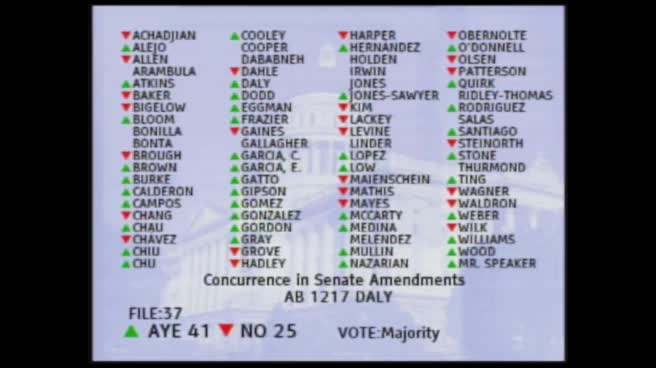
Bill Author

Bill Co-Author(s):