AB 2389: Special districts: district-based elections: reapportionment.
- Session Year: 2015-2016
- House: Assembly
- Latest Version Date: 2016-09-28
Existing law provides for political subdivisions, including special districts, that encompass areas of representation within the state. With respect to these areas, public officials are generally elected by all of the voters of the political subdivision (at-large) or by or from districts formed within the political subdivision (district-based). Under existing law, the manner of election of a governing body of a special district is generally specified in the statutes creating the district. If a political subdivision changes from an at-large method of election to a district-based election, existing law generally requires the political subdivision to submit to the voters an ordinance or resolution providing for the election of members of the governing body by district.
This bill would authorize a governing body of a special district, as defined, to require, by resolution, that the members of its governing body be elected using district-based elections without being required to submit the resolution to the voters for approval. This bill would require the resolution to include a declaration that the change in the method of election is being made in furtherance of the purposes of the California Voting Rights Act of 2001.
Existing law provides for political subdivisions, including special districts, that encompass areas of representation within the state. With respect to these areas, public officials are generally elected by all of the voters of the political subdivision (at-large) or by or from districts formed within the political subdivision (district-based). Under existing law, the manner of election of a governing body of a special district is generally specified in the statutes creating the district. If a political subdivision changes from an at-large method of election to a district-based election, existing law generally requires the political subdivision to submit to the voter voters an ordinance or resolution providing for the election of members of the governing body by district.
This bill would authorize a governing body of a special district, as defined, to require, by resolution, that the election of the members of its governing body be elected using district-based elections without being required to submit the resolution to the voters for approval. This bill would require the resolution to include a declaration that the change in the method of election is being made in furtherance of the purposes of the California Voting Rights Act of 2001.
Existing law provides for political subdivisions, including special districts, that encompass areas of representation within the state. With respect to these areas, public officials are generally elected by all of the voters of the political subdivision (at-large) or by or from districts formed within the political subdivision (district-based). Under existing law, the manner of election of a governing body of a special district is generally specified in the statutes creating the district. If a political subdivision changes from an at-large method of election to a district-based election, existing law generally requires the political subdivision to submit to the voter an ordinance or resolution providing for the election of members of the governing body by district.
This bill would authorize a governing body of a special district, as defined, to require, by resolution, that the election of the members of its governing body be elected using district-based elections without being required to submit the resolution to the voters for approval.
The principal act shall govern whether directors of a district are elected by divisions or by the district at large. A governing body may require that the directors of the governing body be elected using district-based elections pursuant to Section 10650.
SEC. 2.Part 5.5 (commencing with Section 10650) is added to Division 10 of the Elections Code, to read:5.5.Special District Elections10650.(a)Notwithstanding any other law, a governing body of a special district may require, by resolution, that the members of its governing body be elected using district-based elections, as defined in subdivision (b) of Section 14026, without being required to submit the resolution to the voters for approval. A resolution adopted pursuant to this subdivision shall include a declaration that the change in the method of electing members of the governing body is being made in furtherance of the purposes of the California Voting Rights Act of 2001 (Chapter 1.5 (commencing with Section 14025) of Division 14 of the Elections Code).
(b)For purposes of this section, special district means an agency of the state formed pursuant to general law or special act for the local performance of governmental or proprietary functions within limited boundaries. Special district does not include a city, county, city and county, school or community college district, special assessment district, or district with appointed members on its governing body.
The principal act shall govern whether directors of a district are elected by divisions or by the district at large. A governing body may require that the directors of the governing body be elected using district-based elections pursuant to Section 10650.
SECTION 1.SEC. 2.Part 5.5 (commencing with Section 10650) is added to Division 10 of the Elections Code, to read:5.5.Special District Elections10650.(a)Notwithstanding any other law, a governing body of a special district may require, by resolution, that the members of its governing body be elected using district-based elections, as defined in subdivision (b) of Section 14026, without being required to submit the resolution to the voters for approval. A resolution adopted pursuant to this subdivision shall include a declaration that the change in the method of electing members of the governing body is being made in furtherance of the purposes of the California Voting Rights Act of 2001 (Chapter 1.5 (commencing with Section 14025) of Division 14 of the Elections Code).
(b)For purposes of this section, special district means an agency of the state formed pursuant to general law or special act for the local performance of governmental or proprietary functions within limited boundaries, except boundaries. Special district does not include a city, county, city and county, school or community college district, or special assessment district. district, or district with appointed members on its governing body.
(a)Notwithstanding any other law, a governing body of a special district may require, by resolution, that the election of the members of its governing body be elected using district-based elections, as defined in subdivision (b) of Section 14026, without being required to submit the resolution to the voters for approval. A resolution adopted pursuant to this subdivision shall include a declaration that the change in the method of electing members of the governing body is being made in furtherance of the purposes of the California Voting Rights Act of 2001 (Chapter 1.5 (commencing with Section 14025) of Division 14 of the Elections Code).
(b)For purposes of this section, special district means an agency of the state formed pursuant to general law or special act for the local performance of governmental or proprietary functions within limited boundaries, except a city, county, city and county, school or community college district, or special assessment district.
(a)Notwithstanding any other law, a governing body of a special district may require, by resolution, that the election of the members of its governing body be elected using district-based elections, as defined in subdivision (b) of Section 14026, without being required to submit the resolution to the voters for approval.
(b)For purposes of this section, special district means an agency of the state formed pursuant to general law or special act for the local performance of governmental or proprietary functions within limited boundaries, except a city, county, city and county, school or community college district, or special assessment district.
|
Date
|
Status
|
|---|---|
| May 12, 2016 | Read third time. Passed. Ordered to the Senate. |
| Aug 22, 2016 | Enrolled and presented to the Governor at 4 p.m. |
| Aug 16, 2016 | Read third time. Passed. Ordered to the Assembly. (Ayes 34. Noes 5.). |
| Aug 16, 2016 | Read third time. Passed. Ordered to the Assembly. (Ayes 34. Noes 5. Page 5009.). |
| Aug 16, 2016 | Read third time. Passed. Ordered to the Assembly. |
| Aug 16, 2016 | In Assembly. Ordered to Engrossing and Enrolling. |
| Jun 30, 2016 | Read second time. Ordered to third reading. |
| Jun 29, 2016 | From committee: Do pass. (Ayes 6. Noes 0.) (June 29). |
| Jun 9, 2016 | From committee: Do pass and re-refer to Com. on GOV. & F. (Ayes 5. Noes 0.) (June 8). Re-referred to Com. on GOV. & F. |
| May 19, 2016 | Referred to Coms. on E. & C.A. and GOV. & F. |
| May 12, 2016 | Read third time. Passed. Ordered to the Senate. (Ayes 59. Noes 16.) |
| May 12, 2016 | Read third time. Passed. Ordered to the Senate. (Ayes 59. Noes 16. Page 4782.) |
| Feb 18, 2016 | Read first time. To print. |
| May 12, 2016 | In Senate. Read first time. To Com. on RLS. for assignment. |
| May 10, 2016 | Read second time. Ordered to third reading. |
| May 9, 2016 | Read second time and amended. Ordered returned to second reading. |
| May 5, 2016 | From committee: Amend, and do pass as amended. (Ayes 8. Noes 0.) (May 4). |
| Apr 25, 2016 | In committee: Hearing postponed by committee. |
| Apr 6, 2016 | Re-referred to Com. on L. GOV. |
| Apr 5, 2016 | Read second time and amended. |
| Apr 4, 2016 | From committee: Amend, and do pass as amended and re-refer to Com. on L. GOV. (Ayes 5. Noes 2.) (March 30). |
| Mar 8, 2016 | Referred to Coms. on E. & R. and L. GOV. |
| Feb 19, 2016 | From printer. May be heard in committee March 20. |
|
Date
|
Description
|
Location
|
Votes
|
|
|---|---|---|---|---|
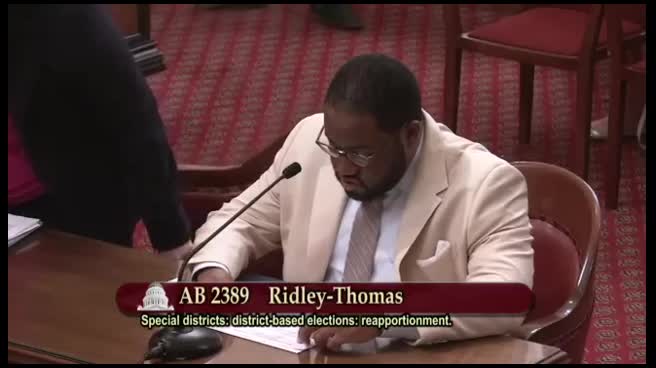
| Aug 16, 2016 | Assembly 3rd Reading AB2389 Ridley-Thomas By Allen | Senate Floor |
Passed |
|
| Jun 29, 2016 | Do pass | Senate Standing Committee on Governance and Finance |
Passed |
|
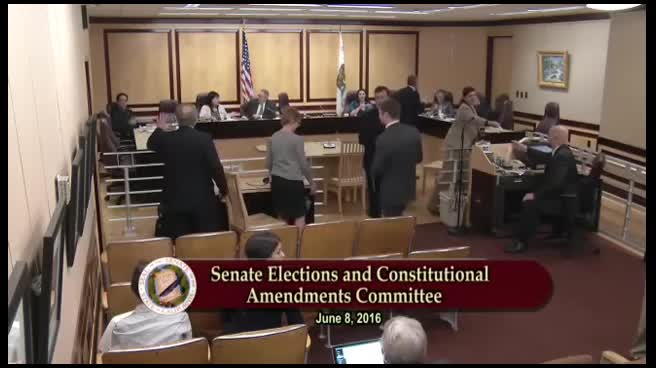
| Jun 8, 2016 | Do pass, but first be re-referred to the Committee on [Governance and Finance] | Senate Standing Committee on Elections and Constitutional Amendments |
Passed |
|
| May 12, 2016 | AB 2389 RIDLEY-THOMAS Assembly Third Reading | Assembly Floor |
Passed |
|
| May 4, 2016 | Do pass as amended. | Assembly Standing Committee on Local Government |
Passed |
|
| Mar 30, 2016 | Do pass as amended and be re-referred to the Committee on [Local Government] | Assembly Standing Committee on Elections and Redistricting |
Passed |
This list shows positions taken on this bill by organizations on the date displayed, which is linked to the original source.
Positions by individuals are not included.
|
Organization
|
Position
|
Date
|
|---|---|---|
| American Civil Liberties Union of California | ** Support | Aug 16, 2016 |
| Association of California Healthcare Districts | ** Support | Aug 16, 2016 |
| Association Of California Healthcare Districts (Achd) | * Support | Jun 29, 2016 |
| Association Of California Water Agencies | ** Support | Aug 16, 2016 |
| California Association of Clerks and Election Officials | ** Support | Aug 16, 2016 |
| California Association of Recreation and Park Districts | ** Support | Aug 16, 2016 |
| California Special Districts Association | ** Support | Aug 16, 2016 |
| League Of Women Voters Of California | ** Support | Aug 16, 2016 |
| Mexican American Legal Defense and Educational Fund | ** Support | Aug 16, 2016 |
Office of Senate Floor Analyses (916) 651-1520 Fax: (916) 327-4478 | AB |
THIRD READING
Bill No: AB 2389
:
SENATE ELECTIONS & C.A. COMMITTEE: 5-0, 6/8/16
AYES: Allen, Anderson, Hancock, Hertzberg, Liu
SENATE GOVERNANCE & FIN. COMMITTEE: 6-0, 6/29/16
AYES: Hertzberg, Nguyen, Beall, Hernandez, Lara, Moorlach
NO VOTE RECORDED: Pavley
ASSEMBLY FLOOR: 59-16, 5/12/16 - See last page for vote
SOURCE: Mexican American Legal Defense and Educational Fund
DIGEST: This bill permits a special district to change the method of electing its governing board members from at-large to a by-district method of election without receiving voter approval.
Existing law:
- Provides that the principal act of a district shall govern whether directors are elected by divisions or by the district at-large.
- Provides that the term "by districts" means the election of members by voters of the district alone; provides that "from districts" means the election of members who are residents of the districts from which they are elected, but who are elected by voters of the jurisdiction as a whole.
- Prohibits, pursuant to the California Voting Rights Act of 2001 (CVRA), an at-large method of election from being imposed or applied in a political subdivision (including a special district) in a manner that impairs the ability of a protected class of voters to elect the candidate of its choice or its ability to influence the outcome of an election, as a result of the dilution or the abridgement of the rights of voters who are members of a protected class.
- Provides that a violation of the CVRA may be established if it is shown that racially polarized voting occurs in elections for members of the governing body of the political subdivision or in elections incorporating other electoral choices by the voters of the political subdivision.
- Requires a court, upon finding a violation of the CVRA, to implement appropriate remedies, including the imposition of district-based elections, which are tailored to remedy the violation.
- Permits any voter who is a member of a protected class and who resides in a political subdivision where a violation of the CVRA is alleged to file an action in the superior court of the county in which the political subdivision is located.
- Permits a city with a population of fewer than 100,000 people to change the method of electing council members to a by-district method of election without receiving voter approval.
This bill:
- Authorizes the governing body of a special district to adopt a resolution, without being required to submit the resolution to the voters for approval that requires members of its governing body to be elected using district-based elections.
- Requires the resolution to include a declaration that the change in the method of electing members of the governing body is in furtherance of the purposes of the CVRA.
- Defines a "special district," for the purposes for these provisions, to mean an agency of the state formed pursuant to general law or special act for the local performance of governmental or proprietary functions within limited boundaries. Provides that a "special district" does not include a city, county, city and county, school or community college district, special assessment district, or a district with appointed members on its governing board.
- Makes other conforming changes.
Background
At-Large vs. District Elections. Under existing law, a special district can be organized so that its governing board members are elected at-large or elected using districts. Jurisdictions that are organized using district-based methods are usually organized as "by-district" or "from-district." A "by-district" jurisdiction allows only the registered voters in a district to vote in the election to choose the governing board member from that area. A "from-district" jurisdiction permits registered voters in the entire jurisdiction to vote for governing board members from each of the districts. In either case, a candidate for the governing board must reside in the district in which he or she is running.
There is no uniform process for a special district to convert from at-large elections to a district-based method of election. Current law provides that the principal act of a special district shall govern whether the governing board members are elected by districts or by the district at-large. Moreover, depending on the kind of district and its size, existing law may specify which method of election it is required to use to elect its governing board members as well as the process for conversion.
California Voting Rights Act of 2001. SB 976 (Polanco, Chapter 129, Statutes of 2002) enacted the CVRA to address racial block voting in at-large elections for local office in California. In areas where racial block voting occurs, an at-large method of election can dilute the voting rights of minority communities if the majority typically votes to support candidates that differ from the candidates who are preferred by minority communities. In such situations, breaking a jurisdiction up into districts can result in districts in which a minority community can elect the candidate of its choice or otherwise have the ability to influence the outcome of an election.
Accordingly, the CVRA prohibits an at-large method of election from being imposed or applied in a political subdivision in a manner that impairs the ability of a protected class of voters to elect the candidate of its choice or to influence the outcome of an election, as a result of the dilution or the abridgement of the rights of voters who are members of the protected class.
The first case brought under the CVRA was filed in 2004, and the jurisdiction that was the target of that case - the City of Modesto - challenged the constitutionality of the law. Ultimately, the City of Modesto appealed that case all the way to the United States Supreme Court, which rejected the city's appeal in October 2007. The legal uncertainty surrounding the CVRA may have limited the impacts of that law in the first five years after its passage.
Since the case in Modesto was resolved, however, many local jurisdictions have converted or are in the process of converting from an at-large method of election to district-based elections due to the CVRA. In many cases, local government bodies must receive voter approval to move from an at-large method of election to a district-based method of election for selecting governing board members. This voter approval requirement can make it difficult for jurisdictions to proactively transition to district-based elections in order to address potential liability under the CVRA. If a jurisdiction attempts to transition from at-large to district-based elections to address CVRA concerns, but the voters reject the proposal, the jurisdiction nonetheless remains subject to a lawsuit under the CVRA.
Furthermore, to the extent that there is racially polarized voting on the question of whether to transition from at-large to district-based elections, the results of the vote on that question could provide further evidence for a lawsuit under the CVRA. As a result, many jurisdictions have sought ways to transition from at-large to district-based elections without having to receive voter approval for such a change.
Since the enactment of the CVRA in 2001, at least 160 local governments have switched from at-large to district based elections. While some jurisdictions did so in response to litigation or threats of litigation, other jurisdictions proactively changed election methods because they believed they could be susceptible to a legal challenge under the CVRA, and they wished to avoid the potential expense of litigation.
Notably, many school districts have transitioned from at-large to district-based elections without receiving voter approval in an effort to avoid potential liability under the CVRA. Even though state law generally requires such a transition to be approved by the voters in a school district, existing law also permits the State Board of Education (SBE) to waive all or part of any section of the Education Code, with certain identified exceptions, upon request by the governing board of a school district or county board of education. The SBE generally is required to approve any and all requests for waivers unless it makes a finding that one of the seven enumerated conditions exists. Since 2009, the SBE has approved more than 130 waivers to permit school districts to change from at-large to district-based elections without voter approval, as would otherwise be required by the Education Code.
Furthermore, in response to concerns that community college districts were subject to liability under the CVRA but were unable to change from at-large to district-based elections without receiving voter approval, AB 684 (Block, Chapter 614, Statutes of 2011) established a process under which a community college district could transition from at-large to district-based elections without receiving voter approval if such a transition was first approved by the Board of Governors (BOG) of the California Community Colleges, among other provisions. Since the enactment of AB 684, the BOG has received and approved requests from approximately 20 community college districts to change their election method from at-large to district-based elections.
Comments
- According to the author, current law provides for different forms of government for special districts in California. Depending on the type of district, a special district can be organized so that members of the governing board are elected at-large or are elected using districts.
In jurisdictions that have districts, the districts can be organized such that the registered voters in the entire district vote for governing board members from each of the districts (known as "from district" elections), or the jurisdiction can be organized so that only the registered voters in a district vote in the election to choose the board member from that area (known as "by district" elections). In either case, a candidate for the governing body must reside in the district in which he or she is running.
The CVRA is designed to protect against at-large election systems that dilute minority voting rights. As a result of the CVRA, local governments throughout the state have been transitioning from at-large to district-based elections.
If a special district wishes to move from at-large elections to a district-based method of election to address concerns under the CVRA, existing law provides no uniform process for accomplishing that conversion.
This voter approval requirement, however, can make it difficult and costly for jurisdictions to proactively transition to district-based elections in order to address potential liability under the CVRA.
AB 2389 allows a special district that is concerned about liability under the CVRA to voluntarily convert from at-large to district-based elections without the expense of a ballot initiative. This bill mirrors a similar process that is already in place for general law cities with populations of fewer than 100,000 people.
Related/Prior Legislation
AB 278 (Hernandez, 2016) and AB 2220 (Cooper, 2016) both extend the option created in SB 493 (Cannella, Chapter 735, Statutes of 2015) to all cities regardless of population size.
SB 927 (Anderson, 2016) permits directors of any public utility district that is wholly or partially within the County of San Diego to be elected at-large, by subdistrict, or from subdistricts, as defined.
SB 493 (Cannella, Chapter 735, Statutes of 2015) permitted a city with a population of fewer than 100,000 people to change the method of electing council members to a by-district method of election without receiving voter approval. This bill mirrors this process and permits the governing body of a special district, as defined, to adopt a resolution, without being required to submit the resolution to the voters for approval, to elect the members of its governing body using district-based elections.
FISCAL EFFECT: Appropriation: Fiscal Com.: Local:
Mexican American Legal Defense and Educational Fund (source)
American Civil Liberties Union of California
Association of California Healthcare Districts
Association of California Water Agencies
California Association of Clerks and Election Officials
California Association of Recreation and Park Districts
California Special Districts Association
Lawyers’ Committee for Civil Rights
League of Women Voters of California
OPPOSITION: (Verified 7/18/16)
None received
ASSEMBLY FLOOR: 59-16, 5/12/16
AYES: Alejo, Arambula, Atkins, Baker, Bloom, Bonilla, Bonta, Brown, Calderon, Campos, Chang, Chau, Chiu, Chu, Cooley, Cooper, Dababneh, Daly, Dodd, Eggman, Frazier, Cristina Garcia, Eduardo Garcia, Gatto, Gipson, Gomez, Gonzalez, Gordon, Gray, Hadley, Roger Hernández, Holden, Irwin, Kim, Lackey, Levine, Linder, Lopez, Low, McCarty, Medina, Mullin, Nazarian, O'Donnell, Olsen, Quirk, Ridley-Thomas, Rodriguez, Salas, Santiago, Mark Stone, Thurmond, Ting, Waldron, Weber, Wilk, Williams, Wood, Rendon
NOES: Travis Allen, Bigelow, Brough, Chávez, Beth Gaines, Gallagher, Grove, Harper, Maienschein, Mathis, Mayes, Melendez, Obernolte, Patterson, Steinorth, Wagner
NO VOTE RECORDED: Achadjian, Burke, Dahle, Jones, Jones-Sawyer
7/29/16 10:49:00
**** END ****
SENATE COMMITTEE ON GOVERNANCE AND FINANCE
Senator Robert M. Hertzberg, Chair
2015 - 2016 Regular
Bill No: | AB 2389 | Hearing Date: | 6/29/16 |
Author: | Ridley-Thomas | Tax Levy: | No |
Version: | 5/9/16 | Fiscal: | No |
Consultant: | Weinberger | ||
Special districts: district-based elections: reapportionment
Allows a special district’s governing board, without having to seek voter approval, to change from an at-large to a by-district method of electing the district’s governing board members.
Background
Unlike counties and cities, which deliver a wide range of public services over large areas, special districts offer focused services, delivering just one or two services to specific geographic areas where the recipients are willing to pay.
About 2,100 of the state’s special districts are independent districts, which have their own separate governing boards that are comprised of members who are either elected by the districts’ own voters or appointed to serve for fixed terms. Most independent special districts have elected boards of directors. For those that do, state law says that the statutes that provide for the creation of a particular special district or type of special district govern whether directors of a district are elected by divisions or by the district at large. An “at-large” method of election allows a voter residing anywhere within the local government's boundaries to vote for any candidate for the governing board. A “district-based” method of election – sometimes called a “by district” election – allows a voter to vote only for a candidate who runs and resides in the same geographical district in which the voter resides.
The California Voting Rights Act (CVRA) prohibits an at-large method of election from being imposed or applied in a political subdivision (including a special district) in a manner that impairs the ability of a protected class of voters to elect the candidate of its choice or its ability to influence the outcome of an election, as a result of the dilution or the abridgement of the rights of voters who are members of a protected class (SB 976, Polanco, 2002). The CVRA was enacted to address racial block voting in at-large elections for local office in California. In areas where racial block voting occurs, an at-large method of election can dilute the voting rights of a protected class of voters if a majority usually votes for candidates who differ from candidates who are preferred by the protected class of voters. In such situations, breaking up a jurisdiction into districts can result in districts in which a protected class of voters can elect the candidate of its choice or otherwise have the power to influence the outcome of an election. If a judge finds that a city’s at-large election method violates the CVRA, state law requires the court to implement appropriate remedies, including the imposition of district-based elections.
The numerous statutes that govern the methods that special districts use to elect their governing boards vary widely. Some statutes require that special district boards must obtain voter approval to switch from at-large to district-based elections. State law doesn’t allow some other types of special districts to use district-based election at all. Because a growing number of districts are seeking to transition to district-based elections in response to concerns about compliance with the CVRA, some public officials want the Legislature to allow those special districts to adopt district-based elections without having to seek voter approval.
Proposed Law
Assembly Bill 2389 allows the governing body of a special district to adopt a resolution, without being required to submit the resolution to the voters for approval, requiring members of its governing body to be elected using district-based elections. The resolution must include a declaration that the change in the method of electing members of the governing body is in furtherance of the purposes of the CVRA.
AB 2389 defines a "special district," for the purposes for these provisions, to mean an agency of the state formed pursuant to general law or special act for the local performance of governmental or proprietary functions within limited boundaries. The bill provides that a "special district" does not include a city, county, city and county, school or community college district, special assessment district, or a district with appointed members on its governing board.
The bill makes other conforming changes to state law.
State Revenue Impact
No estimate.
Comments
1. Purpose of the bill. If a special district wishes to move from at-large elections to a district-based method of election to address concerns under the CVRA, existing law provides no uniform process for accomplishing that conversion. A voter approval requirement can make it difficult and costly for jurisdictions to proactively transition to district-based elections in order to address potential liability under the CVRA. AB 2389 allows a special district that is concerned about liability under the CVRA to voluntarily convert from at-large to district-based elections without the expense of a ballot initiative. This bill mirrors a similar process that the Legislature enacted for general law cities with populations of fewer than 100,000 people (SB 493, Cannella, 2015). AB 2389 doesn’t force any special district to alter its current method of electing board members and doesn’t prevent a district from seeking voter approval for switching to a district-based election method if it chooses to do so. The bill simply provides a tool that can be used by special district officials who wish to avoid unnecessary costs and delays by expediting their districts’ conversion to district-based elections to comply with the CVRA.
2. Finding a balance. The CVRA was enacted to protect democratic principles of fairness and equal access to representation in government. Democratic principles also suggest that local voters should be allowed to make fundamental decisions about the methods by which their communities’ local officials are elected. Sometimes, these principles conflict, as is the case when at-large elections for a local governing board are supported by a majority of a community’s voters but impair a protected class of voters’ ability to influence elections. AB 2389 attempts to strike a balance between making it easier for local governments to modify their elections to comply with the CVRA while still leaving some local discretion over the method by which governing boards are elected.
3. Related legislation. AB 278 (Hernandez) and AB 2220 (Cooper), which both will be heard by the Senate Governance & Finance Committee at its June 29 hearing, would allow all cities, regardless of population size, to change the method of electing council members to a by-district method of election without receiving voter approval. SB 927 (Anderson), which is pending in the Assembly Local Government Committee, permits directors of any public utility district that is wholly or partially within the County of San Diego to be elected at large or by subdistrict. The Senate Governance & Finance Committee approved SB 927 at its March 30 hearing on a 7-0 vote.
4. Double-referred. The Senate Rules Committee has ordered a double-referral of AB 2389, first to the Senate Committee on Elections & Constitutional Amendments, which has jurisdiction over bills relating to local elections and the CVRA, and then to the Senate Governance & Finance Committee, which has jurisdiction over bills relating to special districts’ governing boards. The Senate Elections & Constitutional Amendments Committee passed AB 2398 at its June 8, 2016 hearing on a 5-0 vote.
Assembly Actions
Assembly Elections and Redistricting Committee: 5-2
Assembly Local Government Committee: 8-0
Assembly Floor: 59-16
Support and Opposition
(6/23/16)
Support: American Civil Liberties Union; Association of California Healthcare Districts; Association of California Water Agencies; California Association of Clerks and Election Officials; California Association of Recreation and Park Districts; California Special Districts Association; Lawyers’ Committee for Civil Rights; League of Women Voters of California; Mexican American Legal Defense and Education Fund.
Opposition: Unknown.
-- END --
SENATE COMMITTEE ON
ELECTIONS AND CONSTITUTIONAL AMENDMENTS
Senator Ben Allen, Chair
2015 - 2016 Regular
Bill No: 2389 Hearing Date: 6/8/16
Author: | Ridley-Thomas | ||
Version: |
| ||
Urgency: | Fiscal: | ||
Consultant: | |||
Subject:
DIGEST
Permits a special district to change the method of electing its governing board members from at-large to a by-district method of election without receiving voter approval.
ANALYSIS
Existing law:
- Provides that the principal act of a district shall govern whether directors are elected by divisions or by the district at-large.
- Provides that the term "by districts" means the election of members by voters of the district alone; provides that "from districts" means the election of members who are residents of the districts from which they are elected, but who are elected by voters of the jurisdiction as a whole.
- Prohibits, pursuant to the California Voting Rights Act of 2001 (CVRA), an at-large method of election from being imposed or applied in a political subdivision (including a special district) in a manner that impairs the ability of a protected class of voters to elect the candidate of its choice or its ability to influence the outcome of an election, as a result of the dilution or the abridgement of the rights of voters who are members of a protected class.
- Provides that a violation of the CVRA may be established if it is shown that racially polarized voting occurs in elections for members of the governing body of the political subdivision or in elections incorporating other electoral choices by the voters of the political subdivision.
- Requires a court, upon finding a violation of the CVRA, to implement appropriate remedies, including the imposition of district-based elections, which are tailored to remedy the violation.
- Permits any voter who is a member of a protected class and who resides in a political subdivision where a violation of the CVRA is alleged to file an action in the superior court of the county in which the political subdivision is located.
- Permits a city with a population of fewer than 100,000 people to change the method of electing council members to a by-district method of election without receiving voter approval.
This bill:
- Authorizes the governing body of a special district to adopt a resolution, without being required to submit the resolution to the voters for approval that requires members of its governing body to be elected using district-based elections.
- Requires the resolution to include a declaration that the change in the method of electing members of the governing body is in furtherance of the purposes of the CVRA.
- Defines a "special district," for the purposes for these provisions, to mean an agency of the state formed pursuant to general law or special act for the local performance of governmental or proprietary functions within limited boundaries. Provides that a "special district" does not include a city, county, city and county, school or community college district, special assessment district, or a district with appointed members on its governing board.
- Makes other conforming changes.
BACKGROUND
At-Large vs. District Elections. Under existing law, a special district can be organized so that its governing board members are elected at-large or elected using districts. Jurisdictions that are organized using district-based methods are usually organized as "by-district" or "from-district." A "by-district" jurisdiction allows only the registered voters in a district to vote in the election to choose the governing board member from that area. A "from-district" jurisdiction permits registered voters in the entire jurisdiction to vote for governing board members from each of the districts. In either case, a candidate for the governing board must reside in the district in which he or she is running.
There is no uniform process for a special district to convert from at-large elections to a district-based method of election. Current law provides that the principal act of a special district shall govern whether the governing board members are elected by districts or by the district at-large. Moreover, depending on the kind of district and its size, existing law may specify which method of election it is required to use to elect its governing board members as well as the process for conversion.
California Voting Rights Act of 2001. SB 976 (Polanco, Chapter 129, Statutes of 2002), enacted the CVRA to address racial block voting in at-large elections for local office in California. In areas where racial block voting occurs, an at-large method of election can dilute the voting rights of minority communities if the majority typically votes to support candidates that differ from the candidates who are preferred by minority communities. In such situations, breaking a jurisdiction up into districts can result in districts in which a minority community can elect the candidate of its choice or otherwise have the ability to influence the outcome of an election.
Accordingly, the CVRA prohibits an at-large method of election from being imposed or applied in a political subdivision in a manner that impairs the ability of a protected class of voters to elect the candidate of its choice or to influence the outcome of an election, as a result of the dilution or the abridgement of the rights of voters who are members of the protected class.
The first case brought under the CVRA was filed in 2004, and the jurisdiction that was the target of that case - the City of Modesto - challenged the constitutionality of the law. Ultimately, the City of Modesto appealed that case all the way to the United States Supreme Court, which rejected the city's appeal in October 2007. The legal uncertainty surrounding the CVRA may have limited the impacts of that law in the first five years after its passage.
Since the case in Modesto was resolved, however, many local jurisdictions have converted or are in the process of converting from an at-large method of election to district-based elections due to the CVRA. In many cases, local government bodies must receive voter approval to move from an at-large method of election to a district-based method of election for selecting governing board members. This voter approval requirement can make it difficult for jurisdictions to proactively transition to district-based elections in order to address potential liability under the CVRA. If a jurisdiction attempts to transition from at-large to district-based elections to address CVRA concerns, but the voters reject the proposal, the jurisdiction nonetheless remains subject to a lawsuit under the CVRA.
Furthermore, to the extent that there is racially polarized voting on the question of whether to transition from at-large to district-based elections, the results of the vote on that question could provide further evidence for a lawsuit under the CVRA. As a result, many jurisdictions have sought ways to transition from at-large to district-based elections without having to receive voter approval for such a change.
Since the enactment of the CVRA in 2001, at least 160 local governments have switched from at-large to district based elections. While some jurisdictions did so in response to litigation or threats of litigation, other jurisdictions proactively changed election methods because they believed they could be susceptible to a legal challenge under the CVRA, and they wished to avoid the potential expense of litigation.
Notably, many school districts have transitioned from at-large to district-based elections without receiving voter approval in an effort to avoid potential liability under the CVRA. Even though state law generally requires such a transition to be approved by the voters in a school district, existing law also permits the State Board of Education (SBE) to waive all or part of any section of the Education Code, with certain identified exceptions, upon request by the governing board of a school district or county board of education. The SBE generally is required to approve any and all requests for waivers unless it makes a finding that one of the seven enumerated conditions exists. Since 2009, the SBE has approved more than 130 waivers to permit school districts to change from at-large to district-based elections without voter approval, as would otherwise be required by the Education Code.
Furthermore, in response to concerns that community college districts were subject to liability under the CVRA but were unable to change from at-large to district-based elections without receiving voter approval, AB 684 (Block), Chapter 614, Statutes of 2011, established a process under which a community college district could transition from at-large to district-based elections without receiving voter approval if such a transition was first approved by the Board of Governors (BOG) of the California Community Colleges, among other provisions. Since the enactment of AB 684, the BOG has received and approved requests from approximately 20 community college districts to change their election method from at-large to district-based elections.
COMMENTS
- According to the author: Current law provides for different forms of government for special districts in California. Depending on the type of district, a special district can be organized so that members of the governing board are elected at-large or are elected using districts.
In jurisdictions that have districts, the districts can be organized such that the registered voters in the entire district vote for governing board members from each of the districts (known as "from district" elections), or the jurisdiction can be organized so that only the registered voters in a district vote in the election to choose the board member from that area (known as "by district" elections). In either case, a candidate for the governing body must reside in the district in which he or she is running.
The CVRA is designed to protect against at-large election systems that dilute minority voting rights. As a result of the CVRA, local governments throughout the state have been transitioning from at-large to district-based elections.
If a special district wishes to move from at-large elections to a district-based method of election to address concerns under the CVRA, existing law provides no uniform process for accomplishing that conversion.
This voter approval requirement, however, can make it difficult and costly for jurisdictions to proactively transition to district-based elections in order to address potential liability under the CVRA.
AB 2389 allows a special district that is concerned about liability under the CVRA to voluntarily convert from at-large to district-based elections without the expense of a ballot initiative. This bill mirrors a similar process that is already in place for general law cities with populations of fewer than 100,000 people.
RELATED/PRIOR LEGISLATION
SB 493 (Cannella, Chapter 735, Statutes of 2015), permitted a city with a population of fewer than 100,000 people to change the method of electing council members to a by-district method of election without receiving voter approval. This bill mirrors this process and permits the governing body of a special district, as defined, to adopt a resolution, without being required to submit the resolution to the voters for approval, to elect the members of its governing body using district-based elections.
AB 278 (Hernandez), which is also before this committee today, and AB 2220 (Cooper), which is pending referral in the Senate, both extend the option created in SB 493 to all cities regardless of population size.
SB 927 (Anderson), which is pending in the Assembly Local Government Committee, permits directors of any public utility district that is wholly or partially within the County of San Diego to be elected at large, by subdistrict, or from subdistricts, as defined.
PRIOR ACTION
Assembly Floor: | 59 - 16 |
Assembly Local Government Committee: | 8 - 0 |
Assembly Committee: | 5 - 2 |
POSITIONS
Sponsor: Mexican American Legal Defense and Educational Fund
Support: Association of California Healthcare Districts
California Association of Clerks and Election Officials
California Association of Recreation and Park Districts
California Special Districts Association
League of Women Voters of California
Oppose: None received
-- END --
ASSEMBLY THIRD READING
ATR Bill Id:AB 2389
Author:(Ridley-Thomas)
As Amended Ver:May 9, 2016
Majority vote
Committee | Votes | Ayes | Noes |
Elections | 5-2 | Weber, Gordon, Low, Mullin, Nazarian | Harper, Travis Allen |
Local Government | 8-0 | Eggman, Waldron, Mullin, Bonilla, Chiu, Cooley, Gordon, Linder |
SUMMARY: Permits a special district to change the method of electing its governing board members from at-large to a by-district method of election without receiving voter approval. Specifically, this bill:
- Authorizes the governing body of a special district to adopt a resolution, without being required to submit the resolution to the voters for approval that requires members of its governing body to be elected using district-based elections.
- Requires the resolution to include a declaration that the change in the method of electing members of the governing body is in furtherance of the purposes of the California Voting Rights Act (CVRA) of 2001.
- Defines a "special district," for the purposes for these provisions, to mean an agency of the state formed pursuant to general law or special act for the local performance of governmental or proprietary functions within limited boundaries. Provides that a "special district" does not include a city, county, city and county, school or community college district, special assessment district, or a district with appointed members on its governing board.
FISCAL EFFECT: None. This bill is keyed non-fiscal by the Legislative Counsel.
COMMENTS: According to the author, "Current law provides for different forms of government for special districts in California. Depending on the type of district, a special district can be organized so that members of the governing board are elected at-large or are elected using districts. In jurisdictions that have districts, the districts can be organized such that the registered voters in the entire district vote for governing board members from each of the districts (known as "from district" elections), or the jurisdiction can be organized so that only the registered voters in a district vote in the election to choose the board member from that area (known as "by district" elections). In either case, a candidate for the governing body must reside in the district in which he or she is running.
"The CVRA is designed to protect against at-large election systems that dilute minority voting rights. As a result of the CVRA, local governments throughout the state have been transitioning from at-large to district-based elections. If a special district wishes to move from at-large elections to a district-based method of election to address concerns under the CVRA, existing law provides no uniform process for accomplishing that conversion.
"[A] voter approval requirement, however, can make it difficult and costly for jurisdictions to proactively transition to district-based elections in order to address potential liability under the CVRA. AB 2389 allows a special district that is concerned about liability under the CVRA to voluntarily convert from at-large to district-based elections without the expense of a ballot initiative. This bill mirrors a similar process that is already in place for general law cities with populations of fewer than 100,000 people."
SB 976 (Polanco), Chapter 129, Statutes of 2002, enacted the CVRA to address racial block voting in at-large elections for local office in California. In areas where racial block voting occurs, an at-large method of election can dilute the voting rights of minority communities if the majority typically votes to support candidates that differ from the candidates who are preferred by minority communities. In such situations, breaking a jurisdiction up into districts can result in districts in which a minority community can elect the candidate of its choice or otherwise have the ability to influence the outcome of an election. Accordingly, the CVRA prohibits an at-large method of election from being imposed or applied in a political subdivision in a manner that impairs the ability of a protected class of voters to elect the candidate of its choice or to influence the outcome of an election, as a result of the dilution or the abridgement of the rights of voters who are members of the protected class.
In many cases, local government bodies must receive voter approval to move from an at-large method of election to a district-based method of election for selecting governing board members. This voter approval requirement can make it difficult for jurisdictions to proactively transition to district-based elections in order to address potential liability under the CVRA. If a jurisdiction attempts to transition from at-large to district-based elections to address CVRA concerns, but the voters reject the proposal, the jurisdiction nonetheless remains subject to a lawsuit under the CVRA. Furthermore, to the extent that there is racially polarized voting on the question of whether to transition from at-large to district-based elections, the results of the vote on that question could provide further evidence for a lawsuit under the CVRA. As a result, many jurisdictions have sought ways to transition from at-large to district-based elections without having to receive voter approval for such a change.
Please see the policy committee analyses for a full discussion of this bill.
Analysis Prepared by: Nichole Becker / E. & R. / (916) 319-2094 FN: 0002919
Date of Hearing: May 4, 2016
ASSEMBLY COMMITTEE ON LOCAL GOVERNMENT
Susan Talamantes Eggman, Chair
ABPCA Bill Id:AB 2389 (
Author:Ridley-Thomas) – As Amended Ver:April 5, 2016
SUBJECT: Special districts: district-based elections: reapportionment.
SUMMARY: Authorizes special districts to change the method of electing governing board members from at-large to a by-district method of election without receiving voter approval. Specifically, this bill:
- Authorizes a governing body of a special district, notwithstanding any other law, to adopt a resolution that requires members of its governing body to be elected using district-based elections without being required to submit the resolution to the voters for approval.
- Requires the resolution to include a declaration that the change in the method of electing members of the governing body is in furtherance of the purposes of the California Voting Rights Act of 2001.
- Defines "special district" to mean "any agency of the state formed pursuant to general law or special act for the local performance of governmental or proprietary functions within limited boundaries, except a city, county, city and county, school or community college district, or special assessment district."
EXISTING LAW:
- Establishes the Uniform District Elections Law which provides that the principal act shall govern whether directors are elected by divisions or by the district at-large.
- Provides definitions for the following term which govern the election process for most local governments' legislative bodies:
- An "at-large" election allows a voter residing anywhere within the local government's boundaries to vote for any candidate for the governing board;
- A "by districts" election allows a voter to vote only for a candidate who runs and resides in the same geographical district in which the voter resides; and,
- A "from district" election allows a voter residing anywhere within a local government’s boundaries to vote for any candidate for a local government’s governing board, but each candidate must run in the geographical district where he or she resides.
- Prohibits, pursuant to the California Voting Rights Act of 2001 (CVRA), an at-large method of election from being imposed or applied in a political subdivision (including a special district) in a manner that impairs the ability of a protected class of voters to elect the candidate of its choice or its ability to influence the outcome of an election, as a result of the dilution or the abridgement of the rights of voters who are members of a protected class.
- Provides that a violation of the CVRA may be established if it is shown that racially polarized voting occurs in elections for members of the governing body of the political subdivision or in elections incorporating other electoral choices by the voters of the political subdivision.
- Requires a court, upon finding a violation of the CVRA, to implement appropriate remedies, including the imposition of district-based elections, which are tailored to remedy the violation.
- Permits any voter who is a member of a protected class and who resides in a political subdivision where a violation of the CVRA is alleged to file an action in the superior court of the county in which the political subdivision is located.
FISCAL EFFECT: None
COMMENTS:
- Bill Summary. This bill authorizes a governing body of a special district to adopt a resolution that requires members of its governing body to be elected using district-based elections without being required to submit the resolution to the voters for approval. The resolution to convert the district's method of electing members of the governing board must include a declaration that the change is being made in furtherance of the purposes of the California Voting Rights Act of 2001. This bill, notwithstanding any other law, applies to all special districts formed pursuant to general law or special act, except a city, county, city and county, school or community college district, or special assessment district. This bill is sponsored by the Mexican American Legal Defense and Educational Fund (MALDEF).
- Author's Statement. According to the author, "Current law provides for different forms
of government for special districts in California. Depending on the type of district, a special district can be organized so that members of the governing board are elected at-large or are elected using districts. The CVRA is designed to protect against at-large election systems that dilute minority voting rights. As a result of the CVRA, local governments throughout the state have been transitioning from at-large to district-based elections.
"If a special district wishes to move from at-large elections to a district-based method of election to address concerns under the CVRA, existing law provides no uniform process for accomplishing that conversion. This voter approval requirement, however, can make it difficult and costly for jurisdictions to proactively transition to district-based elections in order to address potential liability under the CVRA. AB 2389 allows a special district that is concerned about liability under the CVRA to voluntarily convert from at-large to district-based elections without the expense of a ballot initiative. This bill mirrors a similar process that is already in place for general law cities with populations of fewer than 100,000 people."
- Background. Under existing law, a special district can be organized so that its governing board members are elected at-large or elected using districts. Jurisdictions that are organized using district-based methods are usually organized as "by-district" or "from-district." A "by-district" jurisdiction allows only the registered voters in a district to vote in the election to choose the governing board member from that area. A "from-district" jurisdiction permits registered voters in the entire jurisdiction to vote for governing board members from each of the districts. In either case, a candidate for the governing board must reside in the district in which he or she is running.
There is no uniform process for a special district to convert from at-large elections to a district-based method of election. Current law provides that the principal act of a special district shall govern whether the governing board members are elected by districts or by the district at-large. Moreover, depending on the kind of district and its size, existing law may specify which method of election it is required to use to elect its governing board members, as well as the process for conversion.
- Related Legislation. SB 927 (Anderson), pending in the Assembly, authorizes directors of any public utility district that is wholly or partially within San Diego County to be elected at large, by subdistrict, or from subdistricts, as defined.
- Policy Considerations. The Committee may wish to consider the following logistics :
- Landowner Voter Districts. This bill requires a special district to include a declaration in the resolution to change the method of electing members of the governing body to be done in furtherance of the purposes of the California Voting Right Act of 2001. The principal acts for some types of special districts, California Water Districts, Levee Districts, and specified irrigation districts, limit voting to landowners in the District. The Committee may wish to note adopting that declaration may pose a challenge for landowner voter districts.
- Resolution, then what? Under existing law, some principal acts contain a conversion process from at-large elections to district elections, and establish requirements on how a governing board draws the divisions and prohibits the change from happening within so many days before an election. The Committee may wish to consider that this bill provides the process for the board to adopt a resolution to change the method of voting, but does not contain any further parameters for special districts in the conversion process.
- Committee Amendments. The Committee may wish to ask the author to accept the following amendments:
- Special Act Special Districts. The bill authorizes any special district, whether created by general or special law, to change the method of electing directors. The Legislature has created a number of special act special districts in circumstances where a principal act could not be used. Many special acts establish a specific governance structure which may require an appointed board, a hybrid appointed-elected board, or that certain board members must be from designated cities or counties. The Committee may wish to amend this bill to only apply to special districts whose governing boards are elected and not appointed.
- Uniform District Elections Law. The principal acts for many types of special districts include cross references to the Uniform District Elections Law to govern election procedures. Additionally, the Uniform District Elections Law provides that principal acts shall govern whether a director is elected by division or at large. The Committee may wish to ask the author to include a cross reference to the authority granted by this bill in the Uniform District Elections Law which many special districts look to govern election procedures.
- Arguments in Support. MALDEF argues, "AB 2389 would give the boards of all special districts in California the authority to convert from at-large to by-district elections by board ordinance, in the same way that last session's SB 493 (Cannella) conferred that authority on general law cities under 100,000 in population and provide uniformity. AB 2389 would thus provide to special districts the flexibility to end minority vote dilution caused by at-large electoral systems without enduring costly litigation. For example, in 2015, MALDEF filed a voting rights lawsuit against Fallbrook's Public Utility District under CVRA. Fallbrook recently entered into a court-approved settlement agreement, and has now converted to district elections. This legislation would have given the Fallbrook Board of Directors the option of avoid litigation entirely, with the same result."
- Arguments in Opposition. None on file.
- Double-Referral. This bill was heard by the Elections and Redistricting Committee on March 30, 2016, where it passed with a 5-2 vote.
REGISTERED SUPPORT / OPPOSITION:
Support
Mexican American Legal Defense and Educational Fund [SPONSOR]
Association of California Water Agencies
Association of Healthcare Districts
California Association of Recreation and Park Districts
California Special Districts Association
Lawyers’ Committee for Civil Rights
League of Women Voters of California
Opposition
None on file
Analysis Prepared by: Misa Lennox / L. GOV. / (916) 319-3958
Date of Hearing: March 30, 2016
ASSEMBLY COMMITTEE ON ELECTIONS AND REDISTRICTING
Shirley Weber, Chair
ABPCA Bill Id:AB 2389 (
Author:Ridley-Thomas) – As Introduced Ver:February 18, 2016
SUBJECT: Special districts: district-based elections: reapportionment.
SUMMARY: Permits a special district to change the method of electing its governing board members from at-large to a by-district method of election without receiving voter approval. Specifically, this bill:
- Authorizes the governing body of a special district to adopt a resolution, without being required to submit the resolution to the voters for approval, that requires members of its governing body to be elected using district-based elections.
- Defines a "special district," for the purposes for these provisions, to mean an agency of the state formed pursuant to general law or special act for the local performance of governmental or proprietary functions within limited boundaries, except a city, county, city and county, school or community college district, or special assessment district.
EXISTING LAW:
- Provides that the principal act of a district shall govern whether directors are elected by divisions or by the district at-large.
- Provides that the term "by districts" means the election of members by voters of the district alone; provides that "from districts" means the election of members who are residents of the districts from which they are elected, but who are elected by voters of the jurisdiction as a whole.
- Prohibits, pursuant to the California Voting Rights Act of 2001 (CVRA), an at-large method of election from being imposed or applied in a political subdivision (including a special district) in a manner that impairs the ability of a protected class of voters to elect the candidate of its choice or its ability to influence the outcome of an election, as a result of the dilution or the abridgement of the rights of voters who are members of a protected class.
- Provides that a violation of the CVRA may be established if it is shown that racially polarized voting occurs in elections for members of the governing body of the political subdivision or in elections incorporating other electoral choices by the voters of the political subdivision.
- Requires a court, upon finding a violation of the CVRA, to implement appropriate remedies, including the imposition of district-based elections, which are tailored to remedy the violation.
- Permits any voter who is a member of a protected class and who resides in a political subdivision where a violation of the CVRA is alleged to file an action in the superior court of the county in which the political subdivision is located.
FISCAL EFFECT: None. Keyed non-fiscal by the Legislative Counsel.
COMMENTS:
- Purpose of the Bill: According to the author:
Current law provides for different forms of government for special districts in California. Depending on the type of district, a special district can be organized so that members of the governing board are elected at-large or are elected using districts.
In jurisdictions that have districts, the districts can be organized such that the registered voters in the entire district vote for governing board members from each of the districts (known as "from district" elections), or the jurisdiction can be organized so that only the registered voters in a district vote in the election to choose the board member from that area (known as "by district" elections). In either case, a candidate for the governing body must reside in the district in which he or she is running.
The CVRA is designed to protect against at-large election systems that dilute minority voting rights. As a result of the CVRA, local governments throughout the state have been transitioning from at-large to district-based elections.
If a special district wishes to move from at-large elections to a district-based method of election to address concerns under the CVRA, existing law provides no uniform process for accomplishing that conversion.
This voter approval requirement, however, can make it difficult and costly for jurisdictions to proactively transition to district-based elections in order to address potential liability under the CVRA.
AB 2389 allows a special district that is concerned about liability under the CVRA to voluntarily convert from at-large to district-based elections without the expense of a ballot initiative.
This bill mirrors a similar process that is already in place for general law cities with populations of fewer than 100,000 people.
- At-Large vs. District Elections: Under existing law, a special district can be organized so that its governing board members are elected at-large or elected using districts. Jurisdictions that are organized using district-based methods are usually organized as "by-district" or "from-district." A "by-district" jurisdiction allows only the registered voters in a district to vote in the election to choose the governing board member from that area. A "from-district" jurisdiction permits registered voters in the entire jurisdiction to vote for governing board members from each of the districts. In either case, a candidate for the governing board must reside in the district in which he or she is running.
There is no uniform process for a special district to convert from at-large elections to a district-based method of election. Current law provides that the principal act of a special district shall govern whether the governing board members are elected by districts or by the district at-large. Moreover, depending on the kind of district and its size, existing law may specify which method of election it is required to use to elect its governing board members as well as the process for conversion. - Previous Legislation and Suggested Amendment: Last year the Legislature approved and the Governor signed SB 493 (Cannella), Chapter 735, Statutes of 2015, which permits a city with a population of fewer than 100,000 people to change the method of electing council members to a by-district method of election without receiving voter approval. This bill mirrors this process and permits the governing body of a special district, as defined, to adopt a resolution, without being required to submit the resolution to the voters for approval, to elect the members of its governing body using district-based elections.
As mentioned above, it is the author's intent to make it easier for a jurisdiction to proactively transition to district-based elections in order to address potential liability under the CVRA. However, in order to ensure this bill does not facilitate changes in the method of electing governing board members in special districts that are unrelated to CVRA concerns, the committee and the author may wish to consider an amendment to require a governing board that changes the method of electing members pursuant to this bill to make findings and declarations when adopting the resolution that the changes are being made in furtherance of the purposes of the CVRA. This amendment also mirrors provisions of SB 493. - California Voting Rights Act of 2001: SB 976 (Polanco), Chapter 129, Statutes of 2002, enacted the CVRA to address racial block voting in at-large elections for local office in California. In areas where racial block voting occurs, an at-large method of election can dilute the voting rights of minority communities if the majority typically votes to support candidates that differ from the candidates who are preferred by minority communities. In such situations, breaking a jurisdiction up into districts can result in districts in which a minority community can elect the candidate of its choice or otherwise have the ability to influence the outcome of an election. Accordingly, the CVRA prohibits an at-large method of election from being imposed or applied in a political subdivision in a manner that impairs the ability of a protected class of voters to elect the candidate of its choice or to influence the outcome of an election, as a result of the dilution or the abridgement of the rights of voters who are members of the protected class.
The first case brought under the CVRA was filed in 2004, and the jurisdiction that was the target of that case—the City of Modesto—challenged the constitutionality of the law. Ultimately, the City of Modesto appealed that case all the way to the United States Supreme Court, which rejected the city's appeal in October 2007. The legal uncertainty surrounding the CVRA may have limited the impacts of that law in the first five years after its passage.
Since the case in Modesto was resolved, however, many local jurisdictions have converted or are in the process of converting from an at-large method of election to district-based elections due to the CVRA.
In many cases, local government bodies must receive voter approval to move from an at-large method of election to a district-based method of election for selecting governing board members. This voter approval requirement can make it difficult for jurisdictions to proactively transition to district-based elections in order to address potential liability under the CVRA. If a jurisdiction attempts to transition from at-large to district-based elections to address CVRA concerns, but the voters reject the proposal, the jurisdiction nonetheless remains subject to a lawsuit under the CVRA. Furthermore, to the extent that there is racially polarized voting on the question of whether to transition from at-large to district-based elections, the results of the vote on that question could provide further evidence for a lawsuit under the CVRA. As a result, many jurisdictions have sought ways to transition from at-large to district-based elections without having to receive voter approval for such a change.
- Arguments in Support: The sponsors of the bill, Mexican American Legal Defense and Educational Fund (MALDEF), write in support:
Current law provides for different forms of government for special districts in California. Depending on the type of district, the code may provide for district elections or at-large elections, and/or may provide for conversion to district election by voter approval or by Board ordinance alone. AB 2389 (Ridley-Thomas) would give the Boards of all special districts in California the authority to convert from at-large to by-district elections by Board ordinance, in the same way that last session's SB 493 (Cannella, Statutes of 2015) conferred that authority to general law cities under 100,000 in populations and provide uniformity.
AB 2389 would thus provide to special districts the flexibility to end minority vote dilution caused by at-large electoral systems without enduring costly litigation. For example, in 2015 MALDEF filed a voting rights lawsuit against Fallbrook's Public Utility District under the CVRA. Fallbrook recently entered into a court-approved settlement agreement, and has now converted to district elections. This legislation would have given the Fallbrook Board of Directors the option to avoid litigation entirely, with the same result…
- Related Legislation: SB 927 (Anderson), permits directors of any public utility district that is wholly or partially within the County of San Diego to be elected at large, by subdistrict, or from subdistricts, as defined. SB 927 is pending in the Senate Governance and Finance Committee.
- Double-Referral: This bill has been double-referred to the Assembly Committee on Local Government.
REGISTERED SUPPORT / OPPOSITION:
Support
Mexican American Legal Defense and Educational Fund (sponsor)
American Civil Liberties Union of California
Association of California Water Agencies
California Association of Recreation and Park Districts
Lawyers' Committee for Civil Rights
Opposition
None on file.
Analysis Prepared by: Nichole Becker / E. & R. / (916) 319-2094
Discussed in Hearing
 5MIN
Senate Floor
 3MIN
Senate Standing Committee on Governance and Finance
 50SEC
Senate Standing Committee on Elections and Constitutional Amendments
4MIN
Senate Standing Committee on Elections and Constitutional Amendments
 1MIN
Assembly Floor
 2MIN
Assembly Standing Committee on Local Government
Bill Author

Bill Co-Author(s):