AB 241: Bankruptcy: retired employees: disclosure of names and mailing addresses.
- Session Year: 2015-2016
- House: Assembly
- Latest Version Date: 2016-09-09
(1)Existing law prohibits a local public entity, as defined, from filing a petition and exercising powers pursuant to applicable federal bankruptcy law unless the local public entity has participated in a specified neutral evaluation process with interested parties, or the local public entity has declared a fiscal emergency and has adopted a resolution by a majority vote of the governing board at a noticed public hearing that includes findings that the financial state of the local public entity jeopardizes the health, safety, or well-being of the residents of the local public entitys jurisdiction or service area absent the protections of federal bankruptcy law. Existing law defines interested party, for purposes of these provisions, to include, among others, a representative selected by an association of retired employees of the local public entity who receive income from the local public entity, as specified. Existing law exempts from public disclosure certain personal information of retirees from public employment.
This bill would require, notwithstanding any other law and under certain conditions, a local public entity to provide the name and mailing address of each retired employee or his or her beneficiary receiving the retired employees retirement benefit, in list form, to any organization that is incorporated and qualified under specific state and federal laws for the purpose of representing retired employees or their beneficiaries as members of the organization in a neutral evaluation process, the declaration of a fiscal emergency and adoption of a resolution, or a bankruptcy proceeding, as specified. By imposing these duties, this bill would impose a state-mandated local program. This bill would limit an organization receiving this information under these provisions to using the information for only these purposes and impose a civil penalty of $25,000 on the organization for a violation of that limitation.
(2)The California Constitution requires local agencies, for the purpose of ensuring public access to the meetings of public bodies and the writings of public officials and agencies, to comply with a statutory enactment that amends or enacts laws relating to public records or open meetings and contains findings demonstrating that the enactment furthers the constitutional requirements relating to this purpose. This bill would make legislative findings to that effect.
(3)The California Constitution requires the state to reimburse local agencies and school districts for certain costs mandated by the state. Statutory provisions establish procedures for making that reimbursement.
This bill would provide that no reimbursement is required by this act for a specified reason.
(1)Existing law prohibits a local public entity, as defined, from filing a petition and exercising powers pursuant to applicable federal bankruptcy law unless the local public entity has participated in a specified neutral evaluation process with interested parties, or the local public entity has declared a fiscal emergency and has adopted a resolution by a majority vote of the governing board at a noticed public hearing that includes findings that the financial state of the local public entity jeopardizes the health, safety, or well-being of the residents of the local public entitys jurisdiction or service area absent the protections of federal bankruptcy law. Existing law defines interested party, for purposes of these provisions, to include, among others, a representative selected by an association of retired employees of the local public entity who receive income from the local public entity, as specified. Existing law exempts from public disclosure certain personal information of retirees from public employment.
This bill would require, notwithstanding any other law and under certain conditions, a local public entity to provide the name and mailing address of each retired employee or his or her beneficiary receiving the retired employees retirement benefit, in list form, to any organization that is incorporated and qualified under specific state and federal laws for the purpose of representing retired employees or their beneficiaries as members of the organization in a neutral evaluation process, the declaration of a fiscal emergency and adoption of a resolution, or a bankruptcy proceeding, as specified. This bill would limit an organization receiving this information under these provisions to using the information for only these purposes and impose a civil penalty of $25,000 on the organization for a violation of that limitation.
(2)The California Constitution requires local agencies, for the purpose of ensuring public access to the meetings of public bodies and the writings of public officials and agencies, to comply with a statutory enactment that amends or enacts laws relating to public records or open meetings and contains findings demonstrating that the enactment furthers the constitutional requirements relating to this purpose. This bill would make legislative findings to that effect.
(3)The California Constitution requires the state to reimburse local agencies and school districts for certain costs mandated by the state. Statutory provisions establish procedures for making that reimbursement.
This bill would provide that no reimbursement is required by this act for a specified reason.
(1)Existing law prohibits a local public entity, as defined, from filing a petition and exercising powers pursuant to applicable federal bankruptcy law unless the local public entity has participated in a specified neutral evaluation process with interested parties, or the local public entity has declared a fiscal emergency and has adopted a resolution by a majority vote of the governing board at a noticed public hearing that includes findings that the financial state of the local public entity jeopardizes the health, safety, or well-being of the residents of the local public entitys jurisdiction or service area absent the protections of federal bankruptcy law. Existing law defines interested party, for purposes of these provisions, to include, among others, a representative selected by an association of retired employees of the local public entity who receive income from the local public entity, as specified. Existing law exempts from public disclosure certain personal information of retirees from public employment.
This bill would require, notwithstanding any other law and under certain conditions, a local public entity to provide the name and mailing address of each retired employee or his or her beneficiary receiving the retired employees retirement benefit benefit, in list form, to any organization that is incorporated and qualified under specific state and federal laws for the purpose of representing retired employees or their beneficiaries as members of the organization in a neutral evaluation process, the declaration of a fiscal emergency and adoption of a resolution, or a bankruptcy proceeding, as specified. This bill would limit an organization receiving this information under these provisions to using the information for only these purposes and impose a civil penalty of $25,000 on the organization for a violation of that limitation under unspecified conditions. limitation.
(2)The California Constitution requires local agencies, for the purpose of ensuring public access to the meetings of public bodies and the writings of public officials and agencies, to comply with a statutory enactment that amends or enacts laws relating to public records or open meetings and contains findings demonstrating that the enactment furthers the constitutional requirements relating to this purpose. This bill would make legislative findings to that effect.
(3)The California Constitution requires the state to reimburse local agencies and school districts for certain costs mandated by the state. Statutory provisions establish procedures for making that reimbursement.
This bill would provide that no reimbursement is required by this act for a specified reason.
(1)Existing law prohibits a local public entity, as defined, from filing a petition and exercising powers pursuant to applicable federal bankruptcy law unless the local public entity has participated in a specified neutral evaluation process with interested parties, or the local public entity has declared a fiscal emergency and has adopted a resolution by a majority vote of the governing board at a noticed public hearing that includes findings that the financial state of the local public entity jeopardizes the health, safety, or well-being of the residents of the local public entitys jurisdiction or service area absent the protections of federal bankruptcy law. Existing law defines interested party, for purposes of these provisions, to include, among others, a representative selected by an association of retired employees of the local public entity who receive income from the local public entity, as specified. Existing law exempts from public disclosure certain personal information of retirees from public employment.
This bill would require, notwithstanding any other law and under certain conditions, a local public entity to provide the name and mailing address of each retired employee or his or her beneficiary receiving the retired employees retirement benefit to any organization that is incorporated and qualified under specific state and federal laws for the purpose of representing retired employees or their beneficiaries as members of the organization in a neutral evaluation process, the declaration of a fiscal emergency and adoption of a resolution, or a bankruptcy proceeding, as specified. This bill would limit an organization receiving this information under these provisions to using the information for only these purposes and impose an unspecified a civil penalty of $25,000 on the organization for a violation of that limitation under unspecified conditions.
(2)The California Constitution requires local agencies, for the purpose of ensuring public access to the meetings of public bodies and the writings of public officials and agencies, to comply with a statutory enactment that amends or enacts laws relating to public records or open meetings and contains findings demonstrating that the enactment furthers the constitutional requirements relating to this purpose. This bill would make legislative findings to that effect.
(3)The California Constitution requires the state to reimburse local agencies and school districts for certain costs mandated by the state. Statutory provisions establish procedures for making that reimbursement.
This bill would provide that no reimbursement is required by this act for a specified reason.
(1)Existing law prohibits a local public entity, as defined, from filing a petition and exercising powers pursuant to applicable federal bankruptcy law unless the local public entity has participated in a specified neutral evaluation process with interested parties, or the local public entity has declared a fiscal emergency and has adopted a resolution by a majority vote of the governing board at a noticed public hearing that includes findings that the financial state of the local public entity jeopardizes the health, safety, or well-being of the residents of the local public entitys jurisdiction or service area absent the protections of federal bankruptcy law. Existing law defines interested party, for purposes of these provisions, to include, among others, a representative selected by an association of retired employees of the local public entity who receive income from the local public entity, as specified. Existing law exempts from public disclosure certain personal information of retirees from public employment.
This bill would require, notwithstanding any other law and under certain conditions, a local public entity to provide the name and mailing address of each retired employee or his or her beneficiary receiving the retired employees retirement benefit to any organization that is incorporated and qualified under specific state and federal laws for the purpose of representing retired employees or their beneficiaries as members of the organization in a neutral evaluation process, the declaration of a fiscal emergency and adoption of a resolution, or a bankruptcy proceeding, as specified. This bill would limit an organization receiving this information under these provisions to using the information for only these purposes and impose an unspecified civil penalty on the organization for a violation of that limitation under unspecified conditions.
(2)The California Constitution requires local agencies, for the purpose of ensuring public access to the meetings of public bodies and the writings of public officials and agencies, to comply with a statutory enactment that amends or enacts laws relating to public records or open meetings and contains findings demonstrating that the enactment furthers the constitutional requirements relating to this purpose. This bill would make legislative findings to that effect.
(3)The California Constitution requires the state to reimburse local agencies and school districts for certain costs mandated by the state. Statutory provisions establish procedures for making that reimbursement.
This bill would provide that no reimbursement is required by this act for a specified reason.
(a)Notwithstanding any other law, including, but not limited to, the California Public Records Act (Chapter 3.5 (commencing with Section 6250) of Division 7 of Title 1), except as provided in subdivision (c), a local public entity shall provide the name and mailing address of each retired employee, or his or her beneficiary receiving the retired employees retirement benefit, in list form, to any organization that is incorporated as a California nonprofit mutual benefit corporation pursuant to Part 3 (commencing with Section 7110) of Division 2 of Title 1 of the Corporations Code and qualified pursuant to Section 501(c)(3), 501(c)(4), or 501(c)(5) of Title 26 of the Internal Revenue Code for the purpose of representing retired employees of the local public entity, upon that organizations request, if any of the following occur:
(1)The local public entity began the process of participating in a neutral evaluation process pursuant to Section 53760.3.
(2)The local public entity declared a fiscal emergency and adopted a resolution by a majority vote of the governing board pursuant to Section 53760.5.
(3)The local public entity filed a petition pursuant to applicable federal bankruptcy law on or before December 31, 2011.
(b)(1)An organization receiving a list with the name and mailing address of a retired employee or his or her beneficiary receiving the retired employees retirement benefit pursuant to subdivision (a) shall use that information only for the purpose of representing the retired employee or his or her beneficiary as a member of the organization as an interested party in a neutral evaluation process pursuant to Section 53760.3, the declaration of a fiscal emergency and adoption of a resolution pursuant to Section 53760.5, or a bankruptcy proceeding.
(2)An organization that violates paragraph (1) by misusing the information in the list provided shall be subject to a civil penalty in the amount of twenty-five thousand dollars ($25,000).
(c)Upon written request of any retired employee, or his or her beneficiary receiving the retired employees retirement benefit, a local public entity shall not disclose the name and home address of the retired employee, or his or her beneficiary receiving the retired employees retirement benefit, and shall remove the retired employee, or his or her beneficiary receiving the retired employees retirement benefit, from any mailing list created by that local public entity for compliance with subdivision (a).
(d)This section shall not affect or limit the disclosure or nondisclosure of public records pursuant to any other statute or decisional law.
SEC. 2.The Legislature finds and declares that Section 1 of this act, which adds Section 53760.9 to the Government Code, furthers, within the meaning of paragraph (7) of subdivision (b) of Section 3 of Article I of the California Constitution, the purposes of that constitutional section as it relates to the right of public access to the meetings of local public bodies or the writings of local public officials and local agencies. Pursuant to paragraph (7) of subdivision (b) of Section 3 of Article I of the California Constitution, the Legislature makes the following findings:
This act ensures that public retirees and their beneficiaries have the opportunity to meaningfully participate in the legal processes of a local public entity filing a petition and exercising powers pursuant to applicable federal bankruptcy law. This act is not intended to limit the publics right of access to public records.
SEC. 3.No reimbursement is required by this act pursuant to Section 6 of Article XIII B of the California Constitution because the only costs that may be incurred by a local agency or school district under this act would result from a legislative mandate that is within the scope of paragraph (7) of subdivision (b) of Section 3 of Article I of the California Constitution.
(a)Notwithstanding any other law, including, but not limited to, the California Public Records Act (Chapter 3.5 (commencing with Section 6250) of Division 7 of Title 1), except as provided in subdivision (c), a local public entity shall provide the name and mailing address of each retired employee, or his or her beneficiary receiving the retired employees retirement benefit, in list form, to any organization that is incorporated as a California nonprofit mutual benefit corporation pursuant to Part 3 (commencing with Section 7110) of Division 2 of Title 1 of the Corporations Code and qualified pursuant to Section 501(c)(3), 501(c)(4), or 501(c)(5) of Title 26 of the Internal Revenue Code for the purpose of representing retired employees of the local public entity, upon that organizations request, if any of the following occur:
(1)The local public entity began the process of participating in a neutral evaluation process pursuant to Section 53760.3.
(2)The local public entity declared a fiscal emergency and adopted a resolution by a majority vote of the governing board pursuant to Section 53760.5.
(3)The local public entity filed a petition pursuant to applicable federal bankruptcy law on or before December 31, 2011.
(b)(1)An organization receiving a list with the name and mailing address of a retired employee or his or her beneficiary receiving the retired employees retirement benefit pursuant to subdivision (a) shall use that information only for the purpose of representing the retired employee or his or her beneficiary as a member of the organization as an interested party in a neutral evaluation process pursuant to Section 53760.3, the declaration of a fiscal emergency and adoption of a resolution pursuant to Section 53760.5, or a bankruptcy proceeding.
(2)An organization that violates paragraph (1) by misusing the information in the list provided shall be subject to a civil penalty in the amount of twenty-five thousand dollars ($25,000).
(c)Upon written request of any retired employee, or his or her beneficiary receiving the retired employees retirement benefit, a local public entity shall not disclose the name and home address of the retired employee, or his or her beneficiary receiving the retired employees retirement benefit, and shall remove the retired employee, or his or her beneficiary receiving the retired employees retirement benefit, from any mailing list maintained created by that local public entity in for compliance with subdivision (a).
(d)This section shall not affect or limit the disclosure or nondisclosure of public records pursuant to any other statute or decisional law.
SEC. 2.The Legislature finds and declares that Section 1 of this act, which adds Section 53760.9 to the Government Code, furthers, within the meaning of paragraph (7) of subdivision (b) of Section 3 of Article I of the California Constitution, the purposes of that constitutional section as it relates to the right of public access to the meetings of local public bodies or the writings of local public officials and local agencies. Pursuant to paragraph (7) of subdivision (b) of Section 3 of Article I of the California Constitution, the Legislature makes the following findings:
This act ensures that public retirees and their beneficiaries have the opportunity to meaningfully participate in the legal processes of a local public entity filing a petition and exercising powers pursuant to applicable federal bankruptcy law. This act is not intended to limit the publics right of access to public records.
SEC. 3.No reimbursement is required by this act pursuant to Section 6 of Article XIII B of the California Constitution because the only costs that may be incurred by a local agency or school district under this act would result from a legislative mandate that is within the scope of paragraph (7) of subdivision (b) of Section 3 of Article I of the California Constitution.
(a)Notwithstanding any other law, including, but not limited to, the California Public Records Act (Chapter 3.5 (commencing with Section 6250) of Division 7 of Title 1), except as provided in subdivision (c), a local public entity shall provide the name and mailing address of each retired employee, or his or her beneficiary receiving the retired employees retirement benefit, in list form, to any organization that is incorporated as a California nonprofit mutual benefit corporation pursuant to Part 3 (commencing with Section 7110) of Division 2 of Title 1 of the Corporations Code and qualified pursuant to Section 501(c)(5) of Title 26 of the Internal Revenue Code for the purpose of representing retired employees of the local public entity, upon that organizations request, if any of the following occur:
(1)The local public entity began the process of participating in a neutral evaluation process pursuant to Section 53760.3.
(2)The local public entity declared a fiscal emergency and adopted a resolution by a majority vote of the governing board pursuant to Section 53760.5.
(3)The local public entity filed a petition pursuant to applicable federal bankruptcy law. law on or before December 31, 2011.
(b)(1)An organization receiving a list with the name and mailing address of a retired employee or his or her beneficiary receiving the retired employees retirement benefit pursuant to subdivision (a) shall use that information only for the purpose of representing the retired employee or his or her beneficiary as a member of the organization as an interested party in a neutral evaluation process pursuant to Section 53760.3, the declaration of a fiscal emergency and adoption of a resolution pursuant to Section 53760.5, or a bankruptcy proceeding.
(2)An organization that violates paragraph (1) by misusing the information in the list provided shall be subject to a civil penalty in the amount of twenty-five thousand dollars ($25,000).
(c)Upon written request of any retired employee, or his or her beneficiary receiving the retired employees retirement benefit, a local public entity shall not disclose the name and home address of the retired employee, or his or her beneficiary receiving the retired employees retirement benefit, and shall remove the retired employee, or his or her beneficiary receiving the retired employees retirement benefit, from any mailing list maintained by that local public entity in compliance with subdivision (a).
SEC. 2.The Legislature finds and declares that Section 1 of this act, which adds Section 53760.9 to the Government Code, furthers, within the meaning of paragraph (7) of subdivision (b) of Section 3 of Article I of the California Constitution, the purposes of that constitutional section as it relates to the right of public access to the meetings of local public bodies or the writings of local public officials and local agencies. Pursuant to paragraph (7) of subdivision (b) of Section 3 of Article I of the California Constitution, the Legislature makes the following findings:
This act ensures that public retirees and their beneficiaries have the opportunity to meaningfully participate in the legal processes of a local public entity filing a petition and exercising powers pursuant to applicable federal bankruptcy law.
SEC. 3.No reimbursement is required by this act pursuant to Section 6 of Article XIII B of the California Constitution because the only costs that may be incurred by a local agency or school district under this act would result from a legislative mandate that is within the scope of paragraph (7) of subdivision (b) of Section 3 of Article I of the California Constitution.
(a)Notwithstanding any other law, including, but not limited to, the California Public Records Act (Chapter 3.5 (commencing with Section 6250) of Division 7 of Title 1), except as provided in subdivision (c), a local public entity shall provide the name and mailing address of each retired employee, or his or her beneficiary receiving the retired employees retirement benefit, in list form, to any organization that is incorporated as a California nonprofit mutual benefit corporation pursuant to Part 3 (commencing with Section 7110) of Division 2 of Title 1 of the Corporations Code and qualified pursuant to Section 501(c)(5) of Title 26 of the Internal Revenue Code for the purpose of representing retired employees of the local public entity, upon that organizations request, if any of the following occur:
(1)The local public entity began the process of participating in a neutral evaluation process pursuant to Section 53760.3.
(2)The local public entity declared a fiscal emergency and adopted a resolution by a majority vote of the governing board pursuant to Section 53760.5.
(3)The local public entity filed a petition pursuant to applicable federal bankruptcy law.
(b)(1)An organization receiving a list with the name and mailing address of a retired employee or his or her beneficiary receiving the retired employees retirement benefit pursuant to subdivision (a) shall use that information only for the purpose of representing the retired employee or his or her beneficiary as a member of the organization as an interested party in a neutral evaluation process pursuant to Section 53760.3, the declaration of a fiscal emergency and adoption of a resolution pursuant to Section 53760.5, or a bankruptcy proceeding.
(2)An organization that violates paragraph (1) by misusing the information in the list provided shall be subject to a civil penalty in the amount of twenty-five thousand dollars ($25,000) under the following conditions: ____. ($25,000).
(c)Upon written request of any retired employee, or his or her beneficiary receiving the retired employees retirement benefit, a local public entity shall not disclose the name and home address of the retired employee, or his or her beneficiary receiving the retired employees retirement benefit, and shall remove the retired employee, or his or her beneficiary receiving the retired employees retirement benefit, from any mailing list maintained by that local public entity in compliance with subdivision (a).
SEC. 2.The Legislature finds and declares that Section 1 of this act, which adds Section 53760.9 to the Government Code, furthers, within the meaning of paragraph (7) of subdivision (b) of Section 3 of Article I of the California Constitution, the purposes of that constitutional section as it relates to the right of public access to the meetings of local public bodies or the writings of local public officials and local agencies. Pursuant to paragraph (7) of subdivision (b) of Section 3 of Article I of the California Constitution, the Legislature makes the following findings:
This act ensures that public retirees and their beneficiaries have the opportunity to meaningfully participate in the legal processes of a local public entity filing a petition and exercising powers pursuant to applicable federal bankruptcy law.
SEC. 3.No reimbursement is required by this act pursuant to Section 6 of Article XIII B of the California Constitution because the only costs that may be incurred by a local agency or school district under this act would result from a legislative mandate that is within the scope of paragraph (7) of subdivision (b) of Section 3 of Article I of the California Constitution.
(a)Notwithstanding any other law, including, but not limited to, the California Public Records Act (Chapter 3.5 (commencing with Section 6250) of Division 7 of Title 1), except as provided in subdivision (c), a local public entity shall provide the name and mailing address of each retired employee, or his or her beneficiary receiving the retired employees retirement benefit, to any organization that is incorporated as a California nonprofit mutual benefit corporation pursuant to Part 3 (commencing with Section 7110) of Division 2 of Title 1 of the Corporations Code and qualified pursuant to Section 501(c)(5) of Title 26 of the Internal Revenue Code for the purpose of representing retired employees of the local public entity, upon that organizations request, if any of the following occur:
(1)The local public entity began the process of participating in a neutral evaluation process pursuant to Section 53760.3.
(2)The local public entity declared a fiscal emergency and adopted a resolution by a majority vote of the governing board pursuant to Section 53760.5.
(3)The local public entity filed a petition pursuant to applicable federal bankruptcy law.
(b)(1)An organization receiving the name and mailing address of a retired employee or his or her beneficiary receiving the retired employees retirement benefit pursuant to subdivision (a) shall use that information only for the purpose of representing the retired employee or his or her beneficiary as a member of the organization as an interested party in a neutral evaluation process pursuant to Section 53760.3, the declaration of a fiscal emergency and adoption of a resolution pursuant to Section 53760.5, or a bankruptcy proceeding.
(2)An organization that violates paragraph (1) shall be subject to a civil penalty in the amount of _____ twenty-five thousand dollars ($____) ($25,000) under the following conditions: ____.
(c)Upon written request of any retired employee, or his or her beneficiary receiving the retired employees retirement benefit, a local public entity shall not disclose the name and home address of the retired employee, or his or her beneficiary receiving the retired employees retirement benefit, and shall remove the retired employee, or his or her beneficiary receiving the retired employees retirement benefit, from any mailing list maintained by that local public entity in compliance with subdivision (a).
SEC. 2.The Legislature finds and declares that Section 1 of this act, which adds Section 53760.9 to the Government Code, furthers, within the meaning of paragraph (7) of subdivision (b) of Section 3 of Article I of the California Constitution, the purposes of that constitutional section as it relates to the right of public access to the meetings of local public bodies or the writings of local public officials and local agencies. Pursuant to paragraph (7) of subdivision (b) of Section 3 of Article I of the California Constitution, the Legislature makes the following findings:
This act ensures that public retirees and their beneficiaries have the opportunity to meaningfully participate in the legal processes of a local public entity filing a petition and exercising powers pursuant to applicable federal bankruptcy law.
SEC. 3.No reimbursement is required by this act pursuant to Section 6 of Article XIII B of the California Constitution because the only costs that may be incurred by a local agency or school district under this act would result from a legislative mandate that is within the scope of paragraph (7) of subdivision (b) of Section 3 of Article I of the California Constitution.
(a)Notwithstanding any other law, including, but not limited to, the California Public Records Act (Chapter 3.5 (commencing with Section 6250) of Division 7 of Title 1), a local public entity shall provide the name and mailing address of each retired employee, or his or her beneficiary receiving the retired employees retirement benefit, to any organization that is incorporated as a California nonprofit mutual benefit corporation pursuant to Part 3 (commencing with Section 7110) of Division 2 of Title 1 of the Corporations Code and qualified pursuant to Section 501(c)(5) of Title 26 of the Internal Revenue Code for the purpose of representing retired employees of the local public entity, upon that organizations request, if any of the following occur:
(1)The local public entity began the process of participating in a neutral evaluation process pursuant to Section 53760.3.
(2)The local public entity declared a fiscal emergency and adopted a resolution by a majority vote of the governing board pursuant to Section 53760.5.
(3)The local public entity filed a petition pursuant to applicable federal bankruptcy law.
(b)(1)An organization receiving the name and mailing address of a retired employee or his or her beneficiary receiving the retired employees retirement benefit pursuant to subdivision (a) shall use that information only for the purpose of representing the retired employee or his or her beneficiary as a member of the organization as an interested party in a neutral evaluation process pursuant to Section 53760.3, the declaration of a fiscal emergency and adoption of a resolution pursuant to Section 53760.5, or a bankruptcy proceeding.
(2)An organization that violates paragraph (1) shall be subject to a civil penalty in the amount of _____ dollars ($____)under the following conditions: ____.
SEC. 2.The Legislature finds and declares that Section 1 of this act, which adds Section 53760.9 to the Government Code, furthers, within the meaning of paragraph (7) of subdivision (b) of Section 3 of Article I of the California Constitution, the purposes of that constitutional section as it relates to the right of public access to the meetings of local public bodies or the writings of local public officials and local agencies. Pursuant to paragraph (7) of subdivision (b) of Section 3 of Article I of the California Constitution, the Legislature makes the following findings:
This act ensures that public retirees and their beneficiaries have the opportunity to meaningfully participate in the legal processes of a local public entity filing a petition and exercising powers pursuant to applicable federal bankruptcy law.
SEC. 3.No reimbursement is required by this act pursuant to Section 6 of Article XIII B of the California Constitution because the only costs that may be incurred by a local agency or school district under this act would result from a legislative mandate that is within the scope of paragraph (7) of subdivision (b) of Section 3 of Article I of the California Constitution.
|
Date
|
Status
|
|---|---|
| Jun 8, 2016 | From committee: Amend, and do pass as amended and re-refer to Com. on APPR. (Ayes 5. Noes 0.) (June 8). |
| Sep 9, 2016 | Chaptered by Secretary of State - Chapter 252, Statutes of 2016. |
| Sep 9, 2016 | Approved by the Governor. |
| Aug 24, 2016 | Enrolled and presented to the Governor at 11:45 a.m. |
| Aug 18, 2016 | Senate amendments concurred in. To Engrossing and Enrolling. (Ayes 65. Noes 11. Page 5876.). |
| Aug 18, 2016 | Senate amendments concurred in. To Engrossing and Enrolling. |
| Aug 16, 2016 | In Assembly. Concurrence in Senate amendments pending. May be considered on or after August 18 pursuant to Assembly Rule 77. |
| Aug 15, 2016 | Read third time. Passed. Ordered to the Assembly. (Ayes 27. Noes 11.). |
| Aug 15, 2016 | Read third time. Passed. Ordered to the Assembly. (Ayes 27. Noes 11. Page 4960.). |
| Aug 15, 2016 | Read third time. Passed. Ordered to the Assembly. |
| Aug 2, 2016 | Read second time. Ordered to third reading. |
| Aug 1, 2016 | From committee: Be placed on second reading file pursuant to Senate Rule 28.8. |
| Jun 21, 2016 | In committee: Hearing postponed by committee. |
| Jun 21, 2016 | From committee chair, with author's amendments: Amend, and re-refer to committee. Read second time, amended, and re-referred to Com. on APPR. |
| Jun 9, 2016 | Read second time and amended. Re-referred to Com. on APPR. |
| Feb 5, 2015 | Read first time. To print. |
| Jun 1, 2016 | From committee chair, with author's amendments: Amend, and re-refer to committee. Read second time, amended, and re-referred to Com. on GOV. & F. |
| Feb 4, 2016 | Referred to Com. on GOV. & F. |
| Jan 27, 2016 | Read third time. Passed. Ordered to the Senate. (Ayes 61. Noes 14. Page 3502.) |
| Jan 27, 2016 | In Senate. Read first time. To Com. on RLS. for assignment. |
| Jan 25, 2016 | Read second time. Ordered to third reading. |
| Jan 21, 2016 | From committee: Do pass. (Ayes 13. Noes 4.) (January 21). |
| May 20, 2015 | In committee: Hearing postponed by committee. |
| Apr 30, 2015 | Re-referred to Com. on APPR. |
| Apr 29, 2015 | Read second time and amended. |
| Apr 28, 2015 | From committee: Amend, and do pass as amended and re-refer to Com. on APPR. (Ayes 11. Noes 0.) (April 21). |
| Apr 9, 2015 | From committee: Do pass and re-refer to Com. on P. & C.P. (Ayes 9. Noes 0.) (April 8). Re-referred to Com. on P. & C.P. |
| Feb 17, 2015 | Referred to Coms. on L. GOV. and P. & C.P. |
| Feb 6, 2015 | From printer. May be heard in committee March 8. |
|
Date
|
Description
|
Location
|
Votes
|
|
|---|---|---|---|---|
| Aug 18, 2016 | AB 241 GORDON Concurrence in Senate Amendments | Assembly Floor |
Passed |
|
| Aug 15, 2016 | Assembly 3rd Reading AB241 Gordon By Wolk | Senate Floor |
Passed |
|
| Jun 8, 2016 | Do pass as amended, but first amend, and re-refer to the Committee on [Appropriations] | Senate Standing Committee on Governance and Finance |
Passed |
|
| Jan 27, 2016 | AB 241 GORDON Assembly Third Reading | Assembly Floor |
Passed |
|
| Jan 21, 2016 | Do pass. | Assembly Standing Committee on Appropriations |
Passed |
|
| Apr 21, 2015 | Do pass as amended and be re-referred to the Committee on [Appropriations] | Assembly Standing Committee on Privacy and Consumer Protection |
Passed |
|
| Apr 8, 2015 | Do pass and be re-referred to the Committee on [Privacy and Consumer Protection] | Assembly Standing Committee on Local Government |
Passed |
This list shows positions taken on this bill by organizations on the date displayed, which is linked to the original source.
Positions by individuals are not included.
|
Organization
|
Position
|
Date
|
|---|---|---|
| American Federation of State, County and Municipal Employees | ** Against | Apr 21, 2015 |
| California Alliance For Retired Americans | ** Support | Aug 15, 2016 |
| California Newspaper Publishers Association | * Support | Jun 8, 2016 |
| California Professional Firefighters | * Support | Apr 21, 2015 |
| California State Retirees | ** Support | Aug 15, 2016 |
| Retired Public Employees Association of California | ** Support | Aug 15, 2016 |
| Retired Public Employees Association [SPONSOR] | ** Support | Apr 21, 2015 |
| Stockton, City Of | * Support | Jun 8, 2016 |
CONCURRENCE IN SENATE AMENDMENTS
CSA1 Bill Id:AB 241
Author:(Gordon)
As Amended Ver:June 21, 2016
Majority vote
ASSEMBLY: | 61-14 | (January 27, 2016) | SENATE: | 27-11 | (August 15, 2016) |
Original Committee Reference: L. GOV.
SUMMARY: Requires a local public entity to provide the name and mailing address of each retired employee to an organization representing retired employees of the local public entity, in specified instances leading up to and when a local public entity files for bankruptcy.
The Senate amendments:
- Provide that the bill's provisions shall not affect or limit the disclosure or nondisclosure of public records pursuant to any other statute or decisional law.
- Make other minor, technical changes.
EXISTING LAW:
- Declares, pursuant to the California Constitution, that people have the right of access to information concerning the conduct of the people's business, and, therefore, the meetings of public bodies and the writings of public officials and agencies shall be open to public scrutiny.
- Requires, as specified in the California Constitution Article I Section 3 subdivision (b) paragraph (7), that in order to ensure public access to the meetings of public bodies and the writings of public officials agencies, each local agency is required to comply with the California Public Records Act and the Ralph M. Brown Act, and with any subsequent statutory enactment amending either act, enacting a successor act, or amending any successor act that contains findings demonstrating that the statutory enactment furthers the purposes of this section of the Constitution.
- Provides, pursuant to the California Constitution Article XIII B, Section 6, that whenever the Legislature or any state agency mandates a new program or higher level of service on any local government, the state shall provide a subvention of funds to reimburse that local government for the costs of the program or increased level of service, except that the Legislature may, but need not, provide a subvention of funds for specified mandates, which include legislative mandates contained in statutes within the scope of Article I Section 3 subdivision (b) paragraph (7).
- Allows a local public entity to initiate a neutral evaluation process if the local public entity is or likely will become unable to meet its financial obligations as and when those obligations are due or become due and owing.
- Allows a local public entity to file a petition and exercise powers pursuant to applicable federal bankruptcy law (Chapter 9) if the local public entity declares a fiscal emergency and adopts a resolution by a majority vote of the governing board at a noticed public hearing that includes findings that the financial state of the local public entity jeopardizes the health, safety, or well-being of the residents of the local public entity's jurisdiction or service area absent the protections of Chapter 9.
FISCAL EFFECT: According to the Senate Appropriations Committee, pursuant to Senate Rule 28.8, negligible state costs.
COMMENTS:
- Bill Summary. This bill would require a local public entity to provide the name and mailing address of each retired employee or his or her beneficiary receiving the retired employee's retirement benefit to any organization that is incorporated as California nonprofit mutual benefit corporation and qualified pursuant to Internal Revenue Code (IRC) title 26 Sections 501(c)(3), 501(c)(4), or a 501(c)(5), for the purpose of representing retired employees of the local public entity, upon that organization's request, if any of the following occur:
- The local public entity began the process of participating in a neutral evaluation process;
- The local public entity declared a fiscal emergency and adopted a resolution by a majority vote of the governing board; or,
- The local public entity filed a petition pursuant to applicable federal bankruptcy law.
This bill's requirements to disclose names and mailing addresses apply to a local public entity notwithstanding any other law, with one specified exception. Specifically, upon written request of any retired employee, or his or her beneficiary receiving the retired employee's retirement benefit, a local public entity must not disclose the name and home address of the retired employee, or his or her beneficiary receiving the retired employee's retirement benefit, and must remove the retired employee, or his or her beneficiary receiving the retired employee's retirement benefit, from any mailing list maintained by that local public entity in compliance with the bill's disclosure requirements.
The bill requires that an organization that misuses the list of names and mailing addresses must be subject to a civil penalty in the amount of $25,000. The bill also declares that the provisions shall not affect or limit the disclosure or nondisclosure of public records pursuant to any other statute or decisional law.
- Author's Statement. According to the author, "When the City of Stockton filed for bankruptcy, retirees from the city attempted to organize to protect their interests in bankruptcy court. In the case of Stockton, the retirees were able to organize and incorporate a group to be a party to the bankruptcy of the City. This group received approval as a labor organization under IRC Section 501(c)(5). They were then able to obtain donations and hire legal counsel to represent the group in bankruptcy court.
"The retiree forming the 501(c)(5) requested from the city, the names and addresses of retired persons from the city be provided to the organization that had been incorporated and approved under IRS Section 501(c)(5) status so they could notify the retirees of their intent to seek representation before the bankruptcy court. However, the City of Stockton, citing the California Public Records Act, refused the request of the 501(c)(5) to provide names and addresses of city retirees, making it very difficult for the retirees to organize and appear in the bankruptcy proceedings.
"Although individual retired persons may appear, because they have an individual claim, the ability to make a significant argument in bankruptcy court to protect the retirees' interest requires competent legal counsel. Other creditors, active employee organizations, and public agencies that have a claim in the bankruptcy proceedings do not have the problem of organization and funding the legal costs.
"A similar exception to the California Public Records Act allows the names, addresses, and telephone numbers of in home health care workers to be provided to labor organizations for the purpose of organization and representing these workers."
- Proposition 42. Proposition 42 was passed by voters on June 3, 2014, and requires all local governments to comply with the California Public Records Act and the Ralph M. Brown Act and with any subsequent changes to those Acts. Proposition 42 also eliminated reimbursement to local agencies for costs of complying with the California Public Records Act and the Ralph M. Brown Act.
This bill, in Section 2, contains language that says that the Legislature finds and declares that Section 1 of the bill furthers the purpose of the California Constitution as it relates to the right of public access to the meetings of local public bodies or the writings of local public officials and local agencies. Pursuant to the Constitution Article I Section 3 subdivision (3) paragraph (7), the bill also includes a finding that says that "This act ensures that public retirees and their beneficiaries have the opportunity to meaningfully participate in the legal processes of a local public entity filing a petition and exercising powers pursuant to applicable federal bankruptcy law." Section 3 of the bill specifies that no reimbursement for local agencies to implement the bill's provisions is necessary because "the only costs that may be incurred by a local agency or school district…would result from a legislative mandate that is within the scope of California Constitution Article I Section 3 subdivision (3) paragraph (7)."
- Arguments in Support. According to the sponsor, "Other creditors, employee organizations, and public agencies that have a claim in the bankruptcy proceedings do not have the issue of organization and funding legal costs. Retirees do. Organizing retired workers to be represented in a bankruptcy proceeding by their former employee should be an equivalent exemption."
- Arguments in Opposition. None on file.
Analysis Prepared by: Debbie Michel / L. GOV. / (916) 319-3958 FN: 0003696
Office of Senate Floor Analyses (916) 651-1520 Fax: (916) 327-4478 | AB |
THIRD READING
Bill No: AB 241
:
SENATE GOVERNANCE & FIN. COMMITTEE: 5-0, 6/8/16
AYES: Hertzberg, Beall, Hernandez, Lara, Pavley
NO VOTE RECORDED: Nguyen, Moorlach
SENATE APPROPRIATIONS COMMITTEE: Senate Rule 28.8
ASSEMBLY FLOOR: 61-14, 1/27/16 - See last page for vote
DIGEST: This bill requires a local public entity to provide contact information for each of its retirement plan beneficiaries to an organization representing the local public entity’s retired employees in certain situations related to the public entity’s efforts to seek municipal bankruptcy protection.
Existing law:
- Requires, pursuant to the California Public Records Act (PRA), that public records must be open to inspection during office hours and gives every person a right to inspect public records, with specific exceptions.
- Exempts from disclosure “personnel, medical, or similar files, the disclosure of which would constitute an unwarranted invasion of personal privacy,” but allows for disclosure of some personnel information under specific circumstances.
This bill:
- Requires a local public entity to provide a list of the name and mailing address of each retired employee, or his or her beneficiary receiving the retired employee’s retirement benefit, to any organization that is incorporated as a California nonprofit mutual benefit corporation pursuant to state law and qualified pursuant to Section 501(c)(3), 501(c)(4), or 501(c)(5) of Title 26 of the Internal Revenue Code for the purpose of representing retired employees of the local public entity, upon that organization’s request, if any of the following occur:
- The local public entity began the process of participating in a neutral evaluation process pursuant to a specified statute.
- The local public entity declared a fiscal emergency and adopted a resolution by a majority vote of the governing board pursuant to a specified statute.
- The local public entity filed a petition pursuant to applicable federal bankruptcy law.
- Specifies that its requirements to disclose names and mailing addresses apply to a local public entity notwithstanding any other law, with one specified exception. Specifically, upon written request of any retired employee, or his or her beneficiary receiving the retired employee’s retirement benefit, a local public entity must not disclose the name and home address of the retired employee, or his or her beneficiary receiving the retired employee’s retirement benefit, and must remove the retired employee, or his or her beneficiary receiving the retired employee’s retirement benefit, from any mailing list maintained by that local public entity in compliance with the bill’s disclosure requirements.
- Requires that an organization receiving a list of the name and mailing address of a retired employee or his or her beneficiary receiving the retired employee’s retirement benefit must use that information only for the purpose of representing the retired employee or his or her beneficiary as a member of the organization as an interested party in:
- A neutral evaluation process,
- The declaration of a fiscal emergency and adoption of a resolution, or
- A bankruptcy proceeding.
- Requires that an organization that misuses the list of names and mailing addresses must be subject to a civil penalty in the amount of twenty-five thousand dollars ($25,000).
- Directs that it provisions must not affect or limit the disclosure or nondisclosure of public records pursuant to any other statute or decisional law.
Background
Federal bankruptcy law for public agencies (Chapter 9) gives government debtors time to come up with repayment plans, providing them a breathing spell from creditors' collection efforts. Only a municipality, which federal law defines as a political subdivision, public agency, or instrumentality of a state, can initiate a Chapter 9 proceeding. The municipality must be insolvent and desire to effect a plan to adjust its debts.
Unlike private bankruptcy law (Chapter 11), municipal bankruptcy law must respect the states' sovereign powers. Consequently, the states can control their local agencies' access to federal bankruptcy protection. California state law allows a local government to petition for bankruptcy protection only after it either participates in a neutral evaluation process or declares a fiscal emergency (AB 506, Wieckowski, Chapter 675 of the Statutes of 2011).
The PRA requires public records to be open to inspection during office hours and gives every person a right to inspect public records, with specific exceptions. The PRA exempts from disclosure “personnel, medical, or similar files, the disclosure of which would constitute an unwarranted invasion of personal privacy.” However, state law also specifically allows for disclosure of some personnel information under specific circumstances. For example, although state law generally prohibits public the public disclosure of information regarding persons paid by the state to provide in-home supportive services or personal care services, it does require that copies of names, addresses, and telephone numbers of those service providers must be made available, upon request, to an exclusive bargaining agent and to any labor organization seeking representation rights pursuant to state law (AB 515, Wright, Chapter 804, Statutes of 1999).
Because a local government’s bankruptcy has the potential to alter the benefits that the local government provides to its retirees, those retirees’ have an interest in being represented as stakeholders in the local government’s bankruptcy process. Advocates for retired public employees want to help retirees organize as a group to ensure that they are properly represented as a party in a local government bankruptcy. They want the Legislature to require that a local government that has taken steps towards a municipal bankruptcy must provide contact information for its retirement beneficiaries to an organization that is formed for the purpose of representing the local government’s retired employees.
Comments
Purpose of the bill. This bill responds to a problem experienced by retirees from the City of Stockton during that city’s municipal bankruptcy process. When the City of Stockton filed for bankruptcy in 2012, retirees from the city organized as a group in order to become a party to the bankruptcy. This group received approval as a labor organization under the Internal Revenue Code. They were then able to obtain donations and hire legal counsel to represent them in bankruptcy court. However, they were unable to obtain, from the city, the names and addresses of the city’s retirees so they could notify them of their intent to seek representation before the bankruptcy court. This bill strikes a balance between retiree organizations’ legitimate interests in being effective advocates for their members and individual retiree’s fundamental interests in protecting the privacy of their personal information. This bill is modelled on a narrow exception in state law that allows contact information for in-home care service providers to be provided to labor organizations for specified purposes. This bill protects individual privacy rights by allowing individual retirees to request that their information not be disclosed and by imposing a penalty for the unauthorized use of a list of the contact information.
Who pays? The Legislative Counsel’s Office says that this bill imposes a state-mandated local program because it requires local government officials to perform additional duties related to producing a list of contact information for retirees. The California Constitution generally requires the state government to reimburse the costs of new or expanded state mandated local programs. However, on June 3, 2014, California voters approved Proposition 42, which amended the California Constitution to require local agencies to comply with the PRA. Proposition 42 also requires local agencies to comply with any subsequent statutory enactment amending the PRA that contains specified findings that the newly enacted statute furthers specified constitutional provisions guaranteeing public access to public agency meetings and records. This bill contains legislative findings that the bill furthers the purpose of Section 3 of Article I of the California Constitution because it “ensures that public retirees and their beneficiaries have the opportunity to meaningfully participate in the legal processes of a local public entity filing a petition and exercising powers pursuant to applicable federal bankruptcy law.” As a result, this bill disclaims the state’s responsibility for reimbursing local governments’ costs of complying with the bill’s requirements.
FISCAL EFFECT: Appropriation: Fiscal Com.: Local:
California Alliance for Retired Americans
California State Retirees
Retired Public Employees Association of California
None received
ASSEMBLY FLOOR: 61-14, 1/27/16
AYES: Achadjian, Alejo, Baker, Bloom, Bonilla, Bonta, Brown, Burke, Calderon, Campos, Chau, Chiu, Chu, Cooley, Cooper, Dababneh, Daly, Dodd, Eggman, Frazier, Cristina Garcia, Eduardo Garcia, Gatto, Gipson, Gomez, Gonzalez, Gordon, Gray, Roger Hernández, Holden, Irwin, Jones-Sawyer, Kim, Lackey, Levine, Linder, Lopez, Low, Maienschein, McCarty, Medina, Mullin, Nazarian, O'Donnell, Olsen, Quirk, Rendon, Ridley-Thomas, Rodriguez, Salas, Santiago, Steinorth, Mark Stone, Thurmond, Ting, Waldron, Weber, Wilk, Williams, Wood, Atkins
NOES: Travis Allen, Bigelow, Brough, Chávez, Dahle, Beth Gaines, Gallagher, Grove, Harper, Jones, Mathis, Melendez, Obernolte, Wagner
NO VOTE RECORDED: Chang, Hadley, Mayes, Patterson
8/3/16 18:43:09
**** END ****
SENATE COMMITTEE ON GOVERNANCE AND FINANCE
Senator Robert M. Hertzberg, Chair
2015 - 2016 Regular
Bill No: | AB 241 | Hearing Date: | 6/8/16 |
Author: | Gordon | Tax Levy: | No |
Version: | 6/1/16 | Fiscal: | Yes |
Consultant: | Weinberger | ||
Bankruptcy: retired employees: disclosure of names and mailing addresses
Requires a local public entity to provide contact information for each of its retirement plan beneficiaries to an organization representing the local public entity’s retired employees in certain situations related to the public entity’s efforts to seek municipal bankruptcy protection.
Background
Federal bankruptcy law for public agencies (Chapter 9) gives government debtors time to come up with repayment plans, providing them a breathing spell from creditors' collection efforts. Only a municipality, which federal law defines as a political subdivision, public agency, or instrumentality of a state, can initiate a Chapter 9 proceeding. The municipality must be insolvent and desire to effect a plan to adjust its debts.
Unlike private bankruptcy law (Chapter 11), municipal bankruptcy law must respect the states' sovereign powers. Consequently, the states can control their local agencies' access to federal bankruptcy protection. California state law allows a local government to petition for bankruptcy protection only after it either participates in a neutral evaluation process or declares a fiscal emergency (AB 506, Wieckowski, 2011).
The California Public Records Act (PRA) requires public records to be open to inspection during office hours and gives every person a right to inspect public records, with specific exceptions. The PRA exempts from disclosure “personnel, medical, or similar files, the disclosure of which would constitute an unwarranted invasion of personal privacy.” However, state law also specifically allows for disclosure of some personnel information under specific circumstances. For example, although state law generally prohibits public the public disclosure of information regarding persons paid by the state to provide in-home supportive services or personal care services, it does require that copies of names, addresses, and telephone numbers of those service providers must be made available, upon request, to an exclusive bargaining agent and to any labor organization seeking representation rights pursuant to state law (AB 515, Wright, 1999).
Because a local government’s bankruptcy has the potential to alter the benefits that the local government provides to its retirees, those retirees’ have an interest in being represented as stakeholders in the local government’s bankruptcy process. Advocates for retired public employees want to help retirees organize as a group to ensure that they are properly represented as a party in a local government bankruptcy. They want the Legislature to require that a local government that has taken steps towards a municipal bankruptcy must provide contact information for its retirement beneficiaries to an organization that is formed for the purpose of representing the local government’s retired employees.
Proposed Law
Assembly Bill 241 requires a local public entity to provide a list of the name and mailing address of each retired employee, or his or her beneficiary receiving the retired employee’s retirement benefit, to any organization that is incorporated as a California nonprofit mutual benefit corporation pursuant to state law and qualified pursuant to Section 501(c)(5) of Title 26 of the Internal Revenue Code for the purpose of representing retired employees of the local public entity, upon that organization’s request, if any of the following occur:
- The local public entity began the process of participating in a neutral evaluation process pursuant to a specified statute.
- The local public entity declared a fiscal emergency and adopted a resolution by a majority vote of the governing board pursuant to a specified statute.
- The local public entity filed a petition pursuant to applicable federal bankruptcy law.
AB 241’s requirements to disclose names and mailing addresses apply to a local public entity notwithstanding any other law, with one specified exception. Specifically, upon written request of any retired employee, or his or her beneficiary receiving the retired employee’s retirement benefit, a local public entity must not disclose the name and home address of the retired employee, or his or her beneficiary receiving the retired employee’s retirement benefit, and must remove the retired employee, or his or her beneficiary receiving the retired employee’s retirement benefit, from any mailing list maintained by that local public entity in compliance with the bill’s disclosure requirements.
AB 241 requires that an organization receiving a list of the name and mailing address of a retired employee or his or her beneficiary receiving the retired employee’s retirement benefit must use that information only for the purpose of representing the retired employee or his or her beneficiary as a member of the organization as an interested party in:
- A neutral evaluation process,
- The declaration of a fiscal emergency and adoption of a resolution, or
- A bankruptcy proceeding.
The bill requires that an organization that misuses the list of names and mailing addresses must be subject to a civil penalty in the amount of twenty-five thousand dollars ($25,000).
State Revenue Impact
No estimate.
Comments
1. Purpose of the bill. AB 241 responds to a problem experienced by retirees from the City of Stockton during that city’s municipal bankruptcy process. When the City of Stockton filed for bankruptcy in 2012, retirees from the city organized as a group in order to become a party to the bankruptcy. This group received approval as a labor organization under the Internal Revenue Code. They were then able to obtain donations and hire legal counsel to represent them in bankruptcy court. However, they were unable to obtain, from the city, the names and addresses of the city’s retirees so they could notify them of their intent to seek representation before the bankruptcy court. AB 241 strikes a balance between retiree organizations’ legitimate interests in being effective advocates for their members and individual retiree’s fundamental interests in protecting the privacy of their personal information. The bill is modelled on a narrow exception in state law that allows contact information for in-home care service providers to be provided to labor organizations for specified purposes. AB 241 protects individual privacy rights by allowing individual retirees to request that their information not be disclosed and by imposing a penalty for the unauthorized use of a list of the contact information.
2. Clarification. State law requires that either a neutral evaluation process or declaration of a fiscal emergency must precede a local entity’s filing a bankruptcy petition pursuant to federal law. AB 241 specifies three circumstances under which a local government must produce a list of its retirement beneficiaries upon the request of an organization representing the government’s retirees: initiating a neutral evaluation process, declaring a fiscal emergency, or filing a petition pursuant to federal bankruptcy law. As a result, AB 214’s language could be misconstrued as implying that a local entity can file a bankruptcy petition under federal law without having either gone through a neutral evaluation process or declared a fiscal emergency. The Committee may wish to consider amending AB 241 to clarify this provision either by deleting the reference to a local entity’s filing a bankruptcy petition or by narrowing that language to apply only to local entities that filed a bankruptcy petition before the neutral evaluation and fiscal emergency statutes were enacted by AB 506 (Wieckowski, 2011).
3. Who pays? The Legislative Counsel’s Office says that AB 241 would impose a state-mandated local program because it requires local government officials to perform additional duties related to producing a list of contact information for retirees. The California Constitution generally requires the state government to reimburse the costs of new or expanded state mandated local programs. However, on June 3, 2014, California voters approved Proposition 42, which amended the California Constitution to require local agencies to comply with the California Public Records Act. Proposition 42 also requires local agencies to comply with any subsequent statutory enactment amending the Public Records Act that contains specified findings that the newly enacted statute furthers specified constitutional provisions guaranteeing public access to public agency meetings and records. AB 241 contains legislative findings that the bill furthers the purpose of Section 3 of Article I of the California Constitution because it “ensures that public retirees and their beneficiaries have the opportunity to meaningfully participate in the legal processes of a local public entity filing a petition and exercising powers pursuant to applicable federal bankruptcy law.” As a result, AB 241 disclaims the state’s responsibility for reimbursing local governments’ costs of complying with the bill’s requirements.
Assembly Actions
Assembly Local Government Committee: 9-0
Assembly Privacy & Consumer Protection Committee: 11-0
Assembly Appropriations Committee: 13-4
Assembly Floor: 61-14
Support and Opposition
(6/2/16)
Support: Retired Public Employees Association of California; American Federation of State, County, and Municipal Employees, AFL-CIO; California Alliance for Retired Americans; California State Retirees.
Opposition: Unknown.
-- END --
ASSEMBLY THIRD READING
ATR Bill Id:AB 241
Author:(Gordon)
As Amended Ver:April 29, 2015
Majority vote
Committee | Votes | Ayes | |
Local Government | 9-0 | Maienschein, Gonzalez, Alejo, Chiu, Cooley, Gordon, Holden, Linder, Waldron | |
Privacy | 11-0 | Gatto, Wilk, Baker, Calderon, Chang, Chau, Cooper, Dababneh, Dahle, Gordon, Low | |
Appropriations | 13-4 | Gomez, Bloom, Bonilla, Bonta, Calderon, Chang, Daly, Eggman, Eduardo Garcia, Holden, Quirk, Weber, Wood | Bigelow, Gallagher, Jones, Wagner |
SUMMARY: Requires a local public entity to provide the name and mailing address of each retired employee to an organization representing retired employees of the local public entity, in specified instances leading up to and when a local public entity files for bankruptcy. Specifically, this bill:
- Requires, notwithstanding any other law, including the California Public Records Act, a local public entity to provide the name and mailing address of each retired employee, or his or her beneficiary receiving the retired employee's retirement benefit, to any organization that is incorporated as a California nonprofit mutual benefit corporation, as specified, for the purpose of representing retired employees of the local public entity, upon that organization's request, if any of the following occur:
- The local public entity began the process of participating in a neutral evaluation process;
- The local public entity declared a fiscal emergency and adopted a resolution by a majority of the governing board, as specified; or,
- The local public entity filed a petition pursuant to applicable federal bankruptcy law.
- Requires an organization receiving the name and mailing address of a retired employee or his or her beneficiary receiving the retired employee's retirement benefit to use that information only for the purpose of representing the retired employee or his or her beneficiary as a member of the organization as an interested party in a neutral evaluation process, the declaration of a fiscal emergency and adoption of a resolution, or a bankruptcy proceeding.
- Requires a $25,000 civil penalty for an organization that violates 2) above, under conditions that are not specified.
- Prohibits, upon written request of any retired employee, or his or her beneficiary receiving the retired employee's retirement benefit, the local public entity from disclosing the name and home address of the retired employee, or his or beneficiary receiving the retired employee's retirement benefit, and requires the local public entity to remove the retired employee, or his or her beneficiary receiving the retired employee's retirement benefit, from any mailing list maintained by the local public entity in compliance with 1) above.
- Finds and declares that Section 1 of the bill furthers, within the meaning of paragraph (7) of subdivision (b) of Section 3 of Article 1 of the California Constitution, the purposes of that constitutional section as it relates to the right of public access to the meetings of local public bodies or the writings of local public officials and local agencies, and declares, pursuant to paragraph (7) of subdivision (b) of Section 3 of Article 1 of the California Constitution, that the Legislature makes the following findings:
This act ensures that public retirees and their beneficiaries have the opportunity to meaningfully participate in the legal processes of a local public entity filing a petition and exercising powers pursuant to applicable federal bankruptcy law.
- Provides that no reimbursement is required because the only costs that may be incurred by a local agency or school district under this act would result from a legislative mandate that is within the scope of paragraph (7) of subdivision (b) of Section 3 of Article I of the California Constitution.
EXISTING LAW:
- Declares, pursuant to the California Constitution, that people have the right of access to information concerning the conduct of the people's business, and, therefore, the meetings of public bodies and the writings of public officials and agencies shall be open to public scrutiny.
- Requires, as specified in paragraph (7) of subdivision (b) of Section 3 of Article I of the California Constitution, that in order to ensure public access to the meetings of public bodies and the writings of public officials agencies, each local agency is required to comply with the California Public Records Act and the Ralph M. Brown Act, and with any subsequent statutory enactment amending either act, enacting a successor act, or amending any successor act that contains findings demonstrating that the statutory enactment furthers the purposes of this section of the Constitution.
- Provides, pursuant to the California Constitution Article XIII B, Section 6, that whenever the Legislature or any state agency mandates a new program or higher level of service on any local government, the state shall provide a subvention of funds to reimburse that local government for the costs of the program or increased level of service, except that the Legislature may, but need not, provide a subvention of funds for specified mandates, which include legislative mandates contained in statutes within the scope of paragraph (7) of subdivision (b) of Section 3 of Article I.
- Specifies, pursuant to the California Public Records Act, that the Act does not require the disclosure of personnel, medical, or similar files, if the disclosure of which would constitute an unwarranted invasion of personal privacy.
- Provides, pursuant to the California Public Records Act, that information regarding persons paid by the state to provide in-home supportive services, as specified, is not subject to public disclosure pursuant to the Act, except as provided in 6) below.
- Requires copies of names, address, and telephone numbers of persons described in 5) above, to be made available, upon request, to an exclusive bargaining agent and to any labor organization seeking representation rights, as specified, and provides that this information shall not be used by the receiving entity for any purpose other than the employee organizing, representation, and assistance activities of the labor organization.
- Allows a local public entity to initiate a neutral evaluation process if the local public entity is or likely will become unable to meet its financial obligations as and when those obligations are due or become due and owing.
- Allows a local public entity to file a petition and exercise powers pursuant to applicable federal bankruptcy law (Chapter 9) if the local public entity declares a fiscal emergency and adopts a resolution by a majority vote of the governing board at a noticed public hearing that includes findings that the financial state of the local public entity jeopardizes the health, safety, or well-being of the residents of the local public entity's jurisdiction or service area absent the protections of Chapter 9.
- Requires the local public entity and interested parties to mutually agree upon a process and select the neutral evaluator to oversee the neutral evaluation process and facilitate all discussions in an effort to resolve their disputes.
- Requires a neutral evaluator to have experience and training in conflict resolution and alternative dispute resolution and meet specified qualifications, and requires the neutral evaluator to be impartial, objective, independent, and free from prejudice, and prohibits the neutral evaluator from imposing a settlement on the parties.
- Requires the local public entity and interested parties participating in the neutral evaluation process to negotiate in good faith.
- Require the neutral evaluation process to end if any of the following occur:
- The parties execute a settlement or agreement;
- The parties reach an agreement or proposed plan of readjustment that requires the approval of a bankruptcy judge;
- The neutral evaluation process has exceeded 60 days and the parties have not reached an agreement, and no agreement is made to extend the process past the initial 60-day time period;
- The local public entity initiated the neutral evaluation process but received no responses from interested parties during the specified time frame; or,
- The fiscal condition of the local public entity deteriorates to the point that a fiscal emergency is declared and necessitates the need to file a petition for Chapter 9.
FISCAL EFFECT: According to the Assembly Appropriations Committee, local mandate costs would fall under Proposition 42 (2014) and, thus, are not reimbursable.
COMMENTS:
- Bill Summary. This bill would require a local public entity to provide the name and mailing address of each retired employee or his or her beneficiary receiving the retired employee's retirement benefit to any organization that is incorporated as a 501(c)(5) for the purpose of representing retired employees, upon the request of that organization, if that local public entity has begun the process of participating in a neutral evaluation, has declared a fiscal emergency, or has filed a petition pursuant to applicable federal bankruptcy law (known as Chapter 9).
The bill also prohibits a 501(c)(5) that receives the name and mailing address of a retired employee or his or her beneficiary from a local public entity from using the information for any other purpose than representing the retired employee or his or her beneficiary as a member of the organization as an interested party in a neutral evaluation process, the declaration of a fiscal emergency, or a bankruptcy proceeding. The bill provides a $25,0000 civil penalty for a 501(c)(5) that violates using the information for any other purpose beyond what is specified in the bill.
The bill is sponsored by the Retired Public Employees Association.
- Author's Statement. According to the author, "When the City of Stockton filed for bankruptcy, retirees from the city attempted to organize to protect their interests in bankruptcy court. In the case of Stockton, the retirees were able to organize and incorporate a group to be a party to the bankruptcy of the City. This group received approval as a labor organization under IRS Code Section 501(c)(5). They were then able to obtain donations and hire legal counsel to represent the group in bankruptcy court.
"The retiree forming the 501(c)(5) requested from the city, the names and addresses of retired persons from the city be provided to the organization that had been incorporated and approved under IRS Section 501(c)(5) status so they could notify the retirees of their intent to seek representation before the bankruptcy court. However, the City of Stockton, citing the California Public Records Act, refused the request of the 501(c)(5) to provide names and addresses of city retirees, making it very difficult for the retirees to organize and appear in the bankruptcy proceedings.
"Although individual retired persons may appear, because they have an individual claim, the ability to make a significant argument in bankruptcy court to protect the retirees' interest requires competent legal counsel. Other creditors, active employee organizations, and public agencies that have a claim in the bankruptcy proceedings do not have the problem of organization and funding the legal costs.
"A similar exception to the California Public Records Act allows the names, addresses, and telephone numbers of in home health care workers to be provided to labor organizations for the purpose of organization and representing these workers."
- Background on Municipal Bankruptcy. According to the United States Courts, "the purpose of Chapter 9 is to provide a financially-distressed municipality protection from its creditors while it develops and negotiates a plan for adjusting its debts. Reorganization of the debts of a municipality is typically accomplished either by extending debt maturities, reducing the amount of principal or interest, or refinancing the debt by obtaining a new loan." Chapter 9 provides a municipal debtor with two primary benefits: a) a breathing spell with the automatic stay; and, b) the power to readjust debts through a bankruptcy plan process. The process enables municipalities to continue to provide essential public services while allowing them to adjust their debts.
Existing law prohibits a local public entity from filing under federal bankruptcy law unless the local public entity has participated in a neutral evaluation process with interested parties, or the local public entity has declared a fiscal emergency and has adopted a resolution by a majority vote of the governing board at a noticed public hearing.
The requirements for a neutral evaluation process or fiscal emergency declaration were put into place by AB 506 (Wieckowski), Chapter 675, Statutes of 2011. Prior to AB 506, local public entities in California had unfettered access to filing under Chapter 9 provisions of federal bankruptcy law, meaning that there was no state involvement or state-mandated requirements placed on the local entity in order to file for Chapter 9. There were several years of legislative attempts to enact some sort of "gatekeeping" provisions and state involvement leading up to the passage of AB 506, including AB 155 (Mendoza) and SB 88 (DeSaulnier) of the 2009-10 Regular Session.
- Proposition 42. Proposition 42 was passed by voters on June 3, 2014, and requires all local governments to comply with the California Public Records Act and the Ralph M. Brown Act and with any subsequent changes to those Acts. Proposition 42 also eliminated reimbursement to local agencies for costs of complying with the California Public Records Act and the Ralph M. Brown Act.
This bill, in Section 2, contains language that says that the Legislature finds and declares that Section 1 of the bill furthers the purpose of the California Constitution as it relates to the right of public access to the meetings of local public bodies or the writings of local public officials and local agencies. Pursuant to paragraph (7) of subdivision (b) of Section 3 of Article I of the Constitution, the bill also includes a finding that says that "This act ensures that public retirees and their beneficiaries have the opportunity to meaningfully participate in the legal processes of a local public entity filing a petition and exercising powers pursuant to applicable federal bankruptcy law." Section 3 of the bill specifies that no reimbursement for local agencies to implement the bill's provisions is necessary because "the only costs that may be incurred by a local agency or school district…would result from a legislative mandate that is within the scope of paragraph (7) of subdivision (b) of Section 3 of Article I of the California Constitution."
- Arguments in Support. According to the sponsor, "Other creditors, employee organizations, and public agencies that have a claim in the bankruptcy proceedings do not have the issue of organization and funding legal costs. Retirees do. Organizing retired workers to be represented in a bankruptcy proceeding by their former employee should be an equivalent exemption."
- Arguments in Opposition. None on file.
Analysis Prepared by: Misa Lennox and Debbie Michel / L. GOV. / (916) 319-3958 FN: 0002570
Date of Hearing: January 21, 2016
ASSEMBLY COMMITTEE ON APPROPRIATIONS
Jimmy Gomez, Chair
ABPCA Bill Id:AB 241
Author:(Gordon) – As Amended Ver:April 29, 2015
Policy Committee: | Local Government | Vote: | 9 - 0 |
Privacy and Consumer Protection | 11 - 0 | ||
|
|
Urgency: No State Mandated Local Program: Yes Reimbursable: No
SUMMARY:
This bill requires a local public entity to provide the name and mailing address of each retired employee to an organization representing retired employees of the local public entity, in certain instances leading up to and when a local public entity files for bankruptcy.
FISCAL EFFECT:
Local mandate costs would fall under Proposition 42 and, thus, are not reimbursable.
COMMENTS:
- Purpose. This bill is intended to help retirees organize as a group in order to be properly represented as a party in a local government bankruptcy. According to the author, “When the City of Stockton filed for bankruptcy, retirees from the city organized as a group in order to become a party to the bankruptcy. This group received approval as a labor organization under the Internal Revenue Service’s Code 501(c)(5). They were then able to obtain donations and hire legal counsel to represent them in bankruptcy court. The group then requested from the city, the names and addresses of the city’s retirees so they could notify them of their intent to seek representation before the bankruptcy court. The city refused. As a result, notifying retirees…was made exponentially more difficult…Other creditors, active employee organizations, and public agencies that have a claim in the bankruptcy proceedings do not have the issue of organizing and funding legal costs. Retirees do.”
- Background. The California Public Records Act (PRA) is designed to give the public broad access to information that public agencies hold. Any grounds for denying access to public records must be found in the specific exemptions listed in the PRA. This means a local agency must allow access to a record unless it can identify an exemption within the PRA that would justify nondisclosure. The PRA specifically exempts from disclosure “personnel, medical, or similar files, the disclosure of which would constitute an unwarranted invasion of personal privacy.”
This bill would require the disclosure of the names and mailing addresses of retired employees in the narrow instance where the information is requested by an organization seeking to represent retirees in a local government bankruptcy proceeding.
- Proposition 42. Proposition 42 was passed by voters on June 3, 2014, and requires all local governments to comply with the PRA and the Ralph M. Brown Act (Brown Act) and with any subsequent changes to those Acts. Proposition 42 also eliminated reimbursement to local agencies for costs of complying with the PRA and the Brown Act.
Analysis Prepared by: Jennifer Swenson / APPR. / (916) 319-2081
AB 241
Page 5
Date of Hearing: April 21, 2015
ASSEMBLY COMMITTEE ON PRIVACY AND CONSUMER PROTECTION
Mike Gatto, Chair
AB 241
(Gordon) – As Introduced February 5, 2015
SUBJECT: Bankruptcy: retired employees: disclosure of names and mailing addresses
SUMMARY:
Requires a local public entity to provide the name and mailing
address of each retired employee to an organization representing
retired employees of the local public entity,
in certain
instances leading up to and when a local public entity files for
bankruptcy. Specifically, this bill:
Requires, notwithstanding any other lawa local public entity to provide the name and mailing address of each retired employee, or his or her beneficiary receiving the retired employee's retirement benefit, to any organization that is incorporated as a California nonprofit mutual benefit corporation, as specified, for the purpose of representing retired employees of the local public entity, upon that organization's request, if any of the following occur:
The local public entity began the process of participating in a neutral evaluation process (which occurs prior to a bankruptcy proceeding);
The local public entity declared a fiscal emergency and adopted a resolution by a majority of the governing board, as specified; or,
The local public entity filed a petition pursuant to applicable federal bankruptcy law.
Requires an organization receiving the name and mailing address of a retired employee or his or her beneficiary receiving the retired employee's retirement benefit to use that information only for the purpose of representing the retired employee or his or her beneficiary as a member of the organization as an interested party in a neutral evaluation process, the declaration of a fiscal emergency and adoption of a resolution, or a bankruptcy proceeding.
Requires an unspecified civil penalty for an organization that violates 2), above, under conditions that are not specified.
Makes various legislative findings.
EXISTING LAW:
Declares that people have the right of access to information concerning the conduct of the people's business, and, therefore, the meetings of public bodies and the writings of public officials and agencies shall be open to public scrutiny. (California Constitution (Cal. Const.) Article 1, Section 3(b)(1).)
Requires that in order to ensure public access to the meetings of public bodies and the writings of public officials agencies, each local agency is required to comply with the California Public Records Act (PRA) and the Ralph M. Brown Act, and with any subsequent statutory enactment amending either act, enacting a successor act, or amending any successor act that contains findings demonstrating that the statutory enactment furthers the purposes
of this section of the Constitution. (Cal. Const. Art. 1, Sec. 3(b) (7).)Specifies, pursuant to the PRA, that it does not require the disclosure of personnel, medical, or similar files, if the disclosure of which would constitute an unwarranted invasion of personal privacy. (Government Code (GC) Section 6254(c).)
Provides, pursuant to the PRA, that information regarding persons paid by the state to provide in-home supportive services, as specified, is not subject to public disclosure pursuant to the PRA, except as provided in 6), below. (GC 6253.2)
Requires copies of names, address, and telephone numbers of persons described in 4), above, to be made available, upon request, to an exclusive bargaining agent and to any labor organization seeking representation rights, as specified, and provides that this information shall not be used by the receiving entity for any purpose other than the employee organizing, representation, and assistance activities of the labor organization. (GC 6253.2)
Allows a local public entity to initiate a neutral evaluation process if the local public entity is or likely will become unable to meet its financial obligations as and when those obligations are due or become due and owing. (GC 53760.3)
Allows a local public entity to file a petition and exercise powers pursuant to applicable federal bankruptcy law (Chapter 9) if the local public entity declares a fiscal emergency and adopts a resolution by a majority vote of the governing board at a noticed public hearing that includes findings that the financial state of the local public entity jeopardizes the health, safety, or well-being of the residents of the local public entity's jurisdiction or service area absent the protections of Chapter 9. (GC 53760.5)
FISCAL EFFECT:
Unknown
COMMENTS:
Purpose of this bill. This bill is intended to help retirees organize as group in order to be properly represented as a party in local government bankruptcy. This bill is sponsored by the Retired Public Employees Association (RPEA).
Author’s statement. According to the author, “When the City of Stockton filed for bankruptcy, retirees from the city organized as a group in order to become a party to the bankruptcy. This group received approval as a labor organization under the Internal Revenue Service’s Code 501(c)(5). They were then able to obtain donations and hire legal counsel to represent them in bankruptcy court. The group then requested from the city, the names and addresses of the city’s retirees so they could notify them of their intent to seek representation before the bankruptcy court. The city refused. As a result, notifying retirees…was made exponentially more difficult…Other creditors, active employee organizations, and public agencies that have a claim in the bankruptcy proceedings do not have the issue of organizing and funding legal costs. Retirees do.”
The PRA and the exemption for personnel information. The PRA is designed to give the public broad access to information that public agencies hold. Any grounds for denying access to public records must be found in the specific exemptions listed in the PRA. This means a local agency must allow access to a record unless it can identify an exemption within the PRA that would justify nondisclosure. The PRA specifically exempts from disclosure “personnel, medical, or similar files, the disclosure of which would constitute an unwarranted invasion of personal privacy.” (GC 6254(c).)
This bill would require the disclosure only of the names and mailing addresses of retired employees in the narrow instance where the information is requested by an organization seeking to represent retirees in a local government bankruptcy proceeding. Specifically, the bill would require a local public entity to provide the name and mailing address of each retired employee, or his or her beneficiary receiving the retired employee's retirement benefit, to any organization that is incorporated as a 501(c)(5) (labor, agricultural or horticultural organizations) for the purpose of representing retired employees, upon the request of that organization, if that local public entity has begun the process of participating in a neutral evaluation, has declared a fiscal emergency, or has filed a petition pursuant to applicable federal bankruptcy law (known as Chapter 9).Proposition 42 and PRA compliance. Proposition 42 was passed by voters on June 3, 2014, and requires all local governments to comply with the PRA and the Ralph M. Brown Act and with any subsequent changes to those Acts. Proposition 42 also eliminated reimbursement to local agencies for costs of complying with the PRA and the Ralph M. Brown Act.
Fair Information Practice Principles. Fair Information Practice Principles or "FIPPs" are a set of principles for protecting the privacy of personally identifiable information (PII). FIPPs have helped shape privacy laws in the United States, because they serve as a framework for thinking about how to approach privacy and data protection. The eight FIPPs are as follows:
Transparency: Provide notice to the individual regarding its collection, use, dissemination, and maintenance of PII.
Individual Participation: Involve the individual in the process of using PII and, to the extent practicable, seek individual consent for the collection, use, dissemination, and maintenance of PII. Allow an individual to access and correct PII on file.
Purpose Specification: Explain the authority that permits the collection of PII and explain the purpose or purposes for which the PII will be used.
Data Minimization: Only collect PII that is directly relevant and necessary to accomplish the specified purposes and only retain the information for as long as is necessary.
Use Limitation: Only use PII for the purposes specified in the notice. Any sharing of PII should be compatible with the purpose for which the PII was collected.
Data Quality & Integrity: Use best efforts to ensure that PII is accurate, relevant, timely, and complete.
Security: Protect the confidentiality of PII through appropriate security safeguards.
Accountability and Auditing: Be accountable by providing training to employees and contractors who use PII, and audit the actual use of PII to demonstrate compliance with FIPPs and privacy laws.
Key FIPPs principles are also reflected in this bill. The bill
applies the FIPPs' “data minimization” principle by permitting
only the collection of names and mailing addresses, rather than
permitting the collection of more sensitive data such as dates of
birth, social security numbers, retirement benefit amounts, etc. By
requiring the 501(c)(5) organization to reach out directly to each
retiree, using the address information received from the local
government, the bill ensures “data quality and integrity” as
FIPPs requires.
The bill also meets the FIPPs “purpose
specification” and “use limitation” principle by strictly
prohibiting a 501(c)(5) that receives the name and mailing address of
a retired employee (or his or her beneficiary) from using that
information for any purpose other than representing the retired
employee or his or her beneficiary as a member of the organization as
an interested party in a bankruptcy proceeding. Finally, the bill
creates “accountability” by means of an enforcement mechanism.
The bill establishes an unspecified civil penalty for a 501(c)(5)
that violates using the information for any other purpose beyond what
is specified in the bill.
Author’s amendments. The author offers the following two amendments:
Specify a civil penalty $25,000. The bill currently contains an unspecified civil penalty.
On Page 3, line 18, after “in the amount of” insert: $25,000Allow a retired employee to request removal of his or her name and home address from any mailing list to be provided under the bill.
Page 3, between lines 19 and 20 insert:
(3) Upon written request of any retired employee, or his or her beneficiary receiving the retired employee's retirement benefit, a local public entity shall not disclose the retired employee's name and home address pursuant to subdivision (a), and a local public entity shall remove the retired employee, or his or her beneficiary receiving the retired employee's retirement benefit from any mailing list maintained by that local public entity in compliance with subdivision (a).
Arguments in support. RPEA states in support of the bill, “Normally the names and addresses of public employees are exempted from the [PRA]; however, there is at least one exception…that allows the names, addresses and telephone numbers of in-home health care workers to be provided to labor organizations for the purpose of organizing and representing these workers…Organizing retired workers to be represented in a bankruptcy proceeding by their former employer should be an equivalent exception.”
Arguments in opposition. The American Federation of State, County and Municipal Employees (AFSCME) opposes the bill on the grounds that the bill is too narrow. AFSCME states in opposition, that “While AFSCME fully supports the idea of allowing retirees to organize, our view is that waiting until a city has filed bankruptcy or an official fiscal emergency has been declared to facilitate organizing is short-sighted. Information on retired employees would be useful any time unions are seeking to organize or represent retirees, especially at the county level.”
Double-referral. This bill was double-referred to the Assembly Local Government Committee, where it was heard on April 9, 2015, and passed on a 9-0 vote.
REGISTERED SUPPORT / OPPOSITION:
Support
Retired Public Employees Association (RPEA) (sponsor)
Opposition
American Federation of State, County and Municipal Employees (AFSCME)
Analysis Prepared by: Jennie Bretschneider / P. & C.P. / (916) 319-2200
AB 241
Page 6
Date of Hearing: April 8, 2015
ASSEMBLY COMMITTEE ON LOCAL GOVERNMENT
Brian Maienschein, Chair
AB 241
(Gordon) – As Introduced February 5, 2015
SUBJECT: Bankruptcy: retired employees: disclosure of names and mailing addresses.
SUMMARY:
Requires a local public entity to provide the name and mailing
address of each retired employee to an organization representing
retired employees of the local public entity,
in specified
instances leading up to and when a local public entity files for
bankruptcy. Specifically, this bill:
Requires, notwithstanding any other law, including the California Public Records Act, a local public entity to provide the name and mailing address of each retired employee, or his or her beneficiary receiving the retired employee's retirement benefit, to any organization that is incorporated as a California nonprofit mutual benefit corporation, as specified, for the purpose of representing retired employees of the local public entity, upon that organization's request, if any of the following occur:
The local public entity began the process of participating in a neutral evaluation process;
The local public entity declared a fiscal emergency and adopted a resolution by a majority of the governing board, as specified; or,
The local public entity filed a petition pursuant to applicable federal bankruptcy law.
Requires an organization receiving the name and mailing address of a retired employee or his or her beneficiary receiving the retired employee's retirement benefit to use that information only for the purpose of representing the retired employee or his or her beneficiary as a member of the organization as an interested party in a neutral evaluation process, the declaration of a fiscal emergency and adoption of a resolution, or a bankruptcy proceeding.
Requires an unspecified civil penalty for an organization that violates 2), above, under conditions that are not specified.
Finds and declares that Section 1 of the bill furthers, within the meaning of paragraph (7) of subdivision (b) of Section 3 of Article 1 of the California Constitution, the purposes of that constitutional section as it relates to the right of public access to the meetings of local public bodies or the writings of local public officials and local agencies, and declares, pursuant to paragraph (7) of subdivision (b) of Section 3 of Article 1 of the California Constitution, that the Legislature makes the following findings:
This act ensures that public retirees and their beneficiaries have the opportunity to meaningfully participate in the legal processes of a local public entity filing a petition and exercising powers pursuant to applicable federal bankruptcy law.
Provides that no reimbursement is required because the only costs that may be incurred by a local agency or school district under this act would result from a legislative mandate that is within the scope of paragraph (7) of subdivision (b) of Section 3 of Article I of the California Constitution.
EXISTING LAW:
Declares, pursuant to the California Constitution, that people have the right of access to information concerning the conduct of the people's business, and, therefore, the meetings
of public bodies and the writings of public officials and agencies shall be open to public scrutiny.Requires, as specified in paragraph (7) of subdivision (b) of Section 3 of Article I of the California Constitution, that in order to ensure public access to the meetings of public bodies and the writings of public officials agencies, each local agency is required to comply with the California Public Records Act and the Ralph M. Brown Act, and with any subsequent statutory enactment amending either act, enacting a successor act, or amending any successor act that contains findings demonstrating that the statutory enactment furthers the purposes
of this section of the Constitution.Provides, pursuant to Section 6 of Article XIII B of the California Constitution, that whenever the Legislature or any state agency mandates a new program or higher level of service on any local government, the state shall provide a subvention of funds to reimburse that local government for the costs of the program or increased level of service, except that the Legislature may, but need not, provide a subvention of funds for the following mandates:
Legislative mandates requested by the local agency affected;
Legislation defining a new crime or changing an existing definition of a crime;
Legislative mandates enacted prior to January 1, 1975, or executive orders or regulations initially implementing legislation enacted prior to January 1, 1975; and,
Legislative mandates contained in statutes within the scope of paragraph (7) of subdivision (b) of Section 3 of Article I.
Specifies, pursuant to the California Public Records Act, that the Act does not require the disclosure of personnel, medical, or similar files, if the disclosure of which would constitute an unwarranted invasion of personal privacy.
Provides, pursuant to the California Public Records Act, that information regarding persons paid by the state to provide in-home supportive services, as specified, is not subject to public disclosure pursuant to the Act, except as provided in 6), below.
Requires copies of names, address, and telephone numbers of persons described in 5), above, to be made available, upon request, to an exclusive bargaining agent and to any labor organization seeking representation rights, as specified, and provides that this information shall not be used by the receiving entity for any purpose other than the employee organizing, representation, and assistance activities of the labor organization.
Allows a local public entity to initiate a neutral evaluation process if the local public entity is or likely will become unable to meet its financial obligations as and when those obligations are due or become due and owing.
Allows a local public entity to file a petition and exercise powers pursuant to applicable federal bankruptcy law (Chapter 9) if the local public entity declares a fiscal emergency and adopts a resolution by a majority vote of the governing board at a noticed public hearing that includes findings that the financial state of the local public entity jeopardizes the health, safety, or well-being of the residents of the local public entity's jurisdiction or service area absent the protections of Chapter 9.
Requires the local public entity and interested parties to mutually agree upon a process and select the neutral evaluator to oversee the neutral evaluation process and facilitate all discussions in an effort to resolve their disputes.
Requires a neutral evaluator to have experience and training in conflict resolution and alternative dispute resolution and meet specified qualifications, and requires the neutral evaluator to be impartial, objective, independent, and free from prejudice, and prohibits the neutral evaluator from imposing a settlement on the parties.
Requires the local public entity and interested parties participating in the neutral evaluation process to negotiate in good faith.
Prohibits the neutral evaluation from lasting more than 60 days following the date the evaluator is selected, unless the local public entity or a majority of participating interested parties elect to extend the process for up to 30 additional days, and prohibits the neutral evaluation process from lasting more than 90 days unless parties agree to an extension.
Require the neutral evaluation process to end if any of the following occur:
The parties execute a settlement or agreement;
The parties reach an agreement or proposed plan of readjustment that requires the approval of a bankruptcy judge;
The neutral evaluation process has exceeded 60 days and the parties have not reached an agreement, and no agreement is made to extend the process past the initial 60-day time period;
The local public entity initiated the neutral evaluation process but received no responses from interested parties during the specified time frame; or,
The fiscal condition of the local public entity deteriorates to the point that a fiscal emergency is declared and necessitates the need to file a petition for Chapter 9.
FISCAL EFFECT: This bill is keyed fiscal and contains a state-mandated local program.
COMMENTS:
Bill Summary. This bill would require a local public entity to provide the name and mailing address of each retired employee or his or her beneficiary receiving the retired employee's retirement benefit to any organization that is incorporated as a 501(c)(5) for the purpose of representing retired employees, upon the request of that organization, if that local public entity has begun the process of participating in a neutral evaluation, has declared a fiscal emergency, or has filed a petition pursuant to applicable federal bankruptcy law (known as Chapter 9).
The bill also prohibits a 501(c)(5) that receives the name and mailing address of a retired employee or his or her beneficiary from a local public entity from using the information for any other purpose than representing the retired employee or his or her beneficiary as a member of the organization as an interested party in a neutral evaluation process, the declaration of a fiscal emergency, or a bankruptcy proceeding. The bill provides an unspecified civil penalty for a 501(c)(5) that violates using the information for any other purpose beyond what is specified in the bill.
The bill is sponsored by the Retired Public Employees Association.
Author's Statement. According to the author, "When the City of Stockton filed for bankruptcy, retirees from the city attempted to organize to protect their interests in bankruptcy court. In the case of Stockton, the retirees were able to organize and incorporate a group to be a party to the bankruptcy of the City. This group received approval as a labor organization under IRS Code Section 501(c)(5). They were then able to obtain donations and hire legal counsel to represent the group in bankruptcy court.
"The retiree forming the 501(c)(5) requested from the city, the names and addresses of retired persons from the city be provided to the organization that had been incorporated and approved under IRS Section 501(c)(5) status so they could notify the retirees of their intent to seek representation before the bankruptcy court. However, the City of Stockton, citing the California Public Records Act, refused the request of the 501(c)(5) to provide names and addresses of city retirees, making it very difficult for the retirees to organize and appear in the bankruptcy proceedings.
"Although individual retired persons may appear, because they have an individual claim, the ability to make a significant argument in bankruptcy court to protect the retirees' interest requires competent legal counsel. Other creditors, active employee organizations, and public agencies that have a claim in the bankruptcy proceedings do not have the problem of organization and funding the legal costs.
"A similar exception to the California Public Records Act allows the names, addresses, and telephone numbers of in home health care workers to be provided to labor organizations for the purpose of organization and representing these workers."
Background on Municipal Bankruptcy. According to the U.S. Courts, "the purpose of Chapter 9 is to provide a financially-distressed municipality protection from its creditors while it develops and negotiates a plan for adjusting its debts. Reorganization of the debts
of a municipality is typically accomplished either by extending debt maturities, reducing the amount of principal or interest, or refinancing the debt by obtaining a new loan."
Chapter 9 provides a municipal debtor with two primary benefits: a) a breathing spell with the automatic stay; and, b) the power to readjust debts through a bankruptcy plan process. The process enables municipalities to continue to provide essential public services while allowing them to adjust their debts.
Existing law prohibits a local public entity from filing under federal bankruptcy law unless the local public entity has participated in a neutral evaluation process with interested parties, or the local public entity has declared a fiscal emergency and has adopted a resolution by a majority vote of the governing board at a noticed public hearing.
The requirements for a neutral evaluation process or fiscal emergency declaration were put into place by AB 506 (Wieckowski), Chapter 675, Statutes of 2011. Prior to AB 506, local public entities in California had unfettered access to filing under Chapter 9 provisions of federal bankruptcy law, meaning that there was no state involvement or state-mandated requirements placed on the local entity in order to file for Chapter 9. There were several years of legislative attempts to enact some sort of "gatekeeping" provisions and state involvement leading up to the passage of AB 506, including AB 155 (Mendoza) and SB 88 (DeSaulnier) of the 2009-10 Session.
Proposition 42. Proposition 42 was passed by voters on June 3, 2014, and requires all local governments to comply with the California Public Records Act and the Ralph M. Brown Act and with any subsequent changes to those Acts. Proposition 42 also eliminated reimbursement to local agencies for costs of complying with the California Public Records Act and the Ralph M. Brown Act.
This bill, in Section 2, contains language that says that the Legislature finds and declares that Section 1 of the bill furthers the purpose of the California Constitution as it relates to the right of public access to the meetings of local public bodies or the writings of local public officials and local agencies. Pursuant to paragraph (7) of subdivision (b) of Section 3 of Article I of the Constitution, the bill also includes a finding that says that "This act ensures that public retirees and their beneficiaries have the opportunity to meaningfully participate in the legal processes of a local public entity filing a petition and exercising powers pursuant to applicable federal bankruptcy law."
Section 3 of the bill specifies that no reimbursement for local agencies to implement the bill's provisions is necessary because "the only costs that may be incurred by a local agency or school district…would result from a legislative mandate that is within the scope of paragraph (7) of subdivision (b) of Section 3 of Article I of the California Constitution."
Questions. The Committee may wish to ask the author the following questions:
Unspecified Fines. The Committee may wish to ask the author and sponsor to discuss the section of the bill that creates a civil penalty if a 501 (c)(5) uses the names and mailing addresses for any other purpose than what is proposed in Section 1 of the bill. The existing version of the bill does not specify the dollar amount or the conditions for the civil penalty.
Confidentiality of Personnel Records. Current law contained in the California Public Records Act does not require the disclosure of personnel, medical, or similar files if the disclosure would constitute unwarranted invasion of personal privacy. This bill trumps those provisions. There could be instances, however, that a retired employee may not want to be contacted or have his or her information shared in the manner provided
for in the bill.
The Committee may wish to consider whether the author and sponsor should add provisions into the bill which require, upon written request of a retired employee to a local public entity, that that local public entity shall remove the employee's home address from any mailing list maintained by the local public entity for the bill's purposes.
(b)(3). Upon written request of any retired employee, or his or her beneficiary receiving the retired employee's retirement benefit, a local public entity shall not disclose the retired employee's name and home address pursuant to subdivision (a), and a local public entity shall remove the retired employee, or his or her beneficiary receiving the retired employee's retirement benefit from any mailing list maintained by that local public entity in compliance with subdivision (a).
Arguments in Support. According to the sponsor, "Other creditors, employee organizations, and public agencies that have a claim in the bankruptcy proceedings do not have the issue of organization and funding legal costs. Retirees do. Organizing retired workers to be represented in a bankruptcy proceeding by their former employee should be an equivalent exemption."
Arguments in Opposition. None on file.
Double-Referral. This bill is double-referred to the Privacy and Consumer Protection Committee.
REGISTERED SUPPORT / OPPOSITION:
Support
Retired Public Employees Association [SPONSOR]
California State Retirees
Opposition
None on file
Analysis Prepared by: Debbie Michel / L. GOV. / (916) 319-3958
Discussed in Hearing
 1MIN
Assembly Floor
 2MIN
Senate Floor
 15MIN
Senate Standing Committee on Governance and Finance
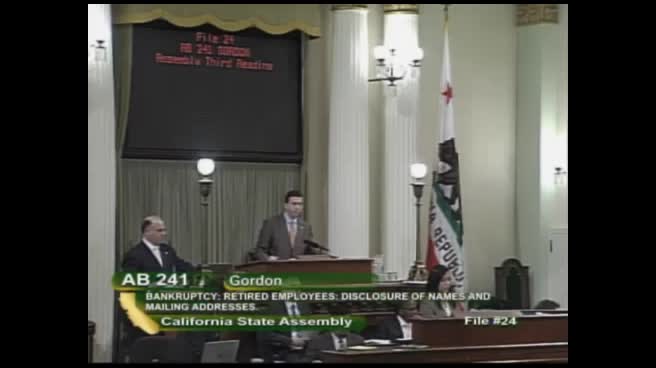 1MIN
Assembly Floor
 2MIN
Assembly Standing Committee on Appropriations
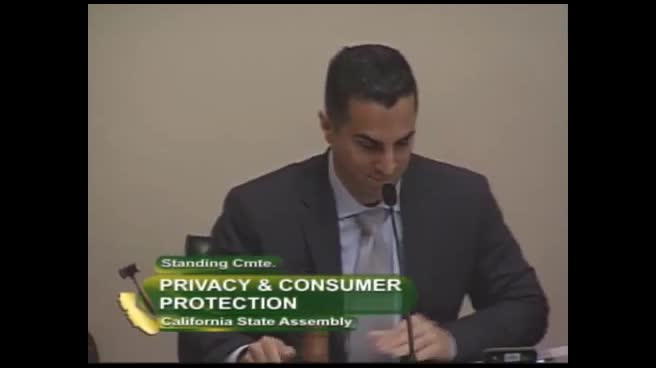 4MIN
Assembly Standing Committee on Privacy and Consumer Protection
Bill Author

Bill Co-Author(s):