AB 2427: Civil Procedure: discovery.
- Session Year: 2015-2016
- House: Assembly
- Latest Version Date: 2016-09-22
Existing law generally prohibits a copy, reproduction, or facsimile of any kind of a photograph, negative, or print, including instant photographs and video recordings, of the body, or any portion of the body, of a deceased person, taken by or for the coroner at the scene of death or in the course of a post mortem examination or autopsy, from being made or disseminated. This prohibition does not apply for use in a criminal action or proceeding in this state that relates to the death of that person, or, as a court permits, by order after good cause has been shown and after written notification of the request for the court order has been served, at least 5 days before the order is made, upon the district attorney of the county in which the post mortem examination or autopsy has been made or caused to be made.
This bill would additionally authorize the making or dissemination of a copy, reproduction, or facsimile described above for use or potential use in a civil action or proceeding that relates to the death of the deceased person (1) if the coroner receives written authorization from a legal heir or representative of the deceased person before the action is filed or while the action is pending and the legal heir or representative provides to the coroner a declaration under penalty of perjury, a valid form of identification, and a certified death certificate, or (2) if a subpoena is issued by a party who is a legal heir or representative of the deceased person in a pending civil action. By expanding the scope of the crime of perjury, the bill would impose a state-mandated local program.
Existing law prescribes the procedure for taking oral depositions inside the state and authorizes any party, after the setting of the initial trial date for an action, to demand the simultaneous exchange by all parties of lists containing the names and addresses of any persons expected to provide expert opinion testimony at the trial. Existing law also provides that a demand for an exchange of expert witness lists may include a demand for the production of discoverable reports and writings made by the listed expert witnesses. Existing law authorizes a party, to depose any expert disclosed in an expert witness list.
This bill would require a deponent who is served with a deposition notice or subpoena calling for electronically stored information to provide a means of gaining direct access to, or a translation into a reasonably usable form of, any information that is password protected or otherwise inaccessible. The bill would also require an expert who is served with a deposition notice, as specified, to produce any materials or category of materials, including any electronically stored information, no later than 3 business days before his or her deposition.
The California Constitution requires the state to reimburse local agencies and school districts for certain costs mandated by the state. Statutory provisions establish procedures for making that reimbursement.
This bill would provide that no reimbursement is required by this act for a specified reason.
Existing law generally prohibits a copy, reproduction, or facsimile of any kind of a photograph, negative, or print, including instant photographs and video recordings, of the body, or any portion of the body, of a deceased person, taken by or for the coroner at the scene of death or in the course of a post mortem examination or autopsy, from being made or disseminated. This prohibition does not apply for use in a criminal action or proceeding in this state that relates to the death of that person, or, as a court permits, by order after good cause has been shown and after written notification of the request for the court order has been served, at least 5 days before the order is made, upon the district attorney of the county in which the post mortem examination or autopsy has been made or caused to be made.
This bill would additionally authorize the making or dissemination of a copy, reproduction, or facsimile described above for use or potential use in a civil action or proceeding that relates to the death of the deceased person (1) if the coroner receives written authorization from a legal heir or representative of the deceased person before the action is filed or while the action is pending and the legal heir or representative provides to the coroner a declaration under penalty of perjury, a valid form of identification, and a certified death certificate, or (2) if a subpoena is issued by a party who is a legal heir or representative of the deceased person in a pending civil action. By expanding the scope of the crime of perjury, the bill would impose a state-mandated local program.
Existing law prescribes the procedure for taking oral depositions inside the state and authorizes any party, after the setting of the initial trial date for an action, to demand the simultaneous exchange by all parties of lists containing the names and addresses of any persons expected to provide expert opinion testimony at the trial. Existing law also provides that a demand for an exchange of expert witness lists may include a demand for the production of discoverable reports and writings made by the listed expert witnesses. Existing law authorizes a party, to depose any expert disclosed in an expert witness list.
This bill would require a deponent who is served with a deposition notice or subpoena calling for electronically stored information to provide a means of gaining direct access to, or a translation into a reasonably usable form of, any information that is password protected or otherwise inaccessible. The bill would also require that an expert who is served with a deposition notice, as specified, to produce any materials or category of materials, including any electronically stored information, and any discoverable reports and writings of an expert trial witness, demanded to be produced in the deposition notice be produced no later than 3 business days before the his or her deposition.
The California Constitution requires the state to reimburse local agencies and school districts for certain costs mandated by the state. Statutory provisions establish procedures for making that reimbursement.
This bill would provide that no reimbursement is required by this act for a specified reason.
Existing law generally prohibits a copy, reproduction, or facsimile of any kind of a photograph, negative, or print, including instant photographs and video recordings, of the body, or any portion of the body, of a deceased person, taken by or for the coroner at the scene of death or in the course of a post mortem examination or autopsy, from being made or disseminated. This prohibition does not apply for use in a criminal action or proceeding in this state that relates to the death of that person, or, as a court permits, by order after good cause has been shown and after written notification of the request for the court order has been served, at least 5 days before the order is made, upon the district attorney of the county in which the post mortem examination or autopsy has been made or caused to be made.
This bill would additionally authorize the making or dissemination of a copy, reproduction, or facsimile described above for use or potential use in a civil action or proceeding that relates to the death of the deceased person (1) if the coroner receives written authorization from a legal heir or representative of the deceased person before the action is filed or while the action is pending and the legal heir or representative provides to the coroner either a declaration under penalty of perjury and perjury, a valid form of identification, or and a certified death certificate, or (2) if a subpoena is issued by a party who is a legal heir or representative of the deceased person in a pending civil action. By expanding the scope of the crime of perjury, the bill would impose a state-mandated local program.
Existing law authorizes any party, after the setting of the initial trial date for an action, to demand the simultaneous exchange by all parties of lists containing the names and addresses of any persons expected to provide expert opinion testimony at the trial. Existing law also provides that a demand for an exchange of expert witness lists may include a demand for the production of discoverable reports and writings made by the listed expert witnesses. Existing law authorizes a party, to depose any expert disclosed in an expert witness list.
This bill would require that any materials or category of materials, including any electronically stored information, and any discoverable reports and writings of an expert trial witness, demanded to be produced in the deposition notice be produced no later than 3 business days before the deposition.
The California Constitution requires the state to reimburse local agencies and school districts for certain costs mandated by the state. Statutory provisions establish procedures for making that reimbursement.
This bill would provide that no reimbursement is required by this act for a specified reason.
Existing law generally prohibits a copy, reproduction, or facsimile of any kind of a photograph, negative, or print, including instant photographs and video recordings, of the body, or any portion of the body, of a deceased person, taken by or for the coroner at the scene of death or in the course of a postmortem post mortem examination or autopsy, from being made or disseminated. This prohibition does not apply for use in a criminal action or proceeding in this state that relates to the death of that person, or or, as a court permits, by order after good cause has been shown and after written notification of the request for the court order has been served, at least 5 days before the order is made, upon the district attorney of the county in which the postmortem post mortem examination or autopsy has been made or caused to be made.
This bill would additionally authorize the making or dissemination of a copy, reproduction, or facsimile described above for use or potential use in a civil action or proceeding that relates to the death of the deceased person (1) if the coroner receives written authorization from a legal heir or representative of the deceased person before the action is filed or while the action is pending, or pending and the legal heir or representative provides to the coroner either a declaration under penalty of perjury and a valid form of identification, or a certified death certificate, or (2) if a subpoena is issued by a party who is a legal heir or representative of the deceased person in a pending civil action. By expanding the scope of the crime of perjury, the bill would impose a state-mandated local program.
Existing law authorizes any party, after the setting of the initial trial date for an action, to demand the simultaneous exchange by all parties of lists containing the names and addresses of any persons expected to provide expert opinion testimony at the trial. Existing law also provides that a demand for an exchange of expert witness lists may include a demand for the production of discoverable reports and writings made by the listed expert witnesses. Existing law authorizes a party, to depose any expert disclosed in an expert witness list.
This bill would require that any materials or category of materials, including any electronically stored information, and any discoverable reports and writings of an expert trial witness, demanded to be produced in the deposition notice be produced no later than 3 business days before the deposition.
The California Constitution requires the state to reimburse local agencies and school districts for certain costs mandated by the state. Statutory provisions establish procedures for making that reimbursement.
This bill would provide that no reimbursement is required by this act for a specified reason.
Existing law generally prohibits a copy, reproduction, or facsimile of any kind of a photograph, negative, or print, including instant photographs and video recordings, of the body, or any portion of the body, of a deceased person, taken by or for the coroner at the scene of death or in the course of a postmortem examination or autopsy, from being made or disseminated. This prohibition does not apply for use in a criminal action or proceeding in this state that relates to the death of that person, or as a court permits, by order after good cause has been shown and after written notification of the request for the court order has been served, at least 5 days before the order is made, upon the district attorney of the county in which the postmortem examination or autopsy has been made or caused to be made.
This bill would additionally authorize the making or dissemination of a copy, reproduction, or facsimile described above for use or potential use in a civil action or proceeding that relates to the death of the deceased person if the coroner receives written authorization from a legal heir or representative of the deceased person before the action is filed or while the action is pending, or if a subpoena is issued in a pending civil action.
Existing law authorizes any party, after the setting of the initial trial date for an action, to demand the simultaneous exchange by all parties of lists containing the names and addresses of any persons expected to provide expert opinion testimony at the trial. Existing law also provides that a demand for an exchange of expert witness lists may include a demand for the production of discoverable reports and writings made by the listed expert witnesses. Existing law authorizes a party, to depose any expert disclosed in an expert witness list.
This bill would require that any materials or category of materials, including any electronically stored information, and any discoverable reports and writings of an expert trial witness, demanded to be produced in the deposition notice be produced no later than 3 business days before the deposition.
Existing law generally prohibits a copy, reproduction, or facsimile of any kind of a photograph, negative, or print, including instant photographs and video recordings, of the body, or any portion of the body, of a deceased person, taken by or for the coroner at the scene of death or in the course of a postmortem examination or autopsy, from being made or disseminated. This prohibition does not apply for use in a criminal action or proceeding in this state that relates to the death of that person, or as a court permits, by order after good cause has been shown and after written notification of the request for the court order has been served, at least 5 days before the order is made, upon the district attorney of the county in which the postmortem examination or autopsy has been made or caused to be made.
This bill would additionally authorize the making or dissemination of a copy, reproduction, or facsimile described above for use or potential use in a civil action or proceeding that relates to the death of the deceased person if the coroner receives written authorization from a legal heir or representative of the deceased person before the action is filed or while the action is pending, or if a subpoena is issued in a pending civil action.
(a)Notwithstanding any other law, a copy, reproduction, or facsimile of any kind of a photograph, negative, or print, including instant photographs and video recordings, of the body, or any portion of the body, of a deceased person, taken by or for the coroner at the scene of death or in the course of a post mortem examination or autopsy, shall not be made or disseminated except as follows:
(1)For use in a criminal action or proceeding in this state that relates to the death of that person.
(2)As a court of this state permits, by order after good cause has been shown and after written notification of the request for the court order has been served, at least five days before the order is made, upon the district attorney of the county in which the post mortem examination or autopsy has been made or caused to be made.
(3)For use or potential use in a civil action or proceeding in this state that relates to the death of that person, if either of the following applies:
(A)The coroner receives written authorization from a legal heir or representative of that person before the action is filed or while the action is pending. To verify the identity of the legal heir or representative, all of the following shall be provided to the coroner:
(i)A declaration under penalty of perjury that the individual is a legal heir or representative of the deceased person.
(ii)A valid form of identification.
(iii)A certified death certificate.
(B)A subpoena is issued by a party who is a legal heir or representative of the deceased person in a pending civil action.
(b)This section shall not apply to the making or dissemination of a copy, reproduction, or facsimile for use in the field of forensic pathology, in medical or scientific education or research, or by a coroner or any law enforcement agency in the United States for investigative purposes, including identification and identification confirmation.
(c)This section shall apply to a copy, reproduction, or facsimile, and to a photograph, negative, or print, regardless of when it was made.
(d)A coroner is not personally liable for monetary damages in a civil action for any act or omission in compliance with this section.
SEC. 2.Section 2025.280 of the Code of Civil Procedure is amended to read:2025.280.(a)The service of a deposition notice under Section 2025.240 is effective to require any deponent who is a party to the action or an officer, director, managing agent, or employee of a party to attend and to testify, as well as to produce any document, electronically stored information, or tangible thing for inspection and copying.
(b)The attendance and testimony of any other deponent, as well as the production by the deponent of any document, electronically stored information, or tangible thing for inspection and copying, requires the service on the deponent of a deposition subpoena under Chapter 6 (commencing with Section 2020.010).
(c)A deponent required by notice or subpoena to produce electronically stored information shall provide a means of gaining direct access to, or a translation into a reasonably usable form of, any electronically stored information that is password protected or otherwise inaccessible.
SEC. 3.Section 2034.415 is added to the Code of Civil Procedure, to read:2034.415.An expert described in subdivision (b) of Section 2034.210 whose deposition is noticed pursuant to Section 2025.220 shall, no later than three business days before his or her deposition, produce any materials or category of materials, including any electronically stored information, called for by the deposition notice.
SEC. 4.No reimbursement is required by this act pursuant to Section 6 of Article XIIIB of the California Constitution because the only costs that may be incurred by a local agency or school district will be incurred because this act creates a new crime or infraction, eliminates a crime or infraction, or changes the penalty for a crime or infraction, within the meaning of Section 17556 of the Government Code, or changes the definition of a crime within the meaning of Section 6 of Article XIIIB of the California Constitution.
(a)Notwithstanding any other law, a copy, reproduction, or facsimile of any kind of a photograph, negative, or print, including instant photographs and video recordings, of the body, or any portion of the body, of a deceased person, taken by or for the coroner at the scene of death or in the course of a post mortem examination or autopsy, shall not be made or disseminated except as follows:
(1)For use in a criminal action or proceeding in this state that relates to the death of that person.
(2)As a court of this state permits, by order after good cause has been shown and after written notification of the request for the court order has been served, at least five days before the order is made, upon the district attorney of the county in which the post mortem examination or autopsy has been made or caused to be made.
(3)For use or potential use in a civil action or proceeding in this state that relates to the death of that person, if either of the following applies:
(A)The coroner receives written authorization from a legal heir or representative of that person before the action is filed or while the action is pending. To verify the identity of the legal heir or representative, all of the following shall be provided to the coroner:
(i)A declaration under penalty of perjury that the individual is a legal heir or representative of the deceased person.
(ii)A valid form of identification.
(iii)A certified death certificate.
(B)A subpoena is issued by a party who is a legal heir or representative of the deceased person in a pending civil action.
(b)This section shall not apply to the making or dissemination of a copy, reproduction, or facsimile for use in the field of forensic pathology, in medical or scientific education or research, or by a coroner or any law enforcement agency in the United States for investigative purposes, including identification and identification confirmation.
(c)This section shall apply to a copy, reproduction, or facsimile, and to a photograph, negative, or print, regardless of when it was made.
(d)A coroner is not personally liable for monetary damages in a civil action for any act or omission in compliance with this section.
SEC. 2.Section 2025.280 of the Code of Civil Procedure is amended to read:2025.280.(a)The service of a deposition notice under Section 2025.240 is effective to require any deponent who is a party to the action or an officer, director, managing agent, or employee of a party to attend and to testify, as well as to produce any document, electronically stored information, or tangible thing for inspection and copying.
(b)The attendance and testimony of any other deponent, as well as the production by the deponent of any document, electronically stored information, or tangible thing for inspection and copying, requires the service on the deponent of a deposition subpoena under Chapter 6 (commencing with Section 2020.010).
(c)A deponent required by notice or subpoena to produce electronically stored information shall provide a means of gaining direct access to, or a translation into a reasonably usable form of, any electronically stored information that is password protected or otherwise inaccessible.
SEC. 2.SEC. 3.Section 2034.415 is added to the Code of Civil Procedure, to read:2034.415.Any materials or category of materials, including any electronically stored information, and any discoverable reports and writings of an expert trial witness, demanded to be produced in the deposition notice shall be produced no later than three business days before the deposition of the expert trial witness.An expert described in subdivision (b) of Section 2034.210 whose deposition is noticed pursuant to Section 2025.220 shall, no later than three business days before his or her deposition, produce any materials or category of materials, including any electronically stored information, called for by the deposition notice.
SEC. 3.SEC. 4.No reimbursement is required by this act pursuant to Section 6 of Article XIIIB of the California Constitution because the only costs that may be incurred by a local agency or school district will be incurred because this act creates a new crime or infraction, eliminates a crime or infraction, or changes the penalty for a crime or infraction, within the meaning of Section 17556 of the Government Code, or changes the definition of a crime within the meaning of Section 6 of Article XIIIB of the California Constitution.
(a)Notwithstanding any other law, a copy, reproduction, or facsimile of any kind of a photograph, negative, or print, including instant photographs and video recordings, of the body, or any portion of the body, of a deceased person, taken by or for the coroner at the scene of death or in the course of a post mortem examination or autopsy, shall not be made or disseminated except as follows:
(1)For use in a criminal action or proceeding in this state that relates to the death of that person.
(2)As a court of this state permits, by order after good cause has been shown and after written notification of the request for the court order has been served, at least five days before the order is made, upon the district attorney of the county in which the post mortem examination or autopsy has been made or caused to be made.
(3)For use or potential use in a civil action or proceeding in this state that relates to the death of that person, if either of the following applies:
(A)The coroner receives written authorization from a legal heir or representative of that person before the action is filed or while the action is pending. To verify the identity of the legal heir or representative, either all of the following shall be provided to the coroner:
(i)A declaration under penalty of perjury that the individual is a legal heir or representative of the deceased person and a valid form of identification. person.
(ii)A valid form of identification.
(ii)
(iii)A certified death certificate.
(B)A subpoena is issued by a party who is a legal heir or representative of the deceased person in a pending civil action.
(b)This section shall not apply to the making or dissemination of a copy, reproduction, or facsimile for use in the field of forensic pathology, in medical or scientific education or research, or by a coroner or any law enforcement agency in the United States for investigative purposes, including identification and identification confirmation.
(c)This section shall apply to a copy, reproduction, or facsimile, and to a photograph, negative, or print, regardless of when it was made.
(d)A coroner is not personally liable for monetary damages in a civil action for any act or omission in compliance with this section.
SEC. 2.Section 2034.415 is added to the Code of Civil Procedure, to read:2034.415.Any materials or category of materials, including any electronically stored information, and any discoverable reports and writings of an expert trial witness, demanded to be produced in the deposition notice shall be produced no later than three business days before the deposition of the expert trial witness.
SEC. 3.No reimbursement is required by this act pursuant to Section 6 of Article XIIIB of the California Constitution because the only costs that may be incurred by a local agency or school district will be incurred because this act creates a new crime or infraction, eliminates a crime or infraction, or changes the penalty for a crime or infraction, within the meaning of Section 17556 of the Government Code, or changes the definition of a crime within the meaning of Section 6 of Article XIIIB of the California Constitution.
(a)Notwithstanding any other law, a copy, reproduction, or facsimile of any kind of a photograph, negative, or print, including instant photographs and video recordings, of the body, or any portion of the body, of a deceased person, taken by or for the coroner at the scene of death or in the course of a post mortem examination or autopsy, shall not be made or disseminated except as follows:
(1)For use in a criminal action or proceeding in this state that relates to the death of that person.
(2)As a court of this state permits, by order after good cause has been shown and after written notification of the request for the court order has been served, at least five days before the order is made, upon the district attorney of the county in which the post mortem examination or autopsy has been made or caused to be made.
(3)For use or potential use in a civil action or proceeding in this state that relates to the death of that person, if either of the following applies:
(A)The coroner receives written authorization from a legal heir or representative of that person before the action is filed or while the action is pending. To verify the identity of the legal heir or representative, either of the following shall be provided to the coroner:
(i)A declaration under penalty of perjury that the individual is a legal heir or representative of the deceased person and a valid form of identification.
(ii)A certified death certificate.
(B)A subpoena is issued by a party who is a legal heir or representative of the deceased person in a pending civil action.
(b)This section shall not apply to the making or dissemination of a copy, reproduction, or facsimile for use in the field of forensic pathology, in medical or scientific education or research, or by a coroner or any law enforcement agency in the United States for investigative purposes, including identification and identification confirmation.
(c)This section shall apply to a copy, reproduction, or facsimile, and to a photograph, negative, or print, regardless of when it was made.
(d)A coroner is not personally liable for monetary damages in a civil action for any act or omission in compliance with this section.
SEC. 2.Section 2034.415 is added to the Code of Civil Procedure, to read:2034.415.Any materials or category of materials, including any electronically stored information, and any discoverable reports and writings of an expert trial witness, demanded to be produced in the deposition notice shall be produced no later than three business days before the deposition of the expert trial witness.
SEC. 3.No reimbursement is required by this act pursuant to Section 6 of Article XIIIB of the California Constitution because the only costs that may be incurred by a local agency or school district will be incurred because this act creates a new crime or infraction, eliminates a crime or infraction, or changes the penalty for a crime or infraction, within the meaning of Section 17556 of the Government Code, or changes the definition of a crime within the meaning of Section 6 of Article XIIIB of the California Constitution.
(a)Notwithstanding any other law, a copy, reproduction, or facsimile of any kind of a photograph, negative, or print, including instant photographs and video recordings, of the body, or any portion of the body, of a deceased person, taken by or for the coroner at the scene of death or in the course of a post mortem examination or autopsy, shall not be made or disseminated except as follows:
(1)For use in a criminal action or proceeding in this state that relates to the death of that person.
(2)As a court of this state permits, by order after good cause has been shown and after written notification of the request for the court order has been served, at least five days before the order is made, upon the district attorney of the county in which the post mortem examination or autopsy has been made or caused to be made.
(3)For use or potential use in a civil action or proceeding in this state that relates to the death of that person, if either of the following applies:
(A)The coroner receives written authorization from a legal heir or representative of that person before the action is filed or while the action is pending.
(B)A subpoena is issued in a pending civil action.
(b)This section shall not apply to the making or dissemination of a copy, reproduction, or facsimile for use in the field of forensic pathology, in medical or scientific education or research, or by a coroner or any law enforcement agency in the United States for investigative purposes, including identification and identification confirmation.
(c)This section shall apply to a copy, reproduction, or facsimile, and to a photograph, negative, or print, regardless of when it was made.
(d)A coroner is not personally liable for monetary damages in a civil action for any act or omission in compliance with this section.
SEC. 2.Section 2034.415 is added to the Code of Civil Procedure, to read:2034.415.Any materials or category of materials, including any electronically stored information, and any discoverable reports and writings of an expert trial witness, demanded to be produced in the deposition notice shall be produced no later than three business days before the deposition of the expert trial witness.
(a)Notwithstanding any other law, a copy, reproduction, or facsimile of any kind of a photograph, negative, or print, including instant photographs and video recordings, of the body, or any portion of the body, of a deceased person, taken by or for the coroner at the scene of death or in the course of a post mortem examination or autopsy, shall not be made or disseminated except as follows:
(1)For use in a criminal action or proceeding in this state that relates to the death of that person.
(2)As a court of this state permits, by order after good cause has been shown and after written notification of the request for the court order has been served, at least five days before the order is made, upon the district attorney of the county in which the post mortem examination or autopsy has been made or caused to be made.
(3)For use or potential use in a civil action or proceeding in this state that relates to the death of that person, if either of the following applies:
(A)The coroner receives written authorization from a legal heir or representative of that person before the action is filed or while the action is pending.
(B)A subpoena is issued in a pending civil action.
(b)This section shall not apply to the making or dissemination of a copy, reproduction, or facsimile for use in the field of forensic pathology, in medical or scientific education or research, or by a coroner or any law enforcement agency in the United States for investigative purposes, including identification and identification confirmation.
(c)This section shall apply to a copy, reproduction, or facsimile, and to a photograph, negative, or print, regardless of when it was made.
(d)A coroner is not personally liable for monetary damages in a civil action for any act or omission in compliance with this section.
|
Date
|
Status
|
|---|---|
| May 31, 2016 | Read third time. Passed. Ordered to the Senate. (Ayes 80. Noes 0. Page 5015.) |
| Sep 9, 2016 | Enrolled and presented to the Governor at 2:30 p.m. |
| Aug 30, 2016 | Senate amendments concurred in. To Engrossing and Enrolling. (Ayes 79. Noes 0. Page 6440.). |
| Aug 30, 2016 | Senate amendments concurred in. To Engrossing and Enrolling. |
| Aug 25, 2016 | In Assembly. Concurrence in Senate amendments pending. May be considered on or after August 28 pursuant to Assembly Rule 77. |
| Aug 24, 2016 | Read third time. Passed. Ordered to the Assembly. (Ayes 39. Noes 0. Page 5368.). |
| Aug 24, 2016 | Read third time. Passed. Ordered to the Assembly. |
| Aug 22, 2016 | Read second time. Ordered to third reading. |
| Aug 19, 2016 | Read third time and amended. Ordered to second reading. |
| Aug 2, 2016 | Read second time. Ordered to third reading. |
| Aug 1, 2016 | From committee: Be placed on second reading file pursuant to Senate Rule 28.8. |
| Jun 28, 2016 | Read second time and amended. Re-referred to Com. on APPR. |
| Jun 27, 2016 | From committee: Amend, and do pass as amended and re-refer to Com. on APPR. (Ayes 7. Noes 0.) (June 21). |
| Jun 9, 2016 | Referred to Com. on JUD. |
| Jun 1, 2016 | In Senate. Read first time. To Com. on RLS. for assignment. |
| May 31, 2016 | Read third time. Passed. Ordered to the Senate. (Ayes 80. Noes 0.) |
| Feb 19, 2016 | Introduced. To print. |
| May 31, 2016 | Read third time. Passed. Ordered to the Senate. |
| May 27, 2016 | Ordered to third reading. |
| May 27, 2016 | From Consent Calendar. |
| May 19, 2016 | Read second time. Ordered to Consent Calendar. |
| May 18, 2016 | From committee: Do pass. To Consent Calendar. (Ayes 20. Noes 0.) (May 18). |
| May 5, 2016 | Read second time. Ordered to third reading. |
| May 5, 2016 | Re-referred to Com. on APPR. pursuant to Joint Rule 10.5. |
| May 4, 2016 | Read second time and amended. Ordered returned to second reading. |
| May 3, 2016 | From committee: Amend, and do pass as amended. (Ayes 10. Noes 0.) (May 3). |
| Apr 13, 2016 | Re-referred to Com. on JUD. |
| Apr 12, 2016 | In committee: Hearing postponed by committee. |
| Apr 12, 2016 | From committee chair, with author's amendments: Amend, and re-refer to Com. on JUD. Read second time and amended. |
| Mar 8, 2016 | Referred to Com. on JUD. |
| Feb 22, 2016 | Read first time. |
| Feb 21, 2016 | From printer. May be heard in committee March 22. |
|
Date
|
Description
|
Location
|
Votes
|
|
|---|---|---|---|---|
| Aug 30, 2016 | AB 2427 CHAU Concurrence in Senate Amendments | Assembly Floor |
Passed |
|
| Aug 24, 2016 | Assembly 3rd Reading AB2427 Chau By Block | Senate Floor |
Passed |
|
| Jun 21, 2016 | Do pass as amended, but first amend, and re-refer to the Committee on [Appropriations] | Senate Standing Committee on Judiciary |
Passed |
|
| May 31, 2016 | AB 2427 CHAU Assembly Third Reading | Assembly Floor |
Passed |
|
| May 18, 2016 | Do pass. To Consent Calendar. | Assembly Standing Committee on Appropriations |
Passed |
|
| May 3, 2016 | Do pass as amended. | Assembly Standing Committee on Judiciary |
Passed |
This list shows positions taken on this bill by organizations on the date displayed, which is linked to the original source.
Positions by individuals are not included.
|
Organization
|
Position
|
Date
|
|---|---|---|
| Anthem Blue Cross | * Against | Jun 27, 2018 |
| California Defense Counsel | ** Support | Aug 24, 2016 |
| California State Sheriffs' Association | ** Against | Aug 24, 2016 |
| Consumer Attorneys Of California | ** Support | Aug 24, 2016 |
| Health Net | * Against | Jun 27, 2018 |
CONCURRENCE IN SENATE AMENDMENTS
CSA1 Bill Id:AB 2427
Author:(Chau)
As Amended Ver:August 19, 2016
Majority vote
ASSEMBLY: | 80-0 | (May 31, 2016) | SENATE: | 39-0 | (August 24, 2016) |
Original Committee Reference: JUD.
SUMMARY: Streamlines the use of postmortem images in civil actions and ensures timely production of expert witness reports before depositions. Specifically, this bill:
- Authorizes the use of postmortem images, as provided, for use or potential use in a civil action or proceeding that relates to the death of the deceased person, if:
- A coroner receives written authorization from a legal heir or representative of the deceased person before the action is filed or while the action is pending. To verify identity, the following shall be provided to the coroner: i) a declaration under penalty of perjury that the individual is a legal heir or representative, and a valid form of identification; or ii) a certified death certificate.
- A subpoena is issued by a party who is a legal heir or representative of the deceased person in a pending civil action.
- Requires that a trial expert who is noticed for a deposition shall produce any materials or category of materials called for by the deposition notice no later than three business days before his or her deposition.
- Specifies that a deponent required to produce electronically stored information shall provide a means of gaining direct access to, or a translation into a reasonably usable form of, any electronically stored information that is password protected or otherwise inaccessible.
The Senate amendments specify that a deponent required to produce electronically stored information shall provide a means of gaining direct access to, or a translation into a reasonably usable form of, any electronically stored information that is password protected or otherwise inaccessible, and provide clarifying technical amendments
FISCAL EFFECT: According to the Senate Appropriations Committee, pursuant to Senate Rule 28.8, negligible state costs.
COMMENTS: This bill represents the annual effort by the plaintiffs' and defense bar to jointly sponsor civil procedure legislation that seeks to create efficiencies in civil litigation, seeking to improve the process for litigants, attorneys, and the courts. Specifically, this bill adds two civil procedure efficiencies; the first provision involves postmortem images in civil actions (making it easier for heirs to obtain them); the second provision involves the timing of the production of materials requested in deposition notice of an expert witness (requiring that materials be provided three days prior to a deposition).
This bill's first provision streamlines the process for families to obtain postmortem images. Currently, it is unlawful to disseminate or reproduce postmortem images taken by or for the coroner at the scene of death or in the course of a postmortem examination or autopsy unless the images are used for a criminal action involving the death of the person, or a court has issued an order upon good cause, as provided. Consistent with existing law to ensure that family's privacy rights are protected, this bill allows postmortem images to be used in a civil action either when the coroner receives written authorization from a legal heir or representative of the deceased person, or when a civil subpoena has been issued. In order to ensure that the bill does not violate a family's privacy interests, this bill requires families to verify status as a legal heir or representative before obtaining postmortem photos by either providing a declaration under penalty of perjury and valid identification, or a copy of a certified death certificate, which is only issued to specific surviving family members. Although existing law allows families to obtain postmortem images through a court order for civil cases, it seems reasonable to allow families to obtain postmortem to help those families determine for themselves whether they should pursue litigation. Indeed, to the extent that families receive images and decide not to pursue a wrongful death claim, this bill would reduce burdens on the court and the county coroner who might have been subpoenaed to testify on the postmortem images. Additionally, the bill provides privacy safeguards to ensure that only legal heirs and representatives may obtain a copy of the images.
This bill's second provision improves the timing of the production of materials requested in a deposition notice of an expert witness. Under current law, a party seeking to take the deposition of a retained expert may specify in a deposition notice the materials or category of materials to be produced by the deponent. Since an expert will usually bring those materials on the day of the deposition, the deposing party may not have time to review those materials before the expert’s deposition. This bill requires that when a retained expert is subject to a deposition notice to produce materials or category of materials, including electronically stored information, the expert shall produce those materials no later than three business days before his or her deposition. According to the author, this is intended to encourage efficiencies in depositions, and reduce costs for all parties during trial. Given that the law does not expressly provide for when an expert must produce his or her file for a deposition, a three-day window appears to be a reasonable approach to create efficiencies during expert discovery. To the extent that requested materials are password protected or otherwise inaccessible, this bill also requires a deponent to provide the means of gaining direct access to, or a translation into a reasonably usable form of, any electronically stored information that is password protected.
Analysis Prepared by: Eric Dang / JUD. / (916) 319-2334 FN: 0004780
Office of Senate Floor Analyses (916) 651-1520 Fax: (916) 327-4478 | AB |
THIRD READING
Bill No: AB 2427
:
SENATE JUDICIARY COMMITTEE: 7-0, 6/21/16
AYES: Jackson, Moorlach, Anderson, Hertzberg, Leno, Monning, Wieckowski
SENATE APPROPRIATIONS COMMITTEE: Senate Rule 28.8
ASSEMBLY FLOOR: 80-0, 5/31/16 - See last page for vote
SOURCE: California Defense Counsel
Consumer Attorneys of California
DIGEST: This bill establishes a new exception to an existing prohibition against the making or disseminating of any postmortem images taken by or for the coroner, by allowing for the use of those postmortem images in a civil action or proceeding that relates to the death of the deceased person, if certain conditions are met. This bill separately requires an expert whose deposition is noticed, as specified, to, no later than three business days before his or her deposition, produce any materials or category of materials, including any electronically stored information (ESI), called for by the deposition notice. This bill also requires deponents who are required to produce ESI, as specified, to provide a means of gaining direct access to, or a translation into a reasonably usable form of, any ESI that is password protected or otherwise inaccessible.
Senate Floor Amendments of 8/19/16 made clarifying changes to the provision regarding the production of materials, including ESI, by expert witnesses and ensure that parties have access to password protected or otherwise inaccessible ESI, as specified.
Existing law:
- Provides, under article I, Section 1 of California Constitution, that, among other rights, all people have an inalienable right to pursue and obtain privacy.
- Provides, under Section 129 of the Code of Civil Procedure, that, notwithstanding any other provision of law, a copy, reproduction, or facsimile of any kind of any photograph, negative, or print, including instant photographs and video recordings, of the body, or any portion of the body, of a deceased person, taken by or for the coroner at the scene of death or in the course of a post mortem examination or autopsy shall not be made or disseminated. Existing law recognizes the following limited exceptions to this rule:
- For use in a criminal action or proceeding in this state that relates to the death of that person; and
- As a court of this state permits, by order after good cause has been shown and after written notification of the request for the court order has been served, at least five days before the order is made, upon the district attorney of the county in which the post mortem examination or autopsy has been made or caused to be made.
- Provides, among other things, that the above prohibition does not apply to the making or dissemination of such a copy, reproduction, or facsimile for use in the field of forensic pathology, for use in medical or scientific education or research, or by a coroner or any law enforcement agency in this or any other state or the United States for investigative purposes, including identification and identification confirmation.
- Provides that these above provisions apply to a copy, reproduction, or facsimile, and to a photograph, negative, or print, regardless of when it was made.
- Requires, pursuant to the Health and Safety Code, that the State Registrar prepare and maintain comprehensive and continuous indices of all certificates registered. Existing law provides that the comprehensive birth and death record indices be kept confidential and exempt from the Public Records Act, except as specified. Existing law requires that the State Registrar prepare and maintain separate noncomprehensive indices of all birth and death records for public release.
- Provides, in relevant part, that the State Registrar, local registrar, or county recorder shall, upon request and payment of the required fee, supply to an applicant a certified copy of the record of a birth, fetal death, death, marriage, or marriage dissolution registered with the official, only as authorized by law, below.
- Authorizes the State Registrar, local registrar, or county recorder to furnish a certified copy of birth, death, or marriage to applicants upon request if:
- The request is written, faxed, or is a digitized image of a request for a certified copy, and is accompanied by a notarized statement, sworn under penalty of perjury, that the requester is an authorized person, as defined; or,
- The request is made in person, and the official takes a statement, sworn under penalty of perjury, that the requester is signing his or her own legal name and is an “authorized person.” (Health & Saf. Code Sec. 103526(a).)
- Defines “authorized person,” for purposes of obtaining certified copies of birth, death, or nonconfidential marriage records, as any of the following:
- The person who is the subject of the record or his or her parent or legal guardian;
- A party who is entitled to receive the record as a result of a court order;
- Law enforcement or governmental agency personnel conducting official business;
- A child, grandchild, sibling, spouse, domestic partner, or grandparent of the person who is the subject of the record;
- An attorney or other person empowered to act on behalf of the person who is the subject of the record; or
- An agent or employee of a funeral establishment who orders death certificates when acting on behalf of specified individuals. (Health & Saf. Code Sec. 103526(c)(2).)
- Provides that, in all other cases in which the requester does not meet the requirements of an authorized person, a certified copy may be provided to the requester but the document shall be an informational certified copy and shall be redacted to remove any signatures that appear on the document. Existing law requires that such a certified copy contain the statement “INFORMATIONAL, NOT A VALID DOCUMENT TO ESTABLISH IDENTITY.”
- Requires that certified copies of a birth, death or marriage record issued pursuant to the above, contain specified information and be printed on sensitized security paper with specified features, including, among other things, a watermark, fluorescent security threads, and fluorescent fibers and requires that the State Registrar, local registrars, county recorders, and county clerks take precautions to safeguard the security paper.
- Sets forth, under the Civil Discovery Act, the procedures, timeframes, and scope by which parties to a civil action conduct and obtain “discovery.” Methods of discovery include oral or written depositions; interrogatories; inspections of documents, things, and places; physical and mental examinations; and simultaneous exchanges of expert trial witness information. Existing law, the Civil Discovery Act, specifies rules for the demand and exchange of expert witness information.
- Sets forth, under the Civil Discovery Act, that the service of a deposition notice, under specified law, is effective to require any deponent who is a party to the action or an officer, director, managing agent, or employee of a party to attend and to testify, as well as to produce any document, electronically stored information (ESI), or tangible thing for inspection and copying. Further provides that the attendance and testimony of any other (non-party) deponent, as well as the production by the deponent of any document, ESI, or tangible thing for inspection and copying, requires the service on the deponent of a deposition subpoena under other specified law.
This bill:
- Adds a new exception to the general prohibition against the making of disseminating of a copy, reproduction, or facsimile of any kind of postmortem photographs, negatives, or prints, as specified, above. The new exception would be for the use or potential use in a civil action or proceeding in this state that relates to the death of that person, if either of the following applies:
- The coroner receives written authorization from a legal heir or representative of that person, as specified below, before the action is filed or while it is pending; or
- A subpoena is issued by a party who is a legal heir or representative of the deceased person in a pending civil action.
- Specifies for the above purposes, that to verify the identity of the legal heir or representative, either of the following shall be provided to the coroner:
- A declaration under penalty of perjury that the individual is a legal heir or representative of the deceased person;
- A valid form of identification; and
- A certified death certificate.
- Adds to the Civil Discovery Act a requirement that an expert whose deposition is noticed, as specified, to, no later than three business days before his or her deposition, produce any materials or category of materials, including any ESI, called for by the deposition notice. Also adds that a deponent required by notice or subpoena to produce ESI shall provide a means of gaining direct access to, or a translation into a reasonably usable form of, any ESI that is password protected or otherwise inaccessible.
Background
Section 129 of the Code of Civil Procedure expressly precludes the making or dissemination of any photographs of a deceased person’s body, notwithstanding any other law and with very limited exceptions. Those exceptions generally allow the use of autopsy images in the following circumstances: in criminal trials relating to the decedent; with court approval; for use by law enforcement; or for medical and scientific education and research. This section effectively recognizes that a veil of privacy surrounds these photographs, but for narrow purposes. When Section 129 was enacted in 1968, the urgency clause reflected that the section services this state’s policy of protecting “individuals and families against unconscionable invasions of their privacy” and that “[t]he reproduction, for unrelated and improper purposes, of any photograph of the body of a deceased person taken in the course of a post mortem examination or autopsy is contrary to such a policy.” The coauthor of that original legislation described the purpose of that section as vindicating “the family of a deceased person[‘s] . . . right to privacy to limit reproduction of gruesome autopsy photographs.” (Marsh v. County of San Diego (2012) 680 F.3d 1148, 1156; see also AB 4 (Bear and Unruh, Ch. 6, Stats. 1968).)
Separately, the Code of Civil Procedure provides for the formal exchange of evidentiary information and materials between parties to a pending action. This process is known as discovery. Generally, California’s Civil Discovery Act permits any party to a civil action to obtain discovery regarding any matter, not privileged, that is relevant to the subject matter in the pending action or to the determination of any motion made in that action, if the matter either is admissible in evidence or appears reasonably calculated to lead to the discovery of admissible evidence. Under that Act, primary devices to conduct discovery include interrogatories, depositions, requests for admissions, and requests for production. Another device by which to conduct discovery, directly relevant to this bill, is by way of simultaneous exchanges of expert trial witness information.
This bill, co-sponsored by the plaintiff and defense bars, seeks to allow for the use of postmortem images in civil actions and to ensure timely production of expert witness reports before depositions.
Comments
As stated by the author, “AB 2427 will contribute to judicial efficiency by making litigation more productive, which will benefit litigants, lawyers and courts.” Specifically, the author writes, “this bill adds two civil procedure efficiencies: the first provision involves postmortem images in civil actions (making it easier for heirs to obtain them); the second provision involves the timing of reports created by expert witnesses for a deposition (requiring them to be provided three days prior to a deposition).”
FISCAL EFFECT: Appropriation: Fiscal Com.: Local:
California Defense Counsel (co-source)
Consumer Attorneys of California (co-source)
OPPOSITION: (Verified 8/19/16)
California State Sheriffs’ Association
ARGUMENTS IN SUPPORT: Co-sponsor, Consumer Attorneys of California writes in support of this expanded authorization for postmortem photographs:
Currently legal heirs or representatives of a deceased individual cannot access any coroners’ photographs of their deceased family member without first obtaining counsel and seeking permission from the court. Code of Civil Procedure [Sec.] 129.
Currently a deceased person’s next of kin cannot view these photographs prior to determining whether or not they deem it necessary to seek legal representation. Instead, legal heirs and representatives must incur the expense to retain an attorney and obtain a court order. Only then can they access the coroner’s photographs and based on that information decide how to proceed. AB 2427 ensures that identify is verified by either providing a declaration under penalty of perjury and valid identification, or a copy of a certified death certificate, which is only issued to specific surviving family members.
Co-sponsor, California Defense Counsel (CDC) writes that “[w]hile current law permits counsel to request production of materials, reports and writings that will be relied upon by experts in their depositions, the law does not provide an express time requirement for the production of the expert’s file. In many cases these expert files are not produced until the deposition actually begins, providing no time for the lawyer conducting the deposition to become familiar with the contents. Depositions are less productive as a result.” As stated by CDC, “AB 2427 is part of the continuing effort by the plaintiff’s and defense bar to create efficiencies in civil litigation, to the benefit of litigants, lawyers, and courts. More meaningful, productive depositions will save time and money for litigants and lawyers, and may reduce the need for judicial intervention in the discovery process.”
ARGUMENTS IN OPPOSITION: In opposition, the California State Sheriffs’ Association (CSSA) writes that “existing law strikes the appropriate balance among appropriate access to postmortem photographs via court order family privacy and coroner workload.” CSSA is concerned that allowing access to these records prior to the filing of an action and without consideration of a judge will result in increased workload and fishing expeditions for wrongful death actions that may never ultimately be filed.
ASSEMBLY FLOOR: 80-0, 5/31/16
AYES: Achadjian, Alejo, Travis Allen, Arambula, Atkins, Baker, Bigelow, Bloom, Bonilla, Bonta, Brough, Brown, Burke, Calderon, Campos, Chang, Chau, Chávez, Chiu, Chu, Cooley, Cooper, Dababneh, Dahle, Daly, Dodd, Eggman, Frazier, Beth Gaines, Gallagher, Cristina Garcia, Eduardo Garcia, Gatto, Gipson, Gomez, Gonzalez, Gordon, Gray, Grove, Hadley, Harper, Roger Hernández, Holden, Irwin, Jones, Jones-Sawyer, Kim, Lackey, Levine, Linder, Lopez, Low, Maienschein, Mathis, Mayes, McCarty, Medina, Melendez, Mullin, Nazarian, Obernolte, O'Donnell, Olsen, Patterson, Quirk, Ridley-Thomas, Rodriguez, Salas, Santiago, Steinorth, Mark Stone, Thurmond, Ting, Wagner, Waldron, Weber, Wilk, Williams, Wood, Rendon
Prepared by: Ronak Daylami / JUD. / (916) 651-4113
8/22/16 23:03:49
**** END ****
Office of Senate Floor Analyses (916) 651-1520 Fax: (916) 327-4478 | AB |
THIRD READING
Bill No: AB 2427
:
SENATE JUDICIARY COMMITTEE: 7-0, 6/21/16
AYES: Jackson, Moorlach, Anderson, Hertzberg, Leno, Monning, Wieckowski
SENATE APPROPRIATIONS COMMITTEE: Senate Rule 28.8
ASSEMBLY FLOOR: 80-0, 5/31/16 - See last page for vote
SOURCE: California Defense Counsel
Consumer Attorneys of California
DIGEST: This bill establishes a new exception to an existing prohibition against the making or disseminating of any postmortem images taken by or for the coroner, as specified. Specifically, this bill allows for the use of those postmortem images in a civil action or proceeding that relates to the death of the deceased person, if either: (1) written authorization is provided by a legal heir or representative of the deceased person, as specified, before the action is filed or while the action is pending; or (2) a subpoena is issued by a party who is a legal heir or representative of the deceased person in a pending civil action. This bill separately requires that any materials or category of materials, including any electronically stored information, and any discoverable reports and writings of an expert trial witness, demanded to be produced in a deposition notice be produced no later than three business days before the deposition of the expert trial witness.
Existing law:
- Provides, under article I, Section 1 of California Constitution, that, among other rights, all people have an inalienable right to pursue and obtain privacy.
- Provides, under Section 129 of the Code of Civil Procedure, that, notwithstanding any other provision of law, a copy, reproduction, or facsimile of any kind of any photograph, negative, or print, including instant photographs and video recordings, of the body, or any portion of the body, of a deceased person, taken by or for the coroner at the scene of death or in the course of a post mortem examination or autopsy shall not be made or disseminated. Existing law recognizes the following limited exceptions to this rule:
- For use in a criminal action or proceeding in this state that relates to the death of that person; and
- As a court of this state permits, by order after good cause has been shown and after written notification of the request for the court order has been served, at least five days before the order is made, upon the district attorney of the county in which the post mortem examination or autopsy has been made or caused to be made.
- Provides, among other things, that the above prohibition does not apply to the making or dissemination of such a copy, reproduction, or facsimile for use in the field of forensic pathology, for use in medical or scientific education or research, or by a coroner or any law enforcement agency in this or any other state or the United States for investigative purposes, including identification and identification confirmation.
- Provides that these above provisions apply to a copy, reproduction, or facsimile, and to a photograph, negative, or print, regardless of when it was made.
- Requires, pursuant to the Health and Safety Code, that the State Registrar prepare and maintain comprehensive and continuous indices of all certificates registered. Existing law provides that the comprehensive birth and death record indices be kept confidential and exempt from the Public Records Act, except as specified. Existing law requires that the State Registrar prepare and maintain separate noncomprehensive indices of all birth and death records for public release.
- Provides, in relevant part, that the State Registrar, local registrar, or county recorder shall, upon request and payment of the required fee, supply to an applicant a certified copy of the record of a birth, fetal death, death, marriage, or marriage dissolution registered with the official, only as authorized by law, below.
- Authorizes the State Registrar, local registrar, or county recorder to furnish a certified copy of birth, death, or marriage to applicants upon request if:
- The request is written, faxed, or is a digitized image of a request for a certified copy, and is accompanied by a notarized statement, sworn under penalty of perjury, that the requester is an authorized person, as defined; or,
- The request is made in person, and the official takes a statement, sworn under penalty of perjury, that the requester is signing his or her own legal name and is an “authorized person.” (Health & Saf. Code Sec. 103526(a).)
- Defines “authorized person,” for purposes of obtaining certified copies of birth, death, or nonconfidential marriage records, as any of the following:
- The person who is the subject of the record or his or her parent or legal guardian;
- A party who is entitled to receive the record as a result of a court order;
- Law enforcement or governmental agency personnel conducting official business;
- A child, grandchild, sibling, spouse, domestic partner, or grandparent of the person who is the subject of the record;
- An attorney or other person empowered to act on behalf of the person who is the subject of the record; or
- An agent or employee of a funeral establishment who orders death certificates when acting on behalf of specified individuals. (Health & Saf. Code Sec. 103526(c)(2).)
- Provides that, in all other cases in which the requester does not meet the requirements of an authorized person, a certified copy may be provided to the requester but the document shall be an informational certified copy and shall be redacted to remove any signatures that appear on the document. Existing law requires that such a certified copy contain the statement “INFORMATIONAL, NOT A VALID DOCUMENT TO ESTABLISH IDENTITY.”
- Requires that certified copies of a birth, death or marriage record issued pursuant to the above, contain specified information and be printed on sensitized security paper with specified features, including, among other things, a watermark, fluorescent security threads, and fluorescent fibers and requires that the State Registrar, local registrars, county recorders, and county clerks take precautions to safeguard the security paper.
- Sets forth, under the Civil Discovery Act, the procedures, timeframes, and scope by which parties to a civil action conduct and obtain “discovery.” Methods of discovery include oral or written depositions; interrogatories; inspections of documents, things, and places; physical and mental examinations; and Simultaneous exchanges of expert trial witness information. Existing law, the Civil Discovery Act, specifies rules for the demand and exchange of expert witness information.
This bill:
- Adds a new exception to the general prohibition against the making of disseminating of a copy, reproduction, or facsimile of any kind of postmortem photographs, negatives, or prints, as specified, above. The new exception would be for the use or potential use in a civil action or proceeding in this state that relates to the death of that person, if either of the following applies:
- The coroner receives written authorization from a legal heir or representative of that person, as specified below, before the action is filed or while it is pending; or
- A subpoena is issued by a party who is a legal heir or representative of the deceased person in a pending civil action.
- Specifies for the above purposes, that to verify the identity of the legal heir or representative, either of the following shall be provided to the coroner:
- A declaration under penalty of perjury that the individual is a legal heir or representative of the deceased person;
- A valid form of identification; and
- A certified death certificate.
- Adds to the Civil Discovery Act a requirement that any materials or category of materials, including any electronically stored information, and any discoverable reports and writings of an expert trial witness, demanded to be produced in the deposition notice be produced no later than three business days before the deposition of the expert trial witness.
Background
Section 129 of the Code of Civil Procedure expressly precludes the making or dissemination of any photographs of a deceased person’s body, notwithstanding any other law and with very limited exceptions. Those exceptions generally allow the use of autopsy images in the following circumstances: in criminal trials relating to the decedent; with court approval; for use by law enforcement; or for medical and scientific education and research. This section effectively recognizes that a veil of privacy surrounds these photographs, but for narrow purposes. When Section 129 was enacted in 1968, the urgency clause reflected that the section services this state’s policy of protecting “individuals and families against unconscionable invasions of their privacy” and that “[t]he reproduction, for unrelated and improper purposes, of any photograph of the body of a deceased person taken in the course of a post mortem examination or autopsy is contrary to such a policy.” The coauthor of that original legislation described the purpose of that section as vindicating “the family of a deceased person[‘s] . . . right to privacy to limit reproduction of gruesome autopsy photographs.” (Marsh v. County of San Diego (2012) 680 F.3d 1148, 1156; see also AB 4 (Bear and Unruh, Ch. 6, Stats. 1968).)
Separately, the Code of Civil Procedure provides for the formal exchange of evidentiary information and materials between parties to a pending action. This process is known as discovery. Generally, California’s Civil Discovery Act permits any party to a civil action to obtain discovery regarding any matter, not privileged, that is relevant to the subject matter in the pending action or to the determination of any motion made in that action, if the matter either is admissible in evidence or appears reasonably calculated to lead to the discovery of admissible evidence. Under that Act, primary devices to conduct discovery include interrogatories, depositions, requests for admissions, and requests for production. Another device by which to conduct discovery, directly relevant to this bill, is by way of simultaneous exchanges of expert trial witness information.
This bill, co-sponsored by the plaintiff and defense bars, seeks to allow for the use of postmortem images in civil actions and to ensure timely production of expert witness reports before depositions.
Comments
As stated by the author, “AB 2427 will contribute to judicial efficiency by making litigation more productive, which will benefit litigants, lawyers and courts.” Specifically, the author writes, “this bill adds two civil procedure efficiencies: the first provision involves postmortem images in civil actions (making it easier for heirs to obtain them); the second provision involves the timing of reports created by expert witnesses for a deposition (requiring them to be provided three days prior to a deposition).”
FISCAL EFFECT: Appropriation: Fiscal Com.: Local:
California Defense Counsel (co-source)
Consumer Attorneys of California (co-source)
California State Sheriffs’ Association
ARGUMENTS IN SUPPORT: Co-sponsor, Consumer Attorneys of California writes in support of this expanded authorization for postmortem photographs:
Currently legal heirs or representatives of a deceased individual cannot access any coroners’ photographs of their deceased family member without first obtaining counsel and seeking permission from the court. Code of Civil Procedure [Sec.] 129.
Currently a deceased person’s next of kin cannot view these photographs prior to determining whether or not they deem it necessary to seek legal representation. Instead, legal heirs and representatives must incur the expense to retain an attorney and obtain a court order. Only then can they access the coroner’s photographs and based on that information decide how to proceed. AB 2427 ensures that identify is verified by either providing a declaration under penalty of perjury and valid identification, or a copy of a certified death certificate, which is only issued to specific surviving family members.
Co-sponsor, California Defense Counsel (CDC) writes that “[w]hile current law permits counsel to request production of materials, reports and writings that will be relied upon by experts in their depositions, the law does not provide an express time requirement for the production of the expert’s file. In many cases these expert files are not produced until the deposition actually begins, providing no time for the lawyer conducting the deposition to become familiar with the contents. Depositions are less productive as a result.” As stated by CDC, “AB 2427 is part of the continuing effort by the plaintiff’s and defense bar to create efficiencies in civil litigation, to the benefit of litigants, lawyers, and courts. More meaningful, productive depositions will save time and money for litigants and lawyers, and may reduce the need for judicial intervention in the discovery process.”
ARGUMENTS IN OPPOSITION: In opposition, the California State Sheriffs’ Association (CSSA) writes that “existing law strikes the appropriate balance among appropriate access to postmortem photographs via court order family privacy and coroner workload.” CSSA is concerned that allowing access to these records prior to the filing of an action and without consideration of a judge will result in increased workload and fishing expeditions for wrongful death actions that may never ultimately be filed.
ASSEMBLY FLOOR: 80-0, 5/31/16
AYES: Achadjian, Alejo, Travis Allen, Arambula, Atkins, Baker, Bigelow, Bloom, Bonilla, Bonta, Brough, Brown, Burke, Calderon, Campos, Chang, Chau, Chávez, Chiu, Chu, Cooley, Cooper, Dababneh, Dahle, Daly, Dodd, Eggman, Frazier, Beth Gaines, Gallagher, Cristina Garcia, Eduardo Garcia, Gatto, Gipson, Gomez, Gonzalez, Gordon, Gray, Grove, Hadley, Harper, Roger Hernández, Holden, Irwin, Jones, Jones-Sawyer, Kim, Lackey, Levine, Linder, Lopez, Low, Maienschein, Mathis, Mayes, McCarty, Medina, Melendez, Mullin, Nazarian, Obernolte, O'Donnell, Olsen, Patterson, Quirk, Ridley-Thomas, Rodriguez, Salas, Santiago, Steinorth, Mark Stone, Thurmond, Ting, Wagner, Waldron, Weber, Wilk, Williams, Wood, Rendon
8/3/16 19:36:05
**** END ****
Senator Hannah-Beth Jackson, Chair
2015-2016 Regular Session
Bill No: AB 2427 (Author:Chau)
Version: May 4, 2016
Hearing Date: June 21, 2016
Fiscal: Yes
Urgency: No
Consultant: RD
SUBJECT
Civil Procedure: discovery
DESCRIPTION
This bill would authorize the use of postmortem images, as provided, in a civil action or proceeding that relates to the death of the deceased person, if either: (1) written authorization is provided by a legal heir or representative of the deceased person, as specified, before the action is filed or while the action is pending; or (2) a subpoena is issued by a party who is a legal heir or representative of the deceased person in a pending civil action. This bill would separately require that any materials or category of materials, including any electronically stored information, and any discoverable reports and writings of an expert trial witness, demanded to be produced in a deposition notice be produced no later than 3 business days before the deposition of the expert trial witness.
BACKGROUND
Section 129 of the Code of Civil Procedure expressly precludes the making or dissemination of any photographs of a deceased person’s body, notwithstanding any other law and with very limited exceptions. Those exceptions generally allow the use of autopsy images in the following circumstances: in criminal trials relating to the decedent; with court approval; for use by law enforcement; or for medical and scientific education and research. This section effectively recognizes that a veil of privacy surrounds these photographs, but for narrow purposes. When Section 129 was enacted in 1968, the urgency clause reflected that the section services this state’s policy of protecting “individuals and families against unconscionable invasions of their privacy” and that “[t]he reproduction, for unrelated and improper purposes, of any photograph of the body of a deceased person taken in the course of a post mortem examination or autopsy is contrary to such a policy.” The co-author of that original legislation described the purpose of that section as vindicating “the family of a deceased person[‘s] . . . right to privacy to limit reproduction of gruesome autopsy photographs.” (Marsh v. County of San Diego (2012) 680 F.3d 1148, 1156; see also AB 4 (Bear and Unruh, Ch. 6, Stats. 1968).)
Separately, the Code of Civil Procedure provides for the formal exchange of evidentiary information and materials between parties to a pending action. This process is known as discovery. Generally, California’s Civil Discovery Act permits any party to a civil action to obtain discovery regarding any matter, not privileged, that is relevant to the subject matter in the pending action or to the determination of any motion made in that action, if the matter either is admissible in evidence or appears reasonably calculated to lead to the discovery of admissible evidence. Under that Act, primary devices to conduct discovery include interrogatories, depositions, requests for admissions, and requests for production. Another device by which to conduct discovery, directly relevant to this bill, is by way of simultaneous exchanges of expert trial witness information.
This bill, co-sponsored by the plaintiff and defense bars, seeks to allow for the use of postmortem images in civil actions and to ensure timely production of expert witness reports before depositions.
CHANGES TO EXISTING LAW
Existing law, the California Constitution, provides that, among other rights, all people have an inalienable right to pursue and obtain privacy. (Cal. Const., art. I, Sec. 1.)
Existing law prohibits, notwithstanding any other provision of law, a copy, reproduction, or facsimile of any kind of any photograph, negative, or print, including instant photographs and video recordings, of the body, or any portion of the body, of a deceased person, taken by or for the coroner at the scene of death or in the course of a post mortem examination or autopsy from being made or disseminated. Existing law recognizes the following limited exceptions to this rule:
- for use in a criminal action or proceeding in this state that relates to the death of that person; and
- as a court of this state permits, by order after good cause has been shown and after written notification of the request for the court order has been served, at least five days before the order is made, upon the district attorney of the county in which the post mortem examination or autopsy has been made or caused to be made. (Code Civ. Proc. Sec. 129(a).)
Existing law, among other things, provides that the above prohibition does not apply to the making or dissemination of such a copy, reproduction, or facsimile for use in the field of forensic pathology, for use in medical or scientific education or research, or by a coroner or any law enforcement agency in this or any other state or the United States for investigative purposes, including identification and identification confirmation. (Code Civ. Proc. Sec. 129(b).)
Existing law provides that these provisions apply to a copy, reproduction, or facsimile, and to a photograph, negative, or print, regardless of when it was made. (Code Civ. Proc. Sec. 129(c).)
Existing law requires the State Registrar to prepare and maintain comprehensive and continuous indices of all certificates registered. Existing law provides that the comprehensive birth and death record indices be kept confidential and exempt from the Public Records Act, except as specified. Existing law requires that the State Registrar prepare and maintain separate noncomprehensive indices of all birth and death records for public release. (Health & Saf. Code Sec. 102230.)
Existing law, in relevant part, provides that the State Registrar, local registrar, or county recorder shall, upon request and payment of the required fee, supply to an applicant a certified copy of the record of a birth, fetal death, death, marriage, or marriage dissolution registered with the official, only as authorized by law, below. (Health & Saf. Code Sec. 103525.)
Existing law authorizes the State Registrar, local registrar, or county recorder to furnish a certified copy of birth, death, or marriage to applicants upon request if:
- the request is written, faxed, or is a digitized image of a request for a certified copy, and is accompanied by a notarized statement, sworn under penalty of perjury, that the requester is an authorized person, as defined; or,
- the request is made in person, and the official takes a statement, sworn under penalty of perjury, that the requester is signing his or her own legal name and is an “authorized person.” (Health & Saf. Code Sec. 103526(a).)
Existing law defines “authorized person,” for purposes of obtaining certified copies of birth, death, or nonconfidential marriage records, as any of the following:
- the person who is the subject of the record or his or her parent or legal guardian;
- a party who is entitled to receive the record as a result of a court order;
- law enforcement or governmental agency personnel conducting official business;
- a child, grandchild, sibling, spouse, domestic partner, or grandparent of the person who is the subject of the record;
- an attorney or other person empowered to act on behalf of the person who is the subject of the record; or
- an agent or employee of a funeral establishment who orders death certificates when acting on behalf of specified individuals. (Health & Saf. Code Sec. 103526(c)(2).)
Existing law provides that, in all other cases in which the requester does not meet the requirements of an authorized person, a certified copy may be provided to the requester but the document shall be an informational certified copy and shall be redacted to remove any signatures that appear on the document. Existing law requires that such a certified copy contain the statement “INFORMATIONAL, NOT A VALID DOCUMENT TO ESTABLISH IDENTITY.” (Health & Saf. Code Sec. 103526(b).)
Existing law requires that certified copies of a birth, death or marriage record issued pursuant to the above, contain specified information and be printed on sensitized security paper with specified features, including, among other things, a watermark, fluorescent security threads, and fluorescent fibers and requires that the State Registrar, local registrars, county recorders, and county clerks take precautions to safeguard the security paper. (Health & Saf. Code Sec. 103526.5.)
Existing law, the Civil Discovery Act, sets forth the procedures, timeframes, and scope by which parties to a civil action conduct and obtain “discovery.” Methods of discovery include oral or written depositions; interrogatories; inspections of documents, things, and places; physical and mental examinations; and Simultaneous exchanges of expert trial witness information. (Code Civ. Proc. Sec. 2016.010 et seq.; Code Civ. Proc. Sec. 2019.010.) Existing law, the Civil Discovery Act, specifies rules for the demand and exchange of expert witness information. (Code Civ. Proc. Sec. 2034.210 et seq.)
This bill would add a new exception to the general prohibition against the making of disseminating of a copy, reproduction, or facsimile of any kind of postmortem photographs, negatives, or prints, as specified, above. The new exception would be for the use or potential use in a civil action or proceeding in this state that relates to the death of that person, if either of the following applies:
- the coroner receives written authorization from a legal heir or representative of that person, as specified below, before the action is filed or while it is pending; or
- a subpoena is issued by a party who is a legal heir or representative of the deceased person in a pending civil action.
This bill would specify for the above purposes, that to verify the identity of the legal heir or representative, either of the following shall be provided to the coroner:
- a declaration under penalty of perjury that the individual is a legal heir or representative of the deceased person and a valid form of identification; or
- a certified death certificate.
This bill would add to the Civil Discovery Act a requirement that any materials or category of materials, including any electronically stored information, and any discoverable reports and writings of an expert trial witness, demanded to be produced in the deposition notice be produced no later than three business days before the deposition of the expert trial witness.
COMMENT
1. Stated need for the bill
According to the author, “AB 2427 will contribute to judicial efficiency by making litigation more productive, which will benefit litigants, lawyers and courts.” Specifically, the author writes, “this bill adds two civil procedure efficiencies: the first provision involves postmortem images in civil actions (making it easier for heirs to obtain them); the second provision involves the timing of reports created by expert witnesses for a deposition (requiring them to be provided three days prior to a deposition).”
2. Bill permits heirs to receive copies of postmortem photographs
Section 129 of the Code of Civil Procedure generally prohibits the dissemination or reproduction of postmortem photographs of a body or any part of the body of a deceased person, taken by or for the coroner at the scene of death or in the course of a post mortem examination or autopsy. This bill is intended to add a new exception to this general prohibition to make it easier for legal heirs to obtain these photographs for limited purposes. Specifically, the bill would allow heirs or legal representatives of the deceased to obtain the deceased post-mortem photographs for the use or potential use in a civil action or proceeding in this state that relates to the death of that person: (1) a subpoena is issued by a party who is a legal heir or representative of the deceased person in a pending civil action; or (2) the coroner receives written authorization from a legal heir or representative of that person, as specified, before the action is filed or while the action is pending. In doing so, this bill potentially raises a question as to what happens if multiple heirs do not agree as to the use of those photographs or wishes that they remain private. Of greater concern, however, would be the possibility of harm to the surviving family if anyone other than a legal heir is able to receive the deceased’s postmortem photographs without a subpoena from the court.
Under this bill, in the absence of a subpoena from the court, for an heir to receive the deceased’s postmortem photographs, the coroner would have to verify the identity of the legal heir or representative before releasing any such reproductions or copies to a person claiming to be an heir or representative. For these purposes, the bill provides that the coroner would have to be provided with either: (1) a declaration under penalty of perjury that the individual is a legal heir or representative of the deceased person and a valid form of identification; or (2) a certified death certificate, which under existing law can only be granted to certain authorized individuals. Under existing law, however, the list of “authorized” individuals who can obtain a certified death certificate is not limited to only the deceased’s parent or legal guardian or a child, grandchild, sibling, spouse, domestic partner, or grandparent of the person who is the subject of the record. Authorized individuals can also include a party who is entitled to receive the record as a result of a court order; law enforcement or governmental agency personnel conducting official business; an attorney or other person empowered to act on behalf of the person who is the subject of the record; or an agent or employee of a funeral establishment who orders death certificates when acting on behalf of specified individuals. (See Health & Saf. Code Sec. 103526(c)(2).) As such, the coroner could feasibly make or disseminate a copy, reproduction, or facsimile of postmortem photographs, negatives, or prints, upon being provided written authorization from not just a victim’s parents, children, or other relatives, but also from an agent or employee of a funeral establishment who orders death certificates when acting on behalf of specified individuals or written authorization by law enforcement or governmental agency personnel conducting official business.
As a practical matter, it seems unlikely that such “authorized” persons would obtain those photographs for use or potential use in a civil action or proceeding in this state that relates to the death of that person, as authorized by this bill. In other words, even if one were to use false pretenses to obtain those photos on the basis of their ability to obtain a death certificate, they could not, under this bill, lawfully use it for any other purposes themselves, and doing so would constitute an unlawful “dissemination” of the photograph. Nonetheless, assuming a violation were to occur, there could be great emotional trauma to family if the postmortem photographs of their loved one are publically shared and, given that any violation of the general prohibition on disclosure could be a violation of the family’s privacy rights or a parent’s fundamental right to control the body and death images of a deceased child, it is not unforeseeable that lawsuits could arise over such issues. Thus, while this bill is currently limited to “legal heirs or representatives” who present the coroner either a declaration under penalty of perjury as to their identity as a legal heir or representative of the deceased individual together with a valid form of identification, or to persons who present a certified death certificate, the following amendments are suggested to limit the bill to legal heirs and require that the individual present both of those items, to reduce the likelihood that privacy rights could be violated. The amendment would still allow for the possibility of legal representatives to obtain the same items by way of subpoena, as otherwise authorized under the bill.
Suggested amendment:
On page 3, lines 13 and 18, strike “or representative”
On page 3, line 15, strike “either of the following” and insert “both of the following”
Co-sponsor, Consumer Attorneys of California writes in support of this expanded authorization for postmortem photographs:
Currently legal heirs or representatives of a deceased individual cannot access any coroners’ photographs of their deceased family member without first obtaining counsel and seeking permission from the court. Code of Civil Procedure [Sec.] 129.
Currently a deceased person’s next of kin cannot view these photographs prior to determining whether or not they deem it necessary to seek legal representation. Instead, legal heirs and representatives must incur the expense to retain an attorney and obtain a court order. Only then can they access the coroner’s photographs and based on that information decide how to proceed. AB 2427 ensures that identify is verified by either providing a declaration under penalty of perjury and valid identification, or a copy of a certified death certificate, which is only issued to specific surviving family members.
3. Production of expert witness materials
Under California law, the Civil Discovery Act, a party may depose any person, including another party’s expert witness. Generally, in addition to depositions, after the setting of the initial trial date for the action, any party obtain discovery by demanding that all parties simultaneously exchange information concerning each other’s expert trial witnesses, as specified. (Code Civ. Proc. Sec. 2034.210.) Unless the party doesn’t intend to offer testimony of any expert witness, this exchange of information includes the name and address of the expert witness and a signed declaration of the expert witness, under penalty of perjury, which includes, for example, brief narrative statements of the expert’s qualifications and the general substance of the expert’s anticipated testimony. (See Code Civ. Proc. Sec. 2034.260.) if a demand for an exchange of information concerning expert trial witnesses includes a demand for production of reports and writing, all parties must produce and exchange, at a place and a date specified in the demand, all discoverable reports and writings, if any, made by the designated expert witness. (Code Civ. Proc. Sec. 2034.270.)
Co-sponsor, California Defense Counsel (CDC) writes that “[w]hile current law permits counsel to request production of materials, reports and writings that will be relied upon by experts in their depositions, the law does not provide an express time requirement for the production of the expert’s file. In many cases these expert files are not produced until the deposition actually begins, providing no time for the lawyer conducting the deposition to become familiar with the contents. Depositions are less productive as a result.” Thus, this bill would now provide that any materials or category of materials, including any electronically stored information, and any discoverable reports and writings of an expert trial witness, demanded to be produced in the deposition notice must be produced no later than three business days before the deposition of the expert witness. As stated by CDC, “AB 2427 is part of the continuing effort by the plaintiff’s and defense bar to create efficiencies in civil litigation, to the benefit of litigants, lawyers, and courts. More meaningful, productive depositions will save time and money for litigants and lawyers, and may reduce the need for judicial intervention in the discovery process.”
4. Opposition to post-mortem photographs provision
In opposition, the California State Sheriffs’ Association (CSSA) writes that “existing law strikes the appropriate balance among appropriate access to postmortem photographs via court order family privacy and coroner workload.” CSSA is concerned that allowing access to these records prior to the filing of an action and without consideration of a judge will result in increased workload and fishing expeditions for wrongful death actions that may never ultimately be filed.
In response, the author writes that “[a]lthough existing law allows families to obtain postmortem images through a court order for civil cases, it is reasonable to allow families to obtain postmortem to help those families determine for themselves whether they should pursue litigation. Indeed, to the extent that families receive images and decide not to pursue a wrongful death claim, this bill would reduce burdens on the court and the county coroner who might have been subpoenaed to testify on the postmortem images. Additionally, the bill has been amended to provide privacy safeguards to ensure that only legal heirs and representatives may obtain a copy of the images.”
Support: None Known
Opposition: California State Sheriffs’ Association
HISTORY
Source: California Defense Bar; Consumer Attorneys of California
Related Pending Legislation: None Known
Prior Legislation: AB 957 (Wagner, Ch. 53, Stats. 2013) amended Section 129 to provide for greater clarity to existing exceptions, and to ensure that a coroner could not be held personally liable for lawful release of images in accordance with existing law.
Prior Vote:
Assembly Floor (Ayes 80, Noes 0)
Assembly Appropriations Committee (Ayes 20, Noes 0)
Assembly Judiciary Committee (Ayes 10, Noes 0)
**************
ASSEMBLY THIRD READING
ATR Bill Id:AB 2427
Author:(Chau)
As Amended Ver:
Majority vote
Committee | Votes | Ayes | Noes |
Judiciary | 10-0 | Mark Stone, Wagner, Alejo, Chau, Chiu, Gallagher, Cristina Garcia, Holden, Maienschein, Ting |
|
Appropriations | 20-0 | Gonzalez, Bigelow, Bloom, Bonilla, Bonta, Calderon, Patterson, Daly, Eggman, Gallagher, Eduardo Garcia, Roger Hernández, Holden, Jones, Obernolte, Quirk, Santiago, Wagner, Weber, Wood |
|
SUMMARY: Streamlines the use of postmortem images in civil actions and ensures timely production of expert witness reports before depositions. Specifically, this bill:
- Authorizes the use of postmortem images, as provided, for use or potential use in a civil action or proceeding that relates to the death of the deceased person, if:
- A coroner receives written authorization from a legal heir or representative of the deceased person before the action is filed or while the action is pending. To verify identity, the following shall be provided to the coroner: 1) a declaration under penalty of perjury that the individual is a legal heir or representative, and a valid form of identification; or 2) a certified death certificate.
- A subpoena is issued by a party who is a legal heir or representative of the deceased person in a pending civil action.
- Requires that any materials or category of materials, including any electronically stored information, and any discoverable reports and writings of an expert trial witness, demanded to be produced in the deposition notice be produced no later than three business days before the deposition.
FISCAL EFFECT: According to the Assembly Appropriations Committee, likely negligible fiscal impact related to enforcement of the requirement to provide documentation under penalty of perjury.
COMMENTS: This bill represents the annual effort by the plaintiffs' and defense bar to jointly sponsor civil procedure legislation that seeks to create efficiencies in civil litigation, seeking to improve the process for litigants, attorneys, and the courts. Specifically, this bill adds two civil procedure efficiencies; the first provision involves postmortem images in civil actions (making it easier for heirs to obtain them); the second provision involves the timing of reports created by expert witnesses for a deposition (requiring them to be provided three days prior to a deposition).
This bill's first provision streamlines the process for families to obtain postmortem images. Currently, it is unlawful to disseminate or reproduce postmortem images taken by or for the coroner at the scene of death or in the course of a postmortem examination or autopsy unless the images are used for a criminal action involving the death of the person, or a court has issued an order upon good cause, as provided. Consistent with existing law to ensure that family's privacy rights are protected, this bill allows postmortem images to be used in a civil action either when the coroner receives written authorization from a legal heir or representative of the deceased person, or when a civil subpoena has been issued. In order to ensure that the bill does not violate a family's privacy interests, this bill requires families to verify status as a legal heir or representative before obtaining postmortem photos by either providing a declaration under penalty of perjury and valid identification, or a copy of a certified death certificate, which is only issued to specific surviving family members. Although existing law allows families to obtain postmortem images through a court order for civil cases, it seems reasonable to allow families to obtain postmortem to help those families determine for themselves whether they should pursue litigation. Indeed, to the extent that families receive images and decide not to pursue a wrongful death claim, this bill would reduce burdens on the court and the county coroner who might have been subpoenaed to testify on the postmortem images. Additionally, the bill provides privacy safeguards to ensure that only legal heirs and representatives may obtain a copy of the images.
This bill's second provision requires materials "of an" expert trial witness, demanded to be produced in a deposition notice, to be produced no later than three business days before the witness's deposition. During pretrial discovery, a party may depose any person, including another party's expert witness. In addition to depositions, parties may exchange information about each other's expert trial witnesses once the parties have set a trial date. Current law allows parties to request the production of materials, reports, and writings that will be relied upon by experts in their depositions. However, the law does not expressly provide for when an expert must produce their file for a deposition. Indeed, current law merely states that when it comes to an exchange of expert reports, the exchange shall be "at the place and on the date specified in the demand."
This bill requires that any materials or category of materials that are demanded, including any electronically stored information, and any discoverable reports and writings of an expert trial witness, to be produced in the deposition notice be produced no later than three business days before the deposition. As the bill reads, it is unclear what are the materials "of an" expert trial witness. When considering the bill in light of other provisions of law relating to simultaneous exchange of expert witness information, it seems reasonable to interpret "of an" expert trial witness to mean "made by". Accordingly, it appears reasonable to require that experts provide their reports and writings at least three days before a deposition to provide time for the attorneys to review the documents in preparation of the expert's deposition. This encourages efficiencies in depositions, and may reduce costs for all parties. Indeed, several practice guides encourage attorneys to subpoena the expert reports before the deposition to prevent any waste of time during the deposition.
Analysis Prepared by: Eric Dang / JUD. / (916) 319-2334 FN: 0003086
Date of Hearing: May 18, 2016
ASSEMBLY COMMITTEE ON APPROPRIATIONS
Lorena Gonzalez, Chair
ABPCA Bill Id:AB 2427
Author:(Chau) – As Amended Ver:May 4, 2016
Policy Committee: | Judiciary | Vote: | 10 - 0 |
Urgency: No State Mandated Local Program: Yes Reimbursable: No
SUMMARY:
This bill streamlines the use of postmortem images in civil actions and ensures timely production of expert witness reports before depositions. Specifically, this bill:
- Authorizes the use of postmortem images in a civil action or proceeding that relates to the death of the deceased person, if:
- A coroner receives written authorization from a legal heir or representative of the deceased person before the action is filed or while the action is pending. To verify identity, one of the following must be provided to the coroner: (1) a declaration under penalty of perjury that the individual is a legal heir or representative, and a valid form of identification; or (2) a certified death certificate.
- A subpoena is issued by a party who is a legal heir or representative of the deceased person in a pending civil action.
- Requires that any materials or category of materials, including any electronically stored information, and any discoverable reports and writings of an expert trial witness, demanded to be produced in the deposition notice be produced no later than 3 business days before the deposition.
FISCAL EFFECT:
Likely negligible fiscal impact related to enforcement of the requirement to provide documentation under penalty of perjury.
COMMENTS:
Postmortem Images. Under current law, the only path for civil litigants to obtain postmortem images is through a court order. This bill would allow a legal heir or representative to obtain postmortem images from the coroner by either validating their identity as a legal heir or representative, or by subpoena.
Expert Witness Reports. This bill requires expert witnesses to provide their reports and writings at least three days before a deposition. This is intended to provide time for the attorneys to review the documents in preparation of the expert’s deposition, thus encouraging more efficient depositions, which may reduce litigation costs for all parties.
This bill, co-sponsored by the Consumer Attorneys of California and the California Defense Counsel, represents an effort between the civil plaintiffs’ and defense bar to jointly sponsor civil procedure legislation that creates efficiencies in civil litigation and improves the process for litigants, attorneys, and the courts.
Analysis Prepared by: Chuck Nicol / APPR. / (916) 319-2081
Date of Hearing: May 3, 2016
ASSEMBLY COMMITTEE ON JUDICIARY
Mark Stone, Chair
ABPCA Bill Id:AB 2427
Author:(Chau) – As Amended Ver:April 12, 2016
As Proposed to be Amended
SUBJECT: CIVIL PROCEDURE
KEY ISSUES:
- SHOULD the process for a surviving family member to obtain a postmortem image of a deceased family member BE STREAMLINED IN A WAY THAT IS CONSISTENT WITH FAMILY-PRIVACY INTERESTS AND which MAY REDUCE LITIGATION COSTS AND THE NEED FOR grieving FAMILIES TO GO TO COURT?
- IN ORDER TO ENCOURAGE EFFICIENt DEPOSITIONS OF EXPERT TRIAL WITNESSES AND TO POTENTIALLY REDUCE LITIGATION COSTS, SHOULD AN EXPERT WITNESS BE REQUIRED TO PROVIDE, AT LEAST THREE DAYS BEFORE A DEPOSITION, REPORTS AND WRITINGS created by the expert witness?
SYNOPSIS
This bill, co-sponsored by the Consumer Attorneys of California and the California Defense Counsel, represents another annual effort between the civil plaintiffs’ and defense bar to jointly sponsor civil procedure legislation that creates efficiencies in civil litigation and improves the process for litigants, attorneys, and the courts. Specifically, this bill adds two civil procedure efficiencies.
The first proposal involves postmortem images, making it easier for families to obtain postmortem images so they can properly determine whether to pursue litigation over the death of a family member, such as a wrongful death claim. Under current law, the only path for civil litigants to obtain postmortem images is through a court order. This bill would allow a legal heir or representative to obtain postmortem images from the coroner by either validating their identity as a legal heir or representative, or by subpoena. In opposition, the California State Sheriff’s Association contends that existing law strikes the appropriate balance between the court and the coroner’s workload and family privacy, and that expanding the dissemination of postmortem images would increase workload for the state’s fifty counties that have combined sheriff-coroner offices. In order to ensure that the bill does not violate a family’s privacy interests over death images, this bill, as proposed to be amended, requires a family member to verify his or her status as a legal heir or representative before obtaining postmortem photos.
The second proposal involves the timing of disclosure in a deposition of reports created by an expert witness, requiring that experts provide their reports and writings at least three days before a deposition. This requirement will provide time for the attorneys to review the documents in preparation of the expert’s deposition, thus encouraging more efficient depositions, which may reduce litigation costs for all parties.
SUMMARY: Streamlines the use of postmortem images in civil actions and ensures timely production of expert witness reports before depositions. Specifically, this bill:
- Authorizes the use of postmortem images, as provided, for use or potential use in a civil action or proceeding that relates to the death of the deceased person, if:
- A coroner receives written authorization from a legal heir or representative of the deceased person before the action is filed or while the action is pending. To verify identity, the following shall be provided to the coroner: (1) a declaration under penalty of perjury that the individual is a legal heir or representative, and a valid form of identification; or (2) a certified death certificate.
- A subpoena is issued by a party who is a legal heir or representative of the deceased person in a pending civil action.
- Requires that any materials or category of materials, including any electronically stored information, and any discoverable reports and writings of an expert trial witness, demanded to be produced in the deposition notice be produced no later than 3 business days before the deposition.
EXISTING LAW:
- Recognizes a right to privacy under the United States Constitution under the Due Process Clause of the 14th Amendment. (U.S. Const., 14th Amend.; see also Boyd v. United States (1886) 116 U.S. 616; Meyer v. Nebraska (1923) 262 U.S. 390; Griswold v. Connecticut (1965) 381 U.S. 479; Lawrence v. Texas (2003) 539 U.S. 558.)
- Provides that all people are by nature free and independent and have inalienable rights. Among these are enjoying and defending life and liberty, acquiring, possessing, and protecting property, and pursuing and obtaining safety, happiness, and privacy. (Cal. Const., Art. I, Section 1.)
- Prohibits making a copy, reproduction, or facsimile of a photograph, negative, or print of the body of a deceased person taken by, or for, the coroner at the scene of death, or in the course of a post mortem examination or autopsy, except for use in a criminal proceeding that relates to the death of that person or by order of the court for good cause, as specified. This provision does not apply to making a copy, reproduction, or facsimile for use in the field of forensic pathology, in medical or scientific education or research, or by any law enforcement agency. (Code of Civil Procedure Section 129. Unless otherwise provided, all further statutory references are to Code of Civil Procedure.)
- Provides that the State Registrar, local registrar, or county recorder shall, upon request and payment of the required fee, provide to any applicant a certified copy of a record of birth, death, marriage, or marriage dissolution that is registered with the official. Provides that only an “authorized person” may receive a certified copy of a birth, death or marriage certificate. (Health and Safety Code Sections 103525, 103526.)
- Defines an “authorized person” who may receive a certified copy of a birth, death, marriage record, and not an informational certified copy, as:
- The registrant or a parent or legal guardian of the registrant;
- A party entitled to receive the record as a result of a court order;
- A member of a law enforcement agency or another governmental agency who is conducting official business, as provided;
- A child, grandparent, grandchild, sibling, spouse, or domestic partner of the registrant;
- An attorney representing the registrant or the registrant’s estate; or
- A funeral establishment. (Health and Safety Code Section 103526 (c).)
- Establishes the Civil Discovery Act, which provides the manner in which parties may engage in discovery. (Section 2016.010 et seq.)
- Allows a party to a civil action to obtain discovery by: oral or written depositions; interrogatories; inspections of documents, things, and places; physical and mental examinations; requests for admissions; and simultaneous exchanges of expert trial witness information. (Section 2019.010 et seq.)
- Establishes certain discovery rules concerning expert witnesses. (Section 2034.010 et seq.)
- Provides that after the setting of the initial trial date for the action, any party may obtain discovery by demanding that all parties simultaneously exchange information concerning each other’s expert trial witnesses to the following extent:
- Any party may demand a mutual and simultaneous exchange by all parties of a list containing the name and address of any natural person, including one who is a party, whose oral or deposition testimony in the form of an expert opinion any party expects to offer in evidence at the trial.
- If any expert designated by a party as provided is a party or an employee of a party, or has been retained by a party for the purpose of forming and expressing an opinion in anticipation of the litigation or in preparation for the trial of the action, the designation of that witness shall include or be accompanied by an expert witness declaration.
- Any party may also include a demand for the mutual and simultaneous production for inspection and copying of all discoverable reports and writings, if any, made by any expert in the course of preparing that expert’s opinion. (Section 2034.210.)
- Provides that on receipt of an expert witness list from a party, any other party may take the deposition of any person on the list. Unless stated otherwise by law, the procedures for taking oral and written depositions as provided apply to a deposition of a listed trial expert witness. (Section 2034.410 et seq.)
- Provides that if a demand for an exchange of information concerning expert trial witnesses includes a demand for production of reports and writings, all parties shall produce and exchange, at the place and on the date specified in the demand, all discoverable reports and writings, if any, made by any designated expert. (Section 2034.270.)
- Provides a trial court shall exclude from evidence the expert opinion of any witness that is offered by any party who has unreasonably failed to do any of the following:
- List that witness as an expert as provided.
- Submit an expert witness declaration.
- Produce reports and writings of expert witnesses as provided.
- Make that expert available for a deposition as provided. (Section 2034.300.)
- Pursuant to the Federal Rules of Civil Procedure, a party must disclose to the other parties the identity of any witness it may use at trial to present evidence as provided. The disclosure must be accompanied by a written report, as provided, and contain the following:
- A complete statement of all opinions the witness will express and the basis and reasons for them;
- The facts or data considered by the witness in forming them;
- Any exhibits that will be used to summarize or support them; and
- The witness’s qualifications, including a list of all publications authored in the previous 10 years.
- A list of all other cases in which, during the previous 4 years, the witness testified as an expert at trial or by deposition; and
- A statement of the compensation to be paid for the study and testimony in the case. (Fed. Rules Civ. Proc., Rule 26 (a)(2), 28 U.S.C.)
FISCAL EFFECT: As currently in print this bill is keyed non-fiscal.
COMMENTS: This bill, co-sponsored by the Consumer Attorneys of California and the California Defense Counsel, represents the annual effort by the plaintiffs’ and defense bar to jointly sponsor civil procedure legislation that seeks to create efficiencies in civil litigation, seeking to improve the process for litigants, attorneys, and the courts. Specifically, this bill adds two civil procedure efficiencies; the first provision involves postmortem images in civil actions (making it easier for heirs to obtain them); the second provision involves the timing of reports created by expert witnesses for a deposition (requiring them to be provided three days prior to a deposition).
This bill’s first provision streamlines the process for families to obtain postmortem images. State and federal courts have recognized that family members have a privacy interest in the death images of a loved one. (Catsouras v. Department of California Highway Patrol (2010) 181 Cal.App.4th 856, 863-864; see also Marsh v. County of San Diego (2012) 680 F.3d 1148, 1158.) In Catsouras, an 18-year old woman was tragically killed and nearly decapitated in an automobile accident. Those images were transmitted by two California Highway Patrol officers to friends and family, who posted those images on the internet. The survivors of the 18-year old woman filed claims against the officers. A California Court of Appeal determined that in posting those images, the family’s privacy interests were violated because “there [was] no indication that any issue of public interest…was involved” and that the public dissemination of the photograph was a case of “pure morbidity and sensationalism without legitimate public interest or law enforcement purpose.” (Id. at 874.) In Nat'l Archives & Records Admin. v. Favish (2004) 541 U.S. 157, the United States Supreme Court recognized that a decedent’s surviving family members have a right to personal privacy in their close relative's death-scene images and that the federal Freedom of Information Act requires an agency to consider the family’s rights when deciding whether to release such images. (Id. at 170.) Accordingly, it appears that when the government releases postmortem images, it must weigh the interests of the family’s privacy against the interests of the public.
Consistent with existing case law, current statute limits the dissemination and use of postmortem photos to several instances. Currently, it is unlawful to disseminate or reproduce postmortem images taken by or for the coroner at the scene of death or in the course of a postmortem examination or autopsy unless the images are used for a criminal action involving the death of the person, or a court has issued an order upon good cause, as provided.
According to the author and sponsors, legal heirs or representatives of a deceased individual cannot access any coroners’ photographs of their deceased family member without first obtaining counsel and seeking permission from the court. Thus, it is difficult for a deceased person’s next of kin to determine whether it is appropriate to pursue legal representation.
Consistent with existing law, this bill ensures that family’s privacy rights are protected, and makes it easier for families to obtain postmortem images for civil actions. This bill allows postmortem images to be used in a civil action either when the coroner receives written authorization from a legal heir or representative of the deceased person, or when a civil subpoena has been issued. In order to ensure that the bill does not violate a family’s privacy interests, this bill, as proposed to be amended, requires families to verify status as a legal heir or representative before obtaining postmortem photos. Under the proposed amendments, identify is verified by either providing a declaration under penalty of perjury and valid identification, or a copy of a certified death certificate, which is only issued to specific surviving family members. In opposition, the California State Sheriffs’ Association contends that expanding the dissemination of postmortem images for use or potential use in a civil action would increase the work load for the State’s fifty counties that have a combined sheriff-coroner office. The opposition also contends that the existing law strikes the appropriate balance between the court and the coroner’s workload, and family privacy, and that without the consideration of a judge, this bill will result in fishing expeditions for wrongful death actions that may never ultimately be filed.
Although existing law allows families to obtain postmortem images through a court order for civil cases, it seems reasonable to allow families to obtain postmortem to help those families determine for themselves whether they should pursue litigation. Indeed, to the extent that families receive images and decide not to pursue a wrongful death claim, this bill would reduce burdens on the court and the county coroner who might have been subpoenaed to testify on the postmortem images. Additionally, the bill, as proposed to be amended, provides privacy safeguards to ensure that only legal heirs and representatives may obtain a copy of the images.
To address coroner workload concerns, the author and sponsors may consider whether it is appropriate to include a sunset clause on this provision of the bill.
This bill’s second provision requires materials “of an” expert trial witness, demanded to be produced in a deposition notice, to be produced no later than three business days before the witness’s deposition. During pretrial discovery, a party may depose any person, including another party’s expert witness. In addition to depositions, parties may exchange information about each other’s expert trial witnesses once the parties have set a trial date. This exchange of information may include: (1) the name and address of the expert witness; (2) a declaration of the expert witness which includes information such as the expert’s qualifications and a narrative statement of the general substance of the expert’s testimony; (3) and any discoverable reports and writings made by the expert witness in the course of preparing that expert’s opinion. When there is a demand for exchange of information for discoverable reports and writings made by the expert witness (see #3), current law requires parties to produce and exchange those reports and writings “at the place and on the date specified in the demand.” (Section 2034.270.)
According to the sponsors, current law allows parties to request the production of materials, reports, and writings that will be relied upon by experts in their depositions. However, the law does not expressly provide for when an expert must produce their file for a deposition. Indeed, current law merely states that when it comes to an exchange of expert reports, the exchange shall be “at the place and on the date specified in the demand.”
This bill requires that any materials or category of materials that are demanded, including any electronically stored information, and any discoverable reports and writings of an expert trial witness, to be produced in the deposition notice be produced no later than three business days before the deposition. As the bill reads, it is unclear what are the materials “of an” expert trial witness. When considering the bill in light of other provisions of law relating to simultaneous exchange of expert witness information, it seems reasonable to interpret “of an” expert trial witness to mean “made by.” Accordingly, it appears reasonable to require that experts provide their reports and writings at least three days before a deposition to provide time for the attorneys to review the documents in preparation of the expert’s deposition. This encourages efficiencies in depositions, and may reduce costs for all parties. Indeed, several practice guides encourage attorneys to subpoena the expert reports before the deposition to prevent any waste of time during the deposition.
To the extent that the Author and the sponsors intend the term “of an” to mean something more than “made by,” the Author and the sponsors should consider an amendment to clarify the language. (For example, “of an” could be interpreted to mean “relied upon,” which would require the expert to produce facts or data considered by the expert in forming the expert’s opinion. (See Fed. Rules Civ. Proc., Rule 26 (a)(2), 28 U.S.C.).)
REGISTERED SUPPORT / OPPOSITION:
Support
Consumer Attorneys of California (co-sponsor)
California Defense Counsel (co-sponsor)
Opposition
California State Sheriff’s Association
Analysis Prepared by: Eric Dang and Amanda Hall / JUD. / (916) 319-2334
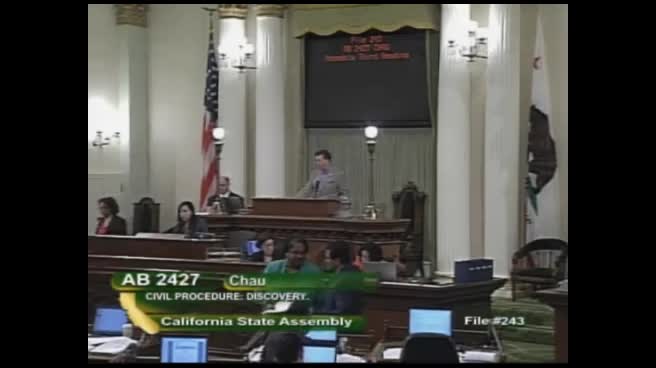
Bill Author

Bill Co-Author(s):