AB 2448: CalWORKs: welfare-to-work: education.
- Session Year: 2015-2016
- House: Assembly
- Latest Version Date: 2016-08-23
Existing law establishes the California Work Opportunity and Responsibility to Kids (CalWORKs) program, under which each county provides cash assistance and other benefits to qualified low-income families using federal, state, and county funds. Existing law establishes a 48-month lifetime limit of CalWORKs benefits for eligible adults, as specified. Existing law requires a recipient of CalWORKs to participate in certain welfare-to-work activities as a condition of eligibility for 24 cumulative months, as specified, and to meet other federal requirements, as specified. Existing law provides that participation in certain activities is not counted against that 24-month period. Existing law requires the county to assign a CalWORKs recipient who lacks a high school diploma or its equivalent to participate in adult basic education, if the recipient has completed job search activities but did not find employment and the education is needed to become employed. Existing law also requires, in order for a recipient to engage in adult basic education in satisfaction of welfare-to-work requirements, the county to perform an assessment and develop a welfare-to-work plan that includes participation in the educational activity.
This bill would instead provide that if the county determines that a CalWORKs recipient has not received his or her high school diploma or its equivalent, the recipient may participate in a high school equivalency program in order to complete a high school equivalency test recognized by the State Department of Education, and that a specified amount of time participating in that activity would not count against the 24-month period described above for certain recipients. The bill would authorize a recipient to participate in a high school equivalency program in lieu of participating in a job search or job club, as specified, and would prohibit a county from requiring the recipient to participate in an assessment before the recipient may engage in a high school equivalency program in satisfaction of welfare-to-work requirements.
Existing law establishes the California Work Opportunity and Responsibility to Kids (CalWORKs) program, under which each county provides cash assistance and other benefits to qualified low-income families using federal, state, and county funds. Existing law establishes a 48-month lifetime limit of CalWORKs benefits for eligible adults, as specified. Existing law requires a recipient of CalWORKs to participate in certain welfare-to-work activities as a condition of eligibility. eligibility for 24 cumulative months, as specified, and to meet other federal requirements, as specified. Existing law provides that participation in certain activities is not counted against that 24-month period. Existing law requires the county to assign a CalWORKs recipient who lacks a high school diploma or its equivalent to participate in adult basic education, if the recipient has completed job search activities but did not find employment and the education is needed to become employed. Existing law also requires, in order for a recipient to engage in adult basic education in satisfaction of welfare-to-work requirements, the county to perform an assessment and develop a welfare-to-work plan that includes participation in the educational activity.
This bill would instead provide that if the county determines that a CalWORKs recipient has not received his or her high school diploma or its equivalent, the recipient may participate in a high school equivalency program in order to complete a high school equivalency test recognized by the State Department of Education. Education, and that a specified amount of time participating in that activity would not count against the 24-month period described above for certain recipients. The bill would authorize the a recipient to participate in a high school equivalency program in lieu of participating in a job search or job club, as specified, and would prohibit the a county from requiring the recipient to participate in an assessment before the recipient may engage in a high school equivalency program in satisfaction of welfare-to-work requirements.
Existing law establishes the California Work Opportunity and Responsibility to Kids (CalWORKs) program, under which each county provides cash assistance and other benefits to qualified low-income families using federal, state, and county funds. Existing law requires a recipient of CalWORKs to participate in welfare-to-work activities as a condition of eligibility. Existing law requires the county to assign a CalWORKs recipient who lacks a high school diploma or its equivalent to participate in adult basic education, if the recipient has completed job search activities but did not find employment and the education is needed to become employed. Existing law also requires, in order for a recipient to engage in adult basic education in satisfaction of welfare-to-work requirements, the county to perform an assessment and develop a welfare-to-work plan that includes participation in the educational activity.
This bill would instead provide that if the county determines that a CalWORKs recipient has not received his or her high school diploma or its equivalent, the recipient may participate in a high school equivalency program in order to complete a high school equivalency test recognized by the State Department of Education. The bill would authorize the recipient to participate in a high school equivalency program in lieu of participating in a job search or job club, and would prohibit the county from requiring the recipient to participate in an assessment before the recipient may engage in a high school equivalency program in satisfaction of welfare-to-work requirements.
Subsequent to the commencement of the receipt of aid under this chapter, the sequence of employment-related activities required of recipients under this article, unless exempted under Section 11320.3, shall be as follows:
(a)Orientation and appraisal.Recipients shall, and applicants may, at the option of a county and with the consent of the applicant, receive orientation to the welfare-to-work program provided under this article and receive appraisal pursuant to Section 11325.2.
(b)After orientation and appraisal, recipients shall participate in job search and job club pursuant to Section 11325.22, family stabilization pursuant to Section 11325.24, a high school equivalency program pursuant to Section 11325.3, or substance abuse, mental health, or domestic violence services, unless the county determines that the recipient should first go to assessment pursuant to subdivision (c).
(c)Assessment. If employment is not found during the period provided for pursuant to subdivision (b), or at any time the county determines that participation in job search for the period specified in subdivision (a) of Section 11325.22 is not likely to lead to employment or that, based on information gathered during the appraisal, further information is needed to make an effective determination regarding the recipients next welfare-to-work activity, the recipient shall be referred to assessment, as provided for in Section 11325.4. Following assessment, the county and the recipient shall develop a welfare-to-work plan, as specified in Section 11325.21. The plan shall specify the activities provided for in Section 11322.6 to which the recipient shall be assigned, and the supportive services, as provided for pursuant to Section 11323.2, with which the recipient will be provided.
(d)Work activities. A recipient who has signed a welfare-to-work plan pursuant to Section 11325.21 shall participate in work activities, as described in this article.
SEC. 2.Section 11322.6 of the Welfare and Institutions Code is amended to read:11322.6.The welfare-to-work plan developed by the county welfare department and the participant pursuant to this article shall provide for welfare-to-work activities. Welfare-to-work activities may include, but are not limited to, any of the following:
(a)Unsubsidized employment.
(b)Subsidized private sector employment.
(c)Subsidized public sector employment.
(d)Work experience, which means public or private sector work that shall help provide basic job skills, enhance existing job skills in a position related to the participants experience, or provide a needed community service that will lead to employment. Unpaid work experience shall be limited to 12 months, unless the county welfare department and the recipient agree to extend this period by an amendment to the welfare-to-work plan. The county welfare department shall review the work experience assignment as appropriate and make revisions as necessary to ensure that it continues to be consistent with the participants plan and effective in preparing the participant to attain employment.
(e)On-the-job training.
(f)(1)Grant-based on-the-job training, which means public or private sector employment or on-the-job training in which the recipients cash grant, or a portion thereof, or the aid grant savings resulting from employment, or both, is diverted to the employer as a wage subsidy to partially or wholly offset the payment of wages to the participant, so long as the total amount diverted does not exceed the familys maximum aid payment.
(2)A county shall not assign a participant to grant-based on-the-job training unless and until the participant has voluntarily agreed to participate in grant-based on-the-job training by executing a voluntary agreement form, which shall be developed by the department. The agreement shall include, but not be limited to, information on the following:
(A)How job termination or another event will not result in loss of the recipients grant funds, pursuant to department regulations.
(B)(i)How to obtain the federal Earned Income Tax Credit (EITC), including the Advance EITC, and increased CalFresh benefits, which may become available due to increased earned income.
(ii)This subparagraph shall only become operative when and to the extent that the department determines that it reflects current federal law and Internal Revenue Service regulations.
(C)How these financial supports should increase the participants current income and how increasing earned income should increase the recipients future social security income.
(3)Grant-based on-the-job training shall include community service positions pursuant to Section 11322.9.
(4)Any portion of a wage from employment that is funded by the diversion of a recipients cash grant, or the grant savings from employment pursuant to this subdivision, or both, shall not be exempt under Section 11451.5 from the calculation of the income of the family for purposes of subdivision (a) of Section 11450.
(g)Supported work or transitional employment, which means forms of grant-based on-the-job training in which the recipients cash grant, or a portion thereof, or the aid grant savings from employment, is diverted to an intermediary service provider, to partially or wholly offset the payment of wages to the participant.
(h)Workstudy.
(i)Self-employment.
(j)Community service.
(k)Adult basic education, which shall include reading, writing, arithmetic, high school proficiency, or a high school equivalency program, and English as a second language. Participants under this subdivision shall be referred to appropriate service providers that include, but are not limited to, educational programs operated by school districts or county offices of education that have contracted with the Superintendent of Public Instruction to provide services to participants pursuant to Section 33117.5 of the Education Code.
(l)Job skills training directly related to employment.
(m)Vocational education and training, including, but not limited to, college and community college education, adult education, regional occupational centers, and regional occupational programs.
(n)Job search and job readiness assistance, which means providing the recipient with training to learn job seeking and interviewing skills, to understand employer expectations, and learn skills designed to enhance an individuals capacity to move toward self-sufficiency, including financial management education.
(o)Education directly related to employment.
(p)Satisfactory progress in secondary school or in a course of study leading to completion of a high school equivalency program, in the case of a recipient who has not completed secondary school or a high school equivalency program, as described in Section 11325.3.
(q)Mental health, substance abuse, and domestic violence services, described in Sections 11325.7 and 11325.8, and Article 7.5 (commencing with Section 11495), that are necessary to obtain and retain employment.
(r)Other activities necessary to assist an individual in obtaining unsubsidized employment.
(s)Assignment to an educational activity identified in subdivisions (k), (m), (o), and (p) is limited to those situations in which the education is needed to become employed.
SEC. 3.Section 11322.85 of the Welfare and Institutions Code is amended to read:11322.85.(a)Unless otherwise exempt, an applicant or recipient shall participate in welfare-to-work activities.
(1)For 24 cumulative months during a recipients lifetime, these activities may include the activities listed in Section 11322.6 that are consistent with the assessment performed in accordance with Section 11325.4 and that are included in the individuals welfare-to-work plan, as described in Section 11325.21, to meet the hours required in Section 11322.8. These 24 months need not be consecutive.
(2)Any month in which the recipient meets the requirements of Section 11322.8, through participation in an activity or activities described in paragraph (3), shall not count as a month of activities for purposes of the 24-month time limit described in paragraph (1).
(3)After a total of 24 months of participation in welfare-to-work activities pursuant to paragraph (1), an aided adult shall participate in one or more of the following welfare-to-work activities, in accordance with Section 607(c) and (d) of Title 42 of the United States Code as of the operative date of this section, that are consistent with the assessment performed in accordance with Section 11325.4, and included in the individuals welfare-to-work plan, described in Section 11325.21:
(A)Unsubsidized employment.
(B)Subsidized private sector employment.
(C)Subsidized public sector employment.
(D)Work experience, including work associated with the refurbishing of publicly assisted housing, if sufficient private sector employment is not available.
(E)On-the-job training.
(F)Job search and job readiness assistance.
(G)Community service programs.
(H)Vocational educational training (not to exceed 12 months with respect to any individual).
(I)Job skills training directly related to employment.
(J)Education directly related to employment, in the case of a recipient who has not received a high school diploma or a certificate of high school equivalence.
(K)Satisfactory attendance at a secondary school or in a course of study leading to a certificate of general equivalence, in the case of a recipient who has not completed secondary school or received such a certificate.
(L)The provision of child care services to an individual who is participating in a community service program.
(b)Any month in which any of the following conditions exists shall not be counted as one of the 24 months of participation allowed under paragraph (1) of subdivision (a):
(1)The recipient is participating in job search in accordance with Section 11325.22, assessment pursuant to Section 11325.4, is in the process of appraisal as described in Section 11325.2, or is participating in the development of a welfare-to-work plan as described in Section 11325.21.
(2)The recipient is no longer receiving aid, pursuant to Sections 11327.4 and 11327.5.
(3)The recipient has been excused from participation for good cause, pursuant to Section 11320.3.
(4)The recipient is exempt from participation pursuant to subdivision (b) of Section 11320.3.
(5)The recipient is only required to participate in accordance with subdivision (d) of Section 11320.3.
(6)The recipient is participating in family stabilization pursuant to Section 11325.24, and the recipient would meet the criteria for good cause pursuant to Section 11320.3. This paragraph may apply to a recipient for no more than six cumulative months.
(7)The recipient has been participating in a high school equivalency program pursuant to Section 11325.3 for at least six months, but has not yet obtained a certificate of high school equivalency. This paragraph may apply to a recipient for no more than six cumulative months, which may be extended for no more than an additional six cumulative months based on a likelihood that the recipient will obtain his or her certificate of high school equivalency during that time period.
(c)County welfare departments shall provide each recipient who is subject to the requirements of paragraph (3) of subdivision (a) written notice describing the 24-month time limitation described in that paragraph and the process by which recipients may claim exemptions from, and extensions to, those requirements.
(d)The notice described in subdivision (c) shall be provided at the time the individual applies for aid, during the recipients annual redetermination, and at least once after the individual has participated for a total of 18 months, and prior to the end of the 21st month, that count toward the 24-month time limit.
(e)The notice described in this section shall include, but shall not be limited to, all of the following:
(1)The number of remaining months the adult recipient may be eligible to receive aid.
(2)The requirements that the recipient must meet in accordance with paragraph (3) of subdivision (a) and the action that the county will take if the adult recipient does not meet those requirements.
(3)The manner in which the recipient may dispute the number of months counted toward the 24-month time limit.
(4)The opportunity for the recipient to modify his or her welfare-to-work plan to meet the requirements of paragraph (3) of subdivision (a).
(5)The opportunity for an exemption to, or extension of, the 24-month time limitation.
(f)For an individual subject to the requirements of paragraph (3) of subdivision (a), who is not exempt or granted an extension, and who does not meet those requirements, the provisions of Sections 11327.4, 11327.5, 11327.9, and 11328.2 shall apply to the extent consistent with the requirements of this section. For purposes of this section, the procedures referenced in this subdivision shall not be described as sanctions.
(g)(1)The department, in consultation with stakeholders, shall convene a workgroup to determine further details of the noticing and engagement requirements for the 24-month time limit, and shall instruct counties via an all-county letter, followed by regulations, no later than 18 months after the effective date of the act that added this section.
(2)The workgroup described in paragraph (1) may also make recommendations to refine or differentiate the procedures and due process requirements applicable to individuals as described in subdivision (f).
(h)(1)Notwithstanding paragraph (3) of subdivision (a) or any other law, an assistance unit that contains an eligible adult who has received assistance under this chapter, or from any state pursuant to the Temporary Assistance for Needy Families program (Part A (commencing with Section 401) of Title IV of the federal Social Security Act (42 U.S.C. Sec. 601 et seq.)) prior to January 1, 2013, may continue in a welfare-to-work plan that meets the requirements of Section 11322.6 for a cumulative period of 24 months commencing January 1, 2013, unless or until he or she exceeds the 48-month time limitation described in Section 11454.
(2)All months of assistance described in paragraph (1) prior to January 1, 2013, shall not be applied to the 24-month limitation described in paragraph (1) of subdivision (a).
SEC. 4.Section 11325.3 is added to the Welfare and Institutions Code, to read:11325.3.(a)If, in the course of appraisal pursuant to Section 11325.2, it is determined that the recipient has not received his or her high school diploma or its equivalent, the recipient shall be eligible to participate in a high school equivalency program in order to complete the High School Equivalency Test, General Education Development Test, Test Assessing Secondary Completion, or any other high school equivalency test recognized by the State Department of Education.
(b)This section does not require a recipient to participate in a high school equivalency program. A recipient may choose to engage in a job club or a job search pursuant to Section 11325.22.
(c)Recipients eligible pursuant to this section shall not be required to participate in an assessment pursuant to Section 11325.4 prior to, or as a condition of, participation in a high school equivalency program.
Subsequent to the commencement of the receipt of aid under this chapter, the sequence of employment-related activities required of recipients under this article, unless exempted under Section 11320.3, shall be as follows:
(a)Orientation and appraisal.Recipients shall, and applicants may, at the option of a county and with the consent of the applicant, receive orientation to the welfare-to-work program provided under this article and receive appraisal pursuant to Section 11325.2.
(b)After orientation and appraisal, recipients shall participate in job search and job club pursuant to Section 11325.22, family stabilization pursuant to Section 11325.24, a high school equivalency program pursuant to Section 11325.3, or substance abuse, mental health, or domestic violence services, unless the county determines that the recipient should first go to assessment pursuant to subdivision (c).
(c)Assessment. If employment is not found during the period provided for pursuant to subdivision (b), or at any time the county determines that participation in job search for the period specified in subdivision (a) of Section 11325.22 is not likely to lead to employment or that, based on information gathered during the appraisal, further information is needed to make an effective determination regarding the recipients next welfare-to-work activity, the recipient shall be referred to assessment, as provided for in Section 11325.4. Following assessment, the county and the recipient shall develop a welfare-to-work plan, as specified in Section 11325.21. The plan shall specify the activities provided for in Section 11322.6 to which the recipient shall be assigned, and the supportive services, as provided for pursuant to Section 11323.2, with which the recipient will be provided.
(d)Work activities. A recipient who has signed a welfare-to-work plan pursuant to Section 11325.21 shall participate in work activities, as described in this article.
SEC. 2.Section 11322.6 of the Welfare and Institutions Code is amended to read:11322.6.The welfare-to-work plan developed by the county welfare department and the participant pursuant to this article shall provide for welfare-to-work activities. Welfare-to-work activities may include, but are not limited to, any of the following:
(a)Unsubsidized employment.
(b)Subsidized private sector employment.
(c)Subsidized public sector employment.
(d)Work experience, which means public or private sector work that shall help provide basic job skills, enhance existing job skills in a position related to the participants experience, or provide a needed community service that will lead to employment. Unpaid work experience shall be limited to 12 months, unless the county welfare department and the recipient agree to extend this period by an amendment to the welfare-to-work plan. The county welfare department shall review the work experience assignment as appropriate and make revisions as necessary to ensure that it continues to be consistent with the participants plan and effective in preparing the participant to attain employment.
(e)On-the-job training.
(f)(1)Grant-based on-the-job training, which means public or private sector employment or on-the-job training in which the recipients cash grant, or a portion thereof, or the aid grant savings resulting from employment, or both, is diverted to the employer as a wage subsidy to partially or wholly offset the payment of wages to the participant, so long as the total amount diverted does not exceed the familys maximum aid payment.
(2)A county shall not assign a participant to grant-based on-the-job training unless and until the participant has voluntarily agreed to participate in grant-based on-the-job training by executing a voluntary agreement form, which shall be developed by the department. The agreement shall include, but not be limited to, information on the following:
(A)How job termination or another event will not result in loss of the recipients grant funds, pursuant to department regulations.
(B)(i)How to obtain the federal Earned Income Tax Credit (EITC), including the Advance EITC, and increased CalFresh benefits, which may become available due to increased earned income.
(ii)This subparagraph shall only become operative when and to the extent that the department determines that it reflects current federal law and Internal Revenue Service regulations.
(C)How these financial supports should increase the participants current income and how increasing earned income should increase the recipients future social security income.
(3)Grant-based on-the-job training shall include community service positions pursuant to Section 11322.9.
(4)Any portion of a wage from employment that is funded by the diversion of a recipients cash grant, or the grant savings from employment pursuant to this subdivision, or both, shall not be exempt under Section 11451.5 from the calculation of the income of the family for purposes of subdivision (a) of Section 11450.
(g)Supported work or transitional employment, which means forms of grant-based on-the-job training in which the recipients cash grant, or a portion thereof, or the aid grant savings from employment, is diverted to an intermediary service provider, to partially or wholly offset the payment of wages to the participant.
(h)Workstudy.
(i)Self-employment.
(j)Community service.
(k)Adult basic education, which shall include reading, writing, arithmetic, high school proficiency, or a high school equivalency program, and English as a second language. Participants under this subdivision shall be referred to appropriate service providers that include, but are not limited to, educational programs operated by school districts or county offices of education that have contracted with the Superintendent of Public Instruction to provide services to participants pursuant to Section 33117.5 of the Education Code.
(l)Job skills training directly related to employment.
(m)Vocational education and training, including, but not limited to, college and community college education, adult education, regional occupational centers, and regional occupational programs.
(n)Job search and job readiness assistance, which means providing the recipient with training to learn job seeking and interviewing skills, to understand employer expectations, and learn skills designed to enhance an individuals capacity to move toward self-sufficiency, including financial management education.
(o)Education directly related to employment.
(p)Satisfactory progress in secondary school or in a course of study leading to completion of a high school equivalency program, in the case of a recipient who has not completed secondary school or a high school equivalency program, as described in Section 11325.3.
(q)Mental health, substance abuse, and domestic violence services, described in Sections 11325.7 and 11325.8, and Article 7.5 (commencing with Section 11495), that are necessary to obtain and retain employment.
(r)Other activities necessary to assist an individual in obtaining unsubsidized employment.
(s)Assignment to an educational activity identified in subdivisions (k), (m), (o), and (p) is limited to those situations in which the education is needed to become employed.
SEC. 3.Section 11322.85 of the Welfare and Institutions Code is amended to read:11322.85.(a)Unless otherwise exempt, an applicant or recipient shall participate in welfare-to-work activities.
(1)For 24 cumulative months during a recipients lifetime, these activities may include the activities listed in Section 11322.6 that are consistent with the assessment performed in accordance with Section 11325.4 and that are included in the individuals welfare-to-work plan, as described in Section 11325.21, to meet the hours required in Section 11322.8. These 24 months need not be consecutive.
(2)Any month in which the recipient meets the requirements of Section 11322.8, through participation in an activity or activities described in paragraph (3), shall not count as a month of activities for purposes of the 24-month time limit described in paragraph (1).
(3)After a total of 24 months of participation in welfare-to-work activities pursuant to paragraph (1), an aided adult shall participate in one or more of the following welfare-to-work activities, in accordance with Section 607(c) and (d) of Title 42 of the United States Code as of the operative date of this section, that are consistent with the assessment performed in accordance with Section 11325.4, and included in the individuals welfare-to-work plan, described in Section 11325.21:
(A)Unsubsidized employment.
(B)Subsidized private sector employment.
(C)Subsidized public sector employment.
(D)Work experience, including work associated with the refurbishing of publicly assisted housing, if sufficient private sector employment is not available.
(E)On-the-job training.
(F)Job search and job readiness assistance.
(G)Community service programs.
(H)Vocational educational training (not to exceed 12 months with respect to any individual).
(I)Job skills training directly related to employment.
(J)Education directly related to employment, in the case of a recipient who has not received a high school diploma or a certificate of high school equivalence.
(K)Satisfactory attendance at a secondary school or in a course of study leading to a certificate of general equivalence, in the case of a recipient who has not completed secondary school or received such a certificate.
(L)The provision of child care services to an individual who is participating in a community service program.
(b)Any month in which any of the following conditions exists shall not be counted as one of the 24 months of participation allowed under paragraph (1) of subdivision (a):
(1)The recipient is participating in job search in accordance with Section 11325.22, assessment pursuant to Section 11325.4, is in the process of appraisal as described in Section 11325.2, or is participating in the development of a welfare-to-work plan as described in Section 11325.21.
(2)The recipient is no longer receiving aid, pursuant to Sections 11327.4 and 11327.5.
(3)The recipient has been excused from participation for good cause, pursuant to Section 11320.3.
(4)The recipient is exempt from participation pursuant to subdivision (b) of Section 11320.3.
(5)The recipient is only required to participate in accordance with subdivision (d) of Section 11320.3.
(6)The recipient is participating in family stabilization pursuant to Section 11325.24, and the recipient would meet the criteria for good cause pursuant to Section 11320.3. This paragraph may apply to a recipient for no more than six cumulative months.
(7)The recipient is has been participating in a high school equivalency program pursuant to Section 11325.3. 11325.3 for at least six months, but has not yet obtained a certificate of high school equivalency. This paragraph may apply to a recipient for no more than six cumulative months, which may be extended for no more than an additional six cumulative months based on a likelihood that the recipient will obtain his or her certificate of high school equivalency during that time period.
(c)County welfare departments shall provide each recipient who is subject to the requirements of paragraph (3) of subdivision (a) written notice describing the 24-month time limitation described in that paragraph and the process by which recipients may claim exemptions from, and extensions to, those requirements.
(d)The notice described in subdivision (c) shall be provided at the time the individual applies for aid, during the recipients annual redetermination, and at least once after the individual has participated for a total of 18 months, and prior to the end of the 21st month, that count toward the 24-month time limit.
(e)The notice described in this section shall include, but shall not be limited to, all of the following:
(1)The number of remaining months the adult recipient may be eligible to receive aid.
(2)The requirements that the recipient must meet in accordance with paragraph (3) of subdivision (a) and the action that the county will take if the adult recipient does not meet those requirements.
(3)The manner in which the recipient may dispute the number of months counted toward the 24-month time limit.
(4)The opportunity for the recipient to modify his or her welfare-to-work plan to meet the requirements of paragraph (3) of subdivision (a).
(5)The opportunity for an exemption to, or extension of, the 24-month time limitation.
(f)For an individual subject to the requirements of paragraph (3) of subdivision (a), who is not exempt or granted an extension, and who does not meet those requirements, the provisions of Sections 11327.4, 11327.5, 11327.9, and 11328.2 shall apply to the extent consistent with the requirements of this section. For purposes of this section, the procedures referenced in this subdivision shall not be described as sanctions.
(g)(1)The department, in consultation with stakeholders, shall convene a workgroup to determine further details of the noticing and engagement requirements for the 24-month time limit, and shall instruct counties via an all-county letter, followed by regulations, no later than 18 months after the effective date of the act that added this section.
(2)The workgroup described in paragraph (1) may also make recommendations to refine or differentiate the procedures and due process requirements applicable to individuals as described in subdivision (f).
(h)(1)Notwithstanding paragraph (3) of subdivision (a) or any other law, an assistance unit that contains an eligible adult who has received assistance under this chapter, or from any state pursuant to the Temporary Assistance for Needy Families program (Part A (commencing with Section 401) of Title IV of the federal Social Security Act (42 U.S.C. Sec. 601 et seq.)) prior to January 1, 2013, may continue in a welfare-to-work plan that meets the requirements of Section 11322.6 for a cumulative period of 24 months commencing January 1, 2013, unless or until he or she exceeds the 48-month time limitation described in Section 11454.
(2)All months of assistance described in paragraph (1) prior to January 1, 2013, shall not be applied to the 24-month limitation described in paragraph (1) of subdivision (a).
SEC. 4.Section 11325.3 is added to the Welfare and Institutions Code, to read:11325.3.(a)If, in the course of appraisal pursuant to Section 11325.2, it is determined that the recipient has not received his or her high school diploma or its equivalent, the recipient shall be eligible to participate in a high school equivalency program in order to complete the High School Equivalency Test, General Education Development Test, Test Assessing Secondary Completion, or any other high school equivalency test recognized by the State Department of Education.
(b)This section does not require a recipient to participate in a high school equivalency program. A recipient may choose to engage in a job club or a job search pursuant to Section 11325.22.
(c)Recipients eligible pursuant to this section shall not be required to participate in an assessment pursuant to Section 11325.4 prior to, or as a condition of, participation in a high school equivalency program.
Subsequent to the commencement of the receipt of aid under this chapter, the sequence of employment-related activities required of recipients under this article, unless exempted under Section 11320.3, shall be as follows:
(a)Orientation and appraisal.Recipients shall, and applicants may, at the option of a county and with the consent of the applicant, receive orientation to the welfare-to-work program provided under this article and receive appraisal pursuant to Section 11325.2.
(b)After orientation and appraisal, recipients shall participate in job search and job club pursuant to Section 11325.22, family stabilization pursuant to Section 11325.24, a high school equivalency program pursuant to Section 11325.3, or substance abuse, mental health, or domestic violence services, unless the county determines that the recipient should first go to assessment pursuant to subdivision (c).
(c)Assessment. If employment is not found during the period provided for pursuant to subdivision (b), or at any time the county determines that participation in job search for the period specified in subdivision (a) of Section 11325.22 is not likely to lead to employment or that, based on information gathered during the appraisal, further information is needed to make an effective determination regarding the recipients next welfare-to-work activity, the recipient shall be referred to assessment, as provided for in Section 11325.4. Following assessment, the county and the recipient shall develop a welfare-to-work plan, as specified in Section 11325.21. The plan shall specify the activities provided for in Section 11322.6 to which the recipient shall be assigned, and the supportive services, as provided for pursuant to Section 11323.2, with which the recipient will be provided.
(d)Work activities. A recipient who has signed a welfare-to-work plan pursuant to Section 11325.21 shall participate in work activities, as described in this article.
SEC. 2.Section 11322.6 of the Welfare and Institutions Code is amended to read:11322.6.The welfare-to-work plan developed by the county welfare department and the participant pursuant to this article shall provide for welfare-to-work activities. Welfare-to-work activities may include, but are not limited to, any of the following:
(a)Unsubsidized employment.
(b)Subsidized private sector employment.
(c)Subsidized public sector employment.
(d)Work experience, which means public or private sector work that shall help provide basic job skills, enhance existing job skills in a position related to the participants experience, or provide a needed community service that will lead to employment. Unpaid work experience shall be limited to 12 months, unless the county welfare department and the recipient agree to extend this period by an amendment to the welfare-to-work plan. The county welfare department shall review the work experience assignment as appropriate and make revisions as necessary to ensure that it continues to be consistent with the participants plan and effective in preparing the participant to attain employment.
(e)On-the-job training.
(f)(1)Grant-based on-the-job training, which means public or private sector employment or on-the-job training in which the recipients cash grant, or a portion thereof, or the aid grant savings resulting from employment, or both, is diverted to the employer as a wage subsidy to partially or wholly offset the payment of wages to the participant, so long as the total amount diverted does not exceed the familys maximum aid payment.
(2)A county shall not assign a participant to grant-based on-the-job training unless and until the participant has voluntarily agreed to participate in grant-based on-the-job training by executing a voluntary agreement form, which shall be developed by the department. The agreement shall include, but not be limited to, information on the following:
(A)How job termination or another event will not result in loss of the recipients grant funds, pursuant to department regulations.
(B)(i)How to obtain the federal Earned Income Tax Credit (EITC), including the Advance EITC, and increased CalFresh benefits, which may become available due to increased earned income.
(ii)This subparagraph shall only become operative when and to the extent that the department determines that it reflects current federal law and Internal Revenue Service regulations.
(C)How these financial supports should increase the participants current income and how increasing earned income should increase the recipients future social security income.
(3)Grant-based on-the-job training shall include community service positions pursuant to Section 11322.9.
(4)Any portion of a wage from employment that is funded by the diversion of a recipients cash grant, or the grant savings from employment pursuant to this subdivision, or both, shall not be exempt under Section 11451.5 from the calculation of the income of the family for purposes of subdivision (a) of Section 11450.
(g)Supported work or transitional employment, which means forms of grant-based on-the-job training in which the recipients cash grant, or a portion thereof, or the aid grant savings from employment, is diverted to an intermediary service provider, to partially or wholly offset the payment of wages to the participant.
(h)Workstudy.
(i)Self-employment.
(j)Community service.
(k)Adult basic education, which shall include reading, writing, arithmetic, high school proficiency, or a high school equivalency program, and English as a second language. Participants under this subdivision shall be referred to appropriate service providers that include, but are not limited to, educational programs operated by school districts or county offices of education that have contracted with the Superintendent of Public Instruction to provide services to participants pursuant to Section 33117.5 of the Education Code.
(l)Job skills training directly related to employment.
(m)Vocational education and training, including, but not limited to, college and community college education, adult education, regional occupational centers, and regional occupational programs.
(n)Job search and job readiness assistance, which means providing the recipient with training to learn job seeking and interviewing skills, to understand employer expectations, and learn skills designed to enhance an individuals capacity to move toward self-sufficiency, including financial management education.
(o)Education directly related to employment.
(p)Satisfactory progress in secondary school or in a course of study leading to completion of a high school equivalency program, in the case of a recipient who has not completed secondary school or a high school equivalency program, as described in Section 11325.3.
(q)Mental health, substance abuse, and domestic violence services, described in Sections 11325.7 and 11325.8, and Article 7.5 (commencing with Section 11495), that are necessary to obtain and retain employment.
(r)Other activities necessary to assist an individual in obtaining unsubsidized employment.
(s)Assignment to an educational activity identified in subdivisions (k), (m), and (o) (o), and (p) is limited to those situations in which the education is needed to become employed.
SEC. 3.Section 11322.85 of the Welfare and Institutions Code is amended to read:11322.85.(a)Unless otherwise exempt, an applicant or recipient shall participate in welfare-to-work activities.
(1)For 24 cumulative months during a recipients lifetime, these activities may include the activities listed in Section 11322.6 that are consistent with the assessment performed in accordance with Section 11325.4 and that are included in the individuals welfare-to-work plan, as described in Section 11325.21, to meet the hours required in Section 11322.8. These 24 months need not be consecutive.
(2)Any month in which the recipient meets the requirements of Section 11322.8, through participation in an activity or activities described in paragraph (3), shall not count as a month of activities for purposes of the 24-month time limit described in paragraph (1).
(3)After a total of 24 months of participation in welfare-to-work activities pursuant to paragraph (1), an aided adult shall participate in one or more of the following welfare-to-work activities, in accordance with Section 607(c) and (d) of Title 42 of the United States Code as of the operative date of this section, that are consistent with the assessment performed in accordance with Section 11325.4, and included in the individuals welfare-to-work plan, described in Section 11325.21:
(A)Unsubsidized employment.
(B)Subsidized private sector employment.
(C)Subsidized public sector employment.
(D)Work experience, including work associated with the refurbishing of publicly assisted housing, if sufficient private sector employment is not available.
(E)On-the-job training.
(F)Job search and job readiness assistance.
(G)Community service programs.
(H)Vocational educational training (not to exceed 12 months with respect to any individual).
(I)Job skills training directly related to employment.
(J)Education directly related to employment. employment, in the case of a recipient who has not received a high school diploma or a certificate of high school equivalence.
(K)Satisfactory attendance at a secondary school or in a course of study leading to a certificate of general equivalence, in the case of a recipient who has not completed secondary school or received such a certificate.
(K)
(L)The provision of child care services to an individual who is participating in a community service program.
(b)Any month in which any of the following conditions exists shall not be counted as one of the 24 months of participation allowed under paragraph (1) of subdivision (a):
(1)The recipient is participating in job search in accordance with Section 11325.22, assessment pursuant to Section 11325.4, is in the process of appraisal as described in Section 11325.2, or is participating in the development of a welfare-to-work plan as described in Section 11325.21.
(2)The recipient is no longer receiving aid, pursuant to Sections 11327.4 and 11327.5.
(3)The recipient has been excused from participation for good cause, pursuant to Section 11320.3.
(4)The recipient is exempt from participation pursuant to subdivision (b) of Section 11320.3.
(5)The recipient is only required to participate in accordance with subdivision (d) of Section 11320.3.
(6)The recipient is participating in family stabilization pursuant to Section 11325.24, and the recipient would meet the criteria for good cause pursuant to Section 11320.3. This paragraph may apply to a recipient for no more than six cumulative months.
(7)The recipient is participating in a high school equivalency program pursuant to Section 11325.3.
(c)County welfare departments shall provide each recipient who is subject to the requirements of paragraph (3) of subdivision (a) written notice describing the 24-month time limitation described in that paragraph and the process by which recipients may claim exemptions from, and extensions to, those requirements.
(d)The notice described in subdivision (c) shall be provided at the time the individual applies for aid, during the recipients annual redetermination, and at least once after the individual has participated for a total of 18 months, and prior to the end of the 21st month, that count toward the 24-month time limit.
(e)The notice described in this section shall include, but shall not be limited to, all of the following:
(1)The number of remaining months the adult recipient may be eligible to receive aid.
(2)The requirements that the recipient must meet in accordance with paragraph (3) of subdivision (a) and the action that the county will take if the adult recipient does not meet those requirements.
(3)The manner in which the recipient may dispute the number of months counted toward the 24-month time limit.
(4)The opportunity for the recipient to modify his or her welfare-to-work plan to meet the requirements of paragraph (3) of subdivision (a).
(5)The opportunity for an exemption to, or extension of, the 24-month time limitation.
(f)For an individual subject to the requirements of paragraph (3) of subdivision (a), who is not exempt or granted an extension, and who does not meet those requirements, the provisions of Sections 11327.4, 11327.5, 11327.9, and 11328.2 shall apply to the extent consistent with the requirements of this section. For purposes of this section, the procedures referenced in this subdivision shall not be described as sanctions.
(g)(1)The department, in consultation with stakeholders, shall convene a workgroup to determine further details of the noticing and engagement requirements for the 24-month time limit, and shall instruct counties via an all-county letter, followed by regulations, no later than 18 months after the effective date of the act that added this section.
(2)The workgroup described in paragraph (1) may also make recommendations to refine or differentiate the procedures and due process requirements applicable to individuals as described in subdivision (f).
(h)(1)Notwithstanding paragraph (3) of subdivision (a) or any other law, an assistance unit that contains an eligible adult who has received assistance under this chapter, or from any state pursuant to the Temporary Assistance for Needy Families program (Part A (commencing with Section 401) of Title IV of the federal Social Security Act (42 U.S.C. Sec. 601 et seq.)) prior to January 1, 2013, may continue in a welfare-to-work plan that meets the requirements of Section 11322.6 for a cumulative period of 24 months commencing January 1, 2013, unless or until he or she exceeds the 48-month time limitation described in Section 11454.
(2)All months of assistance described in paragraph (1) prior to January 1, 2013, shall not be applied to the 24-month limitation described in paragraph (1) of subdivision (a).
SEC. 4.Section 11325.3 is added to the Welfare and Institutions Code, to read:11325.3.(a)If, in the course of appraisal pursuant to Section 11325.2, it is determined that the recipient has not received his or her high school diploma or its equivalent, the recipient shall be eligible to participate in a high school equivalency program in order to complete the High School Equivalency Test, General Education Development Test, Test Assessing Secondary Completion, or any other high school equivalency test recognized by the State Department of Education.
(b)This section does not require a recipient to participate in a high school equivalency program. A recipient may choose to engage in a job club or a job search pursuant to Section 11325.22.
(c)Recipients eligible pursuant to this section shall not be required to participate in an assessment pursuant to Section 11325.4 prior to, or as a condition of, participation in a high school equivalency program.
Subsequent to the commencement of the receipt of aid under this chapter, the sequence of employment-related activities required of recipients under this article, unless exempted under Section 11320.3, shall be as follows:
(a)Orientation and appraisal.Recipients shall, and applicants may, at the option of a county and with the consent of the applicant, receive orientation to the welfare-to-work program provided under this article and receive appraisal pursuant to Section 11325.2.
(b)After orientation and appraisal, recipients shall participate in job search and job club pursuant to Section 11325.22, family stabilization pursuant to Section 11325.24, a high school equivalency program pursuant to Section 11325.3, or substance abuse, mental health, or domestic violence services, unless the county determines that the recipient should first go to assessment pursuant to subdivision (c).
(c)Assessment. If employment is not found during the period provided for pursuant to subdivision (b), or at any time the county determines that participation in job search for the period specified in subdivision (a) of Section 11325.22 is not likely to lead to employment or that, based on information gathered during the appraisal, further information is needed to make an effective determination regarding the recipients next welfare-to-work activity, the recipient shall be referred to assessment, as provided for in Section 11325.4. Following assessment, the county and the recipient shall develop a welfare-to-work plan, as specified in Section 11325.21. The plan shall specify the activities provided for in Section 11322.6 to which the recipient shall be assigned, and the supportive services, as provided for pursuant to Section 11323.2, with which the recipient will be provided.
(d)Work activities. A recipient who has signed a welfare-to-work plan pursuant to Section 11325.21 shall participate in work activities, as described in this article.
SEC. 2.Section 11322.6 of the Welfare and Institutions Code is amended to read:11322.6.The welfare-to-work plan developed by the county welfare department and the participant pursuant to this article shall provide for welfare-to-work activities. Welfare-to-work activities may include, but are not limited to, any of the following:
(a)Unsubsidized employment.
(b)Subsidized private sector employment.
(c)Subsidized public sector employment.
(d)Work experience, which means public or private sector work that shall help provide basic job skills, enhance existing job skills in a position related to the participants experience, or provide a needed community service that will lead to employment. Unpaid work experience shall be limited to 12 months, unless the county welfare department and the recipient agree to extend this period by an amendment to the welfare-to-work plan. The county welfare department shall review the work experience assignment as appropriate and make revisions as necessary to ensure that it continues to be consistent with the participants plan and effective in preparing the participant to attain employment.
(e)On-the-job training.
(f)(1)Grant-based on-the-job training, which means public or private sector employment or on-the-job training in which the recipients cash grant, or a portion thereof, or the aid grant savings resulting from employment, or both, is diverted to the employer as a wage subsidy to partially or wholly offset the payment of wages to the participant, so long as the total amount diverted does not exceed the familys maximum aid payment.
(2)A county shall not assign a participant to grant-based on-the-job training unless and until the participant has voluntarily agreed to participate in grant-based on-the-job training by executing a voluntary agreement form, which shall be developed by the department. The agreement shall include, but not be limited to, information on the following:
(A)How job termination or another event will not result in loss of the recipients grant funds, pursuant to department regulations.
(B)(i)How to obtain the federal Earned Income Tax Credit (EITC), including the Advance EITC, and increased CalFresh benefits, which may become available due to increased earned income.
(ii)This subparagraph shall only become operative when and to the extent that the department determines that it reflects current federal law and Internal Revenue Service regulations.
(C)How these financial supports should increase the participants current income and how increasing earned income should increase the recipients future social security income.
(3)Grant-based on-the-job training shall include community service positions pursuant to Section 11322.9.
(4)Any portion of a wage from employment that is funded by the diversion of a recipients cash grant, or the grant savings from employment pursuant to this subdivision, or both, shall not be exempt under Section 11451.5 from the calculation of the income of the family for purposes of subdivision (a) of Section 11450.
(g)Supported work or transitional employment, which means forms of grant-based on-the-job training in which the recipients cash grant, or a portion thereof, or the aid grant savings from employment, is diverted to an intermediary service provider, to partially or wholly offset the payment of wages to the participant.
(h)Workstudy.
(i)Self-employment.
(j)Community service.
(k)Adult basic education, which shall include reading, writing, arithmetic, high school proficiency, or general educational development certificate of instruction, a high school equivalency program, and English as a second language. Participants under this subdivision shall be referred to appropriate service providers that include, but are not limited to, educational programs operated by school districts or county offices of education that have contracted with the Superintendent of Public Instruction to provide services to participants pursuant to Section 33117.5 of the Education Code.
(l)Job skills training directly related to employment.
(m)Vocational education and training, including, but not limited to, college and community college education, adult education, regional occupational centers, and regional occupational programs.
(n)Job search and job readiness assistance, which means providing the recipient with training to learn job seeking and interviewing skills, to understand employer expectations, and learn skills designed to enhance an individuals capacity to move toward self-sufficiency, including financial management education.
(o)Education directly related to employment.
(p)Satisfactory progress in secondary school or in a course of study leading to a certificate of general educational development, completion of a high school equivalency program, in the case of a recipient who has not completed secondary school or received such a certificate, a high school equivalency program, as described in Section 11325.3.
(q)Mental health, substance abuse, and domestic violence services, described in Sections 11325.7 and 11325.8, and Article 7.5 (commencing with Section 11495), that are necessary to obtain and retain employment.
(r)Other activities necessary to assist an individual in obtaining unsubsidized employment.
(s)Assignment to an educational activity identified in subdivisions (k), (m), and (o) is limited to those situations in which the education is needed to become employed.
SEC. 3.Section 11322.85 of the Welfare and Institutions Code is amended to read:11322.85.(a)Unless otherwise exempt, an applicant or recipient shall participate in welfare-to-work activities.
(1)For 24 cumulative months during a recipients lifetime, these activities may include the activities listed in Section 11322.6 that are consistent with the assessment performed in accordance with Section 11325.4 and that are included in the individuals welfare-to-work plan, as described in Section 11325.21, to meet the hours required in Section 11322.8. These 24 months need not be consecutive.
(2)Any month in which the recipient meets the requirements of Section 11322.8, through participation in an activity or activities described in paragraph (3), shall not count as a month of activities for purposes of the 24-month time limit described in paragraph (1).
(3)After a total of 24 months of participation in welfare-to-work activities pursuant to paragraph (1), an aided adult shall participate in one or more of the following welfare-to-work activities, in accordance with Section 607(c) and (d) of Title 42 of the United States Code as of the operative date of this section, that are consistent with the assessment performed in accordance with Section 11325.4, and included in the individuals welfare-to-work plan, described in Section 11325.21:
(A)Unsubsidized employment.
(B)Subsidized private sector employment.
(C)Subsidized public sector employment.
(D)Work experience, including work associated with the refurbishing of publicly assisted housing, if sufficient private sector employment is not available.
(E)On-the-job training.
(F)Job search and job readiness assistance.
(G)Community service programs.
(H)Vocational educational training (not to exceed 12 months with respect to any individual).
(I)Job skills training directly related to employment.
(J)Education directly related to employment.
(K)The provision of child care services to an individual who is participating in a community service program.
(b)Any month in which any of the following conditions exists shall not be counted as one of the 24 months of participation allowed under paragraph (1) of subdivision (a):
(1)The recipient is participating in job search in accordance with Section 11325.22, assessment pursuant to Section 11325.4, is in the process of appraisal as described in Section 11325.2, or is participating in the development of a welfare-to-work plan as described in Section 11325.21.
(2)The recipient is no longer receiving aid, pursuant to Sections 11327.4 and 11327.5.
(3)The recipient has been excused from participation for good cause, pursuant to Section 11320.3.
(4)The recipient is exempt from participation pursuant to subdivision (b) of Section 11320.3.
(5)The recipient is only required to participate in accordance with subdivision (d) of Section 11320.3.
(6)The recipient is participating in family stabilization pursuant to Section 11325.24, and the recipient would meet the criteria for good cause pursuant to Section 11320.3. This paragraph may apply to a recipient for no more than six cumulative months.
(7)The recipient is participating in a high school equivalency program pursuant to Section 11325.3.
(c)County welfare departments shall provide each recipient who is subject to the requirements of paragraph (3) of subdivision (a) written notice describing the 24-month time limitation described in that paragraph and the process by which recipients may claim exemptions from, and extensions to, those requirements.
(d)The notice described in subdivision (c) shall be provided at the time the individual applies for aid, during the recipients annual redetermination, and at least once after the individual has participated for a total of 18 months, and prior to the end of the 21st month, that count toward the 24-month time limit.
(e)The notice described in this section shall include, but shall not be limited to, all of the following:
(1)The number of remaining months the adult recipient may be eligible to receive aid.
(2)The requirements that the recipient must meet in accordance with paragraph (3) of subdivision (a) and the action that the county will take if the adult recipient does not meet those requirements.
(3)The manner in which the recipient may dispute the number of months counted toward the 24-month time limit.
(4)The opportunity for the recipient to modify his or her welfare-to-work plan to meet the requirements of paragraph (3) of subdivision (a).
(5)The opportunity for an exemption to, or extension of, the 24-month time limitation.
(f)For an individual subject to the requirements of paragraph (3) of subdivision (a), who is not exempt or granted an extension, and who does not meet those requirements, the provisions of Sections 11327.4, 11327.5, 11327.9, and 11328.2 shall apply to the extent consistent with the requirements of this section. For purposes of this section, the procedures referenced in this subdivision shall not be described as sanctions.
(g)(1)The department, in consultation with stakeholders, shall convene a workgroup to determine further details of the noticing and engagement requirements for the 24-month time limit, and shall instruct counties via an all-county letter, followed by regulations, no later than 18 months after the effective date of the act that added this section.
(2)The workgroup described in paragraph (1) may also make recommendations to refine or differentiate the procedures and due process requirements applicable to individuals as described in subdivision (f).
(h)(1)Notwithstanding paragraph (3) of subdivision (a) or any other law, an assistance unit that contains an eligible adult who has received assistance under this chapter, or from any state pursuant to the Temporary Assistance for Needy Families program (Part A (commencing with Section 401) of Title IV of the federal Social Security Act (42 U.S.C. Sec. 601 et seq.)) prior to January 1, 2013, may continue in a welfare-to-work plan that meets the requirements of Section 11322.6 for a cumulative period of 24 months commencing January 1, 2013, unless or until he or she exceeds the 48-month time limitation described in Section 11454.
(2)All months of assistance described in paragraph (1) prior to January 1, 2013, shall not be applied to the 24-month limitation described in paragraph (1) of subdivision (a).
SEC. 4.Section 11325.3 is added to the Welfare and Institutions Code, to read:11325.3.(a)If, in the course of appraisal pursuant to Section 11325.2, it is determined that the recipient has not received his or her high school diploma or its equivalent, the recipient shall be eligible to participate in a high school equivalency program in order to complete the High School Equivalency Test, General Education Development Test, Test Assessing Secondary Completion, or any other high school equivalency test recognized by the State Department of Education.
(b)This section does not require a recipient to participate in a high school equivalency program. A recipient may choose to engage in a job club or a job search pursuant to Section 11325.22.
(c)Recipients eligible pursuant to this section shall not be required to participate in an assessment pursuant to Section 11325.4 prior to, or as a condition of, participation in a high school equivalency program.
Subsequent to the commencement of the receipt of aid under this chapter, the sequence of employment-related activities required of recipients under this article, unless exempted under Section 11320.3, shall be as follows:
(a)Orientation and appraisal.Recipients shall, and applicants may, at the option of a county and with the consent of the applicant, receive orientation to the welfare-to-work program provided under this article and receive appraisal pursuant to Section 11325.2.
(b)After orientation and appraisal, recipients shall participate in job search and job club pursuant to Section 11325.22, family stabilization pursuant to Section 11325.24, a high school equivalency program pursuant to Section 11325.3, or substance abuse, mental health, or domestic violence services, unless the county determines that the recipient should first go to assessment pursuant to subdivision (c).
(c)Assessment. If employment is not found during the period provided for pursuant to subdivision (b), or at any time the county determines that participation in job search for the period specified in subdivision (a) of Section 11325.22 is not likely to lead to employment or that, based on information gathered during the appraisal, further information is needed to make an effective determination regarding the recipients next welfare-to-work activity, the recipient shall be referred to assessment, as provided for in Section 11325.4. Following assessment, the county and the recipient shall develop a welfare-to-work plan, as specified in Section 11325.21. The plan shall specify the activities provided for in Section 11322.6 to which the recipient shall be assigned, and the supportive services, as provided for pursuant to Section 11323.2, with which the recipient will be provided.
(d)Work activities. A recipient who has signed a welfare-to-work plan pursuant to Section 11325.21 shall participate in work activities, as described in this article.
(e)This section shall become operative on January 1, 2014.
SEC. 2.Section 11322.6 of the Welfare and Institutions Code is amended to read:11322.6.The welfare-to-work plan developed by the county welfare department and the participant pursuant to this article shall provide for welfare-to-work activities. Welfare-to-work activities may include, but are not limited to, any of the following:
(a)Unsubsidized employment.
(b)Subsidized private sector employment.
(c)Subsidized public sector employment.
(d)Work experience, which means public or private sector work that shall help provide basic job skills, enhance existing job skills in a position related to the participants experience, or provide a needed community service that will lead to employment. Unpaid work experience shall be limited to 12 months, unless the county welfare department and the recipient agree to extend this period by an amendment to the welfare-to-work plan. The county welfare department shall review the work experience assignment as appropriate and make revisions as necessary to ensure that it continues to be consistent with the participants plan and effective in preparing the participant to attain employment.
(e)On-the-job training.
(f)(1)Grant-based on-the-job training, which means public or private sector employment or on-the-job training in which the recipients cash grant, or a portion thereof, or the aid grant savings resulting from employment, or both, is diverted to the employer as a wage subsidy to partially or wholly offset the payment of wages to the participant, so long as the total amount diverted does not exceed the familys maximum aid payment.
(2)A county shall not assign a participant to grant-based on-the-job training unless and until the participant has voluntarily agreed to participate in grant-based on-the-job training by executing a voluntary agreement form, which shall be developed by the department. The agreement shall include, but not be limited to, information on the following:
(A)How job termination or another event will not result in loss of the recipients grant funds, pursuant to department regulations.
(B)(i)How to obtain the federal Earned Income Tax Credit (EITC), including the Advance EITC, and increased CalFresh benefits, which may become available due to increased earned income.
(ii)This subparagraph shall only become operative when and to the extent that the department determines that it reflects current federal law and Internal Revenue Service regulations.
(C)How these financial supports should increase the participants current income and how increasing earned income should increase the recipients future social security income.
(3)Grant-based on-the-job training shall include community service positions pursuant to Section 11322.9.
(4)Any portion of a wage from employment that is funded by the diversion of a recipients cash grant, or the grant savings from employment pursuant to this subdivision, or both, shall not be exempt under Section 11451.5 from the calculation of the income of the family for purposes of subdivision (a) of Section 11450.
(g)Supported work or transitional employment, which means forms of grant-based on-the-job training in which the recipients cash grant, or a portion thereof, or the aid grant savings from employment, is diverted to an intermediary service provider, to partially or wholly offset the payment of wages to the participant.
(h)Workstudy.
(i)Self-employment.
(j)Community service.
(k)Adult basic education, which shall include reading, writing, arithmetic, high school proficiency, or general educational development certificate of instruction, and English as a second language. Participants under this subdivision shall be referred to appropriate service providers that include, but are not limited to, educational programs operated by school districts or county offices of education that have contracted with the Superintendent of Public Instruction to provide services to participants pursuant to Section 33117.5 of the Education Code.
(l)Job skills training directly related to employment.
(m)Vocational education and training, including, but not limited to, college and community college education, adult education, regional occupational centers, and regional occupational programs.
(n)Job search and job readiness assistance, which means providing the recipient with training to learn job seeking and interviewing skills, to understand employer expectations, and learn skills designed to enhance an individuals capacity to move toward self-sufficiency, including financial management education.
(o)Education directly related to employment.
(p)Satisfactory progress in secondary school or in a course of study leading to a certificate of general educational development, in the case of a recipient who has not completed secondary school or received such a certificate. certificate, as described in Section 11325.3.
(q)Mental health, substance abuse, and domestic violence services, described in Sections 11325.7 and 11325.8, and Article 7.5 (commencing with Section 11495), that are necessary to obtain and retain employment.
(r)Other activities necessary to assist an individual in obtaining unsubsidized employment.
Assignment
(s)Assignment to an educational activity identified in subdivisions (k), (m), (o), and (p) and (o) is limited to those situations in which the education is needed to become employed.
SEC. 3.Section 11322.85 of the Welfare and Institutions Code is amended to read:11322.85.(a)Unless otherwise exempt, an applicant or recipient shall participate in welfare-to-work activities.
(1)For 24 cumulative months during a recipients lifetime, these activities may include the activities listed in Section 11322.6 that are consistent with the assessment performed in accordance with Section 11325.4 and that are included in the individuals welfare-to-work plan, as described in Section 11325.21, to meet the hours required in Section 11322.8. These 24 months need not be consecutive.
(2)Any month in which the recipient meets the requirements of Section 11322.8, through participation in an activity or activities described in paragraph (3), shall not count as a month of activities for purposes of the 24-month time limit described in paragraph (1).
(3)After a total of 24 months of participation in welfare-to-work activities pursuant to paragraph (1), an aided adult shall participate in one or more of the following welfare-to-work activities, in accordance with Section 607(c) and (d) of Title 42 of the United States Code as of the operative date of this section, that are consistent with the assessment performed in accordance with Section 11325.4, and included in the individuals welfare-to-work plan, described in Section 11325.21:
(A)Unsubsidized employment.
(B)Subsidized private sector employment.
(C)Subsidized public sector employment.
(D)Work experience, including work associated with the refurbishing of publicly assisted housing, if sufficient private sector employment is not available.
(E)On-the-job training.
(F)Job search and job readiness assistance.
(G)Community service programs.
(H)Vocational educational training (not to exceed 12 months with respect to any individual).
(I)Job skills training directly related to employment.
(J)Education directly related to employment, in the case of a recipient who has not received a high school diploma or a certificate of high school equivalency. employment.
(K)Satisfactory attendance at a secondary school or in a course of study leading to a certificate of general equivalence, in the case of a recipient who has not completed secondary school or received such a certificate.
(L)
(K)The provision of child care services to an individual who is participating in a community service program.
(b)Any month in which any of the following conditions exists shall not be counted as one of the 24 months of participation allowed under paragraph (1) of subdivision (a):
(1)The recipient is participating in job search in accordance with Section 11325.22, assessment pursuant to Section 11325.4, is in the process of appraisal as described in Section 11325.2, or is participating in the development of a welfare-to-work plan as described in Section 11325.21.
(2)The recipient is no longer receiving aid, pursuant to Sections 11327.4 and 11327.5.
(3)The recipient has been excused from participation for good cause, pursuant to Section 11320.3.
(4)The recipient is exempt from participation pursuant to subdivision (b) of Section 11320.3.
(5)The recipient is only required to participate in accordance with subdivision (d) of Section 11320.3.
(6)The recipient is participating in family stabilization pursuant to Section 11325.24, and the recipient would meet the criteria for good cause pursuant to Section 11320.3. This paragraph may apply to a recipient for no more than six cumulative months.
(7)The recipient is participating in a high school equivalency program pursuant to Section 11325.3.
(c)County welfare departments shall provide each recipient who is subject to the requirements of paragraph (3) of subdivision (a) written notice describing the 24-month time limitation described in that paragraph and the process by which recipients may claim exemptions from, and extensions to, those requirements.
(d)The notice described in subdivision (c) shall be provided at the time the individual applies for aid, during the recipients annual redetermination, and at least once after the individual has participated for a total of 18 months, and prior to the end of the 21st month, that count toward the 24-month time limit.
(e)The notice described in this section shall include, but shall not be limited to, all of the following:
(1)The number of remaining months the adult recipient may be eligible to receive aid.
(2)The requirements that the recipient must meet in accordance with paragraph (3) of subdivision (a) and the action that the county will take if the adult recipient does not meet those requirements.
(3)The manner in which the recipient may dispute the number of months counted toward the 24-month time limit.
(4)The opportunity for the recipient to modify his or her welfare-to-work plan to meet the requirements of paragraph (3) of subdivision (a).
(5)The opportunity for an exemption to, or extension of, the 24-month time limitation.
(f)For an individual subject to the requirements of paragraph (3) of subdivision (a), who is not exempt or granted an extension, and who does not meet those requirements, the provisions of Sections 11327.4, 11327.5, 11327.9, and 11328.2 shall apply to the extent consistent with the requirements of this section. For purposes of this section, the procedures referenced in this subdivision shall not be described as sanctions.
(g)(1)The department, in consultation with stakeholders, shall convene a workgroup to determine further details of the noticing and engagement requirements for the 24-month time limit, and shall instruct counties via an all-county letter, followed by regulations, no later than 18 months after the effective date of the act that added this section.
(2)The workgroup described in paragraph (1) may also make recommendations to refine or differentiate the procedures and due process requirements applicable to individuals as described in subdivision (f).
(h)(1)Notwithstanding paragraph (3) of subdivision (a) or any other law, an assistance unit that contains an eligible adult who has received assistance under this chapter, or from any state pursuant to the Temporary Assistance for Needy Families program (Part A (commencing with Section 401) of Title IV of the federal Social Security Act (42 U.S.C. Sec. 601 et seq.)) prior to January 1, 2013, may continue in a welfare-to-work plan that meets the requirements of Section 11322.6 for a cumulative period of 24 months commencing January 1, 2013, unless or until he or she exceeds the 48-month time limitation described in Section 11454.
(2)All months of assistance described in paragraph (1) prior to January 1, 2013, shall not be applied to the 24-month limitation described in paragraph (1) of subdivision (a).
(i)This section shall become operative on January 1, 2014.
SEC. 4.Section 11325.3 is added to the Welfare and Institutions Code, to read:11325.3.(a)If, in the course of appraisal pursuant to Section 11325.2, it is determined that the recipient has not received his or her high school diploma or its equivalent, the recipient shall be eligible to participate in a high school equivalency program in order to complete the High School Equivalency Test, General Education Development Test, Test Assessing Secondary Completion, or any other high school equivalency test recognized by the State Department of Education.
(b)This section does not require a recipient to participate in a high school equivalency program. A recipient may choose to engage in a job club or a job search pursuant to Section 11325.22.
(c)Recipients eligible pursuant to this section shall not be required to participate in an assessment pursuant to Section 11325.4 prior to, or as a condition of, participation in a high school equivalency program.
|
Date
|
Status
|
|---|---|
| May 10, 2016 | From committee: Amend, and do pass as amended. To Consent Calendar. (Ayes 5. Noes 0.) (May 10). |
| Aug 26, 2016 | Enrolled and presented to the Governor at 4:30 p.m. |
| Aug 22, 2016 | Senate amendments concurred in. To Engrossing and Enrolling. (Ayes 78. Noes 0. Page 6059.). |
| Aug 22, 2016 | Senate amendments concurred in. To Engrossing and Enrolling. |
| Aug 16, 2016 | In Assembly. Concurrence in Senate amendments pending. May be considered on or after August 18 pursuant to Assembly Rule 77. |
| Aug 15, 2016 | Read third time. Passed. Ordered to the Assembly. (Ayes 38. Noes 0.). |
| Aug 15, 2016 | Read third time. Passed. Ordered to the Assembly. (Ayes 38. Noes 0. Page 4979.). |
| Aug 15, 2016 | Read third time. Passed. Ordered to the Assembly. |
| Aug 9, 2016 | Read second time. Ordered to third reading. |
| Aug 8, 2016 | Read third time and amended. Ordered to second reading. |
| May 16, 2016 | Ordered to third reading. |
| May 16, 2016 | From Consent Calendar. |
| May 11, 2016 | Read second time and amended. Ordered to consent calendar. |
| Feb 19, 2016 | Introduced. To print. |
| May 5, 2016 | Referred to Com. on HUMAN S. |
| Apr 25, 2016 | Read third time. Passed. Ordered to the Senate. (Ayes 76. Noes 0.) |
| Apr 25, 2016 | Read third time. Passed. Ordered to the Senate. (Ayes 76. Noes 0. Page 4496.) |
| Apr 25, 2016 | Read third time. Passed. Ordered to the Senate. |
| Apr 25, 2016 | In Senate. Read first time. To Com. on RLS. for assignment. |
| Apr 7, 2016 | Read second time. Ordered to third reading. |
| Apr 6, 2016 | Read second time and amended. Ordered returned to second reading. |
| Apr 5, 2016 | From committee: Amend, and do pass as amended. (Ayes 6. Noes 0.) (March 29). |
| Mar 8, 2016 | Referred to Coms. on HUM. S. and ED. |
| Feb 22, 2016 | Read first time. |
| Feb 21, 2016 | From printer. May be heard in committee March 22. |
|
Date
|
Description
|
Location
|
Votes
|
|
|---|---|---|---|---|
| Aug 22, 2016 | AB 2448 BURKE Concurrence in Senate Amendments | Assembly Floor |
Passed |
|
| Aug 15, 2016 | Assembly 3rd Reading AB2448 Burke By Mitchell | Senate Floor |
Passed |
|
| May 10, 2016 | Do pass as amended, and be ordered to the Consent Calendar | Senate Standing Committee on Human Services |
Passed |
|
| Apr 25, 2016 | AB 2448 BURKE Assembly Third Reading | Assembly Floor |
Passed |
|
| Mar 29, 2016 | Do pass as amended. | Assembly Standing Committee on Human Services |
Passed |
This list shows positions taken on this bill by organizations on the date displayed, which is linked to the original source.
Positions by individuals are not included.
|
Organization
|
Position
|
Date
|
|---|---|---|
| Alameda County Board of Supervisors | ** Support | Aug 15, 2016 |
| California Alternative Payment Program Association | * Support | Mar 29, 2016 |
| California Catholic Conference | ** Support | Mar 29, 2016 |
| California Family Resource Association | ** Support | Aug 15, 2016 |
| California State Association Of Counties | ** Support | Aug 15, 2016 |
| County Welfare Directors Association of California | ** Support | Aug 15, 2016 |
| National Association of Social Workers, CA Chapter | ** Support | Mar 29, 2016 |
| No Barriers Disabled Access Consulting and Advocacy Services | * Support | Mar 29, 2016 |
| Western Center On Law And Poverty Inc. | * Support | Mar 29, 2016 |
GOVERNOR'S VETO
GV Bill Id:AB 2448
Author:(Burke)
As Enrolled Ver:August 26, 2016
2/3 vote
ASSEMBLY: | 76-0 | (April 25, 2016) | SENATE: | 38-0 | (August 15, 2016) |
ASSEMBLY: | 78-0 | (August 22, 2016) |
Original Committee Reference: HUM. S.
SUMMARY: Changes certain California Work Opportunity and Responsibility to Kids (CalWORKs) requirements regarding permissible welfare-to-work activities in order to facilitate a recipient's completion of a high school equivalency program by: including participation in a high school equivalency program among the list of permissible welfare-to-work activities a CalWORKs participant is required to engage in after orientation and appraisal, as specified; stipulating that any month in which a CalWORKs recipient participates in a high school equivalency program, as specified, shall be prohibited from counting against that recipient's "24-month clock"; permitting a CalWORKs recipient to participate in a high school equivalency program, as specified, if it is determined during the appraisal that he or she has not yet received his or her high school diploma or its equivalent; and exempting a CalWORKs recipient who is determined to not have yet received his or her high school diploma or its equivalent from having to participate in an assessment prior to, or as a condition of, participation in a high school equivalency program.
The Senate amendments:
- Stipulate that, in order to be exempt from the 24-month clock due to participation in a high school equivalency program, a recipient must have already been participating in a high school equivalency program for at least six months but not yet obtained a certificate of high school equivalency.
- Limit exemption from the 24-month clock due to participation in a high school equivalency program to no more than six cumulative months which may be extended for up to an additional six cumulative months based on a likelihood that the recipient will obtain his or her certification of high school equivalency during that time period.
EXISTING LAW:
- Establishes under federal law the Temporary Assistance for Needy Families (TANF) program to provide aid and welfare-to-work services to eligible families and, in California, provides that TANF funds for welfare-to-work services are administered through the CalWORKs program. (42 United State Code Section 601 et seq., Welfare and Institutions Code Section (WIC) 11200 et seq.)
- Establishes income, asset and real property limits used to determine eligibility for the program, including net income below the Maximum Aid Payment (MAP), based on family size and county of residence, which is around 40% of the Federal Poverty Level. (WIC 11150 to 11160, 11450 et seq.)
- Establishes a 48-month lifetime limit of CalWORKs benefits for eligible adults, including 24 months during which a recipient must meet federal work requirements in order to retain eligibility. (WIC 11454, 11322.85)
- Requires all individuals over 16 years of age, unless they are otherwise exempt, to participate in specified welfare-to-work activities as a condition of eligibility for CalWORKs. (WIC 11320.3, 11322.6)
- Stipulates the sequence of employment-related activities a CalWORKs participant must engage in subsequent to the receipt of aid. (WIC 11320.3)
- Establishes the number of weekly hours of welfare-to-work participation necessary to remain eligible for aid, including requirements for an unemployed parent in a two-parent assistance unit, as specified. (WIC 11322.8)
FISCAL EFFECT: This bill is keyed non-fiscal by the Legislative Counsel.
COMMENTS:
CalWORKs: The CalWORKs program provides monthly income assistance and employment-related services aimed at moving children out of poverty and helping families meet basic needs. Federal funding for CalWORKs comes from the TANF block grant. The average 2016-17 monthly cash grant for a family of three on CalWORKs (one parent and two children) is $497.35, and the maximum monthly grant amount for a family of three, if the family has no other income and lives in a high-cost county, is $704. According to recent data from the California Department of Social Services, around 497,000 families rely on CalWORKs, including over one million children. Nearly 60% of cases include children under 6 years old.
Maximum grant amounts in high-cost counties of $704 per month for a family of three, with no other income, means $23.46 per day, per family, or $7.82 per family member, per day to meet basic needs, including rent, clothing, utility bills, food, and anything else a family needs to ensure children can be cared for at home and safely remain with their families. This grant amount puts the annual household income at $8,448 per year, or 42% of poverty. Federal Poverty Guidelines for 2016 show that 100% of poverty for a family of three is $20,160 per year.
Welfare-to-Work requirements: Welfare-to-work activities within the CalWORKs program include public or private sector subsidized or unsubsidized employment; on-the-job training; community service; secondary school, adult basic education and vocational education and training when the education is needed for the recipient to become employed; specific mental health, substance abuse, or domestic violence services if they are necessary to obtain or retain employment; and a number of other activities necessary to assist a recipient in obtaining unsubsidized employment.
Unless they are exempt, single parent adults must participate for at least 30 hours per week in welfare-to-work activities, whereas the minimum participation requirement for two-parent families is 35 hours per week. After receiving aid for up to a maximum of 24 months, adults without an exemption must meet federal work requirements, with more restrictive employment settings and allowable employment activities. If a CalWORKs recipient who is not exempt from participation does not meet his or her welfare-to-work requirements, the recipient is sanctioned for noncompliance, and that recipient's portion of the family's grant subtracted from the amount provided to the family to meet basic needs.
CalWORKs time limits: Passage of the Personal Responsibility and Work Opportunity Reconciliation Act of 1996 (PRWORA), which was the final piece of federal welfare reform legislation, marked the end of the previous Aid to Families with Dependent Children (AFDC) program and the beginning of the block-granted TANF program, under which CalWORKs was established in California state law. Among the numerous programmatic changes included within the TANF program was a requirement that eligible parents work or participate in work training or other activities that lead to employment. The TANF program provides a great deal of flexibility in how states implement their respective programs, including the ability for states to establish more truncated time limits than the 60-month lifetime limit on aid for adult recipients authorized within it. As of 2011, California has limited aid to adult CalWORKs recipients to a lifetime limit of 48 months.
Need for this bill: In Federal Fiscal Year 2013, it was reported that only 52.3% of heads-of-household in single-parent CalWORKs families had completed high school or the equivalent, and only 56.1% of heads-of-household in two-parent families had. The impact of having a high school diploma or its equivalent on employment and income is well-documented. For example, the United States Bureau of Labor Statistics reports that, in 2015 for adults ages 25 and over, those without a high school diploma or equivalent saw median weekly earnings of $493, compared to their counterparts with a high school diploma whose median weekly earnings were $678. Amongst the same population, the unemployment rate for those without a high school diploma was 8.0%, compared to 5.4% for those with a high school diploma.
According to the author, "The ultimate goal of the CalWORKs program is to provide support to recipients who need assistance making the transition to work and this bill makes sure high school equivalency is obtained without the 24-month time limit being reached first. This effectively ensures they have enough time to get the education and training needed before entering the workforce full time, increasing their odds of avoiding chronic unemployment and other obstacles in the way of self-sufficiency."
Related Legislation:
AB 1994 (Lopez) of 2016, creates the CalED program to provide a one-time $500 supplement to eligible CalWORKs participants upon successful completion of a high school equivalency examination. The bill has been referred to the Assembly Appropriations Committee's suspense file.
AB 2058 (Mayes) of 2016, creates the CalWORKs Educational Opportunity and Attainment Program and awards grant increases to CalWORKs recipients upon completion of educational milestones, as specified. The bill has been referred to the Assembly Appropriations Committee's suspense file.
I am returning Assembly Bill 2448 without my signature.
This bill suspends the CalWORKs 24-month time clock for up to 12 months for recipients actively seeking their high school diploma or equivalent.
There is flexibility in this program which allows counties to extend the 24-month clock on a case-by-case basis for recipients making progress toward their high school diploma. I am not convinced that a state level suspension as called for in this bill is necessary.
Analysis Prepared by: Daphne Hunt / HUM. S. / (916) 319-2089 FN: 0005144
CONCURRENCE IN SENATE AMENDMENTS
CSA1 Bill Id:AB 2448
Author:(Burke)
As Amended Ver:August 8, 2016
Majority vote
ASSEMBLY: | 76-0 | (April 25, 2016) | SENATE: | 38-0 | (August 15, 2016) |
Original Committee Reference: HUM. S.
SUMMARY: Changes certain California Work Opportunity and Responsibility to Kids (CalWORKs) requirements regarding permissible welfare-to-work activities in order to facilitate a recipient's completion of a high school equivalency program by: including participation in a high school equivalency program among the list of permissible welfare-to-work activities a CalWORKs participant is required to engage in after orientation and appraisal, as specified; stipulating that any month in which a CalWORKs recipient participates in a high school equivalency program, as specified, shall be prohibited from counting against that recipient's "24-month clock"; permitting a CalWORKs recipient to participate in a high school equivalency program, as specified, if it is determined during the appraisal that he or she has not yet received his or her high school diploma or its equivalent; and exempting a CalWORKs recipient who is determined to not have yet received his or her high school diploma or its equivalent from having to participate in an assessment prior to, or as a condition of, participation in a high school equivalency program.
The Senate amendments:
- Stipulate that, in order to be exempt from the 24-month clock due to participation in a high school equivalency program, a recipient must have already been participating in a high school equivalency program for at least six months but not yet obtained a certificate of high school equivalency.
- Limit exemption from the 24-month clock due to participation in a high school equivalency program to no more than six cumulative months which may be extended for up to an additional six cumulative months based on a likelihood that the recipient will obtain his or her certification of high school equivalency during that time period.
EXISTING LAW:
- Establishes under federal law the Temporary Assistance for Needy Families (TANF) program to provide aid and welfare-to-work services to eligible families and, in California, provides that TANF funds for welfare-to-work services are administered through the CalWORKs program. (42 United State Code Section 601 et seq., Welfare and Institutions Code Section (WIC) 11200 et seq.)
- Establishes income, asset and real property limits used to determine eligibility for the program, including net income below the Maximum Aid Payment (MAP), based on family size and county of residence, which is around 40% of the Federal Poverty Level. (WIC 11150 to 11160, 11450 et seq.)
- Establishes a 48-month lifetime limit of CalWORKs benefits for eligible adults, including 24 months during which a recipient must meet federal work requirements in order to retain eligibility. (WIC 11454, 11322.85)
- Requires all individuals over 16 years of age, unless they are otherwise exempt, to participate in specified welfare-to-work activities as a condition of eligibility for CalWORKs. (WIC 11320.3, 11322.6)
- Stipulates the sequence of employment-related activities a CalWORKs participant must engage in subsequent to the receipt of aid. (WIC 11320.3)
- Establishes the number of weekly hours of welfare-to-work participation necessary to remain eligible for aid, including requirements for an unemployed parent in a two-parent assistance unit, as specified. (WIC 11322.8)
FISCAL EFFECT: This bill is keyed non-fiscal by the Legislative Counsel.
COMMENTS:
CalWORKs: The CalWORKs program provides monthly income assistance and employment-related services aimed at moving children out of poverty and helping families meet basic needs. Federal funding for CalWORKs comes from the TANF block grant. The average 2016-17 monthly cash grant for a family of three on CalWORKs (one parent and two children) is $497.35, and the maximum monthly grant amount for a family of three, if the family has no other income and lives in a high-cost county, is $704. According to recent data from the California Department of Social Services, around 497,000 families rely on CalWORKs, including over one million children. Nearly 60% of cases include children under 6 years old.
Maximum grant amounts in high-cost counties of $704 per month for a family of three, with no other income, means $23.46 per day, per family, or $7.82 per family member, per day to meet basic needs, including rent, clothing, utility bills, food, and anything else a family needs to ensure children can be cared for at home and safely remain with their families. This grant amount puts the annual household income at $8,448 per year, or 42% of poverty. Federal Poverty Guidelines for 2016 show that 100% of poverty for a family of three is $20,160 per year.
Welfare-to-Work requirements: Welfare-to-work activities within the CalWORKs program include public or private sector subsidized or unsubsidized employment; on-the-job training; community service; secondary school, adult basic education and vocational education and training when the education is needed for the recipient to become employed; specific mental health, substance abuse, or domestic violence services if they are necessary to obtain or retain employment; and a number of other activities necessary to assist a recipient in obtaining unsubsidized employment.
Unless they are exempt, single parent adults must participate for at least 30 hours per week in welfare-to-work activities, whereas the minimum participation requirement for two-parent families is 35 hours per week. After receiving aid for up to a maximum of 24 months, adults without an exemption must meet federal work requirements, with more restrictive employment settings and allowable employment activities. If a CalWORKs recipient who is not exempt from participation does not meet his or her welfare-to-work requirements, the recipient is sanctioned for noncompliance, and that recipient's portion of the family's grant subtracted from the amount provided to the family to meet basic needs.
CalWORKs time limits: Passage of the Personal Responsibility and Work Opportunity Reconciliation Act of 1996 (PRWORA), which was the final piece of federal welfare reform legislation, marked the end of the previous Aid to Families with Dependent Children (AFDC) program and the beginning of the block-granted TANF program, under which CalWORKs was established in California state law. Among the numerous programmatic changes included within the TANF program was a requirement that eligible parents work or participate in work training or other activities that lead to employment. The TANF program provides a great deal of flexibility in how states implement their respective programs, including the ability for states to establish more truncated time limits than the 60-month lifetime limit on aid for adult recipients authorized within it. As of 2011, California has limited aid to adult CalWORKs recipients to a lifetime limit of 48 months.
Need for this bill: In Federal Fiscal Year 2013, it was reported that only 52.3% of heads-of-household in single-parent CalWORKs families had completed high school or the equivalent, and only 56.1% of heads-of-household in two-parent families had. The impact of having a high school diploma or its equivalent on employment and income is well-documented. For example, the United States Bureau of Labor Statistics reports that, in 2015 for adults ages 25 and over, those without a high school diploma or equivalent saw median weekly earnings of $493, compared to their counterparts with a high school diploma whose median weekly earnings were $678. Amongst the same population, the unemployment rate for those without a high school diploma was 8.0%, compared to 5.4% for those with a high school diploma.
According to the author, "The ultimate goal of the CalWORKs program is to provide support to recipients who need assistance making the transition to work and this bill makes sure high school equivalency is obtained without the 24-month time limit being reached first. This effectively ensures they have enough time to get the education and training needed before entering the workforce full time, increasing their odds of avoiding chronic unemployment and other obstacles in the way of self-sufficiency."
Related Legislation:
AB 1994 (Lopez) of the current legislative session, creates the CalED program to provide a one-time $500 supplement to eligible CalWORKs participants upon successful completion of a high school equivalency examination. The bill has been referred to the Assembly Appropriations Committee's suspense file.
AB 2058 (Mayes) of the current legislative session, creates the CalWORKs Educational Opportunity and Attainment Program and awards grant increases to CalWORKs recipients upon completion of educational milestones, as specified. The bill has been referred to the Assembly Appropriations Committee’s suspense file.
Analysis Prepared by: Daphne Hunt / HUM. S. / (916) 319-2089 FN: 0003900
:
Office of Senate Floor Analyses (916) 651-1520 Fax: (916) 327-4478 | AB |
THIRD READING
Bill No: AB 2448
:
SENATE HUMAN SERVICES COMMITTEE: 5-0, 5/10/16
AYES: McGuire, Berryhill, Hancock, Liu, Nguyen
ASSEMBLY FLOOR: 76-0, 4/25/16 - See last page for vote
SOURCE: California Welfare Directors Association of California
DIGEST: This bill authorizes a CalWORKs recipient who has not received a high school diploma or its equivalent to participate in a high school equivalency program, as specified, in lieu of participating in a job search or job club, and it prohibits the county from requiring the recipient to participate in an assessment before the recipient may engage in a high school equivalency program in satisfaction of welfare-to-work requirements.
Senate Floor Amendments of 8/8/16 establish a maximum 12-month time limit on the proposed exemption from the current 24-month time clock during which CalWORKs recipients are seeking high school equivalency.
ANALYSIS: Existing federal law establishes the federal Temporary Assistance for Needy Families (TANF) program, which permits states to implement the program under a state plan. (42 USC § 601 et seq.)
Existing state law:
- Establishes the California Work Opportunity and Responsibility to Kids (CalWORKs) program to provide cash assistance and social services for low-income families. Under CalWORKs, each county provides assistance through a combination of state, county and federal TANF funds. (WIC 10530, WIC 11200)
- Establishes income, asset and real property limits to determine eligibility for CalWORKs program participants, including net income below the Maximum Aid Payment (MAP), based on family size and county of residence. (WIC 11150 to 11160, 11450 et seq.)
- Establishes a 48-month lifetime limit of CalWORKs benefits for eligible adults, which includes a requirement that a recipient must meet federal work requirements for 24 months in order to retain eligibility. (WIC 11454, 11322.85)
- Requires a recipient of CalWORKs benefits to participate in welfare-to-work activities as a condition of eligibility for aid. (WIC 11320 et seq.)
- Mandates the sequence of employment-related activities a CalWORKs participant must engage in subsequent to the receipt of aid, unless otherwise exempted under Section 11320.3. (WIC 11320.1)
- Requires, generally, all recipients over 16 years of age, unless they are otherwise exempt, to participate in specified welfare-to-work activities as a condition of eligibility for CalWORKs. (WIC 11320.3)
- Establishes qualifying welfare-to-work activities to include employment, on-the-job training, community service, adult basic education, and other specified activities. (WIC 11322.6)
- Establishes the number of weekly hours of welfare-to-work participation necessary to remain eligible for aid, including requirements for an unemployed parent in a two-parent assistance unit, as specified. (WIC 11322.8)
This bill:
- Adds participation in a high school equivalency program to the list of permissible welfare-to-work activities a CalWORKs participant is required to engage in after orientation and appraisal, as specified.
- Requires that any month, for up to 12 months, during which a recipient participates in a high school equivalency program, as specified, shall not be counted against the 24-month clock. Specifically, in order to receive the time clock exemption, the recipient must have been participating in a high school equivalency program for at least six months, but not yet obtained a certificate of high school equivalency. Additionally provides that the exemption may apply to a recipient for no more than six cumulative months, which may be extended for no more than an additional six cumulative months based on a likelihood that the recipient will obtain his or her certificate of high school equivalency during that time period for a total of 12 possible months.
- Removes the requirement that assignments to certain educational activities are limited to situations in which the education is needed to become employed.
- Removes the following from the list of one or more welfare-to-work activities a CalWORKs recipient must participate in after the 24-month clock is exhausted;
- Education that is directly related to employment, for recipients who have not received a high school diploma or certificate of equivalency, and
- Satisfactory attendance at a secondary school or a course of study leading to a certificate of general equivalence, for recipients who have not completed secondary school or received such a certificate.
- Permits a CalWORKs recipient to participate in a high school equivalency program if it is determined during the appraisal that the recipient not yet received his or her high school diploma or its equivalent, as specified.
- Exempts a CalWORKs recipient who is determined to not have yet received his or her high school diploma or its equivalent from having to participate in an assessment prior to, or as a condition of, participation in a high school equivalency program.
Background
According to the author, AB 2448 intends to alleviate the pressure facing CalWORKs participants who are under the 24-month clock, and specifically for those working towards high school equivalency. Under current law, recipients would have to obtain high school equivalency while under the 24-month clock and find employment or risk penalties. To mitigate this time restraint, this bill will guarantee a pre-assessment period where the 24-month clock is not activated as long as the participant is making sufficient progress toward high school equivalency, per the author.
CalWORKs
According to the U.S. Census Bureau, California’s poverty rate during 2011-13 was 23.4 percent. This rate was measured by using the Supplemental Poverty Measure, which takes into account housing costs and other factors. The Census Bureau also reports that more than 2 million of California children were living in poverty in 2014.
California’s most essential anti-poverty strategy is the CalWORKs program, which provides cash assistance to approximately 540,000 families – including more than 1 million children, according to 2014 federal data. The CalWORKs program provides monthly income assistance and employment-related services aimed at moving children out of poverty and helping families meet basic needs. Federal funding for CalWORKs comes from the TANF block grant. In addition to temporary cash assistance to meet basic family needs, CalWORKs provides education, employment and training programs. CDSS is the designated state agency responsible for program supervision at the state level. The counties are responsible for administering the caseloads at the local level. The CalWORKs program is funded with a mix of federal, state, and county funds.
In order to be eligible for CalWORKs, families must meet income and asset tests. In addition, children must be deprived of parental support and care due to the incapacity, death or absence of apparent or unemployment of the principal wage-earner. Persons fleeing to avoid prosecution, custody or confinement after conviction of a felony are not eligible for CalWORKs. Per the 2016-2017 Governor’s budget, the average monthly grant for a CalWORKs household is $497.35 and the maximum aid payment for a family of three is $704, or 42 percent of Federal Poverty Level.
Welfare-to-Work Requirements
State law provides for a cumulative 48-month lifetime limit on cash aid for adults. During those 48 months, adults may receive a total of 24 months of Welfare-to-Work (WTW) services and activities. WTW activities include subsidized and unsubsidized employment, community service, adult basic education, community college, job skills, training, mental health counseling, substance abuse treatment and other activities necessary to assist recipients in obtaining employment.
Unless they are exempt, an adult in a one parent assistance unit is required to participate in WTW activities for an average of 30 hours per week during the month or an average of 20 hours per week for a parent with a child under age six. In a two-parent assistance unit, one or both adults must participate in WTW activities for a combined average of 35 hours per week.
Once the 24 months of WTW activities have been exhausted, adults must meet the stricter federal work participation requirements (20, 30, or 35 hours weekly, depending on family composition) unless they are exempt or receive an extension. If a CalWORKs recipient who is not exempt from participation does not meet the welfare-to-work requirements, the recipient may be sanctioned, and that recipient’s portion of the family’s grant may be subtracted from the amount provided to the family.
Educational attainment
According to a report issued by US Department of Labor’s Bureau of Labor Statistics, in 2014, 18.3 percent of the working poor had not obtained a high school diploma and 8.3 percent of working individuals who were poor had obtained a high school diploma, but no college education. In a separate report by the Bureau of Labor Statistics, the average weekly income for a worker with less than a high school diploma in 2015 was $493. The same report shows high school graduates earned $678 per week. Additionally, unemployment rates for a worker with less than a high school diploma were about 8 percent, which was almost double that of the national average (http://www.bls.gov/emp/ep_chart_001.htm).
According to the sponsor, recent data shows 46 percent of CalWORKs Welfare to Work participants without high school certification achieved high school equivalency in six months or less, and 19 percent took up to 12 months.
Comments
The bill proposes to “freeze” the 24-month clock for CalWORKs recipients who are seeking high school equivalency. Recent amendments establish a 12-month time limit during which the clock would freeze. If a recipient has received his or her high school equivalency within six months, the time clock will not be frozen. However, if a recipient has not yet obtained his or her high school equivalency, the time clock may be frozen for the first six months and up to an additional six months (for a total of 12 months). The six month extension would be based on likelihood that the recipient will obtain high school equivalency during that time period.
Related/Prior Legislation
AB 1994 (Lopez, 2016) creates the CalED program to provide a onetime $500 supplement to eligible CalWORKs participants upon successful completion of a high school equivalency examination.
AB 2058 (Mayes, 2016) creates the CalWORKs Educational Opportunity and Attainment Program and awards grant increases to CalWORKs recipients upon completion of educational milestones, as specified.
FISCAL EFFECT: Appropriation: No Fiscal Com.: No Local: No
County Welfare Directors Association of California (source)
Alameda County Board of Supervisors
California Catholic Conference, Inc.
California Family Resource Association
California State Association of Counties
The County of San Bernardino
The Santa Clara County Board of Supervisors
None received
ARGUMENTS IN SUPPORT: According to the bill’s source, the County Welfare Directors Association of California:
Current law limits adult eligibility for CalWORKs benefits to 24 months, unless the participant is meeting the federal work participation requirements or meets other criteria to have his or her time clock extended. The 24-month restriction makes it particularly difficult for participants working towards a high school diploma or its equivalent because their 24-month clock “ticks” while they pursue their education.
AB 2448 would remove this barrier by allowing CalWORKs participants to obtain a high school equivalency degree prior start of the 24-month time clock. CalWORKs students would need to maintain satisfactory progress towards their high school degree in order for the clock to remain stopped during this time frame.
ASSEMBLY FLOOR: 76-0, 4/25/16
AYES: Achadjian, Alejo, Arambula, Atkins, Baker, Bigelow, Bloom, Bonilla, Bonta, Brough, Brown, Burke, Calderon, Campos, Chau, Chávez, Chiu, Chu, Cooley, Cooper, Dababneh, Dahle, Daly, Dodd, Eggman, Frazier, Beth Gaines, Gallagher, Cristina Garcia, Eduardo Garcia, Gatto, Gipson, Gomez, Gonzalez, Gordon, Gray, Grove, Hadley, Harper, Roger Hernández, Holden, Irwin, Jones, Jones-Sawyer, Kim, Lackey, Levine, Linder, Lopez, Low, Maienschein, Mathis, Mayes, McCarty, Medina, Melendez, Mullin, Nazarian, Obernolte, O'Donnell, Patterson, Quirk, Ridley-Thomas, Rodriguez, Salas, Santiago, Steinorth, Mark Stone, Thurmond, Ting, Wagner, Waldron, Weber, Wilk, Wood, Rendon
NO VOTE RECORDED: Travis Allen, Chang, Olsen, Williams
Prepared by: Taryn Smith / HUMAN S. / (916) 651-1524
8/10/16 15:57:25
**** END ****
8/10/16 15:57:25
Office of Senate Floor Analyses (916) 651-1520 Fax: (916) 327-4478 | AB 2448 |
THIRD READING
Bill No: AB 2448
Amended: 5/11/16 in Senate
SENATE HUMAN SERVICES COMMITTEE: 5-0, 5/10/16
AYES: McGuire, Berryhill, Hancock, Liu, Nguyen
ASSEMBLY FLOOR: 76-0, 4/25/16 - See last page for vote
SUBJECT: CalWORKs: welfare-to-work: education
SOURCE: County Welfare Directors Association of California
DIGEST: This bill authorizes a CalWORKs recipient who has not received a high school diploma or its equivalent to participate in a high school equivalency program, as specified, in lieu of participating in a job search or job club, and it prohibits the county from requiring the recipient to participate in an assessment before the recipient may engage in a high school equivalency program in satisfaction of welfare-to-work requirements.
ANALYSIS: Existing federal law establishes the federal Temporary Assistance for Needy Families (TANF) program, which permits states to implement the program under a state plan. (42 USC § 601 et seq.)
Existing state law:
- Establishes the California Work Opportunity and Responsibility to Kids (CalWORKs) program to provide cash assistance and social services for low-income families. Under CalWORKs, each county provides assistance through a combination of state, county and federal TANF funds. (WIC 10530, WIC 11200)
- Establishes income, asset and real property limits to determine eligibility for CalWORKs program participants, including net income below the Maximum Aid Payment (MAP), based on family size and county of residence. (WIC 11150 to 11160, 11450 et seq.)
- Establishes a 48-month lifetime limit of CalWORKs benefits for eligible adults, which includes a requirement that a recipient must meet federal work requirements for 24 months in order to retain eligibility. (WIC 11454, 11322.85)
- Requires a recipient of CalWORKs benefits to participate in welfare-to-work activities as a condition of eligibility for aid. (WIC 11320 et seq.)
- Mandates the sequence of employment-related activities a CalWORKs participant must engage in subsequent to the receipt of aid, unless otherwise exempted under Section 11320.3. (WIC 11320.1)
- Requires, generally, all recipients over 16 years of age, unless they are otherwise exempt, to participate in specified welfare-to-work activities as a condition of eligibility for CalWORKs. (WIC 11320.3)
- Establishes qualifying welfare-to-work activities to include employment, on-the-job training, community service, adult basic education, and other specified activities. (WIC 11322.6)
- Establishes the number of weekly hours of welfare-to-work participation necessary to remain eligible for aid, including requirements for an unemployed parent in a two-parent assistance unit, as specified. (WIC 11322.8)
This bill:
- Adds participation in a high school equivalency program to the list of permissible welfare-to-work activities a CalWORKs participant is required to engage in after orientation and appraisal, as specified.
- Requires that any month in which a CalWORKs recipient participates in a high school equivalency program, as specified, shall not be counted against that recipient’s “24-month clock.”
- Removes the requirement that assignments to certain educational activities are limited to situations in which the education is needed to become employed.
- Removes the following from the list of one or more welfare-to-work activities a CalWORKs recipient must participate in after the 24-month clock is exhausted;
- Education that is directly related to employment, for recipients who have not received a high school diploma or certificate of equivalency, and
- Satisfactory attendance at a secondary school or a course of study leading to a certificate of general equivalence, for recipients who have not completed secondary school or received such a certificate.
- Permits a CalWORKs recipient to participate in a high school equivalency program if it is determined during the appraisal that the recipient not yet received his or her high school diploma or its equivalent, as specified.
- Exempts a CalWORKs recipient who is determined to not have yet received his or her high school diploma or its equivalent from having to participate in an assessment prior to, or as a condition of, participation in a high school equivalency program.
Background
According to the author, AB 2448 intends to alleviate the pressure facing CalWORKs participants who are under the 24-month clock, and specifically for those working towards high school equivalency. Under current law, recipients would have to obtain high school equivalency while under the 24-month clock and find employment or risk penalties. To mitigate this time restraint, this bill will guarantee a pre-assessment period where the 24-month clock is not activated as long as the participant is making sufficient progress toward high school equivalency, per the author.
CalWORKs
According to the U.S. Census Bureau, California’s poverty rate during 2011-13 was 23.4 percent. This rate was measured by using the Supplemental Poverty Measure, which takes into account housing costs and other factors. The Census Bureau also reports that more than 2 million of California children were living in poverty in 2014.
California’s most essential anti-poverty strategy is the CalWORKs program, which provides cash assistance to approximately 540,000 families – including more than 1 million children, according to 2014 federal data. The CalWORKs program provides monthly income assistance and employment-related services aimed at moving children out of poverty and helping families meet basic needs. Federal funding for CalWORKs comes from the TANF block grant. In addition to temporary cash assistance to meet basic family needs, CalWORKs provides education, employment and training programs. CDSS is the designated state agency responsible for program supervision at the state level. The counties are responsible for administering the caseloads at the local level. The CalWORKs program is funded with a mix of federal, state, and county funds.
In order to be eligible for CalWORKs, families must meet income and asset tests. In addition, children must be deprived of parental support and care due to the incapacity, death or absence of apparent or unemployment of the principal wage-earner. Persons fleeing to avoid prosecution, custody or confinement after conviction of a felony are not eligible for CalWORKs. Per the 2016-2017 Governor’s budget, the average monthly grant for a CalWORKs household is $497.35 and the maximum aid payment for a family of three is $704, or 42 percent of Federal Poverty Level.
Welfare-to-Work Requirements
State law provides for a cumulative 48-month lifetime limit on cash aid for adults. During those 48 months, adults may receive a total of 24 months of Welfare-to-Work (WTW) services and activities. WTW activities include subsidized and unsubsidized employment, community service, adult basic education, community college, job skills, training, mental health counseling, substance abuse treatment and other activities necessary to assist recipients in obtaining employment.
Unless they are exempt, an adult in a one parent assistance unit is required to participate in WTW activities for an average of 30 hours per week during the month or an average of 20 hours per week for a parent with a child under age six. In a two-parent assistance unit, one or both adults must participate in WTW activities for a combined average of 35 hours per week.
Once the 24 months of WTW activities have been exhausted, adults must meet the stricter federal work participation requirements (20, 30, or 35 hours weekly, depending on family composition) unless they are exempt or receive an extension. If a CalWORKs recipient who is not exempt from participation does not meet the welfare-to-work requirements, the recipient may be sanctioned, and that recipient’s portion of the family’s grant may be subtracted from the amount provided to the family.
Educational attainment
According to a report issued by US Department of Labor’s Bureau of Labor Statistics, in 2014, 18.3 percent of the working poor had not obtained a high school diploma and 8.3 percent of the working poor had obtained a high school diploma, but no college education (http://www.bls.gov/opub/reports/working-poor/2014/home.htm). In a separate report by the Bureau of Labor Statistics, the average weekly income for a worker with less than a high school diploma in 2015 was $493. The same report shows high school graduates earning $678 per week. Additionally, unemployment rates for a worker with less than a high school diploma were about 8%, which was almost double that of the national average (http://www.bls.gov/emp/ep_chart_001.htm).
Related Legislation
AB 1994 (Lopez, 2016) creates the CalED program to provide a onetime $500 supplement to eligible CalWORKs participants upon successful completion of a high school equivalency examination.
AB 2058 (Mayes, 2016) creates the CalWORKs Educational Opportunity and Attainment Program and awards grant increases to CalWORKs recipients upon completion of educational limestones, as specified.
FISCAL EFFECT: Appropriation: No Fiscal Com.: No Local: No
County Welfare Directors Association of California (source)
Alameda County Board of Supervisors
California Catholic Conference, Inc.
California State Association of Counties
OPPOSITION: (Verified 5/11/16)
None received
ARGUMENTS IN SUPPORT: According to the bill’s source, the County Welfare Directors Association of California:
Current law limits adult eligibility for CalWORKs benefits to 24 months, unless the participant is meeting the federal work participation requirements or meets other criteria to have his or her time clock extended. The 24-month restriction makes it particularly difficult for participants working towards a high school diploma or its equivalent because their 24-month clock “ticks” while they pursue their education.
AB 2448 would remove this barrier by allowing CalWORKs participants to obtain a high school equivalency degree prior start of the 24-month time clock. CalWORKs students would need to maintain satisfactory progress towards their high school degree in order the clock to remain stopped for the during this time frame.
ASSEMBLY FLOOR: 76-0, 4/25/16
AYES: Achadjian, Alejo, Arambula, Atkins, Baker, Bigelow, Bloom, Bonilla, Bonta, Brough, Brown, Burke, Calderon, Campos, Chau, Chávez, Chiu, Chu, Cooley, Cooper, Dababneh, Dahle, Daly, Dodd, Eggman, Frazier, Beth Gaines, Gallagher, Cristina Garcia, Eduardo Garcia, Gatto, Gipson, Gomez, Gonzalez, Gordon, Gray, Grove, Hadley, Harper, Roger Hernández, Holden, Irwin, Jones, Jones-Sawyer, Kim, Lackey, Levine, Linder, Lopez, Low, Maienschein, Mathis, Mayes, McCarty, Medina, Melendez, Mullin, Nazarian, Obernolte, O'Donnell, Patterson, Quirk, Ridley-Thomas, Rodriguez, Salas, Santiago, Steinorth, Mark Stone, Thurmond, Ting, Wagner, Waldron, Weber, Wilk, Wood, Rendon
NO VOTE RECORDED: Travis Allen, Chang, Olsen, Williams
Prepared by: Taryn Smith / HUMAN S. / (916) 651-1524
5/16/16 14:30:42
**** END ****
Office of Senate Floor Analyses (916) 651-1520 Fax: (916) 327-4478 | AB 2448 |
CONSENT
Bill No: AB 2448
Amended: 5/11/16 in Senate
SENATE HUMAN SERVICES COMMITTEE: 5-0, 5/10/16
AYES: McGuire, Berryhill, Hancock, Liu, Nguyen
ASSEMBLY FLOOR: 76-0, 4/25/16 - See last page for vote
SUBJECT: CalWORKs: welfare-to-work: education
SOURCE: County Welfare Directors Association of California
DIGEST: This bill authorizes a CalWORKs recipient who has not received a high school diploma or its equivalent to participate in a high school equivalency program, as specified, in lieu of participating in a job search or job club, and it prohibits the county from requiring the recipient to participate in an assessment before the recipient may engage in a high school equivalency program in satisfaction of welfare-to-work requirements.
ANALYSIS: Existing federal law establishes the federal Temporary Assistance for Needy Families (TANF) program, which permits states to implement the program under a state plan. (42 USC § 601 et seq.)
Existing state law:
- Establishes the California Work Opportunity and Responsibility to Kids (CalWORKs) program to provide cash assistance and social services for low-income families. Under CalWORKs, each county provides assistance through a combination of state, county and federal TANF funds. (WIC 10530, WIC 11200)
- Establishes income, asset and real property limits to determine eligibility for CalWORKs program participants, including net income below the Maximum Aid Payment (MAP), based on family size and county of residence. (WIC 11150 to 11160, 11450 et seq.)
- Establishes a 48-month lifetime limit of CalWORKs benefits for eligible adults, which includes a requirement that a recipient must meet federal work requirements for 24 months in order to retain eligibility. (WIC 11454, 11322.85)
- Requires a recipient of CalWORKs benefits to participate in welfare-to-work activities as a condition of eligibility for aid. (WIC 11320 et seq.)
- Mandates the sequence of employment-related activities a CalWORKs participant must engage in subsequent to the receipt of aid, unless otherwise exempted under Section 11320.3. (WIC 11320.1)
- Requires, generally, all recipients over 16 years of age, unless they are otherwise exempt, to participate in specified welfare-to-work activities as a condition of eligibility for CalWORKs. (WIC 11320.3)
- Establishes qualifying welfare-to-work activities to include employment, on-the-job training, community service, adult basic education, and other specified activities. (WIC 11322.6)
- Establishes the number of weekly hours of welfare-to-work participation necessary to remain eligible for aid, including requirements for an unemployed parent in a two-parent assistance unit, as specified. (WIC 11322.8)
This bill:
- Adds participation in a high school equivalency program to the list of permissible welfare-to-work activities a CalWORKs participant is required to engage in after orientation and appraisal, as specified.
- Requires that any month in which a CalWORKs recipient participates in a high school equivalency program, as specified, shall not be counted against that recipient’s “24-month clock.”
- Removes the requirement that assignments to certain educational activities are limited to situations in which the education is needed to become employed.
- Removes the following from the list of one or more welfare-to-work activities a CalWORKs recipient must participate in after the 24-month clock is exhausted;
- Education that is directly related to employment, for recipients who have not received a high school diploma or certificate of equivalency, and
- Satisfactory attendance at a secondary school or a course of study leading to a certificate of general equivalence, for recipients who have not completed secondary school or received such a certificate.
- Permits a CalWORKs recipient to participate in a high school equivalency program if it is determined during the appraisal that the recipient not yet received his or her high school diploma or its equivalent, as specified.
- Exempts a CalWORKs recipient who is determined to not have yet received his or her high school diploma or its equivalent from having to participate in an assessment prior to, or as a condition of, participation in a high school equivalency program.
Background
According to the author, AB 2448 intends to alleviate the pressure facing CalWORKs participants who are under the 24-month clock, and specifically for those working towards high school equivalency. Under current law, recipients would have to obtain high school equivalency while under the 24-month clock and find employment or risk penalties. To mitigate this time restraint, this bill will guarantee a pre-assessment period where the 24-month clock is not activated as long as the participant is making sufficient progress toward high school equivalency, per the author.
CalWORKs
According to the U.S. Census Bureau, California’s poverty rate during 2011-13 was 23.4 percent. This rate was measured by using the Supplemental Poverty Measure, which takes into account housing costs and other factors. The Census Bureau also reports that more than 2 million of California children were living in poverty in 2014.
California’s most essential anti-poverty strategy is the CalWORKs program, which provides cash assistance to approximately 540,000 families – including more than 1 million children, according to 2014 federal data. The CalWORKs program provides monthly income assistance and employment-related services aimed at moving children out of poverty and helping families meet basic needs. Federal funding for CalWORKs comes from the TANF block grant. In addition to temporary cash assistance to meet basic family needs, CalWORKs provides education, employment and training programs. CDSS is the designated state agency responsible for program supervision at the state level. The counties are responsible for administering the caseloads at the local level. The CalWORKs program is funded with a mix of federal, state, and county funds.
In order to be eligible for CalWORKs, families must meet income and asset tests. In addition, children must be deprived of parental support and care due to the incapacity, death or absence of apparent or unemployment of the principal wage-earner. Persons fleeing to avoid prosecution, custody or confinement after conviction of a felony are not eligible for CalWORKs. Per the 2016-2017 Governor’s budget, the average monthly grant for a CalWORKs household is $497.35 and the maximum aid payment for a family of three is $704, or 42 percent of Federal Poverty Level.
Welfare-to-Work Requirements
State law provides for a cumulative 48-month lifetime limit on cash aid for adults. During those 48 months, adults may receive a total of 24 months of Welfare-to-Work (WTW) services and activities. WTW activities include subsidized and unsubsidized employment, community service, adult basic education, community college, job skills, training, mental health counseling, substance abuse treatment and other activities necessary to assist recipients in obtaining employment.
Unless they are exempt, an adult in a one parent assistance unit is required to participate in WTW activities for an average of 30 hours per week during the month or an average of 20 hours per week for a parent with a child under age six. In a two-parent assistance unit, one or both adults must participate in WTW activities for a combined average of 35 hours per week.
Once the 24 months of WTW activities have been exhausted, adults must meet the stricter federal work participation requirements (20, 30, or 35 hours weekly, depending on family composition) unless they are exempt or receive an extension. If a CalWORKs recipient who is not exempt from participation does not meet the welfare-to-work requirements, the recipient may be sanctioned, and that recipient’s portion of the family’s grant may be subtracted from the amount provided to the family.
Educational attainment
According to a report issued by US Department of Labor’s Bureau of Labor Statistics, in 2014, 18.3 percent of the working poor had not obtained a high school diploma and 8.3 percent of the working poor had obtained a high school diploma, but no college education (http://www.bls.gov/opub/reports/working-poor/2014/home.htm). In a separate report by the Bureau of Labor Statistics, the average weekly income for a worker with less than a high school diploma in 2015 was $493. The same report shows high school graduates earning $678 per week. Additionally, unemployment rates for a worker with less than a high school diploma were about 8%, which was almost double that of the national average (http://www.bls.gov/emp/ep_chart_001.htm).
Related Legislation
AB 1994 (Lopez, 2016) creates the CalED program to provide a onetime $500 supplement to eligible CalWORKs participants upon successful completion of a high school equivalency examination.
AB 2058 (Mayes, 2016) creates the CalWORKs Educational Opportunity and Attainment Program and awards grant increases to CalWORKs recipients upon completion of educational limestones, as specified.
FISCAL EFFECT: Appropriation: No Fiscal Com.: No Local: No
County Welfare Directors Association of California (source)
Alameda County Board of Supervisors
California Catholic Conference, Inc.
California State Association of Counties
OPPOSITION: (Verified 5/11/16)
None received
ARGUMENTS IN SUPPORT: According to the source:
Current law limits adult eligibility for CalWORKs benefits to 24 months, unless the participant is meeting the federal work participation requirements or meets other criteria to have his or her time clock extended. The 24-month restriction makes it particularly difficult for participants working towards a high school diploma or its equivalent because their 24-month clock “ticks” while they pursue their education.
AB 2448 would remove this barrier by allowing CalWORKs participants to obtain a high school equivalency degree prior start of the 24-month time clock. CalWORKs students would need to maintain satisfactory progress towards their high school degree in order the clock to remain stopped for the during this time frame.
ASSEMBLY FLOOR: 76-0, 4/25/16
AYES: Achadjian, Alejo, Arambula, Atkins, Baker, Bigelow, Bloom, Bonilla, Bonta, Brough, Brown, Burke, Calderon, Campos, Chau, Chávez, Chiu, Chu, Cooley, Cooper, Dababneh, Dahle, Daly, Dodd, Eggman, Frazier, Beth Gaines, Gallagher, Cristina Garcia, Eduardo Garcia, Gatto, Gipson, Gomez, Gonzalez, Gordon, Gray, Grove, Hadley, Harper, Roger Hernández, Holden, Irwin, Jones, Jones-Sawyer, Kim, Lackey, Levine, Linder, Lopez, Low, Maienschein, Mathis, Mayes, McCarty, Medina, Melendez, Mullin, Nazarian, Obernolte, O'Donnell, Patterson, Quirk, Ridley-Thomas, Rodriguez, Salas, Santiago, Steinorth, Mark Stone, Thurmond, Ting, Wagner, Waldron, Weber, Wilk, Wood, Rendon
NO VOTE RECORDED: Travis Allen, Chang, Olsen, Williams
Prepared by: Taryn Smith / HUMAN S. / (916) 651-1524
5/11/16 15:12:45
**** END ****
SENATE COMMITTEE ON HUMAN SERVICES
Senator McGuire, Chair
2015 - 2016 Regular
Bill No: AB 2448
Author: | Burke | ||
Version: | April 6, 2016 | Hearing Date: | May 10, 2016 |
Urgency: | No | Fiscal: | No |
Consultant: | Taryn Smith | ||
Subject: CalWORKs: welfare-to-work: education
SUMMARY
The bill will authorize a CalWORKs recipient who has not received a high school diploma or its equivalent to participate in a high school equivalency program, as specified, in lieu of participating in a job search or job club, and it would prohibit the county from requiring the recipient to participate in an assessment before the recipient may engage in a high school equivalency program in satisfaction of welfare-to-work requirements.
ABSTRACT
Existing law:
- Establishes the federal Temporary Assistance for Needy Families (TANF) program, which permits states to implement the program under a state plan. (42 USC § 601 et seq.)
- Establishes in state law the California Work Opportunity and Responsibility to Kids (CalWORKs) program to provide cash assistance and social services for low-income families. Under CalWORKs, each county provides assistance through a combination of state, county and federal TANF funds. (WIC 10530, WIC 11200)
- Establishes income, asset and real property limits to determine eligibility for CalWORKs program participants, including net income below the Maximum Aid Payment (MAP), based on family size and county of residence. (WIC 11150 to 11160, 11450 et seq.)
- Establishes a 48-month lifetime limit of CalWORKs benefits for eligible adults, which includes a requirement that a recipient must meet federal work requirements for 24 months in order to retain eligibility. (WIC 11454, 11322.85)
- Generally requires a recipient of CalWORKs benefits to participate in welfare-to-work activities as a condition of eligibility for aid. (WIC 11320 et seq.)
- Mandates the sequence of employment-related activities a CalWORKs participant must engage in subsequent to the receipt of aid, unless otherwise exempted under Section 11320.3. (WIC 11320.1)
- Requires all recipients over 16 years of age, unless they are otherwise exempt, to participate in specified welfare-to-work activities as a condition of eligibility for CalWORKs. (WIC 11320.3)
- Establishes qualifying welfare-to-work activities to include employment, on-the-job training, community service, adult basic education, and other specified activities. (WIC 11322.6)
- Establishes the number of weekly hours of welfare-to-work participation necessary to remain eligible for aid, including requirements for an unemployed parent in a two-parent assistance unit, as specified. (WIC 11322.8)
This bill:
- Adds participation in a high school equivalency program to the list of permissible welfare-to-work activities a CalWORKs participant is required to engage in after orientation and appraisal, as specified.
- Requires that any month in which a CalWORKs recipient participates in a high school equivalency program, as specified, shall not be counted against that recipient’s “24-month clock.”
- Removes the requirement that assignments to certain educational activities are limited to situations in which the education is needed to become employed.
- Removes the following from the list of one or more welfare-to-work activities a CalWORKs recipient must participate in after the 24-month clock is exhausted;
- Education that is directly related to employment, for recipients who have not received a high school diploma or certificate of equivalency, and
- Satisfactory attendance at a secondary school or a course of study leading to a certificate of general equivalence, for recipients who have not completed secondary school or received such a certificate.
- Permits a CalWORKs recipient to participate in a high school equivalency program if it is determined during the appraisal that the recipient not yet received his or her high school diploma or its equivalent, as specified.
- Exempts a CalWORKs recipient who is determined to not have yet received his or her high school diploma or its equivalent from having to participate in an assessment prior to, or as a condition of, participation in a high school equivalency program.
FISCAL IMPACT
This bill has been keyed as non-fiscal.
BACKGROUND AND DISCUSSION
Purpose of the bill:
According to the author, AB 2448 intends to alleviate the pressure facing CalWORKs participants who are under the 24-month clock, and specifically for those working towards high school equivalency. Under current law, recipients would have to obtain high school equivalency while under the 24-month clock and find employment or risk penalties. To mitigate this time restraint, this bill will guarantee a pre-assessment period where the 24-month clock is not activated as long as the participant is making sufficient progress toward high school equivalency, per the author.
CalWORKs
According to the U.S. Census Bureau, California’s poverty rate during 2011-13 was 23.4 percent. This rate was measured by using the Supplemental Poverty Measure, which takes into account housing costs and other factors. The Census Bureau also reports that more than 2 million of California children were living in poverty in 2014.
California’s most essential anti-poverty strategy is the CalWORKs program, which provides cash assistance to approximately 540,000 families – including more than 1 million children, according to 2014 federal data. The CalWORKs program provides monthly income assistance and employment-related services aimed at moving children out of poverty and helping families meet basic needs. Federal funding for CalWORKs comes from the TANF block grant. In addition to temporary cash assistance to meet basic family needs, CalWORKs provides education, employment and training programs. CDSS is the designated state agency responsible for program supervision at the state level. The counties are responsible for administering the caseloads at the local level. The CalWORKs program is funded with a mix of federal, state, and county funds.
In order to be eligible for CalWORKs, families must meet income and asset tests. In addition, children must be deprived of parental support and care due to the incapacity, death or absence of apparent or unemployment of the principal wage-earner. Persons fleeing to avoid prosecution, custody or confinement after conviction of a felony are not eligible for CalWORKs. Per the 2016-2017 Governor’s budget, the average monthly grant for a CalWORKs household is $497.35 and the maximum aid payment for a family of three is $704, or 42 percent of Federal Poverty Level.
Welfare-to-Work Requirements
State law provides for a cumulative 48-month lifetime limit on cash aid for adults. During those 48 months, adults may receive a total of 24 months of Welfare-to-Work (WTW) services and activities. WTW activities include subsidized and unsubsidized employment, community service, adult basic education, community college, job skills, training, mental health counseling, substance abuse treatment and other activities necessary to assist recipients in obtaining employment.
Unless they are exempt, an adult in a one parent assistance unit is required to participate in WTW activities for an average of 30 hours per week during the month or an average of 20 hours per week for a parent with a child under age six. In a two-parent assistance unit, one or both adults must participate in WTW activities for a combined average of 35 hours per week.
Once the 24 months of WTW activities have been exhausted, adults must meet the stricter federal work participation requirements (20, 30, or 35 hours weekly, depending on family composition) unless they are exempt or receive an extension. If a CalWORKs recipient who is not exempt from participation does not meet the welfare-to-work requirements, the recipient may be sanctioned, and that recipient’s portion of the family’s grant may be subtracted from the amount provided to the family.
Educational attainment
According to a report issued by US Department of Labor’s Bureau of Labor Statistics, in 2014, 18.3 percent of the working poor had not obtained a high school diploma and 8.3 percent of the working poor had obtained a high school diploma, but no college education.[1] In a separate report by the Bureau of Labor Statistics, the average weekly income for a worker with less than a high school diploma in 2015 was $493. The same report shows high school graduates earning $678 per week. Additionally, unemployment rates for a worker with less than a high school diploma were about 8%, which was almost double that of the national average. [2]
Related legislation:
AB 1994 (Lopez) creates the CalED program to provide a onetime $500 supplement to eligible CalWORKs participants upon successful completion of a high school equivalency examination.
AB 2058 (Mayes) creates the CalWORKs Educational Opportunity and Attainment Program and awards grant increases to CalWORKs recipients upon completion of educational limestones, as specified.
COMMENTS
This bill currently eliminates some educational options from the current list of one or more WTW activities a recipient must participate in after the 24 month time clock is exhausted. This was reportedly a drafting error. Therefore, the following amendments are suggested in order to correct unintended and technical drafting errors and to reinstate existing law.
On page 5, line 22:
(s) Assignment to an educational activity identified in subdivisions (k), (m), and (o), and (p) is limited to those situations in which the education is needed to become employed.
On page 6, line 21:
(J) Education directly related to employment, in the case of a recipient who has not received a high school diploma or a certificate of high school equivalency
(K) Satisfactory attendance at a secondary school or in a course of study leading to a certificate of general equivalence, in the case of a recipient who has not completed secondary school or received such a certificate.
(K) (L) The provision of child care services to an individual who is participating in a community service program.
PRIOR VOTES
Assembly Floor: | 76 - 0 |
Assembly Human Services Committee: | 6 - 0 |
POSITIONS
Support:
County Welfare Directors Association of California (Sponsor)
California Catholic Conference, Inc.
Alameda County Board of Supervisors
Oppose:
None received.
-- END --
ASSEMBLY THIRD READING
ATR Bill Id:AB 2448
Author:(Burke)
As Amended Ver:April 6, 2016
Majority vote
Committee | Votes | Ayes | Noes |
Human Services | 6-0 | Bonilla, Calderon, Lopez, Maienschein, Mark Stone, Thurmond |
SUMMARY: Changes certain California Work Opportunity and Responsibility to Kids (CalWORKs) requirements regarding permissible welfare-to-work activities in order to facilitate a recipient's completion of a high school equivalency program. Specifically, this bill:
- Includes participation in a high school equivalency program among the list of permissible welfare-to-work activities a CalWORKs participant is required to engage in after orientation and appraisal, as specified.
- Stipulates that any month in which a CalWORKs recipient participates in a high school equivalency program, as specified, shall be prohibited from counting against that recipient's "24-month clock," the cumulative time limit during which a broader set of activities are permitted to count as welfare-to-work activities, and after which a more restricted list of welfare-to-work activities is permissible. Further, in accordance with this change, removes participation in a secondary school or high school equivalency program from the list of required activities a CalWORKs recipient must participate in after exhausting the 24-month clock.
- Permits, but does not require, a CalWORKs recipient to participate in a high school equivalency program, as specified, if it is determined during the appraisal that he or she has not yet received his or her high school diploma or its equivalent.
- Exempts a CalWORKs recipient who is determined to not have yet received his or her high school diploma or its equivalent from having to participate in an assessment prior to, or as a condition of, participation in a high school equivalency program.
- Makes technical amendments.
EXISTING LAW:
- Establishes under federal law the Temporary Assistance for Needy Families (TANF) program to provide aid and welfare-to-work services to eligible families and, in California, provides that TANF funds for welfare-to-work services are administered through the CalWORKs program. (42 United State Code Section 601 et seq., Welfare and Institutions Code Section (WIC) 11200 et seq.)
- Establishes income, asset and real property limits used to determine eligibility for the program, including net income below the Maximum Aid Payment (MAP), based on family size and county of residence, which is around 40% of the Federal Poverty Level. (WIC 11150 to 11160, 11450 et seq.)
- Establishes a 48-month lifetime limit of CalWORKs benefits for eligible adults, including 24 months during which a recipient must meet federal work requirements in order to retain eligibility. (WIC 11454, 11322.85)
- Requires all individuals over 16 years of age, unless they are otherwise exempt, to participate in specified welfare-to-work activities as a condition of eligibility for CalWORKs. (WIC 11320.3, 11322.6)
- Stipulates the sequence of employment-related activities a CalWORKs participant must engage in subsequent to the receipt of aid. (WIC 11320.3)
- Establishes the number of weekly hours of welfare-to-work participation necessary to remain eligible for aid, including requirements for an unemployed parent in a two-parent assistance unit, as specified. (WIC 11322.8)
FISCAL EFFECT: Unknown. This bill is keyed non-fiscal by the Legislative Counsel.
COMMENTS:
CalWORKs: The CalWORKs program provides monthly income assistance and employment-related services aimed at moving children out of poverty and helping families meet basic needs. Federal funding for CalWORKs comes from the TANF block grant. The average 2016-17 monthly cash grant for a family of three on CalWORKs (one parent and two children) is $497.35, and the maximum monthly grant amount for a family of three, if the family has no other income and lives in a high-cost county, is $704. According to recent data from the California Department of Social Services, around 497,000 families rely on CalWORKs, including over one million children. Nearly 60% of cases include children under 6 years old.
Maximum grant amounts in high-cost counties of $704 per month for a family of three, with no other income, means $23.46 per day, per family, or $7.82 per family member, per day to meet basic needs, including rent, clothing, utility bills, food, and anything else a family needs to ensure children can be cared for at home and safely remain with their families. This grant amount puts the annual household income at $8,448 per year, or 42% of poverty. Federal Poverty Guidelines for 2016 show that 100% of poverty for a family of three is $20,160 per year.
Welfare-to-Work requirements: Welfare-to-work activities within the CalWORKs program include public or private sector subsidized or unsubsidized employment; on-the-job training; community service; secondary school, adult basic education and vocational education and training when the education is needed for the recipient to become employed; specific mental health, substance abuse, or domestic violence services if they are necessary to obtain or retain employment; and a number of other activities necessary to assist a recipient in obtaining unsubsidized employment.
Unless they are exempt, single parent adults must participate for at least 30 hours per week in welfare-to-work activities, whereas the minimum participation requirement for two-parent families is 35 hours per week. After receiving aid for up to a maximum of 24 months, adults without an exemption must meet federal work requirements, with more restrictive employment settings and allowable employment activities. If a CalWORKs recipient who is not exempt from participation does not meet his or her welfare-to-work requirements, the recipient is sanctioned for noncompliance, and that recipient's portion of the family's grant subtracted from the amount provided to the family to meet basic needs.
CalWORKs time limits: Passage of the Personal Responsibility and Work Opportunity Reconciliation Act of 1996 (PRWORA), which was the final piece of federal welfare reform legislation, marked the end of the previous Aid to Families with Dependent Children (AFDC) program and the beginning of the block-granted TANF program, under which CalWORKs was established in California state law. Among the numerous programmatic changes included within the TANF program was a requirement that eligible parents work or participate in work training or other activities that lead to employment. The TANF program provides a great deal of flexibility in how states implement their respective programs, including the ability for states to establish more truncated time limits than the 60-month lifetime limit on aid for adult recipients authorized within it. As of 2011, California has limited aid to adult CalWORKs recipients to a lifetime limit of 48 months.
Need for this bill: In Federal Fiscal Year 2013, it was reported that only 52.3% of heads-of-household in single-parent CalWORKs families had completed high school or the equivalent, and only 56.1% of heads-of-household in two-parent families had. The impact of having a high school diploma or its equivalent on employment and income is well-documented. For example, the United States Bureau of Labor Statistics reports that, in 2015 for adults ages 25 and over, those without a high school diploma or equivalent saw median weekly earnings of $493, compared to their counterparts with a high school diploma whose median weekly earnings were $678. Amongst the same population, the unemployment rate for those without a high school diploma was 8.0%, compared to 5.4% for those with a high school diploma.
According to the author, "The ultimate goal of the CalWORKs program is to provide support to recipients who need assistance making the transition to work and this bill makes sure high school equivalency is obtained without the 24-month time limit being reached first. This effectively ensures they have enough time to get the education and training needed before entering the workforce full time, increasing their odds of avoiding chronic unemployment and other obstacles in the way of self-sufficiency."
Related Legislation:
AB 1994 (Lopez) of the current legislative session, creates the CalED program to provide a one-time $500 supplement to eligible CalWORKs participants upon successful completion of a high school equivalency examination. The bill was heard in Assembly Human Services on March 29, 2016.
AB 2058 (Mayes) of the current legislative session, creates the CalWORKs Educational Opportunity and Attainment Program and awards grant increases to CalWORKs recipients upon completion of educational milestones, as specified. The bill will be heard in Assembly Human Services on April 12, 2016.
Analysis Prepared by: Daphne Hunt / HUM. S. / (916) 319-2089 FN: 0002683
Date of Hearing: March 29, 2016
ASSEMBLY COMMITTEE ON HUMAN SERVICES
Susan Bonilla, Chair
ABPCA Bill Id:AB 2448 (
Author:Burke) – As Introduced Ver:February 19, 2016
SUBJECT: CalWORKs: welfare-to-work: education
SUMMARY: Changes certain California Work Opportunity and Responsibility to Kids (CalWORKs) requirements regarding permissible welfare-to-work activities in order to facilitate a recipient’s completion of a high school equivalency program.
Specifically, this bill:
- Includes participation in a high school equivalency program among the list of permissible welfare-to-work activities a CalWORKs participant is required to engage in after orientation and appraisal, as specified.
- Stipulates that any month in which a CalWORKs recipient participates in a high school equivalency program, as specified, shall be prohibited from counting against that recipient’s “24-month clock,” the cumulative time limit during which a broader set of activities are permitted to count as welfare-to-work activities, and after which a more restricted list of welfare-to-work activities is permissible. Further, in accordance with this change, removes participation in a secondary school or high school equivalency program from the list of required activities a CalWORKs recipient must participate in after exhausting the 24-month clock.
- Permits, but does not require, a CalWORKs recipient to participate in a high school equivalency program, as specified, if it is determined during the appraisal that he or she has not yet received his or her high school diploma or its equivalent.
- Exempts a CalWORKs recipient who is determined to not have yet received his or her high school diploma or its equivalent from having to participate in an assessment prior to, or as a condition of, participation in a high school equivalency program.
- Makes technical amendments.
EXISTING LAW:
- Establishes under federal law the Temporary Assistance for Needy Families (TANF) program to provide aid and welfare-to-work services to eligible families and, in California, provides that TANF funds for welfare-to-work services are administered through the CalWORKs program. (42 U.S.C. 601 et seq., WIC 11200 et seq.)
- Establishes income, asset and real property limits used to determine eligibility for the program, including net income below the Maximum Aid Payment (MAP), based on family size and county of residence, which is around 40% of the Federal Poverty Level. (WIC 11150 to 11160, 11450 et seq.)
- Establishes a 48-month lifetime limit of CalWORKs benefits for eligible adults, including 24 months during which a recipient must meet federal work requirements in order to retain eligibility. (WIC 11454, 11322.85)
- Requires all individuals over 16 years of age, unless they are otherwise exempt, to participate in specified welfare-to-work activities as a condition of eligibility for CalWORKs. (WIC 11320.3, 11322.6)
- Stipulates the sequence of employment-related activities a CalWORKs participant must engage in subsequent to the receipt of aid. (WIC 11320.3)
- Establishes the number of weekly hours of welfare-to-work participation necessary to remain eligible for aid, including requirements for an unemployed parent in a two-parent assistance unit, as specified. (WIC 11322.8)
FISCAL EFFECT: Unknown.
COMMENTS:
CalWORKs: The CalWORKs program provides monthly income assistance and employment-related services aimed at moving children out of poverty and helping families meet basic needs. Federal funding for CalWORKs comes from the TANF block grant. The average 2016-17 monthly cash grant for a family of three on CalWORKs (one parent and two children) is $497.35, and the maximum monthly grant amount for a family of three, if the family has no other income and lives in a high-cost county, is $704. According to recent data from the California Department of Social Services, around 497,000 families rely on CalWORKs, including over one million children. Nearly 60% of cases include children under 6 years old.
Maximum grant amounts in high-cost counties of $704 per month for a family of three, with no other income, means $23.46 per day, per family, or $7.82 per family member, per day to meet basic needs, including rent, clothing, utility bills, food, and anything else a family needs to ensure children can be cared for at home and safely remain with their families. This grant amount puts the annual household income at $8,448 per year, or 42% of poverty. Federal Poverty Guidelines for 2016 show that 100% of poverty for a family of three is $20,160 per year.
Welfare-to-Work requirements: Welfare-to-work activities within the CalWORKs program include public or private sector subsidized or unsubsidized employment; on-the-job training; community service; secondary school, adult basic education and vocational education and training when the education is needed for the recipient to become employed; specific mental health, substance abuse, or domestic violence services if they are necessary to obtain or retain employment; and a number of other activities necessary to assist a recipient in obtaining unsubsidized employment.
Unless they are exempt, single parent adults must participate for at least 30 hours per week in welfare-to-work activities, whereas the minimum participation requirement for two-parent families is 35 hours per week. After receiving aid for up to a maximum of 24 months, adults without an exemption must meet federal work requirements, with more restrictive employment settings and allowable employment activities. If a CalWORKs recipient who is not exempt from participation does not meet his or her welfare-to-work requirements, the recipient is sanctioned for noncompliance, and that recipient’s portion of the family’s grant subtracted from the amount provided to the family to meet basic needs.
CalWORKs time limits: Passage of the Personal Responsibility and Work Opportunity Reconciliation Act of 1996 (PRWORA), which was the final piece of federal welfare reform legislation, marked the end of the previous Aid to Families with Dependent Children (AFDC) program and the beginning of the block-granted TANF program, under which CalWORKs was established in California state law. Among the numerous programmatic changes included within the TANF program was a requirement that eligible parents work or participate in work training or other activities that lead to employment. The TANF program provides a great deal of flexibility in how states implement their respective programs, including the ability for states to establish more truncated time limits than the 60-month lifetime limit on aid for adult recipients authorized within it. As of 2011, California has limited aid to adult CalWORKs recipients to a lifetime limit of 48 months.
Need for this bill: In Federal Fiscal Year 2013, it was reported that only 52.3% of heads-of-household in single-parent CalWORKs families had completed high school or the equivalent, and only 56.1% of heads-of-household in two-parent families had. The impact of having a high school diploma or its equivalent on employment and income is well-documented. For example, the U.S. Bureau of Labor Statistics reports that, in 2015 for adults ages 25 and over, those without a high school diploma or equivalent saw median weekly earnings of $493, compared to their counterparts with a high school diploma whose median weekly earnings were $678. Amongst the same population, the unemployment rate for those without a high school diploma was 8.0%, compared to 5.4% for those with a high school diploma.
According to the author, “The ultimate goal of the CalWORKs program is to provide support to recipients who need assistance making the transition to work and this bill makes sure high school equivalency is obtained without the 24 month time limit being reached first. This effectively ensures they have enough time to get the education and training needed before entering the workforce full time, increasing their odds of avoiding chronic unemployment and other obstacles in the way of self-sufficiency.”
Suggested amendments: In order to make clear that allowable high school equivalency education per this bill is not restricted to just general educational development (GED) certificate instruction, but includes a broader range of high school equivalency programs, committee staff recommends the following amendments to Section 11322.6 of the bill:
- Starting on line 29 of page 4:
28
(k) Adult basic education, which shall include reading, writing,
29
arithmetic, high school proficiency, or general educational
30
development certificate of instruction a high school equivalency program, and English as a second
31
language. Participants under this subdivision shall be referred to
32
appropriate service providers that include, but are not limited to,
33
educational programs operated by school districts or county offices
34
of education that have contracted with the Superintendent of Public
35
Instruction to provide services to participants pursuant to Section
36
33117.5 of the Education Code.
- Starting on line 8 of page 5:
(p) Satisfactory progress in secondary school or in a course of
8
study leading to a certificate of general educational development completion of a high school equivalency program,
9
in the case of a recipient who has not completed secondary school
10
or received such a certificate. certificate a high school equivalency program, as described in Section
11
11325.3.
RELATED LEGISLATION:
AB 1994 (Lopez), 2016, creates the CalED program to provide a one-time $500 supplement to eligible CalWORKs participants upon successful completion of a high school equivalency examination. The bill will be heard in Assembly Human Services on March 29, 2016.
AB 2058 (Mayes), 2016, creates the CalWORKs Educational Opportunity and Attainment Program and awards grant increases to CalWORKs recipients upon completion of educational milestones, as specified. The bill will be heard in Assembly Human Services on April 12, 2016.
REGISTERED SUPPORT / OPPOSITION:
Support
California Alternative Payment Program Association (CAPPA)
California Catholic Conference
County Welfare Directors Association of CA (CWDA) - sponsor
National Association of Social Workers, CA Chapter (NASW-CA)
Western Center on Law and Poverty
Opposition
None on file.
Analysis Prepared by: Daphne Hunt / HUM. S. / (916) 319-2089
Discussed in Hearing
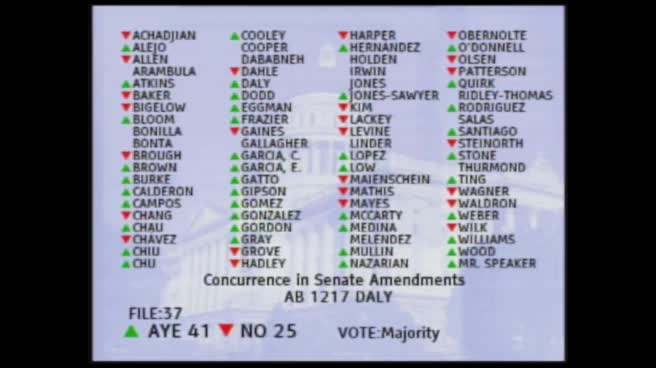 2MIN
Assembly Floor
 3MIN
Senate Floor
 4MIN
Assembly Standing Committee on Human Services
Bill Author

Bill Co-Author(s):