AB 2498: Human trafficking.
- Session Year: 2015-2016
- House: Assembly
- Latest Version Date: 2016-09-26
The California Public Records Act requires state and local agencies to make public records available for inspection by the public, subject to specified criteria and with specified exceptions. Existing law exempts from disclosure any investigatory or security file compiled by any other state or local police agency, or any investigatory or security files compiled by any other state or local agency for correctional, law enforcement, or licensing purposes. Existing law requires, however, that state and local law enforcement agencies make public specified information, including names of victims, relating to the circumstances surrounding all complaints or requests for assistance, among other things, except to the extent that disclosure of a particular item of information would endanger the safety of a person involved in the investigation. Existing law allows victims of specified crimes, including human trafficking, to request that their names be withheld from any public records request, and upon that request prohibits law enforcement agencies from disclosing those names except under specified circumstances. Existing law additionally prohibits law enforcement agencies from disclosing the addresses of victims of specified crimes, including human trafficking.
This bill would authorize, at the request of a victim and subject to specified restrictions, the withholding of the names and images of a victim of human trafficking and that victims immediate family, as defined and as specified, from disclosure pursuant to the California Public Records Act until the investigation or any subsequent prosecution is complete. The bill would additionally prohibit law enforcement agencies from disclosing the names, addresses, and images of victims of human trafficking and their immediate family, except under specified circumstances. The bill would also require law enforcement agencies to orally inform the person who alleges to be the victim of human trafficking of his or her right to have his or her name, addresses, and images, and the names, addresses, and images of his or her immediate family members withheld and kept confidential. By imposing new duties on law enforcement agencies, the bill would impose a state-mandated local program.
Existing law, as amended by the Californians Against Sexual Exploitation Act (CASE Act), an initiative measure enacted by the approval of Proposition 35 at the November 6, 2012, statewide general election proscribes the crime of human trafficking. A person who deprives or violates the personal liberty of another with the intent to obtain forced labor or services, or to effect or maintain a violation of various felony or misdemeanor offenses, including offenses relating to prostitution, child pornography, as specified, or extortion, as defined, is guilty of human trafficking. A person who causes, induces, or persuades, or attempts to cause, induce, or persuade, a person who is a minor at the time of commission of the offense to engage in a commercial sex act, with the intent to effect or maintain a violation of various felony or misdemeanor offenses, is also guilty of human trafficking.
Existing law proscribes various sex offenses, including pimping and pandering. Existing law makes a person who procures another person for the purposes of prostitution, or who by promises, threats, violence, or by any device or scheme, causes, induces, persuades, or encourages another person to become a prostitute guilty of pandering. Existing law makes a person who, knowing another person is a prostitute, lives or derives support or maintenance in whole or in part from the earnings or proceeds of the persons prostitution, or from money loaned or advanced to or charged against that person by any keeper, manager, or inmate of a house or other place where prostitution is practiced or allowed, or who solicits or receives compensation for soliciting for the person guilty of pimping.
Existing law generally requires that the issues on the court calendar be disposed of in a specified order, unless for good cause the court directs an action to be tried out of its order. Existing law requires that certain criminal actions, however, take precedence over all other criminal actions in the order of trial, including criminal actions in which a person is a victim of an alleged violation of a specified sex offense, including rape, incest, or sodomy, committed by the use of force, violence, or the threat of force or violence.
This bill would authorize the court, for good cause, to grant priority to an action for an alleged violation of the prohibition against human trafficking as the court, in its discretion, may determine to be appropriate.
This bill would also make other technical, nonsubstantive, and conforming changes.
Existing constitutional provisions require that a statute that limits the right of access to the meetings of public bodies or the writings of public officials and agencies be adopted with findings demonstrating the interest protected by the limitation and the need for protecting that interest.
This bill would make legislative findings to that effect regarding the need to maintain the confidential names of victims of human trafficking and their families.
The California Constitution requires the state to reimburse local agencies and school districts for certain costs mandated by the state. Statutory provisions establish procedures for making that reimbursement.
This bill would provide that, if the Commission on State Mandates determines that the bill contains costs mandated by the state, reimbursement for those costs shall be made pursuant to these statutory provisions.
The California Public Records Act requires state and local agencies to make public records available for inspection by the public, subject to specified criteria and with specified exceptions. Existing law exempts from disclosure any investigatory or security file compiled by any other state or local police agency, or any investigatory or security files compiled by any other state or local agency for correctional, law enforcement, or licensing purposes. Existing law requires, however, that state and local law enforcement agencies make public specified information, including names of victims, relating to the circumstances surrounding all complaints or requests for assistance, among other things, except to the extent that disclosure of a particular item of information would endanger the safety of a person involved in the investigation. Existing law allows victims of specified crimes, including human trafficking, to request that their names be withheld from any public records request, and upon that request prohibits law enforcement agencies from disclosing those names except under specified circumstances. Existing law additionally prohibits law enforcement agencies from disclosing the addresses of victims of specified crimes, including human trafficking.
This bill would authorize, at the request of a victim and subject to specified restrictions, the withholding of the names and images of a victim of human trafficking and that victims immediate family, as defined and as specified, from disclosure pursuant to the California Public Records Act until the investigation or any subsequent prosecution is complete. The bill would additionally prohibit law enforcement agencies from disclosing the names, addresses, and images of victims of human trafficking and their immediate family, except under specified circumstances. The bill would also require law enforcement agencies to orally inform the person who alleges to be the victim of human trafficking of his or her right to have his or her name, addresses, and images, and the names, addresses, and images of his or her immediate family members withheld and kept confidential. By imposing new duties on law enforcement agencies, the bill would impose a state-mandated local program.
Existing law, as amended by the Californians Against Sexual Exploitation Act (CASE Act), an initiative measure enacted by the approval of Proposition 35 at the November 6, 2012, statewide general election proscribes the crime of human trafficking. A person who deprives or violates the personal liberty of another with the intent to obtain forced labor or services, or to effect or maintain a violation of various felony or misdemeanor offenses, including offenses relating to prostitution, child pornography, as specified, or extortion, as defined, is guilty of human trafficking. A person who causes, induces, or persuades, or attempts to cause, induce, or persuade, a person who is a minor at the time of commission of the offense to engage in a commercial sex act, with the intent to effect or maintain a violation of various felony or misdemeanor offenses, is also guilty of human trafficking.
Existing law proscribes various sex offenses, including pimping and pandering. Existing law makes a person who procures another person for the purposes of prostitution, or who by promises, threats, violence, or by any device or scheme, causes, induces, persuades, or encourages another person to become a prostitute guilty of pandering. Existing law makes a person who, knowing another person is a prostitute, lives or derives support or maintenance in whole or in part from the earnings or proceeds of the persons prostitution, or from money loaned or advanced to or charged against that person by any keeper, manager, or inmate of a house or other place where prostitution is practiced or allowed, or who solicits or receives compensation for soliciting for the person guilty of pimping.
Existing law generally requires that the issues on the court calendar be disposed of in a specified order, unless for good cause the court directs an action to be tried out of its order. Existing law requires that certain criminal actions, however, take precedence over all other criminal actions in the order of trial, including criminal actions in which a person is a victim of an alleged violation of a specified sex offense, including rape, incest, or sodomy, committed by the use of force, violence, or the threat of force or violence.
This bill would expand the list of criminal actions that take precedence over all other criminal actions in the order of trial to include human trafficking, as defined by the CASE Act, pimping, and pandering. The bill would also make technical and clarifying changes. authorize the court, for good cause, to grant priority to an action for an alleged violation of the prohibition against human trafficking as the court, in its discretion, may determine to be appropriate.
This bill would also make other technical, nonsubstantive, and conforming changes.
Existing constitutional provisions require that a statute that limits the right of access to the meetings of public bodies or the writings of public officials and agencies be adopted with findings demonstrating the interest protected by the limitation and the need for protecting that interest.
This bill would make legislative findings to that effect regarding the need to maintain the confidential names of victims of human trafficking and their families.
The California Constitution requires the state to reimburse local agencies and school districts for certain costs mandated by the state. Statutory provisions establish procedures for making that reimbursement.
This bill would provide that, if the Commission on State Mandates determines that the bill contains costs mandated by the state, reimbursement for those costs shall be made pursuant to these statutory provisions.
The California Public Records Act requires state and local agencies to make public records available for inspection by the public, subject to specified criteria and with specified exceptions. Existing law exempts from disclosure any investigatory or security file compiled by any other state or local police agency, or any investigatory or security files compiled by any other state or local agency for correctional, law enforcement, or licensing purposes. Existing law requires, however, that state and local law enforcement agencies make public specified information, including names of victims, relating to the circumstances surrounding all complaints or requests for assistance, among other things, except to the extent that disclosure of a particular item of information would endanger the safety of a person involved in the investigation. Existing law allows victims of specified crimes, including human trafficking, to request that their names be withheld from any public records request, and upon that request prohibits law enforcement agencies from disclosing those names except under specified circumstances. Existing law additionally prohibits law enforcement agencies from disclosing the addresses of victims of specified crimes, including human trafficking.
This bill would authorize, at the request of a victim and subject to specified restrictions, the withholding of the names and images of a victim of human trafficking and that victims immediate family, as defined and as specified, from disclosure pursuant to the California Public Records Act until the investigation or any subsequent prosecution is complete. The bill would additionally prohibit law enforcement agencies from disclosing the names, addresses, and images of victims of human trafficking and their immediate family, except under specified circumstances. The bill would also require law enforcement agencies to orally inform the person who alleges to be the victim of human trafficking of his or her right to have his or her name, addresses, and images, and the names, addresses, and images of his or her immediate family members withheld and kept confidential. If the victims native language is not English, the bill would require that the law enforcement agency inform the victim of this right in his or her native language. By imposing new duties on law enforcement agencies, the bill would impose a state-mandated local program.
Existing law, as amended by the Californians Against Sexual Exploitation Act (CASE Act), an initiative measure enacted by the approval of Proposition 35 at the November 6, 2012, statewide general election proscribes the crime of human trafficking. A person who deprives or violates the personal liberty of another with the intent to obtain forced labor or services, or to effect or maintain a violation of various felony or misdemeanor offenses, including offenses relating to prostitution, child pornography, as specified, or extortion, as defined, is guilty of human trafficking. A person who causes, induces, or persuades, or attempts to cause, induce, or persuade, a person who is a minor at the time of commission of the offense to engage in a commercial sex act, with the intent to effect or maintain a violation of various felony or misdemeanor offenses, is also guilty of human trafficking.
Existing law proscribes various sex offenses, including pimping and pandering. Existing law makes a person who procures another person for the purposes of prostitution, or who by promises, threats, violence, or by any device or scheme, causes, induces, persuades, or encourages another person to become a prostitute guilty of pandering. Existing law makes a person who, knowing another person is a prostitute, lives or derives support or maintenance in whole or in part from the earnings or proceeds of the persons prostitution, or from money loaned or advanced to or charged against that person by any keeper, manager, or inmate of a house or other place where prostitution is practiced or allowed, or who solicits or receives compensation for soliciting for the person guilty of pimping.
Existing law generally requires that the issues on the court calendar be disposed of in a specified order, unless for good cause the court directs an action to be tried out of its order. Existing law requires that certain criminal actions, however, take precedence over all other criminal actions in the order of trial, including criminal actions in which a person is a victim of an alleged violation of a specified sex offense, including rape, incest, or sodomy, committed by the use of force, violence, or the threat of force or violence.
This bill would expand the list of criminal actions that take precedence over all other criminal actions in the order of trial to include human trafficking, as defined by the CASE Act, pimping, and pandering. The bill would also make technical and clarifying changes.
This bill would also make other technical, nonsubstantive, and conforming changes.
Existing constitutional provisions require that a statute that limits the right of access to the meetings of public bodies or the writings of public officials and agencies be adopted with findings demonstrating the interest protected by the limitation and the need for protecting that interest.
This bill would make legislative findings to that effect regarding the need to maintain the confidential names of victims of human trafficking and their families.
This bill would incorporate additional changes to Section 6254 of the Government Code proposed by AB 2611 to take effect if both bills are chaptered and this bill is chaptered last.
The California Constitution requires the state to reimburse local agencies and school districts for certain costs mandated by the state. Statutory provisions establish procedures for making that reimbursement.
This bill would provide that, if the Commission on State Mandates determines that the bill contains costs mandated by the state, reimbursement for those costs shall be made pursuant to these statutory provisions.
The California Public Records Act requires state and local agencies to make public records available for inspection by the public, subject to specified criteria and with specified exceptions. Existing law exempts from disclosure any investigatory or security file compiled by any other state or local police agency, or any investigatory or security files compiled by any other state or local agency for correctional, law enforcement, or licensing purposes. Existing law requires, however, that state and local law enforcement agencies make public specified information, including names of victims, relating to the circumstances surrounding all complaints or requests for assistance, among other things, except to the extent that disclosure of a particular item of information would endanger the safety of a person involved in the investigation. Existing law allows victims of specified crimes, including human trafficking, to request that their names be withheld from any public records request, and upon that request prohibits law enforcement agencies from disclosing those names except under specified circumstances. Existing law additionally prohibits law enforcement agencies from disclosing the addresses of victims of specified crimes, including human trafficking.
This bill would exempt the names, addresses, authorize, at the request of a victim and subject to specified restrictions, the withholding of the names and images of victims a victim of human trafficking and their that victims immediate family, as defined and as specified, from disclosure pursuant to the California Public Records Act. Act until the investigation or any subsequent prosecution is complete. The bill would additionally prohibit law enforcement agencies from disclosing the names, addresses, and images of victims of human trafficking and their immediate family, except under specified circumstances.
Existing law, as amended by the Californians Against Sexual Exploitation Act, Act (CASE Act), an initiative measure enacted by the approval of Proposition 35 at the November 6, 2012, statewide general election (CASE Act), proscribes the crime of human trafficking. A person who deprives or violates the personal liberty of another with the intent to obtain forced labor or services, or to effect or maintain a violation of various felony or misdemeanor offenses, including offenses relating to prostitution, child pornography, as specified, or extortion, as defined, is guilty of human trafficking. A person who causes, induces, or persuades, or attempts to cause, induce, or persuade, a person who is a minor at the time of commission of the offense to engage in a commercial sex act, with the intent to effect or maintain a violation of various felony or misdemeanor offenses, is also guilty of human trafficking.
Existing law proscribes various sex offenses, including pimping and pandering. Existing law makes a person who procures another person for the purposes of prostitution, or who by promises, threats, violence, or by any device or scheme, causes, induces, persuades, or encourages another person to become a prostitute guilty of pandering. Existing law makes a person who, knowing another person is a prostitute, lives or derives support or maintenance in whole or in part from the earnings or proceeds of the persons prostitution, or from money loaned or advanced to or charged against that person by any keeper, manager, or inmate of a house or other place where prostitution is practiced or allowed, or who solicits or receives compensation for soliciting for the person guilty of pimping.
Existing law generally requires that the issues on the court calendar be disposed of in a specified order, unless for good cause the court directs an action to be tried out of its order. Existing law requires that certain criminal actions, however, take precedence over all other criminal actions in the order of trial, including criminal actions in which a person is a victim of an alleged violation of a specified sex offense, including rape, incest, or sodomy, committed by the use of force, violence, or the threat of force or violence.
This bill would expand the list of criminal actions that take precedence over all other criminal actions in the order of trial to include human trafficking, as defined by the CASE Act, pimping, and pandering. The bill would also make technical and clarifying changes.
This bill would also make other technical, nonsubstantive, and conforming changes.
Existing constitutional provisions require that a statute that limits the right of access to the meetings of public bodies or the writings of public officials and agencies be adopted with findings demonstrating the interest protected by the limitation and the need for protecting that interest.
This bill would make legislative findings to that effect regarding the need to maintain the confidential names of victims of human trafficking and their families.
The California Public Records Act requires state and local agencies to make public records available for inspection by the public, subject to specified criteria and with specified exceptions. Existing law exempts from disclosure any investigatory or security file compiled by any other state or local police agency, or any investigatory or security files compiled by any other state or local agency for correctional, law enforcement, or licensing purposes. Existing law requires, however, that state and local law enforcement agencies make public specified information, including names of victims, relating to the circumstances surrounding all complaints or requests for assistance, among other things, except to the extent that disclosure of a particular item of information would endanger the safety of a person involved in the investigation. Existing law allows victims of specified crimes, including human trafficking, to request that their names be withheld from any public records request, and upon that request prohibits law enforcement agencies from disclosing those names except under specified circumstances. Existing law additionally prohibits law enforcement agencies from disclosing the addresses of victims of specified crimes, including human trafficking.
This bill would exempt the names, addresses, and images of victims of human trafficking and their families immediate family, as defined and as specified, from disclosure pursuant to the California Public Records Act. The bill would additionally prohibit law enforcement agencies from disclosing the names, addresses, and images of victims of human trafficking and their families except, immediate family, except under specified circumstances.
Existing law, as amended by the Californians Against Sexual Exploitation Act, an initiative measure enacted by the approval of Proposition 35 at the November 6, 2012, statewide general election (CASE Act), proscribes the crime of human trafficking. A person who deprives or violates the personal liberty of another with the intent to obtain forced labor or services, or to effect or maintain a violation of various felony or misdemeanor offenses, including offenses relating to prostitution, child pornography, as specified, or extortion, as defined, is guilty of human trafficking. A person who causes, induces, or persuades, or attempts to cause, induce, or persuade, a person who is a minor at the time of commission of the offense to engage in a commercial sex act, with the intent to effect or maintain a violation of various felony or misdemeanor offenses, is also guilty of human trafficking.
Existing law proscribes various sex offenses, including pimping and pandering. Existing law makes a person who procures another person for the purposes of prostitution, or who by promises, threats, violence, or by any device or scheme, causes, induces, persuades, or encourages another person to become a prostitute guilty of pandering. Existing law makes a person who, knowing another person is a prostitute, lives or derives support or maintenance in whole or in part from the earnings or proceeds of the persons prostitution, or from money loaned or advanced to or charged against that person by any keeper, manager, or inmate of a house or other place where prostitution is practiced or allowed, or who solicits or receives compensation for soliciting for the person guilty of pimping.
Existing law generally requires that the issues on the court calendar be disposed of in a specified order, unless for good cause the court directs an action to be tried out of its order. Existing law requires that certain criminal actions, however, take precedence over all other criminal actions in the order of trial, including criminal actions in which a person is a victim of an alleged violation of a specified sex offense, including rape, incest, or sodomy, committed by the use of force, violence, or the threat of force or violence.
This bill would expand the list of criminal actions that take precedence over all other criminal actions in the order of trial to include human trafficking, as defined by the CASE Act, pimping, and pandering. The bill would also make technical and clarifying changes.
This bill would also make other technical, nonsubstantive, and conforming changes.
Existing constitutional provisions require that a statute that limits the right of access to the meetings of public bodies or the writings of public officials and agencies be adopted with findings demonstrating the interest protected by the limitation and the need for protecting that interest.
This bill would make legislative findings to that effect regarding the need to maintain the confidential names of victims of human trafficking and their families.
The California Public Records Act requires state and local agencies to make public records available for inspection by the public, subject to specified criteria and with specified exceptions. Existing law exempts from disclosure any investigatory or security file compiled by any other state or local police agency, or any investigatory or security files compiled by any other state or local agency for correctional, law enforcement, or licensing purposes. Existing law requires, however, that state and local law enforcement agencies make public specific specified information, including names of victims, relating to the circumstances surrounding all complaints or requests for assistance, among other things, except to the extent that disclosure of a particular item of information would endanger the safety of a person involved in the investigation. Existing law allows victims of specified crimes, including human trafficking, to request that their names be withheld from any public records request, and upon that request prohibits law enforcement agencies from disclosing those names except under specified circumstances. Existing law additionally prohibits law enforcement agencies from disclosing the addresses of victims of specified crimes, including human trafficking.
This bill would exempt the names, addresses, and images of victims of human trafficking and their families from disclosure pursuant to the California Public Records Act. The bill would additionally prohibit law enforcement agencies from disclosing the names, addresses, and images of victims of human trafficking and their families except, under specified circumstances.
This bill would also make other technical, nonsubstantive, and conforming changes.
Existing constitutional provisions require that a statute that limits the right of access to the meetings of public bodies or the writings of public officials and agencies be adopted with findings demonstrating the interest protected by the limitation and the need for protecting that interest.
This bill would make legislative findings to that effect regarding the need to maintain the confidential names of victims of human trafficking and their families.
Except as provided in Sections 6254.7 and 6254.13, this chapter does not require the disclosure of any of the following records:
(a)Preliminary drafts, notes, or interagency or intra-agency memoranda that are not retained by the public agency in the ordinary course of business, if the public interest in withholding those records clearly outweighs the public interest in disclosure.
(b)Records pertaining to pending litigation to which the public agency is a party, or to claims made pursuant to Division 3.6 (commencing with Section 810), until the pending litigation or claim has been finally adjudicated or otherwise settled.
(c)Personnel, medical, or similar files, the disclosure of which would constitute an unwarranted invasion of personal privacy.
(d)Records contained in or related to any of the following:
(1)Applications filed with any state agency responsible for the regulation or supervision of the issuance of securities or of financial institutions, including, but not limited to, banks, savings and loan associations, industrial loan companies, credit unions, and insurance companies.
(2)Examination, operating, or condition reports prepared by, on behalf of, or for the use of, any state agency referred to in paragraph (1).
(3)Preliminary drafts, notes, or interagency or intra-agency communications prepared by, on behalf of, or for the use of, any state agency referred to in paragraph (1).
(4)Information received in confidence by any state agency referred to in paragraph (1).
(e)Geological and geophysical data, plant production data, and similar information relating to utility systems development, or market or crop reports, that are obtained in confidence from any person.
(f)Records of complaints to, or investigations conducted by, or records of intelligence information or security procedures of, the office of the Attorney General and the Department of Justice, the Office of Emergency Services and any state or local police agency, or any investigatory or security files compiled by any other state or local police agency, or any investigatory or security files compiled by any other state or local agency for correctional, law enforcement, or licensing purposes. However, state and local law enforcement agencies shall disclose the names and addresses of persons involved in, or witnesses other than confidential informants to, the incident, the description of any property involved, the date, time, and location of the incident, all diagrams, statements of the parties involved in the incident, the statements of all witnesses, other than confidential informants, to the victims of an incident, or an authorized representative thereof, an insurance carrier against which a claim has been or might be made, and any person suffering bodily injury or property damage or loss, as the result of the incident caused by arson, burglary, fire, explosion, larceny, robbery, carjacking, vandalism, vehicle theft, or a crime as defined by subdivision (b) of Section 13951, unless the disclosure would endanger the safety of a witness or other person involved in the investigation, or unless disclosure would endanger the successful completion of the investigation or a related investigation. However, this subdivision does not require the disclosure of that portion of those investigative files that reflects the analysis or conclusions of the investigating officer.
Customer lists provided to a state or local police agency by an alarm or security company at the request of the agency shall be construed to be records subject to this subdivision.
Notwithstanding any other provision of this subdivision, state and local law enforcement agencies shall make public the following information, except to the extent that disclosure of a particular item of information would endanger the safety of a person involved in an investigation or would endanger the successful completion of the investigation or a related investigation:
(1)The full name and occupation of every individual arrested by the agency, the individuals physical description including date of birth, color of eyes and hair, sex, height and weight, the time and date of arrest, the time and date of booking, the location of the arrest, the factual circumstances surrounding the arrest, the amount of bail set, the time and manner of release or the location where the individual is currently being held, and all charges the individual is being held upon, including any outstanding warrants from other jurisdictions and parole or probation holds.
(2)(A)Subject to the restrictions imposed by Section 841.5 of the Penal Code, the time, substance, and location of all complaints or requests for assistance received by the agency and the time and nature of the response thereto, including, to the extent the information regarding crimes alleged or committed or any other incident investigated is recorded, the time, date, and location of occurrence, the time and date of the report, the name and age of the victim, the factual circumstances surrounding the crime or incident, and a general description of any injuries, property, or weapons involved. The name of a victim of any crime defined by Section 220, 261, 261.5, 262, 264, 264.1, 265, 266, 266a, 266b, 266c, 266e, 266f, 266j, 267, 269, 273a, 273d, 273.5, 285, 286, 288, 288a, 288.2, 288.3, 288.4, 288.5, 288.7, 289, 422.6, 422.7, 422.75, 646.9, or 647.6 of the Penal Code may be withheld at the victims request, or at the request of the victims parent or guardian if the victim is a minor. When a person is the victim of more than one crime, information disclosing that the person is a victim of a crime defined in any of the sections of the Penal Code set forth in this subdivision may be deleted at the request of the victim, or the victims parent or guardian if the victim is a minor, in making the report of the crime, or of any crime or incident accompanying the crime, available to the public in compliance with the requirements of this paragraph.
(B)Subject to the restrictions imposed by Section 841.5 of the Penal Code, the names and images of a victim of human trafficking, as defined in Section 236.1 of the Penal Code, and of that victims immediate family, other than a family member who is charged with a criminal offense arising from the same incident, may be withheld at the victims request until the investigation or any subsequent prosecution is complete. For purposes of this subdivision, immediate family shall have the same meaning as that provided in paragraph (3) of subdivision (b) of Section 422.4 of the Penal Code.
(3)Subject to the restrictions of Section 841.5 of the Penal Code and this subdivision, the current address of every individual arrested by the agency and the current address of the victim of a crime, if the requester declares under penalty of perjury that the request is made for a scholarly, journalistic, political, or governmental purpose, or that the request is made for investigation purposes by a licensed private investigator as described in Chapter 11.3 (commencing with Section 7512) of Division 3 of the Business and Professions Code. However, the address of the victim of any crime defined by Section 220, 236.1, 261, 261.5, 262, 264, 264.1, 265, 266, 266a, 266b, 266c, 266e, 266f, 266j, 267, 269, 273a, 273d, 273.5, 285, 286, 288, 288a, 288.2, 288.3, 288.4, 288.5, 288.7, 289, 422.6, 422.7, 422.75, 646.9, or 647.6 of the Penal Code shall remain confidential. Address information obtained pursuant to this paragraph shall not be used directly or indirectly, or furnished to another, to sell a product or service to any individual or group of individuals, and the requester shall execute a declaration to that effect under penalty of perjury. This paragraph shall not be construed to prohibit or limit a scholarly, journalistic, political, or government use of address information obtained pursuant to this paragraph.
(g)Test questions, scoring keys, and other examination data used to administer a licensing examination, examination for employment, or academic examination, except as provided for in Chapter 3 (commencing with Section 99150) of Part 65 of Division 14 of Title 3 of the Education Code.
(h)The contents of real estate appraisals or engineering or feasibility estimates and evaluations made for or by the state or local agency relative to the acquisition of property, or to prospective public supply and construction contracts, until all of the property has been acquired or all of the contract agreement obtained. However, the law of eminent domain shall not be affected by this provision.
(i)Information required from any taxpayer in connection with the collection of local taxes that is received in confidence and the disclosure of the information to other persons would result in unfair competitive disadvantage to the person supplying the information.
(j)Library circulation records kept for the purpose of identifying the borrower of items available in libraries, and library and museum materials made or acquired and presented solely for reference or exhibition purposes. The exemption in this subdivision shall not apply to records of fines imposed on the borrowers.
(k)Records, the disclosure of which is exempted or prohibited pursuant to federal or state law, including, but not limited to, provisions of the Evidence Code relating to privilege.
(l)Correspondence of and to the Governor or employees of the Governors office or in the custody of or maintained by the Governors Legal Affairs Secretary. However, public records shall not be transferred to the custody of the Governors Legal Affairs Secretary to evade the disclosure provisions of this chapter.
(m)In the custody of or maintained by the Legislative Counsel, except those records in the public database maintained by the Legislative Counsel that are described in Section 10248.
(n)Statements of personal worth or personal financial data required by a licensing agency and filed by an applicant with the licensing agency to establish his or her personal qualification for the license, certificate, or permit applied for.
(o)Financial data contained in applications for financing under Division 27 (commencing with Section 44500) of the Health and Safety Code, if an authorized officer of the California Pollution Control Financing Authority determines that disclosure of the financial data would be competitively injurious to the applicant and the data is required in order to obtain guarantees from the United States Small Business Administration. The California Pollution Control Financing Authority shall adopt rules for review of individual requests for confidentiality under this section and for making available to the public those portions of an application that are subject to disclosure under this chapter.
(p)Records of state agencies related to activities governed by Chapter 10.3 (commencing with Section 3512), Chapter 10.5 (commencing with Section 3525), and Chapter 12 (commencing with Section 3560) of Division 4, that reveal a state agencys deliberative processes, impressions, evaluations, opinions, recommendations, meeting minutes, research, work products, theories, or strategy, or that provide instruction, advice, or training to employees who do not have full collective bargaining and representation rights under these chapters. This subdivision shall not be construed to limit the disclosure duties of a state agency with respect to any other records relating to the activities governed by the employee relations acts referred to in this subdivision.
(q)(1)Records of state agencies related to activities governed by Article 2.6 (commencing with Section 14081), Article 2.8 (commencing with Section 14087.5), and Article 2.91 (commencing with Section 14089) of Chapter 7 of Part 3 of Division 9 of the Welfare and Institutions Code, that reveal the special negotiators deliberative processes, discussions, communications, or any other portion of the negotiations with providers of health care services, impressions, opinions, recommendations, meeting minutes, research, work product, theories, or strategy, or that provide instruction, advice, or training to employees.
(2)Except for the portion of a contract containing the rates of payment, contracts for inpatient services entered into pursuant to these articles, on or after April 1, 1984, shall be open to inspection one year after they are fully executed. If a contract for inpatient services that is entered into prior to April 1, 1984, is amended on or after April 1, 1984, the amendment, except for any portion containing the rates of payment, shall be open to inspection one year after it is fully executed. If the California Medical Assistance Commission enters into contracts with health care providers for other than inpatient hospital services, those contracts shall be open to inspection one year after they are fully executed.
(3)Three years after a contract or amendment is open to inspection under this subdivision, the portion of the contract or amendment containing the rates of payment shall be open to inspection.
(4)Notwithstanding any other law, the entire contract or amendment shall be open to inspection by the Joint Legislative Audit Committee and the Legislative Analysts Office. The committee and that office shall maintain the confidentiality of the contracts and amendments until the time a contract or amendment is fully open to inspection by the public.
(r)Records of Native American graves, cemeteries, and sacred places and records of Native American places, features, and objects described in Sections 5097.9 and 5097.993 of the Public Resources Code maintained by, or in the possession of, the Native American Heritage Commission, another state agency, or a local agency.
(s)A final accreditation report of the Joint Commission on Accreditation of Hospitals that has been transmitted to the State Department of Health Care Services pursuant to subdivision (b) of Section 1282 of the Health and Safety Code.
(t)Records of a local hospital district, formed pursuant to Division 23 (commencing with Section 32000) of the Health and Safety Code, or the records of a municipal hospital, formed pursuant to Article 7 (commencing with Section 37600) or Article 8 (commencing with Section 37650) of Chapter 5 of Part 2 of Division 3 of Title 4 of this code, that relate to any contract with an insurer or nonprofit hospital service plan for inpatient or outpatient services for alternative rates pursuant to Section 10133 of the Insurance Code. However, the record shall be open to inspection within one year after the contract is fully executed.
(u)(1)Information contained in applications for licenses to carry firearms issued pursuant to Section 26150, 26155, 26170, or 26215 of the Penal Code by the sheriff of a county or the chief or other head of a municipal police department that indicates when or where the applicant is vulnerable to attack or that concerns the applicants medical or psychological history or that of members of his or her family.
(2)The home address and telephone number of prosecutors, public defenders, peace officers, judges, court commissioners, and magistrates that are set forth in applications for licenses to carry firearms issued pursuant to Section 26150, 26155, 26170, or 26215 of the Penal Code by the sheriff of a county or the chief or other head of a municipal police department.
(3)The home address and telephone number of prosecutors, public defenders, peace officers, judges, court commissioners, and magistrates that are set forth in licenses to carry firearms issued pursuant to Section 26150, 26155, 26170, or 26215 of the Penal Code by the sheriff of a county or the chief or other head of a municipal police department.
(v)(1)Records of the Managed Risk Medical Insurance Board and the State Department of Health Care Services related to activities governed by Part 6.3 (commencing with Section 12695), Part 6.5 (commencing with Section 12700), Part 6.6 (commencing with Section 12739.5), or Part 6.7 (commencing with Section 12739.70) of Division 2 of the Insurance Code, or Chapter 2 (commencing with Section 15810) or Chapter 4 (commencing with Section 15870) of Part 3.3 of Division 9 of the Welfare and Institutions Code, and that reveal any of the following:
(A)The deliberative processes, discussions, communications, or any other portion of the negotiations with entities contracting or seeking to contract with the board or the department, entities with which the board or the department is considering a contract, or entities with which the board or department is considering or enters into any other arrangement under which the board or the department provides, receives, or arranges services or reimbursement.
(B)The impressions, opinions, recommendations, meeting minutes, research, work product, theories, or strategy of the board or its staff or the department or its staff, or records that provide instructions, advice, or training to their employees.
(2)(A)Except for the portion of a contract that contains the rates of payment, contracts entered into pursuant to Part 6.3 (commencing with Section 12695), Part 6.5 (commencing with Section 12700), Part 6.6 (commencing with Section 12739.5), or Part 6.7 (commencing with Section 12739.70) of Division 2 of the Insurance Code, or Chapter 2 (commencing with Section 15810) or Chapter 4 (commencing with Section 15870) of Part 3.3 of Division 9 of the Welfare and Institutions Code, on or after July 1, 1991, shall be open to inspection one year after their effective dates.
(B)If a contract that is entered into prior to July 1, 1991, is amended on or after July 1, 1991, the amendment, except for any portion containing the rates of payment, shall be open to inspection one year after the effective date of the amendment.
(3)Three years after a contract or amendment is open to inspection pursuant to this subdivision, the portion of the contract or amendment containing the rates of payment shall be open to inspection.
(4)Notwithstanding any other law, the entire contract or amendments to a contract shall be open to inspection by the Joint Legislative Audit Committee. The committee shall maintain the confidentiality of the contracts and amendments thereto, until the contracts or amendments to the contracts are open to inspection pursuant to paragraph (3).
(w)(1)Records of the Managed Risk Medical Insurance Board related to activities governed by Chapter 8 (commencing with Section 10700) of Part 2 of Division 2 of the Insurance Code, and that reveal the deliberative processes, discussions, communications, or any other portion of the negotiations with health plans, or the impressions, opinions, recommendations, meeting minutes, research, work product, theories, or strategy of the board or its staff, or records that provide instructions, advice, or training to employees.
(2)Except for the portion of a contract that contains the rates of payment, contracts for health coverage entered into pursuant to Chapter 8 (commencing with Section 10700) of Part 2 of Division 2 of the Insurance Code, on or after January 1, 1993, shall be open to inspection one year after they have been fully executed.
(3)Notwithstanding any other law, the entire contract or amendments to a contract shall be open to inspection by the Joint Legislative Audit Committee. The committee shall maintain the confidentiality of the contracts and amendments thereto, until the contracts or amendments to the contracts are open to inspection pursuant to paragraph (2).
(x)Financial data contained in applications for registration, or registration renewal, as a service contractor filed with the Director of Consumer Affairs pursuant to Chapter 20 (commencing with Section 9800) of Division 3 of the Business and Professions Code, for the purpose of establishing the service contractors net worth, or financial data regarding the funded accounts held in escrow for service contracts held in force in this state by a service contractor.
(y)(1)Records of the Managed Risk Medical Insurance Board and the State Department of Health Care Services related to activities governed by Part 6.2 (commencing with Section 12693) or Part 6.4 (commencing with Section 12699.50) of Division 2 of the Insurance Code or Sections 14005.26 and 14005.27 of, or Chapter 3 (commencing with Section 15850) of Part 3.3 of Division 9 of, the Welfare and Institutions Code, if the records reveal any of the following:
(A)The deliberative processes, discussions, communications, or any other portion of the negotiations with entities contracting or seeking to contract with the board or the department, entities with which the board or department is considering a contract, or entities with which the board or department is considering or enters into any other arrangement under which the board or department provides, receives, or arranges services or reimbursement.
(B)The impressions, opinions, recommendations, meeting minutes, research, work product, theories, or strategy of the board or its staff, or the department or its staff, or records that provide instructions, advice, or training to employees.
(2)(A)Except for the portion of a contract that contains the rates of payment, contracts entered into pursuant to Part 6.2 (commencing with Section 12693) or Part 6.4 (commencing with Section 12699.50) of Division 2 of the Insurance Code, on or after January 1, 1998, or Sections 14005.26 and 14005.27 of, or Chapter 3 (commencing with Section 15850) of Part 3.3 of Division 9 of, the Welfare and Institutions Code shall be open to inspection one year after their effective dates.
(B)If a contract entered into pursuant to Part 6.2 (commencing with Section 12693) or Part 6.4 (commencing with Section 12699.50) of Division 2 of the Insurance Code or Sections 14005.26 and 14005.27 of, or Chapter 3 (commencing with Section 15850) of Part 3.3 of Division 9 of, the Welfare and Institutions Code, is amended, the amendment shall be open to inspection one year after the effective date of the amendment.
(3)Three years after a contract or amendment is open to inspection pursuant to this subdivision, the portion of the contract or amendment containing the rates of payment shall be open to inspection.
(4)Notwithstanding any other law, the entire contract or amendments to a contract shall be open to inspection by the Joint Legislative Audit Committee. The committee shall maintain the confidentiality of the contracts and amendments thereto until the contract or amendments to a contract are open to inspection pursuant to paragraph (2) or (3).
(5)The exemption from disclosure provided pursuant to this subdivision for the contracts, deliberative processes, discussions, communications, negotiations, impressions, opinions, recommendations, meeting minutes, research, work product, theories, or strategy of the board or its staff, or the department or its staff, shall also apply to the contracts, deliberative processes, discussions, communications, negotiations, impressions, opinions, recommendations, meeting minutes, research, work product, theories, or strategy of applicants pursuant to Part 6.4 (commencing with Section 12699.50) of Division 2 of the Insurance Code or Chapter 3 (commencing with Section 15850) of Part 3.3 of Division 9 of the Welfare and Institutions Code.
(z)Records obtained pursuant to paragraph (2) of subdivision (f) of Section 2891.1 of the Public Utilities Code.
(aa)A document prepared by or for a state or local agency that assesses its vulnerability to terrorist attack or other criminal acts intended to disrupt the public agencys operations and that is for distribution or consideration in a closed session.
(ab)Critical infrastructure information, as defined in Section 131(3) of Title 6 of the United States Code, that is voluntarily submitted to the Office of Emergency Services for use by that office, including the identity of the person who or entity that voluntarily submitted the information. As used in this subdivision, voluntarily submitted means submitted in the absence of the office exercising any legal authority to compel access to or submission of critical infrastructure information. This subdivision shall not affect the status of information in the possession of any other state or local governmental agency.
(ac)All information provided to the Secretary of State by a person for the purpose of registration in the Advance Health Care Directive Registry, except that those records shall be released at the request of a health care provider, a public guardian, or the registrants legal representative.
(ad)The following records of the State Compensation Insurance Fund:
(1)Records related to claims pursuant to Chapter 1 (commencing with Section 3200) of Division 4 of the Labor Code, to the extent that confidential medical information or other individually identifiable information would be disclosed.
(2)Records related to the discussions, communications, or any other portion of the negotiations with entities contracting or seeking to contract with the fund, and any related deliberations.
(3)Records related to the impressions, opinions, recommendations, meeting minutes of meetings or sessions that are lawfully closed to the public, research, work product, theories, or strategy of the fund or its staff, on the development of rates, contracting strategy, underwriting, or competitive strategy pursuant to the powers granted to the fund in Chapter 4 (commencing with Section 11770) of Part 3 of Division 2 of the Insurance Code.
(4)Records obtained to provide workers compensation insurance under Chapter 4 (commencing with Section 11770) of Part 3 of Division 2 of the Insurance Code, including, but not limited to, any medical claims information, policyholder information provided that nothing in this paragraph shall be interpreted to prevent an insurance agent or broker from obtaining proprietary information or other information authorized by law to be obtained by the agent or broker, and information on rates, pricing, and claims handling received from brokers.
(5)(A)Records that are trade secrets pursuant to Section 6276.44, or Article 11 (commencing with Section 1060) of Chapter 4 of Division 8 of the Evidence Code, including without limitation, instructions, advice, or training provided by the State Compensation Insurance Fund to its board members, officers, and employees regarding the funds special investigation unit, internal audit unit, and informational security, marketing, rating, pricing, underwriting, claims handling, audits, and collections.
(B)Notwithstanding subparagraph (A), the portions of records containing trade secrets shall be available for review by the Joint Legislative Audit Committee, California State Auditors Office, Division of Workers Compensation, and the Department of Insurance to ensure compliance with applicable law.
(6)(A)Internal audits containing proprietary information and the following records that are related to an internal audit:
(i)Personal papers and correspondence of any person providing assistance to the fund when that person has requested in writing that his or her papers and correspondence be kept private and confidential. Those papers and correspondence shall become public records if the written request is withdrawn, or upon order of the fund.
(ii)Papers, correspondence, memoranda, or any substantive information pertaining to any audit not completed or an internal audit that contains proprietary information.
(B)Notwithstanding subparagraph (A), the portions of records containing proprietary information, or any information specified in subparagraph (A) shall be available for review by the Joint Legislative Audit Committee, California State Auditors Office, Division of Workers Compensation, and the Department of Insurance to ensure compliance with applicable law.
(7)(A)Except as provided in subparagraph (C), contracts entered into pursuant to Chapter 4 (commencing with Section 11770) of Part 3 of Division 2 of the Insurance Code shall be open to inspection one year after the contract has been fully executed.
(B)If a contract entered into pursuant to Chapter 4 (commencing with Section 11770) of Part 3 of Division 2 of the Insurance Code is amended, the amendment shall be open to inspection one year after the amendment has been fully executed.
(C)Three years after a contract or amendment is open to inspection pursuant to this subdivision, the portion of the contract or amendment containing the rates of payment shall be open to inspection.
(D)Notwithstanding any other law, the entire contract or amendments to a contract shall be open to inspection by the Joint Legislative Audit Committee. The committee shall maintain the confidentiality of the contracts and amendments thereto until the contract or amendments to a contract are open to inspection pursuant to this paragraph.
(E)This paragraph is not intended to apply to documents related to contracts with public entities that are not otherwise expressly confidential as to that public entity.
(F)For purposes of this paragraph, fully executed means the point in time when all of the necessary parties to the contract have signed the contract.
This section does not prevent any agency from opening its records concerning the administration of the agency to public inspection, unless disclosure is otherwise prohibited by law.
This section does not prevent any health facility from disclosing to a certified bargaining agent relevant financing information pursuant to Section 8 of the National Labor Relations Act (29 U.S.C. Sec. 158).
SEC. 2.Section 293 of the Penal Code is amended to read:293.(a)An employee of a law enforcement agency who personally receives a report from a person, alleging that the person making the report has been the victim of a sex offense, shall inform that person that his or her name will become a matter of public record unless he or she requests that it not become a matter of public record, pursuant to Section 6254 of the Government Code.
(b)A written report of an alleged sex offense shall indicate that the alleged victim has been properly informed pursuant to subdivision (a) and shall memorialize his or her response.
(c)A law enforcement agency shall not disclose to a person, except the prosecutor, parole officers of the Department of Corrections and Rehabilitation, hearing officers of the parole authority, probation officers of county probation departments, or other persons or public agencies where authorized or required by law, the address of a person who alleges to be the victim of a sex offense.
(d)A law enforcement agency shall not disclose to a person, except the prosecutor, parole officers of the Department of Corrections and Rehabilitation, hearing officers of the parole authority, probation officers of county probation departments, or other persons or public agencies where authorized or required by law, the name of a person who alleges to be the victim of a sex offense if that person has elected to exercise his or her right pursuant to this section and Section 6254 of the Government Code.
(e)A law enforcement agency shall not disclose to a person, except the prosecutor, parole officers of the Department of Corrections and Rehabilitation, hearing officers of the parole authority, probation officers of county probation departments, or other persons or public agencies if authorized or required by law, names, addresses, or images of a person who alleges to be the victim of human trafficking, as defined in Section 236.1, or of that alleged victims immediate family, other than a family member who is charged with a criminal offense arising from the same incident, and that information and those images shall be withheld and remain confidential. The law enforcement agency shall orally inform the person who alleges to be the victim of human trafficking of his or her right to have his or her name, addresses, and images, and the names, addresses, and images of his or her immediate family members withheld and kept confidential pursuant to this section and Section 6254 of the Government Code. For purposes of this subdivision, immediate family shall have the same meaning as that provided in paragraph (3) of subdivision (b) of Section 422.4 of the Penal Code.
(f)For purposes of this section, sex offense means any crime listed in subparagraph (A) of paragraph (2) of subdivision (f) of Section 6254 of the Government Code.
(g)Parole officers of the Department of Corrections and Rehabilitation, hearing officers of the parole authority, and probation officers of county probation departments shall be entitled to receive information pursuant to subdivisions (c), (d), and (e) only if the person to whom the information pertains alleges that he or she is the victim of a sex offense or is the victim of human trafficking, as defined in Section 236.1, the alleged perpetrator of which is a parolee who is alleged to have committed the offense while on parole, or in the case of a county probation officer, the person who is alleged to have committed the offense is a probationer or is under investigation by a county probation department.
SEC. 3.Section 293.5 of the Penal Code is amended to read:293.5.(a)Except as provided in Chapter 10 (commencing with Section 1054) of Part 2 of Title 7, or for cases in which the alleged victim of a sex offense, as specified in subdivision (f) of Section 293, has not elected to exercise his or her right pursuant to Section 6254 of the Government Code, the court, at the request of the alleged victim, may order the identity of the alleged victim in all records and during all proceedings to be either Jane Doe or John Doe, if the court finds that such an order is reasonably necessary to protect the privacy of the person and will not unduly prejudice the prosecution or the defense.
(b)If the court orders the alleged victim to be identified as Jane Doe or John Doe pursuant to subdivision (a) and if there is a jury trial, the court shall instruct the jury, at the beginning and at the end of the trial, that the alleged victim is being so identified only for the purpose of protecting his or her privacy pursuant to this section.
SEC. 4.Section 1048.2 is added to the Penal Code, to read:1048.2.Notwithstanding subdivision (b) of Section 1048, for good cause shown, the court may grant priority to an action for an alleged violation of Section 236.1 as the court, in its discretion, may determine to be appropriate.
SEC. 5.The Legislature finds and declares that Section 1 of this act, which amends Section 6254 of the Government Code, imposes a limitation on the publics right of access to the meetings of public bodies or the writings of public officials and agencies within the meaning of Section 3 of Article I of the California Constitution. Pursuant to that constitutional provision, the Legislature makes the following findings to demonstrate the interest protected by this limitation and the need for protecting that interest:
In order to protect the privacy and safety of victims of human trafficking and their families, it is necessary to limit the publics right of access to the personal information of those victims.
SEC. 6.If the Commission on State Mandates determines that this act contains costs mandated by the state, reimbursement to local agencies and school districts for those costs shall be made pursuant to Part 7 (commencing with Section 17500) of Division 4 of Title 2 of the Government Code.
Except as provided in Sections 6254.7 and 6254.13, this chapter does not require the disclosure of any of the following records:
(a)Preliminary drafts, notes, or interagency or intra-agency memoranda that are not retained by the public agency in the ordinary course of business, if the public interest in withholding those records clearly outweighs the public interest in disclosure.
(b)Records pertaining to pending litigation to which the public agency is a party, or to claims made pursuant to Division 3.6 (commencing with Section 810), until the pending litigation or claim has been finally adjudicated or otherwise settled.
(c)Personnel, medical, or similar files, the disclosure of which would constitute an unwarranted invasion of personal privacy.
(d)Records contained in or related to any of the following:
(1)Applications filed with any state agency responsible for the regulation or supervision of the issuance of securities or of financial institutions, including, but not limited to, banks, savings and loan associations, industrial loan companies, credit unions, and insurance companies.
(2)Examination, operating, or condition reports prepared by, on behalf of, or for the use of, any state agency referred to in paragraph (1).
(3)Preliminary drafts, notes, or interagency or intra-agency communications prepared by, on behalf of, or for the use of, any state agency referred to in paragraph (1).
(4)Information received in confidence by any state agency referred to in paragraph (1).
(e)Geological and geophysical data, plant production data, and similar information relating to utility systems development, or market or crop reports, that are obtained in confidence from any person.
(f)Records of complaints to, or investigations conducted by, or records of intelligence information or security procedures of, the office of the Attorney General and the Department of Justice, the Office of Emergency Services and any state or local police agency, or any investigatory or security files compiled by any other state or local police agency, or any investigatory or security files compiled by any other state or local agency for correctional, law enforcement, or licensing purposes. However, state and local law enforcement agencies shall disclose the names and addresses of persons involved in, or witnesses other than confidential informants to, the incident, the description of any property involved, the date, time, and location of the incident, all diagrams, statements of the parties involved in the incident, the statements of all witnesses, other than confidential informants, to the victims of an incident, or an authorized representative thereof, an insurance carrier against which a claim has been or might be made, and any person suffering bodily injury or property damage or loss, as the result of the incident caused by arson, burglary, fire, explosion, larceny, robbery, carjacking, vandalism, vehicle theft, or a crime as defined by subdivision (b) of Section 13951, unless the disclosure would endanger the safety of a witness or other person involved in the investigation, or unless disclosure would endanger the successful completion of the investigation or a related investigation. However, this subdivision does not require the disclosure of that portion of those investigative files that reflects the analysis or conclusions of the investigating officer.
Customer lists provided to a state or local police agency by an alarm or security company at the request of the agency shall be construed to be records subject to this subdivision.
Notwithstanding any other provision of this subdivision, state and local law enforcement agencies shall make public the following information, except to the extent that disclosure of a particular item of information would endanger the safety of a person involved in an investigation or would endanger the successful completion of the investigation or a related investigation:
(1)The full name and occupation of every individual arrested by the agency, the individuals physical description including date of birth, color of eyes and hair, sex, height and weight, the time and date of arrest, the time and date of booking, the location of the arrest, the factual circumstances surrounding the arrest, the amount of bail set, the time and manner of release or the location where the individual is currently being held, and all charges the individual is being held upon, including any outstanding warrants from other jurisdictions and parole or probation holds.
(2)(A)Subject to the restrictions imposed by Section 841.5 of the Penal Code, the time, substance, and location of all complaints or requests for assistance received by the agency and the time and nature of the response thereto, including, to the extent the information regarding crimes alleged or committed or any other incident investigated is recorded, the time, date, and location of occurrence, the time and date of the report, the name and age of the victim, the factual circumstances surrounding the crime or incident, and a general description of any injuries, property, or weapons involved. The name of a victim of any crime defined by Section 220, 261, 261.5, 262, 264, 264.1, 265, 266, 266a, 266b, 266c, 266e, 266f, 266j, 267, 269, 273a, 273d, 273.5, 285, 286, 288, 288a, 288.2, 288.3, 288.4, 288.5, 288.7, 289, 422.6, 422.7, 422.75, 646.9, or 647.6 of the Penal Code may be withheld at the victims request, or at the request of the victims parent or guardian if the victim is a minor. When a person is the victim of more than one crime, information disclosing that the person is a victim of a crime defined in any of the sections of the Penal Code set forth in this subdivision may be deleted at the request of the victim, or the victims parent or guardian if the victim is a minor, in making the report of the crime, or of any crime or incident accompanying the crime, available to the public in compliance with the requirements of this paragraph.
(B)Subject to the restrictions imposed by Section 841.5 of the Penal Code, the names and images of a victim of human trafficking, as defined in Section 236.1 of the Penal Code, and of that victims immediate family, other than a family member who is charged with a criminal offense arising from the same incident, may be withheld at the victims request until the investigation or any subsequent prosecution is complete. For purposes of this subdivision, immediate family shall have the same meaning as that provided in paragraph (3) of subdivision (b) of Section 422.4 of the Penal Code.
(3)Subject to the restrictions of Section 841.5 of the Penal Code and this subdivision, the current address of every individual arrested by the agency and the current address of the victim of a crime, if the requester declares under penalty of perjury that the request is made for a scholarly, journalistic, political, or governmental purpose, or that the request is made for investigation purposes by a licensed private investigator as described in Chapter 11.3 (commencing with Section 7512) of Division 3 of the Business and Professions Code. However, the address of the victim of any crime defined by Section 220, 236.1, 261, 261.5, 262, 264, 264.1, 265, 266, 266a, 266b, 266c, 266e, 266f, 266j, 267, 269, 273a, 273d, 273.5, 285, 286, 288, 288a, 288.2, 288.3, 288.4, 288.5, 288.7, 289, 422.6, 422.7, 422.75, 646.9, or 647.6 of the Penal Code shall remain confidential. Address information obtained pursuant to this paragraph shall not be used directly or indirectly, or furnished to another, to sell a product or service to any individual or group of individuals, and the requester shall execute a declaration to that effect under penalty of perjury. This paragraph shall not be construed to prohibit or limit a scholarly, journalistic, political, or government use of address information obtained pursuant to this paragraph.
(g)Test questions, scoring keys, and other examination data used to administer a licensing examination, examination for employment, or academic examination, except as provided for in Chapter 3 (commencing with Section 99150) of Part 65 of Division 14 of Title 3 of the Education Code.
(h)The contents of real estate appraisals or engineering or feasibility estimates and evaluations made for or by the state or local agency relative to the acquisition of property, or to prospective public supply and construction contracts, until all of the property has been acquired or all of the contract agreement obtained. However, the law of eminent domain shall not be affected by this provision.
(i)Information required from any taxpayer in connection with the collection of local taxes that is received in confidence and the disclosure of the information to other persons would result in unfair competitive disadvantage to the person supplying the information.
(j)Library circulation records kept for the purpose of identifying the borrower of items available in libraries, and library and museum materials made or acquired and presented solely for reference or exhibition purposes. The exemption in this subdivision shall not apply to records of fines imposed on the borrowers.
(k)Records, the disclosure of which is exempted or prohibited pursuant to federal or state law, including, but not limited to, provisions of the Evidence Code relating to privilege.
(l)Correspondence of and to the Governor or employees of the Governors office or in the custody of or maintained by the Governors Legal Affairs Secretary. However, public records shall not be transferred to the custody of the Governors Legal Affairs Secretary to evade the disclosure provisions of this chapter.
(m)In the custody of or maintained by the Legislative Counsel, except those records in the public database maintained by the Legislative Counsel that are described in Section 10248.
(n)Statements of personal worth or personal financial data required by a licensing agency and filed by an applicant with the licensing agency to establish his or her personal qualification for the license, certificate, or permit applied for.
(o)Financial data contained in applications for financing under Division 27 (commencing with Section 44500) of the Health and Safety Code, if an authorized officer of the California Pollution Control Financing Authority determines that disclosure of the financial data would be competitively injurious to the applicant and the data is required in order to obtain guarantees from the United States Small Business Administration. The California Pollution Control Financing Authority shall adopt rules for review of individual requests for confidentiality under this section and for making available to the public those portions of an application that are subject to disclosure under this chapter.
(p)Records of state agencies related to activities governed by Chapter 10.3 (commencing with Section 3512), Chapter 10.5 (commencing with Section 3525), and Chapter 12 (commencing with Section 3560) of Division 4, that reveal a state agencys deliberative processes, impressions, evaluations, opinions, recommendations, meeting minutes, research, work products, theories, or strategy, or that provide instruction, advice, or training to employees who do not have full collective bargaining and representation rights under these chapters. This subdivision shall not be construed to limit the disclosure duties of a state agency with respect to any other records relating to the activities governed by the employee relations acts referred to in this subdivision.
(q)(1)Records of state agencies related to activities governed by Article 2.6 (commencing with Section 14081), Article 2.8 (commencing with Section 14087.5), and Article 2.91 (commencing with Section 14089) of Chapter 7 of Part 3 of Division 9 of the Welfare and Institutions Code, that reveal the special negotiators deliberative processes, discussions, communications, or any other portion of the negotiations with providers of health care services, impressions, opinions, recommendations, meeting minutes, research, work product, theories, or strategy, or that provide instruction, advice, or training to employees.
(2)Except for the portion of a contract containing the rates of payment, contracts for inpatient services entered into pursuant to these articles, on or after April 1, 1984, shall be open to inspection one year after they are fully executed. If a contract for inpatient services that is entered into prior to April 1, 1984, is amended on or after April 1, 1984, the amendment, except for any portion containing the rates of payment, shall be open to inspection one year after it is fully executed. If the California Medical Assistance Commission enters into contracts with health care providers for other than inpatient hospital services, those contracts shall be open to inspection one year after they are fully executed.
(3)Three years after a contract or amendment is open to inspection under this subdivision, the portion of the contract or amendment containing the rates of payment shall be open to inspection.
(4)Notwithstanding any other law, the entire contract or amendment shall be open to inspection by the Joint Legislative Audit Committee and the Legislative Analysts Office. The committee and that office shall maintain the confidentiality of the contracts and amendments until the time a contract or amendment is fully open to inspection by the public.
(r)Records of Native American graves, cemeteries, and sacred places and records of Native American places, features, and objects described in Sections 5097.9 and 5097.993 of the Public Resources Code maintained by, or in the possession of, the Native American Heritage Commission, another state agency, or a local agency.
(s)A final accreditation report of the Joint Commission on Accreditation of Hospitals that has been transmitted to the State Department of Health Care Services pursuant to subdivision (b) of Section 1282 of the Health and Safety Code.
(t)Records of a local hospital district, formed pursuant to Division 23 (commencing with Section 32000) of the Health and Safety Code, or the records of a municipal hospital, formed pursuant to Article 7 (commencing with Section 37600) or Article 8 (commencing with Section 37650) of Chapter 5 of Part 2 of Division 3 of Title 4 of this code, that relate to any contract with an insurer or nonprofit hospital service plan for inpatient or outpatient services for alternative rates pursuant to Section 10133 of the Insurance Code. However, the record shall be open to inspection within one year after the contract is fully executed.
(u)(1)Information contained in applications for licenses to carry firearms issued pursuant to Section 26150, 26155, 26170, or 26215 of the Penal Code by the sheriff of a county or the chief or other head of a municipal police department that indicates when or where the applicant is vulnerable to attack or that concerns the applicants medical or psychological history or that of members of his or her family.
(2)The home address and telephone number of prosecutors, public defenders, peace officers, judges, court commissioners, and magistrates that are set forth in applications for licenses to carry firearms issued pursuant to Section 26150, 26155, 26170, or 26215 of the Penal Code by the sheriff of a county or the chief or other head of a municipal police department.
(3)The home address and telephone number of prosecutors, public defenders, peace officers, judges, court commissioners, and magistrates that are set forth in licenses to carry firearms issued pursuant to Section 26150, 26155, 26170, or 26215 of the Penal Code by the sheriff of a county or the chief or other head of a municipal police department.
(v)(1)Records of the Managed Risk Medical Insurance Board and the State Department of Health Care Services related to activities governed by Part 6.3 (commencing with Section 12695), Part 6.5 (commencing with Section 12700), Part 6.6 (commencing with Section 12739.5), or Part 6.7 (commencing with Section 12739.70) of Division 2 of the Insurance Code, or Chapter 2 (commencing with Section 15810) or Chapter 4 (commencing with Section 15870) of Part 3.3 of Division 9 of the Welfare and Institutions Code, and that reveal any of the following:
(A)The deliberative processes, discussions, communications, or any other portion of the negotiations with entities contracting or seeking to contract with the board or the department, entities with which the board or the department is considering a contract, or entities with which the board or department is considering or enters into any other arrangement under which the board or the department provides, receives, or arranges services or reimbursement.
(B)The impressions, opinions, recommendations, meeting minutes, research, work product, theories, or strategy of the board or its staff or the department or its staff, or records that provide instructions, advice, or training to their employees.
(2)(A)Except for the portion of a contract that contains the rates of payment, contracts entered into pursuant to Part 6.3 (commencing with Section 12695), Part 6.5 (commencing with Section 12700), Part 6.6 (commencing with Section 12739.5), or Part 6.7 (commencing with Section 12739.70) of Division 2 of the Insurance Code, or Chapter 2 (commencing with Section 15810) or Chapter 4 (commencing with Section 15870) of Part 3.3 of Division 9 of the Welfare and Institutions Code, on or after July 1, 1991, shall be open to inspection one year after their effective dates.
(B)If a contract that is entered into prior to July 1, 1991, is amended on or after July 1, 1991, the amendment, except for any portion containing the rates of payment, shall be open to inspection one year after the effective date of the amendment.
(3)Three years after a contract or amendment is open to inspection pursuant to this subdivision, the portion of the contract or amendment containing the rates of payment shall be open to inspection.
(4)Notwithstanding any other law, the entire contract or amendments to a contract shall be open to inspection by the Joint Legislative Audit Committee. The committee shall maintain the confidentiality of the contracts and amendments thereto, until the contracts or amendments to the contracts are open to inspection pursuant to paragraph (3).
(w)(1)Records of the Managed Risk Medical Insurance Board related to activities governed by Chapter 8 (commencing with Section 10700) of Part 2 of Division 2 of the Insurance Code, and that reveal the deliberative processes, discussions, communications, or any other portion of the negotiations with health plans, or the impressions, opinions, recommendations, meeting minutes, research, work product, theories, or strategy of the board or its staff, or records that provide instructions, advice, or training to employees.
(2)Except for the portion of a contract that contains the rates of payment, contracts for health coverage entered into pursuant to Chapter 8 (commencing with Section 10700) of Part 2 of Division 2 of the Insurance Code, on or after January 1, 1993, shall be open to inspection one year after they have been fully executed.
(3)Notwithstanding any other law, the entire contract or amendments to a contract shall be open to inspection by the Joint Legislative Audit Committee. The committee shall maintain the confidentiality of the contracts and amendments thereto, until the contracts or amendments to the contracts are open to inspection pursuant to paragraph (2).
(x)Financial data contained in applications for registration, or registration renewal, as a service contractor filed with the Director of Consumer Affairs pursuant to Chapter 20 (commencing with Section 9800) of Division 3 of the Business and Professions Code, for the purpose of establishing the service contractors net worth, or financial data regarding the funded accounts held in escrow for service contracts held in force in this state by a service contractor.
(y)(1)Records of the Managed Risk Medical Insurance Board and the State Department of Health Care Services related to activities governed by Part 6.2 (commencing with Section 12693) or Part 6.4 (commencing with Section 12699.50) of Division 2 of the Insurance Code or Sections 14005.26 and 14005.27 of, or Chapter 3 (commencing with Section 15850) of Part 3.3 of Division 9 of, the Welfare and Institutions Code, if the records reveal any of the following:
(A)The deliberative processes, discussions, communications, or any other portion of the negotiations with entities contracting or seeking to contract with the board or the department, entities with which the board or department is considering a contract, or entities with which the board or department is considering or enters into any other arrangement under which the board or department provides, receives, or arranges services or reimbursement.
(B)The impressions, opinions, recommendations, meeting minutes, research, work product, theories, or strategy of the board or its staff, or the department or its staff, or records that provide instructions, advice, or training to employees.
(2)(A)Except for the portion of a contract that contains the rates of payment, contracts entered into pursuant to Part 6.2 (commencing with Section 12693) or Part 6.4 (commencing with Section 12699.50) of Division 2 of the Insurance Code, on or after January 1, 1998, or Sections 14005.26 and 14005.27 of, or Chapter 3 (commencing with Section 15850) of Part 3.3 of Division 9 of, the Welfare and Institutions Code shall be open to inspection one year after their effective dates.
(B)If a contract entered into pursuant to Part 6.2 (commencing with Section 12693) or Part 6.4 (commencing with Section 12699.50) of Division 2 of the Insurance Code or Sections 14005.26 and 14005.27 of, or Chapter 3 (commencing with Section 15850) of Part 3.3 of Division 9 of, the Welfare and Institutions Code, is amended, the amendment shall be open to inspection one year after the effective date of the amendment.
(3)Three years after a contract or amendment is open to inspection pursuant to this subdivision, the portion of the contract or amendment containing the rates of payment shall be open to inspection.
(4)Notwithstanding any other law, the entire contract or amendments to a contract shall be open to inspection by the Joint Legislative Audit Committee. The committee shall maintain the confidentiality of the contracts and amendments thereto until the contract or amendments to a contract are open to inspection pursuant to paragraph (2) or (3).
(5)The exemption from disclosure provided pursuant to this subdivision for the contracts, deliberative processes, discussions, communications, negotiations, impressions, opinions, recommendations, meeting minutes, research, work product, theories, or strategy of the board or its staff, or the department or its staff, shall also apply to the contracts, deliberative processes, discussions, communications, negotiations, impressions, opinions, recommendations, meeting minutes, research, work product, theories, or strategy of applicants pursuant to Part 6.4 (commencing with Section 12699.50) of Division 2 of the Insurance Code or Chapter 3 (commencing with Section 15850) of Part 3.3 of Division 9 of the Welfare and Institutions Code.
(z)Records obtained pursuant to paragraph (2) of subdivision (f) of Section 2891.1 of the Public Utilities Code.
(aa)A document prepared by or for a state or local agency that assesses its vulnerability to terrorist attack or other criminal acts intended to disrupt the public agencys operations and that is for distribution or consideration in a closed session.
(ab)Critical infrastructure information, as defined in Section 131(3) of Title 6 of the United States Code, that is voluntarily submitted to the Office of Emergency Services for use by that office, including the identity of the person who or entity that voluntarily submitted the information. As used in this subdivision, voluntarily submitted means submitted in the absence of the office exercising any legal authority to compel access to or submission of critical infrastructure information. This subdivision shall not affect the status of information in the possession of any other state or local governmental agency.
(ac)All information provided to the Secretary of State by a person for the purpose of registration in the Advance Health Care Directive Registry, except that those records shall be released at the request of a health care provider, a public guardian, or the registrants legal representative.
(ad)The following records of the State Compensation Insurance Fund:
(1)Records related to claims pursuant to Chapter 1 (commencing with Section 3200) of Division 4 of the Labor Code, to the extent that confidential medical information or other individually identifiable information would be disclosed.
(2)Records related to the discussions, communications, or any other portion of the negotiations with entities contracting or seeking to contract with the fund, and any related deliberations.
(3)Records related to the impressions, opinions, recommendations, meeting minutes of meetings or sessions that are lawfully closed to the public, research, work product, theories, or strategy of the fund or its staff, on the development of rates, contracting strategy, underwriting, or competitive strategy pursuant to the powers granted to the fund in Chapter 4 (commencing with Section 11770) of Part 3 of Division 2 of the Insurance Code.
(4)Records obtained to provide workers compensation insurance under Chapter 4 (commencing with Section 11770) of Part 3 of Division 2 of the Insurance Code, including, but not limited to, any medical claims information, policyholder information provided that nothing in this paragraph shall be interpreted to prevent an insurance agent or broker from obtaining proprietary information or other information authorized by law to be obtained by the agent or broker, and information on rates, pricing, and claims handling received from brokers.
(5)(A)Records that are trade secrets pursuant to Section 6276.44, or Article 11 (commencing with Section 1060) of Chapter 4 of Division 8 of the Evidence Code, including without limitation, instructions, advice, or training provided by the State Compensation Insurance Fund to its board members, officers, and employees regarding the funds special investigation unit, internal audit unit, and informational security, marketing, rating, pricing, underwriting, claims handling, audits, and collections.
(B)Notwithstanding subparagraph (A), the portions of records containing trade secrets shall be available for review by the Joint Legislative Audit Committee, California State Auditors Office, Division of Workers Compensation, and the Department of Insurance to ensure compliance with applicable law.
(6)(A)Internal audits containing proprietary information and the following records that are related to an internal audit:
(i)Personal papers and correspondence of any person providing assistance to the fund when that person has requested in writing that his or her papers and correspondence be kept private and confidential. Those papers and correspondence shall become public records if the written request is withdrawn, or upon order of the fund.
(ii)Papers, correspondence, memoranda, or any substantive information pertaining to any audit not completed or an internal audit that contains proprietary information.
(B)Notwithstanding subparagraph (A), the portions of records containing proprietary information, or any information specified in subparagraph (A) shall be available for review by the Joint Legislative Audit Committee, California State Auditors Office, Division of Workers Compensation, and the Department of Insurance to ensure compliance with applicable law.
(7)(A)Except as provided in subparagraph (C), contracts entered into pursuant to Chapter 4 (commencing with Section 11770) of Part 3 of Division 2 of the Insurance Code shall be open to inspection one year after the contract has been fully executed.
(B)If a contract entered into pursuant to Chapter 4 (commencing with Section 11770) of Part 3 of Division 2 of the Insurance Code is amended, the amendment shall be open to inspection one year after the amendment has been fully executed.
(C)Three years after a contract or amendment is open to inspection pursuant to this subdivision, the portion of the contract or amendment containing the rates of payment shall be open to inspection.
(D)Notwithstanding any other law, the entire contract or amendments to a contract shall be open to inspection by the Joint Legislative Audit Committee. The committee shall maintain the confidentiality of the contracts and amendments thereto until the contract or amendments to a contract are open to inspection pursuant to this paragraph.
(E)This paragraph is not intended to apply to documents related to contracts with public entities that are not otherwise expressly confidential as to that public entity.
(F)For purposes of this paragraph, fully executed means the point in time when all of the necessary parties to the contract have signed the contract.
This section does not prevent any agency from opening its records concerning the administration of the agency to public inspection, unless disclosure is otherwise prohibited by law.
This section does not prevent any health facility from disclosing to a certified bargaining agent relevant financing information pursuant to Section 8 of the National Labor Relations Act (29 U.S.C. Sec. 158).
SEC. 2.Section 293 of the Penal Code is amended to read:293.(a)An employee of a law enforcement agency who personally receives a report from a person, alleging that the person making the report has been the victim of a sex offense, shall inform that person that his or her name will become a matter of public record unless he or she requests that it not become a matter of public record, pursuant to Section 6254 of the Government Code.
(b)A written report of an alleged sex offense shall indicate that the alleged victim has been properly informed pursuant to subdivision (a) and shall memorialize his or her response.
(c)A law enforcement agency shall not disclose to a person, except the prosecutor, parole officers of the Department of Corrections and Rehabilitation, hearing officers of the parole authority, probation officers of county probation departments, or other persons or public agencies where authorized or required by law, the address of a person who alleges to be the victim of a sex offense.
(d)A law enforcement agency shall not disclose to a person, except the prosecutor, parole officers of the Department of Corrections and Rehabilitation, hearing officers of the parole authority, probation officers of county probation departments, or other persons or public agencies where authorized or required by law, the name of a person who alleges to be the victim of a sex offense if that person has elected to exercise his or her right pursuant to this section and Section 6254 of the Government Code.
(e)A law enforcement agency shall not disclose to a person, except the prosecutor, parole officers of the Department of Corrections and Rehabilitation, hearing officers of the parole authority, probation officers of county probation departments, or other persons or public agencies if authorized or required by law, names, addresses, or images of a person who alleges to be the victim of human trafficking, as defined in Section 236.1, or of that alleged victims immediate family, other than a family member who is charged with a criminal offense arising from the same incident, and that information and those images shall be withheld and remain confidential. The law enforcement agency shall orally inform the person who alleges to be the victim of human trafficking of his or her right to have his or her name, addresses, and images, and the names, addresses, and images of his or her immediate family members withheld and kept confidential pursuant to this section and Section 6254 of the Government Code. For purposes of this subdivision, immediate family shall have the same meaning as that provided in paragraph (3) of subdivision (b) of Section 422.4 of the Penal Code.
(f)For purposes of this section, sex offense means any crime listed in subparagraph (A) of paragraph (2) of subdivision (f) of Section 6254 of the Government Code.
(g)Parole officers of the Department of Corrections and Rehabilitation, hearing officers of the parole authority, and probation officers of county probation departments shall be entitled to receive information pursuant to subdivisions (c), (d), and (e) only if the person to whom the information pertains alleges that he or she is the victim of a sex offense or is the victim of human trafficking, as defined in Section 236.1, the alleged perpetrator of which is a parolee who is alleged to have committed the offense while on parole, or in the case of a county probation officer, the person who is alleged to have committed the offense is a probationer or is under investigation by a county probation department.
SEC. 3.Section 293.5 of the Penal Code is amended to read:293.5.(a)Except as provided in Chapter 10 (commencing with Section 1054) of Part 2 of Title 7, or for cases in which the alleged victim of a sex offense, as specified in subdivision (f) of Section 293, has not elected to exercise his or her right pursuant to Section 6254 of the Government Code, the court, at the request of the alleged victim, may order the identity of the alleged victim in all records and during all proceedings to be either Jane Doe or John Doe, if the court finds that such an order is reasonably necessary to protect the privacy of the person and will not unduly prejudice the prosecution or the defense.
(b)If the court orders the alleged victim to be identified as Jane Doe or John Doe pursuant to subdivision (a) and if there is a jury trial, the court shall instruct the jury, at the beginning and at the end of the trial, that the alleged victim is being so identified only for the purpose of protecting his or her privacy pursuant to this section.
SEC. 4.Section 1048 of the Penal Code is amended to read:1048.(a)The issues on the calendar shall be disposed of in the following order, unless for good cause the court directs an action to be tried out of its order:
(1)Prosecutions for felony, when the defendant is in custody.
(2)Prosecutions for misdemeanor, when the defendant is in custody.
(3)Prosecutions for felony, when the defendant is on bail.
(4)Prosecutions for misdemeanor, when the defendant is on bail.
(b)Notwithstanding subdivision (a), all criminal actions in which (1) a minor is detained as a material witness or is the victim of the alleged offense, (2) a person who was 70 years of age or older at the time of the alleged offense or is a dependent adult, as defined in subdivision (h) of Section 368, was a witness to, or is the victim of, the alleged offense, or (3) a person is a victim of an alleged violation of subdivision (a), (b), or (c) of Section 236.1, Section 261, 262, 264.1, 266i, 266h, 273a, 273d, 285, 286, 288, 288a, or 289, committed by the use of force, violence, or the threat of force or violence, shall be given precedence over all other criminal actions in the order of trial. In those actions, continuations shall be granted by the court only after a hearing and determination of the necessity thereof, and in any event, the trial shall be commenced within 30 days after arraignment, unless for good cause the court shall direct the action to be continued, after a hearing and determination of the necessity of the continuance, and states the findings for a determination of good cause on the record.
(c)This section shall not be deemed to provide a statutory right to a trial within 30 days.
SEC. 4.Section 1048.2 is added to the Penal Code, to read:1048.2.Notwithstanding subdivision (b) of Section 1048, for good cause shown, the court may grant priority to an action for an alleged violation of Section 236.1 as the court, in its discretion, may determine to be appropriate.
SEC. 5.The Legislature finds and declares that Section 1 of this act, which amends Section 6254 of the Government Code, imposes a limitation on the publics right of access to the meetings of public bodies or the writings of public officials and agencies within the meaning of Section 3 of Article I of the California Constitution. Pursuant to that constitutional provision, the Legislature makes the following findings to demonstrate the interest protected by this limitation and the need for protecting that interest:
In order to protect the privacy and safety of victims of human trafficking and their families, it is necessary to limit the publics right of access to the personal information of those victims.
SEC. 6.If the Commission on State Mandates determines that this act contains costs mandated by the state, reimbursement to local agencies and school districts for those costs shall be made pursuant to Part 7 (commencing with Section 17500) of Division 4 of Title 2 of the Government Code.
Except as provided in Sections 6254.7 and 6254.13, this chapter does not require the disclosure of any of the following records:
(a)Preliminary drafts, notes, or interagency or intra-agency memoranda that are not retained by the public agency in the ordinary course of business, if the public interest in withholding those records clearly outweighs the public interest in disclosure.
(b)Records pertaining to pending litigation to which the public agency is a party, or to claims made pursuant to Division 3.6 (commencing with Section 810), until the pending litigation or claim has been finally adjudicated or otherwise settled.
(c)Personnel, medical, or similar files, the disclosure of which would constitute an unwarranted invasion of personal privacy.
(d)Records contained in or related to any of the following:
(1)Applications filed with any state agency responsible for the regulation or supervision of the issuance of securities or of financial institutions, including, but not limited to, banks, savings and loan associations, industrial loan companies, credit unions, and insurance companies.
(2)Examination, operating, or condition reports prepared by, on behalf of, or for the use of, any state agency referred to in paragraph (1).
(3)Preliminary drafts, notes, or interagency or intra-agency communications prepared by, on behalf of, or for the use of, any state agency referred to in paragraph (1).
(4)Information received in confidence by any state agency referred to in paragraph (1).
(e)Geological and geophysical data, plant production data, and similar information relating to utility systems development, or market or crop reports, that are obtained in confidence from any person.
(f)Records of complaints to, or investigations conducted by, or records of intelligence information or security procedures of, the office of the Attorney General and the Department of Justice, the Office of Emergency Services and any state or local police agency, or any investigatory or security files compiled by any other state or local police agency, or any investigatory or security files compiled by any other state or local agency for correctional, law enforcement, or licensing purposes. However, state and local law enforcement agencies shall disclose the names and addresses of persons involved in, or witnesses other than confidential informants to, the incident, the description of any property involved, the date, time, and location of the incident, all diagrams, statements of the parties involved in the incident, the statements of all witnesses, other than confidential informants, to the victims of an incident, or an authorized representative thereof, an insurance carrier against which a claim has been or might be made, and any person suffering bodily injury or property damage or loss, as the result of the incident caused by arson, burglary, fire, explosion, larceny, robbery, carjacking, vandalism, vehicle theft, or a crime as defined by subdivision (b) of Section 13951, unless the disclosure would endanger the safety of a witness or other person involved in the investigation, or unless disclosure would endanger the successful completion of the investigation or a related investigation. However, this subdivision does not require the disclosure of that portion of those investigative files that reflects the analysis or conclusions of the investigating officer.
Customer lists provided to a state or local police agency by an alarm or security company at the request of the agency shall be construed to be records subject to this subdivision.
Notwithstanding any other provision of this subdivision, state and local law enforcement agencies shall make public the following information, except to the extent that disclosure of a particular item of information would endanger the safety of a person involved in an investigation or would endanger the successful completion of the investigation or a related investigation:
(1)The full name and occupation of every individual arrested by the agency, the individuals physical description including date of birth, color of eyes and hair, sex, height and weight, the time and date of arrest, the time and date of booking, the location of the arrest, the factual circumstances surrounding the arrest, the amount of bail set, the time and manner of release or the location where the individual is currently being held, and all charges the individual is being held upon, including any outstanding warrants from other jurisdictions and parole or probation holds.
(2)(A)Subject to the restrictions imposed by Section 841.5 of the Penal Code, the time, substance, and location of all complaints or requests for assistance received by the agency and the time and nature of the response thereto, including, to the extent the information regarding crimes alleged or committed or any other incident investigated is recorded, the time, date, and location of occurrence, the time and date of the report, the name and age of the victim, the factual circumstances surrounding the crime or incident, and a general description of any injuries, property, or weapons involved. The name of a victim of any crime defined by Section 220, 261, 261.5, 262, 264, 264.1, 265, 266, 266a, 266b, 266c, 266e, 266f, 266j, 267, 269, 273a, 273d, 273.5, 285, 286, 288, 288a, 288.2, 288.3, 288.4, 288.5, 288.7, 289, 422.6, 422.7, 422.75, 646.9, or 647.6 of the Penal Code may be withheld at the victims request, or at the request of the victims parent or guardian if the victim is a minor. When a person is the victim of more than one crime, information disclosing that the person is a victim of a crime defined in any of the sections of the Penal Code set forth in this subdivision may be deleted at the request of the victim, or the victims parent or guardian if the victim is a minor, in making the report of the crime, or of any crime or incident accompanying the crime, available to the public in compliance with the requirements of this paragraph.
(B)Subject to the restrictions imposed by Section 841.5 of the Penal Code, the names and images of a victim of human trafficking, as defined in Section 236.1 of the Penal Code, and of that victims immediate family, other than a family member who is charged with a criminal offense arising from the same incident, may be withheld at the victims request until the investigation or any subsequent prosecution is complete. For purposes of this subdivision, immediate family shall have the same meaning as that provided in paragraph (3) of subdivision (b) of Section 422.4 of the Penal Code.
(3)Subject to the restrictions of Section 841.5 of the Penal Code and this subdivision, the current address of every individual arrested by the agency and the current address of the victim of a crime, if the requester declares under penalty of perjury that the request is made for a scholarly, journalistic, political, or governmental purpose, or that the request is made for investigation purposes by a licensed private investigator as described in Chapter 11.3 (commencing with Section 7512) of Division 3 of the Business and Professions Code. However, the address of the victim of any crime defined by Section 220, 236.1, 261, 261.5, 262, 264, 264.1, 265, 266, 266a, 266b, 266c, 266e, 266f, 266j, 267, 269, 273a, 273d, 273.5, 285, 286, 288, 288a, 288.2, 288.3, 288.4, 288.5, 288.7, 289, 422.6, 422.7, 422.75, 646.9, or 647.6 of the Penal Code shall remain confidential. Address information obtained pursuant to this paragraph shall not be used directly or indirectly, or furnished to another, to sell a product or service to any individual or group of individuals, and the requester shall execute a declaration to that effect under penalty of perjury. This paragraph shall not be construed to prohibit or limit a scholarly, journalistic, political, or government use of address information obtained pursuant to this paragraph.
(g)Test questions, scoring keys, and other examination data used to administer a licensing examination, examination for employment, or academic examination, except as provided for in Chapter 3 (commencing with Section 99150) of Part 65 of Division 14 of Title 3 of the Education Code.
(h)The contents of real estate appraisals or engineering or feasibility estimates and evaluations made for or by the state or local agency relative to the acquisition of property, or to prospective public supply and construction contracts, until all of the property has been acquired or all of the contract agreement obtained. However, the law of eminent domain shall not be affected by this provision.
(i)Information required from any taxpayer in connection with the collection of local taxes that is received in confidence and the disclosure of the information to other persons would result in unfair competitive disadvantage to the person supplying the information.
(j)Library circulation records kept for the purpose of identifying the borrower of items available in libraries, and library and museum materials made or acquired and presented solely for reference or exhibition purposes. The exemption in this subdivision shall not apply to records of fines imposed on the borrowers.
(k)Records, the disclosure of which is exempted or prohibited pursuant to federal or state law, including, but not limited to, provisions of the Evidence Code relating to privilege.
(l)Correspondence of and to the Governor or employees of the Governors office or in the custody of or maintained by the Governors Legal Affairs Secretary. However, public records shall not be transferred to the custody of the Governors Legal Affairs Secretary to evade the disclosure provisions of this chapter.
(m)In the custody of or maintained by the Legislative Counsel, except those records in the public database maintained by the Legislative Counsel that are described in Section 10248.
(n)Statements of personal worth or personal financial data required by a licensing agency and filed by an applicant with the licensing agency to establish his or her personal qualification for the license, certificate, or permit applied for.
(o)Financial data contained in applications for financing under Division 27 (commencing with Section 44500) of the Health and Safety Code, if an authorized officer of the California Pollution Control Financing Authority determines that disclosure of the financial data would be competitively injurious to the applicant and the data is required in order to obtain guarantees from the United States Small Business Administration. The California Pollution Control Financing Authority shall adopt rules for review of individual requests for confidentiality under this section and for making available to the public those portions of an application that are subject to disclosure under this chapter.
(p)Records of state agencies related to activities governed by Chapter 10.3 (commencing with Section 3512), Chapter 10.5 (commencing with Section 3525), and Chapter 12 (commencing with Section 3560) of Division 4, that reveal a state agencys deliberative processes, impressions, evaluations, opinions, recommendations, meeting minutes, research, work products, theories, or strategy, or that provide instruction, advice, or training to employees who do not have full collective bargaining and representation rights under these chapters. This subdivision shall not be construed to limit the disclosure duties of a state agency with respect to any other records relating to the activities governed by the employee relations acts referred to in this subdivision.
(q)(1)Records of state agencies related to activities governed by Article 2.6 (commencing with Section 14081), Article 2.8 (commencing with Section 14087.5), and Article 2.91 (commencing with Section 14089) of Chapter 7 of Part 3 of Division 9 of the Welfare and Institutions Code, that reveal the special negotiators deliberative processes, discussions, communications, or any other portion of the negotiations with providers of health care services, impressions, opinions, recommendations, meeting minutes, research, work product, theories, or strategy, or that provide instruction, advice, or training to employees.
(2)Except for the portion of a contract containing the rates of payment, contracts for inpatient services entered into pursuant to these articles, on or after April 1, 1984, shall be open to inspection one year after they are fully executed. If a contract for inpatient services that is entered into prior to April 1, 1984, is amended on or after April 1, 1984, the amendment, except for any portion containing the rates of payment, shall be open to inspection one year after it is fully executed. If the California Medical Assistance Commission enters into contracts with health care providers for other than inpatient hospital services, those contracts shall be open to inspection one year after they are fully executed.
(3)Three years after a contract or amendment is open to inspection under this subdivision, the portion of the contract or amendment containing the rates of payment shall be open to inspection.
(4)Notwithstanding any other law, the entire contract or amendment shall be open to inspection by the Joint Legislative Audit Committee and the Legislative Analysts Office. The committee and that office shall maintain the confidentiality of the contracts and amendments until the time a contract or amendment is fully open to inspection by the public.
(r)Records of Native American graves, cemeteries, and sacred places and records of Native American places, features, and objects described in Sections 5097.9 and 5097.993 of the Public Resources Code maintained by, or in the possession of, the Native American Heritage Commission, another state agency, or a local agency.
(s)A final accreditation report of the Joint Commission on Accreditation of Hospitals that has been transmitted to the State Department of Health Care Services pursuant to subdivision (b) of Section 1282 of the Health and Safety Code.
(t)Records of a local hospital district, formed pursuant to Division 23 (commencing with Section 32000) of the Health and Safety Code, or the records of a municipal hospital, formed pursuant to Article 7 (commencing with Section 37600) or Article 8 (commencing with Section 37650) of Chapter 5 of Part 2 of Division 3 of Title 4 of this code, that relate to any contract with an insurer or nonprofit hospital service plan for inpatient or outpatient services for alternative rates pursuant to Section 10133 of the Insurance Code. However, the record shall be open to inspection within one year after the contract is fully executed.
(u)(1)Information contained in applications for licenses to carry firearms issued pursuant to Section 26150, 26155, 26170, or 26215 of the Penal Code by the sheriff of a county or the chief or other head of a municipal police department that indicates when or where the applicant is vulnerable to attack or that concerns the applicants medical or psychological history or that of members of his or her family.
(2)The home address and telephone number of prosecutors, public defenders, peace officers, judges, court commissioners, and magistrates that are set forth in applications for licenses to carry firearms issued pursuant to Section 26150, 26155, 26170, or 26215 of the Penal Code by the sheriff of a county or the chief or other head of a municipal police department.
(3)The home address and telephone number of prosecutors, public defenders, peace officers, judges, court commissioners, and magistrates that are set forth in licenses to carry firearms issued pursuant to Section 26150, 26155, 26170, or 26215 of the Penal Code by the sheriff of a county or the chief or other head of a municipal police department.
(v)(1)Records of the Managed Risk Medical Insurance Board and the State Department of Health Care Services related to activities governed by Part 6.3 (commencing with Section 12695), Part 6.5 (commencing with Section 12700), Part 6.6 (commencing with Section 12739.5), or Part 6.7 (commencing with Section 12739.70) of Division 2 of the Insurance Code, or Chapter 2 (commencing with Section 15810) or Chapter 4 (commencing with Section 15870) of Part 3.3 of Division 9 of the Welfare and Institutions Code, and that reveal any of the following:
(A)The deliberative processes, discussions, communications, or any other portion of the negotiations with entities contracting or seeking to contract with the board or the department, entities with which the board or the department is considering a contract, or entities with which the board or department is considering or enters into any other arrangement under which the board or the department provides, receives, or arranges services or reimbursement.
(B)The impressions, opinions, recommendations, meeting minutes, research, work product, theories, or strategy of the board or its staff or the department or its staff, or records that provide instructions, advice, or training to their employees.
(2)(A)Except for the portion of a contract that contains the rates of payment, contracts entered into pursuant to Part 6.3 (commencing with Section 12695), Part 6.5 (commencing with Section 12700), Part 6.6 (commencing with Section 12739.5), or Part 6.7 (commencing with Section 12739.70) of Division 2 of the Insurance Code, or Chapter 2 (commencing with Section 15810) or Chapter 4 (commencing with Section 15870) of Part 3.3 of Division 9 of the Welfare and Institutions Code, on or after July 1, 1991, shall be open to inspection one year after their effective dates.
(B)If a contract that is entered into prior to July 1, 1991, is amended on or after July 1, 1991, the amendment, except for any portion containing the rates of payment, shall be open to inspection one year after the effective date of the amendment.
(3)Three years after a contract or amendment is open to inspection pursuant to this subdivision, the portion of the contract or amendment containing the rates of payment shall be open to inspection.
(4)Notwithstanding any other law, the entire contract or amendments to a contract shall be open to inspection by the Joint Legislative Audit Committee. The committee shall maintain the confidentiality of the contracts and amendments thereto, until the contracts or amendments to the contracts are open to inspection pursuant to paragraph (3).
(w)(1)Records of the Managed Risk Medical Insurance Board related to activities governed by Chapter 8 (commencing with Section 10700) of Part 2 of Division 2 of the Insurance Code, and that reveal the deliberative processes, discussions, communications, or any other portion of the negotiations with health plans, or the impressions, opinions, recommendations, meeting minutes, research, work product, theories, or strategy of the board or its staff, or records that provide instructions, advice, or training to employees.
(2)Except for the portion of a contract that contains the rates of payment, contracts for health coverage entered into pursuant to Chapter 8 (commencing with Section 10700) of Part 2 of Division 2 of the Insurance Code, on or after January 1, 1993, shall be open to inspection one year after they have been fully executed.
(3)Notwithstanding any other law, the entire contract or amendments to a contract shall be open to inspection by the Joint Legislative Audit Committee. The committee shall maintain the confidentiality of the contracts and amendments thereto, until the contracts or amendments to the contracts are open to inspection pursuant to paragraph (2).
(x)Financial data contained in applications for registration, or registration renewal, as a service contractor filed with the Director of Consumer Affairs pursuant to Chapter 20 (commencing with Section 9800) of Division 3 of the Business and Professions Code, for the purpose of establishing the service contractors net worth, or financial data regarding the funded accounts held in escrow for service contracts held in force in this state by a service contractor.
(y)(1)Records of the Managed Risk Medical Insurance Board and the State Department of Health Care Services related to activities governed by Part 6.2 (commencing with Section 12693) or Part 6.4 (commencing with Section 12699.50) of Division 2 of the Insurance Code or Sections 14005.26 and 14005.27 of, or Chapter 3 (commencing with Section 15850) of Part 3.3 of Division 9 of, the Welfare and Institutions Code, if the records reveal any of the following:
(A)The deliberative processes, discussions, communications, or any other portion of the negotiations with entities contracting or seeking to contract with the board or the department, entities with which the board or department is considering a contract, or entities with which the board or department is considering or enters into any other arrangement under which the board or department provides, receives, or arranges services or reimbursement.
(B)The impressions, opinions, recommendations, meeting minutes, research, work product, theories, or strategy of the board or its staff, or the department or its staff, or records that provide instructions, advice, or training to employees.
(2)(A)Except for the portion of a contract that contains the rates of payment, contracts entered into pursuant to Part 6.2 (commencing with Section 12693) or Part 6.4 (commencing with Section 12699.50) of Division 2 of the Insurance Code, on or after January 1, 1998, or Sections 14005.26 and 14005.27 of, or Chapter 3 (commencing with Section 15850) of Part 3.3 of Division 9 of, the Welfare and Institutions Code shall be open to inspection one year after their effective dates.
(B)If a contract entered into pursuant to Part 6.2 (commencing with Section 12693) or Part 6.4 (commencing with Section 12699.50) of Division 2 of the Insurance Code or Sections 14005.26 and 14005.27 of, or Chapter 3 (commencing with Section 15850) of Part 3.3 of Division 9 of, the Welfare and Institutions Code, is amended, the amendment shall be open to inspection one year after the effective date of the amendment.
(3)Three years after a contract or amendment is open to inspection pursuant to this subdivision, the portion of the contract or amendment containing the rates of payment shall be open to inspection.
(4)Notwithstanding any other law, the entire contract or amendments to a contract shall be open to inspection by the Joint Legislative Audit Committee. The committee shall maintain the confidentiality of the contracts and amendments thereto until the contract or amendments to a contract are open to inspection pursuant to paragraph (2) or (3).
(5)The exemption from disclosure provided pursuant to this subdivision for the contracts, deliberative processes, discussions, communications, negotiations, impressions, opinions, recommendations, meeting minutes, research, work product, theories, or strategy of the board or its staff, or the department or its staff, shall also apply to the contracts, deliberative processes, discussions, communications, negotiations, impressions, opinions, recommendations, meeting minutes, research, work product, theories, or strategy of applicants pursuant to Part 6.4 (commencing with Section 12699.50) of Division 2 of the Insurance Code or Chapter 3 (commencing with Section 15850) of Part 3.3 of Division 9 of the Welfare and Institutions Code.
(z)Records obtained pursuant to paragraph (2) of subdivision (f) of Section 2891.1 of the Public Utilities Code.
(aa)A document prepared by or for a state or local agency that assesses its vulnerability to terrorist attack or other criminal acts intended to disrupt the public agencys operations and that is for distribution or consideration in a closed session.
(ab)Critical infrastructure information, as defined in Section 131(3) of Title 6 of the United States Code, that is voluntarily submitted to the Office of Emergency Services for use by that office, including the identity of the person who or entity that voluntarily submitted the information. As used in this subdivision, voluntarily submitted means submitted in the absence of the office exercising any legal authority to compel access to or submission of critical infrastructure information. This subdivision shall not affect the status of information in the possession of any other state or local governmental agency.
(ac)All information provided to the Secretary of State by a person for the purpose of registration in the Advance Health Care Directive Registry, except that those records shall be released at the request of a health care provider, a public guardian, or the registrants legal representative.
(ad)The following records of the State Compensation Insurance Fund:
(1)Records related to claims pursuant to Chapter 1 (commencing with Section 3200) of Division 4 of the Labor Code, to the extent that confidential medical information or other individually identifiable information would be disclosed.
(2)Records related to the discussions, communications, or any other portion of the negotiations with entities contracting or seeking to contract with the fund, and any related deliberations.
(3)Records related to the impressions, opinions, recommendations, meeting minutes of meetings or sessions that are lawfully closed to the public, research, work product, theories, or strategy of the fund or its staff, on the development of rates, contracting strategy, underwriting, or competitive strategy pursuant to the powers granted to the fund in Chapter 4 (commencing with Section 11770) of Part 3 of Division 2 of the Insurance Code.
(4)Records obtained to provide workers compensation insurance under Chapter 4 (commencing with Section 11770) of Part 3 of Division 2 of the Insurance Code, including, but not limited to, any medical claims information, policyholder information provided that nothing in this paragraph shall be interpreted to prevent an insurance agent or broker from obtaining proprietary information or other information authorized by law to be obtained by the agent or broker, and information on rates, pricing, and claims handling received from brokers.
(5)(A)Records that are trade secrets pursuant to Section 6276.44, or Article 11 (commencing with Section 1060) of Chapter 4 of Division 8 of the Evidence Code, including without limitation, instructions, advice, or training provided by the State Compensation Insurance Fund to its board members, officers, and employees regarding the funds special investigation unit, internal audit unit, and informational security, marketing, rating, pricing, underwriting, claims handling, audits, and collections.
(B)Notwithstanding subparagraph (A), the portions of records containing trade secrets shall be available for review by the Joint Legislative Audit Committee, California State Auditors Office, Division of Workers Compensation, and the Department of Insurance to ensure compliance with applicable law.
(6)(A)Internal audits containing proprietary information and the following records that are related to an internal audit:
(i)Personal papers and correspondence of any person providing assistance to the fund when that person has requested in writing that his or her papers and correspondence be kept private and confidential. Those papers and correspondence shall become public records if the written request is withdrawn, or upon order of the fund.
(ii)Papers, correspondence, memoranda, or any substantive information pertaining to any audit not completed or an internal audit that contains proprietary information.
(B)Notwithstanding subparagraph (A), the portions of records containing proprietary information, or any information specified in subparagraph (A) shall be available for review by the Joint Legislative Audit Committee, California State Auditors Office, Division of Workers Compensation, and the Department of Insurance to ensure compliance with applicable law.
(7)(A)Except as provided in subparagraph (C), contracts entered into pursuant to Chapter 4 (commencing with Section 11770) of Part 3 of Division 2 of the Insurance Code shall be open to inspection one year after the contract has been fully executed.
(B)If a contract entered into pursuant to Chapter 4 (commencing with Section 11770) of Part 3 of Division 2 of the Insurance Code is amended, the amendment shall be open to inspection one year after the amendment has been fully executed.
(C)Three years after a contract or amendment is open to inspection pursuant to this subdivision, the portion of the contract or amendment containing the rates of payment shall be open to inspection.
(D)Notwithstanding any other law, the entire contract or amendments to a contract shall be open to inspection by the Joint Legislative Audit Committee. The committee shall maintain the confidentiality of the contracts and amendments thereto until the contract or amendments to a contract are open to inspection pursuant to this paragraph.
(E)This paragraph is not intended to apply to documents related to contracts with public entities that are not otherwise expressly confidential as to that public entity.
(F)For purposes of this paragraph, fully executed means the point in time when all of the necessary parties to the contract have signed the contract.
This section does not prevent any agency from opening its records concerning the administration of the agency to public inspection, unless disclosure is otherwise prohibited by law.
This section does not prevent any health facility from disclosing to a certified bargaining agent relevant financing information pursuant to Section 8 of the National Labor Relations Act (29 U.S.C. Sec. 158).
SEC. 2.Section 293 of the Penal Code is amended to read:293.(a)An employee of a law enforcement agency who personally receives a report from a person, alleging that the person making the report has been the victim of a sex offense, shall inform that person that his or her name will become a matter of public record unless he or she requests that it not become a matter of public record, pursuant to Section 6254 of the Government Code.
(b)A written report of an alleged sex offense shall indicate that the alleged victim has been properly informed pursuant to subdivision (a) and shall memorialize his or her response.
(c)A law enforcement agency shall not disclose to a person, except the prosecutor, parole officers of the Department of Corrections and Rehabilitation, hearing officers of the parole authority, probation officers of county probation departments, or other persons or public agencies where authorized or required by law, the address of a person who alleges to be the victim of a sex offense.
(d)A law enforcement agency shall not disclose to a person, except the prosecutor, parole officers of the Department of Corrections and Rehabilitation, hearing officers of the parole authority, probation officers of county probation departments, or other persons or public agencies where authorized or required by law, the name of a person who alleges to be the victim of a sex offense if that person has elected to exercise his or her right pursuant to this section and Section 6254 of the Government Code.
(e)A law enforcement agency shall not disclose to a person, except the prosecutor, parole officers of the Department of Corrections and Rehabilitation, hearing officers of the parole authority, probation officers of county probation departments, or other persons or public agencies if authorized or required by law, names, addresses, or images of a person who alleges to be the victim of human trafficking, as defined in Section 236.1, or of that alleged victims immediate family, other than a family member who is charged with a criminal offense arising from the same incident, and that information and those images shall be withheld and remain confidential. The law enforcement agency shall orally inform the person who alleges to be the victim of human trafficking of his or her right to have his or her name, addresses, and images, and the names, addresses, and images of his or her immediate family members withheld and kept confidential pursuant to this section and Section 6254 of the Government Code. If the victims native language is not English, the law enforcement agency shall inform the victim of this right in the victims native language. For purposes of this subdivision, immediate family shall have the same meaning as that provided in paragraph (3) of subdivision (b) of Section 422.4 of the Penal Code.
(f)For purposes of this section, sex offense means any crime listed in subparagraph (A) of paragraph (2) of subdivision (f) of Section 6254 of the Government Code.
(g)Parole officers of the Department of Corrections and Rehabilitation, hearing officers of the parole authority, and probation officers of county probation departments shall be entitled to receive information pursuant to subdivisions (c), (d), and (e) only if the person to whom the information pertains alleges that he or she is the victim of a sex offense or is the victim of human trafficking, as defined in Section 236.1, the alleged perpetrator of which is a parolee who is alleged to have committed the offense while on parole, or in the case of a county probation officer, the person who is alleged to have committed the offense is a probationer or is under investigation by a county probation department.
SEC. 3.Section 293.5 of the Penal Code is amended to read:293.5.(a)Except as provided in Chapter 10 (commencing with Section 1054) of Part 2 of Title 7, or for cases in which the alleged victim of a sex offense, as specified in subdivision (f) of Section 293, has not elected to exercise his or her right pursuant to Section 6254 of the Government Code, the court, at the request of the alleged victim, may order the identity of the alleged victim in all records and during all proceedings to be either Jane Doe or John Doe, if the court finds that such an order is reasonably necessary to protect the privacy of the person and will not unduly prejudice the prosecution or the defense.
(b)If the court orders the alleged victim to be identified as Jane Doe or John Doe pursuant to subdivision (a) and if there is a jury trial, the court shall instruct the jury, at the beginning and at the end of the trial, that the alleged victim is being so identified only for the purpose of protecting his or her privacy pursuant to this section.
SEC. 4.Section 1048 of the Penal Code is amended to read:1048.(a)The issues on the calendar shall be disposed of in the following order, unless for good cause the court directs an action to be tried out of its order:
(1)Prosecutions for felony, when the defendant is in custody.
(2)Prosecutions for misdemeanor, when the defendant is in custody.
(3)Prosecutions for felony, when the defendant is on bail.
(4)Prosecutions for misdemeanor, when the defendant is on bail.
(b)Notwithstanding subdivision (a), all criminal actions in which (1) a minor is detained as a material witness or is the victim of the alleged offense, (2) a person who was 70 years of age or older at the time of the alleged offense or is a dependent adult, as defined in subdivision (h) of Section 368, was a witness to, or is the victim of, the alleged offense, or (3) a person is a victim of an alleged violation of subdivision (a), (b), or (c) of Section 236.1, Section 261, 262, 264.1, 266i, 266h, 273a, 273d, 285, 286, 288, 288a, or 289, committed by the use of force, violence, or the threat of force or violence, shall be given precedence over all other criminal actions in the order of trial. In those actions, continuations shall be granted by the court only after a hearing and determination of the necessity thereof, and in any event, the trial shall be commenced within 30 days after arraignment, unless for good cause the court shall direct the action to be continued, after a hearing and determination of the necessity of the continuance, and states the findings for a determination of good cause on the record.
(c)This section shall not be deemed to provide a statutory right to a trial within 30 days.
SEC. 5.The Legislature finds and declares that Section 1 of this act, which amends Section 6254 of the Government Code, imposes a limitation on the publics right of access to the meetings of public bodies or the writings of public officials and agencies within the meaning of Section 3 of Article I of the California Constitution. Pursuant to that constitutional provision, the Legislature makes the following findings to demonstrate the interest protected by this limitation and the need for protecting that interest:
In order to protect the privacy and safety of victims of human trafficking and their families, it is necessary to limit the publics right of access to the personal information of those victims.
SEC. 6.If the Commission on State Mandates determines that this act contains costs mandated by the state, reimbursement to local agencies and school districts for those costs shall be made pursuant to Part 7 (commencing with Section 17500) of Division 4 of Title 2 of the Government Code.
Except as provided in Sections 6254.7 and 6254.13, this chapter does not require the disclosure of any of the following records:
(a)Preliminary drafts, notes, or interagency or intra-agency memoranda that are not retained by the public agency in the ordinary course of business, if the public interest in withholding those records clearly outweighs the public interest in disclosure.
(b)Records pertaining to pending litigation to which the public agency is a party, or to claims made pursuant to Division 3.6 (commencing with Section 810), until the pending litigation or claim has been finally adjudicated or otherwise settled.
(c)Personnel, medical, or similar files, the disclosure of which would constitute an unwarranted invasion of personal privacy.
(d)Records contained in or related to any of the following:
(1)Applications filed with any state agency responsible for the regulation or supervision of the issuance of securities or of financial institutions, including, but not limited to, banks, savings and loan associations, industrial loan companies, credit unions, and insurance companies.
(2)Examination, operating, or condition reports prepared by, on behalf of, or for the use of, any state agency referred to in paragraph (1).
(3)Preliminary drafts, notes, or interagency or intra-agency communications prepared by, on behalf of, or for the use of, any state agency referred to in paragraph (1).
(4)Information received in confidence by any state agency referred to in paragraph (1).
(e)Geological and geophysical data, plant production data, and similar information relating to utility systems development, or market or crop reports, that are obtained in confidence from any person.
(f)Records of complaints to, or investigations conducted by, or records of intelligence information or security procedures of, the office of the Attorney General and the Department of Justice, the Office of Emergency Services and any state or local police agency, or any investigatory or security files compiled by any other state or local police agency, or any investigatory or security files compiled by any other state or local agency for correctional, law enforcement, or licensing purposes. However, state and local law enforcement agencies shall disclose the names and addresses of persons involved in, or witnesses other than confidential informants to, the incident, the description of any property involved, the date, time, and location of the incident, all diagrams, statements of the parties involved in the incident, the statements of all witnesses, other than confidential informants, to the victims of an incident, or an authorized representative thereof, an insurance carrier against which a claim has been or might be made, and any person suffering bodily injury or property damage or loss, as the result of the incident caused by arson, burglary, fire, explosion, larceny, robbery, carjacking, vandalism, vehicle theft, or a crime as defined by subdivision (b) of Section 13951, unless the disclosure would endanger the safety of a witness or other person involved in the investigation, or unless disclosure would endanger the successful completion of the investigation or a related investigation. However, this subdivision does not require the disclosure of that portion of those investigative files that reflects the analysis or conclusions of the investigating officer.
Customer lists provided to a state or local police agency by an alarm or security company at the request of the agency shall be construed to be records subject to this subdivision.
Notwithstanding any other provision of this subdivision, state and local law enforcement agencies shall make public the following information, except to the extent that disclosure of a particular item of information would endanger the safety of a person involved in an investigation or would endanger the successful completion of the investigation or a related investigation:
(1)The full name and occupation of every individual arrested by the agency, the individuals physical description including date of birth, color of eyes and hair, sex, height and weight, the time and date of arrest, the time and date of booking, the location of the arrest, the factual circumstances surrounding the arrest, the amount of bail set, the time and manner of release or the location where the individual is currently being held, and all charges the individual is being held upon, including any outstanding warrants from other jurisdictions and parole or probation holds.
(2)(A)Subject to the restrictions imposed by Section 841.5 of the Penal Code, the time, substance, and location of all complaints or requests for assistance received by the agency and the time and nature of the response thereto, including, to the extent the information regarding crimes alleged or committed or any other incident investigated is recorded, the time, date, and location of occurrence, the time and date of the report, the name and age of the victim, the factual circumstances surrounding the crime or incident, and a general description of any injuries, property, or weapons involved. The name of a victim of any crime defined by Section 220, 261, 261.5, 262, 264, 264.1, 265, 266, 266a, 266b, 266c, 266e, 266f, 266j, 267, 269, 273a, 273d, 273.5, 285, 286, 288, 288a, 288.2, 288.3, 288.4, 288.5, 288.7, 289, 422.6, 422.7, 422.75, 646.9, or 647.6 of the Penal Code may be withheld at the victims request, or at the request of the victims parent or guardian if the victim is a minor. When a person is the victim of more than one crime, information disclosing that the person is a victim of a crime defined in any of the sections of the Penal Code set forth in this subdivision may be deleted at the request of the victim, or the victims parent or guardian if the victim is a minor, in making the report of the crime, or of any crime or incident accompanying the crime, available to the public in compliance with the requirements of this paragraph.
(B)Subject to the restrictions imposed by Section 841.5 of the Penal Code, the names and images of a victim of human trafficking, as defined in Section 236.1 of the Penal Code, and of that victims immediate family, other than a family member who is charged with a criminal offense arising from the same incident, may be withheld at the victims request until the investigation or any subsequent prosecution is complete. For purposes of this subdivision, immediate family shall have the same meaning as that provided in paragraph (3) of subdivision (b) of Section 422.4 of the Penal Code.
(3)Subject to the restrictions of Section 841.5 of the Penal Code and this subdivision, the current address of every individual arrested by the agency and the current address of the victim of a crime, if the requester declares under penalty of perjury that the request is made for a scholarly, journalistic, political, or governmental purpose, or that the request is made for investigation purposes by a licensed private investigator as described in Chapter 11.3 (commencing with Section 7512) of Division 3 of the Business and Professions Code. However, the address of the victim of any crime defined by Section 220, 236.1, 261, 261.5, 262, 264, 264.1, 265, 266, 266a, 266b, 266c, 266e, 266f, 266j, 267, 269, 273a, 273d, 273.5, 285, 286, 288, 288a, 288.2, 288.3, 288.4, 288.5, 288.7, 289, 422.6, 422.7, 422.75, 646.9, or 647.6 of the Penal Code shall remain confidential. Address information obtained pursuant to this paragraph shall not be used directly or indirectly, or furnished to another, to sell a product or service to any individual or group of individuals, and the requester shall execute a declaration to that effect under penalty of perjury. This paragraph shall not be construed to prohibit or limit a scholarly, journalistic, political, or government use of address information obtained pursuant to this paragraph.
(g)Test questions, scoring keys, and other examination data used to administer a licensing examination, examination for employment, or academic examination, except as provided for in Chapter 3 (commencing with Section 99150) of Part 65 of Division 14 of Title 3 of the Education Code.
(h)The contents of real estate appraisals or engineering or feasibility estimates and evaluations made for or by the state or local agency relative to the acquisition of property, or to prospective public supply and construction contracts, until all of the property has been acquired or all of the contract agreement obtained. However, the law of eminent domain shall not be affected by this provision.
(i)Information required from any taxpayer in connection with the collection of local taxes that is received in confidence and the disclosure of the information to other persons would result in unfair competitive disadvantage to the person supplying the information.
(j)Library circulation records kept for the purpose of identifying the borrower of items available in libraries, and library and museum materials made or acquired and presented solely for reference or exhibition purposes. The exemption in this subdivision shall not apply to records of fines imposed on the borrowers.
(k)Records, the disclosure of which is exempted or prohibited pursuant to federal or state law, including, but not limited to, provisions of the Evidence Code relating to privilege.
(l)Correspondence of and to the Governor or employees of the Governors office or in the custody of or maintained by the Governors Legal Affairs Secretary. However, public records shall not be transferred to the custody of the Governors Legal Affairs Secretary to evade the disclosure provisions of this chapter.
(m)In the custody of or maintained by the Legislative Counsel, except those records in the public database maintained by the Legislative Counsel that are described in Section 10248.
(n)Statements of personal worth or personal financial data required by a licensing agency and filed by an applicant with the licensing agency to establish his or her personal qualification for the license, certificate, or permit applied for.
(o)Financial data contained in applications for financing under Division 27 (commencing with Section 44500) of the Health and Safety Code, if an authorized officer of the California Pollution Control Financing Authority determines that disclosure of the financial data would be competitively injurious to the applicant and the data is required in order to obtain guarantees from the United States Small Business Administration. The California Pollution Control Financing Authority shall adopt rules for review of individual requests for confidentiality under this section and for making available to the public those portions of an application that are subject to disclosure under this chapter.
(p)Records of state agencies related to activities governed by Chapter 10.3 (commencing with Section 3512), Chapter 10.5 (commencing with Section 3525), and Chapter 12 (commencing with Section 3560) of Division 4, that reveal a state agencys deliberative processes, impressions, evaluations, opinions, recommendations, meeting minutes, research, work products, theories, or strategy, or that provide instruction, advice, or training to employees who do not have full collective bargaining and representation rights under these chapters. This subdivision shall not be construed to limit the disclosure duties of a state agency with respect to any other records relating to the activities governed by the employee relations acts referred to in this subdivision.
(q)(1)Records of state agencies related to activities governed by Article 2.6 (commencing with Section 14081), Article 2.8 (commencing with Section 14087.5), and Article 2.91 (commencing with Section 14089) of Chapter 7 of Part 3 of Division 9 of the Welfare and Institutions Code, that reveal the special negotiators deliberative processes, discussions, communications, or any other portion of the negotiations with providers of health care services, impressions, opinions, recommendations, meeting minutes, research, work product, theories, or strategy, or that provide instruction, advice, or training to employees.
(2)Except for the portion of a contract containing the rates of payment, contracts for inpatient services entered into pursuant to these articles, on or after April 1, 1984, shall be open to inspection one year after they are fully executed. If a contract for inpatient services that is entered into prior to April 1, 1984, is amended on or after April 1, 1984, the amendment, except for any portion containing the rates of payment, shall be open to inspection one year after it is fully executed. If the California Medical Assistance Commission enters into contracts with health care providers for other than inpatient hospital services, those contracts shall be open to inspection one year after they are fully executed.
(3)Three years after a contract or amendment is open to inspection under this subdivision, the portion of the contract or amendment containing the rates of payment shall be open to inspection.
(4)Notwithstanding any other law, the entire contract or amendment shall be open to inspection by the Joint Legislative Audit Committee and the Legislative Analysts Office. The committee and that office shall maintain the confidentiality of the contracts and amendments until the time a contract or amendment is fully open to inspection by the public.
(r)Records of Native American graves, cemeteries, and sacred places and records of Native American places, features, and objects described in Sections 5097.9 and 5097.993 of the Public Resources Code maintained by, or in the possession of, the Native American Heritage Commission, another state agency, or a local agency.
(s)A final accreditation report of the Joint Commission on Accreditation of Hospitals that has been transmitted to the State Department of Health Care Services pursuant to subdivision (b) of Section 1282 of the Health and Safety Code.
(t)Records of a local hospital district, formed pursuant to Division 23 (commencing with Section 32000) of the Health and Safety Code, or the records of a municipal hospital, formed pursuant to Article 7 (commencing with Section 37600) or Article 8 (commencing with Section 37650) of Chapter 5 of Part 2 of Division 3 of Title 4 of this code, that relate to any contract with an insurer or nonprofit hospital service plan for inpatient or outpatient services for alternative rates pursuant to Section 10133 of the Insurance Code. However, the record shall be open to inspection within one year after the contract is fully executed.
(u)(1)Information contained in applications for licenses to carry firearms issued pursuant to Section 26150, 26155, 26170, or 26215 of the Penal Code by the sheriff of a county or the chief or other head of a municipal police department that indicates when or where the applicant is vulnerable to attack or that concerns the applicants medical or psychological history or that of members of his or her family.
(2)The home address and telephone number of prosecutors, public defenders, peace officers, judges, court commissioners, and magistrates that are set forth in applications for licenses to carry firearms issued pursuant to Section 26150, 26155, 26170, or 26215 of the Penal Code by the sheriff of a county or the chief or other head of a municipal police department.
(3)The home address and telephone number of prosecutors, public defenders, peace officers, judges, court commissioners, and magistrates that are set forth in licenses to carry firearms issued pursuant to Section 26150, 26155, 26170, or 26215 of the Penal Code by the sheriff of a county or the chief or other head of a municipal police department.
(v)(1)Records of the Managed Risk Medical Insurance Board and the State Department of Health Care Services related to activities governed by Part 6.3 (commencing with Section 12695), Part 6.5 (commencing with Section 12700), Part 6.6 (commencing with Section 12739.5), or Part 6.7 (commencing with Section 12739.70) of Division 2 of the Insurance Code, or Chapter 2 (commencing with Section 15810) or Chapter 4 (commencing with Section 15870) of Part 3.3 of Division 9 of the Welfare and Institutions Code, and that reveal any of the following:
(A)The deliberative processes, discussions, communications, or any other portion of the negotiations with entities contracting or seeking to contract with the board or the department, entities with which the board or the department is considering a contract, or entities with which the board or department is considering or enters into any other arrangement under which the board or the department provides, receives, or arranges services or reimbursement.
(B)The impressions, opinions, recommendations, meeting minutes, research, work product, theories, or strategy of the board or its staff or the department or its staff, or records that provide instructions, advice, or training to their employees.
(2)(A)Except for the portion of a contract that contains the rates of payment, contracts entered into pursuant to Part 6.3 (commencing with Section 12695), Part 6.5 (commencing with Section 12700), Part 6.6 (commencing with Section 12739.5), or Part 6.7 (commencing with Section 12739.70) of Division 2 of the Insurance Code, or Chapter 2 (commencing with Section 15810) or Chapter 4 (commencing with Section 15870) of Part 3.3 of Division 9 of the Welfare and Institutions Code, on or after July 1, 1991, shall be open to inspection one year after their effective dates.
(B)If a contract that is entered into prior to July 1, 1991, is amended on or after July 1, 1991, the amendment, except for any portion containing the rates of payment, shall be open to inspection one year after the effective date of the amendment.
(3)Three years after a contract or amendment is open to inspection pursuant to this subdivision, the portion of the contract or amendment containing the rates of payment shall be open to inspection.
(4)Notwithstanding any other law, the entire contract or amendments to a contract shall be open to inspection by the Joint Legislative Audit Committee. The committee shall maintain the confidentiality of the contracts and amendments thereto, until the contracts or amendments to the contracts are open to inspection pursuant to paragraph (3).
(w)(1)Records of the Managed Risk Medical Insurance Board related to activities governed by Chapter 8 (commencing with Section 10700) of Part 2 of Division 2 of the Insurance Code, and that reveal the deliberative processes, discussions, communications, or any other portion of the negotiations with health plans, or the impressions, opinions, recommendations, meeting minutes, research, work product, theories, or strategy of the board or its staff, or records that provide instructions, advice, or training to employees.
(2)Except for the portion of a contract that contains the rates of payment, contracts for health coverage entered into pursuant to Chapter 8 (commencing with Section 10700) of Part 2 of Division 2 of the Insurance Code, on or after January 1, 1993, shall be open to inspection one year after they have been fully executed.
(3)Notwithstanding any other law, the entire contract or amendments to a contract shall be open to inspection by the Joint Legislative Audit Committee. The committee shall maintain the confidentiality of the contracts and amendments thereto, until the contracts or amendments to the contracts are open to inspection pursuant to paragraph (2).
(x)Financial data contained in applications for registration, or registration renewal, as a service contractor filed with the Director of Consumer Affairs pursuant to Chapter 20 (commencing with Section 9800) of Division 3 of the Business and Professions Code, for the purpose of establishing the service contractors net worth, or financial data regarding the funded accounts held in escrow for service contracts held in force in this state by a service contractor.
(y)(1)Records of the Managed Risk Medical Insurance Board and the State Department of Health Care Services related to activities governed by Part 6.2 (commencing with Section 12693) or Part 6.4 (commencing with Section 12699.50) of Division 2 of the Insurance Code or Sections 14005.26 and 14005.27 of, or Chapter 3 (commencing with Section 15850) of Part 3.3 of Division 9 of, the Welfare and Institutions Code, if the records reveal any of the following:
(A)The deliberative processes, discussions, communications, or any other portion of the negotiations with entities contracting or seeking to contract with the board or the department, entities with which the board or department is considering a contract, or entities with which the board or department is considering or enters into any other arrangement under which the board or department provides, receives, or arranges services or reimbursement.
(B)The impressions, opinions, recommendations, meeting minutes, research, work product, theories, or strategy of the board or its staff, or the department or its staff, or records that provide instructions, advice, or training to employees.
(2)(A)Except for the portion of a contract that contains the rates of payment, contracts entered into pursuant to Part 6.2 (commencing with Section 12693) or Part 6.4 (commencing with Section 12699.50) of Division 2 of the Insurance Code, on or after January 1, 1998, or Sections 14005.26 and 14005.27 of, or Chapter 3 (commencing with Section 15850) of Part 3.3 of Division 9 of, the Welfare and Institutions Code shall be open to inspection one year after their effective dates.
(B)If a contract entered into pursuant to Part 6.2 (commencing with Section 12693) or Part 6.4 (commencing with Section 12699.50) of Division 2 of the Insurance Code or Sections 14005.26 and 14005.27 of, or Chapter 3 (commencing with Section 15850) of Part 3.3 of Division 9 of, the Welfare and Institutions Code, is amended, the amendment shall be open to inspection one year after the effective date of the amendment.
(3)Three years after a contract or amendment is open to inspection pursuant to this subdivision, the portion of the contract or amendment containing the rates of payment shall be open to inspection.
(4)Notwithstanding any other law, the entire contract or amendments to a contract shall be open to inspection by the Joint Legislative Audit Committee. The committee shall maintain the confidentiality of the contracts and amendments thereto until the contract or amendments to a contract are open to inspection pursuant to paragraph (2) or (3).
(5)The exemption from disclosure provided pursuant to this subdivision for the contracts, deliberative processes, discussions, communications, negotiations, impressions, opinions, recommendations, meeting minutes, research, work product, theories, or strategy of the board or its staff, or the department or its staff, shall also apply to the contracts, deliberative processes, discussions, communications, negotiations, impressions, opinions, recommendations, meeting minutes, research, work product, theories, or strategy of applicants pursuant to Part 6.4 (commencing with Section 12699.50) of Division 2 of the Insurance Code or Chapter 3 (commencing with Section 15850) of Part 3.3 of Division 9 of the Welfare and Institutions Code.
(z)Records obtained pursuant to paragraph (2) of subdivision (f) of Section 2891.1 of the Public Utilities Code.
(aa)A document prepared by or for a state or local agency that assesses its vulnerability to terrorist attack or other criminal acts intended to disrupt the public agencys operations and that is for distribution or consideration in a closed session.
(ab)Critical infrastructure information, as defined in Section 131(3) of Title 6 of the United States Code, that is voluntarily submitted to the Office of Emergency Services for use by that office, including the identity of the person who or entity that voluntarily submitted the information. As used in this subdivision, voluntarily submitted means submitted in the absence of the office exercising any legal authority to compel access to or submission of critical infrastructure information. This subdivision shall not affect the status of information in the possession of any other state or local governmental agency.
(ac)All information provided to the Secretary of State by a person for the purpose of registration in the Advance Health Care Directive Registry, except that those records shall be released at the request of a health care provider, a public guardian, or the registrants legal representative.
(ad)The following records of the State Compensation Insurance Fund:
(1)Records related to claims pursuant to Chapter 1 (commencing with Section 3200) of Division 4 of the Labor Code, to the extent that confidential medical information or other individually identifiable information would be disclosed.
(2)Records related to the discussions, communications, or any other portion of the negotiations with entities contracting or seeking to contract with the fund, and any related deliberations.
(3)Records related to the impressions, opinions, recommendations, meeting minutes of meetings or sessions that are lawfully closed to the public, research, work product, theories, or strategy of the fund or its staff, on the development of rates, contracting strategy, underwriting, or competitive strategy pursuant to the powers granted to the fund in Chapter 4 (commencing with Section 11770) of Part 3 of Division 2 of the Insurance Code.
(4)Records obtained to provide workers compensation insurance under Chapter 4 (commencing with Section 11770) of Part 3 of Division 2 of the Insurance Code, including, but not limited to, any medical claims information, policyholder information provided that nothing in this paragraph shall be interpreted to prevent an insurance agent or broker from obtaining proprietary information or other information authorized by law to be obtained by the agent or broker, and information on rates, pricing, and claims handling received from brokers.
(5)(A)Records that are trade secrets pursuant to Section 6276.44, or Article 11 (commencing with Section 1060) of Chapter 4 of Division 8 of the Evidence Code, including without limitation, instructions, advice, or training provided by the State Compensation Insurance Fund to its board members, officers, and employees regarding the funds special investigation unit, internal audit unit, and informational security, marketing, rating, pricing, underwriting, claims handling, audits, and collections.
(B)Notwithstanding subparagraph (A), the portions of records containing trade secrets shall be available for review by the Joint Legislative Audit Committee, California State Auditors Office, Division of Workers Compensation, and the Department of Insurance to ensure compliance with applicable law.
(6)(A)Internal audits containing proprietary information and the following records that are related to an internal audit:
(i)Personal papers and correspondence of any person providing assistance to the fund when that person has requested in writing that his or her papers and correspondence be kept private and confidential. Those papers and correspondence shall become public records if the written request is withdrawn, or upon order of the fund.
(ii)Papers, correspondence, memoranda, or any substantive information pertaining to any audit not completed or an internal audit that contains proprietary information.
(B)Notwithstanding subparagraph (A), the portions of records containing proprietary information, or any information specified in subparagraph (A) shall be available for review by the Joint Legislative Audit Committee, California State Auditors Office, Division of Workers Compensation, and the Department of Insurance to ensure compliance with applicable law.
(7)(A)Except as provided in subparagraph (C), contracts entered into pursuant to Chapter 4 (commencing with Section 11770) of Part 3 of Division 2 of the Insurance Code shall be open to inspection one year after the contract has been fully executed.
(B)If a contract entered into pursuant to Chapter 4 (commencing with Section 11770) of Part 3 of Division 2 of the Insurance Code is amended, the amendment shall be open to inspection one year after the amendment has been fully executed.
(C)Three years after a contract or amendment is open to inspection pursuant to this subdivision, the portion of the contract or amendment containing the rates of payment shall be open to inspection.
(D)Notwithstanding any other law, the entire contract or amendments to a contract shall be open to inspection by the Joint Legislative Audit Committee. The committee shall maintain the confidentiality of the contracts and amendments thereto until the contract or amendments to a contract are open to inspection pursuant to this paragraph.
(E)This paragraph is not intended to apply to documents related to contracts with public entities that are not otherwise expressly confidential as to that public entity.
(F)For purposes of this paragraph, fully executed means the point in time when all of the necessary parties to the contract have signed the contract.
This section does not prevent any agency from opening its records concerning the administration of the agency to public inspection, unless disclosure is otherwise prohibited by law.
This section does not prevent any health facility from disclosing to a certified bargaining agent relevant financing information pursuant to Section 8 of the National Labor Relations Act (29 U.S.C. Sec. 158).
SEC. 1.5.Section 6254 of the Government Code is amended to read:6254.Except as provided in Sections 6254.7 and 6254.13, this chapter does not require the disclosure of any of the following records:
(a)Preliminary drafts, notes, or interagency or intra-agency memoranda that are not retained by the public agency in the ordinary course of business, if the public interest in withholding those records clearly outweighs the public interest in disclosure.
(b)Records pertaining to pending litigation to which the public agency is a party, or to claims made pursuant to Division 3.6 (commencing with Section 810), until the pending litigation or claim has been finally adjudicated or otherwise settled.
(c)Personnel, medical, or similar files, the disclosure of which would constitute an unwarranted invasion of personal privacy.
(d)Records contained in or related to any of the following:
(1)Applications filed with any state agency responsible for the regulation or supervision of the issuance of securities or of financial institutions, including, but not limited to, banks, savings and loan associations, industrial loan companies, credit unions, and insurance companies.
(2)Examination, operating, or condition reports prepared by, on behalf of, or for the use of, any state agency referred to in paragraph (1).
(3)Preliminary drafts, notes, or interagency or intra-agency communications prepared by, on behalf of, or for the use of, any state agency referred to in paragraph (1).
(4)Information received in confidence by any state agency referred to in paragraph (1).
(e)Geological and geophysical data, plant production data, and similar information relating to utility systems development, or market or crop reports, that are obtained in confidence from any person.
(f)(1)Records of complaints to, or investigations conducted by, or records of intelligence information or security procedures of, the office of the Attorney General and the Department of Justice, the Office of Emergency Services and any state or local police agency, or any investigatory or security files compiled by any other state or local police agency, or any investigatory or security files compiled by any other state or local agency for correctional, law enforcement, or licensing purposes. However, this subdivision does not require the disclosure of that portion of those investigative files that reflects the analysis or conclusions of the investigating officer.
(2)Notwithstanding paragraph (1), state and local law enforcement agencies shall disclose the following:
(A)The names and addresses of persons involved in, or witnesses other than confidential informants to, the incident, the description of any property involved, the date, time, and location of the incident, all diagrams, statements of the parties involved in the incident, the statements of all witnesses, other than confidential informants, to the victims of an incident, or an authorized representative thereof, an insurance carrier against which a claim has been or might be made, and any person suffering bodily injury or property damage or loss, as the result of the incident caused by arson, burglary, fire, explosion, larceny, robbery, carjacking, vandalism, vehicle theft, or a crime as defined by subdivision (b) of Section 13951, unless the disclosure would endanger the safety of a witness, a victim, or any other person involved in the investigation, or unless disclosure would endanger the successful completion of the investigation or a related investigation.
(B)Except to the extent that disclosure of a particular item of information would endanger the safety of a person involved in an investigation or would endanger the successful completion of the investigation or a related investigation:
(i)The full name and occupation of every individual arrested by the agency, the individuals physical description including date of birth, color of eyes and hair, sex, height and weight, the time and date of arrest, the time and date of booking, the location of the arrest, the factual circumstances surrounding the arrest, the amount of bail set, the time and manner of release or the location where the individual is currently being held, and all charges the individual is being held upon, including any outstanding warrants from other jurisdictions and parole or probation holds.
(ii)(I)Subject to the restrictions imposed by Section 841.5 of the Penal Code, the time, substance, and location of all complaints or requests for assistance received by the agency and the time and nature of the response thereto, including, to the extent the information regarding crimes alleged or committed or any other incident investigated is recorded, the time, date, and location of occurrence, the time and date of the report, the name and age of the victim, the factual circumstances surrounding the crime or incident, and a general description of any injuries, property, or weapons involved. The name of a victim of any crime defined by Section 220, 261, 261.5, 262, 264, 264.1, 265, 266, 266a, 266b, 266c, 266e, 266f, 266j, 267, 269, 273a, 273d, 273.5, 285, 286, 288, 288a, 288.2, 288.3, 288.4, 288.5, 288.7, 289, 422.6, 422.7, 422.75, 646.9, or 647.6 of the Penal Code may be withheld at the victims request, or at the request of the victims parent or guardian if the victim is a minor. When a person is the victim of more than one crime, information disclosing that the person is a victim of a crime defined in any of the sections of the Penal Code set forth in this subdivision may be deleted at the request of the victim, or the victims parent or guardian if the victim is a minor, in making the report of the crime, or of any crime or incident accompanying the crime, available to the public in compliance with the requirements of this clause.
(II)Subject to the restrictions imposed by Section 841.5 of the Penal Code, the names and images of a victim of human trafficking, as defined in Section 236.1 of the Penal Code, and of that victims immediate family, other than a family member who is charged with a criminal offense arising from the same incident, may be withheld at the victims request until the investigation or any subsequent prosecution is complete. For purposes of this subdivision, immediate family shall have the same meaning as that provided in paragraph (3) of subdivision (b) of Section 422.4 of the Penal Code.
(iii)Subject to the restrictions of Section 841.5 of the Penal Code and this subdivision, the current address of every individual arrested by the agency and the current address of the victim of a crime, if the requester declares under penalty of perjury that the request is made for a scholarly, journalistic, political, or governmental purpose, or that the request is made for investigation purposes by a licensed private investigator as described in Chapter 11.3 (commencing with Section 7512) of Division 3 of the Business and Professions Code. However, the address of the victim of any crime defined by Section 220, 236.1, 261, 261.5, 262, 264, 264.1, 265, 266, 266a, 266b, 266c, 266e, 266f, 266j, 267, 269, 273a, 273d, 273.5, 285, 286, 288, 288a, 288.2, 288.3, 288.4, 288.5, 288.7, 289, 422.6, 422.7, 422.75, 646.9, or 647.6 of the Penal Code shall remain confidential. Address information obtained pursuant to this subclause shall not be used directly or indirectly, or furnished to another, to sell a product or service to any individual or group of individuals, and the requester shall execute a declaration to that effect under penalty of perjury. This subclause shall not be construed to prohibit or limit a scholarly, journalistic, political, or government use of address information obtained pursuant to this subclause.
(3)Any visual or audio recording of another that depicts death or serious bodily injury in such a morbid and sensational manner that the content is highly offensive to a reasonable person and any public interest or law enforcement purpose for disclosure is clearly outweighed by the public interest in nondisclosure.
(4)Any visual or audio recording of the death of a peace officer being killed in the line of duty, unless authorized to be released by the officers immediate family.
(5)Notwithstanding any other provision of this subdivision, the state and local law enforcement agency shall disclose a copy of a visual or audio recording if the portion of the recording that meets the criteria of paragraph (3) or (4) can be redacted from the recording.
(6)For purposes of this subdivision, the following definitions shall apply:
(A)Records include, but are not limited to, a visual recording and a customer list provided to a state or local police agency by an alarm or security company at the request of the agency.
(B)Visual or audio recording means any photography, film, videotape, audio recording, or other visual or audio reproduction.
(g)Test questions, scoring keys, and other examination data used to administer a licensing examination, examination for employment, or academic examination, except as provided for in Chapter 3 (commencing with Section 99150) of Part 65 of Division 14 of Title 3 of the Education Code.
(h)The contents of real estate appraisals or engineering or feasibility estimates and evaluations made for or by the state or local agency relative to the acquisition of property, or to prospective public supply and construction contracts, until all of the property has been acquired or all of the contract agreement obtained. However, the law of eminent domain shall not be affected by this provision.
(i)Information required from any taxpayer in connection with the collection of local taxes that is received in confidence and the disclosure of the information to other persons would result in unfair competitive disadvantage to the person supplying the information.
(j)Library circulation records kept for the purpose of identifying the borrower of items available in libraries, and library and museum materials made or acquired and presented solely for reference or exhibition purposes. The exemption in this subdivision shall not apply to records of fines imposed on the borrowers.
(k)Records, the disclosure of which is exempted or prohibited pursuant to federal or state law, including, but not limited to, provisions of the Evidence Code relating to privilege.
(l)Correspondence of and to the Governor or employees of the Governors office or in the custody of or maintained by the Governors Legal Affairs Secretary. However, public records shall not be transferred to the custody of the Governors Legal Affairs Secretary to evade the disclosure provisions of this chapter.
(m)In the custody of or maintained by the Legislative Counsel, except those records in the public database maintained by the Legislative Counsel that are described in Section 10248.
(n)Statements of personal worth or personal financial data required by a licensing agency and filed by an applicant with the licensing agency to establish his or her personal qualification for the license, certificate, or permit applied for.
(o)Financial data contained in applications for financing under Division 27 (commencing with Section 44500) of the Health and Safety Code, if an authorized officer of the California Pollution Control Financing Authority determines that disclosure of the financial data would be competitively injurious to the applicant and the data is required in order to obtain guarantees from the United States Small Business Administration. The California Pollution Control Financing Authority shall adopt rules for review of individual requests for confidentiality under this section and for making available to the public those portions of an application that are subject to disclosure under this chapter.
(p)Records of state agencies related to activities governed by Chapter 10.3 (commencing with Section 3512), Chapter 10.5 (commencing with Section 3525), and Chapter 12 (commencing with Section 3560) of Division 4, that reveal a state agencys deliberative processes, impressions, evaluations, opinions, recommendations, meeting minutes, research, work products, theories, or strategy, or that provide instruction, advice, or training to employees who do not have full collective bargaining and representation rights under these chapters. This subdivision shall not be construed to limit the disclosure duties of a state agency with respect to any other records relating to the activities governed by the employee relations acts referred to in this subdivision.
(q)(1)Records of state agencies related to activities governed by Article 2.6 (commencing with Section 14081), Article 2.8 (commencing with Section 14087.5), and Article 2.91 (commencing with Section 14089) of Chapter 7 of Part 3 of Division 9 of the Welfare and Institutions Code, that reveal the special negotiators deliberative processes, discussions, communications, or any other portion of the negotiations with providers of health care services, impressions, opinions, recommendations, meeting minutes, research, work product, theories, or strategy, or that provide instruction, advice, or training to employees.
(2)Except for the portion of a contract containing the rates of payment, contracts for inpatient services entered into pursuant to these articles, on or after April 1, 1984, shall be open to inspection one year after they are fully executed. If a contract for inpatient services that is entered into prior to April 1, 1984, is amended on or after April 1, 1984, the amendment, except for any portion containing the rates of payment, shall be open to inspection one year after it is fully executed. If the California Medical Assistance Commission enters into contracts with health care providers for other than inpatient hospital services, those contracts shall be open to inspection one year after they are fully executed.
(3)Three years after a contract or amendment is open to inspection under this subdivision, the portion of the contract or amendment containing the rates of payment shall be open to inspection.
(4)Notwithstanding any other law, the entire contract or amendment shall be open to inspection by the Joint Legislative Audit Committee and the Legislative Analysts Office. The committee and that office shall maintain the confidentiality of the contracts and amendments until the time a contract or amendment is fully open to inspection by the public.
(r)Records of Native American graves, cemeteries, and sacred places and records of Native American places, features, and objects described in Sections 5097.9 and 5097.993 of the Public Resources Code maintained by, or in the possession of, the Native American Heritage Commission, another state agency, or a local agency.
(s)A final accreditation report of the Joint Commission on Accreditation of Hospitals that has been transmitted to the State Department of Health Care Services pursuant to subdivision (b) of Section 1282 of the Health and Safety Code.
(t)Records of a local hospital district, formed pursuant to Division 23 (commencing with Section 32000) of the Health and Safety Code, or the records of a municipal hospital, formed pursuant to Article 7 (commencing with Section 37600) or Article 8 (commencing with Section 37650) of Chapter 5 of Part 2 of Division 3 of Title 4 of this code, that relate to any contract with an insurer or nonprofit hospital service plan for inpatient or outpatient services for alternative rates pursuant to Section 10133 of the Insurance Code. However, the record shall be open to inspection within one year after the contract is fully executed.
(u)(1)Information contained in applications for licenses to carry firearms issued pursuant to Section 26150, 26155, 26170, or 26215 of the Penal Code by the sheriff of a county or the chief or other head of a municipal police department that indicates when or where the applicant is vulnerable to attack or that concerns the applicants medical or psychological history or that of members of his or her family.
(2)The home address and telephone number of prosecutors, public defenders, peace officers, judges, court commissioners, and magistrates that are set forth in applications for licenses to carry firearms issued pursuant to Section 26150, 26155, 26170, or 26215 of the Penal Code by the sheriff of a county or the chief or other head of a municipal police department.
(3)The home address and telephone number of prosecutors, public defenders, peace officers, judges, court commissioners, and magistrates that are set forth in licenses to carry firearms issued pursuant to Section 26150, 26155, 26170, or 26215 of the Penal Code by the sheriff of a county or the chief or other head of a municipal police department.
(v)(1)Records of the Managed Risk Medical Insurance Board and the State Department of Health Care Services related to activities governed by Part 6.6 (commencing with Section 12739.5), or Part 6.7 (commencing with Section 12739.70) of Division 2 of the Insurance Code, or Chapter 2 (commencing with Section 15810) or Chapter 4 (commencing with Section 15870) of Part 3.3 of Division 9 of the Welfare and Institutions Code, and that reveal any of the following:
(A)The deliberative processes, discussions, communications, or any other portion of the negotiations with entities contracting or seeking to contract with the board or the department, entities with which the board or the department is considering a contract, or entities with which the board or department is considering or enters into any other arrangement under which the board or the department provides, receives, or arranges services or reimbursement.
(B)The impressions, opinions, recommendations, meeting minutes, research, work product, theories, or strategy of the board or its staff or the department or its staff, or records that provide instructions, advice, or training to their employees.
(2)(A)Except for the portion of a contract that contains the rates of payment, contracts entered into pursuant to Part 6.6 (commencing with Section 12739.5), or Part 6.7 (commencing with Section 12739.70) of Division 2 of the Insurance Code, or Chapter 2 (commencing with Section 15810) or Chapter 4 (commencing with Section 15870) of Part 3.3 of Division 9 of the Welfare and Institutions Code, on or after July 1, 1991, shall be open to inspection one year after their effective dates.
(B)If a contract that is entered into prior to July 1, 1991, is amended on or after July 1, 1991, the amendment, except for any portion containing the rates of payment, shall be open to inspection one year after the effective date of the amendment.
(3)Three years after a contract or amendment is open to inspection pursuant to this subdivision, the portion of the contract or amendment containing the rates of payment shall be open to inspection.
(4)Notwithstanding any other law, the entire contract or amendments to a contract shall be open to inspection by the Joint Legislative Audit Committee. The committee shall maintain the confidentiality of the contracts and amendments thereto, until the contracts or amendments to the contracts are open to inspection pursuant to paragraph (3).
(w)(1)Records of the Managed Risk Medical Insurance Board related to activities governed by Chapter 8 (commencing with Section 10700) of Part 2 of Division 2 of the Insurance Code, and that reveal the deliberative processes, discussions, communications, or any other portion of the negotiations with health plans, or the impressions, opinions, recommendations, meeting minutes, research, work product, theories, or strategy of the board or its staff, or records that provide instructions, advice, or training to employees.
(2)Except for the portion of a contract that contains the rates of payment, contracts for health coverage entered into pursuant to Chapter 8 (commencing with Section 10700) of Part 2 of Division 2 of the Insurance Code, on or after January 1, 1993, shall be open to inspection one year after they have been fully executed.
(3)Notwithstanding any other law, the entire contract or amendments to a contract shall be open to inspection by the Joint Legislative Audit Committee. The committee shall maintain the confidentiality of the contracts and amendments thereto, until the contracts or amendments to the contracts are open to inspection pursuant to paragraph (2).
(x)Financial data contained in applications for registration, or registration renewal, as a service contractor filed with the Director of Consumer Affairs pursuant to Chapter 20 (commencing with Section 9800) of Division 3 of the Business and Professions Code, for the purpose of establishing the service contractors net worth, or financial data regarding the funded accounts held in escrow for service contracts held in force in this state by a service contractor.
(y)(1)Records of the Managed Risk Medical Insurance Board and the State Department of Health Care Services related to activities governed by Part 6.2 (commencing with Section 12693) of Division 2 of the Insurance Code or Sections 14005.26 and 14005.27 of, or Chapter 3 (commencing with Section 15850) of Part 3.3 of Division 9 of, the Welfare and Institutions Code, if the records reveal any of the following:
(A)The deliberative processes, discussions, communications, or any other portion of the negotiations with entities contracting or seeking to contract with the board or the department, entities with which the board or department is considering a contract, or entities with which the board or department is considering or enters into any other arrangement under which the board or department provides, receives, or arranges services or reimbursement.
(B)The impressions, opinions, recommendations, meeting minutes, research, work product, theories, or strategy of the board or its staff, or the department or its staff, or records that provide instructions, advice, or training to employees.
(2)(A)Except for the portion of a contract that contains the rates of payment, contracts entered into pursuant to Part 6.2 (commencing with Section 12693) of Division 2 of the Insurance Code, on or after January 1, 1998, or Sections 14005.26 and 14005.27 of, or Chapter 3 (commencing with Section 15850) of Part 3.3 of Division 9 of, the Welfare and Institutions Code shall be open to inspection one year after their effective dates.
(B)If a contract entered into pursuant to Part 6.2 (commencing with Section 12693) of Division 2 of the Insurance Code or Sections 14005.26 and 14005.27 of, or Chapter 3 (commencing with Section 15850) of Part 3.3 of Division 9 of, the Welfare and Institutions Code, is amended, the amendment shall be open to inspection one year after the effective date of the amendment.
(3)Three years after a contract or amendment is open to inspection pursuant to this subdivision, the portion of the contract or amendment containing the rates of payment shall be open to inspection.
(4)Notwithstanding any other law, the entire contract or amendments to a contract shall be open to inspection by the Joint Legislative Audit Committee. The committee shall maintain the confidentiality of the contracts and amendments thereto until the contract or amendments to a contract are open to inspection pursuant to paragraph (2) or (3).
(5)The exemption from disclosure provided pursuant to this subdivision for the contracts, deliberative processes, discussions, communications, negotiations, impressions, opinions, recommendations, meeting minutes, research, work product, theories, or strategy of the board or its staff, or the department or its staff, shall also apply to the contracts, deliberative processes, discussions, communications, negotiations, impressions, opinions, recommendations, meeting minutes, research, work product, theories, or strategy of applicants pursuant to of Division 2 of the Insurance Code or Chapter 3 (commencing with Section 15850) of Part 3.3 of Division 9 of the Welfare and Institutions Code.
(z)Records obtained pursuant to paragraph (2) of subdivision (f) of Section 2891.1 of the Public Utilities Code.
(aa)A document prepared by or for a state or local agency that assesses its vulnerability to terrorist attack or other criminal acts intended to disrupt the public agencys operations and that is for distribution or consideration in a closed session.
(ab)Critical infrastructure information, as defined in Section 131(3) of Title 6 of the United States Code, that is voluntarily submitted to the Office of Emergency Services for use by that office, including the identity of the person who or entity that voluntarily submitted the information. As used in this subdivision, voluntarily submitted means submitted in the absence of the office exercising any legal authority to compel access to or submission of critical infrastructure information. This subdivision shall not affect the status of information in the possession of any other state or local governmental agency.
(ac)All information provided to the Secretary of State by a person for the purpose of registration in the Advance Health Care Directive Registry, except that those records shall be released at the request of a health care provider, a public guardian, or the registrants legal representative.
(ad)The following records of the State Compensation Insurance Fund:
(1)Records related to claims pursuant to Chapter 1 (commencing with Section 3200) of Division 4 of the Labor Code, to the extent that confidential medical information or other individually identifiable information would be disclosed.
(2)Records related to the discussions, communications, or any other portion of the negotiations with entities contracting or seeking to contract with the fund, and any related deliberations.
(3)Records related to the impressions, opinions, recommendations, meeting minutes of meetings or sessions that are lawfully closed to the public, research, work product, theories, or strategy of the fund or its staff, on the development of rates, contracting strategy, underwriting, or competitive strategy pursuant to the powers granted to the fund in Chapter 4 (commencing with Section 11770) of Part 3 of Division 2 of the Insurance Code.
(4)Records obtained to provide workers compensation insurance under Chapter 4 (commencing with Section 11770) of Part 3 of Division 2 of the Insurance Code, including, but not limited to, any medical claims information, policyholder information provided that nothing in this paragraph shall be interpreted to prevent an insurance agent or broker from obtaining proprietary information or other information authorized by law to be obtained by the agent or broker, and information on rates, pricing, and claims handling received from brokers.
(5)(A)Records that are trade secrets pursuant to Section 6276.44, or Article 11 (commencing with Section 1060) of Chapter 4 of Division 8 of the Evidence Code, including without limitation, instructions, advice, or training provided by the State Compensation Insurance Fund to its board members, officers, and employees regarding the funds special investigation unit, internal audit unit, and informational security, marketing, rating, pricing, underwriting, claims handling, audits, and collections.
(B)Notwithstanding subparagraph (A), the portions of records containing trade secrets shall be available for review by the Joint Legislative Audit Committee, California State Auditors Office, Division of Workers Compensation, and the Department of Insurance to ensure compliance with applicable law.
(6)(A)Internal audits containing proprietary information and the following records that are related to an internal audit:
(i)Personal papers and correspondence of any person providing assistance to the fund when that person has requested in writing that his or her papers and correspondence be kept private and confidential. Those papers and correspondence shall become public records if the written request is withdrawn, or upon order of the fund.
(ii)Papers, correspondence, memoranda, or any substantive information pertaining to any audit not completed or an internal audit that contains proprietary information.
(B)Notwithstanding subparagraph (A), the portions of records containing proprietary information, or any information specified in subparagraph (A) shall be available for review by the Joint Legislative Audit Committee, California State Auditors Office, Division of Workers Compensation, and the Department of Insurance to ensure compliance with applicable law.
(7)(A)Except as provided in subparagraph (C), contracts entered into pursuant to Chapter 4 (commencing with Section 11770) of Part 3 of Division 2 of the Insurance Code shall be open to inspection one year after the contract has been fully executed.
(B)If a contract entered into pursuant to Chapter 4 (commencing with Section 11770) of Part 3 of Division 2 of the Insurance Code is amended, the amendment shall be open to inspection one year after the amendment has been fully executed.
(C)Three years after a contract or amendment is open to inspection pursuant to this subdivision, the portion of the contract or amendment containing the rates of payment shall be open to inspection.
(D)Notwithstanding any other law, the entire contract or amendments to a contract shall be open to inspection by the Joint Legislative Audit Committee. The committee shall maintain the confidentiality of the contracts and amendments thereto until the contract or amendments to a contract are open to inspection pursuant to this paragraph.
(E)This paragraph is not intended to apply to documents related to contracts with public entities that are not otherwise expressly confidential as to that public entity.
(F)For purposes of this paragraph, fully executed means the point in time when all of the necessary parties to the contract have signed the contract.
This section does not prevent any agency from opening its records concerning the administration of the agency to public inspection, unless disclosure is otherwise prohibited by law.
This section does not prevent any health facility from disclosing to a certified bargaining agent relevant financing information pursuant to Section 8 of the National Labor Relations Act (29 U.S.C. Sec. 158).
SEC. 2.Section 293 of the Penal Code is amended to read:293.(a)An employee of a law enforcement agency who personally receives a report from a person, alleging that the person making the report has been the victim of a sex offense, shall inform that person that his or her name will become a matter of public record unless he or she requests that it not become a matter of public record, pursuant to Section 6254 of the Government Code.
(b)A written report of an alleged sex offense shall indicate that the alleged victim has been properly informed pursuant to subdivision (a) and shall memorialize his or her response.
(c)A law enforcement agency shall not disclose to a person, except the prosecutor, parole officers of the Department of Corrections and Rehabilitation, hearing officers of the parole authority, probation officers of county probation departments, or other persons or public agencies where authorized or required by law, the address of a person who alleges to be the victim of a sex offense.
(d)A law enforcement agency shall not disclose to a person, except the prosecutor, parole officers of the Department of Corrections and Rehabilitation, hearing officers of the parole authority, probation officers of county probation departments, or other persons or public agencies where authorized or required by law, the name of a person who alleges to be the victim of a sex offense if that person has elected to exercise his or her right pursuant to this section and Section 6254 of the Government Code.
(e)A law enforcement agency shall not disclose to a person, except the prosecutor, parole officers of the Department of Corrections and Rehabilitation, hearing officers of the parole authority, probation officers of county probation departments, or other persons or public agencies if authorized or required by law, names, addresses, or images of a person who alleges to be the victim of human trafficking, as defined in Section 236.1, or of that alleged victims immediate family, other than a family member who is charged with a criminal offense arising from the same incident, and that information and those images shall be withheld and remain confidential. The law enforcement agency shall orally inform the person who alleges to be the victim of human trafficking of his or her right to have his or her name, addresses, and images, and the names, addresses, and images of his or her immediate family members withheld and kept confidential pursuant to this section and Section 6254 of the Government Code. If the victims native language is not English, the law enforcement agency shall inform the victim of this right in the victims native language. For purposes of this subdivision, immediate family shall have the same meaning as that provided in paragraph (3) of subdivision (b) of Section 422.4 of the Penal Code.
(f)For purposes of this section, sex offense means any crime listed in subparagraph (A) of paragraph (2) of subdivision (f) of Section 6254 of the Government Code.
(g)Parole officers of the Department of Corrections and Rehabilitation, hearing officers of the parole authority, and probation officers of county probation departments shall be entitled to receive information pursuant to subdivisions (c), (d), and (e) only if the person to whom the information pertains alleges that he or she is the victim of a sex offense or is the victim of human trafficking, as defined in Section 236.1, the alleged perpetrator of which is a parolee who is alleged to have committed the offense while on parole, or in the case of a county probation officer, the person who is alleged to have committed the offense is a probationer or is under investigation by a county probation department.
SEC. 3.Section 293.5 of the Penal Code is amended to read:293.5.(a)Except as provided in Chapter 10 (commencing with Section 1054) of Part 2 of Title 7, or for cases in which the alleged victim of a sex offense, as specified in subdivision (f) of Section 293, has not elected to exercise his or her right pursuant to Section 6254 of the Government Code, the court, at the request of the alleged victim, may order the identity of the alleged victim in all records and during all proceedings to be either Jane Doe or John Doe, if the court finds that such an order is reasonably necessary to protect the privacy of the person and will not unduly prejudice the prosecution or the defense.
(b)If the court orders the alleged victim to be identified as Jane Doe or John Doe pursuant to subdivision (a) and if there is a jury trial, the court shall instruct the jury, at the beginning and at the end of the trial, that the alleged victim is being so identified only for the purpose of protecting his or her privacy pursuant to this section.
SEC. 4.Section 1048 of the Penal Code is amended to read:1048.(a)The issues on the calendar shall be disposed of in the following order, unless for good cause the court directs an action to be tried out of its order:
(1)Prosecutions for felony, when the defendant is in custody.
(2)Prosecutions for misdemeanor, when the defendant is in custody.
(3)Prosecutions for felony, when the defendant is on bail.
(4)Prosecutions for misdemeanor, when the defendant is on bail.
(b)Notwithstanding subdivision (a), all criminal actions in which (1) a minor is detained as a material witness or is the victim of the alleged offense, (2) a person who was 70 years of age or older at the time of the alleged offense or is a dependent adult, as defined in subdivision (h) of Section 368, was a witness to, or is the victim of, the alleged offense, or (3) a person is a victim of an alleged violation of subdivision (a), (b), or (c) of Section 236.1, Section 261, 262, 264.1, 266i, 266h, 273a, 273d, 285, 286, 288, 288a, or 289, committed by the use of force, violence, or the threat of force or violence, shall be given precedence over all other criminal actions in the order of trial. In those actions, continuations shall be granted by the court only after a hearing and determination of the necessity thereof, and in any event, the trial shall be commenced within 30 days after arraignment, unless for good cause the court shall direct the action to be continued, after a hearing and determination of the necessity of the continuance, and states the findings for a determination of good cause on the record.
(c)This section shall not be deemed to provide a statutory right to a trial within 30 days.
SEC. 5.The Legislature finds and declares that Sections 1 and 1.5 Section 1 of this act, which amend amends Section 6254 of the Government Code, impose imposes a limitation on the publics right of access to the meetings of public bodies or the writings of public officials and agencies within the meaning of Section 3 of Article I of the California Constitution. Pursuant to that constitutional provision, the Legislature makes the following findings to demonstrate the interest protected by this limitation and the need for protecting that interest:
In order to protect the privacy and safety of victims of human trafficking and their families, it is necessary to limit the publics right of access to the personal information of those victims.
SEC. 6.Section 1.5 of this bill incorporates the substantive amendments to Section 6254 of the Government Code proposed by both this bill and Assembly Bill 2611. It shall only become operative if (1) both bills are enacted and become effective on or before January 1, 2017, (2) each bill amends Section 6254 of the Government Code, and (3) this bill is enacted after Assembly Bill 2611, in which case Section 1 of this bill shall not become operative.
SEC. 7.SEC. 6.If the Commission on State Mandates determines that this act contains costs mandated by the state, reimbursement to local agencies and school districts for those costs shall be made pursuant to Part 7 (commencing with Section 17500) of Division 4 of Title 2 of the Government Code.
Except as provided in Sections 6254.7 and 6254.13, this chapter does not require the disclosure of any of the following records:
(a)Preliminary drafts, notes, or interagency or intra-agency memoranda that are not retained by the public agency in the ordinary course of business, if the public interest in withholding those records clearly outweighs the public interest in disclosure.
(b)Records pertaining to pending litigation to which the public agency is a party, or to claims made pursuant to Division 3.6 (commencing with Section 810), until the pending litigation or claim has been finally adjudicated or otherwise settled.
(c)Personnel, medical, or similar files, the disclosure of which would constitute an unwarranted invasion of personal privacy.
(d)Records contained in or related to any of the following:
(1)Applications filed with any state agency responsible for the regulation or supervision of the issuance of securities or of financial institutions, including, but not limited to, banks, savings and loan associations, industrial loan companies, credit unions, and insurance companies.
(2)Examination, operating, or condition reports prepared by, on behalf of, or for the use of, any state agency referred to in paragraph (1).
(3)Preliminary drafts, notes, or interagency or intra-agency communications prepared by, on behalf of, or for the use of, any state agency referred to in paragraph (1).
(4)Information received in confidence by any state agency referred to in paragraph (1).
(e)Geological and geophysical data, plant production data, and similar information relating to utility systems development, or market or crop reports, that are obtained in confidence from any person.
(f)Records of complaints to, or investigations conducted by, or records of intelligence information or security procedures of, the office of the Attorney General and the Department of Justice, the Office of Emergency Services and any state or local police agency, or any investigatory or security files compiled by any other state or local police agency, or any investigatory or security files compiled by any other state or local agency for correctional, law enforcement, or licensing purposes. However, state and local law enforcement agencies shall disclose the names and addresses of persons involved in, or witnesses other than confidential informants to, the incident, the description of any property involved, the date, time, and location of the incident, all diagrams, statements of the parties involved in the incident, the statements of all witnesses, other than confidential informants, to the victims of an incident, or an authorized representative thereof, an insurance carrier against which a claim has been or might be made, and any person suffering bodily injury or property damage or loss, as the result of the incident caused by arson, burglary, fire, explosion, larceny, robbery, carjacking, vandalism, vehicle theft, or a crime as defined by subdivision (b) of Section 13951, unless the disclosure would endanger the safety of a witness or other person involved in the investigation, or unless disclosure would endanger the successful completion of the investigation or a related investigation. However, this subdivision does not require the disclosure of that portion of those investigative files that reflects the analysis or conclusions of the investigating officer.
Customer lists provided to a state or local police agency by an alarm or security company at the request of the agency shall be construed to be records subject to this subdivision.
Notwithstanding any other provision of this subdivision, state and local law enforcement agencies shall make public the following information, except to the extent that disclosure of a particular item of information would endanger the safety of a person involved in an investigation or would endanger the successful completion of the investigation or a related investigation:
(1)The full name and occupation of every individual arrested by the agency, the individuals physical description including date of birth, color of eyes and hair, sex, height and weight, the time and date of arrest, the time and date of booking, the location of the arrest, the factual circumstances surrounding the arrest, the amount of bail set, the time and manner of release or the location where the individual is currently being held, and all charges the individual is being held upon, including any outstanding warrants from other jurisdictions and parole or probation holds.
(2)(A)Subject to the restrictions imposed by Section 841.5 of the Penal Code, the time, substance, and location of all complaints or requests for assistance received by the agency and the time and nature of the response thereto, including, to the extent the information regarding crimes alleged or committed or any other incident investigated is recorded, the time, date, and location of occurrence, the time and date of the report, the name and age of the victim, the factual circumstances surrounding the crime or incident, and a general description of any injuries, property, or weapons involved. The name of a victim of any crime defined by Section 220, 261, 261.5, 262, 264, 264.1, 265, 266, 266a, 266b, 266c, 266e, 266f, 266j, 267, 269, 273a, 273d, 273.5, 285, 286, 288, 288a, 288.2, 288.3, 288.4, 288.5, 288.7, 289, 422.6, 422.7, 422.75, 646.9, or 647.6 of the Penal Code may be withheld at the victims request, or at the request of the victims parent or guardian if the victim is a minor. When a person is the victim of more than one crime, information disclosing that the person is a victim of a crime defined in any of the sections of the Penal Code set forth in this subdivision may be deleted at the request of the victim, or the victims parent or guardian if the victim is a minor, in making the report of the crime, or of any crime or incident accompanying the crime, available to the public in compliance with the requirements of this paragraph.
(B)Subject
(B)Subject to the restrictions imposed by Section 841.5 of the Penal Code, the names and images of a victim of human trafficking, as defined in Section 236.1 of the Penal Code, and of that victims immediate family, other than a family member who is charged with a criminal offense arising from the same incident, may be withheld at the victims request until the investigation or any subsequent prosecution is complete. For purposes of this subdivision, immediate family shall have the same meaning as that provided in paragraph (3) of subdivision (b) of Section 422.4 of the Penal Code.
(3)Subject to the restrictions of Section 841.5 of the Penal Code and this subdivision, the current address of every individual arrested by the agency and the current address of the victim of a crime, if the requester declares under penalty of perjury that the request is made for a scholarly, journalistic, political, or governmental purpose, or that the request is made for investigation purposes by a licensed private investigator as described in Chapter 11.3 (commencing with Section 7512) of Division 3 of the Business and Professions Code. However, the address of the victim of any crime defined by Section 220, 236.1, 261, 261.5, 262, 264, 264.1, 265, 266, 266a, 266b, 266c, 266e, 266f, 266j, 267, 269, 273a, 273d, 273.5, 285, 286, 288, 288a, 288.2, 288.3, 288.4, 288.5, 288.7, 289, 422.6, 422.7, 422.75, 646.9, or 647.6 of the Penal Code shall remain confidential. Address information obtained pursuant to this paragraph shall not be used directly or indirectly, or furnished to another, to sell a product or service to any individual or group of individuals, and the requester shall execute a declaration to that effect under penalty of perjury. This paragraph shall not be construed to prohibit or limit a scholarly, journalistic, political, or government use of address information obtained pursuant to this paragraph.
(g)Test questions, scoring keys, and other examination data used to administer a licensing examination, examination for employment, or academic examination, except as provided for in Chapter 3 (commencing with Section 99150) of Part 65 of Division 14 of Title 3 of the Education Code.
(h)The contents of real estate appraisals or engineering or feasibility estimates and evaluations made for or by the state or local agency relative to the acquisition of property, or to prospective public supply and construction contracts, until all of the property has been acquired or all of the contract agreement obtained. However, the law of eminent domain shall not be affected by this provision.
(i)Information required from any taxpayer in connection with the collection of local taxes that is received in confidence and the disclosure of the information to other persons would result in unfair competitive disadvantage to the person supplying the information.
(j)Library circulation records kept for the purpose of identifying the borrower of items available in libraries, and library and museum materials made or acquired and presented solely for reference or exhibition purposes. The exemption in this subdivision shall not apply to records of fines imposed on the borrowers.
(k)Records, the disclosure of which is exempted or prohibited pursuant to federal or state law, including, but not limited to, provisions of the Evidence Code relating to privilege.
(l)Correspondence of and to the Governor or employees of the Governors office or in the custody of or maintained by the Governors Legal Affairs Secretary. However, public records shall not be transferred to the custody of the Governors Legal Affairs Secretary to evade the disclosure provisions of this chapter.
(m)In the custody of or maintained by the Legislative Counsel, except those records in the public database maintained by the Legislative Counsel that are described in Section 10248.
(n)Statements of personal worth or personal financial data required by a licensing agency and filed by an applicant with the licensing agency to establish his or her personal qualification for the license, certificate, or permit applied for.
(o)Financial data contained in applications for financing under Division 27 (commencing with Section 44500) of the Health and Safety Code, if an authorized officer of the California Pollution Control Financing Authority determines that disclosure of the financial data would be competitively injurious to the applicant and the data is required in order to obtain guarantees from the United States Small Business Administration. The California Pollution Control Financing Authority shall adopt rules for review of individual requests for confidentiality under this section and for making available to the public those portions of an application that are subject to disclosure under this chapter.
(p)Records of state agencies related to activities governed by Chapter 10.3 (commencing with Section 3512), Chapter 10.5 (commencing with Section 3525), and Chapter 12 (commencing with Section 3560) of Division 4, that reveal a state agencys deliberative processes, impressions, evaluations, opinions, recommendations, meeting minutes, research, work products, theories, or strategy, or that provide instruction, advice, or training to employees who do not have full collective bargaining and representation rights under these chapters. This subdivision shall not be construed to limit the disclosure duties of a state agency with respect to any other records relating to the activities governed by the employee relations acts referred to in this subdivision.
(q)(1)Records of state agencies related to activities governed by Article 2.6 (commencing with Section 14081), Article 2.8 (commencing with Section 14087.5), and Article 2.91 (commencing with Section 14089) of Chapter 7 of Part 3 of Division 9 of the Welfare and Institutions Code, that reveal the special negotiators deliberative processes, discussions, communications, or any other portion of the negotiations with providers of health care services, impressions, opinions, recommendations, meeting minutes, research, work product, theories, or strategy, or that provide instruction, advice, or training to employees.
(2)Except for the portion of a contract containing the rates of payment, contracts for inpatient services entered into pursuant to these articles, on or after April 1, 1984, shall be open to inspection one year after they are fully executed. If a contract for inpatient services that is entered into prior to April 1, 1984, is amended on or after April 1, 1984, the amendment, except for any portion containing the rates of payment, shall be open to inspection one year after it is fully executed. If the California Medical Assistance Commission enters into contracts with health care providers for other than inpatient hospital services, those contracts shall be open to inspection one year after they are fully executed.
(3)Three years after a contract or amendment is open to inspection under this subdivision, the portion of the contract or amendment containing the rates of payment shall be open to inspection.
(4)Notwithstanding any other law, the entire contract or amendment shall be open to inspection by the Joint Legislative Audit Committee and the Legislative Analysts Office. The committee and that office shall maintain the confidentiality of the contracts and amendments until the time a contract or amendment is fully open to inspection by the public.
(r)Records of Native American graves, cemeteries, and sacred places and records of Native American places, features, and objects described in Sections 5097.9 and 5097.993 of the Public Resources Code maintained by, or in the possession of, the Native American Heritage Commission, another state agency, or a local agency.
(s)A final accreditation report of the Joint Commission on Accreditation of Hospitals that has been transmitted to the State Department of Health Care Services pursuant to subdivision (b) of Section 1282 of the Health and Safety Code.
(t)Records of a local hospital district, formed pursuant to Division 23 (commencing with Section 32000) of the Health and Safety Code, or the records of a municipal hospital, formed pursuant to Article 7 (commencing with Section 37600) or Article 8 (commencing with Section 37650) of Chapter 5 of Part 2 of Division 3 of Title 4 of this code, that relate to any contract with an insurer or nonprofit hospital service plan for inpatient or outpatient services for alternative rates pursuant to Section 10133 of the Insurance Code. However, the record shall be open to inspection within one year after the contract is fully executed.
(u)(1)Information contained in applications for licenses to carry firearms issued pursuant to Section 26150, 26155, 26170, or 26215 of the Penal Code by the sheriff of a county or the chief or other head of a municipal police department that indicates when or where the applicant is vulnerable to attack or that concerns the applicants medical or psychological history or that of members of his or her family.
(2)The home address and telephone number of prosecutors, public defenders, peace officers, judges, court commissioners, and magistrates that are set forth in applications for licenses to carry firearms issued pursuant to Section 26150, 26155, 26170, or 26215 of the Penal Code by the sheriff of a county or the chief or other head of a municipal police department.
(3)The home address and telephone number of prosecutors, public defenders, peace officers, judges, court commissioners, and magistrates that are set forth in licenses to carry firearms issued pursuant to Section 26150, 26155, 26170, or 26215 of the Penal Code by the sheriff of a county or the chief or other head of a municipal police department.
(v)(1)Records of the Managed Risk Medical Insurance Board and the State Department of Health Care Services related to activities governed by Part 6.3 (commencing with Section 12695), Part 6.5 (commencing with Section 12700), Part 6.6 (commencing with Section 12739.5), or Part 6.7 (commencing with Section 12739.70) of Division 2 of the Insurance Code, or Chapter 2 (commencing with Section 15810) or Chapter 4 (commencing with Section 15870) of Part 3.3 of Division 9 of the Welfare and Institutions Code, and that reveal any of the following:
(A)The deliberative processes, discussions, communications, or any other portion of the negotiations with entities contracting or seeking to contract with the board or the department, entities with which the board or the department is considering a contract, or entities with which the board or department is considering or enters into any other arrangement under which the board or the department provides, receives, or arranges services or reimbursement.
(B)The impressions, opinions, recommendations, meeting minutes, research, work product, theories, or strategy of the board or its staff or the department or its staff, or records that provide instructions, advice, or training to their employees.
(2)(A)Except for the portion of a contract that contains the rates of payment, contracts entered into pursuant to Part 6.3 (commencing with Section 12695), Part 6.5 (commencing with Section 12700), Part 6.6 (commencing with Section 12739.5), or Part 6.7 (commencing with Section 12739.70) of Division 2 of the Insurance Code, or Chapter 2 (commencing with Section 15810) or Chapter 4 (commencing with Section 15870) of Part 3.3 of Division 9 of the Welfare and Institutions Code, on or after July 1, 1991, shall be open to inspection one year after their effective dates.
(B)If a contract that is entered into prior to July 1, 1991, is amended on or after July 1, 1991, the amendment, except for any portion containing the rates of payment, shall be open to inspection one year after the effective date of the amendment.
(3)Three years after a contract or amendment is open to inspection pursuant to this subdivision, the portion of the contract or amendment containing the rates of payment shall be open to inspection.
(4)Notwithstanding any other law, the entire contract or amendments to a contract shall be open to inspection by the Joint Legislative Audit Committee. The committee shall maintain the confidentiality of the contracts and amendments thereto, until the contracts or amendments to the contracts are open to inspection pursuant to paragraph (3).
(w)(1)Records of the Managed Risk Medical Insurance Board related to activities governed by Chapter 8 (commencing with Section 10700) of Part 2 of Division 2 of the Insurance Code, and that reveal the deliberative processes, discussions, communications, or any other portion of the negotiations with health plans, or the impressions, opinions, recommendations, meeting minutes, research, work product, theories, or strategy of the board or its staff, or records that provide instructions, advice, or training to employees.
(2)Except for the portion of a contract that contains the rates of payment, contracts for health coverage entered into pursuant to Chapter 8 (commencing with Section 10700) of Part 2 of Division 2 of the Insurance Code, on or after January 1, 1993, shall be open to inspection one year after they have been fully executed.
(3)Notwithstanding any other law, the entire contract or amendments to a contract shall be open to inspection by the Joint Legislative Audit Committee. The committee shall maintain the confidentiality of the contracts and amendments thereto, until the contracts or amendments to the contracts are open to inspection pursuant to paragraph (2).
(x)Financial data contained in applications for registration, or registration renewal, as a service contractor filed with the Director of Consumer Affairs pursuant to Chapter 20 (commencing with Section 9800) of Division 3 of the Business and Professions Code, for the purpose of establishing the service contractors net worth, or financial data regarding the funded accounts held in escrow for service contracts held in force in this state by a service contractor.
(y)(1)Records of the Managed Risk Medical Insurance Board and the State Department of Health Care Services related to activities governed by Part 6.2 (commencing with Section 12693) or Part 6.4 (commencing with Section 12699.50) of Division 2 of the Insurance Code or Sections 14005.26 and 14005.27 of, or Chapter 3 (commencing with Section 15850) of Part 3.3 of Division 9 of, the Welfare and Institutions Code, if the records reveal any of the following:
(A)The deliberative processes, discussions, communications, or any other portion of the negotiations with entities contracting or seeking to contract with the board or the department, entities with which the board or department is considering a contract, or entities with which the board or department is considering or enters into any other arrangement under which the board or department provides, receives, or arranges services or reimbursement.
(B)The impressions, opinions, recommendations, meeting minutes, research, work product, theories, or strategy of the board or its staff, or the department or its staff, or records that provide instructions, advice, or training to employees.
(2)(A)Except for the portion of a contract that contains the rates of payment, contracts entered into pursuant to Part 6.2 (commencing with Section 12693) or Part 6.4 (commencing with Section 12699.50) of Division 2 of the Insurance Code, on or after January 1, 1998, or Sections 14005.26 and 14005.27 of, or Chapter 3 (commencing with Section 15850) of Part 3.3 of Division 9 of, the Welfare and Institutions Code shall be open to inspection one year after their effective dates.
(B)If a contract entered into pursuant to Part 6.2 (commencing with Section 12693) or Part 6.4 (commencing with Section 12699.50) of Division 2 of the Insurance Code or Sections 14005.26 and 14005.27 of, or Chapter 3 (commencing with Section 15850) of Part 3.3 of Division 9 of, the Welfare and Institutions Code, is amended, the amendment shall be open to inspection one year after the effective date of the amendment.
(3)Three years after a contract or amendment is open to inspection pursuant to this subdivision, the portion of the contract or amendment containing the rates of payment shall be open to inspection.
(4)Notwithstanding any other law, the entire contract or amendments to a contract shall be open to inspection by the Joint Legislative Audit Committee. The committee shall maintain the confidentiality of the contracts and amendments thereto until the contract or amendments to a contract are open to inspection pursuant to paragraph (2) or (3).
(5)The exemption from disclosure provided pursuant to this subdivision for the contracts, deliberative processes, discussions, communications, negotiations, impressions, opinions, recommendations, meeting minutes, research, work product, theories, or strategy of the board or its staff, or the department or its staff, shall also apply to the contracts, deliberative processes, discussions, communications, negotiations, impressions, opinions, recommendations, meeting minutes, research, work product, theories, or strategy of applicants pursuant to Part 6.4 (commencing with Section 12699.50) of Division 2 of the Insurance Code or Chapter 3 (commencing with Section 15850) of Part 3.3 of Division 9 of the Welfare and Institutions Code.
(z)Records obtained pursuant to paragraph (2) of subdivision (f) of Section 2891.1 of the Public Utilities Code.
(aa)A document prepared by or for a state or local agency that assesses its vulnerability to terrorist attack or other criminal acts intended to disrupt the public agencys operations and that is for distribution or consideration in a closed session.
(ab)Critical infrastructure information, as defined in Section 131(3) of Title 6 of the United States Code, that is voluntarily submitted to the Office of Emergency Services for use by that office, including the identity of the person who or entity that voluntarily submitted the information. As used in this subdivision, voluntarily submitted means submitted in the absence of the office exercising any legal authority to compel access to or submission of critical infrastructure information. This subdivision shall not affect the status of information in the possession of any other state or local governmental agency.
(ac)All information provided to the Secretary of State by a person for the purpose of registration in the Advance Health Care Directive Registry, except that those records shall be released at the request of a health care provider, a public guardian, or the registrants legal representative.
(ad)The following records of the State Compensation Insurance Fund:
(1)Records related to claims pursuant to Chapter 1 (commencing with Section 3200) of Division 4 of the Labor Code, to the extent that confidential medical information or other individually identifiable information would be disclosed.
(2)Records related to the discussions, communications, or any other portion of the negotiations with entities contracting or seeking to contract with the fund, and any related deliberations.
(3)Records related to the impressions, opinions, recommendations, meeting minutes of meetings or sessions that are lawfully closed to the public, research, work product, theories, or strategy of the fund or its staff, on the development of rates, contracting strategy, underwriting, or competitive strategy pursuant to the powers granted to the fund in Chapter 4 (commencing with Section 11770) of Part 3 of Division 2 of the Insurance Code.
(4)Records obtained to provide workers compensation insurance under Chapter 4 (commencing with Section 11770) of Part 3 of Division 2 of the Insurance Code, including, but not limited to, any medical claims information, policyholder information provided that nothing in this paragraph shall be interpreted to prevent an insurance agent or broker from obtaining proprietary information or other information authorized by law to be obtained by the agent or broker, and information on rates, pricing, and claims handling received from brokers.
(5)(A)Records that are trade secrets pursuant to Section 6276.44, or Article 11 (commencing with Section 1060) of Chapter 4 of Division 8 of the Evidence Code, including without limitation, instructions, advice, or training provided by the State Compensation Insurance Fund to its board members, officers, and employees regarding the funds special investigation unit, internal audit unit, and informational security, marketing, rating, pricing, underwriting, claims handling, audits, and collections.
(B)Notwithstanding subparagraph (A), the portions of records containing trade secrets shall be available for review by the Joint Legislative Audit Committee, California State Auditors Office, Division of Workers Compensation, and the Department of Insurance to ensure compliance with applicable law.
(6)(A)Internal audits containing proprietary information and the following records that are related to an internal audit:
(i)Personal papers and correspondence of any person providing assistance to the fund when that person has requested in writing that his or her papers and correspondence be kept private and confidential. Those papers and correspondence shall become public records if the written request is withdrawn, or upon order of the fund.
(ii)Papers, correspondence, memoranda, or any substantive information pertaining to any audit not completed or an internal audit that contains proprietary information.
(B)Notwithstanding subparagraph (A), the portions of records containing proprietary information, or any information specified in subparagraph (A) shall be available for review by the Joint Legislative Audit Committee, California State Auditors Office, Division of Workers Compensation, and the Department of Insurance to ensure compliance with applicable law.
(7)(A)Except as provided in subparagraph (C), contracts entered into pursuant to Chapter 4 (commencing with Section 11770) of Part 3 of Division 2 of the Insurance Code shall be open to inspection one year after the contract has been fully executed.
(B)If a contract entered into pursuant to Chapter 4 (commencing with Section 11770) of Part 3 of Division 2 of the Insurance Code is amended, the amendment shall be open to inspection one year after the amendment has been fully executed.
(C)Three years after a contract or amendment is open to inspection pursuant to this subdivision, the portion of the contract or amendment containing the rates of payment shall be open to inspection.
(D)Notwithstanding any other law, the entire contract or amendments to a contract shall be open to inspection by the Joint Legislative Audit Committee. The committee shall maintain the confidentiality of the contracts and amendments thereto until the contract or amendments to a contract are open to inspection pursuant to this paragraph.
(E)This paragraph is not intended to apply to documents related to contracts with public entities that are not otherwise expressly confidential as to that public entity.
(F)For purposes of this paragraph, fully executed means the point in time when all of the necessary parties to the contract have signed the contract.
This section does not prevent any agency from opening its records concerning the administration of the agency to public inspection, unless disclosure is otherwise prohibited by law.
This section does not prevent any health facility from disclosing to a certified bargaining agent relevant financing information pursuant to Section 8 of the National Labor Relations Act (29 U.S.C. Sec. 158).
SEC. 1.5.Section 6254 of the Government Code is amended to read:6254.Except as provided in Sections 6254.7 and 6254.13, this chapter does not require the disclosure of any of the following records:
(a)Preliminary drafts, notes, or interagency or intra-agency memoranda that are not retained by the public agency in the ordinary course of business, if the public interest in withholding those records clearly outweighs the public interest in disclosure.
(b)Records pertaining to pending litigation to which the public agency is a party, or to claims made pursuant to Division 3.6 (commencing with Section 810), until the pending litigation or claim has been finally adjudicated or otherwise settled.
(c)Personnel, medical, or similar files, the disclosure of which would constitute an unwarranted invasion of personal privacy.
(d)Records contained in or related to any of the following:
(1)Applications filed with any state agency responsible for the regulation or supervision of the issuance of securities or of financial institutions, including, but not limited to, banks, savings and loan associations, industrial loan companies, credit unions, and insurance companies.
(2)Examination, operating, or condition reports prepared by, on behalf of, or for the use of, any state agency referred to in paragraph (1).
(3)Preliminary drafts, notes, or interagency or intra-agency communications prepared by, on behalf of, or for the use of, any state agency referred to in paragraph (1).
(4)Information received in confidence by any state agency referred to in paragraph (1).
(e)Geological and geophysical data, plant production data, and similar information relating to utility systems development, or market or crop reports, that are obtained in confidence from any person.
(f)(1)Records of complaints to, or investigations conducted by, or records of intelligence information or security procedures of, the office of the Attorney General and the Department of Justice, the Office of Emergency Services and any state or local police agency, or any investigatory or security files compiled by any other state or local police agency, or any investigatory or security files compiled by any other state or local agency for correctional, law enforcement, or licensing purposes. However, state and local law enforcement agencies shall disclose the this subdivision does not require the disclosure of that portion of those investigative files that reflects the analysis or conclusions of the investigating officer.
(2)Notwithstanding paragraph (1), state and local law enforcement agencies shall disclose the following:
(A)The names and addresses of persons involved in, or witnesses other than confidential informants to, the incident, the description of any property involved, the date, time, and location of the incident, all diagrams, statements of the parties involved in the incident, the statements of all witnesses, other than confidential informants, to the victims of an incident, or an authorized representative thereof, an insurance carrier against which a claim has been or might be made, and any person suffering bodily injury or property damage or loss, as the result of the incident caused by arson, burglary, fire, explosion, larceny, robbery, carjacking, vandalism, vehicle theft, or a crime as defined by subdivision (b) of Section 13951, unless the disclosure would endanger the safety of a witness or witness, a victim, or any other person involved in the investigation, or unless disclosure would endanger the successful completion of the investigation or a related investigation. However, this division does not require the disclosure of that portion of those investigative files that reflects the analysis or conclusions of the investigating officer.
Customer lists provided to a state or local police agency by an alarm or security company at the request of the agency shall be construed to be records subject to this subdivision.
Notwithstanding any other provision of this subdivision, state and local law enforcement agencies shall make public the following information, except
(B)Except to the extent that disclosure of a particular item of information would endanger the safety of a person involved in an investigation or would endanger the successful completion of the investigation or a related investigation:
(1)
(i)The full name and occupation of every individual arrested by the agency, the individuals physical description including date of birth, color of eyes and hair, sex, height and weight, the time and date of arrest, the time and date of booking, the location of the arrest, the factual circumstances surrounding the arrest, the amount of bail set, the time and manner of release or the location where the individual is currently being held, and all charges the individual is being held upon, including any outstanding warrants from other jurisdictions and parole or probation holds.
(2)
(ii)(I)Subject to the restrictions imposed by Section 841.5 of the Penal Code, the time, substance, and location of all complaints or requests for assistance received by the agency and the time and nature of the response thereto, including, to the extent the information regarding crimes alleged or committed or any other incident investigated is recorded, the time, date, and location of occurrence, the time and date of the report, the name and age of the victim, the factual circumstances surrounding the crime or incident, and a general description of any injuries, property, or weapons involved. The name of a victim of any crime defined by Section 220, 236.1, 261, 261.5, 262, 264, 264.1, 265, 266, 266a, 266b, 266c, 266e, 266f, 266j, 267, 269, 273a, 273d, 273.5, 285, 286, 288, 288a, 288.2, 288.3 (as added by Chapter 337 of the Statutes of 2006), 288.3 (as added by Section 6 of Proposition 83 of the November 7, 2006, statewide general election), 288.3, 288.4, 288.5, 288.7, 289, 422.6, 422.7, 422.75, 646.9, or 647.6 of the Penal Code may be withheld at the victims request, or at the request of the victims parent or guardian if the victim is a minor. When a person is the victim of more than one crime, information disclosing that the person is a victim of a crime defined in any of the sections of the Penal Code set forth in this subdivision may be deleted at the request of the victim, or the victims parent or guardian if the victim is a minor, in making the report of the crime, or of any crime or incident accompanying the crime, available to the public in compliance with the requirements of this paragraph. clause.
(3)
(II)Subject to the restrictions imposed by Section 841.5 of the Penal Code, the names and images of a victim of human trafficking, as defined in Section 236.1 of the Penal Code, and of that victims immediate family, other than a family member who is charged with a criminal offense arising from the same incident, may be withheld at the victims request until the investigation or any subsequent prosecution is complete. For purposes of this subdivision, immediate family shall have the same meaning as that provided in paragraph (3) of subdivision (b) of Section 422.4 of the Penal Code.
(iii)Subject to the restrictions of Section 841.5 of the Penal Code and this subdivision, the current address of every individual arrested by the agency and the current address of the victim of a crime, if the requester declares under penalty of perjury that the request is made for a scholarly, journalistic, political, or governmental purpose, or that the request is made for investigation purposes by a licensed private investigator as described in Chapter 11.3 (commencing with Section 7512) of Division 3 of the Business and Professions Code. However, the address of the victim of any crime defined by Section 220, 236.1, 261, 261.5, 262, 264, 264.1, 265, 266, 266a, 266b, 266c, 266e, 266f, 266j, 267, 269, 273a, 273d, 273.5, 285, 286, 288, 288a, 288.2, 288.3 (as added by Chapter 337 of the Statutes of 2006), 288.3 (as added by Section 6 of Proposition 83 of the November 7, 2006, statewide general election), 288.3, 288.4, 288.5, 288.7, 289, 422.6, 422.7, 422.75, 646.9, or 647.6 of the Penal Code shall remain confidential. Address information obtained pursuant to this paragraph subclause shall not be used directly or indirectly, or furnished to another, to sell a product or service to any individual or group of individuals, and the requester shall execute a declaration to that effect under penalty of perjury. This paragraph subclause shall not be construed to prohibit or limit a scholarly, journalistic, political, or government use of address information obtained pursuant to this paragraph. subclause.
(3)Any visual or audio recording of another that depicts death or serious bodily injury in such a morbid and sensational manner that the content is highly offensive to a reasonable person and any public interest or law enforcement purpose for disclosure is clearly outweighed by the public interest in nondisclosure.
(4)Any visual or audio recording of the death of a peace officer being killed in the line of duty, unless authorized to be released by the officers immediate family.
(5)Notwithstanding any other provision of this subdivision, the state and local law enforcement agency shall disclose a copy of a visual or audio recording if the portion of the recording that meets the criteria of paragraph (3) or (4) can be redacted from the recording.
(6)For purposes of this subdivision, the following definitions shall apply:
(A)Records include, but are not limited to, a visual recording and a customer list provided to a state or local police agency by an alarm or security company at the request of the agency.
(B)Visual or audio recording means any photography, film, videotape, audio recording, or other visual or audio reproduction.
(g)Test questions, scoring keys, and other examination data used to administer a licensing examination, examination for employment, or academic examination, except as provided for in Chapter 3 (commencing with Section 99150) of Part 65 of Division 14 of Title 3 of the Education Code.
(h)The contents of real estate appraisals or engineering or feasibility estimates and evaluations made for or by the state or local agency relative to the acquisition of property, or to prospective public supply and construction contracts, until all of the property has been acquired or all of the contract agreement obtained. However, the law of eminent domain shall not be affected by this provision.
(i)Information required from any taxpayer in connection with the collection of local taxes that is received in confidence and the disclosure of the information to other persons would result in unfair competitive disadvantage to the person supplying the information.
(j)Library circulation records kept for the purpose of identifying the borrower of items available in libraries, and library and museum materials made or acquired and presented solely for reference or exhibition purposes. The exemption in this subdivision shall not apply to records of fines imposed on the borrowers.
(k)Records, the disclosure of which is exempted or prohibited pursuant to federal or state law, including, but not limited to, provisions of the Evidence Code relating to privilege.
(l)Correspondence of and to the Governor or employees of the Governors office or in the custody of or maintained by the Governors Legal Affairs Secretary. However, public records shall not be transferred to the custody of the Governors Legal Affairs Secretary to evade the disclosure provisions of this chapter.
(m)In the custody of or maintained by the Legislative Counsel, except those records in the public database maintained by the Legislative Counsel that are described in Section 10248.
(n)Statements of personal worth or personal financial data required by a licensing agency and filed by an applicant with the licensing agency to establish his or her personal qualification for the license, certificate, or permit applied for.
(o)Financial data contained in applications for financing under Division 27 (commencing with Section 44500) of the Health and Safety Code, if an authorized officer of the California Pollution Control Financing Authority determines that disclosure of the financial data would be competitively injurious to the applicant and the data is required in order to obtain guarantees from the United States Small Business Administration. The California Pollution Control Financing Authority shall adopt rules for review of individual requests for confidentiality under this section and for making available to the public those portions of an application that are subject to disclosure under this chapter.
(p)Records of state agencies related to activities governed by Chapter 10.3 (commencing with Section 3512), Chapter 10.5 (commencing with Section 3525), and Chapter 12 (commencing with Section 3560) of Division 4, that reveal a state agencys deliberative processes, impressions, evaluations, opinions, recommendations, meeting minutes, research, work products, theories, or strategy, or that provide instruction, advice, or training to employees who do not have full collective bargaining and representation rights under these chapters. This subdivision shall not be construed to limit the disclosure duties of a state agency with respect to any other records relating to the activities governed by the employee relations acts referred to in this subdivision.
(q)(1)Records of state agencies related to activities governed by Article 2.6 (commencing with Section 14081), Article 2.8 (commencing with Section 14087.5), and Article 2.91 (commencing with Section 14089) of Chapter 7 of Part 3 of Division 9 of the Welfare and Institutions Code, that reveal the special negotiators deliberative processes, discussions, communications, or any other portion of the negotiations with providers of health care services, impressions, opinions, recommendations, meeting minutes, research, work product, theories, or strategy, or that provide instruction, advice, or training to employees.
(2)Except for the portion of a contract containing the rates of payment, contracts for inpatient services entered into pursuant to these articles, on or after April 1, 1984, shall be open to inspection one year after they are fully executed. If a contract for inpatient services that is entered into prior to April 1, 1984, is amended on or after April 1, 1984, the amendment, except for any portion containing the rates of payment, shall be open to inspection one year after it is fully executed. If the California Medical Assistance Commission enters into contracts with health care providers for other than inpatient hospital services, those contracts shall be open to inspection one year after they are fully executed.
(3)Three years after a contract or amendment is open to inspection under this subdivision, the portion of the contract or amendment containing the rates of payment shall be open to inspection.
(4)Notwithstanding any other law, the entire contract or amendment shall be open to inspection by the Joint Legislative Audit Committee and the Legislative Analysts Office. The committee and that office shall maintain the confidentiality of the contracts and amendments until the time a contract or amendment is fully open to inspection by the public.
(r)Records of Native American graves, cemeteries, and sacred places and records of Native American places, features, and objects described in Sections 5097.9 and 5097.993 of the Public Resources Code maintained by, or in the possession of, the Native American Heritage Commission, another state agency, or a local agency.
(s)A final accreditation report of the Joint Commission on Accreditation of Hospitals that has been transmitted to the State Department of Health Care Services pursuant to subdivision (b) of Section 1282 of the Health and Safety Code.
(t)Records of a local hospital district, formed pursuant to Division 23 (commencing with Section 32000) of the Health and Safety Code, or the records of a municipal hospital, formed pursuant to Article 7 (commencing with Section 37600) or Article 8 (commencing with Section 37650) of Chapter 5 of Part 2 of Division 3 of Title 4 of this code, that relate to any contract with an insurer or nonprofit hospital service plan for inpatient or outpatient services for alternative rates pursuant to Section 10133 of the Insurance Code. However, the record shall be open to inspection within one year after the contract is fully executed.
(u)(1)Information contained in applications for licenses to carry firearms issued pursuant to Section 26150, 26155, 26170, or 26215 of the Penal Code by the sheriff of a county or the chief or other head of a municipal police department that indicates when or where the applicant is vulnerable to attack or that concerns the applicants medical or psychological history or that of members of his or her family.
(2)The home address and telephone number of prosecutors, public defenders, peace officers, judges, court commissioners, and magistrates that are set forth in applications for licenses to carry firearms issued pursuant to Section 26150, 26155, 26170, or 26215 of the Penal Code by the sheriff of a county or the chief or other head of a municipal police department.
(3)The home address and telephone number of prosecutors, public defenders, peace officers, judges, court commissioners, and magistrates that are set forth in licenses to carry firearms issued pursuant to Section 26150, 26155, 26170, or 26215 of the Penal Code by the sheriff of a county or the chief or other head of a municipal police department.
(v)(1)Records of the Managed Risk Medical Insurance Board and the State Department of Health Care Services related to activities governed by Part 6.3 (commencing with Section 12695), Part 6.5 (commencing with Section 12700), Part 6.6 (commencing with Section 12739.5), or Part 6.7 (commencing with Section 12739.70) of Division 2 of the Insurance Code, or Chapter 2 (commencing with Section 15810) or Chapter 4 (commencing with Section 15870) of Part 3.3 of Division 9 of the Welfare and Institutions Code, and that reveal any of the following:
(A)The deliberative processes, discussions, communications, or any other portion of the negotiations with entities contracting or seeking to contract with the board or the department, entities with which the board or the department is considering a contract, or entities with which the board or department is considering or enters into any other arrangement under which the board or the department provides, receives, or arranges services or reimbursement.
(B)The impressions, opinions, recommendations, meeting minutes, research, work product, theories, or strategy of the board or its staff or the department or its staff, or records that provide instructions, advice, or training to their employees.
(2)(A)Except for the portion of a contract that contains the rates of payment, contracts entered into pursuant to Part 6.3 (commencing with Section 12695), Part 6.5 (commencing with Section 12700), Part 6.6 (commencing with Section 12739.5), or Part 6.7 (commencing with Section 12739.70) of Division 2 of the Insurance Code, or Chapter 2 (commencing with Section 15810) or Chapter 4 (commencing with Section 15870) of Part 3.3 of Division 9 of the Welfare and Institutions Code, on or after July 1, 1991, shall be open to inspection one year after their effective dates.
(B)If a contract that is entered into prior to July 1, 1991, is amended on or after July 1, 1991, the amendment, except for any portion containing the rates of payment, shall be open to inspection one year after the effective date of the amendment.
(3)Three years after a contract or amendment is open to inspection pursuant to this subdivision, the portion of the contract or amendment containing the rates of payment shall be open to inspection.
(4)Notwithstanding any other law, the entire contract or amendments to a contract shall be open to inspection by the Joint Legislative Audit Committee. The committee shall maintain the confidentiality of the contracts and amendments thereto, until the contracts or amendments to the contracts are open to inspection pursuant to paragraph (3).
(w)(1)Records of the Managed Risk Medical Insurance Board related to activities governed by Chapter 8 (commencing with Section 10700) of Part 2 of Division 2 of the Insurance Code, and that reveal the deliberative processes, discussions, communications, or any other portion of the negotiations with health plans, or the impressions, opinions, recommendations, meeting minutes, research, work product, theories, or strategy of the board or its staff, or records that provide instructions, advice, or training to employees.
(2)Except for the portion of a contract that contains the rates of payment, contracts for health coverage entered into pursuant to Chapter 8 (commencing with Section 10700) of Part 2 of Division 2 of the Insurance Code, on or after January 1, 1993, shall be open to inspection one year after they have been fully executed.
(3)Notwithstanding any other law, the entire contract or amendments to a contract shall be open to inspection by the Joint Legislative Audit Committee. The committee shall maintain the confidentiality of the contracts and amendments thereto, until the contracts or amendments to the contracts are open to inspection pursuant to paragraph (2).
(x)Financial data contained in applications for registration, or registration renewal, as a service contractor filed with the Director of Consumer Affairs pursuant to Chapter 20 (commencing with Section 9800) of Division 3 of the Business and Professions Code, for the purpose of establishing the service contractors net worth, or financial data regarding the funded accounts held in escrow for service contracts held in force in this state by a service contractor.
(y)(1)Records of the Managed Risk Medical Insurance Board and the State Department of Health Care Services related to activities governed by Part 6.2 (commencing with Section 12693) or Part 6.4 (commencing with Section 12699.50) of Division 2 of the Insurance Code or Sections 14005.26 and 14005.27 of, or Chapter 3 (commencing with Section 15850) of Part 3.3 of Division 9 of, the Welfare and Institutions Code, if the records reveal any of the following:
(A)The deliberative processes, discussions, communications, or any other portion of the negotiations with entities contracting or seeking to contract with the board or the department, entities with which the board or department is considering a contract, or entities with which the board or department is considering or enters into any other arrangement under which the board or department provides, receives, or arranges services or reimbursement.
(B)The impressions, opinions, recommendations, meeting minutes, research, work product, theories, or strategy of the board or its staff, or the department or its staff, or records that provide instructions, advice, or training to employees.
(2)(A)Except for the portion of a contract that contains the rates of payment, contracts entered into pursuant to Part 6.2 (commencing with Section 12693) or Part 6.4 (commencing with Section 12699.50) of Division 2 of the Insurance Code, on or after January 1, 1998, or Sections 14005.26 and 14005.27 of, or Chapter 3 (commencing with Section 15850) of Part 3.3 of Division 9 of, the Welfare and Institutions Code shall be open to inspection one year after their effective dates.
(B)If a contract entered into pursuant to Part 6.2 (commencing with Section 12693) or Part 6.4 (commencing with Section 12699.50) of Division 2 of the Insurance Code or Sections 14005.26 and 14005.27 of, or Chapter 3 (commencing with Section 15850) of Part 3.3 of Division 9 of, the Welfare and Institutions Code, is amended, the amendment shall be open to inspection one year after the effective date of the amendment.
(3)Three years after a contract or amendment is open to inspection pursuant to this subdivision, the portion of the contract or amendment containing the rates of payment shall be open to inspection.
(4)Notwithstanding any other law, the entire contract or amendments to a contract shall be open to inspection by the Joint Legislative Audit Committee. The committee shall maintain the confidentiality of the contracts and amendments thereto until the contract or amendments to a contract are open to inspection pursuant to paragraph (2) or (3).
(5)The exemption from disclosure provided pursuant to this subdivision for the contracts, deliberative processes, discussions, communications, negotiations, impressions, opinions, recommendations, meeting minutes, research, work product, theories, or strategy of the board or its staff, or the department or its staff, shall also apply to the contracts, deliberative processes, discussions, communications, negotiations, impressions, opinions, recommendations, meeting minutes, research, work product, theories, or strategy of applicants pursuant to Part 6.4 (commencing with Section 12699.50) of Division 2 of the Insurance Code or Chapter 3 (commencing with Section 15850) of Part 3.3 of Division 9 of the Welfare and Institutions Code.
(z)Records obtained pursuant to paragraph (2) of subdivision (f) of Section 2891.1 of the Public Utilities Code.
(aa)A document prepared by or for a state or local agency that assesses its vulnerability to terrorist attack or other criminal acts intended to disrupt the public agencys operations and that is for distribution or consideration in a closed session.
(ab)Critical infrastructure information, as defined in Section 131(3) of Title 6 of the United States Code, that is voluntarily submitted to the Office of Emergency Services for use by that office, including the identity of the person who or entity that voluntarily submitted the information. As used in this subdivision, voluntarily submitted means submitted in the absence of the office exercising any legal authority to compel access to or submission of critical infrastructure information. This subdivision shall not affect the status of information in the possession of any other state or local governmental agency.
(ac)All information provided to the Secretary of State by a person for the purpose of registration in the Advance Health Care Directive Registry, except that those records shall be released at the request of a health care provider, a public guardian, or the registrants legal representative.
(ad)The following records of the State Compensation Insurance Fund:
(1)Records related to claims pursuant to Chapter 1 (commencing with Section 3200) of Division 4 of the Labor Code, to the extent that confidential medical information or other individually identifiable information would be disclosed.
(2)Records related to the discussions, communications, or any other portion of the negotiations with entities contracting or seeking to contract with the fund, and any related deliberations.
(3)Records related to the impressions, opinions, recommendations, meeting minutes of meetings or sessions that are lawfully closed to the public, research, work product, theories, or strategy of the fund or its staff, on the development of rates, contracting strategy, underwriting, or competitive strategy pursuant to the powers granted to the fund in Chapter 4 (commencing with Section 11770) of Part 3 of Division 2 of the Insurance Code.
(4)Records obtained to provide workers compensation insurance under Chapter 4 (commencing with Section 11770) of Part 3 of Division 2 of the Insurance Code, including, but not limited to, any medical claims information, policyholder information provided that nothing in this paragraph shall be interpreted to prevent an insurance agent or broker from obtaining proprietary information or other information authorized by law to be obtained by the agent or broker, and information on rates, pricing, and claims handling received from brokers.
(5)(A)Records that are trade secrets pursuant to Section 6276.44, or Article 11 (commencing with Section 1060) of Chapter 4 of Division 8 of the Evidence Code, including without limitation, instructions, advice, or training provided by the State Compensation Insurance Fund to its board members, officers, and employees regarding the funds special investigation unit, internal audit unit, and informational security, marketing, rating, pricing, underwriting, claims handling, audits, and collections.
(B)Notwithstanding subparagraph (A), the portions of records containing trade secrets shall be available for review by the Joint Legislative Audit Committee, the Bureau of State Audits, California State Auditors Office, Division of Workers Compensation, and the Department of Insurance to ensure compliance with applicable law.
(6)(A)Internal audits containing proprietary information and the following records that are related to an internal audit:
(i)Personal papers and correspondence of any person providing assistance to the fund when that person has requested in writing that his or her papers and correspondence be kept private and confidential. Those papers and correspondence shall become public records if the written request is withdrawn, or upon order of the fund.
(ii)Papers, correspondence, memoranda, or any substantive information pertaining to any audit not completed or an internal audit that contains proprietary information.
(B)Notwithstanding subparagraph (A), the portions of records containing proprietary information, or any information specified in subparagraph (A) shall be available for review by the Joint Legislative Audit Committee, the Bureau of State Audits, California State Auditors Office, Division of Workers Compensation, and the Department of Insurance to ensure compliance with applicable law.
(7)(A)Except as provided in subparagraph (C), contracts entered into pursuant to Chapter 4 (commencing with Section 11770) of Part 3 of Division 2 of the Insurance Code shall be open to inspection one year after the contract has been fully executed.
(B)If a contract entered into pursuant to Chapter 4 (commencing with Section 11770) of Part 3 of Division 2 of the Insurance Code is amended, the amendment shall be open to inspection one year after the amendment has been fully executed.
(C)Three years after a contract or amendment is open to inspection pursuant to this subdivision, the portion of the contract or amendment containing the rates of payment shall be open to inspection.
(D)Notwithstanding any other law, the entire contract or amendments to a contract shall be open to inspection by the Joint Legislative Audit Committee. The committee shall maintain the confidentiality of the contracts and amendments thereto until the contract or amendments to a contract are open to inspection pursuant to this paragraph.
(E)This paragraph is not intended to apply to documents related to contracts with public entities that are not otherwise expressly confidential as to that public entity.
(F)For purposes of this paragraph, fully executed means the point in time when all of the necessary parties to the contract have signed the contract.
This section does not prevent any agency from opening its records concerning the administration of the agency to public inspection, unless disclosure is otherwise prohibited by law.
This section does not prevent any health facility from disclosing to a certified bargaining agent relevant financing information pursuant to Section 8 of the National Labor Relations Act (29 U.S.C. Sec. 158).
SEC. 2.Section 293 of the Penal Code is amended to read:293.(a)An employee of a law enforcement agency who personally receives a report from a person, alleging that the person making the report has been the victim of a sex offense, shall inform that person that his or her name will become a matter of public record unless he or she requests that it not become a matter of public record, pursuant to Section 6254 of the Government Code.
(b)A written report of an alleged sex offense shall indicate that the alleged victim has been properly informed pursuant to subdivision (a) and shall memorialize his or her response.
(c)A law enforcement agency shall not disclose to a person, except the prosecutor, parole officers of the Department of Corrections and Rehabilitation, hearing officers of the parole authority, probation officers of county probation departments, or other persons or public agencies where authorized or required by law, the address of a person who alleges to be the victim of a sex offense.
(d)A law enforcement agency shall not disclose to a person, except the prosecutor, parole officers of the Department of Corrections and Rehabilitation, hearing officers of the parole authority, probation officers of county probation departments, or other persons or public agencies where authorized or required by law, the name of a person who alleges to be the victim of a sex offense if that person has elected to exercise his or her right pursuant to this section and Section 6254 of the Government Code.
(e)A law enforcement agency shall not disclose to a person, except the prosecutor, parole officers of the Department of Corrections and Rehabilitation, hearing officers of the parole authority, probation officers of county probation departments, or other persons or public agencies where if authorized or required by law, names, addresses, or images of a person who alleges to be the victim of human trafficking, as defined in Section 236.1, or of that alleged victims immediate family, other than a family member who is charged with a criminal offense arising from the same incident, and that information and those images shall be withheld and remain confidential. The law enforcement agency shall orally inform the person who alleges to be the victim of human trafficking of his or her right to have his or her name, addresses, and images, and the names, addresses, and images of his or her immediate family members withheld and kept confidential pursuant to this section and Section 6254 of the Government Code. If the victims native language is not English, the law enforcement agency shall inform the victim of this right in the victims native language. For purposes of this subdivision, immediate family shall have the same meaning as that provided in paragraph (3) of subdivision (b) of Section 422.4 of the Penal Code.
(f)For purposes of this section, sex offense means any crime listed in subparagraph (A) of paragraph (2) of subdivision (f) of Section 6254 of the Government Code.
(g)Parole officers of the Department of Corrections and Rehabilitation, hearing officers of the parole authority, and probation officers of county probation departments shall be entitled to receive information pursuant to subdivisions (c), (d), and (e) only if the person to whom the information pertains alleges that he or she is the victim of a sex offense or is the victim of human trafficking, as defined in Section 236.1, the alleged perpetrator of which is a parolee who is alleged to have committed the offense while on parole, or in the case of a county probation officer, the person who is alleged to have committed the offense is a probationer or is under investigation by a county probation department.
SEC. 3.Section 293.5 of the Penal Code is amended to read:293.5.(a)Except as provided in Chapter 10 (commencing with Section 1054) of Part 2 of Title 7, or for cases in which the alleged victim of a sex offense, as specified in subdivision (f) of Section 293, has not elected to exercise his or her right pursuant to Section 6254 of the Government Code, the court, at the request of the alleged victim, may order the identity of the alleged victim in all records and during all proceedings to be either Jane Doe or John Doe, if the court finds that such an order is reasonably necessary to protect the privacy of the person and will not unduly prejudice the prosecution or the defense.
(b)If the court orders the alleged victim to be identified as Jane Doe or John Doe pursuant to subdivision (a) and if there is a jury trial, the court shall instruct the jury, at the beginning and at the end of the trial, that the alleged victim is being so identified only for the purpose of protecting his or her privacy pursuant to this section.
SEC. 4.Section 1048 of the Penal Code is amended to read:1048.(a)The issues on the calendar shall be disposed of in the following order, unless for good cause the court directs an action to be tried out of its order:
(1)Prosecutions for felony, when the defendant is in custody.
(2)Prosecutions for misdemeanor, when the defendant is in custody.
(3)Prosecutions for felony, when the defendant is on bail.
(4)Prosecutions for misdemeanor, when the defendant is on bail.
(b)Notwithstanding subdivision (a), all criminal actions in which (1) a minor is detained as a material witness or is the victim of the alleged offense, (2) a person who was 70 years of age or older at the time of the alleged offense or is a dependent adult, as defined in subdivision (h) of Section 368, was a witness to, or is the victim of, the alleged offense, or (3) a person is a victim of an alleged violation of subdivision (a), (b), or (c) of Section 236.1, Section 261, 262, 264.1, 266i, 266h, 273a, 273d, 285, 286, 288, 288a, or 289, committed by the use of force, violence, or the threat of force or violence, shall be given precedence over all other criminal actions in the order of trial. In those actions, continuations shall be granted by the court only after a hearing and determination of the necessity thereof, and in any event, the trial shall be commenced within 30 days after arraignment, unless for good cause the court shall direct the action to be continued, after a hearing and determination of the necessity of the continuance, and states the findings for a determination of good cause on the record.
(c)This section shall not be deemed to provide a statutory right to a trial within 30 days.
SEC. 5.The Legislature finds and declares that Section 1 Sections 1 and 1.5 of this act, which amends amend Section 6254 of the Government Code, imposes impose a limitation on the publics right of access to the meetings of public bodies or the writings of public officials and agencies within the meaning of Section 3 of Article I of the California Constitution. Pursuant to that constitutional provision, the Legislature makes the following findings to demonstrate the interest protected by this limitation and the need for protecting that interest:
In order to protect the privacy and safety of victims of human trafficking and their families, it is necessary to limit the publics right of access to the personal information of those victims.
SEC. 6.Section 1.5 of this bill incorporates the substantive amendments to Section 6254 of the Government Code proposed by both this bill and Assembly Bill 2611. It shall only become operative if (1) both bills are enacted and become effective on or before January 1, 2017, (2) each bill amends Section 6254 of the Government Code, and (3) this bill is enacted after Assembly Bill 2611, in which case Section 1 of this bill shall not become operative.
SEC. 7.If the Commission on State Mandates determines that this act contains costs mandated by the state, reimbursement to local agencies and school districts for those costs shall be made pursuant to Part 7 (commencing with Section 17500) of Division 4 of Title 2 of the Government Code.
Except as provided in Sections 6254.7 and 6254.13, this chapter does not require the disclosure of any of the following records:
(a)Preliminary drafts, notes, or interagency or intra-agency memoranda that are not retained by the public agency in the ordinary course of business, if the public interest in withholding those records clearly outweighs the public interest in disclosure.
(b)Records pertaining to pending litigation to which the public agency is a party, or to claims made pursuant to Division 3.6 (commencing with Section 810), until the pending litigation or claim has been finally adjudicated or otherwise settled.
(c)Personnel, medical, or similar files, the disclosure of which would constitute an unwarranted invasion of personal privacy.
(d)Records contained in or related to any of the following:
(1)Applications filed with any state agency responsible for the regulation or supervision of the issuance of securities or of financial institutions, including, but not limited to, banks, savings and loan associations, industrial loan companies, credit unions, and insurance companies.
(2)Examination, operating, or condition reports prepared by, on behalf of, or for the use of, any state agency referred to in paragraph (1).
(3)Preliminary drafts, notes, or interagency or intra-agency communications prepared by, on behalf of, or for the use of, any state agency referred to in paragraph (1).
(4)Information received in confidence by any state agency referred to in paragraph (1).
(e)Geological and geophysical data, plant production data, and similar information relating to utility systems development, or market or crop reports, that are obtained in confidence from any person.
(f)Records of complaints to, or investigations conducted by, or records of intelligence information or security procedures of, the office of the Attorney General and the Department of Justice, the Office of Emergency Services and any state or local police agency, or any investigatory or security files compiled by any other state or local police agency, or any investigatory or security files compiled by any other state or local agency for correctional, law enforcement, or licensing purposes. However, state and local law enforcement agencies shall disclose the names and addresses of persons involved in, or witnesses other than confidential informants to, the incident, the description of any property involved, the date, time, and location of the incident, all diagrams, statements of the parties involved in the incident, the statements of all witnesses, other than confidential informants, to the victims of an incident, or an authorized representative thereof, an insurance carrier against which a claim has been or might be made, and any person suffering bodily injury or property damage or loss, as the result of the incident caused by arson, burglary, fire, explosion, larceny, robbery, carjacking, vandalism, vehicle theft, or a crime as defined by subdivision (b) of Section 13951, unless the disclosure would endanger the safety of a witness or other person involved in the investigation, or unless disclosure would endanger the successful completion of the investigation or a related investigation. However, this subdivision does not require the disclosure of that portion of those investigative files that reflects the analysis or conclusions of the investigating officer.
Customer lists provided to a state or local police agency by an alarm or security company at the request of the agency shall be construed to be records subject to this subdivision.
Notwithstanding any other provision of this subdivision, state and local law enforcement agencies shall make public the following information, except to the extent that disclosure of a particular item of information would endanger the safety of a person involved in an investigation or would endanger the successful completion of the investigation or a related investigation:
(1)The full name and occupation of every individual arrested by the agency, the individuals physical description including date of birth, color of eyes and hair, sex, height and weight, the time and date of arrest, the time and date of booking, the location of the arrest, the factual circumstances surrounding the arrest, the amount of bail set, the time and manner of release or the location where the individual is currently being held, and all charges the individual is being held upon, including any outstanding warrants from other jurisdictions and parole or probation holds.
(2)(A)Subject to the restrictions imposed by Section 841.5 of the Penal Code, the time, substance, and location of all complaints or requests for assistance received by the agency and the time and nature of the response thereto, including, to the extent the information regarding crimes alleged or committed or any other incident investigated is recorded, the time, date, and location of occurrence, the time and date of the report, the name and age of the victim, the factual circumstances surrounding the crime or incident, and a general description of any injuries, property, or weapons involved. The name of a victim of any crime defined by Section 220, 261, 261.5, 262, 264, 264.1, 265, 266, 266a, 266b, 266c, 266e, 266f, 266j, 267, 269, 273a, 273d, 273.5, 285, 286, 288, 288a, 288.2, 288.3, 288.4, 288.5, 288.7, 289, 422.6, 422.7, 422.75, 646.9, or 647.6 of the Penal Code may be withheld at the victims request, or at the request of the victims parent or guardian if the victim is a minor. When a person is the victim of more than one crime, information disclosing that the person is a victim of a crime defined in any of the sections of the Penal Code set forth in this subdivision may be deleted at the request of the victim, or the victims parent or guardian if the victim is a minor, in making the report of the crime, or of any crime or incident accompanying the crime, available to the public in compliance with the requirements of this paragraph.
(B)Notwithstanding subparagraph (A), names, addresses, Subject to the restrictions imposed by Section 841.5 of the Penal Code, the names and images of a victim of human trafficking, as defined in Section 236.1 of the Penal Code, and of that victims immediate family, other than a family member who is charged with a criminal offense arising from the same incident, shall be withheld and remain confidential. may be withheld at the victims request until the investigation or any subsequent prosecution is complete. For purposes of this subdivision, immediate family shall have the same meaning as that provided in paragraph (3) of subdivision (b) of Section 422.4 of the Penal Code.
(3)Subject to the restrictions of Section 841.5 of the Penal Code and this subdivision, the current address of every individual arrested by the agency and the current address of the victim of a crime, if the requester declares under penalty of perjury that the request is made for a scholarly, journalistic, political, or governmental purpose, or that the request is made for investigation purposes by a licensed private investigator as described in Chapter 11.3 (commencing with Section 7512) of Division 3 of the Business and Professions Code. However, the address of the victim of any crime defined by Section 220, 236.1, 261, 261.5, 262, 264, 264.1, 265, 266, 266a, 266b, 266c, 266e, 266f, 266j, 267, 269, 273a, 273d, 273.5, 285, 286, 288, 288a, 288.2, 288.3, 288.4, 288.5, 288.7, 289, 422.6, 422.7, 422.75, 646.9, or 647.6 of the Penal Code shall remain confidential. Address information obtained pursuant to this paragraph shall not be used directly or indirectly, or furnished to another, to sell a product or service to any individual or group of individuals, and the requester shall execute a declaration to that effect under penalty of perjury. This paragraph shall not be construed to prohibit or limit a scholarly, journalistic, political, or government use of address information obtained pursuant to this paragraph.
(g)Test questions, scoring keys, and other examination data used to administer a licensing examination, examination for employment, or academic examination, except as provided for in Chapter 3 (commencing with Section 99150) of Part 65 of Division 14 of Title 3 of the Education Code.
(h)The contents of real estate appraisals or engineering or feasibility estimates and evaluations made for or by the state or local agency relative to the acquisition of property, or to prospective public supply and construction contracts, until all of the property has been acquired or all of the contract agreement obtained. However, the law of eminent domain shall not be affected by this provision.
(i)Information required from any taxpayer in connection with the collection of local taxes that is received in confidence and the disclosure of the information to other persons would result in unfair competitive disadvantage to the person supplying the information.
(j)Library circulation records kept for the purpose of identifying the borrower of items available in libraries, and library and museum materials made or acquired and presented solely for reference or exhibition purposes. The exemption in this subdivision shall not apply to records of fines imposed on the borrowers.
(k)Records, the disclosure of which is exempted or prohibited pursuant to federal or state law, including, but not limited to, provisions of the Evidence Code relating to privilege.
(l)Correspondence of and to the Governor or employees of the Governors office or in the custody of or maintained by the Governors Legal Affairs Secretary. However, public records shall not be transferred to the custody of the Governors Legal Affairs Secretary to evade the disclosure provisions of this chapter.
(m)In the custody of or maintained by the Legislative Counsel, except those records in the public database maintained by the Legislative Counsel that are described in Section 10248.
(n)Statements of personal worth or personal financial data required by a licensing agency and filed by an applicant with the licensing agency to establish his or her personal qualification for the license, certificate, or permit applied for.
(o)Financial data contained in applications for financing under Division 27 (commencing with Section 44500) of the Health and Safety Code, if an authorized officer of the California Pollution Control Financing Authority determines that disclosure of the financial data would be competitively injurious to the applicant and the data is required in order to obtain guarantees from the United States Small Business Administration. The California Pollution Control Financing Authority shall adopt rules for review of individual requests for confidentiality under this section and for making available to the public those portions of an application that are subject to disclosure under this chapter.
(p)Records of state agencies related to activities governed by Chapter 10.3 (commencing with Section 3512), Chapter 10.5 (commencing with Section 3525), and Chapter 12 (commencing with Section 3560) of Division 4, that reveal a state agencys deliberative processes, impressions, evaluations, opinions, recommendations, meeting minutes, research, work products, theories, or strategy, or that provide instruction, advice, or training to employees who do not have full collective bargaining and representation rights under these chapters. This subdivision shall not be construed to limit the disclosure duties of a state agency with respect to any other records relating to the activities governed by the employee relations acts referred to in this subdivision.
(q)(1)Records of state agencies related to activities governed by Article 2.6 (commencing with Section 14081), Article 2.8 (commencing with Section 14087.5), and Article 2.91 (commencing with Section 14089) of Chapter 7 of Part 3 of Division 9 of the Welfare and Institutions Code, that reveal the special negotiators deliberative processes, discussions, communications, or any other portion of the negotiations with providers of health care services, impressions, opinions, recommendations, meeting minutes, research, work product, theories, or strategy, or that provide instruction, advice, or training to employees.
(2)Except for the portion of a contract containing the rates of payment, contracts for inpatient services entered into pursuant to these articles, on or after April 1, 1984, shall be open to inspection one year after they are fully executed. If a contract for inpatient services that is entered into prior to April 1, 1984, is amended on or after April 1, 1984, the amendment, except for any portion containing the rates of payment, shall be open to inspection one year after it is fully executed. If the California Medical Assistance Commission enters into contracts with health care providers for other than inpatient hospital services, those contracts shall be open to inspection one year after they are fully executed.
(3)Three years after a contract or amendment is open to inspection under this subdivision, the portion of the contract or amendment containing the rates of payment shall be open to inspection.
(4)Notwithstanding any other law, the entire contract or amendment shall be open to inspection by the Joint Legislative Audit Committee and the Legislative Analysts Office. The committee and that office shall maintain the confidentiality of the contracts and amendments until the time a contract or amendment is fully open to inspection by the public.
(r)Records of Native American graves, cemeteries, and sacred places and records of Native American places, features, and objects described in Sections 5097.9 and 5097.993 of the Public Resources Code maintained by, or in the possession of, the Native American Heritage Commission, another state agency, or a local agency.
(s)A final accreditation report of the Joint Commission on Accreditation of Hospitals that has been transmitted to the State Department of Health Care Services pursuant to subdivision (b) of Section 1282 of the Health and Safety Code.
(t)Records of a local hospital district, formed pursuant to Division 23 (commencing with Section 32000) of the Health and Safety Code, or the records of a municipal hospital, formed pursuant to Article 7 (commencing with Section 37600) or Article 8 (commencing with Section 37650) of Chapter 5 of Part 2 of Division 3 of Title 4 of this code, that relate to any contract with an insurer or nonprofit hospital service plan for inpatient or outpatient services for alternative rates pursuant to Section 10133 of the Insurance Code. However, the record shall be open to inspection within one year after the contract is fully executed.
(u)(1)Information contained in applications for licenses to carry firearms issued pursuant to Section 26150, 26155, 26170, or 26215 of the Penal Code by the sheriff of a county or the chief or other head of a municipal police department that indicates when or where the applicant is vulnerable to attack or that concerns the applicants medical or psychological history or that of members of his or her family.
(2)The home address and telephone number of prosecutors, public defenders, peace officers, judges, court commissioners, and magistrates that are set forth in applications for licenses to carry firearms issued pursuant to Section 26150, 26155, 26170, or 26215 of the Penal Code by the sheriff of a county or the chief or other head of a municipal police department.
(3)The home address and telephone number of prosecutors, public defenders, peace officers, judges, court commissioners, and magistrates that are set forth in licenses to carry firearms issued pursuant to Section 26150, 26155, 26170, or 26215 of the Penal Code by the sheriff of a county or the chief or other head of a municipal police department.
(v)(1)Records of the Managed Risk Medical Insurance Board and the State Department of Health Care Services related to activities governed by Part 6.3 (commencing with Section 12695), Part 6.5 (commencing with Section 12700), Part 6.6 (commencing with Section 12739.5), or Part 6.7 (commencing with Section 12739.70) of Division 2 of the Insurance Code, or Chapter 2 (commencing with Section 15810) or Chapter 4 (commencing with Section 15870) of Part 3.3 of Division 9 of the Welfare and Institutions Code, and that reveal any of the following:
(A)The deliberative processes, discussions, communications, or any other portion of the negotiations with entities contracting or seeking to contract with the board or the department, entities with which the board or the department is considering a contract, or entities with which the board or department is considering or enters into any other arrangement under which the board or the department provides, receives, or arranges services or reimbursement.
(B)The impressions, opinions, recommendations, meeting minutes, research, work product, theories, or strategy of the board or its staff or the department or its staff, or records that provide instructions, advice, or training to their employees.
(2)(A)Except for the portion of a contract that contains the rates of payment, contracts entered into pursuant to Part 6.3 (commencing with Section 12695), Part 6.5 (commencing with Section 12700), Part 6.6 (commencing with Section 12739.5), or Part 6.7 (commencing with Section 12739.70) of Division 2 of the Insurance Code, or Chapter 2 (commencing with Section 15810) or Chapter 4 (commencing with Section 15870) of Part 3.3 of Division 9 of the Welfare and Institutions Code, on or after July 1, 1991, shall be open to inspection one year after their effective dates.
(B)If a contract that is entered into prior to July 1, 1991, is amended on or after July 1, 1991, the amendment, except for any portion containing the rates of payment, shall be open to inspection one year after the effective date of the amendment.
(3)Three years after a contract or amendment is open to inspection pursuant to this subdivision, the portion of the contract or amendment containing the rates of payment shall be open to inspection.
(4)Notwithstanding any other law, the entire contract or amendments to a contract shall be open to inspection by the Joint Legislative Audit Committee. The committee shall maintain the confidentiality of the contracts and amendments thereto, until the contracts or amendments to the contracts are open to inspection pursuant to paragraph (3).
(w)(1)Records of the Managed Risk Medical Insurance Board related to activities governed by Chapter 8 (commencing with Section 10700) of Part 2 of Division 2 of the Insurance Code, and that reveal the deliberative processes, discussions, communications, or any other portion of the negotiations with health plans, or the impressions, opinions, recommendations, meeting minutes, research, work product, theories, or strategy of the board or its staff, or records that provide instructions, advice, or training to employees.
(2)Except for the portion of a contract that contains the rates of payment, contracts for health coverage entered into pursuant to Chapter 8 (commencing with Section 10700) of Part 2 of Division 2 of the Insurance Code, on or after January 1, 1993, shall be open to inspection one year after they have been fully executed.
(3)Notwithstanding any other law, the entire contract or amendments to a contract shall be open to inspection by the Joint Legislative Audit Committee. The committee shall maintain the confidentiality of the contracts and amendments thereto, until the contracts or amendments to the contracts are open to inspection pursuant to paragraph (2).
(x)Financial data contained in applications for registration, or registration renewal, as a service contractor filed with the Director of Consumer Affairs pursuant to Chapter 20 (commencing with Section 9800) of Division 3 of the Business and Professions Code, for the purpose of establishing the service contractors net worth, or financial data regarding the funded accounts held in escrow for service contracts held in force in this state by a service contractor.
(y)(1)Records of the Managed Risk Medical Insurance Board and the State Department of Health Care Services related to activities governed by Part 6.2 (commencing with Section 12693) or Part 6.4 (commencing with Section 12699.50) of Division 2 of the Insurance Code or Sections 14005.26 and 14005.27 of, or Chapter 3 (commencing with Section 15850) of Part 3.3 of Division 9 of, the Welfare and Institutions Code, if the records reveal any of the following:
(A)The deliberative processes, discussions, communications, or any other portion of the negotiations with entities contracting or seeking to contract with the board or the department, entities with which the board or department is considering a contract, or entities with which the board or department is considering or enters into any other arrangement under which the board or department provides, receives, or arranges services or reimbursement.
(B)The impressions, opinions, recommendations, meeting minutes, research, work product, theories, or strategy of the board or its staff, or the department or its staff, or records that provide instructions, advice, or training to employees.
(2)(A)Except for the portion of a contract that contains the rates of payment, contracts entered into pursuant to Part 6.2 (commencing with Section 12693) or Part 6.4 (commencing with Section 12699.50) of Division 2 of the Insurance Code, on or after January 1, 1998, or Sections 14005.26 and 14005.27 of, or Chapter 3 (commencing with Section 15850) of Part 3.3 of Division 9 of, the Welfare and Institutions Code shall be open to inspection one year after their effective dates.
(B)If a contract entered into pursuant to Part 6.2 (commencing with Section 12693) or Part 6.4 (commencing with Section 12699.50) of Division 2 of the Insurance Code or Sections 14005.26 and 14005.27 of, or Chapter 3 (commencing with Section 15850) of Part 3.3 of Division 9 of, the Welfare and Institutions Code, is amended, the amendment shall be open to inspection one year after the effective date of the amendment.
(3)Three years after a contract or amendment is open to inspection pursuant to this subdivision, the portion of the contract or amendment containing the rates of payment shall be open to inspection.
(4)Notwithstanding any other law, the entire contract or amendments to a contract shall be open to inspection by the Joint Legislative Audit Committee. The committee shall maintain the confidentiality of the contracts and amendments thereto until the contract or amendments to a contract are open to inspection pursuant to paragraph (2) or (3).
(5)The exemption from disclosure provided pursuant to this subdivision for the contracts, deliberative processes, discussions, communications, negotiations, impressions, opinions, recommendations, meeting minutes, research, work product, theories, or strategy of the board or its staff, or the department or its staff, shall also apply to the contracts, deliberative processes, discussions, communications, negotiations, impressions, opinions, recommendations, meeting minutes, research, work product, theories, or strategy of applicants pursuant to Part 6.4 (commencing with Section 12699.50) of Division 2 of the Insurance Code or Chapter 3 (commencing with Section 15850) of Part 3.3 of Division 9 of the Welfare and Institutions Code.
(z)Records obtained pursuant to paragraph (2) of subdivision (f) of Section 2891.1 of the Public Utilities Code.
(aa)A document prepared by or for a state or local agency that assesses its vulnerability to terrorist attack or other criminal acts intended to disrupt the public agencys operations and that is for distribution or consideration in a closed session.
(ab)Critical infrastructure information, as defined in Section 131(3) of Title 6 of the United States Code, that is voluntarily submitted to the Office of Emergency Services for use by that office, including the identity of the person who or entity that voluntarily submitted the information. As used in this subdivision, voluntarily submitted means submitted in the absence of the office exercising any legal authority to compel access to or submission of critical infrastructure information. This subdivision shall not affect the status of information in the possession of any other state or local governmental agency.
(ac)All information provided to the Secretary of State by a person for the purpose of registration in the Advance Health Care Directive Registry, except that those records shall be released at the request of a health care provider, a public guardian, or the registrants legal representative.
(ad)The following records of the State Compensation Insurance Fund:
(1)Records related to claims pursuant to Chapter 1 (commencing with Section 3200) of Division 4 of the Labor Code, to the extent that confidential medical information or other individually identifiable information would be disclosed.
(2)Records related to the discussions, communications, or any other portion of the negotiations with entities contracting or seeking to contract with the fund, and any related deliberations.
(3)Records related to the impressions, opinions, recommendations, meeting minutes of meetings or sessions that are lawfully closed to the public, research, work product, theories, or strategy of the fund or its staff, on the development of rates, contracting strategy, underwriting, or competitive strategy pursuant to the powers granted to the fund in Chapter 4 (commencing with Section 11770) of Part 3 of Division 2 of the Insurance Code.
(4)Records obtained to provide workers compensation insurance under Chapter 4 (commencing with Section 11770) of Part 3 of Division 2 of the Insurance Code, including, but not limited to, any medical claims information, policyholder information provided that nothing in this paragraph shall be interpreted to prevent an insurance agent or broker from obtaining proprietary information or other information authorized by law to be obtained by the agent or broker, and information on rates, pricing, and claims handling received from brokers.
(5)(A)Records that are trade secrets pursuant to Section 6276.44, or Article 11 (commencing with Section 1060) of Chapter 4 of Division 8 of the Evidence Code, including without limitation, instructions, advice, or training provided by the State Compensation Insurance Fund to its board members, officers, and employees regarding the funds special investigation unit, internal audit unit, and informational security, marketing, rating, pricing, underwriting, claims handling, audits, and collections.
(B)Notwithstanding subparagraph (A), the portions of records containing trade secrets shall be available for review by the Joint Legislative Audit Committee, California State Auditors Office, Division of Workers Compensation, and the Department of Insurance to ensure compliance with applicable law.
(6)(A)Internal audits containing proprietary information and the following records that are related to an internal audit:
(i)Personal papers and correspondence of any person providing assistance to the fund when that person has requested in writing that his or her papers and correspondence be kept private and confidential. Those papers and correspondence shall become public records if the written request is withdrawn, or upon order of the fund.
(ii)Papers, correspondence, memoranda, or any substantive information pertaining to any audit not completed or an internal audit that contains proprietary information.
(B)Notwithstanding subparagraph (A), the portions of records containing proprietary information, or any information specified in subparagraph (A) shall be available for review by the Joint Legislative Audit Committee, California State Auditors Office, Division of Workers Compensation, and the Department of Insurance to ensure compliance with applicable law.
(7)(A)Except as provided in subparagraph (C), contracts entered into pursuant to Chapter 4 (commencing with Section 11770) of Part 3 of Division 2 of the Insurance Code shall be open to inspection one year after the contract has been fully executed.
(B)If a contract entered into pursuant to Chapter 4 (commencing with Section 11770) of Part 3 of Division 2 of the Insurance Code is amended, the amendment shall be open to inspection one year after the amendment has been fully executed.
(C)Three years after a contract or amendment is open to inspection pursuant to this subdivision, the portion of the contract or amendment containing the rates of payment shall be open to inspection.
(D)Notwithstanding any other law, the entire contract or amendments to a contract shall be open to inspection by the Joint Legislative Audit Committee. The committee shall maintain the confidentiality of the contracts and amendments thereto until the contract or amendments to a contract are open to inspection pursuant to this paragraph.
(E)This paragraph is not intended to apply to documents related to contracts with public entities that are not otherwise expressly confidential as to that public entity.
(F)For purposes of this paragraph, fully executed means the point in time when all of the necessary parties to the contract have signed the contract.
This section does not prevent any agency from opening its records concerning the administration of the agency to public inspection, unless disclosure is otherwise prohibited by law.
This section does not prevent any health facility from disclosing to a certified bargaining agent relevant financing information pursuant to Section 8 of the National Labor Relations Act (29 U.S.C. Sec. 158).
SEC. 2.Section 293 of the Penal Code is amended to read:293.(a)An employee of a law enforcement agency who personally receives a report from a person, alleging that the person making the report has been the victim of a sex offense, shall inform that person that his or her name will become a matter of public record unless he or she requests that it not become a matter of public record, pursuant to Section 6254 of the Government Code.
(b)A written report of an alleged sex offense shall indicate that the alleged victim has been properly informed pursuant to subdivision (a) and shall memorialize his or her response.
(c)A law enforcement agency shall not disclose to a person, except the prosecutor, parole officers of the Department of Corrections and Rehabilitation, hearing officers of the parole authority, probation officers of county probation departments, or other persons or public agencies where authorized or required by law, the address of a person who alleges to be the victim of a sex offense.
(d)A law enforcement agency shall not disclose to a person, except the prosecutor, parole officers of the Department of Corrections and Rehabilitation, hearing officers of the parole authority, probation officers of county probation departments, or other persons or public agencies where authorized or required by law, the name of a person who alleges to be the victim of a sex offense if that person has elected to exercise his or her right pursuant to this section and Section 6254 of the Government Code.
(e)A law enforcement agency shall not disclose to a person, except the prosecutor, parole officers of the Department of Corrections and Rehabilitation, hearing officers of the parole authority, probation officers of county probation departments, or other persons or public agencies where authorized or required by law, names, addresses, or images of a person who alleges to be the victim of human trafficking, as defined in Section 236.1, or of that alleged victims immediate family, other than a family member who is charged with a criminal offense arising from the same incident, and that information and those images shall be withheld and remain confidential. For purposes of this subdivision, immediate family shall have the same meaning as that provided in paragraph (3) of subdivision (b) of Section 422.4 of the Penal Code.
(f)For purposes of this section, sex offense means any crime listed in subparagraph (A) of paragraph (2) of subdivision (f) of Section 6254 of the Government Code.
(g)Parole officers of the Department of Corrections and Rehabilitation, hearing officers of the parole authority, and probation officers of county probation departments shall be entitled to receive information pursuant to subdivisions (c), (d), and (e) only if the person to whom the information pertains alleges that he or she is the victim of a sex offense or is the victim of human trafficking, as defined in Section 236.1, the alleged perpetrator of which is a parolee who is alleged to have committed the offense while on parole, or in the case of a county probation officer, the person who is alleged to have committed the offense is a probationer or is under investigation by a county probation department.
SEC. 3.Section 293.5 of the Penal Code is amended to read:293.5.(a)Except as provided in Chapter 10 (commencing with Section 1054) of Part 2 of Title 7, or for cases in which the alleged victim of a sex offense, as specified in subdivision (f) of Section 293, has not elected to exercise his or her right pursuant to Section 6254 of the Government Code, the court, at the request of the alleged victim, may order the identity of the alleged victim in all records and during all proceedings to be either Jane Doe or John Doe, if the court finds that such an order is reasonably necessary to protect the privacy of the person and will not unduly prejudice the prosecution or the defense.
(b)If the court orders the alleged victim to be identified as Jane Doe or John Doe pursuant to subdivision (a) and if there is a jury trial, the court shall instruct the jury, at the beginning and at the end of the trial, that the alleged victim is being so identified only for the purpose of protecting his or her privacy pursuant to this section.
SEC. 4.Section 1048 of the Penal Code is amended to read:1048.(a)The issues on the calendar shall be disposed of in the following order, unless for good cause the court directs an action to be tried out of its order:
(1)Prosecutions for felony, when the defendant is in custody.
(2)Prosecutions for misdemeanor, when the defendant is in custody.
(3)Prosecutions for felony, when the defendant is on bail.
(4)Prosecutions for misdemeanor, when the defendant is on bail.
(b)Notwithstanding subdivision (a), all criminal actions in which (1) a minor is detained as a material witness or is the victim of the alleged offense, (2) a person who was 70 years of age or older at the time of the alleged offense or is a dependent adult, as defined in subdivision (h) of Section 368, was a witness to, or is the victim of, the alleged offense, or (3) a person is a victim of an alleged violation of subdivision (a), (b) (b), or (c) of Section 236.1, Section 261, 262, 264.1, 266i, 266h, 273a, 273d, 285, 286, 288, 288a, or 289, committed by the use of force, violence, or the threat of force or violence, shall be given precedence over all other criminal actions in the order of trial. In those actions, continuations shall be granted by the court only after a hearing and determination of the necessity thereof, and in any event, the trial shall be commenced within 30 days after arraignment, unless for good cause the court shall direct the action to be continued, after a hearing and determination of the necessity of the continuance, and states the findings for a determination of good cause on the record.
(c)This section shall not be deemed to provide a statutory right to a trial within 30 days.
SEC. 5.The Legislature finds and declares that Section 1 of this act, which amends Section 6254 of the Government Code, imposes a limitation on the publics right of access to the meetings of public bodies or the writings of public officials and agencies within the meaning of Section 3 of Article I of the California Constitution. Pursuant to that constitutional provision, the Legislature makes the following findings to demonstrate the interest protected by this limitation and the need for protecting that interest:
In order to protect the privacy and safety of victims of human trafficking and their families, it is necessary to limit the publics right of access to the personal information of those victims.
Except as provided in Sections 6254.7 and 6254.13, this chapter does not require the disclosure of any of the following records:
(a)Preliminary drafts, notes, or interagency or intra-agency memoranda that are not retained by the public agency in the ordinary course of business, if the public interest in withholding those records clearly outweighs the public interest in disclosure.
(b)Records pertaining to pending litigation to which the public agency is a party, or to claims made pursuant to Division 3.6 (commencing with Section 810), until the pending litigation or claim has been finally adjudicated or otherwise settled.
(c)Personnel, medical, or similar files, the disclosure of which would constitute an unwarranted invasion of personal privacy.
(d)Records contained in or related to any of the following:
(1)Applications filed with any state agency responsible for the regulation or supervision of the issuance of securities or of financial institutions, including, but not limited to, banks, savings and loan associations, industrial loan companies, credit unions, and insurance companies.
(2)Examination, operating, or condition reports prepared by, on behalf of, or for the use of, any state agency referred to in paragraph (1).
(3)Preliminary drafts, notes, or interagency or intra-agency communications prepared by, on behalf of, or for the use of, any state agency referred to in paragraph (1).
(4)Information received in confidence by any state agency referred to in paragraph (1).
(e)Geological and geophysical data, plant production data, and similar information relating to utility systems development, or market or crop reports, that are obtained in confidence from any person.
(f)Records of complaints to, or investigations conducted by, or records of intelligence information or security procedures of, the office of the Attorney General and the Department of Justice, the Office of Emergency Services and any state or local police agency, or any investigatory or security files compiled by any other state or local police agency, or any investigatory or security files compiled by any other state or local agency for correctional, law enforcement, or licensing purposes. However, state and local law enforcement agencies shall disclose the names and addresses of persons involved in, or witnesses other than confidential informants to, the incident, the description of any property involved, the date, time, and location of the incident, all diagrams, statements of the parties involved in the incident, the statements of all witnesses, other than confidential informants, to the victims of an incident, or an authorized representative thereof, an insurance carrier against which a claim has been or might be made, and any person suffering bodily injury or property damage or loss, as the result of the incident caused by arson, burglary, fire, explosion, larceny, robbery, carjacking, vandalism, vehicle theft, or a crime as defined by subdivision (b) of Section 13951, unless the disclosure would endanger the safety of a witness or other person involved in the investigation, or unless disclosure would endanger the successful completion of the investigation or a related investigation. However, this subdivision does not require the disclosure of that portion of those investigative files that reflects the analysis or conclusions of the investigating officer.
Customer lists provided to a state or local police agency by an alarm or security company at the request of the agency shall be construed to be records subject to this subdivision.
Notwithstanding any other provision of this subdivision, state and local law enforcement agencies shall make public the following information, except to the extent that disclosure of a particular item of information would endanger the safety of a person involved in an investigation or would endanger the successful completion of the investigation or a related investigation:
(1)The full name and occupation of every individual arrested by the agency, the individuals physical description including date of birth, color of eyes and hair, sex, height and weight, the time and date of arrest, the time and date of booking, the location of the arrest, the factual circumstances surrounding the arrest, the amount of bail set, the time and manner of release or the location where the individual is currently being held, and all charges the individual is being held upon, including any outstanding warrants from other jurisdictions and parole or probation holds.
(2)(A)Subject to the restrictions imposed by Section 841.5 of the Penal Code, the time, substance, and location of all complaints or requests for assistance received by the agency and the time and nature of the response thereto, including, to the extent the information regarding crimes alleged or committed or any other incident investigated is recorded, the time, date, and location of occurrence, the time and date of the report, the name and age of the victim, the factual circumstances surrounding the crime or incident, and a general description of any injuries, property, or weapons involved. The name of a victim of any crime defined by Section 220, 261, 261.5, 262, 264, 264.1, 265, 266, 266a, 266b, 266c, 266e, 266f, 266j, 267, 269, 273a, 273d, 273.5, 285, 286, 288, 288a, 288.2, 288.3, 288.4, 288.5, 288.7, 289, 422.6, 422.7, 422.75, 646.9, or 647.6 of the Penal Code may be withheld at the victims request, or at the request of the victims parent or guardian if the victim is a minor. When a person is the victim of more than one crime, information disclosing that the person is a victim of a crime defined in any of the sections of the Penal Code set forth in this subdivision may be deleted at the request of the victim, or the victims parent or guardian if the victim is a minor, in making the report of the crime, or of any crime or incident accompanying the crime, available to the public in compliance with the requirements of this paragraph.
(B)Notwithstanding subparagraph (A), names, addresses, and images of a victim of human trafficking, as defined in Section 236.1 of the Penal Code, and of that victims family, immediate family, other than a family member who is charged with a criminal offense arising from the same incident, shall be withheld and remain confidential. For purposes of this subdivision, immediate family shall have the same meaning as that provided in paragraph (3) of subdivision (b) of Section 422.4 of the Penal Code.
(3)Subject to the restrictions of Section 841.5 of the Penal Code and this subdivision, the current address of every individual arrested by the agency and the current address of the victim of a crime, if the requester declares under penalty of perjury that the request is made for a scholarly, journalistic, political, or governmental purpose, or that the request is made for investigation purposes by a licensed private investigator as described in Chapter 11.3 (commencing with Section 7512) of Division 3 of the Business and Professions Code. However, the address of the victim of any crime defined by Section 220, 236.1, 261, 261.5, 262, 264, 264.1, 265, 266, 266a, 266b, 266c, 266e, 266f, 266j, 267, 269, 273a, 273d, 273.5, 285, 286, 288, 288a, 288.2, 288.3, 288.4, 288.5, 288.7, 289, 422.6, 422.7, 422.75, 646.9, or 647.6 of the Penal Code shall remain confidential. Address information obtained pursuant to this paragraph shall not be used directly or indirectly, or furnished to another, to sell a product or service to any individual or group of individuals, and the requester shall execute a declaration to that effect under penalty of perjury. This paragraph shall not be construed to prohibit or limit a scholarly, journalistic, political, or government use of address information obtained pursuant to this paragraph.
(g)Test questions, scoring keys, and other examination data used to administer a licensing examination, examination for employment, or academic examination, except as provided for in Chapter 3 (commencing with Section 99150) of Part 65 of Division 14 of Title 3 of the Education Code.
(h)The contents of real estate appraisals or engineering or feasibility estimates and evaluations made for or by the state or local agency relative to the acquisition of property, or to prospective public supply and construction contracts, until all of the property has been acquired or all of the contract agreement obtained. However, the law of eminent domain shall not be affected by this provision.
(i)Information required from any taxpayer in connection with the collection of local taxes that is received in confidence and the disclosure of the information to other persons would result in unfair competitive disadvantage to the person supplying the information.
(j)Library circulation records kept for the purpose of identifying the borrower of items available in libraries, and library and museum materials made or acquired and presented solely for reference or exhibition purposes. The exemption in this subdivision shall not apply to records of fines imposed on the borrowers.
(k)Records, the disclosure of which is exempted or prohibited pursuant to federal or state law, including, but not limited to, provisions of the Evidence Code relating to privilege.
(l)Correspondence of and to the Governor or employees of the Governors office or in the custody of or maintained by the Governors Legal Affairs Secretary. However, public records shall not be transferred to the custody of the Governors Legal Affairs Secretary to evade the disclosure provisions of this chapter.
(m)In the custody of or maintained by the Legislative Counsel, except those records in the public database maintained by the Legislative Counsel that are described in Section 10248.
(n)Statements of personal worth or personal financial data required by a licensing agency and filed by an applicant with the licensing agency to establish his or her personal qualification for the license, certificate, or permit applied for.
(o)Financial data contained in applications for financing under Division 27 (commencing with Section 44500) of the Health and Safety Code, if an authorized officer of the California Pollution Control Financing Authority determines that disclosure of the financial data would be competitively injurious to the applicant and the data is required in order to obtain guarantees from the United States Small Business Administration. The California Pollution Control Financing Authority shall adopt rules for review of individual requests for confidentiality under this section and for making available to the public those portions of an application that are subject to disclosure under this chapter.
(p)Records of state agencies related to activities governed by Chapter 10.3 (commencing with Section 3512), Chapter 10.5 (commencing with Section 3525), and Chapter 12 (commencing with Section 3560) of Division 4, that reveal a state agencys deliberative processes, impressions, evaluations, opinions, recommendations, meeting minutes, research, work products, theories, or strategy, or that provide instruction, advice, or training to employees who do not have full collective bargaining and representation rights under these chapters. This subdivision shall not be construed to limit the disclosure duties of a state agency with respect to any other records relating to the activities governed by the employee relations acts referred to in this subdivision.
(q)(1)Records of state agencies related to activities governed by Article 2.6 (commencing with Section 14081), Article 2.8 (commencing with Section 14087.5), and Article 2.91 (commencing with Section 14089) of Chapter 7 of Part 3 of Division 9 of the Welfare and Institutions Code, that reveal the special negotiators deliberative processes, discussions, communications, or any other portion of the negotiations with providers of health care services, impressions, opinions, recommendations, meeting minutes, research, work product, theories, or strategy, or that provide instruction, advice, or training to employees.
(2)Except for the portion of a contract containing the rates of payment, contracts for inpatient services entered into pursuant to these articles, on or after April 1, 1984, shall be open to inspection one year after they are fully executed. If a contract for inpatient services that is entered into prior to April 1, 1984, is amended on or after April 1, 1984, the amendment, except for any portion containing the rates of payment, shall be open to inspection one year after it is fully executed. If the California Medical Assistance Commission enters into contracts with health care providers for other than inpatient hospital services, those contracts shall be open to inspection one year after they are fully executed.
(3)Three years after a contract or amendment is open to inspection under this subdivision, the portion of the contract or amendment containing the rates of payment shall be open to inspection.
(4)Notwithstanding any other law, the entire contract or amendment shall be open to inspection by the Joint Legislative Audit Committee and the Legislative Analysts Office. The committee and that office shall maintain the confidentiality of the contracts and amendments until the time a contract or amendment is fully open to inspection by the public.
(r)Records of Native American graves, cemeteries, and sacred places and records of Native American places, features, and objects described in Sections 5097.9 and 5097.993 of the Public Resources Code maintained by, or in the possession of, the Native American Heritage Commission, another state agency, or a local agency.
(s)A final accreditation report of the Joint Commission on Accreditation of Hospitals that has been transmitted to the State Department of Health Care Services pursuant to subdivision (b) of Section 1282 of the Health and Safety Code.
(t)Records of a local hospital district, formed pursuant to Division 23 (commencing with Section 32000) of the Health and Safety Code, or the records of a municipal hospital, formed pursuant to Article 7 (commencing with Section 37600) or Article 8 (commencing with Section 37650) of Chapter 5 of Part 2 of Division 3 of Title 4 of this code, that relate to any contract with an insurer or nonprofit hospital service plan for inpatient or outpatient services for alternative rates pursuant to Section 10133 of the Insurance Code. However, the record shall be open to inspection within one year after the contract is fully executed.
(u)(1)Information contained in applications for licenses to carry firearms issued pursuant to Section 26150, 26155, 26170, or 26215 of the Penal Code by the sheriff of a county or the chief or other head of a municipal police department that indicates when or where the applicant is vulnerable to attack or that concerns the applicants medical or psychological history or that of members of his or her family.
(2)The home address and telephone number of prosecutors, public defenders, peace officers, judges, court commissioners, and magistrates that are set forth in applications for licenses to carry firearms issued pursuant to Section 26150, 26155, 26170, or 26215 of the Penal Code by the sheriff of a county or the chief or other head of a municipal police department.
(3)The home address and telephone number of prosecutors, public defenders, peace officers, judges, court commissioners, and magistrates that are set forth in licenses to carry firearms issued pursuant to Section 26150, 26155, 26170, or 26215 of the Penal Code by the sheriff of a county or the chief or other head of a municipal police department.
(v)(1)Records of the Managed Risk Medical Insurance Board and the State Department of Health Care Services related to activities governed by Part 6.3 (commencing with Section 12695), Part 6.5 (commencing with Section 12700), Part 6.6 (commencing with Section 12739.5), or Part 6.7 (commencing with Section 12739.70) of Division 2 of the Insurance Code, or Chapter 2 (commencing with Section 15810) or Chapter 4 (commencing with Section 15870) of Part 3.3 of Division 9 of the Welfare and Institutions Code, and that reveal any of the following:
(A)The deliberative processes, discussions, communications, or any other portion of the negotiations with entities contracting or seeking to contract with the board or the department, entities with which the board or the department is considering a contract, or entities with which the board or department is considering or enters into any other arrangement under which the board or the department provides, receives, or arranges services or reimbursement.
(B)The impressions, opinions, recommendations, meeting minutes, research, work product, theories, or strategy of the board or its staff or the department or its staff, or records that provide instructions, advice, or training to their employees.
(2)(A)Except for the portion of a contract that contains the rates of payment, contracts entered into pursuant to Part 6.3 (commencing with Section 12695), Part 6.5 (commencing with Section 12700), Part 6.6 (commencing with Section 12739.5), or Part 6.7 (commencing with Section 12739.70) of Division 2 of the Insurance Code, or Chapter 2 (commencing with Section 15810) or Chapter 4 (commencing with Section 15870) of Part 3.3 of Division 9 of the Welfare and Institutions Code, on or after July 1, 1991, shall be open to inspection one year after their effective dates.
(B)If a contract that is entered into prior to July 1, 1991, is amended on or after July 1, 1991, the amendment, except for any portion containing the rates of payment, shall be open to inspection one year after the effective date of the amendment.
(3)Three years after a contract or amendment is open to inspection pursuant to this subdivision, the portion of the contract or amendment containing the rates of payment shall be open to inspection.
(4)Notwithstanding any other law, the entire contract or amendments to a contract shall be open to inspection by the Joint Legislative Audit Committee. The committee shall maintain the confidentiality of the contracts and amendments thereto, until the contracts or amendments to the contracts are open to inspection pursuant to paragraph (3).
(w)(1)Records of the Managed Risk Medical Insurance Board related to activities governed by Chapter 8 (commencing with Section 10700) of Part 2 of Division 2 of the Insurance Code, and that reveal the deliberative processes, discussions, communications, or any other portion of the negotiations with health plans, or the impressions, opinions, recommendations, meeting minutes, research, work product, theories, or strategy of the board or its staff, or records that provide instructions, advice, or training to employees.
(2)Except for the portion of a contract that contains the rates of payment, contracts for health coverage entered into pursuant to Chapter 8 (commencing with Section 10700) of Part 2 of Division 2 of the Insurance Code, on or after January 1, 1993, shall be open to inspection one year after they have been fully executed.
(3)Notwithstanding any other law, the entire contract or amendments to a contract shall be open to inspection by the Joint Legislative Audit Committee. The committee shall maintain the confidentiality of the contracts and amendments thereto, until the contracts or amendments to the contracts are open to inspection pursuant to paragraph (2).
(x)Financial data contained in applications for registration, or registration renewal, as a service contractor filed with the Director of Consumer Affairs pursuant to Chapter 20 (commencing with Section 9800) of Division 3 of the Business and Professions Code, for the purpose of establishing the service contractors net worth, or financial data regarding the funded accounts held in escrow for service contracts held in force in this state by a service contractor.
(y)(1)Records of the Managed Risk Medical Insurance Board and the State Department of Health Care Services related to activities governed by Part 6.2 (commencing with Section 12693) or Part 6.4 (commencing with Section 12699.50) of Division 2 of the Insurance Code or Sections 14005.26 and 14005.27 of, or Chapter 3 (commencing with Section 15850) of Part 3.3 of Division 9 of, the Welfare and Institutions Code, if the records reveal any of the following:
(A)The deliberative processes, discussions, communications, or any other portion of the negotiations with entities contracting or seeking to contract with the board or the department, entities with which the board or department is considering a contract, or entities with which the board or department is considering or enters into any other arrangement under which the board or department provides, receives, or arranges services or reimbursement.
(B)The impressions, opinions, recommendations, meeting minutes, research, work product, theories, or strategy of the board or its staff, or the department or its staff, or records that provide instructions, advice, or training to employees.
(2)(A)Except for the portion of a contract that contains the rates of payment, contracts entered into pursuant to Part 6.2 (commencing with Section 12693) or Part 6.4 (commencing with Section 12699.50) of Division 2 of the Insurance Code, on or after January 1, 1998, or Sections 14005.26 and 14005.27 of, or Chapter 3 (commencing with Section 15850) of Part 3.3 of Division 9 of, the Welfare and Institutions Code shall be open to inspection one year after their effective dates.
(B)If a contract entered into pursuant to Part 6.2 (commencing with Section 12693) or Part 6.4 (commencing with Section 12699.50) of Division 2 of the Insurance Code or Sections 14005.26 and 14005.27 of, or Chapter 3 (commencing with Section 15850) of Part 3.3 of Division 9 of, the Welfare and Institutions Code, is amended, the amendment shall be open to inspection one year after the effective date of the amendment.
(3)Three years after a contract or amendment is open to inspection pursuant to this subdivision, the portion of the contract or amendment containing the rates of payment shall be open to inspection.
(4)Notwithstanding any other law, the entire contract or amendments to a contract shall be open to inspection by the Joint Legislative Audit Committee. The committee shall maintain the confidentiality of the contracts and amendments thereto until the contract or amendments to a contract are open to inspection pursuant to paragraph (2) or (3).
(5)The exemption from disclosure provided pursuant to this subdivision for the contracts, deliberative processes, discussions, communications, negotiations, impressions, opinions, recommendations, meeting minutes, research, work product, theories, or strategy of the board or its staff, or the department or its staff, shall also apply to the contracts, deliberative processes, discussions, communications, negotiations, impressions, opinions, recommendations, meeting minutes, research, work product, theories, or strategy of applicants pursuant to Part 6.4 (commencing with Section 12699.50) of Division 2 of the Insurance Code or Chapter 3 (commencing with Section 15850) of Part 3.3 of Division 9 of the Welfare and Institutions Code.
(z)Records obtained pursuant to paragraph (2) of subdivision (f) of Section 2891.1 of the Public Utilities Code.
(aa)A document prepared by or for a state or local agency that assesses its vulnerability to terrorist attack or other criminal acts intended to disrupt the public agencys operations and that is for distribution or consideration in a closed session.
(ab)Critical infrastructure information, as defined in Section 131(3) of Title 6 of the United States Code, that is voluntarily submitted to the Office of Emergency Services for use by that office, including the identity of the person who or entity that voluntarily submitted the information. As used in this subdivision, voluntarily submitted means submitted in the absence of the office exercising any legal authority to compel access to or submission of critical infrastructure information. This subdivision shall not affect the status of information in the possession of any other state or local governmental agency.
(ac)All information provided to the Secretary of State by a person for the purpose of registration in the Advance Health Care Directive Registry, except that those records shall be released at the request of a health care provider, a public guardian, or the registrants legal representative.
(ad)The following records of the State Compensation Insurance Fund:
(1)Records related to claims pursuant to Chapter 1 (commencing with Section 3200) of Division 4 of the Labor Code, to the extent that confidential medical information or other individually identifiable information would be disclosed.
(2)Records related to the discussions, communications, or any other portion of the negotiations with entities contracting or seeking to contract with the fund, and any related deliberations.
(3)Records related to the impressions, opinions, recommendations, meeting minutes of meetings or sessions that are lawfully closed to the public, research, work product, theories, or strategy of the fund or its staff, on the development of rates, contracting strategy, underwriting, or competitive strategy pursuant to the powers granted to the fund in Chapter 4 (commencing with Section 11770) of Part 3 of Division 2 of the Insurance Code.
(4)Records obtained to provide workers compensation insurance under Chapter 4 (commencing with Section 11770) of Part 3 of Division 2 of the Insurance Code, including, but not limited to, any medical claims information, policyholder information provided that nothing in this paragraph shall be interpreted to prevent an insurance agent or broker from obtaining proprietary information or other information authorized by law to be obtained by the agent or broker, and information on rates, pricing, and claims handling received from brokers.
(5)(A)Records that are trade secrets pursuant to Section 6276.44, or Article 11 (commencing with Section 1060) of Chapter 4 of Division 8 of the Evidence Code, including without limitation, instructions, advice, or training provided by the State Compensation Insurance Fund to its board members, officers, and employees regarding the funds special investigation unit, internal audit unit, and informational security, marketing, rating, pricing, underwriting, claims handling, audits, and collections.
(B)Notwithstanding subparagraph (A), the portions of records containing trade secrets shall be available for review by the Joint Legislative Audit Committee, California State Auditors Office, Division of Workers Compensation, and the Department of Insurance to ensure compliance with applicable law.
(6)(A)Internal audits containing proprietary information and the following records that are related to an internal audit:
(i)Personal papers and correspondence of any person providing assistance to the fund when that person has requested in writing that his or her papers and correspondence be kept private and confidential. Those papers and correspondence shall become public records if the written request is withdrawn, or upon order of the fund.
(ii)Papers, correspondence, memoranda, or any substantive information pertaining to any audit not completed or an internal audit that contains proprietary information.
(B)Notwithstanding subparagraph (A), the portions of records containing proprietary information, or any information specified in subparagraph (A) shall be available for review by the Joint Legislative Audit Committee, California State Auditors Office, Division of Workers Compensation, and the Department of Insurance to ensure compliance with applicable law.
(7)(A)Except as provided in subparagraph (C), contracts entered into pursuant to Chapter 4 (commencing with Section 11770) of Part 3 of Division 2 of the Insurance Code shall be open to inspection one year after the contract has been fully executed.
(B)If a contract entered into pursuant to Chapter 4 (commencing with Section 11770) of Part 3 of Division 2 of the Insurance Code is amended, the amendment shall be open to inspection one year after the amendment has been fully executed.
(C)Three years after a contract or amendment is open to inspection pursuant to this subdivision, the portion of the contract or amendment containing the rates of payment shall be open to inspection.
(D)Notwithstanding any other law, the entire contract or amendments to a contract shall be open to inspection by the Joint Legislative Audit Committee. The committee shall maintain the confidentiality of the contracts and amendments thereto until the contract or amendments to a contract are open to inspection pursuant to this paragraph.
(E)This paragraph is not intended to apply to documents related to contracts with public entities that are not otherwise expressly confidential as to that public entity.
(F)For purposes of this paragraph, fully executed means the point in time when all of the necessary parties to the contract have signed the contract.
This section does not prevent any agency from opening its records concerning the administration of the agency to public inspection, unless disclosure is otherwise prohibited by law.
This section does not prevent any health facility from disclosing to a certified bargaining agent relevant financing information pursuant to Section 8 of the National Labor Relations Act (29 U.S.C. Sec. 158).
SEC. 2.Section 293 of the Penal Code is amended to read:293.(a)An employee of a law enforcement agency who personally receives a report from a person, alleging that the person making the report has been the victim of a sex offense, shall inform that person that his or her name will become a matter of public record unless he or she requests that it not become a matter of public record, pursuant to Section 6254 of the Government Code.
(b)A written report of an alleged sex offense shall indicate that the alleged victim has been properly informed pursuant to subdivision (a) and shall memorialize his or her response.
(c)A law enforcement agency shall not disclose to a person, except the prosecutor, parole officers of the Department of Corrections and Rehabilitation, hearing officers of the parole authority, probation officers of county probation departments, or other persons or public agencies where authorized or required by law, the address of a person who alleges to be the victim of a sex offense.
(d)A law enforcement agency shall not disclose to a person, except the prosecutor, parole officers of the Department of Corrections and Rehabilitation, hearing officers of the parole authority, probation officers of county probation departments, or other persons or public agencies where authorized or required by law, the name of a person who alleges to be the victim of a sex offense if that person has elected to exercise his or her right pursuant to this section and Section 6254 of the Government Code.
(e)A law enforcement agency shall not disclose to a person, except the prosecutor, parole officers of the Department of Corrections and Rehabilitation, hearing officers of the parole authority, probation officers of county probation departments, or other persons or public agencies where authorized or required by law, names, addresses, or images of a person who alleges to be the victim of human trafficking, as defined in Section 236.1, or of that alleged victims family. immediate family, other than a family member who is charged with a criminal offense arising from the same incident, and that information and those images shall be withheld and remain confidential. For purposes of this subdivision, immediate family shall have the same meaning as that provided in paragraph (3) of subdivision (b) of Section 422.4 of the Penal Code.
(f)For purposes of this section, sex offense means any crime listed in subparagraph (A) of paragraph (2) of subdivision (f) of Section 6254 of the Government Code.
(g)Parole officers of the Department of Corrections and Rehabilitation, hearing officers of the parole authority, and probation officers of county probation departments shall be entitled to receive information pursuant to subdivisions (c), (d), and (e) only if the person to whom the information pertains alleges that he or she is the victim of a sex offense or is the victim of human trafficking, as defined in Section 236.1, the alleged perpetrator of which is a parolee who is alleged to have committed the offense while on parole, or in the case of a county probation officer, the person who is alleged to have committed the offense is a probationer or is under investigation by a county probation department.
SEC. 3.Section 293.5 of the Penal Code is amended to read:293.5.(a)Except as provided in Chapter 10 (commencing with Section 1054) of Part 2 of Title 7, or for cases in which the alleged victim of a sex offense, as specified in subdivision (f) of Section 293, has not elected to exercise his or her right pursuant to Section 6254 of the Government Code, the court, at the request of the alleged victim, may order the identity of the alleged victim in all records and during all proceedings to be either Jane Doe or John Doe, if the court finds that such an order is reasonably necessary to protect the privacy of the person and will not unduly prejudice the prosecution or the defense.
(b)If the court orders the alleged victim to be identified as Jane Doe or John Doe pursuant to subdivision (a) and if there is a jury trial, the court shall instruct the jury, at the beginning and at the end of the trial, that the alleged victim is being so identified only for the purpose of protecting his or her privacy pursuant to this section.
SEC. 4.Section 1048 of the Penal Code is amended to read:1048.(a)The issues on the calendar shall be disposed of in the following order, unless for good cause the court directs an action to be tried out of its order:
(1)Prosecutions for felony, when the defendant is in custody.
(2)Prosecutions for misdemeanor, when the defendant is in custody.
(3)Prosecutions for felony, when the defendant is on bail.
(4)Prosecutions for misdemeanor, when the defendant is on bail.
(b)Notwithstanding subdivision (a), all criminal actions in which (1) a minor is detained as a material witness or is the victim of the alleged offense, (2) a person who was 70 years of age or older at the time of the alleged offense or is a dependent adult, as defined in subdivision (h) of Section 368, was a witness to, or is the victim of, the alleged offense, or (3) a person is a victim of an alleged violation of subdivision (a), (b) or (c) of Section 236.1, Section 261, 262, 264.1, 266i, 266h, 273a, 273d, 285, 286, 288, 288a, or 289, committed by the use of force, violence, or the threat of force or violence, shall be given precedence over all other criminal actions in the order of trial. In those actions, continuations shall be granted by the court only after a hearing and determination of the necessity thereof, and in any event, the trial shall be commenced within 30 days after arraignment, unless for good cause the court shall direct the action to be continued, after a hearing and determination of the necessity of the continuance, and states the findings for a determination of good cause on the record.
(c)This section shall not be deemed to provide a statutory right to a trial within 30 days.
SEC. 5.The Legislature finds and declares that Section 1 of this act, which amends Section 6254 of the Government Code, imposes a limitation on the publics right of access to the meetings of public bodies or the writings of public officials and agencies within the meaning of Section 3 of Article I of the California Constitution. Pursuant to that constitutional provision, the Legislature makes the following findings to demonstrate the interest protected by this limitation and the need for protecting that interest:
In order to protect the privacy and safety of victims of human trafficking and their families, it is necessary to limit the publics right of access to the personal information of those victims.
Except as provided in Sections 6254.7 and 6254.13, this chapter does not require the disclosure of any of the following records:
(a)Preliminary drafts, notes, or interagency or intra-agency memoranda that are not retained by the public agency in the ordinary course of business, if the public interest in withholding those records clearly outweighs the public interest in disclosure.
(b)Records pertaining to pending litigation to which the public agency is a party, or to claims made pursuant to Division 3.6 (commencing with Section 810), until the pending litigation or claim has been finally adjudicated or otherwise settled.
(c)Personnel, medical, or similar files, the disclosure of which would constitute an unwarranted invasion of personal privacy.
(d)Records contained in or related to any of the following:
(1)Applications filed with any state agency responsible for the regulation or supervision of the issuance of securities or of financial institutions, including, but not limited to, banks, savings and loan associations, industrial loan companies, credit unions, and insurance companies.
(2)Examination, operating, or condition reports prepared by, on behalf of, or for the use of, any state agency referred to in paragraph (1).
(3)Preliminary drafts, notes, or interagency or intra-agency communications prepared by, on behalf of, or for the use of, any state agency referred to in paragraph (1).
(4)Information received in confidence by any state agency referred to in paragraph (1).
(e)Geological and geophysical data, plant production data, and similar information relating to utility systems development, or market or crop reports, that are obtained in confidence from any person.
(f)Records of complaints to, or investigations conducted by, or records of intelligence information or security procedures of, the office of the Attorney General and the Department of Justice, the Office of Emergency Services and any state or local police agency, or any investigatory or security files compiled by any other state or local police agency, or any investigatory or security files compiled by any other state or local agency for correctional, law enforcement, or licensing purposes. However, state and local law enforcement agencies shall disclose the names and addresses of persons involved in, or witnesses other than confidential informants to, the incident, the description of any property involved, the date, time, and location of the incident, all diagrams, statements of the parties involved in the incident, the statements of all witnesses, other than confidential informants, to the victims of an incident, or an authorized representative thereof, an insurance carrier against which a claim has been or might be made, and any person suffering bodily injury or property damage or loss, as the result of the incident caused by arson, burglary, fire, explosion, larceny, robbery, carjacking, vandalism, vehicle theft, or a crime as defined by subdivision (b) of Section 13951, unless the disclosure would endanger the safety of a witness or other person involved in the investigation, or unless disclosure would endanger the successful completion of the investigation or a related investigation. However, this subdivision does not require the disclosure of that portion of those investigative files that reflects the analysis or conclusions of the investigating officer.
Customer lists provided to a state or local police agency by an alarm or security company at the request of the agency shall be construed to be records subject to this subdivision.
Notwithstanding any other provision of this subdivision, state and local law enforcement agencies shall make public the following information, except to the extent that disclosure of a particular item of information would endanger the safety of a person involved in an investigation or would endanger the successful completion of the investigation or a related investigation:
(1)The full name and occupation of every individual arrested by the agency, the individuals physical description including date of birth, color of eyes and hair, sex, height and weight, the time and date of arrest, the time and date of booking, the location of the arrest, the factual circumstances surrounding the arrest, the amount of bail set, the time and manner of release or the location where the individual is currently being held, and all charges the individual is being held upon, including any outstanding warrants from other jurisdictions and parole or probation holds.
(2)(A)Subject to the restrictions imposed by Section 841.5 of the Penal Code, the time, substance, and location of all complaints or requests for assistance received by the agency and the time and nature of the response thereto, including, to the extent the information regarding crimes alleged or committed or any other incident investigated is recorded, the time, date, and location of occurrence, the time and date of the report, the name and age of the victim, the factual circumstances surrounding the crime or incident, and a general description of any injuries, property, or weapons involved. The name of a victim of any crime defined by Section 220, 261, 261.5, 262, 264, 264.1, 265, 266, 266a, 266b, 266c, 266e, 266f, 266j, 267, 269, 273a, 273d, 273.5, 285, 286, 288, 288a, 288.2, 288.3, 288.4, 288.5, 288.7, 289, 422.6, 422.7, 422.75, 646.9, or 647.6 of the Penal Code may be withheld at the victims request, or at the request of the victims parent or guardian if the victim is a minor. When a person is the victim of more than one crime, information disclosing that the person is a victim of a crime defined in any of the sections of the Penal Code set forth in this subdivision may be deleted at the request of the victim, or the victims parent or guardian if the victim is a minor, in making the report of the crime, or of any crime or incident accompanying the crime, available to the public in compliance with the requirements of this paragraph.
(B)Notwithstanding subparagraph (A), names, addresses, and images of a victim of human trafficking, as defined in Section 236.1 of the Penal Code, and of that victims family, shall be withheld and remain confidential.
(3)Subject to the restrictions of Section 841.5 of the Penal Code and this subdivision, the current address of every individual arrested by the agency and the current address of the victim of a crime, if the requester declares under penalty of perjury that the request is made for a scholarly, journalistic, political, or governmental purpose, or that the request is made for investigation purposes by a licensed private investigator as described in Chapter 11.3 (commencing with Section 7512) of Division 3 of the Business and Professions Code. However, the address of the victim of any crime defined by Section 220, 236.1, 261, 261.5, 262, 264, 264.1, 265, 266, 266a, 266b, 266c, 266e, 266f, 266j, 267, 269, 273a, 273d, 273.5, 285, 286, 288, 288a, 288.2, 288.3, 288.4, 288.5, 288.7, 289, 422.6, 422.7, 422.75, 646.9, or 647.6 of the Penal Code shall remain confidential. Address information obtained pursuant to this paragraph shall not be used directly or indirectly, or furnished to another, to sell a product or service to any individual or group of individuals, and the requester shall execute a declaration to that effect under penalty of perjury. This paragraph shall not be construed to prohibit or limit a scholarly, journalistic, political, or government use of address information obtained pursuant to this paragraph.
(g)Test questions, scoring keys, and other examination data used to administer a licensing examination, examination for employment, or academic examination, except as provided for in Chapter 3 (commencing with Section 99150) of Part 65 of Division 14 of Title 3 of the Education Code.
(h)The contents of real estate appraisals or engineering or feasibility estimates and evaluations made for or by the state or local agency relative to the acquisition of property, or to prospective public supply and construction contracts, until all of the property has been acquired or all of the contract agreement obtained. However, the law of eminent domain shall not be affected by this provision.
(i)Information required from any taxpayer in connection with the collection of local taxes that is received in confidence and the disclosure of the information to other persons would result in unfair competitive disadvantage to the person supplying the information.
(j)Library circulation records kept for the purpose of identifying the borrower of items available in libraries, and library and museum materials made or acquired and presented solely for reference or exhibition purposes. The exemption in this subdivision shall not apply to records of fines imposed on the borrowers.
(k)Records, the disclosure of which is exempted or prohibited pursuant to federal or state law, including, but not limited to, provisions of the Evidence Code relating to privilege.
(l)Correspondence of and to the Governor or employees of the Governors office or in the custody of or maintained by the Governors Legal Affairs Secretary. However, public records shall not be transferred to the custody of the Governors Legal Affairs Secretary to evade the disclosure provisions of this chapter.
(m)In the custody of or maintained by the Legislative Counsel, except those records in the public database maintained by the Legislative Counsel that are described in Section 10248.
(n)Statements of personal worth or personal financial data required by a licensing agency and filed by an applicant with the licensing agency to establish his or her personal qualification for the license, certificate, or permit applied for.
(o)Financial data contained in applications for financing under Division 27 (commencing with Section 44500) of the Health and Safety Code, if an authorized officer of the California Pollution Control Financing Authority determines that disclosure of the financial data would be competitively injurious to the applicant and the data is required in order to obtain guarantees from the United States Small Business Administration. The California Pollution Control Financing Authority shall adopt rules for review of individual requests for confidentiality under this section and for making available to the public those portions of an application that are subject to disclosure under this chapter.
(p)Records of state agencies related to activities governed by Chapter 10.3 (commencing with Section 3512), Chapter 10.5 (commencing with Section 3525), and Chapter 12 (commencing with Section 3560) of Division 4, that reveal a state agencys deliberative processes, impressions, evaluations, opinions, recommendations, meeting minutes, research, work products, theories, or strategy, or that provide instruction, advice, or training to employees who do not have full collective bargaining and representation rights under these chapters. This subdivision shall not be construed to limit the disclosure duties of a state agency with respect to any other records relating to the activities governed by the employee relations acts referred to in this subdivision.
(q)(1)Records of state agencies related to activities governed by Article 2.6 (commencing with Section 14081), Article 2.8 (commencing with Section 14087.5), and Article 2.91 (commencing with Section 14089) of Chapter 7 of Part 3 of Division 9 of the Welfare and Institutions Code, that reveal the special negotiators deliberative processes, discussions, communications, or any other portion of the negotiations with providers of health care services, impressions, opinions, recommendations, meeting minutes, research, work product, theories, or strategy, or that provide instruction, advice, or training to employees.
(2)Except for the portion of a contract containing the rates of payment, contracts for inpatient services entered into pursuant to these articles, on or after April 1, 1984, shall be open to inspection one year after they are fully executed. If a contract for inpatient services that is entered into prior to April 1, 1984, is amended on or after April 1, 1984, the amendment, except for any portion containing the rates of payment, shall be open to inspection one year after it is fully executed. If the California Medical Assistance Commission enters into contracts with health care providers for other than inpatient hospital services, those contracts shall be open to inspection one year after they are fully executed.
(3)Three years after a contract or amendment is open to inspection under this subdivision, the portion of the contract or amendment containing the rates of payment shall be open to inspection.
(4)Notwithstanding any other law, the entire contract or amendment shall be open to inspection by the Joint Legislative Audit Committee and the Legislative Analysts Office. The committee and that office shall maintain the confidentiality of the contracts and amendments until the time a contract or amendment is fully open to inspection by the public.
(r)Records of Native American graves, cemeteries, and sacred places and records of Native American places, features, and objects described in Sections 5097.9 and 5097.993 of the Public Resources Code maintained by, or in the possession of, the Native American Heritage Commission, another state agency, or a local agency.
(s)A final accreditation report of the Joint Commission on Accreditation of Hospitals that has been transmitted to the State Department of Health Care Services pursuant to subdivision (b) of Section 1282 of the Health and Safety Code.
(t)Records of a local hospital district, formed pursuant to Division 23 (commencing with Section 32000) of the Health and Safety Code, or the records of a municipal hospital, formed pursuant to Article 7 (commencing with Section 37600) or Article 8 (commencing with Section 37650) of Chapter 5 of Part 2 of Division 3 of Title 4 of this code, that relate to any contract with an insurer or nonprofit hospital service plan for inpatient or outpatient services for alternative rates pursuant to Section 10133 of the Insurance Code. However, the record shall be open to inspection within one year after the contract is fully executed.
(u)(1)Information contained in applications for licenses to carry firearms issued pursuant to Section 26150, 26155, 26170, or 26215 of the Penal Code by the sheriff of a county or the chief or other head of a municipal police department that indicates when or where the applicant is vulnerable to attack or that concerns the applicants medical or psychological history or that of members of his or her family.
(2)The home address and telephone number of prosecutors, public defenders, peace officers, judges, court commissioners, and magistrates that are set forth in applications for licenses to carry firearms issued pursuant to Section 26150, 26155, 26170, or 26215 of the Penal Code by the sheriff of a county or the chief or other head of a municipal police department.
(3)The home address and telephone number of prosecutors, public defenders, peace officers, judges, court commissioners, and magistrates that are set forth in licenses to carry firearms issued pursuant to Section 26150, 26155, 26170, or 26215 of the Penal Code by the sheriff of a county or the chief or other head of a municipal police department.
(v)(1)Records of the Managed Risk Medical Insurance Board and the State Department of Health Care Services related to activities governed by Part 6.3 (commencing with Section 12695), Part 6.5 (commencing with Section 12700), Part 6.6 (commencing with Section 12739.5), or Part 6.7 (commencing with Section 12739.70) of Division 2 of the Insurance Code, or Chapter 2 (commencing with Section 15810) or Chapter 4 (commencing with Section 15870) of Part 3.3 of Division 9 of the Welfare and Institutions Code, and that reveal any of the following:
(A)The deliberative processes, discussions, communications, or any other portion of the negotiations with entities contracting or seeking to contract with the board or the department, entities with which the board or the department is considering a contract, or entities with which the board or department is considering or enters into any other arrangement under which the board or the department provides, receives, or arranges services or reimbursement.
(B)The impressions, opinions, recommendations, meeting minutes, research, work product, theories, or strategy of the board or its staff or the department or its staff, or records that provide instructions, advice, or training to their employees.
(2)(A)Except for the portion of a contract that contains the rates of payment, contracts entered into pursuant to Part 6.3 (commencing with Section 12695), Part 6.5 (commencing with Section 12700), Part 6.6 (commencing with Section 12739.5), or Part 6.7 (commencing with Section 12739.70) of Division 2 of the Insurance Code, or Chapter 2 (commencing with Section 15810) or Chapter 4 (commencing with Section 15870) of Part 3.3 of Division 9 of the Welfare and Institutions Code, on or after July 1, 1991, shall be open to inspection one year after their effective dates.
(B)If a contract that is entered into prior to July 1, 1991, is amended on or after July 1, 1991, the amendment, except for any portion containing the rates of payment, shall be open to inspection one year after the effective date of the amendment.
(3)Three years after a contract or amendment is open to inspection pursuant to this subdivision, the portion of the contract or amendment containing the rates of payment shall be open to inspection.
(4)Notwithstanding any other law, the entire contract or amendments to a contract shall be open to inspection by the Joint Legislative Audit Committee. The committee shall maintain the confidentiality of the contracts and amendments thereto, until the contracts or amendments to the contracts are open to inspection pursuant to paragraph (3).
(w)(1)Records of the Managed Risk Medical Insurance Board related to activities governed by Chapter 8 (commencing with Section 10700) of Part 2 of Division 2 of the Insurance Code, and that reveal the deliberative processes, discussions, communications, or any other portion of the negotiations with health plans, or the impressions, opinions, recommendations, meeting minutes, research, work product, theories, or strategy of the board or its staff, or records that provide instructions, advice, or training to employees.
(2)Except for the portion of a contract that contains the rates of payment, contracts for health coverage entered into pursuant to Chapter 8 (commencing with Section 10700) of Part 2 of Division 2 of the Insurance Code, on or after January 1, 1993, shall be open to inspection one year after they have been fully executed.
(3)Notwithstanding any other law, the entire contract or amendments to a contract shall be open to inspection by the Joint Legislative Audit Committee. The committee shall maintain the confidentiality of the contracts and amendments thereto, until the contracts or amendments to the contracts are open to inspection pursuant to paragraph (2).
(x)Financial data contained in applications for registration, or registration renewal, as a service contractor filed with the Director of Consumer Affairs pursuant to Chapter 20 (commencing with Section 9800) of Division 3 of the Business and Professions Code, for the purpose of establishing the service contractors net worth, or financial data regarding the funded accounts held in escrow for service contracts held in force in this state by a service contractor.
(y)(1)Records of the Managed Risk Medical Insurance Board and the State Department of Health Care Services related to activities governed by Part 6.2 (commencing with Section 12693) or Part 6.4 (commencing with Section 12699.50) of Division 2 of the Insurance Code or Sections 14005.26 and 14005.27 of, or Chapter 3 (commencing with Section 15850) of Part 3.3 of Division 9 of, the Welfare and Institutions Code, if the records reveal any of the following:
(A)The deliberative processes, discussions, communications, or any other portion of the negotiations with entities contracting or seeking to contract with the board or the department, entities with which the board or department is considering a contract, or entities with which the board or department is considering or enters into any other arrangement under which the board or department provides, receives, or arranges services or reimbursement.
(B)The impressions, opinions, recommendations, meeting minutes, research, work product, theories, or strategy of the board or its staff, or the department or its staff, or records that provide instructions, advice, or training to employees.
(2)(A)Except for the portion of a contract that contains the rates of payment, contracts entered into pursuant to Part 6.2 (commencing with Section 12693) or Part 6.4 (commencing with Section 12699.50) of Division 2 of the Insurance Code, on or after January 1, 1998, or Sections 14005.26 and 14005.27 of, or Chapter 3 (commencing with Section 15850) of Part 3.3 of Division 9 of, the Welfare and Institutions Code shall be open to inspection one year after their effective dates.
(B)If a contract entered into pursuant to Part 6.2 (commencing with Section 12693) or Part 6.4 (commencing with Section 12699.50) of Division 2 of the Insurance Code or Sections 14005.26 and 14005.27 of, or Chapter 3 (commencing with Section 15850) of Part 3.3 of Division 9 of, the Welfare and Institutions Code, is amended, the amendment shall be open to inspection one year after the effective date of the amendment.
(3)Three years after a contract or amendment is open to inspection pursuant to this subdivision, the portion of the contract or amendment containing the rates of payment shall be open to inspection.
(4)Notwithstanding any other law, the entire contract or amendments to a contract shall be open to inspection by the Joint Legislative Audit Committee. The committee shall maintain the confidentiality of the contracts and amendments thereto until the contract or amendments to a contract are open to inspection pursuant to paragraph (2) or (3).
(5)The exemption from disclosure provided pursuant to this subdivision for the contracts, deliberative processes, discussions, communications, negotiations, impressions, opinions, recommendations, meeting minutes, research, work product, theories, or strategy of the board or its staff, or the department or its staff, shall also apply to the contracts, deliberative processes, discussions, communications, negotiations, impressions, opinions, recommendations, meeting minutes, research, work product, theories, or strategy of applicants pursuant to Part 6.4 (commencing with Section 12699.50) of Division 2 of the Insurance Code or Chapter 3 (commencing with Section 15850) of Part 3.3 of Division 9 of the Welfare and Institutions Code.
(z)Records obtained pursuant to paragraph (2) of subdivision (f) of Section 2891.1 of the Public Utilities Code.
(aa)A document prepared by or for a state or local agency that assesses its vulnerability to terrorist attack or other criminal acts intended to disrupt the public agencys operations and that is for distribution or consideration in a closed session.
(ab)Critical infrastructure information, as defined in Section 131(3) of Title 6 of the United States Code, that is voluntarily submitted to the Office of Emergency Services for use by that office, including the identity of the person who or entity that voluntarily submitted the information. As used in this subdivision, voluntarily submitted means submitted in the absence of the office exercising any legal authority to compel access to or submission of critical infrastructure information. This subdivision shall not affect the status of information in the possession of any other state or local governmental agency.
(ac)All information provided to the Secretary of State by a person for the purpose of registration in the Advance Health Care Directive Registry, except that those records shall be released at the request of a health care provider, a public guardian, or the registrants legal representative.
(ad)The following records of the State Compensation Insurance Fund:
(1)Records related to claims pursuant to Chapter 1 (commencing with Section 3200) of Division 4 of the Labor Code, to the extent that confidential medical information or other individually identifiable information would be disclosed.
(2)Records related to the discussions, communications, or any other portion of the negotiations with entities contracting or seeking to contract with the fund, and any related deliberations.
(3)Records related to the impressions, opinions, recommendations, meeting minutes of meetings or sessions that are lawfully closed to the public, research, work product, theories, or strategy of the fund or its staff, on the development of rates, contracting strategy, underwriting, or competitive strategy pursuant to the powers granted to the fund in Chapter 4 (commencing with Section 11770) of Part 3 of Division 2 of the Insurance Code.
(4)Records obtained to provide workers compensation insurance under Chapter 4 (commencing with Section 11770) of Part 3 of Division 2 of the Insurance Code, including, but not limited to, any medical claims information, policyholder information provided that nothing in this paragraph shall be interpreted to prevent an insurance agent or broker from obtaining proprietary information or other information authorized by law to be obtained by the agent or broker, and information on rates, pricing, and claims handling received from brokers.
(5)(A)Records that are trade secrets pursuant to Section 6276.44, or Article 11 (commencing with Section 1060) of Chapter 4 of Division 8 of the Evidence Code, including without limitation, instructions, advice, or training provided by the State Compensation Insurance Fund to its board members, officers, and employees regarding the funds special investigation unit, internal audit unit, and informational security, marketing, rating, pricing, underwriting, claims handling, audits, and collections.
(B)Notwithstanding subparagraph (A), the portions of records containing trade secrets shall be available for review by the Joint Legislative Audit Committee, California State Auditors Office, Division of Workers Compensation, and the Department of Insurance to ensure compliance with applicable law.
(6)(A)Internal audits containing proprietary information and the following records that are related to an internal audit:
(i)Personal papers and correspondence of any person providing assistance to the fund when that person has requested in writing that his or her papers and correspondence be kept private and confidential. Those papers and correspondence shall become public records if the written request is withdrawn, or upon order of the fund.
(ii)Papers, correspondence, memoranda, or any substantive information pertaining to any audit not completed or an internal audit that contains proprietary information.
(B)Notwithstanding subparagraph (A), the portions of records containing proprietary information, or any information specified in subparagraph (A) shall be available for review by the Joint Legislative Audit Committee, California State Auditors Office, Division of Workers Compensation, and the Department of Insurance to ensure compliance with applicable law.
(7)(A)Except as provided in subparagraph (C), contracts entered into pursuant to Chapter 4 (commencing with Section 11770) of Part 3 of Division 2 of the Insurance Code shall be open to inspection one year after the contract has been fully executed.
(B)If a contract entered into pursuant to Chapter 4 (commencing with Section 11770) of Part 3 of Division 2 of the Insurance Code is amended, the amendment shall be open to inspection one year after the amendment has been fully executed.
(C)Three years after a contract or amendment is open to inspection pursuant to this subdivision, the portion of the contract or amendment containing the rates of payment shall be open to inspection.
(D)Notwithstanding any other law, the entire contract or amendments to a contract shall be open to inspection by the Joint Legislative Audit Committee. The committee shall maintain the confidentiality of the contracts and amendments thereto until the contract or amendments to a contract are open to inspection pursuant to this paragraph.
(E)This paragraph is not intended to apply to documents related to contracts with public entities that are not otherwise expressly confidential as to that public entity.
(F)For purposes of this paragraph, fully executed means the point in time when all of the necessary parties to the contract have signed the contract.
This section does not prevent any agency from opening its records concerning the administration of the agency to public inspection, unless disclosure is otherwise prohibited by law.
This section does not prevent any health facility from disclosing to a certified bargaining agent relevant financing information pursuant to Section 8 of the National Labor Relations Act (29 U.S.C. Sec. 158).
SEC. 2.Section 293 of the Penal Code is amended to read:293.(a)An employee of a law enforcement agency who personally receives a report from a person, alleging that the person making the report has been the victim of a sex offense, shall inform that person that his or her name will become a matter of public record unless he or she requests that it not become a matter of public record, pursuant to Section 6254 of the Government Code.
(b)A written report of an alleged sex offense shall indicate that the alleged victim has been properly informed pursuant to subdivision (a) and shall memorialize his or her response.
(c)A law enforcement agency shall not disclose to a person, except the prosecutor, parole officers of the Department of Corrections and Rehabilitation, hearing officers of the parole authority, probation officers of county probation departments, or other persons or public agencies where authorized or required by law, the address of a person who alleges to be the victim of a sex offense.
(d)A law enforcement agency shall not disclose to a person, except the prosecutor, parole officers of the Department of Corrections and Rehabilitation, hearing officers of the parole authority, probation officers of county probation departments, or other persons or public agencies where authorized or required by law, the name of a person who alleges to be the victim of a sex offense if that person has elected to exercise his or her right pursuant to this section and Section 6254 of the Government Code.
(e)A law enforcement agency shall not disclose to a person, except the prosecutor, parole officers of the Department of Corrections and Rehabilitation, hearing officers of the parole authority, probation officers of county probation departments, or other persons or public agencies where authorized or required by law, names, addresses, or images of a person who alleges to be the victim of human trafficking, as defined in Section 236.1, or of that alleged victims family.
(f)For purposes of this section, sex offense means any crime listed in subparagraph (A) of paragraph (2) of subdivision (f) of Section 6254 of the Government Code.
(g)Parole officers of the Department of Corrections and Rehabilitation, hearing officers of the parole authority, and probation officers of county probation departments shall be entitled to receive information pursuant to subdivisions (c), (d), and (e) only if the person to whom the information pertains alleges that he or she is the victim of a sex offense or is the victim of human trafficking, as defined in Section 236.1, the alleged perpetrator of which is a parolee who is alleged to have committed the offense while on parole, or in the case of a county probation officer, the person who is alleged to have committed the offense is a probationer or is under investigation by a county probation department.
SEC. 3.Section 293.5 of the Penal Code is amended to read:293.5.(a)Except as provided in Chapter 10 (commencing with Section 1054) of Part 2 of Title 7, or for cases in which the alleged victim of a sex offense, as specified in subdivision (f) of Section 293, has not elected to exercise his or her right pursuant to Section 6254 of the Government Code, the court, at the request of the alleged victim, may order the identity of the alleged victim in all records and during all proceedings to be either Jane Doe or John Doe, if the court finds that such an order is reasonably necessary to protect the privacy of the person and will not unduly prejudice the prosecution or the defense.
(b)If the court orders the alleged victim to be identified as Jane Doe or John Doe pursuant to subdivision (a) and if there is a jury trial, the court shall instruct the jury, at the beginning and at the end of the trial, that the alleged victim is being so identified only for the purpose of protecting his or her privacy pursuant to this section.
SEC. 4.Section 1048 of the Penal Code is amended to read:1048.(a)The issues on the calendar shall be disposed of in the following order, unless for good cause the court directs an action to be tried out of its order:
(1)Prosecutions for felony, when the defendant is in custody.
(2)Prosecutions for misdemeanor, when the defendant is in custody.
(3)Prosecutions for felony, when the defendant is on bail.
(4)Prosecutions for misdemeanor, when the defendant is on bail.
(b)Notwithstanding subdivision (a), all criminal actions in which (1) a minor is detained as a material witness or is the victim of the alleged offense, (2) a person who was 70 years of age or older at the time of the alleged offense or is a dependent adult, as defined in subdivision (h) of Section 368, was a witness to, or is the victim of, the alleged offense offense, or (3) any a person is a victim of an alleged violation of subdivision (a), (b) or (c) of Section 236.1, Section 261, 262, 264.1, 266i, 266h, 273a, 273d, 285, 286, 288, 288a, or 289, committed by the use of force, violence, or the threat thereof, of force or violence, shall be given precedence over all other criminal actions in the order of trial. In those actions, continuations shall be granted by the court only after a hearing and determination of the necessity thereof, and in any event, the trial shall be commenced within 30 days after arraignment, unless for good cause the court shall direct the action to be continued, after a hearing and determination of the necessity of the continuance, and states the findings for a determination of good cause on the record.
(c)Nothing in this section shall This section shall not be deemed to provide a statutory right to a trial within 30 days.
SEC. 4.SEC. 5.The Legislature finds and declares that Section 1 of this act, which amends Section 6254 of the Government Code, imposes a limitation on the publics right of access to the meetings of public bodies or the writings of public officials and agencies within the meaning of Section 3 of Article I of the California Constitution. Pursuant to that constitutional provision, the Legislature makes the following findings to demonstrate the interest protected by this limitation and the need for protecting that interest:
In order to protect the privacy and safety of victims of human trafficking and their families, it is necessary to limit the publics right of access to the personal information of those victims.
Except as provided in Sections 6254.7 and 6254.13, this chapter does not require the disclosure of any of the following records:
(a)Preliminary drafts, notes, or interagency or intra-agency memoranda that are not retained by the public agency in the ordinary course of business, if the public interest in withholding those records clearly outweighs the public interest in disclosure.
(b)Records pertaining to pending litigation to which the public agency is a party, or to claims made pursuant to Division 3.6 (commencing with Section 810), until the pending litigation or claim has been finally adjudicated or otherwise settled.
(c)Personnel, medical, or similar files, the disclosure of which would constitute an unwarranted invasion of personal privacy.
(d)Records contained in or related to any of the following:
(1)Applications filed with any state agency responsible for the regulation or supervision of the issuance of securities or of financial institutions, including, but not limited to, banks, savings and loan associations, industrial loan companies, credit unions, and insurance companies.
(2)Examination, operating, or condition reports prepared by, on behalf of, or for the use of, any state agency referred to in paragraph (1).
(3)Preliminary drafts, notes, or interagency or intra-agency communications prepared by, on behalf of, or for the use of, any state agency referred to in paragraph (1).
(4)Information received in confidence by any state agency referred to in paragraph (1).
(e)Geological and geophysical data, plant production data, and similar information relating to utility systems development, or market or crop reports, that are obtained in confidence from any person.
(f)Records of complaints to, or investigations conducted by, or records of intelligence information or security procedures of, the office of the Attorney General and the Department of Justice, the Office of Emergency Services and any state or local police agency, or any investigatory or security files compiled by any other state or local police agency, or any investigatory or security files compiled by any other state or local agency for correctional, law enforcement, or licensing purposes. However, state and local law enforcement agencies shall disclose the names and addresses of persons involved in, or witnesses other than confidential informants to, the incident, the description of any property involved, the date, time, and location of the incident, all diagrams, statements of the parties involved in the incident, the statements of all witnesses, other than confidential informants, to the victims of an incident, or an authorized representative thereof, an insurance carrier against which a claim has been or might be made, and any person suffering bodily injury or property damage or loss, as the result of the incident caused by arson, burglary, fire, explosion, larceny, robbery, carjacking, vandalism, vehicle theft, or a crime as defined by subdivision (b) of Section 13951, unless the disclosure would endanger the safety of a witness or other person involved in the investigation, or unless disclosure would endanger the successful completion of the investigation or a related investigation. However, this division subdivision does not require the disclosure of that portion of those investigative files that reflects the analysis or conclusions of the investigating officer.
Customer lists provided to a state or local police agency by an alarm or security company at the request of the agency shall be construed to be records subject to this subdivision.
Notwithstanding any other provision of this subdivision, state and local law enforcement agencies shall make public the following information, except to the extent that disclosure of a particular item of information would endanger the safety of a person involved in an investigation or would endanger the successful completion of the investigation or a related investigation:
(1)The full name and occupation of every individual arrested by the agency, the individuals physical description including date of birth, color of eyes and hair, sex, height and weight, the time and date of arrest, the time and date of booking, the location of the arrest, the factual circumstances surrounding the arrest, the amount of bail set, the time and manner of release or the location where the individual is currently being held, and all charges the individual is being held upon, including any outstanding warrants from other jurisdictions and parole or probation holds.
(2)(A)Subject to the restrictions imposed by Section 841.5 of the Penal Code, the time, substance, and location of all complaints or requests for assistance received by the agency and the time and nature of the response thereto, including, to the extent the information regarding crimes alleged or committed or any other incident investigated is recorded, the time, date, and location of occurrence, the time and date of the report, the name and age of the victim, the factual circumstances surrounding the crime or incident, and a general description of any injuries, property, or weapons involved. The name of a victim of any crime defined by Section 220, 236.1, 261, 261.5, 262, 264, 264.1, 265, 266, 266a, 266b, 266c, 266e, 266f, 266j, 267, 269, 273a, 273d, 273.5, 285, 286, 288, 288a, 288.2, 288.3 (as added by Chapter 337 of the Statutes of 2006), 288.3 (as added by Section 6 of Proposition 83 of the November 7, 2006, statewide general election), 288.3, 288.4, 288.5, 288.7, 289, 422.6, 422.7, 422.75, 646.9, or 647.6 of the Penal Code may be withheld at the victims request, or at the request of the victims parent or guardian if the victim is a minor. When a person is the victim of more than one crime, information disclosing that the person is a victim of a crime defined in any of the sections of the Penal Code set forth in this subdivision may be deleted at the request of the victim, or the victims parent or guardian if the victim is a minor, in making the report of the crime, or of any crime or incident accompanying the crime, available to the public in compliance with the requirements of this paragraph.
(B)Notwithstanding subparagraph (A), names, addresses, and images of a victim of human trafficking, as defined in Section 236.1 of the Penal Code, and of that victims family, shall be withheld and remain confidential.
(3)Subject to the restrictions of Section 841.5 of the Penal Code and this subdivision, the current address of every individual arrested by the agency and the current address of the victim of a crime, if the requester declares under penalty of perjury that the request is made for a scholarly, journalistic, political, or governmental purpose, or that the request is made for investigation purposes by a licensed private investigator as described in Chapter 11.3 (commencing with Section 7512) of Division 3 of the Business and Professions Code. However, the address of the victim of any crime defined by Section 220, 236.1, 261, 261.5, 262, 264, 264.1, 265, 266, 266a, 266b, 266c, 266e, 266f, 266j, 267, 269, 273a, 273d, 273.5, 285, 286, 288, 288a, 288.2, 288.3 (as added by Chapter 337 of the Statutes of 2006), 288.3 (as added by Section 6 of Proposition 83 of the November 7, 2006, statewide general election), 288.3, 288.4, 288.5, 288.7, 289, 422.6, 422.7, 422.75, 646.9, or 647.6 of the Penal Code shall remain confidential. Address information obtained pursuant to this paragraph shall not be used directly or indirectly, or furnished to another, to sell a product or service to any individual or group of individuals, and the requester shall execute a declaration to that effect under penalty of perjury. This paragraph shall not be construed to prohibit or limit a scholarly, journalistic, political, or government use of address information obtained pursuant to this paragraph.
(g)Test questions, scoring keys, and other examination data used to administer a licensing examination, examination for employment, or academic examination, except as provided for in Chapter 3 (commencing with Section 99150) of Part 65 of Division 14 of Title 3 of the Education Code.
(h)The contents of real estate appraisals or engineering or feasibility estimates and evaluations made for or by the state or local agency relative to the acquisition of property, or to prospective public supply and construction contracts, until all of the property has been acquired or all of the contract agreement obtained. However, the law of eminent domain shall not be affected by this provision.
(i)Information required from any taxpayer in connection with the collection of local taxes that is received in confidence and the disclosure of the information to other persons would result in unfair competitive disadvantage to the person supplying the information.
(j)Library circulation records kept for the purpose of identifying the borrower of items available in libraries, and library and museum materials made or acquired and presented solely for reference or exhibition purposes. The exemption in this subdivision shall not apply to records of fines imposed on the borrowers.
(k)Records, the disclosure of which is exempted or prohibited pursuant to federal or state law, including, but not limited to, provisions of the Evidence Code relating to privilege.
(l)Correspondence of and to the Governor or employees of the Governors office or in the custody of or maintained by the Governors Legal Affairs Secretary. However, public records shall not be transferred to the custody of the Governors Legal Affairs Secretary to evade the disclosure provisions of this chapter.
(m)In the custody of or maintained by the Legislative Counsel, except those records in the public database maintained by the Legislative Counsel that are described in Section 10248.
(n)Statements of personal worth or personal financial data required by a licensing agency and filed by an applicant with the licensing agency to establish his or her personal qualification for the license, certificate, or permit applied for.
(o)Financial data contained in applications for financing under Division 27 (commencing with Section 44500) of the Health and Safety Code, if an authorized officer of the California Pollution Control Financing Authority determines that disclosure of the financial data would be competitively injurious to the applicant and the data is required in order to obtain guarantees from the United States Small Business Administration. The California Pollution Control Financing Authority shall adopt rules for review of individual requests for confidentiality under this section and for making available to the public those portions of an application that are subject to disclosure under this chapter.
(p)Records of state agencies related to activities governed by Chapter 10.3 (commencing with Section 3512), Chapter 10.5 (commencing with Section 3525), and Chapter 12 (commencing with Section 3560) of Division 4, that reveal a state agencys deliberative processes, impressions, evaluations, opinions, recommendations, meeting minutes, research, work products, theories, or strategy, or that provide instruction, advice, or training to employees who do not have full collective bargaining and representation rights under these chapters. This subdivision shall not be construed to limit the disclosure duties of a state agency with respect to any other records relating to the activities governed by the employee relations acts referred to in this subdivision.
(q)(1)Records of state agencies related to activities governed by Article 2.6 (commencing with Section 14081), Article 2.8 (commencing with Section 14087.5), and Article 2.91 (commencing with Section 14089) of Chapter 7 of Part 3 of Division 9 of the Welfare and Institutions Code, that reveal the special negotiators deliberative processes, discussions, communications, or any other portion of the negotiations with providers of health care services, impressions, opinions, recommendations, meeting minutes, research, work product, theories, or strategy, or that provide instruction, advice, or training to employees.
(2)Except for the portion of a contract containing the rates of payment, contracts for inpatient services entered into pursuant to these articles, on or after April 1, 1984, shall be open to inspection one year after they are fully executed. If a contract for inpatient services that is entered into prior to April 1, 1984, is amended on or after April 1, 1984, the amendment, except for any portion containing the rates of payment, shall be open to inspection one year after it is fully executed. If the California Medical Assistance Commission enters into contracts with health care providers for other than inpatient hospital services, those contracts shall be open to inspection one year after they are fully executed.
(3)Three years after a contract or amendment is open to inspection under this subdivision, the portion of the contract or amendment containing the rates of payment shall be open to inspection.
(4)Notwithstanding any other law, the entire contract or amendment shall be open to inspection by the Joint Legislative Audit Committee and the Legislative Analysts Office. The committee and that office shall maintain the confidentiality of the contracts and amendments until the time a contract or amendment is fully open to inspection by the public.
(r)Records of Native American graves, cemeteries, and sacred places and records of Native American places, features, and objects described in Sections 5097.9 and 5097.993 of the Public Resources Code maintained by, or in the possession of, the Native American Heritage Commission, another state agency, or a local agency.
(s)A final accreditation report of the Joint Commission on Accreditation of Hospitals that has been transmitted to the State Department of Health Care Services pursuant to subdivision (b) of Section 1282 of the Health and Safety Code.
(t)Records of a local hospital district, formed pursuant to Division 23 (commencing with Section 32000) of the Health and Safety Code, or the records of a municipal hospital, formed pursuant to Article 7 (commencing with Section 37600) or Article 8 (commencing with Section 37650) of Chapter 5 of Part 2 of Division 3 of Title 4 of this code, that relate to any contract with an insurer or nonprofit hospital service plan for inpatient or outpatient services for alternative rates pursuant to Section 10133 of the Insurance Code. However, the record shall be open to inspection within one year after the contract is fully executed.
(u)(1)Information contained in applications for licenses to carry firearms issued pursuant to Section 26150, 26155, 26170, or 26215 of the Penal Code by the sheriff of a county or the chief or other head of a municipal police department that indicates when or where the applicant is vulnerable to attack or that concerns the applicants medical or psychological history or that of members of his or her family.
(2)The home address and telephone number of prosecutors, public defenders, peace officers, judges, court commissioners, and magistrates that are set forth in applications for licenses to carry firearms issued pursuant to Section 26150, 26155, 26170, or 26215 of the Penal Code by the sheriff of a county or the chief or other head of a municipal police department.
(3)The home address and telephone number of prosecutors, public defenders, peace officers, judges, court commissioners, and magistrates that are set forth in licenses to carry firearms issued pursuant to Section 26150, 26155, 26170, or 26215 of the Penal Code by the sheriff of a county or the chief or other head of a municipal police department.
(v)(1)Records of the Managed Risk Medical Insurance Board and the State Department of Health Care Services related to activities governed by Part 6.3 (commencing with Section 12695), Part 6.5 (commencing with Section 12700), Part 6.6 (commencing with Section 12739.5), or Part 6.7 (commencing with Section 12739.70) of Division 2 of the Insurance Code, or Chapter 2 (commencing with Section 15810) or Chapter 4 (commencing with Section 15870) of Part 3.3 of Division 9 of the Welfare and Institutions Code, and that reveal any of the following:
(A)The deliberative processes, discussions, communications, or any other portion of the negotiations with entities contracting or seeking to contract with the board or the department, entities with which the board or the department is considering a contract, or entities with which the board or department is considering or enters into any other arrangement under which the board or the department provides, receives, or arranges services or reimbursement.
(B)The impressions, opinions, recommendations, meeting minutes, research, work product, theories, or strategy of the board or its staff or the department or its staff, or records that provide instructions, advice, or training to their employees.
(2)(A)Except for the portion of a contract that contains the rates of payment, contracts entered into pursuant to Part 6.3 (commencing with Section 12695), Part 6.5 (commencing with Section 12700), Part 6.6 (commencing with Section 12739.5), or Part 6.7 (commencing with Section 12739.70) of Division 2 of the Insurance Code, or Chapter 2 (commencing with Section 15810) or Chapter 4 (commencing with Section 15870) of Part 3.3 of Division 9 of the Welfare and Institutions Code, on or after July 1, 1991, shall be open to inspection one year after their effective dates.
(B)If a contract that is entered into prior to July 1, 1991, is amended on or after July 1, 1991, the amendment, except for any portion containing the rates of payment, shall be open to inspection one year after the effective date of the amendment.
(3)Three years after a contract or amendment is open to inspection pursuant to this subdivision, the portion of the contract or amendment containing the rates of payment shall be open to inspection.
(4)Notwithstanding any other law, the entire contract or amendments to a contract shall be open to inspection by the Joint Legislative Audit Committee. The committee shall maintain the confidentiality of the contracts and amendments thereto, until the contracts or amendments to the contracts are open to inspection pursuant to paragraph (3).
(w)(1)Records of the Managed Risk Medical Insurance Board related to activities governed by Chapter 8 (commencing with Section 10700) of Part 2 of Division 2 of the Insurance Code, and that reveal the deliberative processes, discussions, communications, or any other portion of the negotiations with health plans, or the impressions, opinions, recommendations, meeting minutes, research, work product, theories, or strategy of the board or its staff, or records that provide instructions, advice, or training to employees.
(2)Except for the portion of a contract that contains the rates of payment, contracts for health coverage entered into pursuant to Chapter 8 (commencing with Section 10700) of Part 2 of Division 2 of the Insurance Code, on or after January 1, 1993, shall be open to inspection one year after they have been fully executed.
(3)Notwithstanding any other law, the entire contract or amendments to a contract shall be open to inspection by the Joint Legislative Audit Committee. The committee shall maintain the confidentiality of the contracts and amendments thereto, until the contracts or amendments to the contracts are open to inspection pursuant to paragraph (2).
(x)Financial data contained in applications for registration, or registration renewal, as a service contractor filed with the Director of Consumer Affairs pursuant to Chapter 20 (commencing with Section 9800) of Division 3 of the Business and Professions Code, for the purpose of establishing the service contractors net worth, or financial data regarding the funded accounts held in escrow for service contracts held in force in this state by a service contractor.
(y)(1)Records of the Managed Risk Medical Insurance Board and the State Department of Health Care Services related to activities governed by Part 6.2 (commencing with Section 12693) or Part 6.4 (commencing with Section 12699.50) of Division 2 of the Insurance Code or Sections 14005.26 and 14005.27 of, or Chapter 3 (commencing with Section 15850) of Part 3.3 of Division 9 of, the Welfare and Institutions Code, if the records reveal any of the following:
(A)The deliberative processes, discussions, communications, or any other portion of the negotiations with entities contracting or seeking to contract with the board or the department, entities with which the board or department is considering a contract, or entities with which the board or department is considering or enters into any other arrangement under which the board or department provides, receives, or arranges services or reimbursement.
(B)The impressions, opinions, recommendations, meeting minutes, research, work product, theories, or strategy of the board or its staff, or the department or its staff, or records that provide instructions, advice, or training to employees.
(2)(A)Except for the portion of a contract that contains the rates of payment, contracts entered into pursuant to Part 6.2 (commencing with Section 12693) or Part 6.4 (commencing with Section 12699.50) of Division 2 of the Insurance Code, on or after January 1, 1998, or Sections 14005.26 and 14005.27 of, or Chapter 3 (commencing with Section 15850) of Part 3.3 of Division 9 of, the Welfare and Institutions Code shall be open to inspection one year after their effective dates.
(B)If a contract entered into pursuant to Part 6.2 (commencing with Section 12693) or Part 6.4 (commencing with Section 12699.50) of Division 2 of the Insurance Code or Sections 14005.26 and 14005.27 of, or Chapter 3 (commencing with Section 15850) of Part 3.3 of Division 9 of, the Welfare and Institutions Code, is amended, the amendment shall be open to inspection one year after the effective date of the amendment.
(3)Three years after a contract or amendment is open to inspection pursuant to this subdivision, the portion of the contract or amendment containing the rates of payment shall be open to inspection.
(4)Notwithstanding any other law, the entire contract or amendments to a contract shall be open to inspection by the Joint Legislative Audit Committee. The committee shall maintain the confidentiality of the contracts and amendments thereto until the contract or amendments to a contract are open to inspection pursuant to paragraph (2) or (3).
(5)The exemption from disclosure provided pursuant to this subdivision for the contracts, deliberative processes, discussions, communications, negotiations, impressions, opinions, recommendations, meeting minutes, research, work product, theories, or strategy of the board or its staff, or the department or its staff, shall also apply to the contracts, deliberative processes, discussions, communications, negotiations, impressions, opinions, recommendations, meeting minutes, research, work product, theories, or strategy of applicants pursuant to Part 6.4 (commencing with Section 12699.50) of Division 2 of the Insurance Code or Chapter 3 (commencing with Section 15850) of Part 3.3 of Division 9 of the Welfare and Institutions Code.
(z)Records obtained pursuant to paragraph (2) of subdivision (f) of Section 2891.1 of the Public Utilities Code.
(aa)A document prepared by or for a state or local agency that assesses its vulnerability to terrorist attack or other criminal acts intended to disrupt the public agencys operations and that is for distribution or consideration in a closed session.
(ab)Critical infrastructure information, as defined in Section 131(3) of Title 6 of the United States Code, that is voluntarily submitted to the Office of Emergency Services for use by that office, including the identity of the person who or entity that voluntarily submitted the information. As used in this subdivision, voluntarily submitted means submitted in the absence of the office exercising any legal authority to compel access to or submission of critical infrastructure information. This subdivision shall not affect the status of information in the possession of any other state or local governmental agency.
(ac)All information provided to the Secretary of State by a person for the purpose of registration in the Advance Health Care Directive Registry, except that those records shall be released at the request of a health care provider, a public guardian, or the registrants legal representative.
(ad)The following records of the State Compensation Insurance Fund:
(1)Records related to claims pursuant to Chapter 1 (commencing with Section 3200) of Division 4 of the Labor Code, to the extent that confidential medical information or other individually identifiable information would be disclosed.
(2)Records related to the discussions, communications, or any other portion of the negotiations with entities contracting or seeking to contract with the fund, and any related deliberations.
(3)Records related to the impressions, opinions, recommendations, meeting minutes of meetings or sessions that are lawfully closed to the public, research, work product, theories, or strategy of the fund or its staff, on the development of rates, contracting strategy, underwriting, or competitive strategy pursuant to the powers granted to the fund in Chapter 4 (commencing with Section 11770) of Part 3 of Division 2 of the Insurance Code.
(4)Records obtained to provide workers compensation insurance under Chapter 4 (commencing with Section 11770) of Part 3 of Division 2 of the Insurance Code, including, but not limited to, any medical claims information, policyholder information provided that nothing in this paragraph shall be interpreted to prevent an insurance agent or broker from obtaining proprietary information or other information authorized by law to be obtained by the agent or broker, and information on rates, pricing, and claims handling received from brokers.
(5)(A)Records that are trade secrets pursuant to Section 6276.44, or Article 11 (commencing with Section 1060) of Chapter 4 of Division 8 of the Evidence Code, including without limitation, instructions, advice, or training provided by the State Compensation Insurance Fund to its board members, officers, and employees regarding the funds special investigation unit, internal audit unit, and informational security, marketing, rating, pricing, underwriting, claims handling, audits, and collections.
(B)Notwithstanding subparagraph (A), the portions of records containing trade secrets shall be available for review by the Joint Legislative Audit Committee, the Bureau of State Audits, California State Auditors Office, Division of Workers Compensation, and the Department of Insurance to ensure compliance with applicable law.
(6)(A)Internal audits containing proprietary information and the following records that are related to an internal audit:
(i)Personal papers and correspondence of any person providing assistance to the fund when that person has requested in writing that his or her papers and correspondence be kept private and confidential. Those papers and correspondence shall become public records if the written request is withdrawn, or upon order of the fund.
(ii)Papers, correspondence, memoranda, or any substantive information pertaining to any audit not completed or an internal audit that contains proprietary information.
(B)Notwithstanding subparagraph (A), the portions of records containing proprietary information, or any information specified in subparagraph (A) shall be available for review by the Joint Legislative Audit Committee, the Bureau of State Audits, California State Auditors Office, Division of Workers Compensation, and the Department of Insurance to ensure compliance with applicable law.
(7)(A)Except as provided in subparagraph (C), contracts entered into pursuant to Chapter 4 (commencing with Section 11770) of Part 3 of Division 2 of the Insurance Code shall be open to inspection one year after the contract has been fully executed.
(B)If a contract entered into pursuant to Chapter 4 (commencing with Section 11770) of Part 3 of Division 2 of the Insurance Code is amended, the amendment shall be open to inspection one year after the amendment has been fully executed.
(C)Three years after a contract or amendment is open to inspection pursuant to this subdivision, the portion of the contract or amendment containing the rates of payment shall be open to inspection.
(D)Notwithstanding any other law, the entire contract or amendments to a contract shall be open to inspection by the Joint Legislative Audit Committee. The committee shall maintain the confidentiality of the contracts and amendments thereto until the contract or amendments to a contract are open to inspection pursuant to this paragraph.
(E)This paragraph is not intended to apply to documents related to contracts with public entities that are not otherwise expressly confidential as to that public entity.
(F)For purposes of this paragraph, fully executed means the point in time when all of the necessary parties to the contract have signed the contract.
This section does not prevent any agency from opening its records concerning the administration of the agency to public inspection, unless disclosure is otherwise prohibited by law.
This section does not prevent any health facility from disclosing to a certified bargaining agent relevant financing information pursuant to Section 8 of the National Labor Relations Act (29 U.S.C. Sec. 158).
SEC. 2.Section 293 of the Penal Code is amended to read:293.(a)An employee of a law enforcement agency who personally receives a report from a person, alleging that the person making the report has been the victim of a sex offense, or was forced to commit an act of prostitution because he or she is the victim of human trafficking, as defined in Section 236.1, shall inform that person that his or her name will become a matter of public record unless he or she requests that it not become a matter of public record, pursuant to Section 6254 of the Government Code.
(b)A written report of an alleged sex offense shall indicate that the alleged victim has been properly informed pursuant to subdivision (a) and shall memorialize his or her response.
(c)A law enforcement agency shall not disclose to a person, except the prosecutor, parole officers of the Department of Corrections and Rehabilitation, hearing officers of the parole authority, probation officers of county probation departments, or other persons or public agencies where authorized or required by law, the address of a person who alleges to be the victim of a sex offense or who was forced to commit an act of prostitution because he or she is the victim of human trafficking, as defined in Section 236.1. offense.
(d)A law enforcement agency shall not disclose to a person, except the prosecutor, parole officers of the Department of Corrections and Rehabilitation, hearing officers of the parole authority, probation officers of county probation departments, or other persons or public agencies where authorized or required by law, the name of a person who alleges to be the victim of a sex offense or who was forced to commit an act of prostitution because he or she is the victim of human trafficking, as defined in Section 236.1, if that person has elected to exercise his or her right pursuant to this section and Section 6254 of the Government Code.
(e)A law enforcement agency shall not disclose to a person, except the prosecutor, parole officers of the Department of Corrections and Rehabilitation, hearing officers of the parole authority, probation officers of county probation departments, or other persons or public agencies where authorized or required by law, names, addresses, or images of a person who alleges to be the victim of human trafficking, as defined in Section 236.1, or of that alleged victims family.
(e)
(f)For purposes of this section, sex offense means any crime listed in subparagraph (A) of paragraph (2) of subdivision (f) of Section 6254 of the Government Code.
(f)
(g)Parole officers of the Department of Corrections and Rehabilitation, hearing officers of the parole authority, and probation officers of county probation departments shall be entitled to receive information pursuant to subdivisions (c) and (d) (c), (d), and (e) only if the person to whom the information pertains alleges that he or she is the victim of a sex offense or was forced to commit an act of prostitution because he or she is the victim of human trafficking, as defined in Section 236.1, the alleged perpetrator of which is a parolee who is alleged to have committed the offense while on parole, or in the case of a county probation officer, the person who is alleged to have committed the offense is a probationer or is under investigation by a county probation department.
SEC. 3.Section 293.5 of the Penal Code is amended to read:293.5.(a)Except as provided in Chapter 10 (commencing with Section 1054) of Part 2 of Title 7, or for cases in which the alleged victim of a sex offense, as specified in subdivision (e) (f) of Section 293, has not elected to exercise his or her right pursuant to Section 6254 of the Government Code, the court, at the request of the alleged victim, may order the identity of the alleged victim in all records and during all proceedings to be either Jane Doe or John Doe, if the court finds that such an order is reasonably necessary to protect the privacy of the person and will not unduly prejudice the prosecution or the defense.
(b)If the court orders the alleged victim to be identified as Jane Doe or John Doe pursuant to subdivision (a) and if there is a jury trial, the court shall instruct the jury, at the beginning and at the end of the trial, that the alleged victim is being so identified only for the purpose of protecting his or her privacy pursuant to this section.
SEC. 4.The Legislature finds and declares that Section 1 of this act, which amends Section 6254 of the Government Code, imposes a limitation on the publics right of access to the meetings of public bodies or the writings of public officials and agencies within the meaning of Section 3 of Article I of the California Constitution. Pursuant to that constitutional provision, the Legislature makes the following findings to demonstrate the interest protected by this limitation and the need for protecting that interest:
In order to protect the privacy and safety of victims of human trafficking and their families, it is necessary to limit the publics right of access to the personal information of those victims.
|
Date
|
Status
|
|---|---|
| Aug 19, 2016 | Read third time and amended. Ordered to second reading. |
| Jun 15, 2016 | From committee: Amend, and do pass as amended and re-refer to Com. on PUB. S. (Ayes 7. Noes 0.) (June 14). |
| Jun 16, 2016 | Read second time and amended. Re-referred to Com. on PUB. S. |
| Jun 21, 2016 | From committee chair, with author's amendments: Amend, and re-refer to committee. Read second time, amended, and re-referred to Com. on PUB. S. |
| Jun 29, 2016 | From committee: Do pass and re-refer to Com. on APPR. (Ayes 7. Noes 0.) (June 28). Re-referred to Com. on APPR. |
| Jun 30, 2016 | From committee chair, with author's amendments: Amend, and re-refer to committee. Read second time, amended, and re-referred to Com. on APPR. |
| Aug 1, 2016 | In committee: Referred to APPR. suspense file. |
| Aug 11, 2016 | From committee: Amend, and do pass as amended. (Ayes 7. Noes 0.) (August 11). |
| Aug 15, 2016 | Read second time and amended. Ordered to third reading. |
| May 26, 2016 | Referred to Coms. on JUD. and PUB. S. |
| Aug 22, 2016 | Read second time. Ordered to third reading. |
| Aug 23, 2016 | Read third time. Passed. Ordered to the Assembly. |
| Aug 23, 2016 | Read third time. Passed. Ordered to the Assembly. (Ayes 39. Noes 0. Page 5277.). |
| Aug 24, 2016 | In Assembly. Concurrence in Senate amendments pending. May be considered on or after August 26 pursuant to Assembly Rule 77. |
| Aug 29, 2016 | Senate amendments concurred in. To Engrossing and Enrolling. |
| Aug 29, 2016 | Senate amendments concurred in. To Engrossing and Enrolling. (Ayes 80. Noes 0. Page 6381.). |
| Sep 7, 2016 | Enrolled and presented to the Governor at 12 p.m. |
| Feb 19, 2016 | Introduced. To print. |
| May 19, 2016 | Read third time. Passed. Ordered to the Senate. (Ayes 76. Noes 0.) |
| May 19, 2016 | Read third time. Passed. Ordered to the Senate. (Ayes 76. Noes 0. Page 4871.) |
| May 19, 2016 | Read third time. Passed. Ordered to the Senate. |
| May 19, 2016 | In Senate. Read first time. To Com. on RLS. for assignment. |
| May 12, 2016 | Read second time. Ordered to Consent Calendar. |
| May 11, 2016 | From committee: Do pass. To Consent Calendar. (Ayes 20. Noes 0.) (May 11). |
| Apr 20, 2016 | From committee: Do pass and re-refer to Com. on APPR. with recommendation: To Consent Calendar. (Ayes 11. Noes 0.) (April 19). Re-referred to Com. on APPR. |
| Apr 11, 2016 | Re-referred to Com. on P. & C.P. |
| Apr 7, 2016 | Read second time and amended. |
| Apr 6, 2016 | From committee: Amend, and do pass as amended and re-refer to Com. on P. & C.P. (Ayes 10. Noes 0.) (April 5). |
| Mar 28, 2016 | Re-referred to Com. on JUD. |
| Mar 18, 2016 | From committee chair, with author's amendments: Amend, and re-refer to Com. on JUD. Read second time and amended. |
| Mar 8, 2016 | Referred to Coms. on JUD. and P. & C.P. |
| Feb 22, 2016 | Read first time. |
| Feb 21, 2016 | From printer. May be heard in committee March 22. |
|
Date
|
Description
|
Location
|
Votes
|
|
|---|---|---|---|---|
| Aug 29, 2016 | AB 2498 BONTA Concurrence in Senate Amendments | Assembly Floor |
Passed |
|
| Aug 23, 2016 | Assembly 3rd Reading AB2498 Bonta By Mitchell | Senate Floor |
Passed |
|
| Aug 11, 2016 | Do pass as amended | Senate Standing Committee on Appropriations |
Passed |
|
| Aug 1, 2016 | Placed on suspense file | Senate Standing Committee on Appropriations |
Passed |
|
| Jun 28, 2016 | Do pass, but first be re-referred to the Committee on [Appropriations] | Senate Standing Committee on Public Safety |
Passed |
|
| Jun 14, 2016 | Do pass as amended, but first amend, and re-refer to the Committee on [Public Safety] | Senate Standing Committee on Judiciary |
Passed |
|
| May 19, 2016 | AB 2498 BONTA Consent Calendar Second Day Regular Session | Assembly Floor |
Passed |
|
| May 11, 2016 | Do pass. To Consent Calendar. | Assembly Standing Committee on Appropriations |
Passed |
|
| Apr 19, 2016 | Do pass and be re-referred to the Committee on [Appropriations] with recommendation: To Consent Calendar | Assembly Standing Committee on Privacy and Consumer Protection |
Passed |
|
| Apr 5, 2016 | Do pass as amended and be re-referred to the Committee on [Privacy and Consumer Protection] | Assembly Standing Committee on Judiciary |
Passed |
This list shows positions taken on this bill by organizations on the date displayed, which is linked to the original source.
Positions by individuals are not included.
|
Organization
|
Position
|
Date
|
|---|---|---|
| Alameda County District Attorney | ** Support | Aug 23, 2016 |
| Association Of Orange County Deputy Sheriffs | ** Support | Aug 23, 2016 |
| California Catholic Conference | ** Support | Aug 23, 2016 |
| California Immigrant Policy Center | ** Support | Aug 23, 2016 |
| California State Sheriffs' Association | ** Support | Aug 23, 2016 |
| California Statewide Law Enforcement Association | ** Support | Aug 23, 2016 |
| Crime Victims United Of California | ** Support | Aug 23, 2016 |
| Fraternal Order of Police | ** Support | Aug 23, 2016 |
| Judicial Council of California | ** Against | Aug 23, 2016 |
| Junior Leagues of California State Public Affairs Committee | ** Support | Aug 23, 2016 |
| League Of California Cities | ** Support | Aug 23, 2016 |
| Long Beach Police Officers Association | ** Support | Aug 23, 2016 |
| Los Angeles County Professional Peace Officers Association | ** Support | Aug 23, 2016 |
| Peace Officers Research Association Of California | ** Support | Aug 23, 2016 |
| Planned Parenthood Affiliates Of California | ** Support | Aug 23, 2016 |
| Sacramento County Deputy Sheriffs' Association | ** Support | Aug 23, 2016 |
| Westcoast Children's Clinic | ** Support | Aug 23, 2016 |
CONCURRENCE IN SENATE AMENDMENTS
CSA1 Bill Id:AB 2498
Author:(Bonta)
As Amended Ver:August 19, 2016
Majority vote
ASSEMBLY: | 76-0 | (May 19, 2016) | SENATE: | 39-0 | (August 23, 2016) |
Original Committee Reference: JUD.
SUMMARY: Protects the names, addresses, and images of victims of human trafficking, and of their families, from public disclosure. Specifically, this bill:
- Authorizes, at the request of a victim of human trafficking, the withholding of the names and images of the victim or of the victim's immediate family, as defined, from disclosure under the California Public Records Act (CPRA) until the investigation or any other subsequent prosecution is complete.
- Prohibits a law enforcement agency from disclosing the names, addresses, or images of a person who alleges to be a victim of human trafficking, or of that alleged victim's immediate family, unless the disclosure is made to specified persons or agencies.
- Requires law enforcement to orally inform a person who alleges to be a victim of human trafficking or his or her right to have his or her name, addresses, or images, or those of his or her immediate family members withheld and kept confidential.
- Defines "sex offense," for purposes of the Penal Code (PC) sections amended by this bill, to include human trafficking, and makes conforming changes to clarify that a person who was forced to commit acts of prostitution because he or she is a victim of human trafficking is the victim of a sexual offense.
- Authorizes the court, for good cause, to grant priority to an action for an alleged violation of the prohibition against human trafficking as the court, in its discretion, may determine to be appropriate.
The Senate amendments:
- Make the authority with holding the names and images of the victim or victim's family upon the request of the victim and only until the investigation or any other subsequent prosecution is complete.
- Require law enforcement to orally inform a person who alleges to be a victim of human trafficking or his or her right to have his or her name, addresses, or images, or those of his or her immediate family members withheld and kept confidential.
- Eliminate a provision in the prior bill that would have expanded the list of criminal actions that take precedence over all other criminal actions in the order of trial to include human trafficking, and instead authorize the court, for good cause, to grant priority to an action for an alleged violation of the prohibition against human trafficking as the court, in its discretion, may determine to be appropriate.
- Make clarifying and technical amendments.
EXISTING LAW:
- Requires, under the California Public Records Act, state and local agencies to make public records available for inspection by the public, unless another provision of the CPRA or another statute expressly exempts the records from the disclosure requirement. (Government Code Section 6250 et seq.)
- Exempts from disclosure under the CPRA any records relating to an investigation conducted by a state or local law enforcement, agency or any investigatory or security files complied by any other agency, for law enforcement or licensing purposes. Specifies, however, that law enforcement agencies shall disclose the names and addresses of persons involved in the incident, including information about the victim, unless the disclosure would endanger the successful completion of the investigation. (Government Code Section 6254 (f).)
- Provides, notwithstanding any required disclosure in 2) above, that the name of a victim of certain sexual crimes, including a human trafficking, may be withheld from disclosure at the victim's request, or at the request of the victim's parent or guardian if the victim is a minor. (Government Code Section 6254 (f)(2).)
- Requires state and local law enforcement agencies to disclose, subject to certain restrictions, the current address of every individual arrested by the agency and the current address of the victim of a crime, if the requester declares under penalty of perjury that the request is made for a scholarly, journalistic, political, or governmental purpose, or made for investigation purposes by a licensed private investigator, as defined. However, notwithstanding this general disclosure requirement, the address of the victim of certain sexual crimes, including human trafficking, shall remain confidential. (Government Code Section 6254 (f)(3).)
- Requires an employee of a law enforcement agency who personally received a report from a person alleging that he or she has been the victim of a sex offense, to inform the person making the report that his or her name will become a matter of public record unless he or she requests that it not become a matter of public record. Provides that if the victim makes this request then the law enforcement agency shall not disclose the name of a victim. (Penal Code Section 293 (a)-(d).)
- Provides that any victim of a sexual crime who has not elected to exercise his or her right to keep her name confidential may request to be identified in all court records and proceedings as either Jane Doe or John Doe, if the court finds that such an order is reasonably necessary to the protect the privacy of the person and will not unduly prejudice the prosecution or the defense. (Penal Code Section 293.5.)
- Gives certain criminal actions, especially those involving sexual offenses, precedence over other criminal actions in the order of the trail calendar. (Penal Code Section 1048.)
FISCAL EFFECT: According to the Senate Appropriations Committee:
- Law enforcement agency mandates: Potential state-reimbursable costs (General Fund) to orally inform alleged victims of their right to have their information, and the information of their immediate family members, kept confidential, as well as to redact information from police reports regarding the victims and their families once the investigation or prosecution is complete (as this information would be exempt from disclosure under the CPRA during this period, potential state reimbursement is only projected after the disclosure exemption under the CPRA has elapsed). The Commission on State Mandates (CSM) previously determined specified provisions of PC Section 293 constituted a reimbursable state mandate (Sex Crime Confidentiality, 98-TC-21), including but not limited to the requirement to inform an alleged victim that his or her name will become a matter of public record unless otherwise requested, and to redact victim information from public records.
- CPRA exemption: Minor ongoing non-reimbursable local agency costs (Local Funds) and state agency costs (General Fund) for additional records exemptions from the CPRA that could incur new workload for redaction.
- Court calendaring: Potential minor ongoing workload impact to add human trafficking to the list of types of criminal cases provided a calendaring preference.
COMMENTS: This bill amends provisions in both the California Public Records Act (CPRA) and the Penal Code in order to better shield the names, addresses, and images of human trafficking victims (and of their families) from public disclosure. This bill does so by building upon victim confidentiality provisions in existing law.
The CPRA makes all public records subject to public inspection unless a specific provision of the CPRA or another statute exempts the record from disclosure. Records exempted under the CPRA include those relating to a criminal investigation, where the disclosure might endanger the success of the investigation. However, this exemption also expressly states that certain information about both the person arrested for the crime and the victim of the crime must be disclosed under certain conditions and to certain persons; most notably law enforcement agencies are permitted under existing law to disclose information to victims and their representatives, other law enforcement agencies for specified purposes, and to persons requesting the information for scholarly, journalistic, political, or governmental uses. Existing restrictions on the ability of law enforcement or other public agencies to disclose information about victims is limited primarily to restrictions on disclosing the names and addresses of minors and victims of certain enumerated sex-related crimes. These crimes include prostitution, pimping, solicitation, and sexual assault, as well as human trafficking.
Under this bill, the confidentiality protections for victims of human trafficking would be greater than that afforded to victims of sexual crimes under existing law. For example, whereas existing law protects the names and addresses of certain sex-crime victims from public disclosure, this bill protects the names, addresses, and images of victims from public disclosure. In addition, this added protection applies not only to the victim, but also to the names, addresses, and images of the victim's family. This bill would also require law enforcement to orally inform a person who alleges that he or she is a victim of human trafficking of his or her right to have names, addresses, and images of the victim, and of the victim's family, withheld and kept confidential. According to the author, these added protections for victims of human trafficking are necessary because of their precarious position and greater vulnerability to retaliation against them (and their families) by the perpetrators of human trafficking. Finally, this bill would authorize the court, for good cause, to grant priority to an action for an alleged violation of the prohibition against human trafficking as the court, in its discretion, may determine to be appropriate.
Analysis Prepared by: Thomas Clark / JUD. / (916) 319-2334 FN: 0004778
Office of Senate Floor Analyses (916) 651-1520 Fax: (916) 327-4478 | AB |
THIRD READING
Bill No: AB 2498
:
SENATE JUDICIARY COMMITTEE: 7-0, 6/14/16
AYES: Jackson, Moorlach, Anderson, Hertzberg, Leno, Monning, Wieckowski
SENATE PUBLIC SAFETY COMMITTEE: 7-0, 6/28/16
AYES: Hancock, Anderson, Glazer, Leno, Liu, Monning, Stone
SENATE APPROPRIATIONS COMMITTEE: 7-0, 8/11/16
AYES: Lara, Bates, Beall, Hill, McGuire, Mendoza, Nielsen
ASSEMBLY FLOOR: 76-0, 5/19/16 (Consent) - See last page for vote
DIGEST: This bill exempts the names, addresses, and images of victims of human trafficking and their immediate family, as specified, from disclosure pursuant to the California Public Records Act (CPRA). This bill requires law enforcement to orally inform a person who alleges to be the victim of human trafficking of his or her right to have his or her name, addresses, and images, and the names, addresses, and images of his or her immediate family members withheld and kept confidential, and, with regard to calendaring, gives courts the discretion to grant human trafficking actions preference in the order of trial.
Senate Floor Amendments of 8/19/16 remove the reference to Section 1048 of the Penal Code, and therefore remove the addition of human trafficking to the list of crimes that would have preference during court calendaring. The amendments instead give a court the discretion to give human trafficking cases priority on the court’s calendar.
Existing law:
- Declares, in the California Constitution, the people’s right to transparency in government. (“The people have the right of access to information concerning the conduct of the people’s business, and therefore, the meetings of public bodies and the writings of public officials and agencies shall be open to public scrutiny....”) (Cal. Const., art. I, Sec. 3.)
- Governs, pursuant to the CPRA, the disclosure of information collected and maintained by public agencies. (Gov. Code Sec. 6250 et seq.) Generally, all public records are accessible to the public upon request, unless the record requested is exempt from public disclosure. (Gov. Code Sec. 6254.) There are 30 general categories of documents or information that are exempt from disclosure, essentially due to the character of the information, and unless it is shown that the public’s interest in disclosure outweighs the public’s interest in non-disclosure of the information, the exempt information may be withheld by the public agency with custody of the information.
- Makes certain criminal record information, including records of complaints to, or investigations conducted by, or any investigatory or security files compiled by any other state or local police agency confidential, but requires state and local law enforcement agencies to make public specified information, including the full name, physical description, date and time of arrest, time and date of booking, and factual circumstances surrounding an arrest, except to the extent that disclosure of a particular item of information would endanger the safety of a person involved in an investigation or would endanger the successful completion of the investigation or a related investigation. (Gov. Code Sec. 6254(f).)
- Provides, notwithstanding any disclosure required under the investigatory exemption under the CPRA, that the name of a victim of certain sexual crimes, including a victim of human trafficking, may be withheld from disclosure at the victim’s request, or at the request of the victim’s parent or guardian if the victim is a minor. (Gov. Code Sec. 6254(f)(2).)
- Requires state and local law enforcement agencies to disclose, subject to certain restrictions, the current address of every individual arrested by the agency and the current address of the victim of a crime, if the requester declares under penalty of perjury that the request is made for a scholarly, journalistic, political, or governmental purpose, or that the request is made for investigation purposes by a licensed private investigator, as defined. However, notwithstanding this general disclosure requirement, the address of the victim of certain sexual crimes, including human trafficking, must remain confidential. (Gov. Code Sec. 6254 (f)(3).)
- Requires an employee of a law enforcement agency who personally received a report from a person alleging that he or she has been the victim of a sex offense, to inform the person making the report that his or her name will become a matter of public record unless he or she requests that it not become a matter of public record, and additionally provides that if the victim makes this request then the law enforcement agency shall not disclose the name of a victim. (Pen. Code Sec. 293 (a)-(d).)
- Provides that any victim of a sexual crime who has not elected to exercise his or her right to keep her name confidential may request to be identified in all court records and proceedings as either Jane Doe or John Doe, if the court finds that such an order is reasonably necessary to protect the privacy of the person and will not unduly prejudice the prosecution or the defense. (Pen. Code Sec. 293.5.)
- Provides that certain criminal actions, especially those involving sexual offenses, take precedence over other criminal actions in the order of the trail calendar. (Pen. Code Sec. 1048.)
This bill:
- Prohibits law enforcement agencies from disclosing the names, addresses, and images of human trafficking victims and their immediate families, except as specified.
- Requires law enforcement agencies to orally inform victims of human trafficking of their right to have their names, addresses, and images, and that of their immediate families, withheld and kept confidential.
- Exempts the names and images of human trafficking victims and their immediate families, with exceptions, from disclosure under the CPRA, until the investigation or subsequent prosecution is complete.
- Allows the court, upon a showing of good cause, to grant priority to an action for an alleged human trafficking violation.
The CPRA governs the disclosure of information collected and maintained by public agencies. Generally, all public records are accessible to the public upon request, unless the record requested is exempt from public disclosure. (Gov. Code Sec. 6254 et seq.) There are 30 general categories of documents or information that are exempt from disclosure, essentially due to the character of the information, and unless it is shown that the public’s interest in disclosure outweighs the public’s interest in non-disclosure of the information, the exempt information may be withheld by the public agency with custody of the information.
A major category of exempted information covers information from records of complaints and investigations, records of intelligence information, and security procedures of the Department of Justice and any state or local law enforcement agency. (Gov. Code Sec. 6254(f).) The statute permits the disclosure of specified information, however, unless disclosure would endanger the successful completion of the investigation or endanger the safety of a witness, the victim, or other persons involved in the investigation. The information permitted to be disclosed are facts about persons arrested by the agency (e.g. physical description, date and time of arrest, name and occupation, all charges filed), facts about complaints or requests for assistance received by the agency (including information about the crimes alleged and factual circumstances about the crime or incident and the injuries sustained by victims), and, pursuant to a request for information for scholarly, journalistic, political, or governmental purpose, the names and addresses of those arrested by the agency and the victims of specified crimes. (Gov. Code Sec. 6254(f)(1), (f)(2), and (f)(3).)
Among the information permitted to be disclosed under Section of Government Code 6254(f) are the names of victims of crimes (Gov. Code Sec. 6254(f)(2).) and their addresses (Gov. Code Sec. 6254(f)(3).). However, where the crime committed is one on a list of sex offenses (such as rape, unlawful sexual intercourse with a minor, sodomy, lewd acts on a child) the law enforcement agency may withhold the victim’s name at the victim’s request or at the request of the victim’s parent or guardian if the victim is a minor. This bill creates additional protections for victims of human trafficking and their families, as specified.
FISCAL EFFECT: Appropriation: Fiscal Com.: Local:
According to the Senate Appropriations Committee:
- Law enforcement agency mandates: Potential state-reimbursable costs (General Fund) to orally inform alleged victims of their right to have their information, and the information of their immediate family members, kept confidential, as well as to redact information from police reports regarding the victims and their families once the investigation or prosecution is complete (as this information would be exempt from disclosure under the CPRA during this period, potential state reimbursement is only projected after the disclosure exemption under the CPRA has elapsed). The Commission on State Mandates (CSM) previously determined specified provisions of Penal Code Section 293 constituted a reimbursable state mandate (Sex Crime Confidentiality, 98-TC-21), including but not limited to the requirement to inform an alleged victim that his or her name will become a matter of public record unless otherwise requested, and to redact victim information from public records.
- CPRA exemption: Minor ongoing non-reimbursable local agency costs (Local Funds) and state agency costs (General Fund) for additional records exemptions from the CPRA that could incur new workload for redaction.
- Court calendaring: Potential minor ongoing workload impact (General Fund*) to add human trafficking to the list of types of criminal cases provided a calendaring preference.
*Trial Court Trust Fund
Alameda County District Attorney
Association of Orange County Deputy Sheriffs
California Catholic Conference
California Immigrant Policy Center
California State Sheriffs’ Association
California Statewide Law Enforcement Association
Crime Victims United of California
Fraternal Order of Police
Junior Leagues of California State Public Affairs Committee
League of California Cities
Long Beach Police Officers Association
Los Angeles County Professional Peace Officers Association
Peace Officers Research Association of California
Planned Parenthood Affiliates of California
Sacramento County Deputy Sheriffs’ Association
WestCoast Children’s Clinic
OPPOSITION: (Verified 8/19/16)
Judicial Council of California
ARGUMENTS IN SUPPORT: In support, Planned Parenthood Affiliates of California (PPAC) writes:
Traffickers use force, fraud, and mental and physical coercion to compel victims to engage in commercial acts of sex or labor services against their will. According to the National Human Trafficking Resource Center, in California there were 912 human trafficking cases reported in 2014 and of those, 75 percent were sex trafficking cases. […]. PPAC supports policies that will prevent human exploitation and that will protect the identity of those who fall victim to these crimes.
ARGUMENTS IN OPPOSITION: The Judicial Council of California was in opposition to prior versions of this bill for the following reasons:
The council has historically opposed calendar preferences because courts are in the best position to prioritize cases based on the unique fact and circumstances of each individual case in the context of the other cases on the courts’ dockets. The council is concerned that statutory calendar preferences mean that other cases, including cases that have statutorily mandated calendar preferences mean that other cases, including cases that have statutorily mandated calendar preferences, such as juvenile cases, criminal cases, and civil cases in which a party is at risk of dying, will take longer to decide. Moreover, delays in the administration of justice that would likely result from any expansion of calendar preferences would be even more pronounced in light of the ongoing fiscal limitations faced by the judicial branch. Finally, the council notes that courts are charged with dispensing equal access to justice for each and every case on their dockets and the calendar preference that would be established by AB 2498 would interfere with the ability of the courts to do so.
ASSEMBLY FLOOR: 76-0, 5/19/16
AYES: Achadjian, Alejo, Travis Allen, Arambula, Atkins, Baker, Bigelow, Bloom, Bonilla, Bonta, Brough, Brown, Burke, Calderon, Campos, Chau, Chávez, Chiu, Chu, Cooley, Cooper, Dababneh, Dahle, Daly, Dodd, Eggman, Frazier, Beth Gaines, Gallagher, Cristina Garcia, Eduardo Garcia, Gatto, Gipson, Gomez, Gonzalez, Gordon, Gray, Grove, Hadley, Harper, Roger Hernández, Holden, Irwin, Jones, Jones-Sawyer, Kim, Lackey, Levine, Linder, Lopez, Low, Maienschein, Mayes, Medina, Melendez, Mullin, Nazarian, Obernolte, O'Donnell, Olsen, Patterson, Quirk, Ridley-Thomas, Rodriguez, Salas, Santiago, Steinorth, Mark Stone, Thurmond, Ting, Wagner, Waldron, Weber, Wilk, Wood, Rendon
NO VOTE RECORDED: Chang, Mathis, McCarty, Williams
8/22/16 23:03:49
**** END ****
Office of Senate Floor Analyses (916) 651-1520 Fax: (916) 327-4478 | AB |
THIRD READING
Bill No: AB 2498
:
SENATE JUDICIARY COMMITTEE: 7-0, 6/14/16
AYES: Jackson, Moorlach, Anderson, Hertzberg, Leno, Monning, Wieckowski
SENATE PUBLIC SAFETY COMMITTEE: 7-0, 6/28/16
AYES: Hancock, Anderson, Glazer, Leno, Liu, Monning, Stone
SENATE APPROPRIATIONS COMMITTEE: 7-0, 8/11/16
AYES: Lara, Bates, Beall, Hill, McGuire, Mendoza, Nielsen
ASSEMBLY FLOOR: 76-0, 5/19/16 (Consent) - See last page for vote
DIGEST: This bill exempts the names, addresses, and images of victims of human trafficking and their immediate family, as specified, from disclosure pursuant to the California Public Records Act (CPRA). This bill requires law enforcement to orally inform a person who alleges to be the victim of human trafficking of his or her right to have his or her name, addresses, and images, and the names, addresses, and images of his or her immediate family members withheld and kept confidential, and expands the list of criminal actions that take precedence over all other criminal actions in the order of trial to include human trafficking, as defined.
Existing law:
- Declares, in the California Constitution, the people’s right to transparency in government. (“The people have the right of access to information concerning the conduct of the people’s business, and therefore, the meetings of public bodies and the writings of public officials and agencies shall be open to public scrutiny....”) (Cal. Const., art. I, Sec. 3.)
- Governs, pursuant to the CPRA, the disclosure of information collected and maintained by public agencies. (Gov. Code Sec. 6250 et seq.) Generally, all public records are accessible to the public upon request, unless the record requested is exempt from public disclosure. (Gov. Code Sec. 6254.) There are 30 general categories of documents or information that are exempt from disclosure, essentially due to the character of the information, and unless it is shown that the public’s interest in disclosure outweighs the public’s interest in non-disclosure of the information, the exempt information may be withheld by the public agency with custody of the information.
- Makes certain criminal record information, including records of complaints to, or investigations conducted by, or any investigatory or security files compiled by any other state or local police agency confidential, but requires state and local law enforcement agencies to make public specified information, including the full name, physical description, date and time of arrest, time and date of booking, and factual circumstances surrounding an arrest, except to the extent that disclosure of a particular item of information would endanger the safety of a person involved in an investigation or would endanger the successful completion of the investigation or a related investigation. (Gov. Code Sec. 6254(f).)
- Provides, notwithstanding any disclosure required under the investigatory exemption under the CPRA, that the name of a victim of certain sexual crimes, including a victim of human trafficking, may be withheld from disclosure at the victim’s request, or at the request of the victim’s parent or guardian if the victim is a minor. (Gov. Code Sec. 6254(f)(2).)
- Requires state and local law enforcement agencies to disclose, subject to certain restrictions, the current address of every individual arrested by the agency and the current address of the victim of a crime, if the requester declares under penalty of perjury that the request is made for a scholarly, journalistic, political, or governmental purpose, or that the request is made for investigation purposes by a licensed private investigator, as defined. However, notwithstanding this general disclosure requirement, the address of the victim of certain sexual crimes, including human trafficking, must remain confidential. (Gov. Code Sec. 6254 (f)(3).)
- Requires an employee of a law enforcement agency who personally received a report from a person alleging that he or she has been the victim of a sex offense, to inform the person making the report that his or her name will become a matter of public record unless he or she requests that it not become a matter of public record, and additionally provides that if the victim makes this request then the law enforcement agency shall not disclose the name of a victim. (Pen. Code Sec. 293 (a)-(d).)
- Provides that any victim of a sexual crime who has not elected to exercise his or her right to keep her name confidential may request to be identified in all court records and proceedings as either Jane Doe or John Doe, if the court finds that such an order is reasonably necessary to protect the privacy of the person and will not unduly prejudice the prosecution or the defense. (Pen. Code Sec. 293.5.)
- Provides that certain criminal actions, especially those involving sexual offenses, take precedence over other criminal actions in the order of the trail calendar. (Pen. Code Sec. 1048.)
This bill:
- Prohibits law enforcement agencies from disclosing the names, addresses, and images of human trafficking victims and their immediate families, except as specified.
- Requires law enforcement agencies to orally inform victims of human trafficking of their right to have their names, addresses, and images, and that of their immediate families, withheld and kept confidential.
- Exempts the names and images of human trafficking victims and their immediate families, with exceptions, from disclosure under the CPRA, until the investigation or subsequent prosecution is complete.
- Adds criminal actions alleging human trafficking to the list of criminal cases that take precedence over all other criminal actions in the trial court calendar.
Background
The CPRA governs the disclosure of information collected and maintained by public agencies. Generally, all public records are accessible to the public upon request, unless the record requested is exempt from public disclosure. (Gov. Code Sec. 6254 et seq.) There are 30 general categories of documents or information that are exempt from disclosure, essentially due to the character of the information, and unless it is shown that the public’s interest in disclosure outweighs the public’s interest in non-disclosure of the information, the exempt information may be withheld by the public agency with custody of the information.
A major category of exempted information covers information from records of complaints and investigations, records of intelligence information, and security procedures of the Department of Justice and any state or local law enforcement agency. (Gov. Code Sec. 6254(f).) The statute permits the disclosure of specified information, however, unless disclosure would endanger the successful completion of the investigation or endanger the safety of a witness, the victim, or other persons involved in the investigation. The information permitted to be disclosed are facts about persons arrested by the agency (e.g. physical description, date and time of arrest, name and occupation, all charges filed), facts about complaints or requests for assistance received by the agency (including information about the crimes alleged and factual circumstances about the crime or incident and the injuries sustained by victims), and, pursuant to a request for information for scholarly, journalistic, political, or governmental purpose, the names and addresses of those arrested by the agency and the victims of specified crimes. (Gov. Code Sec. 6254(f)(1), (f)(2), and (f)(3).)
Among the information permitted to be disclosed under Section of Government Code 6254(f) are the names of victims of crimes (Gov. Code Sec. 6254(f)(2).) and their addresses (Gov. Code Sec. 6254(f)(3).). However, where the crime committed is one on a list of sex offenses (such as rape, unlawful sexual intercourse with a minor, sodomy, lewd acts on a child) the law enforcement agency may withhold the victim’s name at the victim’s request or at the request of the victim’s parent or guardian if the victim is a minor. This bill creates additional protections for victims of human trafficking and their families, as specified.
FISCAL EFFECT: Appropriation: Fiscal Com.: Local:
According to the Senate Appropriations Committee:
- Law enforcement agency mandates: Potential state-reimbursable costs (General Fund) to orally inform alleged victims of their right to have their information, and the information of their immediate family members, kept confidential, as well as to redact information from police reports regarding the victims and their families once the investigation or prosecution is complete (as this information would be exempt from disclosure under the CPRA during this period, potential state reimbursement is only projected after the disclosure exemption under the CPRA has elapsed). The Commission on State Mandates (CSM) previously determined specified provisions of Penal Code Section 293 constituted a reimbursable state mandate (Sex Crime Confidentiality, 98-TC-21), including but not limited to the requirement to inform an alleged victim that his or her name will become a matter of public record unless otherwise requested, and to redact victim information from public records.
- CPRA exemption: Minor ongoing non-reimbursable local agency costs (Local Funds) and state agency costs (General Fund) for additional records exemptions from the CPRA that could incur new workload for redaction.
- Court calendaring: Potential minor ongoing workload impact (General Fund*) to add human trafficking to the list of types of criminal cases provided a calendaring preference.
*Trial Court Trust Fund
Alameda County District Attorney
Association of Orange County Deputy Sheriffs
California Catholic Conference
California Immigrant Policy Center
California State Sheriffs’ Association
California Statewide Law Enforcement Association
Crime Victims United of California
Fraternal Order of Police
Junior Leagues of California State Public Affairs Committee
Long Beach Police Officers Association
Los Angeles County Professional Peace Officers Association
Peace Officers Research Association of California
Planned Parenthood Affiliates of California
Sacramento County Deputy Sheriffs’ Association
WestCoast Children’s Clinic
OPPOSITION: (Verified 8/12/16)
None received
ARGUMENTS IN SUPPORT: In support, Planned Parenthood Affiliates of California (PPAC) writes:
Traffickers use force, fraud, and mental and physical coercion to compel victims to engage in commercial acts of sex or labor services against their will. According to the National Human Trafficking Resource Center, in California there were 912 human trafficking cases reported in 2014 and of those, 75 percent were sex trafficking cases. […]. PPAC supports policies that will prevent human exploitation and that will protect the identity of those who fall victim to these crimes.
ASSEMBLY FLOOR: 76-0, 5/19/16
AYES: Achadjian, Alejo, Travis Allen, Arambula, Atkins, Baker, Bigelow, Bloom, Bonilla, Bonta, Brough, Brown, Burke, Calderon, Campos, Chau, Chávez, Chiu, Chu, Cooley, Cooper, Dababneh, Dahle, Daly, Dodd, Eggman, Frazier, Beth Gaines, Gallagher, Cristina Garcia, Eduardo Garcia, Gatto, Gipson, Gomez, Gonzalez, Gordon, Gray, Grove, Hadley, Harper, Roger Hernández, Holden, Irwin, Jones, Jones-Sawyer, Kim, Lackey, Levine, Linder, Lopez, Low, Maienschein, Mayes, Medina, Melendez, Mullin, Nazarian, Obernolte, O'Donnell, Olsen, Patterson, Quirk, Ridley-Thomas, Rodriguez, Salas, Santiago, Steinorth, Mark Stone, Thurmond, Ting, Wagner, Waldron, Weber, Wilk, Wood, Rendon
NO VOTE RECORDED: Chang, Mathis, McCarty, Williams
8/15/16 20:22:23
**** END ****
SENATE COMMITTEE ON
Senator Ricardo Lara, Chair
2015 - 2016 Regular Session
AB 2498 (Bonta) - Human trafficking
Version: | Policy Vote: |
Urgency: | Mandate: |
Hearing Date: | Consultant: |
*********** ANALYSIS ADDENDUM – SUSPENSE FILE ***********
The following information is revised to reflect amendments
adopted by the committee on August 11, 2016
Bill Summary:
AB 2498 would do the following:
- Prohibit law enforcement agencies from disclosing the names, addresses, and images of human trafficking victims and their immediate families, except as specified.
- Require law enforcement agencies to orally inform victims of human trafficking of their right to have their names, addresses, and images, and that of their immediate families, withheld and kept confidential.
- Exempt the names and images of human trafficking victims and their immediate families, with exceptions, from disclosure under the California Public Records Act (CPRA), until the investigation or subsequent prosecution is complete.
- Adds criminal actions alleging human trafficking to the list of criminal cases that take precedence over all other criminal actions in the trial court calendar.
Fiscal Impact:
- Law enforcement agency mandates: Potential state-reimbursable costs (General Fund) to orally inform alleged victims of their right to have their information, and the information of their immediate family members, kept confidential, as well as to redact information from police reports regarding the victims and their families once the investigation or prosecution is complete (as this information would be exempt from disclosure under the CPRA during this period, potential state reimbursement is only projected after the disclosure exemption under the CPRA has elapsed). The Commission on State Mandates (CSM) previously determined specified provisions of PC § 293 constituted a reimbursable state mandate (Sex Crime Confidentiality, 98-TC-21), including but not limited to the requirement to inform an alleged victim that his or her name will become a matter of public record unless otherwise requested, and to redact victim information from public records.
- CPRA exemption: Minor ongoing non-reimbursable local agency costs (Local Funds) and state agency costs (General Fund) for additional records exemptions from the CPRA that could incur new workload for redaction.
- Court calendaring: Potential minor ongoing workload impact (General Fund*) to add human trafficking to the list of types of criminal cases provided a calendaring preference.
*Trial Court Trust Fund
Committee Amendments:
Remove the requirement for a victim to be informed in his or her native language of the right to have his or her information kept confidential. The requirement to orally inform the victim remains in the bill.
-- END --
SENATE COMMITTEE ON
Senator Ricardo Lara, Chair
2015 - 2016 Regular Session
AB 2498 (Bonta) - Human trafficking
Version: | Policy Vote: |
Urgency: | Mandate: |
Hearing Date: | Consultant: |
This bill meets the criteria for referral to the Suspense File.
Bill Summary:
AB 2498 would do the following:
- Prohibit law enforcement agencies from disclosing the names, addresses, and images of human trafficking victims and their immediate families, except as specified.
- Require law enforcement agencies to orally inform, in the victim’s native language, victims of human trafficking of their right to have their names, addresses, and images, and that of their immediate families, withheld and kept confidential.
- Exempt the names and images of human trafficking victims and their immediate families, with exceptions, from disclosure under the California Public Records Act (CPRA), until the investigation or subsequent prosecution is complete.
- Adds criminal actions alleging human trafficking to the list of criminal cases that take precedence over all other criminal actions in the trial court calendar.
Fiscal Impact:
- Law enforcement agency mandates: Potentially significant state-reimbursable costs in the hundreds of thousands of dollars (General Fund) annually to orally inform alleged victims, in their native language, of their right to have their information, and the information of their immediate family members, kept confidential, as well as to redact information from police reports regarding the victims and their families once the investigation or prosecution is complete (as this information would be exempt from disclosure under the CPRA during this period, potential state reimbursement is only projected after the disclosure exemption under the CPRA has elapsed). The Commission on State Mandates (CSM) previously determined specified provisions of PC § 293 constituted a reimbursable state mandate (Sex Crime Confidentiality, 98-TC-21), including but not limited to the requirement to inform an alleged victim that his or her name will become a matter of public record unless otherwise requested, and to redact victim information from public records.
- CPRA exemption: Minor ongoing non-reimbursable local agency costs (Local Funds) and state agency costs (General Fund) for additional records exemptions from the CPRA that could incur new workload for redaction.
- Court calendaring: Potential minor ongoing workload impact (General Fund*) to add human trafficking to the list of types of criminal cases provided a calendaring preference.
*Trial Court Trust Fund
Background:
Existing law provides that an employee of a law enforcement agency who personally receives a report from a person, alleging that the person making the report has been the victim of a sex offense, or was forced to commit an act of prostitution because he or she is the victim of human trafficking, shall inform that person that his or her name will become a matter of public record unless he or she requests that it not become a matter of public record, as specified. (Penal Code § 293.)
A written report of an alleged sex offense shall indicate that the alleged victim has been properly informed and shall memorialize his or her response.
A law enforcement agency shall not disclose to a person, except the prosecutor, parole officers of the Department of Corrections and Rehabilitation, hearing officers of the parole authority, probation officers of county probation departments, or other persons or public agencies where authorized or required by law, the address of a person who alleges to be the victim of a sex offense or who was forced to commit an act of prostitution because he or she is the victim of human trafficking, as defined in Section 236.1.
A law enforcement agency shall not disclose to a person, except the prosecutor,
parole officers of the Department of Corrections and Rehabilitation, hearing officers of the parole authority, probation officers of county probation departments, or other persons or public agencies where authorized or required by law, the name of a person who alleges to be the victim of a sex offense or who was forced to commit an act of prostitution because he or she is the victim of human trafficking, as defined in Section 236.1, if that person has elected to exercise his or her right pursuant to this section and Section 6254 of the Government Code.
Proposed Law:
This bill would provide that the names, addresses, and images of a victim of human trafficking, and of the victim’s immediate family, other than a family member who is charged with a criminal offense arising from the same incident, shall be withheld from a public records request and remain confidential. Additionally, this bill:
- Provides that if the victim’s native language is not English any information on his or her rights should be provided in his or her native language.
- Prohibits a law enforcement agency from disclosing the names, addresses, or images of a person who alleges to be a victim of human trafficking, or of that alleged victim’s immediate family, other than a family member who is charged with a criminal offense arising from the same incident, unless the disclosure is made to a prosecutor, parole officer of the Department of Corrections and Rehabilitation, hearing officers of the parole authority, probation officers of county probation departments, or other persons or public agencies where authorized or required by law.
- Revises the definition of “sex offense,” for purposes of the Penal Code sections amended by this bill, to exclude human trafficking, as the bill provides for the disclosure of information in human trafficking cases under a separate provision.
- Adds criminal actions alleging human trafficking to the list of criminal cases that take precedence over all other criminal actions in the trial calendar.
Staff Comments:
By requiring law enforcement officers to orally inform victims of human trafficking of their right to have their names, addresses, and images, and that of their immediate families, withheld and kept confidential, this bill creates a state-mandated local program. Further, the additional requirement imposed on law enforcement agencies to inform the victim of this right in the victim’s native language if the victim’s native language is not English, could potentially result in increased costs to local agencies to provide this service. To the extent local agency expenditures qualify as a reimbursable state mandate, agencies could claim reimbursement of these costs (General Fund).
While costs could vary widely, for context, the Commission on State Mandates’ statewide cost estimate for Sex Crime Confidentiality (98-TC-21), which found provisions of PC § 293 to constitute a reimbursable state-mandate, reflects eligible reimbursement of nearly $670,000 annually for about 25 percent of local agencies reporting. In its statement of decision and subsequent parameters and guidelines, the CSM stated the following one-time and ongoing activities were eligible for reimbursement: (1) informing the alleged victim that his or her name will become a matter of public record unless he or she request that it does not; (2) indicating on written reports that the victim has been properly informed of his or her right; (3) redacting a victim’s name and address from all public records, except as provided; (4) developing policies and procedures to implement the reimbursable activities; and, (5) training employees that perform the reimbursable activities of the parameters and guidelines herein.
Staff notes mandate reimbursement in the amount of over $2.1 million was paid out over six years (FYs 1997-98 through 2002-03) but has since been suspended annually in the Budget Act. Because the provisions of this bill do not add onto existing provisions of law within PC § 293 (subdivisions (a) through (d)) that were previously determined to be reimbursable activities, in which case the activities may have been considered as adding on to a previously suspended mandate and ineligible for state reimbursement due to the suspended status of the mandate, but instead, establish a new, separate provision (PC § 293, subdivision (e)), this bill potentially creates a new, potentially state-reimbursable mandate.
By prohibiting a law enforcement agency from disclosing to a person, with specified exceptions, the personal information of a victim and the victim’s immediate family, this bill creates a mandate on law enforcement agencies to redact the personal information of victims and their immediate family members from public documents. As noted above, this activity has previously been determined to be a reimbursable state mandate. However, this bill additionally revises the CPRA to add an exemption from disclosure of this information while the investigation is pending or until prosecution is complete. As a result, during the investigation and prosecution period (when the CPRA disclosure exemption is valid), the mandated activity of redacting personal information is not projected to constitute a reimbursable state mandate, as due to the passage of Proposition 42 (2014), the CSM concluded the CPRA program no longer constitutes a reimbursable state-mandated program beginning June 4, 2014. Therefore, only those activities involving the redaction of personal information for victims and their families after the investigation and prosecution are complete may potentially be considered for state reimbursement.
The Judicial Council has indicated that adding victims of human trafficking to the list of sensitive persons for whom expedited trials are used to encourage defendant/witness participation and accelerate findings against accused persons is not projected to result in a significant workload impact.
Recommended Amendments:
This bill amends the definition of “sex offense” pursuant to PC § 293 to exclude the crime of human trafficking and instead creates a separate provision describing the process for information disclosure in cases of human trafficking. Staff notes that by amending the definition of “sex offense” in PC § 293 to exclude human trafficking (PC § 236.1), the provisions under existing law that allow a court to order the identity of an alleged victim to be Jane Doe or John Doe pursuant to PC § 293.5 no longer includes victims of human trafficking. To the extent this is inconsistent with the intent, staff recommends a technical amendment to PC § 293.5 to add a reference to the offense of human trafficking, as follows:
On page 31, in line 1:
293.5. (a) Except as provided in Chapter 10 (commencing line 39 with Section 1054) of Part 2 of Title 7, or for cases in which the alleged victim of a sex offense, as specified in subdivision (f) of Section 293, or the alleged victim of human trafficking, as defined in Section 236.1, has not elected to exercise his or her right pursuant to Section 6254 of the Government Code, the court, at the request of the alleged victim, may order the identity of the alleged victim in all records and during all proceedings to be either Jane Doe or John Doe, if the court finds that such an order is reasonably line 6 necessary to protect the privacy of the person and will not unduly prejudice the prosecution or the defense.
-- END --
SENATE COMMITTEE ON PUBLIC SAFETY
Senator Loni Hancock, Chair
2015 - 2016 Regular
Bill No: AB 2498 Hearing Date: June 28, 2016
Author: | Bonta | ||
Version: | June 21, 2016 | ||
Urgency: | No | Fiscal: | Yes |
Consultant: | MK | ||
Subject: Human Trafficking
HISTORY
Source: Alameda County District Attorney
Prior Legislation: None known
Support: Association of Orange County Deputy Sheriffs’; California Catholic Conference; California Catholic Conference; California State Sheriffs’ Association; California Statewide Law Enforcement Association; Crime Victims United of California; Fraternal Order of Police; California Immigrant Policy Center; Junior Leagues of California State Public Affairs Committee; League of California Cities; Long Beach Police Officers Association; Planned Parenthood Affiliates of California; Peace Officers Research Association of California; Sacramento County Deputy Sheriffs’ Association; WestCoast Children’s Clinic
Opposition: None known
Assembly Floor Vote: 76 - 0
PURPOSE
The purpose of this bill is to prohibit law enforcement agencies from disclosing the names, addresses, and images of human trafficking victims and their immediate family, except under specified circumstance; to expand the list of criminal actions that take precedence over all other criminal actions in the order of trial to include human trafficking, as defined; and to exempt the names, addresses, and images of victims of human trafficking and their immediate family, as specified, from disclosure pursuant to the California Public Records Act (CPRA).
Existing law, the California Constitution, declares the people’s right to transparency in government. (“The people have the right of access to information concerning the conduct of the people’s business, and therefore, the meetings of public bodies and the writings of public officials and agencies shall be open to public scrutiny....”) (Cal. Const., art. I, Sec. 3.)
Existing law, the California Public Records Act (CPRA), governs the disclosure of information collected and maintained by public agencies. (Government Code §. 6250 et seq.)
Existing law provides that generally, all public records are accessible to the public upon request, unless the record requested is exempt from public disclosure. There are 30 general categories of documents or information that are exempt from disclosure, essentially due to the character of the information, and unless it is shown that the public’s interest in disclosure outweighs the public’s interest in nondisclosure of the information, the exempt information may be withheld by the public agency with custody of the information. (Government Code § 6254.)
Existing law makes certain criminal record information, including records of complaints to, or investigations conducted by, or any investigatory or security files compiled by any other state or local police agency confidential, but requires state and local law enforcement agencies to make public specified information, including the full name, physical description, date and time of arrest, time and date of booking, and factual circumstances surrounding an arrest, except to the extent that disclosure of a particular item of information would endanger the safety of a person involved in an investigation or would endanger the successful completion of the investigation or a related investigation. (Government Code §6254(f).)
Existing law provides, notwithstanding any disclosure required under the investigatory exemption under the CPRA, that the name of a victim of certain sexual crimes, including a victim of human trafficking, may be withheld from disclosure at the victim’s request, or at the request of the victim’s parent or guardian if the victim is a minor. (Government Code Sec. 6254(f)(2).)
Existing law requires state and local law enforcement agencies to disclose, subject to certain restrictions, the current address of every individual arrested by the agency and the current address of the victim of a crime, if the requester declares under penalty of perjury that the request is made for a scholarly, journalistic, political, or governmental purpose, or that the request is made for investigation purposes by a licensed private investigator, as defined. However, notwithstanding this general disclosure requirement, the address of the victim of certain sexual crimes, including human trafficking, must remain confidential. (Government Code § 6254 (f)(3).)
This bill would provide that the names, addresses, and images of a victim of human trafficking, and of the victim’s immediate family, other than a family member who is charged with a criminal offense arising from the same incident, shall be withheld from a public records request and remain confidential.
This bill would provide that if the victim’s native language is not English any information on his or her rights should be provided in his or her native language.
Existing law requires an employee of a law enforcement agency who personally received a report from a person alleging that he or she has been the victim of a sex offense, to inform the person making the report that his or her name will become a matter of public record unless he or she requests that it not become a matter of public record, and additionally provides that if the victim makes this request then the law enforcement agency shall not disclose the name of a victim. (Penal Code § 293 (a)-(d).)
Existing law provides that any victim of a sexual crime who has not elected to exercise his or her right to keep her name confidential may request to be identified in all court records and proceedings as either Jane Doe or John Doe, if the court finds that such an order is reasonably necessary to protect the privacy of the person and will not unduly prejudice the prosecution or the defense. (Penal Code Sec. 293.5.)
This bill would prohibit a law enforcement agency from disclosing the names, addresses, or images of a person who alleges to be a victim of human trafficking, or of that alleged victim’s immediate family, other than a family member who is charged with a criminal offense arising from the same incident, unless the disclosure is made to a prosecutor, parole officer of the Department of Corrections and Rehabilitation, hearing officers of the parole authority, probation officers of county probation departments, or other persons or public agencies where authorized or required by law.
This bill would define “sex offense,” for purposes of the Penal Code sections amended by this bill, to include human trafficking, and makes conforming changes to clarify that a person who was forced to commit acts of prostitution because he or she is a victim of human trafficking is the victim of a sexual offense.
Existing law provides that certain criminal actions, especially those involving sexual offenses, take precedence over other criminal actions in the order of the trail calendar. (Penal Code § 1048.)
This bill would add criminal actions alleging human trafficking to the list of criminal cases that take precedence over all other criminal actions in the trial calendar.
RECEIVERSHIP/OVERCROWDING CRISIS AGGRAVATION
For the past several years this Committee has scrutinized legislation referred to its jurisdiction for any potential impact on prison overcrowding. Mindful of the United States Supreme Court ruling and federal court orders relating to the state’s ability to provide a constitutional level of health care to its inmate population and the related issue of prison overcrowding, this Committee has applied its “ROCA” policy as a content-neutral, provisional measure necessary to ensure that the Legislature does not erode progress in reducing prison overcrowding.
On February 10, 2014, the federal court ordered California to reduce its in-state adult institution population to 137.5% of design capacity by February 28, 2016, as follows:
- 143% of design bed capacity by June 30, 2014;
- 141.5% of design bed capacity by February 28, 2015; and,
- 137.5% of design bed capacity by February 28, 2016.
In December of 2015 the administration reported that as “of December 9, 2015, 112,510 inmates were housed in the State’s 34 adult institutions, which amounts to 136.0% of design bed capacity, and 5,264 inmates were housed in out-of-state facilities. The current population is 1,212 inmates below the final court-ordered population benchmark of 137.5% of design bed capacity, and has been under that benchmark since February 2015.” (Defendants’ December 2015 Status Report in Response to February 10, 2014 Order, 2:90-cv-00520 KJM DAD PC, 3-Judge Court, Coleman v. Brown, Plata v. Brown (fn. omitted).) One year ago, 115,826 inmates were housed in the State’s 34 adult institutions, which amounted to 140.0% of design bed capacity, and 8,864 inmates were housed in out-of-state facilities. (Defendants’ December 2014 Status Report in Response to February 10, 2014 Order, 2:90-cv-00520 KJM DAD PC, 3-Judge Court, Coleman v. Brown, Plata v. Brown (fn. omitted).)
While significant gains have been made in reducing the prison population, the state must stabilize these advances and demonstrate to the federal court that California has in place the “durable solution” to prison overcrowding “consistently demanded” by the court. (Opinion Re: Order Granting in Part and Denying in Part Defendants’ Request For Extension of December 31, 2013 Deadline, NO. 2:90-cv-0520 LKK DAD (PC), 3-Judge Court, Coleman v. Brown, Plata v. Brown (2-10-14). The Committee’s consideration of bills that may impact the prison population therefore will be informed by the following questions:
- Whether a proposal erodes a measure which has contributed to reducing the prison population;
- Whether a proposal addresses a major area of public safety or criminal activity for which there is no other reasonable, appropriate remedy;
- Whether a proposal addresses a crime which is directly dangerous to the physical safety of others for which there is no other reasonably appropriate sanction;
- Whether a proposal corrects a constitutional problem or legislative drafting error; and
- Whether a proposal proposes penalties which are proportionate, and cannot be achieved through any other reasonably appropriate remedy.
COMMENTS
1. Need for The Bill
According to the author:
AB 2498 will help the security and safety of human trafficking victims by ensuring that victims have the right to mask their names and images, as well as the name, images and addresses of their immediate family members, from a public records request.
The bill also provides guidance to country courts to hear time-sensitive cases quickly, thus sending a clear message to traffickers that justice for these victims is a top priority.
2. Privacy Protections for Human Trafficking Victims
Under existing law enforcement shall not disclose the name of a victim of a sex offense except to the prosecutor, parole officers, parole hearing officers, probation officers or others who are authorized or required by law to have this information. This bill would provide that law enforcement shall also not disclose information about an alleged victim of human trafficking or information about the victim’s immediate family members, unless the family member is charged with the offense.
3. Court Calendaring
The law sets forth the order in which the court shall calendar cases unless the court finds good cause to set cases out of order. In general the order is:
- In-custody felonies;
- In-custody misdemeanors;
- Out of custody felonies;
- Out of custody misdemeanors.
There is an exception to the usual order for when a minor or senior is a material witness to a specified sex offense. The law states that these cases shall be given precedence.
This bill would add human trafficking cases, when the victim is a minor or a senior to the cases that have priority in scheduling.
4. CPRA
This bill was heard and passed in Senate Judiciary on June 14 on a vote of 7-0. That committee looked more closely at the changes to the California Public Records Act (CPRA).
Generally the CPRA makes all public records subject to public inspection unless a specific provision of the CPRA or another statute exempts the record from disclosure. For example, records relating to a criminal investigation, where disclosure might endanger the success of the investigation, are specifically exempted from the disclosure requirements of the CPRA. However, this exemption expressly states that certain information about both the person arrested for the crime and the victim must be disclosed to victims and their representatives, other law enforcement agencies for specified purposes, and to persons requesting the information for scholarly, journalistic, political, or governmental uses. The names of victims of sexual crimes are usually only exempt from disclosure under the CPRA if the victim has affirmatively requested that his or her name be kept confidential, but the home addresses of victims of sexual crimes are kept confidential as a matter of course.
This bill creates stronger confidentiality protections for victims of human trafficking than those afforded to other sexual crime victims by protecting specified family members and protecting the images of the victims, but also by offering these protections automatically instead of requiring the victim to “opt in.”
-- END –
Senator Hannah-Beth Jackson, Chair
2015-2016 Regular Session
Bill No: AB 2498 (Author:Bonta)
Version: April 7, 2016
Hearing Date: June 14, 2016
Fiscal: Yes
Urgency: No
Consultant: NR
SUBJECT
Human trafficking
DESCRIPTION
This bill would exempt the names, addresses, and images of victims of human trafficking and their immediate family, as specified, from disclosure pursuant to the California Public Records Act (CPRA).
This bill would additionally prohibit law enforcement agencies from disclosing the names, addresses, and images of human trafficking victims and their immediate family, except under specified circumstances, and would expand the list of criminal actions that take precedence over all other criminal actions in the order of trial to include human trafficking, as defined.
BACKGROUND
The California Public Records Act (CPRA) governs the disclosure of information collected and maintained by public agencies. Generally, all public records are accessible to the public upon request, unless the record requested is exempt from public disclosure. (Gov. Code Sec. 6254 et seq.) There are 30 general categories of documents or information that are exempt from disclosure, essentially due to the character of the information, and unless it is shown that the public’s interest in disclosure outweighs the public’s interest in non-disclosure of the information, the exempt information may be withheld by the public agency with custody of the information.
A major category of exempted information covers information from records of complaints and investigations, records of intelligence information, and security procedures of the Department of Justice and any state or local law enforcement agency. (Gov. Code Sec. 6254(f).) The statute permits the disclosure of specified information, however, unless disclosure would endanger the successful completion of the investigation or endanger the safety of a witness, the victim, or other persons involved in the investigation. The information permitted to be disclosed are facts about persons arrested by the agency (e.g. physical description, date and time of arrest, name and occupation, all charges filed), facts about complaints or requests for assistance received by the agency (including information about the crimes alleged and factual circumstances about the crime or incident and the injuries sustained by victims), and, pursuant to a request for information for scholarly, journalistic, political, or governmental purpose, the names and addresses of those arrested by the agency and the victims of specified crimes. (Gov. Code Sec. 6254(f)(1), (f)(2), and (f)(3).)
Among the information permitted to be disclosed under Sec. 6254(f) are the names of victims of crimes (Gov. Code Sec. 6254(f)(2).) and their addresses (Gov. Code Sec. 6254(f)(3).). However, where the crime committed is one on a list of sex offenses (such as rape, unlawful sexual intercourse with a minor, sodomy, lewd acts on a child) the law enforcement agency may withhold the victim’s name at the victim’s request or at the request of the victim’s parent or guardian if the victim is a minor. This bill would create additional protections for victims of human trafficking and their families, as specified.
CHANGES TO EXISTING LAW
- Existing law, the California Constitution, declares the people’s right to transparency in government. (“The people have the right of access to information concerning the conduct of the people’s business, and therefore, the meetings of public bodies and the writings of public officials and agencies shall be open to public scrutiny....”) (Cal. Const., art. I, Sec. 3.)
Existing law, the California Public Records Act (CPRA), governs the disclosure of information collected and maintained by public agencies. (Gov. Code Sec. 6250 et seq.) Generally, all public records are accessible to the public upon request, unless the record requested is exempt from public disclosure. (Gov. Code Sec. 6254.) There are 30 general categories of documents or information that are exempt from disclosure, essentially due to the character of the information, and unless it is shown that the public’s interest in disclosure outweighs the public’s interest in non-disclosure of the information, the exempt information may be withheld by the public agency with custody of the information.
Existing law makes certain criminal record information, including records of complaints to, or investigations conducted by, or any investigatory or security files compiled by any other state or local police agency confidential, but requires state and local law enforcement agencies to make public specified information, including the full name, physical description, date and time of arrest, time and date of booking, and factual circumstances surrounding an arrest, except to the extent that disclosure of a particular item of information would endanger the safety of a person involved in an investigation or would endanger the successful completion of the investigation or a related investigation. (Gov. Code Sec. 6254(f).)
Existing law provides, notwithstanding any disclosure required under the investigatory exemption under the CPRA, that the name of a victim of certain sexual crimes, including a victim of human trafficking, may be withheld from disclosure at the victim’s request, or at the request of the victim’s parent or guardian if the victim is a minor. (Gov. Code Sec. 6254(f)(2).)
Existing law requires state and local law enforcement agencies to disclose, subject to certain restrictions, the current address of every individual arrested by the agency and the current address of the victim of a crime, if the requester declares under penalty of perjury that the request is made for a scholarly, journalistic, political, or governmental purpose, or that the request is made for investigation purposes by a licensed private investigator, as defined. However, notwithstanding this general disclosure requirement, the address of the victim of certain sexual crimes, including human trafficking, must remain confidential. (Gov. Code Sec. 6254 (f)(3).)
This bill would provide that the names, addresses, and images of a victim of human trafficking, and of the victim’s immediate family, other than a family member who is charged with a criminal offense arising from the same incident, shall be withheld from a public records request and remain confidential.
- Existing law requires an employee of a law enforcement agency who personally received a report from a person alleging that he or she has been the victim of a sex offense, to inform the person making the report that his or her name will become a matter of public record unless he or she requests that it not become a matter of public record, and additionally provides that if the victim makes this request then the law enforcement agency shall not disclose the name of a victim. (Pen. Code Sec. 293 (a)-(d).)
Existing law provides that any victim of a sexual crime who has not elected to exercise his or her right to keep her name confidential may request to be identified in all court records and proceedings as either Jane Doe or John Doe, if the court finds that such an order is reasonably necessary to protect the privacy of the person and will not unduly prejudice the prosecution or the defense. (Pen. Code Sec. 293.5.)
Existing law provides that certain criminal actions, especially those involving sexual offenses, take precedence over other criminal actions in the order of the trail calendar. (Pen. Code Sec. 1048.)
This bill would prohibit a law enforcement agency from disclosing the names, addresses, or images of a person who alleges to be a victim of human trafficking, or of that alleged victim’s immediate family, other than a family member who is charged with a criminal offense arising from the same incident, unless the disclosure is made to a prosecutor, parole officer of the Department of Corrections and Rehabilitation, hearing officers of the parole authority, probation officers of county probation departments, or other persons or public agencies where authorized or required by law.
This bill would define “sex offense,” for purposes of the Penal Code sections amended by this bill, to include human trafficking, and makes conforming changes to clarify that a person who was forced to commit acts of prostitution because he or she is a victim of human trafficking is the victim of a sexual offense.
This bill would add criminal actions alleging human trafficking to the list of criminal cases that take precedence over all other criminal actions in the trial calendar.
COMMENT
- Stated need for the bill
According to the author:
AB 2498 would bring justice to human trafficking victims by strengthening victim protections and by holding exploiters and buyers accountable. Under current law, the name and address of a human trafficking victim becomes public record unless the victim actively requests that information remain confidential. This bill would protect victims by ensuring that the burden of opting-out is not placed on the victim, who may or may not comprehend the court process or the potential outcomes of identifying oneself, such as the risk of retaliation from an exploiter or buyer to themselves or their family members.
- Protects the confidentiality of human trafficking victims and their families
Human trafficking, the world’s fastest growing criminal enterprise and an estimated $32 billion-a-year global industry, is generally defined as the use of force, coercion, or fraud to obtain coerced labor or personal services. The U.S. State Department estimates that 14,500 - 17,500 people are trafficked annually, and that the vast majority of human trafficking victims in the United States are American-born. Over 80 percent of reported trafficking cases are sex trafficking, rather than labor, with the average age of entry for girls into being 12-14 years. (http://www.heatwatch.org/resources/institute [as of June 2, 2016].)
While the California Public Records Act (CPRA) generally provides that all records held by a government agency are accessible to the public upon request, the information related to victims of certain crimes are protected from disclosure. Along with victims of other sexual crimes, existing law protects a human trafficking victim’s name, upon request, and address from public disclosure. This bill would: (1) eliminate the need of a victim to request that his or her information be kept confidential; (2) prohibit the sharing of images related to the crime; and (3) extend these protections to the victim’s immediate family members, with the exception of a family member who is charged with a criminal offense arising from the same incident.
According to the author, these added protections for victims of human trafficking are necessary because of their precarious position and increased vulnerability of retaliation against them and their families by the perpetrators of human trafficking. The California State Sheriffs Association, in support, argues that this bill will ensure greater protection for victims of human trafficking because while existing law allows victims of sexual assault and human trafficking to request that their names be withheld from public records, “this protection is not without security faults because victims may still be identified by their picture, family ties, or address.” This bill correctly recognizes, however, that family members may very well be the perpetrator of the crime, and would therefore exempt a family member, who is charged with a criminal offense arising from human trafficking, from the protections of this bill.
This bill would additionally protect images associated with the crime of human trafficking from public disclosure. Given that many victims of human trafficking have been forced to participate in pornography or have otherwise been “advertised” by their traffickers, allowing that victim to exercise control over images of herself is arguably appropriate. In support, Planned Parenthood Affiliates of California (PPAC) writes:
Traffickers use force, fraud, and mental and physical coercion to compel victims to engage in commercial acts of sex or labor services against their will. According to the National Human Trafficking Resource Center, in California there were 912 human trafficking cases reported in 2014 and of those, 75 percent were sex trafficking cases. […]. PPAC supports policies that will prevent human exploitation and that will protect the identity of those who fall victim to these crimes.
- Provides human trafficking victims greater protection than other crime victims
The CPRA makes all public records subject to public inspection unless a specific provision of the CPRA or another statute exempts the record from disclosure. For example, records relating to a criminal investigation, where disclosure might endanger the success of the investigation, are specifically exempted from the disclosure requirements of the CPRA. However, this exemption expressly states that certain information about both the person arrested for the crime and the victim must be disclosed to victims and their representatives, other law enforcement agencies for specified purposes, and to persons requesting the information for scholarly, journalistic, political, or governmental uses.
The names of victims of sexual crimes are usually only exempt from disclosure under the CPRA if the victim has affirmatively requested that his or her name be kept confidential, but the home addresses of victims of sexual crimes are kept confidential as a matter of course. This bill creates stronger confidentiality protections for victims of human trafficking than those afforded to other sexual crime victims by protecting specified family members and protecting the images of the victims, but also by offering these protections automatically instead of requiring the victim to “opt in.”
The California Immigrant Policy Center, in support, argues that this advantage is necessary because for many victims of human trafficking, requesting that one’s name be kept confidential is “a potentially onerous burden where the victim might not understand the American legal system or the consequences of having his or her status as a victim of human trafficking a matter of public record.” This argument may apply equally to victims of sexual crimes as well, who may not be fluent in English or lack the sophistication to understand the complexities of the justice system. While there appear to be adequate justifications for extending protections to the families of trafficked victims and to images related to the crime (see Comment 2 above), there is arguably not sufficient justification to automatically exempt victims of human trafficking from the disclosure requirements of the CPRA while requiring victims of other sexual crimes to take an affirmative action. To ensure that victims of sex crimes and victims of human trafficking are treated with congruity, the following amendment would provide that the names and images of victims of human trafficking and specified family members would be exempt from disclosure under the CPRA if so requested.
Suggested amendments:
Page 6, strike lines 5 – 12 and insert: “Subject to the restrictions imposed by Section 841.5 of the Penal Code, the names and images of a victim of human trafficking, as defined in Section 236.1 of the Penal Code, and of that victim’s immediate family, other than a family member who is charged with a criminal offense arising from the same incident, may be withheld at the victim’s request until the investigation or any subsequent prosecution is complete. For purposes of this subdivision, “immediate family” shall have the same meaning as that provided in paragraph (3) of subdivision (b) of Section 422.4 of the Penal Code.”
4. Double referral to Senate Committee on Public Safety
In addition to protecting the confidentiality of human trafficking victims under the CPRA, this bill would add similar protections for victims in criminal actions based on allegations of human trafficking in the Penal Code. Those protections would prohibit a law enforcement agency from disclosing the names, addresses, or images of a person who alleges to be a victim of human trafficking, or of that alleged victim’s immediate family, as specified, unless the disclosure is made to a prosecutor, parole officer of the Department of Corrections and Rehabilitation, hearing officers of the parole authority, probation officers of county probation departments, or other persons or public agencies where authorized or required by law, and would make other related changes.
This bill has been double-referred to the Senate Committee on Public Safety for further review of the above provisions.
Support: Alameda County District Attorney; Association of Orange County Deputy Sheriffs; California Catholic Conference; California Immigrant Policy Center; California State Sheriffs’ Association; California Statewide Law Enforcement Association; Crime Victims United of California; Fraternal Order of Police; Junior Leagues of California State Public Affairs Committee; Long Beach Police Officers Association; Peace Officers Research Association of California; Planned Parenthood Affiliates of California; Sacramento County Deputy Sheriffs’ Association; WestCoast Children’s Clinic
Opposition: None Known
HISTORY
Source: Author
Related Pending Legislation:
AB 2611 (Low) would exempt from disclosure, pursuant to the CPRA, audio and video recordings that depict death or serious bodily injury in a morbid, sensational, and offensive manner, or that show a peace officer being killed in the line of duty when those recordings are within law enforcement investigative files.
AB 2843 (Chau) would extend an existing provision of the CPRA that exempts from disclosure the home addresses and home phone numbers of state employees and employees of a school district or county office of education to include the employee’s personal cell phone number and personal email address.
AB 2853 (Gatto) would authorize a public agency to post public records on its Internet Web site and to direct a person requesting such a record to that Web site, as specified.
Prior Legislation: None Known
Prior Vote:
Assembly Floor (Ayes 76, Noes 0)
Assembly Appropriations Committee (Ayes 20, Noes 0)
Assembly Privacy and Consumer Protection Committee (Ayes 11, Noes 0)
Assembly Judiciary Committee (Ayes 10, Noes 0)
**************
Date of Hearing: May 11, 2016
ASSEMBLY COMMITTEE ON APPROPRIATIONS
Lorena Gonzalez, Chair
ABPCA Bill Id:AB 2498
Author:(Bonta) – As Amended Ver:April 7, 2016
Policy Committee: | Judiciary | Vote: | 10 - 0 |
Privacy and Consumer Protection | 11 - 0 | ||
|
|
Urgency: No State Mandated Local Program: No Reimbursable: No
SUMMARY:
This bill prohibits a law enforcement agency from disclosing the names, addresses, or images of a person who alleges to be a victim of human trafficking, or of that alleged victim's immediate family, as defined, unless the disclosure is made to a prosecutor, parole officer of the Department of Corrections and Rehabilitation CDCR), hearing officers of the parole authority, probation officers of county probation departments, or other persons or public agencies where authorized or required by law. In addition, this bill adds criminal actions alleging human trafficking to the list of criminal cases (such as abandonment and neglect of children, sexual offenses, against minor, etc.) that take precedence over all other criminal actions in the judicial trial calendar.
FISCAL EFFECT:
Absorbable costs to the courts.
COMMENTS:
- Background/Purpose. Current law exempts from disclosure under the California Public Records Act (CPRA) any records relating to an investigation conducted by a state or local law enforcement agency or any investigatory or security files complied by any other state or local agency for correctional, law enforcement, or licensing purposes. Specifies, however, that state and local law enforcement agencies shall disclose the names and addresses of persons involved in the incident, including certain information about the victim, as specified, unless the disclosure would endanger the successful completion of the investigation.
This bill seeks to protect the privacy and anonymity of human trafficking victims and their families by amending provisions of the CPRA and the Penal Code in order to better shield the names and images of human trafficking victims (and their families) from public disclosure by public agencies and law enforcement. AB 2498 is author-sponsored.
According to the author, “This bill would protect victims by ensuring that the burden of opting-out is not placed on the victim, who may or may not comprehend the court process or the potential outcomes of identifying oneself, such as the risk of retaliation from an exploiter or buyer to themselves or their family members. Additionally, AB 2498 provides optional guidance to county courts to hear time-sensitive trafficking cases quickly by expanding the list of criminal actions that take precedence over all other criminal actions to include: human trafficking, pimping and pandering.”
This bill strengthens human trafficking victims’ confidentiality by ensuring that in addition to a victim’s name, their addresses, images and families are also excluded from a CPRA disclosure.
- Support. The California State Sheriffs’ Association states that while sexual assault and human trafficking victims may currently request their names to be withheld from public records, “this protection is not without security flaws because victims may still be identified by their picture, family ties or address.”
Analysis Prepared by: Pedro Reyes / APPR. / (916) 319-2081
Date of Hearing: April 19, 2016
ASSEMBLY COMMITTEE ON PRIVACY AND CONSUMER PROTECTION
Ed Chau, Chair
ABPCA Bill Id:AB 2498 (
Author:Bonta) – As Amended Ver:April 7, 2016
SUBJECT: Human trafficking
SUMMARY: Protects the names, addresses, and images of victims of human trafficking and their immediate families from public disclosure by a public agency. Specifically, this bill:
- Provides that the names, addresses, and images of a victim of human trafficking, and of the victim's immediate family, other than a family member who is charged with a criminal offense arising from the same incident, shall be withheld and remain confidential in response to a public records request.
- Prohibits a law enforcement agency from disclosing the names, addresses, or images of a person who alleges to be a victim of human trafficking, or of that alleged victim's immediate family, unless the disclosure is made to a prosecutor, parole officer of the Department of Corrections and Rehabilitation, hearing officers of the parole authority, probation officers of county probation departments, or other persons or public agencies where authorized or required by law.
- Defines “immediate family” for purposes of the bill to include any spouse, whether by marriage or not, domestic partner, parent, child, any person related within the second degree (i.e., sibling, grandparent/grandchild), or any other person who regularly resides in the household, or who, within the prior six months, regularly resided in the household.
- Defines "sex offense” for purposes of the bill to include human trafficking, and makes conforming changes to clarify that a person who was forced to commit acts of prostitution because he or she is a victim of human trafficking is the victim of a sexual offense.
- Adds criminal actions alleging human trafficking to the list of criminal cases that take precedence over all other criminal actions in the judicial trial calendar.
EXISTING LAW:
- Generally requires, pursuant to the California Public Records Act (CPRA), that public agencies disclose a government record to the public upon request, unless there is a specific reason to withhold it or if a public agency can establish that the public interest in nondisclosure clearly outweighs the public interest in disclosure. (Government Code (GC) Section 6250, et seq.)
- Exempts from disclosure under the CPRA any records relating to an investigation conducted by a state or local law enforcement agency or any investigatory or security files complied by any other state or local agency for correctional, law enforcement, or licensing purposes. Specifies, however, that state and local law enforcement agencies shall disclose the names and addresses of persons involved in the incident, including certain information about the victim, as specified, unless the disclosure would endanger the successful completion of the investigation. (GC 6254 (f))
- Provides, notwithstanding any disclosure required under the investigatory exemption under the CPRA, that the name of a victim of certain sexual crimes, including a human trafficking, may be withheld from disclosure at the victim's request, or at the request of the victim's parent or guardian if the victim is a minor. (GC 6254 (f) (2))
- Requires state and local law enforcement agencies to disclose, subject to certain restrictions, the current address of every individual arrested by the agency and the current address of the victim of a crime, if the requester declares under penalty of perjury that the request is made for a scholarly, journalistic, political, or governmental purpose, or that the request is made for investigation purposes by a licensed private investigator, as defined. However, notwithstanding this general disclosure requirement, the address of the victim of certain sexual crimes, including human trafficking, must remain confidential. (GC 6254 (f)(3))
- Requires an employee of a law enforcement agency who personally received a report from a person alleging that he or she has been the victim of a sex offense, to inform the person making the report that his or her name will become a matter of public record unless he or she requests that it not become a matter of public record. Provides that if the victim makes this request then the law enforcement agency shall not disclose the name of a victim. (Penal Code (PC) Section 293 (a)-(d))
- Provides that any victim of a sexual crime who has not elected to exercise his or her right to keep her name confidential may request to be identified in all court records and proceedings as either Jane Doe or John Doe, if the court finds that such an order is reasonably necessary to the protect the privacy of the person and will not unduly prejudice the prosecution or the defense. (PC 293.5)
- Provides that certain criminal actions, especially those involving sexual offenses, take precedence over other criminal actions in the order of the trail calendar. (PC 1048)
FISCAL EFFECT: Unknown
COMMENTS:
- Purpose of this bill. This bill is seeks to protect the privacy and anonymity of human trafficking victims and their families by amending provisions of the CPRA and the Penal Code in order to better shield the names and images of human trafficking victims (and their families) from public disclosure by public agencies and law enforcement. This measure is author-sponsored.
- Author’s statement. According to the author, “AB 2498 would bring justice to human trafficking victims by strengthening victim protections and by holding exploiters and buyers accountable. Under current law, the name and address of a human trafficking victim becomes public record unless the victim actively requests that information remain confidential. This bill would protect victims by ensuring that the burden of opting-out is not placed on the victim, who may or may not comprehend the court process or the potential outcomes of identifying oneself, such as the risk of retaliation from an exploiter or buyer to themselves or their family members. Additionally, AB 2498 provides optional guidance to county courts to hear time-sensitive trafficking cases quickly by expanding the list of criminal actions that take precedence over all other criminal actions to include: human trafficking, pimping and pandering. Currently, Penal Code Section 1048 does not expressly direct presiding judges the option to prioritize human trafficking cases when disposing of cases in a specified order.”
- What is a human trafficking? Human trafficking is generally defined as the use of force, coercion, or fraud to obtain coerced labor or personal services. Human trafficking is considered prevalent statewide and nationally, especially among West Coast port cities.
According to the Human Exploitation and Trafficking (HEAT) Institute, reported human trafficking cases in California have increased 86% from 2012 to 2014, with 912 reported cases (http://www.heatwatch.org/resources/institute). In 2014, 75% or 685 of the 912 human trafficking cases were related to sex trafficking. According to the author, three of the nation’s 13 high-intensity child sex trafficking areas are in California and the Federal Bureau of Investigation estimates human trafficking involves more than 100,000 children nationwide. - CPRA. The CPRA makes all public records subject to public inspection unless a specific provision of the CPRA or another statute exempts the record from disclosure. One type of record exempted under the CPRA is a criminal investigation record, where the disclosure might endanger the success of the investigation. However, this exemption also expressly states that certain information about both the person arrested for the crime and the victim of the crime must be disclosed under certain conditions and to certain persons. Most notably, law enforcement agencies are permitted under existing law to disclose information to victims and their representatives, other law enforcement agencies for specified purposes, and to persons requesting the information for scholarly, journalistic, political, or governmental uses.
Existing restrictions on the ability of law enforcement or other public agencies to disclose information about victims is limited primarily to restrictions on disclosing the names and addresses of minors and victims of certain enumerated sex-related crimes. These crimes include prostitution, pimping, solicitation, and sexual assault, as well as human trafficking. However, existing law treats the name of the victim somewhat differently than the address of the victim of sexual crimes. The names of victims of sexual crimes are usually only exempt from disclosure under the CPRA if the victim has affirmatively requested that his or her name be exempt. The home addresses of victims of sexual crimes are kept confidential as a matter of course.
- Creating stronger privacy protections for human trafficking victims. As noted above, while existing law prohibits a law enforcement agency from releasing the address of a victim of certain sexual crimes, it allows the victim’s name to be released unless the victim requests the law enforcement agency to have his or her name kept confidential.
This bill creates stronger confidentiality protections for victims of human trafficking than those afforded to sexual crime victims under existing law by keeping the names and images of human trafficking victims confidential as a default setting, which means the victim need not request to have his or her name or image kept confidential from disclosure by a law enforcement agency or by any agency subject to the CPRA. In addition, the bill provides this added protection not only to the victim, but also the victim's immediate family.
- Conforming changes to law. The bill also clarifies that a person forced into committing acts of prostitution as a victim of human trafficking is a victim of a sexual offense, and it adds human trafficking to the list of criminal actions, including sexual offenses, that take precedence over other criminal actions in the trial calendar.
- Should this bill be expanded to protect the privacy of all sexual crime victims? This bill creates, for human trafficking victims alone, the protection that the victim need not request that his or her name or image be kept confidential for that to happen.
The author and the Committee may wish to inquire as to the author’s reasoning for singling out one group of sex crime victims over others for stronger privacy protections. And given the sensitive nature of sex crimes as a whole and the emotional and psychological damage that a victim might suffer upon the release of their name or image to the public, the author and the Committee may also wish to consider whether this bill should give any victim of a sexual offense the same privacy protections that this bill provides to human trafficking victims. - Arguments in support. The California State Sheriffs’ Association states that while sexual assault and human trafficking victims may currently request their names to be withheld from public records, “this protection is not without security flaws because victims may still be identified by their picture, family ties or address.” This bill strengthens human trafficking victims’ confidentiality by ensuring that in addition to a victim’s name, their addresses, images and families are also excluded from the [CPRA].”
Planned Parenthood Affiliates of California (PPAC) states in support of this bill that, “Traffickers use force, fraud, and mental and physical coercion to compel victims to engage in commercial acts of sex or labor services against their will. According to the National Human Trafficking Resource Center, in California there were 912 human trafficking cases reported in 2014 and of those, 75 percent were sex trafficking cases. Under Section 293 of the Penal Code, the name and address of a human trafficking victim becomes public record unless the victim actively requests that the information remain confidential. By placing the burden of opting-out on a victim, who may or may not comprehend the process or the potential outcomes, we put them and their family at risk of retaliation from an exploiter or a buyer. PPAC supports policies that will prevent human exploitation and that will protect the identity of those who fall victim to these crimes.”
- Double-referral. This bill was double-referred to the Assembly Judiciary Committee where it was heard on April 5, 2016 and passed 10-0.
REGISTERED SUPPORT / OPPOSITION:
Support
Alameda County District Attorney
Association of Orange County Deputy Sheriffs
California State Sheriffs’ Association
California Statewide Law Enforcement Association
Crime Victims United of California
Fraternal Order of Police
Long Beach Police Officers Association
Planned Parenthood Affiliates of California
Sacramento County Deputy Sheriffs’ Association
Opposition
None on file.
Analysis Prepared by: Jennie Bretschneider / P. & C.P. / (916) 319-2200
Date of Hearing: April 5, 2016
ASSEMBLY COMMITTEE ON JUDICIARY
Mark Stone, Chair
ABPCA Bill Id:AB 2498
Author:(Bonta) – As Amended Ver:March 18, 2016
SUBJECT: Human trafficking: confidentiality
KEY ISSUE: Should the names, addresses, and images of victims of human TRAFFICKING, AND of Their families, be exempted from disclosure under the Public records Act, and should Law enforcement agencies be PROHIBITed from discLosing the names, addresses, and images of victims and their families, except as specified?
SYNOPSIS
This bill is one of several measures introduced in the current legislative session that address the problem of human trafficking, which is generally defined as the use of force, coercion, or fraud to obtain coerced labor or personal services. This bill seeks to shield the names, addresses, and images of human trafficking victims (and of their families) from public exposure by building upon victim confidentiality provisions in existing law. For example, existing law already keeps confidential the address of a victim of certain sexual crimes, and it allows the victim to request that his or her name also be kept confidential. However, under this bill, the confidentiality protections for victims of human trafficking would be greater than those afforded to sexual crimes covered under existing law. For example, whereas existing law protects addresses and, upon request, the names of crime victims from public disclosure, this bill protects the names, with or without a request, addresses, and images of victims from public disclosure. This added protection applies not only to the victim, but also to the names, addresses, and images of the victim's family. In addition, whereas existing law only withholds the victim's name from a public records request "at the victim's request," this bill would require human trafficking victim's name to be kept confidential as a matter of course. The bill also makes additional and conforming changes to clarify that a person forced into committing acts of prostitution as a victim of human trafficking is a victim of a sexual offense, and it adds human trafficking to the list of criminal actions, including sexual offenses, that take precedence over other criminal actions in the trial calendar. This bill is supported by several different law enforcement groups, the California Immigrant Policy Center, the California Catholic Conference, and Planned Parenthood. There is no known opposition to this measure. The analysis recommends amendments relating to the application of these confidentiality provisions to "family members," for reasons explained below.
SUMMARY: Protects the names, addresses, and images of victims of human trafficking, and of their families, from public disclosure. Specifically, this bill:
- Provides that the names, addresses, and images of a victim of human trafficking, and of the victim's family, shall be withheld from a public records request and remain confidential.
- Prohibits a law enforcement agency from disclosing the names, addresses, or images of a person who alleges to be a victim of human trafficking, or of that alleged victim's family, unless the disclosure is made to a prosecutor, parole officer of the Department of Corrections and Rehabilitation, hearing officers of the parole authority, probation officers of county probation departments, or other persons or public agencies where authorized or required by law.
- Defines "sex offense," for purposes of the Penal Code sections amended by this bill, to include human trafficking, and makes conforming changes to clarify that a person who was forced to commit acts of prostitution because he or she is a victim of human trafficking is the victim of a sexual offense.
- Adds criminal actions alleging human trafficking to the list of criminal cases that take precedence over all other criminal actions in the trial calendar.
EXISTING LAW:
- Requires, under the California Public Records Act (CPRA), state and local agencies to make public records available for inspection by the public, unless another provision of the CPRA or another statute expressly exempts the records from the disclosure requirement. (Government Code Section 6250 et seq.)
- Exempts from disclosure under the CPRA any records relating to an investigation conducted by a state or local law enforcement agency or any investigatory or security files complied by any other state or local agency for correctional, law enforcement, or licensing purposes. Specifies, however, that state and local law enforcement agencies shall disclose the names and addresses of persons involved in the incident, including certain information about the victim, as specified, unless the disclosure would endanger the successful completion of the investigation. (Government Code Section 6254 (f).)
- Provides, notwithstanding any required disclosure in 2) above, that the name of a victim of certain sexual crimes, including a human trafficking, may be withheld from disclosure at the victim's request, or at the request of the victim's parent or guardian if the victim is a minor. (Government Code Section 6254 (f) (2).)
- Requires state and local law enforcement agencies to disclose, subject to certain restrictions, the current address of every individual arrested by the agency and the current address of the victim of a crime, if the requester declares under penalty of perjury that the request is made for a scholarly, journalistic, political, or governmental purpose, or that the request is made for investigation purposes by a licensed private investigator, as defined. However, notwithstanding this general disclosure requirement, the address of the victim of certain sexual crimes, including human trafficking, shall remain confidential. (Government Code Section 6254 (f)(3).)
- Requires an employee of a law enforcement agency who personally received a report from a person alleging that he or she has been the victim of a sex offense, to inform the person making the report that his or her name will become a matter of public record unless he or she requests that it not become a matter of public record. Provides that if the victim makes this request then the law enforcement agency shall not disclose the name of a victim. (Penal Code Section 293 (a)-(d).)
- Provides that any victim of a sexual crime who has not elected to exercise his or her right to keep her name confidential may request to be identified in all court records and proceedings as either Jane Doe or John Doe, if the court finds that such an order is reasonably necessary to the protect the privacy of the person and will not unduly prejudice the prosecution or the defense. (Penal Code Section 293.5.)
- Provides that certain criminal actions, especially those involving sexual offenses, take precedence over other criminal actions in the order of the trail calendar. (Penal Code Section 1048.)
FISCAL EFFECT: As currently in print this bill is keyed fiscal.
COMMENTS: This bill is one of several measures introduced in the current legislative session that address the problem of human trafficking, which is generally defined as the use of force, coercion, or fraud to obtain coerced labor or personal services. This bill amends provisions in both the California Public Records Act (CPRA) and the Penal Code in order to better shield the names, addresses, and images of human trafficking victims (and of their families) from public disclosure. The bill does so by building upon victim confidentiality provisions in existing law.
Existing Confidentiality Provisions for Crime Victims: The CPRA makes all public records subject to public inspection unless a specific provision of the CPRA or another statute exempts the record from disclosure. One type of record exempted under the CPRA are those relating to a criminal investigation, where the disclosure might endanger the success of the investigation. However, this exemption also expressly states that certain information about both the person arrested for the crime and the victim of the crime must be disclosed under certain conditions and to certain persons; most notably law enforcement agencies are permitted under existing law to disclose information to victims and their representatives, other law enforcement agencies for specified purposes, and to persons requesting the information for scholarly, journalistic, political, or governmental uses.
Existing restrictions on the ability of law enforcement or other public agencies to disclose information about victims is limited primarily to restrictions on disclosing the names and addresses of minors and victims of certain enumerated sex-related crimes. These crimes include prostitution, pimping, solicitation, and sexual assault, as well as human trafficking.
Existing law treats the name of the victim somewhat differently than the address of the victim of sexual crimes. The names of victims of sexual crimes are usually only exempt from disclosure under the CPRA if the victim has affirmatively requested that his or her name be exempt. The home addresses of victims of sexual crimes are kept confidential as a matter of course.
Strengthening Confidentiality for Victims of Human Trafficking: Under this bill, the confidentiality protections for victims of human trafficking would be greater than that afforded to victims of sexual crimes under existing law. For example, whereas existing law protects the names and addresses of certain sex-crime victims from public disclosure, this bill protects the names, addresses, and images of victims from public disclosure. In addition, this added protection applies not only to the victim, but also to the names, addresses, and images of the victim's family. And, as noted above, whereas existing law only withholds the victim's name from a public records request "at the victim's request," this bill would require the human trafficking victim's name to be kept confidential as a matter of course. According to the author, these added protections for victims of human trafficking are necessary because their precarious position and greater vulnerability to retaliation against them and their families by the perpetrators of human trafficking.
Questions that the Author May Consider if the Bill Moves Forward: While the need and purpose of this proposed legislation is readily apparent, there are a number of issues that the author may consider as the bill moves forward. In general, while protecting human trafficking victims from unwanted public disclosure, potential predators, or retaliation is certainly a worthy public policy goal, there is also a long-standing, and constitutionally mandated, interest in ensuring access to public records, even when those records may include names, addresses, and images of crime victims. In short, the privacy of victims must be reasonably balanced against the public's right of access to public records. There are two areas, in particular, where the author may wish to consider whether this bill may sweep too broadly and tip the scales too far in the direction of privacy and away from access to public records. One issue concerns extending the protection to family members; the other concerns eliminating, for human trafficking victims alone, the existing requirement that a crime victim request confidentiality
Is it necessary to shield the names, addresses, and images of family members? Existing law recognizes the need to keep the names and addresses of certain crime victims confidential, but these existing protections only apply to the victim, not to the victim's family. If the family members are themselves victims of human trafficking, then they will already be protected by the law. Whether family members deserve protection depends, in large measure, upon how one defines the "family" and what role, if any, the family played in the trafficking. For example, does "family" mean only the immediate, nuclear family, or does it include the extended family of uncles, aunts, cousins, and even second or third cousins or cousins once removed? Indeed, according to a website maintained by the Office of Victims of Crime, an office within the U.S. Department of Justice, family members are sometimes the perpetrators of the crime. (See https://www.ovcttac.gov/taskforceguide/eguide/1-understanding-human-trafficking/) In response to questions about this concern, the author's office informed the Committee that it had learned from the Uniform Law Commission that, in some cases, nuclear family members are subject to threats and retaliation by traffickers. If this is the case, then the author may consider limiting the confidentiality provisions to immediate family members, and only where there is no evidence that the family members participated in the commission of the crime. The analysis recommends amendments below that would easily address these concerns.
Should Human Trafficking Victims be expected to Request Confidentiality, as is the Case with Sexual Crime Victims? Existing law withholds the name of a sexual crime victim from a public record request only if confidentiality is requested by the victim. Many of the supporters of this bill argue that an important advantage of this bill is that it automatically keeps the victim's name and address confidential, rather than, as the California Immigrant Policy Center put it, "expecting a victim to opt-out of having their identities revealed," a potentially onerous burden where the victim might not understand the American legal system or the consequences of having his or her status as a victim of human trafficking a matter of public record. The author's office also added in a communication to the Committee that the existing system requires law enforcement to notify victims of sexual offenses of their right to have their names shielded from a public records request, but, unfortunately, language barriers often make this required notice less effective in the case of human trafficking victims. This is a fair point, but it suggests that a more significant factor as to whether the victim should have to request confidentiality depends not so much upon the nature of the crime, but on the language barriers faced by the victim. A victim of rape or sexual assault may also be a non-English speaker who does not fully understand the option of keeping his or her address confidential, yet this victim would be required to request confidentiality while an English-speaking victim of human trafficking would not. Although the Committee is not prepared to offer specific amendments on this issue at this time, the Committee strongly encourages the author to consider this issue should the bill move forward.
Proposed Committee Amendments: In light of the concerns raised above, the Committee believes that confidentiality protections should only apply to the members of the victim's immediate family, and that the confidentiality protection should not apply to any family that has engaged in the human trafficking. Therefore, the Committee requests that the author take the following amendments:
- On page 6 line 5 after "victim's" insert: immediate
- On page 6 line 5 after "family" insert: other than a family member who is charged as a defendant in a criminal offense arising from the same incident
- On page 6 line 6 after the period insert: For purposes of this subdivision, "immediate family shall have the same meaning as that provided in paragraph (3) of subdivision (b) of Section 422.4 of the Penal Code.
- On page 16 line 26 after "victim's' insert: immediate
- On page 16 line 26 after "family" insert: other than a family member who is charged as a defendant in a criminal offense arising from the same incident
- On page 16 line 26 after the period insert: For purposes of this subdivision, "immediate family shall have the same meaning as that provided in paragraph (3) of subdivision (b) of Section 422.4 of the Penal Code.
ARGUMENTS IN SUPPORT: According to the author, "AB 2498 would bring justice to human trafficking victims by strengthening victim protections and by holding exploiters and buyers accountable." The author points out that under existing law, "the name and address of a human trafficking victim becomes public record unless the victim actively requests that information remain confidential." This bill, the author believes, will "protect victims by ensuring that the burden of opting-out is not placed on the victim, who may or may not comprehend the court process or the potential outcomes of identifying oneself." Additionally, the author notes that the provisions related to trial order preference will allow courts to hear "time-sensitive trafficking cases quickly by expanding the list of criminal actions that take precedence over all other criminal actions."
The California Catholic Conference (CCC) supports this bill because it will "help support the security and safety of trafficking victims by ensuring that their identities are kept confidential at the outset, instead of expecting a victim to opt-out of having their identities revealed." CCC also contends that by allowing human trafficking actions to take precedence over other criminal actions, this bill will help relieve "the historic backlog of unheard cases" that has resulted from "the increase in reported human trafficking cases."
The California State Sheriffs' Association (CSSA) notes that while existing law allows victims of sexual assault and human trafficking to request that their names be withheld from public records, "this protection is not without security faults because victims may still be identified by their picture, family ties, or address."
REGISTERED SUPPORT / OPPOSITION:
Support
Alameda County District Attorney's Office
Association of Orange County Deputy Sheriffs
California Catholic Conference
California Immigrant Policy Center
California State Sheriffs Association
California Statewide Law Enforcement Association
Crime Victims United of California
Fraternal Order of Police
Long Beach Police Officers Association
Peace Officers Research Association of California (PORAC)
Planned Parenthood Affiliates of California
Sacramento County Deputy Sheriffs' Association
Opposition
None on file
Analysis Prepared by: Thomas Clark / JUD. / (916) 319-2334
Discussed in Hearing
 1MIN
Assembly Floor
 3MIN
Senate Floor
 6MIN
Senate Standing Committee on Judiciary
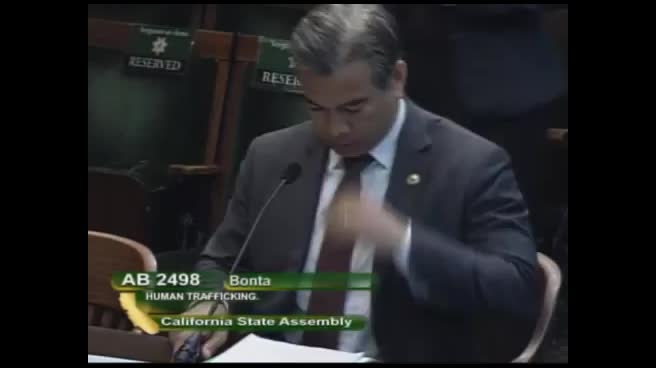 7MIN
Assembly Standing Committee on Judiciary
Bill Author

Bill Co-Author(s):