AB 25: Financial aid: Cal Grant program: renewal.
- Session Year: 2015-2016
- House: Assembly
- Latest Version Date: 2015-10-08
The Cal Grant Program establishes the Cal Grant A and B Entitlement awards, the California Community College Transfer Entitlement awards, the Competitive Cal Grant A and B awards, the Cal Grant C awards, and the Cal Grant T awards under the administration of the Student Aid Commission, and establishes eligibility requirements for awards under these programs for participating students attending qualifying institutions.
Existing law requires the commission to certify by November 1 of each year a qualifying institutions latest 3-year cohort default rate and graduation rate as most recently reported by the United States Department of Education. Existing law provides that an otherwise qualifying institution with a 3-year cohort default rate that is equal to or greater than 15.5% is ineligible for initial and renewal Cal Grant awards at the institution. Existing law provides that an otherwise qualifying institution is ineligible for an initial or renewal Cal Grant award at the institution if the institution has a graduation rate of 30% or less for students taking 150% or less of the expected time to complete degree requirements, as specified, with certain exceptions.
This bill would require the commission to establish an appeal process for an otherwise qualifying institution that fails to satisfy the 3-year cohort default rate and graduation rate requirements and would authorize the commission to grant the appeal for an academic year only if the commission makes a specified determination.
The Cal Grant Program establishes the Cal Grant A and B Entitlement awards, the California Community College Transfer Entitlement awards, the Competitive Cal Grant A and B awards, the Cal Grant C awards, and the Cal Grant T awards under the administration of the Student Aid Commission, and establishes eligibility requirements for awards under these programs for participating students attending qualifying institutions.
Existing law requires the commission to certify by November 1 of each year a qualifying institutions latest 3-year cohort default rate and graduation rate as most recently reported by the United States Department of Education. Existing law provides that an otherwise qualifying institution with a 3-year cohort default rate that is equal to or greater than 15.5% is ineligible for initial and renewal Cal Grant awards at the institution. Existing law provides that an otherwise qualifying institution is ineligible for an initial or renewal Cal Grant award at the institution if the institution has a graduation rate of 30% or less for students taking 150% or less of the expected time to complete degree requirements, as specified, with certain exceptions.
This bill would require the commission to establish an appeal process for an otherwise qualifying institution that fails to satisfy the 3-year cohort default rate and graduation rate requirements, and would make nonsubstantive and conforming changes. requirements and would authorize the commission to grant the appeal for an academic year only if the commission makes a specified determination.
The Cal Grant Program establishes the Cal Grant A and B Entitlement awards, the California Community College Transfer Entitlement awards, the Competitive Cal Grant A and B awards, the Cal Grant C awards, and the Cal Grant T awards under the administration of the Student Aid Commission, and establishes eligibility requirements for awards under these programs for participating students attending qualifying institutions.
Existing law requires the commission to certify by November 1 of each year a qualifying institutions latest 3-year cohort default rate and graduation rate as most recently reported by the United States Department of Education. Existing law provides that an otherwise qualifying institution with a 3-year cohort default rate that is equal to or greater than 15.5% is ineligible for initial and renewal Cal Grant awards at the institution. Existing law provides that an otherwise qualifying institution is ineligible for an initial or renewal Cal Grant award at the institution if the institution has a graduation rate of 30% or less for students taking 150% or less of the expected time to complete degree requirements, as specified, with certain exceptions.
This bill would require the commission to establish an appeal process for an otherwise qualifying institution that fails to satisfy the 3-year cohort default rate and graduation rate requirements, and would make nonsubstantive and conforming changes.
As used in this chapter, the following terms have the following meanings:
(a)An academic year is July 1 to June 30, inclusive. The starting date of a session shall determine the academic year in which it is included.
(b)Access costs means living expenses and expenses for transportation, supplies, and books.
(c)Award year means one academic year, or the equivalent, of attendance at a qualifying institution.
(d)College grade point average and community college grade point average mean a grade point average calculated on the basis of all college work completed, except for nontransferable units and courses not counted in the computation for admission to a California public institution of higher education that grants a baccalaureate degree.
(e)Commission means the Student Aid Commission.
(f)Enrollment status means part- or full-time status.
(1)Part time, for purposes of Cal Grant eligibility, means 6 to 11 semester units, inclusive, or the equivalent.
(2)Full time, for purposes of Cal Grant eligibility, means 12 or more semester units or the equivalent.
(g)Expected family contribution, with respect to an applicant, shall be determined using the federal methodology pursuant to subdivision (a) of Section 69506 (as established by Title IV of the federal Higher Education Act of 1965, as amended (20 U.S.C. Sec. 1070 et seq.)) and applicable rules and regulations adopted by the commission.
(h)High school grade point average means a grade point average calculated on a 4.0 scale, using all academic coursework, for the sophomore year, the summer following the sophomore year, the junior year, and the summer following the junior year, excluding physical education, Reserve Officers Training Corps (ROTC), and remedial courses, and computed pursuant to regulations of the commission. However, for high school graduates who apply after their senior year, high school grade point average includes senior year coursework.
(i)Instructional program of not less than one academic year means a program of study that results in the award of an associate or baccalaureate degree or certificate requiring at least 24 semester units or the equivalent, or that results in eligibility for transfer from a community college to a baccalaureate degree program.
(j)Instructional program of not less than two academic years means a program of study that results in the award of an associate or baccalaureate degree requiring at least 48 semester units or the equivalent, or that results in eligibility for transfer from a community college to a baccalaureate degree program.
(k)(1)Maximum household income and asset levels means the applicable household income and household asset levels for participants, including new applicants and renewing recipients, in the Cal Grant Program, as defined and adopted in regulations by the commission for the 200102 academic year, which shall be set pursuant to the following income and asset ceiling amounts:
CAL GRANT PROGRAM INCOME CEILINGS |
Cal Grant A, | Cal Grant B | |
Dependent and Independent students with dependents* | ||
Family Size | ||
Six or more | $74,100 | $40,700 |
Five | $68,700 | $37,700 |
Four | $64,100 | $33,700 |
Three | $59,000 | $30,300 |
Two | $57,600 | $26,900 |
| ||
Single, no dependents | $23,500 | $23,500 |
Married | $26,900 | $26,900 |
*Applies to independent students with dependents other than a
spouse.
CAL GRANT PROGRAM ASSET CEILINGS |
Cal Grant A, | Cal Grant B | |
|
|
|
Independent | $23,600 | $23,600 |
**Applies to independent students with dependents other than a
spouse.
(2)The commission shall annually adjust the maximum household income and asset levels based on the percentage change in the cost of living within the meaning of paragraph (1) of subdivision (e) of Section 8 of Article XIIIB of the California Constitution. The maximum household income and asset levels applicable to a renewing recipient shall be the greater of the adjusted maximum household income and asset levels or the maximum household income and asset levels at the time of the renewing recipients initial Cal Grant award. For a recipient who was initially awarded a Cal Grant for an academic year before the 201112 academic year, the maximum household income and asset levels shall be the greater of the adjusted maximum household income and asset levels or the 201011 academic year maximum household income and asset levels. An applicant or renewal recipient who qualifies to be considered under the simplified needs test established by federal law for student assistance shall be presumed to meet the asset level test under this section. Before disbursing any Cal Grant funds, a qualifying institution shall be obligated, under the terms of its institutional participation agreement with the commission, to resolve any conflicts that may exist in the data the institution possesses relating to that individual.
(l)(1)Qualifying institution means an institution that complies with paragraphs (2) and (3) and is any of the following:
(A)A California private or independent postsecondary educational institution that participates in the Pell Grant Program and in at least two of the following federal student aid programs:
(i)Federal Work-Study Program.
(ii)Federal Stafford Loan Program.
(iii)Federal Supplemental Educational Opportunity Grant Program.
(B)A nonprofit institution headquartered and operating in California that certifies to the commission that 10 percent of the institutions operating budget, as demonstrated in an audited financial statement, is expended for purposes of institutionally funded student financial aid in the form of grants, that demonstrates to the commission that it has the administrative capacity to administer the funds, that is accredited by the Western Association of Schools and Colleges, and that meets any other state-required criteria adopted by regulation by the commission in consultation with the Department of Finance. A regionally accredited institution that was deemed qualified by the commission to participate in the Cal Grant Program for the 200001 academic year shall retain its eligibility as long as it maintains its existing accreditation status.
(C)A California public postsecondary educational institution.
(2)(A)The institution shall provide information on where to access California license examination passage rates for the most recent available year from graduates of its undergraduate programs leading to employment for which passage of a California licensing examination is required, if that data is electronically available through the Internet Web site of a California licensing or regulatory agency. For purposes of this paragraph, provide may exclusively include placement of an Internet Web site address labeled as an access point for the data on the passage rates of recent program graduates on the Internet Web site where enrollment information is also located, on an Internet Web site that provides centralized admissions information for postsecondary educational systems with multiple campuses, or on applications for enrollment or other program information distributed to prospective students.
(B)The institution shall be responsible for certifying to the commission compliance with the requirements of subparagraph (A).
(3)(A)The commission shall certify by November 1 of each year the institutions latest official three-year cohort default rate and graduation rate as most recently reported by the United States Department of Education. For purposes of this section, the graduation rate is the percentage of full-time, first-time degree or certificate-seeking undergraduate students who graduate in 150 percent or less of the expected time to complete degree requirements as most recently reported publicly in any format, including preliminary data records, by the United States Department of Education.
(B)For purposes of the 201112 academic year, an otherwise qualifying institution with a three-year cohort default rate reported by the United States Department of Education that is equal to or greater than 24.6 percent shall be ineligible for initial and renewal Cal Grant awards at the institution.
(C)For purposes of the 201213 academic year, and every academic year thereafter, an otherwise qualifying institution with a three-year cohort default rate that is equal to or greater than 15.5 percent, as certified by the commission on October 1, 2011, and every year thereafter, shall be ineligible for initial and renewal Cal Grant awards at the institution.
(D)(i)An otherwise qualifying institution that becomes ineligible under this paragraph for initial and renewal Cal Grant awards shall regain its eligibility for the academic year for which it satisfies the requirements established in subparagraph (B), (C), or (F), as applicable.
(ii)If the United States Department of Education corrects or revises an institutions three-year cohort default rate or graduation rate that originally failed to satisfy the requirements established in subparagraph (B), (C), or (F), as applicable, and the correction or revision results in the institutions three-year cohort default rate or graduation rate satisfying those requirements, that institution shall immediately regain its eligibility for the academic year to which the corrected or revised three-year cohort default rate or graduation rate would have been applied.
(E)An otherwise qualifying institution for which no three-year cohort default rate or graduation rate has been reported by the United States Department of Education shall be provisionally eligible to participate in the Cal Grant Program until a three-year cohort default rate or graduation rate has been reported for the institution by the United States Department of Education.
(F)For purposes of the 201213 academic year, and every academic year thereafter, an otherwise qualifying institution with a graduation rate of 30 percent or less, as certified by the commission pursuant to subparagraph (A), shall be ineligible for initial and renewal Cal Grant awards at the institution, except as provided for in subparagraph (H).
(G)Notwithstanding any other law, the requirements of this paragraph shall not apply to institutions with 40 percent or less of undergraduate students borrowing federal student loans, using information reported to the United States Department of Education for the academic year two years before the academic year in which the commission is certifying the three-year cohort default rate or graduation rate pursuant to subparagraph (A).
(H)Notwithstanding subparagraph (F), an otherwise qualifying institution that maintains a three-year cohort default rate that is less than 15.5 percent and a graduation rate above 20 percent for students taking 150 percent or less of the expected time to complete degree requirements, as certified by the commission pursuant to subparagraph (A), shall be eligible for initial and renewal Cal Grant awards at the institution through the 201617 academic year.
(I)The commission shall do all of the following:
(i)Notify initial Cal Grant recipients seeking to attend, or attending, an institution that is ineligible for initial and renewal Cal Grant awards under subparagraph (C) or (F) that the institution is ineligible for initial Cal Grant awards for the academic year for which the student received an initial Cal Grant award.
(ii)Notify renewal Cal Grant recipients attending an institution that is ineligible for initial and renewal Cal Grant awards at the institution under subparagraph (C) or (F) that the students Cal Grant award will be reduced by 20 percent, or eliminated, as appropriate, if the student attends the ineligible institution in an academic year in which the institution is ineligible.
(iii)Provide initial and renewal Cal Grant recipients seeking to attend, or attending, an institution that is ineligible for initial and renewal Cal Grant awards at the institution under subparagraph (C) or (F) with a complete list of all California postsecondary educational institutions at which the student would be eligible to receive an unreduced Cal Grant award.
(iv)(I) Establish an appeal process for an otherwise qualifying institution that fails to satisfy the three-year cohort default rate and graduation rate requirements in subparagraphs (C) and (F), respectively.
(II)The commission may grant an appeal for an academic year only if the commission has determined the institution has a cohort size of 20 individuals or less and the cohort is not representative of the overall institutional performance.
(m)Satisfactory academic progress means those criteria required by applicable federal standards published in Title 34 of the Code of Federal Regulations. The commission may adopt regulations defining satisfactory academic progress in a manner that is consistent with those federal standards.
As used in this chapter, the following terms have the following meanings:
(a)An academic year is July 1 to June 30, inclusive. The starting date of a session shall determine the academic year in which it is included.
(b)Access costs means living expenses and expenses for transportation, supplies, and books.
(c)Award year means one academic year, or the equivalent, of attendance at a qualifying institution.
(d)College grade point average and community college grade point average mean a grade point average calculated on the basis of all college work completed, except for nontransferable units and courses not counted in the computation for admission to a California public institution of higher education that grants a baccalaureate degree.
(e)Commission means the Student Aid Commission.
(f)Enrollment status means part- or full-time status.
(1)Part time, for purposes of Cal Grant eligibility, means 6 to 11 semester units, inclusive, or the equivalent.
(2)Full time, for purposes of Cal Grant eligibility, means 12 or more semester units or the equivalent.
(g)Expected family contribution, with respect to an applicant, shall be determined using the federal methodology pursuant to subdivision (a) of Section 69506 (as established by Title IV of the federal Higher Education Act of 1965, as amended (20 U.S.C. Sec. 1070 et seq.)) and applicable rules and regulations adopted by the commission.
(h)High school grade point average means a grade point average calculated on a 4.0 scale, using all academic coursework, for the sophomore year, the summer following the sophomore year, the junior year, and the summer following the junior year, excluding physical education, Reserve Officers Training Corps (ROTC), and remedial courses, and computed pursuant to regulations of the commission. However, for high school graduates who apply after their senior year, high school grade point average includes senior year coursework.
(i)Instructional program of not less than one academic year means a program of study that results in the award of an associate or baccalaureate degree or certificate requiring at least 24 semester units or the equivalent, or that results in eligibility for transfer from a community college to a baccalaureate degree program.
(j)Instructional program of not less than two academic years means a program of study that results in the award of an associate or baccalaureate degree requiring at least 48 semester units or the equivalent, or that results in eligibility for transfer from a community college to a baccalaureate degree program.
(k)(1)Maximum household income and asset levels means the applicable household income and household asset levels for participants, including new applicants and renewing recipients, in the Cal Grant Program, as defined and adopted in regulations by the commission for the 200102 academic year, which shall be set pursuant to the following income and asset ceiling amounts:
CAL GRANT PROGRAM INCOME CEILINGS |
Cal Grant A, | Cal Grant B | |
Dependent and Independent students with dependents* | ||
Family Size | ||
Six or more | $74,100 | $40,700 |
Five | $68,700 | $37,700 |
Four | $64,100 | $33,700 |
Three | $59,000 | $30,300 |
Two | $57,600 | $26,900 |
| ||
Single, no dependents | $23,500 | $23,500 |
Married | $26,900 | $26,900 |
*Applies to independent students with dependents other than a
spouse.
CAL GRANT PROGRAM ASSET CEILINGS |
Cal Grant A, | Cal Grant B | |
|
|
|
Independent | $23,600 | $23,600 |
**Applies to independent students with dependents other than a
spouse.
(2)The commission shall annually adjust the maximum household income and asset levels based on the percentage change in the cost of living within the meaning of paragraph (1) of subdivision (e) of Section 8 of Article XIIIB of the California Constitution. The maximum household income and asset levels applicable to a renewing recipient shall be the greater of the adjusted maximum household income and asset levels or the maximum household income and asset levels at the time of the renewing recipients initial Cal Grant award. For a recipient who was initially awarded a Cal Grant for an academic year before the 201112 academic year, the maximum household income and asset levels shall be the greater of the adjusted maximum household income and asset levels or the 201011 academic year maximum household income and asset levels. An applicant or renewal recipient who qualifies to be considered under the simplified needs test established by federal law for student assistance shall be presumed to meet the asset level test under this section. Before disbursing any Cal Grant funds, a qualifying institution shall be obligated, under the terms of its institutional participation agreement with the commission, to resolve any conflicts that may exist in the data the institution possesses relating to that individual.
(l)(1)Qualifying institution means an institution that complies with paragraphs (2) and (3) and is any of the following:
(A)A California private or independent postsecondary educational institution that participates in the Pell Grant Program and in at least two of the following federal student aid programs:
(i)Federal Work-Study Program.
(ii)Federal Stafford Loan Program.
(iii)Federal Supplemental Educational Opportunity Grant Program.
(B)A nonprofit institution headquartered and operating in California that certifies to the commission that 10 percent of the institutions operating budget, as demonstrated in an audited financial statement, is expended for purposes of institutionally funded student financial aid in the form of grants, that demonstrates to the commission that it has the administrative capacity to administer the funds, that is accredited by the Western Association of Schools and Colleges, and that meets any other state-required criteria adopted by regulation by the commission in consultation with the Department of Finance. A regionally accredited institution that was deemed qualified by the commission to participate in the Cal Grant Program for the 200001 academic year shall retain its eligibility as long as it maintains its existing accreditation status.
(C)A California public postsecondary educational institution.
(2)(A)The institution shall provide information on where to access California license examination passage rates for the most recent available year from graduates of its undergraduate programs leading to employment for which passage of a California licensing examination is required, if that data is electronically available through the Internet Web site of a California licensing or regulatory agency. For purposes of this paragraph, provide may exclusively include placement of an Internet Web site address labeled as an access point for the data on the passage rates of recent program graduates on the Internet Web site where enrollment information is also located, on an Internet Web site that provides centralized admissions information for postsecondary educational systems with multiple campuses, or on applications for enrollment or other program information distributed to prospective students.
(B)The institution shall be responsible for certifying to the commission compliance with the requirements of subparagraph (A).
(3)(A)The commission shall certify by November 1 of each year the institutions latest official three-year cohort default rate and graduation rate as most recently reported by the United States Department of Education. For purposes of this section, the graduation rate is the percentage of full-time, first-time degree or certificate-seeking undergraduate students who graduate in 150 percent or less of the expected time to complete degree requirements as most recently reported publicly in any format, including preliminary data records, by the United States Department of Education.
(B)For purposes of the 201112 academic year, an otherwise qualifying institution with a three-year cohort default rate reported by the United States Department of Education that is equal to or greater than 24.6 percent shall be ineligible for initial and renewal Cal Grant awards at the institution.
(C)For purposes of the 201213 academic year, and every academic year thereafter, an otherwise qualifying institution with a three-year cohort default rate that is equal to or greater than 15.5 percent, as certified by the commission on October 1, 2011, and every year thereafter, shall be ineligible for initial and renewal Cal Grant awards at the institution.
(D)(i)An otherwise qualifying institution that becomes ineligible under this paragraph for initial and renewal Cal Grant awards shall regain its eligibility for the academic year for which it satisfies the requirements established in subparagraph (B), (C), or (F), as applicable.
(ii)If the United States Department of Education corrects or revises an institutions three-year cohort default rate or graduation rate that originally failed to satisfy the requirements established in subparagraph (B), (C), or (F), as applicable, and the correction or revision results in the institutions three-year cohort default rate or graduation rate satisfying those requirements, that institution shall immediately regain its eligibility for the academic year to which the corrected or revised three-year cohort default rate or graduation rate would have been applied.
(E)An otherwise qualifying institution for which no three-year cohort default rate or graduation rate has been reported by the United States Department of Education shall be provisionally eligible to participate in the Cal Grant Program until a three-year cohort default rate or graduation rate has been reported for the institution by the United States Department of Education.
(F)For purposes of the 201213 academic year, and every academic year thereafter, an otherwise qualifying institution with a graduation rate of 30 percent or less, as certified by the commission pursuant to subparagraph (A), shall be ineligible for initial and renewal Cal Grant awards at the institution, except as provided for in subparagraph (H).
(G)Notwithstanding any other law, the requirements of this paragraph shall not apply to institutions with 40 percent or less of undergraduate students borrowing federal student loans, using information reported to the United States Department of Education for the academic year two years before the academic year in which the commission is certifying the three-year cohort default rate or graduation rate pursuant to subparagraph (A).
(H)Notwithstanding subparagraph (F), an otherwise qualifying institution that maintains a three-year cohort default rate that is less than 15.5 percent and a graduation rate above 20 percent for students taking 150 percent or less of the expected time to complete degree requirements, as certified by the commission pursuant to subparagraph (A), shall be eligible for initial and renewal Cal Grant awards at the institution through the 201617 academic year.
(I)The commission shall do all of the following:
(i)Notify initial Cal Grant recipients seeking to attend, or attending, an institution that is ineligible for initial and renewal Cal Grant awards under subparagraph (C) or (F) that the institution is ineligible for initial Cal Grant awards for the academic year for which the student received an initial Cal Grant award.
(ii)Notify renewal Cal Grant recipients attending an institution that is ineligible for initial and renewal Cal Grant awards at the institution under subparagraph (C) or (F) that the students Cal Grant award will be reduced by 20 percent, or eliminated, as appropriate, if the student attends the ineligible institution in an academic year in which the institution is ineligible.
(iii)Provide initial and renewal Cal Grant recipients seeking to attend, or attending, an institution that is ineligible for initial and renewal Cal Grant awards at the institution under subparagraph (C) or (F) with a complete list of all California postsecondary educational institutions at which the student would be eligible to receive an unreduced Cal Grant award.
(iv)(I) Establish an appeal process for an otherwise qualifying institution that fails to satisfy the three-year cohort default rate and graduation rate requirements in subparagraphs (C) and (F), respectively.
(II)The commission may grant an appeal for an academic year only if the commission has determined the institution has a cohort size of 20 individuals or less and the cohort is not representative of the overall institutional performance, or the commission has determined that the institution has provided sufficient evidence that the institution will meet all Cal Grant participation requirements in the next academic year. performance.
(m)Satisfactory academic progress means those criteria required by applicable federal standards published in Title 34 of the Code of Federal Regulations. The commission may adopt regulations defining satisfactory academic progress in a manner that is consistent with those federal standards.
As used in this chapter, the following terms have the following meanings:
(a)An academic year is July 1 to June 30, inclusive. The starting date of a session shall determine the academic year in which it is included.
(b)Access costs means living expenses and expenses for transportation, supplies, and books.
(c)Award year means one academic year, or the equivalent, of attendance at a qualifying institution.
(d)College grade point average and community college grade point average mean a grade point average calculated on the basis of all college work completed, except for nontransferable units and courses not counted in the computation for admission to a California public institution of higher education that grants a baccalaureate degree.
(e)Commission means the Student Aid Commission.
(f)Enrollment status means part- or full-time status.
(1)Part time, for purposes of Cal Grant eligibility, means 6 to 11 semester units, inclusive, or the equivalent.
(2)Full time, for purposes of Cal Grant eligibility, means 12 or more semester units or the equivalent.
(g)Expected family contribution, with respect to an applicant, shall be determined using the federal methodology pursuant to subdivision (a) of Section 69506 (as established by Title IV of the federal Higher Education Act of 1965, as amended (20 U.S.C. Sec. 1070 et seq.)) and applicable rules and regulations adopted by the commission.
(h)High school grade point average means a grade point average calculated on a 4.0 scale, using all academic coursework, for the sophomore year, the summer following the sophomore year, the junior year, and the summer following the junior year, excluding physical education, Reserve Officers Training Corps (ROTC), and remedial courses, and computed pursuant to regulations of the commission. However, for high school graduates who apply after their senior year, high school grade point average includes senior year coursework.
(i)Instructional program of not less than one academic year means a program of study that results in the award of an associate or baccalaureate degree or certificate requiring at least 24 semester units or the equivalent, or that results in eligibility for transfer from a community college to a baccalaureate degree program.
(j)Instructional program of not less than two academic years means a program of study that results in the award of an associate or baccalaureate degree requiring at least 48 semester units or the equivalent, or that results in eligibility for transfer from a community college to a baccalaureate degree program.
(k)(1)Maximum household income and asset levels means the applicable household income and household asset levels for participants, including new applicants and renewing recipients, in the Cal Grant Program, as defined and adopted in regulations by the commission for the 200102 academic year, which shall be set pursuant to the following income and asset ceiling amounts:
CAL GRANT PROGRAM INCOME CEILINGS |
Cal Grant A, | Cal Grant B | |
Dependent and Independent students with dependents* | ||
Family Size | ||
Six or more | $74,100 | $40,700 |
Five | $68,700 | $37,700 |
Four | $64,100 | $33,700 |
Three | $59,000 | $30,300 |
Two | $57,600 | $26,900 |
| ||
Single, no dependents | $23,500 | $23,500 |
Married | $26,900 | $26,900 |
*Applies to independent students with dependents other than a
spouse.
CAL GRANT PROGRAM ASSET CEILINGS |
Cal Grant A, | Cal Grant B | |
|
|
|
Independent | $23,600 | $23,600 |
**Applies to independent students with dependents other than a
spouse.
(2)The commission shall annually adjust the maximum household income and asset levels based on the percentage change in the cost of living within the meaning of paragraph (1) of subdivision (e) of Section 8 of Article XIIIB of the California Constitution. The maximum household income and asset levels applicable to a renewing recipient shall be the greater of the adjusted maximum household income and asset levels or the maximum household income and asset levels at the time of the renewing recipients initial Cal Grant award. For a recipient who was initially awarded a Cal Grant for an academic year before the 201112 academic year, the maximum household income and asset levels shall be the greater of the adjusted maximum household income and asset levels or the 201011 academic year maximum household income and asset levels. An applicant or renewal recipient who qualifies to be considered under the simplified needs test established by federal law for student assistance shall be presumed to meet the asset level test under this section. Before disbursing any Cal Grant funds, a qualifying institution shall be obligated, under the terms of its institutional participation agreement with the commission, to resolve any conflicts that may exist in the data the institution possesses relating to that individual.
(l)(1)Qualifying institution means an institution that complies with paragraphs (2) and (3) and is any of the following:
(A)A California private or independent postsecondary educational institution that participates in the Pell Grant Program and in at least two of the following federal student aid programs:
(i)Federal Work-Study Program.
(ii)Federal Stafford Loan Program.
(iii)Federal Supplemental Educational Opportunity Grant Program.
(B)A nonprofit institution headquartered and operating in California that certifies to the commission that 10 percent of the institutions operating budget, as demonstrated in an audited financial statement, is expended for purposes of institutionally funded student financial aid in the form of grants, that demonstrates to the commission that it has the administrative capacity to administer the funds, that is accredited by the Western Association of Schools and Colleges, and that meets any other state-required criteria adopted by regulation by the commission in consultation with the Department of Finance. A regionally accredited institution that was deemed qualified by the commission to participate in the Cal Grant Program for the 200001 academic year shall retain its eligibility as long as it maintains its existing accreditation status.
(C)A California public postsecondary educational institution.
(2)(A)The institution shall provide information on where to access California license examination passage rates for the most recent available year from graduates of its undergraduate programs leading to employment for which passage of a California licensing examination is required, if that data is electronically available through the Internet Web site of a California licensing or regulatory agency. For purposes of this paragraph, provide may exclusively include placement of an Internet Web site address labeled as an access point for the data on the passage rates of recent program graduates on the Internet Web site where enrollment information is also located, on an Internet Web site that provides centralized admissions information for postsecondary educational systems with multiple campuses, or on applications for enrollment or other program information distributed to prospective students.
(B)The institution shall be responsible for certifying to the commission compliance with the requirements of subparagraph (A).
(3)(A)The commission shall certify by November 1 of each year the institutions latest official three-year cohort default rate and graduation rate as most recently reported by the United States Department of Education. For purposes of this section, the graduation rate is the percentage of full-time, first-time degree or certificate-seeking undergraduate students who graduate in 150 percent or less of the expected time to complete degree requirements as most recently reported publicly in any format, including preliminary data records, by the United States Department of Education.
(B)For purposes of the 201112 academic year, an otherwise qualifying institution with a three-year cohort default rate reported by the United States Department of Education that is equal to or greater than 24.6 percent shall be ineligible for initial and renewal Cal Grant awards at the institution.
(C)For purposes of the 201213 academic year, and every academic year thereafter, an otherwise qualifying institution with a three-year cohort default rate that is equal to or greater than 15.5 percent, as certified by the commission on October 1, 2011, and every year thereafter, shall be ineligible for initial and renewal Cal Grant awards at the institution.
(D)(i)An otherwise qualifying institution that becomes ineligible under this paragraph for initial and renewal Cal Grant awards shall regain its eligibility for the academic year for which it satisfies the requirements established in subparagraph (B), (C), or (F), as applicable.
(ii)If the United States Department of Education corrects or revises an institutions three-year cohort default rate or graduation rate that originally failed to satisfy the requirements established in subparagraph (B), (C), or (F), as applicable, and the correction or revision results in the institutions three-year cohort default rate or graduation rate satisfying those requirements, that institution shall immediately regain its eligibility for the academic year to which the corrected or revised three-year cohort default rate or graduation rate would have been applied.
(E)An otherwise qualifying institution for which no three-year cohort default rate or graduation rate has been reported by the United States Department of Education shall be provisionally eligible to participate in the Cal Grant Program until a three-year cohort default rate or graduation rate has been reported for the institution by the United States Department of Education.
(F)For purposes of the 201213 academic year, and every academic year thereafter, an otherwise qualifying institution with a graduation rate of 30 percent or less, as certified by the commission pursuant to subparagraph (A), shall be ineligible for initial and renewal Cal Grant awards at the institution, except as provided for in subparagraph (H).
(G)Notwithstanding any other law, the requirements of this paragraph shall not apply to institutions with 40 percent or less of undergraduate students borrowing federal student loans, using information reported to the United States Department of Education for the academic year two years before the academic year in which the commission is certifying the three-year cohort default rate or graduation rate pursuant to subparagraph (A).
(H)Notwithstanding subparagraph (F), an otherwise qualifying institution that maintains a three-year cohort default rate that is less than 15.5 percent and a graduation rate above 20 percent for students taking 150 percent or less of the expected time to complete degree requirements, as certified by the commission pursuant to subparagraph (A), shall be eligible for initial and renewal Cal Grant awards at the institution through the 201617 academic year.
(I)The commission shall do all of the following:
(i)Notify initial Cal Grant recipients seeking to attend, or attending, an institution that is ineligible for initial and renewal Cal Grant awards under subparagraph (C) or (F) that the institution is ineligible for initial Cal Grant awards for the academic year for which the student received an initial Cal Grant award.
(ii)Notify renewal Cal Grant recipients attending an institution that is ineligible for initial and renewal Cal Grant awards at the institution under subparagraph (C) or (F) that the students Cal Grant award will be reduced by 20 percent, or eliminated, as appropriate, if the student attends the ineligible institution in an academic year in which the institution is ineligible.
(iii)Provide initial and renewal Cal Grant recipients seeking to attend, or attending, an institution that is ineligible for initial and renewal Cal Grant awards at the institution under subparagraph (C) or (F) with a complete list of all California postsecondary educational institutions at which the student would be eligible to receive an unreduced Cal Grant award.
(iv)(I) Establish an appeal process for an otherwise qualifying institution that fails to satisfy the three-year cohort default rate and graduation rate requirements in subparagraphs (C) and (F), respectively.
(II)In assessing whether to grant an appeal, the commission may consider cohort size and the likelihood of an otherwise qualifying institution regaining eligibility in the academic year next following the institutions loss of eligibility.
(III)It is the intent of the Legislature that the commission shall define a specific cohort size or range of sizes that constitute a small cohort for the purposes of the appeals process.
(II)The commission may grant an appeal for an academic year only if the commission has determined the institution has a cohort size of 20 individuals or less and the cohort is not representative of the overall institutional performance, or the commission has determined that the institution has provided sufficient evidence that the institution will meet all Cal Grant participation requirements in the next academic year.
(m)Satisfactory academic progress means those criteria required by applicable federal standards published in Title 34 of the Code of Federal Regulations. The commission may adopt regulations defining satisfactory academic progress in a manner that is consistent with those federal standards.
As used in this chapter, the following terms have the following meanings:
(a)An academic year is July 1 to June 30, inclusive. The starting date of a session shall determine the academic year in which it is included.
(b)Access costs means living expenses and expenses for transportation, supplies, and books.
(c)Award year means one academic year, or the equivalent, of attendance at a qualifying institution.
(d)College grade point average and community college grade point average mean a grade point average calculated on the basis of all college work completed, except for nontransferable units and courses not counted in the computation for admission to a California public institution of higher education that grants a baccalaureate degree.
(e)Commission means the Student Aid Commission.
(f)Enrollment status means part- or full-time status.
(1)Part time, for purposes of Cal Grant eligibility, means 6 to 11 semester units, inclusive, or the equivalent.
(2)Full time, for purposes of Cal Grant eligibility, means 12 or more semester units or the equivalent.
(g)Expected family contribution, with respect to an applicant, shall be determined using the federal methodology pursuant to subdivision (a) of Section 69506 (as established by Title IV of the federal Higher Education Act of 1965, as amended (20 U.S.C. Sec. 1070 et seq.)) and applicable rules and regulations adopted by the commission.
(h)High school grade point average means a grade point average calculated on a 4.0 scale, using all academic coursework, for the sophomore year, the summer following the sophomore year, the junior year, and the summer following the junior year, excluding physical education, Reserve Officers Training Corps (ROTC), and remedial courses, and computed pursuant to regulations of the commission. However, for high school graduates who apply after their senior year, high school grade point average includes senior year coursework.
(i)Instructional program of not less than one academic year means a program of study that results in the award of an associate or baccalaureate degree or certificate requiring at least 24 semester units or the equivalent, or that results in eligibility for transfer from a community college to a baccalaureate degree program.
(j)Instructional program of not less than two academic years means a program of study that results in the award of an associate or baccalaureate degree requiring at least 48 semester units or the equivalent, or that results in eligibility for transfer from a community college to a baccalaureate degree program.
(k)(1)Maximum household income and asset levels means the applicable household income and household asset levels for participants, including new applicants and renewing recipients, in the Cal Grant Program, as defined and adopted in regulations by the commission for the 200102 academic year, which shall be set pursuant to the following income and asset ceiling amounts:
CAL GRANT PROGRAM INCOME CEILINGS |
Cal Grant A, | Cal Grant B | |
Dependent and Independent students with dependents* | ||
Family Size | ||
Six or more | $74,100 | $40,700 |
Five | $68,700 | $37,700 |
Four | $64,100 | $33,700 |
Three | $59,000 | $30,300 |
Two | $57,600 | $26,900 |
| ||
Single, no dependents | $23,500 | $23,500 |
Married | $26,900 | $26,900 |
*Applies to independent students with dependents other than a
spouse.
CAL GRANT PROGRAM ASSET CEILINGS |
Cal Grant A, | Cal Grant B | |
|
|
|
Independent | $23,600 | $23,600 |
**Applies to independent students with dependents other than a
spouse.
(2)The commission shall annually adjust the maximum household income and asset levels based on the percentage change in the cost of living within the meaning of paragraph (1) of subdivision (e) of Section 8 of Article XIIIB of the California Constitution. The maximum household income and asset levels applicable to a renewing recipient shall be the greater of the adjusted maximum household income and asset levels or the maximum household income and asset levels at the time of the renewing recipients initial Cal Grant award. For a recipient who was initially awarded a Cal Grant for an academic year before the 201112 academic year, the maximum household income and asset levels shall be the greater of the adjusted maximum household income and asset levels or the 201011 academic year maximum household income and asset levels. An applicant or renewal recipient who qualifies to be considered under the simplified needs test established by federal law for student assistance shall be presumed to meet the asset level test under this section. Before disbursing any Cal Grant funds, a qualifying institution shall be obligated, under the terms of its institutional participation agreement with the commission, to resolve any conflicts that may exist in the data the institution possesses relating to that individual.
(l)(1)Qualifying institution means an institution that complies with paragraphs (2) and (3) and is any of the following:
(A)A California private or independent postsecondary educational institution that participates in the Pell Grant Program and in at least two of the following federal student aid programs:
(i)Federal Work-Study Program.
(ii)Federal Stafford Loan Program.
(iii)Federal Supplemental Educational Opportunity Grant Program.
(B)A nonprofit institution headquartered and operating in California that certifies to the commission that 10 percent of the institutions operating budget, as demonstrated in an audited financial statement, is expended for purposes of institutionally funded student financial aid in the form of grants, that demonstrates to the commission that it has the administrative capacity to administer the funds, that is accredited by the Western Association of Schools and Colleges, and that meets any other state-required criteria adopted by regulation by the commission in consultation with the Department of Finance. A regionally accredited institution that was deemed qualified by the commission to participate in the Cal Grant Program for the 200001 academic year shall retain its eligibility as long as it maintains its existing accreditation status.
(C)A California public postsecondary educational institution.
(2)(A)The institution shall provide information on where to access California license examination passage rates for the most recent available year from graduates of its undergraduate programs leading to employment for which passage of a California licensing examination is required, if that data is electronically available through the Internet Web site of a California licensing or regulatory agency. For purposes of this paragraph, provide may exclusively include placement of an Internet Web site address labeled as an access point for the data on the passage rates of recent program graduates on the Internet Web site where enrollment information is also located, on an Internet Web site that provides centralized admissions information for postsecondary educational systems with multiple campuses, or on applications for enrollment or other program information distributed to prospective students.
(B)The institution shall be responsible for certifying to the commission compliance with the requirements of subparagraph (A).
(3)(A)The commission shall certify by November 1 of each year the institutions latest official three-year cohort default rate and graduation rate as most recently reported by the United States Department of Education. For purposes of this section, the graduation rate is the percentage of full-time, first-time degree or certificate-seeking undergraduate students who graduate in 150 percent or less of the expected time to complete degree requirements as most recently reported publicly in any format, including preliminary data records, by the United States Department of Education.
(B)For purposes of the 201112 academic year, an otherwise qualifying institution with a three-year cohort default rate reported by the United States Department of Education that is equal to or greater than 24.6 percent shall be ineligible for initial and renewal Cal Grant awards at the institution.
(C)For purposes of the 201213 academic year, and every academic year thereafter, an otherwise qualifying institution with a three-year cohort default rate that is equal to or greater than 15.5 percent, as certified by the commission on October 1, 2011, and every year thereafter, shall be ineligible for initial and renewal Cal Grant awards at the institution.
(D)(i)An otherwise qualifying institution that becomes ineligible under this paragraph for initial and renewal Cal Grant awards shall regain its eligibility for the academic year for which it satisfies the requirements established in subparagraph (B), (C), or (F), as applicable.
(ii)If the United States Department of Education corrects or revises an institutions three-year cohort default rate or graduation rate that originally failed to satisfy the requirements established in subparagraph (B), (C), or (F), as applicable, and the correction or revision results in the institutions three-year cohort default rate or graduation rate satisfying those requirements, that institution shall immediately regain its eligibility for the academic year to which the corrected or revised three-year cohort default rate or graduation rate would have been applied.
(E)An otherwise qualifying institution for which no three-year cohort default rate or graduation rate has been reported by the United States Department of Education shall be provisionally eligible to participate in the Cal Grant Program until a three-year cohort default rate or graduation rate has been reported for the institution by the United States Department of Education.
(F)For purposes of the 201213 academic year, and every academic year thereafter, an otherwise qualifying institution with a graduation rate of 30 percent or less, as certified by the commission pursuant to subparagraph (A), shall be ineligible for initial and renewal Cal Grant awards at the institution, except as provided for in subparagraph (H).
(G)Notwithstanding any other law, the requirements of this paragraph shall not apply to institutions with 40 percent or less of undergraduate students borrowing federal student loans, using information reported to the United States Department of Education for the academic year two years before the academic year in which the commission is certifying the three-year cohort default rate or graduation rate pursuant to subparagraph (A).
(H)Notwithstanding subparagraph (F), an otherwise qualifying institution that maintains a three-year cohort default rate that is less than 15.5 percent and a graduation rate above 20 percent for students taking 150 percent or less of the expected time to complete degree requirements, as certified by the commission pursuant to subparagraph (A), shall be eligible for initial and renewal Cal Grant awards at the institution through the 201617 academic year.
(I)The commission shall do all of the following:
(i)Notify initial Cal Grant recipients seeking to attend, or attending, an institution that is ineligible for initial and renewal Cal Grant awards under subparagraph (C) or (F) that the institution is ineligible for initial Cal Grant awards for the academic year for which the student received an initial Cal Grant award.
(ii)Notify renewal Cal Grant recipients attending an institution that is ineligible for initial and renewal Cal Grant awards at the institution under subparagraph (C) or (F) that the students Cal Grant award will be reduced by 20 percent, or eliminated, as appropriate, if the student attends the ineligible institution in an academic year in which the institution is ineligible.
(iii)Provide initial and renewal Cal Grant recipients seeking to attend, or attending, an institution that is ineligible for initial and renewal Cal Grant awards at the institution under subparagraph (C) or (F) with a complete list of all California postsecondary educational institutions at which the student would be eligible to receive an unreduced Cal Grant award.
(iv)(I) Establish an appeal process for an otherwise qualifying institution that fails to satisfy the three-year cohort default rate and graduation requirements in subparagraphs (C) and (F), respectively.
(II)In assessing whether to grant an appeal, the commission may consider cohort size and the likelihood of an otherwise qualifying institution regaining eligibility in the academic year next following the institutions loss of eligibility.
(III)It is the intent of the Legislature that the commission shall define a specific cohort size or range of sizes that constitute a small cohort for the purposes of the appeals process.
(m)Satisfactory academic progress means those criteria required by applicable federal standards published in Title 34 of the Code of Federal Regulations. The commission may adopt regulations defining satisfactory academic progress in a manner that is consistent with those federal standards.
|
Date
|
Status
|
|---|---|
| Jun 2, 2015 | Read third time. Passed. Ordered to the Senate. |
| Oct 8, 2015 | Chaptered by Secretary of State - Chapter 613, Statutes of 2015. |
| Oct 8, 2015 | Approved by the Governor. |
| Sep 14, 2015 | Enrolled and presented to the Governor at 4 p.m. |
| Sep 2, 2015 | Read third time. Passed. Ordered to the Assembly. (Ayes 40. Noes 0. Page 2395.). |
| Sep 2, 2015 | Read third time. Passed. Ordered to the Assembly. |
| Sep 2, 2015 | In Assembly. Ordered to Engrossing and Enrolling. |
| Aug 31, 2015 | Read second time. Ordered to third reading. |
| Aug 27, 2015 | From committee: Do pass. (Ayes 7. Noes 0.) (August 27). |
| Jul 6, 2015 | In committee: Referred to APPR. suspense file. |
| Jun 24, 2015 | From committee: Do pass and re-refer to Com. on APPR. (Ayes 9. Noes 0.) (June 24). Re-referred to Com. on APPR. |
| Jun 11, 2015 | Referred to Com. on ED. |
| Jun 2, 2015 | Read third time. Passed. Ordered to the Senate. (Ayes 79. Noes 0. Page 1766.) |
| Dec 1, 2014 | Read first time. To print. |
| Jun 2, 2015 | In Senate. Read first time. To Com. on RLS. for assignment. |
| May 28, 2015 | Read second time. Ordered to third reading. |
| May 28, 2015 | From committee: Do pass. (Ayes 17. Noes 0.) (May 28). |
| Apr 15, 2015 | In committee: Set, first hearing. Referred to suspense file. |
| Apr 9, 2015 | Re-referred to Com. on APPR. |
| Apr 8, 2015 | From committee chair, with author's amendments: Amend, and re-refer to Com. on APPR. Read second time and amended. |
| Mar 24, 2015 | Re-referred to Com. on APPR. |
| Mar 23, 2015 | Read second time and amended. |
| Mar 19, 2015 | From committee: Amend, and do pass as amended and re-refer to Com. on APPR. (Ayes 11. Noes 0.) (March 17). |
| Jan 16, 2015 | Referred to Com. on HIGHER ED. |
| Dec 2, 2014 | From printer. May be heard in committee January 1. |
|
Date
|
Description
|
Location
|
Votes
|
|
|---|---|---|---|---|
| Sep 2, 2015 | Assembly 3rd Reading AB25 Gipson By Hall | Senate Floor |
Passed |
|
| Aug 27, 2015 | Do pass | Senate Standing Committee on Appropriations |
Passed |
|
| Jul 6, 2015 | Placed on suspense file | Senate Standing Committee on Appropriations |
Passed |
|
| Jun 24, 2015 | Do pass, but first be re-referred to the Committee on [Appropriations] | Senate Standing Committee on Education |
Passed |
|
| Jun 2, 2015 | AB 25 GIPSON Assembly Third Reading | Assembly Floor |
Passed |
|
| May 28, 2015 | Do pass. | Assembly Standing Committee on Appropriations |
Passed |
|
| Mar 17, 2015 | Do pass as amended and be re-referred to the Committee on [Appropriations] | Assembly Standing Committee on Higher Education |
Passed |
This list shows positions taken on this bill by organizations on the date displayed, which is linked to the original source.
Positions by individuals are not included.
|
Organization
|
Position
|
Date
|
|---|---|---|
| American Federation of State, County and Municipal Employees | ** Support | Sep 2, 2015 |
| Association of Independent California Colleges and Universities | ** Support | Sep 2, 2015 |
| California Student Aid Commission | * Support | Jun 24, 2015 |
| Century Latino Organization | ** Support | Jun 2, 2015 |
| Charles Drew University Of Medicine And Science | ** Support | Sep 2, 2015 |
| Charles R Drew University | * Support | Jun 24, 2015 |
| Charles R. Drew University Of Medicine And Science | ** Support | Jun 2, 2015 |
| Hispanic Association of College and Universities | * Support | Jun 24, 2015 |
| Our Lady of Victory Catholic Church | ** Support | Sep 2, 2015 |
| San Jose Evergreen Community College District | ** Support | Sep 2, 2015 |
| St. Aloysius Gonzaga Catholic Church | ** Support | Sep 2, 2015 |
| St. Lawrence of Brindisi Church | ** Support | Sep 2, 2015 |
| u None received. | ** Against | Jun 24, 2015 |
| Watts | ** Support | Jun 2, 2015 |
| Watts Century Latino Organization | ** Support | Sep 2, 2015 |
AB 25
Page 5
|
Office of Senate Floor Analyses (916) 651-1520 Fax: (916) 327-4478 |
THIRD READING
Bill No: AB 25
Amended: 4/8/15 in Assembly
SENATE EDUCATION COMMITTEE: 9-0, 6/24/15
AYES: Liu, Runner, Block, Hancock, Leyva, Mendoza, Monning, Pan, Vidak
SENATE APPROPRIATIONS COMMITTEE: 7-0, 8/27/15
AYES: Lara, Bates, Beall, Hill, Leyva, Mendoza, Nielsen
ASSEMBLY FLOOR: 79-0, 6/2/15 - See last page for vote
SUBJECT: Financial aid: Cal Grant program: renewal
DIGEST: This bill requires the California Student Aid Commission (CSAC) to establish an appeal process for institutions failing to meet Cal Grant program participation requirements and authorizes the CSAC to grant an appeal for one academic year to an institution with a small cohort of 20 individuals or less, as specified.
Existing law:
Authorizes the Cal Grant program, administered by the CSAC, to provide grants to financially needy students to attend a college or university. The Cal Grant programs include both the entitlement and the competitive Cal Grant awards. The program consists of the Cal Grant A, Cal B, and Cal Grant C programs, and eligibility is based upon financial need, grade point average, California residency and other criteria. (Education Code 69430-69433.9)
The 2012 and 2013 Budget Acts established new requirements for institutional participation in the Cal Grant program (SB 70, Chapter 7, Statutes of 2011, and SB 1016, Chapter 38, Statutes of 2012) by providing that:
For the 2011-12 academic year, an otherwise qualifying institution for the Cal Grant program must maintain a three-year cohort default rate equal to or below 24.6 percent to be eligible for Cal Grant awards at the institution.
For 2012-13, and every academic year thereafter, colleges must maintain three year cohort default rates below 15.5 percent in order to be eligible for initial and renewal Cal Grant awards at the institution.
For 2012-13 and every academic year thereafter, an institution must maintain a graduation rate above 30 percent to be eligible for Cal Grant awards at the institution.
There is an exception to these requirements for an institution with a three- year cohort default rate of below 15.5 percent and a graduation rate above 20 percent through the 2016-17 academic year. (EC § 69432.7)
Provides that the cohort default rate and graduation requirements do not apply to institutions with 40 percent or less of its students borrowing federal student loans. (EC § 69432.7)
This bill:
Requires the CSAC to establish an appeal process for an otherwise qualifying institution that fails to satisfy existing three-year CDR and graduation rate requirements.
Specifically authorizes the CSAC to grant an appeal for one academic year if the commission determines the cohort of students at the institution is 20 or less and that cohort is not representative of the institution’s overall performance.
Comments
Need for the bill: As a condition of participating in the Cal Grant program, institutions are required to meet specified criteria including a 3-year cohort default rate below 15.5 percent and maintain a 20% graduation rate for the 2015-2016 academic year. According to the author, program participation requirements have exposed the vulnerability of smaller specialized Universities, where first time full time freshman (FTFTF) students typically have lower enrollment rates and therefore, present volatility to campus Cal Grant eligibility. The author asserts that the risk of losing Cal Grant eligibility to the instability of a small sample size could lead institutions to stop enrolling FTFTF students who would otherwise be eligible to enroll, or to eliminate programs that may attract these students.
This bill seeks to provide an otherwise qualifying institution, with a very small cohort size that becomes ineligible due to CDR and graduation rate requirements the opportunity to regain Cal Grant eligibility following one academic year for which it satisfied the specified thresholds.
Appeal process? Although some institutions deemed ineligible to participate in the Cal Grant program have appealed to CSAC, there is no statutory or regulatory guidance provided regarding such a process. Current law allows an institution to regain eligibility if the United State Department of Education corrects or revises an institution’s three-year CDR or graduation rate that results in the institution satisfying rate requirements. Most recently the CSAC heard from Marymount California University, National Hispanic University, and Charles R. Drew University of their institutional eligibility to participate in the Cal Grant Program in 2014-15. Those institutions whose CDR or graduation rate where miscalculated successfully regained their eligibility.
Effect on schools. For the 2015-2016 academic year a total of 33 schools were found to be Cal Grant ineligible. Schools on the ineligible list failed to meet one or both of the required thresholds for the 2015-16 academic year. As mentioned schools must keep their federal student loan CDR below 15.5 percent and maintain their graduation rate above 20 percent. Included among the list of ineligible schools is Charles R. Drew University of Medicine and Science (CDU). CDU contends that its unsatisfactory status is attribute to having a small cohort of FTFTF undergraduate students, nine in 2005 and four in 2006 (cohorts from whom the recent graduation rate derived) are not representative of its ability to recruit and retain undergraduate students with Cal Grant eligibility. Although CDU tried to appeal its status to CSAC, current law constrains the CSAC’s ability to remedy the situation. The bill provides CSAC with the statutory authority to establish an appeal process and grant an appeal to institutions whose small cohort size is not representative of the institutions overall performance, as specified. It is unclear how many schools would fall under the 20 individuals or less threshold specified in the bill.
Effect on Students. Initial and renewal Cal Grant recipients are not able to use their Cal Grant awards at institutions that fail to meet institutional CDR requirements; however, Cal Grant awards are mobile, meaning if a student chooses to transfer from one institution to another the award would follow the student to the new school provided that the institution is Cal Grant eligible.
Prior Legislation
AB 640 (Hall, 2014) similar to this bill, would have required CSAC to implement an appeal process for schools that fail to meet the CDR and graduation rate requirements and authorized CSAC to consider cohort size. AB 640 was held in the Senate Appropriations Committee.
SB 1149 (Galgiani) was substantially similar to AB 640. SB 1149 was heard and passed by the Senate Education Committee by a vote of 9-0 but was subsequently held in the Senate Appropriations Committee.
FISCAL EFFECT: Appropriation: No Fiscal Com.: Yes Local: No
According to the Senate Appropriations Committee, this bill would have the following fiscal impact:
Unknown costs potentially in the low hundreds of thousands General Fund dependent upon the number of ineligible institutions and approved appeals. Costs would likely vary from year to year.
Likely minor costs to the CSAC to create and administer the appeals process.
American Federation of State, County and Municipal Employees
Association of Independent California Colleges and Universities
Charles Drew University of Medicine and Science
Our Lady of Victory Catholic Church
San Jose Evergreen Community College District
St. Aloysius Gonzaga Catholic Church
St. Lawrence of Brindisi Church
Watts Century Latino Organization
OPPOSITION: (Verified 8/27/15)
None received
ASSEMBLY FLOOR: 79-0, 6/2/15
AYES: Achadjian, Alejo, Travis Allen, Baker, Bigelow, Bloom, Bonilla, Bonta, Brough, Brown, Burke, Calderon, Campos, Chang, Chau, Chiu, Chu, Cooley, Cooper, Dababneh, Dahle, Daly, Dodd, Eggman, Frazier, Beth Gaines, Gallagher, Cristina Garcia, Eduardo Garcia, Gatto, Gipson, Gomez, Gonzalez, Gordon, Gray, Grove, Hadley, Harper, Roger Hernández, Holden, Irwin, Jones, Jones-Sawyer, Kim, Lackey, Levine, Linder, Lopez, Low, Maienschein, Mathis, Mayes, McCarty, Medina, Melendez, Mullin, Nazarian, Obernolte, O'Donnell, Olsen, Patterson, Perea, Quirk, Rendon, Ridley-Thomas, Rodriguez, Salas, Santiago, Steinorth, Mark Stone, Thurmond, Ting, Wagner, Waldron, Weber, Wilk, Williams, Wood, Atkins
NO VOTE RECORDED: Chávez
Prepared by: Olgalilia Ramirez / ED. / (916) 651-4105
8/31/15 10:14:39
**** END ****
AB 25 (Gipson) Page 2 of 2
SENATE COMMITTEE ON APPROPRIATIONS
Senator Ricardo Lara, Chair
2015 - 2016 Regular Session
AB 25 (Gipson) - Financial aid: Cal Grant program: renewal.
|
|
Version: April 8, 2015 |
Policy Vote: ED. 9 - 0 |
Urgency: No |
Mandate: No |
Hearing Date: July 6, 2015 |
Consultant: Jillian Kissee |
This bill meets the criteria for referral to the Suspense File.
Bill Summary:
This bill requires the California Student Aid Commission (CSAC) to establish an appeal process for institutions failing to meet Cal Grant program participation requirements and authorizes the CSAC to grant an appeal to an institution with a small cohort of 20 individuals or less, as specified.
Fiscal Impact:
Unknown costs potentially in the low hundreds of thousands General Fund dependent upon the number of ineligible institutions and approved appeals. Costs would likely vary from year to year.
Likely minor costs to the CSAC to create and administer the appeals process.
Background:
Existing law authorizes the Cal Grant program, administered by the CSAC, to provide grants to financially needy students to attend a college or university. The Cal Grant programs include both the entitlement and the competitive Cal Grant awards. The program consists of the Cal Grant A, Cal B, and Cal Grant C programs, and eligibility is based upon financial need, grade point average, California residency and other criteria. (Education Code 69430-69433.9)
The 2012 and 2013 Budget Acts established new requirements for institutional participation in the Cal Grant program (SB 70, Chapter 7, Statutes of 2011, and SB 1016, Chapter 38, Statutes of 2012) by providing that colleges must maintain three year cohort default rates below 15.5 percent and a graduation rate above 30 percent in order to be eligible for initial and renewal Cal Grant awards at the institution. There is an exception to these requirements for an institution with a three- year cohort default rate of below 15.5 percent and a graduation rate above 20 percent through the 2016-17 academic year. Existing law also provides that the cohort default rate and graduation requirements do not apply to institutions with 40 percent or less of their students borrowing federal student loans. (EC § 69432.7)
Proposed Law:
This bill: (1) requires the Commission to establish an appeal process for an institution that fails to satisfy the three-year cohort default rate and graduation rate requirements pursuant to existing law, and (2) authorizes the Commission to grant an appeal for an academic year only if it determines the institution has a cohort size of 20 or less and the cohort is not representative of the overall institutional performance.
Related Legislation:
AB 640 (Hall, 2014) similar to this bill, would have required CSAC to implement an appeal process for schools that fail to meet the CDR and graduation rate requirements and authorized CSAC to consider cohort size. AB 640 was held in this committee.
SB 1149 (Galgiani, 2014) was substantially similar to AB 640. SB 1149 was held in this committee.
Staff Comments:
This bill requires the CSAC to establish an appeals process and authorize an appeal for an academic year only if it determines (1) the institution has a cohort size of 20 or less and (2) the cohort is not representative of the overall institutional performance.
The CSAC will likely incur costs to establish and administer the required appeals process, including establishing the criteria by which it is determined the cohort is not representative of the overall institutional performance. However, more significant costs could be incurred to the extent this bill results in the reinstatement of disqualified institutions. The costs will likely vary from year to year dependent upon a number of factors such as: the number of ineligible institutions, how many seek an appeal, whether students that receive Cal Grant awards transfer to eligible institutions (as awards follow the student), and whether it is determined that cohorts are not representative of overall institutional performance.
As a point of reference, according CSAC’s most recent data, four institutions that fall under the cohort size required by this bill were recently determined to be ineligible for Cal Grants and received about $200,000. If these institutions appealed this determination and through the CSAC’s appeals process their awards were reinstated, state costs could rise by up to that amount. It is unknown whether the cohorts of these institutions were representative of the overall institutional performance and thereby would have not received an approved appeal, as that is not defined by this bill.
-- END --
AB 25 (Gipson) Page 3 of 3
SENATE COMMITTEE ON EDUCATION
Senator Carol Liu, Chair
2015 - 2016 Regular
Bill No: AB 25
Author: |
Gipson |
||
Version: |
April 8, 2015 Hearing Date: June 24, 2015 |
||
Urgency: |
No |
Fiscal: |
Yes |
Consultant: |
Olgalilia Ramirez |
||
Subject: Financial aid: Cal Grant program: renewal
SUMMARY This bill requires the California Student Aid Commission (CSAC) to establish an appeal process for institutions failing to meet Cal Grant program participation requirements and authorizes the CSAC to grant an appeal for one academic year to an institution with a small cohort of 20 individuals or less, as specified.
BACKGROUND
Existing law authorizes the Cal Grant program, administered by the CSAC, to provide grants to financially needy students to attend a college or university. The Cal Grant programs include both the entitlement and the competitive Cal Grant awards. The program consists of the Cal Grant A, Cal B, and Cal Grant C programs, and eligibility is based upon financial need, grade point average, California residency and other criteria. (Education Code 69430-69433.9)
The 2012 and 2013 Budget Acts established new requirements for institutional participation in the Cal Grant program (SB 70, Chapter 7, Statutes of 2011, and SB 1016, Chapter 38, Statutes of 2012) by providing that:
For the 2011-12 academic year, an otherwise qualifying institution for the Cal Grant program must maintain a three-year cohort default rate equal to or below 24.6 percent to be eligible for Cal Grant awards at the institution.
For 2012-13, and every academic year thereafter, colleges must maintain three year cohort default rates below 15.5 percent in order to be eligible for initial and renewal Cal Grant awards at the institution.
For 2012-13 and every academic year thereafter, an institution must maintain a graduation rate above 30 percent to be eligible for Cal Grant awards at the institution.
There is an exception to these requirements for an institution with a three- year cohort default rate of below 15.5 percent and a graduation rate above 20 percent through the 2016-17 academic year. (EC § 69432.7)
Existing law provides that the cohort default rate and graduation requirements do not apply to institutions with 40 percent or less of its students borrowing federal student loans. (EC § 69432.7)
ANALYSIS
This bill:
Requires the CSAC to establish an appeal process for an otherwise qualifying institution that fails to satisfy existing three-year CDR and graduation rate requirements.
Specifically authorizes the CSAC to grant an appeal for one academic year if the commission determines the cohort of students at the institution is 20 or less and that cohort is not representative of the institution’s overall performance.
STAFF COMMENTS
Need for the bill: As a condition of participating in the Cal Grant program, institutions are required to meet specified criteria including a 3-year cohort default rate below 15.5 percent and maintain a 20% graduation rate for the 2015-2016 academic year. According to the author, program participation requirements have exposed the vulnerability of smaller specialized Universities, where first time full time freshman (FTFTF) students typically have lower enrollment rates and therefore, present volatility to campus Cal Grant eligibility. The author asserts that the risk of losing Cal Grant eligibility to the instability of a small sample size could lead institutions to stop enrolling FTFTF students who would otherwise be eligible to enroll, or to completely eliminate programs that may attract these students.
This bill provides an otherwise qualifying institution, with a very small cohort size that becomes ineligible due to CDR and graduation rate requirements the opportunity to regain Cal Grant eligibility following one academic year for which it satisfied the specified thresholds.
Appeal process? Although some institutions deemed ineligible to participate in the Cal Grant program have appealed to CSAC, there is no statutory or regulatory guidance provided regarding such a process. Current law allows an institution to regain eligibility if the United State Department of Education corrects or revises an institution’s three-year CDR or graduation rate that results in the institution satisfying rate requirements. Most recently the CSAC heard from Marymount California University, National Hispanic University, and Charles R. Drew University of their institutional eligibility to participate in the Cal Grant Program in 2014-15. Those institutions whose CDR or graduation rate where miscalculated successfully regained their eligibility.
Effect on schools. For the 2015-2016 academic year a total of 33 schools were found to be Cal Grant ineligible. Schools on the ineligible list failed to meet one or both of the required thresholds for the 2015-16 academic year. As mentioned schools must keep their federal student loan CDR below 15.5 percent and maintain their graduation rate above 20 percent. Included among the list of ineligible schools is Charles R. Drew University of Medicine and Science (CDU). CDU contends that its unsatisfactory status is attribute to having a small cohort of FTFTF undergraduate students, nine in 2005 and four in 2006 (cohorts from whom the recent graduation rate derived) are not representative of its ability to recruit and retain undergraduate students with Cal Grant eligibility. Although CDU tried to appeal its status to CSAC, current law constrains the CSAC’s ability to remedy the situation. The bill provides CSAC with the statutory authority to establish an appeal process and grant an appeal to institutions whose small cohort size is not representative of the institutions overall performance, as specified. It is unclear how many schools would fall under the 20 individuals or less threshold specified in the bill.
Effect on Students. Initial and renewal Cal Grant recipients are not able to use their Cal Grant awards at institutions that fail to meet institutional CDR requirements; however, Cal Grant awards are mobile, meaning if a student chooses to transfer from one institution to another the award would follow the student to the new school provided that the institution is Cal Grant eligible.
Prior Legislation.
AB 640 (Hall, 2014) similar to this bill, would have required CSAC to implement an appeal process for schools that fail to meet the CDR and graduation rate requirements and authorized CSAC to consider cohort size. AB 640 was held in the Senate Appropriations Committee.
SB 1149 (Galgiani) was substantially similar to AB 640. SB 1149 was heard and passed by this Committee by a vote of 9-0 but was subsequently held in the Senate Appropriations Committee.
SUPPORT
American Federation of State, County and Municipal Employees (AFSCME)
Association of Independent California Colleges and Universities (AICCU)
Charles Drew University of Medicine and Science
Our Lady of Victory Catholic Church
San Jose Evergreen Community College District
St. Aloysius Gonzaga Catholic Church
St. Lawrence of Brindisi Church
OPPOSITION
None received.
-- END --
AB 25
Page 2
ASSEMBLY THIRD READING
AB 25
(Gipson)
As Amended April 8, 2015
Majority vote
Committee |
Votes |
Ayes |
Noes |
Higher Education |
11-0 |
Medina, Baker, Bloom, Harper, Irwin, Levine, Linder, Low, Santiago, Weber, Williams |
|
Appropriations |
17-0 |
Gomez, Bigelow, Bonta, Calderon, Chang, Daly, Eggman, Gallagher, Eduardo Garcia, Gordon, Holden, Jones, Quirk, Rendon, Wagner, Weber, Wood |
|
SUMMARY:
Would require the California Student Aid Commission (CSAC) to establish an appeal process for an otherwise qualifying institution that fails to satisfy the three-year cohort default rate and the graduation rate requirements, and would authorize CSAC to grant an appeal for an academic year if the commission has determined the institution has a cohort size of 20 individuals or less and that the cohort is not representative of the overall institutional performance.
EXISTING LAW
: Requires institutions to meet specified criteria in order to participate in the Cal Grant program, including, for institutions with more than 40% of undergraduate students borrowing federal student loans: 1) a three-year cohort default rate (CDR) equal to or below 15.5%; and, 2) a graduation rate above 20% for the 2015-16, 2016-17 and the 2017-18 academic years, and above 30% for subsequent academic years. (Education Code (EDC) Section 69432.7)
FISCAL EFFECT:
According to the Assembly Appropriations Committee, to the extent institutions determined ineligible for Cal Grant participation are able to regain eligibility through the appeals process, Cal Grant costs would increase for the academic year of reinstatement, assuming students at these institutions who had received Cal Grant awards would not otherwise have re-enrolled at another Cal Grant eligible institution. For example, students at the four small-cohort schools most recently deemed ineligible for Cal Grant participation received Cal Grant awards totaling about $200,000 in the prior academic year. The actual annual costs would likely be less than this amount, as not every school would necessarily regain eligibility. Moreover, in prior years, fewer small-cohort schools have been deemed in eligible.
COMMENTS:
Background. In an effort to increase accountability over public financial aid expenditures and address the budget deficit, as a part of the 2011-12 Budget Act, California established requirements linking an institution's participation in the Cal Grant Program to the percentage of students borrowing federal loans and the number of students defaulting on those federal loans within three years of entering repayment. To participate in the Cal Grant program in the 2011-12 academic year, an institution was required to have a CDR of less than 24.6%. In 2011-12, 76 institutions failed to meet the CDR requirements.
In the 2012-13 Budget Act, the requirements regarding loan defaults were tightened to require a CDR of less than 15.5%, and a graduation rate of greater than 30%, as reported by the Integrated Postsecondary Education Data System (IPEDS). IPEDS graduation data calculates the percentage of first-time, full-time students who began in the fall term and graduate within 150% of the published program length. For example, the 2012 graduation rate for bachelor's degree programs is based on the number of students who began their pursuit as a full-time, first-time student in the fall of 2006.
In the 2015-16 academic year, institutions are required to maintain a CDR of less than 15.5% and a graduation rate of greater than 20%. As reported by CSAC, 301 institutions have been deemed Cal Grant eligible; an additional 23 institutions have been identified as potentially eligible, pending receipt of additional data. CSAC has published a list of 21 ineligible institutions; 17 of these institutions are for-profit, four are non-profit.
Charles R. Drew University of Medicine and Science (CDU). For the 2014-15 and 2015-16 academic years, CSAC deemed CDU ineligible for participation in the Cal Grant program for failing to meet graduation rate requirements. According to IPEDS data, CDU had a graduation rate of 0.0% in these award years. However, as CDU notes, IPEDS data is based on very small student cohorts. In the 2014-15 award year, CDU graduation rate data is based on eight students that began in Fall 2005; none of whom graduated before Spring 2011. In the 2015-16 award year, graduation rate data is based on four students that began in the fall of 2006; none of whom graduated before Spring of 2012. According to CDU, the university is providing institutional aid to students who lost their Cal Grant award due to institutional ineligibility; approximately 24 students in 2014-15.
Existing CSAC appeal process. Institutions deemed ineligible to participate in the Cal Grant program have appealed to CSAC. There is currently no statutory authorization provided to CSAC regarding institutional appeals. For the 2012-13 academic year, approximately six institutions appealed based on the cohort default rate/graduation rate disqualification. These appeals were not brought before the commissioners as staff believed commissioners had no authority to deviate from the statutory requirements. Two subsequent lawsuits by institutions seeking to use preliminary qualifying data resulted in the Academy of Art and Argosy/Art Institute regaining eligibility.
In 2013, CSAC staff brought to commissioners an appeal filed by Menlo College; commissioners granted the appeal finding that a calculation error had been made by United States Department of Education in publishing rates and a correct calculation resulted in the institution meeting the CDR requirements. In 2014, CSAC commissioners heard three appeals relating to the 2014-15 academic year eligibility. Commissioners granted Marymount California's appeal based on factors similar to Menlo College; CDU and National Hispanic University were denied because CSAC determined it did not have flexibility to consider factors beyond those CDR and graduation rate thresholds established in law.
Analysis Prepared by: Laura Metune / HIGHER ED. / (916) 319-3960 FN: 0000686
AB 25
Page 2
Date of Hearing: April 15, 2015
ASSEMBLY COMMITTEE ON APPROPRIATIONS
Jimmy Gomez, Chair
AB 25
(Gipson) – As Amended April 8, 2015
Policy Committee: |
Higher Education |
Vote: |
11 - 0 |
|
|
|
|
|
|
|
|
Urgency: No State Mandated Local Program: No Reimbursable: No
SUMMARY:
This bill authorizes the California Student Aid Commission (CSAC) to grant an appeal, for one academic year, to institutions failing to meet Cal Grant program participation criteria if the commission determines that the cohort of students used to determine the ineligibility for participation comprised 20 individuals or less and that cohort is not representative of overall institutional performance.
FISCAL EFFECT:
Given the small number of schools that would likely appeal in any given year, CSAC's administrative costs will be minor and absorbable.
To the extent institutions determined ineligible for Cal Grant participation are able to regain eligibility through the appeals process, Cal Grant costs would increase for the academic year of reinstatement, assuming students at these institutions who had received Cal Grant awards would not otherwise have re-enrolled at another Cal Grant eligible institution. For example, students at the four small-cohort schools most recently deemed ineligible for Cal Grant participation received Cal Grant awards totaling about $200,000 in the prior academic year. The actual annual costs would likely be less than this amount, as not every school would necessarily regain eligibility. Moreover, in prior years, fewer small-cohort schools have been deemed in eligible.
COMMENTS:
Background. As a part of the 2011-12 Budget Act, California established requirements linking an institution's participation in the Cal Grant Program to the percentage of students borrowing federal loans and the number of students defaulting on those federal loans within three years of entering repayment, i.e the cohort default rate (CDR). To participate in the Cal Grant program in the 2011-12, an institution was required to have a CDR of less than 24.6%. In that year, 76 institutions failed to meet the CDR requirements.
In the 2012-13 Budget Act, the requirements regarding loan defaults were tightened to require a CDR of less than 15.5%, and a graduation rate of greater than 30%, using federal data calculated as the percentage of first-time, full-time students who began in the fall term and graduate within 150% of the published program length. (For example, the 2012 graduation rate for bachelor's degree programs is based on the number of students who began their pursuit as a full-time, first-time student in the fall of 2006.)
For 2015-16, institutions are required to maintain a CDR of less than
15.5% and a graduation rate of greater than 20%. As reported by
CSAC, 301 institutions have been deemed Cal Grant eligible; an
additional 23 institutions have been identified as potentially
eligible, pending receipt of additional data. CSAC has published a
list of 21 ineligible institutions; 17 of these institutions are
for-profit, four are non-profit.
Purpose. According to the author, the Cal Grant program requirements have exposed the vulnerability of smaller, specialized non-profit universities that attract people coming to study for a second career or who transfer to the campus with some college experience. As an example, the Charles R. Drew University of Medicine and Science (CDU) was deemed ineligible for participation in the Cal Grant program for the 2014-15 and 2015-16 academic years for failing to meet graduation rate requirements. CDU had a graduation rate of 0% in these award years. However, as CDU notes, the federal data is based on very small student cohorts. For 2014-15, CDU graduation rate data is based on eight students that began in fall 2005; none of whom graduated before Spring 2011. For 2015-16, graduation rate data is based on only four students that began in the fall of 2006; none of whom graduated before Spring of 2012. According to CDU, the university is providing institutional aid to students who lost their Cal Grant award due to institutional ineligibility—approximately 24 students in 2014-15.
Because such institutions enroll a lower number of first-time, full-time students due to the nature of their program, their Cal Grant eligibility status is more volatile. This bill would require CSAC to establish an appeal process for institutions that fail to meet eligibility requirements and have a cohort size of 20 or fewer students.
Prior Legislation. Last year, AB 1538 (Eggman), which provided an alternative pathway for Cal Grant qualification for institutions serving low-income students that maintain a three-year average CDR and graduation rate that meets requirements, was held on this committee's Suspense file.
Analysis Prepared by: Chuck Nicol / APPR. / (916) 319-2081
AB 25
Page 5
Date of Hearing: March 17, 2015
ASSEMBLY COMMITTEE ON HIGHER EDUCATION
Medina, Chair
AB 25
(Gipson) – As Introduced December 1, 2014
SUBJECT:
Financial aid: Cal Grant program: renewal
SUMMARY:
Would require the California Student Aid Commission (CSAC) to establish an appeal process for institutions that fail to meet specified Cal Grant participation criteria. Specifically, this bill:
Requires CSAC to establish an appeal process for an otherwise qualifying institution that fails to satisfy the three-year cohort default rate and the graduation rate requirements.
Instructs CSAC to consider, in the determination of granting an appeal, cohort size and the likelihood of the institution to regain eligibility in the next academic year following the institution's loss of eligibility.
Establishes Legislative intent that CSAC define a specific cohort size or range of sizes that constitute a small cohort for the purposes of the appeals process.
EXISTING LAW
:
Authorizes the Cal Grant program, administered by CSAC, to provide grants to financially needy students to attend college. The Cal Grant programs include both the entitlement and the competitive Cal Grant awards. The program consists of the Cal Grant A, Cal Grant B, and Cal Grant C programs, and eligibility is based upon financial need, grade point average, residency, and other eligibility criteria, as specified. (Education Code Section 69430-69433.9)
Requires institutions to meet specified criteria in order to participate in the Cal Grant program, including, for institutions with more than 40% of undergraduate students borrowing federal student loans, (a) a three-year cohort default rate (CDR) equal to or below 15.5%; and, (b) a graduation rate above 20% for the 2015-16, 2016-17 and the 2017-18 academic years, and above 30% for subsequent academic years. (EDC 69432.7)
Requires CSAC to notify initial and renewal Cal Grant recipients of changes and the impact to their awards and to provide affected Cal Grant recipients with a complete list of all California postsecondary educational institutions at which the student would be eligible to receive an unreduced Cal Grant Award.
FISCAL EFFECT:
Unknown. However, according to the Senate Appropriations Committee analysis of the fiscal impact of significantly similar legislation proposed in 2014:
Appeals Process: Potentially significant costs for CSAC to administer an appeals process for institutions that have lost eligibility for participation in the Cal Grant program, and are seeking reinstatement as an exception to Cal Grant cohort default and graduation rate requirements.
Reinstatement: Potentially substantial ongoing costs, likely in the millions (General Fund) to the extent that institutions successfully appeal, and have their eligibility reinstated. As a point of reference, prior to the University of Phoenix losing eligibility under the restrictions, students used more than $20 million in Cal Grants at that institution.
COMMENTS:
Background. In an effort to increase accountability over public financial aid expenditures and address the budget deficit, as a part of the 2011-12 Budget Act, California established requirements linking an institution's participation in the Cal Grant Program to the percentage of students borrowing federal loans and the number of students defaulting on those federal loans within three years of entering repayment. To participate in the Cal Grant program in the 2011-12 academic year, an institution was required to have a CDR of less than 24.6%. In 2011-12, 76 institutions failed to meet the CDR requirements.
According to information provided by the Legislative Analyst's Office (LAO), about 3,200 students offered new Cal Grant awards in 2011-12 were planning to attend schools deemed ineligible. About 550 of these students instead attended eligible schools, and another 450 requested leaves of absence to preserve their award for later use. The remaining 2,200 students did not claim their Cal Grants and information concerning college attendance is unavailable. For students receiving renewal Cal Grant awards, of the 1,700 attending ineligible institutions approximately 60% remained at their institution and received a reduced award (an option no longer available to students), 9% transferred to eligible colleges, and another 4% took leaves of absence. No information is available on the remaining students.
In the 2012-13 Budget Act, the requirements regarding loan defaults were tightened to require a CDR of less than 15.5%, and a graduation rate of greater than 30%, as reported by the Integrated Postsecondary Education Data System (IPEDS). IPEDS graduation data calculates the percentage of first-time, full-time students who began in the fall term and graduate within 150% of the published program length. For example, the 2012 graduation rate for bachelor's degree programs is based on the number of students who began their pursuit as a full-time, first-time student in the fall of 2006.
In the 2015-16 academic year, institutions are required to maintain a CDR of less than 15.5% and a graduation rate of greater than 20%. As reported by CSAC, 301 institutions have been deemed Cal Grant eligible; an additional 23 institutions have been identified as potentially eligible, pending receipt of additional data. CSAC has published a list of 21 ineligible institutions; seventeen of these institutions are for-profit, four are non-profit.
Legislative Analyst's Office (LAO) report. In January 2013, the LAO reported to the Legislature on CSAC implementation of the Cal Grant requirements and provided recommendations for refining the standards. According to the LAO, in the absence of broad agreement on direct, quantifiable measures, default rates and graduation rates provide rough proximities of how well an institution is serving students. The LAO noted, however, that current standards have notable drawbacks. Among the LAO's recommendations, the existing system does not take into account institutions that serve disadvantaged students. The LAO indicated that the Legislature could consider adjusting requirements and establishing other outcome measures that account for student characteristics. LAO noted that CSAC is required to collect and report on additional student outcome data that could be used as an additional proxy for institutional quality; however, until there is broader agreement about measuring outcomes, LAO did not recommend using additional measures to determine school eligibility.
Charles R. Drew University of Medicine and Science (CDU). For the 2014-15 and 2015-16 academic years, CSAC deemed CDU ineligible for participation in the Cal Grant program for failing to meet graduation rate requirements. According to IPEDS data, CDU had a graduation rate of 0.0% in these award years. However, as CDU notes, IPEDS data is based on very small student cohorts. In the 2014-15 award year, CDU graduation rate data is based on 8 students that began in fall 2005; none of whom graduated before Spring 2011. In the 2015-16 award year, graduation rate data is based on 4 students that began in the fall of 2006; none of whom graduated before Spring of 2012. According to CDU, the university is providing institutional aid to students who lost their Cal Grant award due to institutional ineligibility; approximately 24 students in 2014-15.
Purpose of this bill. According to the author, the Cal Grant program requirements have exposed the vulnerability of smaller, specialized non-profit universities that attract people coming to study for a second career or who transfer to the campus with some college experience. Because these institutions enroll a lower number of first-time, full-time students due to the nature of their program, their Cal Grant eligibility status is more volatile. This bill would require CSAC to establish an appeal process for institutions that fail to meet eligibility requirements, and authorizes CSAC to consider cohort size and the likelihood of the institution regaining eligibility in the following academic year, in assessing whether an appeal should be granted.
Existing CSAC appeal process. Institutions deemed ineligible to participate in the Cal Grant program have appealed to CSAC. There is currently no statutory authorization provided to CSAC regarding institutional appeals. For the 2012-13 academic year, approximately six institutions appealed based on the cohort default rate/graduation rate disqualification. These appeals were not brought before the commissioners as staff believed commissioners had no authority to deviate from the statutory requirements. Two subsequent lawsuits by institutions seeking to use preliminary qualifying data resulted in the Academy of Art and Argosy/Art Institute regaining eligibility.
In 2013, CSAC staff brought to commissioners an appeal filed by Menlo College; commissioners granted the appeal finding that a calculation error had been made by USDE in publishing rates and a correct calculation resulted in the institution meeting the CDR requirements. In 2014, CSAC commissioners heard three appeals relating to the 2014-15 academic year eligibility. Commissioners granted Marymount California's appeal based on factors similar to Menlo College; CDU and National Hispanic University were denied because the Commission determined it did not have flexibility to consider factors beyond those CDR and graduation rate thresholds established in law.
Committee considerations. This bill provides CSAC significant authority to establish, and assumedly ultimately authorize, an appeal to allow a non-qualifying institution to continue participation in the Cal Grant program. While the bill provides Legislative guidance to CSAC to consider a small cohort or whether the institution is likely to regain eligibility in the subsequent academic year, the bill does not limit CSAC's ability to grant an appeal to an ineligible institution. The limitations currently in statute were established by the Legislature. This bill aims to provide CSAC authority to waive those limitations whenever CSAC deems appropriate.
Committee staff recommends, and the author's office has indicated agreement to, amendments to clarify the circumstances under which CSAC is authorized to grant an institutional appeal. The amendments would specify that CSAC may grant an appeal for an academic year only when (1) an institution has been determined by CSAC to have a small cohort, of 20 or less, and the cohort is not representative of overall institutional performance; and/or (2) the institution has provided evidence to CSAC that the institution is anticipated to meet the Cal Grant participation requirements in the next academic year.
Related legislation.
AB 573 (Medina), pending in the Assembly Higher Education Committee, would require CSAC to publish online a complete list of eligible and ineligible Cal Grant institutions.
Prior legislation.
SB 70 (Committee on Budget and Fiscal Review), Chapter 7, Statutes of 2011, required all institutions of higher education, with more than 40% undergraduate students borrowing federal student loans, to maintain their CDR below 24.6% in 2011-12, and 30% in 2012-13 and thereafter, in order to continue meeting eligibility to participate in the Cal Grant Program for initial awards. Reduced by 20% the renewal Cal Grants at institutions with three-year cohort default rates above 24.6%. Required the LAO to review and report on this policy and potential alternatives by January 1, 2013.
AB 1637 (Weickowski) of 2012, held in the Assembly Higher Education Committee, would have established the student default risk index, by multiplying the percentage of borrowers and the CDR, and limited institutional participation in the Cal Grant program based on risk index scores above 15.
SB 1016 (Committee on Budget and Fiscal Review), Chapter 38, Statutes of 2012, implemented a maximum CDR of 15.5% and a minimum graduation rate of 30% for institutions to be eligible to participate in the Cal Grant program. For institutions with a CDR of less than 10% and graduation rates between 20 and 30%, provided five years for these institutions to increase their six-year graduation rates to the 30% threshold. Eliminated renewal awards for recipients who choose to remain at ineligible institutions.
AB 640 (Hall) and SB 1149 (Galgiani) of 2014, both held in the Senate Appropriations Committee, would have required CSAC to establish an appeal process for institutions institution that becomes ineligible for Cal Grant participation for failing to satisfy the CDR and graduation rate requirements.
SB 860 (Committee on Budget and Fiscal Review), Chapter 34, Statutes of 2014, authorized, through the 2016-17 academic year, an institution with a CDR of less than 15.5% and a graduation rate above 20% to be eligible for participation in the Cal Grant program.
AB 1538 (Eggman) of 2014, held in the Assembly Appropriations Committee, would have provided an alternative pathway for Cal Grant qualification for institutions serving low-income students that maintain a three-year average CDR and graduation rate that meets requirements.
SB 860 (Committee on Budget and Fiscal Review), Chapter 34, Statutes of 2014, authorized, for the 2015-16, 2016-17, and 2017-18 academic years, institutions with a graduation rate above 20% to meet the graduation rate requirements for participation in the Cal Grant program.
REGISTERED SUPPORT / OPPOSITION:
Support
Association of Independent California Colleges and Universities
Charles R. Drew University of Medicine and Science
St. Lawrence of Brindisi Church
Watts/Century Latino Organization
4 individuals
Opposition
None on File
Analysis Prepared by:
Laura Metune/HIGHER ED./(916) 319-3960
Discussed in Hearing
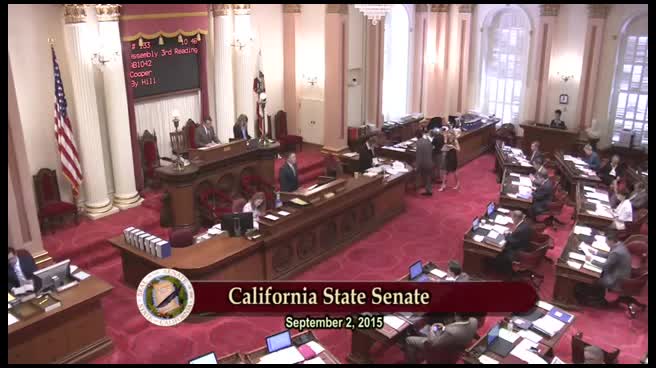 2MIN
Senate Floor
 1MIN
Senate Standing Committee on Appropriations
 8MIN
Senate Standing Committee on Education
 2MIN
Assembly Floor
Bill Author

Bill Co-Author(s):