AB 2584: Land use: housing development.
- Session Year: 2015-2016
- House: Assembly
- Latest Version Date: 2016-09-21
The Housing Accountability Act, among other things, prohibits a local agency from disapproving a housing development project for very low, low-, or moderate-income households or an emergency shelter or conditioning approval in a manner that renders the project infeasible unless the local agency makes specified written findings. The act authorizes an applicant or person who would be eligible to apply for residency in the development or emergency shelter to bring an action to enforce the act.
This bill would, in addition, authorize a housing organization, as defined, to bring an action challenging the disapproval of a housing development pursuant to these provisions.
The Housing Accountability Act, among other things, prohibits a local agency from disapproving a housing development project for very low, low-, or moderate-income households or an emergency shelter or conditioning approval in a manner that renders the project infeasible unless the local agency makes specified written findings. The act authorizes an applicant or person who would be eligible to apply for residency in the development or emergency shelter to bring an action to enforce the act.
This bill would, in addition, authorize a housing organization, as defined, to bring an action to enforce the act. challenging the disapproval of a housing development pursuant to these provisions.
The Housing Accountability Act, among other things, prohibits a local agency from disapproving a housing development project for very low, low-, or moderate-income households or an emergency shelter unless the local agency makes specified written findings. The act authorizes an applicant or person who would be eligible to apply for residency in the development or emergency shelter to bring an action to enforce the act.
This bill would, in addition, authorize a housing organization, as defined, to bring an action to enforce the act.
The Housing Accountability Act, among other things, prohibits a local agency from disapproving a housing development project for very low, low-, or moderate-income households or an emergency shelter unless the local agency makes specified written findings. The act authorizes an applicant or person who would be eligible to apply for residency in the development or emergency shelter to bring an action to enforce the act.
This bill would would, in addition, authorize an entity that represents a housing provider or a person who would be eligible to apply for residency a housing organization, as defined, to bring an action to enforce the act.
The Housing Accountability Act, among other things, prohibits a local agency from disapproving a housing development project for very low, low-, or moderate-income households or an emergency shelter unless the local agency makes specified written findings. The act authorizes an applicant or person who would be eligible to apply for residency in the development or emergency shelter to bring an action to enforce the act.
This bill would authorize an entity that represents a housing provider or a person who would be eligible to apply for residency to bring an action to enforce the act.
(a)The Legislature finds and declares all of the following:
(1)The lack of housing, including emergency shelters, is a critical problem that threatens the economic, environmental, and social quality of life in California.
(2)California housing has become the most expensive in the nation. The excessive cost of the states housing supply is partially caused by activities and policies of many local governments that limit the approval of housing, increase the cost of land for housing, and require that high fees and exactions be paid by producers of housing.
(3)Among the consequences of those actions are discrimination against low-income and minority households, lack of housing to support employment growth, imbalance in jobs and housing, reduced mobility, urban sprawl, excessive commuting, and air quality deterioration.
(4)Many local governments do not give adequate attention to the economic, environmental, and social costs of decisions that result in disapproval of housing projects, reduction in density of housing projects, and excessive standards for housing projects.
(b)It is the policy of the state that a local government not reject or make infeasible housing developments, including emergency shelters, that contribute to meeting the need determined pursuant to this article without a thorough analysis of the economic, social, and environmental effects of the action and without complying with subdivision (d).
(c)The Legislature also recognizes that premature and unnecessary development of agricultural lands for urban uses continues to have adverse effects on the availability of those lands for food and fiber production and on the economy of the state. Furthermore, it is the policy of the state that development should be guided away from prime agricultural lands; therefore, in implementing this section, local jurisdictions should encourage, to the maximum extent practicable, in filling existing urban areas.
(d)A local agency shall not disapprove a housing development project, including farmworker housing as defined in subdivision (h) of Section 50199.7 of the Health and Safety Code, for very low, low-, or moderate-income households, or an emergency shelter, or condition approval in a manner that renders the project infeasible for development for the use of very low, low-, or moderate-income households, or an emergency shelter, including through the use of design review standards, unless it makes written findings, based upon substantial evidence in the record, as to one of the following:
(1)The jurisdiction has adopted a housing element pursuant to this article that has been revised in accordance with Section 65588, is in substantial compliance with this article, and the jurisdiction has met or exceeded its share of the regional housing need allocation pursuant to Section 65584 for the planning period for the income category proposed for the housing development project, provided that any disapproval or conditional approval shall not be based on any of the reasons prohibited by Section 65008. If the housing development project includes a mix of income categories, and the jurisdiction has not met or exceeded its share of the regional housing need for one or more of those categories, then this paragraph shall not be used to disapprove or conditionally approve the project. The share of the regional housing need met by the jurisdiction shall be calculated consistently with the forms and definitions that may be adopted by the Department of Housing and Community Development pursuant to Section 65400. In the case of an emergency shelter, the jurisdiction shall have met or exceeded the need for emergency shelter, as identified pursuant to paragraph (7) of subdivision (a) of Section 65583. Any disapproval or conditional approval pursuant to this paragraph shall be in accordance with applicable law, rule, or standards.
(2)The development project or emergency shelter as proposed would have a specific, adverse impact upon the public health or safety, and there is no feasible method to satisfactorily mitigate or avoid the specific adverse impact without rendering the development unaffordable to low- and moderate-income households or rendering the development of the emergency shelter financially infeasible. As used in this paragraph, a specific, adverse impact means a significant, quantifiable, direct, and unavoidable impact, based on objective, identified written public health or safety standards, policies, or conditions as they existed on the date the application was deemed complete. Inconsistency with the zoning ordinance or general plan land use designation shall not constitute a specific, adverse impact upon the public health or safety.
(3)The denial of the project or imposition of conditions is required in order to comply with specific state or federal law, and there is no feasible method to comply without rendering the development unaffordable to low- and moderate-income households or rendering the development of the emergency shelter financially infeasible.
(4)The development project or emergency shelter is proposed on land zoned for agriculture or resource preservation that is surrounded on at least two sides by land being used for agricultural or resource preservation purposes, or which does not have adequate water or wastewater facilities to serve the project.
(5)The development project or emergency shelter is inconsistent with both the jurisdictions zoning ordinance and general plan land use designation as specified in any element of the general plan as it existed on the date the application was deemed complete, and the jurisdiction has adopted a revised housing element in accordance with Section 65588 that is in substantial compliance with this article.
(A)This paragraph cannot be utilized to disapprove or conditionally approve a housing development project if the development project is proposed on a site that is identified as suitable or available for very low, low-, or moderate-income households in the jurisdictions housing element, and consistent with the density specified in the housing element, even though it is inconsistent with both the jurisdictions zoning ordinance and general plan land use designation.
(B)If the local agency has failed to identify in the inventory of land in its housing element sites that can be developed for housing within the planning period and are sufficient to provide for the jurisdictions share of the regional housing need for all income levels pursuant to Section 65584, then this paragraph shall not be utilized to disapprove or conditionally approve a housing development project proposed for a site designated in any element of the general plan for residential uses or designated in any element of the general plan for commercial uses if residential uses are permitted or conditionally permitted within commercial designations. In any action in court, the burden of proof shall be on the local agency to show that its housing element does identify adequate sites with appropriate zoning and development standards and with services and facilities to accommodate the local agencys share of the regional housing need for the very low and low-income categories.
(C)If the local agency has failed to identify a zone or zones where emergency shelters are allowed as a permitted use without a conditional use or other discretionary permit, has failed to demonstrate that the identified zone or zones include sufficient capacity to accommodate the need for emergency shelter identified in paragraph (7) of subdivision (a) of Section 65583, or has failed to demonstrate that the identified zone or zones can accommodate at least one emergency shelter, as required by paragraph (4) of subdivision (a) of Section 65583, then this paragraph shall not be utilized to disapprove or conditionally approve an emergency shelter proposed for a site designated in any element of the general plan for industrial, commercial, or multifamily residential uses. In any action in court, the burden of proof shall be on the local agency to show that its housing element does satisfy the requirements of paragraph (4) of subdivision (a) of Section 65583.
(e)Nothing in this section shall be construed to relieve the local agency from complying with the congestion management program required by Chapter 2.6 (commencing with Section 65088) of Division 1 of Title 7 or the California Coastal Act of 1976 (Division 20 (commencing with Section 30000) of the Public Resources Code). Neither shall anything in this section be construed to relieve the local agency from making one or more of the findings required pursuant to Section 21081 of the Public Resources Code or otherwise complying with the California Environmental Quality Act (Division 13 (commencing with Section 21000) of the Public Resources Code).
(f)(1)Nothing in this section shall be construed to prohibit a local agency from requiring the development project to comply with objective, quantifiable, written development standards, conditions, and policies appropriate to, and consistent with, meeting the jurisdictions share of the regional housing need pursuant to Section 65584. However, the development standards, conditions, and policies shall be applied to facilitate and accommodate development at the density permitted on the site and proposed by the development.
(2)Nothing in this section shall be construed to prohibit a local agency from requiring an emergency shelter project to comply with objective, quantifiable, written development standards, conditions, and policies that are consistent with paragraph (4) of subdivision (a) of Section 65583 and appropriate to, and consistent with, meeting the jurisdictions need for emergency shelter, as identified pursuant to paragraph (7) of subdivision (a) of Section 65583. However, the development standards, conditions, and policies shall be applied by the local agency to facilitate and accommodate the development of the emergency shelter project.
(3)This section does not prohibit a local agency from imposing fees and other exactions otherwise authorized by law that are essential to provide necessary public services and facilities to the development project or emergency shelter.
(g)This section shall be applicable to charter cities because the Legislature finds that the lack of housing, including emergency shelter, is a critical statewide problem.
(h)The following definitions apply for the purposes of this section:
(1)Feasible means capable of being accomplished in a successful manner within a reasonable period of time, taking into account economic, environmental, social, and technological factors.
(2)Housing development project means a use consisting of any of the following:
(A)Residential units only.
(B)Mixed-use developments consisting of residential and nonresidential uses in which nonresidential uses are limited to neighborhood commercial uses and to the first floor of buildings that are two or more stories. As used in this paragraph, neighborhood commercial means small-scale general or specialty stores that furnish goods and services primarily to residents of the neighborhood.
(C)Transitional housing or supportive housing.
(3)Housing for very low, low-, or moderate-income households means that either (A) at least 20 percent of the total units shall be sold or rented to lower income households, as defined in Section 50079.5 of the Health and Safety Code, or (B) 100 percent of the units shall be sold or rented to persons and families of moderate income as defined in Section 50093 of the Health and Safety Code, or persons and families of middle income, as defined in Section 65008 of this code. Housing units targeted for lower income households shall be made available at a monthly housing cost that does not exceed 30 percent of 60 percent of area median income with adjustments for household size made in accordance with the adjustment factors on which the lower income eligibility limits are based. Housing units targeted for persons and families of moderate income shall be made available at a monthly housing cost that does not exceed 30 percent of 100 percent of area median income with adjustments for household size made in accordance with the adjustment factors on which the moderate-income eligibility limits are based.
(4)Area median income means area median income as periodically established by the Department of Housing and Community Development pursuant to Section 50093 of the Health and Safety Code. The developer shall provide sufficient legal commitments to ensure continued availability of units for very low or low-income households in accordance with the provisions of this subdivision for 30 years.
(5)Disapprove the development project includes any instance in which a local agency does either of the following:
(A)Votes on a proposed housing development project application and the application is disapproved.
(B)Fails to comply with the time periods specified in subdivision (a) of Section 65950. An extension of time pursuant to Article 5 (commencing with Section 65950) shall be deemed to be an extension of time pursuant to this paragraph.
(i)If any city, county, or city and county denies approval or imposes restrictions, including design changes, a reduction of allowable densities or the percentage of a lot that may be occupied by a building or structure under the applicable planning and zoning in force at the time the application is deemed complete pursuant to Section 65943, that have a substantial adverse effect on the viability or affordability of a housing development for very low, low-, or moderate-income households, and the denial of the development or the imposition of restrictions on the development is the subject of a court action which challenges the denial, then the burden of proof shall be on the local legislative body to show that its decision is consistent with the findings as described in subdivision (d) and that the findings are supported by substantial evidence in the record.
(j)When a proposed housing development project complies with applicable, objective general plan and zoning standards and criteria, including design review standards, in effect at the time that the housing development projects application is determined to be complete, but the local agency proposes to disapprove the project or to approve it upon the condition that the project be developed at a lower density, the local agency shall base its decision regarding the proposed housing development project upon written findings supported by substantial evidence on the record that both of the following conditions exist:
(1)The housing development project would have a specific, adverse impact upon the public health or safety unless the project is disapproved or approved upon the condition that the project be developed at a lower density. As used in this paragraph, a specific, adverse impact means a significant, quantifiable, direct, and unavoidable impact, based on objective, identified written public health or safety standards, policies, or conditions as they existed on the date the application was deemed complete.
(2)There is no feasible method to satisfactorily mitigate or avoid the adverse impact identified pursuant to paragraph (1), other than the disapproval of the housing development project or the approval of the project upon the condition that it be developed at a lower density.
(k)(1)The applicant, a person who would be eligible to apply for residency in the development or emergency shelter, or a housing organization may bring an action to enforce this section. If, in any action brought to enforce this section, a court finds that the local agency disapproved a project or conditioned its approval in a manner rendering it infeasible for the development of an emergency shelter, or housing for very low, low-, or moderate-income households, including farmworker housing, without making the findings required by this section or without making sufficient findings supported by substantial evidence, the court shall issue an order or judgment compelling compliance with this section within 60 days, including, but not limited to, an order that the local agency take action on the development project or emergency shelter. The court shall retain jurisdiction to ensure that its order or judgment is carried out and shall award reasonable attorneys fees and costs of suit to the plaintiff or petitioner who proposed the housing development or emergency shelter, except under extraordinary circumstances in which the court finds that awarding fees would not further the purposes of this section. If the court determines that its order or judgment has not been carried out within 60 days, the court may issue further orders as provided by law to ensure that the purposes and policies of this section are fulfilled, including, but not limited to, an order to vacate the decision of the local agency, in which case the application for the project, as constituted at the time the local agency took the initial action determined to be in violation of this section, along with any standard conditions determined by the court to be generally imposed by the local agency on similar projects, shall be deemed approved unless the applicant consents to a different decision or action by the local agency.
(2)For purposes of this subdivision, housing organization means a trade or industry group whose local members are primarily engaged in the construction or management of housing units or a nonprofit organization whose mission includes providing or advocating for increased access to housing for low-income households and have filed written or oral comments with the local agency prior to action on the project. A housing organization may only file an action pursuant to this section to challenge the disapproval of a housing development by a local agency.
(l)If the court finds that the local agency (1) acted in bad faith when it disapproved or conditionally approved the housing development or emergency shelter in violation of this section and (2) failed to carry out the courts order or judgment within 60 days as described in subdivision (k), the court, in addition to any other remedies provided by this section, may impose fines upon the local agency that the local agency shall be required to deposit into a housing trust fund. Fines shall not be paid from funds that are already dedicated for affordable housing, including, but not limited to, redevelopment or low- and moderate-income housing funds and federal HOME and CDBG funds. The local agency shall commit the money in the trust fund within five years for the sole purpose of financing newly constructed housing units affordable to extremely low, very low, or low-income households. For purposes of this section, bad faith shall mean an action that is frivolous or otherwise entirely without merit.
(m)Any action brought to enforce the provisions of this section shall be brought pursuant to Section 1094.5 of the Code of Civil Procedure, and the local agency shall prepare and certify the record of proceedings in accordance with subdivision (c) of Section 1094.6 of the Code of Civil Procedure no later than 30 days after the petition is served, provided that the cost of preparation of the record shall be borne by the local agency. Upon entry of the trial courts order, a party shall, in order to obtain appellate review of the order, file a petition within 20 days after service upon it of a written notice of the entry of the order, or within such further time not exceeding an additional 20 days as the trial court may for good cause allow. If the local agency appeals the judgment of the trial court, the local agency shall post a bond, in an amount to be determined by the court, to the benefit of the plaintiff if the plaintiff is the project applicant.
(n)In any action, the record of the proceedings before the local agency shall be filed as expeditiously as possible and, notwithstanding Section 1094.6 of the Code of Civil Procedure or subdivision (m) of this section, all or part of the record may be prepared (1) by the petitioner with the petition or petitioners points and authorities, (2) by the respondent with respondents points and authorities, (3) after payment of costs by the petitioner, or (4) as otherwise directed by the court. If the expense of preparing the record has been borne by the petitioner and the petitioner is the prevailing party, the expense shall be taxable as costs.
(o)This section shall be known, and may be cited, as the Housing Accountability Act.
(a)The Legislature finds and declares all of the following:
(1)The lack of housing, including emergency shelters, is a critical problem that threatens the economic, environmental, and social quality of life in California.
(2)California housing has become the most expensive in the nation. The excessive cost of the states housing supply is partially caused by activities and policies of many local governments that limit the approval of housing, increase the cost of land for housing, and require that high fees and exactions be paid by producers of housing.
(3)Among the consequences of those actions are discrimination against low-income and minority households, lack of housing to support employment growth, imbalance in jobs and housing, reduced mobility, urban sprawl, excessive commuting, and air quality deterioration.
(4)Many local governments do not give adequate attention to the economic, environmental, and social costs of decisions that result in disapproval of housing projects, reduction in density of housing projects, and excessive standards for housing projects.
(b)It is the policy of the state that a local government not reject or make infeasible housing developments, including emergency shelters, that contribute to meeting the need determined pursuant to this article without a thorough analysis of the economic, social, and environmental effects of the action and without complying with subdivision (d).
(c)The Legislature also recognizes that premature and unnecessary development of agricultural lands for urban uses continues to have adverse effects on the availability of those lands for food and fiber production and on the economy of the state. Furthermore, it is the policy of the state that development should be guided away from prime agricultural lands; therefore, in implementing this section, local jurisdictions should encourage, to the maximum extent practicable, in filling existing urban areas.
(d)A local agency shall not disapprove a housing development project, including farmworker housing as defined in subdivision (h) of Section 50199.7 of the Health and Safety Code, for very low, low-, or moderate-income households, or an emergency shelter, or condition approval in a manner that renders the project infeasible for development for the use of very low, low-, or moderate-income households, or an emergency shelter, including through the use of design review standards, unless it makes written findings, based upon substantial evidence in the record, as to one of the following:
(1)The jurisdiction has adopted a housing element pursuant to this article that has been revised in accordance with Section 65588, is in substantial compliance with this article, and the jurisdiction has met or exceeded its share of the regional housing need allocation pursuant to Section 65584 for the planning period for the income category proposed for the housing development project, provided that any disapproval or conditional approval shall not be based on any of the reasons prohibited by Section 65008. If the housing development project includes a mix of income categories, and the jurisdiction has not met or exceeded its share of the regional housing need for one or more of those categories, then this paragraph shall not be used to disapprove or conditionally approve the project. The share of the regional housing need met by the jurisdiction shall be calculated consistently with the forms and definitions that may be adopted by the Department of Housing and Community Development pursuant to Section 65400. In the case of an emergency shelter, the jurisdiction shall have met or exceeded the need for emergency shelter, as identified pursuant to paragraph (7) of subdivision (a) of Section 65583. Any disapproval or conditional approval pursuant to this paragraph shall be in accordance with applicable law, rule, or standards.
(2)The development project or emergency shelter as proposed would have a specific, adverse impact upon the public health or safety, and there is no feasible method to satisfactorily mitigate or avoid the specific adverse impact without rendering the development unaffordable to low- and moderate-income households or rendering the development of the emergency shelter financially infeasible. As used in this paragraph, a specific, adverse impact means a significant, quantifiable, direct, and unavoidable impact, based on objective, identified written public health or safety standards, policies, or conditions as they existed on the date the application was deemed complete. Inconsistency with the zoning ordinance or general plan land use designation shall not constitute a specific, adverse impact upon the public health or safety.
(3)The denial of the project or imposition of conditions is required in order to comply with specific state or federal law, and there is no feasible method to comply without rendering the development unaffordable to low- and moderate-income households or rendering the development of the emergency shelter financially infeasible.
(4)The development project or emergency shelter is proposed on land zoned for agriculture or resource preservation that is surrounded on at least two sides by land being used for agricultural or resource preservation purposes, or which does not have adequate water or wastewater facilities to serve the project.
(5)The development project or emergency shelter is inconsistent with both the jurisdictions zoning ordinance and general plan land use designation as specified in any element of the general plan as it existed on the date the application was deemed complete, and the jurisdiction has adopted a revised housing element in accordance with Section 65588 that is in substantial compliance with this article.
(A)This paragraph cannot be utilized to disapprove or conditionally approve a housing development project if the development project is proposed on a site that is identified as suitable or available for very low, low-, or moderate-income households in the jurisdictions housing element, and consistent with the density specified in the housing element, even though it is inconsistent with both the jurisdictions zoning ordinance and general plan land use designation.
(B)If the local agency has failed to identify in the inventory of land in its housing element sites that can be developed for housing within the planning period and are sufficient to provide for the jurisdictions share of the regional housing need for all income levels pursuant to Section 65584, then this paragraph shall not be utilized to disapprove or conditionally approve a housing development project proposed for a site designated in any element of the general plan for residential uses or designated in any element of the general plan for commercial uses if residential uses are permitted or conditionally permitted within commercial designations. In any action in court, the burden of proof shall be on the local agency to show that its housing element does identify adequate sites with appropriate zoning and development standards and with services and facilities to accommodate the local agencys share of the regional housing need for the very low and low-income categories.
(C)If the local agency has failed to identify a zone or zones where emergency shelters are allowed as a permitted use without a conditional use or other discretionary permit, has failed to demonstrate that the identified zone or zones include sufficient capacity to accommodate the need for emergency shelter identified in paragraph (7) of subdivision (a) of Section 65583, or has failed to demonstrate that the identified zone or zones can accommodate at least one emergency shelter, as required by paragraph (4) of subdivision (a) of Section 65583, then this paragraph shall not be utilized to disapprove or conditionally approve an emergency shelter proposed for a site designated in any element of the general plan for industrial, commercial, or multifamily residential uses. In any action in court, the burden of proof shall be on the local agency to show that its housing element does satisfy the requirements of paragraph (4) of subdivision (a) of Section 65583.
(e)Nothing in this section shall be construed to relieve the local agency from complying with the congestion management program required by Chapter 2.6 (commencing with Section 65088) of Division 1 of Title 7 or the California Coastal Act of 1976 (Division 20 (commencing with Section 30000) of the Public Resources Code). Neither shall anything in this section be construed to relieve the local agency from making one or more of the findings required pursuant to Section 21081 of the Public Resources Code or otherwise complying with the California Environmental Quality Act (Division 13 (commencing with Section 21000) of the Public Resources Code).
(f)(1)Nothing in this section shall be construed to prohibit a local agency from requiring the development project to comply with objective, quantifiable, written development standards, conditions, and policies appropriate to, and consistent with, meeting the jurisdictions share of the regional housing need pursuant to Section 65584. However, the development standards, conditions, and policies shall be applied to facilitate and accommodate development at the density permitted on the site and proposed by the development.
(2)Nothing in this section shall be construed to prohibit a local agency from requiring an emergency shelter project to comply with objective, quantifiable, written development standards, conditions, and policies that are consistent with paragraph (4) of subdivision (a) of Section 65583 and appropriate to, and consistent with, meeting the jurisdictions need for emergency shelter, as identified pursuant to paragraph (7) of subdivision (a) of Section 65583. However, the development standards, conditions, and policies shall be applied by the local agency to facilitate and accommodate the development of the emergency shelter project.
(3)This section does not prohibit a local agency from imposing fees and other exactions otherwise authorized by law that are essential to provide necessary public services and facilities to the development project or emergency shelter.
(g)This section shall be applicable to charter cities because the Legislature finds that the lack of housing, including emergency shelter, is a critical statewide problem.
(h)The following definitions apply for the purposes of this section:
(1)Feasible means capable of being accomplished in a successful manner within a reasonable period of time, taking into account economic, environmental, social, and technological factors.
(2)Housing development project means a use consisting of any of the following:
(A)Residential units only.
(B)Mixed-use developments consisting of residential and nonresidential uses in which nonresidential uses are limited to neighborhood commercial uses and to the first floor of buildings that are two or more stories. As used in this paragraph, neighborhood commercial means small-scale general or specialty stores that furnish goods and services primarily to residents of the neighborhood.
(C)Transitional housing or supportive housing.
(3)Housing for very low, low-, or moderate-income households means that either (A) at least 20 percent of the total units shall be sold or rented to lower income households, as defined in Section 50079.5 of the Health and Safety Code, or (B) 100 percent of the units shall be sold or rented to persons and families of moderate income as defined in Section 50093 of the Health and Safety Code, or persons and families of middle income, as defined in Section 65008 of this code. Housing units targeted for lower income households shall be made available at a monthly housing cost that does not exceed 30 percent of 60 percent of area median income with adjustments for household size made in accordance with the adjustment factors on which the lower income eligibility limits are based. Housing units targeted for persons and families of moderate income shall be made available at a monthly housing cost that does not exceed 30 percent of 100 percent of area median income with adjustments for household size made in accordance with the adjustment factors on which the moderate-income eligibility limits are based.
(4)Area median income means area median income as periodically established by the Department of Housing and Community Development pursuant to Section 50093 of the Health and Safety Code. The developer shall provide sufficient legal commitments to ensure continued availability of units for very low or low-income households in accordance with the provisions of this subdivision for 30 years.
(5)Disapprove the development project includes any instance in which a local agency does either of the following:
(A)Votes on a proposed housing development project application and the application is disapproved.
(B)Fails to comply with the time periods specified in subdivision (a) of Section 65950. An extension of time pursuant to Article 5 (commencing with Section 65950) shall be deemed to be an extension of time pursuant to this paragraph.
(i)If any city, county, or city and county denies approval or imposes restrictions, including design changes, a reduction of allowable densities or the percentage of a lot that may be occupied by a building or structure under the applicable planning and zoning in force at the time the application is deemed complete pursuant to Section 65943, that have a substantial adverse effect on the viability or affordability of a housing development for very low, low-, or moderate-income households, and the denial of the development or the imposition of restrictions on the development is the subject of a court action which challenges the denial, then the burden of proof shall be on the local legislative body to show that its decision is consistent with the findings as described in subdivision (d) and that the findings are supported by substantial evidence in the record.
(j)When a proposed housing development project complies with applicable, objective general plan and zoning standards and criteria, including design review standards, in effect at the time that the housing development projects application is determined to be complete, but the local agency proposes to disapprove the project or to approve it upon the condition that the project be developed at a lower density, the local agency shall base its decision regarding the proposed housing development project upon written findings supported by substantial evidence on the record that both of the following conditions exist:
(1)The housing development project would have a specific, adverse impact upon the public health or safety unless the project is disapproved or approved upon the condition that the project be developed at a lower density. As used in this paragraph, a specific, adverse impact means a significant, quantifiable, direct, and unavoidable impact, based on objective, identified written public health or safety standards, policies, or conditions as they existed on the date the application was deemed complete.
(2)There is no feasible method to satisfactorily mitigate or avoid the adverse impact identified pursuant to paragraph (1), other than the disapproval of the housing development project or the approval of the project upon the condition that it be developed at a lower density.
(k)(1)The applicant, a person who would be eligible to apply for residency in the development or emergency shelter, or a housing organization may bring an action to enforce this section. If, in any action brought to enforce this section, a court finds that the local agency disapproved a project or conditioned its approval in a manner rendering it infeasible for the development of an emergency shelter, or housing for very low, low-, or moderate-income households, including farmworker housing, without making the findings required by this section or without making sufficient findings supported by substantial evidence, the court shall issue an order or judgment compelling compliance with this section within 60 days, including, but not limited to, an order that the local agency take action on the development project or emergency shelter. The court shall retain jurisdiction to ensure that its order or judgment is carried out and shall award reasonable attorneys fees and costs of suit to the plaintiff or petitioner who proposed the housing development or emergency shelter, except under extraordinary circumstances in which the court finds that awarding fees would not further the purposes of this section. If the court determines that its order or judgment has not been carried out within 60 days, the court may issue further orders as provided by law to ensure that the purposes and policies of this section are fulfilled, including, but not limited to, an order to vacate the decision of the local agency, in which case the application for the project, as constituted at the time the local agency took the initial action determined to be in violation of this section, along with any standard conditions determined by the court to be generally imposed by the local agency on similar projects, shall be deemed approved unless the applicant consents to a different decision or action by the local agency.
(2)For purposes of this subdivision, housing organization means a trade or industry group whose local members are primarily engaged in the construction or management of housing units or a nonprofit organization whose mission includes providing or advocating for increased access to housing for low-income households. households and have filed written or oral comments with the local agency prior to action on the project. A housing organization may only file an action pursuant to this section to challenge the disapproval of a housing development by a local agency.
(l)If the court finds that the local agency (1) acted in bad faith when it disapproved or conditionally approved the housing development or emergency shelter in violation of this section and (2) failed to carry out the courts order or judgment within 60 days as described in subdivision (k), the court, in addition to any other remedies provided by this section, may impose fines upon the local agency that the local agency shall be required to deposit into a housing trust fund. Fines shall not be paid from funds that are already dedicated for affordable housing, including, but not limited to, redevelopment or low- and moderate-income housing funds and federal HOME and CDBG funds. The local agency shall commit the money in the trust fund within five years for the sole purpose of financing newly constructed housing units affordable to extremely low, very low, or low-income households. For purposes of this section, bad faith shall mean an action that is frivolous or otherwise entirely without merit.
(m)Any action brought to enforce the provisions of this section shall be brought pursuant to Section 1094.5 of the Code of Civil Procedure, and the local agency shall prepare and certify the record of proceedings in accordance with subdivision (c) of Section 1094.6 of the Code of Civil Procedure no later than 30 days after the petition is served, provided that the cost of preparation of the record shall be borne by the local agency. Upon entry of the trial courts order, a party shall, in order to obtain appellate review of the order, file a petition within 20 days after service upon it of a written notice of the entry of the order, or within such further time not exceeding an additional 20 days as the trial court may for good cause allow. If the local agency appeals the judgment of the trial court, the local agency shall post a bond, in an amount to be determined by the court, to the benefit of the plaintiff if the plaintiff is the project applicant.
(n)In any action, the record of the proceedings before the local agency shall be filed as expeditiously as possible and, notwithstanding Section 1094.6 of the Code of Civil Procedure or subdivision (m) of this section, all or part of the record may be prepared (1) by the petitioner with the petition or petitioners points and authorities, (2) by the respondent with respondents points and authorities, (3) after payment of costs by the petitioner, or (4) as otherwise directed by the court. If the expense of preparing the record has been borne by the petitioner and the petitioner is the prevailing party, the expense shall be taxable as costs.
(o)This section shall be known, and may be cited, as the Housing Accountability Act.
(a)The Legislature finds and declares all of the following:
(1)The lack of housing, including emergency shelters, is a critical problem that threatens the economic, environmental, and social quality of life in California.
(2)California housing has become the most expensive in the nation. The excessive cost of the states housing supply is partially caused by activities and policies of many local governments that limit the approval of housing, increase the cost of land for housing, and require that high fees and exactions be paid by producers of housing.
(3)Among the consequences of those actions are discrimination against low-income and minority households, lack of housing to support employment growth, imbalance in jobs and housing, reduced mobility, urban sprawl, excessive commuting, and air quality deterioration.
(4)Many local governments do not give adequate attention to the economic, environmental, and social costs of decisions that result in disapproval of housing projects, reduction in density of housing projects, and excessive standards for housing projects.
(b)It is the policy of the state that a local government not reject or make infeasible housing developments, including emergency shelters, that contribute to meeting the need determined pursuant to this article without a thorough analysis of the economic, social, and environmental effects of the action and without complying with subdivision (d).
(c)The Legislature also recognizes that premature and unnecessary development of agricultural lands for urban uses continues to have adverse effects on the availability of those lands for food and fiber production and on the economy of the state. Furthermore, it is the policy of the state that development should be guided away from prime agricultural lands; therefore, in implementing this section, local jurisdictions should encourage, to the maximum extent practicable, in filling existing urban areas.
(d)A local agency shall not disapprove a housing development project, including farmworker housing as defined in subdivision (h) of Section 50199.7 of the Health and Safety Code, for very low, low-, or moderate-income households, or an emergency shelter, or condition approval in a manner that renders the project infeasible for development for the use of very low, low-, or moderate-income households, or an emergency shelter, including through the use of design review standards, unless it makes written findings, based upon substantial evidence in the record, as to one of the following:
(1)The jurisdiction has adopted a housing element pursuant to this article that has been revised in accordance with Section 65588, is in substantial compliance with this article, and the jurisdiction has met or exceeded its share of the regional housing need allocation pursuant to Section 65584 for the planning period for the income category proposed for the housing development project, provided that any disapproval or conditional approval shall not be based on any of the reasons prohibited by Section 65008. If the housing development project includes a mix of income categories, and the jurisdiction has not met or exceeded its share of the regional housing need for one or more of those categories, then this paragraph shall not be used to disapprove or conditionally approve the project. The share of the regional housing need met by the jurisdiction shall be calculated consistently with the forms and definitions that may be adopted by the Department of Housing and Community Development pursuant to Section 65400. In the case of an emergency shelter, the jurisdiction shall have met or exceeded the need for emergency shelter, as identified pursuant to paragraph (7) of subdivision (a) of Section 65583. Any disapproval or conditional approval pursuant to this paragraph shall be in accordance with applicable law, rule, or standards.
(2)The development project or emergency shelter as proposed would have a specific, adverse impact upon the public health or safety, and there is no feasible method to satisfactorily mitigate or avoid the specific adverse impact without rendering the development unaffordable to low- and moderate-income households or rendering the development of the emergency shelter financially infeasible. As used in this paragraph, a specific, adverse impact means a significant, quantifiable, direct, and unavoidable impact, based on objective, identified written public health or safety standards, policies, or conditions as they existed on the date the application was deemed complete. Inconsistency with the zoning ordinance or general plan land use designation shall not constitute a specific, adverse impact upon the public health or safety.
(3)The denial of the project or imposition of conditions is required in order to comply with specific state or federal law, and there is no feasible method to comply without rendering the development unaffordable to low- and moderate-income households or rendering the development of the emergency shelter financially infeasible.
(4)The development project or emergency shelter is proposed on land zoned for agriculture or resource preservation that is surrounded on at least two sides by land being used for agricultural or resource preservation purposes, or which does not have adequate water or wastewater facilities to serve the project.
(5)The development project or emergency shelter is inconsistent with both the jurisdictions zoning ordinance and general plan land use designation as specified in any element of the general plan as it existed on the date the application was deemed complete, and the jurisdiction has adopted a revised housing element in accordance with Section 65588 that is in substantial compliance with this article.
(A)This paragraph cannot be utilized to disapprove or conditionally approve a housing development project if the development project is proposed on a site that is identified as suitable or available for very low, low-, or moderate-income households in the jurisdictions housing element, and consistent with the density specified in the housing element, even though it is inconsistent with both the jurisdictions zoning ordinance and general plan land use designation.
(B)If the local agency has failed to identify in the inventory of land in its housing element sites that can be developed for housing within the planning period and are sufficient to provide for the jurisdictions share of the regional housing need for all income levels pursuant to Section 65584, then this paragraph shall not be utilized to disapprove or conditionally approve a housing development project proposed for a site designated in any element of the general plan for residential uses or designated in any element of the general plan for commercial uses if residential uses are permitted or conditionally permitted within commercial designations. In any action in court, the burden of proof shall be on the local agency to show that its housing element does identify adequate sites with appropriate zoning and development standards and with services and facilities to accommodate the local agencys share of the regional housing need for the very low and low-income categories.
(C)If the local agency has failed to identify a zone or zones where emergency shelters are allowed as a permitted use without a conditional use or other discretionary permit, has failed to demonstrate that the identified zone or zones include sufficient capacity to accommodate the need for emergency shelter identified in paragraph (7) of subdivision (a) of Section 65583, or has failed to demonstrate that the identified zone or zones can accommodate at least one emergency shelter, as required by paragraph (4) of subdivision (a) of Section 65583, then this paragraph shall not be utilized to disapprove or conditionally approve an emergency shelter proposed for a site designated in any element of the general plan for industrial, commercial, or multifamily residential uses. In any action in court, the burden of proof shall be on the local agency to show that its housing element does satisfy the requirements of paragraph (4) of subdivision (a) of Section 65583.
(e)Nothing in this section shall be construed to relieve the local agency from complying with the congestion management program required by Chapter 2.6 (commencing with Section 65088) of Division 1 of Title 7 or the California Coastal Act of 1976 (Division 20 (commencing with Section 30000) of the Public Resources Code). Neither shall anything in this section be construed to relieve the local agency from making one or more of the findings required pursuant to Section 21081 of the Public Resources Code or otherwise complying with the California Environmental Quality Act (Division 13 (commencing with Section 21000) of the Public Resources Code).
(f)(1)Nothing in this section shall be construed to prohibit a local agency from requiring the development project to comply with objective, quantifiable, written development standards, conditions, and policies appropriate to, and consistent with, meeting the jurisdictions share of the regional housing need pursuant to Section 65584. However, the development standards, conditions, and policies shall be applied to facilitate and accommodate development at the density permitted on the site and proposed by the development.
(2)Nothing in this section shall be construed to prohibit a local agency from requiring an emergency shelter project to comply with objective, quantifiable, written development standards, conditions, and policies that are consistent with paragraph (4) of subdivision (a) of Section 65583 and appropriate to, and consistent with, meeting the jurisdictions need for emergency shelter, as identified pursuant to paragraph (7) of subdivision (a) of Section 65583. However, the development standards, conditions, and policies shall be applied by the local agency to facilitate and accommodate the development of the emergency shelter project.
(3)This section does not prohibit a local agency from imposing fees and other exactions otherwise authorized by law that are essential to provide necessary public services and facilities to the development project or emergency shelter.
(g)This section shall be applicable to charter cities because the Legislature finds that the lack of housing, including emergency shelter, is a critical statewide problem.
(h)The following definitions apply for the purposes of this section:
(1)Feasible means capable of being accomplished in a successful manner within a reasonable period of time, taking into account economic, environmental, social, and technological factors.
(2)Housing development project means a use consisting of any of the following:
(A)Residential units only.
(B)Mixed-use developments consisting of residential and nonresidential uses in which nonresidential uses are limited to neighborhood commercial uses and to the first floor of buildings that are two or more stories. As used in this paragraph, neighborhood commercial means small-scale general or specialty stores that furnish goods and services primarily to residents of the neighborhood.
(C)Transitional housing or supportive housing.
(3)Housing for very low, low-, or moderate-income households means that either (A) at least 20 percent of the total units shall be sold or rented to lower income households, as defined in Section 50079.5 of the Health and Safety Code, or (B) 100 percent of the units shall be sold or rented to persons and families of moderate income as defined in Section 50093 of the Health and Safety Code, or persons and families of middle income, as defined in Section 65008 of this code. Housing units targeted for lower income households shall be made available at a monthly housing cost that does not exceed 30 percent of 60 percent of area median income with adjustments for household size made in accordance with the adjustment factors on which the lower income eligibility limits are based. Housing units targeted for persons and families of moderate income shall be made available at a monthly housing cost that does not exceed 30 percent of 100 percent of area median income with adjustments for household size made in accordance with the adjustment factors on which the moderate-income eligibility limits are based.
(4)Area median income means area median income as periodically established by the Department of Housing and Community Development pursuant to Section 50093 of the Health and Safety Code. The developer shall provide sufficient legal commitments to ensure continued availability of units for very low or low-income households in accordance with the provisions of this subdivision for 30 years.
(5)Disapprove the development project includes any instance in which a local agency does either of the following:
(A)Votes on a proposed housing development project application and the application is disapproved.
(B)Fails to comply with the time periods specified in subdivision (a) of Section 65950. An extension of time pursuant to Article 5 (commencing with Section 65950) shall be deemed to be an extension of time pursuant to this paragraph.
(i)If any city, county, or city and county denies approval or imposes restrictions, including design changes, a reduction of allowable densities or the percentage of a lot that may be occupied by a building or structure under the applicable planning and zoning in force at the time the application is deemed complete pursuant to Section 65943, that have a substantial adverse effect on the viability or affordability of a housing development for very low, low-, or moderate-income households, and the denial of the development or the imposition of restrictions on the development is the subject of a court action which challenges the denial, then the burden of proof shall be on the local legislative body to show that its decision is consistent with the findings as described in subdivision (d) and that the findings are supported by substantial evidence in the record.
(j)When a proposed housing development project complies with applicable, objective general plan and zoning standards and criteria, including design review standards, in effect at the time that the housing development projects application is determined to be complete, but the local agency proposes to disapprove the project or to approve it upon the condition that the project be developed at a lower density, the local agency shall base its decision regarding the proposed housing development project upon written findings supported by substantial evidence on the record that both of the following conditions exist:
(1)The housing development project would have a specific, adverse impact upon the public health or safety unless the project is disapproved or approved upon the condition that the project be developed at a lower density. As used in this paragraph, a specific, adverse impact means a significant, quantifiable, direct, and unavoidable impact, based on objective, identified written public health or safety standards, policies, or conditions as they existed on the date the application was deemed complete.
(2)There is no feasible method to satisfactorily mitigate or avoid the adverse impact identified pursuant to paragraph (1), other than the disapproval of the housing development project or the approval of the project upon the condition that it be developed at a lower density.
(k)(1)The applicant, a person who would be eligible to apply for residency in the development or emergency shelter, or a housing organization may bring an action to enforce this section. If, in any action brought to enforce this section, a court finds that the local agency disapproved a project or conditioned its approval in a manner rendering it infeasible for the development of an emergency shelter, or housing for very low, low-, or moderate-income households, including farmworker housing, without making the findings required by this section or without making sufficient findings supported by substantial evidence, the court shall issue an order or judgment compelling compliance with this section within 60 days, including, but not limited to, an order that the local agency take action on the development project or emergency shelter. The court shall retain jurisdiction to ensure that its order or judgment is carried out and shall award reasonable attorneys fees and costs of suit to the plaintiff or petitioner who proposed the housing development or emergency shelter, except under extraordinary circumstances in which the court finds that awarding fees would not further the purposes of this section. If the court determines that its order or judgment has not been carried out within 60 days, the court may issue further orders as provided by law to ensure that the purposes and policies of this section are fulfilled, including, but not limited to, an order to vacate the decision of the local agency, in which case the application for the project, as constituted at the time the local agency took the initial action determined to be in violation of this section, along with any standard conditions determined by the court to be generally imposed by the local agency on similar projects, shall be deemed approved unless the applicant consents to a different decision or action by the local agency.
(2)For purposes of this subdivision, housing organization means a trade or industry group whose local members are primarily engaged in the construction or management of affordable housing units or a nonprofit organization whose mission includes providing or advocating for increased access to affordable housing for low-income households.
(l)If the court finds that the local agency (1) acted in bad faith when it disapproved or conditionally approved the housing development or emergency shelter in violation of this section and (2) failed to carry out the courts order or judgment within 60 days as described in subdivision (k), the court, in addition to any other remedies provided by this section, may impose fines upon the local agency that the local agency shall be required to deposit into a housing trust fund. Fines shall not be paid from funds that are already dedicated for affordable housing, including, but not limited to, redevelopment or low- and moderate-income housing funds and federal HOME and CDBG funds. The local agency shall commit the money in the trust fund within five years for the sole purpose of financing newly constructed housing units affordable to extremely low, very low, or low-income households. For purposes of this section, bad faith shall mean an action that is frivolous or otherwise entirely without merit.
(m)Any action brought to enforce the provisions of this section shall be brought pursuant to Section 1094.5 of the Code of Civil Procedure, and the local agency shall prepare and certify the record of proceedings in accordance with subdivision (c) of Section 1094.6 of the Code of Civil Procedure no later than 30 days after the petition is served, provided that the cost of preparation of the record shall be borne by the local agency. Upon entry of the trial courts order, a party shall, in order to obtain appellate review of the order, file a petition within 20 days after service upon it of a written notice of the entry of the order, or within such further time not exceeding an additional 20 days as the trial court may for good cause allow. If the local agency appeals the judgment of the trial court, the local agency shall post a bond, in an amount to be determined by the court, to the benefit of the plaintiff if the plaintiff is the project applicant.
(n)In any action, the record of the proceedings before the local agency shall be filed as expeditiously as possible and, notwithstanding Section 1094.6 of the Code of Civil Procedure or subdivision (m) of this section, all or part of the record may be prepared (1) by the petitioner with the petition or petitioners points and authorities, (2) by the respondent with respondents points and authorities, (3) after payment of costs by the petitioner, or (4) as otherwise directed by the court. If the expense of preparing the record has been borne by the petitioner and the petitioner is the prevailing party, the expense shall be taxable as costs.
(o)This section shall be known, and may be cited, as the Housing Accountability Act.
(a)The Legislature finds and declares all of the following:
(1)The lack of housing, including emergency shelters, is a critical problem that threatens the economic, environmental, and social quality of life in California.
(2)California housing has become the most expensive in the nation. The excessive cost of the states housing supply is partially caused by activities and policies of many local governments that limit the approval of housing, increase the cost of land for housing, and require that high fees and exactions be paid by producers of housing.
(3)Among the consequences of those actions are discrimination against low-income and minority households, lack of housing to support employment growth, imbalance in jobs and housing, reduced mobility, urban sprawl, excessive commuting, and air quality deterioration.
(4)Many local governments do not give adequate attention to the economic, environmental, and social costs of decisions that result in disapproval of housing projects, reduction in density of housing projects, and excessive standards for housing projects.
(b)It is the policy of the state that a local government not reject or make infeasible housing developments, including emergency shelters, that contribute to meeting the need determined pursuant to this article without a thorough analysis of the economic, social, and environmental effects of the action and without complying with subdivision (d).
(c)The Legislature also recognizes that premature and unnecessary development of agricultural lands for urban uses continues to have adverse effects on the availability of those lands for food and fiber production and on the economy of the state. Furthermore, it is the policy of the state that development should be guided away from prime agricultural lands; therefore, in implementing this section, local jurisdictions should encourage, to the maximum extent practicable, in filling existing urban areas.
(d)A local agency shall not disapprove a housing development project, including farmworker housing as defined in subdivision (h) of Section 50199.7 of the Health and Safety Code, for very low, low-, or moderate-income households, or an emergency shelter, or condition approval in a manner that renders the project infeasible for development for the use of very low, low-, or moderate-income households, or an emergency shelter, including through the use of design review standards, unless it makes written findings, based upon substantial evidence in the record, as to one of the following:
(1)The jurisdiction has adopted a housing element pursuant to this article that has been revised in accordance with Section 65588, is in substantial compliance with this article, and the jurisdiction has met or exceeded its share of the regional housing need allocation pursuant to Section 65584 for the planning period for the income category proposed for the housing development project, provided that any disapproval or conditional approval shall not be based on any of the reasons prohibited by Section 65008. If the housing development project includes a mix of income categories, and the jurisdiction has not met or exceeded its share of the regional housing need for one or more of those categories, then this paragraph shall not be used to disapprove or conditionally approve the project. The share of the regional housing need met by the jurisdiction shall be calculated consistently with the forms and definitions that may be adopted by the Department of Housing and Community Development pursuant to Section 65400. In the case of an emergency shelter, the jurisdiction shall have met or exceeded the need for emergency shelter, as identified pursuant to paragraph (7) of subdivision (a) of Section 65583. Any disapproval or conditional approval pursuant to this paragraph shall be in accordance with applicable law, rule, or standards.
(2)The development project or emergency shelter as proposed would have a specific, adverse impact upon the public health or safety, and there is no feasible method to satisfactorily mitigate or avoid the specific adverse impact without rendering the development unaffordable to low- and moderate-income households or rendering the development of the emergency shelter financially infeasible. As used in this paragraph, a specific, adverse impact means a significant, quantifiable, direct, and unavoidable impact, based on objective, identified written public health or safety standards, policies, or conditions as they existed on the date the application was deemed complete. Inconsistency with the zoning ordinance or general plan land use designation shall not constitute a specific, adverse impact upon the public health or safety.
(3)The denial of the project or imposition of conditions is required in order to comply with specific state or federal law, and there is no feasible method to comply without rendering the development unaffordable to low- and moderate-income households or rendering the development of the emergency shelter financially infeasible.
(4)The development project or emergency shelter is proposed on land zoned for agriculture or resource preservation that is surrounded on at least two sides by land being used for agricultural or resource preservation purposes, or which does not have adequate water or wastewater facilities to serve the project.
(5)The development project or emergency shelter is inconsistent with both the jurisdictions zoning ordinance and general plan land use designation as specified in any element of the general plan as it existed on the date the application was deemed complete, and the jurisdiction has adopted a revised housing element in accordance with Section 65588 that is in substantial compliance with this article.
(A)This paragraph cannot be utilized to disapprove or conditionally approve a housing development project if the development project is proposed on a site that is identified as suitable or available for very low, low-, or moderate-income households in the jurisdictions housing element, and consistent with the density specified in the housing element, even though it is inconsistent with both the jurisdictions zoning ordinance and general plan land use designation.
(B)If the local agency has failed to identify in the inventory of land in its housing element sites that can be developed for housing within the planning period and are sufficient to provide for the jurisdictions share of the regional housing need for all income levels pursuant to Section 65584, then this paragraph shall not be utilized to disapprove or conditionally approve a housing development project proposed for a site designated in any element of the general plan for residential uses or designated in any element of the general plan for commercial uses if residential uses are permitted or conditionally permitted within commercial designations. In any action in court, the burden of proof shall be on the local agency to show that its housing element does identify adequate sites with appropriate zoning and development standards and with services and facilities to accommodate the local agencys share of the regional housing need for the very low and low-income categories.
(C)If the local agency has failed to identify a zone or zones where emergency shelters are allowed as a permitted use without a conditional use or other discretionary permit, has failed to demonstrate that the identified zone or zones include sufficient capacity to accommodate the need for emergency shelter identified in paragraph (7) of subdivision (a) of Section 65583, or has failed to demonstrate that the identified zone or zones can accommodate at least one emergency shelter, as required by paragraph (4) of subdivision (a) of Section 65583, then this paragraph shall not be utilized to disapprove or conditionally approve an emergency shelter proposed for a site designated in any element of the general plan for industrial, commercial, or multifamily residential uses. In any action in court, the burden of proof shall be on the local agency to show that its housing element does satisfy the requirements of paragraph (4) of subdivision (a) of Section 65583.
(e)Nothing in this section shall be construed to relieve the local agency from complying with the congestion management program required by Chapter 2.6 (commencing with Section 65088) of Division 1 of Title 7 or the California Coastal Act of 1976 (Division 20 (commencing with Section 30000) of the Public Resources Code). Neither shall anything in this section be construed to relieve the local agency from making one or more of the findings required pursuant to Section 21081 of the Public Resources Code or otherwise complying with the California Environmental Quality Act (Division 13 (commencing with Section 21000) of the Public Resources Code).
(f)(1)Nothing in this section shall be construed to prohibit a local agency from requiring the development project to comply with objective, quantifiable, written development standards, conditions, and policies appropriate to, and consistent with, meeting the jurisdictions share of the regional housing need pursuant to Section 65584. However, the development standards, conditions, and policies shall be applied to facilitate and accommodate development at the density permitted on the site and proposed by the development.
(2)Nothing in this section shall be construed to prohibit a local agency from requiring an emergency shelter project to comply with objective, quantifiable, written development standards, conditions, and policies that are consistent with paragraph (4) of subdivision (a) of Section 65583 and appropriate to, and consistent with, meeting the jurisdictions need for emergency shelter, as identified pursuant to paragraph (7) of subdivision (a) of Section 65583. However, the development standards, conditions, and policies shall be applied by the local agency to facilitate and accommodate the development of the emergency shelter project.
(3)This section does not prohibit a local agency from imposing fees and other exactions otherwise authorized by law that are essential to provide necessary public services and facilities to the development project or emergency shelter.
(g)This section shall be applicable to charter cities because the Legislature finds that the lack of housing, including emergency shelter, is a critical statewide problem.
(h)The following definitions apply for the purposes of this section:
(1)Feasible means capable of being accomplished in a successful manner within a reasonable period of time, taking into account economic, environmental, social, and technological factors.
(2)Housing development project means a use consisting of any of the following:
(A)Residential units only.
(B)Mixed-use developments consisting of residential and nonresidential uses in which nonresidential uses are limited to neighborhood commercial uses and to the first floor of buildings that are two or more stories. As used in this paragraph, neighborhood commercial means small-scale general or specialty stores that furnish goods and services primarily to residents of the neighborhood.
(C)Transitional housing or supportive housing.
(3)Housing for very low, low-, or moderate-income households means that either (A) at least 20 percent of the total units shall be sold or rented to lower income households, as defined in Section 50079.5 of the Health and Safety Code, or (B) 100 percent of the units shall be sold or rented to persons and families of moderate income as defined in Section 50093 of the Health and Safety Code, or persons and families of middle income, as defined in Section 65008 of this code. Housing units targeted for lower income households shall be made available at a monthly housing cost that does not exceed 30 percent of 60 percent of area median income with adjustments for household size made in accordance with the adjustment factors on which the lower income eligibility limits are based. Housing units targeted for persons and families of moderate income shall be made available at a monthly housing cost that does not exceed 30 percent of 100 percent of area median income with adjustments for household size made in accordance with the adjustment factors on which the moderate-income eligibility limits are based.
(4)Area median income means area median income as periodically established by the Department of Housing and Community Development pursuant to Section 50093 of the Health and Safety Code. The developer shall provide sufficient legal commitments to ensure continued availability of units for very low or low-income households in accordance with the provisions of this subdivision for 30 years.
(5)Disapprove the development project includes any instance in which a local agency does either of the following:
(A)Votes on a proposed housing development project application and the application is disapproved.
(B)Fails to comply with the time periods specified in subdivision (a) of Section 65950. An extension of time pursuant to Article 5 (commencing with Section 65950) shall be deemed to be an extension of time pursuant to this paragraph.
(i)If any city, county, or city and county denies approval or imposes restrictions, including design changes, a reduction of allowable densities or the percentage of a lot that may be occupied by a building or structure under the applicable planning and zoning in force at the time the application is deemed complete pursuant to Section 65943, that have a substantial adverse effect on the viability or affordability of a housing development for very low, low-, or moderate-income households, and the denial of the development or the imposition of restrictions on the development is the subject of a court action which challenges the denial, then the burden of proof shall be on the local legislative body to show that its decision is consistent with the findings as described in subdivision (d) and that the findings are supported by substantial evidence in the record.
(j)When a proposed housing development project complies with applicable, objective general plan and zoning standards and criteria, including design review standards, in effect at the time that the housing development projects application is determined to be complete, but the local agency proposes to disapprove the project or to approve it upon the condition that the project be developed at a lower density, the local agency shall base its decision regarding the proposed housing development project upon written findings supported by substantial evidence on the record that both of the following conditions exist:
(1)The housing development project would have a specific, adverse impact upon the public health or safety unless the project is disapproved or approved upon the condition that the project be developed at a lower density. As used in this paragraph, a specific, adverse impact means a significant, quantifiable, direct, and unavoidable impact, based on objective, identified written public health or safety standards, policies, or conditions as they existed on the date the application was deemed complete.
(2)There is no feasible method to satisfactorily mitigate or avoid the adverse impact identified pursuant to paragraph (1), other than the disapproval of the housing development project or the approval of the project upon the condition that it be developed at a lower density.
(k)(1)The applicant, a person who would be eligible to apply for residency in the development or emergency shelter, or an entity that represents a housing provider or a person who would be eligible to apply for residency a housing organization may bring an action to enforce this section. If, in any action brought to enforce this section, a court finds that the local agency disapproved a project or conditioned its approval in a manner rendering it infeasible for the development of an emergency shelter, or housing for very low, low-, or moderate-income households, including farmworker housing, without making the findings required by this section or without making sufficient findings supported by substantial evidence, the court shall issue an order or judgment compelling compliance with this section within 60 days, including, but not limited to, an order that the local agency take action on the development project or emergency shelter. The court shall retain jurisdiction to ensure that its order or judgment is carried out and shall award reasonable attorneys fees and costs of suit to the plaintiff or petitioner who proposed the housing development or emergency shelter, except under extraordinary circumstances in which the court finds that awarding fees would not further the purposes of this section. If the court determines that its order or judgment has not been carried out within 60 days, the court may issue further orders as provided by law to ensure that the purposes and policies of this section are fulfilled, including, but not limited to, an order to vacate the decision of the local agency, in which case the application for the project, as constituted at the time the local agency took the initial action determined to be in violation of this section, along with any standard conditions determined by the court to be generally imposed by the local agency on similar projects, shall be deemed approved unless the applicant consents to a different decision or action by the local agency.
(2)For purposes of this subdivision, housing organization means a trade or industry group whose local members are primarily engaged in the construction or management of affordable housing units or a nonprofit organization whose mission includes providing or advocating for increased access to affordable housing for low-income households.
(l)If the court finds that the local agency (1) acted in bad faith when it disapproved or conditionally approved the housing development or emergency shelter in violation of this section and (2) failed to carry out the courts order or judgment within 60 days as described in subdivision (k), the court, in addition to any other remedies provided by this section, may impose fines upon the local agency that the local agency shall be required to deposit into a housing trust fund. Fines shall not be paid from funds that are already dedicated for affordable housing, including, but not limited to, redevelopment or low- and moderate-income housing funds and federal HOME and CDBG funds. The local agency shall commit the money in the trust fund within five years for the sole purpose of financing newly constructed housing units affordable to extremely low, very low, or low-income households. For purposes of this section, bad faith shall mean an action that is frivolous or otherwise entirely without merit.
(m)Any action brought to enforce the provisions of this section shall be brought pursuant to Section 1094.5 of the Code of Civil Procedure, and the local agency shall prepare and certify the record of proceedings in accordance with subdivision (c) of Section 1094.6 of the Code of Civil Procedure no later than 30 days after the petition is served, provided that the cost of preparation of the record shall be borne by the local agency. Upon entry of the trial courts order, a party shall, in order to obtain appellate review of the order, file a petition within 20 days after service upon it of a written notice of the entry of the order, or within such further time not exceeding an additional 20 days as the trial court may for good cause allow. If the local agency appeals the judgment of the trial court, the local agency shall post a bond, in an amount to be determined by the court, to the benefit of the plaintiff if the plaintiff is the project applicant.
(n)In any action, the record of the proceedings before the local agency shall be filed as expeditiously as possible and, notwithstanding Section 1094.6 of the Code of Civil Procedure or subdivision (m) of this section, all or part of the record may be prepared (1) by the petitioner with the petition or petitioners points and authorities, (2) by the respondent with respondents points and authorities, (3) after payment of costs by the petitioner, or (4) as otherwise directed by the court. If the expense of preparing the record has been borne by the petitioner and the petitioner is the prevailing party, the expense shall be taxable as costs.
(o)This section shall be known, and may be cited, as the Housing Accountability Act.
(a)The Legislature finds and declares all of the following:
(1)The lack of housing, including emergency shelters, is a critical problem that threatens the economic, environmental, and social quality of life in California.
(2)California housing has become the most expensive in the nation. The excessive cost of the states housing supply is partially caused by activities and policies of many local governments that limit the approval of housing, increase the cost of land for housing, and require that high fees and exactions be paid by producers of housing.
(3)Among the consequences of those actions are discrimination against low-income and minority households, lack of housing to support employment growth, imbalance in jobs and housing, reduced mobility, urban sprawl, excessive commuting, and air quality deterioration.
(4)Many local governments do not give adequate attention to the economic, environmental, and social costs of decisions that result in disapproval of housing projects, reduction in density of housing projects, and excessive standards for housing projects.
(b)It is the policy of the state that a local government not reject or make infeasible housing developments, including emergency shelters, that contribute to meeting the need determined pursuant to this article without a thorough analysis of the economic, social, and environmental effects of the action and without complying with subdivision (d).
(c)The Legislature also recognizes that premature and unnecessary development of agricultural lands for urban uses continues to have adverse effects on the availability of those lands for food and fiber production and on the economy of the state. Furthermore, it is the policy of the state that development should be guided away from prime agricultural lands; therefore, in implementing this section, local jurisdictions should encourage, to the maximum extent practicable, in filling existing urban areas.
(d)A local agency shall not disapprove a housing development project, including farmworker housing as defined in subdivision (h) of Section 50199.7 of the Health and Safety Code, for very low, low-, or moderate-income households, or an emergency shelter, or condition approval in a manner that renders the project infeasible for development for the use of very low, low-, or moderate-income households, or an emergency shelter, including through the use of design review standards, unless it makes written findings, based upon substantial evidence in the record, as to one of the following:
(1)The jurisdiction has adopted a housing element pursuant to this article that has been revised in accordance with Section 65588, is in substantial compliance with this article, and the jurisdiction has met or exceeded its share of the regional housing need allocation pursuant to Section 65584 for the planning period for the income category proposed for the housing development project, provided that any disapproval or conditional approval shall not be based on any of the reasons prohibited by Section 65008. If the housing development project includes a mix of income categories, and the jurisdiction has not met or exceeded its share of the regional housing need for one or more of those categories, then this paragraph shall not be used to disapprove or conditionally approve the project. The share of the regional housing need met by the jurisdiction shall be calculated consistently with the forms and definitions that may be adopted by the Department of Housing and Community Development pursuant to Section 65400. In the case of an emergency shelter, the jurisdiction shall have met or exceeded the need for emergency shelter, as identified pursuant to paragraph (7) of subdivision (a) of Section 65583. Any disapproval or conditional approval pursuant to this paragraph shall be in accordance with applicable law, rule, or standards.
(2)The development project or emergency shelter as proposed would have a specific, adverse impact upon the public health or safety, and there is no feasible method to satisfactorily mitigate or avoid the specific adverse impact without rendering the development unaffordable to low- and moderate-income households or rendering the development of the emergency shelter financially infeasible. As used in this paragraph, a specific, adverse impact means a significant, quantifiable, direct, and unavoidable impact, based on objective, identified written public health or safety standards, policies, or conditions as they existed on the date the application was deemed complete. Inconsistency with the zoning ordinance or general plan land use designation shall not constitute a specific, adverse impact upon the public health or safety.
(3)The denial of the project or imposition of conditions is required in order to comply with specific state or federal law, and there is no feasible method to comply without rendering the development unaffordable to low- and moderate-income households or rendering the development of the emergency shelter financially infeasible.
(4)The development project or emergency shelter is proposed on land zoned for agriculture or resource preservation that is surrounded on at least two sides by land being used for agricultural or resource preservation purposes, or which does not have adequate water or wastewater facilities to serve the project.
(5)The development project or emergency shelter is inconsistent with both the jurisdictions zoning ordinance and general plan land use designation as specified in any element of the general plan as it existed on the date the application was deemed complete, and the jurisdiction has adopted a revised housing element in accordance with Section 65588 that is in substantial compliance with this article.
(A)This paragraph cannot be utilized to disapprove or conditionally approve a housing development project if the development project is proposed on a site that is identified as suitable or available for very low, low-, or moderate-income households in the jurisdictions housing element, and consistent with the density specified in the housing element, even though it is inconsistent with both the jurisdictions zoning ordinance and general plan land use designation.
(B)If the local agency has failed to identify in the inventory of land in its housing element sites that can be developed for housing within the planning period and are sufficient to provide for the jurisdictions share of the regional housing need for all income levels pursuant to Section 65584, then this paragraph shall not be utilized to disapprove or conditionally approve a housing development project proposed for a site designated in any element of the general plan for residential uses or designated in any element of the general plan for commercial uses if residential uses are permitted or conditionally permitted within commercial designations. In any action in court, the burden of proof shall be on the local agency to show that its housing element does identify adequate sites with appropriate zoning and development standards and with services and facilities to accommodate the local agencys share of the regional housing need for the very low and low-income categories.
(C)If the local agency has failed to identify a zone or zones where emergency shelters are allowed as a permitted use without a conditional use or other discretionary permit, has failed to demonstrate that the identified zone or zones include sufficient capacity to accommodate the need for emergency shelter identified in paragraph (7) of subdivision (a) of Section 65583, or has failed to demonstrate that the identified zone or zones can accommodate at least one emergency shelter, as required by paragraph (4) of subdivision (a) of Section 65583, then this paragraph shall not be utilized to disapprove or conditionally approve an emergency shelter proposed for a site designated in any element of the general plan for industrial, commercial, or multifamily residential uses. In any action in court, the burden of proof shall be on the local agency to show that its housing element does satisfy the requirements of paragraph (4) of subdivision (a) of Section 65583.
(e)Nothing in this section shall be construed to relieve the local agency from complying with the congestion management program required by Chapter 2.6 (commencing with Section 65088) of Division 1 of Title 7 or the California Coastal Act of 1976 (Division 20 (commencing with Section 30000) of the Public Resources Code). Neither shall anything in this section be construed to relieve the local agency from making one or more of the findings required pursuant to Section 21081 of the Public Resources Code or otherwise complying with the California Environmental Quality Act (Division 13 (commencing with Section 21000) of the Public Resources Code).
(f)(1)Nothing in this section shall be construed to prohibit a local agency from requiring the development project to comply with objective, quantifiable, written development standards, conditions, and policies appropriate to, and consistent with, meeting the jurisdictions share of the regional housing need pursuant to Section 65584. However, the development standards, conditions, and policies shall be applied to facilitate and accommodate development at the density permitted on the site and proposed by the development.
(2)Nothing in this section shall be construed to prohibit a local agency from requiring an emergency shelter project to comply with objective, quantifiable, written development standards, conditions, and policies that are consistent with paragraph (4) of subdivision (a) of Section 65583 and appropriate to, and consistent with, meeting the jurisdictions need for emergency shelter, as identified pursuant to paragraph (7) of subdivision (a) of Section 65583. However, the development standards, conditions, and policies shall be applied by the local agency to facilitate and accommodate the development of the emergency shelter project.
(3)This section does not prohibit a local agency from imposing fees and other exactions otherwise authorized by law that are essential to provide necessary public services and facilities to the development project or emergency shelter.
(g)This section shall be applicable to charter cities because the Legislature finds that the lack of housing, including emergency shelter, is a critical statewide problem.
(h)The following definitions apply for the purposes of this section:
(1)Feasible means capable of being accomplished in a successful manner within a reasonable period of time, taking into account economic, environmental, social, and technological factors.
(2)Housing development project means a use consisting of any of the following:
(A)Residential units only.
(B)Mixed-use developments consisting of residential and nonresidential uses in which nonresidential uses are limited to neighborhood commercial uses and to the first floor of buildings that are two or more stories. As used in this paragraph, neighborhood commercial means small-scale general or specialty stores that furnish goods and services primarily to residents of the neighborhood.
(C)Transitional housing or supportive housing.
(3)Housing for very low, low-, or moderate-income households means that either (A) at least 20 percent of the total units shall be sold or rented to lower income households, as defined in Section 50079.5 of the Health and Safety Code, or (B) 100 percent of the units shall be sold or rented to persons and families of moderate income as defined in Section 50093 of the Health and Safety Code, or persons and families of middle income, as defined in Section 65008 of this code. Housing units targeted for lower income households shall be made available at a monthly housing cost that does not exceed 30 percent of 60 percent of area median income with adjustments for household size made in accordance with the adjustment factors on which the lower income eligibility limits are based. Housing units targeted for persons and families of moderate income shall be made available at a monthly housing cost that does not exceed 30 percent of 100 percent of area median income with adjustments for household size made in accordance with the adjustment factors on which the moderate-income eligibility limits are based.
(4)Area median income means area median income as periodically established by the Department of Housing and Community Development pursuant to Section 50093 of the Health and Safety Code. The developer shall provide sufficient legal commitments to ensure continued availability of units for very low or low-income households in accordance with the provisions of this subdivision for 30 years.
(5)Disapprove the development project includes any instance in which a local agency does either of the following:
(A)Votes on a proposed housing development project application and the application is disapproved.
(B)Fails to comply with the time periods specified in subdivision (a) of Section 65950. An extension of time pursuant to Article 5 (commencing with Section 65950) shall be deemed to be an extension of time pursuant to this paragraph.
(i)If any city, county, or city and county denies approval or imposes restrictions, including design changes, a reduction of allowable densities or the percentage of a lot that may be occupied by a building or structure under the applicable planning and zoning in force at the time the application is deemed complete pursuant to Section 65943, that have a substantial adverse effect on the viability or affordability of a housing development for very low, low-, or moderate-income households, and the denial of the development or the imposition of restrictions on the development is the subject of a court action which challenges the denial, then the burden of proof shall be on the local legislative body to show that its decision is consistent with the findings as described in subdivision (d) and that the findings are supported by substantial evidence in the record.
(j)When a proposed housing development project complies with applicable, objective general plan and zoning standards and criteria, including design review standards, in effect at the time that the housing development projects application is determined to be complete, but the local agency proposes to disapprove the project or to approve it upon the condition that the project be developed at a lower density, the local agency shall base its decision regarding the proposed housing development project upon written findings supported by substantial evidence on the record that both of the following conditions exist:
(1)The housing development project would have a specific, adverse impact upon the public health or safety unless the project is disapproved or approved upon the condition that the project be developed at a lower density. As used in this paragraph, a specific, adverse impact means a significant, quantifiable, direct, and unavoidable impact, based on objective, identified written public health or safety standards, policies, or conditions as they existed on the date the application was deemed complete.
(2)There is no feasible method to satisfactorily mitigate or avoid the adverse impact identified pursuant to paragraph (1), other than the disapproval of the housing development project or the approval of the project upon the condition that it be developed at a lower density.
(k)The applicant or any applicant, a person who would be eligible to apply for residency in the development or emergency shelter shelter, or an entity that represents a housing provider or a person who would be eligible to apply for residency may bring an action to enforce this section. If, in any action brought to enforce the provisions of this section, a court finds that the local agency disapproved a project or conditioned its approval in a manner rendering it infeasible for the development of an emergency shelter, or housing for very low, low-, or moderate-income households, including farmworker housing, without making the findings required by this section or without making sufficient findings supported by substantial evidence, the court shall issue an order or judgment compelling compliance with this section within 60 days, including, but not limited to, an order that the local agency take action on the development project or emergency shelter. The court shall retain jurisdiction to ensure that its order or judgment is carried out and shall award reasonable attorneys fees and costs of suit to the plaintiff or petitioner who proposed the housing development or emergency shelter, except under extraordinary circumstances in which the court finds that awarding fees would not further the purposes of this section. If the court determines that its order or judgment has not been carried out within 60 days, the court may issue further orders as provided by law to ensure that the purposes and policies of this section are fulfilled, including, but not limited to, an order to vacate the decision of the local agency, in which case the application for the project, as constituted at the time the local agency took the initial action determined to be in violation of this section, along with any standard conditions determined by the court to be generally imposed by the local agency on similar projects, shall be deemed approved unless the applicant consents to a different decision or action by the local agency.
(l)If the court finds that the local agency (1) acted in bad faith when it disapproved or conditionally approved the housing development or emergency shelter in violation of this section and (2) failed to carry out the courts order or judgment within 60 days as described in subdivision (k), the court, in addition to any other remedies provided by this section, may impose fines upon the local agency that the local agency shall be required to deposit into a housing trust fund. Fines shall not be paid from funds that are already dedicated for affordable housing, including, but not limited to, redevelopment or low- and moderate-income housing funds and federal HOME and CDBG funds. The local agency shall commit the money in the trust fund within five years for the sole purpose of financing newly constructed housing units affordable to extremely low, very low, or low-income households. For purposes of this section, bad faith shall mean an action that is frivolous or otherwise entirely without merit.
(m)Any action brought to enforce the provisions of this section shall be brought pursuant to Section 1094.5 of the Code of Civil Procedure, and the local agency shall prepare and certify the record of proceedings in accordance with subdivision (c) of Section 1094.6 of the Code of Civil Procedure no later than 30 days after the petition is served, provided that the cost of preparation of the record shall be borne by the local agency. Upon entry of the trial courts order, a party shall, in order to obtain appellate review of the order, file a petition within 20 days after service upon it of a written notice of the entry of the order, or within such further time not exceeding an additional 20 days as the trial court may for good cause allow. If the local agency appeals the judgment of the trial court, the local agency shall post a bond, in an amount to be determined by the court, to the benefit of the plaintiff if the plaintiff is the project applicant.
(n)In any action, the record of the proceedings before the local agency shall be filed as expeditiously as possible and, notwithstanding Section 1094.6 of the Code of Civil Procedure or subdivision (m) of this section, all or part of the record may be prepared (1) by the petitioner with the petition or petitioners points and authorities, (2) by the respondent with respondents points and authorities, (3) after payment of costs by the petitioner, or (4) as otherwise directed by the court. If the expense of preparing the record has been borne by the petitioner and the petitioner is the prevailing party, the expense shall be taxable as costs.
(o)This section shall be known, and may be cited, as the Housing Accountability Act.
|
Date
|
Status
|
|---|---|
| May 9, 2016 | Read third time. Passed. Ordered to the Senate. (Ayes 64. Noes 9. Page 4723.) |
| Aug 31, 2016 | Enrolled and presented to the Governor at 4 p.m. |
| Aug 23, 2016 | Senate amendments concurred in. To Engrossing and Enrolling. (Ayes 68. Noes 11. Page 6105.). |
| Aug 23, 2016 | Senate amendments concurred in. To Engrossing and Enrolling. |
| Aug 16, 2016 | In Assembly. Concurrence in Senate amendments pending. May be considered on or after August 18 pursuant to Assembly Rule 77. |
| Aug 15, 2016 | Read third time. Passed. Ordered to the Assembly. (Ayes 36. Noes 0.). |
| Aug 15, 2016 | Read third time. Passed. Ordered to the Assembly. (Ayes 36. Noes 0. Page 4953.). |
| Aug 15, 2016 | Read third time. Passed. Ordered to the Assembly. |
| Jun 27, 2016 | Read second time and amended. Ordered to third reading. |
| Jun 23, 2016 | From committee: Amend, and do pass as amended. (Ayes 10. Noes 1.) (June 21). |
| Jun 15, 2016 | From committee chair, with author's amendments: Amend, and re-refer to committee. Read second time, amended, and re-referred to Com. on T. & H. |
| May 19, 2016 | Referred to Com. on T. & H. |
| Feb 19, 2016 | Introduced. To print. |
| May 9, 2016 | Read third time. Passed. Ordered to the Senate. |
| May 9, 2016 | In Senate. Read first time. To Com. on RLS. for assignment. |
| May 4, 2016 | Read second time. Ordered to third reading. |
| May 3, 2016 | From committee: Do pass. (Ayes 9. Noes 0.) (May 3). |
| Apr 26, 2016 | Re-referred to Com. on JUD. |
| Apr 25, 2016 | Read second time and amended. |
| Apr 21, 2016 | From committee: Amend, and do pass as amended and re-refer to Com. on JUD. (Ayes 6. Noes 1.) (April 20). |
| Mar 10, 2016 | Referred to Coms. on H. & C.D. and JUD. |
| Feb 22, 2016 | Read first time. |
| Feb 21, 2016 | From printer. May be heard in committee March 22. |
|
Date
|
Description
|
Location
|
Votes
|
|
|---|---|---|---|---|
| Aug 23, 2016 | AB 2584 DALY Concurrence in Senate Amendments | Assembly Floor |
Passed |
|
| Aug 15, 2016 | Assembly 3rd Reading AB2584 Daly By Mendoza | Senate Floor |
Passed |
|
| Jun 21, 2016 | Do pass as amended | Senate Standing Committee on Transportation and Housing |
Passed |
|
| May 9, 2016 | AB 2584 DALY Assembly Third Reading | Assembly Floor |
Passed |
|
| May 3, 2016 | Do pass. | Assembly Standing Committee on Judiciary |
Passed |
|
| Apr 20, 2016 | Do pass as amended and be re-referred to the Committee on [Judiciary] | Assembly Standing Committee on Housing and Community Development |
Passed |
This list shows positions taken on this bill by organizations on the date displayed, which is linked to the original source.
Positions by individuals are not included.
|
Organization
|
Position
|
Date
|
|---|---|---|
| AARP | ** Support | Aug 15, 2016 |
| Apartment Association of Greater Los Angeles | ** Support | Aug 15, 2016 |
| California Apartment Association | ** Support | Aug 15, 2016 |
| California Association Of Realtors | * Support | Jun 21, 2016 |
| California Rural Legal Assistance Foundation, Inc. | ** Support | Aug 15, 2016 |
| League Of California Cities | ** Against | Aug 15, 2016 |
| Santa Barbara Rental Property Association | ** Support | Aug 15, 2016 |
| Western Center On Law And Poverty Inc. | ** Support | Aug 15, 2016 |
CONCURRENCE IN SENATE AMENDMENTS
CSA1 Bill Id:AB 2584
Author:(Daly)
As Amended Ver:June 27, 2016
Majority vote
ASSEMBLY: | 64-9 | (May 9, 2016) | SENATE: | 36-0 | (August 15, 2016) |
Original Committee Reference: H. & C.D.
SUMMARY: Authorizes a "housing organization," as defined, to enforce specified provisions of the Housing Accountability Act (HAA).
The Senate amendments:
- Add a co-author
- Define "housing organization" as a trade or industry group whose local members are primarily engaged in the construction or management of housing units or a nonprofit organization whose mission includes providing or advocating for increased access to housing for low-income households and have filed written or oral comments with the local agency prior to action on the project.
- Provide that a housing organization may only file an action pursuant to the HAA to challenge the disapproval of a housing development by a local agency.
FISCAL EFFECT: None
COMMENTS:
The purpose of the HAA, referred to colloquially as the "Anti-NIMBY law," is to limit the ability of local agencies to reject or make infeasible housing developments without a thorough analysis of the economic, social, and environmental effects of the action. The HAA requires a city or county to make one of the following findings, based on substantial evidence in the record, in order to disapprove an affordable housing project:
- The city or county has adopted an updated housing element in substantial compliance with the law, and the community has met its share of the regional housing need for that income category.
- The project would have a specific, adverse impact on the public health or safety, and there is no way to mitigate or avoid the impact.
- The denial is required to comply with state or federal law.
- The project is located on agricultural or resource preservation land that does not have adequate water or waste water facilities.
- The jurisdiction has identified sufficient and adequate sites to accommodate its share of the regional housing need and the project is inconsistent with both the general plan land use designation and the zoning ordinance.
Under existing law, if a project is disapproved in violation of the HAA, only the project developer or an eligible tenant of the proposed development may bring an action against the jurisdiction to enforce the provisions of the HAA. This bill would expand the enforcement provisions of the HAA by also allowing a "housing organization" to bring a legal action when a local government disapproves a housing development.
Senate amendments define "housing organization" as a trade or industry group whose local members are primarily engaged in the construction or management of housing units or a nonprofit organization whose mission includes providing or advocating for increased access to housing for low-income households and have filed written or oral comments with the local agency prior to action on the project. Senate amendments also provide that a housing organization may only file an action pursuant to the HAA to challenge the disapproval of a housing development by a local agency.
Purpose of the bill: According to the author: "For nearly 30 years, California's Housing Accountability Act has been a tool to ensure that new housing gets constructed. Under the HAA, local governments must follow certain legal mandates before denying a housing development application. AB 2584 would strengthen the HAA by expanding the list of those who can help enforce its provisions."
Analysis Prepared by: Rebecca Rabovsky / H. & C.D. / (916) 319-2085 FN: 0003666
Office of Senate Floor Analyses (916) 651-1520 Fax: (916) 327-4478 | AB |
THIRD READING
Bill No: AB 2584
:
SENATE TRANS. & HOUSING COMMITTEE: 10-1, 6/21/16
AYES: Beall, Cannella, Allen, Gaines, Galgiani, Leyva, McGuire, Mendoza, Roth, Wieckowski
NOES: Bates
ASSEMBLY FLOOR: 64-9, 5/9/16 - See last page for vote
SOURCE: California Apartment Association
DIGEST: This bill authorizes a “housing organization,” as defined, to enforce the Housing Accountability Act.
Existing law, under the Housing Accountability Act (HAA):
- Requires cities and counties, under existing planning and zoning law, to prepare and adopt a general plan, including a housing element, to guide the future growth of a community. The housing element shall consist of an identification and analysis of existing and projected housing needs and a statement of goals, policies objectives, financial resources and scheduled programs for the preservation, improvement, and development of housing.
- Requires the local jurisdiction, to the extent that it does not have adequate sites within its existing inventory of residentially zoned land, to adopt a program to rezone land at appropriate densities to accommodate the community’s housing need for all income groups.
- Requires a city or county, in order to disapprove an affordable housing project, to make one of the following findings, based upon substantial evidence in the record:
- The city or county has adopted an updated housing element in substantial compliance with the law, and the community met its share of the regional housing need for that income category.
- The project will have a specific, adverse impact on the public health or safety and there is no way to mitigate or avoid the impact.
- The denial is required to comply with state or federal law.
- The project is located on agricultural or resource preservation land that does not have adequate water or waste water facilities.
- The jurisdiction has identified sufficient and adequate sites to accommodate its share of the regional housing need and the project is inconsistent with both the general plan land use designation and the zoning ordinance.
This bill authorizes a “housing organization” to enforce the HAA. This bill defines “housing organization” to mean a trade or industry group whose local members are primarily engaged in the construction or management of affordable housing units or a nonprofit organization whose mission includes providing or advocating for increased access to affordable housing for low-income households and have filed written or oral comments with the local agency prior to action on the project. A housing organization may only file an action pursuant to this section to challenge the disapproval of a housing development by a local agency.
Comments
- Purpose. According to the author, developers may be reluctant to challenge local noncompliance of the HAA because they often build multiple projects within the same city or county over a number of years. For this reason, developers may find it is in their long-term best interest to maintain a good relationship with the city or county by not challenging it on any particular project. As a project’s developer may be reluctant to assert its eligibility for approval, it could be beneficial to ensure that other interested parties — such as potential residents of the development, affected residents of the locality or region, or organizations that advocate for more home building — are able to bring these challenges. This bill authorizes a housing organization to bring an action to enforce the HAA.
- HAA. The purpose of the HAA is to limit the ability of local agencies to reject or make infeasible housing developments without a thorough analysis of the economic, social, and environmental effects of the action. Under current law, if a project was disapproved in violation of the HAA, only the project developer or an eligible tenant of the proposed development may bring suit against the jurisdiction to enforce the provisions of the HAA. This bill expands the enforcement of the provisions of the HAA to also allow housing organizations to bring a legal action when a local government fails to comply with the HAA.
FISCAL EFFECT: Appropriation: Fiscal Com.: Local:
California Apartment Association (source)
AARP
Apartment Association of Greater Los Angeles
California Rural Legal Assistance Foundation
Santa Barbara Rental Property Association
Western Center on Law and Poverty
OPPOSITION: (Verified 6/30/16)
None received
ASSEMBLY FLOOR: 64-9, 5/9/16
AYES: Achadjian, Alejo, Arambula, Atkins, Baker, Bloom, Bonilla, Bonta, Brough, Brown, Burke, Calderon, Campos, Chang, Chau, Chávez, Chiu, Chu, Cooley, Cooper, Dababneh, Dahle, Daly, Dodd, Eggman, Frazier, Cristina Garcia, Gatto, Gipson, Gomez, Gonzalez, Gordon, Gray, Roger Hernández, Holden, Irwin, Jones-Sawyer, Kim, Lackey, Linder, Lopez, Low, Maienschein, Mayes, McCarty, Medina, Mullin, Nazarian, O'Donnell, Patterson, Quirk, Rodriguez, Salas, Santiago, Steinorth, Mark Stone, Thurmond, Ting, Wagner, Weber, Wilk, Williams, Wood, Rendon
NOES: Travis Allen, Grove, Hadley, Harper, Levine, Mathis, Obernolte, Olsen, Waldron
NO VOTE RECORDED: Bigelow, Beth Gaines, Gallagher, Eduardo Garcia, Jones, Melendez, Ridley-Thomas
6/30/16 15:18:03
**** END ****
Office of Senate Floor Analyses (916) 651-1520 Fax: (916) 327-4478 | AB |
THIRD READING
Bill No: AB 2584
:
SENATE TRANS. & HOUSING COMMITTEE: 10-1, 6/21/16
AYES: Beall, Cannella, Allen, Gaines, Galgiani, Leyva, McGuire, Mendoza, Roth, Wieckowski
NOES: Bates
ASSEMBLY FLOOR: 64-9, 5/9/16 - See last page for vote
SOURCE: California Apartment Association
DIGEST: This bill authorizes a “housing organization,” as defined, to enforce the Housing Accountability Act.
Existing law, under the Housing Accountability Act (HAA):
- Requires cities and counties, under existing planning and zoning law, to prepare and adopt a general plan, including a housing element, to guide the future growth of a community. The housing element shall consist of an identification and analysis of existing and projected housing needs and a statement of goals, policies objectives, financial resources and scheduled programs for the preservation, improvement, and development of housing.
- Requires the local jurisdiction, to the extent that it does not have adequate sites within its existing inventory of residentially zoned land, to adopt a program to rezone land at appropriate densities to accommodate the community’s housing need for all income groups.
- Requires a city or county, in order to disapprove an affordable housing project, to make one of the following findings, based upon substantial evidence in the record:
- The city or county has adopted an updated housing element in substantial compliance with the law, and the community met its share of the regional housing need for that income category.
- The project will have a specific, adverse impact on the public health or safety and there is no way to mitigate or avoid the impact.
- The denial is required to comply with state or federal law.
- The project is located on agricultural or resource preservation land that does not have adequate water or waste water facilities.
- The jurisdiction has identified sufficient and adequate sites to accommodate its share of the regional housing need and the project is inconsistent with both the general plan land use designation and the zoning ordinance.
This bill authorizes a “housing organization” to enforce the HAA. This bill defines “housing organization” to mean a trade or industry group whose local members are primarily engaged in the construction or management of affordable housing units or a nonprofit organization whose mission includes providing or advocating for increased access to affordable housing for low-income households and have filed written or oral comments with the local agency prior to action on the project. A housing organization may only file an action pursuant to this section to challenge the disapproval of a housing development by a local agency.
Comments
- Purpose. According to the author, developers may be reluctant to challenge local noncompliance of the HAA because they often build multiple projects within the same city or county over a number of years. For this reason, developers may find it is in their long-term best interest to maintain a good relationship with the city or county by not challenging it on any particular project. As a project’s developer may be reluctant to assert its eligibility for approval, it could be beneficial to ensure that other interested parties — such as potential residents of the development, affected residents of the locality or region, or organizations that advocate for more home building — are able to bring these challenges. This bill authorizes a housing organization to bring an action to enforce the HAA.
- HAA. The purpose of the HAA is to limit the ability of local agencies to reject or make infeasible housing developments without a thorough analysis of the economic, social, and environmental effects of the action. Under current law, if a project was disapproved in violation of the HAA, only the project developer or an eligible tenant of the proposed development may bring suit against the jurisdiction to enforce the provisions of the HAA. This bill expands the enforcement of the provisions of the HAA to also allow housing organizations to bring a legal action when a local government fails to comply with the HAA.
3) Opposition. When this bill was heard in the Senate Transportation and Housing Committee on June 21, the League of California Cities was opposed. The author accepted amendments in that committee that were proposed by the League of California Cities that with the understanding that those amendments would remove their opposition. At the time this analysis was written, the League of California Cities had not formally removed their opposition. Given the amendments were in print on June 27th, it is anticipated that they will remove their opposition.
FISCAL EFFECT: Appropriation: Fiscal Com.: Local:
California Apartment Association (source)
AARP
Apartment Association of Greater Los Angeles
California Rural Legal Assistance Foundation
Santa Barbara Rental Property Association
Western Center on Law and Poverty
OPPOSITION: (Verified 6/27/16)
League of California Cities
ASSEMBLY FLOOR: 64-9, 5/9/16
AYES: Achadjian, Alejo, Arambula, Atkins, Baker, Bloom, Bonilla, Bonta, Brough, Brown, Burke, Calderon, Campos, Chang, Chau, Chávez, Chiu, Chu, Cooley, Cooper, Dababneh, Dahle, Daly, Dodd, Eggman, Frazier, Cristina Garcia, Gatto, Gipson, Gomez, Gonzalez, Gordon, Gray, Roger Hernández, Holden, Irwin, Jones-Sawyer, Kim, Lackey, Linder, Lopez, Low, Maienschein, Mayes, McCarty, Medina, Mullin, Nazarian, O'Donnell, Patterson, Quirk, Rodriguez, Salas, Santiago, Steinorth, Mark Stone, Thurmond, Ting, Wagner, Weber, Wilk, Williams, Wood, Rendon
NOES: Travis Allen, Grove, Hadley, Harper, Levine, Mathis, Obernolte, Olsen, Waldron
NO VOTE RECORDED: Bigelow, Beth Gaines, Gallagher, Eduardo Garcia, Jones, Melendez, Ridley-Thomas
6/29/16 15:45:41
**** END ****
SENATE COMMITTEE ON TRANSPORTATION AND HOUSING
Senator Jim Beall, Chair
2015 - 2016 Regular
Bill No: Hearing Date: 6/21/2016
Author: | Daly | ||
Version: | 6/14/2016 | ||
Urgency: | No | Fiscal: | No |
Consultant: | Alison Dinmore | ||
SUBJECT:
DIGEST: This bill authorizes a “housing organization,” as defined, to enforce the Housing Accountability Act (HAA).
ANALYSIS:
Existing law, under the Housing Accountability Act (HAA):
- Requires cities and counties, under existing planning and zoning law, to prepare and adopt a general plan, including a housing element, to guide the future growth of a community. The housing element shall consist of an identification and analysis of existing and projected housing needs and a statement of goals, policies objectives, financial resources and scheduled programs for the preservation, improvement, and development of housing.
- Requires the local jurisdiction, to the extent that it does not have adequate sites within its existing inventory of residentially zoned land, to adopt a program to rezone land at appropriate densities to accommodate the community’s housing need for all income groups.
- Requires a city or county, to disapprove an affordable housing project, to make one of the following findings, based upon substantial evidence in the record:
- The city or county has adopted an updated housing element in substantial compliance with the law, and the community met its share of the regional housing need for that income category.
- The project will have a specific, adverse impact on the public health or safety and there is no way to mitigate or avoid the impact.
- The denial is required to comply with state or federal law.
- The project is located on agricultural or resource preservation land that does not have adequate water or waste water facilities.
- The jurisdiction has identified sufficient and adequate sites to accommodate its share of the regional housing need and the project is inconsistent with both the general plan land use designation and the zoning ordinance.
This bill authorizes a “housing organization” to enforce the HAA. This bill defines “housing organization” to mean a trade or industry group whose local members are primarily engaged in the construction or management of affordable housing units or a nonprofit organization whose mission includes providing or advocating for increased access to affordable housing for low-income households.
COMMENTS:
- Purpose. According to the author, developers may be reluctant to challenge local noncompliance of the HAA because they often build multiple projects within the same city or county over a number of years. For this reason, developers may find it is in their long-term best interest to maintain a good relationship with the city or county by not challenging it on any particular project. As a project’s developer may be reluctant to assert its eligibility for approval, it could be beneficial to ensure that other interested parties — such as potential residents of the development, affected residents of the locality or region, or organizations that advocate for more home building — are able to bring these challenges. This bill would authorize a housing organization to bring an action to enforce the HAA.
- Housing Accountability Act (HAA). The purpose of the HAA is to limit the ability of local agencies to reject or make infeasible housing developments without a thorough analysis of the economic, social, and environmental effects of the action. Under current law, if a project was disapproved in violation of the HAA, only the project developer or an eligible tenant of the proposed development may bring suit against the jurisdiction to enforce the provisions of the Act. This bill would expand the enforcement of the provisions of the HAA to also allow housing organizations to bring a legal action when a local government fails to comply with the Act.
- Opposition. According to the League of California Cities, this bill is a serious expansion of the law. If a city has violated the law, then the developer should be the first person to bring legal action and will, in many cases, be represented by an “entity that represents people eligible to live in the housing.” Allowing those entities to sue on their own means disconnects the city’s decision from the people it affects.
Assembly Votes:
Floor: 64-9
Jud: 9-0
H&CD: 6-1
Related Legislation:
AB 2208 (Santiago) — add to the list of types of sites that a local government can identify as suitable for residential development in the housing element. This bill is also being heard in the Senate Transportation and Housing Committee.
AB 2865 (Lopez) – requires a local planning agency staff to collect and compile public comments and provide them to each member of the legislative body prior to the adoption of the housing element. This bill is also being heard in the Senate Transportation and Housing Committee.
FISCAL EFFECT: Appropriation: No Fiscal Com.: No Local: No
POSITIONS: (Communicated to the committee before noon on Wednesday,
June 15, 2016.)
SUPPORT:
California Apartment Association (sponsor)
AARP
Apartment Association of Greater Los Angeles
California Rural Legal Assistance Foundation
Santa Barbara Rental Property Association
Western Center on Law and Poverty
OPPOSITION:
League of California Cities
-- END --
ASSEMBLY THIRD READING
ATR Bill Id:AB 2584
Author:(Daly)
As Amended Ver:April 25, 2016
Majority vote
Committee | Votes | Ayes | Noes |
Housing | 6-1 | Chiu, Steinorth, Burke, Chau, Lopez, Mullin | Beth Gaines |
Judiciary | 9-0 | Mark Stone, Wagner, Alejo, Chau, Chiu, Cristina Garcia, Holden, Maienschein, Ting |
SUMMARY: Authorizes a "housing organization" to enforce the Housing Accountability Act (HAA). Specifically, this bill defines "housing organization" to mean a trade or industry group whose local members are primarily engaged in the construction or management of affordable housing units or a nonprofit organization whose mission includes providing or advocating for increased access to affordable housing for low-income households.
FISCAL EFFECT: None
COMMENTS:
Existing housing element law requires each local jurisdiction to identify and analyze existing and projected housing needs, identify adequate sites with appropriate zoning to meet the housing needs of all income segments of the community, and ensure that regulatory systems provide opportunities for, and do not unduly constrain, housing development. To the extent that a community does not have adequate sites within its existing inventory of residentially zoned land, then the community must adopt a program to rezone land at appropriate densities to accommodate the community's housing need for all income groups.
The HAA requires a city or county to make one of the following findings, based on substantial evidence in the record, in order to disapprove an affordable housing project:
- The city or county has adopted an updated housing element in substantial compliance with the law, and the community has met its share of the regional housing need for that income category.
- The project would have a specific, adverse impact on the public health or safety, and there is no way to mitigate or avoid the impact.
- The denial is required to comply with state or federal law.
- The project is located on agricultural or resource preservation land that does not have adequate water or waste water facilities.
- The jurisdiction has identified sufficient and adequate sites to accommodate its share of the regional housing need and the project is inconsistent with both the general plan land use designation and the zoning ordinance.
Under existing law, if a project was disapproved in violation of the HAA, only the project developer or an eligible tenant of the proposed development may bring action against the jurisdiction to enforce the provisions of the HAA. This bill would expand the enforcement provision of the HAA by also allowing a "housing organization" to bring a legal action when a local government fails to comply with the HAA. The bill defines housing organization to mean a trade or industry group whose local members are primarily engaged in the construction or management of affordable housing units or a nonprofit organization whose mission includes providing or advocating for increased access to affordable housing for low-income households.
Purpose of the bill: According to the author: "For nearly 30 years, California’s Housing Accountability Act has been a tool to ensure that new housing gets constructed. Under the HAA, local governments must follow certain legal mandates before denying a housing development application. AB 2584 would strengthen the HAA by expanding the list of those who can help enforce its provisions."
Analysis Prepared by: Ken Spence / H. & C.D. / (916) 319-2085 FN: 0002873
Date of Hearing: May 3, 2016
ASSEMBLY COMMITTEE ON JUDICIARY
Mark Stone, Chair
ABPCA Bill Id:AB 2584
Author:(Daly) – As Amended Ver:April 25, 2016
SUBJECT: LAND USE: HOUSING DEVELOPMENT
KEY ISSUE: SHOULD A HOUSING ORGANIZATION BE AUTHORIZED TO BRING AN ACTION FOR ENFORCEMENT OF THE HOUSING ACCOUNTABILITY ACT (HAA) AND TO COLLECT ATTORNEYS’ FEES IF A COURT FINDS THAT A LOCAL GOVERNMENT HAS VIOLATED THE HAA?
SYNOPSIS
The Housing Accountability Act, or HAA, has been referred to colloquially as the “Anti NIMBY law.” (Schellinger Brothers v. City of Sebastopol (2009) 179 Cal.App.4th 1245, 1253, fn. 9.) The purpose of the HAA is to limit the ability of local governments to “reject or make infeasible housing developments … without a thorough analysis of the economic, social, and environmental effects of the action.” California courts have interpreted the HAA broadly in an effort to carry out the Legislature’s statement that “It is the policy of the state that a local government not reject or make infeasible housing developments, including emergency shelters, that contribute to meeting the need determined pursuant to this article without a thorough analysis of the economic, social, and environmental effects of the action[.]” The HAA specifically gives “a person who would be eligible to apply for residency in the development or emergency shelter” standing to file a complaint pursuant to the HAA. Existing law has been interpreted to give an association standing to bring a suit on behalf of its members when: (a) its members would otherwise have standing to sue in their own right; (b) the interests it seeks to protect are germane to the organization’s purpose; and (c) neither the claim asserted nor the relief requested requires the participation of the individual members in the lawsuit. Existing law also requires a court to award attorneys’ fees to the plaintiff or petitioner who challenges a decision by a local government under the HAA and prevails in the action, except under extraordinary circumstances in which the court finds that awarding fees would not further the purposes of the HAA.
This bill authorizes a “housing organization” to bring an action to enforce the HAA. By extending the standing provision to “housing organization” and defining such an organization as a trade or industry group whose local members are primarily engaged in the construction or management of affordable housing units or a nonprofit organization whose mission includes providing or advocating for increased access to affordable housing for low-income households, this bill is arguably a very modest expansion of existing law. By extending the ability to collect attorneys’ fees to a housing organization, the bill appears to further the Legislature’s purpose in enacting the HAA that it is “the policy of the state that a local government not reject or make infeasible housing developments, including emergency shelters . . . without a thorough analysis of the economic, social, and environmental effects of the action” and further dissuade local governments from violating the HAA.
Sponsored by the California Apartment Association and supported by the Apartment Association of Greater Los Angeles; Santa Barbara Rental Property Association; and Western Center on Law and Poverty, this bill recently passed the Assembly Housing and Community Development Committee by a vote of 6-1. It is opposed by the League of California Cities.
SUMMARY: Authorizes a “housing organization” to bring an action to enforce the Housing Accountability Act (HAA). Specifically, this bill:
- Defines a “housing organization” as a trade or industry group whose local members are primarily engaged in the construction or management of affordable housing units or a nonprofit organization whose mission includes providing or advocating for increased access to affordable housing for low-income households.
- Authorizes a housing organization to bring an action against a local agency to enforce the HAA.
EXISTING LAW:
- Makes the following declarations and findings about the statewide importance of the availability of affordable housing:
- The lack of housing, including emergency shelters, is a critical problem that threatens the economic, environmental, and social quality of life in California.
- The excessive cost of the state’s housing supply is partially caused by activities and policies of many local governments that limit the approval of housing, increase the cost of land for housing, and require that high fees and exactions be paid by producers of housing.
- The consequences from the lack of housing includes discrimination against low-income and minority households, lack of housing to support employment growth, imbalance in jobs and housing, reduced mobility, urban sprawl, excessive commuting, and air quality deterioration.
- Many local governments do not give adequate attention to the economic, environmental, and social costs of decisions that result in disapproval of housing projects, reduction in density of housing projects, and excessive standards for housing projects.
- It is the policy of the state that a local government shall not reject or make infeasible housing developments, including emergency shelters, that contribute to meeting the need for affordable housing without a thorough analysis of the economic, social, and environmental effects of the action. (Government Code Section 65589.5. Unless otherwise stated, all further statutory references are to this section of the Government Code.)
- Establishes the HAA, which among other things, provides that a local agency shall not disapprove a housing development project, as defined, or condition approval, in a manner that renders the project infeasible for development, as provided, unless a local agency makes written findings based upon substantial evidence in the record according to specified requirements. (Ibid.)
- Defines “housing development project” as either: (1) residential units only; (2) mixed-use developments consisting of residential and nonresidential uses as specified; or (3) transitional housing or supportive housing. (Ibid.)
- Defines “disapprove the development project” to include any instance in which a local agency either: (1) votes on a proposed housing development project and the application is disapproved; or (2) fails to comply with the required time period for approval or disapproval required by law. (Ibid.)
- Allows an individual to bring an action against a local agency to enforce the HAA if the individual would be eligible to apply for residency in the proposed development or emergency shelter. (Ibid.)
- Provides that in an action to enforce an HAA violation, a court shall issue an order or judgment compelling compliance with this section within 60 days, including, but not limited to, an order that the local agency take action on the development project or emergency shelter. (Ibid.)
- Allows an association to have standing to bring a suit on behalf of its members when: (a) its members would otherwise have standing to sue in their own right; (b) the interests it seeks to protect are germane to the organization’s purpose; and (c) neither the claim asserted nor the relief requested requires the participation of the individual members in the lawsuit. (Property Owners of Whispering Palms, Inc. v. Newport Pacific, Inc. (2005) 132 Cal.App.4th 666, 673; see also Quail Lakes Owners Association v. Kozina (2012) 204 Cal.App.4th 1132.)
FISCAL EFFECT: As currently in print this bill is keyed non-fiscal.
COMMENTS: The HAA has been referred to colloquially as the “Anti NIMBY law.” (Schellinger Brothers v. City of Sebastopol (2009) 179 Cal.App.4th 1245, 1253, fn. 9.) The purpose of the HAA is to limit the ability of local governments to “reject or make infeasible housing developments … without a thorough analysis of the economic, social, and environmental effects of the action.” (Subdivision (b).) Subdivision (j) requires that “[w]hen a proposed housing development project complies with applicable, objective general plan and zoning standards and criteria,” the local agency which “proposes to disapprove the project … shall base its decision regarding the proposed housing development project” upon specific written findings “supported by substantial evidence” on the record. Specifically, the local agency must find the following before rejecting a project: (1) the housing development project would have a specific, adverse impact upon the public health or safety unless the project is disapproved; and (2) there is no feasible method to satisfactorily mitigate or avoid the adverse impact other than the disapproval of the housing development project.
California courts have interpreted the HAA broadly in an effort to carry out the Legislature’s statement that “It is the policy of the state that a local government not reject or make infeasible housing developments, including emergency shelters, that contribute to meeting the need determined pursuant to this article without a thorough analysis of the economic, social, and environmental effects of the action[.]” (Subdivision (b).) For example, in Honchariw v. County of Stanislaus (2011) 200 Cal.App.4th 1066, the Board of Supervisors of the County of Stanislaus (the Board) voted not to approve appellant Nicholas Honchariw's proposed development project. The Board did not make any Subdivision (j) findings. Appellant brought an administrative mandamus action in superior court to obtain what he contended was the required compliance with the statute. The superior court concluded that Subdivision (j) findings were not required because the project did not comply with “applicable, objective general plan and zoning standards and criteria, including design review standards, in effect.” (Id, at pp. 1080.) The appellate court disagreed:
Any conclusion by the trial court that the proposed project failed to comply with County Code section 20.52.210 is therefore premature and lacks evidentiary support. Concluding that appellant's proposed project did not fail to comply with County Code section 20.52.210 is consistent with the qualifying language of Government Code section 65589.5 (j), which states that if a proposed project “complies with applicable, objective general plan and zoning standards and criteria, including design review standards … ,” then subdivision (j) findings are triggered.” (Ibid.)
The HAA also requires trial courts to retain unusually close oversight of HAA disputes in cases where a local government is found to have violated the HAA, presumably to ensure that the local government comes into compliance with the law. Subdivision (k) requires, in any action where a court finds that the local agency disapproved a project without making the requisite findings required by the HAA, the court to issue an order or judgment compelling compliance with this section within 60 days, including, but not limited to, an order that the local agency take action on the development project or emergency shelter.
Existing Authority of Associations to Enforce the HAA. The FAA specifically gives “a person who would be eligible to apply for residency in the development or emergency shelter” standing to file a complaint pursuant to the HAA. (Subdivision (k).) Existing law has been interpreted to give an association standing to bring a suit on behalf of its members when: (a) its members would otherwise have standing to sue in their own right; (b) the interests it seeks to protect are germane to the organization’s purpose; and (c) neither the claim asserted nor the relief requested requires the participation of the individual members in the lawsuit. (Property Owners of Whispering Palms, Inc. v. Newport Pacific, Inc. (2005) 132 Cal.App.4th 666, 673; see also Quail Lakes Owners Association v. Kozina (2012) 204 Cal.App.4th 1132.)
By extending the standing provision to “housing organization” and defining such an organization as “a trade or industry group whose local members are primarily engaged in the construction or management of affordable housing units or a nonprofit organization whose mission includes providing or advocating for increased access to affordable housing for low-income households,” this bill is arguably a very modest expansion of existing law.
Existing Authority for Complainant to Collect Attorneys’ Fees. Subdivision (k) requires, in any case where a court finds that a local agency has violated the HAA by disapproving a project without making the requisite findings required by the HAA, the court to award reasonable attorney’s fees and costs of suit to the plaintiff or petitioner who proposed the housing development or emergency shelter, except under extraordinary circumstances in which the court finds that awarding fees would not further the purposes of this section. Presumably, the Legislature included the attorneys’ fees requirement to carry out its strong statement in Subdivision (b) of “the policy of the state that a local government not reject or make infeasible housing developments, including emergency shelters . . . without a thorough analysis of the economic, social, and environmental effects of the action” and further dissuade local governments from violating the HAA. Expanding the ability to collect attorneys’ fees to a “housing organization,” as proposed by this bill, also appears to further this legislative intent.
ARGUMENTS IN SUPPORT: The sponsor, the California Apartment Association, writes in support of this bill as follows:
For nearly 30 years, the HAA has been a tool to ensure that new housing gets constructed. Under the HAA, local governments must follow certain legal mandates before denying a housing development application. Since its inception, thirteen separate bills were signed into law to strengthen its provisions and to add more clarity. Currently, only the applicant of a proposed housing project or potential future tenants may bring legal action if a local government fails to comply with the HAA. AB 2584 would strengthen the HAA by expanding the list of those who can help enforce its provisions. Similar to the state’s housing element law and other statutes in California, AB 2584 would allow an entity that represents a housing provider, or represents any person who would be eligible to apply for residency in a proposed housing development, to bring an action to enforce the provisions of the HAA.
AB 2584 applies appropriate pressure on local governments and citizens who attempt to stop the projects with no good cause. Ultimately, allowing organizations that represent housing or tenant interests to enforce the HAA will help combat NIMBY concerns and lead to the construction of more housing.
Similarly, the Western Center on Law and Poverty writes the following in support of this bill:
AB 2584 would further strengthen the HAA by expanding the list of those who can help enforce its provisions. Similar to the state’s housing element law and other statutes in California, AB 2584 would allow an entity that represents a housing provider, or represents any person who would be eligible to apply for residency in a proposed housing development, to bring an action to enforce the provisions of the HAA. The bill applies appropriate pressure on local governments and citizens who attempt to stop affordable housing projects with no good cause. Allowing organizations that represent housing or tenant interests to enforce the HAA will help combat NIMBY concerns and lead to the construction of more affordable housing.
ARGUMENTS IN OPPOSTION: Writing on March 31, 2016, regarding an earlier version of the bill, the League of California Cities writes the following in opposition to this bill:
[AB 2584] adds an entity that represents a housing provider or person eligible to live in the housing to the list of those who can bring a lawsuit. This is a serious expansion of the existing law. If a city has violated the law, then the developer should be the first person to bring legal action. Such a person will, in most cases, be represented by an “entity that represents people eligible to live in the housing.” Allowing those entities to sue on their own means disconnection the city’s decision from that it affects. The measure also provides for attorney’s fees which could be a significant financial burden on our cities.
It is unclear whether the recent amendments to the bill (taken by the author in the Assembly Housing and Community Development Committee on April 25, 2016) to define the term, “entity representing a housing provider,” reduce the concerns of the League of California Cities to any extent.
PRIOR SIMILAR LEGISLATION: AB 369 (Dutra, 2001) gives developers the ability to challenge local governments when they denied housing in violation of the HAA and strengthens the state affordable housing law by requiring a court to award attorney's fees to an affordable housing developer that has had a project unfairly denied by a local agency.
SB 575 (Torlakson, Ch. 601, Stats. of 2005) strengthens the lawsuit provisions in the HAA by requiring that a local government base its finding on having met the regional housing need (RHNA) requirements in the income category that corresponds to the project; allowing for a private attorney general action to enforce the HAA; authorizing the assessment of fines on local governments that are found to have acted in bad faith in disapproving a project and failed to carry out the court's order or judgment within 60 days; and allowing a court to vacate the action of a local government and deem a project approved with court-approved standard conditions.
REGISTERED SUPPORT / OPPOSITION:
Support
California Apartment Association
Apartment Association of Greater Los Angeles
Santa Barbara Rental Property Association
Western Center on Law and Poverty
Opposition
League of California Cities
Analysis Prepared by: Alison Merrilees and Eric Dang / JUD. / (916) 319-2334
Date of Hearing: April 20, 2016
ASSEMBLY COMMITTEE ON HOUSING AND COMMUNITY DEVELOPMENT
David Chiu, Chair
ABPCA Bill Id:AB 2584 (
Author:Daly) – As Introduced Ver:February 19, 2016
SUBJECT: Land use: housing development
SUMMARY: Authorizes an entity representing a housing provider or potential tenant to act to enforce the Housing Accountability Act (HAA). Specifically, this bill: Adds to the list of those eligible to bring an action to enforce the HAA to include an entity that represents a housing provider or a person who would be eligible for residency in the proposed development.
EXISTING LAW:
- Defines “housing development project” to mean a use consisting of any of the following:
- Residential units only.
- Mixed-use developments consisting of residential and nonresidential uses as specified.
- Transitional housing or supportive housing.
- Defines “disapprove the development project” to include any instance in which a local agency either:
- Votes on a proposed housing development project and the application is disapproved; or
- Fails to comply with the required time period for approval or disapproval required by law.
- Prohibits a local agency from disapproving a proposed housing development project for very low-, low-, or moderate-income households or an emergency shelter unless it makes written findings as specified.
- The jurisdiction has adopted and revised its housing element as required by law and has met its share of the regional housing need allocation.
- The proposed development project would have a specific adverse impact upon public health or safety that cannot be mitigated without rendering the development unaffordable or shelter infeasible.
- The denial of the proposed development project is required to comply with specific state or federal law and there is no feasible method to comply without rendering the development unaffordable or shelter infeasible.
- The development project or emergency shelter is proposed on land that does not have adequate water or waste water facilities, or is zoned for agriculture or resource preservation as specified.
- The proposed development project or emergency shelter is inconsistent with both the jurisdiction’s zoning ordinance and general plan land use designation as specified in any element of the general as it existed on the date the application was deemed complete.
- Requires, if a jurisdiction denies approval or imposes restrictions that have a substantial adverse effect on the viability or affordability of a housing development for very low-, low-, or moderate-income households and is the subject of a court action which challenges the denial, the burden of proof to be on the local legislative body
- Authorizes the applicant or any person who would be eligible to apply for residency in the proposed development or emergency shelter to bring an action to enforce the Housing Accountability Act.
FISCAL EFFECT: Unknown
COMMENTS:
Current housing element law requires each local jurisdiction to identify and analyze existing and projected housing needs, identify adequate sites with appropriate zoning to meet the housing needs of all income segments of the community, and ensure that regulatory systems provide opportunities for, and do not unduly constrain, housing development. To the extent that a community does not have adequate sites within its existing inventory of residentially zoned land, then the community must adopt a program to rezone land at appropriate densities to accommodate the community's housing need for all income groups.
Current law, the HAA, requires a city or county to make one of the following findings, based on substantial evidence in the record, in order to disapprove an affordable housing project:
- The city or county has adopted an updated housing element in substantial compliance with the law, and the community has met its share of the regional housing need for that income category.
- The project would have a specific, adverse impact on the public health or safety, and there is no way to mitigate or avoid the impact.
- The denial is required to comply with state or federal law.
- The project is located on agricultural or resource preservation land that does not have adequate water or waste water facilities.
- The jurisdiction has identified sufficient and adequate sites to accommodate its share of the regional housing need and the project is inconsistent with both the general plan land use designation and the zoning ordinance.
Under current law, if a project was disapproved in violation of the HAA, only the project developer or an eligible tenant of the proposed development may bring action against the jurisdiction to enforce the provisions of the Act. AB 2584 would expand the enforcement provision of the HAA by also allowing groups that represent tenants or housing providers to bring a legal action when a local government fails to comply with the Act.
Purpose of the bill: According to the author: “For nearly 30 years, California’s Housing Accountability Act has been a tool to ensure that new housing gets constructed. Under the HAA, local governments must follow certain legal mandates before denying a housing development application. AB 2584 would strengthen the HAA by expanding the list of those who can help enforce its provisions.”
Arguments in support: According to the sponsor the California Apartment Association: “California is in the midst of an unprecedented housing crisis caused by a severe lack of new housing construction, both market rate and affordable. One of the most significant barriers to the construction of new affordable housing is unjustified local resistance from NIMBY (Not in My Backyard) groups… AB 2584 applies appropriate pressure on local governments and citizens who attempt to stop the projects with no good cause. Ultimately, allowing organizations that represent housing or tenant interests to enforce the HAA will help combat NIMBY concerns and lead to the construction of more housing.”
Arguments in opposition: According to the League of California Cities: “This is a serious expansion of the law. If a city has violated the law, then the developer should be the first person to bring legal action. Such a person will, in most cases, be represented by an “entity that represents people eligible to live in the housing.” Allowing those entities to sue on their own means disconnecting the city’s decision from the people that it affects.”
Staff comments: AB 2584 expands the enforcement provision of the HAA by allowing an “entity representing a housing provider” to bring legal action, however this is not well-defined. The committee may wish to consider the following amendment to more clearly define the scope of the bill:
On page 8, line 21, delete and replace “an entity representing a housing provider or a person who would be eligible to apply for residency.” with “a housing organization”.
Add: “A housing organization” means a trade or industry group whose local members are primarily engaged in the construction or management of affordable housing units, or a non-profit organization whose mission includes providing or advocating for increased access to affordable housing for low-income households.
Double referred: If AB 2584 passes this committee, the bill will be referred to the Committee on Judiciary.
REGISTERED SUPPORT / OPPOSITION:
Support
California Apartment Association (Sponsor)
Apartment Association of Greater Los Angeles
California Rural Legal Assistance Foundation
Santa Barbara Rental Property Association
Western Center on Law & Poverty
Opposition
League of California Cities
Analysis Prepared by: Ken Spence / H. & C.D. / (961) 319-2085, Ken Spence / H. & C.D. / (916) 319-2085
Discussed in Hearing
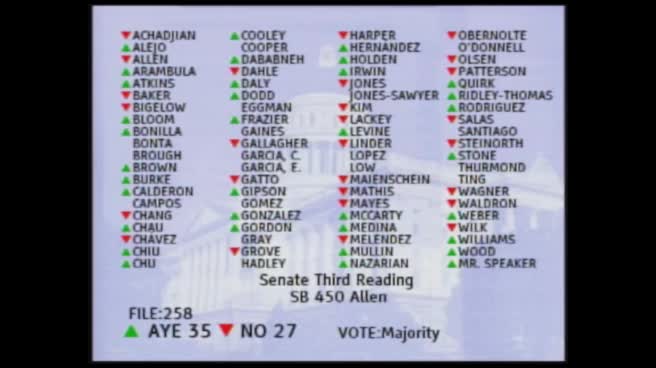 1MIN
Assembly Floor
 2MIN
Senate Floor
 4MIN
Senate Standing Committee on Transportation and Housing
 1MIN
Assembly Floor
Bill Author




