AB 2591: Insurance: electronic transmission.
- Session Year: 2015-2016
- House: Assembly
- Latest Version Date: 2016-09-25
Existing law generally requires, with exceptions, that specified provisions of the Civil Code apply to electronic records and electronic signatures relating to a transaction.
This bill would remove various notices, including a policy change or cancellation notice by the named insured and a written notice of nonrenewal of the policy from the above exemptions, making those notices subject to the specified provisions of the Civil Code. The bill, commencing January 1, 2021, would reinstate certain exemptions of those notices from the specified provisions of the Civil Code.
Existing law generally requires that any required notice related to insurance transactions be made by mail. Existing law authorizes an insurer, under specified conditions, to provide by electronic transmission the required offer of renewal for automobile insurance, the required notice of conditional renewal for commercial insurance, the required offer of coverage or renewal or any disclosure required regarding earthquake insurance, and the offer of renewal for a workers compensation policy.
The bill would, for the above-specified records, authorize additional persons licensed by the Department of Insurance to send those records electronically, as specified. The bill, as of January 1, 2021, would no longer authorize the notice of conditional renewal for commercial insurance to be sent electronically. As of January 1, 2021, the bill would permit a notice of lapse, nonrenewal, cancellation, or termination, as specified, to be transmitted electronically if it is also transmitted by mail, as prescribed by statute.
Existing law generally requires, with exceptions, that specified provisions of the Civil Code apply to electronic records and electronic signatures relating to a transaction.
This bill would remove various notices, including a policy change or cancellation notice by the named insured and a written notice of nonrenewal of the policy from the above exemptions, making those notices subject to the specified provisions of the Civil Code. The bill, commencing January 1, 2021, would reinstate certain exemptions of those notices from the specified provisions of the Civil Code.
Existing law generally requires that any required notice related to insurance transactions be made by mail. Existing law authorizes an insurer, under specified conditions, to provide by electronic transmission the required offer of renewal for automobile insurance, the required notice of conditional renewal for commercial insurance, the required offer of coverage or renewal or any disclosure required regarding earthquake insurance, and the offer of renewal for a workers compensation policy.
The bill would, for the above-specified records, authorize additional persons licensed by the Department of Insurance to send those records electronically, as specified. The bill, as of January 1, 2021, would no longer authorize the notice of conditional renewal for commercial insurance to be sent electronically. As of January 1, 2021, the bill would permit a notice of lapse, nonrenewal, cancellation, or termination, as specified, to be transmitted electronically if it is also transmitted by mail, as prescribed by statute.
Existing law generally requires, with exceptions, that specified provisions of the Civil Code apply to electronic records and electronic signatures relating to a transaction.
This bill would remove various notices, including a policy change or cancellation notice by the named insured and a written notice of nonrenewal of the policy from the above exemptions, making those notices subject to the specified provisions of the Civil Code. The bill, commencing January 1, 2021, would reinstate certain exemptions of those notices from the specified provisions of the Civil Code.
Existing law generally requires that any required notice related to insurance transactions be made by mail. Existing law authorizes an insurer, under specified conditions, to provide by electronic transmission the required offer of renewal for automobile insurance, the required notice of conditional renewal for commercial insurance, the required offer of coverage or renewal or any disclosure required regarding earthquake insurance, and the offer of renewal for a workers compensation policy.
The bill would, until January 1, 2021, for the above-specified records, authorize additional persons in addition to the insurer to send those records by electronic transmission by providing that an agent, broker, or any other person licensed by the Department of Insurance may to send those records electronically, as specified. The bill, as of January 1, 2021, would no longer authorize the notice of conditional renewal for commercial insurance to be sent electronically. As of January 1, 2021, the bill would permit a notice of lapse, nonrenewal, cancellation, or termination, as specified, to be transmitted electronically if it is also transmitted by mail, as prescribed by statute.
Existing law prohibits an insurer, relating to any insurance on risks or on operations in this state, including reinsurance, life insurance, insurance of vessels or craft, title insurance, and disability insurance, from sending a written notice by electronic transmission.
This bill would repeal the above prohibition, thereby allowing an insurer, relating to any insurance on risks or on operations in this state, including reinsurance, life insurance, insurance of vessels or craft, title insurance, and disability insurance, to send a written notice by electronic transmission.
Existing law generally requires, with exceptions, that specified provisions of the Civil Code apply to electronic records and electronic signatures relating to a transaction.
This bill would remove various notices, including a policy cancellation notice by the named insured and a written notice of nonrenewal of the policy from the above exemptions, making those notices subject to the specified provisions of the Civil Code. The bill, commencing January 1, 2021, would reinstate certain exemptions of those notices from the specified provisions of the Civil Code.
Existing law generally requires that any required notice related to insurance transactions be made by mail. Existing law authorizes an insurer, under specified conditions, to provide by electronic transmission the required offer of renewal for automobile insurance, the required notice of conditional renewal for commercial insurance, the required offer of coverage or renewal or any disclosure required regarding earthquake insurance, and the offer of renewal for a workers compensation policy.
The bill would, until January 1, 2021, for the above-specified records, authorize persons in addition to the insurer to send those records by electronic transmission by providing that an agent, broker, or any other person licensed by the Department of Insurance may send those records electronically, as specified. The bill, as of January 1, 2021, would no longer authorize the notice of conditional renewal for commercial insurance to be sent electronically.
Existing law prohibits an insurer, relating to any insurance on risks or on operations in this state, including reinsurance, life insurance, insurance of vessels or craft, title insurance, and disability insurance, from sending a written notice by electronic transmission.
This bill would repeal the above prohibition, thereby allowing an insurer, relating to any insurance on risks or on operations in this state, including reinsurance, life insurance, insurance of vessels or craft, title insurance, and disability insurance, to send a written notice by electronic transmission.
Existing law generally requires, with exceptions, that specified provisions of the Civil Code apply to electronic records and electronic signatures relating to a transaction.
This bill would remove various notices, including a policy cancellation notice by the named insured and a written notice of nonrenewal of the policy from the above exemptions, making those notices subject to the specified provisions of the Civil Code. The bill, commencing January 1, 2021, would reinstate the certain exemptions of those notices from the specified provisions of the Civil Code.
Existing law generally requires that any required notice related to insurance transactions be made by mail. Existing law authorizes an insurer, under specified conditions, to provide by electronic transmission the required offer of renewal for automobile insurance, the required offer of renewal or notice of conditional renewal for property commercial insurance, the required offer of coverage or renewal or any disclosure required regarding earthquake insurance, and the offer of renewal for a workers compensation policy.
The bill would, until January 1, 2021, for the above-specified records, authorize persons in addition to the insurer to send those records by electronic transmission by providing that an agent, broker, or any other person licensed by the Department of Insurance may send those records electronically, as specified. The bill, as of January 1, 2021, would no longer authorize the notice of conditional renewal for commercial insurance to be sent electronically.
Existing law prohibits an insurer, relating to any insurance on risks or on operations in this state, including reinsurance, life insurance, insurance of vessels or craft, title insurance, and disability insurance, from sending a written notice by electronic transmission.
This bill would repeal the above prohibition, thereby allowing an insurer, relating to any insurance on risks or on operations in this state, including reinsurance, life insurance, insurance of vessels or craft, title insurance, and disability insurance, to send a written notice by electronic transmission.
Existing law generally requires, with exceptions, that specified provisions of the Civil Code apply to electronic records and electronic signatures relating to a transaction.
This bill would remove various notices, including a policy cancellation notice by the named insured and a written notice of nonrenewal of the policy from the above exemptions. exemptions, making those notices subject to the specified provisions of the Civil Code. The bill, commencing January 1, 2021, would reinstate the exemptions of those notices from the specified provisions of the Civil Code.
Existing law generally requires that any required notice related to insurance transactions be made by mail. Existing law authorizes an insurer, under specified conditions, to provide by electronic transmission the required offer of renewal for automobile insurance, the required offer of renewal or conditional renewal for property insurance, the required offer of coverage or renewal or any disclosure required regarding earthquake insurance, and the offer of renewal for a workers compensation policy.
The bill would, for the above-specified records, authorize persons in addition to the insurer to send those records by electronic transmission by providing that an agent, broker, or any other person licensed by the Department of Insurance may send those records electronically. The bill would also repeal various provisions on the electronic transmission of certain notices. electronically, as specified.
Existing law prohibits an insurer, relating to any insurance on risks or on operations in this state, including reinsurance, life insurance, insurance of vessels or craft, title insurance, and disability insurance, from sending a written notice by electronic transmission.
This bill would repeal the above prohibition, thereby allowing an insurer, relating to any insurance on risks or on operations in this state, including reinsurance, life insurance, insurance of vessels or craft, title insurance, and disability insurance, to send a written notice by electronic transmission.
Existing law generally requires, with exceptions, that specified provisions of the Civil Code apply to electronic records and electronic signatures relating to a transaction.
This bill would remove various notices, including a policy cancellation notice by the named insured and a written notice of nonrenewal of the policy from the above exemptions.
Existing law generally requires that any required notice related to insurance transactions be made by mail. Existing law authorizes an insurer, under specified conditions, to provide by electronic transmission the required offer of renewal for automobile insurance, the required offer of renewal or conditional renewal for property insurance, the required offer of coverage or renewal or any disclosure required regarding earthquake insurance, and the offer of renewal for a workers compensation policy.
The bill would, for the above-specified records, authorize persons in addition to the insurer to send those records by electronic transmission by providing that an agent, broker, or any other person licensed by the Department of Insurance may send those records electronically. The bill would also repeal various provisions on the electronic transmission of certain notices.
Existing law generally requires, with exceptions, that specified provisions of the Civil Code apply to electronic records and electronic signatures relating to a transaction.
This bill would remove various notices, including a policy cancellation notice by the named insured insured and a written notice of nonrenewal of the policy from the above exemptions.
Existing law generally requires that any required notice related to insurance transactions be made by mail. Existing law authorizes an insurer, under specified conditions, to provide by electronic transmission the required offer of renewal for automobile insurance, the required offer of renewal or conditional renewal for property insurance, the required offer of coverage or renewal or any disclosure required regarding earthquake insurance, and the offer of renewal for a workers compensation policy.
The bill would, for the above-specified records, authorize persons in addition to the insurer to send those records by electronic transmission by providing that an agent, broker, or any other person licensed by the Department of Insurance may send those records electronically. The bill would also repeal various provisions on the electronic transmission of certain notices.
Existing law generally requires, with exceptions, that specified provisions of the Civil Code apply to electronic records and electronic signatures relating to a transaction.
This bill would remove a policy cancellation notice by the named insured from the above exemptions.
Existing law generally requires that any required notice related to insurance transactions be made by mail. Existing law authorizes an insurer, under specified conditions, to provide by electronic transmission the required offer of renewal for automobile insurance, the required offer of renewal or conditional renewal for property insurance, the required offer of coverage or renewal or any disclosure required regarding earthquake insurance, and the offer of renewal for a workers compensation policy, and life insurance records. policy.
This bill would state the intent of the Legislature to enact legislation that would expand the authority of an insurer to provide required documents to its consumers through electronic transmission.
The bill would, for the above-specified records, authorize persons in addition to the insurer to send those records by electronic transmission by providing that an agent, broker, or any other person licensed by the Department of Insurance may send those records electronically.
Existing law generally requires that any required notice related to insurance transactions be made by mail. Existing law authorizes an insurer, under specified conditions, to provide by electronic transmission the required offer of renewal for automobile insurance, the required offer of renewal or conditional renewal for property insurance, the required offer of coverage or renewal or any disclosure required regarding earthquake insurance, the offer of renewal for a workers compensation policy, and life insurance records.
This bill would state the intent of the Legislature to enact legislation that would expand the authority of an insurer to provide required documents to its consumers through electronic transmission.
(a)Except as otherwise provided in subdivisions (b) and (c), this title applies to electronic records and electronic signatures relating to a transaction.
(b)This title does not apply to transactions subject to the following laws:
(1)A law governing the creation and execution of wills, codicils, or testamentary trusts.
(2)Division 1 (commencing with Section 1101) of the Uniform Commercial Code, except Sections 1206 and 1306.
(3)Divisions 3 (commencing with Section 3101), 4 (commencing with Section 4101), 5 (commencing with Section 5101), 8 (commencing with Section 8101), 9 (commencing with Section 9101), and 11 (commencing with Section 11101) of the Uniform Commercial Code.
(4)A law that requires that specifically identifiable text or disclosures in a record or a portion of a record be separately signed, including initialed, from the record. However, this paragraph does not apply to Section 1677 or 1678 of this code or Section 1298 of the Code of Civil Procedure.
(c)This title does not apply to any specific transaction described in Section 17511.5 of the Business and Professions Code, Section 56.11, 56.17, 798.14, 1133, or 1134 of, Section 1689.6, 1689.7, or 1689.13 of, Chapter 2.5 (commencing with Section 1695) of Title 5 of Part 2 of Division 3 of, Section 1720, 1785.15, 1789.14, 1789.16, or 1793.23 of, Chapter 1 (commencing with Section 1801) of Title 2 of Part 4 of Division 3 of, Section 1861.24, 1862.5, 1917.712, 1917.713, 1950.6, 1983, 2924b, 2924c, 2924f, 2924i, 2924j, 2924.3, or 2937 of, Article 1.5 (commencing with Section 2945) of Chapter 2 of Title 14 of Part 4 of Division 3 of, Section 2954.5 or 2963 of, Chapter 2b (commencing with Section 2981) or 2d (commencing with Section 2985.7) of Title 14 of Part 4 of Division 3 of, Section 3071.5 of Part 5 (commencing with Section 4000) of Division 4 of, or Part 5.3 (commencing with Section 6500) of Division 4 of this code, subdivision (b) of Section 18608 or Section 22328 of the Financial Code, Section 1358.15, 1365, 1368.01, 1368.1, 1371, or 18035.5 of the Health and Safety Code, Section 786 as it applies to individual and group disability policies, 10192.18, 10199.44, 10199.46, 10235.16, 10235.40, 11624.09, or 11624.1 of the Insurance Code, Section 779.1, 10010.1, or 16482 of the Public Utilities Code, or Section 9975 or 11738 of the Vehicle Code. An electronic record may not be substituted for any notice that is required to be sent pursuant to Section 1162 of the Code of Civil Procedure. Nothing in this subdivision shall be construed to prohibit the recordation of any document with a county recorder by electronic means.
(d)This title applies to an electronic record or electronic signature otherwise excluded from the application of this title under subdivision (b) when used for a transaction subject to a law other than those specified in subdivision (b).
(e)A transaction subject to this title is also subject to other applicable substantive law.
(f)The exclusion of a transaction from the application of this title under subdivision (b) or (c) shall be construed only to exclude the transaction from the application of this title, but shall not be construed to prohibit the transaction from being conducted by electronic means if the transaction may be conducted by electronic means under any other applicable law.
(g)Notwithstanding subdivisions (b) and (c), this title shall apply to electronic records and electronic signatures relating to transactions conducted by a person licensed, certified, or registered pursuant to the Alarm Company Act (Chapter 11.6 (commencing with Section 7590) of Division 3 of the Business and Professions Code) for purposes of activities authorized by Section 7599.54 of the Business and Professions Code.
(h)This section shall remain in effect only until January 1, 2021, and as of that date is repealed, unless a later enacted statute, that is enacted before January 1, 2021, deletes or extends that date.
SEC. 3.Section 1633.3 of the Civil Code, as added by Section 3.5 of Chapter 638 of the Statutes of 2015, is amended to read:1633.3.(a)Except as otherwise provided in subdivisions (b) and (c), this title applies to electronic records and electronic signatures relating to a transaction.
(b)This title does not apply to transactions subject to the following laws:
(1)A law governing the creation and execution of wills, codicils, or testamentary trusts.
(2)Division 1 (commencing with Section 1101) of the Uniform Commercial Code, except Sections 1206 and 1306.
(3)Divisions 3 (commencing with Section 3101), 4 (commencing with Section 4101), 5 (commencing with Section 5101), 8 (commencing with Section 8101), 9 (commencing with Section 9101), and 11 (commencing with Section 11101) of the Uniform Commercial Code.
(4)A law that requires that specifically identifiable text or disclosures in a record or a portion of a record be separately signed, including initialed, from the record. However, this paragraph does not apply to Section 1677 or 1678 of this code or Section 1298 of the Code of Civil Procedure.
(c)This title does not apply to any specific transaction described in Section 17511.5 of the Business and Professions Code, Section 56.11, 56.17, 798.14, 1133, or 1134 of, Section 1689.6, 1689.7, or 1689.13 of, Chapter 2.5 (commencing with Section 1695) of Title 5 of Part 2 of Division 3 of, Section 1720, 1785.15, 1789.14, 1789.16, or 1793.23 of, Chapter 1 (commencing with Section 1801) of Title 2 of Part 4 of Division 3 of, Section 1861.24, 1862.5, 1917.712, 1917.713, 1950.6, 1983, 2924b, 2924c, 2924f, 2924i, 2924j, 2924.3, or 2937 of, Article 1.5 (commencing with Section 2945) of Chapter 2 of Title 14 of Part 4 of Division 3 of, Section 2954.5 or 2963 of, Chapter 2b (commencing with Section 2981) or 2d (commencing with Section 2985.7) of Title 14 of Part 4 of Division 3 of, Section 3071.5 of Part 5 (commencing with Section 4000) of Division 4 of, or Part 5.3 (commencing with Section 6500) of Division 4 of this code, subdivision (b) of Section 18608 or Section 22328 of the Financial Code, Section 1358.15, 1365, 1368.01, 1368.1, 1371, or 18035.5 of the Health and Safety Code, Section 662, paragraph (2) of subdivision (a) of Section 663, Section 664, 673, or 677, paragraph (2) of subdivision (a) of Section 678, Section 678.1 or 786, paragraph (2) of subdivision (a) of Section 10086, or Section 10113.7, 10127.7, 10127.9, 10127.10, 10192.18, 10199.44, 10199.46, 10235.16, 10235.40, 10509.4, 10509.7, 11624.09, or 11624.1 of the Insurance Code, Section 779.1, 10010.1, or 16482 of the Public Utilities Code, or Section 9975 or 11738 of the Vehicle Code. An electronic record may not be substituted for any notice that is required to be sent pursuant to Section 1162 of the Code of Civil Procedure. Nothing in this subdivision shall be construed to prohibit the recordation of any document with a county recorder by electronic means.
(d)This title applies to an electronic record or electronic signature otherwise excluded from the application of this title under subdivision (b) when used for a transaction subject to a law other than those specified in subdivision (b).
(e)A transaction subject to this title is also subject to other applicable substantive law.
(f)The exclusion of a transaction from the application of this title under subdivision (b) or (c) shall be construed only to exclude the transaction from the application of this title, but shall not be construed to prohibit the transaction from being conducted by electronic means if the transaction may be conducted by electronic means under any other applicable law.
(g)Notwithstanding subdivisions (b) and (c), this title shall apply to electronic records and electronic signatures relating to transactions conducted by a person licensed, certified, or registered pursuant to the Alarm Company Act (Chapter 11.6 (commencing with Section 7590) of Division 3 of the Business and Professions Code) for purposes of activities authorized by Section 7599.54 of the Business and Professions Code.
(h)This section shall become operative on January 1, 2021.
SEC. 4.Section 38.5 of the Insurance Code, as amended by Section 4 of Chapter 369 of the Statutes of 2013, is repealed.SEC. 5.Section 38.5 of the Insurance Code, as added by Section 5 of Chapter 369 of the Statutes of 2013, is repealed.SEC. 6.Section 38.6 of the Insurance Code is amended to read:38.6.(a)(1)Any written record required to be given or mailed to any person by a licensee, including an offer of renewal required by Sections 663 and 678, the notice of policy change or cancellation requested by the insured as required by Section 667.5, the notice of conditional renewal required by Section 678.1, the offer of coverage or renewal or any disclosure required by Section 10086, the offer of renewal for a workers compensation policy, Section 662, paragraph (2) of subdivision (a) of Section 663, Section 664, 667.5, 673, 677, paragraph (2) of subdivision (a) of Section 678, subdivisions (a) and (b) of Section 678.1, or any written record required to be given or mailed to any person by a licensee relating to the business of life insurance, as defined in Section 101 of this code may, if not excluded by subdivision (b) or (c) of Section 1633.3 of the Civil Code, be provided by electronic transmission pursuant to Title 2.5 (commencing with Section 1633.1) of Part 2 of Division 3 of the Civil Code, if each party has agreed to conduct the transaction by electronic means pursuant to Section 1633.5 of the Civil Code, and if the licensee complies with the provisions of this section. A valid electronic signature shall be sufficient for any provision of law requiring a written signature.
(2)For purposes of this section, the definitions set forth in Section 1633.2 of the Civil Code shall apply. The term licensee means an insurer, agent, broker, or any other person who is required to be licensed by the department.
(3)Notwithstanding subdivision (l) of Section 1633.2 of the Civil Code, for purposes of this section, person includes, but is not limited to, the policy owner, policyholder, applicant, insured, or assignee or designee of an insured.
(b)In order to transmit a record listed in subdivision (a) electronically, a licensee shall comply with all of the following:
(1)A licensee, or licensees representative, acquires the consent of the person to opt in to receive the record by electronic transmission, and the person has not withdrawn that consent, prior to providing the record by electronic transmission. A persons consent may be acquired verbally, in writing, or electronically. If consent is acquired verbally, the licensee shall confirm consent in writing or electronically. The licensee shall retain a record of the persons consent to receive the record by electronic transmission with the policy information so that it is retrievable upon request by the department while the policy is in force and for five years thereafter.
(2)A licensee discloses, in writing or electronically, to the person all of the following:
(A)The opt in to receive the record by electronic transmission is voluntary.
(B)That the person may opt out of receiving the record by electronic transmission at any time, and the process or system for the person to opt out.
(C)A description of the record that the person will receive by electronic transmission.
(D)The process or system to report a change or correction in the persons email address.
(E)The licensees contact information, which includes, but is not limited to, a toll-free number or the licensees Internet Web site address.
(3)The opt-in consent disclosure required by paragraph (2) may be set forth in the application or in a separate document that is part of the policy approved by the commissioner and shall be bolded or otherwise set forth in a conspicuous manner. The persons signature shall be set forth immediately below the opt-in consent disclosure. If the licensee seeks consent at any time prior to the completion of the application, consent and signature shall be obtained before the application is completed. If the person has not opted in at the time the application is completed, the licensee may receive the opt-in consent at any time thereafter, pursuant to the same opt-in requirements that apply at the time of the application. The licensee shall retain a copy of the signed opt-in consent disclosure with the policy information so that each is retrievable upon request by the department while the policy is in force and for five years thereafter.
(4)The email address of the person who has consented to electronic transmission shall be set forth on the consent disclosure. In addition, if the person who consented receives an annual statement, the email address of the person who has consented shall be set forth on that record.
(5)The licensee shall annually provide one free printed copy of any record described in this subdivision upon request by the person.
(6)If a provision of this code requires a licensee to transmit a record by first-class mail, regular mail, does not specify a method of delivery, or is a record that is required to be provided pursuant to Article 6.6 (commencing with Section 791), and if the licensee is not otherwise prohibited from transmitting the record electronically under subdivision (b) of Section 1633.8 of the Civil Code, then the record may be transmitted by electronic transmission if the licensee complies with all of the requirements of Sections 1633.15 and 1633.16 of the Civil Code.
(7)Notwithstanding subdivision (b) of Section 1633.8 of the Civil Code, if a provision of this code requires a licensee to transmit a record by return receipt, registered mail, certified mail, signed written receipt of delivery, or other method of delivery evidencing actual receipt by the person, and if the licensee is not otherwise prohibited from transmitting the record electronically under Section 1633.3 of the Civil Code and the provisions of this section, then the licensee shall maintain a process or system that demonstrates proof of delivery and actual receipt of the record by the person consistent with this paragraph. The licensee shall document and retain information demonstrating delivery and actual receipt so that it is retrievable, upon request, by the department at least five years after the policy is no longer in force. The record provided by electronic transmission shall be treated as if actually received if the licensee delivers the record to the person in compliance with applicable statutory delivery deadlines. A licensee may demonstrate actual delivery and receipt by any of the following:
(A)The person acknowledges receipt of the electronic transmission of the record by executing an electronic signature.
(B)The record is posted on the licensees secure Internet Web site, and there is evidence demonstrating that the person logged onto the licensees secure Internet Web site and downloaded, printed, or otherwise acknowledged receipt of the record.
(C)The record is transmitted to the named insured through an application on a personal electronic device that is secured by password, biometric identifier, or other technology, and there is evidence demonstrating that the person logged into the application and viewed or otherwise acknowledged receipt of the record.
(D)If a licensee is unable to demonstrate actual delivery and receipt pursuant to this paragraph, the licensee shall resend the record by regular mail to the person in the manner originally specified by the underlying provision of this code.
(8)Notwithstanding any other law, a notice of lapse, nonrenewal, cancellation, or termination of any product subject to this section may be transmitted electronically if the licensee demonstrates proof of delivery as set forth in paragraph (7) and complies with the other provisions in this section.
(9)If the record is not delivered directly to the electronic address designated by the person but placed at an electronic address accessible to the person, a licensee shall notify the person in plain, clear, and conspicuous language at the electronic address designated by the person that describes the record, informs that person that it is available at another location, and provides instructions to the person as to how to obtain the record.
(10)(A)Upon a licensee receiving information indicating that the record sent by electronic transmission was not received by the person, the licensee shall, within five business days, comply with either clause (i) or (ii):
(i)Contact the person to confirm or update the persons email address and resend the record by electronic transmission. If the licensee elects to resend the record by electronic transmission, the licensee shall demonstrate the transmission was received by the person, pursuant to paragraph (6), (7), or (8). If the licensee is unable to confirm or update the persons email address, the licensee shall resend the record by regular mail to the licensee at the address shown on the policy, or, if the underlying statute requires delivery in a specified manner, send the record in that specified manner.
(ii)Resend the record initially provided by electronic transmission by regular mail to the insured at the address shown on the policy, or, if the underlying statute requires delivery in a specified manner, send the record in that specified manner.
(B)If the licensee sends the first electronic record within the time period required by law and the licensee complies with both paragraph (5) and subparagraph (A) of this paragraph, the record sent pursuant to clause (i) or (ii) of subparagraph (A) shall be treated as if mailed in compliance with the applicable statutory regular mail delivery deadlines.
(11)The licensee shall not charge any person who declines to opt in to receive a record through electronic transmission from receiving a record electronically. The licensee shall not provide a discount or an incentive to any person to opt in to receive electronic records.
(12)The licensee shall verify a persons email address via paper writing sent by regular mail when more than 12 months have elapsed since the licensees last electronic communication.
(c)An insurance agent or broker acting under the direction of a party that enters into a contract by means of an electronic record or electronic signature shall not be held liable for any deficiency in the electronic procedures agreed to by the parties under that contract if all of the following are met:
(1)The insurance agent or broker has not engaged in negligent, reckless, or intentional tortious conduct.
(2)The insurance agent or broker was not involved in the development or establishment of the electronic procedures.
(3)The insurance agent or broker did not deviate from the electronic procedures.
(d)(1)On or before January 1, 2019, the commissioner shall submit a report to the Governor and to the committees of the Senate and Assembly having jurisdiction over insurance and the judiciary, regarding the impact and implementation of the authorization of the electronic transmission of certain insurance renewal offers, notices, or disclosures, relating to the business of life insurance, as authorized by this section. The report shall include input from insurers, consumers, and consumer organizations, and shall include an assessment of the departments experience pertaining to the authorization of the electronic transmission of insurance renewals, relating to the business of life insurance, as authorized by this section.
(2)On or before January 1, 2019, the commissioner shall submit a report to the Governor and to the committees of the Senate and Assembly having jurisdiction over insurance and the judiciary, regarding the impact and implementation of the authorization of the electronic transmission of certain insurance renewal offers, notices, or disclosures including an offer of renewal required by Sections 663 and 678, the notice of conditional renewal required by Section 678.1, the offer of coverage or renewal or any disclosure required by Section 10086, and the offer of renewal for a workers compensation policy, as authorized by this section. The report shall include input from insurers, consumers, and consumer organizations, and shall include an assessment of the departments experience pertaining to the authorization of the electronic transmission of insurance renewals, including, an offer of renewal required by Sections 663 and 678, the notice of conditional renewal required by Section 678.1, the offer of coverage or renewal or any disclosure required by Section 10086, and the offer of renewal for a workers compensation policy, as authorized by this section.
(e)Notwithstanding paragraph (4) of subdivision (b) of Section 1633.3 of the Civil Code, for any policy of life insurance, as defined in Section 101, any statutory requirement for a separate acknowledgment, signature, or initial, which is not expressly prohibited by subdivision (c) of Section 1633.3 of the Civil Code, may be transacted using an electronic signature, or by electronic transaction, subject to all applicable provisions of this section.
(f)The department may suspend a licensee from providing records by electronic transmission if there is a pattern or practices that demonstrate the licensee has failed to comply with the requirements of this section. A licensee may appeal the suspension and resume its electronic transmission of records upon communication from the department that the changes the licensee made to its process or system to comply with the requirements of this section are satisfactory.
(g)This section shall remain in effect only until January 1, 2021, and as of that date is repealed, unless a later enacted statute, that is enacted before January 1, 2021, deletes or extends that date.
SEC. 7.Section 38.6 is added to the Insurance Code, to read:38.6.(a)(1)Any written record required to be given or mailed to any person by a licensee, including an offer of renewal required by paragraph (1) of subdivision (a) of Section 663 and Section 678, the notice of policy change or cancellation requested by the insured as required by Section 667.5, the offer of coverage or renewal or any disclosure required by paragraph (1) of subdivision (a) of Section 10086, and the offer of renewal for a workers compensation policy may, if not excluded by subdivision (b) or (c) of Section 1633.3 of the Civil Code, be provided by electronic transmission pursuant to Title 2.5 (commencing with Section 1633.1) of Part 2 of Division 3 of the Civil Code, if each party has agreed to conduct the transaction by electronic means pursuant to Section 1633.5 of the Civil Code, and if the licensee complies with the provisions of this section. A valid electronic signature shall be sufficient for any provision of law requiring a written signature.
(2)For purposes of this section, the definitions set forth in Section 1633.2 of the Civil Code shall apply. The term licensee means an insurer, agent, broker, or any other person who is required to be licensed by the department.
(3)Notwithstanding subdivision (l) of Section 1633.2 of the Civil Code, for purposes of this section, person includes, but is not limited to, the policy owner, policyholder, applicant, insured, or assignee or designee of an insured.
(b)In order to transmit a record listed in subdivision (a) electronically, a licensee shall comply with all of the following:
(1)A licensee, or licensees representative, acquires the consent of the person to opt in to receive the record by electronic transmission, and the person has not withdrawn that consent, prior to providing the record by electronic transmission. A persons consent may be acquired verbally, in writing, or electronically. If consent is acquired verbally, the licensee shall confirm consent in writing or electronically. The licensee shall retain a record of the persons consent to receive the record by electronic transmission with the policy information so that it is retrievable upon request by the department while the policy is in force and for five years thereafter.
(2)A licensee discloses, in writing or electronically, to the person all of the following:
(A)The opt in to receive the record by electronic transmission is voluntary.
(B)That the person may opt out of receiving the record by electronic transmission at any time, and the process or system for the person to opt out.
(C)A description of the record that the person will receive by electronic transmission.
(D)The process or system to report a change or correction in the persons email address.
(E)The licensees contact information, which includes, but is not limited to, a toll-free number or the licensees Internet Web site address.
(3)The opt-in consent disclosure required by paragraph (2) may be set forth in the application or in a separate document that is part of the policy approved by the commissioner and shall be bolded or otherwise set forth in a conspicuous manner. The persons signature shall be set forth immediately below the opt-in consent disclosure. If the licensee seeks consent at any time prior to the completion of the application, consent and signature shall be obtained before the application is completed. If the person has not opted in at the time the application is completed, the licensee may receive the opt-in consent at any time thereafter, pursuant to the same opt-in requirements that apply at the time of the application. The licensee shall retain a copy of the signed opt-in consent disclosure with the policy information so that each is retrievable upon request by the department while the policy is in force and for five years thereafter.
(4)The email address of the person who has consented to electronic transmission shall be set forth on the consent disclosure. In addition, if the person who consented receives an annual statement, the email address of the person who has consented shall be set forth on that record.
(5)The licensee shall annually provide one free printed copy of any record described in this subdivision upon request by the person.
(6)If a provision of this code requires a licensee to transmit a record by first-class mail, regular mail, does not specify a method of delivery, or is a record that is required to be provided pursuant to Article 6.6 (commencing with Section 791), and if the licensee is not otherwise prohibited from transmitting the record electronically under subdivision (b) of Section 1633.8 of the Civil Code, then the record may be transmitted by electronic transmission if the licensee complies with all of the requirements of Sections 1633.15 and 1633.16 of the Civil Code.
(7)If the record is not delivered directly to the electronic address designated by the person but placed at an electronic address accessible to the person, a licensee shall notify the person in plain, clear, and conspicuous language at the electronic address designated by the person that describes the record, informs that person that it is available at another location, and provides instructions to the person as to how to obtain the record.
(8)(A)Upon a licensee receiving information indicating that the record sent by electronic transmission was not received by the person, the licensee shall, within five business days, comply with either clause (i) or (ii):
(i)Contact the person to confirm or update the persons email address and resend the record by electronic transmission. If the licensee elects to resend the record by electronic transmission, the licensee shall demonstrate the transmission was received by the person, pursuant to paragraph (6). If the licensee is unable to confirm or update the persons email address, the licensee shall resend the record by regular mail to the licensee at the address shown on the policy, or, if the underlying statute requires delivery in a specified manner, send the record in that specified manner.
(ii)Resend the record initially provided by electronic transmission by regular mail to the insured at the address shown on the policy, or, if the underlying statute requires delivery in a specified manner, send the record in that specified manner.
(B)If the licensee sends the first electronic record within the time period required by law and the licensee complies with both paragraph (5) and subparagraph (A) of this paragraph, the record sent pursuant to clause (i) or (ii) of subparagraph (A) shall be treated as if mailed in compliance with the applicable statutory regular mail delivery deadlines.
(9)The licensee shall not charge any person who declines to opt in to receive a record through electronic transmission from receiving a record electronically. The licensee shall not provide a discount or an incentive to any person to opt in to receive electronic records.
(10)The licensee shall verify a persons email address via paper writing sent by regular mail when more than 12 months have elapsed since the licensees last electronic communication.
(c)An insurance agent or broker acting under the direction of a party that enters into a contract by means of an electronic record or electronic signature shall not be held liable for any deficiency in the electronic procedures agreed to by the parties under that contract if all of the following are met:
(1)The insurance agent or broker has not engaged in negligent, reckless, or intentional tortious conduct.
(2)The insurance agent or broker was not involved in the development or establishment of the electronic procedures.
(3)The insurance agent or broker did not deviate from the electronic procedures.
(d)Notwithstanding paragraph (4) of subdivision (b) of Section 1633.3 of the Civil Code, for any policy of life insurance, as defined in Section 101, any statutory requirement for a separate acknowledgment, signature, or initial, which is not expressly prohibited by subdivision (c) of Section 1633.3 of the Civil Code, may be transacted using an electronic signature, or by electronic transaction, subject to all applicable provisions of this section.
(e)The department may suspend a licensee from providing records by electronic transmission if there is a pattern or practices that demonstrate the licensee has failed to comply with the requirements of this section. A licensee may appeal the suspension and resume its electronic transmission of records upon communication from the department that the changes the licensee made to its process or system to comply with the requirements of this section are satisfactory.
(f)This section does not apply to a written record that is required to be given or mailed to any person by a licensee and that relates to the business of life insurance, as defined in Section 101.
(g)A notice of lapse, nonrenewal, cancellation, or termination required by a section of this code that is excluded by subdivision (b) or (c) of Section 1633.3 of the Civil Code may be transmitted electronically if it is also transmitted by mail, as prescribed by statute.
(h)This section shall become operative on January 1, 2021.
(a)Except as otherwise provided in subdivisions (b) and (c), this title applies to electronic records and electronic signatures relating to a transaction.
(b)This title does not apply to transactions subject to the following laws:
(1)A law governing the creation and execution of wills, codicils, or testamentary trusts.
(2)Division 1 (commencing with Section 1101) of the Uniform Commercial Code, except Sections 1206 and 1306.
(3)Divisions 3 (commencing with Section 3101), 4 (commencing with Section 4101), 5 (commencing with Section 5101), 8 (commencing with Section 8101), 9 (commencing with Section 9101), and 11 (commencing with Section 11101) of the Uniform Commercial Code.
(4)A law that requires that specifically identifiable text or disclosures in a record or a portion of a record be separately signed, including initialed, from the record. However, this paragraph does not apply to Section 1677 or 1678 of this code or Section 1298 of the Code of Civil Procedure.
(c)This title does not apply to any specific transaction described in Section 17511.5 of the Business and Professions Code, Section 56.11, 56.17, 798.14, 1133, or 1134 of, Section 1689.6, 1689.7, or 1689.13 of, Chapter 2.5 (commencing with Section 1695) of Title 5 of Part 2 of Division 3 of, Section 1720, 1785.15, 1789.14, 1789.16, or 1793.23 of, Chapter 1 (commencing with Section 1801) of Title 2 of Part 4 of Division 3 of, Section 1861.24, 1862.5, 1917.712, 1917.713, 1950.6, 1983, 2924b, 2924c, 2924f, 2924i, 2924j, 2924.3, or 2937 of, Article 1.5 (commencing with Section 2945) of Chapter 2 of Title 14 of Part 4 of Division 3 of, Section 2954.5 or 2963 of, Chapter 2b (commencing with Section 2981) or 2d (commencing with Section 2985.7) of Title 14 of Part 4 of Division 3 of, Section 3071.5 of Part 5 (commencing with Section 4000) of Division 4 of, or Part 5.3 (commencing with Section 6500) of Division 4 of this code, subdivision (b) of Section 18608 or Section 22328 of the Financial Code, Section 1358.15, 1365, 1368.01, 1368.1, 1371, or 18035.5 of the Health and Safety Code, Section 786 as it applies to individual and group disability policies, 10192.18, 10199.44, 10199.46, 10235.16, 10235.40, 11624.09, or 11624.1 of the Insurance Code, Section 779.1, 10010.1, or 16482 of the Public Utilities Code, or Section 9975 or 11738 of the Vehicle Code. An electronic record may not be substituted for any notice that is required to be sent pursuant to Section 1162 of the Code of Civil Procedure. Nothing in this subdivision shall be construed to prohibit the recordation of any document with a county recorder by electronic means.
(d)This title applies to an electronic record or electronic signature otherwise excluded from the application of this title under subdivision (b) when used for a transaction subject to a law other than those specified in subdivision (b).
(e)A transaction subject to this title is also subject to other applicable substantive law.
(f)The exclusion of a transaction from the application of this title under subdivision (b) or (c) shall be construed only to exclude the transaction from the application of this title, but shall not be construed to prohibit the transaction from being conducted by electronic means if the transaction may be conducted by electronic means under any other applicable law.
(g)Notwithstanding subdivisions (b) and (c), this title shall apply to electronic records and electronic signatures relating to transactions conducted by a person licensed, certified, or registered pursuant to the Alarm Company Act (Chapter 11.6 (commencing with Section 7590) of Division 3 of the Business and Professions Code) for purposes of activities authorized by Section 7599.54 of the Business and Professions Code.
(h)This section shall remain in effect only until January 1, 2021, and as of that date is repealed, unless a later enacted statute, that is enacted before January 1, 2021, deletes or extends that date.
SEC. 3.Section 1633.3 of the Civil Code, as added by Section 3.5 of Chapter 638 of the Statutes of 2015, is amended to read:1633.3.(a)Except as otherwise provided in subdivisions (b) and (c), this title applies to electronic records and electronic signatures relating to a transaction.
(b)This title does not apply to transactions subject to the following laws:
(1)A law governing the creation and execution of wills, codicils, or testamentary trusts.
(2)Division 1 (commencing with Section 1101) of the Uniform Commercial Code, except Sections 1206 and 1306.
(3)Divisions 3 (commencing with Section 3101), 4 (commencing with Section 4101), 5 (commencing with Section 5101), 8 (commencing with Section 8101), 9 (commencing with Section 9101), and 11 (commencing with Section 11101) of the Uniform Commercial Code.
(4)A law that requires that specifically identifiable text or disclosures in a record or a portion of a record be separately signed, including initialed, from the record. However, this paragraph does not apply to Section 1677 or 1678 of this code or Section 1298 of the Code of Civil Procedure.
(c)This title does not apply to any specific transaction described in Section 17511.5 of the Business and Professions Code, Section 56.11, 56.17, 798.14, 1133, or 1134 of, Section 1689.6, 1689.7, or 1689.13 of, Chapter 2.5 (commencing with Section 1695) of Title 5 of Part 2 of Division 3 of, Section 1720, 1785.15, 1789.14, 1789.16, or 1793.23 of, Chapter 1 (commencing with Section 1801) of Title 2 of Part 4 of Division 3 of, Section 1861.24, 1862.5, 1917.712, 1917.713, 1950.6, 1983, 2924b, 2924c, 2924f, 2924i, 2924j, 2924.3, or 2937 of, Article 1.5 (commencing with Section 2945) of Chapter 2 of Title 14 of Part 4 of Division 3 of, Section 2954.5 or 2963 of, Chapter 2b (commencing with Section 2981) or 2d (commencing with Section 2985.7) of Title 14 of Part 4 of Division 3 of, Section 3071.5 of Part 5 (commencing with Section 4000) of Division 4 of, or Part 5.3 (commencing with Section 6500) of Division 4 of this code, subdivision (b) of Section 18608 or Section 22328 of the Financial Code, Section 1358.15, 1365, 1368.01, 1368.1, 1371, or 18035.5 of the Health and Safety Code, Section 662, paragraph (2) of subdivision (a) of Section 663, Section 664, 673, or 677, paragraph (2) of subdivision (a) of Section 678, Section 678.1 or 786, paragraph (2) of subdivision (a) of Section 10086, or Section 10113.7, 10127.7, 10127.9, 10127.10, 10192.18, 10199.44, 10199.46, 10235.16, 10235.40, 10509.4, 10509.7, 11624.09, or 11624.1 of the Insurance Code, Section 779.1, 10010.1, or 16482 of the Public Utilities Code, or Section 9975 or 11738 of the Vehicle Code. An electronic record may not be substituted for any notice that is required to be sent pursuant to Section 1162 of the Code of Civil Procedure. Nothing in this subdivision shall be construed to prohibit the recordation of any document with a county recorder by electronic means.
(d)This title applies to an electronic record or electronic signature otherwise excluded from the application of this title under subdivision (b) when used for a transaction subject to a law other than those specified in subdivision (b).
(e)A transaction subject to this title is also subject to other applicable substantive law.
(f)The exclusion of a transaction from the application of this title under subdivision (b) or (c) shall be construed only to exclude the transaction from the application of this title, but shall not be construed to prohibit the transaction from being conducted by electronic means if the transaction may be conducted by electronic means under any other applicable law.
(g)Notwithstanding subdivisions (b) and (c), this title shall apply to electronic records and electronic signatures relating to transactions conducted by a person licensed, certified, or registered pursuant to the Alarm Company Act (Chapter 11.6 (commencing with Section 7590) of Division 3 of the Business and Professions Code) for purposes of activities authorized by Section 7599.54 of the Business and Professions Code.
(h)This section shall become operative on January 1, 2021.
SEC. 4.Section 38.5 of the Insurance Code, as amended by Section 4 of Chapter 369 of the Statutes of 2013, is repealed.SEC. 5.Section 38.5 of the Insurance Code, as added by Section 5 of Chapter 369 of the Statutes of 2013, is repealed.SEC. 6.Section 38.6 of the Insurance Code is amended to read:38.6.(a)(1)Any written record required to be given or mailed to any person by a licensee, including an offer of renewal required by Sections 663 and 678, the notice of policy change or cancellation requested by the insured as required by Section 667.5, the notice of conditional renewal required by Section 678.1, the offer of coverage or renewal or any disclosure required by Section 10086, the offer of renewal for a workers compensation policy, Section 662, paragraph (2) of subdivision (a) of Section 663, Section 664, 667.5, 673, 677, paragraph (2) of subdivision (a) of Section 678, subdivisions (a) and (b) of Section 678.1, or any written record required to be given or mailed to any person by a licensee relating to the business of life insurance, as defined in Section 101 of this code may, if not excluded by subdivision (b) or (c) of Section 1633.3 of the Civil Code, be provided by electronic transmission pursuant to Title 2.5 (commencing with Section 1633.1) of Part 2 of Division 3 of the Civil Code, if each party has agreed to conduct the transaction by electronic means pursuant to Section 1633.5 of the Civil Code, and if the licensee complies with the provisions of this section. A valid electronic signature shall be sufficient for any provision of law requiring a written signature.
(2)For purposes of this section, the definitions set forth in Section 1633.2 of the Civil Code shall apply. The term licensee means an insurer, agent, broker, or any other person who is required to be licensed by the department.
(3)Notwithstanding subdivision (l) of Section 1633.2 of the Civil Code, for purposes of this section, person includes, but is not limited to, the policy owner, policyholder, applicant, insured, or assignee or designee of an insured.
(b)In order to transmit a record listed in subdivision (a) electronically, a licensee shall comply with all of the following:
(1)A licensee, or licensees representative, acquires the consent of the person to opt in to receive the record by electronic transmission, and the person has not withdrawn that consent, prior to providing the record by electronic transmission. A persons consent may be acquired verbally, in writing, or electronically. If consent is acquired verbally, the licensee shall confirm consent in writing or electronically. The licensee shall retain a record of the persons consent to receive the record by electronic transmission with the policy information so that it is retrievable upon request by the department while the policy is in force and for five years thereafter.
(2)A licensee discloses, in writing or electronically, to the person all of the following:
(A)The opt in to receive the record by electronic transmission is voluntary.
(B)That the person may opt out of receiving the record by electronic transmission at any time, and the process or system for the person to opt out.
(C)A description of the record that the person will receive by electronic transmission.
(D)The process or system to report a change or correction in the persons email address.
(E)The licensees contact information, which includes, but is not limited to, a toll-free number or the licensees Internet Web site address.
(3)The opt-in consent disclosure required by paragraph (2) may be set forth in the application or in a separate document that is part of the policy approved by the commissioner and shall be bolded or otherwise set forth in a conspicuous manner. The persons signature shall be set forth immediately below the opt-in consent disclosure. If the licensee seeks consent at any time prior to the completion of the application, consent and signature shall be obtained before the application is completed. If the person has not opted in at the time the application is completed, the licensee may receive the opt-in consent at any time thereafter, pursuant to the same opt-in requirements that apply at the time of the application. The licensee shall retain a copy of the signed opt-in consent disclosure with the policy information so that each is retrievable upon request by the department while the policy is in force and for five years thereafter.
(4)The email address of the person who has consented to electronic transmission shall be set forth on the consent disclosure. In addition, if the person who consented receives an annual statement, the email address of the person who has consented shall be set forth on that record.
(5)The licensee shall annually provide one free printed copy of any record described in this subdivision upon request by the person.
(6)If a provision of this code requires a licensee to transmit a record by first-class mail, regular mail, does not specify a method of delivery, or is a record that is required to be provided pursuant to Article 6.6 (commencing with Section 791), and if the licensee is not otherwise prohibited from transmitting the record electronically under subdivision (b) of Section 1633.8 of the Civil Code, then the record may be transmitted by electronic transmission if the licensee complies with all of the requirements of Sections 1633.15 and 1633.16 of the Civil Code.
(7)Notwithstanding subdivision (b) of Section 1633.8 of the Civil Code, if a provision of this code requires a licensee to transmit a record by return receipt, registered mail, certified mail, signed written receipt of delivery, or other method of delivery evidencing actual receipt by the person, and if the licensee is not otherwise prohibited from transmitting the record electronically under Section 1633.3 of the Civil Code and the provisions of this section, then the licensee shall maintain a process or system that demonstrates proof of delivery and actual receipt of the record by the person consistent with this paragraph. The licensee shall document and retain information demonstrating delivery and actual receipt so that it is retrievable, upon request, by the department at least five years after the policy is no longer in force. The record provided by electronic transmission shall be treated as if actually received if the licensee delivers the record to the person in compliance with applicable statutory delivery deadlines. A licensee may demonstrate actual delivery and receipt by any of the following:
(A)The person acknowledges receipt of the electronic transmission of the record by executing an electronic signature.
(B)The record is posted on the licensees secure Internet Web site, and there is evidence demonstrating that the person logged onto the licensees secure Internet Web site and downloaded, printed, or otherwise acknowledged receipt of the record.
(C)The record is transmitted to the named insured through an application on a personal electronic device that is secured by password, biometric identifier, or other technology, and there is evidence demonstrating that the person logged into the application and viewed or otherwise acknowledged receipt of the record.
(D)If a licensee is unable to demonstrate actual delivery and receipt pursuant to this paragraph, the licensee shall resend the record by regular mail to the person in the manner originally specified by the underlying provision of this code.
(8)Notwithstanding any other law, a notice of lapse, nonrenewal, cancellation, or termination of any product subject to this section may be transmitted electronically if the licensee demonstrates proof of delivery as set forth in paragraph (7) and complies with the other provisions in this section.
(9)If the record is not delivered directly to the electronic address designated by the person but placed at an electronic address accessible to the person, a licensee shall notify the person in plain, clear, and conspicuous language at the electronic address designated by the person that describes the record, informs that person that it is available at another location, and provides instructions to the person as to how to obtain the record.
(10)(A)Upon a licensee receiving information indicating that the record sent by electronic transmission was not received by the person, the licensee shall, within five business days, comply with either clause (i) or (ii):
(i)Contact the person to confirm or update the persons email address and resend the record by electronic transmission. If the licensee elects to resend the record by electronic transmission, the licensee shall demonstrate the transmission was received by the person, pursuant to paragraph (6), (7), or (8). If the licensee is unable to confirm or update the persons email address, the licensee shall resend the record by regular mail to the licensee at the address shown on the policy, or, if the underlying statute requires delivery in a specified manner, send the record in that specified manner.
(ii)Resend the record initially provided by electronic transmission by regular mail to the insured at the address shown on the policy, or, if the underlying statute requires delivery in a specified manner, send the record in that specified manner.
(B)If the licensee sends the first electronic record within the time period required by law and the licensee complies with both paragraph (5) and subparagraph (A) of this paragraph, the record sent pursuant to clause (i) or (ii) of subparagraph (A) shall be treated as if mailed in compliance with the applicable statutory regular mail delivery deadlines.
(11)The licensee shall not charge any person who declines to opt in to receive a record through electronic transmission from receiving a record electronically. The licensee shall not provide a discount or an incentive to any person to opt in to receive electronic records.
(12)The licensee shall verify a persons email address via paper writing sent by regular mail when more than 12 months have elapsed since the licensees last electronic communication.
(c)An insurance agent or broker acting under the direction of a party that enters into a contract by means of an electronic record or electronic signature shall not be held liable for any deficiency in the electronic procedures agreed to by the parties under that contract if all of the following are met:
(1)The insurance agent or broker has not engaged in negligent, reckless, or intentional tortious conduct.
(2)The insurance agent or broker was not involved in the development or establishment of the electronic procedures.
(3)The insurance agent or broker did not deviate from the electronic procedures.
(d)(1)On or before January 1, 2019, the commissioner shall submit a report to the Governor and to the committees of the Senate and Assembly having jurisdiction over insurance and the judiciary, regarding the impact and implementation of the authorization of the electronic transmission of certain insurance renewal offers, notices, or disclosures, relating to the business of life insurance, as authorized by this section. The report shall include input from insurers, consumers, and consumer organizations, and shall include an assessment of the departments experience pertaining to the authorization of the electronic transmission of insurance renewals, relating to the business of life insurance, as authorized by this section.
(2)On or before January 1, 2019, the commissioner shall submit a report to the Governor and to the committees of the Senate and Assembly having jurisdiction over insurance and the judiciary, regarding the impact and implementation of the authorization of the electronic transmission of certain insurance renewal offers, notices, or disclosures including an offer of renewal required by Sections 663 and 678, the notice of conditional renewal required by Section 678.1, the offer of coverage or renewal or any disclosure required by Section 10086, and the offer of renewal for a workers compensation policy, as authorized by this section. The report shall include input from insurers, consumers, and consumer organizations, and shall include an assessment of the departments experience pertaining to the authorization of the electronic transmission of insurance renewals, including, an offer of renewal required by Sections 663 and 678, the notice of conditional renewal required by Section 678.1, the offer of coverage or renewal or any disclosure required by Section 10086, and the offer of renewal for a workers compensation policy, as authorized by this section.
(e)Notwithstanding paragraph (4) of subdivision (b) of Section 1633.3 of the Civil Code, for any policy of life insurance, as defined in Section 101, any statutory requirement for a separate acknowledgment, signature, or initial, which is not expressly prohibited by subdivision (c) of Section 1633.3 of the Civil Code, may be transacted using an electronic signature, or by electronic transaction, subject to all applicable provisions of this section.
(f)The department may suspend a licensee from providing records by electronic transmission if there is a pattern or practices that demonstrate the licensee has failed to comply with the requirements of this section. A licensee may appeal the suspension and resume its electronic transmission of records upon communication from the department that the changes the licensee made to its process or system to comply with the requirements of this section are satisfactory.
(g)This section shall remain in effect only until January 1, 2021, and as of that date is repealed, unless a later enacted statute, that is enacted before January 1, 2021, deletes or extends that date.
SEC. 7.Section 38.6 is added to the Insurance Code, to read:38.6.(a)(1)Any written record required to be given or mailed to any person by a licensee, including an offer of renewal required by paragraph (1) of subdivision (a) of Section 663 and Section 678, the notice of policy change or cancellation requested by the insured as required by Section 667.5, the offer of coverage or renewal or any disclosure required by paragraph (1) of subdivision (a) of Section 10086, and the offer of renewal for a workers compensation policy may, if not excluded by subdivision (b) or (c) of Section 1633.3 of the Civil Code, be provided by electronic transmission pursuant to Title 2.5 (commencing with Section 1633.1) of Part 2 of Division 3 of the Civil Code, if each party has agreed to conduct the transaction by electronic means pursuant to Section 1633.5 of the Civil Code, and if the licensee complies with the provisions of this section. A valid electronic signature shall be sufficient for any provision of law requiring a written signature.
(2)For purposes of this section, the definitions set forth in Section 1633.2 of the Civil Code shall apply. The term licensee means an insurer, agent, broker, or any other person who is required to be licensed by the department.
(3)Notwithstanding subdivision (l) of Section 1633.2 of the Civil Code, for purposes of this section, person includes, but is not limited to, the policy owner, policyholder, applicant, insured, or assignee or designee of an insured.
(b)In order to transmit a record listed in subdivision (a) electronically, a licensee shall comply with all of the following:
(1)A licensee, or licensees representative, acquires the consent of the person to opt in to receive the record by electronic transmission, and the person has not withdrawn that consent, prior to providing the record by electronic transmission. A persons consent may be acquired verbally, in writing, or electronically. If consent is acquired verbally, the licensee shall confirm consent in writing or electronically. The licensee shall retain a record of the persons consent to receive the record by electronic transmission with the policy information so that it is retrievable upon request by the department while the policy is in force and for five years thereafter.
(2)A licensee discloses, in writing or electronically, to the person all of the following:
(A)The opt in to receive the record by electronic transmission is voluntary.
(B)That the person may opt out of receiving the record by electronic transmission at any time, and the process or system for the person to opt out.
(C)A description of the record that the person will receive by electronic transmission.
(D)The process or system to report a change or correction in the persons email address.
(E)The licensees contact information, which includes, but is not limited to, a toll-free number or the licensees Internet Web site address.
(3)The opt-in consent disclosure required by paragraph (2) may be set forth in the application or in a separate document that is part of the policy approved by the commissioner and shall be bolded or otherwise set forth in a conspicuous manner. The persons signature shall be set forth immediately below the opt-in consent disclosure. If the licensee seeks consent at any time prior to the completion of the application, consent and signature shall be obtained before the application is completed. If the person has not opted in at the time the application is completed, the licensee may receive the opt-in consent at any time thereafter, pursuant to the same opt-in requirements that apply at the time of the application. The licensee shall retain a copy of the signed opt-in consent disclosure with the policy information so that each is retrievable upon request by the department while the policy is in force and for five years thereafter.
(4)The email address of the person who has consented to electronic transmission shall be set forth on the consent disclosure. In addition, if the person who consented receives an annual statement, the email address of the person who has consented shall be set forth on that record.
(5)The licensee shall annually provide one free printed copy of any record described in this subdivision upon request by the person.
(6)If a provision of this code requires a licensee to transmit a record by first-class mail, regular mail, does not specify a method of delivery, or is a record that is required to be provided pursuant to Article 6.6 (commencing with Section 791), and if the licensee is not otherwise prohibited from transmitting the record electronically under subdivision (b) of Section 1633.8 of the Civil Code, then the record may be transmitted by electronic transmission if the licensee complies with all of the requirements of Sections 1633.15 and 1633.16 of the Civil Code.
(7)If the record is not delivered directly to the electronic address designated by the person but placed at an electronic address accessible to the person, a licensee shall notify the person in plain, clear, and conspicuous language at the electronic address designated by the person that describes the record, informs that person that it is available at another location, and provides instructions to the person as to how to obtain the record.
(8)(A)Upon a licensee receiving information indicating that the record sent by electronic transmission was not received by the person, the licensee shall, within five business days, comply with either clause (i) or (ii):
(i)Contact the person to confirm or update the persons email address and resend the record by electronic transmission. If the licensee elects to resend the record by electronic transmission, the licensee shall demonstrate the transmission was received by the person, pursuant to paragraph (6). If the licensee is unable to confirm or update the persons email address, the licensee shall resend the record by regular mail to the licensee at the address shown on the policy, or, if the underlying statute requires delivery in a specified manner, send the record in that specified manner.
(ii)Resend the record initially provided by electronic transmission by regular mail to the insured at the address shown on the policy, or, if the underlying statute requires delivery in a specified manner, send the record in that specified manner.
(B)If the licensee sends the first electronic record within the time period required by law and the licensee complies with both paragraph (5) and subparagraph (A) of this paragraph, the record sent pursuant to clause (i) or (ii) of subparagraph (A) shall be treated as if mailed in compliance with the applicable statutory regular mail delivery deadlines.
(9)The licensee shall not charge any person who declines to opt in to receive a record through electronic transmission from receiving a record electronically. The licensee shall not provide a discount or an incentive to any person to opt in to receive electronic records.
(10)The licensee shall verify a persons email address via paper writing sent by regular mail when more than 12 months have elapsed since the licensees last electronic communication.
(c)An insurance agent or broker acting under the direction of a party that enters into a contract by means of an electronic record or electronic signature shall not be held liable for any deficiency in the electronic procedures agreed to by the parties under that contract if all of the following are met:
(1)The insurance agent or broker has not engaged in negligent, reckless, or intentional tortious conduct.
(2)The insurance agent or broker was not involved in the development or establishment of the electronic procedures.
(3)The insurance agent or broker did not deviate from the electronic procedures.
(d)Notwithstanding paragraph (4) of subdivision (b) of Section 1633.3 of the Civil Code, for any policy of life insurance, as defined in Section 101, any statutory requirement for a separate acknowledgment, signature, or initial, which is not expressly prohibited by subdivision (c) of Section 1633.3 of the Civil Code, may be transacted using an electronic signature, or by electronic transaction, subject to all applicable provisions of this section.
(e)The department may suspend a licensee from providing records by electronic transmission if there is a pattern or practices that demonstrate the licensee has failed to comply with the requirements of this section. A licensee may appeal the suspension and resume its electronic transmission of records upon communication from the department that the changes the licensee made to its process or system to comply with the requirements of this section are satisfactory.
(f)This section does not apply to a written record that is required to be given or mailed to any person by a licensee and that relates to the business of life insurance, as defined in Section 101.
(g)A notice of lapse, nonrenewal, cancellation, or termination required by a section of this code that is excluded by subdivision (b) or (c) of Section 1633.3 of the Civil Code may be transmitted electronically if it is also transmitted by mail, as prescribed by statute.
(h)This section shall become operative on January 1, 2021.
(a)Except as otherwise provided in subdivisions (b) and (c), this title applies to electronic records and electronic signatures relating to a transaction.
(b)This title does not apply to transactions subject to the following laws:
(1)A law governing the creation and execution of wills, codicils, or testamentary trusts.
(2)Division 1 (commencing with Section 1101) of the Uniform Commercial Code, except Sections 1206 and 1306.
(3)Divisions 3 (commencing with Section 3101), 4 (commencing with Section 4101), 5 (commencing with Section 5101), 8 (commencing with Section 8101), 9 (commencing with Section 9101), and 11 (commencing with Section 11101) of the Uniform Commercial Code.
(4)A law that requires that specifically identifiable text or disclosures in a record or a portion of a record be separately signed, including initialed, from the record. However, this paragraph does not apply to Section 1677 or 1678 of this code or Section 1298 of the Code of Civil Procedure.
(c)This title does not apply to any specific transaction described in Section 17511.5 of the Business and Professions Code, Section 56.11, 56.17, 798.14, 1133, or 1134 of, Section 1689.6, 1689.7, or 1689.13 of, Chapter 2.5 (commencing with Section 1695) of Title 5 of Part 2 of Division 3 of, Section 1720, 1785.15, 1789.14, 1789.16, or 1793.23 of, Chapter 1 (commencing with Section 1801) of Title 2 of Part 4 of Division 3 of, Section 1861.24, 1862.5, 1917.712, 1917.713, 1950.6, 1983, 2924b, 2924c, 2924f, 2924i, 2924j, 2924.3, or 2937 of, Article 1.5 (commencing with Section 2945) of Chapter 2 of Title 14 of Part 4 of Division 3 of, Section 2954.5 or 2963 of, Chapter 2b (commencing with Section 2981) or 2d (commencing with Section 2985.7) of Title 14 of Part 4 of Division 3 of, Section 3071.5 of Part 5 (commencing with Section 4000) of Division 4 of, or Part 5.3 (commencing with Section 6500) of Division 4 of this code, subdivision (b) of Section 18608 or Section 22328 of the Financial Code, Section 1358.15, 1365, 1368.01, 1368.1, 1371, or 18035.5 of the Health and Safety Code, Section 786 as it applies to individual and group disability policies, 10192.18, 10199.44, 10199.46, 10235.16, 10235.40, 11624.09, or 11624.1 of the Insurance Code, Section 779.1, 10010.1, or 16482 of the Public Utilities Code, or Section 9975 or 11738 of the Vehicle Code. An electronic record may not be substituted for any notice that is required to be sent pursuant to Section 1162 of the Code of Civil Procedure. Nothing in this subdivision shall be construed to prohibit the recordation of any document with a county recorder by electronic means.
(d)This title applies to an electronic record or electronic signature otherwise excluded from the application of this title under subdivision (b) when used for a transaction subject to a law other than those specified in subdivision (b).
(e)A transaction subject to this title is also subject to other applicable substantive law.
(f)The exclusion of a transaction from the application of this title under subdivision (b) or (c) shall be construed only to exclude the transaction from the application of this title, but shall not be construed to prohibit the transaction from being conducted by electronic means if the transaction may be conducted by electronic means under any other applicable law.
(g)Notwithstanding subdivisions (b) and (c), this title shall apply to electronic records and electronic signatures relating to transactions conducted by a person licensed, certified, or registered pursuant to the Alarm Company Act (Chapter 11.6 (commencing with Section 7590) of Division 3 of the Business and Professions Code) for purposes of activities authorized by Section 7599.54 of the Business and Professions Code.
(h)This section shall remain in effect only until January 1, 2021, and as of that date is repealed, unless a later enacted statute, that is enacted before January 1, 2021, deletes or extends that date.
SEC. 3.Section 1633.3 of the Civil Code, as added by Section 3.5 of Chapter 638 of the Statutes of 2015, is amended to read:1633.3.(a)Except as otherwise provided in subdivisions (b) and (c), this title applies to electronic records and electronic signatures relating to a transaction.
(b)This title does not apply to transactions subject to the following laws:
(1)A law governing the creation and execution of wills, codicils, or testamentary trusts.
(2)Division 1 (commencing with Section 1101) of the Uniform Commercial Code, except Sections 1206 and 1306.
(3)Divisions 3 (commencing with Section 3101), 4 (commencing with Section 4101), 5 (commencing with Section 5101), 8 (commencing with Section 8101), 9 (commencing with Section 9101), and 11 (commencing with Section 11101) of the Uniform Commercial Code.
(4)A law that requires that specifically identifiable text or disclosures in a record or a portion of a record be separately signed, including initialed, from the record. However, this paragraph does not apply to Section 1677 or 1678 of this code or Section 1298 of the Code of Civil Procedure.
(c)This title does not apply to any specific transaction described in Section 17511.5 of the Business and Professions Code, Section 56.11, 56.17, 798.14, 1133, or 1134 of, Section 1689.6, 1689.7, or 1689.13 of, Chapter 2.5 (commencing with Section 1695) of Title 5 of Part 2 of Division 3 of, Section 1720, 1785.15, 1789.14, 1789.16, or 1793.23 of, Chapter 1 (commencing with Section 1801) of Title 2 of Part 4 of Division 3 of, Section 1861.24, 1862.5, 1917.712, 1917.713, 1950.6, 1983, 2924b, 2924c, 2924f, 2924i, 2924j, 2924.3, or 2937 of, Article 1.5 (commencing with Section 2945) of Chapter 2 of Title 14 of Part 4 of Division 3 of, Section 2954.5 or 2963 of, Chapter 2b (commencing with Section 2981) or 2d (commencing with Section 2985.7) of Title 14 of Part 4 of Division 3 of, Section 3071.5 of Part 5 (commencing with Section 4000) of Division 4 of, or Part 5.3 (commencing with Section 6500) of Division 4 of this code, subdivision (b) of Section 18608 or Section 22328 of the Financial Code, Section 1358.15, 1365, 1368.01, 1368.1, 1371, or 18035.5 of the Health and Safety Code, Section 662, paragraph (2) of subdivision (a) of Section 663, Section 664, 673, or 677, 678.1, paragraph (2) of subdivision (a) of Section 678, Section 678.1 or 786, paragraph (2) of subdivision (a) of Section 10086, or Section 10113.7, 10127.7, 10127.9, 10127.10, 10192.18, 10199.44, 10199.46, 10235.16, 10235.40, 10509.4, 10509.7, 11624.09, or 11624.1 of the Insurance Code, Section 779.1, 10010.1, or 16482 of the Public Utilities Code, or Section 9975 or 11738 of the Vehicle Code. An electronic record may not be substituted for any notice that is required to be sent pursuant to Section 1162 of the Code of Civil Procedure. Nothing in this subdivision shall be construed to prohibit the recordation of any document with a county recorder by electronic means.
(d)This title applies to an electronic record or electronic signature otherwise excluded from the application of this title under subdivision (b) when used for a transaction subject to a law other than those specified in subdivision (b).
(e)A transaction subject to this title is also subject to other applicable substantive law.
(f)The exclusion of a transaction from the application of this title under subdivision (b) or (c) shall be construed only to exclude the transaction from the application of this title, but shall not be construed to prohibit the transaction from being conducted by electronic means if the transaction may be conducted by electronic means under any other applicable law.
(g)Notwithstanding subdivisions (b) and (c), this title shall apply to electronic records and electronic signatures relating to transactions conducted by a person licensed, certified, or registered pursuant to the Alarm Company Act (Chapter 11.6 (commencing with Section 7590) of Division 3 of the Business and Professions Code) for purposes of activities authorized by Section 7599.54 of the Business and Professions Code.
(h)This section shall become operative on January 1, 2021.
SEC. 4.Section 38.5 of the Insurance Code, as amended by Section 4 of Chapter 369 of the Statutes of 2013, is repealed.SEC. 5.Section 38.5 of the Insurance Code, as added by Section 5 of Chapter 369 of the Statutes of 2013, is repealed.SEC. 6.Section 38.6 of the Insurance Code is amended to read:38.6.(a)(1)Any written record required to be given or mailed to any person by a licensee, including an offer of renewal required by Sections 663 and 678, the notice of policy change or cancellation requested by the insured as required by Section 667.5, the notice of conditional renewal required by Section 678.1, the offer of coverage or renewal or any disclosure required by Section 10086, the offer of renewal for a workers compensation policy, Section 662, paragraph (2) of subdivision (a) of Section 663, Section 664, 667.5, 673, 677, paragraph (2) of subdivision (a) of Section 678, subdivisions (a) and (b) of Section 678.1, or any written record required to be given or mailed to any person by a licensee relating to the business of life insurance, as defined in Section 101 of this code may, if not excluded by subdivision (b) or (c) of Section 1633.3 of the Civil Code, be provided by electronic transmission pursuant to Title 2.5 (commencing with Section 1633.1) of Part 2 of Division 3 of the Civil Code, if each party has agreed to conduct the transaction by electronic means pursuant to Section 1633.5 of the Civil Code, and if the licensee complies with the provisions of this section. A valid electronic signature shall be sufficient for any provision of law requiring a written signature.
(2)For purposes of this section, the definitions set forth in Section 1633.2 of the Civil Code shall apply. The term licensee means an insurer, agent, broker, or any other person who is required to be licensed by the department.
(3)Notwithstanding subdivision (l) of Section 1633.2 of the Civil Code, for purposes of this section, person includes, but is not limited to, the policy owner, policyholder, applicant, insured, or assignee or designee of an insured.
(b)In order to transmit a record listed in subdivision (a) electronically, a licensee shall comply with all of the following:
(1)A licensee, or licensees representative, acquires the consent of the person to opt in to receive the record by electronic transmission, and the person has not withdrawn that consent, prior to providing the record by electronic transmission. A persons consent may be acquired verbally, in writing, or electronically. If consent is acquired verbally, the licensee shall confirm consent in writing or electronically. The licensee shall retain a record of the persons consent to receive the record by electronic transmission with the policy information so that it is retrievable upon request by the department while the policy is in force and for five years thereafter.
(2)A licensee discloses, in writing or electronically, to the person all of the following:
(A)The opt in to receive the record by electronic transmission is voluntary.
(B)That the person may opt out of receiving the record by electronic transmission at any time, and the process or system for the person to opt out.
(C)A description of the record that the person will receive by electronic transmission.
(D)The process or system to report a change or correction in the persons email address.
(E)The licensees contact information, which includes, but is not limited to, a toll-free number or the licensees Internet Web site address.
(3)The opt-in consent disclosure required by paragraph (2) may be set forth in the application or in a separate document that is part of the policy approved by the commissioner and shall be bolded or otherwise set forth in a conspicuous manner. The persons signature shall be set forth immediately below the opt-in consent disclosure. If the licensee seeks consent at any time prior to the completion of the application, consent and signature shall be obtained before the application is completed. If the person has not opted in at the time the application is completed, the licensee may receive the opt-in consent at any time thereafter, pursuant to the same opt-in requirements that apply at the time of the application. The licensee shall retain a copy of the signed opt-in consent disclosure with the policy information so that each is retrievable upon request by the department while the policy is in force and for five years thereafter.
(4)The email address of the person who has consented to electronic transmission shall be set forth on the consent disclosure. In addition, if the person who consented receives an annual statement, the email address of the person who has consented shall be set forth on that record.
(5)The licensee shall annually provide one free printed copy of any record described in this subdivision upon request by the person.
(6)If a provision of this code requires a licensee to transmit a record by first-class mail, regular mail, does not specify a method of delivery, or is a record that is required to be provided pursuant to Article 6.6 (commencing with Section 791), and if the licensee is not otherwise prohibited from transmitting the record electronically under subdivision (b) of Section 1633.8 of the Civil Code, then the record may be transmitted by electronic transmission if the licensee complies with all of the requirements of Sections 1633.15 and 1633.16 of the Civil Code.
(7)Notwithstanding subdivision (b) of Section 1633.8 of the Civil Code, if a provision of this code requires a licensee to transmit a record by return receipt, registered mail, certified mail, signed written receipt of delivery, or other method of delivery evidencing actual receipt by the person, and if the licensee is not otherwise prohibited from transmitting the record electronically under Section 1633.3 of the Civil Code and the provisions of this section, then the licensee shall maintain a process or system that demonstrates proof of delivery and actual receipt of the record by the person consistent with this paragraph. The licensee shall document and retain information demonstrating delivery and actual receipt so that it is retrievable, upon request, by the department at least five years after the policy is no longer in force. The record provided by electronic transmission shall be treated as if actually received if the licensee delivers the record to the person in compliance with applicable statutory delivery deadlines. A licensee may demonstrate actual delivery and receipt by any of the following:
(A)The person acknowledges receipt of the electronic transmission of the record by executing an electronic signature.
(B)The record is posted on the licensees secure Internet Web site, and there is evidence demonstrating that the person logged onto the licensees secure Internet Web site and downloaded, printed, or otherwise acknowledged receipt of the record.
(C)The record is transmitted to the named insured through an application on a personal electronic device that is secured by password, biometric identifier, or other technology, and there is evidence demonstrating that the person logged into the application and viewed or otherwise acknowledged receipt of the record.
(D)If a licensee is unable to demonstrate actual delivery and receipt pursuant to this paragraph, the licensee shall resend the record by regular mail to the person in the manner originally specified by the underlying provision of this code.
(8)Notwithstanding any other law, a notice of lapse, nonrenewal, cancellation, or termination of any product subject to this section may be transmitted electronically if the licensee demonstrates proof of delivery as set forth in paragraph (7) and complies with the other provisions in this section.
(9)If the record is not delivered directly to the electronic address designated by the person but placed at an electronic address accessible to the person, a licensee shall notify the person in plain, clear, and conspicuous language at the electronic address designated by the person that describes the record, informs that person that it is available at another location, and provides instructions to the person as to how to obtain the record.
(10)(A)Upon a licensee receiving information indicating that the record sent by electronic transmission was not received by the person, the licensee shall, within five business days, comply with either clause (i) or (ii):
(i)Contact the person to confirm or update the persons email address and resend the record by electronic transmission. If the licensee elects to resend the record by electronic transmission, the licensee shall demonstrate the transmission was received by the person, pursuant to paragraph (6), (7), or (8). If the licensee is unable to confirm or update the persons email address, the licensee shall resend the record by regular mail to the licensee at the address shown on the policy, or, if the underlying statute requires delivery in a specified manner, send the record in that specified manner.
(ii)Resend the record initially provided by electronic transmission by regular mail to the insured at the address shown on the policy, or, if the underlying statute requires delivery in a specified manner, send the record in that specified manner.
(B)If the licensee sends the first electronic record within the time period required by law and the licensee complies with both paragraph (5) and subparagraph (A) of this paragraph, the record sent pursuant to clause (i) or (ii) of subparagraph (A) shall be treated as if mailed in compliance with the applicable statutory regular mail delivery deadlines.
(11)The licensee shall not charge any person who declines to opt in to receive a record through electronic transmission from receiving a record electronically. The licensee shall not provide a discount or an incentive to any person to opt in to receive electronic records.
(12)The licensee shall verify a persons email address via paper writing sent by regular mail when more than 12 months have elapsed since the licensees last electronic communication.
(c)An insurance agent or broker acting under the direction of a party that enters into a contract by means of an electronic record or electronic signature shall not be held liable for any deficiency in the electronic procedures agreed to by the parties under that contract if all of the following are met:
(1)The insurance agent or broker has not engaged in negligent, reckless, or intentional tortious conduct.
(2)The insurance agent or broker was not involved in the development or establishment of the electronic procedures.
(3)The insurance agent or broker did not deviate from the electronic procedures.
(d)(1)On or before January 1, 2019, the commissioner shall submit a report to the Governor and to the committees of the Senate and Assembly having jurisdiction over insurance and the judiciary, regarding the impact and implementation of the authorization of the electronic transmission of certain insurance renewal offers, notices, or disclosures, relating to the business of life insurance, as authorized by this section. The report shall include input from insurers, consumers, and consumer organizations, and shall include an assessment of the departments experience pertaining to the authorization of the electronic transmission of insurance renewals, relating to the business of life insurance, as authorized by this section.
(2)On or before January 1, 2019, the commissioner shall submit a report to the Governor and to the committees of the Senate and Assembly having jurisdiction over insurance and the judiciary, regarding the impact and implementation of the authorization of the electronic transmission of certain insurance renewal offers, notices, or disclosures including an offer of renewal required by Sections 663 and 678, the notice of conditional renewal required by Section 678.1, the offer of coverage or renewal or any disclosure required by Section 10086, and the offer of renewal for a workers compensation policy, as authorized by this section. The report shall include input from insurers, consumers, and consumer organizations, and shall include an assessment of the departments experience pertaining to the authorization of the electronic transmission of insurance renewals, including, an offer of renewal required by Sections 663 and 678, the notice of conditional renewal required by Section 678.1, the offer of coverage or renewal or any disclosure required by Section 10086, and the offer of renewal for a workers compensation policy, as authorized by this section.
(e)Notwithstanding paragraph (4) of subdivision (b) of Section 1633.3 of the Civil Code, for any policy of life insurance, as defined in Section 101, any statutory requirement for a separate acknowledgment, signature, or initial, which is not expressly prohibited by subdivision (c) of Section 1633.3 of the Civil Code, may be transacted using an electronic signature, or by electronic transaction, subject to all applicable provisions of this section.
(f)The department may suspend a licensee from providing records by electronic transmission if there is a pattern or practices that demonstrate the licensee has failed to comply with the requirements of this section. A licensee may appeal the suspension and resume its electronic transmission of records upon communication from the department that the changes the licensee made to its process or system to comply with the requirements of this section are satisfactory.
(g)This section shall remain in effect only until January 1, 2021, and as of that date is repealed, unless a later enacted statute, that is enacted before January 1, 2021, deletes or extends that date.
SEC. 7.Section 38.6 is added to the Insurance Code, to read:38.6.(a)(1)Any written record required to be given or mailed to any person by a licensee, including an offer of renewal required by paragraph (1) of subdivision (a) of Section 663 and Section 678, the notice of policy change or cancellation requested by the insured as required by Section 667.5, the offer of coverage or renewal or any disclosure required by paragraph (1) of subdivision (a) of Section 10086, and the offer of renewal for a workers compensation policy, or any written record required to be given or mailed to any person by a licensee relating to the business of life insurance, as defined in Section 101 of this code policy may, if not excluded by subdivision (b) or (c) of Section 1633.3 of the Civil Code, be provided by electronic transmission pursuant to Title 2.5 (commencing with Section 1633.1) of Part 2 of Division 3 of the Civil Code, if each party has agreed to conduct the transaction by electronic means pursuant to Section 1633.5 of the Civil Code, and if the licensee complies with the provisions of this section. A valid electronic signature shall be sufficient for any provision of law requiring a written signature.
(2)For purposes of this section, the definitions set forth in Section 1633.2 of the Civil Code shall apply. The term licensee means an insurer, agent, broker, or any other person who is required to be licensed by the department.
(3)Notwithstanding subdivision (l) of Section 1633.2 of the Civil Code, for purposes of this section, person includes, but is not limited to, the policy owner, policyholder, applicant, insured, or assignee or designee of an insured.
(b)In order to transmit a record listed in subdivision (a) electronically, a licensee shall comply with all of the following:
(1)A licensee, or licensees representative, acquires the consent of the person to opt in to receive the record by electronic transmission, and the person has not withdrawn that consent, prior to providing the record by electronic transmission. A persons consent may be acquired verbally, in writing, or electronically. If consent is acquired verbally, the licensee shall confirm consent in writing or electronically. The licensee shall retain a record of the persons consent to receive the record by electronic transmission with the policy information so that it is retrievable upon request by the department while the policy is in force and for five years thereafter.
(2)A licensee discloses, in writing or electronically, to the person all of the following:
(A)The opt in to receive the record by electronic transmission is voluntary.
(B)That the person may opt out of receiving the record by electronic transmission at any time, and the process or system for the person to opt out.
(C)A description of the record that the person will receive by electronic transmission.
(D)The process or system to report a change or correction in the persons email address.
(E)The licensees contact information, which includes, but is not limited to, a toll-free number or the licensees Internet Web site address.
(3)The opt-in consent disclosure required by paragraph (2) may be set forth in the application or in a separate document that is part of the policy approved by the commissioner and shall be bolded or otherwise set forth in a conspicuous manner. The persons signature shall be set forth immediately below the opt-in consent disclosure. If the licensee seeks consent at any time prior to the completion of the application, consent and signature shall be obtained before the application is completed. If the person has not opted in at the time the application is completed, the licensee may receive the opt-in consent at any time thereafter, pursuant to the same opt-in requirements that apply at the time of the application. The licensee shall retain a copy of the signed opt-in consent disclosure with the policy information so that each is retrievable upon request by the department while the policy is in force and for five years thereafter.
(4)The email address of the person who has consented to electronic transmission shall be set forth on the consent disclosure. In addition, if the person who consented receives an annual statement, the email address of the person who has consented shall be set forth on that record.
(5)The licensee shall annually provide one free printed copy of any record described in this subdivision upon request by the person.
(6)If a provision of this code requires a licensee to transmit a record by first-class mail, regular mail, does not specify a method of delivery, or is a record that is required to be provided pursuant to Article 6.6 (commencing with Section 791), and if the licensee is not otherwise prohibited from transmitting the record electronically under subdivision (b) of Section 1633.8 of the Civil Code, then the record may be transmitted by electronic transmission if the licensee complies with all of the requirements of Sections 1633.15 and 1633.16 of the Civil Code.
(7)If the record is not delivered directly to the electronic address designated by the person but placed at an electronic address accessible to the person, a licensee shall notify the person in plain, clear, and conspicuous language at the electronic address designated by the person that describes the record, informs that person that it is available at another location, and provides instructions to the person as to how to obtain the record.
(8)(A)Upon a licensee receiving information indicating that the record sent by electronic transmission was not received by the person, the licensee shall, within five business days, comply with either clause (i) or (ii):
(i)Contact the person to confirm or update the persons email address and resend the record by electronic transmission. If the licensee elects to resend the record by electronic transmission, the licensee shall demonstrate the transmission was received by the person, pursuant to paragraph (6). If the licensee is unable to confirm or update the persons email address, the licensee shall resend the record by regular mail to the licensee at the address shown on the policy, or, if the underlying statute requires delivery in a specified manner, send the record in that specified manner.
(ii)Resend the record initially provided by electronic transmission by regular mail to the insured at the address shown on the policy, or, if the underlying statute requires delivery in a specified manner, send the record in that specified manner.
(B)If the licensee sends the first electronic record within the time period required by law and the licensee complies with both paragraph (5) and subparagraph (A) of this paragraph, the record sent pursuant to clause (i) or (ii) of subparagraph (A) shall be treated as if mailed in compliance with the applicable statutory regular mail delivery deadlines.
(9)The licensee shall not charge any person who declines to opt in to receive a record through electronic transmission from receiving a record electronically. The licensee shall not provide a discount or an incentive to any person to opt in to receive electronic records.
(10)The licensee shall verify a persons email address via paper writing sent by regular mail when more than 12 months have elapsed since the licensees last electronic communication.
(c)An insurance agent or broker acting under the direction of a party that enters into a contract by means of an electronic record or electronic signature shall not be held liable for any deficiency in the electronic procedures agreed to by the parties under that contract if all of the following are met:
(1)The insurance agent or broker has not engaged in negligent, reckless, or intentional tortious conduct.
(2)The insurance agent or broker was not involved in the development or establishment of the electronic procedures.
(3)The insurance agent or broker did not deviate from the electronic procedures.
(d)Notwithstanding paragraph (4) of subdivision (b) of Section 1633.3 of the Civil Code, for any policy of life insurance, as defined in Section 101, any statutory requirement for a separate acknowledgment, signature, or initial, which is not expressly prohibited by subdivision (c) of Section 1633.3 of the Civil Code, may be transacted using an electronic signature, or by electronic transaction, subject to all applicable provisions of this section.
(e)The department may suspend a licensee from providing records by electronic transmission if there is a pattern or practices that demonstrate the licensee has failed to comply with the requirements of this section. A licensee may appeal the suspension and resume its electronic transmission of records upon communication from the department that the changes the licensee made to its process or system to comply with the requirements of this section are satisfactory.
(f)This section does not apply to a written record that is required to be given or mailed to any person by a licensee and that relates to the business of life insurance, as defined in Section 101.
(g)A notice of lapse, nonrenewal, cancellation, or termination required by a section of this code that is excluded by subdivision (b) or (c) of Section 1633.3 of the Civil Code may be transmitted electronically if it is also transmitted by mail, as prescribed by statute.
(f)
(h)This section shall become operative on January 1, 2021.
(a)Except as otherwise provided in subdivisions (b) and (c), this title applies to electronic records and electronic signatures relating to a transaction.
(b)This title does not apply to transactions subject to the following laws:
(1)A law governing the creation and execution of wills, codicils, or testamentary trusts.
(2)Division 1 (commencing with Section 1101) of the Uniform Commercial Code, except Sections 1206 and 1306.
(3)Divisions 3 (commencing with Section 3101), 4 (commencing with Section 4101), 5 (commencing with Section 5101), 8 (commencing with Section 8101), 9 (commencing with Section 9101), and 11 (commencing with Section 11101) of the Uniform Commercial Code.
(4)A law that requires that specifically identifiable text or disclosures in a record or a portion of a record be separately signed, including initialed, from the record. However, this paragraph does not apply to Section 1677 or 1678 of this code or Section 1298 of the Code of Civil Procedure.
(c)This title does not apply to any specific transaction described in Section 17511.5 of the Business and Professions Code, Section 56.11, 56.17, 798.14, 1133, or 1134 of, Section 1689.6, 1689.7, or 1689.13 of, Chapter 2.5 (commencing with Section 1695) of Title 5 of Part 2 of Division 3 of, Section 1720, 1785.15, 1789.14, 1789.16, or 1793.23 of, Chapter 1 (commencing with Section 1801) of Title 2 of Part 4 of Division 3 of, Section 1861.24, 1862.5, 1917.712, 1917.713, 1950.6, 1983, 2924b, 2924c, 2924f, 2924i, 2924j, 2924.3, or 2937 of, Article 1.5 (commencing with Section 2945) of Chapter 2 of Title 14 of Part 4 of Division 3 of, Section 2954.5 or 2963 of, Chapter 2b (commencing with Section 2981) or 2d (commencing with Section 2985.7) of Title 14 of Part 4 of Division 3 of, Section 3071.5 of Part 5 (commencing with Section 4000) of Division 4 of, or Part 5.3 (commencing with Section 6500) of Division 4 of this code, subdivision (b) of Section 18608 or Section 22328 of the Financial Code, Section 1358.15, 1365, 1368.01, 1368.1, 1371, or 18035.5 of the Health and Safety Code, Section 786 as it applies to individual and group disability policies, 10192.18, 10199.44, 10199.46, 10235.16, 10235.40, 11624.09, or 11624.1 of the Insurance Code, Section 779.1, 10010.1, or 16482 of the Public Utilities Code, or Section 9975 or 11738 of the Vehicle Code. An electronic record may not be substituted for any notice that is required to be sent pursuant to Section 1162 of the Code of Civil Procedure. Nothing in this subdivision shall be construed to prohibit the recordation of any document with a county recorder by electronic means.
(d)This title applies to an electronic record or electronic signature otherwise excluded from the application of this title under subdivision (b) when used for a transaction subject to a law other than those specified in subdivision (b).
(e)A transaction subject to this title is also subject to other applicable substantive law.
(f)The exclusion of a transaction from the application of this title under subdivision (b) or (c) shall be construed only to exclude the transaction from the application of this title, but shall not be construed to prohibit the transaction from being conducted by electronic means if the transaction may be conducted by electronic means under any other applicable law.
(g)Notwithstanding subdivisions (b) and (c), this title shall apply to electronic records and electronic signatures relating to transactions conducted by a person licensed, certified, or registered pursuant to the Alarm Company Act (Chapter 11.6 (commencing with Section 7590) of Division 3 of the Business and Professions Code) for purposes of activities authorized by Section 7599.54 of the Business and Professions Code.
(h)This section shall remain in effect only until January 1, 2021, and as of that date is repealed, unless a later enacted statute, that is enacted before January 1, 2021, deletes or extends that date.
SEC. 3.Section 1633.3 of the Civil Code, as added by Section 3.5 of Chapter 638 of the Statutes of 2015, is amended to read:1633.3.(a)Except as otherwise provided in subdivisions (b) and (c), this title applies to electronic records and electronic signatures relating to a transaction.
(b)This title does not apply to transactions subject to the following laws:
(1)A law governing the creation and execution of wills, codicils, or testamentary trusts.
(2)Division 1 (commencing with Section 1101) of the Uniform Commercial Code, except Sections 1206 and 1306.
(3)Divisions 3 (commencing with Section 3101), 4 (commencing with Section 4101), 5 (commencing with Section 5101), 8 (commencing with Section 8101), 9 (commencing with Section 9101), and 11 (commencing with Section 11101) of the Uniform Commercial Code.
(4)A law that requires that specifically identifiable text or disclosures in a record or a portion of a record be separately signed, including initialed, from the record. However, this paragraph does not apply to Section 1677 or 1678 of this code or Section 1298 of the Code of Civil Procedure.
(c)This title does not apply to any specific transaction described in Section 17511.5 of the Business and Professions Code, Section 56.11, 56.17, 798.14, 1133, or 1134 of, Section 1689.6, 1689.7, or 1689.13 of, Chapter 2.5 (commencing with Section 1695) of Title 5 of Part 2 of Division 3 of, Section 1720, 1785.15, 1789.14, 1789.16, or 1793.23 of, Chapter 1 (commencing with Section 1801) of Title 2 of Part 4 of Division 3 of, Section 1861.24, 1862.5, 1917.712, 1917.713, 1950.6, 1983, 2924b, 2924c, 2924f, 2924i, 2924j, 2924.3, or 2937 of, Article 1.5 (commencing with Section 2945) of Chapter 2 of Title 14 of Part 4 of Division 3 of, Section 2954.5 or 2963 of, Chapter 2b (commencing with Section 2981) or 2d (commencing with Section 2985.7) of Title 14 of Part 4 of Division 3 of, Section 3071.5 of Part 5 (commencing with Section 4000) of Division 4 of, or Part 5.3 (commencing with Section 6500) of Division 4 of this code, subdivision (b) of Section 18608 or Section 22328 of the Financial Code, Section 1358.15, 1365, 1368.01, 1368.1, 1371, or 18035.5 of the Health and Safety Code, Section 662, paragraph (2) of subdivision (a) of Section 663, 664, 673, 677, 678.1, 786, paragraph (2) of subdivision (a) of Section 10086, 10192.18, 10199.44, 10199.46, 10235.16, 10235.40, 11624.09, or 11624.1 of the Insurance Code, Section 779.1, 10010.1, or 16482 of the Public Utilities Code, or Section 9975 or 11738 of the Vehicle Code. An electronic record may not be substituted for any notice that is required to be sent pursuant to Section 1162 of the Code of Civil Procedure. Nothing in this subdivision shall be construed to prohibit the recordation of any document with a county recorder by electronic means.
(d)This title applies to an electronic record or electronic signature otherwise excluded from the application of this title under subdivision (b) when used for a transaction subject to a law other than those specified in subdivision (b).
(e)A transaction subject to this title is also subject to other applicable substantive law.
(f)The exclusion of a transaction from the application of this title under subdivision (b) or (c) shall be construed only to exclude the transaction from the application of this title, but shall not be construed to prohibit the transaction from being conducted by electronic means if the transaction may be conducted by electronic means under any other applicable law.
(g)Notwithstanding subdivisions (b) and (c), this title shall apply to electronic records and electronic signatures relating to transactions conducted by a person licensed, certified, or registered pursuant to the Alarm Company Act (Chapter 11.6 (commencing with Section 7590) of Division 3 of the Business and Professions Code) for purposes of activities authorized by Section 7599.54 of the Business and Professions Code.
(h)This section shall become operative on January 1, 2021.
SEC. 4.Section 38.5 of the Insurance Code, as amended by Section 4 of Chapter 369 of the Statutes of 2013, is repealed.SEC. 5.Section 38.5 of the Insurance Code, as added by Section 5 of Chapter 369 of the Statutes of 2013, is repealed.SEC. 6.Section 38.6 of the Insurance Code is amended to read:38.6.(a)(1)Any written record required to be given or mailed to any person by a licensee, including an offer of renewal required by Sections 663 and 678, the notice of policy change or cancellation requested by the insured as required by Section 667.5, the notice of conditional renewal required by Section 678.1, the offer of coverage or renewal or any disclosure required by Section 10086, the offer of renewal for a workers compensation policy, Section 662, paragraph (2) of subdivision (a) of Section 663, Section 664, 667.5, 673, 677, paragraph (2) of subdivision (a) of Section 678, subdivisions (a) and (b) of Section 678.1, or any written record required to be given or mailed to any person by a licensee relating to the business of life insurance, as defined in Section 101 of this code may, if not excluded by subdivision (b) or (c) of Section 1633.3 of the Civil Code, be provided by electronic transmission pursuant to Title 2.5 (commencing with Section 1633.1) of Part 2 of Division 3 of the Civil Code, if each party has agreed to conduct the transaction by electronic means pursuant to Section 1633.5 of the Civil Code, and if the licensee complies with the provisions of this section. A valid electronic signature shall be sufficient for any provision of law requiring a written signature.
(2)For purposes of this section, the definitions set forth in Section 1633.2 of the Civil Code shall apply. The term licensee means an insurer, agent, broker, or any other person who is required to be licensed by the department.
(3)Notwithstanding subdivision (l) of Section 1633.2 of the Civil Code, for purposes of this section, person includes, but is not limited to, the policy owner, policyholder, applicant, insured, or assignee or designee of an insured.
(b)In order to transmit a record listed in subdivision (a) electronically, a licensee shall comply with all of the following:
(1)A licensee, or licensees representative, acquires the consent of the person to opt in to receive the record by electronic transmission, and the person has not withdrawn that consent, prior to providing the record by electronic transmission. A persons consent may be acquired verbally, in writing, or electronically. If consent is acquired verbally, the licensee shall confirm consent in writing or electronically. The licensee shall retain a record of the persons consent to receive the record by electronic transmission with the policy information so that it is retrievable upon request by the department while the policy is in force and for five years thereafter.
(2)A licensee discloses, in writing or electronically, to the person all of the following:
(A)The opt in to receive the record by electronic transmission is voluntary.
(B)That the person may opt out of receiving the record by electronic transmission at any time, and the process or system for the person to opt out.
(C)A description of the record that the person will receive by electronic transmission.
(D)The process or system to report a change or correction in the persons email address.
(E)The licensees contact information, which includes, but is not limited to, a toll-free number or the licensees Internet Web site address.
(3)The opt-in consent disclosure required by paragraph (2) may be set forth in the application or in a separate document that is part of the policy approved by the commissioner and shall be bolded or otherwise set forth in a conspicuous manner. The persons signature shall be set forth immediately below the opt-in consent disclosure. If the licensee seeks consent at any time prior to the completion of the application, consent and signature shall be obtained before the application is completed. If the person has not opted in at the time the application is completed, the licensee may receive the opt-in consent at any time thereafter, pursuant to the same opt-in requirements that apply at the time of the application. The licensee shall retain a copy of the signed opt-in consent disclosure with the policy information so that each is retrievable upon request by the department while the policy is in force and for five years thereafter.
(4)The email address of the person who has consented to electronic transmission shall be set forth on the consent disclosure. In addition, if the person who consented receives an annual statement, the email address of the person who has consented shall be set forth on that record.
(5)The licensee shall annually provide one free printed copy of any record described in this subdivision upon request by the person.
(6)If a provision of this code requires a licensee to transmit a record by first-class mail, regular mail, does not specify a method of delivery, or is a record that is required to be provided pursuant to Article 6.6 (commencing with Section 791), and if the licensee is not otherwise prohibited from transmitting the record electronically under subdivision (b) of Section 1633.8 of the Civil Code, then the record may be transmitted by electronic transmission if the licensee complies with all of the requirements of Sections 1633.15 and 1633.16 of the Civil Code.
(7)Notwithstanding subdivision (b) of Section 1633.8 of the Civil Code, if a provision of this code requires a licensee to transmit a record by return receipt, registered mail, certified mail, signed written receipt of delivery, or other method of delivery evidencing actual receipt by the person, and if the licensee is not otherwise prohibited from transmitting the record electronically under Section 1633.3 of the Civil Code and the provisions of this section, then the licensee shall maintain a process or system that demonstrates proof of delivery and actual receipt of the record by the person consistent with this paragraph. The licensee shall document and retain information demonstrating delivery and actual receipt so that it is retrievable, upon request, by the department at least five years after the policy is no longer in force. The record provided by electronic transmission shall be treated as if actually received if the licensee delivers the record to the person in compliance with applicable statutory delivery deadlines. A licensee may demonstrate actual delivery and receipt by any of the following:
(A)The person acknowledges receipt of the electronic transmission of the record by executing an electronic signature.
(B)The record is posted on the licensees secure Internet Web site, and there is evidence demonstrating that the person logged onto the licensees secure Internet Web site and downloaded, printed, or otherwise acknowledged receipt of the record.
(C)The record is transmitted to the named insured through an application on a personal electronic device that is secured by password, biometric identifier, or other technology, and there is evidence demonstrating that the person logged into the application and viewed or otherwise acknowledged receipt of the record.
(C)
(D)If a licensee is unable to demonstrate actual delivery and receipt pursuant to this paragraph, the licensee shall resend the record by regular mail to the person in the manner originally specified by the underlying provision of this code.
(8)Notwithstanding any other law, a notice of lapse, nonrenewal, cancellation, or termination of any product subject to this section may be transmitted electronically if the licensee demonstrates proof of delivery as set forth in paragraph (7) and complies with the other provisions in this section.
(9)If the record is not delivered directly to the electronic address designated by the person but placed at an electronic address accessible to the person, a licensee shall notify the person in plain, clear, and conspicuous language at the electronic address designated by the person that describes the record, informs that person that it is available at another location, and provides instructions to the person as to how to obtain the record.
(10)(A)Upon a licensee receiving information indicating that the record sent by electronic transmission was not received by the person, the licensee shall, within five business days, comply with either clause (i) or (ii):
(i)Contact the person to confirm or update the persons email address and resend the record by electronic transmission. If the licensee elects to resend the record by electronic transmission, the licensee shall demonstrate the transmission was received by the person, pursuant to paragraph (6), (7), or (8). If the licensee is unable to confirm or update the persons email address, the licensee shall resend the record by regular mail to the licensee at the address shown on the policy, or, if the underlying statute requires delivery in a specified manner, send the record in that specified manner.
(ii)Resend the record initially provided by electronic transmission by regular mail to the insured at the address shown on the policy, or, if the underlying statute requires delivery in a specified manner, send the record in that specified manner.
(B)If the licensee sends the first electronic record within the time period required by law and the licensee complies with both paragraph (5) and subparagraph (A) of this paragraph, the record sent pursuant to clause (i) or (ii) of subparagraph (A) shall be treated as if mailed in compliance with the applicable statutory regular mail delivery deadlines.
(11)The licensee shall not charge any person who declines to opt in to receive a record through electronic transmission from receiving a record electronically. The licensee shall not provide a discount or an incentive to any person to opt in to receive electronic records.
(12)The licensee shall verify a persons email address via paper writing sent by regular mail when more than 12 months have elapsed since the licensees last electronic communication.
(c)An insurance agent or broker acting under the direction of a party that enters into a contract by means of an electronic record or electronic signature shall not be held liable for any deficiency in the electronic procedures agreed to by the parties under that contract if all of the following are met:
(1)The insurance agent or broker has not engaged in negligent, reckless, or intentional tortious conduct.
(2)The insurance agent or broker was not involved in the development or establishment of the electronic procedures.
(3)The insurance agent or broker did not deviate from the electronic procedures.
(d)(1)On or before January 1, 2019, the commissioner shall submit a report to the Governor and to the committees of the Senate and Assembly having jurisdiction over insurance and the judiciary, regarding the impact and implementation of the authorization of the electronic transmission of certain insurance renewal offers, notices, or disclosures, relating to the business of life insurance, as authorized by this section. The report shall include input from insurers, consumers, and consumer organizations, and shall include an assessment of the departments experience pertaining to the authorization of the electronic transmission of insurance renewals, relating to the business of life insurance, as authorized by this section.
(2)On or before January 1, 2019, the commissioner shall submit a report to the Governor and to the committees of the Senate and Assembly having jurisdiction over insurance and the judiciary, regarding the impact and implementation of the authorization of the electronic transmission of certain insurance renewal offers, notices, or disclosures including an offer of renewal required by Sections 663 and 678, the notice of conditional renewal required by Section 678.1, the offer of coverage or renewal or any disclosure required by Section 10086, and the offer of renewal for a workers compensation policy, as authorized by this section. The report shall include input from insurers, consumers, and consumer organizations, and shall include an assessment of the departments experience pertaining to the authorization of the electronic transmission of insurance renewals, including, an offer of renewal required by Sections 663 and 678, the notice of conditional renewal required by Section 678.1, the offer of coverage or renewal or any disclosure required by Section 10086, and the offer of renewal for a workers compensation policy, as authorized by this section.
(e)Notwithstanding paragraph (4) of subdivision (b) of Section 1633.3 of the Civil Code, for any policy of life insurance, as defined in Section 101, any statutory requirement for a separate acknowledgment, signature, or initial, which is not expressly prohibited by subdivision (c) of Section 1633.3 of the Civil Code, may be transacted using an electronic signature, or by electronic transaction, subject to all applicable provisions of this section.
(f)The department may suspend a licensee from providing records by electronic transmission if there is a pattern or practices that demonstrate the licensee has failed to comply with the requirements of this section. A licensee may appeal the suspension and resume its electronic transmission of records upon communication from the department that the changes the licensee made to its process or system to comply with the requirements of this section are satisfactory.
(g)This section shall remain in effect only until January 1, 2021, and as of that date is repealed, unless a later enacted statute, that is enacted before January 1, 2021, deletes or extends that date.
SEC. 7.Section 38.6 is added to the Insurance Code, to read:38.6.(a)(1)Any written record required to be given or mailed to any person by a licensee, including an offer of renewal required by paragraph (1) of subdivision (a) of Section 663 and Section 678, the notice of policy change or cancellation requested by the insured as required by Section 667.5, the offer of coverage or renewal or any disclosure required by paragraph (1) of subdivision (a) of Section 10086, the offer of renewal for a workers compensation policy, or any written record required to be given or mailed to any person by a licensee relating to the business of life insurance, as defined in Section 101 of this code may, if not excluded by subdivision (b) or (c) of Section 1633.3 of the Civil Code, be provided by electronic transmission pursuant to Title 2.5 (commencing with Section 1633.1) of Part 2 of Division 3 of the Civil Code, if each party has agreed to conduct the transaction by electronic means pursuant to Section 1633.5 of the Civil Code, and if the licensee complies with the provisions of this section. A valid electronic signature shall be sufficient for any provision of law requiring a written signature.
(2)For purposes of this section, the definitions set forth in Section 1633.2 of the Civil Code shall apply. The term licensee means an insurer, agent, broker, or any other person who is required to be licensed by the department.
(3)Notwithstanding subdivision (l) of Section 1633.2 of the Civil Code, for purposes of this section, person includes, but is not limited to, the policy owner, policyholder, applicant, insured, or assignee or designee of an insured.
(b)In order to transmit a record listed in subdivision (a) electronically, a licensee shall comply with all of the following:
(1)A licensee, or licensees representative, acquires the consent of the person to opt in to receive the record by electronic transmission, and the person has not withdrawn that consent, prior to providing the record by electronic transmission. A persons consent may be acquired verbally, in writing, or electronically. If consent is acquired verbally, the licensee shall confirm consent in writing or electronically. The licensee shall retain a record of the persons consent to receive the record by electronic transmission with the policy information so that it is retrievable upon request by the department while the policy is in force and for five years thereafter.
(2)A licensee discloses, in writing or electronically, to the person all of the following:
(A)The opt in to receive the record by electronic transmission is voluntary.
(B)That the person may opt out of receiving the record by electronic transmission at any time, and the process or system for the person to opt out.
(C)A description of the record that the person will receive by electronic transmission.
(D)The process or system to report a change or correction in the persons email address.
(E)The licensees contact information, which includes, but is not limited to, a toll-free number or the licensees Internet Web site address.
(3)The opt-in consent disclosure required by paragraph (2) may be set forth in the application or in a separate document that is part of the policy approved by the commissioner and shall be bolded or otherwise set forth in a conspicuous manner. The persons signature shall be set forth immediately below the opt-in consent disclosure. If the licensee seeks consent at any time prior to the completion of the application, consent and signature shall be obtained before the application is completed. If the person has not opted in at the time the application is completed, the licensee may receive the opt-in consent at any time thereafter, pursuant to the same opt-in requirements that apply at the time of the application. The licensee shall retain a copy of the signed opt-in consent disclosure with the policy information so that each is retrievable upon request by the department while the policy is in force and for five years thereafter.
(4)The email address of the person who has consented to electronic transmission shall be set forth on the consent disclosure. In addition, if the person who consented receives an annual statement, the email address of the person who has consented shall be set forth on that record.
(5)The licensee shall annually provide one free printed copy of any record described in this subdivision upon request by the person.
(6)If a provision of this code requires a licensee to transmit a record by first-class mail, regular mail, does not specify a method of delivery, or is a record that is required to be provided pursuant to Article 6.6 (commencing with Section 791), and if the licensee is not otherwise prohibited from transmitting the record electronically under subdivision (b) of Section 1633.8 of the Civil Code, then the record may be transmitted by electronic transmission if the licensee complies with all of the requirements of Sections 1633.15 and 1633.16 of the Civil Code.
(7)If the record is not delivered directly to the electronic address designated by the person but placed at an electronic address accessible to the person, a licensee shall notify the person in plain, clear, and conspicuous language at the electronic address designated by the person that describes the record, informs that person that it is available at another location, and provides instructions to the person as to how to obtain the record.
(8)(A)Upon a licensee receiving information indicating that the record sent by electronic transmission was not received by the person, the licensee shall, within five business days, comply with either clause (i) or (ii):
(i)Contact the person to confirm or update the persons email address and resend the record by electronic transmission. If the licensee elects to resend the record by electronic transmission, the licensee shall demonstrate the transmission was received by the person, pursuant to paragraph (6). If the licensee is unable to confirm or update the persons email address, the licensee shall resend the record by regular mail to the licensee at the address shown on the policy, or, if the underlying statute requires delivery in a specified manner, send the record in that specified manner.
(ii)Resend the record initially provided by electronic transmission by regular mail to the insured at the address shown on the policy, or, if the underlying statute requires delivery in a specified manner, send the record in that specified manner.
(B)If the licensee sends the first electronic record within the time period required by law and the licensee complies with both paragraph (5) and subparagraph (A) of this paragraph, the record sent pursuant to clause (i) or (ii) of subparagraph (A) shall be treated as if mailed in compliance with the applicable statutory regular mail delivery deadlines.
(9)The licensee shall not charge any person who declines to opt in to receive a record through electronic transmission from receiving a record electronically. The licensee shall not provide a discount or an incentive to any person to opt in to receive electronic records.
(10)The licensee shall verify a persons email address via paper writing sent by regular mail when more than 12 months have elapsed since the licensees last electronic communication.
(c)An insurance agent or broker acting under the direction of a party that enters into a contract by means of an electronic record or electronic signature shall not be held liable for any deficiency in the electronic procedures agreed to by the parties under that contract if all of the following are met:
(1)The insurance agent or broker has not engaged in negligent, reckless, or intentional tortious conduct.
(2)The insurance agent or broker was not involved in the development or establishment of the electronic procedures.
(3)The insurance agent or broker did not deviate from the electronic procedures.
(d)Notwithstanding paragraph (4) of subdivision (b) of Section 1633.3 of the Civil Code, for any policy of life insurance, as defined in Section 101, any statutory requirement for a separate acknowledgment, signature, or initial, which is not expressly prohibited by subdivision (c) of Section 1633.3 of the Civil Code, may be transacted using an electronic signature, or by electronic transaction, subject to all applicable provisions of this section.
(e)The department may suspend a licensee from providing records by electronic transmission if there is a pattern or practices that demonstrate the licensee has failed to comply with the requirements of this section. A licensee may appeal the suspension and resume its electronic transmission of records upon communication from the department that the changes the licensee made to its process or system to comply with the requirements of this section are satisfactory.
(f)This section shall become operative on January 1, 2021.
(a)Except as otherwise provided in subdivisions (b) and (c), this title applies to electronic records and electronic signatures relating to a transaction.
(b)This title does not apply to transactions subject to the following laws:
(1)A law governing the creation and execution of wills, codicils, or testamentary trusts.
(2)Division 1 (commencing with Section 1101) of the Uniform Commercial Code, except Sections 1206 and 1306.
(3)Division 3 (commencing with Section 3101), Division 4 (commencing with Section 4101), Division 5 (commencing with Section 5101), Division 8 (commencing with Section 8101), Division 9 (commencing with Section 9101), and Division 11 (commencing with Section 11101) of the Uniform Commercial Code.
(4)A law that requires that specifically identifiable text or disclosures in a record or a portion of a record be separately signed, including initialed, from the record. However, this paragraph does not apply to Section 1677 or 1678 of this code or Section 1298 of the Code of Civil Procedure.
(c)This title does not apply to any specific transaction described in Section 17511.5 of the Business and Professions Code, Section 56.11, 56.17, 798.14, 1133, or 1134 of, Section 1689.6, 1689.7, or 1689.13 of, Chapter 2.5 (commencing with Section 1695) of Title 5 of Part 2 of Division 3 of, Section 1720, 1785.15, 1789.14, 1789.16, or 1793.23 of, Chapter 1 (commencing with Section 1801) of Title 2 of Part 4 of Division 3 of, Section 1861.24, 1862.5, 1917.712, 1917.713, 1950.6, 1983, 2924b, 2924c, 2924f, 2924i, 2924j, 2924.3, or 2937 of, Article 1.5 (commencing with Section 2945) of Chapter 2 of Title 14 of Part 4 of Division 3 of, Section 2954.5 or 2963 of, Chapter 2b (commencing with Section 2981) or 2d (commencing with Section 2985.7) of Title 14 of Part 4 of Division 3 of, Section 3071.5 of, Part 5 (commencing with Section 4000) of Division 4 of, or Part 5.3 (commencing with Section 6500) of Division 4 of this code, subdivision (b) of Section 18608 or Section 22328 of the Financial Code, Section 1358.15, 1365, 1368.01, 1368.1, 1371, or 18035.5 of the Health and Safety Code, Section 786 as it applies to individual and group disability policies, Section 10192.18, 10199.44, 10199.46, 10235.16, 10235.40, 11624.09, or 11624.1 of the Insurance Code, Section 779.1, 10010.1, or 16482 of the Public Utilities Code, or Section 9975 or 11738 of the Vehicle Code. An electronic record may not be substituted for any notice that is required to be sent pursuant to Section 1162 of the Code of Civil Procedure. Nothing in this subdivision shall be construed to prohibit the recordation of any document with a county recorder by electronic means.
(d)This title applies to an electronic record or electronic signature otherwise excluded from the application of this title under subdivision (b) when used for a transaction subject to a law other than those specified in subdivision (b).
(e)A transaction subject to this title is also subject to other applicable substantive law.
(f)The exclusion of a transaction from the application of this title under subdivision (b) or (c) shall be construed only to exclude the transaction from the application of this title, but shall not be construed to prohibit the transaction from being conducted by electronic means if the transaction may be conducted by electronic means under any other applicable law.
(g)Notwithstanding subdivisions (b) and (c), this title shall apply to electronic records and electronic signatures relating to transactions conducted by a person licensed, certified, or registered pursuant to the Alarm Company Act (Chapter 11.6 (commencing with Section 7590) of Division 3 of the Business and Professions Code) for purposes of activities authorized by Section 7599.54 of the Business and Professions Code.
(h)This section shall remain in effect only until January 1, 2019, and as of that date is repealed, unless a later enacted statute, that is enacted before January 1, 2019, deletes or extends that date.
SECTION 1.Section 1633.3 of the Civil Code, as amended by Section 1.5 of Chapter 638 of the Statutes of 2015, is repealed.1633.3.(a)Except as otherwise provided in subdivisions (b) and (c), this title applies to electronic records and electronic signatures relating to a transaction.
(b)This title does not apply to transactions subject to the following laws:
(1)A law governing the creation and execution of wills, codicils, or testamentary trusts.
(2)Division 1 (commencing with Section 1101) of the Uniform Commercial Code, except Sections 1206 and 1306.
(3)Divisions 3 (commencing with Section 3101), 4 (commencing with Section 4101), 5 (commencing with Section 5101), 8 (commencing with Section 8101), 9 (commencing with Section 9101), and 11 (commencing with Section 11101) of the Uniform Commercial Code.
(4)A law that requires that specifically identifiable text or disclosures in a record or a portion of a record be separately signed, including initialed, from the record. However, this paragraph does not apply to Section 1677 or 1678 of this code or Section 1298 of the Code of Civil Procedure.
(c)This title does not apply to any specific transaction described in Section 17511.5 of the Business and Professions Code, Section 56.11, 56.17, 798.14, 1133, or 1134 of, Section 1689.6, 1689.7, or 1689.13 of, Chapter 2.5 (commencing with Section 1695) of Title 5 of Part 2 of Division 3 of, Section 1720, 1785.15, 1789.14, 1789.16, or 1793.23 of, Chapter 1 (commencing with Section 1801) of Title 2 of Part 4 of Division 3 of, Section 1861.24, 1862.5, 1917.712, 1917.713, 1950.6, 1983, 2924b, 2924c, 2924f, 2924i, 2924j, 2924.3, or 2937 of, Article 1.5 (commencing with Section 2945) of Chapter 2 of Title 14 of Part 4 of Division 3 of, Section 2954.5 or 2963 of, Chapter 2b (commencing with Section 2981) or 2d (commencing with Section 2985.7) of Title 14 of Part 4 of Division 3 of, Section 3071.5 of, Part 5 (commencing with Section 4000) of Division 4 of, or Part 5.3 (commencing with Section 6500) of Division 4 of this code, subdivision (b) of Section 18608 or Section 22328 of the Financial Code, Section 1358.15, 1365, 1368.01, 1368.1, 1371, or 18035.5 of the Health and Safety Code, Section 662, paragraph (2) of subdivision (a) of Section 663, 664, 667.5, 673, 677, paragraph (2) of subdivision (a) of Section 678, subdivisions (a) and (b) of Section 678.1, Section 786 as it applies to individual and group disability policies, Section 10192.18, 10199.44, 10199.46, 10235.16, 10235.40, 11624.09, or 11624.1 of the Insurance Code, Section 779.1, 10010.1, or 16482 of the Public Utilities Code, or Section 9975 or 11738 of the Vehicle Code. An electronic record may not be substituted for any notice that is required to be sent pursuant to Section 1162 of the Code of Civil Procedure. Nothing in this subdivision shall be construed to prohibit the recordation of any document with a county recorder by electronic means.
(d)This title applies to an electronic record or electronic signature otherwise excluded from the application of this title under subdivision (b) when used for a transaction subject to a law other than those specified in subdivision (b).
(e)A transaction subject to this title is also subject to other applicable substantive law.
(f)The exclusion of a transaction from the application of this title under subdivision (b) or (c) shall be construed only to exclude the transaction from the application of this title, but shall not be construed to prohibit the transaction from being conducted by electronic means if the transaction may be conducted by electronic means under any other applicable law.
(g)Notwithstanding subdivisions (b) and (c), this title shall apply to electronic records and electronic signatures relating to transactions conducted by a person licensed, certified, or registered pursuant to the Alarm Company Act (Chapter 11.6 (commencing with Section 7590) of Division 3 of the Business and Professions Code) for purposes of activities authorized by Section 7599.54 of the Business and Professions Code.
(h)This section shall remain in effect only until January 1, 2019, and as of that date is repealed, unless a later enacted statute, that is enacted before January 1, 2019, deletes or extends that date.
SEC. 2.Section 1633.3 of the Civil Code, as amended by Section 2.5 of Chapter 638 of the Statutes of 2015, is amended to read:1633.3.(a)Except as otherwise provided in subdivisions (b) and (c), this title applies to electronic records and electronic signatures relating to a transaction.
(b)This title does not apply to transactions subject to the following laws:
(1)A law governing the creation and execution of wills, codicils, or testamentary trusts.
(2)Division 1 (commencing with Section 1101) of the Uniform Commercial Code, except Sections 1206 and 1306.
(3)Divisions 3 (commencing with Section 3101), 4 (commencing with Section 4101), 5 (commencing with Section 5101), 8 (commencing with Section 8101), 9 (commencing with Section 9101), and 11 (commencing with Section 11101) of the Uniform Commercial Code.
(4)A law that requires that specifically identifiable text or disclosures in a record or a portion of a record be separately signed, including initialed, from the record. However, this paragraph does not apply to Section 1677 or 1678 of this code or Section 1298 of the Code of Civil Procedure.
(c)This title does not apply to any specific transaction described in Section 17511.5 of the Business and Professions Code, Section 56.11, 56.17, 798.14, 1133, or 1134 of, Section 1689.6, 1689.7, or 1689.13 of, Chapter 2.5 (commencing with Section 1695) of Title 5 of Part 2 of Division 3 of, Section 1720, 1785.15, 1789.14, 1789.16, or 1793.23 of, Chapter 1 (commencing with Section 1801) of Title 2 of Part 4 of Division 3 of, Section 1861.24, 1862.5, 1917.712, 1917.713, 1950.6, 1983, 2924b, 2924c, 2924f, 2924i, 2924j, 2924.3, or 2937 of, Article 1.5 (commencing with Section 2945) of Chapter 2 of Title 14 of Part 4 of Division 3 of, Section 2954.5 or 2963 of, Chapter 2b (commencing with Section 2981) or 2d (commencing with Section 2985.7) of Title 14 of Part 4 of Division 3 of, Section 3071.5 of Part 5 (commencing with Section 4000) of Division 4 of, or Part 5.3 (commencing with Section 6500) of Division 4 of this code, subdivision (b) of Section 18608 or Section 22328 of the Financial Code, Section 1358.15, 1365, 1368.01, 1368.1, 1371, or 18035.5 of the Health and Safety Code, Section 786 as it applies to individual and group disability policies, 10192.18, 10199.44, 10199.46, 10235.16, 10235.40, 11624.09, or 11624.1 of the Insurance Code, Section 779.1, 10010.1, or 16482 of the Public Utilities Code, or Section 9975 or 11738 of the Vehicle Code. An electronic record may not be substituted for any notice that is required to be sent pursuant to Section 1162 of the Code of Civil Procedure. Nothing in this subdivision shall be construed to prohibit the recordation of any document with a county recorder by electronic means.
(d)This title applies to an electronic record or electronic signature otherwise excluded from the application of this title under subdivision (b) when used for a transaction subject to a law other than those specified in subdivision (b).
(e)A transaction subject to this title is also subject to other applicable substantive law.
(f)The exclusion of a transaction from the application of this title under subdivision (b) or (c) shall be construed only to exclude the transaction from the application of this title, but shall not be construed to prohibit the transaction from being conducted by electronic means if the transaction may be conducted by electronic means under any other applicable law.
(g)Notwithstanding subdivisions (b) and (c), this title shall apply to electronic records and electronic signatures relating to transactions conducted by a person licensed, certified, or registered pursuant to the Alarm Company Act (Chapter 11.6 (commencing with Section 7590) of Division 3 of the Business and Professions Code) for purposes of activities authorized by Section 7599.54 of the Business and Professions Code.
(h)This section shall become operative on January 1, 2019.
(i)
(h)This section shall remain in effect only until January 1, 2021, and as of that date is repealed, unless a later enacted statute, that is enacted before January 1, 2021, deletes or extends that date.
SEC. 3.Section 1633.3 of the Civil Code, as added by Section 3.5 of Chapter 638 of the Statutes of 2015, is amended to read:1633.3.(a)Except as otherwise provided in subdivisions (b) and (c), this title applies to electronic records and electronic signatures relating to a transaction.
(b)This title does not apply to transactions subject to the following laws:
(1)A law governing the creation and execution of wills, codicils, or testamentary trusts.
(2)Division 1 (commencing with Section 1101) of the Uniform Commercial Code, except Sections 1206 and 1306.
(3)Divisions 3 (commencing with Section 3101), 4 (commencing with Section 4101), 5 (commencing with Section 5101), 8 (commencing with Section 8101), 9 (commencing with Section 9101), and 11 (commencing with Section 11101) of the Uniform Commercial Code.
(4)A law that requires that specifically identifiable text or disclosures in a record or a portion of a record be separately signed, including initialed, from the record. However, this paragraph does not apply to Section 1677 or 1678 of this code or Section 1298 of the Code of Civil Procedure.
(c)This title does not apply to any specific transaction described in Section 17511.5 of the Business and Professions Code, Section 56.11, 56.17, 798.14, 1133, or 1134 of, Section 1689.6, 1689.7, or 1689.13 of, Chapter 2.5 (commencing with Section 1695) of Title 5 of Part 2 of Division 3 of, Section 1720, 1785.15, 1789.14, 1789.16, or 1793.23 of, Chapter 1 (commencing with Section 1801) of Title 2 of Part 4 of Division 3 of, Section 1861.24, 1862.5, 1917.712, 1917.713, 1950.6, 1983, 2924b, 2924c, 2924f, 2924i, 2924j, 2924.3, or 2937 of, Article 1.5 (commencing with Section 2945) of Chapter 2 of Title 14 of Part 4 of Division 3 of, Section 2954.5 or 2963 of, Chapter 2b (commencing with Section 2981) or 2d (commencing with Section 2985.7) of Title 14 of Part 4 of Division 3 of, Section 3071.5 of Part 5 (commencing with Section 4000) of Division 4 of, or Part 5.3 (commencing with Section 6500) of Division 4 of this code, subdivision (b) of Section 18608 or Section 22328 of the Financial Code, Section 1358.15, 1365, 1368.01, 1368.1, 1371, or 18035.5 of the Health and Safety Code, Section 662, paragraph (2) of subdivision (a) of Section 663, 664, 667.5, 673, 677, 678, 678.1, 786, paragraph (2) of subdivision (a) of Section 10086, 10113.7, 10127.7, 10127.9, 10127.10, 10192.18, 10199.44, 10199.46, 10235.16, 10235.40, 10509.4, 10509.7, 11624.09, or 11624.1 of the Insurance Code, Section 779.1, 10010.1, or 16482 of the Public Utilities Code, or Section 9975 or 11738 of the Vehicle Code. An electronic record may not be substituted for any notice that is required to be sent pursuant to Section 1162 of the Code of Civil Procedure. Nothing in this subdivision shall be construed to prohibit the recordation of any document with a county recorder by electronic means.
(d)This title applies to an electronic record or electronic signature otherwise excluded from the application of this title under subdivision (b) when used for a transaction subject to a law other than those specified in subdivision (b).
(e)A transaction subject to this title is also subject to other applicable substantive law.
(f)The exclusion of a transaction from the application of this title under subdivision (b) or (c) shall be construed only to exclude the transaction from the application of this title, but shall not be construed to prohibit the transaction from being conducted by electronic means if the transaction may be conducted by electronic means under any other applicable law.
(g)Notwithstanding subdivisions (b) and (c), this title shall apply to electronic records and electronic signatures relating to transactions conducted by a person licensed, certified, or registered pursuant to the Alarm Company Act (Chapter 11.6 (commencing with Section 7590) of Division 3 of the Business and Professions Code) for purposes of activities authorized by Section 7599.54 of the Business and Professions Code.
(h)This section shall become operative on January 1, 2021.
SEC. 3.SEC. 4.Section 38.5 of the Insurance Code, as amended by Section 4 of Chapter 369 of the Statutes of 2013, is repealed.SEC. 4.SEC. 5.Section 38.5 of the Insurance Code, as added by Section 5 of Chapter 369 of the Statutes of 2013, is repealed.SEC. 5.SEC. 6.Section 38.6 of the Insurance Code is amended to read:38.6.(a)(1)Any written record required to be given or mailed to any person by a licensee, including an offer of renewal required by Sections 663 and 678, the notice of policy change or cancellation requested by the insured as required by Section 667.5, the notice of conditional renewal required by Section 678.1, the offer of coverage or renewal or any disclosure required by Section 10086, the offer of renewal for a workers compensation policy, Section 662, paragraph (2) of subdivision (a) of Section 663, Section 664, 667.5, 673, 677, paragraph (2) of subdivision (a) of Section 678, subdivisions (a) and (b) of Section 678.1, or any written record required to be given or mailed to any person by a licensee relating to the business of life insurance, as defined in Section 101 of this code may, if not excluded by subdivision (b) or (c) of Section 1633.3 of the Civil Code, be provided by electronic transmission pursuant to Title 2.5 (commencing with Section 1633.1) of Part 2 of Division 3 of the Civil Code, if each party has agreed to conduct the transaction by electronic means pursuant to Section 1633.5 of the Civil Code, and if the licensee complies with the provisions of this section. A valid electronic signature shall be sufficient for any provision of law requiring a written signature.
(2)For purposes of this section, the definitions set forth in Section 1633.2 of the Civil Code shall apply. The term licensee means an insurer, agent, broker, or any other person who is required to be licensed by the department.
(3)Notwithstanding subdivision (l) of Section 1633.2 of the Civil Code, for purposes of this section, person includes, but is not limited to, the policy owner, policyholder, applicant, insured, or assignee or designee of an insured.
(b)In order to transmit a record listed in subdivision (a) electronically, a licensee shall comply with all of the following:
(1)A licensee, or licensees representative, acquires the consent of the person to opt in to receive the record by electronic transmission, and the person has not withdrawn that consent, prior to providing the record by electronic transmission. A persons consent may be acquired verbally, in writing, or electronically. If consent is acquired verbally, the licensee shall confirm consent in writing or electronically. The licensee shall retain a record of the persons consent to receive the record by electronic transmission with the policy information so that it is retrievable upon request by the department while the policy is in force and for five years thereafter.
(2)A licensee discloses, in writing or electronically, to the person all of the following:
(A)The opt in to receive the record by electronic transmission is voluntary.
(B)That the person may opt out of receiving the record by electronic transmission at any time, and the process or system for the person to opt out.
(C)A description of the record that the person will receive by electronic transmission.
(D)The process or system to report a change or correction in the persons email address.
(E)The licensees contact information, which includes, but is not limited to, a toll-free number or the licensees Internet Web site address.
(3)The opt-in consent disclosure required by paragraph (2) may be set forth in the application or in a separate document that is part of the policy approved by the commissioner and shall be bolded or otherwise set forth in a conspicuous manner. The persons signature shall be set forth immediately below the opt-in consent disclosure. If the licensee seeks consent at any time prior to the completion of the application, consent and signature shall be obtained before the application is completed. If the person has not opted in at the time the application is completed, the licensee may receive the opt-in consent at any time thereafter, pursuant to the same opt-in requirements that apply at the time of the application. The licensee shall retain a copy of the signed opt-in consent disclosure with the policy information so that each is retrievable upon request by the department while the policy is in force and for five years thereafter.
(4)The email address of the person who has consented to electronic transmission shall be set forth on the consent disclosure. In addition, if the person who consented receives an annual statement, the email address of the person who has consented shall be set forth on that record.
(5)The licensee shall annually provide one free printed copy of any record described in this subdivision upon request by the person.
(6)If a provision of this code requires a licensee to transmit a record by first-class mail, regular mail, does not specify a method of delivery, or is a record that is required to be provided pursuant to Article 6.6 (commencing with Section 791), and if the licensee is not otherwise prohibited from transmitting the record electronically under subdivision (b) of Section 1633.8 of the Civil Code, then the record may be transmitted by electronic transmission if the licensee complies with all of the requirements of Sections 1633.15 and 1633.16 of the Civil Code.
(7)Notwithstanding subdivision (b) of Section 1633.8 of the Civil Code, if a provision of this code requires a licensee to transmit a record by return receipt, registered mail, certified mail, signed written receipt of delivery, or other method of delivery evidencing actual receipt by the person, and if the licensee is not otherwise prohibited from transmitting the record electronically under Section 1633.3 of the Civil Code and the provisions of this section, then the licensee shall maintain a process or system that demonstrates proof of delivery and actual receipt of the record by the person consistent with this paragraph. The licensee shall document and retain information demonstrating delivery and actual receipt so that it is retrievable, upon request, by the department at least five years after the policy is no longer in force. The record provided by electronic transmission shall be treated as if actually received if the licensee delivers the record to the person in compliance with applicable statutory delivery deadlines. A licensee may demonstrate actual delivery and receipt by any of the following:
(A)The person acknowledges receipt of the electronic transmission of the record by executing an electronic signature.
(B)The record is posted on the licensees secure Internet Web site, and there is evidence demonstrating that the person logged onto the licensees secure Internet Web site and downloaded, printed, or otherwise acknowledged receipt of the record.
(C)If a licensee is unable to demonstrate actual delivery and receipt pursuant to this paragraph, the licensee shall resend the record by regular mail to the person in the manner originally specified by the underlying provision of this code.
(8)Notwithstanding any other law, a notice of lapse, nonrenewal, cancellation, or termination of any product subject to this section may be transmitted electronically if the licensee demonstrates proof of delivery as set forth in paragraph (7) and complies with the other provisions in this section.
(9)If the record is not delivered directly to the electronic address designated by the person but placed at an electronic address accessible to the person, a licensee shall notify the person in plain, clear, and conspicuous language at the electronic address designated by the person that describes the record, informs that person that it is available at another location, and provides instructions to the person as to how to obtain the record.
(10)(A)Upon a licensee receiving information indicating that the record sent by electronic transmission was not received by the person, the licensee shall, within five business days, comply with either clause (i) or (ii):
(i)Contact the person to confirm or update the persons email address and resend the record by electronic transmission. If the licensee elects to resend the record by electronic transmission, the licensee shall demonstrate the transmission was received by the person, pursuant to paragraph (6), (7), or (8). If the licensee is unable to confirm or update the persons email address, the licensee shall resend the record by regular mail to the licensee at the address shown on the policy, or, if the underlying statute requires delivery in a specified manner, send the record in that specified manner.
(ii)Resend the record initially provided by electronic transmission by regular mail to the insured at the address shown on the policy, or, if the underlying statute requires delivery in a specified manner, send the record in that specified manner.
(B)If the licensee sends the first electronic record within the time period required by law and the licensee complies with both paragraph (5) and subparagraph (A) of this paragraph, the record sent pursuant to clause (i) or (ii) of subparagraph (A) shall be treated as if mailed in compliance with the applicable statutory regular mail delivery deadlines.
(11)The licensee shall not charge any person who declines to opt in to receive a record through electronic transmission from receiving a record electronically. The licensee shall not provide a discount or an incentive to any person to opt in to receive electronic records.
(12)The licensee shall verify a persons email address via paper writing sent by regular mail when more than 12 months have elapsed since the licensees last electronic communication.
(c)An insurance agent or broker acting under the direction of a party that enters into a contract by means of an electronic record or electronic signature shall not be held liable for any deficiency in the electronic procedures agreed to by the parties under that contract if all of the following are met:
(1)The insurance agent or broker has not engaged in negligent, reckless, or intentional tortious conduct.
(2)The insurance agent or broker was not involved in the development or establishment of the electronic procedures.
(3)The insurance agent or broker did not deviate from the electronic procedures.
(d)(1)On or before January 1, 2019, the commissioner shall submit a report to the Governor and to the committees of the Senate and Assembly having jurisdiction over insurance and the judiciary, regarding the impact and implementation of the authorization of the electronic transmission of certain insurance renewal offers, notices, or disclosures, relating to the business of life insurance, as authorized by this section. The report shall include input from insurers, consumers, and consumer organizations, and shall include an assessment of the departments experience pertaining to the authorization of the electronic transmission of insurance renewals, relating to the business of life insurance, as authorized by this section.
(2)On or before January 1, 2019, the commissioner shall submit a report to the Governor and to the committees of the Senate and Assembly having jurisdiction over insurance and the judiciary, regarding the impact and implementation of the authorization of the electronic transmission of certain insurance renewal offers, notices, or disclosures including an offer of renewal required by Sections 663 and 678, the notice of conditional renewal required by Section 678.1, the offer of coverage or renewal or any disclosure required by Section 10086, and the offer of renewal for a workers compensation policy, as authorized by this section. The report shall include input from insurers, consumers, and consumer organizations, and shall include an assessment of the departments experience pertaining to the authorization of the electronic transmission of insurance renewals, including, an offer of renewal required by Sections 663 and 678, the notice of conditional renewal required by Section 678.1, the offer of coverage or renewal or any disclosure required by Section 10086, and the offer of renewal for a workers compensation policy, as authorized by this section.
(e)Notwithstanding paragraph (4) of subdivision (b) of Section 1633.3 of the Civil Code, for any policy of life insurance, as defined in Section 101, any statutory requirement for a separate acknowledgment, signature, or initial, which is not expressly prohibited by subdivision (c) of Section 1633.3 of the Civil Code, may be transacted using an electronic signature, or by electronic transaction, subject to all applicable provisions of this section.
(f)The department may suspend a licensee from providing records by electronic transmission if there is a pattern or practices that demonstrate the licensee has failed to comply with the requirements of this section. A licensee may appeal the suspension and resume its electronic transmission of records upon communication from the department that the changes the licensee made to its process or system to comply with the requirements of this section are satisfactory.
(g)This section shall remain in effect only until January 1, 2021, and as of that date is repealed, unless a later enacted statute, that is enacted before January 1, 2021, deletes or extends that date.
SEC. 6.SEC. 7.Section 38.6 is added to the Insurance Code, to read:38.6.(a)(1)Any written record required to be given or mailed to any person by a licensee, including an offer of renewal required by Sections 663 and paragraph (1) of subdivision (a) of Section 663 and Section 678, the notice of policy change or cancellation requested by the insured as required by Section 667.5, the notice of conditional renewal required by Section 678.1, the offer of coverage or renewal or any disclosure required by Section paragraph (1) of subdivision (a) of Section 10086, the offer of renewal for a workers compensation policy, or any written record required to be given or mailed to any person by a licensee relating to the business of life insurance, as defined in Section 101 of this code may, if not excluded by subdivision (b) or (c) of Section 1633.3 of the Civil Code, be provided by electronic transmission pursuant to Title 2.5 (commencing with Section 1633.1) of Part 2 of Division 3 of the Civil Code, if each party has agreed to conduct the transaction by electronic means pursuant to Section 1633.5 of the Civil Code, and if the licensee complies with the provisions of this section. A valid electronic signature shall be sufficient for any provision of law requiring a written signature.
(2)For purposes of this section, the definitions set forth in Section 1633.2 of the Civil Code shall apply. The term licensee means an insurer, agent, broker, or any other person who is required to be licensed by the department.
(3)Notwithstanding subdivision (l) of Section 1633.2 of the Civil Code, for purposes of this section, person includes, but is not limited to, the policy owner, policyholder, applicant, insured, or assignee or designee of an insured.
(b)In order to transmit a record listed in subdivision (a) electronically, a licensee shall comply with all of the following:
(1)A licensee, or licensees representative, acquires the consent of the person to opt in to receive the record by electronic transmission, and the person has not withdrawn that consent, prior to providing the record by electronic transmission. A persons consent may be acquired verbally, in writing, or electronically. If consent is acquired verbally, the licensee shall confirm consent in writing or electronically. The licensee shall retain a record of the persons consent to receive the record by electronic transmission with the policy information so that it is retrievable upon request by the department while the policy is in force and for five years thereafter.
(2)A licensee discloses, in writing or electronically, to the person all of the following:
(A)The opt in to receive the record by electronic transmission is voluntary.
(B)That the person may opt out of receiving the record by electronic transmission at any time, and the process or system for the person to opt out.
(C)A description of the record that the person will receive by electronic transmission.
(D)The process or system to report a change or correction in the persons email address.
(E)The licensees contact information, which includes, but is not limited to, a toll-free number or the licensees Internet Web site address.
(3)The opt-in consent disclosure required by paragraph (2) may be set forth in the application or in a separate document that is part of the policy approved by the commissioner and shall be bolded or otherwise set forth in a conspicuous manner. The persons signature shall be set forth immediately below the opt-in consent disclosure. If the licensee seeks consent at any time prior to the completion of the application, consent and signature shall be obtained before the application is completed. If the person has not opted in at the time the application is completed, the licensee may receive the opt-in consent at any time thereafter, pursuant to the same opt-in requirements that apply at the time of the application. The licensee shall retain a copy of the signed opt-in consent disclosure with the policy information so that each is retrievable upon request by the department while the policy is in force and for five years thereafter.
(4)The email address of the person who has consented to electronic transmission shall be set forth on the consent disclosure. In addition, if the person who consented receives an annual statement, the email address of the person who has consented shall be set forth on that record.
(5)The licensee shall annually provide one free printed copy of any record described in this subdivision upon request by the person.
(6)If a provision of this code requires a licensee to transmit a record by first-class mail, regular mail, does not specify a method of delivery, or is a record that is required to be provided pursuant to Article 6.6 (commencing with Section 791), and if the licensee is not otherwise prohibited from transmitting the record electronically under subdivision (b) of Section 1633.8 of the Civil Code, then the record may be transmitted by electronic transmission if the licensee complies with all of the requirements of Sections 1633.15 and 1633.16 of the Civil Code.
(7)If the record is not delivered directly to the electronic address designated by the person but placed at an electronic address accessible to the person, a licensee shall notify the person in plain, clear, and conspicuous language at the electronic address designated by the person that describes the record, informs that person that it is available at another location, and provides instructions to the person as to how to obtain the record.
(8)(A)Upon a licensee receiving information indicating that the record sent by electronic transmission was not received by the person, the licensee shall, within five business days, comply with either clause (i) or (ii):
(i)Contact the person to confirm or update the persons email address and resend the record by electronic transmission. If the licensee elects to resend the record by electronic transmission, the licensee shall demonstrate the transmission was received by the person, pursuant to paragraph (6). If the licensee is unable to confirm or update the persons email address, the licensee shall resend the record by regular mail to the licensee at the address shown on the policy, or, if the underlying statute requires delivery in a specified manner, send the record in that specified manner.
(ii)Resend the record initially provided by electronic transmission by regular mail to the insured at the address shown on the policy, or, if the underlying statute requires delivery in a specified manner, send the record in that specified manner.
(B)If the licensee sends the first electronic record within the time period required by law and the licensee complies with both paragraph (5) and subparagraph (A) of this paragraph, the record sent pursuant to clause (i) or (ii) of subparagraph (A) shall be treated as if mailed in compliance with the applicable statutory regular mail delivery deadlines.
(9)The licensee shall not charge any person who declines to opt in to receive a record through electronic transmission from receiving a record electronically. The licensee shall not provide a discount or an incentive to any person to opt in to receive electronic records.
(10)The licensee shall verify a persons email address via paper writing sent by regular mail when more than 12 months have elapsed since the licensees last electronic communication.
(c)An insurance agent or broker acting under the direction of a party that enters into a contract by means of an electronic record or electronic signature shall not be held liable for any deficiency in the electronic procedures agreed to by the parties under that contract if all of the following are met:
(1)The insurance agent or broker has not engaged in negligent, reckless, or intentional tortious conduct.
(2)The insurance agent or broker was not involved in the development or establishment of the electronic procedures.
(3)The insurance agent or broker did not deviate from the electronic procedures.
(d)Notwithstanding paragraph (4) of subdivision (b) of Section 1633.3 of the Civil Code, for any policy of life insurance, as defined in Section 101, any statutory requirement for a separate acknowledgment, signature, or initial, which is not expressly prohibited by subdivision (c) of Section 1633.3 of the Civil Code, may be transacted using an electronic signature, or by electronic transaction, subject to all applicable provisions of this section.
(e)The department may suspend a licensee from providing records by electronic transmission if there is a pattern or practices that demonstrate the licensee has failed to comply with the requirements of this section. A licensee may appeal the suspension and resume its electronic transmission of records upon communication from the department that the changes the licensee made to its process or system to comply with the requirements of this section are satisfactory.
(f)This section shall become operative on January 1, 2021.
(a)Except as otherwise provided in subdivisions (b) and (c), this title applies to electronic records and electronic signatures relating to a transaction.
(b)This title does not apply to transactions subject to the following laws:
(1)A law governing the creation and execution of wills, codicils, or testamentary trusts.
(2)Division 1 (commencing with Section 1101) of the Uniform Commercial Code, except Sections 1206 and 1306.
(3)Division 3 (commencing with Section 3101), Division 4 (commencing with Section 4101), Division 5 (commencing with Section 5101), Division 8 (commencing with Section 8101), Division 9 (commencing with Section 9101), and Division 11 (commencing with Section 11101) of the Uniform Commercial Code.
(4)A law that requires that specifically identifiable text or disclosures in a record or a portion of a record be separately signed, including initialed, from the record. However, this paragraph does not apply to Section 1677 or 1678 of this code or Section 1298 of the Code of Civil Procedure.
(c)This title does not apply to any specific transaction described in Section 17511.5 of the Business and Professions Code, Section 56.11, 56.17, 798.14, 1133, or 1134 of, Section 1689.6, 1689.7, or 1689.13 of, Chapter 2.5 (commencing with Section 1695) of Title 5 of Part 2 of Division 3 of, Section 1720, 1785.15, 1789.14, 1789.16, or 1793.23 of, Chapter 1 (commencing with Section 1801) of Title 2 of Part 4 of Division 3 of, Section 1861.24, 1862.5, 1917.712, 1917.713, 1950.6, 1983, 2924b, 2924c, 2924f, 2924i, 2924j, 2924.3, or 2937 of, Article 1.5 (commencing with Section 2945) of Chapter 2 of Title 14 of Part 4 of Division 3 of, Section 2954.5 or 2963 of, Chapter 2b (commencing with Section 2981) or 2d (commencing with Section 2985.7) of Title 14 of Part 4 of Division 3 of, Section 3071.5 of, Part 5 (commencing with Section 4000) of Division 4 of, or Part 5.3 (commencing with Section 6500) of Division 4 of this code, subdivision (b) of Section 18608 or Section 22328 of the Financial Code, Section 1358.15, 1365, 1368.01, 1368.1, 1371, or 18035.5 of the Health and Safety Code, Section 786 as it applies to individual and group disability policies, Section 10192.18, 10199.44, 10199.46, 10235.16, 10235.40, 11624.09, or 11624.1 of the Insurance Code, Section 779.1, 10010.1, or 16482 of the Public Utilities Code, or Section 9975 or 11738 of the Vehicle Code. An electronic record may not be substituted for any notice that is required to be sent pursuant to Section 1162 of the Code of Civil Procedure. Nothing in this subdivision shall be construed to prohibit the recordation of any document with a county recorder by electronic means.
(d)This title applies to an electronic record or electronic signature otherwise excluded from the application of this title under subdivision (b) when used for a transaction subject to a law other than those specified in subdivision (b).
(e)A transaction subject to this title is also subject to other applicable substantive law.
(f)The exclusion of a transaction from the application of this title under subdivision (b) or (c) shall be construed only to exclude the transaction from the application of this title, but shall not be construed to prohibit the transaction from being conducted by electronic means if the transaction may be conducted by electronic means under any other applicable law.
(g)Notwithstanding subdivisions (b) and (c), this title shall apply to electronic records and electronic signatures relating to transactions conducted by a person licensed, certified, or registered pursuant to the Alarm Company Act (Chapter 11.6 (commencing with Section 7590) of Division 3 of the Business and Professions Code) for purposes of activities authorized by Section 7599.54 of the Business and Professions Code.
(h)This section shall remain in effect only until January 1, 2019, and as of that date is repealed, unless a later enacted statute, that is enacted before January 1, 2019, deletes or extends that date.
SEC. 2.Section 1633.3 of the Civil Code, as amended by Section 2.5 of Chapter 638 of the Statutes of 2015, is amended to read:1633.3.(a)Except as otherwise provided in subdivisions (b) and (c), this title applies to electronic records and electronic signatures relating to a transaction.
(b)This title does not apply to transactions subject to the following laws:
(1)A law governing the creation and execution of wills, codicils, or testamentary trusts.
(2)Division 1 (commencing with Section 1101) of the Uniform Commercial Code, except Sections 1206 and 1306.
(3)Divisions 3 (commencing with Section 3101), 4 (commencing with Section 4101), 5 (commencing with Section 5101), 8 (commencing with Section 8101), 9 (commencing with Section 9101), and 11 (commencing with Section 11101) of the Uniform Commercial Code.
(4)A law that requires that specifically identifiable text or disclosures in a record or a portion of a record be separately signed, including initialed, from the record. However, this paragraph does not apply to Section 1677 or 1678 of this code or Section 1298 of the Code of Civil Procedure.
(c)This title does not apply to any specific transaction described in Section 17511.5 of the Business and Professions Code, Section 56.11, 56.17, 798.14, 1133, or 1134 of, Section 1689.6, 1689.7, or 1689.13 of, Chapter 2.5 (commencing with Section 1695) of Title 5 of Part 2 of Division 3 of, Section 1720, 1785.15, 1789.14, 1789.16, or 1793.23 of, Chapter 1 (commencing with Section 1801) of Title 2 of Part 4 of Division 3 of, Section 1861.24, 1862.5, 1917.712, 1917.713, 1950.6, 1983, 2924b, 2924c, 2924f, 2924i, 2924j, 2924.3, or 2937 of, Article 1.5 (commencing with Section 2945) of Chapter 2 of Title 14 of Part 4 of Division 3 of, Section 2954.5 or 2963 of, Chapter 2b (commencing with Section 2981) or 2d (commencing with Section 2985.7) of Title 14 of Part 4 of Division 3 of, Section 3071.5 of Part 5 (commencing with Section 4000) of Division 4 of, or Part 5.3 (commencing with Section 6500) of Division 4 of this code, subdivision (b) of Section 18608 or Section 22328 of the Financial Code, Section 1358.15, 1365, 1368.01, 1368.1, 1371, or 18035.5 of the Health and Safety Code, Section 786 as it applies to individual and group disability policies, 10192.18, 10199.44, 10199.46, 10235.16, 10235.40, 11624.09, or 11624.1 of the Insurance Code, Section 779.1, 10010.1, or 16482 of the Public Utilities Code, or Section 9975 or 11738 of the Vehicle Code. An electronic record may not be substituted for any notice that is required to be sent pursuant to Section 1162 of the Code of Civil Procedure. Nothing in this subdivision shall be construed to prohibit the recordation of any document with a county recorder by electronic means.
(d)This title applies to an electronic record or electronic signature otherwise excluded from the application of this title under subdivision (b) when used for a transaction subject to a law other than those specified in subdivision (b).
(e)A transaction subject to this title is also subject to other applicable substantive law.
(f)The exclusion of a transaction from the application of this title under subdivision (b) or (c) shall be construed only to exclude the transaction from the application of this title, but shall not be construed to prohibit the transaction from being conducted by electronic means if the transaction may be conducted by electronic means under any other applicable law.
(g)Notwithstanding subdivisions (b) and (c), this title shall apply to electronic records and electronic signatures relating to transactions conducted by a person licensed, certified, or registered pursuant to the Alarm Company Act (Chapter 11.6 (commencing with Section 7590) of Division 3 of the Business and Professions Code) for purposes of activities authorized by Section 7599.54 of the Business and Professions Code.
(h)This section shall become operative on January 1, 2019.
(i)This section shall remain in effect only until January 1, 2021, and as of that date is repealed, unless a later enacted statute, that is enacted before January 1, 2021, deletes or extends that date.
SEC. 3.Section 1633.3 of the Civil Code, as added by Section 3.5 of Chapter 638 of the Statutes of 2015, is amended to read:1633.3.(a)Except as otherwise provided in subdivisions (b) and (c), this title applies to electronic records and electronic signatures relating to a transaction.
(b)This title does not apply to transactions subject to the following laws:
(1)A law governing the creation and execution of wills, codicils, or testamentary trusts.
(2)Division 1 (commencing with Section 1101) of the Uniform Commercial Code, except Sections 1206 and 1306.
(3)Divisions 3 (commencing with Section 3101), 4 (commencing with Section 4101), 5 (commencing with Section 5101), 8 (commencing with Section 8101), 9 (commencing with Section 9101), and 11 (commencing with Section 11101) of the Uniform Commercial Code.
(4)A law that requires that specifically identifiable text or disclosures in a record or a portion of a record be separately signed, including initialed, from the record. However, this paragraph does not apply to Section 1677 or 1678 of this code or Section 1298 of the Code of Civil Procedure.
(c)This title does not apply to any specific transaction described in Section 17511.5 of the Business and Professions Code, Section 56.11, 56.17, 798.14, 1133, or 1134 of, Section 1689.6, 1689.7, or 1689.13 of, Chapter 2.5 (commencing with Section 1695) of Title 5 of Part 2 of Division 3 of, Section 1720, 1785.15, 1789.14, 1789.16, or 1793.23 of, Chapter 1 (commencing with Section 1801) of Title 2 of Part 4 of Division 3 of, Section 1861.24, 1862.5, 1917.712, 1917.713, 1950.6, 1983, 2924b, 2924c, 2924f, 2924i, 2924j, 2924.3, or 2937 of, Article 1.5 (commencing with Section 2945) of Chapter 2 of Title 14 of Part 4 of Division 3 of, Section 2954.5 or 2963 of, Chapter 2b (commencing with Section 2981) or 2d (commencing with Section 2985.7) of Title 14 of Part 4 of Division 3 of, Section 3071.5 of Part 5 (commencing with Section 4000) of Division 4 of, or Part 5.3 (commencing with Section 6500) of Division 4 of this code, subdivision (b) of Section 18608 or Section 22328 of the Financial Code, Section 1358.15, 1365, 1368.01, 1368.1, 1371, or 18035.5 of the Health and Safety Code, Section 786, 10086, 10113.7, 10127.7, 10127.9, 10127.10, 10192.18, 10199.44, 10199.46, 10235.16, 10235.40, 10509.4, 10509.7, 11624.09, or 11624.1 of the Insurance Code, Section 779.1, 10010.1, or 16482 of the Public Utilities Code, or Section 9975 or 11738 of the Vehicle Code. An electronic record may not be substituted for any notice that is required to be sent pursuant to Section 1162 of the Code of Civil Procedure. Nothing in this subdivision shall be construed to prohibit the recordation of any document with a county recorder by electronic means.
(d)This title applies to an electronic record or electronic signature otherwise excluded from the application of this title under subdivision (b) when used for a transaction subject to a law other than those specified in subdivision (b).
(e)A transaction subject to this title is also subject to other applicable substantive law.
(f)The exclusion of a transaction from the application of this title under subdivision (b) or (c) shall be construed only to exclude the transaction from the application of this title, but shall not be construed to prohibit the transaction from being conducted by electronic means if the transaction may be conducted by electronic means under any other applicable law.
(g)Notwithstanding subdivisions (b) and (c), this title shall apply to electronic records and electronic signatures relating to transactions conducted by a person licensed, certified, or registered pursuant to the Alarm Company Act (Chapter 11.6 (commencing with Section 7590) of Division 3 of the Business and Professions Code) for purposes of activities authorized by Section 7599.54 of the Business and Professions Code.
(h)This section shall become operative on January 1, 2021.
SEC. 4.SEC. 3.Section 38.5 of the Insurance Code, as amended by Section 4 of Chapter 369 of the Statutes of 2013, is repealed.SEC. 5.SEC. 4.Section 38.5 of the Insurance Code, as added by Section 5 of Chapter 369 of the Statutes of 2013, is repealed.SEC. 6.SEC. 5.Section 38.6 of the Insurance Code is amended to read:38.6.(a)(1)Any written record required to be given or mailed to any person by a licensee, including an offer of renewal required by Sections 663 and 678, the notice of policy change or cancellation requested by the insured as required by Section 667.5, the notice of conditional renewal required by Section 678.1, the offer of coverage or renewal or any disclosure required by Section 10086, the offer of renewal for a workers compensation policy, Section 662, paragraph (2) of subdivision (a) of Section 663, Section 664, 667.5, 673, 677, paragraph (2) of subdivision (a) of Section 678, subdivisions (a) and (b) of Section 678.1, or any written record required to be given or mailed to any person by a licensee relating to the business of life insurance, as defined in Section 101 of this code may, if not excluded by subdivision (b) or (c) of Section 1633.3 of the Civil Code, be provided by electronic transmission pursuant to Title 2.5 (commencing with Section 1633.1) of Part 2 of Division 3 of the Civil Code, if each party has agreed to conduct the transaction by electronic means pursuant to Section 1633.5 of the Civil Code, and if the licensee complies with the provisions of this section. A valid electronic signature shall be sufficient for any provision of law requiring a written signature.
(2)For purposes of this section, the definitions set forth in Section 1633.2 of the Civil Code shall apply. The term licensee means an insurer, agent, broker, or any other person who is required to be licensed by the department.
(3)Notwithstanding subdivision (l) of Section 1633.2 of the Civil Code, for purposes of this section, person includes, but is not limited to, the policy owner, policyholder, applicant, insured, or assignee or designee of an insured.
(b)In order to transmit a record listed in subdivision (a) electronically, a licensee shall comply with all of the following:
(1)A licensee, or licensees representative, acquires the consent of the person to opt in to receive the record by electronic transmission, and the person has not withdrawn that consent, prior to providing the record by electronic transmission. A persons consent may be acquired verbally, in writing, or electronically. If consent is acquired verbally, the licensee shall confirm consent in writing or electronically. The licensee shall retain a record of the persons consent to receive the record by electronic transmission with the policy information so that it is retrievable upon request by the department while the policy is in force and for five years thereafter.
(2)A licensee discloses, in writing or electronically, to the person all of the following:
(A)The opt in to receive the record by electronic transmission is voluntary.
(B)That the person may opt out of receiving the record by electronic transmission at any time, and the process or system for the person to opt out.
(C)A description of the record that the person will receive by electronic transmission.
(D)The process or system to report a change or correction in the persons email address.
(E)The licensees contact information, which includes, but is not limited to, a toll-free number or the licensees Internet Web site address.
(3)The opt-in consent disclosure required by paragraph (2) may be set forth in the application or in a separate document that is part of the policy approved by the commissioner and shall be bolded or otherwise set forth in a conspicuous manner. The persons signature shall be set forth immediately below the opt-in consent disclosure. If the licensee seeks consent at any time prior to the completion of the application, consent and signature shall be obtained before the application is completed. If the person has not opted in at the time the application is completed, the licensee may receive the opt-in consent at any time thereafter, pursuant to the same opt in opt-in requirements that apply at the time of the application. The licensee shall retain a copy of the signed opt-in consent disclosure with the policy information so that each is retrievable upon request by the department while the policy is in force and for five years thereafter.
(4)The email address of the person who has consented to electronic transmission shall be set forth on the consent disclosure. In addition, if the person who consented receives an annual statement, the email address of the person who has consented shall be set forth on that record.
(5)The licensee shall annually provide one free printed copy of any record described in this subdivision upon request by the person.
(6)If a provision of this code requires a licensee to transmit a record by first-class mail, regular mail, does not specify a method of delivery, or is a record that is required to be provided pursuant to Article 6.6 (commencing with Section 791), and if the licensee is not otherwise prohibited from transmitting the record electronically under subdivision (b) of Section 1633.8 of the Civil Code, then the record may be transmitted by electronic transmission if the licensee complies with all of the requirements of Sections 1633.15 and 1633.16 of the Civil Code.
(7)Notwithstanding subdivision (b) of Section 1633.8 of the Civil Code, if a provision of this code requires a licensee to transmit a record by return receipt, registered mail, certified mail, signed written receipt of delivery, or other method of delivery evidencing actual receipt by the person, and if the licensee is not otherwise prohibited from transmitting the record electronically under Section 1633.3 of the Civil Code and the provisions of this section, then the licensee shall maintain a process or system that demonstrates proof of delivery and actual receipt of the record by the person consistent with this paragraph. The licensee shall document and retain information demonstrating delivery and actual receipt so that it is retrievable, upon request, by the department at least five years after the policy is no longer in force. The record provided by electronic transmission shall be treated as if actually received if the licensee delivers the record to the person in compliance with applicable statutory delivery deadlines. A licensee may demonstrate actual delivery and receipt by any of the following:
(A)The person acknowledges receipt of the electronic transmission of the record by returning an electronic receipt or by executing an electronic signature.
(B)The record is made part of, or attached to, an email sent to the email address designated by the person, and there is a confirmation receipt, or some other evidence that the person received the email in his or her email account and opened the email.
(C)
(B)The record is posted on the licensees secure Internet Web site, and there is evidence demonstrating that the person logged onto the licensees secure Internet Web site and downloaded, printed, or otherwise acknowledged receipt of the record.
(D)
(C)If a licensee is unable to demonstrate actual delivery and receipt pursuant to this paragraph, the licensee shall resend the record by regular mail to the person in the manner originally specified by the underlying provision of this code.
(8)Notwithstanding any other law, a notice of lapse, nonrenewal, cancellation, or termination of any product subject to this section may be transmitted electronically if the licensee demonstrates proof of delivery as set forth in paragraph (7) and complies with the other provisions in this section.
(9)If the record is not delivered directly to the electronic address designated by the person but placed at an electronic address accessible to the person, a licensee shall notify the person in plain, clear, and conspicuous language at the electronic address designated by the person that describes the record, informs that person that it is available at another location, and provides instructions to the person as to how to obtain the record.
(10)(A)Upon a licensee receiving information indicating that the record sent by electronic transmission was not received by the person, the licensee shall, within five business days, comply with either clause (i) or (ii):
(i)Contact the person to confirm or update the persons email address and resend the record by electronic transmission. If the licensee elects to resend the record by electronic transmission, the licensee shall demonstrate the transmission was received by the person, pursuant to paragraph (6), (7), or (8). If the licensee is unable to confirm or update the persons email address, the licensee shall resend the record by regular mail to the licensee at the address shown on the policy, or, if the underlying statute requires delivery in a specified manner, send the record in that specified manner.
(ii)Resend the record initially provided by electronic transmission by regular mail to the insured at the address shown on the policy, or, if the underlying statute requires delivery in a specified manner, send the record in that specified manner.
(B)If the licensee sends the first electronic record within the time period required by law and the licensee complies with both paragraph (5) and subparagraph (A) of this paragraph, the record sent pursuant to clause (i) or (ii) of subparagraph (A) shall be treated as if mailed in compliance with the applicable statutory regular mail delivery deadlines.
(11)The licensee shall not charge any person who declines to opt in to receive a record through electronic transmission from receiving a record electronically. The licensee shall not provide a discount or an incentive to any person to opt in to receive electronic records.
(12)The licensee shall verify a persons email address via paper writing sent by regular mail when more than 12 months have elapsed since the licenses licensees last electronic communication.
(c)An insurance agent or broker acting under the direction of a party that enters into a contract by means of an electronic record or electronic signature shall not be held liable for any deficiency in the electronic procedures agreed to by the parties under that contract if all of the following are met:
(1)The insurance agent or broker has not engaged in negligent, reckless, or intentional tortious conduct.
(2)The insurance agent or broker was not involved in the development or establishment of the electronic procedures.
(3)The insurance agent or broker did not deviate from the electronic procedures.
(d)(1)On or before January 1, 2020, 2019, the commissioner shall submit a report to the Governor and to the committees of the Senate and Assembly having jurisdiction over insurance and the judiciary, regarding the impact and implementation of the authorization of the electronic transmission of certain insurance renewal offers, notices, or disclosures, relating to the business of life insurance, as authorized by this section. The report shall include input from insurers, consumers, and consumer organizations, and shall include an assessment of the departments experience pertaining to the authorization of the electronic transmission of insurance renewals, relating to the business of life insurance, as authorized by this section.
(2)On or before January 1, 2018, 2019, the commissioner shall submit a report to the Governor and to the committees of the Senate and Assembly having jurisdiction over insurance and the judiciary, regarding the impact and implementation of the authorization of the electronic transmission of certain insurance renewal offers, notices, or disclosures including an offer of renewal required by Sections 663 and 678, the notice of conditional renewal required by Section 678.1, the offer of coverage or renewal or any disclosure required by Section 10086, and the offer of renewal for a workers compensation policy, as authorized by this section. The report shall include input from insurers, consumers, and consumer organizations, and shall include an assessment of the departments experience pertaining to the authorization of the electronic transmission of insurance renewals, including, an offer of renewal required by Sections 663 and 678, the notice of conditional renewal required by Section 678.1, the offer of coverage or renewal or any disclosure required by Section 10086, and the offer of renewal for a workers compensation policy, as authorized by this section.
(e)Notwithstanding paragraph (4) of subdivision (b) of Section 1633.3 of the Civil Code, for any policy of life insurance, as defined in Section 101, any statutory requirement for a separate acknowledgment, signature, or initial, which is not expressly prohibited by subdivision (c) of Section 1633.3 of the Civil Code, may be transacted using an electronic signature, or by electronic transaction, subject to all applicable provisions of this section.
(f)The department may suspend a licensee from providing records by electronic transmission if there is a pattern or practices that demonstrate the licensee has failed to comply with the requirements of this section. A licensee may appeal the suspension and resume its electronic transmission of records upon communication from the department that the changes the licensee made to its process or system to comply with the requirements of this section are satisfactory.
(g)This section shall remain in effect only until January 1, 2021, and as of that date is repealed, unless a later enacted statute, that is enacted before January 1, 2021, deletes or extends that date.
SEC. 6.Section 38.6 is added to the Insurance Code, to read:38.6.(a)(1)Any written record required to be given or mailed to any person by a licensee, including an offer of renewal required by Sections 663 and 678, the notice of policy change or cancellation requested by the insured as required by Section 667.5, the notice of conditional renewal required by Section 678.1, the offer of coverage or renewal or any disclosure required by Section 10086, the offer of renewal for a workers compensation policy, or any written record required to be given or mailed to any person by a licensee relating to the business of life insurance, as defined in Section 101 of this code may, if not excluded by subdivision (b) or (c) of Section 1633.3 of the Civil Code, be provided by electronic transmission pursuant to Title 2.5 (commencing with Section 1633.1) of Part 2 of Division 3 of the Civil Code, if each party has agreed to conduct the transaction by electronic means pursuant to Section 1633.5 of the Civil Code, and if the licensee complies with the provisions of this section. A valid electronic signature shall be sufficient for any provision of law requiring a written signature.
(2)For purposes of this section, the definitions set forth in Section 1633.2 of the Civil Code shall apply. The term licensee means an insurer, agent, broker, or any other person who is required to be licensed by the department.
(3)Notwithstanding subdivision (l) of Section 1633.2 of the Civil Code, for purposes of this section, person includes, but is not limited to, the policy owner, policyholder, applicant, insured, or assignee or designee of an insured.
(b)In order to transmit a record listed in subdivision (a) electronically, a licensee shall comply with all of the following:
(1)A licensee, or licensees representative, acquires the consent of the person to opt in to receive the record by electronic transmission, and the person has not withdrawn that consent, prior to providing the record by electronic transmission. A persons consent may be acquired verbally, in writing, or electronically. If consent is acquired verbally, the licensee shall confirm consent in writing or electronically. The licensee shall retain a record of the persons consent to receive the record by electronic transmission with the policy information so that it is retrievable upon request by the department while the policy is in force and for five years thereafter.
(2)A licensee discloses, in writing or electronically, to the person all of the following:
(A)The opt in to receive the record by electronic transmission is voluntary.
(B)That the person may opt out of receiving the record by electronic transmission at any time, and the process or system for the person to opt out.
(C)A description of the record that the person will receive by electronic transmission.
(D)The process or system to report a change or correction in the persons email address.
(E)The licensees contact information, which includes, but is not limited to, a toll-free number or the licensees Internet Web site address.
(3)The opt-in consent disclosure required by paragraph (2) may be set forth in the application or in a separate document that is part of the policy approved by the commissioner and shall be bolded or otherwise set forth in a conspicuous manner. The persons signature shall be set forth immediately below the opt-in consent disclosure. If the licensee seeks consent at any time prior to the completion of the application, consent and signature shall be obtained before the application is completed. If the person has not opted in at the time the application is completed, the licensee may receive the opt-in consent at any time thereafter, pursuant to the same opt-in requirements that apply at the time of the application. The licensee shall retain a copy of the signed opt-in consent disclosure with the policy information so that each is retrievable upon request by the department while the policy is in force and for five years thereafter.
(4)The email address of the person who has consented to electronic transmission shall be set forth on the consent disclosure. In addition, if the person who consented receives an annual statement, the email address of the person who has consented shall be set forth on that record.
(5)The licensee shall annually provide one free printed copy of any record described in this subdivision upon request by the person.
(6)If a provision of this code requires a licensee to transmit a record by first-class mail, regular mail, does not specify a method of delivery, or is a record that is required to be provided pursuant to Article 6.6 (commencing with Section 791), and if the licensee is not otherwise prohibited from transmitting the record electronically under subdivision (b) of Section 1633.8 of the Civil Code, then the record may be transmitted by electronic transmission if the licensee complies with all of the requirements of Sections 1633.15 and 1633.16 of the Civil Code.
(7)If the record is not delivered directly to the electronic address designated by the person but placed at an electronic address accessible to the person, a licensee shall notify the person in plain, clear, and conspicuous language at the electronic address designated by the person that describes the record, informs that person that it is available at another location, and provides instructions to the person as to how to obtain the record.
(8)(A)Upon a licensee receiving information indicating that the record sent by electronic transmission was not received by the person, the licensee shall, within five business days, comply with either clause (i) or (ii):
(i)Contact the person to confirm or update the persons email address and resend the record by electronic transmission. If the licensee elects to resend the record by electronic transmission, the licensee shall demonstrate the transmission was received by the person, pursuant to paragraph (6). If the licensee is unable to confirm or update the persons email address, the licensee shall resend the record by regular mail to the licensee at the address shown on the policy, or, if the underlying statute requires delivery in a specified manner, send the record in that specified manner.
(ii)Resend the record initially provided by electronic transmission by regular mail to the insured at the address shown on the policy, or, if the underlying statute requires delivery in a specified manner, send the record in that specified manner.
(B)If the licensee sends the first electronic record within the time period required by law and the licensee complies with both paragraph (5) and subparagraph (A) of this paragraph, the record sent pursuant to clause (i) or (ii) of subparagraph (A) shall be treated as if mailed in compliance with the applicable statutory regular mail delivery deadlines.
(9)The licensee shall not charge any person who declines to opt in to receive a record through electronic transmission from receiving a record electronically. The licensee shall not provide a discount or an incentive to any person to opt in to receive electronic records.
(10)The licensee shall verify a persons email address via paper writing sent by regular mail when more than 12 months have elapsed since the licensees last electronic communication.
(c)An insurance agent or broker acting under the direction of a party that enters into a contract by means of an electronic record or electronic signature shall not be held liable for any deficiency in the electronic procedures agreed to by the parties under that contract if all of the following are met:
(1)The insurance agent or broker has not engaged in negligent, reckless, or intentional tortious conduct.
(2)The insurance agent or broker was not involved in the development or establishment of the electronic procedures.
(3)The insurance agent or broker did not deviate from the electronic procedures.
(d)Notwithstanding paragraph (4) of subdivision (b) of Section 1633.3 of the Civil Code, for any policy of life insurance, as defined in Section 101, any statutory requirement for a separate acknowledgment, signature, or initial, which is not expressly prohibited by subdivision (c) of Section 1633.3 of the Civil Code, may be transacted using an electronic signature, or by electronic transaction, subject to all applicable provisions of this section.
(e)The department may suspend a licensee from providing records by electronic transmission if there is a pattern or practices that demonstrate the licensee has failed to comply with the requirements of this section. A licensee may appeal the suspension and resume its electronic transmission of records upon communication from the department that the changes the licensee made to its process or system to comply with the requirements of this section are satisfactory.
(f)This section shall become operative on January 1, 2021.
(a)Except as otherwise provided in subdivisions (b) and (c), this title applies to electronic records and electronic signatures relating to a transaction.
(b)This title does not apply to transactions subject to the following laws:
(1)A law governing the creation and execution of wills, codicils, or testamentary trusts.
(2)Division 1 (commencing with Section 1101) of the Uniform Commercial Code, except Sections 1206 and 1306.
(3)Division 3 (commencing with Section 3101), Division 4 (commencing with Section 4101), Division 5 (commencing with Section 5101), Division 8 (commencing with Section 8101), Division 9 (commencing with Section 9101), and Division 11 (commencing with Section 11101) of the Uniform Commercial Code.
(4)A law that requires that specifically identifiable text or disclosures in a record or a portion of a record be separately signed, including initialed, from the record. However, this paragraph does not apply to Section 1677 or 1678 of this code or Section 1298 of the Code of Civil Procedure.
(c)This title does not apply to any specific transaction described in Section 17511.5 of the Business and Professions Code, Section 56.11, 56.17, 798.14, 1133, or 1134 of, Section 1689.6, 1689.7, or 1689.13 of, Chapter 2.5 (commencing with Section 1695) of Title 5 of Part 2 of Division 3 of, Section 1720, 1785.15, 1789.14, 1789.16, or 1793.23 of, Chapter 1 (commencing with Section 1801) of Title 2 of Part 4 of Division 3 of, Section 1861.24, 1862.5, 1917.712, 1917.713, 1950.6, 1983, 2924b, 2924c, 2924f, 2924i, 2924j, 2924.3, or 2937 of, Article 1.5 (commencing with Section 2945) of Chapter 2 of Title 14 of Part 4 of Division 3 of, Section 2954.5 or 2963 of, Chapter 2b (commencing with Section 2981) or 2d (commencing with Section 2985.7) of Title 14 of Part 4 of Division 3 of, Section 3071.5 of, Part 5 (commencing with Section 4000) of Division 4 of, or Part 5.3 (commencing with Section 6500) of Division 4 of this code, subdivision (b) of Section 18608 or Section 22328 of the Financial Code, Section 1358.15, 1365, 1368.01, 1368.1, 1371, or 18035.5 of the Health and Safety Code, Section 786 as it applies to individual and group disability policies, Section 10192.18, 10199.44, 10199.46, 10235.16, 10235.40, 11624.09, or 11624.1 of the Insurance Code, Section 779.1, 10010.1, or 16482 of the Public Utilities Code, or Section 9975 or 11738 of the Vehicle Code. An electronic record may not be substituted for any notice that is required to be sent pursuant to Section 1162 of the Code of Civil Procedure. Nothing in this subdivision shall be construed to prohibit the recordation of any document with a county recorder by electronic means.
(d)This title applies to an electronic record or electronic signature otherwise excluded from the application of this title under subdivision (b) when used for a transaction subject to a law other than those specified in subdivision (b).
(e)A transaction subject to this title is also subject to other applicable substantive law.
(f)The exclusion of a transaction from the application of this title under subdivision (b) or (c) shall be construed only to exclude the transaction from the application of this title, but shall not be construed to prohibit the transaction from being conducted by electronic means if the transaction may be conducted by electronic means under any other applicable law.
(g)Notwithstanding subdivisions (b) and (c), this title shall apply to electronic records and electronic signatures relating to transactions conducted by a person licensed, certified, or registered pursuant to the Alarm Company Act (Chapter 11.6 (commencing with Section 7590) of Division 3 of the Business and Professions Code) for purposes of activities authorized by Section 7599.54 of the Business and Professions Code.
(h)This section shall remain in effect only until January 1, 2019, and as of that date is repealed, unless a later enacted statute, that is enacted before January 1, 2019, deletes or extends that date.
SEC. 2.Section 1633.3 of the Civil Code, as amended by Section 2.5 of Chapter 638 of the Statutes of 2015, is amended to read:1633.3.(a)Except as otherwise provided in subdivisions (b) and (c), this title applies to electronic records and electronic signatures relating to a transaction.
(b)This title does not apply to transactions subject to the following laws:
(1)A law governing the creation and execution of wills, codicils, or testamentary trusts.
(2)Division 1 (commencing with Section 1101) of the Uniform Commercial Code, except Sections 1206 and 1306.
(3)Divisions 3 (commencing with Section 3101), 4 (commencing with Section 4101), 5 (commencing with Section 5101), 8 (commencing with Section 8101), 9 (commencing with Section 9101), and 11 (commencing with Section 11101) of the Uniform Commercial Code.
(4)A law that requires that specifically identifiable text or disclosures in a record or a portion of a record be separately signed, including initialed, from the record. However, this paragraph does not apply to Section 1677 or 1678 of this code or Section 1298 of the Code of Civil Procedure.
(c)This title does not apply to any specific transaction described in Section 17511.5 of the Business and Professions Code, Section 56.11, 56.17, 798.14, 1133, or 1134 of, Section 1689.6, 1689.7, or 1689.13 of, Chapter 2.5 (commencing with Section 1695) of Title 5 of Part 2 of Division 3 of, Section 1720, 1785.15, 1789.14, 1789.16, or 1793.23 of, Chapter 1 (commencing with Section 1801) of Title 2 of Part 4 of Division 3 of, Section 1861.24, 1862.5, 1917.712, 1917.713, 1950.6, 1983, 2924b, 2924c, 2924f, 2924i, 2924j, 2924.3, or 2937 of, Article 1.5 (commencing with Section 2945) of Chapter 2 of Title 14 of Part 4 of Division 3 of, Section 2954.5 or 2963 of, Chapter 2b (commencing with Section 2981) or 2d (commencing with Section 2985.7) of Title 14 of Part 4 of Division 3 of, Section 3071.5 of Part 5 (commencing with Section 4000) of Division 4 of, or Part 5.3 (commencing with Section 6500) of Division 4 of this code, subdivision (b) of Section 18608 or Section 22328 of the Financial Code, Section 1358.15, 1365, 1368.01, 1368.1, 1371, or 18035.5 of the Health and Safety Code, Section 786 as it applies to individual and group disability policies, 10192.18, 10199.44, 10199.46, 10235.16, 10235.40, 11624.09, or 11624.1 of the Insurance Code, Section 779.1, 10010.1, or 16482 of the Public Utilities Code, or Section 9975 or 11738 of the Vehicle Code. An electronic record may not be substituted for any notice that is required to be sent pursuant to Section 1162 of the Code of Civil Procedure. Nothing in this subdivision shall be construed to prohibit the recordation of any document with a county recorder by electronic means.
(d)This title applies to an electronic record or electronic signature otherwise excluded from the application of this title under subdivision (b) when used for a transaction subject to a law other than those specified in subdivision (b).
(e)A transaction subject to this title is also subject to other applicable substantive law.
(f)The exclusion of a transaction from the application of this title under subdivision (b) or (c) shall be construed only to exclude the transaction from the application of this title, but shall not be construed to prohibit the transaction from being conducted by electronic means if the transaction may be conducted by electronic means under any other applicable law.
(g)Notwithstanding subdivisions (b) and (c), this title shall apply to electronic records and electronic signatures relating to transactions conducted by a person licensed, certified, or registered pursuant to the Alarm Company Act (Chapter 11.6 (commencing with Section 7590) of Division 3 of the Business and Professions Code) for purposes of activities authorized by Section 7599.54 of the Business and Professions Code.
(h)This section shall become operative on January 1, 2019.
(i)This section shall remain in effect only until January 1, 2021, and as of that date is repealed, unless a later enacted statute, that is enacted before January 1, 2021, deletes or extends that date.
SEC. 3.Section 1633.3 of the Civil Code, as added by Section 3.5 of Chapter 638 of the Statutes of 2015, is amended to read:1633.3.(a)Except as otherwise provided in subdivisions (b) and (c), this title applies to electronic records and electronic signatures relating to a transaction.
(b)This title does not apply to transactions subject to the following laws:
(1)A law governing the creation and execution of wills, codicils, or testamentary trusts.
(2)Division 1 (commencing with Section 1101) of the Uniform Commercial Code, except Sections 1206 and 1306.
(3)Divisions 3 (commencing with Section 3101), 4 (commencing with Section 4101), 5 (commencing with Section 5101), 8 (commencing with Section 8101), 9 (commencing with Section 9101), and 11 (commencing with Section 11101) of the Uniform Commercial Code.
(4)A law that requires that specifically identifiable text or disclosures in a record or a portion of a record be separately signed, including initialed, from the record. However, this paragraph does not apply to Section 1677 or 1678 of this code or Section 1298 of the Code of Civil Procedure.
(c)This title does not apply to any specific transaction described in Section 17511.5 of the Business and Professions Code, Section 56.11, 56.17, 798.14, 1133, or 1134 of, Section 1689.6, 1689.7, or 1689.13 of, Chapter 2.5 (commencing with Section 1695) of Title 5 of Part 2 of Division 3 of, Section 1720, 1785.15, 1789.14, 1789.16, or 1793.23 of, Chapter 1 (commencing with Section 1801) of Title 2 of Part 4 of Division 3 of, Section 1861.24, 1862.5, 1917.712, 1917.713, 1950.6, 1983, 2924b, 2924c, 2924f, 2924i, 2924j, 2924.3, or 2937 of, Article 1.5 (commencing with Section 2945) of Chapter 2 of Title 14 of Part 4 of Division 3 of, Section 2954.5 or 2963 of, Chapter 2b (commencing with Section 2981) or 2d (commencing with Section 2985.7) of Title 14 of Part 4 of Division 3 of, Section 3071.5 of Part 5 (commencing with Section 4000) of Division 4 of, or Part 5.3 (commencing with Section 6500) of Division 4 of this code, subdivision (b) of Section 18608 or Section 22328 of the Financial Code, Section 1358.15, 1365, 1368.01, 1368.1, 1371, or 18035.5 of the Health and Safety Code, Section 786, 10086, 10113.7, 10127.7, 10127.9, 10127.10, 10192.18, 10199.44, 10199.46, 10235.16, 10235.40, 10509.4, 10509.7, 11624.09, or 11624.1 of the Insurance Code, Section 779.1, 10010.1, or 16482 of the Public Utilities Code, or Section 9975 or 11738 of the Vehicle Code. An electronic record may not be substituted for any notice that is required to be sent pursuant to Section 1162 of the Code of Civil Procedure. Nothing in this subdivision shall be construed to prohibit the recordation of any document with a county recorder by electronic means.
(d)This title applies to an electronic record or electronic signature otherwise excluded from the application of this title under subdivision (b) when used for a transaction subject to a law other than those specified in subdivision (b).
(e)A transaction subject to this title is also subject to other applicable substantive law.
(f)The exclusion of a transaction from the application of this title under subdivision (b) or (c) shall be construed only to exclude the transaction from the application of this title, but shall not be construed to prohibit the transaction from being conducted by electronic means if the transaction may be conducted by electronic means under any other applicable law.
(g)Notwithstanding subdivisions (b) and (c), this title shall apply to electronic records and electronic signatures relating to transactions conducted by a person licensed, certified, or registered pursuant to the Alarm Company Act (Chapter 11.6 (commencing with Section 7590) of Division 3 of the Business and Professions Code) for purposes of activities authorized by Section 7599.54 of the Business and Professions Code.
(h)This section shall become operative on January 1, 2021.
SEC. 4.Section 38.5 of the Insurance Code, as amended by Section 4 of Chapter 369 of the Statutes of 2013, is repealed.SEC. 5.Section 38.5 of the Insurance Code, as added by Section 5 of Chapter 369 of the Statutes of 2013, is repealed.SEC. 6.Section 38.6 of the Insurance Code is amended to read:38.6.(a)(1)Any written record required to be given or mailed to any person by a licensee, including an offer of renewal required by Sections 663 and 678, the notice of policy change or cancellation requested by the insured as required by Section 667.5, the notice of conditional renewal required by Section 678.1, the offer of coverage or renewal or any disclosure required by Section 10086, the offer of renewal for a workers compensation policy, Section 662, paragraph (2) of subdivision (a) of Section 663, Section 664, 667.5, 673, 677, paragraph (2) of subdivision (a) of Section 678, subdivisions (a) and (b) of Section 678.1, or any written record required to be given or mailed to any person by a licensee relating to the business of life insurance, as defined in Section 101 of this code may, if not excluded by subdivision (b) or (c) of Section 1633.3 of the Civil Code, be provided by electronic transmission pursuant to Title 2.5 (commencing with Section 1633.1) of Part 2 of Division 3 of the Civil Code, if each party has agreed to conduct the transaction by electronic means pursuant to Section 1633.5 of the Civil Code, and if the licensee complies with the provisions of this section. A valid electronic signature shall be sufficient for any provision of law requiring a written signature.
(2)For purposes of this section, the definitions set forth in Section 1633.2 of the Civil Code shall apply. The term licensee means an insurer, agent, broker, or any other person who is required to be licensed by the department.
(3)Notwithstanding subdivision (l) of Section 1633.2 of the Civil Code, for purposes of this section, person includes, but is not limited to, the policy owner, policyholder, applicant, insured, or assignee or designee of an insured.
(b)In order to transmit a record listed in subdivision (a) electronically, a licensee shall comply with all of the following:
(1)A licensee, or licensees representative, acquires the consent of the person to opt in to receive the record by electronic transmission, and the person has not withdrawn that consent, prior to providing the record by electronic transmission. A persons consent may be acquired verbally, in writing, or electronically. If consent is acquired verbally, the licensee shall confirm consent in writing or electronically. The licensee shall retain a record of the persons consent to receive the record by electronic transmission with the policy information so that it is retrievable upon request by the department while the policy is in force and for five years thereafter.
(2)A licensee discloses, in writing or electronically, to the person all of the following:
(A)The opt in to receive the record by electronic transmission is voluntary.
(B)That the person may opt out of receiving the record by electronic transmission at any time, and the process or system for the person to opt out.
(C)A description of the record that the person will receive by electronic transmission.
(D)The process or system to report a change or correction in the persons email address.
(E)The licensees contact information, which includes, but is not limited to, a toll-free number or the licensees Internet Web site address.
(3)The opt-in consent disclosure required by paragraph (2) may be set forth in the application or in a separate document that is part of the policy approved by the commissioner and shall be bolded or otherwise set forth in a conspicuous manner. The persons signature shall be set forth immediately below the opt-in consent disclosure. If the licensee seeks consent at any time prior to the completion of the application, consent and signature shall be obtained before the application is completed. If the person has not opted in at the time the application is completed, the licensee may receive the opt-in consent at any time thereafter, pursuant to the same opt in requirements that apply at the time of the application. The licensee shall retain a copy of the signed opt-in consent disclosure with the policy information so that each is retrievable upon request by the department while the policy is in force and for five years thereafter.
(4)The email address of the person who has consented to electronic transmission shall be set forth on the consent disclosure. In addition, if the person who consented receives an annual statement, the email address of the person who has consented shall be set forth on that record.
(5)The licensee shall annually provide one free printed copy of any record described in this subdivision upon request by the person.
(6)If a provision of this code requires a licensee to transmit a record by first-class mail, regular mail, does not specify a method of delivery, or is a record that is required to be provided pursuant to Article 6.6 (commencing with Section 791), and if the licensee is not otherwise prohibited from transmitting the record electronically under subdivision (b) of Section 1633.8 of the Civil Code, then the record may be transmitted by electronic transmission if the licensee complies with all of the requirements of Sections 1633.15 and 1633.16 of the Civil Code.
(7)Notwithstanding subdivision (b) of Section 1633.8 of the Civil Code, if a provision of this code requires a licensee to transmit a record by return receipt, registered mail, certified mail, signed written receipt of delivery, or other method of delivery evidencing actual receipt by the person, and if the licensee is not otherwise prohibited from transmitting the record electronically under Section 1633.3 of the Civil Code and the provisions of this section, then the licensee shall maintain a process or system that demonstrates proof of delivery and actual receipt of the record by the person consistent with this paragraph. The licensee shall document and retain information demonstrating delivery and actual receipt so that it is retrievable, upon request, by the department at least five years after the policy is no longer in force. The record provided by electronic transmission shall be treated as if actually received if the licensee delivers the record to the person in compliance with applicable statutory delivery deadlines. A licensee may demonstrate actual delivery and receipt by any of the following:
(A)The person acknowledges receipt of the electronic transmission of the record by returning an electronic receipt or by executing an electronic signature.
(B)The record is made part of, or attached to, an email sent to the email address designated by the person, and there is a confirmation receipt, or some other evidence that the person received the email in his or her email account and opened the email.
(C)The record is posted on the licensees secure Internet Web site, and there is evidence demonstrating that the person logged onto the licensees secure Internet Web site and downloaded, printed, or otherwise acknowledged receipt of the record.
(D)If a licensee is unable to demonstrate actual delivery and receipt pursuant to this paragraph, the licensee shall resend the record by regular mail to the person in the manner originally specified by the underlying provision of this code.
(8)Notwithstanding any other law, a notice of lapse, nonrenewal, cancellation, or termination of any product subject to this section may be transmitted electronically if the licensee demonstrates proof of delivery as set forth in paragraph (7) and complies with the other provisions in this section.
(9)If the record is not delivered directly to the electronic address designated by the person but placed at an electronic address accessible to the person, a licensee shall notify the person in plain, clear, and conspicuous language at the electronic address designated by the person that describes the record, informs that person that it is available at another location, and provides instructions to the person as to how to obtain the record.
(10)(A)Upon a licensee receiving information indicating that the record sent by electronic transmission was not received by the person, the licensee shall, within five business days, comply with either clause (i) or (ii):
(i)Contact the person to confirm or update the persons email address and resend the record by electronic transmission. If the licensee elects to resend the record by electronic transmission, the licensee shall demonstrate the transmission was received by the person, pursuant to paragraph (6), (7), or (8). If the licensee is unable to confirm or update the persons email address, the licensee shall resend the record by regular mail to the licensee at the address shown on the policy, or, if the underlying statute requires delivery in a specified manner, send the record in that specified manner.
(ii)Resend the record initially provided by electronic transmission by regular mail to the insured at the address shown on the policy, or, if the underlying statute requires delivery in a specified manner, send the record in that specified manner.
(B)If the licensee sends the first electronic record within the time period required by law and the licensee complies with both paragraph (5) and subparagraph (A) of this paragraph, the record sent pursuant to clause (i) or (ii) of subparagraph (A) shall be treated as if mailed in compliance with the applicable statutory regular mail delivery deadlines.
(11)The licensee shall not charge any person who declines to opt in to receive a record through electronic transmission from receiving a record electronically. The licensee shall not provide a discount or an incentive to any person to opt in to receive electronic records.
(12)The licensee shall verify a persons email address via paper writing sent by regular mail when more than 12 months have elapsed since the licenses last electronic communication.
(c)An insurance agent or broker acting under the direction of a party that enters into a contract by means of an electronic record or electronic signature shall not be held liable for any deficiency in the electronic procedures agreed to by the parties under that contract if all of the following are met:
(1)The insurance agent or broker has not engaged in negligent, reckless, or intentional tortious conduct.
(2)The insurance agent or broker was not involved in the development or establishment of the electronic procedures.
(3)The insurance agent or broker did not deviate from the electronic procedures.
(d)(1)On or before January 1, 2020, the commissioner shall submit a report to the Governor and to the committees of the Senate and Assembly having jurisdiction over insurance and the judiciary, regarding the impact and implementation of the authorization of the electronic transmission of certain insurance renewal offers, notices, or disclosures disclosures, relating to the business of life insurance, as authorized by this section. The report shall include input from insurers, consumers, and consumer organizations, and shall include an assessment of the departments experience pertaining to the authorization of the electronic transmission of insurance renewals renewals, relating to the business of life insurance, as authorized by this section.
(2)On or before January 1, 2018, the commissioner shall submit a report to the Governor and to the committees of the Senate and Assembly having jurisdiction over insurance and the judiciary, regarding the impact and implementation of the authorization of the electronic transmission of certain insurance renewal offers, notices, or disclosures including an offer of renewal required by Sections 663 and 678, the notice of conditional renewal required by Section 678.1, the offer of coverage or renewal or any disclosure required by Section 10086, and the offer of renewal for a workers compensation policy, as authorized by this section. The report shall include input from insurers, consumers, and consumer organizations, and shall include an assessment of the departments experience pertaining to the authorization of the electronic transmission of insurance renewals, including, an offer of renewal required by Sections 663 and 678, the notice of conditional renewal required by Section 678.1, the offer of coverage or renewal or any disclosure required by Section 10086, and the offer of renewal for a workers compensation policy, as authorized by this section.
(e)Notwithstanding paragraph (4) of subdivision (b) of Section 1633.3 of the Civil Code, for any policy of life insurance, as defined in Section 101, any statutory requirement for a separate acknowledgment, signature, or initial, which is not expressly prohibited by subdivision (c) of Section 1633.3 of the Civil Code, may be transacted using an electronic signature, or by electronic transaction, subject to all applicable provisions of this section.
(f)The department may suspend a licensee from providing records by electronic transmission if there is a pattern or practices that demonstrate the licensee has failed to comply with the requirements of this section. A licensee may appeal the suspension and resume its electronic transmission of records upon communication from the department that the changes the licensee made to its process or system to comply with the requirements of this section are satisfactory.
(a)Except as otherwise provided in subdivisions (b) and (c), this title applies to electronic records and electronic signatures relating to a transaction.
(b)This title does not apply to transactions subject to the following laws:
(1)A law governing the creation and execution of wills, codicils, or testamentary trusts.
(2)Division 1 (commencing with Section 1101) of the Uniform Commercial Code, except Sections 1206 and 1306.
(3)Divisions Division 3 (commencing with Section 3101), Division 4 (commencing with Section 4101), Division 5 (commencing with Section 5101), Division 8 (commencing with Section 8101), Division 9 (commencing with Section 9101), and Division 11 (commencing with Section 11101) of the Uniform Commercial Code.
(4)A law that requires that specifically identifiable text or disclosures in a record or a portion of a record be separately signed, including initialed, from the record. However, this paragraph does not apply to Section 1677 or 1678 of this code or Section 1298 of the Code of Civil Procedure.
(c)This title does not apply to any specific transaction described in Section 17511.5 of the Business and Professions Code, Section 56.11, 56.17, 798.14, 1133, or 1134 of, Section 1689.6, 1689.7, or 1689.13 of, Chapter 2.5 (commencing with Section 1695) of Title 5 of Part 2 of Division 3 of, Section 1720, 1785.15, 1789.14, 1789.16, or 1793.23 of, Chapter 1 (commencing with Section 1801) of Title 2 of Part 4 of Division 3 of, Section 1861.24, 1862.5, 1917.712, 1917.713, 1950.6, 1983, 2924b, 2924c, 2924f, 2924i, 2924j, 2924.3, or 2937 of, Article 1.5 (commencing with Section 2945) of Chapter 2 of Title 14 of Part 4 of Division 3 of, Section 2954.5 or 2963 of, Chapter 2b (commencing with Section 2981) or 2d (commencing with Section 2985.7) of Title 14 of Part 4 of Division 3 of, Section 3071.5 of, Part 5 (commencing with Section 4000) of Division 4 of, or Part 5.3 (commencing with Section 6500) of Division 4 of this code, subdivision (b) of Section 18608 or Section 22328 of the Financial Code, Section 1358.15, 1365, 1368.01, 1368.1, 1371, or 18035.5 of the Health and Safety Code, Section 662, paragraph (2) of subdivision (a) of Section 663, 664, 673, 677, paragraph (2) of subdivision (a) of Section 678, subdivisions (a) and (b) of Section 678.1, Section 786 as it applies to individual and group disability policies, Section 10192.18, 10199.44, 10199.46, 10235.16, 10235.40, 11624.09, or 11624.1 of the Insurance Code, Section 779.1, 10010.1, or 16482 of the Public Utilities Code, or Section 9975 or 11738 of the Vehicle Code. An electronic record may not be substituted for any notice that is required to be sent pursuant to Section 1162 of the Code of Civil Procedure. Nothing in this subdivision shall be construed to prohibit the recordation of any document with a county recorder by electronic means.
(d)This title applies to an electronic record or electronic signature otherwise excluded from the application of this title under subdivision (b) when used for a transaction subject to a law other than those specified in subdivision (b).
(e)A transaction subject to this title is also subject to other applicable substantive law.
(f)The exclusion of a transaction from the application of this title under subdivision (b) or (c) shall be construed only to exclude the transaction from the application of this title, but shall not be construed to prohibit the transaction from being conducted by electronic means if the transaction may be conducted by electronic means under any other applicable law.
(g)Notwithstanding subdivisions (b) and (c), this title shall apply to electronic records and electronic signatures relating to transactions conducted by a person licensed, certified, or registered pursuant to the Alarm Company Act (Chapter 11.6 (commencing with Section 7590) of Division 3 of the Business and Professions Code) for purposes of activities authorized by Section 7599.54 of the Business and Professions Code.
(h)This section shall remain in effect only until January 1, 2019, and as of that date is repealed, unless a later enacted statute, that is enacted before January 1, 2019, deletes or extends that date.
SEC. 2.Section 1633.3 of the Civil Code, as amended by Chapter 638 of the Statutes Section 2.5 of Chapter 638 of the Statutes of 2015, is amended to read:1633.3.(a)Except as otherwise provided in subdivisions (b) and (c), this title applies to electronic records and electronic signatures relating to a transaction.
(b)This title does not apply to transactions subject to the following laws:
(1)A law governing the creation and execution of wills, codicils, or testamentary trusts.
(2)Division 1 (commencing with Section 1101) of the Uniform Commercial Code, except Sections 1206 and 1306.
(3)Divisions 3 (commencing with Section 3101), 4 (commencing with Section 4101), 5 (commencing with Section 5101), 8 (commencing with Section 8101), 9 (commencing with Section 9101), and 11 (commencing with Section 11101) of the Uniform Commercial Code.
(4)A law that requires that specifically identifiable text or disclosures in a record or a portion of a record be separately signed, including initialed, from the record. However, this paragraph does not apply to Section 1677 or 1678 of this code or Section 1298 of the Code of Civil Procedure.
(c)This title does not apply to any specific transaction described in Section 17511.5 of the Business and Professions Code, Section 56.11, 56.17, 798.14, 1133, or 1134 of, Section 1689.6, 1689.7, or 1689.13 of, Chapter 2.5 (commencing with Section 1695) of Title 5 of Part 2 of Division 3 of, Section 1720, 1785.15, 1789.14, 1789.16, or 1793.23 of, Chapter 1 (commencing with Section 1801) of Title 2 of Part 4 of Division 3 of, Section 1861.24, 1862.5, 1917.712, 1917.713, 1950.6, 1983, 2924b, 2924c, 2924f, 2924i, 2924j, 2924.3, or 2937 of, Article 1.5 (commencing with Section 2945) of Chapter 2 of Title 14 of Part 4 of Division 3 of, Section 2954.5 or 2963 of, Chapter 2b (commencing with Section 2981) or 2d (commencing with Section 2985.7) of Title 14 of Part 4 of Division 3 of, Section 3071.5 of Part 5 (commencing with Section 4000) of Division 4 of, or Part 5.3 (commencing with Section 6500) of Division 4 of this code, subdivision (b) of Section 18608 or Section 22328 of the Financial Code, Section 1358.15, 1365, 1368.01, 1368.1, 1371, or 18035.5 of the Health and Safety Code, Section 662, 663, 664, 673, 677, 678, 678.1, 786 as it applies to individual and group disability policies, 10192.18, 10199.44, 10199.46, 10235.16, 10235.40, 11624.09, or 11624.1 of the Insurance Code, Section 779.1, 10010.1, or 16482 of the Public Utilities Code, or Section 9975 or 11738 of the Vehicle Code. An electronic record may not be substituted for any notice that is required to be sent pursuant to Section 1162 of the Code of Civil Procedure. Nothing in this subdivision shall be construed to prohibit the recordation of any document with a county recorder by electronic means.
(d)This title applies to an electronic record or electronic signature otherwise excluded from the application of this title under subdivision (b) when used for a transaction subject to a law other than those specified in subdivision (b).
(e)A transaction subject to this title is also subject to other applicable substantive law.
(f)The exclusion of a transaction from the application of this title under subdivision (b) or (c) shall be construed only to exclude the transaction from the application of this title, but shall not be construed to prohibit the transaction from being conducted by electronic means if the transaction may be conducted by electronic means under any other applicable law.
(g)Notwithstanding subdivisions (b) and (c), this title shall apply to electronic records and electronic signatures relating to transactions conducted by a person licensed, certified, or registered pursuant to the Alarm Company Act (Chapter 11.6 (commencing with Section 7590) of Division 3 of the Business and Professions Code) for purposes of activities authorized by Section 7599.54 of the Business and Professions Code.
(h)This section shall become operative on January 1, 2019.
(i)This section shall remain in effect only until January 1, 2021, and as of that date is repealed, unless a later enacted statute, that is enacted before January 1, 2021, deletes or extends that date.
SEC. 3.Section 1633.3 of the Civil Code, as added by Chapter 638 of the Statutes Section 3.5 of Chapter 638 of the Statutes of 2015, is amended to read:1633.3.(a)Except as otherwise provided in subdivisions (b) and (c), this title applies to electronic records and electronic signatures relating to a transaction.
(b)This title does not apply to transactions subject to the following laws:
(1)A law governing the creation and execution of wills, codicils, or testamentary trusts.
(2)Division 1 (commencing with Section 1101) of the Uniform Commercial Code, except Sections 1206 and 1306.
(3)Divisions 3 (commencing with Section 3101), 4 (commencing with Section 4101), 5 (commencing with Section 5101), 8 (commencing with Section 8101), 9 (commencing with Section 9101), and 11 (commencing with Section 11101) of the Uniform Commercial Code.
(4)A law that requires that specifically identifiable text or disclosures in a record or a portion of a record be separately signed, including initialed, from the record. However, this paragraph does not apply to Section 1677 or 1678 of this code or Section 1298 of the Code of Civil Procedure.
(c)This title does not apply to any specific transaction described in Section 17511.5 of the Business and Professions Code, Section 56.11, 56.17, 798.14, 1133, or 1134 of, Section 1689.6, 1689.7, or 1689.13 of, Chapter 2.5 (commencing with Section 1695) of Title 5 of Part 2 of Division 3 of, Section 1720, 1785.15, 1789.14, 1789.16, or 1793.23 of, Chapter 1 (commencing with Section 1801) of Title 2 of Part 4 of Division 3 of, Section 1861.24, 1862.5, 1917.712, 1917.713, 1950.6, 1983, 2924b, 2924c, 2924f, 2924i, 2924j, 2924.3, or 2937 of, Article 1.5 (commencing with Section 2945) of Chapter 2 of Title 14 of Part 4 of Division 3 of, Section 2954.5 or 2963 of, Chapter 2b (commencing with Section 2981) or 2d (commencing with Section 2985.7) of Title 14 of Part 4 of Division 3 of, Section 3071.5 of Part 5 (commencing with Section 4000) of Division 4 of, or Part 5.3 (commencing with Section 6500) of Division 4 of this code, subdivision (b) of Section 18608 or Section 22328 of the Financial Code, Section 1358.15, 1365, 1368.01, 1368.1, 1371, or 18035.5 of the Health and Safety Code, Section 662, 663, 664, 673, 677, 678, 678.1, 786, 10086, 10113.7, 10127.7, 10127.9, 10127.10, 10192.18, 10199.44, 10199.46, 10235.16, 10235.40, 10509.4, 10509.7, 11624.09, or 11624.1 of the Insurance Code, Section 779.1, 10010.1, or 16482 of the Public Utilities Code, or Section 9975 or 11738 of the Vehicle Code. An electronic record may not be substituted for any notice that is required to be sent pursuant to Section 1162 of the Code of Civil Procedure. Nothing in this subdivision shall be construed to prohibit the recordation of any document with a county recorder by electronic means.
(d)This title applies to an electronic record or electronic signature otherwise excluded from the application of this title under subdivision (b) when used for a transaction subject to a law other than those specified in subdivision (b).
(e)A transaction subject to this title is also subject to other applicable substantive law.
(f)The exclusion of a transaction from the application of this title under subdivision (b) or (c) shall be construed only to exclude the transaction from the application of this title, but shall not be construed to prohibit the transaction from being conducted by electronic means if the transaction may be conducted by electronic means under any other applicable law.
(g)Notwithstanding subdivisions (b) and (c), this title shall apply to electronic records and electronic signatures relating to transactions conducted by a person licensed, certified, or registered pursuant to the Alarm Company Act (Chapter 11.6 (commencing with Section 7590) of Division 3 of the Business and Professions Code) for purposes of activities authorized by Section 7599.54 of the Business and Professions Code.
(h)This section shall become operative on January 1, 2021.
SEC. 4.Section 38.5 of the Insurance Code, as amended by Section 4 of Chapter 369 of the Statutes of 2013, is repealed.38.5.(a)Any written notice required to be given or mailed to any person by an insurer relating to any insurance on risks or on operations in this state not excepted by subdivision (a), (b), (c), (d), (e), or (g) of Section 1851 from the coverage of Chapter 9 (commencing with Section 1850.4) of Part 2 of Division 1 of this code may, if not excluded by subdivision (b) or (c) of Section 1633.3 of the Civil Code, be provided by electronic transmission pursuant to Title 2.5 (commencing with Section 1633.1) of Part 2 of Division 3 of the Civil Code, if each party has agreed to conduct the transaction by electronic means pursuant to Section 1633.5 of the Civil Code. The affidavit of the person who initiated the electronic transmission, stating the facts of that transmission into an information processing system outside of the control of the sender or of any person that sent the electronic record on behalf of the sender, is prima facie evidence that the notice was transmitted and shall be sufficient proof of notice. Any notice provided by electronic transmission shall be treated as if mailed or given for the purposes of any provision of this code, except as provided by subdivision (g) of Section 1633.15 of the Civil Code. The insurance company shall maintain a system for confirming that any notice or document that is to be provided by electronic means has been sent in a manner consistent with Section 1633.15 of the Civil Code. A valid electronic signature shall be sufficient for any provision of law requiring a written signature. The insurance company shall retain a copy of the confirmation and electronic signature, when either is required, with the policy information so that they are retrievable upon request by the Department of Insurance while the policy is in force and for five years thereafter.
(b)The offer of renewal required by Sections 663 and 678, the notice of conditional renewal required by Section 678.1, and the offer of coverage or renewal or any disclosure required by Section 10086 and the offer of renewal for a workers compensation policy may be provided by electronic transmission if an insurer complies with all of the following:
(1)An insurer, or insurers representative, acquires the consent of the insured to opt in to receive the offer, notice, or disclosure by electronic transmission, and the insured has not withdrawn that consent, prior to providing the offer, notice, or disclosure by electronic transmission. An insureds consent may be acquired verbally, in writing, or electronically. If consent is acquired verbally, the insurer shall confirm consent in writing or electronically. The insurer shall retain a record of the insureds consent to receive the offer, notice, or disclosure by electronic transmission with the policy information so that it is retrievable upon request by the Department of Insurance while the policy is in force and for five years thereafter.
(2)An insurer discloses, in writing or electronically, to the insured all of the following:
(A)The opt in to receive the offer, notice, or disclosure by electronic transmission is voluntary.
(B)That the insured may opt out of receiving the offer, notice, or disclosure by electronic transmission at any time, and the process or system for the insured to opt out.
(C) A description of the offer, notice, or disclosure that the insured will receive by electronic transmission.
(D)The process or system to report a change or correction in the insureds email address.
(E)The insurers contact information, which includes, but is not limited to, a toll-free number or an insurers Internet Web site address.
(3)An insurer shall include the insureds email address on the policy declaration page.
(4) An insurer shall annually provide one free printed copy of any offer, notice, or disclosure described in this subdivision upon request by the insured.
(5)An insurer shall maintain a process or system that can demonstrate that the offer, notice, or disclosure provided by electronic transmission was both sent and received consistent with Section 1633.15 of the Civil Code. If a different method of sending or receiving is agreed upon by the insurer and the insured pursuant to Section 1633.15 of the Civil Code, an insurer shall comply with the provisions of this subdivision. The insurer shall retain and document information so that the documentation and information is retrievable upon request by the Department of Insurance while the current policy is in force and for five years thereafter related to its process or system demonstrating that the offer, notice, or disclosure provided by electronic transmission was sent to the insured by the applicable statutory regular mail delivery deadlines and received electronically. The offer, notice, or disclosure provided by electronic transmission shall be treated as if mailed so long as the insurer delivers it to the insured in compliance with the applicable statutory regular mail delivery deadlines.
(A)Acceptable methods for an insurer to demonstrate that the offer, notice, or disclosure was sent to the insured include simple mail transfer protocol server log files indicating transmission, or other methodologies indicating sent transmission consistent with standards set forth in Section 1633.15 of the Civil Code.
(B)Acceptable methods for an insurer to demonstrate that the offer, notice, or disclosure was received by the insured include server log files indicating that the email or application has been received, or log files showing that the insured logged into his or her secured account with the insurer, or other methodologies indicating received transmission consistent with standards set forth in Section 1633.15 of the Civil Code.
(6)If the offer, notice, or disclosure is not delivered directly to the electronic address designated by the insured, but placed at an electronic address accessible to the insured, an insurer shall notify the insured in plain, clear, and conspicuous language at the electronic address designated by the insured that describes the offer, notice, or disclosure, informs that insured that it is available at another location, and provides instructions to the insured as to how to obtain the offer, notice, or disclosure.
(7)(A)Upon an insurer receiving information indicating that the offer, notice, or disclosure sent by electronic transmission was not received by the insured, the insurer shall, within two business days, either clause (i) or (ii):
(i)Contact the insured to confirm or update the insureds email address and resend the offer, notice, or disclosure by electronic transmission. If the insurer elects to resend the offer, notice, or disclosure by electronic transmission, the insurer shall demonstrate the transmission was received by the insured, pursuant to paragraph (5). If the insurer is unable to confirm or update the insureds email address, the insurer shall resend the offer, notice, or disclosure by regular mail to the insured at the address shown on the policy.
(ii)Resend the offer, notice, or disclosure initially provided by electronic transmission by regular mail to the insured at the address shown on the policy.
(B)If the insurer sends the first electronic offer, notice, or disclosure within the time period required by law and the insurer complies with both paragraph (5) and subparagraph (A) of this paragraph, the electronic offer, notice, or disclosure sent pursuant to clause (i) or (ii) of subparagraph (A) shall be treated as if mailed in compliance with the applicable statutory regular mail delivery deadlines.
(8)On or before January 1, 2018, the commissioner shall submit a report to the Governor and to the committees of the Senate and Assembly having jurisdiction over insurance and the judiciary, regarding the impact and implementation of the authorization of the electronic transmission of certain insurance renewal offers, notices, or disclosures as authorized by this section. The report shall include input from insurers, consumers, and consumer organizations, and shall include an assessment of the departments experience pertaining to the authorization of the electronic transmission of insurance renewals as authorized by this section.
(c)The department may suspend an insurer from providing offers, notices, or disclosures by electronic transmission if there is a pattern or practices that demonstrate the insurer has failed to comply with the requirements of this section. An insurer may appeal the suspension and resume its electronic transmission of offers, notices, or disclosures upon communication from the department that the changes the insurer made to its process or system to comply with the requirements of this section are satisfactory.
(d)This section shall remain in effect only until January 1, 2019, and as of that date is repealed, unless a later enacted statute, that is enacted before January 1, 2019, deletes or extends that date.
SEC. 5.Section 38.5 of the Insurance Code, as added by Section 5 of Chapter 369 of the Statutes of 2013, is repealed.38.5.(a)Any written notice required to be given or mailed to any person by an insurer relating to any insurance on risks or on operations in this state not excepted by Section 1851 from the coverage of Chapter 9 (commencing with Section 1850.4) of Part 2 of Division 1 of this code may, if not excluded by subdivision (b) or (c) of Section 1633.3 of the Civil Code, be provided by electronic transmission pursuant to Title 2.5 (commencing with Section 1633.1) of Part 2 of Division 3 of the Civil Code, if each party has agreed to conduct the transaction by electronic means pursuant to Section 1633.5 of the Civil Code. The affidavit of the person who initiated the electronic transmission, stating the facts of that transmission into an information processing system outside of the control of the sender or of any person that sent the electronic record on behalf of the sender, is prima facie evidence that the notice was transmitted and shall be sufficient proof of notice. Any notice provided by electronic transmission shall be treated as if mailed or given for the purposes of any provision of this code, except as provided by subdivision (g) of Section 1633.15 of the Civil Code. The insurance company shall maintain a system for confirming that any notice or document that is to be provided by electronic means has been sent in a manner consistent with Section 1633.15 of the Civil Code. A valid electronic signature shall be sufficient for any provision of law requiring a written signature. The insurance company shall retain a copy of the confirmation and electronic signature, when either is required, with the policy information so that they are retrievable upon request by the Department of Insurance while the policy is in force and for five years thereafter.
(b)This section shall become operative on January 1, 2019.
SEC. 4.SEC. 6.Section 38.6 of the Insurance Code is amended to read:38.6.(a)(1)Any written record required to be given or mailed to any person by a licensee, including an offer of renewal required by Sections 663 and 678, the notice of policy change or cancellation requested by the insured as required by Section 667.5, the notice of conditional renewal required by Section 678.1, the offer of coverage or renewal or any disclosure required by Section 10086, the offer of renewal for a workers compensation policy, Section 662, paragraph (2) of subdivision (a) of Section 663, Section 664, 667.5, 673, 677, paragraph (2) of subdivision (a) of Section 678, subdivisions (a) and (b) of Section 678.1, or any written record required to be given or mailed to any person by a licensee relating to the business of life insurance, as defined in Section 101 of this code may, if not excluded by subdivision (b) or (c) of Section 1633.3 of the Civil Code, be provided by electronic transmission pursuant to Title 2.5 (commencing with Section 1633.1) of Part 2 of Division 3 of the Civil Code, if each party has agreed to conduct the transaction by electronic means pursuant to Section 1633.5 of the Civil Code, and if the licensee complies with the provisions of this section. A valid electronic signature shall be sufficient for any provision of law requiring a written signature.
(2)For purposes of this section, the definitions set forth in Section 1633.2 of the Civil Code shall apply. The term licensee means an insurer, agent, broker, or any other person who is required to be licensed by the department.
(3)Notwithstanding subdivision (l) of Section 1633.2 of the Civil Code, for purposes of this section, person includes, but is not limited to, the policy owner, policyholder, applicant, insured, or assignee or designee of an insured.
(b)In order to transmit a record listed in subdivision (a) electronically, a licensee shall comply with all of the following:
(1)A licensee, or licensees representative, acquires the consent of the person to opt in to receive the record by electronic transmission, and the person has not withdrawn that consent, prior to providing the record by electronic transmission. A persons consent may be acquired verbally, in writing, or electronically. If consent is acquired verbally, the licensee shall confirm consent in writing or electronically. The licensee shall retain a record of the persons consent to receive the record by electronic transmission with the policy information so that it is retrievable upon request by the department while the policy is in force and for five years thereafter.
(2)A licensee discloses, in writing or electronically, to the person all of the following:
(A)The opt in to receive the record by electronic transmission is voluntary.
(B)That the person may opt out of receiving the record by electronic transmission at any time, and the process or system for the person to opt out.
(C)A description of the record that the person will receive by electronic transmission.
(D)The process or system to report a change or correction in the persons email address.
(E)The licensees contact information, which includes, but is not limited to, a toll-free number or the licensees Internet Web site address.
(3)The opt-in consent disclosure required by paragraph (2) may be set forth in the application or in a separate document that is part of the policy approved by the commissioner and shall be bolded or otherwise set forth in a conspicuous manner. The persons signature shall be set forth immediately below the opt-in consent disclosure. If the licensee seeks consent at any time prior to the completion of the application, consent and signature shall be obtained before the application is completed. If the person has not opted in at the time the application is completed, the licensee may receive the opt-in consent at any time thereafter, pursuant to the same opt in requirements that apply at the time of the application. The licensee shall retain a copy of the signed opt-in consent disclosure with the policy information so that each is retrievable upon request by the department while the policy is in force and for five years thereafter.
(4)The email address of the person who has consented to electronic transmission shall be set forth on the consent disclosure. In addition, if the person who consented receives an annual statement, the email address of the person who has consented shall be set forth on that record.
(5)The licensee shall annually provide one free printed copy of any record described in this subdivision upon request by the person.
(6)If a provision of this code requires a licensee to transmit a record by first class first-class mail, regular mail, does not specify a method of delivery, or is a record that is required to be provided pursuant to Article 6.6 (commencing with Section 791), and if the licensee is not otherwise prohibited from transmitting the record electronically under subdivision (b) of Section 1633.8 of the Civil Code, then the record may be transmitted by electronic transmission if the licensee complies with all of the requirements of Sections 1633.15 and 1633.16 of the Civil Code.
(7)Notwithstanding subdivision (b) of Section 1633.8 of the Civil Code, if a provision of this code requires a licensee to transmit a record by return receipt, registered mail, certified mail, signed written receipt of delivery, or other method of delivery evidencing actual receipt by the person, and if the licensee is not otherwise prohibited from transmitting the record electronically under Section 1633.3 of the Civil Code and the provisions of this section, then the licensee shall maintain a process or system that demonstrates proof of delivery and actual receipt of the record by the person consistent with this paragraph. The licensee shall document and retain information demonstrating delivery and actual receipt so that it is retrievable, upon request, by the department at least five years after the policy is no longer in force. The record provided by electronic transmission shall be treated as if actually received if the licensee delivers the record to the person in compliance with applicable statutory delivery deadlines. A licensee may demonstrate actual delivery and receipt by any of the following:
(A)The person acknowledges receipt of the electronic transmission of the record by returning an electronic receipt or by executing an electronic signature.
(B)The record is made part of, or attached to, an email sent to the email address designated by the person, and there is a confirmation receipt, or some other evidence that the person received the email in his or her email account and opened the email.
(C)The record is posted on the licensees secure Internet Web site, and there is evidence demonstrating that the person logged onto the licensees secure Internet Web site and downloaded, printed, or otherwise acknowledged receipt of the record.
(D)If a licensee is unable to demonstrate actual delivery and receipt pursuant to this paragraph, the licensee shall resend the record by regular mail to the person in the manner originally specified by the underlying provision of this code.
(8)Notwithstanding any other law, a notice of lapse, nonrenewal, cancellation, or termination of any product subject to this section may be transmitted electronically if the licensee demonstrates proof of delivery as set forth in paragraph (7) and complies with the other provisions in this section.
(9)If the record is not delivered directly to the electronic address designated by the person but placed at an electronic address accessible to the person, a licensee shall notify the person in plain, clear, and conspicuous language at the electronic address designated by the person that describes the record, informs that person that it is available at another location, and provides instructions to the person as to how to obtain the record.
(10)(A)Upon a licensee receiving information indicating that the record sent by electronic transmission was not received by the person, the licensee shall, within five business days, comply with either clause (i) or (ii):
(i)Contact the person to confirm or update the persons email address and resend the record by electronic transmission. If the licensee elects to resend the record by electronic transmission, the licensee shall demonstrate the transmission was received by the person, pursuant to paragraph (6), (7), or (8). If the licensee is unable to confirm or update the persons email address, the licensee shall resend the record by regular mail to the licensee at the address shown on the policy, or, if the underlying statute requires delivery in a specified manner, send the record in that specified manner.
(ii)Resend the record initially provided by electronic transmission by regular mail to the insured at the address shown on the policy, or, if the underlying statute requires delivery in a specified manner, send the record in that specified manner.
(B)If the licensee sends the first electronic record within the time period required by law and the licensee complies with both paragraph (5) and subparagraph (A) of this paragraph, the record sent pursuant to clause (i) or (ii) of subparagraph (A) shall be treated as if mailed in compliance with the applicable statutory regular mail delivery deadlines.
(11)The licensee shall not charge any person who declines to opt in to receive a record through electronic transmission from receiving a record electronically. The licensee shall not provide a discount or an incentive to any person to opt in to receive electronic records.
(12)The licensee shall verify a persons email address via paper writing sent by regular mail when more than 12 months have elapsed since the licenses last electronic communication.
(c)An insurance agent or broker acting under the direction of a party that enters into a contract by means of an electronic record or electronic signature shall not be held liable for any deficiency in the electronic procedures agreed to by the parties under that contract if all of the following are met:
(1)The insurance agent or broker has not engaged in negligent, reckless, or intentional tortious conduct.
(2)The insurance agent or broker was not involved in the development or establishment of the electronic procedures.
(3)The insurance agent or broker did not deviate from the electronic procedures.
(d)On or before January 1, 2020, the commissioner shall submit a report to the Governor and to the committees of the Senate and Assembly having jurisdiction over insurance and the judiciary, regarding the impact and implementation of the authorization of the electronic transmission of certain insurance renewal offers, notices, or disclosures as authorized by this section. The report shall include input from insurers, consumers, and consumer organizations, and shall include an assessment of the departments experience pertaining to the authorization of the electronic transmission of insurance renewals as authorized by this section.
(e)Notwithstanding paragraph (4) of subdivision (b) of Section 1633.3 of the Civil Code, for any policy of life insurance, as defined in Section 101, any statutory requirement for a separate acknowledgment, signature, or initial, which is not expressly prohibited by subdivision (c) of Section 1633.3 of the Civil Code, may be transacted using an electronic signature, or by electronic transaction, subject to all applicable provisions of this section.
(f)The department may suspend a licensee from providing records by electronic transmission if there is a pattern or practices that demonstrate the licensee has failed to comply with the requirements of this section. A licensee may appeal the suspension and resume its electronic transmission of records upon communication from the department that the changes the licensee made to its process or system to comply with the requirements of this section are satisfactory.
(g)This section shall remain in effect only until January 1, 2021, and as of that date is repealed, unless a later enacted statute, that is enacted before January 1, 2021, deletes or extends that date.
(a)Except as otherwise provided in subdivisions (b) and (c), this title applies to electronic records and electronic signatures relating to a transaction.
(b)This title does not apply to transactions subject to the following laws:
(1)A law governing the creation and execution of wills, codicils, or testamentary trusts.
(2)Division 1 (commencing with Section 1101) of the Uniform Commercial Code, except Sections 1206 and 1306.
(3)Divisions 3 (commencing with Section 3101), 4 (commencing with Section 4101), 5 (commencing with Section 5101), 8 (commencing with Section 8101), 9 (commencing with Section 9101), and 11 (commencing with Section 11101) of the Uniform Commercial Code.
(4)A law that requires that specifically identifiable text or disclosures in a record or a portion of a record be separately signed, including initialed, from the record. However, this paragraph does not apply to Section 1677 or 1678 of this code or Section 1298 of the Code of Civil Procedure.
(c)This title does not apply to any specific transaction described in Section 17511.5 of the Business and Professions Code, Section 56.11, 56.17, 798.14, 1133, or 1134 of, Section 1689.6, 1689.7, or 1689.13 of, Chapter 2.5 (commencing with Section 1695) of Title 5 of Part 2 of Division 3 of, Section 1720, 1785.15, 1789.14, 1789.16, or 1793.23 of, Chapter 1 (commencing with Section 1801) of Title 2 of Part 4 of Division 3 of, Section 1861.24, 1862.5, 1917.712, 1917.713, 1950.6, 1983, 2924b, 2924c, 2924f, 2924i, 2924j, 2924.3, or 2937 of, Article 1.5 (commencing with Section 2945) of Chapter 2 of Title 14 of Part 4 of Division 3 of, Section 2954.5 or 2963 of, Chapter 2b (commencing with Section 2981) or 2d (commencing with Section 2985.7) of Title 14 of Part 4 of Division 3 of, Section 3071.5 of, Part 5 (commencing with Section 4000) of Division 4 of, or Part 5.3 (commencing with Section 6500) of Division 4 of this code, subdivision (b) of Section 18608 or Section 22328 of the Financial Code, Section 1358.15, 1365, 1368.01, 1368.1, 1371, or 18035.5 of the Health and Safety Code, Section 662, paragraph (2) of subdivision (a) of Section 663, 664, 667.5, 673, 677, paragraph (2) of subdivision (a) of Section 678, subdivisions (a) and (b) of Section 678.1, Section 786 as it applies to individual and group disability policies, Section 10192.18, 10199.44, 10199.46, 10235.16, 10235.40, 11624.09, or 11624.1 of the Insurance Code, Section 779.1, 10010.1, or 16482 of the Public Utilities Code, or Section 9975 or 11738 of the Vehicle Code. An electronic record may not be substituted for any notice that is required to be sent pursuant to Section 1162 of the Code of Civil Procedure. Nothing in this subdivision shall be construed to prohibit the recordation of any document with a county recorder by electronic means.
(d)This title applies to an electronic record or electronic signature otherwise excluded from the application of this title under subdivision (b) when used for a transaction subject to a law other than those specified in subdivision (b).
(e)A transaction subject to this title is also subject to other applicable substantive law.
(f)The exclusion of a transaction from the application of this title under subdivision (b) or (c) shall be construed only to exclude the transaction from the application of this title, but shall not be construed to prohibit the transaction from being conducted by electronic means if the transaction may be conducted by electronic means under any other applicable law.
(g)Notwithstanding subdivisions (b) and (c), this title shall apply to electronic records and electronic signatures relating to transactions conducted by a person licensed, certified, or registered pursuant to the Alarm Company Act (Chapter 11.6 (commencing with Section 7590) of Division 3 of the Business and Professions Code) for purposes of activities authorized by Section 7599.54 of the Business and Professions Code.
(h)This section shall remain in effect only until January 1, 2019, and as of that date is repealed, unless a later enacted statute, that is enacted before January 1, 2019, deletes or extends that date.
SEC. 2.Section 1633.3 of the Civil Code, as amended by Chapter 638 of the Statutes of 2015, is amended to read:1633.3.(a)Except as otherwise provided in subdivisions (b) and (c), this title applies to electronic records and electronic signatures relating to a transaction.
(b)This title does not apply to transactions subject to the following laws:
(1)A law governing the creation and execution of wills, codicils, or testamentary trusts.
(2)Division 1 (commencing with Section 1101) of the Uniform Commercial Code, except Sections 1206 and 1306.
(3)Divisions 3 (commencing with Section 3101), 4 (commencing with Section 4101), 5 (commencing with Section 5101), 8 (commencing with Section 8101), 9 (commencing with Section 9101), and 11 (commencing with Section 11101) of the Uniform Commercial Code.
(4)A law that requires that specifically identifiable text or disclosures in a record or a portion of a record be separately signed, including initialed, from the record. However, this paragraph does not apply to Section 1677 or 1678 of this code or Section 1298 of the Code of Civil Procedure.
(c)This title does not apply to any specific transaction described in Section 17511.5 of the Business and Professions Code, Section 56.11, 56.17, 798.14, 1133, or 1134 of, Section 1689.6, 1689.7, or 1689.13 of, Chapter 2.5 (commencing with Section 1695) of Title 5 of Part 2 of Division 3 of, Section 1720, 1785.15, 1789.14, 1789.16, or 1793.23 of, Chapter 1 (commencing with Section 1801) of Title 2 of Part 4 of Division 3 of, Section 1861.24, 1862.5, 1917.712, 1917.713, 1950.6, 1983, 2924b, 2924c, 2924f, 2924i, 2924j, 2924.3, or 2937 of, Article 1.5 (commencing with Section 2945) of Chapter 2 of Title 14 of Part 4 of Division 3 of, Section 2954.5 or 2963 of, Chapter 2b (commencing with Section 2981) or 2d (commencing with Section 2985.7) of Title 14 of Part 4 of Division 3 of, Section 3071.5 of Part 5 (commencing with Section 4000) of Division 4 of, or Part 5.3 (commencing with Section 6500) of Division 4 of this code, subdivision (b) of Section 18608 or Section 22328 of the Financial Code, Section 1358.15, 1365, 1368.01, 1368.1, 1371, or 18035.5 of the Health and Safety Code, Section 662, 663, 664, 667.5, 673, 677, 678, 678.1, 786 as it applies to individual and group disability policies, 10192.18, 10199.44, 10199.46, 10235.16, 10235.40, 11624.09, or 11624.1 of the Insurance Code, Section 779.1, 10010.1, or 16482 of the Public Utilities Code, or Section 9975 or 11738 of the Vehicle Code. An electronic record may not be substituted for any notice that is required to be sent pursuant to Section 1162 of the Code of Civil Procedure. Nothing in this subdivision shall be construed to prohibit the recordation of any document with a county recorder by electronic means.
(d)This title applies to an electronic record or electronic signature otherwise excluded from the application of this title under subdivision (b) when used for a transaction subject to a law other than those specified in subdivision (b).
(e)A transaction subject to this title is also subject to other applicable substantive law.
(f)The exclusion of a transaction from the application of this title under subdivision (b) or (c) shall be construed only to exclude the transaction from the application of this title, but shall not be construed to prohibit the transaction from being conducted by electronic means if the transaction may be conducted by electronic means under any other applicable law.
(g)Notwithstanding subdivisions (b) and (c), this title shall apply to electronic records and electronic signatures relating to transactions conducted by a person licensed, certified, or registered pursuant to the Alarm Company Act (Chapter 11.6 (commencing with Section 7590) of Division 3 of the Business and Professions Code) for purposes of activities authorized by Section 7599.54 of the Business and Professions Code.
(h)This section shall become operative on January 1, 2019.
(i)This section shall remain in effect only until January 1, 2021, and as of that date is repealed, unless a later enacted statute, that is enacted before January 1, 2021, deletes or extends that date.
SEC. 3.Section 1633.3 of the Civil Code, as added by Chapter 638 of the Statutes of 2015, is amended to read:1633.3.(a)Except as otherwise provided in subdivisions (b) and (c), this title applies to electronic records and electronic signatures relating to a transaction.
(b)This title does not apply to transactions subject to the following laws:
(1)A law governing the creation and execution of wills, codicils, or testamentary trusts.
(2)Division 1 (commencing with Section 1101) of the Uniform Commercial Code, except Sections 1206 and 1306.
(3)Divisions 3 (commencing with Section 3101), 4 (commencing with Section 4101), 5 (commencing with Section 5101), 8 (commencing with Section 8101), 9 (commencing with Section 9101), and 11 (commencing with Section 11101) of the Uniform Commercial Code.
(4)A law that requires that specifically identifiable text or disclosures in a record or a portion of a record be separately signed, including initialed, from the record. However, this paragraph does not apply to Section 1677 or 1678 of this code or Section 1298 of the Code of Civil Procedure.
(c)This title does not apply to any specific transaction described in Section 17511.5 of the Business and Professions Code, Section 56.11, 56.17, 798.14, 1133, or 1134 of, Section 1689.6, 1689.7, or 1689.13 of, Chapter 2.5 (commencing with Section 1695) of Title 5 of Part 2 of Division 3 of, Section 1720, 1785.15, 1789.14, 1789.16, or 1793.23 of, Chapter 1 (commencing with Section 1801) of Title 2 of Part 4 of Division 3 of, Section 1861.24, 1862.5, 1917.712, 1917.713, 1950.6, 1983, 2924b, 2924c, 2924f, 2924i, 2924j, 2924.3, or 2937 of, Article 1.5 (commencing with Section 2945) of Chapter 2 of Title 14 of Part 4 of Division 3 of, Section 2954.5 or 2963 of, Chapter 2b (commencing with Section 2981) or 2d (commencing with Section 2985.7) of Title 14 of Part 4 of Division 3 of, Section 3071.5 of Part 5 (commencing with Section 4000) of Division 4 of, or Part 5.3 (commencing with Section 6500) of Division 4 of this code, subdivision (b) of Section 18608 or Section 22328 of the Financial Code, Section 1358.15, 1365, 1368.01, 1368.1, 1371, or 18035.5 of the Health and Safety Code, Section 662, 663, 664, 667.5, 673, 677, 678, 678.1, 786, 10086, 10113.7, 10127.7, 10127.9, 10127.10, 10192.18, 10199.44, 10199.46, 10235.16, 10235.40, 10509.4, 10509.7, 11624.09, or 11624.1 of the Insurance Code, Section 779.1, 10010.1, or 16482 of the Public Utilities Code, or Section 9975 or 11738 of the Vehicle Code. An electronic record may not be substituted for any notice that is required to be sent pursuant to Section 1162 of the Code of Civil Procedure. Nothing in this subdivision shall be construed to prohibit the recordation of any document with a county recorder by electronic means.
(d)This title applies to an electronic record or electronic signature otherwise excluded from the application of this title under subdivision (b) when used for a transaction subject to a law other than those specified in subdivision (b).
(e)A transaction subject to this title is also subject to other applicable substantive law.
(f)The exclusion of a transaction from the application of this title under subdivision (b) or (c) shall be construed only to exclude the transaction from the application of this title, but shall not be construed to prohibit the transaction from being conducted by electronic means if the transaction may be conducted by electronic means under any other applicable law.
(g)Notwithstanding subdivisions (b) and (c), this title shall apply to electronic records and electronic signatures relating to transactions conducted by a person licensed, certified, or registered pursuant to the Alarm Company Act (Chapter 11.6 (commencing with Section 7590) of Division 3 of the Business and Professions Code) for purposes of activities authorized by Section 7599.54 of the Business and Professions Code.
(h)This section shall become operative on January 1, 2021.
SEC. 4.Section 38.6 of the Insurance Code is amended to read:38.6.(a)(1)Any written record required to be given or mailed to any person by a licensee licensee, including an offer of renewal required by Sections 663 and 678, the notice of policy change or cancellation requested by the insured as required by Section 667.5, the notice of conditional renewal required by Section 678.1, the offer of coverage or renewal or any disclosure required by Section 10086, the offer of renewal for a workers compensation policy, or any written record required to be given or mailed to any person by a licensee relating to the business of life insurance, as defined in Section 101 of this code may, if not excluded by subdivision (b) or (c) of Section 1633.3 of the Civil Code, be provided by electronic transmission pursuant to Title 2.5 (commencing with Section 1633.1) of Part 2 of Division 3 of the Civil Code, if each party has agreed to conduct the transaction by electronic means pursuant to Section 1633.5 of the Civil Code, and if the licensee complies with the provisions of this section. A valid electronic signature shall be sufficient for any provision of law requiring a written signature.
(2)For purposes of this section, the definitions set forth in Section 1633.2 of the Civil Code shall apply. The term licensee means an insurer, agent, broker, or any other person who is required to be licensed by the department.
(3)Notwithstanding subdivision (l) of Section 1633.2 of the Civil Code, for purposes of this section, person includes, but is not limited to, the policy owner, policyholder, applicant, insured, or assignee or designee of an insured.
(b)In order to transmit a life insurance record electronically, record listed in subdivision (a) electronically, a licensee shall comply with all of the following:
(1)A licensee, or licensees representative, acquires the consent of the person to opt in to receive the record by electronic transmission, and the person has not withdrawn that consent, prior to providing the record by electronic transmission. A persons consent may be acquired verbally, in writing, or electronically. If consent is acquired verbally, the licensee shall confirm consent in writing or electronically. The licensee shall retain a record of the persons consent to receive the record by electronic transmission with the policy information so that it is retrievable upon request by the department while the policy is in force and for five years thereafter.
(2)A licensee discloses, in writing or electronically, to the person all of the following:
(A)The opt in to receive the record by electronic transmission is voluntary.
(B)That the person may opt out of receiving the record by electronic transmission at any time, and the process or system for the person to opt out.
(C)A description of the record that the person will receive by electronic transmission.
(D)The process or system to report a change or correction in the persons email address.
(E)The licensees contact information, which includes, but is not limited to, a toll-free number or the licensees Internet Web site address.
(3)The opt-in consent disclosure required by paragraph (2) may be set forth in the application or in a separate document that is part of the policy approved by the commissioner and shall be bolded or otherwise set forth in a conspicuous manner. The persons signature shall be set forth immediately below the opt-in consent disclosure. If the licensee seeks consent at any time prior to the completion of the application, consent and signature shall be obtained before the application is completed. If the person has not opted in at the time the application is completed, the licensee may receive the opt-in consent at any time thereafter, pursuant to the same opt in requirements that apply at the time of the application. The licensee shall retain a copy of the signed opt-in consent disclosure with the policy information so that each is retrievable upon request by the department while the policy is in force and for five years thereafter.
(4)The email address of the person who has consented to electronic transmission shall be set forth on the consent disclosure. In addition, if the person who consented receives an annual statement, the email address of the person who has consented shall be set forth on that record.
(5)The licensee shall annually provide one free printed copy of any record described in this subdivision upon request by the person.
(6)If a provision of this code requires a licensee to transmit a record by first class mail, regular mail, does not specify a method of delivery, or is a record that is required to be provided pursuant to Article 6.6 (commencing with Section 791), and if the licensee is not otherwise prohibited from transmitting the record electronically under subdivision (b) of Section 1633.8 of the Civil Code, then the record may be transmitted by electronic transmission if the licensee complies with all of the requirements of Sections 1633.15 and 1633.16 of the Civil Code.
(7)Notwithstanding subdivision (b) of Section 1633.8 of the Civil Code, if a provision of this code requires a licensee to transmit a record by return receipt, registered mail, certified mail, signed written receipt of delivery, or other method of delivery evidencing actual receipt by the person, and if the licensee is not otherwise prohibited from transmitting the record electronically under Section 1633.3 of the Civil Code and the provisions of this section, then the licensee shall maintain a process or system that demonstrates proof of delivery and actual receipt of the record by the person consistent with this paragraph. The licensee shall document and retain information demonstrating delivery and actual receipt so that it is retrievable, upon request, by the department at least five years after the policy is no longer in force. The record provided by electronic transmission shall be treated as if actually received if the licensee delivers the record to the person in compliance with applicable statutory delivery deadlines. A licensee may demonstrate actual delivery and receipt by any of the following:
(A)The person acknowledges receipt of the electronic transmission of the record by returning an electronic receipt or by executing an electronic signature.
(B)The record is made part of, or attached to, an email sent to the email address designated by the person, and there is a confirmation receipt, or some other evidence that the person received the email in his or her email account and opened the email.
(C)The record is posted on the licensees secure Internet Web site, and there is evidence demonstrating that the person logged onto the licensees secure Internet Web site and downloaded, printed, or otherwise acknowledged receipt of the record.
(D)If a licensee is unable to demonstrate actual delivery and receipt pursuant to this paragraph, the licensee shall resend the record by regular mail to the person in the manner originally specified by the underlying provision of this code.
(8)Notwithstanding any other law, a notice of lapse, nonrenewal, cancellation, or termination of any product subject to this section may be transmitted electronically if the licensee demonstrates proof of delivery as set forth in paragraph (7) and complies with the other provisions in this section.
(9)If the record is not delivered directly to the electronic address designated by the person but placed at an electronic address accessible to the person, a licensee shall notify the person in plain, clear, and conspicuous language at the electronic address designated by the person that describes the record, informs that person that it is available at another location, and provides instructions to the person as to how to obtain the record.
(10)(A)Upon a licensee receiving information indicating that the record sent by electronic transmission was not received by the person, the licensee shall, within five business days, comply with either clause (i) or (ii):
(i)Contact the person to confirm or update the persons email address and resend the record by electronic transmission. If the licensee elects to resend the record by electronic transmission, the licensee shall demonstrate the transmission was received by the person, pursuant to paragraph (6), (7), or (8). If the licensee is unable to confirm or update the persons email address, the licensee shall resend the record by regular mail to the licensee at the address shown on the policy, or, if the underlying statute requires delivery in a specified manner, send the record in that specified manner.
(ii)Resend the record initially provided by electronic transmission by regular mail to the insured at the address shown on the policy, or, if the underlying statute requires delivery in a specified manner, send the record in that specified manner.
(B)If the licensee sends the first electronic record within the time period required by law and the licensee complies with both paragraph (5) and subparagraph (A) of this paragraph, the record sent pursuant to clause (i) or (ii) of subparagraph (A) shall be treated as if mailed in compliance with the applicable statutory regular mail delivery deadlines.
(11)The licensee shall not charge any person who declines to opt in to receive a record through electronic transmission from receiving a record electronically. The licensee shall not provide a discount or an incentive to any person to opt in to receive electronic records.
(12)The licensee shall verify a persons email address via paper writing sent by regular mail when more than 12 months have elapsed since the licenses last electronic communication.
(c)An insurance agent or broker acting under the direction of a party that enters into a contract by means of an electronic record or electronic signature shall not be held liable for any deficiency in the electronic procedures agreed to by the parties under that contract if all of the following are met:
(1)The insurance agent or broker has not engaged in negligent, reckless, or intentional tortious conduct.
(2)The insurance agent or broker was not involved in the development or establishment of the electronic procedures.
(3)The insurance agent or broker did not deviate from the electronic procedures.
(d)On or before January 1, 2020, the commissioner shall submit a report to the Governor and to the committees of the Senate and Assembly having jurisdiction over insurance and the judiciary, regarding the impact and implementation of the authorization of the electronic transmission of certain insurance renewal offers, notices, or disclosures as authorized by this section. The report shall include input from insurers, consumers, and consumer organizations, and shall include an assessment of the departments experience pertaining to the authorization of the electronic transmission of insurance renewals as authorized by this section.
(e)Notwithstanding paragraph (4) of subdivision (b) of Section 1633.3 of the Civil Code, for any policy of life insurance, as defined in Section 101, any statutory requirement for a separate acknowledgment, signature, or initial, which is not expressly prohibited by subdivision (c) of Section 1633.3 of the Civil Code, may be transacted using an electronic signature, or by electronic transaction, subject to all applicable provisions of this section.
(f)The department may suspend a licensee from providing records by electronic transmission if there is a pattern or practices that demonstrate the licensee has failed to comply with the requirements of this section. A licensee may appeal the suspension and resume its electronic transmission of records upon communication from the department that the changes the licensee made to its process or system to comply with the requirements of this section are satisfactory.
(g)This section shall remain in effect only until January 1, 2021, and as of that date is repealed, unless a later enacted statute, that is enacted before January 1, 2021, deletes or extends that date.
SECTION 1.It is the intent of the Legislature to enact legislation that would expand the authority of an insurer to provide required documents to its consumers through electronic transmission.
It is the intent of the Legislature to enact legislation that would expand the authority of an insurer to provide required documents to its consumers through electronic transmission.
|
Date
|
Status
|
|---|---|
| Aug 2, 2016 | Read second time and amended. Ordered to third reading. |
| May 31, 2016 | Read third time. Passed. Ordered to the Senate. |
| May 31, 2016 | Read third time. Passed. Ordered to the Senate. (Ayes 80. Noes 0. Page 5011.) |
| May 31, 2016 | Read third time. Passed. Ordered to the Senate. (Ayes 80. Noes 0.) |
| Jun 1, 2016 | In Senate. Read first time. To Com. on RLS. for assignment. |
| Jun 9, 2016 | Referred to Coms. on INS. and JUD. |
| Jun 13, 2016 | From committee chair, with author's amendments: Amend, and re-refer to committee. Read second time, amended, and re-referred to Com. on INS. |
| Jun 23, 2016 | From committee: Do pass and re-refer to Com. on JUD. (Ayes 8. Noes 0.) (June 22). Re-referred to Com. on JUD. |
| Aug 1, 2016 | From committee: Amend, and do pass as amended. (Ayes 7. Noes 0.) (June 28). |
| May 27, 2016 | Read third time and amended. Ordered to third reading. (Page 4948.) |
| Aug 18, 2016 | Read third time. Passed. Ordered to the Assembly. |
| Aug 18, 2016 | Read third time. Passed. Ordered to the Assembly. (Ayes 36. Noes 0. Page 5130.). |
| Aug 18, 2016 | Read third time. Passed. Ordered to the Assembly. (Ayes 36. Noes 0.). |
| Aug 24, 2016 | In Assembly. Concurrence in Senate amendments pending. May be considered on or after August 26 pursuant to Assembly Rule 77. |
| Aug 29, 2016 | Senate amendments concurred in. To Engrossing and Enrolling. |
| Aug 29, 2016 | Senate amendments concurred in. To Engrossing and Enrolling. (Ayes 79. Noes 0. Page 6397.). |
| Sep 7, 2016 | Enrolled and presented to the Governor at 3 p.m. |
| Apr 12, 2016 | From committee: Amend, and do pass as amended. (Ayes 13. Noes 0.) (April 6). |
| Feb 21, 2016 | From printer. May be heard in committee March 22. |
| Feb 22, 2016 | Read first time. |
| Mar 17, 2016 | From committee chair, with author's amendments: Amend, and re-refer to Com. on INS. Read second time and amended. |
| Mar 17, 2016 | Referred to Com. on INS. |
| Mar 28, 2016 | Re-referred to Com. on INS. |
| Mar 31, 2016 | From committee chair, with author's amendments: Amend, and re-refer to Com. on INS. Read second time and amended. |
| Apr 4, 2016 | Re-referred to Com. on INS. |
| Apr 12, 2016 | From committee: Amend, and do pass as amended. (Ayes 12. Noes 0.) (April 6). |
| Feb 19, 2016 | Introduced. To print. |
| Apr 13, 2016 | Read second time and amended. Ordered returned to second reading. |
| Apr 14, 2016 | Read second time. Ordered to third reading. |
| Apr 21, 2016 | Re-referred to Com. on JUD. pursuant to Assembly Rule 97. |
| May 9, 2016 | From committee: Amend, and do pass as amended. (Ayes 10. Noes 0.) (May 3). |
| May 10, 2016 | Read second time and amended. Ordered returned to second reading. |
| May 11, 2016 | Read second time. Ordered to third reading. |
| May 27, 2016 | Read third time and amended. Ordered to third reading. |
|
Date
|
Description
|
Location
|
Votes
|
|
|---|---|---|---|---|
| Aug 29, 2016 | AB 2591 DABABNEH Concurrence in Senate Amendments | Assembly Floor |
Passed |
|
| Aug 18, 2016 | Assembly 3rd Reading AB2591 Dababneh By Hall | Senate Floor |
Passed |
|
| Jun 28, 2016 | Do pass as amended | Senate Standing Committee on Judiciary |
Passed |
|
| Jun 22, 2016 | Do pass, but first be re-referred to the Committee on [Judiciary] | Senate Standing Committee on Insurance |
Passed |
|
| May 31, 2016 | AB 2591 DABABNEH Assembly Third Reading | Assembly Floor |
Passed |
|
| May 3, 2016 | Do pass as amended. | Assembly Standing Committee on Judiciary |
Passed |
|
| Apr 6, 2016 | Do pass as amended. | Assembly Standing Committee on Insurance |
Passed |
This list shows positions taken on this bill by organizations on the date displayed, which is linked to the original source.
Positions by individuals are not included.
|
Organization
|
Position
|
Date
|
|---|---|---|
| American Council Of Life Insurers | ** Support | Aug 18, 2016 |
| American Insurance Association | ** Support | Aug 18, 2016 |
| Association Of California Insurance Companies | ** Support | Aug 18, 2016 |
| Association Of California Life & Health Insurance Companies | * Support | Jun 28, 2016 |
| Consumer Attorneys Of California | ** Against | Aug 18, 2016 |
| Independent Insurance Agents and Brokers of California | ** Support | Aug 18, 2016 |
| National Association of Mutual Insurance Companies | ** Support | Aug 18, 2016 |
| Pacific Association Of Domestic Insurance Companies | ** Support | Aug 18, 2016 |
| Personal Insurance Federation Of California | ** Support | Aug 18, 2016 |
| State Farm Mutual Automobile Insurance Company | ** Support | Aug 18, 2016 |
| Western Insurance Agents Association | ** Support | Aug 18, 2016 |
CONCURRENCE IN SENATE AMENDMENTS
CSA1 Bill Id:AB 2591
Author:(Dababneh)
As Amended Ver:August 2, 2016
Majority vote
ASSEMBLY: | 80-0 | May 31, 2016 | SENATE: | 36-0 | (August 18, 2016) |
Original Committee Reference: INS.
SUMMARY: Allows a consumer who opts-in to initiate changes to their automobile insurance policy online, receive non-renewal and cancellation notices for homeowner's and automobile policies electronically, eliminates existing sunset dates for many electronic property/casualty transactions and notices. Specifically, this bill:
- Permits a consumer who opts-in to make consumer initiated changes to their automobile insurance policy online.
- Permits automobile and/or homeowner's policy holders who opt-in to receive notices of cancellation and non-renewal electronically. The bill requires that the policy holder acknowledge the receipt of the notice before the insurer can consider it to have been received.
- Eliminates the use of electronic mail read receipts and other email tracking technologies to verify delivery of electronic cancellation and non-renewal notices for life insurance products.
- Establishes a sunset date of January 1, 2021 for the provisions allowing the electronic delivery of cancellation and non-renewal notices for property/casualty policies.
- Consolidates existing reporting requirements related to the impact and implementation of allowing electronic delivery of insurance documents and notices by requiring the Insurance Commissioner to submit reports to the Legislature on or before January 1, 2019.
The Senate amendments restore the sunset date of January 1, 2021 for the provisions allowing electronic transactions for life insurance products.
EXISTING LAW:
- Establishes the Uniform Electronic Transactions Act (UETA) in California law and the Electronic Signatures in Global and National Commerce Act (eSIGN) in federal law that govern the conduct of electronic transactions and require that both parties consent to conducting transactions electronically.
- Permits consumers who opt-in to receive any documents relating to their life insurance policy electronically.
- Requires consumers to opt-in to the electronic transmission of life insurance documents to acknowledge receipt of a notice of non-renewal or cancellation before the insurer can consider the document to have been received.
- Permits consumers, who opt-in, to receive electronic renewal notices for the following types of property/casualty insurance policies:
- Automobile
- Property
- Liability
- Commercial liability
- Workers' Compensation
- Earthquake
- Life and Disability
- Requires the insurer to obtain consent from the insured before transmitting insurance documents electronically.
- Requires the insurer to make the following disclosures to the consumer before sending electronic renewal notices and disclosures:
- That the insured must opt-in to receiving these electronic documents.
- That the insured may opt-out of electronic receipt at any time.
- How the insured can change the email address used by the insurer.
- Provide the insured the insurer's contact information (including toll free phone number and website address).
- Requires the insurer to provide the consumer, upon request, a printed copy of the electronic documents to the insured.
- Requires the insurer to do one of the following within two business days if the electronic transmission fails:
- Contact the insured to confirm the email address and resend the document electronically.
- Resend the documents by regular mail to the insured's address.
- Permits the department to suspend an insurer's authorization to send electronic documents if the insurer has a pattern or practice that demonstrates a failure to comply with statutory requirements.
- Allows an insurer to appeal this suspension and, when the department determines the insurer has complied with the requirements of the bill, resume electronic transmission of these documents.
FISCAL EFFECT: Unknown
COMMENTS:
- Purpose. According to the author, current law must be updated to preserve the consumer protections that exist today in the California Civil and Insurance Codes and allow broader use of voluntary e-delivery and e-signature of property and casualty insurance documents. SB 251 (Calderon), Chapter 369, Statutes of 2013, which allowed consumers to opt-in to receive a narrow range of insurance documents electronically, was a great first step in modernizing California's insurance laws to reflect the technology that is available today, but more is needed. For example, insurers still cannot electronically add a new driver or new car to an insurance policy without mailing paper copies, even when the consumer has chosen to go paperless. AB 2591 takes the next step by expanding consumer's options to receive electronic documents, and would preserve the consumer protections that exist today in the California Civil and Insurance Codes. This bill would also decrease paper use and gives the consumer a choice in how they want their insurance documents delivered.
- Electronic Transactions. In 2000 eSIGN was enacted to establish federal law governing electronic transactions. Generally speaking, UETA (adopted by California in 1999) provides that the law should be construed to facilitate electronic transmissions and that any transaction not specifically exempted from UETA may be conducted electronically, subject to specific rules including:
- All parties must "opt-in" and may "opt-out" from conducting further transactions electronically at any time.
- A record or signature cannot be denied legal effect because it is in electronic form.
- If a law requires a person to provide information in writing to another, that requirement is satisfied if the information is provided in an electronic record that the recipient can preserve and access for future reference.
Since that time is has become common practice to buy, sell and manage financial products online. Online banking and investing is routine and has been for many years.
- Advantages of Electronic Transactions. Electronic transactions notices have a number of significant advantages including:
- Consumer Choice. Many consumers prefer to interact with their financial services companies electronically and current law denies these consumers that option.
- Faster Delivery. First class mail is typically delivered within a few days whereas electronic mail is essentially instantaneous.
- Cheaper. Electronic delivery will reduce administrative costs for insurers.
- Greener. Electronic delivery eliminates the consumption of energy, paper, and other consumables associated with delivering conventional mail.
- Disaster Recovery. Natural disasters frequently disrupt mail delivery. Electronic delivery of these notices greatly reduces the potential for disruptions related to natural disasters.
- Portability. For the many consumers who do not receive their mail at their primary residence or who change their primary residence frequently, electronic delivery provides a more timely notice.
- Previous Legislation. Senate Bill 251 (Calderon), Chapter 369, was enacted in 2013 which allows policy renewal notices for property/casualty insurance policies to be delivered electronically. The bill closely parallels the requirements of SB 251 as it relates to notices and disclosures related to life insurance. However, the bill allows for a dramatically broader range of electronic transactions in property/casualty insurance including the transmission of key documents requiring an affirmative acknowledgment of receipt by the consumer (including the policy document itself and notices of lapse, termination, cancellation or non-renewal).
- Complete Model. Last year, Assembly Bill 1131 (Dababneh), Chapter 638, Statutes of 2015, was enacted to allow all life insurance documents to be transmitted electronically if the consumer opts-in. The bill builds on the foundation established by SB 251 in many ways. For instance, the requirements for a consumer to opt-in, the ability for a consumer to request hardcopies of a record on a periodic basis, protocols to confirm email addresses, and the steps required to respond to email messages that are not successfully delivered are all drawn from SB 251. However, because the bill allows all life insurance documents to be sent electronically, it sets up different standards to ensure that documents are sent and received based on the sensitivity of the document. For less sensitive documents (e.g., statements and routine notices) life insurers must comply with the send/receive standards established by UETA. For notices of cancellation and non-renewal (which are regarded as the most sensitive documents), the bill requires the policyholder to acknowledge receipt of the notice before it is considered to have been received. This is a key consumer protection because the policyholder has a limited amount of time to respond to such a notice. For instance, among the most common causes for a cancellation notice is the failure to timely pay a premium, but the policyholder has a window to pay the premium to keep the policy in force after receiving the notice. This is particularly significant for life insurance products as it can be difficult to replace a life insurance policy later in life because life insurance policies are harder to obtain and more costly as a person ages. It is worth noting that this standard imposes a greater level of consumer protection than current law which merely requires the insurer to have proof of mailing with no assurance that the policyholder is aware of receiving the notice.
This bill adds authority for policyholders to receive the full range of documents for automobile and homeowner's policies electronically by repealing the existing statute governing electronic transmission requirements for property/casualty policies and instead applying the standards developed in AB 1131. The bill would apply a common set of standards to both life insurance and property/casualty policies.
Analysis Prepared by: Paul Riches / INS. / (916) 319-2086 FN: 0003853
Office of Senate Floor Analyses (916) 651-1520 Fax: (916) 327-4478 | AB |
THIRD READING
Bill No: AB 2591
:
SENATE INSURANCE COMMITTEE: 8-0, 6/22/16
AYES: Roth, Gaines, Berryhill, Glazer, Hall, Hernandez, Mitchell, Wieckowski
NO VOTE RECORDED: Liu
SENATE JUDICIARY COMMITTEE: 7-0, 6/28/16
AYES: Jackson, Moorlach, Anderson, Hertzberg, Leno, Monning, Wieckowski
ASSEMBLY FLOOR: 80-0, 5/31/16 - See last page for vote
SOURCE: American Insurance Association
Association of California Insurance Companies
Independent Insurance Agents and Brokers of California
Pacific Association of Domestic Insurance Companies
Personal Insurance Federation of California
DIGEST: This bill consolidates and recasts the several standards applicable to insurance transactions made electronically, in addition to those provided by the Uniform Electronic Transactions Act (UETA), and applies those standards and UETA to additional insurance documents.
Existing law:
- Requires that various insurance notices, contracts, or other documents (collectively referred to as “records”) be provided in writing and transmitted as specified.
- Validates electronic records and signatures that are otherwise required to be provided in writing.
- Provides that, under California’s version of the UETA, a record or signature cannot be denied legal effect or enforceability because it is in electronic form provided that all parties agree and that the transaction complies with specified standards and principles, but exempts some classes of records and some specific documents as provided. (Civil Code § 1633.1 et seq.)
- Authorizes an insurer (including other licensees transmitting records on behalf an insurer) to transmit electronically specified informational notices for property and casualty insurance so long as the insurer maintains certain records as specified. (Ins. Code Section § 38.5(a).)
- Authorizes an insurer to transmit electronically specified renewal and other notices for property and casualty insurance and workers’ compensation insurance, until 2019, so long as the insurer complies with UETA, documents consent as specifically provided, provides specified disclosures, documents the insured’s email address on the declaration page, provides one free hardcopy annually on request, and complies with other consumer protections. (Ins. Code § 38.5(b).)
- Authorizes an insurer to transact life insurance electronically, until 2021, so long as the insurer complies with UTEA and meets other conditions similar to those applicable to notices of renewal for property and casualty insurance records. (Ins. Code § 38.6.)
- Authorizes a life insurer to electronically transmit notices of cancellation or documents that must otherwise be sent by registered mail, certified mail, or other method providing confirmation of delivery, until 2021, so long as the insurer can demonstrate actual receipt as specified. (Ins. Code § 38.6.)
- Requires the Insurance Commissioner (IC) to submit a report to the Governor and to the appropriate legislative committees on the impact of electronic transmission of certain property and casualty insurance records by January 1, 2018, and another report on the impact of electronic transmission of certain life insurance records by January 1, 2020.
This bill:
- Revises and consolidates the several standards applicable to the electronic transaction of property and casualty insurance and life insurance into a single, universal set of rules, in addition to UETA, that applies to most insurance transactions and lines of insurance.
- Requires a disclosure that informs the consumer that the electronic transmission is voluntary and may be revoked at any time, provides a description of the record, describes the process to report or correct an email address, and provides contact information for the insurer.
- Requires the insurer to document the consumer’s consent.
- Prohibits an insurer from charging a fee for hardcopy transactions or providing a discount for agreeing to electronic transactions.
- Authorizes, until January 1, 2021, the electronic transmission of records that must be sent by registered and certified mail, or other form of delivery providing proof of delivery, and requires an insurer to retain proof of actual receipt by the consumer.
- Authorizes, until January 1, 2021, the electronic transmission of notices of cancellation or nonrenewal and requires an insurer to retain proof of actual receipt by the consumer.
- Prescribes a process for documents posted on a secure Web site or portal.
- Prescribes a follow-up process for contacting the insured if the insurer receives information that the document was not received.
- Requires the insurer to verify the consumer’s electronic address when more than a year has passed since the last electronic communication.
- Establishes that agents and brokers are not liable for a deficiency in the electronic procedures agreed in the contract under specified conditions.
- Requires insurers to maintain relevant records for at least five years.
- Authorizes the Department of Insurance to suspend a licensee’s authority to transmit documents electronically under certain conditions.
- Applies specifically UETA and the additional standards to certain property and casualty records, including certain cancellation and nonrenewal notices, proof of mailing, and a notice of policy change or cancellation requested by insured, and others.
- Eliminates the use of electronic mail read receipts and other email tracking technologies to prove actual receipt for insurance records and establishes standards to prove actual receipt for an application used on a personal electronic device for most lines of insurance.
- Eliminates the sunset date on the provisions authorizing the electronic transmission of most property and casualty insurance notices currently subject to a sunset date (not including cancellation or nonrenewal notices and those requiring proof of receipt).
- Changes the date by which the IC must submit reports regarding the electronic transaction of property and casualty insurance and life insurance to January 1, 2019.
Background
Not long ago “in writing” meant hardcopy and it was not clear whether the law recognized agreements formed and memorialized electronically. In 1999, the National Conference of Commissioners on Uniform State Laws adopted the model UETA to establish consistent interstate rules for electronic transactions. California enacted its version of UETA the same year. In 2000, Congress enacted the Electronic Records and Signatures in Global and National Commerce Act (ESIGN), in part, to encourage the states to adopt UETA.
UETA establishes ground rules and principles for parties engaging in electronic commerce. Most importantly, UETA requires all parties to agree to engage in the transaction electronically. Since concepts from the paper world do not always translate easily into the digital, UETA also establishes extensive default rules and definitions. However, when California enacted UETA, it exempted numerous records, including many insurance documents. Since then, the Legislature has applied UETA to many of the exempted records on a case-by-case basis.
Since 2009, three bills have expanded the number of records subject to UETA, as well as established additional consumer protections specific to those records. AB 328 (C. Calderon. Chapter 433, Statutes of 2009) addressed basic informational documents related to property and casualty insurance (auto, homeowners, liability, commercial, etc.). SB 251 (R. Calderon, Chapter 369, Statutes of 2013) applied UETA to notices of renewal and other documents for property and casualty insurance, and added consumer protections specific to those documents. Last year, AB 1131 (Dababneh, Chapter 638, Statutes of 2015) applied UETA with additional consumer protections similar to those established by SB 251, to all life insurance transactions, including cancelation notices and documents sent by certified and registered mail. SB 251 is scheduled to sunset in 2019 and AB 1131 in 2021.
Meanwhile insurers have developed a wide variety of services offered electronically. Consumers may provide proof of insurance, file a claim, summon emergency assistance, access documents, and seek other services through an application on a tablet or cell phone or through its Web site.
In the end, the case-by-case approach as applied with multiple sunset dates has produced inconsistent standards within California insurance law that change every other year. Several insurers and insurance trade associations have indicated that these shifting standards have discouraged insurers, especially small insurers, from making the necessary investments in human and IT resources to send documents electronically.
This bill establishes a single set of standards applicable to most insurance records, eliminates the sunset provisions applicable to many documents (but leaves the sunset provisions applicable to life insurance and sensitive documents) and more closely aligns California law to the national standards established by ESIGN.
FISCAL EFFECT: Appropriation: Fiscal Com.: Local:
American Insurance Association (co-source)
Association of California Insurance Companies (co-source)
Independent Insurance Agents and Brokers of California (co-source)
Pacific Association of Domestic Insurance Companies (co-source)
Personal Insurance Federation of California (co-source)
American Council of Life Insurers
Association of California Life and Health Insurance Companies
National Association of Mutual Insurance Companies
State Farm Mutual Automobile Insurance Company
Western Insurance Agents Association
Consumer Attorneys of California
ARGUMENTS IN SUPPORT: Several insurance trade associations explain that developments in everyday business electronic communications is already here and it includes secure inbox capabilities, real-time claims reporting and many other customer-friendly features enabled by mobile phone apps and internet-based solutions. As the majority of commerce moves to an online platform driven largely by consumers, the trade associations believe that it is appropriate to review remaining prohibitions on the electronic transaction insurance – particularly those that empower consumers to choose to opt-in.
ARGUMENTS IN OPPOSITION: The Consumer Attorneys of California (CAOC) highlights the importance of receiving documents that alter or cancel coverage. They argue that the consequences of a reduction or cancellation of coverage for a consumer can be serious, including financial exposure to significant uninsured losses for auto accidents and damage to one’s home. CAOC emphasizes that it is crucial that consumers actually receive these documents and that the same rules that may be acceptable for telephone bills or credit card statements are not appropriate for auto and home insurance.
ASSEMBLY FLOOR: 80-0, 5/31/16
AYES: Achadjian, Alejo, Travis Allen, Arambula, Atkins, Baker, Bigelow, Bloom, Bonilla, Bonta, Brough, Brown, Burke, Calderon, Campos, Chang, Chau, Chávez, Chiu, Chu, Cooley, Cooper, Dababneh, Dahle, Daly, Dodd, Eggman, Frazier, Beth Gaines, Gallagher, Cristina Garcia, Eduardo Garcia, Gatto, Gipson, Gomez, Gonzalez, Gordon, Gray, Grove, Hadley, Harper, Roger Hernández, Holden, Irwin, Jones, Jones-Sawyer, Kim, Lackey, Levine, Linder, Lopez, Low, Maienschein, Mathis, Mayes, McCarty, Medina, Melendez, Mullin, Nazarian, Obernolte, O'Donnell, Olsen, Patterson, Quirk, Ridley-Thomas, Rodriguez, Salas, Santiago, Steinorth, Mark Stone, Thurmond, Ting, Wagner, Waldron, Weber, Wilk, Williams, Wood, Rendon
8/3/16 19:38:10
**** END ****
Senator Hannah-Beth Jackson, Chair
2015-2016 Regular Session
Bill No: AB 2591 (Author:Dababneh)
Version: June 13, 2016
Hearing Date: June 28, 2016
Fiscal: No
Urgency: No
Consultant: NR
SUBJECT
Insurance: electronic transmission
DESCRIPTION
This bill would consolidate and recast the several standards applicable to electronic transactions applicable to insurance notices, in addition to those provided under the Uniform Electronic Transactions Act (UETA), and apply those standards to additional insurance documents.
BACKGROUND
In 1999, based on the model law proposed by the National Conference of Commissioners on Uniform State Laws (NCCUSL) to set rules by which electronic commerce may be conducted across the country, California enacted the Uniform Electronic Transactions Act (UETA). (SB 820, Sher, Ch. 428, Stats. 1999.) California’s UETA provides that a record or signature may not be denied legal effect or enforceability solely because it is in electronic form, that a contract may not be denied legal effect or enforceability solely because an electronic record was used in its formation, and that an electronic record or signature satisfies a requirement in the law that a record be in writing or a signature be affixed or if a law provides consequences if there is no record or signature.
UETA, however, does not apply to all contracts. For example, expressly excluded from UETA are transactions that are subject to a law governing the creation and execution of wills, codicils, or testamentary trusts; specified transactions in the Uniform Commercial Code, that were specifically drafted in consideration of electronic records; and transactions subject to a law that requires that specifically identifiable text or disclosures in a record or a portion of a record be separately signed, including initialed, from the record (such as real estate transactions).
Relevant to this bill, various specified insurance transactions are prohibited from UETA. However, beginning in 2009, specific insurance transactions were removed from UETA’s prohibited statute list, thereby authorizing these transactions to be made electronically. AB 328 (C. Calderon, Ch. 433, Stats. 2009) authorized electronic transmission of certain notices that otherwise would require a mailing, upon agreement by the policyholder to receive the electronic communication, including notice of reasons for refusal to issue a good driver policy pursuant to Proposition 103, notice of the reasons for cancelling an automobile insurance policy, notice of the right of a homeowner to purchase earthquake coverage from or as arranged by the homeowner’s insurer, or the proof of mailing this notice, and the standard residential property insurance disclosure that sets forth the various types of homeowners’ insurance policies.
Then in 2013, SB 251 (Calderon, Ch. 369, Stats. 2013) removed from the prohibited statutes list under UETA and authorized electronic transmission of certain notices pertaining to workers’ compensation insurance; the offer of renewal required for personal auto, real and personal property and liability insurance policies; the notice of conditional renewal for commercial insurance policies; and the offer of renewal and certain disclosures related to earthquake insurance, so long as the insurer complies with the specified provisions of UETA and additional procedures and standards. SB 251 requires the Department of Insurance to submit a report, on or before January 1, 2018, to the Governor and to the Committees of the Senate and Assembly having jurisdiction over insurance and the judiciary, regarding the impact and implementation of the authorization of the electronic transmission of certain insurance renewal offers, notices, or disclosures, as specified. SB 251 sunsets on January 1, 2019. Last year, AB 1131 (Dababneh, Ch. 638, Stats. 2015), applied UETA with similar consumer protections, and authorized life insurance carriers, agents and brokers to transactions related to life insurance and annuities electronically. It also authorized the delivery of cancelation notices for life insurance (explicitly exempted from the federal E-SIGN law) and the delivery of documents that must otherwise be sent by certified or registered mail, or some other method requiring confirmation of delivery. AB 1131 is scheduled to sunset in 2021.
This bill now seeks to allow broader use of voluntary e-delivery and e-signature of property and casualty insurance documents, and would therefore consolidate and recast the several standards applicable to electronic transactions applicable to insurance notices, and apply those standards to additional insurance documents.
This bill was heard by the Senate Insurance Committee on June 22, 2016, and was approved by a vote of 8-0.
CHANGES TO EXISTING LAW
Existing federal law, the Electronic Signatures in Global and National Commerce Act (E-SIGN), generally provides for the transmission of electronic signatures, but does not apply to a contract or other record that is governed by: (1) a statute, regulation, or other rule of law governing the creation and execution of wills, codicils, or testamentary trusts; (2) a state statute, regulation, or other rule of law governing adoption, divorce, or other matters of family law; or (3) the Uniform Commercial Code, as in effect in any State, as specified. (15 U.S.C. Secs. 7001, 7003(a).)
Existing law provides that, under California’s version of the UETA, a record or signature cannot be denied legal effect or enforceability because it is in electronic form provided that all parties agree and that the transaction complies with specified standards and principles, but exempts some classes of records and some specific documents as provided. (Civ. Code Sec. 1633.1 et seq.)
Existing law provides that some notices for property and casualty insurance may be sent electronically so long as, in addition to those requirements provided under the UETA, the insurer is able to provide an affidavit documenting the transmission and maintains a system for confirming that any notice or document that is to be provided by electronic means has been sent, and retains relevant records for a period of five years. (Civ. Code Sec. 38.5(a).)
Existing law provides that some renewal and other notices for property and casualty insurance and workers’ compensation insurance, may be provided electronically so long as, in addition to those requirements provided under the UETA and Section 38.5(a), the insurer documents consent as specifically provided, provides specified disclosures, documents the insured’s email address on the declaration page, provides one free hardcopy annually on request, and other consumer protections, until 2019. (Ins. Code Sec. 38.5(b).)
Existing law provides that life insurers may conduct all life insurance transactions based on some basic rules, including heightened treatment of highly sensitive notices of cancellation (requiring some sort of confirmation of receipt), until 2021. (Ins. Code Sec. 38.6.)
This bill would replace the several standards provided in the Insurance Code for the transmission of electronic documents with a single set of rules, in addition to the UETA rules, applicable to all insurance documents (except for some health insurance documents) and all lines of insurance. These new rules and standards would, among other things:
- require a disclosure that informs the consumer that the electronic transmission is voluntary and may be revoked at any time, provide a description of the record, describe the process to report or correct an email address, and provide contact information for the insurer;
- require insurers to document consent and record the email address of the person consenting;
- require the insurer to provide a free hardcopy annually on request and prohibit an insurer from charging, or providing a discount, for consenting;
- authorize the electronic transmission of and establish standards for, in addition to those provided under the UETA, until January 1, 2021, documents that must be sent by registered and certified mail, or return receipt requested that requires electronic proof of actual receipt;
- authorize the electronic transmission of notices of cancellation, until January 1, 2021, and other sensitive documents and apply standards established for registered and certified mail to those documents;
- prescribe a process for documents posted on a secure Web site or portal.
- prescribe a follow-up process for contacting the insured if the insurer receives information that the document was not received;
- require the insurer to verify the consumer’s electronic address when more than a year has passed since the last electronic communication;
- establish that agents and brokers are not liable for a deficiency in the electronic procedures agreed in the contract under specified conditions;
- require insurers to maintain relevant records for a period of at least five years; and
- authorize CDI to suspend a licensee’s authority to transmit documents electronically when there is a pattern or practices that demonstrate the licensee has failed to comply with the applicable standards.
This bill would apply the UETA and the consolidated Insurance Code standards to the following documents:
- notice of policy cancellation to an additional person with an interest;
- written notice of nonrenewal;
- proof of mailing, cancellation, nonrenewal and reasons;
- notice of policy change or cancellation requested by insured;
- notices related to a lender’s right to cancel insurance;
- notices of cancellation;
- notices of nonrenewal; and
- policy notice of nonrenewal for workers’ compensation insurance (Ins. Code Sec. 678.1(a) and (b).)
This bill would eliminate the use of electronic mail read receipts and other email tracking technologies to provide proof of delivery and actual receipt of certain documents and establishes standards for proof of delivery for an application used on a personal electronic device.
This bill would eliminate the sunset date to authorize electronic transmission for most insurance documents subject to a sunset date, but establishes a sunset date of January 1, 2021, for that authority relative to documents that require proof of actual receipt.
COMMENT
- Stated need for the bill
According to the author:
Current law must be updated to preserve the consumer protections that exist today in the California Civil and Insurance Codes and allow broader use of voluntary e-delivery and e-signature of property and casualty insurance documents. SB 251 (Calderon), which allowed consumers to opt-in to receive a narrow range of insurance documents electronically, was a great first step in modernizing California’s insurance laws to reflect the technology that is available today, but more is needed. For example, insurers still cannot electronically add a new driver or new car to an insurance policy without mailing paper copies, even when the consumer has chosen to go paperless. AB 2591 takes the next step by expanding consumer’s options to receive electronic documents, and would preserve the consumer protections that exist today in the California Civil and Insurance Codes. This bill would also decrease paper use and gives the consumer a choice in how they want their insurance documents delivered.
- Reestablish sunset date of January 1, 2021
As introduced, this bill included a sunset provision that would take effect January 1, 2021, unless a later enacted statute deleted or extended that date. However, the bill was amended in Assembly Insurance Committee to eliminate the sunset date completely. In justifying the removal of that sunset date, the Insurance Committee wrote:
The Committee is aware of a number of insurers (representing a significant portion of the property/casualty insurance market in California) who have been unwilling to make the considerable financial investment required to go online because of the uncertainty created by the sunset provisions. Given that reality, the sunset provisions are not only unnecessary, but also getting in the way of providing consumers with online options.
That being said, striking this sunset will undo an important protection that was established one year ago by AB 1131 for life insurance documents. The following amendments would reestablish a January 1, 2021, sunset date that will apply to the sensitive cancellation and nonrenewal documents subject to the heightened standard for actual receipt, but that will not apply to the routine, less sensitive documents that may be transmitted electronically under Section 38.6, including life insurance, property-casualty, and automobile insurance-related documents. The proposed amendments make clear that upon expiration of the sunset date, on January 1, 2021, authority to provide sensitive automobile and property-casualty documents electronically will have expired, and electronic transmittal of those documents will again be prohibited, unless a later enacted statute comes along to extend or repeal that sunset date.
Suggested amendment:
Restore sunset dates approved in AB 1131 (Dababneh, Ch. 638, Stats. 2015.)
- Heightened standard for most sensitive insurance documents
Last year, AB 1131 (Dababneh, Ch. 638, Stats. 2015), established Insurance Code Section 38.6 to allow all life insurance documents to be transmitted electronically if the consumer opts-in. Under Section 38.6, there are two different standards, based on the sensitivity of the document, to ensure that documents are sent and received. For documents considered less sensitive (e.g., statements and routine notices), life insurers may transmit them electronically if they comply with the minimum standards established by UETA. (See Civ. Code Sec. 1633.15, stating an electronic record is received “when the electronic record enters an information processing system that the recipient has designated or uses for the purpose of receiving electronic records or information of the type sent, in a form capable of being processed by that system, and from which the recipient is able to retrieve the electronic record.”) For documents considered most sensitive, such as notices of cancellation, termination, lapse of payment, and non-renewal, Section 38.6 specifies heightened criteria for the policyholder to acknowledge receipt of the notice before it can be considered to have been received. This is a key consumer protection because the policyholder has a limited amount of time to respond to such a notice. For instance, among the most common causes for a cancellation notice is the failure to timely pay a premium, but the policyholder has a window to pay the premium to keep the policy in force after receiving the notice. This is particularly significant for life insurance products as it can be difficult to replace a life insurance policy later in life because life insurance policies are harder to obtain and more costly as a person ages. Proponents note that this standard imposes a greater level of consumer protection than current law which merely requires the insurer to have proof of mailing with no assurance that the policyholder is aware of receiving the notice.
Despite its heightened, two-tier system, Section 38.6 currently applies to only life insurance documents, and not automobile or property-casualty insurance documents which are covered by current Civil Code Section 38.5 (which itself is set to sunset on January 1, 2019). This bill adds authority for policyholders to receive the full range of documents for automobile and homeowner’s policies electronically by repealing the existing statute governing electronic transmission requirements for property/casualty policies and instead applying the standards developed in AB 1131. The bill would have the additional benefit of applying a common set of standards to both life insurance and property/casualty policies in California.
That being said, the Consumer Attorneys of California (CAOC), in opposition, argues that the division of insurance documents between the two tiers requires a closer look. CAOC writes:
Receiving documents altering or canceling coverage is important. The consequences of a reduction or cancellation of coverage for a consumer can be serious, including financial exposure to significant uninsured losses for auto accidents and damage to one’s home. It is crucial that consumers actually receive these documents. The same rules that may be acceptable for telephone bills or credit card statements are not appropriate for auto and home insurance.
All car owners and home owners are required to have auto and home insurance; thus, AB 2591 has a broad application. As a result of the commonality of these auto and home insurance policies, we must ensure consumers do indeed receive important notices that could result in significant financial exposure.
Life insurance policies are inherently more sensitive due to older, more vulnerable consumers who are often less technology-savvy. Additionally, the consequences of an unknowing cancelation or lapse in coverage could have dire financial consequences for an individual who has been paying into their life insurance for decades.
If this Committee were to approve this legislation, it should consider doing so with the commitment that the author work with the opposition to ensure that sensitive documents which have been sent electronically are indeed viewed by the consumer.
Support: American Council of Life Insurers; Association of California Insurance Companies; National Association of Mutual Insurance Companies; Nationwide Insurance; State Farm Mutual Automobile Insurance Company; Western Insurance Agents Association
Opposition: ; Consumer Attorneys of California
HISTORY
Source: American Insurance Association; Association of California Life and Health Insurance Companies; Independent Insurance Agents and Brokers of California; Pacific Association of Domestic Insurance Companies; Personal Insurance Federation of California
Related Pending Legislation: None Known
Prior Legislation:
AB 1131 (Dababneh, Ch. 638, Stats. 2015) See Background.
SB 251 (R. Calderon, Ch. 369, Stats. 2013) See Background.
SB 1212 (R. Calderon, 2012) would have authorized an insurer to transmit electronically specified offers of renewal for automobile, property, or commercial insurance, as well as certain liability insurance and notices related to earthquake coverage. SB 1212 was held without action in the Assembly Insurance Committee.
SB 715 (Calderon, 2011) would have enacted the Suitability Requirements for Annuity Transactions but was vetoed by Governor Brown because he signed AB 689 (Dodd. Ch.302, Stats. 2015), a virtually identical bill.
AB 2066 (Jones, 2010) would have required all insurers, brokers, agents, and others engaged in the transaction of insurance who offer to sell an annuity to a senior to disclose to the senior, as defined, all material facts and features of the annuity that he or she knows or reasonably should know are likely to affect the decision of the senior to purchase the annuity, required a written notice with all blanks filled in and initialed by the senior, signed by the senior, in the annuity transaction, would have delineated conditions under which it would be presumptively improper to sell an annuity to a senior; and would have made the sale of an annuity to a senior without fulfilling the written notice requirement or under specified circumstances as presumptively improper, a violation of the duty owed to a prospective insured who is 65 years of age or older of honesty, good faith, and fair dealing. AB 2066 was held in the Assembly Insurance Committee.
AB 328 (C. Calderon, Ch. 433, Stats. 2009) See Background.
SB 820 (Sher, Ch. 428, Stats. 1999) See Background.
Prior Vote:
Senate Insurance Committee (Ayes 8, Noes 0)
Assembly Floor (Ayes 80, Noes 0)
Assembly Judiciary Committee (Ayes 10, Noes 0)
Assembly Insurance Committee (Ayes 13, Noes 0)
**************
SENATE COMMITTEE ON INSURANCE
Senator Richard Roth, Chair
2015 - 2016 Regular
Bill No: AB 2591 Hearing Date: June 22, 2016
Author: | Dababneh | ||
Version: | May 27, 2016 Amended | ||
Urgency: | No | Fiscal: | No |
Consultant: | Hugh Slayden | ||
Subject: Insurance: electronic transmission
SUMMARY
Consolidates and recasts the several standards applicable to electronic transactions applicable to insurance notices, in addition to those provided under the Uniform Electronic Transactions Act (UETA), and applies those standards to additional insurance documents.
DIGEST
Existing law
- Requires that various insurance notices, contracts, or other documents (collectively referred to as “records”) be provided in writing and transmitted or delivered as specified, including by mail, first-class mail, registered mail, certified mail, and others.
- Validates electronic records that are otherwise required to be provided in writing.
- Provides that, under California’s version of the UETA, a record or signature cannot be denied legal effect or enforceability because it is in electronic form provided that all parties agree and that the transaction complies with specified standards and principles, but exempts some classes of records and some specific documents as provided. (Civil Code § 1633.1 et seq.)
- Provides that, under the United States Electronic Signatures in Global and National Commerce (ESIGN) Act, notwithstanding any statute, regulation, or other rule of law with respect to any transaction in or affecting interstate or foreign commerce a signature, contract, or other record relating to such transaction may not be denied legal effect, validity, or enforceability solely provided that all parties agree and that the transaction complies with specified standards and principles, but exempts some classes of records and does not preempt state laws that meet certain criteria. (15 U.S. Code §§ 7001 et seq.)
- Provides that some notices for property and casualty insurance may be sent electronically so long as, in addition to those requirements provided under UETA, the insurer be able to provide an affidavit documenting the transmission and maintains a system for confirming that any notice or document that is to be provided by electronic means has been sent, and retains relevant records for a period of five years. (Section § 38.5(a).)
- Provides that some renewal and other notices for property and casualty insurance and workers’ compensation insurance, may be provided electronically so long as, in addition to those requirements provided under UETA and Section 38.5(a), the insurer documents consent as specifically provided, provides specified disclosures, documents the insured’s email address on the declaration page, provides one free hardcopy annually on request, and other consumer protections, until 2019. (Ins. Code § 38.5(b).)
- Provides that life insurers may conduct all life insurance transactions based on some basic rules, including heightened treatment of highly sensitive notices of cancellation (requiring some sort of confirmation of receipt), until 2021. (Ins. Code § 38.6.)
- Authorizes insurers to send a notice of policy cancellation to a lienholder with the consent of the recipient.
This bill
- Replaces the several standards provided in the Insurance Code for the transmission of electronic documents with a single set of rules, in addition to UETA, applicable to all insurance documents (except for some health insurance documents) and all lines of insurance including the following:
- Requires a disclosure that informs the consumer that the electronic transmission is voluntary and may be revoked at any time, provides a description of the record, describes the process to report or correct an email address, and provides contact information for the insurer.
- Requires insurers to document consent and record email address of the person consenting.
- Requires the insurer to provide a free hardcopy annually on request and prohibits an insurer from charging, or providing a discount, for consenting.
- Authorizes the electronic transmission of and establishes standards for, in addition to those provided under UETA, until January 1, 2021, documents that must be sent by registered and certified mail, or return receipt requested that requires electronic proof of actual receipt.
- Authorizes the electronic transmission of notices of cancellation, until January 1, 2021, and other sensitive documents and applies standards established for registered and certified mail to those documents.
- Prescribes a process for documents posted on a secure website or portal.
- Prescribes a follow-up process for contacting the insured if the insurer receives information that the document was not received.
- Requires the insurer to verify the consumer’s electronic address when more than a year has passed since the last electronic communication.
- Establishes that agents and brokers are not liable for a deficiency in the electronic procedures agreed in the contract under specified conditions.
- Requires insurers to maintain relevant records for a period of at least five years.
- Authorizes CDI to suspend a licensee’s authority to transmit documents electronically when there is a pattern or practices that demonstrate the licensee has failed to comply with the applicable standards.
- Applies UETA and the consolidated Insurance Code standards to the following documents:
- Notice of policy cancellation to an addition person with an interest (Ins. Code § 662)
- Written notice of nonrenewal (Ins. Code § 663(a)(2))
- Proof of mailing: cancellation, nonrenewal and reasons (Ins. Code § 664)
- Notice of policy change or cancellation requested by insured (Ins. Code § 667.5)
- Notices related to a lender’s right to cancel an insurance policy (Ins. Code § 673)
- Notices of cancellation (Ins. Code § 677(a))
- Notices of nonrenewal (Ins. Code § 678(a)(2))
- Policy notice of nonrenewal for workers’ compensation insurance (Ins. Code § 678.1(a) and (b))
- Eliminates the use of electronic mail read receipts and other email tracking technologies to provide proof of delivery and actual receipt of certain documents and establishes standards for proof of delivery for an application used on a personal electronic device.
- Eliminates the sunset date to authorize electronic transmission for most insurance documents subject to a sunset date, but establishes a sunset date of January 1, 2021, for that authority relative to documents that require proof of actual receipt.
- Coordinates existing reporting requirements and requires CDI to submit both reports to the Legislature on or before January 1, 2019.
COMMENTS
- Purpose of the bill According to the author, current law must be updated to preserve existing consumer protections and allow broader use of voluntary e-delivery and e-signature of property and casualty insurance documents. SB 251 (Calderon), which allowed consumers to opt-in to receive a narrow range of insurance documents electronically, was a great first step in modernizing California’s insurance laws to reflect the technology that is available today, but more is needed. For example, insurers still cannot electronically add a new driver or new car to an insurance policy without mailing paper copies, even when the consumer has chosen to go paperless. AB 2591 takes the next step by expanding consumer’s options to receive electronic documents, and would preserve the consumer protections that exist today in the California Civil and Insurance Codes. This bill will also decrease paper use and give the consumer a choice in how they want their insurance documents delivered.
- Background Every day, countless electronic transactions occur via email, facsimile, smart phone applications, web pages, and other digital forums. The technology works behind the scenes to facilitate contracts, sales, and other commercial activity, but it is the law that makes agreements “real” and enforceable. Some types of agreements are only enforceable if they are in writing. Not long ago, “in writing” meant ink and paper and it was not clear whether the law recognized agreements formed and memorialized electronically.
In 1999, the National Conference of Commissioners on Uniform State Laws (NCCUSL) adopted the model UETA to establish consistent interstate rules for electronic transactions. (Former Legislative Counsel Bion M. Gregory sat on the drafting committee.) SB 820 (Sher), Chapter 428, Statutes of 1999, enacted California’s version of UETA almost immediately afterward. The following year, Congress enacted the Electronic Records and Signatures in Global and National Commerce Act (ESIGN), in part, to encourage the states to adopt UETA in its broadest form and facilitate e-commerce among the states.
ESIGN’s intended effect was to establish UETA as the universal standard. It includes explicit preemption provisions that override state laws are not taken from the model UETA or circumvent the fundamental rule that electronic documents are valid. When California enacted UETA, it exempted numerous records, including many insurance documents, based on the model provision found in Section 3(b)(4) (California Civil Code § 1633(c)). When Congress drafted ESIGN it rejected the UETA state-specific exclusions by saving state laws based on UETA “except that any exception to the scope of such Act enacted by a State under section 3(b)(4) of such Act shall be preempted to the extent such exception is inconsistent with [the validity provisions of ESIGN]” (15 U.S.C § 7002(a)(1).) That ESIGN provision raises significant issues as to the enforceability of the exclusions listed in California’s version of UETA.
There is little case law on this point and nothing directly applicable. ESIGN preemption is a very complex subject and the insurance industry has avoided the controversy by seeking legislative authorization. These efforts began with AB 328 (C. Calderon), Chapter 433, Statutes 2009, that applied UETA and some additional rules to basic informational documents related to property and casualty insurance, including notice of reasons for refusal to issue a good driver policy and the notice of the right of a homeowner to purchase earthquake coverage. SB 251 (R. Calderon), Chapter 369, Statutes of 2013, applied UETA with more consumer protections to notices of renewal and other documents. Last year, AB 1131 (Dababneh), Chapter 638, Statutes of 2015, until 2020, applied UETA with similar consumer protections, and authorized life insurance carriers, agents and brokers to transactions related to life insurance and annuities electronically. It also authorized the delivery of cancelation notices for life insurance (explicitly exempted from ESIGN) and the delivery of documents that must otherwise be sent by certified or registered mail, or some other method requiring confirmation of delivery. SB 251 is scheduled to sunset in 2019 and AB 1131 in 2021.
California insurance law has come completely full circle on uniformity and, in applying UETA with additional and unique features, has differing standards within the same industry and varying standards applied to documents within the same line of insurance. The hodge-podge approach presents a problem for insurers who sell many lines of insurance and consumers who prefer or rely on electronic transactions (including those who travel, students living away from home, and others). This also presents a problem for insurers doing business in several states who are subject to disparate standards and consumers who move to California that are accustomed to receiving these documents electronically.
Insurance E-commerce. Insurers cannot control many of the factors that might make electronic delivery problematic, such when consumers change email addresses or when SPAM filters misdirect messages. UETA and ESIGN both leave the consumer ultimately responsible for choosing the delivery methods they are most comfortable with and that fit their lifestyle. For this reason, legislation has focused on reinforcing informed consent (including heightened disclosures and prohibiting discounts or charges based on consent) in the insurance context.
The insurer-consumer electronic interface is quickly changing as technology evolves and consumers increasingly depend on electronic transactions. Insurers may use any number of technologies, including email, facsimile, text messaging, or smartphone or tablet application, and combinations thereof. For example, a document may be placed in an Internet account and notice of the document delivery provided by email, text message, and or app. Consumers may, through an application on a tablet or cell phone, provide proof of insurance (AB 1708 (Gatto, 2013), Chapter 236, Statutes of 2012), file a claim, summon emergency assistance, access documents, etc.
UETA’s Ground Rules. UETA establishes ground rules and principles for parties engaging in e-commerce. The most important rule is that engaging in electronic forms is voluntary. UETA also recognizes that the underlying law might treat certain transactions with special consideration. For instance, UETA leaves undisturbed provisions that call for a document to be sent within 30 days or with special formatting (such as a font size). But UETA does not impose obligations on either party greater than that imposed by the underlying law and specifically provides that a record may be received even if no individual is aware of its receipt. The NCCUSL drafting committee explains: “As in the paper world, obligations to send do not impose any duties on the sender to assure receipt, other than reasonable methods of dispatch.”
Since concepts from the paper world do not translate easily into the digital, UETA establishes extensive default rules and definitions. For example, for a document to be considered “sent,” the electronic information must be properly addressed or otherwise directed to the recipient and a general broadcast message would not suffice. The record will be considered sent once it leaves the control of the sender or comes under the control of the recipient. In this sense, UETA was constructed to provide a complete system. A state should not have to tailor the rules (it is a uniform standard); ESIGN’s preemptive provisions specifically favor the model act “as approved and recommended for enactment. (15 U.S.C. 7002(1).)
Both UETA and ESIGN respect the level of sensitivity given to a record by the underlying law. A record that must be sent by certified or registered mail, for example, requires confirmation of delivery to the address. While Section 8(b)(2) of the model UETA (Civil Code Section 1633.8(b)(2)) preserves required delivery method but creates a potential absurdity. The drafting committee explains that if a record requires a delivery by first class U.S. mail, the record could still be provided electronically, but must be mailed accordingly, such as mailing a CD with the electronic record. ESIGN refines this approach and preempts any attempt to impose of nonelectronic delivery methods under model UETA Section 8(b)(2). (15 U.S.C. 7002(c).) Rather, ESIGN expressly provides that if a law enacted prior to ESIGN requires verification or acknowledgment of receipt, the electronic equivalent must also provide verification or acknowledgement. (15 U.S.C § 7001.)
This bill permits an insurer to transmit a document that would otherwise require a postal delivery receipt or equivalent if the insurer can document that consumer opened, viewed, or printed the record. However, the standards applied are probably higher than the hardcopy because certified or registered mail does not accomplish this in real life. Only postal mail sent “restricted delivery” requires the USPS to deliver the document to the named recipient.
This bill also authorizes insurers to send notices of cancelation so long as they comply with the same “actual receipt” standard, even though the underlying law does not require certified or registered mail.
Consumer-Initiated Changes. This bill applies UETA and the additional protections to several documents, including notices sent to named insureds who have requested changes to the policy. However, when a policyholder requests a change in the policy at renewal or mid-term, such as the removal of an additional named insured, the insurer must send a notice to the named insured listed on the policy declarations page to the address stated on the policy. This helps to protect other people who depend on the contract. This bill is intended to authorize the insurer to send electronic notices to the policyholder, but it might not apply to other named insureds.
Under existing law, this bill does nothing to change UETA’s requirement that a recipient must consent to electronic transactions and that the record must be properly addressed to the recipient. The Insurance Code requires the notice to be sent to the address listed on the policy. The inability for a named additional insured to receive these notices electronically may prove detrimental to some consumers, especially to a named insured who may not have access to the mail at the residence, such as an estranged or traveling spouse.
Sunset Dates. Sunset dates force the Legislature to reconsider laws based on the most recent information, however, they also undermine the predictability of a law and may not be appropriate where there is a need for long-term planning. Both SB 251 and AB 1131 have sunset dates. Several insurers and insurance trade associations have indicated that the sunset dates have discouraged insurers, especially small insurers, from making the necessary investments in human and IT resources to send documents electronically. The current provisions removing the existing sunset dates on most documents, and the addition of a new sunset for highly sensitive documents, are the result of negotiations between the Assembly Insurance and Judiciary Committees.
Double-referral. This bill is double-referred to the Committee on Judiciary.
- Support Several insurance trade associations explain that developments in everyday business electronic communications is already here and it includes secure inbox capabilities, real-time claims reporting and many other customer-friendly features enabled by mobile phone apps and internet-based solutions. As the majority of commerce moves to an online platform driven largely by consumers, the trade associations believe that it is appropriate to review remaining prohibitions on the electronic transaction insurance – particularly those that empower consumers to choose to opt-in.
- Opposition The Consumer Attorneys of California highlights the importance of receiving documents altering or canceling coverage. The consequences of a reduction or cancellation of coverage for a consumer can be serious, including financial exposure to significant uninsured losses for auto accidents and damage to one’s home. It is crucial that consumers actually receive these documents. The same rules that may be acceptable for telephone bills or credit card statements are not appropriate for auto and home insurance.
All car owners and home owners are required to have auto and home insurance; thus, AB 2591 has a broad application. As a result of the commonality of these auto and home insurance policies, the bill must ensure consumers do indeed receive important notices that could result in significant financial exposure.
Life insurance policies are inherently more sensitive due to older, more vulnerable consumers who are often less technology-savvy. Additionally, the consequences of an unknowing cancelation or lapse in coverage could have dire financial consequences for an individual who has been paying into their life insurance for decades. Because the electronic life insurance bill only recently went into effect, CAOC believes that it is premature to remove the 2021 sunset date relative to life insurance.
- Related Legislation
AB 2296 (Low, 2016) would clarify the types of electronic signatures that are permissible for public agencies.
AB 1743 (Dababneh, 2016) would apply UETA to the California’s Automobile Sales Finance Act & the California Vehicle Leasing Act and authorize the use of an electronic signature for the purpose of purchasing or leasing a vehicle with an electronic signature.
POSITIONS
Support
American Council of Life Insurers
American Insurance Association
Association of California Insurance Companies
Association of California Life and Health Insurance Companies
Independent Insurance Agents and Brokers of California
National Association of Mutual Insurance Companies
Personal Insurance Federation of California
Pacific Association of Domestic Insurance Companies
State Farm Mutual Automobile Insurance Company
Western Insurance Agents Association
Oppose
Consumer Attorneys of California
-- END --
ASSEMBLY THIRD READING
ATR Bill Id:AB 2591
Author:(Dababneh)
As Amended Ver:May 27, 2016
Majority vote
Committee | Votes | Ayes | Noes |
Insurance | 13-0 | Daly, Melendez, Travis Allen, Bigelow, Calderon, Chu, Cooley, Cooper, Dababneh, Dahle, Frazier, Gatto, Rodriguez | |
Judiciary | 10-0 | Mark Stone, Wagner, Alejo, Chau, Chiu, Gallagher, Cristina Garcia, Holden, Maienschein, Ting |
SUMMARY: Allows a consumer who opts-in to initiate changes to their automobile insurance policy online, receive non-renewal and cancellation notices for homeowner's and automobile policies electronically, eliminates existing sunset dates for many electronic property/casualty and life insurance transactions and notices. Specifically, this bill:
- Permits a consumer who opts-in to make consumer initiated changes to their automobile insurance policy online.
- Permits automobile and/or homeowner's policy holders who opt-in to receive notices of cancellation and non-renewal electronically. This bill requires that the policy holder acknowledge the receipt of the notice before the insurer can consider it to have been received.
- Eliminates the use of electronic mail read receipts and other email tracking technologies to verify delivery of electronic cancellation and non-renewal notices for life insurance products.
- Establishes a sunset date of January 1, 2021 for the provisions allowing the electronic delivery of cancellation and non-renewal notices.
- Consolidates existing reporting requirements related to the impact and implementation of allowing electronic delivery of insurance documents and notices by requiring the Insurance Commissioner to submit reports to the Legislature on or before January 1, 2019.
EXISTING LAW:
- Establishes the Uniform Electronic Transactions Act (UETA) in California law and the Electronic Signatures in Global and National Commerce Act (E-SIGN) in federal law that govern the conduct of electronic transactions and require that both parties consent to conducting transactions electronically.
- Permits consumers who opt-in to receive any documents relating to their life insurance policy electronically.
- Requires consumers to opt-in to the electronic transmission of life insurance documents to acknowledge receipt of a notice of non-renewal or cancellation before the insurer can consider the document to have been received.
- Permits consumers, who opt-in, to receive electronic renewal notices for the following types of property/casualty insurance policies:
- Automobile
- Property
- Liability
- Commercial liability
- Workers' Compensation
- Earthquake
- Life and Disability
- Requires the insurer to obtain consent from the insured before transmitting insurance documents electronically.
- Requires the insurer to make the following disclosures to the consumer before sending electronic renewal notices and disclosures:
- That the insured must opt-in to receiving these electronic documents.
- That the insured may opt-out of electronic receipt at any time.
- How the insured can change the email address used by the insurer.
- Provide the insured the insurer's contact information (including toll-free phone number and website address).
- Requires the insurer to provide the consumer, upon request, a printed copy of the electronic documents to the insured.
- Requires the insurer to do one of the following within two business days if the electronic transmission fails:
- Contact the insured to confirm the email address and resend the document electronically.
- Resend the documents by regular mail to the insured's address.
- Permits the department to suspend an insurer's authorization to send electronic documents if the insurer has a pattern or practice that demonstrates a failure to comply with statutory requirements.
- Allows an insurer to appeal this suspension and, when the department determines the insurer has complied with the requirements of the bill, resume electronic transmission of these documents.
FISCAL EFFECT: Unknown. This bill is keyed non-fiscal by the Legislative Counsel.
COMMENTS:
- Purpose. According to the author, current law must be updated to preserve the consumer protections that exist today in the California Civil and Insurance Codes and allow broader use of voluntary e-delivery and e-signature of property and casualty insurance documents. SB 251 (Calderon), Chapter 369, Statutes of 2013, which allowed consumers to opt-in to receive a narrow range of insurance documents electronically, was a great first step in modernizing California's insurance laws to reflect the technology that is available today, but more is needed. For example, insurers still cannot electronically add a new driver or new car to an insurance policy without mailing paper copies, even when the consumer has chosen to go paperless. This bill takes the next step by expanding consumer's options to receive electronic documents, and would preserve the consumer protections that exist today in the California Civil and Insurance Codes. This bill would also decrease paper use and gives the consumer a choice in how they want their insurance documents delivered.
- Electronic Transactions. In 2000 E-SIGN was enacted to establish federal law governing electronic transactions. Generally speaking, UETA (adopted by California in 1999) provides that the law should be construed to facilitate electronic transmissions and that any transaction not specifically exempted from UETA may be conducted electronically, subject to specific rules including:
- All parties must "opt-in" and may "opt-out" from conducting further transactions electronically at any time.
- A record or signature cannot be denied legal effect because it is in electronic form.
- If a law requires a person to provide information in writing to another, that requirement is satisfied if the information is provided in an electronic record that the recipient can preserve and access for future reference.
Since that time is has become common practice to buy, sell and manage financial products online. Online banking and investing is routine and has been for many years.
- Advantages of Electronic Transactions. Electronic transactions notices have a number of significant advantages including:
- Consumer Choice. Many consumers prefer to interact with their financial services companies electronically and current law denies these consumers that option.
- Faster Delivery. First class mail is typically delivered within a few days whereas electronic mail is essentially instantaneous.
- Cheaper. Electronic delivery will reduce administrative costs for insurers.
- Greener. Electronic delivery eliminates the consumption of energy, paper, and other consumables associated with delivering conventional mail.
- Disaster Recovery. Natural disasters frequently disrupt mail delivery. Electronic delivery of these notices greatly reduces the potential for disruptions related to natural disasters.
- Portability. For the many consumers who do not receive their mail at their primary residence or who change their primary residence frequently, electronic delivery provides a more timely notice.
- Previous Legislation. Senate Bill 251 (Calderon) was enacted in 2013 which allows policy renewal notices for property/casualty insurance policies to be delivered electronically. This bill closely parallels the requirements of SB 251 as it relates to notices and disclosures related to life insurance. However, this bill allows for a dramatically broader range of electronic transactions in property/casualty insurance including the transmission of key documents requiring an affirmative acknowledgment of receipt by the consumer (including the policy document itself and notices of lapse, termination, cancellation or non-renewal).
- Complete Model. Last year, Assembly Bill 1131 (Dababneh), Chapter 638, Statutes of 2015 was enacted to allow all life insurance documents to be transmitted electronically if the consumer opts-in. The bill built on the foundation established by SB 251 in many ways. For instance, the requirements for a consumer to opt-in, the ability for a consumer to request hardcopies of a record on a periodic basis, protocols to confirm email addresses, and the steps required to respond to email messages that are not successfully delivered are all drawn from SB 251. However, because the bill allows all life insurance documents to be sent electronically, it sets up different standards to ensure that documents are sent and received based on the sensitivity of the document. For less sensitive documents (e.g., statements and routine notices) life insurers must comply with the send/receive standards established by UETA. For notices of cancellation and non-renewal (which are regarded as the most sensitive documents), the bill requires the policyholder to acknowledge receipt of the notice before it is considered to have been received. This is a key consumer protection because the policyholder has a limited amount of time to respond to such a notice. For instance, among the most common causes for a cancellation notice is the failure to timely pay a premium, but the policyholder has a window to pay the premium to keep the policy in force after receiving the notice. This is particularly significant for life insurance products as it can be difficult to replace a life insurance policy later in life because life insurance policies are harder to obtain and more costly as a person ages. It is worth noting that this standard imposes a greater level of consumer protection than current law which merely requires the insurer to have proof of mailing with no assurance that the policyholder is aware of receiving the notice.
This bill adds authority for policyholders to receive the full range of documents for automobile and homeowner's policies electronically by repealing the existing statute governing electronic transmission requirements for property/casualty policies and instead applying the standards developed in AB 1131. The bill would apply a common set of standards to both life insurance and property/casualty policies.
Analysis Prepared by: Paul Riches / INS. / (916) 319-2086 FN: 0003077
ASSEMBLY THIRD READING
ATR Bill Id:AB 2591
Author:(Dababneh)
As Amended Ver:May 10, 2016
Majority vote
Committee | Votes | Ayes | Noes |
Insurance | 13-0 | Daly, Melendez, Travis Allen, Bigelow, Calderon, Chu, Cooley, Cooper, Dababneh, Dahle, Frazier, Gatto, Rodriguez | |
Judiciary | 10-0 | Mark Stone, Wagner, Alejo, Chau, Chiu, Gallagher, Cristina Garcia, Holden, Maienschein, Ting |
SUMMARY: Allows a consumer who opts-in to initiate changes to their automobile insurance policy online, receive non-renewal and cancellation notices for homeowner's and automobile policies electronically, eliminates existing sunset dates for many electronic property/casualty and life insurance transactions and notices. Specifically, this bill:
- Permits a consumer who opts-in to make consumer initiated changes to their automobile insurance policy online.
- Permits automobile and/or homeowner's policy holders who opt-in to receive notices of cancellation and non-renewal electronically. This bill requires that the policy holder acknowledge the receipt of the notice before the insurer can consider it to have been received.
- Eliminates the use of electronic mail read receipts and other email tracking technologies to verify delivery of electronic cancellation and non-renewal notices for life insurance products.
- Establishes a sunset date of January 1, 2021 for the provisions allowing the electronic delivery of cancellation and non-renewal notices.
- Sunsets Civil Code provisions governing electronic insurance transactions at various dates.
- Consolidates existing reporting requirements related to the impact and implementation of allowing electronic delivery of insurance documents and notices by requiring the Insurance Commissioner to submit reports to the Legislature on or before January 1, 2019.
EXISTING LAW:
- Establishes the Uniform Electronic Transactions Act (UETA) in California law and the Electronic Signatures in Global and National Commerce Act (eSIGN) in federal law that govern the conduct of electronic transactions and require that both parties consent to conducting transactions electronically.
- Permits consumers who opt-in to receive any documents relating to their life insurance policy electronically.
- Requires consumers to opt-in to the electronic transmission of life insurance documents to acknowledge receipt of a notice of non-renewal or cancellation before the insurer can consider the document to have been received.
- Permits consumers, who opt-in, to receive electronic renewal notices for the following types of property/casualty insurance policies:
- Automobile
- Property
- Liability
- Commercial liability
- Workers' Compensation
- Earthquake
- Life and Disability
- Requires the insurer to obtain consent from the insured before transmitting insurance documents electronically.
- Requires the insurer to make the following disclosures to the consumer before sending electronic renewal notices and disclosures:
- That the insured must opt-in to receiving these electronic documents.
- That the insured may opt-out of electronic receipt at any time.
- How the insured can change the email address used by the insurer.
- Provide the insured the insurer's contact information (including toll free phone number and website address).
- Requires the insurer to provide the consumer, upon request, a printed copy of the electronic documents to the insured.
- Requires the insurer to do one of the following within two business days if the electronic transmission fails:
- Contact the insured to confirm the email address and resend the document electronically.
- Resend the documents by regular mail to the insured's address.
- Permits the department to suspend an insurer's authorization to send electronic documents if the insurer has a pattern or practice that demonstrates a failure to comply with statutory requirements.
- Allows an insurer to appeal this suspension and, when the department determines the insurer has complied with the requirements of the bill, resume electronic transmission of these documents.
FISCAL EFFECT: Unknown
COMMENTS:
- Purpose. According to the author, current law must be updated to preserve the consumer protections that exist today in the California Civil and Insurance Codes and allow broader use of voluntary e-delivery and e-signature of property and casualty insurance documents. SB 251 (Calderon), Chapter 369, Statutes of 2013, which allowed consumers to opt-in to receive a narrow range of insurance documents electronically, was a great first step in modernizing California's insurance laws to reflect the technology that is available today, but more is needed. For example, insurers still cannot electronically add a new driver or new car to an insurance policy without mailing paper copies, even when the consumer has chosen to go paperless. AB 2591 takes the next step by expanding consumer's options to receive electronic documents, and would preserve the consumer protections that exist today in the California Civil and Insurance Codes. This bill would also decrease paper use and gives the consumer a choice in how they want their insurance documents delivered.
- Electronic Transactions. In 2000 eSIGN was enacted to establish federal law governing electronic transactions. Generally speaking, UETA (adopted by California in 1999) provides that the law should be construed to facilitate electronic transmissions and that any transaction not specifically exempted from UETA may be conducted electronically, subject to specific rules including:
- All parties must "opt-in" and may "opt-out" from conducting further transactions electronically at any time.
- A record or signature cannot be denied legal effect because it is in electronic form.
- If a law requires a person to provide information in writing to another, that requirement is satisfied if the information is provided in an electronic record that the recipient can preserve and access for future reference.
Since that time is has become common practice to buy, sell and manage financial products online. Online banking and investing is routine and has been for many years.
- Advantages of Electronic Transactions. Electronic transactions notices have a number of significant advantages including:
- Consumer Choice. Many consumers prefer to interact with their financial services companies electronically and current law denies these consumers that option.
- Faster Delivery. First class mail is typically delivered within a few days whereas electronic mail is essentially instantaneous.
- Cheaper. Electronic delivery will reduce administrative costs for insurers.
- Greener. Electronic delivery eliminates the consumption of energy, paper, and other consumables associated with delivering conventional mail.
- Disaster Recovery. Natural disasters frequently disrupt mail delivery. Electronic delivery of these notices greatly reduces the potential for disruptions related to natural disasters.
- Portability. For the many consumers who do not receive their mail at their primary residence or who change their primary residence frequently, electronic delivery provides a more timely notice.
- Previous Legislation. SB 251 was enacted in 2013 which allows policy renewal notices for property/casualty insurance policies to be delivered electronically. This bill closely parallels the requirements of SB 251 as it relates to notices and disclosures related to life insurance. However, this bill allows for a dramatically broader range of electronic transactions in property/casualty insurance including the transmission of key documents requiring an affirmative acknowledgment of receipt by the consumer (including the policy document itself and notices of lapse, termination, cancellation or non-renewal).
- Complete Model. Last year, AB 1131 (Dababneh), Statutes of 638, was enacted to allow all life insurance documents to be transmitted electronically if the consumer opts-in. The bill built on the foundation established by SB 251 in many ways. For instance, the requirements for a consumer to opt-in, the ability for a consumer to request hardcopies of a record on a periodic basis, protocols to confirm email addresses, and the steps required to respond to email messages that are not successfully delivered are all drawn from SB 251. However, because the bill allows all life insurance documents to be sent electronically, it sets up different standards to ensure that documents are sent and received based on the sensitivity of the document. For less sensitive documents (e.g., statements and routine notices) life insurers must comply with the send/receive standards established by UETA. For notices of cancellation and non-renewal (which are regarded as the most sensitive documents), the bill requires the policyholder to acknowledge receipt of the notice before it is considered to have been received. This is a key consumer protection because the policyholder has a limited amount of time to respond to such a notice. For instance, among the most common causes for a cancellation notice is the failure to timely pay a premium, but the policyholder has a window to pay the premium to keep the policy in force after receiving the notice. This is particularly significant for life insurance products as it can be difficult to replace a life insurance policy later in life because life insurance policies are harder to obtain and more costly as a person ages. It is worth noting that this standard imposes a greater level of consumer protection than current law which merely requires the insurer to have proof of mailing with no assurance that the policyholder is aware of receiving the notice.
This bill adds authority for policyholders to receive the full range of documents for automobile and homeowner's policies electronically by repealing the existing statute governing electronic transmission requirements for property/casualty policies and instead applying the standards developed in AB 1131. The bill would apply a common set of standards to both life insurance and property/casualty policies.
- Pending Amendments. The author is working with the Insurance and Judiciary Committees to develop technical amendments that will need to be adopted prior to taking the bill up on the Assembly Floor.
Analysis Prepared by: Paul Riches / INS. / (916) 319-2086 FN: 0002951
Date of Hearing: May 3, 2016
ASSEMBLY COMMITTEE ON JUDICIARY
Mark Stone, Chair
ABPCA Bill Id:AB 2591
Author:(Dababneh) – As Amended Ver:April 13, 2016
As Proposed to be Amended
SUBJECT: INSURANCE: ELECTRONIC TRANSMISSION
KEY ISSUES:
- SHOULD INSURANCE COMPANIES BE AUTHORIZED TO ELECTRONICALLY TRANSMIT NOTICES OF INSURANCE CANCELLATIONS, NONRENEWALS AND RELATED DOCUMENTS TO AUTOMOBILE AND PROPERTY-CASUALTY POLICYHOLDERS, PROVIDED THAT THERE ARE ADDITIONAL SAFEGUARDS TO PROTECT CONSUMERS AGAINST THE SIGNIFICANT HARMS THAT CAN OCCUR IF THESE DOCUMENTS ARE NOT ACTUALLY RECEIVED?
- IN LIGHT OF THE NEW STATUTORY RULES TO BE APPLIED TO THE ELECTRONIC DELIVERY OF DOCUMENTS UNDER THIS BILL, MIGHT IT BE APPROPRIATE TO RETAIN A SUNSET DATE TO EVALUATE ITS PRACTICAL EFFECT?
SYNOPSIS
This bill, sponsored by the insurance industry, seeks to authorize insurers selling automobile and property-casualty policies to electronically provide certain notices of cancellation, nonrenewal, offers of renewal, and other communications to consumers if the named insured opts-in to receive documents by electronic transmission. According to the author, the Insurance Code has not been modernized to reflect the choices today’s insurance consumers should have, and therefore this bill would expand consumer options to receive electronic documents. While the goal of expanding options to conduct financial business electronically is a worthy one, this Committee has long believed that such efforts must be accompanied by sufficient safeguards to ensure that these documents are actually received by the consumer when they are sent electronically. Actual receipt of the documents at issue in this bill, including notices of cancellation and nonrenewal, is crucial because the consequences for the consumer of not receiving them (because of a junk email filter, for example) can be serious, including financial exposure to significant uninsured losses for auto accidents and damage to one's home. Accordingly, as proposed to be amended, this bill tightens the criteria under which an insurer may demonstrate actual delivery and receipt of an electronic document to exclude the use of confirmation receipts in an email program, among other things.
After discussions with Insurance Committee staff and other stakeholders, the author also proposes to amend the bill to reestablish a January 1, 2021 sunset date that will apply to the sensitive cancellation and nonrenewal documents subject to heightened standards for actual receipt, but that sunset will not apply to the routine, less sensitive documents that may be transmitted electronically under Insurance Code Section 38.6, including life insurance, property-casualty, and automobile insurance-related documents. The proposed amendments make clear that upon expiration of the sunset date, on January 1, 2021, authority to provide sensitive automobile and property-casualty documents electronically will have expired, and electronic transmittal of those documents will again be prohibited by Civil Code Section 1633.3 (c) unless a later enacted statute comes along to extend or repeal that sunset date. Finally, this bill would consolidate two similar reporting requirements due on different dates, and make them both due on or before January 1, 2019. This would increase efficiency and help facilitate the Insurance Commissioner delivering a single report to the Governor and the Legislature evaluating the impact of these new rules on the electronic delivery of insurance documents. As proposed to be amended, the Insurance Commissioner has taken no position on the bill; the Consumer Attorneys remain in opposition while they take time to review the amendments and continue to work with the author.
SUMMARY: Authorizes insurers to provide certain motor vehicle and property-casualty notices of cancellation, nonrenewal, termination and lapse of payment by electronic means, if certain conditions are satisfied. Specifically, this bill:
- Authorizes insurers, until January 1, 2021, to electronically provide notices of cancellation, nonrenewal, termination and lapse of payment for automobile, property-casualty, and life insurance policies, if the insurer complies with several requirements, including that the insured opt in and receive specified disclosures.
- Revises the criteria that establish whether an insurer has demonstrated actual delivery and receipt of these notices of cancellation, nonrenewal, termination and lapse of payment. Actual delivery and receipt by the consumer may be established by any of the following:
- The person acknowledges receipt of the electronic transmission of the record by executing an electronic signature.
- The record is posted on the insurer’s secure Internet Web site, and there is evidence demonstrating that the person logged onto the insurer’s secure Internet Web site and downloaded, printed, or otherwise acknowledged receipt of the record.
- The record is resent by regular mail to the person in the manner originally specified by the underlying statutory code if an insurer is unable to demonstrate actual electronic delivery and receipt.
- Re-establishes a sunset date of January 1, 2021 for provisions authorizing cancellation and non-renewal notices for life insurance, property-casualty insurance, and automobile insurance policies, while allowing less sensitive documents, including routine communications and notices, to be provided electronically in perpetuity without being subject to any sunset date.
- Consolidates the due dates for two reports that the Insurance Commissioner is required to make to the Governor and the Legislature regarding the impact and implementation of electronic transmission of important insurance documents. Both of these reports may be combined into a single report and become due on or before January 1, 2019, rather than being due January 1, 2018 and January 1, 2020, respectively.
EXISTING LAW:
- Establishes the Uniform Electronic Transactions Act (UETA) which generally authorizes the transaction of business, commerce and contracts by electronic means, except as prohibited. (Title 2.5 of Part 2 of Division 3 of the Civil Code, commencing with Section 1633.1.)
- Specifies certain transactions which are prohibited from being conducted by electronic means (Civil Code Section 1633.3), such as:
- A notice of cancellation of auto insurance (Insurance Code Section 663);
- A written offer to renew an auto insurance policy, or a written notice of nonrenewal (Insurance Code Section 663);
- A notice of policy change or cancellation requested by the insured (Insurance Code Section 667.5);
- A written notice of exercise of the right to cancel a premium financed insurance policy (Insurance Code Section 673);
- A notice of cancellation of property insurance (Insurance Code Section 677);
- An offer to renew or a notice of nonrenewal of a policy of property, liability, or other casualty insurance on risks located in California (Insurance Code Section 678);
- An offer to renew or a notice of nonrenewal of a commercial policy of property, liability, or other casualty insurance on risks located in California (Insurance Code Section 678.1); and
- A notice of reduced earthquake insurance coverage at the time of renewal of a residential property insurance policy. (Insurance Code Section 10086.)
- Pursuant to UETA, provides that, unless the sender and the recipient agree to a different method of receiving that is reasonable under the circumstances, an electronic record is received when the electronic record enters an information processing system that the recipient has designated or uses for the purpose of receiving electronic records or information of the type sent, in a form capable of being processed by that system, and from which the recipient is able to retrieve the electronic record. (Civil Code Section 1633.15 (b).)
- Permits, until January 1, 2019, consumers who opt-in to receive electronic notices of renewal for automobile, property, liability, workers' compensation, earthquake and disability insurance, as long as other specified conditions are met:
- Requires the insurer to obtain consent from the insured before transmitting insurance documents electronically. (Insurance Code Section 38.5 (b)(1).)
- Requires the insurer to make the following disclosures to the consumer before sending electronic renewal notices and disclosures: (1) The insured must opt-in to receiving these electronic documents; (2) the insured may opt-out of electronic receipt at any time; (3) how the insured can change the email address used by the insurer; (4) the insurer's contact information (including toll free phone number and website address). (Insurance Code Section 38.5 (b)(2).)
- Requires the insurer to do one of the following within two business days if the electronic transmission fails: (1) Contact the insured to confirm the email address and resend the document electronically; (2) resend the documents by regular mail to the insured's address. (Insurance Code Section 38.5 (b)(7)(A).)
- Permits the Department of Insurance (department) to suspend an insurer's authorization to send the above electronic documents if the insurer has a pattern or practice that demonstrate a failure to comply with statutory requirements. Further allows an insurer to appeal this suspension and, when the department determines the insurer has complied with the specified requirements, resume electronic transmission of these documents. (Insurance Code Section 38.5 (c).)
- Permits, until January 1, 2021, consumers who opt-in to receive electronic notices of renewal for life insurance policies, provided other specified conditions (see Items 4a to 4c above) are met. (Insurance Code Section 38.6.)
- Provides, until January 1, 2021, that the record provided by electronic transmission shall be treated as if actually received if the licensee delivers the record to the person in compliance with applicable statutory delivery deadlines. Provides that the licensee may demonstrate actual delivery and receipt by any of the following:
- The person acknowledges receipt of the electronic transmission of the record by returning an electronic receipt or by executing an electronic signature.
- The record is made part of, or attached to, an email sent to the email address designated by the person, and there is a confirmation receipt, or some other evidence that the person received the email in his or her email account and opened the email.
- The record is posted on the licensee’s secure Internet Web site, and there is evidence demonstrating that the person logged onto the licensee’s secure Internet Web site and downloaded, printed, or otherwise acknowledged receipt of the record.
- If a licensee is unable to demonstrate actual delivery and receipt pursuant to this paragraph, the licensee shall resend the record by regular mail to the person in the manner originally specified by the underlying provision of the Insurance Code. (Insurance Code Section 38.6 (b)(7).)
FISCAL EFFECT: As currently in print this bill is keyed non-fiscal.
COMMENTS: Insurance documents have historically been excluded from the law allowing electronic transmittals of documents in specified transactions. As discussed below, this exclusion reflects the many consumer protection issues that arise when insurance documents transmitted through electronic means are not actually received by the consumer. This bill, sponsored by the insurance industry, would lift that longstanding ban to allow insurers to provide certain motor vehicle and property-casualty notices of cancellation, nonrenewal, termination and lapse of payment by electronic means, if the named insured has consented and certain conditions are satisfied that ensure the documents are actually received by the insured.
The bill is sponsored by the Personal Insurance Federation of California, the Association of California Insurance Companies, Pacific Association of Domestic Insurance Companies, the American Insurance Association, and the Independent Insurance Agents and Brokers of California, whose members collectively write the vast majority of auto and home insurance in California. In explaining the need for the bill, the sponsors state:
In 1999, the Uniform Electronic Transactions Act (UETA) was enacted in California, which established uniform standards for conducting business transactions electronically, giving consumers the option to receive certain documents electronically and the right to opt-out if they change their mind. Unfortunately, much of the California Insurance Code was written in the 1940’s and was not amended in alignment with the UETA as other code sections have been. Therefore, the insurance code has not been modernized to reflect the choices today’s insurance consumer should have.
In 2013, members of the Legislature and the Governor recognized shortcomings in existing law and passed SB 251 (Calderon), allowing consumers to opt-in to receive a narrow range of insurance documents electronically. However, under current law insurers still cannot electronically add a new driver or new car to an insurance policy without mailing paper copies, even when the consumer has deliberately chosen to go paperless. SB 251 was a good first step in updating California’s insurance laws to reflect the technology that is available today, but more is needed. AB 2591 would expand consumer options to receive electronic documents, and would preserve the consumer protections that exist today in the California Civil and Insurance Codes.
Potential risks of harm if electronic transmittal of documents does not result in actual receipt by consumers. According to proponents of the bill, many consumers today are not only comfortable with conducting their banking and financial business online, but prefer to do so—including managing their home and auto insurance policies. While this may be true, it should also be acknowledged that consumers face an often underappreciated risk of harm if, under rules set by state law, the electronic transmittal of documents does not result in actual delivery to, and receipt by, the consumer. For example, a renewal that does not come to the attention of the insured may lead to cancelation, causing significant losses to the consumer if coverage unknowingly expires. An insurer may change the terms or costs of the insurance – reducing policy limits, eliminating coverages, increasing deductibles or increasing premium – all unbeknownst to the insured who has not received the required document, particularly for customers who have auto-pay arrangements. In addition, consider that insurers are authorized to unilaterally modify earthquake policies at the time of renewal if they provide the insured with a required disclosure. Failure to receive this document would be critical for the many Californians whose only protection against the total loss of their most precious asset is earthquake insurance. All of these risks presumably underlie the longstanding policy prohibiting electronic transmittal of these documents, and may have increased rather than diminished in the years since UETA was enacted in 1999 to prohibit many insurance documents from being delivered electronically.
With respect to other potential problems, receipt of emailed documents can be impeded by ever more robust but imprecise spam blockers that can filter out legitimate messages. Whatever the problems of the U.S. Post Office may be, there is at least no force or agency actively seeking to intercept physical mail. Technological problems can also interfere, such as when a computer server goes down. A number of ISPs have experienced widespread service failures, and of course receipt of email messages also depends on proper operation of the computer systems on the receiving end that are subject to technological problems of their own. In addition, sophisticated computer hackers have regularly disabled the Internet computer servers of companies through denial-of-service attacks and other methods.
Far from being resolved in the years since the insurance prohibition was adopted in UETA in 1999, these problems may well have gotten worse. Recent data shows that email deliverability – the term used to designate the rate of email placed in the inbox – has dropped to 76% for American businesses. According to Return Path, American businesses saw nearly one in four emails land in the spam folder or go missing, with inbox placement dropping from 87% in 2014 to just 76% in 2015. (Deliverability Benchmark Report: Analysis of Inbox Placement Rates in 2015. Return Path. Available at: https://returnpath.com/wp-content/uploads/2015/10/2015-Deliverability-Benchmark-Report.pdf) According to the study, the reasons for the decline are threefold: ISPs are being more rigorous with filtering and blocking, sender reputations are deteriorating, and consumers are reacting to email overload, including by using a "junk" button to automatically filter out emails from senders they specifically opted-in to receive.
The phenomenon of dealing with email overload by designating a sender as "junk" when the volume becomes too great – even though the user initially consented to receiving messages from the sender – may be particularly relevant here. If an insurance company obtains consent to send renewals by email and subsequently sends other types of unwanted messages, or a greater number of messages than the consumer wishes to receive, the consumer may react by automatically directing further messages from the insurer to a junk filter without realizing that a renewal message six months later will be filtered out as well.
As troubling as these deliverability statistics may be, they do not reflect the full scope of the problem. Receipt of emails is also affected by a wide variety of actions of users. For many people, email addresses are temporary and disposable. Many people use multiple addresses, often transitioning over a period of time, or designating specific addresses for certain uses which may shift with time and experience – for example, a frequently used general address may become associated instead with a more specific purpose, or may be abandoned if it is overtaken by unwanted "spam" emails. People change or abandon an email address or a service provider and do not necessarily recall whether years ago they might have given a particular address to their insurance company – or if they do recall doing so, they may not know how to notify the insurance company that they no longer use that new email address. This problem is compounded because there is no system of forwarding or return receipt requests for email as there is with the Postal Service. Email transmission of insurance documents may also not be effective because of the increasing fear of computer viruses or scams that cause consumers to be reluctant to open emails from senders, even when they appear to be legitimate because of the increasing sophistication of such frauds.
For these reasons and others, California law in many instances still requires written notices and other documents to be mailed to an individual's home or designated physical mailing address to better ensure delivery and/or receipt for legal purposes.
This bill wisely seeks to apply heightened standards to the most sensitive insurance documents to ensure their actual receipt by consumers. Last year, AB 1131 (Dababneh), Ch. 638, Stats. 2015, established Insurance Code Section 38.6 to allow all life insurance documents to be transmitted electronically if the consumer opts-in. Under Section 38.6, there are two different standards to ensure that documents are sent and received based on the sensitivity of the document. For documents considered less sensitive (for example, statements and routine notices), life insurers may transmit them electronically if they comply with the minimum standards established by UETA. (See Civil Code Section 1633.15, stating an electronic record is received "when the electronic record enters an information processing system that the recipient has designated or uses for the purpose of receiving electronic records or information of the type sent, in a form capable of being processed by that system, and from which the recipient is able to retrieve the electronic record.") For documents considered most sensitive, such as notices of cancellation, termination, lapse of payment, and non-renewal, Section 38.6 specifies heightened criteria for the policyholder to acknowledge receipt of the notice before it can be considered to have been received. This is a key consumer protection because the policyholder has a limited amount of time to respond to such a notice. For instance, among the most common causes for a cancellation notice is the failure to timely pay a premium, but the policyholder has a window to pay the premium to keep the policy in force after receiving the notice. This is particularly significant for life insurance products as it can be difficult to replace a life insurance policy later in life because life insurance policies are harder to obtain and more costly as a person ages. Proponents note that this standard imposes a greater level of consumer protection than current law which merely requires the insurer to have proof of mailing with no assurance that the policyholder is aware of receiving the notice.
Despite its heightened, two-tier system, Section 38.6 currently applies to only life insurance documents, and not automobile or property-casualty insurance documents which are covered by current Civil Code Section 38.5 (which itself is set to sunset on January 1, 2019). This bill adds authority for policyholders to receive the full range of documents for automobile and homeowner's policies electronically by repealing the existing statute governing electronic transmission requirements for property/casualty policies and instead applying the standards developed in AB 1131. The bill would have the additional benefit of applying a common set of standards to both life insurance and property/casualty policies in California.
Proposed amendment to better ensure actual receipt by consumer of sensitive documents transmitted electronically under Section 38.6. Under the current version of the bill, an insurer may demonstrate actual delivery and receipt by any of the following methods:
(A) The person acknowledges receipt of the electronic transmission of the record by returning an electronic receipt or by executing an electronic signature.
(B) The record is made part of, or attached to, an email sent to the email address designated by the person, and there is a confirmation receipt, or some other evidence that the person received the email in his or her email account and opened the email.
(C) The record is posted on the licensee’s secure Internet Web site, and there is evidence demonstrating that the person logged onto the licensee’s secure Internet Web site and downloaded, printed, or otherwise acknowledged receipt of the record.
(D) If a licensee is unable to demonstrate actual delivery and receipt pursuant to this paragraph, the licensee shall resend the record by regular mail to the person in the manner originally specified by the underlying provision of this code.
In discussions with the author, the Committee noted its concern that "returning an electronic receipt" in (A) and all of the language in (B) did not appear to adequately ensure that a consumer actually receives the insurance document. Problematically, the "electronic receipt" and "confirmation receipt" referred might be satisfied by an automatic indicator or reply script in an email program, which from experience does not necessarily reflect an affirmative action or step taken by the insured to indicate actual receipt of the underlying document at issue. The hallmark of demonstrating actual receipt is when the consumer can be shown to have taken an affirmative, non-automated step in response to the electronic delivery of the document—for example, by logging into the insurer's secure website to view the notice or respond to it, whether being prompted by an email message or on their own accord.
Committee staff notes that the bill might be further refined to make sure it encompasses a very popular modern technology—smartphone apps—that are increasingly being used by insurance companies and their customers. Because an app in some cases may not involve the consumer literally logging on through an insurer's secure website, the author may wish to explore with stakeholders if there is a need to revise the language of (C), or add a new paragraph, that clearly establishes that technology like an interactive user app represents a secure and acceptable way to actually receive electronic insurance notices.
Accordingly, the author proposes the following amendments:
On page 10, line 20, delete "returning an electronic receipt or by", and delete lines 22 to 26.
Reestablishing a sunset date of January 1, 2021 for untested authority to send sensitive auto, P&C, and life insurance documents. As introduced, this bill included a sunset provision that would take effect January 1, 2021 unless a later enacted statute deleted or extended that date. However, the bill was amended in Assembly Insurance Committee to eliminate the sunset date completely, which in effect would have allowed for the first time all of the sensitive automobile and property-casualty cancellation and nonrenewal notices to be sent electronically, while simultaneously striking the sunset date that would have allowed the Legislature to evaluate that significant policy change for the first time in 2021. In addition, by striking the sunset date in Section 38.6, this bill would have been undoing the sunset date that was just established one year ago by AB 1131 for life insurance documents, before the Legislature had had its first opportunity to evaluate the significant changes related to their electronic transmission as created by AB 1131. In explaining the rational for removing the sunset, the Insurance Committee wrote:
The Committee is aware of a number of insurers (representing a significant portion of the property/casualty insurance market in California) who have been unwilling to make the considerable financial investment required to go online because of the uncertainty created by the sunset provisions. Given that reality, the sunset provisions are not only unnecessary, but also getting in the way of providing consumers with online options.
After discussions with Insurance Committee staff and other stakeholders, the author proposes to amend the bill to reestablish a January 1, 2021 sunset date that will apply to the sensitive cancellation and nonrenewal documents subject to the heightened standard for actual receipt, but that will not apply to the routine, less sensitive documents that may be transmitted electronically under Section 38.6, including life insurance, property-casualty, and automobile insurance-related documents. The proposed amendments make clear that upon expiration of the sunset date, on January 1, 2021, authority to provide sensitive automobile and property-casualty documents electronically will have expired, and electronic transmittal of those documents will again be prohibited by Civil Code Section 1633.3(c) unless a later enacted statute comes along to extend or repeal that sunset date.
Proposed amendment to consolidate dual reporting requirements. Under the bill currently in print, the Insurance Commissioner must report to the Governor and the Legislature on or before January 1, 2020 his evaluation of the impact of the changes brought about by AB 1131 of last year, with respect to the electronic transmittal of life insurance documents to consumers. In addition the Commissioner also is required to complete a similar report, on or before January 1, 2018, evaluating the impact of changes arising from SB 251 (2013), which allowed a narrow range of documents to be provided electronically on a trial basis.
As proposed to be amended, this bill would consolidate those two reports and make them both due on or before January 1, 2019. This would increase efficiency and help facilitate a single report by the Commissioner that would be received and contemplated by the Legislature well in advance of the January 1, 2021 sunset date to be re-established by this bill.
ARGUMENTS IN OPPOSITION: The Committee received an Oppose Unless Amended letter from the Consumer Attorneys prior to a compromise being reached on the proposed amendments described above. The letter states that CAOC opposes the bill "unless it is amended to ensure adequate safeguards are implemented to make certain that consumers receive their important insurance renewal notices and a proper sunset date is added." It is believed that the author's proposed amendments may address some of CAOC's concerns, but that at the time of this analysis CAOC is listed in opposition while the group reviews the amendments. At the same time, the group has pledged to work with the author as the bill moves forward.
REGISTERED SUPPORT / OPPOSITION:
Support
American Insurance Association
Association of California Insurance Companies
Independent Insurance Agents and Brokers of California
Pacific Association of Domestic Insurance Companies
Personal Insurance Federation of California
Oppose unless amended
Consumer Attorneys of California
Analysis Prepared by: Anthony Lew / JUD. / (916) 319-2334
ASSEMBLY THIRD READING
ATR Bill Id:
Author:(Dababneh)
As Amended Ver:April 13, 2016
Majority vote
Committee | Votes | Ayes | Noes |
Insurance | 13-0 | Daly, Melendez, Travis Allen, Bigelow, Calderon, Chu, Cooley, Cooper, Dababneh, Dahle, Frazier, Gatto, Rodriguez |
SUMMARY: Allows a consumer who opts-in to initiate changes to their automobile insurance policy online, receive non-renewal and cancellation notices for homeowner's and automobile policies electronically, and repeals the sunset dates on existing statutes permitting electronic notices and transactions for both property/casualty and life insurance policies. Specifically, this bill:
- Permits a consumer who opts-in to make consumer initiated changes to their automobile insurance policy online.
- Permits automobile and/or homeowner's policy holders who opt-in to receive notices of cancellation and non-renewal electronically. The bill requires that the policy holder acknowledge the receipt of the notice before the insurer can consider it to have been received.
- Repeals the sunset dates on existing statutes allowing online transactions and electronic delivery of some notices for property/casualty polices and life insurance policies.
FISCAL EFFECT: Unknown.
COMMENTS:
Purpose. According to the author, current law must be updated to preserve the consumer protections that exist today in the California Civil and Insurance Codes and allow broader use of voluntary e-delivery and e-signature of property and casualty insurance documents. SB 251 (Ron Calderon), Chapter 369, Statutes of 2013 which allowed consumers to opt-in to receive a narrow range of insurance documents electronically, was a great first step in modernizing California's insurance laws to reflect the technology that is available today, but more is needed. For example, insurers still cannot electronically add a new driver or new car to an insurance policy without mailing paper copies, even when the consumer has chosen to go paperless. This bill takes the next step by expanding consumer's options to receive electronic documents, and would preserve the consumer protections that exist today in the California Civil and Insurance Codes. This bill would also decrease paper use and gives the consumer a choice in how they want their insurance documents delivered.
Electronic Transactions. In 2000 eSIGN was enacted to establish federal law governing electronic transactions. Generally speaking, Uniform Electronics Transaction Act (UETA) (adopted by California in 1999) provides that the law should be construed to facilitate electronic transmissions and that any transaction not specifically exempted from UETA may be conducted electronically, subject to specific rules including:
- All parties must "opt-in" and may "opt-out" from conducting further transactions electronically at any time.
- A record or signature cannot be denied legal effect because it is in electronic form.
- If a law requires a person to provide information in writing to another, that requirement is satisfied if the information is provided in an electronic record that the recipient can preserve and access for future reference.
- Since that time is has become common practice to buy, sell and manage financial products online. Online banking and investing is routine and has been for many years.
- Advantages of Electronic Transactions. Electronic transactions notices have a number of significant advantages including:
- Consumer Choice. Many consumers prefer to interact with their financial services companies electronically and current law denies these consumers that option.
- Faster Delivery. First class mail is typically delivered within a few days whereas electronic mail is essentially instantaneous.
- Cheaper. Electronic delivery will reduce administrative costs for insurers.
- Greener. Electronic delivery eliminates the consumption of energy, paper, and other consumables associated with delivering conventional mail.
- Disaster Recovery. Natural disasters frequently disrupt mail delivery. Electronic delivery of these notices greatly reduces the potential for disruptions related to natural disasters.
- Portability. For the many consumers who do not receive their mail at their primary residence or who change their primary residence frequently, electronic delivery provides a more timely notice.
Previous Legislation. SB 251 was enacted in 2013 which allows policy renewal notices for property/casualty insurance policies to be delivered electronically. This bill closely parallels the requirements of SB 251 as it relates to notices and disclosures related to life insurance. However, this bill allows for a dramatically broader range of electronic transactions in property/casualty insurance including the transmission of key documents requiring an affirmative acknowledgment of receipt by the consumer (including the policy document itself and notices of lapse, termination, cancellation or non-renewal).
Complete Model. Last year, AB 1131 (Dababneh), Chapter 638, Statues of 2015 was enacted to allow all life insurance documents to be transmitted electronically if the consumer opts-in. The bill built on the foundation established by SB 251 in many ways. For instance, the requirements for a consumer to opt-in, the ability for a consumer to request hardcopies of a record on a periodic basis, protocols to confirm email addresses, and the steps required to respond to email messages that are not successfully delivered are all drawn from SB 251. However, because the bill allows all life insurance documents to be sent electronically, it sets up different standards to ensure that documents are sent and received based on the sensitivity of the document. For less sensitive documents (e.g., statements and routine notices) life insurers must comply with the send/receive standards established by UETA. For notices of cancellation and non-renewal (which are regarded as the most sensitive documents), the bill requires the policyholder to acknowledge receipt of the notice before it is considered to have been received. This is a key consumer protection because the policyholder has a limited amount of time to respond to such a notice. For instance, among the most common causes for a cancellation notice is the failure to timely pay a premium, but the policyholder has a window to pay the premium to keep the policy in force after receiving the notice. This is particularly significant for life insurance products as it can be difficult to replace a life insurance policy later in life because life insurance policies are harder to obtain and more costly as a person ages. It is worth noting that this standard imposes a greater level of consumer protection than current law which merely requires the insurer to have proof of mailing with no assurance that the policyholder is aware of receiving the notice.
This bill adds authority for policyholders to receive the full range of documents for automobile and homeowner's policies electronically by repealing the existing statute governing electronic transmission requirements for property/casualty policies and instead applying the standards developed in AB 1131. The bill would apply a common set of standards to both life insurance and property/casualty policies.
Sunset Provisions. Despite the long record of online services in banking and investing, when SB 251 was being considered the sunset provision was added to the bill in response to lingering concerns of some about this limited expansion of online notices for property/casualty policies. AB 1131 included a sunset provision as well in keeping with SB 251. Those provisions are now unnecessary and may be discouraging some insurers from making the investment needed to give their customers the option to move online.
This bill is applying the same comprehensive standards for automobile and homeowner's insurance that were adopted last year for life insurance without controversy. At this writing, there is little dispute regarding the propriety of allowing consumers to receive their automobile and homeowners insurance notices online on the same basis as they do for life insurance. There is also little substantive dispute that moving insurance online alongside other financial services is responsive to the many consumers who have shown, not only comfort with, but a preference for conducting the rest of their financial affairs online. Online insurance services are a fact of life, and it is unrealistic to believe that the Legislature would allow these laws to sunset and force consumers who have chosen to interact with their insurers online to go back to relying on paper and the postal service. Preserving these sunset provisions in the face of this reality makes little sense. If problems arise from allowing consumers this choice, the Legislature can always make changes to address those problems in future legislative sessions.
In addition, the committee is aware of a number of insurers (representing a significant portion of the property/casualty insurance market in California) who have been unwilling to make the considerable financial investment required to go online because of the uncertainty created by the sunset provisions. Given that reality, the sunset provisions are not only unnecessary, but also getting in the way of providing consumers with online options.
Analysis Prepared by: Paul Riches / INS. / (916) 319-2086 FN: 0002742
Date of Hearing: April 6, 2016
ASSEMBLY COMMITTEE ON INSURANCE
Tom Daly, Chair
ABPCA Bill Id:AB 2591 (
Author:Dababneh) – As Amended Ver:March 31, 2016
SUBJECT: Insurance: electronic transmission
SUMMARY: Allows a consumer who opts-in to initiate changes to their automobile insurance policy online, receive non-renewal and cancellation notices for homeowner's and automobile policies electronically, and repeals the sunset dates on existing statutes permitting electronic notices and transactions for both property/casualty and life insurance policies. Specifically, this bill:
- Permits a consumer who opts-in to make consumer initiated changes to their automobile insurance policy online.
- Permits automobile and/or homeowner's policy holders who opt-in to receive notices of cancellation and non-renewal electronically. The bill requires that the policy holder acknowledge the receipt of the notice before the insurer can consider it to have been received.
- Repeals the sunset dates on existing statutes allowing online transactions and electronic delivery of some notices for property/casualty polices and life insurance policies.
EXISTING LAW:
- Establishes the Uniform Electronic Transactions Act (UETA) in California law and the Electronic Signatures in Global and National Commerce Act (eSIGN) in federal law that govern the conduct of electronic transactions and require that both parties consent to conducting transactions electronically.
- Permits consumers who opt-in to receive any documents relating to their life insurance policy electronically.
- Requires consumers to opt-in to the electronic transmission of life insurance documents to acknowledge receipt of a notice of non-renewal or cancellation before the insurer can consider the document to have been received.
- Permits consumers, who opt-in, to receive electronic renewal notices for the following types of property/casualty insurance policies:
- Automobile
- Property
- Liability
- Commercial liability
- Workers' Compensation
- Earthquake
- Life and Disability
- Requires the insurer to obtain consent from the insured before transmitting insurance documents electronically.
- Requires the insurer to make the following disclosures to the consumer before sending electronic renewal notices and disclosures:
- That the insured must opt-in to receiving these electronic documents.
- That the insured may opt-out of electronic receipt at any time.
- How the insured can change the email address used by the insurer.
- Provide the insured the insurer's contact information (including toll free phone number and website address).
- Requires the insurer to provide the consumer, upon request, a printed copy of the electronic documents to the insured.
- Requires the insurer to do one of the following within two business days if the electronic transmission fails:
- Contact the insured to confirm the email address and resend the document electronically.
- Resend the documents by regular mail to the insured's address.
- Permits the department to suspend an insurer's authorization to send electronic documents if the insurer has a pattern or practice that demonstrates a failure to comply with statutory requirements.
- Allows an insurer to appeal this suspension and, when the department determines the insurer has complied with the requirements of the bill, resume electronic transmission of these documents.
FISCAL EFFECT: Undetermined
COMMENTS:
- Purpose. According to the author, current law must be updated to preserve the consumer protections that exist today in the California Civil and Insurance Codes and allow broader use of voluntary e-delivery and e-signature of property and casualty insurance documents. SB 251 (Calderon), which allowed consumers to opt-in to receive a narrow range of insurance documents electronically, was a great first step in modernizing California’s insurance laws to reflect the technology that is available today, but more is needed. For example, insurers still cannot electronically add a new driver or new car to an insurance policy without mailing paper copies, even when the consumer has chosen to go paperless. AB 2591 takes the next step by expanding consumer’s options to receive electronic documents, and would preserve the consumer protections that exist today in the California Civil and Insurance Codes. This bill would also decrease paper use and gives the consumer a choice in how they want their insurance documents delivered.
- Electronic Transactions. In 2000 eSIGN was enacted to establish federal law governing electronic transactions. Generally speaking, UETA (adopted by California in 1999) provides that the law should be construed to facilitate electronic transmissions and that any transaction not specifically exempted from UETA may be conducted electronically, subject to specific rules including:
- All parties must “opt-in” and may “opt-out” from conducting further transactions electronically at any time.
- A record or signature cannot be denied legal effect because it is in electronic form.
- If a law requires a person to provide information in writing to another, that requirement is satisfied if the information is provided in an electronic record that the recipient can preserve and access for future reference.
Since that time is has become common practice to buy, sell and manage financial products online. Online banking and investing is routine and has been for many years.
- Advantages of Electronic Transactions. Electronic transactions notices have a number of significant advantages including:
- Consumer Choice. Many consumers prefer to interact with their financial services companies electronically and current law denies these consumers that option.
- Faster Delivery. First class mail is typically delivered within a few days whereas electronic mail is essentially instantaneous.
- Cheaper. Electronic delivery will reduce administrative costs for insurers.
- Greener. Electronic delivery eliminates the consumption of energy, paper, and other consumables associated with delivering conventional mail.
- Disaster Recovery. Natural disasters frequently disrupt mail delivery. Electronic delivery of these notices greatly reduces the potential for disruptions related to natural disasters.
- Portability. For the many consumers who do not receive their mail at their primary residence or who change their primary residence frequently, electronic delivery provides a more timely notice.
- Previous Legislation. Senate Bill 251 (Calderon) was enacted in 2013 which allows policy renewal notices for property/casualty insurance policies to be delivered electronically. This bill closely parallels the requirements of SB 251 as it relates to notices and disclosures related to life insurance. However, this bill allows for a dramatically broader range of electronic transactions in property/casualty insurance including the transmission of key documents requiring an affirmative acknowledgment of receipt by the consumer (including the policy document itself and notices of lapse, termination, cancellation or non-renewal).
- Complete Model. Last year, Assembly Bill 1131 (Dababneh) was enacted to allow all life insurance documents to be transmitted electronically if the consumer opts-in. The bill built on the foundation established by SB 251 in many ways. For instance, the requirements for a consumer to opt-in, the ability for a consumer to request hardcopies of a record on a periodic basis, protocols to confirm email addresses, and the steps required to respond to email messages that are not successfully delivered are all drawn from SB 251. However, because the bill allows all life insurance documents to be sent electronically, it sets up different standards to ensure that documents are sent and received based on the sensitivity of the document. For less sensitive documents (e.g., statements and routine notices) life insurers must comply with the send/receive standards established by UETA. For notices of cancellation and non-renewal (which are regarded as the most sensitive documents), the bill requires the policyholder to acknowledge receipt of the notice before it is considered to have been received. This is a key consumer protection because the policyholder has a limited amount of time to respond to such a notice. For instance, among the most common causes for a cancellation notice is the failure to timely pay a premium, but the policyholder has a window to pay the premium to keep the policy in force after receiving the notice. This is particularly significant for life insurance products as it can be difficult to replace a life insurance policy later in life because life insurance policies are harder to obtain and more costly as a person ages. It is worth noting that this standard imposes a greater level of consumer protection than current law which merely requires the insurer to have proof of mailing with no assurance that the policyholder is aware of receiving the notice.
This bill adds authority for policyholders to receive the full range of documents for automobile and homeowner's policies electronically by repealing the existing statute governing electronic transmission requirements for property/casualty policies and instead applying the standards developed in AB 1131. The bill would apply a common set of standards to both life insurance and property/casualty policies.
- Sunset Provisions. Despite the long record of online services in banking and investing, when SB 251 was being considered the sunset provision was added to the bill in response to lingering concerns of some about this limited expansion of online notices for property/casualty policies. AB 1131 included a sunset provision as well in keeping with SB 251. Those provisions are now unnecessary and may be discouraging some insurers from making the investment needed to give their customers the option to move online.
This bill is applying the same comprehensive standards for automobile and homeowner's insurance that were adopted last year for life insurance without controversy. At this writing, there is little dispute regarding the propriety of allowing consumers to receive their automobile and homeowners insurance notices online on the same basis as they do for life insurance. There is also little substantive dispute that moving insurance online alongside other financial services is responsive to the many consumers who have shown, not only comfort with, but a preference for conducting the rest of their financial affairs online. Online insurance services are a fact of life, and it is unrealistic to believe that the Legislature would allow these laws to sunset and force consumers who have chosen to interact with their insurers online to go back to relying on paper and the postal service. Preserving these sunset provisions in the face of this reality makes little sense. If problems arise from allowing consumers this choice, the Legislature can always make changes to address those problems in future legislative sessions.
In addition, the committee is aware of a number of insurers (representing a significant portion of the property/casualty insurance market in California) who have been unwilling to make the considerable financial investment required to go online because of the uncertainty created by the sunset provisions. Given that reality, the sunset provisions are not only unnecessary, but also getting in the way of providing consumers with online options.
- Suggested Amendment. The most recent amendments inadvertently deleted a requirement for the commissioner to report to the legislature on the implementation of SB 251. The author may want to consider reinstating that provision to provide the Legislature with feedback on the impact of these bills.
REGISTERED SUPPORT / OPPOSITION:
Support
American Insurance Association
Association of California Insurance Companies
Independent Insurance Agents and Brokers of California
Pacific Association of Domestic Insurance Companies
Personal Insurance Federation of California
Opposition
None received
Analysis Prepared by: Paul Riches / INS. / (916) 319-2086
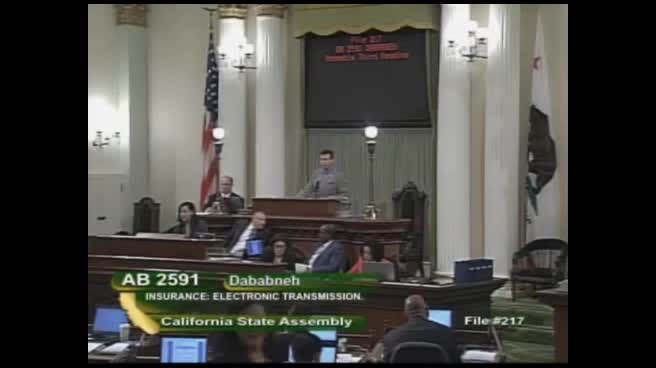
Bill Author

Bill Co-Author(s):